AB 1693: Civil service: minimum requirements: education.
- Session Year: 2023-2024
- House: Assembly
- Latest Version Date: 2023-03-23
Current Status:
Failed
(2024-02-01: From committee: Filed with the Chief Clerk pursuant to Joint Rule 56.)
Introduced
In Committee
First Chamber
In Committee
Second Chamber
Enacted
The California Constitution establishes the State Personnel Board (board) and requires the board to, among other things, enforce the civil service statutes, prescribe probationary periods and classifications, adopt rules authorized by statute, and review disciplinary actions. The Constitution also requires the executive officer of the board to administer the civil service statutes under the rules of the board. Existing law establishes the Department of Human Resources and provides that, subject to the requirements of the Constitution, it succeeds to and is vested with the duties, purposes, responsibilities, and jurisdiction exercised by the board as its designee with respect to the boards administrative and ministerial functions.
Existing law requires the board to establish minimum qualifications for determining the fitness and qualification for each class of position, including education, experience, knowledge, and abilities that each applicant is required to have to be considered eligible for a classification.
This bill would eliminate as a minimum qualification a college degree for all positions that do not require an associated required accreditation unless an agency can justify a college requirement by stating specific duties that necessitate a college degree. If an agency determines that a position requires a college degree, the bill would require that agency to include the specific duties that necessitate a college degree in any advertisements recruiting for that class of position.
The Davis-Stirling Common Interest Development Act defines and regulates common interest developments and requires that the development be managed by an association. Existing law requires, among other things, that if 2 or more associations have consolidated any of their functions, as specified, members of each participating association are entitled to attend and participate in all meetings of the joint association, except as provided, and to have access to records of the consolidated entity.This bill would make nonsubstantive changes to those provisions.The Davis-Stirling Common Interest Development Act defines and regulates common interest developments and requires that the development be managed by an association. Existing law requires, among other things, that if 2 or more associations have consolidated any of their functions, as specified, members of each participating association are entitled to attend and participate in all meetings of the joint association, except as provided, and to have access to records of the consolidated entity.
This bill would make nonsubstantive changes to those provisions.
(a)The board shall establish minimum qualifications for determining the fitness and qualifications of employees for each class of position, including education, experience, knowledge, and abilities that each applicant is required to have to be considered eligible for a classification. The department may require applicants for examination or appointment to provide documentation as it deems necessary to establish the applicants qualifications.
(b)(1)For purposes of setting the minimum education requirement for each class of position, the board shall not require a college degree unless one of the following is established:
(A)The class of position requires an associated accreditation for which a college degree is required.
(B)A state agency can demonstrate that a class of position requires the performance of specific duties that necessitate a college degree.
(2)If an agency establishes a college degree is required under subparagraph (B) for a class of position, that agency shall include the specific duties that necessitate a college degree in all advertisements recruiting for that class of position.
(b)
(c)The department shall develop standards for statements of qualifications used as the examination method in determining the fitness and qualifications of applicants for each class of position, when applicable. The department may require applicants for examination or appointment to provide documentation as it deems necessary to establish the applicants qualifications.
(c)
(d)Whenever the law requires that an applicant for a position as a peace officer be screened to ensure that the applicant is free from emotional and mental impairment, the department or the designated appointing authority shall undertake that screening subject to the applicants right to appeal to the board.
SECTION 1.Section 4820 of the Civil Code is amended to read:4820.Whenever two or more associations have consolidated any of their functions under a joint neighborhood association or similar organization, members of each participating association shall be:(a)Entitled to attend all meetings of the joint association other than executive sessions.(b)Given reasonable opportunity for participation in those meetings.(c)Entitled to the same access to the joint associations records as they are to the participating associations records.Whenever two or more associations have consolidated any of their functions under a joint neighborhood association or similar organization, members of each participating association shall be (a) entitled be:
(a)Entitled to attend all meetings of the joint association other than executive sessions, (b) given sessions.
(b)Given reasonable opportunity for participation in those meetings, and (c) entitled meetings.
(c)Entitled to the same access to the joint associations records as they are to the participating associations records.
|
Date
|
Status
|
|---|---|
| Feb 1, 2024 | From committee: Filed with the Chief Clerk pursuant to Joint Rule 56. |
| Jan 31, 2024 | Died pursuant to Art. IV, Sec. 10(c) of the Constitution. |
| Jan 18, 2024 | In committee: Held under submission. |
| Jan 18, 2024 | In committee: Set, first hearing. Referred to APPR. suspense file. |
| Jan 9, 2024 | From committee: Do pass and re-refer to Com. on APPR. (Ayes 7. Noes 0.) (January 9). Re-referred to Com. on APPR. |
| Mar 27, 2023 | Re-referred to Com. on P.E. & R. |
| Mar 23, 2023 | From committee chair, with author's amendments: Amend, and re-refer to Com. on P.E. & R. Read second time and amended. |
| Mar 23, 2023 | Referred to Com. on P.E. & R. |
| Feb 18, 2023 | From printer. May be heard in committee March 20. |
| Feb 17, 2023 | Read first time. To print. |
|
Date
|
Description
|
Location
|
Votes
|
|
|---|---|---|---|---|
| Jan 9, 2024 | Do pass and be re-referred to the Committee on [Appropriations] | Assembly Standing Committee on Public Employment and Retirement |
Passed |
This list shows positions taken on this bill by organizations on the date displayed, which is linked to the original source.
Positions by individuals are not included.
|
Organization
|
Position
|
Date
|
|---|---|---|
| AFSCME California | * Indeterminate | Jan 9, 2024 |
| SEIU 1000 | * Support | Jan 9, 2024 |
| SEIU California | * Indeterminate | Jan 9, 2024 |
Date of Hearing: January 18, 2024
ASSEMBLY COMMITTEE ON APPROPRIATIONS
Chris Holden, Chair
ABPCA Bill Id:AB 1693
Author:(Bauer-Kahan) – As Amended Ver:March 23, 2023
Policy Committee: | Public Employment and Retirement | Vote: | 7 - 0 |
|
| ||
|
|
Urgency: No State Mandated Local Program: No Reimbursable: No
SUMMARY:
This bill prohibits the State Personnel Board (SPB) from requiring a college degree for the purposes of setting minimum education requirements for positions in state government unless certain conditions are met.
Specifically, SPB is not to require a college degree for position eligibility purposes unless (1) the class of position requires an accreditation for which a college degree is required, or (2) a state agency can demonstrate that a class of position required the performance of specific duties that require a college degree. If a state agency successfully demonstrates (2), the bill requires the agency to include specific duties that necessitate a college degree in all advertised recruiting for that class of position.
FISCAL EFFECT:
- One-time General Fund costs to SPB, potentially in the high hundreds of thousands of dollars, to hire six staff to process and approve all changes submitted by CalHR by January 1, 2025. This bill does not specify a timeline by which its requirements must be completed, therefore it would go into effect January 1, 2025. California’s civil service has approximately 3,000 unique classifications.
- One-time General Fund costs to the California Department of Human Resources (CalHR), potentially in the millions of dollars, to hire dozens of limited-term positions to gather information, review existing classification specifications, determine which currently require a college degree, and process approved changes by January 1, 2025.
- Unknown, though potentially significant, General Fund and special fund costs to every state agency to demonstrate that a class of position requires a college degree and, if it successfully makes the demonstration, to include specific duties that necessitate a college degree in all advertised recruiting for that class of position.
COMMENTS:
- Background. CalHR is a state department tasked with operating the state civil service system according to the California Constitution, the merit principle, and applicable rules adopted by the SPB. SPB is a constitutional board tasked with establishing minimum qualifications, including education levels and experience, for each job classification in state service, among other duties. Current SPB regulations require civil service classifications to have job analyses. A job analysis is a process that identifies the essential tasks and functions of a job classification and the competencies required to perform them. If the job analysis determines that a college degree is necessary, then the classification reflects that a college degree is required as part of its minimum qualifications. Job analyses are required to be updated every five years.
The Governor issued Executive Order (EO) N-11-23 on August 31, 2023. Among other requirements, the EO required CalHR, by October 1, 2023, to update its policies and training materials for its job classification review process with regard to jobs requiring a bachelor’s degree as a minimum qualification. The EO requires CalHR to include, as part of its regular job classification review process, an analysis of whether a bachelor’s degree is necessary for successful performance in these positions and provide supporting documentation.
According to CalHR, it already has completed the review of hundreds of classifications, made amendments to requirements, and had amendments approved through SPB. CalHR notes that in some cases the amendments do not simply remove degree requirements altogether, but amend the education requirements.
While the Governor’s EO required CalHR to update certain policies and training materials by October 1, 2023, it does not prohibit SPB from requiring a college degree unless certain conditions were met, as this bill does. In addition, the EO requires the analyses of bachelor’s degree as part of CalHR’s regular review process, which could be over several years. This bill’s timeline is less clear, but presumably its provisions would go into effect January 1, 2025, were it signed into law
Analysis Prepared by: Natasha Collins / APPR. / (916) 319-2081
Date of Hearing: January 9, 2024
ASSEMBLY COMMITTEE ON PUBLIC EMPLOYMENT AND RETIREMENT
Tina S. McKinnor, Chair
ABPCA Bill Id:AB 1693 (
Author:Bauer-Kahan) – As Amended Ver:March 23, 2023
SUBJECT: Civil service: minimum requirements: education
SUMMARY: Eliminates a college degree as a minimum qualification in the state civil service for positions that do not require an associated required accreditation, unless the state agency can justify the need for the degree, among other provisions. Specifically, this bill:
- Provides that for purposes of setting the minimum education requirement for each class of position, the State Personnel Board (SPB) must not require a college degree unless one of the following is established:
- The class of position requires an associated accreditation for which a college degree is required;
- A state agency can demonstrate that a class of position requires the performance of specific duties that necessitate a college degree.
- Requires the agency to include the specific duties that necessitate a college degree in all advertisements recruiting for that class of position, if the agency establishes that a college degree is necessary, as prescribed.
EXISTING LAW:
- Establishes, pursuant to Section 1 of Article VII of the Constitution of California, that the civil service includes every officer and employee of the state, except as otherwise provided.
- Creates the state civil service that includes every officer and employee of the State except a limited number of specified, exempted officers and employees. Existing law also requires that the state make “permanent appointment and promotion in the civil service under a general system based on merit ascertained by competitive examination.” Case law and custom refer to this provision as the merit principle and it governs the administration of the state’s civil service system.[1]
- Establishes the State Civil Service Act to facilitate the operation of the Constitution’s merit principle for the state civil service.[2]
- Requires, pursuant to the Civil Service Act, that state employment to be based on the merit principle; appointments are based upon merit and fitness ascertained through practical and competitive examination; tenure of civil service employment is subject to good behavior, and among other provisions, applicants and employees are treated in an equitable manner without regard to political affiliation, race, color, sex, religious creed, national origin, ancestry, marital status, age, sexual orientation, disability, political or religious opinions or non-job related factors.
- Establishes, pursuant to Section 3, Article VII of the California Constitution, the SPB which must enforce civil service statutes, and by majority vote of all its members, prescribe probationary periods and classifications, adopt other rules authorized by statute, and review disciplinary actions. In addition, the Executive Officer of the SPB is required to administer civil service statutes under the rules of the SPB.
- Establishes the California Department of Human Resources (CalHR), which succeeds to and is vested with the powers and duties of the former Department of Personnel Administration, to operate the state civil service system pursuant to Article VII of the California Constitution, applicable sections of the Government (Gov.) Code, the merit principle, and applicable rules adopted by the SPB.[3]
- Requires the SPB to prescribe rules consistent with a merit based civil service system to govern appointments classifications, examinations, probationary periods, disciplinary actions, and other matters related to the SPB’s authority under Article VII of the California Constitution. Existing law also authorizes the SPB to conduct audits and investigations of the personnel practices of the CalHR and appointing authorities to ensure compliance with civil service policies, procedures, and statutes, and to post notices of proposed changes to regulations for public comment.[4]
- Requires the CalHR and the SPB to enter into a memorandum of understanding to determine areas of compliance for nonmerit-related audits and to train SPB staff on the areas of compliance.[5]
- Requires the SPB to establish minimum qualifications for determining the fitness and qualifications of employees for each class of position, among other things, and authorizes the CalHR to require applicants for examination or appointment to provide documentation as it deems necessary to establish the applicants’ qualifications.[6]
- Authorizes the CalHR to designate an appointing power to design, announce, or administer examinations for the establishment of employment lists as specified. Existing law also permits a designated appointing power to contract with the CalHR or another designated appointing power for the purpose of designing, publicizing, or administering an examination.[7]
- Defines the following terms:
- “Position” to mean any office or employment in the “state civil service” as the phrase is defined in Section 1 of Article VII of the Constitution.[8]
- “Appointment” to mean the offer to and acceptance by a person of a position in the state civil service, as provided.[9]
- “Appointing authority” or “appointing power” to mean a person or group having authority to make appointments to positions in the state civil service.[10]
- “Probationer” to mean an employee who has probationary status. “Probationary status” to mean the status of an employee who has been certified and appointed from an employment list, or has been reinstated after resignation, or has been transferred or demoted but who has not completed the probationary period.[11]
- “Permanent employee” to mean an employee who has permanent status. “Permanent status” to mean the status of an employee who is lawfully retained in their position after the successful completion of the probationary period, including an employee who is lawfully appointed to their position after successful completion of the job examination period under the Limited Examination and Appointment Program.[12]
- Permits the CalHR and the SPB to delegate, share, or transfer between them responsibilities for programs within their respective jurisdictions pursuant to an agreement.[13]
FISCAL EFFECT: Unknown. This bill is flagged as fiscal by Legislative Counsel.
COMMENTS: According to the author, “[e]mployment in good paying jobs should not be limited by arbitrary filters. Requiring a college degree for our state service is often no more than a barrier to otherwise qualified candidates. California’s ambitious housing, environmental, and social support goals will require rapid hiring. By removing a college degree requirement where it is unnecessary for the position, we can increase the equity and the capacity of our workforce and expand opportunities for Californians.”
Information provided by the author states that, “[o]ver recent decades, the number of jobs requiring a college degree has skyrocketed, even for roles that traditionally do not require such a credential. This phenomena, known as “degree inflation,” hurts candidates that would have otherwise been qualified. [A study titled “Dismissed by Degrees” in 2017] led by researchers at Harvard Business School found more than 60 percent of employers rejected qualified candidates in terms of skills or experience simply because they did not have a college diploma. These hiring managers then found these positions were harder to fill.[14] The study showed that when companies switched to not requiring degrees, they had better employment outcomes and better retention of the folks they employed. Additionally, they were able to offer resources like workforce training that helped improve their retention.[15]
“Many people can be well qualified for a state role without having a college degree. A college degree is often used as a proxy for other skills[16], but these skills can easily be learned and demonstrated through other experiences and training.”
For these purposes, the author concludes by stating, “[this bill] allows degree requirements to be used when needed for a specific credential, but otherwise requires those requirements to be removed.”
- The Paper Ceiling? Purposes of a College Degree
Generally, successful completion of college serves a number of purposes both individually and professionally, although, such purposes largely remain consistent among both public (i.e., government or governmental) and private sector employers.
Historically, the narrative supporting the reason to obtain a college degree stipulates that it offers work-related skills; increased career pathways and stability; personal growth; financial growth/higher average earnings, and there is a lower correlation to unemployment and/or poverty among the college-educated workforce, among other beneficial attributes.
For both public and private sector employers, among other things, successful completion of a college education demonstrates that an individual can successfully complete a long-term project, think logically and critically, identify and clearly communicate (verbal, written, or both) issues, identify and clearly communicate (verbal, written, or both) solutions, and satisfactorily perform the work or collectively work with others to implement solutions, among others.
Modernly, with ongoing (if not increased) economic uncertainty, including periodic or cyclical labor market uncertainty coupled with the increasing costs of a college education and potential to incur debt or substantial debt as a result (especially if a college education and the resulting debt is not viewed as a personal investment in one’s own future), individuals continue to question its necessity and worth. Further, given ongoing technological advancements and the digital age where information or services are readily available at the press of a button or screen tab, and seemingly endless opportunities exist for individuals to passionately pursue a career path that provides flexibility or is on their terms (including for potentially greater near-term financial reward and personal gratification), the historical narrative of a college degree may be waning and viewed as a false dichotomy,[17] and the emphasis or practice of requiring a college degree is referred to as “degree inflation.”
Overall, as public sector employment in the civil service has decreased due to retirements or other attrition,[18] and the recruitment and retention of generational talent for public service has remained relatively stagnant, governmental entities too, have started to question the necessity of a college degree for certain public sector positions towards meeting the increased needs of the public.
- 2001 Annual Census of Employees in the State Civil Service
Like California, other state governments and the federal government are experiencing shortages in their respective public sector workforce, and are considering options to address this challenge.
In December 2021, the California labor force was approximately 19 million. Of the 19 million, approximately 18 million Californians were employed, and approximately 913 thousand were unemployed.[19]
According to the “2001 Annual Census of Employees in the State Civil Service” report, as of December 2021, civil service employees accounted for approximately 1.2 percent of California’s employed. Total hires into civil service during 2021 were 26,601, which was approximately 0.1 percent of the state labor force according to the Employment Development Department, Report 400C for 2001. (Previously referenced, ibid.) During this period, there were 16,837 advancements; 733 demotions; and, 23,514 permanent separations (which is approximately 10.6 percent of the 222,122 employees of December 31, 2021.
Further, when comparing civil service employees to the California labor force, civil service employees had the highest salary range and the lowest percentage in the $40,000 and below salary range and the lowest percentage in the $100,000 - $130,000 salary range. Although the demographic composition of the civil service covers the range among gender, and a greater range among race and ethnicity, age, disability, and veterans, among white and non-white employees, non-white employees account for a continuous increase in the percentage of the civil service workforce during a five-year period from 2017 to 2021. During this same period, the percentage of white civil service employees decreased by 3.4 percent, with non-white employees increasing by the same percentage.[20] Although there has been an increase in non-white employees in the state civil service, those populations (as well as women, following data extrapolation by gender) tend to be overrepresented in occupations that do not pay a family-sustaining wage.[21]
- Minimum Qualifications for State Civil Service Appointment
Among private for-profit, private non-profit, government, and self-employed individuals, government employees have a higher percentage of having a certificate or license, with those in the teaching profession comprising a higher percentage of those who have some form of a credential among government employees.[22]
For each class of position within the state civil service, a job announcement includes, among other information, a description of the position, and minimum qualifications. As an example, see the classic job announcement examination for a common state civil service position known as “Staff Services Analyst,” which is an entry-level position that performs analytical, consultative, and specialized evaluative tasks related to administration of a state program, among other duties.[23]
For this classification, the candidate must possess the equivalent of completing the 12th grade, and have four years of experience performing certain analytical, technical, and clerical skills, among others. Although a college degree is not required, an academic education from an accredited college or university may be substituted for the required experience on a year-by-year basis. (Emphases added.) Thus, in this instance, a college degree is optional as a substitute for the requisite years of experience.
It is noted that a substitution of the minimum qualifications – completion of X or equivalent and years of experience, or possessing a college degree as a substitute for years of experience – may relatively be common among some or many state civil service classifications. However, generally and for example, professional classifications such as actuaries, attorneys, doctors, dentists, engineers, nurses, physician assistants, psychiatrists, psychologists, scientists, etc., in which certain knowledge or skill is critical to appropriately and successfully demonstrate aptitude and ability to perform duties, or an ability to obtain a license or other accredited certification that is predicated on successful completion of college or completion of a requisite number of units is required to lawfully perform certain duties, there may be no substitute or a very limited substitute for a college degree, other accredited certification, or certification requirement.[24]
Where applicable among the litany of classes of positions, the “substitute model” for minimum qualifications may render this bill as unnecessary as it may be sufficient to help individuals overcome the degree requirement as a potential barrier to employment; or, the Governor’s executive order (discussed below) may render the need for the bill as moot and therefore, unnecessary. Regardless, given the historical narrative that emphasizes the importance of obtaining a college degree (even if the historical narrative may, perhaps, be waning), such a barrier may still exist if a candidate who does not possess a college degree is competing against a college-educated candidate for the same state civil service position, assuming that all other qualifications and examination outcomes among the two candidates are the same, equal, or substantially the same or equal.
- California’s Action on the Subject via Governor’s Executive Order
Issued on August 31, 2023, Executive Order N-11-23 provides, among other things, that on or before October 1, 2023, the CalHR must update its existing policies and training materials to require, as part of the regular job classification review process for any position in which a bachelor’s degree remains a job-related educational requirement, explicit analysis of whether a bachelor’s degree is necessary for successful performance in the position and, if it is determined necessary, supporting data that demonstrates the necessity.[25] (Emphasis added.)
Under the executive order, the CalHR would review state civil service classifications and the necessity for a bachelor’s degree requirement, and it if is deemed that the degree requirement remains, CalHR must demonstrate the necessity for the requirement.
- Similar Efforts for Similar Reasons in Other States and Commonwealths
It is noted that, although the Governor issued the executive order discussed above, a number of other states and commonwealths also have implemented similar practices through executive order or legislation to reduce barriers to executive branch-level employment that may assist to address workforce shortages in this sector. These states or commonwealths are:[26]
- Maryland: An initiative was announced to eliminate four-year college degree requirements for more than half of the state’s 38,000 jobs.[27]
- Arizona: Removed bachelor’s degree requirements for public school teachers, and authorizes a teacher to be temporarily certified while enrolled in a bachelor’s program and become fully certified upon degree completion.[28] Another law was signed by the Governor on April 7, 2023, that requires identification of state employee positions that are suitable for skilled through alternative route applicants, in which such applicants have developed skills through job training, community college, military service or an apprenticeship who meet certain criteria (including, does not have a bachelor or graduate degree).[29]
- Tennessee: Prohibits a state agency from requiring a baccalaureate degree as a condition of employment, unless the knowledge, skills, or abilities for the position can only reasonably be obtained through a course of study culminating in a baccalaureate degree.[30]
- Oregon: The state’s teacher licensing board eliminated college degree requirements for substitute teachers, until May 29, 2023.[31]
- Utah: An initiative was launched to eliminate the requirement for a bachelor’s degree for 98 percent of the state’s 1,080 jobs.[32]
- Colorado: State agencies were ordered to integrate skills-based hiring practices and make skills and experience interchangeable with degree requirements.[33]
- Alaska: State agencies were ordered to substitute practical experience for a degree in hiring where possible.[34]
- Pennsylvania: An executive order opened approximately 65,000 (92 percent) commonwealth executive branch jobs to those without degrees.[35]
- New Jersey: The state was ordered to prioritize skills and work experience over college degree requirements for certain state jobs that can pay up to $120,000 a year, opening them to nearly 2 million New Jersey residents with a bachelor’s degree.[36]
- Georgia: The “Reducing Barriers to Staten Employment Act of 2023” directs state agencies to reduce positions requiring a four-year college degree, among other provisions.[37]
- North Carolina: It was ordered that most state jobs reflect that experience can substitute for education and state hiring managers eliminate preferences for degrees for jobs that do not need them.[38]
- South Dakota: Expands job opportunities to those without a postsecondary degree by requiring executive branch agencies to consider work or life experiences of an applicant, and requires the job position to state whether a degree is required to fill the position.[39]
- Ohio: Requires a review of all state classifications where a degree is required by statute or regulation; propose amendments to those classifications where job modernization may have occurred; review job posting and descriptions; and, to develop a statewide policy on skills-based hiring (including that preferred qualifications in hiring practices are not stated in terms of academic degrees), among other provisions.[40]
- Virginia: Effective July 1, 2023, provides equal consideration to applicants with an equivalent combination and level of training, knowledge, skills, certifications, and experience for approximately 90 percent of state (commonwealth)-classified positions.[41]
- Florida: The “Expanding Public Sector Career Opportunities Act” provides, among other things, that a public employer may include a postsecondary degree as a baseline requirement only as an alternative to the number of years of direct experience required, as provided.[42]
- Missouri: Prohibits state agencies form denying consideration to any applicant based solely on lacking a postsecondary degree, and authorizes state agencies to include prior direct experience and particular certifications and courses as baseline requirements, but not include a postsecondary degree as a baseline requirement.[43]
- Michigan: Waives a degree requirement for veterans seeking state jobs.[44]
- Minnesota: Eliminates the condition for a four-year college degree for approximately 75 percent of state positions, and minimum qualification requirements for eligible jobs would focus on experience; however, positions that require a professional license or by state or federal law, or call for professional training, would still require a degree.[45]\
- Key Differences Between the Relevant Subject of the Executive Order and This Bill
The approach by both public policy options ultimately are intended to serve the same purposes and achieve common objectives in the state civil service by: i) removing a barrier to employment for those whom may not otherwise be qualified; ii) increasing recruitment and retention; and, iii) addressing shortages in the state workforce.
While each option recognizes that factors such as life and other occupational skills may or should be of equal weight when compared to a college degree to demonstrate potential or likely success in performing job duties, among them, they propose a different approach, as discussed below.
- The Executive Order
As previously discussed, among other things, the executive order requires an update to existing policies and training materials regarding the bachelor’s degree requirement for civil service classifications; an analysis of whether this degree is necessary; and, supporting data that demonstrates the necessity if it is determined that the bachelor’s degree is necessary. It is important to note that, while the executive order directs the CalHR to perform this work, the CalHR has and continues to work on classification consolidation eliminating a number of types of employment barriers, including job-related educational requirements. The executive order acknowledges this ongoing work by the CalHR by expressly stating, “… as part of the regular job classification review process….” (Emphases added.) As examples of this ongoing regular review process, information received from the CalHR shows that relevant changes have been made for the following class titles during the past several years:
- Research Data Series: Removed multiple class-specific educational requirements. Approved by the SPB on July 12, 2018, this change applies to 36 classifications within this series.
- Information Technology Series: Decreased education and experience requirements. Approved by the SPB on January 11, 2018, this change applies to 37 classifications within this series.
- Custodial Series: Removed high school graduation requirement. Approved by the SPB on December 12, 2019, this change applies to approximately 16 classifications within this series.
- Actuary Series: Broadened entry level classes to allow more areas of study to qualify. Approved by the SPB on May 5, 2022, this change applies to 15 classifications within this series.
- Investigator Series: Broadened minimum qualifications to allow more areas of study to qualify. Approved by the SPB on November 10, 2022, this change applies to 21 classifications within this series.
- Staff Services Analyst (5157): Removed educational unit requirements. This change was approved by the SPB on March 9, 2023.
- Attorney/Deputy Attorney General Series: Lowered required years of experience after passing the California Bar Examination. This change was approved by the SPB on November 12, 2023, and applies to 43 classifications within this series.
- This Bill
The provisions of this bill propose to eliminate a college degree (which could be construed to mean “any” college degree or “all” college degrees, not just a bachelor’s degree as in the executive order) as a minimum qualification for all positions that do not require an associated accreditation, unless it can be justified, as provided, and inclusion of the specific duties that require a college degree in all advertisements recruiting for the position. As such, this bill proposes more what may be viewed as a narrow approach of the executive order. (Emphasis added.)
Some may raise questions as to the wisdom of eliminating a (again, potentially being construed as “any” or “all”) college degree as a minimum qualification; however, it does not equate to a college degree not being required at all. The provisions of this bill would allow the state – as an employer – to maintain a college degree as a minimum qualification requirement for a class of position, if it can be justified – somewhat similar to the executive order. Here, it is important to note that each class of position in the state civil service has specific duties that are inherent to public service that naturally and ultimately inure to benefit the health, safety, and welfare of the public regardless of whether some classes of positions have a more immediate connection to those common goods in the provision of services directly to the public than others.
Although it would remain to be determined and seen as to what the justification may be as to the need for a college degree, a college degree (including the specific subject of a degree or units completed in a specific subject) will continue to be required for a professional class of position, as previously discussed. Moreover, as previously discussed for some of the prior examples are positions in which licensure or certification is predicated on having a degree (or certain degree, including certain subject), or to otherwise be qualified and lawfully authorized to perform certain duties, this bill also recognizes this by expressing “… for all positions that do not require associated accreditation….” (Emphasis added.)
Finally, although a gubernatorial executive order may expire, be rescinded by the governor or successor governor, or invalidated by judicial decision following a successful legal challenge, this bill would establish a statutory (i.e., to place into law, make law, or codify in law) approach to minimum qualification in the state civil service, rather than largely rely on executive (i.e., gubernatorial) fiat that may be subject to change and is external to the appropriate legislative law-making process.
- Other Items to Consider
- The State Civil Act and the Merit Principle
The State Civil Service Act exists to establish a uniform standard in the appointment of individuals to the state civil service. Within the act, the basic premise of the merit principle is to ascertain an individual’s ability to perform job duties when making hiring (and promotional) decisions. The act “evens the playing field,” so to speak, by curtailing bias in awarding appointments based on nonmerit factors such as favoritism, graft, nepotism, political affiliation or influence, discrimination, and other suspect hiring practices (i.e., “spoils”) in employment candidacy and appointment that were common prior to the act.[46]
When considering this history and purpose, a college degree requirement as a minimum qualification may be viewed as aligned with the spirit of the act and its merit principle. Here, it may viewed that, although a degree requirement might be a barrier to employment to some individuals, the requirement may serve, in some respects, to assist in curtailing suspect hiring practices, as previously discussed.
Alternatively, among other viewpoints or arguments, a college degree requirement may be viewed or argued as currently misaligned with the merit principle in that requiring a college degree is not entirely indicative of, nor fully ascertains, an individual’s ability to perform job duties. Rather, in part, the degree requirement excludes or minimizes other qualitative factors of equal or greater importance that also are or should be indicative of an individual possessing the requisite knowledge and skill to satisfactorily perform the job. As such, the requirement to have a college degree is detrimental to otherwise qualified candidates and is not true to, nor consistent with, the basic tenets or foundational “spirit” of the merit principle because the requirement creates an uneven playing field.
- Suggestion to the Author for Consideration
Appreciating the history and purposes of the State Civil Service Act, including the merit principle, to the extent that over time, removing a college degree as a minimum qualification, subject to justification as provided in this bill, results in appointment activity that dilutes the merit principle and potentially results in a return of suspect hiring practices that offend the intents and purposes of the act and merit principle, the author may wish to include a provision that would require the CalHR to update its existing policies, including training materials, similarly as expressed in the executive order.
- Potential Impacts to Higher Education Funding in the Future
To the extent that this bill serves its purposes and achieves its objectives, it also potentially may result in a decline in college enrollment/completion, particularly among individuals whom are interested in entering the state civil service. A decline in enrollment/completion may negatively affect state budgetary allocations for higher education in future years. However, it is acknowledged that a decrease in college enrollment/completion that may directly be attributed to this bill, if any, could be difficult to determine.
The committee is informed that although the subject of this specific subheading is not within the subject matter expertise nor jurisdiction of this committee, it is only offered to contribute to the broader context of the dialogue relating to the subject of this bill.
- Assertions Regarding the Quality of Public Service Provision
Given the number of other states and commonwealths that are taking similar steps to address similar challenges, it is currently unknown whether there may be a correlation between the number of individuals hired who do not possess a college degree and a change in the quality of services provided to the public. Therefore, assertions regarding any such correlation may be premature or debatable at this time.
- Prior or Related Legislation
Assembly Bill 1493 (Carrillo) would establish the Career Development Apprenticeship Program, administered and overseen by the CalHR, that would provide an alternative to the traditional civil service examination appointment process, among other provisions. This bill is currently pending in the Assembly Committee on Public Employment and Retirement.
REGISTERED SUPPORT / OPPOSITION:
Support
None on file.
Opposition
None on file.
Analysis Prepared by: Michael Bolden / P. E. & R. / (916) 319-3957
Sections 1 and 4, art. VII, Cal. Const. ↑
Section 18500, inclusive, of the Government (Gov.) Code. ↑
Section 18502 (a) of the Gov. Code. ↑
Section 18502 (b), ibid. ↑
Section 18502 (b) (2) of the Gov. Code. ↑
Section 18931 (a) of the Gov. Code. ↑
Section 18930.5, inclusive, of the Gov. Code. ↑
Section 18522 of the Gov. Code. ↑
Section 18525 of the Gov. Code. ↑
Section 18524 of the Gov. Code. ↑
Section 18527 of the Gov. Code. ↑
Section 18528 of the Gov. Code. ↑
Section 18502 (c) of the Gov. Code. ↑
“Dismissed by Degrees. How degree inflation is undermining U.S. Competitiveness and hurting America’s middle class.” Harvard Business School, 2017. ↑
“No college degree? No problem. More companies are eliminating requirements to attract the workers they need.” CNBC, April 27, 2022. ↑
“Stop requiring college degrees for jobs that don’t need them.” Vox, March 19, 2023. ↑
“Is College Worth It?” Pew Center Research, May 15, 2011. ↑
Other attrition includes layoffs, acceptance of exempt appointment, resignation, rejection during the probationary period, dismissal, or death. ↑
Report 400C: Monthly Labor Force Data for Counties. Employment Development Department, 2021 – Revised. Note: Data from Report 400C may be rounded. ↑
“2021 Annual Census of Employees in State Civil Service.” California Government Operations Agency/CalHR Report to the Governor and Legislature, August 2023. ↑
“State workers struggle to make ends meet thoughout California; Women, Black, and Latino workers are disproportionately affected.” University of California at Berkeley Labor Center, March 15, 2023 ↑
Spotlight on Statistics (2022), United States (U.S.) Bureau of Labor Statistics, graph 11. ↑
Staff Services Analyst (5157) - CalHR Job Announcement. ↑
Job Descriptions - CalHR. (CalHR website resource/search tool.) ↑
See numerical paragraph 5 of the Governor’s Career Education Executive Order. ↑
Note that as of this writing, the list of other states or commonwealths may not be exhaustive. ↑
“Amid Record-High Agency Vacancy Rates, Hogan Lifts Degree Requirements for Thousands of State Jobs.” Maryland Matters, March 16, 2022. ↑
Senate Bill 1159 (2022, Fifty-fifth Legislature – Second Regular Session). ↑
House Bill 2225 (2023, Fifty-sixth Legislature – First Regular Session). ↑
“Substitute teachers in Oregon don’t need a college degree – for now, officials say.” The News Tribune.
October 14, 2021; “Oregon temporarily drops college degree requirement for substitute teachers to alleviate shortage.” OregonLive/The Oregonian, Oct. 19, 2021. ↑
“Gov. Cox Launches Skills-First hiring Initiative for State Government.” Office of the Governor, December 13, 2022. ↑
“Gov. Polis Takes Innovative Action to Attract New and Skilled Talen to State Workforce.” Office of the Governor, April 14, 2022. ↑
Administrative Order No. 343, Office of the Governor, February, 14, 2023. ↑
“Gov. Shapiro Leads the Nation on Eliminating Degree Requirements, Expanding Job Opportunities.” Office of the Governor, March 1, 2023. ↑
“Governor Murphy Signs Executive Order to Prioritize Work Experience and Skills Training Over Four-Year Degrees for Certain State Employment Opportunities.” Office of the Governor, April 10, 2023. ↑
Senate Bill 3 (2023 Regular Session). Office of the Governor, 2023 Signed Legislation. ↑
“Recognizing The Value of Experience in State Government Hiring.” Office of the Governor, March 13, 2023. ↑
“Gov. Noem Signs Executive Order Expanding Job Opportunities.” News.SD.Gov., April 24, 2023. ↑
“Establishing the State of Ohio as a Model Employer for Skills-Based Hiring Practices.” Executive Order 2023-10D. ↑
“Gov. Glenn Youngkin Announces Landmark Change in State Agency Hiring Practices.” Office of the Governor of Virginia, May 30, 2023. ↑
Chapter 2023-256 (CS/CS/Senate Bill 1310 (2023)), Florida. ↑
House Bill 417, creates incentives for the purpose of encouraging certain individuals to obtain employment-related skills. ↑
“State of Michigan initiative opens up thousands of job opportunities for veterans.” Michigan Veterans Affairs Agency, October 4, 2023. ↑
“Gov. Walz Signs Executive Order Eliminating Four-Year College Degree Requirement for Most State Government Jobs,” Office of the Governor and Lieutenant Governor, October 30, 2023. ↑
“Merit System Principles – An Overview,” CalHR website. ↑
Discussed in Hearing
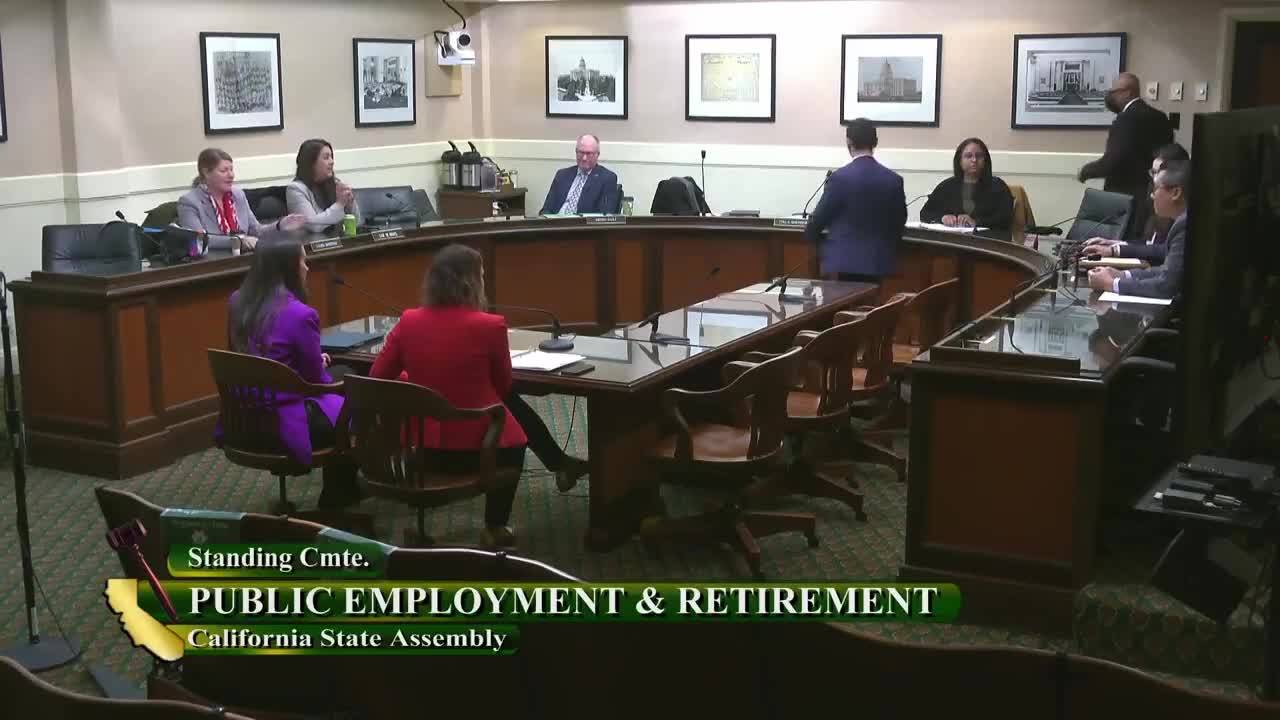 32MIN
Assembly Standing Committee on Public Employment and Retirement
Bill Author

Bill Co-Author(s):