AB 1724: Sales and Use Tax Law: rates.
- Session Year: 2023-2024
- House: Assembly
- Latest Version Date: 2023-03-16
Current Status:
Failed
(2024-02-01: From committee: Filed with the Chief Clerk pursuant to Joint Rule 56.)
Introduced
In Committee
First Chamber
In Committee
Second Chamber
Enacted
What does this bill do?
This bill temporarily lowers the statewide sales and use tax that shoppers pay and retailers collect from 4.75% to 3.75% for sales and purchases in California between January 1, 2024 and January 1, 2025. The rate returns to 4.75% on and after January 1, 2025.
The summary is provided by generative AI which can make mistakes. For original language, please view the details in the table below.
Existing sales and use tax laws impose a tax on retailers measured by the gross receipts from the sale of tangible personal property sold at retail in this state, or on the storage, use, or other consumption in this state of tangible personal property purchased from a retailer for storage, use, or other consumption in this state.
This bill would reduce the rate of tax imposed by the Sales and Use Tax Law on and after January 1, 2024, and before January 1, 2025, by 1%.
This bill would take effect immediately as a tax levy.
Existing law authorizes a taxpayer to appeal the decision of the Franchise Tax Board to disallow a claim for refund. That law requires the Office of Tax Appeals (office) to hear and determine the appeal and to notify the taxpayer and the Franchise Tax Board of its determination. Existing law makes the determination of the office final after 30 days unless the taxpayer or the Franchise Tax Board files a petition for rehearing. In the case of a petition for rehearing, existing law makes the determination final 30 days from the date the office issues its opinion on the petition.This bill, instead, would make the determination final after 35 days as specified in both of the circumstances described above.Existing law authorizes a taxpayer to appeal the decision of the Franchise Tax Board to disallow a claim for refund. That law requires the Office of Tax Appeals (office) to hear and determine the appeal and to notify the taxpayer and the Franchise Tax Board of its determination. Existing law makes the determination of the office final after 30 days unless the taxpayer or the Franchise Tax Board files a petition for rehearing. In the case of a petition for rehearing, existing law makes the determination final 30 days from the date the office issues its opinion on the petition.
This bill, instead, would make the determination final after 35 days as specified in both of the circumstances described above.
For the privilege of selling tangible personal property at retail retail, a tax is hereby imposed upon all retailers at the rate of 21/2 percent following rates of the gross receipts of any retailer from the sale of all tangible personal property sold at retail in this state on or after August 1, 1933, and to and including June 30, 1935, and at the rate of 3 percent thereafter, and at the rate of 21/2 percent on and after July 1, 1943, and to and including June 30, 1949, and at the rate of 3 percent on and after July 1, 1949, and to and including July 31, 1967, and at the rate of 4 percent on and after August 1, 1967, and to and including June 30, 1972, and at the rate of 33/4 percent on and after July 1, 1972, and to and including June 30, 1973, and at the rate of 43/4 percent on and after July 1, 1973, and to and including September 30, 1973, and at the rate of 33/4 percent on and after October 1, 1973, and to and including March 31, 1974, and at the rate of 43/4 percent thereafter. state:
(a)On and after April 1, 1974, and before January 1, 2024, 43/4 percent.
(b)On and after January 1, 2024, and before January 1, 2025, 33/4 percent.
(c)On and after January 1, 2025, 43/4 percent.
SEC. 2.Section 6201 of the Revenue and Taxation Code is amended to read:6201.An excise tax is hereby imposed on the storage, use, or other consumption in this state of tangible personal property purchased from any retailer on or after July 1, 1935, for storage, use, or other consumption in this state at the rate of 3 percent following rates of the sales price of the property, and at the rate of 21/2 percent on and after July 1, 1943, and to and including June 30, 1949, and at the rate of 3 percent on and after July 1, 1949, and to and including July 31, 1967, and at the rate of 4 percent on and after August 1, 1967, and to and including June 30, 1972, and at the rate of 33/4 percent on and after July 1, 1972, and to and including June 30, 1973, and at the rate of 43/4 percent on and after July 1, 1973, and to and including September 30, 1973, and at the rate of 33/4 percent on and after October 1, 1973, and to and including March 31, 1974, and at the rate of 43/4 percent thereafter. property:
(a)On and after April 1, 1974, and before January 1, 2024, 43/4 percent.
(b)On and after January 1, 2024, and before January 1, 2025, 33/4 percent.
(c)On and after January 1, 2025, 43/4 percent.
SEC. 3.This act provides for a tax levy within the meaning of Article IV of the California Constitution and shall go into immediate effect.
SECTION 1.Section 19334 of the Revenue and Taxation Code is amended to read:19334.The determination of the board is final upon the expiration of 35 days from the date of the determination unless within the 35-day period, the taxpayer or Franchise Tax Board files a petition for rehearing with the board. In that event the determination becomes final upon the expiration of 35 days from the date the board issues its opinion on the petition.The determination of the board is final upon the expiration of 30 35 days from the date of the determination unless within the 30-day 35-day period, the taxpayer or Franchise Tax Board files a petition for rehearing with the board. In that event the determination becomes final upon the expiration of 30 35 days from the date the board issues its opinion on the petition.
|
Date
|
Status
|
|---|---|
| Feb 1, 2024 | From committee: Filed with the Chief Clerk pursuant to Joint Rule 56. |
| Jan 31, 2024 | Died pursuant to Art. IV, Sec. 10(c) of the Constitution. |
| May 1, 2023 | In committee: Set, final hearing. Held under submission. |
| Apr 18, 2023 | In committee: Set, second hearing. Referred to REV. & TAX. suspense file. |
| Apr 11, 2023 | In committee: Set, first hearing. Hearing canceled at the request of author. |
| Mar 20, 2023 | Re-referred to Com. on REV. & TAX. |
| Mar 16, 2023 | From committee chair, with author's amendments: Amend, and re-refer to Com. on REV. & TAX. Read second time and amended. |
| Mar 16, 2023 | Referred to Com. on REV. & TAX. |
| Feb 18, 2023 | From printer. May be heard in committee March 20. |
| Feb 17, 2023 | Read first time. To print. |
This list shows positions taken on this bill by organizations on the date displayed, which is linked to the original source.
Positions by individuals are not included.
|
Organization
|
Position
|
Date
|
|---|---|---|
| Howard Jarvis Taxpayers Association | * Support | Apr 17, 2023 |
Date of Hearing: May 1, 2023
ASSEMBLY COMMITTEE ON REVENUE AND TAXATION
Jacqui Irwin, Chair
ABPCA Bill Id:AB 1724 (
Author:Sanchez) – As Amended Ver:March 16, 2023
SUSPENSE
Majority vote. Tax levy. Fiscal committee.
SUBJECT: Sales and Use Tax Law: rates
SUMMARY: Reduces by 1% the portion of the statewide sales and use tax (SUT) rate allocated to the General Fund for the 2024 calendar year.
EXISTING LAW:
- Imposes a sales tax on retailers for the privilege of selling tangible personal property (TPP), absent a specific exemption. The tax is based upon the retailer's gross receipts from TPP sales in this state. (Revenue & Taxation Code (R&TC) Section 6001 et seq.)
- Imposes a complimentary use tax on the storage, use, or other consumption of TPP generally purchased out-of-state and brought into California. The use tax is imposed on the purchaser; and unless the purchaser pays the use tax to an entity registered to collect California's use tax, the purchaser remains liable for the tax. The use tax is set at the same rate as the state's sales tax and must generally be remitted to the California Department of Tax and Fee Administration (CDTFA). (R&TC Section 6001 et seq.)
- Provides SUT exemptions for food products for human consumption, as specified. (R&TC Section 6359.)
- Provides SUT exemptions for utilities including gas, electricity, and water, when delivered to consumers through mains, lines, or pipes, as specified. (R&TC 6353.)
- Defines "tax expenditure" as a credit, deduction, exclusion, exemption, or any other tax benefit as provided for by the state. (R&TC Section 41(b).)
- Requires any bill introduced on or after January 1, 2020, that authorizes a tax expenditure, to contain all of the following:
- Specific goals, purposes, and objectives that the tax expenditure will achieve;
- Detailed performance indicators for the Legislature to use when measuring whether the tax expenditure meets the goals, purposes, and objectives stated in the bill; and,
- Specified data collection requirements to enable the Legislature to determine whether the tax expenditure is meeting, failing to meet, or exceeding those specific goals, purposes, and objectives. (R&TC Section 41(a).)
FISCAL EFFECT: The CDTFA estimates revenue losses of $9.51 billion in calendar year 2024.
COMMENTS:
- The author has provided the following statement in support of this bill:
Rising inflation and higher prices are affecting us all. AB 1724 will offer immediate financial relief for everyone. The one percent reduction in sales tax will allow hard-working Californians to keep more money in their pockets and let them decide how they would like to spend it. This is a common-sense solution to help all who have been hit by the rising costs in our state.
- Committee Staff Comments:
- What is a "tax expenditure"? Existing law provides various credits, deductions, exclusions, exemptions, and preferential rates for particular taxpayer groups. In the late 1960s, U.S. Treasury officials began arguing that these features of the tax law should be referred to as "expenditures" since they are generally enacted to accomplish some governmental purpose and there is a determinable cost associated with each (in the form of foregone revenues).
- What is a "tax expenditure"? Existing law provides various credits, deductions, exclusions, exemptions, and preferential rates for particular taxpayer groups. In the late 1960s, U.S. Treasury officials began arguing that these features of the tax law should be referred to as "expenditures" since they are generally enacted to accomplish some governmental purpose and there is a determinable cost associated with each (in the form of foregone revenues).
As the Department of Finance notes in its annual Tax Expenditure Report, there are several key differences between tax expenditures and direct expenditures. First, tax expenditures are reviewed less frequently than direct expenditures. Second, there is generally no control over the amount of revenue losses associated with any given tax expenditure. Finally, it should also be noted that, once enacted, it takes a two-thirds vote to rescind an existing tax expenditure absent a sunset date. This effectively results in a "one-way ratchet" whereby tax expenditures can be conferred by majority vote, but cannot be rescinded, irrespective of their efficacy or cost, without a supermajority vote.
- Is this a tax expenditure? By adjusting the statewide SUT rate that is allocated to the General Fund, it could be argued that this bill modifies the core structure of the SUT Law and, therefore, is not technically a tax expenditure. The rate reduction, however, is temporary and this change has determinable costs that result from foregone revenues. Further, this bill proposes a change from the "normal" tax code that lowers the burden of individuals or businesses.[1] Finally, state law defines "tax expenditure" broadly, including "a credit, deduction, exclusion, exemption, or any other tax benefit as provided for by the state." Given these considerations and the scale of the foregone revenues that would result from this bill, the temporary rate reduction proposed by this bill falls under the definition of tax expenditure as used by this Committee and California state law.
- An overview of the SUT Law: California currently imposes a statewide SUT rate of 7.25%. The components of this rate are as follows: [2]
Jurisdiction | Purpose/Authority | |
|---|---|---|
3.6875% | State (General Fund) | State general purposes (R&TC Sections 6051 and 6201) |
0.25% | State (General Fund) | State general purposes (R&TC Sections 6051.3 and 6201.3) |
1.0625% | Local Revenue Fund 2011 | Local governments to fund criminal justice, mental health, and social services (R&TC Sections 6051, 6051.15, 6201, and 6201.15) |
0.50% | State (Local Public Safety Fund) | Local governments to fund public safety services (Section 35, Article XIII, State Constitution) |
0.50% | State (Local Revenue Fund) | Local governments to fund health and welfare programs (R&TC Sections 6051.2 and 6201.2) |
1.25% | Local (City/County) 1.00% City and County | (R&TC Sections 7202 and 7203) General city and county operations |
7.25% | Total Statewide Rate |
The SUT represents the state's third largest source of General Fund (GF) revenues. Nevertheless, the past several decades have seen a dramatic reduction in the state's reliance on the SUT and a corresponding increase in its reliance on personal income tax revenues. In fiscal year (FY) 2023-24, SUT revenues are estimated to comprise only 15.9% of the state's GF revenues, down from nearly 60% in FY 1950-51.
- What accounts for the state's reduced reliance on SUT revenues? The SUT Law was enacted in a very different era. In the 1930s, California's economy was largely dominated by manufacturing, and residents mostly bought and sold tangible goods. Thus, in establishing the base for a new consumption tax, it made sense to impose the tax on sales of TPP, defined as personal property that may be "seen, weighed, measured, felt, or touched." Over the past 80 years, however, California's economy has seen dramatic growth in the service and information sectors, resulting in a significant erosion of the SUT base. For example, the Commission on the 21st Century Economy noted that spending on taxable goods represented 34.6% of personal income in 2008, down from 55.4% in 1980. As a result, tax experts and economists from across the political spectrum argue that California should expand its SUT base.
- An inherently regressive tax: The SUT has been widely criticized as a regressive exaction that most heavily impacts those least able to pay. For example, a survey by the Nevada Legislative Counsel Bureau long ago concluded that in the case of a retail sales tax with food exempt, "the lowest income group would experience the highest ratio of tax to income . . . ." [Survey of Sales Taxes Applicable to Nevada 59, Bull. No. 3 (May 1948).] Others, however, contend that a degree of progressivity is provided via the various exemptions built into most state SUT laws (i.e., for certain necessities of life such as food, housing, medical care, and utilities).
- Impacts on inflation: The author argues that this bill will provide California taxpayers with relief from the high prices of goods caused by inflation. As described above, however, California already exempts many products that are necessities of life, including food, housing, medical care, and utilities from the SUT. Because Californian consumers already do not pay taxes on these goods, this bill is unlikely to reduce the cost of such necessities.
Inflation occurs when the money supply in an economy grows at a faster rate than the economy's ability to produce goods and services. Research from other states indicates that shorter, temporary sales tax holidays likely contribute to inflation by encouraging additional consumption and increasing demand without any corresponding increases in the supply of goods.[3],[4],[5] This consideration is especially important during times when supply chains are constrained and cannot keep pace with demand, which occurred most noticeably during the beginning of the COVID-19 pandemic and more recently with avian influenza outbreaks leading to increased egg prices.[6],[7] - Policy on tax expenditures: Both R&TC Section 41 and Committee policy require any tax expenditure bill to outline specific goals, purposes, and objectives that the tax expenditure will achieve, along with detailed performance indicators for the Legislature to use when measuring whether the tax expenditure meets those stated goals, purposes, and objectives. A tax expenditure bill will not be eligible for a Committee vote unless it has complied with these requirements. This bill, in its current form, does not comply with R&TC Section 41 and is therefore ineligible for a vote in this Committee.
In addition to the R&TC Section 41 requirements, this Committee's policy also requires that all tax expenditure proposals contain an appropriate sunset provision to be eligible for a vote. According to this policy, an "appropriate sunset provision" means no more than five years, except in the case of a tax expenditure measure providing relief to California veterans, in which case "appropriate sunset provision" means 10 years. This bill includes a one-year sunset date in compliance with Committee policy.
REGISTERED SUPPORT / OPPOSITION:
Support
None on file
Opposition
None on file
Analysis Prepared by: Wesley Whitaker / REV. & TAX. / (916) 319-2098
"TaxEDU: Tax Expenditure." The Tax Foundation. https://taxfoundation.org/tax-basics/tax-expenditure/. ↑
"Detailed Description of the Sales & Use Tax Rate", California Department of Tax and Fee Administration. https://www.cdtfa.ca.gov/taxes-and-fees/sut-rates-description.htm. ↑
Fritts, Janelle. "2022 Sales Tax Holidays: Bad Policy Any Year, But Especially in Response to High Inflation", The Tax Foundation (August 2, 2022). https://taxfoundation.org/publications/
sales-tax-holidays/. ↑Gleckman, Howard. "Note To Governors: Cutting Taxes Will Make Inflation Worse, Not Better", Tax Policy Center (March 15, 2022). https://www.taxpolicycenter.org/taxvox/note-governors-cutting-taxes-will-make-inflation-worse-not-better. ↑
Guzman, Marco. "Sales Tax Holidays: An Ineffective Alternative to Real Sales Tax Reform", Institute on Taxation and Economic Policy (July 20, 2022). https://itep.org/sales-tax-holidays-an-ineffective-alternative-to-real-sales-tax-reform-2022/. ↑
Santacreu and La Belle. "Supply Chain Disruptions and Inflation During COVID-19", Federal Reserve Bank of St. Louis Review, Second Quarter 2022, 104(2), pp. 78-91. https://doi.org/10.20955/r.104.78-91. ↑
Fortier and Mendez-Carbajo. "Egg and poultry price inflation", Federal Reserve Bank of St. Louis: FRED Blog (January 30, 2023). https://fredblog.stlouisfed.org/2023/01/egg-and-poultry-price-inflation/. ↑
Date of Hearing: April 17, 2023
ASSEMBLY COMMITTEE ON REVENUE AND TAXATION
Jacqui Irwin, Chair
ABPCA Bill Id:AB 1724 (
Author:Sanchez) – As Amended Ver:March 16, 2023
Majority vote. Tax levy. Fiscal committee.
SUBJECT: Sales and Use Tax Law: rates
SUMMARY: Reduces by 1% the portion of the statewide sales and use tax (SUT) rate allocated to the General Fund for the 2024 calendar year.
EXISTING LAW:
- Imposes a sales tax on retailers for the privilege of selling tangible personal property (TPP), absent a specific exemption. The tax is based upon the retailer's gross receipts from TPP sales in this state. (Revenue & Taxation Code (R&TC) Section 6001 et seq.)
- Imposes a complimentary use tax on the storage, use, or other consumption of TPP generally purchased out-of-state and brought into California. The use tax is imposed on the purchaser; and unless the purchaser pays the use tax to an entity registered to collect California's use tax, the purchaser remains liable for the tax. The use tax is set at the same rate as the state's sales tax and must generally be remitted to the California Department of Tax and Fee Administration (CDTFA). (R&TC Section 6001 et seq.)
- Provides SUT exemptions for food products for human consumption, as specified. (R&TC Section 6359.)
- Provides SUT exemptions for utilities including gas, electricity, and water, when delivered to consumers through mains, lines, or pipes, as specified. (R&TC 6353.)
- Defines "tax expenditure" as a credit, deduction, exclusion, exemption, or any other tax benefit as provided for by the state. (R&TC Section 41(b).)
- Requires any bill introduced on or after January 1, 2020, that authorizes a tax expenditure, to contain all of the following:
- Specific goals, purposes, and objectives that the tax expenditure will achieve;
- Detailed performance indicators for the Legislature to use when measuring whether the tax expenditure meets the goals, purposes, and objectives stated in the bill; and,
- Specified data collection requirements to enable the Legislature to determine whether the tax expenditure is meeting, failing to meet, or exceeding those specific goals, purposes, and objectives. (R&TC Section 41(a).)
FISCAL EFFECT: The CDTFA estimates revenue losses of $9.51 billion in calendar year 2024.
COMMENTS:
- The author has provided the following statement in support of this bill:
Rising inflation and higher prices are affecting us all. AB 1724 will offer immediate financial relief for everyone. The one percent reduction in sales tax will allow hard-working Californians to keep more money in their pockets and let them decide how they would like to spend it. This is a common-sense solution to help all who have been hit by the rising costs in our state.
- Committee Staff Comments:
- What is a "tax expenditure"? Existing law provides various credits, deductions, exclusions, exemptions, and preferential rates for particular taxpayer groups. In the late 1960s, U.S. Treasury officials began arguing that these features of the tax law should be referred to as "expenditures" since they are generally enacted to accomplish some governmental purpose and there is a determinable cost associated with each (in the form of foregone revenues).
- What is a "tax expenditure"? Existing law provides various credits, deductions, exclusions, exemptions, and preferential rates for particular taxpayer groups. In the late 1960s, U.S. Treasury officials began arguing that these features of the tax law should be referred to as "expenditures" since they are generally enacted to accomplish some governmental purpose and there is a determinable cost associated with each (in the form of foregone revenues).
As the Department of Finance notes in its annual Tax Expenditure Report, there are several key differences between tax expenditures and direct expenditures. First, tax expenditures are reviewed less frequently than direct expenditures. Second, there is generally no control over the amount of revenue losses associated with any given tax expenditure. Finally, it should also be noted that, once enacted, it takes a two-thirds vote to rescind an existing tax expenditure absent a sunset date. This effectively results in a "one-way ratchet" whereby tax expenditures can be conferred by majority vote, but cannot be rescinded, irrespective of their efficacy or cost, without a supermajority vote.
- Is this a tax expenditure? By adjusting the statewide SUT rate that is allocated to the General Fund, it could be argued that this bill modifies the core structure of the SUT Law and, therefore, is not technically a tax expenditure. The rate reduction, however, is temporary and this change has determinable costs that result from foregone revenues. Further, this bill proposes a change from the "normal" tax code that lowers the burden of individuals or businesses.[1] Finally, state law defines "tax expenditure" broadly, including "a credit, deduction, exclusion, exemption, or any other tax benefit as provided for by the state." Given these considerations and the scale of the foregone revenues that would result from this bill, the temporary rate reduction proposed by this bill falls under the definition of tax expenditure as used by this Committee and California state law.
- An overview of the SUT Law: California currently imposes a statewide SUT rate of 7.25%. The components of this rate are as follows: [2]
Jurisdiction | Purpose/Authority | |
|---|---|---|
3.6875% | State (General Fund) | State general purposes (R&TC Sections 6051 and 6201) |
0.25% | State (General Fund) | State general purposes (R&TC Sections 6051.3 and 6201.3) |
1.0625% | Local Revenue Fund 2011 | Local governments to fund criminal justice, mental health, and social services (R&TC Sections 6051, 6051.15, 6201, and 6201.15) |
0.50% | State (Local Public Safety Fund) | Local governments to fund public safety services (Section 35, Article XIII, State Constitution) |
0.50% | State (Local Revenue Fund) | Local governments to fund health and welfare programs (R&TC Sections 6051.2 and 6201.2) |
1.25% | Local (City/County) 1.00% City and County | (R&TC Sections 7202 and 7203) General city and county operations |
7.25% | Total Statewide Rate |
The SUT represents the state's third largest source of General Fund (GF) revenues. Nevertheless, the past several decades have seen a dramatic reduction in the state's reliance on the SUT and a corresponding increase in its reliance on personal income tax revenues. In fiscal year (FY) 2023-24, SUT revenues are estimated to comprise only 15.9% of the state's GF revenues, down from nearly 60% in FY 1950-51.
- What accounts for the state's reduced reliance on SUT revenues? The SUT Law was enacted in a very different era. In the 1930s, California's economy was largely dominated by manufacturing, and residents mostly bought and sold tangible goods. Thus, in establishing the base for a new consumption tax, it made sense to impose the tax on sales of TPP, defined as personal property that may be "seen, weighed, measured, felt, or touched." Over the past 80 years, however, California's economy has seen dramatic growth in the service and information sectors, resulting in a significant erosion of the SUT base. For example, the Commission on the 21st Century Economy noted that spending on taxable goods represented 34.6% of personal income in 2008, down from 55.4% in 1980. As a result, tax experts and economists from across the political spectrum argue that California should expand its SUT base.
- An inherently regressive tax: The SUT has been widely criticized as a regressive exaction that most heavily impacts those least able to pay. For example, a survey by the Nevada Legislative Counsel Bureau long ago concluded that in the case of a retail sales tax with food exempt, "the lowest income group would experience the highest ratio of tax to income . . . ." [Survey of Sales Taxes Applicable to Nevada 59, Bull. No. 3 (May 1948).] Others, however, contend that a degree of progressivity is provided via the various exemptions built into most state SUT laws (i.e., for certain necessities of life such as food, housing, medical care, and utilities).
- Impacts on inflation: The author argues that this bill will provide California taxpayers with relief from the high prices of goods caused by inflation. As described above, however, California already exempts many products that are necessities of life, including food, housing, medical care, and utilities from the SUT. Because Californian consumers already do not pay taxes on these goods, this bill is unlikely to reduce the cost of such necessities.
Inflation occurs when the money supply in an economy grows at a faster rate than the economy's ability to produce goods and services. Research from other states indicates that shorter, temporary sales tax holidays likely contribute to inflation by encouraging additional consumption and increasing demand without any corresponding increases in the supply of goods.[3],[4],[5] This consideration is especially important during times when supply chains are constrained and cannot keep pace with demand, which occurred most noticeably during the beginning of the COVID-19 pandemic and more recently with avian influenza outbreaks leading to increased egg prices.[6],[7] - Policy on tax expenditures: Both R&TC Section 41 and Committee policy require any tax expenditure bill to outline specific goals, purposes, and objectives that the tax expenditure will achieve, along with detailed performance indicators for the Legislature to use when measuring whether the tax expenditure meets those stated goals, purposes, and objectives. A tax expenditure bill will not be eligible for a Committee vote unless it has complied with these requirements. This bill, in its current form, does not comply with R&TC Section 41 and is therefore ineligible for a vote in this Committee.
In addition to the R&TC Section 41 requirements, this Committee's policy also requires that all tax expenditure proposals contain an appropriate sunset provision to be eligible for a vote. According to this policy, an "appropriate sunset provision" means no more than five years, except in the case of a tax expenditure measure providing relief to California veterans, in which case "appropriate sunset provision" means 10 years. This bill includes a one-year sunset date in compliance with Committee policy.
REGISTERED SUPPORT / OPPOSITION:
Support
None on file
Opposition
None on file
Analysis Prepared by: Wesley Whitaker / REV. & TAX. / (916) 319-2098
"TaxEDU: Tax Expenditure." The Tax Foundation. https://taxfoundation.org/tax-basics/tax-expenditure/. ↑
"Detailed Description of the Sales & Use Tax Rate", California Department of Tax and Fee Administration. https://www.cdtfa.ca.gov/taxes-and-fees/sut-rates-description.htm. ↑
Fritts, Janelle. "2022 Sales Tax Holidays: Bad Policy Any Year, But Especially in Response to High Inflation", The Tax Foundation (August 2, 2022). https://taxfoundation.org/publications/
sales-tax-holidays/. ↑Gleckman, Howard. "Note To Governors: Cutting Taxes Will Make Inflation Worse, Not Better", Tax Policy Center (March 15, 2022). https://www.taxpolicycenter.org/taxvox/note-governors-cutting-taxes-will-make-inflation-worse-not-better. ↑
Guzman, Marco. "Sales Tax Holidays: An Ineffective Alternative to Real Sales Tax Reform", Institute on Taxation and Economic Policy (July 20, 2022). https://itep.org/sales-tax-holidays-an-ineffective-alternative-to-real-sales-tax-reform-2022/. ↑
Santacreu and La Belle. "Supply Chain Disruptions and Inflation During COVID-19", Federal Reserve Bank of St. Louis Review, Second Quarter 2022, 104(2), pp. 78-91. https://doi.org/10.20955/r.104.78-91. ↑
Fortier and Mendez-Carbajo. "Egg and poultry price inflation", Federal Reserve Bank of St. Louis: FRED Blog (January 30, 2023). https://fredblog.stlouisfed.org/2023/01/egg-and-poultry-price-inflation/. ↑
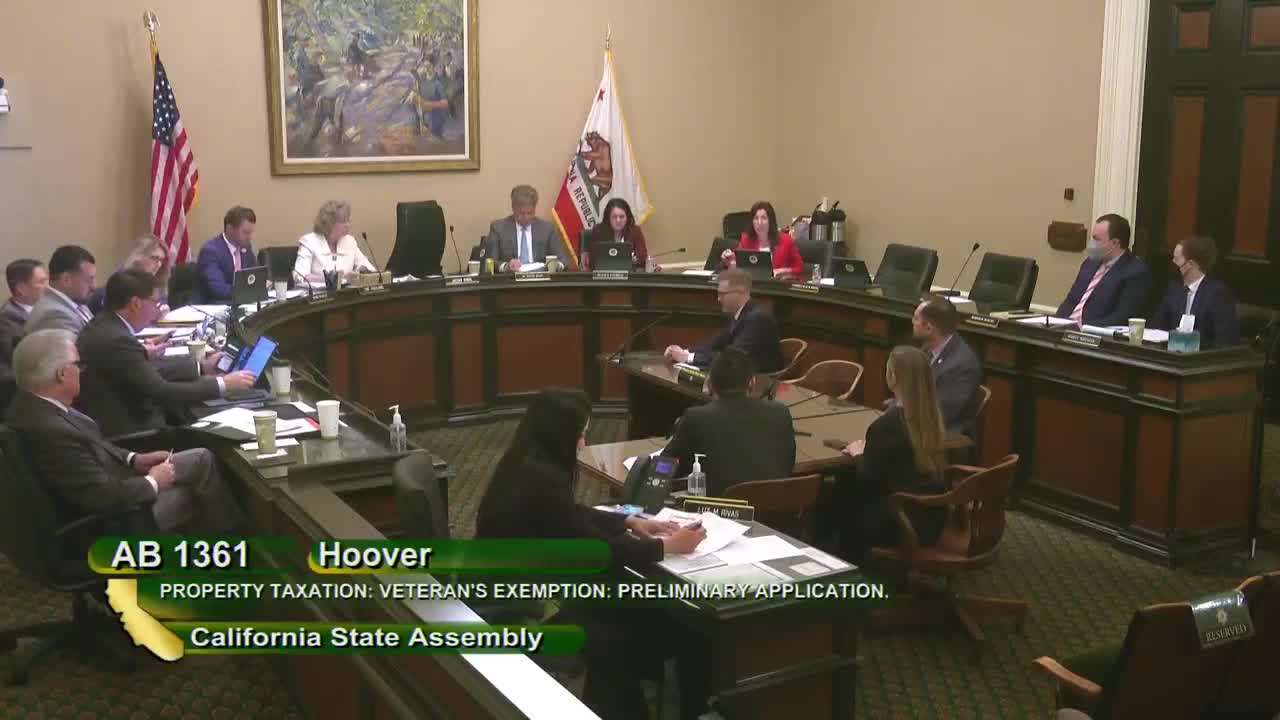
Discussed in Hearing
 4MIN
Assembly Standing Committee on Revenue and Taxation
Bill Author

Bill Co-Author(s):