AB 1746: Inmate firefighters: credits.
- Session Year: 2023-2024
- House: Assembly
- Latest Version Date: 2023-03-20
Current Status:
Failed
(2024-02-01: From committee: Filed with the Chief Clerk pursuant to Joint Rule 56.)
Introduced
In Committee
First Chamber
In Committee
Second Chamber
Enacted
What does this bill do?
Rylas Law stops inmates convicted of certain child‑abuse crimes from earning double-day custody credits for serving as inmate firefighters or after completing firefighter training. It specifically makes people convicted under Penal Code section 273a or subdivision (a) of section 273ab, and those subject to the penalty in section 12022.95, ineligible for the two-for-one credit.
The summary is provided by generative AI which can make mistakes. For original language, please view the details in the table below.
Under existing law, a prisoner can reduce their term of imprisonment by earning credit for, among other things, continuous incarceration, good behavior, and participation in approved rehabilitative programming. Existing law prohibits a prisoner convicted of specified felony offenses from earning credit if the prisoner previously has been convicted of one of those felony offenses 2 or more times and has served 2 or more separate prior prison terms.
Existing law makes an inmate of a state prison, or of a county jail, who has completed training for assignment to a correctional institution as an inmate firefighter, or who is assigned to a correctional institution as an inmate firefighter, and who is eligible to earn one day of credit for every one day of incarceration, instead eligible to earn 2 days of credit for every one day served in that assignment or after completing that training.
This bill bill, Rylas Law, would make a person convicted of specific child abuse crimes ineligible to earn 2 days of credit for every one day served as an inmate firefighter or after completing inmate firefighting training. By reducing the amount of credits an inmate sentenced to county jail can earn, this bill would create a state-mandated local program.
The California Constitution requires the state to reimburse local agencies and school districts for certain costs mandated by the state. Statutory provisions establish procedures for making that reimbursement.
This bill would provide that no reimbursement is required by this act for a specified reason.
Under existing law, a prisoner can reduce their term of imprisonment by earning credit for, among other things, continuous incarceration, good behavior, and participation in approved rehabilitative programming. Existing law prohibits a prisoner convicted of specified felony offenses from earning credit if the prisoner previously has been convicted of one of those felony offenses 2 or more times and has served 2 or more separate prior prison terms.
Existing law makes an inmate of a state prison, or of a county jail, who has completed training for assignment to a correctional institution as an inmate firefighter, or who is assigned to a correctional institution as an inmate firefighter, and who is eligible to earn one day of credit for every one day of incarceration, instead eligible to earn 2 days of credit for every one day served in that assignment or after completing that training.
This bill would make a person convicted of specific child abuse crimes ineligible to earn 2 days of credit for every one day served as an inmate firefighter or after completing inmate firefighting training. By reducing the amount of credits an inmate sentenced to county jail can earn, this bill would create a state-mandated local program.
The California Constitution requires the state to reimburse local agencies and school districts for certain costs mandated by the state. Statutory provisions establish procedures for making that reimbursement.
This bill would provide that no reimbursement is required by this act for a specified reason.
Existing law classifies certain felonies as violent felonies for purposes of various provisions of the Penal Code. Existing law generally imposes an additional 3-year term for a violent felony for each prior separate prison term served by the defendant for a violent felony.This bill would state the intent of the Legislature to enact legislation relating to violent felonies.Existing law classifies certain felonies as violent felonies for purposes of various provisions of the Penal Code. Existing law generally imposes an additional 3-year term for a violent felony for each prior separate prison term served by the defendant for a violent felony.
This bill would state the intent of the Legislature to enact legislation relating to violent felonies.
This act shall be known, and may be cited, as Rylas Law.
SECTION 1.SEC. 2.Section 2933.3 of the Penal Code is amended to read:2933.3.(a)Notwithstanding any other law, an inmate assigned to a conservation camp by the Department of Corrections and Rehabilitation, who is eligible to earn one day of credit for every one day of incarceration pursuant to Section 2933 shall instead earn two days of credit for every one day of service. The enhanced credit authorized pursuant to this subdivision shall only apply to those prisoners eligible after January 1, 2003.
(b)Notwithstanding any other law, an inmate who has completed training for assignment to a conservation camp or to a correctional institution as an inmate firefighter or who is assigned to a correctional institution as an inmate firefighter and who is eligible to earn one day of credit for every one day of incarceration pursuant to Section 2933 shall instead earn two days of credit for every one day served in that assignment or after completing that training.
(c)In addition to credits granted pursuant to subdivision (a) or (b), inmates who have successfully completed training for firefighter assignments shall receive a credit reduction from their term of confinement pursuant to regulations adopted by the secretary.
(d)The credits authorized in subdivisions (b) and (c) shall only apply to inmates who are eligible after July 1, 2009.
(e)Notwithstanding subdivisions (a) to (d), inclusive, a person convicted of a violation of Section 273a and subject to the punishment described in Section 12022.95 or convicted of a violation of subdivision (a) of Section 273ab is not eligible for the credits authorized in this section.
SEC. 2.SEC. 3.Section 4019.2 of the Penal Code is amended to read:4019.2.(a)Notwithstanding any other law, an inmate sentenced to county jail assigned to a conservation camp by a sheriff and who is eligible to earn one day of credit for every one day of incarceration pursuant to Section 4019 shall instead earn two days of credit for every one day of service.
(b)Notwithstanding any other law, an inmate who has completed training for assignment to a conservation camp or to a state or county facility as an inmate firefighter or who is assigned to a county or state correctional institution as an inmate firefighter and who is eligible to earn one day of credit for every one day of incarceration pursuant to Section 4019 shall instead earn two days of credit for every one day served in that assignment or after completing that training.
(c)In addition to credits granted pursuant to subdivision (a) or (b), inmates who have successfully completed training for firefighter assignments shall receive a credit reduction from their term of confinement.
(d)The credits authorized in subdivisions (b) and (c) shall only apply to inmates who are eligible after October 1, 2011.
(e)Notwithstanding subdivisions (a) to (d), inclusive, a person convicted of a violation of Section 273a and subject to the punishment described in Section 12022.95 or convicted of a violation of subdivision (a) of Section 273ab is not eligible for the credits authorized in this section.
SEC. 3.SEC. 4.No reimbursement is required by this act pursuant to Section 6 of Article XIIIB of the California Constitution because the only costs that may be incurred by a local agency or school district will be incurred because this act creates a new crime or infraction, eliminates a crime or infraction, or changes the penalty for a crime or infraction, within the meaning of Section 17556 of the Government Code, or changes the definition of a crime within the meaning of Section 6 of Article XIIIB of the California Constitution.
(a)Notwithstanding any other law, any an inmate assigned to a conservation camp by the Department of Corrections and Rehabilitation, who is eligible to earn one day of credit for every one day of incarceration pursuant to Section 2933 shall instead earn two days of credit for every one day of service. The enhanced credit authorized pursuant to this subdivision shall only apply to those prisoners eligible after January 1, 2003.
(b)Notwithstanding any other law, any an inmate who has completed training for assignment to a conservation camp or to a correctional institution as an inmate firefighter or who is assigned to a correctional institution as an inmate firefighter and who is eligible to earn one day of credit for every one day of incarceration pursuant to Section 2933 shall instead earn two days of credit for every one day served in that assignment or after completing that training.
(c)In addition to credits granted pursuant to subdivision (a) or (b), inmates who have successfully completed training for firefighter assignments shall receive a credit reduction from his or her their term of confinement pursuant to regulations adopted by the secretary.
(d)The credits authorized in subdivisions (b) and (c) shall only apply to inmates who are eligible after July 1, 2009.
(e)Notwithstanding subdivisions (a) to (d), inclusive, a person convicted of a violation of Section 273a or 273ab is not eligible for the credits authorized in this section.
SEC. 2.Section 4019.2 of the Penal Code is amended to read:4019.2.(a)Notwithstanding any other law, any an inmate sentenced to county jail assigned to a conservation camp by a sheriff and who is eligible to earn one day of credit for every one day of incarceration pursuant to Section 4019 shall instead earn two days of credit for every one day of service.
(b)Notwithstanding any other law, any an inmate who has completed training for assignment to a conservation camp or to a state or county facility as an inmate firefighter or who is assigned to a county or state correctional institution as an inmate firefighter and who is eligible to earn one day of credit for every one day of incarceration pursuant to Section 4019 shall instead earn two days of credit for every one day served in that assignment or after completing that training.
(c)In addition to credits granted pursuant to subdivision (a) or (b), inmates who have successfully completed training for firefighter assignments shall receive a credit reduction from his or her their term of confinement.
(d)The credits authorized in subdivisions (b) and (c) shall only apply to inmates who are eligible after October 1, 2011.
(e)Notwithstanding subdivisions (a) to (d), inclusive, a person convicted of a violation of Section 273a is not eligible for the credits authorized in this section.
SEC. 3.No reimbursement is required by this act pursuant to Section 6 of Article XIIIB of the California Constitution because the only costs that may be incurred by a local agency or school district will be incurred because this act creates a new crime or infraction, eliminates a crime or infraction, or changes the penalty for a crime or infraction, within the meaning of Section 17556 of the Government Code, or changes the definition of a crime within the meaning of Section 6 of Article XIIIB of the California Constitution.
SECTION 1.It is the intent of the Legislature to enact legislation relating to violent felonies.It is the intent of the Legislature to enact legislation relating to violent felonies.
|
Date
|
Status
|
|---|---|
| Feb 1, 2024 | From committee: Filed with the Chief Clerk pursuant to Joint Rule 56. |
| Jan 31, 2024 | Died pursuant to Art. IV, Sec. 10(c) of the Constitution. |
| Jan 9, 2024 | In committee: Set, second hearing. Hearing canceled at the request of author. |
| Apr 11, 2023 | In committee: Set, first hearing. Failed passage. Reconsideration granted. |
| Mar 21, 2023 | Re-referred to Com. on PUB. S. |
| Mar 20, 2023 | From committee chair, with author's amendments: Amend, and re-refer to Com. on PUB. S. Read second time and amended. |
| Mar 13, 2023 | Re-referred to Com. on PUB. S. |
| Mar 9, 2023 | From committee chair, with author's amendments: Amend, and re-refer to Com. on PUB. S. Read second time and amended. |
| Mar 9, 2023 | Referred to Com. on PUB. S. |
| Feb 18, 2023 | From printer. May be heard in committee March 20. |
| Feb 17, 2023 | Read first time. To print. |
|
Date
|
Description
|
Location
|
Votes
|
|
|---|---|---|---|---|
| Apr 11, 2023 | Do pass and be re-referred to the Committee on [Appropriations] | Assembly Standing Committee on Public Safety |
Failed |
This list shows positions taken on this bill by organizations on the date displayed, which is linked to the original source.
Positions by individuals are not included.
|
Organization
|
Position
|
Date
|
|---|---|---|
| Aclu California Action | ** Against | |
| Anti Recidivism Coalition | ** Against | |
| California for Safety and Justice | ** Against | |
| California Public Defenders Association | ** Against | |
| Ella Baker Center For Human Rights | ** Against | |
| Initiate Justice | ** Against | |
| Initiate Justice Action | ** Against | |
| Peace Officers Research Association Of California | ** Support |
Date of Hearing:
Counsel: Cheryl Anderson
ASSEMBLY COMMITTEE ON PUBLIC SAFETY
Kevin McCarty, Chair
ABPCA Bill Id:AB 1746
Author:(Hoover) – As Amended Ver:March 20, 2023
Vote Only
SUMMARY:
Provides that a person convicted of specific child endangerment or abuse crimes resulting in death of the child is ineligible to earn enhanced credits for participation as an inmate firefighter or after completing inmate firefighting training. Specifically, this bill:
- Provides that a person incarcerated in state prison, who was convicted of child endangerment resulting in death or assault of a child under eight years of age resulting in death, is ineligible to earn two days of credit for every one day of service (two-for-one credits) at a California Department of Corrections and Rehabilitation (CDCR) conservation camp or after completing training for assignment to a conservation camp or to a correctional facility as an inmate firefighter.
- Provides that a person incarcerated in the county jail, who was convicted of these offenses, is similarly ineligible to earn two-for-one credits for this service or training.
EXISTING LAW:
- Allows for work time credits towards a state prison term to be earned, as specified. (Pen. Code, § 2933, subd. (a).)
- Provides that for every six months of continuous incarceration, except as specified, a person incarcerated in state prison may earn a six-month work-time credit reduction from their term of confinement (one-for-one post-sentence credit). (Pen. Code, § 2933, subd. (b).)
- Provides that a person who is assigned to a CDCR conservation camp and is eligible to receive one day of work-time credit for every one day of incarceration (one-for-one credits) shall instead receive two-for-one credits. The service performed must be after January 1, 2003. (Pen. Code, § 2933.3, subd. (a).)
- Provides that a prisoner who has completed training for assignment to a conservation camp or to a correctional institution as an inmate firefighter or who is assigned to a correctional institution as an inmate firefighter and is eligible to earn one-for-one credits shall receive two two-for-one credits. Application is limited to prisoners who are eligible after July 1, 2009. (Pen. Code, § 2933.3, subd. (b).)
- Allows an incarcerated person who has successfully completed training for a firefighter assignment to also receive a credit reduction from their confinement pursuant to regulations adopted by the secretary. Application is limited to prisoners who are eligible after July 1, 2009. (Pen. Code, § 2933.3, subd. (c).)
- Provides that for time spent in the county jail, a term of four days will be deemed to have been served for every two days spent in actual custody. (Pen. Code, § 4019.)
- Provides that a county jail inmate assigned to a conservation camp by a sheriff and who is eligible to earn day-for-day credits shall instead earn two-for-one credits. (Pen. Code, § 4019.2, subd. (a).)
- Provides that a county jail inmate who has completed training for assignment to a conservation camp or to a state or county facility as an inmate firefighter or who is assigned to a county or state correctional institution as an inmate firefighter and who is eligible to earn day-for-day credits shall instead earn two-for-one credits. Application is limited to eligible inmates after October 1, 2011. (Pen. Code, § 4019.2, subd. (b).)
- Allows county jail inmates who have successfully completed training for firefighter assignments to also receive a credit reduction from their term of confinement. Application is limited to eligible inmates after October 1, 2011. (Pen. Code, § 4019.2, subd. (d).)
- States that a person convicted of a violent felony may not use work-time credits to reduce their term by more than 15%. (Pen. Code, § 2933.1.)
- Prohibits a person convicted of murder from accruing work-time or program credit reductions. (Pen. Code, § 2933.2.)
- Provides that any person who, under circumstances or conditions likely to produce great bodily harm or death, willfully causes or permits any child to suffer, or inflicts thereon unjustifiable physical pain or mental suffering, or having the care or custody of any child, willfully causes or permits the person or health of that child to be injured, or willfully causes or permits that child to be placed in a situation where their person or health is endangered, shall be punished by imprisonment in a county jail not exceeding one year, or in the state prison for two, four, or six years. (Pen. Code, § 273a, subd. (a).)
- Provides that any person who, under circumstances or conditions other than those likely to produce great bodily harm or death, willfully causes or permits any child to suffer, or inflicts thereon unjustifiable physical pain or mental suffering, or having the care or custody of any child, willfully causes or permits the person or health of that child to be injured, or willfully causes or permits that child to be placed in a situation where their person or health may be endangered, is guilty of a misdemeanor. (Pen. Code, § 273a, subd. (b).)
- Provides that any person convicted of child endangerment, who under circumstances or conditions likely to produce great bodily harm or death, willfully causes or permits any child to suffer, or inflicts thereon unjustifiable physical pain or injury that results in death, or having the care or custody of any child, under circumstances likely to produce great bodily harm or death, willfully causes or permits that child to be injured or harmed, and that injury or harm results in death, shall receive a four-year enhancement for each violation, in addition to the sentence provided for that conviction. This does not affect the applicability of murder or manslaughter laws. This section shall not apply unless the allegation is included within an accusatory pleading and admitted by the defendant or found to be true by the trier of fact. (Pen. Code, § 12022.95.)
- Provides that any person, having the care or custody of a child who is under eight years of age, who assaults the child by means of force that to a reasonable person would be likely to produce great bodily injury, resulting in the child’s death, shall be punished by imprisonment in the state prison for 25 years to life. This does not affect the applicability of murder or manslaughter laws. (Pen. Code, § 273ab, subd. (a).)
FISCAL EFFECT:
Unknown
COMMENTS:
- Author's Statement: According to the author, “Child abuse is always heartbreaking but when it results in death it is the worst kind of tragedy. Unfortunately, child abuse happens far too frequently in our country and usually at the hands of a parent or caretaker. Under California law, child abuse is considered a ‘non-serious, non-violent’ offense. That means when an individual is found guilty of this crime, the offender qualifies for early release programs. That is also true even when the abuse results in a child’s death. This bill would prohibit a person whose abuse causes a child’s death from being eligible to serve in a conservation/fire camp, which is the state’s most generous early release program. Killing a child is a horrific crime and should be treated as such.”
- Conservation (Fire) Camps: According to CDCR’s website: “The primary mission of the Conservation (Fire) Camp Program is to support state, local and federal government agencies as they respond to emergencies including fires, floods, and other natural or disasters Additionally, hand crews respond to rescue efforts in local parks or flood suppression.
“CDCR, in cooperation with the California Department of Forestry and Fire Protection (CAL FIRE) and the Los Angeles County Fire Department (LACFD), jointly operates 35 conservation camps, commonly known as fire camps, located in 25 counties across California. All camps are minimum-security facilities and staffed with correctional staff.” (https://www.cdcr.ca.gov/facility-locator/conservation-camps/)
The conservation camp can be a vital part of a person’s rehabilitation. “Just as in every CDCR prison, every conservation camp offers rehabilitative and educational services, including substance abuse programs, religious programs, and GED and college courses.” (https://www.cdcr.ca.gov/facility-locator/conservation-camps/faq-conservation-fire-camp-program/)
The participants are volunteers and must have “minimum custody” status – i.e., the lowest classification for an incarcerated person based on behavior and following rules while in prison and when participating in rehabilitative programing. Additionally, minimum custody status notwithstanding, certain convictions automatically make a person ineligible for a conservation camp assignment. (https://www.cdcr.ca.gov/facility-locator/conservation-camps/faq-conservation-fire-camp-program/)
Persons are excluded from fire camp based on any of the following: a conviction requiring sex offender registration; a life sentence; a sentence for escape within the last 10 years; an arson conviction; a felony hold; validated active or inactive prison gang membership or association; a public interest case; current or prior convictions of murder, rape, or kidnap (violent felonies); or a pattern of excessive misconduct or disruption of the orderly operations of the institution. (https://www.cdcr.ca.gov/facility-locator/conservation-camps/fire_camp_expungement/)
This bill would provide that incarcerated persons in state prison, who have been convicted of specified child endangerment and abuse offenses resulting in the child’s death, may not earn enhanced credits for their service as an inmate firefighter or after completing inmate firefighting training. Anyone convicted of assault of a child under eight years of age resulting in death is currently excluded from participation in Conservation (Fire) Camp by virtue of the life sentence. (See Pen. Code, § 273ab.) If the death of the child results in a murder conviction, the incarcerated person is also excluded. - Constitutional Authority to Award Credits Given to CDCR in Proposition 57: Proposition 57 was passed by the electorate (Ballot Pamp., Gen. Elec. Nov. 8, 2016) and implemented as Article I, section 32 of the California Constitution. Section 32, subdivision (a)(2) of Article I states: “Credit Earning: The Department of Corrections and Rehabilitation shall have authority to award credits earned for good behavior and approved rehabilitative or educational achievements.” Thus Proposition 57 gave CDCR the authority to create its own credit rules. (See https://www.capolicylab.org/wp-content/uploads/2022/08/Three-Strikes-in-California.pdf at p. 8.)
Under current CDCR regulations, full-time conservation workers and people training for these jobs may earn credits at a rate of 66.6% (two-for-one credits). However, if the person has a violent felony conviction, they may only earn credits at a rate of 50% (one-for-one credits). (https://www.cdcr.ca.gov/proposition57/)
This bill would arguably not affect CDCR’s authority to nonetheless grant enhanced credits for an inmate’s post-sentence participation in these programs or training, pursuant to Proposition 57. “By its plain terms, article I, section 32, subdivision (a)(2) authorizes the Department to award—or to not award—conduct credits as it sees fit.” (In re Canady (2020) 57 Cal.App.5th 1022, 1034, citing Brown v. Superior Court (2016) 63 Cal.4th 335, 359, 361 (dis. opn. of Chin, J.) “The broad and permissive language of article I, section 32, subdivision (a)(2) suggests that the voters intended for the Department to have substantial discretion in determining how credits are applied to early parole consideration….” (In re Canady, supra, 57 Cal. App.5th at p. 1034.)
- Sheriff Fire Camp Programs: Under Penal Code section 4019.2, persons incarcerated in a county jail may similarly earn credits for participation in a sheriff’s conservation camp or successful completion of training for assignment to a conservation camp or as an inmate firefighter. An inmate eligible to earn one day of credit for every day of incarceration (one-for-one credits) would instead be able to earn two days of credit for every one day served (two-for-one credits).
The use of such programs, as well as standards and training, can vary by county. For example, the San Diego County Sheriff’s Department, in recognizing the usefulness of reentry services, offers a fire camp program collaboratively administered by Cal Fire and CDCR. To be eligible, the incarcerated person must be sentenced under realignment (Pen. Code, § 1170, subdivision (h)). (https://www.sdsheriff.gov/bureaus/detention-services-bureau/county-parole-and-alternative-custody) Realignment, as passed by California voters in 2011, diverts defendants convicted of less serious felonies to serve their time in local county jail rather than in state prison. Persons are excluded from realignment if they have suffered a serious or violent felony conviction, aggravated theft conviction, or are required to register as a sex offender. (Pen. Code, § 1170, subd. (h)(3).)
This bill would prohibit persons convicted of specified child endangerment and abuse offenses resulting in death of the child from earning enhanced credits for their service as an inmate firefighter or after completing inmate firefighting training. Anyone convicted of assault of a child under eight years of age resulting in death is currently excluded from realignment by virtue of the state prison sentence attendant to the offense, and thus wouldn’t be eligible to participate in, for example, the San Diego Sheriff’s fire camp program. (See Pen. Code, § 273ab.) - Argument in Support: According to the Peace Officers’ Research Association of California, “This bill, Ryla’s Law, would make a person convicted of specific child abuse crimes ineligible to earn 2 days of credit for every one day served as an inmate firefighter or after completing inmate firefighting training. By reducing the amount of credits an inmate sentenced to county jail can earn, this bill would create a state-mandated local program.”
- Argument in Opposition: According to Californians for Safety and Justice, “Fire camp programming within CDCR is an intense physically and mentally strenuous program where wildland firefighters are called upon to respond to various emergency situations throughout the state. While its main purpose is to support fire departments in times of active fire, many incarcerated workers are often put at the frontline of these wildfires in life-threatening conditions. Reports of incarcerated wildland firefighter deaths and injuries are a testament to the grueling conditions that individuals are subject to. During the off-season, the work of these incarcerated workers does not cease. Fire camps provide labor for various state and municipal departments to prevent threats of fire through brush clearance and maintenance, which can be equally as demanding as an active fire incident.
“In 2016, Proposition 57 was passed with 64% of the vote. It included credits for fire campers as a way to recognize the hard labor that incarcerated residents are put through while completing the program. It is not an ‘easy out,’ but a transactional exchange from both the state and the individual. Incarcerated individuals accept these arduous working conditions as a service to their community, in the name of justice.
“AB 1746 undermines the purpose of Proposition 57 and unreasonably discriminates against
someone who may be eligible for such transformative programming, and lacks justification as to why this bill serves the public’s interest. Prohibiting individuals convicted of child abuse crimes from fire camp does not promote justice, rehabilitation, nor accountability for the individual.”
- Prior Legislation:
- AB 945 (Reyes), of the 2023-2024 Legislative Session, would have required courts to report specified data to the Judicial Council regarding petitions for expungement relief filed on the basis of having successfully participated as an incarcerated fire camp member or at an institutional firehouse. AB 945 was vetoed by the Governor.
- AB 17 1st Ext. (Blumenfield), Chapter 12, Statutes of 2011, Criminal Justice Realignment of 2011, as relevant here, conformed county jail custody credits to the equivalent state prison inmate custody credits, including fire camp.
- AB 3000 (Budget Committee), Chapter 1124, Statutes of 2002, as relevant here, provides that any inmate assigned to a conservation camp shall earn two days of work-time credit for every day of service.
- AB 945 (Reyes), of the 2023-2024 Legislative Session, would have required courts to report specified data to the Judicial Council regarding petitions for expungement relief filed on the basis of having successfully participated as an incarcerated fire camp member or at an institutional firehouse. AB 945 was vetoed by the Governor.
REGISTERED SUPPORT / OPPOSITION:
Support
Peace Officers Research Association of California (PORAC)
Opposition
ACLU California Action
Anti Recidivism Coalition
California for Safety and Justice
California Public Defenders Association
Ella Baker Center for Human Rights
Initiate Justice
Initiate Justice Action
Analysis Prepared by:
Cheryl Anderson / PUB. S. / (916) 319-3744
Date of Hearing:
Counsel: Cheryl Anderson
ASSEMBLY COMMITTEE ON PUBLIC SAFETY
Reginald Byron Jones-Sawyer, Sr., Chair
ABPCA Bill Id:AB 1746
Author:(Hoover) – As Amended Ver:March 20, 2023
SUMMARY:
Provides that a person convicted of specific child endangerment or abuse crimes resulting in death of the child is ineligible to earn enhanced credits for participation as an inmate firefighter or after completing inmate firefighting training. Specifically, this bill:
- Provides that a person incarcerated in state prison, who was convicted of child endangerment resulting in death or assault of a child under eight years of age resulting in death, is ineligible to earn two days of credit for every one day of service (two-for-one credits) at a California Department of Corrections and Rehabilitation (CDCR) conservation camp or after completing training for assignment to a conservation camp or to a correctional facility as an inmate firefighter.
- Provides that a person incarcerated in the county jail, who was convicted of these offenses, is similarly ineligible to earn two-for-one credits for this service or training.
EXISTING LAW:
- Allows for work time credits towards a state prison term to be earned, as specified. (Pen. Code, § 2933, subd. (a).)
- Provides that for every six months of continuous incarceration, except as specified, a person incarcerated in state prison may earn a six-month work-time credit reduction from their term of confinement (one-for-one post-sentence credit). (Pen. Code, § 2933, subd. (b).)
- Provides that a person who is assigned to a CDCR conservation camp and is eligible to receive one day of work-time credit for every one day of incarceration (one-for-one credits) shall instead receive two-for-one credits. The service performed must be after January 1, 2003. (Pen. Code, § 2933.3, subd. (a).)
- Provides that a prisoner who has completed training for assignment to a conservation camp or to a correctional institution as an inmate firefighter or who is assigned to a correctional institution as an inmate firefighter and is eligible to earn one-for-one credits shall receive two two-for-one credits. Application is limited to prisoners who are eligible after July 1, 2009. (Pen. Code, § 2933.3, subd. (b).)
- Allows an incarcerated person who has successfully completed training for a firefighter assignment to also receive a credit reduction from their confinement pursuant to regulations adopted by the secretary. Application is limited to prisoners who are eligible after July 1, 2009. (Pen. Code, § 2933.3, subd. (c).)
- Provides that for time spent in the county jail, a term of four days will be deemed to have been served for every two days spent in actual custody. (Pen. Code, § 4019.)
- Provides that a county jail inmate assigned to a conservation camp by a sheriff and who is eligible to earn day-for-day credits shall instead earn two-for-one credits. (Pen. Code, § 4019.2, subd. (a).)
- Provides that a county jail inmate who has completed training for assignment to a conservation camp or to a state or county facility as an inmate firefighter or who is assigned to a county or state correctional institution as an inmate firefighter and who is eligible to earn day-for-day credits shall instead earn two-for-one credits. Application is limited to eligible inmates after October 1, 2011. (Pen. Code, § 4019.2, subd. (b).)
- Allows county jail inmates who have successfully completed training for firefighter assignments to also receive a credit reduction from their term of confinement. Application is limited to eligible inmates after October 1, 2011. (Pen. Code, § 4019.2, subd. (d).)
- States that a person convicted of a violent felony may not use work-time credits to reduce their term by more than 15%. (Pen. Code, § 2933.1.)
- Prohibits a person convicted of murder from accruing work-time or program credit reductions. (Pen. Code, § 2933.2.)
- Provides that any person who, under circumstances or conditions likely to produce great bodily harm or death, willfully causes or permits any child to suffer, or inflicts thereon unjustifiable physical pain or mental suffering, or having the care or custody of any child, willfully causes or permits the person or health of that child to be injured, or willfully causes or permits that child to be placed in a situation where their person or health is endangered, shall be punished by imprisonment in a county jail not exceeding one year, or in the state prison for two, four, or six years. (Pen. Code, § 273a, subd. (a).)
- Provides that any person who, under circumstances or conditions other than those likely to produce great bodily harm or death, willfully causes or permits any child to suffer, or inflicts thereon unjustifiable physical pain or mental suffering, or having the care or custody of any child, willfully causes or permits the person or health of that child to be injured, or willfully causes or permits that child to be placed in a situation where their person or health may be endangered, is guilty of a misdemeanor. (Pen. Code, § 273a, subd. (b).)
- Provides that any person convicted of child endangerment, who under circumstances or conditions likely to produce great bodily harm or death, willfully causes or permits any child to suffer, or inflicts thereon unjustifiable physical pain or injury that results in death, or having the care or custody of any child, under circumstances likely to produce great bodily harm or death, willfully causes or permits that child to be injured or harmed, and that injury or harm results in death, shall receive a four-year enhancement for each violation, in addition to the sentence provided for that conviction. This does not affect the applicability of murder or manslaughter laws. This section shall not apply unless the allegation is included within an accusatory pleading and admitted by the defendant or found to be true by the trier of fact. (Pen. Code, § 12022.95.)
- Provides that any person, having the care or custody of a child who is under eight years of age, who assaults the child by means of force that to a reasonable person would be likely to produce great bodily injury, resulting in the child’s death, shall be punished by imprisonment in the state prison for 25 years to life. This does not affect the applicability of murder or manslaughter laws. (Pen. Code, § 273ab, subd. (a).)
FISCAL EFFECT:
Unknown
COMMENTS:
- Author's Statement: According to the author, “Child abuse is always heartbreaking but when it results in death it is the worst kind of tragedy. Unfortunately, child abuse happens far too frequently in our country and usually at the hands of a parent or caretaker. Under California law, child abuse is considered a ‘non-serious, non-violent’ offense. That means when an individual is found guilty of this crime, the offender qualifies for early release programs. That is also true even when the abuse results in a child’s death. This bill would prohibit a person whose abuse causes a child’s death from being eligible to serve in a conservation/fire camp, which is the state’s most generous early release program. Killing a child is a horrific crime and should be treated as such.”
- Conservation (Fire) Camps: According to CDCR’s website: “The primary mission of the Conservation Camp Program is to support state, local and federal government agencies as they respond to emergencies such as fires, floods, and other natural or manmade disasters.
“CDCR, in cooperation with the California Department of Forestry and Fire Protection (CAL FIRE) and the Los Angeles County Fire Department (LACFD), jointly operates 35 conservation camps, commonly known as fire camps, located in 25 counties across California. All camps are minimum-security facilities and all are staffed with correctional staff.” (https://www.cdcr.ca.gov/facility-locator/conservation-camps/) The conservation camp can be a vital part of a person’s rehabilitation. “They perform a vital service and give back to the community while they serve their sentences with CDCR.” (Ibid.)
As of March 2023, more than 1,600 incarcerated persons are housed in conservation camps. The participants are volunteers and must have “minimum custody” status – i.e., the lowest classification for an incarcerated person based on behavior and following rules while in prison and when participating in rehabilitative programing. Additionally, minimum custody status notwithstanding, certain convictions automatically make a person ineligible for a conservation camp assignment. (https://www.cdcr.ca.gov/facility-locator/conservation-camps/)
Persons are excluded from fire camp based on any of the following: a conviction requiring sex offender registration; a life sentence; a sentence for escape within the last 10 years; an arson conviction; a felony hold; validated active or inactive prison gang membership or association; a public interest case; current or prior convictions of murder, rape, or kidnap (violent felonies); or a pattern of excessive misconduct or disruption of the orderly operations of the institution. (https://www.cdcr.ca.gov/facility-locator/conservation-camps/fire_camp_expungement/)
This bill would provide that incarcerated persons in state prison, who have been convicted of specified child endangerment and abuse offenses resulting in the child’s death, may not earn enhanced credits for their service as an inmate firefighter or after completing inmate firefighting training. - Constitutional Authority to Award Credits Given to CDCR in Proposition 57: Proposition 57 was passed by the electorate (Ballot Pamp., Gen. Elec. Nov. 8, 2016) and implemented as Article I, section 32 of the California Constitution. Section 32, subdivision (a)(2) of Article I states: “Credit Earning: The Department of Corrections and Rehabilitation shall have authority to award credits earned for good behavior and approved rehabilitative or educational achievements.” Thus Proposition 57 gave CDCR the authority to create its own credit rules. (https://www.capolicylab.org/wp-content/uploads/2022/08/Three-Strikes-in-California.pdf at p. 8.)
Under current CDCR regulations, full-time conservation workers and people training for these jobs may earn credits at a rate of 66.6% (two-for-one credits). However, if the person has a violent felony conviction, they may only earn credits at a rate of 50% (one-for-one credits). (https://www.cdcr.ca.gov/proposition57/)
This bill would arguably not affect CDCR’s authority to nonetheless grant enhanced credits for an inmate’s post-sentence participation in these programs or training, pursuant to Proposition 57. “By its plain terms, article I, section 32, subdivision (a)(2) authorizes the Department to award—or to not award—conduct credits as it sees fit.” (In re Canady (2020) 57 Cal.App.5th 1022, 1034, citing Brown v. Superior Court (2016) 63 Cal.4th 335, 359, 361 (dis. opn. of Chin, J.) “The broad and permissive language of article I, section 32, subdivision (a)(2) suggests that the voters intended for the Department to have substantial discretion in determining how credits are applied to early parole consideration….” (In re Canady, supra, 57 Cal. App.5th at p. 1034.)
Further, anyone convicted of assault of a child under eight years of age resulting in death is currently excluded from participation in Conservation (Fire) Camp by virtue of the life sentence. (See Pen. Code, § 273ab.) If the death of the child results in a murder conviction, the incarcerated person is also excluded.
- Sheriff Fire Camp Programs: Under Penal Code section 4019.2, persons incarcerated in a county jail may similarly earn credits for participation in a sheriff’s conservation camp or successful completion of training for assignment to a conservation camp or as an inmate firefighter. An inmate eligible to earn one day of credit for every day of incarceration (one-for-one credits) would instead be able to earn two days of credit for every one day served (two-for-one credits).
The use of such programs, as well as standards and training, can vary by county. For example, the San Bernardino County Fire Department and Sheriff’s Department have partnered to form a County Inmate Hand Crew. “To qualify for the crew, inmates must be a low-level offender (no criminal history of violent, sexual, or serious violations); must have 15-18 months sentence left to serve; no documented gang affiliation; no prior discipline; and must not be a flight risk. Inmates remain under constant supervision while deployed in the field.” (https://sbcfire.org/inmatehandcrew/)
This bill would prohibit persons convicted of specified child endangerment and abuse offenses resulting in death of the child from earning enhanced credits for their service as an inmate firefighter or after completing inmate firefighting training. - Argument in Support: According to the Peace Officers’ Research Association of California, “This bill, Ryla’s Law, would make a person convicted of specific child abuse crimes ineligible to earn 2 days of credit for every one day served as an inmate firefighter or after completing inmate firefighting training. By reducing the amount of credits an inmate sentenced to county jail can earn, this bill would create a state-mandated local program.”
- Argument in Opposition: According to Californians for Safety and Justice, “Fire camp programming within CDCR is an intense physically and mentally strenuous program where wildland firefighters are called upon to respond to various emergency situations throughout the state. While its main purpose is to support fire departments in times of active fire, many incarcerated workers are often put at the frontline of these wildfires in life-threatening conditions. Reports of incarcerated wildland firefighter deaths and injuries are a testament to the grueling conditions that individuals are subject to. During the off-season, the work of these incarcerated workers does not cease. Fire camps provide labor for various state and municipal departments to prevent threats of fire through brush clearance and maintenance, which can be equally as demanding as an active fire incident.
“In 2016, Proposition 57 was passed with 64% of the vote. It included credits for fire campers as a way to recognize the hard labor that incarcerated residents are put through while completing the program. It is not an “easy out,” but a transactional exchange from both the state and the individual. Incarcerated individuals accept these arduous working conditions as a service to their community, in the name of justice.
“AB 1746 undermines the purpose of Proposition 57 and unreasonably discriminates against
someone who may be eligible for such transformative programming, and lacks justification as to why this bill serves the public’s interest. Prohibiting individuals convicted of child abuse crimes from fire camp does not promote justice, rehabilitation, nor accountability for the individual.”
- Related Legislation: AB 945 (Reyes), would require courts to report specified data to the Department of Justice regarding petitions for expungement relief filed on the basis of having successfully participated as an incarcerated fire camp member or at an institutional firehouse. AB 945 is pending hearing in this committee today.
- Prior Legislation:
- AB 17 1st Ext. (Blumenfield), Chapter 12, Statutes of 2011, Criminal Justice Realignment of 2011, as relevant here, conformed county jail custody credits to the equivalent state prison inmate custody credits, including fire camp.
- AB 3000 (Budget Committee), Chapter 1124, Statutes of 2002, as relevant here, provided provide that any inmate assigned to a conservation camp shall earn two days of work-time credit for every day of service.
- AB 17 1st Ext. (Blumenfield), Chapter 12, Statutes of 2011, Criminal Justice Realignment of 2011, as relevant here, conformed county jail custody credits to the equivalent state prison inmate custody credits, including fire camp.
REGISTERED SUPPORT / OPPOSITION:
Support
Peace Officers Research Association of California (PORAC)
Opposition
Anti Recidivism Coalition
California for Safety and Justice
California Public Defenders Association (CPDA)
Initiate Justice
Initiate Justice Action
Analysis Prepared by:
Cheryl Anderson / PUB. S. / (916) 319-3744
Discussed in Hearing
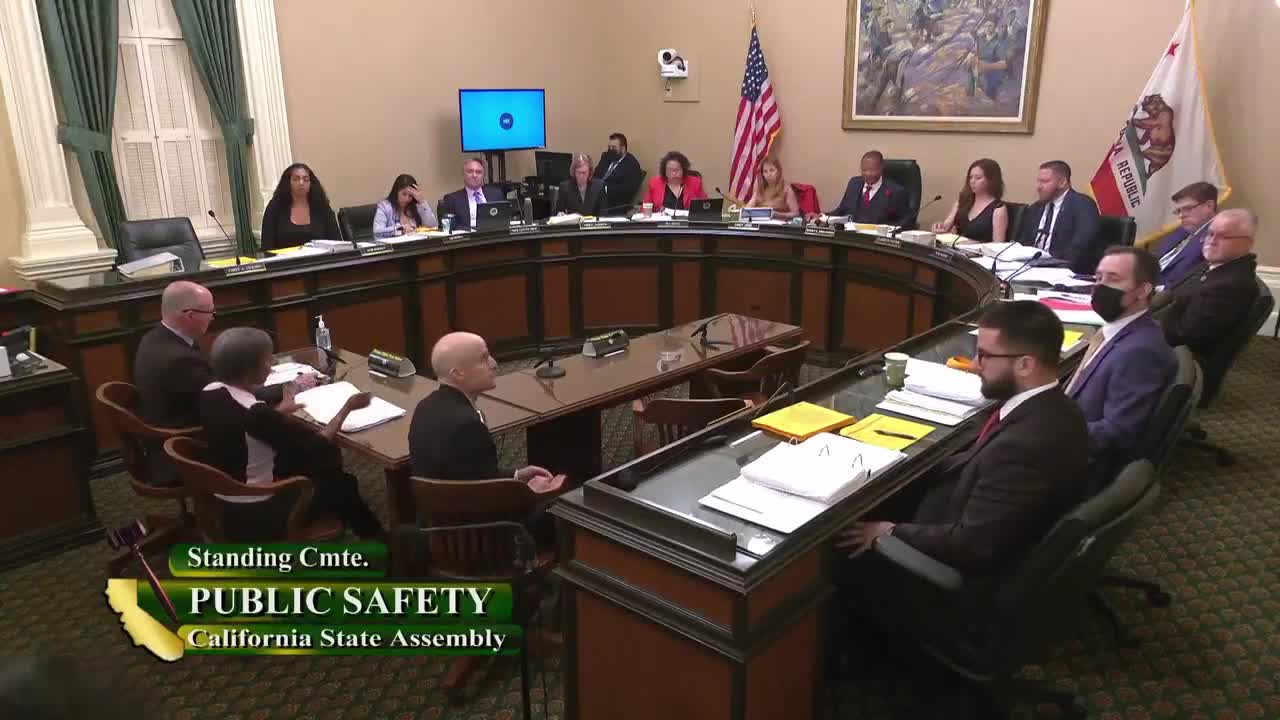 16MIN
Assembly Standing Committee on Public Safety
Bill Author

Bill Co-Author(s):