AB 1814: Law enforcement agencies: facial recognition technology.
- Session Year: 2023-2024
- House: Assembly
- Latest Version Date: 2024-06-12
Current Status:
Failed
(2024-08-15: In committee: Held under submission.)
Introduced
In Committee
First Chamber
In Committee
Second Chamber
Enacted
What does this bill do?
The bill bars law enforcement officers and judges from relying only on a facial recognition match as the basis for probable cause (a reasonable basis to arrest or search someone). It requires officers to review FRT results carefully and consider that matches can be inaccurate, and it defines key FRT terms. If someone is detained or arrested without legal justification based solely on an FRT match, they may sue for false arrest and recover up to $25,000 plus reasonable attorney fees.
The summary is provided by generative AI which can make mistakes. For original language, please view the details in the table below.
Existing law, generally, regulates state and local law enforcement agencies regarding subject matter that includes the selection and training of peace officers, the maintenance and release of records, the use of force, and the use of certain equipment. Previous law, until January 1, 2023, prohibited the use of real-time facial recognition technology (FRT) by law enforcement agencies in connection with body-worn cameras.
This bill would prohibit a law enforcement agency or peace officer from using an FRT-generated match as the sole basis for probable cause in an arrest, search, or warrant. arrest or search. The bill would prohibit a judge from granting an application for a warrant based solely on an FRT match. The bill would authorize a court to award damages of up to $25,000 and reasonable attorneys fees to an individual who is subjected to a violation of this provision. these provisions and reasonable attorneys fees to the prevailing party.
Existing law, generally, regulates state and local law enforcement agencies regarding subject matter that includes the selection and training of peace officers, the maintenance and release of records, the use of force, and the use of certain equipment. Previous law, until January 1, 2023, prohibited the use of real-time facial recognition technology (FRT) by law enforcement agencies in connection with body-worn cameras.
This bill would prohibit a law enforcement agency or peace officer from using an FRT-generated match as the sole basis for probable cause in an arrest, search, or warrant. The bill would authorize a court to award damages of up to $25,000 and reasonable attorneys fees to an individual who is subjected to a violation of this provision.
Existing law, generally, regulates state and local law enforcement agencies regarding subject matter that includes the selection and training of peace officers, the maintenance and release of records, the use of force, and the use of certain equipment. Previous law, until January 1, 2023, prohibited the use of real-time facial recognition technology (FRT) by law enforcement agencies in connection with body-worn cameras.
This bill would prohibit a law enforcement agency or peace officer from using an FRT-generated match as the sole basis for probable cause in an arrest, search, or warrant.
(a)(1)A law enforcement agency or peace officer shall not use a facial recognition technology (FRT) match as the sole basis for probable cause for an arrest, search, or affidavit for a warrant. arrest or search.
(2)A judge shall not grant an application for a warrant based solely on an FRT match.
(b)A peace officer using information obtained from the use of FRT shall examine results with care and consider the possibility that matches could be inaccurate.
(c)For purposes of this section, the following terms have the following meanings:
(1)Facial recognition technology or FRT means a system that compares a probe image of an unidentified human face against a reference photograph database, and, based on biometric data, generates possible matches to aid in identifying the person in the probe image.
(2)Probe image means an image of a person that is searched against a database of known, identified persons or an unsolved photograph file.
(3)Reference photograph database means a database populated with photographs of individuals that have been identified, including databases composed of drivers licenses or other documents made or issued by or under the authority of the state, a political subdivision thereof, any other state, or a federal agency, databases operated by third parties, and arrest photograph databases. This paragraph shall not be deemed to abrogate the provisions of Section 12800.7 of the Vehicle Code or any other provision of law limiting the use of databases populated with photographs of individuals.
(d)(1)A violation of this section constitutes false arrest, as defined in Section 236, arrest for which damages of up to twenty-five thousand dollars ($25,000) may be awarded to an individual who is subjected to the false arrest.
(2)A court shall award reasonable attorneys fees to a prevailing plaintiff party under this subdivision.
(3)This subdivision does not preclude any other remedies available under other applicable laws.
(4)For purposes of this subdivision, a false arrest occurs when an individual is detained, arrested, or otherwise placed in custody without legal justification.
(a)A law enforcement agency or peace officer shall not use a facial recognition technology (FRT) match as the sole basis for probable cause for an arrest, search, or affidavit for a warrant.
(b)A peace officer using information obtained from the use of FRT shall examine results with care and consider the possibility that matches could be inaccurate.
(c)For purposes of this section, the following terms have the following meanings:
(1)Facial recognition technology or FRT means a system that compares a probe image of an unidentified human face against a reference photograph database, and, based on biometric data, generates possible matches to aid in identifying the person in the probe image.
(2)Probe image means an image of a person that is searched against a database of known, identified persons or an unsolved photograph file.
(3)Reference photograph database means a database populated with photographs of individuals that have been identified, including databases composed of drivers licenses or other documents made or issued by or under the authority of the state, a political subdivision thereof, any other state, or a federal agency, databases operated by third parties, and arrest photograph databases. Nothing in this This paragraph shall not be deemed to abrogate the provisions of Section 12800.7 of the Vehicle Code or any other provision of law limiting the use of databases populated with photographs of individuals.
(d)(1)A violation of this section constitutes false arrest, as defined in Section 236, for which damages of up to twenty-five thousand dollars ($25,000) may be awarded to an individual who is subjected to the false arrest.
(2)A court shall award reasonable attorneys fees to a prevailing plaintiff under this subdivision.
(3)This subdivision does not preclude any other remedies available under other applicable laws.
(a)A law enforcement agency or peace officer shall not use a facial recognition technology (FRT) match as the sole basis for probable cause for an arrest, search, or affidavit for a warrant.
(b)A peace officer using information obtained from the use of FRT shall examine results with care and consider the possibility that matches could be inaccurate.
(c)For purposes of this section, the following terms have the following meanings:
(1)Facial recognition technology or FRT means a system that compares a probe image of an unidentified human face against a reference photograph database, and, based on biometric data, generates possible matches to aid in identifying the person in the probe image.
(2)Probe image means an image of a person that is searched against a database of known, identified persons or an unsolved photograph file.
(3)Reference photograph database means a database populated with photographs of individuals that have been identified, including databases composed of drivers licenses or other documents made or issued by or under the authority of the state, a political subdivision thereof, any other state, or a federal agency, databases operated by third parties, and arrest photograph databases. Nothing in this paragraph shall be deemed to abrogate the provisions of Section 12800.7 of the Vehicle Code or any other provision of law limiting the use of databases populated with photographs of individuals.
(a)A law enforcement agency or peace officer shall not use a facial recognition technology (FRT) match as the sole basis for probable cause for an arrest, search, or affidavit for a warrant.
(b)A peace officer using information obtained from the use of FRT shall examine results with care and consider the possibility that matches could be inaccurate.
(c)For purposes of this section, the following terms have the following meanings:
(1)Facial recognition technology or FRT means a system that compares a probe image of an unidentified human face against a reference photograph database, and, based on biometric data, generates possible matches to aid in identifying the person in the probe image.
(2)Probe image means an image of a person that is searched against a database of known, identified persons or an unsolved photograph file.
(3)Reference photograph database means a database populated with photographs of individuals that have been identified, including databases composed of drivers licenses or other documents made or issued by or under the authority of the state, a political subdivision thereof, any other state, or a federal agency, databases operated by third parties, and arrest photograph databases.
|
Date
|
Status
|
|---|---|
| Aug 15, 2024 | In committee: Held under submission. |
| Aug 5, 2024 | In committee: Referred to APPR suspense file. |
| Jul 3, 2024 | From committee: Do pass and re-refer to Com. on APPR. (Ayes 11. Noes 0.) (July 2). Re-referred to Com. on APPR. |
| Jun 12, 2024 | Read second time and amended. Re-referred to Com. on JUD. |
| Jun 11, 2024 | From committee: Amend, and do pass as amended and re-refer to Com. on JUD. (Ayes 5. Noes 0.) (June 11). |
| May 29, 2024 | Referred to Coms. on PUB S., JUD. and APPR. |
| May 21, 2024 | In Senate. Read first time. To Com. on RLS. for assignment. |
| May 20, 2024 | Read third time. Passed. Ordered to the Senate. (Ayes 70. Noes 0. Page 5311.) |
| May 7, 2024 | Read second time. Ordered to third reading. |
| May 6, 2024 | Read second time and amended. Ordered returned to second reading. |
| May 2, 2024 | From committee: Amend, and do pass as amended. (Ayes 10. Noes 0.) (April 30). |
| Apr 1, 2024 | In committee: Hearing postponed by committee. |
| Feb 29, 2024 | Re-referred to Com. on P. & C.P. |
| Feb 28, 2024 | Read second time and amended. |
| Feb 27, 2024 | From committee: Amend, and do pass as amended and re-refer to Com. on P. & C.P. (Ayes 7. Noes 0.) (February 27). |
| Jan 22, 2024 | Referred to Coms. on PUB. S. and P. & C.P. |
| Jan 11, 2024 | From printer. May be heard in committee February 10. |
| Jan 10, 2024 | Read first time. To print. |
|
Date
|
Description
|
Location
|
Votes
|
|
|---|---|---|---|---|
| Aug 5, 2024 | Placed on suspense file | Senate Standing Committee on Appropriations |
Passed |
|
| Jul 2, 2024 | Do pass, but first be re-referred to the Committee on [Appropriations] | Senate Standing Committee on Judiciary |
Passed |
|
| Jun 11, 2024 | Do pass as amended, but first amend, and re-refer to the Committee on [Judiciary] | Senate Standing Committee on Public Safety |
Passed |
|
| May 20, 2024 | AB 1814 Ting Assembly Third Reading | Assembly Floor |
Passed |
|
| Apr 30, 2024 | Do pass as amended. | Assembly Standing Committee on Privacy and Consumer Protection |
Passed |
|
| Feb 27, 2024 | Do pass as amended and be re-referred to the Committee on [Privacy and Consumer Protection] | Assembly Standing Committee on Public Safety |
Passed |
This list shows positions taken on this bill by organizations on the date displayed, which is linked to the original source.
Positions by individuals are not included.
|
Organization
|
Position
|
Date
|
|---|---|---|
| Access Reproductive Justice | * Against | Jul 2, 2024 |
| Access Support Network | ** Against | |
| Aclu California Action | * Against | Jul 2, 2024 |
| Advocacy for Principled Action in Government | ** Against | |
| Advocacy for Principled Action in Government | * Against | Jul 2, 2024 |
| All Family Legal | ** Against | |
| All Family Legal | * Against | Jul 2, 2024 |
| Alliance San Diego | * Against | Jul 2, 2024 |
| American Atheists | * Against | Jul 2, 2024 |
| Asian Americans Advancing Justice - Asian Law Caucus | ** Against | |
| Asian Law Alliance | * Against | Jul 2, 2024 |
| Asian Solidarity Collective | ** Against | |
| Bienestar Human Services | ** Against | |
| Black Lives Matter California | * Against | Jul 2, 2024 |
| Border Line Crisis Center | ** Against | |
| California Alliance for Youth and Community Justice | * Against | Jul 2, 2024 |
| California Faculty Association | ** Support | |
| California Immigrant Policy Center | ** Against | |
| California Impacted Families Project | * Against | Jun 11, 2024 |
| California Latinas for Reproductive Justice | * Against | Jul 2, 2024 |
| California Police Chiefs Association | * Support | Jul 2, 2024 |
| California Prison Focus | * Against | Jun 11, 2024 |
| California Public Defenders Association | * Against | Jun 11, 2024 |
| Cancel the Contract Antelope Valley | ** Against | |
| Cancel the Contract Antelope Valley | * Against | Jun 11, 2024 |
| Cancel the Contract Antelope Valley | * Against | Jul 2, 2024 |
| Change Begins With Me | ** Against | |
| CHISPA | ** Against | |
| City of Long Beach | * Support | Jun 13, 2024 |
| City Of Visalia | * Support | Jul 2, 2024 |
| Consumer Federation Of California | * Against | Jul 2, 2024 |
| Council of University of California Faculty Associations | ** Against | |
| Council on American Islamic Relations California | * Against | Jul 2, 2024 |
| Courage California | ** Against | |
| Electronic Frontier Foundation | * Against | Jul 2, 2024 |
| Electronic Privacy Information Center | ** Against | |
| Electronic Privacy Information Center | * Against | Jul 2, 2024 |
| Encode Justice | ** Against | |
| Felony Murder Elimination Project | * Against | Jun 11, 2024 |
| Fight for the Future | * Against | Jul 2, 2024 |
| Food Empowerment Project | * Against | Jul 2, 2024 |
| Free Speech Coalition | * Against | Jul 2, 2024 |
| Gender Justice LA | * Against | Jul 2, 2024 |
| Gente Organizada | ** Against | |
| Health Care 4 US | ** Against | |
| Healthcare for Us | * Against | Jul 2, 2024 |
| If/When/How: Lawyering for Reproductive Justice | * Against | Jul 2, 2024 |
| Immigrant Defense Advocates | * Against | Jul 2, 2024 |
| In Co-Justice Surveillance Technology Oversight Project | * Against | Jul 2, 2024 |
| Indivisible California State Strong | * Against | Jul 2, 2024 |
| Indivisible East Bay | * Against | Jul 2, 2024 |
| Indivisible Yolo | * Against | Jul 2, 2024 |
| La Defensa | * Against | Jul 2, 2024 |
| League Of California Cities | * Support | Jul 2, 2024 |
| Legal Services for Prisoners with Children | * Against | Jul 2, 2024 |
| Liberate our Elders | * Against | Jun 11, 2024 |
| National Action Network Orange County | ** Against | |
| National Center for Lesbian Rights | * Against | Jul 2, 2024 |
| National Harm Reduction Coalition | ** Against | |
| National Immigration Law Center | * Against | Jul 2, 2024 |
| National Police Accountability Project | ** Support | |
| Oakland Privacy | * Against | Jul 2, 2024 |
| Orale: Organizing Rooted in Abolition, Liberation, and Empowerment | ** Against | |
| Orange County Equality Coalition | * Against | Jul 2, 2024 |
| Organization for Identity and Cultural Development | ** Against | |
| Organization for Identity and Culture Development | * Against | Jul 2, 2024 |
| Organizing Rooted in Abolition, Liberation, and Empowerment | * Against | Jul 2, 2024 |
| Parivar Bay Area | * Against | Jul 2, 2024 |
| Perk Advocacy | ** Support | |
| Policing Project NYU Law School | * Against | Feb 27, 2024 |
| Positive Women's Network | * Against | Jul 2, 2024 |
| Prison From the Inside Out | * Against | Jun 11, 2024 |
| Privacy Rights Clearinghouse | * Against | Jul 2, 2024 |
| Resilience Orange County | ** Against | |
| San Diego Faculty Association | ** Against | |
| San Diego Faculty Association | * Against | Jul 2, 2024 |
| San Francisco Black and Jewish Unity Coalition | * Against | Jul 2, 2024 |
| San Francisco Public Defenders Racial Justice Committee | * Against | Feb 27, 2024 |
| Santa Monica Democratic Club | ** Against | |
| Santa Monica Democratic Club | * Against | Jul 2, 2024 |
| Secure Justice | * Against | Jul 2, 2024 |
| Security Industry Association | ** Support | |
| Security Industry Association SIA | * Support | Apr 30, 2024 |
| Security Industry Associaton | * Support | Jul 2, 2024 |
| Sidewalk Project | ** Against | Jun 13, 2024 |
| Sidewalk Project | * Against | Jun 11, 2024 |
| Silicon Valley De-Bug | * Against | Jul 2, 2024 |
| Stop LAPD Spying | * Against | Jun 11, 2024 |
| Stop LAPD Spying Coalition | ** Against | |
| Students Deserve | ** Against | |
| Students Deserve the Sidewalk Project | * Against | Jul 2, 2024 |
| Surveillance Technology Oversight Project | ** Against | |
| Team Justice San Diego | * Against | Jul 2, 2024 |
| Tech Equity Action | * Against | Jul 2, 2024 |
| Tech Workers Coalition, San Diego | ** Against | |
| The Partnership for the Advancement of New Americans | ** Against | |
| The Sidewalk Project | ** Against | |
| The Western Center on Law and Poverty | * Against | Jul 2, 2024 |
| Training in Early Abortion for Comprehensive Healthcare | * Against | Jul 2, 2024 |
| TransLatina Coalition | * Against | Jul 2, 2024 |
| UC Irvine Faculty Association | ** Against | |
| UC Irvine Faculty Association | * Against | Jul 2, 2024 |
| Universidad Popular | * Against | Jul 2, 2024 |
| University of California Riverside Faculty Association | ** Against | |
| Youth Justice Coalition | * Against | Jul 2, 2024 |
SENATE COMMITTEE ON APPROPRIATIONS
Senator Anna Caballero, Chair
2023 - 2024 Regular Session
AB 1814 (Ting) - Law enforcement agencies: facial recognition technology
Version: June 12, 2024 | Policy Vote: PUB. S. 5 - 0, JUD. 11 - 0 |
Urgency: No | Mandate: No |
Hearing Date: August 5, 2024 | Consultant: Liah Burnley |
Bill Summary:
AB 1814 statutorily authorizes the use of facial recognition technology (FRT) by law enforcement agencies and establishes a civil right of action and statutory damages for a violations leading to a false arrest, as specified.
Fiscal Impact:
- Unknown, potentially significant cost pressure to the state funded trial court system (Trial Court Trust Fund, General Fund) to adjudicate the right of action for false arrests created by this bill and to adjudicate increased petitions for expungements and records sealing associated with false arrests. In addition, this bill could lead to additional and motions to suppress relating to information obtained by FRT in criminal cases. Certain rights to the defendants are attached to criminal proceedings, including the right to a jury trial and the right to counsel (at public expense if the defendants are unable to afford the costs of representation). This bill also establishes standards for the warrant requirement for use of FRT, which could lead to lengthier and more complex court proceedings with attendant workload and resource costs to the court. An eight-hour court day costs approximately $8,000 in staff in workload. If the bill results in only 12 or more days spent in court, trial court costs could be in the hundreds of thousands of dollars. While the courts are not funded on a workload basis, an increase in workload could result in delayed court services and would put pressure on the General Fund to fund additional staff and resources and to increase the amount appropriated to backfill for trial court operations. The Budget Act of 2024, for the fiscal year beginning July 1, 2024, includes a $97 million reduction to the trial courts, a commensurate reduction of up to 7.95 percent to the budget for the state-level judiciary, and a reduction of the trial court state-level emergency reserve in the Trial Court Trust Fund from $10 million to $5 million. The Budget Act also includes a $37.3 million General Fund backfill for the Trial Court Trust Fund to address the continued decline in civil fee and criminal fine and penalty revenues expected in fiscal year 2024‒25.
- Unknown, potentially significant workload cost pressures (General Fund) to the Department of Motor Vehicles (DMV) and other state agencies to share photograph databases with law enforcement agencies.
- Costs (local funds, General Fund) to the counties to incarcerate people arrested for offenses based on FRT matches. Actual incarceration costs will depend on the number of arrests and false arrests and the length of each detention. The average annual cost to incarcerate one person in county jail is approximately $29,000. Although county incarceration costs are generally not considered reimbursable state mandates pursuant to Proposition 30 (2012), overcrowding in county jails creates cost pressure on the General Fund because the state has historically granted new funding to counties to offset overcrowding resulting from 2011 public safety realignment.
Background:
The use of FRT is generally unregulated in this state. In 2019, the Legislature passed AB 1215 (Ting), Chapter 579, Statutes of 2019, which banned the use of FRT and other biometric surveillance systems in connection with cameras worn or carried by law enforcement, including body-worn cameras (BWC), for the purpose of identifying individuals using biometric data. This ban covered both the direct use of biometric surveillance by a law enforcement officer or agency, as well as a request or agreement by an officer or agency that another officer or agency, or a third party, use a biometric surveillance system on behalf of the requesting party. The ban also included narrow exceptions for processes that redact a recording prior to disclosure in order to protect the privacy of a subject, and the use of a mobile fingerprint-scanning device to identify someone without proof of identification during a lawful detention, as long as neither of these functions result in the retention of biometric data or surveillance information. AB 1215 included a sunset date of January 1, 2023.
SB 1038 (Bradford), of the 2021-2022 Legislative Session, would have extended the ban on biometric surveillance and FRT in connection with cameras worn or carried by officers indefinitely. At its core, the question involved balancing the purported investigatory benefits of FRT against its demonstrated privacy risks, technical flaws, and racial and gender biases. There is no evidence demonstrating that the ban on FRT used in connection with BWC had significantly hampered law enforcement efforts in the two years since it became operative. (Sen. Com. on Public Saf., com. on Sen. Bill No. 1038 (2021-2022 Reg. Sess.).) Nevertheless, SB 1038 failed passage in the Senate.
In the 2023-2024 Legislative Session, the Legislature was asked once again to determine whether the investigatory benefits of FRT outweigh the risk to the communities served by law enforcement. AB 642 (Ting) would have set minimum standards for use of FRT by law enforcement, including requiring law enforcement agencies to have a written policy for FRT use, allowing for FRT use when a peace officer has reasonable suspicion that an individual has committed a felony, and providing that an FRT-generated match of an individual may not be the sole basis for probable cause for an arrest, search, or affidavit for a warrant. It did not include any limitation on the source of the input image submitted for comparison against the database of persons. Police could use traffic cameras, CCTV, and images from BWCs or dashcams. AB 642 was held in the Assembly Appropriations Committee.
In contrast, AB 1034 (Wilson), of the 2023-2024 Legislative Session, would have prohibited a law enforcement officer or agency from installing, activating, or using a biometric surveillance system solely in connection with a law enforcement agency’s BWC. AB 642 would have allowed for input images from more sources than AB 1034 would ban, and therefore the two bills were reconcilable. Despite passing through the Assembly, however, AB 1034 was ordered to the inactive file in the Senate.
Because neither of these bills were chaptered, law enforcement can use FRT generally unregulated. (But see, Veh. Code, § 22425, subd. (l)(4) [establishing a narrow prohibition on the use of FRT conjunction with a speed safety systems].) There is currently no required POST law enforcement training on use of FRT and no safeguards in existing law to ensure the confidentiality and cybersecurity of FRT data. Likewise, there are no transparency or records retention policies for law enforcement use of FRT under existing law. Law enforcement agencies are not required under state law to create and maintain policies regarding the use of FRT.
There are legitimate concerns about the potential misuse of FRT and the proliferation of biometric surveillance. FRT is a powerful and potentially intrusive tool, and, as with similar contemporary technologies, its use by law enforcement may have a disproportionate negative impact on people of color and other historically disadvantaged groups. Use of this emerging technology by law enforcement has serious implications for the rights, civil liberties, and privacy of all individuals in this state. For example, FRT matches have misidentified individuals resulting in their wrongful arrests. One report observes that “there has been no jurisprudence establishing guidance on…what additional evidence, if any, is needed before officers can make an arrest” after an FRT match, and that, in many instances, “officers have relied heavily, if not exclusively, on leads generated by face recognition searches.”[1]
Proposed Law:
- Prohibits a law enforcement agency or peace officer from using an FRT match as the sole basis for probable cause for an arrest or search.
- Prohibits a judge from granting an application for a warrant based solely on an FRT match.
- Requires a peace officer using information obtained from the use of FRT to examine results “with care” and “consider the possibility” that matches could be inaccurate.
- Defines the following terms:
- “Facial recognition technology” or “FRT” means a system that compares a probe image of an unidentified human face against a reference photograph database, and, based on biometric data, generates possible matches to aid in identifying the person in the probe image.
- “Probe image” means an image of a person that is searched against a database of known, identified persons or an unsolved photograph file.
- “Reference photograph database” means a database populated with photographs of individuals that have been identified, including databases composed of driver’s licenses or other documents made or issued by or under the authority of the state, a political subdivision thereof, any other state, or a federal agency, databases operated by third parties, and arrest photograph databases.
- Provides that a violation constitutes false arrest for which damages of up to $25,000 may be awarded to an individual who is subjected to the false arrest. A court shall award reasonable attorney’s fees to a prevailing party. All other remedies available under other applicable laws continue to be available.
- Provides that a “false arrest” occurs when an individual is detained, arrested, or otherwise placed in custody without legal justification.
Related Legislation:
- AB 642 (Ting), of the 2023-2024 Legislative Session, would have set minimum standards for use of facial recognition technology (FRT) by law enforcement, including requiring law enforcement agencies to have a written policy for FRT use, allowing for FRT use when a peace officer has reasonable suspicion that an individual has committed a felony, and providing that an FRT-generated match of an individual may not be the sole basis for probable cause for an arrest, search, or affidavit for a warrant. AB 642 was held in the Assembly Appropriations Committee.
- AB 1034 (Wilson), of the 2023-2024 Legislative Session, would have prohibited a law enforcement officer or agency from installing, activating, or using a biometric surveillance system in connection with a law enforcement agency’s body-worn camera or any other officer camera. AB 1034 was placed on the inactive file in the Senate.
-- END --
Center on Privacy & Technology, Georgetown University, A Forensic without The Science (Dec. 6, 2022) p. 6 https://www.law.georgetown.edu/privacy-technology-center/publications/a-forensic-without-the-science-face-recognition-in-u-s-criminal-investigations/. ↑
Senator Thomas Umberg, Chair
2023-2024 Regular Session
Bill No: AB 1814 (Author:Ting)
Version: June 12, 2024
Hearing Date: July 2, 2024
Fiscal: No
Urgency: No
Consultant: CK
SUBJECT
Law enforcement agencies: facial recognition technology
DIGEST
This bill prohibits a finding of probable cause or justification for a warrant based solely on a facial recognition technology (FRT) match.
EXECUTIVE SUMMARY
FRT identifies or confirms a person’s identity using their facial features in an image or video. It can automate face detection by running an image against digital photos from various sources, including public and private databases. The technology has been growing in use, especially among law enforcement, where supporters tout its ability to facilitate solving crimes and identifying perpetrators.
However, much of this use is largely unregulated. And there are growing concerns about its invasive approach and inaccuracies in identifying people of color. More alarming are concerns that use by law enforcement will begin to automate their discretion and undermine the constitutional rights of Californians. Many call for an outright ban to what is considered a dangerous and socially corrosive technology. Others believe that at the very least there needs to be strong safeguards put in place to mitigate the more problematic implications of integrating this technology into law enforcement.
Instead, this bill simply provides that an FRT match cannot form the sole basis for probable cause for an arrest or search, or the sole basis for issuing a warrant. It further encourages officers to “examine results with care” and to “consider the possibility that matches could be inaccurate.”
The bill is author-sponsored. It is supported by various groups, including the California Police Chiefs Association and the Protection of the Educational Rights of Kids Advocacy. It is opposed by dozens of organizations, including the University of California, Irvine Faculty Association, the National Immigration Law Center, and Black Lives Matter California. This bill passed out of the Senate Public Safety Committee on a 5 to 0 vote.
PROPOSED CHANGES TO THE LAW
Existing law:
- Provides, pursuant to the California Constitution, that all people have inalienable rights, including the right to pursue and obtain privacy. (Cal. Const., art. I, § 1.)
- Provides, pursuant to the Unruh Civil Rights Act, that all persons within the jurisdiction of this state are free and equal, and no matter what their sex, race, color, religion, ancestry, national origin, disability, medical condition, genetic information, marital status, sexual orientation, citizenship, primary language, or immigration status are entitled to the full and equal accommodations, advantages, facilities, privileges, or services in all business establishments of every kind whatsoever. (Civ. Code § 51.)
- Provides, pursuant to the Tom Bane Civil Rights Act, a cause of action for intentional interference with a person’s civil rights through violence, coercion, or intimidation. (Civ. Code § 52.1.)
- Provides that no person in the State of California shall, on the basis of sex, race, color, religion, ancestry, national origin, ethnic group identification, age, mental disability, physical disability, medical condition, genetic information, marital status, or sexual orientation, be unlawfully denied full and equal access to the benefits of, or be unlawfully subjected to discrimination under, any program or activity that is conducted, operated, or administered by the state or by any state agency, is funded directly by the state, or receives any financial assistance from the state. (Gov. Code §§ 11135 et. seq.)
- Defines “false imprisonment” as the unlawful violation of the personal liberty of another. (Pen. Code § 236.)
- Excludes from government immunity provisions false arrest or false imprisonment. (Gov. Code § 820.4.)
- Declares that it is the intent of the Legislature to establish policies and procedures to address issues related to the downloading and storage of data recorded by a body-worn camera worn by a peace officer; these policies and procedures shall be based on best practices. (Pen. Code § 832.18(a).)
- Encourages agencies to consider best practices in developing policies related to the use of body-worn cameras and the storage of the data obtained from these cameras. (Pen. Code § 832.18.)
- Instructs law enforcement agencies to work with legal counsel to determine a retention schedule to ensure that storage policies and practices are in compliance with all relevant laws and adequately preserve evidentiary chains of custody. (Pen. Code § 832.18(b)(5)(D).)
This bill:
- Prohibits a law enforcement agency or peace officer from using an FRT match as the sole basis for probable cause for an arrest or search.
- Prohibits a judge from granting an application for a warrant based solely on an FRT match.
- Requires a peace officer using information obtained from the use of FRT to examine results with care and consider the possibility that matches could be inaccurate.
- Defines the following terms:
- “Facial recognition technology” or “FRT” means a system that compares a probe image of an unidentified human face against a reference photograph database, and, based on biometric data, generates possible matches to aid in identifying the person in the probe image.
- “Probe image” means an image of a person that is searched against a database of known, identified persons or an unsolved photograph file.
- “Reference photograph database” means a database populated with photographs of individuals that have been identified, including databases composed of driver’s licenses or other documents made or issued by or under the authority of the state, a political subdivision thereof, any other state, or a federal agency, databases operated by third parties, and arrest photograph databases. This paragraph shall not be deemed to abrogate the provisions of Section 12800.7 of the Vehicle Code or any other provision of law limiting the use of databases populated with photographs of individuals.
- Provides that a violation constitutes false arrest for which damages of up to $25,000 may be awarded to an individual who is subjected to the false arrest. A court shall award reasonable attorney’s fees to a prevailing party. All other remedies available under other applicable laws continue to be available.
- Provides that a “false arrest” occurs when an individual is detained, arrested, or otherwise placed in custody without legal justification.
COMMENTS
- Concerns with use of facial recognition technology
In recent years, there have been growing concerns about how biometric surveillance, and particularly FRT, has been deployed. FRT is being used in our electronic devices and smart home products. However, the widespread collection of data through this technology is troubling. A study found that there is more than a 50 percent chance that any adult is already included in a law enforcement facial recognition database.[1] A researcher at the Center for a New American Security has described the privacy concerns with such ubiquitous and powerful technology:
If you just walk down the street in Boston, in New York, in London, you are going to be recorded by many security cameras. Some of them [in] the possession of the local police force, most of them in possession of private companies who just have a security camera. So in society, we have really gotten used to the idea of being photographed constantly. What’s new in facial recognition technology is that we’re losing the anonymity that used to be associated with being recorded. So it’s not just that you walk past a 7-Eleven, and the security camera notes that you’re there. There’s the possibility that the 7-Eleven will know that you specifically, as an individual, are there, and they know how many times you have passed by in the past few weeks. That’s what’s really changing in recent years is the ability to analyze this data and correlate it and draw insights from it. It really does raise a whole host of new privacy concerns.[2]
The use of FRT by private businesses has also exploded in recent years:
Facial-recognition software, which has been in development since the 1960s and has been gaining popularity with police for more than a decade, has taken off with retailers and event spaces during the last couple of years, consultants say. It’s marketed to them as an unparalleled tool for cutting down on shoplifting, and sold to the public as a security tool — helping identify would-be terrorists at sports games, for instance, or protecting consumers against identity theft by making sure that they are who they say they are. It’s also almost completely unregulated.[3]
In addition to the troubling privacy concerns posed by the technology, there has been research showing that the technology frequently results in misidentification, especially with persons with darker skin tones. A test of the technology highlighted accuracy concerns when matched with federal lawmakers:
The errors emerged as part of a larger test in which the [ACLU] used Amazon’s facial software to compare the photos of all federal lawmakers against a database of 25,000 publicly available mug shots. In the test, the Amazon technology incorrectly matched 28 members of Congress with people who had been arrested, amounting to a 5 percent error rate among legislators.
The test disproportionally misidentified African-American and Latino members of Congress as the people in mug shots.[4]
A similar test was conducted with members of the California Legislature, resulting in 1 in 5 legislators being erroneously matched to a person who had been arrested when their pictures were screened against a database of 25,000 publicly available booking photos.[5]
One recent research study has supported these concerns, finding that FRT “can worsen racial inequities in policing” and that “law enforcement agencies that use automated facial recognition disproportionately arrest Black people.”[6] The research asserts that this can result from “factors that include the lack of Black faces in the algorithms’ training data sets, a belief that these programs are infallible and a tendency of officers’ own biases to magnify these issues.” The researchers conclude:
Amid the growing staffing shortages facing police nationwide, some champion FRT as a much-needed police coverage amplifier that helps agencies do more with fewer officers. Such sentiments likely explain why more than one quarter of local and state police forces and almost half of federal law enforcement agencies regularly access facial recognition systems, despite their faults.
This widespread adoption poses a grave threat to our constitutional right against unlawful searches and seizures.
- FRT
According to the author:
I authored AB 1215 in 2019 which banned the use of biometric surveillance through police body cameras. The bill only passed with a three year moratorium that expired January 1, 2023. Consequently, current law has absolutely no parameters set regarding law enforcement’s use of facial recognition technology. It is critical that we ensure there are safeguards in place in order to avoid another year of unregulated use. California can’t go another year with no protections. AB 1814 is a modest step to setting safeguards in California law by prohibiting law enforcement agencies and peace officers from using facial recognition technology as the sole basis for probable cause for an arrest, search, or affidavit for a warrant. Most importantly, this bill does not prohibit nor deter local governments from choosing to ban the use of facial recognition technology.
This bill provides that an FRT match shall not serve as the sole basis for probable cause for a search or seizure, or the sole basis for issuance of a warrant. However, the Constitution likely already requires as much, as in most cases an FRT match likely does not support a finding of probable cause on its own.[7] In fact, stakeholders have argued that the bill merely codifies the use of FRT by law enforcement rather than provide any meaningful guardrails. A coalition in opposition, including the Western Center on Law and Policy and the California Immigrant Policy Center, write:
Rather than ensuring that face surveillance cannot be used to threaten the lives, rights, and safety of Californians, AB 1814 proposes a woefully inadequate band-aid that emboldens police to expand dangerous face recognition and just writes into law the same failed rules that have already played a role in the wrongful arrests of innocent people—particularly Black men. If AB 1814 is passed, it would effectively greenlight a surveillance technology that is racist, unreliable, and anti-democratic.
A recent opinion piece in the Sacramento Bee calls attention to this issue:
To date, we know of seven wrongful arrests in the United States caused by incorrect face recognition results — and those are only the cases that have become public. In six out of the seven cases, the wrongfully accused individuals were Black, a figure that corresponds to numerous studies showing that facial recognition technology misidentifies Black people and other people of color at higher rates than white people. This is due, in part, to biases in the photo databases used to train the algorithms.
Despite these failures, however, police departments across the state and the country are increasingly using facial recognition technology to try to match pictures of suspects with driver’s license photos, mugshots and images from other databases.
A technology this biased and error-prone should not be used by the police. Unfortunately, California has responded with Assembly Bill 1814, authored by Phil Ting, D-San Francisco. The bill is a misguided attempt to regulate — rather than prohibit — police use of facial recognition by merely declaring that officers shouldn’t rely on this technology as the sole basis to obtain an arrest warrant. While this might sound sensible, it will not stop wrongful arrests. In fact, bills like AB 1814 will make the problem worse.
Even a short time in jail can turn a person’s life upside down. Wrongful arrests caused by facial recognition have set people back thousands of dollars, costing them their job and their home and inflicting lasting psychological and emotional harm on their families.[8]
Writing in support, the California Police Chiefs Association points out the benefits of the technology:
Across the country, real-world examples of law enforcement using FRT to solve major crimes showcases just how important this new technology can be towards protecting our communities. In North America alone, FRT has been used in 40,000 human trafficking cases, helping rescue 15,000 children and identify 17,000 traffickers. In Detroit, law enforcement was successful in identifying a gunman who targeted and murdered three LGBTQ victims. In 2018, another gunman who killed five employees at a newspaper headquarters in Maryland was identified using FRT. And in New York, FRT was used to identify a perpetrator within 24-hrs of kidnapping and raping a young woman; and in a separate instance, a suspected subway bomber was identified through FRT.
As California looks to host the 2026 World Cup and the 2028 Winter Olympics in Los Angeles, we must ensure our agencies have all the best possible tools necessary – including FRT – to defend against threats to the safety of the public at these worldwide events.
However, such successes are weighed against tragic outcomes of false FRT matches, primarily impacting communities of color. There are myriad examples, including Porcha Woodruff:
Porcha Woodruff was getting her two daughters ready for school when six police officers showed up at her door in Detroit. They asked her to step outside because she was under arrest for robbery and carjacking.
“Are you kidding?” she recalled saying to the officers. Ms. Woodruff, 32, said she gestured at her stomach to indicate how ill-equipped she was to commit such a crime: She was eight months pregnant.
Handcuffed in front of her home on a Thursday morning last February, leaving her crying children with her fiancé, Ms. Woodruff was taken to the Detroit Detention Center. She said she was held for 11 hours, questioned about a crime she said she had no knowledge of, and had her iPhone seized to be searched for evidence.
“I was having contractions in the holding cell. My back was sending me sharp pains. I was having spasms. I think I was probably having a panic attack,” said Ms. Woodruff, a licensed aesthetician and nursing school student. “I was hurting, sitting on those concrete benches.”
After being charged in court with robbery and carjacking, Ms. Woodruff was released that evening on a $100,000 personal bond. In an interview, she said she went straight to the hospital where she was diagnosed with dehydration and given two bags of intravenous fluids. A month later, the Wayne County prosecutor dismissed the case against her.
The ordeal started with an automated facial recognition search, according to an investigator’s report from the Detroit Police Department. Ms. Woodruff is the sixth person to report being falsely accused of a crime as a result of facial recognition technology used by police to match an unknown offender’s face to a photo in a database. All six people have been Black; Ms. Woodruff is the first woman to report it happening to her.
It is the third case involving the Detroit Police Department, which runs, on average, 125 facial recognition searches a year, almost entirely on Black men, according to weekly reports about the technology’s use provided by the police to Detroit’s Board of Police Commissioners, a civilian oversight group. Critics of the technology say the cases expose its weaknesses and the dangers posed to innocent people.[9]
The particulars of this case make the danger clear – that such technology will likely exacerbate racial bias issues in policing. However, this bill does not require any reporting or that logs be kept, so identifying patterns in the deployment of FRT will be nearly impossible. This prompts concerns that there should be some form of transparency in law enforcement use and that at the very least there should be internal logging of FRT use or reporting to an entity with oversight. Bolstering the need for such provisions is a recent report from the Los Angeles Times detailing FRT use, and denial, by the Los Angeles Police Department:
The Los Angeles Police Department has used facial recognition software nearly 30,000 times since 2009, with hundreds of officers running images of suspects from surveillance cameras and other sources against a massive database of mug shots taken by law enforcement.
The new figures, released to The Times, reveal for the first time how commonly facial recognition is used in the department, which for years has provided vague and contradictory information about how and whether it uses the technology.
The LAPD has consistently denied having records related to facial recognition, and at times denied using the technology at all.
. . .
LAPD Assistant Chief Horace Frank said “it is no secret” that the LAPD uses facial recognition, that he personally testified to that fact before the Police Commission a couple years ago, and that the more recent denials — including two since last year, one to The Times — were just mistakes.
“We aren’t trying to hide anything,” he said.
Civil liberties advocates disagree. They said the recent denials — only corrected after The Times questioned their accuracy — are part of a long pattern of deception in which the LAPD has systematically avoided discussing facial recognition by denying it has records related to the technology or by claiming, erroneously, that it doesn’t use it.
As such technology improves and becomes more pervasive, transparency around the government’s use of it becomes all the more important — and the LAPD’s actions all the more concerning — given the potential for privacy and civil rights infringements, advocates say.[10]
The author may wish to consider whether some sort of transparency measures should be added before codifying the ability of law enforcement to use FRT. At the very least, any codification of FRT use by law enforcement should require that a suspect searched, detained, or arrested based on an FRT match be notified that FRT was used, otherwise there is little chance they would even now that a violation of this bill has occurred.
FRT is defined to mean a system that compares a probe image of an unidentified human face against a reference photograph database, and, based on biometric data, generates possible matches to aid in identifying the person in the probe image.
Concerns have been raised with the bill’s definition of “reference photograph database,” which means a “database populated with photographs of individuals that have been identified.” This is an extremely broad definition. It provides examples, which include not only arrest photograph databases but also any databases operated by third parties. This means that law enforcement could run a photo against private databases like those compiled by Clearview AI, which boasts having a database of over 50 billion facial images, with more on the way:
The facial recognition company Clearview AI is telling investors it is on track to have 100 billion facial photos in its database within a year, enough to ensure “almost everyone in the world will be identifiable,” according to a financial presentation from December obtained by The Washington Post.
Those images — equivalent to 14 photos for each of the 7 billion people on Earth — would help power a surveillance system that has been used for arrests and criminal investigations by thousands of law enforcement and government agencies around the world.
And the company wants to expand beyond scanning faces for the police, saying in the presentation that it could monitor “gig economy” workers and is researching a number of new technologies that could identify someone based on how they walk, detect their location from a photo or scan their fingerprints from afar.[11]
A lawsuit against Clearview AI, filed by two immigrants’ rights groups in California, Mijente and NorCal Resist, sought to stop the company’s surveillance technology from proliferating in the state.[12] The complaint alleged that the company’s software is still used by state and federal law enforcement to identify individuals despite the various official bans. The suit alleges Clearview AI’s database of images violates the privacy rights of people in California broadly and that the company’s “mass surveillance technology disproportionately harms immigrants and communities of color.” The tactics used to amass the company’s massive stockpile have also drawn widespread backlash and legal action:
Clearview has built its database by taking images from social networks and other online sources without the consent of the websites or the people who were photographed. Facebook, Google, Twitter and YouTube have demanded the company stop taking photos from their sites and delete any that were previously taken. Clearview has argued its data collection is protected by the First Amendment.
Facebook, which forbids the automated copying, or “scraping,” of data from its platform and has an External Data Misuse team, has banned Clearview’s founder, Hoan Ton-That, from its site and has sent the company a cease-and-desist order, but Clearview has refused to provide any information about the extent to which Facebook and Instagram users’ photos remain in Clearview’s database, an official with Facebook’s parent company, Meta, told The Post. The official declined to comment on any steps Meta may be considering in response.
Clearview’s cavalier approach to data harvesting has alarmed privacy advocates, its peers in the facial recognition industry and some members of Congress, who this month urged federal agencies to stop working with the company, because its “technology could eliminate public anonymity in the United States.” Sens. Ron Wyden (D-Ore.) and Rand Paul (R-Ky.) last year introduced a bill that would block public money from going to Clearview on the basis that its data was “illegitimately obtained.”
Clearview is battling a wave of legal action in state and federal courts, including lawsuits in California, Illinois, New York, Vermont and Virginia. New Jersey’s attorney general has ordered police not to use it. In Sweden, authorities fined a local police agency for using it last year. The company is also facing a class-action suit in a Canadian federal court, government investigations in Canada, Sweden and the United Kingdom and complaints from privacy groups alleging data protection violations in France, Greece, Italy and the U.K.
The governments of Australia and France have ordered Clearview to delete their citizens’ data, with Australia saying the company had covertly monetized people’s faces for a purpose “outside reasonable expectations.” “The indiscriminate scraping of people’s facial images, only a fraction of whom would ever be connected with law enforcement investigations, may adversely impact the personal freedoms of all Australians who perceive themselves to be under surveillance,” Australia’s information and privacy commissioner, Angelene Falk, said in November.[13]
The author may wish to consider whether amendments limiting the scope of databases used by law enforcement to run FRT to only specified law enforcement databases is warranted and whether the bill should require FRT searches to be run by law enforcement themselves.
A number of jurisdictions have already responded to the risks by severely restricting the use of FRT by law enforcement and other government entities. Multiple California cities have already banned its use outright. San Francisco has banned its use by police and government agencies.[14] Oakland followed suit, and according to the then Oakland City Council President, “the ban was instituted on the basis that facial recognition is often inaccurate, lacks established ethical standards, is invasive in nature, and has a high potential for government abuse.”[15] Alameda also banned the use of such systems in 2019, asserting “its potential abuse could undermine civil liberties and the technology was unreliable.”[16] Berkeley’s city council banned its use by its police department and other public agencies.[17]
At the federal level, multiple pieces of legislation have been aimed at reining in the use of FRT in law enforcement. In March of last year, a bill imposing a moratorium was introduced by a coalition of Senators and Representatives:
Senators Edward J. Markey (D-Mass.), Jeff Merkley (D-Ore.), Bernie Sanders (I-Vt.), Elizabeth Warren (D-Mass.), and Ron Wyden (D-Ore.) and Representatives Pramila Jayapal (WA-07), Ayanna Pressley (MA-07), Rashida Tlaib (MI-12), Earl Blumenauer (OR-03), Cori Bush (MO-01), Greg Casar (TX-35), Adriano Espaillat (NY-13), Barbara Lee (CA-12), Eleanor Holmes Norton (DC), Jamaal Bowman (NY-16), and Jan Schakowsky (IL-09) today reintroduced the Facial Recognition and Biometric Technology Moratorium Act, legislation to prevent the government from using facial recognition and other biometric technologies, which pose significant privacy and civil liberties issues and disproportionately harm marginalized communities. The legislation responds to reports that hundreds of local, state and federal agencies, including law enforcement, have expanded their use of facial recognition technologies while multiple Black men have been wrongfully arrested based on a false facial recognition match, including a recent case in Maryland. Research shows nearly half of U.S. adults’ faces exist in facial recognition databases and that the faces of Black, Brown, and Asian individuals are up to 100 times more likely to be misidentified than white male faces.
“The year is 2023, but we are living through 1984. The continued proliferation of surveillance tools like facial recognition technologies in our society is deeply disturbing,” said Senator Markey. “Biometric data collection poses serious risks of privacy invasion and discrimination, and Americans know they should not have to forgo personal privacy for safety. As we work to make our country more equitable, we cannot ignore the technologies that stand in the way of progress and perpetuate injustice.”[18]
In addition, last October, Congressman Ted Lieu, and others, introduced the Facial Recognition Act, which “places strong limits on law enforcement use of FRT, provides transparency, and requires annual assessments and reporting on the deployment of the technology to protect individuals’ rights. Specifically, the bill requires that a warrant be obtained that shows probable cause an individual committed a serious violent felony before FRT is deployed.”[19]
However, even when banned, law enforcement agencies have attempted to get around the laws. As reported in the Washington Post:
As cities and states push to restrict the use of facial recognition technologies, some police departments have quietly found a way to keep using the controversial tools: asking for help from other law enforcement agencies that still have access.
Officers in Austin and San Francisco — two of the largest cities where police are banned from using the technology — have repeatedly asked police in neighboring towns to run photos of criminal suspects through their facial recognition programs, according to a Washington Post review of police documents.
. . .
SFPD spokesman Evan Sernoffsky said these requests violated the city ordinance and were not authorized by the department, but the agency faced no consequences from the city. He declined to say whether any officers were disciplined because those would be personnel matters.[20]
This emphasizes the importance of enforcement. This bill provides that a violation constitutes “false arrest” for which damages of up to $25,000 may be awarded to an individual who is subjected to the false arrest. First, without proper oversight and auditing, it is difficult to determine whether an FRT match alone was the basis for a search or arrest. Second, the bill provides that the match cannot form the “sole basis” for probable cause for a search or arrest. It is unclear how much more is required. For instance, an FRT match plus a minor similarity between the matched individual and a description could be enough. Finally, while the bill makes a violation a “false arrest,” it goes on to define “false arrest” to mean when an individual is detained, arrested, or otherwise placed in custody without legal justification. It is unclear how the two provisions interact; is a violation enough to meet this definition? The author may wish to clarify the enforcement mechanism.
An opposition letter submitted by dozens of organizations, including Chispa and Black Lives Matter California, highlights concerns with the enforcement:
Rather than recognizing and addressing the widely understood harms of face surveillance, AB 1814 does nothing to prevent law enforcement from using face surveillance to identify and track people across the state. Further, even the limited restriction this bill imposes to not use face recognition as the sole basis for probable cause is itself unworkable and difficult to enforce. There is no way for people to find out if facial recognition is used against them and no mechanism to make sure the police comply with the law.
- Additional stakeholder positions
The City of Visalia explains its support:
Facial recognition technology is one of many tools utilized in identifying an individual by comparing a digital image of the person’s face to a database of known faces, typically by measuring distinct facial features and characteristics. This technology does not, by itself, result in ultimate identification, but it may generate investigative leads necessary for combatting crime within our communities. Technology assists our law enforcement partners in doing their jobs more efficiently and ultimately improves public safety.
The City of Visalia supports accountability on the part of law enforcement agencies concerning police surveillance technology and policies, as well as related oversight by local governing bodies. However, we do not support policies that restrict law enforcement agencies from utilizing technologies that would otherwise enhance their ability to prevent criminal activity in the communities they serve.
A large coalition in opposition, include ACLU California Action and the Asian Law Alliance, writes:
Face recognition use by law enforcement is among the most invasive surveillance technology that exists. It is already well-understood how this dangerous surveillance technology has been improperly used to wrongfully accuse people of crimes, target immigrants, intimidate activists, and can also threaten the safety of people seeking reproductive rights and gender-affirming care.
Face recognition supercharges the government’s power to surveil people of color and other marginalized groups and threatens our rights to privacy and free expression. We cannot freely organize, seek reproductive health care, or attend a place of worship if we fear that our faces, who we are, where we go, and what we do can be recorded by the police.
The fact that face recognition is simply too dangerous and corrosive to our rights and safety to be used by law enforcement is why companies like companies like Amazon, Microsoft, and IBM do not sell it to police. It is why 20 U.S. communities across the country have already banned the government’s use of face recognition technology. It is why progressive leadership in the United States Congress recently introduced a bill that would prohibit government use of facial recognition and also conditions funding to localities on adopting similar prohibitions. The only responsible standard for face recognition is to prohibit its use by governments. Prohibitions on government use of facial recognition protect our civil rights, reduce dangerous encounters and wrongful detentions, and impede the creation of dangerous biometric databases that would further threaten already vulnerable communities in California.
SUPPORT
California Faculty Association
California Police Chiefs Association
City of Visalia
League of California Cities
Perk Advocacy
OPPOSITION
Access Reproductive Justice
Access Support Network
ACLU California Action
Advocacy for Principled Action in Government
All Family Legal
Alliance San Diego
American Atheists
Asian Americans Advancing Justice - Asian Law Caucus
Asian Law Alliance
Asian Solidarity Collective
Bienestar Human Services
Black Lives Matter California
Border Line Crisis Center
California Alliance for Youth and Community Justice
California Immigrant Policy Center
California Latinas for Reproductive Justice
Cancel the Contract Antelope Valley
Change Begins With Me (INDIVISIBLE)
Chispa
Consumer Federation of California
Council of University of California Faculty Associations
Council on American-Islamic Relations, California
Courage California
Electronic Frontier Foundation
Electronic Privacy Information Center (EPIC)
Encode Justice
Fight for the Future
Food Empowerment Project
Free Speech Coalition
Gender Justice LA
Gente Organizada
Health Care 4 Us
If When How; Lawyering for Reproductive Justice
Immigrant Defense Advocates
Indivisible CA Statestrong
Indivisible East Bay
Indivisible Yolo
LA Defensa
National Harm Reduction Coalition
National Immigration Law Center
Oakland Privacy
Orale: Organizing Rooted in Abolition, Liberation, and Empowerment
Orange County Equality Coalition
Organization for Identity and Cultural Development
Parivar Bay Area
Positive Women's Network - USA
Privacy Rights Clearinghouse
San Diego Faculty Association
San Francisco Black & Jewish Unity Coalition
Santa Monica Democratic Club
Secure Justice
Silicon Valley De-bug
Stop LAPD Spying Coalition
Students Deserve
Surveillance Technology Oversight Project (STOP)
Team Justice San Diego
TechEquity Action
Tech Workers Coalition, San Diego
The Sidewalk Project
The Translatin@ Coalition
Training in Early Abortion for Comprehensive Healthcare (TEACH)
UC Irvine Faculty Association
Universidad Popular
University of California Riverside Faculty Association
Western Center on Law and Poverty
Youth Justice Coalition
One individual
RELATED LEGISLATION
Pending Legislation:
AB 1034 (Wilson, 2023) prohibits a law enforcement agency or law enforcement officer from installing, activating, or using any biometric surveillance system in connection with an officer camera or data collected by an officer camera. It authorizes a person to bring an action for equitable or declaratory relief against a law enforcement agency or officer who violates that prohibition. AB 1034 is currently on the Senate Floor Inactive File.
AB 1463 (Lowenthal, 2023) requires operators and end-users of automated license plate recognition systems (“ALPR system”) to conduct annual audits to review ALPR searches. If the operator or end-user is a public agency, it further requires them to destroy all ALPR information that does not match information on a hot list within 30 days. It places restrictions on accessing certain systems and sharing ALPR information. AB 1463 is currently in this Committee.
Prior Legislation:
AB 642 (Ting, 2023) would have prescribed the acceptable and prohibited uses for FRT, as defined, by a law enforcement agency or peace officer. It would have set certain requirements for FRT systems and reference databases, as defined, used by law enforcement agencies. AB 642 was held in the Assembly Appropriations Committee.
AB 1215 (Ting, Ch. 579, Stats. 2019) prohibited law enforcement from installing, activating, or using a biometric surveillance system in connection with a law enforcement agency’s body-worn camera or any other camera worn or carried.
PRIOR VOTES:
Senate Public Safety Committee (Ayes 5, Noes 0)
Assembly Floor (Ayes 70, Noes 0)
Assembly Privacy and Consumer Protection Committee (Ayes 10, Noes 0)
Assembly Public Safety Committee (Ayes 7, Noes 0)
**************
Shannon Van Sant, San Francisco Approves Ban On Government’s Use Of Facial Recognition Technology (May 14, 2019) NPR, https://www.npr.org/2019/05/14/723193785/san-francisco-considers-ban-on-governments-use-of-facial-recognition-technology. All internet citations are current as of June 24, 2024. ↑
Peter O’Dowd, As Facial Recognition Technology Booms, So Do Privacy Concerns (Dec. 21, 2018) WBUR, https://www.wbur.org/hereandnow/2018/12/21/facial-recognition-privacy-concerns. ↑
Nick Tabor, Smile! The Secretive Business of Facial-Recognition Software in Retail Stores (Oct. 20, 2018) New York Magazine, http://nymag.com/intelligencer/2018/10/retailers-are-using-facial-recognition-technology-too.html. ↑
Natasha Singer, Amazon’s Facial Recognition Wrongly Identifies 28 Lawmakers, A.C.L.U. Says (Jul. 26, 2018) New York Times, https://www.nytimes.com/2018/07/26/technology/amazon-aclu-facial-recognition-congress.html. ↑
Anita Chabria, Facial recognition software mistook 1 in 5 California lawmakers for criminals, says ACLU (August 13, 2019) Los Angeles Times, https://www.latimes.com/california/story/2019-08-12/facial-recognition-software-mistook-1-in-5-california-lawmakers-for-criminals-says-aclu. ↑
Thaddeus L. Johnson & Natasha N. Johnson, Police Facial Recognition Technology Can’t Tell Black People Apart (May 18, 2023) Scientific American, https://www.scientificamerican.com/article/police-facial-recognition-technology-cant-tell-black-people-apart/; Thaddeus L. Johnson, Facial recognition systems in policing and racial disparities in arrests, Government Information Quarterly, Volume 39, Issue 4, 2022, https://www.sciencedirect.com/science/article/abs/pii/S0740624X22000892?via%3Dihub. ↑
In most cases of FRT misidentification, law enforcement use the FRT match to create a photo lineup that is already influenced by the faulty FRT match. See Kashmir Hill, Wrongfully Accused by an Algorithm (June 24 2020) The New York Times, https://www.nytimes.com/2020/06/24/technology/facial-recognition-arrest.html. ↑
Nate Freed Wessler, Why aren’t California lawmakers banning police from using facial recognition technology? (April 25, 2024) Sacramento Bee. ↑
Kashmir Hill, Eight Months Pregnant and Arrested After False Facial Recognition Match (August 6, 2023) The New York Times, https://www.nytimes.com/2023/08/06/business/facial-recognition-false-arrest.html. ↑
Kevin Rector & Richard Winton, Despite past denials, LAPD has used facial recognition software 30,000 times in last decade, records show (September 21, 2020) Los Angeles Times, https://www.latimes.com/california/story/2020-09-21/lapd-controversial-facial-recognition-software. ↑
Drew Harwell, Facial recognition firm Clearview AI tells investors it’s seeking massive expansion beyond law enforcement (February 16, 2022) The Washington Post, https://www.washingtonpost.com/technology/2022/02/16/clearview-expansion-facial-recognition/. ↑
Rachel Metz, Clearview AI sued in California by immigrant rights groups, activists (March 9, 2021) CNN, https://www.cnn.com/2021/03/09/tech/clearview-ai-mijente-lawsuit/index.html. ↑
Ibid. ↑
Sarah Emerson, San Francisco Bans Facial Recognition Use by Police and the Government (May 14, 2019) Vice, https://www.vice.com/en/article/wjvxxb/san-francisco-bans-facial-recognition-use-by-police-and-the-government. ↑
Caroline Haskins, Oakland Becomes Third U.S. City to Ban Facial Recognition (July 17, 2019) Vice, https://www.vice.com/en/article/zmpaex/oakland-becomes-third-us-city-to-ban-facial-recognition-xz. ↑
Peter Hegarty, East Bay police used facial recognition technology despite ban (April 9, 2021) East Bay Times, https://www.eastbaytimes.com/2021/04/09/east-bay-police-used-facial-recognition-technology-despite-ban/. ↑
Levi Sumagaysay, Berkeley bans facial recognition (October, 16, 2019) The Mercury News, https://www.mercurynews.com/2019/10/16/berkeley-bans-facial-recognition/. ↑
Press release, Markey, Merkley, Jayapal Lead Colleagues on Legislation to Ban Government Use of Facial Recognition and other Biometric Technology (March 7, 2023) website of Senator Ed Markey, https://www.markey.senate.gov/news/press-releases/markey-merkley-jayapal-lead-colleagues-on-legislation-to-ban-government-use-of-facial-recognition-and-other-biometric-technology. ↑
Press release, Reps Lieu, Jackson Lee, Clarke, Gomez, Ivey, and Veasey Introduce Bill to Regulate Law Enforcement’s Use of Facial Recognition Technology (October 27, 2023) website of Congressman Ted Lieu, https://lieu.house.gov/media-center/press-releases/reps-lieu-jackson-lee-clarke-gomez-ivey-and-veasey-introduce-bill. ↑
Douglas MacMillan, These cities bar facial recognition tech. Police still found ways to access it. (May 18, 2024) The Washington Post, https://www.washingtonpost.com/business/2024/05/18/facial-recognition-law-enforcement-austin-san-francisco/. ↑
SENATE COMMITTEE ON PUBLIC SAFETY
Senator Aisha Wahab, Chair
2023 - 2024 Regular
Bill No: AB 1814 Hearing Date: June 11, 2024
Author: | Ting | ||
Version: | May 6, 2024 | ||
Urgency: | No | Fiscal: | No |
Consultant: | AB | ||
Subject: Law enforcement agencies: facial recognition technology
HISTORY
Source: Author
Prior Legislation: AB 642 (Ting, 2023), held in Assembly Appropriations
AB 1034 (Wilson, 2023), currently on Senate Inactive File
AB 645 (Friedman, Ch. 808, Stats. of 2023)
SB 1038 (Bradford), died on Senate Inactive File
AB 1281 (Chau, Ch. 268, Stats. of 2020)
AB 2261 (Chau, 2020), held in Assembly Appropriations
AB 1215 (Ting, Ch. 579, Stats. of 2019)
SB 1186 (Hill, 2018), held in the Assembly Appropriations Committee
SB 21 (Hill, 2017), held in Assembly Appropriations Committee
AB 69 (Rodriguez, Ch. 461, Stats. of 2015)
Support: California Faculty Association; League of California Cities; Perk Advocacy
Opposition: Access Reproductive Justice; Access Support Network; ACLU California Action; Advocacy for Principled Action in Government; All Family Legal; Alliance San Diego; American Atheists; Asian Americans Advancing Justice - Asian Law Caucus; Asian Law Alliance; Asian Solidarity Collective; Bienestar Human Services; Black Lives Matter California; Border Line Crisis Center; California Alliance for Youth and Community Justice; California Immigrant Policy Center; Cancel the Contract Antelope Valley; Change Begins With Me (INDIVISIBLE); Chispa; Consumer Federation of California; Council of UC Faculty Associations; Council on American-Islamic Relations, California; Courage California; Electronic Frontier Foundation; Electronic Privacy Information Center (EPIC); Encode Justice; Fight for The Future; Food Empowerment Project; Free Speech Coalition; Gente Organizada; If When How; Lawyering for Reproductive Justice; Indivisible CA Statestrong; Indivisible East Bay; Indivisible Yolo; LA Defensa; National Harm Reduction Coalition; Oakland Privacy; Orale: Organizing Rooted in Abolition, Liberation, and Empowerment; Orange County Equality Coalition; Organization for Identity and Cultural Development; Privacy Rights Clearinghouse; San Diego Faculty Association; San Francisco Black & Jewish Unity Coalition; Santa Monica Democratic Club; Secure Justice; Silicon Valley De-bug; Stop LAPD Spying Coalition; Students Deserve; Surveillance Technology Oversight Project (STOP); Team Justice San Diego; Tech Equity; Tech Workers Coalition, San Diego; Techequity Collaborative; The Sidewalk Project; Training in Early Abortion for Comprehensive Healthcare (TEACH); UC Irvine Faculty Association; Universidad Popular; University of California Riverside Faculty Association; Western Center on Law and Poverty
Assembly Floor Vote: 70 - 0
As Proposed to Be Amended
PURPOSE
The purpose of this bill is to prohibit a facial recognition technology match from being used as the sole basis for an arrest or search conducted by police or as the sole basis for a warrant issued by a judge.
Existing law provides that the right of the people to be secure in their persons, houses, papers, and effects, against unreasonable searches and seizures, shall not be violated, and no Warrants shall issue, but upon probable cause, supported by Oath or affirmation, and particularly describing the place to be searched, and the persons or things to be seized. (U.S. Const., 4th Amend.)
Existing law provides that all people have inalienable rights, including the right to pursue and obtain privacy. (Cal. Const., art. I, § 1.)
Existing law requires the magistrate, before issuing an arrest warrant, to examine a declaration of probable cause made by a peace officer or, when the defendant is a peace officer, an employee of a public prosecutor’s office of this state, as specified. (Pen. Code, § 817, subd. (a)(1).)
Existing law provides that a magistrate shall issue a warrant of probable cause for the arrest of the defendant only if the magistrate is satisfied after reviewing the declaration that there exists probable cause that the offense described in the declaration has been committed and that the defendant described therein has committed the offense. (Pen. Code, § 817, subd. (a)(1).)
Existing law requires that the declaration in support of the warrant of probable cause for arrest be a sworn statement made in writing, but that the magistrate may accept an oral statement made under penalty of perjury, as specified. (Pen. Code, § 817, subd. (b) & (c).)
Existing law defines a search warrant as an order in writing, in the name of the people, signed by a magistrate, directed to a peace officer, commanding him or her to search for a person or persons, a thing or things, or personal property, and, in the case of a thing or things or personal property, bring the same before the magistrate. (Pen. Code, § 1523.)
Existing law enumerates twenty distinct grounds upon which a judge may issue a search warrant. (Pen. Code, § 1524.)
Existing law prohibits cities and counties participating in the Speed Safety System Pilot Program from using facial recognition technology in conjunction with those systems. (Veh. Code, § 22425, subd. (l)(4).)
Existing law declares that it is the intent of the Legislature to establish policies and procedures to address issues related to the downloading and storage of data recorded by a body-worn camera worn by a peace officer; these policies and procedures shall be based on best practices. (Pen. Code, § 832.18, subd. (a).)
Existing law encourages agencies to consider best practices in establishing when data should be downloaded to ensure the data is entered into the system in a timely manner, the cameras are properly maintained and ready for the next use, and for purposes of tagging and categorizing the data. (Pen. Code, § 832.18, subd. (b).)
Existing law encourages agencies to consider best practices in establishing specific measures to prevent data tampering, deleting, and copying, including prohibiting the unauthorized use, duplication, or distribution of body-worn camera data. (Pen. Code, § 832.18, subd. (b)(3).)
Existing law instructs a law enforcement agency using a third-party vendor to manage the data storage system, to consider the following factors to protect the security and integrity of the data: Using an experienced and reputable third-party vendor; entering into contracts that govern the vendor relationship and protect the agency’s data; using a system that has a built-in audit trail to prevent data tampering and unauthorized access; using a system that has a reliable method for automatically backing up data for storage; consulting with internal legal counsel to ensure the method of data storage meets legal requirements for chain-of-custody concerns; and using a system that includes technical assistance capabilities. (Pen. Code, § 832.18, subd. (b)(7).)
Existing law encourages agencies to include in a policy a requirement that all recorded data from body-worn cameras are property of their respective law enforcement agency and shall not be accessed or released for any unauthorized purpose. Encourages a policy that explicitly prohibits agency personnel from accessing recorded data for personal use and from uploading recorded data onto public and social media Internet websites, and include sanctions for violations of this prohibition. (Pen. Code, § 832.18, subd. (b)(8).)
Existing law provides, pursuant to the California Consumer Privacy Act (CCPA), effective January 1, 2020, that a business that collects personal information must inform the consumer at or before the time of collection, the category and purpose of the personal information that is to be collected. (Civ. Code, § 1798.100, subd. (b).)
Existing law defines, for purposes of the CCPA, “biometric information” as including, but is not limited to, imagery of the iris, retina, fingerprint, face, hand, palm, vein patterns, and voice recordings, from which an identifier template, such as a faceprint, a minutiae template, or a voiceprint, can be extracted, and keystroke patterns or rhythms, gait patterns or rhythms, and sleep, health, or exercise data that contain identifying information. (Civ. Code, § 1798.140, subd. (b).)
Existing law requires a person or business conducting business in California that owns or licenses computerized data that includes personal information to disclose a breach of the security of the system under specified circumstances, and defines personal information to include unique biometric data includes physical or digital photographs used or stored for facial recognition purposes. (Civ. Code, § 1798.82, subd. (h)(1)(F))
This bill provides that a law enforcement agency shall not use a facial recognition technology (FRT) match as the sole basis for probable cause for an arrest or search.
This bill provides that a judge shall not grant an application for a warrant based solely on an FRT match.
This bill requires peace officer’s using FRT information to examine the results with care and consider the possibility that matches could be inaccurate.
This bill sets forth the following definitions for terms used therein:
- “Facial recognition technology” or “FRT” means a system that compares a probe image of an unidentified human face against a reference photograph database, and, based on biometric data, generates possible matches to aid in identifying the person in the probe image.
- “Probe image” means an image of a person that is searched against a database of known, identified persons or an unsolved photograph file.
- “Reference photograph database” means a database populated with photographs of individuals that have been identified, including databases composed of driver’s licenses or other documents made or issued by or under the authority of the state, a political subdivision thereof, any other state, or a federal agency, databases operated by third parties, and arrest photograph databases. This paragraph shall not be deemed to abrogate the provisions of Section 12800.7 of the Vehicle Code or any other provision of law limiting the use of databases populated with photographs of individuals.
This bill provides that a violation of the prohibition against law enforcement use of FRT as the sole basis for probable cause constitutes false arrest, for which damages of up to twenty-five thousand ($25,000) may be awarded to an individual who is subjected to the false arrested.
This bill provides that for the purposes of the above provision, a “false arrest” occurs when an individual is detained, arrested, or otherwise placed in custody without legal justification.
This bill requires a court to award reasonable attorney’s fees to a prevailing plaintiff seeking remedy under the above provision.
This bill specifies that the penalty provision above does not preclude other remedies available under applicable laws.
COMMENTS
- Need for This Bill
According to the Author:
I authored AB 1215 in 2019 which banned the use of biometric surveillance through police body cameras. The bill only passed with a three year moratorium that expired January 1, 2023. Consequently, current law has absolutely no parameters set regarding law enforcement’s use of facial recognition technology. It is critical that we ensure there are safeguards in place in order to avoid another year of unregulated use. California can’t go another year with no protections. AB 1814 is a modest step to setting safeguards in California law by prohibiting law enforcement agencies and peace officers from using facial recognition technology as the sole basis for probable cause for an arrest, search, or affidavit for a warrant. Most importantly, this bill does not prohibit nor deter local governments from choosing to ban the use of facial recognition technology.
- Facial Recognition Technology
Facial recognition technology is capable of identifying an individual by comparing a digital image of the person’s face to a database of known faces, typically by measuring distinct facial features and characteristics. Early versions of the technology were pioneered in the 1960s and 1970s, but true facial recognition technology as we understand it today did not come about until the early 1990s. In 1993, the United States military developed the Facial Recognition Technology (FERET) program, which aimed to create a database of faces and recognition algorithms to assist in intelligence gathering, security and law enforcement.[1] Since that time, advances in computer technology and machine learning have led to faster and more accurate recognition software, including real-time face detection in video footage and emotional recognition.
Today, facial recognition technology is used in a variety of applications. It is often a prominent feature in social media platforms, such as Facebook, Snapchat and TikTok. For instance, DeepFace, a “deep learning” facial recognition system created by Facebook, helps the platform identify photos of users so they can review or share the content.[2] Snapchat employs similar technology to allow users to share content augmented by “filters,” which can add features or alter an image of the user’s face. Facial recognition technology has also seen increasing use as a method of ID verification, such as with Apple’s Face ID and Google’s Android “Ice Cream Sandwich” systems.
As facial recognition technology has become more widespread, so have concerns about its shortcomings and potential for misuse. Many critics highlight that the use of facial recognition systems result in serious privacy violations, and that mechanisms to protect against the unwanted sale or dissemination of personal biometric data are insufficient.[3] Others suggest that the technology is still too inaccurate and unreliable to be used in such a broad array of applications. For instance, studies suggest that while facial recognition systems have had increasing success identifying cis-gendered individuals, these systems get it wrong more than one-third of the time if the face belongs to a transgender person.[4] However, even among cis-gendered individuals, research shows that facial recognition systems can be significantly less accurate when identifying women than when identifying men.[5] Additionally, a growing body of research demonstrates that facial recognition systems are significantly less accurate in identifying individuals with dark complexions, particularly women.[6]
- Law Enforcement Uses of Facial Recognition Technology
Despite growing concerns, law enforcement agencies at the federal, state and local level continue to use facial recognition programs. A recent Government Accountability Office report revealed that 20 federal agencies employ such programs, 10 of which intend to expand them over the coming years.[7] Another recent study found that one in four law enforcement agencies across the country can access some form face recognition, and that half of American adults – more than 117 million people – are in a law enforcement face recognition network.[8] Very few of these agencies have a formal facial recognition policy, but one such agency, the New York Police Department, defines the scope of its policy as follows: “Facial recognition technology enhances the ability to investigate criminal activity and increases public safety. The facial recognition process does not by itself establish probable cause to arrest or obtain a search warrant, but it may generate investigative leads through a combination of automated biometric comparisons and human analysis.”[9]
The inaccuracy, biases and potential privacy intrusions inherent in many facial recognition systems used by law enforcement have led to criticism from civil rights advocates, especially in California. In March 2020, the ACLU, on behalf of a group of California residents, filed a class action lawsuit against Clearview AI, claiming that the company illegally collected biometric data from social media and other websites, and applied facial recognition software to the databases for sale to law enforcement and other companies.[10] An investigation by Buzzfeed in 2021 found that 140 state and local law enforcement agencies in California had used or tried Clearview AI’s system.[11] The controversy surrounding law enforcement use of facial recognition has led many California cities to ban the technology, including San Francisco, Oakland, Berkeley, Santa Cruz and Alameda. Despite the ban in San Francisco, officers there may have skirted the city’s ban by outsourcing an FRT search to another law enforcement agency.[12]
In September 2021, the Los Angeles Times reported that the Los Angeles Police Department had used facial recognition software nearly 30,000 times since 2009, despite years of “vague and contradictory information” from the department “about how and whether it uses the technology.” According to the Times, “The LAPD has consistently denied having records related to facial recognition, and at times denied using the technology at all.” Responding to the report, the LAPD claimed that the denials were just mistakes, and that it was no secret that the department used such technology. Although the department could not determine how many leads from the system developed into arrests, it asserted that “the technology helped identify suspects in gang crimes where witnesses were too fearful to come forward and in crimes where no witnesses existed.”[13]
Conversely, proponents of facial recognition technology see it as a useful tool in the law enforcement arsenal that has the ability, among other things, to help officials identify criminals. It was reportedly utilized to identify the man charged in the deadly shooting at The Capital Gazette’s newsroom in Annapolis, Maryland in 2018.[14] Advocates of the technology in the law enforcement context also tout its ability to find missing people, act as a deterrent, and improve security in sensitive places, such as schools, banks and airports. They further argue that early deficiencies in the technology have been corrected - according to the Security Industry Association, which writes in support of the bill:
Calls for restricting use of the technology have often stemmed from misconceptions regarding its performance. While there is evidence that some, especially older versions of facial recognition technology struggled to perform consistently across various demographic factors, the oft-repeated claim that it is inherently less accurate in matching faces of Black and female subjects is simply false, and based on information that is irrelevant, obsolete or nonscientific. […] Most of the leading facial recognition technologies are evaluated by the U.S. government’s National Institute of Standards and Technology (NIST) on an ongoing basis. For over 20 years, the NIST Face Recognition Technology Evaluation (FRTE) Program has remained the world standard for objective, third-party scientific evaluation, providing an “apples to apples” comparison of the performance of facial recognition technologies.
This U.S. government data, which is the most reliable information available, shows that a large number of leading technologies used in commercial and government applications today are well over 99% accurate overall and more than 97.5% accurate across more than 70 different demographic variables [and] s, the top 100 are over 99.5% accurate in matching images across Black male, white male, Black female and white female demographics.
- Recent Facial Recognition Technology Legislation
In 2019, the Legislature passed Assembly Bill 1215 (Ting), Chapter 579, Statutes of 2019, which banned the use of facial recognition technology and other biometric surveillance systems in connection with cameras worn or carried by law enforcement, including body-worn cameras (BWC), for the purpose of identifying individuals using biometric data. The ban covered both the direct use of biometric surveillance by a law enforcement officer or agency, as well as a request or agreement by an officer or agency that another officer or agency, or a third party, use a biometric surveillance system on behalf of the requesting party. The ban also included narrow exceptions for processes that redact a recording prior to disclosure in order to protect the privacy of a subject, and the use of a mobile fingerprint-scanning device to identify someone without proof of identification during a lawful detention, as long as neither of these functions result in the retention of biometric data or surveillance information. AB 1215 included a sunset date of January 1, 2023.
SB 1038 (Bradford), of the 2021-2022 Legislature, would have extended the ban on biometric surveillance and facial recognition systems in connection with cameras worn or carried by officers indefinitely. However, SB 1038 failed on the Senate Floor, and ultimately died on the Senate inactive file. At the time that SB 1038 passed through this committee, committee staff had not identified nor received any evidence demonstrating that the ban on facial recognition technology used in connection with officer-worn cameras had significantly hampered law enforcement efforts in the two years since it had become operative.
Last year, the Legislature was asked once again to determine whether the investigatory benefits of facial recognition technology outweigh the risk to the communities served by law enforcement. AB 642 (Ting) would have set minimum standards for use of FRT by law enforcement, including requiring law enforcement agencies to have a written policy for FRT use, allowing for FRT use when a peace officer has reasonable suspicion that an individual has committed a felony, and providing that an FRT-generated match of an individual may not be the sole basis for probable cause for an arrest, search, or affidavit for a warrant. It did not include any limitation on the source of the input image submitted for comparison against the database of persons. Police could use traffic cameras, CCTV, and images from BWCs or dashcams. AB 642 was held in the Assembly Appropriations Committee.
By contrast, AB 1034 (Wilson), of the 2023-2024 Legislative Session, would have prohibited a law enforcement officer or agency from installing, activating, or using a biometric surveillance system solely in connection with a law enforcement agency’s body-worn camera, thereby reinstating the outright ban on facial recognition technology used in connected with BWCs originally established by AB 1215, but only until January 1, 2027. AB 1034 is currently on the Senate Inactive file, where it was ordered in September 2023. Because neither AB 642 nor AB 1034 were enacted, there currently are only a very few, context specific restrictions on law enforcement’s use of FRT.
- The ‘Probable Cause’ Standard and Effect of This Bill
Both the United States and the California Constitutions guarantee the right of all persons to be secure from unreasonable searches and seizures, a protection that applies to all unreasonable government intrusions into legitimate expectations of privacy.[15] In general, a search is not valid unless it is conducted pursuant to a warrant - probable cause sufficient to justify a search warrant generally requires showing that “there is a fair probability that contraband or evidence of a crime will be found in a particular place” to be search, and case law establishes that "reasonable and probable cause exists if a man of ordinary care and prudence would be led to conscientiously entertain an honest and strong suspicion that the accused is guilty."[16] Additionally, police officers must have probable cause prior to arresting an individual, in which case probable cause exists “when, under the totality of the circumstances known to the arresting officers, a prudent person would have concluded that there was a fair probability that [that individual] had committed a crime.”[17] In either case, whether justification for a search or an arrest exists is based on the totality of the circumstances known to law enforcement at the time of the arrest, search, or submitting of an affidavit for a warrant.[18]
California law prescribes the required form and contents of valid arrest warrants, and provides that a judge shall issue an arrest warrant if they are satisfied after reviewing the declaration of probable cause that probable cause based on the facts alleged in the declaration indeed exists. In addition, existing law specifies that the declaration in support of the warrant must be a sworn statement made in writing, signed under penalty of perjury.[19] However, officers may also make warrantless arrests based on probable cause in specified situations, including for a felony, domestic battery, violation of a DV restraining order, certain other assaults and batteries, a concealed firearm violation, or any other misdemeanor committed in the officer’s presence.[20] With regard to search warrants, existing law imposes similar requirements that they may be issued only upon probable causes supported by affidavit, but also enumerates the 20 specific grounds upon which a search warrant may be issued.[21] However, as with arrests, peace officers may conduct searches without obtaining a warrant if the particular circumstances of the search fall into one of several well-established exceptions to the general warrant requirement, such as exigency, consent, searches incident to arrest, vehicle searches, and several others.[22]
This bill prohibits peace officers from using an FRT match as the sole basis for probable cause for an arrest or search, and expressly prohibits judges from granting an application for a warrant to search or arrest based solely on an FRT match. The bill also requires peace officers to use information obtained from the use of FRT to “examine the results with care and consider the possibility that matches could be inaccurate.” The bill further provides that a violation of these provisions constitutes ‘false arrest,’ for which damages up to $25,000 may be awarded, and where ‘false arrest’ occurs when an individual is detained, arrested or otherwise placed in custody without legal justification.
These provisions raise some questions regarding the practical effect of this bill. First, as the analysis prepared by the Assembly Public Safety Committee points out, while this bill establishes that more than an FRT match is needed to establish probable cause or to grant a warrant, it is unclear how much more is needed. Will two matches be sufficient? Are all FRT matches created equal? The Author and Committee may wish to consider what additional evidence may be required in conjunction with an FRT match before the probable cause standard is met.[23]
Moreover, the bill provides the $25,000 remedy for a violation of the probable cause-related provisions and the provision requiring the exercise of care in examining FRT matches, but it is unclear how plaintiffs or defendants in cases related to such a violation would prove that officers did or did not examine results with care and consider possibilities that results could be inaccurate. Does such a violation actually rise to the level of ‘false arrest?’ The Author and Committee may wish to consider narrowing the applicability of the remedy to only the probable cause-related provisions.
- Argument in Support
According to the California Police Chiefs Association:
FRT has an unprecedented ability to combat criminal activity, identify persons of interest, develop actionable leads, and close cases faster than ever before. It is the objective of protecting our communities and preventing future crime that is driving law enforcement to develop responsible, appropriate, and effective FRT programs. However, there remains a need to ensure the technology is not used in way it was not intended. Through setting meaningful protections, including those within AB 1814, the legitimate use of FRT can lead to significant benefits for public safety.
Across the country, real-world examples of law enforcement using FRT to solve major crimes showcases just how important this new technology can be towards protecting our communities. In North America alone, FRT has been used in 40,000 human trafficking cases, helping rescue 15,000 children and identify 17,000 traffickers. In Detroit, law enforcement was successful in identifying a gunman who targeted and murdered three LGBTQ victims. In 2018, another gunman who killed five employees at a newspaper headquarters in Maryland was identified using FRT. And in New York, FRT was used to identify a perpetrator within 24-hrs of kidnapping and raping a young woman; and in a separate instance, a suspected subway bomber was identified through FRT. As California looks to host the 2026 World Cup and the 2028 Winter Olympics in Los Angeles, we must ensure our agencies have all the best possible tools necessary – including FRT – to defend against threats to the safety of the public at these worldwide events.
- Argument in Opposition
According to Oakland Privacy:
By “reference photo database”, we believe the author is describing the sources of photographs against which a probe image may be compared. The definition above is deeply problematic. The bill explicitly authorizes the use of “databases operated by third parties” as reference photo databases. The largest and most prominent third party facia recognition database is Clearview AI, the notorious company that scraped the entire Internet at scale without permission, notification or consent and now claims to have 20 billion+ photographs in their database or 60x the population of the entire United States. Use of Clearview AI has been banned in Canada , Australia, has been deemed illegal by the European data protection agency, and the company has been fined repeatedly in EU nations including France, Italy and Greece for violations of privacy laws. Clearview AI is not the only third party database of faces available, but its collection is many magnitudes greater than any other product available to CA law enforcement agencies.
By broadly sanctioning the use of this widely-condemned database, the California State Legislature would be forfeiting its global leadership in privacy rights by falling short of accepted standards in the EU and Canada. Assembly Bill 1814 also fails to place critical restrictions on the use of facial recognition and in so doing so, signals to law enforcement agencies all over the state that such restrictions are not required. There are many that could be mentioned, but for the purposes of this letter, here are two prominent ones. The bill does not prohibit the use of facial recognition to monitor First Amendment protected activities. In order not to chill First Amendment rights and in deference to the right to privacy preserved in Article 1 of the California Constitution, FRT use must not encompass broad sweeps
of large gatherings of people where each individual at a protest may be scanned and identified for a vague public safety purpose. While it is possible that the author *meant* to restrict use in this way by mentioning probable cause, the language in the bill does not prevent use. It only prevents outcomes i.e. search, arrest or warrant and only when the FRT match is the sole basis for such an action. So its use to fish people out of crowd for further scrutiny is not prevented. This is not an academic concern, e.g in 2020, the Long Beach Police Department did over 700 facial recognition searches through LACRIS with the reason for the search logged as “PDProtest.”
The bill does not prohibit the use of live facial recognition on the street, via a tablet, smartphone or body camera. Recognition software has a significant error rate, especially with darker skinned people. If patrol officers believe that a person they encounter is a felon or dangerous due to a misidentification, they will act aggressively due to perceived danger. When law enforcement thinks someone is a criminal and they run away, it is well-documented that they start shooting in far too many cases, and sometimes with lethal results. Allowing facial recognition use live in the field will reverse many of the criminal justice reforms that California adopted in the wake of the Black Lives Matter movement to reduce police shootings of unarmed black and brown men. By not prohibiting it in a bill that would be the only standing statewide regulation on the use of this technology, the Legislature is sanctioning such use and lives will be lost. The author is trying to address the problem of people being arrested for crimes they didn’t commit (which is a problem and has already happened at least seven different times), but out on the street a misidentification can have lethal consequences before there is any search, arrest or warrant.
- Committee Amendments
As reflected in the analysis above, the Author has agreed to take the following amendments in committee:
Section 13661 is added to the Penal Code, to read:
13661.
(a)(1) A law enforcement agency or peace officer shall not use a facial recognition technology (FRT) match as the sole basis for probable cause for an arrest or search. or affidavit for a warrant.
(2) A judge shall not grant an application for a warrant based solely on an FRT match.
(b) A peace officer using information obtained from the use of FRT shall examine results with care and consider the possibility that matches could be inaccurate.
(c) For purposes of this section, the following terms have the following meanings:
(1) “Facial recognition technology” or “FRT” means a system that compares a probe image of an unidentified human face against a reference photograph database, and, based on biometric data, generates possible matches to aid in identifying the person in the probe image.
(2) “Probe image” means an image of a person that is searched against a database of known, identified persons or an unsolved photograph file.
(3) “Reference photograph database” means a database populated with photographs of individuals that have been identified, including databases composed of driver’s licenses or other documents made or issued by or under the authority of the state, a political subdivision thereof, any other state, or a federal agency, databases operated by third parties, and arrest photograph databases. This paragraph shall not be deemed to abrogate the provisions of Section 12800.7 of the Vehicle Code or any other provision of law limiting the use of databases populated with photographs of individuals.
(d) (1) A violation of this section constitutes false arrest, as defined in Section 236, for which damages of up to twenty-five thousand dollars ($25,000) may be awarded to an individual who is subjected to the false arrest.
(2) A court shall award reasonable attorney’s fees to a prevailing plaintiff under this subdivision.
(3) This subdivision does not preclude any other remedies available under other applicable laws.
(4) For the purpose of this subdivision, a “false arrest” occurs when an individual is detained, arrested, or otherwise placed in custody without legal justification.
-- END –
“Facial Recognition Technology (FERET).” The National Institute of Standards and Technology, United States Department of Commerce. https://www.nist.gov/programs-projects/face-recognition-technology-feret ↑
Facebook has recently indicated that it would reduce its use of this technology, but its parent company, Meta, may continue to use it in other applications. See “Facebook is backing away from facial recognition. Meta isn’t.” 3 November 2021. https://www.vox.com/recode/22761598/facebook-facial-recognition-meta ↑
Schwartz, Adam. “Resisting the Menace of Face Recognition.” Electronic Frontier Foundation. 26 October 2021. https://www.eff.org/deeplinks/2021/10/resisting-menace-face-recognition ↑
“Facial Recognition Software Has a Gender Problem.” National Science Foundation. 1 November 2019. https://www.nsf.gov/discoveries/disc_summ.jsp?cntn_id=299486 ↑
Buolamwini, Joy, et al. “Gender Shades: Intersectional Accuracy Disparities in Commercial Gender Classification.” PMLR 81:77-91, 2018. http://proceedings.mlr.press/v81/buolamwini18a/buolamwini18a.pdf ↑
Najibi, Alex. “Racial Discrimination in Face Recognition Technology.” Harvard University Graduate School of Arts and Sciences Blog. 24 October 2020. https://sitn.hms.harvard.edu/flash/2020/racial-discrimination-in-face-recognition-technology/ ↑
“Facial Recognition Technology: Federal Law Enforcement Agencies Should Better Assess Privacy and Other Risks.” United States Government Accountability Office. 3 June 2021. https://www.gao.gov/products/gao-21-518 ↑
Garvie, Clare, et al. “The Perpetual Line-Up: Unregulated Police Face Recognition in America.” The Georgetown Law Center on Privacy and Technology. 18 October 2016. https://www.perpetuallineup.org/ ↑
“Facial Recognition Technology Patrol Guide.” City of New York Police Department. Issued 12 March 2020. https://www1.nyc.gov/assets/nypd/downloads/pdf/nypd-facial-recognition-patrol-guide.pdf ↑
“Clearview AI class-action may further test CCPA’s private right of action.” JD Supra. 12 March, 2020. https://www.jdsupra.com/legalnews/clearview-ai-class-action-may-further-14597/ ↑
“Your Local Police Department Might Have Used This Facial Recognition Tool To Surveil You. Find Out Here.” Buzzfeed News. 6 April 2021. https://www.buzzfeednews.com/article/ryanmac/facial-recognition-local-police-clearview-ai-table ↑
“Facial recognition tech used to build SFPD gun case, despite city ban.” S.F. Chronicle. 24 Sept. 2020 https://www.sfchronicle.com/bayarea/article/Facial-recognition-tech-used-to-build-SFPD-gun-15595796.php ↑
“Despite past denials, LAPD has used facial recognition software 30,000 times in last decade, records show.” Los Angeles Times. 21 September 2020. https://www.latimes.com/california/story/2020-09-21/lapd-controversial-facial-recognition-software ↑
Natasha Singer, Amazon’s Facial Recognition Wrongly Identifies 28 Lawmakers, A.C.L.U. Says, New York Times, July 26, 2018, Available at: https://www.nytimes.com/2018/07/26/technology/amazon-aclu-facial-recognition-congress.html?login=facebook. ↑
U.S. Const., amend. IV; Cal. Const., art. 1, sec. 13; United States v. Chadwick (1977) 433 U.S. 1, 7, overruled on other grounds by California v. Acevedo (1991) 500 U.S. 565. ↑
Illinois v. Gates (1983) 462 U.S. 213, 238; People v. Alvarado (1967) 250 Cal.App.2d 584, 591. ↑
See U.S. v. Garza (9th Cir. 1992) 980 F.2d 546, 550; U.S. v. Gonzales (9th Cir. 1984) 749 F.2d 1329, 1337 ↑
See e.g., Illinois v. Gates, supra, 462 U.S. at 238; U.S. v. Buckner (9th Cir. 1999) 179 F.3d 834, 837.) ↑
Penal Code § 817 ↑
Penal Code §836 ↑
Penal Code §1524. ↑
For more info, see Exceptions to Warrant Requirement | U.S. Constitution Annotated | US Law | LII / Legal Information Institute (cornell.edu) ↑
The Assembly Public Safety analysis usefully cites a recent report asserting that “there has been no jurisprudence establishing guidance on…what additional evidence, if any, is needed before officers can make an arrest” after an FRT match, and that, in many instances, “officers have relied heavily, if not exclusively, on leads generated by face recognition searches.” Center on Privacy & Technology, Georgetown University, A Forensic Without The Science (Dec. 6, 2022) p. 6 https://www.law.georgetown.edu/privacy-technology-center/publications/a-forensic-without-the-science-face-recognition-in-u-s-criminal-investigations/ ↑
ASSEMBLY THIRD READING
ATR Bill Id:AB 1814
Author:(Ting)
As Amended Ver:February 28, 2024
Majority vote
SUMMARY
Establishes that law enforcement and peace officers need more than a facial recognition technology (FRT) match before making an arrest, conducting a search, or seeking an affidavit for a warrant.
Major Provisions
- Prohibits law enforcement and peace officers from using a facial recognition technology (FRT) match as the sole basis for probable cause for an arrest, search, or affidavit for a warrant.
- Requires a peace officer using information obtained from the use of FRT to examine the information with care and consider the possibility that matches could be inaccurate.
- Provides that a violation of the prohibition on using FRT as the sole basis for probable cause constitutes false arrest, as specified, for which damages of up to $25,000 and reasonable attorney's fees may be awarded to an individual falsely arrested.
- Defines "facial recognition technology" or "FRT" as "a system that compares a probe image of an unidentified human face against a reference photograph database, and, based on biometric data, generates possible matches to aid in identifying the person in the probe image."
- Defines "probe image" as "an image of a person that is searched against a database of known, identified persons or an unsolved photograph file."
- Defines "reference photo database" as "a database populated with photographs of individuals that have been identified, including databases composed of driver's licenses or other documents made or issued by or under the authority of the state, a political subdivision thereof, any other state, or a federal agency, databases operated by third parties, and arrest photograph databases."
- Provides that nothing in the "reference photo database" definition abrogates any provision of law limiting the use of databases populated with photographs of individuals.
COMMENTS
- Facial Recognition Technology: Facial recognition technology is capable of identifying an individual by comparing a digital image of the person's face to a database of known faces, typically by measuring distinct facial features and characteristics. Early versions of the technology were pioneered in the 1960s and 1970s, but true facial recognition technology as we understand it today did not come about until the early 1990s. In 1993, the United States military developed the Facial Recognition Technology (FERET) program, which aimed to create a database of faces and recognition algorithms to assist in intelligence gathering, security, and law enforcement. ("Facial Recognition Technology (FERET).") The National Institute of Standards and Technology, U.S. Dept. of Commerce (Jan. 25, 2011) <https://www.nist.gov/programs-projects/face-recognition-technology-feret> [last visited Jan. 23, 2024].) Since that time, advances in computer technology and machine learning have led to faster and more accurate recognition software, including real-time face detection in video footage and emotional recognition.
Today, facial recognition technology is used in a variety of applications. It is often a prominent feature in social media platforms, such as Facebook, Snapchat, and TikTok. For instance, DeepFace, a "deep learning" facial recognition system created by Facebook, helps the platform identify photos of users so they can review or share the content. (See Heilweil, Facebook is backing away from facial recognition. Meta isn't., Vox.com (Nov. 3, 2021) <https://www.vox.com/recode/22761598/facebook-facial-recognition-meta> [last visited Jan. 23, 2024].) Snapchat employs similar technology to allow users to share content augmented by "filters," which can add features or alter an image of the user's face. Facial recognition technology has also seen increasing use as a method of ID verification, such as with Apple's Face ID and Google's Android "Ice Cream Sandwich" systems.
- Facial Recognition Technology Legislation in California: In 2019, the Legislature passed AB 1215 (Ting), Chapter 579, Statutes of 2019, which banned the use of facial recognition technology and other biometric surveillance systems in connection with cameras worn or carried by law enforcement, including body-worn cameras (BWC), for the purpose of identifying individuals using biometric data. This ban covered both the direct use of biometric surveillance by a law enforcement officer or agency, as well as a request or agreement by an officer or agency that another officer or agency, or a third party, use a biometric surveillance system on behalf of the requesting party. The ban also included narrow exceptions for processes that redact a recording prior to disclosure in order to protect the privacy of a subject, and the use of a mobile fingerprint-scanning device to identify someone without proof of identification during a lawful detention, as long as neither of these functions result in the retention of biometric data or surveillance information. AB 1215 included a sunset date of January 1, 2023.
SB 1038 (Bradford), of the 2021-2022 Legislative Session, would have extended the ban on biometric surveillance and facial recognition systems in connection with cameras worn or carried by officers indefinitely. At its core, the question involved balancing the purported investigatory benefits of facial recognition technology against its demonstrated privacy risks, technical flaws, and racial and gender biases. Committee staff did not identify or receive any evidence demonstrating that the ban on facial recognition technology used in connection with BWC had significantly hampered law enforcement efforts in the two years since it became operative. (Senate Committee on Public Safety, com. on Senate Bill No. 1038 (2021-2022 Reg. Sess.).) Nevertheless, SB 1038 failed passage in the Senate.
In the 2023-2024 Legislative Session, the Legislature was asked once again to determine whether the investigatory benefits of facial recognition technology outweigh the risk to the communities served by law enforcement. AB 642 (Ting) would have set minimum standards for use of FRT by law enforcement, including requiring law enforcement agencies to have a written policy for FRT use, allowing for FRT use when a peace officer has reasonable suspicion that an individual has committed a felony, and providing that an FRT-generated match of an individual may not be the sole basis for probable cause for an arrest, search, or affidavit for a warrant. It did not include any limitation on the source of the input image submitted for comparison against the database of persons. Police could use traffic cameras, CCTV, and images from BWCs or dashcams. AB 642 was held in the Assembly Appropriations Committee.
In contrast, AB 1034 (Wilson), of the 2023-2024 Legislative Session, would have prohibited a law enforcement officer or agency from installing, activating, or using a biometric surveillance system solely in connection with a law enforcement agency's body-worn camera. AB 642 would have allowed for input images from more sources than AB 1034 would ban, and therefore the two bills were reconcilable. Despite passing through the Assembly, however, AB 1034 was ordered to the inactive file in the Senate. Because neither of these bills have become law, there currently are only a very few, context specific restrictions on law enforcement's use of FRT. (See, e.g., Vehicle Code, Section 22425, subd. (l)(4).)
Unlike previous efforts, this bill does not seek to limit the use of FRT by law enforcement. Rather, it seeks to prevent law enforcement from justifying an arrest, search, or an affidavit for a warrant when the sole basis for that action is an FRT match, which would remain legal in this state. This bill is also reconcilable with AB 1034, should AB 1034 be removed from the inactive file in the Senate and eventually become law. Because AB 1034 would only ban FRT in conjunction with body-worn cameras, this bill would still apply to all uses of FRT by law enforcement not in connection with a body-worn camera or data collected therefrom.
According to the Author
"I authored AB 1215 in 2019 which banned the use of biometric surveillance through police body cameras. The bill only passed with a three year moratorium that expired January 1, 2023. Consequently, current law has absolutely no parameters set regarding law enforcement's use of facial recognition technology. It is critical that we ensure there are safeguards in place in order to avoid another year of unregulated use. California can't go another year with no protections. [This bill] is a modest step to setting safeguards in California law by prohibiting law enforcement agencies and peace officers from using facial recognition technology as the sole basis for probable cause for an arrest, search, or affidavit for a warrant. Most importantly, this bill does not prohibit nor deter local governments from choosing to ban the use of facial recognition technology."
Arguments in Support
According to the California Police Chiefs Association, "FRT has an unprecedented ability to combat criminal activity, identify persons of interest, develop actionable leads, and close cases faster than ever before. It is the objective of protecting our communities and preventing future crime that is driving law enforcement to develop responsible, appropriate, and effective FRT programs. However, there remains a need to ensure the technology is not used in way it was not intended. Through setting meaningful protections, including those within [this bill], the legitimate use of FRT can lead to significant benefits for public safety.
"Across the country, real-world examples of law enforcement using FRT to solve major crimes showcases just how important this new technology can be towards protecting our communities. In North America alone, FRT has been used in 40,000 human trafficking cases, helping rescue 15,000 children and identify 17,000 traffickers. In Detroit, law enforcement was successful in identifying a gunman who targeted and murdered three LGBTQ victims. In 2018, another gunman who killed five employees at a newspaper headquarters in Maryland was identified using FRT. And in New York, FRT was used to identify a perpetrator within 24-hrs of kidnapping and raping a young woman; and in a separate instance, a suspected subway bomber was identified through FRT.
"As California looks to host the 2026 World Cup and the 2028 Winter Olympics in Los Angeles, we must ensure our agencies have all the best possible tools necessary – including FRT – to defend against threats to the safety of the public at these worldwide events. For these reasons, the California Police Chiefs Association strongly supports AB 1814."
Arguments in Opposition
According to Oakland Privacy, "[T]he bill authorizes the use of "databases operated by third parties" as reference photo databases. The largest and most prominent third party database is Clearview AI, the notorious company that scraped the entire Internet at scale without permission, notification or consent and now claims to have 20 billion photographs in their database or 60x the population of the entire United States. Use of Clearview AI has been banned in Canada, Australia, has been deemed illegal by the European data protection agency, and the company has been fined repeatedly in EU nations including France, Italy and Greece for violations of privacy laws.
"Clearview AI is not the only third party database of faces available, but its collection is many magnitudes greater than any other product available to CA law enforcement agencies, and it is currently used (according to the company) by four law enforcement agencies in California, including the Inglewood Police Department and CDCR.10 By sanctioning the use of this widely-condemned database, the California State Legislature would be forfeiting its global leadership in privacy rights by falling short of accepted standards in the EU and Canada.
"[AB] 1814 also fails to place critical restrictions on the use of facial recognition and in so doing so, signals to law enforcement agencies all over the state that such restrictions are not required. There are many that could be mentioned, but for the purposes of this letter, here are two prominent ones.
"The bill does not prohibit the use of facial recognition to monitor First Amendment protected activities. In order not to chill First Amendment rights and in deference to the right to privacy preserved in Article 1 of the California Constitution, FRT use must not encompass broad sweeps of large gatherings of people where each individual at a protest may be scanned and identified for a vague public safety purpose. While it is possible that the author [meant] to restrict use in this way by mentioning probable cause, the language in the bill does not prevent use. It only prevents outcomes i.e. search, arrest or warrant and only when the FRT match is the sole basis for such an action. So its use to fish people out of crowd for further scrutiny is not prevented. This is not an academic concern, e.g in 2020, the Long Beach Police Department did over 700 facial recognition searches through LACRIS with the reason for the search logged as 'PDProtest'
"The bill does not prohibit the use of live facial recognition on the street, via a tablet, smartphone or body camera. Recognition software has a significant error rate, especially with darker-skinned people. If patrol officers that a person they encounter is a felon or dangerous due to a mis-identification, they will act aggressively due to perceived danger, up to and including shooting someone who flees out of fear. When law enforcement thinks someone is a criminal and they run away, it is well-documented that they start shooting in far too many cases, and sometimes with lethal results. Allowing facial recognition use live in the field will reverse many of the criminal justice reforms that California adopted in the wake of the Black Lives Matter movement to reduce police shootings of unarmed black and brown men13. By not prohibiting it, the Legislature is sanctioning such use and lives will be lost. The author thinks he is addressing the problem of people being arrested for crimes they didn't commit (which is a problem and has already happened at least seven different times), but out on the street a mis-identification can have lethal consequences before there is any search, arrest or warrant.
"Passing a law or policy stating that a facial recognition match is not a sole basis for an arrest, warrant or search is not a new idea. Such laws or policies are in place in many jurisdictions around the country. In fact, that was the standing policy in the City of Detroit when Robert Williams, an unassuming mid-forties automative worker and a Black man, was dragged away from his suburban home in front of his screaming daughter for a crime he did not commit.14 Williams came to Sacramento in 2023 and talked to this Legislature about what happened to him and asked you to ban this pernicious technology, and you did not. He told you that his daughter is still in therapy and having nightmares about her father being a bad man. Literally, the equivalent to [this bill] [was] the law at the time, and it did not stop a terrifying experience from happening to him. Assembly member Wilson will remember her conversation with Williams in 2023. AB 1814 is not effective public policy and will not protect Californians from false arrest and worse.
"If, and that is a very big if, this technology is not completely banned in the state (and to be absolutely clear, Oakland Privacy supports such a ban), the restrictions regarding its use must be extensive. A sentence will not do. At a minimum, such a proposal should:
- Maintain the prohibition on the use of the DMV database for reference photos
- Prohibit the use of Clearview AI and any private database that scrapes images without consent
- Prohibit all use related to First Amendment-protected activities
- Prohibit live facial recognition use in the field
[This bill] does none of those things."
FISCAL COMMENTS
Unknown. This bill is keyed non-fiscal by the Legislative Counsel.
VOTES
ASM PUBLIC SAFETY: 7-0-1
YES: McCarty, Alanis, Stephanie Nguyen, Reyes, Ting, Wilson, Zbur
ABS, ABST OR NV: Lackey
ASM PRIVACY AND CONSUMER PROTECTION: 10-0-1
YES: Bauer-Kahan, Joe Patterson, Chen, Dixon, Irwin, Lowenthal, Ortega, Ward, Wicks, Wilson
ABS, ABST OR NV: Bryan
UPDATED
VERSION: February 28, 2024
CONSULTANT: Andrew Ironside / PUB. S. / (916) 319-3744 FN: 0002870
Date of Hearing: April 30, 2024
ASSEMBLY COMMITTEE ON PRIVACY AND CONSUMER PROTECTION
Rebecca Bauer-Kahan, Chair
ABPCA Bill Id:AB 1814 (
Author:Ting) – As Amended Ver:February 28, 2024
AS PROPOSED TO BE AMENDED
SUBJECT: Law enforcement agencies: facial recognition technology
SYNOPSIS
Law enforcement agencies around the country have used facial recognition technology (FRT) for almost two decades. FRT refers to the use of artificial intelligence technology to identify or verify a person from a digital image by determining whether two images of faces represent the same person. Essentially, when looking for a match, a still photograph taken from a surveillance video is compared with a database of photographs of identified individuals. Generally, the FRT search will result in a number of individuals who may match the image. Unfortunately, like many other artificial intelligence tools, FRT has a bias problem.
Recent studies continue to highlight that many FRT systems are less effective at identifying people of color, women, older people, and children. These race, gender, and age biases arise because FRT is often “trained” using non-diverse faces. Essentially, if the original training data set primarily contains photographs of white men with very few women or people of color, then the tool will have a more difficult time correctly identifying women and people of color. As a result, police relying on the technology to identify people have wrongfully arrested Black men based on mistaken FRT identifications, known as “false positives.” This bill is intended to modestly restrict the use of FRT by law enforcement agencies by enshrining in state law that FRT results alone are not sufficient for determining probable cause.
This bill is supported by the Police Chiefs Association of California, the League of California Cities, the Security Industry Association, and several other organizations. Secure Justice, ACLU California Action, Oakland Privacy, and Access to Reproductive Justice are a few of the approximately one dozen opponents.
Committee amendments clarify that a violation of the bill constitutes false arrest for which damages of up to $25,000 may be awarded.
This bill passed the Public Safety Committee on a 7-0-1 vote.
SUMMARY: Prohibits a law enforcement agency or peace officer from using a facial recognition technology (FRT) match as the sole basis for an arrest, search or as an affidavit for a warrant. Specifically, this bill:
- Prohibits the use of an FRT match as the sole basis for an arrest, search or as an affidavit for a warrant.
- Requires a peace officer obtaining FRT matches to carefully examine the results and consider the possibility that FRT matches can be inaccurate.
- Establishes that a violation of this section constitutes false arrest, as defined in Penal Code Section 236, and allows damages of up to $25,000 and reasonable attorney’s fees to an individual who is subjected to such a false arrest.
- Defines “facial recognition technology” to mean a system that compares a probe image of an unidentified human face against a reference photograph database, and, based on biometric data, generates possible matches to aid in identifying the person in the probe image.
- Defines “probe image” to mean an image of a person that is searched against a database of known, identified persons or an unsolved photograph file.
- Defines “reference photograph database” to mean a database populated with photographs of individuals that have been identified, including:
- Driver’s licenses photographs or other documents made and issued by federal, state, or local governments.
- Databases operated by third parties.
- Arrest photograph databases.
- Specifies that the definition of a “reference photograph database” does not abrogate the provisions in Vehicle Code section 12800.7, which specifies that certain documents used to prove identity are not public records, or any other law limiting the use of databases populated with photographs of individuals.
EXISTING LAW:
- Provides, pursuant to the California Constitution, that all people have inalienable rights, including the right to pursue and obtain privacy. (Cal. Const., art. I, § 1.)
- Provides, pursuant to the Unruh Civil Rights Act, that all persons within the jurisdiction of this state are free and equal, and no matter what their sex, race, color, religion, ancestry, national origin, disability, medical condition, genetic information, marital status, sexual orientation, citizenship, primary language, or immigration status are entitled to the full and equal accommodations, advantages, facilities, privileges, or services in all business establishments of every kind whatsoever. (Civ. Code § 51.)
- Provides, pursuant to the Tom Bane Civil Rights Act, a cause of action for intentional interference with a person’s civil rights through violence, coercion, or intimidation. (Civil Code § 52.1.)
- Provides that no person in the State of California shall, on the basis of sex, race, color, religion, ancestry, national origin, ethnic group identification, age, mental disability, physical disability, medical condition, genetic information, marital status, or sexual orientation, be unlawfully denied full and equal access to the benefits of, or be unlawfully subjected to discrimination under, any program or activity that is conducted, operated, or administered by the state or by any state agency, is funded directly by the state, or receives any financial assistance from the state. (Gov. Code §§ 11135 et. seq.)
- Defines “false imprisonment” as the unlawful violation of the personal liberty of another. (Pen. Code § 236.)
- Excludes from government immunity provisions false arrest or false imprisonment. (Gov. Code § 820.4.)
- Declares that it is the intent of the Legislature to establish policies and procedures to address issues related to the downloading and storage of data recorded by a body-worn camera worn by a peace officer; these policies and procedures shall be based on best practices. (Pen. Code § 832.18(a).)
- Encourages agencies to consider best practices in developing policies related to the use of body-worn cameras and the storage of the data obtained from these cameras. (Pen. Code § 832.18.)
- Instructs law enforcement agencies to work with legal counsel to determine a retention schedule to ensure that storage policies and practices are in compliance with all relevant laws and adequately preserve evidentiary chains of custody. (Pen. Code § 832.18(b)(5)(D).)
- Instructs a law enforcement agency using a third-party vendor to manage its data storage system to consider the following factors to protect the security and integrity of the data: Using an experienced and reputable third-party vendor; entering into contracts that govern the vendor relationship and protect the agency’s data; using a system that has a built-in audit trail to prevent data tampering and unauthorized access; using a system that has a reliable method for automatically backing up data for storage; consulting with internal legal counsel to ensure the method of data storage meets legal requirements for chain-of-custody concerns; and using a system that includes technical assistance capabilities. (Pen. Code § 832.18(b)(7).)
FISCAL EFFECT: As currently in print, this bill is keyed non-fiscal.
COMMENTS:
1) Research demonstrates significant problems with FRT and its ability to accurately identify people. FRT refers to the use of artificial intelligence technology to identify or verify a person from a digital image by determining whether two images of faces represent the same person. Essentially, when looking for a match, a still photograph taken from a surveillance video is compared with a database of photographs of identified individuals. Generally, the FRT search will result in a number of individuals who may match the image.
FRT technology remains far from perfect. Recent studies continue to highlight that many FRT systems are less effective at identifying people of color, women, older people, and children. These race, gender, and age biases arise because FRT is often “trained” using non-diverse faces. Essentially, if the original training data set primarily contains photographs of white men with very few women or people of color, then the tool will have a more difficult time correctly identifying women and people of color. As a result, police relying on the technology to identify people have wrongfully arrested Black men based on mistaken FRT identifications, known as “false positives.”
Numerous studies reveal the FRT performance inconsistencies in identifying non-white males and people with darker complexions, generally. The National Institute of Standards and Technology (NIST) conducted the most prominent of these global studies. Their 2019 analysis of 189 facial recognition software programs found that people of color were up to 100 times more likely to be wrongfully identified than white men.[1] Clare Garvie, an expert in law enforcement use of FRT, notes that these NIST tests are performed in a controlled environment using clear images. They are not performed in the real world, where police routinely conduct searches using real world images–which are frequently blurry and/or distant–producing bad results that are even more likely to be mismatched by FRT.[2] Not only does FRT have a racial bias problem, research shows that it also has a gender problem. One study, conducted by Colorado University at Boulder, found that with a brief glance, facial recognition software can categorize gender with remarkable accuracy. But if that face belongs to a transgender person, such systems get it wrong more than one-third of the time. In addition, earlier studies suggest software tends to be most accurate when assessing the gender of white men but misidentify women of color as much as one-third of the time.
According to the study’s lead author, Morgan Klaus Scheuerman, “We found that facial analysis services performed consistently worse on transgender individuals, and were universally unable to classify non-binary genders. While there are many different types of people out there, these systems have an extremely limited view of what gender looks like.”
The Colorado study suggests that FRT systems identify gender based on outdated stereotypes. When Scheuerman, a male with long hair, submitted his picture, half categorized him as female. “These systems run the risk of reinforcing stereotypes of what you should look like if you want to be recognized as a man or a woman,” said Scheuerman. “That impacts everyone.”[3]
The inaccuracy, biases, and potential privacy intrusions inherent in many facial recognition systems used by law enforcement have led to criticism from civil rights advocates, especially in California. In March 2020, the ACLU, on behalf of a group of California residents, filed a class action lawsuit against Clearview AI, claiming that the company illegally collected biometric data from social media and other websites, and applied facial recognition software to the databases for sale to law enforcement and other companies.[4] An investigation by Buzzfeed in 2021 found that 140 state and local law enforcement agencies in California had used or tried Clearview AI’s system.[5]
In a clear example of the flaws in the technology, in late 2023, Rite Aid settled a complaint brought by the Federal Trade Commission (FTC) that charged the drugstore chain with using FRT systems to identify shoppers that were deemed “likely to engage” in shoplifting and continually misidentified people, particularly women, and Black, Latino, or Asian people. The complaint states that Rite Aid used facial recognition technology in hundreds of stores from October 2012 to July 2020 to identify the shoppers it had previously identified as likely to engage in criminal behavior and then the technology sent alerts to Rite Aid employees when it identified those people entering the store. The complaint goes on to explain that store employees would put those people under increased surveillance, ban them from making purchases, or accuse them in front of friends, family, and other customers of having previously committed crimes. The FRT systems were largely used in New York City; Los Angeles; San Francisco; Philadelphia; Baltimore; Detroit; Atlantic City; Seattle; Portland, Oregon; Wilmington, Delaware and Sacramento, California, according to the settlement.[6]
2) Law enforcement uses of facial recognition systems. Law enforcement agencies around the country have used FRT for almost two decades. The Security Industry Association, whose members include the leading providers of facial recognition software used by law enforcement, explain in their letter of support for this bill:
In U.S. law enforcement, facial recognition technology is typically used in the beginning stages of a criminal investigation, when there is a lawfully obtained image of an unknown person of interest whose identification could help solve a crime. This is a post-incident investigative tool to aid identification – not “surveillance.” The function is to generate or follow leads only, not to confirm an identity. Photos are compared against an available database of images using facial recognition software, which returns all potential match candidates with high similarity scores. Personnel then determine whether any of the returns represent leads that should be investigated further. At that point, other investigative techniques outside of facial comparison are used to find and confirm further information needed to positively identify a person and, if a suspect, information needed to establish probable cause to make an arrest or obtain a search warrant.
In September 2021, the Los Angeles Times reported that the Los Angeles Police Department had used facial recognition software nearly 30,000 times since 2009, despite years of “vague and contradictory information” from the department “about how and whether it uses the technology.” According to the Times, “The LAPD has consistently denied having records related to facial recognition, and at times denied using the technology at all.” Responding to the report, the LAPD claimed that the denials were just mistakes, and that it was no secret that the department used such technology. Although the department could not determine how many leads from the system developed into arrests, it asserted that “the technology helped identify suspects in gang crimes where witnesses were too fearful to come forward and in crimes where no witnesses existed.”[7]
In 2023, Porcha Woodruff became the sixth known case overall and the first case of a woman being falsely arrested because of the results of an FRT search. According to the reporting on Ms. Woodruff’s arrest, she was over eight months pregnant when she was arrested for robbery and carjacking. In February 2023, she was arrested in front of her home, handcuffed, taken to the Detroit jail, held for 11 hours, questioned about a crime she said she had no knowledge of, and had her iPhone seized to be searched for evidence. Once released on a $100,000 bond, Ms. Woodruff was taken to the hospital where she was treated for dehydration. One month later all the charges against her were dropped.[8] According to Ms. Woodruff, since her arrest she has suffered from anxiety, depression and extreme stress. In August 2023, she filed a lawsuit against the city of Detroit and a detective in the U.S. District Court for the Eastern District of Michigan alleging false arrest, false imprisonment and a violation of her Fourth Amendment rights to be protected from unreasonable seizures.[9]
Closer to home, the seventh known case of a wrongful arrest due to facial recognition in the U.S. and the first case involving a white man, in January 2022, involves Harvey Eugene Murphy Jr., who was living in Sacramento, California, when a Sunglass Hut in Houston, Texas was robbed. When Mr. Murphy returned to Texas from California, he went to the department of motor vehicles to renew his license. According to news reports, within minutes of identifying himself, an officer approached him to notify him that there was a warrant out for his arrest for aggravated robbery. Despite being in Sacramento at the time of the robbery, 61 year old Mr. Murphy was arrested and held in local jails for nearly two weeks. According to the suit filed by Mr. Murphy in October 2023, while being held in jail he was beaten and raped.[10]
The controversy surrounding law enforcement use of facial recognition has led many California cities to ban the technology, including San Francisco, Oakland, Berkeley, Santa Cruz and Alameda. Despite the ban in San Francisco, officers there may have skirted the city’s ban by outsourcing an FRT search to another law enforcement agency.[11]
Similar to the provisions in this bill, a number of cities have adopted similar ordinances and evidence suggests that they are not effective. For example, according to New York Police Department policy and in the guidelines provided by the developers of the technology, FRT is not supposed to be used as the sole basis for arresting someone. On the contrary, the results it produces instead are intended to assist in an investigation and require taking additional investigative steps. According to a 2023 New York Times investigation:
Law enforcement officers generally say they do not need to mention the use of facial recognition technology because it is only a lead in a case and not the sole reason for someone’s arrest, protecting it from exposure as if it were a confidential informant. But according to Clare Garvie, an expert on the police use of facial recognition, there are four other publicly known cases [beyond the case discussed in the article] of wrongful arrests that appear to have involved little investigation beyond a face match, all involving Black men. She has come across a handful of other examples across the country, she said, in her work with the National Association of Criminal Defense Lawyers.[12]
In another New York Times article related to the first known false arrest of a Black man based only on the use of faulty FRT, the facial recognition results explicitly instructed, in all bolded capital letters, “THIS DOCUMENT IS NOT A POSITIVE IDENTIFICATION. IT IS AN INVESTIGATIVE LEAD ONLY AND IS NOT PROBABLE CAUSE TO ARREST. FURTHER INVESTIGATION IS NEEDED TO DEVELOP PROBABLE CAUSE TO ARREST.” That man, Robert Williams, was arrested and held in jail, apparently solely on the bases of the FRT results, for a burglary at a store he had not been in since 2014 and that he had an alibi for.[13] Mr. Williams testified in this Committee last spring about his experience and the impact it has had on his life. His statement is included in its entirety in the Committee analysis of AB 642 (Ting, 2023).
3) Author’s statement. According to the author:
I authored AB 1215 in 2019 which banned the use of biometric surveillance through police body cameras. The bill only passed with a three year moratorium that expired January 1, 2023. Consequently, current law has absolutely no parameters set regarding law enforcement’s use of facial recognition technology. It is critical that we ensure there are safeguards in place in order to avoid another year of unregulated use. California can’t go another year with no protections. AB 1814 is a modest step to setting safeguards in California law by prohibiting law enforcement agencies and peace officers from using facial recognition technology as the sole basis for probable cause for an arrest, search, or affidavit for a warrant. Most importantly, this bill does not prohibit nor deter local governments from choosing to ban the use of facial recognition technology.
4) Committee amendments. Given the impact on people who are falsely arrested based on FRT results, the amendments agreed to by the author add a penalty for misuse of the technology. The amendments are as follows:
(d) (1) A violation of this section constitutes false arrest, as defined in Section 236, for which damages of up to $25,000 may be awarded to an individual who is subjected to such a false arrest.
(2) A court shall award reasonable attorney’s fees to a prevailing plaintiff under this subdivision.
(3) This subdivision does not preclude any other remedies available under other applicable laws.
6) Previous legislative efforts. In 2019, the Legislature passed AB 1215 (Ting, Chap. 579, Stats. 2019), which banned the use of facial recognition technology and other biometric surveillance systems in connection with cameras worn or carried by law enforcement, including body-worn cameras (BWC), for the purpose of identifying individuals using biometric data. This ban covered both the direct use of biometric surveillance by a law enforcement officer or agency, as well as a request or agreement by an officer or agency that another officer or agency, or a third party, use a biometric surveillance system on behalf of the requesting party. The ban also included narrow exceptions for processes that redact a recording prior to disclosure in order to protect the privacy of a subject, and the use of a mobile fingerprint-scanning device to identify someone without proof of identification during a lawful detention, as long as neither of these functions result in the retention of biometric data or surveillance information. AB 1215 included a sunset date of January 1, 2023.
SB 1038 (Bradford), of the 2021-2022 Legislative session, would have extended the ban on biometric surveillance and facial recognition systems in connection with cameras worn or carried by officers indefinitely. At its core, the question involved balancing the purported investigatory benefits of facial recognition technology against its demonstrated privacy risks, technical flaws and racial and gender biases. Senate Public Safety Committee staff did not identify or receive any evidence demonstrating that the ban on facial recognition technology used in connection with body worn cameras had significantly hampered law enforcement efforts in the two years since it became operative. SB 1038 failed passage in the Senate.
Last year, this Committee heard two bills related to law enforcement agencies’ use of FRT: AB 642 (Ting, 2023) and AB 1034 (Wilson, 2023). Mr. Ting’s bill intended to create a regulatory framework for the use of FRT and Ms. Wilson’s bill proposed banning the use of the technology on images captured by body-worn cameras. The Committee’s analysis of Ms. Wilson’s bill appreciated the privacy protective and potentially lifesaving nature of prohibiting its use. The Committee analysis made the following observations:
1. Allowing law enforcement to use FRT is contrary to the policy direction of the Legislature in recent years and likely violates the state’s laws prohibiting discrimination on the basis of race and gender. As noted previously in recent years, it has been a priority of the Legislature to end the racial violence and injustice that appears to be endemic in the criminal legal system as a whole, and specifically, in policing. By analyzing the results of FRT systems, experts continue to determine that there is a significant risk of a Black man being misidentified by FRT. Given the continued bias in the system, it is likely that allowing the use of FRT on any photographs, much less on images from a body-worn camera, will likely exacerbate biased policing, potentially with tragic outcomes. Therefore, the Committee finds that continuing the moratorium as the technology evolves is consistent with policymaking in this area.
2. The question before this Committee is whether or not [AB 1034 (Wilson)] furthers the Committee’s policy priorities. First and foremost, protecting Californians’ constitutional right to privacy. Along with that, the Committee is working to ensure that all Californians, and those coming from out of state, are protected from punitive and discriminatory draconian laws attacking the LGBTQ+ community and criminalizing people seeking abortion and gender affirming care. Another priority of the Committee is ensuring that the State’s laws protect our immigrant neighbors from federal policies that make them vulnerable to being separated from their families, imprisoned, and ultimately returned to countries that many were often forced to flee from for their own safety. The answer to this question is “yes.” Returning the moratorium on the use of FRT on these cameras and the data they generate provides the only guarantee that tools designed to increase police accountability are not turned in to tools of mass surveillance.
In contrast, the analysis of AB 642 (Ting) raised a number of concerns for this Committee—primarily that the technology is not accurate enough to safely use and establishing a regulatory framework that did not prohibit its use until it reached 100 percent accuracy created a significant risk. Among the issues raised in that analysis were the following:
1. Significant bias remains in FRT systems, making their use dangerous. While this issue was discussed in detail previously, it is worth repeating. NIST’s 98% accuracy score does not account for racial bias. When looking at one algorithm that received a 99% accuracy rating from NIST, the false positive identification rate (FPIR) for Black men was more than 2x the FPR for white men, and for a couple of the thresholds, the disparity was more than 3x. Thus, NIST’s own testing results indicate that an algorithm that may clear the standard in the bill may have a false positive rate for Black men 3x the false positive rate for white men.[14]
In a 2020 study on facial recognition in body worn cameras, “the researcher conducted the study in conditions that were generally stable and controllable, yet matching performance error rates were as high as 100%." Notably, this conclusion is tied to two aspects of body cameras that aren't likely to change: the footage is the result of officers moving, and the footage is filmed with a wide angle, which skews faces. Importantly, as noted, the study was done in conditions that are unlikely to be the conditions officers encounter in the field where people are continually moving – including the officer.[15]
2. The question before this Committee was whether or not [AB 642 (Ting)] furthers the Committee’s policy priorities. First and foremost, protecting Californians’ constitutional right to privacy. Along with that, the Committee is working to ensure that all Californians, and those coming from out of state, are protected from punitive and discriminatory draconian laws attacking the LGBTQ+ community and criminalizing people seeking abortion and gender affirming care. A further priority of the Committee is ensuring that the State’s laws protect our immigrant neighbors from federal policies that make them vulnerable to being separated from their families, imprisoned, and ultimately returned to countries that many were often forced to flee from for their own safety. The answer to this question when it comes to this bill is that in its current version it does not, but with further amendment, it is hoped that it will.
As the author noted, law enforcement agencies are currently using FRT around the state without restriction or regulation. Given the faulty nature of the technology, Californians would likely be well served by robust regulation and strict limits on its use.
However, the larger question before the Legislature this year remains, has the technology reached a stage where it can be used in a restricted manner to assist in law enforcement investigations? Based on the current research discussed previously, this is an open question.
AB 642 (Ting) was held on the Appropriation Committee’s suspense file and AB 1034 (Wilson) is currently on the Senate’s Inactive File and eligible to be brought up for a vote on the Senate Floor.
7) Analysis. As discussed, this issue is not a new one for this Committee and the same concerns remain. The author points to a previous ban on the use of FRT that expired at the end of December 2022 as part of the urgency behind this bill. However, that ban was only on one narrow use of the technology – its use in combination with body-worn or handheld cameras. The broader use of the technology by government and private entities is widespread and largely unrestricted. While the Committee staff continues to have serious reservations about the use of FRT, it is hoped that the bill, as proposed to be amended, provides significant incentive for law enforcement agencies to use FRT circumspectly in conjunction with other evidence sufficient to establish probable cause.
Going forward, the author is encouraged to consider adding a requirement that whenever the technology is used the law enforcement agency must provide a notice to the defendant identified in the search so that they can know FRT was used and that they have a right to seek damages if the police violate the provisions contained in this bill. As one of the opponents of the bill, ACLU California Action, rightly points out:
AB 1814 does not require defendants be informed FRT played a role in their case. While Brady requirements should obligate law enforcement to inform defendants that FRT was used in their case, too often defendants are not informed or only informed by accident. In telling his story to members of the Legislature last year, for example, Mr. Williams related how it was only through a slip by one of the law enforcement officials interviewing him that he was given a clue that FRT may have been used in his case. (Footnote omitted.)
In addition, the author is encouraged to consider narrowing the definition of “reference photograph database” to only include mug shot databases. As currently written, the bill allows law enforcement to use probe images, e.g., an image from a closed circuit video, body-worn camera, dash camera, or any other surveillance camera, on virtually any database. Rather than being limited to running the photo through their mug shot database only, the FRT vendor can use any database, whether government-developed or one owned by a third party, e.g., Facebook, to search through hundreds of millions, if not billions, of images. This allows law enforcement to freely search the images of hundreds of millions of people without first obtaining a court order, warrant, or some other permission to do so.
On this particular point, the TechEquity Action warns in their opposition letter:
AB 1814 newly exposes Californians, and specifically California drivers, to biometric surveillance. The bill defines “reference photo database” – the database of faces that facial recognition will search through – in a manner that explicitly includes “databases composed of driver’s licenses,” allowing police agencies to begin using drivers’ license photos to build surveillance databases. Currently, California police are not authorized to mine driver’s license photos for this kind of surveillance.
Opening California’s driver license photos for biometric surveillance will cause harm. The experience of other states shows that if California authorizes biometric surveillance of driver’s license holders, a population that in California includes immigrants, Immigration and Customs Enforcement will demand access to that database to investigate and target those who are immigrants. Additionally, it will mean that every California driver will be placed in a perpetual virtual lineup. This has caused problems in other states, for example when police in Detroit relied on an FRT mismatch between Robert Williams’ old driver license photo and the suspect, leading to a wrongful arrest.
Recent amendments to AB 1814 do not prevent California drivers from having their California driver license photo added to facial recognition databases and subjected to invasive surveillance. The referenced Vehicle Code provision is an unrelated limit on the sharing of documents a person submits to prove their identity when seeking to obtain a license. This amendment does not prevent every California driver from being placed in a face surveillance database.
ARGUMENTS IN SUPPORT: Arguing in support of the bill, the California Police Chiefs Association argue for the importance of FRT:
Across the country, real-world examples of law enforcement using FRT to solve major crimes showcases just how important this new technology can be towards protecting our communities. In North America alone, FRT has been used in 40,000 human trafficking cases, helping rescue 15,000 children and identify 17,000 traffickers. In Detroit, law enforcement was successful in identifying a gunman who targeted and murdered three LGBTQ victims. In 2018, another gunman who killed five employees at a newspaper headquarters in Maryland was identified using FRT. And in New York, FRT was used to identify a perpetrator within 24-hrs of kidnapping and raping a young woman; and in a separate instance, a suspected subway bomber was identified through FRT.
ARGUMENTS IN OPPOSITION: Echoing the concerns of other organizations opposed to the bill in print, the Electronic Frontier Foundation argues:
This bill will not stop false face recognition matches that lead to arrests. In several of the known cases where face recognition led to wrongful arrests, police are already seeing warnings similar to those required by the bill. It is clear that warnings do not prevent law enforcement from pursuing people based on false face recognition matches.
[. . . .]
FRT is an inherently dangerous form of surveillance and there are no acceptable standards under which law enforcement can use face surveillance. Rather than aligning with the civil rights community and national consensus, AB 1814 grants law enforcement agencies authority to use face recognition technology to identify and track people across the state. It sets up ineffective guardrails and requires no accountability if law enforcement officials abuse it.
REGISTERED SUPPORT / OPPOSITION:
Support
California Faculty Association
California Police Chiefs Association
League of California Cities
National Police Accountability Project
Perk Advocacy
Security Industry Association
Opposition
Access Reproductive Justice
ACLU California Action
Asian Americans Advancing Justice - Asian Law Caucus
Council on American-islamic Relations, California
Electronic Frontier Foundation
Indivisible CA Statestrong
LA Defensa
National Action Network Orange County
Oakland Privacy
Resilience Orange County
Santa Monica Democratic Club
Secure Justice
Techequity Collaborative
The Partnership for The Advancement of New Americans
Oppose Unless Amended
California Public Defenders Association
Analysis Prepared by: Julie Salley / P. & C.P. / (916) 319-2200
Johnson, et al. “Facial recognition systems in policing and racial disparities in arrests,” Government Information Quarterly 39 (2022) 101753, Elsevier, https://www.sciencedirect.com/science/article/abs/pii/S0740624X22000892. ↑
Garvie. “Garbage In, Garbage Out: Face Recognition on Flawed Data,” Georgetown Law Center on Privacy and Technology, (May 16, 2019) https://www.law.georgetown.edu/privacy-technology-center/publications/garbage-in-garbage-out-face-recognition-on-flawed-data/. ↑
Facial recognition software has a gender problem, National Science Foundation (Nov. 1, 2019) https://new.nsf.gov/news/facial-recognition-software-has-gender-problem. ↑
Clearview AI class-action may further test CCPA’s private right of action, JD Supra (Mar. 12, 2020), https://www.jdsupra.com/legalnews/clearview-ai-class-action-may-further-14597/. ↑
Your Local Police Department Might Have Used This Facial Recognition Tool To Surveil You. Find Out Here. Buzzfeed News (Apr. 6, 2021). https://www.buzzfeednews.com/article/ryanmac/facial-recognition-local-police-clearview-ai-table. ↑
Federal Trade Commission v. Rite Aid Corporation. Case 2:23-cv-05023, US District Court for the Easter District of Pennsylvania (Dec. 19, 2023) ↑
“Despite past denials, LAPD has used facial recognition software 30,000 times in last decade, records show,” Los Angeles Times, (Sept. 21, 2020) https://www.latimes.com/california/story/2020-09-21/lapd-controversial-facial-recognition-software. ↑
Hill. “Eight Months Pregnant and Arrested After False Facial Recognition Match,” The New York Times (Aug. 6, 2023) https://www.nytimes.com/2023/08/06/business/facial-recognition-false-arrest.html. ↑
Cho. “Woman sues Detroit after facial recognition mistakes her for crime suspect,” The Washington Post (Aug. 7, 2023) https://www.washingtonpost.com/nation/2023/08/07/michigan-porcha-woodruff-arrest-facial-recognition/. ↑
Bhuiyan. “Facial recognition used after Sunglass Hut robbery led to man’s wrongful jailing, says suit,” The Guardian (Jan. 22, 2024) https://www.theguardian.com/technology/2024/jan/22/sunglass-hut-facial-recognition-wrongful-arrest-lawsuit. ↑
Cassidy “Facial recognition tech used to build SFPD gun case, despite city ban,” San Francisco Chronicle (Sept. 24, 2020), https://www.sfchronicle.com/bayarea/article/Facial-recognition-tech-used-to-build-SFPD-gun-15595796.php. ↑
Hill and Mac “‘Thousands of Dollars for Something I Didn’t Do,’” The New York Times (Mar 30, 2023) https://www.nytimes.com/2023/03/31/technology/facial-recognition-false-arrests.html. ↑
Hill. “Wrongfully Accused by an Algorithm,” The New York Times (Aug. 3, 2020) https://www.nytimes.com/2020/06/24/technology/facial-recognition-arrest.html. ↑
Those test results that bear this out are available a https://pages.nist.gov/frvt/reports/demographics/annexes/annex_16.pdf. ↑
Bryan. Effects of Movement on Biometric Facial Recognition in Body-Worn Cameras, Purdue University, Department of Technology Leadership and Innovation (May 2020). ↑
Date of Hearing: February 27, 2024
Counsel: Andrew Ironside
ASSEMBLY COMMITTEE ON
Kevin McCarty, Chair
ABPCA Bill Id:
Author:() – As Ver:
As Proposed to be Amended in Committee
SUMMARY:
Establishes that law enforcement and peace officers need more than a facial recognition technology (FRT) match before making an arrest, conducting a search, or seeking an affidavit for a warrant. Specifically, this bill:
- Prohibits law enforcement and peace officers from using a facial recognition technology (FRT) match as the sole basis for probable cause for an arrest, search, or affidavit for a warrant.
- Requires a peace officer using information obtained from the use of FRT to examine the information with care and consider the possibility that matches could be inaccurate.
- Defines “facial recognition technology” or “FRT” as “a system that compares a probe image of an unidentified human face against a reference photograph database, and, based on biometric data, generates possible matches to aid in identifying the person in the probe image.”
- Defines “probe image” as “an image of a person that is searched against a database of known, identified persons or an unsolved photograph file.”
- Defines “reference photo database” as “a database populated with photographs of individuals that have been identified, including databases composed of driver’s licenses or other documents made or issued by or under the authority of the state, a political subdivision thereof, any other state, or a federal agency, databases operated by third parties, and arrest photograph databases.”
- Provides that nothing in the “reference photo database” definition abrogates any provision of law limiting the use of databases populated with photographs of individuals.
EXISTING FEDERAL LAW:
- Provides that the right of the people to be secure in their persons, houses, papers, and effects, against unreasonable searches and seizures, shall not be violated, and no Warrants shall issue, but upon probable cause, supported by Oath or affirmation, and particularly describing the place to be searched, and the persons or things to be seized. (U.S. Const., 4th Amend.)
EXISTING STATE LAW:
- Provides that all people have an inalienable right to privacy. (Cal. Const., art. I, § 1.)
- Provides that the right of the people to be secure in their persons, houses, papers, and effects against unreasonable seizures and searches may not be violated; and a warrant may not issue except on probable cause, supported by oath or affirmation, particularly describing the place to be searched and the persons and things to be seized. (Cal. Const., art. I, § 13.)
- Requires the magistrate, before issuing an arrest warrant, to examine a declaration of probable cause made by a peace officer or, when the defendant is a peace officer, an employee of a public prosecutor’s office of this state, as specified. (Pen. Code, § 817, subd. (a)(1).)
- Provides that a magistrate shall issue a warrant of probable cause for the arrest of the defendant only if the magistrate is satisfied after reviewing the declaration that there exists probable cause that the offense described in the declaration has been committed and that the defendant described therein has committed the offense. (Pen. Code, § 817, subd. (a)(1).)
- Requires that the declaration in support of the warrant of probable cause for arrest be a sworn statement made in writing, but that the magistrate may accept an oral statement made under penalty of perjury, as specified. (Pen. Code, § 817, subd. (b) & (c).)
- Requires the declarant to sign under penalty of perjury their declaration in support of the warrant of probable cause for arrest. (Pen. Code, § 817, subd. (d)(1).)
- Prohibits cities and counties participating in the Speed Safety System Pilot Program from using facial recognition technology in conjunction with those systems. (Veh. Code, § 22425, subd. (l)(4).)
- Declares that it is the intent of the Legislature to establish policies and procedures to address issues related to the downloading and storage of data recorded by a body-worn camera worn by a peace officer; these policies and procedures shall be based on best practices. (Pen. Code, § 832.18, subd. (a).)
- Encourages agencies to consider best practices in establishing when data should be downloaded to ensure the data is entered into the system in a timely manner, the cameras are properly maintained and ready for the next use, and for purposes of tagging and categorizing the data. (Pen. Code, § 832.18, subd. (b).)
- Encourages agencies to consider best practices in establishing specific measures to prevent data tampering, deleting, and copying, including prohibiting the unauthorized use, duplication, or distribution of body-worn camera data. (Pen. Code, § 832.18, subd. (b)(3).)
- Instructs a law enforcement agency using a third-party vendor to manage the data storage system, to consider the following factors to protect the security and integrity of the data: Using an experienced and reputable third-party vendor; entering into contracts that govern the vendor relationship and protect the agency’s data; using a system that has a built-in audit trail to prevent data tampering and unauthorized access; using a system that has a reliable method for automatically backing up data for storage; consulting with internal legal counsel to ensure the method of data storage meets legal requirements for chain-of-custody concerns; and using a system that includes technical assistance capabilities. (Pen. Code, § 832.18, subd. (b)(7).)
- Encourages agencies to include in a policy a requirement that all recorded data from body-worn cameras are property of their respective law enforcement agency and shall not be accessed or released for any unauthorized purpose. Encourages a policy that explicitly prohibits agency personnel from accessing recorded data for personal use and from uploading recorded data onto public and social media Internet websites, and include sanctions for violations of this prohibition. (Pen. Code, § 832.18, subd. (b)(8).)
- Provides, pursuant to the California Consumer Privacy Act (CCPA), effective January 1, 2020, that a business that collects personal information must inform the consumer at or before the time of collection, the category and purpose of the personal information that is to be collected. (Civ. Code, § 1798.100, subd. (b).)
- Defines, for purposes of the CCPA, “biometric information” as including, but is not limited to, imagery of the iris, retina, fingerprint, face, hand, palm, vein patterns, and voice recordings, from which an identifier template, such as a faceprint, a minutiae template, or a voiceprint, can be extracted, and keystroke patterns or rhythms, gait patterns or rhythms, and sleep, health, or exercise data that contain identifying information. (Civ. Code, § 1798.140, subd. (b).)
- Requires a person or business conducting business in California that owns or licenses computerized data that includes personal information to disclose a breach of the security of the system under specified circumstances, and defines personal information to include unique biometric data includes physical or digital photographs used or stored for facial recognition purposes. (Civ. Code, § 1798.82, subd. (h)(1)(F))
FISCAL EFFECT:
Unknown
COMMENTS:
- Author's Statement: According to the author, “I authored AB 1215 in 2019 which banned the use of biometric surveillance through police body cameras. The bill only passed with a three year moratorium that expired January 1, 2023. Consequently, current law has absolutely no parameters set regarding law enforcement’s use of facial recognition technology. It is critical that we ensure there are safeguards in place in order to avoid another year of unregulated use. California can’t go another year with no protections. AB 1814 is a modest step to setting safeguards in California law by prohibiting law enforcement agencies and peace officers from using facial recognition technology as the sole basis for probable cause for an arrest, search, or affidavit for a warrant. Most importantly, this bill does not prohibit nor deter local governments from choosing to ban the use of facial recognition technology.”
- Facial Recognition Technology: Facial recognition technology is capable of identifying an individual by comparing a digital image of the person’s face to a database of known faces, typically by measuring distinct facial features and characteristics. Early versions of the technology were pioneered in the 1960s and 1970s, but true facial recognition technology as we understand it today did not come about until the early 1990s. In 1993, the United States military developed the Facial Recognition Technology (FERET) program, which aimed to create a database of faces and recognition algorithms to assist in intelligence gathering, security, and law enforcement. (“Facial Recognition Technology (FERET).”) The National Institute of Standards and Technology, U.S. Dept. of Commerce (Jan. 25, 2011) <https://www.nist.gov/programs-projects/face-recognition-technology-feret> [last visited Jan. 23, 2024].) Since that time, advances in computer technology and machine learning have led to faster and more accurate recognition software, including real-time face detection in video footage and emotional recognition.
Today, facial recognition technology is used in a variety of applications. It is often a prominent feature in social media platforms, such as Facebook, Snapchat, and TikTok. For instance, DeepFace, a “deep learning” facial recognition system created by Facebook, helps the platform identify photos of users so they can review or share the content. (See Heilweil, Facebook is backing away from facial recognition. Meta isn’t., Vox.com (Nov. 3, 2021) <https://www.vox.com/recode/22761598/facebook-facial-recognition-meta> [last visited Jan. 23, 2024].) Snapchat employs similar technology to allow users to share content augmented by “filters,” which can add features or alter an image of the user’s face. Facial recognition technology has also seen increasing use as a method of ID verification, such as with Apple’s Face ID and Google’s Android “Ice Cream Sandwich” systems.
As facial recognition technology has become more widespread, so have concerns about its shortcomings and potential for misuse. Many critics highlight that the use of facial recognition systems result in serious privacy violations, and that mechanisms to protect against the unwanted sale or dissemination of personal biometric data are insufficient. (Schwartz, Resisting the Menace of Face Recognition, Electronic Frontier Foundation (Oct. 26, 2021) <https://www.eff.org/deeplinks/2021/10/resisting-menace-face-recognition> [last visited Jan. 23, 2024] Others suggest that the technology is still too inaccurate and unreliable to be used in such a broad array of applications. For instance, facial recognition technology may be less accurate when identifying transgender people, women, or persons with darker complexions. (See e.g., Facial Recognition Software Has a Gender Problem, National Science Foundation (Nov. 1, 2019) <https://www.nsf.gov/discoveries/disc_summ.jsp?cntn_id=299486> [last visited Jan. 23, 2024]; Buolamwini et al., Gender Shades: Intersectional Accuracy Disparities in Commercial Gender Classification PMLR 81:77-91, 2018 <http://proceedings.mlr.press/v81/buolamwini18a/buolamwini18a.pdf>[last visited Jan. 23, 2024] (Najibi, Racial Discrimination in Face Recognition Technology, Harvard University Graduate School of Arts and Sciences Blog (Oct. 24, 2020) <https://sitn.hms.harvard.edu/flash/2020/racial-discrimination-in-face-recognition-technology/> [last visited Jan. 23, 2024].) - Law Enforcement Uses of Facial Recognition Systems: Despite growing concerns, law enforcement agencies at the federal, state, and local level continue to use facial recognition programs. A Government Accountability Office report revealed that 20 federal agencies employ such programs, 10 of which intend to expand them over the coming years. (Facial Recognition Technology: Federal Law Enforcement Agencies Should Better Assess Privacy and Other Risks, United States Government Accountability Office. (June 3, 2021) <https://www.gao.gov/products/gao-21-518> [last visited Jan. 23, 2024].) Several years ago, one study found that one in four law enforcement agencies across the country can access some form of FRT, and that half of American adults – more than 117 million people – are in a law enforcement face recognition network. (Garvie et al., The Perpetual Line-Up: Unregulated Police Face Recognition in America, Georgetown Law Center on Privacy and Technology (Oct. 18, 2016) <https://www.perpetuallineup.org/> [last visited Jan. 23, 2024].) Very few of these agencies have a formal facial recognition policy, but one such agency, the New York Police Department, defines the scope of its policy as follows: “Facial recognition technology enhances the ability to investigate criminal activity and increases public safety. The facial recognition process does not by itself establish probable cause to arrest or obtain a search warrant, but it may generate investigative leads through a combination of automated biometric comparisons and human analysis.” (Facial Recognition Technology Patrol Guide, City of New York Police Department (Mar. 12, 2020) <https://www1.nyc.gov/assets/nypd/downloads/pdf/nypd-facial-recognition-patrol-guide.pdf> [last visited Jan. 23, 2024].)
Proponents of facial recognition technology see it as a useful tool in helping identify criminals. It was reportedly utilized to identify the man charged in the deadly shooting at The Capital Gazette’s newsroom in Annapolis, Maryland in 2018. (Singer, Amazon’s Facial Recognition Wrongly Identifies 28 Lawmakers, A.C.L.U. Says, N.Y. Times, (July 26, 2018) <https://www.nytimes.com/2018/07/26/technology/amazon-aclu-facial-recognition-congress.html> [last visited Jan. 30, 2024].)
The inaccuracy, biases, and potential privacy intrusions inherent in many facial recognition systems used by law enforcement have led to criticism from civil rights advocates, especially in California. In March 2020, the ACLU, on behalf of a group of California residents, filed a class action lawsuit against Clearview AI, claiming that the company illegally collected biometric data from social media and other websites, and applied facial recognition software to the databases for sale to law enforcement and other companies. (Clearview AI class-action may further test CCPA’s private right of action, JD Supra (Mar. 12, 2020) <https://www.jdsupra.com/legalnews/clearview-ai-class-action-may-further-14597/> [last visited Jan. 23, 2024].) An investigation by Buzzfeed in 2021 found that 140 state and local law enforcement agencies in California had used or tried Clearview AI’s system. (Mac et al., Your Local Police Department Might Have Used This Facial Recognition Tool To Surveil You. Find Out Here., Buzzfeed News, (Apr. 6, 2021) <https://www.buzzfeednews.com/article/ryanmac/facial-recognition-local-police-clearview-ai-table > [last visited Jan. 30, 2024].)
The controversy surrounding law enforcement use of facial recognition has led many California cities to ban the technology, including San Francisco, Oakland, Berkeley, Santa Cruz, and Alameda. Despite the ban in San Francisco, officers there may have skirted the city’s ban by outsourcing an FRT search to another law enforcement agency. (Cassidy, Facial recognition tech used to build SFPD gun case, despite city ban, S.F. Chronicle (Sept. 24, 2020) < https://www.sfchronicle.com/bayarea/article/Facial-recognition-tech-used-to-build-SFPD-gun-15595796.php> [last visited Jan. 30, 2024].)
In September 2021, The Los Angeles Times reported that the Los Angeles Police Department had used facial recognition software nearly 30,000 times since 2009, despite years of “vague and contradictory information” from the department “about how and whether it uses the technology.” According to The Times, “The LAPD has consistently denied having records related to facial recognition, and at times denied using the technology at all.” Responding to the report, the LAPD claimed that the denials were just mistakes, and that it was no secret that the department used such technology. Although the department could not determine how many leads from the system developed into arrests, it asserted that “the technology helped identify suspects in gang crimes where witnesses were too fearful to come forward and in crimes where no witnesses existed.” (Rector et al., Despite past denials, LAPD has used facial recognition software 30,000 times in last decade, records show, L.A. Times, (Sept. 21, 2020) https://www.latimes.com/california/story/2020-09-21/lapd-controversial-facial-recognition-software [last visited Jan. 23, 2024].) - Facial Recognition Technology Legislation in California: In 2019, the Legislature passed AB 1215 (Ting), Chapter 579, Statutes of 2019, which banned the use of facial recognition technology and other biometric surveillance systems in connection with cameras worn or carried by law enforcement, including body-worn cameras (BWC), for the purpose of identifying individuals using biometric data. This ban covered both the direct use of biometric surveillance by a law enforcement officer or agency, as well as a request or agreement by an officer or agency that another officer or agency, or a third party, use a biometric surveillance system on behalf of the requesting party. The ban also included narrow exceptions for processes that redact a recording prior to disclosure in order to protect the privacy of a subject, and the use of a mobile fingerprint-scanning device to identify someone without proof of identification during a lawful detention, as long as neither of these functions result in the retention of biometric data or surveillance information. AB 1215 included a sunset date of January 1, 2023.
SB 1038 (Bradford), of the 2021-2022 Legislative Session, would have extended the ban on biometric surveillance and facial recognition systems in connection with cameras worn or carried by officers indefinitely. At its core, the question involved balancing the purported investigatory benefits of facial recognition technology against its demonstrated privacy risks, technical flaws, and racial and gender biases. Committee staff did not identify or receive any evidence demonstrating that the ban on facial recognition technology used in connection with BWC had significantly hampered law enforcement efforts in the two years since it became operative. (Sen. Com. on Public Saf., com. on Sen. Bill No. 1038 (2021-2022 Reg. Sess.).) Nevertheless, SB 1038 failed passage in the Senate.
In the 2023-2024 Legislative Session, the Legislature was asked once again to determine whether the investigatory benefits of facial recognition technology outweigh the risk to the communities served by law enforcement. AB 642 (Ting) would have set minimum standards for use of FRT by law enforcement, including requiring law enforcement agencies to have a written policy for FRT use, allowing for FRT use when a peace officer has reasonable suspicion that an individual has committed a felony, and providing that an FRT-generated match of an individual may not be the sole basis for probable cause for an arrest, search, or affidavit for a warrant. It did not include any limitation on the source of the input image submitted for comparison against the database of persons. Police could use traffic cameras, CCTV, and images from BWCs or dashcams. AB 642 was held in the Assembly Appropriations Committee.
In contrast, AB 1034 (Wilson), of the 2023-2024 Legislative Session, would have prohibited a law enforcement officer or agency from installing, activating, or using a biometric surveillance system solely in connection with a law enforcement agency’s body-worn camera. AB 642 would have allowed for input images from more sources than AB 1034 would ban, and therefore the two bills were reconcilable. Despite passing through the Assembly, however, AB 1034 was ordered to the inactive file in the Senate. Because neither of these bills have become law, there currently are only a very few, context specific restrictions on law enforcement’s use of FRT. (See, e.g., Veh. Code, § 22425, subd. (l)(4).)
Unlike previous efforts, this bill does not seek to limit the use of FRT by law enforcement. Rather, it seeks to prevent law enforcement from justifying an arrest, search, or an affidavit for a warrant when the sole basis for that action is an FRT match, which would remain legal in this state. This bill is also reconcilable with AB 1034, should AB 1034 be removed from the inactive file in the Senate and eventually become law. Because AB 1034 would only ban FRT in conjunction with body-worn cameras, this bill would still apply to all uses of FRT by law enforcement not in connection with a body-worn camera or data collected therefrom. - Probable Cause to Search or Arrest: This bill prohibits law enforcement and peace officers from using FRT as the sole basis for probable cause for an arrest, search, or affidavit for a warrant.
The Fourth Amendment to the U.S. Constitution protects against unreasonable searches and seizures by the government. Subject limited exceptions, a search or seizure is reasonable if it is supported by probable cause. Probable cause sufficient to justify a search warrant generally requires showing that “there is a fair probability that contraband or evidence of a crime will be found in a particular place” to be search. (Illinois v. Gates (1983) 462 U.S. 213, 238.) Probable cause to arrest an individual exists “when, under the totality of the circumstances known to the arresting officers, a prudent person would have concluded that there was a fair probability that [that individual] had committed a crime.” (See U.S. v. Garza (9th Cir. 1992) 980 F.2d 546, 550; U.S. v. Gonzales (9th Cir. 1984) 749 F.2d 1329, 1337.) In either case, whether justification for a search or an arrest exists is based on the totality of the circumstances known to law enforcement at the time of the arrest, search, or submitting of an affidavit for a warrant. (See e.g., Illinois v. Gates, supra, 462 U.S. at 238; U.S. v. Buckner (9th Cir. 1999) 179 F.3d 834, 837.) As such, under this bill, an FRT match would not, by itself, justify the conclusion that there is a fair probability that the subject of the match had committed a crime or the conclusion that they possessed contraband or evidence of a crime. More would be required.
Opponents of this bill observe that, in several cases, warnings similar to this bill’s language accompanied FRT matches that misidentified individuals resulting in their wrongful arrest. One report observes that “there has been no jurisprudence establishing guidance on…what additional evidence, if any, is needed before officers can make an arrest” after an FRT match, and that, in many instances, “officers have relied heavily, if not exclusively, on leads generated by face recognition searches.” (Center on Privacy & Technology, Georgetown University, A Forensic Without The Science (Dec. 6, 2022) p. 6 <https://www.law.georgetown.edu/privacy-technology-center/publications/a-forensic-without-the-science-face-recognition-in-u-s-criminal-investigations/> [last visited Feb. 21, 2024].) Existing law does not prevent an FRT match alone from providing law enforcement with probable cause to arrest, search, or submit an affidavit for warrant. This bill establishes that more than an FRT match alone is needed to establish probable cause, albeit not how much more. - Argument in Support: According to the California Police Chiefs Association, “FRT has an unprecedented ability to combat criminal activity, identify persons of interest, develop actionable leads, and close cases faster than ever before. It is the objective of protecting our communities and preventing future crime that is driving law enforcement to develop responsible, appropriate, and effective FRT programs. However, there remains a need to ensure the technology is not used in way it was not intended. Through setting meaningful protections, including those within AB 1814, the legitimate use of FRT can lead to significant benefits for public safety.
“Across the country, real-world examples of law enforcement using FRT to solve major crimes showcases just how important this new technology can be towards protecting our communities. In North America alone, FRT has been used in 40,000 human trafficking cases, helping rescue 15,000 children and identify 17,000 traffickers. In Detroit, law enforcement was successful in identifying a gunman who targeted and murdered three LGBTQ victims. In 2018, another gunman who killed five employees at a newspaper headquarters in Maryland was identified using FRT. And in New York, FRT was used to identify a perpetrator within 24-hrs of kidnapping and raping a young woman; and in a separate instance, a suspected subway bomber was identified through FRT.
“As California looks to host the 2026 World Cup and the 2028 Winter Olympics in Los Angeles, we must ensure our agencies have all the best possible tools necessary – including FRT – to defend against threats to the safety of the public at these worldwide events. For these reasons, the California Police Chiefs Association strongly supports AB 1814.” - Argument in Opposition: According to Oakland Privacy, “[T]he bill authorizes the use of “databases operated by third parties” as reference photo databases. The largest and most prominent third party database is Clearview AI, the notorious company that scraped the entire Internet at scale without permission, notification or consent and now claims to have 20 billion photographs in their database or 60x the population of the entire United States. Use of Clearview AI has been banned in Canada, Australia, has been deemed illegal by the European data protection agency, and the company has been fined repeatedly in EU nations including France, Italy and Greece for violations of privacy laws.
“Clearview AI is not the only third party database of faces available, but its collection is many magnitudes greater than any other product available to CA law enforcement agencies, and it is currently used (according to the company) by four law enforcement agencies in California, including the Inglewood Police Department and CDCR.10 By sanctioning the use of this widely-condemned database, the California State Legislature would be forfeiting its global leadership in privacy rights by falling short of accepted standards in the EU and Canada.
“Assembly Bill 1814 also fails to place critical restrictions on the use of facial recognition and in so doing so, signals to law enforcement agencies all over the state that such restrictions are not required. There are many that could be mentioned, but for the purposes of this letter, here are two prominent ones.
“The bill does not prohibit the use of facial recognition to monitor First Amendment protected activities. In order not to chill First Amendment rights and in deference to the right to privacy preserved in Article 1 of the California Constitution, FRT use must not encompass broad sweeps of large gatherings of people where each individual at a protest may be scanned and identified for a vague public safety purpose. While it is possible that the author *meant* to restrict use in this way by mentioning probable cause, the language in the bill does not prevent use. It only prevents outcomes i.e. search, arrest or warrant and only when the FRT match is the sole basis for such an action. So its use to fish people out of crowd for further scrutiny is not prevented. This is not an academic concern, e.g in 2020, the Long Beach Police Department did over 700 facial recognition searches through LACRIS with the reason for the search logged as ‘PDProtest’
“The bill does not prohibit the use of live facial recognition on the street, via a tablet, smartphone or body camera. Recognition software has a significant error rate, especially with darker-skinned people. If patrol officers that a person they encounter is a felon or dangerous due to a mis-identification, they will act aggressively due to perceived danger, up to and including shooting someone who flees out of fear. When law enforcement thinks someone is a criminal and they run away, it is well-documented that they start shooting in far too many cases, and sometimes with lethal results. Allowing facial recognition use live in the field will reverse many of the criminal justice reforms that California adopted in the wake of the Black Lives Matter movement to reduce police shootings of unarmed black and brown men13. By not prohibiting it, the Legislature is sanctioning such use and lives will be lost. The author thinks he is addressing the problem of people being arrested for crimes they didn’t commit (which is a problem and has already happened at least seven different times), but out on the street a mis-identification can have lethal consequences before there is any search, arrest or warrant.
“Passing a law or policy stating that a facial recognition match is not a sole basis for an arrest, warrant or search is not a new idea. Such laws or policies are in place in many jurisdictions around the country. In fact, that was the standing policy in the City of Detroit when Robert Williams, an unassuming mid-forties automative worker and a Black man, was dragged away from his suburban home in front of his screaming daughter for a crime he did not commit.14 Williams came to Sacramento in 2023 and talked to this Legislature about what happened to him and asked you to ban this pernicious technology, and you did not. He told you that his daughter is still in therapy and having nightmares about her father being a bad man. Literally, the equivalent to AB 1814 *was* the law at the time, and it did not stop a terrifying experience from happening to him. Assembly member Wilson will remember her conversation with Williams in 2023. AB 1814 is not effective public policy and will not protect Californians from false arrest and worse.
“If, and that is a very big if, this technology is not completely banned in the state (and to be absolutely clear, Oakland Privacy supports such a ban), the restrictions regarding its use must be extensive. A sentence will not do. At a minimum, such a proposal should:
1. Maintain the prohibition on the use of the DMV database for reference photos
2. Prohibit the use of Clearview AI and any private database that scrapes images without consent
3. Prohibit all use related to First Amendment-protected activities
4. Prohibit live facial recognition use in the field
AB 1814 does none of those things.”
- Related Legislation:
- AB 1804 (Jim Patterson), would authorize a judge, upon receipt of a valid application, to issue an ex parte order authorizing interception of wire or electronic communications initially intercepted within the territorial jurisdiction of the judge’s court if there is probable cause to believe that an individual is committing, has committed, or is about to commit the crime of importing, possessing for sale, transporting, manufacturing, or selling of a substance containing fentanyl or its precursors or analogs where the substance exceeds 1.67 gallons by liquid volume or eight ounces of solid substance by weight. AB 1804 will be heard today in this committee.
- AB 1892 (Flora), would authorize a judge, upon receipt of a valid application, to issue an ex parte order authorizing interception of wire or electronic communications initially intercepted within the territorial jurisdiction of the judge’s court if there is probable cause to believe that an individual is committing, has committed, or is about to commit a crime related to specified obscene matter involving minors. AB 1892 is currently pending hearing in this committee.
- AB 2943 (Zbur), would provide that probable cause supporting a warrantless arrest of a person for shoplifting when the violation was not committed in the officer’s presence is established when an officer receives a sworn statement obtained by the officer from a person who witnessed the person to be arrested committing the alleged violation, or when the officer observes video footage that shows the person to be arrested committing the alleged violation. AB 2943 is pending referral in the Assembly Rules Committee.
- SB 912 (Weiner), prohibits a law enforcement agency from using a colorimetric field drug test to support a finding of probable cause to arrest for simple drug possession, unless a test from a crime laboratory confirms the presence of the drug in the sample. SB 912 is pending hearing in the Senate Public Safety Committee.
- AB 1804 (Jim Patterson), would authorize a judge, upon receipt of a valid application, to issue an ex parte order authorizing interception of wire or electronic communications initially intercepted within the territorial jurisdiction of the judge’s court if there is probable cause to believe that an individual is committing, has committed, or is about to commit the crime of importing, possessing for sale, transporting, manufacturing, or selling of a substance containing fentanyl or its precursors or analogs where the substance exceeds 1.67 gallons by liquid volume or eight ounces of solid substance by weight. AB 1804 will be heard today in this committee.
- Prior Legislation:
- AB 642 (Ting), of the 2023-2024 Legislative Session, would have set minimum standards for use of facial recognition technology (FRT) by law enforcement, including requiring law enforcement agencies to have a written policy for FRT use, allowing for FRT use when a peace officer has reasonable suspicion that an individual has committed a felony, and providing that an FRT-generated match of an individual may not be the sole basis for probable cause for an arrest, search, or affidavit for a warrant. AB 642 was held in the Assembly Appropriations Committee.
- AB 1034 (Wilson), of the 2023-2024 Legislative Session, would have prohibited a law enforcement officer or agency from installing, activating, or using a biometric surveillance system in connection with a law enforcement agency’s body-worn camera or any other officer camera. AB 1034 was placed on the inactive file in the Senate.
- AB 645 (Friedman), Chapter 808, Statutes of 2023, established the Speed Safety Pilot Program authorizing designated cities and counties to install automated speed safety systems, but prohibiting those cities and counties from using facial recognition technology in conjunction with those systems.
- SB 1038 (Bradford), would have deleted the January 1, 2023 sunset date on provisions of law that prohibit a law enforcement officer from installing, activating or using a biometric surveillance system in connection with a body-worn camera or data collected by a body-worn camera. SB 1038 died on the inactive file in the Senate.
- AB 1281 (Chau), Chapter 268, Statutes of 2020, would require a business in California that uses facial recognition technology to disclose that usage in a physical sign that is clear and conspicuous at the entrance of every location that uses facial recognition technology.
- AB 2261 (Chau), of the 2019-2020 Legislative Session, would have established a legal framework governing the use of FRT by public and private entities, including requiring opt-in consent for the enrollment or disclosure of an individual’s facial information, requiring probable cause that an individual committed a serious criminal offense to enroll without consent, requiring independent assessment of accuracy and discriminatory performance of FRT, and requiring that decisions informed by FRT are subject to review. AB 2261 was held in the Suspense File in the Assembly Appropriations Committee.
- AB 1215 (Ting), Chapter 579, Statutes of 2019, prohibited a law enforcement officer or agency from installing, activating, or using a biometric surveillance system in connection with a law enforcement agency’s body-worn camera or any other camera.
- SB 21 (Hill), of the 2017-2018 Legislative Session, would have required local law enforcement agencies to have a policy, approved by the local governing body, in place before using surveillance technology. SB 21 was held in the Suspense File in the Assembly Appropriations Committee.
- SB 1186 (Hill), of the 2017-2018 Legislative Session, would have required local law enforcement agencies to have a policy, approved by the local governing body, in place before using surveillance technology, as defined. SB 1186 was held in the Suspense File in the Assembly Appropriations Committee.
- AB 69 (Rodriguez) Chapter 461, Statutes of 2015, requires law enforcement agencies to follow specified best practices when establishing policies and procedures for downloading and storing data from body-worn cameras.
- SB 34 (Hill) Chapter 532, Statutes of 2015, imposed a variety of security, privacy and public hearing requirements on the use of automated license plate recognition systems, as well as a private right of action and provisions for remedies.
- AB 642 (Ting), of the 2023-2024 Legislative Session, would have set minimum standards for use of facial recognition technology (FRT) by law enforcement, including requiring law enforcement agencies to have a written policy for FRT use, allowing for FRT use when a peace officer has reasonable suspicion that an individual has committed a felony, and providing that an FRT-generated match of an individual may not be the sole basis for probable cause for an arrest, search, or affidavit for a warrant. AB 642 was held in the Assembly Appropriations Committee.
REGISTERED SUPPORT / OPPOSITION:
Support
California Police Chiefs Association
Opposition
ACLU California Action
California Public Defenders Association
Electronic Frontier Foundation
Indivisible CA Statestrong
Oakland Privacy
Analysis Prepared by:
Discussed in Hearing
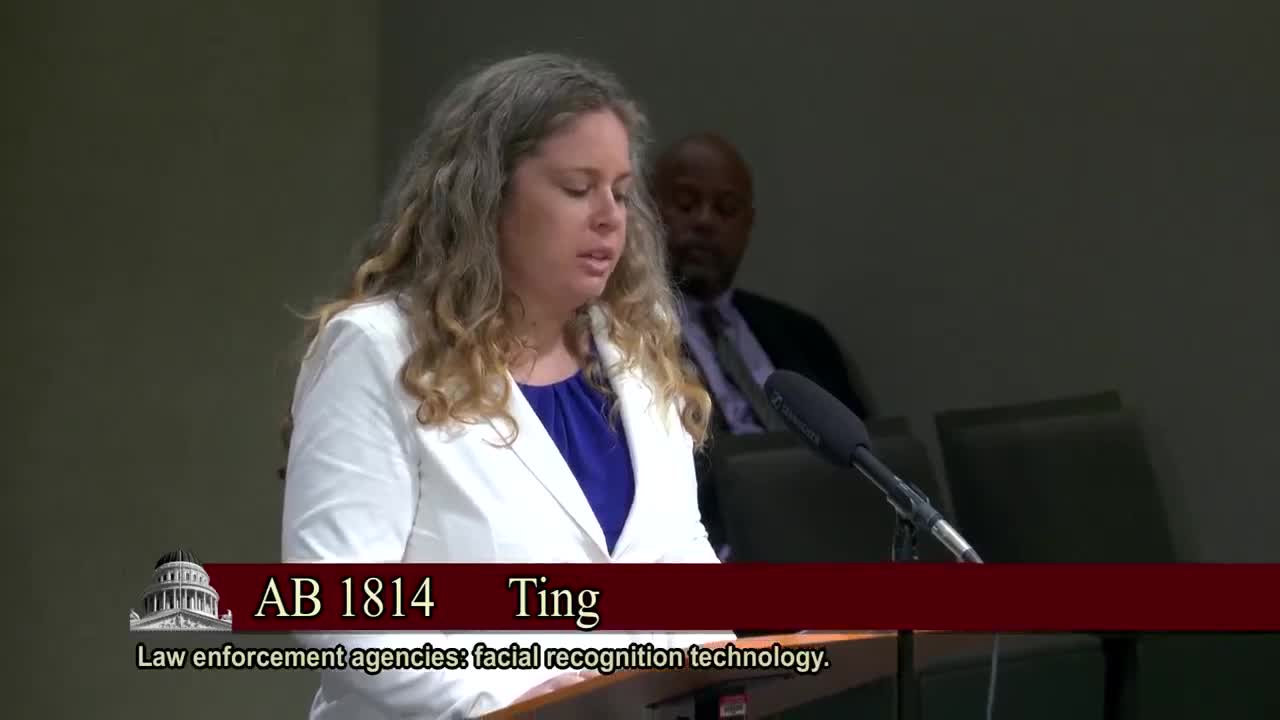 4MIN
Senate Standing Committee on Appropriations
 28MIN
Senate Standing Committee on Judiciary
 12MIN
Senate Standing Committee on Public Safety
 1MIN
Assembly Floor
 31MIN
Assembly Standing Committee on Privacy and Consumer Protection
 23MIN
Assembly Standing Committee on Public Safety
Bill Author

Bill Co-Author(s):