AB 1860: Personal Income Tax Law: exclusions: student loan debt.
- Session Year: 2023-2024
- House: Assembly
- Latest Version Date: 2024-01-18
Current Status:
Failed
(2024-05-16: In committee: Held under submission.)
Introduced
In Committee
First Chamber
In Committee
Second Chamber
Enacted
What does this bill do?
The bill lets people exclude from California taxable income any student loan or medical debt that is forgiven or canceled by a qualifying nonprofit (a federal 501(c)(3)) for tax years 2024 through 2028. It does not apply to debt forgiven in exchange for services, and it requires a report estimating how many taxpayers benefited and the total dollar value of the debt excluded.
The summary is provided by generative AI which can make mistakes. For original language, please view the details in the table below.
The Personal Income Tax Law, in modified conformity with federal income tax law, generally defines gross income as income from whatever source derived, except as specifically excluded, including an exclusion for the amount of student loan indebtedness repaid or canceled pursuant to a specified federal law.
This bill, for taxable years beginning on or after January 1, 2024, and before January 1, 2029, would exclude qualified discharge of indebtedness income from gross income. The bill would define qualified discharge of indebtedness income for this purpose to mean income that would otherwise be realized from the discharge of student loan debt, as defined, or medical debt that is discharged by a qualifying nonprofit organization.
Existing law requires a bill authorizing a new tax expenditure to contain, among other things, specific goals, purposes, and objectives the tax expenditure will achieve, detailed performance indicators, and data collection requirements.
This bill would include additional information required for any bill authorizing a new tax expenditure.
This bill would take effect immediately as a tax levy.
(a)For taxable years beginning on or after January 1, 2024, and before January 1, 2029, gross income does not include qualified discharge of indebtedness income.
(b)For purposes of this section, the following definitions shall apply:
(1)(A)Qualified discharge of indebtedness income means income that arises from the discharge of a debt if the debt discharged satisfies both of the following conditions:
(i)The source of the debt was either a student loan or medical debt.
(ii)The debt was discharged or otherwise terminated by a qualifying entity.
(B)Notwithstanding subparagraph (A), qualified discharge of indebtedness income shall not include income resulting from the discharge of a debt if the discharge is in exchange for services provided to the qualifying entity.
(2)Qualifying entity means an entity that is exempt from federal income taxation pursuant to Section 501(c)(3) of the Internal Revenue Code.
(3)Student loan shall have the same meaning as that term is defined in subdivision (q) of Section 1788.100 of the Civil Code.
(c)(1)For purposes of complying with Section 41, the Legislature finds as follows:
(A)The specific goal, purpose, and objective of the exclusion provided by this section is to provide relief to individuals that would otherwise be penalized for the gratuity of nonprofit organizations.
(B)The performance indicators for the Legislature to use in determining if the exclusion has achieved this goal shall be the number of taxpayers excluding discharged indebtedness from income based on this section, and the total dollar value of income so excluded.
(2)The Legislative Analysts Office shall, no later than December 1, 2029, submit a report to the Legislature, in accordance with Section 9795 of the Government Code, that estimates the number of taxpayers with discharged indebtedness excluded from income, and estimates the total dollar value of the qualified discharge of indebtedness income received, to the extent data is available.
(d)This section shall remain operative until December 1, 2029, and as of that date is repealed.
SEC. 2.This act provides for a tax levy within the meaning of Article IV of the California Constitution and shall go into immediate effect.
|
Date
|
Status
|
|---|---|
| May 16, 2024 | In committee: Held under submission. |
| May 16, 2024 | Joint Rule 62(a), file notice suspended. (Page 5215.) |
| May 15, 2024 | In committee: Set, first hearing. Referred to APPR. suspense file. |
| Apr 30, 2024 | From committee: Do pass and re-refer to Com. on APPR. (Ayes 7. Noes 0.) (April 29). Re-referred to Com. on APPR. |
| Mar 4, 2024 | In committee: Set, first hearing. Referred to REV. & TAX. suspense file. |
| Jan 29, 2024 | Referred to Com. on REV. & TAX. |
| Jan 19, 2024 | From printer. May be heard in committee February 18. |
| Jan 18, 2024 | Read first time. To print. |
|
Date
|
Description
|
Location
|
Votes
|
|
|---|---|---|---|---|
| Apr 29, 2024 | Do pass and be re-referred to the Committee on [Appropriations] | Assembly Standing Committee on Revenue and Taxation |
Passed |
This list shows positions taken on this bill by organizations on the date displayed, which is linked to the original source.
Positions by individuals are not included.
|
Organization
|
Position
|
Date
|
|---|---|---|
| AARP | ** Support | |
| Afscme CA | ** Support | |
| California Federation of Teachers, AFL-CIO | ** Support | |
| california low income consumer coalition | ** Support | Mar 4, 2024 |
| California Pan Ethnic Health Network | * Support | Mar 4, 2024 |
| National Consumer Law Center | * Support | Mar 4, 2024 |
| Rising Communities | ** Support | |
| The Leukemia & Lymphoma Society | ** Support |
Date of Hearing: May 15, 2024
ASSEMBLY COMMITTEE ON APPROPRIATIONS
Buffy Wicks, Chair
ABPCA Bill Id:AB 1860
Author:(Bauer-Kahan) – As Introduced Ver:January 18, 2024
Policy Committee: | Revenue and Taxation | Vote: | 7 - 0 |
|
| ||
|
|
Urgency: No State Mandated Local Program: No Reimbursable: No
SUMMARY:
This bill excludes from gross income, under the Personal Income Tax (PIT) Law, the discharge of student loan debt and medical debt.
Specifically, this bill:
- Excludes, for taxable years beginning on or after January 1, 2024, and before January 1, 2029, qualified discharge of indebtedness income from gross income. “Qualified discharge of indebtedness income” means income that would otherwise be realized from the discharge of student loan debt or medical debt by a 501(c)(3) nonprofit organization.
- Declares the goals and performance indicators for the new exclusion and requires, by December 1, 2029, the Legislative Analyst’s Office (LAO) to submit a report with specified exclusion data to the Legislature.
FISCAL EFFECT:
- Annual General Fund (GF) revenue loss of an unknown, but potentially significant, amount. The Franchise Tax Board (FTB) notes it does not know how many taxpayers may have debt forgiven by a nonprofit organization, nor the amount of such debt. However, FTB assumes approximately $4 million in GF revenue loss for every $50 million of qualified discharged debt (applying an average tax rate of 7.5%). By decreasing PIT revenue, this bill also likely decreases Proposition 98 GF spending by approximately 40% of the revenue loss (the exact amount depends on the specific amount of the annual Proposition 98 guarantee).
- Costs of an unknown, but likely absorbable, amount to FTB to administer the exclusion.
- Costs of an unknown, but likely absorbable, amount to the LAO to prepare the report. However, this committee sees a wide array of bills that require the LAO to measure different tax expenditures. Generally, a request to prepare an individual report would not generate significant new workload for the LAO. But, taken together, these proposals strain the ability of the LAO fulfill other existing or future legislative mandates and requests, as the LAO’s budget is subject to the Legislature’s constitutional spending cap.
According to the LAO, the GF faces a structural deficit in the tens of billions of dollars over the next several fiscal years.
COMMENTS:
- Purpose. According to the author, “Non-profits are doing incredible work to forgive debt for our most vulnerable constituents. AB 1860 will ensure that when student and medical debt is forgiven, instead of facing a high tax burden, individuals are able to experience the full impact of that forgiveness.” This bill is supported by labor organizations, health organizations, and a community college district.
- Tax Treatment of Forgiven Debt. Existing federal and state law generally consider forgiven debt to be taxable income, regardless of the type of debt or how the debt came to be. RIP Medical Debt is a 501(c)(3) that provides charitable aid by purchasing and forgiving the medical debt of low-income individuals. The organization works with partnering entities to purchase bundles of debt, often for pennies on the dollar, similar to a debt collector, but does not pursue the debtor for collection. For example, in 2016, the organization collaborated with John Oliver to forgive $15 million of medical debt. However, RIP Medical Debt does not record the cancelled amount as a forgiven debt, but as a gift representative of the organization’s charitable mission. Under federal and state law, gross income does not include the value of a gift.
This bill provides that medical debt and student loan debt discharged by a 501(c)(3) non-profit organization is excluded from gross income, regardless of how the discharge is recorded. Implementation considerations noted in the Assembly Revenue and Taxation Committee’s analysis of this bill include defining “medical debt” to ensure consistent application of the exclusion and “whether this bill is necessary or if it could add confusion to the existing treatment of forgiven loans,” especially in light of AB 111 (Committee on Budget), Chapter 5, Statutes of 2023, which conformed state law to the federal American Rescue Plan Act’s exclusion of forgiven or discharged student loan debt from gross income.
Analysis Prepared by: Irene Ho / APPR. / (916) 319-2081
Date of Hearing: April 29, 2024
ASSEMBLY COMMITTEE ON REVENUE AND TAXATION
Jacqui Irwin, Chair
ABPCA Bill Id:AB 1860 (
Author:Bauer-Kahan) – As Introduced Ver:January 18, 2024
SUSPENSE
Majority vote. Tax levy. Fiscal committee.
SUBJECT: Personal Income Tax Law: exclusions: student loan debt
SUMMARY: Excludes from gross income, for purposes of the Personal Income Tax (PIT) Law, amounts resulting from the discharge of student loan debt and medical debt, as specified. Specifically, this bill:
- Excludes from gross income, for taxable years beginning on or after January 1, 2024, and before January 1, 2029, "qualified discharge of indebtedness income", as defined.
- Defines the following terms for purposes of this bill:
- "Qualified discharge of indebtedness income" is income that arises from the discharge of a debt if the debt discharged satisfies both of the following conditions:
- The source of the debt was either a student loan or medical debt; and,
- The debt was discharged or otherwise terminated by a qualifying entity.
- "Qualifying entity" is an entity exempt from federal income taxation pursuant to Internal Revenue Code (IRC) Section 501(c)(3);
- "Student loan" is defined by cross-reference to Civil Code Section 1788.100(g).
- "Qualified discharge of indebtedness income" is income that arises from the discharge of a debt if the debt discharged satisfies both of the following conditions:
- Provides that the income exclusion does not apply to income resulting from the discharge of a debt if the discharge is in exchange for services provided to the qualifying entity.
- Finds the following for purposes of satisfying the requirements of Revenue and Taxation Code (R&TC) Section 41:
- The specific goal, purpose, and objective of the exclusion provided by this bill is to provide relief to individuals that would otherwise be penalized for the gratuity of nonprofit organizations; and,
- The performance indicators for the Legislature to use in determining if the exclusion has achieved its goal are the number of taxpayers excluding discharged indebtedness from income and the total dollar value of income so excluded.
- Requires the Legislative Analyst's Office (LAO) to submit a report to the Legislature by December 1, 2029 that estimates, to the extent data is available, the number of taxpayers with discharged indebtedness excluded from income and the total dollar value of the qualified discharge of indebtedness income received.
- Takes immediate effect as a tax levy.
- Sunsets on December 1, 2029.
EXISTING FEDERAL LAW:
- Defines "gross income", unless otherwise provided, to include all income from whatever source derived, including but not limited to income from the discharge of indebtedness. (IRC Section 61(a)(12).)
- Excludes from gross income the value of property acquired by gift. (IRC Section 102(a).)
- Excludes from gross income amounts received resulting from the discharge of certain student loans for individuals who are employed by a qualifying government or not-for-profit organization, as specified. (IRC Section 108(f).)
- Excludes from gross income, for taxable years 2021 through 2025, any amount received resulting from the discharge of any loan provided expressly for postsecondary educational expenses, whether provided by a public or private lender, as specified. (IRC Section 108(f)(5).)
EXISTING STATE LAW:
- Conforms, with modifications, to the definition of gross income in IRC Section 61 for purposes of the PIT Law. (R&TC Section 17071.)
- Excludes from gross income any loan amount repaid by the U.S. Secretary of Education or canceled pursuant to Section 1087e(e) of Title 20 of the United States Code relating to income-contingent repayment. (R&TC Section 17132.11.)
- Excludes from gross income amounts received resulting from the Forgivable Loan Program provided by the California State University. (R&TC Section 17134.)
- Excludes from gross income amounts received resulting from discharged loans for individuals who attended certain for-profit postsecondary institutions. (R&TC Section 17144.6.)
- Conforms to the special rule for discharges codified in IRC Section 108(f)(5) by the American Rescue Plan Act of 2021. (R&TC Section 17144.8.)
FISCAL EFFECT: To determine the magnitude of the potential impact to the General Fund (GF), both the number of taxpayers who would have debt forgiven under this program as well as the amount of debt that would be discharged by qualifying entities would need to be known. Because it is difficult to determine the number of taxpayers who would be impacted by this proposal and the amount of debt that would be discharged, the revenue impact to the GF is unknown. However, the Franchise Tax Board (FTB) estimates that for every $50 million of qualified debt that is discharged, and applying an average tax rate of 7.5%, the revenue loss would be approximately $4 million.
COMMENTS:
- The author has provided the following statement in support of this bill:
A gift of debt forgiveness does not have same the financial meaning as a windfall or income, and we have a compelling societal interest in encouraging it. As medical and student debt becomes an unmanageable burden for so many Californians, debt forgiveness has created an important relief for this financial stress. Non-profits are doing incredible work to forgive debt for our most vulnerable constituents. AB 1860 will ensure that when student and medical debt is forgiven, instead of facing a high tax burden, individuals are able to experience the full impact of that forgiveness. This small change will create an easier path to financial freedom for debt burdened Californians.
- In support of this bill, the American Federation of State, County and Municipal Employees, AFL-CIO California (AFSCME CA) notes, in part:
AB 1860 also provides an important clarification for individuals whose medical debts are canceled. Individuals who have had a substantial amount of medical debt forgiven may find themselves facing a significant tax bill. Medical debt is most pronounced among people who are already struggling with poor health, financial insecurity, or both. People who are extremely ill or living with a disability are also at risk of losing their employment or income due to illness. AB 1860 will not only help California residents who are saddled with debt financially, but it also lifts the significant emotional toll that this type of debt has on individuals who are simultaneously experiencing significant medical problems.
- Committee Staff Comments:
- Forgiven debts are generally considered taxable income: Under IRC Section 61(a)(12), when debt is forgiven, the amount forgiven is typically considered taxable income; this is true regardless of the type of debt or how the debt came to be. Borrowers do not pay tax on amounts they borrow because they are contractually bound to pay that amount back. If that contract is cancelled without the borrowed amount being repaid, the borrower gets to use that money as they see fit. Because the money was essentially received at no cost, the cancellation of the borrower's obligation to pay the money back qualifies it as taxable income. IRC Section 108 provides limited exceptions to the general rule, including for debtors that are insolvent or engaged in a bankruptcy proceeding.
Typically, creditors notify borrowers of cancellation of debt income by providing the taxpayer with a Form 1099-C. Common examples of when taxpayers might receive a Form 1099-C include for the charge-off of a credit card balance, repossession, foreclosure, return of property to a lender, abandonment of property, or the modification of a loan on a principal residence.
- Philanthropic routes to debt relief. RIP Medical Debt is an IRC Section 501(c)(3) charity whose purpose is to provide charitable aid by purchasing and forgiving the medical debt of poor people. The organization, in collaboration with Last Week Tonight's John Oliver, forgave $15 million of medical debt in 2016. Programs like RIP Medical Debt leverage the processes by which some debt is collected. In general, if a debt is overdue, a third-party debt collector may buy the debt from the initial party, like a hospital or insurer, at a deeply discounted rate. The debt collector will then pursue the full value of the debt from the debt holder. Organizations like RIP Medical Debt, on the other hand, work with partnering entities to purchase these bundles of debt – often for pennies on the dollar – without pursuing the debt holders.
Instead of recording the cancelled amounts as forgiven debts, RIP Medical Debt considers the amounts cancelled to be gifts, consistent with IRC Section 102(a).[1] The Supreme Court, in Commissioner v. Duberstein (1960), held that a gift "proceeds from a detached and disinterested generosity" and is made "out of affection, respect, admiration, charity or like impulses," but does not include a transfer that is made "from the constraining force of any moral or legal duty, or from the incentive of anticipated benefit of an economic nature." The provisions of this bill closely mirror these established principles. - Medical debt cancellation efforts gain traction: According to the Consumer Financial Protection Bureau’s (CFPB) "2022 Medical Debt Burden in the United States", $88 billion of outstanding medical bills are currently in collections – affecting one in five Americans. Medical debt is the most common collection type reported on consumer credit records, and consumers report being contacted by debt collectors about medical debt more than any other type of debt.[2]
RIP Medical Debt has partnered with several religious organizations, such as the Northview Church in Indiana and the Trinity Moravian Church in North Carolina, as well as local governmental entities, including the Cities of Akron, Cleveland and Toledo in Ohio; the City of New Orleans, Louisiana; Wayne County, Michigan; Washington, D.C.; and New York City, New York.[3] Los Angeles County began considering a similar plan in the fall of 2023, which may result in roughly 810,000 residents receiving debt cancellation.[4] - U.S. Department of Education's broad-based student debt relief plan: On August 24, 2022, President Biden announced a plan to cancel or reduce federal student loan balances for borrowers with annual income in 2020 or 2021 below $125,000 for individuals or below $250,000 for households. The program generally proposed cancellation of up to $10,000 per eligible borrower, or up to $20,000 of cancellation for eligible borrowers who are also prior Pell Grant recipients. According to the White House, roughly 20 million borrowers would have been eligible to see their full remaining balance canceled, while another 23 million borrowers would have been eligible to see their balance reduced. President Biden further argued that the burden of existing student debt falls disproportionately on Black borrowers, pointing out that 20 years after first enrolling in school, the typical Black borrower who started college in the 1995-96 school year still owed 95% of their original student debt.[5]
According to the U.S. Department of Education, categorical cancellation sought to address "the financial harms of the pandemic" by helping borrowers transition back to repayment status following the end of the pandemic-related pause on loan repayment, interest accrual, and involuntary collections.[6] In an opinion dated August 23, 2022, the Department of Justice's Office of Legal Counsel (OLC) concluded that the Higher Education Relief Opportunities for Students (HEROES) Act of 2003, as amended, authorizes the Secretary of Education to relieve borrowers of the obligation to repay federal student loans. This relief, OLC explained, could in some cases be justified under the HEROES Act as a response to the COVID-19 pandemic. - Supreme Court Blocks Broad-based Cancellation: On June 30, 2023, the Supreme Court of the United States held 6-3 in Biden v. Nebraska that the HEROES Act did not authorize the U.S. Department of Education to categorically forgive student loans as outlined in its student loan debt relief plan. Chief Justice Roberts, writing for the majority, stated, in part:
- Philanthropic routes to debt relief. RIP Medical Debt is an IRC Section 501(c)(3) charity whose purpose is to provide charitable aid by purchasing and forgiving the medical debt of poor people. The organization, in collaboration with Last Week Tonight's John Oliver, forgave $15 million of medical debt in 2016. Programs like RIP Medical Debt leverage the processes by which some debt is collected. In general, if a debt is overdue, a third-party debt collector may buy the debt from the initial party, like a hospital or insurer, at a deeply discounted rate. The debt collector will then pursue the full value of the debt from the debt holder. Organizations like RIP Medical Debt, on the other hand, work with partnering entities to purchase these bundles of debt – often for pennies on the dollar – without pursuing the debt holders.
The HEROES Act authorizes the Secretary to "waive or modify any statutory or regulatory provision applicable to the student financial assistance programs under title IV of the [Education Act] as the Secretary deems necessary in connection with a war or other military operation or national emergency." 20 U.S.C. §1098bb(a)(1). That power has limits. To begin with, statutory permission to "modify" does not authorize "basic and fundamental changes in the scheme" designed by Congress… The authority to "modify" statutes and regulations allows the Secretary to make modest adjustments and additions to existing provisions, not transform them.[7]
- U.S. Department of Education's revised student loan debt relief plan: Following the Supreme Court's decision in Biden v. Nebraska, the U.S. Department of Education announced it would initiate a negotiated rulemaking process under the Higher Education Act of 1965. Negotiated rulemaking is a process in which the Department and affected interest groups negotiate the terms of a proposed administrative rule. On February 22 and 23, 2024, the negotiated rulemaking committee discussed proposed regulatory text that would authorize the U.S. Department of Education to forgive federal student loan balances due to a borrower's inability to pay or undue costs of collection. It is unclear if this proposed regulation will be adopted, when it will become operative if it is adopted, and whether this regulatory change would be subject to litigation if adopted.
- Existing income exclusions for student loan forgiveness: Since 2014, California has provided an exclusion from gross income resulting from student loan debt that is cancelled or repaid under the income-based repayment programs administered by the U.S. Department of Education. Existing state law also provides a gross income exclusion for loans forgiven because of the closure of certain for-profit colleges. Since 2018, California has excluded from gross income a student loan that is discharged due to the death or total and permanent disability of the student. Additionally, AB 111 (Committee on Budget), Chapter 5, Statutes of 2023, conformed state law to the special rule for discharges codified in IRC Section 108(f)(5) by the American Rescue Plan Act of 2021.
- What is a "tax expenditure"? Existing law provides various credits, deductions, exclusions, and exemptions for particular taxpayer groups. In the late 1960s, U.S. Treasury officials began arguing that these features of the tax law should be referred to as "expenditures" since they are generally enacted to accomplish some governmental purpose and there is a determinable cost associated with each (in the form of foregone revenues).
As the Department of Finance notes in its annual Tax Expenditure Report, there are several key differences between tax expenditures and direct expenditures. First, tax expenditures are typically reviewed less frequently than direct expenditures. Second, there is generally no control over the amount of revenue losses associated with any given tax expenditure. Finally, it should also be noted that, once enacted, it takes a two-thirds vote to rescind an existing tax expenditure absent a sunset date. This effectively results in a "one-way ratchet" whereby tax expenditures can be conferred by majority vote, but cannot be rescinded, irrespective of their efficacy or cost, without a supermajority vote.
- Committee's tax expenditure policy: Both R&TC Section 41 and Committee policy require any tax expenditure bill to outline specific goals, purposes, and objectives that the tax expenditure will achieve, along with detailed performance indicators for the Legislature to use when measuring whether the tax expenditure meets those stated goals, purposes, and objectives. A tax expenditure bill will not be eligible for a Committee vote unless it has complied with these requirements.
In its current form, this bill states that the exclusion is intended to provide relief to individuals that would otherwise be penalized for the gratuity of nonprofit organizations. In addition, this bill provides that the exclusion's effectiveness shall be measured by the number of taxpayers excluding income pursuant to this bill and the total dollar amount of income excluded. This bill requires the LAO to submit a report to the Legislature by December 1, 2029, estimating the number of taxpayers excluding income pursuant to this bill and the total dollar amount of income excluded.
In addition to the R&TC Section 41 requirements, this Committee's policy also requires that all tax expenditure proposals contain an appropriate sunset provision to be eligible for a vote. According to this policy, an "appropriate sunset provision" means five years, except in the case of a tax expenditure measure providing relief to California veterans, in which case "appropriate sunset provision" means ten years. This bill contains a five-year sunset provision and therefore complies with the Committee's policy on sunset dates.
- Implementation considerations:
- Definitions: As currently drafted, this bill defines "student debt" but does not provide a definition for "medical debt". The author may wish to consider defining "medical debt" to ensure consistent application.
- Duplicative? As outlined above, questions regarding the taxability of forgiven student loans is complicated and evolving. Given that California has already conformed to Federal law regarding discharges of student loan debts for calendar years 2021-2025, the Committee may wish to consider whether this bill is necessary or if it could add confusion to the existing treatment of forgiven loans.
- Definitions: As currently drafted, this bill defines "student debt" but does not provide a definition for "medical debt". The author may wish to consider defining "medical debt" to ensure consistent application.
- Current legislation: AB 26 (Mike Fong) would have excluded from gross income, for purposes of the PIT Law, amounts of up to $20,000 in "qualified student loan debt" that was discharged under the U.S. Department of Education's student loan debt relief plan. AB 26 was held on the Assembly Appropriations Committee's Suspense File.
- Prior legislation:
- AB 111 (Committee on Budget), Chapter 5, Statutes of 2023, conformed state law to the special rule for discharges codified in IRC Section 108(f)(5) by the American Rescue Plan Act of 2021, among other provisions.
- AB 668 (Petrie-Norris), of the 2021-22 Legislative Session, would have conformed to the student loan forgiveness provisions under the American Rescue Plan Act for taxable years beginning on or after January 1, 2021, and before January 1, 2026. AB 668 was never heard by this Committee.
- AB 91 (Burke), Chapter 39, Statutes of 2019, provided that discharges of indebtedness, under the PIT Law, for certain student loans that are discharged on account of death or total permanent disability of the student are excluded from gross income.
- AB 461 (Muratsuchi), Chapter 525, Statutes of 2017, excluded from gross income student loan debt that is cancelled or repaid under the Income Contingent Repayment Plan, the Pay As You Earn Repayment Plan, and the Revised Pay As You Earn Repayment Plan as administered by the U.S. Department of Education for taxable years beginning on or after January 1, 2017, and before January 1, 2022.
- AB 111 (Committee on Budget), Chapter 5, Statutes of 2023, conformed state law to the special rule for discharges codified in IRC Section 108(f)(5) by the American Rescue Plan Act of 2021, among other provisions.
- Implementation considerations:
REGISTERED SUPPORT / OPPOSITION:
Support
AARP
AFSCME CA
California Federation of Teachers AFL-CIO
Rising Communities (formerly Community Health Councils)
The Leukemia & Lymphoma Society
Opposition
None on file.
Analysis Prepared by: Wesley Whitaker / REV. & TAX. / (916) 319-2098
Miller, The Tax Consequences of John Oliver's $15 Million Medical Debt Forgiveness, Proskauer (June 15, 2016). https://www.proskauertaxtalks.com/2016/06/last-week-tonight-debt-forgiveness/. ↑
Medical Debt Burden in the United States, Consumer Financial Protection Bureau (CFPB) (February 2022). https://files.consumerfinance.gov/f/documents/cfpb_medical-debt-burden-in-the-united-states_report_2022-03.pdf. ↑
Noguchi, A growing wave of local governments are erasing billions in medical debts, NPR (January 23, 2024). https://www.npr.org/sections/health-shots/2024/01/23/1225014618/nyc-joins-a-growing-wave-of-local-governments-erasing-residents-medical-debt. ↑
Wait, LA County considering plan to erase medical debt for residents, CBS News (October 4, 2023). https://www.cbsnews.com/losangeles/news/la-county-considering-plan-to-erase-medical-debt-for-residents/. ↑
FACT SHEET: President Biden Announces Student Loan Relief for Borrowers Who Need It Most, The White House Briefing Room (August 24, 2022). https://www.whitehouse.gov/briefing-room/statements-releases/2022/08/24/fact-sheet-president-biden-announces-student-loan-relief-for-borrowers-who-need-it-most/. ↑
Liu, Statutory Basis for Biden Administration Student Loan Forgiveness, Congressional Research Service (September 13, 2022). https://crsreports.congress.gov/product/
pdf/LSB/LSB10818. ↑Biden v. Nebraska, 600 U.S. ____ (2023). Page 13. https://www.supremecourt.gov/opinions/22pdf/22-506_nmip.pdf. ↑
Date of Hearing: March 4, 2024
ASSEMBLY COMMITTEE ON REVENUE AND TAXATION
Jacqui Irwin, Chair
ABPCA Bill Id:AB 1860 (
Author:Bauer-Kahan) – As Introduced Ver:January 18, 2024
Majority vote. Tax levy. Fiscal committee.
SUBJECT: Personal Income Tax Law: exclusions: student loan debt
SUMMARY: Excludes from gross income, for purposes of the Personal Income Tax (PIT) Law, amounts resulting from the discharge of student loan debt and medical debt, as specified. Specifically, this bill:
- Excludes from gross income, for taxable years beginning on or after January 1, 2024, and before January 1, 2029, "qualified discharge of indebtedness income", as defined.
- Defines the following terms for purposes of this bill:
- "Qualified discharge of indebtedness income" is income that arises from the discharge of a debt if the debt discharged satisfies both of the following conditions:
- The source of the debt was either a student loan or medical debt; and,
- The debt was discharged or otherwise terminated by a qualifying entity.
- "Qualifying entity" is an entity exempt from federal income taxation pursuant to Internal Revenue Code (IRC) Section 501(c)(3);
- "Student loan" is defined by cross-reference to Civil Code Section 1788.100(g).
- "Qualified discharge of indebtedness income" is income that arises from the discharge of a debt if the debt discharged satisfies both of the following conditions:
- Provides that the income exclusion does not apply to income resulting from the discharge of a debt if the discharge is in exchange for services provided to the qualifying entity.
- Finds the following for purposes of satisfying the requirements of Revenue and Taxation Code (R&TC) Section 41:
- The specific goal, purpose, and objective of the exclusion provided by this bill is to provide relief to individuals that would otherwise be penalized for the gratuity of nonprofit organizations; and,
- The performance indicators for the Legislature to use in determining if the exclusion has achieved its goal are the number of taxpayers excluding discharged indebtedness from income and the total dollar value of income so excluded.
- Requires the Legislative Analyst's Office (LAO) to submit a report to the Legislature by December 1, 2029 that estimates, to the extent data is available, the number of taxpayers with discharged indebtedness excluded from income and the total dollar value of the qualified discharge of indebtedness income received.
- Takes immediate effect as a tax levy.
- Sunsets on December 1, 2029.
EXISTING FEDERAL LAW:
- Defines "gross income", unless otherwise provided, to include all income from whatever source derived, including but not limited to income from the discharge of indebtedness. (IRC Section 61(a)(12).)
- Excludes from gross income the value of property acquired by gift. (IRC Section 102(a).)
- Excludes from gross income amounts received resulting from the discharge of certain student loans for individuals who are employed by a qualifying government or not-for-profit organization, as specified. (IRC Section 108(f).)
- Excludes from gross income, for taxable years 2021 through 2025, any amount received resulting from the discharge of any loan provided expressly for postsecondary educational expenses, whether provided by a public or private lender, as specified. (IRC Section 108(f)(5).)
EXISTING STATE LAW:
- Conforms, with modifications, to the definition of gross income in IRC Section 61 for purposes of the PIT Law. (R&TC Section 17071.)
- Excludes from gross income any loan amount repaid by the U.S. Secretary of Education or canceled pursuant to Section 1087e(e) of Title 20 of the United States Code relating to income-contingent repayment. (R&TC Section 17132.11.)
- Excludes from gross income amounts received resulting from the Forgivable Loan Program provided by the California State University. (R&TC Section 17134.)
- Excludes from gross income amounts received resulting from discharged loans for individuals who attended certain for-profit postsecondary institutions. (R&TC Section 17144.6.)
- Conforms to the special rule for discharges codified in IRC Section 108(f)(5) by the American Rescue Plan Act of 2021. (R&TC Section 17144.8.)
FISCAL EFFECT: To determine the magnitude of the potential impact to the General Fund (GF), both the number of taxpayers who would have debt forgiven under this program as well as the amount of debt that would be discharged by qualifying entities would need to be known. Because it is difficult to determine the number of taxpayers who would be impacted by this proposal and the amount of debt that would be discharged, the revenue impact to the GF is unknown. However, the Franchise Tax Board (FTB) estimates that for every $50 million of qualified debt that is discharged, and applying an average tax rate of 7.5%, the revenue loss would be approximately $4 million.
COMMENTS:
- The author has provided the following statement in support of this bill:
A gift of debt forgiveness does not have same the financial meaning as a windfall or income, and we have a compelling societal interest in encouraging it. As medical and student debt becomes an unmanageable burden for so many Californians, debt forgiveness has created an important relief for this financial stress. Non-profits are doing incredible work to forgive debt for our most vulnerable constituents. AB 1860 will ensure that when student and medical debt is forgiven, instead of facing a high tax burden, individuals are able to experience the full impact of that forgiveness. This small change will create an easier path to financial freedom for debt burdened Californians.
- In support of this bill, the American Federation of State, County and Municipal Employees, AFL-CIO California (AFSCME CA) notes, in part:
AB 1860 also provides an important clarification for individuals whose medical debts are canceled. Individuals who have had a substantial amount of medical debt forgiven may find themselves facing a significant tax bill. Medical debt is most pronounced among people who are already struggling with poor health, financial insecurity, or both. People who are extremely ill or living with a disability are also at risk of losing their employment or income due to illness. AB 1860 will not only help California residents who are saddled with debt financially, but it also lifts the significant emotional toll that this type of debt has on individuals who are simultaneously experiencing significant medical problems.
- Committee Staff Comments:
- Forgiven debts are generally considered taxable income: Under IRC Section 61(a)(12), when debt is forgiven, the amount forgiven is typically considered taxable income; this is true regardless of the type of debt or how the debt came to be. Borrowers do not pay tax on amounts they borrow because they are contractually bound to pay that amount back. If that contract is cancelled without the borrowed amount being repaid, the borrower gets to use that money as they see fit. Because the money was essentially received at no cost, the cancellation of the borrower's obligation to pay the money back qualifies it as taxable income. IRC Section 108 provides limited exceptions to the general rule, including for debtors that are insolvent or engaged in a bankruptcy proceeding.
Typically, creditors notify borrowers of cancellation of debt income by providing the taxpayer with a Form 1099-C. Common examples of when taxpayers might receive a Form 1099-C include for the charge-off of a credit card balance, repossession, foreclosure, return of property to a lender, abandonment of property, or the modification of a loan on a principal residence.
- Philanthropic routes to debt relief. RIP Medical Debt is an IRC Section 501(c)(3) charity whose purpose is to provide charitable aid by purchasing and forgiving the medical debt of poor people. The organization, in collaboration with Last Week Tonight's John Oliver, forgave $15 million of medical debt in 2016. Programs like RIP Medical Debt leverage the processes by which some debt is collected. In general, if a debt is overdue, a third-party debt collector may buy the debt from the initial party, like a hospital or insurer, at a deeply discounted rate. The debt collector will then pursue the full value of the debt from the debt holder. Organizations like RIP Medical Debt, on the other hand, work with partnering entities to purchase these bundles of debt – often for pennies on the dollar – without pursuing the debt holders.
Instead of recording the cancelled amounts as forgiven debts, RIP Medical Debt considers the amounts cancelled to be gifts, consistent with IRC Section 102(a).[1] The Supreme Court, in Commissioner v. Duberstein (1960), held that a gift "proceeds from a detached and disinterested generosity" and is made "out of affection, respect, admiration, charity or like impulses," but does not include a transfer that is made "from the constraining force of any moral or legal duty, or from the incentive of anticipated benefit of an economic nature." The provisions of this bill closely mirror these established principles. - Medical debt cancellation efforts gain traction: According to the Consumer Financial Protection Bureau’s (CFPB) "2022 Medical Debt Burden in the United States", $88 billion of outstanding medical bills are currently in collections – affecting one in five Americans. Medical debt is the most common collection type reported on consumer credit records, and consumers report being contacted by debt collectors about medical debt more than any other type of debt.[2]
RIP Medical Debt has partnered with several religious organizations, such as the Northview Church in Indiana and the Trinity Moravian Church in North Carolina, as well as local governmental entities, including the Cities of Akron, Cleveland and Toledo in Ohio; the City of New Orleans, Louisiana; Wayne County, Michigan; Washington, D.C.; and New York City, New York.[3] Los Angeles County began considering a similar plan in the fall of 2023, which may result in roughly 810,000 residents receiving debt cancellation.[4] - U.S. Department of Education's broad-based student debt relief plan: On August 24, 2022, President Biden announced a plan to cancel or reduce federal student loan balances for borrowers with annual income in 2020 or 2021 below $125,000 for individuals or below $250,000 for households. The program generally proposed cancellation of up to $10,000 per eligible borrower, or up to $20,000 of cancellation for eligible borrowers who are also prior Pell Grant recipients. According to the White House, roughly 20 million borrowers would have been eligible to see their full remaining balance canceled, while another 23 million borrowers would have been eligible to see their balance reduced. President Biden further argued that the burden of existing student debt falls disproportionately on Black borrowers, pointing out that 20 years after first enrolling in school, the typical Black borrower who started college in the 1995-96 school year still owed 95% of their original student debt.[5]
According to the U.S. Department of Education, categorical cancellation sought to address "the financial harms of the pandemic" by helping borrowers transition back to repayment status following the end of the pandemic-related pause on loan repayment, interest accrual, and involuntary collections.[6] In an opinion dated August 23, 2022, the Department of Justice's Office of Legal Counsel (OLC) concluded that the Higher Education Relief Opportunities for Students (HEROES) Act of 2003, as amended, authorizes the Secretary of Education to relieve borrowers of the obligation to repay federal student loans. This relief, OLC explained, could in some cases be justified under the HEROES Act as a response to the COVID-19 pandemic. - Supreme Court Blocks Broad-based Cancellation: On June 30, 2023, the Supreme Court of the United States held 6-3 in Biden v. Nebraska that the HEROES Act did not authorize the U.S. Department of Education to categorically forgive student loans as outlined in its student loan debt relief plan. Chief Justice Roberts, writing for the majority, stated, in part:
- Philanthropic routes to debt relief. RIP Medical Debt is an IRC Section 501(c)(3) charity whose purpose is to provide charitable aid by purchasing and forgiving the medical debt of poor people. The organization, in collaboration with Last Week Tonight's John Oliver, forgave $15 million of medical debt in 2016. Programs like RIP Medical Debt leverage the processes by which some debt is collected. In general, if a debt is overdue, a third-party debt collector may buy the debt from the initial party, like a hospital or insurer, at a deeply discounted rate. The debt collector will then pursue the full value of the debt from the debt holder. Organizations like RIP Medical Debt, on the other hand, work with partnering entities to purchase these bundles of debt – often for pennies on the dollar – without pursuing the debt holders.
The HEROES Act authorizes the Secretary to "waive or modify any statutory or regulatory provision applicable to the student financial assistance programs under title IV of the [Education Act] as the Secretary deems necessary in connection with a war or other military operation or national emergency." 20 U.S.C. §1098bb(a)(1). That power has limits. To begin with, statutory permission to "modify" does not authorize "basic and fundamental changes in the scheme" designed by Congress… The authority to "modify" statutes and regulations allows the Secretary to make modest adjustments and additions to existing provisions, not transform them.[7]
- U.S. Department of Education's revised student loan debt relief plan: Following the Supreme Court's decision in Biden v. Nebraska, the U.S. Department of Education announced it would initiate a negotiated rulemaking process under the Higher Education Act of 1965. Negotiated rulemaking is a process in which the Department and affected interest groups negotiate the terms of a proposed administrative rule. On February 22 and 23, 2024, the negotiated rulemaking committee discussed proposed regulatory text that would authorize the U.S. Department of Education to forgive federal student loan balances due to a borrower's inability to pay or undue costs of collection. It is unclear if this proposed regulation will be adopted, when it will become operative if it is adopted, and whether this regulatory change would be subject to litigation if adopted.
- Existing income exclusions for student loan forgiveness: Since 2014, California has provided an exclusion from gross income resulting from student loan debt that is cancelled or repaid under the income-based repayment programs administered by the U.S. Department of Education. Existing state law also provides a gross income exclusion for loans forgiven because of the closure of certain for-profit colleges. Since 2018, California has excluded from gross income a student loan that is discharged due to the death or total and permanent disability of the student. Additionally, AB 111 (Committee on Budget), Chapter 5, Statutes of 2023, conformed state law to the special rule for discharges codified in IRC Section 108(f)(5) by the American Rescue Plan Act of 2021.
- What is a "tax expenditure"? Existing law provides various credits, deductions, exclusions, and exemptions for particular taxpayer groups. In the late 1960s, U.S. Treasury officials began arguing that these features of the tax law should be referred to as "expenditures" since they are generally enacted to accomplish some governmental purpose and there is a determinable cost associated with each (in the form of foregone revenues).
As the Department of Finance notes in its annual Tax Expenditure Report, there are several key differences between tax expenditures and direct expenditures. First, tax expenditures are typically reviewed less frequently than direct expenditures. Second, there is generally no control over the amount of revenue losses associated with any given tax expenditure. Finally, it should also be noted that, once enacted, it takes a two-thirds vote to rescind an existing tax expenditure absent a sunset date. This effectively results in a "one-way ratchet" whereby tax expenditures can be conferred by majority vote, but cannot be rescinded, irrespective of their efficacy or cost, without a supermajority vote.
- Committee's tax expenditure policy: Both R&TC Section 41 and Committee policy require any tax expenditure bill to outline specific goals, purposes, and objectives that the tax expenditure will achieve, along with detailed performance indicators for the Legislature to use when measuring whether the tax expenditure meets those stated goals, purposes, and objectives. A tax expenditure bill will not be eligible for a Committee vote unless it has complied with these requirements.
In its current form, this bill states that the exclusion is intended to provide relief to individuals that would otherwise be penalized for the gratuity of nonprofit organizations. In addition, this bill provides that the exclusion's effectiveness shall be measured by the number of taxpayers excluding income pursuant to this bill and the total dollar amount of income excluded. This bill requires the LAO to submit a report to the Legislature by December 1, 2029, estimating the number of taxpayers excluding income pursuant to this bill and the total dollar amount of income excluded.
In addition to the R&TC Section 41 requirements, this Committee's policy also requires that all tax expenditure proposals contain an appropriate sunset provision to be eligible for a vote. According to this policy, an "appropriate sunset provision" means five years, except in the case of a tax expenditure measure providing relief to California veterans, in which case "appropriate sunset provision" means ten years. This bill contains a five-year sunset provision and therefore complies with the Committee's policy on sunset dates.
- Implementation considerations:
- Definitions: As currently drafted, this bill defines "student debt" but does not provide a definition for "medical debt". The author may wish to consider defining "medical debt" to ensure consistent application.
- Duplicative? As outlined above, questions regarding the taxability of forgiven student loans is complicated and evolving. Given that California has already conformed to Federal law regarding discharges of student loan debts for calendar years 2021-2025, the Committee may wish to consider whether this bill is necessary or if it could add confusion to the existing treatment of forgiven loans.
- Definitions: As currently drafted, this bill defines "student debt" but does not provide a definition for "medical debt". The author may wish to consider defining "medical debt" to ensure consistent application.
- Current legislation: AB 26 (Mike Fong) would have excluded from gross income, for purposes of the PIT Law, amounts of up to $20,000 in "qualified student loan debt" that was discharged under the U.S. Department of Education's student loan debt relief plan. AB 26 was held on the Assembly Appropriations Committee's Suspense File.
- Prior legislation:
- AB 111 (Committee on Budget), Chapter 5, Statutes of 2023, conformed state law to the special rule for discharges codified in IRC Section 108(f)(5) by the American Rescue Plan Act of 2021, among other provisions.
- AB 668 (Petrie-Norris), of the 2021-22 Legislative Session, would have conformed to the student loan forgiveness provisions under the American Rescue Plan Act for taxable years beginning on or after January 1, 2021, and before January 1, 2026. AB 668 was never heard by this Committee.
- AB 91 (Burke), Chapter 39, Statutes of 2019, provided that discharges of indebtedness, under the PIT Law, for certain student loans that are discharged on account of death or total permanent disability of the student are excluded from gross income.
- AB 461 (Muratsuchi), Chapter 525, Statutes of 2017, excluded from gross income student loan debt that is cancelled or repaid under the Income Contingent Repayment Plan, the Pay As You Earn Repayment Plan, and the Revised Pay As You Earn Repayment Plan as administered by the U.S. Department of Education for taxable years beginning on or after January 1, 2017, and before January 1, 2022.
- AB 111 (Committee on Budget), Chapter 5, Statutes of 2023, conformed state law to the special rule for discharges codified in IRC Section 108(f)(5) by the American Rescue Plan Act of 2021, among other provisions.
- Implementation considerations:
REGISTERED SUPPORT / OPPOSITION:
Support
AFSCME CA
Rising Communities (formerly Community Health Councils)
Opposition
None on file.
Analysis Prepared by: Wesley Whitaker / REV. & TAX. / (916) 319-2098
Miller, The Tax Consequences of John Oliver's $15 Million Medical Debt Forgiveness, Proskauer (June 15, 2016). https://www.proskauertaxtalks.com/2016/06/last-week-tonight-debt-forgiveness/. ↑
Medical Debt Burden in the United States, Consumer Financial Protection Bureau (CFPB) (February 2022). https://files.consumerfinance.gov/f/documents/cfpb_medical-debt-burden-in-the-united-states_report_2022-03.pdf. ↑
Noguchi, A growing wave of local governments are erasing billions in medical debts, NPR (January 23, 2024). https://www.npr.org/sections/health-shots/2024/01/23/1225014618/nyc-joins-a-growing-wave-of-local-governments-erasing-residents-medical-debt. ↑
Wait, LA County considering plan to erase medical debt for residents, CBS News (October 4, 2023). https://www.cbsnews.com/losangeles/news/la-county-considering-plan-to-erase-medical-debt-for-residents/. ↑
FACT SHEET: President Biden Announces Student Loan Relief for Borrowers Who Need It Most, The White House Briefing Room (August 24, 2022). https://www.whitehouse.gov/briefing-room/statements-releases/2022/08/24/fact-sheet-president-biden-announces-student-loan-relief-for-borrowers-who-need-it-most/. ↑
Liu, Statutory Basis for Biden Administration Student Loan Forgiveness, Congressional Research Service (September 13, 2022). https://crsreports.congress.gov/product/
pdf/LSB/LSB10818. ↑Biden v. Nebraska, 600 U.S. ____ (2023). Page 13. https://www.supremecourt.gov/opinions/22pdf/22-506_nmip.pdf. ↑
Discussed in Hearing
 4MIN
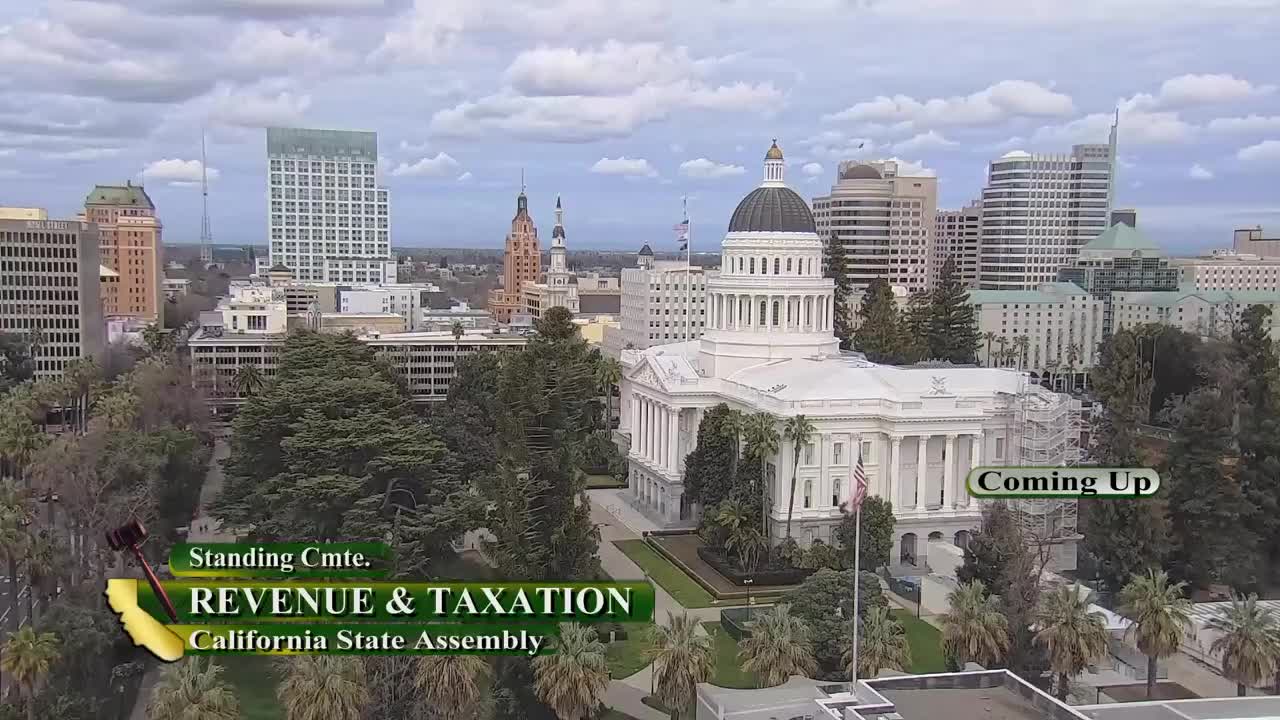
Assembly Standing Committee on Revenue and Taxation
Bill Author

Bill Co-Author(s):