AB 1901: Vehicles: total loss claim: salvage certificate or nonrepairable vehicle certificate.
- Session Year: 2023-2024
- House: Assembly
- Latest Version Date: 2024-09-22
Current Status:
Passed
(2024-09-22: Chaptered by Secretary of State - Chapter 364, Statutes of 2024.)
Introduced
In Committee
First Chamber
In Committee
Second Chamber
Enacted
Existing law requires, if an insurance company makes a total loss settlement on a total loss salvage vehicle or a nonrepairable vehicle, the insurance company, an occupational licensee of the Department of Motor Vehicles (DMV) authorized by the insurance company, or a salvage pool authorized by the insurance company to, within 10 days from the settlement of the loss or after receipt of title, forward the properly endorsed certificate of ownership or other evidence of ownership acceptable to the DMV, the license plates, and a fee, to the DMV, except as specified, and requires the DMV, upon receipt of those required items, to issue a salvage certificate or a nonrepairable vehicle certificate for the vehicle. A violation of the Vehicle Code is an infraction.
This bill would, if an insurance company requests a salvage pool or an occupational licensee to take possession of a vehicle that is the subject of a total loss claim, and, subsequently, the insurance company does not take ownership of the vehicle, authorize the insurance company to direct the salvage pool or occupational licensee to release the vehicle to the registered and legal owner or lienholder of the vehicle after notice from the insurance company authorizing the release. The bill would require the salvage pool or occupational licensee to send 2 notices to the registered and legal owner and any lienholder of the vehicle informing them that they have 30 days from the date of mailing of the first notice and 14 days from the date of mailing of the 2nd notice, and that they have the right to contact the salvage pool or occupational licensee of the department regarding their intent to pick up the vehicle in order to receive an additional 30 days from the date of contact, to pick up the vehicle from the salvage pool or occupational licensee before the vehicle is deemed abandoned. If the registered and legal owner or any lienholder of the vehicle does not pick up the vehicle in those timelines, the bill would require the vehicle to be deemed abandoned and would require the vehicles certificate of title to be deemed to be assigned to the salvage pool or occupational licensee of the department. The bill would authorize the salvage pool or occupational licensee to request on a form signed under penalty of perjury that the DMV issue a salvage certificate or nonrepairable vehicle certificate for the vehicle, as specified, and would require the DMV to issue the certificate.
By creating a new infraction and expanding the scope of the crime of perjury, this bill would impose a state-mandated local program.
Existing law requires, whenever a salvage pool acquires a total loss salvage vehicle, a nonrepairable vehicle, or a recovered stolen vehicle and the vehicle license plates have not been removed pursuant to specified statutes, the salvage pool, prior to disposing of that vehicle, to remove and submit the license plates to the department.
This bill would also require a salvage pool to remove and submit a vehicles license plates to the department for a vehicle the salvage pool acquires through the provisions above and the license plates have not been removed.
The California Constitution requires the state to reimburse local agencies and school districts for certain costs mandated by the state. Statutory provisions establish procedures for making that reimbursement.
This bill would provide that no reimbursement is required by this act for a specified reason.
Existing law requires, if an insurance company makes a total loss settlement on a total loss salvage vehicle or a nonrepairable vehicle, the insurance company, an occupational licensee of the Department of Motor Vehicles (DMV) authorized by the insurance company, or a salvage pool authorized by the insurance company to, within 10 days from the settlement of the loss, forward the properly endorsed certificate of ownership or other evidence of ownership acceptable to the DMV, the license plates, and a fee, to the DMV, except as specified, and requires the DMV, upon receipt of those required items, to issue a salvage certificate or a nonrepairable vehicle certificate for the vehicle. A violation of the Vehicle Code is an infraction.
This bill would, if an insurance company requests a salvage pool or an occupational licensee to take possession of a vehicle that is the subject of a total loss claim, and, subsequently, the insurance company does not take ownership of the vehicle, authorize the insurance company to direct the salvage pool or occupational licensee to release the vehicle to the registered and legal owner or lienholder of the vehicle after notice from the insurance company authorizing the release. The bill would require the salvage pool or occupational licensee to send 2 notices to the registered and legal owner and any lienholder of the vehicle informing them that they have 30 days from the date of mailing of the first notice and 14 days from the date of mailing of the 2nd notice, and that they have the right to contact the salvage pool or occupational licensee of the department regarding their intent to pick up the vehicle in order to receive an additional 30 days from the date of contact, to pick up the vehicle from the salvage pool or occupational licensee before the vehicle is deemed abandoned. If the registered and legal owner or any lienholder of the vehicle does not pick up the vehicle in those timelines, the bill would require the vehicle to be deemed abandoned and would require the vehicles certificate of title to be deemed to be assigned to the salvage pool or occupational licensee of the department. The bill would authorize the salvage pool or occupational licensee to request on a form signed under penalty of perjury that the DMV issue a salvage certificate or nonrepairable vehicle certificate for the vehicle, as specified, and would require the DMV to issue the certificate upon receipt of a complete application. certificate.
By creating a new infraction and expanding the scope of the crime of perjury, this bill would impose a state-mandated local program.
Existing law requires, whenever a salvage pool acquires a total loss salvage vehicle, a nonrepairable vehicle, or a recovered stolen vehicle and the vehicle license plates have not been removed pursuant to specified statutes, the salvage pool, prior to disposing of that vehicle, to remove and submit the license plates to the department.
This bill would also require a salvage pool to remove and submit a vehicles license plates to the department for a vehicle the salvage pool acquires through the provisions above and the license plates have not been removed.
The California Constitution requires the state to reimburse local agencies and school districts for certain costs mandated by the state. Statutory provisions establish procedures for making that reimbursement.
This bill would provide that no reimbursement is required by this act for a specified reason.
Existing law requires, if an insurance company makes a total loss settlement on a total loss salvage vehicle or a nonrepairable vehicle, the insurance company, an occupational licensee of the Department of Motor Vehicles (DMV) authorized by the insurance company, or a salvage pool authorized by the insurance company to, within 10 days from the settlement of the loss, forward the properly endorsed certificate of ownership or other evidence of ownership acceptable to the DMV, the license plates, and a fee, to the DMV, except as specified, and requires the DMV, upon receipt of those required items, to issue a salvage certificate or a nonrepairable vehicle certificate for the vehicle.
This bill would, if an insurance company requests a salvage pool or an occupational licensee to take possession of a vehicle that is the subject of a total loss claim, and, subsequently, the insurance company does not take ownership of the vehicle, authorize the insurance company to direct the salvage pool or occupational licensee to release the vehicle to the registered and legal owner or lienholder of the vehicle after notice from the insurance company authorizing the release. The bill would require the salvage pool or occupational licensee to send 2 notices to the registered and legal owner and any lienholder of the vehicle informing them that they have 30 days from the date of the first notice and 14 days from the date of the 2nd notice notice, and that they have the right to contact the salvage pool or occupational licensee of the department regarding their intent to pick up the vehicle in order to receive an additional 30 days from the date of contact, to pick up the vehicle from the salvage pool or occupational licensee before the vehicle is deemed abandoned. If the registered and legal owner or any lienholder of the vehicle does not pick up the vehicle in that timeline, those timelines, the bill would require the vehicle to be deemed abandoned and would require the vehicles certificate of title to be deemed to be assigned to the salvage pool or occupational licensee of the department. The bill would authorize the salvage pool or occupational licensee to request that the DMV issue a salvage certificate or nonrepairable vehicle certificate for the vehicle, as specified, and would require the DMV to issue the certificate upon receipt of a complete application.
Existing law requires, if an insurance company makes a total loss settlement on a total loss salvage vehicle or a nonrepairable vehicle, the insurance company, an occupational licensee of the Department of Motor Vehicles (DMV) authorized by the insurance company, or a salvage pool authorized by the insurance company to, within 10 days from the settlement of the loss, forward the properly endorsed certificate of ownership or other evidence of ownership acceptable to the DMV, the license plates, and a fee, to the DMV, except as specified, and requires the DMV, upon receipt of those required items, to issue a salvage certificate or a nonrepairable vehicle certificate for the vehicle.
This bill would, if an insurance company requests a salvage pool or an occupational licensee to take possession of a vehicle that is the subject of a total loss claim, and, subsequently, the insurance company does not take ownership of the vehicle, authorize the insurance company to direct the salvage pool or occupational licensee to release the vehicle to the registered and legal owner or lienholder of the vehicle after notice from the insurance company authorizing the release. The bill would require the salvage pool or occupational licensee to send 2 notices to the registered and legal owner and any lienholder of the vehicle informing them that they have 30 days from the date of the first notice and 14 days from the date of the 2nd notice to pick up the vehicle from the salvage pool or occupational licensee before the vehicle is deemed abandoned. If the registered and legal owner or any lienholder of the vehicle does not pick up the vehicle in that timeline, the bill would require the vehicle to be deemed abandoned and would require the vehicles certificate of title to be deemed to be assigned to the salvage pool or occupational licensee of the department. The bill would authorize the salvage pool or occupational licensee to request that the DMV issue a salvage certificate or nonrepairable vehicle certificate for the vehicle, as specified, and would require the DMV to issue the certificate upon receipt of a complete application.
(a)If an insurance company requests a salvage pool authorized by the insurance company or an occupational licensee of the department authorized by the insurance company to take possession of a vehicle that is the subject of a total loss claim, and, subsequently, the insurance company does not take ownership of the vehicle, the insurance company may direct the salvage pool or occupational licensee of the department to release the vehicle to the registered and legal owner or lienholder of the vehicle. The insurance company shall provide the salvage pool or occupational licensee of the department with notice authorizing the release of the vehicle to the vehicles registered and legal owner or lienholder. This notice may be sent by mail, electronic mail, or a proprietary electronic system accessed by both the insurance company and the salvage pool or occupational licensee of the department.
(b)Upon receiving notice from an insurance company pursuant to subdivision (a), the salvage pool or occupational licensee of the department shall send two notices to the registered and legal owner and any lienholder of the vehicle informing the registered and legal owner and lienholder that the vehicle is available to pick up and will be sold or otherwise disposed of if no response is received. The notice shall inform the owner and any lienholder that the registered and legal owner and lienholder has 30 days from the date of mailing of the first notice and 14 days from the date of mailing of the second notice to pick up the vehicle from the salvage pool or occupational licensee of the department before the vehicle is deemed abandoned. The notice shall also inform the registered and legal owner and any lienholder of their right to contact the salvage pool or occupational licensee of the department regarding their intent to pick up the vehicle in order to receive an additional 30 days from the date of contact to pick up the vehicle before the vehicle is deemed abandoned. Notice under this subdivision shall be sent by certified mail or by another commercially available delivery service providing proof of delivery to the address on record with the department and any other known address, or for vehicles last registered in another jurisdiction, to the address on record with that jurisdiction and any other known address.
(c)If the registered and legal owner or any lienholder contacts the salvage pool or occupational licensee of the department regarding their intent to pick up the vehicle within the time periods described in subdivision (b), the salvage pool or occupational licensee shall give the registered and legal owner or any lienholder an additional 30 days from the date of contact to pick up the vehicle before the vehicle is deemed abandoned.
(d)If the registered and legal owner or any lienholder of the vehicle does not pick up the vehicle within 30 days after the date of mailing of the first notice, and within 14 days after the date of mailing of the second notice, as described in subdivision (b), or within 30 days from the date of contact with the salvage pool or occupational licensee of the department, as described in subdivision (c), the vehicle shall be deemed abandoned, the vehicles certificate of title is deemed to be assigned to the salvage pool or occupational licensee of the department.
(e)The salvage pool or occupational licensee of the department, without surrendering the certificate of title, may request, on a form provided by the department and signed under penalty of perjury, that the department issue a salvage certificate or nonrepairable vehicle certificate that is free and clear of all liens for the vehicle. The request shall be accompanied by an attestation and certification that the insurance company did not take ownership of the vehicle and directed the release of the vehicle to the registered and legal owner or lienholder, an attestation and certification of delivery of the notices required pursuant to subdivision (b) or that the notices were returned undeliverable after the notices were sent to the registered and legal owner and any lienholder, as required pursuant to subdivision (b), the license plates for the vehicle, and the fee required by subdivision (c) of Section 11515 for a salvage vehicle or the fee required by subdivision (c) of Section 11515.2 for a nonrepairable vehicle. Notwithstanding any outstanding liens against the vehicle, the department shall issue a salvage certificate or nonrepairable vehicle certificate that is free and clear of all liens for the vehicle to the salvage pool or occupational licensee of the department in possession of the vehicle. An occupational licensee of the department may submit a certificate of license plate destruction in lieu of the actual license plate.
(f)The salvage pool or occupational licensee of the department shall maintain an accurate record of every vehicle it acquires and disposes of pursuant to this section. The records shall be maintained for two years and be open for inspection by any peace officer during the regular business hours of that salvage pool or occupational licensee of the department. The records shall include, but not be limited to, copies of the notices sent to the registered and legal owner and any lienholder of the vehicle and proof of delivery of the notices as specified in subdivision (b).
SEC. 2.Section 11540 of the Vehicle Code is amended to read:11540.(a)A salvage pool shall maintain an accurate record of every vehicle it acquires and every vehicle it disposes of, and shall notify the department of the disposition of any vehicle pursuant to Section 5900.
(b)Whenever a salvage pool acquires a total loss salvage vehicle, a nonrepairable vehicle, or a recovered stolen vehicle and the license plates on the vehicle have not been removed pursuant to subdivision (a) of Section 11515, subdivision (a) of Section 11515.2, subdivision (e) of Section 11515.3, or any other provision of law, the salvage pool shall, prior to disposing of that vehicle, remove and submit the license plates to the department. The salvage pool shall maintain an accurate record of every license plate it acquires and disposes of, which records shall be maintained for two years and be open for inspection by any peace officer during the regular business hours of that salvage pool.
SEC. 3.No reimbursement is required by this act pursuant to Section 6 of Article XIIIB of the California Constitution because the only costs that may be incurred by a local agency or school district will be incurred because this act creates a new crime or infraction, eliminates a crime or infraction, or changes the penalty for a crime or infraction, within the meaning of Section 17556 of the Government Code, or changes the definition of a crime within the meaning of Section 6 of Article XIIIB of the California Constitution.
(a)If an insurance company requests a salvage pool authorized by the insurance company or an occupational licensee of the department authorized by the insurance company to take possession of a vehicle that is the subject of a total loss claim, and, subsequently, the insurance company does not take ownership of the vehicle, the insurance company may direct the salvage pool or occupational licensee of the department to release the vehicle to the registered and legal owner or lienholder of the vehicle. The insurance company shall provide the salvage pool or occupational licensee of the department with notice authorizing the release of the vehicle to the vehicles registered and legal owner or lienholder. This notice may be sent by mail, electronic mail, or a proprietary electronic system accessed by both the insurance company and the salvage pool or occupational licensee of the department.
(b)Upon receiving notice from an insurance company pursuant to subdivision (a), the salvage pool or occupational licensee of the department shall send two notices to the registered and legal owner and any lienholder of the vehicle informing the registered and legal owner and lienholder that the vehicle is available to pick up. up and will be sold or otherwise disposed of if no response is received. The notice shall inform the owner and any lienholder that the registered and legal owner and lienholder has 30 days from the date of mailing of the first notice and 14 days from the date of mailing of the second notice to pick up the vehicle from the salvage pool or occupational licensee of the department before the vehicle is deemed abandoned. The notice shall also inform the registered and legal owner and any lienholder of their right to contact the salvage pool or occupational licensee of the department regarding their intent to pick up the vehicle in order to receive an additional 30 days from the date of contact to pick up the vehicle before the vehicle is deemed abandoned. Notice under this subdivision shall be sent by certified mail or by another commercially available delivery service providing proof of delivery to the address on record with the department. department and any other known address, or for vehicles last registered in another jurisdiction, to the address on record with that jurisdiction and any other known address.
(c)If the registered and legal owner or any lienholder contacts the salvage pool or occupational licensee of the department regarding their intent to pick up the vehicle within the time periods described in subdivision (b), the salvage pool or occupational licensee shall give the registered and legal owner or any lienholder an additional 30 days from the date of contact to pick up the vehicle before the vehicle is deemed abandoned.
(d)If the registered and legal owner or any lienholder of the vehicle does not pick up the vehicle within 30 days after the date of mailing of the first notice, and within 14 days after the date of mailing of the second notice, as described in subdivision (b), or within 30 days from the date of contact with the salvage pool or occupational licensee of the department, as described in subdivision (c), the vehicle shall be deemed abandoned, the vehicles certificate of title is deemed to be assigned to the salvage pool or occupational licensee of the department, and the department.
(e)The salvage pool or occupational licensee of the department, without surrendering the certificate of title, may request, on a form provided by the department, department and signed under penalty of perjury, that the department issue a salvage certificate or nonrepairable vehicle certificate that is free and clear of all liens for the vehicle. The request shall be accompanied by an attestation and certification that the insurance company did not take ownership of the vehicle and directed the release of the vehicle to the registered and legal owner or lienholder, an attestation and certification of delivery of the notice notices required pursuant to subdivision (b) or that the notice was notices were returned undeliverable after the notice was notices were sent to the registered and legal owner and any lienholder, as required pursuant to subdivision (b). (b), the license plates for the vehicle, and the fee required by subdivision (c) of Section 11515 for a salvage vehicle or the fee required by subdivision (c) of Section 11515.2 for a nonrepairable vehicle. Notwithstanding any outstanding liens against the vehicle, the department shall issue a salvage certificate or nonrepairable vehicle certificate that is free and clear of all liens for the vehicle to the salvage pool or occupational licensee of the department in possession of the vehicle upon receipt of a complete application. vehicle. An occupational licensee of the department may submit a certificate of license plate destruction in lieu of the actual license plate.
(f)The salvage pool or occupational licensee of the department shall maintain an accurate record of every vehicle it acquires and disposes of pursuant to this section. The records shall be maintained for two years and be open for inspection by any peace officer during the regular business hours of that salvage pool or occupational licensee of the department. The records shall include, but not be limited to, copies of the notices sent to the registered and legal owner and any lienholder of the vehicle and proof of delivery of the notices as specified in subdivision (b).
SEC. 2.Section 11540 of the Vehicle Code is amended to read:11540.(a)A salvage pool shall maintain an accurate record of every vehicle it acquires and every vehicle it disposes of, and shall notify the department of the disposition of any vehicle pursuant to Section 5900.
(b)Whenever a salvage pool acquires a total loss salvage vehicle, a nonrepairable vehicle, or a recovered stolen vehicle and the license plates on the vehicle have not been removed pursuant to subdivision (a) of Section 11515, subdivision (a) of Section 11515.2, subdivision (e) of Section 11515.3, or any other provision of law, the salvage pool shall, prior to disposing of that vehicle, remove and submit the license plates to the department. The salvage pool shall maintain an accurate record of every license plate it acquires and disposes of, which records shall be maintained for two years and be open for inspection by any peace officer during the regular business hours of that salvage pool.
SEC. 3.No reimbursement is required by this act pursuant to Section 6 of Article XIIIB of the California Constitution because the only costs that may be incurred by a local agency or school district will be incurred because this act creates a new crime or infraction, eliminates a crime or infraction, or changes the penalty for a crime or infraction, within the meaning of Section 17556 of the Government Code, or changes the definition of a crime within the meaning of Section 6 of Article XIIIB of the California Constitution.
(a)If an insurance company requests a salvage pool authorized by the insurance company or an occupational licensee of the department authorized by the insurance company to take possession of a vehicle that is the subject of a total loss claim, and, subsequently, the insurance company does not take ownership of the vehicle, the insurance company may direct the salvage pool or occupational licensee of the department to release the vehicle to the registered and legal owner or lienholder of the vehicle. The insurance company shall provide the salvage pool or occupational licensee of the department with notice authorizing the release of the vehicle to the vehicles registered and legal owner or lienholder. This notice may be sent by mail, electronic mail, or a proprietary electronic system accessed by both the insurance company and the salvage pool or occupational licensee of the department.
(b)Upon receiving notice from an insurance company pursuant to subdivision (a), the salvage pool or occupational licensee of the department shall send two notices to the registered and legal owner and any lienholder of the vehicle informing the registered and legal owner or and lienholder that the vehicle is available to pick up. The notice shall inform the owner and any lienholder that the registered and legal owner or and lienholder has 30 days from the date of the first notice and 14 days from the date of the second notice to pick up the vehicle from the salvage pool or occupational licensee of the department before the vehicle is deemed abandoned. The notice shall also inform the registered and legal owner and any lienholder of their right to contact the salvage pool or occupational licensee of the department regarding their intent to pick up the vehicle in order to receive an additional 30 days from the date of contact to pick up the vehicle before the vehicle is deemed abandoned. Notice under this subdivision shall be sent by certified mail or by another commercially available delivery service providing proof of delivery to the address on record with the department.
(c)If the registered and legal owner or any lienholder contacts the salvage pool or occupational licensee of the department regarding their intent to pick up the vehicle within the time periods described in subdivision (b), the salvage pool or occupational licensee shall give the registered and legal owner or any lienholder an additional 30 days from the date of contact to pick up the vehicle before the vehicle is deemed abandoned.
(c)(d)If the registered and legal owner or any lienholder of the vehicle does not pick up the vehicle within 30 days after the date of the first notice, and within 14 days after the date of the second notice, as described in subdivision (b), or within 30 days from the date of contact with the salvage pool or occupational licensee of the department, as described in subdivision (c), the vehicle shall be deemed abandoned, the vehicles certificate of title is deemed to be assigned to the salvage pool or occupational licensee of the department, and the salvage pool or occupational licensee of the department, without surrendering the certificate of title, may request, on a form provided by the department, that the department issue a salvage certificate or nonrepairable vehicle certificate that is free and clear of all liens for the vehicle. The request shall be accompanied by an attestation and certification of delivery of the notice required pursuant to subdivision (b) or that the notice was returned undeliverable after the notice was sent to the registered and legal owner and any lienholder, as required pursuant to subdivision (b). Notwithstanding any outstanding liens against the vehicle, the department shall issue a salvage certificate or nonrepairable vehicle certificate that is free and clear of all liens for the vehicle to the salvage pool or occupational licensee of the department in possession of the vehicle upon receipt of a complete application.
(a)If an insurance company requests a salvage pool authorized by the insurance company or an occupational licensee of the department authorized by the insurance company to take possession of a vehicle that is the subject of a total loss claim, and, subsequently, the insurance company does not take ownership of the vehicle, the insurance company may direct the salvage pool or occupational licensee of the department to release the vehicle to the registered and legal owner or lienholder of the vehicle. The insurance company shall provide the salvage pool or occupational licensee of the department with notice authorizing the release of the vehicle to the vehicles registered and legal owner or lienholder. This notice may be sent by mail, electronic mail, or a proprietary electronic system accessed by both the insurance company and the salvage pool or occupational licensee of the department.
(b)Upon receiving notice from an insurance company pursuant to subdivision (a), the salvage pool or occupational licensee of the department shall send two notices to the registered and legal owner and any lienholder of the vehicle informing the registered and legal owner or lienholder that the vehicle is available to pick up. The notice shall inform the owner and any lienholder that the registered and legal owner or lienholder has 30 days from the date of the first notice and 14 days from the date of the second notice to pick up the vehicle from the salvage pool or occupational licensee of the department before the vehicle is deemed abandoned. Notice under this subdivision shall be sent by certified mail or by another commercially available delivery service providing proof of delivery to the address on record with the department.
(c)If the registered and legal owner or any lienholder of the vehicle does not pick up the vehicle within 30 days after the date of the first notice, and within 14 days after the date of the second notice, as described in subdivision (b), the vehicle shall be deemed abandoned, the vehicles certificate of title is deemed to be assigned to the salvage pool or occupational licensee of the department, and the salvage pool or occupational licensee of the department, without surrendering the certificate of title, may request, on a form provided by the department, that the department issue a salvage certificate or nonrepairable vehicle certificate that is free and clear of all liens for the vehicle. The request shall be accompanied by an attestation and certification of delivery of the notice required pursuant to subdivision (b) or that the notice was returned undeliverable after the notice was sent to the registered and legal owner and any lienholder, as required pursuant to subdivision (b). Notwithstanding any outstanding liens against the vehicle, the department shall issue a salvage certificate or nonrepairable vehicle certificate that is free and clear of all liens for the vehicle to the salvage pool or occupational licensee of the department in possession of the vehicle upon receipt of a complete application.
|
Date
|
Status
|
|---|---|
| Sep 22, 2024 | Chaptered by Secretary of State - Chapter 364, Statutes of 2024. |
| Sep 22, 2024 | Approved by the Governor. |
| Sep 11, 2024 | Enrolled and presented to the Governor at 4 p.m. |
| Aug 30, 2024 | Senate amendments concurred in. To Engrossing and Enrolling. (Ayes 77. Noes 0.). |
| Aug 30, 2024 | In Assembly. Concurrence in Senate amendments pending. |
| Aug 29, 2024 | Read third time. Passed. Ordered to the Assembly. (Ayes 40. Noes 0.). |
| Jul 2, 2024 | Read second time. Ordered to third reading. |
| Jul 1, 2024 | From committee: Do pass. (Ayes 6. Noes 0.) (July 1). |
| Jun 20, 2024 | From committee chair, with author's amendments: Amend, and re-refer to committee. Read second time, amended, and re-referred to Com. on APPR. |
| Jun 12, 2024 | From committee: Do pass and re-refer to Com. on APPR with recommendation: To Consent Calendar. (Ayes 15. Noes 0.) (June 11). Re-referred to Com. on APPR. |
| May 29, 2024 | From committee chair, with author's amendments: Amend, and re-refer to committee. Read second time, amended, and re-referred to Com. on TRANS. |
| May 23, 2024 | In committee: Set, first hearing. Hearing canceled at the request of author. |
| May 1, 2024 | Referred to Com. on TRANS. |
| Apr 18, 2024 | In Senate. Read first time. To Com. on RLS. for assignment. |
| Apr 18, 2024 | Read third time. Passed. Ordered to the Senate. (Ayes 72. Noes 0.) |
| Apr 11, 2024 | Read second time. Ordered to Consent Calendar. |
| Apr 10, 2024 | From committee: Do pass. To Consent Calendar. (Ayes 14. Noes 0.) (April 10). |
| Mar 19, 2024 | From committee: Do pass and re-refer to Com. on APPR. with recommendation: To Consent Calendar. (Ayes 13. Noes 0.) (March 19). Re-referred to Com. on APPR. |
| Feb 5, 2024 | Referred to Com. on TRANS. |
| Jan 24, 2024 | From printer. May be heard in committee February 23. |
| Jan 23, 2024 | Read first time. To print. |
|
Date
|
Description
|
Location
|
Votes
|
|
|---|---|---|---|---|
| Aug 30, 2024 | AB 1901 Chen Concurrence in Senate Amendments | Assembly Floor |
Passed |
|
| Aug 29, 2024 | Assembly 3rd Reading AB1901 Chen By Niello | Senate Floor |
Passed |
|
| Jul 1, 2024 | Do pass | Senate Standing Committee on Appropriations |
Passed |
|
| Jun 11, 2024 | Do pass, but first be re-referred to the Committee on [Appropriations] with the recommendation: To Consent Calendar | Senate Standing Committee on Transportation |
Passed |
|
| Apr 18, 2024 | AB 1901 Chen Consent Calendar Second Day Regular Session | Assembly Floor |
Passed |
|
| Apr 10, 2024 | Do pass. To Consent Calendar. | Assembly Standing Committee on Appropriations |
Passed |
|
| Mar 19, 2024 | Do pass and be re-referred to the Committee on [Appropriations] with recommendation: To Consent Calendar | Assembly Standing Committee on Transportation |
Passed |
This list shows positions taken on this bill by organizations on the date displayed, which is linked to the original source.
Positions by individuals are not included.
|
Organization
|
Position
|
Date
|
|---|---|---|
| Co-Part | ** Support | |
| Copart, Inc. | ** Support | |
| Insurance Auto Auctions, Inc. | ** Support | |
| Personal Insurance Federation Of California | ** Support |
CONCURRENCE IN SENATE AMENDMENTS
CSA1 Bill Id:AB 1901
Author:(Chen)
As Amended Ver:June 20, 2024
Majority vote
SUMMARY
Creates a process for a vehicle to be deemed abandoned and for a salvage pool to gain salvage certificate or nonrepairable vehicle certificate for a vehicle in its possession that is a total loss vehicle.
Senate Amendments
- Require the salvage pool to remove and submit the nonrepairable vehicle's license plates to the Department of Motor Vehicles (DMV) and maintain records of the license plate and notices sent to the registered owner for two years.
- Require the forms submitted to DMV requesting the salvage certificate or nonrepairable vehicle certificate be signed under penalty of perjury.
- Make technical, clarifying changes.
COMMENTS
DMV has created the Vehicle Industry Registration Procedures Manual (VIRPM) to provide dealers, registration services, financial institutions, and other vehicle industries with vehicle and vessel registration transaction requirements. Under these requirements, if the industry member in possession of a vehicle is unable to get the documents required to establish evidence of ownership, they must submit a statement of facts form to substantiate their ownership of the vehicle. If the vehicle is worth more than $5,000, a surety bond must be obtained for the vehicle, and proof of an unopened certified letter as evidence that a diligent effort was made contact to the previous owners.
In August of 2016, the DMV issued a Vehicle Industry News bulletin notifying individuals that salvage pools could use an alternative process—lien sales—to gain the title of a vehicle. However, in August of 2023, DMV made the determination they did not have the authority to grant the ability to salvage pools to use lien sales as a method of gaining title of the vehicle.
In replacement of the lien sale process previously available to salvage pool, this bill creates a new process that allows them to gain an abandoned vehicle or nonrepairable vehicle in their possession within 30 days if they have sent two notices to the current owner and they have not obtained their vehicle. AB 2330 (Bigelow), Chapter 125, Statutes of 2022 reduced salvage pools burden to gain title of vehicles where the insurance company claimed possession of the vehicle after a total loss claim by only requiring one outreach effort to the previous owner to relinquish title to the vehicle. This bill creates a similar, albeit more stringent process, for a salvage pool company to gain title to a vehicle where the insurance company has not claimed possession of the vehicle after the total loss claim. The process this bill establishes in that circumstance is similar to an older process salvage pools had to follow to gain the title of a vehicle where the insurance company had claimed possession of the vehicle, requiring at least two outreach efforts before DMV grants the salvage pool title of the vehicle.
According to the Author
"Salvage pools, as defined in Vehicle Code 543, are businesses exclusively involved in vehicle disposal from an auto accident – referred to in the statute as total loss salvage or nonrepairable – or recovered after being stolen. They often need to take legal title to a vehicle to participate in the vehicle's resale or salvage operations. At this moment, salvage pools use diligent efforts and bond processes to obtain a vehicle's title. Unfortunately, this diligent efforts process is quite burdensome, takes from three to six months to complete, and requires bond payments regardless of the vehicle's value. AB 1901 restores the lien sale authority for salvage pools when authorized by an insurance company to take possession of a total loss claimed vehicle, a needed alternative for obtaining title to abandoned vehicles after an auto accident."
Arguments in Support
According to Co-Part, the sponsor of this bill, "AB 1901 restores the authority for salvage pools to obtain title to a vehicle under specific circumstances when directed to take possession by an insurance company. AB 1901 protects the owners' rights by requiring salvage pools to send two notices informing them to pick up their vehicle or their vehicle will be deemed abandoned. If the vehicle owner does not pick up the vehicle, then the salvage pool can apply for a new vehicle title from the DMV so long as the application includes an attestation that the notices were delivered."
Arguments in Opposition
None on file.
FISCAL COMMENTS
According to the Senate Appropriations Committee, DMV estimates one-time costs of approximately $115,000 to adopt regulations to create processes and procedures to issue a salvage certificate or nonrepairable vehicle certificate for a vehicle deemed abandoned, including development of specified attestation forms, and an application form that must be signed under penalty of perjury. (Motor Vehicle Account)
VOTES:
ASM TRANSPORTATION: 13-0-2
YES: Wilson, Vince Fong, Aguiar-Curry, Berman, Juan Carrillo, Davies, Jackson, Lowenthal, Papan, Sanchez, Ta, Ting, Ward
ABS, ABST OR NV: Hart, Wicks
ASM APPROPRIATIONS: 14-0-1
YES: Wicks, Sanchez, Arambula, Bryan, Calderon, Dixon, Mike Fong, Grayson, Haney, Hart, Jim Patterson, Pellerin, Ta, Villapudua
ABS, ABST OR NV: Wendy Carrillo
ASSEMBLY FLOOR: 72-0-8
YES: Addis, Aguiar-Curry, Alanis, Alvarez, Bains, Bauer-Kahan, Bennett, Berman, Calderon, Juan Carrillo, Wendy Carrillo, Chen, Connolly, Davies, Dixon, Flora, Mike Fong, Vince Fong, Friedman, Gabriel, Gallagher, Garcia, Gipson, Grayson, Haney, Hart, Holden, Hoover, Irwin, Jackson, Jones-Sawyer, Kalra, Lackey, Lee, Low, Lowenthal, Maienschein, McCarty, McKinnor, Muratsuchi, Stephanie Nguyen, Ortega, Pacheco, Papan, Jim Patterson, Joe Patterson, Pellerin, Petrie-Norris, Quirk-Silva, Ramos, Rendon, Reyes, Luz Rivas, Rodriguez, Blanca Rubio, Sanchez, Santiago, Schiavo, Soria, Ta, Ting, Valencia, Villapudua, Waldron, Wallis, Ward, Weber, Wicks, Wilson, Wood, Zbur, Robert Rivas
ABS, ABST OR NV: Arambula, Boerner, Bonta, Bryan, Cervantes, Megan Dahle, Essayli, Mathis
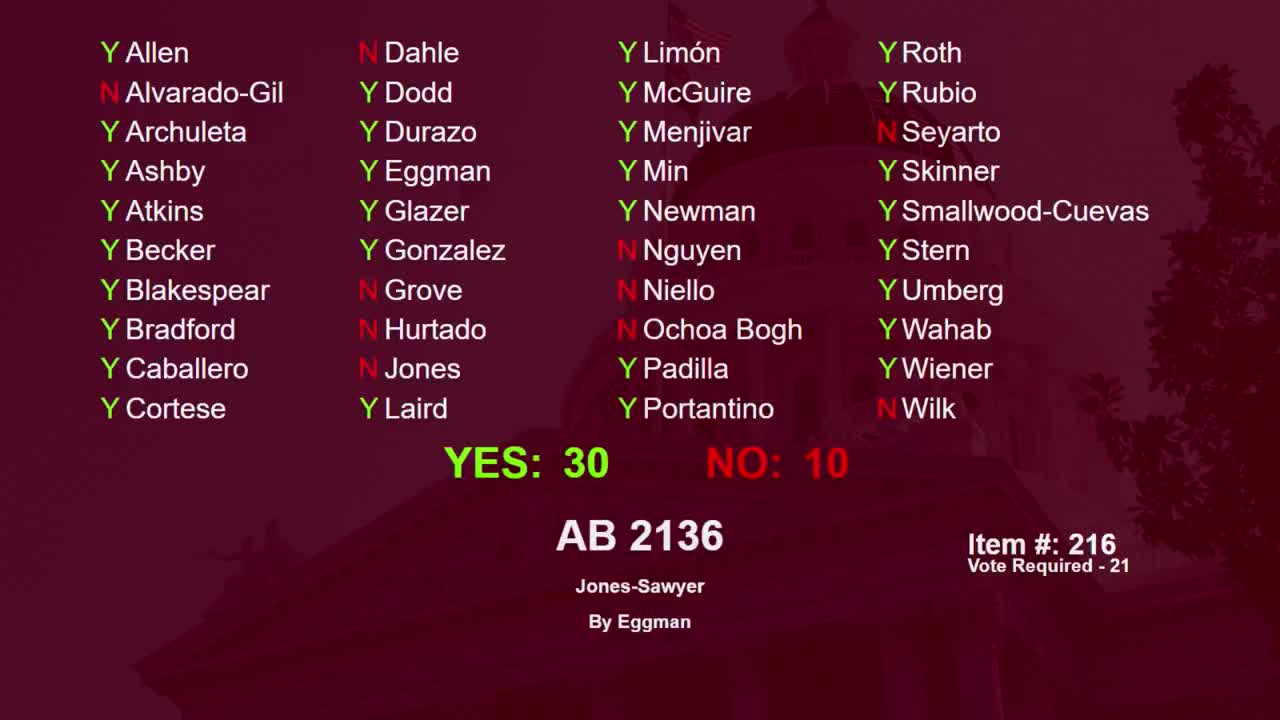
SENATE FLOOR: 40-0-0
YES: Allen, Alvarado-Gil, Archuleta, Ashby, Atkins, Becker, Blakespear, Bradford, Caballero, Cortese, Dahle, Dodd, Durazo, Eggman, Glazer, Gonzalez, Grove, Hurtado, Jones, Laird, Limón, McGuire, Menjivar, Min, Newman, Nguyen, Niello, Ochoa Bogh, Padilla, Portantino, Roth, Rubio, Seyarto, Skinner, Smallwood-Cuevas, Stern, Umberg, Wahab, Wiener, Wilk
UPDATED
VERSION: June 20, 2024
CONSULTANT: David Sforza / TRANS. / (916) 319-2093 FN: 0005013
SENATE RULES COMMITTEE Office of Senate Floor Analyses (916) 651-1520 Fax: (916) 327-4478 | AB 1901 |
THIRD READING
Bill No: AB 1901
Author: Chen (R)
Amended: 6/20/24 in Senate
Vote: 21
SENATE TRANSPORTATION COMMITTEE: 15-0, 6/11/24
AYES: Cortese, Niello, Allen, Archuleta, Becker, Blakespear, Dahle, Dodd, Gonzalez, Limón, Newman, Nguyen, Portantino, Seyarto, Umberg
SENATE APPROPRIATIONS COMMITTEE: 6-0, 7/1/24
AYES: Caballero, Jones, Becker, Bradford, Seyarto, Wahab
NO VOTE RECORDED: Ashby
ASSEMBLY FLOOR: 72-0, 4/18/24 (Consent) - See last page for vote
SUBJECT: Vehicles: total loss claim: salvage certificate or nonrepairable vehicle certificate
SOURCE: Author
DIGEST:
This bill creates a process for a vehicle to be deemed abandoned and for a salvage pool to gain salvage certificate or nonrepairable vehicle certificate for a vehicle in its possession that is a total loss vehicle.
ANALYSIS:
Existing law:
- Authorizes an insurance company, or a salvage pool authorized by an insurance company, to request a salvage certificate or nonrepairable vehicle certificate from the DMV without a properly endorsed certificate of ownership within 15 days after the insurance company makes a total loss settlement on a total loss salvage vehicle so long as the company attests to DMV that it made a single attempt to receive a certificate of ownership from the previous owner of the vehicle. (Vehicle Code Section (VEH) § 11515)
- Defines a “salvage pool” as a person engaged exclusively in the business of disposing of total loss salvage vehicles, nonrepairable vehicles, or recovered stolen vehicles sent to it by, or on behalf of, insurance companies, authorized adjusters, leasing companies, self-insured persons, or financial institutions.
- Defines a "total loss salvage vehicle" as a "vehicle, other than a non-repairable vehicle, of a type subject to registration that has been wrecked, destroyed, or damaged, to such an extent that the owner, leasing company, financial institution, or the insurance company that insured the vehicle, considers it uneconomical to repair the vehicle and because of this, the vehicle is not repaired by or for the person who owned the vehicle at the time of the event resulting in damage." (VEH § 544)
This bill:
- Provides that if an insurance company requests a salvage pool to take possession of a vehicle that is a total loss claim and the insurance company does not take ownership of the vehicle, the insurance company may direct the salvage pool to release the vehicle to the registered and legal owner or lienholder of the vehicle. The insurance company shall provide the salvage pool with notice authorizing the release of the vehicle to the vehicle’s registered and legal owner or lienholder.
- Provides that, upon receiving the above notice, the salvage pool shall send two notices to the registered and legal owner and any lienholder of the vehicle saying that the vehicle is available to pick up. The notice shall say that the registered and legal owner and lienholder has 30 days from the date of the first notice and 14 days from the date of the second notice to pick up the vehicle from the salvage pool before the vehicle is abandoned. The notice shall also give the owner or lienholder an extra 30 days from the date of contact to pick up the vehicle. This notice shall be sent by certified mail or other service providing proof of delivery.
- Provides that, if the registered and legal owner or lienholder does not pick up the vehicle within 30 days of the first notice and within 14 days of the second notice, or after the additional 30 days after providing notice of the intent to pick up the vehicle, the vehicle shall be deemed abandoned, the vehicle’s certificate of title is deemed assigned to the salvage pool and the salvage pool may request that the Department of Motor Vehicles (DMV) issue a salvage certificate or nonrepairable vehicle certificate that is free and clear of all liens. The request shall be accompanied by an attestation and certification of delivery of the notice required above.
Comments
- Author’s Statement. According to the author, “Salvage pools, as defined in Vehicle Code 543, are businesses exclusively involved in vehicle disposal from an auto accident – referred to in statute as total loss salvage or nonrepairable – or recovered after being stolen. They often need to take legal title to a vehicle to participate in the vehicle’s resale or salvage operations. At this moment, salvage pools use the diligent efforts and bond process to obtain a vehicle’s title. Unfortunately, this diligent efforts process is quite burdensome, takes from 3 to 6 months to complete, and requires bond payments regardless of the vehicle’s value. AB 1901 establishes a needed alternative and statutory authority for salvage pools to obtain title to abandoned vehicles after an auto accident when authorized by an insurance company to take possession of a total loss claimed vehicle.”
- What’s the Problem? Salvage pools are businesses that dispose of vehicles that are total losses, unrepairable, or recovered stolen vehicles sent by insurance companies, often for parts or scrap. Before the salvage pool can dispose of the vehicle, it needs to take legal title. Prior to 2016 salvage pools used a process known as “diligent efforts and bond” to take legal title, which takes 3 to 6 months to complete and requires the salvage pool to post a bond, according to the bill sponsor. In 2016, the DMV authorized a quicker process known as a lien sale to obtain title. In 2023, the DMV determined that it lacked statutory authority to allow salvage pools to conduct lien sales and required salvage pools to go through the diligent efforts and bond process. According to the sponsors, this process is more expensive and cumbersome than the previously allowed lien sale process. This bill is intended to reestablish the quicker and less expensive lien sale process for salvage pools to obtain legal title.
- Is Faster Better? This bill speeds the process for a salvage pool to obtain title by several months. To do so it shortens the time that lienholders or the registered owner must respond to a notice from the salvage pool. The bill sponsors contend that this new process is the same as the lien sale process previously authorized by the DMV. That is not quite true, as a lien sale requires notice from the DMV to the lienholder or registered owner, which may attract more attention from the recipient than a notice from an unknown salvage pool. The lien sale also requires a second notice, from the salvage pool, providing the lienholder or registered owner additional time to respond.
- Checking In. The Transportation Committee checked in with credit unions, who are often vehicle lienholders, and they indicated no concerns with the bill. The author has worked with the DMV and was provided technical assistance, which is reflected in the bill.
FISCAL EFFECT: Appropriation: No Fiscal Com.: Yes Local: Yes
According to the Senate Appropriations Committee, DMV estimates one-time costs of approximately $115,000 to adopt regulations to create processes and procedures to issue a salvage certificate or nonrepairable vehicle certificate for a vehicle deemed abandoned, including development of specified attestation forms, and an application form that must be signed under penalty of perjury. (Motor Vehicle Account)
SUPPORT: (Verified 7/1/24)
Copart, INC.
Insurance Auto Auctions, INC.
Personal Insurance Federation of California
OPPOSITION: (Verified 7/1/24)
None received
ASSEMBLY FLOOR: 72-0, 4/18/24
AYES: Addis, Aguiar-Curry, Alanis, Alvarez, Bains, Bauer-Kahan, Bennett, Berman, Calderon, Juan Carrillo, Wendy Carrillo, Chen, Connolly, Davies, Dixon, Flora, Mike Fong, Vince Fong, Friedman, Gabriel, Gallagher, Garcia, Gipson, Grayson, Haney, Hart, Holden, Hoover, Irwin, Jackson, Jones-Sawyer, Kalra, Lackey, Lee, Low, Lowenthal, Maienschein, McCarty, McKinnor, Muratsuchi, Stephanie Nguyen, Ortega, Pacheco, Papan, Jim Patterson, Joe Patterson, Pellerin, Petrie-Norris, Quirk-Silva, Ramos, Rendon, Reyes, Luz Rivas, Rodriguez, Blanca Rubio, Sanchez, Santiago, Schiavo, Soria, Ta, Ting, Valencia, Villapudua, Waldron, Wallis, Ward, Weber, Wicks, Wilson, Wood, Zbur, Robert Rivas
NO VOTE RECORDED: Arambula, Boerner, Bonta, Bryan, Cervantes, Megan Dahle, Essayli, Mathis
Prepared by: Randy Chinn / TRANS. / (916) 651-4121
7/2/24 9:31:57
SENATE COMMITTEE ON APPROPRIATIONS
Senator Anna Caballero, Chair
2023 - 2024 Regular Session
AB 1901 (Chen) - Vehicles: total loss claim: salvage certificate or nonrepairable vehicle certificate
Version: June 20, 2024 | Policy Vote: TRANS. 15 - 0 |
Urgency: No | Mandate: Yes |
Hearing Date: July 1, 2024 | Consultant: Mark McKenzie |
Bill Summary:
AB 1901 would establish a process for a total loss salvage vehicle to be deemed abandoned so that a salvage pool can apply to the Department of Motor Vehicles (DMV) for a salvage certificate or nonrepairable vehicle certificate and dispose of the vehicle.
Fiscal Impact:
- DMV estimates one-time costs of approximately $115,000 to adopt regulations to create processes and procedures to issue a salvage certificate or nonrepairable vehicle certificate for a vehicle deemed abandoned, including development of specified attestation forms, and an application form that must be signed under penalty of perjury. (Motor Vehicle Account)
Background:
A “total loss salvage vehicle” is a vehicle that has been wrecked, destroyed, or damaged to such an extent that it is deemed uneconomical to repair. Existing law requires an insurance company, after a total loss settlement has been made on a salvage vehicle or a nonrepairable vehicle, to forward to DMV the properly endorsed certificate of ownership or other ownership acceptable to DMV, the vehicle’s license plates, and a fee of $15. An insurance company, or a salvage pool authorized by an insurance company, may request a salvage certificate or nonrepairable vehicle certificate from the DMV without a properly endorsed certificate of ownership within 15 days after the insurance company makes a total loss settlement on a total loss salvage vehicle, so long as the insurance company attests to DMV that it made a single attempt to receive a certificate of ownership from the previous owner of the vehicle.
Existing law requires a salvage pool that has acquired a total loss salvage vehicle, nonrepairable vehicle, or recovered stolen vehicle that still has license plates, to remove and submit those plates to the DMV, as specified.
Proposed Law:
AB 1901 would establish a process for a total loss salvage vehicle to be deemed abandoned, so that the vehicle’s title may be assigned to a salvage pool, and the salvage pool may apply to DMV for a salvage certificate or nonrepairable vehicle certificate. Specifically, this bill would do the following, if an insurance company requests that a salvage pool take possession of a vehicle that is a total loss claim, and the insurance company does not take ownership of the vehicle:
- Authorize the insurance company to direct the salvage pool to release the vehicle to the registered and legal owner or lienholder, and require the insurance company to provide the salvage pool with notice authorizing the release of the vehicle, as specified.
- Require the salvage pool, upon receiving the notice from the insurance company, to send two notices in a specified manner to the registered owner and any lienholder indicating the vehicle is ready to pick up, and will be sold or otherwise disposed of if no response is received. The notice must indicate that the owner/lienholder has 30 days from the mailing of the first notice and 14 days from the mailing of the second notice to pick up the vehicle before it is deemed abandoned, and that an additional 30 days may be provided if the owner/lienholder notifies the salvage pool of their intent to pick it up.
- Deem the vehicle to be abandoned, and deem the vehicle’s certificate of title to be assigned to the salvage pool, if the registered owner or lienholder does not pick up the vehicle within the timeframes specified in the notice.
- Authorize the salvage pool to request that DMV issue a salvage certificate or nonrepairable vehicle certificate free and clear of all liens, on a form provided by DMV and signed under penalty of perjury.
- Require the salvage pool’s request to be accompanied by an attestation and certification that the insurance company did not take ownership of the vehicle and directed the release of the vehicle to the registered owner or lienholder, an attestation of the delivery of the required notices or that the notices were returned undeliverable, the license plates for the vehicle and required fees for a salvage vehicle or nonrepairable vehicle.
- Require DMV to issue a salvage certificate or nonrepairable vehicle certificate that is free of all liens to the salvage pool, upon receipt of a complete application, as specified.
- Require the salvage pool to maintain an accurate record of every vehicle it acquires and disposes of pursuant to the process prescribed in this bill. The specified records must be maintained for two years and open for inspection by any peace officer during regular business hours.
Staff Comments:
A salvage pool must take legal title of a total loss salvage vehicle before it can dispose of the vehicle. Prior to 2016, salvage pools used a process that required them to make diligent efforts to obtain documents necessary to demonstrate legal possession of the vehicle and post a bond (“diligent efforts and bond” process). In 2016 DMV updated its guidance manual to allow a salvage pool to conduct a less burdensome and more timely process, known as a “lien sale,” to establish legal possession of a vehicle. In 2023, however, DMV determined that it lacked statutory authority to allow salvage pools to conduct lien sales and issued updated guidance that again requires salvage pools to again use the “diligent efforts and bond” process to establish ownership. This bill is intended to reestablish a quicker and less expensive lien sale process for salvage pools to obtain legal title of total loss salvage vehicles. DMV indicates that it would need to develop and adopt regulations, at a one-time cost of approximately $115,000 to create a new form that must be signed under penalty of perjury, and guidance for submitting specified attestations with an application requesting issuance of a salvage certificate or nonrepairable vehicle certificate that is free and clear of all liens.
-- END --
SENATE COMMITTEE ON TRANSPORTATION
Senator Dave Cortese, Chair
2023 - 2024 Regular
Bill No: Hearing Date: 6/11/2024
Author: | Chen | ||
Version: | 5/29/2024 Amended | ||
Urgency: | No | Fiscal: | Yes |
Consultant: | Randy Chinn | ||
SUBJECT:
DIGEST: This bill creates a process for a vehicle to be deemed abandoned and for a salvage pool to gain salvage certificate or nonrepairable vehicle certificate for a vehicle in its possession that is a total loss vehicle.
ANALYSIS:
Existing law:
- Authorizes an insurance company, or a salvage pool authorized by an insurance company, to request a salvage certificate or nonrepairable vehicle certificate from the DMV without a properly endorsed certificate of ownership within 15 days after the insurance company makes a total loss settlement on a total loss salvage vehicle so long as the company attests to DMV that it made a single attempt to receive a certificate of ownership from the previous owner of the vehicle. (Vehicle Code Section (VEH) § 11515)
- Defines a “salvage pool” as a person engaged exclusively in the business of disposing of total loss salvage vehicles, nonrepairable vehicles, or recovered stolen vehicles sent to it by, or on behalf of, insurance companies, authorized adjusters, leasing companies, self-insured persons, or financial institutions.
- Defines a "total loss salvage vehicle" as a "vehicle, other than a non-repairable vehicle, of a type subject to registration that has been wrecked, destroyed, or damaged, to such an extent that the owner, leasing company, financial institution, or the insurance company that insured the vehicle, considers it uneconomical to repair the vehicle and because of this, the vehicle is not repaired by or for the person who owned the vehicle at the time of the event resulting in damage." (VEH § 544)
This bill:
- Provides that if an insurance company requests a salvage pool to take possession of a vehicle that is a total loss claim and the insurance company does not take ownership of the vehicle, the insurance company may direct the salvage pool to release the vehicle to the registered and legal owner or lienholder of the vehicle. The insurance company shall provide the salvage pool with notice authorizing the release of the vehicle to the vehicle’s registered and legal owner or lienholder.
- Upon receiving the above notice, the salvage pool shall send two notices to the registered and legal owner and any lienholder of the vehicle saying that the vehicle is available to pick up. The notice shall say that the registered and legal owner and lienholder has 30 days from the date of the first notice and 14 days from the date of the second notice to pick up the vehicle from the salvage pool before the vehicle is abandoned. The notice shall also give the owner or lienholder an extra 30 days from the date of contact to pick up the vehicle. This notice shall be sent by certified mail or other service providing proof of delivery.
- If the registered and legal owner or lienholder does not pick up the vehicle within 30 days of the first notice and within 14 days of the second notice, or after the additional 30 days after providing notice of the intent to pick up the vehicle, the vehicle shall be deemed abandoned, the vehicle’s certificate of title is deemed assigned to the salvage pool and the salvage pool may request that the Department of Motor Vehicles (DMV) issue a salvage certificate or nonrepairable vehicle certificate that is free and clear of all liens. The request shall be accompanied by an attestation and certification of delivery of the notice required above.
COMMENTS:
- Author’s Statement. “Salvage pools, as defined in Vehicle Code 543, are businesses exclusively involved in vehicle disposal from an auto accident – referred to in statute as total loss salvage or nonrepairable – or recovered after being stolen. They often need to take legal title to a vehicle to participate in the vehicle’s resale or salvage operations. At this moment, salvage pools use the diligent efforts and bond process to obtain a vehicle’s title. Unfortunately, this diligent efforts process is quite burdensome, takes from 3 to 6 months to complete, and requires bond payments regardless of the vehicle’s value. AB 1901 establishes a needed alternative and statutory authority for salvage pools to obtain title to abandoned vehicles after an auto accident when authorized by an insurance company to take possession of a total loss claimed vehicle.”
- What’s the Problem? Salvage pools are businesses that dispose of vehicles that are total losses, unrepairable, or recovered stolen vehicles sent by insurance companies, often for parts or scrap. Before the salvage pool can dispose of the vehicle, it needs to take legal title. Prior to 2016 salvage pools used a process known as “diligent efforts and bond” to take legal title, which takes 3 to 6 months to complete and requires the salvage pool to post a bond, according to the bill sponsor. In 2016, the DMV authorized a quicker process known as a lien sale to obtain title. In 2023, the DMV determined that it lacked statutory authority to allow salvage pools to conduct lien sales and required salvage pools to go through the diligent efforts and bond process. According to the sponsors, this process is more expensive and cumbersome than the previously allowed lien sale process. This bill is intended to reestablish the quicker and less expensive lien sale process for salvage pools to obtain legal title.
- Is Faster Better? This bill speeds the process for a salvage pool to obtain title by several months. To do so it shortens the time that lienholders or the registered owner must respond to a notice from the salvage pool. The bill sponsors contend that this new process is the same as the lien sale process previously authorized by the DMV. That is not quite true, as a lien sale requires notice from the DMV to the lienholder or registered owner, which may attract more attention from the recipient than a notice from an unknown salvage pool. The lien sale also requires a second notice, from the salvage pool, providing the lienholder or registered owner additional time to respond.
- Checking In. The Committee checked in with credit unions, who are often vehicle lienholders, and they indicated no concerns with the bill. The author has worked with the DMV and was provided technical assistance, which is reflected in the recent amendments.
Related Legislation:
AB 2330 (Bigelow, Chapter 125, Statutes of 2022). Modified existing requirements for an insurance company, or a salvage pool authorized by an insurance company, to receive a salvage certificate or nonrepairable vehicle certificate.
AB 2273 (Fuentes, Chapter 97, Statutes of 2008). Authorized an insurance agency to receive a nonrepairable vehicle certificate without proof of certificate of ownership so long as they attested to DMV under penalty of perjury that they made at least two written attempts to the original owner for the certificate of ownership.
AB 1122 (Wyland, Chapter 412, Statutes of 2006). Authorized an insurance agency to receive a salvage certificate without proof of certificate of ownership so long as they attested to DMV under penalty of perjury that they made at least two written attempts to the original owner for the certificate of ownership.
FISCAL EFFECT: Appropriation: No Fiscal Com.: Yes Local: No
POSITIONS: (Communicated to the committee before noon on Wednesday,
June 5, 2024.)
SUPPORT:
Copart INC. (sponsor)
Insurance Auto Auctions, INC.
OPPOSITION:
None Received
-- END --
Date of Hearing: April 10, 2024
ASSEMBLY COMMITTEE ON APPROPRIATIONS
Buffy Wicks, Chair
ABPCA Bill Id:AB 1901
Author:(Chen) – As Introduced Ver:January 23, 2024
Policy Committee: | Transportation | Vote: | 13 - 0 |
|
| ||
|
|
Urgency: No State Mandated Local Program: No Reimbursable: No
SUMMARY:
This bill creates a process by which a salvage pool, or similar entity, may take legal possession of a vehicle that is subject to a total loss claim and that is not retrieved by the registered legal owner or lien holder.
Specifically, when an insurance company directs a salvage pool, or similar entity, to release to the registered and legal owner or lienholder a vehicle that is subject to a total loss claim, this bill:
- Requires the insurance company to provide the salvage pool, or similar entity, with notice authorizing the release of the vehicle to the vehicle’s registered and legal owner or lienholder.
- Requires the salvage pool, or similar entity, upon receiving the notice from an insurance company described above, to send two notices, by certified mail or by another service providing proof of delivery, to the registered and legal owner or lienholder of the vehicle that the vehicle is available to pick up. The notices are to inform the owner or lienholder they have 30 days from the date of the first notice, and 14 from the date of the second notice, to pick up the vehicle before the vehicle is deemed abandoned.
- Deems a vehicle abandoned if it is not picked up by the owner or lienholder with 30 days or 14 days of the first or second notice, as applicable, in which case the vehicle’s certificate of title is deemed to be assigned to the salvage pool, or similar entity.
- Authorizes a salvage pool, or similar entity, that is assigned a vehicle’s certificate of title, as described above, to request, on a form provided by the Department of Motor Vehicles (DMV) that is accompanied by attestation or certification of notice to the vehicle owner or lienholder, that the DMV issue a salvage certificate or nonrepairable vehicle certificate to the salvage pool, or similar entity.
- Requires the DMV to issue such a certificate to the salvage pool, or similar entity, upon receipt of a complete application.
FISCAL EFFECT:
This bill will likely result in the DMV updating forms, publications and other documents to reflect the requirements of this bill. The cost to DMV should be minor and absorbable.
COMMENTS:
DMV regulations and requirements, based on statute, describe the processes various parties must complete in order to take legal possession of a vehicle. These DMV regulations and requirements are reflected in DMV’s “Vehicle Industry Registration Procedures Manual,” also known as the VIRP Manual. Generally, as detailed in the manual, an industry member in possession of a vehicle who is, despite the industry member’s best effort, unable to obtain the documents necessary to demonstrate legal possession of the vehicle may follow an alternative, less burdensome and more timely process—known as a “lien sale”—to establish legal possession of the vehicle.
In 2016, the DMV updated the VIRP Manual to newly allow a salvage pool—defined in statute as a business exclusively involved in vehicle disposal from an auto accident—to use this alternative process to establish legal possession of a vehicle. (See DMV “Vehicle Industry News 2016-08.”) However, last year (see DMV’s “VR 2023–08”), the DMV issued another update to industry members declaring that, as of November 10, 2023, a salvage pool “cannot conduct a lien sale to obtain title to a vehicle,” DMV’s grant of permission notwithstanding. According to DMV, it repealed its grant of permission for a salvage pool to use the lien sale process because it lacked the legal authority to grant such permission in the first place.
The author writes this bill “restores the lien sale authority for salvage pools,” which the author describes as “a needed alternative for obtaining title to abandoned vehicles after an auto accident.”
Analysis Prepared by: Jay Dickenson / APPR. / (916) 319-2081
Date of Hearing: March 19, 2024
ASSEMBLY COMMITTEE ON TRANSPORTATION
Lori D. Wilson, Chair
ABPCA Bill Id:AB 1901 (
Author:Chen) – As Introduced Ver:January 23, 2024
SUBJECT: Vehicles: total loss claim: salvage certificate or nonrepairable vehicle certificate
SUMMARY: Creates a process for a vehicle to be deemed abandoned and for a salvage pool to gain salvage certificate or nonrepairable vehicle certificate for a vehicle in its possession that is a total loss vehicle. Specifically, this bill:
- Authorizes a salvage pool to gain a salvage certificate or nonrepairable vehicle certificate for a vehicle in its possession under the following circumstances:
- The insurance company requests a salvage pool authorized by the insurance company or an occupational licensee of the Department of Motor Vehicles (DMV) to take possession of a vehicle that is subject to a total loss claim and the insurance company does not take ownership of the vehicle, releasing the vehicle to the registered owner and legal owner or lienholder of the vehicle; and,
- The salvage pool or occupational licensee of DMV sends two notices by certified mail to the registered legal owner and any lienholder of the vehicle informing them that the vehicle is available to pick up. The two notices require the number of days the owner or lienholder has to pick up the vehicle and must be sent two weeks apart. The notice informs the legal owner and the lienholder that they have to pick up the vehicle or that it will be deemed abandoned.
- Provides that if the registered owner does not pick up the vehicle within 30 days, DMV shall assign the vehicle’s certificate of title to the salvage pool or occupational licensee of DMV. The salvage certificate or nonrepairable vehicle certificate issued to the salvage pool for the vehicle shall be free and clear of all liens.
EXISTING LAW:
- Authorizes an insurance company, or a salvage pool authorized by an insurance company, to request a salvage certificate or nonrepairable vehicle certificate from the DMV without a properly endorsed certificate of ownership within 15 days after the insurance company makes a total loss settlement on a total loss salvage vehicle so long as the company attests to DMV that it made a single attempt to receive a certificate of ownership from the previous owner of the vehicle. (Vehicle Code Section (VEH) 11515)
- Defines a “salvage pool” as a person engaged exclusively in the business of disposing of total loss salvage vehicles, nonrepairable vehicles, or recovered stolen vehicles sent to it by, or on behalf of, insurance companies, authorized adjusters, leasing companies, self-insured persons, or financial institutions.
- Defines a "total loss salvage vehicle" as a "vehicle, other than a non-repairable vehicle, of a type subject to registration that has been wrecked, destroyed, or damaged, to such an extent that the owner, leasing company, financial institution, or the insurance company that insured the vehicle, considers it uneconomical to repair the vehicle and because of this, the vehicle is not repaired by or for the person who owned the vehicle at the time of the event resulting in damage." (VEH 544)
FISCAL EFFECT: Unknown
COMMENTS: DMV has created the Vehicle Industry Registration Procedures Manual (VIRPM) to provide dealers, registration services, financial institutions, and other vehicle industries with vehicle and vessel registration transaction requirements. Under these requirements, if the industry member in possession of a vehicle is unable to get the documents required to establish evidence of ownership, they must submit a statement of facts form to substantiate their ownership of the vehicle. If the vehicle is worth more than $5,000, a surety bond must be obtained for the vehicle, and proof of an unopened certified letter as evidence that a diligent effort was made contact to the previous owners.
In August of 2016, the DMV issued a Vehicle Industry News bulletin notifying individuals that salvage pools could use an alternative process—lien sales—to gain the title of a vehicle. However, in August of 2023, DMV made the determination they did not have the authority to grant the ability to salvage pools to use lien sales as a method of gaining title of the vehicle.
According to the author, “Salvage pools, as defined in Vehicle Code 543, are businesses exclusively involved in vehicle disposal from an auto accident – referred to in the statute as total loss salvage or nonrepairable – or recovered after being stolen. They often need to take legal title to a vehicle to participate in the vehicle’s resale or salvage operations. At this moment, salvage pools use diligent efforts and bond processes to obtain a vehicle’s title. Unfortunately, this diligent efforts process is quite burdensome, takes from three to six months to complete, and requires bond payments regardless of the vehicle’s value. AB 1901 restores the lien sale authority for salvage pools when authorized by an insurance company to take possession of a total loss claimed vehicle, a needed alternative for obtaining title to abandoned vehicles after an auto accident.”
In replacement of the lien sale process previously available to salvage pool, this bill creates a new process that allows them to gain an abandoned vehicle or nonrepairable vehicle in their possession within 30 days if they have sent two notices to the current owner and they have not obtained their vehicle. AB 2330 (Bigelow), Chapter 125, Statutes of 2022 reduced salvage pools burden to gain title of vehicles where the insurance company claimed possession of the vehicle after a total loss claim by only requiring one outreach effort to the previous owner to relinquish title to the vehicle. This bill creates a similar, albeit more stringent process, for a salvage pool company to gain title to a vehicle where the insurance company has not claimed possession of the vehicle after the total loss claim. The process this bill establishes in that circumstance is similar to an older process salvage pools had to follow to gain the title of a vehicle where the insurance company had claimed possession of the vehicle, requiring at least two outreach efforts before DMV grants the salvage pool title of the vehicle.
According to Co-Part, the sponsor of this bill, “AB 1901 restores the authority for salvage pools to obtain title to a vehicle under specific circumstances when directed to take possession by an insurance company. AB 1901 protects the owners’ rights by requiring salvage pools to send two notices informing them to pick up their vehicle or their vehicle will be deemed abandoned. If the vehicle owner does not pick up the vehicle, then the salvage pool can apply for a new vehicle title from the DMV so long as the application includes an attestation that the notices were delivered.”
Previous Legislation:
AB 2330 (Bigelow), Chapter 125, Statutes of 2022 modified existing requirements for an insurance company, or a salvage pool authorized by an insurance company, to receive a salvage certificate or nonrepairable vehicle certificate.
AB 2273 (Fuentes), Chapter 97, Statutes of 2008 authorized an insurance agency to receive a nonrepairable vehicle certificate without proof of certificate of ownership so long as they attested to DMV under penalty of perjury that they made at least two written attempts to the original owner for the certificate of ownership.
AB 1122 (Wyland), Chapter 412, Statutes of 2006 authorized an insurance agency to receive a salvage certificate without proof of certificate of ownership so long as they attested to DMV under penalty of perjury that they made at least two written attempts to the original owner for the certificate of ownership.
REGISTERED SUPPORT / OPPOSITION:
Support
Co-Part (sponsor)
Opposition
None on file
Analysis Prepared by: David Sforza / TRANS. / (916) 319-2093
Discussed in Hearing
 1MIN
Assembly Floor
 1MIN
Senate Floor
 2MIN
Senate Standing Committee on Appropriations
Bill Author

Bill Co-Author(s):