AB 1953: Vehicles: weight limits.
- Session Year: 2023-2024
- House: Assembly
- Latest Version Date: 2024-09-12
Current Status:
Passed
(2024-09-12: Chaptered by Secretary of State - Chapter 219, Statutes of 2024.)
Introduced
In Committee
First Chamber
In Committee
Second Chamber
Enacted
What does this bill do?
The bill allows the power unit (the engine or truck that provides motive power) of near‑zero‑emission or zero‑emission heavy vehicles to exceed normal gross weight limits by up to 2,000 pounds. That extra allowance can be split across power units but cannot push total vehicle weight above 82,000 pounds, does not waive other axle, bridge, or tire weight limits, and applies only if federal law allows it.
The summary is provided by generative AI which can make mistakes. For original language, please view the details in the table below.
Existing state and federal laws set specified limits on the total gross weight imposed on the highway by a vehicle with any group of 2 or more consecutive axles. Existing federal law prohibits the maximum gross vehicle weight of a vehicle operated by an engine fueled primarily by natural gas or powered primarily by means of electric battery power from exceeding 82,000 pounds. Existing state law, to the extent expressly authorized by federal law, authorizes a near-zero-emission vehicle or a zero-emission vehicle, as defined, to exceed the weight limits on the power unit by up to 2,000 pounds.
This bill would clarify that the power unit of a near-zero emission or zero-emission vehicle, as defined, is authorized to exceed the allowable gross weight limits by up to a maximum of 2,000 pounds, as specified. This bill would also clarify that the maximum gross vehicle weight for a near-zero-emission vehicle or a zero-emission vehicle is 82,000 pounds.
Existing state and federal laws set specified limits on the total gross weight imposed on the highway by a vehicle with any group of 2 or more consecutive axles. Existing federal law prohibits the maximum gross vehicle weight of a vehicle operated by an engine fueled primarily by natural gas or powered primarily by means of electric battery power from exceeding 82,000 pounds. Existing state law, to the extent expressly authorized by federal law, authorizes a near-zero-emission vehicle or a zero-emission vehicle, as defined, to exceed the weight limits on the power unit by up to 2,000 pounds.
This bill would clarify that the power unit of a near-zero emission or zero-emission vehicle, as defined, is authorized to exceed the allowable gross weight limits by up to 2,000 pounds, but no more than 2,000 pounds when the vehicle contains more than one power unit. a maximum of 2,000 pounds, as specified. This bill would also clarify that the maximum gross vehicle weight for a near-zero-emission vehicle or a zero-emission vehicle is 82,000 pounds.
Existing state and federal laws set specified limits on the total gross weight imposed on the highway by a vehicle with any group of 2 or more consecutive axles. Existing federal law prohibits the maximum gross vehicle weight of a vehicle operated by an engine fueled primarily by natural gas or powered primarily by means of electric battery power from exceeding 82,000 pounds. Existing state law, to the extent expressly authorized by federal law, authorizes a near-zero-emission vehicle or a zero-emission vehicle, as defined, to exceed the weight limits on the power unit by up to 2,000 pounds.
This bill would clarify that the power unit of a near-zero emission or zero-emission vehicle, as defined, is authorized to exceed the allowable gross weight limits by up to 2,000 pounds, but no more than 2,000 pounds when the vehicle contains more than one power unit. This bill would also clarify that the maximum gross vehicle weight for a near-zero-emission vehicle or a zero-emission vehicle is 82,000 pounds.
Existing state and federal laws set specified limits on the total gross weight imposed on the highway by a vehicle with any group of 2 or more consecutive axles. Existing federal law prohibits the maximum gross vehicle weight of a vehicle operated by an engine fueled primarily by natural gas or powered primarily by means of electric battery power from exceeding 82,000 pounds. Existing state law, to the extent expressly authorized by federal law, authorizes a near-zero-emission vehicle or a zero-emission vehicle, as defined, to exceed the weight limits on the power unit by up to 2,000 pounds.
This bill would clarify that the maximum gross vehicle weight for a near-zero-emission vehicle or a zero-emission vehicle is 82,000 pounds.
(a)Except as otherwise provided in this section or Section 35551.5, the total gross weight in pounds imposed on the highway by any group of two or more consecutive axles shall not exceed that given for the respective distance in the following table:
Distance in feet between | |||||
axles | 2 axles | 3 axles | 4 axles | 5 axles | 6 axles |
4 | 34,000 | 34,000 | 34,000 | 34,000 | 34,000 |
5 | 34,000 | 34,000 | 34,000 | 34,000 | 34,000 |
6 | 34,000 | 34,000 | 34,000 | 34,000 | 34,000 |
7 | 34,000 | 34,000 | 34,000 | 34,000 | 34,000 |
8 | 34,000 | 34,000 | 34,000 | 34,000 | 34,000 |
9 | 39,000 | 42,500 | 42,500 | 42,500 | 42,500 |
10 | 40,000 | 43,500 | 43,500 | 43,500 | 43,500 |
11 | 40,000 | 44,000 | 44,000 | 44,000 | 44,000 |
12 | 40,000 | 45,000 | 50,000 | 50,000 | 50,000 |
13 | 40,000 | 45,500 | 50,500 | 50,500 | 50,500 |
14 | 40,000 | 46,500 | 51,500 | 51,500 | 51,500 |
15 | 40,000 | 47,000 | 52,000 | 52,000 | 52,000 |
16 | 40,000 | 48,000 | 52,500 | 52,500 | 52,500 |
17 | 40,000 | 48,500 | 53,500 | 53,500 | 53,500 |
18 | 40,000 | 49,500 | 54,000 | 54,000 | 54,000 |
19 | 40,000 | 50,000 | 54,500 | 54,500 | 54,500 |
20 | 40,000 | 51,000 | 55,500 | 55,500 | 55,500 |
21 | 40,000 | 51,500 | 56,000 | 56,000 | 56,000 |
22 | 40,000 | 52,500 | 56,500 | 56,500 | 56,500 |
23 | 40,000 | 53,000 | 57,500 | 57,500 | 57,500 |
24 | 40,000 | 54,000 | 58,000 | 58,000 | 58,000 |
25 | 40,000 | 54,500 | 58,500 | 58,500 | 58,500 |
26 | 40,000 | 55,500 | 59,500 | 59,500 | 59,500 |
27 | 40,000 | 56,000 | 60,000 | 60,000 | 60,000 |
28 | 40,000 | 57,000 | 60,500 | 60,500 | 60,500 |
29 | 40,000 | 57,500 | 61,500 | 61,500 | 61,500 |
30 | 40,000 | 58,500 | 62,000 | 62,000 | 62,000 |
31 | 40,000 | 59,000 | 62,500 | 62,500 | 62,500 |
32 | 40,000 | 60,000 | 63,500 | 63,500 | 63,500 |
33 | 40,000 | 60,000 | 64,000 | 64,000 | 64,000 |
34 | 40,000 | 60,000 | 64,500 | 64,500 | 64,500 |
35 | 40,000 | 60,000 | 65,500 | 65,500 | 65,500 |
36 | 40,000 | 60,000 | 66,000 | 66,000 | 66,000 |
37 | 40,000 | 60,000 | 66,500 | 66,500 | 66,500 |
38 | 40,000 | 60,000 | 67,500 | 67,500 | 67,500 |
39 | 40,000 | 60,000 | 68,000 | 68,000 | 68,000 |
40 | 40,000 | 60,000 | 68,500 | 70,000 | 70,000 |
41 | 40,000 | 60,000 | 69,500 | 72,000 | 72,000 |
42 | 40,000 | 60,000 | 70,000 | 73,280 | 73,280 |
43 | 40,000 | 60,000 | 70,500 | 73,280 | 73,280 |
44 | 40,000 | 60,000 | 71,500 | 73,280 | 73,280 |
45 | 40,000 | 60,000 | 72,000 | 76,000 | 80,000 |
46 | 40,000 | 60,000 | 72,500 | 76,500 | 80,000 |
47 | 40,000 | 60,000 | 73,500 | 77,500 | 80,000 |
48 | 40,000 | 60,000 | 74,000 | 78,000 | 80,000 |
49 | 40,000 | 60,000 | 74,500 | 78,500 | 80,000 |
50 | 40,000 | 60,000 | 75,500 | 79,000 | 80,000 |
51 | 40,000 | 60,000 | 76,000 | 80,000 | 80,000 |
52 | 40,000 | 60,000 | 76,500 | 80,000 | 80,000 |
53 | 40,000 | 60,000 | 77,500 | 80,000 | 80,000 |
54 | 40,000 | 60,000 | 78,000 | 80,000 | 80,000 |
55 | 40,000 | 60,000 | 78,500 | 80,000 | 80,000 |
56 | 40,000 | 60,000 | 79,500 | 80,000 | 80,000 |
57 | 40,000 | 60,000 | 80,000 | 80,000 | 80,000 |
58 | 40,000 | 60,000 | 80,000 | 80,000 | 80,000 |
59 | 40,000 | 60,000 | 80,000 | 80,000 | 80,000 |
60 | 40,000 | 60,000 | 80,000 | 80,000 | 80,000 |
(b)In addition to the weights specified in subdivision (a), two consecutive sets of tandem axles may carry a gross weight of 34,000 pounds each if the overall distance between the first and last axles of the consecutive sets of tandem axles is 36 feet or more. The gross weight of each set of tandem axles shall not exceed 34,000 pounds and the gross weight of the two consecutive sets of tandem axles shall not exceed 68,000 pounds.
(c)The distance between axles shall be measured to the nearest whole foot. When a fraction is exactly six inches, the next larger whole foot shall be used.
(d)This section does not affect the right to prohibit the use of any highway or any bridge or other structure thereon in the manner and to the extent specified in Article 4 (commencing with Section 35700) and Article 5 (commencing with Section 35750) of this chapter.
(e)The gross weight limits expressed by this section and Section 35550 shall include all enforcement tolerances.
SEC. 2.Section 35559 is added to the Vehicle Code, to read:35559.(a)(1)Notwithstanding any provision of this article, the power unit of a near-zero emission or zero-emission vehicle may exceed the allowable gross weight limits by up to a maximum of 2,000 pounds.
(2)The maximum allowance may apply to a single power unit or be distributed between more than one power unit, but shall not exceed a total of 2,000 pounds across a single vehicle or combination of vehicles.
(3)The maximum gross vehicle weight shall not exceed 82,000 pounds.
(b)This section shall not be construed to exempt any near-zero-emission or zero-emission vehicle from the weight limits prescribed in Article 2 (commencing with Section 35600), Article 3 (commencing with Section 35650), Article 4 (commencing with Section 35700), or Article 5 (commencing with Section 35750) of this chapter.
(c)This section shall not be construed to exempt any near-zero-emission or zero-emission vehicle from tire weight limits imposed by this code or in regulations adopted by the Department of the California Highway Patrol.
(d)For purposes of this section, power unit means a single unit or a combination of units in a near-zero emission or zero-emission vehicle that provide motive power to a drive system independent of any other power source.
(e)The terms near-zero-emission vehicle and zero-emission vehicle have the same meanings as defined in subdivisions (c) and (d) of Section 44258 of the Health and Safety Code.
(f)This section applies only to the extent expressly authorized by federal law.
(a)Except as otherwise provided in this section or Section 35551.5, the total gross weight in pounds imposed on the highway by any group of two or more consecutive axles shall not exceed that given for the respective distance in the following table:
Distance in feet between | |||||
axles | 2 axles | 3 axles | 4 axles | 5 axles | 6 axles |
4 | 34,000 | 34,000 | 34,000 | 34,000 | 34,000 |
5 | 34,000 | 34,000 | 34,000 | 34,000 | 34,000 |
6 | 34,000 | 34,000 | 34,000 | 34,000 | 34,000 |
7 | 34,000 | 34,000 | 34,000 | 34,000 | 34,000 |
8 | 34,000 | 34,000 | 34,000 | 34,000 | 34,000 |
9 | 39,000 | 42,500 | 42,500 | 42,500 | 42,500 |
10 | 40,000 | 43,500 | 43,500 | 43,500 | 43,500 |
11 | 40,000 | 44,000 | 44,000 | 44,000 | 44,000 |
12 | 40,000 | 45,000 | 50,000 | 50,000 | 50,000 |
13 | 40,000 | 45,500 | 50,500 | 50,500 | 50,500 |
14 | 40,000 | 46,500 | 51,500 | 51,500 | 51,500 |
15 | 40,000 | 47,000 | 52,000 | 52,000 | 52,000 |
16 | 40,000 | 48,000 | 52,500 | 52,500 | 52,500 |
17 | 40,000 | 48,500 | 53,500 | 53,500 | 53,500 |
18 | 40,000 | 49,500 | 54,000 | 54,000 | 54,000 |
19 | 40,000 | 50,000 | 54,500 | 54,500 | 54,500 |
20 | 40,000 | 51,000 | 55,500 | 55,500 | 55,500 |
21 | 40,000 | 51,500 | 56,000 | 56,000 | 56,000 |
22 | 40,000 | 52,500 | 56,500 | 56,500 | 56,500 |
23 | 40,000 | 53,000 | 57,500 | 57,500 | 57,500 |
24 | 40,000 | 54,000 | 58,000 | 58,000 | 58,000 |
25 | 40,000 | 54,500 | 58,500 | 58,500 | 58,500 |
26 | 40,000 | 55,500 | 59,500 | 59,500 | 59,500 |
27 | 40,000 | 56,000 | 60,000 | 60,000 | 60,000 |
28 | 40,000 | 57,000 | 60,500 | 60,500 | 60,500 |
29 | 40,000 | 57,500 | 61,500 | 61,500 | 61,500 |
30 | 40,000 | 58,500 | 62,000 | 62,000 | 62,000 |
31 | 40,000 | 59,000 | 62,500 | 62,500 | 62,500 |
32 | 40,000 | 60,000 | 63,500 | 63,500 | 63,500 |
33 | 40,000 | 60,000 | 64,000 | 64,000 | 64,000 |
34 | 40,000 | 60,000 | 64,500 | 64,500 | 64,500 |
35 | 40,000 | 60,000 | 65,500 | 65,500 | 65,500 |
36 | 40,000 | 60,000 | 66,000 | 66,000 | 66,000 |
37 | 40,000 | 60,000 | 66,500 | 66,500 | 66,500 |
38 | 40,000 | 60,000 | 67,500 | 67,500 | 67,500 |
39 | 40,000 | 60,000 | 68,000 | 68,000 | 68,000 |
40 | 40,000 | 60,000 | 68,500 | 70,000 | 70,000 |
41 | 40,000 | 60,000 | 69,500 | 72,000 | 72,000 |
42 | 40,000 | 60,000 | 70,000 | 73,280 | 73,280 |
43 | 40,000 | 60,000 | 70,500 | 73,280 | 73,280 |
44 | 40,000 | 60,000 | 71,500 | 73,280 | 73,280 |
45 | 40,000 | 60,000 | 72,000 | 76,000 | 80,000 |
46 | 40,000 | 60,000 | 72,500 | 76,500 | 80,000 |
47 | 40,000 | 60,000 | 73,500 | 77,500 | 80,000 |
48 | 40,000 | 60,000 | 74,000 | 78,000 | 80,000 |
49 | 40,000 | 60,000 | 74,500 | 78,500 | 80,000 |
50 | 40,000 | 60,000 | 75,500 | 79,000 | 80,000 |
51 | 40,000 | 60,000 | 76,000 | 80,000 | 80,000 |
52 | 40,000 | 60,000 | 76,500 | 80,000 | 80,000 |
53 | 40,000 | 60,000 | 77,500 | 80,000 | 80,000 |
54 | 40,000 | 60,000 | 78,000 | 80,000 | 80,000 |
55 | 40,000 | 60,000 | 78,500 | 80,000 | 80,000 |
56 | 40,000 | 60,000 | 79,500 | 80,000 | 80,000 |
57 | 40,000 | 60,000 | 80,000 | 80,000 | 80,000 |
58 | 40,000 | 60,000 | 80,000 | 80,000 | 80,000 |
59 | 40,000 | 60,000 | 80,000 | 80,000 | 80,000 |
60 | 40,000 | 60,000 | 80,000 | 80,000 | 80,000 |
(b)In addition to the weights specified in subdivision (a), two consecutive sets of tandem axles may carry a gross weight of 34,000 pounds each if the overall distance between the first and last axles of the consecutive sets of tandem axles is 36 feet or more. The gross weight of each set of tandem axles shall not exceed 34,000 pounds and the gross weight of the two consecutive sets of tandem axles shall not exceed 68,000 pounds.
(c)The distance between axles shall be measured to the nearest whole foot. When a fraction is exactly six inches, the next larger whole foot shall be used.
(d)This section does not affect the right to prohibit the use of any highway or any bridge or other structure thereon in the manner and to the extent specified in Article 4 (commencing with Section 35700) and Article 5 (commencing with Section 35750) of this chapter.
(e)The gross weight limits expressed by this section and Section 35550 shall include all enforcement tolerances.
SEC. 2.Section 35559 is added to the Vehicle Code, to read:35559.(a)(1)Notwithstanding any provision of this article, the power unit of a near-zero emission or zero-emission vehicle may exceed the allowable gross weight limits by up to a maximum of 2,000 pounds. However, a vehicle subject to this section shall not exceed a maximum of 2,000 pounds of additional weight when a near-zero-emission or zero-emission vehicle contains more than one power unit. The maximum gross vehicle weight shall not exceed 82,000 pounds.
(2)The maximum allowance may apply to a single power unit or be distributed between more than one power unit, but shall not exceed a total of 2,000 pounds across a single vehicle or combination of vehicles.
(3)The maximum gross vehicle weight shall not exceed 82,000 pounds.
(b)This section shall not be construed to exempt any near-zero-emission or zero-emission vehicle from the weight limits prescribed in Article 2 (commencing with Section 35600), Article 3 (commencing with Section 35650), Article 4 (commencing with Section 35700), or Article 5 (commencing with Section 35750) of this chapter.
(c)This section shall not be construed to exempt any near-zero-emission or zero-emission vehicle from tire weight limits imposed by this code or in regulations adopted by the Department of the California Highway Patrol.
(d)For purposes of this section, power unit means a single unit or a combination of units in a near-zero emission or zero-emission vehicle that provide motive power to a drive system independent of any other power source.
(e)The terms near-zero-emission vehicle and zero-emission vehicle have the same meanings as defined in subdivisions (c) and (d) of Section 44258 of the Health and Safety Code.
(f)This section applies only to the extent expressly authorized by federal law.
(a)Except as otherwise provided in this section or Section 35551.5, the total gross weight in pounds imposed on the highway by any group of two or more consecutive axles shall not exceed that given for the respective distance in the following table:
Distance in feet between | |||||
axles | 2 axles | 3 axles | 4 axles | 5 axles | 6 axles |
4 | 34,000 | 34,000 | 34,000 | 34,000 | 34,000 |
5 | 34,000 | 34,000 | 34,000 | 34,000 | 34,000 |
6 | 34,000 | 34,000 | 34,000 | 34,000 | 34,000 |
7 | 34,000 | 34,000 | 34,000 | 34,000 | 34,000 |
8 | 34,000 | 34,000 | 34,000 | 34,000 | 34,000 |
9 | 39,000 | 42,500 | 42,500 | 42,500 | 42,500 |
10 | 40,000 | 43,500 | 43,500 | 43,500 | 43,500 |
11 | 40,000 | 44,000 | 44,000 | 44,000 | 44,000 |
12 | 40,000 | 45,000 | 50,000 | 50,000 | 50,000 |
13 | 40,000 | 45,500 | 50,500 | 50,500 | 50,500 |
14 | 40,000 | 46,500 | 51,500 | 51,500 | 51,500 |
15 | 40,000 | 47,000 | 52,000 | 52,000 | 52,000 |
16 | 40,000 | 48,000 | 52,500 | 52,500 | 52,500 |
17 | 40,000 | 48,500 | 53,500 | 53,500 | 53,500 |
18 | 40,000 | 49,500 | 54,000 | 54,000 | 54,000 |
19 | 40,000 | 50,000 | 54,500 | 54,500 | 54,500 |
20 | 40,000 | 51,000 | 55,500 | 55,500 | 55,500 |
21 | 40,000 | 51,500 | 56,000 | 56,000 | 56,000 |
22 | 40,000 | 52,500 | 56,500 | 56,500 | 56,500 |
23 | 40,000 | 53,000 | 57,500 | 57,500 | 57,500 |
24 | 40,000 | 54,000 | 58,000 | 58,000 | 58,000 |
25 | 40,000 | 54,500 | 58,500 | 58,500 | 58,500 |
26 | 40,000 | 55,500 | 59,500 | 59,500 | 59,500 |
27 | 40,000 | 56,000 | 60,000 | 60,000 | 60,000 |
28 | 40,000 | 57,000 | 60,500 | 60,500 | 60,500 |
29 | 40,000 | 57,500 | 61,500 | 61,500 | 61,500 |
30 | 40,000 | 58,500 | 62,000 | 62,000 | 62,000 |
31 | 40,000 | 59,000 | 62,500 | 62,500 | 62,500 |
32 | 40,000 | 60,000 | 63,500 | 63,500 | 63,500 |
33 | 40,000 | 60,000 | 64,000 | 64,000 | 64,000 |
34 | 40,000 | 60,000 | 64,500 | 64,500 | 64,500 |
35 | 40,000 | 60,000 | 65,500 | 65,500 | 65,500 |
36 | 40,000 | 60,000 | 66,000 | 66,000 | 66,000 |
37 | 40,000 | 60,000 | 66,500 | 66,500 | 66,500 |
38 | 40,000 | 60,000 | 67,500 | 67,500 | 67,500 |
39 | 40,000 | 60,000 | 68,000 | 68,000 | 68,000 |
40 | 40,000 | 60,000 | 68,500 | 70,000 | 70,000 |
41 | 40,000 | 60,000 | 69,500 | 72,000 | 72,000 |
42 | 40,000 | 60,000 | 70,000 | 73,280 | 73,280 |
43 | 40,000 | 60,000 | 70,500 | 73,280 | 73,280 |
44 | 40,000 | 60,000 | 71,500 | 73,280 | 73,280 |
45 | 40,000 | 60,000 | 72,000 | 76,000 | 80,000 |
46 | 40,000 | 60,000 | 72,500 | 76,500 | 80,000 |
47 | 40,000 | 60,000 | 73,500 | 77,500 | 80,000 |
48 | 40,000 | 60,000 | 74,000 | 78,000 | 80,000 |
49 | 40,000 | 60,000 | 74,500 | 78,500 | 80,000 |
50 | 40,000 | 60,000 | 75,500 | 79,000 | 80,000 |
51 | 40,000 | 60,000 | 76,000 | 80,000 | 80,000 |
52 | 40,000 | 60,000 | 76,500 | 80,000 | 80,000 |
53 | 40,000 | 60,000 | 77,500 | 80,000 | 80,000 |
54 | 40,000 | 60,000 | 78,000 | 80,000 | 80,000 |
55 | 40,000 | 60,000 | 78,500 | 80,000 | 80,000 |
56 | 40,000 | 60,000 | 79,500 | 80,000 | 80,000 |
57 | 40,000 | 60,000 | 80,000 | 80,000 | 80,000 |
58 | 40,000 | 60,000 | 80,000 | 80,000 | 80,000 |
59 | 40,000 | 60,000 | 80,000 | 80,000 | 80,000 |
60 | 40,000 | 60,000 | 80,000 | 80,000 | 80,000 |
(b)In addition to the weights specified in subdivision (a), two consecutive sets of tandem axles may carry a gross weight of 34,000 pounds each if the overall distance between the first and last axles of the consecutive sets of tandem axles is 36 feet or more. The gross weight of each set of tandem axles shall not exceed 34,000 pounds and the gross weight of the two consecutive sets of tandem axles shall not exceed 68,000 pounds.
(c)The distance between axles shall be measured to the nearest whole foot. When a fraction is exactly six inches, the next larger whole foot shall be used.
(d)This section does not affect the right to prohibit the use of any highway or any bridge or other structure thereon in the manner and to the extent specified in Article 4 (commencing with Section 35700) and Article 5 (commencing with Section 35750) of this chapter.
(e)The gross weight limits expressed by this section and Section 35550 shall include all enforcement tolerances.
(f)(1)A near-zero-emission or zero-emission vehicle may exceed the weight limits on the power unit by up to 2,000 pounds, but shall not exceed a maximum gross vehicle weight of 82,000 pounds.(2)For purposes of this subdivision, the terms near-zero-emission vehicle and zero-emission vehicle have the same meanings as defined in subdivisions (c) and (d) of Section 44258 of the Health and Safety Code.(3)This subdivision applies only to the extent expressly authorized by federal law.SEC. 2.Section 35559 is added to the Vehicle Code, to read:35559.(a)Notwithstanding any provision of this article, the power unit of a near-zero emission or zero-emission vehicle may exceed the allowable gross weight limits by up to 2,000 pounds. However, a vehicle subject to this section shall not exceed a maximum of 2,000 pounds of additional weight when a near-zero-emission or zero-emission vehicle contains more than one power unit. The maximum gross vehicle weight shall not exceed 82,000 pounds.
(b)This section shall not be construed to exempt any near-zero-emission or zero-emission vehicle from the weight limits prescribed in Article 2 (commencing with Section 35600), Article 3 (commencing with Section 35650), Article 4 (commencing with Section 35700), or Article 5 (commencing with Section 35750) of this chapter.
(c)This section shall not be construed to exempt any near-zero-emission or zero-emission vehicle from tire weight limits imposed by this code or in regulations adopted by the Department of the California Highway Patrol.
(d)For purposes of this section, power unit means a single unit or a combination of units in a near-zero emission or zero-emission vehicle that provide motive power to a drive system independent of any other power source.
(e)The terms near-zero-emission vehicle and zero-emission vehicle have the same meanings as defined in subdivisions (c) and (d) of Section 44258 of the Health and Safety Code.
(f)This section applies only to the extent expressly authorized by federal law.
(a)Except as otherwise provided in this section or Section 35551.5, the total gross weight in pounds imposed on the highway by any group of two or more consecutive axles shall not exceed that given for the respective distance in the following table:
Distance in feet between | |||||
axles | 2 axles | 3 axles | 4 axles | 5 axles | 6 axles |
4 | 34,000 | 34,000 | 34,000 | 34,000 | 34,000 |
5 | 34,000 | 34,000 | 34,000 | 34,000 | 34,000 |
6 | 34,000 | 34,000 | 34,000 | 34,000 | 34,000 |
7 | 34,000 | 34,000 | 34,000 | 34,000 | 34,000 |
8 | 34,000 | 34,000 | 34,000 | 34,000 | 34,000 |
9 | 39,000 | 42,500 | 42,500 | 42,500 | 42,500 |
10 | 40,000 | 43,500 | 43,500 | 43,500 | 43,500 |
11 | 40,000 | 44,000 | 44,000 | 44,000 | 44,000 |
12 | 40,000 | 45,000 | 50,000 | 50,000 | 50,000 |
13 | 40,000 | 45,500 | 50,500 | 50,500 | 50,500 |
14 | 40,000 | 46,500 | 51,500 | 51,500 | 51,500 |
15 | 40,000 | 47,000 | 52,000 | 52,000 | 52,000 |
16 | 40,000 | 48,000 | 52,500 | 52,500 | 52,500 |
17 | 40,000 | 48,500 | 53,500 | 53,500 | 53,500 |
18 | 40,000 | 49,500 | 54,000 | 54,000 | 54,000 |
19 | 40,000 | 50,000 | 54,500 | 54,500 | 54,500 |
20 | 40,000 | 51,000 | 55,500 | 55,500 | 55,500 |
21 | 40,000 | 51,500 | 56,000 | 56,000 | 56,000 |
22 | 40,000 | 52,500 | 56,500 | 56,500 | 56,500 |
23 | 40,000 | 53,000 | 57,500 | 57,500 | 57,500 |
24 | 40,000 | 54,000 | 58,000 | 58,000 | 58,000 |
25 | 40,000 | 54,500 | 58,500 | 58,500 | 58,500 |
26 | 40,000 | 55,500 | 59,500 | 59,500 | 59,500 |
27 | 40,000 | 56,000 | 60,000 | 60,000 | 60,000 |
28 | 40,000 | 57,000 | 60,500 | 60,500 | 60,500 |
29 | 40,000 | 57,500 | 61,500 | 61,500 | 61,500 |
30 | 40,000 | 58,500 | 62,000 | 62,000 | 62,000 |
31 | 40,000 | 59,000 | 62,500 | 62,500 | 62,500 |
32 | 40,000 | 60,000 | 63,500 | 63,500 | 63,500 |
33 | 40,000 | 60,000 | 64,000 | 64,000 | 64,000 |
34 | 40,000 | 60,000 | 64,500 | 64,500 | 64,500 |
35 | 40,000 | 60,000 | 65,500 | 65,500 | 65,500 |
36 | 40,000 | 60,000 | 66,000 | 66,000 | 66,000 |
37 | 40,000 | 60,000 | 66,500 | 66,500 | 66,500 |
38 | 40,000 | 60,000 | 67,500 | 67,500 | 67,500 |
39 | 40,000 | 60,000 | 68,000 | 68,000 | 68,000 |
40 | 40,000 | 60,000 | 68,500 | 70,000 | 70,000 |
41 | 40,000 | 60,000 | 69,500 | 72,000 | 72,000 |
42 | 40,000 | 60,000 | 70,000 | 73,280 | 73,280 |
43 | 40,000 | 60,000 | 70,500 | 73,280 | 73,280 |
44 | 40,000 | 60,000 | 71,500 | 73,280 | 73,280 |
45 | 40,000 | 60,000 | 72,000 | 76,000 | 80,000 |
46 | 40,000 | 60,000 | 72,500 | 76,500 | 80,000 |
47 | 40,000 | 60,000 | 73,500 | 77,500 | 80,000 |
48 | 40,000 | 60,000 | 74,000 | 78,000 | 80,000 |
49 | 40,000 | 60,000 | 74,500 | 78,500 | 80,000 |
50 | 40,000 | 60,000 | 75,500 | 79,000 | 80,000 |
51 | 40,000 | 60,000 | 76,000 | 80,000 | 80,000 |
52 | 40,000 | 60,000 | 76,500 | 80,000 | 80,000 |
53 | 40,000 | 60,000 | 77,500 | 80,000 | 80,000 |
54 | 40,000 | 60,000 | 78,000 | 80,000 | 80,000 |
55 | 40,000 | 60,000 | 78,500 | 80,000 | 80,000 |
56 | 40,000 | 60,000 | 79,500 | 80,000 | 80,000 |
57 | 40,000 | 60,000 | 80,000 | 80,000 | 80,000 |
58 | 40,000 | 60,000 | 80,000 | 80,000 | 80,000 |
59 | 40,000 | 60,000 | 80,000 | 80,000 | 80,000 |
60 | 40,000 | 60,000 | 80,000 | 80,000 | 80,000 |
(b)In addition to the weights specified in subdivision (a), two consecutive sets of tandem axles may carry a gross weight of 34,000 pounds each if the overall distance between the first and last axles of the consecutive sets of tandem axles is 36 feet or more. The gross weight of each set of tandem axles shall not exceed 34,000 pounds and the gross weight of the two consecutive sets of tandem axles shall not exceed 68,000 pounds.
(c)The distance between axles shall be measured to the nearest whole foot. When a fraction is exactly six inches, the next larger whole foot shall be used.
(d)This section does not affect the right to prohibit the use of any highway or any bridge or other structure thereon in the manner and to the extent specified in Article 4 (commencing with Section 35700) and Article 5 (commencing with Section 35750) of this chapter.
(e)The gross weight limits expressed by this section and Section 35550 shall include all enforcement tolerances.
(f)(1)A near-zero-emission or zero-emission vehicle may exceed the weight limits on the power unit by up to 2,000 pounds. pounds, but shall not exceed a maximum gross vehicle weight of 82,000 pounds.
(2)For purposes of this subdivision, the terms near-zero-emission vehicle and zero-emission vehicle have the same meanings as defined in subdivisions (c) and (d) of Section 44258 of the Health and Safety Code.
(3)This subdivision applies only to the extent expressly authorized by federal law.
|
Date
|
Status
|
|---|---|
| Sep 12, 2024 | Chaptered by Secretary of State - Chapter 219, Statutes of 2024. |
| Sep 12, 2024 | Approved by the Governor. |
| Sep 5, 2024 | Enrolled and presented to the Governor at 4 p.m. |
| Aug 27, 2024 | Senate amendments concurred in. To Engrossing and Enrolling. (Ayes 77. Noes 0.). |
| Aug 27, 2024 | Assembly Rule 77 suspended. |
| Aug 26, 2024 | In Assembly. Concurrence in Senate amendments pending. May be considered on or after August 28 pursuant to Assembly Rule 77. |
| Aug 26, 2024 | Read third time. Passed. Ordered to the Assembly. (Ayes 39. Noes 0.). |
| Aug 12, 2024 | Read second time. Ordered to third reading. |
| Aug 8, 2024 | Read third time and amended. Ordered to second reading. |
| Jun 6, 2024 | From Consent Calendar. |
| Jun 6, 2024 | Ordered to third reading. |
| May 30, 2024 | Read second time. Ordered to Consent Calendar. |
| May 29, 2024 | From committee: Do pass. To Consent Calendar. (Ayes 12. Noes 0.) (May 28). |
| May 15, 2024 | From committee chair, with author's amendments: Amend, and re-refer to committee. Read second time, amended, and re-referred to Com. on TRANS. |
| May 1, 2024 | Referred to Com. on TRANS. |
| Apr 8, 2024 | In Senate. Read first time. To Com. on RLS. for assignment. |
| Apr 8, 2024 | Read third time. Passed. Ordered to the Senate. (Ayes 74. Noes 0. Page 4661.) |
| Apr 3, 2024 | Read second time. Ordered to Consent Calendar. |
| Apr 2, 2024 | From committee: Do pass. To Consent Calendar. (Ayes 15. Noes 0.) (April 1). |
| Feb 12, 2024 | Referred to Com. on TRANS. |
| Jan 30, 2024 | From printer. May be heard in committee February 29. |
| Jan 29, 2024 | Read first time. To print. |
|
Date
|
Description
|
Location
|
Votes
|
|
|---|---|---|---|---|
| Aug 27, 2024 | AB 1953 Villapudua Concurrence in Senate Amendments | Assembly Floor |
Passed |
|
| Aug 26, 2024 | Assembly 3rd Reading AB1953 Villapudua By Cortese | Senate Floor |
Passed |
|
| May 28, 2024 | Do pass and be ordered to the Consent Calendar | Senate Standing Committee on Transportation |
Passed |
|
| Apr 8, 2024 | AB 1953 Villapudua Consent Calendar Second Day Regular Session | Assembly Floor |
Passed |
|
| Apr 1, 2024 | Do pass. To Consent Calendar. | Assembly Standing Committee on Transportation |
Passed |
This list shows positions taken on this bill by organizations on the date displayed, which is linked to the original source.
Positions by individuals are not included.
|
Organization
|
Position
|
Date
|
|---|---|---|
| California Electric Transportation Coalition | ** Support | |
| California Renewable Transportation Alliance | ** Support | |
| California Trucking Association | ** Support | |
| Republic Services - Western Region | ** Support | |
| Valley CAN | ** Support |
CONCURRENCE IN SENATE AMENDMENTS
CSA1 Bill Id:AB 1953
Author:(Villapudua)
As Amended Ver:August 8, 2024
Majority vote
SUMMARY
Clarifies that the maximum gross weight for a zero-emission or near-zero emission vehicle is 82,000 pounds.
Senate Amendments
Are technical and clarifying in nature.
COMMENTS
AB 2061 (Frazier) Chapter 580, Statutes of 2018 authorized zero-emission and near-zero emission vehicles to have an increased weight limit of 2,000 pounds to the extent permitted by federal law. The change in law was made to reflect that transitioning from diesel trucks to zero and near-zero-natural gas, battery electric, or hydrogen fuel cell trucks would increase truck weights, relative to the weight of diesel trucks.
According to the University of California Institute of Transportation Studies (UC ITS) report Effects of Increased Weights of Alternative Fuel Trucks on Pavement and Bridges, long haul battery electric trucks are estimated to be 5,328 pounds heavier than their diesel counterparts. Hydrogen fuel cell long haul trucks are expected to weigh 2,267 pounds more than their diesel counterparts, and natural gas trucks are estimated to weigh 500 to 2,000 pounds more than their diesel counterparts. The report notes that "The pavement damage analyses of the example state highway pavements and the county roads and urban arterials indicated that the projected changes for the implementation of alternative fuel trucks in 2030 and 2050 would cause a zero to approximately 1% increase in life reduction across all cases. The damage analysis for residential streets is only modeled for 500 to 2,000 pound increases in the weights of waste-hauling trucks indicated that these pavements would continue to fail by exposure to the environment rather than by the waste truck loading, despite the increased axle loads."
While it has been widely understood that AB 2061 would allow zero and near-zero emission vehicles to operate up to 82,000 pounds, Vehicle Code Section 35551(f) is missing key language contained in federal statute that would unambiguously authorize zero and near-zero emission trucks to operate up to the same limit as authorized under federal law.
AB 1953 will provide the necessary technical clean-up to ensure that early adopters of zero and near-zero emission technologies are not exposed to unnecessary liability and are better able to compete with traditional diesel trucks as zero-emission trucks can weigh up to 8,000 pounds more than their diesel counterparts, which reduces cargo payloads if they are subject to the lower weight limit.
While all zero and near-zero-emission vehicles are granted the weight exemption of an additional 2,000 pounds that weight exemption on the interstate highway system applies only to the extent permissible by federal law. As of the writing of this analysis, only electric trucks and natural gas trucks currently have that weight exemption. There is pending federal legislation to extend this weight exemption to hydrogen fuel cell vehicles this legislative session.
According to the Author
"AB 1953 simply clarifies existing law allowing zero and near-zero emission trucks to operate up to a gross weight of 82,000 pounds on non-federally funded highways. While it is widely understood that AB 2061 (Frazier of 2018) allows for this type of operation, this bill would add key technical language into Vehicle Code 35551 (f) that would remove all ambiguity and potential liability for the legal operation of a truck that weights up to 82,000 pounds."
Arguments in Support
The California Trucking Association, the sponsor of this bill, argues "Truck and trailer combinations are generally limited to operating at a total combined weight of 80,000lbs gross vehicle weight rating (GVWR). Recognizing that zero and near-zero-emission trucks are heavier than traditional diesel trucks due to the weight of batteries, fuel cells, and tanks, Congress has approved such vehicles to operate up to a maximum of 82,000 pounds GVWR".
Arguments in Opposition
No opposition on file.
FISCAL COMMENTS
This bill has been keyed non-fiscal by Legislative Counsel.
VOTES:
ASM TRANSPORTATION: 15-0-0
YES: Wilson, Vince Fong, Aguiar-Curry, Berman, Juan Carrillo, Davies, Hart, Jackson, Lowenthal, Papan, Sanchez, Ting, Wallis, Ward, Wicks
ASSEMBLY FLOOR: 74-0-6
YES: Addis, Aguiar-Curry, Alanis, Alvarez, Arambula, Bains, Bennett, Berman, Boerner, Bonta, Bryan, Calderon, Juan Carrillo, Wendy Carrillo, Cervantes, Chen, Connolly, Davies, Dixon, Essayli, Flora, Mike Fong, Vince Fong, Friedman, Gabriel, Gallagher, Garcia, Grayson, Haney, Hart, Holden, Hoover, Irwin, Jackson, Kalra, Lackey, Lee, Low, Lowenthal, Maienschein, McKinnor, Muratsuchi, Stephanie Nguyen, Ortega, Pacheco, Papan, Jim Patterson, Joe Patterson, Pellerin, Petrie-Norris, Quirk-Silva, Ramos, Rendon, Reyes, Luz Rivas, Rodriguez, Blanca Rubio, Sanchez, Santiago, Schiavo, Soria, Ta, Ting, Valencia, Villapudua, Waldron, Wallis, Ward, Weber, Wicks, Wilson, Wood, Zbur, Robert Rivas
ABS, ABST OR NV: Bauer-Kahan, Megan Dahle, Gipson, Jones-Sawyer, Mathis, McCarty
SENATE FLOOR: 40-0-0
YES: Allen, Alvarado-Gil, Archuleta, Ashby, Atkins, Becker, Blakespear, Bradford, Caballero, Cortese, Dahle, Dodd, Durazo, Eggman, Glazer, Gonzalez, Grove, Hurtado, Jones, Laird, Limón, McGuire, Menjivar, Min, Newman, Nguyen, Niello, Ochoa Bogh, Padilla, Portantino, Roth, Rubio, Seyarto, Skinner, Smallwood-Cuevas, Stern, Umberg, Wahab, Wiener, Wilk
UPDATED
VERSION: August 8, 2024
CONSULTANT: David Sforza / TRANS. / (916) 319-2093 FN: 0004259
CONCURRENCE IN SENATE AMENDMENTS
CSA1 Bill Id:AB 1953
Author:(Villapudua)
As Amended Ver:August 8, 2024
Majority vote
SUMMARY
Clarifies that the maximum gross weight for a zero-emission or near-zero emission vehicle is 82,000 pounds.
Senate Amendments
Are technical and clarifying in nature.
COMMENTS
AB 2061 (Frazier) Chapter 580, Statutes of 2018 authorized zero-emission and near-zero emission vehicles to have an increased weight limit of 2,000 pounds to the extent permitted by federal law. The change in law was made to reflect that transitioning from diesel trucks to zero and near-zero-natural gas, battery electric, or hydrogen fuel cell trucks would increase truck weights, relative to the weight of diesel trucks.
According to the University of California Institute of Transportation Studies (UC ITS) report Effects of Increased Weights of Alternative Fuel Trucks on Pavement and Bridges, long haul battery electric trucks are estimated to be 5,328 pounds heavier than their diesel counterparts. Hydrogen fuel cell long haul trucks are expected to weigh 2,267 pounds more than their diesel counterparts, and natural gas trucks are estimated to weigh 500 to 2,000 pounds more than their diesel counterparts. The report notes that "The pavement damage analyses of the example state highway pavements and the county roads and urban arterials indicated that the projected changes for the implementation of alternative fuel trucks in 2030 and 2050 would cause a zero to approximately 1% increase in life reduction across all cases. The damage analysis for residential streets is only modeled for 500 to 2,000 pound increases in the weights of waste-hauling trucks indicated that these pavements would continue to fail by exposure to the environment rather than by the waste truck loading, despite the increased axle loads."
While it has been widely understood that AB 2061 would allow zero and near-zero emission vehicles to operate up to 82,000 pounds, Vehicle Code Section 35551(f) is missing key language contained in federal statute that would unambiguously authorize zero and near-zero emission trucks to operate up to the same limit as authorized under federal law.
AB 1953 will provide the necessary technical clean-up to ensure that early adopters of zero and near-zero emission technologies are not exposed to unnecessary liability and are better able to compete with traditional diesel trucks as zero-emission trucks can weigh up to 8,000 pounds more than their diesel counterparts, which reduces cargo payloads if they are subject to the lower weight limit.
While all zero and near-zero-emission vehicles are granted the weight exemption of an additional 2,000 pounds that weight exemption on the interstate highway system applies only to the extent permissible by federal law. As of the writing of this analysis, only electric trucks and natural gas trucks currently have that weight exemption. There is pending federal legislation to extend this weight exemption to hydrogen fuel cell vehicles this legislative session.
According to the Author
"AB 1953 simply clarifies existing law allowing zero and near-zero emission trucks to operate up to a gross weight of 82,000 pounds on non-federally funded highways. While it is widely understood that AB 2061 (Frazier of 2018) allows for this type of operation, this bill would add key technical language into Vehicle Code 35551 (f) that would remove all ambiguity and potential liability for the legal operation of a truck that weights up to 82,000 pounds."
Arguments in Support
The California Trucking Association, the sponsor of this bill, argues "Truck and trailer combinations are generally limited to operating at a total combined weight of 80,000lbs gross vehicle weight rating (GVWR). Recognizing that zero and near-zero-emission trucks are heavier than traditional diesel trucks due to the weight of batteries, fuel cells, and tanks, Congress has approved such vehicles to operate up to a maximum of 82,000 pounds GVWR".
Arguments in Opposition
No opposition on file.
FISCAL COMMENTS
This bill has been keyed non-fiscal by Legislative Counsel.
VOTES:
ASM TRANSPORTATION: 15-0-0
YES: Wilson, Vince Fong, Aguiar-Curry, Berman, Juan Carrillo, Davies, Hart, Jackson, Lowenthal, Papan, Sanchez, Ting, Wallis, Ward, Wicks
ASSEMBLY FLOOR: 74-0-6
YES: Addis, Aguiar-Curry, Alanis, Alvarez, Arambula, Bains, Bennett, Berman, Boerner, Bonta, Bryan, Calderon, Juan Carrillo, Wendy Carrillo, Cervantes, Chen, Connolly, Davies, Dixon, Essayli, Flora, Mike Fong, Vince Fong, Friedman, Gabriel, Gallagher, Garcia, Grayson, Haney, Hart, Holden, Hoover, Irwin, Jackson, Kalra, Lackey, Lee, Low, Lowenthal, Maienschein, McKinnor, Muratsuchi, Stephanie Nguyen, Ortega, Pacheco, Papan, Jim Patterson, Joe Patterson, Pellerin, Petrie-Norris, Quirk-Silva, Ramos, Rendon, Reyes, Luz Rivas, Rodriguez, Blanca Rubio, Sanchez, Santiago, Schiavo, Soria, Ta, Ting, Valencia, Villapudua, Waldron, Wallis, Ward, Weber, Wicks, Wilson, Wood, Zbur, Robert Rivas
ABS, ABST OR NV: Bauer-Kahan, Megan Dahle, Gipson, Jones-Sawyer, Mathis, McCarty
UPDATED
VERSION: August 8, 2024
CONSULTANT: David Sforza / TRANS. / (916) 319-2093 FN: 0004259
SENATE RULES COMMITTEE Office of Senate Floor Analyses (916) 651-1520 Fax: (916) 327-4478 | AB 1953 |
THIRD READING
Bill No: AB 1953
Author: Villapudua (D)
Amended: 8/8/24 in Senate
Vote: 21
SENATE TRANSPORTATION COMMITTEE: 12-0, 5/28/24
AYES: Cortese, Niello, Archuleta, Becker, Dodd, Gonzalez, Limón, Newman, Nguyen, Portantino, Seyarto, Umberg
NO VOTE RECORDED: Allen, Blakespear, Dahle
ASSEMBLY FLOOR: 74-0, 4/8/24 (Consent) - See last page for vote
SUBJECT: Vehicles: weight limits
SOURCE: California Trucking Association
DIGEST:
This bill clarifies that the power unit of a near-zero emission or zero-emission vehicle may exceed allowable gross weight limits by up to 2,000 pounds, but no more than 2,000 pounds when the vehicle contains more than one power unit. This bill would also clarify that the maximum gross vehicle weight for a near-zero-emission vehicle or a zero-emission vehicle is 82,000 pounds.
Senate Floor amendments of 8/8/24 make technical changes specifying that the 2,000 pound vehicle weight allowance may be distributed between more than one power unit but shall not exceed 2,000 pounds across a vehicle or combination of vehicles.
ANALYSIS:
Existing law:
- Establishes maximum gross or loaded weights, for vehicles, which vary based on the distance between axles and the number of axles. For two-axle vehicles the maximum weight is 40,000 pounds, for three-axle vehicles the maximum weight is 60,000 pounds, and for vehicles with four or more axles the maximum weight is 80,000 pounds. (Vehicle Code (VEH) §35551)
- Authorizes a near-zero-emission (NZEV) or zero-emission vehicle (ZEV) to exceed the vehicle weight limits on the power unit by up to 2,000 pounds to the extent expressly authorized by federal law.
- Defines “zero-emission vehicle” as a vehicle that produces no emissions of criteria pollutants, toxic air contaminants, and greenhouse gases (GHGs) when stationary or operating, as determined by the California Air Resources Board (CARB). (Health and Safety Code (HSC) §44258)
- Defines “near zero-emission vehicle” as a vehicle that utilizes zero-emission technologies, enables technologies that provide a pathway to zero-emissions operations, or incorporates other technologies that significantly reduce criteria pollutants, toxic air contaminants, and GHG emissions, as defined by the CARB in consultation with the State Energy Resources Conservation and Development Commission consistent with meeting the state’s mid- and long-term air quality standards and climate goals. (HSC §44258)
- Existing federal law permits natural gas vehicles and electric vehicles to exceed weight limits on interstate highways by an amount equal to the difference between that vehicle and the weight of a comparable diesel tank and fueling system, at a maximum of 82,000 pounds (23 United States Code §127).
This bill:
- Defines, for the purpose of this legislation, “power unit” as a single unit or combination of units in a NZEV or ZEV vehicle that provides motor power to a drive system independent of any other power source.
- Clarifies that the power unit of a NZEV or ZEV may exceed allowable gross weight limits by up to a maximum of 2,000 pounds.
- Clarifies that the 2,000 pound vehicle weight allowance may apply to a single power unit or be distributed between more than one power unit but shall not exceed 2,000 pounds across a single vehicle or combination of vehicles
- Clarifies that the maximum gross vehicle weight for a NZEV or a ZEV is 82,000 pounds.
- Clarifies that these exemptions only apply to gross weight limits and shall not apply to other vehicle weight limits described in statute or to the tire weight limits imposed by statute or adopted by the California Highway Patrol.
Comments
- Purpose of bill. According to the author, “AB 1953 seeks to clarify existing law relating to fleets operating zero and near-zero emission vehicles. In 2018 and 2019, respectively, California (AB 2061) and the federal government (FAST Act) authorized zero and near-zero emission trucks to operate up to 82,000lbs gross vehicle weight rating (GVWR) and 2,000lbs above weight limits on the power unit to account for the added weight of batteries, fuel cells and tanks. However, as drafted, fleets operating up to 82,000lbs GVWR on non-federally funded highways may be exposed to liability due to the way California Vehicle Code is currently drafted. This bill would clarify that the added weight is allowed on both the power unit and the GVWR of the tractor-trailer combination as a whole.”
- Vehicle weight and infrastructure degradation. Heavier vehicles put more stress on roads, bridges, and other infrastructure. According to a 2009 report by the Federal Highway Administration titled “Exploring Vehicle Size and Weight Solutions”, the amount of infrastructure damage an overweight vehicle causes is geometrically larger than the weight increase. For example, an increase in axle weight from 18,000 pounds to 20,000 pounds causes 50 percent more damage to the pavement. This increased stress decreases the remaining service life of the infrastructure, resulting in increased costs for maintenance. Wear and tear on roads primarily comes from commercial vehicles. Studies have shown that heavy trucks are at least 1,000 times more damaging to the roads than passenger vehicles. As such, the state and federal government establish maximum weight limits on vehicles to preserve road infrastructure. Interstates are generally engineered to carry heavy loads in such a way local streets and roads are not. California levies additional weight fees on commercial vehicles designed to pay for the increased damage heavier vehicles do to the roads.
- ZEVs are heavier than standard vehicles. According to the University of California Institute of Transportation Studies (UC ITS) report “Effects of Increased Weights of Alternative Fuel Trucks on Pavement and Bridges,” long haul battery electric trucks are estimated to be 5,328 pounds heavier than their diesel counterparts. Hydrogen fuel cell long haul trucks are expected to weigh 2,267 more than their diesel counterparts, and natural gas trucks are estimated to weigh 500 to 2,000 pounds more than their diesel counterparts. Because of this, ZEV and NZEV long haul vehicles must carry lighter loads in order to comply with vehicle weight limits, decreasing the amount of money that can be generated by a single trip. This creates a financial disincentive for trucking companies to convert their fleets to ZEVs and reduce emissions.
- Greasing the wheels. In 2015, Congress passed and President Obama signed into law, the Fixing America’s Surface Transportation (FAST) Act. The FAST Act authorized $305 billion over four years for critical transportation projects. Among the provisions of the Act was a limited exemption for natural gas vehicles to exceed any federal vehicle weight limit, up to a maximum gross vehicle weight of 82,000 pounds, by an amount equal to the difference between the weight of the vehicle attributable to the natural gas tank and fueling system and the weight of a comparable diesel tank and fueling system. However, this exemption only applied to operation on the federal highway system. In 2017, SB 53 (Hueso) was introduced to extend the federal exception to operation on local streets and roads. The bill was held in the Senate Appropriations Committee, but the next year a similar bill was introduced.
AB 2061 (Frazier, Chapter 580, Statutes of 2018) was similar to SB 53 (Hueso), however it applied to all NZEV and ZEV vehicles, not just natural gas vehicles. It also removed the requirement that the amount the vehicle exceeded the weight limit by had to be equal to the difference in weight between a diesel system and the NZEV system. This is likely due to the difficulty in making such a calculation given the variety of ZEV technologies and determining the appropriate point of comparison. The bill effectively subsidized the adoption of ZEV technology in commercial fleets through increased road infrastructure maintenance costs.
The year after AB 2061 was signed into law, Congress updated their natural gas vehicle exemption to also apply to electric battery vehicles. Mirroring California state law, the federal exemption allows for exceeding the weight limit on a power unit by up to 2,000 pounds, with no reference to the difference in weight between the natural gas or battery electric vehicle and a diesel vehicle. This exemption does not apply to hydrogen fuel cell vehicles though there is pending federal legislation to address this.
- What’s the issue? The ZEV and NZEV weight exemption has been law for over five years. In that time, there have been no challenges to commercial vehicles in accessing the benefit of the bill. However, there is a subtle difference in the phrasing of the federal exemption (which has been in place since 2019) relative to the state exemption. Commercial vehicle companies are concerned that this difference could imply that the weight exemption is meant to apply only to the vehicle itself and not the tractor-trailer-cargo combination as a whole. The intent of the state and federal exemption is to allow for heavier loads, so this bill rewrites existing law to clarify that ZEV and NZEV vehicle power units may weigh 2,000 pounds more than otherwise allowed up to a maximum weight of 82,000 pounds.
FISCAL EFFECT: Appropriation: No Fiscal Com.: No Local: No
California Trucking Association (source)
California Electric Transportation Coalition
California Renewable Transportation Alliance
Republic Services - Western Region
Valley Can (clean Air Now)
OPPOSITION: (Verified 8/8/24)
None received
ASSEMBLY FLOOR: 74-0, 4/8/24
AYES: Addis, Aguiar-Curry, Alanis, Alvarez, Arambula, Bains, Bennett, Berman, Boerner, Bonta, Bryan, Calderon, Juan Carrillo, Wendy Carrillo, Cervantes, Chen, Connolly, Davies, Dixon, Essayli, Flora, Mike Fong, Vince Fong, Friedman, Gabriel, Gallagher, Garcia, Grayson, Haney, Hart, Holden, Hoover, Irwin, Jackson, Kalra, Lackey, Lee, Low, Lowenthal, Maienschein, McKinnor, Muratsuchi, Stephanie Nguyen, Ortega, Pacheco, Papan, Jim Patterson, Joe Patterson, Pellerin, Petrie-Norris, Quirk-Silva, Ramos, Rendon, Reyes, Luz Rivas, Rodriguez, Blanca Rubio, Sanchez, Santiago, Schiavo, Soria, Ta, Ting, Valencia, Villapudua, Waldron, Wallis, Ward, Weber, Wicks, Wilson, Wood, Zbur, Robert Rivas
NO VOTE RECORDED: Bauer-Kahan, Megan Dahle, Gipson, Jones-Sawyer, Mathis, McCarty
Prepared by: Jacob O'Connor / TRANS. / (916) 651-4121
8/13/24 12:59:35
SENATE RULES COMMITTEE Office of Senate Floor Analyses (916) 651-1520 Fax: (916) 327-4478 | AB 1953 |
THIRD READING
Bill No: AB 1953
Author: Villapudua (D)
Amended: 5/15/24 in Senate
Vote: 21
SENATE TRANSPORTATION COMMITTEE: 12-0, 5/28/24
AYES: Cortese, Niello, Archuleta, Becker, Dodd, Gonzalez, Limón, Newman, Nguyen, Portantino, Seyarto, Umberg
NO VOTE RECORDED: Allen, Blakespear, Dahle
ASSEMBLY FLOOR: 74-0, 4/8/24 (Consent) - See last page for vote
SUBJECT: Vehicles: weight limits
SOURCE: California Trucking Association
DIGEST:
This bill clarifies that the power unit of a near-zero emission (NZEV) or zero-emission vehicle (ZEV) may exceed allowable gross weight limits by up to 2,000 pounds, but no more than 2,000 pounds when the vehicle contains more than one power unit. This bill clarifies that the maximum gross vehicle weight for a near-zero-emission vehicle or a zero-emission vehicle is 82,000 pounds.
ANALYSIS: Existing federal law permits natural gas vehicles and electric vehicles to exceed weight limits on interstate highways by an amount equal to the difference between that vehicle and the weight of a comparable diesel tank and fueling system, at a maximum of 82,000 pounds. (Title 23 United States Code §127)
Existing state law:
- Establishes maximum gross or loaded weights, for vehicles, which vary based on the distance between axles and the number of axles. For two-axle vehicles the maximum weight is 40,000 pounds, for three-axle vehicles the maximum weight is 60,000 pounds, and for vehicles with four or more axles the maximum weight is 80,000 pounds. (Vehicle Code (VEH) § 35551)
- Authorizes an NZEV or a ZEV to exceed the vehicle weight limits on the power unit by up to 2,000 pounds to the extent expressly authorized by federal law.
- Defines “zero-emission vehicle” as a vehicle that produces no emissions of criteria pollutants, toxic air contaminants, and greenhouse gases (GHGs) when stationary or operating, as determined by the California Air Resources Board (CARB). (Health and Safety Code (HSC) § 44258)
- Defines “near zero-emission vehicle” as a vehicle that utilizes zero-emission technologies, enables technologies that provide a pathway to zero-emissions operations, or incorporates other technologies that significantly reduce criteria pollutants, toxic air contaminants, and GHG emissions, as defined by the CARB in consultation with the State Energy Resources Conservation and Development Commission consistent with meeting the state’s mid- and long-term air quality standards and climate goals. (HSC § 44258)
This bill:
- Defines, for the purpose of this legislation, “power unit” as a single unit or combination of units in a NZEV or ZEV vehicle that provides motor power to a drive system independent of any other power source.
- Clarifies that the power unit of a NZEV or ZEV may exceed allowable gross weight limits by up to 2,000 pounds, but no more than 2,000 pounds when the vehicle contains more than one power unit.
- Clarifies that the maximum gross vehicle weight for a NZEV or a ZEV is 82,000 pounds.
- Clarifies that these exemptions only apply to gross weight limits and shall not apply to other vehicle weight limits described in statute or to the tire weight limits imposed by statute or adopted by the California Highway Patrol.
Comments
- Purpose of bill. According to the author, “AB 1953 seeks to clarify existing law relating to fleets operating zero and near-zero emission vehicles. In 2018 and 2019, respectively, California (AB 2061) and the federal government (FAST Act) authorized zero and near-zero emission trucks to operate up to 82,000lbs gross vehicle weight rating (GVWR) and 2,000lbs above weight limits on the power unit to account for the added weight of batteries, fuel cells and tanks. However, as drafted, fleets operating up to 82,000lbs GVWR on non-federally funded highways may be exposed to liability due to the way California Vehicle Code is currently drafted. This bill would clarify that the added weight is allowed on both the power unit and the GVWR of the tractor-trailer combination as a whole.”
- Vehicle weight and infrastructure degradation. Heavier vehicles put more stress on roads, bridges, and other infrastructure. According to a 2009 report by the Federal Highway Administration titled “Exploring Vehicle Size and Weight Solutions”, the amount of infrastructure damage an overweight vehicle causes is geometrically larger than the weight increase. For example, an increase in axle weight from 18,000 pounds to 20,000 pounds causes 50 percent more damage to the pavement. This increased stress decreases the remaining service life of the infrastructure, resulting in increased costs for maintenance. Wear and tear on roads primarily comes from commercial vehicles. Studies have shown that heavy trucks are at least 1,000 times more damaging to the roads than passenger vehicles. As such, the state and federal government establish maximum weight limits on vehicles to preserve road infrastructure. Interstates are generally engineered to carry heavy loads in such a way local streets and roads are not. California levies additional weight fees on commercial vehicles designed to pay for the increased damage heavier vehicles do to the roads.
- ZEVs are heavier than standard vehicles. According to the University of California Institute of Transportation Studies (UC ITS) report “Effects of Increased Weights of Alternative Fuel Trucks on Pavement and Bridges,” long haul battery electric trucks are estimated to be 5,328 pounds heavier than their diesel counterparts. Hydrogen fuel cell long haul trucks are expected to weigh 2,267 more than their diesel counterparts, and natural gas trucks are estimated to weigh 500 to 2,000 pounds more than their diesel counterparts. Because of this, ZEV and NZEV long haul vehicles must carry lighter loads in order to comply with vehicle weight limits, decreasing the amount of money that can be generated by a single trip. This creates a financial disincentive for trucking companies to convert their fleets to ZEVs and reduce emissions.
- Greasing the wheels. In 2015, Congress passed and President Obama signed into law, the Fixing America’s Surface Transportation (FAST) Act. The FAST Act authorized $305 billion over four years for critical transportation projects. Among the provisions of the Act was a limited exemption for natural gas vehicles to exceed any federal vehicle weight limit, up to a maximum gross vehicle weight of 82,000 pounds, by an amount equal to the difference between the weight of the vehicle attributable to the natural gas tank and fueling system and the weight of a comparable diesel tank and fueling system. However, this exemption only applied to operation on the federal highway system. In 2017, SB 53 (Hueso) was introduced to extend the federal exception to operation on local streets and roads. The bill was held in the Senate Appropriations Committee, but the next year a similar bill was introduced.
AB 2061 (Frazier, Chapter 580, Statutes of 2018) was similar to SB 53 (Hueso), however it applied to all NZEV and ZEV vehicles, not just natural gas vehicles. It also removed the requirement that the amount the vehicle exceeded the weight limit by had to be equal to the difference in weight between a diesel system and the NZEV system. This is likely due to the difficulty in making such a calculation given the variety of ZEV technologies and determining the appropriate point of comparison. The bill effectively subsidized the adoption of ZEV technology in commercial fleets through increased road infrastructure maintenance costs.
The year after AB 2061 was signed into law, Congress updated their natural gas vehicle exemption to also apply to electric battery vehicles. Mirroring California state law, the federal exemption allows for exceeding the weight limit on a power unit by up to 2,000 pounds, with no reference to the difference in weight between the natural gas or battery electric vehicle and a diesel vehicle. This exemption does not apply to hydrogen fuel cell vehicles though there is pending federal legislation to address this.
- What’s the issue? The ZEV and NZEV weight exemption has been law for over five years. In that time, there have been no challenges to commercial vehicles in accessing the benefit of the bill. However, there is a subtle difference in the phrasing of the federal exemption (which has been in place since 2019) relative to the state exemption. Commercial vehicle companies are concerned that this difference could imply that the weight exemption is meant to apply only to the vehicle itself and not the tractor-trailer-cargo combination as a whole. The intent of the state and federal exemption is to allow for heavier loads, so this bill rewrites existing law to clarify that ZEV and NZEV vehicle power units may weigh 2,000 pounds more than otherwise allowed up to a maximum weight of 82,000 pounds.
FISCAL EFFECT: Appropriation: No Fiscal Com.: No Local: No
SUPPORT: (Verified 5/29/24)
California Trucking Association (source)
California Electric Transportation Coalition
California Renewable Transportation Alliance
Republic Services - Western Region
Valley Can dba clean Air Now
OPPOSITION: (Verified 5/29/24)
None received
ASSEMBLY FLOOR: 74-0, 4/8/24
AYES: Addis, Aguiar-Curry, Alanis, Alvarez, Arambula, Bains, Bennett, Berman, Boerner, Bonta, Bryan, Calderon, Juan Carrillo, Wendy Carrillo, Cervantes, Chen, Connolly, Davies, Dixon, Essayli, Flora, Mike Fong, Vince Fong, Friedman, Gabriel, Gallagher, Garcia, Grayson, Haney, Hart, Holden, Hoover, Irwin, Jackson, Kalra, Lackey, Lee, Low, Lowenthal, Maienschein, McKinnor, Muratsuchi, Stephanie Nguyen, Ortega, Pacheco, Papan, Jim Patterson, Joe Patterson, Pellerin, Petrie-Norris, Quirk-Silva, Ramos, Rendon, Reyes, Luz Rivas, Rodriguez, Blanca Rubio, Sanchez, Santiago, Schiavo, Soria, Ta, Ting, Valencia, Villapudua, Waldron, Wallis, Ward, Weber, Wicks, Wilson, Wood, Zbur, Robert Rivas
NO VOTE RECORDED: Bauer-Kahan, Megan Dahle, Gipson, Jones-Sawyer, Mathis, McCarty
Prepared by: Jacob O'Connor / TRANS. / (916) 651-4121
6/6/24 11:05:34
**** END ****
SENATE COMMITTEE ON TRANSPORTATION
Senator Dave Cortese, Chair
2023 - 2024 Regular
Bill No: Hearing Date: 5/28/2024
Author: | Villapudua | ||
Version: | 5/15/2024 Amended | ||
Urgency: | No | Fiscal: | No |
Consultant: | Jacob O'Connor | ||
SUBJECT:
DIGEST: This bill clarifies that the power unit of a near-zero emission or zero-emission vehicle may exceed allowable gross weight limits by up to 2,000 pounds, but no more than 2,000 pounds when the vehicle contains more than one power unit. This bill would also clarify that the maximum gross vehicle weight for a near-zero-emission vehicle or a zero-emission vehicle is 82,000 pounds.
ANALYSIS:
Existing law:
- Establishes maximum gross or loaded weights, for vehicles, which vary based on the distance between axles and the number of axles. For two-axle vehicles the maximum weight is 40,000 pounds, for three-axle vehicles the maximum weight is 60,000 pounds, and for vehicles with four or more axles the maximum weight is 80,000 pounds. (Vehicle Code (VEH) §35551)
- Authorizes a near-zero-emission (NZEV) or zero-emission vehicle (ZEV) to exceed the vehicle weight limits on the power unit by up to 2,000 pounds to the extent expressly authorized by federal law.
- Defines “zero-emission vehicle” as a vehicle that produces no emissions of criteria pollutants, toxic air contaminants, and greenhouse gases (GHGs) when stationary or operating, as determined by the California Air Resources Board (CARB). (Health and Safety Code (HSC) §44258)
- Defines “near zero-emission vehicle” as a vehicle that utilizes zero-emission technologies, enables technologies that provide a pathway to zero-emissions operations, or incorporates other technologies that significantly reduce criteria pollutants, toxic air contaminants, and GHG emissions, as defined by the CARB in consultation with the State Energy Resources Conservation and Development Commission consistent with meeting the state’s mid- and long-term air quality standards and climate goals. (HSC §44258)
- Existing federal law permits natural gas vehicles and electric vehicles to exceed weight limits on interstate highways by an amount equal to the difference between that vehicle and the weight of a comparable diesel tank and fueling system, at a maximum of 82,000 pounds (23 United States Code §127).
This bill:
- Defines, for the purpose of this legislation, “power unit” as a single unit or combination of units in a NZEV or ZEV vehicle that provides motor power to a drive system independent of any other power source.
- Clarifies that the power unit of a NZEV or ZEV may exceed allowable gross weight limits by up to 2,000 pounds, but no more than 2,000 pounds when the vehicle contains more than one power unit.
- Clarifies that the maximum gross vehicle weight for a NZEV or a ZEV is 82,000 pounds.
- Clarifies that these exemptions only apply to gross weight limits and shall not apply to other vehicle weight limits described in statute or to the tire weight limits imposed by statute or adopted by the California Highway Patrol.
COMMENTS:
- Purpose. According to the author, “AB 1953 seeks to clarify existing law relating to fleets operating zero and near-zero emission vehicles. In 2018 and 2019, respectively, California (AB 2061) and the federal government (FAST Act) authorized zero and near-zero emission trucks to operate up to 82,000lbs gross vehicle weight rating (GVWR) and 2,000lbs above weight limits on the power unit to account for the added weight of batteries, fuel cells and tanks. However, as drafted, fleets operating up to 82,000lbs GVWR on non-federally funded highways may be exposed to liability due to the way California Vehicle Code is currently drafted. This bill would clarify that the added weight is allowed on both the power unit and the GVWR of the tractor-trailer combination as a whole.”
- Vehicle weight and infrastructure degradation. Heavier vehicles put more stress on roads, bridges, and other infrastructure. According to a 2009 report by the Federal Highway Administration titled “Exploring Vehicle Size and Weight Solutions”, the amount of infrastructure damage an overweight vehicle causes is geometrically larger than the weight increase. For example, an increase in axle weight from 18,000 pounds to 20,000 pounds causes 50 percent more damage to the pavement. This increased stress decreases the remaining service life of the infrastructure, resulting in increased costs for maintenance. Wear and tear on roads primarily comes from commercial vehicles. Studies have shown that heavy trucks are at least 1,000 times more damaging to the roads than passenger vehicles. As such, the state and federal government establish maximum weight limits on vehicles to preserve road infrastructure. Interstates are generally engineered to carry heavy loads in such a way local streets and roads are not. California levies additional weight fees on commercial vehicles designed to pay for the increased damage heavier vehicles do to the roads.
- ZEVs are heavier than standard vehicles. According to the University of California Institute of Transportation Studies (UC ITS) report “Effects of Increased Weights of Alternative Fuel Trucks on Pavement and Bridges,” long haul battery electric trucks are estimated to be 5,328 pounds heavier than their diesel counterparts. Hydrogen fuel cell long haul trucks are expected to weigh 2,267 more than their diesel counterparts, and natural gas trucks are estimated to weigh 500 to 2,000 pounds more than their diesel counterparts. Because of this, ZEV and NZEV long haul vehicles must carry lighter loads in order to comply with vehicle weight limits, decreasing the amount of money that can be generated by a single trip. This creates a financial disincentive for trucking companies to convert their fleets to ZEVs and reduce emissions.
- Greasing the wheels. In 2015, Congress passed and President Obama signed into law, the Fixing America’s Surface Transportation (FAST) Act. The FAST Act authorized $305 billion over four years for critical transportation projects. Among the provisions of the Act was a limited exemption for natural gas vehicles to exceed any federal vehicle weight limit, up to a maximum gross vehicle weight of 82,000 pounds, by an amount equal to the difference between the weight of the vehicle attributable to the natural gas tank and fueling system and the weight of a comparable diesel tank and fueling system. However, this exemption only applied to operation on the federal highway system. In 2017, SB 53 (Hueso) was introduced to extend the federal exception to operation on local streets and roads. The bill was held in the Senate Appropriations Committee, but the next year a similar bill was introduced.
AB 2061 (Frazier, Chapter 580, Statutes of 2018) was similar to SB 53 (Hueso), however it applied to all NZEV and ZEV vehicles, not just natural gas vehicles. It also removed the requirement that the amount the vehicle exceeded the weight limit by had to be equal to the difference in weight between a diesel system and the NZEV system. This is likely due to the difficulty in making such a calculation given the variety of ZEV technologies and determining the appropriate point of comparison. The bill effectively subsidized the adoption of ZEV technology in commercial fleets through increased road infrastructure maintenance costs.
The year after AB 2061 was signed into law, Congress updated their natural gas vehicle exemption to also apply to electric battery vehicles. Mirroring California state law, the federal exemption allows for exceeding the weight limit on a power unit by up to 2,000 pounds, with no reference to the difference in weight between the natural gas or battery electric vehicle and a diesel vehicle. This exemption does not apply to hydrogen fuel cell vehicles though there is pending federal legislation to address this.
- What’s the issue? The ZEV and NZEV weight exemption has been law for over five years. In that time, there have been no challenges to commercial vehicles in accessing the benefit of the bill. However, there is a subtle difference in the phrasing of the federal exemption (which has been in place since 2019) relative to the state exemption. Commercial vehicle companies are concerned that this difference could imply that the weight exemption is meant to apply only to the vehicle itself and not the tractor-trailer-cargo combination as a whole. The intent of the state and federal exemption is to allow for heavier loads, so this bill rewrites existing law to clarify that ZEV and NZEV vehicle power units may weigh 2,000 pounds more than otherwise allowed up to a maximum weight of 82,000 pounds.
Related Legislation:
AB 2061 (Frazier, Chapter 580, Statutes of 2018) authorized zero-emission and near-zero emission vehicles to have an increased weight limit of 2,000 pounds to the extent permitted by federal law.
SB 53 (Hueso, 2017), would have authorized a motor vehicle with an engine fueled primarily by natural gas to exceed specified maximum weight limits by up to 2,000 pounds, and require a specified analysis to estimate the damage caused by these vehicles and a fee that compensates for the cost of that damage. SB 53 was held on Senate Appropriations Committee suspense file.
FISCAL EFFECT: Appropriation: No Fiscal Com.: No Local: No
POSITIONS: (Communicated to the committee before noon on Wednesday,
May 22, 2024.)
SUPPORT:
California Electric Transportation Coalition
California Renewable Transportation Alliance
California Trucking Association
Republic Services - Western Region
Valley Can (clean Air Now)
OPPOSITION:
None received
-- END --
Date of Hearing: April 1, 2024
ASSEMBLY COMMITTEE ON TRANSPORTATION
Lori D. Wilson, Chair
ABPCA Bill Id:AB 1953 (
Author:Villapudua) – As Introduced Ver:January 29, 2024
SUBJECT: Vehicles: weight limits
SUMMARY: Clarifies that the maximum gross weight for a zero-emission or near-zero emission vehicle is 82,000 pounds.
EXISTING LAW:
- Establishes maximum gross, or loaded weights, for vehicles, which vary based on the distance between axles and the number of axles. For two-axle vehicles the maximum weight is 40,000 pounds, for three-axle vehicles the maximum weight is 60,000 pounds, and for vehicles with four or more axles the maximum weight is 80,000 pounds. (Vehicle Code Section (VEH) 35551)
- Authorizes a near-zero-emission or zero-emission vehicle to exceed the vehicle weight limits on the power unit by up to 2,000 pounds to the extent expressly authorized by federal law. (VEH 35551)
- Defines “zero-emission vehicle” as a vehicle that produces no emissions of criteria pollutants, toxic air contaminants, and greenhouse gases (GHGs) when stationary or operating, as determined by the California Air Resources Board (CARB). (Health and Safety Code section (HSC) 44258)
- Defines “near zero-emission vehicle” as a vehicle that utilizes zero-emission technologies, enables technologies that provide a pathway to zero-emissions operations, or incorporates other technologies that significantly reduce criteria pollutants, toxic air contaminants, and GHG emissions, as defined by the CARB in consultation with the State Energy Resources Conservation and Development Commission consistent with meeting the state’s mid- and long-term air quality standards and climate goals. (HSC 44258)
- Existing federal law permits natural gas vehicles and electric vehicles to exceed weight limits on interstate highways by an amount equal to the difference between that vehicle and the weight of a comparable diesel tank and fueling system, at a maximum of 82,000 pounds (23 United States Code 127).
FISCAL EFFECT: Unknown
COMMENTS:
AB 2061 (Frazier) Chapter 580, Statutes of 2018 authorized zero-emission and near-zero emission vehicles to have an increased weight limit of 2,000 pounds to the extent permitted by federal law. The change in law was made to reflect that transitioning from diesel trucks to zero and near-zero-natural gas, battery electric, or hydrogen fuel cell trucks would increase truck weights, relative to the weight of diesel trucks.
According to the author, “AB 1953 simply clarifies existing law allowing zero and near-zero emission trucks to operate up to a gross weight of 82,000 pounds on non-federally funded highways. While it is widely understood that AB 2061 (Frazier of 2018) allows for this type of operation, this bill would add key technical language into Vehicle Code 35551 (f) that would remove all ambiguity and potential liability for the legal operation of a truck that weights up to 82,000 pounds.”
According to the University of California Institute of Transportation Studies (UC ITS) report Effects of Increased Weights of Alternative Fuel Trucks on Pavement and Bridges, long haul battery electric trucks are estimated to be 5,328 pounds heavier than their diesel counterparts. Hydrogen fuel cell long haul trucks are expected to weigh 2,267 more than their diesel counterparts, and natural gas trucks are estimated to weigh 500 to 2,000 pounds more than their diesel counterparts. The report notes that “The pavement damage analyses of the example state highway pavements and the county roads and urban arterials indicated that the projected changes for the implementation of alternative fuel trucks in 2030 and 2050 would cause a zero to approximately 1% increase in life reduction across all cases. The damage analysis for residential streets is only modeled for 500 to 2,000 pound increases in the weights of waste-hauling trucks indicated that these pavements would continue to fail by exposure to the environment rather than by the waste truck loading, despite the increased axle loads.”
The California Trucking Association, the sponsor of this bill, argues “Truck and trailer combinations are generally limited to operating at a total combined weight of 80,000lbs gross vehicle weight rating (GVWR). Recognizing that zero and near-zero-emission trucks are heavier than traditional diesel trucks due to the weight of batteries, fuel cells, and tanks, Congress has approved such vehicles to operate up to a maximum of 82,000 pounds GVWR.
While it has been widely understood that AB 2061 would allow zero and near-zero emission vehicles to operate up to 82,000 pounds, Vehicle Code Section 35551(f) is missing key language contained in federal statute that would unambiguously authorize zero and near-zero emission trucks to operate up to the same limit as authorized under federal law.
AB 1953 will provide the necessary technical clean-up to ensure that early adopters of zero and near-zero emission technologies are not exposed to unnecessary liability and are better able to compete with traditional diesel trucks as zero-emission trucks can weigh up to 8,000lbs more than their diesel counterparts, which reduces cargo payloads if they are subject to the lower weight limit.
While all zero and near-zero-emission vehicles are granted the weight exemption of an additional 2,000 pounds that weight exemption on the interstate highway system applies only to the extent permissible by federal law. As of the writing of this analysis, only electric trucks and natural gas trucks currently have that weight exemption. There is pending federal legislation to extend this weight exemption to hydrogen fuel cell vehicles this legislative session.
Previous Legislation:
AB 2061 (Frazier) Chapter 580, Statutes of 2018 authorized zero-emission and near-zero emission vehicles to have an increased weight limit of 2,000 pounds to the extent permitted by federal law.
SB 53 (Hueso) of 2017, would have authorized a motor vehicle with an engine fueled primarily by natural gas to exceed specified maximum weight limits by up to 2,000 pounds, and require a specified analysis to estimate the damage caused by these vehicles and a fee that compensates for the cost of that damage. SB 53 was held on Senate Appropriations Committee suspense file.
REGISTERED SUPPORT / OPPOSITION:
Support
California Trucking Association (sponsor)
California Renewable Transportation Alliance
Republic Services—Western Region
Valley CAN (Clean Air Now)
Opposition
None on file
Analysis Prepared by: David Sforza / TRANS. / (916) 319-2093
Discussed in Hearing
View Older Hearings
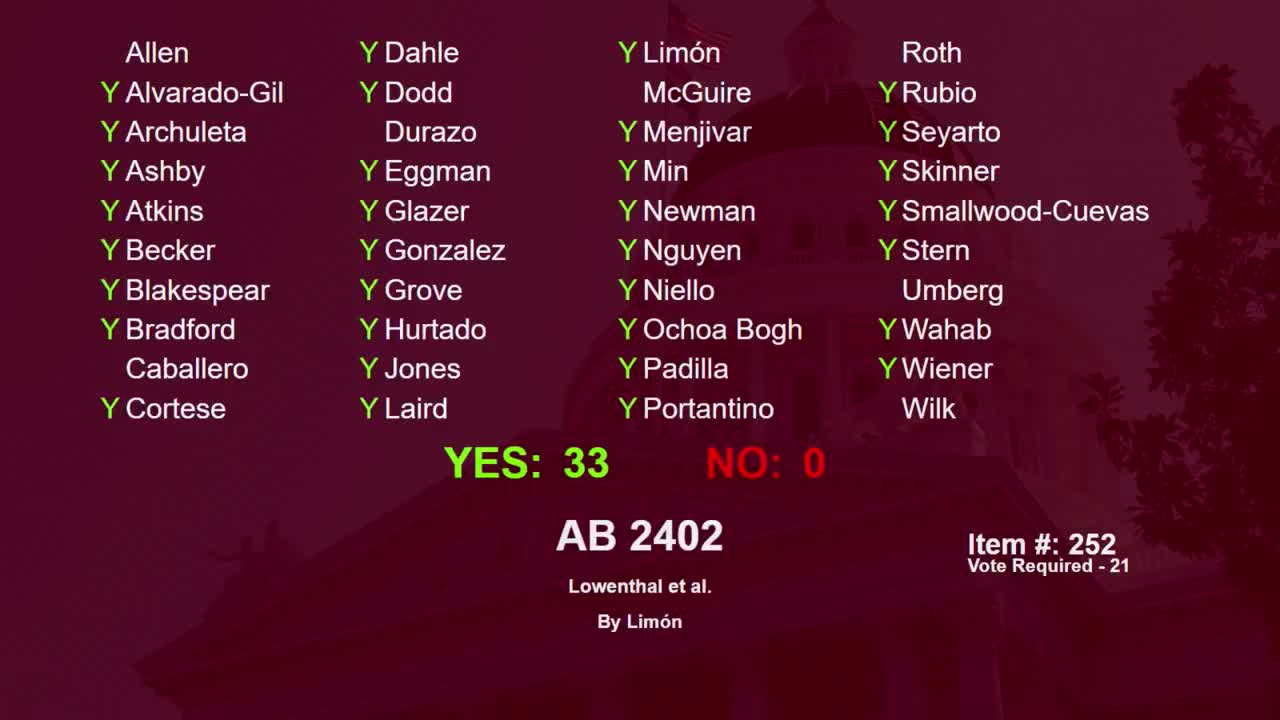
Bill Author

Bill Co-Author(s):