AB 1957: Public contracts: best value construction contracting for counties.
- Session Year: 2023-2024
- House: Assembly
- Latest Version Date: 2024-07-02
Current Status:
Passed
(2024-07-02: Chaptered by Secretary of State - Chapter 58, Statutes of 2024.)
Introduced
In Committee
First Chamber
In Committee
Second Chamber
Enacted
Existing law establishes a pilot program to allow the Counties of Alameda, Los Angeles, Monterey, Riverside, San Bernardino, San Diego, San Mateo, Santa Clara, Solano, and Yuba to select a bidder on the basis of best value, as defined, for construction projects in excess of $1,000,000. Existing law also authorizes these counties to use a best value construction contracting method to award individual annual contracts, not to exceed $3,000,000, for repair, remodeling, or other repetitive work to be done according to unit prices, as specified. Existing law establishes procedures and criteria for the selection of a best value contractor and requires that bidders verify specified information under oath. Existing law requires the board of supervisors of a participating county to submit a report that contains specified information about the projects awarded using the best value procedures described above to the appropriate policy committees of the Legislature and the Joint Legislative Budget Committee before March 1, 2024. Existing law repeals the pilot program provisions on January 1, 2025.
This bill would instead authorize any county of the state to utilize this program and would extend the operation of those provisions until January 1, 2030. The bill would instead require the board of supervisors of a participating county to submit the report described above to the appropriate policy committees of the Legislature and the Joint Legislative Budget Committee before March 1, 2029. Because the bill would expand the program to all counties within the state and would extend the operation of the program, the bill would expand the crime of perjury, thereby imposing a state-mandated local program.
The California Constitution requires the state to reimburse local agencies and school districts for certain costs mandated by the state. Statutory provisions establish procedures for making that reimbursement.
This bill would provide that no reimbursement is required by this act for a specified reason.
Existing law establishes a pilot program to allow the Counties of Alameda, Los Angeles, Monterey, Riverside, San Bernardino, San Diego, San Mateo, Santa Clara, Solano, and Yuba to select a bidder on the basis of best value, as defined, for construction projects in excess of $1,000,000. Existing law also authorizes these counties to use a best value construction contracting method to award individual annual contracts, not to exceed $3,000,000, for repair, remodeling, or other repetitive work to be done according to unit prices, as specified. Existing law establishes procedures and criteria for the selection of a best value contractor and requires that bidders verify specified information under oath. Existing law requires the board of supervisors of a participating county to submit a report that contains specified information about the projects awarded using the best value procedures described above to the appropriate policy committees of the Legislature and the Joint Legislative Budget Committee before March 1, 2024. Existing law repeals the pilot program provisions on January 1, 2025.
This bill would instead authorize any county of the state to utilize this program and would remove the January 1, 2025, sunset date, thereby extending the operation of those provisions indefinitely. extend the operation of those provisions until January 1, 2030. The bill would delete the requirement for instead require the board of supervisors of a participating county to submit the report described above to the appropriate policy committees of the Legislature and the Joint Legislative Budget Committee before March 1, 2024. 2029. Because the bill would expand the program to all counties within the state and would indefinitely extend the operation of the program, the bill would expand the crime of perjury, thereby imposing a state-mandated local program.
The California Constitution requires the state to reimburse local agencies and school districts for certain costs mandated by the state. Statutory provisions establish procedures for making that reimbursement.
This bill would provide that no reimbursement is required by this act for a specified reason.
Existing law establishes a pilot program to allow the Counties of Alameda, Los Angeles, Monterey, Riverside, San Bernardino, San Diego, San Mateo, Santa Clara, Solano, and Yuba to select a bidder on the basis of best value, as defined, for construction projects in excess of $1,000,000. Existing law also authorizes these counties to use a best value construction contracting method to award individual annual contracts, not to exceed $3,000,000, for repair, remodeling, or other repetitive work to be done according to unit prices, as specified. Existing law establishes procedures and criteria for the selection of a best value contractor and requires that bidders verify specified information under oath. Existing law requires the board of supervisors of a participating county to submit a report that contains specified information about the projects awarded using the best value procedures described above to the appropriate policy committees of the Legislature and the Joint Legislative Budget Committee before March 1, 2024. Existing law repeals the pilot program provisions on January 1, 2025.
This bill would instead authorize any county of the state to utilize this program and would remove the January 1, 2025, sunset date, thereby extending the operation of those provisions indefinitely. The bill would delete the requirement for the board of supervisors of a participating county to submit the report described above to the appropriate policy committees of the Legislature and the Joint Legislative Budget Committee before March 1, 2024. Because the bill would expand the program to all counties within the state and would indefinitely extend the operation of the program, the bill would expand the crime of perjury, thereby imposing a state-mandated local program.
The California Constitution requires the state to reimburse local agencies and school districts for certain costs mandated by the state. Statutory provisions establish procedures for making that reimbursement.
This bill would provide that no reimbursement is required by this act for a specified reason.
(a)This article provides for a best value procurement program for county construction projects in excess of one million dollars ($1,000,000).
(b)The board of supervisors of a county shall let any contract for a construction project pursuant to this article to the bidder representing the best value or else reject all bids.
(c)The bidder may be selected on the basis of the best value to the county. In order to implement this method of selection, the board of supervisors shall adopt and publish procedures and required criteria that ensure that all selections are conducted in a fair and impartial manner. These procedures shall conform to Sections 20155.3 to 20155.6, inclusive, and shall be mandatory for a county that chooses to participate in the pilot program.
(d)If the board of supervisors of a county deems it to be in the best interest of the county, the board of supervisors, on the refusal or failure of the successful bidder for a project to execute a tendered contract, may award it to the bidder with the second lowest best value score, as determined in accordance with subdivision (c) of Section 20155.5. If the second bidder fails or refuses to execute the contract, the board of supervisors may likewise award it to the bidder with the third lowest best value score, as determined in accordance with subdivision (c) of Section 20155.5.
(e)(1)A county may also use the best value construction contracting method set out in this article to award individual annual contracts, which shall not exceed three million dollars ($3,000,000), adjusted annually to reflect the percentage change in the California Consumer Price Index, for repair, remodeling, or other repetitive work to be done according to unit prices. The contracts shall be based on plans and specifications for typical work. No annual contracts may be awarded for any new construction.
(2)For purposes of this subdivision, best value criteria shall be applied to the annual contract for construction services, rather than to an individual, specific project. Annual contracts may be extended or renewed for two subsequent annual terms and a maximum of six million dollars ($6,000,000) over the subsequent two terms of the contract. Contract values shall be adjusted annually to reflect the percentage change in the California Consumer Price Index.
(3)For purposes of this subdivision, unit price means the amount paid for a single unit of an item of work, and typical work means a work description applicable universally or applicable to a large number of individual projects, as distinguished from work specifically described with respect to an individual project. For purposes of this section, repair, remodeling, or other repetitive work to be done according to unit prices shall not include design or contract drawings.
SEC. 3.Section 20155.1 of the Public Contract Code is amended to read:20155.1.As used in this article:
(a)Best value means a procurement process whereby the selected bidder may be selected on the basis of objective criteria for evaluating the qualifications of bidders with the resulting selection representing the best combination of price and qualifications.
(b)Best value contract means a competitively bid contract entered into pursuant to this article.
(c)Best value contractor means a properly licensed person, firm, or corporation that submits a bid for, or is awarded, a best value contract.
(d)County means any chartered or general law county. County includes a city and county.
(e)Demonstrated management competency means the experience, competency, capability, and capacity of the proposed management staffing to complete projects of similar size, scope, or complexity.
(f)Financial condition means the financial resources needed to perform the contract. The criteria used to evaluate a bidders financial condition shall include, at a minimum, capacity to obtain all required payment bonds, performance bonds, and liability insurance.
(g)Labor compliance means the ability to comply with, and past performance with, contract and statutory requirements for the payment of wages and qualifications of the workforce. The criteria used to evaluate a bidders labor compliance shall include, as a minimum, the bidders ability to comply with the apprenticeship requirements of the California Apprenticeship Council and the Department of Industrial Relations, its past conformance with those requirements, and its past conformance with requirements to pay prevailing wages on public works projects.
(h)Qualifications means the financial condition, relevant experience, demonstrated management competency, labor compliance, and safety record of the bidder, and, if required by the bidding documents, some or all of the preceding qualifications as they pertain to subcontractors proposed to be used by the bidder for designated portions of the work. A county shall evaluate financial condition, relevant experience, demonstrated management competency, labor compliance, and safety record, using, to the extent possible, quantifiable measurements.
(i)Relevant experience means the experience, competency, capability, and capacity to complete projects of similar size, scope, or complexity.
(j)Safety record means the prior history concerning the safe performance of construction contracts. The criteria used to evaluate a bidders safety record shall include, at a minimum, its experience modification rate for the most recent three-year period, and its average total recordable injury or illness rate and average lost work rate for the most recent three-year period.
SEC. 4.Section 20155.7 of the Public Contract Code is amended to read:20155.7.(a)Before March 1, 2029, the board of supervisors of a participating county shall submit a report to the appropriate policy committees of the Legislature and the Joint Legislative Budget Committee. The report shall include, but is not limited to, the following information:
(1)A description of the projects awarded using the best value procedures.
(2)The contract award amounts.
(3)The best value contractors awarded the projects.
(4)A description of any written protests concerning any aspect of the solicitation, bid, or award of the best value contracts, including the resolution of the protests.
(5)A description of the prequalification process.
(6)The criteria used to evaluate the bids, including the weighting of the criteria and an assessment of the effectiveness of the methodology.
(7)If a project awarded under this article has been completed, an assessment of the project performance, to include a summary of any delays or cost increases.
(b)A report submitted pursuant to subdivision (a) shall be submitted in compliance with Section 9795 of the Government Code.
SEC. 5.Section 20155.9 of the Public Contract Code is amended to read:20155.9.This article shall remain in effect only until January 1, 2030, and as of that date is repealed.
SEC. 6.No reimbursement is required by this act pursuant to Section 6 of Article XIIIB of the California Constitution because the only costs that may be incurred by a local agency or school district will be incurred because this act creates a new crime or infraction, eliminates a crime or infraction, or changes the penalty for a crime or infraction, within the meaning of Section 17556 of the Government Code, or changes the definition of a crime within the meaning of Section 6 of Article XIIIB of the California Constitution.
(a)This article provides for a best value procurement program for county construction projects in excess of one million dollars ($1,000,000).
(b)The board of supervisors of a county shall let any contract for a construction project pursuant to this article to the bidder representing the best value or else reject all bids.
(c)The bidder may be selected on the basis of the best value to the county. In order to implement this method of selection, the board of supervisors shall adopt and publish procedures and required criteria that ensure that all selections are conducted in a fair and impartial manner. These procedures shall conform to Sections 20155.3 to 20155.6, inclusive, and shall be mandatory for a county that chooses to participate in the pilot program.
(d)If the board of supervisors of a county deems it to be in the best interest of the county, the board of supervisors, on the refusal or failure of the successful bidder for a project to execute a tendered contract, may award it to the bidder with the second lowest best value score, as determined in accordance with subdivision (c) of Section 20155.5. If the second bidder fails or refuses to execute the contract, the board of supervisors may likewise award it to the bidder with the third lowest best value score, as determined in accordance with subdivision (c) of Section 20155.5.
(e)(1)A county may also use the best value construction contracting method set out in this article to award individual annual contracts, which shall not exceed three million dollars ($3,000,000), adjusted annually to reflect the percentage change in the California Consumer Price Index, for repair, remodeling, or other repetitive work to be done according to unit prices. The contracts shall be based on plans and specifications for typical work. No annual contracts may be awarded for any new construction.
(2)For purposes of this subdivision, best value criteria shall be applied to the annual contract for construction services, rather than to an individual, specific project. Annual contracts may be extended or renewed for two subsequent annual terms and a maximum of six million dollars ($6,000,000) over the subsequent two terms of the contract. Contract values shall be adjusted annually to reflect the percentage change in the California Consumer Price Index.
(3)For purposes of this subdivision, unit price means the amount paid for a single unit of an item of work, and typical work means a work description applicable universally or applicable to a large number of individual projects, as distinguished from work specifically described with respect to an individual project. For purposes of this section, repair, remodeling, or other repetitive work to be done according to unit prices shall not include design or contract drawings.
SEC. 3.Section 20155.1 of the Public Contract Code is amended to read:20155.1.As used in this article:
(a)Best value means a procurement process whereby the selected bidder may be selected on the basis of objective criteria for evaluating the qualifications of bidders with the resulting selection representing the best combination of price and qualifications.
(b)Best value contract means a competitively bid contract entered into pursuant to this article.
(c)Best value contractor means a properly licensed person, firm, or corporation that submits a bid for, or is awarded, a best value contract.
(d)County means any chartered or general law county. County includes a city and county.
(e)Demonstrated management competency means the experience, competency, capability, and capacity of the proposed management staffing to complete projects of similar size, scope, or complexity.
(f)Financial condition means the financial resources needed to perform the contract. The criteria used to evaluate a bidders financial condition shall include, at a minimum, capacity to obtain all required payment bonds, performance bonds, and liability insurance.
(g)Labor compliance means the ability to comply with, and past performance with, contract and statutory requirements for the payment of wages and qualifications of the workforce. The criteria used to evaluate a bidders labor compliance shall include, as a minimum, the bidders ability to comply with the apprenticeship requirements of the California Apprenticeship Council and the Department of Industrial Relations, its past conformance with those requirements, and its past conformance with requirements to pay prevailing wages on public works projects.
(h)Qualifications means the financial condition, relevant experience, demonstrated management competency, labor compliance, and safety record of the bidder, and, if required by the bidding documents, some or all of the preceding qualifications as they pertain to subcontractors proposed to be used by the bidder for designated portions of the work. A county shall evaluate financial condition, relevant experience, demonstrated management competency, labor compliance, and safety record, using, to the extent possible, quantifiable measurements.
(i)Relevant experience means the experience, competency, capability, and capacity to complete projects of similar size, scope, or complexity.
(j)Safety record means the prior history concerning the safe performance of construction contracts. The criteria used to evaluate a bidders safety record shall include, at a minimum, its experience modification rate for the most recent three-year period, and its average total recordable injury or illness rate and average lost work rate for the most recent three-year period.
SEC. 4.Section 20155.7 of the Public Contract Code is repealed.SEC. 5.Section 20155.9 of the Public Contract Code is repealed.SEC. 4.Section 20155.7 of the Public Contract Code is amended to read:20155.7.(a)Before March 1, 2024, 2029, the board of supervisors of a participating county shall submit a report to the appropriate policy committees of the Legislature and the Joint Legislative Budget Committee. The report shall include, but is not limited to, the following information:
(1)A description of the projects awarded using the best value procedures.
(2)The contract award amounts.
(3)The best value contractors awarded the projects.
(4)A description of any written protests concerning any aspect of the solicitation, bid, or award of the best value contracts, including the resolution of the protests.
(5)A description of the prequalification process.
(6)The criteria used to evaluate the bids, including the weighting of the criteria and an assessment of the effectiveness of the methodology.
(7)If a project awarded under this article has been completed, an assessment of the project performance, to include a summary of any delays or cost increases.
(b)A report submitted pursuant to subdivision (a) shall be submitted in compliance with Section 9795 of the Government Code.
SEC. 5.Section 20155.9 of the Public Contract Code is amended to read:20155.9.This article shall remain in effect only until January 1, 2025, 2030, and as of that date is repealed.
SEC. 6.No reimbursement is required by this act pursuant to Section 6 of Article XIIIB of the California Constitution because the only costs that may be incurred by a local agency or school district will be incurred because this act creates a new crime or infraction, eliminates a crime or infraction, or changes the penalty for a crime or infraction, within the meaning of Section 17556 of the Government Code, or changes the definition of a crime within the meaning of Section 6 of Article XIIIB of the California Constitution.
(a)This article provides for a pilot best value procurement program for the Counties of Alameda, Los Angeles, Monterey, Riverside, San Bernardino, San Diego, San Mateo, Santa Clara, Solano, and Yuba for county construction projects in excess of one million dollars ($1,000,000).
(b)The board of supervisors of a county shall let any contract for a construction project pursuant to this article to the bidder representing the best value or else reject all bids.
(c)The bidder may be selected on the basis of the best value to the county. In order to implement this method of selection, the board of supervisors shall adopt and publish procedures and required criteria that ensure that all selections are conducted in a fair and impartial manner. These procedures shall conform to Sections 20155.3 to 20155.6, inclusive, and shall be mandatory for a county that chooses to participate in the pilot program.
(d)If the board of supervisors of a county deems it to be in the best interest of the county, the board of supervisors, on the refusal or failure of the successful bidder for a project to execute a tendered contract, may award it to the bidder with the second lowest best value score, as determined in accordance with subdivision (c) of Section 20155.5. If the second bidder fails or refuses to execute the contract, the board of supervisors may likewise award it to the bidder with the third lowest best value score, as determined in accordance with subdivision (c) of Section 20155.5.
(e)(1)A county listed in subdivision (a) may also use the best value construction contracting method set out in this article to award individual annual contracts, which shall not exceed three million dollars ($3,000,000), adjusted annually to reflect the percentage change in the California Consumer Price Index, for repair, remodeling, or other repetitive work to be done according to unit prices. The contracts shall be based on plans and specifications for typical work. No annual contracts may be awarded for any new construction.
(2)For purposes of this subdivision, best value criteria shall be applied to the annual contract for construction services, rather than to an individual, specific project. Annual contracts may be extended or renewed for two subsequent annual terms and a maximum of six million dollars ($6,000,000) over the subsequent two terms of the contract. Contract values shall be adjusted annually to reflect the percentage change in the California Consumer Price Index.
(3)For purposes of this subdivision, unit price means the amount paid for a single unit of an item of work, and typical work means a work description applicable universally or applicable to a large number of individual projects, as distinguished from work specifically described with respect to an individual project. For purposes of this section, repair, remodeling, or other repetitive work to be done according to unit prices shall not include design or contract drawings.
SEC. 3.Section 20155.1 of the Public Contract Code is amended to read:20155.1.As used in this article:
(a)Best value means a procurement process whereby the selected bidder may be selected on the basis of objective criteria for evaluating the qualifications of bidders with the resulting selection representing the best combination of price and qualifications.
(b)Best value contract means a competitively bid contract entered into pursuant to this article.
(c)Best value contractor means a properly licensed person, firm, or corporation that submits a bid for, or is awarded, a best value contract.
(d)County means any of the following counties:(1)The County of Alameda.(2)The County of Los Angeles.(3)The County of Monterey.(4)The County of Riverside.(5)The County of San Bernardino.(6)The County of San Diego.(7)The County of San Mateo.(8)The County of Santa Clara.(9)The County of Solano.(10)The County of Yuba.(d)County means any chartered or general law county. County includes a city and county.
(e)Demonstrated management competency means the experience, competency, capability, and capacity of the proposed management staffing to complete projects of similar size, scope, or complexity.
(f)Financial condition means the financial resources needed to perform the contract. The criteria used to evaluate a bidders financial condition shall include, at a minimum, capacity to obtain all required payment bonds, performance bonds, and liability insurance.
(g)Labor compliance means the ability to comply with, and past performance with, contract and statutory requirements for the payment of wages and qualifications of the workforce. The criteria used to evaluate a bidders labor compliance shall include, as a minimum, the bidders ability to comply with the apprenticeship requirements of the California Apprenticeship Council and the Department of Industrial Relations, its past conformance with those requirements, and its past conformance with requirements to pay prevailing wages on public works projects.
(h)Qualifications means the financial condition, relevant experience, demonstrated management competency, labor compliance, and safety record of the bidder, and, if required by the bidding documents, some or all of the preceding qualifications as they pertain to subcontractors proposed to be used by the bidder for designated portions of the work. A county shall evaluate financial condition, relevant experience, demonstrated management competency, labor compliance, and safety record, using, to the extent possible, quantifiable measurements.
(i)Relevant experience means the experience, competency, capability, and capacity to complete projects of similar size, scope, or complexity.
(j)Safety record means the prior history concerning the safe performance of construction contracts. The criteria used to evaluate a bidders safety record shall include, at a minimum, its experience modification rate for the most recent three-year period, and its average total recordable injury or illness rate and average lost work rate for the most recent three-year period.
SEC. 4.Section 20155.7 of the Public Contract Code is repealed.20155.7.(a)Before March 1, 2024, the board of supervisors of a participating county shall submit a report to the appropriate policy committees of the Legislature and the Joint Legislative Budget Committee. The report shall include, but is not limited to, the following information:(1)A description of the projects awarded using the best value procedures.(2)The contract award amounts.(3)The best value contractors awarded the projects.(4)A description of any written protests concerning any aspect of the solicitation, bid, or award of the best value contracts, including the resolution of the protests.(5)A description of the prequalification process.(6)The criteria used to evaluate the bids, including the weighting of the criteria and an assessment of the effectiveness of the methodology.(7)If a project awarded under this article has been completed, an assessment of the project performance, to include a summary of any delays or cost increases.(b)A report submitted pursuant to subdivision (a) shall be submitted in compliance with Section 9795 of the Government Code.SEC. 5.Section 20155.9 of the Public Contract Code is repealed.20155.9.This article shall remain in effect only until January 1, 2025, and as of that date is repealed.SEC. 6.No reimbursement is required by this act pursuant to Section 6 of Article XIIIB of the California Constitution because the only costs that may be incurred by a local agency or school district will be incurred because this act creates a new crime or infraction, eliminates a crime or infraction, or changes the penalty for a crime or infraction, within the meaning of Section 17556 of the Government Code, or changes the definition of a crime within the meaning of Section 6 of Article XIIIB of the California Constitution.
|
Date
|
Status
|
|---|---|
| Jul 2, 2024 | Chaptered by Secretary of State - Chapter 58, Statutes of 2024. |
| Jul 2, 2024 | Approved by the Governor. |
| Jun 25, 2024 | Enrolled and presented to the Governor at 4 p.m. |
| Jun 13, 2024 | In Assembly. Ordered to Engrossing and Enrolling. |
| Jun 13, 2024 | Read third time. Passed. Ordered to the Assembly. (Ayes 37. Noes 0. Page 4491.). |
| Jun 11, 2024 | Read second time. Ordered to Consent Calendar. |
| Jun 10, 2024 | From committee: Be ordered to second reading file pursuant to Senate Rule 28.8 and ordered to Consent Calendar. |
| May 29, 2024 | From committee: Do pass and re-refer to Com. on APPR with recommendation: To Consent Calendar. (Ayes 7. Noes 0.) (May 29). Re-referred to Com. on APPR. |
| May 22, 2024 | Referred to Com. on L. GOV. |
| May 9, 2024 | In Senate. Read first time. To Com. on RLS. for assignment. |
| May 9, 2024 | Read third time. Passed. Ordered to the Senate. (Ayes 65. Noes 0. Page 5158.) |
| May 2, 2024 | Read second time. Ordered to Consent Calendar. |
| May 1, 2024 | From committee: Do pass. To Consent Calendar. (Ayes 14. Noes 0.) (May 1). |
| Apr 18, 2024 | From committee: Do pass and re-refer to Com. on APPR. (Ayes 9. Noes 0.) (April 17). Re-referred to Com. on APPR. |
| Apr 9, 2024 | Re-referred to Com. on L. GOV. |
| Apr 8, 2024 | From committee chair, with author's amendments: Amend, and re-refer to Com. on L. GOV. Read second time and amended. |
| Feb 12, 2024 | Referred to Com. on L. GOV. |
| Jan 30, 2024 | From printer. May be heard in committee February 29. |
| Jan 29, 2024 | Read first time. To print. |
|
Date
|
Description
|
Location
|
Votes
|
|
|---|---|---|---|---|
| Jun 13, 2024 | Consent Calendar 2nd AB1957 Wilson | Senate Floor |
Passed |
|
| May 29, 2024 | Do pass, but first be re-referred to the Committee on [Appropriations] with the recommendation: To Consent Calendar | Senate Standing Committee on Local Government |
Passed |
|
| May 9, 2024 | AB 1957 Wilson Consent Calendar Second Day Regular Session | Assembly Floor |
Passed |
|
| May 1, 2024 | Do pass. To Consent Calendar. | Assembly Standing Committee on Appropriations |
Passed |
|
| Apr 17, 2024 | Do pass and be re-referred to the Committee on [Appropriations] | Assembly Standing Committee on Local Government |
Passed |
This list shows positions taken on this bill by organizations on the date displayed, which is linked to the original source.
Positions by individuals are not included.
|
Organization
|
Position
|
Date
|
|---|---|---|
| Architects and Engineers Association | * Support | Apr 17, 2024 |
| Associated General Contractors Of California | ** Support | |
| California State Association Of Counties | ** Support | |
| County of Los Angeles Board of Supervisors | ** Support | |
| County of Solano | ** Support | |
| Gordian Group Inc. The | * For If Amend | Apr 17, 2024 |
| Orange County Board of Supervisors | * Support | Apr 17, 2024 |
| Riverside County | * Support | Apr 17, 2024 |
| Riverside County Transportation Commission | ** Support | |
| Rural County Represenatatives of California | * Support | Apr 17, 2024 |
| Santa Clara County | * Support | Apr 17, 2024 |
| The Gordian Group | ** Support | |
| The Urban Counties of California | * Support | Apr 17, 2024 |
| Western Electrical Contractors Association | ** Support |
SENATE RULES COMMITTEE Office of Senate Floor Analyses (916) 651-1520 Fax: (916) 327-4478 | AB 1957 |
CONSENT
Bill No: AB 1957
Author: Wilson (D)
Amended: 4/8/24 in Assembly
Vote: 21
SENATE LOCAL GOVERNMENT COMMITTEE: 7-0, 5/29/24
AYES: Durazo, Seyarto, Dahle, Glazer, Skinner, Wahab, Wiener
SENATE APPROPRIATIONS COMMITTEE: Senate Rule 28.8
ASSEMBLY FLOOR: 65-0, 5/9/24 (Consent) - See last page for vote
SUBJECT: Public contracts: best value construction contracting for counties
SOURCE: County of Orange
County of Santa Clara
County of Solano
DIGEST:
This bill expands a ten-county pilot program to allow all counties to use best-value contracting, and extends the sunset date on the authorization to January 1, 2030.
ANALYSIS:
Existing law:
- Requires, pursuant to the Local Agency Public Construction Act (Act), local agencies to invite bids for construction projects and award contracts to the lowest responsible bidder, unless otherwise specified.
- Creates a pilot program for Alameda, Los Angeles, Monterey, Riverside, San Bernardino, San Diego, San Mateo, Santa Clara, Solano, and Yuba Counties to:
- Award contracts for construction projects in excess of one million using the best-value method.
- Award individual annual contracts for repair, remodeling, or other repetitive work to be done according to unit prices – also known as “job order contracting.” If a county uses the best-value method for job order contracts, the contracts must: (i) not exceed three million, adjusted for inflation; (ii) not be for new construction; and (iii) apply the best-value method criteria to the annual contract for construction services, not to an individual project. Additionally, participating counties can extend annual contracts for two annual terms at a maximum of six million over that period. Counties must adjust contract values annually to reflect the percentage change in the California consumer price index.
- Provides that participating counties must satisfy a number of requirements to use this authority, including to:
- Adopt and publish procedures and required criteria that ensure local agencies select bids in a fair and impartial manner;
- Evaluate at a public meeting the alternative of awarding the contract on the basis of the lowest bid price;
- Make a written finding that awarding the contract on the basis of best value will reduce project costs, expedite project completion, and/or provide features not achievable via the low-bid method;
- Prepare bid solicitations and providing notice as required by the Act, and complying with the Subcontracting Fair Practices Act regarding subcontractors identified in a bid;
- Establish prequalification procedures in accordance with the Act;
- Include in bid solicitations the criteria and rating system a county will consider in evaluating bids;
- Prequalify or shortlist only those contractors who provide an enforceable commitment to use a skilled and trained workforce to perform all work on the project that falls within an apprenticeable occupation, with specified exceptions;
- Appoint an evaluation committee, which must evaluate bidders solely upon the criteria in the bid solicitations and assign a qualifications score to each bid;
- Determine best value by dividing each bidder’s price by its qualifications score, with the lowest cost per quality point representing the best-value bid;
- Announce bid awards publicly, including the score of the selected contractor in relation to all other bidders, and;
- Submit a report to the Legislature, including information about the county’s use of the bill’s authority before the pilot program sunsets on January 1, 2025.
This bill:
- Expands a pilot program for the Counties of Alameda, Los Angeles, Monterey, Riverside, San Bernardino, San Diego, San Mateo, Santa Clara, Solano, and Yuba for best value procurement for construction projects in excess of one million to include all counties.
- Extends the sunset date on the authorization for the program from January 1, 2025, to January 1, 2030.
- Requires participating counties to submit a report to the Legislature before March 1, 2029
- Makes technical and conforming changes.
Background
Local agencies typically use the traditional design-bid-build method for constructing public works. This approach splits construction projects into two distinct phases: design and construction. During the design phase, the local agency prepares detailed project plans and specifications using its own employees or by hiring outside architects and engineers. Once project designs are complete, local agencies invite bids from the construction community and award the contract to the lowest responsible bidder.
Over the last couple of decades, legislators have gradually expanded local agencies’ authority to procure construction projects using various alternatives to the design-bid-build project delivery method. These alternatives include:
- “Design-build” contracting allows local agencies to procure both design and construction services from a single company before the development of complete plans and specifications. (SB 785, Wolk, Chapter 931, Statutes of 2014)
- “Construction manager at risk” contracting allows local agencies to retain a construction manager, who provides pre-construction services during the design period, who later becomes the general contractor during the construction process, and is responsible for delivering the project within an agreed upon price, thereby assuming the risk for cost overruns. (SB 328, Knight, Chapter 517, Statutes of 2013)
During the bidding phase, these alternative procurement methods allow a local agency to evaluate bids on a “best-value” basis, incorporating technical factors, such as qualifications, in addition to price. For example, the statutes authorizing design-build contracting allow local agencies to award a contract based on consideration of objective criteria that include features, functions, lifecycle costs, experience, and past performance.
Comments
- Purpose of the bill. According to the author, “Best value contracting was established as a pilot program in 2016 and has continued to expand throughout the years. It has been a highly successful program but is due to sunset. AB 1957 will remove the sunset date of January 1, 2025 and allow all counties to be included in the procurement program. Best-value contracting presents a unique opportunity for local governments to deliver high-quality projects for our residents. Solano County, one of the pilot project counties, has found this contracting method to be an effective tool in delivering projects on time and on budget.”
- Mixed reviews. The reports from counties that have used best value contracting to date present a mixed picture of best-value contracting. Los Angeles County and Solano County have successfully used best value procurement for contracts totaling a substantial dollar amount and consider it a valuable method because it allows for more collaborative project delivery with higher quality contractors. All three counties from which the Committee received reports indicated some challenges with the procedures required under the law. Two counties, Los Angeles and Santa Clara, have found it challenging to meet the three-bidder minimum on projects. In Los Angeles County, their construction project received no best value bids, which may indicate challenges for construction projects beyond simply receiving a sufficient number of bids. All three counties described some added costs associated with the prequalification process, and Santa Clara County noted the caps on annual contracts limit the law’s usefulness, particularly given some of the procedural steps required for best value contracting. The Committee may wish to consider whether further reforms that increase the use of best value contracting may deliver additional benefits for local agencies.
FISCAL EFFECT: Appropriation: No Fiscal Com.: Yes Local: Yes
SUPPORT: (Verified 6/11/24)
County of Orange (co-source)
County of Santa Clara (co-source)
County of Solano (co-source)
American Society of Civil Engineers-region 9
Associated General Contractors of California
California Builders Alliance
California State Association of Counties
County of Riverside
Gordian Group
Riverside County Transportation Commission
Rural County Representatives of California
Sacramento Regional Builders Exchange
Urban Counties of California
Western Electrical Contractors Association
OPPOSITION: (Verified 6/11/24)
None received
ASSEMBLY FLOOR: 65-0, 5/9/24
AYES: Addis, Aguiar-Curry, Alanis, Alvarez, Arambula, Bauer-Kahan, Bennett, Berman, Boerner, Bonta, Bryan, Calderon, Juan Carrillo, Wendy Carrillo, Chen, Connolly, Davies, Dixon, Essayli, Mike Fong, Vince Fong, Friedman, Gallagher, Garcia, Gipson, Hart, Holden, Hoover, Irwin, Jackson, Jones-Sawyer, Kalra, Lackey, Lee, Lowenthal, Maienschein, McCarty, McKinnor, Muratsuchi, Ortega, Pacheco, Papan, Jim Patterson, Joe Patterson, Pellerin, Quirk-Silva, Ramos, Rendon, Reyes, Rodriguez, Blanca Rubio, Sanchez, Santiago, Soria, Ta, Valencia, Villapudua, Waldron, Ward, Weber, Wicks, Wilson, Wood, Zbur, Robert Rivas
NO VOTE RECORDED: Bains, Cervantes, Megan Dahle, Flora, Gabriel, Grayson, Haney, Low, Mathis, Stephanie Nguyen, Petrie-Norris, Luz Rivas, Schiavo, Ting, Wallis
Prepared by: Anton Favorini-Csorba / L. GOV. / (916) 651-4119
6/11/24 10:01:24
**** END ****
SENATE COMMITTEE ON LOCAL GOVERNMENT
Senator María Elena Durazo, Chair
2023 - 2024 Regular
Bill No: | AB 1957 | Hearing Date: | 5/29/24 |
Author: | Wilson | Fiscal: | Yes |
Version: | 4/8/24 | Consultant: | Favorini-Csorba |
Public contracts: best value construction contracting for counties
Expands a ten-county pilot program to allow all counties to use best-value contracting, and extends the sunset date on the authorization to January 1, 2030.
Background
Contracting. The Local Agency Public Construction Act (the Act) generally requires local agencies to invite bids for construction projects and award contracts to the lowest responsible bidder. Local agencies typically use the traditional design-bid-build method for constructing public works. This approach splits construction projects into two distinct phases: design and construction. During the design phase, the local agency prepares detailed project plans and specifications using its own employees or by hiring outside architects and engineers. Once project designs are complete, local agencies invite bids from the construction community and award the contract to the lowest responsible bidder.
Over the last couple of decades, the Legislature has gradually expanded local agencies’ authority to procure construction projects using various alternatives to the design-bid-build project delivery method. These alternatives include:
- “Design-build” contracting allows local agencies to procure both design and construction services from a single company before the development of complete plans and specifications (SB 785, Wolk, 2014); and,
- “Construction manager at risk” contracting allows local agencies to retain a construction manager, who provides pre-construction services during the design period, later becomes the general contractor during the construction process, and is responsible for delivering the project within an agreed upon price, thereby assuming the risk for cost overruns (SB 328, Knight, 2013).
During the bidding phase, these alternative procurement methods allow a local agency to evaluate bids on a “best-value” basis, incorporating technical factors, such as qualifications, in addition to price. For example, the statutes authorizing design-build contracting allow local agencies to award a contract based on consideration of objective criteria that include features, functions, lifecycle costs, experience, and past performance.
County best-value contracting pilot. SB 762 (Wolk, 2015) established a pilot program until January 1, 2020, that allowed the counties of Alameda, Los Angeles, Riverside, San Bernardino, San Diego, Solano, and Yuba to award contracts for construction projects in excess of $1 million using the best-value method.
SB 793 (Hill, 2017) added San Mateo County to the pilot program and allowed counties participating in the pilot to use the program to award individual annual contracts for repair, remodeling, or other repetitive work to be done according to unit prices – also known as “job-order contracting.” If a county uses the best-value method for job order contracts, the contracts must:
- Not exceed $3 million, adjusted for inflation;
- Not be for new construction; and
- Apply the best-value method criteria to the annual contract for construction services, not to an individual project.
Additionally, participating counties can extend annual contracts for two annual terms at a maximum of $6 million over that period. Counties must adjust contract values annually to reflect the percentage change in the California consumer price index.
Most recently, SB 128 (Beall, 2019) added Monterey and Santa Clara counties to the authorization and extended the sunset date from January 1, 2020, to January 1, 2025.
As a result, ten counties are eligible to use the best-value procurement method: Alameda, Los Angeles, Monterey, Riverside, San Bernardino, San Diego, San Mateo, Santa Clara, Solano, and Yuba.
Best-value contracting requirements. Participating counties must satisfy a number of requirements to use the best-value contracting authority, including to:
- Adopt and publish procedures and required criteria to ensure local agencies select bids in a fair and impartial manner;
- Evaluate at a public meeting the alternative of awarding the contract on the basis of the lowest bid price;
- Make a written finding that awarding the contract on the basis of best value will reduce project costs, expedite project completion, and/or provide features not achievable via the low-bid method;
- Prepare bid solicitations and provide notice as required by the Act, and comply with the Subcontracting Fair Practices Act regarding subcontractors identified in a bid;
- Establish prequalification procedures in accordance with the Act;
- Include in bid solicitations the criteria and rating system a county will consider in evaluating bids;
- Prequalify or shortlist only those contractors who provide an enforceable commitment to use a skilled and trained workforce to perform all work on the project that falls within an apprenticeable occupation, with specified exceptions;
- Appoint an evaluation committee, which must evaluate bidders solely upon the criteria in the bid solicitations and assign a qualifications score to each bid;
- Determine best value by dividing each bidder’s price by its qualifications score, with the lowest cost per quality point representing the best-value bid;
- Announce bid awards publicly, including the score of the selected contractor in relation to all other bidders; and
- Submit a report to the Legislature, including information about the county’s use of the bill’s authority on or before March 1, 2024.
So far, the Committee has received reports from three of the ten counties on their use of best-value contracting:
- Los Angeles County reports it has used best-value contracting for 141 projects totaling $58 million over four years. All of those contracts were job-order contracts. Los Angeles County notes that it also put out an RFP under the best-value pilot for one construction project, but received no bids. The County’s report concluded that best-value contracting “contributed to better performance and expedited completion of highly complex projects while reducing project costs by avoiding contractor errors, costly change orders, and redo of projects. These types of results are not readily achieved when awarding project contracts on the basis of traditional lowest bid price.”
- Santa Clara County has used best-value contracting for six projects, all job-order contracts. The County’s report indicates that while it prefers the flexibility to use best-value or low-bidder methods of contracting, the best-value method added months to the contracting timeline and tended to favor the same contractors. The County’s Roads and Airports Department also notes “it is still unknown whether the best value solicitation method provides more value than a low bid solicitation.”
- Solano County has used the program for two construction projects: to construct a $26 million vocational training facility for the county sheriff, and for an $11 million Plumbing Replacement and Shower repair project at their Justice Center Detention facility. Regarding the latter project, Solano County’s report states that despite cost increases associated with unforeseen complications, “best value procurement attracted a high-quality General Contractor to the project – one willing to work in a collaborative manner to resolve challenges and mitigate additional costs and delay while providing a quality product.”
The Counties of Orange, Santa Clara, and Solano want the Legislature to extend the sunset date to allow counties to continue to use the best-value contracting method and expand the program to all counties.
Proposed Law
Assembly Bill 1957 expands the best-value contracting pilot program to include all counties. The bill also extends the sunset date on the authorization for the program from January 1, 2025, to January 1, 2030, and requires local agencies that use the authority to report to the Legislature on or before March 1, 2029.
Comments
1. Purpose of the bill. According to the author, “Best value contracting was established as a pilot program in 2016 and has continued to expand throughout the years. It has been a highly successful program but is due to sunset. AB 1957 will remove the sunset date of January 1, 2025 and allow all counties to be included in the procurement program. Best-value contracting presents a unique opportunity for local governments to deliver high-quality projects for our residents. Solano County, one of the pilot project counties, has found this contracting method to be an effective tool in delivering projects on time and on budget.”
2. Mixed reviews. The reports from counties that have used best value contracting to date present a mixed picture of best-value contracting. Los Angeles County and Solano County have successfully used best value procurement for contracts totaling a substantial dollar amount and consider it a valuable method because it allows for more collaborative project delivery with higher quality contractors. All three counties from which the Committee received reports indicated some challenges with the procedures required under the law. Two counties, Los Angeles and Santa Clara, have found it challenging to meet the three-bidder minimum on projects. In Los Angeles County, their construction project received no best value bids, which may indicate challenges for construction projects beyond simply receiving a sufficient number of bids. All three counties described some added costs associated with the prequalification process, and Santa Clara County noted the caps on annual contracts limit the law’s usefulness, particularly given some of the procedural steps required for best value contracting. The Committee may wish to consider whether further reforms that increase the use of best value contracting may deliver additional benefits for local agencies.
3. Mandate. The California Constitution requires the state to reimburse local governments for the costs of new or expanded state mandated local programs. Because AB 1957 expands the crime of perjury, Legislative Counsel says the bill imposes a new state mandate. AB 1957 disclaims the state's responsibility for providing reimbursement because the costs are due to expanding a crime.
4. Related legislation. SB 1325 (Durazo), which the Committee approved at its April 17th hearing on a vote of 5-2, allows public entities to use best value procurement when awarding contracts for goods over $250,000. SB 1325 is pending in the Assembly.
Assembly Actions
Assembly Local Government Committee: 9-0
Assembly Appropriations Committee: 14-0
Assembly Floor: 65-0
Support and Opposition
(5/24/24)
Support: County of Orange (Co-Sponsor)
County of Santa Clara (Co-Sponsor)
County of Solano (Co-Sponsor)
American Society of Civil Engineers-region 9
Associated General Contractors of California
California State Association of Counties
County of Riverside
Gordian Group
Riverside County Transportation Commission (RCTC)
Rural County Representatives of California (RCRC)
Urban Counties of California (UCC)
Western Electrical Contractors Association
Opposition: None received.
-- END --
Date of Hearing: May 1, 2024
ASSEMBLY COMMITTEE ON APPROPRIATIONS
Buffy Wicks, Chair
ABPCA Bill Id:AB 1957
Author:(Wilson) – As Amended Ver:April 8, 2024
Policy Committee: | Local Government | Vote: | 9 - 0 |
|
| ||
|
|
Urgency: No State Mandated Local Program: Yes Reimbursable: No
SUMMARY:
This bill authorizes any county of the state to use an existing pilot program allowing the counties of Alameda, Los Angeles, Monterey, Riverside, San Bernardino, San Diego, San Mateo, Santa Clara, Solano, and Yuba to utilize the “best value” method for construction projects in excess of $1 million and job order contracts up to $3 million. This bill also extends the sunset date on the program from January 1, 2025, to January 1, 2030.
FISCAL EFFECT:
Negligible state costs. Any local costs are not reimbursable by the state.
COMMENTS:
- Purpose. The author seeks to extend and expand to all counties a pilot program allowing certain counties to use “best value” contracting as an alternative bidding process for construction projects. According to the author:
Best value contracting was established as a pilot program in 2016 and has continued to expand throughout the years. It has been a highly successful program but is due to sunset. [This bill] will remove the sunset date of January 1, 2025 and allow all counties to be included in the procurement program. Best-value contracting presents a unique opportunity for local governments to deliver high-quality projects for our residents. Solano County, one of the pilot project counties, has found this contracting method to be an effective tool in delivering projects on time and on budget.
- Background. SB 762 (Wolk), Chapter 627, Statutes of 2015, established a pilot program until January 1, 2020, allowing the counties of Alameda, Los Angeles, Riverside, San Bernardino, San Diego, Solano, and Yuba to award contracts for construction projects in excess of $1 million to the bidder representing the best value. Traditionally, construction projects have been bid out and awarded based upon a lowest-cost approach. Best value, a competitive contracting process, allows projects to be awarded to the contractor offering the best combination of price and qualifications, instead of just the lowest bid. In addition to submitting bids for project cost, prospective contractors also submit technical proposals. The technical proposals are evaluated based on objective criteria, and scored. The scores are then used to weigh or adjust the submitted bid price. The contract is awarded to the contractor that represents the best value to the contracting agency.
SB 793 (Hill), Chapter 627, Statutes of 2017, among other items, expanded the pilot to include the County of San Mateo and to allow the use of best value contracting method for job order contracting for up to $3 million contracts. SB 128 (Beall), Chapter 501, Statutes of 2019, expanded the program again by adding the counties of Monterey and Santa Clara to the authorization and extended the sunset date from January 1, 2020, to January 1, 2025.
This bill allows all counties, statewide, to use the best value pilot and extends the sunset date to January 1, 2030.
Arguments in Support. This bill is sponsored by the Solano County Board of Supervisors, who writes in support:
For Solano County, the ability to participate in the best value process has provided substantial benefits, including improved project control and quality. These projects have started and finished more efficiently and on budget. Further, best value contracting proved to lessen administrative costs and time by increasing contract terms through renewal options, which also helps increase the capacity to deliver more projects in less time. This drives more high-quality construction work into the statewide construction marketplace while reducing administrative burdens.
Analysis Prepared by: Jennifer Swenson / APPR. / (916) 319-2081
Date of Hearing: April 17, 2024
ASSEMBLY COMMITTEE ON LOCAL GOVERNMENT
Juan Carrillo, Chair
ABPCA Bill Id:AB 1957 (
Author:Wilson) – As Amended Ver:April 8, 2024
SUBJECT: Public contracts: best value construction contracting for counties.
SUMMARY: Expands a pilot program for specified counties to use best value contracting to include all counties, and extends the sunset date on the authorization to January 1, 2030. Specifically, this bill:
- Expands a pilot program for the Counties of Alameda, Los Angeles, Monterey, Riverside, San Bernardino, San Diego, San Mateo, Santa Clara, Solano, and Yuba for best value procurement for construction projects in excess of $1 million to include all counties.
- Extends the sunset date on the authorization for the program from January 1, 2025, to January 1, 2030, and makes conforming changes.
- Provides that no reimbursement is required by this bill pursuant to Section 6 of Article XIII B of the California Constitution because the only costs that may be incurred by a local agency or school district will be incurred because this bill creates a new crime or infraction, eliminates a crime or infraction, or changes the penalty for a crime or infraction, within the meaning of Section 17556 of the Government Code, or changes the definition of a crime within the meaning of Section 6 of Article XIII B of the California Constitution.
FISCAL EFFECT: This bill is keyed fiscal and contains a state-mandated local program.
COMMENTS:
- Bill Summary and Author’s Statement. This bill expands a pilot program for the Counties of Alameda, Los Angeles, Monterey, Riverside, San Bernardino, San Diego, San Mateo, Santa Clara, Solano, and Yuba for best value procurement for construction projects in excess of $1 million to include all counties. This bill also extends the sunset date on the authorization for the program from January 1, 2025, to January 1, 2030.
“Best value contracting was established as a pilot program in 2016 and has continued to expand throughout the years. It has been a highly successful program but is due to sunset. AB 1957 will remove the sunset date of January 1, 2025 and allow all counties to be included in the procurement program. Best-value contracting presents a unique opportunity for local governments to deliver high-quality projects for our residents. Solano County, one of the pilot project counties, has found this contracting method to be an effective tool in delivering projects on time and on budget.”
This bill is sponsored by Solano County.
- Background. SB 762 (Wolk), Chapter 627, Statutes of 2015, established a pilot program until January 1, 2020, that allowed the counties of Alameda, Los Angeles, Riverside, San Bernardino, San Diego, Solano, and Yuba to award contracts for construction projects in excess of $1 million to the bidder representing the best value.
Best value contracting has generally been recognized as a viable alternative for construction projects. Traditionally, construction projects have been bid out and awarded based upon a lowest-cost approach. Best value, a competitive contracting process, allows projects to be awarded to the contractor offering the best combination of price and qualifications, instead of just the lowest bid. In addition to submitting bids for project cost, prospective contractors also submit technical proposals. The technical proposals are evaluated based on objective criteria, and scores are compiled. The scores are then used to weigh or adjust the submitted bid price. The contract is awarded to the contractor that represents the best value to the contracting agency.
Participating counties must satisfy a number of requirements in order to use this authority, including:
- Adopting and publishing procedures and required criteria that ensure all selections are conducted in a fair and impartial manner.
- Evaluating at a public meeting the alternative of awarding the contract on the basis of the lowest bid price.
- Making a written finding that awarding a contract on the basis of best value will reduce project costs, expedite project completion, and/or provide features not achievable via the low-bid method.
- Preparing bid solicitations and providing notice as required by the Local Agency Public Construction Act (LAPC Act), and complying with the Subcontracting Fair Practices Act regarding subcontractors identified in a bid.
- Establishing prequalification procedures in accordance with the LAPC Act.
- Including in bid solicitations the criteria and rating system a county will consider in evaluating bids.
- Prequalifying or shortlisting only those contractors who provide an enforceable commitment to use a skilled and trained workforce to perform all work on the project that falls within an apprenticeable occupation, with specified exceptions.
- Appointing an evaluation committee, which must evaluate bidders solely upon the criteria in the bid solicitations and assign a qualifications score to each bid.
- Determining best value by dividing each bidder's price by its qualifications score, with the lowest cost per quality point representing the best value bid.
- Publicly announcing bid awards, including the score of the selected contractor in relation to all other bidders.
- Submitting a report to the Legislature, including information about the county’s use of the bill’s authority, before the pilot program sunsets.
- Expansions of the Pilot. SB 793 (Hill) Chapter 627, Statutes of 2017, expanded the pilot program with the following provisions:
- Adding San Mateo County to the list of counties authorized to use the pilot program.
- Allowing counties in the pilot program to also use the program’s best value contracting method to award individual annual contracts for repair, remodeling, or other repetitive work to be done according to unit prices – also known as job order contracting or a job order contract. These contracts cannot exceed $3 million, adjusted for inflation, and must be based on plans and specifications for typical work. They also cannot be for new construction. Best value criteria must be applied to the annual contract for construction services, rather than to an individual, specific project. Annual contracts may be extended or renewed for two subsequent annual terms at a maximum of $6 million over the subsequent terms. Contract values must be adjusted annually to reflect the percentage change in the California CPI.
SB 128 (Beall) added the Counties of Monterey and Santa Clara to the authorization and extended the sunset date from January 1, 2020, to January 1, 2025.
- Arguments in Support. The Solano County Board of Supervisors, sponsor of this bill, writes, “The bill would extend best value contracting to counties, giving them the ability to attract a more qualified bidding pool, reduce the number of bad actors during the contractor selection process and increase the number of skilled craftworkers on County construction projects. Additionally, this legislation would give Counties the ability to select the contractor with the skill set that best matches the applicable requirements to the projects at hand.
“Best value contracting was established as a pilot under SB 762 (Wolk – 2015) and expanded by SB 793 (Hill – 2017) and SB 128 (Beall – 2019). The authority allows counties to award contracts for construction projects in excess of $1 million to the bidder representing the best value. The participating counties are Alameda, Los Angeles, Monterey, Riverside, San Bernardino, San Diego, San Mateo, Santa Clara, Solano, and Yuba. Current best value legislation is set to expire on January 1, 2025.
“For Solano County, the ability to participate in the best value process has provided substantial benefits, including improved project control and quality. These projects have started and finished more efficiently and on budget. Further, best value contracting proved to lessen administrative costs and time by increasing contract terms through renewal options, which also helps increase the capacity to deliver more projects in less time. This drives more high-quality construction work into the statewide construction marketplace while reducing administrative burdens.”
- Arguments in Opposition. None on file.
REGISTERED SUPPORT / OPPOSITION:
Support
County of Solano [SPONSOR]
Associated General Contractors of California
California State Association of Counties
County of Santa Clara
County of Orange
Riverside County Transportation Commission (RCTC)
Rural County Representatives of California (RCRC)
Urban Counties of California (UCC)
Western Electrical Contractors Association
Support If Amended
County of Los Angeles Board of Supervisors
The Gordian Group
Opposition
None on file
Analysis Prepared by: Angela Mapp / L. GOV. / (916) 319-3958
Discussed in Hearing
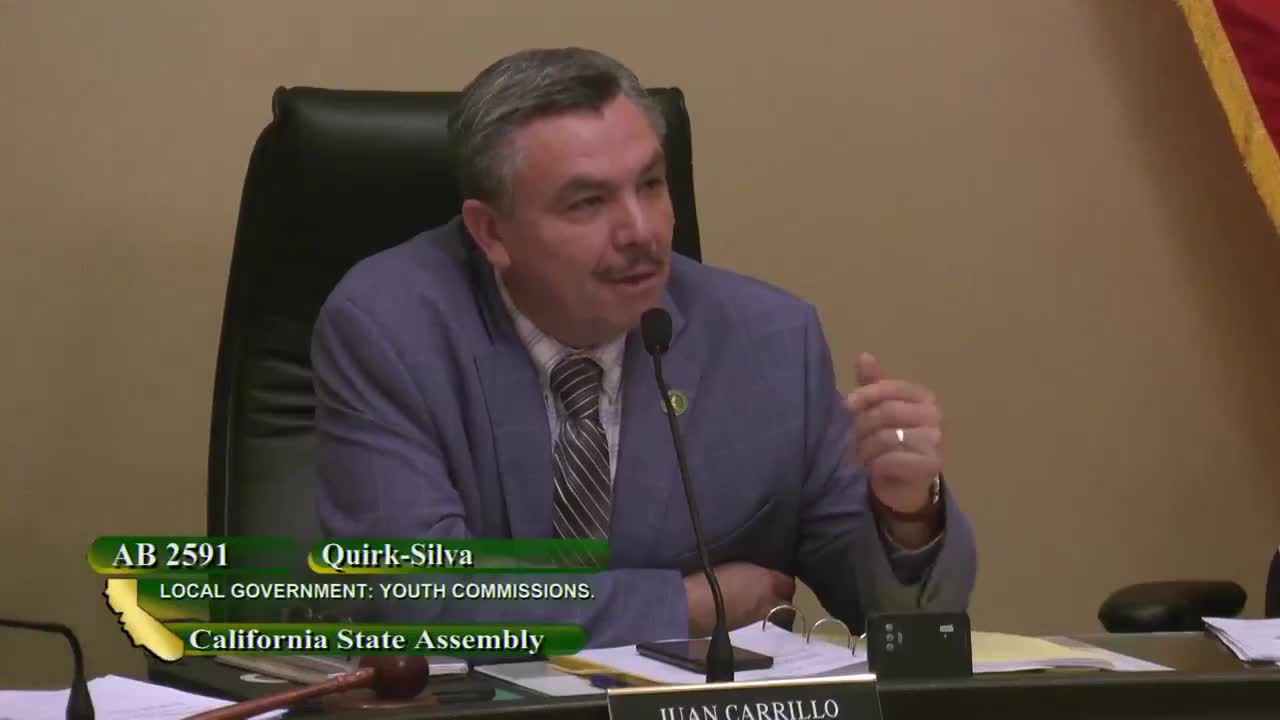 4MIN
Assembly Standing Committee on Local Government
Bill Author

Bill Co-Author(s):