AB 2005: California State University: faculty and employee housing.
- Session Year: 2023-2024
- House: Assembly
- Latest Version Date: 2024-09-25
Current Status:
Passed
(2024-09-25: Chaptered by Secretary of State - Chapter 558, Statutes of 2024.)
Introduced
In Committee
First Chamber
In Committee
Second Chamber
Enacted
Existing law, the Teacher Housing Act of 2016, authorizes a school district to establish and implement programs that address the housing needs of teachers and school district employees who face challenges in securing affordable housing, as specified. The act provides that the purpose of the act is to facilitate the acquisition, construction, rehabilitation and preservation of affordable rental housing for teachers and school district employees to allow teachers or school district employees to access and maintain housing stability. The act provides that it specifically creates a state policy supporting housing for teachers and school district employees as described by specified federal law and permits school districts and developers in receipt of local or state funds or tax credits designated for affordable rental housing to restrict occupancy to teachers and school district employees on land owned by school districts, so long as that housing does not violate any other applicable laws. The act defines various terms for these purposes.
This bill would authorize the California State University to establish and implement programs that address the housing needs of faculty or California State University employees who face challenges in securing affordable housing, as specified. The bill would provide that the purpose of its provisions are to facilitate the acquisition, construction, rehabilitation and preservation of affordable rental housing for faculty or California State University employees to allow them to access and maintain housing stability. The bill would provide that it specifically creates a state policy supporting housing for faculty or California State University campus employees as described by specified federal law and permits the California State University developers in receipt of local or state funds or tax credits designated for affordable rental housing to restrict occupancy to faculty or California State University employees on land owned by the California State University or a California State University auxiliary organization, as defined, so long as that housing does not violate any other applicable laws. The bill would define various terms for these purposes.
Existing law, the Teacher Housing Act of 2016, authorizes a school district to establish and implement programs that address the housing needs of teachers and school district employees who face challenges in securing affordable housing, as specified. The act provides that the purpose of the act is to facilitate the acquisition, construction, rehabilitation and preservation of affordable rental housing for teachers and school district employees to allow teachers or school district employees to access and maintain housing stability. The act provides that it specifically creates a state policy supporting housing for teachers and school district employees as described by specified federal law and permits school districts and developers in receipt of local or state funds or tax credits designated for affordable rental housing to restrict occupancy to teachers and school district employees on land owned by school districts, so long as that housing does not violate any other applicable laws. The act defines various terms for these purposes.
This bill would authorize the California State University to establish and implement programs that address the housing needs of faculty or California State University employees who face challenges in securing affordable housing, as specified. The bill would provide that the purpose of its provisions are to facilitate the acquisition, construction, rehabilitation and preservation of affordable rental housing for faculty or California State University employees to allow them to access and maintain housing stability. The bill would provide that it specifically creates a state policy supporting housing for faculty or California State University campus employees as described by specified federal law and permits the California State University developers in receipt of local or state funds or tax credits designated for affordable rental housing to restrict occupancy to faculty or California State University employees on land owned by the California State University, University or a California State University auxiliary organization, as defined, so long as that housing does not violate any other applicable laws. The bill would define various terms for these purposes.
Existing law, the Teacher Housing Act of 2016, authorizes a school district to establish and implement programs that address the housing needs of teachers and school district employees who face challenges in securing affordable housing, as specified. The act provides that the purpose of the act is to facilitate the acquisition, construction, rehabilitation and preservation of affordable rental housing for teachers and school district employees to allow teachers or school district employees to access and maintain housing stability. The act provides that it specifically creates a state policy supporting housing for teachers and school district employees as described by specified federal law and permits school districts and developers in receipt of local or state funds or tax credits designated for affordable rental housing to restrict occupancy to teachers and school district employees on land owned by school districts, so long as that housing does not violate any other applicable laws. The act defines various terms for these purposes.
This bill would authorize the California State University to establish and implement programs that address the housing needs of faculty or California State University employees who face challenges in securing affordable housing, as specified. The bill would provide that the purpose of its provisions are to facilitate the acquisition, construction, rehabilitation and preservation of affordable rental housing for faculty or California State University employees to allow them to access and maintain housing stability. The bill would provide that it specifically creates a state policy supporting housing for faculty or California State University campus employees as described by specified federal law and permits the California State University developers in receipt of local or state funds or tax credits designated for affordable rental housing to restrict occupancy to faculty or California State University employees on land owned by the California State University, so long as that housing does not violate any other applicable laws. The bill would define various terms for these purposes.
This part may be cited as the California State University Faculty and Employee Housing Act of 2024.
53611.(a)The purpose of this part is to facilitate the acquisition, construction, rehabilitation, and preservation of affordable rental housing for faculty and California State University employees to allow them to access and maintain housing stability.
(b)A program established under this part shall be restricted to faculty or California State University employees, except that a California State University campus may allow local public employees or other members of the public to occupy housing created through this part, subject to applicable laws and regulations.
(c)A California State University campus may prioritize California State University employees over local public employees or other members of the public to occupy housing.
53612.As used in this part:
(a)Affordable rental housing means a rental housing development with a majority of its rents restricted to levels that are affordable to persons and families of low or moderate income.
(b)Auxiliary organization has the same meaning as defined in Section 89901 of the Education Code.
(c)Faculty or California State University employee means any person employed by a California State University campus, including, but not limited to, faculty and staff.
(d)Local public employees includes employees of a city, county, city and county, charter city, charter county, charter city and county, special district, or any combination thereof.
(e)Persons and families of low or moderate income has the same meaning as defined in Section 50093.
(f)Rental housing development means a structure or set of structures with common financing, ownership, and management with one or more dwelling units, including efficiency units. No more than one of the dwelling units may be occupied as a primary residence by a person or household who is the owner of the structure or structures.
53613.The California State University may establish and implement programs that address the housing needs of faculty or California State University employees who face challenges in securing affordable housing. To the extent feasible, a California State University campus may establish and implement programs that, among other things, do any of the following:
(a)Leverage federal, state, and local public, private, and nonprofit programs and fiscal resources available to housing developers.
(b)Promote public and private partnerships.
(c)Foster innovative financing opportunities.
53614.This part specifically creates a state policy supporting housing for faculty or California State University campus employees as described in Section 42(g)(9) of the Internal Revenue Code, and, further, permits the California State University and developers in receipt of local or state funds or tax credits designated for affordable rental housing to restrict occupancy to faculty or California State University employees on land owned by the Trustees of the California State University or a California State University auxiliary organization, including permitting California State University campuses and developers in receipt of tax credits designated for affordable rental housing to retain the right to prioritize and restrict occupancy on land owned by the Trustees of the California State University or a California State University auxiliary organization to faculty or California State University employees of the California State University, so long as that housing does not violate any other applicable laws.
SEC. 2.The provisions of this act are severable. If any provision of this act or its application is held invalid, that invalidity shall not affect other provisions or applications that can be given effect without the invalid provision or application.
This part may be cited as the California State University Faculty and Employee Housing Act of 2024.
53611.(a)The purpose of this part is to facilitate the acquisition, construction, rehabilitation, and preservation of affordable rental housing for faculty and California State University employees to allow them to access and maintain housing stability.
(b)A program established under this part shall be restricted to faculty or California State University employees, except that a California State University campus may allow local public employees or other members of the public to occupy housing created through this part, subject to applicable laws and regulations.
(c)A California State University campus may prioritize California State University employees over local public employees or other members of the public to occupy housing.
53612.As used in this part:
(a)Affordable rental housing means a rental housing development with a majority of its rents restricted to levels that are affordable to persons and families of low or moderate income.
(b)Auxiliary organization has the same meaning as defined in Section 89901 of the Education Code.
(b)(c)Faculty or California State University employee means any person employed by a California State University campus, including, but not limited to, faculty and staff.
(c)(d)Local public employees includes employees of a city, county, city and county, charter city, charter county, charter city and county, special district, or any combination thereof.
(d)(e)Persons and families of low or moderate income has the same meaning as defined in Section 50093.
(e)(f)Rental housing development means a structure or set of structures with common financing, ownership, and management with one or more dwelling units, including efficiency units. No more than one of the dwelling units may be occupied as a primary residence by a person or household who is the owner of the structure or structures.
53613.The California State University may establish and implement programs that address the housing needs of faculty or California State University employees who face challenges in securing affordable housing. To the extent feasible, a California State University campus may establish and implement programs that, among other things, do any of the following:
(a)Leverage federal, state, and local public, private, and nonprofit programs and fiscal resources available to housing developers.
(b)Promote public and private partnerships.
(c)Foster innovative financing opportunities.
53614.This part specifically creates a state policy supporting housing for faculty or California State University campus employees as described in Section 42(g)(9) of the Internal Revenue Code, and, further, permits the California State University and developers in receipt of local or state funds or tax credits designated for affordable rental housing to restrict occupancy to faculty or California State University employees on land owned by the Trustees of the California State University Trustees, or a California State University auxiliary organization, including permitting California State University campuses and developers in receipt of tax credits designated for affordable rental housing to retain the right to prioritize and restrict occupancy on land owned by the Trustees of the California State University Trustees or a California State University auxiliary organization to faculty or California State University employees of the California State University, so long as that housing does not violate any other applicable laws.
SEC. 2.The provisions of this act are severable. If any provision of this act or its application is held invalid, that invalidity shall not affect other provisions or applications that can be given effect without the invalid provision or application.
This part may be cited as the California State University Faculty and Employee Housing Act of 2024.
53611.(a)The purpose of this part is to facilitate the acquisition, construction, rehabilitation, and preservation of affordable rental housing for faculty and California State University employees to allow them to access and maintain housing stability.
(b)A program established under this part shall be restricted to faculty or California State University employees, except that a California State University campus may allow local public employees or other members of the public to occupy housing created through this part, subject to applicable laws and regulations.
(c)A California State University campus may prioritize California State University employees over local public employees or other members of the public to occupy housing.
53612.As used in this part:
(a)Affordable rental housing means a rental housing development with a majority of its rents restricted to levels that are affordable to persons and families of low or moderate income.
(b)Faculty or California State University employee means any person employed by a California State University campus, including, but not limited to, faculty and staff.
(c)Local public employees includes employees of a city, county, city and county, charter city, charter county, charter city and county, special district, or any combination thereof.
(d)Persons and families of low or moderate income has the same meaning as defined in Section 50093.
(e)Rental housing development means a structure or set of structures with common financing, ownership, and management with one or more dwelling units, including efficiency units. No more than one of the dwelling units may be occupied as a primary residence by a person or household who is the owner of the structure or structures.
53613.The California State University may establish and implement programs that address the housing needs of faculty or California State University employees who face challenges in securing affordable housing. To the extent feasible, a California State University campus may establish and implement programs that, among other things, do any of the following:
(a)Leverage federal, state, and local public, private, and nonprofit programs and fiscal resources available to housing developers.
(b)Promote public and private partnerships.
(c)Foster innovative financing opportunities.
53614.This part specifically creates a state policy supporting housing for faculty or California State University campus employees as described in Section 42(g)(9) of the Internal Revenue Code, and, further, permits the California State University and developers in receipt of local or state funds or tax credits designated for affordable rental housing to restrict occupancy to faculty or California State University employees on land owned by California State University Trustees, including permitting California State University campuses and developers in receipt of tax credits designated for affordable rental housing to retain the right to prioritize and restrict occupancy on land owned by California State University Trustees to faculty or California State University employees of the California State University, so long as that housing does not violate any other applicable laws.
SEC. 2.The provisions of this act are severable. If any provision of this act or its application is held invalid, that invalidity shall not affect other provisions or applications that can be given effect without the invalid provision or application.
REVISIONS: HeadingLine 2.|
Date
|
Status
|
|---|---|
| Sep 25, 2024 | Chaptered by Secretary of State - Chapter 558, Statutes of 2024. |
| Sep 25, 2024 | Approved by the Governor. |
| Sep 3, 2024 | Enrolled and presented to the Governor at 3:30 p.m. |
| Aug 26, 2024 | In Assembly. Ordered to Engrossing and Enrolling. |
| Aug 26, 2024 | Read third time. Passed. Ordered to the Assembly. (Ayes 31. Noes 8.). |
| Aug 19, 2024 | Read second time. Ordered to third reading. |
| Aug 15, 2024 | From committee: Do pass. (Ayes 4. Noes 2.) (August 15). |
| Jul 1, 2024 | In committee: Referred to suspense file. |
| Jun 19, 2024 | From committee: Do pass and re-refer to Com. on APPR. (Ayes 9. Noes 1.) (June 18). Re-referred to Com. on APPR. |
| May 29, 2024 | Referred to Com. on HOUSING. |
| May 22, 2024 | In Senate. Read first time. To Com. on RLS. for assignment. |
| May 21, 2024 | Read third time. Passed. Ordered to the Senate. (Ayes 61. Noes 7. Page 5358.) |
| May 20, 2024 | Read second time. Ordered to third reading. |
| May 16, 2024 | Read second time and amended. Ordered returned to second reading. |
| May 16, 2024 | From committee: Amend, and do pass as amended. (Ayes 11. Noes 4.) (May 16). |
| May 16, 2024 | Assembly Rule 63 suspended. |
| Apr 24, 2024 | In committee: Set, first hearing. Referred to APPR. suspense file. |
| Apr 10, 2024 | From committee: Do pass and re-refer to Com. on APPR. (Ayes 7. Noes 2.) (April 9). Re-referred to Com. on APPR. |
| Apr 10, 2024 | Coauthors revised. |
| Mar 20, 2024 | From committee: Do pass and re-refer to Com. on HIGHER ED. (Ayes 7. Noes 0.) (March 20). Re-referred to Com. on HIGHER ED. |
| Feb 12, 2024 | Referred to Coms. on H. & C.D. and HIGHER ED. |
| Feb 1, 2024 | From printer. May be heard in committee March 2. |
| Jan 31, 2024 | Read first time. To print. |
|
Date
|
Description
|
Location
|
Votes
|
|
|---|---|---|---|---|
| Aug 26, 2024 | Assembly 3rd Reading AB2005 Ward et al. By Menjivar | Senate Floor |
Passed |
|
| Aug 15, 2024 | Do pass | Senate Standing Committee on Appropriations |
Passed |
|
| Jul 1, 2024 | Placed on suspense file | Senate Standing Committee on Appropriations |
Passed |
|
| Jun 18, 2024 | Do pass, but first be re-referred to the Committee on [Appropriations] | Senate Standing Committee on Housing |
Passed |
|
| May 21, 2024 | AB 2005 Ward Assembly Third Reading | Assembly Floor |
Passed |
|
| May 16, 2024 | Do pass as amended. | Assembly Standing Committee on Appropriations |
Passed |
|
| Apr 9, 2024 | Do pass and be re-referred to the Committee on [Appropriations] | Assembly Standing Committee on Higher Education |
Passed |
|
| Mar 20, 2024 | Do pass and be re-referred to the Committee on [Higher Education] | Assembly Standing Committee on Housing and Community Development |
Passed |
This list shows positions taken on this bill by organizations on the date displayed, which is linked to the original source.
Positions by individuals are not included.
|
Organization
|
Position
|
Date
|
|---|---|---|
| American Federation Of State, County And Municipal Employees, Afl-Cio | ** Support | |
| Associated General Contractors Of California | ** Support | |
| Associated General Contractors-San Diego Chapter | ** Support | |
| Bakersfield, California State University | ** Support | |
| California Apartment Association | ** Support | |
| California Association Of Local Housing Finance Agencies | * Support | Mar 20, 2024 |
| California Association Of Realtors | ** Against | |
| California Faculty Association | ** Support | |
| California Polytechnic State University, San Luis Obispo | ** Support | |
| California State Polytechnic University, Pomona | ** Support | |
| California State University | ** Support | |
| California State University Maritime Academy | ** Support | |
| California State University, Los Angeles | ** Support | |
| California Teamsters Public Affairs Council | ** Support | |
| Channel Islands, California State University | ** Support | |
| Chico, California State University | ** Support | |
| CSU Office of the Chancellor | * Support | Apr 9, 2024 |
| Dominguez Hills, California State University | ** Support | |
| East Bay Leadership Council | ** Support | |
| East Bay, California State University | ** Support | |
| Fresno, California State University | ** Support | |
| Fullerton, California State University | ** Support | |
| Long Beach, California State University | ** Support | |
| Los Angeles, California State University | ** Support | |
| Monterey Bay, California State University | ** Support | |
| Northridge, California State University | ** Support | |
| Sacramento, California State University | ** Support | |
| San Bernardino, California State University | ** Support | |
| San Diego Housing Commission | * Support | Apr 9, 2024 |
| San Diego State University | ** Support | |
| San Francisco State University | ** Support | |
| San José State University | ** Support | |
| San Marcos, California State University | ** Support | |
| Sonoma State University | ** Support | |
| Stanislaus, California State University | ** Support | |
| Yimby Action | ** Support |
SENATE RULES COMMITTEE Office of Senate Floor Analyses (916) 651-1520 Fax: (916) 327-4478 | AB 2005 |
THIRD READING
Bill No: AB 2005
Author: Ward (D), et al.
Amended: 5/16/24 in Assembly
Vote: 21
SENATE HOUSING COMMITTEE: 9-1, 6/18/24
AYES: Skinner, Ochoa Bogh, Blakespear, Caballero, Cortese, Menjivar, Padilla, Umberg, Wahab
NOES: Seyarto
SENATE APPROPRIATIONS COMMITTEE: 4-2, 8/15/24
AYES: Caballero, Ashby, Becker, Wahab
NOES: Jones, Seyarto
NO VOTE RECORDED: Bradford
ASSEMBLY FLOOR: 61-7, 5/21/24 - See last page for vote
SUBJECT: California State University: faculty and employee housing
SOURCE: California State University
DIGEST:
This bill establishes the California State University (CSU) Faculty and Employee Housing Act of 2024.
ANALYSIS:
Existing law:
- Defines, pursuant to the Teacher Housing Act of 2016, “teacher or school district employee” as any person employed by a unified school district maintaining prekindergarten, transitional kindergarten, and grades 1-12 inclusive, an elementary school district maintaining prekindergarten, transitional kindergarten, and grades 1-8 inclusive, or a high school district employing grades 1-12 inclusive, including but not limited to certificated and classified staff.
- Creates, pursuant to the Teacher Housing Act of 2016, a state policy supporting housing for teachers and school district employees and further permits school districts and developers in receipt of local or state funds or tax credits designated for affordable rental housing to restrict occupancy to teachers and school district employees on land owned by school districts, so long as that housing does not violate any other applicable laws.
- Authorizes, pursuant to the Teacher Housing Act of 2016, local public employees and other members of the public to occupy housing authorized by this Act.
- Authorizes, pursuant to the Community College Faculty and Employee Housing Act of 2022, a community college district to establish and implement programs that address the housing needs of community college district employees and faculty who face challenges in securing affordable housing.
- Enacts the Unruh Civil Rights Act, which specifically outlaws discrimination in California based on sex, race, color, religion, ancestry, national origin, age, disability, medical condition, genetic information, marital status, or sexual orientation.
- Enacts the Fair Employment and Housing Act, which prohibits the existence of a restrictive covenant that makes housing opportunities unavailable based on race, color, religion, sex, sexual orientation, familial status, marital status, disability, national origin, source of income or ancestry.
This bill:
- Establishes the CSU Faculty and Employee Housing Act of 2024, which provides that a CSU campus may allow local public employees or other members of the public to occupy housing created by this Act. Also provides that a CSU campus may prioritize CSU employees over other public employees for housing created by this Act.
- Authorizes CSU to establish and implement programs to address the housing needs of CSU faculty or employees who face challenges in securing affordable housing that, among other things, leverage federal, state, and local public, private, and nonprofit programs and resources available to housing developers; promote public and private partnerships; and foster innovative financing opportunities.
- Creates a state policy supporting housing for CSU faculty or employees as described in Section 42(g)(9) of the Internal Revenue Code to allow the following:
- CSU and a developer in receipt of local or state funds or tax credits designated for affordable rental housing to restrict occupancy to CSU faculty or employees on land owned by CSU or a CSU auxiliary organization; and
- A developer in receipt of tax credits designated for affordable rental housing to retain the right to prioritize and restrict occupancy on land owned by CSU or a CSU auxiliary organization to CSU faculty or employees so long as that housing does not violate any other applicable laws.
Background
Teacher Housing Act. In 2016, SB 1413 (Leno, Chapter 732, Statutes of 2016) established the Teacher Housing Act of 2016 to facilitate the acquisition, construction, rehabilitation, and preservation of affordable housing for teachers and school employees. School districts are authorized to establish and implement programs that address the housing needs of teachers and school district employees by leveraging funding sources including state, federal, local, public, private and resources available to housing developers, promoting public and private partnerships, and fostering innovative financing opportunities. SB 1413 also created a state policy supporting the use of federal and state Low Income Housing Tax Credits (LIHTC) to fund housing for teachers and school district employees on land owned by the school district and permitting school districts to restrict occupancy to teachers and school district employees.
The intent of SB 1413 was to provide express state statutory authority to permit school districts to construct housing on their property and limit the occupancy to teachers and school districts employees. Federal law creates an exemption to the "general use" requirement that allows the use of federal and state tax credits if a state establishes a policy or program that supports housing for such a specified group. SB 1413 established this policy by allowing school districts to restrict occupancy of affordable housing on school district land constructed with federal or state LIHTC to the teachers and school district employees.
By declaring a state policy supporting housing for teachers/school district employees, these housing projects could qualify under federal law as general public housing and therefore be eligible for both federal and state LIHTCs.
AB 3308 (Gabriel, Chapter 199, Statutes of 2020) further amended the Act to make clear that school districts could still access LIHTC if the school district restricts occupancy of housing constructed on their land to their own employees, but at their discretion offers the housing to other public employees.
Comments
Expanding the Teacher Housing Act to higher education. In 2022, AB 1719 (Ward, Chapter 640) gave community college faculty and employees the same benefits as allowed for school districts under the Teacher Housing Act, allowing a community college district and a developer to use state or local funds or LIHTC to construct affordable rental housing on land owned by the community college district and restrict occupancy to community college district employees or faculty. This bill seeks to provide these benefits to CSU faculty and employees.
FISCAL EFFECT: Appropriation: No Fiscal Com.: Yes Local: No
According to the Senate Appropriations Committee:
- Unknown cost pressures by authorizing a new category of affordable housing that would qualify for an award of Low Income Housing Tax Credits (LIHTCs), thereby increasing demand on an oversubscribed funding source, and potentially displacing credit allocations for other affordable housing projects. The State Treasurer’s Office (STO) indicates that LIHTCs are oversubscribed by a 3:1 ratio. (General Fund)
- Unknown potential expenditure of CSU revenues to partially finance the remaining costs of CSU faculty and employee housing. However, this additional funding would typically be financed through a partnership with a third party developer, or by applying for other state affordable housing funding sources. (various funding sources)
SUPPORT: (Verified 8/15/24)
California State University (source)
American Federation of State, County and Municipal Employees, AFL-CIO
Bakersfield, California State University
California Apartment Association
California Faculty Association
California Polytechnic State University, San Luis Obispo
California State Polytechnic University, Pomona
California State University Maritime Academy
Channel Islands, California State University
Chico, California State University
Dominguez Hills, California State University
East Bay Leadership Council
Fresno, California State University
Fullerton, California State University
Long Beach, California State University
Los Angeles, California State University
Monterey Bay, California State University
Northridge, California State University
Sacramento, California State University
San Bernardino, California State University
San Diego State University
San Francisco State University
San José State University
San Marcos, California State University
Sonoma State University
Stanislaus, California State University
YIMBY Action
OPPOSITION: (Verified 8/15/24)
California Association of Realtors
ARGUMENTS IN SUPPORT: According to the author, “AB 2005 protects the diversity and quality of our education system by ensuring that access to housing is not a detracting aspect of our Universities. This measure intends to address the California housing crisis’ impact on California State University (CSU) staff and faculty. According to the California Department of Housing and Community Development, only 16% of residents in California can afford to buy a home, and many of our CSU staff and faculty struggle with financial insecurity making them unable to afford adequate housing. AB 2005 would ensure California State Universities are equipped to provide such housing, and are able to retain quality staff and faculty that reflect the diversity of California. Lack of access to affordable housing has resulted in a greater difficulty in recruitment and retention of diverse, quality staff who may be considering other career opportunities, or leaving California altogether. This bill provides CSU campuses with the authority to provide affordable housing to those that educate and prepare California’s future leaders.”
ARGUMENTS IN OPPOSITION: The California Association of Realtors opposes the bill, stating that it should be amended to limit the acquisition of housing developments to parcels of five or more units, “to preserve homeownership opportunities for our state’s working families.”
ASSEMBLY FLOOR: 61-7, 5/21/24
AYES: Addis, Aguiar-Curry, Alanis, Alvarez, Arambula, Bains, Bauer-Kahan, Bennett, Berman, Boerner, Bonta, Bryan, Calderon, Juan Carrillo, Wendy Carrillo, Connolly, Davies, Mike Fong, Garcia, Gipson, Grayson, Haney, Hart, Irwin, Jackson, Jones-Sawyer, Kalra, Lee, Low, Lowenthal, Maienschein, McCarty, McKinnor, Muratsuchi, Stephanie Nguyen, Ortega, Pacheco, Papan, Jim Patterson, Pellerin, Petrie-Norris, Quirk-Silva, Ramos, Rendon, Reyes, Luz Rivas, Rodriguez, Blanca Rubio, Santiago, Schiavo, Soria, Ting, Valencia, Villapudua, Ward, Weber, Wicks, Wilson, Wood, Zbur, Robert Rivas
NOES: Dixon, Essayli, Vince Fong, Gallagher, Sanchez, Ta, Waldron
NO VOTE RECORDED: Cervantes, Chen, Megan Dahle, Flora, Friedman, Gabriel, Holden, Hoover, Lackey, Mathis, Joe Patterson, Wallis
Prepared by: Alison Hughes / HOUSING / (916) 651-4124
8/18/24 8:51:15
**** END ****
SENATE COMMITTEE ON
Senator Anna Caballero, Chair
2023 - 2024 Regular Session
AB 2005 (Ward) - California State University: faculty and employee housing
Version: | Policy Vote: |
Urgency: | Mandate: |
Hearing Date: | Consultant: |
Bill Summary:
AB 2005 would enact the California State University Faculty and Employee Housing Act of 2024, authorizing California State University (CSU) to establish and implement programs that address the housing needs of faculty or CSU employees who face challenges in securing affordable housing, as specified.
Fiscal Impact:
- Unknown cost pressures by authorizing a new category of affordable housing that would qualify for an award of Low Income Housing Tax Credits (LIHTCs), thereby increasing demand on an oversubscribed funding source, and potentially displacing credit allocations for other affordable housing projects. The State Treasurer’s Office (STO) indicates that LIHTCs are oversubscribed by a 3:1 ratio. (General Fund)
- Unknown potential expenditure of CSU revenues to partially finance the remaining costs of CSU faculty and employee housing. However, this additional funding would typically be financed through a partnership with a third party developer, or by applying for other state affordable housing funding sources. (various funding sources)
Background:
Most affordable housing constructed in the state is funded in part by federal and state LIHTCs, which are available for housing developments constructed for households that make up to 80% of the area median income (AMI). California receives an allocation of federal tax credits each year based on a per-resident formula. In 1987, the Legislature authorized the creation of a state LIHTC program to augment the federal tax credit program. The state tax credit program has an ongoing statutory authorization of $70 million annually. Since 2019-20, the state budget has included an additional $500 million in state credits that are available each year for allocation by the Tax Credit Allocation Committee (TCAC) within the STO.
Generally, under federal Internal Revenue Service (IRS) rules, if a residential unit is provided only for a member of a social organization or provided by an employer for its employees, that unit is not available for use by the general public and is therefore not eligible to receive an allocation of federal LIHTCs. However, federal IRS law also states that a qualified LIHTC project does not fail to meet the general public use requirement solely because of occupancy restrictions or preferences that favor tenants (1) with special needs, (2) who are members of a specified group under a federal program or state program or policy that supports housing for such a specified group, or (3) who are involved in artistic or literary activities.
Existing law, the Teacher Housing Act of 2016, authorizes K-12 school districts to establish and implement programs that address the housing needs of teachers and school district employees by leveraging funding sources including state, federal, and local public, private and nonprofit resources available to housing developers, promoting public and private partnerships, and fostering innovative financing opportunities. Existing law also establishes a state policy supporting the use of federal and state LIHTCs to fund housing for teachers and school district employees on land owned by the school district and permitted school districts to restrict occupancy to teachers and school district employees, which provides the necessary exemption to the “general use” requirements under the IRS rules pertaining to LIHTCs. Existing law authorizes local public employees and other members of the public to occupy housing authorized by the Teacher Housing Act, as specified.
Existing law, the Community College Faculty and Employee and Housing Act of 2022, provides community college districts with the same authority provided to school districts under the Teacher Housing Act. These provisions authorize community college districts and developers to use state or local funds or LIHTCs to construct affordable rental housing on land owned by the district and to restrict occupancy to community college district employees or faculty, as specified.
Proposed Law:
AB 2005 would enact the California State University Faculty and Employee Housing Act of 2024. Specifically, this bill would:
- Authorize the CSU to establish and implement programs that address the housing needs of faculty and district employees who face challenges in securing affordable housing.
- Authorize the CSU to establish and implement programs that leverage federal, state, and local public, private, and nonprofit programs and fiscal resources available to housing developers, promote public and private partnerships, and foster innovative financing opportunities.
- Restrict a program established under the act to faculty or district employees, including certificated and classified staff, but authorize a district to also allow local public employees or other members of the public to occupy housing created through this bill, subject to applicable laws and regulations.
- Authorize a CSU campus to prioritize CSU employees over local public employees or other members of the public to occupy housing.
- Create a state policy supporting housing for faculty or CSU campus employees as described in Section 42(g)(9) of the Internal Revenue Code, and permit the CSU and developers in receipt of local or state funds or tax credits designated for affordable rental housing to restrict occupancy to faculty or CSU employees on land owned by the Trustees of the CSU or a CSU auxiliary organization, including permitting CSU campuses and developers in receipt of tax credits designated for affordable rental housing to retain the right to prioritize and restrict occupancy on land owned by the Trustees of the CSU or a CSU auxiliary organization to faculty or CSU employees, so long as that housing does not violate any other applicable laws.
Related Legislation:
AB 2967 (Ting), which is currently pending on the Senate Floor, would expand the Teacher Housing Act of 2016 to explicitly include employees of nonprofit organizations operating early childhood, prekindergarten, or school age childcare, classrooms or programs, or expanded learning classrooms and programs.
AB 1719 (Ward), Chap. 640/2022, enacted the Community College Faculty and Employee Housing Act of 2022, authorizing community college districts to establish and implement programs that address the housing needs of faculty and district employees who face challenges in securing affordable housing, as specified.
AB 3308 (Gabriel), Chap. 199/2020, authorized school districts to restrict occupancy of affordable housing on school district-owned land, funded with LIHTCs, to teachers and school district employees of the school district that owns the land. The bill also authorized other public employees to occupy the housing, at the discretion of the district, as specified.
SB 1413 (Leno), Chap. 732/2016, enacted the Teacher Housing Act of 2016, authorizing a school district to establish and implement programs that address the housing needs of teachers and school district employees who face challenges in securing affordable housing. The bill also established a state policy supporting the use of LIHTCs to fund that housing and restrict occupancy to teachers and district employees.
-- END --
SENATE COMMITTEE ON HOUSING
Senator Nancy Skinner, Chair
2023 - 2024 Regular
Bill No: AB 2005 Hearing Date: 6/18/2024
Author: | Ward | ||
Version: | 5/16/2024 | ||
Urgency: | No | Fiscal: | Yes |
Consultant: | Erin Riches | ||
SUBJECT: California State University: faculty and employee housing
DIGEST: This bill establishes the California State University (CSU) Faculty and Employee Housing Act of 2024.
ANALYSIS:
Existing law:
- Defines, pursuant to the Teacher Housing Act of 2016, “teacher or school district employee” as any person employed by a unified school district maintaining prekindergarten, transitional kindergarten, and grades 1-12 inclusive, an elementary school district maintaining prekindergarten, transitional kindergarten, and grades 1-8 inclusive, or a high school district employing grades 1-12 inclusive, including but not limited to certificated and classified staff.
- Creates, pursuant to the Teacher Housing Act of 2016, a state policy supporting housing for teachers and school district employees and further permits school districts and developers in receipt of local or state funds or tax credits designated for affordable rental housing to restrict occupancy to teachers and school district employees on land owned by school districts, so long as that housing does not violate any other applicable laws.
- Authorizes, pursuant to the Teacher Housing Act of 2016, local public employees and other members of the public to occupy housing authorized by this Act.
- Authorizes, pursuant to the Community College Faculty and Employee Housing Act of 2022, a community college district to establish and implement programs that address the housing needs of community college district employees and faculty who face challenges in securing affordable housing.
- Enacts the Unruh Civil Rights Act, which specifically outlaws discrimination in California based on sex, race, color, religion, ancestry, national origin, age, disability, medical condition, genetic information, marital status, or sexual orientation.
- Enacts the Fair Employment and Housing Act, which prohibits the existence of a restrictive covenant that makes housing opportunities unavailable based on race, color, religion, sex, sexual orientation, familial status, marital status, disability, national origin, source of income or ancestry.
This bill:
- Establishes the CSU Faculty and Employee Housing Act of 2024, which provides that a CSU campus may allow local public employees or other members of the public to occupy housing created by this Act. Also provides that a CSU campus may prioritize CSU employees over other public employees for housing created by this Act.
- Authorizes CSU to establish and implement programs to address the housing needs of CSU faculty or employees who face challenges in securing affordable housing that, among other things, leverage federal, state, and local public, private, and nonprofit programs and resources available to housing developers; promote public and private partnerships; and foster innovative financing opportunities.
- Creates a state policy supporting housing for CSU faculty or employees as described in Section 42(g)(9) of the Internal Revenue Code to allow the following:
- CSU and a developer in receipt of local or state funds or tax credits designated for affordable rental housing to restrict occupancy to CSU faculty or employees on land owned by CSU or a CSU auxiliary organization; and
- A developer in receipt of tax credits designated for affordable rental housing to retain the right to prioritize and restrict occupancy on land owned by CSU or a CSU auxiliary organization to CSU faculty or employees so long as that housing does not violate any other applicable laws.
COMMENTS:
- Author’s statement. “AB 2005 protects the diversity and quality of our education system by ensuring that access to housing is not a detracting aspect of our Universities. This measure intends to address the California housing crisis’ impact on California State University (CSU) staff and faculty. According to the California Department of Housing and Community Development, only 16% of residents in California can afford to buy a home, and many of our CSU staff and faculty struggle with financial insecurity making them unable to afford adequate housing. AB 2005 would ensure California State Universities are equipped to provide such housing, and are able to retain quality staff and faculty that reflect the diversity of California. Lack of access to affordable housing has resulted in a greater difficulty in recruitment and retention of diverse, quality staff who may be considering other career opportunities, or leaving California altogether. This bill provides CSU campuses with the authority to provide affordable housing to those that educate and prepare California’s future leaders.”
- Teacher Housing Act background. In 2016, SB 1413 (Leno, Chapter 732, Statutes of 2016) established the Teacher Housing Act of 2016 to facilitate the acquisition, construction, rehabilitation, and preservation of affordable housing for teachers and school employees. School districts are authorized to establish and implement programs that address the housing needs of teachers and school district employees by leveraging funding sources including state, federal, local, public, private and resources available to housing developers, promoting public and private partnerships, and fostering innovative financing opportunities. SB 1413 also created a state policy supporting the use of federal and state Low Income Housing Tax Credits (LIHTC) to fund housing for teachers and school district employees on land owned by the school district and permitting school districts to restrict occupancy to teachers and school district employees.
The intent of SB 1413 was to provide express state statutory authority to permit school districts to construct housing on their property and limit the occupancy to teachers and school districts employees. Federal law creates an exemption to the "general use" requirement that allows the use of federal and state tax credits if a state establishes a policy or program that supports housing for such a specified group. SB 1413 established this policy by allowing school districts to restrict occupancy of affordable housing on school district land constructed with federal or state LIHTC to the teachers and school district employees.
By declaring a state policy supporting housing for teachers/school district employees, these housing projects could qualify under federal law as general public housing and therefore be eligible for both federal and state LIHTCs.
AB 3308 (Gabriel, Chapter 199, Statutes of 2020) further amended the Act to make clear that school districts could still access LIHTC if the school district restricts occupancy of housing constructed on their land to their own employees, but at their discretion offers the housing to other public employees.
- Expanding the Teacher Housing Act to higher education. In 2022, AB 1719 (Ward, Chapter 640) gave community college faculty and employees the same benefits as allowed for school districts under the Teacher Housing Act, allowing a community college district and a developer to use state or local funds or LIHTC to construct affordable rental housing on land owned by the community college district and restrict occupancy to community college district employees or faculty. This bill seeks to provide these benefits to CSU faculty and employees.
- Opposition arguments. The California Association of Realtors opposes the bill, stating that it should be amended to limit the acquisition of housing developments to parcels of five or more units, “to preserve homeownership opportunities for our state’s working families.”
Related Legislation:
AB 2967 (Ting, 2024) — expands the Teacher Housing Act to cover specified nonprofit organization employees. This bill is pending on the Senate Floor.
AB 1719 (Ward, Chapter 640, 2022) — established the Community College Faculty and Employee Housing Act of 2022, which provides that a community college district may establish and implement programs that address the housing needs of community college district employees and faculty who face challenges in securing affordable housing.
AB 3308 (Gabriel, Chapter 199, Statutes of 2020) — allowed school districts to restrict occupancy of affordable housing on school district-owned land, funded with LIHTC, to teachers and school district employees of the school district that owns the land. It further allows public employees to also occupy the housing constructed under this provision.
SB 1413 (Leno, Chapter 732, Statutes of 2016) — established the Teacher Housing Act of 2016 to facilitate the acquisition, construction, rehabilitation, and preservation of affordable housing for teachers and school employees.
FISCAL EFFECT: Appropriation: Fiscal Com.: Local:
POSITIONS: (Communicated to the committee before noon on Wednesday,
June 12, 2024.)
SUPPORT:
California State University (Sponsor)
American Federation of State, County and Municipal Employees, AFL-CIO
Bakersfield, California State University
California Apartment Association
California Faculty Association
California Polytechnic State University, San Luis Obispo
California State Polytechnic University, Pomona
California State University Maritime Academy
Channel Islands, California State University
Chico, California State University
Dominguez Hills, California State University
Fresno, California State University
Fullerton, California State University
Long Beach, California State University
Los Angeles, California State University
Monterey Bay, California State University
Northridge, California State University
Sacramento, California State University
San Bernardino, California State University
San Diego State University
San Francisco State University
San José State University
San Marcos, California State University
Sonoma State University
Stanislaus, California State University
YIMBY Action
OPPOSITION:
California Association of Realtors
-- END --
ASSEMBLY THIRD READING
ATR Bill Id:AB 2005
Author:(Ward)
As Amended Ver:May 16, 2024
Majority vote
SUMMARY
Establishes the California State University (CSU) Faculty and Employee Housing Act of 2024.
Major Provisions
- Includes the following definitions:
- '"Affordable rental housing'" means a rental housing development with a majority of its rents restricted to levels that are affordable to persons and families of low or moderate income;
- '"Auxiliary organization'" has the same meaning as defined in Section 89901 of the Education Code.
- '"Faculty or CSU employee'" means any person employed by a CSU campus, including, but not limited to, faculty and staff;
- '"Local public employees'" includes employees of a city, county, city and county, charter city, charter county, charter city and county, special district, or any combination thereof;
- '"Persons and families of low or moderate income'" has the same meaning as defined in Section 50093;
- '"Rental housing development'" means a structure or set of structures with common financing, ownership, and management with one or more dwelling units, including efficiency units. No more than one of the dwelling units may be occupied as a primary residence by a person or household who is the owner of the structure or structures.
- Provides that a CSU may establish and implement programs that address the housing needs of CSU employees and faculty who face challenges in securing affordable housing.
- Provides that a program established by CSU may be restricted to CSU faculty or employees, except that a CSU campus may allow local public employees or other members of the public to occupy housing created through this bill, subject to applicable laws and regulations.
- Allows a CSU campus to prioritize CSU employees over local public employees or other members of the public to occupy housing.
- Creates a state policy supporting housing for CSU employees and faculty, as described in Section 42(g)(9) of the federal Internal Revenue Code, to allow the following:
- A CSU and a developer in receipt of local or state funds or tax credits designated for affordable rental housing to restrict occupancy to CSU employees or faculty on land owned by the CSU Trustees or a CSU auxiliary organization; and
- A developer in receipt of tax credits designated for affordable rental housing to retain the right to prioritize and restrict occupancy on land owned by CSU or a CSU auxiliary organization to employees and faculty so long as that housing does not violate any other applicable laws.
- Makes the provisions of the Act severable. If any provision of this act or its application is held invalid, that invalidity shall not affect other provisions or applications that can be given effect without the invalid provision or application.
COMMENTS
LIHTC: Most affordable housing created in the state is funded in part by federal and state LIHTC. LIHTC are used to develop housing for households that make up to 80 percent of the area median income (AMI). California receives an allocation of federal tax credits each year based on a per-resident formula. In 1987, the Legislature authorized the creation of a state LIHTC program to augment the federal tax credit program. The state tax credit program has an ongoing statutory authorization of $70 million. The 2019-20, 2020-21, and 2021-23 budgets authorized an additional $500 million for state tax credits.
Teacher Housing Act of 2016: In 2016, SB 1413 (Leno), Chapter 732, Statutes of 2016 established the Teacher Housing Act of 2016 (the Act) to facilitate the acquisition, construction, rehabilitation, and preservation of affordable housing for teachers and school district employees. That Act authorized school districts to establish and implement programs that address the housing needs of teachers and school district employees by leveraging funding sources, including state, federal, and local public, private and nonprofit resources available to housing developers, promoting public and private partnerships, and fostering innovative financing opportunities. The Act also created a state policy supporting the use of federal and state LIHTC to fund housing for teachers and school district employees on land owned by the school district and permitted school districts to restrict occupancy to teachers and school district employees.
Generally, under federal IRS rules, if a residential unit is provided for only a member of a social organization or provided by an employer for its employees, the unit is not for use by the general public and is not eligible for federal LIHTC. However, federal IRS law also states that a qualified LIHTC project does not fail to meet the general public use requirement solely because of occupancy restrictions or preferences that favor tenants 1) with special needs, 2) who are members of a specified group under a federal program or a state program or policy that supports housing for such a specified group, or 3) who are involved in artistic or literary activities.
The Act provided express state statutory authority to permit school districts to construct housing on their property and limit the occupancy to teachers and school districts employees. As mentioned above, federal law creates an exemption to the '"general use'" requirement that allows the use of federal and state tax credits if a state establishes a policy or program that supports housing for such a specified group. The Act established this policy by allowing school districts to restrict occupancy of affordable housing on school district land constructed with federal or state LIHTC to the district's teachers and school employees.
In 2021, AB 3308 (Gabriel), Chapter 199, Statutes of 2020, further amended the Act to make clear that school districts could still access LIHTC if the school district restricts occupancy of housing constructed on their land to their own employees, but at their discretion offers the housing to other public employees.
In 2022, AB 1719 (Ward), Chapter 640, Statutes of 2022 established the Community College Faculty and Employee Housing Act of 2022, creating a state policy to allow developers that receive LIHTC to restrict occupancy to faculty and community college district employees on land owned by community college districts.
This bill would establish the CSU Faculty and Employee Housing Act to allow LIHTC to subsidize construction of rental housing affordable to faculty and staff at or below 80% of AMI. CSUs may restrict occupancy to CSU employees or faculty on land owned by the Trustees.
According to the Author
'"AB 2005 protects the diversity and quality of our education system by ensuring that access to housing is not a detracting factor from our Universities. Social mobility for students is a strength within the CSU system, and providing them with increased access to affordable housing safeguards this quality of educational institution. Many of our CSU staff, students, and faculty struggle with financial insecurity and are unable to afford adequate housing, further limiting the inclusion of low-income and first-generation students into our university system. AB 2005 would ensure California State Universities are able to retain quality staff and students that reflect the diversity of California, and encourage social mobility for our students. AB 2005 strengthens CSU's ability to recruit and retain excellent staff as well as continue to welcome students that reflect the diversity and excellence of California.'"
Arguments in Support
According the sponsors, CSCU, '"this bill will allow the CSU to support their staff and faculty by enabling CSU campuses to develop their own affordable housing. This will help our university better retain and recruit quality staff, and it will add important housing stock to their region.'"
Arguments in Opposition
The California Association of Realtors (CAR) are opposed to this bill and seek amendments to eliminate the acquisition of single-family (1 to 4 units) homes (i.e., duplex, triplex, fourplex or primary residences with ADUs and/or junior ADUs).
FISCAL COMMENTS
According to the Assembly Committee on Appropriations, future cost pressures of an unknown amount, but potentially significant statewide. By authorizing a new category of affordable housing that qualifies for an award of LIHTCs, this bill increases demand on an oversubscribed funding source, and potentially displaces credit allocations for other affordable housing projects. The State Treasurer's Office (STO) indicates the state's LIHTCs are oversubscribed by a three-to-one ratio.
VOTES
ASM HOUSING AND COMMUNITY DEVELOPMENT: 7-0-2
YES: Ward, Grayson, Kalra, Lee, Zbur, Reyes, Wilson
ABS, ABST OR NV: Joe Patterson, Sanchez
ASM HIGHER EDUCATION: 7-2-2
YES: Mike Fong, Arambula, Boerner, Irwin, Jackson, Muratsuchi, Quirk-Silva
NO: Ta, Essayli
ABS, ABST OR NV: Chen, Low
ASM APPROPRIATIONS: 11-4-0
YES: Wicks, Arambula, Bryan, Calderon, Wendy Carrillo, Mike Fong, Grayson, Haney, Hart, Pellerin, Villapudua
NO: Sanchez, Dixon, Jim Patterson, Ta
UPDATED
VERSION: May 16, 2024
CONSULTANT: Lisa Engel / H. & C.D. / (916) 319-2085 FN: 0003408
Date of Hearing: April 24, 2024
ASSEMBLY COMMITTEE ON APPROPRIATIONS
Buffy Wicks, Chair
ABPCA Bill Id:AB 2005
Author:(Ward) – As Introduced Ver:January 31, 2024
Policy Committee: | Housing and Community Development | Vote: | 7 - 0 |
Higher Education | 7 - 2 | ||
|
|
Urgency: No State Mandated Local Program: No Reimbursable: No
SUMMARY:
This bill establishes the California State University (CSU) Faculty and Employee Housing Act of 2024, to enable CSU campuses to use low-income housing tax credits (LIHTCs) to develop affordable housing for CSU faculty and staff on CSU-owned land. This bill is similar to the Community College Faculty and Employee Housing Act of 2022.
Specifically, this bill:
- Authorizes a CSU to establish and implement programs that address the housing needs of faculty and CSU employees who face challenges in securing affordable housing.
- Allows, to the extent feasible, the CSU to establish and implement programs that leverage programs and fiscal resources available to housing developers, promote public and private partnerships and foster innovative financing opportunities.
- Restricts a program established under the act to CSU faculty or employees, but authorizes a CSU to allow local public employees or other members of the public to occupy housing created through this bill, subject to applicable laws and regulations.
- Allows a CSU campus to prioritize CSU employees over local public employees or other members of the public to occupy housing.
- Creates a state policy supporting housing for faculty and CSU employees as described in Section 42(g)(9) of the Internal Revenue Code to allow a CSU and developers in receipt of local or state funds or tax credits designated for affordable rental housing to restrict occupancy to faculty and CSU employees on land owned by the CSU Trustees, including permitting a CSU and developers in receipt of tax credits designated for affordable rental housing to retain the right to prioritize and restrict occupancy on land owned by CSU to faculty and employees, so long as that housing does not violate any other applicable laws.
FISCAL EFFECT:
Future cost pressures of an unknown amount, but potentially significant statewide. By authorizing a new category of affordable housing that qualifies for an award of LIHTCs, this bill increases demand on an oversubscribed funding source, and potentially displaces credit allocations for other affordable housing projects. The State Treasurer’s Office (STO) indicates the state’s LIHTCs are oversubscribed by a three-to-one ratio.
COMMENTS:
- Purpose. The author seeks to facilitate the acquisition of affordable rental housing for CSU faculty and employees to allow them access to, and to maintain stable, housing. According to the author:
Many of our CSU staff, students, and faculty struggle with financial insecurity and are unable to afford adequate housing, further limiting the inclusion of low-income and first-generation students into our university system. [This bill] would ensure California State Universities are able to retain quality staff and students that reflect the diversity of California, and encourage social mobility for our students.
- Background. SB 1413 (Leno), Chapter 732, Statutes of 2016, established the Teacher Housing Act of 2016, to facilitate the acquisition, construction, rehabilitation and preservation of affordable housing for teachers and school employees. SB 1413 also created a state policy supporting the use of federal and state LIHTCs to fund housing for teachers and school district employees on land owned by the school district, and permitting school districts to restrict occupancy to teachers and school district employees.
Most affordable housing created in the state is funded in part by federal and state LIHTCs. LIHTCs are used to develop housing for households making up to 80% of the area median income. California receives an allocation of federal tax credits each year based on a per-resident formula. In 1987, the Legislature authorized the creation of a state LIHTC program to augment the federal tax credit program. The state tax credit program has an ongoing statutory authorization of $70 million. The budget act in each fiscal year from 2019-20, through 2023-24, authorized an additional $500 million for state tax credits. The Governor’s 2024-25 budget proposes to not allocate the additional funds.
Generally, under federal IRS rules, if a residential unit is provided for only a member of a social organization or provided by an employer for its employees, the unit is considered not for use by the general public and is not eligible for federal LIHTCs. Federal IRS law creates an exemption to the “general use” requirement for a project in a state with an established policy or program supporting housing favoring certain tenants, including, among others, tenants who are members of a specified group such as teachers.
SB 1413 established such a policy for purposes of the Teacher Housing Act of 2016, by declaring a state policy supporting housing for teachers and school employees. AB 3308 (Gabriel), Chapter 199, Statues of 2020, further clarified a school district could access LIHTCs if the school district restricts occupancy of housing constructed on its land to its own employees, but at its discretion offers the housing to other public employees.
In 2022, AB 1719 (Ward), Chapter 640, similarly established the Community College Faculty and Employee Housing Act of 2022, creating a state policy to allow developers that receive LIHTCs to restrict occupancy to faculty and community college district employees on land owned by community college districts.
This bill creates a similar program for CSUs, including establishing the statewide policy necessary for projects developed under the bill to qualify for LIHTCs.
- Arguments in Opposition. The California Association of Realtors (CAR) is opposed to this measure unless amendments are taken to limit the acquisition of housing developments to those parcels with five or more units. According to CAR, “While well intended, this program should not convert our limited homeownership housing supply to deed restricted corporate rental housing assets.”
Analysis Prepared by: Jennifer Swenson / APPR. / (916) 319-2081
Date of Hearing: April 9, 2024
ASSEMBLY COMMITTEE ON HIGHER EDUCATION
Mike Fong, Chair
ABPCA Bill Id:AB 2005 (
Author:Ward) – As Introduced Ver:January 31, 2024
SUBJECT: California State University: faculty and employee housing.
SUMMARY: Establishes the California State University (CSU) Faculty and Employee Housing Act of 2024. Specifically, this bill:
- Provides that a CSU may establish and implement programs that address the housing needs of CSU employees and faculty who face challenges in securing affordable housing.
- Provides that a program established by the CSU may be restricted to CSU faculty or employees, except that a CSU campus may allow local public employees or other members of the public to occupy housing created through this bill, subject to applicable laws and regulations.
- Allows a CSU campus to prioritize CSU employees over local public employees or other members of the public to occupy housing.
- Creates a state policy supporting housing for CSU employees and faculty, as specified, to allow the following:
- A CSU and a developer in receipt of local or state funds or tax credits designated for affordable rental housing to restrict occupancy to CSU employees or faculty on land owned by the CSU Trustees; and,
- A developer in receipt of tax credits designated for affordable rental housing to retain the right to prioritize and restrict occupancy on land owned by the CSU to employees and faculty so long as that housing does not violate any other applicable laws.
- Makes the provisions of the Act severable. If any provision of this act or its application is held invalid, that invalidity shall not affect other provisions or applications that can be given effect without the invalid provision or application.
- Defines the following for purposes of this measure:
- “Affordable rental housing” means a rental housing development with a majority of its rents restricted to levels that are affordable to persons and families of low or moderate income;
- “Faculty or CSU employee” means any person employed by a CSU campus, including, but not limited to, faculty and staff;
- “Local public employees” includes employees of a city, county, city and county, charter city, charter county, charter city and county, special district, or any combination thereof;
- “Persons and families of low or moderate income” has the same meaning as defined in Section 50093;
- “Rental housing development” means a structure or set of structures with common financing, ownership, and management with one or more dwelling units, including efficiency units. No more than one of the dwelling units may be occupied as a primary residence by a person or household who is the owner of the structure or structures.
EXISTING LAW: Federal law. Provides that a low-income housing tax credit (LIHTC) project does not fail to meet the general public use requirement solely because of occupancy restrictions or preferences that favor tenants: (1) With special needs; (2) Who are members of a specified group under a Federal program or state program or policy that supports housing for such a specified group; or, (3) Who are involved in artistic or literary activities (Internal Revenue Code Section 42(g)(9).
State law.
- Establishes the CSU administered by the Board of Trustees, and provides that the Trustees shall have the full power over the construction and development of any CSU campus and any buildings or other facilities or improvements (Education Code Section 89030, et seq.).
- Establishes the Teacher Housing Act of 2016 to facilitate the acquisition, construction, rehabilitation, and preservation of affordable rental housing for teachers and school district employees and to allow teachers or school district employees to access and maintain housing stability;
- Provides that a program developed under the Teacher Housing Act of 2016 must be limited to teachers and school district employees;
- Defines “affordable rental housing” to mean housing of five or more units in which a majority of the rents are restricted to level that affordable to person and families of low or moderate income;
- Defines “teacher or school district employee” to mean a person employed by a unified school district, an elementary school district, or a high school, including, but not limited to, certificated or classified staff
- Allows a school district to establish and implement a program that address housing needs of teachers and school district employees who face challenges securing affordable housing, by:
- Leveraging federal, state, local public, private, nonprofit programs and fiscal resources available to housing developers;
- Promoting public and private partnerships; and,
- Fostering innovative financing options.
- Creates a state policy supporting housing for teachers and school district employees pursuant to existing federal law (see federal law above) and permits school districts and developers in receipt of local or state funds or tax credits for affordable housing to restrict occupancy to teachers and school district employees on land owned by school districts, provided that no other laws are violated (Health and Safety Code (HSC) Section 53571).
- Establishes the Community College Faculty and Employee Housing Act of 2022 to allow a community college district to establish and implement programs that address the housing needs of community college district employees and faculty who face challenges in securing affordable housing (HSC 53580).
- Creates a state policy supporting housing for community college employees and faculty as described in existing federal law (see federal law above) to allow the following:
- A community college district and a developer in receipt of local or state funds or tax credits designated for affordable rental housing to restrict occupancy to community college district employees or faculty on land owned by the community college district; and,
- A developer in receipt of tax credits designated for affordable rental housing to retain the right to prioritize and restrict occupancy on land owned by community college district to employees and faculty so long as that housing does not violate any other applicable laws (HSC 53584).
FISCAL EFFECT: Unknown
COMMENTS: Double referral. This measure was heard by the Assembly Committee on Housing, on March 20, 2024, where it passed out with a vote of 7 – 0.
Purpose of the measure. According to the author, “the California State University educates the most ethnically, economically, and academically diverse student body in the nation. The CSU provides more than half of all undergraduate degrees earned by California’s Latinx, African American and Native American students combined. Nearly one third of CSU students are the first in their family to attend college. Nearly 70% of CSU employees are women and minorities.”
The author contends that, “the diversity that makes up the CSU system and national rankings demonstrate its power to uplift students and drive upward social mobility. Nevertheless, a lack of available affordable housing makes it especially challenging for students to succeed and leaves faculty and staff to face long commute times or to potentially leave the state. This bill will increase available housing stock for the diverse makeup of the CSU system and thereby increase access to higher education to low-income Californians. The CSU system needs the ability to support students, faculty, and staff with affordable housing to retain its diverse workforce and continue to educate its diverse student body.”
The author states that, “AB 2005 would ensure California State Universities are able to retain quality staff and students that reflect the diversity of California, and encourage social mobility for our students. AB 2005 strengthens CSU’s ability to recruit and retain excellent staff as well as continue to welcome students that reflect the diversity and excellence of California.”
Further, according to information provided by the author, according to the California Department of Housing and Community Development, only 16% of residents in California can afford to buy a home.[1] Additionally, California renters also have the nation’s second highest rent burdens.[2] Lack of access to affordable housing has resulted in a greater difficulty in recruitment and retention of diverse, faculty and staff at the CSU who may be considering other career opportunities, or leaving California altogether.
Low Income Housing Tax Credits (LIHTC). Most affordable housing created in the State is funded in part by federal and state LIHTC. The LIHTC are used to develop housing for households that make up to 80% of the area median income (AMI). California receives an allocation of federal tax credits each year based on a per-resident formula. In 1987, the Legislature authorized the creation of a state LIHTC program to augment the federal tax credit program. The state tax credit program has an ongoing statutory authorization of $70 million. The 2019-20, 2020-21, and 2021-23 Annual Budget Acts all authorized an additional $500 million for state tax credits.
Generally, under federal Internal Revenue Service (IRS) rules, if a residential unit is provided for only a member of a social organization or provided by an employer for its employees, the unit is not for use by the general public and is not eligible for federal LIHTC. However, federal IRS law also states that a qualified LIHTC project does not fail to meet the general public use requirement solely because of occupancy restrictions or preferences that favor tenants: (1) with special needs; (2) who are members of a specified group under a federal program or a state program or policy that supports housing for such a specified group; or, (3) who are involved in artistic or literary activities.
This measure would establish the CSU Faculty and Employee Housing Act to allow LIHTC to subsidize construction of rental housing affordable to faculty and staff at or below 80% of AMI.
Teacher Housing Act of 2016. SB 1413 (Leno), Chapter 732, Statutes of 2016, established the Teacher Housing Act of 2016 to facilitate the acquisition, construction, rehabilitation, and preservation of affordable housing for teachers and school employees. School districts are authorized to establish and implement programs that address the housing needs of teachers and school district employees by leveraging funding sources including state, federal, local, public, private and resources available to housing developers, promoting public and private partnerships, and fostering innovative financing opportunities. SB 1413 also created a state policy supporting the use of federal and state LIHTC to fund housing for teachers and school district employees on land owned by the school district and permitting school districts to restrict occupancy to teachers and school district employees.
The intent of SB 1413 was to provide express state statutory authority to permit school districts to construct housing on their property and limit the occupancy to teachers and school districts employees. By declaring a state policy supporting housing for teachers/school district employees, these housing projects could qualify under federal law as general public housing and therefore be eligible for both federal and state LIHTCs.
AB 3308 (Gabriel), Chapter 199, Statutes of 2020, further amended the Act to make clear that school districts could still access LIHTC if the school district restricts occupancy of housing constructed on their land to their own employees, but at their discretion offers the housing to other public employees.
Further, AB 1719 (Ward), Chapter 640, Statutes of 2022, established the California Community College (CCC) Faculty and Employee Housing Act of 2022, creating a state policy to allow developers that receive LIHTC to restrict occupancy to faculty and community college district employees on land owned by community college districts.
This measure (AB 2005, Ward), appears to bring parity to CSU faculty and staff with that of CCC faculty and staff. However, the bill does not address UC faculty and staff.
Moving forward the author may wish to include UC faculty and staff.
Arguments in support. According to the CSU Chancellor’s Office, sponsors of this measure, “AB 2005 will allow the CSU to support our staff and faculty by enabling CSU universities to develop their own affordable housing. This will help our university better retain and recruit quality staff, and it will add important housing stock to the state. For these reasons, the CSU urges your support for AB 2005.”
Prior legislation. AB 1719 (Ward), Chapter 640, Statutes of 2022, established the Community College Faculty and Employee Housing Act of 2022 to allow community colleges and developers in receive of LIHTC to limit occupancy of affordable housing constructed using LIHTC to faculty and employees of community colleges.
AB 3308 (Gabriel), Chapter 199, Statutes of 2020, amended the Teacher Housing Act of 2016 to make clear that school districts could restrict occupancy of housing constructed on their land to their own employees but at their discretion can open up the housing to other public employees.
SB 1413 (Leno), Chapter 732, Statutes of 2016, established the Teacher Housing Act of 2016 and to allow a school district to establish and implement programs that address the housing needs of teachers and school district employees who face challenges in securing affordable housing. In addition, to allow housing developments to use LIHTC to build housing restricted to teachers and employees of school districts.
REGISTERED SUPPORT / OPPOSITION:
Support
Associated General Contractors of California
Associated General Contractors-San Diego Chapter
Bakersfield, California State University
Cal Maritime, California State University
California Apartment Association
California Polytechnic State University, San Luis Obispo
California State Polytechnic University, Pomona
California State University Maritime Academy
California State University, Los Angeles
California State University, Office of the Chancellor (Sponsor)
California Teamsters Public Affairs Council
Channel Islands, California State University
Chico, California State University
Dominguez Hills, California State University
East Bay, California State University
Fresno, California State University
Fullerton, California State University
Long Beach, California State University
Los Angeles, California State University
Monterey Bay, California State University
Northridge, California State University
Sacramento, California State University
San Bernardino, California State University
San Diego State University
San Francisco State University
San José State University
San Marcos, California State University
Sonoma State University
Stanislaus, California State University
Yimby Action
Opposition
None on file.
Analysis Prepared by: Jeanice Warden / HIGHER ED. / (916) 319-3960
Date of Hearing: March 20, 2024
ASSEMBLY COMMITTEE ON HOUSING AND COMMUNITY DEVELOPMENT
Christopher M. Ward, Chair
ABPCA Bill Id:AB 2005 (
Author:Ward) – As Introduced Ver:January 31, 2024
SUBJECT: California State University: faculty and employee housing
SUMMARY: Establishes the California State University (CSU) Faculty and Employee Housing Act of 2024. Specifically, this bill:
- Includes the following definitions:
- “Affordable rental housing” means a rental housing development with a majority of its rents restricted to levels that are affordable to persons and families of low or moderate income;
- “Faculty or CSU employee” means any person employed by a CSU campus, including, but not limited to, faculty and staff;
- “Local public employees” includes employees of a city, county, city and county, charter city, charter county, charter city and county, special district, or any combination thereof;
- “Persons and families of low or moderate income” has the same meaning as defined in Section 50093;
- “Rental housing development” means a structure or set of structures with common financing, ownership, and management with one or more dwelling units, including efficiency units. No more than one of the dwelling units may be occupied as a primary residence by a person or household who is the owner of the structure or structures.
- Provides that a CSU may establish and implement programs that address the housing needs of CSU employees and faculty who face challenges in securing affordable housing.
- Provides that a program established by CSU may be restricted to CSU faculty or employees, except that a CSU campus may allow local public employees or other members of the public to occupy housing created through this bill, subject to applicable laws and regulations.
- Allows a CSU campus to prioritize CSU employees over local public employees or other members of the public to occupy housing.
- Creates a state policy supporting housing for CSU employees and faculty, as described in Section 42(g)(9) of the federal Internal Revenue Code, to allow the following:
- A CSU and a developer in receipt of local or state funds or tax credits designated for affordable rental housing to restrict occupancy to CSU employees or faculty on land owned by the CSU Trustees; and
- A developer in receipt of tax credits designated for affordable rental housing to retain the right to prioritize and restrict occupancy on land owned by CSU to employees and faculty so long as that housing does not violate any other applicable laws.
- Makes the provisions of the Act severable. If any provision of this act or its application is held invalid, that invalidity shall not affect other provisions or applications that can be given effect without the invalid provision or application.
EXISTING LAW:
Federal law:
- Provides that a low-income housing tax credit (LIHTC) project does not fail to meet the general public use requirement solely because of occupancy restrictions or preferences that favor tenants:
- with special needs;
- who are members of a specified group under a Federal program or state program or policy that supports housing for such a specified group; or,
- who are involved in artistic or literary activities. (Internal Revenue Code Section 42(g)(9)
State law:
- Establishes the Teacher Housing Act of 2016 to facilitate the acquisition, construction, rehabilitation, and preservation of affordable rental housing for teachers and school district employees and to allow teachers or school district employees to access and maintain housing stability. (Health and Safety Code (HSC) Section 53571)
- Provides that a program developed under the Teacher Housing Act of 2016 must be limited to teachers and school district employees. (HSC 53571)
- Defines “affordable rental housing” to mean housing of five or more units in which a majority of the rents are restricted to level that affordable to person and families of low or moderate income. (HSC 53571)
- Defines “teacher or school district employee” to mean a person employed by a unified school district, an elementary school district, or a high school, including, but not limited to, certificated or classified staff. (HSC 53571)
- Allows a school district to establish and implement a program that address housing needs of teachers and school district employees who face challenges securing affordable housing, by:
- Leveraging federal, state, local public, private, nonprofit programs and fiscal resources available to housing developers;
- Promoting public and private partnerships; and,
- Fostering innovative financing options. (HSC 53571)
- Creates a state policy supporting housing for teachers and school district employees as described in Section 42 (g)(9) of the Internal Revenue Code and permits school districts and developers in receipt of local or state funds or tax credits for affordable housing to restrict occupancy to teachers and school district employees on land owned by school districts, provided that no other laws are violated. (HSC 53571)
- Establishes the Community College Faculty and Employee Housing Act of 2022 to allow a community college district to establish and implement programs that address the housing needs of community college district employees and faculty who face challenges in securing affordable housing. (HSC 53580)
- Creates a state policy supporting housing for community college employees and faculty as described in Section 42(g)(9) of the Internal Revenue Code to allow the following:
- A community college district and a developer in receipt of local or state funds or tax credits designated for affordable rental housing to restrict occupancy to community college district employees or faculty on land owned by the community college district; and
- A developer in receipt of tax credits designated for affordable rental housing to retain the right to prioritize and restrict occupancy on land owned by community college district to employees and faculty so long as that housing does not violate any other applicable laws. (HSC 53584)
FISCAL EFFECT: Unknown.
COMMENTS:
Author’s Statement: According to the author, “AB 2005 protects the diversity and quality of our education system by ensuring that access to housing is not a detracting factor from our Universities. Social mobility for students is a strength within the CSU system, and providing them with increased access to affordable housing safeguards this quality of educational institution. Many of our CSU staff, students, and faculty struggle with financial insecurity and are unable to afford adequate housing, further limiting the inclusion of low-income and first-generation students into our university system. AB 2005 would ensure California State Universities are able to retain quality staff and students that reflect the diversity of California, and encourage social mobility for our students. AB 2005 strengthens CSU’s ability to recruit and retain excellent staff as well as continue to welcome students that reflect the diversity and excellence of California.”
LIHTC: Most affordable housing created in the state is funded in part by federal and state LIHTC. LIHTC are used to develop housing for households that make up to 80 percent of the area median income (AMI). California receives an allocation of federal tax credits each year based on a per-resident formula. In 1987, the Legislature authorized the creation of a state LIHTC program to augment the federal tax credit program. The state tax credit program has an ongoing statutory authorization of $70 million. The 2019-20, 2020-21, and 2021-23 budgets authorized an additional $500 million for state tax credits.
Teacher Housing Act of 2016: In 2016, SB 1413 (Leno), Chapter 732, established the Teacher Housing Act of 2016 (the Act) to facilitate the acquisition, construction, rehabilitation, and preservation of affordable housing for teachers and school district employees. That Act authorized school districts to establish and implement programs that address the housing needs of teachers and school district employees by leveraging funding sources, including state, federal, and local public, private and nonprofit resources available to housing developers, promoting public and private partnerships, and fostering innovative financing opportunities. The Act also created a state policy supporting the use of federal and state LIHTC to fund housing for teachers and school district employees on land owned by the school district and permitted school districts to restrict occupancy to teachers and school district employees.
Generally, under federal IRS rules, if a residential unit is provided for only a member of a social organization or provided by an employer for its employees, the unit is not for use by the general public and is not eligible for federal LIHTC. However, federal IRS law also states that a qualified LIHTC project does not fail to meet the general public use requirement solely because of occupancy restrictions or preferences that favor tenants (1) with special needs, (2) who are members of a specified group under a federal program or a state program or policy that supports housing for such a specified group, or (3) who are involved in artistic or literary activities.
The Act provided express state statutory authority to permit school districts to construct housing on their property and limit the occupancy to teachers and school districts employees. As mentioned above, federal law creates an exemption to the “general use” requirement that allows the use of federal and state tax credits if a state establishes a policy or program that supports housing for such a specified group. The Act established this policy by allowing school districts to restrict occupancy of affordable housing on school district land constructed with federal or state LIHTC to the district’s teachers and school employees.
In 2021, AB 3308 (Gabriel), Chapter 199, further amended the Act to make clear that school districts could still access LIHTC if the school district restricts occupancy of housing constructed on their land to their own employees, but at their discretion offers the housing to other public employees.
In 2022, AB 1719 (Ward), Chapter 640, established the Community College Faculty and Employee Housing Act of 2022, creating a state policy to allow developers that receive LIHTC to restrict occupancy to faculty and community college district employees on land owned by community college districts.
This bill would establish the CSU Faculty and Employee Housing Act to allow LIHTC to subsidize construction of rental housing affordable to faculty and staff at or below 80% of AMI. CSUs may restrict occupancy to CSU employees or faculty on land owned by the Trustees.
Arguments in Support: According the sponsors, CSCU, “this bill will allow the CSU to support their staff and faculty by enabling CSU campuses to develop their own affordable housing. This will help our university better retain and recruit quality staff, and it will add important housing stock to their region.”
Arguments in Opposition The California Association of Realtors (CAR) are opposed to this bill and seek amendments to eliminate the acquisition of single-family (1 to 4 units) homes (i.e., duplex, triplex, fourplex or primary residences with ADUs and/or junior ADUs).
Related Legislation:
AB 1719 (Ward), Chapter 640, Statutes of 2022: Established the Community College Faculty and Employee Housing Act of 2022 to allow community colleges and developers in receive of LIHTC to limit occupancy of affordable housing constructed using LIHTC to faculty and employees of community colleges.
AB 3308 (Gabriel), Chapter 199, Statutes of 2021: Clarified the Teacher Housing Act of 2016 to make clear that school districts could restrict occupancy of housing constructed on their land to their own employees but at their discretion can open up the housing to other public employees.
SB 1413 (Leno), Chapter 732, Statutes of 2016: Established the Teacher Housing Act of 2016 and to allow a school district to establish and implement programs that address the housing needs of teachers and school district employees who face challenges in securing affordable housing. In addition, to allow housing developments to use LIHTC to build housing restricted to teachers and employees of school districts.
Double-Referred: This bill was also referred to the Assembly Committee on Higher Education where it will be heard should it pass out of this committee.
REGISTERED SUPPORT / OPPOSITION:
Support
Bakersfield, California State University
California Apartment Association
California Polytechnic State University, San Luis Obispo
California State Polytechnic University, Pomona
California State University Maritime Academy
California State University, Office of the Chancellor
California Teamsters Public Affairs Council
Channel Islands, California State University
Chico, California State University
Dominguez Hills, California State University
East Bay, California State University
Fresno, California State University
Fullerton, California State University
Long Beach, California State University
Los Angeles, California State University
Monterey Bay, California State University
Northridge, California State University
Sacramento, California State University
San Bernardino, California State University
San Diego State University
San Francisco State University
San José State University
San Marcos, California State University
Sonoma State University
Stanislaus, California State University
San Marcos, California State University
YIMBY Action
Opposition
California Association of Realtors (unless amended)
Analysis Prepared by: Lisa Engel / H. & C.D. / (916) 319-2085
Discussed in Hearing
 3MIN
Senate Floor
 5MIN
Senate Standing Committee on Housing
 1MIN
Assembly Floor
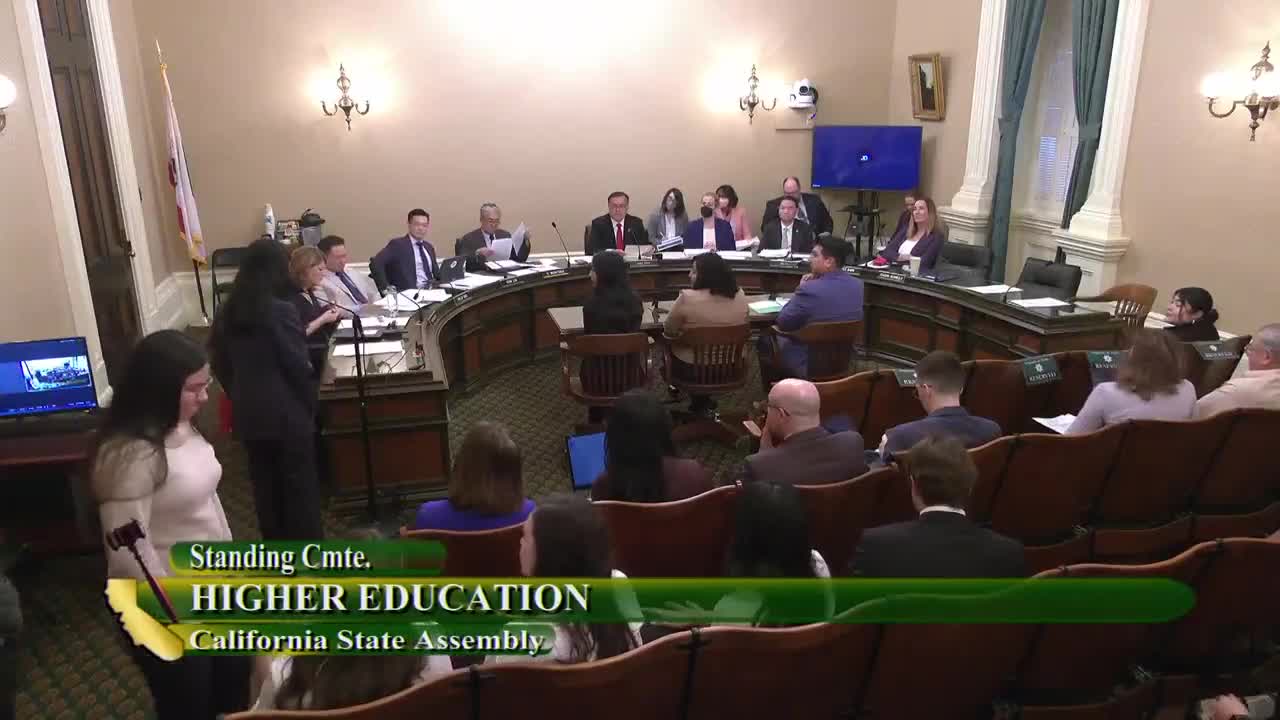 6MIN
Assembly Standing Committee on Higher Education
 8MIN
Assembly Standing Committee on Housing and Community Development
Bill Author

Bill Co-Author(s):







