AB 2012: Rabies control data.
- Session Year: 2023-2024
- House: Assembly
- Latest Version Date: 2024-01-31
Current Status:
Failed
(2024-05-16: In committee: Held under submission.)
Introduced
In Committee
First Chamber
In Committee
Second Chamber
Enacted
Existing law governs the seizure, rescue, adopting out, and euthanasia of abandoned and surrendered animals by animal control officers, law enforcement officers, animal shelters, and rescue organizations. Existing law requires the governing body of each city, city and county, or county to maintain or provide for the maintenance of an animal shelter system and a rabies control program.
This bill would require the State Department of Public Health to collect certain rabies control program data from each city, city and county, or county, as outlined. The bill would authorize the department to contract out this requirement to a California accredited veterinary school. By increasing the data collected from each city, city and county, and county, this bill would create a state-mandated local program.
The California Constitution requires the state to reimburse local agencies and school districts for certain costs mandated by the state. Statutory provisions establish procedures for making that reimbursement.
This bill would provide that, if the Commission on State Mandates determines that the bill contains costs mandated by the state, reimbursement for those costs shall be made pursuant to the statutory provisions noted above.
In rabies areas, all of the following shall apply:
(a)Every owner of a dog, after the dog attains the age of four months, shall no less than once every two years secure a license for the dog as provided by ordinance of the responsible city, city and county, or county. License fees shall be fixed by the responsible city, city and county, or county, at an amount not to exceed limitations otherwise prescribed by state law or city, city and county, or county charter.
(b)(1)Every owner of a dog, after the dog attains the age of three months or older, shall, at intervals of time not more often than once a year, as may be prescribed by the department, procure its vaccination by a licensed veterinarian with a canine antirabies vaccine approved by the department and administered according to the vaccine label, unless a licensed veterinarian determines, on an annual basis, that a rabies vaccination would endanger the dogs life due to disease or other considerations that the veterinarian can verify and document. The responsible city, county, or city and county may specify the means by which a dogs owner is required to provide proof of the dogs rabies vaccination, including, but not limited to, by electronic transmission or facsimile.
(2)A request for an exemption from the requirements of this subdivision shall be submitted on an approved form developed by the department and shall include a signed statement by the veterinarian explaining the inadvisability of the vaccination and a signed statement by the dog owner affirming that the owner understands the consequences and accepts all liability associated with owning a dog that has not received the canine antirabies vaccine. The request shall be submitted to the local health officer, who may issue an exemption from the canine antirabies vaccine.
(3)The local health officer shall report exemptions issued pursuant to this subdivision to the department.
(4)A dog that is exempt from the vaccination requirements of this section shall be considered unvaccinated.
(5)A dog that is exempt from the vaccination requirements of this section shall, at the discretion of the local health officer or the officers designee, be confined to the premises of the owner, keeper, or harborer and, when off the premises, shall be on a leash the length of which shall not exceed six feet and shall be under the direct physical control of an adult. A dog that is exempt from the provisions of this section shall not have contact with a dog or cat that is not currently vaccinated against rabies.
(c)All dogs under four months of age shall be confined to the premises of, or kept under physical restraint by, the owner, keeper, or harborer. Nothing in this chapter or Section 120435 shall be construed to prevent the sale or transportation of a puppy four months old or younger.
(d)A dog in violation of this chapter or any additional provisions that may be prescribed by a local governing body shall be impounded, as provided by local ordinance.
(e)(1)The governing body of each city, city and county, or county shall maintain or provide for the maintenance of an animal shelter system and a rabies control program for the purpose of carrying out and enforcing this section.
(2)(A)The department shall collect rabies control program data from each city, city and county, or county annually, or quarterly if deemed necessary by the department, except as specified in subparagraph (C).
(B)The department may do any of the following:
(i)Require each city or city-contracted animal care and control agency, and county or county-contracted animal care and control agency, to certify that the data they submit is true and correct.
(ii)Determine an annual or quarterly date by which each city, city and county, or county shall report collected rabies control program data to the department.
(iii)Determine an annual date by which the department shall publicly post on its internet website rabies control program data collected from each county.
(C)The department may contract out this requirement to a California accredited veterinary school.
(3)Rabies control program data collected shall include all of the following:
(A)Total number of dogs and cats licensed.
(B)Number of public rabies vaccinations administered.
(C)Number of live domestic dogs and cats received by local animal control authorities, including, but not limited to, number of stray animals, surrendered by owner, or transferred from other shelters.
(D)Number of domestic dogs and cats discharged by local animal control authorities, including, but not limited to, number reclaimed by owner, adopted, relinquished to a rescue organization, euthanized, died, or transferred to another shelter.
(E)Animal bite data deemed necessary by the department.
(F)Animal rabies quarantine data deemed necessary by the department.
(G)Any other data deemed necessary by the department.
(f)(1)Each city, county, or city and county shall provide dog vaccination clinics, or arrange for dog vaccination at clinics operated by veterinary groups or associations, held at strategic locations throughout each city, city and county, or county. The vaccination and licensing procedures may be combined as a single operation in the clinics. No charge in excess of the actual cost shall be made for any one vaccination at a clinic. No owner of a dog shall be required to have the dog vaccinated at a public clinic if the owner elects to have the dog vaccinated by a licensed veterinarian of the owners choice.
(2)All public clinics shall be required to operate under antiseptic immunization conditions comparable to those used in the vaccination of human beings.
(g)In addition to the authority provided in subdivision (a), the ordinance of the responsible city, city and county, or county may provide for the issuance of a license for a period not to exceed three years for dogs that have attained the age of 12 months or older and have been vaccinated against rabies or one year for dogs exempted from the vaccination requirement pursuant to subdivision (b). The person to whom the license is issued pursuant to this subdivision may choose a license period as established by the governing body of up to one, two, or three years. However, when issuing a license pursuant to this subdivision, the license period shall not extend beyond the remaining period of validity for the current rabies vaccination and, if a dog is exempted from the vaccination requirement pursuant to subdivision (b), the license period shall not extend beyond one year. A dog owner who complies with this subdivision shall be deemed to have complied with the requirements of subdivision (a).
(h)All information obtained from a dog owner by compliance with this chapter is confidential to the dog owner and proprietary to the veterinarian. This information shall not be used, distributed, or released for any purpose, except to ensure compliance with existing federal, state, county, or city laws or regulations.
SEC. 2.If the Commission on State Mandates determines that this act contains costs mandated by the state, reimbursement to local agencies and school districts for those costs shall be made pursuant to Part 7 (commencing with Section 17500) of Division 4 of Title 2 of the Government Code.
|
Date
|
Status
|
|---|---|
| May 16, 2024 | In committee: Held under submission. |
| Apr 24, 2024 | In committee: Set, first hearing. Referred to APPR. suspense file. |
| Apr 2, 2024 | From committee: Do pass and re-refer to Com. on APPR. (Ayes 18. Noes 0.) (April 2). Re-referred to Com. on APPR. |
| Feb 12, 2024 | Referred to Com. on B. & P. |
| Feb 1, 2024 | From printer. May be heard in committee March 2. |
| Jan 31, 2024 | Read first time. To print. |
|
Date
|
Description
|
Location
|
Votes
|
|
|---|---|---|---|---|
| Apr 2, 2024 | Do pass and be re-referred to the Committee on [Appropriations] | Assembly Standing Committee on Business and Professions |
Passed |
This list shows positions taken on this bill by organizations on the date displayed, which is linked to the original source.
Positions by individuals are not included.
|
Organization
|
Position
|
Date
|
|---|---|---|
| American Kennel Club, INC. | ** Support | |
| ANIMAL WELLNESS ACTION | ** Support | |
| Buddy’s Angels | ** Support | |
| California Animal Welfare Association | * Support | Apr 2, 2024 |
| California Association Of Professional Scientists | ** Against | |
| Catmosphere Laguna Foundation | ** Support | |
| Foods by Jude | ** Support | |
| Hanaeleh | ** Support | |
| Humboldt Humane | ** Support | |
| Michelson Center For Public Policy | ** Support | |
| NY 4 Whales | ** Support | |
| People Advocating for Animal Welfare | ** Support | |
| Poison Free Malibu | ** Support | |
| Saving Imperial Rescue | ** Support | |
| Social Compassion In Legislation | * Support | Apr 2, 2024 |
| START Rescue | ** Support | |
| Terra Advocati | ** Support | |
| The Animal Coalition Group | ** Support | |
| The Canine Condition | ** Support | |
| The German Shepherd Rescue of Orange County | ** Support | |
| UnchainedTV | ** Support |
Date of Hearing: April 24, 2024
ASSEMBLY COMMITTEE ON APPROPRIATIONS
Buffy Wicks, Chair
ABPCA Bill Id:AB 2012
Author:(Lee) – As Introduced Ver:January 31, 2024
Policy Committee: | Business and Professions | Vote: | 18 - 0 |
|
| ||
|
|
Urgency: No State Mandated Local Program: Yes Reimbursable: Yes
SUMMARY:
This bill requires the California Department of Public Health (CDPH), if CDPH deems it necessary, to collect from each local government, annually or quarterly, the following numbers: (1) dogs and cats licensed; (2) dogs and cats received; (3) rabies vaccines administered; (4) dogs and cats discharged, and whether the animals were reclaimed by owner, adopted, or euthanized, among other dispositions; (5) animal bites; (6) animals quarantined due to rabies; and (7) any other data CDPH deems necessary. The bill also authorizes CDPH to contract out the requirements of this bill to a California-accredited veterinary school.
FISCAL EFFECT:
CDPH estimates ongoing annual costs of approximately $200,000 to $250,000 to establish a contract with a veterinary school, starting in fiscal year 2024-25 (General Fund). The contract will include a position to collect the specified data from local government animal shelters and collate, retain, summarize, and publish those data.
The County Health Executives Association of California anticipates negligible costs to local governments because most of the data required by this bill have been, and continue to be, collected by animal shelters.
According to the Legislative Analyst’s Office, the General Fund faces a structural deficit in the tens of billions of dollars over the next several fiscal years.
COMMENTS:
- Purpose. This bill is sponsored by Social Compassion in Legislation. According to the author:
The official state pet is the “Shelter Pet.” This bill will help provide important data about shelter animals so that resources are better optimized to find more pets their forever homes.
State, local jurisdictions, and nonprofits invest hundreds of millions of dollars in our shelter system to save animals’ lives. Yet the data these entities rely on to direct these resources is no longer available.
This transparency will ensure that the state and other entities are able to direct funding efficiently to shelters with the greatest need, while also giving policymakers a more complete picture of the pet overpopulation problem to make informed policy decisions.
- Background. CDPH collected rabies data from shelters until 2016. CDPH explained its reasons for ceasing rabies data collection as follows:
[T]he epidemiology of rabies has transformed from a disease of chiefly domestic dogs to exclusively wildlife reservoirs (bats, skunks)… the role of domestic animals in rabies transmission risk, and the informative value of animal shelter data toward rabies control, has diminished significantly.
3) Related Legislation
- AB 332 (Lee) is substantially similar to this bill, and requires CDPH to collect and report specified data as part of their rabies control program. AB 332 was held in Senate Appropriations Committee.
- AB 2425 (Essayli) requires an animal shelter to provide the public notice of the adoption availability of an animal, and requires the California Department of Food and Agriculture to conduct a study on overcrowding of state animal shelters, among other topics. AB 2425 also includes provisions pertaining to dog breeders. AB 2425 is pending in Assembly Business and Professions Committee.
- AB 595 (Essayli), of the current legislative session, requires an animal shelter to provide, at least 72 hours before euthanizing any animal, public notice with information that includes the scheduled euthanasia date, and CDFA to conduct a study on animal shelter overcrowding and the feasibility of a statewide database for animals scheduled to be euthanized. AB 595 was held in this committee.
- SB 1358 (Nguyen) is substantially similar to this bill and requires CDPH to collect and report specified data from public animal shelters as part of its annual rabies control activities reporting. SB 1358 is pending in Senate Health Committee.
- SB 1459 (Nguyen) requires, among other things, a public animal control agency or shelter in a county with a population greater than 400,000 to publish and update specified data on its internet website, and exempts a veterinarian or registered veterinary technician from prosecution if they willfully release a cat as part of a trap, neuter, and release activity. SB 1459 is pending in Senate Business, Professions, and Economic Development Committee.
- AB 332 (Lee) is substantially similar to this bill, and requires CDPH to collect and report specified data as part of their rabies control program. AB 332 was held in Senate Appropriations Committee.
Analysis Prepared by: Allegra Kim / APPR. / (916) 319-2081
Date of Hearing: April 2, 2024
ASSEMBLY COMMITTEE ON BUSINESS AND PROFESSIONS
Marc Berman, Chair
ABPCA Bill Id:AB 2012
Author:(Lee) – As Introduced Ver:January 31, 2024
SUBJECT: Rabies control data.
SUMMARY: Requires the California Department of Public Health (CDPH) to collect specified data from public animal shelters as part of their annual rabies control activities reporting, and authorizes the CDPH to contract out this requirement to a California-accredited veterinary school.
EXISTING LAW:
- Governs the operation of animal shelters by, among other things, setting a minimum holding period for stray dogs, cats, and other animals, and requiring animal shelters to ensure that those animals, if adopted, are spayed or neutered and, with exceptions, microchipped. (Food and Agricultural Code (FAC) §§ 30501 et seq.; § 31108.3; §§ 31751 et seq.; §§ 32000 et seq.)
- Requires all public and private animal shelters to keep accurate records on each animal taken up, medically treated, or impounded, which shall include all of the following information and any other information required by the Veterinary Medical Board of California:
- The date the animal was taken up, medically treated, euthanized, or impounded.
- The circumstances under which the animal was taken up, medically treated, euthanized, or impounded.
- The names of the personnel who took up, medically treated, euthanized, or impounded the animal.
- A description of any medical treatment provided to the animal and the name of the veterinarian of record.
- The final disposition of the animal, including the name of the person who euthanized the animal or the name and address of the adopting party. These records shall be maintained for three years after the date on which the animal’s impoundment ends.
(FAC § 32003)
- Defines “rabies” as including both rabies and any other animal disease dangerous to human beings that may be declared by the CDPH. (Health and Safety Code (HSC) § 121575)
- Requires the CDPH to make a preliminary investigation whenever any case of rabies is reported as to whether the disease exists, and as to the probable area of the state in which the population or animals are endangered. (HSC § 121595)
- Authorizes the CDPH to institute special measures of control to supplement the efforts of the local authorities in any county or city whenever it becomes necessary in the judgment of the department, to enforce the state’s rabies control laws. (HSC § 121665)
- Requires every owner of a dog, after the dog attains the age of four months, to secure a license for the dog as provided by ordinance of the responsible city, city and county, or county. (HSC § 121690(a))
- Requires every owner of a dog, after the dog attains the age of three months or older and at intervals of time not more often than once a year, as may be prescribed by the CDPH, to procure its vaccination by a licensed veterinarian with a canine anti-rabies vaccine approved by the department and administered according to the vaccine label. (HSC § 121690(b)(1))
- Specifies that the responsible city and county retains documentation of any exemption, unless a licensed veterinarian determines, on an annual basis, that a rabies vaccination would endanger the dog’s life due to disease or other considerations, the veterinarian can verify and document; the responsible city, county, or city and county, may specify the means by which a dog’s owner is required to provide proof of the dog’s rabies vaccination, including, but not limited to, by electronic transmission or facsimile. (HSC § 121690(b)(1-2))
- Allows for exemptions from an approved form developed and approved by the CDPH, which must be signed by the veterinarian explaining the inadvisability of the vaccination and a signed statement by the dog owner affirming that the owner understands the consequences and accepts all liability associated with owning a dog that has not received the canine anti-rabies vaccine. (HCS § 121690(b)(2))
- Directs this requested information be submitted to the local county health officer, who may issue an exemption from the canine anti-rabies vaccine; requires local county health offices to report exemptions to the CDPH. (HSC § 121690(b)(3))
- Specifies that any exempted canines from its local city and county vaccination requirements of this section be considered unvaccinated. (HSC 121690(b)(4))
- Exempts from the vaccination requirements, at the discretion of the local health officer or the officer’s designee, be confined to the premises of the owner, keeper, or harbor and, when off the premises, shall be on a leash the length of which shall not exceed six feet and shall be under the direct physical control of an adult. (HSC § 121690(b)(5))
- Requires the governing body of each city, city and county, or county to maintain or provide for the maintenance of an animal shelter system and a rabies control program. (HSC § 121690(e))
THIS BILL:
- Requires the CDPH to collect the following rabies control program data from each local government annually, or quarterly if deemed necessary by the CDPH:
- Total number of dogs and cats licensed.
- Number of public rabies vaccinations administered.
- Number of domestic dogs and cats received by local animal control authorities, including, but not limited to, number surrendered by owner, by the public, or transferred from other shelters.
- Number of domestic dogs and cats discharged by local animal control authorities, including, but not limited to, number reclaimed by owner, adopted, relinquished to a rescue organization, euthanized, died, or transferred to another shelter.
- Animal bite data deemed necessary by the CDPH.
- Animal rabies quarantine data deemed necessary by the CDPH.
- Any other data deemed necessary by the CDPH.
- Authorizes the CDPH to:
- Require every local animal care and control agency to certify that the data they submit is true and correct.
- Determine an annual or quarterly date by which each local jurisdiction shall report collected rabies control program data to the department.
- Determine an annual date by which the department shall publicly post on its internet website rabies control program data collected from each county.
- Authorizes the CDPH to contract out the requirements under this bill to a California accredited veterinary school.
FISCAL EFFECT: Unknown; this bill is keyed fiscal by Legislative Counsel.
COMMENTS:
Purpose. This bill is sponsored by Social Compassion in Legislation. According to the author:
“The official state pet is the ‘Shelter Pet.’ AB 2012 will help provide important data about shelter animals so that resources are better optimized to find more pets their forever homes. State, local jurisdictions, and nonprofits invest hundreds of millions of dollars in our shelter system to save animals’ lives. Yet the data these entities rely on to direct these resources is no longer available. This transparency will ensure that the state and other entities are able to direct funding efficiently to shelters with the greatest need, while also giving policymakers a more complete picture of the pet overpopulation problem to make informed policy decisions.”
Background.
Rabies control programming. As part of its mission to protect and promote public health in California, the CDPH monitors and prevents the spread of communicable diseases in the state, including rabies. This is achieved through myriad reporting requirements and data collection initiatives. All owners of dogs three months or older must ensure their dog is vaccinated against rabies unless a veterinarian determines the rabies vaccination would endanger the dog’s life. Veterinarians are required to report rabies vaccination information to the CDPH, including the name and address of the owner, the date of vaccination, and the type of vaccine used. In addition, veterinarians and animal control agencies are required to report any suspected or confirmed cases of rabies to the CDPH. Health care providers, animal control agencies, and law enforcement must also report any animal bite incidents to the CDPH.
The CDPH releases an annual report regarding rabies surveillance programming, detailing among other data points: confirmed cases of rabies in California, the species of each rabies case, and general observations regarding rabies spread and prevention. From 1995 to 2016, the CDPH also reported data as detailed under this bill that was voluntarily submitted from public animal shelters, including the total number of licensed dogs and cats in California, the number of rabies vaccines administered, and animal bite incidents.
This bill intends to clarify that the CDPH is required to collect and report these data points from local governments. In addition, the CDPH would also be required to collect data on the number of domestic dogs and cats discharged by local animal control authorities, including, but not limited to: the number reclaimed by owner, adopted, relinquished to a rescue organization, euthanized, died, or transferred to another shelter. This bill would also authorize the CDPH to contract out these data collection and reporting requirements to a California accredited veterinary school, a notable addition since the prior iteration of this bill—AB 332 (Lee) from 2023—that was approved by this committee.
Accredited veterinary schools. Currently, California accredits two veterinary schools – the UC Davis School of Veterinary Medicine in Davis, and the Western University of Health Sciences in Pomona. In particular, UC Davis oversees the Koret Shelter Medicine Program (KSMP), with research specializing in the state’s adoption outcomes and shelter management improvement. Among other research projects and initiatives, KSMP administers the $50 million “California for All Animals” grant program established in the 2020-21 budget which aims to fulfill the state’s goal that no healthy animal is euthanized in a shelter. Recipients of these grant funds - many of which are public and private shelters that would be captured under this bill – must submit substantive data to KSMP, much of which is the same or similar to data required to be disclosed under this bill. As such, data collection and reporting requirements under this bill do seem consistent with the current scope of at least one of the state’s two accredited veterinary schools.
SPARC vs. The County of Los Angeles. Since the previous version of this legislation was heard, a consequential court decision has made certain data disclosed under this bill more relevant to a number of stakeholders involved in animal control and dog rescue. Santa Paula Animal Rescue Center, Inc. (SPARC) and Lucky Pup Dog Rescue (Lucky Pup) sued the LA County Department of Animal Care and Control (LADACC), arguing the county overstepped its authority when they denied transferring dogs to the respective rescues, citing behavioral issues. The dogs were then euthanized.
While the LA County Superior Court initially ruled in favor of the LADACC, the decision was overturned in the Second District Court of Appeal, a reversal upheld when the California Supreme Court denied LADACC’s request to review the appellate court’s judgement. As a result of this decision, local animal shelters must relinquish any requested dog to non-profit rescue partners, even if the shelter determines the dog to be “potentially dangerous” or otherwise unadoptable due to behavior. Therefore, some supporters argue certain data disclosed under this bill – including bite incidents and specifics around shelter transfers - can aid the state and relevant stakeholders to better track potential “dangerous” incidents involving adopted dogs.
Current Related Legislation.
AB 1988 (Muratsuchi) would authorize that any puppy or kitten relinquished to a public or private animal shelter by the purported owner be made immediately available for release to a nonprofit organization, animal rescue organization, or adoption organization. This bill is pending consideration in this committee.
AB 2265 (McCarty) would, among other things, require that all animal shelters provide public notice at least 24 hours before a dog or cat is scheduled to be euthanized, to be posted daily on their internet website or Facebook page, and that the notice be physically affixed on the kennel of a dog to cat scheduled to be euthanized, as well as mandates time certain that a dog or cat must be spayed or neutered by an animal shelter upon being given to a foster. This bill is pending consideration in this committee.
AB 2425 (Essayli) would, among other things, require an animal shelter to provide public notice regarding the adoption availability of any animal, and require the Department of Food and Agriculture (CDFA) to conduct a study on certain topics, including overcrowding of state animal shelters. The bill would also make changes and additions to state law pertaining to dog breeders. This bill is pending consideration in this committee.
SB 1358 (Nguyen) is substantially similar to this bill, and would require the CDPH to collect and report specified data from public animal shelters as part of their annual rabies control activities reporting. This bill is pending consideration in the Senate Health Committee.
SB 1459 (Nguyen) would, among other things, require public animal control agencies and shelters in counties with a population greater than 400,000 to publish and update specified data on their internet website, and exempt a veterinarian or registered veterinary technician from prosecution if they willfully release a cat as part of a trap, neuter, and release activity. This bill is pending referral by the Senate Rules Committee.
SB 1478 (Nguyen) would require the inclusion of specified information in any order issued by a veterinarian that authorizes a registered veterinary technician to perform animal health care services on animals impounded by a public shelter. This bill is pending referral by the Senate Rules Committee.
Prior Related Legislation.
AB 332 (Lee) from 2023 was substantially similar to this bill, and would have required the CDPH to collect and report specified data as part of their rabies control program. This bill was held in the Senate Appropriations Committee.
AB 595 (Essayli) would have required that all animal shelters provide public notice at least 72 hours before euthanizing any animal with information that includes the scheduled euthanasia date and required the California Department of Food and Agriculture to conduct a study on animal shelter overcrowding and the feasibility of a statewide database for animals scheduled to be euthanized. This bill was held in the Senate Appropriations Committee.
AB 1881 (Santiago) from 2022 would have required every public animal control agency, shelter, or rescue group to conspicuously post or provide a copy of a Dog and Cat Bill of Rights.
AB 2723 (Holden, Chapter 549, Statutes of 2022) established additional requirements on various types of public animals related to microchip registration and the release of dogs and cats.
AB 588 (Chen, Chapter 430, Statutes of 2019) required any shelter or rescue group in California disclose when a dog with a bite history when it is being adopted out.
ACR 153 (Santiago, Chapter 72, 2018) urged communities in California to implement policies that support the adoption of healthy cats from shelters by 2025.
AB 2791 (Muratsuchi, Chapter 194, Statutes of 2018) permitted a puppy or kitten that is reasonably believed to be unowned and is impounded in a shelter to be immediately made available for release to a nonprofit animal rescue or adoption organization before euthanasia.
SB 1785 (Hayden, Chapter 752, Statutes of 1998) established that the State of California’s policy is that no adoptable animal should be euthanized if it can be adopted into a suitable home.
ARGUMENTS IN SUPPORT:
This bill is sponsored by Social Compassion in Legislation (SCIL). According to SCIL: “AB 2012 will give the state, local jurisdictions, and philanthropic organizations the visibility they need to ensure funds are most effectively and efficiently targeted, while giving lawmakers a complete picture of the pet overpopulation problem as they move forward with legislative solutions, as well as ensure animal shelter data is available in the unfortunate event of a zoonotic disease outbreak.”
This bill is supported by a wide array of animal welfare organizations, including but not limited to: the California Animal Welfare Association, Animal Wellness Action, Humboldt Humane, and more. These organizations write: “AB 2012 will give the state, local jurisdictions, and philanthropic organizations the visibility they need to ensure funds are most effectively and efficiently targeted, while giving lawmakers a complete picture of the pet overpopulation problem as they move forward with legislative solutions, as well as ensure animal shelter data is available in the unfortunate event of a zoonotic disease outbreak.
This bill is supported by the American Kennel Club (AKC), representing “470 California dog clubs and thousands of constituent dog owners in California”. According to AKC: “this factual and uniformly collected data—along with the greater clarity provided by it—will serve as an objective and unambiguous dataset that will help to address assumptions that are often made about animal shelters.”
ARGUMENTS IN OPPOSITION:
This bill is opposed by the California Professional Scientists (CAPS), representing “more than 4,000 highly educated, specially trained state-employed scientists working in over 30 state departments and 81 scientific classifications”. According to CAPS: “While CAPS is not opposed to collecting this information, we are opposed to contracting out scientific work when scientific expertise already exists within [Bargaining Unit 10]. Rather than contracting out data collection and management to an accredited California veterinary school, this work is better done by state scientists (through creation of new positions) within the CDPH.”
REGISTERED SUPPORT:
Social Compassion in Legislation (Sponsor)
American Kennel Club, Inc.
Animal Wellness Action
Buddy’s Angels
California Animal Welfare Association
Catmosphere Laguna Foundation
Foods by Jude
Hanaeleh
Humboldt Humane
Michelson Center for Public Policy
NY 4 Whales
People Advocating for Animal Welfare
Poison Free Malibu
Saving Imperial Rescue
Start Rescue
Terra Advocati
The Animal Coalition Group
The Canine Condition
The German Shepherd Rescue of Orange County
UnchainedTV
1121 Individuals
REGISTERED OPPOSITION:
California Association of Professional Scientists
Analysis Prepared by: Edward Franco / B. & P. / (916) 319-3301
Discussed in Hearing
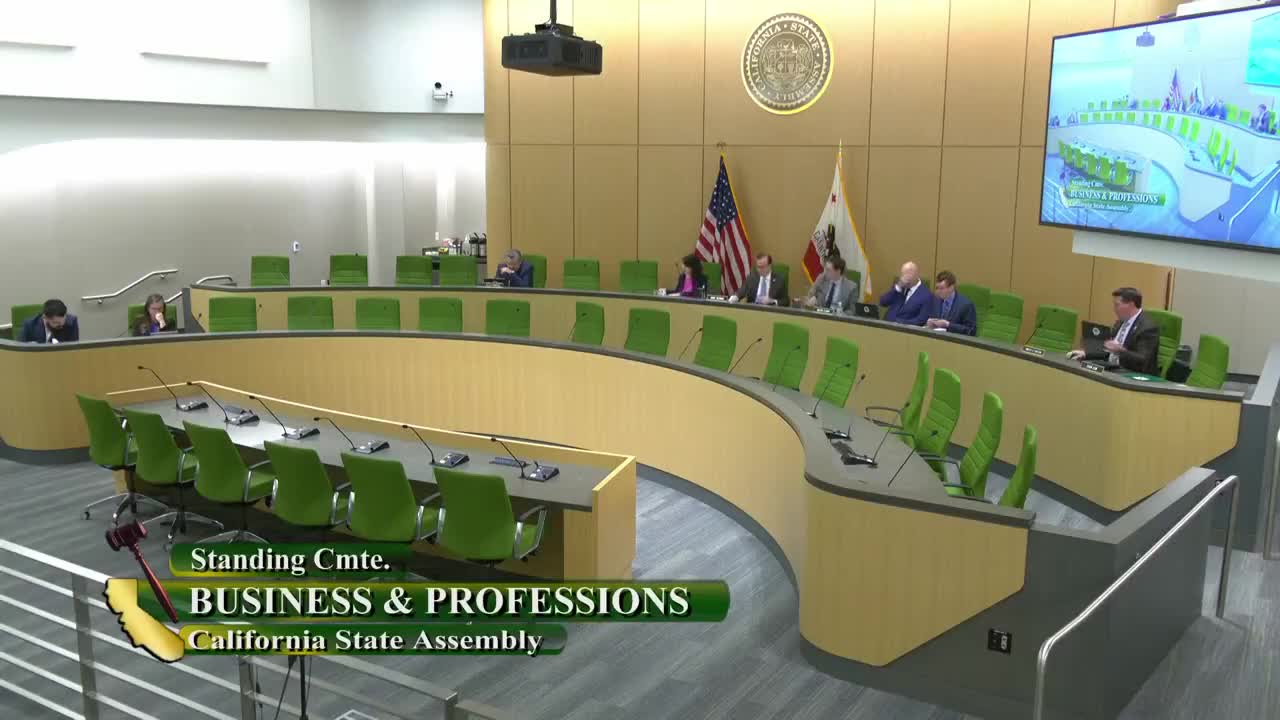 4MIN
Assembly Standing Committee on Business and Professions
Bill Author

Bill Co-Author(s):