AB 2015: Nursing schools and programs: faculty members, directors, and assistant directors.
- Session Year: 2023-2024
- House: Assembly
- Latest Version Date: 2024-09-22
Current Status:
Passed
(2024-09-22: Chaptered by Secretary of State - Chapter 370, Statutes of 2024.)
Introduced
In Committee
First Chamber
In Committee
Second Chamber
Enacted
Existing law, the Nursing Practice Act, establishes the Board of Registered Nursing in the Department of Consumer Affairs to license and regulate the practice of nursing. A violation of the act is a crime. Existing law imposes specified duties on the board related to the approval and regulation of schools of nursing and nursing programs whose graduates are eligible to apply for a license to practice nursing. In this regard, existing law requires the executive officer of the board to develop a uniform method for evaluating requests and granting approvals.
If the board requires the approval of the faculty or directors, as described above, this bill would authorize the board to approve an individual to serve as a member of the faculty, director, or assistant director of an approved school of nursing or nursing program. The bill would require the board to approve an applicant for individual approval if the applicant submits a completed application, as described, and to display an individuals approval status through an online search tool administered by the department. The bill would make the approval valid for 5 years and would authorize the board to renew the approval, as provided. If required by the board for directors and assistant directors of an approved school of nursing or nursing program, the bill would require an approved school of nursing or nursing program to continue to report to the board changes in the nursing programs director and assistant director of nursing positions, except as specified. Because the bill would expand the scope of a crime under the act, the bill would impose a state-mandated local program.
The California Constitution requires the state to reimburse local agencies and school districts for certain costs mandated by the state. Statutory provisions establish procedures for making that reimbursement.
This bill would provide that no reimbursement is required by this act for a specified reason.
Existing law, the Nursing Practice Act, establishes the Board of Registered Nursing in the Department of Consumer Affairs to license and regulate the practice of nursing. A violation of the act is a crime. Existing law imposes specified duties on the board related to the approval and regulation of schools of nursing and nursing programs whose graduates are eligible to apply for a license to practice nursing. In this regard, existing law requires the executive officer of the board to develop a uniform method for evaluating requests and granting approvals.
This bill would require all faculty members, assistant directors, and directors of an approved school of nursing or nursing program to hold an active license in good standing as a registered nurse issued by the board and to be approved by the board as possessing minimum qualifications, including being clinically competent, as specified. The bill would require the board to display an individuals faculty approval status through an online search tool administered by the department. The bill would require an approved school of nursing or nursing program, before extending an offer of employment to a faculty member, assistant director, or director, to use the online search tool to verify that the applicant has an active license in good standing and is approved to teach in the level and content areas relevant to the open position or assignment. The bill would make the approval valid for 5 years and would authorize the board to renew the approval with evidence of continued clinical competence. The bill would authorize the board to grant a one-year temporary faculty approval under specified circumstances. The bill would require an approved school of nursing or nursing program to report to the board changes in the nursing programs director and assistant director of nursing positions, except as specified. The bill would require the executive officer to develop a uniform method for evaluating requests and granting approvals, and would authorize the executive officer to revise the uniform methods developed, as necessary. The bill would make the development or revision of the uniform method exempt from the requirements of the Administrative Procedure Act, as specified. Because the bill would expand the scope of a crime under the act, the bill would impose a state-mandated local program.If the board requires the approval of the faculty or directors, as described above, this bill would authorize the board to approve an individual to serve as a member of the faculty, director, or assistant director of an approved school of nursing or nursing program. The bill would require the board to approve an applicant for individual approval if the applicant submits a completed application, as described, and to display an individuals approval status through an online search tool administered by the department. The bill would make the approval valid for 5 years and would authorize the board to renew the approval, as provided. If required by the board for directors and assistant directors of an approved school of nursing or nursing program, the bill would require an approved school of nursing or nursing program to continue to report to the board changes in the nursing programs director and assistant director of nursing positions, except as specified. Because the bill would expand the scope of a crime under the act, the bill would impose a state-mandated local program.
The California Constitution requires the state to reimburse local agencies and school districts for certain costs mandated by the state. Statutory provisions establish procedures for making that reimbursement.
This bill would provide that no reimbursement is required by this act for a specified reason.
Existing law, the Nursing Practice Act, establishes the Board of Registered Nursing in the Department of Consumer Affairs to license and regulate the practice of nursing. A violation of the act is a crime. Existing law imposes specified duties on the board related to the approval and regulation of schools of nursing and nursing programs whose graduates are eligible to apply for a license to practice nursing. In this regard, existing law requires the executive officer of the board to develop a uniform method for evaluating requests and granting approvals.
This bill would require all faculty members, assistant directors, and directors of an approved school of nursing or nursing program to hold an active license in good standing as a registered nurse issued by the board and to be approved by the board as possessing minimum qualifications, including being clinically competent, as specified. The bill would require the board to display an individuals faculty approval status through an online search tool administered by the department. The bill would require an approved school of nursing or nursing program, before extending an offer of employment to a faculty member, assistant director, or director, to use the online search tool to verify that the applicant has an active license in good standing and is approved to teach in the level and content areas relevant to the open position or assignment. The bill would make the approval valid for 5 years and would authorize the board to renew the approval with evidence of continued clinical competence. The bill would authorize the board to grant a one-year temporary faculty approval under specified circumstances. The bill would require an approved school of nursing or nursing program to report to the board changes in the nursing programs director and assistant director of nursing positions, except as specified. The bill would require the executive officer to develop a uniform method for evaluating requests and granting approvals, and would authorize the executive officer to revise the uniform methods developed, as necessary. The bill would make the development or revision of the uniform method exempt from the requirements of the Administrative Procedure Act, as specified. Because the bill would expand the scope of a crime under the act, the bill would impose a state-mandated local program.
The California Constitution requires the state to reimburse local agencies and school districts for certain costs mandated by the state. Statutory provisions establish procedures for making that reimbursement.
This bill would provide that no reimbursement is required by this act for a specified reason.
If the board requires the approval of the faculty or directors in regulations promulgated pursuant to Section 2786, all of the following apply:
(a)The board may approve an individual to serve as a member of the faculty, director, or assistant director of an approved school of nursing or nursing program.
(b)The board shall approve an applicant for individual approval if the applicant submits a completed application in the form prescribed by the board demonstrating that the applicant meets the requirements established by the board for faculty, directors, and assistant directors of an approved school of nursing or nursing program.
(c)The individual approval under this section shall be valid for five years and may be renewed if the individual demonstrates to the board that they continue to meet the requirements established by the board for faculty, directors, and assistant directors of an approved school of nursing or nursing program.
(d)The board shall display an approved individuals faculty, director, or assistant director approval status, including the approved faculty level and content areas, if applicable, and the status of their nursing license through an online search tool administered by the department.
(e)(1)If an applicant for approval under this section has a faculty position and does not meet a requirement established by the board for a different position, the board may accept a remediation plan submitted by an approved school of nursing or nursing program to help the applicant meet the requirement.
(2)If the board accepts the plan submitted under paragraph (1), the board may approve the applicant to instruct in theory under the mentorship and supervision of the content expert identified in the plan for up to one year.
(f)If required by the board for directors and assistant directors of an approved school of nursing or nursing program, an approved school of nursing or nursing program shall continue to report to the board changes in the nursing programs director and assistant director of nursing positions.
(g)An approved school of nursing or nursing program shall not be required to report to the board any of the following faculty changes:
(1)A change in a faculty members teaching area.
(2)An offer of employment for a faculty member position.
(3)Termination of employment of a faculty member.
(h)This section does not modify any limitations on the powers of the board related to the faculty approval of accredited schools of nursing and nursing programs as specified in subdivision (b) of Section 2786.2.
SEC. 2.No reimbursement is required by this act pursuant to Section 6 of Article XIIIB of the California Constitution because the only costs that may be incurred by a local agency or school district will be incurred because this act creates a new crime or infraction, eliminates a crime or infraction, or changes the penalty for a crime or infraction, within the meaning of Section 17556 of the Government Code, or changes the definition of a crime within the meaning of Section 6 of Article XIIIB of the California Constitution.
If the board requires the approval of the faculty or directors pursuant to Section 2786, all of the following apply:
(a)The board may approve an individual to serve as a member of the faculty, director, or assistant director of an approved school of nursing or nursing program.
(b)The board shall approve an applicant for individual approval if the applicant submits a completed application in the form prescribed by the board demonstrating that the applicant meets the requirements established by the board for faculty, directors, and assistant directors of an approved school of nursing or nursing program.
(c)The individual approval under this section shall be valid for five years and may be renewed if the individual demonstrates to the board that they continue to meet the requirements established by the board for faculty, directors, and assistant directors of an approved school of nursing or nursing program.
(d)The board shall display an approved individuals faculty, director, or assistant director approval status, including the approved faculty level and content areas, if applicable, and the status of their nursing license through an online search tool administered by the department.
(e)(1)If an applicant for approval under this section has a faculty position and does not meet a requirement established by the board for a different position, the board may accept a remediation plan submitted by an approved school of nursing or nursing program to help the applicant meet the requirement.
(2)If the board accepts the plan submitted under paragraph (1), the board may approve the applicant to instruct in theory under the mentorship and supervision of the content expert identified in the plan for up to one year.
(f)If required by the board for directors and assistant directors of an approved school of nursing or nursing program, an approved school of nursing or nursing program shall continue to report to the board changes in the nursing programs director and assistant director of nursing positions.
(g)An approved school of nursing or nursing program shall not be required to report to the board any of the following faculty changes:
(1)A change in a faculty members teaching area.
(2)An offer of employment for a faculty member position.
(3)Termination of employment of a faculty member.
(h)This section does not modify any limitations on the powers of the board related to the approval of schools of nursing and nursing programs as specified in Section 2786.2.
SEC. 2.No reimbursement is required by this act pursuant to Section 6 of Article XIIIB of the California Constitution because the only costs that may be incurred by a local agency or school district will be incurred because this act creates a new crime or infraction, eliminates a crime or infraction, or changes the penalty for a crime or infraction, within the meaning of Section 17556 of the Government Code, or changes the definition of a crime within the meaning of Section 6 of Article XIIIB of the California Constitution.
(a)All faculty members, assistant directors, and directors of an approved school of nursing or nursing program shall hold an active license in good standing as a registered nurse issued by the board and shall be approved by the board as possessing the minimum qualifications established by the board pursuant to this section.
(b)To obtain approval as a faculty member, assistant director, or director of an approved school of nursing or nursing program pursuant to this section, an individual shall submit a completed application in the form prescribed by the board and shall be accompanied by evidence, statements, or documents, as required by the board.
(c)A faculty member shall be clinically competent in the nursing area in which they teach. For purposes of this subdivision, clinically competent means that the faculty member possesses and exercises the degree of learning, skill, care, and experience ordinarily possessed and exercised by staff-level registered nurses of the nursing area to which the faculty member is assigned. Clinical competence is established through direct patient care experience obtained within the previous five years by either of the following:
(1)One year of continuous, full-time experience, or its equivalent, providing direct patient care as a registered nurse in the designated nursing area.
(2)One academic year of registered nurse-level clinical teaching experience, or its equivalent, in the designated nursing area that demonstrate clinical competency.
(d)Upon approval of an application submitted pursuant to subdivision (b), the board shall display an individuals faculty approval status, including the approved level and content areas, and the status of their nursing license through an online search tool administered by the department.
(e)Board approval pursuant to this section is valid for a period of five years and the board may renew the approval with evidence of continued clinical competence.
(f)Before extending an offer of employment to a faculty member, assistant director, or director, an approved school of nursing or nursing program shall use the online search tool administered by the department to verify both of the following:
(1)The applicant holds a clear and active license issued by the board.
(2)The applicant is approved by the board pursuant to this section to teach in the level and content areas relevant to the open position or assignment.
(g)(1)If an applicant has a current faculty position in a nursing content area and does not meet the requirements set forth in subdivision (c) regarding clinical competency relevant to an open or new position or assignment, an approved school of nursing or nursing program may use the boards faculty remediation process to assist the faculty member to become approved in the new nursing content area.
(2)The board may grant a one-year temporary faculty approval in a nursing content area while the applicant is completing a board-approved remediation plan that will meet the clinical competence requirement specified in subdivision (c) for nursing content area approval. Temporary approval pursuant to this paragraph shall only apply to instruction in theory and shall be conditioned on the applicant being under mentorship and supervision of the content expert for that nursing content area.
(h)An approved school of nursing or nursing program shall report to the board changes in the nursing programs director and assistant director of nursing positions.
(i)An approved school of nursing or nursing program shall not be required to report to the board any of the following faculty changes:
(1)A change in a faculty members teaching area.
(2)An offer of employment for a faculty member position.
(3)Termination of employment of a faculty member.
(j)(1)The executive officer shall develop a uniform method for evaluating requests and granting approvals pursuant to this section.
(2)The executive officer may revise the uniform method developed pursuant to this subdivision, as necessary. The development or revision of the uniform method shall be exempt from the requirements of the Administrative Procedure Act (Chapter 3.5 (commencing with Section 11340) of Part 1 of Title 2 of the Government Code).
SEC. 2.No reimbursement is required by this act pursuant to Section 6 of Article XIIIB of the California Constitution because the only costs that may be incurred by a local agency or school district will be incurred because this act creates a new crime or infraction, eliminates a crime or infraction, or changes the penalty for a crime or infraction, within the meaning of Section 17556 of the Government Code, or changes the definition of a crime within the meaning of Section 6 of Article XIIIB of the California Constitution.
|
Date
|
Status
|
|---|---|
| Sep 22, 2024 | Chaptered by Secretary of State - Chapter 370, Statutes of 2024. |
| Sep 22, 2024 | Approved by the Governor. |
| Sep 3, 2024 | Enrolled and presented to the Governor at 3:30 p.m. |
| Aug 26, 2024 | Senate amendments concurred in. To Engrossing and Enrolling. (Ayes 62. Noes 8. Page 6565.). |
| Aug 21, 2024 | In Assembly. Concurrence in Senate amendments pending. May be considered on or after August 23 pursuant to Assembly Rule 77. |
| Aug 21, 2024 | Read third time. Passed. Ordered to the Assembly. (Ayes 28. Noes 4. Page 5267.). |
| Jul 2, 2024 | Read second time. Ordered to third reading. |
| Jul 1, 2024 | From committee: Be ordered to second reading pursuant to Senate Rule 28.8. |
| Jun 18, 2024 | Read second time and amended. Re-referred to Com. on APPR. |
| Jun 17, 2024 | From committee: Amend, and do pass as amended and re-refer to Com. on APPR. (Ayes 11. Noes 1.) (June 17). |
| May 29, 2024 | Referred to Com. on B., P. & E. D. |
| May 21, 2024 | In Senate. Read first time. To Com. on RLS. for assignment. |
| May 20, 2024 | Read third time. Passed. Ordered to the Senate. (Ayes 59. Noes 9. Page 5314.) |
| May 9, 2024 | Read second time. Ordered to third reading. |
| May 8, 2024 | From committee: Do pass. (Ayes 11. Noes 3.) (May 8). |
| Apr 25, 2024 | Re-referred to Com. on APPR. |
| Apr 24, 2024 | Read second time and amended. |
| Apr 23, 2024 | From committee: Amend, and do pass as amended and re-refer to Com. on APPR. (Ayes 13. Noes 2.) (April 23). |
| Feb 12, 2024 | Referred to Com. on B. & P. |
| Feb 1, 2024 | From printer. May be heard in committee March 2. |
| Jan 31, 2024 | Read first time. To print. |
|
Date
|
Description
|
Location
|
Votes
|
|
|---|---|---|---|---|
| Aug 26, 2024 | AB 2015 Schiavo Concurrence in Senate Amendments | Assembly Floor |
Passed |
|
| Aug 21, 2024 | Assembly 3rd Reading AB2015 Schiavo By Roth | Senate Floor |
Passed |
|
| Jun 17, 2024 | Do pass as amended, but first amend, and re-refer to the Committee on [Appropriations] | Senate Standing Committee on Business, Professions and Economic Development |
Passed |
|
| May 20, 2024 | AB 2015 Schiavo Assembly Third Reading | Assembly Floor |
Passed |
|
| May 8, 2024 | Do pass. | Assembly Standing Committee on Appropriations |
Passed |
|
| Apr 23, 2024 | Do pass as amended and be re-referred to the Committee on [Appropriations] | Assembly Standing Committee on Business and Professions |
Passed |
This list shows positions taken on this bill by organizations on the date displayed, which is linked to the original source.
Positions by individuals are not included.
|
Organization
|
Position
|
Date
|
|---|---|---|
| Association of Independent California Colleges and Universities | ** Against | |
| Board of Registered Nursing | ** Support | |
| California Nurses Association | ** Support | |
| California State Council of Service Employees International Union | ** Support | |
| Santa Clarita Community College District - College of the Canyons | ** Support |
CONCURRENCE IN SENATE AMENDMENTS
CSA1 Bill Id:AB 2015
Author:(Schiavo)
As Amended Ver:June 18, 2024
Majority vote
SUMMARY
Authorizes the Board of Registered Nursing (BRN), if it chooses to approve faculty or directors as part of its nursing school and nursing program approval authority, to approve individual faculty and directors independent of the school or program approval.
Senate Amendments
Make technical and clarifying changes.
COMMENTS
Background. The BRN is a licensing entity within DCA that is responsible for administering and enforcing the Nursing Practice Act, which is the chapter of laws that establishes the BRN and outlines the regulatory framework for the practice, licensing, education, and discipline of RNs and advanced practice registered nurses. The BRN is also one of the few licensing boards that actively approve and regulate educational programs that offer the degrees necessary for licensure. In-state programs that offer a course of instruction leading to an RN license must seek approval from the BRN to operate.
At the end of fiscal year 2021-22, the BRN reported a total of 152 approved RN programs, including 91 associate degree in nursing (ADN) programs, 48 bachelor of science in nursing (BSN) programs, and 13 entry-level master's (ELM) programs.
Faculty and Director Approval. As part of its nursing school and education program approval regulations, the BRN reviews proposed faculty members and directors to determine whether they meet the BRN's standards for education and experience. This bill authorizes the BRN to modify its current approval process to allow faculty and directors to apply directly to the BRN, rather than through the hiring program.
According to the BRN, it does not approve proposed faculty or directors until after the nursing program has gone through much of the hiring process and an offer is extended to a potential candidate. If the candidate does not meet the qualifications, then the program must move on to another candidate or utilize the BRN's "Faculty Remediation Guidelines" to help the candidate meet the BRN's requirements. The BRN is sponsoring this bill to allow faculty to apply for "portable" approval that is independent of a program's hiring process.
This bill also allows faculty and directors to display BRN approval on the BRN's BreEZe licensing database and requires programs to check for approval prior to extending an offer for employment. Because faculty are required to be approved as "clinically competent" in the area of nursing they seek to teach, the database would also show what areas they approved for.
According to the Author
"One of the ways to address the statewide nursing shortage is to make sure nursing school instructors are efficiently certified to provide that instruction, and if they're lacking, the opportunity to quickly meet those qualifications. [This bill] will provide both teaching nurses and their prospective employers greater confidence in the hiring process by decoupling the teaching credential approval process from the hiring process, allowing nurses to close any qualification gaps and enabling nurses to proactively seek multiple instructor opportunities."
Arguments in Support
The Board of Registered Nursing (sponsor) writes in support:
The Board's current process ties faculty approval to the nursing program, not the individual applicant. Nursing programs go through their recruitment, application screening, interviews, and at the very end of the hiring process, prior to extending a final offer to their top candidate, submit them to the Board for review to ensure that they meet the Board's minimum qualifications for faculty approval. If the applicant is not approved, the entire hiring process could have to start all over again. If the applicant is approved, that approval is limited to the one nursing program who submitted the applicant to the Board.
[This bill] would authorize the Board to provide a faculty approval that is portable and can be instantly verified by prospective employers. Under the proposed process, an applicant would apply directly to the Board and their approval status would be connected to their Registered Nurse license on the Department of Consumer Affairs license look up page. This would allow nursing programs to verify whether an individual is approved to teach, at what level, and in what content area at the same time they are verifying whether the applicant has an active nursing license.
The bill would ensure that nursing program's finite resources are spent interviewing applicants who have already met the minimum qualifications and have been approved by the Board. It would also mean that approved faculty can apply for similar positions at other nursing programs without having to go back through Board approval.
Moreover, having the approval process tied to the applicant, rather than the nursing program, would allow the Board to remove onerous faculty reporting requirements that are currently shouldered by the nursing programs.
Lastly, the bill provides nursing programs with added flexibility by authorizing the Board to grant temporary approval for existing faculty who are in the process of completing a remediation plan to teach a theory course in a new content area.
Arguments in Opposition
No opposition on file.
FISCAL COMMENTS
According to the Senate Appropriations Committee, pursuant to Senate Rule 28.8, no significant state costs anticipated.
VOTES:
ASM BUSINESS AND PROFESSIONS: 13-2-3
YES: Berman, Bains, Juan Carrillo, Chen, Aguiar-Curry, Irwin, Jackson, Lowenthal, McKinnor, Stephanie Nguyen, Pellerin, Soria, Zbur
NO: Dixon, Sanchez
ABS, ABST OR NV: Flora, Alanis, Low
ASM APPROPRIATIONS: 11-3-1
YES: Wicks, Arambula, Bryan, Calderon, Wendy Carrillo, Mike Fong, Friedman, Haney, Hart, Pellerin, Villapudua
NO: Sanchez, Dixon, Ta
ABS, ABST OR NV: Jim Patterson
ASSEMBLY FLOOR: 59-9-12
YES: Addis, Aguiar-Curry, Alvarez, Bains, Bauer-Kahan, Bennett, Berman, Boerner, Bonta, Bryan, Calderon, Juan Carrillo, Wendy Carrillo, Chen, Connolly, Mike Fong, Friedman, Gallagher, Garcia, Gipson, Grayson, Haney, Hart, Holden, Irwin, Jackson, Jones-Sawyer, Kalra, Lee, Low, Lowenthal, Maienschein, McCarty, McKinnor, Muratsuchi, Ortega, Pacheco, Papan, Pellerin, Petrie-Norris, Quirk-Silva, Ramos, Rendon, Reyes, Rodriguez, Blanca Rubio, Santiago, Schiavo, Soria, Ting, Valencia, Villapudua, Ward, Weber, Wicks, Wilson, Wood, Zbur, Robert Rivas
NO: Davies, Dixon, Essayli, Flora, Vince Fong, Hoover, Joe Patterson, Sanchez, Ta
ABS, ABST OR NV: Alanis, Arambula, Cervantes, Megan Dahle, Gabriel, Lackey, Mathis, Stephanie Nguyen, Jim Patterson, Luz Rivas, Waldron, Wallis
UPDATED
VERSION: June 18, 2024
CONSULTANT: Vincent Chee / B. & P. / (916) 319-3301 FN: 0002925
SENATE COMMITTEE ON
BUSINESS, PROFESSIONS AND ECONOMIC DEVELOPMENT
Senator Angelique Ashby, Chair
2023 - 2024 Regular
Bill No: Hearing Date: June 17, 2024
Author: | |||
Version: | April 24, 2024 | ||
Urgency: | No | Fiscal: | Yes |
Consultant: | Elissa Silva | ||
Subject:
SUMMARY:
Authorizes the Board of Registered Nursing (BRN), if it chooses to approve faculty or directors as part of its school approval authority, to approve individual faculty and directors, independent of the school or program approval.
Existing law:
- Establishes the Board of Registered Nursing (BRN) under the jurisdiction of the Department of Consumer Affairs (DCA) to license and regulate the practice of nursing. (Business and Professions Code (BPC) § 2700 et seq.)
- Defines “an approved school of nursing” or “an approved nursing program” as one that has been approved by the BRN, gives the course of instruction approved by the BRN covering not fewer than two academic years, is affiliated or conducted in connection with one or more hospitals, and is an institution of higher education which includes but is not limited to, community colleges offering an associate of arts or associate of science degree, baccalaureate degree, or an entry level master’s degree, and is an institution that is not subject to specified provisions of the California Private Postsecondary Education Act, as specified. (BPC § 2786(a)(1))
- Requires an approved school or nursing or nursing program (approved school) to meet a minimum of 500 direct patient care clinical hours in a BRN-approved clinical setting with a minimum of 30 hours of supervised direct patient, care clinical hours dedicated to each nursing area specified by the BRN. (BPC § 2786(a)(2))
- Requires the BRN to determine by regulation the subjects of instruction to be completed in an approved school for licensure as a registered nurse (RN) and must include the minimum units of theory and clinical experience and necessary to achieve essential clinical competency at the entry level of the RN. (BPC § 2786(c)(1))
- Reduces ongoing approval requirements for approved schools of nursing or nursing programs that are actively accredited by an institutional or programmatic accreditor recognized by the United States Department of Education (USDE), including requiring the BRN to accept faculty hiring decisions made by the approved program director, if included within the scope of accreditation. (BPC § 2786.2(b)(1)(C)) 8)
- Establishes various requirements for BRN approval of faculty and directors. (California Code of Regulations, Title 16, §§ 1425, 1425.1)
This bill:
- States that if the BRN requires the approval of faculty or directors pursuant to the BRN’s jurisdiction over the approval of schools of nursing, the following apply:
- The BRN may approve an individual to serve as a member of the faculty, director, or assistant director of an approved school.
- The BRN must approve an applicant for individual approval if the applicant submits a completed application in the form prescribed by the BRN demonstrating that the applicant meets the requirements established by the BRN for faculty, directors, and assistant directors of an approved school.
- The individual approval is valid for five years and may be renewed if the individual demonstrates to the BRN that they continue to meet the BRN’s requirements, as specified;
- The BRN must display an approved individual’s faculty, director or assistance director approval status, including the approved faculty level and content areas and status of their RN license through an online search tool administered by the DCA.
- If an applicant for approval has a faculty position and does not meet a requirement established by the BRN for a different position, the BRN may accept a remediation plan submitted by an approved school to help the applicant meet the requirement and if the BRN accepts the plan, the BRN may approve the applicant to instruct theory under mentorship and supervision of the content expert identified in the plan for up to one year.
- Requires an approved school to continue to report to the BRN changes in the nursing program’s director and assistant director of nursing positions if required by the BRN, as specified.
- States that an approved school is not required to report to the BRN any of the following changes:
- A change in a faculty member’s teaching area;
- An offer of employment for a faculty member position;
- Termination of employment of a faculty member.
- States that the provisions of this bill do not modify any limitations on the powers of the BRN related to the approved schools, as specified.
FISCAL EFFECT:
According to the Assembly Committee on Appropriations., the bill will not result in costs to the BRN, which already has a process to meet the provisions of this bill.
COMMENTS:
- Purpose. The Board of Registered Nursing is the sponsor of this bill. According to the author, “Currently, when a nurse applies for a faculty, assistant director, or director position at an unaccredited nursing program, proof of their qualifications are not vetted in the initial screening stages. The nursing program conducting the hiring instead goes through the entire hiring process, up to the point where an offer would be extended to a potential candidate, before the program confirms with the BRN that the candidate meets the qualifications for the position. If the selected candidate does not meet the qualifications, then the nursing program must either pursue a remediation process to bring the candidate up to the standards, select another candidate, or start the hiring process from the beginning. This creates a backwards system where job candidates and the nursing programs conducting the hiring process can waste valuable time if a selected candidate is not approved by the Board. Additionally, if a nurse in an accredited program aims to pick up additional responsibilities on the side at an unaccredited program, the nurse will not have the appropriate credentialing visible on DCA’s license search prior to applying for the external position. This bill will remedy both of these situations as well as expedite the filling of faculty and director positions through the creation of the temporary approval process.”
- Background.
The Board of Registered Nursing. The BRN is responsible for administering and enforcing the Nursing Practice Act, which establishes the administrative parameters of the BRN and outlines the regulatory framework for the practice of nursing including the licensing, education, discipline of registered nurses (RNs) and advanced practice registered nurses (APRNs). The BRN’s licensing population is typically one of the highest nursing populations in the country. RNs perform health care functions that require a substantial amount of scientific knowledge or technical skill, including direct and indirect patient care; disease prevention and restorative measures; administration of medication and therapeutic agents; skin tests; immunizations; blood withdrawal; patient assessment, analysis, planning, and treatment implementation; and laboratory tests. In order to obtain licensure in California, an individual must complete general preliminary education requirements as determined by the BRN, and complete the courses of instruction prescribed by the BRN.
The BRN has statutory authority to approve BRN education programs. The BRN is required to establish through regulations the required course of study of a program necessary for licensure, ensure that courses of theory and clinical meet minimum standards to ensure clinical competency, ensure that the nursing program meet a minimum of 500 hours of direct patient care clinical hours, among others. As part of its review and approval process, the BRN reviews proposed faculty for their qualifications and requires certain levels of education and experience for full-time faculty.
According to the BRN, it does not approve proposed faculty or directors until after the nursing program has gone through much of the hiring process and an offer is extended to a potential candidate. If the candidate does not meet the qualifications, the program must move on to another candidate or utilize the BRN’s “Faculty Remediation Guidelines” to help the candidate meet the BRN’s requirements. The BRN is sponsoring this bill to allow faculty to apply for “portable” approval that is independent of a program’s hiring process. This bill also allows faculty and directors to display BRN approval on the BRN’s BreEZe licensing database and requires programs to check for approval prior to extending an offer for employment. Because faculty are required to be approved as “clinically competent” in the area of nursing they seek to teach, the database would also show what areas for which they are approved. This bill would (1) codify the BRN’s regulations requiring faculty and director approval and (2) modify the process to allow faculty and directors to apply directly to the BRN, rather than through the hiring program of a nursing school.
- Arguments in Support. The Board of Registered Nursing writes in support, “AB 2015 would allow the Board to provide a faculty approval that is portable and can be instantly verified by prospective employers. Under the proposed process, an applicant would apply directly to the Board and their approval status would be connected to their Registered Nurse license on the Department of Consumer Affairs license look up page. This would allow nursing programs to verify whether an individual is approved to teach, at what level, and in what content area at the same time they are verifying whether the applicant has an active nursing license.”
The California Nursing Association writes in support and notes, “This bill would separate the nurse teaching credential approval process from the hiring process, among other things, and allow nurses to obtain a portable credential from the California Board of Registered Nursing (BRN).”
SEIU California writes in support and notes, “The current process of requiring programs to seek approval from the BRN when hiring faculty members, ensures that instructors have the necessary expertise to instruct on a topic. That is a critical role for the BRN to play, and we believe that AB 2015 strikes an appropriate balance of maintain high quality faculty while also streamlining the process so that we don’t lose out on quality instructors.”
College of the Canyons writes in support and notes, “AB 2015 will streamline the credentialing process by allowing nurses to obtain portable credentials directly from the BRN. This eliminates unnecessary delays and ensures that qualified candidates can seamlessly transition into teaching roles. And, by addressing the order in which steps are completed, AB 2015 maintains the quality and competency of nursing program faculty. It allows nursing programs to make informed hiring decisions without compromising on standards.”
- Technical Amendment. To capture the BRN’s current role in approving faculty, the bill should be amended moving forward to clarify that approval of faculty is pursuant to the BRN’s promulgated regulations, and further clarify that the provisions of this bill do not affect schools meeting certain accreditation standards as specified in existing law.
SUPPORT AND OPPOSITION:
Support:
Board of Registered Nursing
California Nurses Association
California State Council of Service Employees International Union
Santa Clarita Community College District - College of The Canyons
Opposition:
None received
-- END --
SENATE RULES COMMITTEE Office of Senate Floor Analyses (916) 651-1520 Fax: (916) 327-4478 | AB 2015 |
THIRD READING
Bill No: AB 2015
Author: Schiavo (D)
Amended: 6/18/24 in Senate
Vote: 21
SENATE BUS., PROF. & ECON. DEV. COMMITTEE: 11-1, 6/17/24
AYES: Ashby, Alvarado-Gil, Archuleta, Becker, Eggman, Glazer, Menjivar, Niello, Roth, Smallwood-Cuevas, Wilk
NOES: Nguyen
NO VOTE RECORDED: Dodd
SENATE APPROPRIATIONS COMMITTEE: Senate Rule 28.8
ASSEMBLY FLOOR: 59-9, 5/20/24 - See last page for vote
SUBJECT: Nursing schools and programs: faculty members, directors, and assistant directors
SOURCE: Board of Registered Nursing
DIGEST:
This bill authorizes the Board of Registered Nursing (BRN), if it chooses to approve faculty or directors as part of its school approval authority, to approve individual faculty and directors, independent of the school or program approval.
ANALYSIS:
Existing law:
- Establishes the Board of Registered Nursing (BRN) under the jurisdiction of the Department of Consumer Affairs (DCA) to license and regulate the practice of nursing. (Business and Professions Code (BPC) § 2700 et seq.)
- Requires an approved school or nursing or nursing program (approved school) to meet a minimum of 500 direct patient care clinical hours in a BRN-approved clinical setting with a minimum of 30 hours of supervised direct patient, care clinical hours dedicated to each nursing area specified by the BRN. (BPC § 2786(a)(2))
- Requires the BRN to determine by regulation the subjects of instruction to be completed in an approved school for licensure as a registered nurse (RN) and must include the minimum units of theory and clinical experience and necessary to achieve essential clinical competency at the entry level of the RN. (BPC § 2786(c)(1))
- Reduces ongoing approval requirements for approved schools of nursing or nursing programs that are actively accredited by an institutional or programmatic accreditor recognized by the United States Department of Education (USDE), including requiring the BRN to accept faculty hiring decisions made by the approved program director, if included within the scope of accreditation. (BPC § 2786.2(b)(1)(C)) 8)
- Establishes various requirements for BRN approval of faculty and directors. (California Code of Regulations, Title 16, §§ 1425, 1425.1)
This bill:
- States that if the BRN requires the approval of faculty or directors pursuant to the BRN’s jurisdiction over the approval of schools of nursing, the following apply:
- The BRN may approve an individual to serve as a member of the faculty, director, or assistant director of an approved school.
- The BRN must approve an applicant for individual approval if the applicant submits a completed application in the form prescribed by the BRN demonstrating that the applicant meets the requirements established by the BRN for faculty, directors, and assistant directors of an approved school.
- The individual approval is valid for five years and may be renewed if the individual demonstrates to the BRN that they continue to meet the BRN’s requirements, as specified;
- The BRN must display an approved individual’s faculty, director or assistance director approval status, including the approved faculty level and content areas and status of their RN license through an online search tool administered by the DCA.
- If an applicant for approval has a faculty position and does not meet a requirement established by the BRN for a different position, the BRN may accept a remediation plan submitted by an approved school to help the applicant meet the requirement and if the BRN accepts the plan, the BRN may approve the applicant to instruct theory under mentorship and supervision of the content expert identified in the plan for up to one year.
- Requires an approved school to continue to report to the BRN changes in the nursing program’s director and assistant director of nursing positions if required by the BRN, as specified.
- States that an approved school is not required to report to the BRN any of the following changes:
- A change in a faculty member’s teaching area;
- An offer of employment for a faculty member position;
- Termination of employment of a faculty member.
- States that the provisions of this bill do not modify any limitations on the powers of the BRN related to the approved schools, as specified.
Background
The Board of Registered Nursing. The BRN is responsible for administering and enforcing the Nursing Practice Act, which establishes the administrative parameters of the BRN and outlines the regulatory framework for the practice of nursing. In order to obtain licensure in California, an individual must complete general preliminary education requirements as determined by the BRN, and complete the courses of instruction prescribed by the BRN.
The BRN has statutory authority to approve BRN education programs. The BRN is required to establish through regulations the required course of study of a program necessary for licensure, ensure that courses of theory and clinical meet minimum standards to ensure clinical competency, ensure that the nursing program meet a minimum of 500 hours of direct patient care clinical hours, among others. As part of its review and approval process, the BRN reviews proposed faculty for their qualifications and requires certain levels of education and experience for full-time faculty.
According to the BRN, it does not approve proposed faculty or directors until after the nursing program has gone through much of the hiring process and an offer is extended to a potential candidate. If the candidate does not meet the qualifications, the program must move on to another candidate or utilize the BRN’s “Faculty Remediation Guidelines” to help the candidate meet the BRN’s requirements. The BRN is sponsoring this bill to allow faculty to apply for “portable” approval that is independent of a program’s hiring process. This bill also allows faculty and directors to display BRN approval on the BRN’s BreEZe licensing database and requires programs to check for approval prior to extending an offer for employment. Because faculty are required to be approved as “clinically competent” in the area of nursing they seek to teach, the database would also show what areas for which they are approved. This bill would (1) codify the BRN’s regulations requiring faculty and director approval and (2) modify the process to allow faculty and directors to apply directly to the BRN, rather than through the hiring program of a nursing school.
FISCAL EFFECT: Appropriation: No Fiscal Com.: Yes Local: Yes
SUPPORT: (Verified 7/2/24)
Board of Registered Nursing (source)
California Nurses Association
California State Council of Service Employees International Union
Santa Clarita Community College District - College of the Canyons
OPPOSITION: (Verified 7/2/24)
None received
ARGUMENTS IN SUPPORT: Supporters note generally that this bill will help streamline the credentialing process and help eliminate deficiencies in the current hiring process.
ASSEMBLY FLOOR: 59-9, 5/20/24
AYES: Addis, Aguiar-Curry, Alvarez, Bains, Bauer-Kahan, Bennett, Berman, Boerner, Bonta, Bryan, Calderon, Juan Carrillo, Wendy Carrillo, Chen, Connolly, Mike Fong, Friedman, Gallagher, Garcia, Gipson, Grayson, Haney, Hart, Holden, Irwin, Jackson, Jones-Sawyer, Kalra, Lee, Low, Lowenthal, Maienschein, McCarty, McKinnor, Muratsuchi, Ortega, Pacheco, Papan, Pellerin, Petrie-Norris, Quirk-Silva, Ramos, Rendon, Reyes, Rodriguez, Blanca Rubio, Santiago, Schiavo, Soria, Ting, Valencia, Villapudua, Ward, Weber, Wicks, Wilson, Wood, Zbur, Robert Rivas
NOES: Davies, Dixon, Essayli, Flora, Vince Fong, Hoover, Joe Patterson, Sanchez, Ta
NO VOTE RECORDED: Alanis, Arambula, Cervantes, Megan Dahle, Gabriel, Lackey, Mathis, Stephanie Nguyen, Jim Patterson, Luz Rivas, Waldron, Wallis
Prepared by: Elissa Silva / B., P. & E.D. / 916-651-4104
7/3/24 9:46:46
**** END ****
SENATE RULES COMMITTEE Office of Senate Floor Analyses (916) 651-1520 Fax: (916) 327-4478 | AB 2015 |
THIRD READING
Bill No: AB 2015
Author: Schiavo (D)
Amended: 6/18/24 in Senate
Vote: 21
SENATE BUS., PROF. & ECON. DEV. COMMITTEE: 11-1, 6/17/24
AYES: Ashby, Alvarado-Gil, Archuleta, Becker, Eggman, Glazer, Menjivar, Niello, Roth, Smallwood-Cuevas, Wilk
NOES: Nguyen
NO VOTE RECORDED: Dodd
SENATE APPROPRIATIONS COMMITTEE: Senate Rule 28.8
ASSEMBLY FLOOR: 59-9, 5/20/24 - See last page for vote
SUBJECT: Nursing schools and programs: faculty members, directors, and assistant directors
SOURCE: Board of Registered Nursing
DIGEST:
This bill authorizes the Board of Registered Nursing (BRN), if it chooses to approve faculty or directors as part of its school approval authority, to approve individual faculty and directors, independent of the school or program approval.
ANALYSIS:
Existing law:
- Establishes the Board of Registered Nursing (BRN) under the jurisdiction of the Department of Consumer Affairs (DCA) to license and regulate the practice of nursing. (Business and Professions Code (BPC) § 2700 et seq.)
- Requires an approved school or nursing or nursing program (approved school) to meet a minimum of 500 direct patient care clinical hours in a BRN-approved clinical setting with a minimum of 30 hours of supervised direct patient, care clinical hours dedicated to each nursing area specified by the BRN. (BPC § 2786(a)(2))
- Requires the BRN to determine by regulation the subjects of instruction to be completed in an approved school for licensure as a registered nurse (RN) and must include the minimum units of theory and clinical experience and necessary to achieve essential clinical competency at the entry level of the RN. (BPC § 2786(c)(1))
- Reduces ongoing approval requirements for approved schools of nursing or nursing programs that are actively accredited by an institutional or programmatic accreditor recognized by the United States Department of Education (USDE), including requiring the BRN to accept faculty hiring decisions made by the approved program director, if included within the scope of accreditation. (BPC § 2786.2(b)(1)(C)) 8)
- Establishes various requirements for BRN approval of faculty and directors. (California Code of Regulations, Title 16, §§ 1425, 1425.1)
This bill:
- States that if the BRN requires the approval of faculty or directors pursuant to the BRN’s jurisdiction over the approval of schools of nursing, the following apply:
- The BRN may approve an individual to serve as a member of the faculty, director, or assistant director of an approved school.
- The BRN must approve an applicant for individual approval if the applicant submits a completed application in the form prescribed by the BRN demonstrating that the applicant meets the requirements established by the BRN for faculty, directors, and assistant directors of an approved school.
- The individual approval is valid for five years and may be renewed if the individual demonstrates to the BRN that they continue to meet the BRN’s requirements, as specified;
- The BRN must display an approved individual’s faculty, director or assistance director approval status, including the approved faculty level and content areas and status of their RN license through an online search tool administered by the DCA.
- If an applicant for approval has a faculty position and does not meet a requirement established by the BRN for a different position, the BRN may accept a remediation plan submitted by an approved school to help the applicant meet the requirement and if the BRN accepts the plan, the BRN may approve the applicant to instruct theory under mentorship and supervision of the content expert identified in the plan for up to one year.
- Requires an approved school to continue to report to the BRN changes in the nursing program’s director and assistant director of nursing positions if required by the BRN, as specified.
- States that an approved school is not required to report to the BRN any of the following changes:
- A change in a faculty member’s teaching area;
- An offer of employment for a faculty member position;
- Termination of employment of a faculty member.
- States that the provisions of this bill do not modify any limitations on the powers of the BRN related to the approved schools, as specified.
Background
The Board of Registered Nursing. The BRN is responsible for administering and enforcing the Nursing Practice Act, which establishes the administrative parameters of the BRN and outlines the regulatory framework for the practice of nursing. In order to obtain licensure in California, an individual must complete general preliminary education requirements as determined by the BRN, and complete the courses of instruction prescribed by the BRN.
The BRN has statutory authority to approve BRN education programs. The BRN is required to establish through regulations the required course of study of a program necessary for licensure, ensure that courses of theory and clinical meet minimum standards to ensure clinical competency, ensure that the nursing program meet a minimum of 500 hours of direct patient care clinical hours, among others. As part of its review and approval process, the BRN reviews proposed faculty for their qualifications and requires certain levels of education and experience for full-time faculty.
According to the BRN, it does not approve proposed faculty or directors until after the nursing program has gone through much of the hiring process and an offer is extended to a potential candidate. If the candidate does not meet the qualifications, the program must move on to another candidate or utilize the BRN’s “Faculty Remediation Guidelines” to help the candidate meet the BRN’s requirements. The BRN is sponsoring this bill to allow faculty to apply for “portable” approval that is independent of a program’s hiring process. This bill also allows faculty and directors to display BRN approval on the BRN’s BreEZe licensing database and requires programs to check for approval prior to extending an offer for employment. Because faculty are required to be approved as “clinically competent” in the area of nursing they seek to teach, the database would also show what areas for which they are approved. This bill would (1) codify the BRN’s regulations requiring faculty and director approval and (2) modify the process to allow faculty and directors to apply directly to the BRN, rather than through the hiring program of a nursing school.
FISCAL EFFECT: Appropriation: No Fiscal Com.: Yes Local: Yes
SUPPORT: (Verified 7/2/24)
Board of Registered Nursing (source)
California Nurses Association
California State Council of Service Employees International Union
Santa Clarita Community College District - College of the Canyons
OPPOSITION: (Verified 7/2/24)
Association of Independent California Colleges and Universities
ARGUMENTS IN SUPPORT: Supporters note generally that this bill will help streamline the credentialing process and help eliminate deficiencies in the current hiring process.
ARGUMENTS IN OPPOSITION: Opponents note, “We believe that this conflicts with the intent and spirit of AB 2684 (Berman, 2022), which among other things, required BRN to “accept faculty hiring decisions made by the approved program director” for approved schools that are actively accredited by an institutional or programmatic accreditor.”
ASSEMBLY FLOOR: 59-9, 5/20/24
AYES: Addis, Aguiar-Curry, Alvarez, Bains, Bauer-Kahan, Bennett, Berman, Boerner, Bonta, Bryan, Calderon, Juan Carrillo, Wendy Carrillo, Chen, Connolly, Mike Fong, Friedman, Gallagher, Garcia, Gipson, Grayson, Haney, Hart, Holden, Irwin, Jackson, Jones-Sawyer, Kalra, Lee, Low, Lowenthal, Maienschein, McCarty, McKinnor, Muratsuchi, Ortega, Pacheco, Papan, Pellerin, Petrie-Norris, Quirk-Silva, Ramos, Rendon, Reyes, Rodriguez, Blanca Rubio, Santiago, Schiavo, Soria, Ting, Valencia, Villapudua, Ward, Weber, Wicks, Wilson, Wood, Zbur, Robert Rivas
NOES: Davies, Dixon, Essayli, Flora, Vince Fong, Hoover, Joe Patterson, Sanchez, Ta
NO VOTE RECORDED: Alanis, Arambula, Cervantes, Megan Dahle, Gabriel, Lackey, Mathis, Stephanie Nguyen, Jim Patterson, Luz Rivas, Waldron, Wallis
Prepared by: Elissa Silva / B., P. & E.D. / 916-651-4104
7/2/24 15:16:43
**** END ****
SENATE COMMITTEE ON
BUSINESS, PROFESSIONS AND ECONOMIC DEVELOPMENT
Senator Angelique Ashby, Chair
2023 - 2024 Regular
Bill No: AB 2015 Hearing Date: June 17, 2024
Author: | Schiavo | ||
Version: |
| ||
Urgency: | Fiscal: | ||
Consultant: | |||
Subject: Nursing schools and programs: faculty members, directors, and assistant directors
SUMMARY:
Authorizes the Board of Registered Nursing (BRN), if it chooses to approve faculty or directors as part of its school approval authority, to approve individual faculty and directors, independent of the school or program approval.
Existing law:
- Establishes the Board of Registered Nursing (BRN) under the jurisdiction of the Department of Consumer Affairs (DCA) to license and regulate the practice of nursing. (Business and Professions Code (BPC) § 2700 et seq.)
- Defines “an approved school of nursing” or “an approved nursing program” as one that has been approved by the BRN, gives the course of instruction approved by the BRN covering not fewer than two academic years, is affiliated or conducted in connection with one or more hospitals, and is an institution of higher education which includes but is not limited to, community colleges offering an associate of arts or associate of science degree, baccalaureate degree, or an entry level master’s degree, and is an institution that is not subject to specified provisions of the California Private Postsecondary Education Act, as specified. (BPC § 2786(a)(1))
- Requires an approved school or nursing or nursing program (approved school) to meet a minimum of 500 direct patient care clinical hours in a BRN-approved clinical setting with a minimum of 30 hours of supervised direct patient, care clinical hours dedicated to each nursing area specified by the BRN. (BPC § 2786(a)(2))
- Requires the BRN to determine by regulation the subjects of instruction to be completed in an approved school for licensure as a registered nurse (RN) and must include the minimum units of theory and clinical experience and necessary to achieve essential clinical competency at the entry level of the RN. (BPC § 2786(c)(1))
- Reduces ongoing approval requirements for approved schools of nursing or nursing programs that are actively accredited by an institutional or programmatic accreditor recognized by the United States Department of Education (USDE), including requiring the BRN to accept faculty hiring decisions made by the approved program director, if included within the scope of accreditation. (BPC § 2786.2(b)(1)(C)) 8)
- Establishes various requirements for BRN approval of faculty and directors. (California Code of Regulations, Title 16, §§ 1425, 1425.1)
This bill:
- States that if the BRN requires the approval of faculty or directors pursuant to the BRN’s jurisdiction over the approval of schools of nursing, the following apply:
- The BRN may approve an individual to serve as a member of the faculty, director, or assistant director of an approved school.
- The BRN must approve an applicant for individual approval if the applicant submits a completed application in the form prescribed by the BRN demonstrating that the applicant meets the requirements established by the BRN for faculty, directors, and assistant directors of an approved school.
- The individual approval is valid for five years and may be renewed if the individual demonstrates to the BRN that they continue to meet the BRN’s requirements, as specified;
- The BRN must display an approved individual’s faculty, director or assistance director approval status, including the approved faculty level and content areas and status of their RN license through an online search tool administered by the DCA.
- If an applicant for approval has a faculty position and does not meet a requirement established by the BRN for a different position, the BRN may accept a remediation plan submitted by an approved school to help the applicant meet the requirement and if the BRN accepts the plan, the BRN may approve the applicant to instruct theory under mentorship and supervision of the content expert identified in the plan for up to one year.
- Requires an approved school to continue to report to the BRN changes in the nursing program’s director and assistant director of nursing positions if required by the BRN, as specified.
- States that an approved school is not required to report to the BRN any of the following changes:
- A change in a faculty member’s teaching area;
- An offer of employment for a faculty member position;
- Termination of employment of a faculty member.
- States that the provisions of this bill do not modify any limitations on the powers of the BRN related to the approved schools, as specified.
FISCAL EFFECT:
According to the Assembly Committee on Appropriations., the bill will not result in costs to the BRN, which already has a process to meet the provisions of this bill.
COMMENTS:
- Purpose. The Board of Registered Nursing is the sponsor of this bill. According to the author, “Currently, when a nurse applies for a faculty, assistant director, or director position at an unaccredited nursing program, proof of their qualifications are not vetted in the initial screening stages. The nursing program conducting the hiring instead goes through the entire hiring process, up to the point where an offer would be extended to a potential candidate, before the program confirms with the BRN that the candidate meets the qualifications for the position. If the selected candidate does not meet the qualifications, then the nursing program must either pursue a remediation process to bring the candidate up to the standards, select another candidate, or start the hiring process from the beginning. This creates a backwards system where job candidates and the nursing programs conducting the hiring process can waste valuable time if a selected candidate is not approved by the Board. Additionally, if a nurse in an accredited program aims to pick up additional responsibilities on the side at an unaccredited program, the nurse will not have the appropriate credentialing visible on DCA’s license search prior to applying for the external position. This bill will remedy both of these situations as well as expedite the filling of faculty and director positions through the creation of the temporary approval process.”
- Background.
The Board of Registered Nursing. The BRN is responsible for administering and enforcing the Nursing Practice Act, which establishes the administrative parameters of the BRN and outlines the regulatory framework for the practice of nursing including the licensing, education, discipline of registered nurses (RNs) and advanced practice registered nurses (APRNs). The BRN’s licensing population is typically one of the highest nursing populations in the country. RNs perform health care functions that require a substantial amount of scientific knowledge or technical skill, including direct and indirect patient care; disease prevention and restorative measures; administration of medication and therapeutic agents; skin tests; immunizations; blood withdrawal; patient assessment, analysis, planning, and treatment implementation; and laboratory tests. In order to obtain licensure in California, an individual must complete general preliminary education requirements as determined by the BRN, and complete the courses of instruction prescribed by the BRN.
The BRN has statutory authority to approve BRN education programs. The BRN is required to establish through regulations the required course of study of a program necessary for licensure, ensure that courses of theory and clinical meet minimum standards to ensure clinical competency, ensure that the nursing program meet a minimum of 500 hours of direct patient care clinical hours, among others. As part of its review and approval process, the BRN reviews proposed faculty for their qualifications and requires certain levels of education and experience for full-time faculty.
According to the BRN, it does not approve proposed faculty or directors until after the nursing program has gone through much of the hiring process and an offer is extended to a potential candidate. If the candidate does not meet the qualifications, the program must move on to another candidate or utilize the BRN’s “Faculty Remediation Guidelines” to help the candidate meet the BRN’s requirements. The BRN is sponsoring this bill to allow faculty to apply for “portable” approval that is independent of a program’s hiring process. This bill also allows faculty and directors to display BRN approval on the BRN’s BreEZe licensing database and requires programs to check for approval prior to extending an offer for employment. Because faculty are required to be approved as “clinically competent” in the area of nursing they seek to teach, the database would also show what areas for which they are approved. This bill would (1) codify the BRN’s regulations requiring faculty and director approval and (2) modify the process to allow faculty and directors to apply directly to the BRN, rather than through the hiring program of a nursing school.
- Arguments in Support. The Board of Registered Nursing writes in support, “AB 2015 would allow the Board to provide a faculty approval that is portable and can be instantly verified by prospective employers. Under the proposed process, an applicant would apply directly to the Board and their approval status would be connected to their Registered Nurse license on the Department of Consumer Affairs license look up page. This would allow nursing programs to verify whether an individual is approved to teach, at what level, and in what content area at the same time they are verifying whether the applicant has an active nursing license.”
The California Nursing Association writes in support and notes, “This bill would separate the nurse teaching credential approval process from the hiring process, among other things, and allow nurses to obtain a portable credential from the California Board of Registered Nursing (BRN).”
SEIU California writes in support and notes, “The current process of requiring programs to seek approval from the BRN when hiring faculty members, ensures that instructors have the necessary expertise to instruct on a topic. That is a critical role for the BRN to play, and we believe that AB 2015 strikes an appropriate balance of maintain high quality faculty while also streamlining the process so that we don’t lose out on quality instructors.”
College of the Canyons writes in support and notes, “AB 2015 will streamline the credentialing process by allowing nurses to obtain portable credentials directly from the BRN. This eliminates unnecessary delays and ensures that qualified candidates can seamlessly transition into teaching roles. And, by addressing the order in which steps are completed, AB 2015 maintains the quality and competency of nursing program faculty. It allows nursing programs to make informed hiring decisions without compromising on standards.”
- Arguments in Opposition. The Association of independent California Colleges and Universities writes, “AB 2015 would require an approved school of nursing or nursing program—before extending an offer of employment to a faculty member, assistant director, or director—to verify that the California Board of Registered Nursing (BRN) has already approved that individual to teach in the level and content areas relevant to the open position or assignment. We believe that this conflicts with the intent and spirit of AB 2684 (Berman, 2022), which among other things, required BRN to “accept faculty hiring decisions made by the approved program director” for approved schools that are actively accredited by an institutional or programmatic accreditor.”
- Technical Amendment. To capture the BRN’s current role in approving faculty, the bill should be amended moving forward to clarify that approval of faculty is pursuant to the BRN’s promulgated regulations, and further clarify that the provisions of this bill do not affect schools meeting certain accreditation standards as specified in existing law.
SUPPORT AND OPPOSITION:
Support:
Board of Registered Nursing
California Nurses Association
California State Council of Service Employees International Union
Santa Clarita Community College District - College of The Canyons
Opposition:
None received
-- END --
ASSEMBLY THIRD READING
ATR Bill Id:AB 2015
Author:(Schiavo)
As Amended Ver:April 24, 2024
Majority vote
SUMMARY
Authorizes the Board of Registered Nursing (BRN), if it chooses to approve faculty or directors as part of its nursing school and nursing program approval authority, to approve individual faculty and directors independent of the school or program approval.
Major Provisions
- Authorize the BRN to establish faculty and director approval procedures for individuals, separate from the approval or continuing approval of a nursing school or nursing program, as specified.
- Require the BRN to display the approval status of approved individuals.
- Authorize the BRN to temporarily approve faculty, for up to one year, who are training to meet the BRN's faculty requirements.
- Specify that an approved nursing school or nursing program is required to report to the BRN any of the following faculty changes:
- A change in a faculty member's teaching area.
- An offer of employment for a faculty member position.
- Termination of employment of a faculty member.
- Clarify that there is no impact on the exemptions regarding faculty approval for accredited schools or programs.
COMMENTS
Background. The BRN is a licensing entity within DCA that is responsible for administering and enforcing the Nursing Practice Act, which is the chapter of laws that establishes the BRN and outlines the regulatory framework for the practice, licensing, education, and discipline of RNs and advanced practice registered nurses. The BRN is also one of the few licensing boards that actively approve and regulate educational programs that offer the degrees necessary for licensure. In-state programs that offer a course of instruction leading to an RN license must seek approval from the BRN to operate.
At the end of fiscal year 2021-22, the BRN reported a total of 152 approved RN programs, including 91 associate degree in nursing (ADN) programs, 48 bachelor of science in nursing (BSN) programs, and 13 entry-level master's (ELM) programs.
Faculty and Director Approval. As part of its nursing school and education program approval regulations, the BRN reviews proposed faculty members and directors to determine whether they meet the BRN's standards for education and experience. This bill authorizes the BRN to modify its current approval process to allow faculty and directors to apply directly to the BRN, rather than through the hiring program.
According to the BRN, it does not approve proposed faculty or directors until after the nursing program has gone through much of the hiring process and an offer is extended to a potential candidate. If the candidate does not meet the qualifications, then the program must move on to another candidate or utilize the BRN's "Faculty Remediation Guidelines" to help the candidate meet the BRN's requirements. The BRN is sponsoring this bill to allow faculty to apply for "portable" approval that is independent of a program's hiring process.
This bill also allows faculty and directors to display BRN approval on the BRN's BreEZe licensing database and requires programs to check for approval prior to extending an offer for employment. Because faculty are required to be approved as "clinically competent" in the area of nursing they seek to teach, the database would also show what areas they approved for.
According to the Author
"One of the ways to address the statewide nursing shortage is to make sure nursing school instructors are efficiently certified to provide that instruction, and if they're lacking, the opportunity to quickly meet those qualifications. [This bill] will provide both teaching nurses and their prospective employers greater confidence in the hiring process by decoupling the teaching credential approval process from the hiring process, allowing nurses to close any qualification gaps and enabling nurses to proactively seek multiple instructor opportunities."
Arguments in Support
The Board of Registered Nursing (sponsor) writes in support:
The Board's current process ties faculty approval to the nursing program, not the individual applicant. Nursing programs go through their recruitment, application screening, interviews, and at the very end of the hiring process, prior to extending a final offer to their top candidate, submit them to the Board for review to ensure that they meet the Board's minimum qualifications for faculty approval. If the applicant is not approved, the entire hiring process could have to start all over again. If the applicant is approved, that approval is limited to the one nursing program who submitted the applicant to the Board.
[This bill] would authorize the Board to provide a faculty approval that is portable and can be instantly verified by prospective employers. Under the proposed process, an applicant would apply directly to the Board and their approval status would be connected to their Registered Nurse license on the Department of Consumer Affairs license look up page. This would allow nursing programs to verify whether an individual is approved to teach, at what level, and in what content area at the same time they are verifying whether the applicant has an active nursing license.
The bill would ensure that nursing program's finite resources are spent interviewing applicants who have already met the minimum qualifications and have been approved by the Board. It would also mean that approved faculty can apply for similar positions at other nursing programs without having to go back through Board approval.
Moreover, having the approval process tied to the applicant, rather than the nursing program, would allow the Board to remove onerous faculty reporting requirements that are currently shouldered by the nursing programs.
Lastly, the bill provides nursing programs with added flexibility by authorizing the Board to grant temporary approval for existing faculty who are in the process of completing a remediation plan to teach a theory course in a new content area.
Arguments in Opposition
None on file.
FISCAL COMMENTS
According to the Assembly Appropriations Committee, no costs to the BRN, which already has a process to meet the provisions of this bill.
VOTES
ASM BUSINESS AND PROFESSIONS: 13-2-3
YES: Berman, Bains, Juan Carrillo, Chen, Aguiar-Curry, Irwin, Jackson, Lowenthal, McKinnor, Stephanie Nguyen, Pellerin, Soria, Zbur
NO: Dixon, Sanchez
ABS, ABST OR NV: Flora, Alanis, Low
ASM APPROPRIATIONS: 11-3-1
YES: Wicks, Arambula, Bryan, Calderon, Wendy Carrillo, Mike Fong, Friedman, Haney, Hart, Pellerin, Villapudua
NO: Sanchez, Dixon, Ta
ABS, ABST OR NV: Jim Patterson
UPDATED
VERSION: April 24, 2024
CONSULTANT: Vincent Chee / B. & P. / (916) 319-3301 FN: 0002925
Date of Hearing: May 8, 2024
ASSEMBLY COMMITTEE ON APPROPRIATIONS
Buffy Wicks, Chair
ABPCA Bill Id:AB 2015
Author:(Schiavo) – As Amended Ver:April 24, 2024
Policy Committee: | Business and Professions | Vote: | 13 - 2 |
|
| ||
|
|
Urgency: No State Mandated Local Program: Yes Reimbursable: No
SUMMARY:
This bill authorizes the Board of Registered Nursing (BRN) to approve an individual to serve as a member, director, or assistant director of faculty of a school of nursing or nursing program.
FISCAL EFFECT:
No costs to the BRN, which already has a process to meet the provisions of this bill.
COMMENTS:
- Purpose. This bill is sponsored by the BRN. According to the author:
One of the ways to address the statewide nursing shortage is to make sure nursing school instructors are efficiently certified to provide that instruction, and if they’re lacking, the opportunity to quickly meet those qualifications. AB 2015 will provide both teaching nurses and their prospective employers greater confidence in the hiring process by decoupling the teaching credential approval process from the hiring process, allowing nurses to close any qualification gaps and enabling nurses to proactively seek multiple instructor opportunities.
- Background.
BRN. The BRN is a licensing entity that is responsible for administering and enforcing the Nursing Practice Act, which is the chapter of laws that establishes the BRN and outlines the regulatory framework for the practice, licensing, education, and discipline of registered nurses (RNs) and advanced practice registered nurses. The BRN is also one of the few licensing boards that actively approve and regulate educational programs that offer the degrees necessary for licensure. In-state programs that offer a course of instruction leading to an RN license must seek approval from the BRN to operate. At the end of FY 2021-22, the BRN reported 152 approved RN programs, including 91 associate degree in nursing programs, 48 Bachelor of Science in nursing programs, and 13 entry-level master's programs.
Faculty and Director Approval. As part of its nursing school and education program approval process, the BRN reviews proposed faculty members and directors to determine whether they meet the BRN’s standards for education and experience. According to the BRN, it does not approve proposed faculty or directors until after the nursing program has gone through much of the hiring process and has extended an offer to a candidate. If the candidate does not meet the qualifications, then the program must move on to another candidate or utilize the BRN’s “Faculty Remediation Guidelines” to help the candidate meet the BRN’s requirements. The BRN is sponsoring this bill to allow faculty to apply for “portable” approval that is independent of a program’s hiring process.
- Prior Legislation. AB 2684 (Berman), Chapter 413, Statutes of 2022, was the BRN’s 2022 sunset review bill and, among other things, required the BRN to accept faculty approval decisions made by the approved program director of an actively accredited approved school of nursing.
Analysis Prepared by: Allegra Kim / APPR. / (916) 319-2081
Date of Hearing: April 23, 2024
ASSEMBLY COMMITTEE ON BUSINESS AND PROFESSIONS
Marc Berman, Chair
ABPCA Bill Id:AB 2015
Author:(Schiavo) – As Introduced Ver:January 31, 2024
SUBJECT: Nursing schools and programs: faculty members, directors, and assistant directors.
SUMMARY: Requires all faculty members, assistant directors, and directors of an approved school of nursing to be actively licensed with the Board of Registered Nursing (BRN) as a registered nurse (RN) and to be approved by the BRN, as specified.
EXISTING LAW:
- Regulates the practice of nursing under the Nursing Practice Act. (Business and Professions Code (BPC) §§ 2700-2838.4)
- Establishes the BRN within the Department of Consumer Affairs (DCA) to administer and enforce the Nursing Practice Act and license RN. (BPC § 2701)
- Makes it unlawful for anyone to conduct a school or program of nursing unless the school has been approved by the BRN. (BPC §§ 2785-2789, 2798)
- Defines “an approved school of nursing” or “an approved nursing program” as one that has been approved by the BRN, gives the course of instruction approved by the BRN, covering two or more academic years, is connected with one or more hospitals, and is an institution of higher education. “Institution of higher education” includes community colleges offering an associate of arts or associate of science degree and private postsecondary institutions offering an associate of arts, an associate of science, a baccalaureate degree, or an entry-level master’s degree, and is an institution that is not a private postsecondary school. (BPC § 2786(a))
- Requires the BRN to approve schools of nursing and nursing programs that offer a course of instruction leading to licensure as an RN, and prohibits the operation of a school of nursing unless approved by the board. (BPC §§ 2785-2759, 2798)
- Requires the BRN to determine by regulation the required subjects of instruction be completed in an approved school of nursing for licensure as a registered nurse and shall include the minimum units of theory and clinical experience necessary to achieve essential clinical competency at the entry-level of the registered nurse. The BRN’s regulations must be designed to require all schools to provide clinical instruction in all phases of the educational process, except as specified. (BPC § 2786(c))
- Reduces ongoing approval requirements for approved schools of nursing or nursing programs that are actively accredited by an institutional or programmatic accreditor recognized by the United States Department of Education (USDE), including requiring the BRN to accept faculty hiring decisions made by the approved program director if included within the scope of accreditation. (BPC § 2786.2(b)(1)(C))
- Establishes various requirements for BRN approval of faculty and directors. (California Code of Regulations, Title 16, §§ 1425, 1425.1)
THIS BILL:
- Requires all faculty members, assistant directors, and directors of an approved school of nursing or nursing program to hold an active license in good standing as an RN issued by the BRN and be approved by the BRN as possessing the minimum qualifications established by the BRN.
- Requires, to obtain approval as a faculty member, assistant director, or director of an approved school of nursing or nursing program, an individual to submit a completed application in the form prescribed by the BRN and that is accompanied by evidence, statements, or documents, as required by the BRN.
- Requires a faculty member to be clinically competent in the nursing area in which they teach.
- Defines “clinically competent” to mean that the faculty member possesses and exercises the degree of learning, skill, care, and experience ordinarily possessed and exercised by staff-level RNs of the nursing area to which the faculty member is assigned.
- Specifies that clinical competence is established through direct patient care experience obtained within the previous five years by either of the following:
- One year of continuous, full-time experience, or its equivalent, providing direct patient care as an RN in the designated nursing area.
- One academic year of RN-level clinical teaching experience, or its equivalent, in the designated nursing area that demonstrate clinical competency.
- Requires the BRN, upon receipt of an application, to display an individual’s faculty approval status, including the approved level and content areas, and the status of their nursing license through an online search tool administered by the department.
- Makes BRN approval valid for a period of five years.
- Authorizes the BRN to renew the approval with evidence of continued clinical competence.
- Requires an approved school of nursing or nursing program, before extending an offer of employment to a faculty member, assistant director, or director, to use the online search tool administered by the DCA to verify both of the following:
- The applicant holds a clear and active RN license.
- The applicant is approved to teach in the level and content areas relevant to the open position or assignment.
- Authorizes an approved school of nursing or nursing program, if an applicant has a current faculty position in a nursing content area and does not meet the requirements for clinical competency relevant to a different position, to use the BRN’s faculty remediation process to assist the faculty member to become approved in the new nursing content area.
- Authorizes the BRN to grant a one-year temporary faculty approval in a nursing content area while the applicant is completing a BRN-approved remediation plan that will meet the clinical competence requirement for nursing content area approval.
- Specifies that temporary approval only applies to instruction in theory and must be conditioned on the applicant being under mentorship and supervision of the content expert for that nursing content area.
- Requires an approved school of nursing or nursing program to report to the BRN changes in the nursing program’s director and assistant director of nursing positions.
- Specifies that an approved school of nursing or nursing program is not required to report to the BRN any of the following faculty changes:
- A change in a faculty member’s teaching area.
- An offer of employment for a faculty member position.
- Termination of employment of a faculty member.
- Requires the BRN’s executive officer to develop a uniform method for evaluating requests and granting the approvals.
- Authorizes the executive officer to revise the uniform method as necessary and makes the development or revision of the uniform method exempt from the requirements of the Administrative Procedure Act.
FISCAL EFFECT: Unknown. This bill is keyed fiscal by the Legislative Counsel.
COMMENTS:
Purpose. This bill is sponsored by the Board of Registered Nursing. According to the author, “One of the ways to address the statewide nursing shortage is to make sure nursing school instructors are efficiently certified to provide that instruction, and if they’re lacking, the opportunity to quickly meet those qualifications. [This bill] will provide both teaching nurses and their prospective employers greater confidence in the hiring process by decoupling the teaching credential approval process from the hiring process, allowing nurses to close any qualification gaps and enabling nurses to proactively seek multiple instructor opportunities.”
Background. The BRN is a licensing entity within DCA that is responsible for administering and enforcing the Nursing Practice Act, which is the chapter of laws that establishes the BRN and outlines the regulatory framework for the practice, licensing, education, and discipline of RNs and advanced practice registered nurses. The BRN is also one of the few licensing boards that actively approve and regulate educational programs that offer the degrees necessary for licensure. In-state programs that offer a course of instruction leading to an RN license must seek approval from the BRN to operate.
At the end of fiscal year 2021-22, the BRN reported a total of 152 approved RN programs, including 91 associate degree in nursing (ADN) programs, 48 bachelor of science in nursing (BSN) programs, and 13 entry-level master's (ELM) programs.
Faculty and Director Approval. As part of its nursing school and education program approval process, the BRN reviews proposed faculty members and directors to determine whether they meet the BRN’s standards for education and experience. This bill would (1) codify the BRN’s regulations requiring faculty and director approval and (2) modify the process to allow faculty and directors to apply directly to the BRN, rather than through the hiring program.
According to the BRN, it does not approve proposed faculty or directors until after the nursing program has gone through much of the hiring process and an offer is extended to a potential candidate. If the candidate does not meet the qualifications, then the program must move on to another candidate or utilize the BRN’s “Faculty Remediation Guidelines” to help the candidate meet the BRN’s requirements. The BRN is sponsoring this bill to allow faculty to apply for “portable” approval that is independent of a program’s hiring process.
This bill also allows faculty and directors to display BRN approval on the BRN’s BreEZe licensing database and requires programs to check for approval prior to extending an offer for employment. Because faculty are required to be approved as “clinically competent” in the area of nursing they seek to teach, the database would also show what areas they approved for.
Prior Related Legislation. AB 2684 (Berman), Chapter 413, Statutes of 2022, was the BRN’s 2022 sunset review bill and, among other things, required the BRN to accept faculty approval decisions made by the approved program director of an actively accredited approved school of nursing.
ARGUMENTS IN SUPPORT:
The Board of Registered Nursing (sponsor)writes in support:
The Board’s current process ties faculty approval to the nursing program, not the individual applicant. Nursing programs go through their recruitment, application screening, interviews, and at the very end of the hiring process, prior to extending a final offer to their top candidate, submit them to the Board for review to ensure that they meet the Board’s minimum qualifications for faculty approval. If the applicant is not approved, the entire hiring process could have to start all over again. If the applicant is approved, that approval is limited to the one nursing program who submitted the applicant to the Board.
[This bill] would authorize the Board to provide a faculty approval that is portable and can be instantly verified by prospective employers. Under the proposed process, an applicant would apply directly to the Board and their approval status would be connected to their Registered Nurse license on the Department of Consumer Affairs license look up page. This would allow nursing programs to verify whether an individual is approved to teach, at what level, and in what content area at the same time they are verifying whether the applicant has an active nursing license.
The bill would ensure that nursing program’s finite resources are spent interviewing applicants who have already met the minimum qualifications and have been approved by the Board. It would also mean that approved faculty can apply for similar positions at other nursing programs without having to go back through Board approval.
Moreover, having the approval process tied to the applicant, rather than the nursing program, would allow the Board to remove onerous faculty reporting requirements that are currently shouldered by the nursing programs.
Lastly, the bill provides nursing programs with added flexibility by authorizing the Board to grant temporary approval for existing faculty who are in the process of completing a remediation plan to teach a theory course in a new content area.
ARGUMENTS IN OPPOSITION:
The Association of Independent California Colleges and Universities (AICCU) writes in opposition:
[This bill] would require an approved school of nursing or nursing program—before extending an offer of employment to a faculty member, assistant director, or director—to verify that the California Board of Registered Nursing (BRN) has already approved that individual to teach in the level and content areas relevant to the open position or assignment. We believe that this conflicts with the intent and spirit of AB 2684 (Berman, 2022), which among other things, required BRN to “accept faculty hiring decisions made by the approved program director” for approved schools that are actively accredited by an institutional or programmatic accreditor. AB 2684 rightly shifted faculty hiring processes in a manner that better aligned with accreditation standards, and we believe that the policy proposed under [this bill] moves in the opposite direction.
[This bill] creates a new credentialing process for registered nurses to become faculty in programs or schools of nursing that does not exist for any other health care profession in the State. To our knowledge, there are no other health professions (doctors, dentists, physical therapists, clinical counselors, etc.) in California whose licensing board requires a separate approval process for faculty teaching in schools of the profession. Nursing program directors report that open positions are already difficult to fill, given those with nursing degrees can usually earn more working in a healthcare setting than as program faculty. By creating an additional hoop for potential faculty to jump through, we believe that this will it even more difficult to identify and hire competent nursing faculty than it already is.
While we appreciate the discussions about how to improve the nursing education pipeline, we do not see compelling evidence or data to demonstrate the need for [this bill]. Instead, we believe that the Legislature should maintain its commitment to the policies approved in 2022 via AB 2684, which provides more appropriate changes to the faculty hiring processes in nursing programs.
POLICY ISSUE FOR CONSIDERATION:
Approval of Faculty at Accredited Programs. During the BRN’s 2022 sunset review,[1] stakeholders argued that the BRN’s faculty requirements may be unnecessary or are at least duplicative of accreditors. The State Auditor found that some of BRN’s requirements for nursing programs overlap with standards imposed by national nursing program accreditors and recommended that the Legislature consider restructuring the BRN’s oversight to leverage portions of the accreditors’ review to reduce duplication and more efficiently use state resources.
The goal of accreditation is to ensure that postsecondary institutions (higher education) meet acceptable levels of quality. According to the USDE, there are two basic types of educational accreditation, "institutional" (historically known as regional) and the other referred to as "specialized" or "programmatic" (historically known as national). Institutional accreditation applies to an entire institution, indicating that each part contributes to the institution's learning objectives. Programmatic accreditation normally applies to specific programs, departments, or schools that are parts of an institution.
In California, all public institutions maintain institutional accreditation, so all RN programs offered at community colleges benefit from Western Association of Schools and Colleges, Accrediting Commission for Community and Junior Colleges accreditation. In addition, all private postsecondary institutions that offer educational programs must have Bureau for Private and Post-Secondary Education approval. Many of the criteria reviewed by the BRN, including faculty, facilities, and resources are also reviewed by accreditors.
Accreditation can be expensive, so fewer programs have optional programmatic accreditation. Given that the BRN may offer similar services to programmatic accreditation, there some programs may have no reason to seek additional programmatic accreditation.
The State Auditor did note that there are differences between the BRN’s faculty approval requirements and those of accreditors, including the BRN’s requirement for at least one year of direct patient care experience in the last five years. Stakeholders argued at the time and continue to argue that approved program directors should be trusted to select whomever they believe to be most qualified.
As a result of the sunset review and the State Auditor’s recommendations, accredited schools of nursing and nursing programs that are approved by the BRN are no longer required to obtain approval from the BRN for specified changes within the scope of their accreditation, including faculty hiring decisions.
As drafted, this bill bypasses that exemption by codifying the BRN’s regulations requiring faculty approval and requiring all faculty to be approved at the individual level, which negates or at the very least conflicts with the requirement that the BRN “accept faculty hiring decisions made by the approved program director.”
AMENDMENTS:
Approval of Faculty at Accredited Programs. To ensure that the sunset recommendations are not impacted, amend the bill to (1) strike the codification of the BRN’s approval requirements and instead authorize the BRN, by virtue of its existing requirements, to establish faculty and director approval independent of a program’s hiring process; (2) clarify that there are no new requirements on programs that do not currently exist; and (3) clarify that the bill will not impact the exemptions regarding faculty approval of accredited schools or programs.
Strike the contents of the bill through line 10 of page 4:
2787. (a) All faculty members, assistant directors, and directors of an approved school of nursing or nursing program shall hold an active license in good standing as a registered nurse issued by the board and shall be approved by the board as possessing the minimum qualifications established by the board pursuant to this section.
(b) To obtain approval as a faculty member, assistant director, or director of an approved school of nursing or nursing program pursuant to this section, an individual shall submit a completed application in the form prescribed by the board and shall be accompanied by evidence, statements, or documents, as required by the board.
(c) A faculty member shall be clinically competent in the nursing area in which they teach. For purposes of this subdivision, “clinically competent” means that the faculty member possesses and exercises the degree of learning, skill, care, and experience ordinarily possessed and exercised by staff-level registered nurses of the nursing area to which the faculty member is assigned. Clinical competence is established through direct patient care experience obtained within the previous five years by either of the following:
(1) One year of continuous, full-time experience, or its equivalent, providing direct patient care as a registered nurse in the designated nursing area.
(2) One academic year of registered nurse-level clinical teaching experience, or its equivalent, in the designated nursing area that demonstrate clinical competency.
(d) Upon approval of an application submitted pursuant to subdivision (b), the board shall display an individual’s faculty approval status, including the approved level and content areas, and the status of their nursing license through an online search tool administered by the department.
(e) Board approval pursuant to this section is valid for a period of five years and the board may renew the approval with evidence of continued clinical competence.
(f) Before extending an offer of employment to a faculty member, assistant director, or director, an approved school of nursing or nursing program shall use the online search tool administered by the department to verify both of the following:
(1) The applicant holds a clear and active license issued by the board.
(2) The applicant is approved by the board pursuant to this section to teach in the level and content areas relevant to the open position or assignment.
(g) (1) If an applicant has a current faculty position in a nursing content area and does not meet the requirements set forth in subdivision (c) regarding clinical competency relevant to an open or new position or assignment, an approved school of nursing or nursing program may use the board’s faculty remediation process to assist the faculty member to become approved in the new nursing content area.
(2) The board may grant a one-year temporary faculty approval in a nursing content area while the applicant is completing a board-approved remediation plan that will meet the clinical competence requirement specified in subdivision (c) for nursing content area approval. Temporary approval pursuant to this paragraph shall only apply to instruction in theory and shall be conditioned on the applicant being under mentorship and supervision of the content expert for that nursing content area.
On page 4, after line 10:
If the board requires the approval of the faculty or directors pursuant to Section 2786, then the following apply:
(a) The board may approve an individual to serve as a member of the faculty or a director or assistant director of an approved school of nursing or nursing program.
(b) The board shall approve an applicant for individual approval if the applicant submits a completed application in the form prescribed by the board demonstrating that the applicant meets the requirements established by the board for faculty, directors, and assistant directors of an approved school of nursing or nursing program.
(c) The individual approval under this section shall be valid for five years and may be renewed if the individual demonstrates to the board that they continue to meet the requirements established by the board for faculty, directors, and assistant directors of an approved school of nursing or nursing program.
(d) The board shall display an approved individual’s faculty, director, or assistant director approval status, including the approved faculty level and content areas, if applicable, and the status of their nursing license through an online search tool administered by the department.
(e)(1) If an applicant for approval under this section has a faculty position and does not meet a requirement established by the board for a different position, the board may accept a remediation plan submitted by an approved school of nursing or nursing program to help the applicant meet the requirement.
(2) If the board accepts the plan submitted under paragraph (1), then the board may approve the applicant to instruct in theory under the mentorship and supervision of the content expert identified in the plan for up to one year.
(h) An (f) If required by the board for directors and assistant directors of an approved school of nursing or nursing program, an approved school of nursing or nursing program shall continue to report to the board changes in the nursing program’s director and assistant director of nursing positions.
(i) (g) An approved school of nursing or nursing program shall not be required to report to the board any of the following faculty changes:
(1) A change in a faculty member’s teaching area.
(2) An offer of employment for a faculty member position.
(3) Termination of employment of a faculty member.
(h) This section does not require any approval exempted under Section 2786.2.
(j) (1) The executive officer shall develop a uniform method for evaluating requests and granting approvals pursuant to this section.
(2) The executive officer may revise the uniform method developed pursuant to this subdivision, as necessary. The development or revision of the uniform method shall be exempt from the requirements of the Administrative Procedure Act (Chapter 3.5 (commencing with Section 11340) of Part 1 of Title 2 of the Government Code).
REGISTERED SUPPORT:
Board of Registered Nursing (sponsor)
California State Council of Service Employees International Union
Santa Clarita Community College District - College of The Canyons
REGISTERED OPPOSITION:
Association of Independent California Colleges & Universities
Analysis Prepared by: Vincent Chee / B. & P. / (916) 319-3301
The sunset review process provides an opportunity for the DCA, the Legislature, the boards, and interested parties and stakeholders to discuss the performance of the boards, and make recommendations for improvements. Each year, the Assembly Business and Professions Committee and the Senate Business, Professions, and Economic Development Committee hold joint sunset review oversight hearings to review the boards and bureaus. For more information, see the background paper on the BRN’s 2022 Sunset Review, accessible at: https://abp.assembly.ca.gov/jointsunsethearings. ↑
Discussed in Hearing
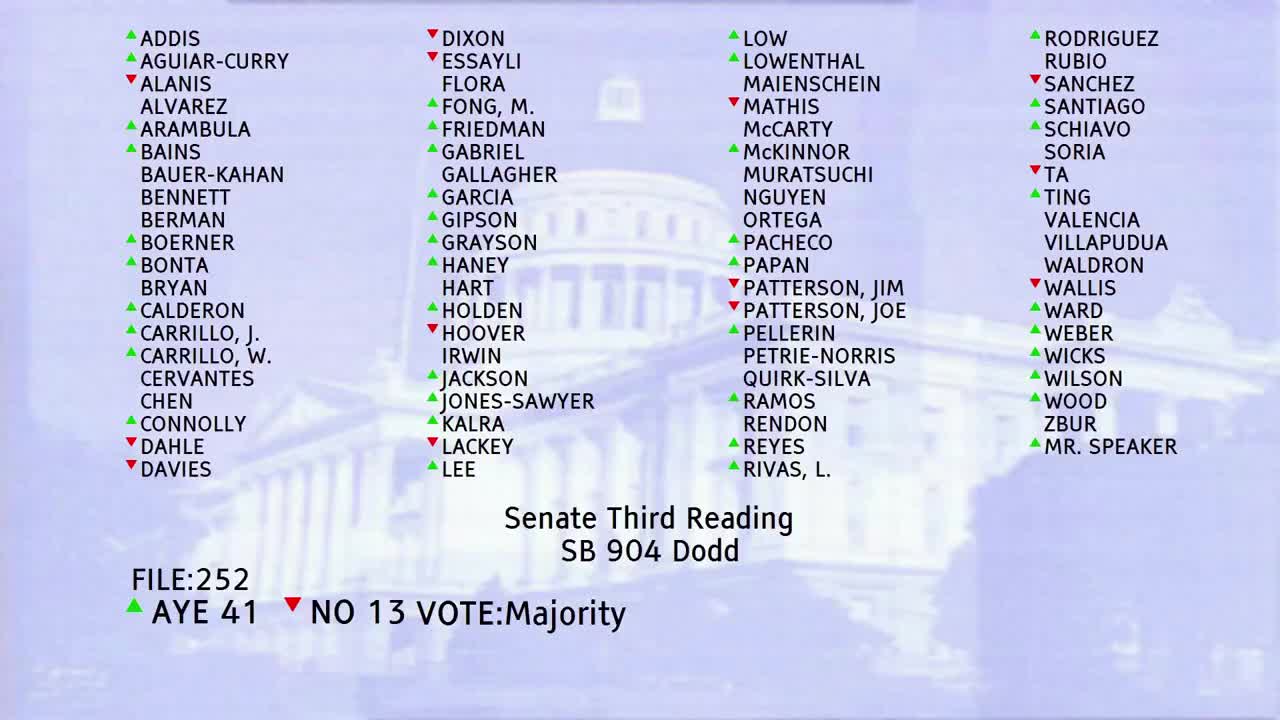 45SEC
Assembly Floor
 3MIN
Senate Floor
 11MIN
Senate Standing Committee on Business, Professions and Economic Development
 1MIN
Assembly Floor
 1MIN
Assembly Standing Committee on Appropriations
 3MIN
Assembly Standing Committee on Business and Professions
 1MIN
Assembly Standing Committee on Business and Professions
27SEC
Assembly Standing Committee on Business and Professions
Bill Author

Bill Co-Author(s):