AB 2048: Community colleges: systemic campus reforms: sexual harassment: report.
- Session Year: 2023-2024
- House: Assembly
- Latest Version Date: 2024-09-27
Current Status:
Passed
(2024-09-27: Chaptered by Secretary of State - Chapter 694, Statutes of 2024.)
Introduced
In Committee
First Chamber
In Committee
Second Chamber
Enacted
Existing law establishes the California Community Colleges, under the administration of the Board of Governors of the California Community Colleges, as one of the segments of public postsecondary education in this state. The board of governors appoints the Chancellor of the California Community Colleges to serve as the chief executive officer of the segment.
Existing federal law, known as Title IX, prohibits a person, on the basis of sex, from being excluded from participation in, being denied the benefits of, or being subject to discrimination, which includes sexual harassment, under any education program or activity receiving federal financial assistance.
Existing law prohibits a person from being subjected to discrimination on the basis of specified attributes, including, among others, disability or gender, in a program or activity conducted by a postsecondary educational institution that receives, or benefits from, state financial assistance or enrolls students who receive state student financial aid.
This bill would require the Chancellor of the California Community Colleges, on or before December 1, 2025, and in consultation with stakeholders, to submit a report to the Legislature with recommendations for establishing systemic campus reforms that effectively prevent, detect, and address sexual harassment on community college campuses, as provided.
Existing law establishes the California Community Colleges, under the administration of the Board of Governors of the California Community Colleges, as one of the segments of public postsecondary education in this state. The board of governors appoints the Chancellor of the California Community Colleges to serve as the chief executive officer of the segment.
Existing federal law, known as Title IX, prohibits a person, on the basis of sex, from being excluded from participation in, being denied the benefits of, or being subject to discrimination, which includes sexual harassment, under any education program or activity receiving federal financial assistance.
Existing law prohibits a person from being subjected to discrimination on the basis of specified attributes, including, among others, disability or gender, in a program or activity conducted by a postsecondary educational institution that receives, or benefits from, state financial assistance or enrolls students who receive state student financial aid.
This bill would require the Chancellor of the California Community Colleges to convene a community college sexual harassment and Title IX working group, to include, among others, at least 3 community college presidents or chief executive officers, 4 community college Title IX officers, including, but not limited to, the Vice President of Human Resources for Glendale Community College, and 4 community college general counsels, as specified. The bill would require the working group to, among other things, review the policies and procedures of a sampling of no less than 15 community college districts and determine if existing community college district policies and procedures regarding faculty-student and staff-student relationships and sexual harassment are adequate to prevent, detect, and address sexual harassment, and whether they are consistent with best practices, and review a sampling of no less than 18 community college district Title IX offices and determine, among other things, whether community college district Title IX offices are equipped with adequate staff to prevent, detect, and address sexual harassment on community college campuses. The bill would require the working group, on or before February 1, 2026, to submit a report to the Legislature containing its findings and policy recommendations, as specified. The bill would make these provisions inoperative as of July 1, 2026. By imposing new duties on community college districts, the bill would impose a state-mandated local program.This bill would make legislative findings and declarations as to the necessity of a special statute for Glendale Community College.The California Constitution requires the state to reimburse local agencies and school districts for certain costs mandated by the state. Statutory provisions establish procedures for making that reimbursement.This bill would provide that, if the Commission on State Mandates determines that the bill contains costs mandated by the state, reimbursement for those costs shall be made pursuant to the statutory provisions noted above.This bill would require the Chancellor of the California Community Colleges, on or before December 1, 2025, and in consultation with stakeholders, to submit a report to the Legislature with recommendations for establishing systemic campus reforms that effectively prevent, detect, and address sexual harassment on community college campuses, as provided.
Existing federal law establishes the California Community Colleges, under the administration of the Board of Governors of the California Community Colleges, as one of the segments of public postsecondary education in this state. The board of governors appoints the Chancellor of the California Community Colleges to serve as the chief executive officer of the segment.
Existing federal law, known as Title IX, prohibits a person, on the basis of sex, from being excluded from participation in, being denied the benefits of, or being subject to discrimination, which includes sexual harassment, under any education program or activity receiving federal financial assistance.
Existing law prohibits a person from being subjected to discrimination on the basis of specified attributes, including, among others, disability or gender, in a program or activity conducted by a postsecondary educational institution that receives, or benefits from, state financial assistance or enrolls students who receive state student financial aid.
This bill would require each California State University and University of California campus, and each community college district, to establish a Title IX office, as provided. The bill would require each Title IX office to be under the administration of a Title IX coordinator who would be responsible for coordinating the campus or districts implementation and compliance with systemwide nondiscrimination policies, as specified. The bill would require each Title IX office, among other things, to ensure timely and effective responses to reports and formal complaints of sex discrimination, and to process, adjudicate, and implement the outcomes of formal complaints of sex discrimination, as provided. the Chancellor of the California Community Colleges to convene a community college sexual harassment and Title IX working group, to include, among others, at least 3 community college presidents or chief executive officers, 4 community college Title IX officers, including, but not limited to, the Vice President of Human Resources for Glendale Community College, and 4 community college general counsels, as specified. The bill would require the working group to, among other things, review the policies and procedures of a sampling of no less than 15 community college districts and determine if existing community college district policies and procedures regarding faculty-student and staff-student relationships and sexual harassment are adequate to prevent, detect, and address sexual harassment, and whether they are consistent with best practices, and review a sampling of no less than 18 community college district Title IX offices and determine, among other things, whether community college district Title IX offices are equipped with adequate staff to prevent, detect, and address sexual harassment on community college campuses. The bill would require the working group, on or before February 1, 2026, to submit a report to the Legislature containing its findings and policy recommendations, as specified. The bill would make these provisions inoperative as of July 1, 2026. By imposing new duties on community college districts, the bill would impose a state-mandated local program.
This bill would make legislative findings and declarations as to the necessity of a special statute for Glendale Community College.
The California Constitution requires the state to reimburse local agencies and school districts for certain costs mandated by the state. Statutory provisions establish procedures for making that reimbursement.
This bill would provide that, if the Commission on State Mandates determines that the bill contains costs mandated by the state, reimbursement for those costs shall be made pursuant to the statutory provisions noted above.
Existing federal law, known as Title IX, prohibits a person, on the basis of sex, from being excluded from participation in, being denied the benefits of, or being subject to discrimination, which includes sexual harassment, under any education program or activity receiving federal financial assistance.
Existing law prohibits a person from being subjected to discrimination on the basis of specified attributes, including, among others, disability or gender, in a program or activity conducted by a postsecondary educational institution that receives, or benefits from, state financial assistance or enrolls students who receive state student financial aid.
This bill would require each California State University and University of California campus, and each community college district, to establish a Title IX office, as provided. The bill would require each Title IX office to be under the administration of a Title IX coordinator who would be responsible for coordinating the campus or districts implementation and compliance with systemwide nondiscrimination policies, as specified. The bill would require each Title IX office, among other things, to ensure timely and effective responses to reports and formal complaints of sex discrimination, and to process, adjudicate, and implement the outcomes of formal complaints of sex discrimination, as provided. By imposing new duties on community college districts, the bill would impose a state-mandated local program.
The California Constitution requires the state to reimburse local agencies and school districts for certain costs mandated by the state. Statutory provisions establish procedures for making that reimbursement.
This bill would provide that, if the Commission on State Mandates determines that the bill contains costs mandated by the state, reimbursement for those costs shall be made pursuant to the statutory provisions noted above.
Existing federal law, known as Title IX, prohibits a person, on the basis of sex, from being excluded from participation in, being denied the benefits of, or being subject to discrimination, which includes sexual harassment, under any education program or activity receiving federal financial assistance.
Existing law prohibits a person from being subjected to discrimination on the basis of specified attributes, including, among others, disability or gender, in a program or activity conducted by a postsecondary educational institution that receives, or benefits from, state financial assistance or enrolls students who receive state student financial aid.
This bill would state the intent of the Legislature to enact future legislation related to staffing Title IX and nondiscrimination offices at each campus of a postsecondary educational institution and the process those offices use to adjudicate complaints of discrimination. require each California State University and University of California campus, and each community college district, to establish a Title IX office, as provided. The bill would require each Title IX office to be under the administration of a Title IX coordinator who would be responsible for coordinating the campus implementation and compliance with systemwide nondiscrimination policies, as specified. The bill would require each Title IX office, among other things, to ensure timely and effective responses to complaints of sex discrimination, and to process, adjudicate, and implement the outcomes of complaints of sex discrimination, as provided. By imposing new duties on community college districts, the bill would impose a state-mandated local program.
The California Constitution requires the state to reimburse local agencies and school districts for certain costs mandated by the state. Statutory provisions establish procedures for making that reimbursement.
This bill would provide that, if the Commission on State Mandates determines that the bill contains costs mandated by the state, reimbursement for those costs shall be made pursuant to the statutory provisions noted above.
Existing federal law, known as Title IX, prohibits a person, on the basis of sex, from being excluded from participation in, being denied the benefits of, or being subject to discrimination, which includes sexual harassment, under any education program or activity receiving federal financial assistance.
Existing law prohibits a person from being subjected to discrimination on the basis of specified attributes, including, among others, disability or gender, in a program or activity conducted by a postsecondary educational institution that receives, or benefits from, state financial assistance or enrolls students who receive state student financial aid.
This bill would state the intent of the Legislature to enact future legislation related to staffing Title IX and nondiscrimination offices at each campus of a postsecondary educational institution and the process those offices use to adjudicate complaints of discrimination.
(a)On or before December 1, 2025, the Chancellor of the California Community Colleges shall, in consultation with stakeholders, submit a report to the Legislature with recommendations for establishing systemic campus reforms that effectively prevent, detect, and address sexual harassment on community college campuses. The report shall include recommendations for all of the following:
(1)Baseline standards for policies and procedures that detect, address, and prevent the reoccurrence of sexual harassment that are consistent with best practices.
(2)Methods for monitoring the effectiveness of, and adherence to, the policies and procedures described in paragraph (1) and methods for monitoring the compliance of each community college campus with state and federal laws and regulations pertaining to sexual harassment.
(3)Protocols for system and campus reporting on sexual harassment complaints that provide transparency on the number and outcomes of sexual harassment complaints to the public.
(4)The recruitment, hiring, and training of campus-based, district-based, and systemwide staff to adequately prevent, detect, and address sexual harassment on community college campuses.
(5)Support and resources at the state level that will enhance campus efforts to reform campus practices to prevent, detect, and address sexual harassment on community college campuses.
(b)(1)A report to be submitted pursuant to subdivision (a) shall be submitted in compliance with Section 9795 of the Government Code.
(2)Pursuant to Section 10231.5 of the Government Code, this section shall be repealed on January 1, 2027.
SECTION 1.Section 66281 is added to the Education Code, to read:66281.(a)(1)The Chancellor of the California Community Colleges shall convene a community college sexual harassment and Title IX working group. The working group shall include, but not be limited to, the following members:(A)The Chancellor of the California Community Colleges or the chancellors designee.(B)A Community College League of California representative.(C)At least three community college presidents or chief executive officers, including, but not limited to, a representative from a rural community college and a representative from a single campus community college district.(D)Four community college Title IX officers, including, but not limited to, the Vice President of Human Resources for Glendale Community College.(E)A representative from the Faculty Association of California Community Colleges.(F)A representative from the Student Senate for California Community Colleges.(G)A representative from the Academic Senate for California Community Colleges.(H)A representative from a personnel commission.(I)Four community college general counsels, including, but not limited to, a general counsel from a rural community college and a general counsel from a single campus community college district.(J)The Chair of the Assembly Committee on Higher Education or the chairs designee.(K)The Chair of the Senate Committee on Education or the chairs designee.(2)All appointments to the working group shall be completed on or before March 1, 2025.(b)The working group shall do all of the following:(1)(A)Review the policies and procedures of a sampling of no less than 15 community college districts and determine if existing community college district policies and procedures regarding faculty-student and staff-student relationships and sexual harassment are adequate to prevent, detect, and address sexual harassment, and whether they are consistent with best practices.(B)Review and determine if existing regulations in the California Code of Regulations regarding sexual harassment are adequate to prevent, detect, and address sexual harassment, and whether they are consistent with best practices.(C)Determine if the California Community Colleges should have community college district-based policies or a systemwide policy to adequately prevent, detect, and address sexual harassment in a manner that is in compliance with state and federal law and existing best practices.(2)Determine to what extent a systemwide model of compliance would best assist community colleges in their duty to prevent, detect, and address sexual harassment on campus.(3)Determine to what extent a regional model of compliance would best assist community colleges in their duty to prevent, detect, and address sexual harassment on campus.(4)Review a sampling of no less than 18 community college district Title IX offices and determine the following:(A)Whether community college district Title IX offices are equipped with adequate staff to prevent, detect, and address sexual harassment on community college campuses.(B)Whether community college district Title IX offices are fulfilling the obligation of the community college districts to prevent, detect, and address sexual harassment on community college campuses.(C)Whether community college district Title IX offices are the best model to prevent, detect, and address sexual harassment on community college campuses or if a campus-based model should be adopted.(D)The appropriate number of staff for each community college district to prevent, detect, and address sexual harassment on community college campuses.(5)Review and determine if the California Community Colleges Chancellors Office is effective in its duty to monitor community colleges for their compliance with state and federal laws pertaining to sexual harassment.(6)On or before February 1, 2026, submit a report to the Legislature, pursuant to Section 9795 of the Government Code, containing its findings and policy recommendations in connection with its activities pursuant to this subdivision.(c)This section shall become inoperative on July 1, 2026, and, as of January 1, 2027, is repealed.SEC. 2.The Legislature finds and declares that a special statute is necessary and that a general statute cannot be made applicable within the meaning of Section 16 of Article IV of the California Constitution because of the unique institutional expertise of Glendale Community College.SEC. 3.If the Commission on State Mandates determines that this act contains costs mandated by the state, reimbursement to local agencies and school districts for those costs shall be made pursuant to Part 7 (commencing with Section 17500) of Division 4 of Title 2 of the Government Code.(a)(1)The Chancellor of the California Community Colleges shall convene a community college sexual harassment and Title IX working group. The working group shall include, but not be limited to, the following members:
(A)The Chancellor of the California Community Colleges or the chancellors designee.
(B)A Community College League of California representative.
(C)At least three community college presidents or chief executive officers, including, but not limited to, a representative from a rural community college and a representative from a single campus community college district.
(D)Four community college Title IX officers, including, but not limited to, the Vice President of Human Resources for Glendale Community College.
(E)A representative from the Faculty Association of California Community Colleges.
(F)A representative from the Student Senate for California Community Colleges.
(G)A representative from the Academic Senate for California Community Colleges.
(H)A representative from a personnel commission.
(I)Four community college general counsels, including, but not limited to, a general counsel from a rural community college and a general counsel from a single campus community college district.
(J)The Chair of the Assembly Committee on Higher Education or the chairs designee.
(K)The Chair of the Senate Committee on Education or the chairs designee.
(2)All appointments to the working group shall be completed on or before March 1, 2025.
(b)The working group shall do all of the following:
(1)(A)Review the policies and procedures of a sampling of no less than 15 community college districts and determine if existing community college district policies and procedures regarding faculty-student and staff-student relationships and sexual harassment are adequate to prevent, detect, and address sexual harassment, and whether they are consistent with best practices.
(B)Review and determine if existing regulations in the California Code of Regulations regarding sexual harassment are adequate to prevent, detect, and address sexual harassment, and whether they are consistent with best practices.
(C)Determine if the California Community Colleges should have community college district-based policies or a systemwide policy to adequately prevent, detect, and address sexual harassment in a manner that is in compliance with state and federal law and existing best practices.
(2)Determine to what extent a systemwide model of compliance would best assist community colleges in their duty to prevent, detect, and address sexual harassment on campus.
(3)Determine to what extent a regional model of compliance would best assist community colleges in their duty to prevent, detect, and address sexual harassment on campus.
(4)Review a sampling of no less than 18 community college district Title IX offices and determine the following:
(A)Whether community college district Title IX offices are equipped with adequate staff to prevent, detect, and address sexual harassment on community college campuses.
(B)Whether community college district Title IX offices are fulfilling the obligation of the community college districts to prevent, detect, and address sexual harassment on community college campuses.
(C)Whether community college district Title IX offices are the best model to prevent, detect, and address sexual harassment on community college campuses or if a campus-based model should be adopted.
(D)The appropriate number of staff for each community college district to prevent, detect, and address sexual harassment on community college campuses.
(5)Review and determine if the California Community Colleges Chancellors Office is effective in its duty to monitor community colleges for their compliance with state and federal laws pertaining to sexual harassment.
(6)On or before February 1, 2026, submit a report to the Legislature, pursuant to Section 9795 of the Government Code, containing its findings and policy recommendations in connection with its activities pursuant to this subdivision.
(c)This section shall become inoperative on July 1, 2026, and, as of January 1, 2027, is repealed.
SEC. 2.The Legislature finds and declares that a special statute is necessary and that a general statute cannot be made applicable within the meaning of Section 16 of Article IV of the California Constitution because of the unique institutional expertise of Glendale Community College.
SEC. 3.If the Commission on State Mandates determines that this act contains costs mandated by the state, reimbursement to local agencies and school districts for those costs shall be made pursuant to Part 7 (commencing with Section 17500) of Division 4 of Title 2 of the Government Code.
SECTION 1.Section 66279 is added to the Education Code, to read:66279.(a)(1)Notwithstanding any other law, and in furtherance of complying with Section 66270, each campus of the California State University and the University of California shall establish, on or before July 1, 2026, a Title IX office in a private space for students and employees to disclose reports and formal complaints of sex discrimination, including, but not limited to, sexual harassment. The Title IX office shall be under the administration of a Title IX coordinator who shall be responsible for coordinating the campus implementation and compliance with the systemwide nondiscrimination policy established pursuant to Section 66280.(2)The Title IX office shall do all of the following:(A)Ensure timely and effective responses to reports and formal complaints of sex discrimination, including, but not limited to, sexual harassment.(B)Provide supportive measures to complainants, and, as applicable, respondents.(C)Process, adjudicate, and implement the outcomes of formal complaints of sex discrimination, including, but not limited to, sexual harassment, pursuant to the systemwide nondiscrimination policy established pursuant to Section 66280.(D)Maintain a case management system that includes all of the following information for each formal complaint of sex discrimination, including, but not limited to, sexual harassment:(i)The date of the formal complaint and the date, nature, and location of the incident or incidents.(ii)The name of the person who reported the formal complaint and the persons affiliation with the campus, or whether the formal complaint was reported anonymously.(iii)The name and title of the person who received the formal complaint.(iv)The name of the person alleged to have experienced sex discrimination, if other than the person who reported the formal complaint, and their affiliation with the campus.(v)The name of the respondent and the respondents affiliation with the campus.(vi)Any campus community context, including, but not limited to, the athletic team, student organization, or campus department or office where the incident or incidents occurred.(vii)Whether the formal complaint was received by the campus, along with a copy of the notice of allegations provided to the parties. If the campus dismissed the formal complaint, a copy of the written notice of dismissal provided to the parties with the reason for the dismissal.(viii)Whether the campus opened an investigation of the formal complaint and, if applicable, its reason for declining to investigate the formal complaint.(ix)The name of the person assigned to investigate the formal complaint, and the name of the person assigned to implement any supportive measures pursuant to subparagraph (B).(x)All supportive measures offered and implemented in response to the formal complaint pursuant to subparagraph (B).(xi)The names of all witnesses identified by either party, interview notes or summaries, if available, and, for any witnesses who were not interviewed, an explanation of why they were not interviewed.(xii)Once completed, the final investigative report for the formal complaint and any changes to the formal complaint requested by the complainant or respondent.(xiii)The outcome of the formal complaint, including, if applicable, the rulings from a hearing on the formal complaint and any disciplinary measures.(xiv)The action plan or remedies implemented by the Title IX coordinator and the campus, if applicable, to deter and prevent the reoccurrence of sex discrimination incidents.(E)Develop and implement a comprehensive prevention and outreach program on sex discrimination, including, but not limited to, sexual harassment. This program shall be updated annually to address sex discrimination incidents and prevent the reoccurrence of sex discrimination incidents. The program shall do all of the following:(i)Address a range of strategies to prevent sex discrimination, including, but not limited to, a victim empowerment program, a public awareness campaign, primary prevention, bystander intervention, and risk reduction.(ii)Provide to students, faculty, and staff information regarding the protocols for reporting formal complaints of sex discrimination, including the name, office location, and contact information of the Title IX coordinator, by both of the following means:(I)Emailing the information to each student, faculty member, and staff member at the beginning of each academic semester or other academic term.(II)Including the information as part of an on-campus orientation program pursuant to Section 67385.7.(iii)In response to patterns of occurrences of sex discrimination incidents, provide additional prevention training to student organization on campus, including, but not limited to, college-affiliated fraternity and sororities, athletic teams, and students who reside on campus.(F)Provide annual prevention trainings for students, faculty, and staff. The trainings provided by the Title IX office shall be the same as the systemwide prevention trainings provided in Section 66280.(b)The Title IX coordinator shall have the authority and responsibility to implement a consistent campuswide response to formal complaints of sex discrimination, including, but not limited to, sexual harassment. The Title IX coordinator shall have the experience, training, and expertise necessary to coordinate and carry out the systemwide nondiscrimination policy established pursuant to Section 66280. The Title IX coordinator shall operate with the authority, independence, and resources necessary to fulfill the duties of the Title IX office established pursuant to this section. The Title IX coordinator shall be a full time position, and shall be responsible for preventing and addressing sex discrimination, including, but not limited to, sexual harassment, on campus. The Title IX coordinator shall do both of the following:(1)Meet, on or before September 1, 2026, and at least once every three months thereafter, with the campus president or chancellor to provide a comprehensive report on the Title IX offices compliance with paragraph (2) of subdivision (a). This report shall include an action plan on how to address reports and formal complaints of sex discrimination, and on how the campus is fulfilling the obligation to provide educational programs free from sex discrimination. This report, once approved by the campus president or chancellor, shall be submitted to the systemwide Office of Civil Rights as part of the evaluation pursuant to paragraph (9) of subdivision (c) of Section 66280.(2)If an action plan is provided by the systemwide Office of Civil Rights as part of the evaluation pursuant to paragraph (9) of subdivision (c) of Section 66280, implement that action plan.(c)(1)On or before July 1, 2026, each campus shall recruit and hire qualified Title IX office personnel, including, but not limited to, the Title IX coordinator, a deputy Title IX coordinator, a Title IX case manager, a Title IX investigator, a Title IX prevention education coordinator, and an administrative assistant to serve as the team to process, adjudicate, and implement the outcomes of formal complaints of sex discrimination, including, but not limited to, sexual harassment. These Title IX office personnel shall have the experience, training, and expertise necessary to coordinate and carry out the requirements of the Title IX office established pursuant to this section.(2)Beginning with the 202627 academic year, the Title IX coordinator and the president or chancellor of the campus shall assess whether additional staffing or resources are needed by the Title IX office to fulfill the duties of the Title IX office established pursuant to this section. If additional staff or resources are needed, the Title IX coordinator andthe president or chancellor of the campus shall make that request to the appropriate entities for that request to be included in the annual systemwide budget request submitted to the Legislature.(d)Notwithstanding Section 67400, this section shall apply to the University of California.SEC. 2.Section 66279.5 is added to the Education Code, to read:66279.5.(a)Notwithstanding any other law, and in furtherance of complying with Section 66270, each community college district shall establish, on or before July 1, 2026, a Title IX office in a private space for students and employees to disclose reports and formal complaints of sex discrimination, including, but not limited to, sexual harassment. The Title IX office shall be under the administration of a Title IX coordinator who shall be responsible for coordinating the community college districts implementation and compliance with the systemwide nondiscrimination policy established pursuant to Section 66280.(b)The Title IX office established pursuant to subdivision (a) shall do all of the following:(1)Ensure timely and effective responses to reports and formal complaints of sex discrimination, including, but not limited to, sexual harassment.(2)Provide supportive measures to complainants and, as applicable, respondents.(3)Process, adjudicate, and implement the outcomes of formal complaints of sex discrimination, including, but not limited to, sexual harassment, pursuant to the systemwide nondiscrimination policy established pursuant to Section 66280.(4)Maintain a case management system that will capture and maintain all of the following information for each formal complaint of sex discrimination:(A)The date of the formal complaint and the date, nature, and location of the incident or incidents.(B)The name of the person who reported the formal complaint and the persons affiliation with the district, or whether the formal complaint was reported anonymously.(C)The name and title of the person who received the formal complaint.(D)The name of the person alleged to have experienced sex discrimination, if other than the person who reported the formal complaint, and their affiliation with the district.(E)The name of the respondent and the respondents affiliation with the district.(F)Any district community context, including, but not limited to, the campus where the incident or incidents occurred, and the athletic team, student organization, or campus department or office where the incident or incidents occurred.(G)Whether the formal complaint was received by the district, along with a copy of the notice of allegations provided to the parties. If the district dismissed the formal complaint, a copy of the written notice of dismissal provided to the parties with reason for the dismissal.(H)Whether the district opened an investigation and, if applicable, its reason for declining to investigate the formal complaint.(I)The name of the person assigned to investigate the formal complaint and the name of person assigned to implement any supportive measures pursuant to paragraph (2).(J)All supportive measures offered and implemented in response to the formal complaint pursuant to paragraph (2).(K)The names of all witnesses identified by either party, interview notes or summaries, if available, and, for any witnesses who were not interviewed, an explanation of why they were not interviewed.(L)Once completed, the final investigative report for the formal complaint and any changes to the formal complaint requested by the complainant or respondent.(M)The outcome of the formal complaint, including, if applicable, the rulings from a hearing on the formal complaint and any disciplinary measures.(N)The action plan or remedies implemented by the Title IX coordinator and the campus, if applicable, to deter and prevent the reoccurrence of sex discrimination incidents.(5)Develop and implement a comprehensive prevention and outreach program on sex discrimination, including, but not limited to, sexual harassment. The program shall be updated annually to address sex discrimination incidents and prevent the reoccurrence of sex discrimination incidents. The program shall do all of the following:(A)Address a range of strategies to prevent sex discrimination, including, but not limited to, a victim empowerment program, a public awareness campaign, primary prevention, bystander intervention, and risk reduction.(B)Provide to students, faculty, and staff information regarding the protocols for reporting formal complaints of sex discrimination, including the name, office location, and contact information of the Title IX coordinator, by both of the following means:(i)Emailing the information to each student, faculty member, and staff member at the beginning of each semester or other academic term.(ii)Including the information in an on-campus orientation program pursuant to Section 67385.7.(C)In response to patterns of occurrences of sex discrimination incidents, provide additional prevention training to student organizations on campuses within the district, including, but not limited to, college-affiliated fraternity and sororities, athletic teams, and students who reside on campus.(6)Provide annual prevention trainings for students, faculty, and staff. The trainings provided by the Title IX office shall be the same as the systemwide prevention trainings provided in Section 66280.(c)The Title IX coordinator has the authority and responsibility to implement a consistent districtwide response to reports of sex discrimination, including, but not limited to, sexual harassment. The Title IX coordinator shall have the experience, training, and expertise necessary to coordinate and carry out the systemwide nondiscrimination policy established pursuant to Section 66280. The Title IX coordinator shall operate with the authority, independence, and resources necessary to fulfill the duties of the Title IX office established pursuant to this section. The Title IX coordinator shall be a full time position, and shall be responsible for preventing and addressing sex discrimination, including, but not limited to, sexual harassment, on community college campuses located within the community college district. The Title IX coordinator shall do both of the following:(1)Meet, on or before September 1, 2026, and at least once every three months thereafter, with the chief executive officer of the community college district to provide a comprehensive report on the Title IX offices compliance with subdivision (b). This report shall include an action plan on how to address reports and formal complaints of sex discrimination, and on how the district is fulfilling the obligation to provide educational programs free from sex discrimination. This report, once approved by chancellor of the community college district, shall be submitted to the systemwide Office of Civil Rights as part of the evaluation pursuant to paragraph (9) of subdivision (c) of Section 66280.(2)If an action plan is provided by the systemwide Office of Civil Rights as part of the evaluation pursuant to paragraph (9) of subdivision (c) of Section 66280, implement that action plan.(d)(1)On or before July 1, 2026, each community college district shall recruit and hire qualified Title IX office personnel, including, but not limited to, the Title IX coordinator, a Title IX case manager, a Title IX investigator, a Title IX prevention education coordinator, and an administrative assistant to serve as the team to process, adjudicate, and implement the outcomes of formal complaints of sex discrimination, including, but not limited to, sexual harassment. The Title IX office personnel shall have the experience, training, and expertise necessary to coordinate and carry out the requirements of the Title IX office established pursuant to this section.(2)Beginning with the 202627 academic year, the Title IX coordinator and the chancellor of the community college district shall assess whether additional staffing or resources are needed by the Title IX office to fulfill the duties of the Title IX office established pursuant to this section. If additional staff or resources are needed, the community college district shall include a written request for the additional staff or resources in the annual systemwide budget request submitted to the Legislature.(e)On or before July 1, 2027, each community college shall establish the on-campus position of a deputy Title IX coordinator. The deputy Title IX coordinator shall serve as the campus-based point of contact for students, faculty, and staff to report a formal complaint of sex discrimination, including, but not limited to, sexual harassment. The deputy Title IX coordinator shall act as a broker between the community college and the community college districts Title IX office, and shall assist the community college districts Title IX office in preventing and addressing sex discrimination, including, but not limited to, sexual harassment, on the campus of the community college.SEC. 3.If the Commission on State Mandates determines that this act contains costs mandated by the state, reimbursement to local agencies and school districts for those costs shall be made pursuant to Part 7 (commencing with Section 17500) of Division 4 of Title 2 of the Government Code.(a)(1)Notwithstanding any other law, and in furtherance of complying with Section 66270, each campus of the California State University and the University of California shall establish, on or before July 1, 2026, a Title IX office in a private space for students and employees to disclose reports and formal complaints of sex discrimination, including, but not limited to, sexual harassment. The Title IX office shall be under the administration of a Title IX coordinator who shall be responsible for coordinating the campus implementation and compliance with the systemwide nondiscrimination policies policy established pursuant to Section 66280.
(2)The Title IX office shall do all of the following:
(A)Ensure timely and effective responses to reports and formal complaints of sex discrimination, including, but not limited to, sexual harassment.
(B)Provide or assist confidential advocates pursuant to Section 66281.9 in providing supportive measures to complainants, and, as applicable, respondents.
(C)Process, adjudicate, and implement the outcomes of formal complaints of sex discrimination, including, but not limited to, sexual harassment, pursuant to the systemwide nondiscrimination policies policy established pursuant to Section 66280.
(D)Maintain a case management system that includes all of the following information for each formal complaint of sex discrimination, including, but not limited to, sexual harassment:
(i)The date of the formal complaint and the date, nature, and location of the incident or incidents.
(ii)The name of the person who reported the formal complaint and the persons affiliation with the campus, or whether the formal complaint was reported anonymously.
(iii)The name and title of the person who received the formal complaint.
(iv)The name of the person alleged to have experienced sex discrimination, if other than the person who reported the formal complaint, and their affiliation with the campus.
(v)The name of the respondent and the respondents affiliation with the campus.
(vi)Any campus community context, including, but not limited to, the athletic team, student organization, or campus department or office where the incident or incidents occurred.
(vii)Whether a the formal complaint was received by the campus, along with a copy of the notice of allegations provided to the parties. If the campus dismissed the formal complaint, a copy of the written notice of dismissal provided to the parties with the reason for the dismissal.
(viii)Whether the campus opened an investigation of the formal complaint and, if applicable, its reason for declining to investigate the formal complaint.
(ix)The name of the person assigned to investigate the formal complaint, and the name of the person assigned to implement any supportive measures pursuant to subparagraph (B).
(x)All supportive measures offered and implemented in response to the formal complaint pursuant to subparagraph (B).
(xi)The names of all witnesses identified by either party, interview notes or summaries, if available, and, for any witnesses who were not interviewed, an explanation of why they were not interviewed.
(xii)Once completed, the final investigative report for the formal complaint and any changes to the formal complaint requested by the complainant or respondent.
(xiii)The outcome of the formal complaint, including, if applicable, the rulings from a hearing on the formal complaint and any disciplinary measures.
(xiv)The action plan or remedies implemented by the Title IX coordinator and the campus, if applicable, to deter and prevent the reoccurrence of sex discrimination incidents.
(E)Develop and implement a comprehensive prevention and outreach program on sex discrimination, including, but not limited to, sexual harassment. This program shall be updated annually to address sex discrimination incidents and prevent the reoccurrence of sex discrimination incidents. The program shall do all of the following:
(i)Address a range of strategies to prevent sex discrimination, including, but not limited to, a victim empowerment program, a public awareness campaign, primary prevention, bystander intervention, and risk reduction.
(ii)Provide to students, faculty, and staff information regarding the protocols for reporting formal complaints of sex discrimination, including the name, office location, and contact information of the Title IX coordinator, by both of the following means:
(I)Emailing the information to each student, faculty member, and staff member at the beginning of each academic semester or other academic term.
(II)Including the information as part of an on-campus orientation program pursuant to Section 67385.7.
(F)Provide training to students, faculty, and staff in accordance with the systemwide nondiscrimination policy established pursuant to Section 66280.(iii)In response to patterns of occurrences of sex discrimination incidents, provide additional prevention training to student organization on campus, including, but not limited to, college-affiliated fraternity and sororities, athletic teams, and students who reside on campus.
(F)Provide annual prevention trainings for students, faculty, and staff. The trainings provided by the Title IX office shall be the same as the systemwide prevention trainings provided in Section 66280.
(b)The Title IX coordinator shall have the authority and responsibility to implement a consistent campuswide response to formal complaints of sex discrimination, including, but not limited to, sexual harassment. The Title IX coordinator shall have the experience, training, and expertise necessary to coordinate and carry out the systemwide nondiscrimination policy established pursuant to Section 66280. The Title IX coordinator shall operate with the authority, independence, and resources necessary to fulfill the duties of the Title IX office established pursuant to this section. The Title IX coordinator shall be a full time position, and shall be responsible for preventing and addressing sex discrimination, including, but not limited to, sexual harassment, on campus. The Title IX coordinator shall do both of the following:
(1)Meet, on or before September 1, 2026, and at least once every three months thereafter, with the campus president or chancellor to report on the activities of the Title IX office pursuant to this section for the purpose of preventing and addressing sex discrimination, including, but not limited to, sexual harassment, on campus. provide a comprehensive report on the Title IX offices compliance with paragraph (2) of subdivision (a). This report shall include an action plan on how to address reports and formal complaints of sex discrimination, and on how the campus is fulfilling the obligation to provide educational programs free from sex discrimination. This report, once approved by the campus president or chancellor, shall be submitted to the systemwide Office of Civil Rights as part of the evaluation pursuant to paragraph (9) of subdivision (c) of Section 66280.
(2)Meet, on or before September 1, 2026, and at least once every three months thereafter, with the systemwide Title IX coordinator established pursuant to Section 66280 to report on the activities of the Title IX office pursuant to this section for the purpose of preventing and addressing sex discrimination on campus.(2)If an action plan is provided by the systemwide Office of Civil Rights as part of the evaluation pursuant to paragraph (9) of subdivision (c) of Section 66280, implement that action plan.
(c)(1)On or before July 1, 2026, each campus shall recruit and hire qualified Title IX office personnel, including, but not limited to, the Title IX coordinator, a deputy Title IX coordinator, a Title IX case manager, a Title IX investigator, a Title IX prevention education coordinator, and an administrative assistant to serve as the team to process, adjudicate, and implement the outcomes of formal complaints of sex discrimination, including, but not limited to, sexual harassment. These Title IX office personnel shall have the experience, training, and expertise necessary to coordinate and carry out the requirements of the Title IX office established pursuant to this section.
(2)Beginning with the 202627 academic year, the Title IX coordinator and the president or chancellor of the campus shall assess whether additional staffing or resources are needed by the Title IX office to fulfill the duties of the Title IX office established pursuant to this section. If additional staff or resources are needed, the Title IX coordinator andthe president or chancellor of the campus shall include a written request for the additional staff and resources make that request to the appropriate entities for that request to be included in the annual systemwide budget request submitted to the Legislature.
(d)Notwithstanding Section 67400, this section shall apply to the University of California.
SEC. 2.Section 66279.5 is added to the Education Code, to read:66279.5.(a)Notwithstanding any other law, and in furtherance of complying with Section 66270, each community college district shall establish, on or before July 1, 2026, a Title IX office in a private space for students and employees to disclose reports and formal complaints of sex discrimination, including, but not limited to, sexual harassment. The Title IX office shall be under the administration of a Title IX coordinator who shall be responsible for coordinating the community college districts implementation and compliance with the systemwide nondiscrimination policies policy established pursuant to Section 66280.
(b)The Title IX office established pursuant to subdivision (a) shall do all of the following:
(1)Ensure timely and effective responses to reports and formal complaints of sex discrimination, including, but not limited to, sexual harassment.
(2)Provide or assist confidential advocates pursuant to Section 66281.9 in providing supportive measures to complainants and, as applicable, respondents.
(3)Process, adjudicate, and implement the outcomes of formal complaints of sex discrimination, including, but not limited to, sexual harassment, pursuant to the systemwide nondiscrimination policies policy established pursuant to Section 66280.
(4)Maintain a case management system that will capture and maintain all of the following information for each formal complaint of sex discrimination:
(A)The date of the formal complaint and the date, nature, and location of the incident or incidents.
(B)The name of the person who reported the formal complaint and the persons affiliation with the campus, district, or whether the formal complaint was reported anonymously.
(C)The name and title of the person who received the formal complaint.
(D)The name of the person alleged to have experienced sex discrimination, if other than the person who reported the formal complaint, and their affiliation with the campus. district.
(E)The name of the respondent and the respondents affiliation with the campus. district.
(F)Any campus district community context, including, but not limited to, the campus where the incident or incidents occurred, and the athletic team, student organization, or campus department or office where the incident or incidents occurred.
(G)Whether a the formal complaint was received by the campus, district, along with a copy of the notice of allegations provided to the parties. If the campus district dismissed the formal complaint, a copy of the written notice of dismissal provided to the parties with reason for the dismissal.
(H)Whether the campus district opened an investigation and, if applicable, its reason for declining to investigate the formal complaint.
(I)The name of the person assigned to investigate the formal complaint and the name of person assigned to implement any supportive measures pursuant to paragraph (2).
(J)All supportive measures offered and implemented in response to the formal complaint pursuant to paragraph (2).
(K)The names of all witnesses identified by either party, interview notes or summaries, if available, and, for any witnesses who were not interviewed, an explanation of why they were not interviewed.
(L)Once completed, the final investigative report for the formal complaint and any changes to the formal complaint requested by the complainant or respondent.
(M)The outcome of the formal complaint, including, if applicable, the rulings from a hearing on the formal complaint and any disciplinary measures.
(N)The action plan or remedies implemented by the Title IX coordinator and the campus, if applicable, to deter and prevent the reoccurrence of sex discrimination incidents.
(5)Develop and implement a comprehensive prevention and outreach program on sex discrimination, including, but not limited to, sexual harassment. The program shall be updated annually to address sex discrimination incidents and prevent the reoccurrence of sex discrimination incidents. The program shall do all of the following:
(A)Address a range of strategies to prevent sex discrimination, including, but not limited to, a victim empowerment program, a public awareness campaign, primary prevention, bystander intervention, and risk reduction.
(B)Provide to students, faculty, and staff information regarding the protocols for reporting formal complaints of sex discrimination, including the name, office location, and contact information of the Title IX coordinator, by both of the following means:
(i)Emailing the information to each student, faculty member, and staff member at the beginning of each semester or other academic term.
(ii)Including the information in an on-campus orientation program pursuant to Section 67385.7.
(C)In response to patterns of occurrences of sex discrimination incidents, provide additional prevention training to student organizations on campuses within the district, including, but not limited to, college-affiliated fraternity and sororities, athletic teams, and students who reside on campus.
(6)Provide training to students, faculty, and staff in accordance with the systemwide nondiscrimination policies established pursuant to Section 66280.(6)Provide annual prevention trainings for students, faculty, and staff. The trainings provided by the Title IX office shall be the same as the systemwide prevention trainings provided in Section 66280.
(c)The Title IX coordinator has the authority and responsibility to implement a consistent campuswide districtwide response to reports of sex discrimination, including, but not limited to, sexual harassment. The Title IX coordinator shall have the experience, training, and expertise necessary to coordinate and carry out the systemwide nondiscrimination policy established pursuant to Section 66280. The Title IX coordinator shall operate with the authority, independence, and resources necessary to fulfill the duties of the Title IX office established pursuant to this section. The Title IX coordinator shall be a full time position, and shall be responsible for preventing and addressing sex discrimination, including, but not limited to, sexual harassment, on community college campuses located within the community college district. The Title IX coordinator shall do both of the following:
(1)Meet, on or before September 1, 2026, and at least once every three months thereafter, with each campuss the chief executive officer of the community college district to provide an evaluation of the Title IX offices activities pursuant to this section in preventing and addressing sex discrimination, including, but not limited to, sexual harassment, on the campus of the community college. a comprehensive report on the Title IX offices compliance with subdivision (b). This report shall include an action plan on how to address reports and formal complaints of sex discrimination, and on how the district is fulfilling the obligation to provide educational programs free from sex discrimination. This report, once approved by chancellor of the community college district, shall be submitted to the systemwide Office of Civil Rights as part of the evaluation pursuant to paragraph (9) of subdivision (c) of Section 66280.
(2)Meet, on or before September 1, 2026, and at least once every three months thereafter, with the California Community Colleges systemwide Title IX coordinator established pursuant to Section 66280 to provide an evaluation of the Title IX offices activities pursuant to this section in preventing and addressing sex discrimination for each community college campus maintained by the community college district.(2)If an action plan is provided by the systemwide Office of Civil Rights as part of the evaluation pursuant to paragraph (9) of subdivision (c) of Section 66280, implement that action plan.
(d)(1)On or before July 1, 2026, each community college district shall recruit and hire qualified Title IX office personnel, including, but not limited to, the Title IX coordinator, a Title IX case manager, a Title IX investigator, a Title IX prevention education coordinator, and an administrative assistant to serve as the team to process, adjudicate, and implement the outcomes of formal complaints of sex discrimination, including, but not limited to, sexual harassment. The Title IX office personnel shall have the experience, training, and expertise necessary to coordinate and carry out the requirements of the Title IX office established pursuant to this section.
(2)Beginning with the 202627 academic year, the Title IX coordinator and the chief executive officer of each community college maintained by chancellor of the community college district shall assess whether additional staffing or resources are needed by the Title IX office to fulfill the duties of the Title IX office established pursuant to this section. If additional staff or resources are needed, the community college district shall include a written request for the additional staff or resources in the annual systemwide budget request submitted to the Legislature.
(e)On or before July 1, 2027, each community college shall establish the on-campus position of a deputy Title IX coordinator. The deputy Title IX coordinator shall serve as the campus-based point of contact for students, faculty, and staff to report a formal complaint of sex discrimination, including, but not limited to, sexual harassment. The deputy Title IX coordinator shall act as a broker between the community college and the community college districts Title IX office, and shall assist the community college districts Title IX office in preventing and addressing sex discrimination, including, but not limited to, sexual harassment, on the campus of the community college.
SEC. 3.If the Commission on State Mandates determines that this act contains costs mandated by the state, reimbursement to local agencies and school districts for those costs shall be made pursuant to Part 7 (commencing with Section 17500) of Division 4 of Title 2 of the Government Code.
(a)(1)Notwithstanding any other law, and in furtherance of complying with Section 66270, each campus of the California State University and the University of California shall establish, on or before July 1, 2026, a Title IX office in a private space for students and employees to disclose complaints of sex discrimination, including, but not limited to, sexual harassment. The Title IX office shall be under the administration of a Title IX coordinator who shall be responsible for coordinating the campus implementation and compliance with the systemwide nondiscrimination policies established pursuant to Section 66280.
(2)The Title IX office shall do all of the following:
(A)Ensure timely and effective responses to complaints of sex discrimination, including, but not limited to, sexual harassment.
(B)Provide or assist confidential advocates pursuant to Section 66281.9 in providing supportive measures to complainants, and, as applicable, respondents.
(C)Process, adjudicate, and implement the outcomes of complaints of sex discrimination, including, but not limited to, sexual harassment, pursuant to the systemwide nondiscrimination policies established pursuant to Section 66280.
(D)Maintain a case management system that includes all of the following information for each complaint of sex discrimination, including, but not limited to, sexual harassment:
(i)The date of the complaint and the date, nature, and location of the incident or incidents.
(ii)The name of the person who reported the complaint and the persons affiliation with the campus, or whether the complaint was reported anonymously.
(iii)The name and title of the person who received the complaint.
(iv)The name of the person alleged to have experienced sex discrimination, if other than the person who reported the complaint, and their affiliation with the campus.
(v)The name of the respondent and the respondents affiliation with the campus.
(vi)Any campus community context, including, but not limited to, the athletic team, student organization, or campus department or office where the incident or incidents occurred.
(vii)Whether a formal complaint was received by the campus, along with a copy of the notice of allegations provided to the parties. If the campus dismissed the formal complaint, a copy of the written notice of dismissal provided to the parties with the reason for the dismissal.
(viii)Whether the campus opened an investigation of the complaint and, if applicable, its reason for declining to investigate the complaint.
(ix)The name of the person assigned to investigate the complaint, and the name of the person assigned to implement any supportive measures pursuant to subparagraph (B).
(x)All supportive measures offered and implemented in response to the complaint pursuant to subparagraph (B).
(xi)The names of all witnesses identified by either party, interview notes or summaries, if available, and, for any witnesses who were not interviewed, an explanation of why they were not interviewed.
(E)Develop and implement a comprehensive prevention and outreach program on sex discrimination, including, but not limited to, sexual harassment. This program shall do all of the following:
(i)Address a range of strategies to prevent sex discrimination, including, but not limited to, a victim empowerment program, a public awareness campaign, primary prevention, bystander intervention, and risk reduction.
(ii)Provide to students, faculty, and staff information regarding the protocols for reporting complaints of sex discrimination, including the name, office location, and contact information of the Title IX coordinator, by both of the following means:
(I)Emailing the information to each student, faculty member, and staff member at the beginning of each academic semester or other academic term.
(II)Including the information as part of an on-campus orientation program pursuant to Section 67385.7.
(F)Provide training to students, faculty, and staff in accordance with the systemwide nondiscrimination policy established pursuant to Section 66280.
(b)The Title IX coordinator shall have the authority and responsibility to implement a consistent campuswide response to complaints of sex discrimination, including, but not limited to, sexual harassment. The Title IX coordinator shall have the experience, training, and expertise necessary to coordinate and carry out the systemwide nondiscrimination policy established pursuant to Section 66280. The Title IX coordinator shall operate with the authority, independence, and resources necessary to fulfill the duties of the Title IX office established pursuant to this section. The Title IX coordinator shall do both of the following:
(1)Meet, on or before September 1, 2026, and at least once every three months thereafter, with the campus president or chancellor to report on the activities of the Title IX office pursuant to this section for the purpose of preventing and addressing sex discrimination, including, but not limited to, sexual harassment, on campus.
(2)Meet, on or before September 1, 2026, and at least once every three months thereafter, with the systemwide Title IX coordinator established pursuant to Section 66280 to report on the activities of the Title IX office pursuant to this section for the purpose of preventing and addressing sex discrimination on campus.
(c)(1)On or before July 1, 2026, each campus shall recruit and hire qualified Title IX office personnel, including, but not limited to, the Title IX coordinator, a deputy Title IX coordinator, a Title IX case manager, a Title IX investigator, a Title IX prevention education coordinator, and an administrative assistant to serve as the team to process, adjudicate, and implement the outcomes of complaints of sex discrimination, including, but not limited to, sexual harassment. These Title IX office personnel shall have the experience, training, and expertise necessary to coordinate and carry out the requirements of the Title IX office established pursuant to this section.
(2)Beginning with the 202627 academic year, the Title IX coordinator and the president or chancellor of the campus shall assess whether additional staffing or resources are needed by the Title IX office to fulfill the duties of the Title IX office established pursuant to this section. If additional staff or resources are needed, the president or chancellor of the campus shall include a written request for the additional staff and resources in the annual systemwide budget request submitted to the Legislature.
(d)Notwithstanding Section 67400, this section shall apply to the University of California.
SEC. 2.Section 66279.5 is added to the Education Code, to read:66279.5.(a)Notwithstanding any other law, and in furtherance of complying with Section 66270, each community college district shall establish, on or before July 1, 2026, a Title IX office in a private space for students and employees to disclose complaints of sex discrimination, including, but not limited to, sexual harassment. The Title IX office shall be under the administration of a Title IX coordinator who shall be responsible for coordinating the community college districts implementation and compliance with the systemwide nondiscrimination policies established pursuant to Section 66280.
(b)The Title IX office established pursuant to subdivision (a) shall do all of the following:
(1)Ensure timely and effective responses to reports of sex discrimination, including, but not limited to, sexual harassment.
(2)Provide or assist confidential advocates pursuant to Section 66281.9 in providing supportive measures to complainants and, as applicable, respondents.
(3)Process, adjudicate, and implement the outcomes of complaints of sex discrimination, including, but not limited to, sexual harassment, pursuant to the systemwide nondiscrimination policies established pursuant to Section 66280.
(4)Maintain a case management system that will capture and maintain all of the following information for each complaint of sex discrimination:
(A)The date of the complaint and the date, nature, and location of the incident or incidents.
(B)The name of the person who reported the complaint and the persons affiliation with the campus, or whether the complaint was reported anonymously.
(C)The name and title of the person who received the complaint.
(D)The name of the person alleged to have experienced sex discrimination, if other than the person who reported the complaint, and their affiliation with the campus.
(E)The name of the respondent and the respondents affiliation with the campus.
(F)Any campus community context, including, but not limited to, the athletic team, student organization, or campus department or office where the incident or incidents occurred.
(G)Whether a formal complaint was received by the campus, along with a copy of the notice of allegations provided to the parties. If the campus dismissed the formal complaint, a copy of the written notice of dismissal provided to the parties with reason for the dismissal.
(H)Whether the campus opened an investigation and, if applicable, its reason for declining to investigate the complaint.
(I)The name of the person assigned to investigate the complaint and the name of person assigned to implement any supportive measures pursuant to paragraph (2).
(J)All supportive measures offered and implemented in response to the complaint pursuant to paragraph (2).
(K)The names of all witnesses identified by either party, interview notes or summaries, if available, and, for any witnesses who were not interviewed, an explanation of why they were not interviewed.
(5)Develop and implement a comprehensive prevention and outreach program on sex discrimination, including, but not limited to, sexual harassment. The program shall do all of the following:
(A)Address a range of strategies to prevent sex discrimination, including, but not limited to, a victim empowerment program, a public awareness campaign, primary prevention, bystander intervention, and risk reduction.
(B)Provide to students, faculty, and staff information regarding the protocols for reporting complaints of sex discrimination, including the name, office location, and contact information of the Title IX coordinator, by both of the following means:
(i)Emailing the information to each student, faculty member, and staff member at the beginning of each semester or other academic term.
(ii)Including the information in an on-campus orientation program pursuant to 67385.7.
(6)Provide training to students, faculty, and staff in accordance with the systemwide nondiscrimination policies established pursuant to Section 66280.
(c)The Title IX coordinator has the authority and responsibility to implement a consistent campuswide response to reports of sex discrimination, including, but not limited to, sexual harassment. The Title IX coordinator shall have the experience, training, and expertise necessary to coordinate and carry out the systemwide nondiscrimination policy established pursuant to Section 66280. The Title IX coordinator shall operate with the authority, independence, and resources necessary to fulfill the duties of the Title IX office established pursuant to this section. The Title IX coordinator shall do both of the following:
(1)Meet, on or before September 1, 2026, and at least once every three months thereafter, with each campuss chief executive officer to provide an evaluation of the Title IX offices activities pursuant to this section in preventing and addressing sex discrimination, including, but not limited to, sexual harassment, on the campus of the community college.
(2)Meet, on or before September 1, 2026, and at least once every three months thereafter, with the California Community Colleges systemwide Title IX coordinator established pursuant to Section 66280 to provide an evaluation of the Title IX offices activities pursuant to this section in preventing and addressing sex discrimination for each community college campus maintained by the community college district.
(d)(1)On or before July 1, 2026, each community college district shall recruit and hire qualified Title IX office personnel, including, but not limited to, the Title IX coordinator, a Title IX case manager, a Title IX investigator, a Title IX prevention education coordinator, and an administrative assistant to serve as the team to process, adjudicate, and implement the outcomes of complaints of sex discrimination, including, but not limited to, sexual harassment. The Title IX office personnel shall have the experience, training, and expertise necessary to coordinate and carry out the requirements of the Title IX office established pursuant to this section.
(2)Beginning with the 202627 academic year, the Title IX coordinator and the chief executive officer of each community college maintained by the community college district shall assess whether additional staffing or resources are needed by the Title IX office to fulfill the duties of the Title IX office established pursuant to this section. If additional staff or resources are needed, the community college district shall include a written request for the additional staff or resources in the annual systemwide budget request submitted to the Legislature.
(e)On or before July 1, 2027, each community college shall establish the on-campus position of a deputy Title IX coordinator. The deputy Title IX coordinator shall serve as the campus-based point of contact for students, faculty, and staff to report a complaint of sex discrimination, including, but not limited to, sexual harassment. The deputy Title IX coordinator shall act as a broker between the community college and the community college districts Title IX office, and shall assist the community college districts Title IX office in preventing and addressing sex discrimination, including, but not limited to, sexual harassment, on the campus of the community college.
SEC. 3.If the Commission on State Mandates determines that this act contains costs mandated by the state, reimbursement to local agencies and school districts for those costs shall be made pursuant to Part 7 (commencing with Section 17500) of Division 4 of Title 2 of the Government Code.
SECTION 1.It is the intent of the Legislature to enact future legislation related to staffing Title IX and nondiscrimination offices at each campus of a postsecondary educational institution and the process those offices use to adjudicate complaints of discrimination.It is the intent of the Legislature to enact future legislation related to staffing Title IX and nondiscrimination offices at each campus of a postsecondary educational institution and the process those offices use to adjudicate complaints of discrimination.
|
Date
|
Status
|
|---|---|
| Sep 27, 2024 | Chaptered by Secretary of State - Chapter 694, Statutes of 2024. |
| Sep 27, 2024 | Approved by the Governor. |
| Sep 10, 2024 | Enrolled and presented to the Governor at 4:30 p.m. |
| Aug 28, 2024 | Senate amendments concurred in. To Engrossing and Enrolling. (Ayes 76. Noes 0.). |
| Aug 28, 2024 | In Assembly. Concurrence in Senate amendments pending. May be considered on or after August 30 pursuant to Assembly Rule 77. |
| Aug 28, 2024 | Assembly Rule 77 suspended. |
| Aug 27, 2024 | Read third time. Passed. Ordered to the Assembly. (Ayes 38. Noes 0.). |
| Aug 19, 2024 | Read second time. Ordered to third reading. |
| Aug 15, 2024 | Read second time and amended. Ordered returned to second reading. |
| Aug 15, 2024 | From committee: Amend, and do pass as amended. (Ayes 7. Noes 0.) (August 15). |
| Aug 5, 2024 | In committee: Referred to APPR suspense file. |
| Jun 26, 2024 | From committee: Do pass and re-refer to Com. on APPR. (Ayes 11. Noes 0.) (June 25). Re-referred to Com. on APPR. |
| Jun 19, 2024 | From committee: Do pass and re-refer to Com. on JUD. with recommendation: To Consent Calendar. (Ayes 7. Noes 0.) (June 19). Re-referred to Com. on JUD. |
| Jun 5, 2024 | Referred to Coms. on ED. and JUD. |
| May 23, 2024 | In Senate. Read first time. To Com. on RLS. for assignment. |
| May 22, 2024 | Read third time. Passed. Ordered to the Senate. (Ayes 69. Noes 0. Page 5563.) |
| May 20, 2024 | Read second time. Ordered to third reading. |
| May 16, 2024 | Read second time and amended. Ordered returned to second reading. |
| May 16, 2024 | From committee: Amend, and do pass as amended. (Ayes 11. Noes 0.) (May 16). |
| May 16, 2024 | Assembly Rule 63 suspended. |
| May 8, 2024 | In committee: Set, first hearing. Referred to APPR. suspense file. |
| Apr 22, 2024 | Re-referred to Com. on APPR. |
| Apr 18, 2024 | Read second time and amended. |
| Apr 17, 2024 | From committee: Amend, and do pass as amended and re-refer to Com. on APPR. (Ayes 11. Noes 0.) (April 16). |
| Mar 20, 2024 | Re-referred to Com. on HIGHER ED. |
| Mar 19, 2024 | From committee chair, with author's amendments: Amend, and re-refer to Com. on HIGHER ED. Read second time and amended. |
| Mar 18, 2024 | Referred to Coms. on HIGHER ED. and JUD. |
| Feb 2, 2024 | From printer. May be heard in committee March 3. |
| Feb 1, 2024 | Read first time. To print. |
|
Date
|
Description
|
Location
|
Votes
|
|
|---|---|---|---|---|
| Aug 28, 2024 | AB 2048 Mike Fong Concurrence in Senate Amendments | Assembly Floor |
Passed |
|
| Aug 27, 2024 | Assembly 3rd Reading AB2048 Mike Fong By Dodd | Senate Floor |
Passed |
|
| Aug 15, 2024 | Do pass as amended | Senate Standing Committee on Appropriations |
Passed |
|
| Aug 5, 2024 | Placed on suspense file | Senate Standing Committee on Appropriations |
Passed |
|
| Jun 25, 2024 | Do pass, but first be re-referred to the Committee on [Appropriations] | Senate Standing Committee on Judiciary |
Passed |
|
| Jun 19, 2024 | Do pass, but first be re-referred to the Committee on [Judiciary] with the recommendation: To Consent Calendar | Senate Standing Committee on Education |
Passed |
|
| May 22, 2024 | AB 2048 Mike Fong Assembly Third Reading | Assembly Floor |
Passed |
|
| May 16, 2024 | Do pass as amended. | Assembly Standing Committee on Appropriations |
Passed |
|
| Apr 16, 2024 | Do pass as amended and be re-referred to the Committee on [Appropriations] | Assembly Standing Committee on Higher Education |
Passed |
This list shows positions taken on this bill by organizations on the date displayed, which is linked to the original source.
Positions by individuals are not included.
|
Organization
|
Position
|
Date
|
|---|---|---|
| Cal State Student Association | * Support | Apr 16, 2024 |
| California Community College Independence Faculty Union | * Support | Apr 16, 2024 |
| California State Student Association | ** Support | |
| California State University Employees Union | ** Support | |
| California Teachers Association | ** Support | |
| CFT - A Union of Educators and Classified Professionals, AFT, AFL-CIO | ** Support | |
| Faculty Association Of California Community Colleges | ** Support | |
| Generation Up | ** Support | |
| IGNITE National | * Support | Apr 16, 2024 |
| Office of Lieutenant Governor Eleni Kounalakis | ** Support | |
| SAFE Campuses Coalition | ** Support |
CONCURRENCE IN SENATE AMENDMENTS
CSA1 Bill Id:AB 2048
Author:(Mike Fong)
As Amended Ver:August 15, 2024
Majority vote
SUMMARY
Requires the Chancellor of the CCC by December 1, 2025 to consult with stakeholders and submit a report to the Legislature with specified recommendations for establishing systemic reforms that will effectively prevent, detect, and address sexual harassment on community college campuses.
Senate Amendments
- Removed language for the establishment of the community college sexual harassment and Title IX working group that would have examined the existing structure in place to prevent and address sex discrimination on campuses; and,
- Requires the Chancellor of the CCC by December 1, 2025 to consult with stakeholders and submit a report to the Legislature with specified recommendations for establishing systemic campus reforms that will effectively prevent, detect, and address sexual harassment on community college campuses.
COMMENTS
Community colleges and sex discrimination prevention. The CCC is the only public higher education system in California without a systemwide Title IX coordinator. The responsibility of monitoring compliance with Title IX and other antidiscrimination laws, is delegated to the CCC Chancellor's Office by EDC Section 66292. According to the CCC Chancellor's Office, the current duties of overseeing the implementation of Title IX and other sex discrimination laws is relegated to the Office of General Counsel. Technically, the California Code of Regulations Title 5, Section, 59340, requires each community college district to annually submit a report on the following information:
- The number of employment and non-employment discrimination complaints and informal charges received in the previous academic year;
- The number of resolved complaints and informal charges in the previous academic year; and,
- The number of complaints received in the previous academic year and those that were substantiated in whole or in part.
During briefings for the "A Call to Action" report, CCC Chancellor's Office, confirmed the Office does not actively monitor each district's compliance with either state or federal law, nor do they actively monitor each community college's district policies as to whether the policies comply with federal or state law.
In 2019, Dr. Carla Martinez published a dissertation entitled, "Title IX Policy in the California Community Colleges." The dissertation assessed how the CCCs are meeting Title IX obligations through its district-level policies. The dissertation examined 20 district policies, interviewed Title IX practitioners, and provided feedback from a Title IX expert panel. The dissertation concluded the following:
- Existing governance structure delegates authority to the local governing boards to create policies on preventing sex discrimination on campus. This decentralized process means the policies are not uniformed across the system (pg. 2);
- Due to the lack of a single systemwide policy, districts often have multiple policies or versions of how to prevent discrimination on campus, as well as, how complaints are to be processed (pg. 47-49). More than half of the districts' policies that were reviewed were completely silent about Title IX (pg. 50). In some cases sexual harassment and sex-based discrimination were missing from the prohibited behaviors listed in the district's policies (pg. 54);
- "Four-year institutions have responded by creating stand-alone Title IX offices with full-time staff dedicated to Title IX compliance. Community colleges, on the other hand, have responded more slowly to Title IX mandates. This is particularly true in California. California Community Colleges (CCC) face more challenges in maintaining Title IX compliance. The CCCs often lack the resources and staffing to create stand-alone Title IX offices. Even the role of the Title IX Coordinator is often performed by an existing staff member with other primary responsibilities on campus" (page 9 of the dissertation).
- "Of the policies reviewed only one district's policy named the position of a Title IX coordinator and the majority of districts' policies have the tasks associated with a Title IX coordinator assigned to administrators with additional job descriptions (pg. 52). The fact that the role of the Title IX coordinator is often tacked onto to already busy administrators left practitioners feeling conflicted about how they were meeting Title IX obligations (pg. 52)."
The California Code of Regulations, Title 5, Division 6, Chapter 10, Title 5, Subchapter 5, Section 59324 requires each district to have at least one district officer who is responsible for receiving sexual harassment complaints, oversee the informal resolution process and coordinates the investigation of sexual harassment complaints. According to Dr. Martinez's dissertation, these Title IX coordinators, even at the district level, have multiple job responsibilities beyond the adjudication of complaints and the prevention of sexual harassment. For example some CCC Title IX coordinators also campus administrators for student services, human resources, or in one case library services.
The CCC with their locally elected governing boards do not have the same centralized governance structure as the California State University, and the University of California. Providing consistent oversight for addressing sexual discrimination across the CCC will require an infusion of funds and a greater centralized coordination of oversight and compliance.
Therefore this measure seeks to honor the unique qualities of the CCC by requiring a report to provide recommendations on how additional structures could be established to provide students, faculty, and staff with a uniformed response in the prevention of sex discrimination on community college campuses.
Board of Governors "Gender Equity Work Group." Originally, this measure contained provision to establish a working group to examine how to implement best practices to ensure all campuses of the CCC were implementing Title IX with fidelity. In July 2024, the Chancellor of the CCC announced the creation of the Gender Equity working group whose purpose was to examine existing practices of sexual harassment prevention throughout the CCC and determine ways to improve.
The working group is set to begin meeting in the fall of 2024 and the amendments taken by the Author of this measure reflect a collaborative effort between the Legislature and the CCC to address sex discrimination on CCC campuses.
According to the Author
"California has long been heralded as a state for equity and inclusion; however the systems in place for our college campuses to monitor and address sex discrimination are archaic when compared to other states. AB 2048 seeks to identify best practices for requiring the CCC to provide methods and oversight to ensure college campuses are preventing and addressing sexual harassment and sex discrimination in a manner that fosters trust and restores educational equity to the survivors. AB 2048 would establish require the Chancellor of the California Community Colleges (CCC) to work with stakeholders to produce and submit a report to the Legislature with recommendations for establishing systemic campus reforms that effectively prevent, detect, and address sexual harassment on community college campuses."
Arguments in Support
The bill was gutted and amended in the Assembly Committee on Appropriations and therefore, the arguments in support are based on a previous version. The SAFE Campuses Coalition, which includes Generation UP, INC, Ignite Nation, and the Youth Power Project, highlight the need for AB 2048 M. Fong by stating, "California's public colleges and universities are not doing enough to protect their students from the physical and emotional consequences of sexual violence and harassment. Underfunded resource offices and inadequate Title IX standards contribute to underreporting, and perpetuate unsafe campus environments. The recent audit report on the CSU system, 'A Call to Action,' exposes the failures of current practices, but also provides a comprehensive set of legislative solutions. We can do more to prevent sexual violence and harassment. We can do more to ensure that survivors have access to critical resources. We can do more to make California's colleges and universities safer for all communities. Change is possible, and the time to act is now. Representing thousands of students and young people across the state, our organizations are committed to securing a safer future for California's students through AB 2048."
Arguments in Opposition
None on file.
FISCAL COMMENTS
According to the Senate Appropriations Committee, this bill could result in additional General Fund costs, potentially in the tens of thousands to low hundreds of thousands of dollars on a one-time basis, for the CCC Chancellor's Office to develop the recommendations and provide a report to the Legislature.
VOTES:
ASM HIGHER EDUCATION: 11-0-0
YES: Mike Fong, Ta, Arambula, Boerner, Chen, Alanis, Irwin, Jackson, Addis, Muratsuchi, Quirk-Silva
ASM APPROPRIATIONS: 11-0-4
YES: Wicks, Arambula, Bryan, Calderon, Wendy Carrillo, Mike Fong, Grayson, Haney, Hart, Pellerin, Villapudua
ABS, ABST OR NV: Sanchez, Dixon, Jim Patterson, Ta
ASSEMBLY FLOOR: 69-0-11
YES: Addis, Aguiar-Curry, Alanis, Alvarez, Arambula, Bains, Bauer-Kahan, Bennett, Berman, Boerner, Bonta, Bryan, Juan Carrillo, Wendy Carrillo, Chen, Connolly, Davies, Dixon, Flora, Mike Fong, Vince Fong, Gabriel, Garcia, Gipson, Grayson, Haney, Hart, Irwin, Jackson, Jones-Sawyer, Kalra, Lackey, Lee, Low, Lowenthal, Maienschein, McCarty, McKinnor, Muratsuchi, Stephanie Nguyen, Ortega, Pacheco, Papan, Jim Patterson, Pellerin, Petrie-Norris, Quirk-Silva, Ramos, Rendon, Reyes, Rodriguez, Blanca Rubio, Sanchez, Santiago, Schiavo, Soria, Ta, Ting, Valencia, Villapudua, Waldron, Wallis, Ward, Weber, Wicks, Wilson, Wood, Zbur, Robert Rivas
ABS, ABST OR NV: Calderon, Cervantes, Megan Dahle, Essayli, Friedman, Gallagher, Holden, Hoover, Mathis, Joe Patterson, Luz Rivas
SENATE FLOOR: 40-0-0
YES: Allen, Alvarado-Gil, Archuleta, Ashby, Atkins, Becker, Blakespear, Bradford, Caballero, Cortese, Dahle, Dodd, Durazo, Eggman, Glazer, Gonzalez, Grove, Hurtado, Jones, Laird, Limón, McGuire, Menjivar, Min, Newman, Nguyen, Niello, Ochoa Bogh, Padilla, Portantino, Roth, Rubio, Seyarto, Skinner, Smallwood-Cuevas, Stern, Umberg, Wahab, Wiener, Wilk
UPDATED
VERSION: August 15, 2024
CONSULTANT: Ellen Cesaretti-Monroy / HIGHER ED. / (916) 319-3960 FN: 0004593
SENATE RULES COMMITTEE Office of Senate Floor Analyses (916) 651-1520 Fax: (916) 327-4478 | AB 2048 |
THIRD READING
Bill No: AB 2048
Author: Mike Fong (D)
Amended: 8/15/24 in Senate
Vote: 21
SENATE EDUCATION COMMITTEE: 7-0, 6/19/24
AYES: Newman, Ochoa Bogh, Cortese, Glazer, Gonzalez, Smallwood-Cuevas, Wilk
SENATE JUDICIARY COMMITTEE: 11-0, 6/25/24
AYES: Umberg, Wilk, Allen, Ashby, Caballero, Durazo, Laird, Niello, Roth, Stern, Wahab
SENATE APPROPRIATIONS COMMITTEE: 7-0, 8/15/24
AYES: Caballero, Jones, Ashby, Becker, Bradford, Seyarto, Wahab
ASSEMBLY FLOOR: 69-0, 5/22/24 - See last page for vote
SUBJECT: Community colleges: systemic campus reforms: sexual harassment: report
SOURCE: Author
DIGEST:
This bill requires the California Community College (CCC) Chancellor, in consultation with stakeholders, to submit a report to the Legislature by December 1, 2025, with recommendations for establishing systemic campus reforms that effectively prevent, detect, and address sexual harassment on community college campuses.
ANALYSIS:
Existing law:
- Provides that, in part, “no person in the United States shall, on the basis of sex, be excluded from participation in, be denied the benefits of, or be subjected to discrimination under any educational program or activity receiving Federal financial assistance.” Enforcement of compliance is initiated upon the filing of a complaint alleging a violation of Title IX. (Title IX of the Education Amendments of 1972 to the 1964 Civil Rights Act; United States Code, Title 20, § 1681 et seq)
- Requires each postsecondary education institution in the state to provide a written policy on sexual harassment, including information on the complaint process, on the institution’s website. Existing law requires written policies on sexual harassment to include information on the specific rules and procedures for reporting charges of sexual harassment and the available remedies and resources available to survivors both on and off campus. Existing law requires a copy of the written policies on sexual harassment to be:
- Displayed in a prominent location, as defined, in the main administrative building or in another area on the campus or school site.
- Provided to students during any orientation program for new students at the beginning of each quarter, semester, or summer session.
- Provided to each faculty member, administrative staff, and all members of the support staff at the beginning of each school year or at the time the employee is hired.
- Included in any publication of the institution that includes the comprehensive rules, regulations, procedures, and standards of conduct for the institution. (Education Code (EC) § 66281.5)
- Displayed in a prominent location, as defined, in the main administrative building or in another area on the campus or school site.
- Requires the governing board or body of each postsecondary institution in the state, as a condition of receiving state funding, to comply with numerous requirements pertaining to preventing sexual harassment, and providing complaint and grievance procedures relating to claims of sexual harassment. (EC § 66281.8)
This bill:
- Requires the CCC Chancellor, in consultation with stakeholders, to submit a report to the Legislature by December 1, 2025, with recommendations for establishing systemic campus reforms that effectively prevent, detect, and address sexual harassment on community college campuses.
- Requires the report to include recommendations for all of the following:
- Baseline standards for policies and procedures that detect, address, and prevent the reoccurrence of sexual harassment that are consistent with best practices.
- Methods for monitoring the effectiveness of, and adherence to, the policies and procedures in a) above, and methods for monitoring the compliance of each community college campus with state and federal laws and regulations pertaining to sexual harassment.
- Protocols for system and campus reporting on sexual harassment complaints that provide transparency on the number of outcomes of sexual harassment complaints to the public.
- The recruitment, hiring, and training of campus-based, district-based, and systemwide staff to adequately prevent, detect, and address sexual harassment on community college campuses.
- Support and resources at the state level that will enhance campus efforts to reform campus practices to prevent, detect, and address sexual harassment on community college campuses.
- Baseline standards for policies and procedures that detect, address, and prevent the reoccurrence of sexual harassment that are consistent with best practices.
- Sunsets the provisions of this bill on January 1, 2027.
Comments
- Need for the bill. According to the author, “California has long been heralded as a state for equity and inclusion; however, the systems in place for our college campuses to monitor and address sex discrimination are archaic when compared to other states. AB 2048 seeks to identify best practices for requiring the CCC to provide methods and oversight to ensure college campuses are preventing and addressing sexual harassment and sex discrimination in a manner that fosters trust and restores educational equity to the survivors.”
- Recent report on how postsecondary education institutions address sexual discrimination. Throughout 2023, staff from the Assembly Higher Education Committee and this committee hosted fact-finding briefings with representatives from the CCC, California State University (CSU), University of California (UC), and various California Independent Colleges and Universities to understand how higher education institutions are preventing and addressing sexual discrimination on campuses. The Assembly Higher Education Committee released a report that provides a synopsis of the information gleaned from the briefings and a compilation of legislative proposals for how the State can partner with higher education institutions to prevent and address discrimination in all its forms on college and university campuses throughout California. https://ahed.assembly.ca.gov/system/files/2024-02/a-call-to-action-report-2024_0.pdf
As noted in the report, the CCC Chancellor’s Office does not actively monitor each community college district’s compliance with either state or federal law, nor do they actively monitor each community college’s district policies as to whether the policies comply with federal or state law. Community colleges are governed by their locally elected governing boards of each community college district; the CCC system does not have the same centralized governance structure as the CSU and UC. This bill recognizes the unique governance structure of the CCCs by requiring a report with recommendations for establishing systemic campus reforms that effectively prevent, detect, and address sexual harassment on community college campuses.
FISCAL EFFECT: Appropriation: No Fiscal Com.: Yes Local: No
According to the Senate Appropriations Committee, this bill could result in additional General Fund costs, potentially in the tens of thousands to low hundreds of thousands of dollars on a one-time basis, for the CCC Chancellor’s Office to develop the recommendations and provide a report to the Legislature.
SUPPORT: (Verified 8/19/24)
Office of Lieutenant Governor Eleni Kounalakis
California State University Employees Union
California Teachers Association
CFT – A union of Educators and Classified Professionals, AFT, AFL-CIO
Faculty Association of California Community Colleges
Generation Up
OPPOSITION: (Verified 8/19/24)
None received
ASSEMBLY FLOOR: 69-0, 5/22/24
AYES: Addis, Aguiar-Curry, Alanis, Alvarez, Arambula, Bains, Bauer-Kahan, Bennett, Berman, Boerner, Bonta, Bryan, Juan Carrillo, Wendy Carrillo, Chen, Connolly, Davies, Dixon, Flora, Mike Fong, Vince Fong, Gabriel, Garcia, Gipson, Grayson, Haney, Hart, Irwin, Jackson, Jones-Sawyer, Kalra, Lackey, Lee, Low, Lowenthal, Maienschein, McCarty, McKinnor, Muratsuchi, Stephanie Nguyen, Ortega, Pacheco, Papan, Jim Patterson, Pellerin, Petrie-Norris, Quirk-Silva, Ramos, Rendon, Reyes, Rodriguez, Blanca Rubio, Sanchez, Santiago, Schiavo, Soria, Ta, Ting, Valencia, Villapudua, Waldron, Wallis, Ward, Weber, Wicks, Wilson, Wood, Zbur, Robert Rivas
NO VOTE RECORDED: Calderon, Cervantes, Megan Dahle, Essayli, Friedman, Gallagher, Holden, Hoover, Mathis, Joe Patterson, Luz Rivas
Prepared by: Lynn Lorber / ED. / (916) 651-4105
8/19/24 10:47:17
**** END ****
SENATE COMMITTEE ON
Senator Anna Caballero, Chair
2023 - 2024 Regular Session
AB 2048 (Mike Fong) - Community colleges: community college sexual harassment and Title IX working group
Version: | Policy Vote: |
Urgency: | Mandate: |
Hearing Date: | Consultant: |
Bill Summary:
This bill requires the California Community College (CCC) Chancellor to convene a community college sexual harassment and Title IX working group to review the policies and procedures of community college and Title IX offices and determine whether they are effective in preventing, detecting, and addressing sexual harassment on campus.
*********** ANALYSIS ADDENDUM – SUSPENSE FILE ***********
The following information is revised to reflect amendments
adopted by the committee on August 15, 2024
Fiscal Impact:
This bill could result in additional General Fund costs, potentially in the tens of thousands to low hundreds of thousands of dollars on a one-time basis, for the Chancellor’s Office to develop the recommendations and provide a report to the Legislature.
Author Amendments:
Remove the requirement for the Chancellor to convene the workgroup and instead require the Chancellor to submit a report to the Legislature with recommendations for establishing systemic campus reforms that prevent, detect, and address sexual harassment on community college campuses.
-- END --
SENATE COMMITTEE ON APPROPRIATIONS
Senator Anna Caballero, Chair
2023 - 2024 Regular Session
AB 2048 (Mike Fong) - Community colleges: community college sexual harassment and Title IX working group
Version: May 16, 2024 | Policy Vote: ED. 7 - 0, JUD. 11 - 0 |
Urgency: No | Mandate: Yes |
Hearing Date: August 5, 2024 | Consultant: Lenin Del Castillo |
Bill Summary:
This bill requires the California Community College (CCC) Chancellor to convene a community college sexual harassment and Title IX working group to review the policies and procedures of community college and Title IX offices and determine whether they are effective in preventing, detecting, and addressing sexual harassment on campus.
Fiscal Impact:
The Chancellor’s Office indicates that this bill would impose one-time General Fund costs of $700,000 to convene the workgroup and provide recommendations to the Legislature. Additionally, the Chancellor’s Office estimates Proposition 98 General Fund costs in the low hundreds of thousands of dollars on a one-time basis for the participation of community colleges employees.
Background:
Existing federal law establishes Title IX, which provides that, in part, “no person in the United States shall, on the basis of sex, be excluded from participation in, be denied the benefits of, or be subjected to discrimination under any educational program or activity receiving Federal financial assistance.” Enforcement of compliance is initiated upon the filing of a complaint alleging a violation of Title IX.
Existing state law establishes the Equity in Higher Education Act (Act) which prohibits a person from being subjected to discrimination on the basis of disability, gender, gender identity, gender expression, nationality, race or ethnicity, religion, sexual orientation, or any other characteristic that is contained in the statutory definition of hate crimes, in any program or activity conducted by an educational institution that receives, or benefits from, state financial assistance or enrolls pupils who receive state student financial aid.
Existing law requires each postsecondary education institution to provide a written policy on sexual harassment, including information on the complaint process, on the institution’s website. Existing law requires written policies on sexual harassment to include information on the specific rules and procedures for reporting charges of sexual harassment and the available remedies and resources available to survivors both on and off campus. The written policies on sexual harassment shall be displayed in a prominent location, as defined, in the main administrative building or in another area on the campus or school site and provided to students during any orientation program for new students at the beginning of each quarter, semester, or summer session.
Existing law requires the governing board or body of each postsecondary institution in the state, as a condition of receiving state funding, to comply with numerous requirements pertaining to preventing sexual harassment, and providing complaint and grievance procedures relating to claims of sexual harassment.
Proposed Law:
This bill requires the CCC Chancellor to convene a community college sexual harassment and Title IX working group, and requires the working group to include specified members, including but not be limited to, the Chancellor of the CCC or the Chancellor’s designee, a representative of the Community College League of California, and at least three community college presidents or chief executive officers, including, but not limited to, a representative from a rural community college and a representative from a single campus community college district.
This bill requires the working group to do all of the following:
- Review the policies and procedures of a sampling of no less than 15 community college districts and determine if existing community college district policies and procedures regarding faculty-student and staff-student relationships and sexual harassment are adequate to prevent, detect, and address sexual harassment, and whether they are consistent with best practices.
- Review and determine if existing regulations in the California Code of Regulations regarding sexual harassment are adequate to prevent, detect, and address sexual harassment, and whether they are consistent with best practices.
- Determine if the CCCs should have community college district-based policies or a systemwide policy to adequately prevent, detect, and address sexual harassment in a manner that is in compliance with state and federal law and existing best practices.
- Determine to what extent a systemwide model of compliance would best assist community colleges in their duty to prevent, detect, and address sexual harassment on campus.
- Determine to what extent a regional model of compliance would best assist community colleges in their duty to prevent, detect, and address sexual harassment on campus.
- Review a sampling of no less than 18 community college district Title IX offices and determine the following:
- Whether community college district Title IX offices are equipped with adequate staff to prevent, detect, and address sexual harassment on community college campuses.
- Whether community college district Title IX offices are fulfilling the obligation of the community college districts to prevent, detect, and address sexual harassment on community college campuses.
- Whether community college district Title IX offices are the best model to prevent, detect, and address sexual harassment on community college campuses or if a campus-based model should be adopted.
- The appropriate number of staff for each community college district to prevent, detect, and address sexual harassment on community college campuses.
- Review and determine if the CCC Chancellor’s Office is effective in its duty to monitor community colleges for their compliance with state and federal laws pertaining to sexual harassment.
- Submit a report to the Legislature, by February 1, 2026, containing its findings and policy recommendations in connection with its activities listed above.
- Whether community college district Title IX offices are equipped with adequate staff to prevent, detect, and address sexual harassment on community college campuses.
- Review the policies and procedures of a sampling of no less than 15 community college districts and determine if existing community college district policies and procedures regarding faculty-student and staff-student relationships and sexual harassment are adequate to prevent, detect, and address sexual harassment, and whether they are consistent with best practices.
The bill’s provisions shall sunsets on July 1, 2026.
Related Legislation:
>
Staff Comments:
The Assembly Higher Education Committee released a report that provides a synopsis of the information gleaned from the briefings and a compilation of legislative proposals for how the State can partner with higher education institutions to prevent and address discrimination in all its forms on college and university campuses throughout California. As noted in the report, the CCC Chancellor's Office does not actively monitor each community college district's compliance with either state or federal law, nor do they actively monitor each community college's district policies as to whether the policies comply with federal or state law. Community colleges are governed by their locally elected governing boards of each community college district; the CCC system does not have the same centralized governance structure as the CSU and UC.
This bill would establish a working group to provide recommendations on how additional models of practice could be established to provide students, faculty, and staff with a uniformed response in the prevention of sex discrimination on community college campuses.
-- END --
Senator Thomas Umberg, Chair
2023-2024 Regular Session
Bill No: AB 2048 (Author:Mike Fong)
Version: May 16, 2024
Hearing Date: June 25, 2024
Fiscal: Yes
Urgency: No
Consultant: ME
SUBJECT
Community colleges: community college sexual harassment and Title IX working group
DIGEST
This bill requires the Chancellor of the California Community Colleges (CCCs) to establish a community college sexual harassment and Title IX working group, as specified, and study specified topics and report back to the Legislature.
EXECUTIVE SUMMARY
In response to numerous reports of California public postsecondary educational institutions creating an environment that protects perpetrators of sexual harassment to the detriment of student and employee survivors, various legislators have introduced legislation to force public postsecondary educational institutions to create an environment that better protects students and employees from being victimized by sexual harassment. AB 2048 is one of the bills designed to create a safer environment at California’s community colleges.
The provisions in this bill arise from findings in a 2024 Assembly Higher Education Committee report.[1] This bill requires the Chancellor of the CCCs to convene a community college sexual harassment and Title IX working group to include specified members. The bill requires the working group to, among other things, review the policies and procedures of a sampling of no less than 15 community college districts and determine if existing community college district policies and procedures regarding faculty-student and staff-student relationships and sexual harassment are adequate to prevent, detect, and address sexual harassment, and whether they are consistent with best practices, and review a sampling of no less than 18 community college district Title IX offices and determine, among other things, whether community college district Title IX offices are equipped with adequate staff to prevent, detect, and address sexual harassment on community college campuses. In addition, this bill requires the working group, on or before February 1, 2026, to submit a report to the Legislature containing its findings and policy recommendations, as specified.
The bill is supported by the California State University Employees Union, the Faculty Association of California Community Colleges, and Lieutenant Governor Eleni Kounalakis. The bill is opposed by Stop Abuse for Everyone, an organization that opposes most of the bill package that seek to implement recommendations from the Assembly Higher Education Committee report. AB 2024 passed the Senate Education Committee with a vote of 7 to 0.
PROPOSED CHANGES TO THE LAW
Existing federal law:
- Provides that, in part, "no person in the United States shall, on the basis of sex, be excluded from participation in, be denied the benefits of, or be subjected to discrimination under any educational program or activity receiving Federal financial assistance." Enforcement of compliance is initiated upon the filing of a complaint alleging a violation of Title IX. (Title IX of the Education Amendments of 1972 to the 1964 Civil Rights Act)
- Requires each school district and county office of education, or a local public or private agency that receives funding from the state or federal government, to designate a person to serve as the Title IX compliance coordinator to enforce compliance at the local level, including coordinating any complaints of non-compliance. (Title IX of the Education Amendments of 1972 to the 1964 Civil Rights Act)
Existing state law:
- Provides that no person participating in any program or activity conducted by any postsecondary education institution, that receives state financial assistance or enrolls students who receive state financial aid, is to be subjected to discrimination on the basis of disability, gender, gender identity, gender expression, nationality, race or ethnicity, religion, sexual orientation, or any characteristic listed or defined in Government Code section 11135 or any other characteristic that is contained in the prohibition of hate crimes defined in Penal Code Section 422.6 (a), including immigration status. (Educ. Code § 66270.)
- Provides that no person participating in any program or activity, that is conducted, operated, or administered by the state or state agency that is funded directly by the state or receives any financial assistance from the state, will not be subjected to discrimination nor denied full or equal access to benefits, on the basis of sex, race, color, religion, ancestry, national origin, ethnic group identification, age, mental disability, physical disability, medical condition, genetic information, marital status, or sexual orientation and clarifies that this section applies to the CSU. (Gov. Code § 11135.)
This bill:
- Requires the Chancellor of the California Community Colleges (CCCs) to convene a community college sexual harassment and Title IX working group.
- Provides that all appointments to the working group shall be completed on or before March 1, 2025.
- Provides that the working group shall include, but not be limited to, the following members: the Chancellor of the CCCs or the chancellor’s designee; a Community College League of California representative; at least three community college presidents or chief executive officers, including, but not limited to, a representative from a rural community college and a representative from a single campus community college district; four community college Title IX officers, including, but not limited to, the Vice President of Human Resources for Glendale Community College; a representative from the Faculty Association of California Community Colleges; a representative from the Student Senate for CCCs; a representative from the Academic Senate for CCCs; a representative from a personnel commission; four community college general counsels, including, but not limited to, a general counsel from a rural community college and a general counsel from a single campus community college district; the Chair of the Assembly Committee on Higher Education or the chair’s designee; and the Chair of the Senate Committee on Education or the chair’s designee.
- Requires the working group to review the policies and procedures of a sampling of no less than 15 community college districts and determine if existing community college district policies and procedures regarding faculty-student and staff-student relationships and sexual harassment are adequate to prevent, detect, and address sexual harassment, and whether they are consistent with best practices.
- Requires the working group to review and determine if existing regulations in the California Code of Regulations regarding sexual harassment are adequate to prevent, detect, and address sexual harassment, and whether they are consistent with best practices.
- Requires the working group to determine if the CCCs should have community college district-based policies or a systemwide policy to adequately prevent, detect, and address sexual harassment in a manner that is in compliance with state and federal law and existing best practices.
- Requires the working group to determine to what extent a systemwide model of compliance would best assist community colleges in their duty to prevent, detect, and address sexual harassment on campus.
- Requires the working group to determine to what extent a regional model of compliance would best assist community colleges in their duty to prevent, detect, and address sexual harassment on campus.
- Requires the working group to review a sampling of no less than 18 community college district Title IX offices and determine the following: whether community college district Title IX offices are equipped with adequate staff to prevent, detect, and address sexual harassment on community college campuses; whether community college district Title IX offices are fulfilling the obligation of the community college districts to prevent, detect, and address sexual harassment on community college campuses; whether community college district Title IX offices are the best model to prevent, detect, and address sexual harassment on community college campuses or if a campus-based model should be adopted; the appropriate number of staff for each community college district to prevent, detect, and address sexual harassment on community college campuses; and if the CCCs Chancellor’s Office is effective in its duty to monitor community colleges for their compliance with state and federal laws pertaining to sexual harassment.
- Requires the working group to submit a report to the Legislature, pursuant to Section 9795 of the Government Code, containing its findings and policy recommendations in connection with its activities pursuant to this subdivision, on or before February 1, 2026.
- Provides that the provisions of this bill become inoperative on July 1, 2026, and, as of January 1, 2027, are repealed.
COMMENTS
- Author’s statement
According to the author:
California has long been heralded as a state for equity and inclusion; however the systems in place for our college campuses to monitor and address sex discrimination are archaic when compared to other states. AB 2048 seeks to identify best practices for requiring the CCC to provide methods and oversight to ensure college campuses are preventing and addressing sexual harassment and sex discrimination in a manner that fosters trust and restores educational equity to the survivors. AB 2048 would establish a community college sexual harassment and Title IX working group who will examine the existing structure of the CCC for preventing and addressing sex discrimination and will provide recommendations for improvement to the Legislature by February 1, 2026.
2. Senate Education Committee and Assembly Higher Education Committee hosted fact finding briefings that resulted in a report[2] prepared by the Assembly Higher Education Committee with various legislative proposals to prevent and address discrimination on college and university campuses in California
According to the Senate Education Committee, staff from the Assembly Higher Education Committee and their Committee hosted fact-finding briefings with representatives from the CCCs, CSUs, UCs and independent colleges and universities in California. Their goal was to understand how higher education institutions are preventing and addressing sexual discrimination on campuses. The Assembly Higher Education Committee released a report this year that highlights shortcomings with existing law and recommends proposals to prevent and address discrimination on California’s higher education campuses.
The 2024 Assembly Higher Education Committee report, A Call to Action: How Postsecondary Education Institutions Can Address Sex Discrimination and Provide Educational Justice on Campus, page 2, explains:
Title IX goes beyond ensuring women have access to sports and academic majors; it requires all higher education institutions to provide educational programs free from sex discrimination. The prevention of sex discrimination is more than simply having a policy on how to address complaints. Prevention is creating a campus culture that addresses the root cause of sex discrimination before it becomes a complaint. The prevention of sex discrimination includes training where bystanders are empowered to intervene, a campus where students, faculty, and staff are encouraged to report incidents, and a culture, where those reports are met with support for all parties involved. Policies are necessary to address sex discrimination when it occurs, but those policies should be trauma-informed and focused on imposing accountability rather than retribution when conduct is found to have violated the campuses’ policies or the law.
As further explained on page 2 of the report, sex discrimination “means sexual assault, sexual harassment, stalking, domestic violence, and dating violence…The prevention of sex discrimination on college and university campuses in California is outlined in three main sets of policies: Federal (Title IX), State (Sex Equity in Higher Education act and related sections of the Education Code), and the higher education institution’s policies.”
The Senate Education Committee analysis of SB 1491 (Eggman, 2024) explains the genesis of the report:
Throughout 2023, staff from the Assembly Higher Education Committee and [the Senate Education Committee] hosted fact-finding briefings with representatives from the CCC, CSU, UC and various California Independent Colleges and Universities to understand how higher education institutions are preventing and addressing sexual discrimination on campuses. The Assembly Higher Education Committee released a report that provides a synopsis of the information gleaned from the briefings and a compilation of legislative proposals for how the State can partner with higher education institutions to prevent and address discrimination in all its forms on college and university campuses throughout California.
The provisions of this bill arise from these briefings and this report. As explained by the author, “[d]uring briefings for the ‘A Call to Action’ report, CCC Chancellor's Office, confirmed the Office does not actively monitor each district's compliance with either state or federal law, nor do they actively monitor each community college's district policies as to whether the policies comply with federal or state law.” The author further notes that the report explained that the CCC is the only system without a systemwide Title IX coordinator and a systemwide nondiscrimination policy.
This bill requires the Chancellor of the CCCs to convene a community college sexual harassment and Title IX working group to include specified members. The bill requires the working group to, among other things, review the policies and procedures of a sampling of no less than 15 community college districts and determine if existing community college district policies and procedures regarding faculty-student and staff-student relationships and sexual harassment are adequate to prevent, detect, and address sexual harassment, and whether they are consistent with best practices, and review a sampling of no less than 18 community college district Title IX offices and determine, among other things, whether community college district Title IX offices are equipped with adequate staff to prevent, detect, and address sexual harassment on community college campuses. In addition, this bill requires the working group, on or before February 1, 2026, to submit a report to the Legislature containing its findings and policy recommendations, as specified.
3. Support
In support of this bill, the California State University Employees Union writes:
Title IX policies at educational institutions aim to protect students, educators, and school employees against all forms of sex or gender discrimination, but the 2024 report entitled “A Call to Action,” authored by the Assembly Committee on Higher Education, found that although each system has Title IX offices, they are understaffed and lack clear objectives for how to address and prevent sexual harassment. The report also found that none of the systemwide policies require the Title IX coordinators to engage with campus leadership regarding plans to combat and prevent sex discrimination.
In order to effectively combat the culture of sexual harassment prevalent across college campuses, it is imperative that Title IX offices have effective infrastructure and best practices in place, as well as adequate staffing. Convening a working group within the CCC is a crucial first step to change as it will help determine where to start and how best to approach these efforts.
Students, faculty, and staff deserve to live, work, and learn in a safe environment. This measure will help provides clear guidance for the CCC to address and prevent sexual harassment on their campuses.
The Lieutenant Governor Eleni Kounalakis writes the following in support of AB 2048:
I am proud to support Assembly Bill (AB) 2048, which will create a working group to examine existing structures for preventing and addressing sexual harassment within the California Community College (CCC) system and recommend policies for improvement.
In December 2023, the Assembly Higher Education Committee produced a report, A Call to Action, identifying how California’s postsecondary institutions can address sex discrimination and harassment on their campuses. AB 2048 is one of 12 bills in the resulting legislative package, aiming to make our campuses safer places to live, work, and learn. AB 2048 requires the CCC Chancellor to establish a working group to examine and provide recommendations on improving existing policies addressing and preventing sexual harassment and discrimination. As the only system without a systemwide Title IX coordinator, this legislation is critical to ensure that best practices are being implemented across the 116 campuses serving over 2 million students.
As a member of all three public higher education boards, I have heard firsthand from our students the need to reform how our campuses handle Title IX violations. AB 2048 will be an important step towards addressing these shortfalls and improving campus culture.
For these reasons, I am proud to support AB 2048.
SUPPORT
California State University Employees Union
Faculty Association of California Community Colleges
Lieutenant Governor Eleni Kounalakis
OPPOSITION
Stop Abuse for Everyone
RELATED LEGISLATION
Pending Legislation:
SB 1166 (Dodd, 2024) expands the scope of a currently-required CSU report containing a summation of the activities undertaken by each campus and by the systemwide Title IX office to also include outcomes of appeals, a list of personnel who are exempt from being a “responsible employee,” and a yet-to-be-developed annual report that compiles campus-based evaluations of how sex discrimination is addressed on campuses. Requests the UC and requires each community college district to also submit this report. SB 1166 is in the Assembly Appropriations Committee.
SB 1491 (Eggman, 2024) requires the CSU Trustees and the governing board of each community college district, and requests the UC Regents, to designate an employee at each of their respective campuses as a point of contact for the needs of lesbian, gay, bisexual, asexual, pansexual, transgender, gender-nonconforming, intersex and two-spirit faculty, staff, and students at the respective campus. The bill requires the point of contact to be a confidential employee, as specified; requires the CSU Trustees and the governing board of each community college district to adopt and publish policies on harassment, intimidation, and bullying and include these policies within the rules and regulations governing student behavior; and, requires California Student Aid Commission, beginning with the 2026-27 school year, to provide written notice to students who receive state financial aid whether their college or university has a religious school exemption from Title IX. SB 1491 is in the Assembly Judiciary Committee.
AB 810 (Friedman, 2024) requires CCCs and CSU, and requests UC and private postsecondary education institutions, to implement a policy of requiring potential employees for academic, athletic, and administrative positions to disclose whether they have been the subject of a finding of sexual harassment and to permit the institution to contact past employers to inquire whether the applicant had any substantiated allegations of misconduct. AB 810 is in the Senate Appropriations Committee.
AB 1790 (Connelly, 2024) requires the CSU to take specified actions to implement the recommendations provided by the State Auditor’s report from 2022 titled “California State University: It Did Not Adequately or Consistently Address Some Allegations of Sexual Harassment.” AB 1790 is pending in the Senate Appropriations Committee.
AB 1905 (Addis, 2024) prohibits an employee of a public postsecondary educational institution from being eligible for retreat rights and from receiving a letter of recommendation if the employee is the respondent in a sexual harassment complaint where a final determination has been made or the employee resigned. AB 1905 is in the Senate Appropriations Committee.
AB 2047 (Mike Fong, 2024) requires each CSU and UC campus to establish a Title IX office, under the administration of a Title IX coordinator, in a private space for students and employees to disclose reports and complaints of sex discrimination, and specifies what the Title IX offices and coordinator must do. The bill provides that the Title IX coordinators shall have the authority and responsibility to implement a consistent campuswide response to complaints of sex discrimination. The bill requires the CSU and UC to establish systemwide Offices of Civil Rights and designate a staff person as the systemwide civil rights officer and specifies their duties. AB 2047 is in the Senate Judiciary Committee.
AB 2326 (Alvarez, 2024) establishes which entities who are responsible for ensuring campus programs are free from discrimination and who has the authority to oversee and monitor compliance with state and federal laws; requires the chair of the CCC Board of Governors, the President of UC, and the Chancellor of CSU to present to the Legislature annually on the state of the system in preventing discrimination on campus; and, requires the systemwide governing boards to review the system’s nondiscrimination policies and to update them if necessary. AB 2326 is in the Senate Appropriations Committee.
AB 2407 (Hart, 2024) requires the State Auditor to conduct an audit every three years of the CCC, CSU, and UC regarding their respective handling and investigation of sexual harassment complaints. AB 2407 is pending in the Senate Appropriations Committee.
AB 2492 (Irwin, 2024) requires each public postsecondary education institution to establish the following positions: confidential student advocate to assist students who file complaints of sex discrimination with a Title IX office or have experienced sex discrimination; a confidential staff and faculty advocate to assist staff and faculty who have filed a complaint of sex discrimination with a Title IX office or have experienced sex discrimination; and a confidential respondent services coordinator to assist students, staff, or faculty who have been accused of sex discrimination. AB 2942 is in the Senate Judiciary Committee.
AB 2608 (Gabriel, 2024) expands currently required training for students on sexual violence and sexual harassment to include information regarding drug-facilitated sexual assault and information related to confidential support and care resources. AB 2608 is pending in the Senate Appropriations Committee.
AB 2987 (Ortega, 2024) requires each campus of the CSU and CCCs, and requests each campus of the UC, to provide status updates on the outcomes of complaints of sex discrimination to complainants and respondents, to the extent permissible under state and federal law; and, requires/requests that notice of a disciplinary action to the respondent be provided to the respondent within three schooldays of a decision. AB 2987 is in the Senate Appropriations Committee.
Prior Legislation:
SB 808 (Dodd, Ch. 417, Stats. 2023) required the CSU to annually submit a report to the Legislature related to sexual harassment reports, complaints, investigations, hearings, and appeals.
SB 791 (McGuire, Ch. 415, Stats. 2023) required the governing board of a community college district and the Trustees of the CSU, and requested the UC Regents, to require an application for appointment to an academic or administrative position to disclose any final administrative or judicial decision issued within the last seven years determining that the applicant committed sexual harassment.
AB 1844 (Medina, 2022) would have required disclosure of records of sexual assault and harassment allegations against employees by public postsecondary educational institutions when those employees seek future employment. AB 1844 died in the Assembly Appropriations Committee.
AB 2683 (Gabriel, Ch. 798, Stats. 2022) required the CCCs, CSU, and any independent institution of higher education or private postsecondary education institutions that receives state financial assistance to provide annual sexual harassment and sexual violence prevention training to students, as specified. Requested the UC to provide the same aforementioned annual training to students.
SB 493 (Jackson, Ch. 303, Stats. 2020) required postsecondary educational institutions to, among other things, adopt rules and procedures for the prevention of sexual harassment, and adopt and post on their Web sites the grievance procedures to resolve complaints of sexual harassment.
SB 1375 (Jackson, Ch. 655, Stats. 2016) required all schools receiving federal funding post the following information on their website: the name and contact information of their Title IX Coordinator; the rights of a pupil and the public, and the responsibilities of the school under Title IX; a description of how to file a complaint under Title IX. SB 1375 also required the State Superintendent of Public Instruction to electronically send an annual letter to all schools notifying them of this responsibility.
SB 1435 (Jackson, Ch. 633, Stats. 2016) requested that the “Health Framework for California Public Schools” include comprehensive information on the development of healthy relationships and be age and developmentally appropriate.
AB 2654 (Bonilla, Ch. 107, Stats. 2016) required postsecondary educational institutions to post their written policy on sexual harassment on their websites. AB 2654 also required the policy to include information on the complaint process and the timeline for the complaint process. The policy must include information on where to obtain the specific rules and procedures for pursuing available remedies and resources, both on and off campus.
SB 186 (Jackson, Ch. 232, Stats. 2015) enabled the governing board of a CCC district to exercise jurisdiction over student conduct that occurs off district property in cases of sexual assault and sexual exploitation, regardless of the victim’s affiliation with the college.
SB 665 (Block, 2015) would have required the Attorney General to establish a statewide Title IX Oversight Office, required postsecondary educational institutions to report specific data to this office and required each student to complete training on rape and sexual assault awareness and prevention annually. SB 665 was held in the Senate Appropriations Committee.
SB 695 (DeLeón, Ch. 424, Stats. 2015) required K-12 school districts that require completion of a course in health education as a condition of high school graduation to include instruction in sexual assault and violence.
SB 967 (DeLeón, Ch. 748, Stats. 2014) required the governing boards of CCC districts, the CSU Trustees, and the UC Regents, as well as the governing boards of independent postsecondary institutions in California to adopt victim-centered sexual assault, domestic violence, dating violence, and stalking policies as a condition of receiving state funds for student financial assistance.
AB 1433 (Gatto, Ch. 798, Stats. 2014) required the governing board of each public, private and independent postsecondary educational institution, which receives public funds for student financial assistance, to adopt and implement written policies and procedures governing the reporting of specified crimes to law enforcement agencies.
SB 777 (Kuehl, Ch. 559, Stats. 2007) revised the list of prohibited bases of discrimination and the kinds of prohibited instruction, activities, and instructional materials in the Education Code, and instead referred to the protected characteristics contained in the definition of hate crimes in the Penal Code. Defined disability, gender, nationality, race or ethnicity, religion, and sexual orientation for this purpose. Changed the current references of “handicapped” individuals in the Education Code to, instead, refer to individuals with physical disabilities.
AB 3133 (Roos, Ch. 1117, Stats. 1982) enacted the Sex Equity in Education Act, which, similar to its federal Title IX counterpart, prohibits discrimination in California schools on the basis of sex.
PRIOR VOTES:
Senate Education Committee (Ayes 7, Noes 0)
Assembly Floor (Ayes 69, Noes 0)
Assembly Appropriations Committee (Ayes 11, Noes 0)
Assembly Higher Education Committee (Ayes 11, Noes 0)
**************
See Assembly Higher Education Committee report entitled A Call to Action: How Postsecondary Education Institutions Can Address Sex Discrimination and Provide Educational Justice on Campus (2024), available at https://ahed.assembly.ca.gov/system/files/2024-02/a-call-to-action-report-2024_0.pdf [as of June 9, 2024] ↑
A Call to Action: How Postsecondary Education Institutions Can Address Sex Discrimination and Provide Educational Justice on Campus; The California Assembly Committee on Higher Education (2024) available at https://ahed.assembly.ca.gov/system/files/2024-02/a-call-to-action-report-2024_0.pdf ↑
SENATE COMMITTEE ON EDUCATION
Senator Josh Newman, Chair
2023 - 2024 Regular
Bill No: Hearing Date: June 19, 2024
Author: | Mike Fong | ||
Version: |
| ||
Urgency: | Fiscal: | ||
Consultant: | |||
Subject:
NOTE: This bill has been referred to the Committees on Education and Judiciary. A "do pass" motion should include referral to the Committee on Judiciary.
SUMMARY
This bill requires the California Community College (CCC) Chancellor to convene a community college sexual harassment and Title IX working group to, among other things, review the policies and procedures of community college and Title IX offices to determine whether they are effective in preventing, detecting, and addressing sexual harassment on community college campuses.
BACKGROUND
Existing law:
- Provides that, in part, "no person in the United States shall, on the basis of sex, be excluded from participation in, be denied the benefits of, or be subjected to discrimination under any educational program or activity receiving Federal financial assistance." Enforcement of compliance is initiated upon the filing of a complaint alleging a violation of Title IX. (Title IX of the Education Amendments of 1972 to the 1964 Civil Rights Act; United States Code, Title 20, § 1681 et seq)
- Requires each postsecondary education institution in the state to provide a written policy on sexual harassment, including information on the complaint process, on the institution’s website. Existing law requires written policies on sexual harassment to include information on the specific rules and procedures for reporting charges of sexual harassment and the available remedies and resources available to survivors both on and off campus. Existing law requires a copy of the written policies on sexual harassment to be:
- Displayed in a prominent location, as defined, in the main administrative building or in another area on the campus or school site.
- Provided to students during any orientation program for new students at the beginning of each quarter, semester, or summer session.
- Provided to each faculty member, administrative staff, and all members of the support staff at the beginning of each school year or at the time the employee is hired.
- Included in any publication of the institution that includes the comprehensive rules, regulations, procedures, and standards of conduct for the institution. (Education Code (EC) § 66281.5)
- Displayed in a prominent location, as defined, in the main administrative building or in another area on the campus or school site.
- Requires the governing board or body of each postsecondary institution in the state, as a condition of receiving state funding, to comply with numerous requirements pertaining to preventing sexual harassment, and providing complaint and grievance procedures relating to claims of sexual harassment. (EC § 66281.8).
ANALYSIS
This bill requires the CCC Chancellor to convene a community college sexual harassment and Title IX working group to, among other things, review the policies and procedures of community college and Title IX offices to determine whether they are effective in preventing, detecting, and addressing sexual harassment on community college campuses. Specifically, this bill:
Working group members
- Requires the CCC Chancellor to convene a community college sexual harassment and Title IX working group, and requires the working group to include, but not be limited to, the following members:
- The Chancellor of the CCC or the Chancellor’s designee.
- A representative of the Community College League of California.
- At least three community college presidents or chief executive officers, including, but not limited to, a representative from a rural community college and a representative from a single campus community college district.
- Four community college Title IX officers, including, but not limited to, the Vice President of Human Resources for Glendale Community College.
- A representative from the Faculty Association of California Community Colleges.
- A representative from the Student Senate for California Community Colleges.
- A representative from the Academic Senate for California Community Colleges.
- A representative from a personnel commission.
- Four community college general counsels, including, but not limited to, a general counsel from a rural community college and a general counsel from a single campus community college district.
- The Chair of the Assembly Committee on Higher Education or the chair’s designee.
- The Chair of the Senate Committee on Education or the chair’s designee.
- The Chancellor of the CCC or the Chancellor’s designee.
- Requires all appointments to the working group to be completed by March 1, 2025.
Working group duties
- Requires the working group to do all of the following:
- Review the policies and procedures of a sampling of no less than 15 community college districts and determine if existing community college district policies and procedures regarding faculty-student and staff-student relationships and sexual harassment are adequate to prevent, detect, and address sexual harassment, and whether they are consistent with best practices.
- Review and determine if existing regulations in the California Code of Regulations regarding sexual harassment are adequate to prevent, detect, and address sexual harassment, and whether they are consistent with best practices.
- Determine if the CCCs should have community college district-based policies or a systemwide policy to adequately prevent, detect, and address sexual harassment in a manner that is in compliance with state and federal law and existing best practices.
- Determine to what extent a systemwide model of compliance would best assist community colleges in their duty to prevent, detect, and address sexual harassment on campus.
- Determine to what extent a regional model of compliance would best assist community colleges in their duty to prevent, detect, and address sexual harassment on campus.
- Review a sampling of no less than 18 community college district Title IX offices and determine the following:
- Whether community college district Title IX offices are equipped with adequate staff to prevent, detect, and address sexual harassment on community college campuses.
- Whether community college district Title IX offices are fulfilling the obligation of the community college districts to prevent, detect, and address sexual harassment on community college campuses.
- Whether community college district Title IX offices are the best model to prevent, detect, and address sexual harassment on community college campuses or if a campus-based model should be adopted.
- The appropriate number of staff for each community college district to prevent, detect, and address sexual harassment on community college campuses.
- Review and determine if the CCC Chancellor’s Office is effective in its duty to monitor community colleges for their compliance with state and federal laws pertaining to sexual harassment.
- Submit a report to the Legislature, by February 1, 2026, containing its findings and policy recommendations in connection with its activities listed above.
- Whether community college district Title IX offices are equipped with adequate staff to prevent, detect, and address sexual harassment on community college campuses.
- Review the policies and procedures of a sampling of no less than 15 community college districts and determine if existing community college district policies and procedures regarding faculty-student and staff-student relationships and sexual harassment are adequate to prevent, detect, and address sexual harassment, and whether they are consistent with best practices.
- Sunsets the provisions of this bill on July 1, 2026.
STAFF COMMENTS
- Need for the bill. According to the author, “California has long been heralded as a state for equity and inclusion; however, the systems in place for our college campuses to monitor and address sex discrimination are archaic when compared to other states. AB 2048 seeks to identify best practices for requiring the CCC to provide methods and oversight to ensure college campuses are preventing and addressing sexual harassment and sex discrimination in a manner that fosters trust and restores educational equity to the survivors. AB 2048 would establish a community college sexual harassment and Title IX working group who will examine the existing structure of the CCC for preventing and addressing sex discrimination and will provide recommendations for improvement to the Legislature by February 1, 2026.”
- Recent report on how postsecondary education institutions address sexual discrimination. Throughout 2023, staff from the Assembly Higher Education Committee and this committee hosted fact-finding briefings with representatives from the CCC, California State University (CSU), University of California (UC), and various California Independent Colleges and Universities to understand how higher education institutions are preventing and addressing sexual discrimination on campuses. The Assembly Higher Education Committee released a report that provides a synopsis of the information gleaned from the briefings and a compilation of legislative proposals for how the State can partner with higher education institutions to prevent and address discrimination in all its forms on college and university campuses throughout California. https://ahed.assembly.ca.gov/system/files/2024-02/a-call-to-action-report-2024_0.pdf
As noted in the report, the CCC Chancellor's Office does not actively monitor each community college district's compliance with either state or federal law, nor do they actively monitor each community college's district policies as to whether the policies comply with federal or state law. Community colleges are governed by their locally elected governing boards of each community college district; the CCC system does not have the same centralized governance structure as the CSU and UC. This bill recognizes the unique governance structure of the CCCs by establishing a working group to provide recommendations on how additional models of practice could be established to provide students, faculty, and staff with a uniformed response in the prevention of sex discrimination on community college campuses. - Fiscal impact. According to the Assembly Appropriations Committee, this bill would impose one-time General Fund costs to the CCC to create the workgroup, potentially in the mid-hundreds of thousands of dollars.
- Related legislation.
AB 2492 (Irwin, 2024) requires each public postsecondary education institution to establish specified positions and designate at least one person to fulfill each position, including a confidential student advocate, a confidential staff and faculty advocate, and a confidential respondent services coordinator. AB 2492 is scheduled to be heard in this committee on June 19, 2024.
AB 2047 (Mike Fong, 2024) requires the CSU and the UC to establish a systemwide Title IX office, a systemwide Office of Civil Rights, a position of civil rights officer, and establishes duties for the systemwide Office of Civil Rights, the civil rights coordinator, and Title IX coordinator. AB 2047 is scheduled to be heard in this committee on June 19, 2024.
AB 2407 (Hart, 2024) requires the California State Auditor to report, by September 1, 2026, and every three years thereafter, the results of an audit of the ability of the CCCs, the CSU, and the UC to address and prevent sexual harassment on campus. AB 2407 is pending in the Senate Appropriations Committee.
SB 1166 (Dodd, 2024) (1) expands the scope of a currently-required CSU report containing a summation of the activities undertaken by each campus and by the systemwide Title IX office to also include outcomes of appeals, a list of personnel who are exempt from being a “responsible employee,” and a yet-to-be-developed annual report that compiles campus-based evaluations of how sex discrimination is addressed on campuses; and, (2) requests the UC and requires each community college district to also submit this report. SB 1166 is scheduled to be heard by the Assembly Higher Education Committee on June 18, 2024.
AB 2987 (Ortega, 2024) requires each campus of the CSU and the CCC, and requests each campus of the UC, provide updates on the status of complaints of sexual discrimination to complainants and respondents. AB 2987 is pending in the Senate Appropriations Committee.
SB 1491 (Eggman, 2024) (1) requires the CSU Trustees and the governing board of each community college district to designate an employee at each of their respective campuses as a point of contact for the needs of lesbian, gay, bisexual, asexual, pansexual, transgender, gender-nonconforming, intersex and two-spirit faculty, staff, and students at the respective campus; (2) requires the point of contact to be a confidential employee, as specified; (3) requires the CSU Trustees and the governing board of each community college district to adopt and publish policies on harassment, intimidation, and bullying and include these policies within the rules and regulations governing student behavior; and, (4) requires California Student Aid Commission, beginning with the 2026-27 school year, to provide written notice to students who receive state financial aid whether their college or university has a religious school exemption from Title IX. SB 1491 is scheduled to be heard by the Assembly Higher Education Committee on June 18, 2024.
AB 810 (Friedman, 2024) (1) requests the governing board or body of an independent institution of higher education that receives state financial assistance, as part of the hiring process for specified positions, to require an applicant to disclose any final administrative decision or final judicial decision issued within the last seven years determining that the applicant committed sexual harassment; (2) requires the governing board of community college districts and the Trustees of the CSU (and requests the Regents of the UC), to require an applicant for an academic, athletic, or administrative position to sign a release form that authorizes the release of information by previous employers concerning any substantiated allegations of misconduct and, (3) requires the UC, CSU, CCC, independent institutions of higher education, and private postsecondary educational institutions, during the process to authorize a volunteer in an athletic department, to contact the current or former employer to determine if the applicant violated any employment policies. AB 810 is scheduled to be heard by the Senate Judiciary Committee on June 18, 2024.
AB 2608 (Gabriel, 2024) expands currently required annual training for students on sexual violence and sexual harassment to also include topics related to alcohol- and drug-facilitated sexual assault and confidential support and care resources for situations that arise as a result of an act of sexual violence and/or sexual harassment. AB 2608 is pending in the Senate Appropriations Committee.
AB 2925 (Friedman, 2024) creates a requirement for specific anti-discrimination training or diversity, equity, and inclusion training offered by postsecondary education institutions to include training on how to combat and address discrimination against the five most targeted groups in the state. AB 2925 is scheduled to be heard in this committee on June 19, 2024.
AB 1575 (Irwin, 2024) authorizes students who receive a disciplinary notification the right to have an adviser of their choosing and requires postsecondary education institutions to provide training for the aforementioned adviser. AB 1575 is scheduled to be heard by the Senate Judiciary Committee on June 18, 2024.
AB 2326 (Alvarez, 2024) recasts and modifies statutes that specify which individual or office within each public higher education segment is responsible for ensuring campus programs are free from discrimination, and who has the authority to oversee and monitor compliance with state and federal laws related to anti-discrimination, specifically including sexual harassment. AB 2326 is pending in the Senate Judiciary Committee.
AB 1905 (Addis, 2024) prohibits an employee of a public postsecondary educational institution from being eligible for retreat rights and from receiving a letter of recommendation if the employee is the respondent in a sexual harassment complaint where a final determination has been made, the employee resigned, or the employee enters into a settlement with the institution. AB 1905 is pending in the Senate Judiciary Committee.
AB 1790 (Connelly, 2024) requires the CSU to implement the recommendations provided in a 2023 California State Auditor report related to CSU’s handling of allegations of sexual harassment. AB 1790 is pending in the Senate Appropriations Committee.
SUPPORT
Office of Lieutenant Governor Eleni Kounalakis
California Federation of Teachers
California State University Employees Union
Faculty Association of California Community Colleges
OPPOSITION
None received
-- END --
ASSEMBLY THIRD READING
ATR Bill Id:AB 2048
Author:(Mike Fong)
As Amended Ver:May 16, 2024
Majority vote
SUMMARY
Requires by March 1, 2025, for the Chancellor of the California Community Colleges (CCC) to establish a community college sexual harassment and Title IX working group who will examine the existing structure of the CCC for preventing and addressing sex discrimination and will provide recommendations for improvement to the Legislature by February 1, 2026.
Major Provisions
- Requires by March 1, 2025, for the Chancellor of the CCC to establish a community college sexual harassment and Title IX working group who will examine the existing structure of the CCC for preventing and addressing sex discrimination. The working group will be comprised of 19 members including representatives from administrators, faculty, students, staff, and the Legislature, as defined.
- The working group will provide a report of its findings and policy recommendations to the Legislature by February 1, 2026. To produce findings and policy recommendation the working group will do the following:
- Review a sampling of no less than 15 community colleges district's policies and procedures and determine if the existing community college district policies and procedures regarding faculty-student and staff-student relationships and sexual harassment are adequate to prevent, detect, and address sexual harassment and whether they are consistent with best practices.
- Review and determine if existing California Code of Regulations regarding sexual harassment are adequate to prevent, detect, and address sexual harassment and whether they are consistent with best practices.
- Determine if the CCC should have district-based policies or a systemwide policy to adequately prevent, detect, and address sexual harassment in a manner that is in compliance with state and federal laws and existing best practices.
- Determine to what extent a systemwide model of compliance would best assist community colleges in their duty to prevent, detect, and address sexual harassment on campus.
- Determine to what extent a regional model of compliance would best assist community colleges in their duty to prevent, detect, and address sexual harassment on campus.
- Review a sampling of community college district Title IX offices and determine whether the district is equipped with adequate staff, as defined, whether the "district Title IX office model is the best model to address sexual harassment on campus, and determine he appropriate number of staff each district should have to address sexual harassment on campus.
- Review and determine if the Chancellor's Office is effective in its duty to monitor community colleges for their compliance with state and federal laws pertaining to sexual harassment.
- Repeals the provision in the bill on July 1, 2026.
COMMENTS
Community colleges and sex discrimination prevention. The CCC is the only public higher education system in California without a systemwide Title IX coordinator. The responsibility of monitoring compliance with Title IX and other antidiscrimination laws, is delegated to the CCC Chancellor's Office by EDC Section 66292. According to the CCC Chancellor's Office, the current duties of overseeing the implementation of Title IX and other sex discrimination laws is relegated to the Office of General Counsel. Technically, the California Code of Regulations Title 5, Section, 59340, requires each community college district to annually submit a report on the following information:
- The number of employment and non-employment discrimination complaints and informal charges received in the previous academic year;
- The number of resolved complaints and informal charges in the previous academic year; and,
- The number of complaints received in the previous academic year and those that were substantiated in whole or in part.
During briefings for the "A Call to Action" report, CCC Chancellor's Office, confirmed the Office does not actively monitor each district's compliance with either state or federal law, nor do they actively monitor each community college's district policies as to whether the policies comply with federal or state law.
In 2019, Dr. Carla Martinez published a dissertation entitled, "Title IX Policy in the California Community Colleges." The dissertation assessed how the CCCs are meeting Title IX obligations through its district-level policies. The dissertation examined 20 district policies, interviewed Title IX practitioners, and provided feedback from a Title IX expert panel. The dissertation concluded the following:
- Existing governance structure delegates authority to the local governing boards to create policies on preventing sex discrimination on campus. This decentralized process means the policies are not uniformed across the system (pg. 2);
- Due to the lack of a single systemwide policy, districts often have multiple policies or versions of how to prevent discrimination on campus, as well as, how complaints are to be processed (pg. 47-49). More than half of the districts' policies that were reviewed were completely silent about Title IX (pg. 50). In some cases sexual harassment and sex-based discrimination were missing from the prohibited behaviors listed in the district's policies (pg. 54);
- "Four-year institutions have responded by creating stand-alone Title IX offices with full-time staff dedicated to Title IX compliance. Community colleges, on the other hand, have responded more slowly to Title IX mandates. This is particularly true in California. California Community Colleges (CCC) face more challenges in maintaining Title IX compliance. The CCCs often lack the resources and staffing to create stand-alone Title IX offices. Even the role of the Title IX Coordinator is often performed by an existing staff member with other primary responsibilities on campus" (page 9 of the dissertation).
- "Of the policies reviewed only one district's policy named the position of a Title IX coordinator and the majority of districts' policies have the tasks associated with a Title IX coordinator assigned to administrators with additional job descriptions (pg. 52). The fact that the role of the Title IX coordinator is often tacked onto to already busy administrators left practitioners feeling conflicted about how they were meeting Title IX obligations (pg. 52)."
The California Code of Regulations, Title 5, Division 6, Chapter 10, Title 5, Subchapter 5, Section 59324 requires each district to have at least one district officer who is responsible for receiving sexual harassment complaints, oversee the informal resolution process and coordinates the investigation of sexual harassment complaints. According to Dr. Martinez's dissertation, these Title IX coordinators, even at the district level, have multiple job responsibilities beyond the adjudication of complaints and the prevention of sexual harassment. For example some CCC Title IX coordinators also campus administrators for student services, human resources, or in one case library services.
The CCC with their locally elected governing boards do not have the same centralized governance structure as the California State University, and the University of California. Providing consistent oversight for addressing sexual discrimination across the CCC will require an infusion of funds and a greater centralized coordination of oversight and compliance.
Therefore this measure seeks to honor the unique qualities of the CCC by establishing a taskforce to provide recommendations on how additional structures could be established to provide students, faculty, and staff with a uniformed response in the prevention of sex discrimination on community college campuses.
According to the Author
"California has long been heralded as a state for equity and inclusion; however the systems in place for our college campuses to monitor and address sex discrimination are archaic when compared to other states. AB 2048 seeks to identify best practices for requiring the CCC to provide methods and oversight to ensure college campuses are preventing and addressing sexual harassment and sex discrimination in a manner that fosters trust and restores educational equity to the survivors. AB 2048 would establish a community college sexual harassment and Title IX working group who will examine the existing structure of the CCC for preventing and addressing sex discrimination and will provide recommendations for improvement to the Legislature by February 1, 2026."
Arguments in Support
The bill was gutted and amended in the Assembly Committee on Appropriations and therefore, the arguments in support are based on a previous version. The SAFE Campuses Coalition, which includes Generation UP, INC, Ignite Nation, and the Youth Power Project, highlight the need for AB 2048 M. Fong by stating, "California's public colleges and universities are not doing enough to protect their students from the physical and emotional consequences of sexual violence and harassment. Underfunded resource offices and inadequate Title IX standards contribute to underreporting, and perpetuate unsafe campus environments. The recent audit report on the CSU system, 'A Call to Action,' exposes the failures of current practices, but also provides a comprehensive set of legislative solutions. We can do more to prevent sexual violence and harassment. We can do more to ensure that survivors have access to critical resources. We can do more to make California's colleges and universities safer for all communities. Change is possible, and the time to act is now. Representing thousands of students and young people across the state, our organizations are committed to securing a safer future for California's students through AB 2048."
Arguments in Opposition
None on file.
FISCAL COMMENTS
According to the Assembly Committee on Appropriations:
One-time General Fund costs to CCC to create the workgroup, potentially in the mid-hundreds of thousands of dollars.
VOTES
ASM HIGHER EDUCATION: 11-0-0
YES: Mike Fong, Ta, Arambula, Boerner, Chen, Alanis, Irwin, Jackson, Addis, Muratsuchi, Quirk-Silva
ASM APPROPRIATIONS: 11-0-4
YES: Wicks, Arambula, Bryan, Calderon, Wendy Carrillo, Mike Fong, Grayson, Haney, Hart, Pellerin, Villapudua
ABS, ABST OR NV: Sanchez, Dixon, Jim Patterson, Ta
UPDATED
VERSION: May 16, 2024
CONSULTANT: Ellen Cesaretti-Monroy / HIGHER ED. / (916) 319-3960 FN: 0003414
Date of Hearing: May 8, 2024
ASSEMBLY COMMITTEE ON APPROPRIATIONS
Buffy Wicks, Chair
ABPCA Bill Id:AB 2048
Author:(Mike Fong) – As Amended Ver:April 18, 2024
Policy Committee: | Higher Education | Vote: | 11 - 0 |
|
| ||
|
|
Urgency: No State Mandated Local Program: Yes Reimbursable: Yes
SUMMARY:
This bill requires, by July 1, 2026, each California Community College (CCC) district, and each campus of the California State University (CSU) and University of California (UC), to establish a Title IX office in a private space for students and employees to disclose reports and formal complaints of sex discrimination.
Specifically, each Title IX office is to:
- Ensure timely and effective responses to reports and formal complaints of sex discrimination.
- Provide supportive measures to complainants and respondents.
- Process, adjudicate, and implement the outcomes of formal complaints of sex discrimination pursuant to the systemwide nondiscrimination policy.
- Maintain a case management system that includes detailed information for each formal complaint of sex discrimination.
- Develop and implement a comprehensive prevention and outreach program on sex discrimination to be updated annually.
- Provide annual prevention trainings for students, faculty, and staff. The trainings are to be the same as the systemwide trainings.
- Meet, on or before September 1, 2026, and at least once every three months thereafter, with the campus president or chancellor to provide a comprehensive report on the Title IX office’s compliance.
The bill further requires, by July 1, 2026, each campus to recruit and hire qualified Title IX office personnel, including the Title IX coordinator, a deputy Title IX coordinator, a Title IX case manager, a Title IX investigator, a Title IX prevention education coordinator, and an administrative assistant.
The bill also requires, by July 1, 2027, each CCC campus to establish the on-campus position of a deputy Title IX coordinator. The deputy Title IX coordinator is to serve as the campus-based point of contact for students, faculty, and staff to report a formal complaint of sex discrimination.
The bill also requires, beginning with the 2026-27 academic year, the Title IX coordinator and the president or chancellor of the campus to assess whether additional staffing or resources are needed to fulfill the duties of the Title IX office. If so, the bill requires a request for staff or resources be included in the annual systemwide budget request submitted to the Legislature.
FISCAL EFFECT:
- Ongoing General Fund costs to each UC campus of about $650,000 to hire five staff at each campus to operate the Title IX office. Campuses already have a Title IX coordinator position. Systemwide costs would be about $5.5 million. The UC system has nine campuses.
- Ongoing General Fund costs to each CSU campus averaging about $350,000 to hire staff at each campus to operate the Title IX office. In addition to each CSU campus already having a Title IX coordinator position, some campuses already employ other positions required by this bill. Systemwide costs would be about $8 million. The CSU system has about 23 campuses.
CSU notes that smaller campuses may not need every position required by this bill and could be significantly stretched to create an office with the number of staff required by this bill.
- Ongoing Proposition 98 General Fund costs to each CCC district of about $650,000 to hire five staff at each campus to operate the Title IX offices. Campuses already have a Title IX coordinator position. Systemwide costs would be about $47 million. The CCC system has 72 CCC districts.
- Ongoing Proposition 98 General Fund costs of about $150,000 to each CCC campus to hire an on-campus deputy Title IX coordinator. Systemwide costs would be about $17 million. The state has 115 CCC campuses.
If the Commission on State Mandates determines the bill’s requirements to be a reimbursable state mandate, the state would need to reimburse these costs to CCCs.
According to the Legislative Analyst’s Office, the General Fund faces a structural deficit in the tens of billions of dollars over the next several fiscal years.
COMMENTS:
- Purpose. According to a coalition of youth who support this bill, the SAFE Campuses Coalition:
California’s public colleges and universities are not doing enough to protect their students from the physical and emotional consequences of sexual violence and harassment. Underfunded resource offices and inadequate Title IX standards contribute to underreporting, and perpetuate unsafe campus environments…We can do more to make California’s colleges and universities safer for all communities. Change is possible, and the time to act is now. Representing thousands of students and young people across the state, our organizations are committed to securing a safer future for California’s students through AB 2048.
- Background. Federal law (Title IX of the Education Amendments of 1972 to the 1964 Civil Rights Act) states that, "no person in the United States shall, on the basis of sex, be excluded from participation in, be denied the benefits of, or be subjected to discrimination under any educational program of activity receiving Federal financial assistance." Sexual harassment on college campuses may be considered a violation of Title IX because it impedes a student’s right to receive an education free of sex-based discrimination. Federal law requires institutions of higher education to designate an individual on each campus to serve as a Title IX coordinator.
Similarly, state law, known as the Equity in Higher Education Act, states that no person shall be subjected to discrimination on the basis of, among other things, sex, in any program or activity conducted by any postsecondary educational institution that receives or benefits from state financial assistance.
This bill is part of the Assembly’s “Call to Action” bill package. The bill package includes several bills related to addressing sexual discrimination on college and university campuses. The bills in the package largely pull from recommendations made in a recent report on campus sexual discrimination published by the Assembly Higher Education Committee. The report was pursued in reaction to a recent state audit of CSU’s mishandling of sexual discrimination and news reports of mishandling of sexual discrimination across California’s colleges and universities.
This bill is a companion bill to AB 2047 (Mike Fong), which requires the CCC, CSU, and UC, by July 1, 2026, to establish an independent, systemwide Office of Civil Rights for the purpose of ensuring campus programs and activities are free from sex discrimination. AB 2048 intends for campus Title IX offices to work with systemwide Offices of Civil Rights created by AB 2048 to protect students from discrimination.
Analysis Prepared by: Natasha Collins / APPR. / (916) 319-2081
Date of Hearing: April 16, 2024
ASSEMBLY COMMITTEE ON HIGHER EDUCATION
Mike Fong, Chair
ABPCA Bill Id:AB 2048 (
Author:Mike Fong) – As Amended Ver:March 19, 2024
SUBJECT: Public postsecondary education: discrimination prevention: campus-based Title IX offices
SUMMARY: Requires each campus of the CSU and UC, and each community college district, to establish a Title IX office in a private space for students and employees to disclose complaints of sex discrimination and establishes the responsibilities of the Title IX office in addressing and preventing sex discrimination on college campuses. Specifically, this bill:
- Establishes, by July 1, 2026, at each campus of the CSU and each campus of the UC a Title IX office (office) in a private space for students and employees to disclose complaints of sex discrimination, including, but not limited to sexual harassment. The Title IX coordinator will manage the office and will be responsible for coordinating the campus’ implementation and compliance with the systemwide nondiscrimination policy established by AB 2047 (M. Fong) of 2024.
- The office will have the following responsibilities:
- Ensure timely and effective responses to complaints of sex discrimination;
- Provide supportive measures to complainants and respondents;
- Process, adjudicate, and implement the outcomes of complaints of sex discrimination as required by the CSU or UC nondiscrimination policy;
- Maintain a case management system. The case management system will have the following:
- The date of the complaint and the date, nature, and location of the incident or incidents;
- The name of the person who reported the complaint and the person’s affiliation with the campus, or whether the complaint was reported anonymously;
- The name and title of the person who received the complaint;
- The name of the person alleged to have experienced sex discrimination, if other than the person who reported the complaint, and the person who experienced the sex discrimination affiliation with the campus;
- The name of the respondent and the respondent affiliation with the campus;
- Any campus community context;
- Whether a formal complaint was received by the campus, along with a copy of the notice of allegations provided to the parties. If the campus dismissed the formal complaint, a copy of the written notice of dismissal provided to the parties with the reason for the dismissal;
- Whether the campus opened an investigation of the complaint and, if applicable, its reason for declining to investigate the complaint;
- The name of the person assigned to investigate the complaint, and the name of the person assigned to implement any supportive measures;
- All supportive measures offered and implemented in response to the complaint; and,
- The names of all witnesses identified by either party, interview notes or summaries, if available for any witnesses who were not interviewed an explanation of why they were not interviewed;
- Develop and implement a comprehensive prevention and outreach program on sex discrimination. This program will do all the following:
- Address a range of strategies to prevent sex discrimination;
- Provide to students, faculty, and staff information regarding the protocols for reporting complaints of sex discrimination, including the name, office location, and contact information of the Title IX coordinator, by both of the following means:
- Emailing the information to each student, faculty, and staff member at the beginning of each academic semester or other academic term; and,
- Including the information as part of the on-campus orientation program pursuant to Section 67385.7;
- Provide trainings to student, faculty, and staff in accordance with the systemwide nondiscrimination policy.
- Authorizes the Title IX coordinator to have the authority and responsibility to implement a consistent campus based response to complaints of sex discrimination. The coordinator will have experience, training, and expertise necessary to coordinate and carry out the systemwide nondiscrimination policy. The Title IX coordinator will operate with the authority, independence, and resources necessary to fulfill the duties of the Title IX office.
- Requires the Title IX coordinator to do the following:
- By September 1, 2026, meet with the campus president (CSU) or the campus chancellor (UC) and proceed to meet with the president and chancellor every three months thereafter. The meetings are established so the Title IX coordinator can report on the activities of the Title IX office, specifically how the office is addressing and preventing sex discrimination on campus.
- By September 1, 2026, meet with the systemwide Title IX coordinator and proceed to meet with the systemwide Title IX coordinator every three months thereafter. The meetings are established so that the campus Title IX coordinator can report on the activities of the Title IX office, specifically how the office is addressing and preventing sex discrimination on campus.
- Requires, by July 1, 2026, for each campus to recruit and hire qualified Title IX office personnel including, but not limited to: the Title IX coordinator, a deputy Title IX coordinator, a Title IX case manager, a Title IX investigator, a Title IX prevention education coordinator, and an administrative assistant. The team will help the Title IX coordinator in adjudicating complaints of sex discrimination. The Title IX office personnel will have the experience, training, and expertise necessary to carry out their duties.
- Permits the campus president or chancellor and the campus Title IX coordinator, beginning in the 2026-2027 academic year, the ability to assess whether additional staffing or resources are needed by the Title IX office in order to fulfill the requirements of this measure. Authorizes the president or chancellor of the campus to make a written request for additional staff and resources in the annual systemwide budget request to the Legislature.
- Despite the UC being exempt from the Donahue Act, this measure will apply to them, unless the UC exercises their autonomy for it not to apply.
- Implements (1) – (3) of this analysis for the CCC but at the community college district rather than at each campus. Thereby, establishes 73 Title IX offices, one at each community college district, including CalBright.
- Requires the community college district Title IX coordinator to do the following:
- By September 1, 2026, meet with each campus chief executive officer within the community college district and proceed to meet with each campus chief executive officer within the community college district every three months thereafter. The meetings are established so the Title IX coordinator can report on the activities of the Title IX office, specifically how the office is addressing and preventing sex discrimination on each college campus within the district.
- By September 1, 2026, meet with the systemwide Title IX coordinator and proceed to meet with the systemwide Title IX coordinator every three months thereafter. The meetings are established so the campus Title IX coordinator can report on the activities of the Title IX office, specifically on how the office is addressing and preventing sex discrimination on each community college campus within the district.
- Requires, by July 1, 2026, for each campus to recruit and hire qualified Title IX office personnel including, but not limited to: the Title IX coordinator, a Title IX case manager, a Title IX investigator, a Title IX prevention education coordinator, and an administrative assistant. The team will help the Title IX coordinator in adjudicating complaints of sex discrimination. The Title IX office personnel will have the experience, training, and expertise necessary to carry out their duties.
- Permits each community college chief executive officer and the campus Title IX coordinator, beginning in the 2026-2027 academic year, the ability to assess whether additional staffing or resources are needed by the Title IX office in order to fulfill the requirements of this measure. Authorizes the community college district to make a written request for additional staff and resources in the CCC annual budget request to the Legislature.
- Requires by July 1, 2027, for each community college to establish an on-campus position of a deputy Title IX coordinator. The deputy Title IX coordinator shall serve as the campus point of contact for students, faculty, and staff to report a complaint of sex discrimination. The deputy Title IX coordinator will act as a broker between the community college and the community college district’s Title IX office and will assist the district Title IX office with preventing and addressing sex discrimination on campus.
- Stipulates if the Commission on State Mandates determines the act incurs a cost mandate by the state, the community colleges will be reimbursed.
EXISTING LAW: Federal law.
- No person in the United States will, on the basis of sex, be excluded from participation in, be denied the benefits of, or be subjected to discrimination under any education program or activity receiving Federal financial assistance except for specified circumstances including membership of fraternities and sororities (United States Code Title 20, Chapter 38, Section 1681… colloquially known as Title IX).
- Outlines the required response pursuant to Title IX, of a postsecondary higher education institution when the institution is made aware of an alleged sexual harassment incident on campus. The regulations include a requirement for a formal complaint, a grievance procedure for an investigation into whether the incident based on a standard of evidence occurred, and a method of appealing the outcome of the grievance process (Federal Code of Regulations Title 34, Subtitle B, Chapter 1, Subpart D, Section 106.45).
- Defines sexual harassment as conduct on the basis of sex that satisfies at least one of the following:
- An employee of the postsecondary education institution conditions aid, benefit, or services to a recipient on the individual’s participation in unwelcome sexual conduct;
- Unwelcome conduct determined by a reasonable person to be so severe, pervasive, and objectively offensive that it effectively denies a person equal access to the recipient’s education program or activity; and,
- Sexual assault, dating violence, domestic violence, and stalking, as defined in the United States Code (Federal Code of Regulations, Title 34, Subpart D, Section 106.30).
State law.
- Establishes the UC as a public trust to be administered by the Regents and grants the Regents full powers of organization and governance subject only to legislative control as necessary to ensure the security of funds, compliance with terms of its endowments, and the statutory requirements around competitive bidding and contracts, sales of property, and the purchase of materials, goods, and services (Article IX, Section (9) (a) of the California Constitution).
- Establishes the CCC under the administration of the Board of Governors of the CCC, as one of the segments of public postsecondary education in California. The CCC shall be comprised of community college districts (Education Code (EDC) Section 70900).
- Establishes that CCC districts are under the control of a board of trustees, known as the governing board, who has the authority to establish, maintain, operate, and govern one or more community colleges, within its district as specified. Permits districts to establish policies for and the approval of courses of instruction and educational programs (EDC Section 70902).
- Establishes the CSU system, comprised of 23 campuses, and bestows upon the CSU Trustees, through the BOT, the power, duties, and functions with respect to the management, administration, and control of the CSU system (EDC Sections 66606 and 89000 et. Seq.).
- Stipulates no provision of the Donahue Higher Education Act shall apply to the UC unless the UC Regents adopts the provision (EDC Section 67400).
- Establishes the policy for the State of California that all persons should enjoy their postsecondary education free from discrimination regardless of their sex. Requires each postsecondary education institution in the state to provide a written policy on sexual harassment (policy), including information on the complaint process, on the institutions website. The policy is to include information on the specific rules and procedures for reporting charges of sexual harassment and the available remedies and resources available to survivors both on and off campus. A copy of the policies shall be:
- Displayed in a prominent location, as defined, in the main administrative building or in another area on the campus or school site;
- Provided to students during any orientation program for new students at the beginning of each quarter, semester, or summer session;
- Provided to each faculty member, administrative staff, and all member of the support staff at the beginning of each school year or at the time the employee is hired;
- Included in any publication of the institution that includes the comprehensive rules, regulations, procedure, and standards of conduct for the institution (EDC Section 66281.5).
- Requires the governing board or body of each postsecondary institution in the state, as a condition of receiving state funding, to comply with an array of conditions pertaining to protecting students from sexual harassment protections and to provide students with procedural protections relating to claims of sexual harassment (EDC Section 66281.8).
- Defines sexual harassment and sexual violence as the following:
- “Sexual harassment” as sexual battery, sexual violence, sexual exploitation, and unwelcomed sexual advances request for sexual favors and other verbal, visual, or physical conduct of a sexual nature made by someone from or in the work or educational setting in which specific conditions are met. Clarifies sexual harassment of students is a form of sex discrimination prohibited by the Equity in Higher Education Act; and,
- “Sexual violence” as a physical sexual act perpetrated against a person without the affirmed consent of the survivor, as defined. Physical sexual acts include rape, sexual batter, sexual exploitation, prostituting another person, trafficking another person, recording images of the person during the act without consent, distributions of said images without consent, or viewing a person’s intimate moments in which privacy is expected without consent, as defined (EDC Section 66262.5).
FISCAL EFFECT: Unknown
COMMENTS: A Call to Action. To understand how higher education institutions are preventing and addressing sex discrimination on campuses, staff from the Assembly Committee on Higher Education hosted fact-finding briefings with representatives from the CCC, the CSU, the UC, and various California Independent Colleges and Universities. The “A Call to Action” report is a synopsis of the information gleaned from the briefings and over 400 hours of research as to how the State can partner with higher education institutions to prevent and address sex discrimination in all its forms on campuses throughout California[1].
The “A Call to Action” report attempted to answer “how many staff are necessary to address sex discrimination on campus,” by noting the following:
“Federal Title IX regulations require every recipient of federal funding to have a Title IX coordinator. [The California Sex Equity in Education Act also requires each campus to have a designated employee to adjudicate complaints of sexual harassment]. The number of staff assigned to a Title IX office varies by campus and by segment. Training provided to the Committee Staff by Institutional Compliance Solutions, LLC, suggested that each campus-based Title IX office should, at the bare minimum, have: a Title IX coordinator, an investigator, and an informal resolution officer. Furthermore, each campus should have an identified hearing officer, who is independent of the Title IX office, who is trained in the grievance procedures and State/Federal laws regarding the adjudication of sex discrimination complaints. Standards of best practice suggest the hearing officer not be a member of the Title IX office to prevent a claim of collusion between the office and the impartial hearing officer when a finding is determined after a hearing.”
“To determine the number of staff required to operate a sufficient Title IX office, Committee Staff reviewed multiple sources including the U.S. Department of Justice Civil Rights Division’s Resolution Agreement between the United States of America and San José State University (U.S. Department of Justice, 2021). On page 7 of the agreement, the U.S. Justice Department asks the campus to sufficiently fund the Title IX office to maintain qualified Title IX personnel including a Title IX coordinator, a deputy Title IX coordinator, a minimum of two Title IX investigators, and one administrative assistant. The resolution further states, that the Department will assess after one year whether additional staff or resources will be recommended to support the Title IX office based on the workload and need. The other requirement in the resolution was for the Title IX office to be centrally-located, physically on-campus in a location that provides a private space for students and employees to meet with the Title IX office staff” (pages 13 and 14 of the report).
Based on the findings above, the following recommendations were made:
Campus Recommendation 1 – Each campus of the CSU and UC should have a Title IX office that is centrally located and ensures the privacy of complainants and respondents. The office shall have at a minimum a Title IX coordinator, Title IX deputy coordinator, case manager, investigator, prevention education coordinator, and an administrative assistant.
Each CCC campus shall have a Title IX deputy coordinator who will intake cases and provide supportive measures) and a prevention education coordinator who will provide educational prevention training to the campus.
The staff of the Title IX office will have no other responsibility other than to prevent and address sex discrimination complaints.
Each CCC district will have at a minimum a Title IX coordinator, a case manager, and one investigator for each campus in the district. The role of the district office is to assist the campus-level office with the prevention of sex discrimination on community college campuses within the district.
Campus Recommendation 2 – Each year the campus-based Title IX office and district-based Title IX office will provide a report to either the president (CSU), chancellor (UC), or local governing board (CCC) regarding the staffing capacity of the offices and whether additional personnel are warranted to meet the demands placed on the offices. The staffing evaluations shall be included in the annual report provided to the CCC local governing board and the CSU and UC systemwide governing board.
Campus Recommendation 4 – Every three months the campus-based Title IX coordinator or district Title IX coordinator (CCC) will provide information on the campus's education prevention programming, adjudication of complaints, and trends/patterns of sexual harassment on campus to the chief executive officer (CCC), president (CSU), and chancellor (UC) of the campus. The same report will be provided to the Systemwide Title IX coordinator every three months. In the case of the CCC, the district Title IX coordinator will also be required to provide information every three months to the local governing board.
AB 2048 (M. Fong) ameliorates the above recommendations and mandates each CSU and UC to have a campus-based Title IX office with a minimum number of personnel, and requires the CCC districts to have a Title IX office with a minimum number of personnel. The measure also requires each Title IX offices throughout CCC, CSU, and UC to have specified responsibilities and to consistently report outcomes to designated administrators in an effort to not only enforce compliance, but to also improve upon prevention of sexual harassment incidents on campus.
Need for the measure. As contended by the author, “California has long been heralded as a state for equity and inclusion; however the systems in place for our college campuses to monitor and address sex discrimination are archaic when compared to other states. AB 2048 seeks to build upon identified best practices by the Federal Government by requiring the CCC to have district-level Title IX offices and the CSU and UC to have campus-based Title IX offices. The measure is part of a larger bill package that seeks to provide a methods and oversight to ensure college campuses are preventing and addressing sexual harassment and sex discrimination in a manner that fosters trust and restore educational equity to the survivor. AB 2048 would require each Title IX office to have trained staff and assigns specific duties to the offices as the first responders to discrimination as it occurs on campus.”
Title IX offices on campuses. The Federal Title IX regulations and the Sex Equity Act in the California Education Code, require CCC, CSU, and UC campuses to have at least one designated employee who addresses sexual harassment complaints. EDC Section 66281.8 stipulates the same person designated to oversee the campuses federal Title IX regulations can also oversee the California Equity Act requirements for the adjudication of sexual harassment cases.
To be clear, EDC Section 66281.8 requires the designated employee to be on campus and was to be implemented by January 1, 2022, regardless of whether funding was provided for implementation.
AB 2048 (M. Fong) seeks to build upon EDC Section 66281.8 by creating campus-based (CSU and UC) and district-based (CCC) Title IX offices with dedicated staff, whose sole job responsibility is to address sex discrimination and sexual harassment complaints.
At the CSU and UC there are dedicated Title IX offices on each campus. While the staffing ratios of the campuses vary, each campus has more than one staff member whose primary role is addressing and preventing sex discrimination. The chart below is a compilation of the Title IX and discrimination, harassment, and retaliation staff on each CSU:
CSU Campus | Title IX and Discrimination, Harassment and Retaliation (includes vacancies) | UC Campus | Staff in Title IX Offices |
Bakersfield | 2 | Berkeley | 17 |
Channel Island | 3 | Davis | 20 |
Chico | 7 | Irvine | 20 |
Dominguez Hills | 4 | Los Angeles | 10 |
East Bay | 4 | Merced | 6 |
Fresno | 3.25 | Riverside | 8 |
Fullerton | 5 | San Diego | 13 |
Humboldt | 3 | San Francisco | 13 |
Long Beach | 7 | Santa Barbara | 9 |
Los Angeles | 2.5 | Santa Cruz | 8 |
Maritime | 1 | ||
CSU Campus | Title IX and Discrimination, Harassment and Retaliation (includes vacancies) | ||
Monterey Bay | 2 | ||
Northridge | 6 | ||
Pomona | 6 | ||
Sacramento | 6 | ||
San Bernardino | 6 | ||
San Diego | 6 | ||
San Francisco | 6 | ||
San Jose | 6 | ||
San Luis Obispo | 8 | ||
San Marcos | 5 | ||
Sonoma | 4 | ||
Stanislaus | 2.25 |
Source: CSU Cozen O’Connor Report and UC campus websites.
The number of staffing positions vary as does the responsibilities of the Title IX positions. At the very least, each campus has at one designated Title IX personnel. However, as described in the “A Call to Action” report, multiple sources have suggested a best practice is to have more than one person conducting prevention and adjudication work on collegiate campuses for the purposes of addressing sex discrimination.
Due to the decentralized nature of the CCC, there are 73 different districts with 73 governing boards who determine the day to day practices of community colleges within their geographic boundary. In 2019, Dr. Carla Martinez published a dissertation entitled, “Title IX Policy in the California Community Colleges.” The dissertation acted as a miniature audit examining if a sampling of CCC districts (20 in total) were complying with federal and state laws pertaining to sex discrimination. Dr. Martinez, opens her dissertation with a summary, “four-year institutions have responded by creating stand-alone Title IX offices with full-time staff dedicated to Title IX compliance. Community colleges, on the other hand, have responded more slowly to Title IX mandates. This is particularly true in California. California Community Colleges (CCC) face more challenges in maintaining Title IX compliance. The CCCs often lack the resources and staffing to create stand-alone Title IX offices. Even the role of the Title IX Coordinator is often performed by an existing staff member with other primary responsibilities on campus” (page 9 of the dissertation).[2]
The dissertation determined the following from a survey of the 20 CCC district’s policies:
“Of the policies reviewed only one district’s policy named the position of a Title IX coordinator and the majority of districts’ policies have the tasks associated with a Title IX coordinator assigned to administrators with additional job descriptions (pg. 52). The fact that the role of the Title IX coordinator is often tacked onto to already busy administrators left practitioners feeling conflicted about how they were meeting Title IX obligations (pg. 52).”
The California Code of Regulations, Title 5, Division 6, Chapter 10, Title 5, Subchapter 5, Section 59324 requires each district to have at least one district officer who is responsible for receiving sexual harassment complaints, oversee the informal resolution process and coordinates the investigation of sexual harassment complaints. According to Dr. Martinez’s dissertation, these Title IX coordinators, even at the district level, have multiple job responsibilities beyond the adjudication of complaints and the prevention of sexual harassment. For example some CCC Title IX coordinators also campus administrators for student services, human resources, or in one case library services.
AB 2048 (M. Fong) evokes best practices from recent reports and requires CCC districts and CSU and UC campuses to establish independent Title IX offices with minimum staffing requirement for each office. The measure would require the CSU and UC to have the following personnel in their campus – based offices: Title IX coordinator, Title IX case manager, a Title IX investigator, a Title IX prevention education coordinator, and an administrative assistant. The measure requires the CCC – district based offices to hire Title IX coordinator, Title IX case manager, a Title IX investigator, a Title IX prevention education coordinator, and an administrative assistant. The measure also requires each CCC campus by July 1, 2027 to have a deputy Title IX coordinator as a point-of-contact on campus for students, faculty, and staff.
Duties and responsibilities of a Title IX office. Title IX offices on campuses or districts have a bifurcated responsibility. The offices are responsible for adjudicating complaints and for developing a comprehensive educational and outreach prevention program for each campus or district. Federal law (the Violence Against Women’s Act of 1994 (reauthorized in 2022)), and EDC Section 67385.7 require an annual training for students on how to recognize and prevent sexual harassment and sexual violence on campus. This training is often regulated and conducted by the Title IX offices. Additionally, EDC Section 67386 requires institutions to offer comprehensive prevention and outreach programs addressing sexual violence, domestic violence, dating violence, and stalking. When Title IX staff at a campus are overwhelmed by complaints and cases, the additional work of monitoring and addressing trends, providing additional training to prevent discrimination, and addressing conduct of concern become secondary or unattainable. Title IX staff will often triage the adjudication of complaints over prevention practices to ensure minimum compliance with federal and state laws to avoid punitive measures, while ignoring the spirit of those laws which is ultimately to prevent the reoccurrence of discrimination. This becomes an unmanageable cycle where more complaints are filed because a campus has ignored trends where preventative measures may have addressed issues before complaints were filed.
Fully equipped campuses with multiple Title IX staff can conduct preventative practices. For example, one Title IX coordinator, interviewed by Committee Staff, mentioned their staff conducts safety trainings for fraternities and sororities before rush week to help them understand how to identify conduct of concern amongst their fraternity brothers and sorority sisters (Campus Title IX staff, Personal Correspondence, September 26, 2023).
AB 2048 (M. Fong) requires campuses of the CSU and UC and districts of the CCC to hire a minimum number of staff for each Title IX office to ensure there are dedicated staff for all the tasks undertaken by the Title IX office; and, the measure relegates specific tasks including training, prevention measures, and data tracking to the Title IX office so robust and comprehensive prevention efforts can begin on campuses.
In June 2020, San José State University was found to have failed to comply with certain aspects of Title IX’s prohibition against sex discrimination and the resolution served as a compliance agreement by which the campus agrees to implement the sections of the resolution and in return the U.S. Department of Justice would pursue a case against the campus. In the U.S. Department of Justice Civil Rights Division’s “Resolution Agreement between the United States of America and San José State University,” several mandates were required of San José State University including: minimum Title IX staffing requirements and reviews to the staffing quotas, case management requirements, staff training requirements, and outreach and prevention educational programming requirements. AB 2048 (M. Fong) codifies many of the requirements listed in the resolution agreement for all campuses of the CSU and UC and districts of the CCC.
Arguments in support. According to the Faculty Association of the California Community Colleges, “the introduction of AB 2048 is a commendable step forward in our collective efforts to combat sex discrimination, including but not limited to sexual harassment, within our campuses. By mandating the creation of Title IX offices, complete with a dedicated coordinator and the necessary personnel to adjudicate complaints effectively, this bill provides the structural backbone needed to address these critical issues comprehensively.”
Furthermore, “FACCC appreciates the bill's detailed provisions, particularly those outlining the responsibilities of the Title IX office to ensure timely and effective responses to complaints, develop comprehensive prevention and outreach programs, and maintain a case management system for transparency and accountability. The emphasis on training for students, faculty, and staff aligns with our longstanding advocacy for educational initiatives that foster a respectful and safe campus culture. Furthermore, the bill's requirement for additional resources, if necessary, to support the effective operation of the Title IX offices reflects a thoughtful approach to its implementation. It ensures that institutions are equipped to fulfill their duties without compromising the quality of education and support services offered to students. As educators and advocates for California's community college system, we recognize the profound impact that a secure and supportive learning environment has on student success. AB 2048 not only reinforces the legal obligations of our institutions under Title IX but also exemplifies the moral imperative to protect and uplift every member of our educational community.”
The SAFE Campuses Coalition, which includes Generation UP, INC, Ignite Nation, and the Youth Power Project, highlight the need for AB 2048 M. Fong by stating, “California’s public colleges and universities are not doing enough to protect their students from the physical and emotional consequences of sexual violence and harassment. Underfunded resource offices and inadequate Title IX standards contribute to underreporting, and perpetuate unsafe campus environments. The recent audit report on the CSU system, ‘A Call to Action,’ exposes the failures of current practices, but also provides a comprehensive set of legislative solutions. We can do more to prevent sexual violence and harassment. We can do more to ensure that survivors have access to critical resources. We can do more to make California’s colleges and universities safer for all communities. Change is possible, and the time to act is now. Representing thousands of students and young people across the state, our organizations are committed to securing a safer future for California’s students through AB 2048.”
Committee comments. The “A Call to Action” report was drafted with careful consideration to the resources and the unique capacities of each of the CCC, CSU, and UC. All three systems provided input and recommendations to the report prior to the publication of the report. The report was not a silo effort conducted by Committee Staff, but rather a collaborative process in which the voices of the campus community, including students, staff, and faculty, were heard, amplified, and considered throughout the entire process.
Addressing and preventing sex discrimination, sexual harassment, and sexual violence is not just a legal requirement in both State and Federal law, but a moral obligation in addressing systemic injustice. However, addressing sex discrimination and establishing Title IX offices with dedicated staff should not undermine the ongoing efforts of all three systems in addressing racism, antisemitism, islamophobia, and other forms of discrimination that occur on campus. In recent months, both the CSU and UC have taken concerted efforts to re-examine how their campuses address discrimination, AB 2048 (M. Fong) is meant to provide additional support not derail the ongoing efforts to address all forms of discrimination.
Moving forward the author may wish to address concerns raised that having dedicated staff to address sex discrimination complaints could dissuade campuses from focusing on diversity, equity, and inclusion efforts in order to meet the mandates of this measure.
Finite resources are always a concern of postsecondary education institutions, but in the case of Title IX the finite resource is trained personnel. Consistently, the CCC and CSU have vacancies in their Title IX offices that often go unfilled for months, if not years. It is not an uncommon practice for Title IX coordinators from one system to be poached by another system to fill vacancies.
Moving forward the author may wish to examine staggered timelines for implementation for each of the three segments.
To provide clarity on the intent of the author for the reporting requirements to be collaborative and not punitive, and to address staffing concerns by the California Community Colleges, Committee Staff has suggested, and the Author has agreed, to the following:
- Amends Section 66279, subdivision (a), paragraph (1), paragraph (2) subparagraph (A), (B), and (C) to address technical and conforming changes:
(a) (1) Notwithstanding any other law, and in furtherance of complying with Section 66270, each campus of the California State University and the University of California shall establish, on or before July 1, 2026, a Title IX office in a private space for students and employees to disclose complaints of sex discrimination, including, but not limited to, sexual harassment. The Title IX office shall be under the administration of a Title IX coordinator who shall be responsible for coordinating the campus’ implementation and compliance with the systemwide nondiscrimination policy policies established pursuant to Section 66280.
(2) The Title IX office shall do all of the following:
(A) Ensure timely and effective responses to reports and formal complaint complaints of sex discrimination, including, but not limited to, sexual harassment.
(B) Provide or assist confidential advocates pursuant to Section 66281.9 in providing supportive measures to complainants, and, as applicable, respondents.
(C) Process, adjudicate, and implement the outcomes of complaints of sex discrimination, including, but not limited to, sexual harassment, pursuant to the systemwide nondiscrimination policy policies established pursuant to Section 66280.
- Amends Section 66279, subdivision (a), paragraph (2), subparagraph (D) to add to the case management system, data points suggested by the California State Auditor.
(xii) Once completed, the final investigative report along with any changes requested by either party of the complaint.
(xiii) The outcome of the hearing, if applicable, or the outcome of the complaint, including disciplinary measures if applicable.
(xiv) The action plan or remedies implemented by the Title IX coordinator and campus, if applicable to deter or prevent the sex discrimination incident from reoccurring.
- Amends Section 66270, subdivision (a) paragraph (2), subparagraph (E) as follows:
(E) Develop and implement comprehensive prevention and outreach program on sex discrimination, including, but not limited to, sexual harassment. The programs shall be updated annually to address and prevent the reoccurrence of reports and complaints of sex discrimination that occurred in the previous academic year. This program shall do all of the following:
(iii) Pursuant to trends of occurrences of sex discrimination incidents, provide additional prevention training to student organization on campus, including, but not limited to college-affiliated fraternity and sororities, athletic teams, and students who reside on campus.
- Amends Section 66270, subdivision (a) paragraph (2), subparagraph (F) as follows:
(F) Provide annual prevention trainings for students, faculty, and staff. The annual prevention training provided by the Title IX office shall be the same training as the systemwide prevention training pursuant to Section 66280. Provide training to students, faculty, and staff in accordance with the systemwide nondiscrimination policy established pursuant to Section 66280.
- Amends Section 66270, subdivision (b), paragraph (1) and paragraph (2) to read as follows:
(1) Meet, on or before September 1, 2026, and at least once every three months thereafter, with the campus president or chancellor to provide a comprehensive report on the activities of the the Title IX office compliance with paragraph (2) of subdivision (a) of this section. The report will include an action plan of how to address reported incidents of sex discrimination and how the campus is fulfilling the obligation to provide educational programs free from sex discrimination. The same comprehensive report once approved by the campus president or chancellor shall be submitted to the systemwide Civil Rights office pursuant to paragraph (9) of subdivision (c) of Section 66280. pursuant to this section for the purpose of preventing and addressing sex discrimination, including, but not limited to, sexual harassment, on campus.
(2) If an action plan is provided by the systemwide Civil Rights office, pursuant to paragraph (9) of subdivision (c) of Section 66280, the Title IX coordinator will implement the action plan accordingly.
(2) Meet, on or before September 1, 2026, and at least once every three months thereafter, with the systemwide Title IX coordinator established pursuant to Section 66280 to report on the activities of the Title IX office pursuant to this section for the purpose of preventing and addressing sex discrimination on campus.
- Amends Section 66270, subdivision (c), paragraph (2) to read as follows:
(2) Beginning with the 2026–27 academic year, the Title IX coordinator and the president or chancellor of the campus shall assess whether additional staffing or resources are needed by the Title IX office to fulfill the duties of the Title IX office established pursuant to this section. If additional staff or resources the Title IX coordinator and the president or chancellor of the campus will make the request to the appropriate entities for the request to be included in the annual systemwide budget request submitted to the Legislature. are needed, the president or chancellor of the campus shall include a written request for the additional staff and resources in the annual systemwide budget request submitted to the Legislature.
- Amends Section 66279.5 to conform with the changes as listed above in (1) – (5).
- Amends Section 66279.5, subdivision (c), paragraph (1) and paragraph (2) to read as follows
(c) The Title IX coordinator has the authority and responsibility to implement a consistent campuswide response to reports of sex discrimination, including, but not limited to, sexual harassment. The Title IX coordinator shall have the experience, training, and expertise necessary to coordinate and carry out the systemwide nondiscrimination policy established pursuant to Section 66280. The Title IX coordinator shall operate with the authority, independence, and resources necessary to fulfill the duties of the Title IX office established pursuant to this section. The Title IX coordinator shall be a full time position who is responsible for preventing and addressing sex discrimination, including, but not limited to sexual harassment, on community college campuses located within the community college district. The Title IX coordinator shall do both of the following:
(1) Beginning on or before September 1, 2026, meet with the chief executive oficer of the community college district and provide a comprehensive report on the Title IX office’s compliance with subdivision (b) of this section. The report will include an action plan of how to address reported incidents of sex discrimination and how the district is fulfilling the obligation to provide educational programs free from sex discrimination. The same comprehensive report once approved by the chancellor of the community college district shall be submitted to the systemwide Civil Rights Office pursuant to paragraph (9) of subdivision (c) of Section 66280. pursuant to this section for the purpose of preventing and addressing sex discrimination, including, but not limited to, sexual harassment, on campus.
(2) If an action plan is provided by the systemwide Civil Rights office, pursuant to paragraph (9) of subdivision (c) of Section 66280, the Title IX coordinator will implement the action plan accordingly.
(2) Meet, on or before September 1, 2026, and at least once every three months thereafter, with the systemwide Title IX coordinator established pursuant to Section 66280 to report on the activities of the Title IX office pursuant to this section for the purpose of preventing and addressing sex discrimination on campus.
Meet, on or before September 1, 2026, and at least once every three months thereafter, with each campus’s chief executive officer in the district to provide an evaluation of the Title IX office’s activities pursuant to this section in preventing and addressing sex discrimination, including, but not limited to, sexual harassment, on the campus of the community college.
(2) Meet, on or before September 1, 2026, and at least once every three months thereafter, with the California Community Colleges’ systemwide Title IX coordinator established pursuant to Section 66280 to provide an evaluation of the Title IX office’s activities pursuant to this section in preventing and addressing sex discrimination for each community college campus maintained by the community college district.
- Amends Section 66279.5, subdivision (d), paragraph (2) to read as follows
(2) Beginning with the 2026–27 academic year, the Title IX coordinator and the chancellor of the community college district chief executive officer of each community college maintained by the community college district shall assess whether additional staffing or resources are needed by the Title IX office to fulfill the duties of the Title IX office established pursuant to this section. If additional staff or resources are needed, the community college district shall include a written request for the additional staff or resources in the annual systemwide budget request submitted to the Legislature.
Related legislation. In response to the recommendations put forth by the Assembly Higher Education Committee, 12 bills by 11 different authors were introduced. In addition to AB 2048 (M. Fong), the bills included in the bill package are as follows:
- AB 810 (Friedman) of 2024, currently pending referral in the Senate Rules Committee, would require the CCC, the CSU, and requests both the UC and private postsecondary education institutions, to implement a policy of requiring potential employees for academic, athletic, and administrative positions to disclose whether they have been the subject of a finding of sexual harassment and to permit the institution to contact past employers to inquire whether the applicant had any substantiated allegations of misconduct.
- SB 1166 (Dodd) of 2024, currently pending a hearing in the Senate Committee on Appropriations, would require the CCC, the CSU, and requests the UC to provide annual reports to the Legislature on the timelines and outcomes of sexual harassment complaints adjudicated by campuses within the system.
- SB 1491 (Eggman) of 2024, currently pending a hearing in the Senate Committee on Judiciary, provides an array of additional supports and protections for lesbian, gay, bisexual, asexual, pansexual, transgender, gender-nonconforming, intersex and two-spirit faculty, staff, and students at postsecondary education institutions throughout the State.
- AB 1790 (Connolly) of 2024, is scheduled to be heard in the Assembly Higher Education Committee on April 16, 2024 and requires the CSU to implement the California State Auditor’s findings by January 1, 2026 and to provide two reports to the Legislature on the implementation of the recommendations, as described.
- AB 1905 (Addis) of 2024, places conditions upon the use of settlements, informal resolutions, retreat rights, and letters of recommendations for public postsecondary education institutions of the state for employees who are the respondent in a sexual harassment complaint, as defined. AB 1905 (Addis) passed out of this Committee with a 11 - 0, and is currently pending a hearing in the Assembly Public Employment and Retirement Committee.
- AB 2047 (Mike Fong) of 2024, is scheduled to be heard in the Assembly Higher Education Committee on April 16, 2024. The measure would require the CCC, CSU, and UC to establish a systemwide Office of Civil Rights and establish the position of systemwide Title IX coordinator.
- AB 2326 (Alvarez) of 2024, is scheduled to be heard in the Assembly Higher Education Committee on April 16, 2024, delineates which entities with the public higher education institutions are responsible for ensuring campus programs are free from discrimination and who has the authority to oversee and monitor compliance with state and federal laws; and, requires the leadership of all three public higher education institutions to present to the Legislature their efforts in addressing and preventing discrimination on campus..
- AB 2407 (Hart) of 2024, is scheduled to be heard in the Assembly Higher Education Committee on April 16, 2024, and requires the State Auditor to conduct an audit every three years of the CCC, CSU, and UC regarding their respective handling and investigation of sexual harassment complaints.
- AB 2492 (Irwin) of 2024, is scheduled to be heard in the Assembly Higher Education Committee on April 16, 2024, and would require each public postsecondary education institution to establish the positions of a confidential student advocate, a confidential staff and faculty advocate, and a confidential respondent services coordinator.
- AB 2608 (Gabriel) of 2024, is scheduled to be heard in the Assembly Higher Education Committee on April 16, 2024 and would expand the requirements for annual training for students on sexual violence and sexual harassment to include information on drug-facilitated sexual assault and information related to confidential support and care resources.
- AB 2987 (Ortega) of 2024, is scheduled to be heard in the Assembly Higher Education Committee on April 16, 2024. The measure would require each campus of the CSU and CCCs, and requests each campus of the UC, to provide status updates on the outcomes of complaints of sex discrimination to complainants and respondent; and, requires/requests that notice of a disciplinary action to the respondent be provided to the respondent within three schooldays of a decision.
REGISTERED SUPPORT / OPPOSITION:
Support
California State Student Association
California State University Employees Union (CSUEU)
Faculty Association of California Community Colleges
GenUp (Generation Up)
Safe Campuses Coalition
Opposition
None on file.
Analysis Prepared by: Ellen Cesaretti-Monroy / HIGHER ED. / (916) 319-3960
https://ahed.assembly.ca.gov/media/3122 ↑
Title IX Policy in the California Community Colleges - ProQuest ↑
Date of Hearing: April 16, 2024
ASSEMBLY COMMITTEE ON HIGHER EDUCATION
Mike Fong, Chair
ABPCA Bill Id:AB 2048 (
Author:Mike Fong) – As Amended Ver:March 19, 2024
[Note: This bill is double referred to the Assembly Judiciary Committee and will be heard by the Committee as it relates to issues under its jurisdiction.]
SUBJECT: Public postsecondary education: discrimination prevention: campus-based Title IX offices
SUMMARY: Requires each campus of the CSU and UC, and each community college district, to establish a Title IX office in a private space for students and employees to disclose complaints of sex discrimination and establishes the responsibilities of the Title IX office in addressing and preventing sex discrimination on college campuses. Specifically, this bill:
- Establishes, by July 1, 2026, at each campus of the CSU and each campus of the UC a Title IX office (office) in a private space for students and employees to disclose complaints of sex discrimination, including, but not limited to sexual harassment. The Title IX coordinator will manage the office and will be responsible for coordinating the campus’ implementation and compliance with the systemwide nondiscrimination policy established by AB 2047 (M. Fong) of 2024.
- The office will have the following responsibilities:
- Ensure timely and effective responses to complaints of sex discrimination;
- Provide supportive measures to complainants and respondents;
- Process, adjudicate, and implement the outcomes of complaints of sex discrimination as required by the CSU or UC nondiscrimination policy;
- Maintain a case management system. The case management system will have the following:
- The date of the complaint and the date, nature, and location of the incident or incidents;
- The name of the person who reported the complaint and the person’s affiliation with the campus, or whether the complaint was reported anonymously;
- The name and title of the person who received the complaint;
- The name of the person alleged to have experienced sex discrimination, if other than the person who reported the complaint, and the person who experienced the sex discrimination affiliation with the campus;
- The name of the respondent and the respondent affiliation with the campus;
- Any campus community context;
- Whether a formal complaint was received by the campus, along with a copy of the notice of allegations provided to the parties. If the campus dismissed the formal complaint, a copy of the written notice of dismissal provided to the parties with the reason for the dismissal;
- Whether the campus opened an investigation of the complaint and, if applicable, its reason for declining to investigate the complaint;
- The name of the person assigned to investigate the complaint, and the name of the person assigned to implement any supportive measures;
- All supportive measures offered and implemented in response to the complaint; and,
- The names of all witnesses identified by either party, interview notes or summaries, if available for any witnesses who were not interviewed an explanation of why they were not interviewed;
- Develop and implement a comprehensive prevention and outreach program on sex discrimination. This program will do all the following:
- Address a range of strategies to prevent sex discrimination;
- Provide to students, faculty, and staff information regarding the protocols for reporting complaints of sex discrimination, including the name, office location, and contact information of the Title IX coordinator, by both of the following means:
- Emailing the information to each student, faculty, and staff member at the beginning of each academic semester or other academic term; and,
- Including the information as part of the on-campus orientation program pursuant to Section 67385.7;
- Provide trainings to student, faculty, and staff in accordance with the systemwide nondiscrimination policy.
- Authorizes the Title IX coordinator to have the authority and responsibility to implement a consistent campus based response to complaints of sex discrimination. The coordinator will have experience, training, and expertise necessary to coordinate and carry out the systemwide nondiscrimination policy. The Title IX coordinator will operate with the authority, independence, and resources necessary to fulfill the duties of the Title IX office.
- Requires the Title IX coordinator to do the following:
- By September 1, 2026, meet with the campus president (CSU) or the campus chancellor (UC) and proceed to meet with the president and chancellor every three months thereafter. The meetings are established so the Title IX coordinator can report on the activities of the Title IX office, specifically how the office is addressing and preventing sex discrimination on campus.
- By September 1, 2026, meet with the systemwide Title IX coordinator and proceed to meet with the systemwide Title IX coordinator every three months thereafter. The meetings are established so that the campus Title IX coordinator can report on the activities of the Title IX office, specifically how the office is addressing and preventing sex discrimination on campus.
- Requires, by July 1, 2026, for each campus to recruit and hire qualified Title IX office personnel including, but not limited to: the Title IX coordinator, a deputy Title IX coordinator, a Title IX case manager, a Title IX investigator, a Title IX prevention education coordinator, and an administrative assistant. The team will help the Title IX coordinator in adjudicating complaints of sex discrimination. The Title IX office personnel will have the experience, training, and expertise necessary to carry out their duties.
- Permits the campus president or chancellor and the campus Title IX coordinator, beginning in the 2026-2027 academic year, the ability to assess whether additional staffing or resources are needed by the Title IX office in order to fulfill the requirements of this measure. Authorizes the president or chancellor of the campus to make a written request for additional staff and resources in the annual systemwide budget request to the Legislature.
- Despite the UC being exempt from the Donahue Act, this measure will apply to them, unless the UC exercises their autonomy for it not to apply.
- Implements (1) – (3) of this analysis for the CCC but at the community college district rather than at each campus. Thereby, establishes 73 Title IX offices, one at each community college district, including CalBright.
- Requires the community college district Title IX coordinator to do the following:
- By September 1, 2026, meet with each campus chief executive officer within the community college district and proceed to meet with each campus chief executive officer within the community college district every three months thereafter. The meetings are established so the Title IX coordinator can report on the activities of the Title IX office, specifically how the office is addressing and preventing sex discrimination on each college campus within the district.
- By September 1, 2026, meet with the systemwide Title IX coordinator and proceed to meet with the systemwide Title IX coordinator every three months thereafter. The meetings are established so the campus Title IX coordinator can report on the activities of the Title IX office, specifically on how the office is addressing and preventing sex discrimination on each community college campus within the district.
- Requires, by July 1, 2026, for each campus to recruit and hire qualified Title IX office personnel including, but not limited to: the Title IX coordinator, a Title IX case manager, a Title IX investigator, a Title IX prevention education coordinator, and an administrative assistant. The team will help the Title IX coordinator in adjudicating complaints of sex discrimination. The Title IX office personnel will have the experience, training, and expertise necessary to carry out their duties.
- Permits each community college chief executive officer and the campus Title IX coordinator, beginning in the 2026-2027 academic year, the ability to assess whether additional staffing or resources are needed by the Title IX office in order to fulfill the requirements of this measure. Authorizes the community college district to make a written request for additional staff and resources in the CCC annual budget request to the Legislature.
- Requires by July 1, 2027, for each community college to establish an on-campus position of a deputy Title IX coordinator. The deputy Title IX coordinator shall serve as the campus point of contact for students, faculty, and staff to report a complaint of sex discrimination. The deputy Title IX coordinator will act as a broker between the community college and the community college district’s Title IX office and will assist the district Title IX office with preventing and addressing sex discrimination on campus.
- Stipulates if the Commission on State Mandates determines the act incurs a cost mandate by the state, the community colleges will be reimbursed.
EXISTING LAW: Federal law.
- No person in the United States will, on the basis of sex, be excluded from participation in, be denied the benefits of, or be subjected to discrimination under any education program or activity receiving Federal financial assistance except for specified circumstances including membership of fraternities and sororities (United States Code Title 20, Chapter 38, Section 1681… colloquially known as Title IX).
- Outlines the required response pursuant to Title IX, of a postsecondary higher education institution when the institution is made aware of an alleged sexual harassment incident on campus. The regulations include a requirement for a formal complaint, a grievance procedure for an investigation into whether the incident based on a standard of evidence occurred, and a method of appealing the outcome of the grievance process (Federal Code of Regulations Title 34, Subtitle B, Chapter 1, Subpart D, Section 106.45).
- Defines sexual harassment as conduct on the basis of sex that satisfies at least one of the following:
- An employee of the postsecondary education institution conditions aid, benefit, or services to a recipient on the individual’s participation in unwelcome sexual conduct;
- Unwelcome conduct determined by a reasonable person to be so severe, pervasive, and objectively offensive that it effectively denies a person equal access to the recipient’s education program or activity; and,
- Sexual assault, dating violence, domestic violence, and stalking, as defined in the United States Code (Federal Code of Regulations, Title 34, Subpart D, Section 106.30).
State law.
- Establishes the UC as a public trust to be administered by the Regents and grants the Regents full powers of organization and governance subject only to legislative control as necessary to ensure the security of funds, compliance with terms of its endowments, and the statutory requirements around competitive bidding and contracts, sales of property, and the purchase of materials, goods, and services (Article IX, Section (9) (a) of the California Constitution).
- Establishes the CCC under the administration of the Board of Governors of the CCC, as one of the segments of public postsecondary education in California. The CCC shall be comprised of community college districts (Education Code (EDC) Section 70900).
- Establishes that CCC districts are under the control of a board of trustees, known as the governing board, who has the authority to establish, maintain, operate, and govern one or more community colleges, within its district as specified. Permits districts to establish policies for and the approval of courses of instruction and educational programs (EDC Section 70902).
- Establishes the CSU system, comprised of 23 campuses, and bestows upon the CSU Trustees, through the BOT, the power, duties, and functions with respect to the management, administration, and control of the CSU system (EDC Sections 66606 and 89000 et. Seq.).
- Stipulates no provision of the Donahue Higher Education Act shall apply to the UC unless the UC Regents adopts the provision (EDC Section 67400).
- Establishes the policy for the State of California that all persons should enjoy their postsecondary education free from discrimination regardless of their sex. Requires each postsecondary education institution in the state to provide a written policy on sexual harassment (policy), including information on the complaint process, on the institutions website. The policy is to include information on the specific rules and procedures for reporting charges of sexual harassment and the available remedies and resources available to survivors both on and off campus. A copy of the policies shall be:
- Displayed in a prominent location, as defined, in the main administrative building or in another area on the campus or school site;
- Provided to students during any orientation program for new students at the beginning of each quarter, semester, or summer session;
- Provided to each faculty member, administrative staff, and all member of the support staff at the beginning of each school year or at the time the employee is hired;
- Included in any publication of the institution that includes the comprehensive rules, regulations, procedure, and standards of conduct for the institution (EDC Section 66281.5).
- Requires the governing board or body of each postsecondary institution in the state, as a condition of receiving state funding, to comply with an array of conditions pertaining to protecting students from sexual harassment protections and to provide students with procedural protections relating to claims of sexual harassment (EDC Section 66281.8).
- Defines sexual harassment and sexual violence as the following:
- “Sexual harassment” as sexual battery, sexual violence, sexual exploitation, and unwelcomed sexual advances request for sexual favors and other verbal, visual, or physical conduct of a sexual nature made by someone from or in the work or educational setting in which specific conditions are met. Clarifies sexual harassment of students is a form of sex discrimination prohibited by the Equity in Higher Education Act; and,
- “Sexual violence” as a physical sexual act perpetrated against a person without the affirmed consent of the survivor, as defined. Physical sexual acts include rape, sexual batter, sexual exploitation, prostituting another person, trafficking another person, recording images of the person during the act without consent, distributions of said images without consent, or viewing a person’s intimate moments in which privacy is expected without consent, as defined (EDC Section 66262.5).
FISCAL EFFECT: Unknown
COMMENTS: A Call to Action. To understand how higher education institutions are preventing and addressing sex discrimination on campuses, staff from the Assembly Committee on Higher Education hosted fact-finding briefings with representatives from the CCC, the CSU, the UC, and various California Independent Colleges and Universities. The “A Call to Action” report is a synopsis of the information gleaned from the briefings and over 400 hours of research as to how the State can partner with higher education institutions to prevent and address sex discrimination in all its forms on campuses throughout California[1].
The “A Call to Action” report attempted to answer “how many staff are necessary to address sex discrimination on campus,” by noting the following:
“Federal Title IX regulations require every recipient of federal funding to have a Title IX coordinator. [The California Sex Equity in Education Act also requires each campus to have a designated employee to adjudicate complaints of sexual harassment]. The number of staff assigned to a Title IX office varies by campus and by segment. Training provided to the Committee Staff by Institutional Compliance Solutions, LLC, suggested that each campus-based Title IX office should, at the bare minimum, have: a Title IX coordinator, an investigator, and an informal resolution officer. Furthermore, each campus should have an identified hearing officer, who is independent of the Title IX office, who is trained in the grievance procedures and State/Federal laws regarding the adjudication of sex discrimination complaints. Standards of best practice suggest the hearing officer not be a member of the Title IX office to prevent a claim of collusion between the office and the impartial hearing officer when a finding is determined after a hearing.”
“To determine the number of staff required to operate a sufficient Title IX office, Committee Staff reviewed multiple sources including the U.S. Department of Justice Civil Rights Division’s Resolution Agreement between the United States of America and San José State University (U.S. Department of Justice, 2021). On page 7 of the agreement, the U.S. Justice Department asks the campus to sufficiently fund the Title IX office to maintain qualified Title IX personnel including a Title IX coordinator, a deputy Title IX coordinator, a minimum of two Title IX investigators, and one administrative assistant. The resolution further states, that the Department will assess after one year whether additional staff or resources will be recommended to support the Title IX office based on the workload and need. The other requirement in the resolution was for the Title IX office to be centrally-located, physically on-campus in a location that provides a private space for students and employees to meet with the Title IX office staff” (pages 13 and 14 of the report).
Based on the findings above, the following recommendations were made:
Campus Recommendation 1 – Each campus of the CSU and UC should have a Title IX office that is centrally located and ensures the privacy of complainants and respondents. The office shall have at a minimum a Title IX coordinator, Title IX deputy coordinator, case manager, investigator, prevention education coordinator, and an administrative assistant.
Each CCC campus shall have a Title IX deputy coordinator who will intake cases and provide supportive measures) and a prevention education coordinator who will provide educational prevention training to the campus.
The staff of the Title IX office will have no other responsibility other than to prevent and address sex discrimination complaints.
Each CCC district will have at a minimum a Title IX coordinator, a case manager, and one investigator for each campus in the district. The role of the district office is to assist the campus-level office with the prevention of sex discrimination on community college campuses within the district.
Campus Recommendation 2 – Each year the campus-based Title IX office and district-based Title IX office will provide a report to either the president (CSU), chancellor (UC), or local governing board (CCC) regarding the staffing capacity of the offices and whether additional personnel are warranted to meet the demands placed on the offices. The staffing evaluations shall be included in the annual report provided to the CCC local governing board and the CSU and UC systemwide governing board.
Campus Recommendation 4 – Every three months the campus-based Title IX coordinator or district Title IX coordinator (CCC) will provide information on the campus's education prevention programming, adjudication of complaints, and trends/patterns of sexual harassment on campus to the chief executive officer (CCC), president (CSU), and chancellor (UC) of the campus. The same report will be provided to the Systemwide Title IX coordinator every three months. In the case of the CCC, the district Title IX coordinator will also be required to provide information every three months to the local governing board.
AB 2048 (M. Fong) ameliorates the above recommendations and mandates each CSU and UC to have a campus-based Title IX office with a minimum number of personnel, and requires the CCC districts to have a Title IX office with a minimum number of personnel. The measure also requires each Title IX offices throughout CCC, CSU, and UC to have specified responsibilities and to consistently report outcomes to designated administrators in an effort to not only enforce compliance, but to also improve upon prevention of sexual harassment incidents on campus.
Need for the measure. As contended by the author, “California has long been heralded as a state for equity and inclusion; however the systems in place for our college campuses to monitor and address sex discrimination are archaic when compared to other states. AB 2048 seeks to build upon identified best practices by the Federal Government by requiring the CCC to have district-level Title IX offices and the CSU and UC to have campus-based Title IX offices. The measure is part of a larger bill package that seeks to provide a methods and oversight to ensure college campuses are preventing and addressing sexual harassment and sex discrimination in a manner that fosters trust and restore educational equity to the survivor. AB 2048 would require each Title IX office to have trained staff and assigns specific duties to the offices as the first responders to discrimination as it occurs on campus.”
Title IX offices on campuses. The Federal Title IX regulations and the Sex Equity Act in the California Education Code, require CCC, CSU, and UC campuses to have at least one designated employee who addresses sexual harassment complaints. EDC Section 66281.8 stipulates the same person designated to oversee the campuses federal Title IX regulations can also oversee the California Equity Act requirements for the adjudication of sexual harassment cases.
To be clear, EDC Section 66281.8 requires the designated employee to be on campus and was to be implemented by January 1, 2022, regardless of whether funding was provided for implementation.
AB 2048 (M. Fong) seeks to build upon EDC Section 66281.8 by creating campus-based (CSU and UC) and district-based (CCC) Title IX offices with dedicated staff, whose sole job responsibility is to address sex discrimination and sexual harassment complaints.
At the CSU and UC there are dedicated Title IX offices on each campus. While the staffing ratios of the campuses vary, each campus has more than one staff member whose primary role is addressing and preventing sex discrimination. The chart below is a compilation of the Title IX and discrimination, harassment, and retaliation staff on each CSU:
CSU Campus | Title IX and Discrimination, Harassment and Retaliation (includes vacancies) | UC Campus | Staff in Title IX Offices |
Bakersfield | 2 | Berkeley | 17 |
Channel Island | 3 | Davis | 20 |
Chico | 7 | Irvine | 20 |
Dominguez Hills | 4 | Los Angeles | 10 |
East Bay | 4 | Merced | 6 |
Fresno | 3.25 | Riverside | 8 |
Fullerton | 5 | San Diego | 13 |
Humboldt | 3 | San Francisco | 13 |
Long Beach | 7 | Santa Barbara | 9 |
Los Angeles | 2.5 | Santa Cruz | 8 |
Maritime | 1 | ||
CSU Campus | Title IX and Discrimination, Harassment and Retaliation (includes vacancies) | ||
Monterey Bay | 2 | ||
Northridge | 6 | ||
Pomona | 6 | ||
Sacramento | 6 | ||
San Bernardino | 6 | ||
San Diego | 6 | ||
San Francisco | 6 | ||
San Jose | 6 | ||
San Luis Obispo | 8 | ||
San Marcos | 5 | ||
Sonoma | 4 | ||
Stanislaus | 2.25 |
Source: CSU Cozen O’Connor Report and UC campus websites.
The number of staffing positions vary as does the responsibilities of the Title IX positions. At the very least, each campus has at one designated Title IX personnel. However, as described in the “A Call to Action” report, multiple sources have suggested a best practice is to have more than one person conducting prevention and adjudication work on collegiate campuses for the purposes of addressing sex discrimination.
Due to the decentralized nature of the CCC, there are 73 different districts with 73 governing boards who determine the day to day practices of community colleges within their geographic boundary. In 2019, Dr. Carla Martinez published a dissertation entitled, “Title IX Policy in the California Community Colleges.” The dissertation acted as a miniature audit examining if a sampling of CCC districts (20 in total) were complying with federal and state laws pertaining to sex discrimination. Dr. Martinez, opens her dissertation with a summary, “four-year institutions have responded by creating stand-alone Title IX offices with full-time staff dedicated to Title IX compliance. Community colleges, on the other hand, have responded more slowly to Title IX mandates. This is particularly true in California. California Community Colleges (CCC) face more challenges in maintaining Title IX compliance. The CCCs often lack the resources and staffing to create stand-alone Title IX offices. Even the role of the Title IX Coordinator is often performed by an existing staff member with other primary responsibilities on campus” (page 9 of the dissertation).[2]
The dissertation determined the following from a survey of the 20 CCC district’s policies:
“Of the policies reviewed only one district’s policy named the position of a Title IX coordinator and the majority of districts’ policies have the tasks associated with a Title IX coordinator assigned to administrators with additional job descriptions (pg. 52). The fact that the role of the Title IX coordinator is often tacked onto to already busy administrators left practitioners feeling conflicted about how they were meeting Title IX obligations (pg. 52).”
The California Code of Regulations, Title 5, Division 6, Chapter 10, Title 5, Subchapter 5, Section 59324 requires each district to have at least one district officer who is responsible for receiving sexual harassment complaints, oversee the informal resolution process and coordinates the investigation of sexual harassment complaints. According to Dr. Martinez’s dissertation, these Title IX coordinators, even at the district level, have multiple job responsibilities beyond the adjudication of complaints and the prevention of sexual harassment. For example some CCC Title IX coordinators also campus administrators for student services, human resources, or in one case library services.
AB 2048 (M. Fong) evokes best practices from recent reports and requires CCC districts and CSU and UC campuses to establish independent Title IX offices with minimum staffing requirement for each office. The measure would require the CSU and UC to have the following personnel in their campus – based offices: Title IX coordinator, Title IX case manager, a Title IX investigator, a Title IX prevention education coordinator, and an administrative assistant. The measure requires the CCC – district based offices to hire Title IX coordinator, Title IX case manager, a Title IX investigator, a Title IX prevention education coordinator, and an administrative assistant. The measure also requires each CCC campus by July 1, 2027 to have a deputy Title IX coordinator as a point-of-contact on campus for students, faculty, and staff.
Duties and responsibilities of a Title IX office. Title IX offices on campuses or districts have a bifurcated responsibility. The offices are responsible for adjudicating complaints and for developing a comprehensive educational and outreach prevention program for each campus or district. Federal law (the Violence Against Women’s Act of 1994 (reauthorized in 2022)), and EDC Section 67385.7 require an annual training for students on how to recognize and prevent sexual harassment and sexual violence on campus. This training is often regulated and conducted by the Title IX offices. Additionally, EDC Section 67386 requires institutions to offer comprehensive prevention and outreach programs addressing sexual violence, domestic violence, dating violence, and stalking. When Title IX staff at a campus are overwhelmed by complaints and cases, the additional work of monitoring and addressing trends, providing additional training to prevent discrimination, and addressing conduct of concern become secondary or unattainable. Title IX staff will often triage the adjudication of complaints over prevention practices to ensure minimum compliance with federal and state laws to avoid punitive measures, while ignoring the spirit of those laws which is ultimately to prevent the reoccurrence of discrimination. This becomes an unmanageable cycle where more complaints are filed because a campus has ignored trends where preventative measures may have addressed issues before complaints were filed.
Fully equipped campuses with multiple Title IX staff can conduct preventative practices. For example, one Title IX coordinator, interviewed by Committee Staff, mentioned their staff conducts safety trainings for fraternities and sororities before rush week to help them understand how to identify conduct of concern amongst their fraternity brothers and sorority sisters (Campus Title IX staff, Personal Correspondence, September 26, 2023).
AB 2048 (M. Fong) requires campuses of the CSU and UC and districts of the CCC to hire a minimum number of staff for each Title IX office to ensure there are dedicated staff for all the tasks undertaken by the Title IX office; and, the measure relegates specific tasks including training, prevention measures, and data tracking to the Title IX office so robust and comprehensive prevention efforts can begin on campuses.
In June 2020, San José State University was found to have failed to comply with certain aspects of Title IX’s prohibition against sex discrimination and the resolution served as a compliance agreement by which the campus agrees to implement the sections of the resolution and in return the U.S. Department of Justice would pursue a case against the campus. In the U.S. Department of Justice Civil Rights Division’s “Resolution Agreement between the United States of America and San José State University,” several mandates were required of San José State University including: minimum Title IX staffing requirements and reviews to the staffing quotas, case management requirements, staff training requirements, and outreach and prevention educational programming requirements. AB 2048 (M. Fong) codifies many of the requirements listed in the resolution agreement for all campuses of the CSU and UC and districts of the CCC.
Arguments in support. According to the Faculty Association of the California Community Colleges, “the introduction of AB 2048 is a commendable step forward in our collective efforts to combat sex discrimination, including but not limited to sexual harassment, within our campuses. By mandating the creation of Title IX offices, complete with a dedicated coordinator and the necessary personnel to adjudicate complaints effectively, this bill provides the structural backbone needed to address these critical issues comprehensively.”
Furthermore, “FACCC appreciates the bill's detailed provisions, particularly those outlining the responsibilities of the Title IX office to ensure timely and effective responses to complaints, develop comprehensive prevention and outreach programs, and maintain a case management system for transparency and accountability. The emphasis on training for students, faculty, and staff aligns with our longstanding advocacy for educational initiatives that foster a respectful and safe campus culture. Furthermore, the bill's requirement for additional resources, if necessary, to support the effective operation of the Title IX offices reflects a thoughtful approach to its implementation. It ensures that institutions are equipped to fulfill their duties without compromising the quality of education and support services offered to students. As educators and advocates for California's community college system, we recognize the profound impact that a secure and supportive learning environment has on student success. AB 2048 not only reinforces the legal obligations of our institutions under Title IX but also exemplifies the moral imperative to protect and uplift every member of our educational community.”
The SAFE Campuses Coalition, which includes Generation UP, INC, Ignite Nation, and the Youth Power Project, highlight the need for AB 2048 M. Fong by stating, “California’s public colleges and universities are not doing enough to protect their students from the physical and emotional consequences of sexual violence and harassment. Underfunded resource offices and inadequate Title IX standards contribute to underreporting, and perpetuate unsafe campus environments. The recent audit report on the CSU system, ‘A Call to Action,’ exposes the failures of current practices, but also provides a comprehensive set of legislative solutions. We can do more to prevent sexual violence and harassment. We can do more to ensure that survivors have access to critical resources. We can do more to make California’s colleges and universities safer for all communities. Change is possible, and the time to act is now. Representing thousands of students and young people across the state, our organizations are committed to securing a safer future for California’s students through AB 2048.”
Committee comments. The “A Call to Action” report was drafted with careful consideration to the resources and the unique capacities of each of the CCC, CSU, and UC. All three systems provided input and recommendations to the report prior to the publication of the report. The report was not a silo effort conducted by Committee Staff, but rather a collaborative process in which the voices of the campus community, including students, staff, and faculty, were heard, amplified, and considered throughout the entire process.
Addressing and preventing sex discrimination, sexual harassment, and sexual violence is not just a legal requirement in both State and Federal law, but a moral obligation in addressing systemic injustice. However, addressing sex discrimination and establishing Title IX offices with dedicated staff should not undermine the ongoing efforts of all three systems in addressing racism, antisemitism, islamophobia, and other forms of discrimination that occur on campus. In recent months, both the CSU and UC have taken concerted efforts to re-examine how their campuses address discrimination, AB 2048 (M. Fong) is meant to provide additional support not derail the ongoing efforts to address all forms of discrimination.
Moving forward the author may wish to address concerns raised that having dedicated staff to address sex discrimination complaints could dissuade campuses from focusing on diversity, equity, and inclusion efforts in order to meet the mandates of this measure.
Finite resources are always a concern of postsecondary education institutions, but in the case of Title IX the finite resource is trained personnel. Consistently, the CCC and CSU have vacancies in their Title IX offices that often go unfilled for months, if not years. It is not an uncommon practice for Title IX coordinators from one system to be poached by another system to fill vacancies.
Moving forward the author may wish to examine staggered timelines for implementation for each of the three segments.
To provide clarity on the intent of the author for the reporting requirements to be collaborative and not punitive, and to address staffing concerns by the California Community Colleges, Committee Staff has suggested, and the Author has agreed, to the following:
- Amends Section 66279, subdivision (a), paragraph (1), paragraph (2) subparagraph (A), (B), and (C) to address technical and conforming changes:
(a) (1) Notwithstanding any other law, and in furtherance of complying with Section 66270, each campus of the California State University and the University of California shall establish, on or before July 1, 2026, a Title IX office in a private space for students and employees to disclose complaints of sex discrimination, including, but not limited to, sexual harassment. The Title IX office shall be under the administration of a Title IX coordinator who shall be responsible for coordinating the campus’ implementation and compliance with the systemwide nondiscrimination policy policies established pursuant to Section 66280.
(2) The Title IX office shall do all of the following:
(A) Ensure timely and effective responses to reports and formal complaint complaints of sex discrimination, including, but not limited to, sexual harassment.
(B) Provide or assist confidential advocates pursuant to Section 66281.9 in providing supportive measures to complainants, and, as applicable, respondents.
(C) Process, adjudicate, and implement the outcomes of complaints of sex discrimination, including, but not limited to, sexual harassment, pursuant to the systemwide nondiscrimination policy policies established pursuant to Section 66280.
- Amends Section 66279, subdivision (a), paragraph (2), subparagraph (D) to add to the case management system, data points suggested by the California State Auditor.
(xii) Once completed, the final investigative report along with any changes requested by either party of the complaint.
(xiii) The outcome of the hearing, if applicable, or the outcome of the complaint, including disciplinary measures if applicable.
(xiv) The action plan or remedies implemented by the Title IX coordinator and campus, if applicable to deter or prevent the sex discrimination incident from reoccurring.
- Amends Section 66270, subdivision (a) paragraph (2), subparagraph (E) as follows:
(E) Develop and implement comprehensive prevention and outreach program on sex discrimination, including, but not limited to, sexual harassment. The programs shall be updated annually to address and prevent the reoccurrence of reports and complaints of sex discrimination that occurred in the previous academic year. This program shall do all of the following:
(iii) Pursuant to trends of occurrences of sex discrimination incidents, provide additional prevention training to student organization on campus, including, but not limited to college-affiliated fraternity and sororities, athletic teams, and students who reside on campus.
- Amends Section 66270, subdivision (a) paragraph (2), subparagraph (F) as follows:
(F) Provide annual prevention trainings for students, faculty, and staff. The annual prevention training provided by the Title IX office shall be the same training as the systemwide prevention training pursuant to Section 66280. Provide training to students, faculty, and staff in accordance with the systemwide nondiscrimination policy established pursuant to Section 66280.
- Amends Section 66270, subdivision (b), paragraph (1) and paragraph (2) to read as follows:
(1) Meet, on or before September 1, 2026, and at least once every three months thereafter, with the campus president or chancellor to provide a comprehensive report on the activities of the the Title IX office compliance with paragraph (2) of subdivision (a) of this section. The report will include an action plan of how to address reported incidents of sex discrimination and how the campus is fulfilling the obligation to provide educational programs free from sex discrimination. The same comprehensive report once approved by the campus president or chancellor shall be submitted to the systemwide Civil Rights office pursuant to paragraph (9) of subdivision (c) of Section 66280. pursuant to this section for the purpose of preventing and addressing sex discrimination, including, but not limited to, sexual harassment, on campus.
(2) If an action plan is provided by the systemwide Civil Rights office, pursuant to paragraph (9) of subdivision (c) of Section 66280, the Title IX coordinator will implement the action plan accordingly.
(2) Meet, on or before September 1, 2026, and at least once every three months thereafter, with the systemwide Title IX coordinator established pursuant to Section 66280 to report on the activities of the Title IX office pursuant to this section for the purpose of preventing and addressing sex discrimination on campus.
- Amends Section 66270, subdivision (c), paragraph (2) to read as follows:
(2) Beginning with the 2026–27 academic year, the Title IX coordinator and the president or chancellor of the campus shall assess whether additional staffing or resources are needed by the Title IX office to fulfill the duties of the Title IX office established pursuant to this section. If additional staff or resources the Title IX coordinator and the president or chancellor of the campus will make the request to the appropriate entities for the request to be included in the annual systemwide budget request submitted to the Legislature. are needed, the president or chancellor of the campus shall include a written request for the additional staff and resources in the annual systemwide budget request submitted to the Legislature.
- Amends Section 66279.5 to conform with the changes as listed above in (1) – (5).
- Amends Section 66279.5, subdivision (c), paragraph (1) and paragraph (2) to read as follows
(c) The Title IX coordinator has the authority and responsibility to implement a consistent campuswide response to reports of sex discrimination, including, but not limited to, sexual harassment. The Title IX coordinator shall have the experience, training, and expertise necessary to coordinate and carry out the systemwide nondiscrimination policy established pursuant to Section 66280. The Title IX coordinator shall operate with the authority, independence, and resources necessary to fulfill the duties of the Title IX office established pursuant to this section. The Title IX coordinator shall be a full time position who is responsible for preventing and addressing sex discrimination, including, but not limited to sexual harassment, on community college campuses located within the community college district. The Title IX coordinator shall do both of the following:
(1) Beginning on or before September 1, 2026, meet with the chief executive oficer of the community college district and provide a comprehensive report on the Title IX office’s compliance with subdivision (b) of this section. The report will include an action plan of how to address reported incidents of sex discrimination and how the district is fulfilling the obligation to provide educational programs free from sex discrimination. The same comprehensive report once approved by the chancellor of the community college district shall be submitted to the systemwide Civil Rights Office pursuant to paragraph (9) of subdivision (c) of Section 66280. pursuant to this section for the purpose of preventing and addressing sex discrimination, including, but not limited to, sexual harassment, on campus.
(2) If an action plan is provided by the systemwide Civil Rights office, pursuant to paragraph (9) of subdivision (c) of Section 66280, the Title IX coordinator will implement the action plan accordingly.
(2) Meet, on or before September 1, 2026, and at least once every three months thereafter, with the systemwide Title IX coordinator established pursuant to Section 66280 to report on the activities of the Title IX office pursuant to this section for the purpose of preventing and addressing sex discrimination on campus.
Meet, on or before September 1, 2026, and at least once every three months thereafter, with each campus’s chief executive officer in the district to provide an evaluation of the Title IX office’s activities pursuant to this section in preventing and addressing sex discrimination, including, but not limited to, sexual harassment, on the campus of the community college.
(2) Meet, on or before September 1, 2026, and at least once every three months thereafter, with the California Community Colleges’ systemwide Title IX coordinator established pursuant to Section 66280 to provide an evaluation of the Title IX office’s activities pursuant to this section in preventing and addressing sex discrimination for each community college campus maintained by the community college district.
- Amends Section 66279.5, subdivision (d), paragraph (2) to read as follows
(2) Beginning with the 2026–27 academic year, the Title IX coordinator and the chancellor of the community college district chief executive officer of each community college maintained by the community college district shall assess whether additional staffing or resources are needed by the Title IX office to fulfill the duties of the Title IX office established pursuant to this section. If additional staff or resources are needed, the community college district shall include a written request for the additional staff or resources in the annual systemwide budget request submitted to the Legislature.
Related legislation. In response to the recommendations put forth by the Assembly Higher Education Committee, 12 bills by 11 different authors were introduced. In addition to AB 2048 (M. Fong), the bills included in the bill package are as follows:
- AB 810 (Friedman) of 2024, currently pending referral in the Senate Rules Committee, would require the CCC, the CSU, and requests both the UC and private postsecondary education institutions, to implement a policy of requiring potential employees for academic, athletic, and administrative positions to disclose whether they have been the subject of a finding of sexual harassment and to permit the institution to contact past employers to inquire whether the applicant had any substantiated allegations of misconduct.
- SB 1166 (Dodd) of 2024, currently pending a hearing in the Senate Committee on Appropriations, would require the CCC, the CSU, and requests the UC to provide annual reports to the Legislature on the timelines and outcomes of sexual harassment complaints adjudicated by campuses within the system.
- SB 1491 (Eggman) of 2024, currently pending a hearing in the Senate Committee on Judiciary, provides an array of additional supports and protections for lesbian, gay, bisexual, asexual, pansexual, transgender, gender-nonconforming, intersex and two-spirit faculty, staff, and students at postsecondary education institutions throughout the State.
- AB 1790 (Connolly) of 2024, is scheduled to be heard in the Assembly Higher Education Committee on April 16, 2024 and requires the CSU to implement the California State Auditor’s findings by January 1, 2026 and to provide two reports to the Legislature on the implementation of the recommendations, as described.
- AB 1905 (Addis) of 2024, places conditions upon the use of settlements, informal resolutions, retreat rights, and letters of recommendations for public postsecondary education institutions of the state for employees who are the respondent in a sexual harassment complaint, as defined. AB 1905 (Addis) passed out of this Committee with a 11 - 0, and is currently pending a hearing in the Assembly Public Employment and Retirement Committee.
- AB 2047 (Mike Fong) of 2024, is scheduled to be heard in the Assembly Higher Education Committee on April 16, 2024. The measure would require the CCC, CSU, and UC to establish a systemwide Office of Civil Rights and establish the position of systemwide Title IX coordinator.
- AB 2326 (Alvarez) of 2024, is scheduled to be heard in the Assembly Higher Education Committee on April 16, 2024, delineates which entities with the public higher education institutions are responsible for ensuring campus programs are free from discrimination and who has the authority to oversee and monitor compliance with state and federal laws; and, requires the leadership of all three public higher education institutions to present to the Legislature their efforts in addressing and preventing discrimination on campus..
- AB 2407 (Hart) of 2024, is scheduled to be heard in the Assembly Higher Education Committee on April 16, 2024, and requires the State Auditor to conduct an audit every three years of the CCC, CSU, and UC regarding their respective handling and investigation of sexual harassment complaints.
- AB 2492 (Irwin) of 2024, is scheduled to be heard in the Assembly Higher Education Committee on April 16, 2024, and would require each public postsecondary education institution to establish the positions of a confidential student advocate, a confidential staff and faculty advocate, and a confidential respondent services coordinator.
- AB 2608 (Gabriel) of 2024, is scheduled to be heard in the Assembly Higher Education Committee on April 16, 2024 and would expand the requirements for annual training for students on sexual violence and sexual harassment to include information on drug-facilitated sexual assault and information related to confidential support and care resources.
- AB 2987 (Ortega) of 2024, is scheduled to be heard in the Assembly Higher Education Committee on April 16, 2024. The measure would require each campus of the CSU and CCCs, and requests each campus of the UC, to provide status updates on the outcomes of complaints of sex discrimination to complainants and respondent; and, requires/requests that notice of a disciplinary action to the respondent be provided to the respondent within three schooldays of a decision.
REGISTERED SUPPORT / OPPOSITION:
Support
California State Student Association
California State University Employees Union (CSUEU)
Faculty Association of California Community Colleges
GenUp (Generation Up)
Safe Campuses Coalition
Opposition
None on file.
Analysis Prepared by: Ellen Cesaretti-Monroy / HIGHER ED. / (916) 319-3960
https://ahed.assembly.ca.gov/media/3122 ↑
Title IX Policy in the California Community Colleges - ProQuest ↑
Discussed in Hearing
 1MIN
Assembly Floor
 39SEC
Senate Floor
 1MIN
Senate Standing Committee on Appropriations
 3MIN
Senate Standing Committee on Judiciary
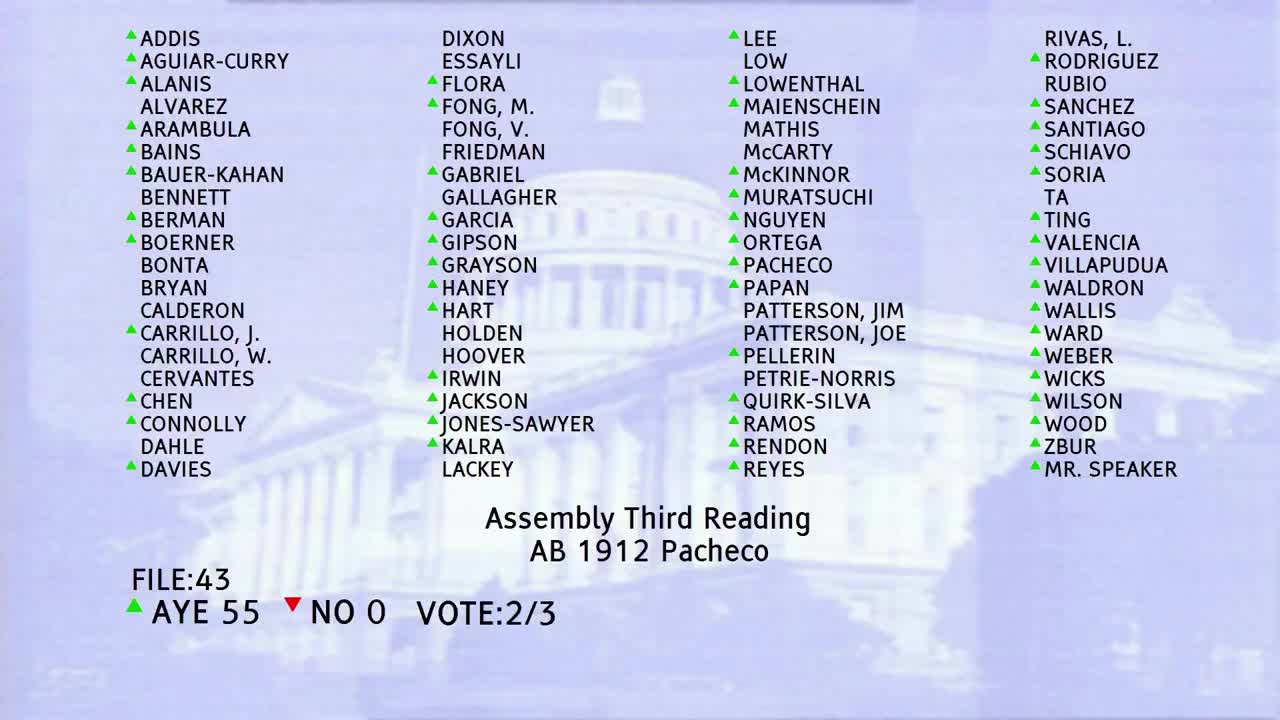 2MIN
Assembly Floor
 7MIN
Assembly Standing Committee on Higher Education
Bill Author

Bill Co-Author(s):