AB 2086: Transportation funding: California Transportation Plan: public dashboard.
- Session Year: 2023-2024
- House: Assembly
- Latest Version Date: 2024-09-27
Current Status:
Passed
(2024-09-27: Chaptered by Secretary of State - Chapter 629, Statutes of 2024.)
Introduced
In Committee
First Chamber
In Committee
Second Chamber
Enacted
What does this bill do?
The bill requires the California Transportation Plan to include a financial section that shows the full 10-year cost to carry out the plan, a summary of available revenues, and what parts of the plan are realistic under those revenue limits. It also requires the state Department of Transportation to expand a public online dashboard so people can see how annual investments from major state transportation funding programs are advancing the plan’s goals using clear performance measures.
The summary is provided by generative AI which can make mistakes. For original language, please view the details in the table below.
Existing law requires the Department of Transportation to prepare the California Transportation Plan for submission to the Governor and the Legislature as a long-range planning document that incorporates various elements and is consistent with specified expressions of legislative intent. Existing law requires the department to complete the 3rd update to the plan by December 31, 2025, and to update the plan every 5 years thereafter.
This bill would require the California Transportation Plan to also include a financial element that summarizes the full cost of plan implementation through the first 10 years of the planning period and includes a summary of available revenues through the planning period and an analysis of what is feasible within the plan if constrained by a realistic projection of available revenues, as specified.
This bill would require the department to enhance an existing public online dashboard on or before January 1, 2027, to display how annual project investments from specified transportation funding programs are advancing the vision and goals of the California Transportation Plan, using performance metrics determined by the department for each funding program, as specified. The bill would require the department to display other specified information on the dashboard and to periodically update the performance metrics and data on the dashboard, as specified.
Existing law requires the Department of Transportation to prepare the California Transportation Plan for submission to the Governor and the Legislature as a long-range planning document that incorporates various elements and is consistent with specified expressions of legislative intent. Existing law requires the department to complete the 3rd update to the plan by December 31, 2025, and to update the plan every 5 years thereafter.
This bill would require the California Transportation Plan to also include a financial element that summarizes the full cost of plan implementation, implementation through the first 10 years of the planning period and includes a summary of available revenues through the planning period, period and an analysis of what is feasible within the plan if constrained by a realistic projection of available revenues, as specified.
This bill would require the department to enhance an existing public online dashboard on or before January 1, 2027, to display how annual project investments from specified transportation funding programs are advancing the vision and goals of the California Transportation Plan, Plan, using performance metrics determined by the department for each funding program, as specified. The bill would require the department to display other specified information on the dashboard and to periodically update this the performance metrics and data on the dashboard. dashboard, as specified.
Existing law requires the Department of Transportation to prepare the California Transportation Plan for submission to the Governor and the Legislature as a long-range planning document that incorporates various elements and is consistent with specified expressions of legislative intent. Existing law requires the department to complete the 3rd update to the plan by December 31, 2025, and to update the plan every 5 years thereafter.
This bill would require the California Transportation Plan to also include a financial element that summarizes the full cost of plan implementation, a summary of available revenues through the planning period, and an analysis of what is feasible within the plan if constrained by a realistic projection of available revenues, as specified.
This bill would require the department to enhance an existing public online dashboard on or before January 1, 2027, to display how annual project investments are advancing the vision and goals of the California Transportation Plan, as specified. The bill would require the department to periodically update this data on the dashboard.
Existing law creates the Department of Transportation within the Transportation Agency and makes the department responsible for, among other things, the improvement and maintenance of the state highway system. Existing law requires the department to prepare and submit a proposed budget to the Governor that includes the portion to be funded from the State Highway Account. Existing law establishes the priorities for use of funds in that account, with operation, maintenance, and rehabilitation of the state highway system as the highest priority.Existing law also creates the California Transportation Commission within the Transportation Agency and vests the commission with various powers and duties relative to the programming of transportation capital projects and the allocation of funds to those projects, pursuant to the state transportation improvement program and various other transportation funding programs.This bill would require the commission, on or before January 1, 2026, to adopt guidelines for the department to use to determine whether the use of the funding made available to the department is advancing the Core Four priorities of safety, equity, climate action, and economic prosperity established by the Transportation Agency. In developing the guidelines, the bill would require the commission to conduct a public engagement process, hold a public comment period, and allow the interagency equity advisory committee established by these 3 agencies an opportunity to review, provide recommendations on, and evaluate potential changes to, the proposed guidelines.The bill would require the department, on or before January 1, 2026, to submit a report to the Legislature on how it advanced the Core Four priorities with the funding that was made available to it in the preceding 5 fiscal years. On January 1, 2027, and each year thereafter, the bill would require the department, using the guidelines adopted by the commission, to prepare and submit a report to the Legislature demonstrating how the department advanced the Core Four priorities with the moneys that were made available to it in the preceding fiscal year.On or before January 1, 2027, the bill would require the department to create a public online dashboard, or enhance an existing public online dashboard, to display annual project investments using the guidelines adopted by the commission, and require the displayed annual project investments to be broken down by geography, the district of the department, and program area.Existing law creates the Department of Transportation within the Transportation Agency and makes the department responsible for, among other things, the improvement and maintenance of the state highway system. Existing law requires the department to prepare and submit a proposed budget to the Governor that includes the portion to be funded from the State Highway Account. Existing law establishes the priorities for use of funds in that account, with operation, maintenance, and rehabilitation of the state highway system as the highest priority.
Existing law also creates the California Transportation Commission within the Transportation Agency and vests the commission with various powers and duties relative to the programming of transportation capital projects and the allocation of funds to those projects, pursuant to the state transportation improvement program and various other transportation funding programs.
This bill would require the commission, on or before January 1, 2026, to adopt guidelines for the department to use to determine whether the use of the funding made available to the department is advancing the Core Four priorities of safety, equity, climate action, and economic prosperity established by the Transportation Agency. In developing the guidelines, the bill would require the commission to conduct a public engagement process, hold a public comment period, and allow the interagency equity advisory committee established by these 3 agencies an opportunity to review, provide recommendations on, and evaluate potential changes to, the proposed guidelines.
The bill would require the department, on or before January 1, 2026, to submit a report to the Legislature on how it advanced the Core Four priorities with the funding that was made available to it in the preceding 5 fiscal years. On January 1, 2027, and each year thereafter, the bill would require the department, using the guidelines adopted by the commission, to prepare and submit a report to the Legislature demonstrating how the department advanced the Core Four priorities with the moneys that were made available to it in the preceding fiscal year.
On or before January 1, 2027, the bill would require the department to create a public online dashboard, or enhance an existing public online dashboard, to display annual project investments using the guidelines adopted by the commission, and require the displayed annual project investments to be broken down by geography, the district of the department, and program area.
The Legislature finds and declares all of the following:
(a)The California Transportation Plan, which is made up of goals and objectives, defines the vision for Californias future transportation system and identifies performance measures to track progress toward achieving those goals and objectives.
(b)The California Global Warming Solutions Act of 2006 (Division 25.5 (commencing with Section 38500) of the Health and Safety Code) requires the State Air Resources Board to ensure that statewide greenhouse gas emissions are reduced to at least 40% below the 1990 level by 2030.
(c)Executive Order No. N-16-22 requires all state agencies to analyze practices to advance equity and respond to disparities in their mission, goals, data, tools, policies, programs, and operations.
(d)Executive Order No. N-19-19 requires every aspect of state government to redouble its efforts to reduce greenhouse gas emissions and mitigate the impacts of climate change while building a sustainable, inclusive economy.
(e)While there have been piecemeal efforts towards transparency and accountability of the roughly $19 billion that flows through the Department of Transportation, these efforts do not paint a complete or clear picture for the public.
SEC. 2.Section 65072 of the Government Code is amended to read:65072.The California Transportation Plan shall include all of the following:
(a)A policy element that describes the states transportation policies and system performance objectives. These policies and objectives shall be consistent with legislative intent described in Sections 14000, 14000.5, 14000.6, and 65088.
(b)A strategies element that incorporates the broad system concepts and strategies synthesized from the adopted regional transportation plans prepared pursuant to Section 65080. The California Transportation Plan shall not be project specific.
(c)A financial element that summarizes the full cost of implementing the California Transportation Plan through the first 10 years of the planning period and includes a summary of available revenues through the planning period and an analysis of what is feasible within the plan if constrained by a realistic projection of available revenues. The financial element shall also evaluate the feasibility of any policy assumptions or scenarios included in the plan. The financial element may include a discussion of tradeoffs within the plan considering financial constraints.
(d)A recommendations element that includes economic forecasts and recommendations to the Legislature and the Governor to achieve the plans broad system concepts, strategies, and performance objectives.
SEC. 3.Section 65075 is added to the Government Code, to read:65075.(a)(1)On or before January 1, 2027, the department shall enhance an existing public online dashboard, such as the Rebuilding California internet website, to display how annual project investments from funding programs are advancing the vision and goals of the California Transportation Plan, using readily available, significant performance metrics for each funding program, as determined by the department, in consultation with other stakeholders, including, but not limited to, equity-focused partners. The department shall also report on the dashboard on the status of the implementation of the short-, mid-, and long-term implementation actions included in the implementation element of the California Transportation Plan.
(2)At the same time that the California Transportation Plan is required to be updated pursuant to Section 65071, the department shall update the performance metrics displayed on the dashboard pursuant to paragraph (1) to reflect any significant changes to the funding programs consistent with the requirements for determining the performance metrics set forth in paragraph (1).
(3)The department shall present the data on the dashboard described in paragraph (1) in a searchable, consistent, transparent, and digestible manner, and shall periodically update the data required by this section on the dashboard.
(b)For purposes of this section, funding programs means all of the following programs:
(1)The Active Transportation Program (Chapter 8 (commencing with Section 2380) of Division 3 of the Streets and Highways Code).
(2)The interregional transportation improvement program.
(3)The Local Partnership Program created pursuant to Sections 2032 and 2033 of the Streets and Highways Code.
(4)The Solutions for Congested Corridors Program (Chapter 8.5 (commencing with Section 2390) of Division 3 of the Streets and Highways Code).
(5)The state highway operation and protection program.
(6)The Trade Corridor Enhancement Program established pursuant to Chapter 4.8 (commencing with Section 2192) of Division 3 of the Streets and Highways Code.
(7)The Transit and Intercity Rail Capital Program (Part 2 (commencing with Section 75220) of Division 44 of the Public Resources Code).
The Legislature finds and declares all of the following:
(a)The Transportation Agency set goals encompassing its Core Four priorities of safety, equity, climate action, and economic prosperity.(a)The California Transportation Plan, which is made up of goals and objectives, defines the vision for Californias future transportation system and identifies performance measures to track progress toward achieving those goals and objectives.
(b)The California Global Warming Solutions Act of 2006 (Division 25.5 (commencing with Section 38500) of the Health and Safety Code) requires the State Air Resources Board to ensure that statewide greenhouse gas emissions are reduced to at least 40% below the 1990 level by 2030.
(c)Executive Order No. N-16-22 requires all state agencies to analyze practices to advance equity and respond to disparities in their mission, goals, data, tools, policies, programs, and operations.
(d)Executive Order No. N-19-19 requires every aspect of state government to redouble its efforts to reduce greenhouse gas emissions and mitigate the impacts of climate change while building a sustainable, inclusive economy.
(e)While there have been piecemeal efforts towards transparency and accountability of the roughly $19 billion that flows through the Department of Transportation, these efforts do not paint a complete or clear picture for the public.
SEC. 2.Section 65072 of the Government Code is amended to read:65072.The California Transportation Plan shall include all of the following:
(a)A policy element that describes the states transportation policies and system performance objectives. These policies and objectives shall be consistent with legislative intent described in Sections 14000, 14000.5, 14000.6, and 65088.
(b)A strategies element that incorporates the broad system concepts and strategies synthesized from the adopted regional transportation plans prepared pursuant to Section 65080. The California Transportation Plan shall not be project specific.
(c)A financial element that summarizes the full cost of implementing the California Transportation Plan, Plan through the first 10 years of the planning period and includes a summary of available revenues through the planning period, period and an analysis of what is feasible within the plan if constrained by a realistic projection of available revenues. The financial element shall also evaluate the feasibility of any policy assumptions or scenarios included in the plan. The financial element may include a discussion of tradeoffs within the plan considering financial constraints.
(d)A recommendations element that includes economic forecasts and recommendations to the Legislature and the Governor to achieve the plans broad system concepts, strategies, and performance objectives.
SEC. 3.Section 65075 is added to the Government Code, to read:65075.(a)(1)On or before January 1, 2027, the department shall enhance an existing public online dashboard, such as the Rebuilding California internet website, to display how annual project investments from funding programs are advancing the vision and goals of the California Transportation Plan, including reporting Plan, using readily available, significant performance metrics for each funding program, as determined by the department, in consultation with other stakeholders, including, but not limited to, equity-focused partners. The department shall also report on the dashboard on the status of the implementation of the short-, mid-, and long-term implementation actions included in the implementation element of the California Transportation Plan. The annual project investments shall be broken down by geography, the district of the department, and program area. The
(2)At the same time that the California Transportation Plan is required to be updated pursuant to Section 65071, the department shall update the performance metrics displayed on the dashboard pursuant to paragraph (1) to reflect any significant changes to the funding programs consistent with the requirements for determining the performance metrics set forth in paragraph (1).
(3)The department shall present the data on the dashboard described in paragraph (1) in a searchable, consistent, transparent, and digestible manner, and shall periodically update the data required by this section on the dashboard.
(b)For purposes of this section, funding programs means all of the following programs:
(1)The Active Transportation Program (Chapter 8 (commencing with Section 2380) of Division 3 of the Streets and Highways Code).
(2)The interregional transportation improvement program.
(3)The Local Partnership Program created pursuant to Sections 2032 and 2033 of the Streets and Highways Code.
(4)The Solutions for Congested Corridors Program (Chapter 8.5 (commencing with Section 2390) of Division 3 of the Streets and Highways Code).
(5)The state highway operation and protection program.
(6)The Trade Corridor Enhancement Program established pursuant to Chapter 4.8 (commencing with Section 2192) of Division 3 of the Streets and Highways Code.
(7)The Transit and Intercity Rail Capital Program (Part 2 (commencing with Section 75220) of Division 44 of the Public Resources Code).
The Legislature finds and declares all of the following:
(a)The Transportation Agency set goals encompassing its Core Four priorities of safety, equity, climate action, and economic prosperity.
(b)The California Global Warming Solutions Act of 2006 (Division 25.5 (commencing with Section 38500) of the Health and Safety Code) requires the State Air Resources Board to ensure that statewide greenhouse gas emissions are reduced to at least 40% below the 1990 level by 2030.
(c)Executive Order No. N-16-22 requires all state agencies to analyze practices to advance equity and respond to disparities in their mission, goals, data, tools, policies, programs, and operations.
(d)Executive Order No. N-19-19 requires every aspect of state government to redouble its efforts to reduce greenhouse gas emissions and mitigate the impacts of climate change while building a sustainable, inclusive economy.
(e)While there have been piecemeal efforts towards transparency and accountability of the roughly $19 billion that flows through the Department of Transportation, these efforts do not paint a complete or clear picture for the public.
SEC. 2.Chapter 6 (commencing with Section 14470) is added to Part 5 of Division 3 of Title 2 of the Government Code, to read:6.Funding Transparency and Accountability14470.For purposes of this chapter, the following definitions apply:(a)Core Four priorities means the safety, equity, climate action, and economic prosperity priorities established by the Transportation Agency.(b)Interagency equity advisory committee means the interagency equity advisory committee formed by the commission, the department, and the Transportation Agency.14471.(a)On or before January 1, 2026, the commission shall adopt guidelines for the department to use to determine whether the use of the funding made available to the department is advancing the Core Four priorities.(b)The guidelines shall do both of the following:(1)Include quantitative metrics for the department to use to track progress toward advancing the Core Four priorities including, but not limited to, all of the following metrics:(A)For the safety priority, the following metrics:(i)A reduction in traffic fatalities and serious injuries.(ii)Increasing safety for vulnerable road users.(B)For the equity priority, the following metrics:(i)The percentage and total dollars invested in priority populations who are identified using the California Communities Environmental Health Screening Tool, also known as CalEnviroScreen, or the departments Transportation Equity Index, or both.(ii)A description of the meaningful benefits to priority populations who are identified in the manner described in clause (i).(C)For the climate action priority, the following metrics:(i)A quantification of an increase or decrease in greenhouse gas emissions associated with the lane miles added to the state highway system.(ii)A quantification of an increase or decrease in vehicle miles traveled on the state highway system associated with the lane miles added to the state highway system.(D)For the economic prosperity metric, the following priorities:(i)Employment per dollar.(ii)Labor income and value added.(iii)Education attainment needed for all jobs supported.(2)Establish a process for the commission to set quantitative targets at three-year intervals that show a clear pathway for the department to advance the Core Four priorities.(c)In developing the guidelines, the commission shall do all of the following:(1)Conduct a public engagement process and include the public engagement process on the agenda of at least one public meeting of the interagency equity advisory committee. The commission shall provide public notice on its internet website of the public meeting not less than 14 days before the meeting.(2)Hold a public comment period of at least 30 days that enables the public and stakeholders to provide input and feedback on the proposed guidelines.(3)Before adopting the final guidelines, allow the interagency equity advisory committee an opportunity to review, provide recommendations on, and evaluate potential changes to, the proposed guidelines.14472.(a)On or before January 1, 2026, the department shall submit a report to the Legislature on how the department advanced the Core Four priorities with the funding that was made available to it in the preceding five fiscal years. The information in the report shall be broken down by program and by each district of the department.(b)(1)Notwithstanding Section 10231.5, on January 1, 2027, and each year thereafter, the department shall, using the guidelines adopted pursuant to Section 14471, prepare and submit a report to the Legislature demonstrating how the department advanced the Core Four priorities with the moneys that were made available to it in the preceding fiscal year. In preparing the report, the department shall prioritize using data available from existing processes including, but not limited to, data made available pursuant to Sections 235, 236, and 2032.5 of the Streets and Highways Code, and the Climate Action Plan for Transportation Infrastructure adopted by the Transportation Agency.(2)The report required by this subdivision shall also include all of the following information:(A)An update on the departments expenditures in the preceding fiscal year by program and district compared to its planned expenditures in the current fiscal year.(B)The progress that the departments expenditures in the preceding fiscal year made towards meeting the targets established by the commission pursuant to Section 14471.(C)How the departments planned expenditures for the current fiscal year are responsive to performance history and how it aligns with the commissions targets and other long-range goals.(D)If the department is not on track to meet the targets and goals specified in subparagraph (C), what actions can be taken to get on track to meet those targets and goals.(c)The reports to be submitted to the Legislature pursuant to subdivisions (a) and (b) shall be submitted in compliance with Section 9795.14473.On or before January 1, 2027, the department shall create a public online dashboard, or enhance an existing public online dashboard, to display annual project investments using the guidelines adopted pursuant to Section 14471. The annual project investments shall be broken down by geography, the district of the department, and program area. The department shall present the data on the dashboard in a consistent, transparent, and digestible manner, and shall periodically update the dashboard.SEC. 2.Section 65072 of the Government Code is amended to read:65072.The California Transportation Plan shall include all of the following:
(a)A policy element that describes the states transportation policies and system performance objectives. These policies and objectives shall be consistent with legislative intent described in Sections 14000, 14000.5, 14000.6, and 65088.
(b)A strategies element that shall incorporate incorporates the broad system concepts and strategies synthesized from the adopted regional transportation plans prepared pursuant to Section 65080. The California Transportation Plan shall not be project specific.
(c)A financial element that summarizes the full cost of implementing the California Transportation Plan, a summary of available revenues through the planning period, and an analysis of what is feasible within the plan if constrained by a realistic projection of available revenues. The financial element shall also evaluate the feasibility of any policy assumptions or scenarios included in the plan. The financial element may include a discussion of tradeoffs within the plan considering financial constraints.
(c)(d)A recommendations element that includes economic forecasts and recommendations to the Legislature and the Governor to achieve the plans broad system concepts, strategies, and performance objectives.
SEC. 3.Section 65075 is added to the Government Code, to read:65075.On or before January 1, 2027, the department shall enhance an existing public online dashboard, such as the Rebuilding California internet website, to display how annual project investments are advancing the vision and goals of the California Transportation Plan, including reporting on the status of the implementation of the short-, mid-, and long-term implementation actions included in the implementation element of the California Transportation Plan. The annual project investments shall be broken down by geography, the district of the department, and program area. The department shall present the data on the dashboard in a searchable, consistent, transparent, and digestible manner, and shall periodically update the data required by this section on the dashboard.
The Legislature finds and declares all of the following:
(a)The Transportation Agency set goals encompassing its Core Four priorities of safety, equity, climate action, and economic prosperity.
(b)The California Global Warming Solutions Act of 2006 (Division 25.5 (commencing with Section 38500) of the Health and Safety Code) requires the State Air Resources Board to ensure that statewide greenhouse gas emissions are reduced to at least 40% below the 1990 level by 2030.
(c)Executive Order No. N-16-22 requires all state agencies to analyze practices to advance equity and respond to disparities in their mission, goals, data, tools, policies, programs, and operations.
(d)Executive Order No. N-19-19 requires every aspect of state government to redouble its efforts to reduce greenhouse gas emissions and mitigate the impacts of climate change while building a sustainable, inclusive economy.
(e)While there have been piecemeal efforts towards transparency and accountability of the roughly $19 billion that flows through the Department of Transportation, these efforts do not paint a complete or clear picture for the public.
SEC. 2.Chapter 6 (commencing with Section 14470) is added to Part 5 of Division 3 of Title 2 of the Government Code, to read:6.Funding Transparency and Accountability14470.For purposes of this chapter, the following definitions apply:
(a)Core Four priorities means the safety, equity, climate action, and economic prosperity priorities established by the Transportation Agency.
(b)Interagency equity advisory committee means the interagency equity advisory committee formed by the commission, the department, and the Transportation Agency.
14471.(a)On or before January 1, 2026, the commission shall adopt guidelines for the department to use to determine whether the use of the funding made available to the department is advancing the Core Four priorities.
(b)The guidelines shall do both of the following:
(1)Include quantitative metrics for the department to use to track progress toward advancing the Core Four priorities including, but not limited to, all of the following metrics:
(A)For the safety priority, the following metrics:
(i)A reduction in traffic fatalities and serious injuries.
(ii)Increasing safety for vulnerable road users.
(B)For the equity priority, the following metrics:
(i)The percentage and total dollars invested in priority populations who are identified using the California Communities Environmental Health Screening Tool, also known as CalEnviroScreen, or the departments Transportation Equity Index, or both.
(ii)A description of the meaningful benefits to priority populations who are identified in the manner described in clause (i).
(C)For the climate action priority, the following metrics:
(i)A quantification of an increase or decrease in greenhouse gas emissions associated with the lane miles added to the state highway system.
(ii)A quantification of an increase or decrease in vehicle miles traveled on the state highway system associated with the lane miles added to the state highway system.
(D)For the economic prosperity metric, the following priorities:
(i)Employment per dollar.
(ii)Labor income and value added.
(iii)Education attainment needed for all jobs supported.
(2)Establish a process for the commission to set quantitative targets at three-year intervals that show a clear pathway for the department to advance the Core Four priorities.
(c)In developing the guidelines, the commission shall do all of the following:
(1)Conduct a public engagement process and include the public engagement process on the agenda of at least one public meeting of the interagency equity advisory committee. The commission shall provide public notice on its internet website of the public meeting not less than 14 days before the meeting.
(2)Hold a public comment period of at least 30 days that enables the public and stakeholders to provide input and feedback on the proposed guidelines.
(3)Before adopting the final guidelines, allow the interagency equity advisory committee an opportunity to review, provide recommendations on, and evaluate potential changes to, the proposed guidelines.
14472.(a)On or before January 1, 2026, the department shall submit a report to the Legislature on how the department advanced the Core Four priorities with the funding that was made available to it in the preceding five fiscal years. The information in the report shall be broken down by program and by each district of the department.
(b)(1)Notwithstanding Section 10231.5, on January 1, 2027, and each year thereafter, the department shall, using the guidelines adopted pursuant to Section 14471, prepare and submit a report to the Legislature demonstrating how the department advanced the Core Four priorities with the moneys that were made available to it in the preceding fiscal year. In preparing the report, the department shall prioritize using data available from existing processes including, but not limited to, data made available pursuant to Sections 235, 236, and 2032.5 of the Streets and Highways Code, and the Climate Action Plan for Transportation Infrastructure adopted by the Transportation Agency.
(2)The report required by this subdivision shall also include all of the following information:
(A)An update on the departments expenditures in the preceding fiscal year by program and district compared to its planned expenditures in the current fiscal year.
(B)The progress that the departments expenditures in the preceding fiscal year made towards meeting the targets established by the commission pursuant to Section 14471.
(C)How the departments planned expenditures for the current fiscal year are responsive to performance history and how it aligns with the commissions targets and other long-range goals.
(D)If the department is not on track to meet the targets and goals specified in subparagraph (C), what actions can be taken to get on track to meet those targets and goals.
(c)The reports to be submitted to the Legislature pursuant to subdivisions (a) and (b) shall be submitted in compliance with Section 9795.
14473.On or before January 1, 2027, the department shall create a public online dashboard, or enhance an existing public online dashboard, to display annual project investments using the guidelines adopted pursuant to Section 14471. The annual project investments shall be broken down by geography, the district of the department, and program area. The department shall present the data on the dashboard in a consistent, transparent, and digestible manner, and shall periodically update the dashboard.
|
Date
|
Status
|
|---|---|
| Sep 27, 2024 | Chaptered by Secretary of State - Chapter 629, Statutes of 2024. |
| Sep 27, 2024 | Approved by the Governor. |
| Sep 12, 2024 | Enrolled and presented to the Governor at 4 p.m. |
| Aug 31, 2024 | Senate amendments concurred in. To Engrossing and Enrolling. (Ayes 77. Noes 0.). |
| Aug 30, 2024 | In Assembly. Concurrence in Senate amendments pending. |
| Aug 30, 2024 | Read third time. Passed. Ordered to the Assembly. (Ayes 40. Noes 0.). |
| Aug 26, 2024 | Ordered to special consent calendar. |
| Aug 19, 2024 | Read second time. Ordered to third reading. |
| Aug 15, 2024 | Read second time and amended. Ordered returned to second reading. |
| Aug 15, 2024 | From committee: Amend, and do pass as amended. (Ayes 7. Noes 0.) (August 15). |
| Aug 5, 2024 | In committee: Referred to APPR suspense file. |
| Jun 26, 2024 | From committee: Do pass and re-refer to Com. on APPR. (Ayes 15. Noes 0.) (June 25). Re-referred to Com. on APPR. |
| May 29, 2024 | Referred to Com. on TRANS. |
| May 22, 2024 | In Senate. Read first time. To Com. on RLS. for assignment. |
| May 21, 2024 | Read third time. Passed. Ordered to the Senate. (Ayes 72. Noes 0. Page 5415.) |
| May 20, 2024 | Read second time. Ordered to third reading. |
| May 16, 2024 | Joint Rule 62(a), file notice suspended. (Page 5215.) |
| May 16, 2024 | From committee: Do pass. (Ayes 15. Noes 0.) (May 16). |
| May 15, 2024 | In committee: Set, first hearing. Referred to APPR. suspense file. |
| Apr 23, 2024 | From committee: Do pass and re-refer to Com. on APPR. (Ayes 15. Noes 0.) (April 22). Re-referred to Com. on APPR. |
| Apr 16, 2024 | Re-referred to Com. on TRANS. |
| Apr 15, 2024 | From committee chair, with author's amendments: Amend, and re-refer to Com. on TRANS. Read second time and amended. |
| Feb 20, 2024 | Referred to Com. on TRANS. |
| Feb 6, 2024 | From printer. May be heard in committee March 7. |
| Feb 5, 2024 | Read first time. To print. |
|
Date
|
Description
|
Location
|
Votes
|
|
|---|---|---|---|---|
| Aug 31, 2024 | AB 2086 Schiavo Concurrence in Senate Amendments | Assembly Floor |
Passed |
|
| Aug 30, 2024 | Special Consent AB2086 Schiavo | Senate Floor |
Passed |
|
| Aug 15, 2024 | Do pass as amended | Senate Standing Committee on Appropriations |
Passed |
|
| Aug 5, 2024 | Placed on suspense file | Senate Standing Committee on Appropriations |
Passed |
|
| Jun 25, 2024 | Do pass, but first be re-referred to the Committee on [Appropriations] | Senate Standing Committee on Transportation |
Passed |
|
| May 21, 2024 | AB 2086 Schiavo Assembly Third Reading | Assembly Floor |
Passed |
|
| May 16, 2024 | Do pass. | Assembly Standing Committee on Appropriations |
Passed |
|
| Apr 22, 2024 | Do pass and be re-referred to the Committee on [Appropriations] | Assembly Standing Committee on Transportation |
Passed |
This list shows positions taken on this bill by organizations on the date displayed, which is linked to the original source.
Positions by individuals are not included.
|
Organization
|
Position
|
Date
|
|---|---|---|
| 350 Bay Area | ** Support | |
| ACT LA | ** Support | |
| Active San Gabriel Valley | ** Support | |
| American Lung Association | * Support | Apr 22, 2024 |
| Bike East Bay | ** Support | |
| CA Coalition for Clean Air | ** Support | |
| CalBike | ** Support | |
| California Association Of Councils Of Governments | ** Support | |
| California Environmental Justice Alliance | ** Support | |
| California Environmental Voters | ** Support | |
| California Green New Deal Coalition | ** Support | |
| California Walks | ** Support | |
| Campaign for Sustainable Transportation - Santa Cruz | ** Support | |
| Canal Alliance | ** Support | |
| Center for Community Action and Environmental Justice | ** Support | |
| Center for Independent Living | ** Support | |
| Clean Air Coalition | ** Support | |
| Climate Plan | ** Support | |
| East Bay Housing Organizations | ** Support | |
| Environmental Defense Fund | ** Support | |
| Extinction Rebellion San Francisco Bay Area | ** Support | |
| Friends Committee On Legislation Of California | ** Support | |
| Gray Panthers | ** Support | |
| Greenbelt Alliance | ** Support | |
| Greenlighting Institute | * Support | Apr 22, 2024 |
| Move LA | ** Support | |
| Natural Resources Defense Council | ** Support | |
| Natural Resources Defense Council (NRDC) | * Support | Apr 22, 2024 |
| NextGen California | ** Support | |
| Partnership for the Advancement of New Americans - PANA | ** Support | |
| Planning And Conservation League | ** Support | |
| PolicyLink | ** Support | |
| Public Advocates Inc. | ** Support | |
| Rails-to-Trails Conservancy | ** Support | |
| Safe Routes to School National Partnership | ** Support | |
| San Diego 350 | ** Support | |
| Sierra Club California | ** Support | |
| SPUR | ** Support | |
| Streets for All | ** Support | |
| Sustainable Claremont | ** Support | |
| The Greenlining Institute | ** Support | |
| Transbay Coalition | ** Support | |
| Transform | ** Support | |
| Urban Habitat | ** Support |
CONCURRENCE IN SENATE AMENDMENTS
CSA1 Bill Id:AB 2086
Author:(Schiavo)
As Amended Ver:August 15, 2024
Majority vote
SUMMARY
This bill requires the California Transportation Plan (CTP) to include a financial element that summarizes the full cost of implementing the CTP, a summary of available revenues, an analysis of what is feasible within the plan, considering constrained revenues, and requires Department of Transportation (Caltrans) to enhance an existing public online dashboard to display how annual project investments are advancing the vision and goals of the CTP.
Senate Amendments
- Clarifies the timeframe of the financial element in the CTP include the first 10 years of the planning period;
- Requires the dashboard to be updated to reflect any significant changes to funding programs;
- Clarifies the data on the dashboard include all of the following funding programs:
- The Active Transportation Program;
- The interregional transportation improvement program;
- The Local Partnership Program;
- The Solutions for Congested Corridors Program;
- The state highway operation and protection program;
- The Trade Corridor Enhancement Program; and,
- The Transit and Intercity Rail Capital Program.
COMMENTS
California's transportation network consists of streets, highways, railways, bicycle routes, and pedestrian pathways. This network provides people and businesses the ability to access destinations and move goods and services throughout the state. Construction, operations, and maintenance responsibilities are shared amongst state, regional, tribal and local governments. Funding for these activities comes from federal, state, and local taxes, fees and assessments, private investments and tribal investments. Currently, roughly $35 billion (federal, state, and local funds combined) is spent annually in California on building and maintaining the transportation network. Additionally, with the passage of the federal Infrastructure Investment and Jobs Act (IIJA), California is expected to receive approximately $40 billion over five years.
In 2017, the Legislature passed and Governor Brown signed into law, SB 1 (Beall, Chapter 5, Statutes of 2017), which provided roughly $5.2 billion annually for highways, local streets and roads, public transit, and bicycle and pedestrian facilities; recognized the need to prioritize maintenance and better utilize the system we have. "Fix it first" was the guiding principle of SB 1, or focusing the state's transportation spending to maintain a state of good repair of the existing system.
SB 1 included specific performance outcomes for Caltrans to meet for the state highway system by 2027, through investments in the State Highway Operations Protection Program (SHOPP) and maintenance programs, including not less than 98% of pavement on the state highway system in good or fair condition; not less than 90% level of service achieved for maintenance of potholes, spalls, and cracks; not less than 90% of culverts in good or fair condition; not less than 90% of the transportation management system units in good condition; and to fix not less than an additional 500 bridges.
SB 1 also created the Independent Office of Audits and Investigations and the Inspector General (IG). The IG is responsible for ensuring Caltrans and external entities that receive state and federal transportation funds from Caltrans are spending those funds appropriately. SB 1 also led to the creation of the RebuldingCA website, which publishes a statewide project map and data on monies spent under SB 1 and IIJA.
This bill seeks to display on the RebuildingCA website how annual transportation project investments are advancing the goals and vision of the CTP.
CTP 2050, is the state's long-range transportation roadmap for policy change. It was most recently updated in February 2021. CTP 2050 is designed to provide a unifying and foundational policy framework for making effective, transparent, and transformational transportation decisions in California and identify a timeline, roles, and responsibilities for each plan recommendation. The CTP does not contain specific projects, but rather policies and strategies to close the gap between what regional plans aim to achieve and how much more is required to meet 2050 goals.
This bill requires Caltrans, by January 1, 2027, to display on an online dashboard how annual project investments from specific programs are advancing the vision and goals of the CTP, including reporting on the status of the implementation of the short-, mid-, and long-term implementation actions included in the implementation element of the CTP. This shall be done using readily available and significant performance metrics for each program, as each program has different goals and so cannot be effectively evaluated all the same way. The funding programs that will be included in this implementation element shall be: the active transportation program; the interregional transportation improvement program; the local partnership program; the solutions for congested corridors program; the state highway operation and protection program; the trade corridor enhancement program; and the transit and intercity rail capital program.
One of the shortcomings of the CTP is that it is not fiscally unconstrained. Therefore, some see the CTP as an aspirational document. Moreover, the lack of fiscal constraint makes it and is difficult to evaluate when compared to regional plans that are required to provide an assessment of expected future funding necessary to implement the plan.
AB 285 (Friedman, Chapter 605, Statutes of 2019), required the SGC to develop a report to look at various aspects of state and regional transportation planning and funding. The California Transportation Assessment Report was developed through work of the University of California Institute for Transportation Studies (UC ITS). The report includes findings and provides recommendations to help the state align transportation funding with state climate goals. Specifically, the report suggest this could be done through, "the reviewing and prioritizing various state goals within transportation funding program guidelines or statute".
One of the recommendations of the AB 285 report that is universally supported by stakeholders is "updating and better aligning among existing state and regional plans," including adding a fiscal constraint analysis to the CTP. This bill requires the CTP to include a financial element that summarizes the full cost of plan implementation constrained by a realistic projection of available revenues. Additionally, the financial element may include a discussion of tradeoffs with the plan considering financial constraints.
According to the Author
"Transparency is what Californians need and deserve. Being able to see how our state departments spend taxpayer dollars and witnessing how their actions better serve our community is our goal. AB 2086 will show how our tax dollars bring safety, equity, and economic prosperity to our disadvantaged communities. Further, this bill will give us a look into how are tax dollars are working to help us reach our climate goals."
Arguments in Support
Greenlining Institute writes, "While there have been piecemeal efforts towards transparency and accountability of the roughly $21 billion annually in state and federal transportation funds that flow through Caltrans -- these efforts are not coordinated and do not paint a full picture. Without a much stronger lens of transparency on our massive transportation investments, decision makers are not well equipped to direct future spending. AB 2086 looks comprehensively at Caltrans transportation program budget and requires annual reporting…"
Arguments in Opposition
None on file.
FISCAL COMMENTS
According to the Senate Appropriations Committee:
"Caltrans estimates one-time and ongoing workload and contracting costs of approximately $1 million annually, including one-time costs to update the Rebuilding California website to incorporate performance metrics from seven specified programs, and ongoing costs to maintain the website and for 3.0 PY of staff to collect and validate updated project data. (State Highway Account) The California Transportation Commission (CTC) indicates that any workload costs would not be significant to update the CTP guidelines. (State Highway Account and Public Transportation Account)"
VOTES:
ASM TRANSPORTATION: 15-0-0
YES: Wilson, Davies, Aguiar-Curry, Juan Carrillo, Hart, Hoover, Jackson, Ortega, Papan, Sanchez, Ting, Valencia, Wallis, Ward, Wicks
ASM APPROPRIATIONS: 15-0-0
YES: Wicks, Sanchez, Arambula, Bryan, Calderon, Wendy Carrillo, Dixon, Mike Fong, Grayson, Haney, Hart, Jim Patterson, Pellerin, Ta, Villapudua
ASSEMBLY FLOOR: 72-0-8
YES: Addis, Aguiar-Curry, Alanis, Alvarez, Arambula, Bains, Bauer-Kahan, Bennett, Berman, Boerner, Bonta, Bryan, Juan Carrillo, Wendy Carrillo, Chen, Connolly, Davies, Dixon, Essayli, Flora, Mike Fong, Vince Fong, Gallagher, Garcia, Gipson, Grayson, Haney, Hart, Hoover, Irwin, Jackson, Jones-Sawyer, Kalra, Lackey, Lee, Low, Lowenthal, Maienschein, McCarty, McKinnor, Muratsuchi, Stephanie Nguyen, Ortega, Pacheco, Papan, Jim Patterson, Joe Patterson, Pellerin, Petrie-Norris, Quirk-Silva, Ramos, Rendon, Reyes, Rodriguez, Blanca Rubio, Sanchez, Santiago, Schiavo, Soria, Ta, Ting, Valencia, Villapudua, Waldron, Wallis, Ward, Weber, Wicks, Wilson, Wood, Zbur, Robert Rivas
ABS, ABST OR NV: Calderon, Cervantes, Megan Dahle, Friedman, Gabriel, Holden, Mathis, Luz Rivas
UPDATED
VERSION: August 15, 2024
CONSULTANT: Julia Kingsley / TRANS. / (916) 319-2093 FN: 0004976
SENATE RULES COMMITTEE Office of Senate Floor Analyses (916) 651-1520 Fax: (916) 327-4478 | AB 2086 |
THIRD READING
Bill No: AB 2086
Author: Schiavo (D)
Amended: 8/15/24 in Senate
Vote: 21
SENATE TRANSPORTATION COMMITTEE: 15-0, 6/25/24
AYES: Cortese, Niello, Allen, Archuleta, Becker, Blakespear, Dahle, Dodd, Gonzalez, Laird, Limón, Newman, Nguyen, Seyarto, Umberg
SENATE APPROPRIATIONS COMMITTEE: 7-0, 8/15/24
AYES: Caballero, Jones, Ashby, Becker, Bradford, Seyarto, Wahab
ASSEMBLY FLOOR: 72-0, 5/21/24 - See last page for vote
SUBJECT: Transportation funding: California Transportation Plan: public dashboard
SOURCE: The Greenlining Institute
DIGEST:
This bill requires the California Transportation Plan (CTP) to include a financial element that summarizes the full cost of implementing the plan over the first ten years of the planning period. This bill requires the Department of Transportation (Caltrans) to report on how annual project investments are advancing the vision and goals of the CTP.
ANALYSIS:
Existing law:
- Requires the California Transportation Plan (CTP) to include: (GC 65072)
- A policy element that describes the state’s transportation policies and system performance objectives;
- A strategies element that shall incorporate the broad system concepts and strategies synthesized from adopted regional transportation plans. The CTP shall not be project specific; and
- A recommendations element that includes economic forecasts and recommendations to the Legislature and the Governor to achieve the plan’s broad system concepts, strategies, and performance objectives.
- Requires Caltrans to update the CTP by December 31, 2015 and every five years thereafter. (GC 65071)
- Requires the Strategic Growth Council to coordinate programs of member state agencies to improve air and water quality, improve natural resource protection, increase the availability of affordable housing, improve transportation, meet the goals of the California Global Warming Solutions Act of 2006, encourage sustainable land use planning, and revitalize urban and community centers in a sustainable manner. (PRC 75121)
- Requires Caltrans to update the CTP, as specified, and requires the Strategic Growth Council (SGC) to report to the Legislature on interactions of the CTP and the Sustainable Communities Strategies/Alternative Planning Strategies plans and a review of the potential impacts and opportunities for coordination between specified programs.
This bill:
- Requires the CTP to include a financial element that:
- Summarizes the full cost of implementing the CTP through the first ten years of the planning period;
- Summarizes available revenues through the planning period;
- Analyzes what is feasible within the plan if constrained by the realistic projection of available revenues; and
- Evaluates the feasibility of any policy assumptions or scenarios included in the plan and may include a discussion of tradeoffs within the plan.
- Would require Caltrans, by January 1, 2027 to present and annually update in a searchable, consistent, and transparent manner on an existing public dashboard:
- How annual project investments from specified funding programs are advancing the vision and goas of the CTP using readily available significant performance metrics as determined by Caltrans in consultation with stakeholders;
- The status of the implementation of the short-, mid-, and long-term implementation actions included in the implementation element of the CTP.
Comments
- Author’s Statement. According to the author, “Transparency is what Californians need and deserve. Being able to see how our state department spend taxpayer dollars and witnessing how their actions better serve our communities is our goal. AB 2086 will show how our tax dollars bring safety, equity, and economic prosperity to our disadvantaged communities. Further, this bill will give us a look into how tax dollars are working to help us reach our climate goals.”
- Fiscally Constrain the CTP. CTP 2050 is the state’s fiscally unconstrained long-range transportation roadmap for policy change. CTP 2050 is designed to provide a unifying policy framework for making effective transportation decisions in California and identify a timeline, roles, and responsibilities for each plan recommendation. The CTP does not contain specific projects, but rather policies and strategies to close the gap between what regional plans aim to achieve and what more is required to meet 2050 goals. The CTP is difficult to evaluate when compared to regional plans, which are required to provide an assessment of expected future funding to implement the plan.
The CTP presents a vision for California’s transportation system to achieve an array of statewide goals, including statutory commitments to reduce greenhouse gas (GHG) emissions. Using the CTP goals as a policy framework and technical analysis of future GHG reduction scenarios, 14 Recommendations were developed for the plan. These recommendations represent the key actions the State should pursue to achieve the CTP’s vision. Caltrans leads the implementation of the CTP and its recommendations in collaboration with other State, regional, and local agencies.
Chapter 605, Statutes of 2019 (AB 285, Friedman) required the SGC to develop a report to look at various aspects of state and regional transportation planning and funding. The California Transportation Assessment Report was developed through work of the University of California Institute for Transportation Studies. Specifically, the report includes findings and provides recommendations to help align transportation funding with climate goals. One of the recommendations of the report that is universally supported by stakeholders is “updating and better aligning among existing state and regional plans,” including adding a fiscal constraint analysis to the CTP.
- CTP Action Status. Stakeholders contend Caltrans should monitor both the recommendations and actions that were previously discussed within the CTP 2050. To address this contention, Caltrans is working with internal divisions and programs and external partner agencies to highlight statewide efforts that satisfy the criteria of both. Initially, Caltrans is presenting a categorized drop down list of the 14 CTP recommendations that are further broken down by their individual actions. For every recommendation, there is a column that highlights the Action, Action Status, Agency Effort, Effort Description of those efforts and a final column that lists which state Participating Agencies are in lead and or support of that effort.
- Implementation Element of the CTP. The bill requires Caltrans, by January 1, 2027, to display on an online dashboard how annual project investments from specific programs are advancing the vision and goals of the CTP, including reporting on the status of the implementation of the short-, mid-, and long-term implementation actions included in the implementation element of the CTP. This shall be done using readily available and significant performance metrics for each program, as each program has different goals and so cannot be effectively evaluated all the same way. The funding programs that will be included in this implementation element shall be:
- The Active Transportation Program;
- The interregional transportation improvement program.
- The Local Partnership Program;
- The Solutions for Congested Corridors program;
- The state highway operation and protection program (SHOPP);
- The Trade Corridor Enhancement Program; and
- The Transit and Intercity Rail Capital Program.
FISCAL EFFECT: Appropriation: No Fiscal Com.: Yes Local: No
According to the Senate Appropriations Committee, “Caltrans estimates one-time and ongoing workload and contracting costs of approximately $1 million annually, including one-time costs to update the Rebuilding California website to incorporate performance metrics from seven specified programs, and ongoing costs to maintain the website and for 3.0 PY of staff to collect and validate updated project data. (State Highway Account) The California Transportation Commission (CTC) indicates that any workload costs would not be significant to update the CTP guidelines. (State Highway Account and Public Transportation Account)”
SUPPORT: (Verified 8/15/24)
The Greenlining Institute (source)
350 Bay Area
ACT LA
Active San Gabriel Valley
Bike East Bay
CA Coalition for Clean Air
Calbike
California Association of Councils of Governments
California Environmental Justice Alliance
California Environmental Voters
California Green New Deal Coalition
California Walks
Campaign for Sustainable Transportation - Santa Cruz
Canal Alliance
Center for Community Action and Environmental Justice
Center for Independent Living
Clean Air Coalition
Climate Plan
East Bay Housing Organizations
Environmental Defense Fund
Extinction Rebellion San Francisco Bay Area
Friends Committee on Legislation of California
Gray Panthers
Greenbelt Alliance
Move LA
Natural Resources Defense Council
Nextgen California
Partnership for The Advancement of New Americans — Pana
Planning and Conservation League
Policylink
Public Advocates INC.
Safe Routes to School National Partnership
San Diego 350
Sierra Club California
Spur
Streets for All
Sustainable Claremont
Transform
Urban Habitat
OPPOSITION: (Verified 8/15/24)
None received
ASSEMBLY FLOOR: 72-0, 5/21/24
AYES: Addis, Aguiar-Curry, Alanis, Alvarez, Arambula, Bains, Bauer-Kahan, Bennett, Berman, Boerner, Bonta, Bryan, Juan Carrillo, Wendy Carrillo, Chen, Connolly, Davies, Dixon, Essayli, Flora, Mike Fong, Vince Fong, Gallagher, Garcia, Gipson, Grayson, Haney, Hart, Hoover, Irwin, Jackson, Jones-Sawyer, Kalra, Lackey, Lee, Low, Lowenthal, Maienschein, McCarty, McKinnor, Muratsuchi, Stephanie Nguyen, Ortega, Pacheco, Papan, Jim Patterson, Joe Patterson, Pellerin, Petrie-Norris, Quirk-Silva, Ramos, Rendon, Reyes, Rodriguez, Blanca Rubio, Sanchez, Santiago, Schiavo, Soria, Ta, Ting, Valencia, Villapudua, Waldron, Wallis, Ward, Weber, Wicks, Wilson, Wood, Zbur, Robert Rivas
NO VOTE RECORDED: Calderon, Cervantes, Megan Dahle, Friedman, Gabriel, Holden, Mathis, Luz Rivas
Prepared by: Jacob O’Connor / TRANS. / (916) 651-4121
8/18/24 17:50:01
**** END ****
SENATE COMMITTEE ON APPROPRIATIONS
Senator Anna Caballero, Chair
2023 - 2024 Regular Session
AB 2086 (Schiavo) - Transportation funding: California Transportation Plan: public dashboard
Version: April 15, 2024 | Policy Vote: TRANS. 15 - 0 |
Urgency: No | Mandate: No |
Hearing Date: August 15, 2024 | Consultant: Mark McKenzie |
Bill Summary:
AB 2086 would require the California Transportation Plan (CTP) to include a financial element that summarizes the full cost of implementing the CTP, a summary of available revenues, and analysis of what is feasible within the plan, considering constrained revenues. The bill would also require the Department of Transportation (Caltrans) to enhance an existing public online dashboard to display how annual project investments are advancing the vision and goals of the CTP, as specified.
*********** ANALYSIS ADDENDUM – SUSPENSE FILE ***********
The following information is revised to reflect amendments
adopted by the committee on August 15, 2024
Fiscal Impact:
- Caltrans estimates one-time and ongoing workload and contracting costs of approximately $1 million annually, including one-time costs to update the Rebuilding California website to incorporate performance metrics from seven specified programs, and ongoing costs to maintain the website and for 3.0 PY of staff to collect and validate updated project data. (State Highway Account)
- The California Transportation Commission (CTC) indicates that any workload costs would not be significant to update the CTP guidelines. (State Highway Account and Public Transportation Account)
Author Amendments:
- Specify that the financial element would summarize the full cost of implementing the CTP through the first 10 years of the planning period.
- Specify that the updated online dashboard would display how annual project investments from specified funding programs are advancing the vision and goals of the CTP using readily available, significant performance metrics for each funding program, as determined by Caltrans, in consultation with other stakeholders, including equity-focused partners. Amendments limit these requirements to the following funding programs:
- The Active Transportation Program.
- The Interregional Transportation Improvement Program.
- The Local Partnership Program.
- The Solutions for Congested Corridors Program.
- The State Highway Operation and Protection Program.
- The Trade Corridor Enhancement Program.
- The Transit and Intercity Rail Capital Program.
- Delete a requirement that annual project investments be broken down by geography, Caltrans district, and program area.
- Require Caltrans, when updating the CTP, to update performance metrics displayed on the dashboard to reflect any significant changes to the specified funding programs.
-- END --
SENATE COMMITTEE ON
Senator Anna Caballero, Chair
2023 - 2024 Regular Session
AB 2086 (Schiavo) - Transportation funding: California Transportation Plan: public dashboard
Version: | Policy Vote: |
Urgency: | Mandate: |
Hearing Date: | Consultant: |
Bill Summary:
AB 2086 would require the California Transportation Plan (CTP) to include a financial element that summarizes the full cost of implementing the CTP, a summary of available revenues, and analysis of what is feasible within the plan, considering constrained revenues. The bill would also require the Department of Transportation (Caltrans) to enhance an existing public online dashboard to display how annual project investments are advancing the vision and goals of the CTP, as specified.
Fiscal Impact:
- Caltrans estimates one-time and ongoing workload and contracting costs, at least in the low millions of dollars. The magnitude of these costs that are one-time in nature is unknown at this time. (State Highway Account)
- One-time costs would be incurred to develop the database and interface for additional information to be reported on a public online dashboard that supports measurement of eight goal areas specified by the CTP. The estimated costs include costs for a consultant contract for the development of processes to ensure data is collected in a manner to meet the bill’s requirements.
- Ongoing staffing costs would be incurred to develop, validate, maintain, and update fiscally-constrained data elements for the CTP on the online dashboard, and to provide data analytics and quality control measures for the dashboard. These costs assume data is reported as annual investments of statewide projects by Caltrans district, general geographic area, and program. Costs would be significantly higher if project-level data must be reported on all state and local transportation projects.
- The California Transportation Commission (CTC) indicates that any workload costs would not be significant to update the CTP guidelines. See staff comments. (State Highway Account and Public Transportation Account)
Background:
Existing law requires Caltrans to prepare a statewide, long-range transportation plan that describes the integrated multimodal transportation system necessary to meet specified greenhouse gas emission reduction targets. The CTP is updated every five years and existing law requires the second update of the CTP to be completed by December 31, 2020. The plan must include a policy element that describes state policies and system performance objectives, a strategies element that synthesizes the regional transportation plans’ concepts and strategies, and a recommendations element that includes economic forecasts and recommendations to achieve the plan’s objectives. The CTP must consider all of the following subject areas for the movement of people and freight: (1) mobility and accessibility; (2) integration and connectivity; (3) efficient system management and operation; (4) existing system preservation; (5) safety and security; (6) economic development, including productivity and efficiency; (7) environmental protection and quality of life; and (8) environmental justice.
Existing law requires Caltrans to coordinate with the California Transportation Commission (CTC), the Strategic Growth Council, the California Air Resources Board, the State Energy Resources Conservation and Development Commission, and specified local and regional entities when drafting the CTP. The CTC must review recommendations in updates to the CTP, prepare specific action-oriented and pragmatic recommendations for transportation system improvements, and submit a report with those recommendations one year after each CTP update.
Proposed Law:
AB 2086 would require the CTP to include a financial element that summarizes the full cost of implementing the plan, a summary of available revenues through the planning period, and an analysis of what is feasible within the plan if constrained by the realistic projection of available revenues. The financial element must evaluate the feasibility of any policy assumptions or scenarios included in the plan, and may also include a discussion of tradeoffs within the plan considering financial constraints.
The bill would also require Caltrans, by January 1, 2027, to enhance a public online dashboard, such as the Rebuilding California website, to display how annual project investments are advancing the vision and goals of the CTP, including reporting on the status of the implementation of the short-, mid-, and long-term actions in the CTP’s implementation element. Caltrans must report annual project investments by geography, Caltrans district, and program area, and periodically update the data on the public online dashboard.
Related Legislation:
SB 7 (Friedman), which is currently pending on the Senate Inactive File, included, among other things, requirements that the CTP include a financial element and an analysis of how CalSTA, Caltrans, and the CTC are achieving principles outlines in the CAPTI, the federal Infrastructure Investment and Jobs Act of 2021, and the federal Justice40 initiative.
AB 285 (Friedman), Chap. 605/2019, required Caltrans to include additional information in the CTP regarding how the state will achieve feasible emission reductions in order to achieve greenhouse gas reduction targets and how the plan is consistent with attainment of all state ambient air quality standards, among other provisions. The bill also required the Strategic Growth Council to develop a specified report examining various aspects of state and regional transportation planning and funding.
Staff Comments:
The CTC completed its update to the CTP guidelines and adopted the 2023 CTP guidelines at its June 2023 Commission meeting. The most recent update to the guidelines included extensive stakeholder outreach, multiple workshops, a public review period for draft guidelines, and updates the guidelines based upon outreach and public comment. The CTC indicates that it has also subsequently initiated updates to the Regional Transportation Plan (RTP) guidelines to account for the changes to the CTP guidelines. The changes proposed in this bill to require the CTP to include a financial element closely mirrors the 2023 CTP guidelines, with the exception of the provision requiring the financial element to “evaluate the feasibility of any policy assumptions or scenarios included in the plan.” The CTP estimates that any updates to CTP guidelines as a result of this bill would not require significant workload.
-- END --
SENATE COMMITTEE ON TRANSPORTATION
Senator Dave Cortese, Chair
2023 - 2024 Regular
Bill No: AB 2086 Hearing Date: 6/25/2024
Author: | Schiavo | ||
Version: | 4/15/2024 Amended | ||
Urgency: | No | Fiscal: | Yes |
Consultant: | Bob Franzoia | ||
SUBJECT: Transportation funding: California Transportation Plan: public dashboard
DIGEST: This bill would require the California Transportation Plan (CTP) to include a financial element that summarizes the full cost of implementing the plan (VEC 65072). It would also require the Department of Transportation (Caltrans) to report on how annual project investments are advancing the vision and goals of the CTP (VEC 65075).
ANALYSIS:
Existing law:
- The CTP shall include all of the following:
- A policy element that describes the state’s transportation policies and system performance objectives. These policies and objectives shall be consistent with legislative intent. (GC 65072)
- A strategies element that shall incorporate the broad system concepts and strategies synthesized from adopted regional transportation plans. The CTP shall not be project specific.
- A recommendations element that includes economic forecasts and recommendations to the Legislature and the Governor to achieve the plan’s broad system concepts, strategies, and performance objectives.
- Caltrans is required to update the CTP by December 31, 2015 and every five years thereafter (December 31, 2025). (GC 65071)
- The Strategic Growth Council is required to coordinate programs of member state agencies to improve air and water quality, improve natural resource protection, increase the availability of affordable housing, improve transportation, meet the goals of the California Global Warming Solutions Act of 2006, encourage sustainable land use planning, and revitalize urban and community centers in a sustainable manner. The council awards grants and loans to support the planning and development of sustainable communities. The council is required to report with specified information regarding the management of the grants and loans. (PRC 75121)
- Requires Caltrans to update the CTP, as specified, and requires the Strategic Growth Council (SGC) to report to the Legislature on interactions of the CTP and the Sustainable Communities Strategies/Alternative Planning Strategies plans and a review of the potential impacts and opportunities for coordination between specified programs.
- The California State Transportation Agency (CalSTA) adopted the Climate Action Plan for Transportation Infrastructure (CAPTI) detailing how the state recommends investing discretionary transportation dollars annually to combat climate change while supporting public health, safety and equity. CAPTI includes a monitoring structure to evaluate progress and any updates on implementation are to be made through a public process with the goals of transparency and public accountability. CalSTA released an annual progress report December 21, 2022.
- Chapter 508, Statutes of 2022 (SB1121, Gonzalez) requires the California Transportation Commission (CTC) to prepare a needs assessment of the cost to operate, maintain and provide for the necessary future growth of the state and local transportation system for the next ten years. The assessment would require the CTC to forecast the expected revenue, including federal, state and local revenues to pay for the cost identified in the assessment, any shortfall in revenue to cover the cost and recommendations on how any shortfall should be addressed. An interim assessment is due by January 1, 2024 and a completed needs assessment by January 1, 2025 and every five years thereafter.
- Chapter 629, Statutes of 2023 (SB 695, Gonzalez) requires Caltrans and the CTC, not later than January 1, 2025, to develop a format for data and information and report on projects on the state highway system covering the projects on a fiscal year basis from July 1, 2018, to June 30, 2023, including:
- The number of new lane miles added to the state highway system.
- A breakdown of the new lane miles by type, including, general-purpose lanes, auxiliary lanes, managed lanes and high-occupancy vehicle lanes.
- The number of new bike lanes broken down by Class I, II, III and IV.
- The number of sidewalk miles added and number of existing sidewalks reconstructed for accessibility and safety.
- The data and information on planned, pending projects shall include:
- A description of each project, including the location.
- The date each project initiation document was completed.
- The status of each project including the current phase of development, designated as environmental, design, right-of-way or construction.
- A determination of the primary purpose and need of each project, if available. (SHC 235)
- The data and information to be reported beginning January 1, 2026 and annually thereafter, shall, for projects covering the 2023-24 fiscal year, include:
- A quantification of an increase or decrease in greenhouse gas emissions associated with the lane miles added to the state highway system, if available.
- A quantification of an increase or decrease in vehicle miles traveled associated with the lane miles added to the state highway system.
- A quantification of the mitigation required as part of transit-oriented in-fill projects that results in additional lane miles on the state highway system. (SHC 236)
This bill:
- Requires the CTP to include a financial element that summarizes the full cost of implementing the CTP, a summary of available revenues through the planning period, and an analysis of what is feasible within the plan if constrained by the realistic projection of available revenues. The financial element shall evaluate the feasibility of any policy assumptions or scenarios included in the plan and may include a discussion of tradeoffs within the plan considering financial constraints.
- Would require Caltrans to report on the status of the implementation of the short-, mid-, and long term implementation actions included in the Implementation Element of the CTP using an enhanced existing public online dashboard, such as the Rebuilding California internet website to display this information. Caltrans would be required to report annual project investments by geography, the Caltrans district and program area.
COMMENTS:
- Author’s Statement. According to the author, “Transparency is what Californians need and deserve. Being able to see how our state department spend taxpayer dollars and witnessing how their actions better serve our communities is our goal. AB 2086 will show how our tax dollars bring safety, equity, and economic prosperity to our disadvantaged communities. Further, this bill will give us a look into how tax dollars are working to help us reach our climate goals.”
- Fiscally Constrain the CTP. CTP 2050 is the state’s fiscally unconstrained long-range transportation roadmap for policy change. CTP 2050 is designed to provide a unifying policy framework for making effective transportation decisions in California and identify a timeline, roles, and responsibilities for each plan recommendation. The CTP does not contain specific projects, but rather policies and strategies to close the gap between what regional plans aim to achieve and what more is required to meet 2050 goals. The CTP is difficult to evaluate when compared to regional plans, which are required to provide an assessment of expected future funding to implement the plan.
The CTP presents a vision for California’s transportation system to achieve an array of statewide goals, including statutory commitments to reduce greenhouse gas (GHG) emissions. Using the CTP goals as a policy framework and technical analysis of future GHG reduction scenarios, 14 Recommendations were developed for the plan. These recommendations represent the key actions the State should pursue to achieve the CTP’s vision. Caltrans leads the implementation of the CTP and its recommendations in collaboration with other State, regional, and local agencies.
Chapter 605, Statutes of 2019 (AB 285, Friedman) required the SGC to develop a report to look at various aspects of state and regional transportation planning and funding. The California Transportation Assessment Report was developed through work of the University of California Institute for Transportation Studies. Specifically, the report includes findings and provides recommendations to help align transportation funding with climate goals. One of the recommendations of the report that is universally supported by stakeholders is “updating and better aligning among existing state and regional plans,” including adding a fiscal constraint analysis to the CTP.
- CTP Action Status. Stakeholders contend Caltrans should monitor both the recommendations and actions that were previously discussed within the CTP 2050. To address this contention, Caltrans is working with internal divisions and programs and external partner agencies to highlight statewide efforts that satisfy the criteria of both. Initially, Caltrans is presenting a categorized drop down list of the 14 CTP recommendations that are further broken down by their individual actions. For every recommendation, there is a column that highlights the Action, Action Status, Agency Effort, Effort Description of those efforts and a final column that lists which state Participating Agencies are in lead and or support of that effort.
- Implementation Element of the CTP. The bill requires Caltrans, by January 1, 2027, to display on an online dashboard how annual project investments are advancing the vision and goals of the CTP, including reporting on the status of the implementation of the short-, mid-, and long-term implementation actions included in the implementation element of the CTP. The Implementation Element is to consider the financial feasibility of recommendations at a high level and take financial resources into account when determining roles and responsibility for Caltrans and partner agencies. The Implementation Element will:
- Identify short (5-year), mid, and long-term implementation actions, each with agency leads, process expectations, and anticipated outcomes.
- Provide details regarding implementation of new and continuing actions, specifying the lead agency and other parties responsible for implementation of each action, a timeframe for completion and key milestones, and the resources needed to support implementation.
- Identify coordinated actions with other state agencies to maximize implementation potential.
- Identify initial financial needs and sources for short-term implementation actions.
- Identify statutory changes that may be needed to implement the plan.
- Create a process for monitoring travel, economic, demographic, and other conditions, which identifies potential indicators of recovery and long term structural change that could support refinement of the new and continuing actions.
- Provide guidance for integration of the CTP with Caltrans modal plans and regional planning efforts, highlighting specific CTP goals, objectives, performance measures, and strategies that are relevant to each modal plan.
- Provide guidance for integration of the CTP into state transportation policies related to topics like systems planning, corridor planning, project development, design, project delivery, project prioritization, and programming.
- Define strategies for ongoing coordination with partners and engagement with the public during plan implementation, including a steering committee to coordinate overall implementation activities, as well as working groups for specific actions.
- Define strategies for coordination within Caltrans divisions, offices, and districts, to link the CTP vision and goals to a wide range of agency initiatives.
- Develop an ongoing performance monitoring process that reports progress toward all CTP objectives, including both federally required and state-specific.
- Annual project investments. The bill requires Caltrans to display annual project investments on an online dashboard and to break down those annual project investments by geography, the Caltrans district and program area. It is unclear what constitutes an annual project investment and whether the Implementation Element actions in #4 can be linked with those investments. Thus, there is considerable uncertainty as to what programs are to be reported and whether those programs have reportable data and information.
Related Legislation:
AB 7 (Friedman, 2023). Proposed, among other things, requiring the CTP to include a financial element, and an analysis of how CalSTA, Caltrans, and CTC are achieving principles outlined in CAPTI, the federal Infrastructure Investment and Jobs Act of 2021, and the federal Justice 40 initiative. This bill passed the Senate Transportation Committee (10-4) and was later ordered to the Inactive File.
AB 2438 (Friedman, 2022). Proposed requires various state transportation programs to incorporate strategies from the CAPTI into program guidelines. This bill also proposed requires various state agencies to establish new transparency and accountability guidelines for certain transportation funding programs. This bill passed Senate Transportation Committee 9-4. This bill was vetoed by Governor Newsom with the following message:
I am returning Assembly Bill 2438 without my signature.
This bill requires the alignment of certain transportation funding programs with the Climate Action Plan for Transportation Infrastructure (CAPTI) adopted in July 2021, and requires additional public transparency procedures in the project selection process for various transportation programs.
While I share the goal of addressing the impacts of the transportation sector on climate change, this bill is unnecessary. Work is well under way at the California State Transportation Agency (CalSTA), the California Department of Transportation (Caltrans) and the California Transportation Commission to align funding programs in the bill with CAPTI, with several actions already completed.
CalSTA is committed to reviewing outcomes and integrating public feedback in future years to make modifications to CAPTI, as necessary, to meet the needs of the statewide transportation system. Linking these programs in statute to a specific iteration of this plan inhibits the state's ability to appropriately respond to the evolution of the state's response to climate change.
A draft Annual Report on CAPTI Implementation Progress will be released in October of this year, outlining the progress made on CAPTI implementation since its adoption last July. My Administration will continue collaborating with transportation stakeholders to increase program funding accountability and transparency as well as enhance financial planning for climate change impacts to transportation infrastructure.
For these reasons, I cannot sign this bill.
FISCAL EFFECT: Appropriation: Fiscal Com.: Local:
According the Assembly Appropriations Committee, “Caltrans estimates this bill will entail one-time and ongoing work that will require resources in the low millions of dollars (special fund). Caltrans, in providing this cost estimate, cautions, however, it finds the bill as written so “ambiguous” that is it unable to develop a more-accurate cost estimate or determine the feasibility of implementing the bill.
That said, Caltrans describes the work it believes this bill to require as (a) developing the database and interface for the information to be reported on the dashboard, which will entail contracting with an outside consultant, (b) developing, validating, maintaining and updating the financial elements data for the CTP on the online dashboard and (c) providing data analytics and quality control measures for the data dashboard.
Caltrans additionally warns that its cost estimate is based on the assumption that the data affected by this bill covers annual investments of state-level projects broken down by Caltrans district, general geographic area, and program. If the bill requires Caltrans to provide project-level data for all state and local transportation projects, then, Caltrans reports, the costs will “increase significantly.”
POSITIONS: (Communicated to the committee before noon on Wednesday,
June 19, 2024.)
SUPPORT:
350 Bay Area
ACT LA
Active San Gabriel Valley
Bike East Bay
CA Coalition for Clean Air
Calbike
California Association of Councils of Governments
California Environmental Justice Alliance
California Environmental Voters
California Green New Deal Coalition
California Walks
Campaign for Sustainable Transportation - Santa Cruz
Canal Alliance
Center for Community Action and Environmental Justice
Center for Independent Living
Clean Air Coalition
Climate Plan
East Bay Housing Organizations
Environmental Defense Fund
Extinction Rebellion San Francisco Bay Area
Friends Committee on Legislation of California
Gray Panthers
Greenbelt Alliance
Greenlining Institute; the
Move LA
Natural Resources Defense Council (NRDC)
Nextgen California
Partnership for The Advancement of New Americans — Pana
Planning and Conservation League
Policylink
Public Advocates INC.
Safe Routes to School National Partnership
San Diego 350
Sierra Club California
Spur
Streets for All
Sustainable Claremont
Transform
Urban Habitat
OPPOSITION:
None received
-- END --
ASSEMBLY THIRD READING
ATR Bill Id:AB 2086
Author:(Schiavo)
As Amended Ver:April 15, 2024
Majority vote
SUMMARY
Requires the California Transportation Plan (CTP) to include a financial element that summarizes the cost of implementation, available revenue, and feasibility of the plan, and requires the Department of Transportation (Caltrans) to enhance an existing online dashboard to display how annual project investments are advancing the vision and goals of the CTP.
Major Provisions
- Requires the CTP include a financial element that summarizes the full cost of implementing the plan, a summary of available revenues through the period covered by the plan and an analysis of what is feasible within the plan if constrained by a realistic projection of available revenues.
- Requires Caltrans enhance an existing online dashboard, such as the Rebuilding California website, to display how annual transportation project investments are advancing the vision and goals of the CTP.
COMMENTS
California's transportation network consists of streets, highways, railways, bicycle routes, and pedestrian pathways. This network provides people and businesses the ability to access destinations and move goods and services throughout the state. Construction, operations, and maintenance responsibilities are shared amongst state, regional, tribal and local governments. Funding for these activities comes from federal, state, and local taxes, fees and assessments, private investments and tribal investments. Currently, roughly $35 billion (federal, state, and local funds combined) is spent annually in California on building and maintaining the transportation network. Additionally, with the passage of the federal Infrastructure Investment and Jobs Act (IIJA), California is expected to receive approximately $40 billion over five years.
In 2017, the Legislature passed and Governor Brown signed into law, SB 1 (Beall), Chapter 5, Statutes of 2017, which provided roughly $5.2 billion annually for highways, local streets and roads, public transit, and bicycle and pedestrian facilities; recognized the need to prioritize maintenance and better utilize the system we have. "Fix it first" was the guiding principle of SB 1, or focusing the state's transportation spending to maintain a state of good repair of the existing system.
SB 1 also created the Independent Office of Audits and Investigations and the Inspector General (IG). The IG is responsible for ensuring Caltrans and external entities that receive state and federal transportation funds from Caltrans are spending those funds appropriately. SB 1 also led to the creation of the RebuldingCA website, which publishes a statewide project map and data on monies spent under SB 1 and IIJA.
This bill seeks to display on the RebuildingCA website how annual transportation project investments are advancing the goals and vision of the CTP.
State law requires Caltrans to develop, and update every five years, the CTP, which is a long-range planning document that integrates state and regional transportation planning. The law requires the CTP to include three elements: (a) a policy element that describes the state's transportation policies and system performance objectives, (b) a strategies element that shall incorporate the broad system concepts and strategies synthesized from the adopted regional transportation plans and (c) a recommendations element that includes economic forecasts and recommendations to the Legislature and the Governor to achieve the plan's broad system concepts, strategies, and performance objectives. In addition, statute requires the CTP to consider the following: (a) mobility and accessibility, (b) integration and connectivity, (c) efficient system management and operation, (d) existing system preservation, (e) safety and security (f) economic development, including productivity and efficiency, (g) environmental protection, air quality, and quality of life, and (h) environmental justice.
One criticism of the CTP is that it is not fiscally constrained. That is, the plan lays out goals and plans, but it does not limit those goals and plans by the resources available to achieve them. This bill requires the CTP includes a financial element that summarizes the full cost of implementing the plan, a summary of available revenues through the period covered by the plan and an analysis of what is feasible within the plan if constrained by a realistic projection of available revenues.
AB 285 (Friedman) Chapter 605, Statutes of 2019, required the SGC to develop a report to look at various aspects of state and regional transportation planning and funding. The California Transportation Assessment Report was developed through work of the University of California Institute for Transportation Studies (UC ITS). The report includes findings and provides recommendations to help the state align transportation funding with state climate goals. Specifically, the report suggest this could be done through, "the reviewing and prioritizing various state goals within transportation funding program guidelines or statute".
One of the recommendations of the AB 285 report that is universally supported by stakeholders is "updating and better aligning among existing state and regional plans," including adding a fiscal constraint analysis to the CTP. This bill requires the CTP to include a financial element that summarizes the full cost of plan implementation constrained by a realistic projection of available revenues. Additionally, the financial element may include a discussion of tradeoffs with the plan considering financial constraints.
According to the Author
"Transparency is what Californians need and deserve. Being able to see how our state departments spend taxpayer dollars and witnessing how their actions better serve our community is our goal. AB 2086 will show how our tax dollars bring safety, equity, and economic prosperity to our disadvantaged communities. Further, this bill will give us a look into how are tax dollars are working to help us reach our climate goals."
Arguments in Support
Greenlining Institute writes, "While there have been piecemeal efforts towards transparency and accountability of the roughly $21 billion annually in state and federal transportation funds that flow through Caltrans -- these efforts are not coordinated and do not paint a full picture. Without a much stronger lens of transparency on our massive transportation investments, decision makers are not well equipped to direct future spending. AB 2086 looks comprehensively at Caltrans transportation program budget and requires annual reporting…"
Arguments in Opposition
None on file.
FISCAL COMMENTS
According to the Assembly Committee on Appropriations:
Caltrans estimates this bill will entail one-time and ongoing work that will require resources in the low millions of dollars (special fund). Caltrans, in providing this cost estimate, cautions, however, it finds the bill as written so "ambiguous" that is it unable to develop a more-accurate cost estimate or determine the feasibility of implementing the bill.
That said, Caltrans describes the work it believes this bill to require as a) developing the database and interface for the information to be reported on the dashboard, which will entail contracting with an outside consultant, b) developing, validating, maintaining and updating the financial elements data for the CTP on the online dashboard and c) providing data analytics and quality control measures for the data dashboard.
Caltrans additionally warns that its cost estimate is based on the assumption that the data affected by this bill covers annual investments of state-level projects broken down by Caltrans district, general geographic area, and program. If the bill requires Caltrans to provide project-level data for all state and local transportation projects, then, Caltrans reports, the costs will "increase significantly."
VOTES
ASM TRANSPORTATION: 15-0-0
YES: Wilson, Davies, Aguiar-Curry, Juan Carrillo, Hart, Hoover, Jackson, Ortega, Papan, Sanchez, Ting, Valencia, Wallis, Ward, Wicks
ASM APPROPRIATIONS: 15-0-0
YES: Wicks, Sanchez, Arambula, Bryan, Calderon, Wendy Carrillo, Dixon, Mike Fong, Grayson, Haney, Hart, Jim Patterson, Pellerin, Ta, Villapudua
UPDATED
VERSION: April 15, 2024
CONSULTANT: Julia Kingsley / TRANS. / (916) 319-2093 FN: 0003153
Date of Hearing: May 15, 2024
ASSEMBLY COMMITTEE ON APPROPRIATIONS
Buffy Wicks, Chair
ABPCA Bill Id:AB 2086
Author:(Schiavo) – As Amended Ver:April 15, 2024
Policy Committee: | Transportation | Vote: | 15 - 0 |
|
| ||
|
|
Urgency: No State Mandated Local Program: No Reimbursable: No
SUMMARY:
This bill requires the California Transportation Plan (CTP) include a financial element and directs the Department of Transportation (Caltrans) to enhance an existing online dashboard regarding California transportation projects.
Specifically, this bill:
- Requires the CTP include a financial element that summarizes the full cost of implementing the plan, a summary of available revenues through the period covered by the plan and an analysis of what is feasible within the plan if constrained by a realistic projection of available revenues.
- Requires Caltrans enhance an existing online dashboard, such as the Rebuilding California website, to display how annual transportation project investments are advancing the vision and goals of the CTP.
FISCAL EFFECT:
Caltrans estimates this bill will entail one-time and ongoing work that will require resources in the low millions of dollars (special fund). Caltrans, in providing this cost estimate, cautions, however, it finds the bill as written so “ambiguous” that is it unable to develop a more-accurate cost estimate or determine the feasibility of implementing the bill.
That said, Caltrans describes the work it believes this bill to require as (a) developing the database and interface for the information to be reported on the dashboard, which will entail contracting with an outside consultant, (b) developing, validating, maintaining and updating the financial elements data for the CTP on the online dashboard and (c) providing data analytics and quality control measures for the data dashboard.
Caltrans additionally warns that its cost estimate is based on the assumption that the data affected by this bill covers annual investments of state-level projects broken down by Caltrans district, general geographic area, and program. If the bill requires Caltrans to provide project-level data for all state and local transportation projects, then, Caltrans reports, the costs will “increase significantly.”
COMMENTS:
- Purpose. The author intends this bill to allow interested members of the public to see and assess how public monies are being spent on transportation and what the state has to show for that spending. According to the author:
Transparency is what Californians need and deserve. Being able to see how our state departments spend taxpayer dollars and witnessing how their actions better serve our community is our goal. AB 2086 will show how our tax dollars bring safety, equity, and economic prosperity to our disadvantaged communities. Further, this bill will give us a look into how are tax dollars are working to help us reach our climate goals.
- Background.
The California Transportation Plan. State law requires Caltrans to develop, and update every five years, the CTP, which is a long-range planning document that integrates state and regional transportation planning. The law requires the CTP to include three elements: (a) a policy element that describes the state’s transportation policies and system performance objectives, (b) a strategies element that shall incorporate the broad system concepts and strategies synthesized from the adopted regional transportation plans and (c) a recommendations element that includes economic forecasts and recommendations to the Legislature and the Governor to achieve the plan’s broad system concepts, strategies, and performance objectives. In addition, statute requires the CTP to consider the following: (a) mobility and accessibility, (b) integration and connectivity, (c) efficient system management and operation, (d) existing system preservation, (e) safety and security (f) economic development, including productivity and efficiency, (g) environmental protection, air quality, and quality of life, and (h) environmental justice.
One criticism of the CTP is that it is not fiscally constrained. That is, the plan lays out goals and plans, but it does not limit those goals and plans by the resources available to achieve them. This bill requires the CTP includes a financial element that summarizes the full cost of implementing the plan, a summary of available revenues through the period covered by the plan and an analysis of what is feasible within the plan if constrained by a realistic projection of available revenues.
The Road Repair and Accountability Act of 2017. In 2017, the Legislature passed SB 1 (Beall), Chapter 5, Statutes of 2017, which provides roughly $5.2 billion annually for highways, local streets and roads, public transit, and bicycle and pedestrian facilities. SB 1’s text says it “advances greenhouse gas reduction objectives and other environmental goals by focusing on,” among other things, “‘fix-it-first’ projects,” meaning, generally road repair and maintenance before new construction. Following passage of SB 1, Caltrans developed the RebuildingCA website, which describes itself as “your one-stop shop for Senate Bill 1 (SB 1) and federal Infrastructure Investment and Jobs Act (IIJA) funding information.” This bill directs Caltrans to enhance an existing online dashboard, such as the RebuildingCA website, to display how annual transportation project investments are advancing the vision and goals of the CTP.
- Support and Opposition. This bill is supported by a long list of advocacy organizations, including environmental advocates and transit user advocates, that contend current transportation funding lacks clarity and coordination:
Despite many efforts at aligning investments with policy goals, there continues to be a lack of clarity on whether and how California’s transportation investments are meeting the state’s goals. Existing efforts to shed light on transportation investments, such as the Rebuilding California dashboard, provide very scarce, limited information about projects…AB 2086 looks comprehensively at Caltrans transportation program budget and requires annual reporting to describe how all investments are advancing the goals and performance measures in the California Transportation Plan.
Without a much stronger lens of transparency on our massive transportation investments, decision makers are not well equipped to direct future spending.
A coalition of industry associations opposes the measure, describing it as duplicative of existing law and requiring incomplete analysis:
the transportation construction industry co-sponsored legislation last year (SB 695, Gonzalez) that will make publicly available much of the data your bill is concerned with. As such, we find that in many ways your bill is duplicative of existing law…In our view, the Department is actively trying to address myriad transportation related policy issues from climate change to safety to economic prosperity to investing in disadvantaged communities, just to name a few. The forthcoming reporting required by SB 695 will illuminate for the Legislature and the public important information about the Department’s investment decisions. Finally, [the California State Transportation Agency’s] annual [California Action Plan for Transportation Infrastructure] report also provides additional information that looks at how investment decisions are helping meet the state’s more encompassing transportation related goals and objectives.
Analysis Prepared by: Jay Dickenson / APPR. / (916) 319-2081
Date of Hearing: April 22, 2024
ASSEMBLY COMMITTEE ON TRANSPORTATION
Lori D. Wilson, Chair
ABPCA Bill Id:AB 2086 (
Author:Schiavo) – As Amended Ver:April 15, 2024
SUBJECT: Transportation funding: California Transportation Plan: public dashboard
SUMMARY: Requires the California Transportation Plan (CTP) to include a financial element that summarizes the cost of implementation, available revenue, and feasibility of the plan, and requires the Department of Transportation (Caltrans) to enhance an existing online dashboard to display how annual project investments are advancing the vision and goals of the CTP.
EXISTING LAW:
- Requires Caltrans to update the CTP every five years (Government Code (GOV) Section 65071)
- Requires the CTP to consider all of the following subject areas for the movement of people and freight: mobility and accessibility, integration and connectivity, efficient system management and operation, existing system preservation, safety and security, economic development, including productivity and efficiency, environmental protection, air quality, and quality of life, environmental justice. (GOV Section 65072.1)
- Requires the CTP to include or address:
- A policy element that describes the state’s transportation policies and system performance objectives;
- Strategies that incorporate the broad system concepts and strategies synthesized from the adopted regional transportation plans, though not be project specific;
- A recommendations element that includes economic forecasts and recommendations to the Legislature and the Governor to achieve the plan’s broad system concepts, strategies, and performance objectives;
- How the state will achieve maximum feasible emissions reductions in order to attain a statewide reduction of greenhouse gas emissions to 1990 levels by 2020 and 40% below 1990 levels by December 31, 2030;
- How the plan is consistent with, and supports attaining, all state and federal ambient air quality standards, national ambient air quality standards;
- Statewide integrated multimodal transportation system needed to achieve these results;
- A forecast of the impacts of advanced and emerging technologies over a 20-year horizon on infrastructure, access, and transportation systems; and,
- A review of the progress made implementing past California Transportation Plans including, but not limited to, a review of actions taken in each region of the state to achieve the goals and policies outlined in the plan. (Government Code (GOV) Section 65072-65072.2)
- Requires, Caltrans to update the CTP, as specified, and requires the Strategic Growth Council (SGC), by January 31, 2022, to submit a report to the Legislature on interactions of the CTP and Sustainable Communities Strategies (SCS) plans, and a review of the potential impacts and opportunities for coordination between specified programs. (GOV Section 65072.2)
FISCAL EFFECT: Unknown
COMMENTS: California’s transportation network consists of streets, highways, railways, bicycle routes, and pedestrian pathways. This network provides people and businesses the ability to access destinations and move goods and services throughout the state. Construction, operations, and maintenance responsibilities are shared amongst state, regional, tribal and local governments. Funding for these activities comes from federal, state, and local taxes, fees and assessments, private investments and tribal investments. Currently, roughly $35 billion (federal, state, and local funds combined) is spent annually in California on building and maintaining the transportation network. Additionally, with the passage of the federal Infrastructure Investment and Jobs Act (IIJA), California is expected to receive approximately $40 billion over five years.
In 2017, the Legislature passed and Governor Brown signed into law, SB 1 (Beall, Chapter 5, Statutes of 2017), which provided roughly $5.2 billion annually for highways, local streets and roads, public transit, and bicycle and pedestrian facilities; recognized the need to prioritize maintenance and better utilize the system we have. “Fix it first” was the guiding principle of SB 1, or focusing the state’s transportation spending to maintain a state of good repair of the existing system.
SB 1 included specific performance outcomes for Caltrans to meet for the state highway system by 2027, through investments in the State Highway Operations Protection Program (SHOPP) and maintenance programs, including not less than 98% of pavement on the state highway system in good or fair condition; not less than 90% level of service achieved for maintenance of potholes, spalls, and cracks; not less than 90% of culverts in good or fair condition; not less than 90% of the transportation management system units in good condition; and to fix not less than an additional 500 bridges.
SB 1 also created the Independent Office of Audits and Investigations and the Inspector General (IG). The IG is responsible for ensuring Caltrans and external entities that receive state and federal transportation funds from Caltrans are spending those funds appropriately. SB 1 also led to the creation of the RebuldingCA website, which publishes a statewide project map and data on monies spent under SB 1 and IIJA.
This bill seeks to display on the RebuildingCA website how annual transportation project investments are advancing the goals and vision of the CTP.
CTP 2050, is the state’s long-range transportation roadmap for policy change. It was most recently updated in February 2021. CTP 2050 is designed to provide a unifying and foundational policy framework for making effective, transparent, and transformational transportation decisions in California and identify a timeline, roles, and responsibilities for each plan recommendation. The CTP does not contain specific projects, but rather policies and strategies to close the gap between what regional plans aim to achieve and how much more is required to meet 2050 goals.
One of the shortcomings of the CTP is that it is not fiscally unconstrained. Therefore, some see the CTP as an aspirational document. Moreover, the lack of fiscal constraint makes it and is difficult to evaluate when compared to regional plans that are required to provide an assessment of expected future funding necessary to implement the plan.
AB 285 (Friedman, Chapter 605, Statutes of 2019), required the SGC to develop a report to look at various aspects of state and regional transportation planning and funding. The California Transportation Assessment Report was developed through work of the University of California Institute for Transportation Studies (UC ITS). The report includes findings and provides recommendations to help the state align transportation funding with state climate goals. Specifically, the report suggest this could be done through, “the reviewing and prioritizing various state goals within transportation funding program guidelines or statute”.
One of the recommendations of the AB 285 report that is universally supported by stakeholders is “updating and better aligning among existing state and regional plans,” including adding a fiscal constraint analysis to the CTP. This bill requires the CTP to include a financial element that summarizes the full cost of plan implementation constrained by a realistic projection of available revenues. Additionally, the financial element may include a discussion of tradeoffs with the plan considering financial constraints.
According to the author, “Transparency is what Californians need and deserve. Being able to see how our state departments spend taxpayer dollars and witnessing how their actions better serve our community is our goal. AB 2086 will show how our tax dollars bring safety, equity, and economic prosperity to our disadvantaged communities. Further, this bill will give us a look into how are tax dollars are working to help us reach our climate goals.”
In support, the Greenlining Institute writes, “While there have been piecemeal efforts towards transparency and accountability of the roughly $21 billion annually in state and federal transportation funds that flow through Caltrans -- these efforts are not coordinated and do not paint a full picture. Without a much stronger lens of transparency on our massive transportation investments, decision makers are not well equipped to direct future spending. AB 2086 looks comprehensively at Caltrans transportation program budget and requires annual reporting…”
Previous legislation. SB 695 (Gonzalez), Chapter 629, Statutes of 2023, requires Caltrans to prepare and make available on its internet website data and information about projects on the state highway system covering the period from July 1, 2018, to June 30, 2023, inclusive.
AB 7 (Friedman of 2023) would have, among other provisions, required the CTP to include a financial element, and an analysis of how CalSTA, Caltrans, and CTC are achieving principles outlined in the CAPTI, the federal Infrastructure Investment and Jobs Act of 2021 (IIJA), and the federal Justice 40 initiative.
AB 285 (Friedman), Chapter 605, Statutes of 2019, updates requirements of the California Transportation Plan (CTP) to reflect the state’s recent environmental goals.
REGISTERED SUPPORT / OPPOSITION:
Support
350 Bay Area
ACT LA
Bike East Bay
Calbike
California Environmental Justice Alliance
California Environmental Voters
California Walks
Campaign for Sustainable Transportation - Santa Cruz
Canal Alliance
Center for Community Action & Environmental Justice
Center for Independent Living
Climate Plan
Coalition for Clean Air
Environmental Defense Fund
Extinction Rebellion San Francisco Bay Area
Friends Committee on Legislation of California
Gray Panthers
Greenbelt Alliance
Greenlining Institute
Move LA
Natural Resources Defense Council (NRDC)
Nextgen California
Partnership for The Advancement of New Americans
Planning and Conservation League
Policylink
Public Advocates INC.
Rails-to-trails Conservancy
Safe Routes to School National Partnership
San Diego 350
Sierra Club California
Spur
Streets for All
Sustainable Claremont
Transbay Coalition
Transform
Urban Habitat
Opposition (based on February 5, 2024, as introduced, version)
None on file
Analysis Prepared by: Julia Kingsley / TRANS. / (916) 319-2093
Discussed in Hearing
 1MIN
Assembly Floor
 12MIN
Senate Standing Committee on Transportation
 2MIN
Assembly Floor
 9MIN
Assembly Standing Committee on Transportation
 1MIN
Assembly Standing Committee on Transportation
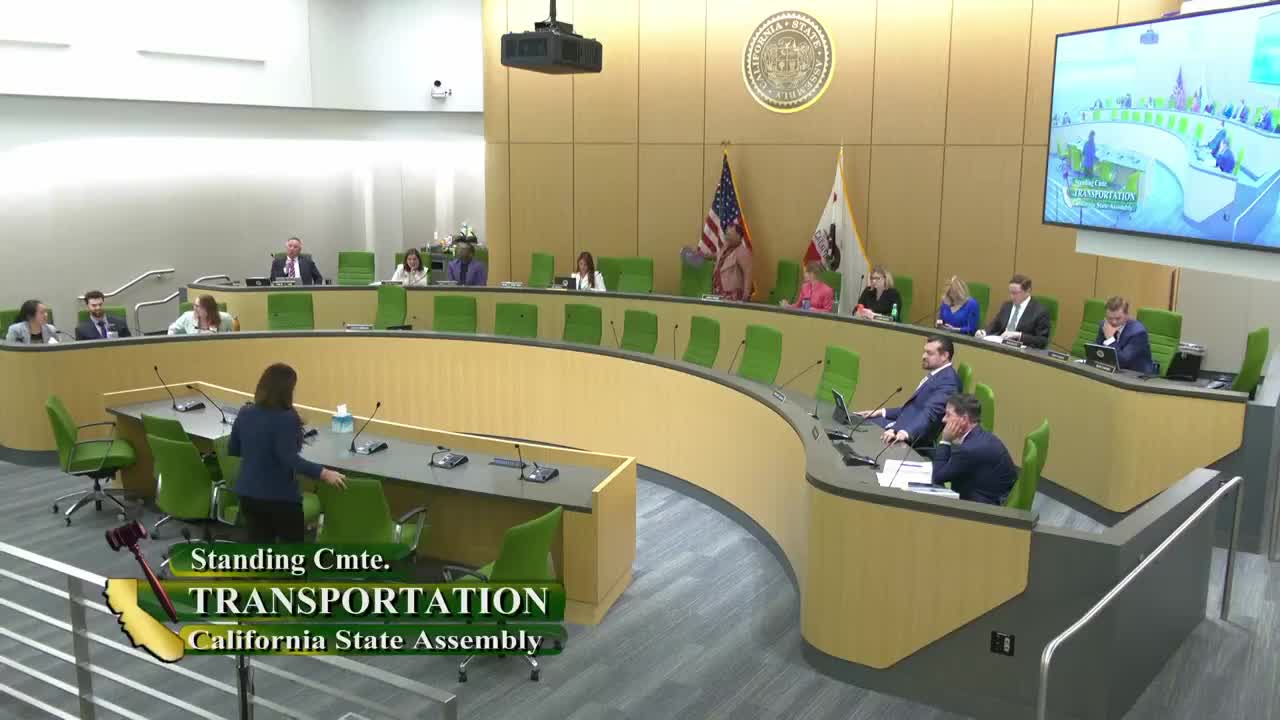 15SEC
Assembly Standing Committee on Transportation
24SEC
Assembly Standing Committee on Transportation
Bill Author

Bill Co-Author(s):