AB 2142: Prisons: mental health.
- Session Year: 2023-2024
- House: Assembly
- Latest Version Date: 2024-02-06
Current Status:
Failed
(2024-05-16: In committee: Held under submission.)
Introduced
In Committee
First Chamber
In Committee
Second Chamber
Enacted
Existing law authorizes the Secretary of the Department of Corrections and Rehabilitation to establish and maintain classes for incarcerated persons utilizing institutional personnel or entering into an agreement with the governing board of a school district or private school. Existing law requires the department to develop and implement a plan to obtain additional rehabilitation and treatment services for incarcerated persons and parolees. Existing law requires that plan to include, among other things, filling vacant state staff positions that provide direct and indirect rehabilitation services, or obtaining services from local governments and contractors to assist with treatment for parolees and incarcerated persons.
This bill would require the department to establish a 3-year pilot program at 2 or more institutions that would provide access to specified mental health therapy for those not classified by the department to receive mental health treatment from the institution. The bill would require communications during therapy sessions, as specified, between the incarcerated person and assigned therapist to be confidential. The bill would require the California Correctional Health Care Services to be the custodian of records for treatment records generated under this pilot program. The bill would require the department to report certain information to the fiscal and appropriate policy committees of the Legislature, from March 1, 2025, to March 1, 2027.
The bill would make related findings and declarations.
The Legislature finds and declares all of the following:
(a)Rehabilitation is an essential function of the Department of Corrections and Rehabilitation.
(b)The primary function of the Department of Corrections and Rehabilitations Statewide Mental Health Program is to ensure patients have ready access to mental health services based on their need.
(c)Mental health therapy contributes to personal growth, reflection, and preparation for safe and successful postincarceration reentry and helps foster a safer environment for staff and people incarcerated in the Department of Corrections and Rehabilitation.
(d)Mental health therapy can be provided by an array of licensed professionals or registered mental health providers, including marriage and family therapists, psychologists, and professional clinical counselors.
(e)To that end, access to mental health therapy should be available to all people incarcerated in the Department of Corrections and Rehabilitation, whatever their security level or length of sentence, without having to be classified as having a mental health disorder.
(f)The department has implemented a successful telepsychiatry program that has improved access to mental health care services and reduced staffing shortages and utilizing these technologies for a broader population will provide for a greater variety of options for incarcerated people to meet with therapists.
SEC. 2.Section 2693 is added to the Penal Code, to read:2693.(a)In order to foster incarcerated peoples growth, mental and emotional wellness, and rehabilitation, the Department of Corrections and Rehabilitation shall establish a three-year pilot program at two or more institutions. The pilot program shall include at least one institution housing people of each gender. The pilot program at each institution shall provide access to mental health therapy to an incarcerated person in either of the following settings:
(1)Virtual therapy opportunities, including telepsychiatry in a confidential setting.
(2)Contracted licensed or registered mental health providers who can provide counseling in a confidential setting.
(b)For each incarcerated person, virtual therapy opportunities or in-person sessions, pursuant to paragraph (2) of subdivision (a), shall be offered at least twice per month, for a minimum of 50 minutes, or as determined by the provider.
(c)Access to services during an incarcerated persons enrollment in the pilot program shall be limited to persons who are not currently determined by the department as having the following classification statuses:
(1)Correctional Clinical Case Management System.
(2)Enhanced Outpatient Program.
(3)Acute levels of care, including the Psychiatric Inpatient Programs or Mental Health Crisis Bed.
(d)Enrollment shall not result in an incarcerated person being classified as having a serious mental health disorder unless the provider has made a formal recommendation and the incarcerated person offers express, written permission.
(e)Communications between an incarcerated person and the assigned mental health provider shall be confidential pursuant to the privacy protections of the Health Insurance Portability and Accountability Act of 1996 (HIPAA) (Public Law 104-191). The California Correctional Health Care Services shall act as the custodian of records for all treatment documents generated under this pilot program.
(f)Upon the incarcerated persons release from custody, the department shall provide them with information about community-based treatment programs.
(g)(1)The department shall report to the fiscal and appropriate policy committees of the Legislature on March 1, 2025, and each March 1 thereafter until March 1, 2027. The report shall include all of the following:
(A)The planned capacity of the program at each participating facility.
(B)The number of incarcerated persons enrolled in the program at each participating facility.
(C)The percentage of participants with positive posttreatment outcomes.
(D)The number of persons who are successfully linked to postrelease community-based treatment programs.
(2)(A)The requirement for submitting a report imposed under paragraph (1) shall become inoperative on March 1, 2027.
(B)A report to be submitted pursuant to this subdivision shall be submitted in compliance with Section 9795 of the Government Code.
(h)For the purposes of this section, virtual therapy opportunities means services provided by tablet, video conference, or other technologies.
(i)For the purposes of this section, positive outcomes means an inmate exhibiting any of the following:
(1)Reduced disciplinary action or writeups from staff.
(2)Self-acceptance.
(3)Self-understanding.
(4)Improved interpersonal safety and functioning.
|
Date
|
Status
|
|---|---|
| May 16, 2024 | In committee: Held under submission. |
| Apr 24, 2024 | In committee: Set, first hearing. Referred to APPR. suspense file. |
| Apr 3, 2024 | From committee: Do pass and re-refer to Com. on APPR. (Ayes 8. Noes 0.) (April 2). Re-referred to Com. on APPR. |
| Feb 20, 2024 | Referred to Com. on PUB. S. |
| Feb 7, 2024 | From printer. May be heard in committee March 8. |
| Feb 6, 2024 | Read first time. To print. |
|
Date
|
Description
|
Location
|
Votes
|
|
|---|---|---|---|---|
| Apr 2, 2024 | Do pass and be re-referred to the Committee on [Appropriations] | Assembly Standing Committee on Public Safety |
Passed |
This list shows positions taken on this bill by organizations on the date displayed, which is linked to the original source.
Positions by individuals are not included.
|
Organization
|
Position
|
Date
|
|---|---|---|
| Anti-Recidivism Coalition | * Support | Apr 2, 2024 |
| California Association of Alcohol and Drug Program Executives | * Support | Apr 2, 2024 |
| California Association Of Marriage And Family Therapists | * Support | Apr 2, 2024 |
| California Correctional Peace Officers Association | * Support | Apr 2, 2024 |
| California Police Chiefs Association | ** Support | |
| California Public Defenders Association | ** Support | |
| California State Association of Psychiatrists | * Support | Apr 2, 2024 |
| California Youth Empowerment Network | ** Support | |
| Californians for Safety and Justice | * Support | Apr 2, 2024 |
| Initiate Justice | * Support | Apr 2, 2024 |
| Mental Health America of California | * Support | Apr 2, 2024 |
Date of Hearing: April 24, 2024
ASSEMBLY COMMITTEE ON APPROPRIATIONS
Buffy Wicks, Chair
ABPCA Bill Id:AB 2142
Author:(Haney) – As Introduced Ver:February 6, 2024
Policy Committee: | Public Safety | Vote: | 8 - 0 |
|
| ||
|
|
Urgency: No State Mandated Local Program: No Reimbursable: No
SUMMARY:
This bill requires the California Department of Corrections and Rehabilitation (CDCR) to operate a three-year pilot program to provide therapy to incarcerated people who do not qualify for higher levels of mental health care in prison.
FISCAL EFFECT:
Costs (General Fund) to CDCR, likely in the millions to tens of millions of dollars annually, to operate the pilot program. CDCR estimates that operating this pilot at two facilities could add another 3,000 patients to CDCR’s mental health services. CDCR anticipates costs of at least $13 million annually for 84 clinicians, six IT support staff, and additional Telehealth IT equipment and cell phones to operate the pilot program. If CDCR needs to hire additional program or custody staff, allocate additional physical space, or upgrade IT network infrastructure to facilitate adoption of the pilot program, costs may be significantly higher. As discussed in more detail below, implementation of this bill might have significant impacts on CDCR’s ongoing litigation costs.
COMMENTS:
- Purpose. According to the author:
Most people with trauma benefit from seeing a therapist. Denying incarcerated persons – who arguably can carry the most complex trauma – from seeking therapy does nothing to promote their rehabilitation. This bill is a small step in the right direction in keeping our communities safe from more trauma and harm.
- Background. CDCR currently provides mental health care services to incarcerated people at several different levels based on the severity of a person’s mental health needs. The Correctional Clinical Case Management System (CCCMS) is the basic level of outpatient mental health care at CDCR. The Enhanced Outpatient Program (EOP) provides a more intensive level of outpatient care than CCCMS. CDCR provides short-term, inpatient care for acute mental health needs – including episodes of psychiatric distress or mental disorder – in Mental Health Crisis Beds (MHCBs). Psychiatric Inpatient Programs (PIPs) provide intensive, long-term inpatient treatment for incarcerated patients who cannot function adequately or stabilize in an outpatient program or shorter-term inpatient program.
This bill requires CDCR to operate a pilot program at two or more institutions to provide therapy services to incarcerated people who are not currently treated through CCCMS, EOP, MHCB, or PIP – in other words, incarcerated people who do not already have diagnosed mental health conditions. The pilot program must offer, in a confidential setting, access to virtual therapy or in-person counseling from contracted, licensed or registered mental health providers. The bill also provides that enrollment in the pilot program must not result in an incarcerated person being classified as having a serious mental health disorder unless the provider has made a formal recommendation and the incarcerated person offers express, written permission. The bill contains confidentiality provisions to protect communications between a participating incarcerated person and their mental health provider, and requires CDCR to report to the Legislature about the scope and outcomes of the pilot program.
CDCR currently faces more than $90 million in sanctions for failing to adequately staff mental health services in state prisons, which may be imposed as part of a decades-long federal class action lawsuit (Coleman v. Newsom). For years, CDCR has been unable to meet the minimum staff vacancy rate imposed on the department by court order. The department has argued that it has made every reasonable effort to fill its mental health staffing vacancies, but faces significant challenges due to the nature and location of the work and a national shortage of mental health care providers. However, this spring, the court issued a tentative ruling that may require CDCR to pay sanctions based on the department’s continuing vacancy rates. To the extent implementation of this bill makes it harder for CDCR to fill its existing mental health vacancies, the bill may significantly increase CDCR’s ongoing costs under Coleman, and may lead to additional litigation regarding the level of service established by this bill in comparison to the level of service required by Coleman.
Analysis Prepared by: Annika Carlson / APPR. / (916) 319-2081
Date of Hearing: April 2, 2024
Counsel: Liah Burnley
ASSEMBLY COMMITTEE ON
Kevin McCarty, Chair
ABPCA Bill Id:
Author:() – As Ver:
SUMMARY:
Requires the Department of Corrections and Rehabilitation (CDCR) to establish a three-year pilot program for mental health therapy for incarcerated individuals. Specifically, this bill:
- Provides that the program shall provide access to mental health therapy to incarcerated individuals.
- Provides that the purpose of the program is to foster growth, mental and emotional wellness, and rehabilitation of incarcerated individuals.
- Requires the program to provide mental health therapy in either of the following settings:
- Virtual therapy, including telepsychiatry, provided by tablet, video conference, or other technologies, in a confidential setting; or
- Counseling with licensed or registered mental health providers in a confidential setting.
- Virtual therapy, including telepsychiatry, provided by tablet, video conference, or other technologies, in a confidential setting; or
- Requires the mental health therapy sessions to be offered at least twice per month, for a minimum of 50 minutes, or as determined by the provider.
- Provides that communications between an incarcerated person and the mental health provider are confidential pursuant to the privacy protections of the Health Insurance Portability and Accountability Act of 1996 (HIPAA).
- Requires CDCR to implement the program at two or more institutions, including at least one intuition housing people of each gender.
- Provides that the following individuals are not eligible to participate in the program:
- Individuals in the Correctional Clinical Case Management System (CCCMS);
- Individuals in the Enhanced Outpatient Program (EOP); and,
- Individuals with acute levels of care, including Psychiatric Inpatient Programs (PIPs) or Mental Health Crisis Bed (MHCB).
- Individuals in the Correctional Clinical Case Management System (CCCMS);
- States that a participant shall not be classified as having a serious mental health disorder because of their enrollment in the program, unless the provider has made a formal recommendation and the incarcerated person offers express, written permission.
- Requires CDCR to provide participants with information about community-based treatment programs upon release from custody;
- Requires CDCR to submit annual reports to the Legislature about the program that include the following information:
- The planned capacity of the program at each participating facility;
- The number of participants enrolled in the program at each participating facility;
- The percentage of participants with positive post-treatment outcomes, which include reduced disciplinary action or write-ups from staff, self-acceptance, self-understanding, and improved interpersonal safety and functioning; and,
- The number of participants who are successfully linked to postrelease community-based treatment programs.
- The planned capacity of the program at each participating facility;
- Makes legislative findings and declarations.
EXISTING LAW:
- Establishes CDCR to administer the state prison system under the direction of the Secretary. (Pen. Code, § 5000 et seq.)
- Vests the Secretary of the CDCR with the supervision, management and control of state prisons, including the responsibility for the care, custody, treatment, training, discipline and employment of a person confined in those prisons. (Pen. Code, § 5054.)
- Provides that the purpose of sentencing for crime is public safety achieved through punishment, rehabilitation, and restorative justice. (Pen. Code, § 1170, subd. (a)(1).)
- Requires CDCR to expand substance abuse treatment services in prisons to accommodate at least 4,000 additional inmates who have histories of substance abuse. (Pen. Code, § 2694.)
- Requires CDCR to establish the Case Management Reentry Pilot Program for individuals who are likely to benefit from a case management reentry strategy designed to address homelessness, joblessness, mental disorders, and developmental disabilities among offenders transitioning from prison into the community. The purpose of the pilot program is to implement promising and evidence-based practices and strategies that promote improved public safety outcomes for offenders reentering society after serving a term in state prison and while released to parole. (Pen. Code, § 3016.)
- Requires, as a condition of parole, an incarcerated person who meets the specified criteria to be provided necessary treatment by the State Department of State Hospitals (DSH). (Pen. Code, § 2962.)
- States that the treatment shall be inpatient unless the DSH certifies that there is reasonable cause to believe the parolee can be safely and effectively treated on an outpatient basis. (Pen. Code, § 2964.)
FISCAL EFFECT:
Unknown
COMMENTS:
- Author's Statement: According to the author, “Most people with trauma benefit from seeing a therapist. Denying incarcerated persons – who arguably can carry the most complex trauma – from seeking therapy does nothing to promote their rehabilitation. This bill is a small step in the right direction in keeping our communities safe from more trauma and harm.”
- Mental Health Services at CDCR: CDCR’s Mental Health Services Delivery System provides incarcerated individuals access to mental health services. According to CDCR, the primary function of their Statewide Mental Health Program (SMHP) is to ensure patients have ready access to mental health services based on their need. The SMHP operates under a court order reached in the Coleman v. Newsom lawsuit filed originally in 1990 as Coleman v. Wilson. In 1997, the parties reached agreement on a plan to address constitutional inadequacies by establishing mental health services, including programs and staffing, at multiple levels of care. CDCR’s Mental Health Services Delivery System Program Guide provides the policies and procedures that govern delivery of these mental health services. (CDCR, Mental Health Program (MHP). Available at: <https://www.cdcr.ca.gov/dhcs/mental-health-program/> [as of March 25, 2025].)
According to the Mental Health Services Delivery System Program Guide:
Any inmate can be referred for mental health services at any time. Inmates who are not identified at Reception or upon arrival at an institution as needing mental health services, may develop such needs later. Any staff members that have concerns about an inmate’s mental stability are encouraged to refer that inmate for evaluation by a qualified mental health clinician (psychiatrist, psychologist, or clinical social worker).
(CDCR, Mental Health Services Delivery System Programs Guide. Available at: <https://cchcs.ca.gov/wp-content/uploads/sites/60/2021-Program-Guide-2.1.22.pdf> [as of March 25, 2025].) An inmate must meet the specific treatment criteria to receive treatment at a specific level of care. CCCMS is the basic, primary level of outpatient mental health care at CDCR. EOP is the highest level of outpatient care. EOP provides more intensive level of outpatient clinical care than CCCMS. MHCB is acute care that provides short-term inpatient treatment for episodes of psychiatric distress or mental disorder. Lastly, PIPs provide treatment that is more intensive for patients who cannot function adequately or stabilize in an outpatient program or shorter-term inpatient program and provide long-term inpatient mental health care. (Ibid.)
This bill would establish a three-year pilot program at two or more CDCR institutions that would provide access to virtual and in-person mental health counseling sessions. Individuals designated by CDCR to receive mental health care, pursuant to the above-described levels of care, would be ineligible, as the intent of this bill is to target populations who may not have a mental health disorder, but, as evidenced by the very circumstance of their incarceration, may still benefit from mental health therapy. Indeed, the psychological impact of prison in and of itself[1] may be adequate justification for ensuring that the incarcerated populations have access to mental health counseling.
- Practical Considerations: This bill would require CDCR to submit a report to the legislature regarding the pilot program. If chaptered, this bill would go into effect Jan 1, 2025. As currently drafted, the first report would come due March 1, 2025. Presumably, the pilot program would end on January 1, 2028. However, the last report would be due March 1, 2027, and the bill would require no further reporting after this date. The reporting deadlines in the bill would not allow the legislature to draw the most useful conclusions about the pilot program.
In addition, this bill specifies that enrollment in the program cannot lead to a participant being diagnosed as a serious mental health disorder, unless the provider has made a formal recommendation and the incarcerated person offers express, written permission. Some people incarcerated at CDCR with a serious mental health disorder may be civilly committed to DSH for continued treatment after their release date, if they are found to be a danger to others. (CDCR, Offenders with a Mental Health Disorder. Available at: <https://www.cdcr.ca.gov/bph/divisions/severe-mental-health-disorder/> [as of March 25, 2025].) There is a need to encourage incarcerated individuals to participate in the program, without fear of being diagnosed with a serious mental disorder, and the potential consequences that may follow. However, the legislature should consider the requirement that a diagnosis cannot be made without the person’s written consent. Given that a mental health professional has determined that the person would be a may have a serious mental health disorder, it could be the case that the person may benefit from continued mental health treatment at DSH upon parole.
- Argument in Support: According to Initiate Justice, “People with mental health issues are far over-represented in California’s prisons, which makes access to consistent mental health therapy even more critical to effectively rehabilitating incarcerated people in California and reducing our recidivism rate. Research has demonstrated that justice-involved people have high levels of trauma and PTSD that lead them to engage in criminogenic behavior as a method of ‘survival coping.’ According to the Journal of Juvenile Justice, justice-involved youth and young adults are thirteen times more likely to have at least one adverse childhood experience (ACE) and four times more likely to specify four or more ACEs. Further, research on post-traumatic growth indicates that people can heal from trauma.
“Unfortunately, most incarcerated people do not have access to mental health support to do so. According to the National Alliance on Mental Illness (NAMI), about 3 in 5 people (63%) with a history of mental illness do not receive mental health treatment while incarcerated in state and federal prisons. In 2013, the California Journal of Politics and Policy found that of the majority of incarcerated persons with mental health or substance use issues, less than 10% receive treatment. Often, incarcerated people who would benefit from therapy will deny they have mental health issues, given the stigma surrounding mental health issues in prisons. As a result, they may not feel safe seeking it out.
“It’s imperative that incarcerated people receive high quality mental health therapy.”
- Related Legislation:
- AB 2040 (Waldron) would establish the California Reentry Officer, independent of CDCR, to promote state and local efforts to ensure successful reentry services are provided to incarcerated individuals. AB 2040 is pending in Assembly Appropriations Committee.
- AB 2818 (Mathis) would require county jails to provide incarcerated individuals contact information for social services upon release. AB 2818 is being heard in this Committee today.
- AB 2040 (Waldron) would establish the California Reentry Officer, independent of CDCR, to promote state and local efforts to ensure successful reentry services are provided to incarcerated individuals. AB 2040 is pending in Assembly Appropriations Committee.
- Prior Legislation:
- AB 857 (Ortega), Chapter 857, Statues of 2023, requires CDCR to provide each incarcerated person, upon release, informational materials about vocational rehabilitation services and independent living programs offered by the Department of Rehabilitation.
- AB 1104 (Bonta), Chapter 560, Statutes of 2023, provides that effective rehabilitation increases public safety and builds stronger communities, and that the purpose of incarceration is rehabilitation and successful community reintegration through education, treatment, and restorative justice programs.
- SB 513 (Wiener), of the 2023- 2024 Legislative Session, would have required CDCR to conduct mental health treatment to accomplish specified goals. SB 513 was held under submission in Senate Appropriations Committee.
- AB 428 (Waldron), of the 2023-2024 Legislative Session, would have established the California Department of Reentry to provide leadership, coordination, and technical assistance to ensure successful reentry services are provided to incarcerated individuals. AB 428 was held under submission in Assembly Appropriations Committee.
- SB 903, Chapter 821, Statues of 2022, requires California Rehabilitation Oversight Board to examine CDCR’s efforts to address the housing needs of incarcerated persons, including those who are identified as having serious mental health needs, who are released to the community as parolees and to include specified data on homelessness in its reports.
- AB 2250 (Bonta), of the 2021-2022 Legislative Session, would have required CDCR to establish a reentry services pilot program to provide comprehensive, structured reentry services for women released from state prison. AB 2250 was held in the Assembly Appropriations Committee.
- AB 2730 (Villapudua), of the 2021-2022 Legislative Session, would have created the California Anti-recidivism and Public Safety Act pilot program which would have required CDCR to sponsor a program to help incarcerated persons reintegrate into their communities, reduce recidivism, and increase public safety. AB 2730 was vetoed.
- AB 620 (Holden), of the 2017-2018 Legislative Session, would have required CDCR to provide meaningful opportunity for successful release of incarcerated persons by offering information about and access to effective trauma focused programming, as specified. AB 620 failed passage in the Assembly Appropriations Committee.
- AB 2129 (Jones-Sawyer), of the 2013-2014 Legislative Session, would have required CDCR to develop a voluntary reentry program that included access to cognitive behavior therapy. AB 2129 was held in the Assembly Appropriations Committee.
- AB 857 (Ortega), Chapter 857, Statues of 2023, requires CDCR to provide each incarcerated person, upon release, informational materials about vocational rehabilitation services and independent living programs offered by the Department of Rehabilitation.
REGISTERED SUPPORT / OPPOSITION:
Support
Anti-recidivism Coalition
California Association of Alcohol and Drug Program Executives, INC.
California Association of Marriage and Family Therapists
California Police Chiefs Association
California Public Defenders Association
California Youth Empowerment Network
Initiate Justice
Mental Health America of California
Opposition
None
Analysis Prepared by:
See, Prison Policy Initiate, Research Roundup: Incarceration Can Cause Lasting Damage to Mental Health. Available at: <https://www.prisonpolicy.org/blog/2021/05/13/mentalhealthimpacts/> [“The carceral environment can be inherently damaging to mental health by removing people from society and eliminating meaning and purpose from their lives. On top of that, the appalling conditions common in prisons and jails — such as overcrowding, solitary confinement, and routine exposure to violence — can have further negative effects. Researchers have even theorized that incarceration can lead to “Post-Incarceration Syndrome,” a syndrome similar to PTSD, meaning that even after serving their official sentences, many people continue to suffer the mental effects.”] ↑
Discussed in Hearing
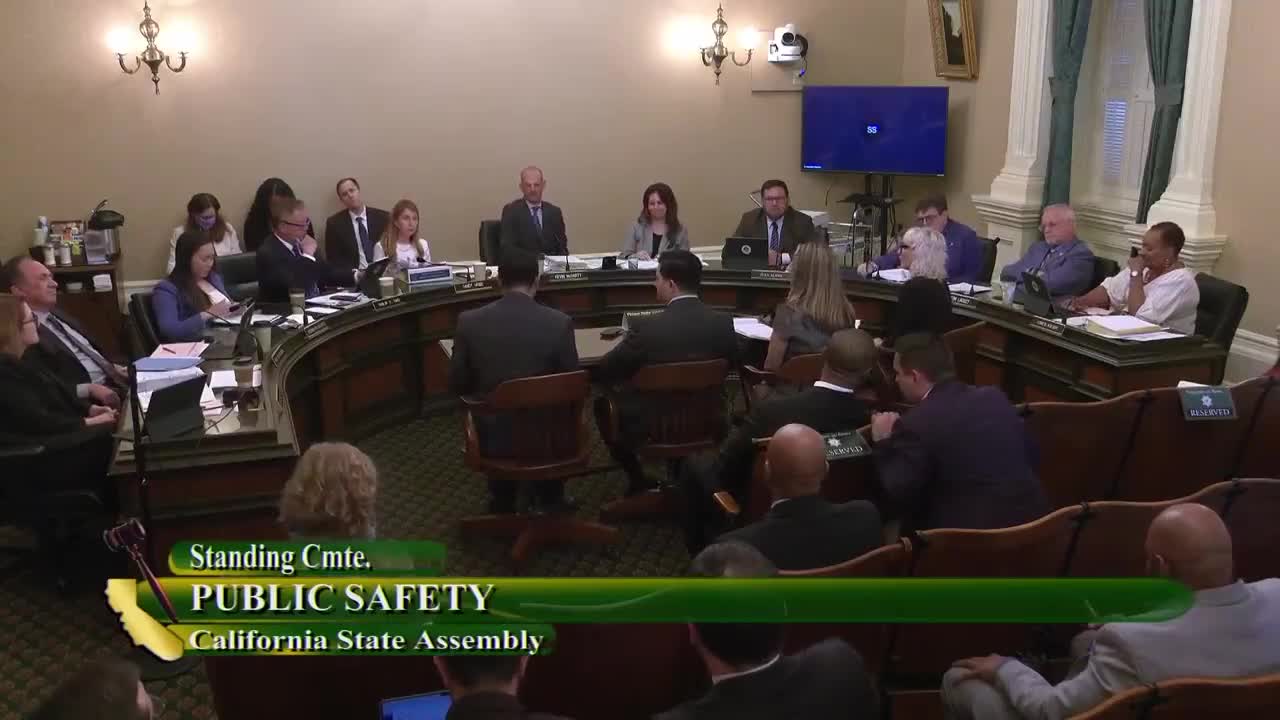 8MIN
Assembly Standing Committee on Public Safety
Bill Author

Bill Co-Author(s):