AB 222: Civil Rights Department: Californians with disabilities workgroup.
- Session Year: 2023-2024
- House: Assembly
- Latest Version Date: 2023-03-15
Current Status:
Failed
(2024-02-01: From committee: Filed with the Chief Clerk pursuant to Joint Rule 56.)
Introduced
In Committee
First Chamber
In Committee
Second Chamber
Enacted
What does this bill do?
The bill requires the state Civil Rights Department to form a workgroup to recommend updates to accessibility and anti‑discrimination laws for people with disabilities that focus on workforce and employment. The department will appoint at least 10 members, including people with disabilities, family members, business and labor representatives, state disability and rehabilitation agencies, and the state's protection and advocacy agency, and the group will review labor laws, workplace policies, employment data, and best practices. The workgroup must consult stakeholders and send recommendations to the Legislature to improve inclusion, enforcement of workplace civil rights, and reduce unemployment and underemployment for people with disabilities.
The summary is provided by generative AI which can make mistakes. For original language, please view the details in the table below.
Existing law, the California Fair Employment and Housing Act, establishes the Civil Rights Department within the Business, Consumer Services, and Housing Agency under the direction of the Director of Civil Rights. Existing law sets forth the powers and duties of the department, which include receiving, investigating, conciliating, mediating, and prosecuting complaints alleging unlawful practices or violations of specified civil rights provisions, including those based on a mental or physical disability, as defined.
This bill would require the department to convene a workgroup to make recommendations to the Legislature for the development of accessibility and antidiscrimination laws for people with disabilities, as defined. The bill would require membership the department to appoint members of the workgroup to include interested parties and stakeholders that reflect the diversity of the state, including, among other groups, individuals who have personal experience with a disability. The bill would require the workgroup to take specified actions, including examining existing laws and policies related to, among other issues, improving the effective enforcement of civil rights laws.
This bill would require the department, based on the findings of the workgroup, to submit a report to the Legislature by July 1, 2025, containing recommendations on ways to achieve specified goals and priorities of the workgroup. The bill would also require provide that the Legislature to should hold public hearings on the results of the report within one year of submission of that report.
This bill would repeal these provisions on January 1, 2028.
This bill would include related legislative findings.
Existing law, the California Fair Employment and Housing Act, establishes the Civil Rights Department within the Business, Consumer Services, and Housing Agency under the direction of the Director of Civil Rights. Existing law sets forth the powers and duties of the department, which include receiving, investigating, conciliating, mediating, and prosecuting complaints alleging unlawful practices or violations of specified civil rights provisions, including those based on a mental or physical disability, as defined.
This bill would require the department to convene a workgroup to make recommendations to the Legislature for the development of accessibility and antidiscrimination laws for people with disabilities, as defined. The bill would require membership of the workgroup to include interested parties and stakeholders that reflect the diversity of the state, including, among other groups, individuals who have personal experience with a disability. The bill would require the workgroup to take specified actions, including examining existing laws and policies related to, among other issues, improving the effective enforcement of civil rights laws.
This bill would require the department, based on the findings of the workgroup, to submit a report to the Legislature by July 1, 2025, containing recommendations on ways to achieve specified goals and priorities of the workgroup. The bill would also require the Legislature to hold public hearings on the results of the report within one year of submission of that report.
This bill would repeal these provisions on January 1, 2028.
This bill would include related legislative findings.
The Legislature finds and declares all of the following:
(a)California is the nationwide leader in enacting landmark legislation focusing on the rights of people with disabilities. The Lanterman Developmental Disabilities Services Act was passed by the Legislature in 1969.
(b)The federal Americans with Disabilities Act was enacted over 30 years ago in 1990.
(c)Many aspects of these laws need updating to adjust to modern times and 21st century challenges that disabled people face on a daily basis.
(d)It is the intent of the Legislature to establish a workgroup focused on California disability laws and policies. policies related to workforce and employment. The workgroup will be representative of all people with disabilities, along with the various other subject matter experts in the state. The workgroup will be required to report to the Legislature recommendations for updating laws and policies. It is the intent of the Legislature that when the report required by this act is completed, that the Legislature fully examine and take action in response to its recommendations.
SEC. 2.Section 12931.5 is added to the Government Code, to read:12931.5.(a)The department Civil Rights Department shall convene a workgroup to make recommendations to the Legislature for the development of accessibility and antidiscrimination laws related to workforce and employment for people with disabilities.
(b)For purposes of this section, disability means any mental or physical disability as defined in Sections 12926 and 12926.1.
(c)Membership of the workgroup shall be appointed by the department in consultation with the protection and advocacy agency described in paragraph (8) and shall include at least 10 interested parties and stakeholders that reflect the diversity of the state, including, but not limited to, representatives at least one representative from all each of the following groups:
(1)Individuals who have personal experience with a disability, including individuals with a targeted disability as defined by Section 1614.203(a)(9) of Title 29 of the Code of Federal Regulations.
(2)Family members of children with disabilities, as defined by the federal Individuals with Disabilities Education Act (20 U.S.C. Sec. 1401(3)).
(3)Individuals from the The business and labor communities.
(4)The State Department of Social Services.
(5)The State Council on Developmental Disabilities.
(6)The California Commission on Disability Access.
(7)The Department of Rehabilitation.
(8)The protection and advocacy agency designated by the Governor in this state to fulfill the requirements and assurances of the federal Developmental Disabilities Assistance and Bill of Rights Act of 2000, contained in Chapter 144 (commencing with Section 15001) of Title 42 of the United States Code, for the protection and advocacy of the rights of persons with developmental disabilities, as defined in Section 15002(8) of Title 42 of the United States Code.
(d)At a minimum, the workgroup shall do all of the following:
(1)Examine Californias existing labor laws and public workplace and employment policies and procedures, and review best practices and recommendations from research within California and in other states, related to all of the following:
(A)Improving integration and inclusion of people with disabilities in the broader community. California workforce.
(B)Ensuring that all sectors of society Californias labor, workforce, and employment are covered by civil rights laws to the maximum extent possible.
(C)Improving the effective enforcement of civil rights laws. laws in Californias workplaces.
(D)Ensuring that people with disabilities are able to acquire the same information, engage in the same interactions, and enjoy the same services from mobile, electronic, or internet-based sources with the same level of privacy and independence and substantially equivalent ease of use as others.(E)(D)Reducing the high rates of unemployment, underemployment, and poverty unemployment and underemployment among people with disabilities.
(F)Expanding community-based services and integrated housing for people with disabilities, and reducing the reliance on institutional settings.(G)Reducing the disproportionate incarceration of people with disabilities.(H)Achieving the full inclusion of students with disabilities in integrated general education classrooms without restraint and seclusion.(I)Addressing ableism and systemic inequality in areas of modern life, including, but not limited to, K12 education, higher education, transportation, medical care, housing, public benefits and other government services, employment, and places of public accommodation.(2)Review available data and identify additional data needed to assess workforce participation and outcomes for people with disabilities.
(3)Consult with organizations representing stakeholders, including organizations representing the interests of people with disabilities, throughout the development of its findings.
(e)(1)Based on the findings of the workgroup, the department, by July 1, 2025, shall submit a report to the Legislature containing recommendations on ways to achieve or advance the goals and priorities set forth in paragraph (1) of subdivision (d).
(2)The report shall be submitted in compliance with Section 9795.
(3)The Legislature shall should hold public hearings on the results of the report within one year of the submission of the report.
(f)This section shall remain in effect only until January 1, 2028, and as of that date is repealed.
The Legislature finds and declares all of the following:
(a)California is the nationwide leader in enacting landmark legislation focusing on the rights of people with disabilities. The Lanterman Developmental Disabilities Services Act was passed by the Legislature in 1969.
(b)The federal Americans with Disabilities Act was enacted over 30 years ago in 1990.
(c)Many aspects of these laws need updating to adjust to modern times and 21st century challenges that disabled people face on a daily basis.
(d)It is the intent of the Legislature to establish a workgroup focused on California disability laws and policies. The workgroup will be representative of all people with disabilities, along with the various other subject matter experts in the state. The workgroup will be required to report to the Legislature recommendations for updating laws and policies.
SEC. 2.Section 12931.5 is added to the Government Code, to read:12931.5.(a)The department shall convene a workgroup to make recommendations to the Legislature for the development of accessibility and antidiscrimination laws for people with disabilities.
(b)For purposes of this section, disability means any mental or physical disability as defined in Sections 12926 and 12926.1.
(c)Membership of the workgroup shall include interested parties and stakeholders that reflect the diversity of the state, including, but not limited to, representatives from all of the following groups:
(1)Individuals who have personal experience with a disability, including individuals with a targeted disability as defined by Section 1614.203(a)(9) of Title 29 of the Code of Federal Regulations.
(2)Family members of children with disabilities, as defined by the federal Individuals with Disabilities Education Act (20 U.S.C. Sec. 1401(3)).
(3)Individuals from the business and labor communities.
(d)At a minimum, the workgroup shall do all of the following:
(1)Examine existing laws and public policies and procedures, and review best practices and recommendations from research within California and in other states, related to all of the following:
(A)Improving integration and inclusion of people with disabilities in the broader community.
(B)Ensuring that all sectors of society are covered by civil rights laws to the maximum extent possible.
(C)Improving the effective enforcement of civil rights laws.
(D)Ensuring that people with disabilities are able to acquire the same information, engage in the same interactions, and enjoy the same services from mobile, electronic, or internet-based sources with the same level of privacy and independence and substantially equivalent ease of use as others.
(E)Reducing the high rates of unemployment, underemployment, and poverty among people with disabilities.
(F)Expanding community-based services and integrated housing for people with disabilities, and reducing the reliance on institutional settings.
(G)Reducing the disproportionate incarceration of people with disabilities.
(H)Achieving the full inclusion of students with disabilities in integrated general education classrooms without restraint and seclusion.
(I)Addressing ableism and systemic inequality in areas of modern life, including, but not limited to, K12 education, higher education, transportation, medical care, housing, public benefits and other government services, employment, and places of public accommodation.
(2)Review available data and identify additional data needed to assess participation and outcomes for people with disabilities.
(3)Consult with organizations representing stakeholders, including organizations representing the interests of people with disabilities, throughout the development of its findings.
(e)(1)Based on the findings of the workgroup, the department, by July 1, 2025, shall submit a report to the Legislature containing recommendations on ways to achieve or advance the goals and priorities set forth in paragraph (1) of subdivision (d).
(2)The report shall be submitted in compliance with Section 9795.
(3)The Legislature shall hold public hearings on the results of the report within one year of the submission of the report.
(f)This section shall remain in effect only until January 1, 2028, and as of that date is repealed.
|
Date
|
Status
|
|---|---|
| Feb 1, 2024 | From committee: Filed with the Chief Clerk pursuant to Joint Rule 56. |
| Jan 31, 2024 | Died pursuant to Art. IV, Sec. 10(c) of the Constitution. |
| May 18, 2023 | In committee: Held under submission. |
| Apr 19, 2023 | In committee: Set, first hearing. Referred to APPR. suspense file. |
| Mar 16, 2023 | Re-referred to Com. on APPR. |
| Mar 15, 2023 | Read second time and amended. |
| Mar 14, 2023 | From committee: Amend, and do pass as amended and re-refer to Com. on APPR. (Ayes 11. Noes 0.) (March 14). |
| Feb 2, 2023 | Referred to Com. on JUD. |
| Jan 11, 2023 | From printer. May be heard in committee February 10. |
| Jan 10, 2023 | Read first time. To print. |
|
Date
|
Description
|
Location
|
Votes
|
|
|---|---|---|---|---|
| Mar 14, 2023 | Do pass as amended and be re-referred to the Committee on [Appropriations] | Assembly Standing Committee on Judiciary |
Passed |
This list shows positions taken on this bill by organizations on the date displayed, which is linked to the original source.
Positions by individuals are not included.
|
Organization
|
Position
|
Date
|
|---|---|---|
| Disability Rights California | * Support | Mar 14, 2023 |
| Justice in Aging | ** Support | |
| The Arc and United Cerebral Palsy California Collaboration | ** Support |
Date of Hearing: April 19, 2023
ASSEMBLY COMMITTEE ON APPROPRIATIONS
Chris Holden, Chair
ABPCA Bill Id:AB 222
Author:(Arambula) – As Amended Ver:March 15, 2023
Policy Committee: | Judiciary | Vote: | 11 - 0 |
|
| ||
|
|
Urgency: No State Mandated Local Program: No Reimbursable: No
SUMMARY:
This bill creates a workgroup convened by the Civil Rights Department to make recommendations to the Legislature about disability accessibility and antidiscrimination laws related to workforce and employment. The bill requires the workgroup to study existing labor laws, workplace and employment policies and procedures, available data, and input from stakeholders, and requires the workgroup to report its recommendations to the Legislature by July 1, 2025.
FISCAL EFFECT:
This bill would generate general fund costs in the millions of dollars. The Civil Rights Department estimates costs of $990,000 in fiscal year 2024-25 and $983,000 in fiscal year 2025-2026, which would cover staffing, operational expenses, and costs associated with disability access. Depending on the composition and accessibility needs of the workgroup, the Civil Rights Department may incur additional costs for assistive technologies to help workgroup members complete the work directed by this bill. The bill does not specify whether workgroup members would receive a per diem or be entitled to reimbursement for their expenses; if so, those would be additional general fund costs.
COMMENTS:
- Purpose. This bill is sponsored by Disability Rights California. According to the author,
AB 222 will strengthen the civil rights protections that California provides for individuals with disabilities. It will create a workgroup to address the need for updating laws and services that aim to support all Californians with disabilities.
The Americans with Disabilities Act (ADA) was enacted over thirty years ago in 1990. The disability rights movement advocated for civil rights and achieved the goal of improving the lives of many disabled people at the time. Many aspects of these laws need updating to adjust to modern times and twenty-first century challenges that individuals with disabilities face, such as in the workplace.
- Disability Access. As summarized in the analysis of this bill by the Assembly Committee on the Judiciary, California has long been a leader in protecting against discrimination based on disability, and working to provide equal access and opportunity to people with disabilities. However, in the decades since major disability rights legislation was enacted, there have been significant changes in the contemporary workplace and developments in technology, and discrimination against people with disabilities has persisted. This bill would create a workgroup convened by the Civil Rights Department to study existing law and policy with the goal of improving integration of people with disabilities into the workforce, ensuring all sectors of labor, workforce, and employment are covered by civil rights laws, improving enforcement of workplace civil rights laws, and reducing the rates of underemployment and unemployment among people with disabilities. This bill requires the workgroup to report its findings and recommendations to the Legislature, and encourages the Legislature to hold public hearings on the results of the workgroup’s report.
- Prior Legislation. AB 1990 (Arambula), of the 2021-2022 Legislative Session, sought to establish a similar workgroup convened by the Civil Rights Department. Unlike AB 222, AB 1990 was not limited to labor and workforce issues, and sought to make recommendations on disability laws and policies generally. AB 1990 was held on this committee’s suspense file.
Analysis Prepared by: Annika Carlson / APPR. / (916) 319-2081
Date of Hearing: March 14, 2023
ASSEMBLY COMMITTEE ON JUDICIARY
Brian Maienschein, Chair
ABPCA Bill Id:AB 222
Author:(Arambula) – As Introduced Ver:January 10, 2023
As Proposed to be Amended
SUBJECT: Civil Rights Department: Californians with disabilities workgroup: WORKFORCE AND EMPLOYMENT
KEY ISSUE: should a workgroup be convened by the CIVIL RIGHTS DEPARTMENT to study policies related to workforce and employment that affect californians with disabilities and recommend changes to the state’s laws and policies that would reduce high rates of unemployment among people with disabilities?
SYNOPSIS
As proposed to be amended, this bill creates a workgroup, convened by the Civil Rights Department (formerly the Department of Fair Employment and Housing), to study policies related to workforce and employment that affect Californians with disabilities and recommend changes to the state’s laws and policies that would reduce high rates of unemployment and underemployment among people with disabilities. Membership of the ten-person workgroup would include interested parties and stakeholders that reflect the diversity of the state, including, but not limited to, representatives from all of the following groups:
- Individuals who have personal experience with a disability, including individuals with a targeted disability as defined by Section 1614.203(a)(9) of Title 29 of the Code of Federal Regulations;
- Family members of children with disabilities, as defined by the federal Individuals with Disabilities Education Act (20 U.S.C. Section 1401(3)); and
- Individuals from the business and labor communities.
As currently in print, the workgroup created by the bill would have a vast agenda: to examine existing laws and public policies and procedures, and review best practices and recommendations from research within California and in other states, including specified topics such as reducing the high rates of unemployment, underemployment, and poverty among people with disabilities; expanding community-based services and integrated housing for people with disabilities, and reducing the reliance on institutional settings; reducing the disproportionate incarceration of people with disabilities; and achieving the full inclusion of students with disabilities in integrated general education classrooms without restraint and seclusion. The author wisely proposes to narrow the focus of the bill to just one serious and complex, yet far more narrow and manageable issue: policies related to workforce and employment that affect Californians with disabilities. The workgroup would recommend changes to the state’s laws and policies that would reduce high rates of unemployment and underemployment among people with disabilities. Based on the findings of the workgroup, the department, by July 1, 2025, would be required to submit a report to the Legislature containing recommendations on ways to achieve or advance the goals and priorities set forth. The bill’s provisions would sunset on January 1, 2028.
The bill is sponsored by Disability Rights California and supported by a number of disability advocacy organizations. The bill has no opposition on file.
SUMMARY: Creates a workgroup, convened by the Office of Civil Rights (OCR), to study policies related to workforce and employment that affect Californians with disabilities and recommend changes to the state’s laws and policies that would reduce high rates of unemployment and underemployment among people with disabilities. Specifically, this bill:
- Makes the following findings and declarations on behalf of the Legislature:
- California is the nationwide leader in enacting landmark legislation focusing on the rights of people with disabilities. The Lanterman Developmental Disabilities Services Act was passed by the Legislature in 1969.
- The federal Americans with Disabilities Act was enacted over 30 years ago in 1990.
- Many aspects of these laws need updating to adjust to modern times and 21st century challenges that disabled people face on a daily basis.
- It is the intent of the Legislature to establish a workgroup focused on California disability laws and policies related to workforce and employment. The workgroup will be representative of all people with disabilities, along with the various other subject matter experts in the state. The workgroup will be required to report to the Legislature recommendations for updating laws and policies.
- It is the intent of the Legislature that when the report required by this act is completed, that the Legislature fully examine and take action in response to its recommendations.
- Requires OCR to convene a workgroup to make recommendations to the Legislature for the development of accessibility and antidiscrimination laws related to workforce and employment for people with disabilities.
- Requires membership of the workgroup to include ten interested parties and stakeholders that reflect the diversity of the state, including, but not limited to, at least one representative from each of the following groups:
- Individuals who have personal experience with a disability, including individuals with a targeted disability as defined by Section 1614.203(a)(9) of Title 29 of the Code of Federal Regulations.
- Family members of children with disabilities, as defined by the federal Individuals with Disabilities Education Act (20 U.S.C. Section 1401(3)).
- Individuals from the business and labor communities.
- Requires, at a minimum, the workgroup to do all of the following:
- Examine existing labor laws and workforce and employment policies and procedures, and review best practices and recommendations from research within California and in other states, related to all of the following:
- Improving integration and inclusion of people with disabilities in the California workforce.
- Ensuring that all sectors of California’s labor, workforce, and employment are covered by civil rights laws to the maximum extent possible.
- Improving the effective enforcement of civil rights laws in the California workforce. Ensuring that all sectors of society California’s labor, workforce, and employment are covered by civil rights laws to the maximum extent possible.
- Improving the effective enforcement of civil rights laws in the California’s workplaces.
- Reducing the high rates of unemployment, and underemployment, and poverty among people with disabilities.
- Review available data and identify additional data needed to assess participation and outcomes for people with disabilities.
- Consult with organizations representing stakeholders, including organizations representing the interests of people with disabilities, throughout the development of its findings.
- Examine existing labor laws and workforce and employment policies and procedures, and review best practices and recommendations from research within California and in other states, related to all of the following:
- Based on the findings of the workgroup, requires OCR, by January 1, 2025, to submit a report to the Legislature containing recommendations on ways to achieve or advance the goals and priorities set forth above. The report shall be submitted to the Legislature in compliance with rules for how reports are submitted to the Legislature.
- Provides that the Legislature should hold public hearings on the results of the report within one year of the submission of the report.
- Provides that the provisions of the bill shall remain in effect only until January 1, 2028, and as of that date is repealed.
- Defines, for purposes of the bill, “disability” as any mental or physical disability as defined in Government Code Sections 12926 and 12926.1.
EXISTING LAW:
- Pursuant to federal law, under the Americans with Disabilities Act (ADA), provides that no individual shall be discriminated against on the basis of disability in the full and equal enjoyment of the goods, services, facilities, privileges, advantages, or accommodations of any place of public accommodation by any person who owns, leases, or leases to, or operates a place of public accommodation. (42 U.S.C. Section 12182.)
- Pursuant to the Unruh Civil Rights Act (Unruh), provides that all persons, regardless of sex, race, color, religion, ancestry, national origin, disability or medical condition, are entitled to the full and equal accommodations, advantages, facilities, privileges, or services in all business establishments of every kind; makes a violation of the ADA also constitutes a violation of Unruh; and subjects a person or entity in violation to actual damages incurred by an injured party, treble actual damages but not less than $4,000, and any attorney’s fees as the court may determine to be proper. (Civil Code Section 51 et seq.)
- Provides, pursuant to the Disabled Persons Act, that individuals with disabilities or medical conditions have the same right as the general public to the full and free use of the streets, highways, sidewalks, walkways, public buildings, medical facilities, including hospitals, clinics and physicians’ offices, public facilities and other public places, and also provides that a violation of an individual’s rights under the ADA constitutes a violation of state law. (Civil Code Section 54.)
- Provides that individuals with disabilities shall be entitled to full and equal access to public accommodations, subject only to the conditions and limitations established by law, or state or federal regulation, and applicable alike to all persons. (Civil Code Section 54.1.)
- Provides for a California Commission on Disability Access (CCDA), an independent state agency composed of 17 members, with the general responsibility for monitoring disability access compliance in California, and the authority to hold hearings and make recommendations to the Legislature for necessary changes to existing state law in order to facilitate implementation of state and federal laws on disability access. (Government Code Section 8299 et seq.)
- Defines “mental disability” and “physical disability.” (Government Code Section 12926 (j), (m).)
- Makes a number of findings about physical disability, mental disability, and medical condition, including the following:
- Under the law of this state, whether a condition limits a major life activity shall be determined without respect to any mitigating measures, unless the mitigating measure itself limits a major life activity, regardless of federal law under the Americans with Disabilities Act of 1990. Further, under the law of this state, “working” is a major life activity, regardless of whether the actual or perceived working limitation implicates a particular employment or a class or broad range of employments.
- The Legislature intends (1) for state law to be independent of the federal Americans with Disabilities Act of 1990, (2) to require a “limitation” rather than a “substantial limitation” of a major life activity, and (3) by enacting paragraph (4) of subdivision (j) and paragraph (4) of subdivision (l) of Section 12926, to provide protection when an individual is erroneously or mistakenly believed to have any physical or mental condition that limits a major life activity. (Government Code Section 12926.1 (c)-(d).)
FISCAL EFFECT: As currently in print this bill is keyed fiscal.
COMMENTS: This bill seeks to create a workgroup, convened by the Office of Civil Rights (formerly the Department of Fair Employment and Housing), to study policies related to workforce and employment that affect Californians with disabilities and recommend changes to the state’s laws and policies that would reduce high rates of unemployment and underemployment among people with disabilities. According to the author:
AB 222 will strengthen the civil rights protections that California provides for individuals with disabilities. It will create a workgroup to address the need for updating laws and services that aim to support all Californians with disabilities.
The Americans with Disabilities Act (ADA) was enacted over thirty years ago in 1990. The disability rights movement advocated for civil rights and achieved the goal of improving the lives of many disabled people at the time. Many aspects of these laws need updating to adjust to modern times and twenty-first century challenges that individuals with disabilities face, such as in the workplace.
California is a nationwide leader in enacting landmark legislation focusing on the rights of people with disabilities. Although these landmark policies made major strides for the disability community in the United States, many aspects of the law need to be updated to adjust to modern times, especially regarding modern technology.
AB 222 will bring people representing the many faces of individuals with various disabilities to the table for a much-needed conversation regarding labor, workforce, and employment.
Background. As this bill points out in its findings and declarations, California has long been a leader in enacting laws to protect the rights of the disabled community.
Extending as far back as 1897, California law has prohibited discrimination against individuals in places of public accommodation. Section 51 of the Civil Code was enacted in 1905 and, after amendments in 1919 and 1923, provided as follows:
All citizens within the jurisdiction of this state are entitled to the full and equal accommodations, advantages, facilities and privileges of inns, restaurants, hotels, eating houses, places where ice cream or soft drinks of any kind are sold for consumption on the premises, barber shops, bath houses, theaters, skating rinks, public conveyances and all other places of public accommodation or amusement, subject only to the conditions and limitations established by law, and applicable alike to all citizens.
For as long as California has proscribed discrimination in places of public accommodation under Section 51, it has also provided a damages remedy for violations of the law. The remedy available for violation of Section 51 was established in Section 52, and provided that anyone who denied a citizen access to any public accommodation or facility was liable for an amount not less than one hundred dollars in damages. Thus, from its inception, Section 51 sought to obtain equality for its citizens by proscribing discrimination, requiring that public places admit all “citizens,” and allowing aggrieved plaintiffs to recover damages to compensate for the harm. (But to avoid romanticizing state history and be truthful, California history is also rife with systemic racism and discrimination, including passage of an 1858 law that banned “any person of the Chinese or Mongolian races” from entering the state; allowing enslaved Americans who fled to California to be kidnapped and returned to their “owners” pursuant to the Fugitive Slave Act; a 1931 raid in Los Angeles in which police officers rounded up, arrested, and deported 400 people because they appeared to be Latino, but many of whom were American citizens; anti-misogyny marriage laws; Proposition 187; statutes and initiatives prohibiting marriage equality, etc.)
The Unruh Civil Rights Act. In 1959, in response to several appellate court rulings holding that Section 51 did not prohibit exclusion of customers from places such as private schools and businesses on the basis of race, California enacted the Unruh Act (named after its author, Jesse Unruh), which significantly revised Section 51 in two respects. First, the law was broadened to unequivocally prohibit discrimination in all “public accommodations.” Second, an illustrative list that identified categories of protected persons was added to the law.
In 1974, “sex” was added to the Unruh Act to prohibit gender-based discrimination. Most relevant to this bill, in 1987, the Act was broadened to encompass discrimination against blind or otherwise physically disabled individuals. A 1992 amendment eliminated the “blindness” and “physical” distinctions, expanding the law to apply to all persons with disabilities.
According to the California Supreme Court, “In 1992, shortly after passage of the federal Americans with Disabilities Act (ADA), the Legislature amended the state's disability protections ‘to strengthen California law in areas where it is weaker than the [ADA] and to retain California law when it provides more protection for individuals with disabilities than the [ADA].’ Two overlapping laws, the Unruh Civil Rights Act (§ 51) and the Disabled Persons Act (§§ 54–55.3), are the principal sources of state disability access protection.” (Jankey v. Lee (2012) 55 Cal.4th 1038, 1044 [citation to internal quotation deleted].) Therefore, since 1992, public accommodations in California have been required to comply with not only the ADA, but also with the state’s Unruh Act, which incorporates the ADA into its provisions and makes a violation of the ADA punishable as a violation of Unruh. (Civil Code Section 51.) All violations of Unruh are subject to statutory damages of at least $4,000 per violation, except some cases where the violation is based on a construction-related accessibility claim, in which case lower damages (a minimum of $1,000, or $2,000, depending on the circumstances) apply.
The Lanterman-Petris-Short Act. The first American hospitals established for the care and treatment of individuals with mental illnesses appeared in the late 1700s. Until the mid-1800s, their numbers were so few that it was common for persons with mental illness to land in jail, or be otherwise housed with the indigent, physically ill, individuals with physical disabilities, alcoholics, the senile, and the “slothful.” The deplorable conditions that these individuals were forced to live in prompted state interest in providing state-run “asylums” for residential care. Following a series of major lawsuits in the late 1800s, alleging wrongful commitment to these institutions, procedures for commitment were tightened.
In California prior to 1967, the state’s mental health system looked very different than it does now. Many more individuals with mental health disabilities lived in state hospitals and large facilities, often for long periods of their life. In 1967, the Lanterman-Petris-Short Act (LPS Act, Welfare and Institutions Code Sections 5000 et seq.) was enacted. Named after its authors, State Assemblyman Frank Lanterman and California State Senators Nicholas C. Petris and Alan Short, the LPS Act sought to, “end the inappropriate, indefinite, and involuntary commitment of persons with mental health disorders.” It also established a right to prompt psychiatric evaluation and treatment, in some situations, and set out strict due process protections for mental health clients. The LPS Act provides for involuntary commitment for varying lengths of time for the purpose of treatment and evaluation, provided that certain requirements or preconditions are met. Additionally, the LPS Act provides for LPS conservatorships, resulting in involuntary commitment for the purposes of treatment, if an individual is found to meet the “grave disability” standard in which a person, because of a mental disorder, or impairment by chronic alcoholism, is unable to provide for their basic personal needs for food, clothing, or shelter.
The LPS Act provides for a conservator of the person, of the estate, or of both the person and the estate for a person who is gravely disabled because of a mental health disorder or impairment by chronic alcoholism or use of controlled substances. The person for whom such a conservatorship is sought has the right to demand a court or jury trial on the issue of whether they meet the gravely disabled requirement. The purpose of an LPS conservatorship is to provide individualized treatment, supervision, and placement for the gravely disabled person.
Lack of full equality and integration in society of people with disabilities. Despite the passage of these landmark anti-discrimination laws in California, as well as at the federal level, individuals with disabilities continue to experience discrimination in various ways, including in employment.
Recent labor statistics show the unemployment rate of individuals with disabilities in the United States is more than twice as high as it is for persons without disabilities (9.7% versus 4.0%). (U.S. Department of Labor, Office of Disability Employment Policy, Disability Labor Force Statistics (Feb. 20222), available at Disability Employment Statistics | U.S. Department of Labor (dol.gov).) Among youth aged 20-24, individuals with disabilities had a 46.7% rate of labor force participation, versus a rate of 72.0% for youth of the same age without a disability. (Ibid.)
The bill. This bill creates a workgroup, convened by the OCR (formerly the Department of Fair Employment and Housing), to study policies affecting people with disabilities in the workforce and employment in California.
The bill in print would give the workgroup a vast agenda of complex topics to study; among other things, it would be required to examine existing laws and public policies and procedures; best practices and recommendations from research within California and in other states, about specified topics, such as reducing the high rates of unemployment, underemployment, and poverty among people with disabilities; expanding community-based services and integrated housing for people with disabilities, and reducing the reliance on institutional settings; reducing the disproportionate incarceration of people with disabilities; and achieving the full inclusion of students with disabilities in integrated general education classrooms without restraint and seclusion.
The bill would also require the workgroup to review available data and identify additional data needed to assess participation and outcomes for people with disabilities; and consult with organizations representing stakeholders, including organizations representing the interests of people with disabilities, throughout the development of its findings.
Author’s amendments. As proposed to be amended, the bill directs the workgroup to study just one serious and complex, yet far more narrow and manageable issue: policies related to workforce and employment that affect Californians with disabilities. The workgroup would be tasked with recommending changes to the state’s laws and policies that would reduce high rates of unemployment and underemployment among people with disabilities.
The bill in print does not specify the number of members the workgroup would have. As proposed to be amended, the bill would specify that the workgroup would have “at least ten” members. Membership of the ten-person workgroup would be required to include interested parties and stakeholders that reflect the diversity of the state, including, individuals who have personal experience with a disability; family members of children with disabilities; and individuals from the business and labor communities. These groups are included in the bill in print.
As proposed to be amended, the bill would also specify that representatives from the above groups, as well as the following, would be selected by OCR in consultation with the protection and advocacy agency described in paragraph (8) below and be included in the working group. (Disability Rights California is the “protection and advocacy agency designated by the Governor in this state to fulfill the requirements and assurances of the federal Developmental Disabilities Assistance and Bill of Rights Act of 2000, contained in Chapter 144 (commencing with Section 15001) of Title 42 of the United States Code, for the protection and advocacy of the rights of persons with developmental disabilities, as defined in Section 15002(8) of Title 42 of the United States Code.”) :
- The California Department of Social Services.
- The State Council on Developmental Disabilities.
- The California Commission on Disability Access.
- The California Department of Rehabilitation.
- The protection and advocacy agency designated by the Governor in this state to fulfill the requirements and assurances of the federal Developmental Disabilities Assistance and Bill of Rights Act of 2000, contained in Chapter 144 (commencing with Section 15001) of Title 42 of the United States Code, for the protection and advocacy of the rights of persons with developmental disabilities, as defined in Section 15002(8) of Title 42 of the United States Code.
Requirement for the Legislature to hold hearings on the workgroup’s findings. The bill in print requires the Legislature to “hold public hearings on the results of the report within one year of the submission of the report.” This requirement is invalid and unenforceable. The current Legislature cannot require a future Legislature (i.e. the one in 2026) to do anything. Nor could or would a court ever order the future Legislature to do so (because of the separation of powers). The power to make rules for the selection of officers, rules of proceeding or rules which regulate committees or employees of either or both houses of the Legislature, with one exception, are exclusively the province of the house affected by them. “Provisions of a statutory initiative measure regulating appointments of the Assembly Speaker and Senate President pro tempore regulating appointments and powers of standing, select, joint, and interim committees of the houses, regulating methods of adoption of rules for conduct of the houses. . . may not be amended or modified except as permitted by the Act, and repealing existing provisions of the Government Code relating to such subjects are invalid as in conflict with provisions of the State Constitution granting legislative bodies the power to enact rules or resolutions.” (People’s Advocate, Inc. v. Superior Court (California Legislature) (1986) 181 Cal.App.3d 316.)
Given these serious concerns, the author wisely wishes to modify this provision to read as follows:
The Legislature shall should hold public hearings on the results of the report within one year of the submission of the report.
In addition, the author proposes to add the following to Section One of the bill, regarding the intent of the Legislature:
It is the intent of the Legislature that when the report required by this act is completed, that the Legislature fully examine and take action in response to its recommendations.
ARGUMENTS IN SUPPORT: The bill’s sponsor, Disability Rights California, writes the following:
Disabled people experience access issues and discrimination in employment, education, building access, housing and transportation, technology, including internet and in state and local government processes among so many more. Disabled people experience these forms of discrimination often at a disproportionate rate if they have physical disabilities, but there are often not services available for people with invisible disabilities. Unfortunately, many times when disabled people file complaints about being discriminated against or experiencing access issues, the complaint does not end in a result that is satisfactory to the disabled person.
In regard to employment specifically, disabled people often experience workplace discrimination, harassment, reasonable accommodations issues, interview and applications questions issues, pre-employment medical exams and more. Disability discrimination in the workplace is a common claim by employees in California. It is clear that current disability laws are not enough to combat discrimination in 2023.
. . . Too often, the disability community is considered after a policy is in place, but this bill gives the disability community an opportunity to engage throughout the process. A popular saying in the disability movement is “Nothing about us without us!” and as DRC works on this bill, this phrase will remain constant in how AB 222s workgroup is developed.
REGISTERED SUPPORT / OPPOSITION:
Support
Disability Rights California
Justice in Aging
The Arc and United Cerebral Palsy California Collaboration
Opposition
None on file
Analysis Prepared by: Alison Merrilees / JUD. / (916) 319-2334
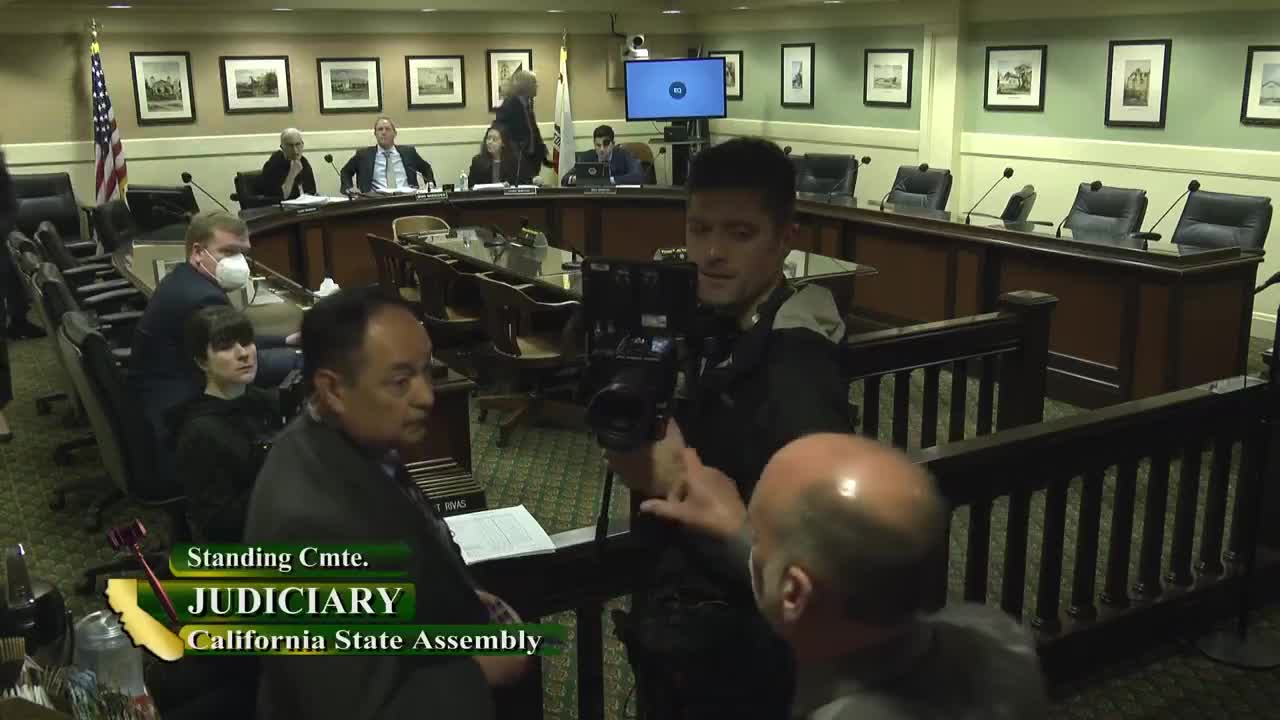
Discussed in Hearing
 11MIN
Assembly Standing Committee on Judiciary
Bill Author

Bill Co-Author(s):