AB 2235: Public contracts: local agencies: wind infrastructure.
- Session Year: 2023-2024
- House: Assembly
- Latest Version Date: 2024-09-27
Current Status:
Passed
(2024-09-27: Chaptered by Secretary of State - Chapter 707, Statutes of 2024.)
Introduced
In Committee
First Chamber
In Committee
Second Chamber
Enacted
Existing law generally requires public contracts to be awarded by competitive bidding pursuant to procedures set forth in the Public Contract Code, subject to various exceptions. Existing law authorizes certain local government agencies to use alternative contracting methods, including best value procurement and progressive design-build contracting for particular types of public projects, including, among others, certain construction projects and regional communications and related infrastructure projects.
Existing law establishes requirements that apply when a public entity is required by statute or regulation to obtain an enforceable commitment that a bidder, contractor, or other entity will use a skilled and trained workforce to complete a contract or project, and imposes various duties on the Labor Commissioner with respect to those requirements.
This bill would authorize the City of Long Beach to procure contracts relating to the terminal development project at the Port of Long Beach, known as Pier Wind, and to enter into an alternative project delivery method contract for that purpose, as provided. The bill would require the city to prepare, publicly advertise, and issue solicitation documents to procure and award any contract, subject to prescribed requirements. For purposes of these provisions, the bill would authorize the city to perform various duties regarding the procurement and administration of these contracts, including amending those contracts, as prescribed.
The bill would impose various prohibitions and requirements on a business entity, including requiring that entity to provide payment bonds for the project and using a skilled and trained workforce to perform all construction work on the project. The bill would require the contract between the city and the business entity to comply with certain requirements, such as including errors and omissions insurance. The bill would require all documents related to the project to be subject to disclosure under the California Public Records Act. The bill would define various terms for purposes of its provisions.
The bill would state that its provisions are severable and would make legislative findings and declarations as to the necessity of a special statute for the City of Long Beach.
Existing law generally requires public contracts to be awarded by competitive bidding pursuant to procedures set forth in the Public Contract Code, subject to various exceptions. Existing law authorizes certain local government agencies to use alternative contracting methods, including best value procurement and progressive design-build contracting for particular types of public projects, including, among others, certain construction projects and regional communications and related infrastructure projects.
Existing law establishes requirements that apply when a public entity is required by statute or regulation to obtain an enforceable commitment that a bidder, contractor, or other entity will use a skilled and trained workforce to complete a contract or project, and imposes various duties on the Labor Commissioner with respect to those requirements.
This bill would authorize the City of Long Beach to procure contracts relating to the terminal development project at the Port of Long Beach, known as Pier Wind, and to enter into an alternative project delivery method contract for that purpose, as provided. The bill would require the city to prepare, publicly advertise, and issue solicitation documents to procure and award any contract, subject to prescribed requirements. For purposes of these provisions, the bill would authorize the city to perform various duties regarding the procurement and administration of these contracts, including amending those contracts, as prescribed.
The bill would impose various prohibitions and requirements on a business entity, including requiring that entity to provide payment bonds for the project and using a skilled and trained workforce to perform all construction work. work on the project. The bill would require the contract between the city and the business entity to comply with certain requirements, such as including errors and omissions insurance. The bill would require all documents related to the project to be subject to disclosure under the California Public Records Act. The bill would define various terms for purposes of its provisions.
The bill would state that its provisions are severable and would make legislative findings and declarations as to the necessity of a special statute for the City of Long Beach.
Existing law generally requires public contracts to be awarded by competitive bidding pursuant to procedures set forth in the Public Contract Code, subject to various exceptions. Existing law authorizes certain local government agencies to use alternative contracting methods, including best value procurement and progressive design-build contracting for particular types of public projects, including, among others, certain construction projects and regional communications and related infrastructure projects.
Existing law establishes requirements that apply when a public entity is required by statute or regulation to obtain an enforceable commitment that a bidder, contractor, or other entity will use a skilled and trained workforce to complete a contract or project, and imposes various duties on the Labor Commissioner with respect to those requirements.
This bill would authorize the City of Long Beach to procure contracts relating to the terminal development project at the Port of Long Beach, known as Pier Wind, and to utilize any alternative project delivery method, including progressive design-build, for purposes of any contract related to that project. enter into an alternative project delivery method contract for that purpose, as provided. The bill would require the city to prepare prepare, publicly advertise, and issue solicitation documents to procure and award any contract. contract, subject to prescribed requirements. For purposes of these provisions, the bill would authorize the city to perform various duties regarding the procurement and administration of these contracts, including amending or entering into new contracts, those contracts, as prescribed.
The bill would impose various prohibitions and requirements on a business entity, including requiring that entity to provide payment bonds for the project and using a skilled and trained workforce to perform all construction work. The bill would require the contract between the city and the business entity to comply with certain requirements, such as including errors and omissions insurance. The bill would require all documents related to the project to be subject to disclosure under the California Public Records Act. The bill would define various terms for purposes of its provisions.
The bill would state that its provisions are severable and would make legislative findings and declarations as to the necessity of a special statute for the City of Long Beach.
Existing law generally requires public contracts to be awarded by competitive bidding pursuant to procedures set forth in the Public Contract Code, subject to various exceptions. Existing law authorizes certain local government agencies to use alternative contracting methods, including best value procurement and progressive design-build contracting for particular types of public projects, including, among others, certain construction projects and regional communications and related infrastructure projects.
Existing law establishes requirements that apply when a public entity is required by statute or regulation to obtain an enforceable commitment that a bidder, contractor, or other entity will use a skilled and trained workforce to complete a contract or project, and imposes various duties on the Labor Commissioner with respect to those requirements.
This bill would authorize the City of Long Beach to procure contracts relating to the terminal development project at the Port of Long Beach, known as Pier Wind, and to utilize any alternative project delivery method, including progressive design-build, for purposes of any contract related to that project. The bill would require the city to prepare and issue solicitation documents to procure and award any contract. For purposes of these provisions, the bill would authorize the city to perform various duties regarding the procurement and administration of these contracts, including amending or entering into new contracts, as prescribed.
The bill would impose various prohibitions and requirements on a business entity, as defined, including requiring that entity to provide payment bonds for the project and using a skilled and trained workforce. workforce to perform all construction work. The bill would require the contract between the city and the business entity to comply with certain requirements, such as including errors and omissions insurance. The bill would require all documents related to the project to be subject to disclosure under the California Public Records Act. The bill would define various terms for purposes of its provisions.
The bill would state that its provisions are severable and would make legislative findings and declarations as to the necessity of a special statute for the City of Long Beach.
Existing law generally requires public contracts to be awarded by competitive bidding pursuant to procedures set forth in the Public Contract Code, subject to various exceptions. Existing law authorizes certain local government agencies to use alternative contracting methods, including best value procurement and progressive design-build contracting for particular types of public projects, including, among others, certain construction projects and regional communications and related infrastructure projects.
Existing law establishes requirements that apply when a public entity is required by statute or regulation to obtain an enforceable commitment that a bidder, contractor, or other entity will use a skilled and trained workforce to complete a contract or project, and imposes various duties on the Labor Commissioner with respect to those requirements.
This bill would authorize the City of Long Beach to procure contracts relating to the terminal development project at the Port of Long Beach, known as Pier Wind, and to utilize any alternative project delivery method, including progressive design-build, for purposes of any contract related to that project. The bill would require the city to prepare and issue solicitation documents to procure and award any contract. For purposes of these provisions, the bill would authorize the city to perform various duties regarding the procurement and administration of these contracts, including amending or entering into new contracts, as prescribed.
The bill would impose various prohibitions and requirements on a business entity, as defined, including requiring that entity to provide payment bonds for the project and using a skilled and trained workforce. The bill would require the contract between the city and the business entity to comply with certain requirements, such as including errors and omissions insurance. The bill would require all documents related to the project to be subject to disclosure under the California Public Records Act.
The bill would state that its provisions are severable and would make legislative findings and declarations as to the necessity of a special statute for the City of Long Beach.
For purposes of this chapter, the following definitions apply:
(a)Apprenticeable occupation has the same meaning as provided in subdivision (a) of Section 2601.
(b)Best interests of the city means a procurement process that is determined by the city to provide the best value and an expedited delivery schedule while maintaining a high level of quality workmanship and materials.
(c)Best value means a procurement process whereby the selected bidder may be selected on the basis of objective criteria for evaluating the qualifications of bidders with the resulting selection representing the best combination of price and qualifications.
(d)Business entity means a partnership, corporation, or other legal entity that is able to provide appropriately licensed contracting, architectural, engineering, financial, construction, operations, management, facilities maintenance, and other services for development of the project, as applicable in relation to its respective scope of work.
(e)City means the City of Long Beach and its Board of Harbor Commissioners.
(f)Construction for purposes of the project, as defined in subdivision (p), does not include maritime and longshore operations.
(g)Construction manager at-risk means a competitively procured contract by the city with an individual, partnership, joint venture, corporation, or other recognized legal entity, that is appropriately licensed in this state, including a contractors license issued by the Contractors State License Board, and that guarantees the cost of a project and furnishes construction management services, including, but not limited to, preparation and coordination of bid packages, scheduling, cost control, value engineering, evaluation, preconstruction services, and construction administration.
(h)Construction Manager/General Contractor means a project delivery method using a best value procurement process in which a construction manager is procured to provide preconstruction services during the design phase of the project and construction or construction management services during the construction phase of the project.
(i)Construction subcontract means each subcontract awarded by a business entity to a subcontractor that will perform work, labor, or render services to the business entity in or about the construction of the project, or a subcontractor licensed by the State of California that, under subcontract to the business entity, specially fabricates and installs a portion of the work or improvement according to detailed drawings contained in plans and specifications.
(j)Design-build means a procurement process in which both the design and construction of a project are procured in a single phase.
(k)Design sequencing means a method of project delivery that enables the sequencing of design activities to permit each construction phase to commence when the design for that phase is complete, instead of requiring the design for the entire project to be completed before commencing construction.
(l)Guaranteed maximum price means the maximum payment agreed upon by the city and a business entity to finish all remaining design, preconstruction, and construction activities sufficient to complete and close out the project or any part of the project.
(m)Maritime and longshore operations for purposes of the project, as defined in subdivision (p), includes all of the following:
(1)The loading and unloading of cargo or materials to and from vessels, or the movement of cargo or materials to and from vessels, or other directly related functions, at any terminal or port facility to the cargos or materials point of rest, except for the movement of construction materials on a barge, construction staging area, or construction area when used as a construction work platform, rigging and hoisting of construction materials directly from a barge, construction staging area, or construction area when being used as a construction work platform into the construction process, the removal of construction materials directly from the project to a barge, construction staging area, or construction area when being used as a construction work platform, and the movement of construction materials and construction equipment within the construction staging area, from the construction staging area to the construction site, and on the construction site.
(2)Maintenance and repair work on the containers and equipment used to load or unload vessels.
(3)Maintenance and repair work necessary to facilitate the movement of cargo or materials to and from vessels at any terminal or port facility to the cargo or materials point of rest.
(n)Preconstruction services means services during the design phase, including, but not limited to, scheduling, pricing, and phasing to assist the city to design a more constructible project.
(o)Progressive design-build means a project delivery method in which the design, preconstruction services, and construction of the project or part of the project are procured, in one or more stages, from a single design-build entity that is selected through a best value-based selection at an early stage of the project.
(p)(1)Project means the terminal development project at the Port of Long Beach, currently known as Pier Wind, that is anticipated to involve the construction and development of a large-scale, multiacre terminal and transportation corridor to support offshore wind-related activities.
(2)Project does not include the construction, assembly, operation, or maintenance of offshore wind turbine systems or their floating foundations, nor the manufacturing and fabrication of their components.
(3)Project does not include maritime and longshore operations.
(q)Project labor agreement has the same meaning as provided in paragraph (1) of subdivision (b) of Section 2500.
(r)Public works has the same meaning as provided in subdivision (a) of Section 1720 of the Labor Code.
(s)Vessel includes, but is not limited to, a ship, boat, barge, and other related maritime craft.
22191.(a)(1)The city may procure contracts for the project or any part of the project pursuant to this chapter.
(2)The city may enter into an alternative project delivery method contract for any part of the project pursuant to this chapter upon completing both of the following:
(A)An evaluation of the traditional design-bid-build process of construction and of the alternative project delivery method in a public meeting.
(B)Following the evaluation specified in subparagraph (A), a written finding that use of the alternative project delivery method on the project will accomplish one or more of the following objectives:
(i)Reduce project costs.
(ii)Expedite the completion of the project.
(iii)Provide features that are not achievable through the design-bid-build method.
(b)Subject to the limitations of this chapter, the city may utilize any of the following alternative project delivery methods, or any combination of the following methods:
(1)Construction manager at-risk.
(2)Construction Manager/General Contractor.
(3)Design-build.
(4)Design sequencing.
(5)Progressive design-build.
(c)The design and construction of the project may occur in sequential or concurrent phases.
(d)This chapter does not allow an alternative project delivery method to include maritime and longshore operations.
(e)Except to the extent otherwise required under applicable law, the city may include in any contract procured pursuant to this chapter any provision that the city determines is necessary or appropriate.
(f)(1)The city shall prepare, publicly advertise, and issue solicitation documents to procure and award any contract pursuant to this chapter, subject to the following:
(A)For Construction Manager/General Contractor contracts, the solicitation documents prepared by the city shall include criteria that are the same as, or substantially similar to, those provided in subparagraphs (A) to (K), inclusive, of paragraph (1) of, and paragraph (2) of, subdivision (a) of Section 6703.
(B)For design-build and progressive design-build contracts, the city shall comply with the same or substantially similar requirements of Section 22185.2 and Sections 22185.4 to 22185.7, inclusive, and subdivisions (a), (c), and (d) of Section 22185.3.
(2)The contract solicitation process may include prequalification or short-listing business entities who seek to perform the project or any part of the project.
(3)The city shall review submissions it solicits and receives and may award contracts for the project to one or more responsible business entities whose submissions are determined by the city to be the most advantageous by providing the best value in meeting the best interests of the city.
(g)The city shall retain the right not to award any contract for the project, including if the city determines that the project is not in the best interests of the city or should negotiations with any business entity otherwise fail.
22192.(a)(1)Upon agreement of the pricing, including any guaranteed maximum price if applicable, for any relevant aspects of the project, the city, in its sole and absolute discretion, may do all of the following:
(A)Amend its contract with the business entity.
(B)Direct the business entity to complete the remaining design, preconstruction, and construction activities sufficient to complete and close out the project or any part of the project.
(C)Add funds to the contract for the activities pursuant to this subdivision.
(2)Any amendment of the existing contract with the business entity shall not require any additional competitive process.
(3)This section does not require the city to amend an existing contract or enter into a new contract for remaining design, preconstruction, or construction activities for the project.
(b)(1)If the city and the business entity do not reach an agreement on pricing for any relevant aspect of the project, or if the city otherwise elects not to have the business entity complete some or all of the remaining work, the city may solicit proposals to complete some or all of the remaining work for the project from firms that previously submitted proposals.
(2)(A)The city may, upon written determination that it is in the best interest of the city to do so, formally solicit proposals from other business entities to complete some or all of the remaining work for the project, or complete the project using other delivery methods.
(B)If otherwise applicable to the city, any contract awarded for the project shall be made on a best value basis.
22193.(a)The city, in its solicitation for proposals or bids for the project, may identify specific types of subcontractors, certifications, and license classifications that shall be included in the business entitys proposal or bid.
(b)All construction subcontractors that are identified in the business entitys proposal or bid shall be afforded the protections of Chapter 4 (commencing with Section 4100) of Part 1.
22194.(a)All public works constructed pursuant to this chapter shall comply with Chapter 1 (commencing with Section 1720) of Part 7 of Division 2 of the Labor Code.
(b)A business entity shall not be evaluated for selection or eligible for selection by the city unless the business entity provides an enforceable commitment to the city that the business entity and its subcontractors at every tier shall use a skilled and trained workforce to perform all construction work on the project or contract that falls within an apprenticeable occupation in the building and construction trades, in accordance with Chapter 2.9 (commencing with Section 2600) of Part 1.
(c)Subdivision (b) shall not apply if one or more of the following requirements are met:
(1)The city has entered into a project labor agreement that will bind all contractors and subcontractors performing construction work on the project or contract to use a skilled and trained workforce, and the business entity agrees to be bound by that project labor agreement.
(2)The project or contract is being performed under the extension or renewal of a project labor agreement that was entered into by the city before January 1, 2025, which binds all contractors and subcontractors performing construction work to use a skilled and trained workforce.
(3)The business entity has entered into a project labor agreement that shall bind the entity and all of its subcontractors at every tier performing construction work on the project or contract to use a skilled and trained workforce.
22195.The business entity shall provide payment bonds for the project issued by a California-admitted surety in the form, at the times, and in the amount required by the city.
22196.(a)The relevant contracts between the city and the business entity for the project shall require errors and omissions insurance coverage for the design elements of the project.
(b)The relevant contracts between the city and the business entity shall be subject to subdivision (b) of Section 2782 of the Civil Code.
(c)Any contract between the business entity and a contractor or subcontractor relating to the project shall be subject to Section 2782.05 of the Civil Code.
22197.(a)The negotiation process shall expressly prohibit practices that may result in unlawful activity, including, but not limited to, rebates, kickbacks, or other unlawful consideration.
(b)The negotiation process shall expressly prohibit city employees from participating in the selection process when those employees have a relationship with a person or business entity seeking a contract under this chapter that would subject those employees to Section 87100 of the Government Code.
22198.All documents related to the project shall be subject to disclosure under the California Public Records Act (Division 10 (commencing with Section 7920.000) of Title 1 of the Government Code), except those exempted from disclosure under the act.
22199.(a)The provisions of this chapter are severable. If any provision of this chapter or its application is held invalid, that invalidity shall not affect other provisions or applications that can be given effect without the invalid provision or application.
(b)Except as expressly provided herein, this chapter does not affect, expand, alter, or limit any rights or remedies otherwise available at law.
SEC. 2.The Legislature finds and declares that a special statute is necessary and that a general statute cannot be made applicable within the meaning of Section 16 of Article IV of the California Constitution because of the unique and special circumstances surrounding the project and the need to immediately, quickly, and efficiently develop the project.
For purposes of this chapter, the following definitions apply:
(a)Apprenticeable occupation has the same meaning as provided in subdivision (a) of Section 2601.
(b)Best interests of the city means a procurement process that is determined by the city to provide the best value and an expedited delivery schedule while maintaining a high level of quality workmanship and materials.
(c)Best value means a procurement process whereby the selected bidder may be selected on the basis of objective criteria for evaluating the qualifications of bidders with the resulting selection representing the best combination of price and qualifications.
(d)Business entity means a partnership, corporation, or other legal entity that is able to provide appropriately licensed contracting, architectural, engineering, financial, construction, operations, management, facilities maintenance, and other services for development of the project, as applicable in relation to its respective scope of work.
(e)City means the City of Long Beach and its Board of Harbor Commissioners.
(f)(1)Construction means any new construction work, subsequent construction work, and construction maintenance work following the initial completion of a project that is contracted to be performed by a contractor in the construction industry, including construction work on a barge, in a construction staging area, or in a construction area that is being used as a construction work platform.(2)Construction does not include any of the following:(A)The loading and unloading of cargo to and from vessels.(B)The movement of cargo to and from vessels at any terminal or port facility to the cargos point of rest.(C)Maintenance and repair work on the containers and equipment used to load or unload vessels.(D)Maintenance and repair work necessary to facilitate the movement of cargo to and from vessels at any terminal or port facility to the cargos point of rest.(f)Construction for purposes of the project, as defined in subdivision (p), does not include maritime and longshore operations.
(g)Construction manager at-risk means a competitively procured contract by the city with an individual, partnership, joint venture, corporation, or other recognized legal entity, that is appropriately licensed in this state, including a contractors license issued by the Contractors State License Board, and that guarantees the cost of a project and furnishes construction management services, including, but not limited to, preparation and coordination of bid packages, scheduling, cost control, value engineering, evaluation, preconstruction services, and construction administration.
(h)Construction Manager/General Contractor means a project delivery method using a best value procurement process in which a construction manager is procured to provide preconstruction services during the design phase of the project and construction or construction management services during the construction phase of the project.
(i)Construction subcontract means each subcontract awarded by a business entity to a subcontractor that will perform work, labor, or render services to the business entity in or about the construction of the project, or a subcontractor licensed by the State of California that, under subcontract to the business entity, specially fabricates and installs a portion of the work or improvement according to detailed drawings contained in plans and specifications.
(j)Design-build means a procurement process in which both the design and construction of a project are procured in a single phase.
(k)Design sequencing means a method of project delivery that enables the sequencing of design activities to permit each construction phase to commence when the design for that phase is complete, instead of requiring the design for the entire project to be completed before commencing construction.
(l)Guaranteed maximum price means the maximum payment agreed upon by the city and a business entity to finish all remaining design, preconstruction, and construction activities sufficient to complete and close out the project or any part of the project.
(m)Maritime and longshore operations for purposes of the project, as defined in subdivision (p), includes all of the following:
(1)The loading and unloading of cargo or materials to and from vessels, or the movement of cargo or materials to and from vessels, or other directly related functions, at any terminal or port facility to the cargos or materials point of rest, except for the movement of construction materials on a barge, construction staging area, or construction area when used as a construction work platform, rigging and hoisting of construction materials directly from a barge, construction staging area, or construction area when being used as a construction work platform into the construction process, the removal of construction materials directly from the project to a barge, construction staging area, or construction area when being used as a construction work platform, and the movement of construction materials and construction equipment within the construction staging area, from the construction staging area to the construction site, and on the construction site.
(2)Maintenance and repair work on the containers and equipment used to load or unload vessels.
(3)Maintenance and repair work necessary to facilitate the movement of cargo or materials to and from vessels at any terminal or port facility to the cargo or materials point of rest.
(m)(n)Preconstruction services means services during the design phase, including, but not limited to, scheduling, pricing, and phasing to assist the city to design a more constructible project.
(n)(o)Progressive design-build means a project delivery method in which the design, preconstruction services, and construction of the project or part of the project are procured, in one or more stages, from a single design-build entity that is selected through a best value-based selection at an early stage of the project.
(o)(p)(1)Project means the terminal development project at the Port of Long Beach, currently known as Pier Wind, that is anticipated to involve the construction and development of a large-scale, multiacre terminal and transportation corridor to support offshore wind-related activities.
(2)Project does not include the construction, assembly, operation, or maintenance of offshore wind turbine systems or their floating foundations, nor the manufacturing and fabrication of their components.
(3)Project does not include maritime and longshore operations.
(p)(q)Project labor agreement has the same meaning as provided in paragraph (1) of subdivision (b) of Section 2500.
(q)(r)Public works has the same meaning as provided in subdivision (a) of Section 1720 of the Labor Code.
(r)(s)Vessel includes, but is not limited to, a ship, boat, barge, and other related maritime craft.
22191.(a)(1)The city may procure contracts relating to for the project or any part of the project pursuant to this chapter.
(2)The city may enter into an alternative project delivery method contract for any part of the project pursuant to this chapter upon completing both of the following:
(A)An evaluation of the traditional design-bid-build process of construction and of the alternative project delivery method in a public meeting.
(B)Following the evaluation specified in subparagraph (A), a written finding that use of the alternative project delivery method on the project will accomplish one or more of the following objectives:
(i)Reduce project costs.
(ii)Expedite the completion of the project.
(iii)Provide features that are not achievable through the design-bid-build method.
(b)Subject to the limitations of this chapter, the city may utilize any of the following alternative project delivery methods, or any combination of the following methods:
(1)Construction manager at-risk.
(2)Construction Manager/General Contractor.
(3)Design-build.
(4)Design sequencing.
(5)Progressive design-build.
(c)The design and construction of the project may occur in sequential or concurrent phases.
(d)This chapter does not allow an alternative project delivery method to include maritime and longshore operations.
(d)(e)Except to the extent otherwise required under applicable law, the city may include in any contract procured pursuant to this chapter any provision that the city determines is necessary or appropriate.
(e)(f)(1)The city shall prepare, publicly advertise, and issue solicitation documents to procure and award any contract pursuant to this chapter, subject to the following:
(A)For Construction Manager/General Contractor contracts, the solicitation documents prepared by the city shall include criteria that are the same as, or substantially similar to, those provided in subparagraphs (A) to (K), inclusive, of paragraph (1) of, and paragraph (2) of, subdivision (a) of Section 6703.
(B)For design-build and progressive design-build contracts, the city shall comply with the same or substantially similar requirements of Section 22185.2 and Sections 22185.4 to 22185.7, inclusive, and subdivisions (a), (c), and (d) of Section 22185.3.
(2)The contract solicitation process may include prequalification or short-listing business entities who seek to perform the project or any part of the project.
(3)The city shall review submissions it solicits and receives and may award contracts relating to for the project to one or more responsible business entities whose submissions are determined by the city to be the most advantageous by providing the best value in meeting the best interests of the city.
(f)(g)The city shall retain the right not to award any contract relating to for the project, including if the city determines that the project is not in the best interests of the city or should negotiations with any business entity otherwise fail.
22192.(a)(1)Upon agreement of the pricing, including any guaranteed maximum price if applicable, for any relevant aspects of the project, the city, in its sole and absolute discretion, may do all of the following:
(A)Amend its contract with the business entity.
(B)Direct the business entity to complete the remaining design, preconstruction, and construction activities sufficient to complete and close out the project or any part of the project.
(C)Add funds to the contract for the activities pursuant to this subdivision.
(2)Any amendment of the existing contract with the business entity shall not require any additional competitive process.
(3)This section does not require the city to amend an existing contract or enter into a new contract for remaining design, preconstruction, or construction activities. activities for the project.
(b)(1)If the city and the business entity do not reach an agreement on pricing for any relevant aspect of the project, or if the city otherwise elects not to have the business entity complete some or all of the remaining work, the city may solicit proposals to complete some or all of the remaining work for the project from firms that previously submitted proposals.
(2)(A)The city may, upon written determination that it is in the best interest of the city to do so, formally solicit proposals from other business entities to complete some or all of the remaining work, work for the project, or complete the project using other delivery methods.
(B)If otherwise applicable to the city, any contract awarded for the project shall be made on a best value basis.
22193.(a)The city, in its solicitation for proposals or bids for the project, may identify specific types of subcontractors, certifications, and license classifications that shall be included in the business entitys proposal or bid.
(b)All construction subcontractors that are identified in the business entitys proposal or bid shall be afforded the protections of Chapter 4 (commencing with Section 4100) of Part 1.
22194.(a)All public works constructed pursuant to this chapter shall comply with Chapter 1 (commencing with Section 1720) of Part 7 of Division 2 of the Labor Code.
(b)A business entity shall not be evaluated for selection or eligible for selection by the city unless the business entity provides an enforceable commitment to the city that the business entity and its subcontractors at every tier shall use a skilled and trained workforce to perform all construction work, as defined in subdivision (f) of Section 22190, work on the project or contract that falls within an apprenticeable occupation in the building and construction trades, in accordance with Chapter 2.9 (commencing with Section 2600) of Part 1.
(c)(1)This section Subdivision (b) shall not apply if one or more of the following requirements are met:
(A)(1)The city has entered into a project labor agreement that will bind all contractors and subcontractors performing construction work on the project or contract to use a skilled and trained workforce, and the business entity agrees to be bound by that project labor agreement.
(B)(2)The project or contract is being performed under the extension or renewal of a project labor agreement that was entered into by the city before January 1, 2025, which binds all contractors and subcontractors performing construction work to use a skilled and trained workforce.
(C)(3)The business entity has entered into a project labor agreement that shall bind the entity and all of its subcontractors at every tier performing construction work on the project or contract to use a skilled and trained workforce.
(2)For purposes of this subdivision, a project labor agreement shall only apply to construction work as defined in subdivision (f) of Section 22190.22195.The business entity shall provide payment bonds for the project issued by a California-admitted surety in the form, at the times, and in the amount required by the city.
22196.(a)The relevant contracts between the city and the business entity relating to for the project shall require errors and omissions insurance coverage for the design elements of the project.
(b)The relevant contracts between the city and the business entity shall be subject to subdivision (b) of Section 2782 of the Civil Code.
(c)Any contract between the business entity and a contractor or subcontractor relating to the project shall be subject to Section 2782.05 of the Civil Code.
22197.(a)The negotiation process shall expressly prohibit practices that may result in unlawful activity, including, but not limited to, rebates, kickbacks, or other unlawful consideration.
(b)The negotiation process shall expressly prohibit city employees from participating in the selection process when those employees have a relationship with a person or business entity seeking a contract under this chapter that would subject those employees to Section 87100 of the Government Code.
22198.All documents related to the project shall be subject to disclosure under the California Public Records Act (Division 10 (commencing with Section 7920.000) of Title 1 of the Government Code), except those exempted from disclosure under the act.
22199.(a)The provisions of this chapter are severable. If any provision of this chapter or its application is held invalid, that invalidity shall not affect other provisions or applications that can be given effect without the invalid provision or application.
(b)Except as expressly provided herein, this chapter does not affect, expand, alter, or limit any rights or remedies otherwise available at law.
SEC. 2.The Legislature finds and declares that a special statute is necessary and that a general statute cannot be made applicable within the meaning of Section 16 of Article IV of the California Constitution because of the unique and special circumstances surrounding the project and the need to immediately, quickly, and efficiently develop the project.
For purposes of this chapter, the following definitions apply:
(a)Apprenticeable occupation has the same meaning as provided in subdivision (a) of Section 2601.
(b)Best interests of the city means a procurement process that is determined by the city to provide the best value and an expedited delivery schedule while maintaining a high level of quality workmanship and materials.
(c)Best value means a value determined by an evaluation of objective criteria established by the city that may include, but not be limited to, a combination of price, financing costs, development experience, personnel, past performance, plans and approaches, financial strength, safety record, and other criteria deemed appropriate by the city.(d)Business entity means an individual, partnership, joint venture, corporation, company, or other business organization of any form.(c)Best value means a procurement process whereby the selected bidder may be selected on the basis of objective criteria for evaluating the qualifications of bidders with the resulting selection representing the best combination of price and qualifications.
(d)Business entity means a partnership, corporation, or other legal entity that is able to provide appropriately licensed contracting, architectural, engineering, financial, construction, operations, management, facilities maintenance, and other services for development of the project, as applicable in relation to its respective scope of work.
(e)City means the City of Long Beach and its departments, including the City of Long Beach Harbor Department. Board of Harbor Commissioners.
(f)(1)Construction means any new construction work, subsequent construction work, and construction maintenance work following the initial completion of a project that is contracted to be performed by a contractor in the construction industry, including construction work on a barge, in a construction staging area, or in a construction area that is being used as a construction work platform.
(2)Construction does not include any of the following:
(A)The loading and unloading of cargo to and from vessels.
(B)The movement of cargo to and from vessels at any terminal or port facility to the cargos point of rest.
(C)Maintenance and repair work on the containers and equipment used to load or unload vessels.
(D)Maintenance and repair work necessary to facilitate the movement of cargo to and from vessels at any terminal or port facility to the cargos point of rest.
(g)Construction manager at-risk means a competitively procured contract by the city with an individual, partnership, joint venture, corporation, or other recognized legal entity, that is appropriately licensed in this state, including a contractors license issued by the Contractors State License Board, and that guarantees the cost of a project and furnishes construction management services, including, but not limited to, preparation and coordination of bid packages, scheduling, cost control, value engineering, evaluation, preconstruction services, and construction administration.
(g)Construction Manager or General Contractor or CMGC means
(h)Construction Manager/General Contractor means a project delivery method using a best value procurement process in which a construction manager is procured to provide preconstruction services during the design phase of the project and construction or construction management services during the construction phase of the project.
(h)(i)Construction subcontract means each subcontract awarded by a business entity to a subcontractor that will perform work, labor, or render services to the business entity in or about the construction of the project, or a subcontractor licensed by the State of California that, under subcontract to the business entity, specially fabricates and installs a portion of the work or improvement according to detailed drawings contained in plans and specifications.
(j)Design-build means a procurement process in which both the design and construction of a project are procured in a single phase.
(i)(k)Design sequencing means a method of project delivery that enables the sequencing of design activities to permit each construction phase to commence when the design for that phase is complete, instead of requiring the design for the entire project to be completed before commencing construction.
(j)(l)Guaranteed maximum price means the maximum payment agreed upon by the city and a business entity to finish all remaining design, preconstruction, and construction activities sufficient to complete and close out the project or any part of the project.
(m)Preconstruction services means services during the design phase, including, but not limited to, scheduling, pricing, and phasing to assist the city to design a more constructible project.
(k)(n)Progressive design-build means a project delivery method in which the design, preconstruction services, and construction of the project or part of the project are procured, in one or more stages, from a single design-build entity that is selected through a best value-based selection at an early stage of the project.
(l)(o)(1)Project means the terminal development project at the Port of Long Beach, currently known as Pier Wind, that is anticipated to involve the construction and development of a large-scale, multiacre terminal and transportation corridor to support offshore wind-related activities.
(2)Project does not include the construction, assembly, operation, or maintenance of offshore wind turbine systems or their floating foundations, nor the manufacturing and fabrication of their components.
(m)(p)Project labor agreement has the same meaning as provided in paragraph (1) of subdivision (b) of Section 2500.
(n)(q)Public works has the same meaning as provided in subdivision (a) of Section 1720 of the Labor Code.
(o)(r)Vessel includes, but is not limited to, a ship, boat, barge, and other related maritime craft.
22191.(a)(1)The city may procure contracts relating to the project or any part of the project pursuant to this chapter.
(b)With respect to any contract procured pursuant to this chapter, the city may utilize any alternative project delivery method, including, but not limited to, Construction Manager or General Contractor, including construction manager at-risk, design sequencing, progressive design-build, design-build, predevelopment agreements or other early contractor involvement models, early works agreements, and any other forms of alternative project delivery, or any combination of any such methods.(2)The city may enter into an alternative project delivery method contract pursuant to this chapter upon completing both of the following:
(A)An evaluation of the traditional design-bid-build process of construction and of the alternative project delivery method in a public meeting.
(B)Following the evaluation specified in subparagraph (A), a written finding that use of the alternative project delivery method on the project will accomplish one or more of the following objectives:
(i)Reduce project costs.
(ii)Expedite the completion of the project.
(iii)Provide features that are not achievable through the design-bid-build method.
(b)Subject to the limitations of this chapter, the city may utilize any of the following alternative project delivery methods, or any combination of the following methods:
(1)Construction manager at-risk.
(2)Construction Manager/General Contractor.
(3)Design-build.
(4)Design sequencing.
(5)Progressive design-build.
(c)The design and construction of the project may occur in sequential or concurrent phases.
(d)Except to the extent otherwise required under applicable law, the city may include in any contract procured pursuant to this chapter any provision that the city determines is necessary or appropriate.
(e)(1)The city shall prepare prepare, publicly advertise, and issue solicitation documents to procure and award any contract pursuant to this chapter. chapter, subject to the following:
(A)For Construction Manager/General Contractor contracts, the solicitation documents prepared by the city shall include criteria that are the same as, or substantially similar to, those provided in subparagraphs (A) to (K), inclusive, of paragraph (1) of, and paragraph (2) of, subdivision (a) of Section 6703.
(B)For design-build and progressive design-build contracts, the city shall comply with the same or substantially similar requirements of Section 22185.2 and Sections 22185.4 to 22185.7, inclusive, and subdivisions (a), (c), and (d) of Section 22185.3.
(2)The contract solicitation process may include prequalification or short-listing business entities who seek to perform the project or any part of the project.
(3)The city shall review submissions it solicits and receives and may award contracts relating to the project to one or more responsible business entities whose submissions are determined by the city to be the most advantageous by providing the best value in meeting the best interests of the city.
(f)The city shall retain the right not to award any contract relating to the project, including if the city determines that the project is not in the best interests of the city or should negotiations with any business entity otherwise fail.
(g)The citys selection of a business entity or business entities for project award shall be final and shall not be subject to challenge by bid protest.22192.(a)(1)Upon agreement of the pricing, including any guaranteed maximum price if applicable, for any relevant aspects of the project, the city, in its sole and absolute discretion, may do all of the following:
(A)Amend its contract or enter into a new contract with the business entity.
(B)Direct the business entity to complete the remaining design, preconstruction, and construction activities sufficient to complete and close out the project or any part of the project.
(C)Add funds to the contract for the activities pursuant to this subdivision.
(2)Any amendment of the existing contract or a new contract with the business entity shall not require any additional competitive process.
(3)This section does not require the city to amend an existing contract or enter into a new contract for remaining design, preconstruction, or construction activities.
(b)(1)If the city and the business entity do not reach an agreement on pricing for any relevant aspect of the project, or if the city otherwise elects not to have the business entity complete some or all of the remaining work, the city may solicit proposals to complete some or all of the remaining work for the project from firms that previously submitted proposals.
(2)(A)The city may, upon written determination that it is in the best interest of the city to do so, formally solicit proposals from other business entities to complete some or all of the remaining work, or complete the project using other delivery methods.
(B)If otherwise applicable to the city, any contract awarded shall be made on a best value basis.
22193.(a)The city, in its solicitation for proposals or bids for the project, may identify specific types of subcontractors, certifications, and license classifications that shall be included in the business entitys proposal or bid.
(b)All construction subcontractors that are identified in the business entitys proposal or bid shall be afforded the protections of Chapter 4 (commencing with Section 4100) of Part 1.
(c)Subcontractors that were not listed by the business entity as part of its proposal or bid submission shall be awarded subcontracts by the business entity in accordance with applicable law and the process set forth by the city, which may include, but shall not be limited to, any of the following:(1)Providing public notice of availability of work to be subcontracted in accordance with the publication requirements specified by the city, including a fixed date and time on which bids or proposals shall be due.(2)Establishing reasonable qualification criteria and standards.(3)Awarding the subcontract on a best value basis.22194.(a)All public works constructed pursuant to this chapter shall comply with Chapter 1 (commencing with Section 1720) of Part 7 of Division 2 of the Labor Code.
(b)A business entity shall not be evaluated for selection or eligible for selection by the city unless the business entity provides an enforceable commitment to the city that the business entity and its subcontractors at every tier shall use a skilled and trained workforce to perform all construction work, as defined in subdivision (f) of Section 22190, on the project or contract that falls within an apprenticeable occupation in the building and construction trades, in accordance with Chapter 2.9 (commencing with Section 2600) of Part 1.
(c)(1)This section shall not apply if one or more of the following requirements are met:
(A)The city has entered into a project labor agreement that will bind all contractors and subcontractors performing construction work on the project or contract to use a skilled and trained workforce, and the business entity agrees to be bound by that project labor agreement.
(B)The project or contract is being performed under the extension or renewal of a project labor agreement that was entered into by the city before January 1, 2025, which binds all contractors and subcontractors performing construction work to use a skilled and trained workforce.
(C)The business entity has entered into a project labor agreement that shall bind the entity and all of its subcontractors at every tier performing the project or contract to use a skilled and trained workforce.
(2)For purposes of this subdivision, a project labor agreement shall only apply to construction work as defined in subdivision (f) of Section 22190.
22195.The business entity shall provide payment bonds for the project issued by a California-admitted surety in the form, at the times, and in the amount required by the city.
22196.(a)The relevant contracts between the city and the business entity relating to the project shall require errors and omissions insurance coverage for the design elements of the project.
(b)The relevant contracts between the city and the business entity shall be subject to subdivision (b) of Section 2782 of the Civil Code.
(c)Any contract between the business entity and a contractor or subcontractor relating to the project shall be subject to Section 2782.05 of the Civil Code.
22197.(a)The negotiation process shall expressly prohibit practices that may result in unlawful activity, including, but not limited to, rebates, kickbacks, or other unlawful consideration.
(b)The negotiation process shall expressly prohibit city employees from participating in the selection process when those employees have a relationship with a person or business entity seeking a contract under this chapter that would subject those employees to Section 87100 of the Government Code.
22198.All documents related to the project shall be subject to disclosure under the California Public Records Act (Division 10 (commencing with Section 7920.000) of Title 1 of the Government Code), except those exempted from disclosure under the act.
22199.(a)The provisions of this chapter are severable. If any provision of this chapter or its application is held invalid, that invalidity shall not affect other provisions or applications that can be given effect without the invalid provision or application.
(b)Except as expressly provided herein, this chapter does not affect, expand, alter, or limit any rights or remedies otherwise available at law.
SEC. 2.The Legislature finds and declares that a special statute is necessary and that a general statute cannot be made applicable within the meaning of Section 16 of Article IV of the California Constitution because of the unique and special circumstances surrounding the project and the need to immediately, quickly, and efficiently develop the project.
For purposes of this chapter, the following definitions apply:
(a)Apprenticeable occupation has the same meaning as provided in subdivision (a) of Section 2601.
(b)Best interests of the city means a procurement process that is determined by the city to provide the best value and an expedited delivery schedule while maintaining a high level of quality workmanship and materials.
(c)Best value means a value determined by an evaluation of objective criteria established by the city that may include, but not be limited to, a combination of price, financing costs, development experience, personnel, past performance, plans and approaches, financial strength, safety record, and other criteria deemed appropriate by the city.
(d)Business entity means an individual, partnership, joint venture, corporation, company, or other business organization of any form.
(e)City means the City of Long Beach and its departments, including the City of Long Beach Harbor Department.
(f)(1)Construction means any new construction work, subsequent construction work, and construction maintenance work following the initial completion of a project that is contracted to be performed by a contractor in the construction industry, including construction work on a barge, in a construction staging area, or in a construction area that is being used as a construction work platform.
(2)Construction does not include any of the following:
(A)The loading and unloading of cargo to and from vessels.
(B)The movement of cargo to and from vessels at any terminal or port facility to the cargos point of rest.
(C)Maintenance and repair work on the containers and equipment used to load or unload vessels.
(D)Maintenance and repair work necessary to facilitate the movement of cargo to and from vessels at any terminal or port facility to the cargos point of rest.
(f)(g)Construction Manager or General Contractor or CMGC means a project delivery method using a best value procurement process in which a construction manager is procured to provide preconstruction services during the design phase of the project and construction or construction management services during the construction phase of the project.
(g)(h)Construction subcontract means each subcontract awarded by a business entity to a subcontractor that will perform work, labor, or render services to the business entity in or about the construction of the project, or a subcontractor licensed by the State of California that, under subcontract to the business entity, specially fabricates and installs a portion of the work or improvement according to detailed drawings contained in plans and specifications.
(h)(i)Design sequencing means a method of project delivery that enables the sequencing of design activities to permit each construction phase to commence when the design for that phase is complete, instead of requiring the design for the entire project to be completed before commencing construction.
(i)(j)Guaranteed maximum price means the maximum payment agreed upon by the city and a business entity to finish all remaining design, preconstruction, and construction activities sufficient to complete and close out the project or any part of the project.
(j)(k)Progressive design-build means a project delivery method in which the design, preconstruction services, and construction of the project or part of the project are procured, in one or more stages, from a single design-build entity that is selected through a best value-based selection at an early stage of the project.
(k)(l)(1)Project means the terminal development project at the Port of Long Beach, currently known as Pier Wind, that is anticipated to involve the construction and development of a large-scale, multiacre terminal and transportation corridor to support offshore wind-related activities.
(2)Project does not include the construction, assembly, operation operation, or maintenance of offshore wind turbine systems or their floating foundations, nor the manufacturing and fabrication of their components.
(l)(m)Project labor agreement has the same meaning as provided in paragraph (1) of subdivision (b) of Section 2500.
(m)(n)Public works has the same meaning as provided in subdivision (a) of Section 1720 of the Labor Code.
(o)Vessel includes, but is not limited to, a ship, boat, barge, and other related maritime craft.
22191.(a)The city may procure contracts relating to the project or any part of the project pursuant to this chapter.
(b)With respect to any contract procured pursuant to this chapter, the city may utilize any alternative project delivery method, including, but not limited to, Construction Manager or General Contractor, including construction manager at-risk, design sequencing, progressive design-build, design-build, predevelopment agreements or other early contractor involvement models, early works agreements, and any other forms of alternative project delivery, or any combination of any such methods.
(c)The design and construction of the project may occur in sequential or concurrent phases.
(d)Except to the extent otherwise required under applicable law, the city may include in any contract procured pursuant to this chapter any provision that the city determines is necessary or appropriate.
(e)(1)The city shall prepare and issue solicitation documents to procure and award any contract pursuant to this chapter.
(2)The contract solicitation process may include prequalification or short-listing business entities who seek to perform the project or any part of the project.
(3)The city shall review submissions it solicits and receives and may award contracts relating to the project to one or more responsible business entities whose submissions are determined by the city to be the most advantageous by providing the best value in meeting the best interests of the city.
(f)The city shall retain the right not to award any contract relating to the project, including if the city determines that the project is not in the best interests of the city or should negotiations with any business entity otherwise fail.
(g)The citys selection of a business entity or business entities for project award shall be final and shall not be subject to challenge by bid protest.
22192.(a)(1)Upon agreement of the pricing, including any guaranteed maximum price if applicable, for any relevant aspects of the project, the city, in its sole and absolute discretion, may do all of the following:
(A)Amend its contract or enter into a new contract with the business entity.
(B)Direct the business entity to complete the remaining design, preconstruction, and construction activities sufficient to complete and close out the project or any part of the project.
(C)Add funds to the contract for the activities pursuant to this subdivision.
(2)Any amendment of the existing contract or a new contract with the business entity shall not require any additional competitive process.
(3)This section does not require the city to amend an existing contract or enter into a new contract for remaining design, preconstruction, or construction activities.
(b)(1)If the city and the business entity do not reach an agreement on pricing for any relevant aspect of the project, or if the city otherwise elects not to have the business entity complete some or all of the remaining work, the city may solicit proposals to complete some or all of the remaining work for the project from firms that previously submitted proposals.
(2)(A)The city may, upon written determination that it is in the best interest of the city to do so, formally solicit proposals from other business entities to complete some or all of the remaining work, or complete the project using other delivery methods.
(B)If otherwise applicable to the city, any contract awarded shall be made on a best value basis.
22193.(a)The city, in its solicitation for proposals or bids for the project, may identify specific types of subcontractors, certifications, and license classifications that shall be included in the business entitys proposal or bid.
(b)All construction subcontractors that are identified in the business entitys proposal or bid shall be afforded the protections of Chapter 4 (commencing with Section 4100) of Part 1.
(c)Subcontractors that were not listed by the business entity as part of its proposal or bid submission shall be awarded subcontracts by the business entity in accordance with applicable law and the process set forth by the city, which may include, but shall not be limited to, any of the following:
(1)Providing public notice of availability of work to be subcontracted in accordance with the publication requirements specified by the city, including a fixed date and time on which bids or proposals shall be due.
(2)Establishing reasonable qualification criteria and standards.
(3)Awarding the subcontract on a best value basis.
22194.(a)All public works constructed pursuant to this chapter shall comply with Chapter 1 (commencing with Section 1720) of Part 7 of Division 2 of the Labor Code.
(b)A business entity shall not be evaluated for selection or eligible for selection by the city unless the business entity provides an enforceable commitment to the city that the business entity and its subcontractors at every tier shall use a skilled and trained workforce to perform all work construction work, as defined in subdivision (f) of Section 22190, on the project or contract that falls within an apprenticeable occupation in the building and construction trades, in accordance with Chapter 2.9 (commencing with Section 2600) of Part 1.
(c)(1)This section shall not apply if one or more of the following requirements are met:
(1)(A)The city has entered into a project labor agreement that will bind all contractors and subcontractors performing construction work on the project or contract to use a skilled and trained workforce, and the business entity agrees to be bound by that project labor agreement.
(2)(B)The project or contract is being performed under the extension or renewal of a project labor agreement that was entered into by the city before January 1, 2025, which binds all contractors and subcontractors performing construction work to use a skilled and trained workforce.
(3)(C)The business entity has entered into a project labor agreement that shall bind the entity and all of its subcontractors at every tier performing the project or contract to use a skilled and trained workforce.
(2)For purposes of this subdivision, a project labor agreement shall only apply to construction work as defined in subdivision (f) of Section 22190.
22195.The business entity shall provide payment bonds for the project issued by a California-admitted surety in the form, at the times, and in the amount required by the city.
22196.(a)The relevant contracts between the city and the business entity relating to the project shall require errors and omissions insurance coverage for the design elements of the project.
(b)The relevant contracts between the city and the business entity shall be subject to subdivision (b) of Section 2782 of the Civil Code.
(c)Any contract between the business entity and a contractor or subcontractor relating to the project shall be subject to Section 2782.05 of the Civil Code.
22197.(a)The negotiation process shall expressly prohibit practices that may result in unlawful activity, including, but not limited to, rebates, kickbacks, or other unlawful consideration.
(b)The negotiation process shall expressly prohibit city employees from participating in the selection process when those employees have a relationship with a person or business entity seeking a contract under this chapter that would subject those employees to Section 87100 of the Government Code.
22198.All documents related to the project shall be subject to disclosure under the California Public Records Act (Division 10 (commencing with Section 7920.000) of Title 1 of the Government Code), except those exempted from disclosure under the act.
22199.(a)The provisions of this chapter are severable. If any provision of this chapter or its application is held invalid, that invalidity shall not affect other provisions or applications that can be given effect without the invalid provision or application.
(b)Except as expressly provided herein, this chapter does not affect, expand, alter, or limit any rights or remedies otherwise available at law.
SEC. 2.The Legislature finds and declares that a special statute is necessary and that a general statute cannot be made applicable within the meaning of Section 16 of Article IV of the California Constitution because of the unique and special circumstances surrounding the project and the need to immediately, quickly, and efficiently develop the project.
For purposes of this chapter, the following definitions apply:
(a)Apprenticeable occupation has the same meaning as provided in subdivision (a) of Section 2601.
(b)Best interests of the city means a procurement process that is determined by the city to provide the best value and an expedited delivery schedule while maintaining a high level of quality workmanship and materials.
(c)Best value means a value determined by an evaluation of objective criteria established by the city that may include, but not be limited to, a combination of price, financing costs, development experience, personnel, past performance, plans and approaches, financial strength, safety record, and other criteria deemed appropriate by the city.
(d)Business entity means an individual, partnership, joint venture, corporation, company, or other business organization of any form.
(e)City means the City of Long Beach and its departments, including the City of Long Beach Harbor Department.
(f)Construction Manager or General Contractor or CMGC means a project delivery method using a best value procurement process in which a construction manager is procured to provide preconstruction services during the design phase of the project and construction or construction management services during the construction phase of the project.
(g)Construction subcontract means each subcontract awarded by a business entity to a subcontractor that will perform work, labor, or render services to the business entity in or about the construction of the project, or a subcontractor licensed by the State of California that, under subcontract to the business entity, specially fabricates and installs a portion of the work or improvement according to detailed drawings contained in plans and specifications.
(h)Design sequencing means a method of project delivery that enables the sequencing of design activities to permit each construction phase to commence when the design for that phase is complete, instead of requiring design for the entire project to be completed before commencing construction.
(i)Guaranteed maximum price means the maximum payment agreed upon by the city and a business entity to finish all remaining design, preconstruction, and construction activities sufficient to complete and close out the project or any part of the project.
(j)Progressive design-build means a project delivery method in which the design, preconstruction services, and construction of the project or part of the project are procured, in one or more stages, from a single design-build entity that is selected through a best value-based selection at an early stage of the project.
(k)(1)Project means the terminal development project at the Port of Long Beach, currently known as Pier Wind, that is anticipated to involve the construction and development of a large-scale, multiacre terminal and transportation corridor to support offshore wind-related activities.
(2)Project does not include the construction, assembly, operation or maintenance of offshore wind turbine systems or their floating foundations, nor the manufacturing and fabrication of their components.
(l)Project labor agreement has the same meaning as provided in paragraph (1) of subdivision (b) of Section 2500.
(m)Public works has the same meaning as provided in subdivision (a) of Section 1720 of the Labor Code.
22191.(a)The city may procure contracts relating to the project or any part of the project pursuant to this chapter.
(b)With respect to any contract procured pursuant to this chapter, the city may utilize any alternative project delivery method, including, but not limited to, Construction Manager or General Contractor, including construction manager at-risk, design sequencing, progressive design-build, design-build, predevelopment agreements or other early contractor involvement models, early works agreements, and any other forms of alternative project delivery, or any combination of any such methods.
(c)The design and construction of the project may occur in sequential or concurrent phases.
(d)Except to the extent otherwise required under applicable law, the city may include in any contract procured pursuant to this chapter any provision that the city determines is necessary or appropriate.
(e)(1)The city shall prepare and issue solicitation documents to procure and award any contract pursuant to this chapter.
(2)The contract solicitation process may include prequalification or short-listing business entities who seek to perform the project or any part of the project.
(3)The city shall review submissions it solicits and receives and may award contracts relating to the project to one or more responsible business entities whose submissions are determined by the city to be the most advantageous by providing the best value in meeting the best interests of the city.
(f)The city shall retain the right not to award any contract relating to the project, including if the city determines that the project is not in the best interests of the city or should negotiations with any business entity otherwise fail.
(g)The citys selection of a business entity or business entities for project award shall be final and shall not be subject to challenge by bid protest.
22192.(a)(1)Upon agreement of the pricing, including any guaranteed maximum price if applicable, for any relevant aspects of the project, the city, in its sole and absolute discretion, may do all of the following:
(A)Amend its contract or enter into a new contract with the business entity.
(B)Direct the business entity to complete the remaining design, preconstruction, and construction activities sufficient to complete and close out the project or any part of the project.
(C)Add funds to the contract for the activities pursuant to this subdivision.
(2)Any amendment of the existing contract or a new contract with the business entity shall not require any additional competitive process.
(3)This section does not require the city to amend an existing contract or enter into a new contract for remaining design, preconstruction, or construction activities.
(b)(1)If the city and the business entity do not reach an agreement on pricing for any relevant aspect of the project, or if the city otherwise elects not to have the business entity complete some or all of the remaining work, the city may solicit proposals to complete some or all of the remaining work for the project from firms that previously submitted proposals.
(2)(A)The city may, upon written determination that it is in the best interest of the city to do so, formally solicit proposals from other business entities to complete some or all of the remaining work, or complete the project using other delivery methods.
(B)If otherwise applicable to the city, any contract awarded shall be made on a best value basis.
22193.(a)The city, in its solicitation for proposals or bids for the project, may identify specific types of subcontractors, certifications, and license classifications that shall be included in the business entitys proposal or bid.
(b)All construction subcontractors that are identified in the business entitys proposal or bid shall be afforded the protections of Chapter 4 (commencing with Section 4100) of Part 1.
(c)Subcontractors that were not listed by the business entity as part of its proposal or bid submission shall be awarded subcontracts by the business entity in accordance with applicable law and the process set forth by the city, which may include, but shall not be limited to, any of the following:
(1)Providing public notice of availability of work to be subcontracted in accordance with the publication requirements specified by the city, including a fixed date and time on which bids or proposals shall be due.
(2)Establishing reasonable qualification criteria and standards.
(3)Awarding the subcontract on a best value basis.
22194.(a)All public works constructed pursuant to this chapter shall comply with Chapter 1 (commencing with Section 1720) of Part 7 of Division 2 of the Labor Code.
(b)A business entity shall not be evaluated for selection or eligible for selection by the city unless the business entity provides an enforceable commitment to the city that the business entity and its subcontractors at every tier shall use a skilled and trained workforce to perform all work on the project or contract that falls within an apprenticeable occupation in the building and construction trades, in accordance with Chapter 2.9 (commencing with Section 2600) of Part 1.
(c)This section shall not apply if one or more of the following requirements are met:
(1)The city has entered into a project labor agreement that will bind all contractors and subcontractors performing work on the project or contract to use a skilled and trained workforce, and the business entity agrees to be bound by that project labor agreement.
(2)The project or contract is being performed under the extension or renewal of a project labor agreement that was entered into by the city before January 1, 2025, which binds all contractors and subcontractors performing work to use a skilled and trained workforce.
(3)The business entity has entered into a project labor agreement that shall bind the entity and all of its subcontractors at every tier performing the project or contract to use a skilled and trained workforce.
22195.The business entity shall provide payment bonds for the project issued by a California-admitted surety in the form, at the times, and in the amount required by the city.
22196.(a)The relevant contracts between the city and the business entity relating to the project shall require errors and omissions insurance coverage for the design elements of the project.
(b)The relevant contracts between the city and the business entity shall be subject to subdivision (b) of Section 2782 of the Civil Code.
(c)Any contract between the business entity and a contractor or subcontractor relating to the project shall be subject to Section 2782.05 of the Civil Code.
22197.(a)The negotiation process shall expressly prohibit practices that may result in unlawful activity, including, but not limited to, rebates, kickbacks, or other unlawful consideration.
(b)The negotiation process shall expressly prohibit city employees from participating in the selection process when those employees have a relationship with a person or business entity seeking a contract under this chapter that would subject those employees to Section 87100 of the Government Code.
22198.All documents related to the project shall be subject to disclosure under the California Public Records Act (Division 10 (commencing with Section 7920.000) of Title 1 of the Government Code), except those exempted from disclosure under the act.
22199.(a)The provisions of this chapter are severable. If any provision of this chapter or its application is held invalid, that invalidity shall not affect other provisions or applications that can be given effect without the invalid provision or application.
(b)Except as expressly provided herein, this chapter does not affect, expand, alter, or limit any rights or remedies otherwise available at law.
SEC. 2.The Legislature finds and declares that a special statute is necessary and that a general statute cannot be made applicable within the meaning of Section 16 of Article IV of the California Constitution because of the unique and special circumstances surrounding the project and the need to immediately, quickly, and efficiently develop the project.
|
Date
|
Status
|
|---|---|
| Sep 27, 2024 | Chaptered by Secretary of State - Chapter 707, Statutes of 2024. |
| Sep 27, 2024 | Approved by the Governor. |
| Sep 11, 2024 | Enrolled and presented to the Governor at 4 p.m. |
| Aug 29, 2024 | Senate amendments concurred in. To Engrossing and Enrolling. (Ayes 76. Noes 0.). |
| Aug 29, 2024 | Assembly Rule 77 suspended. |
| Aug 28, 2024 | In Assembly. Concurrence in Senate amendments pending. May be considered on or after August 30 pursuant to Assembly Rule 77. |
| Aug 28, 2024 | Read third time. Passed. Ordered to the Assembly. (Ayes 37. Noes 0.). |
| Aug 26, 2024 | Read second time. Ordered to third reading. |
| Aug 23, 2024 | Read third time and amended. Ordered to second reading. |
| Aug 6, 2024 | Read second time. Ordered to third reading. |
| Aug 5, 2024 | From committee: Be ordered to second reading pursuant to Senate Rule 28.8. |
| Jul 3, 2024 | From committee: Do pass and re-refer to Com. on APPR. (Ayes 6. Noes 0.) (July 3). Re-referred to Com. on APPR. |
| Jun 5, 2024 | Referred to Com. on L. GOV. |
| May 24, 2024 | In Senate. Read first time. To Com. on RLS. for assignment. |
| May 24, 2024 | Read third time. Passed. Ordered to the Senate. (Ayes 65. Noes 0. Page 5668.) |
| May 20, 2024 | Ordered to third reading. |
| May 20, 2024 | From Consent Calendar. |
| May 16, 2024 | Read second time. Ordered to Consent Calendar. |
| May 15, 2024 | From committee: Do pass. To Consent Calendar. (Ayes 15. Noes 0.) (May 15). |
| May 1, 2024 | Re-referred to Com. on APPR. |
| Apr 30, 2024 | Read second time and amended. |
| Apr 29, 2024 | From committee: Amend, and do pass as amended and re-refer to Com. on APPR. (Ayes 8. Noes 0.) (April 24). |
| Apr 16, 2024 | Re-referred to Com. on L. GOV. |
| Apr 15, 2024 | From committee chair, with author's amendments: Amend, and re-refer to Com. on L. GOV. Read second time and amended. |
| Feb 26, 2024 | Referred to Com. on L. GOV. |
| Feb 9, 2024 | From printer. May be heard in committee March 10. |
| Feb 8, 2024 | Read first time. To print. |
|
Date
|
Description
|
Location
|
Votes
|
|
|---|---|---|---|---|
| Aug 29, 2024 | AB 2235 Lowenthal Concurrence in Senate Amendments | Assembly Floor |
Passed |
|
| Aug 28, 2024 | Assembly 3rd Reading AB2235 Lowenthal By Gonzalez | Senate Floor |
Passed |
|
| Jul 3, 2024 | Do pass, but first be re-referred to the Committee on [Appropriations] | Senate Standing Committee on Local Government |
Passed |
|
| May 24, 2024 | AB 2235 Lowenthal Assembly Third Reading | Assembly Floor |
Passed |
|
| May 15, 2024 | Do pass. To Consent Calendar. | Assembly Standing Committee on Appropriations |
Passed |
|
| Apr 24, 2024 | Do pass as amended and be re-referred to the Committee on [Appropriations] | Assembly Standing Committee on Local Government |
Passed |
This list shows positions taken on this bill by organizations on the date displayed, which is linked to the original source.
Positions by individuals are not included.
|
Organization
|
Position
|
Date
|
|---|---|---|
| California Association Of Port Authorities | * Support | Apr 24, 2024 |
| Harbor Association of Industry and Commerce | ** Support | |
| International Brotherhood Of Electrical Workers Local 18 | * Support | Apr 24, 2024 |
| International Longshore Warehouse Union Local 13 | ** Support | |
| International Longshore Warehouse Union Local 63 | ** Support | |
| International Longshore Warehouse Union Local 94 | ** Support | |
| International Longshore & Warehouse Union | ** Support | |
| International Longshore and Warehouse Union | ** Support | |
| International Union Of Elevator Constructors Local 18 | * Support | Apr 24, 2024 |
| International Warehouse Union Local 63 | * Support | Apr 24, 2024 |
| Local 10 | * Support | Apr 24, 2024 |
| Local 18 | * Support | Apr 24, 2024 |
| Local 18 | * Support | Apr 24, 2024 |
| Local 18 | * Support | Apr 24, 2024 |
| Local 54 | * Support | Apr 24, 2024 |
| Pacific Merchant Shipping Association | ** Support | |
| Port of Long Beach | ** Support | |
| South Bay Association of Chambers of Commerce | ** Support | |
| State Building & Construction Trades Council Of California | ** Against |
CONCURRENCE IN SENATE AMENDMENTS
CSA1 Bill Id:AB 2235
Author:(Lowenthal)
As Amended Ver:August 23, 2024
Majority vote
SUMMARY
Authorizes the City of Long Beach (city) and its Board of Harbor Commissioners to procure contracts relating to the terminal development project at the Port of Long Beach (Port), known as Pier Wind, and to use alternative project delivery methods for that purpose.
Senate Amendments
- Change the definition of "construction" to clarify that construction does not include maritime and longshore operations.
- Add a definition of "maritime and longshore operations" to include all of the following:
- The loading and unloading of cargo or materials to and from vessels, or the movement of cargo or materials to and from vessels, or other directly related functions, at any terminal or port facility to the cargo's or material's point of rest, except for the movement of construction materials on a barge, construction staging area, or construction area when used as a construction work platform, rigging and hoisting of construction materials directly from a barge, construction staging area, or construction area when being used as a construction work platform into the construction process, the removal of construction materials directly from the project to a barge, construction staging area, or construction area when being used as a construction work platform, and the movement of construction materials and construction equipment within the construction staging area, from the construction staging area to the construction site, and on the construction site.
- Maintenance and repair work on the containers and equipment used to load or unload vessels.
- Maintenance and repair work necessary to facilitate the movement of cargo or materials to and from vessels at any terminal or port facility to the cargo or material's point of rest.
- Change the definition of "project" to clarify that "project" does not include maritime and longshore operations.
- Clarify that this bill does not allow an alternative project delivery method to include maritime and longshore operations.
- Make additional technical and clarifying changes.
COMMENTS
Existing law generally requires local agencies to use the design-bid-build method for public works contracts, which provides separate contracts for design and construction. However, local agencies have also been granted the authority to use alternative procurement methods, including design-build, progressive design-build, construction manager/general contractor, and construction manager at-risk, within specified parameters.
The 100% Clean Energy Act of 2018 increased California's renewable portfolio standard (RPS) goal to 60% by 2030 and requires RPS-eligible resources and zero-carbon resources to supply 100% of California's electricity retail sales and electricity procured to serve state agencies by 2045.
Based on a joint analysis by the CEC, the Public Utilities Commission, and the California Air Resources Board (ARB), an estimated six gigawatts (GW) of renewable energy and storage resources need to come online annually to meet the state's 2045 carbon neutrality goal. To meet these bold renewable energy targets, California's offshore waters are quickly emerging as a prime location for new floating offshore wind projects.
The advantage of offshore wind over its land-based counterpart is that the offshore wind resource is far more consistent, reliable, and energetic, with little of the topographic and small-scale variability typically seen on land. Offshore wind is a clean energy source at night, complementing solar energy by providing energy generation at the end of the day and into the evening as the sun sets. The National Renewable Energy Laboratory has identified 200 GW of offshore wind technical potential for California.
In September 2021, the Legislature passed AB 525 (Chiu), Chapter 231, Statutes of 2021, requiring the CEC to develop a strategic plan for offshore wind energy developments installed off the California coast in federal waters. The AB 525 report estimates that an investment of about $11 billion to $12 billion would be required to build out the ports to accommodate upgrades to support a range of activities, including construction and staging of floating platform foundations, manufacturing and storage of components, final assembly, and long-term operations and maintenance.
In January, the U.S. Department of Transportation granted $426 million Infrastructure Investment and Jobs act of 2021 to the Humboldt Bay Harbor, Recreation and Conservation District for construction of the onshore facilities to support the building and operation of offshore wind turbines off the Humboldt County Coast. A deep water port and properly equipped marine terminal will be needed so components of the massive, 1,000-plus-foot turbine devices can be shipped in, assembled and towed out to federally leased waters to begin transmitting power.
The Port released plans in May of 2023 for its floating offshore wind facility – known as Pier Wind – which will support the manufacture and assembly of offshore wind turbines. According to an announcement by the Port, "It would be the largest facility at any U.S. seaport specifically designed to accommodate the assembly of offshore wind turbines…The Pier Wind project helps California harness the powerful wind in deep waters in order to generate renewable energy while enhancing air quality by reducing reliance on fossil fuels; meet the state's goal of producing 25 gigawatts of offshore wind power by 2045; and contribute toward lowering the national cost of offshore wind power by 70% by 2035.
"The facility would span up to 400 acres of newly built land located southwest of the Long Beach International Gateway Bridge within the Harbor District. The Port's concept study…provides information to continue planning and discussion with state and federal officials, developers and funders for the $4.7 billion project. Pier Wind would also create new jobs and career opportunities for the communities closest to the Port that have been disproportionately impacted by climate change and port operations. Community members would participate and benefit as California transitions away from fossil fuels and into a green economy. Construction could potentially start in January 2027, with the first 100 acres operational in early 2031, the second 100 acres operational in late 2031, and the last 200 acres coming online in 2035."
According to the Author
The Port of Long Beach is embarking on an ambitious plan to help California meet its goal of producing 25 gigawatts of offshore wind power by 2045 and help lower the national cost of offshore wind power by 70% by 2035. Offshore wind will play a critical role in California's renewable energy portfolio, helping California achieve its SB100 goals while delivering the renewable energy to support decarbonization across multiple sectors, including the Port of Long Beach's transition to zero emissions.
Time is of the essence to develop the port infrastructure needed to enable offshore wind and tackle the climate crisis. Due to the complexity and aggressive delivery schedule of Pier Wind needed to meet California's offshore wind energy goals, it would be expedient to pass AB 2235 to provide an express ability for the City of Long Beach to procure contracts using a plethora of project delivery methods relating to the Pier Wind project.
Arguments in Support
The Port of Long Beach, sponsor of this bill, writes, "On behalf of the Port of Long Beach (POLB; Port), we thank you for authoring Assembly Bill 2235, which would allow the Port to employ alternative project delivery models to design and build Pier Wind. Because of the proposed project's complexity and aggressive delivery schedule needed to support California's offshore wind goals, the Port is seeking enabling legislation for the construction of the terminal and serves as the lead sponsor for this bill.
"Working in alignment with the State's goals of developing 25 GW of offshore wind energy by 2045, POLB developed a conceptual plan for the Pier Wind project – the nation's largest facility specifically designed to assemble offshore wind turbines. Once assembled, the turbines would be towed by sea from POLB to wind lease areas in Central and Northern California that will generate reliable, renewable power for the grid. In addition to putting California and the United States at the forefront of floating offshore wind technology and development, Pier Wind would help the state meet climate goals while creating jobs and economic opportunities for local communities, and establishing a new green energy industry that would bring economic benefits throughout the state and nation.
"Pier Wind is designed as a green terminal that will facilitate the efficient production of turbines capable of generating up to 25 megawatts of energy, which will help achieve economies of scale needed to lower energy costs. POLB is at the center of the nation's supply chain with connections to robust water, rail and roadway networks. The Port additionally has access to the state's largest manufacturing base and construction and marine workforce with the capability to quickly retool and meet the demands of the growing renewable energy industry.
"We truly appreciate your leadership and commitment to work with labor, including, but not limited to, the International Longshore and Warehouse Union (ILWU) and Building and Construction Trade Council, to ensure they have input in protecting their traditional work. To make sure that this critical project remains on track to meet the State's offshore wind energy goals, we are proud to serve as the lead sponsor for this bill and thank you, again, for authoring this piece of legislation."
Arguments in Opposition
None on file.
FISCAL COMMENTS
According to the Senate Appropriations Committee, pursuant to Senate Rule 28.8, negligible state costs.
VOTES:
ASM LOCAL GOVERNMENT: 8-0-1
YES: Juan Carrillo, Waldron, Valencia, Kalra, Pacheco, Ramos, Ward, Wilson
ABS, ABST OR NV: Essayli
ASM APPROPRIATIONS: 15-0-0
YES: Wicks, Sanchez, Arambula, Bryan, Calderon, Wendy Carrillo, Dixon, Mike Fong, Grayson, Haney, Hart, Jim Patterson, Pellerin, Ta, Villapudua
ASSEMBLY FLOOR: 65-0-15
YES: Addis, Aguiar-Curry, Alanis, Alvarez, Arambula, Bains, Bennett, Berman, Boerner, Bonta, Bryan, Calderon, Juan Carrillo, Wendy Carrillo, Chen, Connolly, Davies, Dixon, Flora, Mike Fong, Vince Fong, Gabriel, Gallagher, Garcia, Gipson, Grayson, Haney, Hart, Hoover, Irwin, Jones-Sawyer, Kalra, Lackey, Lee, Low, Lowenthal, Maienschein, McCarty, McKinnor, Muratsuchi, Stephanie Nguyen, Ortega, Pacheco, Papan, Jim Patterson, Joe Patterson, Pellerin, Petrie-Norris, Ramos, Reyes, Rodriguez, Santiago, Schiavo, Soria, Ta, Ting, Valencia, Villapudua, Waldron, Wallis, Ward, Weber, Wilson, Zbur, Robert Rivas
ABS, ABST OR NV: Bauer-Kahan, Cervantes, Megan Dahle, Essayli, Friedman, Holden, Jackson, Mathis, Quirk-Silva, Rendon, Luz Rivas, Blanca Rubio, Sanchez, Wicks, Wood
SENATE FLOOR: 38-0-2
YES: Allen, Archuleta, Ashby, Atkins, Becker, Blakespear, Bradford, Caballero, Cortese, Dahle, Dodd, Durazo, Eggman, Glazer, Gonzalez, Grove, Hurtado, Jones, Laird, Limón, McGuire, Menjivar, Min, Newman, Nguyen, Niello, Ochoa Bogh, Padilla, Portantino, Roth, Rubio, Skinner, Smallwood-Cuevas, Stern, Umberg, Wahab, Wiener, Wilk
ABS, ABST OR NV: Alvarado-Gil, Seyarto
UPDATED
VERSION: August 23, 2024
CONSULTANT: Angela Mapp / L. GOV. / (916) 319-3958 FN: 0004683
SENATE RULES COMMITTEE Office of Senate Floor Analyses (916) 651-1520 Fax: (916) 327-4478 | AB 2235 |
THIRD READING
Bill No: AB 2235
Author: Lowenthal (D)
Amended: 8/23/24 in Senate
Vote: 21
SENATE LOCAL GOVERNMENT COMMITTEE: 6-0, 7/3/24
AYES: Durazo, Dahle, Glazer, Skinner, Wahab, Wiener
NO VOTE RECORDED: Seyarto
SENATE APPROPRIATIONS COMMITTEE: Senate Rule 28.8
ASSEMBLY FLOOR: 65-0, 5/24/24 - See last page for vote
SUBJECT: Public contracts: local agencies: wind infrastructure
SOURCE: Port of Long Beach
DIGEST:
This bill allows the City of Long Beach and its Board of Harbor Commissioners to use specified procurement methods and processes for the Pier Wind project.
Senate Floor Amendments of 8/23/24 clarify the scope of work that can be included in a contract for the Pier Wind project by deleting the definition of construction and inserting a definition of “maritime and longshore operations.”
ANALYSIS:
Existing law:
- Requires, pursuant to the Local Agency Public Construction Act (LAPC Act), local officials to invite bids for construction projects and then award contracts to the lowest responsible bidder under the traditional design-bid-build project delivery system.
- Authorizes cities, counties, and specified special districts and transit agencies to use design-build for specified public works contracts in excess of $1 million using either a low bid or best value process, as specified.
- Authorizes the Department of General Services (DGS) to use the progressive design-build procurement process for up to three public works projects, as specified.
- Authorizes, until January 1, 2029, a city, county, city and county, or special district authorized to provide for the production, storage, supply, treatment, or distribution of water to use progressive design-build for up to 15 specified water projects each over $5 million, and outlines the process and additional parameters for the use of this procurement method.
- Requires local agencies that use the progressive design-build authority described in 4), above, to submit a report on its use to the Legislature by January 1, 2028, as specified.
- Authorizes, until January 1, 2029, counties to use CMAR for the construction of buildings costing in excess of $1 million and allows a county to award the contract to the lowest responsible bidder or by the best value method.
This bill:
- Allows the City of Long Beach and its Board of Harbor Commissioners (the city) to use specified procurement methods and processes for the Pier Wind project. These methods include:
- Construction manager at-risk.
- Construction Manager/General Contractor.
- Design-build.
- Design sequencing.
- Progressive design-build.
- Any combination of the above.
- To use an alternative method, requires the city to:
- Complete an evaluation of the traditional design-bid-build process of construction and of the alternative project delivery method in a public meeting.
- Following the evaluation above, complete a written finding that use of the alternative project delivery method on the project will reduce project costs, expedite the completion of the project, or provide features not achievable through the design-bid-build method.
- Requires the city to prepare, publicly advertise, and issue solicitation documents to procure and award any contract, and requires all public works to be constructed pursuant to this bill to comply with requirements similar to existing law governing public works, as specified.
- Grants the city the authority to include any provision in the contracts that it deems necessary and provides additional specified powers that the city may exercise regarding contracting.
- Specifies certain requirements that must be in any contract, including:
- The business entity with whom the city is contracting provides payment bonds for the project.
- The contracts between the business entity and the city include errors and omissions insurance coverage for the design elements of the project.
- The contracts are subject to specified existing law regarding liability.
- Includes conflict of interest provisions that require the negotiation process expressly prohibit practices that may result in unlawful activity, including, but not limited to, rebates, kickbacks, or other unlawful consideration, and prohibit city employees from participating in the selection process when those employees have a relationship with a person or business entity seeking a contract.
- Provides that a business entity may not be evaluated or be eligible for selection unless the business entity provides an enforceable commitment that it and its subcontractors will use a skilled and trained workforce to perform all construction work, unless the city has entered into a project labor agreement (PLA), as specified.
- Provides that the requirement for a PLA only applies to construction work.
- Defines the project to mean the terminal development project at the Port of Long Beach, currently known as Pier Wind, that is anticipated to involve the construction and development of a large-scale, multiacre terminal and transportation corridor to support offshore wind-related activities, but excludes from the project:
- Construction, assembly, operation, or maintenance of offshore wind turbine systems or their floating foundations, nor the manufacturing and fabrication of their components.
- Maritime and longshore operations.
- Provides that construction, for purposes of the project, does not include maritime and longshore operations.
- Prohibits an alternative delivery method from including maritime and longshore operations, which for the purpose of the project, are defined to include all of the following:
- The loading and unloading of cargo or materials to and from vessels, or the movement of cargo or materials to and from vessels, or other directly related functions, at any terminal or port facility to the cargo’s or material’s point of rest, except for any of the following:
- Movement of construction materials on a barge, construction staging area, or construction area when used as a construction work platform;
- Rigging and hoisting of construction materials directly from a barge, construction staging area, or construction area when being used as a construction work platform into the construction process;
- Removal of construction materials directly from the project to a barge, construction staging area, or construction area when being used as a construction work platform;
- Movement of construction materials and construction equipment within the construction staging area, from the construction staging area to the construction site, and on the construction site.
- Maintenance and repair work on the containers and equipment used to load or unload vessels; and
- Maintenance and repair work necessary to facilitate the movement of cargo to and from vessels at any terminal or port facility to the cargo’s point of rest.
- The loading and unloading of cargo or materials to and from vessels, or the movement of cargo or materials to and from vessels, or other directly related functions, at any terminal or port facility to the cargo’s or material’s point of rest, except for any of the following:
- Provides all documents are subject to disclosure under the California Public Record Act.
- Contains a severability clause.
- Includes findings and declarations to support its purposes.
Background
- Offshore wind. California has significant potential to generate clean energy through the development of “offshore wind” projects that float off the coast. The National Renewable Energy Laboratory has identified 200 GW of offshore wind energy potential that is technically possible to develop in California. The advantage of offshore wind over its land-based counterpart is the offshore wind resource is far more consistent, reliable, and energetic, with little of the topographic and small-scale variability typically seen on land. Offshore wind is a clean energy source complementing solar energy by providing energy generation at the end of the day and into the evening as the sun sets.
- Pier Wind. The Port of Long Beach (Port) released plans in May of 2023 for its floating offshore wind facility – known as Pier Wind – which will support the manufacture and assembly of offshore wind turbines. According to an announcement by the Port:
“It would be the largest facility at any U.S. seaport specifically designed to accommodate the assembly of offshore wind turbines…The Pier Wind project helps California harness the powerful wind in deep waters in order to generate renewable energy while enhancing air quality by reducing reliance on fossil fuels; meet the state’s goal of producing 25 gigawatts of offshore wind power by 2045; and contribute toward lowering the national cost of offshore wind power by 70% by 2035.
“The facility would span up to 400 acres of newly built land located southwest of the Long Beach International Gateway Bridge within the Harbor District. The Port’s concept study…provides information to continue planning and discussion with state and federal officials, developers and funders for the $4.7 billion project. Pier Wind would also create new jobs and career opportunities for the communities closest to the Port that have been disproportionately impacted by climate change and port operations. Community members would participate and benefit as California transitions away from fossil fuels and into a green economy. Construction could potentially start in January 2027, with the first 100 acres operational in early 2031, the second 100 acres operational in late 2031, and the last 200 acres coming online in 2035.”
To deploy the offshore wind turbines envisioned, a staging and assembly area will need to be constructed to assemble the turbines at the port. Once assembled, the turbines will be towed out to the location where they will be deployed to begin generating electricity.
Because of the scope, complexity, and need for progressing on the project in phases over time, the Port of Long Beach wants the Legislature to let it use alternative procurement methods for the construction of Pier Wind.
Comments
- Purpose of the bill. According to the author, “The Port of Long Beach is embarking on an ambitious plan to help California meet its goal of producing 25 gigawatts of offshore wind power by 2045 and help lower the national cost of offshore wind power by 70% by 2035. Offshore wind will play a critical role in California’s renewable energy portfolio, helping California achieve its SB100 goals while delivering the renewable energy to support decarbonization across multiple sectors, including the Port of Long Beach’s transition to zero emissions.
“Time is of the essence to develop the port infrastructure needed to enable offshore wind and tackle the climate crisis. Due to the complexity and aggressive delivery schedule of Pier Wind needed to meet California’s offshore wind energy goals, it would be expedient to pass AB 2235 to provide an express ability for the City of Long Beach to procure contracts using a plethora of project delivery methods relating to the Pier Wind project.”
- Who gets to work on Pier Wind? Ports are unique in the local government world because of their geographic position—they are the interface between seafaring vessels and the land transportation modes that deliver goods to the rest of the state and the country. Ports are also significant infrastructure works. Pier Wind will add up to 400 acres of new land and facilities to the port, which will require significant construction investment and a strong construction workforce. It also provides opportunity for employment in the maritime industry. This bill allows the Port of Long Beach to avail itself of a variety of procurement methods, and consistent with other authorizations for these methods, requires the project to use a skilled and trained workforce or have a PLA, which requires the use of a unionized labor force comprising various construction trades. Crucially, the International Longshore and Warehouse Union (ILWU) does not operate under PLAs, so requiring the use of PLAs could exclude ILWU’s workers. To address this, the bill limits the scope of the PLA to covering specified construction activities at the site, and excludes other activities related to cargo handling and maintenance of containers and equipment used for cargo handling. This bill, as amended on 8/23/24, represents a compromise between the ILWU and the State Building and Construction Trades regarding their respective scopes of work when it comes to the use of alternative contracting methods for the construction of the facilities needed to build and deliver offshore wind turbines.
FISCAL EFFECT: Appropriation: No Fiscal Com.: Yes Local: No
SUPPORT: (Verified 8/27/24)
Port of Long Beach (source)
Harbor Association of Industry and Commerce
International Longshore & Warehouse Union
International Longshore & Warehouse Union Local 13
International Longshore & Warehouse Union Local 63
International Longshore & Warehouse Union Local 94
International Longshore and Warehouse Union
Pacific Merchant Shipping Association
South Bay Association of Chambers of Commerce
OPPOSITION: (Verified 8/27/24)
None received
ASSEMBLY FLOOR: 65-0, 5/24/24
AYES: Addis, Aguiar-Curry, Alanis, Alvarez, Arambula, Bains, Bennett, Berman, Boerner, Bonta, Bryan, Calderon, Juan Carrillo, Wendy Carrillo, Chen, Connolly, Davies, Dixon, Flora, Mike Fong, Vince Fong, Gabriel, Gallagher, Garcia, Gipson, Grayson, Haney, Hart, Hoover, Irwin, Jones-Sawyer, Kalra, Lackey, Lee, Low, Lowenthal, Maienschein, McCarty, McKinnor, Muratsuchi, Stephanie Nguyen, Ortega, Pacheco, Papan, Jim Patterson, Joe Patterson, Pellerin, Petrie-Norris, Ramos, Reyes, Rodriguez, Santiago, Schiavo, Soria, Ta, Ting, Valencia, Villapudua, Waldron, Wallis, Ward, Weber, Wilson, Zbur, Robert Rivas
NO VOTE RECORDED: Bauer-Kahan, Cervantes, Megan Dahle, Essayli, Friedman, Holden, Jackson, Mathis, Quirk-Silva, Rendon, Luz Rivas, Blanca Rubio, Sanchez, Wicks, Wood
Prepared by: Anton Favorini-Csorba / L. GOV. / (916) 651-4119
8/26/24 17:01:01
**** END ****
SENATE RULES COMMITTEE Office of Senate Floor Analyses (916) 651-1520 Fax: (916) 327-4478 | AB 2235 |
THIRD READING
Bill No: AB 2235
Author: Lowenthal (D)
Amended: 4/30/24 in Assembly
Vote: 21
SENATE LOCAL GOVERNMENT COMMITTEE: 6-0, 7/3/24
AYES: Durazo, Dahle, Glazer, Skinner, Wahab, Wiener
NO VOTE RECORDED: Seyarto
SENATE APPROPRIATIONS COMMITTEE: Senate Rule 28.8
ASSEMBLY FLOOR: 65-0, 5/24/24 - See last page for vote
SUBJECT: Public contracts: local agencies: wind infrastructure
SOURCE: Port of Long Beach
DIGEST:
This bill allows the City of Long Beach and its Board of Harbor Commissioners to use specified procurement methods and processes for the Pier Wind project.
ANALYSIS:
Existing law:
- Requires, pursuant to the Local Agency Public Construction Act (LAPC Act), local officials to invite bids for construction projects and then award contracts to the lowest responsible bidder under the traditional design-bid-build project delivery system.
- Authorizes cities, counties, and specified special districts and transit agencies to use design-build for specified public works contracts in excess of $1 million using either a low bid or best value process, as specified.
- Authorizes the Department of General Services (DGS) to use the progressive design-build procurement process for up to three public works projects, as specified.
- Authorizes, until January 1, 2029, a city, county, city and county, or special district authorized to provide for the production, storage, supply, treatment, or distribution of water to use progressive design-build for up to 15 specified water projects each over $5 million, and outlines the process and additional parameters for the use of this procurement method.
- Requires local agencies that use the progressive design-build authority described in 4), above, to submit a report on its use to the Legislature by January 1, 2028, as specified.
- Authorizes, until January 1, 2029, counties to use CMAR for the construction of buildings costing in excess of $1 million and allows a county to award the contract to the lowest responsible bidder or by the best value method.
This bill:
- Allows the City of Long Beach and its Board of Harbor Commissioners (the city) to use specified procurement methods and processes for the Pier Wind project. These methods include:
- Construction manager at-risk.
- Construction Manager/General Contractor.
- Design-build.
- Design sequencing.
- Progressive design-build.
- Any combination of the above.
- To use an alternative method, requires the city to:
- Complete an evaluation of the traditional design-bid-build process of construction and of the alternative project delivery method in a public meeting.
- Following the evaluation above, complete a written finding that use of the alternative project delivery method on the project will reduce project costs, expedite the completion of the project, or provide features not achievable through the design-bid-build method.
- Requires the city to prepare, publicly advertise, and issue solicitation documents to procure and award any contract, and requires all public works to be constructed pursuant to this bill to comply with requirements similar to existing law governing public works, as specified.
- Grants the city the authority to include any provision in the contracts that it deems necessary and provides additional specified powers that the city may exercise regarding contracting.
- Specifies certain requirements that must be in any contract, including:
- The business entity with whom the city is contracting provides payment bonds for the project.
- The contracts between the business entity and the city include errors and omissions insurance coverage for the design elements of the project.
- The contracts are subject to specified existing law regarding liability.
- Includes conflict of interest provisions that require the negotiation process expressly prohibit practices that may result in unlawful activity, including, but not limited to, rebates, kickbacks, or other unlawful consideration, and prohibit city employees from participating in the selection process when those employees have a relationship with a person or business entity seeking a contract.
- Provides that a business entity may not be evaluated or be eligible for selection unless the business entity provides an enforceable commitment that it and its subcontractors will use a skilled and trained workforce to perform all construction work, unless the city has entered into a project labor agreement (PLA), as specified.
- Provides that the requirement for a PLA only applies to construction work, which is defined to include any new construction work, subsequent construction work, and construction maintenance work following the initial completion of a project that is contracted to be performed by a contractor in the construction industry, including construction work on a barge, in a construction staging area, or in a construction area that is being used as a construction work platform.
- Excludes from the definition of construction all of the following:
- The loading and unloading of cargo to and from vessels;
- The movement of cargo to and from vessels at any terminal or port facility to the cargo’s point of rest;
- Maintenance and repair work on the containers and equipment used to load or unload vessels; and
- Maintenance and repair work necessary to facilitate the movement of cargo to and from vessels at any terminal or port facility to the cargo’s point of rest.
- Provides all documents are subject to disclosure under the California Public Record Act.
- Contains a severability clause.
- Includes findings and declarations to support its purposes.
Background
- Offshore wind. California has significant potential to generate clean energy through the development of “offshore wind” projects that float off the coast. The National Renewable Energy Laboratory has identified 200 GW of offshore wind energy potential that is technically possible to develop in California. The advantage of offshore wind over its land-based counterpart is the offshore wind resource is far more consistent, reliable, and energetic, with little of the topographic and small-scale variability typically seen on land. Offshore wind is a clean energy source complementing solar energy by providing energy generation at the end of the day and into the evening as the sun sets.
- Pier Wind. The Port of Long Beach (Port) released plans in May of 2023 for its floating offshore wind facility – known as Pier Wind – which will support the manufacture and assembly of offshore wind turbines. According to an announcement by the Port:
“It would be the largest facility at any U.S. seaport specifically designed to accommodate the assembly of offshore wind turbines…The Pier Wind project helps California harness the powerful wind in deep waters in order to generate renewable energy while enhancing air quality by reducing reliance on fossil fuels; meet the state’s goal of producing 25 gigawatts of offshore wind power by 2045; and contribute toward lowering the national cost of offshore wind power by 70% by 2035.
“The facility would span up to 400 acres of newly built land located southwest of the Long Beach International Gateway Bridge within the Harbor District. The Port’s concept study…provides information to continue planning and discussion with state and federal officials, developers and funders for the $4.7 billion project. Pier Wind would also create new jobs and career opportunities for the communities closest to the Port that have been disproportionately impacted by climate change and port operations. Community members would participate and benefit as California transitions away from fossil fuels and into a green economy. Construction could potentially start in January 2027, with the first 100 acres operational in early 2031, the second 100 acres operational in late 2031, and the last 200 acres coming online in 2035.”
To deploy the offshore wind turbines envisioned, a staging and assembly area will need to be constructed to assemble the turbines at the port. Once assembled, the turbines will be towed out to the location where they will be deployed to begin generating electricity.
Because of the scope, complexity, and need for progressing on the project in phases over time, the Port of Long Beach wants the Legislature to let it use alternative procurement methods for the construction of Pier Wind.
Comments
- Purpose of the bill. According to the author, “The Port of Long Beach is embarking on an ambitious plan to help California meet its goal of producing 25 gigawatts of offshore wind power by 2045 and help lower the national cost of offshore wind power by 70% by 2035. Offshore wind will play a critical role in California’s renewable energy portfolio, helping California achieve its SB100 goals while delivering the renewable energy to support decarbonization across multiple sectors, including the Port of Long Beach’s transition to zero emissions.
“Time is of the essence to develop the port infrastructure needed to enable offshore wind and tackle the climate crisis. Due to the complexity and aggressive delivery schedule of Pier Wind needed to meet California’s offshore wind energy goals, it would be expedient to pass AB 2235 to provide an express ability for the City of Long Beach to procure contracts using a plethora of project delivery methods relating to the Pier Wind project.”
- Who gets to work on Pier Wind? Ports are unique in the local government world because of their geographic position—they are the interface between seafaring vessels and the land transportation modes that deliver goods to the rest of the state and the country. Ports are also significant infrastructure works. Pier Wind will add up to 400 acres of new land and facilities to the port, which will require significant construction investment and a strong construction workforce. It also provides opportunity for employment in the maritime industry. This bill allows the Port of Long Beach to avail itself of a variety of procurement methods, and consistent with other authorizations for these methods, requires the project to use a skilled and trained workforce or have a PLA, which requires the use of a unionized labor force comprising various construction trades. Crucially, the International Longshore and Warehouse Union (ILWU) does not operate under PLAs, so requiring the use of PLAs on Pier Wind projects could exclude ILWU’s workers. To address this, the bill limits the scope of the PLA to covering specified construction activities at the site, and excludes other activities related to cargo handling and maintenance of containers and equipment used for cargo handling.
However, there is not always a clear distinction between construction activities and maritime activities. The State Building and Construction Trades are concerned that the current definition of construction that must be covered by a PLA in the bill currently could be overly limiting, meaning that there would be some activities that their members might not be employed to perform. ILWU is concerned that if amendments were made to this bill that define the scope of maritime operations, those amendments might exclude their members from being employed on activities related to Pier Wind. The Legislature may wish to consider how to balance these competing interests.
FISCAL EFFECT: Appropriation: No Fiscal Com.: Yes Local: No
SUPPORT: (Verified 8/6/24)
Port of Long Beach (source)
Harbor Association of Industry and Commerce
International Longshore & Warehouse Union
International Longshore & Warehouse Union Local 13
International Longshore & Warehouse Union Local 63
International Longshore & Warehouse Union Local 94
International Longshore and Warehouse Union
Pacific Merchant Shipping Association
South Bay Association of Chambers of Commerce
OPPOSITION: (Verified 8/6/24)
State Building & Construction Trades Council of California
ASSEMBLY FLOOR: 65-0, 5/24/24
AYES: Addis, Aguiar-Curry, Alanis, Alvarez, Arambula, Bains, Bennett, Berman, Boerner, Bonta, Bryan, Calderon, Juan Carrillo, Wendy Carrillo, Chen, Connolly, Davies, Dixon, Flora, Mike Fong, Vince Fong, Gabriel, Gallagher, Garcia, Gipson, Grayson, Haney, Hart, Hoover, Irwin, Jones-Sawyer, Kalra, Lackey, Lee, Low, Lowenthal, Maienschein, McCarty, McKinnor, Muratsuchi, Stephanie Nguyen, Ortega, Pacheco, Papan, Jim Patterson, Joe Patterson, Pellerin, Petrie-Norris, Ramos, Reyes, Rodriguez, Santiago, Schiavo, Soria, Ta, Ting, Valencia, Villapudua, Waldron, Wallis, Ward, Weber, Wilson, Zbur, Robert Rivas
NO VOTE RECORDED: Bauer-Kahan, Cervantes, Megan Dahle, Essayli, Friedman, Holden, Jackson, Mathis, Quirk-Silva, Rendon, Luz Rivas, Blanca Rubio, Sanchez, Wicks, Wood
Prepared by: Anton Favorini-Csorba / L. GOV. / (916) 651-4119
8/7/24 17:51:16
**** END ****
SENATE COMMITTEE ON LOCAL GOVERNMENT
Senator María Elena Durazo, Chair
2023 - 2024 Regular
Bill No: | AB 2235 | Hearing Date: | 7/3/24 |
Author: | Lowenthal | Fiscal: | Yes |
Version: | 4/30/24 | Consultant: | Favorini-Csorba |
Public contracts: local agencies: wind infrastructure
Allows the City of Long Beach and its Board of Harbor Commissioners to use specified procurement methods and processes for the Pier Wind project.
Background
The Local Agency Public Construction Act generally requires local agencies to invite bids for construction projects and award contracts to the lowest responsible bidder. Local agencies typically use the traditional design-bid-build method for constructing public works. This approach splits construction projects into two distinct phases: design and construction. During the design phase, the local agency prepares detailed project plans and specifications using its own employees or by hiring outside architects and engineers. Once project designs are complete, local agencies invite bids from the construction community and awards the contract to the lowest responsible bidder. Over the last couple of decades, legislators have gradually expanded local agencies’ authority to complete construction projects using various alternatives to the design-bid-build project delivery method.
Design-Build. California law allows local agencies to use the design-build method, in which a single contract covers the design and construction of a project with a single company or consortium that acts as both the project designer and builder. Existing law generally limits the use of design-build by local agencies to specified types of projects, but with a number of narrow exceptions. It also contains a number of details regarding how design-build projects must progress.
Progressive Design-Build. Progressive design-build is a more recent variant on traditional design-build contracting that generally includes two phases. In the first phase, the awarding authority uses a best value process to select a design-build entity that completes preliminary plans and preconstruction services necessary to provide a cost estimate and final design proposal. The project then “progresses” to the second phase, where the awarding authority and the design-build entity agree to a final design, project cost, and schedule. If they cannot agree, there is an “off ramp” between the two phases when the awarding authority can pursue other options, but still benefit from having the first phase of work complete. This is different from traditional design-build, where the awarding entity contracts with a single entity to design and construct a project at a set price before design work begins, and without a similar off ramp.
AB 2551 (Gallagher, 2016) authorized local agencies to use a number of alternative procurement methods, including progressive design-build, for any surface storage project that receives specified funding for water storage projects. Some charter cities have implemented their own progressive design-build process, relying on their Constitutional authority to control their own municipal affairs.
SB 991 (Newman, 2022) authorized a county, city, or special district that produces, stores, supplies, treats, or distributes water to use progressive design-build for up to 15 public works projects in excess of $5 million each that treat, pump, store, or convey water, wastewater, recycled water, advanced treated water, or supporting facilities. SB 991 outlined extensive requirements for the procurement process, including provisions for the use of a skilled and trained workforce, protections for subcontractors, and other requirements. SB 991 required, no later than January 1, 2028, a local agency that uses the progressive design-build process authorized by the bill to submit a report to the Legislature on the use of the progressive design-build process, and specified the contents of that report. SB 617 (Newman, 2023) expanded on SB 991 to allow transit agencies and regional transportation planning agencies to utilize progressive design-build. Most recently, SB 706 (Caballero, 2023) authorized, until January 1, 2030, a city, county, or special district to use the progressive design-build process for up to 10 public works projects in excess of $5 million.
Construction Manager/General Contractor (CM/GC). The CM/GC project-delivery method allows an agency to engage a construction manager during the design process to provide assistance to the design team, which can ultimately lead to a more constructible project. When design is nearly complete, the agency and the construction manager negotiate a guaranteed maximum price for the construction of the project based on the defined scope and schedule. If this price is acceptable to both parties, they execute a contract for construction services, and the construction manager becomes the general contractor. CM/GC can lead to less costly and more expediently delivered projects because of the construction manager’s involvement in the design process. AB 1845 (Calderon, 2022) authorized the Metropolitan Water District of Southern California to use design-build, progressive design-build and CM/GC project delivery methods for a regional water recycling project or a drought response project, also with specified requirements.
Construction Manager At-Risk (CM at-risk). CM at-risk is a process that allows the client of a project to choose the construction manager (CM) before the design stage is complete. The CM is chosen and then the entire operation is centralized under a single contract. The architect and CM work together in order to cultivate and assess the design. Then, the CM gives the client a guaranteed maximum price, and coordinates all subcontract work. The architect/engineer (A/E) is hired separately from the CM at-risk and the traditional client – A/E relationship is maintained. However, A/Es can generally perform the CM role, with various restrictions imposed based on state. The Legislature has allowed the California Administrative Office of the Courts, the University of California, the California State University system, school districts, counties and some cities to use CM at-risk.
Design-sequencing. Design-sequencing is a method of construction contracting that enables the sequencing of design activities to permit each project construction phase to commence when design for that phase is complete, rather than requiring design for the entire project to be completed before commencing construction. SB 1549 (Vargas, 2012) allows the San Diego Association of Governments to utilize alternative project delivery methods, including design-sequencing, for public transit projects within its jurisdiction.
Clean energy goals. The 100 Percent Clean Energy Act of 2018 increased California’s renewable portfolio standard (RPS) goal to 60 percent by 2030 and requires RPS-eligible resources and zero-carbon resources to supply 100 percent of California’s electricity retail sales and electricity procured to serve state agencies by 2045.
Based on a joint analysis by the California Energy Commission (CEC), the Public Utilities Commission, and the California Air Resources Board (ARB), an estimated six gigawatts (GW) of renewable energy and storage resources need to come online annually to meet the state’s 2045 carbon neutrality goal.
Offshore wind. California has significant potential to generate clean energy through the development of “offshore wind” projects that float off the coast. The National Renewable Energy Laboratory has identified 200 GW of offshore wind energy potential that is technically possible to develop in California. The advantage of offshore wind over its land-based counterpart is the offshore wind resource is far more consistent, reliable, and energetic, with little of the topographic and small-scale variability typically seen on land. Offshore wind is a clean energy source complementing solar energy by providing energy generation at the end of the day and into the evening as the sun sets.
In September 2021, the Legislature enacted AB 525 (Chiu, 2021) requiring the CEC to develop a strategic plan for offshore wind energy developments installed off the California coast in federal waters. The strategic plan, released in January 2024, is guided by three interim reports. The first report, adopted in August 2022, evaluated and quantified the maximum feasible capacity of offshore wind to achieve reliability, ratepayer, employment, and decarbonization benefits and established aspirational planning goals of 2 to 5 GW for 2030 and 25 GW for 2045. The second report, adopted in February 2023, provided a preliminary assessment of the economic benefits of offshore wind as they relate to seaport investments and workforce development needs and standards. The third report, adopted in May 2023, described permitting roadmap options that included time frames and milestones for a coordinated, comprehensive, and efficient permitting process for offshore wind energy facilities and associated electricity and transmission infrastructure off the coast of California. The strategic plan also discusses the impacts and strategies to address those impacts in California’s underserved communities.
Port Infrastructure Costs. To make offshore wind a reality, California must invest in significant infrastructure improvements to its ports where wind turbines will need to be assembled prior to being towed out to sea to be deployed. The AB 525 report estimates an investment of about $11 billion to $12 billion would be required to build out the ports to accommodate upgrades to support a range of activities, including construction and staging of floating platform foundations, manufacturing and storage of components, final assembly, and long-term operations and maintenance.
In January, the U.S. Department of Transportation granted $426 million in Infrastructure Investment and Jobs Act of 2021 funds to the Humboldt Bay Harbor, Recreation and Conservation District for construction of the onshore facilities to support the building and operation of offshore wind turbines off the Humboldt County coast. A deep water port and properly equipped marine terminal will be needed so components of the massive, 1,000-plus-foot turbine devices can be shipped in, assembled and towed out to federally leased waters to begin transmitting power.
Pier Wind. The Port of Long Beach (Port) released plans in May of 2023 for its floating offshore wind facility – known as Pier Wind – which will support the manufacture and assembly of offshore wind turbines. According to an announcement by the Port:
“It would be the largest facility at any U.S. seaport specifically designed to accommodate the assembly of offshore wind turbines…The Pier Wind project helps California harness the powerful wind in deep waters in order to generate renewable energy while enhancing air quality by reducing reliance on fossil fuels; meet the state’s goal of producing 25 gigawatts of offshore wind power by 2045; and contribute toward lowering the national cost of offshore wind power by 70% by 2035.
“The facility would span up to 400 acres of newly built land located southwest of the Long Beach International Gateway Bridge within the Harbor District. The Port’s concept study…provides information to continue planning and discussion with state and federal officials, developers and funders for the $4.7 billion project. Pier Wind would also create new jobs and career opportunities for the communities closest to the Port that have been disproportionately impacted by climate change and port operations. Community members would participate and benefit as California transitions away from fossil fuels and into a green economy. Construction could potentially start in January 2027, with the first 100 acres operational in early 2031, the second 100 acres operational in late 2031, and the last 200 acres coming online in 2035.”
To deploy the offshore wind turbines envisioned, a staging and assembly area will need to be constructed to assemble the turbines at the port. Once assembled, the turbines will be towed out to the location where they will be deployed to begin generating electricity.
Because of the scope, complexity, and need for progressing on the project in phases over time, the Port of Long Beach wants the Legislature to let it use alternative procurement methods for the construction of Pier Wind.
Proposed Law
Assembly Bill 2235 allows the City of Long Beach and its Board of Harbor Commissioners (the city) to use specified procurement methods and processes for the Pier Wind project. These methods include:
- Construction manager at-risk;
- Construction Manager/General Contractor;
- Design-build;
- Design sequencing;
- Progressive design-build; or
- Any combination of the above.
To use an alternative method, the city must:
- Complete an evaluation of the traditional design-bid-build process of construction and of the alternative project delivery method in a public meeting; and
- Following the evaluation above, complete a written finding that use of the alternative project delivery method on the project will reduce project costs, expedite the completion of the project, or provide features not achievable through the design-bid-build method.
AB 2235 requires the city to prepare, publicly advertise, and issue solicitation documents to procure and award any contract, and requires all public works to be constructed pursuant to this bill to comply with requirements similar to existing law governing public works, as specified. AB 2235 grants the city the authority to include any provision in the contracts that it deems necessary and provides additional specified powers that the city may exercise regarding contracting. It also specifies certain requirements that must be in any contract, including:
- The business entity with whom the city is contracting provides payment bonds for the project;
- The contracts between the business entity and the city include errors and omissions insurance coverage for the design elements of the project; and
- The contracts are subject to specified existing law regarding liability.
The bill includes conflict of interest provisions that require the negotiation process expressly prohibit practices that may result in unlawful activity, including, but not limited to, rebates, kickbacks, or other unlawful consideration, and prohibit city employees from participating in the selection process when those employees have a relationship with a person or business entity seeking a contract.
AB 2235 provides that a business entity may not be evaluated or be eligible for selection unless the business entity provides an enforceable commitment that it and its subcontractors will use a skilled and trained workforce to perform all construction work, unless the city has entered into a project labor agreement (PLA), as specified.
However, under the bill, a PLA only applies to construction work, which is defined to include any new construction work, subsequent construction work, and construction maintenance work following the initial completion of a project that is contracted to be performed by a contractor in the construction industry, including construction work on a barge, in a construction staging area, or in a construction area that is being used as a construction work platform. The bill excludes from the definition of construction all of the following:
- The loading and unloading of cargo to and from vessels;
- The movement of cargo to and from vessels at any terminal or port facility to the cargo’s point of rest;
- Maintenance and repair work on the containers and equipment used to load or unload vessels; and
- Maintenance and repair work necessary to facilitate the movement of cargo to and from vessels at any terminal or port facility to the cargo’s point of rest.
AB 2235 contains a severability clause, provides all documents are subject to disclosure under the California Public Record Act, and includes findings and declarations to support its purposes.
Comments
1. Purpose of the bill. According to the author, “The Port of Long Beach is embarking on an ambitious plan to help California meet its goal of producing 25 gigawatts of offshore wind power by 2045 and help lower the national cost of offshore wind power by 70% by 2035. Offshore wind will play a critical role in California’s renewable energy portfolio, helping California achieve its SB100 goals while delivering the renewable energy to support decarbonization across multiple sectors, including the Port of Long Beach’s transition to zero emissions.
“Time is of the essence to develop the port infrastructure needed to enable offshore wind and tackle the climate crisis. Due to the complexity and aggressive delivery schedule of Pier Wind needed to meet California’s offshore wind energy goals, it would be expedient to pass AB 2235 to provide an express ability for the City of Long Beach to procure contracts using a plethora of project delivery methods relating to the Pier Wind project.”
2. Who gets to work on Pier Wind? Ports are unique in the local government world because of their geographic position—they are the interface between seafaring vessels and the land transportation modes that deliver goods to the rest of the state and the country. Ports are also significant infrastructure works. Pier Wind will add up to 400 acres of new land and facilities to the port, which will require significant construction investment and a strong construction workforce. It also provides opportunity for employment in the maritime industry. AB 2235 allows the Port of Long Beach to avail itself of a variety of procurement methods, and consistent with other authorizations for these methods, requires the project to use a skilled and trained workforce or have a PLA, which requires the use of a unionized labor force comprising various construction trades. Crucially, the International Longshore and Warehouse Union (ILWU) does not operate under PLAs, so requiring the use of PLAs on Pier Wind projects could exclude ILWU’s workers. To address this, the bill limits the scope of the PLA to covering specified construction activities at the site, and excludes other activities related to cargo handling and maintenance of containers and equipment used for cargo handling.
However, there is not always a clear distinction between construction activities and maritime activities. The State Building and Construction Trades are concerned that the current definition of construction that must be covered by a PLA in the bill currently could be overly limiting, meaning that there would be some activities that their members might not be employed to perform. ILWU is concerned that if amendments were made to AB 2235 that define the scope of maritime operations, those amendments might exclude their members from being employed on activities related to Pier Wind. The Committee may wish to consider how to balance these competing interests.
3. Special legislation. Section 16 of Article IV of the California Constitution prohibits special legislation when a general law can apply. AB 2235 contains findings and declarations explaining the need for legislation that applies only to the City of Long Beach because of the unique and special circumstances surrounding the project and the need to immediately, quickly, and efficiently develop the project.
Assembly Actions
Assembly Local Government Committee: 8-0
Assembly Appropriations Committee: 15-0
Assembly Floor: 65-0
Support and Opposition
(6/28/24)
Support: Port of Long Beach (Sponsor)
Harbor Association of Industry and Commerce (HAIC)
International Longshore & Warehouse Union
International Longshore & Warehouse Union Local 13
International Longshore & Warehouse Union Local 63
International Longshore & Warehouse Union Local 94
International Longshore and Warehouse Union
Pacific Merchant Shipping Association
South Bay Association of Chambers of Commerce
Opposition: State Building & Construction Trades Council of California
-- END --
ASSEMBLY THIRD READING
ATR Bill Id:AB 2235
Author:(Lowenthal)
As Amended Ver:April 30, 2024
Majority vote
SUMMARY
Authorizes the City of Long Beach (city) to procure contracts relating to the terminal development project at the Port of Long Beach (Port), known as Pier Wind, and to use alternative project delivery methods for that purpose.
Major Provisions
- Authorizes the city to procure contracts relating to the project or any part of the project pursuant to the provisions of this bill.
- Authorizes the city to enter into an alternative project delivery method contract upon completing both of the following:
- An evaluation of the traditional design-bid-build process of construction and of the alternative project delivery method in a public meeting.
- Following the evaluation specified above, a written finding that use of the alternative project delivery method on the project will reduce project costs, expedite the completion of the project, or provide features not achievable through the design-bid-build method.
- Authorizes, subject to the specifications and limitations in this bill, the city to utilize any of the following alternative project delivery methods, or any combination thereof: construction manager at-risk; construction manager/general contractor; design-build; design sequencing; and, progressive design-build.
- Requires all public works constructed pursuant to this bill to comply with existing law governing public works, as specified, and provides that a business entity may not be evaluated for selection or eligible for selection by the city unless the business entity provides an enforceable commitment to the city that the business entity and its subcontractors will use a skilled and trained workforce to perform all construction work, as specified, unless the city has entered into a project labor agreement, as specified.
COMMENTS
Existing law generally requires local agencies to use the design-bid-build method for public works contracts, which provides separate contracts for design and construction. However, local agencies have also been granted the authority to use alternative procurement methods, including design-build, progressive design-build, construction manager/general contractor, and construction manager at-risk, within specified parameters.
The 100% Clean Energy Act of 2018 increased California's renewable portfolio standard (RPS) goal to 60% by 2030 and requires RPS-eligible resources and zero-carbon resources to supply 100% of California's electricity retail sales and electricity procured to serve state agencies by 2045.
Based on a joint analysis by the CEC, the Public Utilities Commission, and the California Air Resources Board (ARB), an estimated six gigawatts (GW) of renewable energy and storage resources need to come online annually to meet the state's 2045 carbon neutrality goal. To meet these bold renewable energy targets, California's offshore waters are quickly emerging as a prime location for new floating offshore wind projects.
The advantage of offshore wind over its land-based counterpart is that the offshore wind resource is far more consistent, reliable, and energetic, with little of the topographic and small-scale variability typically seen on land. Offshore wind is a clean energy source at night, complementing solar energy by providing energy generation at the end of the day and into the evening as the sun sets. The National Renewable Energy Laboratory has identified 200 GW of offshore wind technical potential for California.
In September 2021, the Legislature passed AB 525 (Chiu), Chapter 231, Statutes of 2021, requiring the CEC to develop a strategic plan for offshore wind energy developments installed off the California coast in federal waters. The AB 525 report estimates that an investment of about $11 billion to $12 billion would be required to build out the ports to accommodate upgrades to support a range of activities, including construction and staging of floating platform foundations, manufacturing and storage of components, final assembly, and long-term operations and maintenance.
In January, the U.S. Department of Transportation granted $426 million Infrastructure Investment and Jobs act of 2021 to the Humboldt Bay Harbor, Recreation and Conservation District for construction of the onshore facilities to support the building and operation of offshore wind turbines off the Humboldt County Coast. A deep water port and properly equipped marine terminal will be needed so components of the massive, 1,000-plus-foot turbine devices can be shipped in, assembled and towed out to federally leased waters to begin transmitting power.
The Port released plans in May of 2023 for its floating offshore wind facility – known as Pier Wind – which will support the manufacture and assembly of offshore wind turbines. According to an announcement by the Port, "It would be the largest facility at any U.S. seaport specifically designed to accommodate the assembly of offshore wind turbines…The Pier Wind project helps California harness the powerful wind in deep waters in order to generate renewable energy while enhancing air quality by reducing reliance on fossil fuels; meet the state's goal of producing 25 gigawatts of offshore wind power by 2045; and contribute toward lowering the national cost of offshore wind power by 70% by 2035.
"The facility would span up to 400 acres of newly built land located southwest of the Long Beach International Gateway Bridge within the Harbor District. The Port's concept study…provides information to continue planning and discussion with state and federal officials, developers and funders for the $4.7 billion project. Pier Wind would also create new jobs and career opportunities for the communities closest to the Port that have been disproportionately impacted by climate change and port operations. Community members would participate and benefit as California transitions away from fossil fuels and into a green economy. Construction could potentially start in January 2027, with the first 100 acres operational in early 2031, the second 100 acres operational in late 2031, and the last 200 acres coming online in 2035."
According to the Author
The Port of Long Beach is embarking on an ambitious plan to help California meet its goal of producing 25 gigawatts of offshore wind power by 2045 and help lower the national cost of offshore wind power by 70% by 2035. Offshore wind will play a critical role in California's renewable energy portfolio, helping California achieve its SB100 goals while delivering the renewable energy to support decarbonization across multiple sectors, including the Port of Long Beach's transition to zero emissions.
Time is of the essence to develop the port infrastructure needed to enable offshore wind and tackle the climate crisis. Due to the complexity and aggressive delivery schedule of Pier Wind needed to meet California's offshore wind energy goals, it would be expedient to pass AB 2235 to provide an express ability for the City of Long Beach to procure contracts using a plethora of project delivery methods relating to the Pier Wind project.
Arguments in Support
The Port of Long Beach, sponsor of this bill, writes, "On behalf of the Port of Long Beach (POLB; Port), we thank you for authoring Assembly Bill 2235, which would allow the Port to employ alternative project delivery models to design and build Pier Wind. Because of the proposed project's complexity and aggressive delivery schedule needed to support California's offshore wind goals, the Port is seeking enabling legislation for the construction of the terminal and serves as the lead sponsor for this bill.
"Working in alignment with the State's goals of developing 25 GW of offshore wind energy by 2045, POLB developed a conceptual plan for the Pier Wind project – the nation's largest facility specifically designed to assemble offshore wind turbines. Once assembled, the turbines would be towed by sea from POLB to wind lease areas in Central and Northern California that will generate reliable, renewable power for the grid. In addition to putting California and the United States at the forefront of floating offshore wind technology and development, Pier Wind would help the state meet climate goals while creating jobs and economic opportunities for local communities, and establishing a new green energy industry that would bring economic benefits throughout the state and nation.
"Pier Wind is designed as a green terminal that will facilitate the efficient production of turbines capable of generating up to 25 megawatts of energy, which will help achieve economies of scale needed to lower energy costs. POLB is at the center of the nation's supply chain with connections to robust water, rail and roadway networks. The Port additionally has access to the state's largest manufacturing base and construction and marine workforce with the capability to quickly retool and meet the demands of the growing renewable energy industry.
"We truly appreciate your leadership and commitment to work with labor, including, but not limited to, the International Longshore and Warehouse Union (ILWU) and Building and Construction Trade Council, to ensure they have input in protecting their traditional work. To make sure that this critical project remains on track to meet the State's offshore wind energy goals, we are proud to serve as the lead sponsor for this bill and thank you, again, for authoring this piece of legislation."
Arguments in Opposition
The State Building and Construction Trades Council of California, with an "oppose, unless amended" position, writes, "As we work collaboratively with policymakers such as Assembly Member Lowenthal and others who want to build up and fortify the ports for the burgeoning offshore wind industry, and find solutions to fund those projects, we want to ensure that bills do not conflate jurisdictional disputes between unions with the important work that needs to be funded and completed at ports such as Long Beach.
"Unfortunately, AB 2235 does that. While attempting to define what 'construction' is when it pertains to the Port of Long Beach it also grants the use of different project delivery methods to deliver the large and complex infrastructure projects that Long Beach needs to be ready for the offshore wind construction industry. Furthermore, the legislation also attempts to limit the scope of project labor agreements (PLA), something that concerns us greatly. We have had productive discussions with the ILWU in the recent past around central permitting legislation, but jurisdictional issues go beyond the scope of this bill and should be discussed separately from whether the Port of Long Beach can utilize different project delivery methods.
"We ask that the bill's scope be limited to the project delivery policy expansion needed to ease the ability to do much needed construction at the Port of Long Beach. Until that happens, we must respectfully oppose AB 2235."
FISCAL COMMENTS
According to the Assembly Appropriations Committee, "No state costs."
VOTES
ASM LOCAL GOVERNMENT: 8-0-1
YES: Juan Carrillo, Waldron, Valencia, Kalra, Pacheco, Ramos, Ward, Wilson
ABS, ABST OR NV: Essayli
ASM APPROPRIATIONS: 15-0-0
YES: Wicks, Sanchez, Arambula, Bryan, Calderon, Wendy Carrillo, Dixon, Mike Fong, Grayson, Haney, Hart, Jim Patterson, Pellerin, Ta, Villapudua
UPDATED
VERSION: April 30, 2024
CONSULTANT: Angela Mapp / L. GOV. / (916) 319-3958 FN: 0003447
Date of Hearing: May 15, 2024
ASSEMBLY COMMITTEE ON APPROPRIATIONS
Buffy Wicks, Chair
ABPCA Bill Id:AB 2235
Author:(Lowenthal) – As Amended Ver:April 30, 2024
Policy Committee: | Local Government | Vote: | 8 - 0 |
|
| ||
|
|
Urgency: No State Mandated Local Program: No Reimbursable: No
SUMMARY:
This bill authorizes the City of Long Beach (city) to procure contracts relating to the terminal development project at the Port of Long Beach (Port), known as Pier Wind, and to enter into an alternative project delivery method contract for that purpose.
Among its provisions, this bill:
- Authorizes the city to procure contracts relating to the project or any part of the project pursuant to the provisions of this bill.
- Authorizes the city to enter into an alternative project delivery method contract upon completing both of the following:
- An evaluation of the traditional design-bid-build process of construction and of the alternative project delivery method in a public meeting.
- Following the evaluation specified above, a written finding that use of the alternative project delivery method on the project will reduce project costs, expedite the completion of the project, or provide features not achievable through the design-bid-build method.
- Subject to the specifications and limitations in this bill, authorizes the city to utilize any of the following alternative project delivery methods, or any combination of construction manager at-risk, construction manager/general contractor, design-build, design sequencing, and progressive design-build.
- Requires all public works constructed pursuant to this bill to comply with existing law governing public works, as specified, and provides that a business entity may not be evaluated for selection or eligible for selection by the city unless the business entity provides an enforceable commitment to the city that the business entity and its subcontractors will use a skilled and trained workforce to perform all construction work, as specified, unless the city has entered into a project labor agreement, as specified.
FISCAL EFFECT:
No state costs.
COMMENTS:
- Purpose. According to the author:
The Port of Long Beach is embarking on an ambitious plan to help California meet its goal of producing 25 gigawatts of offshore wind power by 2045 and help lower the national cost of offshore wind power by 70% by 2035. Offshore wind will play a critical role in California’s renewable energy portfolio, helping California achieve its SB 100 goals while delivering the renewable energy to support decarbonization across multiple sectors, including the Port of Long Beach’s transition to zero emissions.
Due to the complexity and aggressive delivery schedule of Pier Wind needed to meet California’s offshore wind energy goals, it would be expedient to pass [this bill] to provide an express ability for the City of Long Beach to procure contracts using a plethora of project delivery methods relating to the Pier Wind project.
- Background. Existing law generally requires local agencies to use the design-bid-build method for public works contracts, which provides separate contracts for design and construction. However, local agencies have also been granted the authority to use alternative procurement methods, including design-build, progressive design-build, construction manager/general contractor, and construction manager at-risk, within specified parameters. This bill offers these methods, and a few other flexibilities, to the Port of Long Beach for its Pier Wind project.
The passage of AB 525 (Chiu), Chapter 231, Statutes of 2021, required the California Energy Commission to develop a strategic plan for offshore wind energy developments installed off the California coast in federal waters. The AB 525 report estimates an $11 billion to $12 billion investment will be required to accommodate upgrades to support a range of activities, including construction and staging of floating platform foundations, manufacturing and storage of components, final assembly, and long-term operations and maintenance.
In January, the U.S. Department of Transportation granted $426 million to the Humboldt Bay Harbor, Recreation and Conservation District for construction of the onshore facilities to support the building and operation of offshore wind turbines off the Humboldt County coast. A deep water port and properly equipped marine terminal will be needed so components of the 1,000-plus-foot turbine devices can be shipped in, assembled, and towed out to federally leased waters to begin transmitting power.
The Port released plans in May of 2023 for its floating offshore wind facility – known as Pier Wind – which will support the manufacture and assembly of offshore wind turbines. According to the Port, “It would be the largest facility at any U.S. seaport specifically designed to accommodate the assembly of offshore wind turbines.”
- Related Legislation. AB 2208 (Zbur, et al.), of this legislative session, enacts the California Ports Development and Offshore Wind Infrastructure Bond Act of 2024, to authorize $1 billion in general obligation bonds for offshore wind energy. AB 2208 is pending in the Assembly Natural Resources Committee where it was set, but never received a hearing.
Analysis Prepared by: Jennifer Swenson / APPR. / (916) 319-2081
Date of Hearing: April 24, 2024
ASSEMBLY COMMITTEE ON LOCAL GOVERNMENT
Juan Carrillo, Chair
ABPCA Bill Id:AB 2235 (
Author:Lowenthal) – As Amended Ver:April 15, 2024
SUBJECT: Public contracts: local agencies: wind infrastructure.
SUMMARY: Provides the City of Long Beach (city) and its departments, including the City of Long Beach Harbor Department (Harbor Department) with flexible procurement methods and processes for the Pier Wind project (project). Specifically, this bill:
- Provides the following definitions for the purposes of this bill:
- “Apprenticeable occupation” means an occupation for which the Chief of the Division of Apprenticeship Standards of the Department of Industrial Relations had approved an apprenticeship program pursuant to Section 3075 of the Labor Code before January 1, 2014.
- “Best interests of the city” means a procurement process that is determined by the city to provide the best value and an expedited delivery schedule while maintaining a high level of quality workmanship and materials.
- “Best value” means a value determined by an evaluation of objective criteria established by the city that may include, but not be limited to, a combination of price, financing costs, development experience, personnel, past performance, plans and approaches, financial strength, safety record, and other criteria deemed appropriate by the city.
- “Business entity” means an individual, partnership, joint venture, corporation, company, or other business organization of any form.
- “City” means the City of Long Beach and its departments, including the City of Long Beach Harbor Department.
- “Construction” means any new construction work, subsequent construction work, and construction maintenance work following the initial completion of a project that is contracted to be performed by a contractor in the construction industry, including construction work on a barge, in a construction staging area, or in a construction area that is being used as a construction work platform. “Construction” does not include any of the following:
- The loading and unloading of cargo to and from vessels.
- The movement of cargo to and from vessels at any terminal or port facility to the cargo’s point of rest.
- Maintenance and repair work on the containers and equipment used to load or unload vessels.
- Maintenance and repair work necessary to facilitate the movement of cargo to and from vessels at any terminal or port facility to the cargo’s point of rest.
- “Construction Manager or General Contractor” or “CMGC” means a project delivery method using a best value procurement process in which a construction manager is procured to provide preconstruction services during the design phase of the project and construction or construction management services during the construction phase of the project.
- “Construction subcontract” means each subcontract awarded by a business entity to a subcontractor that will perform work, labor, or render services to the business entity in or about the construction of the project, or a subcontractor licensed by the State of California that, under subcontract to the business entity, specially fabricates and installs a portion of the work or improvement according to detailed drawings contained in plans and specifications.
- “Design sequencing” means a method of project delivery that enables the sequencing of design activities to permit each construction phase to commence when the design for that phase is complete, instead of requiring the design for the entire project to be completed before commencing construction.
- “Guaranteed maximum price” means the maximum payment agreed upon by the city and a business entity to finish all remaining design, preconstruction, and construction activities sufficient to complete and close out the project or any part of the project.
- “Progressive design-build” means a project delivery method in which the design, preconstruction services, and construction of the project or part of the project are procured, in one or more stages, from a single design-build entity that is selected through a best value-based selection at an early stage of the project.
- “Project” means the terminal development project at the Port of Long Beach, currently known as Pier Wind, that is anticipated to involve the construction and development of a large-scale, multiacre terminal and transportation corridor to support offshore wind-related activities. “Project” does not include the construction, assembly, operation or maintenance of offshore wind turbine systems or their floating foundations, nor the manufacturing and fabrication of their components.
- “Project labor agreement” means a prehire collective bargaining agreement that establishes terms and conditions of employment for a specific construction project or projects and is an agreement described in Section 158(f) of Title 29 of the United States Code.
- “Public works” has the same meaning as provided in subdivision (a) of Section 1720 of the Labor Code.
- “Vessel” includes, but is not limited to, a ship, boat, barge, and other related maritime craft.
- Allows the city to procure contracts relating to the project or any part of the project pursuant to this bill.
- Allows, with respect to any contract procured pursuant to this bill, the city to utilize any alternative project delivery method, including, but not limited to:
- Construction Manager or General Contractor, including construction manager at-risk (CMAR).
- Design sequencing.
- Progressive design-build.
- Design-build.
- Predevelopment agreements or other early contractor involvement models.
- Early works agreements.
- Any other forms of alternative project delivery, or any combination of any such methods.
- Allows the design and construction of the project to occur in sequential or concurrent phases.
- Allows, except to the extent otherwise required under applicable law, the city to include in any contract procured pursuant to this bill any provision that the city determines is necessary or appropriate.
- Requires the city to prepare and issue solicitation documents to procure and award any contract pursuant to this bill.
- Allows the contract solicitation process to include prequalification or short-listing business entities who seek to perform the project or any part of the project.
- Requires the city to review submissions it solicits and receives, and allows the city to award contracts relating to the project to one or more responsible business entities whose submissions are determined by the city to be the most advantageous by providing the best value in meeting the best interests of the city.
- Provides that the city shall retain the right not to award any contract relating to the project, including if the city determines that the project is not in the best interests of the city or should negotiations with any business entity otherwise fail.
- Provides that the city’s selection of a business entity or business entities for project award shall be final and shall not be subject to challenge by bid protest.
- Allows, upon agreement of the pricing, including any guaranteed maximum price if applicable, for any relevant aspects of the project, the city, in its sole and absolute discretion, to do all of the following:
- Amend its contract or enter into a new contract with the business entity.
- Direct the business entity to complete the remaining design, preconstruction, and construction activities sufficient to complete and close out the project or any part of the project.
- Add funds to the contract for the activities pursuant to this subdivision.
- Provides that any amendment of the existing contract or a new contract with the business entity shall not require any additional competitive process.
- Provides that this bill does not require the city to amend an existing contract or enter into a new contract for remaining design, preconstruction, or construction activities.
- Allows, if the city and the business entity do not reach an agreement on pricing for any relevant aspect of the project, or if the city otherwise elects not to have the business entity complete some or all of the remaining work, the city to solicit proposals to complete some or all of the remaining work for the project from firms that previously submitted proposals.
- Allows the city to, upon written determination that it is in the best interest of the city to do so, formally solicit proposals from other business entities to complete some or all of the remaining work, or complete the project using other delivery methods.
- Requires, if otherwise applicable to the city, any contract awarded to be made on a best value basis.
- Allows the city, in its solicitation for proposals or bids for the project, to identify specific types of subcontractors, certifications, and license classifications that shall be included in the business entity’s proposal or bid.
- Requires all construction subcontractors that are identified in the business entity’s proposal or bid to be afforded the protections of the Subletting and Subcontracting Fair Practices Act, as specified.
- Requires subcontractors that were not listed by the business entity as part of its proposal or bid submission to be awarded subcontracts by the business entity in accordance with applicable law and the process set forth by the city, which may include, but shall not be limited to, any of the following:
- Providing public notice of availability of work to be subcontracted in accordance with the publication requirements specified by the city, including a fixed date and time on which bids or proposals shall be due.
- Establishing reasonable qualification criteria and standards.
- Awarding the subcontract on a best value basis.
- Requires all public works constructed pursuant to this bill to comply with existing law governing public works, as specified, and provides that a business entity shall not be evaluated for selection or eligible for selection by the city unless the business entity provides an enforceable commitment to the city that the business entity and its subcontractors at every tier shall use a skilled and trained workforce to perform all construction work, as defined in this bill, on the project or contract that falls within an apprenticeable occupation in the building and construction trades, in accordance with specified existing law governing the use of a skilled and trained workforce. These requirements shall not apply if one or more of the following requirements are met:
- The city has entered into a project labor agreement (PLA) that will bind all contractors and subcontractors performing construction work on the project or contract to use a skilled and trained workforce, and the business entity agrees to be bound by that PLA.
- The project or contract is being performed under the extension or renewal of a PLA that was entered into by the city before January 1, 2025, which binds all contractors and subcontractors performing construction work to use a skilled and trained workforce.
- The business entity has entered into a PLA that shall bind the entity and all of its subcontractors at every tier performing the project or contract to use a skilled and trained workforce.
- Provides, for purposes of 20), above, a PLA shall only apply to construction work as defined in this bill.
- Requires the business entity to provide payment bonds for the project issued by a California-admitted surety in the form, at the times, and in the amount required by the city.
- Requires the relevant contracts between the city and the business entity relating to the project to require errors and omissions insurance coverage for the design elements of the project.
- Requires the relevant contracts between the city and the business entity to be subject to subdivision (b) of Section 2782 of the Civil Code, which governs liability regarding construction contracts between a public agency and a contractor.
- Requires any contract between the business entity and a contractor or subcontractor relating to the project to be subject to Section 2782.05 of the Civil Code, which governs liability regarding construction contracts between contractors and subcontractors.
- Requires the negotiation process to expressly prohibit practices that may result in unlawful activity, including, but not limited to, rebates, kickbacks, or other unlawful consideration.
- Requires the negotiation process to expressly prohibit city employees from participating in the selection process when those employees have a relationship with a person or business entity seeking a contract under this bill that would subject those employees to Section 87100 of the Government Code, which prohibits a public official at any level of state or local government from making, participate in making, or in any way attempt to use the public official’s official position to influence a governmental decision in which the official knows or has reason to know the official has a financial interest.
- Requires all documents related to the project to be subject to disclosure under the California Public Records Act, as specified, except those exempted from disclosure under the act.
- Provides that the provisions of this bill are severable. If any provision of this chapter or its application is held invalid, that invalidity shall not affect other provisions or applications that can be given effect without the invalid provision or application.
- Provides, except as expressly provided, that this bill does not affect, expand, alter, or limit any rights or remedies otherwise available at law.
- Finds and declares that a special statute is necessary and that a general statute cannot be made applicable within the meaning of Section 16 of Article IV of the California Constitution because of the unique and special circumstances surrounding the project and the need to immediately, quickly, and efficiently develop the project.
EXISTING LAW:
- Requires, pursuant to the Local Agency Public Construction Act (LAPC Act), local officials to invite bids for construction projects and then award contracts to the lowest responsible bidder under the traditional design-bid-build project delivery system. [Public Contract Code (PCC) §§ 20100 – 20929]
- Authorizes cities, counties, and specified special districts and transit agencies to use design-build for specified public works contracts in excess of $1 million using either a low bid or best value process, as specified. (PCC §§ 22160 – 22169)
- Authorizes the Department of General Services (DGS) to use the progressive design-build procurement process for up to three public works projects, as specified. (PCC §§ 10198 – 10198.8)
- Authorizes, until January 1, 2029, a city, county, city and county, or special district authorized to provide for the production, storage, supply, treatment, or distribution of water to use progressive design-build for up to 15 specified water projects each over $5 million, and outlines the process and additional parameters for the use of this procurement method. (PCC §§ 22170 – 22174)
- Requires local agencies that use the progressive design-build authority described in 4), above, to submit a report on its use to the Legislature by January 1, 2028, as specified. (PCC § 22172.5)
- Authorizes, until January 1, 2029, counties to use CMAR for the construction of buildings costing in excess of $1 million and allows a county to award the contract to the lowest responsible bidder or by the best value method. (PCC § 20146)
FISCAL EFFECT: This bill is keyed fiscal.
COMMENTS:
- Bill Summary. This bill provides flexibility for the City of Long Beach to procure contracts for the Pier Wind project, as follows:
- Project Delivery Methods and Contract Contents. This bill allows the city to procure contracts relating to the project or any part of the project and to utilize any alternative project delivery method, including, but not limited to:
- Construction Manager or General Contractor, including CMAR.
- Design sequencing.
- Progressive design-build.
- Design-build.
- Predevelopment agreements or other early contractor involvement models.
- Early works agreements.
- Any other forms of alternative project delivery, or any combination of any such methods.
- Project Delivery Methods and Contract Contents. This bill allows the city to procure contracts relating to the project or any part of the project and to utilize any alternative project delivery method, including, but not limited to:
This bill allows, except to the extent otherwise required under applicable law, the city to include in any contract for the project any provision that the city determines is necessary or appropriate.
- Solicitation Requirements. This bill provides the following regarding the solicitation process:
- The city must prepare and issue solicitation documents to procure and award any contract.
- The contract solicitation process may include prequalification or short-listing business entities.
- The city must review submissions it solicits and receives.
- The city may award contracts to one or more responsible business entities whose submissions are determined by the city to be the most advantageous by providing the best value in meeting the best interests of the city. The city retains the right not to award any contract, as specified.
- The city’s selection of a business entity or entities for project award shall be final and shall not be subject to challenge by bid protest.
- Contract Negotiations, Amendments and Awards. This bill provides the following regarding contract negotiations, amendments and awards:
- Upon agreement of the pricing for any relevant aspects of the project, the city, in its sole and absolute discretion, may do all of the following:
- Amend its contract or enter into a new contract with the business entity.
- Direct the business entity to complete the remaining design, preconstruction, and construction activities sufficient to complete and close out the project or any part of the project.
- Add funds to the contract for the activities pursuant to this subdivision.
- Any amendment of the existing contract or a new contract with the business entity shall not require any additional competitive process.
- Contains provisions for instances where a pricing is not agreed upon or to complete remaining work or use a different delivery method.
- If otherwise applicable to the city, any contract awarded must be made on a best value basis.
- The negotiation process must expressly prohibit the following:
- Practices that may result in unlawful activity, including, but not limited to, rebates, kickbacks, or other unlawful consideration.
- City employees from participating in the selection process when those employees have a relationship with a person or business entity seeking a contract, pursuant to existing law.
- Upon agreement of the pricing for any relevant aspects of the project, the city, in its sole and absolute discretion, may do all of the following:
- Subcontracting Provisions. This bill includes a number of provisions regarding subcontracting, including the following:
- The city may, in its solicitation for proposals or bids, identify specific types of subcontractors, certifications, and license classifications that shall be included in the business entity’s proposal or bid.
- Requires all subcontractors that are identified in the business entity’s proposal or bid to be afforded the protections of the Subletting and Subcontracting Fair Practices Act. Subcontractors that were not listed by the business entity must be awarded subcontracts in accordance with applicable law and the process set forth by the city, which may include, but shall not be limited to, any of the following:
- Providing public notice of availability of work to be subcontracted in accordance with the publication requirements specified by the city, including a fixed date and time on which bids or proposals shall be due.
- Establishing reasonable qualification criteria and standards.
- Awarding the subcontract on a best value basis.
- Labor Provisions. This bill requires all public works constructed pursuant to its provisions to comply with existing law governing public works. A business entity shall not be evaluated for selection or eligible for selection by the city unless the business entity provides an enforceable commitment to the city that the business entity and its subcontractors at every tier shall use a skilled and trained workforce, as specified. These requirements do not apply if certain provisions regarding PLAs are met, as specified.
- Payment Bonds and Errors and Omissions Insurance. This bill requires the business entity to provide payment bonds for the project issued by a California-admitted surety in the form, at the times, and in the amount required by the city. Relevant contracts between the city and the business entity must require errors and omissions insurance coverage for the design elements of the project.
- Solicitation Requirements. This bill provides the following regarding the solicitation process:
This bill requires all documents related to the project to be subject to disclosure under the California Public Records Act.
This bill specifies that “project” means the terminal development project at the Port of Long Beach, currently known as Pier Wind, that is anticipated to involve the construction and development of a large-scale, multiacre terminal and transportation corridor to support offshore wind-related activities. “Project” does not include the construction, assembly, operation or maintenance of offshore wind turbine systems or their floating foundations, nor the manufacturing and fabrication of their components.
This bill is sponsored by the Port of Long Beach.
- Author’s Statement. According to the author, “The Port of Long Beach is embarking on an ambitious plan to help California meet its goal of producing 25 gigawatts of offshore wind power by 2045 and help lower the national cost of offshore wind power by 70% by 2035. Offshore wind will play a critical role in California’s renewable energy portfolio, helping California achieve its SB100 goals while delivering the renewable energy to support decarbonization across multiple sectors, including the Port of Long Beach’s transition to zero emissions.
“Time is of the essence to develop the port infrastructure needed to enable offshore wind and tackle the climate crisis. Due to the complexity and aggressive delivery schedule of Pier Wind needed to meet California’s offshore wind energy goals, it would be expedient to pass AB 2235 to provide an express ability for the City of Long Beach to procure contracts using a plethora of project delivery methods relating to the Pier Wind project.”
- Background. Current law generally requires local agencies to use the design-bid-build method for public works contracts, which provides separate contracts for design and construction. However, local agencies have also been granted the authority to use the following alternative procurement methods, with specified parameters:
- Design-Build. California law allows local agencies to use the design-build method, in which a single contract covers the design and construction of a project with a single company or consortium that acts as both the project designer and builder. Existing law generally limits the use of design-build by local agencies to specified types of projects, but with a number of narrow exceptions over the years. It also contains a number of details regarding how design-build projects must progress.
- Progressive Design-Build. Progressive design-build is a more recent variant on traditional design-build contracting. While there is some variation, the progressive design-build model generally includes two phases. In the first phase, the awarding authority uses a best value process to select a design-build entity that completes preliminary plans and preconstruction services necessary to provide a cost estimate and final design proposal. The project then “progresses” to the second phase, where the awarding authority and the design-build entity agree to a final design, project cost, and schedule. If they cannot agree, there is an “off ramp” between the two phases when the awarding authority can pursue other options, but still benefit from having the first phase of work complete. This is different from traditional design-build, where the awarding entity contracts with a single entity to design and construct a project at a set price before design work begins, and without a similar off ramp.
AB 137 (Committee on Budget), Chapter 77, Statutes of 2021, authorized the DGS to use the progressive design-build procurement process for up to three public works projects, and outlined extensive parameters for the department’s use of this procurement method. AB 2551 (Gallagher), Chapter 760, Statutes of 2016, authorized local agencies to use a number of alternative procurement methods, including progressive design-build, for any surface storage project that receives specified funding for water storage projects. Some charter cities have implemented their own progressive design-build process, relying on their Constitutional authority to control their own “municipal affairs.”
SB 991 (Newman), Chapter 243, Statutes of 2022, authorized a county, city, or special district that produces, stores, supplies, treats, or distributes water to use progressive design-build for up to 15 public works projects in excess of $5 million each that treat, pump, store, or convey water, wastewater, recycled water, advanced treated water, or supporting facilities. SB 991 outlined extensive requirements for the procurement process that must be followed, including provisions for the use of a skilled and trained workforce, protections for subcontractors, and other requirements. SB 991 required, no later than January 1, 2028, a local agency that uses the progressive design-build process authorized by the bill to submit a report to the Legislature on the use of the progressive design-build process, and specified the contents of that report. SB 617 (Newman) Chapter 310, Statutes of 2023, expanded on SB 991 to allow transit agencies and regional transportation planning agencies to utilize progressive design-build.
SB 706 (Caballero), Chapter 500, Statutes of 2023, authorized, until January 1, 2030, a city, county, or special district to use the progressive design-build process for up to 10 public works projects in excess of $5 million.
- Construction Manager/General Contractor (CM/GC). The CM/GC project-delivery method allows an agency to engage a construction manager during the design process to provide assistance to the design team, which can ultimately lead to a more constructible project. When design is nearly complete, the agency and the construction manager negotiate a guaranteed maximum price for the construction of the project based on the defined scope and schedule. If this price is acceptable to both parties, they execute a contract for construction services, and the construction manager becomes the general contractor. CM/GC can lead to less costly or more expediently delivered projects because of the construction manager’s involvement in the design process.
The Legislature has authorized a number of agencies to use CM/GC. SB 626 (Dodd), Chapter 247, Statutes of 2021, authorized the Department of Water Resources to use the design-build and CM/GC project delivery methods for facilities of the State Water Project and outlined extensive parameters for the department’s use of these methods. AB 1845 (Calderon), Chapter 275, Statutes of 2022 authorized the Metropolitan Water District of Southern California to use design-build, progressive design-build and CM/GC project delivery methods for a regional water recycling project or a drought response project, also with specified requirements.
- Construction Manager At-Risk (CM at-risk). CM at-risk is a process that allows the client of a project to choose the construction manager (CM) before the design stage is complete. The CM is chosen based on qualifications, and then the entire operation is centralized under a single contract. The architect and CM work together in order to cultivate and assay the design. Then, the CM gives the client a guaranteed maximum price, and coordinates all subcontract work. The architect/engineer (A/E) is hired separately from the CM at-risk and the traditional client – A/E relationship is maintained. However, A/Es can generally perform the CM role, with various restrictions imposed based on state.
CM at-risk has been authorized for use by the California Administrative Office of the Courts, the UC, the California State University System, school districts, counties and some cities.
- Clean Energy Goals. The 100 Percent Clean Energy Act of 2018 increased California’s renewable portfolio standard (RPS) goal to 60% by 2030 and requires RPS-eligible resources and zero-carbon resources to supply 100% of California’s electricity retail sales and electricity procured to serve state agencies by 2045.
Based on a joint analysis by the CEC, the Public Utilities Commission, and the California Air Resources Board (ARB), an estimated six gigawatts (GW) of renewable energy and storage resources need to come online annually to meet the state’s 2045 carbon neutrality goal. To meet these bold renewable energy targets, California’s offshore waters are quickly emerging as a prime location for new floating offshore wind projects.
- Offshore Wind. The advantage of offshore wind over its land-based counterpart is that the offshore wind resource is far more consistent, reliable, and energetic, with little of the topographic and small-scale variability typically seen on land. Offshore wind is a clean energy source at night complementing solar energy by providing energy generation at the end of the day and into the evening as the sun sets. The National Renewable Energy Laboratory has identified 200 GW of offshore wind technical potential for California.
In September 2021, the Legislature passed AB 525 (Chiu), Chapter 231, Statutes of 2021, requiring the CEC to develop a strategic plan for offshore wind energy developments installed off the California coast in federal waters. The strategic plan, released in January 2024, is guided by three AB 525 interim reports. The first report, adopted in August 2022, evaluated and quantified the maximum feasible capacity of offshore wind to achieve reliability, ratepayer, employment, and decarbonization benefits and established aspirational planning goals of 2 to 5 GW for 2030 and 25 GW for 2045. The second report, adopted in February 2023, provided a preliminary assessment of the economic benefits of offshore wind as they relate to seaport investments and workforce development needs and standards. The third report, adopted in May 2023, described permitting roadmap options that included time frames and milestones for a coordinated, comprehensive, and efficient permitting process for offshore wind energy facilities and associated electricity and transmission infrastructure off the coast of California. The strategic plan also discusses the impacts and strategies to address those impacts in California’s underserved communities.
- Port Infrastructure Costs. To make offshore wind a reality, California must invest in significant infrastructure improvements to its ports where wind turbines will need to be assembled and deployed. The AB 525 report estimates that an investment of about $11 billion to $12 billion would be required to build out the ports to accommodate upgrades to support a range of activities, including construction and staging of floating platform foundations, manufacturing and storage of components, final assembly, and long-term operations and maintenance.
In January, the U.S. Department of Transportation granted $426 million Infrastructure Investment and Jobs act of 2021 to the Humboldt Bay Harbor, Recreation and Conservation District for construction of the onshore facilities to support the building and operation of offshore wind turbines off the Humboldt County Coast. A deep water port and properly equipped marine terminal will be needed so components of the massive, 1,000-plus-foot turbine devices can be shipped in, assembled and towed out to federally leased waters to begin transmitting power.
- Pier Wind. The Port of Long Beach (Port) released plans in May of 2023 for its floating offshore wind facility – known as Pier Wind – which will support the manufacture and assembly of offshore wind turbines. According to an announcement by the Port, “It would be the largest facility at any U.S. seaport specifically designed to accommodate the assembly of offshore wind turbines…The Pier Wind project helps California harness the powerful wind in deep waters in order to generate renewable energy while enhancing air quality by reducing reliance on fossil fuels; meet the state’s goal of producing 25 gigawatts of offshore wind power by 2045; and contribute toward lowering the national cost of offshore wind power by 70% by 2035.
“The facility would span up to 400 acres of newly built land located southwest of the Long Beach International Gateway Bridge within the Harbor District. The Port’s concept study…provides information to continue planning and discussion with state and federal officials, developers and funders for the $4.7 billion project. Pier Wind would also create new jobs and career opportunities for the communities closest to the Port that have been disproportionately impacted by climate change and port operations. Community members would participate and benefit as California transitions away from fossil fuels and into a green economy. Construction could potentially start in January 2027, with the first 100 acres operational in early 2031, the second 100 acres operational in late 2031, and the last 200 acres coming online in 2035.”
- Policy Considerations. This bill provides remarkable flexibility for the city and its departments, including the Harbor Department, in contracting for the Pier Wind project. This bill allows the city and its departments to use a number of alternative contracting methods without cross-references to sections of law that have authorized those methods for other entities, leaving out most of the specificity in those codes sections regarding the allowable number of projects, the allowable dollar amounts, and – most notably – the solicitation processes that must be followed.
For example, while the bill contains provisions for a solicitation process, that process lacks details regarding competitive solicitations/bidding, public noticing, or any details regarding requests for proposals (RFPs) or requests for qualifications (RFQs). Where the bill does mention noticing (for subcontracting), it gives the city complete discretion regarding what those noticing requirements might be and makes them permissive. As another example, the bill specifies that the city’s selection of a business entity for project award shall be final and shall not be subject to challenge by bid protest, which is usually considered to be a vital protection for contractors in the bidding process.
The bill also extends its flexible procurement methods to the city and its departments, including the Harbor Department. Generally speaking, the Public Contract Code grants similar authorizations to public agencies with specified oversight and transparency requirements on those agencies’ governing board members. It is not typical to grant these powers to a department of the agency, as governing board oversight is generally considered preferable to safeguard the public’s interests.
While it is clear that the Pier Wind project represents a critical environmental and economic opportunity for the city, the region, and the state, the Committee may wish to consider if the language of the bill appropriately balances the city’s need for flexibility and speed with the protections for contractors and the public that the Public Contract Code otherwise requires, and if additional parameters should be placed around the city’s use of alternative contracting for the project.
- Committee Amendments. The Committee may wish to consider the following amendments:
- Add or revise definitions to conform to definitions in existing law
- Limit the authorization to the city only (and not its departments).
- Limit the alternative methods to CMAR, CM/GC, design-build, progressive design-build, and design sequencing.
- Require the city, as a condition of using the alternative project delivery methods provided in the bill, to evaluate the traditional design-bid-build process and the alternative project delivery method in a public meeting and make a written finding that use of the alternative project delivery method accomplish one or more of the following objectives: reduce project costs, expedite the project’s completion, or provide features not achievable through the design-bid-build method. This finding must be made prior to the city entering into an alternative project delivery method contract.
- Required the city to publicly advertise and issue solicitation documents to procure and award any contract, pursuant to the following:
- For CM/GC contracts, the city shall comply with the same or substantially similar requirements contained in Section 6703, which contains specifications for an RFQ process.
- For design-build and progressive design-build contracts, the city shall comply with the same or substantially similar requirements of Sections 22185.2, 22185.3(a)(c) and (d), 22185.4, 22185.5, 22185.6, and 22185.7, which contain specifications for an RFQ process and other contracting provisions governing the use of these methods for local agencies generally.
- Remove language stating that the city’s selection of a business entity or business entities for project award shall be final and shall not be subject to challenge by bid protest.
- Remove the ability of the city to enter into a new contract with a business entity, with which it has agreed upon pricing, without any additional competitive process.
- Clarify subcontracting language to conform to existing law.
- Related Legislation. AB 2208 (Zbur, et al.) enacts the California Ports Development and Offshore Wind Infrastructure Bond Act of 2024, to authorize $1 billion in general obligation bonds for offshore wind energy. AB 2208 is pending in the Assembly Natural Resources Committee.
- Previous Legislation. AB 400 (Blanca Rubio), Chapter 201, Statutes of 2023, eliminated the sunset date of January 1, 2025, on provisions of law authorizing local agencies to use the design-build contracting method.
SB 617 (Newman) Chapter 310, Statutes of 2023, expanded an existing authorization for local water agencies to use the progressive design-build method of project delivery for specified water projects to allow transit agencies and regional transportation planning agencies, as specified, to utilize progressive design-build procurement method, until January 1, 2029.
SB 706 (Caballero), Chapter 500, Statutes of 2023, authorized, until January 1, 2030, a city, county, or special district to use the progressive design-build process for up to 10 public works projects in excess of $5 million.
AB 1932 (Daly), Chapter 435, Statutes of 2022, extended until January 1, 2029, the authorization for counties to enter into construction manager at-risk (CMAR) contracts.
AB 1845 (Calderon), Chapter 275, Statutes of 2022, authorized the Metropolitan Water District of Southern California to use design-build, progressive design-build and CM/GC project delivery methods for up to 15 regional water recycling projects or drought response projects.
AB 2789 (Mullin), Chapter 214, Statutes of 2022, repealed the January 1, 2023, sunset date authorizing the Midpeninsula Regional Open Space District and the Santa Clara Valley Open-Space Authority to use the design-build process for the construction of facilities or other buildings, and authorized the East Bay Regional Park District to use the design-build process for the construction of facilities or other buildings.
SB 991 (Newman), Chapter 243, Statutes of 2022, allowed a city, county, city and county, or special district that provides for the production, storage, supply, treatment or distribution of any water from any source to procure progressive design-build contracts and use the progressive design-build contracting process described in the bill for up to 15 public works projects in excess of $5 million for each project.
SB 1354 (Jones), Chapter 900, Statutes of 2022, allowed cities and counties to use design-build for contracts that are necessary to comply with construction-related accessibility standards as defined in existing law.
AB 137 (Committee on Budget), Chapter 77, Statutes of 2021, authorized the Department of General Services to use the progressive design-build procurement process for up to three public works projects, and outlined parameters for the department’s use of this procurement method.
SB 626 (Dodd), Chapter 247, Statutes of 2021, authorized the Department of Water Resources to use the design-build and CM/GC project delivery methods for facilities of the State Water Project, excluding through Delta conveyance, as specified.
SB 914 (Dodd), Chapter 108, Statutes of 2018, expanded the types of projects counties can deliver using the CMAR contracting method.
SB 1262 (Beall), Chapter 465, Statutes of 2018, eliminated the restriction on the number of projects Caltrans can procure through the CM/GC procurement method.
AB 115 (Committee on Budget), Chapter 20, Statues of 2017, expanded Caltrans authority to utilize CM/GC from 12 to up to 24 projects.
AB 851 (Caballero and Gloria), Chapter 821, Statutes of 2017, extended the sunset date on the authority of counties to use construction manager at-risk (CM at-risk) contracting, extended CM at-risk contracting authority to the City of San Diego (San Diego) for specified projects, and allowed the Santa Clara Valley Water District (District) to use the design-build procurement method for specified types of projects.
AB 994 (Muratsuchi), Chapter 321, Statutes of 2017, allowed the Beach Cities Health District to use the design-build procurement method to assign contracts for the construction of facilities or other buildings in the district.
AB 1523 (Obernolte and Reyes), Chapter 154, Statutes of 2017, authorized the San Bernardino County Transportation Authority to use design-build for the construction of the Mt. Vernon Avenue Viaduct project.
SB 373 (Cannella), Chapter 391, Statutes of 2017, allowed the Stanislaus Regional Water Authority to use design-build for its Regional Surface Water Supply Project.
SB 793 (Hill), Chapter 627, Statutes of 2017, allowed the Peninsula Health Care District, the Midpeninsula Regional Open Space District, and the Santa Clara Valley Open-Space Authority to use the design-build procurement method to assign contracts for the construction of facilities or other buildings in those districts.
AB 2126 (Mullin), Chapter 750, Statutes of 2016, expanded Caltrans authority to utilize CM/GC from 6 to up to 12 projects.
SB 957 (Hueso), Chapter 212, Statutes of 2016, allowed health care districts that own or operate a hospital or clinic to use the design-build procedure to construct a building or improvements directly related to the construction of a hospital or health facility building.
AB 1171 (Linder), Chapter 413, Statutes of 2015, authorized regional transportation agencies (RTAs) to use CM/GC contracts, under limited circumstances.
AB 1290 (Dahle), Chapter 34, Statutes of 2015, allowed the Mayers Memorial Hospital District to use the design-build procedure to construct a building or improvements directly related to the construction of a hospital or health facility building in the district.
SB 374 (Hueso), Chapter 715, Statutes of 2015, allowed SANDAG to use the design-build procurement process for specified development projects related to transit facilities developed or jointly developed by SANDAG.
AB 155 (Alejo), Chapter 865, Statutes of 2014, allowed the Monterey County Water Resources Agency to use design-build contracting to construct a pipeline or tunnel that will connect two reservoirs that the agency owns and operates.
SB 268 (Gaines), Chapter 18, Statutes of 2014, allowed the Last Frontier Health Care District to use the design-build process when contracting for the construction of a building and improvements directly related to a hospital or health facility building at the Modoc Medical Center.
SB 785 (Wolk), Chapter 931, Statutes of 2014, repealed existing law authorizing DGS, CDCR, and local agencies to use the design-build procurement process, and enacted uniform provisions authorizing DGS, CDCR, and specified local agencies to utilize the design-build procurement process for specified public works projects.
AB 195 (Hall, 2013), Chapter 121, Statutes of 2013, extended the sunset for the use of design-build by counties from July 1, 2014, to July 1, 2016.
AB 797 (Gordon), Chapter 320, Statutes of 2013, authorized the Santa Clara Valley Transportation Authority and the San Mateo County Transit District to use CM/GC contracting on transit projects.
SB 328 (Knight), Chapter 517, Statutes of 2013, authorized, until January 1, 2018, counties to use CMAR contracts for projects in excess of $1 million on county-owned or leased buildings.
AB 2498 (Gordon), Chapter 752, Statutes of 2012, authorized Caltrans to use CM/GC on no more than six projects, at least five of which must have construction costs greater than $10 million.
SB 1549 (Vargas), Chapter 767, Statutes of 2012, authorized the San Diego Association of Governments to use CM/GC contracting on transit projects.
- Arguments in Support. The Port of Long Beach, sponsor of this bill, writes, “On behalf of the Port of Long Beach (POLB; Port), we thank you for authoring Assembly Bill 2235, which would allow the Port to employ alternative project delivery models to design and build Pier Wind. Because of the proposed project’s complexity and aggressive delivery schedule needed to support California’s offshore wind goals, the Port is seeking enabling legislation for the construction of the terminal and serves as the lead sponsor for this bill.
“Working in alignment with the State’s goals of developing 25 GW of offshore wind energy by 2045, POLB developed a conceptual plan for the Pier Wind project – the nation’s largest facility specifically designed to assemble offshore wind turbines. Once assembled, the turbines would be towed by sea from POLB to wind lease areas in Central and Northern California that will generate reliable, renewable power for the grid. In addition to putting California and the United States at the forefront of floating offshore wind technology and development, Pier Wind would help the state meet climate goals while creating jobs and economic opportunities for local communities, and establishing a new green energy industry that would bring economic benefits throughout the state and nation.
“Pier Wind is designed as a green terminal that will facilitate the efficient production of turbines capable of generating up to 25 megawatts of energy, which will help achieve economies of scale needed to lower energy costs. POLB is at the center of the nation’s supply chain with connections to robust water, rail and roadway networks. The Port additionally has access to the state’s largest manufacturing base and construction and marine workforce with the capability to quickly retool and meet the demands of the growing renewable energy industry.
“We truly appreciate your leadership and commitment to work with labor, including, but not limited to, the International Longshore and Warehouse Union (ILWU) and Building and Construction Trade Council, to ensure they have input in protecting their traditional work. To make sure that this critical project remains on track to meet the State’s offshore wind energy goals, we are proud to serve as the lead sponsor for this bill and thank you, again, for authoring this piece of legislation.”
- Arguments in Opposition. None on file.
REGISTERED SUPPORT / OPPOSITION:
Support
Port of Long Beach [SPONSOR]
Harbor Association of Industry and Commerce (HAIC)
Pacific Merchant Shipping Association
South Bay Association of Chambers of Commerce
Opposition
None on file
Analysis Prepared by: Angela Mapp / L. GOV. / (916) 319-3958
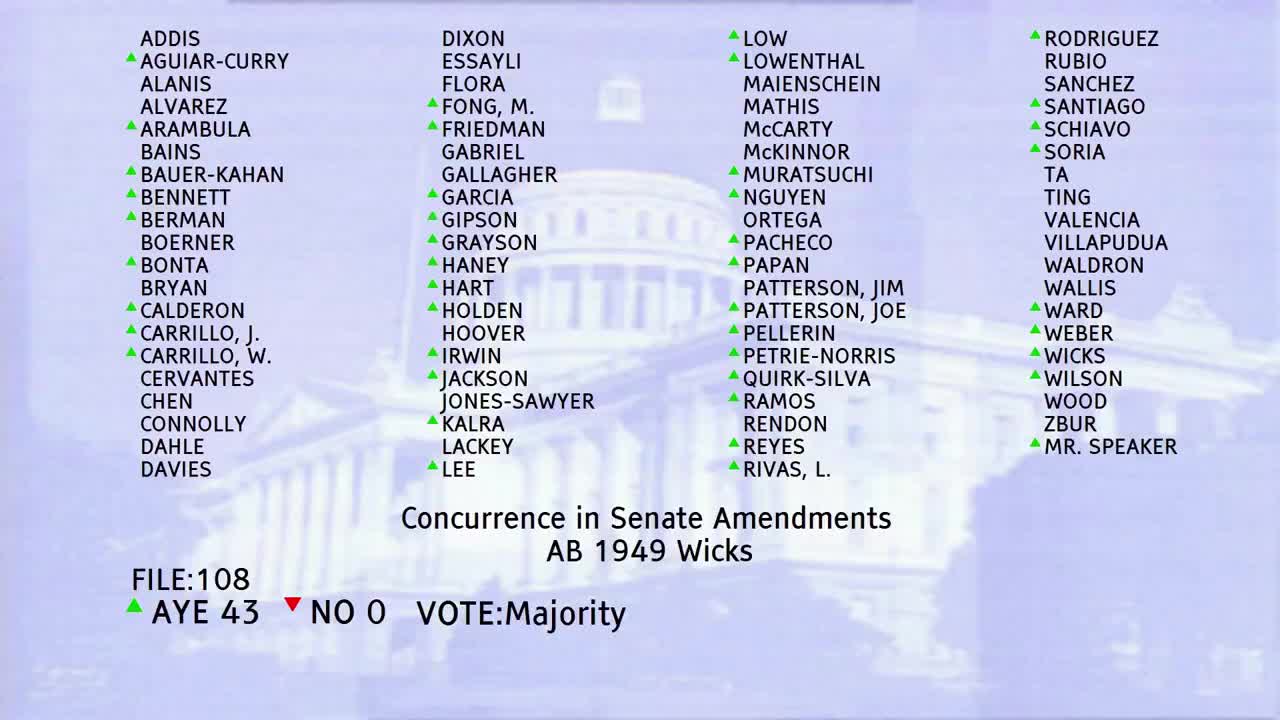
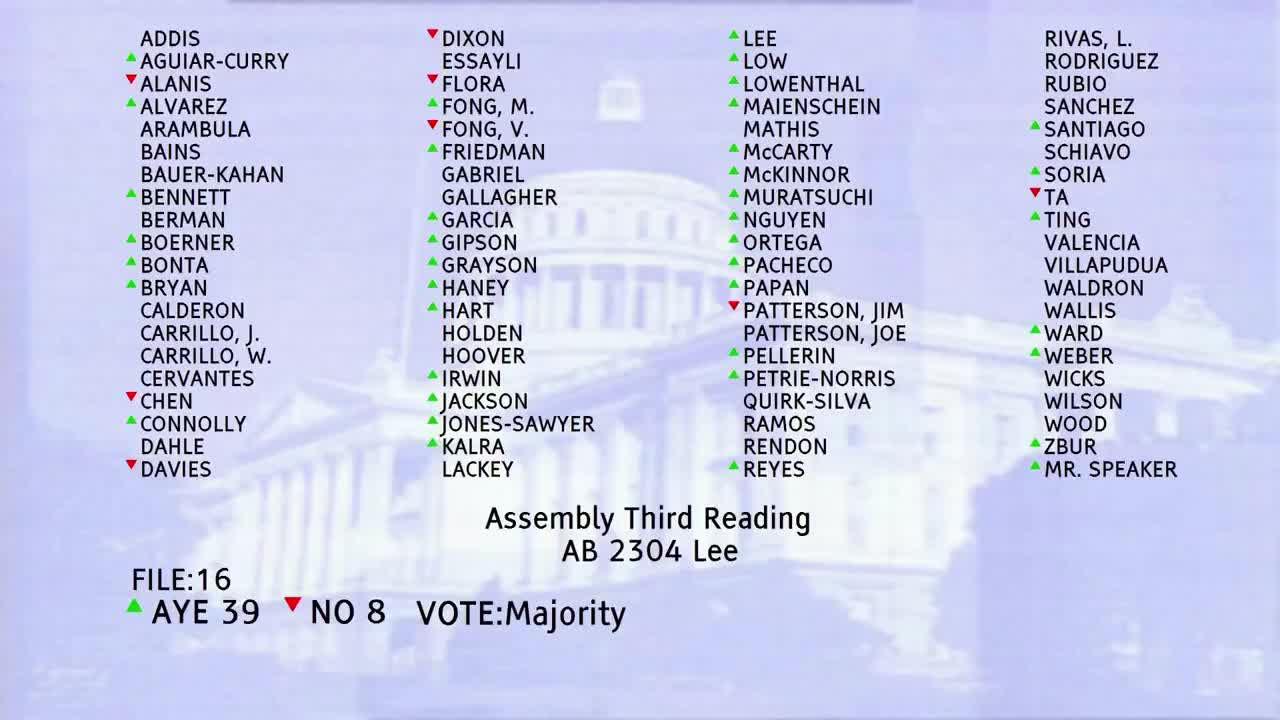
Bill Author

Bill Co-Author(s):