AB 2263: The California Guaranteed Income Statewide Feasibility Study Act.
- Session Year: 2023-2024
- House: Assembly
- Latest Version Date: 2024-09-05
Current Status:
Failed
(2024-09-22: Vetoed by Governor.)
Introduced
In Committee
First Chamber
In Committee
Second Chamber
Enacted
What does this bill do?
The bill requires the California Department of Social Services to hire researchers to produce a statewide feasibility study on expanding a guaranteed income program, focusing on scaling permanent payments to reach low‑income Californians and priority groups. The study must assess administrative needs, funding and partnership options, data‑driven ways to target those most affected, and include a steering committee made up of pilot operators, program participants, advocates, and researchers, and it asks certain state agencies to share necessary data.
The summary is provided by generative AI which can make mistakes. For original language, please view the details in the table below.
Existing law requires the State Department of Social Services, subject to an appropriation for this purpose in the annual Budget Act, to administer the California Guaranteed Income Pilot Program to provide grants to eligible entities for the purpose of administering pilot programs and projects that provide a guaranteed income to participants. Existing law requires the department to prioritize funding for pilot programs and projects that serve California residents who age out of the extended foster care program and pregnant individuals. Existing law requires the department, in consultation with relevant stakeholders, to determine the methodology for, and manner of, distributing those grants, subject to certain requirements. Existing law requires the department to review and evaluate the pilot programs and projects funded pursuant to these provisions, provide a report to the Legislature regarding that review and evaluation, and post a copy of the report on its internet website.
This bill, the California Guaranteed Income Statewide Feasibility Study Act, would require the State Department of Social Services to contract with one or more entities, subject to specified requirements, for the provision of a Guaranteed Income Statewide Feasibility Study to provide recommendations on the feasibility of a statewide Guaranteed Income Program and achieve, among other things, the objective of examining the feasibility, benefits, and challenges of scaling up permanent guaranteed income programs to reach a larger proportion of Californias socially and economically vulnerable populations, focusing on regions with a high cost of living, and informed by best practices and lessons learned from the Guaranteed Income Pilot Program. The bill would require specified state departments to disclose necessary data to the State Department of Social Services and require the study to include a steering committee composed of various stakeholders, as provided. The bill would require the department to, on or before July 1, 2027, publish on its internet website and provide a report to the Governor and the Legislature on the feasibility and benefits of expanding the Guaranteed Income Program statewide based on the outcomes of the study.
This bill would authorize the State Department of Social Services to implement, interpret, or make specific the act without taking any regulatory action, as specified, and accept and, subject to an appropriation, expend funds to administer and implement the act.
Existing law requires the State Department of Social Services, subject to an appropriation for this purpose in the annual Budget Act, to administer the California Guaranteed Income Pilot Program to provide grants to eligible entities for the purpose of administering pilot programs and projects that provide a guaranteed income to participants. Existing law requires the department to prioritize funding for pilot programs and projects that serve California residents who age out of the extended foster care program and pregnant individuals. Existing law requires the department, in consultation with relevant stakeholders, to determine the methodology for, and manner of, distributing those grants, subject to certain requirements. Existing law requires the department to review and evaluate the pilot programs and projects funded pursuant to these provisions, provide a report to the Legislature regarding that review and evaluation, and post a copy of the report on its internet website.
This bill, the California Guaranteed Income Study and Funding Statewide Feasibility Study Act, would establish the Guaranteed Income Study and Funding Act Coordinating Council, consisting of 7 representatives, appointed on or before July 1, 2026, as specified. The bill would require the council to seek to attain, require the State Department of Social Services to contract with one or more entities, subject to specified requirements, for the provision of a Guaranteed Income Statewide Feasibility Study to provide recommendations on the feasibility of a statewide Guaranteed Income Program and achieve, among other things, the objective of examining the feasibility, benefits, and challenges of scaling up permanent guaranteed income programs to reach a larger proportion of Californias socially and economically vulnerable populations, focusing on regions with a high cost of living. living, and informed by best practices and lessons learned from the Guaranteed Income Pilot Program. The bill would require specified state departments to disclose necessary data to the State Department of Social Services and require the study to include a steering committee composed of various stakeholders, as provided. The bill would require the department to, on or before July 1, 2027, publish on its internet website and provide a report to the Governor and the Legislature on the feasibility and benefits of expanding the Guaranteed Income Program statewide based on the outcomes of the study.
This bill would require, on or before July 1, 2027, the council to seek to obtain specified goals, including identifying local, state, and federal resources, benefits, and services that seek to prevent and end poverty in California and creating data-sharing partnerships among various federal, state, and local public and private entities. The bill would require the department to provide staff for the council. The bill would also require an unspecified state agency administering a new direct cash transfer program or an organization seeking guaranteed income exemptions that are designed similar to a guaranteed income program created on or after July 1, 2027, to collaborate with the council to adopt guidelines and regulations to incorporate core components of the guaranteed income programs. The bill would establish, on or before July 1, 2026, a steering committee to provide technical assistance to and approve recommendations by the Guaranteed Income Study and Funding Act Coordinating Council, as specified.This bill would authorize the State Department of Social Services to implement, interpret, or make specific the act without taking any regulatory action, as specified, and accept and, subject to an appropriation, expend funds to administer and implement the act.
Existing law requires the State Department of Social Services, subject to an appropriation for this purpose in the annual Budget Act, to administer the California Guaranteed Income Pilot Program to provide grants to eligible entities for the purpose of administering pilot programs and projects that provide a guaranteed income to participants. Existing law requires the department to prioritize funding for pilot programs and projects that serve California residents who age out of the extended foster care program and pregnant individuals. Existing law requires the department, in consultation with relevant stakeholders, to determine the methodology for, and manner of, distributing those grants, subject to certain requirements. Existing law requires the department to review and evaluate the pilot programs and projects funded pursuant to these provisions, provide a report to the Legislature regarding that review and evaluation, and post a copy of the report on its internet website.
This bill, the California Guaranteed Income Study and Funding Act, would establish the Guaranteed Income Study and Funding Act Coordinating Council, consisting of 6 members, appointed by the Legislature, 7 representatives, appointed on or before July 1, 2026, as specified. The bill would require the council to seek to attain, among other things, the objective of examining the feasibility, benefits, and challenges of scaling up permanent guaranteed income programs to reach a larger proportion of Californias socially and economically vulnerable populations, focusing on regions with a high cost of living. The bill would require, on or before July 1, 2026, the Legislature and the Governor to appoint 11 members to a steering committee to provide technical assistance to and approve recommendations by the Guaranteed Income Study and Funding Act Coordinating Council, as specified.
TheThis bill would require, on or before July 1, 2027, the council to seek to obtain specified goals, including identifying local, state, and federal resources, benefits, and services that seek to prevent and end poverty in California and creating data-sharing partnerships among various federal, state, and local public and private entities. The bill would require the department to provide staff for the council. The bill would also require an unspecified state agency administering a new direct cash transfer program or an organization seeking guaranteed income exemptions that are designed similar to a guaranteed income program created on or after July 1, 2027, to collaborate with the council to adopt guidelines and regulations to incorporate core components of the guaranteed income programs. The bill would establish, on or before July 1, 2026, a steering committee to provide technical assistance to and approve recommendations by the Guaranteed Income Study and Funding Act Coordinating Council, as specified.
Existing law requires the State Department of Social Services, subject to an appropriation for this purpose in the annual Budget Act, to administer the California Guaranteed Income Pilot Program to provide grants to eligible entities for the purpose of administering pilot programs and projects that provide a guaranteed income to participants. Existing law requires the department to prioritize funding for pilot programs and projects that serve California residents who age out of the extended foster care program and pregnant individuals. Existing law requires the department, in consultation with relevant stakeholders, to determine the methodology for, and manner of, distributing those grants, subject to certain requirements. Existing law requires the department to review and evaluate the pilot programs and projects funded pursuant to these provisions, provide a report to the Legislature regarding that review and evaluation, and post a copy of the report on its internet website.
This bill, the California Guaranteed Income Study and Funding Act, would establish the Guaranteed Income Study and Funding Act Coordinating Council, consisting of 6 members, appointed by the Legislature, as specified. The bill would require the council to seek to attain, among other things, the objective of examining the feasibility, benefits, and challenges of scaling up permanent guaranteed income programs to reach a larger proportion of Californias socially and economically vulnerable populations, focusing on regions with a high cost of living. The bill would require, on or before July 1, 2026, the Legislature and the Governor to appoint 11 members to a steering committee to provide technical assistance to and approve recommendations by the Guaranteed Income Study and Funding Act Coordinating Council, as specified.
The bill would require, on or before July 1, 2027, the council to seek to obtain specified goals, including identifying local, state, and federal resources, benefits, and services that seek to prevent and end poverty in California and creating data-sharing partnerships among various federal, state, and local public and private entities. The bill would require the department to provide staff for the council. The bill would also require an unspecified state agency administering a new direct cash transfer program or an organization seeking guaranteed income exemptions that are designed similar to a guaranteed income program created on or after July 1, 2027, to collaborate with the council to adopt guidelines and regulations to incorporate core components of the guaranteed income programs.
This chapter shall be known, and may be cited, as the California Guaranteed Income Statewide Feasibility Study Act.
18996.91.(a)The State Department of Social Services shall contract with one or more entities for the provision of a Guaranteed Income Statewide Feasibility Study. The study shall provide recommendations on the feasibility of a statewide Guaranteed Income Program and seek to achieve, at minimum all of the following objectives:
(1)Determine what administrative capacity, infrastructure, and data sharing across state and local agencies will be necessary to execute a statewide guaranteed income program that first seeks to include priority populations with the ultimate goal of reaching all low-income Californians.
(2)Examine the feasibility, benefits, and challenges of scaling up permanent guaranteed income programs to reach a larger proportion of Californias socially and economically vulnerable populations, focusing on regions with a high cost of living, and informed by best practices and lessons learned from the Guaranteed Income Pilot Program established pursuant to Chapter 16 (commencing with Section 18997).
(3)Explore progressive, innovative, and equitable funding mechanisms, partnerships, and sustainable revenue sources that can support the expansion and long-term viability of permanent guaranteed income programs and ultimately redistribute wealth.
(4)Explore a data-driven approach to identify priority populations, taking into consideration the intersections of social, gender, economic, and racial disparities in California to ensure that the guaranteed income program targets those most in need and most affected by these disparities. Notwithstanding any other state law, each of the following state departments shall disclose necessary data to the department to the extent permitted by federal law, for the purposes of this paragraph.
(A)The State Department of Health Care Services.
(B)The State Department of Public Health.
(C)The Employment Development Department.
(D)The Interagency Council on Homelessness.
(E)The Franchise Tax Board.
(5)Identify local, state, and federal resources, benefits, and services that seek to prevent and end poverty in California.
(6)Identify necessary data-sharing partnerships among groups and individuals including, but not limited to, local government agencies, participants in the United States Department of Housing and Urban Developments assisted housing, federal agencies, nonprofit, private, and community-based entities working to implement guaranteed income pilot programs, and state agencies and departments, including, but not limited to, the Franchise Tax Board, the Treasurers office, the State Department of Social Services, the State Department of Health Care Services, the State Department of Public Health, the Interagency Council on Homelessness, the Employment Development Department, and other statewide institutions that deliver services to low-income Californians.
(7)Identify the need and potential for local, state, and federal entities to coordinate existing funding and applications for competitive funding. Any action taken shall not restructure or change any existing allocations or allocation formula.
(8)Present policy and procedural recommendations to legislators and other governmental entities to introduce a permanent statewide guaranteed income program.
(b)On or before July 1, 2027, the State Department of Social Services shall publish on its internet website and provide a report to the Governor and the Legislature on the feasibility and benefits of expanding the Guaranteed Income Program statewide based on the outcomes of the Guaranteed Income Statewide Feasibility Study.
(c)(1)The requirement for submitting a report imposed under subdivision (b) is inoperative on January 1, 2029, pursuant to Section 10231.5 of the Government Code.
(2)A report to be submitted pursuant to subdivision (b) shall be submitted in compliance with Section 9795 of the Government Code.
(d)The Guaranteed Income Statewide Feasibility Study shall include a steering committee composed of the following stakeholders:
(1)Three persons who operate or have operated a local or state-funded guaranteed income pilot program. One person shall be from the northern region, one person shall be from the central region, and one person shall be from the southern region of California.
(2)Five participants in a local guaranteed income pilot program who live in California. At least one person shall be from the northern region, at least one shall be from the central region, and at least one person shall be from the southern region of California.
(3)Two representatives of antipoverty and advocacy coalitions that advocate for statewide wealth and income redistribution and economic racial justice.
(4)One researcher with knowledge and expertise in community collaborative guaranteed income research.
(e)The contractor chosen by the department pursuant to subdivision (a) shall be limited to the research institutions based in California that are supported by the United States Department of Health and Human Services, Office of the Assistant Secretary for Planning and Evaluation, and, to the extent possible, and the contractor shall provide equitable compensation for participants in local guaranteed income pilot programs participating in paragraph (3) of subdivision (d).
18996.92.(a)Notwithstanding any other law, contracts awarded pursuant to this chapter are exempt from the personal services contracting requirements of Article 4 (commencing with Section 19130) of Chapter 5 of Part 2 of Division 5 of Title 2 of the Government Code, the Public Contract Code, and the State Contracting Manual.
(b)Notwithstanding any other law, contracts awarded pursuant to this chapter are not subject to the approval of the Department of General Services or the Department of Technology.
(c)Notwithstanding the rulemaking provisions of the Administrative Procedure Act (Chapter 3.5 (commencing with Section 11340) of Part 1 of Division 3 of Title 2 of the Government Code) or any other law, the department may implement, interpret, or make specific this chapter without taking any regulatory action.
18996.93.Notwithstanding any other law, the department may accept and, subject to an appropriation for this purpose, expend funds from any source, public or private, to administer this chapter.
18996.94.Implementation of this chapter shall be subject to an appropriation by the Legislature.
This chapter shall be known, and may be cited, as the California Guaranteed Income Study and Funding Statewide Feasibility Study Act.
18996.91.(a)(1)The Guaranteed Income Study and Funding Act Coordinating Council is hereby established.(2)On or before July 1, 2026, the council shall be appointed as follows:(A)A representative by the State Department of Social Services.(B)A representative by the California Housing Finance Agency.(C)A representative by the State Department of Health Care Services.(D)A representative by the Franchise Tax Board.(E)A representative by the California Tax Credit Allocation Committee in the Treasurers office.(F)A representative by the Governors office with antipoverty experience.(G)A representative by the County Welfare Directors Association.(b)The council shall18996.91.(a)The State Department of Social Services shall contract with one or more entities for the provision of a Guaranteed Income Statewide Feasibility Study. The study shall provide recommendations on the feasibility of a statewide Guaranteed Income Program and seek to attain at least, but not limited to, achieve, at minimum all of the following objectives:
(1)Determine what administrative capacity, infrastructure, and data sharing across state and local agencies will be necessary to execute a statewide guaranteed income program that first seeks to include priority populations with the ultimate goal of reaching all low-income Californians.
(2)Examine the feasibility, benefits, and challenges of scaling up permanent guaranteed income programs to reach a larger proportion of Californias socially and economically vulnerable populations, focusing on regions with a high cost of living. living, and informed by best practices and lessons learned from the Guaranteed Income Pilot Program established pursuant to Chapter 16 (commencing with Section 18997).
(3)Explore progressive, innovative, and equitable funding mechanisms, partnerships, and sustainable revenue sources that can support the expansion and long-term viability of permanent guaranteed income programs and ultimately redistribute wealth.
(4)Establish a Explore a data-driven approach to identify priority populations, taking into consideration the intersections of social, gender, economic, and racial disparities in California to ensure that the guaranteed income program targets those most in need and most affected by these disparities. Notwithstanding any other state law, each of the following state departments shall disclose necessary data to the department to the extent permitted by federal law, for the purposes of this paragraph.
(c)On or before July 1, 2027, the council shall seek to obtain all of the following goals:(A)The State Department of Health Care Services.
(B)The State Department of Public Health.
(C)The Employment Development Department.
(D)The Interagency Council on Homelessness.
(E)The Franchise Tax Board.
(1)(5)Identify local, state, and federal resources, benefits, and services that seek to prevent and end poverty in California.
(2)Create data-sharing(6)Identify necessary data-sharing partnerships among groups and individuals including, but not limited to, local government agencies, participants in the United States Department of Housing and Urban Developments assisted housing, federal agencies, nonprofit, private, and community-based entities working to implement guaranteed income pilot programs, and state agencies and departments, including, but not limited to, the Franchise Tax Board, the Treasurers office, the State Department of Social Services, the State Department of Health Care Services, the State Department of Public Health, the Interagency Council on Homelessness, the Employment Development Department, and other statewide institutions that deliver services to low-income Californians.
(3)(7)Identify the need and potential for local, state, and federal entities to coordinate existing funding and applications for competitive funding. Any action taken shall not restructure or change any existing allocations or allocation formula.
(4)Make policy(8)Present policy and procedural recommendations to legislators and other governmental entities to introduce a permanent statewide guaranteed income program.
(5)Broker agreements between state agencies, departments, and local jurisdictions to align and coordinate resources and reduce administrative burdens of accessing existing resources and operations.(6)Serve as a statewide guaranteed income planning and policy development resource.(7)Report to the Governor, federal cabinet members, and the Legislature on the benefits of expanding the guaranteed income program statewide.(8)Ensure accountability and results in meeting the strategies and goals of the council.(d)At the councils discretion, the council may invite stakeholders, including members of philanthropic communities and experts, to participate in meetings or provide information to the council.(e)The State Department of Social Services shall provide staff for the council.(f)An unspecified state agency administering a new direct cash transfer program or an organization seeking guaranteed income exemptions that are designed similar to a guaranteed income program created on or after July 1, 2027, shall collaborate with the council to adopt guidelines and regulations to incorporate core components of the guaranteed income program.(b)On or before July 1, 2027, the State Department of Social Services shall publish on its internet website and provide a report to the Governor and the Legislature on the feasibility and benefits of expanding the Guaranteed Income Program statewide based on the outcomes of the Guaranteed Income Statewide Feasibility Study.
(c)(1)The requirement for submitting a report imposed under subdivision (b) is inoperative on January 1, 2029, pursuant to Section 10231.5 of the Government Code.
(2)A report to be submitted pursuant to subdivision (b) shall be submitted in compliance with Section 9795 of the Government Code.
(d)The Guaranteed Income Statewide Feasibility Study shall include a steering committee composed of the following stakeholders:
(1)Three persons who operate or have operated a local or state-funded guaranteed income pilot program. One person shall be from the northern region, one person shall be from the central region, and one person shall be from the southern region of California.
(2)Five participants in a local guaranteed income pilot program who live in California. At least one person shall be from the northern region, at least one shall be from the central region, and at least one person shall be from the southern region of California.
(3)Two representatives of antipoverty and advocacy coalitions that advocate for statewide wealth and income redistribution and economic racial justice.
(4)One researcher with knowledge and expertise in community collaborative guaranteed income research.
(e)The contractor chosen by the department pursuant to subdivision (a) shall be limited to the research institutions based in California that are supported by the United States Department of Health and Human Services, Office of the Assistant Secretary for Planning and Evaluation, and, to the extent possible, and the contractor shall provide equitable compensation for participants in local guaranteed income pilot programs participating in paragraph (3) of subdivision (d).
18996.92.(a)On or before July 1, 2026, a steering committee consisting of 11 members shall be established to provide technical assistance to and approve recommendations by the Guaranteed Income Study and Funding Act Coordinating Council, as follows:(1)Three persons who operate or have operated a local or state funded guaranteed income pilot program. One person shall be from the northern region, one person shall be from the central region, and one person shall be from the southern region of California. One person shall be appointed by the Senate Committee on Rules. One person shall be appointed by the Speaker of the Assembly. One person shall be appointed by the Governor with guidance from the State Department of Social Services.(2)Three participants in a local guaranteed income pilot program who live in California. One person shall be appointed by the Senate Committee on Rules. One person shall be appointed by the Speaker of the Assembly. One person shall be appointed by the Governor with guidance from the State Department of Social Services.(3)Two participants in a state-funded guaranteed income pilot program shall be appointed by the Governor with guidance from the State Department of Social Services.(4)Two representatives of antipoverty and advocacy coalitions that are responsible for statewide wealth and income redistribution and economic racial justice, including, but not limited to, an antipoverty task force, the California Hope, Opportunity, Perseverance, and Empowerment (HOPE) for Children Trust Account Program, and state low-income tax credit programs. The Senate Committee on Rules and the Speaker of the Assembly shall each appoint one person.(5)A researcher with knowledge and expertise in community collaborative guaranteed income research, appointed by the Senate Committee on Rules.(b)Notwithstanding Section 11009 of the Government Code, participants appointed to the steering committee pursuant to paragraphs (2) and (3) of subdivision (a) may receive a reasonable per diem payment and mileage charge as reimbursement for living expenses, including childcare costs, and traveling expenses incurred in the performance of duties.18996.92.(a)Notwithstanding any other law, contracts awarded pursuant to this chapter are exempt from the personal services contracting requirements of Article 4 (commencing with Section 19130) of Chapter 5 of Part 2 of Division 5 of Title 2 of the Government Code, the Public Contract Code, and the State Contracting Manual.
(b)Notwithstanding any other law, contracts awarded pursuant to this chapter are not subject to the approval of the Department of General Services or the Department of Technology.
(c)Notwithstanding the rulemaking provisions of the Administrative Procedure Act (Chapter 3.5 (commencing with Section 11340) of Part 1 of Division 3 of Title 2 of the Government Code) or any other law, the department may implement, interpret, or make specific this chapter without taking any regulatory action.
18996.93.Notwithstanding any other law, the department may accept and, subject to an appropriation for this purpose, expend funds from any source, public or private, to administer this chapter.
18996.94.Implementation of this chapter shall be subject to an appropriation by the Legislature.
This chapter shall be known, and may be cited, as the California Guaranteed Income Study and Funding Act.
18996.91.(a)(1)The Guaranteed Income Study and Funding Act Coordinating Council is hereby established.
(2)On or before July 1, 2026, the Legislature shall appoint the following six members to the council: council shall be appointed as follows:
(A)A representative of by the State Department of Social Services.
(B)A representative of by the California Housing Finance Agency.
(C)A representative of by the State Department of Health Care Services.
(D)A representative of by the Franchise Tax Board.
(E)A representative of by the California Tax Credit Allocation Committee in the Treasurers office.
(F)A representative from by the Governors office with antipoverty experience.
(G)A representative by the County Welfare Directors Association.
(b)The council shall seek to attain at least, but not limited to, all of the following objectives:
(1)Determine what administrative capacity, infrastructure, and data sharing across state and local agencies will be necessary to execute a statewide guaranteed income program that first seeks to include priority populations with the ultimate goal of reaching all low-income Californians.
(2)Examine the feasibility, benefits, and challenges of scaling up permanent guaranteed income programs to reach a larger proportion of Californias socially and economically vulnerable populations, focusing on regions with a high cost of living.
(3)Explore progressive, innovative, and equitable funding mechanisms, partnerships, and sustainable revenue sources that can support the expansion and long-term viability of permanent guaranteed income programs and ultimately redistribute wealth.
(4)Establish a data-driven approach to identify priority populations, taking into consideration the intersections of social, gender, economic, and racial disparities in California to ensure that the guaranteed income program targets those most in need and most affected by these disparities.
(c)On or before July 1, 2027, the council shall seek to obtain all of the following goals:
(1)Identify local, state, and federal resources, benefits, and services that seek to prevent and end poverty in California.
(2)Create data-sharing partnerships among local government agencies, participants in the United States Department of Housing and Urban Developments assisted housing, federal agencies, nonprofit, private, and community-based entities working to implement guaranteed income pilot programs, and state agencies and departments, including, but not limited to, the Franchise Tax Board, the Treasurers office, the State Department of Social Services, the State Department of Health Care Services, and other statewide institutions that deliver services to low-income Californians.
(3)Identify the need and potential for local, state, and federal entities to coordinate existing funding and applications for competitive funding. Any action taken shall not restructure or change any existing allocations or allocation formula.
(4)Make policy and procedural recommendations to legislators and other governmental entities to introduce a permanent statewide guaranteed income program.
(5)Broker agreements between state agencies, departments, and local jurisdictions to align and coordinate resources and reduce administrative burdens of accessing existing resources and operations.
(6)Serve as a statewide guaranteed income planning and policy development resource.
(7)Report to the Governor, federal cabinet members, and the Legislature on the benefits of expanding the guaranteed income program statewide.
(8)Ensure accountability and results in meeting the strategies and goals of the council.
(d)At the councils discretion, the council may invite stakeholders, including members of philanthropic communities and experts, to participate in meetings or provide information to the council.
(e)The State Department of Social Services shall provide staff for the council.
(f)An unspecified state agency administering a new direct cash transfer program or an organization seeking guaranteed income exemptions that are designed similar to a guaranteed income program created on or after July 1, 2027, shall collaborate with the council to adopt guidelines and regulations to incorporate core components of the guaranteed income program.
18996.92.(a)On or before July 1, 2026, the Legislature shall appoint 11 members to a steering committee consisting of 11 members shall be established to provide technical assistance to and approve recommendations by the Guaranteed Income Study and Funding Act Coordinating Council, as follows:
(1)Three persons who operate or have operated a local or state funded guaranteed income pilot program. One person shall be from the northern region, one person shall be from the central region, and one person shall be from the southern region of California. One person shall be appointed by the Senate Committee on Rules. One person shall be appointed by the Speaker of the Assembly. One person shall be appointed by the Governor with guidance from the State Department of Social Services.
(2)Three participants in a local guaranteed income pilot program who live in California. One person shall be appointed by the Senate Committee on Rules. One person shall be appointed by the Speaker of the Assembly. One person shall be appointed by the Governor with guidance from the State Department of Social Services.
(3)Two participants in a state-funded guaranteed income pilot program shall be appointed by the Governor with guidance from the State Department of Social Services.
(4)Two representatives of antipoverty and advocacy coalitions that are responsible for statewide wealth and income redistribution and economic racial justice, including, but not limited to, an antipoverty task force, the California Hope, Opportunity, Perseverance, and Empowerment (HOPE) for Children Trust Account Program, and state low-income tax credit programs. The Senate Committee on Rules and the Speaker of the Assembly shall each appoint one person.
(5)A researcher with knowledge and expertise in community collaborative guaranteed income research, appointed by the Senate Committee on Rules.
(b)Notwithstanding Section 11009 of the Government Code, participants appointed to the steering committee pursuant to paragraphs (2) and (3) of subdivision (a) may receive a reasonable per diem payment and mileage charge as reimbursement for living expenses, including childcare costs, and traveling expenses incurred in the performance of duties.
This chapter shall be known, and may be cited, as the California Guaranteed Income Study and Funding Act.
18996.91.(a)(1)The Guaranteed Income Study and Funding Act Coordinating Council is hereby established.
(2)On or before July 1, 2026, the Legislature shall appoint the following six members to the council:
(A)A representative of the State Department of Social Services.
(B)A representative of the California Housing Finance Agency.
(C)A representative of the State Department of Health Care Services.
(D)A representative of the Franchise Tax Board.
(E)A representative of the California Tax Credit Allocation Committee in the Treasurers office.
(F)A representative from the Governors office with antipoverty experience.
(b)The council shall seek to attain at least, but not limited to, all of the following objectives:
(1)Determine what administrative capacity, infrastructure, and data sharing across state and local agencies will be necessary to execute a statewide guaranteed income program that first seeks to include priority populations with the ultimate goal of reaching all low-income Californians.
(2)Examine the feasibility, benefits, and challenges of scaling up permanent guaranteed income programs to reach a larger proportion of Californias socially and economically vulnerable populations, focusing on regions with a high cost of living.
(3)Explore progressive, innovative, and equitable funding mechanisms, partnerships, and sustainable revenue sources that can support the expansion and long-term viability of permanent guaranteed income programs and ultimately redistribute wealth.
(4)Establish a data-driven approach to identify priority populations, taking into consideration the intersections of social, gender, economic, and racial disparities in California to ensure that the guaranteed income program targets those most in need and most affected by these disparities.
(c)On or before July 1, 2027, the council shall seek to obtain all of the following goals:
(1)Identify local, state, and federal resources, benefits, and services that seek to prevent and end poverty in California.
(2)Create data-sharing partnerships among local government agencies, participants in the United States Department of Housing and Urban Developments assisted housing, federal agencies, nonprofit, private, and community-based entities working to implement guaranteed income pilot programs, and state agencies and departments, including, but not limited to, the Franchise Tax Board, the Treasurers office, the State Department of Social Services, the State Department of Health Care Services, and other statewide institutions that deliver services to low-income Californians.
(3)Identify the need and potential for local, state, and federal entities to coordinate existing funding and applications for competitive funding. Any action taken shall not restructure or change any existing allocations or allocation formula.
(4)Make policy and procedural recommendations to legislators and other governmental entities to introduce a permanent statewide guaranteed income program.
(5)Broker agreements between state agencies, departments, and local jurisdictions to align and coordinate resources and reduce administrative burdens of accessing existing resources and operations.
(6)Serve as a statewide guaranteed income planning and policy development resource.
(7)Report to the Governor, federal cabinet members, and the Legislature on the benefits of expanding the guaranteed income program statewide.
(8)Ensure accountability and results in meeting the strategies and goals of the council.
(d)At the councils discretion, the council may invite stakeholders, including members of philanthropic communities and experts, to participate in meetings or provide information to the council.
(e)The State Department of Social Services shall provide staff for the council.
(f)An unspecified state agency administering a new direct cash transfer program or an organization seeking guaranteed income exemptions that are designed similar to a guaranteed income program created on or after July 1, 2027, shall collaborate with the council to adopt guidelines and regulations to incorporate core components of the guaranteed income program.
18996.92.(a)On or before July 1, 2026, the Legislature shall appoint 11 members to a steering committee to provide technical assistance to and approve recommendations by the Guaranteed Income Study and Funding Act Coordinating Council, as follows:
(1)Three persons who operate or have operated a local or state funded guaranteed income pilot program. One person shall be from the northern region, one person shall be from the central region, and one person shall be from the southern region of California. ____ person(s) One person shall be appointed by the Senate Committee on Rules. ____ person(s) One person shall be appointed by the Speaker of the Assembly. One person shall be appointed by the Governor with guidance from the State Department of Social Services.
(2)Three participants in a local guaranteed income pilot program who live in California. One person shall be appointed by the Senate Committee on Rules. One person shall be appointed by the Speaker of the Assembly. One person shall be appointed by the Governor with guidance from the State Department of Social Services.
(3)Two participants in a state-funded guaranteed income pilot program shall be appointed by the Governor with guidance from the State Department of Social Services.
(4)Two representatives of antipoverty and advocacy coalitions that are responsible for statewide wealth and income redistribution and economic racial justice, including, but not limited to, an antipoverty task force, the California Hope, Opportunity, Perseverance, and Empowerment (HOPE) for Children Trust Account Program, and state low-income tax credit programs. The Senate Committee on Rules and the Speaker of the Assembly shall each appoint one person.
(5)A researcher with knowledge and expertise in community collaborative guaranteed income research, appointed by the Senate Committee on Rules.
(b)Notwithstanding Section 11009 of the Government Code, participants appointed to the steering committee pursuant to paragraphs (2) and (3) of subdivision (a) may receive a reasonable per diem payment and mileage charge as reimbursement for living expenses, including childcare costs, and traveling expenses incurred in the performance of duties.
This chapter shall be known, and may be cited, as the California Guaranteed Income Study and Funding Act.
18996.91.(a)(1)The Guaranteed Income Study and Funding Act Coordinating Council is hereby established.
(2)On or before July 1, 2026, the Legislature shall appoint the following six members to the council:
(A)A representative of the State Department of Social Services.
(B)A representative of the California Housing Finance Agency.
(C)A representative of the State Department of Health Care Services.
(D)A representative of the Franchise Tax Board.
(E)A representative of the California Tax Credit Allocation Committee in the Treasurers office.
(F)A representative from the Governors office with antipoverty experience.
(b)The council shall seek to attain at least, but not limited to, all of the following objectives:
(1)Determine what administrative capacity, infrastructure, and data sharing across state and local agencies will be necessary to execute a statewide guaranteed income program that first seeks to include priority populations with the ultimate goal of reaching all low-income Californians.
(2)Examine the feasibility, benefits, and challenges of scaling up permanent guaranteed income programs to reach a larger proportion of Californias socially and economically vulnerable populations, focusing on regions with a high cost of living.
(3)Explore progressive, innovative, and equitable funding mechanisms, partnerships, and sustainable revenue sources that can support the expansion and long-term viability of permanent guaranteed income programs and ultimately redistribute wealth.
(4)Establish a data-driven approach to identify priority populations, taking into consideration the intersections of social, gender, economic, and racial disparities in California to ensure that the guaranteed income program targets those most in need and most affected by these disparities.
(c)On or before July 1, 2027, the council shall seek to obtain all of the following goals:
(1)Identify local, state, and federal resources, benefits, and services that seek to prevent and end poverty in California.
(2)Create data-sharing partnerships among local government agencies, participants in the United States Department of Housing and Urban Developments assisted housing, federal agencies, nonprofit, private, and community-based entities working to implement guaranteed income pilot programs, and state agencies and departments, including, but not limited to, the Franchise Tax Board, the Treasurers office, the State Department of Social Services, the State Department of Health Care Services, and other statewide institutions that deliver services to low-income Californians.
(3)Identify the need and potential for local, state, and federal entities to coordinate existing funding and applications for competitive funding. Any action taken shall not restructure or change any existing allocations or allocation formula.
(4)Make policy and procedural recommendations to legislators and other governmental entities to introduce a permanent statewide guaranteed income program.
(5)Broker agreements between state agencies, departments, and local jurisdictions to align and coordinate resources and reduce administrative burdens of accessing existing resources and operations.
(6)Serve as a statewide guaranteed income planning and policy development resource.
(7)Report to the Governor, federal cabinet members, and the Legislature on the benefits of expanding the guaranteed income program statewide.
(8)Ensure accountability and results in meeting the strategies and goals of the council.
(d)At the councils discretion, the council may invite stakeholders, including members of philanthropic communities and experts, to participate in meetings or provide information to the council.
(e)The State Department of Social Services shall provide staff for the council.
(f)An unspecified state agency administering a new direct cash transfer program or an organization seeking guaranteed income exemptions that are designed similar to a guaranteed income program created on or after July 1, 2027, shall collaborate with the council to adopt guidelines and regulations to incorporate core components of the guaranteed income program.
18996.92.(a)On or before July 1, 2026, the Legislature shall appoint 11 members to a steering committee to provide technical assistance to and approve recommendations by the Guaranteed Income Study and Funding Act Coordinating Council, as follows:
(1)Three persons who operate or have operated a local or state funded guaranteed income pilot program. One person shall be from the northern region, one person shall be from the central region, and one person shall be from the southern region of California. ____ person(s) shall be appointed by the Senate Committee on Rules. ____ person(s) shall be appointed by the Speaker of the Assembly.
(2)Three participants in a local guaranteed income pilot program who live in California. One person shall be appointed by the Senate Committee on Rules. One person shall be appointed by the Speaker of the Assembly. One person shall be appointed by the Governor with guidance from the State Department of Social Services.
(3)Two participants in a state-funded guaranteed income pilot program shall be appointed by the Governor with guidance from the State Department of Social Services.
(4)Two representatives of antipoverty and advocacy coalitions that are responsible for statewide wealth and income redistribution and economic racial justice, including, but not limited to, an antipoverty task force, the California Hope, Opportunity, Perseverance, and Empowerment (HOPE) for Children Trust Account Program, and state low-income tax credit programs. The Senate Committee on Rules and the Speaker of the Assembly shall each appoint one person.
(5)A researcher with knowledge and expertise in community collaborative guaranteed income research, appointed by the Senate Committee on Rules.
(b)Notwithstanding Section 11009 of the Government Code, participants appointed to the steering committee pursuant to paragraphs (2) and (3) of subdivision (a) may receive a reasonable per diem payment and mileage charge as reimbursement for living expenses, including childcare costs, and traveling expenses incurred in the performance of duties.
|
Date
|
Status
|
|---|---|
| Sep 22, 2024 | Vetoed by Governor. |
| Sep 13, 2024 | Enrolled and presented to the Governor at 4 p.m. |
| Aug 31, 2024 | Senate amendments concurred in. To Engrossing and Enrolling. (Ayes 51. Noes 12.). |
| Aug 31, 2024 | In Assembly. Concurrence in Senate amendments pending. |
| Aug 31, 2024 | Read third time. Passed. Ordered to the Assembly. (Ayes 30. Noes 9.). |
| Aug 28, 2024 | Read second time. Ordered to third reading. |
| Aug 27, 2024 | Read third time and amended. Ordered to second reading. |
| Aug 27, 2024 | Joint Rule 61 suspended. (Ayes 30. Noes 9.) |
| Aug 19, 2024 | Read second time. Ordered to third reading. |
| Aug 15, 2024 | From committee: Do pass. (Ayes 5. Noes 2.) (August 15). |
| Aug 5, 2024 | In committee: Referred to APPR suspense file. |
| Jul 2, 2024 | From committee: Do pass and re-refer to Com. on APPR. (Ayes 4. Noes 0.) (July 1). Re-referred to Com. on APPR. |
| Jun 11, 2024 | From committee chair, with author's amendments: Amend, and re-refer to committee. Read second time, amended, and re-referred to Com. on HUMAN S. |
| Jun 5, 2024 | Referred to Com. on HUMAN S. |
| May 24, 2024 | In Senate. Read first time. To Com. on RLS. for assignment. |
| May 23, 2024 | Read third time. Passed. Ordered to the Senate. (Ayes 54. Noes 14. Page 5627.) |
| May 20, 2024 | Read second time. Ordered to third reading. |
| May 16, 2024 | From committee: Do pass. (Ayes 11. Noes 4.) (May 16). |
| May 8, 2024 | In committee: Set, first hearing. Referred to APPR. suspense file. |
| Apr 24, 2024 | From committee: Do pass and re-refer to Com. on APPR. (Ayes 5. Noes 1.) (April 23). Re-referred to Com. on APPR. |
| Apr 17, 2024 | Re-referred to Com. on HUM. S. |
| Apr 16, 2024 | From committee chair, with author's amendments: Amend, and re-refer to Com. on HUM. S. Read second time and amended. |
| Mar 21, 2024 | Referred to Com. on HUM. S. |
| Feb 9, 2024 | From printer. May be heard in committee March 10. |
| Feb 8, 2024 | Read first time. To print. |
|
Date
|
Description
|
Location
|
Votes
|
|
|---|---|---|---|---|
| Aug 31, 2024 | AB 2263 Friedman Concurrence in Senate Amendments | Assembly Floor |
Passed |
|
| Aug 31, 2024 | Assembly 3rd Reading AB2263 Friedman et al. By Wiener | Senate Floor |
Passed |
|
| Aug 15, 2024 | Do pass | Senate Standing Committee on Appropriations |
Passed |
|
| Aug 5, 2024 | Placed on suspense file | Senate Standing Committee on Appropriations |
Passed |
|
| Jul 1, 2024 | Do pass, but first be re-referred to the Committee on [Appropriations] | Senate Standing Committee on Human Services |
Passed |
|
| May 23, 2024 | AB 2263 Friedman Assembly Third Reading | Assembly Floor |
Passed |
|
| May 16, 2024 | Do pass. | Assembly Standing Committee on Appropriations |
Passed |
|
| Apr 23, 2024 | Do pass and be re-referred to the Committee on [Appropriations] | Assembly Standing Committee on Human Services |
Passed |
This list shows positions taken on this bill by organizations on the date displayed, which is linked to the original source.
Positions by individuals are not included.
|
Organization
|
Position
|
Date
|
|---|---|---|
| Access Reproductive Justice | ** Support | |
| Aclu California Action | ** Support | |
| APLA Health | ** Support | |
| Asian Americans Advancing Justice Southern California | * Support | Jul 1, 2024 |
| Buen Vecino | ** Support | |
| California Faculty Association | ** Support | |
| California Immigrant Policy Center | ** Support | |
| California Reinvestment Coalition | ** Support | |
| California Wic Association | ** Support | |
| California Women's Law Center | ** Support | |
| Center for Employment Opportunities, INC. | ** Support | |
| Child Abuse Prevention Center | ** Support | |
| City of West Hollywood | ** Support | |
| Coalition of California Welfare Rights Organizations | * Support | Apr 23, 2024 |
| Community Health Councils | ** Support | |
| Contra Costa County Of | * Support | Jul 1, 2024 |
| Contra Costa Solano Food Bank | * Support | Apr 23, 2024 |
| Contra Costa Solano Food Bank | * Support | Apr 23, 2024 |
| County of Los Angeles Board of Supervisors | ** Support | |
| County Welfare Directors Association of California | ** Support | |
| Courage California | ** Support | |
| Democrats for Israel - CA | ** Support | |
| Democrats for Israel Los Angeles | ** Support | |
| Destination: Home | ** Support | |
| Economic Security Project Action | ** Support | |
| ETTA | ** Support | |
| Food Bank of Contra Costa | * Support | Jul 1, 2024 |
| Friends Committee On Legislation Of California | ** Support | |
| Glide | ** Support | |
| Golden State Opportunity | ** Support | |
| GRACE - End Child Poverty in California | ** Support | |
| Hadassah | ** Support | |
| Holocaust Museum LA | ** Support | |
| ikar | ** Support | |
| Indivisible Ca Statestrong | ** Support | |
| JCRC Bay Area | ** Support | |
| Jewish Center for Justice | ** Support | |
| Jewish Community Federation and Endowment Fund | ** Support | |
| Jewish Democratic Club of Marin | ** Support | |
| Jewish Democratic Club of Solano County | ** Support | |
| Jewish Democratic Coalition of the Bay Area | ** Support | |
| Jewish Family and Children's Services of San Francisco, the Peninsula, Marin and Sonoma Counties | ** Support | |
| Jewish Family and Children’s Service of Long Beach and Orange County | ** Support | |
| Jewish Family Service of Los Angeles | ** Support | |
| Jewish Family Service of San Diego | ** Support | |
| Jewish Family Services of Silicon Valley | ** Support | |
| Jewish Federation of The Greater San Gabriel and Pomona Valleys | ** Support | |
| Jewish Long Beach | ** Support | |
| Jewish Public Affairs Committee | ** Support | |
| Jewish Silicon Valley | ** Support | |
| John Burton Advocates for Youth | ** Support | |
| JVS SoCal | ** Support | |
| LA Voice | ** Support | |
| Mazon: A Jewish Response to Hunger | ** Support | |
| National Council of Jewish Women | * Support | Apr 23, 2024 |
| National Council Of Jewish Women Los Angeles | ** Support | |
| National Council of Jewish Women, Los Angeles Section | ** Support | |
| Office of Assemblymember Laura Friedman | ** Support | |
| Progressive Zionists of California | ** Support | |
| San Diego for Every Child | ** Support | |
| SF Black and Jewish Unity Coalition | ** Support | |
| Sustainable Systems Research Foundation | ** Support | |
| The Child Abuse Prevention Center And Its Affiliates Safe Kids California Prevent Child Abuse California And The California Family Resource Association | ** Support | |
| The Children's Partnership | * Support | Jul 1, 2024 |
| United Way California Capital Region | ** Support | |
| United Ways Of California | ** Support | |
| Universal Income Project | ** Support | |
| Ventures | ** Support | |
| Western Center on Law & Poverty, INC. | ** Support |
GOVERNOR'S VETO
GV Bill Id:AB 2263
Author:(Friedman)
As Enrolled Ver:September 5, 2024
2/3 vote
SUMMARY
Establishes the California Guaranteed Income Statewide Feasibility Study Act (Act), upon appropriation, to assess administrative needs, explore funding mechanisms, and identify priority populations for a permanent statewide guaranteed income (GI) program
Senate Amendments:
- Strike the creation of a coordinating council and goals to implement the Act, and instead, require the Department of Social Services (CDSS) to contract with one or more entities for the provision of a Guaranteed Income Statewide Feasibility Study
- Require, to extent permitted by federal law, the Department of Health Care Services, Department of Public Health, Employment Development Department, Interagency Council on Homelessness, and Franchise Tax Board to disclose necessary data to CDSS.
- Require, by July 1, 2027, CDSS to publish on its website and provide a report to the Governor and the Legislature on the feasibility and benefits of expanding the Guaranteed Income Program statewide based on the outcomes of the Guaranteed Income Statewide Feasibility Study.
- Strike the prior bill's steering committee, and instead established a steering committee comprised of the following:
- Three persons who operate or have operated a local or state-funded guaranteed income pilot program. One person shall be from the northern region, one person shall be from the central region, and one person shall be from the southern region of California.
- Five participants in a local guaranteed income pilot program who live in California. At least one person shall be from the northern region, at least one shall be from the central region, and at least one person shall be from the southern region of California.
- Two representatives of antipoverty and advocacy coalitions that advocate for statewide wealth and income redistribution and economic racial justice.
- One researcher with knowledge and expertise in community collaborative guaranteed income research.
- Permit CDSS to accept and, subject to an appropriation for this purpose, expend funds from any source, public or private, to administer this chapter
Governor’s Veto Message
This bill would require the State Department of Social Services (DSS) to develop a California Guaranteed Income Statewide Feasibility Study to report on the feasibility and benefits of a statewide Guaranteed Income Program, by July 1, 2027, and would create a steering committee to inform the study.
The 2021-22 Budget Act provided $35 million over five years for grants to administer a Guaranteed Income Pilot Program, which began enrollment in 2023. Additionally, the 2024-25 Budget Act provided another $5 million for eligible adults 60 years of age or older. Considering that there is existing funding provided and ongoing activity with the current guaranteed income pilots, this bill is premature. Further, the funding necessary to implement AB 2263 is not included in the budget.
COMMENTS
Background: Poverty in California & Cash Assistance Programs. According to the findings of the California Poverty Measure by the Public Policy Institute of California, which accounts for housing costs and safety net benefits, poverty rose from 11.7% in 2021 to 13.2% in 2023 in California, equating to about five million individuals who did not have enough resources to fulfill their basic needs. To mitigate the effects of poverty, the state offers a variety of social services, including several cash assistance programs, such as the California Work Opportunity and Responsibility to Kids, the Social Security Income/State Supplementary Program, Cash Assistance Program for Immigrants, and the Refugee Cash Assistance Program.
Guaranteed Income Programs provide direct cash transfers to individuals and families, which have gained traction as a promising approach to poverty alleviation. Several cities and counties in California have local GI programs, including, but not limited to the cities of Compton, Los Angeles, Long Beach, San Diego, and San Francisco, as well as the counties of Santa Clara and Sacramento. Research demonstrates that GI significantly contributes to economic stability.
AB 153 (Committee on Budget), Chapter 86, Statutes of 2021, established the California GI Program, the first state-level GI program in the nation, to provide grants to eligible entities to implement pilot programs and projects that offer GI to participants. The Budget Act of 2021 provided a $35 million General Fund allocation over five years for the state GI program. CDSS, who administers the program, has directed funds to support seven guaranteed income program projects across the state. These pilots grant unconditional, unrestricted, and regular cash payments to support the basic needs of California residents who are pregnant or are aging out of extended foster care. CDSS will assess the impact and implementation of the pilots in partnership with the Urban Institute. The findings are expected to build on the success and lessons learned from prior GI projects.
According to the Author
"California has one of the highest costs of living in the U.S. and is home to the nation's starkest income and wealth disparities. Against this backdrop, guaranteed income programs are a transformative approach to addressing poverty and inequality. While we've made landmark investments in pilot programs, more work is needed to build on that momentum and effectively translate the pilot findings into a sustainable and statewide program.
"[This bill] establishes the framework for a comprehensive study on the needed infrastructure, funding, and prioritization of populations for a statewide program to alleviate poverty and promote economic empowerment for enrollees in communities across California."
Arguments in Support
The co-sponsors of this bill, GRACE-End Child Poverty CA, writes, "[This bill] is a first-of-its-kind comprehensive, statewide study on the needed infrastructure, funding mechanisms, and prioritization of populations for a statewide guaranteed income (GI) program to alleviate poverty and promote economic well-being. The study will:
- Identify resources, benefits, and services to prevent and end poverty,
- Identify data-sharing partnerships across state agencies, local and federal government entities, and non-profit organizations,
- Coordinate funding applications without restructuring existing allocations,
- Explore a data-driven approach to identify key priority populations in scaling up a statewide GI program,
- Explore progressive and equitable funding mechanisms, and
- Forward policy recommendations for a permanent statewide GI program."
Arguments in Opposition
No opposition on file.
FISCAL COMMENTS
According to the Senate Appropriations Committee:
- The California Department of Social Services (CDSS) estimates General Fund costs of $999,000 in the first year and $986,000 ongoing thereafter for state administration to support the council.
- Unknown General Fund cost pressures related to the potential expansion of guaranteed income programs statewide.
VOTES
ASM HUMAN SERVICES: 5-1-1
YES: Lee, Calderon, Gipson, Jackson, Ortega
NO: Essayli
ABS, ABST OR NV: Mathis
ASM APPROPRIATIONS: 11-4-0
YES: Wicks, Arambula, Bryan, Calderon, Wendy Carrillo, Mike Fong, Grayson, Haney, Hart, Pellerin, Villapudua
NO: Sanchez, Dixon, Jim Patterson, Ta
ASSEMBLY FLOOR: 54-14-12
YES: Addis, Aguiar-Curry, Alvarez, Arambula, Bauer-Kahan, Bennett, Berman, Boerner, Bonta, Bryan, Calderon, Juan Carrillo, Wendy Carrillo, Connolly, Mike Fong, Friedman, Gabriel, Garcia, Gipson, Grayson, Haney, Hart, Irwin, Jackson, Jones-Sawyer, Kalra, Lee, Low, Lowenthal, Maienschein, McCarty, McKinnor, Muratsuchi, Stephanie Nguyen, Ortega, Pacheco, Papan, Pellerin, Petrie-Norris, Quirk-Silva, Ramos, Rendon, Reyes, Rodriguez, Santiago, Schiavo, Soria, Ting, Ward, Weber, Wilson, Wood, Zbur, Robert Rivas
NO: Alanis, Chen, Davies, Dixon, Flora, Vince Fong, Gallagher, Hoover, Lackey, Joe Patterson, Sanchez, Ta, Waldron, Wallis
ABS, ABST OR NV: Bains, Cervantes, Megan Dahle, Essayli, Holden, Mathis, Jim Patterson, Luz Rivas, Blanca Rubio, Valencia, Villapudua, Wicks
SENATE FLOOR: 30-9-1
YES: Allen, Archuleta, Ashby, Atkins, Becker, Blakespear, Bradford, Caballero, Cortese, Dodd, Durazo, Eggman, Glazer, Gonzalez, Hurtado, Laird, Limón, McGuire, Menjivar, Newman, Padilla, Portantino, Roth, Rubio, Skinner, Smallwood-Cuevas, Stern, Umberg, Wahab, Wiener
NO: Alvarado-Gil, Dahle, Grove, Jones, Nguyen, Niello, Ochoa Bogh, Seyarto, Wilk
ABS, ABST OR NV: Min
ASSEMBLY FLOOR: 51-12-16
YES: Addis, Aguiar-Curry, Alvarez, Bauer-Kahan, Bennett, Berman, Boerner, Bonta, Bryan, Juan Carrillo, Wendy Carrillo, Cervantes, Connolly, Mike Fong, Friedman, Gabriel, Garcia, Gipson, Haney, Hart, Holden, Irwin, Jackson, Jones-Sawyer, Kalra, Lee, Low, Lowenthal, Maienschein, McCarty, McKinnor, Muratsuchi, Stephanie Nguyen, Pacheco, Papan, Pellerin, Quirk-Silva, Ramos, Reyes, Luz Rivas, Blanca Rubio, Santiago, Schiavo, Ting, Ward, Weber, Wicks, Wilson, Wood, Zbur, Robert Rivas
NO: Chen, Davies, Dixon, Gallagher, Hoover, Lackey, Mathis, Joe Patterson, Sanchez, Ta, Waldron, Wallis
ABS, ABST OR NV: Alanis, Arambula, Bains, Calderon, Megan Dahle, Essayli, Flora, Grayson, Ortega, Jim Patterson, Petrie-Norris, Rendon, Rodriguez, Soria, Valencia, Villapudua
UPDATED
VERSION: September 5, 2024
CONSULTANT: Bri-Ann Hernandez / HUM. S. / (916) 319-2089 FN: 0005119
CONCURRENCE IN SENATE AMENDMENTS
CSA1 Bill Id:AB 2263
Author:(Friedman)
As Amended Ver:August 27, 2024
Majority vote
SUMMARY
Establishes the California Guaranteed Income Statewide Feasibility Study Act (Act), upon appropriation, to assess administrative needs, explore funding mechanisms, and identify priority populations for a permanent statewide guaranteed income (GI) program.
Senate Amendments
- Strike the creation of a coordinating council and goals to implement the Act, and instead, require the Department of Social Services (CDSS) to contract with one or more entities for the provision of a Guaranteed Income Statewide Feasibility Study
- Require, to extent permitted by federal law, the Department of Health Care Services, Department of Public Health, Employment Development Department, Interagency Council on Homelessness, and Franchise Tax Board to disclose necessary data to CDSS.
- Require, by July 1, 2027, CDSS to publish on its website and provide a report to the Governor and the Legislature on the feasibility and benefits of expanding the Guaranteed Income Program statewide based on the outcomes of the Guaranteed Income Statewide Feasibility Study.
- Strike the prior bill's steering committee, and instead established a steering committee comprised of the following:
- Three persons who operate or have operated a local or state-funded guaranteed income pilot program. One person shall be from the northern region, one person shall be from the central region, and one person shall be from the southern region of California.
- Five participants in a local guaranteed income pilot program who live in California. At least one person shall be from the northern region, at least one shall be from the central region, and at least one person shall be from the southern region of California.
- Two representatives of antipoverty and advocacy coalitions that advocate for statewide wealth and income redistribution and economic racial justice.
- One researcher with knowledge and expertise in community collaborative guaranteed income research.
- Permit CDSS to accept and, subject to an appropriation for this purpose, expend funds from any source, public or private, to administer this chapter.
COMMENTS
Background: Poverty in California & Cash Assistance Programs. According to the findings of the California Poverty Measure by the Public Policy Institute of California, which accounts for housing costs and safety net benefits, poverty rose from 11.7% in 2021 to 13.2% in 2023 in California, equating to about five million individuals who did not have enough resources to fulfill their basic needs. To mitigate the effects of poverty, the state offers a variety of social services, including several cash assistance programs, such as the California Work Opportunity and Responsibility to Kids, the Social Security Income/State Supplementary Program, Cash Assistance Program for Immigrants, and the Refugee Cash Assistance Program.
Guaranteed Income Programs provide direct cash transfers to individuals and families, which have gained traction as a promising approach to poverty alleviation. Several cities and counties in California have local GI programs, including, but not limited to the cities of Compton, Los Angeles, Long Beach, San Diego, and San Francisco, as well as the counties of Santa Clara and Sacramento. Research demonstrates that GI significantly contributes to economic stability.
AB 153 (Committee on Budget), Chapter 86, Statutes of 2021, established the California GI Program, the first state-level GI program in the nation, to provide grants to eligible entities to implement pilot programs and projects that offer GI to participants. The Budget Act of 2021 provided a $35 million General Fund allocation over five years for the state GI program. CDSS, who administers the program, has directed funds to support seven guaranteed income program projects across the state. These pilots grant unconditional, unrestricted, and regular cash payments to support the basic needs of California residents who are pregnant or are aging out of extended foster care. CDSS will assess the impact and implementation of the pilots in partnership with the Urban Institute. The findings are expected to build on the success and lessons learned from prior GI projects.
According to the Author
"California has one of the highest costs of living in the U.S. and is home to the nation's starkest income and wealth disparities. Against this backdrop, guaranteed income programs are a transformative approach to addressing poverty and inequality. While we've made landmark investments in pilot programs, more work is needed to build on that momentum and effectively translate the pilot findings into a sustainable and statewide program.
"[This bill] establishes the framework for a comprehensive study on the needed infrastructure, funding, and prioritization of populations for a statewide program to alleviate poverty and promote economic empowerment for enrollees in communities across California."
Arguments in Support
The co-sponsors of this bill, GRACE-End Child Poverty CA, writes, "[This bill] is a first-of-its-kind comprehensive, statewide study on the needed infrastructure, funding mechanisms, and prioritization of populations for a statewide guaranteed income (GI) program to alleviate poverty and promote economic well-being. The study will:
- Identify resources, benefits, and services to prevent and end poverty,
- Identify data-sharing partnerships across state agencies, local and federal
government entities, and non-profit organizations,
- Coordinate funding applications without restructuring existing allocations,
- Explore a data-driven approach to identify key priority populations in scaling up a
statewide GI program,
- Explore progressive and equitable funding mechanisms, and
- Forward policy recommendations for a permanent statewide GI program."
Arguments in Opposition
No opposition on file.
FISCAL COMMENTS
This version has not been analyzed by a fiscal committee.
VOTES:
ASM HUMAN SERVICES: 5-1-1
YES: Lee, Calderon, Gipson, Jackson, Ortega
NO: Essayli
ABS, ABST OR NV: Mathis
ASM APPROPRIATIONS: 11-4-0
YES: Wicks, Arambula, Bryan, Calderon, Wendy Carrillo, Mike Fong, Grayson, Haney, Hart, Pellerin, Villapudua
NO: Sanchez, Dixon, Jim Patterson, Ta
ASSEMBLY FLOOR: 54-14-12
YES: Addis, Aguiar-Curry, Alvarez, Arambula, Bauer-Kahan, Bennett, Berman, Boerner, Bonta, Bryan, Calderon, Juan Carrillo, Wendy Carrillo, Connolly, Mike Fong, Friedman, Gabriel, Garcia, Gipson, Grayson, Haney, Hart, Irwin, Jackson, Jones-Sawyer, Kalra, Lee, Low, Lowenthal, Maienschein, McCarty, McKinnor, Muratsuchi, Stephanie Nguyen, Ortega, Pacheco, Papan, Pellerin, Petrie-Norris, Quirk-Silva, Ramos, Rendon, Reyes, Rodriguez, Santiago, Schiavo, Soria, Ting, Ward, Weber, Wilson, Wood, Zbur, Robert Rivas
NO: Alanis, Chen, Davies, Dixon, Flora, Vince Fong, Gallagher, Hoover, Lackey, Joe Patterson, Sanchez, Ta, Waldron, Wallis
ABS, ABST OR NV: Bains, Cervantes, Megan Dahle, Essayli, Holden, Mathis, Jim Patterson, Luz Rivas, Blanca Rubio, Valencia, Villapudua, Wicks
UPDATED
VERSION: August 27, 2024
CONSULTANT: Bri-Ann Hernández / HUM. S. / (916) 319-2089 FN: 0004986
SENATE RULES COMMITTEE Office of Senate Floor Analyses (916) 651-1520 Fax: (916) 327-4478 | AB 2263 |
THIRD READING
Bill No: AB 2263
Author: Friedman (D), et al.
Amended: 8/27/24 in Senate
Vote: 21
SENATE HUMAN SERVICES COMMITTEE: 4-0, 7/1/24
AYES: Alvarado-Gil, Blakespear, Limón, Menjivar
NO VOTE RECORDED: Ochoa Bogh
SENATE APPROPRIATIONS COMMITTEE: 5-2, 8/15/24
AYES: Caballero, Ashby, Becker, Bradford, Wahab
NO: Jones, Seyarto
ASSEMBLY FLOOR: 54-14, 5/23/24 - See last page for vote
SUBJECT: The California Guaranteed Income Statewide Feasibility Study Act
SOURCE: GRACE- End Child Poverty in California
National Council of Jewish Women, Los Angeles Section
DIGEST:
This bill creates the California Guaranteed Income Statewide Feasibility Study Act and requires the California Department of Social Services (CDSS) to contract with one or more entities to create the Guaranteed Income Statewide Feasibility Study which will make recommendations about the feasibility of a permanent statewide guaranteed income program. Requires CDSS to publish a report on July 1, 2027 on the feasibility and benefits of expanding Guaranteed Income Program and other findings.
Senate Floor Amendments of 8/27/24 changes the name to California Guaranteed Income Statewide Feasibility Study Act and instead of creating a Coordinating Council and Steering Committee and it requires the Department of Social Services to contract with other entities and create a steering committee to complete and report on the objectives of the bill.
ANALYSIS:
Existing Law:
- Requires, subject to an appropriation for the purpose in the annual Budget Act, CDSS to administer the California Guaranteed Income Pilot Program to provide grants to eligible entities for the purpose of administering pilot programs and projects that serve California residents who age out of the extended foster care program at or after 21 years of age or who are pregnant individuals. (WIC 18997(a))
- Requires CDSS, in consultation with relevant stakeholders, to determine the methodology for, and manner of, distributing grants awarded. Requires CDSS, in determining the methodology for, and manner of, distributing grants, to ensure that grant funds are awarded in an equitable manner to eligible entities in both rural and urban counties and in proportion to the number of individuals anticipated to be served by an eligible entity’s pilot program or project. (WIC 18997(a))
- Requires CDSS to review and evaluate the funded pilot programs and projects to determine, at a minimum, the economic impact of the programs and projects and their impact on the outcomes of individuals who receive guaranteed income payments. Requires the evaluation to include the applicability of the lessons learned from the pilot program for the state’s California Work Opportunity and Responsibility to Kids (CalWORKs) program, with the objective of reaching the goals of improved outcomes for families and children living in poverty. (WIC 18997(e)(1))
- Requires CDSS to submit a report to the Legislature regarding the review and evaluation conducted in 5) above and to post a copy of the report on its internet website. (WIC 18997(e)(2))
- Defines “eligible entity” to mean either of the following:
- A city, county, city and county, tribe, consortium of tribes, or tribal organization, or any combination thereof; or,
- A nonprofit organization that is exempt from federal income taxable under Section 501(c)(3) or 501(c)(5) of the Internal Revenue Code of 1968 and that provides a letter of support for its pilot program or project from any county or city and county in which the organization will operate its pilot program or project. (WIC18997(g))
- Authorizes CDSS to establish an appropriate method, process, and structure for grant management, fiscal accountability, payments to guaranteed income pilot participants, and technical assistance and supports for grantees that ensure transparency and accountability in the use of state funds. (WIC 18997.2(a))
- Requires the California Guaranteed Income Pilot Program to become inoperative on July 1, 2026, and, as of January 1, 2027, is repealed. (WIC 18997.4)
This Bill:
- Creates the California Guaranteed Income Statewide Feasibility Study Act.
- Requires the Department of Social Services (CDSS) to contract with one or more entities to create the Guaranteed Income Statewide Feasibility Study that will make recommendations about the feasibility a statewide Guaranteed Income Program and achieve specified objectives, including:
- Determining the infrastructure administrative capacity and data sharing needed to execute a statewide guaranteed income program.
- Examine feasibility of scaling up permanent guaranteed income programs focusing on regions with high cost of living and requires recommendations about the scaling up of current guaranteed income programs be informed by lessons learned from the Guaranteed Income Pilot Program.
- Explore funding mechanisms, partnerships, and sustainable revenue sources that can support a permanent guaranteed income program, as specified.
- Explore a data driven approach to identify priority populations and require specified state departments to share necessary data with CDSS notwithstanding any other state or federal law.
- Identify local, state, and federal resources, benefits, and services that seek to prevent and end poverty in California.
- Identify necessary data- sharing partnerships among specified state and federal departments.
- Identify the need and potential for local, state, and federal entities to coordinate existing funding and applications for competitive funding.
- Present policy and procedural recommendations to legislators and other governmental entities.
- Requires the contractor chosen by CDSS to be limited to California based research institutions that are supported by the United States Department of Health and Human Services, Office of the Assistant Secretary for Planning and Evaluation and to provide compensation to steering committee participants who were local guaranteed income program participants.
- Requires CDSS to publish a report on July 1, 2027 on the feasibility and benefits of expanding the Guaranteed Income Pilot Program and other findings.
- Makes the reporting requirement inoperative on January 1, 2029.
- Requires the creation of a steering committee, as specified.
- Makes implementation of this chapter shall be subject to an appropriation by the Legislature.
Comments
According to the author, “California has one of the highest costs of living in the United States and is home to the nation's starkest income and wealth disparities. Against this backdrop, guaranteed income programs are a transformative approach to addressing poverty and inequality. While we've made landmark investments in pilot programs, more work is needed to build on that momentum and effectively translate the pilot findings into a sustainable and statewide program.
“AB 2263 establishes the framework for a comprehensive study on the needed infrastructure, funding, and prioritization of populations for a statewide program to alleviate poverty and promote economic empowerment for enrollees in communities across California.”
Universal Basic Income. According to Stanford Law School’s Basic Income Lab, an initiative of the Stanford McCoy Family Center for Ethics in Society, Universal Basic Income can vary by funding source, level and frequency of payment, and the particular associated policies that are proposed around it. Despite these variables, they provide the following as defining characteristics of Universal Basic Income:
- Periodic: A recurrent payment, rather than a one-off grant;
- Cash Payment: provided to recipients as cash, so that recipients may convert their benefits into whatever they chose;
- Universal: paid to all, and not targeted to a specific population;
- Individual: paid on an individual basis versus household-basis; and
- Unconditional: it involves no work requirement or sanctions, it is accessible to those in work and out of work, voluntarily or not.
Proponents of Universal Basic Income suggest that recipient choice in terms of how to spend the funds received and the unconditional nature of Universal Basic Income are key characteristics that differentiate Universal Basic Income projects from other, more traditional safety net programs. By not placing restrictions on how the funds may be spent, Universal Basic Income projects allow the recipient to determine how to spend the funds, and individuals are able to make the choices that are most important to their own well-being and success. Additionally, by not tying Universal Basic Income to work or other conditions, recipients are given the space and time needed to focus on things like education or skill attainment that might not otherwise be feasible.
This bill requires the Guaranteed Income Statewide Feasibility Study to be advised by a steering committee that consists of participants who have operated or participated in local or state guaranteed income programs, as well as representatives of antipoverty organizations and researchers with expertise.
California Guaranteed Income Pilot Program. The 2021-22 Budget (AB 153, Committee on Budget, Chapter 86, Statutes of 2021) established the California Guaranteed Income Pilot Program to provide grants to eligible entities for the purpose of administering pilot programs and projects that provide a guaranteed income to participants. The Guaranteed Income Pilot Program received $35 million General Fund in the 2021 Budget to be spent over five years. CDSS is the administering department and is responsible for prioritizing funding for pilot programs and projects that serve California residents that age out of the extended foster care program at or after 21 years of age or individuals who are pregnant. CDSS, in consultation with stakeholders, is also responsible for determining the methodology for, and manner of, distributing Guaranteed Income Pilot program grants. CDSS and the entities receiving funding, are also required to seek waivers or exemptions as necessary to prevent guaranteed income payments from being calculated as income or resources for the purpose of determining a recipient, or member of their household’s, eligibility for benefits or assistance, or the amount or extent of benefits or assistance, provided under any state or local benefit or assistance program, the Medi-Cal program, and federal benefit and assistance programs.
Entities eligible to receive the California Guaranteed Income Pilot Program grants are: cities, counties, or a city and county; and, a nonprofit organization, as provided, that provides a letter of support for its pilot or project from any county or city and county in which the organization will operate its pilot project. Additionally, in order to receive funding, the eligible entity must present commitments of additional funding for Guaranteed Income Pilot program pilots and projects from a nongovernmental source equal to or greater than 50 percent of the amount of funding provided by a Guaranteed Income Pilot grant. The eligible entity must also agree to assist CDSS in obtaining, or to pursue, all available exemptions or waivers to ensure that guaranteed income payments made under the funded pilots and projects are not considered income or resources for the recipient of the guaranteed income payments or any member of their household in any means-tested federal, state, or local public benefit programs.
This bill requires Guaranteed Income Statewide Feasibility Study to draw upon the lessons learned in the California Guaranteed Income Pilot Program and local guaranteed income programs to provide recommendations to establish a permanent statewide guaranteed income program.
Related/Prior Legislation
AB 120 (Committee on Budget, Chapter 43, Statutes of 2023) required CDSS to evaluate the applicability of the lessons learned from the Guaranteed Income Pilot Program for the state’s California Work Opportunity and Responsibility to Kids (CalWORKs) program, with the objective of reaching the goals of improved outcomes for families and children living in poverty. The bill authorizes the department to accept and expend funds from any source, public or private, to administer the program.
SB 333 (Cortese, 2023) would establish, subject to appropriation, the California Success, Opportunity, and Academic Resilience (SOAR) GIP Program and the California SOAR GI Fund for purposes of awarding monthly payments to twelfth grade students who are homeless from April 1, 2025, to August 1, 2025. The bill is pending before the Assembly Appropriations Committee.
AB 128 (Committee on Budget, Chapter 21, Statutes of 2021) appropriated funds for the California Guaranteed Income Pilot Program to provide grant funding to local county or city pilots, as provided.
AB 65 (Low, 2021) would have created a Universal Basic Income program administered by the FTB. The bill was held in the Assembly Appropriations Committee
SB 739 (Cortese, 2021) would have created a Universal Basic Income pilot project for foster youth exiting foster care at 21 years of age by providing monthly $1,000 payments to those former foster youth for three years, as provided. Prior to being amended out of this committee’s jurisdiction while in the Assembly, portions of the bill were incorporated into AB 153 (2021). The bill was held in the Assembly Committee on Natural Resources.
FISCAL EFFECT: Appropriation: No Fiscal Com.: Yes Local: No
- The California Department of Social Services (CDSS) estimates General Fund costs of $999,000 in the first year and $986,000 ongoing thereafter for state administration to support the council.
- Unknown General Fund cost pressures related to the potential expansion of guaranteed income programs statewide.
SUPPORT: (Verified 8/15/24)
GRACE- End Child Poverty in California (co-source)
National Council of Jewish Women, Los Angeles Section (co-source)
ACLU California Action
Buen Vecino
California Faculty Association
California Immigrant Policy Center
California Wic Association
California Women's Law Center
Center for Employment Opportunities, INC.
Child Abuse Prevention Center and Its Affiliates Safe Kids California, Prevent Child Abuse California and The California Family Resource Association; the
County of Los Angeles Board of Supervisors
County Welfare Directors Association of California
Democrats for Israel - CA
Democrats for Israel Los Angeles
Destination: Home
Economic Security Project Action
Etta
Friends Committee on Legislation of California
Glide
Golden State Opportunity
Hadassah
Holocaust Museum LA
Ikar
Jcrc Bay Area
Jewish Center for Justice
Jewish Community Federation and Endowment Fund
Jewish Democratic Club of Marin
Jewish Democratic Club of Solano County
Jewish Democratic Coalition of The Bay Area
Jewish Family and Children's Service of Long Beach and Orange County
Jewish Family and Children's Services of San Francisco, the Peninsula, Marin and Sonoma Counties
Jewish Family Service of Los Angeles
Jewish Family Service of San Diego
Jewish Family Services of Silicon Valley
Jewish Federation of The Greater San Gabriel and Pomona Valleys
Jewish Long Beach
Jewish Public Affairs Committee
Jewish Silicon Valley
Jvs Socal
Mazon: a Jewish Response to Hunger
National Council of Jewish Women Los Angeles
Office of Assemblymember Laura Friedman
Progressive Zionists of California
San Diego for Every Child
Sf Black and Jewish Unity Coalition
United Way California Capital Region
United Ways of California (UWCA)
Ventures
Western Center on Law & Poverty, INC.
OPPOSITION: (Verified 8/15/24)
None received
ASSEMBLY FLOOR: 54-14, 5/23/24
AYES: Addis, Aguiar-Curry, Alvarez, Arambula, Bauer-Kahan, Bennett, Berman, Boerner, Bonta, Bryan, Calderon, Juan Carrillo, Wendy Carrillo, Connolly, Mike Fong, Friedman, Gabriel, Garcia, Gipson, Grayson, Haney, Hart, Irwin, Jackson, Jones-Sawyer, Kalra, Lee, Low, Lowenthal, Maienschein, McCarty, McKinnor, Muratsuchi, Stephanie Nguyen, Ortega, Pacheco, Papan, Pellerin, Petrie-Norris, Quirk-Silva, Ramos, Rendon, Reyes, Rodriguez, Santiago, Schiavo, Soria, Ting, Ward, Weber, Wilson, Wood, Zbur, Robert Rivas
NOES: Alanis, Chen, Davies, Dixon, Flora, Vince Fong, Gallagher, Hoover, Lackey, Joe Patterson, Sanchez, Ta, Waldron, Wallis
NO VOTE RECORDED: Bains, Cervantes, Megan Dahle, Essayli, Holden, Mathis, Jim Patterson, Luz Rivas, Blanca Rubio, Valencia, Villapudua, Wicks
Prepared by: Naima Ford Antal / HUMAN S. / (916) 651-1524
8/28/24 23:40:23
**** END ****
SENATE RULES COMMITTEE Office of Senate Floor Analyses (916) 651-1520 Fax: (916) 327-4478 | AB 2263 |
THIRD READING
Bill No: AB 2263
Author: Friedman (D), et al.
Amended: 6/11/24 in Senate
Vote: 21
SENATE HUMAN SERVICES COMMITTEE: 4-0, 7/1/24
AYES: Alvarado-Gil, Blakespear, Limón, Menjivar
NO VOTE RECORDED: Ochoa Bogh
SENATE APPROPRIATIONS COMMITTEE: 5-2, 8/15/24
AYES: Caballero, Ashby, Becker, Bradford, Wahab
NOES: Jones, Seyarto
ASSEMBLY FLOOR: 54-14, 5/23/24 - See last page for vote
SUBJECT: The California Guaranteed Income Study and Funding Act
SOURCE: GRACE- End Child Poverty in California
National Council of Jewish Women, Los Angeles Section
DIGEST:
This bill creates the California Guaranteed Income Study and Funding Act and establishes the Guaranteed Income Study and Funding Act Coordinating Council, as specified. Requires the Council to attain specified objectives to determine the capacity, feasibility, funding mechanisms and data driven approach to implement a statewide guaranteed income program. Requires an 11 member steering committee to be created on or before July 1, 2026 to provide technical assistance to and approve the recommendations of the Guaranteed Income Study and Funding Act Coordinating Council.
ANALYSIS:
Existing law:
- Requires, subject to an appropriation for the purpose in the annual Budget Act, CDSS to administer the California Guaranteed Income Pilot Program to provide grants to eligible entities for the purpose of administering pilot programs and projects that serve California residents who age out of the extended foster care program at or after 21 years of age or who are pregnant individuals. (WIC 18997(a))
- Requires CDSS, in consultation with relevant stakeholders, to determine the methodology for, and manner of, distributing grants awarded. Requires CDSS, in determining the methodology for, and manner of, distributing grants, to ensure that grant funds are awarded in an equitable manner to eligible entities in both rural and urban counties and in proportion to the number of individuals anticipated to be served by an eligible entity’s pilot program or project. (WIC 18997(a))
- Requires, notwithstanding any other law, Guaranteed Income payments received by an individual from a funded pilot program or project to not be considered income or resources for purposes of determining the individual’s, or any member of their household’s, eligibility for benefits or assistance, or the amount or extend of benefits or assistance, under any state or local benefit or assistance program. (WIC 18997 (c)(1))
- Requires CDSS to identify federal benefit and assistance programs that require an exemption or waiver in order for a Guaranteed Income payment funded with a grant provided through the Guaranteed Income Pilot Program to be excluded from consideration as income or resources for purposes of the federal program. Exempts the state’s failure to be granted a federal exemption or waiver to not affect CDSS’ ability to administer the Guaranteed Income Pilot Program, and permits CDSS to consider alternatives to prevent adverse consequences for participants. (WIC 18997(c)(2))
- Requires CDSS to review and evaluate the funded pilot programs and projects to determine, at a minimum, the economic impact of the programs and projects and their impact on the outcomes of individuals who receive guaranteed income payments. Requires the evaluation to include the applicability of the lessons learned from the pilot program for the state’s California Work Opportunity and Responsibility to Kids (CalWORKs) program, with the objective of reaching the goals of improved outcomes for families and children living in poverty. (WIC 18997(e)(1))
- Requires CDSS to submit a report to the Legislature regarding the review and evaluation conducted in 5) above and to post a copy of the report on its internet website. (WIC 18997(e)(2))
- Defines “eligible entity” to mean either of the following:
- A city, county, city and county, tribe, consortium of tribes, or tribal organization, or any combination thereof; or,
- A nonprofit organization that is exempt from federal income taxable under Section 501(c)(3) or 501(c)(5) of the Internal Revenue Code of 1968 and that provides a letter of support for its pilot program or project from any county or city and county in which the organization will operate its pilot program or project. (WIC18997(g))
- Authorizes CDSS to establish an appropriate method, process, and structure for grant management, fiscal accountability, payments to guaranteed income pilot participants, and technical assistance and supports for grantees that ensure transparency and accountability in the use of state funds. (WIC 18997.2(a))
- Requires the California Guaranteed Income Pilot Program to become inoperative on July 1, 2026, and, as of January 1, 2027, is repealed. (WIC 18997.4)
This bill:
- Creates the California Guaranteed Income Study and Funding Act
- Establishes the Guaranteed Income Study and Funding Act Coordinating Council on or before July 1, 2026 with the specified appointees:
- Requires the Guaranteed Income Study and Funding Act Coordinating Council to pursue specified objectives.
- Requires to Guaranteed Income Study and Funding Act Coordinating Council to reach specified goals.
- Allows the Guaranteed Income Study and Funding Act Coordinating Council to invite stakeholders to participate in meetings or provide information.
- Requires an unspecified state agency administering a new direct cash transfer program or an organization seeking guaranteed income exemptions that are designed similar to a guaranteed income program that is created on or after July 1, 2027, to collaborate with the Guaranteed Income Study and Funding Act Coordinating Council to adopt guidelines and regulations to incorporate core components of the guaranteed income program.
- Requires the Guaranteed Income Study and Funding Act Coordinating Council to create a steering committee consisting of 11 members to provide technical assistance and approve recommendations of the council, as specified, on or before July 1, 2026.
- Allows the steering committee members that are participants in a local or state funded guaranteed income pilot program to receive a reasonable per diem payment and mileage charge as reimbursement for living expenses, including childcare costs, and traveling expenses incurred in the performance of duties, notwithstanding Government Code Section 11009.
Comments
According to the author, “California has one of the highest costs of living in the United States and is home to the nation's starkest income and wealth disparities. Against this backdrop, guaranteed income programs are a transformative approach to addressing poverty and inequality. While we've made landmark investments in pilot programs, more work is needed to build on that momentum and effectively translate the pilot findings into a sustainable and statewide program.
“AB 2263 establishes the framework for a comprehensive study on the needed infrastructure, funding, and prioritization of populations for a statewide program to alleviate poverty and promote economic empowerment for enrollees in communities across California.”
Universal Basic Income. According to Stanford Law School’s Basic Income Lab, an initiative of the Stanford McCoy Family Center for Ethics in Society, Universal Basic Income can vary by funding source, level and frequency of payment, and the particular associated policies that are proposed around it. Despite these variables, they provide the following as defining characteristics of Universal Basic Income:
- Periodic: A recurrent payment, rather than a one-off grant;
- Cash Payment: provided to recipients as cash, so that recipients may convert their benefits into whatever they chose;
- Universal: paid to all, and not targeted to a specific population;
- Individual: paid on an individual basis versus household-basis; and
- Unconditional: it involves no work requirement or sanctions, it is accessible to those in work and out of work, voluntarily or not.
Proponents of Universal Basic Income suggest that recipient choice in terms of how to spend the funds received and the unconditional nature of Universal Basic Income are key characteristics that differentiate Universal Basic Income projects from other, more traditional safety net programs. By not placing restrictions on how the funds may be spent, Universal Basic Income projects allow the recipient to determine how to spend the funds, and individuals are able to make the choices that are most important to their own well-being and success. Additionally, by not tying Universal Basic Income to work or other conditions, recipients are given the space and time needed to focus on things like education or skill attainment that might not otherwise be feasible.
This bill requires the Guaranteed Income Study and Funding Act Coordinating Council to be advised by a steering committee that consists of participants from these local programs, as well as the state one.
California Guaranteed Income Pilot Program. The 2021-22 Budget (AB 153, Committee on Budget, Chapter 86, Statutes of 2021) established the California Guaranteed Income Pilot Program to provide grants to eligible entities for the purpose of administering pilot programs and projects that provide a guaranteed income to participants. The Guaranteed Income Pilot Program received $35 million General Fund in the 2021 Budget to be spent over five years. CDSS is the administering department and is responsible for prioritizing funding for pilot programs and projects that serve California residents that age out of the extended foster care program at or after 21 years of age or individuals who are pregnant. CDSS, in consultation with stakeholders, is also responsible for determining the methodology for, and manner of, distributing Guaranteed Income Pilot program grants. CDSS and the entities receiving funding, are also required to seek waivers or exemptions as necessary to prevent guaranteed income payments from being calculated as income or resources for the purpose of determining a recipient, or member of their household’s, eligibility for benefits or assistance, or the amount or extent of benefits or assistance, provided under any state or local benefit or assistance program, the Medi-Cal program, and federal benefit and assistance programs.
Entities eligible to receive the California Guaranteed Income Pilot Program grants are: cities, counties, or a city and county; and, a nonprofit organization, as provided, that provides a letter of support for its pilot or project from any county or city and county in which the organization will operate its pilot project. Additionally, in order to receive funding, the eligible entity must present commitments of additional funding for Guaranteed Income Pilot program pilots and projects from a nongovernmental source equal to or greater than 50 percent of the amount of funding provided by a Guaranteed Income Pilot grant. The eligible entity must also agree to assist CDSS in obtaining, or to pursue, all available exemptions or waivers to ensure that guaranteed income payments made under the funded pilots and projects are not considered income or resources for the recipient of the guaranteed income payments or any member of their household in any means-tested federal, state, or local public benefit programs.
This bill requires the Guaranteed Income Study and Funding Act Coordinating Council to draw upon the lessons learned in the California Guaranteed Income Pilot Program and local guaranteed income programs to provide recommendations to establish a permanent statewide guaranteed income program.
Related/Prior Legislation:
AB 120 (Committee on Budget, Chapter 43, Statutes of 2023) required CDSS to evaluate the applicability of the lessons learned from the Guaranteed Income Pilot Program for the state’s California Work Opportunity and Responsibility to Kids (CalWORKs) program, with the objective of reaching the goals of improved outcomes for families and children living in poverty. The bill authorized the department to accept and expend funds from any source, public or private, to administer the program.
SB 333 (Cortese, 2023) would establish, subject to appropriation, the California Success, Opportunity, and Academic Resilience (SOAR) GIP Program and the California SOAR GI Fund for purposes of awarding monthly payments to twelfth grade students who are homeless from April 1, 2025, to August 1, 2025. SB 333 is pending before the Assembly Appropriations Committee.
AB 128 (Committee on Budget, Chapter 21, Statutes of 2021) appropriated funds for the California Guaranteed Income Pilot Program to provide grant funding to local county or city pilots, as provided.
AB 65 (Low, 2021) would have created a Universal Basic Income program administered by the FTB. The bill was held in the Assembly Appropriations Committee
SB 739 (Cortese, 2021) would have created a Universal Basic Income pilot project for foster youth exiting foster care at 21 years of age by providing monthly $1,000 payments to those former foster youth for three years, as provided. Prior to being amended out of this committee’s jurisdiction while in the Assembly, portions of the bill were incorporated into AB 153 (2021). The bill was held in the Assembly Committee on Natural Resources.
FISCAL EFFECT: Appropriation: No Fiscal Com.: Yes Local: No
SUPPORT:
ACLU California Action
Buen Vecino
California Faculty Association
California Immigrant Policy Center
California Wic Association
California Women's Law Center
Center for Employment Opportunities, INC.
Child Abuse Prevention Center and Its Affiliates Safe Kids California, Prevent Child Abuse California and The California Family Resource Association
County of Los Angeles Board of Supervisors
County Welfare Directors Association of California
Democrats for Israel - CA
Democrats for Israel Los Angeles
Destination: Home
Economic Security Project Action
Etta
Friends Committee on Legislation of California
Glide
Golden State Opportunity
Hadassah
Holocaust Museum LA
Ikar
JCRC Bay Area
Jewish Center for Justice
Jewish Community Federation and Endowment Fund
Jewish Democratic Club of Marin
Jewish Democratic Club of Solano County
Jewish Democratic Coalition of The Bay Area
Jewish Family and Children's Service of Long Beach and Orange County
Jewish Family and Children's Services of San Francisco, the Peninsula, Marin and Sonoma Counties
Jewish Family Service of Los Angeles
Jewish Family Service of San Diego
Jewish Family Services of Silicon Valley
Jewish Federation of The Greater San Gabriel and Pomona Valleys
Jewish Long Beach
Jewish Public Affairs Committee
Jewish Silicon Valley
JVS Socal
National Council of Jewish Women Los Angeles
Office of Assemblymember Laura Friedman
Progressive Zionists of California
San Diego for Every Child
SF Black and Jewish Unity Coalition
United Way California Capital Region
United Ways of California (UWCA)
Ventures
Western Center on Law & Poverty, INC.
OPPOSITION:
None received
ASSEMBLY FLOOR: 54-14, 5/23/24
AYES: Addis, Aguiar-Curry, Alvarez, Arambula, Bauer-Kahan, Bennett, Berman, Boerner, Bonta, Bryan, Calderon, Juan Carrillo, Wendy Carrillo, Connolly, Mike Fong, Friedman, Gabriel, Garcia, Gipson, Grayson, Haney, Hart, Irwin, Jackson, Jones-Sawyer, Kalra, Lee, Low, Lowenthal, Maienschein, McCarty, McKinnor, Muratsuchi, Stephanie Nguyen, Ortega, Pacheco, Papan, Pellerin, Petrie-Norris, Quirk-Silva, Ramos, Rendon, Reyes, Rodriguez, Santiago, Schiavo, Soria, Ting, Ward, Weber, Wilson, Wood, Zbur, Robert Rivas
NOES: Alanis, Chen, Davies, Dixon, Flora, Vince Fong, Gallagher, Hoover, Lackey, Joe Patterson, Sanchez, Ta, Waldron, Wallis
NO VOTE RECORDED: Bains, Cervantes, Megan Dahle, Essayli, Holden, Mathis, Jim Patterson, Luz Rivas, Blanca Rubio, Valencia, Villapudua, Wicks
Prepared by: Naima Ford Antal / HUMAN S. / (916) 651-1524
8/18/24 9:07:31
**** END ****
SENATE COMMITTEE ON
Senator Anna Caballero, Chair
2023 - 2024 Regular Session
AB 2263 (Friedman) - The California Guaranteed Income Study and Funding Act
Version: | Policy Vote: |
Urgency: | Mandate: |
Hearing Date: | Consultant: |
Bill Summary:
AB 2263 would establish the Guaranteed Income Study and Funding Act Coordinating Council.
Fiscal Impact:
- The California Department of Social Services (CDSS) estimates General Fund costs of $999,000 in the first year and $986,000 ongoing thereafter for state administration to support the council.
- Unknown General Fund cost pressures related to the potential expansion of guaranteed income programs statewide.
Background:
Current law establishes the California Guaranteed Income Pilot Program. CDSS administers the program to provide grants to eligible entities for the purpose of administering pilot programs and projects that provide a guaranteed income to participants. Current law requires CDSS to prioritize funding for pilot programs and projects that serve California residents who age out of the extended foster care program at or after 21 years of age or who are pregnant individuals. CDSS, in consultation with relevant stakeholders, must determine the methodology for, and manner of, distributing grants awarded. “Eligible entities” include a city, county, city and county, tribe, consortium of tribes, tribal organization, or nonprofit organization, as specified. State law provides that guaranteed income payments received by an individual from a pilot program or project is not considered income or resources for purposes of determining the individual’s, or any member of their household’s, eligibility for benefits or assistance, or the amount or extent of benefits or assistance, under any state or local benefit or assistance program. In November 2022, the CDSS announced their intent to award approximately $25 million to pilot program recipients for fiscal years 2022-23 through 2025-26.
Proposed Law:
Specific provisions of the bill would:
- Establish the Guaranteed Income Study and Funding Act Coordinating Council and specify membership of the council.
- Require the council to seek to attain at least, but not limited to, all of the following objectives:
- Determine what administrative capacity, infrastructure, and data sharing across state and local agencies will be necessary to execute a statewide guaranteed income program that first seeks to include priority populations with the ultimate goal of reaching all low-income Californians.
- Examine the feasibility, benefits, and challenges of scaling up permanent guaranteed income programs to reach a larger proportion of California’s socially and economically vulnerable populations, focusing on regions with a high cost of living.
- Explore progressive, innovative, and equitable funding mechanisms, partnerships, and sustainable revenue sources that can support the expansion and long-term viability of permanent guaranteed income programs and ultimately redistribute wealth.
- Establish a data-driven approach to identify priority populations, taking into consideration the intersections of social, gender, economic, and racial disparities in California to ensure that the guaranteed income program targets those most in need and most affected by these disparities.
- Require the CDSS to provide staff for the council.
- Require an unspecified state agency administering a new direct cash transfer program or an organization seeking guaranteed income exemptions that are designed similar to a guaranteed income program created on or after July 1, 2027, to collaborate with the council to adopt guidelines and regulations to incorporate core components of the guaranteed income program.
- Require, on or before July 1, 2026, a steering committee consisting of 11 members to be established to provide technical assistance to and approve recommendations by the Guaranteed Income Study and Funding Act Coordinating Council, as specified; and authorize members to receive a reasonable per diem payment and mileage charge as reimbursement for living expenses, including childcare costs, and traveling expenses incurred in the performance of duties.
-- END --
SENATE COMMITTEE ON HUMAN SERVICES
Senator Alvarado-Gil, Chair
2023 - 2024 Regular
Bill No: | AB 2263 | ||
Author: | Friedman | ||
Version: | June 11, 2024 | Hearing Date: | July 1, 2024 |
Urgency: | No | Fiscal: | Yes |
Consultant: | Naima Ford Antal | ||
Subject: The California Guaranteed Income Study and Funding Act
SUMMARY
This bill creates the California Guaranteed Income Study and Funding Act and establishes the Guaranteed Income Study and Funding Act Coordinating Council, as specified. Requires the Council to attain specified objectives to determine the capacity, feasibility, funding mechanisms and data driven approach to implement a statewide guaranteed income program. Requires an 11 member steering committee to be created on or before July 1, 2026 to provide technical assistance to and approve the recommendations of the Guaranteed Income Study and Funding Act Coordinating Council.
ABSTRACT
Existing Law:
- Requires, subject to an appropriation for the purpose in the annual Budget Act, CDSS to administer the California Guaranteed Income Pilot Program to provide grants to eligible entities for the purpose of administering pilot programs and projects that serve California residents who age out of the extended foster care program at or after 21 years of age or who are pregnant individuals. (WIC 18997(a))
- Requires CDSS, in consultation with relevant stakeholders, to determine the methodology for, and manner of, distributing grants awarded. Requires CDSS, in determining the methodology for, and manner of, distributing grants, to ensure that grant funds are awarded in an equitable manner to eligible entities in both rural and urban counties and in proportion to the number of individuals anticipated to be served by an eligible entity’s pilot program or project. (WIC 18997(a))
- Requires, notwithstanding any other law, Guaranteed Income payments received by an individual from a funded pilot program or project to not be considered income or resources for purposes of determining the individual’s, or any member of their household’s, eligibility for benefits or assistance, or the amount or extend of benefits or assistance, under any state or local benefit or assistance program. (WIC 18997 (c)(1))
- Requires CDSS to identify federal benefit and assistance programs that require an exemption or waiver in order for a Guaranteed Income payment funded with a grant provided through the Guaranteed Income Pilot Program to be excluded from consideration as income or resources for purposes of the federal program. Exempts the state’s failure to be granted a federal exemption or waiver to not affect CDSS’ ability to administer the Guaranteed Income Pilot Program, and permits CDSS to consider alternatives to prevent adverse consequences for participants. (WIC 18997(c)(2))
- Requires CDSS to review and evaluate the funded pilot programs and projects to determine, at a minimum, the economic impact of the programs and projects and their impact on the outcomes of individuals who receive guaranteed income payments. Requires the evaluation to include the applicability of the lessons learned from the pilot program for the state’s California Work Opportunity and Responsibility to Kids (CalWORKs) program, with the objective of reaching the goals of improved outcomes for families and children living in poverty. (WIC 18997(e)(1))
- Requires CDSS to submit a report to the Legislature regarding the review and evaluation conducted in 5) above and to post a copy of the report on its internet website. (WIC 18997(e)(2))
- Defines “eligible entity” to mean either of the following:
- A city, county, city and county, tribe, consortium of tribes, or tribal organization, or any combination thereof; or,
- A nonprofit organization that is exempt from federal income taxable under Section 501(c)(3) or 501(c)(5) of the Internal Revenue Code of 1968 and that provides a letter of support for its pilot program or project from any county or city and county in which the organization will operate its pilot program or project. (WIC18997(g))
- Authorizes CDSS to establish an appropriate method, process, and structure for grant management, fiscal accountability, payments to guaranteed income pilot participants, and technical assistance and supports for grantees that ensure transparency and accountability in the use of state funds. (WIC 18997.2(a))
- Requires the California Guaranteed Income Pilot Program to become inoperative on July 1, 2026, and, as of January 1, 2027, is repealed. (WIC 18997.4)
This Bill:
- Creates the California Guaranteed Income Study and Funding Act
- Establishes the Guaranteed Income Study and Funding Act Coordinating Council on or before July 1, 2026 with the following appointees:
- A representative by the State Department of Social Services.
- A representative by the California Housing Finance Agency.
- A representative by the State Department of Health Care Services.
- A representative by the Franchise Tax Board
- A representative by the California Tax Credit Allocation Committee in the Treasurer’s office.
- A representative appointed by the Governor’s office with antipoverty experience.
- A representative of the County Welfare Directors Association.
- Requires the Guaranteed Income Study and Funding Act Coordinating Council to pursue the following objectives:
- Determine what administrative capacity, infrastructure, and data sharing across state and local governments is necessary to operate a statewide guaranteed income program.
- Examine the feasibility, benefits, and challenges of scaling up current guaranteed income programs to reach more socially and economically vulnerable Californians, focusing on areas with high cost of living.
- Explore progressive, innovative, and equitable funding mechanisms, partnerships, and sustainable revenue sources that can support a growing and permanent guaranteed income program.
- Establish a data-driven approach to identify priority populations focusing on the intersections of social, gender, economic, and racial disparities in California.
- Requires to Guaranteed Income Study and Funding Act Coordinating Council to reach the following goals:
- Identify local, state, and federal resources, benefits, and services that seek to prevent and end poverty in California.
- Create data-sharing partnerships among local government agencies, participants in the United States Department of Housing and Urban Development’s (HUD) assisted housing, federal agencies, nonprofit, private, and community-based entities that are implementing guarantee income pilot programs and specified state agencies that deliver services to low-income Californians.
- Identify the need and potential for local, state, and federal entities to coordinate existing funding and applications for competitive funding.
- Make policy and procedural recommendations to legislators and other governmental entities.
- Broker agreements between state agencies, departments, and local jurisdictions to align and coordinate resources and reduce administrative burdens of accessing existing resources and operations.
- Serve as a statewide guaranteed income planning and policy development resource.
- Report to the Governor, federal cabinet members, and the Legislature on the benefits of expanding the guaranteed income program statewide.
- Ensure accountability and results.
- Allows the Guaranteed Income Study and Funding Act Coordinating Council to invite stakeholders to participate in meetings or provide information.
- Requires an unspecified state agency administering a new direct cash transfer program or an organization seeking guaranteed income exemptions that are designed similar to a guaranteed income program that is created on or after July 1, 2027, to collaborate with the Guaranteed Income Study and Funding Act Coordinating Council to adopt guidelines and regulations to incorporate core components of the guaranteed income program.
- Requires the Guaranteed Income Study and Funding Act Coordinating Council to create a steering committee consisting of 11 members to provide technical assistance and approve recommendations of the council, on or before July 1, 2026. Specifically the steering committee must consist of:
- Three people who operate or have operated a local or state funded guaranteed income pilot program. One from the northern, central, and southern regions of California. One appointed by the Senate Committee on Rules, one appointed by the Speaker of the Assembly, one appointed by the Governor with guidance from CDSS.
- Three participants in a local guaranteed income pilot program who live in California. One appointed by the Senate Committee on Rules, one appointed by the Speaker of the Assembly, one appointed by the Governor with guidance from the CDSS.
- Two participants in a state-funded guaranteed income pilot program who are appointed by the Governor with guidance from CDSS.
- Two representatives of antipoverty and advocacy coalitions. The Senate Committee on Rules and the Speaker of the Assembly must each appoint one person.
- A researcher with knowledge and expertise in community collaborative guaranteed income research, appointed by the Senate Committee on Rules.
- Allows the steering committee members that are participants in a local or state funded guaranteed income pilot program to receive a reasonable per diem payment and mileage charge as reimbursement for living expenses, including childcare costs, and traveling expenses incurred in the performance of duties, notwithstanding Government Code Section 11009.
FISCAL IMPACT
According to the Assembly Appropriations Committee “CDSS estimates one-time General Fund (GF) costs of $999,000 in the first year and $986,000 annually ongoing. These costs include two to three staff positions and consulting and professional contracts ($500,000) necessary to participate in and support the work of the Guaranteed Income Study and Funding Act Coordinating Council. The author has submitted a one-time $500,000 GF budget request to support the [Guaranteed Income Study and Funding Act Coordinating Council].”
BACKGROUND AND DISCUSSION
Purpose of the Bill:
According to the author, “California has one of the highest costs of living in the United States and is home to the nation's starkest income and wealth disparities. Against this backdrop, guaranteed income programs are a transformative approach to addressing poverty and inequality. While we've made landmark investments in pilot programs, more work is needed to build on that momentum and effectively translate the pilot findings into a sustainable and statewide program.
“AB 2263 establishes the framework for a comprehensive study on the needed infrastructure, funding, and prioritization of populations for a statewide program to alleviate poverty and promote economic empowerment for enrollees in communities across California.”
Universal Basic Income
According to Stanford Law School’s Basic Income Lab, an initiative of the Stanford McCoy Family Center for Ethics in Society, Universal Basic Income can vary by funding source, level and frequency of payment, and the particular associated policies that are proposed around it. Despite these variables, they provide the following as defining characteristics of Universal Basic Income:
- Periodic: A recurrent payment, rather than a one-off grant;
- Cash Payment: provided to recipients as cash, so that recipients may convert their benefits into whatever they chose;
- Universal: paid to all, and not targeted to a specific population;
- Individual: paid on an individual basis versus household-basis; and
- Unconditional: it involves no work requirement or sanctions, it is accessible to those in work and out of work, voluntarily or not.
Proponents of Universal Basic Income suggest that recipient choice in terms of how to spend the funds received and the unconditional nature of Universal Basic Income are key characteristics that differentiate Universal Basic Income projects from other, more traditional safety net programs. By not placing restrictions on how the funds may be spent, Universal Basic Income projects allow the recipient to determine how to spend the funds, and individuals are able to make the choices that are most important to their own well-being and success. Additionally, by not tying Universal Basic Income to work or other conditions, recipients are given the space and time needed to focus on things like education or skill attainment that might not otherwise be feasible.
Universal Basic Income has a long history, but has been receiving increased focus since 2016 with the launch of the Economic Security Project, which has devoted millions of dollars to research and advocacy on Universal Basic Income, and the testing of Universal Basic Income in Oakland by the technology incubator Y Combinator. Perhaps the most high profile test of Universal Basic Income begin in 2019 when the then Mayor of Stockton announced the Stockton Economic Empowerment Demonstration (SEED). SEED, funded by the Economic Security Project, provided 125 Stockton residents with $500 per a month, in the form of unconditional cash payments.
The initial key findings of SEED’s outcomes showed guaranteed income reduced income volatility; enabled recipients to find full-time employment (recipients’ full-time employment increased by 12 percentage points); resulted in recipients being healthier, showing less depression and anxiety and enhanced wellbeing; and, alleviated financial scarcity, creating new opportunities for self-determination, choice, goal-setting, and risk-taking.
Additionally, the preliminary analysis found that recipients spent most of the money on basic needs, including food, merchandise, utilities, and auto costs. Recipients reported that these payments helped them stretch their resources to cover needs like caring for aging or ill family members, school or sports supplies, and transportation to and from doctor’s appointments, all things that might have otherwise skipped. This particularly impacted women, who typically bear the brunt of unpaid care work, allowing them to both care for their families and meet their own basic needs. For example, one participant reported that the extra $500 a month allowed her to continue buying diapers for her grandchildren while also being able to purchase an adequate amount of feminine hygiene products for herself for the first time in months.
Furthermore, SEED considered the potential impacts that this additional income might have on participant eligibility for other public social services, as well as the impact the income could have on determining benefit amounts for those who retained eligibility. SEED was able to secure a waiver for CalWORKs, through collaboration with the San Joaquin County Human Services agency, which enabled SEED disbursements to be exempted from consideration as income for all CalWORKs services, including support services (child care, transportation, and counseling/therapy) and family stabilization (intensive case management). Additionally, SEED developed a Hold Harmless Fund that allowed them to reimburse recipients for any unanticipated benefit losses.
In addition to SEED, there are several ongoing Universal Basic Income pilot programs targeting specific populations in different parts of the state that are either ongoing or in the process of launching including:
- San Francisco’s Abundant Birth Project
- Compton Pledge
- Oakland Resilient Families
- Santa Clara County TAY
- Breathe – Los Angeles County’s Guaranteed Income Program.
This bill requires the Guaranteed Income Study and Funding Act Coordinating Council to be advised by a steering committee that consists of participants from these local programs, as well as the state one.
California Guaranteed Income Pilot Program
The 2021-22 Budget (AB 153, Committee on Budget, Chapter 86, Statutes of 2021) established the California Guaranteed Income Pilot Program to provide grants to eligible entities for the purpose of administering pilot programs and projects that provide a guaranteed income to participants. The Guaranteed Income Pilot Program received $35 million General Fund in the 2021 Budget to be spent over five years. CDSS is the administering department and is responsible for prioritizing funding for pilot programs and projects that serve California residents that age out of the extended foster care program at or after 21 years of age or individuals who are pregnant. CDSS, in consultation with stakeholders, is also responsible for determining the methodology for, and manner of, distributing Guaranteed Income Pilot program grants. CDSS and the entities receiving funding, are also required to seek waivers or exemptions as necessary to prevent guaranteed income payments from being calculated as income or resources for the purpose of determining a recipient, or member of their household’s, eligibility for benefits or assistance, or the amount or extent of benefits or assistance, provided under any state or local benefit or assistance program, the Medi-Cal program, and federal benefit and assistance programs.
Entities eligible to receive the California Guaranteed Income Pilot Program grants are: cities, counties, or a city and county; and, a nonprofit organization, as provided, that provides a letter of support for its pilot or project from any county or city and county in which the organization will operate its pilot project. Additionally, in order to receive funding, the eligible entity must present commitments of additional funding for Guaranteed Income Pilot program pilots and projects from a nongovernmental source equal to or greater than 50 percent of the amount of funding provided by a Guaranteed Income Pilot grant. The eligible entity must also agree to assist CDSS in obtaining, or to pursue, all available exemptions or waivers to ensure that guaranteed income payments made under the funded pilots and projects are not considered income or resources for the recipient of the guaranteed income payments or any member of their household in any means-tested federal, state, or local public benefit programs.
The California Guaranteed Income Pilot Program in part arose from SB 739 (Cortese, 2021) which would have created a Universal Basic Income pilot project for foster youth who exited care at 21 years of age, administered by CDSS. SB 739 would have provided for monthly $1,000 Universal Basic Income payments to former foster youth for three years and defined “Universal Basic Income” as “unconditional cash payments of equal amounts issued monthly to individual residents of California with the intention of ensuring the economic security of the recipients.” In November 2022, CDSS announced their intent to award more than $25 million in grant funding to seven Guaranteed Income Pilot projects across the state, serving approximately 1,975 individuals across California with monthly payments ranging from $600-$1,200 per month, for a period of 12-18 months.
This bill requires the Guaranteed Income Study and Funding Act Coordinating Council to draw upon the lessons learned in the California Guaranteed Income Pilot Program and local guaranteed income programs to provide recommendations to establish a permanent statewide guaranteed income program.
Related/Prior Legislation:
AB 120 (Committee on Budget, Chapter 43, Statutes of 2023) required CDSS to evaluate the applicability of the lessons learned from the Guaranteed Income Pilot Program for the state’s California Work Opportunity and Responsibility to Kids (CalWORKs) program, with the objective of reaching the goals of improved outcomes for families and children living in poverty. The bill would authorize the department to accept and expend funds from any source, public or private, to administer the program.
SB 333 (Cortese, 2023) would establish, subject to appropriation, the California Success, Opportunity, and Academic Resilience (SOAR) GIP Program and the California SOAR GI Fund for purposes of awarding monthly payments to twelfth grade students who are homeless from April 1, 2025, to August 1, 2025. SB 333 is pending before the Assembly Appropriations Committee.
AB 128 (Committee on Budget, Chapter 21, Statutes of 2021) appropriated funds for the California Guaranteed Income Pilot Program to provide grant funding to local county or city pilots, as provided.
AB 65 (Low, 2021) would have created a Universal Basic Income program administered by the FTB. AB 65 was held in the Assembly Appropriations Committee
SB 739 (Cortese, 2021) would have created a Universal Basic Income pilot project for foster youth exiting foster care at 21 years of age by providing monthly $1,000 payments to those former foster youth for three years, as provided. Prior to being amended out of this committee’s jurisdiction while in the Assembly, portions of the bill were incorporated into AB 153 (2021). SB 739 was held in the Assembly Committee on Natural Resources.
AB 2712 (Low, 2020) would have required, among other things, upon appropriation, the FTB to administer the California Universal Basic Income program to issue monthly $1,000 payments to electing eligible individuals, as specified. AB 2712 was held in the Assembly Human Services Committee
COMMENTS
This bill creates a council, called the Guaranteed Income Study and Funding Act Coordinating Council, of stakeholders and committee of advisors to help California establish a permanent guaranteed income program. Assessments of the California Guaranteed Income Pilot Program are currently happening but there is desire to maintain momentum towards expanding the program as the pilots come to an end. This bill sets up a thoughtful and strategic method to learn if and how a permanent guaranteed income program can be created in California by initiating the partnerships and systemic infrastructure that would take place if the program were being implemented today.
PRIOR VOTES
| |
Assembly Floor: | 54 - 14 |
Assembly Appropriations Committee: | 11 - 4 |
Assembly Human Services Committee: | 5 - 1 |
POSITIONS
Support:
National Council of Jewish Women Los Angeles (Co-Sponsor)
ACLU California Action
Buen Vecino
California Faculty Association
California Immigrant Policy Center
California Wic Association
California Women's Law Center
Child Abuse Prevention Center and Its Affiliates Safe Kids California, Prevent Child Abuse California and The California Family Resource Association; the
County of Los Angeles Board of Supervisors
Democrats for Israel - CA
Democrats for Israel Los Angeles
Destination: Home
Economic Security Project Action
Etta
Friends Committee on Legislation of California
Glide
Golden State Opportunity
Hadassah
Holocaust Museum LA
Ikar
Jcrc Bay Area
Jewish Center for Justice
Jewish Community Federation and Endowment Fund
Jewish Democratic Club of Marin
Jewish Democratic Club of Solano County
Jewish Democratic Coalition of The Bay Area
Jewish Family and Children's Service of Long Beach and Orange County
Jewish Family and Children's Services of San Francisco, the Peninsula, Marin and Sonoma Counties
Jewish Family Service of Los Angeles
Jewish Family Service of San Diego
Jewish Family Services of Silicon Valley
Jewish Federation of The Greater San Gabriel and Pomona Valleys
Jewish Long Beach
Jewish Public Affairs Committee
Jewish Silicon Valley
Jvs Socal
Progressive Zionists of California
San Diego for Every Child
Sf Black and Jewish Unity Coalition
United Way California Capital Region
United Ways of California (UWCA)
Ventures
Western Center on Law & Poverty, INC.
Oppose:
None
-- END --
ASSEMBLY THIRD READING
ATR Bill Id:AB 2263
Author:(Friedman)
As Amended Ver:April 16, 2024
Majority vote
SUMMARY
Establishes the California Guaranteed Income Study and Funding Act Coordinating Council (Council) to assess administrative needs, explore funding mechanisms, and identify priority populations for a permanent statewide guaranteed income program.
Major Provisions
- Requires the Legislature, on or before July 1, 2026, to appoint the following six members to the Council:
- A representative of the California Department of Social Services (CDSS);
- A representative of the California Housing Finance Agency;
- A representative of the State Department of Health Care Services (DHCS);
- A representative of the Franchise Tax Board (FTB);
- A representative of the California Tax Credit Allocation Committee in the Treasurer's office; and,
- A representative from the Governor's office with antipoverty experience.
- Requires the Council to seek to attain at least, but not limited to, all of the following objectives:
- Determine what administrative capacity, infrastructure, and data sharing across state and local agencies will be necessary to execute a statewide guaranteed income (GI) program that first seeks to include priority populations with the ultimate goal of reaching all low-income Californians;
- Examine the feasibility, benefits, and challenges of scaling up permanent GI programs to reach a larger proportion of California's socially and economically vulnerable populations, focusing on regions with a high cost of living;
- Explore progressive, innovative, and equitable funding mechanisms, partnerships, and sustainable revenue sources that can support the expansion and long-term viability of permanent GI programs and ultimately redistribute wealth; and,
- Establish a data-driven approach to identify priority populations, taking into consideration the intersections of social, gender, economic, and racial disparities in California to ensure that the GI program targets those most in need and most affected by these disparities.
- Requires the Council, on or before July 1, 2027, to seek to obtain all of the following goals:
- Identify local, state, and federal resources, benefits, and services that seek to prevent and end poverty in California;
- Create data-sharing partnerships among local government agencies, participants in the United States (U.S.) Department of Housing and Urban Development's assisted housing, federal agencies, nonprofit, private, and community-based entities working to implement guaranteed income pilot (GIP) programs, and state agencies and departments, including, but not limited to, the FTB, the Treasurer's office, CDSS, DHCS, and other statewide institutions that deliver services to low-income Californians;
- Identify the need and potential for local, state, and federal entities to coordinate existing funding and applications for competitive funding. Any action taken shall not restructure or change any existing allocations or allocation formula;
- Make policy and procedural recommendations to legislators and other governmental entities to introduce a permanent statewide GI program;
- Broker agreements between state agencies, departments, and local jurisdictions to align and coordinate resources and reduce administrative burdens of accessing existing resources and operations;
- Serve as a statewide GI planning and policy development resource;
- Report to the Governor, federal cabinet members, and the Legislature on the benefits of expanding the GI program statewide; and,
- Ensure accountability and results in meeting the strategies and goals of the council.
- Permits the Council, at the Council's discretion, to invite stakeholders, including members of philanthropic communities and experts, to participate in meetings or provide information to the council.
- Requires CDSS to provide staff for the Council.
- Requires an unspecified state agency administering a new direct cash transfer program or an organization seeking GI exemptions that are designed similar to a GI program created on or after July 1, 2027, to collaborate with the council to adopt guidelines and regulations to incorporate core components of the GI program.
- Requires the Legislature, on or before July 1, 2026, to appoint 11 members to a steering committee to provide technical assistance to and approve recommendations by the Council, as follows:
- Three persons who operate or have operated a local or state funded GIP program. One person shall be from the northern region, one person shall be from the central region, and one person shall be from the southern region of California. One person shall be appointed by the Senate Committee on Rules. One person shall be appointed by the Speaker of the Assembly. One person shall be appointed by the Governor with guidance from CDSS.
- Three participants in a local GIP program who live in California. One person shall be appointed by the Senate Committee on Rules. One person shall be appointed by the Speaker of the Assembly. One person shall be appointed by the Governor with guidance from CDSS;
- Two participants in a state-funded GIP program shall be appointed by the Governor with guidance from CDSS;
- Two representatives of antipoverty and advocacy coalitions that are responsible for statewide wealth and income redistribution and economic racial justice, including, but not limited to, an antipoverty task force, the California Hope, Opportunity, Perseverance, and Empowerment (HOPE) for Children Trust Account Program, and state low-income tax credit programs. The Senate Committee on Rules and the Speaker of the Assembly shall each appoint one person; and,
- A researcher with knowledge and expertise in community collaborative guaranteed income research, appointed by the Senate Committee on Rules.
- Permits participants appointed to the steering committee pursuant to b) and c) of 7), above, to receive a reasonable per diem payment and mileage charge as reimbursement for living expenses, including childcare costs, and traveling expenses in the performance of duties.
COMMENTS
Background: Poverty in California & Cash Assistance Programs. According to the findings of the California Poverty Measure by the Public Policy Institute of California, which accounts for housing costs and safety net benefits, poverty rose from 11.7% in 2021 to 13.2% in 2023 in California, equating to about five million individuals who did not have enough resources to fulfill their basic needs. To mitigate the effects of poverty, the state offers a variety of social services, including several cash assistance programs, such as the California Work Opportunity and Responsibility to Kids, the Social Security Income/State Supplementary Program, Cash Assistance Program for Immigrants, and the Refugee Cash Assistance Program.
Guaranteed Income Programs provide direct cash transfers to individuals and families, which have gained traction as a promising approach to poverty alleviation. Several cities and counties in California have local GI programs, including, but not limited to the cities of Compton, Los Angeles, Long Beach, San Diego, and San Francisco, as well as the counties of Santa Clara and Sacramento. Research demonstrates that GI significantly contributes to economic stability.
AB 153 (Committee on Budget) Chapter 86, Statutes of 2021, established the California GI Program, the first state-level GI program in the nation, to provide grants to eligible entities to implement pilot programs and projects that offer GI to participants. The Budget Act of 2021 provided a $35 million General Fund allocation over five years for the state GI program. CDSS, who administers the program, has directed funds to support seven GIP projects across the state. These pilots grant unconditional, unrestricted, and regular cash payments to support the basic needs of California residents who are pregnant or are aging out of extended foster care. CDSS will assess the impact and implementation of the pilots in partnership with the Urban Institute. The findings are expected to build on the success and lessons learned from prior GI projects.
According to the Author
"California has one of the highest costs of living in the U.S. and is home to the nation's starkest income and wealth disparities. Against this backdrop, guaranteed income programs are a transformative approach to addressing poverty and inequality. While we've made landmark investments in pilot programs, more work is needed to build on that momentum and effectively translate the pilot findings into a sustainable and statewide program.
"[This bill] establishes the framework for a comprehensive study on the needed infrastructure, funding, and prioritization of populations for a statewide program to alleviate poverty and promote economic empowerment for enrollees in communities across California."
Arguments in Support
According to the GRACE Institute – End Child Poverty in CA and National Council of Jewish Women Los Angeles, "[This bill] is a first-of-its-kind comprehensive, statewide study on the needed infrastructure, funding mechanisms, and prioritization of populations for a statewide guaranteed income (GI) program to alleviate poverty and promote economic well-being."
Arguments in Opposition
No opposition on file.
FISCAL COMMENTS
According to the Assembly Appropriations Committee on May 7, 2024, CDSS estimates one-time General Fund (GF) costs of $999,000 in the first year and $986,000 annually ongoing. These costs include two to three staff positions and consulting and professional contracts ($500,000) necessary to participate in and support the work of the council. The author has submitted a one-time $500,000 GF budget request to support the Council.
According to the Legislative Analyst's Office, the General Fund faces a structural deficit in the tens of billions of dollars over the next several fiscal years.
VOTES
ASM HUMAN SERVICES: 5-1-1
YES: Lee, Calderon, Gipson, Jackson, Ortega
NO: Essayli
ABS, ABST OR NV: Mathis
ASM APPROPRIATIONS: 11-4-0
YES: Wicks, Arambula, Bryan, Calderon, Wendy Carrillo, Mike Fong, Grayson, Haney, Hart, Pellerin, Villapudua
NO: Sanchez, Dixon, Jim Patterson, Ta
UPDATED
VERSION: April 16, 2024
CONSULTANT: Bri-Ann Hernández / HUM. S. / (916) 319-2089 FN: 0003137
Date of Hearing: May 8, 2024
ASSEMBLY COMMITTEE ON APPROPRIATIONS
Buffy Wicks, Chair
ABPCA Bill Id:AB 2263
Author:(Friedman) – As Amended Ver:April 16, 2024
Policy Committee: | Human Services | Vote: | 5 - 1 |
|
| ||
|
|
Urgency: No State Mandated Local Program: No Reimbursable: No
SUMMARY:
This bill establishes the California Guaranteed Income Study and Funding Act Coordinating Council (Council) to examine the feasibility, benefits, and challenges of establishing a permanent statewide guaranteed income program.
Among this bill’s provisions:
- Establishes the Council to assess administrative needs, explore funding mechanisms, and identify priority populations for a permanent statewide guaranteed income program.
- Requires the Legislature, by July 1, 2026, to appoint six members to the Council, including representatives of five specified state departments and agencies, and one representative from the Governor’s office with antipoverty experience.
- Requires the Council, by July 1, 2027, to seek to attain all of the following goals, among others:
- Identify local, state, and federal resources, benefits, and services that seek to prevent and end poverty in California.
- Create data-sharing partnerships among local government agencies, federal agencies and community-based entities working to implement guaranteed income (GI) pilot programs, and state departments and institutions that deliver services to low-income Californians.
- Identify the need and potential for local, state, and federal entities to coordinate existing funding and applications for competitive funding.
- Make policy and procedural recommendations to legislators and other governmental entities to introduce a permanent statewide GI program.
- Requires the California Department of Social Services (CDSS) to provide staff for the Council.
- Requires the Legislature, by July 1, 2026, to appoint 11 members, as specified, to a steering committee to provide technical assistance to and approve recommendations by the Council. Permits certain participants appointed to the steering committee to receive a reasonable per diem payment and mileage charge as reimbursement for living expenses, including childcare costs, and traveling expenses in the performance of duties.
FISCAL EFFECT:
CDSS estimates one-time General Fund (GF) costs of $999,000 in the first year and $986,000 annually ongoing. These costs include two to three staff positions and consulting and professional contracts ($500,000) necessary to participate in and support the work of the council. The author has submitted a one-time $500,000 GF budget request to support the Council.
According to the Legislative Analyst’s Office, the General Fund faces a structural deficit in the tens of billions of dollars over the next several fiscal years.
COMMENTS:
- Purpose. According to the author:
California has one of the highest costs of living in the U.S. and is home to the nation's starkest income and wealth disparities. Against this backdrop, guaranteed income programs are a transformative approach to addressing poverty and inequality. While we've made landmark investments in pilot programs, more work is needed to build on that momentum and effectively translate the pilot findings into a sustainable and statewide program. [This bill] establishes the framework for a comprehensive study on the needed infrastructure, funding, and prioritization of populations for a statewide program to alleviate poverty and promote economic empowerment for enrollees in communities across California.
- Background. According to the findings of the California Poverty Measure by the Public Policy Institute of California, which accounts for housing costs and safety net benefits, poverty rose from 11.7% in 2021 to 13.2% in 2023 in California, equating to approximately five million individuals who lack resources to fulfill their basic needs.
To mitigate the effects of poverty, the state offers a variety of social services, including several cash assistance programs, such as the California Work Opportunity and Responsibility to Kids (CalWORKs), the Social Security Income/State Supplementary Program (SSI/SSP), Cash Assistance Program for Immigrants (CAPI), and the Refugee Cash Assistance Program (RCA).
More recently, GI programs, which provide direct cash transfers to individuals and families, have gained traction. Several cities and counties in California have local GI programs. In addition, AB 153 (Committee on Budget), Chapter 86, Statutes of 2021, established the California Guaranteed Income Program, the first state-level GI program in the nation, to provide grants to eligible entities to implement pilot programs and projects that offer GI to participants.
The Budget Act of 2021 provided a $35 million GF allocation over five years for the state GI program. CDSS, who administers the program, has directed funds to support seven GI pilot projects across the state. These pilots grant unconditional, unrestricted, and regular cash payments to support the basic needs of California residents who are pregnant or are aging out of extended foster care. CDSS will assess the impact and implementation of the pilots in partnership with the Urban Institute. The findings are expected to build on the success and lessons learned from prior guaranteed income projects.
- Related Legislation. SB 333 (Cortese), of this legislative session, establishes the California Success, Opportunity, and Academic Resilience (SOAR) GI Program to award monthly payments to twelfth grade students who are homeless from April 1, 2025, to August 1, 2025. SB 333 is pending in the Assembly Education Committee.
- Prior Legislation. AB 120 (Committee on Budget), Chapter 43, Statutes of 2023, exempts all GI payments from consideration as income or resources for purposes of the CalWORKs program.
Analysis Prepared by: Jennifer Swenson / APPR. / (916) 319-2081
Discussed in Hearing
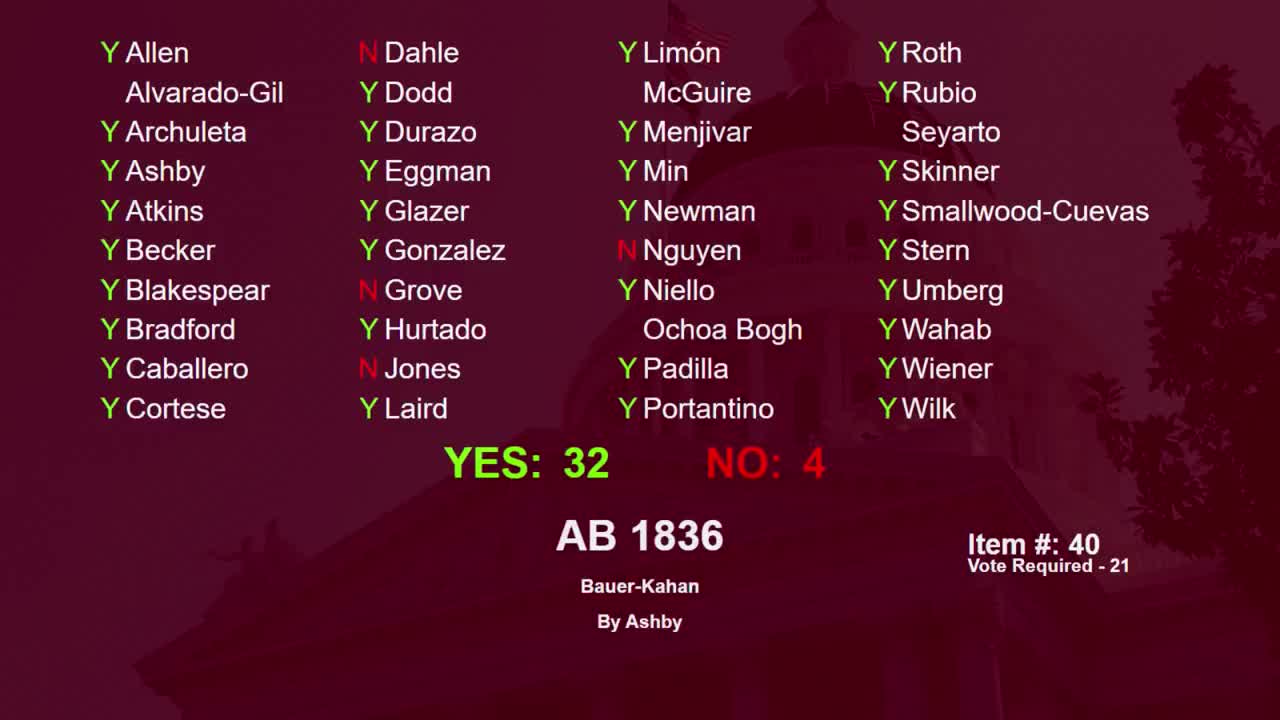 2MIN
Senate Floor
 1MIN
Assembly Floor
 59SEC
Senate Standing Committee on Appropriations
 13MIN
Senate Standing Committee on Human Services
 1MIN
Assembly Floor
 8MIN
Assembly Standing Committee on Human Services
Bill Author

Bill Co-Author(s):
