AB 2297: Hospital and Emergency Physician Fair Pricing Policies.
- Session Year: 2023-2024
- House: Assembly
- Latest Version Date: 2024-09-24
Current Status:
Passed
(2024-09-24: Chaptered by Secretary of State - Chapter 511, Statutes of 2024.)
Introduced
In Committee
First Chamber
In Committee
Second Chamber
Enacted
Existing law requires a hospital to maintain a written charity care policy and a discount payment policy for uninsured patients or patients with high medical costs who are at or below 400 percent of the federal poverty level. Existing law requires the written policy regarding discount payments to also include a statement that an emergency physician who provides emergency medical services in a hospital that provides emergency care is also required by law to provide discounts to uninsured patients or patients with high medical costs who are at or below 400 percent of the federal poverty level. Existing law authorizes an emergency physician to choose to grant eligibility for a discount payment policy to patients with incomes over 350% of the federal poverty level. Existing law defines high medical costs for these purposes to mean, among other things, specified annual out-of-pocket costs incurred by the individual at the hospital or a hospital that provided emergency care.
This bill would authorize an emergency physician to choose to grant eligibility for a discount payment policy to patients with incomes over 400% of the federal poverty level. The bill would also clarify that out-of-pocket costs for the above-described definition of high medical costs means any expenses for medical care that are not reimbursed by insurance or a health coverage program, such as Medicare copays or Medi-Cal cost sharing.
Existing law requires a hospitals discount payment policy to clearly state the eligibility criteria based upon income, and authorizes a hospital to consider the income and monetary assets of the patient or the patients family, as defined, in determining eligibility under its charity care policy.
This bill would prohibit a hospital from considering the monetary assets of the patient in determining eligibility for both the charity care and the discount payment policies, but would authorize the hospital to consider the availability of a patients health savings account held by the patient or the patients family, as specified. The bill would revise the definition of patients family, as specified. The bill would instead require that the eligibility for charity care or discounted payments be determined at any time the hospital is in receipt of, among other things, recent pay stubs or income tax returns. The bill would prohibit a hospital or an emergency physician from imposing time limits for applying for charity care or discounted payments, and would prohibit a hospital or emergency physician from denying eligibility based on the timing of a patients application. The bill would authorize a hospital or emergency physician to waive or reduce Medi-Cal and Medicare cost-sharing amounts as part of its charity care program or discount payment program, as specified.
Existing law requires a hospital or an emergency physician to establish a written policy defining standards and practices for the collection of debt. Existing law authorizes a hospital or emergency physician to consider only income and monetary assets, as specified, in determining the amount of debt a hospital or emergency physician may seek to recover from patients who are eligible under the hospitals or emergency physicians charity care or discount payment policy.
This bill would eliminate the authorization for a hospital or an emergency physician to consider monetary assets in determining the amount of debt the hospital or emergency physician may seek to recover from patients who are eligible under these policies.
Existing law prohibits a hospital, in dealing with patients eligible under the hospitals charity care or discount payment policies, or emergency physician, in dealing with patients eligible under the emergency physicians discount payment policies, from using liens on primary residences as a means of collecting unpaid hospital or emergency physician bills. Existing law prohibits a collection agency, in dealing with a patient under a hospitals charity care or discount payment policies or in dealing with a patient under the emergency physicians discount payment policy, from conducting a sale of a patients primary residence, as specified, as a means of collecting unpaid hospital or emergency physician bills.
This bill would prohibit a hospital or emergency physician from using liens on any real property as a means of collecting unpaid hospital or emergency physician bills, and would prohibit a collection agency from conducting a sale of any real property owned, in part or completely, by a patient or placing a lien on any real property as a means of collecting unpaid hospital or emergency physician bills.
The bill would define charity care and discount payment for the purposes described above.
Existing law requires a hospital to reimburse a patient any amount actually paid in excess of the amount due, including interest. Under existing law, a hospital is not required to reimburse the patient or pay interest if the amount due is less than $5.
This bill would authorize the hospital to reimburse the patient, but is not required to do so, if the hospital or the department determines that a patient qualified for financial assistance at the time the patient was first billed and it has been 5 years or more since the last payment to the hospital, hospital assignee, or debt buyer or the patient debt was sold to a debt buyer in accordance with state law in effect at the time the debt was sold, if sold before January 1, 2022.
Existing law requires the State Department of Public Health to be responsible for the enforcement of the hospital pricing policy provisions for violations occurring prior to January 1, 2024. Existing law requires the Department of Health Care Access and Information to be responsible for the enforcement of these provisions for violations occurring on or after January 1, 2024.
This bill would require the Department of Health Care Access and Information to also have enforcement authority to assess penalties for violations that occurred on or after January 1, 2022, that arise out of the same investigation for investigations involving hospital actions occurring on or after January 1, 2024, as specified.
This bill would incorporate additional changes to Section 127425 of the Health and Safety Code proposed by Senate Bill 1061, to be operative only if this bill and Senate Bill 1061 are enacted and this bill is enacted last.
Existing law requires a hospital to maintain a written charity care policy and a discount payment policy for uninsured patients or patients with high medical costs who are at or below 400 percent of the federal poverty level. Existing law requires the written policy regarding discount payments to also include a statement that an emergency physician who provides emergency medical services in a hospital that provides emergency care is also required by law to provide discounts to uninsured patients or patients with high medical costs who are at or below 400 percent of the federal poverty level. Existing law authorizes an emergency physician to choose to grant eligibility for a discount payment policy to patients with incomes over 350% of the federal poverty level. Existing law defines high medical costs for these purposes to mean, among other things, specified annual out-of-pocket costs incurred by the individual at the hospital or a hospital that provided emergency care.
This bill would authorize an emergency physician to choose to grant eligibility for a discount payment policy to patients with incomes over 400% of the federal poverty level. The bill would also clarify that out-of-pocket costs for the above-described definition of high medical costs means any expenses for medical care that are not reimbursed by insurance or a health coverage program, such as Medicare copays or Medi-Cal cost sharing.
Existing law requires a hospitals discount payment policy to clearly state the eligibility criteria based upon income, and authorizes a hospital to consider the income and monetary assets of the patient or the patients family, as defined, in determining eligibility under its charity care policy.
This bill would prohibit a hospital from considering the monetary assets of the patient in determining eligibility for both the charity care and the discount payment policies, but would authorize the hospital to consider the availability of a patients health savings account held by the patient or the patients family, as specified. The bill would revise the definition of patients family, as specified. The bill would instead require that the eligibility for charity care or discounted payments be determined at any time the hospital is in receipt of, among other things, recent pay stubs or income tax returns. The bill would prohibit a hospital or an emergency physician from imposing time limits for applying for charity care or discounted payments, and would prohibit a hospital or emergency physician from denying eligibility based on the timing of a patients application. The bill would authorize a hospital or emergency physician to waive or reduce Medi-Cal and Medicare cost-sharing amounts as part of its charity care program or discount payment program, as specified.
Existing law requires a hospital or an emergency physician to establish a written policy defining standards and practices for the collection of debt. Existing law authorizes a hospital or emergency physician to consider only income and monetary assets, as specified, in determining the amount of debt a hospital or emergency physician may seek to recover from patients who are eligible under the hospitals or emergency physicians charity care or discount payment policy.
This bill would eliminate the authorization for a hospital or an emergency physician to consider monetary assets in determining the amount of debt the hospital or emergency physician may seek to recover from patients who are eligible under these policies.
Existing law prohibits a hospital, in dealing with patients eligible under the hospitals charity care or discount payment policies, or emergency physician, in dealing with patients eligible under the emergency physicians discount payment policies, from using liens on primary residences as a means of collecting unpaid hospital or emergency physician bills. Existing law prohibits a collection agency, in dealing with a patient under a hospitals charity care or discount payment policies or in dealing with a patient under the emergency physicians discount payment policy, from conducting a sale of a patients primary residence, as specified, as a means of collecting unpaid hospital or emergency physician bills.
This bill would prohibit a hospital or emergency physician from using liens on any real property as a means of collecting unpaid hospital or emergency physician bills, and would prohibit a collection agency from conducting a sale of any real property owned, in part or completely, by a patient or placing a lien on any real property as a means of collecting unpaid hospital or emergency physician bills.
The bill would define charity care and discount payment for the purposes described above.
Existing law requires a hospital to reimburse a patient any amount actually paid in excess of the amount due, including interest. Under existing law, a hospital is not required to reimburse the patient or pay interest if the amount due is less than $5.
This bill would authorize the hospital to reimburse the patient, but is not required to do so, if the hospital or the department determines that a patient qualified for financial assistance at the time the patient was first billed and it has been 5 years or more since the last payment to the hospital, hospital assignee, or debt buyer or the patient debt was sold to a debt buyer in accordance with state law in effect at the time the debt was sold, if sold before January 1, 2022.
Existing law requires the State Department of Public Health to be responsible for the enforcement of the hospital pricing policy provisions for violations occurring prior to January 1, 2024. Existing law requires the Department of Health Care Access and Information to be responsible for the enforcement of these provisions for violations occurring on or after January 1, 2024.
This bill would require the Department of Health Care Access and Information to also have enforcement authority to assess penalties for violations that occurred on or after January 1, 2022, that arise out of the same investigation for investigations involving hospital actions occurring on or after January 1, 2024, as specified.
This bill would incorporate additional changes to Section 127425 of the Health and Safety Code proposed by Senate Bill 1061, to be operative only if this bill and Senate Bill 1061 are enacted and this bill is enacted last.
Existing law requires a hospital to maintain a written charity care policy and a discount payment policy for uninsured patients or patients with high medical costs who are at or below 400 percent of the federal poverty level. Existing law requires the written policy regarding discount payments to also include a statement that an emergency physician who provides emergency medical services in a hospital that provides emergency care is also required by law to provide discounts to uninsured patients or patients with high medical costs who are at or below 400 percent of the federal poverty level. Existing law authorizes an emergency physician to choose to grant eligibility for a discount payment policy to patients with incomes over 350% of the federal poverty level. Existing law defines high medical costs for these purposes to mean, among other things, specified annual out-of-pocket costs incurred by the individual at the hospital or a hospital that provided emergency care.
This bill would authorize an emergency physician to choose to grant eligibility for a discount payment policy to patients with incomes over 400% of the federal poverty level. The bill would also clarify that out-of-pocket costs for the above-described definition of high medical costs means any expenses for medical care that are not reimbursed by insurance or a health coverage program, such as Medicare copays or Medi-Cal cost sharing.
Existing law requires a hospitals discount payment policy to clearly state the eligibility criteria based upon income, and authorizes a hospital to consider the income and monetary assets of the patient or the patients family, as defined, in determining eligibility under its charity care policy.
This bill would prohibit a hospital from considering the monetary assets of the patient in determining eligibility for both the charity care and the discount payment policies, but would authorize the hospital to consider the availability of a patients health savings account held by the patient or the patients family, as specified. The bill would revise the definition of patients family, as specified. The bill would instead require that the eligibility for charity care or discounted payments be determined at any time the hospital is in receipt of of, among other things, recent pay stubs or income tax returns. The bill would prohibit a hospital or an emergency physician from imposing time limits for applying for charity care or discounted payments, and would prohibit a hospital or emergency physician from denying eligibility based on the timing of a patients application. The bill would authorize a hospital or emergency physician to waive or reduce Medi-Cal and Medicare cost-sharing amounts as part of its charity care program or discount payment program. program, as specified.
Existing law requires a hospital or an emergency physician to establish a written policy defining standards and practices for the collection of debt. Existing law authorizes a hospital or emergency physician to consider only income and monetary assets, as specified, in determining the amount of debt a hospital or emergency physician may seek to recover from patients who are eligible under the hospitals or emergency physicians charity care or discount payment policy.
This bill would eliminate the authorization for a hospital or an emergency physician to consider monetary assets in determining the amount of debt the hospital or emergency physician may seek to recover from patients who are eligible under these policies.
Existing law prohibits a hospital, in dealing with patients eligible under the hospitals charity care or discount payment policies, or emergency physician, in dealing with patients eligible under the emergency physicians discount payment policies, from using liens on primary residences as a means of collecting unpaid hospital or emergency physician bills. Existing law prohibits a collection agency, in dealing with a patient under a hospitals charity care or discount payment policies or in dealing with a patient under the emergency physicians discount payment policy, from conducting a sale of a patients primary residence, as specified, as a means of collecting unpaid hospital or emergency physician bills.
This bill would prohibit a hospital or emergency physician from using liens on any real property as a means of collecting unpaid hospital or emergency physician bills, and would prohibit a collection agency from conducting a sale of any real property owned, in part or completely, by a patient or placing a lien on any real property as a means of collecting unpaid hospital or emergency physician bills.
The bill would define charity care and discount payment for the purposes described above.
Existing law requires a hospital to reimburse a patient any amount actually paid in excess of the amount due, including interest. Under existing law, a hospital is not required to reimburse the patient or pay interest if the amount due is less than $5.
This bill would authorize the hospital to reimburse the patient, but is not required to do so, if the hospital or the department determines that a patient qualified for financial assistance at the time the patient was first billed and it has been 7 5 years or more since the last payment to the hospital, hospital assignee, or debt buyer or the patient debt was sold to a debt buyer in accordance with state law in effect at the time the debt was sold, if sold before January 1, 2022.
Existing law requires the State Department of Public Health to be responsible for the enforcement of the hospital pricing policy provisions for violations occurring prior to January 1, 2024. Existing law requires the Department of Health Care Access and Information to be responsible for the enforcement of these provisions for violations occurring on or after January 1, 2024.
This bill would require the Department of Health Care Access and Information to also have enforcement authority to assess penalties for violations that occurred on or after January 1, 2022, that arise out of the same investigation for investigations involving hospital actions occurring on or after January 1, 2024. 2024, as specified.
This bill would incorporate additional changes to Section 127425 of the Health and Safety Code proposed by Senate Bill 1061, to be operative only if this bill and Senate Bill 1061 are enacted and this bill is enacted last.
Existing law requires a hospital to maintain a written charity care policy and a discount payment policy for uninsured patients or patients with high medical costs who are at or below 400 percent of the federal poverty level. Existing law requires the written policy regarding discount payments to also include a statement that an emergency physician who provides emergency medical services in a hospital that provides emergency care is also required by law to provide discounts to uninsured patients or patients with high medical costs who are at or below 400 percent of the federal poverty level. Existing law authorizes an emergency physician to choose to grant eligibility for a discount payment policy to patients with incomes over 350% of the federal poverty level. Existing law defines high medical costs for these purposes to mean, among other things, specified annual out-of-pocket costs incurred by the individual at the hospital or a hospital that provided emergency care.
This bill would authorize an emergency physician to choose to grant eligibility for a discount payment policy to patients with incomes over 400% of the federal poverty level. The bill would also clarify that out-of-pocket costs for the above-described definition of high medical costs means any expenses for medical care that are not reimbursed by insurance or a health coverage program, such as Medicare copays or Medi-Cal cost sharing.
Existing law requires a hospitals discount payment policy to clearly state the eligibility criteria based upon income, and authorizes a hospital to consider the income and monetary assets of the patient or the patients family, as defined, in determining eligibility under its charity care policy.
This bill would prohibit a hospital from considering the monetary assets of the patient in determining eligibility for both the charity care and the discount payment policies, but would authorize the hospital to consider, among other things, a health savings account, as specified. consider the availability of a patients health savings account held by the patient or the patients family, as specified. The bill would revise the definition of patients family, as specified. The bill would instead require that the eligibility for charity care or discounted payments be determined at any time the hospital is in receipt of recent pay stubs or income tax returns. The bill would prohibit a hospital or an emergency physician from imposing time limits for eligibility. applying for charity care or discounted payments, and would prohibit a hospital or emergency physician from denying eligibility based on the timing of a patients application. The bill would authorize a hospital or emergency physician to waive or reduce Medi-Cal and Medicare cost-sharing amounts as part of its charity care program or discount payment program.
Existing law requires a hospital or an emergency physician to establish a written policy defining standards and practices for the collection of debt. Existing law authorizes a hospital or emergency physician to consider only income and monetary assets, as specified, in determining the amount of debt a hospital or emergency physician may seek to recover from patients who are eligible under the hospitals or emergency physicians charity care or discount payment policy.
This bill would eliminate the authorization for a hospital or an emergency physician to consider monetary assets in determining the amount of debt the hospital or emergency physician may seek to recover from patients who are eligible under these policies.
Existing law prohibits a hospital, in dealing with patients eligible under the hospitals charity care or discount payment policies, or emergency physician, in dealing with patients eligible under the emergency physicians discount payment policies, from using liens on primary residences as a means of collecting unpaid hospital or emergency physician bills. Existing law prohibits a collection agency, in dealing with a patient under a hospitals charity care or discount payment policies or in dealing with a patient under the emergency physicians discount payment policy, from conducting a sale of a patients primary residence, as specified, as a means of collecting unpaid hospital or emergency physician bills.
This bill would prohibit a hospital or emergency physician from using liens on any real property as a means of collecting unpaid hospital or emergency physician bills, and would prohibit a collection agency from conducting a sale of any real property owned, in part or completely, by a patient or placing a lien on any real property as a means of collecting unpaid hospital or emergency physician bills.
The bill would define charity care and discount payment for the purposes described above.
Existing law requires a hospital to reimburse a patient any amount actually paid in excess of the amount due, including interest. Under existing law, a hospital is not required to reimburse the patient or pay interest if the amount due is less than $5.
This bill would authorize the hospital to reimburse the patient, but is not required to do so, if the hospital or the department determines that a patient qualified for financial assistance at the time the patient was first billed and it has been 7 years or more since the last payment to the hospital, hospital assignee, or debt buyer or the patient debt was sold to a debt buyer in accordance with state law in effect at the time the debt was sold, if sold before January 1, 2022.
Existing law requires the State Department of Public Health to be responsible for the enforcement of the hospital pricing policy provisions for violations occurring prior to January 1, 2024. Existing law requires the Department of Health Care Access and Information to be responsible for the enforcement of these provisions for violations occurring on or after January 1, 2024.
This bill would require the Department of Health Care Access and Information to also have enforcement authority to assess penalties for violations that occurred on or after January 1, 2022, that arise out of the same investigation for investigations involving hospital actions occurring on or after January 1, 2024.
Existing law requires a hospital to maintain a written charity care policy and a discount payment policy for uninsured patients or patients with high medical costs who are at or below 400 percent of the federal poverty level. Existing law requires the written policy regarding discount payments to also include a statement that an emergency physician who provides emergency medical services in a hospital that provides emergency care is also required by law to provide discounts to uninsured patients or patients with high medical costs who are at or below 400 percent of the federal poverty level. Existing law authorizes an emergency physician to choose to grant eligibility for a discount payment policy to patients with incomes over 350% of the federal poverty level. Existing law defines high medical costs for these purposes to mean, among other things, specified annual out-of-pocket costs incurred by the individual at the hospital or a hospital that provided emergency care.
This bill would authorize an emergency physician to choose to grant eligibility for a discount payment policy to patients with incomes over 400% of the federal poverty level. The bill would also clarify that out-of-pocket costs for the above-described definition of high medical costs means any expenses for medical care that are not reimbursed by insurance or a health coverage program, such as Medicare copays or Medi-Cal cost sharing.
Existing law requires a hospitals discount payment policy to clearly state the eligibility criteria based upon income, and authorizes a hospital to consider the income and monetary assets of the patient in determining eligibility under its charity care policy.
This bill would prohibit a hospital from considering the monetary assets of the patient in determining eligibility for both the charity care and the discount payment policies, but would authorize the hospital to consider consider, among other things, a health savings account, as specified. The bill would instead require that the eligibility for charity care or discounted payments be determined at any time the hospital is in receipt of recent pay stubs or income tax returns. The bill would prohibit a hospital from imposing time limits for eligibility. The bill would authorize a hospital to waive Medi-Cal and Medicare cost-sharing amounts as part of its charity care program or discount payment program.
Existing law requires a hospital or an emergency physician to establish a written policy defining standards and practices for the collection of debt. Existing law authorizes a hospital or emergency physician to consider only income and monetary assets, as specified, in determining the amount of debt a hospital or emergency physician may seek to recover from patients who are eligible under the hospitals or emergency physicians charity care or discount payment policy.
This bill would eliminate the authorization for a hospital or an emergency physician to consider monetary assets in determining the amount of debt the hospital or emergency physician may seek to recover from patients who are eligible under these policies.
Existing law prohibits a hospital, in dealing with patients eligible under the hospitals charity care or discount payment policies, or emergency physician, in dealing with patients eligible under the emergency physicians discount payment policies, from using liens on primary residences as a means of collecting unpaid hospital or emergency physician bills. Existing law prohibits a collection agency, in dealing with a patient under a hospitals charity care or discount payment policies or in dealing with a patient under the emergency physicians discount payment policy, from conducting a sale of a patients primary residence, as specified, as a means of collecting unpaid hospital or emergency physician bills.
This bill would prohibit a hospital or emergency physician from using liens on any real property as a means of collecting unpaid hospital or emergency physician bills, and would prohibit a collection agency from conducting a sale of any real property owned, in part or completely, by a patient or placing a lien on any real property as a means of collecting unpaid hospital or emergency physician bills.
The bill would define charity care and discount payment for the purposes described above.
Existing law requires a hospital to maintain a written charity care policy and a discount payment policy for uninsured patients or patients with high medical costs who are at or below 400 percent of the federal poverty level. Existing law requires the written policy regarding discount payments to also include a statement that an emergency physician who provides emergency medical services in a hospital that provides emergency care is also required by law to provide discounts to uninsured patients or patients with high medical costs who are at or below 400 percent of the federal poverty level. Existing law authorizes an emergency physician to choose to grant eligibility for a discount payment policy to patients with incomes over 350% of the federal poverty level. Existing law defines high medical costs for these purposes to mean, among other things, specified annual out-of-pocket costs incurred by the individual at the hospital or a hospital that provided emergency care.
This bill would authorize an emergency physician to choose to grant eligibility for a discount payment policy to patients with incomes over 400% of the federal poverty level. The bill would also clarify that out-of-pocket costs for the above-described definition of high medical costs means any expenses for medical care that are not reimbursed by insurance or a health coverage program, such as Medicare copays or Medi-Cal cost sharing.
Existing law requires a hospitals discount payment policy to clearly state the eligibility criteria based upon income, and authorizes a hospital to consider the income and monetary assets of the patient in determining eligibility under its charity care policy.
This bill would define charity policy for those purposes. The This bill would prohibit a hospital from considering the monetary assets of the patient in determining eligibility for both the charity care and the discount payment policies. policies, but would authorize the hospital to consider a health savings account, as specified. The bill would instead require that the eligibility for charity care or discounted payments be determined at any time the hospital is in receipt of recent pay stubs or income tax returns. The bill would prohibit a hospital from imposing time limits for eligibility. The bill would authorize a hospital to waive Medi-Cal and Medicare cost-sharing amounts as part of its charity care program or discount payment program.
Existing law requires a hospital or an emergency physician to establish a written policy defining standards and practices for the collection of debt. Existing law authorizes a hospital or emergency physician to consider only income and monetary assets, as specified, in determining the amount of debt a hospital or emergency physician may seek to recover from patients who are eligible under the hospitals or emergency physicians charity care or discount payment policy.
This bill would eliminate the authorization for a hospital or an emergency physician to consider monetary assets in determining the amount of debt the hospital or emergency physician may seek to recover from patients who are eligible under these policies.
Existing law prohibits a hospital, in dealing with patients eligible under the hospitals charity care or discount payment policies, or emergency physician, in dealing with patients eligible under the emergency physicians discount payment policies, from using liens on primary residences as a means of collecting unpaid hospital or emergency physician bills. Existing law prohibits a collection agency, in dealing with a patient under a hospitals charity care or discount payment policies or in dealing with a patient under the emergency physicians discount payment policy, from conducting a sale of a patients primary residence, as specified, as a means of collecting unpaid hospital or emergency physician bills.
This bill would prohibit a hospital or emergency physician from using liens on any real property as a means of collecting unpaid hospital or emergency physician bills, and would prohibit a collection agency from conducting a sale of any real property owned, in part or completely, by a patient or placing a lien on any real property as a means of collecting unpaid hospital or emergency physician bills.
The bill would define charity care and discount payment for the purposes described above.
Existing law requires a hospital to maintain a written charity care policy and a discount payment policy for uninsured patients or patients with high medical costs who are at or below 400 percent of the federal poverty level. Existing law requires the written policy regarding discount payments to also include a statement that an emergency physician who provides emergency medical services in a hospital that provides emergency care is also required by law to provide discounts to uninsured patients or patients with high medical costs who are at or below 400 percent of the federal poverty level. Existing law authorizes an emergency physician to choose to grant eligibility for a discount payment policy to patients with incomes over 350% of the federal poverty level. Existing law defines high medical costs for these purposes to mean, among other things, specified annual out-of-pocket costs incurred by the individual at the hospital or a hospital that provided emergency care.
This bill would authorize an emergency physician to choose to grant eligibility for a discount payment policy to patients with incomes over 400% of the federal poverty level. The bill would also clarify that out-of-pocket costs for the above-described definition of high medical costs means any expenses for medical care that are not reimbursed by insurance or a health coverage program, such as Medicare copays or Medi-Cal cost sharing.
Existing law requires a hospitals discount payment policy to clearly state the eligibility criteria based upon income, and authorizes a hospital to consider the income and monetary assets of the patient in determining eligibility under its charity care policy.
This bill would define charity policy for those purposes. The bill would prohibit a hospital from considering the monetary assets of the patient in determining eligibility for both the charity care and the discount payment policies. The bill would instead require that the eligibility for charity care or discounted payments be determined at any time the hospital is in receipt of recent pay stubs or income tax returns. The bill would prohibit a hospital from imposing time limits for eligibility. The bill would authorize a hospital to waive Medi-Cal and Medicare cost-sharing amounts as part of its charity care program or discount payment program.
Existing law requires a hospital or an emergency physician to establish a written policy defining standards and practices for the collection of debt. Existing law authorizes a hospital or emergency physician to consider only income and monetary assets, as specified, in determining the amount of debt a hospital or emergency physician may seek to recover from patients who are eligible under the hospitals or emergency physicians charity care or discount payment policy.
This bill would eliminate the authorization for a hospital or an emergency physician to consider monetary assets in determining the amount of debt the hospital or emergency physician may seek to recover from patients who are eligible under these policies.
Existing law prohibits a hospital, in dealing with patients eligible under the hospitals charity care or discount payment policies, or emergency physician, in dealing with patients eligible under the emergency physicians discount payment policies, from using liens on primary residences as a means of collecting unpaid hospital or emergency physician bills. Existing law prohibits a collection agency, in dealing with a patient under a hospitals charity care or discount payment policies or in dealing with a patient under the emergency physicians discount payment policy, from conducting a sale of a patients primary residence, as specified, as a means of collecting unpaid hospital or emergency physician bills.
This bill would prohibit a hospital or emergency physician from using liens on any real property as a means of collecting unpaid hospital or emergency physician bills, and would prohibit a collection agency from conducting a sale of any real property owned, in part or completely, by a patient or placing a lien on any real property as a means of collecting unpaid hospital or emergency physician bills.
As used in this article, the following terms have the following meanings:
(a)Allowance for financially qualified patient means, with respect to services rendered to a financially qualified patient, an allowance that is applied after the hospitals charges are imposed on the patient, due to the patients determined financial inability to pay the charges.
(b)Federal poverty level means the poverty guidelines updated periodically in the Federal Register by the United States Department of Health and Human Services under authority of subsection (2) of Section 9902 of Title 42 of the United States Code.
(c)Financially qualified patient means a patient who is both of the following:
(1)A patient who is a self-pay patient, as defined in subdivision (f), or a patient with high medical costs, as defined in subdivision (g).
(2)A patient who has a family income that does not exceed 400 percent of the federal poverty level.
(d)Hospital means a facility that is required to be licensed under subdivision (a), (b), or (f) of Section 1250, except a facility operated by the State Department of State Hospitals, the State Department of Developmental Services, or the Department of Corrections and Rehabilitation.
(e)Department means the Department of Health Care Access and Information.
(f)Self-pay patient means a patient who does not have third-party coverage from a health insurer, health care service plan, Medicare, or Medicaid, and whose injury is not a compensable injury for purposes of workers compensation, automobile insurance, or other insurance as determined and documented by the hospital. Self-pay patients may include charity care patients.
(g)A patient with high medical costs means a person whose family income does not exceed 400 percent of the federal poverty level, as defined in subdivision (b). For these purposes, high medical costs means any of the following:
(1)Annual out-of-pocket costs incurred by the individual at the hospital that exceed the lesser of 10 percent of the patients current family income or family income in the prior 12 months. Out-of-pocket costs means any expenses for medical care that are not reimbursed by insurance or a health coverage program, such as Medicare copays or Medi-Cal cost sharing.
(2)Annual out-of-pocket expenses that exceed 10 percent of the patients family income, if the patient provides documentation of the patients medical expenses paid by the patient or the patients family in the prior 12 months. Out-of-pocket expenses means any expenses for medical care that are not reimbursed by insurance or a health coverage program, such as Medicare copays or Medi-Cal cost sharing.
(3)A lower level determined by the hospital in accordance with the hospitals charity care policy.
(h)Patients family means the following:
(1)For persons 18 years of age and older, spouse, domestic partner, as defined in Section 297 of the Family Code, and dependent children under 21 years of age, or any age if disabled, consistent with Section 1614(a) of Part A of Title XVI of the Social Security Act, whether living at home or not.
(2)For persons under 18 years of age or for a dependent child 18 to 20 years of age, inclusive, parent, caretaker relatives, and parents or caretaker relatives other dependent children under 21 years of age, or any age if disabled, consistent with Section 1614(a) of Part A of Title XVI of the Social Security Act.
(i)Reasonable payment plan means monthly payments that are not more than 10 percent of a patients family income for a month, excluding deductions for essential living expenses. Essential living expenses means, for purposes of this subdivision, expenses for any of the following: rent or house payment and maintenance, food and household supplies, utilities and telephone, clothing, medical and dental payments, insurance, school or child care, child or spousal support, transportation and auto expenses, including insurance, gas, and repairs, installment payments, laundry and cleaning, and other extraordinary expenses.
(j)Guarantor means a person who has legal financial responsibility for the patients health care services.
SEC. 2.Section 127400.5 is added to the Health and Safety Code, to read:127400.5.For purposes of this chapter, the following terms have the following meanings:
(a)Charity care means free care.
(b)Discounted payment or discount payment means any charge for care that is reduced but not free.
SEC. 3.Section 127401 of the Health and Safety Code is amended to read:127401.(a)The State Department of Public Health shall be responsible for the enforcement of the provisions of this article for violations occurring prior to January 1, 2024. The Department of Health Care Access and Information shall be responsible for the enforcement of the provisions of this article for violations occurring on or after January 1, 2024.
(b)For investigations involving hospital actions required by this article occurring on or after January 1, 2024, the Department of Health Care Access and Information shall also have enforcement authority to assess penalties for violations that occurred on or after January 1, 2022, that arise out of the same investigation. The State Department of Public Health and the Department of Health Care Access and Information shall not impose a penalty for any violation for which the other department has imposed a penalty. Any action brought by the Director of the Department of Health Care Access and Information against a hospital shall not abate by reason of a sale or other transfer of ownership of the hospital that is a party to the action except with the express written consent of the director.
SEC. 4.Section 127405 of the Health and Safety Code is amended to read:127405.(a)(1)(A)Each hospital shall maintain an understandable written policy regarding discount payments for financially qualified patients as well as an understandable written charity care policy. Uninsured patients or patients with high medical costs who are at or below 400 percent of the federal poverty level, as defined in subdivision (b) of Section 127400, shall be eligible for participation under a hospitals charity care policy or discount payment policy. Notwithstanding any other provision of this article, a hospital may choose to grant eligibility for its discount payment policy or charity care policies to patients with incomes over 400 percent of the federal poverty level. Both the charity care policy and the discount payment policy shall state the process used by the hospital to determine whether a patient is eligible for charity care or discounted payment. In the event of a dispute, a patient may seek review from the business manager, chief financial officer, or other appropriate manager as designated in the charity care policy and the discount payment policy.
(B)The written policy regarding discount payments shall also include a statement that an emergency physician, as defined in Section 127450, who provides emergency medical services in a hospital that provides emergency care is also required by law to provide discounts to uninsured patients or patients with high medical costs who are at or below 400 percent of the federal poverty level. This statement shall not be construed to impose any additional responsibilities upon the hospital.
(2)Rural hospitals, as defined in Section 124840, may establish eligibility levels for financial assistance and charity care at less than 400 percent of the federal poverty level as appropriate to maintain their financial and operational integrity.
(b)(1)A hospitals discount payment policy and charity care policy shall clearly state eligibility criteria based upon income consistent with the application of the federal poverty level. In determining eligibility under its discount payment policy or charity care policy, a hospital shall not consider the monetary assets of the patient.
(2)A hospital shall not require a patient to apply for Medicare, Medi-Cal, or other coverage before the patient is screened for, or provided, discount payment. When screening for eligibility for discount payment, a hospital may require the patient to participate in a screening for Medi-Cal eligibility.
(c)A discount payment policy shall include an extended payment plan to allow payment of the discounted price over time. The policy shall provide that the hospital and the patient shall negotiate the terms of the payment plan, and take into consideration the patients family income and essential living expenses. A hospital may also consider the availability of a patients health savings account held by the patient or the patients family. If the hospital and the patient cannot agree on the payment plan, the hospital shall use the formula described in subdivision (i) of Section 127400 to create a reasonable payment plan.
(d)(1)A hospital shall limit expected payment for services it provides to a patient at or below 400 percent of the federal poverty level, as defined in subdivision (b) of Section 127400, eligible under its discount payment policy to the amount of payment the hospital would expect, in good faith, to receive for providing services from Medicare or Medi-Cal, whichever is greater. If the hospital provides a service for which there is no established payment by Medicare or Medi-Cal, the hospital shall establish an appropriate discounted payment. Patients eligible under this article shall not be required to undergo an independent dispute resolution process.
(2)The hospital may require a patient or guarantor to pay the hospital the entire amount of any reimbursement sent directly to the patient or guarantor by a third-party payer for that hospitals services.
(3)If the patient receives a legal settlement, judgment, or award under a liable third party action that includes payment for health care services or medical care related to the injury, the hospital may require the patient or guarantor to reimburse the hospital for the related health care services rendered up to the amount reasonably awarded for that purpose.
(e)A patient, or patients legal representative, who requests a discounted payment, charity care, or other assistance in meeting their financial obligation to the hospital shall make every reasonable effort to provide the hospital with documentation of income and health benefits coverage. If the person requests charity care or a discounted payment and fails to provide information that is reasonable and necessary for the hospital to make a determination, the hospital may consider that failure in making its determination.
(1)For purposes of determining eligibility for discounted payment or charity care, documentation of income shall be limited to recent pay stubs or income tax returns. The hospital may accept other forms of documentation of income but shall not require those other forms. If a patient does not submit an application or documentation of income, a hospital may presumptively determine that a patient is eligible for charity care or discounted payment based on information other than that provided by the patient or based on a prior eligibility determination.
(2)Information obtained pursuant to paragraph (1) shall not be used for collections activities. This paragraph does not prohibit the use of information obtained by the hospital, collection agency, or assignee independently of the eligibility process for charity care or discounted payment.
(3)Eligibility for discounted payments or charity care shall be determined at any time the hospital is in receipt of information specified in paragraph (1). A hospital shall not impose time limits for applying for charity care or discounted payments, nor deny eligibility based on the timing of a patients application.
(f)(1)A hospital may waive or reduce Medi-Cal and Medicare cost-sharing amounts as part of its charity care program or discount payment program.
(2)In waiving or reducing Medicare cost-sharing amounts, the hospital may consider the patients monetary assets to the extent required for the hospital to be reimbursed under the Medicare program for Medicare bad debt without seeking to collect cost-sharing amounts from the patient as required by federal law, including, but not limited to, Section 413.89 of Title 42 of the Code of Federal Regulations. Monetary assets include only assets that are convertible to cash and do not include retirement or deferred compensation plans qualified under the Internal Revenue Code, nonqualified deferred compensation plans, or assets below the maximum community spouse resource allowance under Section 1396r5(d) of Title 42 of the United States Code.
SEC. 5.Section 127425 of the Health and Safety Code is amended to read:127425.(a)A hospital shall not sell patient debt to a debt buyer, as defined in Section 1788.50 of the Civil Code, unless all of the following apply:
(1)The hospital has found the patient ineligible for financial assistance or the patient has not responded to any attempts to bill or offer financial assistance for 180 days.
(2)The hospital includes contractual language in the sales agreement in which the debt buyer agrees to return, and the hospital agrees to accept, any account in which the balance has been determined to be incorrect due to the availability of a third-party payer, including a health plan or government health coverage program, or the patient is eligible for charity care or financial assistance.
(3)The debt buyer agrees to not resell or otherwise transfer the patient debt, except to the originating hospital or a tax-exempt organization described in Section 127444, or if the debt buyer is sold or merged with another entity.
(4)The debt buyer agrees not to charge interest or fees on the patient debt.
(5)The debt buyer is licensed as a debt collector by the Department of Financial Protection and Innovation.
(b)A hospital shall have a written policy about when and under whose authority patient debt is advanced for collection, whether the collection activity is conducted by the hospital, an affiliate or subsidiary of the hospital, or by an external collection agency, or debt buyer.
(c)A hospital shall establish a written policy defining standards and practices for the collection of debt, and shall obtain a written agreement from any agency that collects hospital receivables that it will adhere to the hospitals standards and scope of practices. This agreement shall require the affiliate, subsidiary, debt buyer, or external collection agency of the hospital that collects the debt to comply with the hospitals definition and application of a reasonable payment plan, as defined in subdivision (i) of Section 127400. The policy shall not conflict with other applicable laws and shall not be construed to create a joint venture between the hospital and the external entity, or otherwise to allow hospital governance of an external entity that collects hospital receivables. In determining the amount of a debt a hospital may seek to recover from patients who are eligible under the hospitals charity care policy or discount payment policy, the hospital may consider only income as limited by Section 127405.
(d)At time of billing, a hospital shall provide a written summary consistent with Section 127410, which includes the same information concerning services and charges provided to all other patients who receive care at the hospital.
(e)Before assigning a bill to collections, or selling patient debt to a debt buyer, a hospital shall send a patient a notice with all of the following information:
(1)The date or dates of service of the bill that is being assigned to collections or sold.
(2)The name of the entity the bill is being assigned or sold to.
(3)A statement informing the patient how to obtain an itemized hospital bill from the hospital.
(4)The name and plan type of the health coverage for the patient on record with the hospital at the time of services or a statement that the hospital does not have that information.
(5)An application for the hospitals charity care and financial assistance.
(6)The date or dates the patient was originally sent a notice about applying for financial assistance, the date or dates the patient was sent a financial assistance application, and, if applicable, the date a decision on the application was made.
(f)A hospital, any assignee of the hospital, or other owner of the patient debt, including a collection agency or debt buyer, shall not report adverse information to a consumer credit reporting agency or commence civil action against the patient for nonpayment before 180 days after initial billing.
(g)If a patient is attempting to qualify for eligibility under the hospitals charity care or discount payment policy and is attempting in good faith to settle an outstanding bill with the hospital by negotiating a reasonable payment plan or by making regular partial payments of a reasonable amount, the hospital shall not send the unpaid bill to any collection agency, debt buyer, or other assignee, unless that entity has agreed to comply with this article.
(h)(1)The hospital or other assignee that is an affiliate or subsidiary of the hospital shall not, in dealing with patients eligible under the hospitals charity care or discount payment policies, use wage garnishments or liens on any real property as a means of collecting unpaid hospital bills.
(2)A collection agency, debt buyer, or other assignee that is not a subsidiary or affiliate of the hospital shall not, in dealing with any patient under the hospitals charity care or discount payment policies, use as a means of collecting unpaid hospital bills, any of the following:
(A)A wage garnishment, except by order of the court upon noticed motion, supported by a declaration filed by the movant identifying the basis for which it believes that the patient has the ability to make payments on the judgment under the wage garnishment, which the court shall consider in light of the size of the judgment and additional information provided by the patient before or at the hearing concerning the patients ability to pay, including information about probable future medical expenses based on the current condition of the patient and other obligations of the patient.
(B)Notice or conduct a sale of any real property owned, in part or completely, by the patient.
(C)Liens on any real property.
(3)This requirement does not preclude a hospital, collection agency, debt buyer, or other assignee from pursuing reimbursement and any enforcement remedy or remedies from third-party liability settlements, tortfeasors, or other legally responsible parties.
(i)Extended payment plans offered by a hospital to assist patients eligible under the hospitals charity care policy, discount payment policy, or any other policy adopted by the hospital for assisting low-income patients with no insurance or high medical costs in settling outstanding past due hospital bills, shall be interest free. The hospital extended payment plan may be declared no longer operative after the patients failure to make all consecutive payments due during a 90-day period. Before declaring the hospital extended payment plan no longer operative, the hospital, collection agency, debt buyer, or assignee shall make a reasonable attempt to contact the patient by telephone and, to give notice in writing, that the extended payment plan may become inoperative, and of the opportunity to renegotiate the extended payment plan. Before the hospital extended payment plan being declared inoperative, the hospital, collection agency, debt buyer, or assignee shall attempt to renegotiate the terms of the defaulted extended payment plan, if requested by the patient. The hospital, collection agency, debt buyer, or assignee shall not report adverse information to a consumer credit reporting agency or commence a civil action against the patient or responsible party for nonpayment before the time the extended payment plan is declared to be no longer operative. For purposes of this section, the notice and telephone call to the patient may be made to the last known telephone number and address of the patient.
(j)This section does not diminish or eliminate any protections consumers have under existing federal and state debt collection laws, or any other consumer protections available under state or federal law. If the patient fails to make all consecutive payments for 90 days and fails to renegotiate a payment plan, this subdivision does not limit or alter the obligation of the patient to make payments on the obligation owing to the hospital pursuant to any contract or applicable statute from the date that the extended payment plan is declared no longer operative, as set forth in subdivision (i).
SEC. 5.5.Section 127425 of the Health and Safety Code is amended to read:127425.(a)A hospital shall not sell patient debt to a debt buyer, as defined in Section 1788.50 of the Civil Code, unless all of the following apply:
(1)The hospital has found the patient ineligible for financial assistance or the patient has not responded to any attempts to bill or offer financial assistance for 180 days.
(2)The hospital includes contractual language in the sales agreement in which the debt buyer agrees to return, and the hospital agrees to accept, any account in which the balance has been determined to be incorrect due to the availability of a third-party payer, including a health plan or government health coverage program, or the patient is eligible for charity care or financial assistance.
(3)The debt buyer agrees to not resell or otherwise transfer the patient debt, except to the originating hospital or a tax-exempt organization described in Section 127444, or if the debt buyer is sold or merged with another entity.
(4)The debt buyer agrees not to charge interest or fees on the patient debt.
(5)The debt buyer is licensed as a debt collector by the Department of Financial Protection and Innovation.
(b)A hospital shall have a written policy about when and under whose authority patient debt is advanced for collection, whether the collection activity is conducted by the hospital, an affiliate or subsidiary of the hospital, or by an external collection agency, or debt buyer.
(c)A hospital shall establish a written policy defining standards and practices for the collection of debt, and shall obtain a written agreement from any agency that collects hospital receivables that it will adhere to the hospitals standards and scope of practices. This agreement shall require the affiliate, subsidiary, debt buyer, or external collection agency of the hospital that collects the debt to comply with the hospitals definition and application of a reasonable payment plan, as defined in subdivision (i) of Section 127400. The policy shall not conflict with other applicable laws and shall not be construed to create a joint venture between the hospital and the external entity, or otherwise to allow hospital governance of an external entity that collects hospital receivables. In determining the amount of a debt a hospital may seek to recover from patients who are eligible under the hospitals charity care policy or discount payment policy, the hospital may consider only income as limited by Section 127405.
(d)At time of billing, a hospital shall provide a written summary consistent with Section 127410, which includes the same information concerning services and charges provided to all other patients who receive care at the hospital.
(e)Before assigning a bill to collections, or selling patient debt to a debt buyer, a hospital shall send a patient a notice with all of the following information:
(1)The date or dates of service of the bill that is being assigned to collections or sold.
(2)The name of the entity the bill is being assigned or sold to.
(3)A statement informing the patient how to obtain an itemized hospital bill from the hospital.
(4)The name and plan type of the health coverage for the patient on record with the hospital at the time of services or a statement that the hospital does not have that information.
(5)An application for the hospitals charity care and financial assistance.
(6)The date or dates the patient was originally sent a notice about applying for financial assistance, the date or dates the patient was sent a financial assistance application, and, if applicable, the date a decision on the application was made.
(f)A hospital, any assignee of the hospital, or other owner of the patient debt, including a collection agency or debt buyer, shall not do either of the following:
(1)Report adverse information to a consumer credit reporting agency.
(2)Commence civil action against the patient for nonpayment before 180 days after initial billing.
(g)If a patient is attempting to qualify for eligibility under the hospitals charity care or discount payment policy and is attempting in good faith to settle an outstanding bill with the hospital by negotiating a reasonable payment plan or by making regular partial payments of a reasonable amount, the hospital shall not send the unpaid bill to any collection agency, debt buyer, or other assignee, unless that entity has agreed to comply with this article.
(h)(1)The hospital or other assignee that is an affiliate or subsidiary of the hospital shall not, in dealing with patients eligible under the hospitals charity care or discount payment policies, use wage garnishments or liens on any real property as a means of collecting unpaid hospital bills.
(2)A collection agency, debt buyer, or other assignee that is not a subsidiary or affiliate of the hospital shall not, in dealing with any patient under the hospitals charity care or discount payment policies, use as a means of collecting unpaid hospital bills, any of the following:
(A)A wage garnishment, except by order of the court upon noticed motion, supported by a declaration filed by the movant identifying the basis for which it believes that the patient has the ability to make payments on the judgment under the wage garnishment, which the court shall consider in light of the size of the judgment and additional information provided by the patient before or at the hearing concerning the patients ability to pay, including information about probable future medical expenses based on the current condition of the patient and other obligations of the patient.
(B)Notice or conduct a sale of any real property owned, in part or completely, by the patient.
(C)Liens on any real property.
(3)This requirement does not preclude a hospital, collection agency, debt buyer, or other assignee from pursuing reimbursement and any enforcement remedy or remedies from third-party liability settlements, tortfeasors, or other legally responsible parties.
(i)Extended payment plans offered by a hospital to assist patients eligible under the hospitals charity care policy, discount payment policy, or any other policy adopted by the hospital for assisting low-income patients with no insurance or high medical costs in settling outstanding past due hospital bills, shall be interest free. The hospital extended payment plan may be declared no longer operative after the patients failure to make all consecutive payments due during a 90-day period. Before declaring the hospital extended payment plan no longer operative, the hospital, collection agency, debt buyer, or assignee shall make a reasonable attempt to contact the patient by telephone and, to give notice in writing, that the extended payment plan may become inoperative, and of the opportunity to renegotiate the extended payment plan. Before the hospital extended payment plan being declared inoperative, the hospital, collection agency, debt buyer, or assignee shall attempt to renegotiate the terms of the defaulted extended payment plan, if requested by the patient. The hospital, collection agency, debt buyer, or assignee shall not commence a civil action against the patient or responsible party for nonpayment before the time the extended payment plan is declared to be no longer operative. For purposes of this section, the notice and telephone call to the patient may be made to the last known telephone number and address of the patient.
(j)(1)A hospital shall maintain all records relating to money owed to the hospital by a patient or a patients guarantor for five years, including, but not limited to, all of the following:
(A)Documents related to litigation filed by the hospital.
(B)A contract and significant related records by which a hospital assigns or sells medical debt to a third party.
(C)A list, updated at least annually, of every person, including the persons name and contact information, that meets at least one of the following criteria:
(i)The person is a debt collector to whom the hospital sold or assigned a debt that a patient of the hospital owed the hospital.
(ii)The person is retained by the hospital to pursue litigation for debts owed by patients on behalf of the hospital.
(2)Any contract entered into by a hospital related to the assignment or sale of medical debt shall require the assignee or buyer and any subsequent assignee or buyer to maintain records related to litigation for five years.
(3)For purposes of this subdivision, debt collector and person have the same meanings as defined in Section 1788.2 of the Civil Code.
(k)This section does not diminish or eliminate any protections consumers have under existing federal and state debt collection laws, or any other consumer protections available under state or federal law. If the patient fails to make all consecutive payments for 90 days and fails to renegotiate a payment plan, this subdivision does not limit or alter the obligation of the patient to make payments on the obligation owing to the hospital pursuant to any contract or applicable statute from the date that the extended payment plan is declared no longer operative, as set forth in subdivision (i).
SEC. 6.Section 127435 of the Health and Safety Code is amended to read:127435.(a)A hospital shall provide to the department a copy of its discount payment policy, charity care policy, eligibility procedures for those policies, review process, and the application for charity care or discounted payment programs, as well as a copy of its debt collection policy. The department may determine whether the information is to be provided electronically or in some other similar manner. The information shall be provided at least biennially on January 1, or when a significant change is made. If no significant change has been made by the hospital since the information was previously provided, notifying the department of the lack of change shall meet the requirements of this section. The department shall make this information available to the public on its internet website.
(b)The department shall review a hospitals policy for compliance with this article by January 1, 2023, and whenever a significant change is made and submitted to the department.
(c)A patient shall not be denied financial assistance that would be available pursuant to the policy published on the departments internet website at the time the patient was first billed.
SEC. 7.Section 127436 of the Health and Safety Code is amended to read:127436.(a)Upon promulgation of regulations as required in subdivisions (b) and (c) no later than January 1, 2024, the Director of the Department of Health Care Access and Information shall impose an administrative penalty for each violation against a hospital that fails to comply with this article, unless the administrative penalty is waived or reduced by the department in the interest of fairness. For purposes of this section, multiple violations identified during the same investigation shall constitute a single violation for purposes of assessing an administrative penalty.
(b)Upon receipt of a complaint by a patient that a hospital has not followed the requirements of Sections 127405 to 127435, inclusive, the director shall do all of the following:
(1)Review the patients eligibility for charity care or financial assistance under the hospitals published financial assistance policy in effect at the time the patient was first billed.
(2)Review the hospitals compliance with this article.
(3)If, after completing the actions in paragraphs (1) and (2), the director believes that the hospital may have violated this article, issue a notice to the hospital describing the alleged violation. The notice shall state all of the facts supporting the alleged violation. The hospital shall have 30 days after issuance of the notice to file a response with the director.
(4)If, after considering all of the information included in any response filed by the hospital, the director determines that a violation has occurred, assess an administrative penalty. The administrative penalty may be up to forty thousand dollars ($40,000), which amount shall be adjusted every five years to reflect the percentage change in the calendar year average, for the five-year period, of the medical care index of the Consumer Price Index, as published by the United States Bureau of Labor Statistics. The department shall promulgate regulations establishing criteria to determine the amount of an administrative penalty. The criteria shall include, at a minimum, all of the following:
(A)The actual financial harm to patients, if any.
(B)The nature, scope, and severity of the violation, including whether the hospitals policies, postings, and screening practices are in compliance with Sections 127405 to 127435, inclusive, or whether the violation was a mistake that resulted in a violation of those policies and practices.
(C)The facilitys history of compliance with related state and federal statutes and regulations.
(D)Factors beyond the facilitys control that restrict the facilitys ability to comply with this chapter or the rules and regulations promulgated thereunder.
(E)The demonstrated willfulness of the violation.
(F)The extent to which the facility detected the violation and took steps to immediately correct the violation and prevent the violation from recurring.
(G)The special circumstances of small and rural hospitals, as defined in Section 124840, if that consideration is needed to protect access to quality care in those hospitals.
(5)Notify the patient of the violation and the patients right to reimbursement pursuant to Section 127440.
(6)Begin collection efforts for the penalty after the deadline to appeal pursuant to subdivision (c) has passed, or, if the hospital files an appeal, when all appeals have been exhausted and the departments findings have been upheld.
(c)The department shall promulgate regulations to establish a process whereby a hospital may appeal the directors determination that a violation has occurred or the amount of any penalty assessed, subject to the following requirements:
(1)A hospital shall have 30 days from issuance to appeal any determination or penalty.
(2)A hospital may submit any relevant evidence during the appeal process.
(3)The department shall provide the patient who filed a complaint with timely notice of the appeal and a copy of any evidence submitted by the hospital, and offer the patient 30 days to submit a response, including any additional evidence in support of the complaint.
(4)The department shall consider all relevant evidence.
(5)The department may reduce or waive an assessment in the interest of fairness.
(6)The department may reduce or waive a penalty if a violation was due to factors beyond the hospitals control, such as a patient failing to provide accurate information or an unauthorized person removing signage from hospital walls.
SEC. 8.Section 127440 of the Health and Safety Code is amended to read:127440.(a)The hospital shall reimburse the patient or patients any amount actually paid in excess of the amount due under this article, including interest. Interest owed by the hospital to the patient shall accrue at the rate set forth in Section 685.010 of the Code of Civil Procedure, beginning on the date payment by the patient is received by the hospital. However, a hospital is not required to reimburse the patient or pay interest if the amount due is less than five dollars ($5.00). The hospital shall refund the patient within 30 days.
(b)The hospital may reimburse the patient, but is not required to do so, if the hospital or the department determines that a patient qualified for financial assistance at the time the patient was first billed and either of the following has occurred:
(1)It has been five years or more since the last payment to the hospital, hospital assignee, or debt buyer.
(2)The patient debt was sold to a debt buyer in accordance with state law in effect at the time the debt was sold, if sold before January 1, 2022.
(c)This section does not diminish or eliminate any rights or responsibilities a hospital may have, nor any rights that a patient may have under existing federal and state laws, including, but not limited to, 26 CFR Sec. 1.501(r)-6.
SEC. 9.Section 127450 of the Health and Safety Code is amended to read:127450.As used in this article, the following terms have the following meanings:
(a)Allowance for financially qualified patient means, with respect to emergency care rendered to a financially qualified patient, an allowance that is applied after the emergency physicians charges are imposed on the patient, due to the patients determined financial inability to pay the charges.
(b)Emergency care means emergency medical services and care, as defined in Section 1317.1, that is provided by an emergency physician in the emergency department of a hospital.
(c)Emergency physician means a physician and surgeon licensed pursuant to Chapter 5 (commencing with Section 2000) of Division 2 of the Business and Professions Code who is credentialed by a hospital and either employed or contracted by the hospital to provide emergency medical services in the emergency department of the hospital, except that an emergency physician shall not include a physician specialist who is called into the emergency department of a hospital or who is on staff or has privileges at the hospital outside of the emergency department.
(d)Federal poverty level means the poverty guidelines updated periodically in the Federal Register by the United States Department of Health and Human Services under authority of subsection (2) of Section 9902 of Title 42 of the United States Code.
(e)Financially qualified patient means a patient who is both of the following:
(1)A patient who is a self-pay patient or a patient with high medical costs.
(2)A patient who has a family income that does not exceed 400 percent of the federal poverty level.
(f)Hospital means a facility that is required to be licensed under subdivision (a) of Section 1250, except a facility operated by the State Department of State Hospitals, the State Department of Developmental Services, or the Department of Corrections and Rehabilitation.
(g)Department means the Department of Health Care Access and Information.
(h)Self-pay patient means a patient who does not have third-party coverage from a health insurer, health care service plan, Medicare, or Medicaid, and whose injury is not a compensable injury for purposes of workers compensation, automobile insurance, or other insurance as determined and documented by the emergency physician. Self-pay patients may include charity care patients.
(i)A patient with high medical costs means a person whose family income does not exceed 400 percent of the federal poverty level if that individual does not receive a discounted rate from the emergency physician as a result of their third-party coverage. For these purposes, high medical costs means any of the following:
(1)Annual out-of-pocket costs incurred by the individual at the hospital that provided emergency care that exceed 10 percent of the patients family income in the prior 12 months. Out-of-pocket costs means any expenses for medical care that are not reimbursed by insurance or a health coverage program, such as Medicare copays or Medi-Cal cost sharing.
(2)Annual out-of-pocket expenses that exceed 10 percent of the patients family income, if the patient provides documentation of the patients medical expenses paid by the patient or the patients family in the prior 12 months. Out-of-pocket expenses means any expenses for medical care that are not reimbursed by insurance or a health coverage program, such as Medicare copays or Medi-Cal cost sharing. The emergency physician may waive the request for documentation.
(3)A lower level determined by the emergency physician in accordance with the emergency physicians discounted payment policy.
(j)Patients family means the following:
(1)For persons 18 years of age and older, spouse, domestic partner, as defined in Section 297 of the Family Code, and dependent children under 21 years of age, or any age if disabled, consistent with Section 1614(a) of Part A of Title XVI of the Social Security Act, whether living at home or not.
(2)For persons under 18 years of age or for a dependent child 18 to 20 years of age, inclusive, parent, caretaker relatives, and parents or caretaker relatives other dependent children under 21 years of age, or any age if disabled, consistent with Section 1614(a) of Part A of Title XVI of the Social Security Act.
(k)Reasonable payment formula means monthly payments that are not more than 10 percent of a patients family income for a month, excluding deductions for essential living expenses. Essential living expenses means, for purposes of this subdivision, expenses for all of the following: rent or house payment and maintenance, food and household supplies, utilities and telephone, clothing, medical and dental payments, insurance, school or child care, child or spousal support, transportation and auto expenses, including insurance, gas, and repairs, installment payments, laundry and cleaning, and other extraordinary expenses.
SEC. 10.Section 127452 of the Health and Safety Code is amended to read:127452.(a)Uninsured patients or patients with high medical costs who are at or below 400 percent of the federal poverty level shall be eligible to apply to an emergency physician for a discount payment pursuant to a discount payment policy. Notwithstanding any other provision of this article, an emergency physician may choose to grant eligibility for a discount payment policy to patients with incomes over 400 percent of the federal poverty level.
(b)An emergency physician shall limit expected payment for services provided to a patient at or below 400 percent of the federal poverty level and who is eligible under the emergency physicians discount payment policy to an amount that is no greater than 50 percent of the median of billed charges based on a nationally recognized database of physician and surgeon charges until the nonprofit FAIR Health, Inc. creates a database that makes available the rate of payment received by physician and surgeons from commercial insurers for the same services in the same or similar geographic region. When FAIR Health, Inc. makes available the rate of payment received by physicians and surgeons from commercial insurers for the same services in the same or similar geographic region, the amount of expected payment under this section shall be no greater than the median or average of rates paid by commercial insurers for the same or similar services in the same or similar geographic region.
(c)(1)If an emergency physician seeks reimbursement from the Maddy Fund pursuant to Section 1797.98c, then the emergency physician shall, at that time, cease any further billing or collection activity for that patient.
(2)If the emergency physician does not receive reimbursement from the Maddy Fund after attempting to obtain reimbursement from the Maddy Fund, then the provisions of this article shall apply.
(3)If the emergency physician does not attempt to seek reimbursement from the Maddy Fund, the provisions of this article shall apply.
(d)A patient, or patients legal representative, who requests a discounted payment or other assistance in meeting their financial obligation to the emergency physician shall make every reasonable effort to provide the emergency physician with documentation of income and health benefits coverage, if the emergency physician requests the documentation. If the patient, or the patients legal representative, requests a discounted payment and fails to provide information that is reasonable and necessary for the emergency physician to make a determination, the emergency physician may consider that failure in making its determination.
(1)For purposes of determining eligibility for discounted payment, the emergency physician may rely on the determination made by the hospital at which emergency care was provided. If the emergency physician chooses to make a separate determination of eligibility for discounted payment, documentation of income shall be limited to recent pay stubs or income tax returns. The emergency physician, at their discretion, may accept self-attestation by a patient, or a patients legal representative, but shall not request documentation of income other than that authorized in this paragraph.
(2)Information obtained pursuant to paragraph (1) shall not be used for collections activities. This paragraph does not prohibit the use of information obtained by the emergency physician, collection agency, or assignee independent of the eligibility process for discounted payment.
(3)Eligibility for discounted payments shall be determined at any time the emergency physician is in receipt of information specified in paragraph (1). An emergency physician shall not impose time limits for applying for discount payments, nor deny eligibility based on the timing of a patients application.
(e)An emergency physician may waive or reduce Medi-Cal and Medicare cost-sharing amounts as part of their discount payment program.
SEC. 11.Section 127455 of the Health and Safety Code is amended to read:127455.(a)Each emergency physician shall have a written policy about when and under whose authority patient debt is advanced for collection.
(b)Each emergency physician shall establish a written policy defining standards and practices for the collection of debt, and shall obtain a written agreement from any agency that collects emergency physician receivables that it will adhere to the emergency physicians standards and scope of practice. This agreement shall require the affiliate, subsidiary, or external collection agency of the physician that collects the debt to comply with the physicians definition and application of a reasonable payment formula, as defined in subdivision (k) of Section 127450. The policy shall not conflict with other applicable laws and shall not be construed to create a joint venture between the emergency physician and the external entity, or otherwise to allow physician and surgeon governance of an external entity that collects physician and surgeon receivables. In determining the amount of a debt the emergency physician may seek to recover from patients who are eligible under the emergency physicians charity care policy or discount payment policy, the emergency physician may consider only income as limited by Section 127452.
(c)For a patient that lacks coverage, or for a patient that provides information that they may be a patient with high medical costs, the emergency physician, an assignee of the emergency physician, or other owner of the patient debt, including a collection agency, shall not report adverse information to a consumer credit reporting agency or commence civil action against the patient for nonpayment at any time before 150 days after initial billing.
(d)If a patient is attempting to qualify for eligibility under the emergency physicians discount payment policy and is attempting in good faith to settle an outstanding bill with the physician and surgeon by negotiating an extended payment plan, the emergency physician or their assignee, including a collection agency, shall not report adverse information to a consumer credit agency or commence a civil action.
(e)(1)The emergency physician or other assignee shall not, in dealing with patients eligible under the emergency physicians discount payment policies, use wage garnishments or liens on any real property as a means of collecting unpaid emergency physician bills.
(2)A collection agency or other assignee shall not, in dealing with any patient under the emergency physicians discount payment policy, use as a means of collecting unpaid emergency physician bills, any of the following:
(A)A wage garnishment, except by order of the court upon noticed motion, supported by a declaration filed by the movant identifying the basis for its belief that the patient has the ability to make payments on the judgment under the wage garnishment, that the court shall consider in light of the size of the judgment and additional information provided by the patient before or at the hearing concerning the patients ability to pay, including information about probable future medical expenses based on the current condition of the patient and other obligations of the patient.
(B)Notice or conduct a sale of any real property owned, in part or completely, by the patient.
(C)Liens on any real property.
(3)This requirement does not preclude the emergency physician, collection agency, or other assignee from pursuing reimbursement and any enforcement remedy or remedies from third-party liability settlements, tortfeasors, or other legally responsible parties.
(f)Extended payment plans offered by an emergency physician to assist patients eligible under the emergency physicians discount payment policy or any other policy adopted by the emergency physician for assisting low-income patients with no insurance or high medical costs in settling outstanding past due emergency physician bills, shall be interest free. The emergency physicians extended payment plan may be declared no longer operative after the patients failure to make all consecutive payments due during a 90-day period. Before declaring the emergency physicians extended payment plan no longer operative, the emergency physician, collection agency, or assignee shall make a reasonable attempt to contact the patient by telephone, if the telephone number is known, and to give notice in writing that the extended payment plan may become inoperative, and of the opportunity to renegotiate the extended payment plan. Before the emergency physicians extended payment plan being declared inoperative, the emergency physician, collection agency, or assignee shall attempt to renegotiate the terms of the defaulted extended payment plan, if requested by the patient. If the patient wishes to renegotiate the terms of the defaulted extended payment plan but no agreement can be reached on the amount of the payment, the emergency physician or their assignee shall apply the reasonable payment formula in subdivision (k) of Section 127450 to determine a monthly payment amount for a subsequent extended payment plan. If the reasonable payment formula would result in a payment of less than ten dollars ($10) a month, the subsequent extended payment plan shall be ten dollars ($10) per month. The emergency physician, collection agency, or assignee shall not report adverse information to a consumer credit reporting agency or commence a civil action against the patient or responsible party for nonpayment before the time the extended payment plan is declared to be no longer operative. If after having defaulted on an extended payment plan the patient has entered into another extended payment plan with payments in the amount of either the reasonable payment formula or ten dollars ($10) per month and the patient fails to make all consecutive payments due during a 90-day period, that extended payment plan is inoperative. For purposes of this section, the notice and telephone call to the patient may be made to the last known telephone number and address of the patient.
(g)For purposes of determining the reasonable payment formula in subdivision (k) of Section 127450, the emergency physician or their assignee may rely on the determination of family income and essential living expenses made by the hospital at which emergency care was provided. The emergency physician or their assignee, at their discretion, may accept self-attestation of family income and essential living expenses by a patient or a patients legal representative.
(h)This section shall not be construed to diminish or eliminate any protections consumers have under existing federal and state debt collection laws, or any other consumer protections available under state or federal law. If the patient fails to make all consecutive payments for 90 days and fails to renegotiate a payment plan, this subdivision does not limit or alter the obligation of the patient to make payments on the obligation owing to the emergency physician pursuant to any contract or applicable statute from the date that the extended payment plan is declared no longer operative, as set forth in subdivision (f).
SEC. 12.Section 5.5 of this bill incorporates amendments to Section 127425 of the Health and Safety Code proposed by both this bill and Senate Bill 1061. That section of this bill shall only become operative if (1) both bills are enacted and become effective on or before January 1, 2025, (2) each bill amends Section 127425 of the Health and Safety Code, and (3) this bill is enacted after Senate Bill 1061, in which case Section 5 of this bill shall not become operative.
As used in this article, the following terms have the following meanings:
(a)Allowance for financially qualified patient means, with respect to services rendered to a financially qualified patient, an allowance that is applied after the hospitals charges are imposed on the patient, due to the patients determined financial inability to pay the charges.
(b)Federal poverty level means the poverty guidelines updated periodically in the Federal Register by the United States Department of Health and Human Services under authority of subsection (2) of Section 9902 of Title 42 of the United States Code.
(c)Financially qualified patient means a patient who is both of the following:
(1)A patient who is a self-pay patient, as defined in subdivision (f), or a patient with high medical costs, as defined in subdivision (g).
(2)A patient who has a family income that does not exceed 400 percent of the federal poverty level.
(d)Hospital means a facility that is required to be licensed under subdivision (a), (b), or (f) of Section 1250, except a facility operated by the State Department of State Hospitals, the State Department of Developmental Services, or the Department of Corrections and Rehabilitation.
(e)Department means the Department of Health Care Access and Information.
(f)Self-pay patient means a patient who does not have third-party coverage from a health insurer, health care service plan, Medicare, or Medicaid, and whose injury is not a compensable injury for purposes of workers compensation, automobile insurance, or other insurance as determined and documented by the hospital. Self-pay patients may include charity care patients.
(g)A patient with high medical costs means a person whose family income does not exceed 400 percent of the federal poverty level, as defined in subdivision (b). For these purposes, high medical costs means any of the following:
(1)Annual out-of-pocket costs incurred by the individual at the hospital that exceed the lesser of 10 percent of the patients current family income or family income in the prior 12 months. Out-of-pocket costs means any expenses for medical care that are not reimbursed by insurance or a health coverage program, such as Medicare copays or Medi-Cal cost sharing.
(2)Annual out-of-pocket expenses that exceed 10 percent of the patients family income, if the patient provides documentation of the patients medical expenses paid by the patient or the patients family in the prior 12 months. Out-of-pocket expenses means any expenses for medical care that are not reimbursed by insurance or a health coverage program, such as Medicare copays or Medi-Cal cost sharing.
(3)A lower level determined by the hospital in accordance with the hospitals charity care policy.
(h)Patients family means the following:
(1)For persons 18 years of age and older, spouse, domestic partner, as defined in Section 297 of the Family Code, and dependent children under 21 years of age, or any age if disabled, consistent with Section 1614(a) of Part A of Title XVI of the Social Security Act, whether living at home or not.
(2)For persons under 18 years of age or for a dependent child 18 to 20 years of age, inclusive, parent, caretaker relatives, and parents or caretaker relatives other dependent children under 21 years of age, or any age if disabled, consistent with Section 1614(a) of Part A of Title XVI of the Social Security Act.
(i)Reasonable payment plan means monthly payments that are not more than 10 percent of a patients family income for a month, excluding deductions for essential living expenses. Essential living expenses means, for purposes of this subdivision, expenses for any of the following: rent or house payment and maintenance, food and household supplies, utilities and telephone, clothing, medical and dental payments, insurance, school or child care, child or spousal support, transportation and auto expenses, including insurance, gas, and repairs, installment payments, laundry and cleaning, and other extraordinary expenses.
(j)Guarantor means a person who has legal financial responsibility for the patients health care services.
SEC. 2.Section 127400.5 is added to the Health and Safety Code, to read:127400.5.For purposes of this chapter, the following terms have the following meanings:
(a)Charity care means free care.
(b)Discounted payment or discount payment means any charge for care that is reduced but not free.
SEC. 3.Section 127401 of the Health and Safety Code is amended to read:127401.(a)The State Department of Public Health shall be responsible for the enforcement of the provisions of this article for violations occurring prior to January 1, 2024. The Department of Health Care Access and Information shall be responsible for the enforcement of the provisions of this article for violations occurring on or after January 1, 2024.
(b)For investigations involving hospital actions required by this article occurring on or after January 1, 2024, the Department of Health Care Access and Information shall also have enforcement authority to assess penalties for violations that occurred on or after January 1, 2022, that arise out of the same investigation. The State Department of Public Health and the Department of Health Care Access and Information shall not impose a penalty for any violation for which the other department has imposed a penalty. Any action brought by the Director of the Department of Health Care Access and Information against a hospital shall not abate by reason of a sale or other transfer of ownership of the hospital that is a party to the action except with the express written consent of the director.
SEC. 4.Section 127405 of the Health and Safety Code is amended to read:127405.(a)(1)(A)Each hospital shall maintain an understandable written policy regarding discount payments for financially qualified patients as well as an understandable written charity care policy. Uninsured patients or patients with high medical costs who are at or below 400 percent of the federal poverty level, as defined in subdivision (b) of Section 127400, shall be eligible for participation under a hospitals charity care policy or discount payment policy. Notwithstanding any other provision of this article, a hospital may choose to grant eligibility for its discount payment policy or charity care policies to patients with incomes over 400 percent of the federal poverty level. Both the charity care policy and the discount payment policy shall state the process used by the hospital to determine whether a patient is eligible for charity care or discounted payment. In the event of a dispute, a patient may seek review from the business manager, chief financial officer, or other appropriate manager as designated in the charity care policy and the discount payment policy.
(B)The written policy regarding discount payments shall also include a statement that an emergency physician, as defined in Section 127450, who provides emergency medical services in a hospital that provides emergency care is also required by law to provide discounts to uninsured patients or patients with high medical costs who are at or below 400 percent of the federal poverty level. This statement shall not be construed to impose any additional responsibilities upon the hospital.
(2)Rural hospitals, as defined in Section 124840, may establish eligibility levels for financial assistance and charity care at less than 400 percent of the federal poverty level as appropriate to maintain their financial and operational integrity.
(b)(1)A hospitals discount payment policy and charity care policy shall clearly state eligibility criteria based upon income consistent with the application of the federal poverty level. In determining eligibility under its discount payment policy or charity care policy, a hospital shall not consider the monetary assets of the patient.
(2)A hospital shall not require a patient to apply for Medicare, Medi-Cal, or other coverage before the patient is screened for, or provided, discount payment. When screening for eligibility for discount payment, a hospital may require the patient to participate in a screening for Medi-Cal eligibility.
(c)A discount payment policy shall include an extended payment plan to allow payment of the discounted price over time. The policy shall provide that the hospital and the patient shall negotiate the terms of the payment plan, and take into consideration the patients family income and essential living expenses. A hospital may also consider the availability of a patients health savings account held by the patient or the patients family. If the hospital and the patient cannot agree on the payment plan, the hospital shall use the formula described in subdivision (i) of Section 127400 to create a reasonable payment plan.
(d)(1)A hospital shall limit expected payment for services it provides to a patient at or below 400 percent of the federal poverty level, as defined in subdivision (b) of Section 127400, eligible under its discount payment policy to the amount of payment the hospital would expect, in good faith, to receive for providing services from Medicare or Medi-Cal, whichever is greater. If the hospital provides a service for which there is no established payment by Medicare or Medi-Cal, the hospital shall establish an appropriate discounted payment. Patients eligible under this article shall not be required to undergo an independent dispute resolution process.
(2)The hospital may require a patient or guarantor to pay the hospital the entire amount of any reimbursement sent directly to the patient or guarantor by a third-party payer for that hospitals services.
(3)If the patient receives a legal settlement, judgment, or award under a liable third party action that includes payment for health care services or medical care related to the injury, the hospital may require the patient or guarantor to reimburse the hospital for the related health care services rendered up to the amount reasonably awarded for that purpose.
(e)A patient, or patients legal representative, who requests a discounted payment, charity care, or other assistance in meeting their financial obligation to the hospital shall make every reasonable effort to provide the hospital with documentation of income and health benefits coverage. If the person requests charity care or a discounted payment and fails to provide information that is reasonable and necessary for the hospital to make a determination, the hospital may consider that failure in making its determination.
(1)For purposes of determining eligibility for discounted payment or charity care, documentation of income shall be limited to recent pay stubs or income tax returns. The hospital may accept other forms of documentation of income but shall not require those other forms. If a patient does not submit an application or documentation of income, a hospital may presumptively determine that a patient is eligible for charity care or discounted payment based on information other than that provided by the patient or based on a prior eligibility determination.
(2)Information obtained pursuant to paragraph (1) shall not be used for collections activities. This paragraph does not prohibit the use of information obtained by the hospital, collection agency, or assignee independently of the eligibility process for charity care or discounted payment.
(3)Eligibility for discounted payments or charity care shall be determined at any time the hospital is in receipt of information specified in paragraph (1). A hospital shall not impose time limits for applying for charity care or discounted payments, nor deny eligibility based on the timing of a patients application.
(f)(1)A hospital may waive or reduce Medi-Cal and Medicare cost-sharing amounts as part of its charity care program or discount payment program.
(2)In waiving or reducing Medicare cost-sharing amounts, the hospital may consider the patients monetary assets to the extent required for the hospital to be reimbursed under the Medicare program for Medicare bad debt without seeking to collect cost-sharing amounts from the patient as required by federal law, including, but not limited to, Section 413.89 of Title 42 of the Code of Federal Regulations. Monetary assets include only assets that are convertible to cash and do not include retirement or deferred compensation plans qualified under the Internal Revenue Code, nonqualified deferred compensation plans, or assets below the maximum community spouse resource allowance under Section 1396r5(d) of Title 42 of the United States Code.
SEC. 5.Section 127425 of the Health and Safety Code is amended to read:127425.(a)A hospital shall not sell patient debt to a debt buyer, as defined in Section 1788.50 of the Civil Code, unless all of the following apply:
(1)The hospital has found the patient ineligible for financial assistance or the patient has not responded to any attempts to bill or offer financial assistance for 180 days.
(2)The hospital includes contractual language in the sales agreement in which the debt buyer agrees to return, and the hospital agrees to accept, any account in which the balance has been determined to be incorrect due to the availability of a third-party payer, including a health plan or government health coverage program, or the patient is eligible for charity care or financial assistance.
(3)The debt buyer agrees to not resell or otherwise transfer the patient debt, except to the originating hospital or a tax-exempt organization described in Section 127444, or if the debt buyer is sold or merged with another entity.
(4)The debt buyer agrees not to charge interest or fees on the patient debt.
(5)The debt buyer is licensed as a debt collector by the Department of Financial Protection and Innovation.
(b)A hospital shall have a written policy about when and under whose authority patient debt is advanced for collection, whether the collection activity is conducted by the hospital, an affiliate or subsidiary of the hospital, or by an external collection agency, or debt buyer.
(c)A hospital shall establish a written policy defining standards and practices for the collection of debt, and shall obtain a written agreement from any agency that collects hospital receivables that it will adhere to the hospitals standards and scope of practices. This agreement shall require the affiliate, subsidiary, debt buyer, or external collection agency of the hospital that collects the debt to comply with the hospitals definition and application of a reasonable payment plan, as defined in subdivision (i) of Section 127400. The policy shall not conflict with other applicable laws and shall not be construed to create a joint venture between the hospital and the external entity, or otherwise to allow hospital governance of an external entity that collects hospital receivables. In determining the amount of a debt a hospital may seek to recover from patients who are eligible under the hospitals charity care policy or discount payment policy, the hospital may consider only income as limited by Section 127405.
(d)At time of billing, a hospital shall provide a written summary consistent with Section 127410, which includes the same information concerning services and charges provided to all other patients who receive care at the hospital.
(e)Before assigning a bill to collections, or selling patient debt to a debt buyer, a hospital shall send a patient a notice with all of the following information:
(1)The date or dates of service of the bill that is being assigned to collections or sold.
(2)The name of the entity the bill is being assigned or sold to.
(3)A statement informing the patient how to obtain an itemized hospital bill from the hospital.
(4)The name and plan type of the health coverage for the patient on record with the hospital at the time of services or a statement that the hospital does not have that information.
(5)An application for the hospitals charity care and financial assistance.
(6)The date or dates the patient was originally sent a notice about applying for financial assistance, the date or dates the patient was sent a financial assistance application, and, if applicable, the date a decision on the application was made.
(f)A hospital, any assignee of the hospital, or other owner of the patient debt, including a collection agency or debt buyer, shall not report adverse information to a consumer credit reporting agency or commence civil action against the patient for nonpayment before 180 days after initial billing.
(g)If a patient is attempting to qualify for eligibility under the hospitals charity care or discount payment policy and is attempting in good faith to settle an outstanding bill with the hospital by negotiating a reasonable payment plan or by making regular partial payments of a reasonable amount, the hospital shall not send the unpaid bill to any collection agency, debt buyer, or other assignee, unless that entity has agreed to comply with this article.
(h)(1)The hospital or other assignee that is an affiliate or subsidiary of the hospital shall not, in dealing with patients eligible under the hospitals charity care or discount payment policies, use wage garnishments or liens on any real property as a means of collecting unpaid hospital bills.
(2)A collection agency, debt buyer, or other assignee that is not a subsidiary or affiliate of the hospital shall not, in dealing with any patient under the hospitals charity care or discount payment policies, use as a means of collecting unpaid hospital bills, any of the following:
(A)A wage garnishment, except by order of the court upon noticed motion, supported by a declaration filed by the movant identifying the basis for which it believes that the patient has the ability to make payments on the judgment under the wage garnishment, which the court shall consider in light of the size of the judgment and additional information provided by the patient before or at the hearing concerning the patients ability to pay, including information about probable future medical expenses based on the current condition of the patient and other obligations of the patient.
(B)Notice or conduct a sale of any real property owned, in part or completely, by the patient.
(C)Liens on any real property.
(3)This requirement does not preclude a hospital, collection agency, debt buyer, or other assignee from pursuing reimbursement and any enforcement remedy or remedies from third-party liability settlements, tortfeasors, or other legally responsible parties.
(i)Extended payment plans offered by a hospital to assist patients eligible under the hospitals charity care policy, discount payment policy, or any other policy adopted by the hospital for assisting low-income patients with no insurance or high medical costs in settling outstanding past due hospital bills, shall be interest free. The hospital extended payment plan may be declared no longer operative after the patients failure to make all consecutive payments due during a 90-day period. Before declaring the hospital extended payment plan no longer operative, the hospital, collection agency, debt buyer, or assignee shall make a reasonable attempt to contact the patient by telephone and, to give notice in writing, that the extended payment plan may become inoperative, and of the opportunity to renegotiate the extended payment plan. Before the hospital extended payment plan being declared inoperative, the hospital, collection agency, debt buyer, or assignee shall attempt to renegotiate the terms of the defaulted extended payment plan, if requested by the patient. The hospital, collection agency, debt buyer, or assignee shall not report adverse information to a consumer credit reporting agency or commence a civil action against the patient or responsible party for nonpayment before the time the extended payment plan is declared to be no longer operative. For purposes of this section, the notice and telephone call to the patient may be made to the last known telephone number and address of the patient.
(j)This section does not diminish or eliminate any protections consumers have under existing federal and state debt collection laws, or any other consumer protections available under state or federal law. If the patient fails to make all consecutive payments for 90 days and fails to renegotiate a payment plan, this subdivision does not limit or alter the obligation of the patient to make payments on the obligation owing to the hospital pursuant to any contract or applicable statute from the date that the extended payment plan is declared no longer operative, as set forth in subdivision (i).
SEC. 5.5.Section 127425 of the Health and Safety Code is amended to read:127425.(a)A hospital shall not sell patient debt to a debt buyer, as defined in Section 1788.50 of the Civil Code, unless all of the following apply:
(1)The hospital has found the patient ineligible for financial assistance or the patient has not responded to any attempts to bill or offer financial assistance for 180 days.
(2)The hospital includes contractual language in the sales agreement in which the debt buyer agrees to return, and the hospital agrees to accept, any account in which the balance has been determined to be incorrect due to the availability of a third-party payer, including a health plan or government health coverage program, or the patient is eligible for charity care or financial assistance.
(3)The debt buyer agrees to not resell or otherwise transfer the patient debt, except to the originating hospital or a tax-exempt organization described in Section 127444, or if the debt buyer is sold or merged with another entity.
(4)The debt buyer agrees not to charge interest or fees on the patient debt.
(5)The debt buyer is licensed as a debt collector by the Department of Financial Protection and Innovation.
(b)A hospital shall have a written policy about when and under whose authority patient debt is advanced for collection, whether the collection activity is conducted by the hospital, an affiliate or subsidiary of the hospital, or by an external collection agency, or debt buyer.
(c)A hospital shall establish a written policy defining standards and practices for the collection of debt, and shall obtain a written agreement from any agency that collects hospital receivables that it will adhere to the hospitals standards and scope of practices. This agreement shall require the affiliate, subsidiary, debt buyer, or external collection agency of the hospital that collects the debt to comply with the hospitals definition and application of a reasonable payment plan, as defined in subdivision (i) of Section 127400. The policy shall not conflict with other applicable laws and shall not be construed to create a joint venture between the hospital and the external entity, or otherwise to allow hospital governance of an external entity that collects hospital receivables. In determining the amount of a debt a hospital may seek to recover from patients who are eligible under the hospitals charity care policy or discount payment policy, the hospital may consider only income as limited by Section 127405.
(d)At time of billing, a hospital shall provide a written summary consistent with Section 127410, which includes the same information concerning services and charges provided to all other patients who receive care at the hospital.
(e)Before assigning a bill to collections, or selling patient debt to a debt buyer, a hospital shall send a patient a notice with all of the following information:
(1)The date or dates of service of the bill that is being assigned to collections or sold.
(2)The name of the entity the bill is being assigned or sold to.
(3)A statement informing the patient how to obtain an itemized hospital bill from the hospital.
(4)The name and plan type of the health coverage for the patient on record with the hospital at the time of services or a statement that the hospital does not have that information.
(5)An application for the hospitals charity care and financial assistance.
(6)The date or dates the patient was originally sent a notice about applying for financial assistance, the date or dates the patient was sent a financial assistance application, and, if applicable, the date a decision on the application was made.
(f)A hospital, any assignee of the hospital, or other owner of the patient debt, including a collection agency or debt buyer, shall not do either of the following:
(1)Report adverse information to a consumer credit reporting agency.
(2)Commence civil action against the patient for nonpayment before 180 days after initial billing.
(g)If a patient is attempting to qualify for eligibility under the hospitals charity care or discount payment policy and is attempting in good faith to settle an outstanding bill with the hospital by negotiating a reasonable payment plan or by making regular partial payments of a reasonable amount, the hospital shall not send the unpaid bill to any collection agency, debt buyer, or other assignee, unless that entity has agreed to comply with this article.
(h)(1)The hospital or other assignee that is an affiliate or subsidiary of the hospital shall not, in dealing with patients eligible under the hospitals charity care or discount payment policies, use wage garnishments or liens on any real property as a means of collecting unpaid hospital bills.
(2)A collection agency, debt buyer, or other assignee that is not a subsidiary or affiliate of the hospital shall not, in dealing with any patient under the hospitals charity care or discount payment policies, use as a means of collecting unpaid hospital bills, any of the following:
(A)A wage garnishment, except by order of the court upon noticed motion, supported by a declaration filed by the movant identifying the basis for which it believes that the patient has the ability to make payments on the judgment under the wage garnishment, which the court shall consider in light of the size of the judgment and additional information provided by the patient before or at the hearing concerning the patients ability to pay, including information about probable future medical expenses based on the current condition of the patient and other obligations of the patient.
(B)Notice or conduct a sale of any real property owned, in part or completely, by the patient.
(C)Liens on any real property.
(3)This requirement does not preclude a hospital, collection agency, debt buyer, or other assignee from pursuing reimbursement and any enforcement remedy or remedies from third-party liability settlements, tortfeasors, or other legally responsible parties.
(i)Extended payment plans offered by a hospital to assist patients eligible under the hospitals charity care policy, discount payment policy, or any other policy adopted by the hospital for assisting low-income patients with no insurance or high medical costs in settling outstanding past due hospital bills, shall be interest free. The hospital extended payment plan may be declared no longer operative after the patients failure to make all consecutive payments due during a 90-day period. Before declaring the hospital extended payment plan no longer operative, the hospital, collection agency, debt buyer, or assignee shall make a reasonable attempt to contact the patient by telephone and, to give notice in writing, that the extended payment plan may become inoperative, and of the opportunity to renegotiate the extended payment plan. Before the hospital extended payment plan being declared inoperative, the hospital, collection agency, debt buyer, or assignee shall attempt to renegotiate the terms of the defaulted extended payment plan, if requested by the patient. The hospital, collection agency, debt buyer, or assignee shall not commence a civil action against the patient or responsible party for nonpayment before the time the extended payment plan is declared to be no longer operative. For purposes of this section, the notice and telephone call to the patient may be made to the last known telephone number and address of the patient.
(j)(1)A hospital shall maintain all records relating to money owed to the hospital by a patient or a patients guarantor for five years, including, but not limited to, all of the following:
(A)Documents related to litigation filed by the hospital.
(B)A contract and significant related records by which a hospital assigns or sells medical debt to a third party.
(C)A list, updated at least annually, of every person, including the persons name and contact information, that meets at least one of the following criteria:
(i)The person is a debt collector to whom the hospital sold or assigned a debt that a patient of the hospital owed the hospital.
(ii)The person is retained by the hospital to pursue litigation for debts owed by patients on behalf of the hospital.
(2)Any contract entered into by a hospital related to the assignment or sale of medical debt shall require the assignee or buyer and any subsequent assignee or buyer to maintain records related to litigation for five years.
(3)For purposes of this subdivision, debt collector and person have the same meanings as defined in Section 1788.2 of the Civil Code.
(k)This section does not diminish or eliminate any protections consumers have under existing federal and state debt collection laws, or any other consumer protections available under state or federal law. If the patient fails to make all consecutive payments for 90 days and fails to renegotiate a payment plan, this subdivision does not limit or alter the obligation of the patient to make payments on the obligation owing to the hospital pursuant to any contract or applicable statute from the date that the extended payment plan is declared no longer operative, as set forth in subdivision (i).
SEC. 6.Section 127435 of the Health and Safety Code is amended to read:127435.(a)A hospital shall provide to the department a copy of its discount payment policy, charity care policy, eligibility procedures for those policies, review process, and the application for charity care or discounted payment programs, as well as a copy of its debt collection policy. The department may determine whether the information is to be provided electronically or in some other similar manner. The information shall be provided at least biennially on January 1, or when a significant change is made. If no significant change has been made by the hospital since the information was previously provided, notifying the department of the lack of change shall meet the requirements of this section. The department shall make this information available to the public on its internet website.
(b)The department shall review a hospitals policy for compliance with this article by January 1, 2023, and whenever a significant change is made and submitted to the department.
(c)A patient shall not be denied financial assistance that would be available pursuant to the policy published on the departments internet website at the time the patient was first billed.
SEC. 7.Section 127436 of the Health and Safety Code is amended to read:127436.(a)Upon promulgation of regulations as required in subdivisions (b) and (c) no later than January 1, 2024, the Director of the Department of Health Care Access and Information shall impose an administrative penalty for each violation against a hospital that fails to comply with this article, unless the administrative penalty is waived or reduced by the department in the interest of fairness. For purposes of this section, multiple violations identified during the same investigation shall constitute a single violation for purposes of assessing an administrative penalty.
(b)Upon receipt of a complaint by a patient that a hospital has not followed the requirements of Sections 127405 to 127435, inclusive, the director shall do all of the following:
(1)Review the patients eligibility for charity care or financial assistance under the hospitals published financial assistance policy in effect at the time the patient was first billed.
(2)Review the hospitals compliance with this article.
(3)If, after completing the actions in paragraphs (1) and (2), the director believes that the hospital may have violated this article, issue a notice to the hospital describing the alleged violation. The notice shall state all of the facts supporting the alleged violation. The hospital shall have 30 days after issuance of the notice to file a response with the director.
(4)If, after considering all of the information included in any response filed by the hospital, the director determines that a violation has occurred, assess an administrative penalty. The administrative penalty may be up to forty thousand dollars ($40,000), which amount shall be adjusted every five years to reflect the percentage change in the calendar year average, for the five-year period, of the medical care index of the Consumer Price Index, as published by the United States Bureau of Labor Statistics. The department shall promulgate regulations establishing criteria to determine the amount of an administrative penalty. The criteria shall include, at a minimum, all of the following:
(A)The actual financial harm to patients, if any.
(B)The nature, scope, and severity of the violation, including whether the hospitals policies, postings, and screening practices are in compliance with Sections 127405 to 127435, inclusive, or whether the violation was a mistake that resulted in a violation of those policies and practices.
(C)The facilitys history of compliance with related state and federal statutes and regulations.
(D)Factors beyond the facilitys control that restrict the facilitys ability to comply with this chapter or the rules and regulations promulgated thereunder.
(E)The demonstrated willfulness of the violation.
(F)The extent to which the facility detected the violation and took steps to immediately correct the violation and prevent the violation from recurring.
(G)The special circumstances of small and rural hospitals, as defined in Section 124840, if that consideration is needed to protect access to quality care in those hospitals.
(5)Notify the patient of the violation and the patients right to reimbursement pursuant to Section 127440.
(6)Begin collection efforts for the penalty after the deadline to appeal pursuant to subdivision (c) has passed, or, if the hospital files an appeal, when all appeals have been exhausted and the departments findings have been upheld.
(c)The department shall promulgate regulations to establish a process whereby a hospital may appeal the directors determination that a violation has occurred or the amount of any penalty assessed, subject to the following requirements:
(1)A hospital shall have 30 days from issuance to appeal any determination or penalty.
(2)A hospital may submit any relevant evidence during the appeal process.
(3)The department shall provide the patient who filed a complaint with timely notice of the appeal and a copy of any evidence submitted by the hospital, and offer the patient 30 days to submit a response, including any additional evidence in support of the complaint.
(4)The department shall consider all relevant evidence.
(5)The department may reduce or waive an assessment in the interest of fairness.
(6)The department may reduce or waive a penalty if a violation was due to factors beyond the hospitals control, such as a patient failing to provide accurate information or an unauthorized person removing signage from hospital walls.
SEC. 8.Section 127440 of the Health and Safety Code is amended to read:127440.(a)The hospital shall reimburse the patient or patients any amount actually paid in excess of the amount due under this article, including interest. Interest owed by the hospital to the patient shall accrue at the rate set forth in Section 685.010 of the Code of Civil Procedure, beginning on the date payment by the patient is received by the hospital. However, a hospital is not required to reimburse the patient or pay interest if the amount due is less than five dollars ($5.00). The hospital shall refund the patient within 30 days.
(b)The hospital may reimburse the patient, but is not required to do so, if the hospital or the department determines that a patient qualified for financial assistance at the time the patient was first billed and either of the following has occurred:
(1)It has been five years or more since the last payment to the hospital, hospital assignee, or debt buyer.
(2)The patient debt was sold to a debt buyer in accordance with state law in effect at the time the debt was sold, if sold before January 1, 2022.
(c)This section does not diminish or eliminate any rights or responsibilities a hospital may have, nor any rights that a patient may have under existing federal and state laws, including, but not limited to, 26 CFR Sec. 1.501(r)-6.
SEC. 9.Section 127450 of the Health and Safety Code is amended to read:127450.As used in this article, the following terms have the following meanings:
(a)Allowance for financially qualified patient means, with respect to emergency care rendered to a financially qualified patient, an allowance that is applied after the emergency physicians charges are imposed on the patient, due to the patients determined financial inability to pay the charges.
(b)Emergency care means emergency medical services and care, as defined in Section 1317.1, that is provided by an emergency physician in the emergency department of a hospital.
(c)Emergency physician means a physician and surgeon licensed pursuant to Chapter 5 (commencing with Section 2000) of Division 2 of the Business and Professions Code who is credentialed by a hospital and either employed or contracted by the hospital to provide emergency medical services in the emergency department of the hospital, except that an emergency physician shall not include a physician specialist who is called into the emergency department of a hospital or who is on staff or has privileges at the hospital outside of the emergency department.
(d)Federal poverty level means the poverty guidelines updated periodically in the Federal Register by the United States Department of Health and Human Services under authority of subsection (2) of Section 9902 of Title 42 of the United States Code.
(e)Financially qualified patient means a patient who is both of the following:
(1)A patient who is a self-pay patient or a patient with high medical costs.
(2)A patient who has a family income that does not exceed 400 percent of the federal poverty level.
(f)Hospital means a facility that is required to be licensed under subdivision (a) of Section 1250, except a facility operated by the State Department of State Hospitals, the State Department of Developmental Services, or the Department of Corrections and Rehabilitation.
(g)Department means the Department of Health Care Access and Information.
(h)Self-pay patient means a patient who does not have third-party coverage from a health insurer, health care service plan, Medicare, or Medicaid, and whose injury is not a compensable injury for purposes of workers compensation, automobile insurance, or other insurance as determined and documented by the emergency physician. Self-pay patients may include charity care patients.
(i)A patient with high medical costs means a person whose family income does not exceed 400 percent of the federal poverty level if that individual does not receive a discounted rate from the emergency physician as a result of their third-party coverage. For these purposes, high medical costs means any of the following:
(1)Annual out-of-pocket costs incurred by the individual at the hospital that provided emergency care that exceed 10 percent of the patients family income in the prior 12 months. Out-of-pocket costs means any expenses for medical care that are not reimbursed by insurance or a health coverage program, such as Medicare copays or Medi-Cal cost sharing.
(2)Annual out-of-pocket expenses that exceed 10 percent of the patients family income, if the patient provides documentation of the patients medical expenses paid by the patient or the patients family in the prior 12 months. Out-of-pocket expenses means any expenses for medical care that are not reimbursed by insurance or a health coverage program, such as Medicare copays or Medi-Cal cost sharing. The emergency physician may waive the request for documentation.
(3)A lower level determined by the emergency physician in accordance with the emergency physicians discounted payment policy.
(j)Patients family means the following:
(1)For persons 18 years of age and older, spouse, domestic partner, as defined in Section 297 of the Family Code, and dependent children under 21 years of age, or any age if disabled, consistent with Section 1614(a) of Part A of Title XVI of the Social Security Act, whether living at home or not.
(2)For persons under 18 years of age or for a dependent child 18 to 20 years of age, inclusive, parent, caretaker relatives, and parents or caretaker relatives other dependent children under 21 years of age, or any age if disabled, consistent with Section 1614(a) of Part A of Title XVI of the Social Security Act.
(k)Reasonable payment formula means monthly payments that are not more than 10 percent of a patients family income for a month, excluding deductions for essential living expenses. Essential living expenses means, for purposes of this subdivision, expenses for all of the following: rent or house payment and maintenance, food and household supplies, utilities and telephone, clothing, medical and dental payments, insurance, school or child care, child or spousal support, transportation and auto expenses, including insurance, gas, and repairs, installment payments, laundry and cleaning, and other extraordinary expenses.
SEC. 10.Section 127452 of the Health and Safety Code is amended to read:127452.(a)Uninsured patients or patients with high medical costs who are at or below 400 percent of the federal poverty level shall be eligible to apply to an emergency physician for a discount payment pursuant to a discount payment policy. Notwithstanding any other provision of this article, an emergency physician may choose to grant eligibility for a discount payment policy to patients with incomes over 400 percent of the federal poverty level.
(b)An emergency physician shall limit expected payment for services provided to a patient at or below 400 percent of the federal poverty level and who is eligible under the emergency physicians discount payment policy to an amount that is no greater than 50 percent of the median of billed charges based on a nationally recognized database of physician and surgeon charges until the nonprofit FAIR Health, Inc. creates a database that makes available the rate of payment received by physician and surgeons from commercial insurers for the same services in the same or similar geographic region. When FAIR Health, Inc. makes available the rate of payment received by physicians and surgeons from commercial insurers for the same services in the same or similar geographic region, the amount of expected payment under this section shall be no greater than the median or average of rates paid by commercial insurers for the same or similar services in the same or similar geographic region.
(c)(1)If an emergency physician seeks reimbursement from the Maddy Fund pursuant to Section 1797.98c, then the emergency physician shall, at that time, cease any further billing or collection activity for that patient.
(2)If the emergency physician does not receive reimbursement from the Maddy Fund after attempting to obtain reimbursement from the Maddy Fund, then the provisions of this article shall apply.
(3)If the emergency physician does not attempt to seek reimbursement from the Maddy Fund, the provisions of this article shall apply.
(d)A patient, or patients legal representative, who requests a discounted payment or other assistance in meeting their financial obligation to the emergency physician shall make every reasonable effort to provide the emergency physician with documentation of income and health benefits coverage, if the emergency physician requests the documentation. If the patient, or the patients legal representative, requests a discounted payment and fails to provide information that is reasonable and necessary for the emergency physician to make a determination, the emergency physician may consider that failure in making its determination.
(1)For purposes of determining eligibility for discounted payment, the emergency physician may rely on the determination made by the hospital at which emergency care was provided. If the emergency physician chooses to make a separate determination of eligibility for discounted payment, documentation of income shall be limited to recent pay stubs or income tax returns. The emergency physician, at their discretion, may accept self-attestation by a patient, or a patients legal representative, but shall not request documentation of income other than that authorized in this paragraph.
(2)Information obtained pursuant to paragraph (1) shall not be used for collections activities. This paragraph does not prohibit the use of information obtained by the emergency physician, collection agency, or assignee independent of the eligibility process for discounted payment.
(3)Eligibility for discounted payments shall be determined at any time the emergency physician is in receipt of information specified in paragraph (1). An emergency physician shall not impose time limits for applying for discount payments, nor deny eligibility based on the timing of a patients application.
(e)An emergency physician may waive or reduce Medi-Cal and Medicare cost-sharing amounts as part of their discount payment program.
SEC. 11.Section 127455 of the Health and Safety Code is amended to read:127455.(a)Each emergency physician shall have a written policy about when and under whose authority patient debt is advanced for collection.
(b)Each emergency physician shall establish a written policy defining standards and practices for the collection of debt, and shall obtain a written agreement from any agency that collects emergency physician receivables that it will adhere to the emergency physicians standards and scope of practice. This agreement shall require the affiliate, subsidiary, or external collection agency of the physician that collects the debt to comply with the physicians definition and application of a reasonable payment formula, as defined in subdivision (k) of Section 127450. The policy shall not conflict with other applicable laws and shall not be construed to create a joint venture between the emergency physician and the external entity, or otherwise to allow physician and surgeon governance of an external entity that collects physician and surgeon receivables. In determining the amount of a debt the emergency physician may seek to recover from patients who are eligible under the emergency physicians charity care policy or discount payment policy, the emergency physician may consider only income as limited by Section 127452.
(c)For a patient that lacks coverage, or for a patient that provides information that they may be a patient with high medical costs, the emergency physician, an assignee of the emergency physician, or other owner of the patient debt, including a collection agency, shall not report adverse information to a consumer credit reporting agency or commence civil action against the patient for nonpayment at any time before 150 days after initial billing.
(d)If a patient is attempting to qualify for eligibility under the emergency physicians discount payment policy and is attempting in good faith to settle an outstanding bill with the physician and surgeon by negotiating an extended payment plan, the emergency physician or their assignee, including a collection agency, shall not report adverse information to a consumer credit agency or commence a civil action.
(e)(1)The emergency physician or other assignee shall not, in dealing with patients eligible under the emergency physicians discount payment policies, use wage garnishments or liens on any real property as a means of collecting unpaid emergency physician bills.
(2)A collection agency or other assignee shall not, in dealing with any patient under the emergency physicians discount payment policy, use as a means of collecting unpaid emergency physician bills, any of the following:
(A)A wage garnishment, except by order of the court upon noticed motion, supported by a declaration filed by the movant identifying the basis for its belief that the patient has the ability to make payments on the judgment under the wage garnishment, that the court shall consider in light of the size of the judgment and additional information provided by the patient before or at the hearing concerning the patients ability to pay, including information about probable future medical expenses based on the current condition of the patient and other obligations of the patient.
(B)Notice or conduct a sale of any real property owned, in part or completely, by the patient.
(C)Liens on any real property.
(3)This requirement does not preclude the emergency physician, collection agency, or other assignee from pursuing reimbursement and any enforcement remedy or remedies from third-party liability settlements, tortfeasors, or other legally responsible parties.
(f)Extended payment plans offered by an emergency physician to assist patients eligible under the emergency physicians discount payment policy or any other policy adopted by the emergency physician for assisting low-income patients with no insurance or high medical costs in settling outstanding past due emergency physician bills, shall be interest free. The emergency physicians extended payment plan may be declared no longer operative after the patients failure to make all consecutive payments due during a 90-day period. Before declaring the emergency physicians extended payment plan no longer operative, the emergency physician, collection agency, or assignee shall make a reasonable attempt to contact the patient by telephone, if the telephone number is known, and to give notice in writing that the extended payment plan may become inoperative, and of the opportunity to renegotiate the extended payment plan. Before the emergency physicians extended payment plan being declared inoperative, the emergency physician, collection agency, or assignee shall attempt to renegotiate the terms of the defaulted extended payment plan, if requested by the patient. If the patient wishes to renegotiate the terms of the defaulted extended payment plan but no agreement can be reached on the amount of the payment, the emergency physician or their assignee shall apply the reasonable payment formula in subdivision (k) of Section 127450 to determine a monthly payment amount for a subsequent extended payment plan. If the reasonable payment formula would result in a payment of less than ten dollars ($10) a month, the subsequent extended payment plan shall be ten dollars ($10) per month. The emergency physician, collection agency, or assignee shall not report adverse information to a consumer credit reporting agency or commence a civil action against the patient or responsible party for nonpayment before the time the extended payment plan is declared to be no longer operative. If after having defaulted on an extended payment plan the patient has entered into another extended payment plan with payments in the amount of either the reasonable payment formula or ten dollars ($10) per month and the patient fails to make all consecutive payments due during a 90-day period, that extended payment plan is inoperative. For purposes of this section, the notice and telephone call to the patient may be made to the last known telephone number and address of the patient.
(g)For purposes of determining the reasonable payment formula in subdivision (k) of Section 127450, the emergency physician or their assignee may rely on the determination of family income and essential living expenses made by the hospital at which emergency care was provided. The emergency physician or their assignee, at their discretion, may accept self-attestation of family income and essential living expenses by a patient or a patients legal representative.
(h)This section shall not be construed to diminish or eliminate any protections consumers have under existing federal and state debt collection laws, or any other consumer protections available under state or federal law. If the patient fails to make all consecutive payments for 90 days and fails to renegotiate a payment plan, this subdivision does not limit or alter the obligation of the patient to make payments on the obligation owing to the emergency physician pursuant to any contract or applicable statute from the date that the extended payment plan is declared no longer operative, as set forth in subdivision (f).
SEC. 12.Section 5.5 of this bill incorporates amendments to Section 127425 of the Health and Safety Code proposed by both this bill and Senate Bill 1061. That section of this bill shall only become operative if (1) both bills are enacted and become effective on or before January 1, 2025, (2) each bill amends Section 127425 of the Health and Safety Code, and (3) this bill is enacted after Senate Bill 1061, in which case Section 5 of this bill shall not become operative.
As used in this article, the following terms have the following meanings:
(a)Allowance for financially qualified patient means, with respect to services rendered to a financially qualified patient, an allowance that is applied after the hospitals charges are imposed on the patient, due to the patients determined financial inability to pay the charges.
(b)Federal poverty level means the poverty guidelines updated periodically in the Federal Register by the United States Department of Health and Human Services under authority of subsection (2) of Section 9902 of Title 42 of the United States Code.
(c)Financially qualified patient means a patient who is both of the following:
(1)A patient who is a self-pay patient, as defined in subdivision (f), or a patient with high medical costs, as defined in subdivision (g).
(2)A patient who has a family income that does not exceed 400 percent of the federal poverty level.
(d)Hospital means a facility that is required to be licensed under subdivision (a), (b), or (f) of Section 1250, except a facility operated by the State Department of State Hospitals, the State Department of Developmental Services, or the Department of Corrections and Rehabilitation.
(e)Department means the Department of Health Care Access and Information.
(f)Self-pay patient means a patient who does not have third-party coverage from a health insurer, health care service plan, Medicare, or Medicaid, and whose injury is not a compensable injury for purposes of workers compensation, automobile insurance, or other insurance as determined and documented by the hospital. Self-pay patients may include charity care patients.
(g)A patient with high medical costs means a person whose family income does not exceed 400 percent of the federal poverty level, as defined in subdivision (b). For these purposes, high medical costs means any of the following:
(1)Annual out-of-pocket costs incurred by the individual at the hospital that exceed the lesser of 10 percent of the patients current family income or family income in the prior 12 months. Out-of-pocket costs means any expenses for medical care that are not reimbursed by insurance or a health coverage program, such as Medicare copays or Medi-Cal cost sharing.
(2)Annual out-of-pocket expenses that exceed 10 percent of the patients family income, if the patient provides documentation of the patients medical expenses paid by the patient or the patients family in the prior 12 months. Out-of-pocket expenses means any expenses for medical care that are not reimbursed by insurance or a health coverage program, such as Medicare copays or Medi-Cal cost sharing.
(3)A lower level determined by the hospital in accordance with the hospitals charity care policy.
(h)Patients family means the following:
(1)For persons 18 years of age and older, spouse, domestic partner, as defined in Section 297 of the Family Code, and dependent children under 21 years of age, or any age if disabled, consistent with Section 1614(a) of Part A of Title XVI of the Social Security Act, whether living at home or not.
(2)For persons under 18 years of age or for a dependent child 18 to 20 years of age, inclusive, parent, caretaker relatives, and parents or caretaker relatives other dependent children under 21 years of age, or any age if disabled, consistent with Section 1614(a) of Part A of Title XVI of the Social Security Act.
(i)Reasonable payment plan means monthly payments that are not more than 10 percent of a patients family income for a month, excluding deductions for essential living expenses. Essential living expenses means, for purposes of this subdivision, expenses for any of the following: rent or house payment and maintenance, food and household supplies, utilities and telephone, clothing, medical and dental payments, insurance, school or child care, child or spousal support, transportation and auto expenses, including insurance, gas, and repairs, installment payments, laundry and cleaning, and other extraordinary expenses.
(j)Guarantor means a person who has legal financial responsibility for the patients health care services.
SEC. 2.Section 127400.5 is added to the Health and Safety Code, to read:127400.5.For purposes of this chapter, the following terms have the following meanings:
(a)Charity care means free care.
(b)Discounted payment or discount payment means any charge for care that is reduced but not free.
SEC. 3.Section 127401 of the Health and Safety Code is amended to read:127401.(a)The State Department of Public Health shall be responsible for the enforcement of the provisions of this article for violations occurring prior to January 1, 2024. The Department of Health Care Access and Information shall be responsible for the enforcement of the provisions of this article for violations occurring on or after January 1, 2024.
(b)For investigations involving hospital actions required by this article occurring on or after January 1, 2024, the Department of Health Care Access and Information shall also have enforcement authority to assess penalties for violations that occurred on or after January 1, 2022, that arise out of the same investigation. The State Department of Public Health and the Department of Health Care Access and Information shall not impose a penalty for any violation for which the other department has imposed a penalty. Any action brought by the Director of the Department of Health Care Access and Information against a hospital shall not abate by reason of a sale or other transfer of ownership of the hospital that is a party to the action except with the express written consent of the director.
SEC. 4.Section 127405 of the Health and Safety Code is amended to read:127405.(a)(1)(A)Each hospital shall maintain an understandable written policy regarding discount payments for financially qualified patients as well as an understandable written charity care policy. Uninsured patients or patients with high medical costs who are at or below 400 percent of the federal poverty level, as defined in subdivision (b) of Section 127400, shall be eligible for participation under a hospitals charity care policy or discount payment policy. Notwithstanding any other provision of this article, a hospital may choose to grant eligibility for its discount payment policy or charity care policies to patients with incomes over 400 percent of the federal poverty level. Both the charity care policy and the discount payment policy shall state the process used by the hospital to determine whether a patient is eligible for charity care or discounted payment. In the event of a dispute, a patient may seek review from the business manager, chief financial officer, or other appropriate manager as designated in the charity care policy and the discount payment policy.
(B)The written policy regarding discount payments shall also include a statement that an emergency physician, as defined in Section 127450, who provides emergency medical services in a hospital that provides emergency care is also required by law to provide discounts to uninsured patients or patients with high medical costs who are at or below 400 percent of the federal poverty level. This statement shall not be construed to impose any additional responsibilities upon the hospital.
(2)Rural hospitals, as defined in Section 124840, may establish eligibility levels for financial assistance and charity care at less than 400 percent of the federal poverty level as appropriate to maintain their financial and operational integrity.
(b)(1)A hospitals discount payment policy and charity care policy shall clearly state eligibility criteria based upon income consistent with the application of the federal poverty level. In determining eligibility under its discount payment policy or charity care policy, a hospital shall not consider the monetary assets of the patient. A
(2)A hospital shall not require a patient to apply for Medicare, Medi-Cal, or other coverage before the patient is screened for, or provided, discount payment. When screening for eligibility for discount payment, a hospital may require the patient to participate in a screening for Medi-Cal eligibility.
(c)A discount payment policy shall include an extended payment plan to allow payment of the discounted price over time. The policy shall provide that the hospital and the patient shall negotiate the terms of the payment plan, and take into consideration the patients family income and essential living expenses. A hospital may also consider the availability of a patients health savings account held by the patient or the patients family. If the hospital and the patient cannot agree on the payment plan, the hospital shall use the formula described in subdivision (i) of Section 127400 to create a reasonable payment plan.
(d)(1)A hospital shall limit expected payment for services it provides to a patient at or below 400 percent of the federal poverty level, as defined in subdivision (b) of Section 127400, eligible under its discount payment policy to the amount of payment the hospital would expect, in good faith, to receive for providing services from Medicare or Medi-Cal, whichever is greater. If the hospital provides a service for which there is no established payment by Medicare or Medi-Cal, the hospital shall establish an appropriate discounted payment. Patients eligible under this article shall not be required to undergo an independent dispute resolution process.
(2)The hospital may require a patient or guarantor to pay the hospital the entire amount of any reimbursement sent directly to the patient or guarantor by a third-party payer for that hospitals services.
(3)If the patient receives a legal settlement, judgment, or award under a liable third party action that includes payment for health care services or medical care related to the injury, the hospital may require the patient or guarantor to reimburse the hospital for the related health care services rendered up to the amount reasonably awarded for that purpose.
(e)A patient, or patients legal representative, who requests a discounted payment, charity care, or other assistance in meeting their financial obligation to the hospital shall make every reasonable effort to provide the hospital with documentation of income and health benefits coverage. If the person requests charity care or a discounted payment and fails to provide information that is reasonable and necessary for the hospital to make a determination, the hospital may consider that failure in making its determination.
(1)For purposes of determining eligibility for discounted payment or charity care, documentation of income shall be limited to recent pay stubs or income tax returns. The hospital may accept other forms of documentation of income but shall not require those other forms. If a patient does not submit an application or documentation of income, a hospital may presumptively determine that a patient is eligible for charity care or discounted payment based on information other than that provided by the patient or based on a prior eligibility determination.
(2)Information obtained pursuant to paragraph (1) shall not be used for collections activities. This paragraph does not prohibit the use of information obtained by the hospital, collection agency, or assignee independently of the eligibility process for charity care or discounted payment.
(3)Eligibility for discounted payments or charity care shall be determined at any time the hospital is in receipt of information specified in paragraph (1). A hospital shall not impose time limits for applying for charity care or discounted payments, nor deny eligibility based on the timing of a patients application.
(f)(1)A hospital may waive or reduce Medi-Cal and Medicare cost-sharing amounts as part of its charity care program or discount payment program.
(2)In waiving or reducing Medicare cost-sharing amounts, the hospital may consider the patients monetary assets to the extent required for the hospital to be reimbursed under the Medicare program for Medicare bad debt without seeking to collect cost-sharing amounts from the patient as required by federal law, including, but not limited to, Section 413.89 of Title 42 of the Code of Federal Regulations. Monetary assets include only assets that are convertible to cash and do not include retirement or deferred compensation plans qualified under the Internal Revenue Code, nonqualified deferred compensation plans, or assets below the maximum community spouse resource allowance under Section 1396r5(d) of Title 42 of the United States Code.
SEC. 5.Section 127425 of the Health and Safety Code is amended to read:127425.(a)A hospital shall not sell patient debt to a debt buyer, as defined in Section 1788.50 of the Civil Code, unless all of the following apply:
(1)The hospital has found the patient ineligible for financial assistance or the patient has not responded to any attempts to bill or offer financial assistance for 180 days.
(2)The hospital includes contractual language in the sales agreement in which the debt buyer agrees to return, and the hospital agrees to accept, any account in which the balance has been determined to be incorrect due to the availability of a third-party payer, including a health plan or government health coverage program, or the patient is eligible for charity care or financial assistance.
(3)The debt buyer agrees to not resell or otherwise transfer the patient debt, except to the originating hospital or a tax-exempt organization described in Section 127444, or if the debt buyer is sold or merged with another entity.
(4)The debt buyer agrees not to charge interest or fees on the patient debt.
(5)The debt buyer is licensed as a debt collector by the Department of Financial Protection and Innovation.
(b)A hospital shall have a written policy about when and under whose authority patient debt is advanced for collection, whether the collection activity is conducted by the hospital, an affiliate or subsidiary of the hospital, or by an external collection agency, or debt buyer.
(c)A hospital shall establish a written policy defining standards and practices for the collection of debt, and shall obtain a written agreement from any agency that collects hospital receivables that it will adhere to the hospitals standards and scope of practices. This agreement shall require the affiliate, subsidiary, debt buyer, or external collection agency of the hospital that collects the debt to comply with the hospitals definition and application of a reasonable payment plan, as defined in subdivision (i) of Section 127400. The policy shall not conflict with other applicable laws and shall not be construed to create a joint venture between the hospital and the external entity, or otherwise to allow hospital governance of an external entity that collects hospital receivables. In determining the amount of a debt a hospital may seek to recover from patients who are eligible under the hospitals charity care policy or discount payment policy, the hospital may consider only income as limited by Section 127405.
(d)At time of billing, a hospital shall provide a written summary consistent with Section 127410, which includes the same information concerning services and charges provided to all other patients who receive care at the hospital.
(e)Before assigning a bill to collections, or selling patient debt to a debt buyer, a hospital shall send a patient a notice with all of the following information:
(1)The date or dates of service of the bill that is being assigned to collections or sold.
(2)The name of the entity the bill is being assigned or sold to.
(3)A statement informing the patient how to obtain an itemized hospital bill from the hospital.
(4)The name and plan type of the health coverage for the patient on record with the hospital at the time of services or a statement that the hospital does not have that information.
(5)An application for the hospitals charity care and financial assistance.
(6)The date or dates the patient was originally sent a notice about applying for financial assistance, the date or dates the patient was sent a financial assistance application, and, if applicable, the date a decision on the application was made.
(f)A hospital, any assignee of the hospital, or other owner of the patient debt, including a collection agency or debt buyer, shall not report adverse information to a consumer credit reporting agency or commence civil action against the patient for nonpayment before 180 days after initial billing.
(g)If a patient is attempting to qualify for eligibility under the hospitals charity care or discount payment policy and is attempting in good faith to settle an outstanding bill with the hospital by negotiating a reasonable payment plan or by making regular partial payments of a reasonable amount, the hospital shall not send the unpaid bill to any collection agency, debt buyer, or other assignee, unless that entity has agreed to comply with this article.
(h)(1)The hospital or other assignee that is an affiliate or subsidiary of the hospital shall not, in dealing with patients eligible under the hospitals charity care or discount payment policies, use wage garnishments or liens on any real property as a means of collecting unpaid hospital bills.
(2)A collection agency, debt buyer, or other assignee that is not a subsidiary or affiliate of the hospital shall not, in dealing with any patient under the hospitals charity care or discount payment policies, use as a means of collecting unpaid hospital bills, any of the following:
(A)A wage garnishment, except by order of the court upon noticed motion, supported by a declaration filed by the movant identifying the basis for which it believes that the patient has the ability to make payments on the judgment under the wage garnishment, which the court shall consider in light of the size of the judgment and additional information provided by the patient before or at the hearing concerning the patients ability to pay, including information about probable future medical expenses based on the current condition of the patient and other obligations of the patient.
(B)Notice or conduct a sale of any real property owned, in part or completely, by the patient.
(C)Liens on any real property.
(3)This requirement does not preclude a hospital, collection agency, debt buyer, or other assignee from pursuing reimbursement and any enforcement remedy or remedies from third-party liability settlements, tortfeasors, or other legally responsible parties.
(i)Extended payment plans offered by a hospital to assist patients eligible under the hospitals charity care policy, discount payment policy, or any other policy adopted by the hospital for assisting low-income patients with no insurance or high medical costs in settling outstanding past due hospital bills, shall be interest free. The hospital extended payment plan may be declared no longer operative after the patients failure to make all consecutive payments due during a 90-day period. Before declaring the hospital extended payment plan no longer operative, the hospital, collection agency, debt buyer, or assignee shall make a reasonable attempt to contact the patient by telephone and, to give notice in writing, that the extended payment plan may become inoperative, and of the opportunity to renegotiate the extended payment plan. Before the hospital extended payment plan being declared inoperative, the hospital, collection agency, debt buyer, or assignee shall attempt to renegotiate the terms of the defaulted extended payment plan, if requested by the patient. The hospital, collection agency, debt buyer, or assignee shall not report adverse information to a consumer credit reporting agency or commence a civil action against the patient or responsible party for nonpayment before the time the extended payment plan is declared to be no longer operative. For purposes of this section, the notice and telephone call to the patient may be made to the last known telephone number and address of the patient.
(j)This section does not diminish or eliminate any protections consumers have under existing federal and state debt collection laws, or any other consumer protections available under state or federal law. If the patient fails to make all consecutive payments for 90 days and fails to renegotiate a payment plan, this subdivision does not limit or alter the obligation of the patient to make payments on the obligation owing to the hospital pursuant to any contract or applicable statute from the date that the extended payment plan is declared no longer operative, as set forth in subdivision (i).
SEC. 5.5.Section 127425 of the Health and Safety Code is amended to read:127425.(a)A hospital shall not sell patient debt to a debt buyer, as defined in Section 1788.50 of the Civil Code, unless all of the following apply:
(1)The hospital has found the patient ineligible for financial assistance or the patient has not responded to any attempts to bill or offer financial assistance for 180 days.
(2)The hospital includes contractual language in the sales agreement in which the debt buyer agrees to return, and the hospital agrees to accept, any account in which the balance has been determined to be incorrect due to the availability of a third-party payer, including a health plan or government health coverage program, or the patient is eligible for charity care or financial assistance.
(3)The debt buyer agrees to not resell or otherwise transfer the patient debt, except to the originating hospital or a tax-exempt organization described in Section 127444, or if the debt buyer is sold or merged with another entity.
(4)The debt buyer agrees not to charge interest or fees on the patient debt.
(5)The debt buyer is licensed as a debt collector by the Department of Financial Protection and Innovation.
(b)A hospital shall have a written policy about when and under whose authority patient debt is advanced for collection, whether the collection activity is conducted by the hospital, an affiliate or subsidiary of the hospital, or by an external collection agency, or debt buyer.
(c)A hospital shall establish a written policy defining standards and practices for the collection of debt, and shall obtain a written agreement from any agency that collects hospital receivables that it will adhere to the hospitals standards and scope of practices. This agreement shall require the affiliate, subsidiary, debt buyer, or external collection agency of the hospital that collects the debt to comply with the hospitals definition and application of a reasonable payment plan, as defined in subdivision (i) of Section 127400. The policy shall not conflict with other applicable laws and shall not be construed to create a joint venture between the hospital and the external entity, or otherwise to allow hospital governance of an external entity that collects hospital receivables. In determining the amount of a debt a hospital may seek to recover from patients who are eligible under the hospitals charity care policy or discount payment policy, the hospital may consider only income and monetary assets as limited by Section 127405.
(d)At time of billing, a hospital shall provide a written summary consistent with Section 127410, which includes the same information concerning services and charges provided to all other patients who receive care at the hospital.
(e)Before assigning a bill to collections, or selling patient debt to a debt buyer, a hospital shall send a patient a notice with all of the following information:
(1)The date or dates of service of the bill that is being assigned to collections or sold.
(2)The name of the entity the bill is being assigned or sold to.
(3)A statement informing the patient how to obtain an itemized hospital bill from the hospital.
(4)The name and plan type of the health coverage for the patient on record with the hospital at the time of services or a statement that the hospital does not have that information.
(5)An application for the hospitals charity care and financial assistance.
(6)The date or dates the patient was originally sent a notice about applying for financial assistance, the date or dates the patient was sent a financial assistance application, and, if applicable, the date a decision on the application was made.
(f)A hospital, any assignee of the hospital, or other owner of the patient debt, including a collection agency or debt buyer, shall not report adverse information to a consumer credit reporting agency or commence civil action against the patient for nonpayment before 180 days after initial billing. do either of the following:
(1)Report adverse information to a consumer credit reporting agency.
(2)Commence civil action against the patient for nonpayment before 180 days after initial billing.
(g)If a patient is attempting to qualify for eligibility under the hospitals charity care or discount payment policy and is attempting in good faith to settle an outstanding bill with the hospital by negotiating a reasonable payment plan or by making regular partial payments of a reasonable amount, the hospital shall not send the unpaid bill to any collection agency, debt buyer, or other assignee, unless that entity has agreed to comply with this article.
(h)(1)The hospital or other assignee that is an affiliate or subsidiary of the hospital shall not, in dealing with patients eligible under the hospitals charity care or discount payment policies, use wage garnishments or liens on primary residences any real property as a means of collecting unpaid hospital bills.
(2)A collection agency, debt buyer, or other assignee that is not a subsidiary or affiliate of the hospital shall not, in dealing with any patient under the hospitals charity care or discount payment policies, use as a means of collecting unpaid hospital bills, any of the following:
(A)A wage garnishment, except by order of the court upon noticed motion, supported by a declaration filed by the movant identifying the basis for which it believes that the patient has the ability to make payments on the judgment under the wage garnishment, which the court shall consider in light of the size of the judgment and additional information provided by the patient prior to, before or at, at the hearing concerning the patients ability to pay, including information about probable future medical expenses based on the current condition of the patient and other obligations of the patient.
(B)Notice or conduct a sale of the patients primary residence during the life of the patient or the patients spouse, or during the period a child of the patient is a minor, or a child of the patient who has attained the age of majority is unable to take care of themselves and resides in the dwelling as their primary residence. In the event a person protected by this paragraph owns more than one dwelling, the primary residence shall be the dwelling that is the patients current homestead, as defined in Section 704.710 of the Code of Civil Procedure, or was the patients homestead at the time of the death of a person other than the patient who is asserting the protections of this paragraph. any real property owned, in part or completely, by the patient.
(C)Liens on any real property.
(3)This requirement does not preclude a hospital, collection agency, debt buyer, or other assignee from pursuing reimbursement and any enforcement remedy or remedies from third-party liability settlements, tortfeasors, or other legally responsible parties.
(i)Extended payment plans offered by a hospital to assist patients eligible under the hospitals charity care policy, discount payment policy, or any other policy adopted by the hospital for assisting low-income patients with no insurance or high medical costs in settling outstanding past due hospital bills, shall be interest free. The hospital extended payment plan may be declared no longer operative after the patients failure to make all consecutive payments due during a 90-day period. Before declaring the hospital extended payment plan no longer operative, the hospital, collection agency, debt buyer, or assignee shall make a reasonable attempt to contact the patient by telephone and, to give notice in writing, that the extended payment plan may become inoperative, and of the opportunity to renegotiate the extended payment plan. Prior to Before the hospital extended payment plan being declared inoperative, the hospital, collection agency, debt buyer, or assignee shall attempt to renegotiate the terms of the defaulted extended payment plan, if requested by the patient. The hospital, collection agency, debt buyer, or assignee shall not report adverse information to a consumer credit reporting agency or commence a civil action against the patient or responsible party for nonpayment prior to before the time the extended payment plan is declared to be no longer operative. For purposes of this section, the notice and telephone call to the patient may be made to the last known telephone number and address of the patient.
(j)(1)A hospital shall maintain all records relating to money owed to the hospital by a patient or a patients guarantor for five years, including, but not limited to, all of the following:
(A)Documents related to litigation filed by the hospital.
(B)A contract and significant related records by which a hospital assigns or sells medical debt to a third party.
(C)A list, updated at least annually, of every person, including the persons name and contact information, that meets at least one of the following criteria:
(i)The person is a debt collector to whom the hospital sold or assigned a debt that a patient of the hospital owed the hospital.
(ii)The person is retained by the hospital to pursue litigation for debts owed by patients on behalf of the hospital.
(2)Any contract entered into by a hospital related to the assignment or sale of medical debt shall require the assignee or buyer and any subsequent assignee or buyer to maintain records related to litigation for five years.
(3)For purposes of this subdivision, debt collector and person have the same meanings as defined in Section 1788.2 of the Civil Code.
(j)(k)This section does not diminish or eliminate any protections consumers have under existing federal and state debt collection laws, or any other consumer protections available under state or federal law. If the patient fails to make all consecutive payments for 90 days and fails to renegotiate a payment plan, this subdivision does not limit or alter the obligation of the patient to make payments on the obligation owing to the hospital pursuant to any contract or applicable statute from the date that the extended payment plan is declared no longer operative, as set forth in subdivision (i).
SEC. 6.Section 127435 of the Health and Safety Code is amended to read:127435.(a)A hospital shall provide to the department a copy of its discount payment policy, charity care policy, eligibility procedures for those policies, review process, and the application for charity care or discounted payment programs, as well as a copy of its debt collection policy. The department may determine whether the information is to be provided electronically or in some other similar manner. The information shall be provided at least biennially on January 1, or when a significant change is made. If no significant change has been made by the hospital since the information was previously provided, notifying the department of the lack of change shall meet the requirements of this section. The department shall make this information available to the public on its internet website.
(b)The department shall review a hospitals policy for compliance with this article by January 1, 2023, and whenever a significant change is made and submitted to the department.
(c)A patient shall not be denied financial assistance that would be available pursuant to the policy published on the departments internet website at the time the patient was first billed.
SEC. 7.Section 127436 of the Health and Safety Code is amended to read:127436.(a)Upon promulgation of regulations as required in subdivisions (b) and (c) no later than January 1, 2024, the Director of the Department of Health Care Access and Information shall impose an administrative penalty for each violation against a hospital that fails to comply with this article, unless the administrative penalty is waived or reduced by the department in the interest of fairness. For purposes of this section, multiple violations identified during the same investigation shall constitute a single violation for purposes of assessing an administrative penalty.
(b)Upon receipt of a complaint by a patient that a hospital has not followed the requirements of Sections 127405 to 127435, inclusive, the director shall do all of the following:
(1)Review the patients eligibility for charity care or financial assistance under the hospitals published financial assistance policy in effect at the time the patient was first billed.
(2)Review the hospitals compliance with this article.
(3)If, after completing the actions in paragraphs (1) and (2), the director believes that the hospital may have violated this article, issue a notice to the hospital describing the alleged violation. The notice shall state all of the facts supporting the alleged violation. The hospital shall have 30 days after issuance of the notice to file a response with the director.
(4)If, after considering all of the information included in any response filed by the hospital, the director determines that a violation has occurred, assess an administrative penalty. The administrative penalty may be up to forty thousand dollars ($40,000), which amount shall be adjusted every five years to reflect the percentage change in the calendar year average, for the five-year period, of the medical care index of the Consumer Price Index, as published by the United States Bureau of Labor Statistics. The department shall promulgate regulations establishing criteria to determine the amount of an administrative penalty. The criteria shall include, at a minimum, all of the following:
(A)The actual financial harm to patients, if any.
(B)The nature, scope, and severity of the violation, including whether the hospitals policies, postings, and screening practices are in compliance with Sections 127405 to 127435, inclusive, or whether the violation was a mistake that resulted in a violation of those policies and practices.
(C)The facilitys history of compliance with related state and federal statutes and regulations.
(D)Factors beyond the facilitys control that restrict the facilitys ability to comply with this chapter or the rules and regulations promulgated thereunder.
(E)The demonstrated willfulness of the violation.
(F)The extent to which the facility detected the violation and took steps to immediately correct the violation and prevent the violation from recurring.
(G)The special circumstances of small and rural hospitals, as defined in Section 124840, if that consideration is needed to protect access to quality care in those hospitals.
(5)Notify the patient of the violation and the patients right to reimbursement pursuant to Section 127440.
(6)Begin collection efforts for the penalty after the deadline to appeal pursuant to subdivision (c) has passed, or, if the hospital files an appeal, when all appeals have been exhausted and the departments findings have been upheld.
(c)The department shall promulgate regulations to establish a process whereby a hospital may appeal the directors determination that a violation has occurred or the amount of any penalty assessed, subject to the following requirements:
(1)A hospital shall have 30 days from issuance to appeal any determination or penalty.
(2)A hospital may submit any relevant evidence during the appeal process.
(3)The department shall provide the patient who filed a complaint with timely notice of the appeal and a copy of any evidence submitted by the hospital, and offer the patient 30 days to submit a response, including any additional evidence in support of the complaint.
(4)The department shall consider all relevant evidence.
(5)The department may reduce or waive an assessment in the interest of fairness.
(6)The department may reduce or waive a penalty if a violation was due to factors beyond the hospitals control, such as a patient failing to provide accurate information or an unauthorized person removing signage from hospital walls.
SEC. 8.Section 127440 of the Health and Safety Code is amended to read:127440.(a)The hospital shall reimburse the patient or patients any amount actually paid in excess of the amount due under this article, including interest. Interest owed by the hospital to the patient shall accrue at the rate set forth in Section 685.010 of the Code of Civil Procedure, beginning on the date payment by the patient is received by the hospital. However, a hospital is not required to reimburse the patient or pay interest if the amount due is less than five dollars ($5.00). The hospital shall refund the patient within 30 days.
(b)The hospital may reimburse the patient, but is not required to do so, if the hospital or the department determines that a patient qualified for financial assistance at the time the patient was first billed and either of the following has occurred:
(1)It has been seven five years or more since the last payment to the hospital, hospital assignee, or debt buyer.
(2)The patient debt was sold to a debt buyer in accordance with state law in effect at the time the debt was sold, if sold before January 1, 2022.
(c)This section does not diminish or eliminate any rights or responsibilities a hospital may have, nor any rights that a patient may have under existing federal and state laws, including, but not limited to, 26 CFR Sec. 1.501(r)-6.
SEC. 9.Section 127450 of the Health and Safety Code is amended to read:127450.As used in this article, the following terms have the following meanings:
(a)Allowance for financially qualified patient means, with respect to emergency care rendered to a financially qualified patient, an allowance that is applied after the emergency physicians charges are imposed on the patient, due to the patients determined financial inability to pay the charges.
(b)Emergency care means emergency medical services and care, as defined in Section 1317.1, that is provided by an emergency physician in the emergency department of a hospital.
(c)Emergency physician means a physician and surgeon licensed pursuant to Chapter 5 (commencing with Section 2000) of Division 2 of the Business and Professions Code who is credentialed by a hospital and either employed or contracted by the hospital to provide emergency medical services in the emergency department of the hospital, except that an emergency physician shall not include a physician specialist who is called into the emergency department of a hospital or who is on staff or has privileges at the hospital outside of the emergency department.
(d)Federal poverty level means the poverty guidelines updated periodically in the Federal Register by the United States Department of Health and Human Services under authority of subsection (2) of Section 9902 of Title 42 of the United States Code.
(e)Financially qualified patient means a patient who is both of the following:
(1)A patient who is a self-pay patient or a patient with high medical costs.
(2)A patient who has a family income that does not exceed 400 percent of the federal poverty level.
(f)Hospital means a facility that is required to be licensed under subdivision (a) of Section 1250, except a facility operated by the State Department of State Hospitals, the State Department of Developmental Services, or the Department of Corrections and Rehabilitation.
(g)Department means the Department of Health Care Access and Information.
(h)Self-pay patient means a patient who does not have third-party coverage from a health insurer, health care service plan, Medicare, or Medicaid, and whose injury is not a compensable injury for purposes of workers compensation, automobile insurance, or other insurance as determined and documented by the emergency physician. Self-pay patients may include charity care patients.
(i)A patient with high medical costs means a person whose family income does not exceed 400 percent of the federal poverty level if that individual does not receive a discounted rate from the emergency physician as a result of their third-party coverage. For these purposes, high medical costs means any of the following:
(1)Annual out-of-pocket costs incurred by the individual at the hospital that provided emergency care that exceed 10 percent of the patients family income in the prior 12 months. Out-of-pocket costs means any expenses for medical care that are not reimbursed by insurance or a health coverage program, such as Medicare copays or Medi-Cal cost sharing.
(2)Annual out-of-pocket expenses that exceed 10 percent of the patients family income, if the patient provides documentation of the patients medical expenses paid by the patient or the patients family in the prior 12 months. Out-of-pocket expenses means any expenses for medical care that are not reimbursed by insurance or a health coverage program, such as Medicare copays or Medi-Cal cost sharing. The emergency physician may waive the request for documentation.
(3)A lower level determined by the emergency physician in accordance with the emergency physicians discounted payment policy.
(j)Patients family means the following:
(1)For persons 18 years of age and older, spouse, domestic partner, as defined in Section 297 of the Family Code, and dependent children under 21 years of age, or any age if disabled, consistent with Section 1614(a) of Part A of Title XVI of the Social Security Act, whether living at home or not.
(2)For persons under 18 years of age or for a dependent child 18 to 20 years of age, inclusive, parent, caretaker relatives, and parents or caretaker relatives other dependent children under 21 years of age, or any age if disabled, consistent with Section 1614(a) of Part A of Title XVI of the Social Security Act.
(k)Reasonable payment formula means monthly payments that are not more than 10 percent of a patients family income for a month, excluding deductions for essential living expenses. Essential living expenses means, for purposes of this subdivision, expenses for all of the following: rent or house payment and maintenance, food and household supplies, utilities and telephone, clothing, medical and dental payments, insurance, school or child care, child or spousal support, transportation and auto expenses, including insurance, gas, and repairs, installment payments, laundry and cleaning, and other extraordinary expenses.
SEC. 10.Section 127452 of the Health and Safety Code is amended to read:127452.(a)Uninsured patients or patients with high medical costs who are at or below 400 percent of the federal poverty level shall be eligible to apply to an emergency physician for a discount payment pursuant to a discount payment policy. Notwithstanding any other provision of this article, an emergency physician may choose to grant eligibility for a discount payment policy to patients with incomes over 400 percent of the federal poverty level.
(b)An emergency physician shall limit expected payment for services provided to a patient at or below 400 percent of the federal poverty level and who is eligible under the emergency physicians discount payment policy to an amount that is no greater than 50 percent of the median of billed charges based on a nationally recognized database of physician and surgeon charges until the nonprofit FAIR Health, Inc. creates a database that makes available the rate of payment received by physician and surgeons from commercial insurers for the same services in the same or similar geographic region. When FAIR Health, Inc. makes available the rate of payment received by physicians and surgeons from commercial insurers for the same services in the same or similar geographic region, the amount of expected payment under this section shall be no greater than the median or average of rates paid by commercial insurers for the same or similar services in the same or similar geographic region.
(c)(1)If an emergency physician seeks reimbursement from the Maddy Fund pursuant to Section 1797.98c, then the emergency physician shall, at that time, cease any further billing or collection activity for that patient.
(2)If the emergency physician does not receive reimbursement from the Maddy Fund after attempting to obtain reimbursement from the Maddy Fund, then the provisions of this article shall apply.
(3)If the emergency physician does not attempt to seek reimbursement from the Maddy Fund, the provisions of this article shall apply.
(d)A patient, or patients legal representative, who requests a discounted payment or other assistance in meeting their financial obligation to the emergency physician shall make every reasonable effort to provide the emergency physician with documentation of income and health benefits coverage, if the emergency physician requests the documentation. If the patient, or the patients legal representative, requests a discounted payment and fails to provide information that is reasonable and necessary for the emergency physician to make a determination, the emergency physician may consider that failure in making its determination.
(1)For purposes of determining eligibility for discounted payment, the emergency physician may rely on the determination made by the hospital at which emergency care was provided. If the emergency physician chooses to make a separate determination of eligibility for discounted payment, documentation of income shall be limited to recent pay stubs or income tax returns. The emergency physician, at their discretion, may accept self-attestation by a patient, or a patients legal representative, but shall not request documentation of income other than that authorized in this paragraph.
(2)Information obtained pursuant to paragraph (1) shall not be used for collections activities. This paragraph does not prohibit the use of information obtained by the emergency physician, collection agency, or assignee independent of the eligibility process for discounted payment.
(3)Eligibility for discounted payments shall be determined at any time the emergency physician is in receipt of information specified in paragraph (1). An emergency physician shall not impose time limits for applying for discount payments, nor deny eligibility based on the timing of a patients application.
(e)An emergency physician may waive or reduce Medi-Cal and Medicare cost-sharing amounts as part of their discount payment program.
SEC. 11.Section 127455 of the Health and Safety Code is amended to read:127455.(a)Each emergency physician shall have a written policy about when and under whose authority patient debt is advanced for collection.
(b)Each emergency physician shall establish a written policy defining standards and practices for the collection of debt, and shall obtain a written agreement from any agency that collects emergency physician receivables that it will adhere to the emergency physicians standards and scope of practice. This agreement shall require the affiliate, subsidiary, or external collection agency of the physician that collects the debt to comply with the physicians definition and application of a reasonable payment formula, as defined in subdivision (k) of Section 127450. The policy shall not conflict with other applicable laws and shall not be construed to create a joint venture between the emergency physician and the external entity, or otherwise to allow physician and surgeon governance of an external entity that collects physician and surgeon receivables. In determining the amount of a debt the emergency physician may seek to recover from patients who are eligible under the emergency physicians charity care policy or discount payment policy, the emergency physician may consider only income as limited by Section 127452.
(c)For a patient that lacks coverage, or for a patient that provides information that they may be a patient with high medical costs, the emergency physician, an assignee of the emergency physician, or other owner of the patient debt, including a collection agency, shall not report adverse information to a consumer credit reporting agency or commence civil action against the patient for nonpayment at any time before 150 days after initial billing.
(d)If a patient is attempting to qualify for eligibility under the emergency physicians discount payment policy and is attempting in good faith to settle an outstanding bill with the physician and surgeon by negotiating an extended payment plan, the emergency physician or their assignee, including a collection agency, shall not report adverse information to a consumer credit agency or commence a civil action.
(e)(1)The emergency physician or other assignee shall not, in dealing with patients eligible under the emergency physicians discount payment policies, use wage garnishments or liens on any real property as a means of collecting unpaid emergency physician bills.
(2)A collection agency or other assignee shall not, in dealing with any patient under the emergency physicians discount payment policy, use as a means of collecting unpaid emergency physician bills, any of the following:
(A)A wage garnishment, except by order of the court upon noticed motion, supported by a declaration filed by the movant identifying the basis for its belief that the patient has the ability to make payments on the judgment under the wage garnishment, that the court shall consider in light of the size of the judgment and additional information provided by the patient before or at the hearing concerning the patients ability to pay, including information about probable future medical expenses based on the current condition of the patient and other obligations of the patient.
(B)Notice or conduct a sale of any real property owned, in part or completely, by the patient.
(C)Liens on any real property.
(3)This requirement does not preclude the emergency physician, collection agency, or other assignee from pursuing reimbursement and any enforcement remedy or remedies from third-party liability settlements, tortfeasors, or other legally responsible parties.
(f)Extended payment plans offered by an emergency physician to assist patients eligible under the emergency physicians discount payment policy or any other policy adopted by the emergency physician for assisting low-income patients with no insurance or high medical costs in settling outstanding past due emergency physician bills, shall be interest free. The emergency physicians extended payment plan may be declared no longer operative after the patients failure to make all consecutive payments due during a 90-day period. Before declaring the emergency physicians extended payment plan no longer operative, the emergency physician, collection agency, or assignee shall make a reasonable attempt to contact the patient by telephone, if the telephone number is known, and to give notice in writing that the extended payment plan may become inoperative, and of the opportunity to renegotiate the extended payment plan. Before the emergency physicians extended payment plan being declared inoperative, the emergency physician, collection agency, or assignee shall attempt to renegotiate the terms of the defaulted extended payment plan, if requested by the patient. If the patient wishes to renegotiate the terms of the defaulted extended payment plan but no agreement can be reached on the amount of the payment, the emergency physician or their assignee shall apply the reasonable payment formula in subdivision (k) of Section 127450 to determine a monthly payment amount for a subsequent extended payment plan. If the reasonable payment formula would result in a payment of less than ten dollars ($10) a month, the subsequent extended payment plan shall be ten dollars ($10) per month. The emergency physician, collection agency, or assignee shall not report adverse information to a consumer credit reporting agency or commence a civil action against the patient or responsible party for nonpayment before the time the extended payment plan is declared to be no longer operative. If after having defaulted on an extended payment plan the patient has entered into another extended payment plan with payments in the amount of either the reasonable payment formula or ten dollars ($10) per month and the patient fails to make all consecutive payments due during a 90-day period, that extended payment plan is inoperative. For purposes of this section, the notice and telephone call to the patient may be made to the last known telephone number and address of the patient.
(g)For purposes of determining the reasonable payment formula in subdivision (k) of Section 127450, the emergency physician or their assignee may rely on the determination of family income and essential living expenses made by the hospital at which emergency care was provided. The emergency physician or their assignee, at their discretion, may accept self-attestation of family income and essential living expenses by a patient or a patients legal representative.
(h)This section shall not be construed to diminish or eliminate any protections consumers have under existing federal and state debt collection laws, or any other consumer protections available under state or federal law. If the patient fails to make all consecutive payments for 90 days and fails to renegotiate a payment plan, this subdivision does not limit or alter the obligation of the patient to make payments on the obligation owing to the emergency physician pursuant to any contract or applicable statute from the date that the extended payment plan is declared no longer operative, as set forth in subdivision (f).
SEC. 12.Section 5.5 of this bill incorporates amendments to Section 127425 of the Health and Safety Code proposed by both this bill and Senate Bill 1061. That section of this bill shall only become operative if (1) both bills are enacted and become effective on or before January 1, 2025, (2) each bill amends Section 127425 of the Health and Safety Code, and (3) this bill is enacted after Senate Bill 1061, in which case Section 5 of this bill shall not become operative.
As used in this article, the following terms have the following meanings:
(a)Allowance for financially qualified patient means, with respect to services rendered to a financially qualified patient, an allowance that is applied after the hospitals charges are imposed on the patient, due to the patients determined financial inability to pay the charges.
(b)Federal poverty level means the poverty guidelines updated periodically in the Federal Register by the United States Department of Health and Human Services under authority of subsection (2) of Section 9902 of Title 42 of the United States Code.
(c)Financially qualified patient means a patient who is both of the following:
(1)A patient who is a self-pay patient, as defined in subdivision (f), or a patient with high medical costs, as defined in subdivision (g).
(2)A patient who has a family income that does not exceed 400 percent of the federal poverty level.
(d)Hospital means a facility that is required to be licensed under subdivision (a), (b), or (f) of Section 1250, except a facility operated by the State Department of State Hospitals Hospitals, the State Department of Developmental Services, or the Department of Corrections and Rehabilitation.
(e)Department means the Department of Health Care Access and Information.
(f)Self-pay patient means a patient who does not have third-party coverage from a health insurer, health care service plan, Medicare, or Medicaid, and whose injury is not a compensable injury for purposes of workers compensation, automobile insurance, or other insurance as determined and documented by the hospital. Self-pay patients may include charity care patients.
(g)A patient with high medical costs means a person whose family income does not exceed 400 percent of the federal poverty level, as defined in subdivision (b). For these purposes, high medical costs means any of the following:
(1)Annual out-of-pocket costs incurred by the individual at the hospital that exceed the lesser of 10 percent of the patients current family income or family income in the prior 12 months. Out-of-pocket costs mean means any expenses for medical care that are not reimbursed by insurance or a health coverage program, such as Medicare copays or Medi-Cal cost sharing.
(2)Annual out-of-pocket expenses that exceed 10 percent of the patients family income, if the patient provides documentation of the patients medical expenses paid by the patient or the patients family in the prior 12 months. Out-of-pocket costs mean expenses means any expenses for medical care that are not reimbursed by insurance or a health coverage program, such as Medicare copays or Medi-Cal cost sharing.
(3)A lower level determined by the hospital in accordance with the hospitals charity care policy.
(h)Patients family means the following:
(1)For persons 18 years of age and older, spouse, domestic partner, as defined in Section 297 of the Family Code, and dependent children under 21 years of age, or any age if disabled, consistent with Section 1614(a) of Part A of Title XVI of the Social Security Act, whether living at home or not.
(2)For persons under 18 years of age, age or for a dependent child 18 to 20 years of age, inclusive, parent, caretaker relatives, and other parents or caretaker relatives other dependent children under 21 years of age of the parent or caretaker relative. age, or any age if disabled, consistent with Section 1614(a) of Part A of Title XVI of the Social Security Act.
(i)Reasonable payment plan means monthly payments that are not more than 10 percent of a patients family income for a month, excluding deductions for essential living expenses. Essential living expenses means, for purposes of this subdivision, expenses for any of the following: rent or house payment and maintenance, food and household supplies, utilities and telephone, clothing, medical and dental payments, insurance, school or child care, child or spousal support, transportation and auto expenses, including insurance, gas, and repairs, installment payments, laundry and cleaning, and other extraordinary expenses.
SEC. 2.Section 127400.5 is added to the Health and Safety Code, to read:127400.5.For purposes of this chapter, the following terms have the following meanings:
(a)Charity care means free care.
(b)Discounted payment or discount payment means any charge for care that is reduced but not free.
SEC. 3.Section 127401 of the Health and Safety Code is amended to read:127401.Each general acute care hospital licensed pursuant to subdivision (a) of Section 1250 shall comply with the provisions of this article. (a)The State Department of Public Health shall be responsible for the enforcement of these the provisions of this article for violations occurring prior to January 1, 2024. The Department of Health Care Access and Information shall be responsible for the enforcement of these the provisions of this article for violations occurring on or after January 1, 2024.
(b)For investigations involving hospital actions required by this article occurring on or after January 1, 2024, the Department of Health Care Access and Information shall also have enforcement authority to assess penalties for violations that occurred on or after January 1, 2022, that arise out of the same investigation. Any action brought by the Director of the Department of Health Care Access and Information against a hospital shall not abate by reason of a sale or other transfer of ownership of the hospital that is a party to the action except with the express written consent of the director.
SEC. 3.SEC. 4.Section 127405 of the Health and Safety Code is amended to read:127405.(a)(1)(A)Each hospital shall maintain an understandable written policy regarding discount payments for financially qualified patients as well as an understandable written charity care policy. Uninsured patients or patients with high medical costs who are at or below 400 percent of the federal poverty level, as defined in subdivision (b) of Section 127400, shall be eligible to apply for participation under a hospitals charity care policy or discount payment policy. Notwithstanding any other provision of this article, a hospital may choose to grant eligibility for its discount payment policy or charity care policies to patients with incomes over 400 percent of the federal poverty level. Both the charity care policy and the discount payment policy shall state the process used by the hospital to determine whether a patient is eligible for charity care or discounted payment. In the event of a dispute, a patient may seek review from the business manager, chief financial officer, or other appropriate manager as designated in the charity care policy and the discount payment policy.
(B)The written policy regarding discount payments shall also include a statement that an emergency physician, as defined in Section 127450, who provides emergency medical services in a hospital that provides emergency care is also required by law to provide discounts to uninsured patients or patients with high medical costs who are at or below 400 percent of the federal poverty level. This statement shall not be construed to impose any additional responsibilities upon the hospital.
(2)Rural hospitals, as defined in Section 124840, may establish eligibility levels for financial assistance and charity care at less than 400 percent of the federal poverty level as appropriate to maintain their financial and operational integrity.
(b)(1)A hospitals discount payment policy and charity care policy shall clearly state eligibility criteria based upon income consistent with the application of the federal poverty level. In determining eligibility under its discount payment policy, policy or charity care policy, a hospital shall not consider the monetary assets of the patient. However, a hospital may consider any of the following: A hospital shall not require a patient to apply for Medicare, Medi-Cal, or other coverage before the patient is screened for, or provided, discount payment.
(A)A patients health savings account, the health savings account of the patients spouse, or, if the patient is a minor or dependent child, the health savings account of the patients parent. In considering a health savings account for eligibility for discounted care, a hospital may require a patient to contribute up to the total amount in the account at the time of the hospital service and shall consider whether the patient qualifies for discounted care for the remainder of the bill under its policy after payment from the account.(B)The monetary assets of a patient or guarantor if the patient is a Medicare beneficiary, but only to the extent required to comply with federal law, including, but not limited to, Section 413.89 of Title 42 of the Code of Federal Regulations.(C)Any insurance payment paid directly to the patient or guarantor for the services rendered.(D)Any legal settlement or damages award paid to the patient or guarantor that compensates the patient or guarantor for the health care expenses related to services rendered.(2)For the purpose of considering eligibility for financial assistance pursuant to paragraph (1), monetary assets shall not include retirement or deferred compensation plans qualified under the Internal Revenue Code, or nonqualified deferred compensation plans. The maximum community spouse resource allowance under 42 U.S.C. 1396r5(d) shall not be considered.(3)The(c)A discount payment policy shall include an extended payment plan to allow payment of the discounted price over time. The policy shall provide that the hospital and the patient shall negotiate the terms of the payment plan, and take into consideration the patients family income and essential living expenses. A hospital may also consider the availability of a patients health savings account held by the patient or the patients family. If the hospital and the patient cannot agree on the payment plan, the hospital shall use the formula described in subdivision (i) of Section 127400 to create a reasonable payment plan.
(c)(1)The charity care policy shall state clearly the eligibility criteria for charity care. In determining eligibility under its charity care policy, a hospital shall not consider the monetary assets of the patient. However, a hospital may consider any of the following:(A)The income of the patient and a patients health savings account, the health savings account of the patients spouse, or, if the patient is a minor or dependent child, the health savings account of the patients parent. In considering a health savings account for eligibility for charity care, a hospital may require a patient to contribute up to the total amount in the account at the time of the hospital service and shall consider whether the patient qualifies for charity care for the remainder of the bill under its policy after payment from the account.(B)The monetary assets of a patient or guarantor if the patient is a Medicare beneficiary, but only to the extent required to comply with federal law, including, but not limited to, Section 413.89 of Title 42 of the Code of Federal Regulations.(C)Any insurance payment paid directly to the patient or guarantor for the services rendered.(D)Any legal settlement or damages award paid to the patient or guarantor that compensates the patient or guarantor for the health care expenses related to services rendered.(2)For the purpose of considering eligibility for financial assistance pursuant to this paragraph, monetary assets shall not include retirement or deferred compensation plans qualified under the Internal Revenue Code, or nonqualified deferred compensation plans. The maximum community spouse resource allowance pursuant to 42 U.S.C. 1396r5(d) shall not be considered.(d)A hospital shall limit expected payment for services it provides to a patient at or below 400 percent of the federal poverty level, as defined in subdivision (b) of Section 127400, eligible under its discount payment policy to the amount of payment the hospital would expect, in good faith, to receive for providing services from Medicare or Medi-Cal, whichever is greater. If the hospital provides a service for which there is no established payment by Medicare or Medi-Cal, the hospital shall establish an appropriate discounted payment. Patients eligible under this article shall not be required to undergo an independent dispute resolution process.
(e)A patient, or patients legal representative, who requests a discounted payment, charity care, or other assistance in meeting their financial obligation to the hospital shall make every reasonable effort to provide the hospital with documentation of income and health benefits coverage. If the person requests charity care or a discounted payment and fails to provide information that is reasonable and necessary for the hospital to make a determination, the hospital may consider that failure in making its determination.
(1)For purposes of determining eligibility for discounted payment, payment or charity care, documentation of income shall be limited to recent pay stubs or income tax returns.
(2)Information obtained pursuant to paragraph (1) shall not be used for collections activities. This paragraph does not prohibit the use of information obtained by the hospital, collection agency, or assignee independently of the eligibility process for charity care or discounted payment.
(3)Eligibility for discounted payments or charity care shall be determined at any time the hospital is in receipt of information specified in paragraph (1). A hospital shall not impose time limits for eligibility applying for charity care or discounted payments. payments, nor deny eligibility based on the timing of a patients application.
(f)A hospital may waive or reduce Medi-Cal and Medicare cost-sharing amounts as part of its charity care program or discount payment program.
SEC. 4.SEC. 5.Section 127425 of the Health and Safety Code is amended to read:127425.(a)A hospital shall not sell patient debt to a debt buyer, as defined in Section 1788.50 of the Civil Code, unless all of the following apply:
(1)The hospital has found the patient ineligible for financial assistance or the patient has not responded to any attempts to bill or offer financial assistance for 180 days.
(2)The hospital includes contractual language in the sales agreement in which the debt buyer agrees to return, and the hospital agrees to accept, any account in which the balance has been determined to be incorrect due to the availability of a third-party payer, including a health plan or government health coverage program, or the patient is eligible for charity care or financial assistance.
(3)The debt buyer agrees to not resell or otherwise transfer the patient debt, except to the originating hospital or a tax-exempt organization described in Section 127444, or if the debt buyer is sold or merged with another entity.
(4)The debt buyer agrees not to charge interest or fees on the patient debt.
(5)The debt buyer is licensed as a debt collector by the Department of Financial Protection and Innovation.
(b)A hospital shall have a written policy about when and under whose authority patient debt is advanced for collection, whether the collection activity is conducted by the hospital, an affiliate or subsidiary of the hospital, or by an external collection agency, or debt buyer.
(c)A hospital shall establish a written policy defining standards and practices for the collection of debt, and shall obtain a written agreement from any agency that collects hospital receivables that it will adhere to the hospitals standards and scope of practices. This agreement shall require the affiliate, subsidiary, debt buyer, or external collection agency of the hospital that collects the debt to comply with the hospitals definition and application of a reasonable payment plan, as defined in subdivision (i) of Section 127400. The policy shall not conflict with other applicable laws and shall not be construed to create a joint venture between the hospital and the external entity, or otherwise to allow hospital governance of an external entity that collects hospital receivables. In determining the amount of a debt a hospital may seek to recover from patients who are eligible under the hospitals charity care policy or discount payment policy, the hospital may consider only income as limited by Section 127405.
(d)At time of billing, a hospital shall provide a written summary consistent with Section 127410, which includes the same information concerning services and charges provided to all other patients who receive care at the hospital.
(e)Before assigning a bill to collections, or selling patient debt to a debt buyer, a hospital shall send a patient a notice with all of the following information:
(1)The date or dates of service of the bill that is being assigned to collections or sold.
(2)The name of the entity the bill is being assigned or sold to.
(3)A statement informing the patient how to obtain an itemized hospital bill from the hospital.
(4)The name and plan type of the health coverage for the patient on record with the hospital at the time of services or a statement that the hospital does not have that information.
(5)An application for the hospitals charity care and financial assistance.
(6)The date or dates the patient was originally sent a notice about applying for financial assistance, the date or dates the patient was sent a financial assistance application, and, if applicable, the date a decision on the application was made.
(f)A hospital, any assignee of the hospital, or other owner of the patient debt, including a collection agency or debt buyer, shall not report adverse information to a consumer credit reporting agency or commence civil action against the patient for nonpayment before 180 days after initial billing.
(g)If a patient is attempting to qualify for eligibility under the hospitals charity care or discount payment policy and is attempting in good faith to settle an outstanding bill with the hospital by negotiating a reasonable payment plan or by making regular partial payments of a reasonable amount, the hospital shall not send the unpaid bill to any collection agency, debt buyer, or other assignee, unless that entity has agreed to comply with this article.
(h)(1)The hospital or other assignee that is an affiliate or subsidiary of the hospital shall not, in dealing with patients eligible under the hospitals charity care or discount payment policies, use wage garnishments or liens on any real property as a means of collecting unpaid hospital bills.
(2)A collection agency, debt buyer, or other assignee that is not a subsidiary or affiliate of the hospital shall not, in dealing with any patient under the hospitals charity care or discount payment policies, use as a means of collecting unpaid hospital bills, any of the following:
(A)A wage garnishment, except by order of the court upon noticed motion, supported by a declaration filed by the movant identifying the basis for which it believes that the patient has the ability to make payments on the judgment under the wage garnishment, which the court shall consider in light of the size of the judgment and additional information provided by the patient before or at the hearing concerning the patients ability to pay, including information about probable future medical expenses based on the current condition of the patient and other obligations of the patient.
(B)Notice or conduct a sale of any real property owned, in part or completely, by the patient.
(C)Liens on any real property.
(3)This requirement does not preclude a hospital, collection agency, debt buyer, or other assignee from pursuing reimbursement and any enforcement remedy or remedies from third-party liability settlements, tortfeasors, or other legally responsible parties.
(i)Extended payment plans offered by a hospital to assist patients eligible under the hospitals charity care policy, discount payment policy, or any other policy adopted by the hospital for assisting low-income patients with no insurance or high medical costs in settling outstanding past due hospital bills, shall be interest free. The hospital extended payment plan may be declared no longer operative after the patients failure to make all consecutive payments due during a 90-day period. Before declaring the hospital extended payment plan no longer operative, the hospital, collection agency, debt buyer, or assignee shall make a reasonable attempt to contact the patient by telephone and, to give notice in writing, that the extended payment plan may become inoperative, and of the opportunity to renegotiate the extended payment plan. Before the hospital extended payment plan being declared inoperative, the hospital, collection agency, debt buyer, or assignee shall attempt to renegotiate the terms of the defaulted extended payment plan, if requested by the patient. The hospital, collection agency, debt buyer, or assignee shall not report adverse information to a consumer credit reporting agency or commence a civil action against the patient or responsible party for nonpayment before the time the extended payment plan is declared to be no longer operative. For purposes of this section, the notice and telephone call to the patient may be made to the last known telephone number and address of the patient.
(j)This section does not diminish or eliminate any protections consumers have under existing federal and state debt collection laws, or any other consumer protections available under state or federal law. If the patient fails to make all consecutive payments for 90 days and fails to renegotiate a payment plan, this subdivision does not limit or alter the obligation of the patient to make payments on the obligation owing to the hospital pursuant to any contract or applicable statute from the date that the extended payment plan is declared no longer operative, as set forth in subdivision (i).
SEC. 6.Section 127435 of the Health and Safety Code is amended to read:127435.(a)A hospital shall provide to the department a copy of its discount payment policy, charity care policy, eligibility procedures for those policies, review process, and the application for charity care or discounted payment programs, as well as a copy of its debt collection policy. The department may determine whether the information is to be provided electronically or in some other similar manner. The information shall be provided at least biennially on January 1, or when a significant change is made. If no significant change has been made by the hospital since the information was previously provided, notifying the department of the lack of change shall meet the requirements of this section. The department shall make this information available to the public on its internet website.
(b)The department shall review a hospitals policy for compliance with this article by January 1, 2023, and whenever a significant change is made and submitted to the department.
(c)A patient shall not be denied financial assistance that would be available pursuant to the policy published on the departments internet website at the time of service. the patient was first billed.
SEC. 7.Section 127436 of the Health and Safety Code is amended to read:127436.(a)Upon promulgation of regulations as required in subdivisions (b) and (c) no later than January 1, 2024, the Director of the Department of Health Care Access and Information shall impose an administrative penalty for each violation against a hospital that fails to comply with this article, unless the administrative penalty is waived pursuant to this section. or reduced by the department in the interest of fairness. For purposes of this section, multiple violations identified during the same investigation shall constitute a single violation for purposes of assessing an administrative penalty.
(b)Upon receipt of a complaint by a patient that a hospital has not followed the requirements of Sections 127405 to 127435, inclusive, the director shall do all of the following:
(1)Review the patients eligibility for charity care or financial assistance under the hospitals published financial assistance policy in effect at the time the patient was first billed.
(2)Review the hospitals compliance with this article.
(3)If, after completing the actions in paragraphs (1) and (2), the director believes that the hospital may have violated this article, issue a notice to the hospital describing the alleged violation. The notice shall state all of the facts supporting the alleged violation. The hospital shall have 30 days after issuance of the notice to file a response with the director.
(4)If, after considering all of the information included in any response filed by the hospital, the director determines that a violation has occurred, assess an administrative penalty. The administrative penalty may be up to forty thousand dollars ($40,000), which amount shall be adjusted every five years to reflect the percentage change in the calendar year average, for the five-year period, of the medical care index of the Consumer Price Index, as published by the United States Bureau of Labor Statistics. The department shall promulgate regulations establishing criteria to determine the amount of an administrative penalty. The criteria shall include, at a minimum, all of the following:
(A)The actual financial harm to patients, if any.
(B)The nature, scope, and severity of the violation, including whether the hospitals policies, postings, and screening practices are in compliance with Sections 127405 to 127435, inclusive, or whether the violation was a mistake that resulted in a violation of those policies and practices.
(C)The facilitys history of compliance with related state and federal statutes and regulations.
(D)Factors beyond the facilitys control that restrict the facilitys ability to comply with this chapter or the rules and regulations promulgated thereunder.
(E)The demonstrated willfulness of the violation.
(F)The extent to which the facility detected the violation and took steps to immediately correct the violation and prevent the violation from recurring.
(G)The special circumstances of small and rural hospitals, as defined in Section 124840, if that consideration is needed to protect access to quality care in those hospitals.
(5)Notify the patient of the violation and the patients right to reimbursement pursuant to Section 127440.
(6)Begin collection efforts for the penalty after the deadline to appeal pursuant to subdivision (c) has passed, or, if the hospital files an appeal, when all appeals have been exhausted and the departments findings have been upheld.
(c)The department shall promulgate regulations to establish a process whereby a hospital may appeal the directors determination that a violation has occurred or the amount of any penalty assessed, subject to the following requirements:
(1)A hospital shall have 30 days from issuance to appeal any determination or penalty.
(2)A hospital may submit any relevant evidence during the appeal process.
(3)The department shall provide the patient who filed a complaint with timely notice of the appeal and a copy of any evidence submitted by the hospital, and offer the patient 30 days to submit a response, including any additional evidence in support of the complaint.
(4)The department shall consider all relevant evidence.
(5)The department may reduce or waive an assessment in the interest of fairness.
(6)The department may reduce or waive a penalty if a violation was due to factors beyond the hospitals control, such as a patient failing to provide accurate information or an unauthorized person removing signage from hospital walls.
SEC. 8.Section 127440 of the Health and Safety Code is amended to read:127440.(a)The hospital shall reimburse the patient or patients any amount actually paid in excess of the amount due under this article, including interest. Interest owed by the hospital to the patient shall accrue at the rate set forth in Section 685.010 of the Code of Civil Procedure, beginning on the date payment by the patient is received by the hospital. However, a hospital is not required to reimburse the patient or pay interest if the amount due is less than five dollars ($5.00). The hospital shall refund the patient within 30 days.
(b)The hospital may reimburse the patient, but is not required to do so, if the hospital or the department determines that a patient qualified for financial assistance at the time the patient was first billed and either of the following has occurred:
(1)It has been seven years or more since the last payment to the hospital, hospital assignee, or debt buyer.
(2)The patient debt was sold to a debt buyer in accordance with state law in effect at the time the debt was sold, if sold before January 1, 2022.
(c)This section does not diminish or eliminate any rights or responsibilities a hospital may have, nor any rights that a patient may have under existing federal and state laws, including, but not limited to, 26 CFR Sec. 1.501(r)-6.
SEC. 5.SEC. 9.Section 127450 of the Health and Safety Code is amended to read:127450.As used in this article, the following terms have the following meanings:
(a)Allowance for financially qualified patient means, with respect to emergency care rendered to a financially qualified patient, an allowance that is applied after the emergency physicians charges are imposed on the patient, due to the patients determined financial inability to pay the charges.
(b)Emergency care means emergency medical services and care, as defined in Section 1317.1, that is provided by an emergency physician in the emergency department of a hospital.
(c)Emergency physician means a physician and surgeon licensed pursuant to Chapter 5 (commencing with Section 2000) of Division 2 of the Business and Professions Code who is credentialed by a hospital and either employed or contracted by the hospital to provide emergency medical services in the emergency department of the hospital, except that an emergency physician shall not include a physician specialist who is called into the emergency department of a hospital or who is on staff or has privileges at the hospital outside of the emergency department.
(d)Federal poverty level means the poverty guidelines updated periodically in the Federal Register by the United States Department of Health and Human Services under authority of subsection (2) of Section 9902 of Title 42 of the United States Code.
(e)Financially qualified patient means a patient who is both of the following:
(1)A patient who is a self-pay patient or a patient with high medical costs.
(2)A patient who has a family income that does not exceed 400 percent of the federal poverty level.
(f)Hospital means a facility that is required to be licensed under subdivision (a) of Section 1250, except a facility operated by the State Department of State Hospitals Hospitals, the State Department of Developmental Services, or the Department of Corrections and Rehabilitation.
(g)Department means the Department of Health Care Access and Information.
(h)Self-pay patient means a patient who does not have third-party coverage from a health insurer, health care service plan, Medicare, or Medicaid, and whose injury is not a compensable injury for purposes of workers compensation, automobile insurance, or other insurance as determined and documented by the emergency physician. Self-pay patients may include charity care patients.
(i)A patient with high medical costs means a person whose family income does not exceed 400 percent of the federal poverty level if that individual does not receive a discounted rate from the emergency physician as a result of their third-party coverage. For these purposes, high medical costs means any of the following:
(1)Annual out-of-pocket costs incurred by the individual at the hospital that provided emergency care that exceed 10 percent of the patients family income in the prior 12 months. Out-of-pocket costs mean means any expenses for medical care that are not reimbursed by insurance or a health coverage program, such as Medicare copays or Medi-Cal cost sharing.
(2)Annual out-of-pocket expenses that exceed 10 percent of the patients family income, if the patient provides documentation of the patients medical expenses paid by the patient or the patients family in the prior 12 months. Out-of-pocket costs mean expenses means any expenses for medical care that are not reimbursed by insurance or a health coverage program, such as Medicare copays or Medi-Cal cost sharing. The emergency physician may waive the request for documentation.
(3)A lower level determined by the emergency physician in accordance with the emergency physicians discounted payment policy.
(j)Patients family means the following:
(1)For persons 18 years of age and older, spouse, domestic partner, as defined in Section 297 of the Family Code, and dependent children under 21 years of age, or any age if disabled, consistent with Section 1614(a) of Part A of Title XVI of the Social Security Act, whether living at home or not.
(2)For persons under 18 years of age, age or for a dependent child 18 to 20 years of age, inclusive, parent, caretaker relatives, and other parents or caretaker relatives other dependent children under 21 years of age of the parent or caretaker relative. age, or any age if disabled, consistent with Section 1614(a) of Part A of Title XVI of the Social Security Act.
(k)Reasonable payment formula means monthly payments that are not more than 10 percent of a patients family income for a month, excluding deductions for essential living expenses. Essential living expenses means, for purposes of this subdivision, expenses for all of the following: rent or house payment and maintenance, food and household supplies, utilities and telephone, clothing, medical and dental payments, insurance, school or child care, child or spousal support, transportation and auto expenses, including insurance, gas, and repairs, installment payments, laundry and cleaning, and other extraordinary expenses.
SEC. 6.SEC. 10.Section 127452 of the Health and Safety Code is amended to read:127452.(a)Uninsured patients or patients with high medical costs who are at or below 400 percent of the federal poverty level shall be eligible to apply to an emergency physician for a discount payment pursuant to a discount payment policy. Notwithstanding any other provision of this article, an emergency physician may choose to grant eligibility for a discount payment policy to patients with incomes over 400 percent of the federal poverty level.
(b)An emergency physician shall limit expected payment for services provided to a patient at or below 400 percent of the federal poverty level and who is eligible under the emergency physicians discount payment policy to an amount that is no greater than 50 percent of the median of billed charges based on a nationally recognized database of physician and surgeon charges until the nonprofit FAIR Health, Inc. creates a database that makes available the rate of payment received by physician and surgeons from commercial insurers for the same services in the same or similar geographic region. When FAIR Health, Inc. makes available the rate of payment received by physicians and surgeons from commercial insurers for the same services in the same or similar geographic region, the amount of expected payment under this section shall be no greater than the median or average of rates paid by commercial insurers for the same or similar services in the same or similar geographic region.
(c)(1)If an emergency physician seeks reimbursement from the Maddy Fund pursuant to Section 1797.98c, then the emergency physician shall, at that time, cease any further billing or collection activity for that patient.
(2)If the emergency physician does not receive reimbursement from the Maddy Fund after attempting to obtain reimbursement from the Maddy Fund, then the provisions of this article shall apply.
(3)If the emergency physician does not attempt to seek reimbursement from the Maddy Fund, the provisions of this article shall apply.
(d)A patient, or patients legal representative, who requests a discounted payment or other assistance in meeting their financial obligation to the emergency physician shall make every reasonable effort to provide the emergency physician with documentation of income and health benefits coverage, if the emergency physician requests the documentation. If the patient, or the patients legal representative, requests a discounted payment and fails to provide information that is reasonable and necessary for the emergency physician to make a determination, the emergency physician may consider that failure in making its determination.
(1)For purposes of determining eligibility for discounted payment, the emergency physician may rely on the determination made by the hospital at which emergency care was provided. If the emergency physician chooses to make a separate determination of eligibility for discounted payment, documentation of income shall be limited to recent pay stubs or income tax returns. The emergency physician, at their discretion, may accept self-attestation by a patient, or a patients legal representative, but shall not request documentation of income other than that authorized in this paragraph.
(2)Information obtained pursuant to paragraph (1) shall not be used for collections activities. This paragraph does not prohibit the use of information obtained by the emergency physician, collection agency, or assignee independent of the eligibility process for discounted payment.
(3)Eligibility for discounted payments shall be determined at any time the emergency physician is in receipt of information specified in paragraph (1). An emergency physician shall not impose time limits for eligibility for discounted payments. applying for discount payments, nor deny eligibility based on the timing of a patients application.
(e)An emergency physician may waive or reduce Medi-Cal and Medicare cost-sharing amounts as part of their discount payment program.
SEC. 7.SEC. 11.Section 127455 of the Health and Safety Code is amended to read:127455.(a)Each emergency physician shall have a written policy about when and under whose authority patient debt is advanced for collection.
(b)Each emergency physician shall establish a written policy defining standards and practices for the collection of debt, and shall obtain a written agreement from any agency that collects emergency physician receivables that it will adhere to the emergency physicians standards and scope of practice. This agreement shall require the affiliate, subsidiary, or external collection agency of the physician that collects the debt to comply with the physicians definition and application of a reasonable payment formula, as defined in subdivision (k) of Section 127450. The policy shall not conflict with other applicable laws and shall not be construed to create a joint venture between the emergency physician and the external entity, or otherwise to allow physician and surgeon governance of an external entity that collects physician and surgeon receivables. In determining the amount of a debt the emergency physician may seek to recover from patients who are eligible under the emergency physicians charity care policy or discount payment policy, the emergency physician may consider only income as limited by Section 127452.
(c)For a patient that lacks coverage, or for a patient that provides information that they may be a patient with high medical costs, the emergency physician, an assignee of the emergency physician, or other owner of the patient debt, including a collection agency, shall not report adverse information to a consumer credit reporting agency or commence civil action against the patient for nonpayment at any time before 150 days after initial billing.
(d)If a patient is attempting to qualify for eligibility under the emergency physicians discount payment policy and is attempting in good faith to settle an outstanding bill with the physician and surgeon by negotiating an extended payment plan, the emergency physician or their assignee, including a collection agency, shall not report adverse information to a consumer credit agency or commence a civil action.
(e)(1)The emergency physician or other assignee shall not, in dealing with patients eligible under the emergency physicians discount payment policies, use wage garnishments or liens on any real property as a means of collecting unpaid emergency physician bills.
(2)A collection agency or other assignee shall not, in dealing with any patient under the emergency physicians discount payment policy, use as a means of collecting unpaid emergency physician bills, any of the following:
(A)A wage garnishment, except by order of the court upon noticed motion, supported by a declaration filed by the movant identifying the basis for its belief that the patient has the ability to make payments on the judgment under the wage garnishment, that the court shall consider in light of the size of the judgment and additional information provided by the patient before or at the hearing concerning the patients ability to pay, including information about probable future medical expenses based on the current condition of the patient and other obligations of the patient.
(B)Notice or conduct a sale of any real property owned, in part or completely, by the patient.
(C)Liens on any real property.
(3)This requirement does not preclude the emergency physician, collection agency, or other assignee from pursuing reimbursement and any enforcement remedy or remedies from third-party liability settlements, tortfeasors, or other legally responsible parties.
(f)Extended payment plans offered by an emergency physician to assist patients eligible under the emergency physicians discount payment policy or any other policy adopted by the emergency physician for assisting low-income patients with no insurance or high medical costs in settling outstanding past due emergency physician bills, shall be interest free. The emergency physicians extended payment plan may be declared no longer operative after the patients failure to make all consecutive payments due during a 90-day period. Before declaring the emergency physicians extended payment plan no longer operative, the emergency physician, collection agency, or assignee shall make a reasonable attempt to contact the patient by telephone, if the telephone number is known, and to give notice in writing that the extended payment plan may become inoperative, and of the opportunity to renegotiate the extended payment plan. Before the emergency physicians extended payment plan being declared inoperative, the emergency physician, collection agency, or assignee shall attempt to renegotiate the terms of the defaulted extended payment plan, if requested by the patient. If the patient wishes to renegotiate the terms of the defaulted extended payment plan but no agreement can be reached on the amount of the payment, the emergency physician or their assignee shall apply the reasonable payment formula in subdivision (k) of Section 127450 to determine a monthly payment amount for a subsequent extended payment plan. If the reasonable payment formula would result in a payment of less than ten dollars ($10) a month, the subsequent extended payment plan shall be ten dollars ($10) per month. The emergency physician, collection agency, or assignee shall not report adverse information to a consumer credit reporting agency or commence a civil action against the patient or responsible party for nonpayment before the time the extended payment plan is declared to be no longer operative. If after having defaulted on an extended payment plan the patient has entered into another extended payment plan with payments in the amount of either the reasonable payment formula or ten dollars ($10) per month and the patient fails to make all consecutive payments due during a 90-day period, that extended payment plan is inoperative. For purposes of this section, the notice and telephone call to the patient may be made to the last known telephone number and address of the patient.
(g)For purposes of determining the reasonable payment formula in subdivision (k) of Section 127450, the emergency physician or their assignee may rely on the determination of family income and essential living expenses made by the hospital at which emergency care was provided. The emergency physician or their assignee, at their discretion, may accept self-attestation of family income and essential living expenses by a patient or a patients legal representative.
(h)This section shall not be construed to diminish or eliminate any protections consumers have under existing federal and state debt collection laws, or any other consumer protections available under state or federal law. If the patient fails to make all consecutive payments for 90 days and fails to renegotiate a payment plan, this subdivision does not limit or alter the obligation of the patient to make payments on the obligation owing to the emergency physician pursuant to any contract or applicable statute from the date that the extended payment plan is declared no longer operative, as set forth in subdivision (f).
As used in this article, the following terms have the following meanings:
(a)Allowance for financially qualified patient means, with respect to services rendered to a financially qualified patient, an allowance that is applied after the hospitals charges are imposed on the patient, due to the patients determined financial inability to pay the charges.
(b)Federal poverty level means the poverty guidelines updated periodically in the Federal Register by the United States Department of Health and Human Services under authority of subsection (2) of Section 9902 of Title 42 of the United States Code.
(c)Financially qualified patient means a patient who is both of the following:
(1)A patient who is a self-pay patient, as defined in subdivision (f), or a patient with high medical costs, as defined in subdivision (g).
(2)A patient who has a family income that does not exceed 400 percent of the federal poverty level.
(d)Hospital means a facility that is required to be licensed under subdivision (a), (b), or (f) of Section 1250, except a facility operated by the State Department of State Hospitals or the Department of Corrections and Rehabilitation.
(e)Department means the Department of Health Care Access and Information.
(f)Self-pay patient means a patient who does not have third-party coverage from a health insurer, health care service plan, Medicare, or Medicaid, and whose injury is not a compensable injury for purposes of workers compensation, automobile insurance, or other insurance as determined and documented by the hospital. Self-pay patients may include charity care patients.
(g)A patient with high medical costs means a person whose family income does not exceed 400 percent of the federal poverty level, as defined in subdivision (b). For these purposes, high medical costs means any of the following:
(1)Annual out-of-pocket costs incurred by the individual at the hospital that exceed the lesser of 10 percent of the patients current family income or family income in the prior 12 months. Out-of-pocket costs mean any expenses for medical care that are not reimbursed by insurance or a health coverage program, such as Medicare copays or Medi-Cal cost sharing.
(2)Annual out-of-pocket expenses that exceed 10 percent of the patients family income, if the patient provides documentation of the patients medical expenses paid by the patient or the patients family in the prior 12 months. Out-of-pocket costs mean any expenses for medical care that are not reimbursed by insurance or a health coverage program, such as Medicare copays or Medi-Cal cost sharing.
(3)A lower level determined by the hospital in accordance with the hospitals charity care policy.
(h)Patients family means the following:
(1)For persons 18 years of age and older, spouse, domestic partner, as defined in Section 297 of the Family Code, and dependent children under 21 years of age, whether living at home or not.
(2)For persons under 18 years of age, parent, caretaker relatives, and other children under 21 years of age of the parent or caretaker relative.
(i)Reasonable payment plan means monthly payments that are not more than 10 percent of a patients family income for a month, excluding deductions for essential living expenses. Essential living expenses means, for purposes of this subdivision, expenses for any of the following: rent or house payment and maintenance, food and household supplies, utilities and telephone, clothing, medical and dental payments, insurance, school or child care, child or spousal support, transportation and auto expenses, including insurance, gas, and repairs, installment payments, laundry and cleaning, and other extraordinary expenses.
SEC. 2.Section 127400.5 is added to the Health and Safety Code, to read:127400.5.For purposes of this chapter, the following terms have the following meanings:
(a)Charity care means free care.
(b)Discounted payment or discount payment means any charge for care that is reduced but not free.
SEC. 3.Section 127405 of the Health and Safety Code is amended to read:127405.(a)(1)(A)Each hospital shall maintain an understandable written policy regarding discount payments for financially qualified patients as well as an understandable written charity care policy. Uninsured patients or patients with high medical costs who are at or below 400 percent of the federal poverty level, as defined in subdivision (b) of Section 127400, shall be eligible to apply for participation under a hospitals charity care policy or discount payment policy. Notwithstanding any other provision of this article, a hospital may choose to grant eligibility for its discount payment policy or charity care policies to patients with incomes over 400 percent of the federal poverty level. Both the charity care policy and the discount payment policy shall state the process used by the hospital to determine whether a patient is eligible for charity care or discounted payment. In the event of a dispute, a patient may seek review from the business manager, chief financial officer, or other appropriate manager as designated in the charity care policy and the discount payment policy.
(B)The written policy regarding discount payments shall also include a statement that an emergency physician, as defined in Section 127450, who provides emergency medical services in a hospital that provides emergency care is also required by law to provide discounts to uninsured patients or patients with high medical costs who are at or below 400 percent of the federal poverty level. This statement shall not be construed to impose any additional responsibilities upon the hospital.
(2)Rural hospitals, as defined in Section 124840, may establish eligibility levels for financial assistance and charity care at less than 400 percent of the federal poverty level as appropriate to maintain their financial and operational integrity.
(b)(1)A hospitals discount payment policy shall clearly state eligibility criteria based upon income consistent with the application of the federal poverty level. In determining eligibility under its discount payment policy, a hospital shall not consider the monetary assets of the patient, but the hospital may consider a patient. However, a hospital may consider any of the following:
(A)A patients health savings account, the health savings account of the patients spouse, or, if the patient is a minor or dependent child, the health savings account of the patients parent. In considering a health savings account for eligibility for discounted care, a hospital may require a patient to contribute up to the total amount in the account at the time of the hospital service and shall consider whether the patient qualifies for discounted care for the remainder of the bill under its policy after payment from the account. The
(B)The monetary assets of a patient or guarantor if the patient is a Medicare beneficiary, but only to the extent required to comply with federal law, including, but not limited to, Section 413.89 of Title 42 of the Code of Federal Regulations.
(C)Any insurance payment paid directly to the patient or guarantor for the services rendered.
(D)Any legal settlement or damages award paid to the patient or guarantor that compensates the patient or guarantor for the health care expenses related to services rendered.
(2)For the purpose of considering eligibility for financial assistance pursuant to paragraph (1), monetary assets shall not include retirement or deferred compensation plans qualified under the Internal Revenue Code, or nonqualified deferred compensation plans. The maximum community spouse resource allowance under 42 U.S.C. 1396r5(d) shall not be considered.
(3)The discount payment policy shall also include an extended payment plan to allow payment of the discounted price over time. The policy shall provide that the hospital and the patient shall negotiate the terms of the payment plan, and take into consideration the patients family income and essential living expenses. If the hospital and the patient cannot agree on the payment plan, the hospital shall use the formula described in subdivision (i) of Section 127400 to create a reasonable payment plan.
(c)(1)The charity care policy shall state clearly the eligibility criteria for charity care. In determining eligibility under its charity care policy, a hospital may consider the shall not consider the monetary assets of the patient. However, a hospital may consider any of the following:
(A)The income of the patient and a patients health savings account, the health savings account of the patients spouse, or, if the patient is a minor or dependent child, the health savings account of the patients parent. In considering a health savings account for eligibility for charity care, a hospital may require a patient to contribute up to the total amount in the account at the time of the hospital service and shall consider whether the patient qualifies for charity care for the remainder of the bill under its policy after payment from the account. In determining eligibility under its charity care policy, a hospital shall not consider the monetary assets of the patient.
(B)The monetary assets of a patient or guarantor if the patient is a Medicare beneficiary, but only to the extent required to comply with federal law, including, but not limited to, Section 413.89 of Title 42 of the Code of Federal Regulations.
(C)Any insurance payment paid directly to the patient or guarantor for the services rendered.
(D)Any legal settlement or damages award paid to the patient or guarantor that compensates the patient or guarantor for the health care expenses related to services rendered.
(2)For the purpose of considering eligibility for financial assistance pursuant to this paragraph, monetary assets shall not include retirement or deferred compensation plans qualified under the Internal Revenue Code, or nonqualified deferred compensation plans. The maximum community spouse resource allowance pursuant to 42 U.S.C. 1396r5(d) shall not be considered.
(d)A hospital shall limit expected payment for services it provides to a patient at or below 400 percent of the federal poverty level, as defined in subdivision (b) of Section 127400, eligible under its discount payment policy to the amount of payment the hospital would expect, in good faith, to receive for providing services from Medicare or Medi-Cal, whichever is greater. If the hospital provides a service for which there is no established payment by Medicare or Medi-Cal, the hospital shall establish an appropriate discounted payment. Patients eligible under this article shall not be required to undergo an independent dispute resolution process.
(e)A patient, or patients legal representative, who requests a discounted payment, charity care, or other assistance in meeting their financial obligation to the hospital shall make every reasonable effort to provide the hospital with documentation of income and health benefits coverage. If the person requests charity care or a discounted payment and fails to provide information that is reasonable and necessary for the hospital to make a determination, the hospital may consider that failure in making its determination.
(1)For purposes of determining eligibility for discounted payment, documentation of income shall be limited to recent pay stubs or income tax returns.
(2)Information obtained pursuant to paragraph (1) shall not be used for collections activities. This paragraph does not prohibit the use of information obtained by the hospital, collection agency, or assignee independently of the eligibility process for charity care or discounted payment.
(3)Eligibility for discounted payments or charity care shall be determined at any time the hospital is in receipt of information specified in paragraph (1). A hospital shall not impose time limits for eligibility for charity care or discounted payments.
(f)A hospital may waive Medi-Cal and Medicare cost-sharing amounts as part of its charity care program or discount payment program.
SEC. 4.Section 127425 of the Health and Safety Code is amended to read:127425.(a)A hospital shall not sell patient debt to a debt buyer, as defined in Section 1788.50 of the Civil Code, unless all of the following apply:
(1)The hospital has found the patient ineligible for financial assistance or the patient has not responded to any attempts to bill or offer financial assistance for 180 days.
(2)The hospital includes contractual language in the sales agreement in which the debt buyer agrees to return, and the hospital agrees to accept, any account in which the balance has been determined to be incorrect due to the availability of a third-party payer, including a health plan or government health coverage program, or the patient is eligible for charity care or financial assistance.
(3)The debt buyer agrees to not resell or otherwise transfer the patient debt, except to the originating hospital or a tax-exempt organization described in Section 127444, or if the debt buyer is sold or merged with another entity.
(4)The debt buyer agrees not to charge interest or fees on the patient debt.
(5)The debt buyer is licensed as a debt collector by the Department of Financial Protection and Innovation.
(b)A hospital shall have a written policy about when and under whose authority patient debt is advanced for collection, whether the collection activity is conducted by the hospital, an affiliate or subsidiary of the hospital, or by an external collection agency, or debt buyer.
(c)A hospital shall establish a written policy defining standards and practices for the collection of debt, and shall obtain a written agreement from any agency that collects hospital receivables that it will adhere to the hospitals standards and scope of practices. This agreement shall require the affiliate, subsidiary, debt buyer, or external collection agency of the hospital that collects the debt to comply with the hospitals definition and application of a reasonable payment plan, as defined in subdivision (i) of Section 127400. The policy shall not conflict with other applicable laws and shall not be construed to create a joint venture between the hospital and the external entity, or otherwise to allow hospital governance of an external entity that collects hospital receivables. In determining the amount of a debt a hospital may seek to recover from patients who are eligible under the hospitals charity care policy or discount payment policy, the hospital may consider only income as limited by Section 127405.
(d)At time of billing, a hospital shall provide a written summary consistent with Section 127410, which includes the same information concerning services and charges provided to all other patients who receive care at the hospital.
(e)Before assigning a bill to collections, or selling patient debt to a debt buyer, a hospital shall send a patient a notice with all of the following information:
(1)The date or dates of service of the bill that is being assigned to collections or sold.
(2)The name of the entity the bill is being assigned or sold to.
(3)A statement informing the patient how to obtain an itemized hospital bill from the hospital.
(4)The name and plan type of the health coverage for the patient on record with the hospital at the time of services or a statement that the hospital does not have that information.
(5)An application for the hospitals charity care and financial assistance.
(6)The date or dates the patient was originally sent a notice about applying for financial assistance, the date or dates the patient was sent a financial assistance application, and, if applicable, the date a decision on the application was made.
(f)A hospital, any assignee of the hospital, or other owner of the patient debt, including a collection agency or debt buyer, shall not report adverse information to a consumer credit reporting agency or commence civil action against the patient for nonpayment before 180 days after initial billing.
(g)If a patient is attempting to qualify for eligibility under the hospitals charity care or discount payment policy and is attempting in good faith to settle an outstanding bill with the hospital by negotiating a reasonable payment plan or by making regular partial payments of a reasonable amount, the hospital shall not send the unpaid bill to any collection agency, debt buyer, or other assignee, unless that entity has agreed to comply with this article.
(h)(1)The hospital or other assignee that is an affiliate or subsidiary of the hospital shall not, in dealing with patients eligible under the hospitals charity care or discount payment policies, use wage garnishments or liens on any real property as a means of collecting unpaid hospital bills.
(2)A collection agency, debt buyer, or other assignee that is not a subsidiary or affiliate of the hospital shall not, in dealing with any patient under the hospitals charity care or discount payment policies, use as a means of collecting unpaid hospital bills, any of the following:
(A)A wage garnishment, except by order of the court upon noticed motion, supported by a declaration filed by the movant identifying the basis for which it believes that the patient has the ability to make payments on the judgment under the wage garnishment, which the court shall consider in light of the size of the judgment and additional information provided by the patient before or at the hearing concerning the patients ability to pay, including information about probable future medical expenses based on the current condition of the patient and other obligations of the patient.
(B)Notice or conduct a sale of any real property owned, in part or completely, by the patient.
(C)Liens on any real property.
(3)This requirement does not preclude a hospital, collection agency, debt buyer, or other assignee from pursuing reimbursement and any enforcement remedy or remedies from third-party liability settlements, tortfeasors, or other legally responsible parties.
(i)Extended payment plans offered by a hospital to assist patients eligible under the hospitals charity care policy, discount payment policy, or any other policy adopted by the hospital for assisting low-income patients with no insurance or high medical costs in settling outstanding past due hospital bills, shall be interest free. The hospital extended payment plan may be declared no longer operative after the patients failure to make all consecutive payments due during a 90-day period. Before declaring the hospital extended payment plan no longer operative, the hospital, collection agency, debt buyer, or assignee shall make a reasonable attempt to contact the patient by telephone and, to give notice in writing, that the extended payment plan may become inoperative, and of the opportunity to renegotiate the extended payment plan. Before the hospital extended payment plan being declared inoperative, the hospital, collection agency, debt buyer, or assignee shall attempt to renegotiate the terms of the defaulted extended payment plan, if requested by the patient. The hospital, collection agency, debt buyer, or assignee shall not report adverse information to a consumer credit reporting agency or commence a civil action against the patient or responsible party for nonpayment before the time the extended payment plan is declared to be no longer operative. For purposes of this section, the notice and telephone call to the patient may be made to the last known telephone number and address of the patient.
(j)This section does not diminish or eliminate any protections consumers have under existing federal and state debt collection laws, or any other consumer protections available under state or federal law. If the patient fails to make all consecutive payments for 90 days and fails to renegotiate a payment plan, this subdivision does not limit or alter the obligation of the patient to make payments on the obligation owing to the hospital pursuant to any contract or applicable statute from the date that the extended payment plan is declared no longer operative, as set forth in subdivision (i).
SEC. 5.Section 127450 of the Health and Safety Code is amended to read:127450.As used in this article, the following terms have the following meanings:
(a)Allowance for financially qualified patient means, with respect to emergency care rendered to a financially qualified patient, an allowance that is applied after the emergency physicians charges are imposed on the patient, due to the patients determined financial inability to pay the charges.
(b)Emergency care means emergency medical services and care, as defined in Section 1317.1, that is provided by an emergency physician in the emergency department of a hospital.
(c)Emergency physician means a physician and surgeon licensed pursuant to Chapter 5 (commencing with Section 2000) of Division 2 of the Business and Professions Code who is credentialed by a hospital and either employed or contracted by the hospital to provide emergency medical services in the emergency department of the hospital, except that an emergency physician shall not include a physician specialist who is called into the emergency department of a hospital or who is on staff or has privileges at the hospital outside of the emergency department.
(d)Federal poverty level means the poverty guidelines updated periodically in the Federal Register by the United States Department of Health and Human Services under authority of subsection (2) of Section 9902 of Title 42 of the United States Code.
(e)Financially qualified patient means a patient who is both of the following:
(1)A patient who is a self-pay patient or a patient with high medical costs.
(2)A patient who has a family income that does not exceed 400 percent of the federal poverty level.
(f)Hospital means a facility that is required to be licensed under subdivision (a) of Section 1250, except a facility operated by the State Department of State Hospitals or the Department of Corrections and Rehabilitation.
(g)Department means the Department of Health Care Access and Information.
(h)Self-pay patient means a patient who does not have third-party coverage from a health insurer, health care service plan, Medicare, or Medicaid, and whose injury is not a compensable injury for purposes of workers compensation, automobile insurance, or other insurance as determined and documented by the emergency physician. Self-pay patients may include charity care patients.
(i)A patient with high medical costs means a person whose family income does not exceed 400 percent of the federal poverty level if that individual does not receive a discounted rate from the emergency physician as a result of their third-party coverage. For these purposes, high medical costs means any of the following:
(1)Annual out-of-pocket costs incurred by the individual at the hospital that provided emergency care that exceed 10 percent of the patients family income in the prior 12 months. Out-of-pocket costs mean any expenses for medical care that are not reimbursed by insurance or a health coverage program, such as Medicare copays or Medi-Cal cost sharing.
(2)Annual out-of-pocket expenses that exceed 10 percent of the patients family income, if the patient provides documentation of the patients medical expenses paid by the patient or the patients family in the prior 12 months. Out-of-pocket costs mean any expenses for medical care that are not reimbursed by insurance or a health coverage program, such as Medicare copays or Medi-Cal cost sharing. The emergency physician may waive the request for documentation.
(3)A lower level determined by the emergency physician in accordance with the emergency physicians discounted payment policy.
(j)Patients family means the following:
(1)For persons 18 years of age and older, spouse, domestic partner, as defined in Section 297 of the Family Code, and dependent children under 21 years of age, whether living at home or not.
(2)For persons under 18 years of age, parent, caretaker relatives, and other children under 21 years of age of the parent or caretaker relative.
(k)Reasonable payment formula means monthly payments that are not more than 10 percent of a patients family income for a month, excluding deductions for essential living expenses. Essential living expenses means, for purposes of this subdivision, expenses for all of the following: rent or house payment and maintenance, food and household supplies, utilities and telephone, clothing, medical and dental payments, insurance, school or child care, child or spousal support, transportation and auto expenses, including insurance, gas, and repairs, installment payments, laundry and cleaning, and other extraordinary expenses.
SEC. 6.Section 127452 of the Health and Safety Code is amended to read:127452.(a)Uninsured patients or patients with high medical costs who are at or below 400 percent of the federal poverty level shall be eligible to apply to an emergency physician for a discount payment pursuant to a discount payment policy. Notwithstanding any other provision of this article, an emergency physician may choose to grant eligibility for a discount payment policy to patients with incomes over 400 percent of the federal poverty level.
(b)An emergency physician shall limit expected payment for services provided to a patient at or below 400 percent of the federal poverty level and who is eligible under the emergency physicians discount payment policy to an amount that is no greater than 50 percent of the median of billed charges based on a nationally recognized database of physician and surgeon charges until the nonprofit FAIR Health, Inc. creates a database that makes available the rate of payment received by physician and surgeons from commercial insurers for the same services in the same or similar geographic region. When FAIR Health, Inc. makes available the rate of payment received by physicians and surgeons from commercial insurers for the same services in the same or similar geographic region, the amount of expected payment under this section shall be no greater than the median or average of rates paid by commercial insurers for the same or similar services in the same or similar geographic region.
(c)(1)If an emergency physician seeks reimbursement from the Maddy Fund pursuant to Section 1797.98c, then the emergency physician shall, at that time, cease any further billing or collection activity for that patient.
(2)If the emergency physician does not receive reimbursement from the Maddy Fund after attempting to obtain reimbursement from the Maddy Fund, then the provisions of this article shall apply.
(3)If the emergency physician does not attempt to seek reimbursement from the Maddy Fund, the provisions of this article shall apply.
(d)A patient, or patients legal representative, who requests a discounted payment or other assistance in meeting their financial obligation to the emergency physician shall make every reasonable effort to provide the emergency physician with documentation of income and health benefits coverage, if the emergency physician requests the documentation. If the patient, or the patients legal representative, requests a discounted payment and fails to provide information that is reasonable and necessary for the emergency physician to make a determination, the emergency physician may consider that failure in making its determination.
(1)For purposes of determining eligibility for discounted payment, the emergency physician may rely on the determination made by the hospital at which emergency care was provided. If the emergency physician chooses to make a separate determination of eligibility for discounted payment, documentation of income shall be limited to recent pay stubs or income tax returns. The emergency physician, at their discretion, may accept self-attestation by a patient, or a patients legal representative, but shall not request documentation of income other than that authorized in this paragraph.
(2)Information obtained pursuant to paragraph (1) shall not be used for collections activities. This paragraph does not prohibit the use of information obtained by the emergency physician, collection agency, or assignee independent of the eligibility process for discounted payment.
(3)Eligibility for discounted payments shall be determined at any time the emergency physician is in receipt of information specified in paragraph (1). An emergency physician shall not impose time limits for eligibility for discounted payments.
(e)An emergency physician may waive Medi-Cal and Medicare cost-sharing amounts as part of their discount payment program.
SEC. 7.Section 127455 of the Health and Safety Code is amended to read:127455.(a)Each emergency physician shall have a written policy about when and under whose authority patient debt is advanced for collection.
(b)Each emergency physician shall establish a written policy defining standards and practices for the collection of debt, and shall obtain a written agreement from any agency that collects emergency physician receivables that it will adhere to the emergency physicians standards and scope of practice. This agreement shall require the affiliate, subsidiary, or external collection agency of the physician that collects the debt to comply with the physicians definition and application of a reasonable payment formula, as defined in subdivision (k) of Section 127450. The policy shall not conflict with other applicable laws and shall not be construed to create a joint venture between the emergency physician and the external entity, or otherwise to allow physician and surgeon governance of an external entity that collects physician and surgeon receivables. In determining the amount of a debt the emergency physician may seek to recover from patients who are eligible under the emergency physicians charity care policy or discount payment policy, the emergency physician may consider only income as limited by Section 127452.
(c)For a patient that lacks coverage, or for a patient that provides information that they may be a patient with high medical costs, the emergency physician, an assignee of the emergency physician, or other owner of the patient debt, including a collection agency, shall not report adverse information to a consumer credit reporting agency or commence civil action against the patient for nonpayment at any time before 150 days after initial billing.
(d)If a patient is attempting to qualify for eligibility under the emergency physicians discount payment policy and is attempting in good faith to settle an outstanding bill with the physician and surgeon by negotiating an extended payment plan, the emergency physician or their assignee, including a collection agency, shall not report adverse information to a consumer credit agency or commence a civil action.
(e)(1)The emergency physician or other assignee shall not, in dealing with patients eligible under the emergency physicians discount payment policies, use wage garnishments or liens on any real property as a means of collecting unpaid emergency physician bills.
(2)A collection agency or other assignee shall not, in dealing with any patient under the emergency physicians discount payment policy, use as a means of collecting unpaid emergency physician bills, any of the following:
(A)A wage garnishment, except by order of the court upon noticed motion, supported by a declaration filed by the movant identifying the basis for its belief that the patient has the ability to make payments on the judgment under the wage garnishment, that the court shall consider in light of the size of the judgment and additional information provided by the patient before or at the hearing concerning the patients ability to pay, including information about probable future medical expenses based on the current condition of the patient and other obligations of the patient.
(B)Notice or conduct a sale of any real property owned, in part or completely, by the patient.
(C)Liens on any real property.
(3)This requirement does not preclude the emergency physician, collection agency, or other assignee from pursuing reimbursement and any enforcement remedy or remedies from third-party liability settlements, tortfeasors, or other legally responsible parties.
(f)Extended payment plans offered by an emergency physician to assist patients eligible under the emergency physicians discount payment policy or any other policy adopted by the emergency physician for assisting low-income patients with no insurance or high medical costs in settling outstanding past due emergency physician bills, shall be interest free. The emergency physicians extended payment plan may be declared no longer operative after the patients failure to make all consecutive payments due during a 90-day period. Before declaring the emergency physicians extended payment plan no longer operative, the emergency physician, collection agency, or assignee shall make a reasonable attempt to contact the patient by telephone, if the telephone number is known, and to give notice in writing that the extended payment plan may become inoperative, and of the opportunity to renegotiate the extended payment plan. Before the emergency physicians extended payment plan being declared inoperative, the emergency physician, collection agency, or assignee shall attempt to renegotiate the terms of the defaulted extended payment plan, if requested by the patient. If the patient wishes to renegotiate the terms of the defaulted extended payment plan but no agreement can be reached on the amount of the payment, the emergency physician or their assignee shall apply the reasonable payment formula in subdivision (k) of Section 127450 to determine a monthly payment amount for a subsequent extended payment plan. If the reasonable payment formula would result in a payment of less than ten dollars ($10) a month, the subsequent extended payment plan shall be ten dollars ($10) per month. The emergency physician, collection agency, or assignee shall not report adverse information to a consumer credit reporting agency or commence a civil action against the patient or responsible party for nonpayment before the time the extended payment plan is declared to be no longer operative. If after having defaulted on an extended payment plan the patient has entered into another extended payment plan with payments in the amount of either the reasonable payment formula or ten dollars ($10) per month and the patient fails to make all consecutive payments due during a 90-day period, that extended payment plan is inoperative. For purposes of this section, the notice and telephone call to the patient may be made to the last known telephone number and address of the patient.
(g)For purposes of determining the reasonable payment formula in subdivision (k) of Section 127450, the emergency physician or their assignee may rely on the determination of family income and essential living expenses made by the hospital at which emergency care was provided. The emergency physician or their assignee, at their discretion, may accept self-attestation of family income and essential living expenses by a patient or a patients legal representative.
(h)This section shall not be construed to diminish or eliminate any protections consumers have under existing federal and state debt collection laws, or any other consumer protections available under state or federal law. If the patient fails to make all consecutive payments for 90 days and fails to renegotiate a payment plan, this subdivision does not limit or alter the obligation of the patient to make payments on the obligation owing to the emergency physician pursuant to any contract or applicable statute from the date that the extended payment plan is declared no longer operative, as set forth in subdivision (f).
As used in this article, the following terms have the following meanings:
(a)Allowance for financially qualified patient means, with respect to services rendered to a financially qualified patient, an allowance that is applied after the hospitals charges are imposed on the patient, due to the patients determined financial inability to pay the charges.
(b)Federal poverty level means the poverty guidelines updated periodically in the Federal Register by the United States Department of Health and Human Services under authority of subsection (2) of Section 9902 of Title 42 of the United States Code.
(c)Financially qualified patient means a patient who is both of the following:
(1)A patient who is a self-pay patient, as defined in subdivision (f), or a patient with high medical costs, as defined in subdivision (g).
(2)A patient who has a family income that does not exceed 400 percent of the federal poverty level.
(d)Hospital means a facility that is required to be licensed under subdivision (a), (b), or (f) of Section 1250, except a facility operated by the State Department of State Hospitals or the Department of Corrections and Rehabilitation.
(e)Department means the Department of Health Care Access and Information.
(f)Self-pay patient means a patient who does not have third-party coverage from a health insurer, health care service plan, Medicare, or Medicaid, and whose injury is not a compensable injury for purposes of workers compensation, automobile insurance, or other insurance as determined and documented by the hospital. Self-pay patients may include charity care patients.
(g)A patient with high medical costs means a person whose family income does not exceed 400 percent of the federal poverty level, as defined in subdivision (b). For these purposes, high medical costs means any of the following:
(1)Annual out-of-pocket costs incurred by the individual at the hospital that exceed the lesser of 10 percent of the patients current family income or family income in the prior 12 months. Out-of-pocket costs mean any expenses for medical care that are not reimbursed by insurance or a health coverage program, such as Medicare copays or Medi-Cal cost sharing.
(2)Annual out-of-pocket expenses that exceed 10 percent of the patients family income, if the patient provides documentation of the patients medical expenses paid by the patient or the patients family in the prior 12 months. Out-of-pocket costs mean any expenses for medical care that are not reimbursed by insurance or a health coverage program, such as Medicare copays or Medi-Cal cost sharing.
(3)A lower level determined by the hospital in accordance with the hospitals charity care policy.
(h)Patients family means the following:
(1)For persons 18 years of age and older, spouse, domestic partner, as defined in Section 297 of the Family Code, and dependent children under 21 years of age, whether living at home or not.
(2)For persons under 18 years of age, parent, caretaker relatives, and other children under 21 years of age of the parent or caretaker relative.
(i)Reasonable payment plan means monthly payments that are not more than 10 percent of a patients family income for a month, excluding deductions for essential living expenses. Essential living expenses means, for purposes of this subdivision, expenses for any of the following: rent or house payment and maintenance, food and household supplies, utilities and telephone, clothing, medical and dental payments, insurance, school or child care, child or spousal support, transportation and auto expenses, including insurance, gas, and repairs, installment payments, laundry and cleaning, and other extraordinary expenses.
(j)Charity care policy means free care.(k)Discounted payment policy or discount payment policy means any cost of care that is reduced and for which a patient may pay the amount in monthly installments.SEC. 2.Section 127400.5 is added to the Health and Safety Code, to read:127400.5.For purposes of this chapter, the following terms have the following meanings:
(a)Charity care means free care.
(b)Discounted payment or discount payment means any charge for care that is reduced but not free.
SEC. 2.SEC. 3.Section 127405 of the Health and Safety Code is amended to read:127405.(a)(1)(A)Each hospital shall maintain an understandable written policy regarding discount payments for financially qualified patients as well as an understandable written charity care policy. Uninsured patients or patients with high medical costs who are at or below 400 percent of the federal poverty level, as defined in subdivision (b) of Section 127400, shall be eligible to apply for participation under a hospitals charity care policy or discount payment policy. Notwithstanding any other provision of this article, a hospital may choose to grant eligibility for its discount payment policy or charity care policies to patients with incomes over 400 percent of the federal poverty level. Both the charity care policy and the discount payment policy shall state the process used by the hospital to determine whether a patient is eligible for charity care or discounted payment. In the event of a dispute, a patient may seek review from the business manager, chief financial officer, or other appropriate manager as designated in the charity care policy and the discount payment policy.
(B)The written policy regarding discount payments shall also include a statement that an emergency physician, as defined in Section 127450, who provides emergency medical services in a hospital that provides emergency care is also required by law to provide discounts to uninsured patients or patients with high medical costs who are at or below 400 percent of the federal poverty level. This statement shall not be construed to impose any additional responsibilities upon the hospital.
(2)Rural hospitals, as defined in Section 124840, may establish eligibility levels for financial assistance and charity care at less than 400 percent of the federal poverty level as appropriate to maintain their financial and operational integrity.
(b)A hospitals discount payment policy shall clearly state eligibility criteria based upon income consistent with the application of the federal poverty level. In determining eligibility under its discount payment policy, a hospital shall not consider the monetary assets of the patient. patient, but the hospital may consider a patients health savings account, the health savings account of the patients spouse, or, if the patient is a minor or dependent child, the health savings account of the patients parent. In considering a health savings account for eligibility for discounted care, a hospital may require a patient to contribute up to the total amount in the account at the time of the hospital service and shall consider whether the patient qualifies for discounted care for the remainder of the bill under its policy after payment from the account. The discount payment policy shall also include an extended payment plan to allow payment of the discounted price over time. The policy shall provide that the hospital and the patient shall negotiate the terms of the payment plan, and take into consideration the patients family income and essential living expenses. If the hospital and the patient cannot agree on the payment plan, the hospital shall use the formula described in subdivision (i) of Section 127400 to create a reasonable payment plan.
(c)The charity care policy shall state clearly the eligibility criteria for charity care. In determining eligibility under its charity care policy, a hospital may consider the income of the patient. patient and a patients health savings account, the health savings account of the patients spouse, or, if the patient is a minor or dependent child, the health savings account of the patients parent. In considering a health savings account for eligibility for charity care, a hospital may require a patient to contribute up to the total amount in the account at the time of the hospital service and shall consider whether the patient qualifies for charity care for the remainder of the bill under its policy after payment from the account. In determining eligibility under its charity care policy, a hospital shall not consider the monetary assets of the patient.
(d)A hospital shall limit expected payment for services it provides to a patient at or below 400 percent of the federal poverty level, as defined in subdivision (b) of Section 127400, eligible under its discount payment policy to the amount of payment the hospital would expect, in good faith, to receive for providing services from Medicare or Medi-Cal, whichever is greater. If the hospital provides a service for which there is no established payment by Medicare or Medi-Cal, the hospital shall establish an appropriate discounted payment. Patients eligible under this article shall not be required to undergo an independent dispute resolution process.
(e)A patient, or patients legal representative, who requests a discounted payment, charity care, or other assistance in meeting their financial obligation to the hospital shall make every reasonable effort to provide the hospital with documentation of income and health benefits coverage. If the person requests charity care or a discounted payment and fails to provide information that is reasonable and necessary for the hospital to make a determination, the hospital may consider that failure in making its determination.
(1)For purposes of determining eligibility for discounted payment, documentation of income shall be limited to recent pay stubs or income tax returns.
(2)Information obtained pursuant to paragraph (1) shall not be used for collections activities. This paragraph does not prohibit the use of information obtained by the hospital, collection agency, or assignee independently of the eligibility process for charity care or discounted payment.
(3)Eligibility for discounted payments or charity care shall be determined at any time the hospital is in receipt of information specified in paragraph (1). A hospital shall not impose time limits for eligibility for charity care or discounted payments.
(f)A hospital may waive Medi-Cal and Medicare cost-sharing amounts as part of its charity care program or discount payment program.
SEC. 3.SEC. 4.Section 127425 of the Health and Safety Code is amended to read:127425.(a)A hospital shall not sell patient debt to a debt buyer, as defined in Section 1788.50 of the Civil Code, unless all of the following apply:
(1)The hospital has found the patient ineligible for financial assistance or the patient has not responded to any attempts to bill or offer financial assistance for 180 days.
(2)The hospital includes contractual language in the sales agreement in which the debt buyer agrees to return, and the hospital agrees to accept, any account in which the balance has been determined to be incorrect due to the availability of a third-party payer, including a health plan or government health coverage program, or the patient is eligible for charity care or financial assistance.
(3)The debt buyer agrees to not resell or otherwise transfer the patient debt, except to the originating hospital or a tax-exempt organization described in Section 127444, or if the debt buyer is sold or merged with another entity.
(4)The debt buyer agrees not to charge interest or fees on the patient debt.
(5)The debt buyer is licensed as a debt collector by the Department of Financial Protection and Innovation.
(b)A hospital shall have a written policy about when and under whose authority patient debt is advanced for collection, whether the collection activity is conducted by the hospital, an affiliate or subsidiary of the hospital, or by an external collection agency, or debt buyer.
(c)A hospital shall establish a written policy defining standards and practices for the collection of debt, and shall obtain a written agreement from any agency that collects hospital receivables that it will adhere to the hospitals standards and scope of practices. This agreement shall require the affiliate, subsidiary, debt buyer, or external collection agency of the hospital that collects the debt to comply with the hospitals definition and application of a reasonable payment plan, as defined in subdivision (i) of Section 127400. The policy shall not conflict with other applicable laws and shall not be construed to create a joint venture between the hospital and the external entity, or otherwise to allow hospital governance of an external entity that collects hospital receivables. In determining the amount of a debt a hospital may seek to recover from patients who are eligible under the hospitals charity care policy or discount payment policy, the hospital may consider only income as limited by Section 127405.
(d)At time of billing, a hospital shall provide a written summary consistent with Section 127410, which includes the same information concerning services and charges provided to all other patients who receive care at the hospital.
(e)Before assigning a bill to collections, or selling patient debt to a debt buyer, a hospital shall send a patient a notice with all of the following information:
(1)The date or dates of service of the bill that is being assigned to collections or sold.
(2)The name of the entity the bill is being assigned or sold to.
(3)A statement informing the patient how to obtain an itemized hospital bill from the hospital.
(4)The name and plan type of the health coverage for the patient on record with the hospital at the time of services or a statement that the hospital does not have that information.
(5)An application for the hospitals charity care and financial assistance.
(6)The date or dates the patient was originally sent a notice about applying for financial assistance, the date or dates the patient was sent a financial assistance application, and, if applicable, the date a decision on the application was made.
(f)A hospital, any assignee of the hospital, or other owner of the patient debt, including a collection agency or debt buyer, shall not report adverse information to a consumer credit reporting agency or commence civil action against the patient for nonpayment before 180 days after initial billing.
(g)If a patient is attempting to qualify for eligibility under the hospitals charity care or discount payment policy and is attempting in good faith to settle an outstanding bill with the hospital by negotiating a reasonable payment plan or by making regular partial payments of a reasonable amount, the hospital shall not send the unpaid bill to any collection agency, debt buyer, or other assignee, unless that entity has agreed to comply with this article.
(h)(1)The hospital or other assignee that is an affiliate or subsidiary of the hospital shall not, in dealing with patients eligible under the hospitals charity care or discount payment policies, use wage garnishments or liens on any real property as a means of collecting unpaid hospital bills.
(2)A collection agency, debt buyer, or other assignee that is not a subsidiary or affiliate of the hospital shall not, in dealing with any patient under the hospitals charity care or discount payment policies, use as a means of collecting unpaid hospital bills, any of the following:
(A)A wage garnishment, except by order of the court upon noticed motion, supported by a declaration filed by the movant identifying the basis for which it believes that the patient has the ability to make payments on the judgment under the wage garnishment, which the court shall consider in light of the size of the judgment and additional information provided by the patient before or at the hearing concerning the patients ability to pay, including information about probable future medical expenses based on the current condition of the patient and other obligations of the patient.
(B)Notice or conduct a sale of any real property owned, in part or completely, by the patient.
(C)Liens on any real property.
(3)This requirement does not preclude a hospital, collection agency, debt buyer, or other assignee from pursuing reimbursement and any enforcement remedy or remedies from third-party liability settlements, tortfeasors, or other legally responsible parties.
(i)Extended payment plans offered by a hospital to assist patients eligible under the hospitals charity care policy, discount payment policy, or any other policy adopted by the hospital for assisting low-income patients with no insurance or high medical costs in settling outstanding past due hospital bills, shall be interest free. The hospital extended payment plan may be declared no longer operative after the patients failure to make all consecutive payments due during a 90-day period. Before declaring the hospital extended payment plan no longer operative, the hospital, collection agency, debt buyer, or assignee shall make a reasonable attempt to contact the patient by telephone and, to give notice in writing, that the extended payment plan may become inoperative, and of the opportunity to renegotiate the extended payment plan. Before the hospital extended payment plan being declared inoperative, the hospital, collection agency, debt buyer, or assignee shall attempt to renegotiate the terms of the defaulted extended payment plan, if requested by the patient. The hospital, collection agency, debt buyer, or assignee shall not report adverse information to a consumer credit reporting agency or commence a civil action against the patient or responsible party for nonpayment before the time the extended payment plan is declared to be no longer operative. For purposes of this section, the notice and telephone call to the patient may be made to the last known telephone number and address of the patient.
(j)This section does not diminish or eliminate any protections consumers have under existing federal and state debt collection laws, or any other consumer protections available under state or federal law. If the patient fails to make all consecutive payments for 90 days and fails to renegotiate a payment plan, this subdivision does not limit or alter the obligation of the patient to make payments on the obligation owing to the hospital pursuant to any contract or applicable statute from the date that the extended payment plan is declared no longer operative, as set forth in subdivision (i).
SEC. 4.SEC. 5.Section 127450 of the Health and Safety Code is amended to read:127450.As used in this article, the following terms have the following meanings:
(a)Allowance for financially qualified patient means, with respect to emergency care rendered to a financially qualified patient, an allowance that is applied after the emergency physicians charges are imposed on the patient, due to the patients determined financial inability to pay the charges.
(b)Emergency care means emergency medical services and care, as defined in Section 1317.1, that is provided by an emergency physician in the emergency department of a hospital.
(c)Emergency physician means a physician and surgeon licensed pursuant to Chapter 5 (commencing with Section 2000) of Division 2 of the Business and Professions Code who is credentialed by a hospital and either employed or contracted by the hospital to provide emergency medical services in the emergency department of the hospital, except that an emergency physician shall not include a physician specialist who is called into the emergency department of a hospital or who is on staff or has privileges at the hospital outside of the emergency department.
(d)Federal poverty level means the poverty guidelines updated periodically in the Federal Register by the United States Department of Health and Human Services under authority of subsection (2) of Section 9902 of Title 42 of the United States Code.
(e)Financially qualified patient means a patient who is both of the following:
(1)A patient who is a self-pay patient or a patient with high medical costs.
(2)A patient who has a family income that does not exceed 400 percent of the federal poverty level.
(f)Hospital means a facility that is required to be licensed under subdivision (a) of Section 1250, except a facility operated by the State Department of State Hospitals or the Department of Corrections and Rehabilitation.
(g)Department means the Department of Health Care Access and Information.
(h)Self-pay patient means a patient who does not have third-party coverage from a health insurer, health care service plan, Medicare, or Medicaid, and whose injury is not a compensable injury for purposes of workers compensation, automobile insurance, or other insurance as determined and documented by the emergency physician. Self-pay patients may include charity care patients.
(i)A patient with high medical costs means a person whose family income does not exceed 400 percent of the federal poverty level if that individual does not receive a discounted rate from the emergency physician as a result of their third-party coverage. For these purposes, high medical costs means any of the following:
(1)Annual out-of-pocket costs incurred by the individual at the hospital that provided emergency care that exceed 10 percent of the patients family income in the prior 12 months. Out-of-pocket costs mean any expenses for medical care that are not reimbursed by insurance or a health coverage program, such as Medicare copays or Medi-Cal cost sharing.
(2)Annual out-of-pocket expenses that exceed 10 percent of the patients family income, if the patient provides documentation of the patients medical expenses paid by the patient or the patients family in the prior 12 months. Out-of-pocket costs mean any expenses for medical care that are not reimbursed by insurance or a health coverage program, such as Medicare copays or Medi-Cal cost sharing. The emergency physician may waive the request for documentation.
(3)A lower level determined by the emergency physician in accordance with the emergency physicians discounted payment policy.
(j)Patients family means the following:
(1)For persons 18 years of age and older, spouse, domestic partner, as defined in Section 297 of the Family Code, and dependent children under 21 years of age, whether living at home or not.
(2)For persons under 18 years of age, parent, caretaker relatives, and other children under 21 years of age of the parent or caretaker relative.
(k)Reasonable payment formula means monthly payments that are not more than 10 percent of a patients family income for a month, excluding deductions for essential living expenses. Essential living expenses means, for purposes of this subdivision, expenses for all of the following: rent or house payment and maintenance, food and household supplies, utilities and telephone, clothing, medical and dental payments, insurance, school or child care, child or spousal support, transportation and auto expenses, including insurance, gas, and repairs, installment payments, laundry and cleaning, and other extraordinary expenses.
SEC. 5.SEC. 6.Section 127452 of the Health and Safety Code is amended to read:127452.(a)Uninsured patients or patients with high medical costs who are at or below 400 percent of the federal poverty level shall be eligible to apply to an emergency physician for a discount payment pursuant to a discount payment policy. Notwithstanding any other provision of this article, an emergency physician may choose to grant eligibility for a discount payment policy to patients with incomes over 400 percent of the federal poverty level.
(b)An emergency physician shall limit expected payment for services provided to a patient at or below 400 percent of the federal poverty level and who is eligible under the emergency physicians discount payment policy to an amount that is no greater than 50 percent of the median of billed charges based on a nationally recognized database of physician and surgeon charges until the nonprofit FAIR Health, Inc. creates a database that makes available the rate of payment received by physician and surgeons from commercial insurers for the same services in the same or similar geographic region. When FAIR Health, Inc. makes available the rate of payment received by physicians and surgeons from commercial insurers for the same services in the same or similar geographic region, the amount of expected payment under this section shall be no greater than the median or average of rates paid by commercial insurers for the same or similar services in the same or similar geographic region.
(c)(1)If an emergency physician seeks reimbursement from the Maddy Fund pursuant to Section 1797.98c, then the emergency physician shall, at that time, cease any further billing or collection activity for that patient.
(2)If the emergency physician does not receive reimbursement from the Maddy Fund after attempting to obtain reimbursement from the Maddy Fund, then the provisions of this article shall apply.
(3)If the emergency physician does not attempt to seek reimbursement from the Maddy Fund, the provisions of this article shall apply.
(d)A patient, or patients legal representative, who requests a discounted payment or other assistance in meeting their financial obligation to the emergency physician shall make every reasonable effort to provide the emergency physician with documentation of income and health benefits coverage, if the emergency physician requests the documentation. If the patient, or the patients legal representative, requests a discounted payment and fails to provide information that is reasonable and necessary for the emergency physician to make a determination, the emergency physician may consider that failure in making its determination.
(1)For purposes of determining eligibility for discounted payment, the emergency physician may rely on the determination made by the hospital at which emergency care was provided. If the emergency physician chooses to make a separate determination of eligibility for discounted payment, documentation of income shall be limited to recent pay stubs or income tax returns. The emergency physician, at their discretion, may accept self-attestation by a patient, or a patients legal representative, but shall not request documentation of income other than that authorized in this paragraph.
(2)Information obtained pursuant to paragraph (1) shall not be used for collections activities. This paragraph does not prohibit the use of information obtained by the emergency physician, collection agency, or assignee independent of the eligibility process for discounted payment.
(3)Eligibility for discounted payments shall be determined at any time the emergency physician is in receipt of information specified in paragraph (1). An emergency physician shall not impose time limits for eligibility for discounted payments.
(e)An emergency physician may waive Medi-Cal and Medicare cost-sharing amounts as part of their discount payment program.
SEC. 6.SEC. 7.Section 127455 of the Health and Safety Code is amended to read:127455.(a)Each emergency physician shall have a written policy about when and under whose authority patient debt is advanced for collection.
(b)Each emergency physician shall establish a written policy defining standards and practices for the collection of debt, and shall obtain a written agreement from any agency that collects emergency physician receivables that it will adhere to the emergency physicians standards and scope of practice. This agreement shall require the affiliate, subsidiary, or external collection agency of the physician that collects the debt to comply with the physicians definition and application of a reasonable payment formula, as defined in subdivision (k) of Section 127450. The policy shall not conflict with other applicable laws and shall not be construed to create a joint venture between the emergency physician and the external entity, or otherwise to allow physician and surgeon governance of an external entity that collects physician and surgeon receivables. In determining the amount of a debt the emergency physician may seek to recover from patients who are eligible under the emergency physicians charity care policy or discount payment policy, the emergency physician may consider only income as limited by Section 127452.
(c)For a patient that lacks coverage, or for a patient that provides information that they may be a patient with high medical costs, the emergency physician, an assignee of the emergency physician, or other owner of the patient debt, including a collection agency, shall not report adverse information to a consumer credit reporting agency or commence civil action against the patient for nonpayment at any time before 150 days after initial billing.
(d)If a patient is attempting to qualify for eligibility under the emergency physicians discount payment policy and is attempting in good faith to settle an outstanding bill with the physician and surgeon by negotiating an extended payment plan, the emergency physician or their assignee, including a collection agency, shall not report adverse information to a consumer credit agency or commence a civil action.
(e)(1)The emergency physician or other assignee shall not, in dealing with patients eligible under the emergency physicians discount payment policies, use wage garnishments or liens on any real property as a means of collecting unpaid emergency physician bills.
(2)A collection agency or other assignee shall not, in dealing with any patient under the emergency physicians discount payment policy, use as a means of collecting unpaid emergency physician bills, any of the following:
(A)A wage garnishment, except by order of the court upon noticed motion, supported by a declaration filed by the movant identifying the basis for its belief that the patient has the ability to make payments on the judgment under the wage garnishment, that the court shall consider in light of the size of the judgment and additional information provided by the patient before or at the hearing concerning the patients ability to pay, including information about probable future medical expenses based on the current condition of the patient and other obligations of the patient.
(B)Notice or conduct a sale of any real property owned, in part or completely, by the patient.
(C)Liens on any real property.
(3)This requirement does not preclude the emergency physician, collection agency, or other assignee from pursuing reimbursement and any enforcement remedy or remedies from third-party liability settlements, tortfeasors, or other legally responsible parties.
(f)Extended payment plans offered by an emergency physician to assist patients eligible under the emergency physicians discount payment policy or any other policy adopted by the emergency physician for assisting low-income patients with no insurance or high medical costs in settling outstanding past due emergency physician bills, shall be interest free. The emergency physicians extended payment plan may be declared no longer operative after the patients failure to make all consecutive payments due during a 90-day period. Before declaring the emergency physicians extended payment plan no longer operative, the emergency physician, collection agency, or assignee shall make a reasonable attempt to contact the patient by telephone, if the telephone number is known, and to give notice in writing that the extended payment plan may become inoperative, and of the opportunity to renegotiate the extended payment plan. Before the emergency physicians extended payment plan being declared inoperative, the emergency physician, collection agency, or assignee shall attempt to renegotiate the terms of the defaulted extended payment plan, if requested by the patient. If the patient wishes to renegotiate the terms of the defaulted extended payment plan but no agreement can be reached on the amount of the payment, the emergency physician or their assignee shall apply the reasonable payment formula in subdivision (k) of Section 127450 to determine a monthly payment amount for a subsequent extended payment plan. If the reasonable payment formula would result in a payment of less than ten dollars ($10) a month, the subsequent extended payment plan shall be ten dollars ($10) per month. The emergency physician, collection agency, or assignee shall not report adverse information to a consumer credit reporting agency or commence a civil action against the patient or responsible party for nonpayment before the time the extended payment plan is declared to be no longer operative. If after having defaulted on an extended payment plan the patient has entered into another extended payment plan with payments in the amount of either the reasonable payment formula or ten dollars ($10) per month and the patient fails to make all consecutive payments due during a 90-day period, that extended payment plan is inoperative. For purposes of this section, the notice and telephone call to the patient may be made to the last known telephone number and address of the patient.
(g)For purposes of determining the reasonable payment formula in subdivision (k) of Section 127450, the emergency physician or their assignee may rely on the determination of family income and essential living expenses made by the hospital at which emergency care was provided. The emergency physician or their assignee, at their discretion, may accept self-attestation of family income and essential living expenses by a patient or a patients legal representative.
(h)This section shall not be construed to diminish or eliminate any protections consumers have under existing federal and state debt collection laws, or any other consumer protections available under state or federal law. If the patient fails to make all consecutive payments for 90 days and fails to renegotiate a payment plan, this subdivision does not limit or alter the obligation of the patient to make payments on the obligation owing to the emergency physician pursuant to any contract or applicable statute from the date that the extended payment plan is declared no longer operative, as set forth in subdivision (f).
REVISIONS: HeadingLine 2.As used in this article, the following terms have the following meanings:
(a)Allowance for financially qualified patient means, with respect to services rendered to a financially qualified patient, an allowance that is applied after the hospitals charges are imposed on the patient, due to the patients determined financial inability to pay the charges.
(b)Federal poverty level means the poverty guidelines updated periodically in the Federal Register by the United States Department of Health and Human Services under authority of subsection (2) of Section 9902 of Title 42 of the United States Code.
(c)Financially qualified patient means a patient who is both of the following:
(1)A patient who is a self-pay patient, as defined in subdivision (f), or a patient with high medical costs, as defined in subdivision (g).
(2)A patient who has a family income that does not exceed 400 percent of the federal poverty level.
(d)Hospital means a facility that is required to be licensed under subdivision (a), (b), or (f) of Section 1250, except a facility operated by the State Department of State Hospitals or the Department of Corrections and Rehabilitation.
(e)Department means the Department of Health Care Access and Information.
(f)Self-pay patient means a patient who does not have third-party coverage from a health insurer, health care service plan, Medicare, or Medicaid, and whose injury is not a compensable injury for purposes of workers compensation, automobile insurance, or other insurance as determined and documented by the hospital. Self-pay patients may include charity care patients.
(g)A patient with high medical costs means a person whose family income does not exceed 400 percent of the federal poverty level, as defined in subdivision (b). For these purposes, high medical costs means any of the following:
(1)Annual out-of-pocket costs incurred by the individual at the hospital that exceed the lesser of 10 percent of the patients current family income or family income in the prior 12 months. Out-of-pocket costs mean any expenses for medical care that are not reimbursed by insurance or a health coverage program, such as Medicare copays or Medi-Cal cost sharing.
(2)Annual out-of-pocket expenses that exceed 10 percent of the patients family income, if the patient provides documentation of the patients medical expenses paid by the patient or the patients family in the prior 12 months. Out-of-pocket costs mean any expenses for medical care that are not reimbursed by insurance or a health coverage program, such as Medicare copays or Medi-Cal cost sharing.
(3)A lower level determined by the hospital in accordance with the hospitals charity care policy.
(h)Patients family means the following:
(1)For persons 18 years of age and older, spouse, domestic partner, as defined in Section 297 of the Family Code, and dependent children under 21 years of age, whether living at home or not.
(2)For persons under 18 years of age, parent, caretaker relatives, and other children under 21 years of age of the parent or caretaker relative.
(i)Reasonable payment plan means monthly payments that are not more than 10 percent of a patients family income for a month, excluding deductions for essential living expenses. Essential living expenses means, for purposes of this subdivision, expenses for any of the following: rent or house payment and maintenance, food and household supplies, utilities and telephone, clothing, medical and dental payments, insurance, school or child care, child or spousal support, transportation and auto expenses, including insurance, gas, and repairs, installment payments, laundry and cleaning, and other extraordinary expenses.
(j)Charity care policy means free care.
(k)Discounted payment policy or discount payment policy means any cost of care that is reduced and for which a patient may pay the amount in monthly installments.
SEC. 2.Section 127405 of the Health and Safety Code is amended to read:127405.(a)(1)(A)Each hospital shall maintain an understandable written policy regarding discount payments for financially qualified patients as well as an understandable written charity care policy. Uninsured patients or patients with high medical costs who are at or below 400 percent of the federal poverty level, as defined in subdivision (b) of Section 127400, shall be eligible to apply for participation under a hospitals charity care policy or discount payment policy. Notwithstanding any other provision of this article, a hospital may choose to grant eligibility for its discount payment policy or charity care policies to patients with incomes over 400 percent of the federal poverty level. Both the charity care policy and the discount payment policy shall state the process used by the hospital to determine whether a patient is eligible for charity care or discounted payment. In the event of a dispute, a patient may seek review from the business manager, chief financial officer, or other appropriate manager as designated in the charity care policy and the discount payment policy.
(B)The written policy regarding discount payments shall also include a statement that an emergency physician, as defined in Section 127450, who provides emergency medical services in a hospital that provides emergency care is also required by law to provide discounts to uninsured patients or patients with high medical costs who are at or below 400 percent of the federal poverty level. This statement shall not be construed to impose any additional responsibilities upon the hospital.
(2)Rural hospitals, as defined in Section 124840, may establish eligibility levels for financial assistance and charity care at less than 400 percent of the federal poverty level as appropriate to maintain their financial and operational integrity.
(b)A hospitals discount payment policy shall clearly state eligibility criteria based upon income consistent with the application of the federal poverty level. In determining eligibility under its discount payment policy, a hospital shall not consider the monetary assets of the patient. The discount payment policy shall also include an extended payment plan to allow payment of the discounted price over time. The policy shall provide that the hospital and the patient shall negotiate the terms of the payment plan, and take into consideration the patients family income and essential living expenses. If the hospital and the patient cannot agree on the payment plan, the hospital shall use the formula described in subdivision (i) of Section 127400 to create a reasonable payment plan.
(c)The charity care policy shall state clearly the eligibility criteria for charity care. In determining eligibility under its charity care policy, a hospital may consider the income and monetary assets of the patient. For purposes of this determination, monetary assets shall not include retirement or deferred compensation plans qualified under the Internal Revenue Code, or nonqualified deferred compensation plans. Furthermore, the first ten thousand dollars ($10,000) of a patients monetary assets shall not be counted in determining eligibility, nor shall 50 percent of a patients monetary assets over the first ten thousand dollars ($10,000) be counted in determining eligibility. In determining eligibility under its charity care policy, a hospital shall not consider the monetary assets of the patient.
(d)A hospital shall limit expected payment for services it provides to a patient at or below 400 percent of the federal poverty level, as defined in subdivision (b) of Section 127400, eligible under its discount payment policy to the amount of payment the hospital would expect, in good faith, to receive for providing services from Medicare or Medi-Cal, whichever is greater. If the hospital provides a service for which there is no established payment by Medicare or Medi-Cal, the hospital shall establish an appropriate discounted payment. Patients eligible under this article shall not be required to undergo an independent dispute resolution process.
(e)A patient, or patients legal representative, who requests a discounted payment, charity care, or other assistance in meeting their financial obligation to the hospital shall make every reasonable effort to provide the hospital with documentation of income and health benefits coverage. If the person requests charity care or a discounted payment and fails to provide information that is reasonable and necessary for the hospital to make a determination, the hospital may consider that failure in making its determination.
(1)For purposes of determining eligibility for discounted payment, documentation of income shall be limited to recent pay stubs or income tax returns.
(2)For purposes of determining eligibility for charity care, documentation of assets may include information on all monetary assets, but shall not include statements on retirement or deferred compensation plans qualified under the Internal Revenue Code, or nonqualified deferred compensation plans. A hospital may require waivers or releases from the patient or the patients family, authorizing the hospital to obtain account information from financial or commercial institutions, or other entities that hold or maintain the monetary assets, to verify their value.(3)(2)Information obtained pursuant to paragraph (1) or (2) shall not be used for collections activities. This paragraph does not prohibit the use of information obtained by the hospital, collection agency, or assignee independently of the eligibility process for charity care or discounted payment.
(4)(3)Eligibility for discounted payments or charity care may shall be determined at any time the hospital is in receipt of information specified in paragraph (1) or (2), respectively (1). A hospital shall not impose time limits for eligibility for charity care or discounted payments.
(f)A hospital may waive Medi-Cal and Medicare cost-sharing amounts as part of its charity care program or discount payment program.
SEC. 3.Section 127425 of the Health and Safety Code is amended to read:127425.(a)A hospital shall not sell patient debt to a debt buyer, as defined in Section 1788.50 of the Civil Code, unless all of the following apply:
(1)The hospital has found the patient ineligible for financial assistance or the patient has not responded to any attempts to bill or offer financial assistance for 180 days.
(2)The hospital includes contractual language in the sales agreement in which the debt buyer agrees to return, and the hospital agrees to accept, any account in which the balance has been determined to be incorrect due to the availability of a third-party payer, including a health plan or government health coverage program, or the patient is eligible for charity care or financial assistance.
(3)The debt buyer agrees to not resell or otherwise transfer the patient debt, except to the originating hospital or a tax-exempt organization described in Section 127444, or if the debt buyer is sold or merged with another entity.
(4)The debt buyer agrees not to charge interest or fees on the patient debt.
(5)The debt buyer is licensed as a debt collector by the Department of Financial Protection and Innovation.
(b)A hospital shall have a written policy about when and under whose authority patient debt is advanced for collection, whether the collection activity is conducted by the hospital, an affiliate or subsidiary of the hospital, or by an external collection agency, or debt buyer.
(c)A hospital shall establish a written policy defining standards and practices for the collection of debt, and shall obtain a written agreement from any agency that collects hospital receivables that it will adhere to the hospitals standards and scope of practices. This agreement shall require the affiliate, subsidiary, debt buyer, or external collection agency of the hospital that collects the debt to comply with the hospitals definition and application of a reasonable payment plan, as defined in subdivision (i) of Section 127400. The policy shall not conflict with other applicable laws and shall not be construed to create a joint venture between the hospital and the external entity, or otherwise to allow hospital governance of an external entity that collects hospital receivables. In determining the amount of a debt a hospital may seek to recover from patients who are eligible under the hospitals charity care policy or discount payment policy, the hospital may consider only income and monetary assets as limited by Section 127405.
(d)At time of billing, a hospital shall provide a written summary consistent with Section 127410, which includes the same information concerning services and charges provided to all other patients who receive care at the hospital.
(e)Before assigning a bill to collections, or selling patient debt to a debt buyer, a hospital shall send a patient a notice with all of the following information:
(1)The date or dates of service of the bill that is being assigned to collections or sold.
(2)The name of the entity the bill is being assigned or sold to.
(3)A statement informing the patient how to obtain an itemized hospital bill from the hospital.
(4)The name and plan type of the health coverage for the patient on record with the hospital at the time of services or a statement that the hospital does not have that information.
(5)An application for the hospitals charity care and financial assistance.
(6)The date or dates the patient was originally sent a notice about applying for financial assistance, the date or dates the patient was sent a financial assistance application, and, if applicable, the date a decision on the application was made.
(f)A hospital, any assignee of the hospital, or other owner of the patient debt, including a collection agency or debt buyer, shall not report adverse information to a consumer credit reporting agency or commence civil action against the patient for nonpayment before 180 days after initial billing.
(g)If a patient is attempting to qualify for eligibility under the hospitals charity care or discount payment policy and is attempting in good faith to settle an outstanding bill with the hospital by negotiating a reasonable payment plan or by making regular partial payments of a reasonable amount, the hospital shall not send the unpaid bill to any collection agency, debt buyer, or other assignee, unless that entity has agreed to comply with this article.
(h)(1)The hospital or other assignee that is an affiliate or subsidiary of the hospital shall not, in dealing with patients eligible under the hospitals charity care or discount payment policies, use wage garnishments or liens on primary residences any real property as a means of collecting unpaid hospital bills.
(2)A collection agency, debt buyer, or other assignee that is not a subsidiary or affiliate of the hospital shall not, in dealing with any patient under the hospitals charity care or discount payment policies, use as a means of collecting unpaid hospital bills, any of the following:
(A)A wage garnishment, except by order of the court upon noticed motion, supported by a declaration filed by the movant identifying the basis for which it believes that the patient has the ability to make payments on the judgment under the wage garnishment, which the court shall consider in light of the size of the judgment and additional information provided by the patient prior to, or at, before or at the hearing concerning the patients ability to pay, including information about probable future medical expenses based on the current condition of the patient and other obligations of the patient.
(B)Notice or conduct a sale of the patients primary residence during the life of the patient or the patients spouse, or during the period a child of the patient is a minor, or a child of the patient who has attained the age of majority is unable to take care of themselves and resides in the dwelling as their primary residence. In the event a person protected by this paragraph owns more than one dwelling, the primary residence shall be the dwelling that is the patients current homestead, as defined in Section 704.710 of the Code of Civil Procedure, or was the patients homestead at the time of the death of a person other than the patient who is asserting the protections of this paragraph. any real property owned, in part or completely, by the patient.
(C)Liens on any real property.
(3)This requirement does not preclude a hospital, collection agency, debt buyer, or other assignee from pursuing reimbursement and any enforcement remedy or remedies from third-party liability settlements, tortfeasors, or other legally responsible parties.
(i)Extended payment plans offered by a hospital to assist patients eligible under the hospitals charity care policy, discount payment policy, or any other policy adopted by the hospital for assisting low-income patients with no insurance or high medical costs in settling outstanding past due hospital bills, shall be interest free. The hospital extended payment plan may be declared no longer operative after the patients failure to make all consecutive payments due during a 90-day period. Before declaring the hospital extended payment plan no longer operative, the hospital, collection agency, debt buyer, or assignee shall make a reasonable attempt to contact the patient by telephone and, to give notice in writing, that the extended payment plan may become inoperative, and of the opportunity to renegotiate the extended payment plan. Prior to Before the hospital extended payment plan being declared inoperative, the hospital, collection agency, debt buyer, or assignee shall attempt to renegotiate the terms of the defaulted extended payment plan, if requested by the patient. The hospital, collection agency, debt buyer, or assignee shall not report adverse information to a consumer credit reporting agency or commence a civil action against the patient or responsible party for nonpayment prior to before the time the extended payment plan is declared to be no longer operative. For purposes of this section, the notice and telephone call to the patient may be made to the last known telephone number and address of the patient.
(j)This section does not diminish or eliminate any protections consumers have under existing federal and state debt collection laws, or any other consumer protections available under state or federal law. If the patient fails to make all consecutive payments for 90 days and fails to renegotiate a payment plan, this subdivision does not limit or alter the obligation of the patient to make payments on the obligation owing to the hospital pursuant to any contract or applicable statute from the date that the extended payment plan is declared no longer operative, as set forth in subdivision (i).
SEC. 4.Section 127450 of the Health and Safety Code is amended to read:127450.As used in this article, the following terms have the following meanings:
(a)Allowance for financially qualified patient means, with respect to emergency care rendered to a financially qualified patient, an allowance that is applied after the emergency physicians charges are imposed on the patient, due to the patients determined financial inability to pay the charges.
(b)Emergency care means emergency medical services and care, as defined in Section 1317.1, that is provided by an emergency physician in the emergency department of a hospital.
(c)Emergency physician means a physician and surgeon licensed pursuant to Chapter 5 (commencing with Section 2000) of Division 2 of the Business and Professions Code who is credentialed by a hospital and either employed or contracted by the hospital to provide emergency medical services in the emergency department of the hospital, except that an emergency physician shall not include a physician specialist who is called into the emergency department of a hospital or who is on staff or has privileges at the hospital outside of the emergency department.
(d)Federal poverty level means the poverty guidelines updated periodically in the Federal Register by the United States Department of Health and Human Services under authority of subsection (2) of Section 9902 of Title 42 of the United States Code.
(e)Financially qualified patient means a patient who is both of the following:
(1)A patient who is a self-pay patient or a patient with high medical costs.
(2)A patient who has a family income that does not exceed 350 400 percent of the federal poverty level.
(f)Hospital means a facility that is required to be licensed under subdivision (a) of Section 1250, except a facility operated by the State Department of State Hospitals or the Department of Corrections and Rehabilitation.
(g)Department means the Department of Health Care Access and Information.
(h)Self-pay patient means a patient who does not have third-party coverage from a health insurer, health care service plan, Medicare, or Medicaid, and whose injury is not a compensable injury for purposes of workers compensation, automobile insurance, or other insurance as determined and documented by the emergency physician. Self-pay patients may include charity care patients.
(i)A patient with high medical costs means a person whose family income does not exceed 350 400 percent of the federal poverty level if that individual does not receive a discounted rate from the emergency physician as a result of their third-party coverage. For these purposes, high medical costs means any of the following:
(1)Annual out-of-pocket costs incurred by the individual at the hospital that provided emergency care that exceed 10 percent of the patients family income in the prior 12 months. Out-of-pocket costs mean any expenses for medical care that are not reimbursed by insurance or a health coverage program, such as Medicare copays or Medi-Cal cost sharing.
(2)Annual out-of-pocket expenses that exceed 10 percent of the patients family income, if the patient provides documentation of the patients medical expenses paid by the patient or the patients family in the prior 12 months. Out-of-pocket costs mean any expenses for medical care that are not reimbursed by insurance or a health coverage program, such as Medicare copays or Medi-Cal cost sharing. The emergency physician may waive the request for documentation.
(3)A lower level determined by the emergency physician in accordance with the emergency physicians discounted payment policy.
(j)Patients family means the following:
(1)For persons 18 years of age and older, spouse, domestic partner, as defined in Section 297 of the Family Code, and dependent children under 21 years of age, whether living at home or not.
(2)For persons under 18 years of age, parent, caretaker relatives, and other children under 21 years of age of the parent or caretaker relative.
(k)Reasonable payment formula means monthly payments that are not more than 10 percent of a patients family income for a month, excluding deductions for essential living expenses. Essential living expenses means, for purposes of this subdivision, expenses for all of the following: rent or house payment and maintenance, food and household supplies, utilities and telephone, clothing, medical and dental payments, insurance, school or child care, child or spousal support, transportation and auto expenses, including insurance, gas, and repairs, installment payments, laundry and cleaning, and other extraordinary expenses.
SEC. 5.Section 127452 of the Health and Safety Code is amended to read:127452.(a)Uninsured patients or patients with high medical costs who are at or below 350 400 percent of the federal poverty level shall be eligible to apply to an emergency physician for a discount payment pursuant to a discount payment policy. Notwithstanding any other provision of this article, an emergency physician may choose to grant eligibility for a discount payment policy to patients with incomes over 350 400 percent of the federal poverty level.
(b)An emergency physician shall limit expected payment for services provided to a patient at or below 350 400 percent of the federal poverty level and who is eligible under the emergency physicians discount payment policy to an amount that is no greater than 50 percent of the median of billed charges based on a nationally recognized database of physician and surgeon charges until the nonprofit FAIR Health, Inc. creates a database that makes available the rate of payment received by physician and surgeons from commercial insurers for the same services in the same or similar geographic region. When FAIR Health, Inc. makes available the rate of payment received by physicians and surgeons from commercial insurers for the same services in the same or similar geographic region, the amount of expected payment under this section shall be no greater than the median or average of rates paid by commercial insurers for the same or similar services in the same or similar geographic region.
(c)(1)If an emergency physician seeks reimbursement from the Maddy Fund pursuant to Section 1797.98c, then the emergency physician shall, at that time, cease any further billing or collection activity for that patient.
(2)If the emergency physician does not receive reimbursement from the Maddy Fund after attempting to obtain reimbursement from the Maddy Fund, then the provisions of this article shall apply.
(3)If the emergency physician does not attempt to seek reimbursement from the Maddy Fund, the provisions of this article shall apply.
(d)A patient, or patients legal representative, who requests a discounted payment or other assistance in meeting his or her their financial obligation to the emergency physician shall make every reasonable effort to provide the emergency physician with documentation of income and health benefits coverage, if the emergency physician requests the documentation. If the patient, or the patients legal representative, requests a discounted payment and fails to provide information that is reasonable and necessary for the emergency physician to make a determination, the emergency physician may consider that failure in making its determination.
(1)For purposes of determining eligibility for discounted payment, the emergency physician may rely on the determination made by the hospital at which emergency care was provided. If the emergency physician chooses to make a separate determination of eligibility for discounted payment, documentation of income shall be limited to recent pay stubs or income tax returns. The emergency physician, at his or her their discretion, may accept self-attestation by a patient, or a patients legal representative, but shall not request documentation of income other than that authorized in this paragraph.
(2)Information obtained pursuant to paragraph (1) shall not be used for collections activities. This paragraph does not prohibit the use of information obtained by the emergency physician, collection agency, or assignee independent of the eligibility process for discounted payment.
(3)Eligibility for discounted payments may shall be determined at any time the emergency physician is in receipt of information specified in paragraph (1) or (2), respectively. (1). An emergency physician shall not impose time limits for eligibility for discounted payments.
(e)An emergency physician may waive Medi-Cal and Medicare cost-sharing amounts as part of their discount payment program.
SEC. 6.Section 127455 of the Health and Safety Code is amended to read:127455.(a)Each emergency physician shall have a written policy about when and under whose authority patient debt is advanced for collection.
(b)Each emergency physician shall establish a written policy defining standards and practices for the collection of debt, and shall obtain a written agreement from any agency that collects emergency physician receivables that it will adhere to the emergency physicians standards and scope of practice. This agreement shall require the affiliate, subsidiary, or external collection agency of the physician that collects the debt to comply with the physicians definition and application of a reasonable payment formula, as defined in subdivision (k) of Section 127450. The policy shall not conflict with other applicable laws and shall not be construed to create a joint venture between the emergency physician and the external entity, or otherwise to allow physician and surgeon governance of an external entity that collects physician and surgeon receivables. In determining the amount of a debt the emergency physician may seek to recover from patients who are eligible under the emergency physicians charity care policy or discount payment policy, the emergency physician may consider only income and monetary assets as limited by Section 127452.
(c)For a patient that lacks coverage, or for a patient that provides information that he or she they may be a patient with high medical costs, the emergency physician, an assignee of the emergency physician, or other owner of the patient debt, including a collection agency, shall not report adverse information to a consumer credit reporting agency or commence civil action against the patient for nonpayment at any time prior to before 150 days after initial billing.
(d)If a patient is attempting to qualify for eligibility under the emergency physicians discount payment policy and is attempting in good faith to settle an outstanding bill with the physician and surgeon by negotiating an extended payment plan, the emergency physician or his or her their assignee, including a collection agency, shall not report adverse information to a consumer credit agency or commence a civil action.
(e)(1)The emergency physician or other assignee shall not, in dealing with patients eligible under the emergency physicians discount payment policies, use wage garnishments or liens on primary residences any real property as a means of collecting unpaid emergency physician bills.
(2)A collection agency or other assignee shall not, in dealing with any patient under the emergency physicians discount payment policy, use as a means of collecting unpaid emergency physician bills, any of the following:
(A)A wage garnishment, except by order of the court upon noticed motion, supported by a declaration filed by the movant identifying the basis for its belief that the patient has the ability to make payments on the judgment under the wage garnishment, that the court shall consider in light of the size of the judgment and additional information provided by the patient prior to, or at, before or at the hearing concerning the patients ability to pay, including information about probable future medical expenses based on the current condition of the patient and other obligations of the patient.
(B)Notice or conduct a sale of the patients primary residence during the life of the patient or his or her spouse, or during the period a child of the patient is a minor, or a child of the patient who has attained the age of majority is unable to take care of himself or herself and resides in the dwelling as his or her primary residence. In the event a person protected by this paragraph owns more than one dwelling, the primary residence shall be the dwelling that is the patients current homestead, as defined in Section 704.710 of the Code of Civil Procedure, or was the patients homestead at the time of the death of a person other than the patient who is asserting the protections of this paragraph. any real property owned, in part or completely, by the patient.
(C)Liens on any real property.
(3)This requirement does not preclude the emergency physician, collection agency, or other assignee from pursuing reimbursement and any enforcement remedy or remedies from third-party liability settlements, tortfeasors, or other legally responsible parties.
(f)Extended payment plans offered by an emergency physician to assist patients eligible under the emergency physicians discount payment policy or any other policy adopted by the emergency physician for assisting low-income patients with no insurance or high medical costs in settling outstanding past due emergency physician bills, shall be interest free. The emergency physicians extended payment plan may be declared no longer operative after the patients failure to make all consecutive payments due during a 90-day period. Before declaring the emergency physicians extended payment plan no longer operative, the emergency physician, collection agency, or assignee shall make a reasonable attempt to contact the patient by telephone, if the telephone number is known, and to give notice in writing that the extended payment plan may become inoperative, and of the opportunity to renegotiate the extended payment plan. Prior to Before the emergency physicians extended payment plan being declared inoperative, the emergency physician, collection agency, or assignee shall attempt to renegotiate the terms of the defaulted extended payment plan, if requested by the patient. If the patient wishes to renegotiate the terms of the defaulted extended payment plan but no agreement can be reached on the amount of the payment, the emergency physician or his or her their assignee shall apply the reasonable payment formula in subdivision (k) of Section 127450 to determine a monthly payment amount for a subsequent extended payment plan. If the reasonable payment formula would result in a payment of less than ten dollars ($10) a month, the subsequent extended payment plan shall be ten dollars ($10) per month. The emergency physician, collection agency, or assignee shall not report adverse information to a consumer credit reporting agency or commence a civil action against the patient or responsible party for nonpayment prior to before the time the extended payment plan is declared to be no longer operative. If after having defaulted on an extended payment plan the patient has entered into another extended payment plan with payments in the amount of either the reasonable payment formula or ten dollars ($10) per month and the patient fails to make all consecutive payments due during a 90-day period, that extended payment plan is inoperative. For purposes of this section, the notice and telephone call to the patient may be made to the last known telephone number and address of the patient.
(g)For purposes of determining the reasonable payment formula in subdivision (k) of Section 127450, the emergency physician or his or her their assignee may rely on the determination of family income and essential living expenses made by the hospital at which emergency care was provided. The emergency physician or his or her their assignee, at his or her their discretion, may accept self-attestation of family income and essential living expenses by a patient or a patients legal representative.
(h)Nothing in this This section shall not be construed to diminish or eliminate any protections consumers have under existing federal and state debt collection laws, or any other consumer protections available under state or federal law. If the patient fails to make all consecutive payments for 90 days and fails to renegotiate a payment plan, this subdivision does not limit or alter the obligation of the patient to make payments on the obligation owing to the emergency physician pursuant to any contract or applicable statute from the date that the extended payment plan is declared no longer operative, as set forth in subdivision (f).
|
Date
|
Status
|
|---|---|
| Sep 24, 2024 | Chaptered by Secretary of State - Chapter 511, Statutes of 2024. |
| Sep 24, 2024 | Approved by the Governor. |
| Sep 11, 2024 | Enrolled and presented to the Governor at 4 p.m. |
| Aug 29, 2024 | Senate amendments concurred in. To Engrossing and Enrolling. (Ayes 60. Noes 0.). |
| Aug 29, 2024 | Assembly Rule 77 suspended. |
| Aug 28, 2024 | In Assembly. Concurrence in Senate amendments pending. May be considered on or after August 30 pursuant to Assembly Rule 77. |
| Aug 28, 2024 | Read third time. Passed. Ordered to the Assembly. (Ayes 30. Noes 7.). |
| Aug 26, 2024 | Read second time. Ordered to third reading. |
| Aug 23, 2024 | Read third time and amended. Ordered to second reading. |
| Aug 13, 2024 | Read second time. Ordered to third reading. |
| Aug 12, 2024 | From committee: Be ordered to second reading pursuant to Senate Rule 28.8. |
| Aug 5, 2024 | From committee chair, with author's amendments: Amend, and re-refer to committee. Read second time, amended, and re-referred to Com. on APPR. |
| Jul 29, 2024 | In committee: Hearing postponed by committee. |
| Jun 26, 2024 | From committee: Do pass and re-refer to Com. on APPR. (Ayes 9. Noes 2.) (June 25). Re-referred to Com. on APPR. |
| Jun 17, 2024 | Read second time and amended. Re-referred to Com. on JUD. |
| Jun 13, 2024 | From committee: Amend, and do pass as amended and re-refer to Com. on JUD. (Ayes 7. Noes 2.) (June 12). |
| May 29, 2024 | Referred to Coms. on HEALTH and JUD. |
| May 21, 2024 | In Senate. Read first time. To Com. on RLS. for assignment. |
| May 20, 2024 | Read third time. Passed. Ordered to the Senate. (Ayes 56. Noes 6. Page 5316.) |
| May 9, 2024 | Read second time. Ordered to third reading. |
| May 8, 2024 | From committee: Do pass. (Ayes 11. Noes 2.) (May 8). |
| Apr 23, 2024 | From committee: Do pass and re-refer to Com. on APPR. (Ayes 9. Noes 2.) (April 23). Re-referred to Com. on APPR. |
| Apr 23, 2024 | Coauthors revised. |
| Apr 15, 2024 | Re-referred to Com. on JUD. |
| Apr 11, 2024 | Read second time and amended. |
| Apr 10, 2024 | From committee: Amend, and do pass as amended and re-refer to Com. on JUD. (Ayes 13. Noes 2.) (April 9). |
| Mar 26, 2024 | In committee: Hearing postponed by committee. |
| Feb 26, 2024 | Referred to Coms. on HEALTH and JUD. |
| Feb 13, 2024 | From printer. May be heard in committee March 14. |
| Feb 12, 2024 | Read first time. To print. |
|
Date
|
Description
|
Location
|
Votes
|
|
|---|---|---|---|---|
| Aug 29, 2024 | AB 2297 Friedman Concurrence in Senate Amendments | Assembly Floor |
Passed |
|
| Aug 28, 2024 | Assembly 3rd Reading AB2297 Friedman et al. By Limón | Senate Floor |
Passed |
|
| Jun 25, 2024 | Do pass, but first be re-referred to the Committee on [Appropriations] | Senate Standing Committee on Judiciary |
Passed |
|
| Jun 12, 2024 | Do pass as amended, but first amend, and re-refer to the Committee on [Judiciary] | Senate Standing Committee on Health |
Passed |
|
| May 20, 2024 | AB 2297 Friedman Assembly Third Reading | Assembly Floor |
Passed |
|
| May 8, 2024 | Do pass. | Assembly Standing Committee on Appropriations |
Passed |
|
| Apr 23, 2024 | Do pass and be re-referred to the Committee on [Appropriations] | Assembly Standing Committee on Judiciary |
Passed |
|
| Apr 9, 2024 | Do pass as amended and be re-referred to the Committee on [Judiciary] | Assembly Standing Committee on Health |
Passed |
This list shows positions taken on this bill by organizations on the date displayed, which is linked to the original source.
Positions by individuals are not included.
|
Organization
|
Position
|
Date
|
|---|---|---|
| Access Reproductive Justice | ** Support | |
| Alliance of Californians for Community Empowerment Action | ** Support | |
| American Civil Liberties Union California Action | ** Support | |
| American Federation of State, County, and Municipal Employees | ** Support | |
| Asia Resources | ** Support | |
| Asian Americans Advancing Justice Southern California | ** Support | |
| Asian Resources, Inc. | ** Support | |
| Attorney General Rob Bonta | ** Support | |
| Bay Area Legal Aid | ** Support | |
| Bet Tzedek | ** Support | |
| California Advocates for Nursing Home Reform | ** Support | |
| California Association of Collectors, Inc. | ** Against | |
| California Hospital Association | * Against | Jun 14, 2024 |
| California Pan-Ethnic Health Network | ** Support | |
| California Retired Teachers Association | ** Support | |
| California Rural Legal Assistance Foundation | ** Support | |
| California State Association of Psychiatrists | ** Support | |
| California State Council of Service Employees International Union | ** Support | |
| Coalition of California Welfare Rights Organizations | ** Support | |
| Community Health Councils | ** Support | |
| Community Legal Aid, Southern California | ** Support | |
| County Of Los Angeles | ** Support | |
| Courage California | ** Support | |
| Disability Rights California | ** Support | |
| Disability Rights Education and Defense Fund | ** Support | |
| Friends Committee On Legislation Of California | ** Support | |
| Health Access California | ** Support | |
| Justice in Aging | ** Support | |
| Latino Coalition for a Healthy California | ** Support | |
| Legal Services of Northern California | ** Support | |
| National Health Law Program | ** Support | |
| National Multiple Sclerosis Society | ** Support | |
| South Asian Network | ** Support | |
| The Leukemia & Lymphoma Society | ** Support | |
| Voices for Progress | ** Support | |
| western center on law & poverty | ** Support | |
| Young Invincibles | ** Support |
CONCURRENCE IN SENATE AMENDMENTS
CSA1 Bill Id:AB 2297
Author:(Friedman)
As Amended Ver:August 23, 2024
Majority vote
SUMMARY
Authorizes an emergency physician to grant eligibility for a discount payment policy to patients with incomes over 400% of the federal poverty level. Prohibits a hospital from considering the monetary assets of the patient when determining eligibility for both charity care and discount payment policies. Prohibits a hospital or emergency physician from using liens on any real property as a means of collecting unpaid hospital or emergency physician bills, and prohibits a collection agency from conducting a sale of any real property owned by a patient, or placing a lien on any real property as a means of collecting unpaid hospital or emergency physician bills.
Senate Amendments
- Allow a hospital to consider the following when determining eligibility for both charity care and discount payment policies:
- The availability of a patient's health saving account;
- The monetary assets of a patient or guarantor if the patient is a Medicare beneficiary, but only to the extent required to comply with federal law;
- Any insurance payment paid directly to the patient or guarantor for the services rendered; and,
- Any legal settlement or damages award paid to the patient or guarantor that compensates the patient or guarantor for the health care expenses related to services rendered;
- Clarify that monetary assets shall not include retirement or deferred compensation plans qualified under the Internal Revenue Code, or nonqualified deferred compensation plans.
- When waiving or reducing Medicare cost-sharing amounts, the hospital to consider the patient's monetary assets to the extent required for the hospital to be reimbursed under the Medicare program for Medicare bad debt without seeking to collect cost-sharing amounts from the patient as required by federal law.
- Contain chaptering out amends in the event this bill and Senate Bill 1061 are both enacted.
COMMENTS
Fair pricing policies. AB 774 (Chan), Chapter 755, Statutes of 2006, established Hospital Fair Pricing Policies effective January 1, 2007. AB 774 required each licensed general acute care hospital, psychiatric acute hospital, and special hospital to increase public awareness of the availability of charity care, payment discounts, government-sponsored health insurance, and to standardize its billing and collections procedures. AB 774 also required the Department of Health Care Access and Information to collect and make available to the public a copy of each hospital's charity care and discount payment policies, eligibility procedures for those policies, review processes, and application forms.
Debt collection/medical debt. According to the 2024 California Health Care Foundation Survey, medical debt is a significant driver of bankruptcy, poverty, and racial inequities. Over a third (38%) of Californians report having medical debt, which disproportionately impacts Black, Latino/x, and low-income people. According to a 2023 Urban Institute Issue Brief, "Most Adults with Past-due Medical Debt Owe Money to Hospitals," hospital debt makes up over 70% of medical debt, and hospital bills are generally much larger than other types of medical bills.
Decreasing charity care spending. Nonprofit hospitals must offer charity care and other community services as a condition of their exemption from income, property, and sales taxes. The facilities provide charity care to eligible uninsured and insured patients, with no expectation of payment. According to a 2020 John Hopkins University study published in the Journal of the American Medical Association, the highest-earning nonprofit hospitals in the United States provided less charity care to patients than lower-earning hospitals did, relative to the facilities' respective profits. For every $100 of net income, hospitals in the top-earning quartile gave $11.5 of charity care to uninsured patients and $5.1 to insured patients. In contrast, hospitals in the lower, third quartile of income gave considerably more – $72.3 to the uninsured and $40.9 to the insured. Hospitals in the top 1% of earnings generated 23% of the net income of all nonprofit hospitals and provided 7% (to the uninsured) and 5% (insured) of the charity care at all nonprofit hospitals. The data came from 2017 Medicare cost reports published by the federal Centers for Medicare and Medicaid Services. The study also found that in states where Medicaid was expanded under the Patient Protection and Affordable Care Act (such as California), hospitals gave less charity care than hospitals in other states did: $12 versus $37.8 for uninsured patients, and $8.7 versus $11 for insured patients, measured against every $100 of net income.
According to the Author
Health care debt can have profound consequences that impact not just an individual's financial security, but also their health. In a nationwide survey, 24% of adults stated that they had medical bills that were past due or that they were unable to pay. In nearly 20% of those cases, the burden of the debt has forced individuals to change their living situation, putting them at risk for homelessness. The author states that many also forgo future medical care because of the debt. The author also notes that over one third of Californians report having medical debt. The author contends that in recent years, we've taken steps to better protect patients and ensure that hospitals are accountable for their charity care and financial assistance practices, however, patients can still fall through the gaps in our safety net. The author concludes that this bill will shield a qualifying patient's property from liens during the debt collection process, thereby helping to preserve their housing stability, and better clarify eligibility rules so that we can ensure more consistent compliance among hospitals.
Arguments in Support
Bet Tzedek and Western Center on Law and Poverty are cosponsors of this bill and stat that it will eliminate practices of collecting medical debt that have disproportionately harmed communities of color and update eligibility criteria for hospital financial assistance with best practices to serve low- and moderate-income patients. The sponsors also note that this bill will protect Californians' savings from being depleted when seeking hospital care. While retirement plans are protected from eligibility exclusions in charity care determinations, personal savings accounts and other monetary assets are not. Californians need their savings to prevent senior poverty. As of 2019, 7.4 million Californians ages 25 to 64 do not have access to an employer-sponsored retirement plan and nearly half of California's private sector workers have no retirement assets at all. The majority of private sector Latinx workers (7 out of 10) lack access to workplace retirement plans, a marked disparity compared to other races. Currently, most California families fall substantially short of being on track to meet the lower-bound retirement savings benchmark, with families ages 35 to 55 barely reaching about 20% of the target savings for retirement. Yet health care debt peaks among those between the ages of 30 and 49, with 52% in this age group saying they have current health care debt.
Arguments in Opposition
There is no known opposition.
FISCAL COMMENTS
According to the Senate Appropriations Committee, pursuant to Senate Rule 28.8, negligible state costs.
VOTES:
ASM HEALTH: 13-2-1
YES: Bonta, Waldron, Aguiar-Curry, Arambula, Wendy Carrillo, Haney, Jones-Sawyer, Maienschein, McCarty, Rodriguez, Santiago, Schiavo, Weber
NO: Flora, Sanchez
ABS, ABST OR NV: Joe Patterson
ASM JUDICIARY: 9-2-1
YES: Kalra, Bauer-Kahan, Bryan, Connolly, Haney, Maienschein, McKinnor, Pacheco, Reyes
NO: Dixon, Sanchez
ABS, ABST OR NV: Waldron
ASM APPROPRIATIONS: 11-2-2
YES: Wicks, Arambula, Bryan, Calderon, Wendy Carrillo, Mike Fong, Friedman, Haney, Hart, Pellerin, Villapudua
NO: Sanchez, Dixon
ABS, ABST OR NV: Jim Patterson, Ta
ASSEMBLY FLOOR: 56-6-18
YES: Addis, Aguiar-Curry, Alvarez, Bains, Bauer-Kahan, Bennett, Berman, Boerner, Bonta, Bryan, Calderon, Juan Carrillo, Wendy Carrillo, Connolly, Mike Fong, Friedman, Garcia, Gipson, Grayson, Haney, Hart, Holden, Irwin, Jackson, Jones-Sawyer, Kalra, Lee, Low, Lowenthal, Maienschein, McCarty, McKinnor, Muratsuchi, Ortega, Papan, Pellerin, Petrie-Norris, Quirk-Silva, Ramos, Rendon, Reyes, Rodriguez, Blanca Rubio, Santiago, Schiavo, Ting, Valencia, Villapudua, Waldron, Ward, Weber, Wicks, Wilson, Wood, Zbur, Robert Rivas
NO: Dixon, Essayli, Vince Fong, Jim Patterson, Joe Patterson, Sanchez
ABS, ABST OR NV: Alanis, Arambula, Cervantes, Chen, Megan Dahle, Davies, Flora, Gabriel, Gallagher, Hoover, Lackey, Mathis, Stephanie Nguyen, Pacheco, Luz Rivas, Soria, Ta, Wallis
SENATE FLOOR: 31-7-2
YES: Allen, Archuleta, Ashby, Atkins, Becker, Blakespear, Bradford, Caballero, Cortese, Dodd, Durazo, Eggman, Glazer, Gonzalez, Hurtado, Laird, Limón, McGuire, Menjivar, Min, Newman, Padilla, Portantino, Roth, Rubio, Skinner, Smallwood-Cuevas, Stern, Umberg, Wahab, Wiener
NO: Dahle, Grove, Jones, Nguyen, Niello, Seyarto, Wilk
ABS, ABST OR NV: Alvarado-Gil, Ochoa Bogh
UPDATED
VERSION: August 23, 2024
CONSULTANT: Lara Flynn / HEALTH / (916) 319-2097 FN: 0004606
CONCURRENCE IN SENATE AMENDMENTS
CSA1 Bill Id:AB 2297
Author:(Friedman)
As Amended Ver:August 23, 2024
Majority vote
SUMMARY
Authorizes an emergency physician to grant eligibility for a discount payment policy to patients with incomes over 400% of the federal poverty level. Prohibits a hospital from considering the monetary assets of the patient when determining eligibility for both charity care and discount payment policies. Prohibits a hospital or emergency physician from using liens on any real property as a means of collecting unpaid hospital or emergency physician bills, and prohibits a collection agency from conducting a sale of any real property owned by a patient, or placing a lien on any real property as a means of collecting unpaid hospital or emergency physician bills.
Senate Amendments
- Allow a hospital to consider the following when determining eligibility for both charity care and discount payment policies:
- The availability of a patient's health saving account;
- The monetary assets of a patient or guarantor if the patient is a Medicare beneficiary, but only to the extent required to comply with federal law;
- Any insurance payment paid directly to the patient or guarantor for the services rendered; and,
- Any legal settlement or damages award paid to the patient or guarantor that compensates the patient or guarantor for the health care expenses related to services rendered;
- Clarify that monetary assets shall not include retirement or deferred compensation plans qualified under the Internal Revenue Code, or nonqualified deferred compensation plans.
- When waiving or reducing Medicare cost-sharing amounts, the hospital to consider the patient's monetary assets to the extent required for the hospital to be reimbursed under the Medicare program for Medicare bad debt without seeking to collect cost-sharing amounts from the patient as required by federal law.
- Contain chaptering out amends in the event this bill and Senate Bill 1061 are both enacted.
COMMENTS
Fair pricing policies. AB 774 (Chan), Chapter 755, Statutes of 2006, established Hospital Fair Pricing Policies effective January 1, 2007. AB 774 required each licensed general acute care hospital, psychiatric acute hospital, and special hospital to increase public awareness of the availability of charity care, payment discounts, government-sponsored health insurance, and to standardize its billing and collections procedures. AB 774 also required the Department of Health Care Access and Information to collect and make available to the public a copy of each hospital's charity care and discount payment policies, eligibility procedures for those policies, review processes, and application forms.
Debt collection/medical debt. According to the 2024 California Health Care Foundation Survey, medical debt is a significant driver of bankruptcy, poverty, and racial inequities. Over a third (38%) of Californians report having medical debt, which disproportionately impacts Black, Latino/x, and low-income people. According to a 2023 Urban Institute Issue Brief, "Most Adults with Past-due Medical Debt Owe Money to Hospitals," hospital debt makes up over 70% of medical debt, and hospital bills are generally much larger than other types of medical bills.
Decreasing charity care spending. Nonprofit hospitals must offer charity care and other community services as a condition of their exemption from income, property, and sales taxes. The facilities provide charity care to eligible uninsured and insured patients, with no expectation of payment. According to a 2020 John Hopkins University study published in the Journal of the American Medical Association, the highest-earning nonprofit hospitals in the United States provided less charity care to patients than lower-earning hospitals did, relative to the facilities' respective profits. For every $100 of net income, hospitals in the top-earning quartile gave $11.5 of charity care to uninsured patients and $5.1 to insured patients. In contrast, hospitals in the lower, third quartile of income gave considerably more – $72.3 to the uninsured and $40.9 to the insured. Hospitals in the top 1% of earnings generated 23% of the net income of all nonprofit hospitals and provided 7% (to the uninsured) and 5% (insured) of the charity care at all nonprofit hospitals. The data came from 2017 Medicare cost reports published by the federal Centers for Medicare and Medicaid Services. The study also found that in states where Medicaid was expanded under the Patient Protection and Affordable Care Act (such as California), hospitals gave less charity care than hospitals in other states did: $12 versus $37.8 for uninsured patients, and $8.7 versus $11 for insured patients, measured against every $100 of net income.
According to the Author
Health care debt can have profound consequences that impact not just an individual's financial security, but also their health. In a nationwide survey, 24% of adults stated that they had medical bills that were past due or that they were unable to pay. In nearly 20% of those cases, the burden of the debt has forced individuals to change their living situation, putting them at risk for homelessness. The author states that many also forgo future medical care because of the debt. The author also notes that over one third of Californians report having medical debt. The author contends that in recent years, we've taken steps to better protect patients and ensure that hospitals are accountable for their charity care and financial assistance practices, however, patients can still fall through the gaps in our safety net. The author concludes that this bill will shield a qualifying patient's property from liens during the debt collection process, thereby helping to preserve their housing stability, and better clarify eligibility rules so that we can ensure more consistent compliance among hospitals.
Arguments in Support
Bet Tzedek and Western Center on Law and Poverty are cosponsors of this bill and stat that it will eliminate practices of collecting medical debt that have disproportionately harmed communities of color and update eligibility criteria for hospital financial assistance with best practices to serve low- and moderate-income patients. The sponsors also note that this bill will protect Californians' savings from being depleted when seeking hospital care. While retirement plans are protected from eligibility exclusions in charity care determinations, personal savings accounts and other monetary assets are not. Californians need their savings to prevent senior poverty. As of 2019, 7.4 million Californians ages 25 to 64 do not have access to an employer-sponsored retirement plan and nearly half of California's private sector workers have no retirement assets at all. The majority of private sector Latinx workers (7 out of 10) lack access to workplace retirement plans, a marked disparity compared to other races. Currently, most California families fall substantially short of being on track to meet the lower-bound retirement savings benchmark, with families ages 35 to 55 barely reaching about 20% of the target savings for retirement. Yet health care debt peaks among those between the ages of 30 and 49, with 52% in this age group saying they have current health care debt.
Arguments in Opposition
There is no known opposition.
FISCAL COMMENTS
According to the Senate Appropriations Committee, pursuant to Senate Rule 28.8, negligible state costs.
VOTES:
ASM HEALTH: 13-2-1
YES: Bonta, Waldron, Aguiar-Curry, Arambula, Wendy Carrillo, Haney, Jones-Sawyer, Maienschein, McCarty, Rodriguez, Santiago, Schiavo, Weber
NO: Flora, Sanchez
ABS, ABST OR NV: Joe Patterson
ASM JUDICIARY: 9-2-1
YES: Kalra, Bauer-Kahan, Bryan, Connolly, Haney, Maienschein, McKinnor, Pacheco, Reyes
NO: Dixon, Sanchez
ABS, ABST OR NV: Waldron
ASM APPROPRIATIONS: 11-2-2
YES: Wicks, Arambula, Bryan, Calderon, Wendy Carrillo, Mike Fong, Friedman, Haney, Hart, Pellerin, Villapudua
NO: Sanchez, Dixon
ABS, ABST OR NV: Jim Patterson, Ta
ASSEMBLY FLOOR: 56-6-18
YES: Addis, Aguiar-Curry, Alvarez, Bains, Bauer-Kahan, Bennett, Berman, Boerner, Bonta, Bryan, Calderon, Juan Carrillo, Wendy Carrillo, Connolly, Mike Fong, Friedman, Garcia, Gipson, Grayson, Haney, Hart, Holden, Irwin, Jackson, Jones-Sawyer, Kalra, Lee, Low, Lowenthal, Maienschein, McCarty, McKinnor, Muratsuchi, Ortega, Papan, Pellerin, Petrie‑Norris, Quirk-Silva, Ramos, Rendon, Reyes, Rodriguez, Blanca Rubio, Santiago, Schiavo, Ting, Valencia, Villapudua, Waldron, Ward, Weber, Wicks, Wilson, Wood, Zbur, Robert Rivas
NO: Dixon, Essayli, Vince Fong, Jim Patterson, Joe Patterson, Sanchez
ABS, ABST OR NV: Alanis, Arambula, Cervantes, Chen, Megan Dahle, Davies, Flora, Gabriel, Gallagher, Hoover, Lackey, Mathis, Stephanie Nguyen, Pacheco, Luz Rivas, Soria, Ta, Wallis
UPDATED
VERSION: August 23, 2024
CONSULTANT: Lara Flynn / HEALTH / (916) 319-2097 FN: 0004606
SENATE RULES COMMITTEE Office of Senate Floor Analyses (916) 651-1520 Fax: (916) 327-4478 | AB 2297 |
THIRD READING
Bill No: AB 2297
Author: Friedman (D), et al.
Amended: 8/23/24 in Senate
Vote: 21
SENATE HEALTH COMMITTEE: 7-2, 6/12/24
AYES: Roth, Gonzalez, Hurtado, Limón, Menjivar, Rubio, Wiener
NOES: Nguyen, Grove
NO VOTE RECORDED: Glazer, Smallwood-Cuevas
SENATE JUDICIARY COMMITTEE: 9-2, 6/25/24
AYES: Umberg, Allen, Ashby, Caballero, Durazo, Laird, Roth, Stern, Wahab
NOES: Wilk, Niello
SENATE APPROPRIATIONS COMMITTEE: Senate Rule 28.8
ASSEMBLY FLOOR: 56-6, 5/20/24 - See last page for vote
SUBJECT: Hospital and Emergency Physician Fair Pricing Policies
SOURCE: Bet Tzedek
Western Center on Law & Poverty
DIGEST:
This bill prohibits a hospital, in determining eligibility under their charity care or discount payment policies, from considering the monetary assets of the patient. Prohibits hospitals or emergency physicians from imposing time limits for applying for charity care or discounted payments. Expands the prohibition on hospitals and emergency physicians from placing liens on primary residences to also prohibit liens on any real property owned by the patient.
Senate Floor Amendments of 8/23/24 incorporate technical assistance from the Department of Health Care Access and Information (HCAI) as well as stakeholder input from the hospital association on that technical assistance, including permitting a hospital to consider a patient’s monetary assets, in waiving or reducing Medicare cost-sharing amounts, to the extent required for the hospital to be reimbursed under the Medicare bad debt program, while excluding retirement accounts from these assets. Additionally, permit a hospital to require a patient to pay the hospital the amount of any reimbursement sent directly to the patient for that hospital’s services, and to require the patient to reimburse the hospital for health care services when the patient receives a legal settlement or judgment that includes payment for health care services. Incorporate changes made by SB 1061 (Limón) to avoid chaptering out conflicts in the event both bills are signed into law.
ANALYSIS:
Existing law:
- Establishes Hospital and Emergency Physician Fair Pricing Policies (FPP), enforcement of which was transferred from the California Department of Public Health (CDPH) to the Department of Health Care Access and Information (HCAI) for violations after January 1, 2024. [Health and Safety Code (HSC) §127400 et seq., §127401]
- Requires each hospital, under the FPP, to maintain understandable written policies on discounted payments and charity care for uninsured patients or patients with high medical costs who have income up to 400% of the federal poverty level (FPL). [HSC §127405]
- Requires a hospital’s discount payment policy to clearly state eligibility criteria based upon income consistent with the application of the FPL. Requires a hospital to limit expected payment under its discount payment policy to the amount the hospital would expect to receive for providing services from Medicare or Medi-Cal, whichever is greater. [HSC § 127405(b) and (d)]
- Requires a hospital’s charity care policy to clearly state the eligibility criteria for charity care, and permits a hospital to consider income and monetary assets of the patient. For these purposes, prohibits monetary assets from including retirement or deferred compensation plans, and prohibits the first $10,000 of a patient’s monetary assets from being counted in determining eligibility, nor 50% of a patient’s monetary assets over the first $10,000. [HSC §127405(c)]
- Permits eligibility for discounted payments or charity care to be determined at any time the hospital is in receipt of information required to make a determination, such as pay stubs or income tax returns for income documentation. [HSC §127405(e)(4)]
- Requires each hospital to provide patients with a written notice about the availability of the hospital’s discount payment and charity care policies, including information about eligibility, and contact information for a hospital employee or office. [HSC §127410]
- Prohibits a hospital from selling patient debt to a debt buyer unless certain conditions are met, including that the hospital has found the patient ineligible for financial assistance or the patient has not responded to any attempts to bill or offer financial assistance for 180 days, the hospital includes contractual language in which the debt buyer agrees to return any account in which the balance has been determined to be incorrect or the patient is eligible for charity care or financial assistance. [HSC §127425]
- Prohibits a hospital or an affiliate of the hospital, in dealing with patients eligible under a charity care or discount payment policy, from using wage garnishments or liens on primary residences. [HSC §127425(h)(1)]
This bill:
- Revises the definition of “patient with high medical costs,” for purposes of FPPs, by clarifying that out-of-pocket costs mean any expenses for medical care that are not reimbursed by insurance or a health coverage program, such as Medicare copays or Medi-Cal cost sharing.
- Defines, for purposes of FPPs, “charity care” as meaning free care, and “discounted payment” as meaning any charge that is reduced but not free.
- Prohibits a hospital, in determining eligibility under its discount payment policy or its charity care policy, from considering the monetary assets of the patient. Repeals related provisions of law pertaining to what is considered monetary assets, and permitting hospitals to obtain account information related to monetary assets.
- Permits a hospital, for purposes of determining eligibility for discounted payment or charity care, to accept forms of documentation of income other than pay stubs or income tax returns, but prohibits the hospital from requiring those other forms. Permits a hospital to presumptively determine that a patient is eligible for charity care or discounted payment based on information other than that provided by the patient if a patient does not submit an application or documentation of income.
- Permits a hospital, for purposes of a discount payment program, to require a patient or guarantor, as defined, to pay the hospital the entire amount of any reimbursement sent directly to the patient or guarantor by a third-party payer for that hospital’s services.
- Permits a hospital, as part of a discount payment program, to require a patient or guarantor, if the patient receivers a legal settlement, judgment, or award under a liable third party action that includes payment for health care services related to the injury, to reimburse the hospital for those health care services up to the amount reasonable awarded for that purpose.
- Permits a hospital to consider the availability of a patient’s health savings account held by the patient or the patient’s family when negotiating the terms of a payment plan under a discount payment policy.
- Prohibits a hospital from requiring a patient to apply for Medicare or Medi-Cal before the patient is screen for, or provided, a discounted payment, but permits a hospital to require the patient to participate in a screening for Medi-Cal eligibility when screening for eligibility for discount payment.
- Permits a hospital to waive or reduce Medi-Cal and Medicare cost-sharing amounts as part of its charity care or discount payment programs. In waiving or reducing Medicare cost-sharing amounts, permits the hospital to consider the patient’s monetary assets to the extent required for the hospital to be reimbursed under the Medical bad debt program without seeking to collect cost-sharing amounts from the patient as required by federal law, as specified. Limits monetary assets to only those assets that are convertible to cash and do not include retirement or deferred compensation plans, or assets below the maximum community spouse resource allowance, as specified.
- Prohibits a hospital or an emergency physician from imposing time limits for applying for charity care or discounted payments.
- Expands the prohibition on hospitals and emergency physicians from placing liens on primary residences as a means of collecting unpaid bills to instead prohibit liens on any real property. Also prohibits a collection agency, debt buyer, or other assignee from placing a lien or conducting a sale of any real property owned, in part or completely, by the patient, rather than just the primary residence.
- Increases the eligibility level for uninsured patients or patients with high medical costs to apply to an emergency physician for a discount payment policy to 400% of the federal poverty level, rather than 350%.
- Repeals provisions of law relating to the consideration of monetary assets for charity care policies to conform to this bill’s prohibition on the consideration of monetary assets.
- Clarifies, for purposes of provisions of existing law that shifts enforcement of the charity and discount payment policy requirements from CDPH to HCAI effective January 1, 2024, that HCAI also has enforcement authority for violations that occurred on or after January 1, 2022 if the violations arise out of an investigation related to an action that occurred on or after January 1, 2024. However, prohibits CDPH or HCAI from imposing a penalty for any violation for which the other department has imposed a penalty.
- Permits, but does not require, a hospital to reimburse a patient if the patient qualified for financial assistance at the time the patient was first billed and either of the following has occurred:
- It has been five years or more since the last payment to the hospital, hospital assignee, or debt buyer; or,
- The patient debt was sold to a debt buyer in accordance with state law in effect at the time the debt was sold, if sold before January 1, 2022.
- Makes other minor, technical clarifications to the provisions of law governing discount and charity care requirements.
- Incorporates changes made by SB 1061 (Limón) to avoid chaptering out conflicts in the event both bills are signed into law.
Comments
- Author’s statement. According to the author, “health care debt can have profound consequences that impact not just an individual’s financial security, but also their health. In a nationwide survey, 24% of adults stated that they had medical bills that were past due or that they were unable to pay. In nearly 20% of those cases, the burden of the debt has forced individuals to change their living situation, putting them at risk for homelessness. Many also forgo future medical care because of the debt. Closer to home, over one third of Californians report having medical debt. In recent years, we’ve taken steps to better protect patients and ensure that hospitals are accountable for their charity care and financial assistance practices. However, patients can still fall through the gaps in our safety net. This bill will shield a qualifying patient’s property from liens during the debt collection process, thereby helping to preserve their housing stability, and better clarify eligibility rules so that we can ensure more consistent compliance among hospitals.”
- Background on the FPP. After several years of debate between consumer advocates and hospitals, AB 774 (Chan, Chapter 755, Statutes of 2006) established the Hospital Fair Pricing Policies Act. AB 774 did several things: it required hospitals to establish charity care and discount billing policies, and included notices about those policies; it limited the amount that uninsured patients could be charged to no more than the hospital could expect to receive for the same services from Medicare or Medi-Cal or other government sponsored benefits; it insured that patients would additionally be screened for government-subsidized programs for which they may qualify; and, it established practices for collections on bills, including that a hospital or collection agent may not take adverse action against a consumer for at least 150 days after the initial bill. AB 1503 (Lieu, Chapter 445, Statutes of 2010) used the model of AB 774 to apply very similar discount and charity care requirements to emergency physicians who provide emergency medical services in a hospital. In the intervening years, a number of bills have modified what is now called the Hospital and Emergency Physicians Fair Pricing Policies Act. AB 1020 (Friedman, Chapter 473, Statutes of 2021) shifted enforcement of the FPP from CDPH to HCAI, increased the income threshold for eligibility from 350% of FPL to 400% of FPL, and placed limitations on medical debt collection practices.
- Use of assets in determining eligibility. Under current California law, a hospital’s discount payment policy is required to “clearly state eligibility criteria based upon income consistent with the application of the federal poverty level.” There is no mention of using assets to determine eligibility for discount payment programs, which limits what a hospital can charge for services to eligible patients to no more than what the hospital could expect to receive from Medicare or Medi-Cal, whichever is greater. With regard to a hospital’s charity care policies, where eligible patients are given free care, California law permits a hospital, in determining eligibility, to “consider income and monetary assets of the patient.” The law goes on to state that for purposes of this determination, monetary assets do not include retirement or deferred compensation plans, and then further limits the amount of monetary assets that can be considered. This bill changes this law to prohibit hospitals from considering assets for purposes of eligibility determinations for both the discount payment and charity care policies, although hospitals could consider health savings accounts when determining payment amounts under a discount payment program.
FISCAL EFFECT: Appropriation: No Fiscal Com.: Yes Local: No
SUPPORT: (Verified 8/7/24)
Bet Tzedek (co-source)
Western Center on Law & Poverty (co-source)
Attorney General Rob Bonta
Access Reproductive Justice
American Civil Liberties Union California Action
Alliance of Californians for Community Empowerment Action
American Federation of State, County, and Municipal Employees
Asian Americans Advancing Justice – Southern California
Asian Resources
Bay Area Legal Aid
California Advocates for Nursing Home Reform
California Pan-Ethnic Health Network
California Retired Teachers Association
California Rural Legal Assistance Foundation
California State Association of Psychiatrists
California State Council of Service Employees International Union
Coalition of California Welfare Rights Organizations
Community Health Councils
Community Legal Aid Southern California
County of Los Angeles
Courage California
Disability Rights California
Disability Rights Education and Defense Fund
Friends Committee on Legislation of California
Health Access California
Justice in Aging
Latino Coalition for a Healthy California
Legal Services of Northern California
National Health Law Program
National Multiple Sclerosis Society
South Asian Network
The Leukemia & Lymphoma Society
Voices for Progress
Young Invincibles
OPPOSITION: (Verified 8/7/24)
None received
ARGUMENTS IN SUPPORT: This bill is co-sponsored by Bet Tzedek and Western Center on Law and Poverty, who state that despite qualifying for financial assistance, patients are still getting large medical bills from hospitals, and that some hospitals impose arbitrary deadlines and disqualify eligible patients from financial assistance. Sponsors state that in HCAI’s Frequently Asked Questions about the FPP, it interprets the current law to prohibit deadlines for application, and this bill will amend statute to clearly reflect this intent. Additionally, this bill will address historic inequities in wealth accumulation. Home ownership is the greatest asset for many Californians, and often the main way that families build generational wealth. Currently, hospitals are prohibited from placing liens on a patient’s primary residence, but in Los Angeles County, a review of two debt collectors that work exclusively on behalf of healthcare providers found that more than 140 property liens were placed in 2023, with similar numbers in previous years. This bill would completely prohibit the use of home liens in the collection of unpaid hospital bills from financially qualified patients. Sponsors state that this bill would also eliminate asset consideration in financial assistance determinations, which would align with current Medi-Cal eligibility rules, simplify the financial assistance application process, and provide more uniformity among hospital financial assistance programs across the state. Effective January 2024, the Medi-Cal program eliminated asset consideration from its eligibility criteria to reduce poverty among seniors and persons with disabilities. Sponsors argue that assets are not an accurate measure of a person’s current level of financial need, since assets are usually meant to cover large, unexpected life expenses. Sponsors state that current hospital financial assistance rules on assets are confusing to the average patient, and that hospitals may exclude a patient from charity care eligibility in almost any way they want, subject to a few limitations. Certain monetary assets such a pensions and 401k retirement plans are excluded, but other forms of monetary assets such as stocks and personal savings may not be. This bill would protect Californians’ savings from being depleted when seeking hospital care.
ASSEMBLY FLOOR: 56-6, 5/20/24
AYES: Addis, Aguiar-Curry, Alvarez, Bains, Bauer-Kahan, Bennett, Berman, Boerner, Bonta, Bryan, Calderon, Juan Carrillo, Wendy Carrillo, Connolly, Mike Fong, Friedman, Garcia, Gipson, Grayson, Haney, Hart, Holden, Irwin, Jackson, Jones-Sawyer, Kalra, Lee, Low, Lowenthal, Maienschein, McCarty, McKinnor, Muratsuchi, Ortega, Papan, Pellerin, Petrie-Norris, Quirk-Silva, Ramos, Rendon, Reyes, Rodriguez, Blanca Rubio, Santiago, Schiavo, Ting, Valencia, Villapudua, Waldron, Ward, Weber, Wicks, Wilson, Wood, Zbur, Robert Rivas
NOES: Dixon, Essayli, Vince Fong, Jim Patterson, Joe Patterson, Sanchez
NO VOTE RECORDED: Alanis, Arambula, Cervantes, Chen, Megan Dahle, Davies, Flora, Gabriel, Gallagher, Hoover, Lackey, Mathis, Stephanie Nguyen, Pacheco, Luz Rivas, Soria, Ta, Wallis
Prepared by: Vincent D. Marchand / HEALTH / (916) 651-4111
8/26/24 17:01:05
**** END ****
SENATE RULES COMMITTEE Office of Senate Floor Analyses (916) 651-1520 Fax: (916) 327-4478 | AB 2297 |
THIRD READING
Bill No: AB 2297
Author: Friedman (D), et al.
Amended: 8/5/24 in Senate
Vote: 21
SENATE HEALTH COMMITTEE: 7-2, 6/12/24
AYES: Roth, Gonzalez, Hurtado, Limón, Menjivar, Rubio, Wiener
NOES: Nguyen, Grove
NO VOTE RECORDED: Glazer, Smallwood-Cuevas
SENATE JUDICIARY COMMITTEE: 9-2, 6/25/24
AYES: Umberg, Allen, Ashby, Caballero, Durazo, Laird, Roth, Stern, Wahab
NOES: Wilk, Niello
SENATE APPROPRIATIONS COMMITTEE: Senate Rule 28.8
ASSEMBLY FLOOR: 56-6, 5/20/24 - See last page for vote
SUBJECT: Hospital and Emergency Physician Fair Pricing Policies
SOURCE: Bet Tzedek
Western Center on Law & Poverty
DIGEST:
This bill prohibits a hospital, in determining eligibility under their charity care or discount payment policies, from considering the monetary assets of the patient. Prohibits hospitals or emergency physicians from imposing time limits for applying for charity care or discounted payments. Expands the prohibition on hospitals and emergency physicians from placing liens on primary residences to also prohibit liens on any real property owned by the patient.
ANALYSIS:
Existing law:
- Establishes Hospital and Emergency Physician Fair Pricing Policies (FPP), enforcement of which was transferred from the California Department of Public Health (CDPH) to the Department of Health Care Access and Information (HCAI) for violations after January 1, 2024. [HSC §127400 et seq., §127401]
- Requires each hospital, under the FPP, to maintain understandable written policies on discounted payments and charity care for uninsured patients or patients with high medical costs who have income up to 400% of the federal poverty level (FPL). [HSC §127405]
- Requires a hospital’s discount payment policy to clearly state eligibility criteria based upon income consistent with the application of the FPL. Requires a hospital to limit expected payment under its discount payment policy to the amount the hospital would expect to receive for providing services from Medicare or Medi-Cal, whichever is greater. [HSC § 127405(b) and (d)]
- Requires a hospital’s charity care policy to clearly state the eligibility criteria for charity care, and permits a hospital to consider income and monetary assets of the patient. For these purposes, prohibits monetary assets from including retirement or deferred compensation plans, and prohibits the first $10,000 of a patient’s monetary assets from being counted in determining eligibility, nor 50% of a patient’s monetary assets over the first $10,000. [HSC §127405(c)]
- Permits eligibility for discounted payments or charity care to be determined at any time the hospital is in receipt of information required to make a determination, such as pay stubs or income tax returns for income documentation. [HSC §127405(e)(4)]
- Requires each hospital to provide patients with a written notice about the availability of the hospital’s discount payment and charity care policies, including information about eligibility, and contact information for a hospital employee or office. [HSC §127410]
- Prohibits a hospital from selling patient debt to a debt buyer unless certain conditions are met, including that the hospital has found the patient ineligible for financial assistance or the patient has not responded to any attempts to bill or offer financial assistance for 180 days, the hospital includes contractual language in which the debt buyer agrees to return any account in which the balance has been determined to be incorrect or the patient is eligible for charity care or financial assistance. [HSC §127425]
- Prohibits a hospital or an affiliate of the hospital, in dealing with patients eligible under a charity care or discount payment policy, from using wage garnishments or liens on primary residences. [HSC §127425(h)(1)]
This bill:
- Revises the definition of “patient with high medical costs,” for purposes of FPPs, by clarifying that out-of-pocket costs mean any expenses for medical care that are not reimbursed by insurance or a health coverage program, such as Medicare copays or Medi-Cal cost sharing.
- Defines, for purposes of FPPs, “charity care” as meaning free care, and “discounted payment” as meaning any charge that is reduced but not free.
- Prohibits a hospital, in determining eligibility under its discount payment policy or its charity care policy, from considering the monetary assets of the patient. Repeals related provisions of law pertaining to what is considered monetary assets, and permitting hospitals to obtain account information related to monetary assets.
- Permits a hospital to consider the availability of a patient’s health savings account held by the patient or the patient’s family when negotiating the terms of a payment plan under a discount payment policy.
- Prohibits a hospital from requiring a patient to apply for Medicare or Medi-Cal before the patient is screen for, or provided, a discounted payment.
- Permits a hospital to waiver or reduce Medi-Cal and Medicare cost-sharing amounts as part of its charity care or discount payment programs.
- Prohibits a hospital or an emergency physician from imposing time limits for applying for charity care or discounted payments.
- Expands the prohibition on hospitals and emergency physicians from placing liens on primary residences as a means of collecting unpaid bills to instead prohibit liens on any real property. Also prohibits a collection agency, debt buyer, or other assignee from placing a lien or conducting a sale of any real property owned, in part or completely, by the patient, rather than just the primary residence.
- Increases the eligibility level for uninsured patients or patients with high medical costs to apply to an emergency physician for a discount payment policy to 400% of the federal poverty level, rather than 350%.
- Repeals provisions of law relating to the consideration of monetary assets for charity care policies to conform to this bill’s prohibition on the consideration of monetary assets.
- Clarifies, for purposes of provisions of existing law that shifts enforcement of the charity and discount payment policy requirements from CDPH to HCAI effective January 1, 2024, that HCAI also has enforcement authority for violations that occurred on or after January 1, 2022 if the violations arise out of an investigation related to an action that occurred on or after January 1, 2024.
- Permits, but does not require, a hospital to reimburse a patient if the patient qualified for financial assistance at the time the patient was first billed and either of the following has occurred:
- It has been seven years or more since the last payment to the hospital, hospital assignee, or debt buyer; or,
- The patient debt was sold to a debt buyer in accordance with state law in effect at the time the debt was sold, if sold before January 1, 2022.
- Makes other minor, technical clarifications to the provisions of law governing discount and charity care requirements.
Comments
- Author’s statement. According to the author, “health care debt can have profound consequences that impact not just an individual’s financial security, but also their health. In a nationwide survey, 24% of adults stated that they had medical bills that were past due or that they were unable to pay. In nearly 20% of those cases, the burden of the debt has forced individuals to change their living situation, putting them at risk for homelessness. Many also forgo future medical care because of the debt. Closer to home, over one third of Californians report having medical debt. In recent years, we’ve taken steps to better protect patients and ensure that hospitals are accountable for their charity care and financial assistance practices. However, patients can still fall through the gaps in our safety net. This bill will shield a qualifying patient’s property from liens during the debt collection process, thereby helping to preserve their housing stability, and better clarify eligibility rules so that we can ensure more consistent compliance among hospitals.”
- Background on the FPP. After several years of debate between consumer advocates and hospitals, AB 774 (Chan, Chapter 755, Statutes of 2006) established the Hospital Fair Pricing Policies Act. AB 774 did several things: it required hospitals to establish charity care and discount billing policies, and included notices about those policies; it limited the amount that uninsured patients could be charged to no more than the hospital could expect to receive for the same services from Medicare or Medi-Cal or other government sponsored benefits; it insured that patients would additionally be screened for government-subsidized programs for which they may qualify; and, it established practices for collections on bills, including that a hospital or collection agent may not take adverse action against a consumer for at least 150 days after the initial bill. AB 1503 (Lieu, Chapter 445, Statutes of 2010) used the model of AB 774 to apply very similar discount and charity care requirements to emergency physicians who provide emergency medical services in a hospital. In the intervening years, a number of bills have modified what is now called the Hospital and Emergency Physicians Fair Pricing Policies Act. AB 1020 (Friedman, Chapter 473, Statutes of 2021) shifted enforcement of the FPP from CDPH to HCAI, increased the income threshold for eligibility from 350% of FPL to 400% of FPL, and placed limitations on medical debt collection practices.
- Use of assets in determining eligibility. Under current California law, a hospital’s discount payment policy is required to “clearly state eligibility criteria based upon income consistent with the application of the federal poverty level.” There is no mention of using assets to determine eligibility for discount payment programs, which limits what a hospital can charge for services to eligible patients to no more than what the hospital could expect to receive from Medicare or Medi-Cal, whichever is greater. With regard to a hospital’s charity care policies, where eligible patients are given free care, California law permits a hospital, in determining eligibility, to “consider income and monetary assets of the patient.” The law goes on to state that for purposes of this determination, monetary assets do not include retirement or deferred compensation plans, and then further limits the amount of monetary assets that can be considered. This bill changes this law to prohibit hospitals from considering assets for purposes of eligibility determinations for both the discount payment and charity care policies, although hospitals could consider health savings accounts when determining payment amounts under a discount payment program.
The California Hospital Association, as described in their “oppose unless amended” letter, argue that federal law, in some cases, actually requires the use of assets in determining whether someone is in financial need. For example, federal regulations [42 CFR §413.89(e)(ii)] specify that in order for bad debt to be claimed for reimbursement when it comes to a medically indigent non-dual eligible Medicare beneficiary, the hospital cannot use a beneficiary’s declaration of their inability to pay as sole proof of medical indigence, but instead is required to “take into account the analysis of both the beneficiary’s assets (only those convertible to cash and unnecessary for the beneficiary’s daily living) and income.” Additionally, CHA points to federal fraud and abuse laws that allow hospitals to waive Medicare and Medi-Cal copays and deductibles, but only so long as the patients are determined to be “experiencing financial hardship.” In guidelines published by the Office of Inspector General (OIG) for the federal Department of Health and Human Services, health care providers are permitted to forgive a Medicare coinsurance or deductible amount so long as the waiver is not offered as part of any advertisement or solicitation, and the provider is waiving the coinsurance or deductible amount “after determining in good faith that the individual is in financial need.” The OIG went on to state that what constitutes a good faith determination of financial need may vary depending on the individual patient’s circumstances and that hospitals should have flexibility to take into account relevant variables, and that factors may include: the local cost of living; a patient’s income, assets, and expenses; a patient’s family size; and, the scope and extent of a patient’s medical bills.
Proponents point out that in the case of the OIG guidelines, there is discretion and flexibility provided to hospitals in determining financial need, and there is no explicit requirement that assets must be considered.
FISCAL EFFECT: Appropriation: No Fiscal Com.: Yes Local: No
SUPPORT: (Verified 8/7/24)
Bet Tzedek (co-source)
Western Center on Law & Poverty (co-source)
Access Reproductive Justice
American Civil Liberties Union California Action
Alliance of Californians for Community Empowerment Action
American Federation of State, County, and Municipal Employees
Asian Americans Advancing Justice – Southern California
Asian Resources
Attorney General Rob Bonta
Bay Area Legal Aid
California Advocates for Nursing Home Reform
California Pan-Ethnic Health Network
California Retired Teachers Association
California Rural Legal Assistance Foundation
California State Association of Psychiatrists
California State Council of Service Employees International Union
Coalition of California Welfare Rights Organizations
Community Health Councils
Community Legal Aid Southern California
County of Los Angeles
Courage California
Disability Rights California
Disability Rights Education and Defense Fund
Friends Committee on Legislation of California
Health Access California
Justice in Aging
Latino Coalition for a Healthy California
Legal Services of Northern California
National Health Law Program
National Multiple Sclerosis Society
South Asian Network
The Leukemia & Lymphoma Society
Voices for Progress
Young Invincibles
OPPOSITION: (Verified 8/7/24)
California Hospital Association (unless amended)
ARGUMENTS IN SUPPORT: This bill is co-sponsored by Bet Tzedek and Western Center on Law and Poverty, who state that despite qualifying for financial assistance, patients are still getting large medical bills from hospitals, and that some hospitals impose arbitrary deadlines and disqualify eligible patients from financial assistance. Sponsors state that in HCAI’s Frequently Asked Questions about the FPP, it interprets the current law to prohibit deadlines for application, and this bill will amend statute to clearly reflect this intent. Additionally, this bill will address historic inequities in wealth accumulation. Home ownership is the greatest asset for many Californians, and often the main way that families build generational wealth. Currently, hospitals are prohibited from placing liens on a patient’s primary residence, but in Los Angeles County, a review of two debt collectors that work exclusively on behalf of healthcare providers found that more than 140 property liens were placed in 2023, with similar numbers in previous years. This bill would completely prohibit the use of home liens in the collection of unpaid hospital bills from financially qualified patients. Sponsors state that this bill would also eliminate asset consideration in financial assistance determinations, which would align with current Medi-Cal eligibility rules, simplify the financial assistance application process, and provide more uniformity among hospital financial assistance programs across the state. Effective January 2024, the Medi-Cal program eliminated asset consideration from its eligibility criteria to reduce poverty among seniors and persons with disabilities. Sponsors argue that assets are not an accurate measure of a person’s current level of financial need, since assets are usually meant to cover large, unexpected life expenses. Sponsors state that current hospital financial assistance rules on assets are confusing to the average patient, and that hospitals may exclude a patient from charity care eligibility in almost any way they want, subject to a few limitations. Certain monetary assets such a pensions and 401k retirement plans are excluded, but other forms of monetary assets such as stocks and personal savings may not be. This bill would protect Californians’ savings from being depleted when seeking hospital care.
ARGUMENTS IN OPPOSITION: Oppose unless amended. The California Hospital Association (CHA) states that they are particularly concerned about the deletion, in the August 5th amendments, of previously negotiated amendments that would have done the following:
- Permitted hospitals to consider the existence of a patient’s health savings account when determining eligibility for charity care, with CHA noting that health savings accounts were created expressly to pay for medical care, and employers fund them for this purpose;
- Permitted hospitals to consider health insurance company payments to patients when determining eligibility for charity care, with CHA noting that sometimes health insurance companies send payment for hospital bills directly to patients instead of the hospital, and some patients choose to keep the money rather than pay their hospital bill;
- Permitted hospitals to continue complying with federal law, which requires them to consider Medicare patients’ assets when determining eligibility for charity care.
- Permitted hospitals to consider funds that patients received from lawsuits, but only if those funds were awarded to patients to compensation them for their hospital expenses.
CHA states they are also concerned with new amendments that grant HCAI the authority to assess penalties on hospitals for violations that occurred from January 1, 2022, if these violations are discovered during an investigation of a hospital’s actions after January 1, 2024. CHA requests further language making it clear that a hospital cannot be fined by both CDPH and HCAI for the same violation. CHA is additionally opposed to new amendments that prohibit hospitals from requiring a patient to apply for Medicare, Medi-Cal, or other coverage before they are screened for or provided a discount payment, which CHA argues goes against the state’s policy to prioritize Medi-Cal coverage.
ASSEMBLY FLOOR: 56-6, 5/20/24
AYES: Addis, Aguiar-Curry, Alvarez, Bains, Bauer-Kahan, Bennett, Berman, Boerner, Bonta, Bryan, Calderon, Juan Carrillo, Wendy Carrillo, Connolly, Mike Fong, Friedman, Garcia, Gipson, Grayson, Haney, Hart, Holden, Irwin, Jackson, Jones-Sawyer, Kalra, Lee, Low, Lowenthal, Maienschein, McCarty, McKinnor, Muratsuchi, Ortega, Papan, Pellerin, Petrie-Norris, Quirk-Silva, Ramos, Rendon, Reyes, Rodriguez, Blanca Rubio, Santiago, Schiavo, Ting, Valencia, Villapudua, Waldron, Ward, Weber, Wicks, Wilson, Wood, Zbur, Robert Rivas
NOES: Dixon, Essayli, Vince Fong, Jim Patterson, Joe Patterson, Sanchez
NO VOTE RECORDED: Alanis, Arambula, Cervantes, Chen, Megan Dahle, Davies, Flora, Gabriel, Gallagher, Hoover, Lackey, Mathis, Stephanie Nguyen, Pacheco, Luz Rivas, Soria, Ta, Wallis
Prepared by: Vincent D. Marchand / HEALTH / (916) 651-4111
8/14/24 14:03:11
**** END ****
Senator Thomas Umberg, Chair
2023-2024 Regular Session
Bill No: AB 2297 (Author:Friedman)
Version: June 17, 2024
Hearing Date: June 25, 2024
Fiscal: Yes
Urgency: No
Consultant: AM
SUBJECT
Hospital and Emergency Physician Fair Pricing Policies
DIGEST
This bill prohibits a hospital or an emergency physician, in determining eligibility under their charity care or discount payment policies, from considering the monetary assets of the patient, except for health savings accounts. The bill prohibits hospitals or emergency physicians from imposing time limits for eligibility for charity care or discounted payments. The bill also extends the prohibition on hospitals and emergency physicians from placing liens on primary residences to prohibiting liens on any real property owned by the patient. Lastly, the bill prohibits a collection agency, debt buyer, or assignee that is not a subsidiary or affiliate of the hospital from noticing or conducting a sale of any real property owned, in part or completely, by the patient or placing liens on any real property.
EXECUTIVE SUMMARY
Medical debt can be devastating to families in California and can come without warning. In fact, estimates find that over 40 percent of American adults are saddled with medical bills they are unable to pay. This bill seeks to bolster existing protect for patients and consumers who incur medical debt. This bill was previously analyzed by the Senate Health Committee—where it passed by a vote of 7 to 2—regarding issues relating to the public health implications of the bill’s provisions, including the provisions related to limiting assets a hospital can consider to determine eligibility for their charity care or discount programs. This analysis, however, is limited to the issues within this Committee’s jurisdiction—namely, the provisions related to medical debt collection. The bill is sponsored by Bet Tzedek and Western Center on Law and Poverty. The bill is supported by numerous consumer, labor, health access, and anti-poverty advocacy organizations, including the Public Law Center and the National Health Law Program. The bill is opposed by the California Hospital Association.
PROPOSED CHANGES TO THE LAW
Existing law:
- Establishes the Hospital and Emergency Physician Fair Pricing Policies (FPP), enforcement of which was transferred from the California Department of Public Health (CDPH) to the Department of Health Care Access and Information (HCAI) for violations occurring on or after January 1, 2024. (Health and Saf. § 127400 et seq.)
- Requires a hospital’s charity care policy to clearly state the eligibility criteria for charity care, and authorizes a hospital to consider income and monetary assets of the patient. (Health and Saf. § 127405(b) & (d).)
- For these purposes, prohibits monetary assets from including retirement or deferred compensation plans, and prohibits the first $10,000 of a patient’s monetary assets from being counted in determining eligibility, nor 50% of a patient’s monetary assets over the first $10,000. (Health and Saf. § 127405(c).)
- Provides that eligibility for discounted payments or charity care may be determined at any time the hospital is in receipt of information needed to determine eligibility for charity care. (Health and Saf. § 127405(e)(4).)
- Prohibits a hospital from selling patient debt to a debt buyer unless certain conditions are met, including that the hospital has found the patient ineligible for financial assistance or the patient has not responded to any attempts to bill or offer financial assistance for 180 days, the hospital includes contractual language in which the debt buyer agrees to return any account in which the balance has been determined to be incorrect or the patient is eligible for charity care or financial assistance. (Health and Saf. § 127425.)
- Prohibits a collection agency, debt buyer, or other assignee that is not a subsidiary or affiliate of the hospital, in dealing with any patient under the hospital’s charity care or discount payment policies, from using as a means of collecting unpaid hospital bills either of the following:
- A wage garnishment, except by order of the court upon noticed motion, supported by a declaration filed by the movant identifying the basis for which it believes that the patient has the ability to make payments on the judgment under the wage garnishment, which the court shall consider in light of the size of the judgment and additional information provided by the patient prior to, or at, the hearing concerning the patient’s ability to pay, including information about probable future medical expenses based on the current condition of the patient and other obligations of the patient.
- Notice or conduct a sale of the patient’s primary residence during the life of the patient or the patient’s spouse, or during the period a child of the patient is a minor, or a child of the patient who has attained the age of majority is unable to take care of themselves and resides in the dwelling as their primary residence. In the event a person protected by this paragraph owns more than one dwelling, the primary residence shall be the dwelling that is the patient’s current homestead, as defined in Section 704.710 of the Code of Civil Procedure, or was the patient’s homestead at the time of the death of a person other than the patient who is asserting the protections of this paragraph. (Health and Saf. § 127425(h)(2).)
- Prohibits a hospital or other assignee that is an affiliate or subsidiary of the hospital, in dealing with patients eligible under the hospital’s charity care or discount payment policies, from using wage garnishments or liens on primary residences. (Health and Saf. § 127425(h)(1).)
This bill:
- Provides that in determining eligibility under its discount payment policy, a hospital shall not consider the monetary assets of the patient, but the hospital may consider a patient’s health savings account, the health savings account of the patient’s spouse, or, if the patient is a minor or dependent child, the health savings account of the patient’s parent. In considering a health savings account for eligibility for discounted care, a hospital may require a patient to contribute up to the total amount in the account at the time of the hospital service and shall consider whether the patient qualifies for discounted care for the remainder of the bill under its policy after payment from the account.
- Allows a hospital to consider the income of the patient and a patient’s health savings account, the health savings account of the patient’s spouse, or, if the patient is a minor or dependent child, the health savings account of the patient’s parent. In considering a health savings account for eligibility for charity care, a hospital may require a patient to contribute up to the total amount in the account at the time of the hospital service and shall consider whether the patient qualifies for charity care for the remainder of the bill under its policy after payment from the account. In determining eligibility under its charity care policy, a hospital shall not consider the monetary assets of the patient.
- Deletes the authorization under existing law to require documentation or information on all monetary assets.
- Deletes the authority for a hospital to require waivers or releases from the patient, or the patient’s family, authorizing the hospital to obtain account information from financial institutions, commercial institutions, or other entities that hold or maintain the monetary assets, to verify their value.
- Specifies how eligibility for discounted payments or charity care must be determined, and clarifies that the determination of eligibility must be determined at any time the hospital is in receipt of information indicating that the patient qualifies for discounted payments or charity care.
- Prohibits a hospital from imposing time limits for eligibility for charity care or discounted payments.
- Allows a hospital to waive Medi-Cal and Medicare cost-sharing amounts as part of its charity care program or discount payment program.
- Requires a hospital, in establishing a written policy defining standards and practices for the collection of debt, to obtain a written agreement from any agency that collects hospital receivables, specifying that the hospital shall consider only income, and not assets, of a patient.
- Prohibits the hospital or other assignee that is an affiliate or subsidiary of the hospital, in dealing with patients eligible under the hospital’s charity care or discount payment policies, from using wage garnishments or liens on any real property as a means of collecting unpaid hospital bills.
- Prohibits any collection agency, debt buyer, or other assignee that is not a subsidiary or affiliate of the hospital from doing either of the following:
- noticing or conducting a sale of any real property owned, in part or completely, by the patient; or
- placing liens on any real property owned by the patient.
- Makes the provisions in 1) through 9), above, applicable to an emergency physician.
COMMENTS
- Stated need for the bill
The author writes:
Health care debt can have profound consequences that impact not just an individual’s financial security, but also their health. In a nationwide survey, 24% of adults stated that they had medical bills that were past due or that they were unable to pay. In nearly 20% of those cases, the burden of the debt has forced individuals to change their living situation, putting them at risk for homelessness. Many also forgo future medical care because of the debt.
Closer to home, over one third of Californians report having medical debt. In recent years, we’ve taken steps to better protect patients and ensure that hospitals are accountable for their charity care and financial assistance practices. However, patients can still fall through the gaps in our safety net. AB 2297 will shield a qualifying patient’s property from liens during the debt collection process, thereby helping to preserve their housing stability, and better clarify eligibility rules so that we can ensure more consistent compliance among hospitals.
- Background on the FPP
The Senate Health Committee analysis of this bill provides useful background on the FPP:
After several years of debate between consumer advocates and hospitals, AB 774 (Chan, Chapter 755, Statutes of 2006) established the Hospital Fair Pricing Policies Act. AB 774 did several things: it required hospitals to establish charity care and discount billing policies, and included notices about those policies; it limited the amount that uninsured patients could be charged to no more than the hospital could expect to receive for the same services from Medicare or Medi-Cal or other government sponsored benefits; it insured that patients would additionally be screened for government-subsidized programs for which they may qualify; and, it established practices for collections on bills, including that a hospital or collection agent may not take adverse action against a consumer for at least 150 days after the initial bill. AB 1503 (Lieu, Chapter 445, Statutes of 2010) used the model of AB 774 to apply very similar discount and charity care requirements to emergency physicians who provide emergency medical services in a hospital. In the intervening years, a number of bills have modified what is now called the Hospital and Emergency Physicians Fair Pricing Policies Act. AB 1020 (Friedman, Chapter 473, Statutes of 2021) shifted enforcement of the FPP from CDPH to HCAI, increased the income threshold for eligibility from 350% of [the federal poverty level] FPL to 400% of FPL, and placed limitations on medical debt collection practices.[1]
- Medical debt
In 2021, it was estimated that there was $88 million of medical debt on consumer credit records, which accounted for 58 percent of all debt collection entries on credits reports.[2] According to the 2024 California Health Care Foundation Survey, medical debt is a significant driver of bankruptcy, poverty, and racial inequities—reporting that over a third (38 percent) of Californians report having medical debt, which disproportionately impacts Black, Latino, and low-income people.[3] Among Californians who report medical debt, 18 percent owe $5,000 or more, 10 percent owe between $5,000 and $10,000, 4 percent owe between $10,000 and $25,000, and another 4 percent report owing more than $25,000.[4] The Urban Institute reports that over 70 percent of adults who reported having medical debt owed some of that debt to the hospitals, and hospital bills are generally much larger than other types of medical bills. [5] According to the American Bankruptcy Institute, medical debt is the second leading cause of bankruptcy after job loss.[6]
- Hospitals may sell right to collect medical debt to debt collectors
While medical debt generally is owed to a hospital, they are authorized to sell the right to collect unpaid medical bills to debt collectors under specified conditions. These conditions are as follows:
- The hospital has found the patient ineligible for financial assistance or the patient has not responded to any attempts to collect on the bill or offer financial assistance for 180 days;
- The hospital includes contractual language in the sales agreement in which the debt buyer agrees to return, and the hospital agrees to accept, any account in which the balance has been determined to be incorrect due to the availability of a third-party payer, including a health plan or government health coverage program, or the patient is eligible for charity care or financial assistance;
- The debt buyer agrees to not resell or otherwise transfer the patient debt, except to the originating hospital or a tax-exempt organization, or if the debt buyer is sold or merged with another entity;
- The debt buyer agrees not to charge interest or fees on the patient debt; and,
- The debt buyer is licensed as a debt collector by the Department of Financial Protection and Innovation. (Health and Saf. Code § 127425.)
Existing law prohibits a hospital or its affiliates from collecting their debts by placing liens on a patient’s primary residence (Health and Saf. Code § 127425(h)(1)). However, debt collectors are not subject to this same limitation under existing law. Existing law provides that a debt collector cannot notice or conduct a sale of the patient’s primary residence during the life of the patient or the patient’s spouse, or during the period a child of the patient is a minor, or a child of the patient who has attained the age of majority and is unable to take care of themselves and resides in the dwelling as their primary residence. (Health and Saf. § 127425(h)(2).) This bill would instead prohibit both a hospital and any collection agency or debt collector from placing any liens on any real property. The bill would also specifically prohibit a collection agency or debt collector from noticing or conducting a sale of any real property owned, in part or completely, by the patient. This would essentially leave wage garnishment by order of a court as the exclusive way a collection agency or debt collector would be able to collect on the debt owed.
- Statements in support
Bet Tzedek and Western Center on Law and Poverty, the sponsors of the bill, write in support stating:
The Hospital Fair Pricing Act, Health and Safety Code § 127400 et seq., sets minimum guidelines that hospitals, debt collectors, and emergency physicians must follow in offering financial assistance to patients and collecting unpaid accounts. Despite qualifying for financial assistance, patients are still getting large medical bills from hospitals. Some hospitals impose arbitrary deadlines and disqualify eligible patients from financial assistance. The Department of Health Care Access and Information interprets current law to prohibit deadlines for application, and the current statute should clearly reflect the Act’s intent. This bill would clarify that hospitals must review financial assistance eligibility at any time and prohibit application deadlines for financial assistance.
AB 2297 would also address historic inequities in wealth accumulation. Home ownership is the greatest asset for many Californians, and often the main way that families build generational wealth. Currently, hospitals are prohibited from placing liens on a patient’s primary residence, but debt collectors are allowed to place liens on a patient’s home to collect unpaid hospital bills. Property liens are regularly used to collect unpaid medical debt. In Los Angeles County, a review of two debt collectors that work exclusively on behalf of healthcare providers found that over 140 property liens were placed in 2023 with similar numbers in previous years. This bill would completely prohibit the use of home liens in the collection of unpaid hospital bills from financially qualified patients. […]
Current hospital financial assistance rules on assets are confusing to the average patient. Hospitals may exclude a patient from charity care eligibility in almost any way they want, subject to a few limitations. Certain monetary assets such as pensions and 401(k) retirement plans are excluded but other forms of monetary assets such as stocks, personal savings, and health savings accounts may not be. Hospitals may not count the first $10,000 of a patient’s monetary assets and may not count 50% of a patient’s monetary assets over the first $10,000.
This bill would protect Californians’ savings from being depleted when seeking hospital care. While retirement plans are protected from eligibility exclusions in charity care determinations, personal savings accounts and other monetary assets are not. Californians need their savings to prevent senior poverty. […]
- Statements in opposition
The California Hospital Association (CHA) is opposed unless amended to provisions of the bill that are not squarely in the jurisdiction of this Committee. Specifically they state prohibiting assessment of a patient’s assets for waivers of Medicare and Medi-Cal cost sharing would require hospitals to be out of compliance with federal laws and guidelines, writing:
The sponsors and authors of this bill recognize the federal law issues with respect to Medicare patients, but the amendments they have accepted only solve part of the problem. The bill still prohibits hospitals from considering some of the assets of Medicare patients – specifically, their 401K and IRA assets, no matter how large. The federal government does not permit hospitals to overlook a Medicare patient’s $500,000 401K or IRA and forgive their bill on the basis of indigency. In addition, the sponsors and authors fail to recognize the federal limits on writing off debts for beneficiaries of other federal health care programs.
CHA recommends that this bill include language that allows hospitals to consider all assets for patients covered by Federal health care programs, but only so long as federal law so requires. The stakeholders may wish to request that the Biden administration revise its policy on considering assets.
The Senate Health Committee reviewed these claims that the bill’s limitation on what assets can be used to assess a discount payment policy and recommended an amendment to carve out Medicare beneficiaries from the limitation on monetary assets, but only to the extent required to comply with federal law. The Senate Health Committee did not require such a carve-out for Medi-Cal beneficiaries. It should also be noted that existing law already prohibits retirement assets and deferred compensation plans (i.e. 401ks and IRAs) from being used in the determination of monetary assets under the existing charity care provisions. (see Health & Saf. Code § 127405(c) & (e)(2).)
The second issue CHA raises is with the prohibition on hospitals from establishing a reasonable deadline for patients to apply for charity care or discounted payment, requesting the bill be amended “to establish a reasonable deadline—approximately four years after payment is made—after which the account would be closed.” They state that a deadline incentivizes patients to complete the charity care application. They also note that existing law requires hospitals to refund any amount paid if a patient later completes an application and is found eligible for charity care or discounted payment and that without a timeline they could have to refund a patient many years later.
SUPPORT
Bet Tzedek (sponsor)
Western Center on Law and Poverty (sponsor)
American Federation of State, County and Municipal Employees, AFL-CIO
California Retired Teachers Association
Coalition of California Welfare Rights Organizations
County of Los Angeles Board of Supervisors
Courage California
Disability Rights Education and Defense Fund
Los Angeles County Department of Public Health
National Health Law Program
National Multiple Sclerosis Society
Public Law Center
SEIU California
The Leukemia and Lymphoma Society
OPPOSITION
California Hospital Association
RELATED LEGISLATION
Pending Legislation:
SB 1061 (Limón, 2024), among other things, prohibits: reporting medical debt to credit reporting agencies or an investigative consumer reporting agency; those agencies from including it in their reports; and others from relying on medical debt that appears. SB 1061 is currently pending in the Assembly Health Committee.
Prior Legislation: AB 1020 (Friedman, Ch. 473, Stats. 2021) see Comment 2), above.
AB 1503 (Lieu, Ch. 445, Stats. 2010) see Comment 2), above.
AB 774 (Chan, Ch. 755, Stats. 2006) see Comment 2), above.
PRIOR VOTES
Senate Health Committee (Ayes 7, Noes 2)
Assembly Floor (Ayes 56, Noes 6)
Assembly Appropriations Committee (Ayes 11, Noes 2)
Assembly Judiciary Committee (Ayes 9, Noes 2)
Assembly Health Committee (Ayes 13, Noes 2)
**************
Sen. Health Comm. analysis of SB 2297 (2023-24 reg. sess.) at p. 3. ↑
Paying for It: How Health Care Costs and Medical Debt Are Making Americans Sicker and Poorer, The Commonwealth Fund, (Oct. 26, 2023), available at https://www.commonwealthfund.org/publications/surveys/2023/oct/paying-for-it-costs-debt-americans-sicker-poorer-2023-affordability-survey#:~:text=In%202021%2C%20there%20was%20an,largest%20single%20source%20of%20debt. ↑
Jen Joynt, et. al., The 2024 CHCF California Health Policy Survey, (Jan, 31, 2024), available at https://www.chcf.org/publication/2024-chcf-california-health-policy-survey/. ↑
Ibid. ↑
Michael Karpman, Most Adults with Past-Due Medical Debt Owen Money to Hospitals, The Urban Institute, (Mar. 2023), https://www.urban.org/sites/default/files/2023-03/Most%20Adults%20with%20Past-Due%20Medical%20Debt%20Owe%20Money%20to%20Hospitals.pdf. ↑
The 3 Most Common Reasons Why People File Bankruptcy, American Bankruptcy Institute, available at https://www.abi.org/feed-item/the-3-most-common-reasons-why-people-file-bankruptcy. ↑
SENATE COMMITTEE ON HEALTH
Senator Richard Roth, Chair
BILL NO: AB 2297
AUTHOR: | Friedman | ||
VERSION: | April 11, 2024 | ||
HEARING DATE: | June 12, 2024 | ||
CONSULTANT: | Vincent D. Marchand | ||
SUBJECT: Hospital and Emergency Physician Fair Pricing Policies
SUMMARY:
Prohibits a hospital or an emergency physician, in determining eligibility under their charity care or discount payment policies, from considering the monetary assets of the patient, except for health savings accounts. Prohibits hospitals or emergency physicians from imposing time limits for eligibility for charity care or discounted payments. Expands the prohibition on hospitals and emergency physicians from placing liens on primary residences to also prohibit liens on any real property owned by the patient.
Existing law:
- Establishes Hospital and Emergency Physician Fair Pricing Policies (FPP), enforcement of which was transferred from the California Department of Public Health (CDPH) to the Department of Health Care Access and Information (HCAI) for violations occurring on or after January 1, 2024. [HSC §127400 et seq., §127401]
- Requires each hospital, under the FPP, to maintain understandable written policies on discounted payments and charity care for uninsured patients or patients with high medical costs who have income up to 400% of the federal poverty level (FPL). [HSC §127405]
- Requires a hospital’s discount payment policy to clearly state eligibility criteria based upon income consistent with the application of the FPL. Requires a hospital to limit expected payment under its discount payment policy to the amount the hospital would expect, in good faith, to receive for providing services from Medicare or Medi-Cal, whichever is greater. [HSC § 127405(b) and (d)]
- Requires a hospital’s charity care policy to clearly state the eligibility criteria for charity care, and permits a hospital to consider income and monetary assets of the patient. For these purposes, prohibits monetary assets from including retirement or deferred compensation plans, and prohibits the first $10,000 of a patient’s monetary assets from being counted in determining eligibility, nor 50% of a patient’s monetary assets over the first $10,000. [HSC §127405(c)]
- Permits eligibility for discounted payments or charity care to be determined at any time the hospital is in receipt of information required to make a determination, such as pay stubs or income tax returns for income documentation. [HSC §127405(e)(4)]
- Requires each hospital to provide patients with a written notice about the availability of the hospital’s discount payment and charity care policies, including information about eligibility, and contact information for a hospital employee or office. Requires the notice to be in English and other languages, and written correspondence to be in the language spoken by the patient, as specified. [HSC §127410]
- Prohibits a hospital from selling patient debt to a debt buyer unless certain conditions are met, including that the hospital has found the patient ineligible for financial assistance or the patient has not responded to any attempts to bill or offer financial assistance for 180 days, the hospital includes contractual language in which the debt buyer agrees to return any account in which the balance has been determined to be incorrect or the patient is eligible for charity care or financial assistance. [HSC §127425]
- Prohibits a hospital or other assignee that is an affiliate or subsidiary of the hospital, in dealing with patients eligible under the hospital’s charity care or discount payment policies, from using wage garnishments or liens on primary residences. [HSC §127425(h)(1)]
This bill:
- Revises the definition of “patient with high medical costs,” for purposes of FPPs, by clarifying that out-of-pocket costs mean any expenses for medical care that are not reimbursed by insurance or a health coverage program, such as Medicare copays or Medi-Cal cost sharing.
- Defines, for purposes of FPPs, “charity care” as meaning free care, and “discounted payment” as meaning any charge for care that is reduced but not free.
- Prohibits a hospital or an emergency physician, in determining eligibility under its discount payment policy or its charity care policy, from considering the monetary assets of the patient.
- Permits the hospital to consider a patient’s health savings account, the health savings account of the patient’s spouse, or, if the patient is a minor or dependent child, the health savings account of the patient’s parent.
- Permits a hospital, in considering a health savings account for eligibility for discounted care, to require a patient to contribute up to the total amount in the account at the time of the hospital service and to consider whether the patient qualifies for discounted care for the remainder of the bill under its policy after payment from the account.
- Prohibits a hospital or an emergency physician from imposing time limits for eligibility for charity care or discounted payments.
- Permits a hospital or an emergency physician to waive Medi-Cal and Medicare cost sharing amounts as part of its charity care or discount payment programs.
- Expands the prohibition on hospitals and emergency physicians from placing liens on primary residences as a means of collecting unpaid bills to instead prohibit liens on any real property. Also prohibits a collection agency, debt buyer, or other assignee from placing a lien or conducting a sale of any real property owned, in part or completely, by the patient, rather than just the primary residence.
- Increases the eligibility level for uninsured patients or patients with high medical costs to apply to an emergency physician for a discount payment policy to 400% of the federal poverty level, rather than 350%.
- Repeals provisions of law relating to the consideration of monetary assets for charity care policies to conform to this bill’s prohibition on the consideration of monetary assets.
FISCAL EFFECT:
According to the Assembly Appropriations Committee, HCAI estimates minor and absorbable costs.
PRIOR VOTES:
Assembly Floor: 56 - 6
Assembly Appropriations Committee: 11 - 2
Assembly Judiciary Committee: 9 - 2
Assembly Health Committee: 13 - 2
COMMENTS:
- Author’s statement. According to the author, health care debt can have profound consequences that impact not just an individual’s financial security, but also their health. In a nationwide survey, 24% of adults stated that they had medical bills that were past due or that they were unable to pay. In nearly 20% of those cases, the burden of the debt has forced individuals to change their living situation, putting them at risk for homelessness. Many also forgo future medical care because of the debt. Closer to home, over one third of Californians report having medical debt. In recent years, we’ve taken steps to better protect patients and ensure that hospitals are accountable for their charity care and financial assistance practices. However, patients can still fall through the gaps in our safety net. This bill will shield a qualifying patient’s property from liens during the debt collection process, thereby helping to preserve their housing stability, and better clarify eligibility rules so that we can ensure more consistent compliance among hospitals.
- Background on the FPP. After several years of debate between consumer advocates and hospitals, AB 774 (Chan, Chapter 755, Statutes of 2006) established the Hospital Fair Pricing Policies Act. AB 774 did several things: it required hospitals to establish charity care and discount billing policies, and included notices about those policies; it limited the amount that uninsured patients could be charged to no more than the hospital could expect to receive for the same services from Medicare or Medi-Cal or other government sponsored benefits; it insured that patients would additionally be screened for government-subsidized programs for which they may qualify; and, it established practices for collections on bills, including that a hospital or collection agent may not take adverse action against a consumer for at least 150 days after the initial bill. AB 1503 (Lieu, Chapter 445, Statutes of 2010) used the model of AB 774 to apply very similar discount and charity care requirements to emergency physicians who provide emergency medical services in a hospital. In the intervening years, a number of bills have modified what is now called the Hospital and Emergency Physicians Fair Pricing Policies Act. AB 1020 (Friedman, Chapter 473, Statutes of 2021) shifted enforcement of the FPP from CDPH to HCAI, increased the income threshold for eligibility from 350% of FPL to 400% of FPL, and placed limitations on medical debt collection practices.
- Medical debt. According to the 2024 California Health Care Foundation’s Health Policy Survey, nearly four in ten Californians report having any kind of medical debt, and Californians who report any kind of medical debt are more likely to report skipping care. Black (53%) and Latino (46%) are more likely to report debt than White (33%) or Asian Californians (28%). Among Californians who report medical debt, 18% owe $5,000 or more, 10% owe between $5,000 and $10,000, 4% owe between $10,000 and $25,000, and another 4% report owing more than $25,000. According to a March 2023 brief from the Urban Institute’ Health Reform Monitoring Survey, more than one in seven adults live in families with past-due medical debt, and nearly three in four with past due-medical debt report owing at least some of that debt to hospitals. Most adults with past-due hospital bills reported that a collection agency contacted them about the debt. Although nearly 36% of adults with past-due hospital bills reported working out a payment plan, only about 22% reported received discounted care. Additionally, adults with incomes below 250% of the FPL were as likely as those with higher incomes to experience hospital debt collection actions and to have received discounted care.
An October 14, 2019, Kaiser Health News report indicates that 45% of nonprofit hospital organizations are routinely sending medical bills to patients whose incomes are low enough to qualify for charity care, according to the analysis of reports, the nonprofits submit annually to the Internal Revenue Service (IRS). Those 1,134 organizations operate 1,651 hospitals. Together, the hospitals estimated they had given up collecting $2.7 billion in bills sent to patients who probably would have qualified for financial assistance under the hospitals’ own policies if they had filled out the applications. These written-off bills, known as bad debt, represented a tenth of all nonprofit hospital bad debt reported to the IRS in 2017 (the most recent year for which data is available). That sum may represent an undercount because it is based on self-reported estimates from hospitals and is not independently audited. In addition, it does not include money that financially struggling patients eventually paid. There were several California hospitals included in this analysis. Many small and rural hospitals, but also in urban Southern California regions. - Use of assets in determining eligibility. Under current California law, a hospital’s discount payment policy is required to “clearly state eligibility criteria based upon income consistent with the application of the federal poverty level.” There is no mention of using assets to determine eligibility for discount payment programs, which limits what a hospital can charge for services to eligible patients to no more than what the hospital could expect to receive from Medicare or Medi-Cal, whichever is greater. With regard to a hospital’s charity care policies, where eligible patients are given free care, California law permits a hospital, in determining eligibility, to “consider income and monetary assets of the patient.” The law goes on to state that for purposes of this determination, monetary assets do not include retirement or deferred compensation plans, and then further limits the amount of monetary assets that can be considered. This bill changes this law to prohibit hospitals from considering assets for purposes of eligibility determinations for both the discount payment and charity care policies, with the exception of health savings accounts.
The California Hospital Association, as described in their “oppose unless amended” letter, argue that federal law, in some cases, actually requires the use of assets in determining whether someone is in financial need. For example, federal regulations [42 CFR §413.89(e)(ii)] specify that in order for bad debt to be claimed for reimbursement when it comes to a medically indigent non-dual eligible Medicare beneficiary, the hospital cannot use a beneficiary’s declaration of their inability to pay as sole proof of medical indigence, but instead is required to “take into account the analysis of both the beneficiary’s assets (only those convertible to cash and unnecessary for the beneficiary’s daily living) and income.” Additionally, CHA points to federal fraud and abuse laws that allow hospitals to waive Medicare and Medi-Cal copays and deductibles, but only so long as the patients are determined to be “experiencing financial hardship.” In guidelines published by the Office of Inspector General for the federal Department of Health and Human Services (OIG), health care providers are permitted to forgive a Medicare coinsurance or deductible amount so long as the waiver is not offered as part of any advertisement or solicitation, and the provider is waiving the coinsurance or deductible amount “after determining in good faith that the individual is in financial need.” The OIG went on to state that what constitutes a good faith determination of financial need may vary depending on the individual patient’s circumstances and that hospitals should have flexibility to take into account relevant variables, and that factors may include: the local cost of living; a patient’s income, assets, and expenses; a patient’s family size; and, the scope and extent of a patient’s medical bills.
Proponents point out that in the case of the OIG guidelines, there is discretion and flexibility provided to hospitals in determining financial need, and there is no explicit requirement that assets must be considered. Proponents state that with regard to the first example on bad debt, where the federal regulations do explicitly require an analysis of assets, some consideration of assets may be necessary, and are open to a narrow amendment to permit some asset consideration as necessary to comply with federal law. - Double referral. This bill is double referred. Should it pass out of this Committee, it will be referred to the Senate Committee on Judiciary.
- Related legislation. SB 1061 (Limón) prohibits medical debt from being furnished to a consumer credit reporting agency, and, prohibits a person who uses a consumer credit report in connection with a credit transaction from using medical debt as a negative factor when making a credit decision. SB 1061 is pending in the Assembly Judiciary Committee.
- Prior legislation. AB 1020 (Friedman, Chapter 473, Statutes of 2021) increases the income threshold for qualifying for hospital discount payment programs to 400% of the FPL, transfers oversight of hospital fair pricing policies to HCAI, adds requirements on debt collectors and debt buyers (including increasing time before unpaid hospital debt can be reported to credit agencies), and makes other changes to help inform patients about charity care and discount payment requirements and avoid debt collection litigation.
AB 532 (Wood, Chapter 465, Statutes of 2021) creates additional disclosure requirements on hospitals related to written notices about the availability of discounted payment and charity care policies for uninsured patients and patients with high medical costs, such as inclusion of the internet address of an organization that will help patients understand billing and payment processes, the timing of disclosures, and posting in observation units.
AB 1503 (Lieu, Chapter 445, Statutes of 2010) required emergency physicians who provide emergency medical services in a hospital to provide discounts to uninsured patients, establishes limits on the expected payment for emergency medical services, as specified, limited debt-collection activities, and required hospitals to include a written description of the hospital discount policy.
AB 774 (Chan, Chapter 755, Statutes of 2006) established Hospital Fair Pricing Policies, which requires every hospital to offer reduced rates to uninsured and underinsured patients who may have low or moderate income, and to provide policies that clearly state the qualifications for free care and discounted payments. - Support. This bill is co-sponsored by Bet Tzedek and Western Center on Law and Poverty, who state that despite qualifying for financial assistance, patients are still getting large medical bills from hospitals, and that some hospitals impose arbitrary deadlines and disqualify eligible patients from financial assistance. Sponsors state that in HCAI’s Frequently Asked Questions about the FPP, it interprets the current law to prohibit deadlines for application, and this bill will amend statute to clearly reflect this intent. Additionally, this bill will address historic inequities in wealth accumulation. Home ownership is the greatest asset for many Californians, and often the main way that families build generational wealth. Currently, hospitals are prohibited from placing liens on a patient’s primary residence, but in Los Angeles County, a review of two debt collectors that work exclusively on behalf of healthcare providers found that more than 140 property liens were placed in 2023, with similar numbers in previous years. This bill would completely prohibit the use of home liens in the collection of unpaid hospital bills from financially qualified patients. Sponsors state that this bill would also eliminate asset consideration in financial assistance determinations, which would align with current Medi-Cal eligibility rules, simplify the financial assistance application process, and provide more uniformity among hospital financial assistance programs across the state. Effective January 2024, the Medi-Cal program eliminated asset consideration from its eligibility criteria to reduce poverty among seniors and persons with disabilities. Sponsors argue that assets are not an accurate measure of a person’s current level of financial need, since assets are usually meant to cover large, unexpected life expenses. Sponsors state that current hospital financial assistance rules on assets are confusing to the average patient, and that hospitals may exclude a patient from charity care eligibility in almost any way they want, subject to a few limitations. Certain monetary assets such a pensions and 401k retirement plans are excluded, but other forms of monetary assets such as stocks and personal savings may not be. This bill would protect Californians’ savings from being depleted when seeking hospital care.
- Oppose unless amended. The California Hospital Association (CHA) states that they continue to have concerns that this bill could compel hospitals to be out of compliance with Medicare and Medi-Cal cost sharing, and should be amended to comport with federal law that calls for an assessment of a patient’s assets for waivers of Medicare and Medi-Cal cost sharing. CHA is also opposed to the prohibition on hospitals establishing a deadline for patients to apply for charity care or discount payment policies, stating that this bill should be amended to permit a hospital to impose a reasonable deadline that cannot be earlier than six months after a debt is sent to collections, or four years after a payment is made. With regard to federal requirements on assessing patient assets, CHA states that federal policy only allows hospitals to waive Medicare and Medi-Cal cost sharing after an individualized determination of a patient’s financial need. For example, CHA states that federal regulations state that a hospital “must take into account the analysis of both the beneficiary’s assets (only those convertible to cash and unnecessary for the beneficiary’s daily living) and income” before providing a charity allowance.
The California Association of Collectors is also opposed to this bill unless amended, stating that this bill will lead to the unintended result of a patient qualifying for charity care based on his/her then-existing income, but who has sufficient funds in deposit accounts to pay for their medical care. Additionally, this bill will preclude hospitals, or their assignees, from obtaining a lien against any real property, not just the patient’s primary residence, in an attempt to collect unpaid hospital debt. The California Association of Collectors argues this is an unnecessary expansion of existing law that will create a loophole for the wealthy. - Amendments. The author asks the committee to approve amendments to permit hospitals to consider certain assets in determining eligibility for financial assistance programs, as follows:
- The monetary assets of a patient or guarantor if the patient is a Medicare beneficiary, but only to the extent required to comply with federal law, including but not limited to, Section 413.89 of Title 42 of the Code of Federal Regulations. For the purpose of considering eligibility for financial assistance, monetary assets shall not include retirement or deferred compensation plans qualified under the Internal Revenue Code, or nonqualified deferred compensation plans; furthermore, the maximum Community Spouse Resource Allowance under 42 U.S.C. 1396r–5(d) shall not be considered;
- Any insurance payment paid directly to the patient or guarantor for the services rendered. For the purpose of considering eligibility for financial assistance, monetary assets shall not include retirement or deferred compensation plans qualified under the Internal Revenue Code, or nonqualified deferred compensation plans; furthermore, the maximum Community Spouse Resource Allowance under 42 U.S.C. 1396r–5(d) shall not be considered; and,
- Any legal settlement or damages award paid to the patient or guarantor that compensates the patient or guarantor for the health care expenses related to services rendered. For the purpose of considering eligibility for financial assistance, monetary assets shall not include retirement or deferred compensation plans qualified under the Internal Revenue Code, or nonqualified deferred compensation plans; furthermore, the maximum Community Spouse Resource Allowance under 42 U.S.C. 1396r–5(d) shall not be considered.
SUPPORT AND OPPOSITION:
Support: Bet Tzedek (co-sponsor)
Western Center on Law & Poverty (co-sponsor)
Access Reproductive Justice
American Civil Liberties Union California Action
Alliance of Californians for Community Empowerment Action
American Federation of State, County, and Municipal Employees
Asian Americans Advancing Justice – Southern California
Asian Resources
Bay Area Legal Aid
California Advocates for Nursing Home Reform
California Pan-Ethnic Health Network
California Retired Teachers Association
California Rural Legal Assistance Foundation
California State Association of Psychiatrists
California State Council of Service Employees International Union
Coalition of California Welfare Rights Organizations
Community Health Councils
Community Legal Aid Southern California
County of Los Angeles
Courage California
Disability Rights California
Disability Rights Education and Defense Fund
Friends Committee on Legislation of California
Health Access California
Justice in Aging
Latino Coalition for a Healthy California
Legal Services of Northern California
National Health Law Program
National Multiple Sclerosis Society
South Asian Network
The Leukemia & Lymphoma Society
Voices for Progress
Young Invincibles
Oppose: California Association of Collectors, Inc. (unless amended)
California Hospital Association (unless amended)
-- END --
ASSEMBLY THIRD READING
ATR Bill Id:AB 2297
Author:(Friedman)
As Amended Ver:April 11, 2024
Majority vote
SUMMARY
Authorizes an emergency physician to grant eligibility for a discount payment policy to patients with incomes over 400% of the federal poverty level. Prohibits a hospital from considering the monetary assets of the patient when determining eligibility for both charity care and discount payment policies. Prohibits a hospital or emergency physician from using liens on any real property as a means of collecting unpaid hospital or emergency physician bills, and prohibits a collection agency from conducting a sale of any real property owned by a patient, or placing a lien on any real property as a means of collecting unpaid hospital or emergency physician bills.
Major Provisions
COMMENTS
- Fair pricing policies. AB 774 (Chan), Chapter 755, Statutes of 2006, established Hospital Fair Pricing Policies effective January 1, 2007. AB 774 required each licensed general acute care hospital, psychiatric acute hospital, and special hospital to increase public awareness of the availability of charity care, payment discounts, government-sponsored health insurance, and to standardize its billing and collections procedures. AB 774 also required the Department of Health Care Access and Information to collect and make available to the public a copy of each hospital's charity care and discount payment policies, eligibility procedures for those policies, review processes, and application forms.
- Debt collection/medical debt. According to the 2024 California Health Care Foundation Survey, medical debt is a significant driver of bankruptcy, poverty, and racial inequities. Over a third (38%) of Californians report having medical debt, which disproportionately impacts Black, Latino/x, and low-income people. According to a 2023 Urban Institute Issue Brief, "Most Adults with Past-due Medical Debt Owe Money to Hospitals," hospital debt makes up over 70% of medical debt, and hospital bills are generally much larger than other types of medical bills.
- Decreasing charity care spending. Nonprofit hospitals must offer charity care and other community services as a condition of their exemption from income, property, and sales taxes. The facilities provide charity care to eligible uninsured and insured patients, with no expectation of payment. According to a 2020 John Hopkins University study published in the Journal of the American Medical Association, the highest-earning nonprofit hospitals in the United States provided less charity care to patients than lower-earning hospitals did, relative to the facilities' respective profits. For every $100 of net income, hospitals in the top-earning quartile gave $11.5 of charity care to uninsured patients and $5.1 to insured patients. In contrast, hospitals in the lower, third quartile of income gave considerably more – $72.3 to the uninsured and $40.9 to the insured. Hospitals in the top 1% of earnings generated 23% of the net income of all nonprofit hospitals and provided 7% (to the uninsured) and 5% (insured) of the charity care at all nonprofit hospitals. The data came from 2017 Medicare cost reports published by the federal Centers for Medicare and Medicaid Services. The study also found that in states where Medicaid was expanded under the Patient Protection and Affordable Care Act (such as California), hospitals gave less charity care than hospitals in other states did: $12 versus $37.8 for uninsured patients, and $8.7 versus $11 for insured patients, measured against every $100 of net income.
- Home ownership and wealth. Homeownership is an effective way to build wealth, especially for low-income households. According to a 2020 Habitat for Humanity evidence brief "Financial benefits of homeownership for low-income households," homeownership promotes wealth building by acting as a forced savings mechanism and through home value appreciation. Homeownership is the largest source of wealth among families, with the median value of a primary residence worth about 10 times the median value of financial assets held by families. Housing wealth gains are built up through price appreciation and by paying off the mortgage. Homeownership confers several economic benefits on homeowners, including the ability to accumulate wealth by accessing credit, building equity and reducing housing costs.
According to the Author
Health care debt can have profound consequences that impact not just an individual's financial security, but also their health. In a nationwide survey, 24% of adults stated that they had medical bills that were past due or that they were unable to pay. In nearly 20% of those cases, the burden of the debt has forced individuals to change their living situation, putting them at risk for homelessness. The author states that many also forgo future medical care because of the debt. The author also notes that over one third of Californians report having medical debt. The author contends that in recent years, we've taken steps to better protect patients and ensure that hospitals are accountable for their charity care and financial assistance practices, however, patients can still fall through the gaps in our safety net. The author concludes that this bill will shield a qualifying patient's property from liens during the debt collection process, thereby helping to preserve their housing stability, and better clarify eligibility rules so that we can ensure more consistent compliance among hospitals.
Arguments in Support
Bet Tzedek and Western Center on Law and Poverty are cosponsors of this bill and state that it will eliminate practices of collecting medical debt that have disproportionately harmed communities of color and update eligibility criteria for hospital financial assistance with best practices to serve low- and moderate-income patients. The cosponsors also state that this bill also address historic inequities in wealth accumulation. Home ownership is the greatest asset for many Californians, and often the main way that families build generational wealth. Currently, hospitals are prohibited from placing liens on a patient's primary residence, but debt collectors are allowed to place liens on a patient's home to collect unpaid hospital bills. Property liens are regularly used to collect unpaid medical debt. In Los Angeles County, a review of two debt collectors that work exclusively on behalf of healthcare providers found that over 140 property liens were placed in 2023 with similar numbers in previous years. The cosponsors note that this bill would completely prohibit the use of home liens in the collection of unpaid hospital bills from financially qualified patients.
The bill would also eliminate asset consideration in financial assistance determinations. This change would align with current Medi-Cal eligibility rules, simplify the financial assistance application process, and bring hospital financial assistance programs more uniformity across the state. Effective January 2024, the Medi-Cal program eliminated asset consideration from its eligibility criteria to reduce poverty among seniors and persons with disabilities, who previously were allowed to maintain only $2,000 to $3,000 in assets to qualify for no-cost Medi-Cal. Assets are not an accurate measure of a person's current level of financial need, since assets are usually meant to cover large, unexpected life expenses.
Arguments in Opposition
The California Association of Collectors (CAC) is opposed to this bill unless it is amended and states that this bill will preclude hospitals, or their assignees, from obtaining a lien against any real property, not just the patient's primary residence, in an attempt to collect unpaid hospital debt. CAC states that this is an unnecessary expansion of existing law that will create a loophole for the wealthy.
FISCAL COMMENTS
According to the Assembly Appropriations Committee, the Department of Health Care Access and Information estimates minor and absorbable costs.
VOTES
ASM HEALTH: 13-2-1
YES: Bonta, Waldron, Aguiar-Curry, Arambula, Wendy Carrillo, Haney, Jones-Sawyer, Maienschein, McCarty, Rodriguez, Santiago, Schiavo, Weber
NO: Flora, Sanchez
ABS, ABST OR NV: Joe Patterson
ASM JUDICIARY: 9-2-1
YES: Kalra, Bauer-Kahan, Bryan, Connolly, Haney, Maienschein, McKinnor, Pacheco, Reyes
NO: Dixon, Sanchez
ABS, ABST OR NV: Waldron
ASM APPROPRIATIONS: 11-2-2
YES: Wicks, Arambula, Bryan, Calderon, Wendy Carrillo, Mike Fong, Friedman, Haney, Hart, Pellerin, Villapudua
NO: Sanchez, Dixon
ABS, ABST OR NV: Jim Patterson, Ta
UPDATED
VERSION: April 11, 2024
CONSULTANT: Lara Flynn / HEALTH / (916) 319-2097 FN: 0002900
Date of Hearing: May 8, 2024
ASSEMBLY COMMITTEE ON APPROPRIATIONS
Buffy Wicks, Chair
ABPCA Bill Id:AB 2297
Author:(Friedman) – As Amended Ver:April 11, 2024
Policy Committee: | Health | Vote: | 13 - 2 |
Judiciary | 9 - 2 | ||
|
|
Urgency: No State Mandated Local Program: No Reimbursable: No
SUMMARY:
This bill revises the Hospital Fair Pricing Policies by prohibiting a debt collector from garnishing wages and placing a lien on, or selling, a patient’s real property to collect a debt for unpaid hospital or emergency physician bills; clarifying that a hospital must review eligibility for financial assistance at any time; and prohibiting a hospital from considering the monetary assets of a patient in determining eligibility for a discount payment.
FISCAL EFFECT:
The Department of Health Care Access and Information estimates minor and absorbable costs.
COMMENTS:
- Purpose. This bill is sponsored by Western Center on Law and Poverty and Bet Tzedek Legal Services. According to the author:
Health care debt can have profound consequences that impact not just an individual’s financial security, but also their health. In a nationwide survey, 24% of adults stated that they had medical bills that were past due or that they were unable to pay. In nearly 20% of those cases, the burden of the debt has forced individuals to change their living situation, putting them at risk for homelessness. Many also forgo future medical care because of the debt.
Closer to home, over one-third of Californians report having medical debt. In recent years, we’ve taken steps to better protect patients and ensure that hospitals are accountable for their charity care and financial assistance practices. However, patients can still fall through the gaps in our safety net. AB 2297 will shield a qualifying patient’s property from liens during the debt collection process, thereby helping to preserve their housing stability, and better clarify eligibility rules so that we can ensure more consistent compliance among hospitals.
- Background. AB 774 (Chan), Chapter 755, Statutes of 2006, established Hospital Fair Pricing Policies effective January 1, 2007. AB 774 requires health facilities, including hospitals, to increase public awareness of the availability of charity care, payment discounts, government-sponsored health insurance, and to standardize its billing and collections procedures. AB 774 also requires HCAI to collect and make available to the public a copy of each hospital’s charity care and discount payment policies, eligibility procedures for those policies, review processes, and application forms.
- Prior Legislation.
- AB 532 (Wood), Chapter 465, Statutes of 2021, requires the notice hospitals provide to patients regarding discounted payments and charity care to include additional information on organizations that will help the patient understand the billing and payment process, and information on health coverage options.
- AB 1020 (Friedman), Chapter 473, Statutes of 2021, prohibits a hospital from selling patient debt to a debt buyer, unless specified conditions are met, including that the hospital has found the patient ineligible for financial assistance or the patient has not responded to attempts to bill or offer financial assistance for 180 days. AB 1020 also prohibits a debt collector from collecting consumer debt that originated with a hospital without first communicating with the debtor in writing and providing specified information about the debt, and revises eligibility requirements for charity care or discount payments from a hospital, among other provisions.
Analysis Prepared by: Allegra Kim / APPR. / (916) 319-2081
Date of Hearing: April 23, 2024
ASSEMBLY COMMITTEE ON JUDICIARY
Ash Kalra, Chair
ABPCA Bill Id:AB 2297
Author:Friedman – As Amended Ver:April 11, 2024
SUBJECT: Hospital and Emergency Physician Fair Pricing Policies
KEY ISSUE: should patients and consumers be protected in several ways from the CATASTROPHIC financial consequences of having unpaid medical debts; and should one of the protections be a prohibition on DeBT COLLECTORS garnishing the patient’s wages or placing liens on their property when the underlying debt is for unpaid hospital or emergency physician bills and the patient may qualify for charity care or a discount payment plan?
SYNOPSIS
Medical debt makes up a significant portion of debt owed by US consumers. According to the 2024 California Health Care Foundation Survey, medical debt is a significant driver of bankruptcy, poverty, and racial inequities. Over a third (38%) of Californians report having medical debt, which disproportionately impacts Black, Latino/x, and low-income people. Existing law offers several protections to patients with unpaid medical debt that is payable to hospitals, including hospital fair pricing policies; charity care; and limitations on how hospitals may collect medical debt. And while hospitals are prohibited from collecting their debts in certain ways, such as placing liens on a patient’s primary residence (See Health and Safety Code Section 127425 (h)(1)), debt collectors are not.
This bill, co-sponsored by Bet Tzedek and Western Center on Law and Poverty, seeks to protect patients and consumers from crushing medical debt in several ways. Most of these provisions are outside the jurisdiction of this Committee and were thoroughly addressed in the analysis of the Assembly Committee on Health, which recently heard and approved this bill by a vote of 13-2.
Most relevant to the jurisdiction of this Committee, the bill prohibits debt collectors from using specific methods of collecting unpaid medical bills. Specifically, it prohibits the following: (1) a hospital or other assignee that is an affiliate or subsidiary of the hospital, in dealing with patients eligible under the hospitals charity care or discount payment policies, from using wage garnishment or liens on primary residences or any real property as a means of collecting unpaid hospital bills; (2) a collection agency, debt buyer, or other assignee that is not a subsidiary or affiliate of the hospital, from conducting a sale of any real property owned, in part or completely, by the patient, or placing liens on any real property; (3) an emergency physician or other assignee, in dealing with patients eligible under the emergency physician’s discount payment policies, from using wage garnishments or liens on any real property as a means of collecting unpaid emergency physician bills; and (4) a collection agency or other assignee, in dealing with any patient under the emergency physician’s discount payment policy, from noticing or conducting a sale of any real property owned, in part or completely, by the patient, or placing liens on any real property. Importantly, the bill also requires, for both hospitals and emergency physicians, that a patient may apply for charity or discounted payment care at any time and that the hospital or emergency physician must determine the patient’s eligibility whenever they receive the information.
The bill is supported by a large number of consumer, labor, health access, and anti-poverty advocacy organizations. The California Hospital Association and the CA Association of Collectors oppose the bill, unless amended.
SUMMARY: Among other things, protects patients and consumers by prohibiting debt collectors from using certain methods, specifically garnishing wages and placing liens on real property, to collect a debt when the debt is for the patient’s unpaid hospital or emergency physician bills. Specifically, this bill:
- For purposes of defining the phrase “A patient with high medical costs” as it relates to a patient’s eligibility for charity care, defines “out of pocket costs” to mean “any expenses for medical care that are not reimbursed by insurance or a health coverage program, such as Medicare copays or Medi-Cal cost sharing.”
- Defines the following for purposes of existing law that governs a hospital’s obligation to provide charity care and medical care for a discounted payment policy:
- “Charity care” means free care.
- “Discounted payment” or “discount payment” means any charge for care that is reduced but not free.
- Provides that in determining eligibility under its discount payment policy, a hospital shall not consider the monetary assets of the patient, but the hospital may consider a patient’s health savings account, the health savings account of the patient’s spouse, or, if the patient is a minor or dependent child, the health savings account of the patient’s parent. In considering a health savings account for eligibility for discounted care, a hospital may require a patient to contribute up to the total amount in the account at the time of the hospital service and shall consider whether the patient qualifies for discounted care for the remainder of the bill under its policy after payment from the account.
- Allows a hospital to consider the income of the patient and a patient’s health savings account, the health savings account of the patient’s spouse, or, if the patient is a minor or dependent child, the health savings account of the patient’s parent. In considering a health savings account for eligibility for charity care, a hospital may require a patient to contribute up to the total amount in the account at the time of the hospital service and shall consider whether the patient qualifies for charity care for the remainder of the bill under its policy after payment from the account. In determining eligibility under its charity care policy, a hospital shall not consider the monetary assets of the patient.
- Deletes this provision from existing law: For purposes of determining eligibility for charity care, documentation of assets may include information on all monetary assets, but shall not include statements on retirement or deferred compensation plans qualified under the Internal Revenue Code, or nonqualified deferred compensation plans. A hospital may require waivers or releases from the patient or the patient’s family, authorizing the hospital to obtain account information from financial or commercial institutions, or other entities that hold or maintain the monetary assets, to verify their value.
- Provides how eligibility for discounted payments or charity care shall (versus may in current law) be determined; and clarifies that the determination of eligibility shall be determined at any time the hospital is in receipt of information indicating that the patient qualifies for discounted payments or charity care.
- Prohibits a hospital from imposing time limits for eligibility for charity care or discounted payments.
- Allows a hospital to waive Medi-Cal and Medicare cost-sharing amounts as part of its charity care program or discount payment program.
- Requires a hospital, in establishing a written policy defining standards and practices for the collection of debt, to obtain a written agreement from any agency that collects hospital receivables, specifying that the hospital shall consider only income, and not assets, of a patient.
- Prohibits the hospital or other assignee that is an affiliate or subsidiary of the hospital, in dealing with patients eligible under the hospital’s charity care or discount payment policies, from using wage garnishments or liens on any real property as a means of collecting unpaid hospital bills; and prohibits any collection agency, debt buyer, or other assignee that is not a subsidiary or affiliate of the hospital from doing either of the following:
- Noticing or conducting a sale of any real property owned, in part or completely, by the patient.
- Placing liens on any real property owned by the patient.
- Makes 1) – 10), above, applicable to an emergency physician.
EXISTING LAW:
- Provides that eligibility for discounted payments or charity care may be determined at any time the hospital is in receipt of information needed to determine eligibility for charity care. (Health and Safety Code Section 127405 (e)(4).)
- Prohibits a hospital or other assignee that is an affiliate or subsidiary of the hospital, in dealing with patients eligible under the hospital’s charity care or discount payment policies, from using wage garnishments or liens on primary residences. (Health and Safety Code Section 127425 (h)(1).)
FISCAL EFFECT: As currently in print this bill is keyed fiscal.
COMMENTS: This bill, co-sponsored by Bet Tzedek and Western Center on Law and Poverty, seeks to protect patients and consumers from crushing medical debt in several ways. The bill would authorize an emergency physician to grant eligibility for a discount payment policy to patients with incomes over 400% of the federal poverty level; prohibit a hospital from considering the monetary assets of the patient when determining eligibility for both charity care and discount payment policies; and require these providers to allow patients to apply for charity care and discount policies at any time. Most relevant to the jurisdiction of this Committee, the bill prohibits debt collectors from using specific methods of collecting debt, such as garnishing wages and placing liens on real property, in order to collect medical debt that is purchased from a hospital or emergency physician. According to the author:
Health care debt can have profound consequences that impact not just an individual’s financial security, but also their health. In a nationwide survey, 24% of adults stated that they had medical bills that were past due or that they were unable to pay. In nearly 20% of those cases, the burden of the debt has forced individuals to change their living situation, putting them at risk for homelessness. Many also forgo future medical care because of the debt.
Closer to home, over one third of Californians report having medical debt. In recent years, we’ve taken steps to better protect patients and ensure that hospitals are accountable for their charity care and financial assistance practices. However, patients can still fall through the gaps in our safety net. AB 2297 will shield a qualifying patient’s property from liens during the debt collection process, thereby helping to preserve their housing stability, and better clarify eligibility rules so that we can ensure more consistent compliance among hospitals.
Medical debt is a serious problem for California consumers. Over the past 50 years, wage stagnation, as well as the rising costs associated with housing, health care, and education have dramatically increased debt loads for the average family. The online finance site NerdWallet’s annual study finds credit card debt surging with the cost of living. (2022 American Household Credit Card Debt Study – NerdWallet, available at: https://www.nerdwallet.com/article/credit-cards/average-credit-card-debt-household.) In the past year, median household income has grown just 4%, while the overall cost of living has jumped 8%. The survey found that nearly half of employed Americans (45%) say their pay has not increased enough over the past 12 months to keep up with inflation.
While it sometimes is argued that consumer debt is discretionary because of credit card spending (although many such charges are for necessities of life, such as clothing and food), according to a 2001 report by the Consumer Bankruptcy Project, only 13% of debtors filed for bankruptcy protection because of credit card overspending or bad investments. Furthermore, one type of consumer debt--medical debt -- almost always is involuntary. No one chooses to need ambulance transportation to a hospital because of a heart attack, for example.
Medical debt makes up a significant portion of debt owed by US consumers. According to the 2024 California Health Care Foundation Survey, medical debt is a significant driver of bankruptcy, poverty, and racial inequities. Over a third (38%) of Californians report having medical debt, which disproportionately impacts Black, Latino/x, and low-income people. According to a 2023 Urban Institute Issue Brief, “Most Adults with Past-due Medical Debt Owe Money to Hospitals,” hospital debt makes up over 70% of medical debt, and hospital bills are generally much larger than other types of medical bills. According to the American Bankruptcy Institute, medical debt is the second leading cause of bankruptcy (after job loss). (See American Bankruptcy Institute, “The 3 Most Common Reasons Why People File Bankruptcy,” accessed April 6, 2024, available at https://www.abi.org/feed-item/the-3-most-common-reasons-why-people-file-bankruptcy.)
While medical debt generally is owed to a hospital, hospitals may sell the right to collect unpaid medical bills to debt collectors under specified conditions (see Limitations in existing law about how hospitals may collect and sell medical debt, below). And while hospitals are prohibited from collecting their debts in certain ways, such as placing liens on a patient’s primary residence (See Health and Safety Code Section 127425 (h)(1)), debt collectors are not subject to those same limitations.
Existing programs to assist patients with outstanding medical bills and their shortcomings. Existing law offers several protections to patients with unpaid medical debt that is payable to hospitals:
Hospital Fair Pricing Policies. AB 774 (Chan), Chapter 755, Statutes of 2006, established Hospital Fair Pricing Policies effective January 1, 2007. AB 774 required health facilities, including hospitals, to increase public awareness of the availability of charity care, payment discounts, government-sponsored health insurance, and to standardize its billing and collections procedures. AB 774 also required HCAI to collect and make available to the public a copy of each hospital’s charity care and discount payment policies, eligibility procedures for those policies, review processes, and application forms.
Charity Care. Nonprofit hospitals must offer charity care and other community services as a condition of their exemption from income, property, and sales taxes. Such facilities must provide charity care to eligible uninsured and insured patients, with no expectation of payment. According to a 2020 John Hopkins University study published in the Journal of the American Medical Association, the highest-earning nonprofit hospitals in the United States provided less charity care to patients than lower-earning hospitals did, relative to the facilities’ respective profits. For every $100 of net income, hospitals in the top-earning quartile gave $11.5 of charity care to uninsured patients and $5.1 to insured patients. In contrast, hospitals in the lower, third quartile of income gave considerably more: $72.3 to the uninsured and $40.9 to the insured. Hospitals in the top 1% of earnings generated 23% of the net income of all nonprofit hospitals and provided 7% (to the uninsured) and 5% (insured) of the charity care at all nonprofit hospitals. The data came from 2017 Medicare cost reports published by the federal Centers for Medicare and Medicaid Services. The study also found that in states where Medicaid was expanded under the Patient Protection and Affordable Care Act (such as California), hospitals gave less charity care than hospitals in other states did: $12 versus $37.8 for uninsured patients, and $8.7 versus $11 for insured patients, measured against every $100 of net income.
Under existing law, a hospital must maintain an understandable written policy regarding discount payments for financially qualified patients as well as an understandable written charity care policy. (Health and Safety Code Section 127405.) Existing law provides that eligibility for discounted payments or charity care may be determined at any time the hospital is in receipt of information needed to determine eligibility for charity care. (Health and Safety Code Section 127405 (e)(4).) Patient advocates argue that this means patients can apply for charity care at any time, including during a hospital’s attempts to place a lien on the patient’s real property (other than the primary residence) or to garnish the patient’s wages. Obviously, the patient’s ability to apply for charity care and reduced payments ends once a hospital sells an uncollected medical debt to a collection agency.
Charity care seems to be declining. According to a 2023 Lown Institute report, “Fair Share Spending,” non-profit hospitals, in particular, are under-delivering on their community benefit and charity care obligations. The report found that, out of 1,773 nonprofit hospitals evaluated, 77% spent less on charity care and community investment than the estimated value of their tax breaks — what they call a “fair share” deficit. The total “fair share” deficit for these hospitals amounted to $14.2 billion in 2020, enough to erase the medical debts of 18 million Americans or rescue the finances of more than 600 rural hospitals at risk of closure. According to the report, in California 71 hospitals have a “fair share deficit” of $1,380 million, an amount large enough to wipe out 581,510 medical debts (or 18% of medical debt in the state). Kaiser Health News reported in 2019 that non-profit hospitals in California could have—but did not—provide $135 million in charity care to patients.
Hospitals also have inconsistent practices in accepting financial assistance applications. While the law seems to require hospitals to process applications at any time, many hospitals impose arbitrary deadlines. As a result, hospitals disqualify eligible patients from financial assistance to expedite collections.
Limitations in existing law regarding how hospitals may collect and sell medical debt. Hospitals have several options to collect unpaid medical bills in addition to billing patients or insurance companies. In the case of a patient whose injuries are caused by a third party, a hospital may place a medical lien on an expected legal judgement or settlement related to the patient’s personal injury claim. (Civil Code Sections 3045.1 – 3045.5.) This gives medical providers one year from the date after a payment to the injured person (or their heirs or attorney) to take legal action to collect on a judgment that the patient recovers to pay them for their personal injury. (Civil Code Section 3045.5.) After the year has passed, the lien expires and the medical provider loses their right to pursue the right to recover their share of the judgment in court, although they may pursue collection of the debt in other ways.
One way that a hospital may recover at least part of an unpaid debt is to sell the debt to a collector if all of the following apply:
- The hospital has found the patient ineligible for financial assistance or the patient has not responded to any attempts to bill or offer financial assistance for 180 days;
- The hospital includes contractual language in the sales agreement in which the debt buyer agrees to return, and the hospital agrees to accept, any account in which the balance has been determined to be incorrect due to the availability of a third-party payer, including a health plan or government health coverage program, or the patient is eligible for charity care or financial assistance;
- The debt buyer agrees to not resell or otherwise transfer the patient debt, except to the originating hospital or a tax-exempt organization, or if the debt buyer is sold or merged with another entity;
- The debt buyer agrees not to charge interest or fees on the patient debt; and,
- The debt buyer is licensed as a debt collector by the Department of Financial Protection and Innovation. (Health and Safety Code Section 127425.)
The limitations that apply to hospitals regarding collection of debts do not apply to debt collectors who buy a debt from a hospital. For example, although hospitals are prohibited from placing liens on a patient’s primary residence and garnishing the patient’s wages, debt collectors who purchase medical debt from hospitals are not. Property liens are regularly used to collect unpaid medical debt. In Los Angeles County, a review of two debt collectors that work exclusively on behalf of healthcare providers found that over 140 property liens were placed in 2023 with similar numbers in previous years.
In 2011, the Federal Trade Commission (FTC) issued an extensive report in which it found that complaints filed by debt collectors to initiate collection actions against debtors frequently did not provide sufficient information to the defendant-debtor or the court about the underlying debt or the collector's right to collect. The FTC’s report explained that “the function of debt collection complaints in a notice pleading system is to provide sufficient information so that: (1) consumers can determine whether to admit or deny the complaint allegations and assert affirmative defenses in their answers; and (2) judges can determine whether to grant a motion for a more definite statement or enter a default judgment.” (Federal Trade Commission, Repairing A Broken System: Protecting Consumers in Debt Collection Litigation and Arbitration, July 2010.)
The bill. As mentioned above, this bill seeks to protect patients and consumers from crushing medical debt in several ways. Most of these provisions are outside the jurisdiction of this Committee and have been thoroughly addressed in the analysis of the bill by the Assembly Committee on Health, which recently heard and approved this bill by a vote of 13-2.
Most relevant to the jurisdiction of this Committee, the bill prohibits debt collectors from using specific methods to collect unpaid medical bills. Specifically, it prohibits the following:
- A hospital or other assignee that is an affiliate or subsidiary of the hospital, in dealing with patients eligible under the hospitals charity care or discount payment policies, from using wage garnishment or liens on primary residences or any real property as a means of collecting unpaid hospital bills.
- A collection agency, debt buyer, or other assignee that is not a subsidiary or affiliate of the hospital, from conducting a sale of any real property owned, in part or completely, by the patient, or placing liens on any real property.
- An emergency physician or other assignee, in dealing with patients eligible under the emergency physician’s discount payment policies, from using wage garnishments or liens on any real property as a means of collecting unpaid emergency physician bills.
- A collection agency or other assignee, in dealing with any patient under the emergency physician’s discount payment policy, from noticing or conducting a sale of any real property owned, in part or completely, by the patient, or placing liens on any real property.
Importantly, the bill also requires, for both hospitals and emergency physicians, that a patient may apply for charity or discounted payment care at any time and that the hospital or emergency physician must determine the patient’s eligibility whenever they receive the information. This offers a lifeline for patients who are unaware that they qualify for these important resources until after care is provided and then the hospital or emergency physician seeks to recover the unpaid debt.
ARGUMENTS IN SUPPORT: Co-sponsors Bet Tzedek and Western Center on Law and Poverty write the following in a joint letter to explain why the bill is necessary:
This bill would eliminate practices of collecting medical debt that have disproportionately harmed communities of color and update eligibility criteria for hospital financial assistance with best practices to serve low- and moderate-income patients.
. . .
Despite qualifying for financial assistance, patients are still getting large medical bills from hospitals. Some hospitals impose arbitrary deadlines and disqualify eligible patients from financial assistance. The Department of Health Care Access and Information interprets current law to prohibit deadlines for application, and the current statute should clearly reflect the Act’s intent. This bill would clarify that hospitals must review financial assistance eligibility at any time and prohibit application deadlines for financial assistance.
AB 2297 would also address historic inequities in wealth accumulation. Home ownership is the greatest asset for many Californians, and often the main way that families build generational wealth. . . . Property liens are regularly used to collect unpaid medical debt.
ARGUMENTS IN OPPOSITION (UNLESS AMENDED): The California Association of Collectors, Inc. states that it has two main concerns with the bill: the prohibition on consideration of a patient’s assets in a determination of the patient’s eligibility for charity care, and the prohibition on placement of a lien on all types of real property owned by a patient:
The bill in its current form dictates that a hospital shall not take into account the monetary assets of a patient in determining the eligibility of the patient for charity care. A patient’s income will be the only factor to consider in determining charity care eligibility. This will lead to the unintended result of a patient qualifying for charity care based on his/her then existing income but who has who has sufficient funds in deposit accounts to pay for his/her medical care.
This bill will preclude hospitals, or their assignees, from obtaining a lien against any real property, not just the patient’s primary residence, in an attempt to collect unpaid hospital debt. This is an unnecessary expansion of existing law that will create a loophole for the wealthy.
The California Hospital Association articulates several concerns with the bill and suggests several corresponding changes:
The bill would prohibit hospitals from considering a patient’s Health Savings Account (HSA) when determining whether the patient qualifies for charity care or discounted payment. HSAs were created by federal law expressly to pay for medical care, and employers fund them for this purpose. Hospitals should be able to consider HSAs in the charity care eligibility determination process.
. . .
The bill could compel hospitals to be out of compliance with federal laws and guidelines regarding consideration of patients’ assets when waiving Medicare and Medi-Cal cost sharing and when providing charity allowances. The bill should be amended to comport with federal law that calls for an assessment of a patient’s assets for waivers of Medicare and Medi-Cal cost sharing.
. . .
The bill would prohibit hospitals from establishing a reasonable deadline for patients to apply for charity care or discounted payment. This presents two problems.
- Setting a deadline serves as an incentive for patients to complete the charity care application so they can get the aid they need. For some patients, the first time they pay attention to their bill is when it goes to collections. AB 2297 should be amended to permit a hospital to impose a reasonable deadline, which cannot be earlier than six months after a debt is sent to collections.
- Existing law requires hospitals to refund any amount paid if a patient later completes an application and is found eligible for charity care/discounted payment. Rather than allowing a patient to return years later for a refund, AB 2297 should be amended to establish a reasonable deadline — approximately four years after payment is made — after which the account is closed.
REGISTERED SUPPORT / OPPOSITION:
Support
Alliance of Californians for Community Empowerment (ACCE) Action
Asian Americans Advancing Justice-southern California
Bay Area Legal Aid
Bet Tzedek (co-sponsor)
California Advocates for Nursing Home Reform
California Pan - Ethnic Health Network
California Retired Teachers Association
California Rural Legal Assistance Foundation, INC.
California State Association of Psychiatrists (CSAP)
California State Council of Service Employees International Union (SEIU California)
Community Health Councils
Community Legal Aid SoCal
Courage California
Disability Rights California
Friends Committee on Legislation of California
Health Access California
Justice in Aging
Legal Services of Northern California
National Multiple Sclerosis Society
The Leukemia & Lymphoma Society
Voices for Progress
Western Center on Law & Poverty, Inc. (co-sponsor)
Young Invincibles
Opposition (unless amended)
California Association of Collectors, Inc.
California Hospital Association
Analysis Prepared by: Alison Merrilees / JUD. / (916) 319-2334
Date of Hearing: April 9, 2024
ASSEMBLY COMMITTEE ON HEALTH
Mia Bonta, Chair
ABPCA Bill Id:AB 2297 (
Author:(Friedman) – As Introduced Ver:February 12, 2024
SUBJECT: Hospital and Emergency Physician Fair Pricing Policies.
SUMMARY: Authorizes an emergency physician to grant eligibility for a discount payment policy to patients with incomes over 400% of the federal poverty level (FPL). Prohibits a hospital from considering the monetary assets of the patient when determining eligibility for both charity care and discount payment policies. Prohibits a hospital or emergency physician from using liens on any real property as a means of collecting unpaid hospital or emergency physician bills, and prohibits a collection agency from conducting a sale of any real property owned by a patient, or placing a lien on any real property as a means of collecting unpaid hospital or emergency physician bills. Specifically, this bill:
- Prohibits a hospital, in determining eligibility under its discount payment policy, from considering the monetary assets of the patient.
- Requires, rather than authorizes, eligibility for discounted payments or charity care to be determined at any time the hospitals is in receipt of a patients pay stubs or income tax returns, and prohibits a hospital from imposing time limits for eligibility for charity care or discounted payments.
- Authorizes a hospital to waive Medi-Cal and Medicare cost-sharing amounts as part of its charity care program or discount payment program.
- Prohibits a hospital or other assignee that is an affiliate or subsidiary of the hospital, in dealing with patients eligible under the hospitals charity care or discount payment policies, from using wage garnishment or liens on primary residences or any real property as a means of collecting unpaid hospital bills.
- Prohibits a collection agency, debt buyer, or other assignee that is not a subsidiary or affiliate of the hospital, from conducting a sale of any real property owned, in part or completely, by the patient, or placing liens on any real property.
- Raises eligibility to apply for discount payment policies for uninsured patients or patients with high medical costs from 350% to 400% of FPL.
- Requires eligibility for discounted payment to be determined at any time the emergency physician of the patient’s pay stubs or income tax returns.
- Prohibits an emergency physician from imposing time limits for eligibility for discounted payments, and authorizes an emergency physician to waive Medi-Cal and Medicare cost-sharing amounts as part of their discount payment program.
- Prohibits an emergency physician or other assignee, in dealing with patients eligible under the emergency physician’s discount payment policies, from using wage garnishments or liens on any real property as a means of collecting unpaid emergency physician bills.
- Prohibits a collection agency or other assignee, in dealing with any patient under the emergency physician’s discount payment policy, from noticing or conducting a sale of any real property owned, in part or completely, by the patient, or placing liens on any real property.
- Revises the definition of “high medical costs” to include an expenses for medical care that are not reimbursed by insurance or a health coverage program, such as Medicare copays or Medi-Cal costs sharing.
- Defines, for purposes of this bill:
- “Charity care policy” to mean free care; and,
- “Discounted payment policy” or “discount payment policy” to mean any cost of care that is reduced and for which a patient may pay the amount in monthly installments.
EXISTING LAW:
- Establishes the Department of Health Care Access and Information (HCAI) in the California Health and Human Services Agency to expand equitable access to quality, affordable health care for all Californians through resilient facilities, actionable information, and the health workforce each community needs. [Health and Safety Code (HSC) §127000, et seq.]
- Requires a hospital to provide a person without health coverage with a written estimate of the amount the hospital will require the person to pay for the health care services, procedures, and supplies that are reasonably expected to be provided to the person by the hospital, based upon an average length of stay and services provided for the person’s diagnosis. Allows the hospital to provide this estimate during normal business office hours. Requires the hospital to provide information about its financial assistance and charity care policies and contact information for a hospital employee or office from which the person may obtain further information about these policies. Requires the hospital to also provide the person with an application form for financial assistance or charity care. Excludes emergency services. [HSC §1339.585]
- Requires each hospital to maintain an understandable written policy regarding discount payments for financially qualified patients as well as an understandable written charity care policy. Makes uninsured patients or patients with high medical costs who are at or below 400% of FPL level eligible to apply for participation under a hospital’s charity care policy or discount payment policy. Requires the written policy regarding discount payments to include a statement that an emergency physician who provides emergency medical services in a hospital that provides emergency care is also required to provide discounts to uninsured patients or patients with high medical costs who are at or below 400% of the federal poverty level. [HSC §127405]
- Prohibits a hospital from selling patient debt to a debt buyer unless all of the following apply:
- The hospital has found the patient ineligible for financial assistance or the patient has not responded to any attempts to bill or offer financial assistance for 180 days;
- The hospital includes contractual language in the sales agreement in which the debt buyer agrees to return, and the hospital agrees to accept, any account in which the balance has been determined to be incorrect due to the availability of a third-party payer, including a health plan or government health coverage program, or the patient is eligible for charity care or financial assistance;
- The debt buyer agrees to not resell or otherwise transfer the patient debt, except to the originating hospital or a tax-exempt organization, or if the debt buyer is sold or merged with another entity;
- The debt buyer agrees not to charge interest or fees on the patient debt; and,
- The debt buyer is licensed as a debt collector by the Department of Financial Protection and Innovation. [HSC §127425]
- Requires a hospital to provide a copy of its discount payment policy, charity care policy, eligibility procedures for those policies, review process, and the application for charity care or discounted payment programs, as well as a copy of its debt collection policy to HCAI. Requires the information to be provided at least biennially on January 1, or when a significant change is made. Requires HCAI to make this information available to the public on its internet website. Prohibits a patient from being denied financial assistance that would be available pursuant to the policy published on HCAI’s internet website at the time of service. [HSC §127435]
FISCAL EFFECT: Unknown. This bill has not yet been analyzed by a fiscal committee.
COMMENTS:
- PURPOSE OF THIS BILL. According to the author, health care debt can have profound consequences that impact not just an individual’s financial security, but also their health. In a nationwide survey, 24% of adults stated that they had medical bills that were past due or that they were unable to pay. In nearly 20% of those cases, the burden of the debt has forced individuals to change their living situation, putting them at risk for homelessness. The author states that many also forgo future medical care because of the debt. The author also notes that over one third of Californians report having medical debt. The author contends that in recent years, we’ve taken steps to better protect patients and ensure that hospitals are accountable for their charity care and financial assistance practices, however, patients can still fall through the gaps in our safety net. The author concludes that this bill will shield a qualifying patient’s property from liens during the debt collection process, thereby helping to preserve their housing stability, and better clarify eligibility rules so that we can ensure more consistent compliance among hospitals.
- BACKGROUND.
- Fair pricing policies. AB 774 (Chan), Chapter 755, Statutes of 2006, established Hospital Fair Pricing Policies effective January 1, 2007. AB 774 required each licensed general acute care hospital, psychiatric acute hospital, and special hospital to increase public awareness of the availability of charity care, payment discounts, government-sponsored health insurance, and to standardize its billing and collections procedures. AB 774 also required HCAI to collect and make available to the public a copy of each hospital’s charity care and discount payment policies, eligibility procedures for those policies, review processes, and application forms.
- Debt collection/medical debt. According to the 2024 California Health Care Foundation Survey, medical debt is a significant driver of bankruptcy, poverty, and racial inequities. Over a third (38%) of Californians report having medical debt, which disproportionately impacts Black, Latino/x, and low-income people. According to a 2023 Urban Institute Issue Brief, “Most Adults with Past-due Medical Debt Owe Money to Hospitals,” hospital debt makes up over 70% of medical debt, and hospital bills are generally much larger than other types of medical bills.
- Decreasing charity care spending. Nonprofit hospitals must offer charity care and other community services as a condition of their exemption from income, property, and sales taxes. The facilities provide charity care to eligible uninsured and insured patients, with no expectation of payment. According to a 2020 John Hopkins University study published in the Journal of the American Medical Association, the highest-earning nonprofit hospitals in the United States provided less charity care to patients than lower-earning hospitals did, relative to the facilities’ respective profits. For every $100 of net income, hospitals in the top-earning quartile gave $11.5 of charity care to uninsured patients and $5.1 to insured patients. In contrast, hospitals in the lower, third quartile of income gave considerably more – $72.3 to the uninsured and $40.9 to the insured. Hospitals in the top 1% of earnings generated 23% of the net income of all nonprofit hospitals and provided 7% (to the uninsured) and 5% (insured) of the charity care at all nonprofit hospitals. The data came from 2017 Medicare cost reports published by the federal Centers for Medicare and Medicaid Services. The study also found that in states where Medicaid was expanded under the Patient Protection and Affordable Care Act (such as California), hospitals gave less charity care than hospitals in other states did: $12 versus $37.8 for uninsured patients, and $8.7 versus $11 for insured patients, measured against every $100 of net income.
According to a 2023 Lown Institute report (the report), “Fair Share Spending,” non-profit hospitals, in particular, are under-delivering on their community benefit and charity care obligations. The report found that, out of 1,773 nonprofit hospitals evaluated, 77% spent less on charity care and community investment than the estimated value of their tax breaks — what they call a “fair share” deficit. The total “fair share” deficit for these hospitals amounted to $14.2 billion in 2020, enough to erase the medical debts of 18 million Americans or rescue the finances of more than 600 rural hospitals at risk of closure. According to the report, in California 71 hospitals have a “fair share deficit” of $1,380 million, an amount large enough to wipe out 581,510 medical debts (or 18% of medical debt in the state). Hospitals also have inconsistent practices in accepting financial assistance applications. While the law requires hospitals to process applications at any time, many hospitals impose arbitrary deadlines. As a result, hospitals disqualify eligible patients from financial assistance to expedite collections. Kaiser Health News reported in 2019 that non-profit hospitals in California could have—but did not—provide $135 million in charity care to patients. - Home ownership and wealth. Homeownership is an effective way to build wealth, especially for low-income households. According to a 2020 Habitat for Humanity evidence brief “Financial benefits of homeownership for low-income households,” homeownership promotes wealth building by acting as a forced savings mechanism and through home value appreciation. Homeownership is the largest source of wealth among families, with the median value of a primary residence worth about 10 times the median value of financial assets held by families. Housing wealth gains are built up through price appreciation and by paying off the mortgage. Homeownership confers several economic benefits on homeowners, including the ability to accumulate wealth by accessing credit, building equity and reducing housing costs.
- Fair pricing policies. AB 774 (Chan), Chapter 755, Statutes of 2006, established Hospital Fair Pricing Policies effective January 1, 2007. AB 774 required each licensed general acute care hospital, psychiatric acute hospital, and special hospital to increase public awareness of the availability of charity care, payment discounts, government-sponsored health insurance, and to standardize its billing and collections procedures. AB 774 also required HCAI to collect and make available to the public a copy of each hospital’s charity care and discount payment policies, eligibility procedures for those policies, review processes, and application forms.
- SUPPORT. Bet Tzedek and Western Center on Law and Poverty are cosponsors of this bill and state that it will eliminate practices of collecting medical debt that have disproportionately harmed communities of color and update eligibility criteria for hospital financial assistance with best practices to serve low- and moderate-income patients. The cosponsors also state that this bill also address historic inequities in wealth accumulation. Home ownership is the greatest asset for many Californians, and often the main way that families build generational wealth. Currently, hospitals are prohibited from placing liens on a patient’s primary residence, but debt collectors are allowed to place liens on a patient’s home to collect unpaid hospital bills. Property liens are regularly used to collect unpaid medical debt. In Los Angeles County, a review of two debt collectors that work exclusively on behalf of healthcare providers found that over 140 property liens were placed in 2023 with similar numbers in previous years. The cosponsors note that this bill would completely prohibit the use of home liens in the collection of unpaid hospital bills from financially qualified patients.
The bill would also eliminate asset consideration in financial assistance determinations. This change would align with current Medi-Cal eligibility rules, simplify the financial assistance application process, and bring hospital financial assistance programs more uniformity across the state. Effective January 2024, the Medi-Cal program eliminated asset consideration from its eligibility criteria to reduce poverty among seniors and persons with disabilities, who previously were allowed to maintain only $2,000 to $3,000 in assets to qualify for no-cost Medi-Cal. Assets are not an accurate measure of a person’s current level of financial need, since assets are usually meant to cover large, unexpected life expenses.
The sponsors conclude that this bill would protect Californians’ savings from being depleted when seeking hospital care. While retirement plans are protected from eligibility exclusions in charity care determinations, personal savings accounts and other monetary assets are not. Californians need their savings to prevent senior poverty. As of 2019, 7.4 million Californians ages 25 to 64 do not have access to an employer-sponsored retirement plan and nearly half of California’s private sector workers have no retirement assets at all. The majority of private sector Latinx workers (seven out of 10) lack access to workplace retirement plans, a marked disparity compared to other races.
- OPPOSE UNLESS AMENDED. The California Hospital Association (CHA) is opposed to this bill unless it is amended. CHA states that it appreciates the author’s and sponsors’ intent to ease the financial and emotional strain on patients who struggle to pay medical bills, however, CHA has the following concerns with the bill as written:
- This bill would prohibit hospitals from considering a patient’s Health Savings Account (HSA) when determining whether the patient qualifies for charity care or discounted payment. HSAs were created by federal law expressly to pay for medical care, and employers fund them for this purpose. Hospitals should be able to consider HSAs in the charity care eligibility determination process.
- This bill could compel hospitals to be out of compliance with federal laws and guidelines regarding consideration of patients’ assets when waiving Medicare and Medi-Cal cost sharing and when providing charity allowances. This bill should be amended to comport with federal law that calls for an assessment of a patient’s assets for waivers of Medicare and Medi-Cal cost sharing.
- This bill would prohibit hospitals from establishing a reasonable deadline for patients to apply for charity care or discounted payment. This presents two problems.
- Setting a deadline serves as an incentive for patients to complete the charity care application so they can get the aid they need. For some patients, the first time they pay attention to their bill is when it goes to collections. CHA states that this bill should be amended to permit a hospital to impose a reasonable deadline, which cannot be earlier than six months after a debt is sent to collections.
- Existing law requires hospitals to refund any amount paid if a patient later completes an application and is found eligible for charity care/discounted payment. Rather than allowing a patient to return years later for a refund, CHA states that this bill should be amended to establish a reasonable deadline — approximately four years after payment is made — after which the account is closed.
The California Association of Collectors (CAC) is opposed to this bill unless it is amended and notes that it will preclude hospitals, or their assignees, from obtaining a lien against any real property, not just the patient’s primary residence, in an attempt to collect unpaid hospital debt. This is an unnecessary expansion of existing law that will create a loophole for the wealthy. CAC states that they understand the need to protect low-income individuals from burdensome hospital debt, but this bill will protect the assets of those who can afford to pay their medical debt and it will increase the cost of, and restrict access to medical care as hospitals are faced with doing more with less.
- PREVIOUS LEGISLATION.
- AB 532 (Wood), Chapter 465, Statutes of 2021, requires the notice hospitals provide to patients under current law regarding discounted payments and charity care to include additional information on organizations that will help the patient understand the billing and payment process, and information on health coverage options. Requires the notice to be provided at the time of service whenever possible.
- AB 1020 (Friedman), Chapter 473, Statutes of 2021, prohibits a hospital from selling patient debt to a debt buyer, unless specified conditions are met, including that the hospital has found the patient ineligible for financial assistance or the patient has not responded to attempts to bill or offer financial assistance for 180 days. Prohibits a debt collector from collecting consumer debt that originated with a hospital without first communicating with the debtor in writing, and including the name and address of the hospital and information on how to obtain an itemized hospital bill. Revises eligibility requirements for charity care or discount payments from a hospital, redefines "high medical costs" and requires a hospital to display a notice of the hospital's policy for financially qualified and self-pay patients on the hospital's internet website.
- AB 774 (Chan), Chapter 755, Statutes of 2006, establishes hospital fair pricing policies, which requires every hospital to offer reduced rates to uninsured and underinsured patients who may have low or moderate income, and to provide policies that clearly state the qualifications for free care and discounted payments.
- DOUBLE REFERRAL. This bill is double referred, upon passage in this Committee, this bill will be re-referred to the Assembly Committee on Judiciary.
- PROPOSED AMENDMENTS. In order to address concerns raised by CHA, the author is proposing to amend this bill to update the definition of charity care and discount care, and allow a hospital to consider the balance of a health savings account in determining an individuals’ qualification for charity care.
REGISTERED SUPPORT / OPPOSITION:
Support
Bet Tzedek (cosponsor)
Western Center on Law and Poverty (cosponsor)
American Federation of State, County and Municipal Employees (AFL-CIO)
Asian Americans Advancing Justice-southern California
Asian Resources, INC.
Bay Area Legal Aid
California Advocates for Nursing Home Reform
California Retired Teachers Association
California Rural Legal Assistance Foundation, INC.
California State Association of Psychiatrists (CSAP)
California State Council of Service Employees International Union (SEIU California)
Community Health Councils
Community Legal Aid SoCal
Courage California
Disability Rights California
Friends Committee on Legislation of California
Health Access California
Justice in Aging
Latino Coalition for A Healthy California
National Multiple Sclerosis Society
The Leukemia & Lymphoma Society
Voices for Progress
Young Invincibles
Opposition
None on file.
Analysis Prepared by: Lara Flynn / HEALTH / (916) 319-2097
Discussed in Hearing
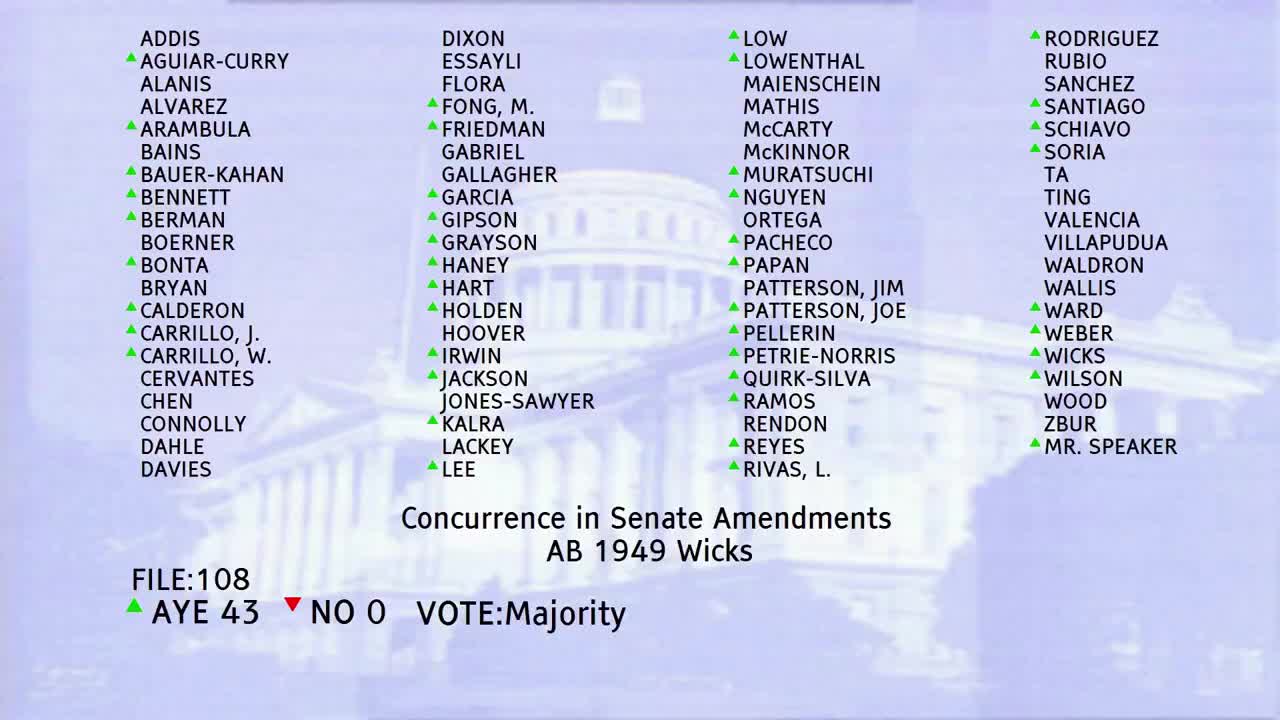 1MIN
Assembly Floor
 2MIN
Senate Floor
 10MIN
Senate Standing Committee on Judiciary
 9MIN
Senate Standing Committee on Health
 3MIN
Assembly Floor
 2MIN
Assembly Standing Committee on Appropriations
 9MIN
Assembly Standing Committee on Judiciary
 29SEC
Assembly Standing Committee on Judiciary
Bill Author