AB 2327: Optometry: mobile optometric offices.
- Session Year: 2023-2024
- House: Assembly
- Latest Version Date: 2024-09-22
Current Status:
Passed
(2024-09-22: Chaptered by Secretary of State - Chapter 391, Statutes of 2024.)
Introduced
In Committee
First Chamber
In Committee
Second Chamber
Enacted
Existing law, the Optometry Practice Act, establishes the State Board of Optometry within the Department of Consumer Affairs and sets forth the powers and duties of the board relating to the licensure and regulation of the practice of optometry. Existing law regulates the ownership and operation of mobile optometric offices, as defined, including, among other things, requiring the owner and operator of a mobile optometric office to file a quarterly report containing specified information. Existing law requires the board, by January 1, 2023, to adopt regulations establishing a registry for the owners and operators of mobile optometric offices, as specified. Existing law prohibits the board, before January 1, 2023, from bringing an enforcement action against an owner and operator of a mobile optometric office based solely on its affiliation status with an approved optometry school in California for remotely providing optometric service. Existing law makes these and other provisions related to the permitting and regulation of mobile optometric offices effective only until July 1, 2025, and repeals them as of that date.
This bill would authorize the owner and operator of a mobile optometric office to instead file the above-described quarterly reports as a single, annual report during the first renewal period of 2 years, as specified. The bill would also extend the deadline for the board to adopt the above-described regulations to January 1, 2026. The bill would prohibit the board from bringing the above-described enforcement action before January 1, 2026, or before the board adopts those regulations, whichever is earlier. The bill would extend the repeal date of the provisions related to the permitting and regulation of mobile optometric clinics to July 1, 2035.
Existing law, the Optometry Practice Act, establishes the State Board of Optometry within the Department of Consumer Affairs and sets forth the powers and duties of the board relating to the licensure and regulation of the practice of optometry. Existing law regulates the ownership and operation of mobile optometric offices, as defined, including, among other things, requiring the owner and operator of a mobile optometric office to file a quarterly report containing specified information. Existing law requires the board, by January 1, 2023, to adopt regulations establishing a registry for the owners and operators of mobile optometric offices, as specified. Existing law prohibits the board, before January 1, 2023, from bringing an enforcement action against an owner and operator of a mobile optometric office based solely on its affiliation status with an approved optometry school in California for remotely providing optometric service. Existing law makes these and other provisions related to the permitting and regulation of mobile optometric offices effective only until July 1, 2025, and repeals them as of that date.
This bill would require authorize the owner and operator of a mobile optometric office to instead file the above-described quarterly reports as a single, annual report during the first renewal period of 2 years, as specified. The bill would also extend the deadline for the board to adopt the above-described regulations by to January 1, 2026. The bill would prohibit the board from bringing the above-described enforcement action before January 1, 2026, or before the board adopts those regulations, whichever is earlier. The bill would extend the repeal date of the provisions related to the permitting and regulation of mobile optometric clinics to July 1, 2035.
Existing law, the Optometry Practice Act, establishes the State Board of Optometry within the Department of Consumer Affairs and sets forth the powers and duties of the board relating to the licensure and regulation of the practice of optometry. Existing law requires the board, by January 1, 2023, to adopt regulations establishing a registry for the owners and operators of mobile optometric offices, as specified. Existing law prohibits the board, before January 1, 2023, from bringing an enforcement action against an owner and operator of a mobile optometric office based solely on its affiliation status with an approved optometry school in California for remotely providing optometric service. Existing law makes these and other provisions related to the permitting and regulation of mobile optometric offices effective only until July 1, 2025, and repeals them as of that date.
This bill would require the board to adopt the above-described regulations by January 1, 2026. The bill would prohibit the board from bringing the above-described enforcement action before January 1, 2026. 2026, or before the board adopts those regulations, whichever is earlier. The bill would extend the repeal date of the provisions related to the permitting and regulation of mobile optometric clinics to July 1, 2035.
Existing law, the Optometry Practice Act, establishes the State Board of Optometry within the Department of Consumer Affairs and sets forth the powers and duties of the board relating to the licensure and regulation of the practice of optometry. Existing law requires the board, by January 1, 2023, to adopt regulations establishing a registry for the owners and operators of mobile optometric offices, as specified. Existing law prohibits the board, before January 1, 2023, from bringing an enforcement action against an owner and operator of a mobile optometric office based solely on its affiliation status with an approved optometry school in California for remotely providing optometric service. Existing law makes these and other provisions related to the permitting and regulation of mobile optometric offices effective only until July 1, 2025, and repeals them as of that date.
This bill would require the board to adopt the above-described regulations by January 1, 2026. The bill would prohibit the board from bringing the above-described enforcement action before January 1, 2026. The bill would extend the repeal date of the provisions related to the permitting and regulation of mobile optometric clinics to July 1, 2035.
(a)As used in this section, mobile optometric office means a trailer, van, or other means of transportation in which the practice of optometry, as defined in Section 3041, is performed and which is not affiliated with an approved optometry school in California.
(b)This section shall not apply to any of the following:
(1)Optometric services provided remotely by an approved optometry school in California that meets the requirements of Section 1507 of Title 16 of the California Code of Regulations.
(2)A licensee engaged in the practice of optometry at a facility defined in paragraph (1), (2), or (3) of subdivision (a) of Section 3070.1.
(3)A federally qualified health center, as defined in Section 1396d(l)(2)(B) of Title 42 of the United States Code.
(4)A nonprofit or charitable organization exempt from taxation pursuant to Section 501(c)(3), 501(c)(4), or 501(c)(6) of the Internal Revenue Code (26 U.S.C. Sec. 501(c)(3), 501(c)(4), or 501(c)(6)), which utilizes the volunteer services of licensees engaging in the temporary practice of optometry pursuant to subdivision (b) of Section 3070.
(5)A free clinic, as defined in subparagraph (B) of paragraph (1) of subdivision (a) of Section 1204 of the Health and Safety Code, which is operated by a clinic corporation, as defined in paragraph (3) of subdivision (b) of Section 1200 of the Health and Safety Code.
(6)A specialized vision health care service plan, as defined in subdivision (f) of Section 1345 of the Health and Safety Code, formed and existing pursuant to the provisions of the Nonprofit Corporation Law (Division 2 (commencing with Section 5000) of Title 1 of the Corporations Code).
(c)The ownership and operation of a mobile optometric office shall be limited to a nonprofit or charitable organization that is exempt from taxation pursuant to Section 501(c)(3) or 501(c)(4) of the United States Internal Revenue Code that provides optometric services to patients regardless of the patients ability to pay.
(1)The owner and operator of a mobile optometric office shall register with the board. The owner and operator of a mobile optometric office and the optometrist providing services shall not accept payment for services other than those provided through the Medi-Cal program or through any of the states programs under the Childrens Health Insurance Program (CHIP) under Title XIX (42 U.S.C. Sec. 1396 et seq.), or Title XXI (42 U.S.C. Sec. 1397aa et seq.), of the Social Security Act.
(2)The medical operations of the mobile optometric office shall be directed by a licensed optometrist and in every phase shall be under the exclusive control of the licensed optometrist, including the selection and supervision of optometric staff, the scheduling of patients, the amount of time the optometrist or optician spends with patients, the fees charged for optometric products and services, the examination procedures, the treatment provided to patients, and the followup care pursuant to this section.
(3)The owner and operator of a mobile optometric office shall not operate more than 12 mobile optometric offices within the first renewal period of two years, but may operate more than 12 offices after the first renewal period is complete.
(d)An owner and operator who has obtained approval from the board pursuant to paragraph (1) of subdivision (c) and wishes to operate a mobile optometric office shall apply for a permit from the board before beginning operation of each mobile optometric office. The application shall be made on a board-prescribed form that requests any information the board deems appropriate to register a mobile optometric office pursuant to this section. The form shall be accompanied by a nonrefundable fee of four hundred seventy-two dollars ($472). The board may increase the fee, as necessary to cover the reasonable regulatory costs of administration, to not more than six hundred dollars ($600).
(1)Upon approval of the permit, the board shall issue a unique identifying number for each mobile optometric office that shall be used in all reporting by the owner and operator to the board.
(2)Upon approval, the permit shall be valid until the next renewal date of the owner and operator registration.
(3)Mobile optometric office permits are specific to the vehicle registered with the board. Permits are not transferrable.
(4)An owner and operator may apply for renewal of the mobile optometric office permit by attesting to compliance with the requirements of this section and payment of the biennial renewal fee prescribed by the board.
(e)The owner and operator of the mobile optometric office registering with the board pursuant to subdivision (c) shall provide the following information to the board:
(1)The description of services to be rendered within the mobile optometric office.
(2)The names and optometry license numbers of optometrists, registration numbers of opticians, and names of any other persons who are providing patient care, as described in Section 2544.
(3)The dates of operation and cities or counties served.
(4)A description of how followup care will be provided.
(5)A catalog of complaints, if any.
(6)Articles of incorporation or acknowledgment of intent to operate and employer identification number demonstrating the owner and operator is a nonprofit or charitable organization that is exempt from taxation pursuant to Section 501(c)(3) or 501(c)(4) of the Internal Revenue Code.
(7)Any other information the board deems appropriate to safeguard the public from substandard optometric care, fraud, or other violation of this chapter.
(f)(1)Except as provided in paragraph (2), the owner and operator of the mobile optometric office, on a form prescribed by the board, shall file a quarterly report containing the following information:
(A)A list of all visits made by each mobile optometric office, including dates of operation, address, care provided, and names and license numbers of optometrists and opticians who provided care.
(B)A summary of all complaints received by each mobile optometric office, the disposition of those complaints, and referral information.
(C)An updated and current list of licensed optometrists, registered opticians, and any other persons who have provided care within each mobile optometric office since the last reporting period.
(D)An updated and current list of licensed optometrists who are available for followup care as a result of a complaint on a volunteer basis or who accept Medi-Cal payments.
(E)Any other information the board deems appropriate to safeguard the public from substandard optometric care, fraud, or other violation of this chapter.
(2)During the first renewal period of two years, the owner and operator of the mobile optometric office may file the report required by paragraph (1) in a single, annual report on or before January 1 of each calendar year. The board shall not take an enforcement action against an owner or operator of a mobile optometric office for submitting the quarterly reports as a single, annual report pursuant to this paragraph.
(g)The owner and operator of the mobile optometric office shall notify the board of any change to the information provided to the board pursuant to subdivision (e) within 14 days.
(h)(1)The owner and operator of the mobile optometric office shall provide each patient, and, if applicable, the patients caregiver or guardian, a consumer notice prescribed by the board that includes the following:
(A)The name, license number, and contact information for the optometrist.
(B)Optometrists providing services at a mobile optometric office are regulated by the board and the contact information for filing a complaint with the board.
(C)Information on how to obtain a copy of the patients medical information.
(D)Information on followup care available for the patient, including a list of available Medi-Cal or volunteer optometrists. This list shall be updated every six months and is subject to the inspection by the board.
(E)Any other information the board deems appropriate to safeguard the public from substandard optometric care, fraud, or other violation of this chapter.
(2)The optometrist shall maintain a copy of the consumer notice described in paragraph (1) in the patients medical record.
(3)Upon request by the patients caregiver or guardian, a copy of the prescription made for the patient shall be provided.
(i)Any person who is employed by the owner and operator of the mobile optometric office to drive or transport the vehicle shall possess a valid drivers license.
(j)By January 1, 2026, the board shall adopt regulations establishing a registry for the owners and operators of mobile optometric offices and shall set a registration fee at an amount not to exceed the reasonable regulatory costs of administration.
(k)The board may adopt regulations to conduct quality assurance reviews for the owner and operator of a mobile optometric office and optometrists engaging in the practice of optometry at a mobile optometric office.
(l)The board shall not bring an enforcement action against an owner and operator of a mobile optometric office based solely on its affiliation status with an approved optometry school in California for remotely providing optometric service before January 1, 2026, or before the board adopts final regulations pursuant to subdivision (j), whichever is earlier.
(m)The owner and operator of a mobile optometric office shall maintain records in the following manner, which shall be made available to the board upon request for inspection:
(1)Records are maintained and made available to the patient in such a way that the type and extent of services provided to the patient are conspicuously disclosed. The disclosure of records shall be made at or near the time services are rendered and shall be maintained at the primary business office specified.
(2)The owner and operator of a mobile optometric office complies with all federal and state laws and regulations regarding the maintenance and protection of medical records, including, but not limited to, the federal Health Insurance Portability and Accountability Act of 1996 (42 U.S.C. Sec. 300gg).
(3)Pursuant to Section 3007, the owner and operator of the mobile optometric office keeps all necessary records for a minimum of seven years from the date of service in order to disclose fully the extent of services furnished to a patient. Any information included on a printed copy of an original document to a patient shall be certified by the owner and operator of the mobile optometric office as being true, accurate, and complete.
(4)If a prescription is issued to a patient, records shall be maintained for each prescription as part of the patients chart, including all of the following information about the optometrist:
(A)Name.
(B)Optometrist license number.
(C)The place of practice and the primary business office.
(D)Description of the goods and services for which the patient is charged and the amount charged. If no charge was made to the patient, a description of the goods and services provided.
(5)The owners and operators of the mobile optometric offices shall maintain accurate records of the mobile optometric offices, including vehicle registration numbers and the year, make, and model of each trailer or van.
(n)Any licensed optometrist who provides patient care in conjunction with a mobile optometric office shall obtain a statement of licensure pursuant to subdivision (a) of Section 3070 with the mobile optometric offices address as registered with the board. If the licensee is not practicing optometry at a location other than with the owner and operator of the mobile optometric office, then the licensee shall list as their primary address of record the owner and operator of the mobile optometric offices address as registered with the board.
(o) All examinations performed at the mobile optometric office shall be performed by a licensed optometrist who is certified to use therapeutic pharmaceutical agents pursuant to Section 3041.3.
(p)This section does not apply to optometry services defined in Section 3070.1.
(q)This section shall remain in effect only until July 1, 2035, and as of that date is repealed.
(a)As used in this section, mobile optometric office means a trailer, van, or other means of transportation in which the practice of optometry, as defined in Section 3041, is performed and which is not affiliated with an approved optometry school in California.
(b)This section shall not apply to any of the following:
(1)Optometric services provided remotely by an approved optometry school in California that meets the requirements of Section 1507 of Title 16 of the California Code of Regulations.
(2)A licensee engaged in the practice of optometry at a facility defined in paragraph (1), (2), or (3) of subdivision (a) of Section 3070.1.
(3)A federally qualified health center, as defined in Section 1396d(l)(2)(B) of Title 42 of the United States Code.
(4)A nonprofit or charitable organization exempt from taxation pursuant to Section 501(c)(3), 501(c)(4), or 501(c)(6) of the Internal Revenue Code (26 U.S.C. Sec. 501(c)(3), 501(c)(4), or 501(c)(6)), which utilizes the volunteer services of licensees engaging in the temporary practice of optometry pursuant to subdivision (b) of Section 3070.
(5)A free clinic, as defined in subparagraph (B) of paragraph (1) of subdivision (a) of Section 1204 of the Health and Safety Code, which is operated by a clinic corporation, as defined in paragraph (3) of subdivision (b) of Section 1200 of the Health and Safety Code.
(6)A specialized vision health care service plan, as defined in subdivision (f) of Section 1345 of the Health and Safety Code, formed and existing pursuant to the provisions of the Nonprofit Corporation Law (Division 2 (commencing with Section 5000) of Title 1 of the Corporations Code).
(c)The ownership and operation of a mobile optometric office shall be limited to a nonprofit or charitable organization that is exempt from taxation pursuant to Section 501(c)(3) or 501(c)(4) of the United States Internal Revenue Code that provides optometric services to patients regardless of the patients ability to pay.
(1)The owner and operator of a mobile optometric office shall register with the board. The owner and operator of a mobile optometric office and the optometrist providing services shall not accept payment for services other than those provided through the Medi-Cal program or through any of the states programs under the Childrens Health Insurance Program (CHIP) under Title XIX (42 U.S.C. Sec. 1396 et seq.), or Title XXI (42 U.S.C. Sec. 1397aa et seq.), of the Social Security Act.
(2)The medical operations of the mobile optometric office shall be directed by a licensed optometrist and in every phase shall be under the exclusive control of the licensed optometrist, including the selection and supervision of optometric staff, the scheduling of patients, the amount of time the optometrist or optician spends with patients, the fees charged for optometric products and services, the examination procedures, the treatment provided to patients, and the followup care pursuant to this section.
(3)The owner and operator of a mobile optometric office shall not operate more than 12 mobile optometric offices within the first renewal period of two years, but may operate more than 12 offices after the first renewal period is complete.
(d)An owner and operator who has obtained approval from the board pursuant to paragraph (1) of subdivision (c) and wishes to operate a mobile optometric office shall apply for a permit from the board before beginning operation of each mobile optometric office. The application shall be made on a board-prescribed form that requests any information the board deems appropriate to register a mobile optometric office pursuant to this section. The form shall be accompanied by a nonrefundable fee of four hundred seventy-two dollars ($472). The board may increase the fee, as necessary to cover the reasonable regulatory costs of administration, to not more than six hundred dollars ($600).
(1)Upon approval of the permit, the board shall issue a unique identifying number for each mobile optometric office that shall be used in all reporting by the owner and operator to the board.
(2)Upon approval, the permit shall be valid until the next renewal date of the owner and operator registration.
(3)Mobile optometric office permits are specific to the vehicle registered with the board. Permits are not transferrable.
(4)An owner and operator may apply for renewal of the mobile optometric office permit by attesting to compliance with the requirements of this section and payment of the biennial renewal fee prescribed by the board.
(e)The owner and operator of the mobile optometric office registering with the board pursuant to subdivision (c) shall provide the following information to the board:
(1)The description of services to be rendered within the mobile optometric office.
(2)The names and optometry license numbers of optometrists, registration numbers of opticians, and names of any other persons who are providing patient care, as described in Section 2544.
(3)The dates of operation and cities or counties served.
(4)A description of how followup care will be provided.
(5)A catalog of complaints, if any.
(6)Articles of incorporation or acknowledgment of intent to operate and employer identification number demonstrating the owner and operator is a nonprofit or charitable organization that is exempt from taxation pursuant to Section 501(c)(3) or 501(c)(4) of the Internal Revenue Code.
(7)Any other information the board deems appropriate to safeguard the public from substandard optometric care, fraud, or other violation of this chapter.
(f)The (1)Except as provided in paragraph (2), the owner and operator of the mobile optometric office, on a form prescribed by the board, shall file a quarterly report containing the following information:
(1)(A)A list of all visits made by each mobile optometric office, including dates of operation, address, care provided, and names and license numbers of optometrists and opticians who provided care.
(2)(B)A summary of all complaints received by each mobile optometric office, the disposition of those complaints, and referral information.
(3)(C)An updated and current list of licensed optometrists, registered opticians, and any other persons who have provided care within each mobile optometric office since the last reporting period.
(4)(D)An updated and current list of licensed optometrists who are available for followup care as a result of a complaint on a volunteer basis or who accept Medi-Cal payments.
(5)(E)Any other information the board deems appropriate to safeguard the public from substandard optometric care, fraud, or other violation of this chapter.
(2)During the first renewal period of two years, the owner and operator of the mobile optometric office may file the report required by paragraph (1) in a single, annual report on or before January 1 of each calendar year. The board shall not take an enforcement action against an owner or operator of a mobile optometric office for submitting the quarterly reports as a single, annual report pursuant to this paragraph.
(g)The owner and operator of the mobile optometric office shall notify the board of any change to the information provided to the board pursuant to subdivision (d) (e) within 14 days.
(h)(1)The owner and operator of the mobile optometric office shall provide each patient patient, and, if applicable, the patients caregiver or guardian, a consumer notice prescribed by the board that includes the following:
(A)The name, license number, and contact information for the optometrist.
(B)Optometrists providing services at a mobile optometric office are regulated by the board and the contact information for filing a complaint with the board.
(C)Information on how to obtain a copy of the patients medical information.
(D)Information on followup care available for the patient, including a list of available Medi-Cal or volunteer optometrists. This list shall be updated every six months and is subject to the inspection by the board.
(E)Any other information the board deems appropriate to safeguard the public from substandard optometric care, fraud, or other violation of this chapter.
(2)The optometrist shall maintain a copy of the consumer notice described in paragraph (1) in the patients medical record.
(3)Upon request by the patients caregiver or guardian, a copy of the prescription made for the patient shall be provided.
(i)Any person who is employed by the owner and operator of the mobile optometric office to drive or transport the vehicle shall possess a valid drivers license.
(j)By January 1, 2026, the board shall adopt regulations establishing a registry for the owners and operators of mobile optometric offices and shall set a registration fee at an amount not to exceed the reasonable regulatory costs of administration.
(k)The board may adopt regulations to conduct quality assurance reviews for the owner and operator of a mobile optometric office and optometrists engaging in the practice of optometry at a mobile optometric office.
(l)The board shall not bring an enforcement action against an owner and operator of a mobile optometric office based solely on its affiliation status with an approved optometry school in California for remotely providing optometric service before January 1, 2026, or before the board adopts final regulations pursuant to subdivision (j), whichever is earlier.
(m)The owner and operator of a mobile optometric office shall maintain records in the following manner, which shall be made available to the board upon request for inspection:
(1)Records are maintained and made available to the patient in such a way that the type and extent of services provided to the patient are conspicuously disclosed. The disclosure of records shall be made at or near the time services are rendered and shall be maintained at the primary business office specified.
(2)The owner and operator of a mobile optometric office complies with all federal and state laws and regulations regarding the maintenance and protection of medical records, including, but not limited to, the federal Health Insurance Portability and Accountability Act of 1996 (42 U.S.C. Sec. 300gg).
(3)Pursuant to Section 3007, the owner and operator of the mobile optometric office keeps all necessary records for a minimum of seven years from the date of service in order to disclose fully the extent of services furnished to a patient. Any information included on a printed copy of an original document to a patient shall be certified by the owner and operator of the mobile optometric office as being true, accurate, and complete.
(4)If a prescription is issued to a patient, records shall be maintained for each prescription as part of the patients chart, including all of the following information about the optometrist:
(A)Name.
(B)Optometrist license number.
(C)The place of practice and the primary business office.
(D)Description of the goods and services for which the patient is charged and the amount charged. If no charge was made to the patient, a description of the goods and services provided.
(5)The owners and operators of the mobile optometric offices shall maintain accurate records of the mobile optometric offices, including vehicle registration numbers and the year, make, and model of each trailer or van.
(n)Any licensed optometrist who provides patient care in conjunction with a mobile optometric office shall obtain a statement of licensure pursuant to subdivision (a) of Section 3070 with the mobile optometric offices address as registered with the board. If the licensee is not practicing optometry at a location other than with the owner and operator of the mobile optometric office, then the licensee shall list as their primary address of record the owner and operator of the mobile optometric offices address as registered with the board.
(o) All examinations performed at the mobile optometric office shall be performed by a licensed optometrist who is certified to use therapeutic pharmaceutical agents pursuant to Section 3041.3.
(p)This section does not apply to optometry services defined in Section 3070.1.
(q)This section shall remain in effect only until July 1, 2035, and as of that date is repealed.
(a)As used in this section, mobile optometric office means a trailer, van, or other means of transportation in which the practice of optometry, as defined in Section 3041, is performed and which is not affiliated with an approved optometry school in California.
(b)This section shall not apply to any of the following:
(1)Optometric services provided remotely by an approved optometry school in California that meets the requirements of Section 1507 of Title 16 of the California Code of Regulations.
(2)A licensee engaged in the practice of optometry at a facility defined in paragraph (1), (2), or (3) of subdivision (a) of Section 3070.1.
(3)A federally qualified health center, as defined in Section 1396d(l)(2)(B) of Title 42 of the United States Code.
(4)A nonprofit or charitable organization exempt from taxation pursuant to Section 501(c)(3), 501(c)(4), or 501(c)(6) of the Internal Revenue Code (26 U.S.C. Sec. 501(c)(3), 501(c)(4), or 501(c)(6)), which utilizes the volunteer services of licensees engaging in the temporary practice of optometry pursuant to subdivision (b) of Section 3070.
(5)A free clinic, as defined in subparagraph (B) of paragraph (1) of subdivision (a) of Section 1204 of the Health and Safety Code, which is operated by a clinic corporation, as defined in paragraph (3) of subdivision (b) of Section 1200 of the Health and Safety Code.
(6)A specialized vision health care service plan, as defined in subdivision (f) of Section 1345 of the Health and Safety Code, formed and existing pursuant to the provisions of the Nonprofit Corporation Law (Division 2 (commencing with Section 5000) of Title 1 of the Corporations Code).
(c)The ownership and operation of a mobile optometric office shall be limited to a nonprofit or charitable organization that is exempt from taxation pursuant to Section 501(c)(3) or 501(c)(4) of the United States Internal Revenue Code that provides optometric services to patients regardless of the patients ability to pay.
(1)The owner and operator of a mobile optometric office shall register with the board. The owner and operator of a mobile optometric office and the optometrist providing services shall not accept payment for services other than those provided through the Medi-Cal program or through any of the states programs under the Childrens Health Insurance Program (CHIP) under Title XIX (42 U.S.C. Sec. 1396 et seq.), or Title XXI (42 U.S.C. Sec. 1397aa et seq.), of the Social Security Act.
(2)The medical operations of the mobile optometric office shall be directed by a licensed optometrist and in every phase shall be under the exclusive control of the licensed optometrist, including the selection and supervision of optometric staff, the scheduling of patients, the amount of time the optometrist or optician spends with patients, the fees charged for optometric products and services, the examination procedures, the treatment provided to patients, and the followup care pursuant to this section.
(3)The owner and operator of a mobile optometric office shall not operate more than 12 mobile optometric offices within the first renewal period of two years, but may operate more than 12 offices after the first renewal period is complete.
(d)An owner and operator who has obtained approval from the board pursuant to paragraph (1) of subdivision (c) and wishes to operate a mobile optometric office shall apply for a permit from the board before beginning operation of each mobile optometric office. The application shall be made on a board-prescribed form that requests any information the board deems appropriate to register a mobile optometric office pursuant to this section. The form shall be accompanied by a nonrefundable fee of four hundred seventy-two dollars ($472). The board may increase the fee, as necessary to cover the reasonable regulatory costs of administration, to not more than six hundred dollars ($600).
(1)Upon approval of the permit, the board shall issue a unique identifying number for each mobile optometric office that shall be used in all reporting by the owner and operator to the board.
(2)Upon approval, the permit shall be valid until the next renewal date of the owner and operator registration.
(3)Mobile optometric office permits are specific to the vehicle registered with the board. Permits are not transferrable.
(4)An owner and operator may apply for renewal of the mobile optometric office permit by attesting to compliance with the requirements of this section and payment of the biennial renewal fee prescribed by the board.
(e)The owner and operator of the mobile optometric office registering with the board pursuant to subdivision (c) shall provide the following information to the board:
(1)The description of services to be rendered within the mobile optometric office.
(2)The names and optometry license numbers of optometrists, registration numbers of opticians, and names of any other persons who are providing patient care, as described in Section 2544.
(3)The dates of operation and cities or counties served.
(4)A description of how followup care will be provided.
(5)A catalog of complaints, if any.
(6)Articles of incorporation or acknowledgment of intent to operate and employer identification number demonstrating the owner and operator is a nonprofit or charitable organization that is exempt from taxation pursuant to Section 501(c)(3) or 501(c)(4) of the Internal Revenue Code.
(7)Any other information the board deems appropriate to safeguard the public from substandard optometric care, fraud, or other violation of this chapter.
(f)The owner and operator of the mobile optometric office, on a form prescribed by the board, shall file a quarterly report containing the following information:
(1)A list of all visits made by each mobile optometric office, including dates of operation, address, care provided, and names and license numbers of optometrists and opticians who provided care.
(2)A summary of all complaints received by each mobile optometric office, the disposition of those complaints, and referral information.
(3)An updated and current list of licensed optometrists, registered opticians, and any other persons who have provided care within each mobile optometric office since the last reporting period.
(4)An updated and current list of licensed optometrists who are available for followup care as a result of a complaint on a volunteer basis or who accept Medi-Cal payments.
(5)Any other information the board deems appropriate to safeguard the public from substandard optometric care, fraud, or other violation of this chapter.
(g)The owner and operator of the mobile optometric office shall notify the board of any change to the information provided to the board pursuant to subdivision (d) within 14 days.
(h)(1)The owner and operator of the mobile optometric office shall provide each patient and, if applicable, the patients caregiver or guardian, a consumer notice prescribed by the board that includes the following:
(A)The name, license number, and contact information for the optometrist.
(B)Optometrists providing services at a mobile optometric office are regulated by the board and the contact information for filing a complaint with the board.
(C)Information on how to obtain a copy of the patients medical information.
(D)Information on followup care available for the patient, including a list of available Medi-Cal or volunteer optometrists. This list shall be updated every six months and is subject to the inspection by the board.
(E)Any other information the board deems appropriate to safeguard the public from substandard optometric care, fraud, or other violation of this chapter.
(2)The optometrist shall maintain a copy of the consumer notice described in paragraph (1) in the patients medical record.
(3)Upon request by the patients caregiver or guardian, a copy of the prescription made for the patient shall be provided.
(i)Any person who is employed by the owner and operator of the mobile optometric office to drive or transport the vehicle shall possess a valid drivers license.
(j)By January 1, 2026, the board shall adopt regulations establishing a registry for the owners and operators of mobile optometric offices and shall set a registration fee at an amount not to exceed the reasonable regulatory costs of administration.
(k)The board may adopt regulations to conduct quality assurance reviews for the owner and operator of a mobile optometric office and optometrists engaging in the practice of optometry at a mobile optometric office.
(l)The board shall not bring an enforcement action against an owner and operator of a mobile optometric office based solely on its affiliation status with an approved optometry school in California for remotely providing optometric service before January 1, 2026. 2026, or before the board adopts final regulations pursuant to subdivision (j), whichever is earlier.
(m)The owner and operator of a mobile optometric office shall maintain records in the following manner, which shall be made available to the board upon request for inspection:
(1)Records are maintained and made available to the patient in such a way that the type and extent of services provided to the patient are conspicuously disclosed. The disclosure of records shall be made at or near the time services are rendered and shall be maintained at the primary business office specified.
(2)The owner and operator of a mobile optometric office complies with all federal and state laws and regulations regarding the maintenance and protection of medical records, including, but not limited to, the federal Health Insurance Portability and Accountability Act of 1996 (42 U.S.C. Sec. 300gg).
(3)Pursuant to Section 3007, the owner and operator of the mobile optometric office keeps all necessary records for a minimum of seven years from the date of service in order to disclose fully the extent of services furnished to a patient. Any information included on a printed copy of an original document to a patient shall be certified by the owner and operator of the mobile optometric office as being true, accurate, and complete.
(4)If a prescription is issued to a patient, records shall be maintained for each prescription as part of the patients chart, including all of the following information about the optometrist:
(A)Name.
(B)Optometrist license number.
(C)The place of practice and the primary business office.
(D)Description of the goods and services for which the patient is charged and the amount charged. If no charge was made to the patient, a description of the goods and services provided.
(5)The owners and operators of the mobile optometric offices shall maintain accurate records of the mobile optometric offices, including vehicle registration numbers and the year, make, and model of each trailer or van.
(n)Any licensed optometrist who provides patient care in conjunction with a mobile optometric office shall obtain a statement of licensure pursuant to subdivision (a) of Section 3070 with the mobile optometric offices address as registered with the board. If the licensee is not practicing optometry at a location other than with the owner and operator of the mobile optometric office, then the licensee shall list as their primary address of record the owner and operator of the mobile optometric offices address as registered with the board.
(o) All examinations performed at the mobile optometric office shall be performed by a licensed optometrist who is certified to use therapeutic pharmaceutical agents pursuant to Section 3041.3.
(p)This section does not apply to optometry services defined in Section 3070.1.
(q)This section shall remain in effect only until July 1, 2035, and as of that date is repealed.
(a)As used in this section, mobile optometric office means a trailer, van, or other means of transportation in which the practice of optometry, as defined in Section 3041, is performed and which is not affiliated with an approved optometry school in California.
(b)This section shall not apply to any of the following:
(1)Optometric services provided remotely by an approved optometry school in California that meets the requirements of Section 1507 of Title 16 of the California Code of Regulations.
(2)A licensee engaged in the practice of optometry at a facility defined in paragraph (1), (2), or (3) of subdivision (a) of Section 3070.1.
(3)A federally qualified health center, as defined in Section 1396d(l)(2)(B) of Title 42 of the United States Code.
(4)A nonprofit or charitable organization exempt from taxation pursuant to Section 501(c)(3), 501(c)(4), or 501(c)(6) of the Internal Revenue Code (26 U.S.C. Sec. 501(c)(3), 501(c)(4), or 501(c)(6)), which utilizes the volunteer services of licensees engaging in the temporary practice of optometry pursuant to subdivision (b) of Section 3070.
(5)A free clinic, as defined in subparagraph (B) of paragraph (1) of subdivision (a) of Section 1204 of the Health and Safety Code, which is operated by a clinic corporation, as defined in paragraph (3) of subdivision (b) of Section 1200 of the Health and Safety Code.
(6)A specialized vision health care service plan, as defined in subdivision (f) of Section 1345 of the Health and Safety Code, formed and existing pursuant to the provisions of the Nonprofit Corporation Law (Division 2 (commencing with Section 5000) of Title 1 of the Corporations Code).
(c)The ownership and operation of a mobile optometric office shall be limited to a nonprofit or charitable organization that is exempt from taxation pursuant to Section 501(c)(3) or 501(c)(4) of the United States Internal Revenue Code that provides optometric services to patients regardless of the patients ability to pay.
(1)The owner and operator of a mobile optometric office shall register with the board. The owner and operator of a mobile optometric office and the optometrist providing services shall not accept payment for services other than those provided through the Medi-Cal program or through any of the states programs under the Childrens Health Insurance Program (CHIP) under Title XIX (42 U.S.C. Sec. 1396 et seq.), or Title XXI (42 U.S.C. Sec. 1397aa et seq.), of the Social Security Act.
(2)The medical operations of the mobile optometric office shall be directed by a licensed optometrist and in every phase shall be under the exclusive control of the licensed optometrist, including the selection and supervision of optometric staff, the scheduling of patients, the amount of time the optometrist or optician spends with patients, the fees charged for optometric products and services, the examination procedures, the treatment provided to patients, and the followup care pursuant to this section.
(3)The owner and operator of a mobile optometric office shall not operate more than 12 mobile optometric offices within the first renewal period of two years, but may operate more than 12 offices after the first renewal period is complete.
(d)An owner and operator who has obtained approval from the board pursuant to paragraph (1) of subdivision (c) and wishes to operate a mobile optometric office shall apply for a permit from the board before beginning operation of each mobile optometric office. The application shall be made on a board-prescribed form that requests any information the board deems appropriate to register a mobile optometric office pursuant to this section. The form shall be accompanied by a nonrefundable fee of four hundred seventy-two dollars ($472). The board may increase the fee, as necessary to cover the reasonable regulatory costs of administration, to not more than six hundred dollars ($600).
(1)Upon approval of the permit, the board shall issue a unique identifying number for each mobile optometric office that shall be used in all reporting by the owner and operator to the board.
(2)Upon approval, the permit shall be valid until the next renewal date of the owner and operator registration.
(3)Mobile optometric office permits are specific to the vehicle registered with the board. Permits are not transferrable.
(4)An owner and operator may apply for renewal of the mobile optometric office permit by attesting to compliance with the requirements of this section and payment of the biennial renewal fee prescribed by the board.
(e)The owner and operator of the mobile optometric office registering with the board pursuant to subdivision (c) shall provide the following information to the board:
(1)The description of services to be rendered within the mobile optometric office.
(2)The names and optometry license numbers of optometrists, registration numbers of opticians, and names of any other persons who are providing patient care, as described in Section 2544.
(3)The dates of operation and cities or counties served.
(4)A description of how followup care will be provided.
(5)A catalog of complaints, if any.
(6)Articles of incorporation or acknowledgment of intent to operate and employer identification number demonstrating the owner and operator is a nonprofit or charitable organization that is exempt from taxation pursuant to Section 501(c)(3) or 501(c)(4) of the Internal Revenue Code.
(7)Any other information the board deems appropriate to safeguard the public from substandard optometric care, fraud, or other violation of this chapter.
(f)The owner and operator of the mobile optometric office, on a form prescribed by the board, shall file a quarterly report containing the following information:
(1)A list of all visits made by each mobile optometric office, including dates of operation, address, care provided, and names and license numbers of optometrists and opticians who provided care.
(2)A summary of all complaints received by each mobile optometric office, the disposition of those complaints, and referral information.
(3)An updated and current list of licensed optometrists, registered opticians, and any other persons who have provided care within each mobile optometric office since the last reporting period.
(4)An updated and current list of licensed optometrists who are available for followup care as a result of a complaint on a volunteer basis or who accept Medi-Cal payments.
(5)Any other information the board deems appropriate to safeguard the public from substandard optometric care, fraud, or other violation of this chapter.
(g)The owner and operator of the mobile optometric office shall notify the board of any change to the information provided to the board pursuant to subdivision (d) within 14 days.
(h)(1)The owner and operator of the mobile optometric office shall provide each patient and, if applicable, the patients caregiver or guardian, a consumer notice prescribed by the board that includes the following:
(A)The name, license number, and contact information for the optometrist.
(B)Optometrists providing services at a mobile optometric office are regulated by the board and the contact information for filing a complaint with the board.
(C)Information on how to obtain a copy of the patients medical information.
(D)Information on followup care available for the patient, including a list of available Medi-Cal or volunteer optometrists. This list shall be updated every six months and is subject to the inspection by the board.
(E)Any other information the board deems appropriate to safeguard the public from substandard optometric care, fraud, or other violation of this chapter.
(2)The optometrist shall maintain a copy of the consumer notice described in paragraph (1) in the patients medical record.
(3)Upon request by the patients caregiver or guardian, a copy of the prescription made for the patient shall be provided.
(i)Any person who is employed by the owner and operator of the mobile optometric office to drive or transport the vehicle shall possess a valid drivers license.
(j)By January 1, 2023, 2026, the board shall adopt regulations establishing a registry for the owners and operators of mobile optometric offices and shall set a registration fee at an amount not to exceed the reasonable regulatory costs of administration.
(k)The board may adopt regulations to conduct quality assurance reviews for the owner and operator of a mobile optometric office and optometrists engaging in the practice of optometry at a mobile optometric office.
(l)The board shall not bring an enforcement action against an owner and operator of a mobile optometric office based solely on its affiliation status with an approved optometry school in California for remotely providing optometric service before January 1, 2023. 2026.
(m)The owner and operator of a mobile optometric office shall maintain records in the following manner, which shall be made available to the board upon request for inspection:
(1)Records are maintained and made available to the patient in such a way that the type and extent of services provided to the patient are conspicuously disclosed. The disclosure of records shall be made at or near the time services are rendered and shall be maintained at the primary business office specified.
(2)The owner and operator of a mobile optometric office complies with all federal and state laws and regulations regarding the maintenance and protection of medical records, including, but not limited to, the federal Health Insurance Portability and Accountability Act of 1996 (42 U.S.C. Sec. 300gg).
(3)Pursuant to Section 3007, the owner and operator of the mobile optometric office keeps all necessary records for a minimum of seven years from the date of service in order to disclose fully the extent of services furnished to a patient. Any information included on a printed copy of an original document to a patient shall be certified by the owner and operator of the mobile optometric office as being true, accurate, and complete.
(4)If a prescription is issued to a patient, records shall be maintained for each prescription as part of the patients chart, including all of the following information about the optometrist:
(A)Name.
(B)Optometrist license number.
(C)The place of practice and the primary business office.
(D)Description of the goods and services for which the patient is charged and the amount charged. If no charge was made to the patient, a description of the goods and services provided.
(5)The owners and operators of the mobile optometric offices shall maintain accurate records of the mobile optometric offices, including vehicle registration numbers and the year, make, and model of each trailer or van.
(n)Any licensed optometrist who provides patient care in conjunction with a mobile optometric office shall obtain a statement of licensure pursuant to subdivision (a) of Section 3070 with the mobile optometric offices address as registered with the board. If the licensee is not practicing optometry at a location other than with the owner and operator of the mobile optometric office, then the licensee shall list as their primary address of record the owner and operator of the mobile optometric offices address as registered with the board.
(o) All examinations performed at the mobile optometric office shall be performed by a licensed optometrist who is certified to use therapeutic pharmaceutical agents pursuant to Section 3041.3.
(p)This section does not apply to optometry services defined in Section 3070.1.
(q)This section shall remain in effect only until July 1, 2025, 2035, and as of that date is repealed.
|
Date
|
Status
|
|---|---|
| Sep 22, 2024 | Chaptered by Secretary of State - Chapter 391, Statutes of 2024. |
| Sep 22, 2024 | Approved by the Governor. |
| Sep 5, 2024 | Enrolled and presented to the Governor at 4 p.m. |
| Aug 27, 2024 | Senate amendments concurred in. To Engrossing and Enrolling. (Ayes 77. Noes 0.). |
| Aug 27, 2024 | Assembly Rule 77 suspended. |
| Aug 26, 2024 | In Assembly. Concurrence in Senate amendments pending. May be considered on or after August 28 pursuant to Assembly Rule 77. |
| Aug 26, 2024 | Read third time. Passed. Ordered to the Assembly. (Ayes 39. Noes 0.). |
| Aug 6, 2024 | Read second time. Ordered to third reading. |
| Aug 5, 2024 | From committee: Be ordered to second reading pursuant to Senate Rule 28.8. |
| Jul 3, 2024 | Read second time and amended. Re-referred to Com. on APPR. |
| Jul 2, 2024 | From committee: Amend, and do pass as amended and re-refer to Com. on APPR. (Ayes 13. Noes 0.) (July 1). |
| May 8, 2024 | Referred to Com. on B., P. & E. D. |
| Apr 25, 2024 | In Senate. Read first time. To Com. on RLS. for assignment. |
| Apr 25, 2024 | Read third time. Passed. Ordered to the Senate. (Ayes 75. Noes 0. Page 4998.) |
| Apr 18, 2024 | Read second time. Ordered to Consent Calendar. |
| Apr 17, 2024 | From committee: Do pass. To Consent Calendar. (Ayes 15. Noes 0.) (April 17). |
| Apr 4, 2024 | Re-referred to Com. on APPR. |
| Apr 3, 2024 | Read second time and amended. |
| Apr 2, 2024 | From committee: Amend, and do pass as amended and re-refer to Com. on APPR. (Ayes 18. Noes 0.) (April 2). |
| Feb 26, 2024 | Referred to Com. on B. & P. |
| Feb 13, 2024 | From printer. May be heard in committee March 14. |
| Feb 12, 2024 | Read first time. To print. |
|
Date
|
Description
|
Location
|
Votes
|
|
|---|---|---|---|---|
| Aug 27, 2024 | AB 2327 Wendy Carrillo Concurrence in Senate Amendments | Assembly Floor |
Passed |
|
| Aug 26, 2024 | Assembly 3rd Reading AB2327 Wendy Carrillo et al By Allen | Senate Floor |
Passed |
|
| Jul 1, 2024 | Do pass as amended, but first amend, and re-refer to the Committee on [Appropriations] | Senate Standing Committee on Business, Professions and Economic Development |
Passed |
|
| Apr 25, 2024 | AB 2327 Wendy Carrillo Consent Calendar Second Day Regular Session | Assembly Floor |
Passed |
|
| Apr 17, 2024 | Do pass. To Consent Calendar. | Assembly Standing Committee on Appropriations |
Passed |
|
| Apr 2, 2024 | Do pass as amended and be re-referred to the Committee on [Appropriations] | Assembly Standing Committee on Business and Professions |
Passed |
This list shows positions taken on this bill by organizations on the date displayed, which is linked to the original source.
Positions by individuals are not included.
|
Organization
|
Position
|
Date
|
|---|---|---|
| California State Board of Optometry | ** Support | |
| Vision to Learn | ** Support |
CONCURRENCE IN SENATE AMENDMENTS
CSA1 Bill Id:AB 2327
Author:(Wendy Carrillo)
As Amended Ver:July 3, 2024
Majority vote
SUMMARY
Extends the sunset date for a registration program within the California State Board of Optometry (CBO) that allows for nonprofits and charitable organizations to provide optometric services to patients regardless of the patient's ability to pay through mobile optometric offices.
Senate Amendments
- Allow for the owner and operator of a mobile optometric office to file the required report in a single, annual report on or before January 1 of each calendar year during the first renewal period of two years.
- Prohibit the CBO from taking an enforcement action against an owner or operator of a mobile optometric office for submitting the quarterly reports as a single, annual report.
COMMENTS
Existing law allows for healing arts licensees to deliver services through mobile health care units to the extent authorized by written policies established by the governing body of the licensee. Previously, CBO regulations allowed for the provision of optometry services through registered "extended optometric clinical facilities." This registration program was restricted to clinical facilities employed by an approved school of optometry where optometry services were rendered outside or beyond the walls, boundaries, or precincts of the primary campus of the school. Mobile optometric facilities were only allowed to function as a part of a school teaching program, as approved by the CBO.
While the extended optometric clinical facility program was historically used to provide mobile optometry services to low-access communities, optometrists seeking to provide those services were limited to the extent that they were required to be affiliated with a school of optometry. This limitation created challenges for charitable organizations and nonprofits dedicated to providing care through mobile clinics as a way to address the widely recognized need for expanded access to optometric care for patients who are uninsured and unable to pay out of pocket. One reputable nonprofit, Vision to Learn, had provided more than 186,500 eye exams and more than 148,500 pairs of glasses to students and other Californians, regardless of income, between when it was established in 2012 and 2020.
While Vision To Learn and similar programs have been broadly celebrated as successful, there were concerns that their operation was technically unsupported by statute or board regulation to the extent that the provision of services was technically unaffiliated with a school of optometry. This lack of clarity led to concerns relating to the possibility of enforcement action by the CBO against nonprofit optometry service providers. To resolve this lack of certainty and provide nonprofits like Vision To Learn with statutory reassurance, the Legislature enacted Assembly Bill 896 (Low), Chapter 121 in 2020. This bill sought to satisfy any apprehension by creating a new registration program to formalize the presence of mobile optometric offices operated by nonprofits and charitable organizations.
Under the provisions of AB 896, organizations are required to submit information to the CBO regarding services provided and any complaints received by the organization. Further, all medical operations of a mobile optometric office must be directed by a licensed optometrist. Finally, the bill created a safe harbor for charitable organizations and nonprofits currently providing services while the CBO promulgated regulations to implement the new registration program.
AB 896 required the CBO to adopt its regulations establishing a registry for the owners and operators of mobile optometric offices prior to January 2023; however, the CBO did not submit its notice of proposed regulatory action until December 2023, and those regulations are still pending. Meanwhile, the safe harbor provision intended to protect nonprofits from enforcement action prior to the adoption of regulations has expired. In addition, AB 896 contained a sunset clause subjecting the entire law to repeal on July 1, 2025 unless extended by the Legislature.
This bill would extend each of these three dates. First, the bill would extend the sunset on the mobile optometric offices law until July 1, 2035. Next, it would extend the deadline by which the CBO is required to adopt regulations until January 1, 2026. Finally, it would extend the safe harbor language to that same January 1, 2026 timeline. These changes will allow nonprofits like Vision To Learn to continue operating with peace of mind despite the CBO's delays in adopting their regulations to fully implement the program.
According to the Author
"Los Angeles Unified School District is the birthplace of Vision to Learn. Previous to the 2020 law, non-profit mobile optometric offices could only operate if they were affiliated with a school of optometry. This limitation constrained non-profit vision care providers like Vision to Learn from legally serving populations that needed optometric care but were not receiving it. While many optometrists take MediCal and do their best to reach out to low-income patients, they can't replicate the model used by non-profits who will bring a mobile clinic to a school, church or other community facility. AB 2327 allows non-profit mobile optometric offices to continue to provide vital optometric services to ensure low- income students have the best chance possible to succeed in school and in life."
Arguments in Support
Vision To Learn, the sponsor of this bill, writes: "One in five kids in public schools lack the glasses they need to see the board, read a book, or participate in class; and in low-income communities up to 95% of kids who need glasses do not have them." Vision to Learn argues that "passage of AB 2327 will give the Board the time it needs to promulgate regulations for Mobile Optometry clinics and will allow Vision To Learn and other non-profits to continue to serve California's vulnerable student populations and give them the tools they need to succeed in school."
Arguments in Opposition
None on file.
FISCAL COMMENTS
Pursuant to Senate Rule 28.8, negligible state costs.
VOTES:
ASM BUSINESS AND PROFESSIONS: 18-0-0
YES: Berman, Flora, Alanis, Bains, Juan Carrillo, Chen, Dixon, Grayson, Irwin, Jackson, Low, Lowenthal, McKinnor, Stephanie Nguyen, Pellerin, Sanchez, Soria, Zbur
ASM APPROPRIATIONS: 15-0-0
YES: Wicks, Sanchez, Arambula, Bryan, Calderon, Wendy Carrillo, Dixon, Mike Fong, Grayson, Haney, Hart, Jim Patterson, Pellerin, Ta, Villapudua
ASSEMBLY FLOOR: 75-0-5
YES: Addis, Aguiar-Curry, Alanis, Alvarez, Arambula, Bains, Bauer-Kahan, Bennett, Berman, Bonta, Bryan, Calderon, Juan Carrillo, Wendy Carrillo, Cervantes, Chen, Connolly, Davies, Dixon, Essayli, Flora, Mike Fong, Vince Fong, Friedman, Gabriel, Garcia, Gipson, Grayson, Haney, Holden, Hoover, Irwin, Jackson, Jones-Sawyer, Kalra, Lackey, Lee, Low, Lowenthal, Maienschein, McCarty, McKinnor, Muratsuchi, Stephanie Nguyen, Ortega, Pacheco, Papan, Jim Patterson, Joe Patterson, Pellerin, Petrie-Norris, Quirk-Silva, Ramos, Rendon, Reyes, Luz Rivas, Rodriguez, Blanca Rubio, Sanchez, Santiago, Schiavo, Soria, Ta, Ting, Valencia, Villapudua, Waldron, Wallis, Ward, Weber, Wicks, Wilson, Wood, Zbur, Robert Rivas
ABS, ABST OR NV: Boerner, Megan Dahle, Gallagher, Hart, Mathis
SENATE FLOOR: 39-0-1
YES: Allen, Alvarado-Gil, Archuleta, Ashby, Atkins, Becker, Blakespear, Bradford, Caballero, Cortese, Dahle, Dodd, Durazo, Eggman, Glazer, Gonzalez, Grove, Hurtado, Jones, Laird, Limón, Menjivar, Min, Newman, Nguyen, Niello, Ochoa Bogh, Padilla, Portantino, Roth, Rubio, Seyarto, Skinner, Smallwood-Cuevas, Stern, Umberg, Wahab, Wiener, Wilk
ABS, ABST OR NV: McGuire
UPDATED
VERSION: July 3, 2024
CONSULTANT: Robert Sumner / B. & P. / (916) 319-3301 FN: 0004689
CONCURRENCE IN SENATE AMENDMENTS
CSA1 Bill Id:AB 2327
Author:(Wendy Carrillo)
As Amended Ver:July 3, 2024
Majority vote
SUMMARY
Extends the sunset date for a registration program within the California State Board of Optometry (CBO) that allows for nonprofits and charitable organizations to provide optometric services to patients regardless of the patient's ability to pay through mobile optometric offices.
Senate Amendments
- Allow for the owner and operator of a mobile optometric office to file the required report in a single, annual report on or before January 1 of each calendar year during the first renewal period of two years.
- Prohibit the CBO from taking an enforcement action against an owner or operator of a mobile optometric office for submitting the quarterly reports as a single, annual report.
COMMENTS
Existing law allows for healing arts licensees to deliver services through mobile health care units to the extent authorized by written policies established by the governing body of the licensee. Previously, CBO regulations allowed for the provision of optometry services through registered "extended optometric clinical facilities." This registration program was restricted to clinical facilities employed by an approved school of optometry where optometry services were rendered outside or beyond the walls, boundaries, or precincts of the primary campus of the school. Mobile optometric facilities were only allowed to function as a part of a school teaching program, as approved by the CBO.
While the extended optometric clinical facility program was historically used to provide mobile optometry services to low-access communities, optometrists seeking to provide those services were limited to the extent that they were required to be affiliated with a school of optometry. This limitation created challenges for charitable organizations and nonprofits dedicated to providing care through mobile clinics as a way to address the widely recognized need for expanded access to optometric care for patients who are uninsured and unable to pay out of pocket. One reputable nonprofit, Vision to Learn, had provided more than 186,500 eye exams and more than 148,500 pairs of glasses to students and other Californians, regardless of income, between when it was established in 2012 and 2020.
While Vision To Learn and similar programs have been broadly celebrated as successful, there were concerns that their operation was technically unsupported by statute or board regulation to the extent that the provision of services was technically unaffiliated with a school of optometry. This lack of clarity led to concerns relating to the possibility of enforcement action by the CBO against nonprofit optometry service providers. To resolve this lack of certainty and provide nonprofits like Vision To Learn with statutory reassurance, the Legislature enacted Assembly Bill 896 (Low), Chapter 121 in 2020. This bill sought to satisfy any apprehension by creating a new registration program to formalize the presence of mobile optometric offices operated by nonprofits and charitable organizations.
Under the provisions of AB 896, organizations are required to submit information to the CBO regarding services provided and any complaints received by the organization. Further, all medical operations of a mobile optometric office must be directed by a licensed optometrist. Finally, the bill created a safe harbor for charitable organizations and nonprofits currently providing services while the CBO promulgated regulations to implement the new registration program.
AB 896 required the CBO to adopt its regulations establishing a registry for the owners and operators of mobile optometric offices prior to January 2023; however, the CBO did not submit its notice of proposed regulatory action until December 2023, and those regulations are still pending. Meanwhile, the safe harbor provision intended to protect nonprofits from enforcement action prior to the adoption of regulations has expired. In addition, AB 896 contained a sunset clause subjecting the entire law to repeal on July 1, 2025 unless extended by the Legislature.
This bill would extend each of these three dates. First, the bill would extend the sunset on the mobile optometric offices law until July 1, 2035. Next, it would extend the deadline by which the CBO is required to adopt regulations until January 1, 2026. Finally, it would extend the safe harbor language to that same January 1, 2026 timeline. These changes will allow nonprofits like Vision To Learn to continue operating with peace of mind despite the CBO's delays in adopting their regulations to fully implement the program.
According to the Author
"Los Angeles Unified School District is the birthplace of Vision to Learn. Previous to the 2020 law, non-profit mobile optometric offices could only operate if they were affiliated with a school of optometry. This limitation constrained non-profit vision care providers like Vision to Learn from legally serving populations that needed optometric care but were not receiving it. While many optometrists take MediCal and do their best to reach out to low-income patients, they can't replicate the model used by non-profits who will bring a mobile clinic to a school, church or other community facility. AB 2327 allows non-profit mobile optometric offices to continue to provide vital optometric services to ensure low- income students have the best chance possible to succeed in school and in life."
Arguments in Support
Vision To Learn, the sponsor of this bill, writes: "One in five kids in public schools lack the glasses they need to see the board, read a book, or participate in class; and in low-income communities up to 95% of kids who need glasses do not have them." Vision to Learn argues that "passage of AB 2327 will give the Board the time it needs to promulgate regulations for Mobile Optometry clinics and will allow Vision To Learn and other non-profits to continue to serve California's vulnerable student populations and give them the tools they need to succeed in school."
Arguments in Opposition
None on file.
FISCAL COMMENTS
Pursuant to Senate Rule 28.8, negligible state costs.
VOTES:
ASM BUSINESS AND PROFESSIONS: 18-0-0
YES: Berman, Flora, Alanis, Bains, Juan Carrillo, Chen, Dixon, Grayson, Irwin, Jackson, Low, Lowenthal, McKinnor, Stephanie Nguyen, Pellerin, Sanchez, Soria, Zbur
ASM APPROPRIATIONS: 15-0-0
YES: Wicks, Sanchez, Arambula, Bryan, Calderon, Wendy Carrillo, Dixon, Mike Fong, Grayson, Haney, Hart, Jim Patterson, Pellerin, Ta, Villapudua
ASSEMBLY FLOOR: 75-0-5
YES: Addis, Aguiar-Curry, Alanis, Alvarez, Arambula, Bains, Bauer-Kahan, Bennett, Berman, Bonta, Bryan, Calderon, Juan Carrillo, Wendy Carrillo, Cervantes, Chen, Connolly, Davies, Dixon, Essayli, Flora, Mike Fong, Vince Fong, Friedman, Gabriel, Garcia, Gipson, Grayson, Haney, Holden, Hoover, Irwin, Jackson, Jones-Sawyer, Kalra, Lackey, Lee, Low, Lowenthal, Maienschein, McCarty, McKinnor, Muratsuchi, Stephanie Nguyen, Ortega, Pacheco, Papan, Jim Patterson, Joe Patterson, Pellerin, Petrie-Norris, Quirk-Silva, Ramos, Rendon, Reyes, Luz Rivas, Rodriguez, Blanca Rubio, Sanchez, Santiago, Schiavo, Soria, Ta, Ting, Valencia, Villapudua, Waldron, Wallis, Ward, Weber, Wicks, Wilson, Wood, Zbur, Robert Rivas
ABS, ABST OR NV: Boerner, Megan Dahle, Gallagher, Hart, Mathis
UPDATED
VERSION: July 3, 2024
CONSULTANT: Robert Sumner / B. & P. / (916) 319-3301 FN: 0004689
SENATE RULES COMMITTEE Office of Senate Floor Analyses (916) 651-1520 Fax: (916) 327-4478 | AB 2327 |
THIRD READING
Bill No: AB 2327
Author: Wendy Carrillo (D), et al.
Amended: 7/3/24 in Senate
Vote: 21
SENATE BUS., PROF. & ECON. DEV. COMMITTEE: 13-0, 7/1/24
AYES: Ashby, Nguyen, Alvarado-Gil, Archuleta, Becker, Dodd, Eggman, Glazer, Menjivar, Niello, Roth, Smallwood-Cuevas, Wilk
SENATE APPROPRIATIONS COMMITTEE: Senate Rule 28.8
ASSEMBLY FLOOR: 75-0, 4/25/24 (Consent) - See last page for vote
SUBJECT: Optometry: mobile optometric offices
SOURCE: Vision to Learn
DIGEST:
This bill extends the sunset date for a registration program within the California State Board of Optometry (CBO) that allows nonprofits and charitable organizations to provide optometric services through mobile optometric offices (MOOs), and extends the CBO’s timeframe to complete regulations for the registration program and extends the exemption from enforcement, as specified.
ANALYSIS:
Existing law:
- Establishes the CBO to license and regulate optometrists, registered dispensing opticians, contact lens dispensers, spectacle lens dispensers, and nonresident contact lens dispensers and register MOOs. (Business and Professions Code (BPC) § 3010.5)
- Limits the ownership and operator of a MOO to a non-profit or charitable organization exempt from taxation pursuant to section 501(c)(3) or 501(c)(4) of the United States Internal Revenue Code that provides optometric services to patients regardless of the patient’s ability to pay. (BPC § 3070.2(c))
- Defines “MOO” to mean a trailer, van, or other means of transportation in which the practice of optometry is performed and which is not affiliated with an approved school of optometry in California. (BPC § 3070.2(a))
- Prohibits the owner or operator of a MOO from operating more than 12 MOO within the first renewal period of two years, but authorizes a MOO to operate more than 12 after the first renewal period. (BPC § 3070.2(c)(3))
- Requires the owner or operator of a MOO to apply for a permit from the CBO before beginning operation of a MOO, on a form prescribed by the CBO, along with a fee of $472, and authorizes the CBO to increase the fee, as necessary to cover the reasonable regulatory costs of administration, to not more than $600. (BPC § 3070.2(d))
- Requires by January 1, 2023, the CBO to adopt regulations establishing a registry fir the owners and operators of mobile optometric offices and set a registration fee not to exceed the reasonable regulatory costs of administration. (BPC § 3070.2(j))
This bill:
- Extends CBO oversight of registration for a MOO and specifications a MOO must meet to July 1, 2035.
- Extends the date by which the CBO is required to adopt regulations related to registration to no later than January 1, 2026, and correspondingly extends safe harbor language prohibiting the CBO from taking action against an owner and operator of a mobile optometric office prior to that date.
Background
The CBO regulates licensed optometrists, dispensing opticians, optical businesses and issues optometry certifications for Diagnostic Pharmaceutical Agents, Therapeutic Pharmaceutical Agents, Lacrimal Irrigation and Dilation, and Glaucoma. Under current law, practicing optometrists are required to notify and register their practice locations with the CBO, and mobile optometric services are only authorized as specified under current CBO regulations.
AB 896 (Low, Chapter, 12, Statutes of 2020) created a pathway, under the optometry practice act, which permitted for the operation of a MOO, without requiring the mobile facility be connected with an optometry school in order to operate. Because existing regulations did not contemplate MOO business models not attached to optometry schools, the CBO did not have a regulatory scheme to register MOOs, or collect a fee prior to the passage of AB 896. AB 896 statutorily required the CBO to adopt regulations establishing a registry for the owners and operators of MOOs and the fee structure prior to January 2023. However, the CBO did not submit its notice of proposed regulatory action until December 2023, and those regulations are still pending. Meanwhile, the safe harbor provision intended to protect nonprofits from enforcement action prior to the adoption of regulations has expired. In addition, AB 896 contained a sunset clause subjecting the entire law to repeal on July 1, 2025 unless extended by the Legislature.
AB 896 also created guidelines in order to ensure that the optometric care provided in those facilities was consistent with care provided under current optometric practice for facilities. Those guidelines include that MOOs be owned only by nonprofit or charitable organizations, they register with the CBO, they are limited in the number of MOOs that can be operated by one owner or operator, the medical operations are directed solely by an optometrist, and that MOOs provide the CBO with detailed information about business operations including the name and license number of optometrists, optician registration numbers, catalog of complaints, dates of operations, and counties or cities served. In addition, the MOOs are required to provide quarterly reports to the CBO with information about the dates of operations, the addresses of where the care was provided, and the type of care, among other information required to be shared.
As part of the CBO’s 2021 Sunset Review, the question was raised in the CBO’s staff background paper (issue #18) whether the CBO needs statutory changes in its implementation of its registration program for MOOs. As a result of those discussions, AB 1534 (Committee on Business and Professions, Chapter 630, Statutes of 2021) made various changes regarding CBO oversight of MOOs. AB 1534 extended the deadline for completing regulations by one year. The sunset bill also established the current cap on owners and operators of MOOs from operating more than 12 MOOs within the first renewal cycle, among other provisions. The CBO is scheduled to be reviewed again in 2025, through the joint sunset review oversight process. The regulatory structure for MOO operations is likely to be considered as part of those discussions to address any deficiencies with current law and to ensure the proper oversight and regulation. Given the comprehensive nature of the sunset review oversight process, it is likely that the limitations on both brick and mortar and mobile offices will be evaluated.
This bill extends three dates under the MOO registration program. First, this bill would extend the sunset on the MOO law until July 1, 2035. Next, it would extend the deadline by which the CBO is required to adopt regulations until January 1, 2026. Finally, it would extend the safe harbor language to that same January 1, 2026 timeline. These changes will allow nonprofits to continue operating amidst the CBO’s delays in adopting their regulations to fully implement the program. Those regulations are not expected to be implemented until late 2024.
FISCAL EFFECT: Appropriation: No Fiscal Com.: Yes Local: No
SUPPORT: (Verified 8/5/24)
Vision to Learn (source)
California State Board of Optometry
OPPOSITION: (Verified 8/5/24)
None received
ARGUMENTS IN SUPPORT: Supporters note this bill will give the CBO time to implement regulations and provide flexibility for the CBO.
ASSEMBLY FLOOR: 75-0, 4/25/24
AYES: Addis, Aguiar-Curry, Alanis, Alvarez, Arambula, Bains, Bauer-Kahan, Bennett, Berman, Bonta, Bryan, Calderon, Juan Carrillo, Wendy Carrillo, Cervantes, Chen, Connolly, Davies, Dixon, Essayli, Flora, Mike Fong, Vince Fong, Friedman, Gabriel, Garcia, Gipson, Grayson, Haney, Holden, Hoover, Irwin, Jackson, Jones-Sawyer, Kalra, Lackey, Lee, Low, Lowenthal, Maienschein, McCarty, McKinnor, Muratsuchi, Stephanie Nguyen, Ortega, Pacheco, Papan, Jim Patterson, Joe Patterson, Pellerin, Petrie-Norris, Quirk-Silva, Ramos, Rendon, Reyes, Luz Rivas, Rodriguez, Blanca Rubio, Sanchez, Santiago, Schiavo, Soria, Ta, Ting, Valencia, Villapudua, Waldron, Wallis, Ward, Weber, Wicks, Wilson, Wood, Zbur, Robert Rivas
NO VOTE RECORDED: Boerner, Megan Dahle, Gallagher, Hart, Mathis
Prepared by: Elissa Silva / B., P. & E.D. / 916-651-4104
8/7/24 13:38:18
**** END ****
SENATE COMMITTEE ON
BUSINESS, PROFESSIONS AND ECONOMIC DEVELOPMENT
Senator Angelique Ashby, Chair
2023 - 2024 Regular
Bill No: Hearing Date: July 1, 2024
Author: | |||
Version: |
| ||
Urgency: | Fiscal: | ||
Consultant: | |||
Subject:
SUMMARY:
Extends the sunset date for a registration program within the California State Board of Optometry (CBO) that allows nonprofits and charitable organizations to provide optometric services through mobile optometric offices (MOO) and extends the CBO’s timeframe to complete regulations for the registration program and extends the exemption from enforcement, as specified.
Existing law:
- Establishes the CBO to license and regulate optometrists, registered dispensing opticians, contact lens dispensers, spectacle lens dispensers, and nonresident contact lens dispensers and register MOOs. (Business and Professions Code (BPC) § 3010.5)
- States that the practice of optometry includes the diagnosing, prevention, treatment and management of disorders and dysfunctions of the visual system, under the optometry practice act (act), as well as the provision of habilitative or rehabilitative optometric services and specifically authorizes an optometrist who is certified to use therapeutic pharmaceutical agents to diagnose and treat the human eye for various enumerated conditions, as specified. (BPC § 3041)
- Prohibits a person from engaging in the practice of optometry or to advertise or hold oneself out as an optometrist without a valid, unrevoked license. (BPC § 3040)
- Requires each licensed optometrist, before engaging in the practice of optometry, to notify the CBO in writing of the address or addresses where the licensee is to engage in the practice of optometry and of any changes to the licensee’s change of practice. After providing the address or addresses and place of practice information to the CBO, the licensee must obtain a statement of licensure from the CBO, which is to be placed in all practice locations other than the optometrist’s primary place of practice, unless the licensee is practicing temporarily, as specified. (BPC § 3070(a)(b))
- Prohibits a person, singly or in combination with others, from having any office or place for the practice of optometry, including but not limited to vans, trailers, or other mobile equipment, unless that person is licensed to practice optometry or the registered owner and operator of a MOO. Prohibits an optometrist and no two or more optometrists jointly, from having more than 11 offices. (BPC § 3077)
- Until July 1, 2025, establishes registration for a MOO.
- Requires the owner of and operator of a MOO to register with the CBO, and prohibits the owner or operator of a MOO and the optometrists providing services in the MOO from accepting payment for services, other than those provided through the Medi-Cal program or through any of the state’s programs under the Children’s Health Insurance Program or the Social Security Act, as specified. (BPC § 3070.2(c)(1))
- Limits the ownership and operator of a MOO to a non-profit or charitable organization exempt from taxation pursuant to section 501(c)(3) or 501(c)(4) of the United States Internal Revenue Code that provides optometric services to patients regardless of the patient’s ability to pay. (BPC § 3070.2(c))
- Defines “MOO” to mean a trailer, van, or other means of transportation in which the practice of optometry is performed and which is not affiliated with an approved school of optometry in California. (BPC § 3070.2(a))
- Prohibits the owner or operator of a MOO from operating more than 12 MOO within the first renewal period of two years, but authorizes a MOO to operate more than 12 after the first renewal period. (BPC § 3070.2(c)(3))
- Requires the owner or operator of a MOO to apply for a permit from the CBO before beginning operation of a MOO, on a form prescribed by the CBO, along with a fee of $472, and authorizes the CBO to increase the fee, as necessary to cover the reasonable regulatory costs of administration, to not more than $600. (BPC § 3070.2(d))
- Requires the owner and operator of the MOO to file a quarterly report with the CBO containing the following information:
- A list of all visits made by each MOO, including dates of operation, address, care provided, and names and license numbers of optometrists and opticians who provided care.
- A summary of all complaints received by each MOO, the disposition of those complaints, and referral information;
- An updated and current list of licensed optometrists, registered opticians, and any other persons who have provided care within each MOO since the last reporting period;
- An updated and current list of licensed optometrists who are available for follow-up care as a result of a complaint on a volunteer basis or who accept Medi-Cal payments;
- Any other information the CBO deems appropriate to safeguard the public from substandard care, fraud, or other violations of the optometry practice act. (BPC § 3070.2(d))
- Requires the owner or operator of a MOO to provide each patient, and if applicable, the patient’s caregiver or guardian, a consumer notice prescribed the CBO that includes specified information including optometrist’s license number, contact information, statement on how the patient can obtain copy of medical records, among others. (BPC § 3070.2(h))
- Requires by January 1, 2023, the CBO to adopt regulations establishing a registry fir the owners and operators of mobile optometric offices and set a registration fee not to exceed the reasonable regulatory costs of administration. (BPC § 3070.2(j))
- Prohibits the CBO from brining an enforcement action against an owner and operator of a MOO based solely on its affiliation status with an approved optometry school in California for remotely providing optometric services before January 1, 2023.
This bill:
- Extends CBO oversight of registration for a MOO and specifications a MOO must meet to July 1, 2035.
- Extends the date by which the CBO is required to adopt regulations related to registration to no later than January 1, 2026, and correspondingly extends safe harbor language prohibiting the CBO from taking action against an owner and operator of a mobile optometric office prior to that date.
FISCAL EFFECT:
According to the Assembly Committee on Appropriations, there are no state costs associated with this bill.
COMMENTS:
- Purpose. The sponsor of this bill is Vision to Learn. According to the author, “One in five kids in public schools lack the glasses they need to see the board, read a book, or participate in class; and in low-income communities, 95% of kids who need glasses do not have them. Students with uncorrected vision problems often avoid reading and can have trouble focusing in class. Research demonstrates that glasses provided by non-profits such as Vision to Learn is the most effective low cost educational intervention based on standardized test scores.”
- Background.
Board of Optometry and Mobile Optometric Facilities. The CBO oversees approximately 31,000 licensed optometrists, dispensing opticians, and optical businesses and issues optometry certifications for Diagnostic Pharmaceutical Agents, Therapeutic Pharmaceutical Agents, Lacrimal Irrigation and Dilation, and Glaucoma. Under current law, practicing optometrists are required to notify and register their practice locations with the CBO, and mobile optometric services are authorized only as specified under current CBO regulations.
The Health and Safety Code (HSC) authorizes the operation of a mobile health facility. Mobile facilities can provide a variety of healthcare, as long as authorized under the respective healing arts board. The provisions in the HSC lay out the requirements necessary in order to operate a mobile facility and specifically require any licensee using a mobile clinical facility to have written policies established by the governing body of the licensee. Those policies must include, at a minimum, policies related to patient care, personnel training and orientation, personnel supervision, and evaluation of services provided by the mobile unit. Through previous regulations, the CBO established requirements for mobile clinical facilities to operate; however, those mobile facilities had to be connected to an optometry school. It was brought to the Legislature’s attention, that there other business models which included not-for-profit organizations in California who are not affiliated with any optometry academic institution, providing vision-related services to school-aged children in low-income and rural service areas where access to vision care was challenging.
Concerns were raised that these mobile facility operations were technically unsupported by statute or CBO regulation to the extent that the provision of services were technically unaffiliated with any school of optometry. This lack of clarity led to concerns about possible enforcement actions by the CBO against mobile nonprofit optometry service providers. An outcome of this was the passage of AB 896 (Low, Chapter, Statutes of 2020). That bill created a specific pathway, under the optometry practice act, that would permit for the operation of a MOO, without requiring a mobile facility be connected with an optometry school in order to operate.
AB 896 required the CBO to establish a registration program, including a fee, for the owners and operators. Because existing regulations did not contemplate MOO business models that were not attached to optometry schools, the CBO did not have a regulatory scheme to register the MOOs, or collect a fee prior to the passage of AB 896. AB 896 statutorily required the CBO to adopt regulations establishing the registry for the owners and operators of MOOs and the fee structure prior to January 2023. However, the CBO did not submit its notice of proposed regulatory action until December 2023, and those regulations are still pending. Meanwhile, the safe harbor provision intended to protect nonprofits from enforcement action prior to the adoption of regulations has expired. In addition, AB 896 contained a sunset clause subjecting the entire law to repeal on July 1, 2025 unless extended by the Legislature.
AB 896 also created safeguards in order to ensure that the optometric care provided in those facilities was consistent with care provided under current optometric practice for facilities, including that MOOs be owned only by nonprofit or charitable organizations, they register with the CBO, they are limited in the number of MOOs that can be operated by one owner or operator, the medical operations are directed solely by an optometrist, and that MOOs provide the CBO with detailed information about business operations including the name and license number of optometrists, optician registration numbers, catalog of complaints, dates of operations, and counties or cities served. In addition, the MOOs are required to provide quarterly reports to the CBO with information about the dates of operations, the addresses of where the care was provided, and the type of care, among other information to be shared. Because they are required to report quarterly, the owner or operator of a MOO is subject to CBO enforcement for any non-compliance.
As part of the CBO’s 2021 Sunset Review, the question was raised in the CBO’s staff background paper (issue #18) whether the CBO needs statutory changes in its implementation of its registration program for MOOs. As a result of those discussions, AB 1534 (Committee on Business and Professions, Chapter 630, Statutes of 2021) made various changes regarding CBO oversight of MOOs. AB 1534 extended the deadline for completing regulations by one year. The sunset bill also established the current cap on owners and operators of MOOs from operating more than 12 MOOs within the first renewal cycle, among other provisions. The CBO is scheduled to be reviewed again in 2025, through the joint sunset review oversight process. The regulatory structure for MOO operations is likely to be considered as part of those discussions to address any deficiencies with current law and to ensure the proper oversight and regulation. Given the comprehensive nature of the sunset review oversight process, it is likely that the limitations on both brick and mortar and mobile offices will be evaluated.
Not-for-Profit Vision Service Providers. The widely recognized need for expanded access to optometric care for patients who are uninsured and unable to pay out of pocket has led to the establishment of charitable organizations and nonprofits dedicated to providing vision care through mobile clinics. One of those nonprofits is the sponsor of this measure, Vision to Learn, which focuses its vision services on school-aged youth. The 2022-2023, Annual Report from Vision to Learn notes,”…as we have helped provide about 2 1/2 million children with vision screenings, 500,000 with eye exams and 400,000 with glasses. All at no cost to the children or their families. Vision To Learn now operates the largest school-based eye care program in the country.” SB 502 (Allen, Chapter, Statutes of 2023) increased funding and coverage access for entities who may operate MOOs to include reimbursement from both Medi-Cal and the State Children’s Health Insurance Program, commonly referred to as CHIP.
This bill extends three dates under the MOO registration program. First, the bill would extend the sunset on the MOO law until July 1, 2035. Next, it would extend the deadline by which the CBO is required to adopt regulations until January 1, 2026. Finally, it would extend the safe harbor language to that same January 1, 2026 timeline. These changes will allow nonprofits like Vision To Learn to continue operating amidst the CBO’s delays in adopting their regulations to fully implement the program. Those regulations are not expected to be implemented until later in 2024.
- Related Legislation. AB 1534 (Committee on Business and Professions, Chapter 630, Statutes of 2021), made a number of changes and updates to the operations of the CBO), which among other provisions clarified the requirements for operating a MOO, increased financial penalties for violations of the nonresident ophthalmic lens dispenser act, specified lease agreements between licensed physician and optometrists, and specified Medical Board of California disciplinary authority.
AB 896 (Low, Chapter 121, Statutes of 2020) authorized the operation of a MOO owned by a charitable organization, as specified, and merged the Dispensing Optician Fund with the Optometry Fund into one, single Optometry Fund.
- Arguments in Support. Vision to Learn writes in support and notes, “Passage of AB 2327 will give the Board the time it needs to promulgate regulations for Mobile Optometry clinics and will allow Vision To Learn and other non-profits to continue to serve California’s vulnerable student populations and give them the tools they need to succeed in school.”
The Board of Optometry writes in support, “These changes provide important flexibility and protections as the Board diligently works to implement the Mobile Optometric Office Registration program. In addition, these changes do not slow down the Board’s implementation process or impact the regulatory text currently out for public comment.”
- Policy Consideration and Suggested Amendment. To ensure a smooth transition to the new regulatory program and to provide owners and operators of MOOs and the CBO with time to provide reports and review those reports respectively, the bill should be amended to provide MOOs with additional time to file the required quarterly reports without being subject to CBO enforcement.
SUPPORT AND OPPOSITION:
Support:
California State Board of Optometry
Vision to Learn
Opposition:
None received
-- END --
Date of Hearing: April 17, 2024
ASSEMBLY COMMITTEE ON APPROPRIATIONS
Buffy Wicks, Chair
ABPCA Bill Id:AB 2327
Author:(Wendy Carrillo) – As Amended Ver:April 3, 2024
Policy Committee: | Business and Professions | Vote: | 18 - 0 |
|
| ||
|
|
Urgency: No State Mandated Local Program: No Reimbursable: No
SUMMARY:
The California Board of Optometry (CBO) is authorized to permit and register a nonprofit or charitable organization to provide optometric services, through mobile optometric offices, to patients, regardless of the patients’ ability to pay. This bill extends the sunset date for the program to July 1, 2035. This bill also extends the date by which CBO must adopt regulations for the registry, from January 1, 2023, to January 1, 2026.
FISCAL EFFECT:
No state costs.
COMMENTS:
- Purpose. This bill is sponsored by Vision To Learn. According to the author:
Los Angeles Unified School District is the birthplace of Vision to Learn. Previous to the 2020 law, non-profit mobile optometric offices could only operate if they were affiliated with a school of optometry. This limitation constrained non-profit vision care providers like Vision to Learn from legally serving populations that needed optometric care but were not receiving it. While many optometrists take Medi-Cal and do their best to reach out to low-income patients, they can’t replicate the model used by non-profits who will bring a mobile clinic to a school, church or other community facility. AB 2327 allows non-profit mobile optometric offices to continue to provide vital optometric services to ensure low- income students have the best chance possible to succeed in school and in life.
- Background. Existing law allows healing arts licensees to deliver services through mobile health care units to the extent authorized by the governing body of the licensee. Previously, CBO regulations allowed optometrists to provide services through registered “extended optometric clinical facilities,” where optometry services were rendered outside or beyond the walls, boundaries, or precincts of the primary campus of the school and was restricted to facilities employed by an approved school of optometry as part of an approved school teaching program.
Vision To Learn had provided more than 186,500 eye exams and more than 148,500 pairs of glasses to students and other Californians, regardless of income, between 2012 and 2020. However, there were concerns that the operation of Vision To Learn and similar programs was technically unsupported by statute or board regulation because the provision of services was technically unaffiliated with a school of optometry. This lack of clarity led to concerns relating to the possibility of enforcement action by the CBO against nonprofit optometry service providers. To resolve this lack of certainty the Legislature enacted AB 896 (Low), Chapter 121, Statutes of 2020. AB 896 established a registration program allowing nonprofits and charitable organizations to provide optometric services through mobile optometric offices to patients, regardless of the patients’ ability to pay.
AB 896 required the CBO to adopt regulations establishing a registry for the owners and operators of mobile optometric offices prior to January 2023; however, the CBO did not submit its notice of proposed regulatory action until December 2023, and those regulations are still pending. The safe harbor provision intended to protect nonprofits from enforcement action prior to the adoption of regulations expired in January 2023.
Analysis Prepared by: Allegra Kim / APPR. / (916) 319-2081
Date of Hearing: April 2, 2024
ASSEMBLY COMMITTEE ON BUSINESS AND PROFESSIONS
Marc Berman, Chair
ABPCA Bill Id:AB 2327
Author:(Wendy Carrillo) – As Introduced Ver:February 12, 2024
SUBJECT: Optometry: mobile optometric offices: regulations.
SUMMARY: Extends the sunset date for a registration program within the California State Board of Optometry (CBO) that allows for nonprofits and charitable organizations to provide optometric services to patients regardless of the patient’s ability to pay through mobile optometric offices.
EXISTING LAW:
- Establishes the Optometry Practice Act to provide for the regulation and oversight of optometry. (Business and Professions Code (BPC) §§ 3000 et seq.)
- Establishes the CBO within the Department of Consumer Affairs (DCA) for the licensure and regulation of optometrists, registered dispensing opticians, contact lens dispensers, spectacle lens dispensers, and nonresident contact lens dispensers. (BPC § 3010.5)
- Makes it unlawful for a person to engage in or advertise the practice of optometry without having first obtained an optometrist license from the CBO. (BPC § 3040)
- Provides that the practice of optometry includes the prevention, diagnosis, treatment, and management of disorders and dysfunctions of the visual system, as well as the provision of habilitative or rehabilitative optometric services, and specifically authorizes an optometrist who is certified to use therapeutic pharmaceutical agents to diagnose and treat the human eye for various enumerated conditions. (BPC § 3041)
- Requires optometrists to notify the CBO in writing of the address where they intend to engage in the practice of optometry and of any changes to their place of practice, except for limited cases where they engage in temporary practice. (BPC § 3070)
- Requires optometrists to post in each location where they practice optometry, in an area that is likely to be seen by all patients who use the office, their current license or other evidence of current license status issued by the CBO. (BPC § 3075)
- Defines “office” as any office or other place for the practice of optometry, including but not limited to vans, trailers, or other mobile equipment, and limits optometrists to a maximum of 11 offices. (BPC § 3077)
- Requires the CBO to adopt regulations by January 1, 2023 establishing a registry for mobile optometric office owned and operated by nonprofit or charitable organizations, which are required to report specified information to the CBO and provide patients with information on their care and the availability of followup care; provides that the statute establishing this registration program shall remain in effect only until July 1, 2025. (BPC § 3070.2)
THIS BILL:
- Extends the sunset date for the CBO’s mobile optometric office registry to July 1, 2035.
- Extends the date by which the CBO is required to adopt regulations for the registry to no later than January 1, 2026, and correspondingly extends safe harbor language prohibiting the CBO from taking action against an owner and operator of a mobile optometric office prior to that date.
FISCAL EFFECT: Unknown; this bill is keyed fiscal by the Legislative Counsel.
COMMENTS:
Purpose. This bill is sponsored by Vision To Learn. According to the author:
“Los Angeles Unified School District is the birthplace of Vision to Learn. Previous to the 2020 law, non-profit mobile optometric offices could only operate if they were affiliated with a school of optometry. This limitation constrained non-profit vision care providers like Vision to Learn from legally serving populations that needed optometric care but were not receiving it. While many optometrists take MediCal and do their best to reach out to low-income patients, they can’t replicate the model used by non-profits who will bring a mobile clinic to a school, church or other community facility. AB 2327 allows non-profit mobile optometric offices to continue to provide vital optometric services to ensure low- income students have the best chance possible to succeed in school and in life.”
Background.
Practice of Optometry. California first formally regulated optometrists in 1903 when the Legislature defined the practice of optometry and established the California State Board of Examiners in Optometry. In 1913, the Legislature replaced the act with a new Optometry Law, which created a State Board of Optometry with expanded authority over optometrists, opticians, and schools of optometry. Much of the language enacted in this 1913 legislation survives in the Optometry Practice Act today. Education requirements for optometrists were subsequently enacted in 1923.
As of 2021, the current CBO is responsible for overseeing approximately 31,937 optometrists, opticians, and optical businesses. The CBO is also responsible for issuing certifications for optometrists to use Diagnostic Pharmaceutical Agents (DPA); Therapeutic Pharmaceutical Agents (TPA); TPA with Lacrimal Irrigation and Dilation (TPL); and TPA with Glaucoma Certification (TPG); and TPA with Lacrimal Irrigation and Dilation and Glaucoma Certification (TLG). The CBO additionally issues statements of licensure and fictitious name permits.
Under the Optometry Practice Act, the practice of optometry “includes the prevention and diagnosis of disorders and dysfunctions of the visual system, and the treatment and management of certain disorders and dysfunctions of the visual system, as well as the provision of habilitative or rehabilitative optometric services.” Statute establishes the scope of practice for optometrists by enumerating the examinations, procedures, and treatments that an optometrist may perform. No person may engage in the practice of optometry or advertise themselves as an optometrist in California without a valid license from the CBO.
Mobile Optometric Offices. Existing law allows for healing arts licensees to deliver services through mobile health care units to the extent authorized by written policies established by the governing body of the licensee. Previously, CBO regulations allowed for the provision of optometry services through registered “extended optometric clinical facilities.” This registration program was restricted to clinical facilities employed by an approved school of optometry where optometry services were rendered outside or beyond the walls, boundaries, or precincts of the primary campus of the school. Mobile optometric facilities were only allowed to function as a part of a school teaching program, as approved by the CBO.
While the extended optometric clinical facility program was historically used to provide mobile optometry services to low-access communities, optometrists seeking to provide those services were limited to the extent that they were required to be affiliated with a school of optometry. This limitation created challenges for charitable organizations and nonprofits dedicated to providing care through mobile clinics as a way to address the widely recognized need for expanded access to optometric care for patients who are uninsured and unable to pay out of pocket. One reputable nonprofit, Vision to Learn, had provided more than 186,500 eye exams and more than 148,500 pairs of glasses to students and other Californians, regardless of income, between when it was established in 2012 and 2020.
While Vision To Learn and similar programs have been broadly celebrated as successful, there were concerns that their operation was technically unsupported by statute or board regulation to the extent that the provision of services was technically unaffiliated with a school of optometry. This lack of clarity led to concerns relating to the possibility of enforcement action by the CBO against nonprofit optometry service providers. To resolve this lack of certainty and provide nonprofits like Vision To Learn with statutory reassurance, the Legislature enacted Assembly Bill 896 (Low) in 2020. This bill sought to satisfy any apprehension by creating a new registration program to formalize the presence of mobile optometric offices operated by nonprofits and charitable organizations.
Under the provisions of AB 896, organizations are required to submit information to the CBO regarding services provided and any complaints received by the organization. Further, all medical operations of a mobile optometric office must be directed by a licensed optometrist. Finally, the bill created a safe harbor for charitable organizations and nonprofits currently providing services while the CBO promulgated regulations to implement the new registration program.
AB 896 required the CBO to adopt its regulations establishing a registry for the owners and operators of mobile optometric offices prior to January 2023; however, the CBO did not submit its notice of proposed regulatory action until December 2023, and those regulations are still pending. Meanwhile, the safe harbor provision intended to protect nonprofits from enforcement action prior to the adoption of regulations has expired. In addition, AB 896 contained a sunset clause subjecting the entire law to repeal on July 1, 2025 unless extended by the Legislature.
This bill would extend each of these three dates. First, the bill would extend the sunset on the mobile optometric offices law until July 1, 2035. Next, it would extend the deadline by which the CBO is required to adopt regulations until January 1, 2026. Finally, it would extend the safe harbor language to that same January 1, 2026 timeline. These changes will allow nonprofits like Vision To Learn to continue operating with peace of mind despite the CBO’s delays in adopting their regulations to fully implement the program.
Prior Related Legislation.
AB 896 (Low, Chapter 121, Statutes of 2020) expressly allowed for nonprofits and charitable organizations to provide optometric services to patients regardless of the patient’s ability to pay through mobile optometric offices under a new registration program within CBO.
ARGUMENTS IN SUPPORT:
Vision To Learn, the sponsor of this bill, writes: “One in five kids in public schools lack the glasses they need to see the board, read a book, or participate in class; and in low-income communities up to 95% of kids who need glasses do not have them.” Vision to Learn argues that “passage of AB 2327 will give the Board the time it needs to promulgate regulations for Mobile Optometry clinics and will allow Vision To Learn and other non-profits to continue to serve California’s vulnerable student populations and give them the tools they need to succeed in school.”
ARGUMENTS IN OPPOSITION:
None on file.
IMPLEMENTATION ISSUES:
This bill extends both the CBO’s deadline to adopt regulations and language providing safe harbor to mobile optometric clinics to January 1, 2026. These dates were previously aligned to ensure that the CBO would not take enforcement action against a nonprofit for failing to comply with regulations that had not yet been adopted. However, given that the CBO is in the final stages of the rulemaking process, there is cause for optimism that regulations will be adopted well in advance of 2026, and that safe harbor will not be needed for that extended an amount of time. The author may wish to consider providing that the safe harbor provision is valid either until January 1, 2026, or until the CBO’s regulations are adopted, whichever is earlier.
AMENDMENTS:
To provide that the safe harbor language is valid until the earlier of either January 1, 2026, or until the CBO’s regulations are adopted, amend subdivision (l) as follows:
(l) The board shall not bring an enforcement action against an owner and operator of a mobile optometric office based solely on its affiliation status with an approved optometry school in California for remotely providing optometric service prior to the adoption of the board’s final regulations pursuant to subdivision (j), or before January 1, 2026, whichever occurs first.
REGISTERED SUPPORT:
Vision To Learn (Sponsor)
REGISTERED OPPOSITION:
None on file.
Analysis Prepared by: Robert Sumner / B. & P. / (916) 319-3301
Discussed in Hearing
 56SEC
Assembly Floor
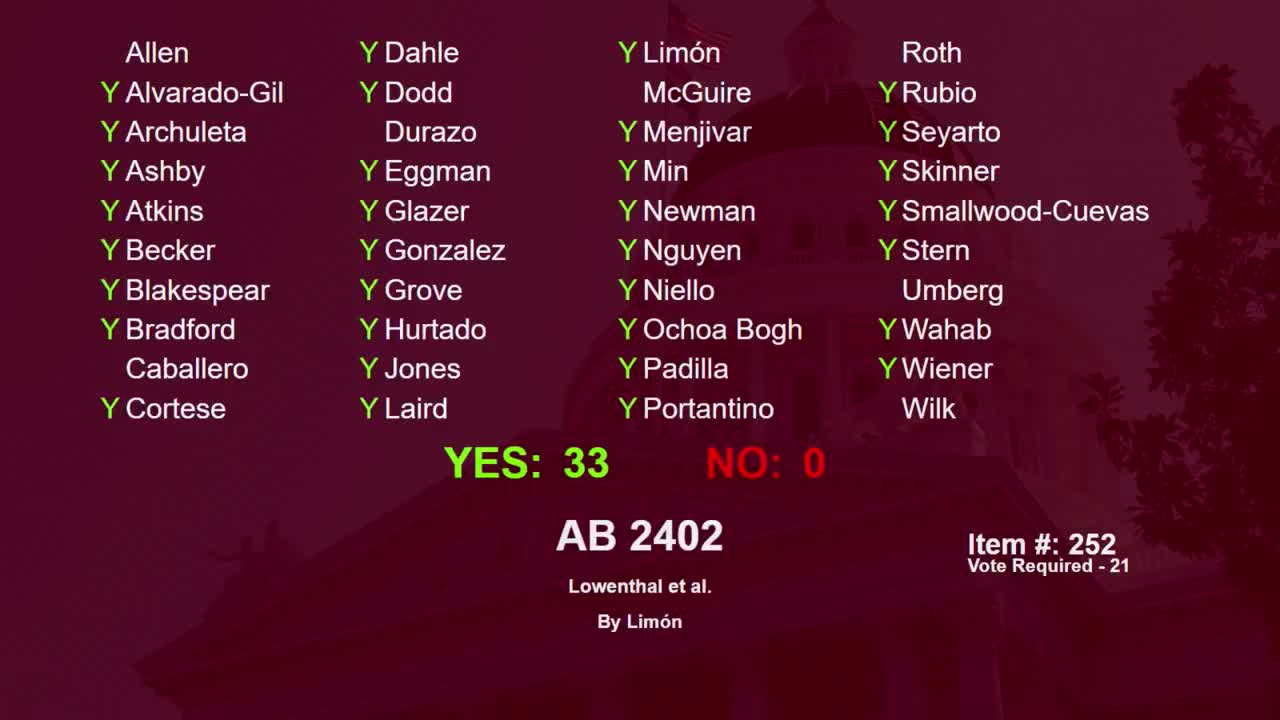 2MIN
Senate Floor
 9MIN
Senate Standing Committee on Business, Professions and Economic Development
 7MIN
Assembly Standing Committee on Business and Professions
Bill Author