AB 2443: Transactions and use taxes: Cities of Lancaster, Palmdale, and Victorville.
- Session Year: 2023-2024
- House: Assembly
- Latest Version Date: 2024-09-29
Current Status:
Passed
(2024-09-29: Chaptered by Secretary of State - Chapter 961, Statutes of 2024.)
Introduced
In Committee
First Chamber
In Committee
Second Chamber
Enacted
Existing law authorizes cities and counties, subject to certain limitations and approval requirements, to levy a transactions and use tax for general or specific purposes, in accordance with the procedures and requirements set forth in the Transactions and Use Tax Law, including a requirement that the combined rate of all taxes that may be imposed in accordance with that law in the jurisdiction not exceed 2%.
This bill would authorize the Cities of Lancaster, Palmdale, and Victorville to impose a transactions and use tax for the support of countywide transportation programs or general services, at a rate of no more than 1% that, in combination with other transactions and use taxes, would exceed the above-described combined rate limit of 2%, if certain requirements are met. The bill would provide that a transactions and use tax rate imposed pursuant to the bill will not be considered for purposes of the combined rate limit described above. The bill would repeal these authorizations on January 1, 2029, if an ordinance proposing the tax has not been approved by that date, as specified.
This bill would make legislative findings and declarations as to the necessity of a special statute for the Cities of Lancaster, Palmdale, and Victorville.
This bill would declare that it is to take effect immediately as an urgency statute.
Existing law authorizes cities and counties, subject to certain limitations and approval requirements, to levy a transactions and use tax for general or specific purposes, in accordance with the procedures and requirements set forth in the Transactions and Use Tax Law, including a requirement that the combined rate of all taxes that may be imposed in accordance with that law in the jurisdiction not exceed 2%.
This bill would authorize the Cities of Lancaster, Palmdale, and Victorville to impose a transactions and use tax for the support of countywide transportation programs or general services, at a rate of no more than 1% that, in combination with other transactions and use taxes, would exceed the above-described combined rate limit of 2%, if certain requirements are met. The bill would provide that a transactions and use tax rate imposed pursuant to the bill will not be considered for purposes of the combined rate limit described above. The bill would repeal these authorizations on January 1, 2029, if an ordinance proposing the tax has not been approved by that date, as specified.
This bill would make legislative findings and declarations as to the necessity of a special statute for the Cities of Lancaster, Palmdale, and Victorville.
This bill would declare that it is to take effect immediately as an urgency statute.
Existing law authorizes cities and counties, subject to certain limitations and approval requirements, to levy a transactions and use tax for general or specific purposes, in accordance with the procedures and requirements set forth in the Transactions and Use Tax Law, including a requirement that the combined rate of all taxes that may be imposed in accordance with that law in the jurisdiction not exceed 2%.
This bill would authorize the Cities of Lancaster, Palmdale, and Victorville to impose a transactions and use tax for the support of countywide transportation programs or general services, at a rate of no more than 1% that, in combination with other transactions and use taxes, would exceed the above-described combined rate limit of 2%, if certain requirements are met. The bill would provide that a transactions and use tax rate imposed pursuant to the bill will not be considered for purposes of the combined rate limit described above. The bill would repeal these authorizations on January 1, 2029, if an ordinance proposing the tax has not been approved by that date, as specified.
This bill would make legislative findings and declarations as to the necessity of a special statute for the Cities of Lancaster, Palmdale, and Victorville.
This bill would declare that it is to take effect immediately as an urgency statute.
Existing law authorizes cities and counties, subject to certain limitations and approval requirements, to levy a transactions and use tax for general or specific purposes, in accordance with the procedures and requirements set forth in the Transactions and Use Tax Law, including a requirement that the combined rate of all taxes that may be imposed in accordance with that law in the jurisdiction not exceed 2%.
This bill would authorize the Cities of Lancaster, Palmdale, and Victorville to impose a transactions and use tax for the support of countywide transportation programs or general services, at a rate of no more than 1% that, in combination with other transactions and use taxes, would exceed the above-described combined rate limit of 2%, if certain requirements are met. The bill would provide that a transactions and use tax rate imposed pursuant to the bill will not be considered for purposes of the combined rate limit described above. The bill would repeal these authorizations on January 1, 2029, if an ordinance proposing the tax has not been approved by that date, as specified.
This bill would make legislative findings and declarations as to the necessity of a special statute for the Cities of Lancaster, Palmdale, and Victorville.
Existing law, the Western Joshua Tree Conservation Act, prohibits any person or public agency from importing into the state, exporting out of the state, or taking, possessing, purchasing, or selling within the state, a western Joshua tree or any part or product of the tree, except as provided. Under existing law, the Department of Fish and Wildlife may authorize, by permit, the taking of a western Joshua tree if certain conditions are met, including, among other conditions, that the permittee mitigates all impacts to, and the taking of, the western Joshua tree. Existing law authorizes the department to enter into an agreement with any county or city to delegate to the county or city the ability to authorize the taking of a western Joshua tree associated with developing single-family residences, multifamily residences, accessory structures, and public works projects concurrent with its approval of the project if certain conditions are met. Existing law authorizes any person or public agency receiving a take authorization for a project to pay specified fees in lieu of satisfying the mitigation obligation on several bases, including if the project receives a permit issued by a county or city.This bill would additionally authorize the department to enter into an agreement with any city to delegate to the city the ability to authorize the taking of western Joshua trees associated with developing commercial and industrial projects. The bill would, relative to other project types subject to delegated local mitigation authority, limit the bases for commercial or industrial projects to pay specified fees in lieu of satisfying the mitigation obligation, as provided.Existing law, the Western Joshua Tree Conservation Act, would prohibit prohibits any person or public agency from importing into the state, exporting out of the state, or taking, possessing, purchasing, or selling within the state, a western Joshua tree or any part or product of the tree, except as provided. Under existing law, the Department of Fish and Wildlife may authorize, by permit, the taking of a western Joshua tree if certain conditions are met, including, among other conditions, that the permittee mitigates all impacts to, and the taking of, the western Joshua tree. Existing law, pursuant to that act, law authorizes the Department of Fish and Wildlife department to enter into an agreement with any county or city to delegate to the county or city the ability to authorize the taking of a western Joshua tree associated with developing single-family residences, multifamily residences, accessory structures, and public works projects concurrent with its approval of the project if certain conditions are met. Existing law authorizes any person or public agency receiving a take authorization for a project to pay specified fees in lieu of satisfying the mitigation obligation on several bases, including if the project receives a permit issued by a county or city.
This bill would additionally authorize the department to enter into an agreement with any county or city to delegate to the county or city the ability to authorize the taking of a western Joshua tree trees associated with developing commercial and industrial projects, as provided. projects. The bill would, relative to other project types subject to delegated local mitigation authority, limit the bases for commercial or industrial projects to pay specified fees in lieu of satisfying the mitigation obligation, as provided.
Existing law, the Western Joshua Tree Conservation Act, would prohibit any person or public agency from importing into the state, exporting out of the state, or taking, possessing, purchasing, or selling within the state, a western Joshua tree or any part or product of the tree, except as provided. Existing law, pursuant to that act, authorizes the Department of Fish and Wildlife to enter into an agreement with any county or city to delegate to the county or city the ability to authorize the taking of a western Joshua tree associated with developing single-family residences, multifamily residences, accessory structures, and public works projects concurrent with its approval of the project if certain conditions are met.
This bill would additionally authorize the department to enter into an agreement with any county or city to delegate to the county or city the ability to authorize the taking of a western Joshua tree associated with commercial and industrial projects, as provided.
(a)Notwithstanding any other law, the City of Victorville, by ordinance or by citizens initiative, may impose a transactions and use tax for general or specific purposes at a rate of no more than 1 percent that would, in combination with all taxes imposed in accordance with Part 1.6 (commencing with Section 7251), exceed the limit established in Section 7251.1 if all of the following requirements are met:
(1)The city council of the City of Victorville adopts an ordinance proposing the transactions and use tax by the applicable voting approval requirement.
(2)The ordinance proposing the transactions and use tax is submitted to the electorate and is approved by the voters voting on the ordinance by the applicable voting approval requirement in accordance with the California Constitution.
(3)The transactions and use tax conforms to the Transactions and Use Tax Law (Part 1.6 (commencing with Section 7251)), other than Section 7251.1.
(b)Notwithstanding Section 7251.1, a transactions and use tax rate imposed pursuant to subdivision (a) shall not be considered for purposes of the combined rate limitation established by Section 7251.1.
7287.12.If, as of January 1, 2029, an ordinance or citizens initiative proposing a transactions and use tax has not been approved as required by Section 7287.11, this chapter shall be repealed as of that same date.
SEC. 2.Chapter 3.11 (commencing with Section 7287.13) is added to Part 1.7 of Division 2 of the Revenue and Taxation Code, to read:3.11.City of Lancaster Transactions and Use Tax7287.13.(a)Notwithstanding any other law, the City of Lancaster, by ordinance or by citizens initiative, may impose a transactions and use tax for general or specific purposes at a rate of no more than 1 percent that would, in combination with all taxes imposed in accordance with Part 1.6 (commencing with Section 7251), exceed the limit established in Section 7251.1 if all of the following requirements are met:
(1)The city council of the City of Lancaster adopts an ordinance proposing the transactions and use tax by the applicable voting approval requirement.
(2)The ordinance proposing the transactions and use tax is submitted to the electorate and is approved by the voters voting on the ordinance by the applicable voting approval requirement in accordance with the California Constitution.
(3)The transactions and use tax conforms to the Transactions and Use Tax Law (Part 1.6 (commencing with Section 7251)), other than Section 7251.1.
(b)Notwithstanding Section 7251.1, a transactions and use tax rate imposed pursuant to subdivision (a) shall not be considered for purposes of the combined rate limitation established by Section 7251.1.
7287.14.If, as of January 1, 2029, an ordinance or citizens initiative proposing a transactions and use tax has not been approved as required by Section 7287.13, this chapter shall be repealed as of that same date.
SEC. 3.Chapter 3.12 (commencing with Section 7287.15) is added to Part 1.7 of Division 2 of the Revenue and Taxation Code, to read:3.12.City of Palmdale Transactions and Use Tax7287.15.(a)Notwithstanding any other law, the City of Palmdale, by ordinance or by citizens initiative, may impose a transactions and use tax for general or specific purposes at a rate of no more than 1 percent that would, in combination with all taxes imposed in accordance with Part 1.6 (commencing with Section 7251), exceed the limit established in Section 7251.1 if all of the following requirements are met:
(1)The city council of the City of Palmdale adopts an ordinance proposing the transactions and use tax by the applicable voting approval requirement.
(2)The ordinance proposing the transactions and use tax is submitted to the electorate and is approved by the voters voting on the ordinance by the applicable voting approval requirement in accordance with the California Constitution.
(3)The transactions and use tax conforms to the Transactions and Use Tax Law (Part 1.6 (commencing with Section 7251)), other than Section 7251.1.
(b)Notwithstanding Section 7251.1, a transactions and use tax rate imposed pursuant to subdivision (a) shall not be considered for purposes of the combined rate limitation established by Section 7251.1.
7287.16.If, as of January 1, 2029, an ordinance or citizens initiative proposing a transactions and use tax has not been approved as required by Section 7287.15, this chapter shall be repealed as of that same date.
SEC. 4.The Legislature finds and declares that a special statute is necessary and that a general statute cannot be made applicable within the meaning of Section 16 of Article IV of the California Constitution because of the critical needs of the transportation infrastructure and general services within the Cities of Lancaster, Palmdale, and Victorville.
SEC. 5.This act is an urgency statute necessary for the immediate preservation of the public peace, health, or safety within the meaning of Article IV of the California Constitution and shall go into immediate effect. The facts constituting the necessity are:
In order to ensure the Cities of Lancaster, Palmdale, and Victorville can quickly meet the critical infrastructure and service needs of the aforementioned communities, it is necessary that this act take effect immediately.
(a)Notwithstanding any other law, the City of Victorville, by ordinance or by citizens initiative, may impose a transactions and use tax for general or specific purposes at a rate of no more than 1 percent that would, in combination with all taxes imposed in accordance with Part 1.6 (commencing with Section 7251), exceed the limit established in Section 7251.1 if all of the following requirements are met:
(1)The city council of the City of Victorville adopts an ordinance proposing the transactions and use tax by the applicable voting approval requirement.
(2)The ordinance proposing the transactions and use tax is submitted to the electorate and is approved by the voters voting on the ordinance by the applicable voting approval requirement in accordance with the California Constitution.
(3)The transactions and use tax conforms to the Transactions and Use Tax Law (Part 1.6 (commencing with Section 7251)), other than Section 7251.1.
(b)Notwithstanding Section 7251.1, a transactions and use tax rate imposed pursuant to subdivision (a) shall not be considered for purposes of the combined rate limitation established by Section 7251.1.
7287.12.If, as of January 1, 2029, an ordinance or citizens initiative proposing a transactions and use tax has not been approved as required by Section 7287.11, this chapter shall be repealed as of that same date.
SEC. 2.Chapter 3.11 (commencing with Section 7287.13) is added to Part 1.7 of Division 2 of the Revenue and Taxation Code, to read:3.11.City of Lancaster Transactions and Use Tax7287.13.(a)Notwithstanding any other law, the City of Lancaster, by ordinance or by citizens initiative, may impose a transactions and use tax for general or specific purposes at a rate of no more than 1 percent that would, in combination with all taxes imposed in accordance with Part 1.6 (commencing with Section 7251), exceed the limit established in Section 7251.1 if all of the following requirements are met:
(1)The city council of the City of Lancaster adopts an ordinance proposing the transactions and use tax by the applicable voting approval requirement.
(2)The ordinance proposing the transactions and use tax is submitted to the electorate and is approved by the voters voting on the ordinance by the applicable voting approval requirement in accordance with the California Constitution.
(3)The transactions and use tax conforms to the Transactions and Use Tax Law (Part 1.6 (commencing with Section 7251)), other than Section 7251.1.
(b)Notwithstanding Section 7251.1, a transactions and use tax rate imposed pursuant to subdivision (a) shall not be considered for purposes of the combined rate limitation established by Section 7251.1.
7287.14.If, as of January 1, 2029, an ordinance or citizens initiative proposing a transactions and use tax has not been approved as required by Section 7287.13, this chapter shall be repealed as of that same date.
SEC. 3.Chapter 3.12 (commencing with Section 7287.15) is added to Part 1.7 of Division 2 of the Revenue and Taxation Code, to read:3.12.City of Palmdale Transactions and Use Tax7287.15.(a)Notwithstanding any other law, the City of Palmdale, by ordinance or by citizens initiative, may impose a transactions and use tax for general or specific purposes at a rate of no more than 1 percent that would, in combination with all taxes imposed in accordance with Part 1.6 (commencing with Section 7251), exceed the limit established in Section 7251.1 if all of the following requirements are met:
(1)The city council of the City of Palmdale adopts an ordinance proposing the transactions and use tax by the applicable voting approval requirement.
(2)The ordinance proposing the transactions and use tax is submitted to the electorate and is approved by the voters voting on the ordinance by the applicable voting approval requirement in accordance with the California Constitution.
(3)The transactions and use tax conforms to the Transactions and Use Tax Law (Part 1.6 (commencing with Section 7251)), other than Section 7251.1.
(b)Notwithstanding Section 7251.1, a transactions and use tax rate imposed pursuant to subdivision (a) shall not be considered for purposes of the combined rate limitation established by Section 7251.1.
7287.16.If, as of January 1, 2029, an ordinance or citizens initiative proposing a transactions and use tax has not been approved as required by Section 7287.15, this chapter shall be repealed as of that same date.
SEC. 4.The Legislature finds and declares that a special statute is necessary and that a general statute cannot be made applicable within the meaning of Section 16 of Article IV of the California Constitution because of the critical needs of the transportation infrastructure and general services within the Cities of Lancaster, Palmdale, and Victorville.
SEC. 5.This act is an urgency statute necessary for the immediate preservation of the public peace, health, or safety within the meaning of Article IV of the California Constitution and shall go into immediate effect. The facts constituting the necessity are:
In order to ensure the Cities of Lancaster, Palmdale, and Victorville can quickly meet the critical infrastructure and service needs of the aforementioned communities, it is necessary that this act take effect immediately.
(a)Notwithstanding any other law, the City of Victorville, by ordinance or by citizens initiative, may impose a transactions and use tax for general or specific purposes at a rate of no more than 1 percent that would, in combination with all taxes imposed in accordance with Part 1.6 (commencing with Section 7251), exceed the limit established in Section 7251.1 if all of the following requirements are met:
(1)The city council of the City of Victorville adopts an ordinance proposing the transactions and use tax by the applicable voting approval requirement.
(2)The ordinance proposing the transactions and use tax is submitted to the electorate and is approved by the voters voting on the ordinance by the applicable voting approval requirement in accordance with the California Constitution.
(3)The transactions and use tax conforms to the Transactions and Use Tax Law (Part 1.6 (commencing with Section 7251)), other than Section 7251.1.
(b)Notwithstanding Section 7251.1, a transactions and use tax rate imposed pursuant to subdivision (a) shall not be considered for purposes of the combined rate limitation established by Section 7251.1.
7287.12.If, as of January 1, 2029, an ordinance or citizens initiative proposing a transactions and use tax has not been approved as required by Section 7287.11, this chapter shall be repealed as of that same date.
SEC. 2.Chapter 3.11 (commencing with Section 7287.13) is added to Part 1.7 of Division 2 of the Revenue and Taxation Code, to read:3.11.City of Lancaster Transactions and Use Tax7287.13.(a)Notwithstanding any other law, the City of Lancaster, by ordinance or by citizens initiative, may impose a transactions and use tax for general or specific purposes at a rate of no more than 1 percent that would, in combination with all taxes imposed in accordance with Part 1.6 (commencing with Section 7251), exceed the limit established in Section 7251.1 if all of the following requirements are met:
(1)The city council of the City of Lancaster adopts an ordinance proposing the transactions and use tax by the applicable voting approval requirement.
(2)The ordinance proposing the transactions and use tax is submitted to the electorate and is approved by the voters voting on the ordinance by the applicable voting approval requirement in accordance with the California Constitution.
(3)The transactions and use tax conforms to the Transactions and Use Tax Law (Part 1.6 (commencing with Section 7251)), other than Section 7251.1.
(b)Notwithstanding Section 7251.1, a transactions and use tax rate imposed pursuant to subdivision (a) shall not be considered for purposes of the combined rate limitation established by Section 7251.1.
7287.14.If, as of January 1, 2029, an ordinance or citizens initiative proposing a transactions and use tax has not been approved as required by Section 7287.13, this chapter shall be repealed as of that same date.
SEC. 3.Chapter 3.12 (commencing with Section 7287.15) is added to Part 1.7 of Division 2 of the Revenue and Taxation Code, to read:3.12.City of Palmdale Transactions and Use Tax7287.15.(a)Notwithstanding any other law, the City of Palmdale, by ordinance or by citizens initiative, may impose a transactions and use tax for general or specific purposes at a rate of no more than 1 percent that would, in combination with all taxes imposed in accordance with Part 1.6 (commencing with Section 7251), exceed the limit established in Section 7251.1 if all of the following requirements are met:
(1)The city council of the City of Palmdale adopts an ordinance proposing the transactions and use tax by the applicable voting approval requirement.
(2)The ordinance proposing the transactions and use tax is submitted to the electorate and is approved by the voters voting on the ordinance by the applicable voting approval requirement in accordance with the California Constitution.
(3)The transactions and use tax conforms to the Transactions and Use Tax Law (Part 1.6 (commencing with Section 7251)), other than Section 7251.1.
(b)Notwithstanding Section 7251.1, a transactions and use tax rate imposed pursuant to subdivision (a) shall not be considered for purposes of the combined rate limitation established by Section 7251.1.
7287.16.If, as of January 1, 2029, an ordinance or citizens initiative proposing a transactions and use tax has not been approved as required by Section 7287.15, this chapter shall be repealed as of that same date.
SEC. 4.The Legislature finds and declares that a special statute is necessary and that a general statute cannot be made applicable within the meaning of Section 16 of Article IV of the California Constitution because of the critical needs of the transportation infrastructure and general services within the Cities of Lancaster, Palmdale, and Victorville.
SEC. 5.This act is an urgency statute necessary for the immediate preservation of the public peace, health, or safety within the meaning of Article IV of the California Constitution and shall go into immediate effect. The facts constituting the necessity are:
In order to ensure the Cities of Lancaster, Palmdale, and Victorville can quickly meet the critical infrastructure and service needs of the aforementioned communities, it is necessary that this act take effect immediately.
(a)Notwithstanding any other law, the City of Victorville, by ordinance or by citizens initiative, may impose a transactions and use tax for general or specific purposes at a rate of no more than 1 percent that would, in combination with all taxes imposed in accordance with Part 1.6 (commencing with Section 7251), exceed the limit established in Section 7251.1 if all of the following requirements are met:
(1)The city council of the City of Victorville adopts an ordinance proposing the transactions and use tax by the applicable voting approval requirement.
(2)The ordinance proposing the transactions and use tax is submitted to the electorate and is approved by the voters voting on the ordinance by the applicable voting approval requirement in accordance with the California Constitution.
(3)The transactions and use tax conforms to the Transactions and Use Tax Law (Part 1.6 (commencing with Section 7251)), other than Section 7251.1.
(b)Notwithstanding Section 7251.1, a transactions and use tax rate imposed pursuant to subdivision (a) shall not be considered for purposes of the combined rate limitation established by Section 7251.1.
7287.12.If, as of January 1, 2029, an ordinance or citizens initiative proposing a transactions and use tax has not been approved as required by Section 7287.11, this chapter shall be repealed as of that same date.
SEC. 2.Chapter 3.11 (commencing with Section 7287.13) is added to Part 1.7 of Division 2 of the Revenue and Taxation Code, to read:3.11.City of Lancaster Transactions and Use Tax7287.13.(a)Notwithstanding any other law, the City of Lancaster, by ordinance or by citizens initiative, may impose a transactions and use tax for general or specific purposes at a rate of no more than 1 percent that would, in combination with all taxes imposed in accordance with Part 1.6 (commencing with Section 7251), exceed the limit established in Section 7251.1 if all of the following requirements are met:
(1)The city council of the City of Lancaster adopts an ordinance proposing the transactions and use tax by the applicable voting approval requirement.
(2)The ordinance proposing the transactions and use tax is submitted to the electorate and is approved by the voters voting on the ordinance by the applicable voting approval requirement in accordance with the California Constitution.
(3)The transactions and use tax conforms to the Transactions and Use Tax Law (Part 1.6 (commencing with Section 7251)), other than Section 7251.1.
(b)Notwithstanding Section 7251.1, a transactions and use tax rate imposed pursuant to subdivision (a) shall not be considered for purposes of the combined rate limitation established by Section 7251.1.
7287.14.If, as of January 1, 2029, an ordinance or citizens initiative proposing a transactions and use tax has not been approved as required by Section 7287.13, this chapter shall be repealed as of that same date.
SEC. 3.Chapter 3.12 (commencing with Section 7287.15) is added to Part 1.7 of Division 2 of the Revenue and Taxation Code, to read:3.12.City of Palmdale Transactions and Use Tax7287.15.(a)Notwithstanding any other law, the City of Palmdale, by ordinance or by citizens initiative, may impose a transactions and use tax for general or specific purposes at a rate of no more than 1 percent that would, in combination with all taxes imposed in accordance with Part 1.6 (commencing with Section 7251), exceed the limit established in Section 7251.1 if all of the following requirements are met:
(1)The city council of the City of Palmdale adopts an ordinance proposing the transactions and use tax by the applicable voting approval requirement.
(2)The ordinance proposing the transactions and use tax is submitted to the electorate and is approved by the voters voting on the ordinance by the applicable voting approval requirement in accordance with the California Constitution.
(3)The transactions and use tax conforms to the Transactions and Use Tax Law (Part 1.6 (commencing with Section 7251)), other than Section 7251.1.
(b)Notwithstanding Section 7251.1, a transactions and use tax rate imposed pursuant to subdivision (a) shall not be considered for purposes of the combined rate limitation established by Section 7251.1.
7287.16.If, as of January 1, 2029, an ordinance or citizens initiative proposing a transactions and use tax has not been approved as required by Section 7287.15, this chapter shall be repealed as of that same date.
SEC. 4.The Legislature finds and declares that a special statute is necessary and that a general statute cannot be made applicable within the meaning of Section 16 of Article IV of the California Constitution because of the critical needs of the transportation infrastructure and general services within the Cities of Lancaster, Palmdale, and Victorville.
SECTION 1.Section 1927.3 of the Fish and Game Code is amended to read:1927.3.(a)The department may authorize, by permit, the taking of a western Joshua tree if all of the following conditions are met:(1)The permittee submits to the department for its approval a census of all western Joshua trees on the project site, including size information and photographs, that categorize the western Joshua trees according to the following size classes:(A)Less than one meter in height.(B)One meter or greater but less than five meters in height.(C)Five meters or greater in height.(2)The permittee avoids and minimizes impacts to, and the taking of, the western Joshua tree to the maximum extent practicable. Minimization may include trimming, encroachment on root systems, relocation, or other actions that result in detrimental but nonlethal impacts to a western Joshua tree.(3)The permittee mitigates all impacts to, and taking of, the western Joshua tree. The measures required to meet this obligation shall be roughly proportional in extent to the impact of the authorized taking of the species. When various measures are available to meet this obligation, the measures required shall maintain the permittees objectives to the greatest extent possible. All required measures shall be capable of successful implementation. The permittee shall ensure adequate funding to implement the mitigation measures. In lieu of completing the mitigation obligation on its own, the permittee may elect to satisfy this mitigation obligation by paying fees, pursuant to the fee schedule in subdivision (d) or (e), for deposit into the fund.(4)(A)The department may include permit conditions that require the permittee to relocate one or more of the western Joshua trees. If relocation is required, the permittee shall implement measures to assist the survival of relocated trees, and to comply with any other reasonable measures required by the department to facilitate the successful relocation and survival of the western Joshua trees. These relocation measures shall include, but are not limited to, all of the following:(i)A requirement that the relocated western Joshua tree is placed in a location and with proper orientation to improve its survival.(ii)A requirement that western Joshua trees are relocated at a time that maximizes their survival when feasible.(iii)A requirement that a desert native plant specialist be onsite to oversee relocation.(B)The department may limit relocation to certain size classes of trees.(C)By July 1, 2024, the department shall adopt guidelines and relocation protocols, based on the best available science, to relocate western Joshua trees successfully. The department shall consult with desert native plant specialists as part of the development of these guidelines and relocation protocols. Chapter 3.5 (commencing with Section 11340) of Part 1 of Division 3 of Title 2 of the Government Code shall not apply to the development, adoption, or amendment of guidelines and relocation protocols pursuant to this subparagraph.(b)For purposes of this section, each western Joshua tree stem or trunk arising from the ground shall be considered an individual tree requiring mitigation, regardless of its proximity to any other western Joshua tree stem or trunk.(c)(1)If all of the conditions of paragraph (3) are met, the department may enter into an agreement with any county to delegate to the county the ability to authorize the taking of a western Joshua tree associated with developing any one or more of the following projects concurrent with the countys approval of the project:(A)Single-family residences.(B)Multifamily residences.(C)Accessory structures.(D)Public works projects.(2)If all of the conditions of paragraph (3) are met, the department may enter into an agreement with any city to delegate to the city the ability to authorize the taking of a western Joshua tree associated with developing any one or more of the following projects concurrent with the citys approval of the project:(A)Single-family residences.(B)Multifamily residences.(C)Accessory structures.(D)Public works projects.(E)Commercial projects.(F)Industrial projects.(3)The delegation of authority pursuant to paragraphs (1) and (2) shall be subject to all of the following conditions:(A)The county or city adopts an ordinance that requires as a condition of any approval or permit issued under the authority of an agreement entered into pursuant to this subdivision satisfaction of the requirements of this chapter.(B)Except as provided otherwise in this subdivision, the county or city ensures that the permittee satisfies all of the requirements of subdivision (a) of this section.(C)The project will take no more than 10 individual western Joshua trees on the project site where the project proponent proposes to construct a single-family residence, multifamily residence, accessory structure, commercial project, or industrial project, or no more than 40 individual western Joshua trees on the project site on which a public agency proposes to undertake a public works project. Before authorizing the take of more than 20, but no more than 40, individual western Joshua trees for a public works project, the county or city shall obtain the departments written concurrence that the project has avoided and minimized the take of western Joshua trees to the maximum extent practicable.(D)The county or city shall collect any fees for permits issued and remit them quarterly to the fund as directed by the department.(E)The county or city entering into an agreement pursuant to this subdivision may impose a reasonable fee to cover the administrative costs of issuing the permit.(F)(i)The department retains express authority to suspend or revoke the county or citys take authorization in the event the department determines the county or city has violated the terms of the agreement, or this chapter, the county or city fails to implement or enforce the terms of the agreement or this chapter, or the department determines that the local population of western Joshua trees within, or in the vicinity of, that county or city needs further protection. The county or city shall conduct an annual assessment of the status of the local population within the county or city and submit the assessment to the department. The department shall determine if the population needs further protection to provide for the conservation of the species.(ii)The department shall adopt standardized survey and assessment methods for the annual assessment required pursuant to clause (i), including requiring that a desert native plant specialist conduct the assessment. Chapter 3.5 (commencing with Section 11340) of Part 1 of Division 3 of Title 2 of the Government Code shall not apply to the development, adoption, or amendment of standardized survey and assessment methods pursuant to this subparagraph.(G)The county or city shall be required to submit to the department quarterly reports documenting the number of permits issued, photographs and other evidence demonstrating that take and other impacts were avoided and minimized to the maximum extent practicable, the number and size class of western Joshua trees authorized to be taken, the number of western Joshua trees encroached upon, the number of western Joshua trees lethally removed, the number and location of western Joshua trees relocated, the amount of fees collected, and other information required by the department in the agreement.(d)Any person or public agency receiving a take authorization pursuant to this chapter for a project that meets the criteria of either subparagraph (A) of paragraph (1) or subparagraph (B) of paragraph (1) may elect, in lieu of satisfying the mitigation obligation provided for in paragraph (3) of subdivision (a), to pay fees in the amounts provided in paragraph (2) for deposit into the fund.(1)(A)Any project in the area bounded by the intersection of Highway 99 and Highway 58, then east along Highway 58 to the intersection of Interstate 15, then north along Interstate 15 to the intersection of Highway 247, then south along Highway 247 to the intersection of Highway 18, then west along Highway 18 to the intersection of Highway 138, then west and north along Highway 138 to the intersection of Interstate 5, then north along Interstate 5 to the intersection of Highway 99, then north along Highway 99 to Highway 58.(B)Any single-family residence, multifamily residence, accessory structure, or public works project receiving a permit issued by a county or city pursuant to an agreement with the department pursuant to subdivision (c), regardless of location.(2)(A)One thousand dollars ($1,000) for each western Joshua tree five meters or greater in height.(B)Two hundred dollars ($200) for each western Joshua tree one meter or greater but less than five meters in height.(C)One hundred fifty dollars ($150) for each western Joshua tree less than one meter in height.(e)Any person or public agency receiving a take authorization pursuant to this chapter for a project that meets the criteria set forth in paragraph (1) may elect, in lieu of satisfying the mitigation obligation provided for in paragraph (3) of subdivision (a), to pay fees in the amounts provided in paragraph (2) for deposit into the fund.(1)(A)Notwithstanding paragraph (1) of subdivision (d), any project within two miles of Joshua Tree National Park, or any unit of the state park system.(B)Any project that does not meet the criteria set forth in paragraph (1) of subdivision (d).(2)(A)Two thousand five hundred dollars ($2,500) for each western Joshua tree five meters or greater in height.(B)Five hundred dollars ($500) for each western Joshua tree one meter or greater but less than five meters in height.(C)Three hundred forty dollars ($340) for each western Joshua tree less than one meter in height.(f)Upon request, the department may authorize a reduction in the amount of the fees prescribed by subdivisions (d) and (e) for any western Joshua tree conserved by a project proponent through the acquisition of compensatory habitat mitigation land otherwise required by law for the project.(g)(1)The permittee shall bear responsibility for implementing measures to assist the survival of western Joshua trees relocated pursuant to paragraph (4) of subdivision (a).(2)Unless specifically required by written agreement, a landowner that agrees in writing to allow western Joshua trees to be relocated onto land it owns shall not be liable for the continued survival of the western Joshua trees, shall not be required to manage or maintain the translocated western Joshua trees, and shall not be required to change existing land use practices, provided that the land use practices do not result in the taking, possession, sale, or further translocation of the western Joshua trees.(a)The department may authorize, by permit, the taking of a western Joshua tree if all of the following conditions are met:
(1)The permittee submits to the department for its approval a census of all western Joshua trees on the project site, including size information and photographs, that categorize the western Joshua trees according to the following size classes:
(A)Less than one meter in height.
(B)One meter or greater but less than five meters in height.
(C)Five meters or greater in height.
(2)The permittee avoids and minimizes impacts to, and the taking of, the western Joshua tree to the maximum extent practicable. Minimization may include trimming, encroachment on root systems, relocation, or other actions that result in detrimental but nonlethal impacts to a western Joshua tree.
(3)The permittee mitigates all impacts to, and taking of, the western Joshua tree. The measures required to meet this obligation shall be roughly proportional in extent to the impact of the authorized taking of the species. When various measures are available to meet this obligation, the measures required shall maintain the permittees objectives to the greatest extent possible. All required measures shall be capable of successful implementation. The permittee shall ensure adequate funding to implement the mitigation measures. In lieu of completing the mitigation obligation on its own, the permittee may elect to satisfy this mitigation obligation by paying fees, pursuant to the fee schedule in subdivision (d) or (e), for deposit into the fund.
(4)(A)The department may include permit conditions that require the permittee to relocate one or more of the western Joshua trees. If relocation is required, the permittee shall implement measures to assist the survival of relocated trees, and to comply with any other reasonable measures required by the department to facilitate the successful relocation and survival of the western Joshua trees. These relocation measures shall include, but are not limited to, all of the following:
(i)A requirement that the relocated western Joshua tree is placed in a location and with proper orientation to improve its survival.
(ii)A requirement that western Joshua trees are relocated at a time that maximizes their survival when feasible.
(iii)A requirement that a desert native plant specialist be onsite to oversee relocation.
(B)The department may limit relocation to certain size classes of trees.
(C)By July 1, 2024, the department shall adopt guidelines and relocation protocols, based on the best available science, to relocate western Joshua trees successfully. The department shall consult with desert native plant specialists as part of the development of these guidelines and relocation protocols. Chapter 3.5 (commencing with Section 11340) of Part 1 of Division 3 of Title 2 of the Government Code shall not apply to the development, adoption, or amendment of guidelines and relocation protocols pursuant to this subparagraph.
(b)For purposes of this section, each western Joshua tree stem or trunk arising from the ground shall be considered an individual tree requiring mitigation, regardless of its proximity to any other western Joshua tree stem or trunk.
(c)The department may enter into an agreement with any county or city to delegate to the county or city the ability to authorize the taking of a western Joshua tree associated with developing single-family residences, multifamily residences, accessory structures, public works projects, commercial projects, and industrial projects, concurrent with its approval of the project, residence, or structure, if all of the following conditions are met:(c)(1)If all of the conditions of paragraph (3) are met, the department may enter into an agreement with any county to delegate to the county the ability to authorize the taking of a western Joshua tree associated with developing any one or more of the following projects concurrent with the countys approval of the project:
(A)Single-family residences.
(B)Multifamily residences.
(C)Accessory structures.
(D)Public works projects.
(2)If all of the conditions of paragraph (3) are met, the department may enter into an agreement with any city to delegate to the city the ability to authorize the taking of a western Joshua tree associated with developing any one or more of the following projects concurrent with the citys approval of the project:
(A)Single-family residences.
(B)Multifamily residences.
(C)Accessory structures.
(D)Public works projects.
(E)Commercial projects.
(F)Industrial projects.
(3)The delegation of authority pursuant to paragraphs (1) and (2) shall be subject to all of the following conditions:
(1)(A)The county or city adopts an ordinance that requires as a condition of any approval or permit issued under the authority of an agreement entered into pursuant to this subdivision satisfaction of the requirements of this chapter.
(2)(B)Except as provided otherwise in this subdivision, the county or city ensures that the permittee satisfies all of the requirements of subdivision (a) of this section.
(3)(C)The project will take no more than 10 individual western Joshua trees on the project site where the project proponent proposes to construct a single-family residence, multifamily residence, or accessory structure, commercial project, or industrial project, or no more than 40 individual western Joshua trees on the project site on which a public agency proposes to undertake a public works project. Before authorizing the take of more than 20, but no more than 40, individual western Joshua trees for a public works project, the county or city shall obtain the departments written concurrence that the project has avoided and minimized the take of western Joshua trees to the maximum extent practicable.
(4)(D)The county or city shall collect any fees for permits issued and remit them quarterly to the fund as directed by the department.
(5)(E)The county or city entering into an agreement pursuant to this subdivision may impose a reasonable fee to cover the administrative costs of issuing the permit.
(6)(A) The(F)(i)The department retains express authority to suspend or revoke the county or citys take authorization in the event the department determines the county or city has violated the terms of the agreement, or this chapter, the county or city fails to implement or enforce the terms of the agreement or this chapter, or the department determines that the local population of western Joshua trees within, or in the vicinity of, that county or city needs further protection. The county or city shall conduct an annual assessment of the status of the local population within the county or city and submit the assessment to the department. The department shall determine if the population needs further protection to provide for the conservation of the species.
(B)(ii)The department shall adopt standardized survey and assessment methods for the annual assessment required pursuant to subparagraph (A), clause (i), including requiring that a desert native plant specialist conduct the assessment. Chapter 3.5 (commencing with Section 11340) of Part 1 of Division 3 of Title 2 of the Government Code shall not apply to the development, adoption, or amendment of standardized survey and assessment methods pursuant to this subparagraph.
(7)(G)The county or city shall be required to submit to the department quarterly reports documenting the number of permits issued, photographs and other evidence demonstrating that take and other impacts were avoided and minimized to the maximum extent practicable, the number and size class of western Joshua trees authorized to be taken, the number of western Joshua trees encroached upon, the number of western Joshua trees lethally removed, the number and location of western Joshua trees relocated, the amount of fees collected, and other information required by the department in the agreement.
(d)Any person or public agency receiving a take authorization pursuant to this chapter for a project that meets the criteria set forth in paragraph (1) of either subparagraph (A) of paragraph (1) or subparagraph (B) of paragraph (1) may elect, in lieu of satisfying the mitigation obligation provided for in paragraph (3) of subdivision (a), to pay fees in the amounts provided in paragraph (2) for deposit into the fund.
(1)(A)Any project in the area bounded by the intersection of Highway 99 and Highway 58, then east along Highway 58 to the intersection of Interstate 15, then north along Interstate 15 to the intersection of Highway 247, then south along Highway 247 to the intersection of Highway 18, then west along Highway 18 to the intersection of Highway 138, then west and north along Highway 138 to the intersection of Interstate 5, then north along Interstate 5 to the intersection of Highway 99, then north along Highway 99 to Highway 58.
(B)Any project single-family residence, multifamily residence, accessory structure, or public works project receiving a permit issued by a county or city pursuant to an agreement with the department pursuant to subdivision (c), regardless of location.
(2)(A)One thousand dollars ($1,000) for each western Joshua tree five meters or greater in height.
(B)Two hundred dollars ($200) for each western Joshua tree one meter or greater but less than five meters in height.
(C)One hundred fifty dollars ($150) for each western Joshua tree less than one meter in height.
(e)Any person or public agency receiving a take authorization pursuant to this chapter for a project that meets the criteria set forth in paragraph (1) may elect, in lieu of satisfying the mitigation obligation provided for in paragraph (3) of subdivision (a), to pay fees in the amounts provided in paragraph (2) for deposit into the fund.
(1)(A)Notwithstanding paragraph (1) of subdivision (d), any project within two miles of Joshua Tree National Park, or any unit of the state park system.
(B)Any project that does not meet the criteria set forth in paragraph (1) of subdivision (d).
(2)(A)Two thousand five hundred dollars ($2,500) for each western Joshua tree five meters or greater in height.
(B)Five hundred dollars ($500) for each western Joshua tree one meter or greater but less than five meters in height.
(C)Three hundred forty dollars ($340) for each western Joshua tree less than one meter in height.
(f)Upon request, the department may authorize a reduction in the amount of the fees prescribed by subdivisions (d) and (e) for any western Joshua tree conserved by a project proponent through the acquisition of compensatory habitat mitigation land otherwise required by law for the project.
(g)(1)The permittee shall bear responsibility for implementing measures to assist the survival of western Joshua trees relocated pursuant to paragraph (4) of subdivision (a).
(2)Unless specifically required by written agreement, a landowner that agrees in writing to allow western Joshua trees to be relocated onto land it owns shall not be liable for the continued survival of the western Joshua trees, shall not be required to manage or maintain the translocated western Joshua trees, and shall not be required to change existing land use practices, provided that the land use practices do not result in the taking, possession, sale, or further translocation of the western Joshua trees.
(a)The department may authorize, by permit, the taking of a western Joshua tree if all of the following conditions are met:
(1)The permittee submits to the department for its approval a census of all western Joshua trees on the project site, including size information and photographs, that categorize the western Joshua trees according to the following size classes:
(A)Less than one meter in height.
(B)One meter or greater but less than five meters in height.
(C)Five meters or greater in height.
(2)The permittee avoids and minimizes impacts to, and the taking of, the western Joshua tree to the maximum extent practicable. Minimization may include trimming, encroachment on root systems, relocation, or other actions that result in detrimental but nonlethal impacts to a western Joshua tree.
(3)The permittee mitigates all impacts to, and taking of, the western Joshua tree. The measures required to meet this obligation shall be roughly proportional in extent to the impact of the authorized taking of the species. When various measures are available to meet this obligation, the measures required shall maintain the permittees objectives to the greatest extent possible. All required measures shall be capable of successful implementation. The permittee shall ensure adequate funding to implement the mitigation measures. In lieu of completing the mitigation obligation on its own, the permittee may elect to satisfy this mitigation obligation by paying fees, pursuant to the fee schedule in subdivision (d) or (e), for deposit into the fund.
(4)(A)The department may include permit conditions that require the permittee to relocate one or more of the western Joshua trees. If relocation is required, the permittee shall implement measures to assist the survival of relocated trees, and to comply with any other reasonable measures required by the department to facilitate the successful relocation and survival of the western Joshua trees. These relocation measures shall include, but are not limited to, all of the following:
(i)A requirement that the relocated western Joshua tree is placed in a location and with proper orientation to improve its survival.
(ii)A requirement that western Joshua trees are relocated at a time that maximizes their survival when feasible.
(iii)A requirement that a desert native plant specialist be onsite to oversee relocation.
(B)The department may limit relocation to certain size classes of trees.
(C)By July 1, 2024, the department shall adopt guidelines and relocation protocols, based on the best available science, to relocate western Joshua trees successfully. The department shall consult with desert native plant specialists as part of the development of these guidelines and relocation protocols. Chapter 3.5 (commencing with Section 11340) of Part 1 of Division 3 of Title 2 of the Government Code shall not apply to the development, adoption, or amendment of guidelines and relocation protocols pursuant to this subparagraph.
(b)For purposes of this section, each western Joshua tree stem or trunk arising from the ground shall be considered an individual tree requiring mitigation, regardless of its proximity to any other western Joshua tree stem or trunk.
(c)The department may enter into an agreement with any county or city to delegate to the county or city the ability to authorize the taking of a western Joshua tree associated with developing single-family residences, multifamily residences, accessory structures, and public works projects projects, commercial projects, and industrial projects, concurrent with its approval of the project, residence, or structure, if all of the following conditions are met:
(1)The county or city adopts an ordinance that requires as a condition of any approval or permit issued under the authority of an agreement entered into pursuant to this subdivision satisfaction of the requirements of this chapter.
(2)Except as provided otherwise in this subdivision, the county or city ensures that the permittee satisfies all of the requirements of subdivision (a) of this section.
(3)The project will take no more than 10 individual western Joshua trees on the project site where the project proponent proposes to construct a single-family residence, multifamily residence, or accessory structure, or no more than 40 individual western Joshua trees on the project site on which a public agency proposes to undertake a public works project. Before authorizing the take of more than 20, but no more than 40, individual western Joshua trees for a public works project, the county or city shall obtain the departments written concurrence that the project has avoided and minimized the take of western Joshua trees to the maximum extent practicable.
(4)The county or city shall collect any fees for permits issued and remit them quarterly to the fund as directed by the department.
(5)The county or city entering into an agreement pursuant to this subdivision may impose a reasonable fee to cover the administrative costs of issuing the permit.
(6)(A)The department retains express authority to suspend or revoke the county or citys take authorization in the event the department determines the county or city has violated the terms of the agreement, or this chapter, the county or city fails to implement or enforce the terms of the agreement or this chapter, or the department determines that the local population of western Joshua trees within, or in the vicinity of, that county or city needs further protection. The county or city shall conduct an annual assessment of the status of the local population within the county or city and submit the assessment to the department. The department shall determine if the population needs further protection to provide for the conservation of the species.
(B)The department shall adopt standardized survey and assessment methods for the annual assessment required pursuant to subparagraph (A), including requiring that a desert native plant specialist conduct the assessment. Chapter 3.5 (commencing with Section 11340) of Part 1 of Division 3 of Title 2 of the Government Code shall not apply to the development, adoption, or amendment of standardized survey and assessment methods pursuant to this subparagraph.
(7)The county or city shall be required to submit to the department quarterly reports documenting the number of permits issued, photographs and other evidence demonstrating that take and other impacts were avoided and minimized to the maximum extent practicable, the number and size class of western Joshua trees authorized to be taken, the number of western Joshua trees encroached upon, the number of western Joshua trees lethally removed, the number and location of western Joshua trees relocated, the amount of fees collected, and other information required by the department in the agreement.
(d)Any person or public agency receiving a take authorization pursuant to this chapter for a project that meets the criteria set forth in paragraph (1) may elect, in lieu of satisfying the mitigation obligation provided for in paragraph (3) of subdivision (a), to pay fees in the amounts provided in paragraph (2) for deposit into the fund.
(1)(A)Any project in the area bounded by the intersection of Highway 99 and Highway 58, then east along Highway 58 to the intersection of Interstate 15, then north along Interstate 15 to the intersection of Highway 247, then south along Highway 247 to the intersection of Highway 18, then west along Highway 18 to the intersection of Highway 138, then west and north along Highway 138 to the intersection of Interstate 5, then north along Interstate 5 to the intersection of Highway 99, then north along Highway 99 to Highway 58.
(B)Any project receiving a permit issued by a county or city pursuant to an agreement with the department pursuant to subdivision (c), regardless of location.
(2)(A)One thousand dollars ($1,000) for each western Joshua tree five meters or greater in height.
(B)Two hundred dollars ($200) for each western Joshua tree one meter or greater but less than five meters in height.
(C)One hundred fifty dollars ($150) for each western Joshua tree less than one meter in height.
(e)Any person or public agency receiving a take authorization pursuant to this chapter for a project that meets the criteria set forth in paragraph (1) may elect, in lieu of satisfying the mitigation obligation provided for in paragraph (3) of subdivision (a), to pay fees in the amounts provided in paragraph (2) for deposit into the fund.
(1)(A)Notwithstanding paragraph (1) of subdivision (d), any project within two miles of Joshua Tree National Park, or any unit of the state park system.
(B)Any project that does not meet the criteria set forth in paragraph (1) of subdivision (d).
(2)(A)Two thousand five hundred dollars ($2,500) for each western Joshua tree five meters or greater in height.
(B)Five hundred dollars ($500) for each western Joshua tree one meter or greater but less than five meters in height.
(C)Three hundred forty dollars ($340) for each western Joshua tree less than one meter in height.
(f)Upon request, the department may authorize a reduction in the amount of the fees prescribed by subdivisions (d) and (e) for any western Joshua tree conserved by a project proponent through the acquisition of compensatory habitat mitigation land otherwise required by law for the project.
(g)(1)The permittee shall bear responsibility for implementing measures to assist the survival of western Joshua trees relocated pursuant to paragraph (4) of subdivision (a).
(2)Unless specifically required by written agreement, a landowner that agrees in writing to allow western Joshua trees to be relocated onto land it owns shall not be liable for the continued survival of the western Joshua trees, shall not be required to manage or maintain the translocated western Joshua trees, and shall not be required to change existing land use practices, provided that the land use practices do not result in the taking, possession, sale, or further translocation of the western Joshua trees.
|
Date
|
Status
|
|---|---|
| Sep 29, 2024 | Chaptered by Secretary of State - Chapter 961, Statutes of 2024. |
| Sep 29, 2024 | Approved by the Governor. |
| Sep 11, 2024 | Enrolled and presented to the Governor at 4 p.m. |
| Aug 29, 2024 | Urgency clause adopted. Senate amendments concurred in. To Engrossing and Enrolling. (Ayes 55. Noes 16.). |
| Aug 28, 2024 | From committee: That the Senate amendments be concurred in. (Ayes 7. Noes 2.) (August 28). |
| Aug 27, 2024 | Joint Rule 62(a) suspended. |
| Aug 22, 2024 | Re-referred to Com. on L. GOV. pursuant to Assembly Rule 77.2. |
| Aug 20, 2024 | In Assembly. Concurrence in Senate amendments pending. May be considered on or after August 22 pursuant to Assembly Rule 77. |
| Aug 20, 2024 | Read third time. Urgency clause adopted. Passed. Ordered to the Assembly. (Ayes 31. Noes 9. Page 5236.). |
| Aug 7, 2024 | Read second time. Ordered to third reading. |
| Aug 6, 2024 | Read third time and amended. Ordered to second reading. |
| Aug 5, 2024 | Read second time. Ordered to third reading. |
| Jul 3, 2024 | From committee: Do pass. (Ayes 5. Noes 2.) (July 3). |
| Jun 26, 2024 | From committee: Do pass and re-refer to Com. on L. GOV. (Ayes 6. Noes 1.) (June 26). Re-referred to Com. on L. GOV. |
| Jun 12, 2024 | Re-referred to Coms. on REV. & TAX. and L. GOV. |
| Jun 11, 2024 | Withdrawn from committee. |
| Jun 11, 2024 | Re-referred to Com. on RLS. |
| Jun 11, 2024 | In committee: Set, first hearing. Hearing canceled at the request of author. |
| Jun 10, 2024 | From committee chair, with author's amendments: Amend, and re-refer to committee. Read second time, amended, and re-referred to Com. on N.R. & W. |
| May 29, 2024 | Referred to Com. on N.R. & W. |
| May 16, 2024 | In Senate. Read first time. To Com. on RLS. for assignment. |
| May 16, 2024 | Read third time. Passed. Ordered to the Senate. (Ayes 71. Noes 0.) |
| May 9, 2024 | Read second time. Ordered to Consent Calendar. |
| May 8, 2024 | From committee: Do pass. To Consent Calendar. (Ayes 15. Noes 0.) (May 8). |
| Apr 29, 2024 | Re-referred to Com. on APPR. |
| Apr 25, 2024 | Read second time and amended. |
| Apr 24, 2024 | From committee: Amend, and do pass as amended and re-refer to Com. on APPR. (Ayes 12. Noes 0.) (April 23). |
| Apr 24, 2024 | Coauthors revised. |
| Feb 26, 2024 | Referred to Com. on W., P., & W. |
| Feb 14, 2024 | From printer. May be heard in committee March 15. |
| Feb 13, 2024 | Read first time. To print. |
|
Date
|
Description
|
Location
|
Votes
|
|
|---|---|---|---|---|
| Aug 29, 2024 | AB 2443 Juan Carrillo Concurrence - Urgency Added | Assembly Floor |
Passed |
|
| Aug 28, 2024 | With recommendation: That Senate amendments be concurred in. | Assembly Standing Committee on Local Government |
Passed |
|
| Aug 20, 2024 | Assembly 3rd Reading AB2443 Juan Carrillo By Glazer Urgency Clause | Senate Floor |
Passed |
|
| Jul 3, 2024 | Do pass | Senate Standing Committee on Local Government |
Passed |
|
| Jun 26, 2024 | Do pass, but first be re-referred to the Committee on [Local Government] | Senate Standing Committee on Revenue and Taxation |
Passed |
|
| May 16, 2024 | AB 2443 Juan Carrillo Consent Calendar Second Day Regular Session | Assembly Floor |
Passed |
|
| May 8, 2024 | Do pass. To Consent Calendar. | Assembly Standing Committee on Appropriations |
Passed |
|
| Apr 23, 2024 | Do pass as amended and be re-referred to the Committee on [Appropriations] | Assembly Standing Committee on Water, Parks, and Wildlife |
Passed |
This list shows positions taken on this bill by organizations on the date displayed, which is linked to the original source.
Positions by individuals are not included.
|
Organization
|
Position
|
Date
|
|---|---|---|
| California Building Industry Association | ** Support | |
| California Cement Manufacturers Environmental Coalition | * Support | Apr 23, 2024 |
| CALIFORNIA CONSTRUCTION & INDUSTRIAL MATERIALS ASSOCIATION | ** Support | |
| California Native Plant Society | * Against | Apr 23, 2024 |
| California Taxpayers Association | ** Against | |
| Center For Biological Diversity | ** Against | |
| City Of Palmdale | * Support | Jul 3, 2024 |
| City of Victorville | * Support | Jul 3, 2024 |
| County of San Bernardino | * Support | Apr 23, 2024 |
| Defenders Of Wildlife | * Against | Apr 23, 2024 |
| Mojave Desert Land Trust | * Against | Apr 23, 2024 |
| National Audubon Society | ** Against | |
| Planning And Conservation League | ** Against | |
| San Bernardino County | ** Support | |
| Sierra Club California | ** Against |
CONCURRENCE IN SENATE AMENDMENTS
CSA2 Bill Id:AB 2443
Author:(Juan Carrillo)
As Amended Ver:August 6, 2024
2/3 vote
SUMMARY
Original Committee of Reference: Assembly Water, Parks, and Wildlife Committee
Authorizes the cities of Lancaster, Palmdale, and Victorville to impose a transaction and use tax (TUT) that exceeds the 2% statutory limitation.
Senate Amendments
Current Committee Recommendation: Concur
- Delete the Assembly version of this bill.
- Authorize the cities of Lancaster, Palmdale, and Victorville, by ordinance or by citizens’ initiative, to impose a TUT for general or specific purposes at a rate of no more than 1% that would, in combination with all taxes imposed, exceed the 2% cap established by law if all of the following conditions are met:
- The city council of the respective city adopts an ordinance proposing the TUT by the applicable voting approval requirement.
- The ordinance proposing the TUT is submitted to the electorate and is approved by the voters voting on the ordinance by the applicable voting approval requirement in accordance with the California Constitution.
- The TUT conforms to the TUT Law.
- Specify that a TUT rate imposed pursuant to this bill shall not be considered for purposes of the combined rate limitation established by law.
- Provide that if, as of January 1, 2029, an ordinance or citizens’ initiative proposing a TUT has not been approved by Lancaster, Palmdale, or Victorville, the provisions in this bill that apply to each city, respectively, shall be repealed as of that same date.
- Add an urgency clause.
COMMENTS
Sales and Use Taxes. State law imposes the sales tax on every retailer "engaged in business in this state" that sells tangible personal property, and requires them to register with the California Department of Tax and Fee Administration (CDTFA), as well as collect the appropriate tax at purchase and remit the amount to CDFTA. Sales tax applies whenever a retail sale occurs, which is generally any sale other than one for resale in the regular course of business. The current rate is 7.25%.
Unless the purchaser pays the sales tax to the retailer, he or she is liable for the use tax, which the law imposes on any person consuming tangible personal property in the state. The use tax is the same rate as the sales tax, and also like the sales tax, must be remitted on or before the last day of the month following the quarterly period in which the person made the purchase.
Transactions and Use Taxes. The California Constitution states that taxes levied by local governments are either general taxes, subject to majority approval of its voters, or special taxes, subject to 2/3 vote (Article XIII C). Proposition 13 (1978) required a 2/3 vote of each house of the Legislature for state tax increases, and a 2/3 vote for local special taxes. Proposition 62 (1986) prohibited local agencies from imposing general taxes without majority approval of local voters, and a 2/3 vote for special taxes. Proposition 218 (1996) extended those vote thresholds to charter cities, and limited local agencies' powers to levy new assessments, fees, and taxes. Local agencies generally propose to increase taxes by adopting an ordinance or a resolution at a public hearing.
State law allows cities, counties, and specified special districts to increase the sales and use tax applicable in their jurisdiction, also known as district taxes or TUTs. Generally, the combined TUT tax rate imposed within a local jurisdiction cannot exceed 2%. To determine whether a county has reached this rate limitation, all countywide taxes and the highest combined rate imposed by a city within the county are counted towards the county's rate limit. For example, if a county imposes three 0.5% countywide taxes and two cities within the county each impose a 0.5% tax, the combined rate in those two cities would be 2%. In such a circumstance, the two cities could not impose another TUT, and the county could not impose another countywide TUT, absent special authority to exceed the rate limitation.
Prior to 2003, cities lacked the ability to place TUTs before their voters without first obtaining approval by the Legislature to bring an ordinance before the city council, and, if approved at the council level, to the voters. This was remedied by SB 566 (Scott), Chapter 709, Statutes of 2003, which imposed the uniform 2% countywide cap.
AB 464 (Mullin) of 2015 would have increased the maximum combined rate of all TUTs that may be levied by authorized entities within a county from 2% to 3%. This bill was vetoed by Governor Brown stating, "This bill would raise, on a blanket basis, the limit on local transactions and use tax for all counties and cities from two percent to three percent. Although I have approved raising the limit for individual counties, I am reluctant to approve this measure in view of all the taxes being discussed and proposed for the 2016 ballot."
According to CDTFA data, as of April 1, 2024, local jurisdictions (city, county, and special purpose authorities) impose a combined 413 TUTs for general or special purposes. Generally, TUTs are levied throughout the entire area of a single county, the entire unincorporated area within a single county, or a single incorporated city, except for those imposed by the Bay Area Rapid Transit District (Alameda, Contra Costa, and San Francisco counties) and the Sonoma-Marin Rail Transit District (Sonoma and Marin counties). Of the 413 district taxes, 67 are imposed countywide, four are imposed in unincorporated county areas, and 342 are imposed citywide.
According to the Author
AB 2443 would authorize the cities of Lancaster, Palmdale, and Victorville to levy a transactions and use tax of no more than 1% that, in combination with other transactions and use taxes, would exceed the combined rate limit of 2%. Each of these cities are facing significant challenges around transportation infrastructure, housing, and homelessness. This district bill would provide flexibility to allow residents in these cities to vote on local measures to fund critical needs facing the community.
Arguments in Support
None on file.
Arguments in Opposition
According to the California Taxpayers Association, "California has the highest state-level sales and use tax rate in the country, and several cities in California, including Lancaster and Palmdale, have even higher rates. The sales and use tax is a regressive tax that has the greatest impact on low-income residents because it makes it more expensive for these taxpayers to purchase everyday necessities. Inflation has increased the cost of everyday goods, which in turn increases the sales tax that is imposed as a percentage of the retail price. Adding even more to the cost of living with a sales tax increase would harm Californians, and will disproportionately impact the state's most vulnerable residents.
"...Businesses engaged in manufacturing and research-and-development activities face a significant sales and use tax burden in California. Under existing law, when a business purchases manufacturing or R&D equipment, the purchase is subject to a one-time local sales tax of 1.25 percent plus any additional voter-approved transactions and use taxes. Taxing business inputs increases overall production costs for everyday goods produced in California. Authorizing Lancaster, Palmdale, and Victorville to exceed the 2 percent transactions and use tax cap would increase the cost of doing business for critical industries in the area.
"...Unlike the federal government, which receives an exemption for all state and local sales taxes, purchases made by municipal and state agencies are subject to state and local sales taxes. Increasing the local sales tax would increase costs for purchases made by cities and counties, public school districts, and universities operating in the county."
FISCAL COMMENTS
None.
VOTES
ASM WATER, PARKS, AND WILDLIFE: 12-0-3
YES: Papan, Addis, Alanis, Alvarez, Bonta, Gallagher, Davies, Hart, Luz Rivas, Schiavo, Villapudua, Weber
ABS, ABST OR NV: Mathis, Bennett, Garcia
ASM APPROPRIATIONS: 15-0-0
YES: Wicks, Sanchez, Arambula, Bryan, Calderon, Wendy Carrillo, Dixon, Mike Fong, Friedman, Haney, Hart, Jim Patterson, Pellerin, Ta, Villapudua
ASSEMBLY FLOOR: 71-0-9
YES: Aguiar-Curry, Alanis, Arambula, Bains, Bauer-Kahan, Bennett, Berman, Boerner, Bonta, Bryan, Calderon, Juan Carrillo, Wendy Carrillo, Chen, Connolly, Davies, Dixon, Essayli, Mike Fong, Friedman, Gabriel, Gallagher, Garcia, Grayson, Haney, Hart, Holden, Hoover, Jackson, Jones-Sawyer, Kalra, Lackey, Lee, Low, Lowenthal, Maienschein, McCarty, McKinnor, Muratsuchi, Stephanie Nguyen, Ortega, Pacheco, Papan, Jim Patterson, Joe Patterson, Pellerin, Petrie-Norris, Quirk-Silva, Ramos, Rendon, Reyes, Luz Rivas, Rodriguez, Blanca Rubio, Sanchez, Santiago, Schiavo, Soria, Ta, Ting, Valencia, Villapudua, Waldron, Wallis, Ward, Weber, Wicks, Wilson, Wood, Zbur, Robert Rivas
ABS, ABST OR NV: Addis, Alvarez, Cervantes, Megan Dahle, Flora, Vince Fong, Gipson, Irwin, Mathis
SENATE FLOOR: 31-9-0
YES: Allen, Archuleta, Ashby, Atkins, Becker, Blakespear, Bradford, Caballero, Cortese, Dodd, Durazo, Eggman, Glazer, Gonzalez, Hurtado, Laird, Limón, McGuire, Menjivar, Newman, Padilla, Portantino, Roth, Rubio, Skinner, Smallwood-Cuevas, Stern, Umberg, Wahab, Wiener, Wilk
NO: Alvarado-Gil, Dahle, Grove, Jones, Min, Nguyen, Niello, Ochoa Bogh, Seyarto
ASM LOCAL GOVERNMENT: 7-2-0
YES: Juan Carrillo, Haney, Kalra, Pacheco, Ramos, Ward, Wilson
NO: Waldron, Essayli
UPDATED
VERSION: August 6, 2024
CONSULTANT: Jimmy MacDonald / L. GOV. / (916) 319-3958 FN: 0004954
CONCURRENCE IN SENATE AMENDMENTS
CSA2 Bill Id:AB 2443
Author:(Juan Carrillo)
As Amended Ver:August 6, 2024
2/3 vote
SUMMARY
Original Committee of Reference: Assembly Water, Parks, and Wildlife Committee
Authorizes the cities of Lancaster, Palmdale, and Victorville to impose a transaction and use tax (TUT) that exceeds the 2% statutory limitation.
Senate Amendments
Current Committee Recommendation: Concur
- Delete the Assembly version of this bill.
- Authorize the cities of Lancaster, Palmdale, and Victorville, by ordinance or by citizens’ initiative, to impose a TUT for general or specific purposes at a rate of no more than 1% that would, in combination with all taxes imposed, exceed the 2% cap established by law if all of the following conditions are met:
- The city council of the respective city adopts an ordinance proposing the TUT by the applicable voting approval requirement.
- The ordinance proposing the TUT is submitted to the electorate and is approved by the voters voting on the ordinance by the applicable voting approval requirement in accordance with the California Constitution.
- The TUT conforms to the TUT Law.
- Specify that a TUT rate imposed pursuant to this bill shall not be considered for purposes of the combined rate limitation established by law.
- Provide that if, as of January 1, 2029, an ordinance or citizens’ initiative proposing a TUT has not been approved by Lancaster, Palmdale, or Victorville, the provisions in this bill that apply to each city, respectively, shall be repealed as of that same date.
- Add an urgency clause.
COMMENTS
Sales and Use Taxes. State law imposes the sales tax on every retailer "engaged in business in this state" that sells tangible personal property, and requires them to register with the California Department of Tax and Fee Administration (CDTFA), as well as collect the appropriate tax at purchase and remit the amount to CDFTA. Sales tax applies whenever a retail sale occurs, which is generally any sale other than one for resale in the regular course of business. The current rate is 7.25%.
Unless the purchaser pays the sales tax to the retailer, he or she is liable for the use tax, which the law imposes on any person consuming tangible personal property in the state. The use tax is the same rate as the sales tax, and also like the sales tax, must be remitted on or before the last day of the month following the quarterly period in which the person made the purchase.
Transactions and Use Taxes. The California Constitution states that taxes levied by local governments are either general taxes, subject to majority approval of its voters, or special taxes, subject to 2/3 vote (Article XIII C). Proposition 13 (1978) required a 2/3 vote of each house of the Legislature for state tax increases, and a 2/3 vote for local special taxes. Proposition 62 (1986) prohibited local agencies from imposing general taxes without majority approval of local voters, and a 2/3 vote for special taxes. Proposition 218 (1996) extended those vote thresholds to charter cities, and limited local agencies' powers to levy new assessments, fees, and taxes. Local agencies generally propose to increase taxes by adopting an ordinance or a resolution at a public hearing.
State law allows cities, counties, and specified special districts to increase the sales and use tax applicable in their jurisdiction, also known as district taxes or TUTs. Generally, the combined TUT tax rate imposed within a local jurisdiction cannot exceed 2%. To determine whether a county has reached this rate limitation, all countywide taxes and the highest combined rate imposed by a city within the county are counted towards the county's rate limit. For example, if a county imposes three 0.5% countywide taxes and two cities within the county each impose a 0.5% tax, the combined rate in those two cities would be 2%. In such a circumstance, the two cities could not impose another TUT, and the county could not impose another countywide TUT, absent special authority to exceed the rate limitation.
Prior to 2003, cities lacked the ability to place TUTs before their voters without first obtaining approval by the Legislature to bring an ordinance before the city council, and, if approved at the council level, to the voters. This was remedied by SB 566 (Scott), Chapter 709, Statutes of 2003, which imposed the uniform 2% countywide cap.
AB 464 (Mullin) of 2015 would have increased the maximum combined rate of all TUTs that may be levied by authorized entities within a county from 2% to 3%. This bill was vetoed by Governor Brown stating, "This bill would raise, on a blanket basis, the limit on local transactions and use tax for all counties and cities from two percent to three percent. Although I have approved raising the limit for individual counties, I am reluctant to approve this measure in view of all the taxes being discussed and proposed for the 2016 ballot."
According to CDTFA data, as of April 1, 2024, local jurisdictions (city, county, and special purpose authorities) impose a combined 413 TUTs for general or special purposes. Generally, TUTs are levied throughout the entire area of a single county, the entire unincorporated area within a single county, or a single incorporated city, except for those imposed by the Bay Area Rapid Transit District (Alameda, Contra Costa, and San Francisco counties) and the Sonoma-Marin Rail Transit District (Sonoma and Marin counties). Of the 413 district taxes, 67 are imposed countywide, four are imposed in unincorporated county areas, and 342 are imposed citywide.
According to the Author
AB 2443 would authorize the cities of Lancaster, Palmdale, and Victorville to levy a transactions and use tax of no more than 1% that, in combination with other transactions and use taxes, would exceed the combined rate limit of 2%. Each of these cities are facing significant challenges around transportation infrastructure, housing, and homelessness. This district bill would provide flexibility to allow residents in these cities to vote on local measures to fund critical needs facing the community.
Arguments in Support
None on file.
Arguments in Opposition
According to the California Taxpayers Association, "California has the highest state-level sales and use tax rate in the country, and several cities in California, including Lancaster and Palmdale, have even higher rates. The sales and use tax is a regressive tax that has the greatest impact on low-income residents because it makes it more expensive for these taxpayers to purchase everyday necessities. Inflation has increased the cost of everyday goods, which in turn increases the sales tax that is imposed as a percentage of the retail price. Adding even more to the cost of living with a sales tax increase would harm Californians, and will disproportionately impact the state's most vulnerable residents.
"...Businesses engaged in manufacturing and research-and-development activities face a significant sales and use tax burden in California. Under existing law, when a business purchases manufacturing or R&D equipment, the purchase is subject to a one-time local sales tax of 1.25 percent plus any additional voter-approved transactions and use taxes. Taxing business inputs increases overall production costs for everyday goods produced in California. Authorizing Lancaster, Palmdale, and Victorville to exceed the 2 percent transactions and use tax cap would increase the cost of doing business for critical industries in the area.
"...Unlike the federal government, which receives an exemption for all state and local sales taxes, purchases made by municipal and state agencies are subject to state and local sales taxes. Increasing the local sales tax would increase costs for purchases made by cities and counties, public school districts, and universities operating in the county."
FISCAL COMMENTS
None.
VOTES
ASM WATER, PARKS, AND WILDLIFE: 12-0-3
YES: Papan, Addis, Alanis, Alvarez, Bonta, Gallagher, Davies, Hart, Luz Rivas, Schiavo, Villapudua, Weber
ABS, ABST OR NV: Mathis, Bennett, Garcia
ASM APPROPRIATIONS: 15-0-0
YES: Wicks, Sanchez, Arambula, Bryan, Calderon, Wendy Carrillo, Dixon, Mike Fong, Friedman, Haney, Hart, Jim Patterson, Pellerin, Ta, Villapudua
ASSEMBLY FLOOR: 71-0-9
YES: Aguiar-Curry, Alanis, Arambula, Bains, Bauer-Kahan, Bennett, Berman, Boerner, Bonta, Bryan, Calderon, Juan Carrillo, Wendy Carrillo, Chen, Connolly, Davies, Dixon, Essayli, Mike Fong, Friedman, Gabriel, Gallagher, Garcia, Grayson, Haney, Hart, Holden, Hoover, Jackson, Jones-Sawyer, Kalra, Lackey, Lee, Low, Lowenthal, Maienschein, McCarty, McKinnor, Muratsuchi, Stephanie Nguyen, Ortega, Pacheco, Papan, Jim Patterson, Joe Patterson, Pellerin, Petrie-Norris, Quirk-Silva, Ramos, Rendon, Reyes, Luz Rivas, Rodriguez, Blanca Rubio, Sanchez, Santiago, Schiavo, Soria, Ta, Ting, Valencia, Villapudua, Waldron, Wallis, Ward, Weber, Wicks, Wilson, Wood, Zbur, Robert Rivas
ABS, ABST OR NV: Addis, Alvarez, Cervantes, Megan Dahle, Flora, Vince Fong, Gipson, Irwin, Mathis
SENATE FLOOR: 31-9-0
YES: Allen, Archuleta, Ashby, Atkins, Becker, Blakespear, Bradford, Caballero, Cortese, Dodd, Durazo, Eggman, Glazer, Gonzalez, Hurtado, Laird, Limón, McGuire, Menjivar, Newman, Padilla, Portantino, Roth, Rubio, Skinner, Smallwood-Cuevas, Stern, Umberg, Wahab, Wiener, Wilk
NO: Alvarado-Gil, Dahle, Grove, Jones, Min, Nguyen, Niello, Ochoa Bogh, Seyarto
ASM LOCAL GOVERNMENT: 7-2-0
YES: Juan Carrillo, Haney, Kalra, Pacheco, Ramos, Ward, Wilson
NO: Waldron, Essayli
UPDATED
VERSION: August 6, 2024
CONSULTANT: Jimmy MacDonald / L. GOV. / (916) 319-3958 FN: 0004954
Date of Hearing: August 28, 2024
ASSEMBLY COMMITTEE ON LOCAL GOVERNMENT
Juan Carrillo, Chair
ABPCA Bill Id:AB 2443 (
Author:Juan Carrillo) – As Amended Ver:August 6, 2024
SUBJECT: Transactions and use taxes: Cities of Lancaster, Palmdale, and Victorville.
SUMMARY: Authorizes the cities of Lancaster, Palmdale, and Victorville to impose a transaction and use tax (TUT) that exceeds the 2% statutory limitation. Specifically, this bill:
- Authorizes the cities of Lancaster, Palmdale, and Victorville, by ordinance or by citizens' initiative, to impose a TUT for general or specific purposes at a rate of no more than 1% that would, in combination with all taxes imposed, exceed the 2% cap established by law if all of the following conditions are met:
- The city council of the respective city adopts an ordinance proposing the TUT by the applicable voting approval requirement.
- The ordinance proposing the TUT is submitted to the electorate and is approved by the voters voting on the ordinance by the applicable voting approval requirement in accordance with the California Constitution.
- The TUT conforms to the TUT Law.
- Specifies that a TUT rate imposed pursuant to this bill shall not be considered for purposes of the combined rate limitation established by law.
- Provides that if, as of January 1, 2029, an ordinance or citizens' initiative proposing a TUT has not been approved by Lancaster, Palmdale, or Victorville, the provisions in this bill that apply to each city, respectively, shall be repealed as of that same date.
- Finds and declares that a special statute is necessary and that a general statute cannot be made applicable because of the critical needs of transportation infrastructure and general services within the Cities of Lancaster, Palmdale, and Victorville.
- Contains an urgency clause.
FISCAL EFFECT: None.
COMMENTS:
- Sales and Use Taxes. State law imposes the sales tax on every retailer “engaged in business in this state” that sells tangible personal property, and requires them to register with the California Department of Tax and Fee Administration (CDTFA), as well as collect the appropriate tax at purchase and remit the amount to CDFTA. Sales tax applies whenever a retail sale occurs, which is generally any sale other than one for resale in the regular course of business. The current rate is 7.25% as shown in the table below.
Rate | Jurisdiction | Purpose/Authority | |
|---|---|---|---|
3.9375% | State (General Fund) | State general purposes | |
1.0625% |
| Local governments to fund local public safety services | |
0.50% | State (1991 Realignment) | Local governments to fund health and welfare programs | |
0.50% | State (Proposition 172 - 1993) | Local governments to fund public safety services | |
1.25% | Local (City/County) |
| |
7.25% | Total Statewide Rate |
Unless the purchaser pays the sales tax to the retailer, he or she is liable for the use tax, which the law imposes on any person consuming tangible personal property in the state. The use tax is the same rate as the sales tax, and also like the sales tax, must be remitted on or before the last day of the month following the quarterly period in which the person made the purchase.
- Transactions and Use Taxes. The California Constitution states that taxes levied by local governments are either general taxes, subject to majority approval of its voters, or special taxes, subject to 2/3 vote (Article XIII C). Proposition 13 (1978) required a 2/3 vote of each house of the Legislature for state tax increases, and a 2/3 vote for local special taxes. Proposition 62 (1986) prohibited local agencies from imposing general taxes without majority approval of local voters, and a 2/3 vote for special taxes. Proposition 218 (1996) extended those vote thresholds to charter cities, and limited local agencies' powers to levy new assessments, fees, and taxes. Local agencies generally propose to increase taxes by adopting an ordinance or a resolution at a public hearing.
State law allows cities, counties, and specified special districts to increase the sales and use tax applicable in their jurisdiction, also known as district taxes or TUTs. Generally, the combined TUT tax rate imposed within a local jurisdiction cannot exceed 2%. To determine whether a county has reached this rate limitation, all countywide taxes and the highest combined rate imposed by a city within the county are counted towards the county's rate limit. For example, if a county imposes three 0.5% countywide taxes and two cities within the county each impose a 0.5% tax, the combined rate in those two cities would be 2%. In such a circumstance, the two cities could not impose another TUT, and the county could not impose another countywide TUT, absent special authority to exceed the rate limitation.
Prior to 2003, cities lacked the ability to place TUTs before their voters without first obtaining approval by the Legislature to bring an ordinance before the city council, and, if approved at the council level, to the voters. This was remedied by SB 566 (Scott), Chapter 709, Statutes of 2003, which imposed the uniform 2% countywide cap.
AB 464 (Mullin) of 2015 would have increased the maximum combined rate of all TUTs that may be levied by authorized entities within a county from 2% to 3%. This bill was vetoed by Governor Brown stating, "This bill would raise, on a blanket basis, the limit on local transactions and use tax for all counties and cities from two percent to three percent. Although I have approved raising the limit for individual counties, I am reluctant to approve this measure in view of all the taxes being discussed and proposed for the 2016 ballot."
According to CDTFA data, as of April 1, 2024, local jurisdictions (city, county, and special purpose authorities) impose a combined 413 TUTs for general or special purposes. Generally, TUTs are levied throughout the entire area of a single county, the entire unincorporated area within a single county, or a single incorporated city, except for those imposed by the Bay Area Rapid Transit District (Alameda, Contra Costa, and San Francisco counties) and the Sonoma-Marin Rail Transit District (Sonoma and Marin counties). Of the 413 TUTs, 67 are imposed countywide, four are imposed in unincorporated county areas, and 342 are imposed citywide.
- Lancaster and Palmdale TUTs. Los Angeles County currently has 61 TUTs levied within its borders. Los Angeles County imposes four 0.5% TUTs for transportation, two of which the Legislature has exempted from the 2% cap [AB 2321 (Feuer), Chapter 302, Statutes of 2008, and SB 767 (De Leon), Chapter 580, Statutes of 2015], as well as Measure H’s (2017) 0.25% tax, for a total countywide rate of 9.5%. Last year, the Legislature allowed Los Angeles County to impose a TUT of up to 0.5% that exceeds the 2% cap if the tax replaces the tax currently imposed by Measure H in Los Angeles County [AB 1679 (Santiago), Chapter 731, Statutes of 2023]. There are 56 citywide TUTs in Los Angeles County, including 0.75% rates in the cities of Lancaster and Palmdale, for a total rate of 10.25% in those cities. As a result, both cities need an exemption from the 2% cap if they want to impose additional TUTs.
- Victorville TUT. San Bernardino County has nine TUTs levied within its borders: one countywide tax (for transportation purposes) and eight city-wide taxes. The countywide TUT of 0.5% is subject to the 2.00% combined rate limitation. Presently, the City of Victorville in San Bernardino County imposes a TUT rate of 1%, thus its combined TUT rate is 8.75%. Therefore, the City of Victorville can currently impose an additional 0.50% before it reaches the 2% rate limitation.
- Upland. On August 28, 2017, the California Supreme Court entered a decision in California Cannabis Coalition v. City of Upland, 3 Cal. 5th 924, which held that the requirement in Article XIIIC, Section Two, subdivision (b) of the California Constitution that general taxes be submitted to the electorate at a regularly scheduled general election where members of the local governing board are subject to election did not apply to taxes proposed by voter initiative. As discussed in a March 7, 2018, joint oversight hearing, “Uproar over Upland? Assessing the California Supreme Court’s Decision,” groups seeking to impose special taxes by majority vote by initiative argued if the Court held the general election requirement in subdivision (b) did not apply to initiatives, then neither did the 2/3 vote requirement for special taxes in subdivision (d). At least seven such taxes imposed by voters in various local agencies across the state have been approved, and no court thus far has invalidated them. AB 2443’s authority for the cities of Victorville, Lancaster, and Palmdale to exceed the 2% cap applies to both taxes imposed by ordinance or initiative, so if voters submitted an initiative, rather than the county or a city, the measure would have a majority vote requirement.
- Bill Summary and Author’s Statement. This bill allows the cities of Lancaster, Palmdale, and Victorville to impose a TUT for general or specific purposes at a rate of no more than 1% that would, in combination with all taxes imposed, exceed the 2% cap established by law, if specified conditions are met. This bill provides that the TUT authorizations with respect to any of the three specified cities must be repealed if an ordinance or citizens’ initiative proposing the authorized TUT is not approved by the respective city by January 1, 2029. This bill is sponsored by the author.
According to the author, “AB 2443 would authorize the cities of Lancaster, Palmdale, and Victorville to levy a transactions and use tax of no more than 1% that, in combination with other transactions and use taxes, would exceed the combined rate limit of 2%. Each of these cities are facing significant challenges around transportation infrastructure, housing, and homelessness. This district bill would provide flexibility to allow residents in these cities to vote on local measures to fund critical needs facing the community.”
- Policy Consideration. California’s sales tax rate is currently at 7.25%, which is high compared to other states, especially when incorporating locally imposed TUTs. Some tax experts argue that sales and use taxes are regressive, meaning that the tax incidence falls more heavily on low-income individuals than high-income individuals because those of lesser means generally spend a greater percentage of their income on taxable sales, instead of intangible products or services which are not taxed. With this bill, the sales tax rate could grow as high as 11.5% in cities of Lancaster and Palmdale. While any increase would have to be approved by the voters, the Committee may wish to consider whether AB 2443 allows for rates that are too high.
- Related Legislation. AB 2431 (Mathis) authorizes a city, county, or city and county to impose a TUT at an unspecified rate that exceeds the 2% statutory limitation if certain conditions are met. This bill was never heard in the Assembly Local Government Committee.
AB 3259 (Wilson) allows the cities of Campbell and Pinole, the Solano County Board of Supervisors and a city council in Solano County to impose a TUT, by ordinance or voter initiative, of up to 0.5% even if it exceeds the 2% cap. This bill is currently pending on the Senate Floor.
- Previous Legislation. AB 618 (Stone) of 2019 would have permitted the Cities of Emeryville (Alameda County) and Scotts Valley (Santa Cruz County) to impose a tax of up to 0.25% that exceeds the 2% cap. AB 618 was vetoed with a message that stated, “The Cities of Emeryville and Scotts Valley have not yet reached the statewide cap of 2 percent, making it unclear why additional tax authority is needed.”
AB 723 (Quirk), Chapter 747, Statutes of 2019, provided that neither the tax imposed by BART nor the tax imposed by the Alameda County Transportation Commission counts against the 2% cap, and made a similar change in Santa Cruz County.
SB 1349 (Glazer), Chapter 369, Statutes of 2020, permitted Contra Costa County, and cities within Contra Costa County, additional legal flexibility to impose local TUTs.
AB 2453 (Bennett), Chapter 286, Statutes of 2022, authorized the Ventura County Transportation Commission to impose a TUT of no more than 0.5% that does not count against the cap in Ventura County.
AB 1256 (Wood), Chapter 572, Statutes of 2023, authorized Humboldt County to impose a TUT of up to 1% that exceeds the 2% statutory limitation.
AB 1385 (Garcia), Chapter 578, Statutes of 2023, raised the maximum TUT that RCTC may impose, from 1% to 1.5%.
AB 1679 (Santiago), Chapter 731, Statutes of 2023, authorizes Los Angeles County to impose a TUT of up to .5% that exceeds the 2% statutory limitation, as specified.
SB 335 (Cortese), Chapter 391, Statutes of 2023, allows the Santa Clara County Board of Supervisors to propose a TUT of up to .625% in Santa Clara County that exceeds the 2% cap and shifted the authority to impose a TUT for countywide transportation purposes in Ventura County that exceeds the 2% cap from the Ventura County Transportation Commission to the County.
SB 862 (Laird), Chapter 296, Statutes of 2023, authorized the board of directors of the Santa Cruz Metropolitan Transit District to impose a retail TUT of up to .5% after January 1, 2024, that is excluded from the 2% combined rate limit, if certain conditions are met.
- Arguments in Support. None on file.
- Arguments in Opposition. According to the California Taxpayers Association, “California has the highest state-level sales and use tax rate in the country, and several cities in California, including Lancaster and Palmdale, have even higher rates. The sales and use tax is a regressive tax that has the greatest impact on low-income residents because it makes it more expensive for these taxpayers to purchase everyday necessities. Inflation has increased the cost of everyday goods, which in turn increases the sales tax that is imposed as a percentage of the retail price. Adding even more to the cost of living with a sales tax increase would harm Californians, and will disproportionately impact the state’s most vulnerable residents.
“...Businesses engaged in manufacturing and research-and-development activities face a significant sales and use tax burden in California. Under existing law, when a business purchases manufacturing or R&D equipment, the purchase is subject to a one-time local sales tax of 1.25 percent plus any additional voter-approved transactions and use taxes. Taxing business inputs increases overall production costs for everyday goods produced in California. Authorizing Lancaster, Palmdale, and Victorville to exceed the 2 percent transactions and use tax cap would increase the cost of doing business for critical industries in the area.
“...Unlike the federal government, which receives an exemption for all state and local sales taxes, purchases made by municipal and state agencies are subject to state and local sales taxes. Increasing the local sales tax would increase costs for purchases made by cities and counties, public school districts, and universities operating in the county.”
REGISTERED SUPPORT / OPPOSITION:
Support
None on file
Opposition
California Taxpayers Association
Analysis Prepared by: Jimmy MacDonald / L. GOV. / (916) 319-3958
CONCURRENCE IN SENATE AMENDMENTS
CSA1 Bill Id:AB 2443
Author:(Juan Carrillo)
As Amended Ver:August 6, 2024
2/3 vote. Urgency
SUMMARY
Authorizes the cities of Lancaster, Palmdale, and Victorville to impose a transaction and use tax (TUT) that exceeds the 2% statutory limitation.
Senate Amendments
- Delete the Assembly version of this bill.
- Authorize the cities of Lancaster, Palmdale, and Victorville, by ordinance or by citizens' initiative, to impose a TUT for general or specific purposes at a rate of no more than 1% that would, in combination with all taxes imposed, exceed the 2% cap established by law if all of the following conditions are met:
- The city council of the respective city adopts an ordinance proposing the TUT by the applicable voting approval requirement.
- The ordinance proposing the TUT is submitted to the electorate and is approved by the voters voting on the ordinance by the applicable voting approval requirement in accordance with the California Constitution.
- The TUT conforms to the TUT Law.
- Specify that a TUT rate imposed pursuant to this bill shall not be considered for purposes of the combined rate limitation established by law.
- Provide that if, as of January 1, 2029, an ordinance or citizens' initiative proposing a TUT has not been approved by Lancaster, Palmdale, or Victorville, the provisions in this bill that apply to each city, respectively, shall be repealed as of that same date.
- Contain an urgency clause.
COMMENTS
- Sales and Use Taxes. State law imposes the sales tax on every retailer "engaged in business in this state" that sells tangible personal property, and requires them to register with the California Department of Tax and Fee Administration (CDTFA), as well as collect the appropriate tax at purchase and remit the amount to CDFTA. Sales tax applies whenever a retail sale occurs, which is generally any sale other than one for resale in the regular course of business. The current rate is 7.25% as shown in the table below.
Rate | Jurisdiction | Purpose/Authority | |
|---|---|---|---|
3.9375% | State (General Fund) | State general purposes | |
1.0625% |
| Local governments to fund local public safety services | |
0.50% | State (1991 Realignment) | Local governments to fund health and welfare programs | |
0.50% | State (Proposition 172 - 1993) | Local governments to fund public safety services | |
1.25% | Local (City/County) | City and county general operations | |
7.25% | Total Statewide Rate |
Unless the purchaser pays the sales tax to the retailer, he or she is liable for the use tax, which the law imposes on any person consuming tangible personal property in the state. The use tax is the same rate as the sales tax, and also like the sales tax, must be remitted on or before the last day of the month following the quarterly period in which the person made the purchase.
- Transactions and Use Taxes. The California Constitution states that taxes levied by local governments are either general taxes, subject to majority approval of its voters, or special taxes, subject to 2/3 vote (Article XIII C). Proposition 13 (1978) required a 2/3 vote of each house of the Legislature for state tax increases, and a 2/3 vote for local special taxes. Proposition 62 (1986) prohibited local agencies from imposing general taxes without majority approval of local voters, and a 2/3 vote for special taxes. Proposition 218 (1996) extended those vote thresholds to charter cities, and limited local agencies' powers to levy new assessments, fees, and taxes. Local agencies generally propose to increase taxes by adopting an ordinance or a resolution at a public hearing.
State law allows cities, counties, and specified special districts to increase the sales and use tax applicable in their jurisdiction, also known as district taxes or TUTs. Generally, the combined TUT tax rate imposed within a local jurisdiction cannot exceed 2%. To determine whether a county has reached this rate limitation, all countywide taxes and the highest combined rate imposed by a city within the county are counted towards the county's rate limit. For example, if a county imposes three 0.5% countywide taxes and two cities within the county each impose a 0.5% tax, the combined rate in those two cities would be 2%. In such a circumstance, the two cities could not impose another TUT, and the county could not impose another countywide TUT, absent special authority to exceed the rate limitation.
Prior to 2003, cities lacked the ability to place TUTs before their voters without first obtaining approval by the Legislature to bring an ordinance before the city council, and, if approved at the council level, to the voters. This was remedied by SB 566 (Scott), Chapter 709, Statutes of 2003, which imposed the uniform 2% countywide cap.
AB 464 (Mullin) would have increased the maximum combined rate of all TUTs that may be levied by authorized entities within a county from 2% to 3%. This bill was vetoed by Governor Brown stating, "This bill would raise, on a blanket basis, the limit on local transactions and use tax for all counties and cities from two percent to three percent. Although I have approved raising the limit for individual counties, I am reluctant to approve this measure in view of all the taxes being discussed and proposed for the 2016 ballot."
According to CDTFA data, as of April 1, 2024, local jurisdictions (city, county, and special purpose authorities) impose a combined 413 TUTs for general or special purposes. Generally, TUTs are levied throughout the entire area of a single county, the entire unincorporated area within a single county, or a single incorporated city, except for those imposed by the Bay Area Rapid Tranist District (Alameda, Contra Costa, and San Francisco counties) and the Sonoma-Marin Rail Transit District (Sonoma and Marin counties). Of the 413 district taxes, 67 are imposed countywide, four are imposed in unincorporated county areas, and 342 are imposed citywide.
According to the Author
AB 2443 would authorize the cities of Lancaster, Palmdale, and Victorville to levy a transactions and use tax of no more than 1% that, in combination with other transactions and use taxes, would exceed the combined rate limit of 2%. Each of these cities are facing significant challenges around transportation infrastructure, housing, and homelessness. This district bill would provide flexibility to allow residents in these cities to vote on local measures to fund critical needs facing the community.
Arguments in Support
None on file.
Arguments in Opposition
According to the California Taxpayers Association, "California has the highest state-level sales and use tax rate in the country, and several cities in California, including Lancaster and Palmdale, have even higher rates. The sales and use tax is a regressive tax that has the greatest impact on low-income residents because it makes it more expensive for these taxpayers to purchase everyday necessities. Inflation has increased the cost of everyday goods, which in turn increases the sales tax that is imposed as a percentage of the retail price. Adding even more to the cost of living with a sales tax increase would harm Californians, and will disproportionately impact the state's most vulnerable residents.
"...Businesses engaged in manufacturing and research-and-development activities face a significant sales and use tax burden in California. Under existing law, when a business purchases manufacturing or R&D equipment, the purchase is subject to a one-time local sales tax of 1.25 percent plus any additional voter-approved transactions and use taxes. Taxing business inputs increases overall production costs for everyday goods produced in California. Authorizing Lancaster, Palmdale, and Victorville to exceed the 2 percent transactions and use tax cap would increase the cost of doing business for critical industries in the area
"...Unlike the federal government, which receives an exemption for all state and local sales taxes, purchases made by municipal and state agencies are subject to state and local sales taxes. Increasing the local sales tax would increase costs for purchases made by cities and counties, public school districts, and universities operating in the county."
FISCAL COMMENTS
None.
VOTES:
ASM WATER, PARKS, AND WILDLIFE: 12-0-3
YES: Papan, Addis, Alanis, Alvarez, Bonta, Gallagher, Davies, Hart, Luz Rivas, Schiavo, Villapudua, Weber
ABS, ABST OR NV: Mathis, Bennett, Garcia
ASM APPROPRIATIONS: 15-0-0
YES: Wicks, Sanchez, Arambula, Bryan, Calderon, Wendy Carrillo, Dixon, Mike Fong, Friedman, Haney, Hart, Jim Patterson, Pellerin, Ta, Villapudua
ASSEMBLY FLOOR: 71-0-9
YES: Aguiar-Curry, Alanis, Arambula, Bains, Bauer-Kahan, Bennett, Berman, Boerner, Bonta, Bryan, Calderon, Juan Carrillo, Wendy Carrillo, Chen, Connolly, Davies, Dixon, Essayli, Mike Fong, Friedman, Gabriel, Gallagher, Garcia, Grayson, Haney, Hart, Holden, Hoover, Jackson, Jones-Sawyer, Kalra, Lackey, Lee, Low, Lowenthal, Maienschein, McCarty, McKinnor, Muratsuchi, Stephanie Nguyen, Ortega, Pacheco, Papan, Jim Patterson, Joe Patterson, Pellerin, Petrie-Norris, Quirk-Silva, Ramos, Rendon, Reyes, Luz Rivas, Rodriguez, Blanca Rubio, Sanchez, Santiago, Schiavo, Soria, Ta, Ting, Valencia, Villapudua, Waldron, Wallis, Ward, Weber, Wicks, Wilson, Wood, Zbur, Robert Rivas
ABS, ABST OR NV: Addis, Alvarez, Cervantes, Megan Dahle, Flora, Vince Fong, Gipson, Irwin, Mathis
SENATE FLOOR: 31-9-0
YES: Allen, Archuleta, Ashby, Atkins, Becker, Blakespear, Bradford, Caballero, Cortese, Dodd, Durazo, Eggman, Glazer, Gonzalez, Hurtado, Laird, Limón, McGuire, Menjivar, Newman, Padilla, Portantino, Roth, Rubio, Skinner, Smallwood-Cuevas, Stern, Umberg, Wahab, Wiener, Wilk
NO: Alvarado-Gil, Dahle, Grove, Jones, Min, Nguyen, Niello, Ochoa Bogh, Seyarto
UPDATED
VERSION: August 6, 2024
CONSULTANT: Jimmy MacDonald / L. GOV. / (916) 319-3958 FN: 0004330
CONCURRENCE IN SENATE AMENDMENTS
CSA1 Bill Id:AB 2443
Author:(Juan Carrillo)
As Amended Ver:August 6, 2024
2/3 vote. Urgency
SUMMARY
Authorizes the cities of Lancaster, Palmdale, and Victorville to impose a transaction and use tax (TUT) that exceeds the 2% statutory limitation.
Senate Amendments
- Delete the Assembly version of this bill.
- Authorize the cities of Lancaster, Palmdale, and Victorville, by ordinance or by citizens' initiative, to impose a TUT for general or specific purposes at a rate of no more than 1% that would, in combination with all taxes imposed, exceed the 2% cap established by law if all of the following conditions are met:
- The city council of the respective city adopts an ordinance proposing the TUT by the applicable voting approval requirement.
- The ordinance proposing the TUT is submitted to the electorate and is approved by the voters voting on the ordinance by the applicable voting approval requirement in accordance with the California Constitution.
- The TUT conforms to the TUT Law.
- Specify that a TUT rate imposed pursuant to this bill shall not be considered for purposes of the combined rate limitation established by law.
- Provide that if, as of January 1, 2029, an ordinance or citizens' initiative proposing a TUT has not been approved by Lancaster, Palmdale, or Victorville, the provisions in this bill that apply to each city, respectively, shall be repealed as of that same date.
- Contain an urgency clause.
COMMENTS
Sales and Use Taxes. State law imposes the sales tax on every retailer "engaged in business in this state" that sells tangible personal property, and requires them to register with the California Department of Tax and Fee Administration (CDTFA), as well as collect the appropriate tax at purchase and remit the amount to CDFTA. Sales tax applies whenever a retail sale occurs, which is generally any sale other than one for resale in the regular course of business. The current rate is 7.25%.
Unless the purchaser pays the sales tax to the retailer, he or she is liable for the use tax, which the law imposes on any person consuming tangible personal property in the state. The use tax is the same rate as the sales tax, and also like the sales tax, must be remitted on or before the last day of the month following the quarterly period in which the person made the purchase.
Transactions and Use Taxes. The California Constitution states that taxes levied by local governments are either general taxes, subject to majority approval of its voters, or special taxes, subject to 2/3 vote (Article XIII C). Proposition 13 (1978) required a 2/3 vote of each house of the Legislature for state tax increases, and a 2/3 vote for local special taxes. Proposition 62 (1986) prohibited local agencies from imposing general taxes without majority approval of local voters, and a 2/3 vote for special taxes. Proposition 218 (1996) extended those vote thresholds to charter cities, and limited local agencies' powers to levy new assessments, fees, and taxes. Local agencies generally propose to increase taxes by adopting an ordinance or a resolution at a public hearing.
State law allows cities, counties, and specified special districts to increase the sales and use tax applicable in their jurisdiction, also known as district taxes or TUTs. Generally, the combined TUT tax rate imposed within a local jurisdiction cannot exceed 2%. To determine whether a county has reached this rate limitation, all countywide taxes and the highest combined rate imposed by a city within the county are counted towards the county's rate limit. For example, if a county imposes three 0.5% countywide taxes and two cities within the county each impose a 0.5% tax, the combined rate in those two cities would be 2%. In such a circumstance, the two cities could not impose another TUT, and the county could not impose another countywide TUT, absent special authority to exceed the rate limitation.
Prior to 2003, cities lacked the ability to place TUTs before their voters without first obtaining approval by the Legislature to bring an ordinance before the city council, and, if approved at the council level, to the voters. This was remedied by SB 566 (Scott), Chapter 709, Statutes of 2003, which imposed the uniform 2% countywide cap.
AB 464 (Mullin) of 2015 would have increased the maximum combined rate of all TUTs that may be levied by authorized entities within a county from 2% to 3%. This bill was vetoed by Governor Brown stating, "This bill would raise, on a blanket basis, the limit on local transactions and use tax for all counties and cities from two percent to three percent. Although I have approved raising the limit for individual counties, I am reluctant to approve this measure in view of all the taxes being discussed and proposed for the 2016 ballot."
According to CDTFA data, as of April 1, 2024, local jurisdictions (city, county, and special purpose authorities) impose a combined 413 TUTs for general or special purposes. Generally, TUTs are levied throughout the entire area of a single county, the entire unincorporated area within a single county, or a single incorporated city, except for those imposed by the Bay Area Rapid Transit District (Alameda, Contra Costa, and San Francisco counties) and the Sonoma-Marin Rail Transit District (Sonoma and Marin counties). Of the 413 district taxes, 67 are imposed countywide, four are imposed in unincorporated county areas, and 342 are imposed citywide.
According to the Author
AB 2443 would authorize the cities of Lancaster, Palmdale, and Victorville to levy a transactions and use tax of no more than 1% that, in combination with other transactions and use taxes, would exceed the combined rate limit of 2%. Each of these cities are facing significant challenges around transportation infrastructure, housing, and homelessness. This district bill would provide flexibility to allow residents in these cities to vote on local measures to fund critical needs facing the community.
Arguments in Support
None on file.
Arguments in Opposition
According to the California Taxpayers Association, "California has the highest state-level sales and use tax rate in the country, and several cities in California, including Lancaster and Palmdale, have even higher rates. The sales and use tax is a regressive tax that has the greatest impact on low-income residents because it makes it more expensive for these taxpayers to purchase everyday necessities. Inflation has increased the cost of everyday goods, which in turn increases the sales tax that is imposed as a percentage of the retail price. Adding even more to the cost of living with a sales tax increase would harm Californians, and will disproportionately impact the state's most vulnerable residents.
"...Businesses engaged in manufacturing and research-and-development activities face a significant sales and use tax burden in California. Under existing law, when a business purchases manufacturing or R&D equipment, the purchase is subject to a one-time local sales tax of 1.25 percent plus any additional voter-approved transactions and use taxes. Taxing business inputs increases overall production costs for everyday goods produced in California. Authorizing Lancaster, Palmdale, and Victorville to exceed the 2 percent transactions and use tax cap would increase the cost of doing business for critical industries in the area.
"...Unlike the federal government, which receives an exemption for all state and local sales taxes, purchases made by municipal and state agencies are subject to state and local sales taxes. Increasing the local sales tax would increase costs for purchases made by cities and counties, public school districts, and universities operating in the county."
FISCAL COMMENTS
None.
VOTES:
ASM WATER, PARKS, AND WILDLIFE: 12-0-3
YES: Papan, Addis, Alanis, Alvarez, Bonta, Gallagher, Davies, Hart, Luz Rivas, Schiavo, Villapudua, Weber
ABS, ABST OR NV: Mathis, Bennett, Garcia
ASM APPROPRIATIONS: 15-0-0
YES: Wicks, Sanchez, Arambula, Bryan, Calderon, Wendy Carrillo, Dixon, Mike Fong, Friedman, Haney, Hart, Jim Patterson, Pellerin, Ta, Villapudua
ASSEMBLY FLOOR: 71-0-9
YES: Aguiar-Curry, Alanis, Arambula, Bains, Bauer-Kahan, Bennett, Berman, Boerner, Bonta, Bryan, Calderon, Juan Carrillo, Wendy Carrillo, Chen, Connolly, Davies, Dixon, Essayli, Mike Fong, Friedman, Gabriel, Gallagher, Garcia, Grayson, Haney, Hart, Holden, Hoover, Jackson, Jones-Sawyer, Kalra, Lackey, Lee, Low, Lowenthal, Maienschein, McCarty, McKinnor, Muratsuchi, Stephanie Nguyen, Ortega, Pacheco, Papan, Jim Patterson, Joe Patterson, Pellerin, Petrie-Norris, Quirk-Silva, Ramos, Rendon, Reyes, Luz Rivas, Rodriguez, Blanca Rubio, Sanchez, Santiago, Schiavo, Soria, Ta, Ting, Valencia, Villapudua, Waldron, Wallis, Ward, Weber, Wicks, Wilson, Wood, Zbur, Robert Rivas
ABS, ABST OR NV: Addis, Alvarez, Cervantes, Megan Dahle, Flora, Vince Fong, Gipson, Irwin, Mathis
SENATE FLOOR: 31-9-0
YES: Allen, Archuleta, Ashby, Atkins, Becker, Blakespear, Bradford, Caballero, Cortese, Dodd, Durazo, Eggman, Glazer, Gonzalez, Hurtado, Laird, Limón, McGuire, Menjivar, Newman, Padilla, Portantino, Roth, Rubio, Skinner, Smallwood-Cuevas, Stern, Umberg, Wahab, Wiener, Wilk
NO: Alvarado-Gil, Dahle, Grove, Jones, Min, Nguyen, Niello, Ochoa Bogh, Seyarto
UPDATED
VERSION: August 6, 2024
CONSULTANT: Jimmy MacDonald / L. GOV. / (916) 319-3958 FN: 0004442
SENATE RULES COMMITTEE Office of Senate Floor Analyses (916) 651-1520 Fax: (916) 327-4478 | AB 2443 |
THIRD READING
Bill No: AB 2443
Author: Juan Carrillo (D)
Amended: 8/6/24 in Senate
Vote: 27- Urgency
SENATE REVENUE AND TAXATION COMMITTEE: 6-1, 6/26/24
AYES: Glazer, Ashby, Bradford, Dodd, Padilla, Skinner
NOES: Dahle
SENATE LOCAL GOVERNMENT COMMITTEE: 5-2, 7/3/24
AYES: Durazo, Glazer, Skinner, Wahab, Wiener
NOES: Seyarto, Dahle
ASSEMBLY FLOOR: 71-0, 5/16/24 (Consent) - See last page for vote
SUBJECT: Transactions and use taxes: Cities of Lancaster, Palmdale, and Victorville
SOURCE: Author
DIGEST:
This bill allows the Cities of Victorville, Lancaster, and Palmdale to impose a district tax, by ordinance or voter initiative, of up to 1% even if it exceeds the 2% cap.
Senate Floor Amendments of 8/6/24 add an urgency clause.
ANALYSIS:
Existing law:
- Imposes the sales tax on every retailer engaged in business in this state that sells tangible personal property, and requires them to collect the appropriate tax from the purchase and remit the amount to the California Department of Tax and Fee Administration.
- Applies whenever a retail sale is made, which is basically any sale other than one for resale in the regular course of business.
- Provides that unless the person pays the sales tax to the retailer, he or she is liable for the use tax, which is imposed on any person consuming tangible personal property in the state. The use tax rate is the same rate as the sales tax rate, and must be remitted on or before the last day of the month following the quarterly period in which the person made the purchase.
- Levies the sales and use tax at a current rate of 7.25%.
- States that taxes levied by local governments are either general taxes, subject to majority approval of its voters, or special taxes, subject to 2/3 vote (California Constitution, Article XIII C).
- Allows cities, counties, and specified special districts, including the San Francisco Bay Area Rapid Transit District and the Santa Cruz County Metropolitan Transit District, to increase the sales and use tax applied within their jurisdictions, also known as district or transactions and use taxes, for either specific or general purposes pursuant to the California Constitution’s voter approval requirements.
- Allows counties to impose a district tax solely in the unincorporated area of a county (AB 2119, Stone, Chapter 148, Statutes of 2014).
- Caps the maximum district tax rate at 2% within a county; however, allows exceptions from the cap for the Cities of El Cerrito and Santa Fe Springs, Contra Costa County, Humboldt County, San Mateo County, Sonoma County (and any city in Sonoma County), the Transportation Agency for Monterey County, and the Los Angeles Metropolitan Transportation Authority, among others.
This bill:
- Authorizes the Cities of Victorville, Lancaster, and Palmdale to impose a district tax, by ordinance or voter initiative, of up to 1%, that exceeds the 2% cap if:
- The city council of the city adopts an ordinance imposing the tax, and submits it to the electorate;
- The voters approve the tax in accordance with Article XIII C of the California Constitution; and
- The tax otherwise conforms to the Transactions and Use Tax Law, other than the 2% cap.
- Repeals its authorizations for all three cities on January 1, 2029 if the tax is not approved.
- Provides that the measure takes effect immediately as an urgency statute.
Background
Los Angeles County. Los Angeles County currently has 61 district taxes levied within its borders. Los Angeles County imposes four 0.5% district taxes for transportation, two of which the Legislature has exempted from the 2% cap, as well as Measure H’s (2017) 0.25% tax, for a total countywide rate of 9.5%. Last year, the Legislature allows Los Angeles County to impose a district tax up to 0.5% that exceeds the 2% cap if the tax replaces the tax currently imposed by Measure H in Los Angeles County (AB 1679, Santiago, Chapter 731, Statutes of 2023). There are 56 citywide taxes in Los Angeles County, including 0.75% rates in the cities of Lancaster and Palmdale, for a total rate of 10.25% in those cities. As a result, both cities need an exemption from the 2% cap if they want to impose additional district taxes.
San Bernardino County. San Bernardino County imposes one countywide tax for transportation of 0.5%, and the City of Victorville imposes a district tax of 1%. As a result, either the City or the County can on a first-come, first-served basis impose a district tax of 0.5 % before reaching the 2% combined rate limitation. However, the City of Montclair has a 1.25% district tax, so the County can only impose a tax of 0.25%, unless it only wanted the tax to apply only in the unincorporated area.
Comments
Too high? While the state sales and use tax rate decreased from 7.5% to 7.25% on January 1, 2017, California’s rate is high compared to other states, especially when incorporating locally imposed district taxes. Tax experts generally agree that sales and use taxes are regressive, meaning the tax incidence falls more on low-income individuals than high-income individuals because those of lesser means generally spend a greater percentage of their income on taxable sales, even if California’s exempts many necessities such as food and prescription medication. When combined with the authority the Legislature granted Los Angeles County to replace its Measure H with a district tax of 0.5% not subject to the 2% cap, AB 2443 could lead to a rate in the Cities of Lancaster and Palmdale of 11.5% if either city imposes the maximum tax rate allowed under the bill.
FISCAL EFFECT: Appropriation: No Fiscal Com.: No Local: No
SUPPORT: (Verified 8/7/24)
None received
OPPOSITION: (Verified 8/7/24)
California Taxpayers Association
ARGUMENTS IN SUPPORT: According to the author, “AB 2443 would authorize the cities of Lancaster, Palmdale, and Victorville to levy a transactions and use tax of no more than 1% that, in combination with other transactions and use taxes, would exceed the combined rate limit of 2%. Each of these cities are facing significant challenges around transportation infrastructure, housing, and homelessness. This district bill would provide flexibility to allow residents in these cities to vote on local measures to fund critical needs facing the community.”
ARGUMENTS IN OPPOSITION: According to the California Taxpayers Association, “California has the highest state-level sales and use tax rate in the country, and several cities in California, including Lancaster and Palmdale, have even higher rates. The sales and use tax is a regressive tax that has the greatest impact on low-income residents because it makes it more expensive for these taxpayers to purchase everyday necessities. Inflation has increased the cost of everyday goods, which in turn increases the sales tax that is imposed as a percentage of the retail price. Adding even more to the cost of living with a sales tax increase would harm Californians, and will disproportionately impact the state’s most vulnerable residents.”
ASSEMBLY FLOOR: 71-0, 5/16/24
AYES: Aguiar-Curry, Alanis, Arambula, Bains, Bauer-Kahan, Bennett, Berman, Boerner, Bonta, Bryan, Calderon, Juan Carrillo, Wendy Carrillo, Chen, Connolly, Davies, Dixon, Essayli, Mike Fong, Friedman, Gabriel, Gallagher, Garcia, Grayson, Haney, Hart, Holden, Hoover, Jackson, Jones-Sawyer, Kalra, Lackey, Lee, Low, Lowenthal, Maienschein, McCarty, McKinnor, Muratsuchi, Stephanie Nguyen, Ortega, Pacheco, Papan, Jim Patterson, Joe Patterson, Pellerin, Petrie-Norris, Quirk-Silva, Ramos, Rendon, Reyes, Luz Rivas, Rodriguez, Blanca Rubio, Sanchez, Santiago, Schiavo, Soria, Ta, Ting, Valencia, Villapudua, Waldron, Wallis, Ward, Weber, Wicks, Wilson, Wood, Zbur, Robert Rivas
NO VOTE RECORDED: Addis, Alvarez, Cervantes, Megan Dahle, Flora, Vince Fong, Gipson, Irwin, Mathis
Prepared by: Colin Grinnell / REV. & TAX. / (916) 651-4117
8/7/24 14:34:39
**** END ****
SENATE RULES COMMITTEE Office of Senate Floor Analyses (916) 651-1520 Fax: (916) 327-4478 | AB 2443 |
THIRD READING
Bill No: AB 2443
Author: Juan Carrillo (D)
Amended: 6/10/24 in Senate
Vote: 21
SENATE REVENUE AND TAXATION COMMITTEE: 6-1, 6/26/24
AYES: Glazer, Ashby, Bradford, Dodd, Padilla, Skinner
NOES: Dahle
SENATE LOCAL GOVERNMENT COMMITTEE: 5-2, 7/3/24
AYES: Durazo, Glazer, Skinner, Wahab, Wiener
NOES: Seyarto, Dahle
ASSEMBLY FLOOR: 71-0, 5/16/24 (Consent) - See last page for vote
SUBJECT: Transactions and use taxes: Cities of Lancaster, Palmdale, and Victorville
SOURCE: Author
DIGEST:
This bill allows the Cities of Victorville, Lancaster, and Palmdale to impose a district tax, by ordinance or voter initiative, of up to 1% even if it exceeds the 2% cap.
ANALYSIS:
Existing law:
- Imposes the sales tax on every retailer engaged in business in this state that sells tangible personal property, and requires them to collect the appropriate tax from the purchase and remit the amount to the California Department of Tax and Fee Administration.
- Applies whenever a retail sale is made, which is basically any sale other than one for resale in the regular course of business.
- Provides that unless the person pays the sales tax to the retailer, he or she is liable for the use tax, which is imposed on any person consuming tangible personal property in the state. The use tax rate is the same rate as the sales tax rate, and must be remitted on or before the last day of the month following the quarterly period in which the person made the purchase.
- Levies the sales and use tax at a current rate of 7.25%.
- States that taxes levied by local governments are either general taxes, subject to majority approval of its voters, or special taxes, subject to 2/3 vote (California Constitution, Article XIII C).
- Allows cities, counties, and specified special districts, including the San Francisco Bay Area Rapid Transit District and the Santa Cruz County Metropolitan Transit District, to increase the sales and use tax applied within their jurisdictions, also known as district or transactions and use taxes, for either specific or general purposes pursuant to the California Constitution’s voter approval requirements.
- Allows counties to impose a district tax solely in the unincorporated area of a county (AB 2119, Stone, Chapter 148, Statutes of 2014).
- Caps the maximum district tax rate at 2% within a county; however, allows exceptions from the cap for the Cities of El Cerrito and Santa Fe Springs, Contra Costa County, Humboldt County, San Mateo County, Sonoma County (and any city in Sonoma County), the Transportation Agency for Monterey County, and the Los Angeles Metropolitan Transportation Authority, among others.
This bill:
- Authorizes the Cities of Victorville, Lancaster, and Palmdale to impose a district tax, by ordinance or voter initiative, of up to 1%, that exceeds the 2% cap if:
- The city council of the city adopts an ordinance imposing the tax, and submits it to the electorate;
- The voters approve the tax in accordance with Article XIII C of the California Constitution; and
- The tax otherwise conforms to the Transactions and Use Tax Law, other than the 2% cap.
- Repeals its authorizations for all three cities on January 1, 2029 if the tax is not approved.
Background
Los Angeles County. Los Angeles County currently has 61 district taxes levied within its borders. Los Angeles County imposes four 0.5% district taxes for transportation, two of which the Legislature has exempted from the 2% cap, as well as Measure H’s (2017) 0.25% tax, for a total countywide rate of 9.5%. Last year, the Legislature allows Los Angeles County to impose a district tax up to 0.5% that exceeds the 2% cap if the tax replaces the tax currently imposed by Measure H in Los Angeles County (AB 1679, Santiago, Chapter 731, Statutes of 2023). There are 56 citywide taxes in Los Angeles County, including 0.75% rates in the cities of Lancaster and Palmdale, for a total rate of 10.25% in those cities. As a result, both cities need an exemption from the 2% cap if they want to impose additional district taxes.
San Bernardino County. The County of San Bernardino imposes one countywide tax for transportation of 0.5%, and the City of Victorville imposes a district tax of 1%. As a result, either the City or the County can on a first-come, first-served basis impose a district tax of 0.5 % before reaching the 2% combined rate limitation. However, the City of Montclair has a 1.25% district tax, so the County can only impose a tax of 0.25%, unless it only wanted the tax to apply only in the unincorporated area.
Comments
Too high? While the state sales and use tax rate decreased from 7.5% to 7.25% on January 1, 2017, California’s rate is high compared to other states, especially when incorporating locally imposed district taxes. Tax experts generally agree that sales and use taxes are regressive, meaning the tax incidence falls more on low-income individuals than high-income individuals because those of lesser means generally spend a greater percentage of their income on taxable sales, even if California’s exempts many necessities such as food and prescription medication. When combined with the authority the Legislature granted Los Angeles County to replace its Measure H with a district tax of 0.5% not subject to the 2% cap, this bill could lead to a rate in the Cities of Lancaster and Palmdale of 11.5% if either city imposes the maximum tax rate allowed under the bill.
FISCAL EFFECT: Appropriation: No Fiscal Com.: No Local: No
SUPPORT: (Verified 7/22/24)
None received
OPPOSITION: (Verified 7/22/24)
California Taxpayers Association
ARGUMENTS IN SUPPORT: According to the author, “AB 2443 would authorize the cities of Lancaster, Palmdale, and Victorville to levy a transactions and use tax of no more than 1% that, in combination with other transactions and use taxes, would exceed the combined rate limit of 2%. Each of these cities are facing significant challenges around transportation infrastructure, housing, and homelessness. This district bill would provide flexibility to allow residents in these cities to vote on local measures to fund critical needs facing the community.”
ARGUMENTS IN OPPOSITION: According to the California Taxpayers Association, “California has the highest state-level sales and use tax rate in the country, and several cities in California, including Lancaster and Palmdale, have even higher rates. The sales and use tax is a regressive tax that has the greatest impact on low-income residents because it makes it more expensive for these taxpayers to purchase everyday necessities. Inflation has increased the cost of everyday goods, which in turn increases the sales tax that is imposed as a percentage of the retail price. Adding even more to the cost of living with a sales tax increase would harm Californians, and will disproportionately impact the state’s most vulnerable residents.”
ASSEMBLY FLOOR: 71-0, 5/16/24
AYES: Aguiar-Curry, Alanis, Arambula, Bains, Bauer-Kahan, Bennett, Berman, Boerner, Bonta, Bryan, Calderon, Juan Carrillo, Wendy Carrillo, Chen, Connolly, Davies, Dixon, Essayli, Mike Fong, Friedman, Gabriel, Gallagher, Garcia, Grayson, Haney, Hart, Holden, Hoover, Jackson, Jones-Sawyer, Kalra, Lackey, Lee, Low, Lowenthal, Maienschein, McCarty, McKinnor, Muratsuchi, Stephanie Nguyen, Ortega, Pacheco, Papan, Jim Patterson, Joe Patterson, Pellerin, Petrie-Norris, Quirk-Silva, Ramos, Rendon, Reyes, Luz Rivas, Rodriguez, Blanca Rubio, Sanchez, Santiago, Schiavo, Soria, Ta, Ting, Valencia, Villapudua, Waldron, Wallis, Ward, Weber, Wicks, Wilson, Wood, Zbur, Robert Rivas
NO VOTE RECORDED: Addis, Alvarez, Cervantes, Megan Dahle, Flora, Vince Fong, Gipson, Irwin, Mathis
Prepared by: Colin Grinnell / REV. & TAX. / (916) 651-4117
7/31/24 15:30:47
**** END ****
SENATE COMMITTEE ON LOCAL GOVERNMENT
Senator María Elena Durazo, Chair
2023 - 2024 Regular
Bill No: | AB 2443 | Hearing Date: | 7/3/24 |
Author: | Juan Carrillo | Fiscal: | No |
Version: | 6/10/24 | Consultant: | Peterson |
Transactions and use taxes: Cities of Lancaster, Palmdale, and Victorville
Allows the Cities of Victorville, Lancaster, and Palmdale to impose a district tax, by ordinance or voter initiative, of up to 1% even if it exceeds the 2% cap.
Background
Sales and use tax. State law imposes the sales tax on every retailer “engaged in business in this state” that sells tangible personal property, and requires them to register with the California Department of Tax and Fee Administration (CDTFA), as well as collect and remit appropriate tax at purchase and remit the amount to CDTFA. Sales tax applies whenever a retail sale occurs, which is generally any sale other than one for resale in the regular course of business. The current rate is 7.25% as shown in the table below. Additionally, cities, counties, and specified special districts may increase the sales and use tax, also known as district or transactions and use taxes.
Rate | Jurisdiction | Purpose/Authority |
|---|---|---|
3.9375% | State (General Fund) | State general purposes |
1.0625% | Local Revenue Fund (2011 Realignment) | Local governments to fund local public safety services |
0.50% | State (1991 Realignment) | Local governments to fund health and welfare programs |
0.50% | State (Proposition 172 - 1993) | Local governments to fund public safety services |
1.25% | Local (City/County) 1.00% City and County | City and county general operations. Dedicated to county transportation purposes |
7.25% | Total Statewide Rate |
Unless the purchaser pays the sales tax to the retailer, they are liable for the use tax, which the law imposes on any person consuming tangible personal property in the state. The use tax is the same rate as the sales tax, and like the sales tax, must be remitted on or before the last day of the month following the quarterly period in which the person made the purchase. CDTFA collects sales taxes from retailers, deposits the state share in the General Fund, and then allocates the local share of the Bradley-Burns sales tax and any district tax to the appropriate jurisdiction.
District Taxes. The California Constitution states that taxes levied by local governments are either general taxes, subject to majority approval of its voters, or special taxes, subject to 2/3 vote (Article XIII C). Proposition 13 (1978) required a 2/3 vote of each house of the Legislature for state tax increases, and 2/3 vote for local special taxes. Proposition 62 (1986) prohibited local agencies from imposing general taxes without the majority approval of local voters, and a 2/3 vote for special taxes. Proposition 218 (1996) extended those vote thresholds to charter cities, and limited local agencies’ powers to levy new assessments, fees, and taxes. Local agencies generally propose to increase taxes by adopting an ordinance or a resolution at a public hearing.
State law allows cities, counties, and specified special districts to increase the sales and use tax applicable in their jurisdiction, also known as district or transactions and use taxes. As of April 1, 2024, local agencies impose 413 district taxes for general or special purposes, including 342 imposed citywide, 67 imposed countywide, and 4 imposed in unincorporated county areas. Generally, local agencies impose these taxes throughout the entire area of a single county, the entire unincorporated area within a single county, or a single incorporated city. However, three transportation operators in the Bay Area have regional district taxes:
- The Bay Area Rapid Transit (BART) District, which covers Alameda, Contra Costa, and San Francisco;
- The Peninsula Corridor Joint Powers Board (CalTrain), which covers San Francisco, San Mateo, and Santa Clara counties; and
- The Sonoma-Marin Rail Transit District, which includes Sonoma and Marin counties.
State law caps the total tax rate for any county district tax at 2%. The cap applies countywide, so if one agency imposes a district tax, it may limit the ability of another agency in the same jurisdiction to impose a district tax if there is no remaining room under 2% cap. For example, if city X imposes a 1% tax in county A, county A in which city X is located could not impose an additional district tax above 1%. The Legislature has enacted several exceptions to the county wide 2% cap, including in the cities of Alameda, Berkeley, Emeryville, and Santa Fe Springs; as well as Alameda, Contra Costa, Humboldt, Los Angeles, and Santa Clara counties, plus five more enacted last year.
Los Angeles County. Los Angeles County currently has 61 district taxes levied within its borders. Los Angeles County imposes four 0.5% district taxes for transportation, two of which the Legislature has exempted from the 2% cap (AB 2321, Feuer, 2008, and SB 767, De Leon, 2015), as well as Measure H’s (2017) 0.25% tax, for a total countywide rate of 9.5%. Last year, the Legislature allowed Los Angeles County to impose a district tax up to 0.5% that exceeds the 2% cap if the tax replaces the tax currently imposed by Measure H in Los Angeles County (AB 1679, Santiago). There are 56 citywide taxes in Los Angeles County, including 0.75% rates in the cities of Lancaster and Palmdale, for a total rate of 10.25% in those cities. As a result, both cities need an exemption from the 2% cap if they want to impose additional district taxes.
San Bernardino County. The County of San Bernardino imposes one countywide tax of 0.5% for transportation and the City of Victorville imposes a district tax of 1%. As a result, either the City or the County can on a first-come, first-served basis impose a district tax of 0.5 % before reaching the 2% combined rate limitation. However, the City of Montclair has a 1.25% district tax, so the County can only impose a tax of 0.25%, unless it only wants the tax to apply only in the unincorporated area.
The Cities of Lancaster and Palmdale in Los Angeles County, and Victorville in San Bernardino County, want to impose additional district taxes that exceed the 2% cap.
Proposed Law
Assembly Bill 2443 allows the Cities of Victorville, Lancaster, and Palmdale to impose a district tax, by ordinance or voter initiative, of up to 1% even if it exceeds the 2% cap when combined with other district taxes imposed by local agencies.
The Board or respective city council must adopt an ordinance proposing the tax, submit the ordinance to the electorate for approval, and be approved by voters. The tax must also conform to state district tax law.
The bill repeals the authority for the cities of Victorville, Lancaster, and Palmdale to impose a tax in excess of the cap on January 1, 2029.
Comments
1. Purpose of the bill. According to the author, “AB 2443 would authorize the cities of Lancaster, Palmdale, and Victorville to levy a transactions and use tax of no more than 1% that, in combination with other transactions and use taxes, would exceed the combined rate limit of 2%. Each of these cities are facing significant challenges around transportation infrastructure, housing, and homelessness. This district bill would provide flexibility to allow residents in these cities to vote on local measures to fund critical needs facing the community.”
2. Too high? While the state sales and use tax rate decreased from 7.5% to 7.25% on January 1, 2017, California’s rate is high compared to other states, especially when incorporating locally imposed district taxes. Tax experts generally agree that sales and use taxes are regressive, meaning the tax incidence falls more on low-income individuals than high-income individuals because those of lesser means generally spend a greater percentage of their income on taxable sales, even if California’s exempts many necessities such as food and prescription medication. When combined with the authority the Legislature granted Los Angeles County to replace its Measure H with a district tax of 0.5% not subject to the 2% cap, AB 2443 could lead to a rate in the Cities of Lancaster and Palmdale of 11.5% if either city imposes the maximum tax rate allowed under the bill. While local voters must approve any tax, the Committee may wish to consider whether AB 2443 allows for rates that are too high.
3. Existing cap. SB 566 (Scott, 2003) imposed the uniform 2% cap for both cities and counties, in response to a multitude of jurisdiction-specific bills seeking to authorize district taxes. The cap sets an upper limit on the local rate, as California’s sales and use tax rate is very high as noted above. In 2015, AB 464 (Mullin) attempted to raise the cap to 3%, however, Governor Brown vetoed the bill, stating:
“This bill would raise, on a blanket basis, the limit on local transactions and use tax for all counties and cities from two percent to three percent. Although I have approved raising the limit for individual counties, I am reluctant to approve this measure in view of all the taxes being discussed and proposed for the 2016 ballot.”
4. Upland. On August 28, 2017, the California Supreme Court entered a decision in California Cannabis Coalition v. City of Upland, 3 Cal. 5th 924, which held that Article XIIIC, Section Two, subdivision (b)’s requirement that general taxes be submitted to the electorate at a regularly scheduled general election where members of the local governing board are subject to election did not apply to taxes proposed by voter initiative. As discussed in the Senate Governance and Finance Committee’s March 7, 2018, joint oversight hearing, “Uproar over Upland? Assessing the California Supreme Court’s Decision,” groups seeking to impose special taxes by majority vote by initiative argued if the Court held the general election requirement in subdivision (b) did not apply to initiatives, then neither did the 2/3 vote requirement for special taxes in subdivision (d). At least seven such taxes imposed by voters in various local agencies across the state have been approved, and no court thus far has invalidated them. AB 2443’s authority for San Bernardino County and the cities of Victorville, Lancaster, and Palmdale to exceed the 2% cap applies to both taxes imposed by ordinance or initiative, so if voters submitted an initiative, rather than the county or a city, the measure would have a majority vote requirement.
5. Related legislation. AB 3259 (Wilson), which the Committee approved on a vote of 5-2 at its June 11th hearing, allows the County of Solano, or any city within the County of Solano, to impose a district tax of up to 0.5% that is exempt from the 2% cap.
6. Special legislation. The California Constitution prohibits special legislation when a general law can apply (Section 16 of Article IV). AB 2443 contains findings and declarations explaining the need for legislation that applies only to transaction and use taxes imposed within the Counties of Los Angeles and San Bernardino.
7. Hello friend. The Senate Revenue and Taxation Committee approved AB 2443 at its June 26th hearing on a vote of 6-1. The Senate Local Government Committee is hearing AB 2443 as the committee of second reference.
8. Gut and amend. As approved by the Assembly, AB 2443 related to the Western Joshua Tree Conservation Act. On June 10th, the author amended the bill to remove those provisions and insert the current ones.
Assembly Actions
Prior Assembly votes not relevant.
Support and Opposition
(6/28/24)
Support: None submitted.
Opposition: California Taxpayers Association
-- END --
SENATE COMMITTEE ON REVENUE AND TAXATION
Senator Steven Glazer, Chair
2023 - 2024 Regular
Bill No: | AB 2443 | Hearing Date: | 6/26/24 |
Author: | Juan Carrillo | Tax Levy: | No |
Version: | 6/10/24 | Fiscal: | No |
Consultant: | Grinnell | ||
Transactions and use taxes: Cities of Lancaster, Palmdale, and Victorville
Allows the Cities of Victorville, Lancaster, and Palmdale to impose a district tax, by ordinance or voter initiative, of up to 1% even if it exceeds the 2% cap.
Background
Sales and use tax. State law imposes the sales tax on every retailer “engaged in business in this state” that sells tangible personal property, requires them to register with the California Department of Fee & Tax Administration (CDTFA), and remit taxes collected from purchasers to CDTFA. Sales tax applies whenever a retail sale. The state sales and use tax rate is 7.25%. Additionally, cities, counties, and specified special districts may increase the sales and use tax, also known as district or transactions and use taxes.
Rate | Jurisdiction | Purpose/Authority |
|---|---|---|
3.9375% | State (General Fund) | State general purposes |
1.0625% | Local Revenue Fund (2011 Realignment) | Local governments to fund local public safety services |
0.50% | State (1991 Realignment) | Local governments to fund health and welfare programs |
0.50% | State (Proposition 172 - 1993) | Local governments to fund public safety services |
1.25% | Local (City/County) 1.00% City and County | City and county general operations. Dedicated to county transportation purposes |
7.25% | Total Statewide Rate |
Unless the purchaser pays the sales tax to the retailer, they are liable for the use tax, which the law imposes on any person consuming tangible personal property in the state. The use tax is the same rate as the sales tax, and like the sales tax, must be remitted on or before the last day of the month following the quarterly period in which the person made the purchase. CDTFA collects sales taxes from retailers, deposits the state share in the General Fund, and then allocates the local share and any district tax to the appropriate jurisdiction.
District Taxes. The California Constitution states that taxes levied by local governments are either general taxes, subject to majority approval of its voters, or special taxes, subject to 2/3 vote (Article XIII C). Proposition 13 (1978) required a 2/3 vote of each house of the Legislature for state tax increases, and 2/3 vote for local special taxes. Proposition 62 (1986) prohibited local agencies from imposing general taxes without the majority approval of local voters, and a 2/3 vote for special taxes. Proposition 218 (1996) extended those vote thresholds to charter cities, and limited local agencies’ powers to levy new assessments, fees, and taxes. Local agencies generally propose to increase taxes by adopting an ordinance or a resolution at a public hearing.
State law allows cities, counties, and specified special districts to increase the sales and use tax applicable in their jurisdiction, also known as district or transactions and use taxes. As of April 1, 2024, local agencies impose 413 district taxes for general or special purposes, including 342 imposed citywide, 67 imposed countywide, and 4 imposed in unincorporated county areas. Generally, local agencies impose these taxes throughout the entire area of a single county, the entire unincorporated area within a single county, or a single incorporated city. However, three transportation operators in the Bay Area have regional district taxes:
- The Bay Area Rapid Transit (BART) District, which covers Alameda, Contra Costa, and San Francisco;
- The Peninsula Corridor Joint Powers Board (CalTrain), which covers San Francisco, San Mateo, and Santa Clara counties; and
- The Sonoma-Marin Rail Transit District, which includes Sonoma and Marin counties.
State law caps the total tax rate for any county district tax at 2%. The cap applies countywide, so if one agency imposes a district tax, it may limit the ability of another agency in the same jurisdiction to impose a district tax if there is no remaining room under 2% cap. For example, if a city x imposes a 1% tax in county a, county a in which city x is located could not impose an additional district tax above 1%. The Legislature has enacted several exceptions to the county wide 2% cap, including in the cities of Alameda, Berkeley, Emeryville, and Santa Fe Springs; as well as Alameda, Contra Costa, Humboldt, Los Angeles, and Santa Clara counties, plus five more enacted last year.
Los Angeles County. Los Angeles County currently has 61 district taxes levied within its borders. Los Angeles County imposes four 0.5% district taxes for transportation, two of which the Legislature has exempted from the 2% cap (AB 2321, Feuer, 2008, and SB 767, De Leon, 2015), as well as Measure H’s (2017) 0.25% tax, for a total countywide rate of 9.5%. Last year, the Legislature allows Los Angeles County to impose a district tax up to 0.5% that exceeds the 2% cap if the tax replaces the tax currently imposed by Measure H in Los Angeles County (AB 1679, Santiago). There are 56 citywide taxes in Los Angeles County, including 0.75% rates in the cities of Lancaster and Palmdale, for a total rate of 10.25% in those cities. As a result, both cities need an exemption from the 2% cap if they want to impose additional district taxes.
San Bernardino County. The County of San Bernardino imposes one countywide tax for transportation of 0.5%, and the City of Victorville imposes a district tax of 1%. As a result, either the City or the County can on a first-come, first-served basis impose a district tax of 0.5 % before reaching the 2% combined rate limitation. However, the City of Montclair has a 1.25% district tax, so the County can only impose a tax of 0.25%, unless it only wanted the tax to apply only in the unincorporated area.
The Cities of Lancaster and Palmdale in Los Angeles County, and Victorville in San Bernardino County, want to impose additional district taxes that exceed the 2% cap.
Proposed Law
Assembly Bill 2443 allows the Cities of Victorville, Lancaster, and Palmdale to impose a district tax, by ordinance or voter initiative, of up to 1% even if it exceeds the 2% cap when combined with other district taxes imposed by local agencies in San Bernardino County.
The Board or respective city council must adopt an ordinance proposing the tax, submit the ordinance to the electorate for approval, and be approved by voters. The tax must also conform to state district tax law.
The bill repeals the authority for the cities of Victorville, Lancaster, and Palmdale to impose a tax in excess of the cap on January 1, 2029.
State Revenue Impact
No estimate.
Comments
1. Purpose of the bill. According to the author, “AB 2443 would authorize the cities of Lancaster, Palmdale, and Victorville to levy a transactions and use tax of no more than 1% that, in combination with other transactions and use taxes, would exceed the combined rate limit of 2%. Each of these cities are facing significant challenges around transportation infrastructure, housing, and homelessness. This district bill would provide flexibility to allow residents in these cities to vote on local measures to fund critical needs facing the community.”
2. Too high? While the state sales and use tax rate decreased from 7.5% to 7.25% on January 1, 2017, California’s rate is high compared to other states, especially when incorporating locally imposed district taxes. Tax experts generally agree that sales and use taxes are regressive, meaning the tax incidence falls more on low-income individuals than high-income individuals because those of lesser means generally spend a greater percentage of their income on taxable sales, even if California’s exempts many necessities such as food and prescription medication. When combined with the authority the Legislature granted Los Angeles County to replace its Measure H with a district tax of 0.5% not subject to the 2% cap, AB 2443 could lead to a rate in the Cities of Lancaster and Palmdale of 11.5% if either city imposes the maximum tax rate allowed under the bill. While local voters must approve any tax, the Committee may wish to consider whether AB 2443 allows for rates that are too high.
3. Existing cap. SB 566 (Scott, 2003) imposed the uniform 2% cap for both cities and counties, in response to a multitude of jurisdiction-specific bills seeking to authorize district taxes. The cap sets an upper limit on the local rate, as California’s sales and use tax rate is very high as noted above. In 2015, AB 464 (Mullin) attempted to raise the cap to 3%, however, Governor Brown vetoed the bill, stating:
“This bill would raise, on a blanket basis, the limit on local transactions and use tax for all counties and cities from two percent to three percent. Although I have approved raising the limit for individual counties, I am reluctant to approve this measure in view of all the taxes being discussed and proposed for the 2016 ballot.”
4. Upland. On August 28, 2017, the California Supreme Court entered a decision in California Cannabis Coalition v. City of Upland, 3 Cal. 5th 924, which held that Article XIIIC, Section Two, subdivision (b)’s requirement that general taxes be submitted to the electorate at a regularly scheduled general election where members of the local governing board are subject to election did not apply to taxes proposed by voter initiative. As discussed in the Senate Governance and Finance Committee’s March 7, 2018, joint oversight hearing, “Uproar over Upland? Assessing the California Supreme Court’s Decision,” groups seeking to impose special taxes by majority vote by initiative argued if the Court held the general election requirement in subdivision (b) did not apply to initiatives, then neither did the 2/3 vote requirement for special taxes in subdivision (d). At least seven such taxes imposed by voters in various local agencies across the state have been approved, and no court thus far has invalidated them. AB 2443’s authority for San Bernardino County and the cities of Victorville, Lancaster, and Palmdale to exceed the 2% cap applies to both taxes imposed by ordinance or initiative, so if voters submitted an initiative, rather than the county or a city, the measure would have a majority vote requirement.
5. Related legislation. At its June 26th hearing, the Committee will also consider AB 3259 (Wilson), which allows the County of Solano, or any city within the County of Solano, to impose a district tax of up to 0.5% that is exempt from the 2% cap.
6. Special legislation. The California Constitution prohibits special legislation when a general law can apply (Section 16 of Article IV). AB 2443 contains findings and declarations explaining the need for legislation that applies only to transaction and use taxes imposed within the Counties of Los Angeles and San Bernardino.
7. Hello friend. The Senate Rules Committee has ordered a double referral of AB 2443: first to the Revenue and Taxation Committee and second to the Senate Local Government Committee.
8. Gut and amend. As approved by the Assembly, AB 2443 related to the Western Joshua Tree Conservation Act. On June 10th, the author amended the bill to remove those provisions and insert the current ones.
Assembly Actions
Not relevant to this version of the bill.
Support and Opposition
(6/21/24)
Support: None submitted.
Opposition: California Taxpayers Association
-- END --
Date of Hearing: May 8, 2024
ASSEMBLY COMMITTEE ON APPROPRIATIONS
Buffy Wicks, Chair
ABPCA Bill Id:AB 2443
Author:(Juan Carrillo) – As Amended Ver:April 25, 2024
Policy Committee: | Water, Parks and Wildlife | Vote: | 12 - 0 |
|
| ||
|
|
Urgency: No State Mandated Local Program: No Reimbursable: No
SUMMARY:
This bill authorizes the Department of Fish and Wildlife (DFW) to enter into an agreement with any city to delegate to the city the ability to authorize the taking of a western Joshua tree associated with developing commercial and industrial projects, concurrent with the city’s approval of the project and if specified conditions are met.
FISCAL EFFECT:
Minor and absorbable costs to DFW. This bill could reduce DFW’s workload an indeterminate amount by delegating the permitting of some commercial and industrial projects to cities. A person or public agency receiving a take authorization for a commercial or industrial project would pay the required in-lieu fees regardless of whether the project proponent received the take authorization from DFW or from a city.
COMMENTS:
1) Purpose. According to the author:
This bill will create a pathway for local governments to issue permits on specified commercial and industrial projects, just like they do for housing and public works projects within their jurisdictions. This will take pressure off of CDFW’s permitting program and allow local jurisdictions to complete the project at the local level.
2) Background. Enacted in 2023, the Western Joshua Tree Conservation Act prohibits the importation, export, take, possession, purchase, or sale of any western Joshua tree in California unless authorized by DFW. The act authorizes DFW to issue permits for the incidental take of one or more western Joshua trees if the permittee meets certain conditions. Permittees may pay specified fees in lieu of conducting mitigation activities. The act also authorizes DFW to issue permits for the removal of dead western Joshua trees and the trimming of live western Joshua trees under certain circumstances.
Pursuant to the act, DFW may enter into an agreement with any county or city to delegate limited authority to permit the taking of a western Joshua tree associated with developing single-family residences, multifamily residences, accessory structures, and public works projects. DFW may similarly enter into an agreement with any county or city to delegate limited authority to permit the removal of dead western Joshua trees and the trimming of live western Joshua trees. Delegation agreements became available as of February 28, 2024, and DFW has begun negotiating agreements with several local agencies.
Under the act, all in-lieu fees collected are deposited into the Western Joshua Tree Conservation Fund (Fund) for appropriation to DFW solely for the purposes of acquiring, conserving, and managing western Joshua tree conservation lands and completing other activities to conserve the western Joshua tree. According to DFW, the department has received 76 Western Joshua Tree Conservation Act incidental take applications and has issued five permits. DFW has collected approximately $845,620 in fees from 16 projects. There have been no expenditures from the Fund to date.
Additionally, the act requires DFW to develop and implement a western Joshua tree conservation plan in collaboration with governmental agencies, California Native American Tribes, and the public. The complete draft conservation plan must be presented no later than December 31, 2024 at a public meeting of the Fish and Game Commission (FGC) for its review and approval. DFW must also develop annual reports assessing the conservation status of the western Joshua tree and submit them to the FGC and the Legislature no later than January 1 of each year, starting in 2025.
The California Building Industry Association writes in support of this bill:
One of the goals for enabling cities and counties to authorize take in these limited circumstances was to alleviate the anticipated increase in permitting actions soon to be facing the Department. CBIA believes the addition of commercial and industrial projects to the list of projects that could be permitted by local governments pursuant to the requirements in the Act helps accomplish this goal.
Analysis Prepared by: Nikita Koraddi / APPR. / (916) 319-2081
Date of Hearing: April 23, 2024
ASSEMBLY COMMITTEE ON WATER, PARKS, AND WILDLIFE
Diane Papan, Chair
ABPCA Bill Id:AB 2443 (
Author:Juan Carrillo) – As Introduced Ver:February 13, 2024
SUBJECT: Western Joshua Tree Conservation Act: agreements with counties or cities: industrial and commercial projects
SUMMARY: Authorizes the Department of Fish and Wildlife (DFW) to enter into an agreement with any county or city to delegate to the county or city the taking of a western Joshua tree associated with commercial and industrial projects.
EXISTING LAW:
- Specifies that DFW has jurisdiction over the conservation, protection, and management of fish, wildlife, native plants, and habitat necessary for biologically sustainable populations of those species [Fish and Game Code (FGC) § 1802].
- Defines “take” as hunt, pursue, catch, capture, or kill, or attempt to hunt, pursue, catch, capture, or kill (FGC § 86).
- Prohibits the taking of an endangered or threatened species, except in certain situations (FGC § 2080 et seq.).
- Allows DFW to authorize the taking of listed species pursuant to an incidental take permit if the taking is incidental to an otherwise lawful activity, the impacts are minimized and fully mitigated, and the issuance of the permit would not jeopardize the continued existence of the species (FGC §§ 2081; 2084).
- Establishes the Western Joshua Tree Conservation Act (WJTCA) that enacts the following (FGC § 1927 et seq.):
- Prohibits any person or public agency from importing into the state, exporting out of the state, or taking, possessing, purchasing, or selling within the state, a western Joshua tree or any part or product of the tree, except as provided pursuant to existing law or by paying a specified fee;
- Specifies that certain take authorizations apply during any period in which the western Joshua tree has been designated by the Fish and Game Commission (Commission) as a candidate for listing under the California Endangered Species Act (CESA), if the Commission lists the western Joshua tree as endangered or threatened pursuant to the CESA, and upon the approval of a natural community conservation plan in which the western Joshua tree is a covered species;
- Authorizes DFW to issue a permit for the taking of a western Joshua tree if specified conditions are met, including, that the permittee mitigates all impacts to, and taking of, the western Joshua tree;
- Authorizes a permittee, in lieu of completing the mitigation measures on its own, to elect to satisfy the mitigation obligation by paying a fee pursuant to a specified fee schedule;
- Requires DFW to annually adjust the fees for inflation, and to review the fees by December 31, 2026, and every four years thereafter, to ensure the conservation of western Joshua tree;
- Requires all fees remitted to DFW to be deposited into the Western Joshua Tree Conservation Fund (Conservation Fund), as provided, and requires the moneys in the Conservation Fund, upon appropriation by the Legislature, to be used solely for the purposes of acquiring, conserving, and managing western Joshua tree conservation lands and completing other activities to conserve the western Joshua tree.
- Exempts DFW from the State Contract Act; requirements related to state acquisition of goods and services; requirements related to contracts with private architects, engineering, land surveying, and construction project management firms; and the California Environmental Quality Act (CEQA) for the expenditure of moneys in the Conservation Fund;
- Authorizes DFW to enter into an agreement with any county or city to delegate to the county or city the ability to authorize the taking of a western Joshua tree associated with developing single-family residences, accessory structures, and public works projects, as defined, concurrent with the city’s or county’s approval of the project;
- Authorizes DFW or its designee to issue a permit to authorize the removal or trimming of a dead western Joshua tree or the trimming of a live western Joshua tree, as provided;
- Requires DFW to develop and implement a western Joshua tree conservation plan in collaboration with governmental agencies, California Native American tribes, and the public. Specifies that DFW shall present the final conservation plan at a public meeting of the Commission, for its review and approval, by December 31, 2024, and requires the Commission to take final action on the plan by June 30, 2025;
- Requires DFW to submit an annual report to the Commission and the Legislature addressing the conservation status of the western Joshua tree, as provided; and
- Requires the Commission, beginning in 2026, and at least every four years thereafter, to, at a public meeting, review the status of the western Joshua tree and the effectiveness of the conservation plan, as specified.
FISCAL EFFECT: Unknown. This bill is keyed fiscal.
COMMENTS:
- Purpose of this bill. This bill authorizes DFW enter into an agreement with any county or city to delegate to the county or city the taking of a western Joshua tree associated with commercial and industrial projects. According to the author, “The Western Joshua Tree is an iconic symbol of the High Desert region and I support the preservation of this species. Although the state has been moving in the right direction to protect this iconic species while meeting our state’s goals, we must address the need to streamline permitting for projects that are vital economic developments for local governments in the growing region. With the increased cost of living and lack of space in the metropolitan areas of Los Angeles, more people are continuing to move into the High Desert region. Therefore, I believe there is an opportunity to strike a balance between conservation and economic development that is needed to address the increases in population. This bill will create a pathway for local governments to issue permits on specified commercial and industrial projects, just like they do for housing and public works projects within their jurisdictions. This will take pressure off of CDFW’s permitting program and allow local jurisdictions to complete the project at the local level.”
- Background. The western Joshua tree, Yucca brevifolia, is a member of the Agave family. The Joshua tree is a monocot in the subgroup of flowering plants that also includes grasses and orchids. Many birds, mammals, reptiles, and insects depend on the Joshua tree for food and shelter.
The tree’s life cycle begins with the rare germination of a seed—its survival dependent upon well-timed rains. Young sprouts may grow quickly in the first five years, then slow down considerably thereafter. The tallest Joshua trees can be more than forty feet (12.2 meters) high. Determining the age of a Joshua tree is difficult, and rough estimates are often based on height—Joshua trees grow at rates of one-half inch to three inches per year. Some researchers think an average lifespan for a Joshua tree is about 150 years, but some of the largest trees may be older than that.
Western Joshua trees are widely distributed in the Mojave Desert region of California. According to DFW’s Status Review of the species, estimates indicate that the abundance of the western Joshua tree is currently relatively high, but there is high uncertainty in estimates of population size due to both the uncertainty of density estimates, and uncertainty regarding how much area is occupied by the species. The eastern Joshua tree is also present in California, but is not considered in this bill or this analysis.
Threats to western Joshua trees. Populations of western Joshua trees within California have declined following European settlement of the Mojave Desert region, primarily due to habitat loss and degradation related to agricultural conversion and development. DFW estimates that approximately 30% of the habitat occupied by western Joshua tree in California may have been modified between European settlement and the present. Habitat loss, wildfires, aridification, and other climate change effects are major threats to the western Joshua tree. For example, in 2020, the Dome Fire incinerated 1.3 million Joshua trees in a part of the Mojave National Preserve called the Cima Dome. While potentially less immediate than other threats, climate change could represent an existential threat to the western Joshua tree. DFW expects that some of the effects of climate change (e.g., increased temperatures and decreased total water availability locally) will likely contribute to a decline in populations of western Joshua trees within California through the end of the 21st century
Proposed CESA listing. In response to this threat, the western Joshua tree was proposed for listing as threatened under CESA at the Commission in late 2019. The Commission accepted the western Joshua tree as a candidate species in 2020 and has not made a final decision on the listing yet. While a candidate for listing, the western Joshua tree has similar protections to those of a listed species. This includes take prohibitions and take authorization through permits obtained from DFW. Since becoming a candidate, take permits were issued under FGC §§ 2081 and 2084.
The Western Joshua Tree Conservation Act. To provide protections to western Joshua trees and hopefully prevent an official listing while enabling development, WJTCA was enacted last year (see Related Legislation and Existing Law). The WJTCA prohibits the importation, export, take, possession, purchase, or sale of any western Joshua tree in California unless authorized by DFW. WJTCA authorizes DFW to issue permits for the incidental take of one or more western Joshua trees if the permittee meets certain conditions. Permittees may pay specified fees in lieu of conducting mitigation activities. WJTCA also authorizes DFW to issue permits for the removal of dead western Joshua trees and the trimming of live western Joshua trees under certain circumstances.
Pursuant to the WJTCA, DFW may enter into an agreement with any county or city to delegate limited authority to permit the take of a western Joshua tree associated with developing single-family residences, multifamily residences, accessory structures, and public works projects (Delegation Agreements). Delegation Agreements for this purpose limit the number of trees that may be take depending on the type of project. DFW may similarly enter into Delegation Agreements with any county or city to permit the removal of dead western Joshua trees and the trimming of live western Joshua trees. Delegation Agreements just became available as of February 28, 2024 and DFW has already begun negotiating agreements with several local agencies.
Under WJTCA, all in-lieu fees collected will be deposited into the Conservation Fund for appropriation to DFW solely for the purposes of acquiring, conserving, and managing western Joshua tree conservation lands and completing other activities to conserve the western Joshua tree. Additionally, WJTCA requires DFW to develop and implement a western Joshua tree conservation plan in collaboration with governmental agencies, California Native American Tribes, and the public. The complete draft conservation plan must be presented no later than December 31, 2024 at a public meeting of the Commission for its review and approval. DFW must also develop annual reports assessing the conservation status of the western Joshua tree and submit them to the Commission and the State Legislature no later than January 1 of each year, starting in 2025. The Commission is expected to postpone final consideration of the petition to list western Joshua tree until DFW submits an updated status review to the Commission by no later than January 1, 2033.
- Policy considerations. WJTCA, which this bill is amending, represents a highly negotiated balance between mitigation, in lieu fees, impacted area, allowed activities, and even the definition of an “individual tree.” Modifying WJTCA at this time will likely interrupt current implementation and unsettle the balance struck in the WJTCA. Specifically, this bill enables the take of an unspecified number of western Joshua trees for commercial and industrial projects, which have an unknown and potentially very large footprints, via Delegation Agreement. This extremely broad authority could lead to untold impacts to western Joshua trees. Further, commercial and industrial projects would be allowed to access the lower fee structures put in place by WJTCA for an unspecified amount of trees, greatly destabilizing the amount of in lieu fees that would have been placed in the Conservation Fund to protect the trees.
- Proposed committee amendments. Commercial and industrial projects within the boundaries specified by the WJTCA were able to access the reduced fees before this bill; however, to preserved the fee structure, commercial and industrial projects that are outside of the boundary, but permitted by a Delegation Agreement, should continue to use the higher fee structure. To clarify the allowed take of western Joshua trees in the Delegation Agreements and ensure the structure by which the fees were negotiated remains intact, the Committee may wish to ask the author to accept the following amendments:
Amendment 1 – subdivision (c) is amended to read:
(c) The department may enter into an agreement with any county or city to delegate to the county or city the ability to authorize the taking of a western Joshua tree associated with developing single-family residences, multifamily residences, accessory structures, and public works projects, commercial projects, and industrial projects, concurrent with its approval of the project, and the department may enter into an agreement with any city to delegate to the city the ability to authorize the taking of western Joshua tree associated with commercial and industrial projects, concurrent with the approval of the project, residence, or structure, if all of the following conditions are met:
(1) The county or city adopts an ordinance that requires as a condition of any approval or permit issued under the authority of an agreement entered into pursuant to this subdivision satisfaction of the requirements of this chapter.
(2) Except as provided otherwise in this subdivision, the county or city ensures that the permittee satisfies all of the requirements of subdivision (a) of this section.
(3) The project will take no more than 10 individual western Joshua trees on the project site where the project proponent proposes to construct a single-family residence, multifamily residence, or accessory structure, commercial project, or industrial project, or no more than 40 individual western Joshua trees on the project site on which a public agency proposes to undertake a public works project. Before authorizing the take of more than 20, but no more than 40, individual western Joshua trees for a public works project, the county or city shall obtain the department’s written concurrence that the project has avoided and minimized the take of western Joshua trees to the maximum extent practicable.
Amendment 2 – subdivision (d)(1)(B) is amended to read:
(d) Any person or public agency receiving a take authorization pursuant to this chapter for a project that meets the criteria set forth in paragraph (1) may elect, in lieu of satisfying the mitigation obligation provided for in paragraph (3) of subdivision (a), to pay fees in the amounts provided in paragraph (2) for deposit into the fund.
(1) (A) Any project in the area bounded by the intersection of Highway 99 and Highway 58, then east along Highway 58 to the intersection of Interstate 15, then north along Interstate 15 to the intersection of Highway 247, then south along Highway 247 to the intersection of Highway 18, then west along Highway 18 to the intersection of Highway 138, then west and north along Highway 138 to the intersection of Interstate 5, then north along Interstate 5 to the intersection of Highway 99, then north along Highway 99 to Highway 58.
(B) Any project, except commercial and industrial projects, receiving a permit issued by a county or city pursuant to an agreement with the department pursuant to subdivision (c), regardless of location
(2) (A) One thousand dollars ($1,000) for each western Joshua tree five meters or greater in height.
(B) Two hundred dollars ($200) for each western Joshua tree one meter or greater but less than five meters in height.
(C) One hundred fifty dollars ($150) for each western Joshua tree less than one meter in height.
- Arguments in support. Several industry organizations and San Bernardino County write in support of this bill. They indicate that this bill will “streamline projects that are vital economic developments for local governments.” California Building Industry Association writes, “One of the goals for enabling cities and counties to authorize take in these limited circumstances was to alleviate the anticipated increase in permitting actions soon to be facing [DFW… so] the addition of commercial and industrial projects to the list of projects that could be permitted by local governments pursuant to the requirements in [WJTCA] helps accomplish this goal.” The San Bernardino County concurs that “local agencies can review permits more expeditiously than Sacramento.”
- Arguments in opposition. Numerous environmental organizations write in opposition to this bill with three primary concerns. First, these groups argue that the lack of minimum thresholds for the allowed take of western Joshua trees by these projects is not in line with the strict numerical limits placed on other projects and would therefore enable projects that could destroy hundreds of tress. Second, they claim this bill will threaten the fiscal stability of the WJTCA by enabling these large projects to access the lower in lieu fees thereby reducing available mitigation fees. The Center for Biological Diversity writes, “The WJTCA contains a narrow exception to the fee structure to incentivize local jurisdictions to seek permitting authority [… with] the expectation is that such limited delegation would not greatly reduce the overall fee amounts collected and applied to Joshua tree conservation. […] [This bill] would make these large projects eligible for the fee discount, potentially reducing overall conservation funds by 50% or more, ensuring that any DFW, [Commission] or future Legislative review of the adequacy of the mitigation fund would necessarily find mitigation fees to be inadequate.” Finally, opposition notes that any change to the WJTCA is premature as the Delegation Agreements have just taken form and it unclear how the WJTCA was functioning before the amendments in this bill. The organizations believe the current WJTCA may not provide enough protection as it is and note that they have been patiently waiting to renegotiate the fees per the timeline designated in the WJTCA. They write, “CDFW has only purchased 200 acres of ‘mitigation lands’ while approving thousands of acres of removal of western Joshua tree” and that changing WJTCA at this juncture would further threaten the tree.
- Related legislation. AB 1008 (Bauer-Kahan) of 2023 was the policy bill that established the WJTCA and enabled negotiation. The WJTCA was included in budget bill SB 122, Chapter 51, Statutes of 2023.
AB 1183 (Ramos), Chapter 380, Statutes of 2021, establishes the California Desert Conservation Program at the Wildlife Conservation Board to acquire, preserve, restore, and enhance desert habitat within the California deserts region.
SR 116 (Allen, Hertzberg, Hill, Leyva, and Stern) of 2018 declares the California Desert an ecological treasure, and proclaims we should secure for the American people of this and future generations an enduring heritage of biodiversity, wilderness, national parks, and public land values in the California Desert.
REGISTERED SUPPORT / OPPOSITION:
Support
California Building Industry Association
California Cement Manufacturers Environmental Coalition
California Construction & Industrial Materials Association
San Bernardino County
Opposition
California Native Plant Society
Center for Biological Diversity
Defenders of Wildlife
Mojave Desert Land Trust
National Audubon Society
Planning and Conservation League
Sierra Club California
Analysis Prepared by: Stephanie Mitchell / W., P., & W. / (916) 319-2096
Discussed in Hearing
 3MIN
Assembly Floor
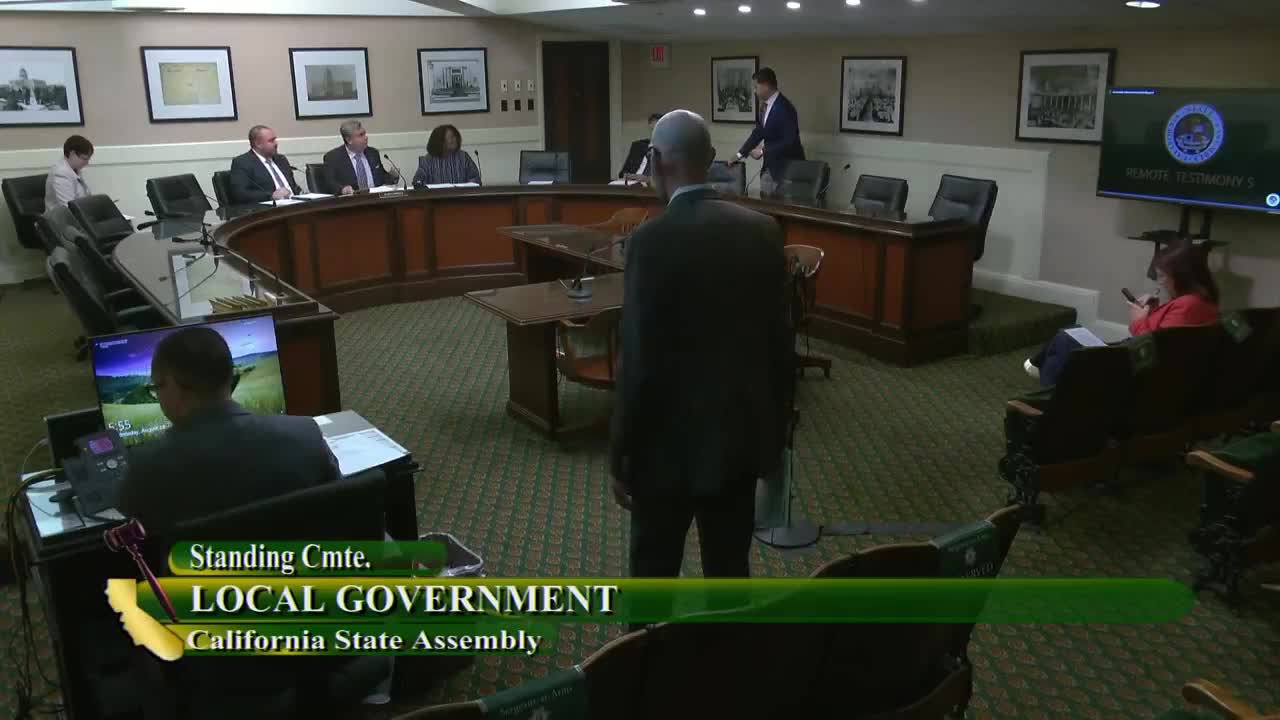 3MIN
Assembly Standing Committee on Local Government
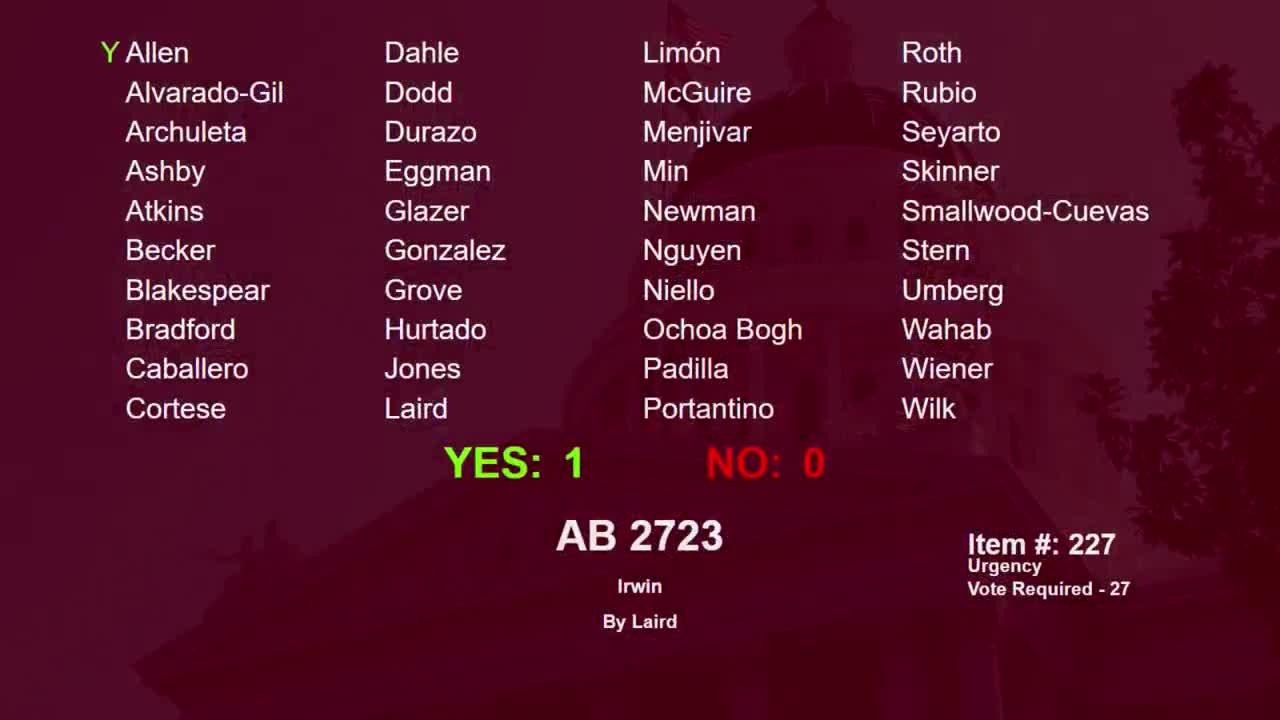 3MIN
Senate Floor
 3MIN
Senate Standing Committee on Local Government
 3MIN
Senate Standing Committee on Revenue and Taxation
 7MIN
Assembly Standing Committee on Water, Parks, and Wildlife
 53SEC
Assembly Standing Committee on Water, Parks, and Wildlife
Bill Author
Bill Co-Author(s):