AB 2454: Drinking water: rental property: domestic well testing.
- Session Year: 2023-2024
- House: Assembly
- Latest Version Date: 2024-09-24
Current Status:
Passed
(2024-09-24: Chaptered by Secretary of State - Chapter 506, Statutes of 2024.)
Introduced
In Committee
First Chamber
In Committee
Second Chamber
Enacted
The California Safe Drinking Water Act provides for the operation of public water systems and imposes on the State Water Resources Control Board various duties and responsibilities for the regulation and control of drinking water in the State of California. The act requires the state board to adopt primary drinking water standards for contaminants in drinking water based upon specified criteria. Existing law makes certain violations of the act a crime.
This bill would require an owner of a domestic well that serves a rental property within the boundaries of a testing program, as defined, to participate in the testing program, as specified. The bill would require the state board to post certain information regarding applicable testing programs on its internet website. The bill would require the owner of a domestic well that serves a rental property to ensure that the test results, and information on how to read and understand the test results, are provided to current residents of the rental property within 10 days of receiving the test results. If the test results demonstrate an exceedance of any primary drinking water standard, and the owner of the domestic well or a resident served by the domestic well is eligible for a program for the provision of safe drinking water, the bill would require the domestic well owner to provide safe drinking water to the residents. The bill would prohibit an owner of a domestic well from imposing any charge, or increasing any fee, rent, or other charge imposed, on any resident solely as a result of the requirements of these provisions.
To the extent that an owner of the rental property, when providing notice of the results of domestic well testing to residents pursuant to these provisions, would make any false statement or representation, this bill would expand the scope of a crime and impose a state-mandated local program.
The California Constitution requires the state to reimburse local agencies and school districts for certain costs mandated by the state. Statutory provisions establish procedures for making that reimbursement.
This bill would provide that no reimbursement is required by this act for a specified reason.
The California Safe Drinking Water Act provides for the operation of public water systems and imposes on the State Water Resources Control Board various duties and responsibilities for the regulation and control of drinking water in the State of California. The act requires the state board to adopt primary drinking water standards for contaminants in drinking water based upon specified criteria. Existing law makes certain violations of the act a crime.
This bill would require an owner of a domestic well that serves a rental property within the boundaries of a testing program, as defined, to participate in the testing program, as specified. The bill would require an owner of the rental property to provide testing results to all current residents of the rental property, as specified. The bill would require, if the testing demonstrates a violation of any primary drinking water standards, the domestic well owner to ensure that, within 14 days of receiving test results, tenants of rental properties served solely by that domestic well have access to an adequate supply of safe drinking water. the state board to post certain information regarding applicable testing programs on its internet website. The bill would require the owner of a domestic well that serves a rental property to ensure that the test results, and information on how to read and understand the test results, are provided to current residents of the rental property within 10 days of receiving the test results. If the test results demonstrate an exceedance of any primary drinking water standard, and the owner of the domestic well or a resident served by the domestic well is eligible for a program for the provision of safe drinking water, the bill would require the domestic well owner to provide safe drinking water to the residents. The bill would prohibit an owner of a domestic well from imposing any charge, or increasing any fee, rent, or other charge imposed, on any resident solely as a result of the requirements of these provisions.
To the extent that an owner of the rental property, when providing notice of the results of domestic well testing to residents pursuant to these provisions, would make any false statement or representation, this bill would expand the scope of a crime and impose a state-mandated local program.
The California Constitution requires the state to reimburse local agencies and school districts for certain costs mandated by the state. Statutory provisions establish procedures for making that reimbursement.
This bill would provide that no reimbursement is required by this act for a specified reason.
The California Safe Drinking Water Act provides for the operation of public water systems and imposes on the State Water Resources Control Board various duties and responsibilities for the regulation and control of drinking water in the State of California. The act requires the state board to adopt primary drinking water standards for contaminants in drinking water based upon specified criteria. Existing law makes certain violations of the act a crime.
This bill would require an owner of a domestic well that serves a rental property who is provided written notice of a free domestic well within the boundaries of a testing program, as defined, to participate in the program and its related requirements, testing program, as specified. The bill would require an owner of the rental property to provide testing results to all current residents of the rental property, as specified. The bill would require, if the testing demonstrates a violation of any primary drinking water standards, the domestic well owner to ensure that, within 14 days of receiving test results, tenants of rental properties served solely by that domestic well have access to an adequate supply of safe drinking water. The bill would prohibit an owner of a domestic well from imposing any charge, or increasing any fee, rent, or other charge imposed, on any tenant resident solely as a result of the requirements of these provisions.To the extent that an owner of the rental property, when providing notice of the results of domestic well testing to tenants residents pursuant to these provisions, would make any false statement or representation, this bill would expand the scope of a crime and impose a state-mandated local program.
The California Constitution requires the state to reimburse local agencies and school districts for certain costs mandated by the state. Statutory provisions establish procedures for making that reimbursement.
This bill would provide that no reimbursement is required by this act for a specified reason.
The California Safe Drinking Water Act provides for the operation of public water systems and imposes on the State Water Resources Control Board various duties and responsibilities for the regulation and control of drinking water in the State of California. The act requires the state board to adopt primary drinking water standards for contaminants in drinking water based upon specified criteria. Existing law makes certain violations of the act a crime.
This bill would require an owner of a domestic well that serves a rental property who is provided written notice of a free domestic well testing program, as defined, to participate in the program and its related requirements, as specified. The bill would require an owner of the rental property to provide testing results to all current residents of the rental property, as specified. The bill would require, if the testing demonstrates a violation of any primary drinking water standards, the domestic well owner to ensure that, within 14 days of receiving test results, tenants of rental properties served solely by that domestic well have access to an adequate supply of safe drinking water. The bill would prohibit an owner of a domestic well from imposing any charge, or increasing any fee, rent, or other charge imposed, on any tenant solely as a result of the requirements of these provisions.
To the extent that an owner of the rental property, when providing notice of the results of domestic well testing to tenants pursuant to these provisions, would make any false statement or representation, this bill would expand the scope of a crime and impose a state-mandated local program.
The California Constitution requires the state to reimburse local agencies and school districts for certain costs mandated by the state. Statutory provisions establish procedures for making that reimbursement.
This bill would provide that no reimbursement is required by this act for a specified reason.
Existing law requires the Department of Toxic Substances Control to establish a statewide Hazardous Waste Strike Force, which consists of a representative from each of specified agencies and which is required to make recommendations regarding programs to uniformly enforce state hazardous waste statutes and regulations, to publicize and improve the statewide telephone number, and to report information concerning violations of those statues and regulations.This bill would add to the task force a representative from the Office of Environmental Health Hazard Assessment and a representative from each of 3 different certified unified program agencies selected by the Secretary for Environmental Protection.To the extent this bill would impose new duties on a certified unified program agency, this bill would create a state-mandated local program. The California Constitution requires the state to reimburse local agencies and school districts for certain costs mandated by the state. Statutory provisions establish procedures for making that reimbursement.This bill would provide that, if the Commission on State Mandates determines that the bill contains costs mandated by the state, reimbursement for those costs shall be made pursuant to the statutory provisions noted above.Existing law requires the Department of Toxic Substances Control to establish a statewide Hazardous Waste Strike Force, which consists of a representative from each of specified agencies and which is required to make recommendations regarding programs to uniformly enforce state hazardous waste statutes and regulations, to publicize and improve the statewide telephone number, and to report information concerning violations of those statues and regulations.
This bill would add to the task force a representative from the Office of Environmental Health Hazard Assessment and a representative from each of 3 different certified unified program agencies selected by the Secretary for Environmental Protection.
To the extent this bill would impose new duties on a certified unified program agency, this bill would create a state-mandated local program.
The California Constitution requires the state to reimburse local agencies and school districts for certain costs mandated by the state. Statutory provisions establish procedures for making that reimbursement.
This bill would provide that, if the Commission on State Mandates determines that the bill contains costs mandated by the state, reimbursement for those costs shall be made pursuant to the statutory provisions noted above.
The following definitions shall apply to this section and Sections 116682, 116684, 116686, and 116688:
(a)Adequate supply means sufficient water to meet residents health and safety needs at all times.
(b)Affected residence means a residence within a disadvantaged community that is reliant on a water supply that is either inadequate or unsafe and that is not served by a public water system or state small water system.
(c)At-risk domestic well means a domestic well that serves a disadvantaged community and is at risk of consistently failing to provide an adequate supply of safe drinking water as determined by the state board pursuant to the methodology established in the 2021 Drinking Water Needs Assessment referenced in subdivision (b) of Section 116769, or a substantially similar methodology adopted by the state board in an update to the Drinking Water Needs Assessment.
(d)At-risk water system means a water system that meets all the following conditions:
(1)The water system is either a public water system with 3,300 or fewer connections or a state small water system.
(2)The system serves a disadvantaged community.
(3)The system is at risk of consistently failing to provide an adequate supply of safe drinking water, as determined by the state board pursuant to the methodology established in the 2021 Drinking Water Needs Assessment referenced in subdivision (b) of Section 116769, or a substantially similar methodology adopted by the state board in an update to the Drinking Water Needs Assessment.
(e)Consistently fails means a failure to provide an adequate supply of safe drinking water.
(f)Consolidated water system means the public water system resulting from the consolidation of a public water system with another public water system, state small water system, or affected residences.
(g)Consolidation means joining two or more public water systems, state small water systems, or affected residences into a single public water system.
(h)Disadvantaged community means a disadvantaged community, as defined in Section 79505.5 of the Water Code.
(i)Domestic well means a groundwater well used to supply water for the domestic needs of an individual residence or a water system that is not a public water system and that has no more than four service connections.
(j)Extension of service means the provision of service through any physical or operational infrastructure arrangement other than consolidation.
(k)Groundwater sustainability agency has the same meaning as provided in Section 10721 of the Water Code.
(l)Infill site means a site within the area served by a subsumed water system that, as of the date of consolidation, is adjacent to a parcel that is developed for a qualified urban use.
(m)Operation period means the period during which an administrator provides services to a designated water system, as provided in paragraph (2) of subdivision (r) of Section 116686.
(n)Qualified urban use means any residential, commercial, public institutional, industrial, transit or transportation facility, or retail use, or any combination of those uses.
(o)Receiving water system means the public water system that provides service to a subsumed water system through consolidation or extension of service.
(p)Safe drinking water means water that meets all primary and secondary drinking water standards.
(q)State small water system has the same meaning as provided in Section 116275.
(r)Subsumed water system means a public water system, state small water system, or affected residences served by domestic wells consolidated into or receiving service from the receiving water system.
SEC. 2.Section 116688 is added to the Health and Safety Code, to read:116688.(a)For the purposes of this section, testing program means a program that provides domestic well testing for one or more primary or secondary drinking water contaminants by a laboratory accredited by the state to conduct drinking water sampling and analysis, that is offered free of charge to the owner of a domestic well or a resident of a rental property served by a domestic well, and that was established by, or receives funding from, the state board or a regional water quality control board.
(b)(1)An owner of a domestic well that serves a rental property that is within the boundaries of a testing program shall participate in the testing program, to the extent that the testing program has capacity, and shall do all of the following:
(A)(i)Request testing for all primary and secondary drinking water contaminants for which testing is provided by the testing program.
(ii)The domestic well owner may request testing for contaminants of emerging concern if offered by the testing program.
(B)Request regular testing as frequently as the testing program recommends, within the capacity of the testing program.
(C)Provide all necessary consent for the testing and for submission of testing results by the accredited laboratory to the state board, to any relevant database maintained by the state board, or to the local health officer or other relevant local agency, depending on the testing programs procedures for sharing testing data.
(2)If a domestic well that serves a rental property is located within the boundaries of more than one testing program, the owner of the domestic well shall be required to participate in only one testing program at a time.
(3)If the owner of a domestic well that serves a rental property does not qualify for a testing program but a resident of the rental property does, the owner shall participate in the testing program on the residents behalf, to the extent allowed by the testing program.
(c)(1)The state board shall post information regarding applicable testing programs on its internet website. The information shall include, but is not limited to, all of the following:
(A)The boundaries of the testing program.
(B)Qualifications for participating in the testing program.
(C)Information on how to participate in the testing program.
(D)The duty of an owner of a domestic well that serves a rental property to comply with the requirements of this section.
(E)Information on how to read and understand test results.
(F)Information on how domestic well users can access safe drinking water, including through programs offered by the state board, regional water quality control boards, or other state agencies.
(2)The state board shall inform all counties within the boundaries of a testing program of the presence of the testing program and of the information described in paragraph (1), and shall encourage the relevant local health officers or other relevant local agencies to share this information with the owners of domestic wells and residents of rental properties served by domestic wells, within the boundaries of the testing program.
(3)The state board and the regional water quality control boards may partner with local agencies and community organizations to spread awareness and educate domestic well owners and residents of rental properties served by domestic wells about testing programs and the requirements of this section.
(d)Within 10 days of receiving test results from a testing program, the owner of a domestic well that serves a rental property shall ensure that the test results, and the information on how to read and understand test results posted by the board pursuant to subparagraph (E) of paragraph (1) of subdivision (c), are provided to current residents of the rental property.
(e)If the test results collected pursuant to this section demonstrate an exceedance of any primary drinking water standard, and the owner of the domestic well or a resident served by the domestic well is eligible for the provision of safe drinking water under a program identified pursuant to subparagraph (F) of paragraph (1) of subdivision (c), the domestic well owner shall provide safe drinking water under that program to residents served by the domestic well.
(f)An owner of a domestic well shall not impose any charge, or increase any fee, rent, or other charge imposed, on any resident solely as a result of the requirements of this section.
(g)This section does not impose any new obligation or requirement on a testing program.
SEC. 3.No reimbursement is required by this act pursuant to Section 6 of Article XIIIB of the California Constitution because the only costs that may be incurred by a local agency or school district will be incurred because this act creates a new crime or infraction, eliminates a crime or infraction, or changes the penalty for a crime or infraction, within the meaning of Section 17556 of the Government Code, or changes the definition of a crime within the meaning of Section 6 of Article XIIIB of the California Constitution.
The following definitions shall apply to this section and Sections 116682, 116684, 116686, and 116688:
(a)Adequate supply means sufficient water to meet residents health and safety needs at all times.
(b)Affected residence means a residence within a disadvantaged community that is reliant on a water supply that is either inadequate or unsafe and that is not served by a public water system or state small water system.
(c)At-risk domestic well means a domestic well that serves a disadvantaged community and is at risk of consistently failing to provide an adequate supply of safe drinking water as determined by the state board pursuant to the methodology established in the 2021 Drinking Water Needs Assessment referenced in subdivision (b) of Section 116769, or a substantially similar methodology adopted by the state board in an update to the Drinking Water Needs Assessment.
(d)At-risk water system means a water system that meets all the following conditions:
(1)The water system is either a public water system with 3,300 or fewer connections or a state small water system.
(2)The system serves a disadvantaged community.
(3)The system is at risk of consistently failing to provide an adequate supply of safe drinking water, as determined by the state board pursuant to the methodology established in the 2021 Drinking Water Needs Assessment referenced in subdivision (b) of Section 116769, or a substantially similar methodology adopted by the state board in an update to the Drinking Water Needs Assessment.
(e)Consistently fails means a failure to provide an adequate supply of safe drinking water.
(f)Consolidated water system means the public water system resulting from the consolidation of a public water system with another public water system, state small water system, or affected residences.
(g)Consolidation means joining two or more public water systems, state small water systems, or affected residences into a single public water system.
(h)Disadvantaged community means a disadvantaged community, as defined in Section 79505.5 of the Water Code.
(i)Domestic well means a groundwater well used to supply water for the domestic needs of an individual residence or a water system that is not a public water system and that has no more than four service connections.
(j)Extension of service means the provision of service through any physical or operational infrastructure arrangement other than consolidation.
(k)Groundwater sustainability agency has the same meaning as provided in Section 10721 of the Water Code.
(l)Infill site means a site within the area served by a subsumed water system that, as of the date of consolidation, is adjacent to a parcel that is developed for a qualified urban use.
(m)Operation period means the period during which an administrator provides services to a designated water system, as provided in paragraph (2) of subdivision (r) of Section 116686.
(n)Qualified urban use means any residential, commercial, public institutional, industrial, transit or transportation facility, or retail use, or any combination of those uses.
(o)Receiving water system means the public water system that provides service to a subsumed water system through consolidation or extension of service.
(p)Safe drinking water means water that meets all primary and secondary drinking water standards.
(q)State small water system has the same meaning as provided in Section 116275.
(r)Subsumed water system means a public water system, state small water system, or affected residences served by domestic wells consolidated into or receiving service from the receiving water system.
SEC. 2.Section 116688 is added to the Health and Safety Code, to read:116688.(a)For the purposes of this section, testing program means a program that provides domestic well testing for one or more primary or secondary drinking water contaminants by a laboratory accredited by the state to conduct drinking water sampling and analysis, that is offered free of charge to the owner of a domestic well or a resident of a rental property served by a domestic well, and that was established by, or receives funding from, the state board or a regional water quality control board.
(b)(1)An owner of a domestic well that serves a rental property that is within the boundaries of a testing program shall participate in the testing program, to the extent that the testing program has capacity, and shall do all of the following:
(1)(A)(A)(i)Request testing for all primary and secondary drinking water contaminants for which testing is provided by the testing program.
(B)(ii)The domestic well owner may request testing for contaminants of emerging concern if offered by the testing program.
(2)(B)Request regular testing as frequently as the testing program recommends, within the capacity of the testing program.
(3)(C)Provide all necessary consent for the testing and for submission of testing results by the accredited laboratory to the state board, to any relevant database maintained by the state board, or to the local health officer or other relevant local agency, depending on the testing programs procedures for sharing testing data.
(c)An owner of the rental property shall provide testing results to all current residents of the rental property within 10 days of receiving those results. The test results shall describe any exceedance of primary or secondary drinking water standards, and shall be provided in English and the primary language spoken by the resident recipient.(d)If the testing results collected pursuant to this section demonstrate a violation of any primary drinking water standards, the domestic well owner shall ensure that, within 14 days of receiving test results, tenants of rental properties served solely by that domestic well have access to an adequate supply of safe drinking water.(2)If a domestic well that serves a rental property is located within the boundaries of more than one testing program, the owner of the domestic well shall be required to participate in only one testing program at a time.
(3)If the owner of a domestic well that serves a rental property does not qualify for a testing program but a resident of the rental property does, the owner shall participate in the testing program on the residents behalf, to the extent allowed by the testing program.
(c)(1)The state board shall post information regarding applicable testing programs on its internet website. The information shall include, but is not limited to, all of the following:
(A)The boundaries of the testing program.
(B)Qualifications for participating in the testing program.
(C)Information on how to participate in the testing program.
(D)The duty of an owner of a domestic well that serves a rental property to comply with the requirements of this section.
(E)Information on how to read and understand test results.
(F)Information on how domestic well users can access safe drinking water, including through programs offered by the state board, regional water quality control boards, or other state agencies.
(2)The state board shall inform all counties within the boundaries of a testing program of the presence of the testing program and of the information described in paragraph (1), and shall encourage the relevant local health officers or other relevant local agencies to share this information with the owners of domestic wells and residents of rental properties served by domestic wells, within the boundaries of the testing program.
(3)The state board and the regional water quality control boards may partner with local agencies and community organizations to spread awareness and educate domestic well owners and residents of rental properties served by domestic wells about testing programs and the requirements of this section.
(d)Within 10 days of receiving test results from a testing program, the owner of a domestic well that serves a rental property shall ensure that the test results, and the information on how to read and understand test results posted by the board pursuant to subparagraph (E) of paragraph (1) of subdivision (c), are provided to current residents of the rental property.
(e)If the test results collected pursuant to this section demonstrate an exceedance of any primary drinking water standard, and the owner of the domestic well or a resident served by the domestic well is eligible for the provision of safe drinking water under a program identified pursuant to subparagraph (F) of paragraph (1) of subdivision (c), the domestic well owner shall provide safe drinking water under that program to residents served by the domestic well.
(e)(f)An owner of a domestic well shall not impose any charge, or increase any fee, rent, or other charge imposed, on any resident solely as a result of the requirements of this section.
(f)This section is exempt from the remedies set forth in this article.(g)This section does not impose any new obligation or requirement on a testing program.
SEC. 3.No reimbursement is required by this act pursuant to Section 6 of Article XIIIB of the California Constitution because the only costs that may be incurred by a local agency or school district will be incurred because this act creates a new crime or infraction, eliminates a crime or infraction, or changes the penalty for a crime or infraction, within the meaning of Section 17556 of the Government Code, or changes the definition of a crime within the meaning of Section 6 of Article XIIIB of the California Constitution.
The following definitions shall apply to this section and Sections 116682, 116684, 116686, and 116688:
(a)Adequate supply means sufficient water to meet residents health and safety needs at all times.
(b)Affected residence means a residence within a disadvantaged community that is reliant on a water supply that is either inadequate or unsafe and that is not served by a public water system or state small water system.
(c)At-risk domestic well means a domestic well that serves a disadvantaged community and is at risk of consistently failing to provide an adequate supply of safe drinking water as determined by the state board pursuant to the methodology established in the 2021 Drinking Water Needs Assessment referenced in subdivision (b) of Section 116769, or a substantially similar methodology adopted by the state board in an update to the Drinking Water Needs Assessment.
(d)At-risk water system means a water system that meets all the following conditions:
(1)The water system is either a public water system with 3,300 or fewer connections or a state small water system.
(2)The system serves a disadvantaged community.
(3)The system is at risk of consistently failing to provide an adequate supply of safe drinking water, as determined by the state board pursuant to the methodology established in the 2021 Drinking Water Needs Assessment referenced in subdivision (b) of Section 116769, or a substantially similar methodology adopted by the state board in an update to the Drinking Water Needs Assessment.
(e)Consistently fails means a failure to provide an adequate supply of safe drinking water.
(f)Consolidated water system means the public water system resulting from the consolidation of a public water system with another public water system, state small water system, or affected residences.
(g)Consolidation means joining two or more public water systems, state small water systems, or affected residences into a single public water system.
(h)Disadvantaged community means a disadvantaged community, as defined in Section 79505.5 of the Water Code.
(i)Domestic well means a groundwater well used to supply water for the domestic needs of an individual residence or a water system that is not a public water system and that has no more than four service connections.
(j)Extension of service means the provision of service through any physical or operational infrastructure arrangement other than consolidation.
(k)Groundwater sustainability agency has the same meaning as provided in Section 10721 of the Water Code.
(l)Infill site means a site within the area served by a subsumed water system that, as of the date of consolidation, is adjacent to a parcel that is developed for a qualified urban use.
(m)Operation period means the period during which an administrator provides services to a designated water system, as provided in paragraph (2) of subdivision (r) of Section 116686.
(n)Qualified urban use means any residential, commercial, public institutional, industrial, transit or transportation facility, or retail use, or any combination of those uses.
(o)Receiving water system means the public water system that provides service to a subsumed water system through consolidation or extension of service.
(p)Safe drinking water means water that meets all primary and secondary drinking water standards.
(q)State small water system has the same meaning as provided in Section 116275.
(r)Subsumed water system means a public water system, state small water system, or affected residences served by domestic wells consolidated into or receiving service from the receiving water system.
SEC. 2.Section 116688 is added to the Health and Safety Code, to read:116688.(a)For the purposes of this section, free domestic well testing testing program means a program that provides domestic well testing for one or more primary or secondary drinking water contaminants by a laboratory certified accredited by the state to conduct drinking water sampling and analysis, that is offered free of charge to the owner of a domestic well, and that is funded by any of the following: well or a resident of a rental property served by a domestic well, and that was established by, or receives funding from, the state board or a regional water quality control board.
(1)Any fund or program to test domestic wells established by any California regional water quality control board pursuant to Chapter 4 (commencing with Section 13200) of Division 7 of the Water Code.(2)Any fund or program to test domestic wells established by the state board pursuant to Article 3 (commencing with Section 13440) of Chapter 6 of Division 7 of the Water Code.(3)Any well mitigation funds or programs established by a groundwater sustainability agency pursuant to Part 2.74 (commencing with Section 10720) of Division 6 of the Water Code.(4)Any funds or programs established by the fund expenditure plan developed by the state board pursuant to Section 116768.5.(5)Any other fund or program created to provide domestic well testing at no cost to the owner of the domestic well, including, but not limited to, state funds, federal funds, bond funds, voluntary agreements, settlement agreements, and judgments.(b)An owner of a domestic well that serves a rental property who is provided written notice that is within the boundaries of a free domestic well testing program shall participate in the program and its related requirements testing program, to the extent that the testing program has capacity, and shall do all of the following:(1)(A)Request testing for all primary and secondary drinking water contaminants, or contaminants of emerging concern, contaminants for which testing is provided by the testing program.(B)The domestic well owner may request testing for contaminants of emerging concern if offered by the testing program.
(2)Request followup testing annually, or if the program does not offer annual testing, request followup regular testing as frequently as the program permits. testing program recommends, within the capacity of the testing program.(3)Provide all necessary consent for the testing, testing and for submission of testing results by the certified accredited laboratory to the Division of Drinking Water and any public state board, to any relevant database maintained by the state board. board, or to the local health officer or other relevant local agency, depending on the testing programs procedures for sharing testing data.(c)Written notice to the owner of the domestic well pursuant to subdivision (b) shall be provided by mailing a description of the relevant domestic well testing program to the owner of the domestic well at their last known address and to a current resident of the rental property.(d)(c)An owner of the rental property shall provide testing results to all current residents of the rental property within 10 days of receiving those results. The test results shall describe any exceedance of primary or secondary drinking water standards, and shall be provided in English and the primary language spoken by the resident recipient.
(e)(d)If the testing results collected pursuant to this section demonstrate a violation of any primary drinking water standards, the domestic well owner shall ensure that, within 14 days of receiving test results, tenants of rental properties served solely by that domestic well have access to an adequate supply of safe drinking water.
(f)(e)An owner of a domestic well shall not impose any charge, or increase any fee, rent, or other charge imposed, on any tenant resident solely as a result of the requirements of this section.
(g)(f)This section is exempt from the remedies set forth in this article.
SEC. 3.No reimbursement is required by this act pursuant to Section 6 of Article XIIIB of the California Constitution because the only costs that may be incurred by a local agency or school district will be incurred because this act creates a new crime or infraction, eliminates a crime or infraction, or changes the penalty for a crime or infraction, within the meaning of Section 17556 of the Government Code, or changes the definition of a crime within the meaning of Section 6 of Article XIIIB of the California Constitution.
The following definitions shall apply to this section and Sections 116682, 116684, and 116686: 116686, and 116688:
(a)Adequate supply means sufficient water to meet residents health and safety needs at all times.
(b)Affected residence means a residence within a disadvantaged community that is reliant on a water supply that is either inadequate or unsafe and that is not served by a public water system or state small water system.
(c)At-risk domestic well means a domestic well that serves a disadvantaged community and is at risk of consistently failing to provide an adequate supply of safe drinking water as determined by the state board pursuant to the methodology established in the 2021 Drinking Water Needs Assessment referenced in subdivision (b) of Section 116769, or a substantially similar methodology adopted by the state board in an update to the Drinking Water Needs Assessment.
(d)At-risk water system means a water system that meets all the following conditions:
(1)The water system is either a public water system with 3,300 or fewer connections or a state small water system.
(2)The system serves a disadvantaged community.
(3)The system is at risk of consistently failing to provide an adequate supply of safe drinking water, as determined by the state board pursuant to the methodology established in the 2021 Drinking Water Needs Assessment referenced in subdivision (b) of Section 116769, or a substantially similar methodology adopted by the state board in an update to the Drinking Water Needs Assessment.
(e)Consistently fails means a failure to provide an adequate supply of safe drinking water.
(f)Consolidated water system means the public water system resulting from the consolidation of a public water system with another public water system, state small water system, or affected residences.
(g)Consolidation means joining two or more public water systems, state small water systems, or affected residences into a single public water system.
(h)Disadvantaged community means a disadvantaged community, as defined in Section 79505.5 of the Water Code.
(i)Domestic well means a groundwater well used to supply water for the domestic needs of an individual residence or a water system that is not a public water system and that has no more than four service connections.
(j)Extension of service means the provision of service through any physical or operational infrastructure arrangement other than consolidation.
(k)Groundwater sustainability agency has the same meaning as provided in Section 10721 of the Water Code.
(l)Infill site means a site within the area served by a subsumed water system that, as of the date of consolidation, is adjacent to a parcel that is developed for a qualified urban use.
(m)Operation period means the period during which an administrator provides services to a designated water system, as provided in paragraph (2) of subdivision (r) of Section 116686.
(n)Qualified urban use means any residential, commercial, public institutional, industrial, transit or transportation facility, or retail use, or any combination of those uses.
(o)Receiving water system means the public water system that provides service to a subsumed water system through consolidation or extension of service.
(p)Safe drinking water means water that meets all primary and secondary drinking water standards.
(q)State small water system has the same meaning as provided in Section 116275.
(r)Subsumed water system means a public water system, state small water system, or affected residences served by domestic wells consolidated into or receiving service from the receiving water system.
SEC. 2.Section 116688 is added to the Health and Safety Code, to read:116688.(a)For the purposes of this section, free domestic well testing program means a program that provides domestic well testing for one or more contaminants by a laboratory certified by the state to conduct drinking water sampling and analysis, that is offered free of charge to the owner of a domestic well, and that is funded by any of the following:
(1)Any fund or program to test domestic wells established by any California regional water quality control board pursuant to Chapter 4 (commencing with Section 13200) of Division 7 of the Water Code.
(2)Any fund or program to test domestic wells established by the state board pursuant to Article 3 (commencing with Section 13440) of Chapter 6 of Division 7 of the Water Code.
(3)Any well mitigation funds or programs established by a groundwater sustainability agency pursuant to Part 2.74 (commencing with Section 10720) of Division 6 of the Water Code.
(4)Any funds or programs established by the fund expenditure plan developed by the state board pursuant to Section 116768.5.
(5)Any other fund or program created to provide domestic well testing at no cost to the owner of the domestic well, including, but not limited to, state funds, federal funds, bond funds, voluntary agreements, settlement agreements, and judgments.
(b)An owner of a domestic well that serves a rental property who is provided written notice of a free domestic well testing program shall participate in the program and its related requirements and shall do all of the following:
(1)Request testing for all primary and secondary drinking water contaminants, or contaminants of emerging concern, for which testing is provided by the program.
(2)Request followup testing annually, or if the program does not offer annual testing, request followup testing as frequently as the program permits.
(3)Provide all necessary consent for the testing, and for submission of testing results by the certified laboratory to the Division of Drinking Water and any public database maintained by the state board.
(c)Written notice to the owner of the domestic well pursuant to subdivision (b) shall be provided by mailing a description of the relevant domestic well testing program to the owner of the domestic well at their last known address and to a current resident of the rental property.
(d)An owner of the rental property shall provide testing results to all current residents of the rental property within 10 days of receiving those results. The test results shall describe any exceedance of primary or secondary drinking water standards, and shall be provided in English and the primary language spoken by the resident recipient.
(e)If the testing results collected pursuant to this section demonstrate a violation of any primary drinking water standards, the domestic well owner shall ensure that, within 14 days of receiving test results, tenants of rental properties served solely by that domestic well have access to an adequate supply of safe drinking water.
(f)An owner of a domestic well shall not impose any charge, or increase any fee, rent, or other charge imposed, on any tenant solely as a result of the requirements of this section.
(g)This section is exempt from the remedies set forth in this article.
SEC. 3.No reimbursement is required by this act pursuant to Section 6 of Article XIIIB of the California Constitution because the only costs that may be incurred by a local agency or school district will be incurred because this act creates a new crime or infraction, eliminates a crime or infraction, or changes the penalty for a crime or infraction, within the meaning of Section 17556 of the Government Code, or changes the definition of a crime within the meaning of Section 6 of Article XIIIB of the California Constitution.
SECTION 1.Section 25197.2 of the Health and Safety Code is amended to read:25197.2.(a)The department shall establish a statewide Hazardous Waste Strike Force that shall consist of a representative from each of the following agencies:(1)The Department of Transportation.(2)The Department of Industrial Relations.(3)The Department of Food and Agriculture.(4)The State Water Resources Control Board.(5)The State Air Resources Board.(6)The Department of the California Highway Patrol.(7)The Office of the State Fire Marshal in the Department of Forestry and Fire Protection.(8)The Department of Resources Recycling and Recovery.(9)The Department of Fish and Wildlife.(10)The Office of Emergency Services.(11)The Department of Toxic Substances Control.(12)The Attorney General.(13)The Department of Pesticide Regulation.(14)The Office of Environmental Health Hazard Assessment.(15)Three different certified unified program agencies, selected by the Secretary for Environmental Protection.(b)The director, or the directors designee, shall direct and coordinate the activities of the Hazardous Waste Strike Force.(c)The Hazardous Waste Strike Force shall do all of the following:(1)Recommend standardized programs among the agencies represented on the Hazardous Waste Strike Force for the purposes of uniformly enforcing state hazardous waste statutes and regulations and reporting violators of these statutes and regulations.(2)Recommend programs to publicize and improve the statewide telephone number established pursuant to paragraph (5) of subdivision (b) of Section 25197.1.(3)Recommend local and regional programs to report information concerning violations of this chapter and any other hazardous waste statutes and regulations.SEC. 2.If the Commission on State Mandates determines that this act contains costs mandated by the state, reimbursement to local agencies and school districts for those costs shall be made pursuant to Part 7 (commencing with Section 17500) of Division 4 of Title 2 of the Government Code.(a)The department shall establish a statewide Hazardous Waste Strike Force which that shall consist of a representative from each of the following agencies:
(1)The Department of Transportation.
(2)The Department of Industrial Relations.
(3)The Department of Food and Agriculture.
(4)The State Water Resources Control Board.
(5)The State Air Resources Board.
(6)The Department of the California Highway Patrol.
(7)The Office of the State Fire Marshal in the Department of Forestry and Fire Protection.
(8)The California Integrated Waste Management Board. Department of Resources Recycling and Recovery.
(9)The Department of Fish and Game. Wildlife.
(10)The Office of Emergency Services.
(11)The Department of Toxic Substances Control.
(12)The Attorney General.
(13)The Department of Pesticide Regulation.
(14)The Office of Environmental Health Hazard Assessment.
(15)Three different certified unified program agencies, selected by the Secretary for Environmental Protection.
(b)The director, or the directors designee, shall direct and coordinate the activities of the Hazardous Waste Strike Force.
(c)The Hazardous Waste Strike Force shall do all of the following:
(1)Recommend standardized programs among the agencies represented on the Hazardous Waste Strike Force for the purposes of uniformly enforcing state hazardous waste statutes and regulations and reporting violators of these statutes and regulations.
(2)Recommend programs to publicize and improve the statewide telephone number established pursuant to paragraph (5) of subdivision (b) of Section 25197.1.
(3)Recommend local and regional programs to report information concerning violations of this chapter and any other hazardous waste statutes and regulations.
SEC. 2.If the Commission on State Mandates determines that this act contains costs mandated by the state, reimbursement to local agencies and school districts for those costs shall be made pursuant to Part 7 (commencing with Section 17500) of Division 4 of Title 2 of the Government Code.
|
Date
|
Status
|
|---|---|
| Sep 24, 2024 | Chaptered by Secretary of State - Chapter 506, Statutes of 2024. |
| Sep 24, 2024 | Approved by the Governor. |
| Sep 11, 2024 | Enrolled and presented to the Governor at 4 p.m. |
| Aug 29, 2024 | Senate amendments concurred in. To Engrossing and Enrolling. (Ayes 61. Noes 0.). |
| Aug 29, 2024 | Assembly Rule 77 suspended. |
| Aug 28, 2024 | In Assembly. Concurrence in Senate amendments pending. May be considered on or after August 30 pursuant to Assembly Rule 77. |
| Aug 28, 2024 | Read third time. Passed. Ordered to the Assembly. (Ayes 31. Noes 6.). |
| Aug 26, 2024 | Read second time. Ordered to third reading. |
| Aug 22, 2024 | Read third time and amended. Ordered to second reading. |
| Aug 19, 2024 | Read second time. Ordered to third reading. |
| Aug 15, 2024 | Read second time and amended. Ordered returned to second reading. |
| Aug 15, 2024 | From committee: Amend, and do pass as amended. (Ayes 5. Noes 2.) (August 15). |
| Aug 5, 2024 | In committee: Referred to APPR suspense file. |
| Jul 3, 2024 | From committee: Do pass and re-refer to Com. on APPR. (Ayes 5. Noes 0.) (July 3). Re-referred to Com. on APPR. |
| Jun 5, 2024 | Referred to Com. on E.Q. |
| May 23, 2024 | In Senate. Read first time. To Com. on RLS. for assignment. |
| May 22, 2024 | Read third time. Passed. Ordered to the Senate. (Ayes 59. Noes 0. Page 5478.) |
| May 20, 2024 | Read second time. Ordered to third reading. |
| May 16, 2024 | From committee: Do pass. (Ayes 11. Noes 1.) (May 16). |
| May 8, 2024 | In committee: Set, first hearing. Referred to APPR. suspense file. |
| Apr 24, 2024 | From committee: Do pass and re-refer to Com. on APPR. (Ayes 5. Noes 0.) (April 23). Re-referred to Com. on APPR. |
| Apr 16, 2024 | Re-referred to Com. on E.S. & T.M. |
| Apr 15, 2024 | From committee chair, with author's amendments: Amend, and re-refer to Com. on E.S. & T.M. Read second time and amended. |
| Feb 26, 2024 | Referred to Com. on E.S. & T.M. |
| Feb 14, 2024 | From printer. May be heard in committee March 15. |
| Feb 13, 2024 | Read first time. To print. |
|
Date
|
Description
|
Location
|
Votes
|
|
|---|---|---|---|---|
| Aug 29, 2024 | AB 2454 Lee Concurrence in Senate Amendments | Assembly Floor |
Passed |
|
| Aug 28, 2024 | Assembly 3rd Reading AB2454 Lee By Allen | Senate Floor |
Passed |
|
| Aug 15, 2024 | Do pass as amended | Senate Standing Committee on Appropriations |
Passed |
|
| Aug 5, 2024 | Placed on suspense file | Senate Standing Committee on Appropriations |
Passed |
|
| Jul 3, 2024 | Do pass, but first be re-referred to the Committee on [Appropriations] | Senate Standing Committee on Environmental Quality |
Passed |
|
| May 22, 2024 | AB 2454 Lee Assembly Third Reading | Assembly Floor |
Passed |
|
| May 16, 2024 | Do pass. | Assembly Standing Committee on Appropriations |
Passed |
|
| Apr 23, 2024 | Do pass and be re-referred to the Committee on [Appropriations] | Assembly Standing Committee on Environmental Safety and Toxic Materials |
Passed |
This list shows positions taken on this bill by organizations on the date displayed, which is linked to the original source.
Positions by individuals are not included.
|
Organization
|
Position
|
Date
|
|---|---|---|
| Californians for Pesticide Reform | * Support | Apr 23, 2024 |
| Carbon Cycle Institute | ** Support | |
| Clean Water Action | ** Support | |
| cleanearth4kids.org | ** Support | |
| Community Water Center | ** Support | |
| Environmental Working Group | ** Support | |
| Human Impact Partners | ** Support | |
| Leadership Counsel for Justice and Accountability | ** Support | |
| Rural Community Assistance Corporation | ** Support | |
| Safe Ag, Safe Schools | * Support | Apr 23, 2024 |
| Self-Help Enterprises | ** Support | |
| Self-Help Enterprises | * Support | Jul 3, 2024 |
CONCURRENCE IN SENATE AMENDMENTS
CSA1 Bill Id:AB 2454
Author:(Lee)
As Amended Ver:August 22, 2024
Majority vote
SUMMARY
Requires a domestic well owner—if their well serves a rental property that is located within the boundaries of a testing program, which provides free testing for drinking water contaminants and was established by or receives funding from the State Water Resources Control Board (State Water Board) or a Regional Water Quality Control Board (Regional Water Board)—to participate in the program, communicate the test results to residents of the rental property, and, if a program exists to support it, provide residents with safe drinking water.
Senate Amendments
- Make changes to the definition of a "testing program," to mean a program that provides domestic well testing for one or more primary or secondary drinking water contaminants by a laboratory accredited by the state to conduct drinking water sampling and analysis, that is offered free of charge to the owner of a domestic well or a resident of a rental property served by a domestic well, and that was established by, or receives funding from, the State Water Board or a Regional Water Board.
- Delete provisions specifying that the requirement for an owner of a domestic well that serves a rental property to participate in a free domestic well testing program applies, if the program is funded by any of the following: any fund or program to test domestic wells established by any Regional Water Board pursuant to the Porter-Cologne Water Quality Control Act; any fund or program to test domestic wells established by the State Water Board pursuant to the Cleanup and Abatement Account; any well mitigation funds or programs established by a groundwater sustainability agency pursuant to the Sustainable Groundwater Management Act; any funds or programs established by the fund expenditure plan, developed by the State Water Board for the Safe and Affordable Drinking Water Fund; and, any other fund or program created to provide domestic well testing at no cost to the owner of the domestic well, including, but not limited to, state funds, federal funds, bond funds, voluntary agreements, settlement agreements, and judgements.
- Delete a requirement for the owner of a domestic well that serves a rental property to participate in a testing program if they are provided written notice; instead, require the owner of a domestic well that serves a rental property that is within the boundaries of a testing program to participate in the testing program, to the extent that the testing program has capacity.
- Delete a requirement for a domestic well owner to request testing for contaminants of emerging concern; instead, authorize a domestic well owner to request testing for contaminants of emerging concern if offered by the testing program.
- Delete a requirement for domestic well owners to request follow-up testing annually; instead, require that domestic well owners request regular testing as frequently as the testing program recommends, within the capacity of the testing program.
- Require domestic well owners to provide necessary consent for submission of testing results by an accredited laboratory to the State Water Board, any relevant database maintained by the State Water Board, or to the local health officer or other relevant local agency, depending upon the testing program's procedures for sharing testing data.
- Delete a requirement that written notice of a domestic well testing program be provided by mailing a description of the relevant testing program to the domestic well owner at their last known address and to a current resident of the rental property.
- Delete requirements for a rental property owner to provide testing results to all current residents of the rental property within 10 days of receiving the results, for the test results to describe any exceedance of primary or secondary drinking water standards, and for the test results to be provided in English and the primary language spoken by the resident recipient.
- Require, within 10 days of receiving test results from a testing program, the owner of a domestic well that serves a rental property to ensure that the test results, and information posted by the State Water Board on how to read and understand test results, are provided to current residents of the rental property.
- Delete a requirement for a domestic well owner, if test results show a violation of any primary drinking water standard, to ensure that tenants of rental properties served solely by that domestic well have access to an adequate supply of safe drinking water, within 14 days of receiving the test results.
- Require, if a domestic well that serves a rental property is located within the boundaries of more than one testing program, the domestic well owner to participate in only one testing program at a time.
- Require a domestic well owner to participate in a testing program on a resident's behalf, to the extent allowed by the program, if the owner of a domestic well does not qualify for the program, but a resident of a rental property served by the well does.
- Require the State Water Board to post on its website specified information regarding applicable testing programs, including qualifications for participating in the testing program and information on how domestic well users can access safe drinking water through programs offered by the State Water Board, Regional Water Boards, or other state agencies.
- Require, if test results demonstrate an exceedance of any primary drinking water standard, and the domestic well owner or a resident served by the domestic well is eligible for the provision of safe drinking water under a program offered by the State Water Board, Regional Water Boards, or other state agencies (as identified on the State Water Board's website), the domestic well owner to provide safe drinking water under that program to residents served by the domestic well.
- Require the State Water Board to inform all counties within testing program boundaries of the presence of the testing program and other specified information, and to encourage relevant local health officers or other local agencies to share this information with domestic well owners and residents of rental properties served by domestic wells within the testing program's boundaries.
- Authorize the State Water Board and Regional Water Boards to partner with local agencies and community organizations, to spread awareness and educate domestic well owners and residents of rental properties served by domestic wells about testing programs and the requirements established by this bill.
- Delete a provision exempting the remedies established under this bill from the California Safe Drinking Water Act.
- Specify that the requirements under this bill do not impose any new obligation or requirement on a testing program.
- Make technical and clarifying changes.
COMMENTS
Domestic wells and inequitable access to safe drinking water: State law defines a domestic well as a groundwater well used to supply water for the domestic needs of an individual residence, or a water system that is not a public water system and has no more than four service connections. According to the State Water Board, domestic wells are typically used by single family homeowners for private use and consumption. The State Water Board notes that one million Californians lack access to water that is reliably safe for drinking. In its 2022 Drinking Water Needs Assessment, the State Water Board reports that across the state, an estimated 33% of domestic wells are located in disadvantaged or severely disadvantaged communities, and 43% of wells in these communities are identified as at-risk, or located in areas where groundwater is at high risk of containing contaminants that exceed safe drinking water standards. At-risk domestic wells may exceed drinking water standards established for multiple contaminants, including nitrate; arsenic; radioactive chemicals; 1,2,3 trichloropropane; uranium; and hexavalent chromium.
Domestic well regulation: Neither the United States Environmental Protection Agency nor the State Water Board regulates domestic wells, although both recommend annual testing of wells used for drinking water. According to the State Water Board's 2015 guide on domestic wells, well owners must obtain permits from local environmental health agencies or local water districts before well construction, modification, or destruction. The Department of Water Resources and the State Water Board have established well construction standards; however, the state does not maintain water quality standards, or testing or remediation requirements, for domestic wells.
Domestic well testing programs: In prior years, the State Water Board implemented the Domestic Well Project (Project), which sampled the private wells of volunteer well owners on a county-by-county basis. From 2002 to 2011, the Project sampled over 1,100 wells in Yuba, El Dorado, Tehama, Tulare, San Diego, and Monterey Counties for commonly detected chemicals, including nitrate, trace metals, volatile organic compounds, pesticides, and radionuclides. Since 2011, the Project has been on hold pending additional funding. However, the results show that domestic well contamination is a statewide problem.
Although California does not maintain statewide requirements or programs explicitly focused on water quality testing for domestic wells, funds issued by the State Water Board have been used to support regional domestic well testing programs, such as the Self Help Enterprises Household Solutions Program and the Central Valley Salinity Alternatives for Long-Term Sustainability (CV-SALTS) Program. According to supporters of this bill—including community-based organizations that are engaged in on-the-ground efforts to help households access well testing through initiatives such as CV-SALTS—tenants in some instances are unable to benefit from free well testing programs, when domestic well owners decline to participate or are unresponsive to a written invitation to participate. The sponsors of AB 2454 maintain that this barrier to participation for tenants is one reason that free domestic well testing programs only reach a fraction of households at risk for exposure to dangerous contaminants.
This bill: California currently lacks explicit statewide protections for tenants who rely on domestic wells for drinking water. AB 2454 proposes to help address this issue by requiring domestic well owners—if their well serves a rental property located within the boundaries of a free domestic well testing program, established or funded by the State Water Board or a Regional Water Board—to participate in the program, communicate the test results to tenants, and, if a program exists to support it, provide tenants with safe drinking water.
According to the Author
"Everyone should have the same human right to access safe drinking water. Unfortunately, despite the existence of free domestic well testing programs in many regions of the state, domestic well participation remains far too low, putting people at risk of exposure to dangerous contaminants. This bill would require domestic well owners to participate in these free programs, and where contamination exists, to ensure that those being serviced by wells have an adequate supply of safe drinking water, thereby helping to prevent people from drinking toxic tap water."
Arguments in Support
According to a coalition of supporting organizations:
"While well testing and mitigation can be costly, several local and state funded programs exist to provide essential resources such as bottled water deliveries, hauled water, or water quality testing at no cost to the well owner...However, current law does not require the owner of a domestic well owner serving a rental property to participate in these free domestic well testing programs, or to ensure that tenants have an adequate supply of safe drinking water when a contamination problem is found. The result is that many tenants cannot access these programs, and that they are not nearly as effective or equitable as they should be when a domestic well owner does not reside on-site, is unresponsive, or if they decline to receive these essential services.
This bill would help ensure that a tenant living in areas where federal, state, or locally funded domestic well testing programs can access these programs, minimizing their potential exposure to toxic chemicals, and improving the ability of state and regional partners to effectively address groundwater contamination and provide access to safe drinking water."
Arguments in Opposition
None on file.
FISCAL COMMENTS
According to the Senate Appropriations Committee, should this bill be enacted, the State Water Board estimates initial annual costs of $225,000 for outreach and education. The State Water Board also notes that enforcement costs, while unknown at this time, could exceed $675,000 annually as the state collects additional data on the number and locations of rental properties served by domestic wells.
VOTES:
ASM ENVIRONMENTAL SAFETY AND TOXIC MATERIALS: 5-0-2
YES: Garcia, Connolly, McKinnor, Papan, Reyes
ABS, ABST OR NV: Hoover, Ta
ASM APPROPRIATIONS: 11-1-3
YES: Wicks, Arambula, Bryan, Calderon, Wendy Carrillo, Mike Fong, Grayson, Haney, Hart, Pellerin, Villapudua
NO: Dixon
ABS, ABST OR NV: Sanchez, Jim Patterson, Ta
ASSEMBLY FLOOR: 59-0-21
YES: Addis, Aguiar-Curry, Alanis, Alvarez, Arambula, Bains, Bauer-Kahan, Bennett, Berman, Boerner, Bonta, Bryan, Juan Carrillo, Wendy Carrillo, Connolly, Mike Fong, Gabriel, Garcia, Gipson, Grayson, Haney, Hart, Irwin, Jackson, Jones-Sawyer, Kalra, Lee, Low, Lowenthal, Maienschein, McCarty, McKinnor, Muratsuchi, Stephanie Nguyen, Ortega, Pacheco, Papan, Pellerin, Petrie-Norris, Quirk-Silva, Ramos, Rendon, Reyes, Rodriguez, Blanca Rubio, Santiago, Schiavo, Soria, Ting, Valencia, Villapudua, Waldron, Ward, Weber, Wicks, Wilson, Wood, Zbur, Robert Rivas
ABS, ABST OR NV: Calderon, Cervantes, Chen, Megan Dahle, Davies, Dixon, Essayli, Flora, Vince Fong, Friedman, Gallagher, Holden, Hoover, Lackey, Mathis, Jim Patterson, Joe Patterson, Luz Rivas, Sanchez, Ta, Wallis
SENATE FLOOR: 31-6-3
YES: Allen, Archuleta, Ashby, Atkins, Becker, Blakespear, Bradford, Caballero, Cortese, Dodd, Durazo, Eggman, Glazer, Gonzalez, Hurtado, Laird, Limón, McGuire, Menjivar, Min, Newman, Padilla, Portantino, Roth, Rubio, Skinner, Smallwood-Cuevas, Stern, Umberg, Wahab, Wiener
NO: Dahle, Grove, Jones, Niello, Seyarto, Wilk
ABS, ABST OR NV: Alvarado-Gil, Nguyen, Ochoa Bogh
UPDATED
VERSION: August 22, 2024
CONSULTANT: Naomi Ondrasek / E.S. & T.M. / (916) 319-3965 FN: 0004920
CONCURRENCE IN SENATE AMENDMENTS
CSA1 Bill Id:AB 2454
Author:(Lee)
As Amended Ver:August 22, 2024
Majority vote
SUMMARY
Requires a domestic well owner—if their well serves a rental property that is located within the boundaries of a testing program, which provides free testing for drinking water contaminants and was established by or receives funding from the State Water Resources Control Board (State Water Board) or a Regional Water Quality Control Board (Regional Water Board)—to participate in the program, communicate the test results to residents of the rental property, and, if a program exists to support it, provide residents with safe drinking water.
Senate Amendments
- Make changes to the definition of a "testing program," to mean a program that provides domestic well testing for one or more primary or secondary drinking water contaminants by a laboratory accredited by the state to conduct drinking water sampling and analysis, that is offered free of charge to the owner of a domestic well or a resident of a rental property served by a domestic well, and that was established by, or receives funding from, the State Water Board or a Regional Water Board.
- Delete provisions specifying that the requirement for an owner of a domestic well that serves a rental property to participate in a free domestic well testing program applies, if the program is funded by any of the following: any fund or program to test domestic wells established by any Regional Water Board pursuant to the Porter-Cologne Water Quality Control Act; any fund or program to test domestic wells established by the State Water Board pursuant to the Cleanup and Abatement Account; any well mitigation funds or programs established by a groundwater sustainability agency pursuant to the Sustainable Groundwater Management Act; any funds or programs established by the fund expenditure plan, developed by the State Water Board for the Safe and Affordable Drinking Water Fund; and, any other fund or program created to provide domestic well testing at no cost to the owner of the domestic well, including, but not limited to, state funds, federal funds, bond funds, voluntary agreements, settlement agreements, and judgements.
- Delete a requirement for the owner of a domestic well that serves a rental property to participate in a testing program if they are provided written notice; instead, require the owner of a domestic well that serves a rental property that is within the boundaries of a testing program to participate in the testing program, to the extent that the testing program has capacity.
- Delete a requirement for a domestic well owner to request testing for contaminants of emerging concern; instead, authorize a domestic well owner to request testing for contaminants of emerging concern if offered by the testing program.
- Delete a requirement for domestic well owners to request follow-up testing annually; instead, require that domestic well owners request regular testing as frequently as the testing program recommends, within the capacity of the testing program.
- Require domestic well owners to provide necessary consent for submission of testing results by an accredited laboratory to the State Water Board, any relevant database maintained by the State Water Board, or to the local health officer or other relevant local agency, depending upon the testing program's procedures for sharing testing data.
- Delete a requirement that written notice of a domestic well testing program be provided by mailing a description of the relevant testing program to the domestic well owner at their last known address and to a current resident of the rental property.
- Delete requirements for a rental property owner to provide testing results to all current residents of the rental property within 10 days of receiving the results, for the test results to describe any exceedance of primary or secondary drinking water standards, and for the test results to be provided in English and the primary language spoken by the resident recipient.
- Require, within 10 days of receiving test results from a testing program, the owner of a domestic well that serves a rental property to ensure that the test results, and information posted by the State Water Board on how to read and understand test results, are provided to current residents of the rental property.
- Delete a requirement for a domestic well owner, if test results show a violation of any primary drinking water standard, to ensure that tenants of rental properties served solely by that domestic well have access to an adequate supply of safe drinking water, within 14 days of receiving the test results.
- Require, if a domestic well that serves a rental property is located within the boundaries of more than one testing program, the domestic well owner to participate in only one testing program at a time.
- Require a domestic well owner to participate in a testing program on a resident's behalf, to the extent allowed by the program, if the owner of a domestic well does not qualify for the program, but a resident of a rental property served by the well does.
- Require the State Water Board to post on its website specified information regarding applicable testing programs, including qualifications for participating in the testing program and information on how domestic well users can access safe drinking water through programs offered by the State Water Board, Regional Water Boards, or other state agencies.
- Require, if test results demonstrate an exceedance of any primary drinking water standard, and the domestic well owner or a resident served by the domestic well is eligible for the provision of safe drinking water under a program offered by the State Water Board, Regional Water Boards, or other state agencies (as identified on the State Water Board's website), the domestic well owner to provide safe drinking water under that program to residents served by the domestic well.
- Require the State Water Board to inform all counties within testing program boundaries of the presence of the testing program and other specified information, and to encourage relevant local health officers or other local agencies to share this information with domestic well owners and residents of rental properties served by domestic wells within the testing program's boundaries.
- Authorize the State Water Board and Regional Water Boards to partner with local agencies and community organizations, to spread awareness and educate domestic well owners and residents of rental properties served by domestic wells about testing programs and the requirements established by this bill.
- Delete a provision exempting the remedies established under this bill from the California Safe Drinking Water Act.
- Specify that the requirements under this bill do not impose any new obligation or requirement on a testing program.
- Make technical and clarifying changes.
COMMENTS
Domestic wells and inequitable access to safe drinking water: State law defines a domestic well as a groundwater well used to supply water for the domestic needs of an individual residence, or a water system that is not a public water system and has no more than four service connections. According to the State Water Board, domestic wells are typically used by single family homeowners for private use and consumption. The State Water Board notes that one million Californians lack access to water that is reliably safe for drinking. In its 2022 Drinking Water Needs Assessment, the State Water Board reports that across the state, an estimated 33% of domestic wells are located in disadvantaged or severely disadvantaged communities, and 43% of wells in these communities are identified as at-risk, or located in areas where groundwater is at high risk of containing contaminants that exceed safe drinking water standards. At-risk domestic wells may exceed drinking water standards established for multiple contaminants, including nitrate; arsenic; radioactive chemicals; 1,2,3 trichloropropane; uranium; and hexavalent chromium.
Domestic well regulation: Neither the United States Environmental Protection Agency nor the State Water Board regulates domestic wells, although both recommend annual testing of wells used for drinking water. According to the State Water Board's 2015 guide on domestic wells, well owners must obtain permits from local environmental health agencies or local water districts before well construction, modification, or destruction. The Department of Water Resources and the State Water Board have established well construction standards; however, the state does not maintain water quality standards, or testing or remediation requirements, for domestic wells.
Domestic well testing programs: In prior years, the State Water Board implemented the Domestic Well Project (Project), which sampled the private wells of volunteer well owners on a county-by-county basis. From 2002 to 2011, the Project sampled over 1,100 wells in Yuba, El Dorado, Tehama, Tulare, San Diego, and Monterey Counties for commonly detected chemicals, including nitrate, trace metals, volatile organic compounds, pesticides, and radionuclides. Since 2011, the Project has been on hold pending additional funding. However, the results show that domestic well contamination is a statewide problem.
Although California does not maintain statewide requirements or programs explicitly focused on water quality testing for domestic wells, funds issued by the State Water Board have been used to support regional domestic well testing programs, such as the Self Help Enterprises Household Solutions Program and the Central Valley Salinity Alternatives for Long-Term Sustainability (CV-SALTS) Program. According to supporters of this bill—including community-based organizations that are engaged in on-the-ground efforts to help households access well testing through initiatives such as CV-SALTS—tenants in some instances are unable to benefit from free well testing programs, when domestic well owners decline to participate or are unresponsive to a written invitation to participate. The sponsors of AB 2454 maintain that this barrier to participation for tenants is one reason that free domestic well testing programs only reach a fraction of households at risk for exposure to dangerous contaminants.
This bill: California currently lacks explicit statewide protections for tenants who rely on domestic wells for drinking water. AB 2454 proposes to help address this issue by requiring domestic well owners—if their well serves a rental property located within the boundaries of a free domestic well testing program, established or funded by the State Water Board or a Regional Water Board—to participate in the program, communicate the test results to tenants, and, if a program exists to support it, provide tenants with safe drinking water.
According to the Author
"Everyone should have the same human right to access safe drinking water. Unfortunately, despite the existence of free domestic well testing programs in many regions of the state, domestic well participation remains far too low, putting people at risk of exposure to dangerous contaminants. This bill would require domestic well owners to participate in these free programs, and where contamination exists, to ensure that those being serviced by wells have an adequate supply of safe drinking water, thereby helping to prevent people from drinking toxic tap water."
Arguments in Support
According to a coalition of supporting organizations:
"While well testing and mitigation can be costly, several local and state funded programs exist to provide essential resources such as bottled water deliveries, hauled water, or water quality testing at no cost to the well owner...However, current law does not require the owner of a domestic well owner serving a rental property to participate in these free domestic well testing programs, or to ensure that tenants have an adequate supply of safe drinking water when a contamination problem is found. The result is that many tenants cannot access these programs, and that they are not nearly as effective or equitable as they should be when a domestic well owner does not reside on-site, is unresponsive, or if they decline to receive these essential services.
This bill would help ensure that a tenant living in areas where federal, state, or locally funded domestic well testing programs can access these programs, minimizing their potential exposure to toxic chemicals, and improving the ability of state and regional partners to effectively address groundwater contamination and provide access to safe drinking water."
Arguments in Opposition
None on file.
FISCAL COMMENTS
According to the Senate Appropriations Committee, should this bill be enacted, the State Water Board estimates initial annual costs of $225,000 for outreach and education. The State Water Board also notes that enforcement costs, while unknown at this time, could exceed $675,000 annually as the state collects additional data on the number and locations of rental properties served by domestic wells.
VOTES:
ASM ENVIRONMENTAL SAFETY AND TOXIC MATERIALS: 5-0-2
YES: Garcia, Connolly, McKinnor, Papan, Reyes
ABS, ABST OR NV: Hoover, Ta
ASM APPROPRIATIONS: 11-1-3
YES: Wicks, Arambula, Bryan, Calderon, Wendy Carrillo, Mike Fong, Grayson, Haney, Hart, Pellerin, Villapudua
NO: Dixon
ABS, ABST OR NV: Sanchez, Jim Patterson, Ta
ASSEMBLY FLOOR: 59-0-21
YES: Addis, Aguiar-Curry, Alanis, Alvarez, Arambula, Bains, Bauer-Kahan, Bennett, Berman, Boerner, Bonta, Bryan, Juan Carrillo, Wendy Carrillo, Connolly, Mike Fong, Gabriel, Garcia, Gipson, Grayson, Haney, Hart, Irwin, Jackson, Jones-Sawyer, Kalra, Lee, Low, Lowenthal, Maienschein, McCarty, McKinnor, Muratsuchi, Stephanie Nguyen, Ortega, Pacheco, Papan, Pellerin, Petrie-Norris, Quirk-Silva, Ramos, Rendon, Reyes, Rodriguez, Blanca Rubio, Santiago, Schiavo, Soria, Ting, Valencia, Villapudua, Waldron, Ward, Weber, Wicks, Wilson, Wood, Zbur, Robert Rivas
ABS, ABST OR NV: Calderon, Cervantes, Chen, Megan Dahle, Davies, Dixon, Essayli, Flora, Vince Fong, Friedman, Gallagher, Holden, Hoover, Lackey, Mathis, Jim Patterson, Joe Patterson, Luz Rivas, Sanchez, Ta, Wallis
UPDATED
VERSION: August 22, 2024
CONSULTANT: Naomi Ondrasek / E.S. & T.M. / (916) 319-3965 FN: 0004920
SENATE RULES COMMITTEE Office of Senate Floor Analyses (916) 651-1520 Fax: (916) 327-4478 | AB 2454 |
THIRD READING
Bill No: AB 2454
Author: Lee (D)
Amended: 8/22/24 in Senate
Vote: 21
SENATE ENVIRONMENTAL QUALITY COMMITTEE: 5-0, 7/3/24
AYES: Allen, Gonzalez, Hurtado, Menjivar, Skinner
NO VOTE RECORDED: Dahle, Nguyen
SENATE APPROPRIATIONS COMMITTEE: 5-2, 8/15/24
AYES: Caballero, Ashby, Becker, Bradford, Wahab
NOES: Jones, Seyarto
ASSEMBLY FLOOR: 59-0, 5/22/24 - See last page for vote
SUBJECT: Drinking water: rental property: domestic well testing
SOURCE: Community Water Center
Clean Water Action
Leadership Counsel for Justice and Accountability
DIGEST:
This bill requires an owner of a domestic well that serves a rental property located within the boundaries of a free water testing program, to participate in the program and perform specified actions, including providing test results to tenants and, if the test results demonstrate a violation of any primary drinking water standard, ensuring tenants have access to an adequate supply of safe drinking water.
Senate Floor Amendments of 8/22/24 provide more detail as to the actions required by the State Water Board, including what information they must publicly post, and domestic well owners whose wells serve a rental property located within the boundaries of a free water testing program.
ANALYSIS:
Existing law:
- Declares that it is the established policy of the state that every human being has the right to safe, clean, affordable, and accessible water adequate for human consumption, cooking, and sanitary purposes. (Water Code (WC) § 106.3)
- Requires, pursuant to the California Safe Drinking Water Act (SDWA), the State Water Board to regulate drinking water and to enforce the federal SDWA and other regulations. (Health and Safety Code (HSC) § 116275, et seq.)
- Defines "domestic well" as a groundwater well used to supply water for the domestic needs of an individual residence or a water system that is not a public water system and that has no more than four service connections. (HSC § 116681(g))
- Prohibits an order from the State Water Board from requiring consolidation or extension of service to a residence served solely by a domestic well, until an owner of the affected residence provides written consent to the consolidation or extension of service. (HSC § 116682(j)(1))
- Specifies that any owner of a domestic well, located within a consolidation or extended service area, who does not provide written consent is ineligible, until consent is provided, for any future water-related grant funding from the state, other than funding to mitigate a well failure, disaster, or other emergency. (HSC § 116682(j)(2))
- Requires any owner of a domestic well, that serves a rental property and is located within a consolidation or extended service area, who does not provide written consent to ensure that tenants of rental properties served solely by that domestic well have access to an adequate supply of safe drinking water; requires, until consent is provided, the domestic well owner to do all of the following:
- Once per year, test the drinking water from domestic wells; testing shall be conducted for all contaminants for which the State Water Board has adopted primary and secondary drinking water standards and conducted pursuant to specified state regulations;
- Provide the test results to all tenants within 10 days of receiving them; the notice shall comply with specified state regulations and shall be provided in English and the primary language spoken by the tenant; and,
- Provide the test results to the local health officer or other relevant health agency. (HSC § 116682(j)(3)(A))
This bill:
- Defines "testing program" to mean a program that provides domestic well testing for one or more contaminants by an accredited laboratory that is offered free of charge to the owner of a domestic well or a resident of the property served by the domestic well, and that was established by, or receives funding from, the State Water Board or a Regional Water Board.
- Requires an owner of a domestic well that serves a rental property that is located within the boundaries of a testing program, to participate in the program and its related requirements, and to perform several specified actions, including the provision of all necessary consent for testing.
- Requires the State Water Board to post a number of pieces of information regarding applicable testing programs, as specified.
- Requires the State Water Board to inform all counties within the boundaries of a testing program of the presence of the testing program and encourage relevant parties to share this information with domestic well owners and residents of rental properties served by domestic wells.
- Authorizes the State and Regional Water Boards to partner with relevant parties to undertake educational campaigns regarding testing programs.
- Requires the owner of the rental property to provide test results, as well as information about how to read and understand the testing results as posted by the State Water Board, to all current residents of the rental property within 10 days of receiving the results
- Requires, if the test results demonstrate a violation of any primary drinking water standard and the owner of the domestic well or a resident served by the domestic well is eligible for the provision of safe drinking water under a testing program, the domestic well owner to provide safe drinking water under the program.
- Prohibits the owner of a domestic well from imposing any charge, or increasing any fee, rent, or other charge on any tenant solely as a result of the requirements of this bill.
Background
- Human right to water. Through the enactment of AB 685 (Eng, Chapter 524, Statutes of 2012), California became the first state with a Human Right to Water law. AB 685 established a state policy that every human being has the right to safe, clean, affordable, and accessible water adequate for human consumption, cooking, and sanitation. Water supply issues; contaminants; costs of treatment and distribution systems; climate change; the number and nature of small public water systems, especially in disadvantaged communities; and many other factors continue to challenge progress in implementing the Human Right to Water.
- Domestic wells and inequitable access to safe drinking water. State law defines a domestic well as a groundwater well used to supply water for the domestic needs of an individual residence, or a water system that is not a public water system and has no more than four service connections. The State Water Board notes that one million Californians lack access to water that is reliably safe for drinking. In its 2022 Drinking Water Needs Assessment, the State Water Board reports that across the state, an estimated 33% of domestic wells are located in disadvantaged or severely disadvantaged communities, and 43% of wells in these communities are identified as at-risk, or located in areas where groundwater is at high risk of containing contaminants that exceed safe drinking water standards. When compared to non-at-risk domestic well areas, at-risk domestic well areas have higher overall pollution burdens, a higher percentage of household poverty, a higher percentage of limited English-speaking households, and larger household size. They are also more likely to be in majority non-white census areas.
- Domestic well regulation. Neither the United States Environmental Protection Agency (U.S. EPA) nor the State Water Board regulates domestic wells, although both recommend annual testing of wells used for drinking water. According to the State Water Board's 2015 guide on domestic wells, well owners must obtain permits from local environmental health agencies or local water districts before well construction, modification, or destruction. The Department of Water Resources and the State Water Board have established well construction standards; however, the state does not maintain water quality standards, or testing or remediation requirements, for domestic wells.
California—similar to most other states—does not maintain statewide laws or regulations that provide explicit protections for people renting homes that are on domestic wells, at least with respect to drinking water quality. Because neither state nor federal law requires domestic wells to be tested for drinking water contaminants, renters may not know whether contaminants are present in their drinking water. Without explicit protections, they may not be willing to test the water for a domestic well that they do not own. In 2023, California took steps to provide protections for a limited population of tenants using domestic wells through the enactment of AB 664 (Lee, Chapter 810, Statutes of 2023). Under the California SDWA, domestic well owners cannot be compelled to participate in extension of service or consolidation projects, which involve the physical or managerial joining of two or more water systems. The State Water Board uses these projects to improve access to safe drinking water for disadvantaged communities. AB 664 preserves the ability of domestic well owners to decline participation in these projects but requires well owners who decline to ensure that tenants who rely on their wells have access to an adequate supply of safe drinking water.
- Domestic well testing programs. While most drinking water in California meets requirements for health and safety, surface waters and aquifers used for drinking water can be contaminated by various chemicals, microbes, and radionuclides. Groundwater, in particular, can be highly contaminated because of the presence of naturally occurring pollutants in bedrock such as arsenic, or radionuclides. In prior years, the State Water Board implemented the Domestic Well Project, which sampled the private wells of volunteer well owners on a county-by-county basis. From 2002 to 2011, the Project sampled over 1,100 wells in California for commonly detected chemicals, including nitrate, trace metals, volatile organic compounds, pesticides, and radionuclides. Since 2011, the Project has been on hold pending additional funding. However, the results show that domestic well contamination is a statewide problem.
Comments
- Purpose of Bill. According to the author, “Everyone should have the same human right to access safe drinking water. Unfortunately, despite the existence of free domestic well testing programs in many regions of the state, domestic well participation remains far too low, putting people at risk of exposure to dangerous contaminants. This bill would require domestic well owners to participate in these free programs, and where contamination exists, to ensure that those being serviced by wells have an adequate supply of safe drinking water, thereby helping to prevent people from drinking toxic tap water.”
- Well-water testing programs not reaching tenants. According to supporters of this bill—including community-based organizations that are engaged in on-the-ground efforts to help households access well testing—tenants in some instances are unable to benefit from free well testing programs, when domestic well owners decline to participate or are unresponsive to a written invitation to participate. The sponsors of this bill maintain that this barrier to participation for tenants is one reason that free domestic well testing programs only reach a fraction of households at risk for exposure to dangerous contaminants.
This bill proposes to address this issue by requiring domestic well owners—if their well serves a rental property located within the boundaries of a testing program—to participate in the testing program and request regular testing as frequently as the testing program recommends. This bill defines "testing program" to include any program that meets all of the criteria: a) provides domestic well testing by an accredited lab for drinking water contaminants; b) is offered free of charge to the owner of the domestic well or a resident of a rental property that is served by a domestic well; and c) was established by, or received funding from, the State Water Board or a Regional Water Board. The bill also specifies that the owner of the rental property shall provide testing results to all current residents of the rental property within 10 days of receiving the results. Furthermore, this bill requires a domestic well owner to provide residents of the property an adequate supply of safe drinking water if the test results demonstrate a violation of any drinking water standard and the owner of the domestic well or resident of the property served by the domestic well is eligible for the provision of safe drinking water under a testing program, as specified. These provisions will ensure that residents of the property are adequately informed of the quality of their drinking water and, if a program exists to support it, provided an adequate safe drinking water supply.
- The long and short of it. Safe and affordable drinking water is a fundamental human right. However, there are many, including tenants, who do not know if their water is in fact safe. California currently lacks explicit statewide protections for tenants who rely on domestic wells as their sole source of drinking water; This bill draws attention to this issue and takes steps to ensure tenants can benefit from the free water programs established or run by the State and Regional Water Boards.
Related/Prior Legislation
AB 664 (Lee, Chapter 810, Statutes of 2023) requires the owner of a domestic well that serves a rental property and is located within a drinking water system consolidation or extended service area, who does not provide written consent to the consolidation or extension of service, to ensure that tenants of rental properties served solely by their well have access to an adequate supply of safe drinking water.
SB 403 (Gonzalez, Chapter 242, Statutes of 2021) authorizes the State Water Board to order the consolidation of at-risk domestic wells and water systems.
AB 685 (Eng, Chapter 524, Statutes of 2012) declared that it is the established policy of the state that every human being has the right to clean, affordable, and accessible water and requires that relevant state agencies consider this policy when revising, adopting, or establishing policies, regulations, and grant criteria pertinent to the human uses of water.
FISCAL EFFECT: Appropriation: No Fiscal Com.: Yes Local: Yes
According to the Senate Appropriations Committee, The State Water Board estimates initial costs of approximately $225,000 annually (General Fund and/or Safe and Affordable Drinking Water Fund [SADF]) to conduct outreach and educate domestic well owners of their obligations under this bill. The State Water Board notes enforcement costs are unknown at this time due to the historical lack of authority to regulate domestic wells and the need to collect better data on the number and location of rental properties with domestic wells and their compliance with provisions of this bill. The State Water Board anticipates that the need for enforcement resources could increase costs significantly, potentially exceeding $675,000 annually for at least 3 positions, based on multiple factors. The State Water Board notes costs associated with education/outreach and coordination with domestic well testing programs established or funded by the Water Boards may potentially increase by unknown amounts if such domestic well testing programs are created or expanded in the future.
SUPPORT: (Verified 8/22/24)
Community Water Center (co-source)
Clean Water Action (co-source)
Leadership Counsel for Justice and Accountability (co-source)
Cleanearth4kids.org
Carbon Cycle Institute
Environmental Working Group
Human Impact Partners
Rural Community Assistance Corporation
Self-help Enterprises
OPPOSITION: (Verified 8/22/24)
None received
ARGUMENTS IN SUPPORT: According to a coalition of environmental supporters, including the sponsors of the bill, “This bill would help ensure that residents living in areas where federal, state, or locally funded domestic well testing programs can access these programs, minimizing their potential exposure to toxic chemicals, and improving the ability of state and regional partners to effectively address groundwater contamination and provide access to safe drinking water.”
ASSEMBLY FLOOR: 59-0, 5/22/24
AYES: Addis, Aguiar-Curry, Alanis, Alvarez, Arambula, Bains, Bauer-Kahan, Bennett, Berman, Boerner, Bonta, Bryan, Juan Carrillo, Wendy Carrillo, Connolly, Mike Fong, Gabriel, Garcia, Gipson, Grayson, Haney, Hart, Irwin, Jackson, Jones-Sawyer, Kalra, Lee, Low, Lowenthal, Maienschein, McCarty, McKinnor, Muratsuchi, Stephanie Nguyen, Ortega, Pacheco, Papan, Pellerin, Petrie-Norris, Quirk-Silva, Ramos, Rendon, Reyes, Rodriguez, Blanca Rubio, Santiago, Schiavo, Soria, Ting, Valencia, Villapudua, Waldron, Ward, Weber, Wicks, Wilson, Wood, Zbur, Robert Rivas
NO VOTE RECORDED: Calderon, Cervantes, Chen, Megan Dahle, Davies, Dixon, Essayli, Flora, Vince Fong, Friedman, Gallagher, Holden, Hoover, Lackey, Mathis, Jim Patterson, Joe Patterson, Luz Rivas, Sanchez, Ta, Wallis
Prepared by: Holly Rudel / E.Q. / (916) 651-4108
8/23/24 21:36:25
SENATE RULES COMMITTEE Office of Senate Floor Analyses (916) 651-1520 Fax: (916) 327-4478 | AB 2454 |
THIRD READING
Bill No: AB 2454
Author: Lee (D)
Amended: 8/15/24 in Senate
Vote: 21
SENATE ENVIRONMENTAL QUALITY COMMITTEE: 5-0, 7/3/24
AYES: Allen, Gonzalez, Hurtado, Menjivar, Skinner
NO VOTE RECORDED: Dahle, Nguyen
SENATE APPROPRIATIONS COMMITTEE: 5-2, 8/15/24
AYES: Caballero, Ashby, Becker, Bradford, Wahab
NOES: Jones, Seyarto
ASSEMBLY FLOOR: 59-0, 5/22/24 - See last page for vote
SUBJECT: Drinking water: rental property: domestic well testing
SOURCE: Community Water Center
Clean Water Action
Leadership Counsel for Justice and Accountability
DIGEST:
This bill requires an owner of a domestic well that serves a rental property located within the boundaries of a free water testing program, to participate in the program and perform specified actions, including providing test results to tenants and, if the test results demonstrate a violation of any primary drinking water standard, ensuring tenants have access to an adequate supply of safe drinking water.
ANALYSIS:
Existing law:
- Declares that it is the established policy of the state that every human being has the right to safe, clean, affordable, and accessible water adequate for human consumption, cooking, and sanitary purposes. (Water Code (WC) § 106.3)
- Requires, pursuant to the California Safe Drinking Water Act (SDWA), the State Water Board to regulate drinking water and to enforce the federal SDWA and other regulations. (Health and Safety Code (HSC) § 116275, et seq.)
- Defines "domestic well" as a groundwater well used to supply water for the domestic needs of an individual residence or a water system that is not a public water system and that has no more than four service connections. (HSC § 116681(g))
- Prohibits an order from the State Water Board from requiring consolidation or extension of service to a residence served solely by a domestic well, until an owner of the affected residence provides written consent to the consolidation or extension of service. (HSC § 116682(j)(1))
- Specifies that any owner of a domestic well, located within a consolidation or extended service area, who does not provide written consent is ineligible, until consent is provided, for any future water-related grant funding from the state, other than funding to mitigate a well failure, disaster, or other emergency. (HSC § 116682(j)(2))
- Requires any owner of a domestic well, that serves a rental property and is located within a consolidation or extended service area, who does not provide written consent to ensure that tenants of rental properties served solely by that domestic well have access to an adequate supply of safe drinking water; requires, until consent is provided, the domestic well owner to do all of the following:
- Once per year, test the drinking water from domestic wells; testing shall be conducted for all contaminants for which the State Water Board has adopted primary and secondary drinking water standards and conducted pursuant to specified state regulations;
- Provide the test results to all tenants within 10 days of receiving them; the notice shall comply with specified state regulations and shall be provided in English and the primary language spoken by the tenant; and,
- Provide the test results to the local health officer or other relevant health agency. (HSC § 116682(j)(3)(A))
This bill:
- Defines "testing program" to mean a program that provides domestic well testing for one or more contaminants by an accredited laboratory that is offered free of charge to the owner of a domestic well or a resident of the property served by the domestic well, and that was established by, or receives funding from, the State Water Board or a Regional Water Board.
- Requires an owner of a domestic well that serves a rental property that is located within the boundaries of a testing program, to participate in the program and its related requirements, and to perform several specified actions, including the provision of all necessary consent for testing.
- Requires the owner of the rental property to provide test results to all current residents of the rental property within 10 days of receiving the results; requires the test results to describe any exceedance of primary or secondary drinking water standards, and to be provided in English and the primary language spoken by the resident.
- Requires, if the test results demonstrate a violation of any primary drinking water standard, the domestic well owner to ensure that, within 14 days of receiving the test results, tenants of rental properties served solely by the domestic well have access to an adequate supply of safe drinking water.
- Prohibits the owner of a domestic well from imposing any charge, or increasing any fee, rent, or other charge on any tenant solely as a result of the requirements of this bill.
Background
- Human right to water. Through the enactment of AB 685 (Eng, Chapter 524, Statutes of 2012), California became the first state with a Human Right to Water law. AB 685 established a state policy that every human being has the right to safe, clean, affordable, and accessible water adequate for human consumption, cooking, and sanitation. Water supply issues; contaminants; costs of treatment and distribution systems; climate change; the number and nature of small public water systems, especially in disadvantaged communities; and many other factors continue to challenge progress in implementing the Human Right to Water.
- Domestic wells and inequitable access to safe drinking water. State law defines a domestic well as a groundwater well used to supply water for the domestic needs of an individual residence, or a water system that is not a public water system and has no more than four service connections. The State Water Board notes that one million Californians lack access to water that is reliably safe for drinking. In its 2022 Drinking Water Needs Assessment, the State Water Board reports that across the state, an estimated 33% of domestic wells are located in disadvantaged or severely disadvantaged communities, and 43% of wells in these communities are identified as at-risk, or located in areas where groundwater is at high risk of containing contaminants that exceed safe drinking water standards. When compared to non-at-risk domestic well areas, at-risk domestic well areas have higher overall pollution burdens, a higher percentage of household poverty, a higher percentage of limited English-speaking households, and larger household size. They are also more likely to be in majority non-white census areas.
- Domestic well regulation. Neither the United States Environmental Protection Agency (U.S. EPA) nor the State Water Board regulates domestic wells, although both recommend annual testing of wells used for drinking water. According to the State Water Board's 2015 guide on domestic wells, well owners must obtain permits from local environmental health agencies or local water districts before well construction, modification, or destruction. The Department of Water Resources and the State Water Board have established well construction standards; however, the state does not maintain water quality standards, or testing or remediation requirements, for domestic wells.
California—similar to most other states—does not maintain statewide laws or regulations that provide explicit protections for people renting homes that are on domestic wells, at least with respect to drinking water quality. Because neither state nor federal law requires domestic wells to be tested for drinking water contaminants, renters may not know whether contaminants are present in their drinking water. Without explicit protections, they may not be willing to test the water for a domestic well that they do not own.
In 2023, California took steps to provide protections for a limited population of tenants using domestic wells through the enactment of AB 664 (Lee, Chapter 810, Statutes of 2023). Under the California SDWA, domestic well owners cannot be compelled to participate in extension of service or consolidation projects, which involve the physical or managerial joining of two or more water systems. The State Water Board uses these projects to improve access to safe drinking water for disadvantaged communities. AB 664 preserves the ability of domestic well owners to decline participation in these projects but requires well owners who decline to ensure that tenants who rely on their wells have access to an adequate supply of safe drinking water.
- Domestic well testing programs. While most drinking water in California meets requirements for health and safety, surface waters and aquifers used for drinking water can be contaminated by various chemicals, microbes, and radionuclides. Groundwater, in particular, can be highly contaminated because of the presence of naturally occurring pollutants in bedrock such as arsenic, or radionuclides. In prior years, the State Water Board implemented the Domestic Well Project, which sampled the private wells of volunteer well owners on a county-by-county basis. From 2002 to 2011, the Project sampled over 1,100 wells in Yuba, El Dorado, Tehama, Tulare, San Diego, and Monterey Counties for commonly detected chemicals, including nitrate, trace metals, volatile organic compounds, pesticides, and radionuclides. Since 2011, the Project has been on hold pending additional funding. However, the results show that domestic well contamination is a statewide problem.
Comments
- Purpose of Bill. According to the author, “Everyone should have the same human right to access safe drinking water. Unfortunately, despite the existence of free domestic well testing programs in many regions of the state, domestic well participation remains far too low, putting people at risk of exposure to dangerous contaminants. This bill would require domestic well owners to participate in these free programs, and where contamination exists, to ensure that those being serviced by wells have an adequate supply of safe drinking water, thereby helping to prevent people from drinking toxic tap water.”
- Well-water testing programs not reaching tenants. According to supporters of this bill—including community-based organizations that are engaged in on-the-ground efforts to help households access well testing—tenants in some instances are unable to benefit from free well testing programs, when domestic well owners decline to participate or are unresponsive to a written invitation to participate. The sponsors of this bill maintain that this barrier to participation for tenants is one reason that free domestic well testing programs only reach a fraction of households at risk for exposure to dangerous contaminants.
This bill proposes to address this issue by requiring domestic well owners—if their well serves a rental property located within the boundaries of a testing program—to participate in the testing program and request regular testing as frequently as the testing program recommends. This bill defines "testing program" to include any program that meets all of the criteria: (a) provides domestic well testing by an accredited lab for drinking water contaminants; (b) is offered free of charge to the owner of the domestic well or a resident of a rental property that is served by a domestic well; and (c) was established by, or received funding from, the State Water Board or a Regional Water Board. This bill also specifies that the owner of the rental property shall provide testing results to all current residents of the rental property within 10 days of receiving the results. Furthermore, this bill requires a domestic well owner to provide residents of the property an adequate supply of safe drinking water if the test results demonstrate a violation of any drinking water standard. These provisions will ensure that residents of the property are adequately informed of the quality of their drinking water and are provided an adequate safe drinking water supply.
- The long and short of it. Safe and affordable drinking water is a fundamental human right. However, there are many, including tenants, who do not know if their water is in fact safe. California currently lacks explicit statewide protections for tenants who rely on domestic wells as their sole source of drinking water; this bill draws attention to this issue and takes steps to ensure tenants can benefit from free domestic well testing programs and have adequate access to safe drinking water.
Related/Prior Legislation
AB 664 (Lee, Chapter 810, Statutes of 2023) required the owner of a domestic well that serves a rental property and is located within a drinking water system consolidation or extended service area, who does not provide written consent to the consolidation or extension of service, to ensure that tenants of rental properties served solely by their well have access to an adequate supply of safe drinking water.
SB 403 (Gonzalez, Chapter 242, Statutes of 2021) authorized the State Water Board to order the consolidation of at-risk domestic wells and water systems.
SB 200 (Monning, Chapter 120, Statutes of 2019) established the Safe and Affordable Drinking Water Fund to help water systems provide an adequate and affordable supply of safe drinking water in both the near and the long terms.
AB 685 (Eng, Chapter 524, Statutes of 2012) declared that it is the established policy of the state that every human being has the right to clean, affordable, and accessible water and requires that relevant state agencies consider this policy when revising, adopting, or establishing policies, regulations, and grant criteria pertinent to the human uses of water.
FISCAL EFFECT: Appropriation: No Fiscal Com.: Yes Local: Yes
According to the Senate Appropriations Committee:
- The State Water Board estimates initial costs of approximately $225,000 annually (General Fund and/or Safe and Affordable Drinking Water Fund [SADF]) to conduct outreach and educate domestic well owners of their obligations under this bill. The State Water Board notes enforcement costs are unknown at this time due to the historical lack of authority to regulate domestic wells and the need to collect better data on the number and location of rental properties with domestic wells and their compliance with provisions of this bill. The State Water Board anticipates that the need for enforcement resources could increase costs significantly, potentially exceeding $675,000 annually for at least 3 positions, based on multiple factors. The State Water Board notes costs associated with education/outreach and coordination with domestic well testing programs established or funded by the Water Boards may potentially increase by unknown amounts if such domestic well testing programs are created or expanded in the future.
SUPPORT: (Verified 8/16/2024)
Clean Water Action (co-source)
Community Water Center (co-source)
Leadership Counsel for Justice and Accountability (co-source)
Carbon Cycle Institute
Cleanearth4kids.org
Environmental Working Group
Human Impact Partners
Rural Community Assistance Corporation (RCAC)
Self-help Enterprises
OPPOSITION: (Verified 8/16/24)
None received
ARGUMENTS IN SUPPORT: According to a coalition of environmental supporters, including the sponsors of the bill, “Under current law, (AB 664, Lee) domestic well owners serving residents in disadvantaged communities where consolidations are occurring must consent to ongoing, state-funded consolidation projects, or provide annual well testing and replacement drinking water. While well testing and mitigation can be costly, several local and state-funded programs exist to provide essential resources such as bottled water deliveries, hauled water, or water quality testing at no cost to the well owner. One such program is the CV-SALTS program in the San Joaquin Valley, which provides complementary nitrate contamination testing, as well as assistance with short-term & long-term replacement water solutions. However, current law does not require the owner of a domestic well owner serving a rental property to participate in these free domestic well testing programs, or to ensure that residents have an adequate supply of saf drinking water when a contamination problem is found. The result is that many residents cannot access these programs, and that they are not nearly as effective or equitable as they should be when a domestic well owner does not reside on-site, is unresponsive, or if they decline to receive these essential services. This bill would help ensure that residents living in areas where federal, state, or locally funded domestic well testing programs can access these programs, minimizing their potential exposure to toxic chemicals, and improving the ability of state and regional partners to effectively address groundwater contamination and provide access to safe drinking water.”
ASSEMBLY FLOOR: 59-0, 5/22/24
AYES: Addis, Aguiar-Curry, Alanis, Alvarez, Arambula, Bains, Bauer-Kahan, Bennett, Berman, Boerner, Bonta, Bryan, Juan Carrillo, Wendy Carrillo, Connolly, Mike Fong, Gabriel, Garcia, Gipson, Grayson, Haney, Hart, Irwin, Jackson, Jones-Sawyer, Kalra, Lee, Low, Lowenthal, Maienschein, McCarty, McKinnor, Muratsuchi, Stephanie Nguyen, Ortega, Pacheco, Papan, Pellerin, Petrie-Norris, Quirk-Silva, Ramos, Rendon, Reyes, Rodriguez, Blanca Rubio, Santiago, Schiavo, Soria, Ting, Valencia, Villapudua, Waldron, Ward, Weber, Wicks, Wilson, Wood, Zbur, Robert Rivas
NO VOTE RECORDED: Calderon, Cervantes, Chen, Megan Dahle, Davies, Dixon, Essayli, Flora, Vince Fong, Friedman, Gallagher, Holden, Hoover, Lackey, Mathis, Jim Patterson, Joe Patterson, Luz Rivas, Sanchez, Ta, Wallis
Prepared by: Holly Rudel / E.Q. / (916) 651-4108
8/18/24 17:50:07
SENATE COMMITTEE ON
Senator Anna Caballero, Chair
2023 - 2024 Regular Session
AB 2454 (Lee) - Drinking water: rental property: domestic well testing
Version: | Policy Vote: |
Urgency: | Mandate: |
Hearing Date: | Consultant: |
Bill Summary:
This bill would require an owner of a domestic well that serves a rental property, who is provided written notice of a free domestic well testing program, as defined, to participate in the program and perform specified actions, including providing test results to tenants and, if the test results demonstrate a violation of any primary drinking water standard, ensuring tenants have access to an adequate supply of safe drinking water.
*********** ANALYSIS ADDENDUM – SUSPENSE FILE ***********
The following information is revised to reflect amendments
adopted by the committee on August 15, 2024
Fiscal Impact:
- The State Water Board estimates initial costs of approximately $225,000 annually (General Fund and/or Safe and Affordable Drinking Water Fund [SADF]) to conduct outreach and educate domestic well owners of their obligations under this bill. The State Water Board notes enforcement costs are unknown at this time due to the historical lack of authority to regulate domestic wells and the need to collect better data on the number and location of rental properties with domestic wells and their compliance with provisions of this bill. The State Water Board anticipates that the need for enforcement resources could increase costs significantly, potentially exceeding $675,000 annually for at least 3 positions, based on multiple factors. The State Water Board notes costs associated with education/outreach and coordination with domestic well testing programs established or funded by the Water Boards may potentially increase by unknown amounts if such domestic well testing programs are created or expanded in the future.
Author Amendments:
These amendments would limit the scope of the bill to rental properties within the boundaries of a testing program. “Testing program” would be defined as a program providing domestic well testing for one or more drinking water contaminants by an accredited laboratory, as specified, offered free of charge to domestic well owners or residents of a rental properties served by domestic wells, and that was established by, or receives funding from, the state board or a regional water quality control board. They would also stroke written notice requirements and make other changes.
-- END --
SENATE COMMITTEE ON
Senator Anna Caballero, Chair
2023 - 2024 Regular Session
AB 2454 (Lee) - Drinking water: rental property: domestic well testing
Version: | Policy Vote: |
Urgency: | Mandate: |
Hearing Date: | Consultant: |
Bill Summary:
This bill would require an owner of a domestic well that serves a rental property, who is provided written notice of a free domestic well testing program, as defined, to participate in the program and perform specified actions, including providing test results to tenants and, if the test results demonstrate a violation of any primary drinking water standard, ensuring tenants have access to an adequate supply of safe drinking water.
Fiscal Impact:
- The State Water Board estimates ongoing costs of approximately $450,000 annually with an additional $500,000 in one-time contracting costs (General Fund) to enhance and maintain the databases that would be impacted by this bill.
Background:
Through the enactment of AB 685 (Eng, Chapter 524, Statutes of 2012), California became the first state with a Human Right to Water law. AB 685 established a state policy that every human being has the right to safe, clean, affordable, and accessible water adequate for human consumption, cooking, and sanitation. Water supply issues; contaminants; costs of treatment and distribution systems; climate change; the number and nature of small public water systems, especially in disadvantaged communities; and many other factors continue to challenge progress in implementing the Human Right to Water.
Neither the United States Environmental Protection Agency (U.S. EPA) nor the State Water Board regulates domestic wells, although both recommend annual testing of wells used for drinking water. California—similar to most other states—does not maintain statewide laws or regulations that provide explicit protections for people renting homes that are on domestic wells, at least with respect to drinking water quality. Because neither state nor federal law requires domestic wells to be tested for drinking water contaminants, renters may not know whether contaminants are present in their drinking water. Without explicit protections, they may not be willing to test the water for a domestic well that they do not own.
In 2023, California took steps to provide protections for a limited population of tenants using domestic wells through the enactment of AB 664 (Lee, Chapter 810, Statutes of 2023). Under the California SDWA, domestic well owners cannot be compelled to participate in extension of service or consolidation projects, which involve the physical or managerial joining of two or more water systems. The State Water Board uses these projects to improve access to safe drinking water for disadvantaged communities. AB 664 preserves the ability of domestic well owners to decline participation in these projects but requires well owners who decline to ensure that tenants who rely on their wells have access to an adequate supply of safe drinking water.
In prior years, the State Water Board implemented the Domestic Well Project, which sampled the private wells of volunteer well owners on a county-by-county basis. From 2002 to 2011, the Project sampled over 1,100 wells in Yuba, El Dorado, Tehama, Tulare, San Diego, and Monterey Counties for commonly detected chemicals, including nitrate, trace metals, volatile organic compounds, pesticides, and radionuclides. Since 2011, the Project has been on hold pending additional funding. However, the results show that domestic well contamination is a statewide problem.
Proposed Law:
This bill would require an owner of a domestic well that serves a rental property, who is provided written notice of a free domestic well testing program, as defined, to participate in the program and perform specified actions, including providing test results to tenants and, if the test results demonstrate a violation of any primary drinking water standard, ensuring tenants have access to an adequate supply of safe drinking water. Specifically, this bill would:
- Define "free domestic well testing program" to mean a program that provides domestic well testing for one or more contaminants by a laboratory certified by the state to conduct drinking water sampling and analysis, that is offered free of charge to the owner of a domestic well, and that is funded under any one of several specified acts or funds.
- Require an owner of a domestic well that serves a rental property, who is provided written notice of a free domestic well testing program, to participate in the program and its related requirements, and to perform several specified actions, including the provision of all necessary consent for testing.
- Require written notice to be provided by mailing a description of the relevant domestic well testing program to the owner of the domestic well at their last known address and to the current resident of the rental property.
- Require the owner of the rental property to provide test results to all current residents of the rental property within 10 days of receiving the results; requires the test results to describe any exceedance of primary or secondary drinking water standards, and to be provided in English and the primary language spoken by the resident.
- Require, if the test results demonstrate a violation of any primary drinking water standard, the domestic well owner to ensure that, within 14 days of receiving the test results, tenants of rental properties served solely by the domestic well have access to an adequate supply of safe drinking water.
- Prohibit the owner of a domestic well from imposing any charge, or increasing any fee, rent, or other charge on any tenant solely as a result of the requirements of this bill.
- Provide that the provisions under this bill are exempt from the remedies set forth in the California Safe Drinking Water Act.
Related Legislation:
AB 664 (Lee, Chapter 810, Statutes of 2023) requires the owner of a domestic well that serves a rental property and is located within a drinking water system consolidation or extended service area, who does not provide written consent to the consolidation or extension of service, to ensure that tenants of rental properties served solely by their well have access to an adequate supply of safe drinking water.
SB 403 (Gonzalez, Chapter 242, Statutes of 2021) authorizes the State Water Board to order the consolidation of at-risk domestic wells and water systems.
SB 200 (Monning, Chapter 120, Statutes of 2019) established the SADW Fund to help water systems provide an adequate and affordable supply of safe drinking water in both the near and the long terms.
AB 685 (Eng, Chapter 524, Statutes of 2012) declared that it is the established policy of the state that every human being has the right to clean, affordable, and accessible water adequate for human consumption, cooking, and sanitary purposes and requires that relevant state agencies, including the Department of Water Resources, the State Water Board, and the State Department of Public Health consider this policy when revising, adopting, or establishing policies, regulations, and grant criteria pertinent to the human uses of water.
Staff Comments:
While the language of this bill exempts the bill’s provisions from the remedies set forth in the Safe Drinking Water Act, the other underlying statutes for the various acts and funds referenced in the bill’s definition of “free domestic well testing program” specify different remedies for noncompliance. The State Water Board and presumably other state and regional entities with relevant testing programs, such as the regional water boards and the Department of Water Resources, could incur enforcement costs to ensure domestic well owners are complying with the requirements of this bill.
-- END --
SENATE COMMITTEE ON ENVIRONMENTAL QUALITY
Senator Allen, Chair
2023 - 2024 Regular
Bill No: AB 2454
Author: | Lee | ||
Version: | 4/15/2024 | Hearing Date: | 7/3/2024 |
Urgency: | No | Fiscal: | Yes |
Consultant: | Holly Rudel | ||
SUBJECT: Drinking water: rental property: domestic well testing
DIGEST: Requires an owner of a domestic well that serves a rental property, who is provided written notice of a free domestic well testing program, as defined, to participate in the program and perform specified actions, including providing test results to tenants and, if the test results demonstrate a violation of any primary drinking water standard, ensuring tenants have access to an adequate supply of safe drinking water.
ANALYSIS:
Existing law:
- Declares that it is the established policy of the state that every human being has the right to safe, clean, affordable, and accessible water adequate for human consumption, cooking, and sanitary purposes. (Water Code (WC) § 106.3)
- Requires, pursuant to the California SDWA, the State Water Board to regulate drinking water and to enforce the federal SDWA and other regulations. (Health and Safety Code (HSC) § 116275, et seq.)
- Defines "domestic well" as a groundwater well used to supply water for the domestic needs of an individual residence or a water system that is not a public water system and that has no more than four service connections. (HSC § 116681(g))
- Prohibits an order from the State Water Board from requiring consolidation or extension of service to a residence served solely by a domestic well, until an owner of the affected residence provides written consent to the consolidation or extension of service. (HSC § 116682(j)(1))
- Specifies that any owner of a domestic well, located within a consolidation or extended service area, who does not provide written consent is ineligible, until consent is provided, for any future water-related grant funding from the state, other than funding to mitigate a well failure, disaster, or other emergency. (HSC § 116682(j)(2))
- Requires any owner of a domestic well, that serves a rental property and is located within a consolidation or extended service area, who does not provide written consent to ensure that tenants of rental properties served solely by that domestic well have access to an adequate supply of safe drinking water; requires, until consent is provided, the domestic well owner to do all of the following:
- Once per year, test the drinking water from domestic wells; testing shall be conducted for all contaminants for which the State Water Board has adopted primary and secondary drinking water standards and conducted pursuant to specified state regulations;
- Provide the test results to all tenants within 10 days of receiving them; the notice shall comply with specified state regulations and shall be provided in English and the primary language spoken by the tenant; and,
- Provide the test results to the local health officer or other relevant health agency. (HSC § 116682(j)(3)(A))
- Prohibits an owner of a domestic well from imposing any charge, or increasing any fee, rent, or other charge on any tenant solely as a result of the requirements specified above (in HSC § 116682(j)(3)(A-C)). (HSC § 116682(j)(3)(D))
- Establishes the Safe and Affordable Drinking Water (SADW) Fund to help water systems provide an adequate and affordable supply of safe drinking water in both the near and long terms. (HSC § 116766)
- Requires the State Water Board, in consultation with the Department of Finance, to annually adopt an Expenditure Plan for the SADW Fund; requires the Expenditure Plan to include, among other things, a list of programs to be funded that assist or will assist households supplied by a domestic well that consistently fails to provide an adequate supply of safe drinking water. (HSC § 116769(a)(6))
- Authorizes the Expenditure Plan to include, among other things, expenditures for testing the drinking water quality of domestic wells serving low-income households, prioritizing those in high-risk areas, as defined. (HSC § 116770(d))
- Authorizes the State Water Board to approve grants from the Abatement Account, to any eligible entity to assist in cleaning up a waste, abating the effects of a waste on waters of the state, or addressing an urgent drinking water need. Eligible entities include a public agency, tribal government, not-for-profit organization serving a disadvantaged community, or a community water system that serves a disadvantaged community. (WC § 13442)
This bill:
- Defines "free domestic well testing program" to mean a program that provides domestic well testing for one or more contaminants by a laboratory certified by the state to conduct drinking water sampling and analysis, that is offered free of charge to the owner of a domestic well, and that is funded under any one of several specified acts or funds.
- Requires an owner of a domestic well that serves a rental property, who is provided written notice of a free domestic well testing program, to participate in the program and its related requirements, and to perform several specified actions, including the provision of all necessary consent for testing.
- Requires written notice to be provided by mailing a description of the relevant domestic well testing program to the owner of the domestic well at their last known address and to the current resident of the rental property.
- Requires the owner of the rental property to provide test results to all current residents of the rental property within 10 days of receiving the results; requires the test results to describe any exceedance of primary or secondary drinking water standards, and to be provided in English and the primary language spoken by the resident.
- Requires, if the test results demonstrate a violation of any primary drinking water standard, the domestic well owner to ensure that, within 14 days of receiving the test results, tenants of rental properties served solely by the domestic well have access to an adequate supply of safe drinking water.
- Prohibits the owner of a domestic well from imposing any charge, or increasing any fee, rent, or other charge on any tenant solely as a result of the requirements of this bill.
- Provides that the provisions under this bill are exempt from the remedies set forth in the California Safe Drinking Water Act.
Background
- Human right to water. Through the enactment of AB 685 (Eng, Chapter 524, Statutes of 2012), California became the first state with a Human Right to Water law. AB 685 established a state policy that every human being has the right to safe, clean, affordable, and accessible water adequate for human consumption, cooking, and sanitation. Water supply issues; contaminants; costs of treatment and distribution systems; climate change; the number and nature of small public water systems, especially in disadvantaged communities; and many other factors continue to challenge progress in implementing the Human Right to Water.
- Domestic wells and inequitable access to safe drinking water. State law defines a domestic well as a groundwater well used to supply water for the domestic needs of an individual residence, or a water system that is not a public water system and has no more than four service connections. The State Water Board notes that one million Californians lack access to water that is reliably safe for drinking. In its 2022 Drinking Water Needs Assessment, the State Water Board reports that across the state, an estimated 33% of domestic wells are located in disadvantaged or severely disadvantaged communities, and 43% of wells in these communities are identified as at-risk, or located in areas where groundwater is at high risk of containing contaminants that exceed safe drinking water standards. When compared to non-at-risk domestic well areas, at-risk domestic well areas have higher overall pollution burdens, a higher percentage of household poverty, a higher percentage of limited English-speaking households, and larger household size. They are also more likely to be in majority non-white census areas.
- Domestic well regulation. Neither the United States Environmental Protection Agency (U.S. EPA) nor the State Water Board regulates domestic wells, although both recommend annual testing of wells used for drinking water. According to the State Water Board's 2015 guide on domestic wells, well owners must obtain permits from local environmental health agencies or local water districts before well construction, modification, or destruction. The Department of Water Resources and the State Water Board have established well construction standards; however, the state does not maintain water quality standards, or testing or remediation requirements, for domestic wells.
California—similar to most other states—does not maintain statewide laws or regulations that provide explicit protections for people renting homes that are on domestic wells, at least with respect to drinking water quality. Because neither state nor federal law requires domestic wells to be tested for drinking water contaminants, renters may not know whether contaminants are present in their drinking water. Without explicit protections, they may not be willing to test the water for a domestic well that they do not own.
In 2023, California took steps to provide protections for a limited population of tenants using domestic wells through the enactment of AB 664 (Lee, Chapter 810, Statutes of 2023). Under the California SDWA, domestic well owners cannot be compelled to participate in extension of service or consolidation projects, which involve the physical or managerial joining of two or more water systems. The State Water Board uses these projects to improve access to safe drinking water for disadvantaged communities. AB 664 preserves the ability of domestic well owners to decline participation in these projects but requires well owners who decline to ensure that tenants who rely on their wells have access to an adequate supply of safe drinking water.
- Domestic well testing programs. While most drinking water in California meets requirements for health and safety, surface waters and aquifers used for drinking water can be contaminated by various chemicals, microbes, and radionuclides. Groundwater, in particular, can be highly contaminated because of the presence of naturally occurring pollutants in bedrock such as arsenic, or radionuclides. In prior years, the State Water Board implemented the Domestic Well Project, which sampled the private wells of volunteer well owners on a county-by-county basis. From 2002 to 2011, the Project sampled over 1,100 wells in Yuba, El Dorado, Tehama, Tulare, San Diego, and Monterey Counties for commonly detected chemicals, including nitrate, trace metals, volatile organic compounds, pesticides, and radionuclides. Since 2011, the Project has been on hold pending additional funding. However, the results show that domestic well contamination is a statewide problem.
Although California does not maintain statewide requirements or programs explicitly focused on water quality testing for domestic wells, funds issued by the State Water Board have been used to support regional domestic well testing programs, such as the Self Help Enterprises Household Solutions Program (a community development organization that serves multiple counties in the San Joaquin Valley) and the Central Valley Salinity Alternatives for Long-Term Sustainability (CV-SALTS) program (in agriculture-dense areas where nitrate contamination is of concern).
Comments
- Purpose of Bill. According to the author, “Everyone should have the same human right to access safe drinking water. Unfortunately, despite the existence of free domestic well testing programs in many regions of the state, domestic well participation remains far too low, putting people at risk of exposure to dangerous contaminants. This bill would require domestic well owners to participate in these free programs, and where contamination exists, to ensure that those being serviced by wells have an adequate supply of safe drinking water, thereby helping to prevent people from drinking toxic tap water.”
- Well-water testing programs not reaching tenants. According to supporters of this bill—including community-based organizations that are engaged in on-the-ground efforts to help households access well testing through initiatives such as CV-SALTS—tenants in some instances are unable to benefit from free well testing programs, when domestic well owners decline to participate or are unresponsive to a written invitation to participate. The sponsors of this bill maintain that this barrier to participation for tenants is one reason that free domestic well testing programs only reach a fraction of households at risk for exposure to dangerous contaminants.
AB 2454 proposes to address this issue by requiring domestic well owners—if their well serves a rental property—to participate in a free domestic well testing program if they receive written notice of the program. AB 2454 defines "free domestic well testing program" to include programs offered under any one of several acts or funds, including Porter-Cologne, Sustainable Groundwater Management Act, the Cleanup and Abatement Account, the Safe and Affordable Drinking Water Fund, or any other fund or program created to provide free domestic well testing.
- What is a “notice”? The bill specifies that an owner of a domestic well that serves a rental property who is provided written notice about a free well testing program must participate in the program and request testing for all drinking water contaminants covered by the program. However, the bill is unclear as to who exactly will be providing the written notice. The written notice must be sent to the owner of the domestic well and the current resident of the rental property. Would this be a formal letter sent by the State Water Board? By a regional agency responsible for local testing programs? By non-profits providing the testing? Who would verify whether the notice was actually received by the domestic well owner? Given that AB 2454 specifies numerous well-water testing programs governed by different entities, determining whether a domestic well-owner is in violation of the provisions of this bill based on whether the owner was appropriately noticed may be challenging, especially if the entity doing the noticing is separate from the entity responsible for enforcement.
- Who does this apply to? The “free domestic well testing programs” identified in AB 2454 are governed by separate statutes in the Water Code and Health and Safety Code and are administered by multiple state and regional agencies, including the State Water Board, Regional Water Boards, and the California Department of Water Resources. Each of the programs has different eligibility requirements (such as income thresholds) and tests for different contaminants. Furthermore, AB 2454’s definition of a “free domestic well testing program” includes programs categorized as "any other fund or program created to provide free domestic well testing.” Could this include programs offered by non-governmental entities? If a domestic well-owner is given notice of any of these programs (or a combination of them), would they have to participate, even if they did not meet the eligibility requirements of the program? Even within a single program, there can be variability for which contaminants are tested for (for example, two of the CV-SALTS Management Zones only test for nitrate, but three others have added non-nitrate contaminants to their well tests). As currently written, it is unclear whether the written notice triggering testing requirements would include which contaminants must be tested for. The author may wish to consider requiring the eligibility and testing requirements for relevant programs be included in the notice provided to domestic well owners and tenants.
- How would enforcement work? As described in Comment (4), the programs included in this bill are governed by a host of different statutes and agencies. CV-SALTS, for example, is a collaborative effort by the State Water Board and the Central Valley Water Board, and some of the Management Zones (“Priority 2”) are still under development and were just sent a Notice to Comply in December 2023. Which agencies will be responsible for ensuring that domestic well owners comply with the bill's requirements? Are additional statutory changes, in the laws governing each of these acts and funds, needed to explicitly authorize and/or require enforcement by these agencies? Each of these statutes specifies different remedies for noncompliance. How would these remedies apply to noncompliance by a domestic well owner under AB 2454? If a non-governmental entity is offering a well-water testing program, how would the state exercise oversight over these programs?
- The long and short of it. Safe and affordable drinking water is a fundamental human right. However, there are many, including tenants, who do not know if their water is in fact safe. AB 2454 requires a domestic well owner, if their well serves a rental property, to participate in a free domestic well testing program if they receive written notice for the program. The bill would also require domestic well owners participating in these programs to share test results with tenants and ensure that tenants have access to an adequate supply of safe drinking water if testing shows contamination. California currently lacks explicit statewide protections for tenants who rely on domestic wells as their sole source of drinking water; AB 2454 draws attention to this issue and takes steps to ensure tenants can benefit from free domestic well testing programs. However, there are several implementation challenges that still exist with this bill as written that will need to be addressed should this bill pass out of this committee.
Related/Prior Legislation
AB 664 (Lee, Chapter 810, Statutes of 2023) requires the owner of a domestic well that serves a rental property and is located within a drinking water system consolidation or extended service area, who does not provide written consent to the consolidation or extension of service, to ensure that tenants of rental properties served solely by their well have access to an adequate supply of safe drinking water.
SB 403 (Gonzalez, Chapter 242, Statutes of 2021) authorizes the State Water Board to order the consolidation of at-risk domestic wells and water systems.
SB 200 (Monning, Chapter 120, Statutes of 2019) established the SADW Fund to help water systems provide an adequate and affordable supply of safe drinking water in both the near and the long terms.
AB 685 (Eng, Chapter 524, Statutes of 2012) declared that it is the established policy of the state that every human being has the right to clean, affordable, and accessible water adequate for human consumption, cooking, and sanitary purposes and requires that relevant state agencies, including the Department of Water Resources, the State Water Board, and the State Department of Public Health consider this policy when revising, adopting, or establishing policies, regulations, and grant criteria pertinent to the human uses of water.
SOURCE:
Community Water Center, Clean Water Action, Leadership Counsel for Justice and Accountability (co-sponsors)
SUPPORT:
Carbon Cycle Institute
Clean Water Action
Cleanearth4kids.org
Community Water Center
Environmental Working Group
Human Impact Partners
Leadership Counsel for Justice & Accountability
Rural Community Assistance Corporation (RCAC)
Self-help Enterprises
1 Individual
OPPOSITION:
None received
ARGUMENTS IN SUPPORT:
According to a coalition of environmental supporters, including the sponsors of the bill, “Under current law, (AB 664, Lee) domestic well owners serving residents in disadvantaged communities where consolidations are occurring must consent to ongoing, state funded consolidation projects, or provide annual well testing and replacement drinking water. While well testing and mitigation can be costly, several local and state funded programs exist to provide essential resources such as bottled water deliveries, hauled water, or water quality testing at no cost to the well owner. One such program is the CV-SALTS program in the San Joaquin Valley, which provides complementary nitrate contamination testing, as well as assistance with short-term & long-ter replacement water solutions. However, current law does not require the owner of a domestic well owner serving a rental property to participate in these free domestic well testing programs, or to ensure that residents have an adequate supply of saf drinking water when a contamination problem is found. The result is that many residents cannot access these programs, and that they are not nearly as effective or equitable as they should be when a domestic well owner does not reside on-site, is unresponsive, or if they decline to receive these essential services.
“This bill would help ensure that residents living in areas where federal, state, or locally funded domestic well testing programs can access these programs, minimizing their potential exposure to toxic chemicals, and improving the ability of state and regional partners to effectively address groundwater contamination and provide access to safe drinking water.”
Positions reflect letters received by noon one week prior to the hearing.
-- END --
ASSEMBLY THIRD READING
ATR Bill Id:AB 2454
Author:(Lee)
As Amended Ver:April 15, 2024
Majority vote
SUMMARY
Requires an owner of a domestic well that serves a rental property, who is provided written notice of a free domestic well testing program, as defined, to participate in the program and perform specified actions, including providing test results to tenants and, if the test results demonstrate a violation of any primary drinking water standard, ensuring tenants have access to an adequate supply of safe drinking water.
Major Provisions
- Defines "free domestic well testing program" to mean a program that provides domestic well testing for one or more contaminants by a laboratory certified by the state to conduct drinking water sampling and analysis, that is offered free of charge to the owner of a domestic well, and that is funded under any one of several specified acts or funds.
- Requires an owner of a domestic well that serves a rental property, who is provided written notice of a free domestic well testing program, to participate in the program and its related requirements, and to perform several specified actions, including the provision of all necessary consent for testing.
- Requires written notice to be provided by mailing a description of the relevant domestic well testing program to the owner of the domestic well at their last known address and to the current resident of the rental property.
- Requires the owner of the rental property to provide test results to all current residents of the rental property within 10 days of receiving the results; requires the test results to describe any exceedance of primary or secondary drinking water standards, and to be provided in English and the primary language spoken by the resident.
- Requires, if the test results demonstrate a violation of any primary drinking water standard, the domestic well owner to ensure that, within 14 days of receiving the test results, tenants of rental properties served solely by the domestic well have access to an adequate supply of safe drinking water.
- Prohibits the owner of a domestic well from imposing any charge, or increasing any fee, rent, or other charge on any tenant solely as a result of the requirements of this bill.
- Provides that the provisions under this bill are exempt from the remedies set forth in the California Safe Drinking Water Act.
COMMENTS
Domestic wells and inequitable access to safe drinking water: State law defines a domestic well as a groundwater well used to supply water for the domestic needs of an individual residence, or a water system that is not a public water system and has no more than four service connections. According to the State Water Resources Control Board (State Water Board), domestic wells are typically used by single family homeowners for private use and consumption. The State Water Board notes that one million Californians lack access to water that is reliably safe for drinking. In its 2022 Drinking Water Needs Assessment, the State Water Board reports that across the state, an estimated 33% of domestic wells are located in disadvantaged or severely disadvantaged communities, and 43% of wells in these communities are identified as at-risk, or located in areas where groundwater is at high risk of containing contaminants that exceed safe drinking water standards. At-risk domestic wells may exceed drinking water standards established for multiple contaminants, including nitrate; arsenic; radioactive chemicals; 1,2,3 trichloropropane; uranium; and hexavalent chromium.
Domestic well regulation: Neither the United States Environmental Protection Agency nor the State Water Board regulates domestic wells, although both recommend annual testing of wells used for drinking water. According to the State Water Board's 2015 guide on domestic wells, well owners must obtain permits from local environmental health agencies or local water districts before well construction, modification, or destruction. The Department of Water Resources and the State Water Board have established well construction standards; however, the state does not maintain water quality standards, or testing or remediation requirements, for domestic wells.
Domestic well testing programs: In prior years, the State Water Board implemented the Domestic Well Project (Project), which sampled the private wells of volunteer well owners on a county-by-county basis. From 2002 to 2011, the Project sampled over 1,100 wells in Yuba, El Dorado, Tehama, Tulare, San Diego, and Monterey Counties for commonly detected chemicals, including nitrate, trace metals, volatile organic compounds, pesticides, and radionuclides. Since 2011, the Project has been on hold pending additional funding. However, the results show that domestic well contamination is a statewide problem.
Although California does not maintain statewide requirements or programs explicitly focused on water quality testing for domestic wells, funds issued by the State Water Board have been used to support regional domestic well testing programs, such as the Self Help Enterprises Household Solutions Program and the Central Valley Salinity Alternatives for Long-Term Sustainability (CV-SALTS) program. According to supporters of this bill—including community-based organizations that are engaged in on-the-ground efforts to help households access well testing through initiatives such as CV-SALTS—tenants in some instances are unable to benefit from free well testing programs, when domestic well owners decline to participate or are unresponsive to a written invitation to participate. The sponsors of this bill maintain that this barrier to participation for tenants is one reason that free domestic well testing programs only reach a fraction of households at risk for exposure to dangerous contaminants.
This bill: California currently lacks explicit statewide protections for tenants who rely on domestic wells as their sole source of drinking water. This bill proposes to address this issue by requiring domestic well owners—if their well serves a rental property—to participate in a free domestic well testing program if they receive written notice of the program. This bill defines "free domestic well testing program" to include programs offered under any one of several specified acts or funds. As outlined in the ESTM Committee analysis of this bill, the author may wish to consider questions relating to the enforcement of this bill for domestic well testing programs that are administered under different state agencies and bodies of law.
According to the Author
"Tenants should have the same human right to access safe drinking water as homeowners. Unfortunately, despite the existence of free domestic well testing programs in many regions of the state, domestic well participation remains far too low, putting tenants at risk of exposure to dangerous contaminants. This bill would require domestic well owners to participate in these free programs, and where contamination exists, to ensure that tenants have an adequate supply of safe drinking water, thereby helping to prevent tenants from drinking toxic tap water."
Arguments in Support
According to a coalition of supporting organizations:
"While well testing and mitigation can be costly, several local and state funded programs exist to provide essential resources such as bottled water deliveries, hauled water, or water quality testing at no cost to the well owner...However, current law does not require the owner of a domestic well owner serving a rental property to participate in these free domestic well testing programs, or to ensure that tenants have an adequate supply of safe drinking water when a contamination problem is found. The result is that many tenants cannot access these programs, and that they are not nearly as effective or equitable as they should be when a domestic well owner does not reside on-site, is unresponsive, or if they decline to receive these essential services.
This bill would help ensure that a tenant living in areas where federal, state, or locally funded domestic well testing programs can access these programs, minimizing their potential exposure to toxic chemicals, and improving the ability of state and regional partners to effectively address groundwater contamination and provide access to safe drinking water."
Arguments in Opposition
None on file.
FISCAL COMMENTS
According to the Assembly Appropriations Committee, should this bill be enacted, the State Water Board estimates ongoing annual costs ranging from the hundreds of thousands to low millions of dollars, to align the bill's requirements with the State Water Board's existing programs, funds, and enforcement authorities. The State Water Board and presumably other state and regional entities with relevant testing programs could also incur enforcement costs to ensure domestic well owners are complying with the requirements of this bill.
VOTES
ASM ENVIRONMENTAL SAFETY AND TOXIC MATERIALS: 5-0-2
YES: Garcia, Connolly, McKinnor, Papan, Reyes
ABS, ABST OR NV: Hoover, Ta
ASM APPROPRIATIONS: 11-1-3
YES: Wicks, Arambula, Bryan, Calderon, Wendy Carrillo, Mike Fong, Grayson, Haney, Hart, Pellerin, Villapudua
NO: Dixon
ABS, ABST OR NV: Sanchez, Jim Patterson, Ta
UPDATED
VERSION: April 15, 2024
CONSULTANT: Naomi Ondrasek / E.S. & T.M. / (916) 319-3965 FN: 0003012
Date of Hearing: May 8, 2024
ASSEMBLY COMMITTEE ON APPROPRIATIONS
Buffy Wicks, Chair
ABPCA Bill Id:AB 2454
Author:(Lee) – As Amended Ver:April 15, 2024
Policy Committee: | Environmental Safety and Toxic Materials | Vote: | 5 - 0 |
|
| ||
|
|
Urgency: No State Mandated Local Program: Yes Reimbursable: No
SUMMARY:
This bill requires an owner of a domestic well that serves a rental property, who is provided written notice of a free domestic well testing program, to participate in the program and perform specified actions.
Specifically, this bill, among other things:
- Requires an owner of a domestic well that serves a rental property, who is provided written notice of a free domestic well testing program, to participate in the program and its related requirements and do all of the following:
- Request testing for all primary and secondary drinking water contaminants, or contaminants of emerging concern, for which testing is provided by the program.
- Request follow-up testing annually, or if the program does not offer annual testing, request follow-up testing as frequently as the program permits.
- Provide all necessary consent for the testing, and for the submission of test results by the certified laboratory to the Division of Drinking Water and any public database maintained by the State Water Resources Control Board (State Water Board).
- Requires written notice be provided by mailing a description of the relevant domestic well testing program to the owner of the domestic well at their last known address and to the current resident of the rental property.
- Requires the owner of the rental property to provide test results to all current residents of the rental property within 10 days of receiving the results. Requires the test results to describe any exceedance of primary or secondary drinking water standards, and to be provided in English and the primary language spoken by the resident.
- Requires the domestic well owner, if the test results demonstrate a violation of any primary drinking water standard, to ensure that, within 14 days of receiving the test results, tenants of rental properties served solely by the domestic well have access to an adequate supply of safe drinking water.
- Prohibits the owner of a domestic well from imposing any charge, or increasing any fee, rent, or other charge on any tenant solely as a result of the requirements of this section.
- Provides that this bill’s provisions are exempt from the remedies set forth in the California Safe Drinking Water Act (SDWA).
FISCAL EFFECT:
The State Water Board estimates ongoing annual costs of an unknown but potentially significant amount, likely in the hundreds of thousands to low millions of dollars, to align the bill’s requirements with the State Water Board’s existing programs, funds, and enforcement authorities (General Fund or special fund). According to the Legislative Analyst’s Office, the General Fund faces a structural deficit in the tens of billions of dollars over the next several fiscal years.
While the language of this bill exempts the bill’s provisions from the remedies set forth in the Safe Drinking Water Act, the other underlying statutes for the various acts and funds referenced in the bill’s definition of “free domestic well testing program” specify different remedies for noncompliance. The State Water Board and presumably other state and regional entities with relevant testing programs, such as the regional water boards and the Department of Water Resources, could incur enforcement costs to ensure domestic well owners are complying with the requirements of this bill.
COMMENTS:
1) Purpose. According to the author:
Tenants should have the same human right to access safe drinking water as homeowners. Unfortunately, despite the existence of free domestic well testing programs in many regions of the state, domestic well participation remains far too low, putting tenants at risk of exposure to dangerous contaminants. This bill would require domestic well owners to participate in these free programs, and where contamination exists, to ensure that tenants have an adequate supply of safe drinking water, thereby helping to prevent tenants from drinking toxic tap water.
2) Background. The State Water Board notes that one million Californians lack access to safe drinking water. In its 2022 drinking water needs assessment, the State Water Board reports that across the state, an estimated 33% of domestic wells are located in disadvantaged or severely disadvantaged communities, and 43% of wells in those communities are identified as at-risk, or located in areas where groundwater is at high risk of containing contaminants that exceed safe drinking water standards.
Because neither state nor federal law requires domestic wells to be tested for drinking water contaminants, renters may not know whether contaminants are present in their drinking water. Neither the U.S. Environmental Protection Agency nor the State Water Board regulates domestic wells, although both recommend annual testing of wells used for drinking water. The state does not maintain water quality standards, or testing or remediation requirements for domestic wells. Further, California does not maintain statewide laws or regulations that provide explicit protections for people renting homes that are on domestic wells, at least with respect to drinking water quality. In 2023, California took steps to provide protections for a limited population of tenants using domestic wells through enactment of AB 664 (Lee), Chapter 810, Statutes of 2023 (see related legislation below).
In prior years, under the Groundwater Ambient Monitoring and Assessment Program, the State Water Board implemented the Domestic Well Project (Project), which sampled the private wells of volunteer well owners on a county-by-county basis. From 2002 to 2011, over 1,100 wells were sampled in various counties. The Project sampled domestic wells for commonly detected chemicals, including nitrate, trace metals, volatile organic compounds, pesticides, and radionuclides, at no cost to well owners. Well owners received the test results and fact sheets. As of 2011, the Project has been on hold pending additional funding. However, the results show that domestic well contamination is a statewide problem.
Although California does not maintain statewide requirements or programs explicitly focused on water quality testing for domestic wells, funds issued by the State Water Board have been used to support regional domestic well testing programs, such as the Self Help Enterprises Household Solutions Program and the Central Valley Salinity Alternatives for Long-Term Sustainability (CV-SALTS) program. According to supporters of this bill – including community-based organizations that are engaged in on-the-ground efforts to help households access well testing through initiatives such as CV-SALTS – tenants are sometimes unable to benefit from free well testing programs, for example in instances where domestic well owners decline to participate or are unresponsive to a written invitation to participate. The sponsors of this bill maintain that this barrier to participation for tenants is one reason that free domestic well testing programs only reach a fraction of households at risk for exposure to dangerous contaminants.
3) Related Legislation. AB 664 (Lee), Chapter 810, Statutes of 2023, requires the owner of a domestic well that serves a rental property and is located within a drinking water system consolidation or extended service area, who does not provide written consent to the consolidation or extension of service, to ensure that tenants of rental properties served solely by their well have access to an adequate supply of safe drinking water.
Analysis Prepared by: Nikita Koraddi / APPR. / (916) 319-2081
Discussed in Hearing
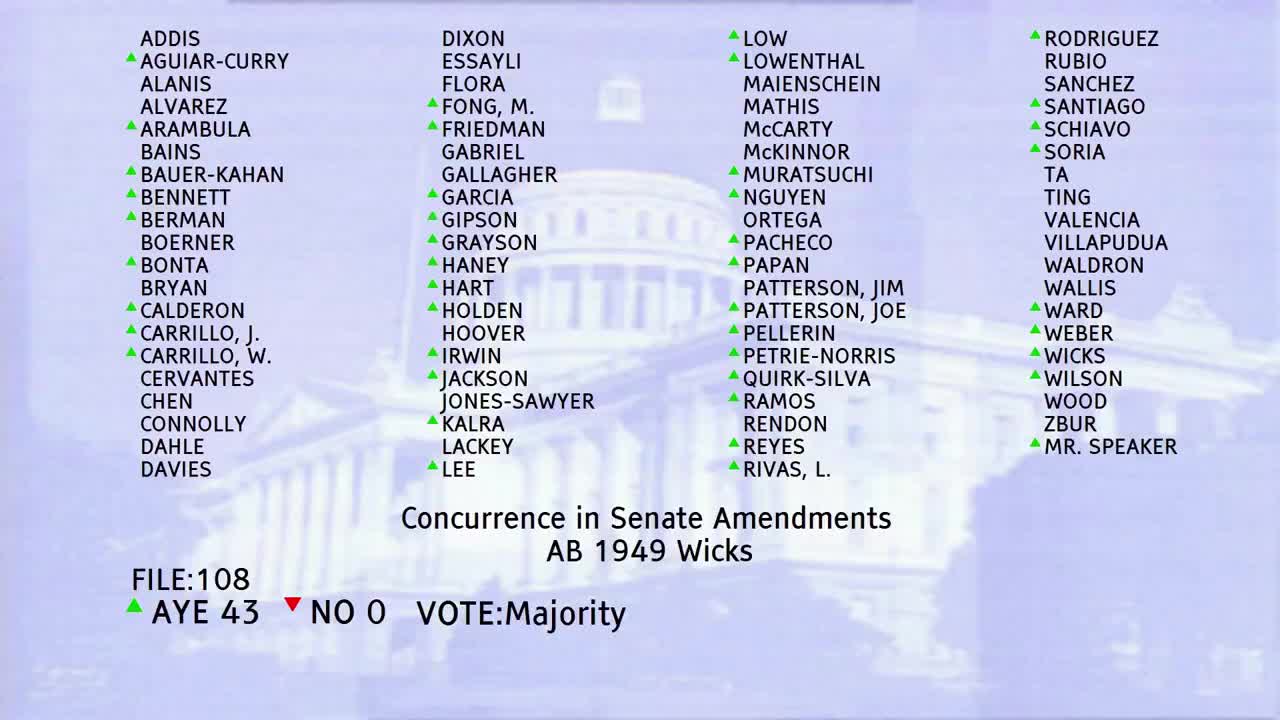 54SEC
Assembly Floor
 2MIN
Senate Floor
 1MIN
Senate Standing Committee on Appropriations
 12MIN
Senate Standing Committee on Environmental Quality
 47SEC
Assembly Floor
 7MIN
Assembly Standing Committee on Environmental Safety and Toxic Materials
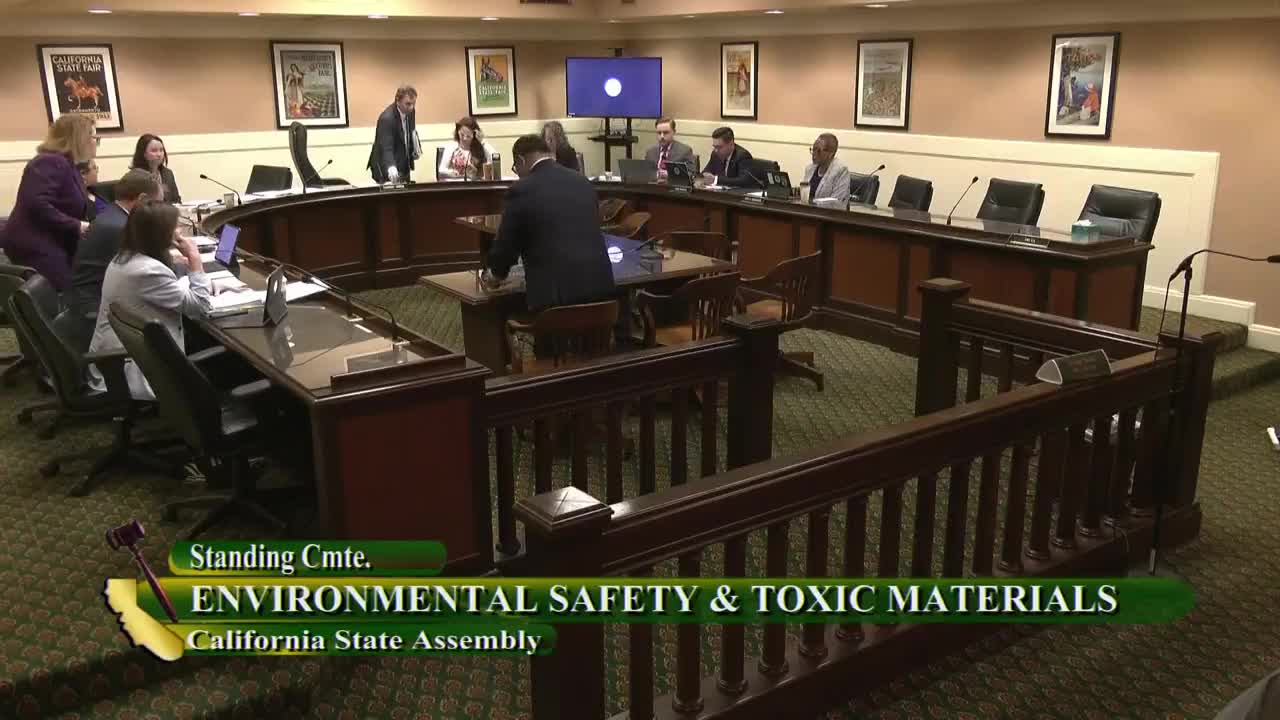 31SEC
Assembly Standing Committee on Environmental Safety and Toxic Materials
Bill Author

Bill Co-Author(s):