AB 2460: Common interest developments: association governance: member election.
- Session Year: 2023-2024
- House: Assembly
- Latest Version Date: 2024-09-22
Current Status:
Passed
(2024-09-22: Chaptered by Secretary of State - Chapter 401, Statutes of 2024.)
Introduced
In Committee
First Chamber
In Committee
Second Chamber
Enacted
Existing law, the Davis-Stirling Common Interest Development Act, defines and regulates common interest developments, including member elections. Existing law prescribes that a quorum is required only if stated in the governing documents or by law. In the absence of a quorum, existing law authorizes an association to adjourn the proceeding to a date at least 20 days after the adjourned proceeding, at which time the quorum required for purposes of a membership meeting is 20% of the voting members present in person, by proxy, or by secret written ballot received. Existing law requires an association to provide general notice of the membership meeting, as specified, no less than 15 days prior to the election of directors.
In the absence of a quorum, this bill would instead authorize an association to adjourn the meeting to a date at least 20 days after the adjourned meeting, at which time the quorum required for purposes of a reconvened meeting would be 20% of the members, voting in person, by proxy, or by secret ballot. The bill would require an association to provide general notice of the reconvened meeting, as specified, no later than 15 days prior to the date of the reconvened meeting.
Under existing law, for elections of directors and for recall elections, an association is required to provide general notice of specified information about the election at least 30 days before the ballots are distributed, including a statement that the board of directors may call a subsequent meeting at least 20 days after a scheduled election if the quorum is not reached, as specified.
This bill would instead require an association whose governing documents require a quorum for election of directors to provide general notice of a statement that the association may call a reconvened meeting to be held at least 20 days after a scheduled election if the quorum is not reached, as specified.
Existing law authorizes and regulates the formation and operation of various corporations, including a nonprofit mutual benefit corporation. Existing law sets forth the parameters of a quorum at a meeting of members, as specified. For a corporation that is a common interest development, existing law imposes notice requirements for special meetings. In the absence of a quorum, existing law authorizes a corporation that is a common interest development to adjourn a membership proceeding to a date at least 20 days after the adjourned proceeding, at which time the quorum required for purposes of a membership meeting is 20% of the voting members present in person, by proxy, or by secret written ballot received.
In the absence of a quorum, this bill would instead authorize the corporation that is a common interest development to adjourn a meeting to a date at least 20 days after the adjourned meeting, at which time the quorum required for purposes of a reconvened meeting would be 20% of the members, voting in person, by proxy, or by secret ballot.
This bill would incorporate additional changes to Section 5115 of the Civil Code proposed by AB 2159 to be operative only if this bill and AB 2159 are enacted and this bill is enacted last.
Existing law, the Davis-Stirling Common Interest Development Act, defines and regulates common interest developments, including member elections. Existing law prescribes that a quorum is required only if stated in the governing documents or by law. In the absence of a quorum, existing law authorizes an association to adjourn the proceeding to a date at least 20 days after the adjourned proceeding, at which time the quorum required for purposes of a membership meeting is 20% of the voting members present in person, by proxy, or by secret written ballot received. Existing law requires an association to provide general notice of the membership meeting, as specified, no less than 15 days prior to the election of directors.
In the absence of a quorum, this bill would instead authorize an association to adjourn the meeting to a date at least 20 days after the adjourned meeting, at which time the quorum required for purposes of a reconvened meeting would be 20% of the members members, voting in person, by proxy, or by secret ballot. The bill would require an association to provide general notice of the reconvened meeting, as specified, no later than 15 days prior to the date of the reconvened meeting.
Under existing law, for elections of directors and for recall elections, an association is required to provide general notice of specified information about the election at least 30 days before the ballots are distributed, including a statement that the board of directors may call a subsequent meeting at least 20 days after a scheduled election if the quorum is not reached, as specified.
This bill would instead require an association whose governing documents require a quorum for election of directors to provide general notice of a statement that the association may call a reconvened meeting to be held at least 20 days after a scheduled election if the quorum is not reached, as specified.
Existing law authorizes and regulates the formation and operation of various corporations, including a nonprofit mutual benefit corporation. Existing law sets forth the parameters of a quorum at a meeting of members, as specified. For a corporation that is a common interest development, existing law imposes notice requirements for special meetings. In the absence of a quorum, existing law authorizes a corporation that is a common interest development to adjourn a membership proceeding to a date at least 20 days after the adjourned proceeding, at which time the quorum required for purposes of a membership meeting is 20% of the voting members present in person, by proxy, or by secret written ballot received.
In the absence of a quorum, this bill would instead authorize the corporation that is a common interest development to adjourn a meeting to a date at least 20 days after the adjourned meeting, at which time the quorum required for purposes of a reconvened meeting would be 20% of the members members, voting in person, by proxy, or by secret ballot.
Existing law, the Davis-Stirling Common Interest Development Act, defines and regulates common interest developments, including member elections. Existing law prescribes that a quorum is required only if stated in the governing documents or by law. In the absence of a quorum, existing law authorizes an association to adjourn the proceeding to a date at least 20 days after the adjourned proceeding, at which time the quorum required for purposes of a membership meeting is 20% of the voting members present in person, by proxy, or by secret written ballot received. Existing law requires an association to provide general notice of the membership meeting, as specified, no less than 15 days prior to the election of directors.
In the absence of a quorum, this bill would instead authorize an association to adjourn the meeting to a date at least 20 days after the adjourned meeting, at which time the quorum required for purposes of a reconvened meeting would be 20% of the members voting in person, by proxy, or by secret ballot. The bill would require an association to provide general notice of the reconvened meeting, as specified, no later than 15 days prior to the date of the reconvened meeting.
Under existing law, for elections of directors and for recall elections, an association is required to provide general notice of specified information about the election at least 30 days before the ballots are distributed, including a statement that the board of directors may call a subsequent meeting at least 20 days after a scheduled election if the quorum is not reached, as specified.
This bill would instead require an association whose governing documents require a quorum for election of directors to provide general notice of a statement that the association may call a reconvened meeting to be held at least 20 days after a scheduled election if the quorum is not reached, as specified.
Existing law authorizes and regulates the formation and operation of various corporations, including a nonprofit mutual benefit corporation. Existing law sets forth the parameters of a quorum at a meeting of members, as specified. For a corporation that is a common interest development, existing law imposes notice requirements for special meetings. In the absence of a quorum, existing law authorizes a corporation that is a common interest development to adjourn a membership proceeding to a date at least 20 days after the adjourned proceeding, at which time the quorum required for purposes of a membership meeting is 20% of the voting members present in person, by proxy, or by secret written ballot received.
In the absence of a quorum, this bill would instead authorize the corporation that is a common interest development to adjourn a meeting to a date at least 20 days after the adjourned meeting, at which time the quorum required for purposes of a reconvened meeting would be 20% of the members voting in person, by proxy, or by secret ballot.
Existing law, the Davis-Stirling Common Interest Development Act, defines and regulates common interest developments, including member elections. Existing law prescribes that a quorum is required only if stated in the governing documents or by law. In the absence of a quorum, existing law authorizes an association to adjourn the proceeding to a date at least 20 days after the adjourned proceeding, at which time the quorum required for purposes of a membership meeting is 20% of the voting members present in person, by proxy, or by secret written ballot received. Existing law requires an association to provide general notice of the membership meeting, as specified, no less than 15 days prior to the election of directors.
In the absence of a quorum, this bill would instead require authorize an association to adjourn the meeting to a date at least 20 days after the adjourned meeting, at which time the quorum required for purposes of a reconvened meeting would be 20% of the members voting in person, by proxy, or by secret ballot. The bill would require an association to provide general notice of the reconvened meeting, as specified, no later than 15 days prior to the date of the reconvened meeting.
Under existing law, for elections of directors and for recall elections, an association is required to provide general notice of specified information about the election at least 30 days before the ballots are distributed, including a statement that the board of directors may call a subsequent meeting at least 20 days after a scheduled election if the quorum is not reached, as specified.
This bill would instead require an association whose governing documents require a quorum for election of directors to provide general notice of a statement that the association shall may call a reconvened meeting at least 20 days after a scheduled election if the quorum is not reached, as specified.
Existing law authorizes and regulates the formation and operation of various corporations, including a nonprofit mutual benefit corporation. Existing law sets forth the parameters of a quorum at a meeting of members, as specified. For a corporation that is a common interest development, existing law imposes notice requirements for special meetings. In the absence of a quorum, existing law authorizes a corporation that is a common interest development to adjourn a membership proceeding to a date at least 20 days after the adjourned proceeding, at which time the quorum required for purposes of a membership meeting is 20% of the voting members present in person, by proxy, or by secret written ballot received.
In the absence of a quorum, this bill would instead require authorize the corporation that is a common interest development to adjourn a meeting to a date at least 20 days after the adjourned meeting, at which time the quorum required for purposes of a reconvened meeting would be 20% of the members voting in person, by proxy, or by secret ballot.
Existing law, the Davis-Stirling Common Interest Development Act, defines and regulates common interest developments, including member elections. Existing law prescribes that a quorum is required only if stated in the governing documents or by law. In the absence of a quorum, existing law authorizes an association to adjourn the proceeding to a date at least 20 days after the adjourned proceeding, at which time the quorum required for purposes of a membership meeting is 20% of the voting members present in person, by proxy, or by secret written ballot received. Existing law requires an association to provide general notice of the membership meeting, as specified, no less than 15 days prior to the election of directors.
In the absence of a quorum, this bill would instead authorize the board of require an association to adjourn the proceeding on behalf of the members meeting to a date at least 20 days after the adjourned proceeding, meeting, at which time the quorum required for purposes of a reconvened membership meeting would be 20% of the voting members present voting in person, by proxy, or by secret written ballot received. ballot. The bill would require an association to provide general notice of the reconvened membership meeting, as specified, no later than 15 days prior to the date of the reconvened membership meeting.
Under existing law, for elections of directors and for recall elections, an association is required to provide general notice of specified information about the election at least 30 days before the ballots are distributed, including a statement that the board of directors may call a subsequent meeting at least 20 days after a scheduled election if the quorum is not reached, as specified.
This bill would instead require an association whose governing documents require a quorum for election of directors to provide general notice of a statement that the board of directors may association shall call a reconvened meeting at least 20 days after a scheduled election if the quorum is not reached, as specified.
Existing law authorizes and regulates the formation and operation of various corporations, including a nonprofit mutual benefit corporation. Existing law sets forth the parameters of a quorum at a meeting of members, as specified. For a corporation that is a common interest development, existing law imposes notice requirements for special meetings. In the absence of a quorum, existing law authorizes a corporation that is a common interest development to adjourn a membership proceeding to a date at least 20 days after the adjourned proceeding, at which time the quorum required for purposes of a membership meeting is 20% of the voting members present in person, by proxy, or by secret written ballot received.
In the absence of a quorum, this bill would instead authorize the board of require the corporation that is a common interest development to adjourn a membership proceeding on behalf of the members meeting to a date at least 20 days after the adjourned proceeding, meeting, at which time the quorum required for purposes of a reconvened membership meeting would be 20% of the voting members present voting in person, by proxy, or by secret written ballot received. ballot.
Existing law, the Davis-Stirling Common Interest Development Act, defines and regulates common interest developments, including member elections. Existing law prescribes that a quorum is required only if stated in the governing documents or by law. In the absence of a quorum, existing law authorizes an association to adjourn the proceeding to a date at least 20 days after the adjourned proceeding, at which time the quorum required for purposes of a membership meeting is 20% of the voting members present in person, by proxy, or by secret written ballot received. Existing law requires an association to provide general notice of the membership meeting, as specified, no less than 15 days prior to the election of directors.
In the absence of a quorum, this bill would instead authorize the board of an association to adjourn the proceeding on behalf of the members to a date at least 20 days after the adjourned proceeding, at which time the quorum required for purposes of a reconvened membership meeting would be 20% of the voting members present in person, by proxy, or by secret written ballot received. The bill would require an association to provide general notice of the reconvened membership meeting, as specified, no later than 15 days prior to the date of the reconvened membership meeting.
Under existing law, for elections of directors and for recall elections, an association is required to provide general notice of specified information about the election at least 30 days before the ballots are distributed, including a statement that the board of directors may call a subsequent meeting at least 20 days after a scheduled election if the quorum is not reached, as specified.
This bill would instead require an association whose governing documents require a quorum for election of directors to provide general notice of a statement that the board of directors may call a reconvened meeting at least 20 days after a scheduled election if the quorum is not reached, as specified.
Existing law authorizes and regulates the formation and operation of various corporations, including a nonprofit mutual benefit corporation. Existing law sets forth the parameters of a quorum at a meeting of members, as specified. For a corporation that is a common interest development, existing law imposes notice requirements for special meetings. In the absence of a quorum, existing law authorizes a corporation that is a common interest development to adjourn a membership proceeding to a date at least 20 days after the adjourned proceeding, at which time the quorum required for purposes of a membership meeting is 20% of the voting members present in person, by proxy, or by secret written ballot received.
In the absence of a quorum, this bill would instead authorize the board of the corporation that is a common interest development to adjourn a membership proceeding on behalf of the members to a date at least 20 days after the adjourned proceeding, at which time the quorum required for purposes of a reconvened membership meeting would be 20% of the voting members present in person, by proxy, or by secret written ballot received.
(a)An association shall provide general notice of the procedure and deadline for submitting a nomination at least 30 days before any deadline for submitting a nomination. Individual notice shall be delivered pursuant to Section 4040 if individual notice is requested by a member. This subdivision shall only apply to elections of directors and to recall elections.
(b)For elections of directors and for recall elections, an association shall provide general notice of all of the following at least 30 days before the ballots are distributed:
(1)The date and time by which, and the physical address where, ballots are to be returned by mail or handed to the inspector or inspectors of elections.
(2)The date, time, and location of the meeting at which a quorum will be determined, if the associations governing documents require a quorum, and at which ballots will be counted.
(3)The list of all candidates names that will appear on the ballot.
(4)Individual notice of the above paragraphs shall be delivered pursuant to Section 4040 if individual notice is requested by a member.
(5)(A)If the associations governing documents require a quorum for election of directors, a statement that the association may call a reconvened meeting to be held at least 20 days after a scheduled election if the required quorum is not reached, at which time the quorum of the membership to elect directors will be 20 percent of the associations members, voting in person, by proxy, or by secret ballot.
(B)This paragraph shall not apply if the governing documents of the association provide for a quorum lower than 20 percent.
(c)Ballots and two preaddressed envelopes with instructions on how to return ballots shall be mailed by first-class mail or delivered by the association to every member not less than 30 days prior to the deadline for voting. In order to preserve confidentiality, a voter may not be identified by name, address, or lot, parcel, or unit number on the ballot. The association shall use as a model those procedures used by California counties for ensuring confidentiality of vote by mail ballots, including both of the following:
(1)The ballot itself is not signed by the voter, but is inserted into an envelope that is sealed. This envelope is inserted into a second envelope that is sealed. In the upper left-hand corner of the second envelope, the voter shall sign the voters name, indicate the voters name, and indicate the address or separate interest identifier that entitles the voter to vote.
(2)The second envelope is addressed to the inspector or inspectors of elections, who will be tallying the votes. The envelope may be mailed or delivered by hand to a location specified by the inspector or inspectors of elections. The member may request a receipt for delivery.
(d)(1)A quorum shall be required only if so stated in the governing documents or other provisions of law. If a quorum is required by the governing documents, each ballot received by the inspector of elections shall be treated as a member present at a meeting for purposes of establishing a quorum.
(2)For an election of directors of an association, and in the absence of meeting quorum as required by the associations governing documents or Section 7512 of the Corporations Code, unless a lower quorum for a reconvened meeting is authorized by the associations governing documents, the association may adjourn the meeting to a date at least 20 days after the adjourned meeting, at which time the quorum required for purposes of a reconvened meeting to elect directors shall be 20 percent of the associations members, voting in person, by proxy, or by secret ballot.
(3)No less than 15 days prior to the date of the reconvened meeting described in paragraph (2), the association shall provide general notice of the reconvened meeting, which shall include:
(A)The date, time, and location of the meeting.
(B)The list of all candidates.
(C)Unless the associations governing documents provide for a lower quorum, a statement that 20 percent of the associations members, voting in person, by proxy, or secret ballot will satisfy the quorum requirements for the election of directors at that reconvened meeting and that the ballots will be counted if a quorum is reached, if the associations governing documents require a quorum.
(e)An association shall allow for cumulative voting using the secret ballot procedures provided in this section, if cumulative voting is provided for in the governing documents.
(f)Except for the meeting to count the votes required in subdivision (a) of Section 5120, an election may be conducted entirely by mail unless otherwise specified in the governing documents.
(g)In an election to approve an amendment of the governing documents, the text of the proposed amendment shall be delivered to the members with the ballot.
SEC. 1.5.Section 5115 of the Civil Code is amended to read:5115.(a)An association shall provide general notice of the procedure and deadline for submitting a nomination at least 30 days before any deadline for submitting a nomination. Individual notice shall be delivered pursuant to Section 4040 if individual notice is requested by a member. This subdivision shall only apply to elections of directors and to recall elections.
(b)For elections of directors and for recall elections, an association shall provide general notice of all of the following at least 30 days before the ballots are distributed:
(1)The date and time by which, and the physical address where, ballots are to be returned by mail or handed to the inspector or inspectors of elections.
(2)If the association allows for voting in an election by electronic secret ballot as provided for in Section 5105, the date and time by which electronic secret ballots are to be transmitted to the internet-based voting system and preliminary instructions on how to vote by electronic secret ballot upon commencement of the voting period.
(3)The date, time, and location of the meeting at which a quorum will be determined, if the associations governing documents require a quorum, and at which ballots will be counted.
(4)The list of all candidates names that will appear on the ballot.
(5)Individual notice of the above paragraphs shall be delivered pursuant to Section 4040 if individual notice is requested by a member.
(6)(A)If the associations governing documents require a quorum for an election of directors, a statement that the association may call a reconvened meeting to be held at least 20 days after a scheduled election if the required quorum is not reached, at which time the quorum of the membership to elect directors will be 20 percent of the associations members, voting in person, by proxy, or by secret ballot.
(B)This paragraph shall not apply if the governing documents of the association provide for a quorum lower than 20 percent.
(c)Ballots and two preaddressed envelopes with instructions on how to return ballots shall be mailed by first-class mail or delivered by the association to every member not less than 30 days prior to the deadline for voting, unless an association conducts an election by electronic secret ballot as provided for in Section 5105, in which case only members who will vote by written secret ballot pursuant to Section 5105 shall be mailed or delivered the ballots and envelopes. In order to preserve confidentiality, a voter may not be identified by name, address, or lot, parcel, or unit number on the ballot. The association shall use as a model those procedures used by California counties for ensuring confidentiality of vote by mail ballots, including both of the following:
(1)The ballot itself is not signed by the voter, but is inserted into an envelope that is sealed. This envelope is inserted into a second envelope that is sealed. In the upper left-hand corner of the second envelope, the voter shall sign the voters name, indicate the voters name, and indicate the address or separate interest identifier that entitles the voter to vote.
(2)The second envelope is addressed to the inspector or inspectors of elections, who will be tallying the votes. The envelope may be mailed or delivered by hand to a location specified by the inspector or inspectors of elections. The member may request a receipt for delivery.
(d)(1)A quorum shall be required only if so stated in the governing documents or other provisions of law. If a quorum is required by the governing documents, each ballot received by the inspector or inspectors of elections shall be treated as a member present at a meeting for purposes of establishing a quorum.
(2)For an election of directors of an association, and in the absence of meeting quorum as required by the associations governing documents or Section 7512 of the Corporations Code, unless a lower quorum for a reconvened meeting is authorized by the associations governing documents, the association may adjourn the meeting to a date at least 20 days after the adjourned meeting, at which time the quorum required for purposes of a reconvened meeting to elect directors shall be 20 percent of the associations members, voting in person, by proxy, or by secret ballot.
(3)No less than 15 days prior to the date of the reconvened meeting described in paragraph (2), the association shall provide general notice of the reconvened meeting, which shall include:
(A)The date, time, and location of the meeting.
(B)The list of all candidates.
(C)Unless the associations governing documents provide for a lower quorum, a statement that 20 percent of the associations members, voting in person, by proxy, or secret ballot will satisfy the quorum requirements for the election of directors at that reconvened meeting and that the ballots will be counted if a quorum is reached, if the associations governing documents require a quorum.
(e)An association shall allow for cumulative voting using the secret ballot procedures provided in this section, if cumulative voting is provided for in the governing documents.
(f)Notwithstanding any contrary provision in the governing documents, except for the meeting to count the votes required in subdivision (a) of Section 5120, an election may be conducted entirely by mail, electronic secret ballot, or a combination of mail and electronic secret ballot, pursuant to Section 5105.
(g)(1)Except as provided in paragraph (2), in an election to approve an amendment of the governing documents, the text of the proposed amendment shall be delivered to the members with the ballot.
(2)Notwithstanding paragraph (1), if an association conducts an election to approve an amendment of governing documents by electronic secret ballot, the association may deliver, by electronic means, the text of the proposed amendment to those members who vote by electronic secret ballot, pursuant to Section 5105. The association shall also deliver a written copy of the text of the proposed amendment to those members upon request and without charge. If a member votes by written secret ballot, pursuant to Section 5105, the association shall deliver a written copy of the text of the proposed amendment to the member with the ballot.
SEC. 2.Section 7512 of the Corporations Code is amended to read:7512.(a)One-third of the voting power, represented in person or by proxy, shall constitute a quorum at a meeting of members, but, subject to subdivisions (b) and (c), a bylaw may set a different quorum. Any bylaw amendment to increase the quorum may be adopted only by approval of the members (Section 5034). If a quorum is present, the affirmative vote of the majority of the voting power represented at the meeting, entitled to vote, and voting on any matter shall be the act of the members unless the vote of a greater number or voting by classes is required by this part or the articles or bylaws.
(b)Where a bylaw authorizes a corporation to conduct a meeting with a quorum of less than one-third of the voting power, then the only matters that may be voted upon at any regular meeting actually attended, in person or by proxy, by less than one-third of the voting power are matters notice of the general nature of which was given, pursuant to the first sentence of subdivision (a) of Section 7511.
(c)Subject to subdivision (b), the members present at a duly called or held meeting at which a quorum is present may continue to transact business until adjournment notwithstanding the withdrawal of enough members to leave less than a quorum, if any action taken (other than adjournment) is approved by at least a majority of the members required to constitute a quorum or, if required by this division, or by the articles or the bylaws, the vote of the greater number or voting by classes.
(d)In the absence of a quorum, any meeting of members may be adjourned from time to time by the vote of a majority of the votes represented either in person or by proxy, but no other business may be transacted, except as provided in subdivision (c).
(e)For an election of directors of a corporation that is a common interest development, and in the absence of meeting quorum as required by the associations governing documents or this section, unless a lower quorum for a reconvened meeting is authorized by an associations governing documents, the corporation may adjourn the meeting to a date at least 20 days after the adjourned meeting, at which time the quorum required for purposes of a reconvened meeting to elect directors shall be 20 percent of the associations members, voting in person, by proxy, or by secret ballot.
SEC. 3.Section 1.5 of this bill incorporates amendments to Section 5115 of the Civil Code proposed by both this bill and Assembly Bill 2159. That section of this bill shall only become operative if (1) both bills are enacted and become effective on or before January 1, 2025, (2) each bill amends Section 5115 of the Civil Code, and (3) this bill is enacted after Assembly Bill 2159, in which case Section 1 of this bill shall not become operative.
(a)An association shall provide general notice of the procedure and deadline for submitting a nomination at least 30 days before any deadline for submitting a nomination. Individual notice shall be delivered pursuant to Section 4040 if individual notice is requested by a member. This subdivision shall only apply to elections of directors and to recall elections.
(b)For elections of directors and for recall elections, an association shall provide general notice of all of the following at least 30 days before the ballots are distributed:
(1)The date and time by which, and the physical address where, ballots are to be returned by mail or handed to the inspector or inspectors of elections.
(2)The date, time, and location of the meeting at which a quorum will be determined, if the associations governing documents require a quorum, and at which ballots will be counted.
(3)The list of all candidates names that will appear on the ballot.
(4)Individual notice of the above paragraphs shall be delivered pursuant to Section 4040 if individual notice is requested by a member.
(5)(A)If the associations governing documents require a quorum for election of directors, a statement that the association may call a reconvened meeting to be held at least 20 days after a scheduled election if the required quorum is not reached, at which time the quorum of the membership to elect directors will be 20 percent of the associations members, voting in person, by proxy, or by secret ballot.
(B)This paragraph shall not apply if the governing documents of the association provide for a quorum lower than 20 percent.
(c)Ballots and two preaddressed envelopes with instructions on how to return ballots shall be mailed by first-class mail or delivered by the association to every member not less than 30 days prior to the deadline for voting. In order to preserve confidentiality, a voter may not be identified by name, address, or lot, parcel, or unit number on the ballot. The association shall use as a model those procedures used by California counties for ensuring confidentiality of vote by mail ballots, including both of the following:
(1)The ballot itself is not signed by the voter, but is inserted into an envelope that is sealed. This envelope is inserted into a second envelope that is sealed. In the upper left-hand corner of the second envelope, the voter shall sign the voters name, indicate the voters name, and indicate the address or separate interest identifier that entitles the voter to vote.
(2)The second envelope is addressed to the inspector or inspectors of elections, who will be tallying the votes. The envelope may be mailed or delivered by hand to a location specified by the inspector or inspectors of elections. The member may request a receipt for delivery.
(d)(1)A quorum shall be required only if so stated in the governing documents or other provisions of law. If a quorum is required by the governing documents, each ballot received by the inspector of elections shall be treated as a member present at a meeting for purposes of establishing a quorum.
(2)For an election of directors of an association, and in the absence of meeting quorum as required by the associations governing documents or Section 7512 of the Corporations Code, unless a lower quorum for a reconvened meeting is authorized by the associations governing documents, the association may adjourn the meeting to a date at least 20 days after the adjourned meeting, at which time the quorum required for purposes of a reconvened meeting to elect directors shall be 20 percent of the associations members, voting in person, by proxy, or by secret ballot.
(3)No less than 15 days prior to the date of the reconvened meeting described in paragraph (2), the association shall provide general notice of the reconvened meeting, which shall include:
(A)The date, time, and location of the meeting.
(B)The list of all candidates.
(C)Unless the associations governing documents provide for a lower quorum, a statement that 20 percent of the associations members, voting in person, by proxy, or secret ballot will satisfy the quorum requirements for the election of directors at that reconvened meeting and that the ballots will be counted if a quorum is reached, if the associations governing documents require a quorum.
(e)An association shall allow for cumulative voting using the secret ballot procedures provided in this section, if cumulative voting is provided for in the governing documents.
(f)Except for the meeting to count the votes required in subdivision (a) of Section 5120, an election may be conducted entirely by mail unless otherwise specified in the governing documents.
(g)In an election to approve an amendment of the governing documents, the text of the proposed amendment shall be delivered to the members with the ballot.
SEC. 1.5.Section 5115 of the Civil Code is amended to read:5115.(a)An association shall provide general notice of the procedure and deadline for submitting a nomination at least 30 days before any deadline for submitting a nomination. Individual notice shall be delivered pursuant to Section 4040 if individual notice is requested by a member. This subdivision shall only apply to elections of directors and to recall elections.
(b)For elections of directors and for recall elections, an association shall provide general notice of all of the following at least 30 days before the ballots are distributed:
(1)The date and time by which, and the physical address where, ballots are to be returned by mail or handed to the inspector or inspectors of elections.
(2)If the association allows for voting in an election by electronic secret ballot as provided for in Section 5105, the date and time by which electronic secret ballots are to be transmitted to the internet-based voting system and preliminary instructions on how to vote by electronic secret ballot upon commencement of the voting period.
(2)(3)The date, time, and location of the meeting at which a quorum will be determined, if the associations governing documents require a quorum, and at which ballots will be counted.
(3)(4)The list of all candidates names that will appear on the ballot.
(4)(5)Individual notice of the above paragraphs shall be delivered pursuant to Section 4040 if individual notice is requested by a member.
(5)(6)(A)If the associations governing documents require a quorum for an election of directors, a statement that the board of directors association may call a subsequent reconvened meeting to be held at least 20 days after a scheduled election if the required quorum is not reached, at which time the quorum of the membership to elect directors will be 20 percent of the associations members members, voting in person, by proxy, or by secret ballot.
(B)This paragraph shall not apply if the governing documents of the association provide for a quorum lower than 20 percent.
(c)Ballots and two preaddressed envelopes with instructions on how to return ballots shall be mailed by first-class mail or delivered by the association to every member not less than 30 days prior to the deadline for voting. voting, unless an association conducts an election by electronic secret ballot as provided for in Section 5105, in which case only members who will vote by written secret ballot pursuant to Section 5105 shall be mailed or delivered the ballots and envelopes. In order to preserve confidentiality, a voter may not be identified by name, address, or lot, parcel, or unit number on the ballot. The association shall use as a model those procedures used by California counties for ensuring confidentiality of vote by mail ballots, including all both of the following:
(1)The ballot itself is not signed by the voter, but is inserted into an envelope that is sealed. This envelope is inserted into a second envelope that is sealed. In the upper left-hand corner of the second envelope, the voter shall sign the voters name, indicate the voters name, and indicate the address or separate interest identifier that entitles the voter to vote.
(2)The second envelope is addressed to the inspector or inspectors of elections, who will be tallying the votes. The envelope may be mailed or delivered by hand to a location specified by the inspector or inspectors of elections. The member may request a receipt for delivery.
(d)(1)A quorum shall be required only if so stated in the governing documents or other provisions of law. If a quorum is required by the governing documents, each ballot received by the inspector or inspectors of elections shall be treated as a member present at a meeting for purposes of establishing a quorum.
(2)For an election of directors of a corporation that is a common interest development, an association, and in the absence of meeting quorum as required by the associations governing documents or Section 7512 of the Corporations Code, unless a lower quorum for a reconvened meeting is authorized by the associations governing documents, the association may adjourn the proceeding meeting to a date at least 20 days after the adjourned proceeding, meeting, at which time the quorum required for purposes of a membership reconvened meeting to elect directors shall be 20 percent of the associations members, voting members present in person, by proxy, or by secret written ballot received. ballot.
(3)No less than 15 days prior to an election authorized pursuant to the date of the reconvened meeting described in paragraph (2), the association shall provide general notice of the membership reconvened meeting, which shall include:
(A)The date, time, and location of the meeting.
(B)The list of all candidates.
(C)A Unless the associations governing documents provide for a lower quorum, a statement that 20 percent of the association present or voting by proxy associations members, voting in person, by proxy, or secret ballot will satisfy the quorum requirements for the election of directors at that reconvened meeting and that the ballots will be counted if a quorum is reached, if the associations governing documents require a quorum.
(e)An association shall allow for cumulative voting using the secret ballot procedures provided in this section, if cumulative voting is provided for in the governing documents.
(f)Except Notwithstanding any contrary provision in the governing documents, except for the meeting to count the votes required in subdivision (a) of Section 5120, an election may be conducted entirely by mail unless otherwise specified in the governing documents. mail, electronic secret ballot, or a combination of mail and electronic secret ballot, pursuant to Section 5105.
(g)In(g)(1)Except as provided in paragraph (2), in an election to approve an amendment of the governing documents, the text of the proposed amendment shall be delivered to the members with the ballot.
(2)Notwithstanding paragraph (1), if an association conducts an election to approve an amendment of governing documents by electronic secret ballot, the association may deliver, by electronic means, the text of the proposed amendment to those members who vote by electronic secret ballot, pursuant to Section 5105. The association shall also deliver a written copy of the text of the proposed amendment to those members upon request and without charge. If a member votes by written secret ballot, pursuant to Section 5105, the association shall deliver a written copy of the text of the proposed amendment to the member with the ballot.
SEC. 2.Section 7512 of the Corporations Code is amended to read:7512.(a)One-third of the voting power, represented in person or by proxy, shall constitute a quorum at a meeting of members, but, subject to subdivisions (b) and (c), a bylaw may set a different quorum. Any bylaw amendment to increase the quorum may be adopted only by approval of the members (Section 5034). If a quorum is present, the affirmative vote of the majority of the voting power represented at the meeting, entitled to vote, and voting on any matter shall be the act of the members unless the vote of a greater number or voting by classes is required by this part or the articles or bylaws.
(b)Where a bylaw authorizes a corporation to conduct a meeting with a quorum of less than one-third of the voting power, then the only matters that may be voted upon at any regular meeting actually attended, in person or by proxy, by less than one-third of the voting power are matters notice of the general nature of which was given, pursuant to the first sentence of subdivision (a) of Section 7511.
(c)Subject to subdivision (b), the members present at a duly called or held meeting at which a quorum is present may continue to transact business until adjournment notwithstanding the withdrawal of enough members to leave less than a quorum, if any action taken (other than adjournment) is approved by at least a majority of the members required to constitute a quorum or, if required by this division, or by the articles or the bylaws, the vote of the greater number or voting by classes.
(d)In the absence of a quorum, any meeting of members may be adjourned from time to time by the vote of a majority of the votes represented either in person or by proxy, but no other business may be transacted, except as provided in subdivision (c).
(e)For an election of directors of a corporation that is a common interest development, and in the absence of meeting quorum as required by the associations governing documents or this section, unless a lower quorum for a reconvened meeting is authorized by an associations governing documents, the corporation may adjourn the meeting to a date at least 20 days after the adjourned meeting, at which time the quorum required for purposes of a reconvened meeting to elect directors shall be 20 percent of the associations members, voting in person, by proxy, or by secret ballot.
SEC. 3.Section 1.5 of this bill incorporates amendments to Section 5115 of the Civil Code proposed by both this bill and Assembly Bill 2159. That section of this bill shall only become operative if (1) both bills are enacted and become effective on or before January 1, 2025, (2) each bill amends Section 5115 of the Civil Code, and (3) this bill is enacted after Assembly Bill 2159, in which case Section 1 of this bill shall not become operative.
(a)An association shall provide general notice of the procedure and deadline for submitting a nomination at least 30 days before any deadline for submitting a nomination. Individual notice shall be delivered pursuant to Section 4040 if individual notice is requested by a member. This subdivision shall only apply to elections of directors and to recall elections.
(b)For elections of directors and for recall elections, an association shall provide general notice of all of the following at least 30 days before the ballots are distributed:
(1)The date and time by which, and the physical address where, ballots are to be returned by mail or handed to the inspector or inspectors of elections.
(2)The date, time, and location of the meeting at which a quorum will be determined, if the associations governing documents require a quorum, and at which ballots will be counted.
(3)The list of all candidates names that will appear on the ballot.
(4)Individual notice of the above paragraphs shall be delivered pursuant to Section 4040 if individual notice is requested by a member.
(5)(A)If the associations governing documents require a quorum for election of directors, a statement that the association may call a reconvened meeting to be held at least 20 days after a scheduled election if the required quorum is not reached, at which time the quorum of the membership to elect directors will be 20 percent of the associations members members, voting in person, by proxy, or by secret ballot.
(B)This paragraph shall not apply if the governing documents of the association provide for a quorum lower than 20 percent.
(c)Ballots and two preaddressed envelopes with instructions on how to return ballots shall be mailed by first-class mail or delivered by the association to every member not less than 30 days prior to the deadline for voting. In order to preserve confidentiality, a voter may not be identified by name, address, or lot, parcel, or unit number on the ballot. The association shall use as a model those procedures used by California counties for ensuring confidentiality of vote by mail ballots, including both of the following:
(1)The ballot itself is not signed by the voter, but is inserted into an envelope that is sealed. This envelope is inserted into a second envelope that is sealed. In the upper left-hand corner of the second envelope, the voter shall sign the voters name, indicate the voters name, and indicate the address or separate interest identifier that entitles the voter to vote.
(2)The second envelope is addressed to the inspector or inspectors of elections, who will be tallying the votes. The envelope may be mailed or delivered by hand to a location specified by the inspector or inspectors of elections. The member may request a receipt for delivery.
(d)(1)A quorum shall be required only if so stated in the governing documents or other provisions of law. If a quorum is required by the governing documents, each ballot received by the inspector of elections shall be treated as a member present at a meeting for purposes of establishing a quorum.
(2)For an election of directors of an association, and in the absence of meeting quorum as required by the associations governing documents or Section 7512 of the Corporations Code, unless a lower quorum for a reconvened meeting is authorized by the associations governing documents, the association may adjourn the meeting to a date at least 20 days after the adjourned meeting, at which time the quorum required for purposes of a reconvened meeting to elect directors shall be 20 percent of the associations members members, voting in person, by proxy, or by secret ballot.
(3)No less than 15 days prior to the date of the reconvened meeting described in paragraph (2), the association shall provide general notice of the reconvened meeting, which shall include:
(A)The date, time, and location of the meeting.
(B)The list of all candidates.
(C)Unless the associations governing documents provide for a lower quorum, a statement that 20 percent of the associations members members, voting in person, by proxy, or secret ballot will satisfy the quorum requirements for the election of directors at that reconvened meeting and that the ballots will be counted if a quorum is reached, if the associations governing documents require a quorum.
(e)An association shall allow for cumulative voting using the secret ballot procedures provided in this section, if cumulative voting is provided for in the governing documents.
(f)Except for the meeting to count the votes required in subdivision (a) of Section 5120, an election may be conducted entirely by mail unless otherwise specified in the governing documents.
(g)In an election to approve an amendment of the governing documents, the text of the proposed amendment shall be delivered to the members with the ballot.
SEC. 2.Section 7512 of the Corporations Code is amended to read:7512.(a)One-third of the voting power, represented in person or by proxy, shall constitute a quorum at a meeting of members, but, subject to subdivisions (b) and (c), a bylaw may set a different quorum. Any bylaw amendment to increase the quorum may be adopted only by approval of the members (Section 5034). If a quorum is present, the affirmative vote of the majority of the voting power represented at the meeting, entitled to vote, and voting on any matter shall be the act of the members unless the vote of a greater number or voting by classes is required by this part or the articles or bylaws.
(b)Where a bylaw authorizes a corporation to conduct a meeting with a quorum of less than one-third of the voting power, then the only matters that may be voted upon at any regular meeting actually attended, in person or by proxy, by less than one-third of the voting power are matters notice of the general nature of which was given, pursuant to the first sentence of subdivision (a) of Section 7511.
(c)Subject to subdivision (b), the members present at a duly called or held meeting at which a quorum is present may continue to transact business until adjournment notwithstanding the withdrawal of enough members to leave less than a quorum, if any action taken (other than adjournment) is approved by at least a majority of the members required to constitute a quorum or, if required by this division, or by the articles or the bylaws, the vote of the greater number or voting by classes.
(d)In the absence of a quorum, any meeting of members may be adjourned from time to time by the vote of a majority of the votes represented either in person or by proxy, but no other business may be transacted, except as provided in subdivision (c).
(e)For an election of directors of a corporation that is a common interest development, and in the absence of meeting quorum as required by the associations governing documents or this section, unless a lower quorum for a reconvened meeting is authorized by an associations governing documents, the corporation may adjourn the meeting to a date at least 20 days after the adjourned meeting, at which time the quorum required for purposes of a reconvened meeting to elect directors shall be 20 percent of the associations members members, voting in person, by proxy, or by secret ballot.
(a)An association shall provide general notice of the procedure and deadline for submitting a nomination at least 30 days before any deadline for submitting a nomination. Individual notice shall be delivered pursuant to Section 4040 if individual notice is requested by a member. This subdivision shall only apply to elections of directors and to recall elections.
(b)For elections of directors and for recall elections, an association shall provide general notice of all of the following at least 30 days before the ballots are distributed:
(1)The date and time by which, and the physical address where, ballots are to be returned by mail or handed to the inspector or inspectors of elections.
(2)The date, time, and location of the meeting at which a quorum will be determined, if the associations governing documents require a quorum, and at which ballots will be counted.
(3)The list of all candidates names that will appear on the ballot.
(4)Individual notice of the above paragraphs shall be delivered pursuant to Section 4040 if individual notice is requested by a member.
(5)(A)If the associations governing documents require a quorum for election of directors, a statement that the association may call a reconvened meeting to be held at least 20 days after a scheduled election if the required quorum is not reached, at which time the quorum of the membership to elect directors will be 20 percent of the associations members voting in person, by proxy, or by secret ballot.
(B)This paragraph shall not apply if the governing documents of the association provide for a quorum lower than 20 percent.
(c)Ballots and two preaddressed envelopes with instructions on how to return ballots shall be mailed by first-class mail or delivered by the association to every member not less than 30 days prior to the deadline for voting. In order to preserve confidentiality, a voter may not be identified by name, address, or lot, parcel, or unit number on the ballot. The association shall use as a model those procedures used by California counties for ensuring confidentiality of vote by mail ballots, including both of the following:
(1)The ballot itself is not signed by the voter, but is inserted into an envelope that is sealed. This envelope is inserted into a second envelope that is sealed. In the upper left-hand corner of the second envelope, the voter shall sign the voters name, indicate the voters name, and indicate the address or separate interest identifier that entitles the voter to vote.
(2)The second envelope is addressed to the inspector or inspectors of elections, who will be tallying the votes. The envelope may be mailed or delivered by hand to a location specified by the inspector or inspectors of elections. The member may request a receipt for delivery.
(d)(1)A quorum shall be required only if so stated in the governing documents or other provisions of law. If a quorum is required by the governing documents, each ballot received by the inspector of elections shall be treated as a member present at a meeting for purposes of establishing a quorum.
(2)For an election of directors of an association, and in the absence of meeting quorum as required by the associations governing documents or Section 7512 of the Corporations Code, unless a lower quorum for a reconvened meeting is authorized by the associations governing documents, the association may adjourn the meeting to a date at least 20 days after the adjourned meeting, at which time the quorum required for purposes of a reconvened meeting to elect directors shall be 20 percent of the associations members voting in person, by proxy, or by secret ballot.
(3)No less than 15 days prior to the date of the reconvened meeting described in paragraph (2), the association shall provide general notice of the reconvened meeting, which shall include:
(A)The date, time, and location of the meeting.
(B)The list of all candidates.
(C)Unless the associations governing documents provide for a lower quorum, a statement that 20 percent of the associations members voting in person, by proxy, or secret ballot will satisfy the quorum requirements for the election of directors at that reconvened meeting and that the ballots will be counted if a quorum is reached, if the associations governing documents require a quorum.
(e)An association shall allow for cumulative voting using the secret ballot procedures provided in this section, if cumulative voting is provided for in the governing documents.
(f)Except for the meeting to count the votes required in subdivision (a) of Section 5120, an election may be conducted entirely by mail unless otherwise specified in the governing documents.
(g)In an election to approve an amendment of the governing documents, the text of the proposed amendment shall be delivered to the members with the ballot.
SEC. 2.Section 7512 of the Corporations Code is amended to read:7512.(a)One-third of the voting power, represented in person or by proxy, shall constitute a quorum at a meeting of members, but, subject to subdivisions (b) and (c), a bylaw may set a different quorum. Any bylaw amendment to increase the quorum may be adopted only by approval of the members (Section 5034). If a quorum is present, the affirmative vote of the majority of the voting power represented at the meeting, entitled to vote, and voting on any matter shall be the act of the members unless the vote of a greater number or voting by classes is required by this part or the articles or bylaws.
(b)Where a bylaw authorizes a corporation to conduct a meeting with a quorum of less than one-third of the voting power, then the only matters that may be voted upon at any regular meeting actually attended, in person or by proxy, by less than one-third of the voting power are matters notice of the general nature of which was given, pursuant to the first sentence of subdivision (a) of Section 7511.
(c)Subject to subdivision (b), the members present at a duly called or held meeting at which a quorum is present may continue to transact business until adjournment notwithstanding the withdrawal of enough members to leave less than a quorum, if any action taken (other than adjournment) is approved by at least a majority of the members required to constitute a quorum or, if required by this division, or by the articles or the bylaws, the vote of the greater number or voting by classes.
(d)In the absence of a quorum, any meeting of members may be adjourned from time to time by the vote of a majority of the votes represented either in person or by proxy, but no other business may be transacted, except as provided in subdivision (c).
(e)For an election of directors of a corporation that is a common interest development, and in the absence of meeting quorum as required by the associations governing documents or this section, unless a lower quorum for a reconvened meeting is authorized by an associations governing documents, the corporation may adjourn the meeting to a date at least 20 days after the adjourned meeting, at which time the quorum required for purposes of a reconvened meeting to elect directors shall be 20 percent of the associations members voting in person, by proxy, or by secret ballot.
(a)An association shall provide general notice of the procedure and deadline for submitting a nomination at least 30 days before any deadline for submitting a nomination. Individual notice shall be delivered pursuant to Section 4040 if individual notice is requested by a member. This subdivision shall only apply to elections of directors and to recall elections.
(b)For elections of directors and for recall elections, an association shall provide general notice of all of the following at least 30 days before the ballots are distributed:
(1)The date and time by which, and the physical address where, ballots are to be returned by mail or handed to the inspector or inspectors of elections.
(2)The date, time, and location of the meeting at which a quorum will be determined, if the associations governing documents require a quorum, and at which ballots will be counted.
(3)The list of all candidates names that will appear on the ballot.
(4)Individual notice of the above paragraphs shall be delivered pursuant to Section 4040 if individual notice is requested by a member.
(5)(A)If the associations governing documents require a quorum for election of directors, a statement that the association shall may call a reconvened meeting at least 20 days after a scheduled election if the required quorum is not reached, at which time the quorum of the membership to elect directors will be 20 percent of the associations members voting in person, by proxy, or by secret ballot.
(B)This paragraph shall not apply if the governing documents of the association provide for a quorum lower than 20 percent.
(c)Ballots and two preaddressed envelopes with instructions on how to return ballots shall be mailed by first-class mail or delivered by the association to every member not less than 30 days prior to the deadline for voting. In order to preserve confidentiality, a voter may not be identified by name, address, or lot, parcel, or unit number on the ballot. The association shall use as a model those procedures used by California counties for ensuring confidentiality of vote by mail ballots, including both of the following:
(1)The ballot itself is not signed by the voter, but is inserted into an envelope that is sealed. This envelope is inserted into a second envelope that is sealed. In the upper left-hand corner of the second envelope, the voter shall sign the voters name, indicate the voters name, and indicate the address or separate interest identifier that entitles the voter to vote.
(2)The second envelope is addressed to the inspector or inspectors of elections, who will be tallying the votes. The envelope may be mailed or delivered by hand to a location specified by the inspector or inspectors of elections. The member may request a receipt for delivery.
(d)(1)A quorum shall be required only if so stated in the governing documents or other provisions of law. If a quorum is required by the governing documents, each ballot received by the inspector of elections shall be treated as a member present at a meeting for purposes of establishing a quorum.
(2)For an election of directors of an association, and in the absence of meeting quorum as required by the associations governing documents or Section 7512 of the Corporations Code, unless a lower quorum for a reconvened meeting is authorized by the associations governing documents, the association shall may adjourn the meeting to a date at least 20 days after the adjourned meeting, at which time the quorum required for purposes of a reconvened meeting to elect directors shall be 20 percent of the associations members voting in person, by proxy, or by secret ballot.
(3)No less than 15 days prior to the date of the reconvened meeting described in paragraph (2), the association shall provide general notice of the reconvened meeting, which shall include:
(A)The date, time, and location of the meeting.
(B)The list of all candidates.
(C)Unless the associations governing documents provide for a lower quorum, a statement that 20 percent of the associations members voting in person, by proxy, or secret ballot will satisfy the quorum requirements for the election of directors at that reconvened meeting and that the ballots will be counted if a quorum is reached, if the associations governing documents require a quorum.
(e)An association shall allow for cumulative voting using the secret ballot procedures provided in this section, if cumulative voting is provided for in the governing documents.
(f)Except for the meeting to count the votes required in subdivision (a) of Section 5120, an election may be conducted entirely by mail unless otherwise specified in the governing documents.
(g)In an election to approve an amendment of the governing documents, the text of the proposed amendment shall be delivered to the members with the ballot.
SEC. 2.Section 7512 of the Corporations Code is amended to read:7512.(a)One-third of the voting power, represented in person or by proxy, shall constitute a quorum at a meeting of members, but, subject to subdivisions (b) and (c), a bylaw may set a different quorum. Any bylaw amendment to increase the quorum may be adopted only by approval of the members (Section 5034). If a quorum is present, the affirmative vote of the majority of the voting power represented at the meeting, entitled to vote, and voting on any matter shall be the act of the members unless the vote of a greater number or voting by classes is required by this part or the articles or bylaws.
(b)Where a bylaw authorizes a corporation to conduct a meeting with a quorum of less than one-third of the voting power, then the only matters that may be voted upon at any regular meeting actually attended, in person or by proxy, by less than one-third of the voting power are matters notice of the general nature of which was given, pursuant to the first sentence of subdivision (a) of Section 7511.
(c)Subject to subdivision (b), the members present at a duly called or held meeting at which a quorum is present may continue to transact business until adjournment notwithstanding the withdrawal of enough members to leave less than a quorum, if any action taken (other than adjournment) is approved by at least a majority of the members required to constitute a quorum or, if required by this division, or by the articles or the bylaws, the vote of the greater number or voting by classes.
(d)In the absence of a quorum, any meeting of members may be adjourned from time to time by the vote of a majority of the votes represented either in person or by proxy, but no other business may be transacted, except as provided in subdivision (c).
(e)For an election of directors of a corporation that is a common interest development, and in the absence of meeting quorum as required by the associations governing documents or this section, unless a lower quorum for a reconvened meeting is authorized by an associations governing documents, the corporation shall may adjourn the meeting to a date at least 20 days after the adjourned meeting, at which time the quorum required for purposes of a reconvened meeting to elect directors shall be 20 percent of the associations members voting in person, by proxy, or by secret ballot.
(a)An association shall provide general notice of the procedure and deadline for submitting a nomination at least 30 days before any deadline for submitting a nomination. Individual notice shall be delivered pursuant to Section 4040 if individual notice is requested by a member. This subdivision shall only apply to elections of directors and to recall elections.
(b)For elections of directors and for recall elections, an association shall provide general notice of all of the following at least 30 days before the ballots are distributed:
(1)The date and time by which, and the physical address where, ballots are to be returned by mail or handed to the inspector or inspectors of elections.
(2)The date, time, and location of the meeting at which a quorum will be determined, if the associations governing documents require a quorum, and at which ballots will be counted.
(3)The list of all candidates names that will appear on the ballot.
(4)Individual notice of the above paragraphs shall be delivered pursuant to Section 4040 if individual notice is requested by a member.
(5)(A)If the associations governing documents require a quorum for election of directors, a statement that the board of directors may association shall call a reconvened meeting at least 20 days after a scheduled election if the required quorum is not reached, at which time the quorum of the membership to elect directors will be 20 percent of the associations members voting in person, by proxy, or by secret ballot.
(B)This paragraph shall not apply if the governing documents of the association provide for a quorum lower than 20 percent.
(c)Ballots and two preaddressed envelopes with instructions on how to return ballots shall be mailed by first-class mail or delivered by the association to every member not less than 30 days prior to the deadline for voting. In order to preserve confidentiality, a voter may not be identified by name, address, or lot, parcel, or unit number on the ballot. The association shall use as a model those procedures used by California counties for ensuring confidentiality of vote by mail ballots, including all both of the following:
(1)The ballot itself is not signed by the voter, but is inserted into an envelope that is sealed. This envelope is inserted into a second envelope that is sealed. In the upper left-hand corner of the second envelope, the voter shall sign the voters name, indicate the voters name, and indicate the address or separate interest identifier that entitles the voter to vote.
(2)The second envelope is addressed to the inspector or inspectors of elections, who will be tallying the votes. The envelope may be mailed or delivered by hand to a location specified by the inspector or inspectors of elections. The member may request a receipt for delivery.
(d)(1)A quorum shall be required only if so stated in the governing documents or other provisions of law. If a quorum is required by the governing documents, each ballot received by the inspector of elections shall be treated as a member present at a meeting for purposes of establishing a quorum.
(2)For an election of directors of a corporation that is a common interest development, an association, and in the absence of meeting quorum as required by the associations governing documents or Section 7512 of the Corporations Code, unless a lower quorum for a reconvened meeting is authorized by the associations governing documents, the board of the association may shall adjourn the proceeding on behalf of the members meeting to a date at least 20 days after the adjourned proceeding, meeting, at which time the quorum required for purposes of a reconvened membership meeting to elect directors shall be 20 percent of the associations voting members present voting in person, by proxy, or by secret written ballot received. ballot.
(3)No less than 15 days prior to the date of the reconvened membership meeting described in paragraph (2), the association shall provide general notice of the reconvened membership meeting, which shall include:
(A)The date, time, and location of the meeting.
(B)The list of all candidates.
(C)A Unless the associations governing documents provide for a lower quorum, a statement that 20 percent of the association present or voting associations members voting in person, by proxy proxy, or secret ballot will satisfy the quorum requirements for the election of directors at that reconvened membership meeting and that the ballots will be counted if a quorum is reached, if the associations governing documents require a quorum.
(e)An association shall allow for cumulative voting using the secret ballot procedures provided in this section, if cumulative voting is provided for in the governing documents.
(f)Except for the meeting to count the votes required in subdivision (a) of Section 5120, an election may be conducted entirely by mail unless otherwise specified in the governing documents.
(g)In an election to approve an amendment of the governing documents, the text of the proposed amendment shall be delivered to the members with the ballot.
SEC. 2.Section 7512 of the Corporations Code is amended to read:7512.(a)One-third of the voting power, represented in person or by proxy, shall constitute a quorum at a meeting of members, but, subject to subdivisions (b) and (c), a bylaw may set a different quorum. Any bylaw amendment to increase the quorum may be adopted only by approval of the members (Section 5034). If a quorum is present, the affirmative vote of the majority of the voting power represented at the meeting, entitled to vote, and voting on any matter shall be the act of the members unless the vote of a greater number or voting by classes is required by this part or the articles or bylaws.
(b)Where a bylaw authorizes a corporation to conduct a meeting with a quorum of less than one-third of the voting power, then the only matters that may be voted upon at any regular meeting actually attended, in person or by proxy, by less than one-third of the voting power are matters notice of the general nature of which was given, pursuant to the first sentence of subdivision (a) of Section 7511.
(c)Subject to subdivision (b), the members present at a duly called or held meeting at which a quorum is present may continue to transact business until adjournment notwithstanding the withdrawal of enough members to leave less than a quorum, if any action taken (other than adjournment) is approved by at least a majority of the members required to constitute a quorum or, if required by this division, or by the articles or the bylaws, the vote of the greater number or voting by classes.
(d)In the absence of a quorum, any meeting of members may be adjourned from time to time by the vote of a majority of the votes represented either in person or by proxy, but no other business may be transacted, except as provided in subdivision (c).
(e)For an election of directors of a corporation that is a common interest development, and in the absence of meeting quorum as required by the associations governing documents or this section, unless a lower quorum for a reconvened meeting is authorized by an associations governing documents, the board of the corporation may shall adjourn the proceeding on behalf of the members meeting to a date at least 20 days after the adjourned proceeding, meeting, at which time the quorum required for purposes of a reconvened membership meeting to elect directors shall be 20 percent of the associations voting members present voting in person, by proxy, or by secret written ballot received. ballot.
(a)An association shall provide general notice of the procedure and deadline for submitting a nomination at least 30 days before any deadline for submitting a nomination. Individual notice shall be delivered pursuant to Section 4040 if individual notice is requested by a member. This subdivision shall only apply to elections of directors and to recall elections.
(b)For elections of directors and for recall elections, an association shall provide general notice of all of the following at least 30 days before the ballots are distributed:
(1)The date and time by which, and the physical address where, ballots are to be returned by mail or handed to the inspector or inspectors of elections.
(2)The date, time, and location of the meeting at which a quorum will be determined, if the associations governing documents require a quorum, and at which ballots will be counted.
(3)The list of all candidates names that will appear on the ballot.
(4)Individual notice of the above paragraphs shall be delivered pursuant to Section 4040 if individual notice is requested by a member.
(5)If the associations governing documents require a quorum for election of directors, a statement that the board of directors may call a subsequent reconvened meeting at least 20 days after a scheduled election if the required quorum is not reached, at which time the quorum of the membership to elect directors will be 20 percent of the associations members voting in person, by proxy, or by secret ballot.
(c)Ballots and two preaddressed envelopes with instructions on how to return ballots shall be mailed by first-class mail or delivered by the association to every member not less than 30 days prior to the deadline for voting. In order to preserve confidentiality, a voter may not be identified by name, address, or lot, parcel, or unit number on the ballot. The association shall use as a model those procedures used by California counties for ensuring confidentiality of vote by mail ballots, including all of the following:
(1)The ballot itself is not signed by the voter, but is inserted into an envelope that is sealed. This envelope is inserted into a second envelope that is sealed. In the upper left-hand corner of the second envelope, the voter shall sign the voters name, indicate the voters name, and indicate the address or separate interest identifier that entitles the voter to vote.
(2)The second envelope is addressed to the inspector or inspectors of elections, who will be tallying the votes. The envelope may be mailed or delivered by hand to a location specified by the inspector or inspectors of elections. The member may request a receipt for delivery.
(d)(1)A quorum shall be required only if so stated in the governing documents or other provisions of law. If a quorum is required by the governing documents, each ballot received by the inspector of elections shall be treated as a member present at a meeting for purposes of establishing a quorum.
(2)For an election of directors of a corporation that is a common interest development, and in the absence of meeting quorum as required by the associations governing documents or Section 7512 of the Corporations Code, unless a lower quorum for a reconvened meeting is authorized by the associations governing documents, the board of the association may adjourn the proceeding on behalf of the members to a date at least 20 days after the adjourned proceeding, at which time the quorum required for purposes of a reconvened membership meeting to elect directors shall be 20 percent of the associations voting members present in person, by proxy, or by secret written ballot received.
(3)No less than 15 days prior to an election authorized pursuant to the date of the reconvened membership meeting described in paragraph (2), the association shall provide general notice of the reconvened membership meeting, which shall include:
(A)The date, time, and location of the meeting.
(B)The list of all candidates.
(C)A statement that 20 percent of the association present or voting by proxy or secret ballot will satisfy the quorum requirements for the election of directors at that reconvened membership meeting and that the ballots will be counted if a quorum is reached, if the associations governing documents require a quorum.
(e)An association shall allow for cumulative voting using the secret ballot procedures provided in this section, if cumulative voting is provided for in the governing documents.
(f)Except for the meeting to count the votes required in subdivision (a) of Section 5120, an election may be conducted entirely by mail unless otherwise specified in the governing documents.
(g)In an election to approve an amendment of the governing documents, the text of the proposed amendment shall be delivered to the members with the ballot.
SEC. 2.Section 7512 of the Corporations Code is amended to read:7512.(a)One-third of the voting power, represented in person or by proxy, shall constitute a quorum at a meeting of members, but, subject to subdivisions (b) and (c), a bylaw may set a different quorum. Any bylaw amendment to increase the quorum may be adopted only by approval of the members (Section 5034). If a quorum is present, the affirmative vote of the majority of the voting power represented at the meeting, entitled to vote, and voting on any matter shall be the act of the members unless the vote of a greater number or voting by classes is required by this part or the articles or bylaws.
(b)Where a bylaw authorizes a corporation to conduct a meeting with a quorum of less than one-third of the voting power, then the only matters that may be voted upon at any regular meeting actually attended, in person or by proxy, by less than one-third of the voting power are matters notice of the general nature of which was given, pursuant to the first sentence of subdivision (a) of Section 7511.
(c)Subject to subdivision (b), the members present at a duly called or held meeting at which a quorum is present may continue to transact business until adjournment notwithstanding the withdrawal of enough members to leave less than a quorum, if any action taken (other than adjournment) is approved by at least a majority of the members required to constitute a quorum or, if required by this division, or by the articles or the bylaws, the vote of the greater number or voting by classes.
(d)In the absence of a quorum, any meeting of members may be adjourned from time to time by the vote of a majority of the votes represented either in person or by proxy, but no other business may be transacted, except as provided in subdivision (c).
(e)For an election of directors of a corporation that is a common interest development, and in the absence of meeting quorum as required by the associations governing documents or this section, unless a lower quorum for a reconvened meeting is authorized by an associations governing documents, the board of the corporation may adjourn the proceeding on behalf of the members to a date at least 20 days after the adjourned proceeding, at which time the quorum required for purposes of a reconvened membership meeting to elect directors shall be 20 percent of the associations voting members present in person, by proxy, or by secret written ballot received.
|
Date
|
Status
|
|---|---|
| Sep 22, 2024 | Chaptered by Secretary of State - Chapter 401, Statutes of 2024. |
| Sep 22, 2024 | Approved by the Governor. |
| Sep 13, 2024 | Enrolled and presented to the Governor at 4 p.m. |
| Aug 31, 2024 | Senate amendments concurred in. To Engrossing and Enrolling. (Ayes 69. Noes 1.). |
| Aug 31, 2024 | In Assembly. Concurrence in Senate amendments pending. |
| Aug 31, 2024 | Read third time. Passed. Ordered to the Assembly. (Ayes 40. Noes 0.). |
| Aug 28, 2024 | Read second time. Ordered to third reading. |
| Aug 27, 2024 | Read third time and amended. Ordered to second reading. |
| Aug 27, 2024 | Joint Rule 61 suspended. |
| Aug 5, 2024 | Read second time. Ordered to third reading. |
| Jul 3, 2024 | From committee: Do pass. (Ayes 11. Noes 0.) (July 2). |
| Jun 19, 2024 | From committee: Do pass and re-refer to Com. on JUD. (Ayes 10. Noes 0.) (June 18). Re-referred to Com. on JUD. |
| Jun 5, 2024 | Referred to Coms. on HOUSING and JUD. |
| May 24, 2024 | In Senate. Read first time. To Com. on RLS. for assignment. |
| May 24, 2024 | Read third time. Passed. Ordered to the Senate. (Ayes 58. Noes 1. Page 5664.) |
| May 20, 2024 | Read third time and amended. Ordered to third reading. (Page 5325.) |
| May 20, 2024 | Assembly Rule 69(b)(1) suspended. (Page 5324.) |
| May 6, 2024 | Read second time. Ordered to third reading. |
| May 2, 2024 | Read second time and amended. Ordered returned to second reading. |
| May 1, 2024 | From committee: Amend, and do pass as amended. (Ayes 12. Noes 0.) (April 30). |
| Apr 16, 2024 | Re-referred to Com. on JUD. |
| Apr 15, 2024 | Read second time and amended. |
| Apr 11, 2024 | From committee: Amend, and do pass as amended and re-refer to Com. on JUD. (Ayes 7. Noes 1.) (April 10). |
| Apr 2, 2024 | Re-referred to Com. on H. & C.D. |
| Apr 1, 2024 | From committee chair, with author's amendments: Amend, and re-refer to Com. on H. & C.D. Read second time and amended. |
| Mar 4, 2024 | Referred to Coms. on H. & C.D. and JUD. |
| Feb 14, 2024 | From printer. May be heard in committee March 15. |
| Feb 13, 2024 | Read first time. To print. |
|
Date
|
Description
|
Location
|
Votes
|
|
|---|---|---|---|---|
| Aug 31, 2024 | AB 2460 Ta Concurrence in Senate Amendments | Assembly Floor |
Passed |
|
| Aug 31, 2024 | Assembly 3rd Reading AB2460 Ta By Umberg | Senate Floor |
Passed |
|
| Jul 2, 2024 | Do pass | Senate Standing Committee on Judiciary |
Passed |
|
| Jun 18, 2024 | Do pass, but first be re-referred to the Committee on [Judiciary] | Senate Standing Committee on Housing |
Passed |
|
| May 24, 2024 | AB 2460 Ta Assembly Third Reading | Assembly Floor |
Passed |
|
| Apr 30, 2024 | Do pass as amended. | Assembly Standing Committee on Judiciary |
Passed |
|
| Apr 10, 2024 | Do pass as amended and be re-referred to the Committee on [Judiciary] | Assembly Standing Committee on Housing and Community Development |
Passed |
This list shows positions taken on this bill by organizations on the date displayed, which is linked to the original source.
Positions by individuals are not included.
|
Organization
|
Position
|
Date
|
|---|---|---|
| California Legislative Action Committee | * Support | Apr 30, 2024 |
| Center for California Homeowner Association Law | * Against Unless Amend | Jul 2, 2024 |
| Center For Homeowner Association Law | ** Against | |
| Community Association's Institute | * Support | Jul 2, 2024 |
| Community Associations Institute - California Legislative Action Committee | ** Support |
CONCURRENCE IN SENATE AMENDMENTS
CSA1 Bill Id:AB 2460
Author:(Ta)
As Amended Ver:August 27, 2024
Majority vote
SUMMARY
Adopts technical clarifications to the existing law governing delayed homeowner association (HOA) board elections resulting from the initial absence of a quorum.
Senate Amendments
Incorporate chaptering amendments.
COMMENTS
HOAs are corporate entities that govern housing units built within a common interest development (CID). A HOA is governed by a board elected among the homeowners within the development. Under existing law, for an election for new board members to take place, a quorum must be reached.
Given that HOA elections can be low-turnout affairs, last year this bill's author introduced AB 1458 (Ta), Chapter 303, Statutes of 2023, to provide for specialized procedures if a HOA fails to reach a voting quorum in a board election. This bill makes minor technical amendments to AB 1458 to address late technical advice from the Governor and the Department of Real Estate.
Background on CIDs: CIDs are a type of housing with separate ownership of housing units that also share common areas and amenities. There are a variety of CIDs, including condominium complexes, planned unit developments, and resident-owned mobilehome parks. In recent years CIDs have represented a growing share of California's housing stock. Data from 2019 indicates that there are an estimated 54,065 CIDs in the state that are made up of 5 million housing units, or about 35 percent of the state's total housing stock.
CIDs are regulated under the Davis-Stirling Act (Civil Code Section 4000 et seq.) as well as the governing documents of the homeowners association (HOA), including the bylaws, declaration, and operating rules. CIDs can also have Covenants, Conditions, and Restrictions (CC&Rs) which are filed with the county and recorded when they are established. Owners in a CID are contractually obligated to abide by the CC&Rs and the governing documents of a CID, which specify rules such as parking policies, allowable modifications to homes, and rental restrictions. Additionally, HOAs are governed by a board of directors elected by the membership in elections that closely resemble California's vote-by-mail process. In addition, many associations use a managing agent to assist with finances, logistics, and other services provided to homeowners.
HOA boards have a number of duties and powers. The board determines the annual assessments that members must pay in order to cover communal expenses. The board enforces the community rules and can propose as well as make changes to those rules. If members do not pay their assessments in full or on time, or if members violate the community rules, the board has the power to fine the members and, if necessary, the power to foreclose upon the offending member's property. This combination of responsibilities and authority has led multiple courts to observe that HOAs function in many ways almost "as a second municipal government, regulating many aspects of [the homeowners'] daily lives." (Villa Milano Homeowners Ass'n v. Il Davorge (2000) 84 Cal.App.4th 819, 836)
Existing law requires HOAs to communicate with their membership on a variety of topics, including general issues impacting the HOA. HOAs are also required to provide members with individual notice for issues related to their specific separate interests within the development. To facilitate the transmission of both general and individual notices, existing law requires the association to annually update contact information for all association members. If an association member has consented to electronic delivery of notices, then the members must also provide a valid e-mail address to the association to facilitate the proper delivery of critical association-related information to the homeowner.
HOA elections and issues related to quorum: HOAs must hold elections for board directors when a seat becomes vacant and at least every four years. The Davis-Stirling Act requires HOA elections to conform to certain procedures, including double-stuffed ballots and the selection of at least one independent third-party inspector of elections. Voting for board members is the fundamental way a homeowner in a CID can advocate to have their interests represented in the HOA's governance. Recent legislative actions related to HOA election rules have addressed qualifications for nominees to the board (SB 323 (Wieckowski), Chapter 858, Statutes of 2019), challenges with finding enough members who are willing to run for the board and procedures for election by acclamation (SB 754 (Moorlach), Chapter 858, Statutes of 2019, and AB 502 (Davies), Chapter 517, Statutes of 2021), and processes for authorizing a lower voting quorum requirement under certain circumstances AB 1458 (Ta), Chapters 303, Statutes of 2023.
Quorum is the minimum number of members of an association that must be "present" – either in person or via mailed ballots – in order to make the HOA election proceedings of a meeting legally valid. Quorum requirements differ depending on the type of HOA that has been formed and whether or not quorum is required in HOA governing documents. In most instances, if quorum is required by an HOA's governing documents, the quorum is a "50% + 1" threshold of members. If an HOA has chosen to incorporate as a nonprofit mutual benefit corporation, then state law establishes quorum at 33% of membership.
In the event a quorum is not reached for the election of HOA directors, several options exist. Until this year, typically, a homeowner association would rerun elections until a quorum was achieved. Not only was this method inefficient and costly to homeowner associations, but until new board members were elected, the existing board remained in place. This left "zombie" boards, with members serving well past their term, to operate associations until new board members could be elected. A second option, found in Corporations Code Section 7515 provides a legal process where members of the association may petition a court for an order lowering the quorum threshold for a single election to the number of votes cast. This too can be an expensive and time-consuming endeavor. Finally, the association can vote to lower the quorum threshold, however, if the association suffers from a lack of participation this too can be difficult, as that vote is also subject to quorum requirements.
As a result of these difficulties, last year, this measure's author successfully authored AB 1458 (Ta), Chapter 303, Statutes of 2023. AB 1458 provided that an election of HOA directors, and in the absence of meeting quorum unless a lower quorum is authorized by the association's governing documents, the association may adjourn the proceeding to a subsequent date at least 20 days after the initial election date, at which time the quorum required will be 20% of the association's voting members present in person, by proxy, or by secret written ballot received.
This bill represents minor technical clean-up to AB 1458. It clarifies that the election may be reconvened to a later date if a quorum is not met, rather than requiring the HOA to call a separate subsequent election. This bill replaces the terms "board of directors" and "common interest development" with the term "association" to ensure greater clarity in the law. The bill also ensures the consistent use of the terms, "in person," "by proxy," or "by secret ballot" for consistency with the rest of the Davis-Sterling Act. Finally, the bill clarifies that AB 1458 and its quorum requirements do not apply to homeowner associations that currently provide for voting quorums below 20% of the membership in their governing documents.
This measure is opposed by the Center for California Homeowner Association Law. The same organization opposed AB 1458 contending that the bill did not give homeowners proper notice of the reconvened election. Nothing in this bill changes the processes adopted by AB 1458, with the minor exception of exempting HOAs with preexisting governing documents with lower quorum requirements from the provisions of that bill. As such, even if this bill does not advance, the opposition's issues with AB 1458 would not be addressed as that measure remains law.
According to the Author
"AB 2460 would clarify the correct vocabulary as defined by the California Department of Real Estate when it comes to proceeding with a Board of Directors election for a Homeowners Association."
Arguments in Support
According to the Community Associations Institute's Legislative Action Committee (CAI-CLAC), AB 2460 "clarifies existing law in providing for reduced quorum for Board member elections.
In 2023, the legislature approved AB 1458 (Ta), which authorizes an association that fails to reach quorum for an election of the Board, to call another meeting within 30 days where the quorum requirement will be reduced to 20% of the association's members voting in person, proxy, or secret written ballot.
AB 1458 states the Board shall call for the reconvened meeting which results in some confusion because many associations hold their election during the Annual Members Meeting. In this situation, it would be the Association's responsibility to call for the reconvened meeting.
AB 2460 would clarify who has the responsibility to call for the reconvened meeting, require a reconvened meeting to be called when quorum is not reached, and clean up language describing how quorum is counted."
Arguments in Opposition
According to the Center for California Homeowners Association Law, "AB2460/Ta…amends certain quorum requirements and procedures in association elections. Assembly Member Ta's bill AB1458 enacted last year set forth a procedure for dealing with an election of members of a Board of Directors where a required quorum is not met. The bill contained some inaccuracies and issues needing clarification that this year's AB 2460 tries to address.
However, the continuing flaws in these two bills that we see include our belief that they
- leave the procedure open to challenge,
- do not provide guidance for the safeguarding of unopened ballots
- and fail to address the fundamental problem of a lack of participation of members in voting. CCHAL has offered specific amendments to address these issues and received commitments in previous hearings from the author to try to address these flaws,"
FISCAL COMMENTS
None.
VOTES:
ASM HOUSING AND COMMUNITY DEVELOPMENT: 7-1-1
YES: Ward, Joe Patterson, Grayson, Kalra, Quirk-Silva, Reyes, Wilson
NO: Lee
ABS, ABST OR NV: Sanchez
ASM JUDICIARY: 12-0-0
YES: Kalra, Dixon, Bauer-Kahan, Bryan, Connolly, Essayli, Haney, Maienschein, McKinnor, Pacheco, Reyes, Sanchez
ASSEMBLY FLOOR: 58-1-21
YES: Addis, Aguiar-Curry, Alanis, Arambula, Bains, Bennett, Berman, Boerner, Calderon, Juan Carrillo, Wendy Carrillo, Chen, Connolly, Davies, Dixon, Flora, Mike Fong, Vince Fong, Friedman, Gabriel, Gallagher, Garcia, Gipson, Grayson, Haney, Hart, Hoover, Irwin, Kalra, Lackey, Low, Lowenthal, Maienschein, McCarty, Stephanie Nguyen, Ortega, Pacheco, Papan, Jim Patterson, Joe Patterson, Pellerin, Petrie-Norris, Ramos, Reyes, Rodriguez, Santiago, Schiavo, Soria, Ta, Ting, Valencia, Villapudua, Waldron, Wallis, Ward, Weber, Zbur, Robert Rivas
NO: Lee
ABS, ABST OR NV: Alvarez, Bauer-Kahan, Bonta, Bryan, Cervantes, Megan Dahle, Essayli, Holden, Jackson, Jones-Sawyer, Mathis, McKinnor, Muratsuchi, Quirk-Silva, Rendon, Luz Rivas, Blanca Rubio, Sanchez, Wicks, Wilson, Wood
UPDATED
VERSION: August 27, 2024
CONSULTANT: Dori Ganetsos / H. & C.D. / (916) 319-2085 FN: 0004937
SENATE RULES COMMITTEE Office of Senate Floor Analyses (916) 651-1520 Fax: (916) 327-4478 | AB 2460 |
THIRD READING
Bill No: AB 2460
Author: Ta (R)
Amended: 5/20/24 in Assembly
Vote: 21
SENATE HOUSING COMMITTEE: 10-0, 6/18/24
AYES: Skinner, Ochoa Bogh, Blakespear, Caballero, Cortese, Menjivar, Padilla, Seyarto, Umberg, Wahab
ASSEMBLY FLOOR: 58-1, 5/24/24 - See last page for vote
SUBJECT: Common interest developments: association governance: member election
SOURCE: Community Associations Institute - California Legislative Action Committee
DIGEST:
This bill clarifies requirements for common interest development (CID) board of director elections that must be rescheduled due to failure to achieve a quorum.
ANALYSIS:
Existing law:
- Establishes the Davis-Stirling Common Interest Development Act, which provides rules and regulations governing the operation of residential CIDs and the rights and responsibilities of homeownership associations (HOAs) and HOA members.
- Requires HOAs, in elections of directors and recall elections, to provide a general notice regarding the election at least 30 days before ballots are distributed.
- Requires ballots and two preaddressed envelopes with instructions on how to return ballots to be mailed by first-class mail or delivered by the association to every member no less than 30 days prior to the deadline for voting. Requires HOAs to use procedures used by California counties for ensuring confidentiality of vote by mail ballots, as specified.
- Requires a quorum for elections of director and recall elections only if so stated in the HOA’s governing documents or other provisions of law. If a quorum is required by the governing documents, each ballot received by the inspector of elections shall be treated as a member present at a meeting for purposes of establishing a quorum.
- Requires, for incorporated HOAs, a quorum at a meeting of members to be one-third of the voting power, represented in person or by proxy. Authorizes corporation bylaws to set a different quorum subject to specified restrictions.
- For HOAs that require a quorum for elections of directors, and in the absence of a quorum, authorizes the board to call a subsequent meeting at least 20 days after a scheduled election if the quorum is not met, at which time the quorum will be 20% of the HOA’s members voting in person, by proxy, or by secret ballot.
This bill:
- Clarifies that if a subsequent meeting must be held for an election of directors due to failure to attain a quorum, the HOA (rather than the CID) may call a reconvened meeting to be held at least 20 days after the scheduled election.
- Requires the general election notice sent to HOA members to include a statement that if a quorum is not attained, the HOA may call a reconvened meeting to be held at least 20 days after the initial meeting, which will require a quorum of 20% of the HOA’s members voting in person, by proxy, or by secret ballot.
- Provides that the requirements in 1) and 2) do not apply if the HOA’s governing documents provide for a quorum of less than 20% of the HOA’s members.
- Clarifies that an HOA may call a reconvened meeting for an election of directors due to failure to attain a quorum, rather than being restricted to holding an election at a membership meeting.
Background
CIDs and the Davis-Stirling Act. CIDs are a type of housing with separate ownership of housing units that also share common areas and amenities. There are a variety of different types of CIDs, including condominium complexes, planned unit developments, and resident-owned mobilehome parks. In recent years CIDs have represented a growing share of California’s housing stock. Data from 2019 indicates that there are an estimated 54,065 CIDs in the state made up of 5 million units, or about 35% of the state’s total housing stock.
CIDs are regulated under the Davis-Stirling Act as well as the governing documents of the HOA, including the bylaws, declaration, and operating rules. Additionally, HOAs are governed by a board of directors elected by the membership. HOA boards have a number of duties and powers, including determining the annual assessments members must pay in order to cover communal expenses. The board enforces the community rules and can propose and make changes to those rules.
Comments
- Author’s statement. According to the author, “AB 2460 would clarify the correct vocabulary as defined by the California Department of Real Estate when it comes to proceeding with a Board of Directors election for a Homeowners Association.”
- HOA elections. HOAs are required to hold elections for directors when a seat becomes vacant and at least every four years. Quorum is the minimum number of HOA members that must be “present” – either in person or via mailed ballots – in order to make the proceedings of a meeting legally valid. Quorum requirements differ depending on the type of HOA that has been formed and on whether or not quorum is required by the HOA governing documents. In most cases, if quorum is required by an HOA’s governing documents, the quorum is a “50% + 1” threshold of members. If an HOA has chosen to incorporate as a nonprofit corporation, state law establishes a quorum at 33% of membership.
- Quorum requirements. According to the California Association of Community Managers and the Community Associations Institute’s California Legislative Action Committee (CAI-CLAC), a significant number of HOAs reported having difficulty meeting quorum requirements for board elections. Regardless of quorum rules, board directors must remain in office “until a successor has been elected and qualified.” Existing law provides a variety of possible remedies to address this problem, including declaring an election by acclamation, abolishing a quorum requirement from the governing documents, holding multiple elections, or by having directors resign their seats to create vacancies that can be temporarily filled by appointment. Most or all of these remedies, however, were difficult, costly, or both, to implement. In response, these two organizations co-sponsored AB 1458 (Ta, Chapter 303, Statutes of 2023), which authorized a lower quorum requirement for CID elections of directors under specified circumstances. This bill makes clarifying changes to the provisions of CID law added by AB 1458.
FISCAL EFFECT: Appropriation: No Fiscal Com.: No Local: No
SUPPORT: (Verified 7/24/24)
Community Associations Institute - California Legislative Action Committee (Source)
OPPOSITION: (Verified 7/24/24)
Center for Homeowner Association Law
ARGUMENTS IN SUPPORT: CAI-CLAC states that this bill provides several needed clarifications to AB 1458. In addition to several technical changes, it clarifies who has the responsibility to call for the reconvened meeting, clarifies that the reconvened meeting does not have to be an annual membership meeting, and adds information about the requirement to call a reconvened meeting to the general election notice requirements. The author notes that this is cleanup language requested by the Governor’s Office on behalf of the state Department of Real Estate, which essentially defines the HOA board of directors election process as “reconvening” rather than calling for a new election.
ARGUMENTS IN OPPOSITION: The Center for Homeowner Association Law opposes this bill on the same grounds for which it opposed AB 1458, arguing that it restricts the right of homeowners to vote in board of directors elections. The Center states that this bill should be amended to increase notice requirements for reconvened meetings, require sealed ballots to remain unopened and in the custody of the elections inspector until the reconvened meeting, and limit the number of times a reconvened meeting can be held without calling a new election.
ASSEMBLY FLOOR: 58-1, 5/24/24
AYES: Addis, Aguiar-Curry, Alanis, Arambula, Bains, Bennett, Berman, Boerner, Calderon, Juan Carrillo, Wendy Carrillo, Chen, Connolly, Davies, Dixon, Flora, Mike Fong, Vince Fong, Friedman, Gabriel, Gallagher, Garcia, Gipson, Grayson, Haney, Hart, Hoover, Irwin, Kalra, Lackey, Low, Lowenthal, Maienschein, McCarty, Stephanie Nguyen, Ortega, Pacheco, Papan, Jim Patterson, Joe Patterson, Pellerin, Petrie-Norris, Ramos, Reyes, Rodriguez, Santiago, Schiavo, Soria, Ta, Ting, Valencia, Villapudua, Waldron, Wallis, Ward, Weber, Zbur, Robert Rivas
NOES: Lee
NO VOTE RECORDED: Alvarez, Bauer-Kahan, Bonta, Bryan, Cervantes, Megan Dahle, Essayli, Holden, Jackson, Jones-Sawyer, Mathis, McKinnor, Muratsuchi, Quirk-Silva, Rendon, Luz Rivas, Blanca Rubio, Sanchez, Wicks, Wilson, Wood
Prepared by: Hank Brady / HOUSING / (916) 651-4124
8/27/24 13:47:46
**** END ****
SENATE RULES COMMITTEE Office of Senate Floor Analyses (916) 651-1520 Fax: (916) 327-4478 | AB 2460 |
THIRD READING
Bill No: AB 2460
Author: Ta (R)
Amended: 5/20/24 in Assembly
Vote: 21
SENATE HOUSING COMMITTEE: 10-0, 6/18/24
AYES: Skinner, Ochoa Bogh, Blakespear, Caballero, Cortese, Menjivar, Padilla, Seyarto, Umberg, Wahab
ASSEMBLY FLOOR: 58-1, 5/24/24 - See last page for vote
SUBJECT: Common interest developments: association governance: member election
SOURCE: Community Associations Institute - California Legislative Action Committee
DIGEST:
This bill clarifies requirements for common interest development (CID) board of director elections that must be rescheduled due to failure to achieve a quorum.
ANALYSIS:
Existing law:
- Establishes the Davis-Stirling Common Interest Development Act, which provides rules and regulations governing the operation of residential CIDs and the rights and responsibilities of homeownership associations (HOAs) and HOA members.
- Requires HOAs, in elections of directors and recall elections, to provide a general notice regarding the election at least 30 days before ballots are distributed.
- Requires ballots and two preaddressed envelopes with instructions on how to return ballots to be mailed by first-class mail or delivered by the association to every member no less than 30 days prior to the deadline for voting. Requires HOAs to use procedures used by California counties for ensuring confidentiality of vote by mail ballots, as specified.
- Requires a quorum for elections of director and recall elections only if so stated in the HOA’s governing documents or other provisions of law. If a quorum is required by the governing documents, each ballot received by the inspector of elections shall be treated as a member present at a meeting for purposes of establishing a quorum.
- Requires, for incorporated HOAs, a quorum at a meeting of members to be one-third of the voting power, represented in person or by proxy. Authorizes corporation bylaws to set a different quorum subject to specified restrictions.
- For HOAs that require a quorum for elections of directors, and in the absence of a quorum, authorizes the board to call a subsequent meeting at least 20 days after a scheduled election if the quorum is not met, at which time the quorum will be 20% of the HOA’s members voting in person, by proxy, or by secret ballot.
This bill:
- Clarifies that if a subsequent meeting must be held for an election of directors due to failure to attain a quorum, the HOA (rather than the CID) may call a reconvened meeting to be held at least 20 days after the scheduled election.
- Requires the general election notice sent to HOA members to include a statement that if a quorum is not attained, the HOA may call a reconvened meeting to be held at least 20 days after the initial meeting, which will require a quorum of 20% of the HOA’s members voting in person, by proxy, or by secret ballot.
- Provides that the requirements in 1) and 2) do not apply if the HOA’s governing documents provide for a quorum of less than 20% of the HOA’s members.
- Clarifies that an HOA may call a reconvened meeting for an election of directors due to failure to attain a quorum, rather than being restricted to holding an election at a membership meeting.
Background
CIDs and the Davis-Stirling Act. CIDs are a type of housing with separate ownership of housing units that also share common areas and amenities. There are a variety of different types of CIDs, including condominium complexes, planned unit developments, and resident-owned mobilehome parks. In recent years CIDs have represented a growing share of California’s housing stock. Data from 2019 indicates that there are an estimated 54,065 CIDs in the state made up of 5 million units, or about 35% of the state’s total housing stock.
CIDs are regulated under the Davis-Stirling Act as well as the governing documents of the HOA, including the bylaws, declaration, and operating rules. Additionally, HOAs are governed by a board of directors elected by the membership. HOA boards have a number of duties and powers, including determining the annual assessments members must pay in order to cover communal expenses. The board enforces the community rules and can propose and make changes to those rules.
Comments
- Author’s statement. According to the author, “AB 2460 would clarify the correct vocabulary as defined by the California Department of Real Estate when it comes to proceeding with a Board of Directors election for a Homeowners Association.”
- HOA elections. HOAs are required to hold elections for directors when a seat becomes vacant and at least every four years. Quorum is the minimum number of HOA members that must be “present” – either in person or via mailed ballots – in order to make the proceedings of a meeting legally valid. Quorum requirements differ depending on the type of HOA that has been formed and on whether or not quorum is required by the HOA governing documents. In most cases, if quorum is required by an HOA’s governing documents, the quorum is a “50% + 1” threshold of members. If an HOA has chosen to incorporate as a nonprofit corporation, state law establishes a quorum at 33% of membership.
- Quorum requirements. According to the California Association of Community Managers and the Community Associations Institute’s California Legislative Action Committee (CAI-CLAC), a significant number of HOAs reported having difficulty meeting quorum requirements for board elections. Regardless of quorum rules, board directors must remain in office “until a successor has been elected and qualified.” Existing law provides a variety of possible remedies to address this problem, including declaring an election by acclamation, abolishing a quorum requirement from the governing documents, holding multiple elections, or by having directors resign their seats to create vacancies that can be temporarily filled by appointment. Most or all of these remedies, however, were difficult, costly, or both, to implement. In response, these two organizations co-sponsored AB 1458 (Ta, Chapter 303, Statutes of 2023), which authorized a lower quorum requirement for CID elections of directors under specified circumstances. This bill makes clarifying changes to the provisions of CID law added by AB 1458.
FISCAL EFFECT: Appropriation: No Fiscal Com.: No Local: No
SUPPORT: (Verified 7/24/24)
Community Associations Institute - California Legislative Action Committee (Source)
OPPOSITION: (Verified 7/24/24)
Center for Homeowner Association Law
ARGUMENTS IN SUPPORT: CAI-CLAC states that this bill provides several needed clarifications to AB 1458. In addition to several technical changes, it clarifies who has the responsibility to call for the reconvened meeting, clarifies that the reconvened meeting does not have to be an annual membership meeting, and adds information about the requirement to call a reconvened meeting to the general election notice requirements. The author notes that this is cleanup language requested by the Governor’s Office on behalf of the state Department of Real Estate, which essentially defines the HOA board of directors election process as “reconvening” rather than calling for a new election.
ARGUMENTS IN OPPOSITION: The Center for Homeowner Association Law opposes this bill on the same grounds for which it opposed AB 1458, arguing that it restricts the right of homeowners to vote in board of directors elections. The Center states that this bill should be amended to increase notice requirements for reconvened meetings, require sealed ballots to remain unopened and in the custody of the elections inspector until the reconvened meeting, and limit the number of times a reconvened meeting can be held without calling a new election.
ASSEMBLY FLOOR: 58-1, 5/24/24
AYES: Addis, Aguiar-Curry, Alanis, Arambula, Bains, Bennett, Berman, Boerner, Calderon, Juan Carrillo, Wendy Carrillo, Chen, Connolly, Davies, Dixon, Flora, Mike Fong, Vince Fong, Friedman, Gabriel, Gallagher, Garcia, Gipson, Grayson, Haney, Hart, Hoover, Irwin, Kalra, Lackey, Low, Lowenthal, Maienschein, McCarty, Stephanie Nguyen, Ortega, Pacheco, Papan, Jim Patterson, Joe Patterson, Pellerin, Petrie-Norris, Ramos, Reyes, Rodriguez, Santiago, Schiavo, Soria, Ta, Ting, Valencia, Villapudua, Waldron, Wallis, Ward, Weber, Zbur, Robert Rivas
NOES: Lee
NO VOTE RECORDED: Alvarez, Bauer-Kahan, Bonta, Bryan, Cervantes, Megan Dahle, Essayli, Holden, Jackson, Jones-Sawyer, Mathis, McKinnor, Muratsuchi, Quirk-Silva, Rendon, Luz Rivas, Blanca Rubio, Sanchez, Wicks, Wilson, Wood
Prepared by: Hank Brady / HOUSING / (916) 651-4124
7/31/24 15:30:48
**** END ****
Senator Thomas Umberg, Chair
2023-2024 Regular Session
Bill No: AB 2460 (Author:Ta)
Version: May 20, 2024
Hearing Date: July 2, 2024
Fiscal: No
Urgency: No
Consultant: ID
SUBJECT
Common interest developments: association governance: member election
DIGEST
This bill makes various clarifying changes to the process by which a homeowners’ association of a common interest development (CID) may hold an election under a lowered quorum requirement if a quorum was not met at the initial election meeting.
EXECUTIVE SUMMARY
CIDs are self-governing housing developments comprised of individually-owned housing units and common space that all homeowners and residents of the common interest development can enjoy. The rules for CIDs are tightly prescribed by law, including how members of the development may elect a board of directors to manage the development and its homeowners’ association. Elections for the board of directors must be by secret ballot, in which members of the CID are mailed a ballot that they must complete and return. The votes are counted and tabulated by an election inspector or inspectors at a public meeting. If the CID’s guiding documents require a quorum for board elections, a quorum must be met at this public meeting.
A recent bill, AB 1458 (Ta, Ch. 303, Stats. 2023), provided a process to address what a homeowners’ association may do if a quorum is not met, specifying that the board may set another meeting for counting the votes at least 20 days after the election, at which the quorum requirement will be 20 percent. AB 1458 also required that the board provide homeowner association members general notice of this subsequent meeting with specified information at least 15 days before the meeting. However, some ambiguities in the language of AB 1458 remain. This bill corrects those ambiguities and provides clarifying language for various parts of the provisions created by AB 1458. This bill is sponsored by the Community Associations Institute - California Legislative Action Committee, and the Committee has received no timely opposition. This bill previously passed out of the Senate Housing Committee by a vote of 10 to 0.
PROPOSED CHANGES TO THE LAW
Existing law:
- Establishes, within the Davis-Stirling Common Interest Development Act, rules and regulations governing the operation of a residential common interest development (CID) and the respective rights and duties of a Homeowners Association (HOA) and its members. (Civ. Code § 4000 et seq.)
- Obligates HOAs to hold an election by secret ballot, according to specified procedures, for:
- assessments legally requiring a vote;
- election and removal of directors;
- amendments to the governing documents; or
- the grant of exclusive use of a common area. (Civ. Code § 5100(a).)
- Prohibits an HOA board of directors from taking action on an item of business outside of a board meeting. (Civ. Code § 4910(a).)
- Provides that an HOA must provide general notice of the procedure and deadline for submitting a nomination for board of directors at least 30 days before the nomination deadline. (Civ. Code § 5115(a).)
- Specifies the voting process for an HOA election as follows:
- ballots and two pre-addressed envelopes with instructions on how to return ballots must be mailed by first-class mail or delivered by the association to every member not less than 30 days prior to the deadline for voting. In order to preserve confidentiality, a voter may not be identified by name, address, lot, parcel, or unit number on the ballot. The association must use as a model those procedures used by California counties for ensuring confidentiality of vote-by-mail ballots, including all of the following:
- the ballot itself is not signed by the voter, but is inserted into an envelope that is sealed. This envelope is inserted into a second envelope that is sealed. In the upper left hand corner of the second envelope, the voter shall sign the voter’s name, indicate the voter’s name, and indicate the address or separate interest identifier that entitles the voter to vote; and
- the second envelope is addressed to the inspector or inspectors of elections, who will be tallying the votes. The envelope may be mailed or delivered by hand to a location specified by the inspector or inspectors of elections. The member may request a receipt for delivery. (Civ. Code § 5115(a).)
- ballots and two pre-addressed envelopes with instructions on how to return ballots must be mailed by first-class mail or delivered by the association to every member not less than 30 days prior to the deadline for voting. In order to preserve confidentiality, a voter may not be identified by name, address, lot, parcel, or unit number on the ballot. The association must use as a model those procedures used by California counties for ensuring confidentiality of vote-by-mail ballots, including all of the following:
- Requires the HOA to select one to three independent, third-party inspectors to run the election and receive and tabulate ballots, and specifies their duties and obligations. Specifies that an inspector may be a volunteer. (Civ. Code § 5110.)
- Requires that all votes in a board election are to be counted and tabulated by the inspector or inspectors of elections in public at a properly noticed open meeting of the board or members, and that any candidate or other member of the association may witness the counting and tabulation of the votes. Prohibits any person, including a member of the association or an employee of the management company, from opening or otherwise reviewing any ballot prior to the time and place at which the ballots are counted and tabulated. (Civ. Code § 5120(a).)
- Specifies a quorum is required in a board election only if stated in the governing documents or other provisions of law. If a quorum is required by the governing documents, each ballot received by the inspector of elections is to be treated as a member present at a meeting for purposes of establishing a quorum. (Civ. Code § 5115(d).)
- Specifies that, if a quorum is not met at the public meeting to count the votes for a board election, the board may call a subsequent meeting at least 20 days after a scheduled election, at which meeting the quorum will be 20 percent of the HOA’s members voting in person, by proxy, or by secret ballot. Specifies that, in order to utilize this lowered quorum process, the HOA must provide general notice of the subsequent meeting at least 15 days prior to the election, which must include:
- the date, time, and location of the meeting;
- the list of all candidates;
- a statement that 20% of the HOA present or voting by proxy or secret ballot will satisfy the quorum requirements for the election, and that the ballots will be counted if a quorum is reached. (Civ. Code § 5115(d).)
- Allows an HOA with 6,000 or more units to seat candidates for the board of directors by acclamation in lieu of balloting if, at the close of nominations for directors, the number of nominees is not more than the number of vacancies to be elected, as determined by the inspector or inspectors of elections, provided that all of the following are true:
- the HOA provided individual notice of the election and the procedure for nominating candidates at least 30 days before the close of nominations;
- the HOA permits all candidates to run if nominated, except that:
- an HOA shall disqualify a person from nomination as a candidate if the person is not a member of the association at the time of the nomination. This does not restrict a developer from making a nomination of a non-member candidate consistent with the developer’s voting powers;
- an HOA may disqualify a nominee with a prior criminal conviction that would prevent the association from purchasing or maintaining the required fidelity bond coverage;
- an HOA may disqualify a nominee who is not current on their payment of regular and special assessments, which are consumer debts subject to validation. This does not allow disqualification based on failure to pay any third parties and that non-payment of assessments is not disqualifying if payments are made under protest, the nominee has entered into a payment plan, or the nominee has not been given a chance to engage in internal dispute resolution;
- an HOA may disqualify a nominee who, if elected, would be serving on the board at the same time as another person with a joint ownership interest in the same separate interest parcel as the person, and the other person is either properly nominated for the current election or an incumbent director; and
- an HOA may disqualify a nominee who has been a member of the association for less than one year. (Civ. Code § 5100(g).)
This bill:
- Clarifies that, if a subsequent meeting must be held for an election of directors due to failure to attain a quorum, the HOA (rather than the board of directors) may call a reconvened meeting to be held at least 20 days after the scheduled election.
- Requires the general election notice sent to HOA members to include a statement that if a quorum is not attained, the HOA may call a reconvened meeting to be held at least 20 days after the initial meeting, which will require a quorum of 20% of the HOA’s members voting in person, by proxy, or by secret ballot.
- Provides that the requirements in 2) do not apply if the HOA’s governing documents provide for a quorum of less than 20% of the HOA’s members.
- Clarifies that an HOA may call a reconvened meeting for an election of directors due to failure to attain a quorum, rather than being restricted to holding an election at a membership meeting.
- Clarifies that the required general notice for a reconvened meeting be provided at least 15 days prior to the reconvened meeting , and include a statement that, unless the HOA’s governing documents provide for a lower quorum, 20 percent of the HOA’s members, voting in person, by proxy, or secret ballot will satisfy the quorum requirements at the reconvened meeting.
- Clarifies the language throughout the provisions for a lowered quorum by utilizing the phrase “reconvened meeting” to specify the meeting at which the lowered quorum requirement will apply.
COMMENTS
- Author’s statement
According to the author:
AB 2460 would clarify the correct vocabulary as defined by the California Department of Real Estate when it comes to proceeding with a Board of Directors election for a Homeowners Association.
2. Common Interest Developments
Common Interest Developments (CIDs) are self-governing housing developments comprised of individually-owned housing units and common space that all homeowners and residents of the CID can enjoy. Arrangements of CIDs can vary widely, from condominiums, townhouses, and detached single-family homes, to apartment-like high rises. They may be comprised of only a few housing units, or thousands. CIDs are commonly referred to as HOAs, or homeowner associations, for the body that provides for the CID’s self-governance.
The laws that regulate CIDs are encompassed in the Davis-Sterling Common Interest Development Act. (Civil Code Section 4000 et seq.) All homeowners in the CID are members of the HOA, which provides for the self-governance of the CID, managing and maintaining the common space of the CID, setting the rules for the CID, and resolving disputes. The HOA elects a board of directors, and usually has bylaws outlining the governance rules of the HOA and its board of directors. The board of directors of the association has a number of duties and powers. The board manages the community, frequently by hiring an individual or entity to do so on its behalf. The board determines the annual assessments that members must pay in order to cover communal expenses. Many of the rules and structure of the CID are determined by the Declaration of Covenants, Conditions, and Restrictions (CC&Rs) that are filed with the county recorder when the CID is established. These CC&Rs identify the CID’s common area, the HOA’s responsibilities, the obligation of the HOA to collect assessments from homeowners to cover the HOA’s expenses, and a variety of other topics.
HOAs are usually funded through monthly dues set and charged by the board to the owners of each separate unit within the CID. In addition, HOAs may implement one-time assessments on their members to cover a major project or unexpected costs that the members’ dues are not able to cover. The HOA has significant power over individual members: when a homeowner in the CID does not pay their assessments, the HOA has the authority to impose a lien and foreclose on an individual’s property. (Civ. Code §§ 5660, 5700.) The Davis-Sterling Act also sets out the various responsibilities for maintenance of the facilities of the CID between the HOA and the individual homeowners.
The HOA’s board of directors are elected through HOA-wide elections. These elections must be conducted through a secret paper balloting system that is designed to be similar to the state’s vote-by-mail system. (Civ. Code § 5100 et seq.) The HOA must select one to three independent, third-party inspectors to run the election and receive and tabulate ballots. (Civ. Code § 5110.) HOA members are provided with paper ballots which they must complete and return by a specified date, and then the ballots are counted and tabulated by the election inspector at a public, open meeting of the board. (Civ. Code § 5120.) Sometimes, HOA elections require a quorum of members at the public meeting where the votes are to be counted in order for the election to take place. This the case if the HOA’s governing documents or other law requires there be a quorum. (Civ. Code § 5115(d).)
An issue may sometimes arise in which a quorum is not reached in the board election. In this case, historically, the HOA would have to hold another election, repeatedly until a quorum is reached, or they may vote to lower the quorum (a vote which would also be subject to a quorum). Alternatively, the HOA could petition a court for an order lowering the quorum requirement for an election through Section 7515 of the Corporations Code. However, this may be a costly and extended process.
3. AB 2460 makes various clarifications to the process for lowering the quorum requirement for an HOA election that was created by AB 1458
To attempt to address the issue of when an HOA cannot reach a quorum in an HOA election, last year the Legislature enacted AB 1458 (Ta, Ch. 303, Stats. 2023). AB 1458 authorized an HOA to adjourn an election that fails to obtain a quorum until at least 20 days after the initial election, on which date the HOA can hold a subsequent meeting with a quorum requirement of 20% of the HOA’s members. AB 1458 also required that the board provide the HOA with general notice of the subsequent membership meeting at least 15 days prior to the new election. As a safeguard, AB 1458 required that the lowered quorum requirement may only be used if the general notice of the initial election include a notice that a lowered quorum may be used.
However, the authors assert that there were some technical errors present in that bill. This bill aims to correct those errors. It revises the language of the required notice about the lowered quorum requirements that an HOA must provide HOA members with the general notice of the election, clarifying that the HOA may call the second meeting for the election. It makes additional clarifications in the language of AB 1458, including to specify that the second election meeting is a reconvened meeting. This bill also specifies that the lowered quorum provisions do not apply if the HOA’s governing documents already provide for a quorum lower than 20 percent.
SUPPORT
Community Associations Institute – California Legislative Action Committee
OPPOSITION
None received
RELATED LEGISLATION
Pending Legislation: AB 2159 (Maienschein, 2024) allows an HOA to conduct an election by electronic secret ballot, as specified. This bill is currently in this Committee.
Prior Legislation:
AB 1458 (Ta, Ch. 303, Stats. 2023) authorized a lower quorum requirement for HOA elections of directors, if a quorum is not met in the initial election, and provided a process for that lowered quorum requirement and reconvened election, as specified.
AB 502 (Davies, Ch. 517, Stats. 2021) removed the requirement that an HOA must have 6,000 or more units in order to use an election by acclamation procedure that allows HOAs to bypass a full election for board of directors if the number of nominees is not more than the number of vacancies to be filled.
SB 323 (Wieckowski, Ch. 848, Stats. 2019) enacted a series of reforms to the laws governing board of director elections in HOAs that seek to increase the regularity, fairness, formality, and transparency associated with such elections.
SB 754 (Moorlach, Ch. 858, Stats. 2019) provided that nominees to an HOA board in an HOA are considered elected by acclamation if the number of nominees does not exceed the number of vacancies on the board.
AB 1726 (Swanson, 2010) provided a 33 percent quorum requirement for a subsequent election after an HOA’s initial election failed to receive a quorum. AB 1726 was vetoed by Governor Schwarzenegger under the explanation that the bill was “unnecessary because existing law allows a HOA to amend its governing documents to establish a lower quorum” and that the bill “would interfere with the basic democratic principle of CIDs.”
PRIOR VOTES:
Senate Housing Committee (Ayes 10, Noes 0)
Assembly Floor (Ayes 58, Noes 1)
Assembly Judiciary Committee (Ayes 12, Noes 0)
Assembly Housing and Community Development Committee (Ayes 7, Noes 1)
**************
SENATE COMMITTEE ON HOUSING
Senator Nancy Skinner, Chair
2023 - 2024 Regular
Bill No: AB 2460 Hearing Date: 6/18/2024
Author: | Ta | ||
Version: | 5/20/2024 | ||
Urgency: | No | Fiscal: | No |
Consultant: | Erin Riches | ||
SUBJECT: Common interest developments: association governance: member election
DIGEST: This bill clarifies requirements for common interest development (CID) board of director elections that must be rescheduled due to failure to achieve a quorum.
ANALYSIS:
Existing law:
- Establishes the Davis-Stirling Common Interest Development Act, which provides rules and regulations governing the operation of residential CIDs and the rights and responsibilities of homeownership associations (HOAs) and HOA members.
- Requires HOAs, in elections of directors and recall elections, to provide general notice of all of the following at least 30 days before ballots are distributed:
- The date and time by which, and the physical address where, ballots are to be returned by mail or handed to the inspector or inspectors of elections;
- The date, time, and location of the meeting at which ballots will be counted;
- The list of all candidates’ names that will appear on the ballot;
- Individual notice of (a)-(c) must be delivered pursuant to existing law if individual notice is requested by a member.
- If a quorum for an election of directors is required, a statement that if a quorum is not met for the election, the board may call a subsequent meeting at least 20 days after a scheduled election, at which time the quorum will be 20% of the HOA’s members voting in person, by proxy, or by secret ballot.
- Requires ballots and two preaddressed envelopes with instructions on how to return ballots to be mailed by first-class mail or delivered by the association to every member no less than 30 days prior to the deadline for voting. Requires HOAs to use procedures used by California counties for ensuring confidentiality of vote by mail ballots, as specified.
- Requires a quorum for elections of director and recall elections only if so stated in the HOA’s governing documents or other provisions of law. If a quorum is required by the governing documents, each ballot received by the inspector of elections shall be treated as a member present at a meeting for purposes of establishing a quorum.
- Requires, for incorporated HOAs, a quorum at a meeting of members to be one-third of the voting power, represented in person or by proxy. Authorizes corporation bylaws to set a different quorum subject to specified restrictions.
- For HOAs that require a quorum for elections of directors, and in the absence of a quorum, authorizes the board to call a subsequent meeting at least 20 days after a scheduled election if the quorum is not met, at which time the quorum will be 20% of the HOA’s members voting in person, by proxy, or by secret ballot. The HOA is required to provide general notice of the meeting, which must include:
- The date, time, and location of the meeting;
- The list of all candidates;
- A statement that 20% of the HOA present or voting by proxy or secret ballot will satisfy the quorum requirements for the election and that the ballots will be counted if a quorum is reached.
This bill:
- Clarifies that if a subsequent meeting must be held for an election of directors due to failure to attain a quorum, the HOA (rather than the CID) may call a reconvened meeting to be held at least 20 days after the scheduled election.
- Requires the general election notice sent to HOA members to include a statement that if a quorum is not attained, the HOA may call a reconvened meeting to be held at least 20 days after the initial meeting, which will require a quorum of 20% of the HOA’s members voting in person, by proxy, or by secret ballot.
- Provides that the requirements in (1) and (2) do not apply if the HOA’s governing documents provide for a quorum of less than 20% of the HOA’s members.
- Clarifies that an HOA may call a reconvened meeting for an election of directors due to failure to attain a quorum, rather than being restricted to holding an election at a membership meeting.
COMMENTS:
- Author’s statement. “AB 2460 would clarify the correct vocabulary as defined by the California Department of Real Estate when it comes to proceeding with a Board of Directors election for a Homeowners Association.”
- CID background. CIDs are a type of housing with separate ownership of housing units that also share common areas and amenities. There are a variety of different types of CIDs, including condominium complexes, planned unit developments, and resident-owned mobilehome parks. In recent years CIDs have represented a growing share of California’s housing stock. Data from 2019 indicates that there are an estimated 54,065 CIDs in the state made up of 5 million units, or about 35% of the state’s total housing stock.
CIDs are regulated under the Davis-Stirling Act as well as the governing documents of the HOA, including the bylaws, declaration, and operating rules. Additionally, HOAs are governed by a board of directors elected by the membership. HOA boards have a number of duties and powers, including determining the annual assessments members must pay in order to cover communal expenses. The board enforces the community rules and can propose and make changes to those rules.
- HOA elections and quorum requirements. HOAs are required to hold elections for directors when a seat becomes vacant and at least every four years. Quorum is the minimum number of HOA members that must be “present” – either in person or via mailed ballots – in order to make the proceedings of a meeting legally valid. Quorum requirements differ depending on the type of HOA that has been formed and on whether or not quorum is required by the HOA governing documents. In most cases, if quorum is required by an HOA’s governing documents, the quorum is a “50% + 1” threshold of members. If an HOA has chosen to incorporate as a nonprofit corporation, state law establishes a quorum at 33% of membership.
According to the California Association of Community Managers (CACM) and the Community Associations Institute’s California Legislative Action Committee (CAI-CLAC), a significant number of HOAs reported having difficulty meeting quorum requirements for board elections. Regardless of quorum rules, board directors must remain in office “until a successor has been elected and qualified.” Existing law provided a variety of possible remedies to address this problem, including declaring an election by acclamation, abolishing a quorum requirement from the governing documents, holding multiple elections, or by having directors resign their seats to create vacancies that can be temporarily filled by appointment. Most or all of these remedies, however, were difficult, costly, or both, to implement. In response, these two organizations co-sponsored AB 1458 (Ta, Chapter 303, Statutes of 2023), which authorized a lower quorum requirement for CID elections of directors under specified circumstances.
CAI-CLAC states that this bill provides several needed clarifications to AB 1458. In addition to several technical changes, it clarifies who has the responsibility to call for the reconvened meeting, clarifies that the reconvened meeting does not have to be an annual membership meeting, and adds information about the requirement to call a reconvened meeting to the general election notice requirements. The author notes that this is cleanup language requested by the Governor’s Office on behalf of the state Department of Real Estate, which essentially defines the HOA board of directors election process as “reconvening” rather than calling for a new election.
- Opposition arguments. The Center for Homeowner Association Law opposes this bill on the same grounds for which it opposed AB 1458, arguing that it restricts the right of homeowners to vote in board of directors elections. The Center states that this bill should be amended to increase notice requirements for reconvened meetings, require sealed ballots to remain unopened and in the custody of the elections inspector until the reconvened meeting, and limit the number of times a reconvened meeting can be held without calling a new election.
- Double referral. This bill has also been referred to the Judiciary Committee.
Related Legislation:
AB 2159 (Maienschein, 2024) — allows an HOA to conduct an election by electronic secret ballot, as specified. This bill will also be heard in this committee today.
AB 1458 (Ta, Chapter 303, Statutes of 2023) — authorized a lower quorum requirement for CID elections of directors under specified circumstances.
AB 502 (Davies, Chapter 517, Statutes of 2021) — removed the requirement that an HOA must have 6,000 or more units in order to use an election by acclamation procedure which allows HOAs to bypass a full election for board of directors if the number of nominees is not more than the number of vacancies to be filled.
SB 323 (Wieckowski, Chapter 848, Statutes of 2019) — enacted a series of reforms to the laws governing board of director elections in HOAs that seek to increase the regularity, fairness, formality, and transparency associated with such elections.
SB 754 (Moorlach, Chapter 858, Statutes of 2019) — provided that if nominees to an HOA board in a CID shall be considered elected by acclamation if the number of nominees does not exceed the number of vacancies on the board.
FISCAL EFFECT: Appropriation: No Fiscal Com.: No Local: No
POSITIONS: (Communicated to the committee before noon on Wednesday,
June 12, 2024.)
SUPPORT:
Community Associations Institute - California Legislative Action Committee (Sponsor)
OPPOSITION:
Center for Homeowner Association Law
-- END --
ASSEMBLY THIRD READING
ATR Bill Id:AB 2460
Author:(Ta)
As Amended Ver:May 20, 2024
Majority vote
SUMMARY
Adopts technical clarifications to the existing law governing delayed homeowner association (HOA) board elections resulting from the initial absence of a quorum.
Major Provisions
- Clarifies that if a HOA's governing documents require a quorum for election of directors, the HOA may call a reconvened meeting to be held at least 20 days after a scheduled election if the required quorum is not reached, at which time the quorum of the membership to elect directors will be 20% of the association's members, voting in person, by proxy, or by secret ballot must be included in the general notice provided to homeowners regarding the election.
- Provides that the provisions of 1), above, do not apply if a HOA's governing documents provide for a voting quorum of less than 20% of the association's members.
- Clarifies several uses of the phrase "in person," "by proxy," or "by secret ballot" in the Civil Code to ensure consistency of the Code.
- Permits reconvened meetings for the purpose of holding elections for the board of directors of a homeowner association to occur at any meeting of the association and not only at "membership meetings," as specified.
COMMENTS
HOAs are corporate entities that govern housing units built within a common interest development (CID). A HOA is governed by a board elected among the homeowners within the development. Under existing law, for an election for new board members to take place, a quorum must be reached.
Given that HOA elections can be low-turnout affairs, last year this bill's author introduced AB 1458 (Ta), Chapter 303, Statutes of 2023, to provide for specialized procedures if a HOA fails to reach a voting quorum in a board election. This bill makes minor technical amendments to AB 1458 to address late technical advice from the Governor and the Department of Real Estate.
Background on CIDs: CIDs are a type of housing with separate ownership of housing units that also share common areas and amenities. There are a variety of CIDs, including condominium complexes, planned unit developments, and resident-owned mobilehome parks. In recent years CIDs have represented a growing share of California's housing stock. Data from 2019 indicates that there are an estimated 54,065 CIDs in the state that are made up of 5 million housing units, or about 35% of the state's total housing stock.
CIDs are regulated under the Davis-Stirling Act (Civil Code Section 4000 et seq.) as well as the governing documents of the homeowners association (HOA), including the bylaws, declaration, and operating rules. CIDs can also have Covenants, Conditions, and Restrictions (CC&Rs) which are filed with the county and recorded when they are established. Owners in a CID are contractually obligated to abide by the CC&Rs and the governing documents of a CID, which specify rules such as parking policies, allowable modifications to homes, and rental restrictions. Additionally, HOAs are governed by a board of directors elected by the membership in elections that closely resemble California's vote-by-mail process. In addition, many associations use a managing agent to assist with finances, logistics, and other services provided to homeowners.
HOA boards have a number of duties and powers. The board determines the annual assessments that members must pay in order to cover communal expenses. The board enforces the community rules and can propose as well as make changes to those rules. If members do not pay their assessments in full or on time, or if members violate the community rules, the board has the power to fine the members and, if necessary, the power to foreclose upon the offending member's property. This combination of responsibilities and authority has led multiple courts to observe that HOAs function in many ways almost "as a second municipal government, regulating many aspects of [the homeowners'] daily lives." (Villa Milano Homeowners Ass'n v. Il Davorge (2000) 84 Cal.App.4th 819, 836)
Existing law requires HOAs to communicate with their membership on a variety of topics, including general issues impacting the HOA. HOAs are also required to provide members with individual notice for issues related to their specific separate interests within the development. To facilitate the transmission of both general and individual notices, existing law requires the association to annually update contact information for all association members. If an association member has consented to electronic delivery of notices, then the members must also provide a valid e-mail address to the association to facilitate the proper delivery of critical association-related information to the homeowner.
HOA elections and issues related to quorum: HOAs must hold elections for board directors when a seat becomes vacant and at least every four years. The Davis-Stirling Act requires HOA elections to conform to certain procedures, including double-stuffed ballots and the selection of at least one independent third-party inspector of elections. Voting for board members is the fundamental way a homeowner in a CID can advocate to have their interests represented in the HOA's governance. Recent legislative actions related to HOA election rules have addressed qualifications for nominees to the board (SB 323 (Wieckowski), Chapter 858, Statutes of 2019), challenges with finding enough members who are willing to run for the board and procedures for election by acclamation (SB 754 (Moorlach), Chapter 858, Statutes of 2019, and AB 502 (Davies), Chapter 517, Statutes of 2021), and processes for authorizing a lower voting quorum requirement under certain circumstances AB 1458 (Ta), Chapters 303, Statutes of 2023.
Quorum is the minimum number of members of an association that must be "present" – either in person or via mailed ballots – in order to make the HOA election proceedings of a meeting legally valid. Quorum requirements differ depending on the type of HOA that has been formed and whether or not quorum is required in HOA governing documents. In most instances, if quorum is required by an HOA's governing documents, the quorum is a "50% + 1" threshold of members. If an HOA has chosen to incorporate as a nonprofit mutual benefit corporation, then state law establishes quorum at 33% of membership.
In the event a quorum is not reached for the election of HOA directors, several options exist. Until this year, typically, a homeowner association would rerun elections until a quorum was achieved. Not only was this method inefficient and costly to homeowner associations, but until new board members were elected, the existing board remained in place. This left "zombie" boards, with members serving well past their term, to operate associations until new board members could be elected. A second option, found in Corporations Code Section 7515 provides a legal process where members of the association may petition a court for an order lowering the quorum threshold for a single election to the number of votes cast. This too can be an expensive and time-consuming endeavor. Finally, the association can vote to lower the quorum threshold, however, if the association suffers from a lack of participation this too can be difficult, as that vote is also subject to quorum requirements.
As a result of these difficulties, last year, this measure's author successfully authored AB 1458 (Ta), Chapter 303, Statutes of 2023. AB 1458 provided that an election of HOA directors, and in the absence of meeting quorum unless a lower quorum is authorized by the association's governing documents, the association may adjourn the proceeding to a subsequent date at least 20 days after the initial election date, at which time the quorum required will be 20% of the association's voting members present in person, by proxy, or by secret written ballot received.
This bill represents minor technical clean-up to AB 1458. It clarifies that the election may be reconvened to a later date if a quorum is not met, rather than requiring the HOA to call a separate subsequent election. This bill replaces the terms "board of directors" and "common interest development" with the term "association" to ensure greater clarity in the law. The bill also ensures the consistent use of the terms, "in person," "by proxy," or "by secret ballot" for consistency with the rest of the Davis-Sterling Act. Finally, the bill clarifies that AB 1458 and its quorum requirements do not apply to homeowner associations that currently provide for voting quorums below 20% of the membership in their governing documents.
This measure is opposed by the Center for California Homeowner Association Law. The same organization opposed AB 1458 contending that the bill did not give homeowners proper notice of the reconvened election. Nothing in this bill changes the processes adopted by AB 1458, with the minor exception of exempting HOAs with preexisting governing documents with lower quorum requirements from the provisions of that bill. As such, even if this bill does not advance, the opposition's issues with AB 1458 would not be addressed as that measure remains law.
According to the Author
"AB 2460 would clarify the correct vocabulary as defined by the California Department of Real Estate when it comes to proceeding with a Board of Directors election for a Homeowners Association."
Arguments in Support
According to the Community Associations Institute's Legislative Action Committee (CAI-CLAC), AB 2460 "clarifies existing law in providing for reduced quorum for Board member elections.
In 2023, the legislature approved AB 1458 (Ta), which authorizes an association that fails to reach quorum for an election of the Board, to call another meeting within 30 days where the quorum requirement will be reduced to 20% of the association's members voting in person, proxy, or secret written ballot.
AB 1458 states the Board shall call for the reconvened meeting which results in some confusion because many associations hold their election during the Annual Members Meeting. In this situation, it would be the Association's responsibility to call for the reconvened meeting.
AB 2460 would clarify who has the responsibility to call for the reconvened meeting, require a reconvened meeting to be called when quorum is not reached, and clean up language describing how quorum is counted."
Arguments in Opposition
According to the Center for California Homeowner Association Law, "Board members are homeowners elected by their neighbors. The role of quorum is to ensure broad participation by owners when deciding who among their neighbors will be making the rules for the community, enforcing the rules, setting assessments and spending the millions they collect annually from owners disciplining members.
We stress these functions, because, associations aren't social clubs: the Legislature and the California courts have made clear that they are quasi-governmental entities – like special districts – whose leaders are elected by the people they serve, in this instance homeowners. Their leaders should be elected through a process that is fair and of unquestioned integrity.
The Center's proposed amendments serve two purposes:
- To provide more detailed guidance to ensure the integrity of the election and to reduce the chances of an election being challenged for lack of due process.
- To increase the likelihood that quorum will be reached by providing more notice to homeowners that a balloting period might be extended due to the lack of a quorum
For the reasons laid out here, our Center has an Oppose Unless Amended position and we remain hopeful that these amendments are incorporated into AB2460."
FISCAL COMMENTS
None.
VOTES
ASM HOUSING AND COMMUNITY DEVELOPMENT: 7-1-1
YES: Ward, Joe Patterson, Grayson, Kalra, Quirk-Silva, Reyes, Wilson
NO: Lee
ABS, ABST OR NV: Sanchez
ASM JUDICIARY: 12-0-0
YES: Kalra, Dixon, Bauer-Kahan, Bryan, Connolly, Essayli, Haney, Maienschein, McKinnor, Pacheco, Reyes, Sanchez
UPDATED
VERSION: May 20, 2024
CONSULTANT: Dori Ganetsos / H. & C.D. / (916) 319-2085 FN: 0003445
ASSEMBLY THIRD READING
ATR Bill Id:AB 2460
Author:(Ta)
As Amended Ver:May 2, 2024
Majority vote
SUMMARY
Adopts technical clarifications to the existing law governing delayed homeowner association (HOA) board elections resulting from the initial absence of a quorum.
Major Provisions
- Clarifies that if a HOA's governing documents require a quorum for election of directors, the HOA may call a reconvened meeting to be held at least 20 days after a scheduled election if the required quorum is not reached, at which time the quorum of the membership to elect directors will be 20% of the association's members voting in person, by proxy, or by secret ballot must be included in the general notice provided to homeowners regarding the election.
- Provides that the provisions of 1) do not apply if a HOA's governing documents provide for a voting quorum of less than 20% of the association's members.
- Clarifies several uses of the phrase "in person," "by proxy," or "by secret ballot" in the Civil Code to ensure consistency of the Code.
- Permits reconvened meetings for the purpose of holding elections for the board of directors of a homeowner association to occur at any meeting of the association and not only at "membership meetings," as specified.
COMMENTS
HOAs are corporate entities that govern housing units built within a common interest development (CID). A HOA is governed by a board elected among the homeowners within the development. Under existing law, for an election for new board members to take place, a quorum must be reached.
Given that HOA elections can be low-turnout affairs, last year this bill's author introduced AB 1458 (Ta), Chapter 303, Statutes of 2023, to provide for specialized procedures if a HOA fails to reach a voting quorum in a board election. This bill makes minor technical amendments to AB 1458 to address late technical advice from the Governor and the Department of Real Estate.
Background on CIDs: CIDs are a type of housing with separate ownership of housing units that also share common areas and amenities. There are a variety of CIDs, including condominium complexes, planned unit developments, and resident-owned mobilehome parks. In recent years CIDs have represented a growing share of California's housing stock. Data from 2019 indicates that there are an estimated 54,065 CIDs in the state that are made up of 5 million housing units, or about 35% of the state's total housing stock.
CIDs are regulated under the Davis-Stirling Act (Civil Code Section 4000 et seq.) as well as the governing documents of the homeowners association (HOA), including the bylaws, declaration, and operating rules. CIDs can also have Covenants, Conditions, and Restrictions (CC&Rs) which are filed with the county and recorded when they are established. Owners in a CID are contractually obligated to abide by the CC&Rs and the governing documents of a CID, which specify rules such as parking policies, allowable modifications to homes, and rental restrictions. Additionally, HOAs are governed by a board of directors elected by the membership in elections that closely resemble California's vote-by-mail process. In addition, many associations use a managing agent to assist with finances, logistics, and other services provided to homeowners.
HOA boards have a number of duties and powers. The board determines the annual assessments that members must pay in order to cover communal expenses. The board enforces the community rules and can propose as well as make changes to those rules. If members do not pay their assessments in full or on time, or if members violate the community rules, the board has the power to fine the members and, if necessary, the power to foreclose upon the offending member's property. This combination of responsibilities and authority has led multiple courts to observe that HOAs function in many ways almost "as a second municipal government, regulating many aspects of [the homeowners'] daily lives." (Villa Milano Homeowners Ass'n v. Il Davorge (2000) 84 Cal.App.4th 819, 836)
Existing law requires HOAs to communicate with their membership on a variety of topics, including general issues impacting the HOA. HOAs are also required to provide members with individual notice for issues related to their specific separate interests within the development. To facilitate the transmission of both general and individual notices, existing law requires the association to annually update contact information for all association members. If an association member has consented to electronic delivery of notices, then the members must also provide a valid e-mail address to the association to facilitate the proper delivery of critical association-related information to the homeowner.
HOA elections and issues related to quorum: HOAs must hold elections for board directors when a seat becomes vacant and at least every four years. The Davis-Stirling Act requires HOA elections to conform to certain procedures, including double-stuffed ballots and the selection of at least one independent third-party inspector of elections. Voting for board members is the fundamental way a homeowner in a CID can advocate to have their interests represented in the HOA's governance. Recent legislative actions related to HOA election rules have addressed qualifications for nominees to the board (SB 323 (Wieckowski), Chapter 858, Statutes of 2019), challenges with finding enough members who are willing to run for the board and procedures for election by acclamation (SB 754 (Moorlach), Chapter 858, Statutes of 2019, and AB 502 (Davies), Chapter 517, Statutes of 2021), and processes for authorizing a lower voting quorum requirement under certain circumstances AB 1458 (Ta), Chapters 303, Statutes of 2023.
Quorum is the minimum number of members of an association that must be "present" – either in person or via mailed ballots – in order to make the HOA election proceedings of a meeting legally valid. Quorum requirements differ depending on the type of HOA that has been formed and whether or not quorum is required in HOA governing documents. In most instances, if quorum is required by an HOA's governing documents, the quorum is a "50% + 1" threshold of members. If an HOA has chosen to incorporate as a nonprofit mutual benefit corporation, then state law establishes quorum at 33% of membership.
In the event a quorum is not reached for the election of HOA directors, several options exist. Until this year, typically, a homeowner association would rerun elections until a quorum was achieved. Not only was this method inefficient and costly to homeowner associations, but until new board members were elected, the existing board remained in place. This left "zombie" boards, with members serving well past their term, to operate associations until new board members could be elected. A second option, found in Corporations Code Section 7515 provides a legal process where members of the association may petition a court for an order lowering the quorum threshold for a single election to the number of votes cast. This too can be an expensive and time-consuming endeavor. Finally, the association can vote to lower the quorum threshold, however, if the association suffers from a lack of participation this too can be difficult, as that vote is also subject to quorum requirements.
As a result of these difficulties, last year, this measure's author successfully authored AB 1458 (Ta), Chapter 303, Statutes of 2023. AB 1458 provided that an election of HOA directors, and in the absence of meeting quorum unless a lower quorum is authorized by the association's governing documents, the association may adjourn the proceeding to a subsequent date at least 20 days after the initial election date, at which time the quorum required will be 20% of the association's voting members present in person, by proxy, or by secret written ballot received.
This bill represents minor technical clean-up to AB 1458. It clarifies that the election may be reconvened to a later date if a quorum is not met, rather than requiring the HOA to call a separate subsequent election. This bill replaces the terms "board of directors" and "common interest development" with the term "association" to ensure greater clarity in the law. The bill also ensures the consistent use of the terms, "in person," "by proxy," or "by secret ballot" for consistency with the rest of the Davis-Sterling Act. Finally, the bill clarifies that AB 1458 and its quorum requirements do not apply to homeowner associations that currently provide for voting quorums below 20% of the membership in their governing documents.
This measure is opposed by the Center for California Homeowner Association Law. The same organization opposed AB 1458 contending that the bill did not give homeowners proper notice of the reconvened election. Nothing in this bill changes the processes adopted by AB 1458, with the minor exception of exempting HOAs with preexisting governing documents with lower quorum requirements from the provisions of that bill. As such, even if this bill does not advance, the opposition's issues with AB 1458 would not be addressed as that measure remains law.
According to the Author
"[This bill] would clarify the correct vocabulary as defined by the California Department of Real Estate when it comes to proceeding with a Board of Directors election for a Homeowners Association."
Arguments in Support
According to the Community Associations Institute's Legislative Action Committee (CAI-CLAC), this bill "clarifies existing law in providing for reduced quorum for Board member elections.
In 2023, the legislature approved AB 1458 (Ta), which authorizes an association that fails to reach quorum for an election of the Board, to call another meeting within 30 days where the quorum requirement will be reduced to 20% of the association's members voting in person, proxy, or secret written ballot.
AB 1458 states the Board shall call for the reconvened meeting which results in some confusion because many associations hold their election during the Annual Members Meeting. In this situation, it would be the Association's responsibility to call for the reconvened meeting.
[This bill] would clarify who has the responsibility to call for the reconvened meeting, require a reconvened meeting to be called when quorum is not reached, and clean up language describing how quorum is counted."
Arguments in Opposition
According to the Center for California Homeowner Association Law, "Board members are homeowners elected by their neighbors. The role of quorum is to ensure broad participation by owners when deciding who among their neighbors will be making the rules for the community, enforcing the rules, setting assessments and spending the millions they collect annually from owners disciplining members.
We stress these functions, because, associations aren't social clubs: the Legislature and the California courts have made clear that they are quasi-governmental entities – like special districts – whose leaders are elected by the people they serve, in this instance homeowners. Their leaders should be elected through a process that is fair and of unquestioned integrity.
The Center's proposed amendments serve two purposes:
- To provide more detailed guidance to ensure the integrity of the election and to reduce the chances of an election being challenged for lack of due process.
- To increase the likelihood that quorum will be reached by providing more notice to homeowners that a balloting period might be extended due to the lack of a quorum
For the reasons laid out here, our Center has an Oppose Unless Amended position and we remain hopeful that these amendments are incorporated into [this bill]."
FISCAL COMMENTS
None.
VOTES
ASM HOUSING AND COMMUNITY DEVELOPMENT: 7-1-1
YES: Ward, Joe Patterson, Grayson, Kalra, Quirk-Silva, Reyes, Wilson
NO: Lee
ABS, ABST OR NV: Sanchez
ASM JUDICIARY: 12-0-0
YES: Kalra, Dixon, Bauer-Kahan, Bryan, Connolly, Essayli, Haney, Maienschein, McKinnor, Pacheco, Reyes, Sanchez
UPDATED
VERSION: May2, 2024
CONSULTANT: Dori Ganetsos / H. & C.D. / (916) 319-2085 FN: 0002858
Date of Hearing: April 30, 2024
ASSEMBLY COMMITTEE ON JUDICIARY
Ash Kalra, Chair
ABPCA Bill Id:AB 2460
Author:(Ta) – As Amended Ver:April 15, 2024
As Proposed to be Amended
SUBJECT: Common interest developments: association governance: member election
KEY ISSUE: should several technical modifications be adopted to the existing law regarding homeowner association elections and required voting quorums?
SYNOPSIS
Homeowner associations, the governing arm of common interest developments, are required to hold elections to name members to the board that govern the day-to-day functions of the association. While many homeowner associations enjoy robust participation from association members, too frequently, homeowner associations suffer from a lack of participation in association affairs by the development’s residents. In these instances, a homeowner association may fail to obtain a quorum of members voting during a board election. Prior to this year, in these instances, the association was forced to repeatedly hold elections in the hopes of achieving a quorum and being authorized to replace the board.
Seeking to make board elections easier in associations with low-member participation in elections, last year, the Legislature approved AB 1458 (Ta) Chap. 303, Stats. 2023 to establish a process whereby an association could hold an election with a 20 percent quorum requirement if the association complied with various procedural and notice provisions adopted by that bill. This measure simply reflects technical clean-up requested by the Newsom administration that was presented too late in the 2023 session for the author to be able to incorporate the amendments into AB 1458. With the exception of clarifying the applicability of AB 1458 to homeowner associations that already have quorum requirements below 20 percent in their governing documents, none of the changes in this bill are significantly substantive. In keeping with the spirit of this measure, proposed amendments are also minor and clarifying.
This measure is supported by the Community Associations Institute's California Legislative Action Committee, the original sponsor of AB 1458. The Community Associations Institute highlights the benefits to homeowner associations that were provided by AB 1458 and indicate that measure’s early success, despite the need for minor clarifying amendments. This bill is opposed, unless amended, by the Center for California Homeowner Association Law who renew their opposition to this bill on the same grounds that they opposed AB 1458. The opposition objects to the procedures for lowering the quorum and prefer the notice requirements and procedural constraints generally found in the law prior to AB 1458’s enactment. It should be noted that should this measure fail, none of the opposition’s underlying concerns with the now-existing law would be addressed. This measure was previously heard and approved by the Committee on Housing and Community Development by a 7-1 vote.
SUMMARY: Adopts technical clarifications to the existing law governing delayed homeowner association board elections resulting from the initial absence of a quorum. Specifically, this bill:
- Clarifies that if a homeowner association’s governing documents require a quorum for election of directors, a statement that the association may call a reconvened meeting to be held at least 20 days after a scheduled election if the required quorum is not reached, at which time the quorum of the membership to elect directors will be 20 percent of the association’s members voting in person, by proxy, or by secret ballot must be included in the general notice provided to homeowners regarding the election.
- Provides that the provisions of 1) do not apply if a homeowner association’s governing documents provide for a voting quorum of less than 20 percent of the association’s members.
- Clarifies several uses of the phrase “in person,” “by proxy,” or “by secret ballot” in the Civil Code to ensure consistency of the Code.
- Permits reconvened meetings for the purpose of holding elections for the board of directors of a homeowner association to occur at any meeting of the association and not only at “membership meetings,” as specified.
EXISTING LAW:
- Establishes the Davis-Stirling Common Interest Development Act and provides for the rules and regulations governing the operation of a residential common interest development and the respective rights and duties of the homeowner association and its members. (Civil Code Section 4000 et seq.)
- Prohibits the home association’s board of directors from taking action on an item of business outside of a board meeting. (Civil Code Section 4910 (a).)
- Requires a homeowner association, in elections of directors and recall elections, to provide general notice of all of the following at least 30 days before ballots are distributed:
- The date and time by which, and the physical address where, ballots are to be returned by mail or handed to the inspector or inspectors of elections;
- The date, time, and location of the meeting at which the quorum will be determined, if a quorum is required by the association’s governing documents, and at which ballots will be counted;
- The list of all candidates’ names that will appear on the ballot;
- Individual notice of a)-c) must be delivered pursuant to existing law if individual notice is requested by a member;
- Language stating that if a quorum for the election of directors is required, and the quorum is not met, the board may call a subsequent meeting at least 20 days after a scheduled election, at which time the quorum will be 20 percent of the association’s members voting in person, by proxy, or by secret ballot. (Civil Code Section 5115 (a).)
- Provides that for an election of directors of a corporation that is a common interest development, and in the absence of a meeting quorum as required by the association’s governing documents, unless a lower quorum is authorized by the association’s governing documents, the association may adjourn the proceeding to a date at least 20 days after the adjourned proceeding, at which time the quorum required for purposes of a membership meeting to elect directors is to be 20 percent of the association’s voting members present in person, by proxy, or by secret written ballot received. (Civil Code Section 5115 (d)(2) & Corporations Code Section 7512 (e).)
- Requires, no less than 15 days prior to an election being held after a prior adjournment pursuant to 4), the homeowner association to provide general notice of the membership meeting, including all of the following information:
- The date, time, and location of the meeting;
- The list of all candidates in the election; and
- A statement that 20 percent of the association present or voting by proxy or secret ballot will satisfy the quorum requirements for the election of directors and that the ballots will be counted if a quorum is reached, if the association’s governing documents require a quorum. (Civil Code Section 5115 (d)(3).)
- Requires the homeowner association to provide general notice of the time and place of a board meeting at least four days before a meeting, except as follows:
- Only two days’ notice is required for a non-emergency board meeting that is held solely in executive session; and
- No notice is required for an emergency meeting, as defined. (Civil Code Section 4920.)
- States that if a homeowner association is required to provide “general notice” of a meeting, it may deliver the notice by any of the following means:
- Any method constituting individual notice;
- Including the notice in a billing statement, newsletter, or other document;
- Posting the notice in a prominent location that is accessible to all members, as specified; or
- Television broadcast, if the association broadcasts television programming. (Civil Code Section 4045 (a).)
- Provides that if the homeowner association must provide “individual notice” of a meeting, it must deliver the notice by mail or overnight delivery unless the recipient has consented to delivery by email, facsimile, or other electronic means. (Civil Code Section 4040 (a).)
- Provides that each director of a corporation, including a director elected to fill a vacancy, must hold office until the expiration of the term for which elected and until a successor has been elected and qualified, unless the director has been removed from office, and except as otherwise provided in the articles or bylaws. (Corporations Code Section 7220.)
- Authorizes, under specified circumstances, a county superior court to order a meeting or vote of members in a manner the court finds fair and equitable, if for any reason it is impractical or unduly difficult for any corporation to call or conduct a meeting of its members, delegates, or directors, or otherwise obtain their consent, and a director, officer, delegate, or member petitions the court for such authorization. (Corporations Code Section 7515 (a).)
- In an order issued pursuant to 10), authorizes the court to dispense with any requirement related to the holding of and voting at meetings or obtaining votes, including any requirement as to quorums or as to the number of percentage of votes needed for approval, that would otherwise be imposed by the articles, bylaws, or existing law. (Corporations Code 7515 (c).)
FISCAL EFFECT: As currently in print this bill is keyed non-fiscal.
COMMENTS: Homeowner associations are corporate entities that are designed to provide governance for units built within a common interest development. An association is governed by a board elected among the homeowners within the development. Pursuant to existing law, in order for an election for new board members to take place, a quorum must be reached. Typically this quorum requirement is found in the association’s governing documents.
Given that homeowner association elections can be relatively low-turnout affairs, last year this bill’s author introduced AB 1458 (Ta) Chap. 303, Stats. 2023, to provide for specialized procedures if a homeowner association fails to reach a voting quorum in a board election. This bill makes minor technical amendments to AB 1458 to address late technical advice from the Governor and the Department of Real Estate. In support of this straightforward and modest measure, the author states:
AB 2460 would provide clarity to HOA law by ensuring the uniformity of language in the Davis-Stirling Act as created by AB 1458 (Ta, 2023). This measure also includes cleanup language proposed by the Governor’s administration.
Background on homeowner association governance. There are approximately 50,000 common interest developments in California. They vary in size and structure, but generally are characterized by the following: (1) separate ownership of individual residential units coupled with an undivided interest in common property; (2) covenants, conditions, and restrictions that limit the use of both separate interests and common property; and (3) management of common property and enforcement of restrictions by a homeowner association.
Governance of these developments and the homeowner associations that make up their governing bodies is regulated under the Davis-Stirling Act (Civil Code Section 1350 et seq.), which sets forth general rules governing common interest developments. Beyond the overarching state law, each individual association is also subject to specific rules and regulations set forth by the association’s “governing documents." These governing documents include the recorded declaration and any other documents, such as bylaws, operating rules of the association, or articles of incorporation that govern the operation of the association. Homeowner associations are governed by volunteer boards of directors who are elected by the members of the association and who are responsible for interpreting the governing documents and state law. The procedures for conducting association board elections are typically left to the governing documents of the association, outside of some basic parameters set in state law. To assist in managing the affairs of the association, many boards contract out the day-to-day operations of the association to professional managers or management companies who handle everything from community maintenance to the financial affairs of the association, as well as providing logistical assistance to association elections.
Existing statutory procedures are designed to ensure that homeowner association members are aware of the business of the association. Existing law requires homeowner associations to communicate with its membership on a variety of topics, including general issues impacting the entire association. These general notices include information regarding future board meetings, potential construction in common areas, and other topics that broadly concern the entire membership of the association. Additionally, associations are required to provide members with individual notice for issues related to their specific separate interests within the development. Individual notices include notices related to non or late-payment of associations dues and fees, notices of violations of association policies, and notices of potential legal action that the association might take against an individual member.
In order to facilitate the transmission of both general and individual notices, existing law requires the association to annually update contact information for all association members. In order to ensure that notices reach members at the proper location, existing law requires all association members to update contact information with the association including the address or addresses to which notices from the association are to be delivered, an alternate or secondary address to which notices from the association are to be delivered, the name and address of the owner’s legal representative, if any, including any person with power of attorney or other person who can be contacted in the event of the owner’s extended absence from the separate interest, and whether the separate interest is owner-occupied, is rented out, if the parcel is developed but vacant, or if the parcel is undeveloped land. Additionally, if an association member has consented to electronic delivery of notices, then the members must also provide a valid e-mail address to the association to facilitate the proper delivery of critical association-related information to the homeowner.
For some homeowner associations getting sufficient participation in association business can be difficult. Existing law requires a homeowner association’s governing documents, its Covenants, Conditions and Restrictions, to establish quorums for various actions by the association’s governing body. In order to ensure that the association’s governing body truly reflects the will of the association members, many associations use quorums for board elections. By law, these elections must occur whenever there is a vacancy on a board, or at minimum, every four years. In the event a quorum is not reached, several options exist. Until this year, typically, a homeowner association would simply rerun elections until a quorum was achieved. Not only was this method inefficient and costly to homeowner association (the association must pay for election observers and reprint documents for all elections), but until new board members were elected the existing board remained in place. This left “zombie” boards, essentially boards with members serving well past their term, to operate associations until new board members could be elected. A second option, found in Corporations Code Section 7515 provides a legal process where members of the association may petition a court for an order lowering the quorum threshold for a single election to the number of votes cast Yet again, however, this can be an expensive and time consuming endeavor. Finally, the association can vote to lower the quorum threshold, however, if the association suffers from a lack of participation this too can be difficult, as that vote is also subject to quorum requirements.
As a result of these difficulties, last year, this measure’s author successfully authored AB 1458 (Ta) Chap. 303, Stats. 2023, to create a process whereby an election meeting could be adjourned and a new meeting scheduled at least 20 days later whereby a lower quorum could be utilized. Just days prior to the end of session, the administration presented the author with several technical changes to AB 1458. Due to timing, it was agreed the Governor would sign that bill and this measure would be introduced to clarify the provisions of AB 1458.
This bill represents minor technical clean-up to AB 1458. Generally, this measure replaces the terms “board of directors” and “common interest development” with the term “association” to ensure greater clarity in the law. The bill also clarifies the usage of terms including, “in person,” “by proxy,” or “by secret ballot” to ensure consistency of the provisions of AB 1458 with the rest of the Davis-Sterling Act. Finally, the bill clarifies that AB 1458 and its quorum requirements do not apply to homeowner associations that currently provide for voting quorums below 20 percent of the membership in their governing documents.
Minor technical amendments, in keeping with the intent of this bill, clarify meeting timelines. The author notes that some of this measure’s modifications to the language regarding the 20 day timeline for holding a reconvened meeting at which an election at a lower quorum may be held inadvertently reintroduced some ambiguity into the statute. Given that the intent of this measure is to clarify the procedures introduced by AB 1458, seeking to eliminate any ambiguity, the author is proposing the following amendment to subparagraph (A) of paragraph (5) of subdivision (b) of Civil Code Section 5115 to read:
(5) (A) If the association’s governing documents require a quorum for election of directors, a statement that the association may call a reconvened meeting to be held at least 20 days after a scheduled election if the required quorum is not reached, at which time the quorum of the membership to elect directors will be 20 percent of the association’s members voting in person, by proxy, or by secret ballot.
Opposition concerns do not reflect the specifics of this bill, but rather ongoing opposition to the procedures adopted pursuant to AB 1458. This measure is opposed by the Center for California Homeowner Association Law. The same organization opposed AB 1458 contending that the bill did not give homeowners proper notice of the reconvened election. Although those timelines are now law, the opposition writes, “We offered a number of amendments AB 1458 to ameliorate some of the worst effects of the bill, but they were not taken up.” The opposition goes on to argue that, “We opposed AB 1458 because it would chisel away at the right of homeowners to vote in Board of Director elections by extending the balloting period and lowering the quorum for the election without effective notice to all homeowners of these changes.”
It should be noted that nothing in this bill changes the processes adopted by AB 1458, with the minor exception of exempting homeowner associations with preexisting governing documents with lower quorum requirements from the provisions of that bill. Thus, even if this Committee were to oppose this bill, none of the opposition’s issues with AB 1458 would be addressed as that measure remains law (albeit, according to the Newsom Administration, in its imperfect form).
As to the underlying amendments requested by the opposition, last year this Committee did not believe they were necessary. Of note, the requested amendment requiring a homeowner association that cannot reach quorum to “hold a new election or use the other options already in statute for reducing quorum including seeking relief in Superior Court,” was dismissed as it undermined the whole intent of the bill, which was to lessen the existence of “zombie” boards as a result of repeated failures to achieve a quorum. While the opposition does make legitimate points, notably that a homeowners association is a quasi-governmental body and possesses powers similar to those held by local governments, on balance, the merits of AB 1458 still prevail. Compellingly, last year, the proponents of AB 1458 argued that local government elections are decided by a majority of those voting, no matter how abysmal turnout may be. In the analysis of that bill, this Committee highlighted the 2022 primary election in Los Angeles County in which only 14.45 percent of registered voters (822,545 participating voters out of an estimated 5,690,637 registered voters) took part in that election. (Los Angeles County reports low voter turnout in Primary Election, KCAL-9 News, available at: https://www.cbsnews.com/losangeles/news/los-angeles-county-reports-low-voter-turnout-in-primary-election/.) Despite the low turnout, that election produced a new mayor for America’s second largest city. In an ideal world, voter participation for all elections would be near 100 percent; but in reality (for both large metropolitan governments and homeowner associations alike) election decisions are made by those who show up, even if their numbers are small.
ARGUMENTS IN SUPPORT: This bill is supported by the Community Associations Institute's California Legislative Action Committee who represent the leadership of Homeowner Associations across California. In support of this bill they state:
In 2023, the legislature approved AB 1458 (Ta), which authorizes an association that fails to reach quorum for an election of the Board, to call another meeting within 30 days where the quorum requirement will be reduced to 20% of the association’s members voting in person, proxy, or secret written ballot.
AB 1458 states the Board shall call for the reconvened meeting which results in some confusion because many associations hold their election during the Annual Members Meeting. In this situation, it would be the Association’s responsibility to call for the reconvened meeting.
AB 2460 would clarify who has the responsibility to call for the reconvened meeting, require a reconvened meeting to be called when quorum is not reached, and clean up language describing how quorum is counted.
ARGUMENTS IN OPPOSITION: As noted, this measure, like its predecessor, is opposed by the Center for California Homeowner Association Law. In opposition to this measure they write:
Board members are homeowners elected by their neighbors. The role of quorum is to ensure broad participation by owners when deciding who among their neighbors will be making the rules for the community, enforcing the rules, setting assessments and spending the millions they collect annually from owners disciplining members.
We stress these functions, because, associations aren’t social clubs: the Legislature and the California courts have made clear that they are quasi-governmental entities – like special districts – whose leaders are elected by the people they serve, in this instance homeowners. Their leaders should be elected through a process that is fair and of unquestioned integrity.
The Center’s proposed amendments serve two purposes:
1. To provide more detailed guidance to ensure the integrity of the election and to reduce the chances of an election being challenged for lack of due process.
2. To increase the likelihood that quorum will be reached by providing more notice to homeowners that a balloting period might be extended due to the lack of a quorum
For the reasons laid out here, our Center has an Oppose Unless Amended position and we remain hopeful that these amendments are incorporated into AB2460.
REGISTERED SUPPORT / OPPOSITION:
Support
Community Associations Institute's California Legislative Action Committee
Opposition
Center for California Homeowner Association Law
Analysis Prepared by: Nicholas Liedtke / JUD. / (916) 319-2334
Date of Hearing: April 10, 2024
ASSEMBLY COMMITTEE ON HOUSING AND COMMUNITY DEVELOPMENT
Christopher M. Ward, Chair
ABPCA Bill Id:AB 2460 (
Author:Ta) – As Amended Ver:April 1, 2024
SUBJECT: Common interest developments: association governance: member election
SUMMARY: Requires the association of a common interest development (CID) to reconvene an election of directors to a later meeting date, rather than authorizing the board to call for a subsequent election, if a voting quorum is not present. Specifically, this bill:
- Requires, rather than authorizes, a homeowners association (HOA), rather than the association’s board of directors, to reconvene a meeting for the election of directors to a later date if a quorum is not met, at which time the quorum to elect directors will be 20% of the association’s members voting in person, by proxy, or by secret ballot.
- Provides that if the HOA already has a quorum that is lower than 20% established, the 20% quorum provision does not apply.
- Ensures the consistent use of the phrase “in person, by proxy, or by secret ballot” throughout Civil Code (CIV) Section 5115 when referencing the process in which an association holds an election of directors.
- Permits these elections to be held at any HOA meeting, assuming all of the procedures outlined in CIV 5115 are followed, rather specifying it must occur at a “membership meeting.”
EXISTING LAW:
- Establishes the Davis-Stirling Common Interest Development Act, which provides rules and regulations governing the operation of residential CIDs and the rights and responsibilities of Homeownership Associations (HOAs) and HOA members. (Civil Code (CIV) Section 4000 et seq.)
- Requires HOAs, in elections of directors and recall elections, to provide general notice of all of the following at least 30 days before ballots are distributed:
- The date and time by which, and the physical address where, ballots are to be returned by mail or handed to the inspector or inspectors of elections;
- The date, time, and location of the meeting at which the quorum will be determined, if a quorum is required by the association’s governing documents, and at which ballots will be counted;
- The list of all candidates’ names that will appear on the ballot;
- Individual notice of a)-c) must be delivered pursuant to existing law if individual notice is requested by a member;
- Language stating that if a quorum for the election of directors is required, and the quorum is not met, the board may call a subsequent meeting at least 20 days after a scheduled election, at which time the quorum will be 20 percent of the association’s members voting in person, by proxy, or by secret ballot. (CIV Section 5115)
- Requires ballots and two preaddressed envelopes with instructions on how to return ballots to be mailed by first-class mail or delivered by the association to every member no less than 30 days prior to the deadline for voting. Requires associations to use procedures used by California counties for ensuring confidentiality of vote by mail ballots, as specified. (CIV 5115)
- Requires a quorum for elections of director and recall elections only if so stated in the governing documents of the association or other provisions of law. If a quorum is required by the governing documents, requires the inspector of elections to treat each ballot received as a member present at a meeting for purposes of establishing a quorum. (CIV 5115)
- For incorporated associations, requires a quorum at a meeting of members to be one-third of the voting power, represented in person or by proxy. Authorizes corporation bylaws to set a different quorum subject to specified restrictions. (Corporations (CORP) Code 7512).
- For associations that require a quorum for elections of directors, and in the absence of a quorum, authorizes the board to call a subsequent meeting at least 20 days after a scheduled election if the quorum is not met, at which time the quorum will be 20 percent of the association’s members voting in person, by proxy, or by secret ballot. The HOA is required to provide general notice of the meeting, which must include:
- The date, time, and location of the meeting;
- The list of all candidates;
- A statement that 20 percent of the association present or voting by proxy or secret ballot will satisfy the quorum requirements for the election and that the ballots will be counted if a quorum is reached. (CIV 5115)
- Provides that each director of a corporation, including a director elected to fill a vacancy, shall hold office until the expiration of the term for which elected and until a successor has been elected and qualified, unless the director has been removed from office, and except as otherwise provided in the articles or bylaws. (CORP Code 7220)
- Authorizes, under specified circumstances, a county superior court to order a meeting or vote of members in a manner the court finds fair and equitable, if for any reason it is impractical or unduly difficult for any corporation to call or conduct a meeting of its members, delegates, or directors, or otherwise obtain their consent, and a director, officer, delegate, or member petitions the court for such authorization. (CORP Code 7515)
- In an order is issued pursuant to 7), authorizes the court to dispense with any requirement related to the holding of and voting at meetings or obtaining votes, including any requirement as to quorums or as to the number of percentage of votes needed for approval, that would otherwise be imposed by the articles, bylaws, or existing law. (CORP Code 7515)
FISCAL EFFECT: None.
COMMENTS:
Author’s Statement: According to the author, “AB 2460 would clarify the correct vocabulary as defined by the California Department of Real Estate when it comes to proceeding with a Board of Directors election for a Homeowners Association.”
Background on Common Interest Developments (CIDs): CIDs are a type of housing with separate ownership of housing units that also share common areas and amenities. There are a variety of different types of CIDs, including condominium complexes, planned unit developments, and resident-owned mobilehome parks. In recent years CIDs have represented a growing share of California’s housing stock. Data from 2019 indicates that there are an estimated 54,065 CIDs in the state that are made up of 5 million housing units, or about 35 percent of the state’s total housing stock.
CIDs are regulated under the Davis-Stirling Act (Civil Code Section 4000 et seq.) as well as the governing documents of the homeowners association (HOA), including the bylaws, declaration, and operating rules. CIDs can also have Covenants, Conditions, and Restrictions (CC&Rs) which are filed with the county and recorded at the time they are established. Owners in a CID are contractually obligated to abide by the CC&Rs and the governing documents of a CID, which specify rules such as parking policies, allowable modifications to homes, and rental restrictions. Additionally, HOAs are governed by a board of directors elected by the membership in elections that closely resemble California’s vote-by-mail process. In addition, many associations use a managing agent to assist with finances, logistics, and other services provided to homeowners.
HOA boards have a number of duties and powers. The board determines the annual assessments that members must pay in order to cover communal expenses. The board enforces the community rules and can propose as well as make changes to those rules. If members do not pay their assessments in full or on time, or if members violate the community rules, the board has the power to fine the members and, if necessary, the power to foreclose upon the offending member’s property. This combination of responsibilities and authority has led multiple courts to observe that HOAs function in many ways almost “as a second municipal government, regulating many aspects of [the homeowners’] daily lives.” (Villa Milano Homeowners Ass’n v. Il Davorge (2000) 84 Cal.App.4th 819, 836)
HOA Elections and Issues Related to Quorum:
HOAs are required to hold elections for board directors when a seat becomes vacant and at least every four years. The Davis-Stirling Act requires HOA elections to conform to certain procedures, including double-stuffed ballots and the selection of at least one independent third party inspector of elections. Voting for board members is the fundamental way a homeowner in a CID can advocate to have their interests represented in the HOA’s governance. Recent legislative actions related to HOA election rules have addressed qualifications for nominees to the board (SB 323 (Wieckowski), Chapter 858, Statutes of 2019), challenges with finding enough members who are willing to run for the board and procedures for election by acclamation (SB 754 (Moorlach), Chapter 858, Statutes of 2019, and AB 502 (Davies), Chapter 517, Statutes of 2021), and processes for authorizing a lower voting quorum requirement under certain circumstances AB 1458 (Ta), Chapters 303, Statutes of 2023.
Quorum is the minimum number of members of an association that must be “present” – either in person or via mailed ballots – in order to make the HOA election proceedings of a meeting legally valid. Quorum requirements differ depending on the type of HOA that has been formed and whether or not quorum is required in HOA governing documents. In most instances, if quorum is required by an HOA’s governing documents, the quorum is a “50 percent + 1” threshold of members. If an HOA has chosen to incorporate as a nonprofit mutual benefit corporation, then state law establishes quorum at 33 percent of membership.
For an election of HOA directors, and in the absence of meeting quorum as required by the association’s governing documents or Section 7512 of the Corporations Code for nonprofit mutual benefit corporations, unless a lower quorum is authorized by the association’s governing documents, the association may adjourn the proceeding to a subsequent date at least 20 days after the initial election date, at which time the quorum required will be 20% of the association’s voting members present in person, by proxy, or by secret written ballot received.
This bill makes technical cleanup to the provisions of AB 1458 (Ta), Chapters 303, Statutes of 2023, by clarifying that the election may be reconvened to a later date if a quorum is not met, rather than requiring the HOA to call a separate subsequent election. The bill maintains the same timing and general notice requirements established by AB 1458, but clarifies that the election may be reconvened to a later date at which time a 20% quorum of voting members will be required. This technical language regarding a reconvened meeting is required to be incorporated into the general notice of the initial election of the board of directors, and in the general notice of the reconvened meeting.
Arguments in Support: According to the Community Associations Institute’s Legislative Action Committee (CAI-CLAC), AB 2460 “clarifies existing law in providing for reduced quorum for Board member elections.
In 2023, the legislature approved AB 1458 (Ta), which authorizes an association that fails to reach quorum for an election of the Board, to call another meeting within 30 days where the quorum requirement will be reduced to 20% of the association’s members voting in person, proxy, or secret written ballot.
AB 1458 states the Board shall call for the reconvened meeting which results in some confusion because many associations hold their election during the Annual Members Meeting. In this situation, it would be the Association’s responsibility to call for the reconvened meeting.
AB 2460 would clarify who has the responsibility to call for the reconvened meeting, require a reconvened meeting to be called when quorum is not reached, and clean up language describing how quorum is counted.”
Arguments in Opposition: According to the Center for California Homeowner Association Law, “What AB2460 would permit is an undemocratic process through which a minimal number of homeowners – without meaningful notice to their neighbors -- convene in what is essentially a closed process in order to choose the board. Furthermore, the legislation offers no recourse for owners shut out of the process to challenge or overturn the seating of a board done via this process.”
Committee Amendments: Staff recommend the bill be amended as follows to provide more flexibility to the CID association and to align this bill with the intent of AB 1458 (Ta):
- Modify Civil Code Section 5115 to specify that the association may adjourn the meeting, rather than shall adjourn the meeting.
- Modify Corporations Code Section 7512 to specify that the association may adjourn the meeting, rather than shall adjourn the meeting.
SECTION 1.
Section 5115 of the Civil Code is amended to read:
5115.
(5) (A) If the association’s governing documents require a quorum for election of directors, a statement that the association shall may call a reconvened meeting at least 20 days after a scheduled election if the required quorum is not reached, at which time the quorum of the membership to elect directors will be 20 percent of the association’s members voting in person, by proxy, or by secret ballot.
(d)(2) For an election of directors of an association, and in the absence of meeting quorum as required by the association’s governing documents or Section 7512 of the Corporations Code, unless a lower quorum for a reconvened meeting is authorized by the association’s governing documents, the association shall may adjourn the meeting to a date at least 20 days after the adjourned meeting, at which time the quorum required for purposes of a reconvened meeting to elect directors shall be 20 percent of the association’s members voting in person, by proxy, or by secret ballot.
Section 7512 of the Corporations Code is amended to read:
7512.
(e) For an election of directors of a corporation that is a common interest development, and in the absence of meeting quorum as required by the association’s governing documents or this section, unless a lower quorum for a reconvened meeting is authorized by an association’s governing documents, the corporation shall may adjourn the meeting to a date at least 20 days after the adjourned meeting, at which time the quorum required for purposes of a reconvened meeting to elect directors shall be 20 percent of the association’s members voting in person, by proxy, or by secret ballot.
Related Legislation:
AB 1458 (Ta), Chapters 303, Statutes of 2023, authorized a lower quorum requirement for common interest development (CID) association elections of directors in subsequent elections under specified circumstances
AB 502 (Davies), Chapter 517, Statutes of 2021 expanded the ability to perform acclamation elections to all HOAs in the state, regardless of size, and made other changes to the acclamation process.
AB 1726 (Swanson) of the 2009-2010 Session would have created a two-tiered reduced quorum threshold for HOAs who were unable to meet quorum requirements for board of directors elections. The bill would have set a statewide quorum standard for a second election attempt at 40 percent of the HOA’s voting power, and 33 percent for third or subsequent election attempts. This bill was vetoed by the Governor:
To the Members of the California State Assembly:
I am returning Assembly Bill 1726 without my signature.
This bill would allow a homeowners association (HOA) of a common interest development (CID) unable to achieve a quorum for a member meeting or an election of directors to lower the quorum requirement for the second election to 40% and for the third or additional elections to 33%, unless otherwise specified in the CID's governing documents.
I believe that this bill is unnecessary because existing law allows a HOA to amend its governing documents to establish a lower quorum. I am also concerned that this bill would interfere with the basic democratic principle of CIDs.
For these reasons I cannot sign this bill.
Sincerely,
Arnold Schwarzenegger
Double referred: This bill was also referred to the Assembly Committee on Judiciary, where it will be heard should it pass out of this committee.
REGISTERED SUPPORT / OPPOSITION:
Support
Community Associations Institute - California Legislative Action Committee
Opposition
Center for Homeowner Association Law
Analysis Prepared by: Dori Ganetsos / H. & C.D. / (916) 319-2085
Discussed in Hearing
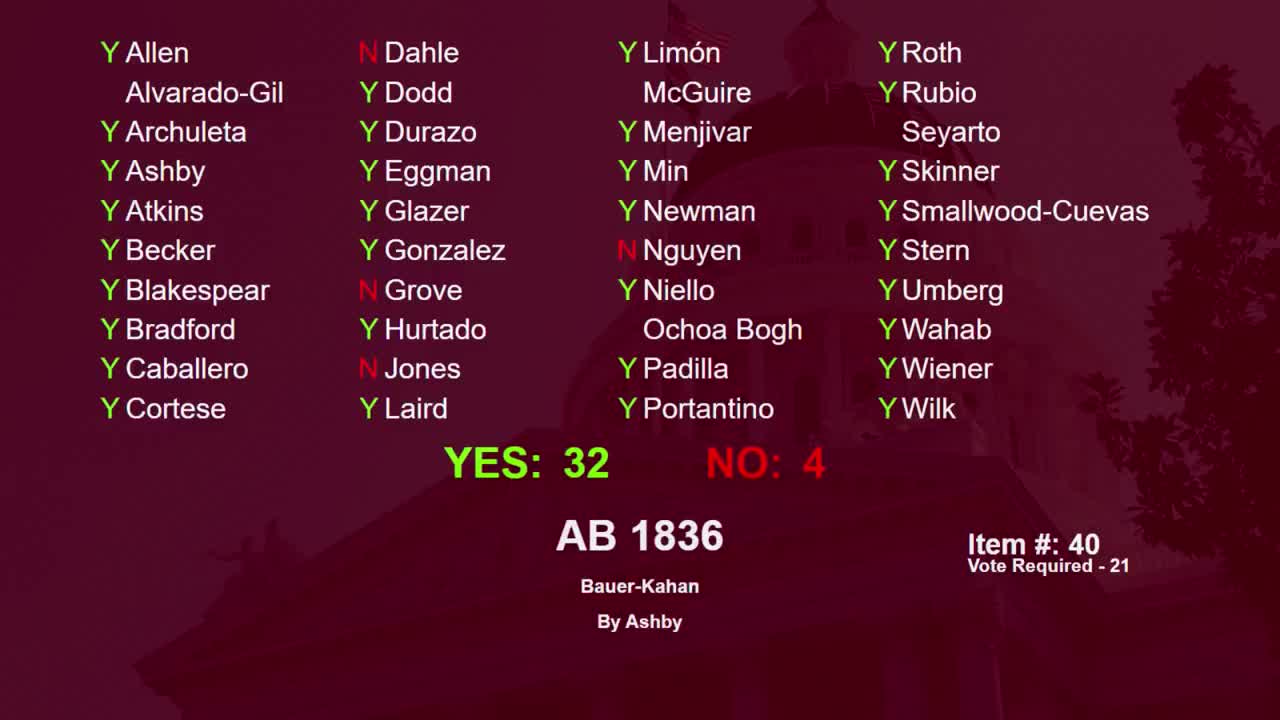 1MIN
Senate Floor
 5MIN
Senate Standing Committee on Judiciary
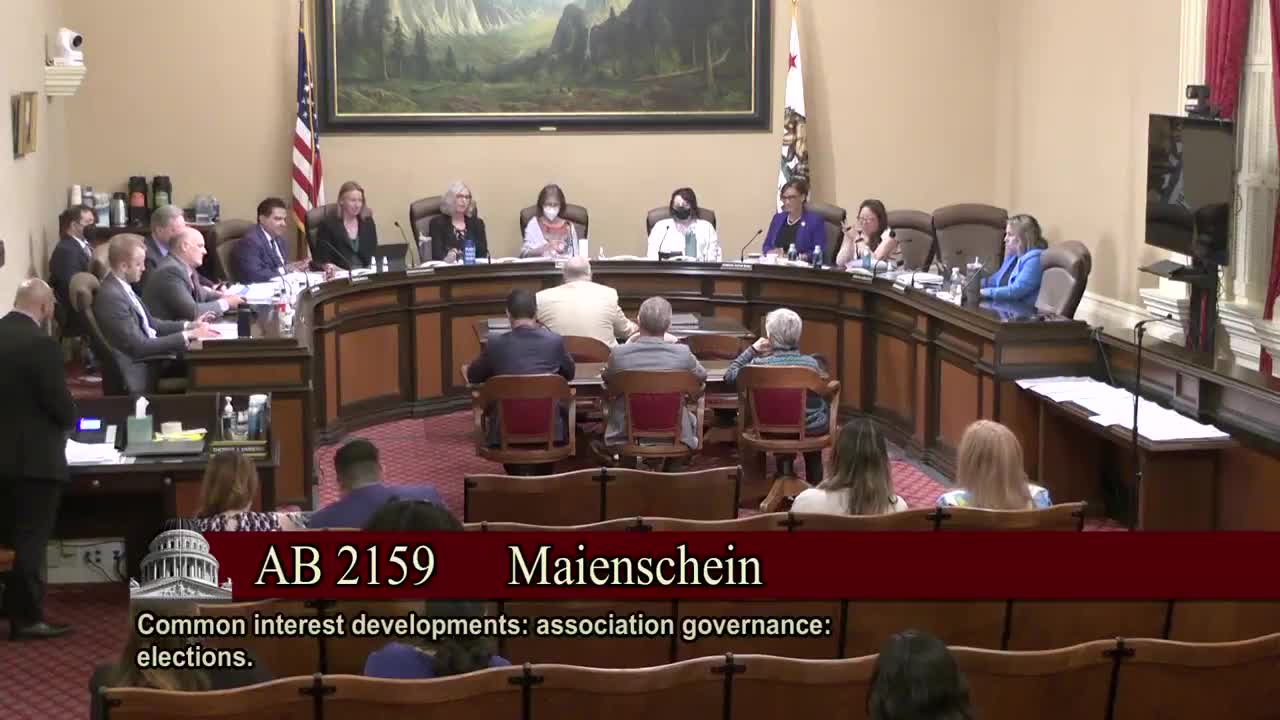 9MIN
Senate Standing Committee on Housing
 54SEC
Assembly Floor
 12MIN
Assembly Standing Committee on Judiciary
 9MIN
Assembly Standing Committee on Housing and Community Development
Bill Author

Bill Co-Author(s):