AB 2471: Professions and vocations: public health nurses.
- Session Year: 2023-2024
- House: Assembly
- Latest Version Date: 2024-09-27
Current Status:
Passed
(2024-09-27: Chaptered by Secretary of State - Chapter 717, Statutes of 2024.)
Introduced
In Committee
First Chamber
In Committee
Second Chamber
Enacted
Existing law requires the payment of a nonrefundable fee to be paid by a registered nurse for an evaluation of their qualifications to use the title of public health nurse. Existing law additionally specifies a fee for renewal of the certification to practice as a public health nurse and imposes a penalty fee for failure to renew a certificate to practice as a public health nurse within the prescribed time of 50% of the renewal fee in effect on the date of renewal of the certificate, as specified.
This bill would delete those provisions relating to renewal of a certificate to practice as a public health nurse. The bill would also state that a public health nurse certificate is not subject to renewal.
This bill would incorporate additional changes to Section 2816 of the Business and Professions Code proposed by SB 1526 to be operative only if this bill and SB 1526 are enacted and this bill is enacted last.
Existing law requires the payment of a nonrefundable fee to be paid by a registered nurse for an evaluation of their qualifications to use the title of public health nurse. Existing law additionally specifies a fee for renewal of the certification to practice as a public health nurse and imposes a penalty fee for failure to renew a certificate to practice as a public health nurse within the prescribed time of 50% of the renewal fee in effect on the date of renewal of the certificate, as specified.
This bill would delete those provisions relating to renewal of a certificate to practice as a public health nurse. The bill would also state that a public health nurse certificate is not subject to renewal.
Existing law requires the payment of a nonrefundable fee to be paid by a registered nurse for an evaluation of their qualifications to use the title of public health nurse. Existing law additionally specifies a fee for renewal of the certification to practice as a public health nurse and imposes a penalty fee for failure to renew a certificate to practice as a public health nurse within the prescribed time of 50% of the renewal fee in effect on the date of renewal of the certificate, as specified.
This bill would delete those provisions relating to renewal of a certificate to practice as a public health nurse.
(a)The nonrefundable fee to be paid by a registered nurse for an evaluation of their qualifications to use the title public health nurse shall not be less than three hundred dollars ($300) or more than one thousand dollars ($1,000). All fees payable under this section shall be collected by and paid to the Board of Registered Nursing Fund. It is the intention of the Legislature that the costs of carrying out the purposes of this article shall be covered by the revenue collected pursuant to this section. The board shall refund any registered nurse who paid more than three hundred dollars ($300) for an evaluation of their qualifications to use the title public health nurse between April 5, 2018, and December 31, 2018.
(b)A public health nurse certificate is not subject to renewal.
SEC. 1.5.Section 2816 of the Business and Professions Code is amended to read:2816.(a)The nonrefundable fee to be paid by a registered nurse for an evaluation of their qualifications to use the title public health nurse shall not be more than one thousand dollars ($1,000). All fees payable under this section shall be collected by and paid to the Board of Registered Nursing Fund. It is the intention of the Legislature that the costs of carrying out the purposes of this article shall be covered by the revenue collected pursuant to this section. The board shall refund any registered nurse who paid more than three hundred dollars ($300) for an evaluation of their qualifications to use the title public health nurse between April 5, 2018, and December 31, 2018.
(b)A public health nurse certificate is not subject to renewal.
SEC. 2.Section 1.5 of this bill incorporates amendments to Section 2816 of the Business and Professions Code proposed by both this bill and Senate Bill 1526. That section of this bill shall only become operative if (1) both bills are enacted and become effective on or before January 1, 2025, (2) each bill amends Section 2816 of the Business and Professions Code, and (3) this bill is enacted after Senate Bill 1526, in which case Section 1 of this bill shall not become operative.
(a)The nonrefundable fee to be paid by a registered nurse for an evaluation of their qualifications to use the title public health nurse shall not be less than three hundred dollars ($300) or more than one thousand dollars ($1,000). All fees payable under this section shall be collected by and paid to the Board of Registered Nursing Fund. It is the intention of the Legislature that the costs of carrying out the purposes of this article shall be covered by the revenue collected pursuant to this section. The board shall refund any registered nurse who paid more than three hundred dollars ($300) for an evaluation of their qualifications to use the title public health nurse between April 5, 2018, and December 31, 2018.
(b)A public health nurse certificate is not subject to renewal.
SEC. 1.5.Section 2816 of the Business and Professions Code is amended to read:2816.(a)The nonrefundable fee to be paid by a registered nurse for an evaluation of their qualifications to use the title public health nurse shall not be less than three hundred dollars ($300) or more than one thousand dollars ($1,000). The fee to be paid upon the application for renewal of the certificate to practice as a public health nurse shall not be less than one hundred twenty-five dollars ($125) and not more than five hundred dollars ($500). The penalty fee for failure to renew a certificate to practice as a public health nurse within the prescribed time shall be 50 percent of the renewal fee in effect on the date of renewal of the certificate, but not less than sixty-two dollars and fifty cents ($62.50), and not more than two hundred fifty dollars ($250). All fees payable under this section shall be collected by and paid to the Board of Registered Nursing Fund. It is the intention of the Legislature that the costs of carrying out the purposes of this article shall be covered by the revenue collected pursuant to this section. The board shall refund any registered nurse who paid more than three hundred dollars ($300) for an evaluation of their qualifications to use the title public health nurse between April 5, 2018, and December 31, 2018.
(b)A public health nurse certificate is not subject to renewal.
SEC. 2.Section 1.5 of this bill incorporates amendments to Section 2816 of the Business and Professions Code proposed by both this bill and Senate Bill 1526. That section of this bill shall only become operative if (1) both bills are enacted and become effective on or before January 1, 2025, (2) each bill amends Section 2816 of the Business and Professions Code, and (3) this bill is enacted after Senate Bill 1526, in which case Section 1 of this bill shall not become operative.
(a)The nonrefundable fee to be paid by a registered nurse for an evaluation of their qualifications to use the title public health nurse shall not be less than three hundred dollars ($300) or more than one thousand dollars ($1,000). All fees payable under this section shall be collected by and paid to the Board of Registered Nursing Fund. It is the intention of the Legislature that the costs of carrying out the purposes of this article shall be covered by the revenue collected pursuant to this section. The board shall refund any registered nurse who paid more than three hundred dollars ($300) for an evaluation of their qualifications to use the title public health nurse between April 5, 2018, and December 31, 2018.
(b)A public health nurse certificate is not subject to renewal.
The nonrefundable fee to be paid by a registered nurse for an evaluation of their qualifications to use the title public health nurse shall not be less than three hundred dollars ($300) or more than one thousand dollars ($1,000). The fee to be paid upon the application for renewal of the certificate to practice as a public health nurse shall not be less than one hundred twenty-five dollars ($125) and not more than five hundred dollars ($500). The penalty fee for failure to renew a certificate to practice as a public health nurse within the prescribed time shall be 50 percent of the renewal fee in effect on the date of renewal of the certificate, but not less than sixty-two dollars and fifty cents ($62.50), and not more than two hundred fifty dollars ($250). All fees payable under this section shall be collected by and paid to the Board of Registered Nursing Fund. It is the intention of the Legislature that the costs of carrying out the purposes of this article shall be covered by the revenue collected pursuant to this section. The board shall refund any registered nurse who paid more than three hundred dollars ($300) for an evaluation of their qualifications to use the title public health nurse between April 5, 2018, and December 31, 2018.
REVISIONS: HeadinigLines 2 and 3.|
Date
|
Status
|
|---|---|
| Sep 27, 2024 | Chaptered by Secretary of State - Chapter 717, Statutes of 2024. |
| Sep 27, 2024 | Approved by the Governor. |
| Sep 13, 2024 | Enrolled and presented to the Governor at 4 p.m. |
| Aug 31, 2024 | Senate amendments concurred in. To Engrossing and Enrolling. (Ayes 74. Noes 0.). |
| Aug 31, 2024 | In Assembly. Concurrence in Senate amendments pending. |
| Aug 31, 2024 | Read third time. Passed. Ordered to the Assembly. (Ayes 39. Noes 0.). |
| Aug 29, 2024 | Read second time. Ordered to third reading. |
| Aug 28, 2024 | Read third time and amended. Ordered to second reading. |
| Aug 28, 2024 | Ordered to third reading. |
| Aug 28, 2024 | Joint Rule 61 suspended. |
| Aug 28, 2024 | From special consent calendar by Senator Niello |
| Aug 26, 2024 | Ordered to special consent calendar. |
| Aug 19, 2024 | Read second time. Ordered to third reading. |
| Aug 15, 2024 | Read second time and amended. Ordered returned to second reading. |
| Aug 15, 2024 | From committee: Amend, and do pass as amended. (Ayes 7. Noes 0.) (August 15). |
| Jun 24, 2024 | In committee: Referred to suspense file. |
| Jun 10, 2024 | From committee: Do pass and re-refer to Com. on APPR. (Ayes 12. Noes 0.) (June 10). Re-referred to Com. on APPR. |
| Jun 5, 2024 | Referred to Com. on B., P. & E. D. |
| May 23, 2024 | In Senate. Read first time. To Com. on RLS. for assignment. |
| May 22, 2024 | Read third time. Passed. Ordered to the Senate. (Ayes 69. Noes 0. Page 5479.) |
| May 20, 2024 | Read second time. Ordered to third reading. |
| May 16, 2024 | From committee: Do pass. (Ayes 15. Noes 0.) (May 16). |
| May 16, 2024 | Coauthors revised. |
| Apr 17, 2024 | In committee: Set, first hearing. Referred to APPR. suspense file. |
| Apr 2, 2024 | From committee: Do pass and re-refer to Com. on APPR. with recommendation: To Consent Calendar. (Ayes 18. Noes 0.) (April 2). Re-referred to Com. on APPR. |
| Mar 4, 2024 | Referred to Com. on B. & P. |
| Feb 14, 2024 | From printer. May be heard in committee March 15. |
| Feb 13, 2024 | Read first time. To print. |
|
Date
|
Description
|
Location
|
Votes
|
|
|---|---|---|---|---|
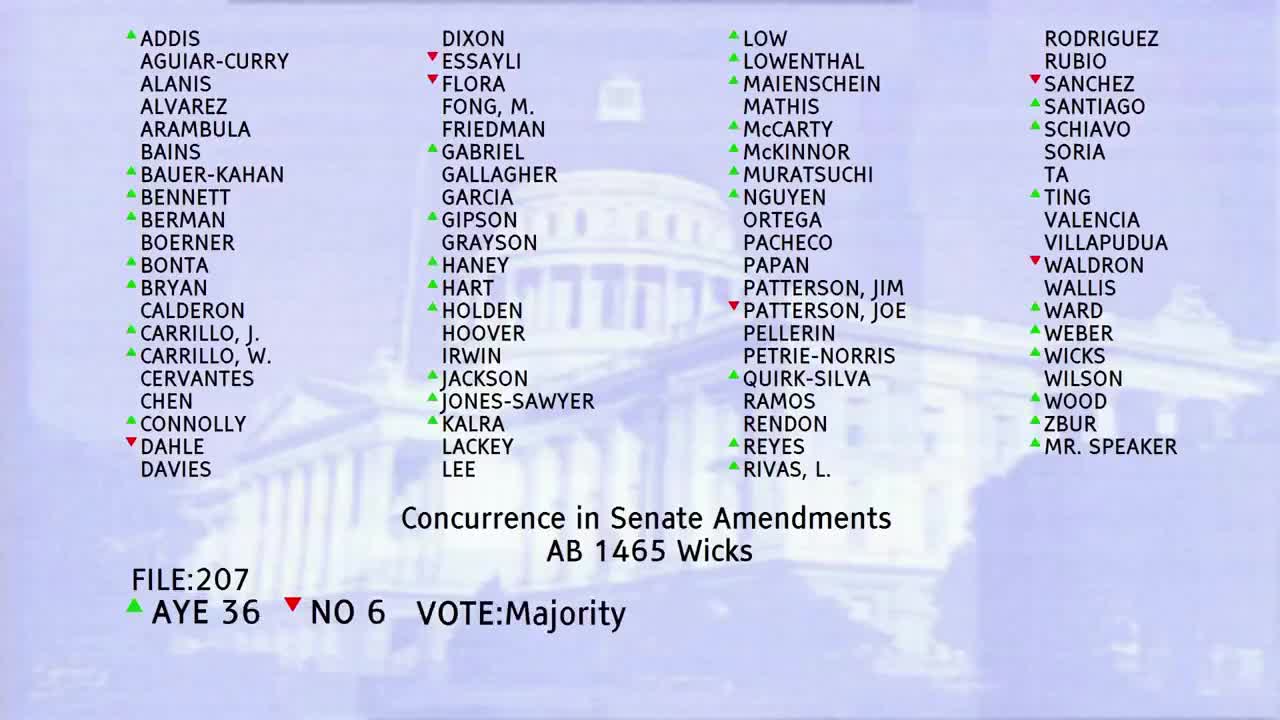
| Aug 31, 2024 | AB 2471 Jim Patterson Concurrence in Senate Amendments | Assembly Floor |
Passed |
|
| Aug 31, 2024 | Assembly 3rd Reading AB2471 Jim Patterson et al. By Niello | Senate Floor |
Passed |
|
| Aug 15, 2024 | Do pass as amended | Senate Standing Committee on Appropriations |
Passed |
|
| Jun 24, 2024 | Placed on suspense file | Senate Standing Committee on Appropriations |
Passed |
|
| Jun 10, 2024 | Do pass, but first be re-referred to the Committee on [Appropriations] | Senate Standing Committee on Business, Professions and Economic Development |
Passed |
|
| May 22, 2024 | AB 2471 Jim Patterson Assembly Third Reading | Assembly Floor |
Passed |
|
| May 16, 2024 | Do pass. | Assembly Standing Committee on Appropriations |
Passed |
|
| Apr 2, 2024 | Do pass and be re-referred to the Committee on [Appropriations] with recommendation: To Consent Calendar | Assembly Standing Committee on Business and Professions |
Passed |
This list shows positions taken on this bill by organizations on the date displayed, which is linked to the original source.
Positions by individuals are not included.
|
Organization
|
Position
|
Date
|
|---|---|---|
| Board of Registered Nursing | ** Support | |
| County Health Executives Association Of California | ** Support | |
| County of Humboldt | * Support | Jun 10, 2024 |
| County Of Mono | ** Support | |
| County of Mono, California | ** Support | |
| Health Officers Association Of California | ** Support | |
| Mariposa County Board of Supervisors | ** Support | |
| Tulare County | ** Support | |
| Westhillscollege.com | ** Support |
CONCURRENCE IN SENATE AMENDMENTS
CSA1 Bill Id:AB 2471
Author:(Jim Patterson)
As Amended Ver:August 15, 2024
Majority vote
SUMMARY
Deletes the requirement for public health nurses to renew certificates.
Senate Amendments
State that the certificate is not subject to renewal.
COMMENTS
Background. Public health nurses (PHNs) are specialized registered nurses (RNs) that provide direct patient care and services related to maintaining the public and community's health and safety. Historically, the PHN designation was intended to establish uniform titles and training in response to conflicting definitions created by state agencies and private organizations, so it does not modify the scope of practice of RNs who specialize as PHNs.
To qualify for PHN certification, applicant RNs must hold a baccalaureate or entry-level master's degree in nursing awarded by a school accredited by a BRN-approved accrediting body and proof of supervised clinical experience. Equivalency methods are provided for individuals whose baccalaureate or entry-level master's degree in nursing is from non-approved accredited schools and for those who have a baccalaureate degree in a field other than nursing.
According to the Author
"[This bill] addresses the financial barrier to public health nurses by removing provisions related to the renewal of certificates. This change simplifies the certification process, reducing financial barriers for registered nurses and encouraging more individuals to pursue or continue their careers in public health nursing."
Arguments in Support
The Board of Registered Nursing (BRN) writes in support:
Currently, a PHN must apply and pay a fee to renew their Registered Nursing (RN) license as well as apply and pay a fee to renew their PHN certificate every two years. The PHN certificate renewal requirement mirrors the certificate renewal requirement for Advance Practice Registered Nurses (APRNs). However, APRNs have an expanded scope of practice which incurs additional investigations and enforcement costs for the Board. These additional costs are covered by the fee APRNs pay to renew their certificates every two years.
While PHNs complete specialized coursework and clinical experience to obtain a certificate, they do not have an expanded scope of practice beyond that of an RN. Consequently, PHNs do not have the same need for a renewal fee. Removing the renewal requirement and associated fee would help to reduce the financial burden of the renewal fee for PHNs and assist in community recruitment efforts.
Arguments in Opposition
No opposition on file.
FISCAL COMMENTS
According to the Senate Appropriations Committee:
- The BRN notes an annual revenue loss of approximately $2.625 million (BRN Fund). There are currently 42,000 PHNs and the certificate renewal fee is $125, paid to the BRN on a biennial basis. The BRN notes that resources related to workload for PHN certificate renewals will be redirected to other vital board activities.
- The Office of Information Services within the Department of Consumer Affairs notes absorbable costs of $4,000 for additional IT workload.
VOTES:
ASM BUSINESS AND PROFESSIONS: 18-0-0
YES: Berman, Flora, Alanis, Bains, Juan Carrillo, Chen, Dixon, Grayson, Irwin, Jackson, Low, Lowenthal, McKinnor, Stephanie Nguyen, Pellerin, Sanchez, Soria, Zbur
ASM APPROPRIATIONS: 15-0-0
YES: Wicks, Sanchez, Arambula, Bryan, Calderon, Wendy Carrillo, Dixon, Mike Fong, Grayson, Haney, Hart, Jim Patterson, Pellerin, Ta, Villapudua
ASSEMBLY FLOOR: 69-0-11
YES: Addis, Aguiar-Curry, Alanis, Alvarez, Arambula, Bains, Bauer-Kahan, Bennett, Berman, Boerner, Bryan, Juan Carrillo, Wendy Carrillo, Chen, Connolly, Davies, Dixon, Flora, Mike Fong, Vince Fong, Gabriel, Gallagher, Garcia, Gipson, Grayson, Haney, Hart, Hoover, Irwin, Jackson, Jones-Sawyer, Kalra, Lackey, Lee, Low, Lowenthal, Maienschein, McCarty, McKinnor, Muratsuchi, Stephanie Nguyen, Ortega, Pacheco, Papan, Jim Patterson, Joe Patterson, Pellerin, Petrie-Norris, Quirk-Silva, Ramos, Rendon, Reyes, Rodriguez, Blanca Rubio, Sanchez, Santiago, Schiavo, Soria, Ta, Ting, Valencia, Villapudua, Waldron, Wallis, Ward, Wicks, Wood, Zbur, Robert Rivas
ABS, ABST OR NV: Bonta, Calderon, Cervantes, Megan Dahle, Essayli, Friedman, Holden, Mathis, Luz Rivas, Weber, Wilson
UPDATED
VERSION: August 15, 2024
CONSULTANT: Vincent Chee / B. & P. / (916) 319-3301 FN: 0003003
SENATE RULES COMMITTEE Office of Senate Floor Analyses (916) 651-1520 Fax: (916) 327-4478 | AB 2471 |
THIRD READING
Bill No: AB 2471
Author: Jim Patterson (R), et al.
Amended: 8/28/24 in Senate
Vote: 21
SENATE BUS., PROF. & ECON. DEV. COMMITTEE: 12-0, 6/10/24
AYES: Ashby, Nguyen, Alvarado-Gil, Archuleta, Becker, Dodd, Eggman, Glazer, Menjivar, Niello, Roth, Wilk
NO VOTE RECORDED: Smallwood-Cuevas
SENATE APPROPRIATIONS COMMITTEE: 7-0, 8/15/24
AYES: Caballero, Jones, Ashby, Becker, Bradford, Seyarto, Wahab
ASSEMBLY FLOOR: 69-0, 5/22/24 - See last page for vote
SUBJECT: Professions and vocations: public health nurses
SOURCE: Author
DIGEST:
This bill deletes the requirement for a public health nurse (PHN), certified by the Board of Registered Nursing (BRN) to renew a PHN certificate and pay a renewal fee, as specified.
Senate Floor Amendments of 8/28/24 address a chaptering conflict.
ANALYSIS:
Existing law:
- Establishes the BRN, under the Department of Consumer Affairs to provide for the licensure and regulation of the practice of nursing. (BPC §§ 2700 et seq.)
- States that the Legislature recognizes that public health nursing is a service of crucial importance for the health, safety, and sanitation of the population in all of California’s communities. These services currently include, but are not limited to:
- Control and prevention of communicable disease.
- Promotion of maternal, child, and adolescent health.
- Prevention of abuse and neglect of children, elders, and spouses.
- Outreach screening, case management, resource coordination and assessment, and delivery and evaluation of care for individuals, families, and communities. (BPC § 2818(a))
- Prohibits the use of the title “public health nurse” without a PHN certificate issued by the BRN. (BPC § 2818(c))
- Specifies that the PHN certificate does not expand the scope of practice of a registered nurse. (BPC § 2820)
- Requires the BRN to set the application fee for the PHN certificate between $300 and $1,000 and the renewal fee between $125 and $500. (BPC § 2816)
This bill deletes the fees for a PHN to renew a certificate with the BRN, and clarifies that a PHN certificate is not subject to renewal.
Background
The BRN is responsible for the licensure and regulation of registered nurses (RN), advanced practice registered nurses (APRN), and for approving nurse educational programs. A PHN is a RN, who meets additional education requirements including a baccalaureate or entry-level master’s degree in nursing awarded by a school accredited by a BRN-approved accrediting body and proof of supervised clinical experience. There are equivalency methods for individuals whose baccalaureate or entry-level master’s degree in nursing is from non-approved accredited schools and for those who have a baccalaureate degree in a field other than nursing.
PHNs provide direct patient care and services related to maintaining the public and community’s health and safety. Historically, the PHN designation was intended to establish uniform titles and training in response to conflicting definitions created by state agencies and private organizations. A PHN certificate does not modify or expand the scope of practice of RNs.
Current law, BPC Section 2818 (c) states that no individual shall hold himself or herself out as a PHN or use a title which includes the term “public health nurse” unless that individual is in possession of a valid PHN certificate issued by the BRN. In order to obtain the certification for designation as a PHN, a PHN must apply and pay an initial certification fee and subsequently renew their PHN certificate. This is in addition to any initial RN application and RN licensure renewal fees.
As noted by the BRN, the PHN renewal requirement and associated fee were set up to mirror the certificate renewal requirements and fees for other APRNs. However, APRNs such as Nurse Practitioners, Certified Nurse Midwives, Certified Registered Nurse Anesthetists, have an expanded scope of practice. While PHNs complete specialized coursework and clinical experience to obtain a certificate, they do not have an expanded scope of practice beyond that of an RN. Consequently, PHNs do not have the same need for a renewal application and fee to maintain that designation. PHNs would still be required to renew their RN license on a biennial basis. This bill removes the current requirement for a PHN to renew their PHN certificate and pay a renewal fee. An applicant for a PHN will still be required to pay an initial application fee to obtain the certificate for PHN designation.
FISCAL EFFECT: Appropriation: No Fiscal Com.: Yes Local: No
According to the Senate Committee on Appropriations, the BRN notes an annual revenue loss of approximately $2.625 million. There are currently 42,000 PHNs and the certificate renewal fee is $125, paid to the BRN on a biennial basis. The BRN notes that resources related to workload for PHN certificate renewals will be redirected to other vital board activities. The Office of Information Services within the Department of Consumer Affairs notes absorbable costs of $4,000 for additional IT workload.
SUPPORT: (Verified 8/26/24)
Board of Registered Nursing
County Health Executives Association of California
County of Mono
Health Officers Association of California
Mariposa County Board of Supervisors
Tulare County
Westhillscollege.com
OPPOSITION: (Verified 8/26/24)
None received
ARGUMENTS IN SUPPORT: Supporters note generally that this bill will help incentivize PHNs to maintain their certification that will help support efforts to address the nursing shortage and strengthen the public health nursing system.
ASSEMBLY FLOOR: 69-0, 5/22/24
AYES: Addis, Aguiar-Curry, Alanis, Alvarez, Arambula, Bains, Bauer-Kahan, Bennett, Berman, Boerner, Bryan, Juan Carrillo, Wendy Carrillo, Chen, Connolly, Davies, Dixon, Flora, Mike Fong, Vince Fong, Gabriel, Gallagher, Garcia, Gipson, Grayson, Haney, Hart, Hoover, Irwin, Jackson, Jones-Sawyer, Kalra, Lackey, Lee, Low, Lowenthal, Maienschein, McCarty, McKinnor, Muratsuchi, Stephanie Nguyen, Ortega, Pacheco, Papan, Jim Patterson, Joe Patterson, Pellerin, Petrie-Norris, Quirk-Silva, Ramos, Rendon, Reyes, Rodriguez, Blanca Rubio, Sanchez, Santiago, Schiavo, Soria, Ta, Ting, Valencia, Villapudua, Waldron, Wallis, Ward, Wicks, Wood, Zbur, Robert Rivas
NO VOTE RECORDED: Bonta, Calderon, Cervantes, Megan Dahle, Essayli, Friedman, Holden, Mathis, Luz Rivas, Weber, Wilson
Prepared by: Elissa Silva / B., P. & E.D. /
8/29/24 16:35:28
**** END ****
SENATE RULES COMMITTEE Office of Senate Floor Analyses (916) 651-1520 Fax: (916) 327-4478 | AB 2471 |
THIRD READING
Bill No: AB 2471
Author: Jim Patterson (R), et al.
Amended: 8/15/24 in Senate
Vote: 21
SENATE BUS., PROF. & ECON. DEV. COMMITTEE: 12-0, 6/10/24
AYES: Ashby, Nguyen, Alvarado-Gil, Archuleta, Becker, Dodd, Eggman, Glazer, Menjivar, Niello, Roth, Wilk
NO VOTE RECORDED: Smallwood-Cuevas
SENATE APPROPRIATIONS COMMITTEE: 7-0, 8/15/24
AYES: Caballero, Jones, Ashby, Becker, Bradford, Seyarto, Wahab
ASSEMBLY FLOOR: 69-0, 5/22/24 - See last page for vote
SUBJECT: Professions and vocations: public health nurses
SOURCE: Author
DIGEST:
This bill deletes the requirement for a public health nurse (PHN), certified by the Board of Registered Nursing (BRN) to renew a PHN certificate and pay a renewal fee, as specified.
ANALYSIS:
Existing law:
- Establishes the BRN, under the Department of Consumer Affairs to provide for the licensure and regulation of the practice of nursing. (BPC §§ 2700 et seq.)
- States that the Legislature recognizes that public health nursing is a service of crucial importance for the health, safety, and sanitation of the population in all of California’s communities. These services currently include, but are not limited to:
- Control and prevention of communicable disease.
- Promotion of maternal, child, and adolescent health.
- Prevention of abuse and neglect of children, elders, and spouses.
- Outreach screening, case management, resource coordination and assessment, and delivery and evaluation of care for individuals, families, and communities. (BPC § 2818(a))
- Prohibits the use of the title “public health nurse” without a PHN certificate issued by the BRN. (BPC § 2818(c))
- Specifies that the PHN certificate does not expand the scope of practice of a registered nurse. (BPC § 2820)
- Requires the BRN to set the application fee for the PHN certificate between $300 and $1,000 and the renewal fee between $125 and $500. (BPC § 2816)
This bill deletes the fees for a PHN to renew a certificate with the BRN, and clarifies that a PHN certificate is not subject to renewal.
Background
The BRN is responsible for the licensure and regulation of registered nurses (RN), advanced practice registered nurses (APRN), and for approving nurse educational programs. A PHN is a RN, who meets additional education requirements including a baccalaureate or entry-level master’s degree in nursing awarded by a school accredited by a BRN-approved accrediting body and proof of supervised clinical experience. There are equivalency methods for individuals whose baccalaureate or entry-level master’s degree in nursing is from non-approved accredited schools and for those who have a baccalaureate degree in a field other than nursing.
PHNs provide direct patient care and services related to maintaining the public and community’s health and safety. Historically, the PHN designation was intended to establish uniform titles and training in response to conflicting definitions created by state agencies and private organizations. A PHN certificate does not modify or expand the scope of practice of RNs.
Current law, BPC Section 2818 (c) states that no individual shall hold himself or herself out as a PHN or use a title which includes the term “public health nurse” unless that individual is in possession of a valid PHN certificate issued by the BRN. In order to obtain the certification for designation as a PHN, a PHN must apply and pay an initial certification fee and subsequently renew their PHN certificate. This is in addition to any initial RN application and RN licensure renewal fees.
As noted by the BRN, the PHN renewal requirement and associated fee were set up to mirror the certificate renewal requirements and fees for other APRNs. However, APRNs such as Nurse Practitioners, Certified Nurse Midwives, Certified Registered Nurse Anesthetists, have an expanded scope of practice. While PHNs complete specialized coursework and clinical experience to obtain a certificate, they do not have an expanded scope of practice beyond that of an RN. Consequently, PHNs do not have the same need for a renewal application and fee to maintain that designation. PHNs would still be required to renew their RN license on a biennial basis. This bill removes the current requirement for a PHN to renew their PHN certificate and pay a renewal fee. An applicant for a PHN will still be required to pay an initial application fee to obtain the certificate for PHN designation.
FISCAL EFFECT: Appropriation: No Fiscal Com.: Yes Local: No
According to the Senate Committee on Appropriations, the BRN notes an annual revenue loss of approximately $2.625 million. There are currently 42,000 PHNs and the certificate renewal fee is $125, paid to the BRN on a biennial basis. The BRN notes that resources related to workload for PHN certificate renewals will be redirected to other vital board activities. The Office of Information Services within the Department of Consumer Affairs notes absorbable costs of $4,000 for additional IT workload.
SUPPORT: (Verified 8/15/24)
Board of Registered Nursing
County Health Executives Association of California
County of Mono
Health Officers Association of California
Mariposa County Board of Supervisors
Tulare County
Westhillscollege.com
OPPOSITION: (Verified 8/15/24)
None received
ARGUMENTS IN SUPPORT: Supporters note generally that this bill will help incentivize PHNs to maintain their certification that will help support efforts to address the nursing shortage and strengthen the public health nursing system.
ASSEMBLY FLOOR: 69-0, 5/22/24
AYES: Addis, Aguiar-Curry, Alanis, Alvarez, Arambula, Bains, Bauer-Kahan, Bennett, Berman, Boerner, Bryan, Juan Carrillo, Wendy Carrillo, Chen, Connolly, Davies, Dixon, Flora, Mike Fong, Vince Fong, Gabriel, Gallagher, Garcia, Gipson, Grayson, Haney, Hart, Hoover, Irwin, Jackson, Jones-Sawyer, Kalra, Lackey, Lee, Low, Lowenthal, Maienschein, McCarty, McKinnor, Muratsuchi, Stephanie Nguyen, Ortega, Pacheco, Papan, Jim Patterson, Joe Patterson, Pellerin, Petrie-Norris, Quirk-Silva, Ramos, Rendon, Reyes, Rodriguez, Blanca Rubio, Sanchez, Santiago, Schiavo, Soria, Ta, Ting, Valencia, Villapudua, Waldron, Wallis, Ward, Wicks, Wood, Zbur, Robert Rivas
NO VOTE RECORDED: Bonta, Calderon, Cervantes, Megan Dahle, Essayli, Friedman, Holden, Mathis, Luz Rivas, Weber, Wilson
Prepared by: Elissa Silva / B., P. & E.D. / 916-651-4104
8/18/24 17:50:10
**** END ****
SENATE COMMITTEE ON
Senator Anna Caballero, Chair
2023 - 2024 Regular Session
AB 2471 (Jim Patterson) - Professions and vocations: public health nurses
Version: | Policy Vote: |
Urgency: | Mandate: |
Hearing Date: | Consultant: |
Bill Summary:
AB 2471 deletes the requirement for a public health nurse (PHN) to renew a PHN certificate with the Board of Registered Nursing (BRN) and deletes the associated fee and penalty.
*********** ANALYSIS ADDENDUM – SUSPENSE FILE ***********
The following information is revised to reflect amendments
adopted by the committee on August 15, 2024
Fiscal Impact:
- The BRN notes an annual revenue loss of approximately $2.625 million (BRN Fund). There are currently 42,000 PHNs and the certificate renewal fee is $125, paid to the BRN on a biennial basis. The BRN notes that resources related to workload for PHN certificate renewals will be redirected to other vital board activities.
- The Office of Information Services within the Department of Consumer Affairs notes absorbable costs of $4,000 for additional IT workload.
Author Amendments:
Specify a PHN certificate is not subject to renewal.
-- END --
SENATE COMMITTEE ON
Senator Anna Caballero, Chair
2023 - 2024 Regular Session
AB 2471 (Jim Patterson) - Professions and vocations: public health nurses
Version: | Policy Vote: |
Urgency: | Mandate: |
Hearing Date: | Consultant: |
Bill Summary:
AB 2471 deletes the requirement for a public health nurse (PHN) to renew a PHN certificate with the Board of Registered Nursing (BRN) and deletes the associated fee and penalty.
Fiscal Impact:
- The BRN notes an annual revenue loss of approximately $2.625 million (BRN Fund). There are currently 42,000 PHNs and the certificate renewal fee is $125, paid to the BRN on a biennial basis. The BRN notes that resources related to workload for PHN certificate renewals will be redirected to other vital board activities.
- The Office of Information Services within the Department of Consumer Affairs notes absorbable costs of $4,000 for additional IT workload.
Background:
A PHN is a registered nurse (RNs), who meets additional education requirements including a baccalaureate or entry-level master’s degree in nursing awarded by a school accredited by a BRN-approved accrediting body and proof of supervised clinical experience. There are equivalency methods for individuals whose baccalaureate or entry-level master’s degree in nursing is from non-approved accredited schools and for those who have a baccalaureate degree in a field other than nursing.
PHNs provide direct patient care and services related to maintaining the public and community’s health and safety. Historically, the PHN designation was intended to establish uniform titles and training in response to conflicting definitions created by state agencies and private organizations. A PHN certificate does not modify or expand the scope of practice of RNs. Common services provided by PHN include, but are not limited to: control and prevention of communicable disease; promotion of maternal, child, and adolescent health; prevention of abuse and neglect of children, elders, and spouses; outreach screening, case management, resource coordination and assessment; and delivery and evaluation of care for individuals, families, and communities.
Current law states that no individual shall hold themselves out as a PHN or use a title which includes the term “public health nurse” unless that individual is in possession of a valid PHN certificate issued by the BRN. In order to obtain the certification for designation as a PHN, a PHN must apply and pay an initial certification fee and subsequently renew their PHN certificate. This is in addition to any initial RN application and RN licensure renewal fees.
As noted by the BRN, the PHN renewal requirement and associated fee were set up to mirror the certificate renewal requirements and fees for other advanced practice RNs (APRNs). However, APRNs such as Nurse Practitioners, Certified Nurse Midwives, Certified Registered Nurse Anesthetists, have an expanded scope of practice. While PHNs complete specialized coursework and clinical experience to obtain a certificate, they do not have an expanded scope of practice beyond that of an RN. Consequently, PHNs do not have the same need for a renewal application and fee to maintain that designation. PHNs would still be required to renew their RN license on a biennial basis.
Proposed Law:
Deletes the requirement for a PHN to renew a certificate with the BRN and deletes the associated fee and penalty.
Staff Comments:
The BRN is a special fund agency primarily funded through licensing and administrative fee revenues and receives no support from the General Fund. The BRN’s largest and most consistent source of revenue is renewal fees.
While this bill will result in a reduction of annual renewal fee revenue, the BRN Fund is stable and an increase of current fees, or reduction in those fees, is not anticipated. The 2024-25 Governor’s Budget notes that the BRN Fund will have a projected fund balance of approximately $81.49 million at the end of Fiscal Year 2024-25, with $66.54 million in annual expenditures. Based on these projections, the BRN will have a fund reserve of approximately 14.8 months at the end of FY 2024-25. A healthy fund balance can cover economic uncertainties, potential litigation, salary or price increases, and other unexpected expenditures.
-- END --
SENATE COMMITTEE ON
BUSINESS, PROFESSIONS AND ECONOMIC DEVELOPMENT
Senator Angelique Ashby, Chair
2023 - 2024 Regular
Bill No: Hearing Date: June 10, 2024
Author: | |||
Version: | February 13, 2024 | ||
Urgency: | No | Fiscal: | Yes |
Consultant: | Elissa Silva | ||
Subject:
SUMMARY:
Deletes the requirement for a public health nurse (PHN), certified by the Board of Registered Nursing (BRN) to renew a PHN certificate and pay a renewal fee, as specified.
Existing law:
- Establishes the BRN, under the Department of Consumer Affairs to provide for the licensure and regulation of the practice of nursing. (BPC §§ 2700 et seq.)
- States that the Legislature recognizes that public health nursing is a service of crucial importance for the health, safety, and sanitation of the population in all of California’s communities. These services currently include, but are not limited to:
- Control and prevention of communicable disease.
- Promotion of maternal, child, and adolescent health.
- Prevention of abuse and neglect of children, elders, and spouses.
- Outreach screening, case management, resource coordination and assessment, and delivery and evaluation of care for individuals, families, and communities. (BPC § 2818(a))
- Prohibits the use of the title “public health nurse” without a PHN certificate issued by the BRN. (BPC § 2818(c))
- Specifies that the PHN certificate does not expand the scope of practice of a registered nurse. (BPC § 2820)
- Requires the BRN to set the application fee for the PHN certificate between $300 and $1,000 and the renewal fee between $125 and $500. (BPC § 2816)
This bill deletes the requirement that a PHN renew a certificate with the BRN.
FISCAL EFFECT:
According to the Assembly Committee on Appropriations, BRN anticipates ongoing revenue loss of approximately $2.625 million annually. The Board has 42,000 active public health nurses. With the deletion of the $125 renewal fee, the Board indicates resources related to the workload of renewing public health certifications will be redirected to other vital areas. The Department of Consumer Affairs notes an additional, absorbable information technology cost of $4,000.
COMMENTS:
- Purpose. The Author is the sponsor of this bill. According to the Author, “Unfortunately, in addition to paying for an RN license, a public health nurse has to pay to renewal their public health nurse certificate as well. The renewal is simply a fee and not associated to any further evidence of qualifications.”
- Background.
Board of Registered Nursing (BRN). The BRN is responsible for the licensure and regulation of registered nurses (RN), advanced practice registered nurses (APRN), and for approving nurse educational programs. A PHN is a RN, who meets additional education requirements including a baccalaureate or entry-level master’s degree in nursing awarded by a school accredited by a BRN-approved accrediting body and proof of supervised clinical experience. There are equivalency methods for individuals whose baccalaureate or entry-level master’s degree in nursing is from non-approved accredited schools and for those who have a baccalaureate degree in a field other than nursing.
PHNs provide direct patient care and services related to maintaining the public and community’s health and safety. Historically, the PHN designation was intended to establish uniform titles and training in response to conflicting definitions created by state agencies and private organizations. A PHN certificate does not modify or expand the scope of practice of RNs. Common services provided by PHN includes, but is not limited to control and prevention of communicable disease, promotion of maternal, child, and adolescent health, prevention of abuse and neglect of children, elders, and spouses, outreach screening, case management, resource coordination and assessment, and delivery and evaluation of care for individuals, families, and communities.
Current law, BPC § 2818 (c) states that no individual shall hold himself or herself out as a PHN or use a title which includes the term “public health nurse” unless that individual is in possession of a valid PHN certificate issued by the BRN. In order to obtain the certification for designation as a PHN, a PHN must apply and pay an initial certification fee and subsequently renew their PHN certificate. This is in addition to any initial RN application and RN licensure renewal fees.
As noted by the BRN, the PHN renewal requirement and associated fee were set up to mirror the certificate renewal requirements and fees for other APRNs. However, APRNs such as Nurse Practitioners, Certified Nurse Midwives, Certified Registered Nurse Anesthetists, have an expanded scope of practice. While PHNs complete specialized coursework and clinical experience to obtain a certificate, they do not have an expanded scope of practice beyond that of an RN. Consequently, PHNs do not have the same need for a renewal application and fee to maintain that designation. PHNs would still be required to renew their RN license on a biennial basis. This bill removes the current requirement for a PHN to renew their PHN certificate and pay a renewal fee. An applicant for a PHN will still be required to pay an initial application fee to obtain the certificate for PHN designation. Current law sets a fee floor for the evaluation of an application for a PHN to be not less than $300 and no more than $1,000 (BPC § 2816).
- Arguments in Support. Supporters note generally this bill will incentivize nurses to maintain their certifications without the additional expense.
SUPPORT AND OPPOSITION:
Support:
Board of Registered Nursing
County Health Executives Association of California
County of Mono
County of Tulare
Health Officers Association of California
Mariposa County Board of Supervisors
West Hills Community College District
Opposition:
None received
-- END --
ASSEMBLY THIRD READING
ATR Bill Id:AB 2471
Author:(Jim Patterson)
As Introduced Ver:February 13, 2024
Majority vote
SUMMARY
Deletes the requirement for public health nurses to renew certificates.
Major Provisions
- Delete the requirement that public health nurses renew their certificates.
- Make conforming changes.
COMMENTS
Background. Public health nurses (PHNs) are specialized registered nurses (RNs) that provide direct patient care and services related to maintaining the public and community's health and safety. Historically, the PHN designation was intended to establish uniform titles and training in response to conflicting definitions created by state agencies and private organizations, so it does not modify the scope of practice of RNs who specialize as PHNs.
To qualify for PHN certification, applicant RNs must hold a baccalaureate or entry-level master's degree in nursing awarded by a school accredited by a BRN-approved accrediting body and proof of supervised clinical experience. Equivalency methods are provided for individuals whose baccalaureate or entry-level master's degree in nursing is from non-approved accredited schools and for those who have a baccalaureate degree in a field other than nursing.
According to the Author
This bill "addresses the financial barrier to public health nurses by removing provisions related to the renewal of certificates. This change simplifies the certification process, reducing financial barriers for registered nurses and encouraging more individuals to pursue or continue their careers in public health nursing."
Arguments in Support
The Board of Registered Nursing (BRN) writes in support:
Currently, a PHN must apply and pay a fee to renew their Registered Nursing (RN) license as well as apply and pay a fee to renew their PHN certificate every two years. The PHN certificate renewal requirement mirrors the certificate renewal requirement for Advance Practice Registered Nurses (APRNs). However, APRNs have an expanded scope of practice which incurs additional investigations and enforcement costs for the Board. These additional costs are covered by the fee APRNs pay to renew their certificates every two years.
While PHNs complete specialized coursework and clinical experience to obtain a certificate, they do not have an expanded scope of practice beyond that of an RN. Consequently, PHNs do not have the same need for a renewal fee. Removing the renewal requirement and associated fee would help to reduce the financial burden of the renewal fee for PHNs and assist in community recruitment efforts.
Arguments in Opposition
None on file.
FISCAL COMMENTS
According to the Assembly Appropriations Committee, the Board of Registered Nursing (Board) anticipates ongoing revenue loss of approximately $2.625 million annually (Board of Registered Nursing Fund (Fund)). The Board has 42,000 active public health nurses. With the deletion of the $125 renewal fee, the Board indicates resources related to the workload of renewing public health certifications will be redirected to other vital areas within the Board. The Department of Consumer Affairs notes an additional, absorbable information technology cost of $4,000.
VOTES
ASM BUSINESS AND PROFESSIONS: 18-0-0
YES: Berman, Flora, Alanis, Bains, Juan Carrillo, Chen, Dixon, Grayson, Irwin, Jackson, Low, Lowenthal, McKinnor, Stephanie Nguyen, Pellerin, Sanchez, Soria, Zbur
ASM APPROPRIATIONS: 15-0-0
YES: Wicks, Sanchez, Arambula, Bryan, Calderon, Wendy Carrillo, Dixon, Mike Fong, Grayson, Haney, Hart, Jim Patterson, Pellerin, Ta, Villapudua
UPDATED
VERSION: February 13, 2024
CONSULTANT: Vincent Chee / B. & P. / (916) 319-3301 FN: 0003003
Date of Hearing: April 17, 2024
ASSEMBLY COMMITTEE ON APPROPRIATIONS
Buffy Wicks, Chair
ABPCA Bill Id:AB 2471
Author:(Jim Patterson) – As Introduced Ver:February 13, 2024
Policy Committee: | Business and Professions | Vote: | 18 - 0 |
|
| ||
|
|
Urgency: No State Mandated Local Program: No Reimbursable: No
SUMMARY:
This bill eliminates the requirement that a public health nurse (PHN) pay a fee to renew their certificate to practice as a public health nurse.
FISCAL EFFECT:
The Board of Registered Nursing (Board) anticipates ongoing revenue loss of approximately $2.625 million annually (Board of Registered Nursing Fund (Fund)). The Board has 42,000 active public health nurses. With the deletion of the $125 renewal fee, the Board indicates resources related to the workload of renewing public health certifications will be redirected to other vital areas within the Board. The Department of Consumer Affairs notes an additional, absorbable information technology cost of $4,000.
COMMENTS:
- Purpose. According to the author:
This bill addresses the financial barrier to public health nurses by removing provisions related to the renewal of certificates. This change simplifies the certification process, reducing financial barriers for registered nurses and encouraging more individuals to pursue or continue their careers in public health nursing.
- Background. PHNs are specialized registered nurses (RNs) who provide direct patient care and services related to maintaining the public and community’s health and safety. To qualify for PHN certification, an RN must hold a baccalaureate or entry-level master’s degree in nursing awarded by a school accredited by a Board-approved accrediting body and supervised clinical experience. An RN whose baccalaureate or entry-level master’s degree in nursing is from a non-approved accredited school or who has a baccalaureate degree in a field other than nursing may also qualify under equivalency methods.
According to the Board, a PHN must apply and pay a fee to renew both their RN license and their PHN certificate every two years. The PHN certificate renewal requirement mirrors the certificate renewal requirement for Advance Practice Registered Nurses (APRNs). However, APRNs have an expanded scope of practice that incurs additional investigations and enforcement costs for the Board. These additional costs are covered by the fee APRNs pay to renew their certificates every two years. Although a PHN must complete specialized coursework and clinical experience to obtain a PHN certificate, their scope of practice is not expanded beyond that of an RN. Consequently, the Board does not have the same need for additional investigations and enforcement and a concomitant renewal fee for PHNs. The Board adds that removing the renewal requirement and associated fee would help to reduce the financial burden of the renewal fee for PHNs and assist in community recruitment efforts. - Prior Legislation. SB 104 (Skinner), Chapter 189, Statutes of 2023 (“Budget Bill Junior”), required the Board to implement the Public Health Nurse Certification Fee Waiver Program (Program). According to the Board’s website, the Program provides, from January 1, 2024 until January 1, 2026, a one-time waiver of initial application or renewal fees for PHN certification as part of Governor Newsom's Workforce for a Healthy California. Prior to SB 104, statute allowed the Board to set the initial PHN certificate application fee between $300 and $1,000 and to set the renewal fee between $125 and $500. The Board website shows an initial PHN certificate application fee of $300 and renewal fee of $125.
- Fund Condition. The Fund is primarily funded through licensing fees and administrative fee revenues, with the largest and most consistent source of revenue being renewal fees. The Fund made a $30 million loan to the General Fund in fiscal year (FY) 2020-21 to help with COVID-19 response (to be repaid in FY 2024-25), and a $65 million loan to the General Fund in FY 2023-24. Prior to these loans, the Fund maintained a nine-month reserve, and was projected to grow.
Analysis Prepared by: Allegra Kim / APPR. / (916) 319-2081
Date of Hearing:
ASSEMBLY COMMITTEE ON BUSINESS AND PROFESSIONS
Marc Berman, Chair
ABPCA Bill Id:AB 2471
Author:(Jim Patterson) – As Introduced Ver:February 13, 2024
SUBJECT: Professions and vocations: public health nurses.
SUMMARY: Deletes the requirement for public health nurses to renew certificates.
EXISTING LAW:
- Regulates the practice of nursing under the Nursing Practice Act. (Business and Professions Code (BPC) §§ 2700-2838.4)
- Establishes the Board of Registered Nursing (BRN) within the Department of Consumer Affairs (DCA) to administer and enforce the Nursing Practice Act until January 1, 2027. (BPC § 2701)
- Prohibits the use of the title “public health nurse” without a public health nurse certificate issued by the BRN. (BPC § 2818(c))
- Specifies that the public health nurse certificate does not expand the scope of practice of a registered nurse. (BPC § 2820)
- Requires the BRN to set the application fee for the public health nurse certificate between $300 and $1,000 and the renewal fee between $125 and $500. (BPC § 2816)
THIS BILL:
- Deletes the requirement that public health nurses renew their certificates.
- Makes conforming changes.
FISCAL EFFECT: Unknown. This bill is keyed fiscal by the Legislative Counsel.
COMMENTS:
Purpose. This bill is sponsored by the author. According to the author, this bill “addresses the financial barrier to public health nurses by removing provisions related to the renewal of certificates. This change simplifies the certification process, reducing financial barriers for registered nurses and encouraging more individuals to pursue or continue their careers in public health nursing.”
Background. Public health nurses (PHNs) are specialized registered nurses (RNs) that provide direct patient care and services related to maintaining the public and community’s health and safety. Historically, the PHN designation was intended to establish uniform titles and training in response to conflicting definitions created by state agencies and private organizations, so it does not modify the scope of practice of RNs who specialize as PHNs.
To qualify for PHN certification, applicant RNs must hold a baccalaureate or entry-level master’s degree in nursing awarded by a school accredited by a BRN-approved accrediting body and proof of supervised clinical experience. Equivalency methods are provided for individuals whose baccalaureate or entry-level master’s degree in nursing is from non-approved accredited schools and for those who have a baccalaureate degree in a field other than nursing.
ARGUMENTS IN SUPPORT:
The Board of Registered Nursing (BRN) writes in support:
Currently, a PHN must apply and pay a fee to renew their Registered Nursing (RN) license as well as apply and pay a fee to renew their PHN certificate every two years. The PHN certificate renewal requirement mirrors the certificate renewal requirement for Advance Practice Registered Nurses (APRNs). However, APRNs have an expanded scope of practice which incurs additional investigations and enforcement costs for the Board. These additional costs are covered by the fee APRNs pay to renew their certificates every two years.
While PHNs complete specialized coursework and clinical experience to obtain a certificate, they do not have an expanded scope of practice beyond that of an RN. Consequently, PHNs do not have the same need for a renewal fee. Removing the renewal requirement and associated fee would help to reduce the financial burden of the renewal fee for PHNs and assist in community recruitment efforts.
ARGUMENTS IN OPPOSITION:
None on file
REGISTERED SUPPORT:
Board of Registered Nursing
County Health Executives Association of California (CHEAC)
County of Mono, California
Health Officers Association of California
Mariposa County Board of Supervisors
Tulare; County of
Westhillscollege.com
REGISTERED OPPOSITION:
None on file
Analysis Prepared by: Vincent Chee / B. & P. / (916) 319-3301
Discussed in Hearing
 1MIN
Senate Floor
 35SEC
Assembly Floor
 6MIN
Senate Standing Committee on Business, Professions and Economic Development
 1MIN
Assembly Floor
Bill Author