AB 249: Water: schoolsites: lead testing.
- Session Year: 2023-2024
- House: Assembly
- Latest Version Date: 2023-09-18
Current Status:
Failed
(2024-02-01: Consideration of Governor's veto stricken from file.)
Introduced
In Committee
First Chamber
In Committee
Second Chamber
Enacted
Existing law, the California Safe Drinking Water Act, requires the State Water Resources Control Board to administer provisions relating to the regulation of drinking water to protect public health. The act requires the state board to establish a grant program, in consultation with the State Department of Education, to award grants to local educational agencies for the purposes of improving access to, and the quality of, drinking water in public schools serving kindergarten or any of grades 1 to 12, inclusive, and preschools and child daycare facilities located on public school property.
This bill would require a community water system that serves a schoolsite, as defined, to test for lead in the potable water system outlets of the schoolsite before January 1, 2027, except as provided. The bill would require the community water system to report its findings to the applicable schoolsite or local educational agency and to the state board. The bill would require the local educational agency or schoolsite, if the lead level exceeds a specified level at a schoolsite, to notify the parents and guardians of the pupils who attend the schoolsite, take immediate steps to make inoperable and shut down from use all potable water system outlets where the excess lead levels may exist, and work to ensure that a lead-free source of drinking water is provided for pupils, as specified. The bill would require a community water system to test a potable water system outlet that replaces an outlet that is found to have excess levels of lead. The bill would require a community water system to prepare a sampling plan for each schoolsite where lead sampling is required under these provisions, as specified. The bill would require the schoolsite, local educational agency, and state board to make the results of schoolsite lead sampling publicly available by posting the results on its internet website. The bill would require a schoolsite and a local educational agency, if an internet website is not maintained, to provide the results upon request. By imposing additional duties on local agencies, this bill would impose a state-mandated local program.
The California Constitution requires the state to reimburse local agencies and school districts for certain costs mandated by the state. Statutory provisions establish procedures for making that reimbursement.
This bill would provide that, if the Commission on State Mandates determines that the bill contains costs mandated by the state, reimbursement for those costs shall be made pursuant to the statutory provisions noted above.
Existing law, the California Safe Drinking Water Act, requires the State Water Resources Control Board to administer provisions relating to the regulation of drinking water to protect public health. The act requires the state board to establish a grant program, in consultation with the State Department of Education, to award grants to local educational agencies for the purposes of improving access to, and the quality of, drinking water in public schools serving kindergarten or any of grades 1 to 12, inclusive, and preschools and child daycare facilities located on public school property.
This bill would require a community water system that serves a schoolsite, as defined, to test for lead in the potable water system outlets of the schoolsite before January 1, 2027, except for potable water system outlets in buildings that were either constructed after January 1, 2010, or modernized after January 1, 2010, and all faucets and other end point devices used for providing potable water were replaced as part of the modernization. as provided. The bill would require the community water system to report its findings to the applicable schoolsite or local educational agency and to the state board. The bill would require the local educational agency or schoolsite, if the lead level exceeds a specified level at a schoolsite, to notify the parents and guardians of the pupils who attend the schoolsite, take immediate steps to make inoperable and shut down from use all potable water system outlets where the excess lead levels may exist, and work to ensure that a lead-free source of drinking water is provided for pupils, as specified. The bill would require a community water system to test a potable water system outlet that replaces an outlet that is found to have excess levels of lead. The bill would require a community water system to prepare a sampling plan for each schoolsite where lead sampling is required under these provisions, as specified. The bill would require the schoolsite, local education educational agency, and state board to make the results of schoolsite lead sampling publicly available by posting the results on its internet website. The bill would require a schoolsite and a local educational agency, if an internet website is not maintained, to provide the results upon request. By imposing additional duties on local agencies, this bill would impose a state-mandated local program.
Existing law authorizes the state board to issue a citation for violations of the act or any regulation, permit, standard, citation, or order issued or adopted under the act, and to assess a penalty in an amount not to exceed $1,000 per day for each day a violation occurs, as provided. Existing law requires a public water system to reimburse the state board for enforcement costs incurred, as specified.This bill would expand the state boards authority to issue citations and penalties for violations of the act or any regulation, permit, standard, citation, or order issued or adopted under the act, as well as the requirement to reimburse the state board for enforcement costs, to apply to any person, as provided.The California Constitution requires the state to reimburse local agencies and school districts for certain costs mandated by the state. Statutory provisions establish procedures for making that reimbursement.
This bill would provide that, if the Commission on State Mandates determines that the bill contains costs mandated by the state, reimbursement for those costs shall be made pursuant to the statutory provisions noted above.
Existing law, the California Safe Drinking Water Act, requires the State Water Resources Control Board to administer provisions relating to the regulation of drinking water to protect public health. The act requires the state board to establish a grant program, in consultation with the State Department of Education, to award grants to local educational agencies for the purposes of improving access to, and the quality of, drinking water in public schools serving kindergarten or any of grades 1 to 12, inclusive, and preschools and child daycare facilities located on public school property.
This bill would require a community water system that serves a schoolsite, as defined, to test for lead in the potable water system outlets of the schoolsite before January 1, 2027, except for potable water system outlets in buildings that were either constructed after January 1, 2010, or modernized after January 1, 2010, and all faucets and other end point devices used for providing potable water were replaced as part of the modernization. The bill would require the community water system to report its findings to the applicable school schoolsite or local educational agency and to the state board. The bill would require the local educational agency or school, schoolsite, if the lead level exceeds a specified level at a schoolsite, to notify the parents and guardians of the pupils who attend the schoolsite, take immediate steps to make inoperable and shut down from use all fountains and faucets all potable water system outlets where the excess lead levels may exist, and work with the schoolsites under its jurisdiction to ensure that a potable lead-free source of drinking water is provided for pupils, as specified. The bill would require a community water system to test a potable water system outlet that replaces an outlet that is found to have excess levels of lead. The bill would require a community water system to prepare a sampling plan for each schoolsite where lead sampling is required under these provisions. provisions, as specified. The bill would require the schoolsite, local education agency, and state board to make the results of schoolsite lead sampling publicly available by posting the results on its internet website. The bill would require a schoolsite and a local educational agency, if an internet website is not maintained, to provide the results upon request. By imposing additional duties on local agencies, this bill would impose a state-mandated local program.
This bill would require the State Water Resources Control Board to allocate $10,000,000 each fiscal year for the years 2024 to 2027, inclusive, from the funds the state board receives from the federal Infrastructure Investment and Jobs Act, to the extent allowed under federal law, to pay for drinking water testing, drinking water filters, and related training for school personnel at schoolsites, as specified.Existing law establishes the Safe Drinking Water State Revolving Fund, in which both the state and federal funds are continuously appropriated, to provide financial assistance for the design and construction of projects for public water systems that will enable those systems to meet safe drinking water standards.This bill would require the state board to allocate $5,000,000 each fiscal year for the years 2024 to 2027, inclusive, from its federal Drinking Water State Revolving Fund federal allocation, to the extent allowed under federal law, to pay for water efficient faucet and fixture replacements at schoolsites, as specified. By making moneys in the Safe Drinking Water State Revolving Fund, a continuously appropriated fund, available for new purposes, the bill would make an appropriation.Existing law authorizes the state board to issue a citation for violations of the act or any regulation, permit, standard, citation, or order issued or adopted under the act, and to assess a penalty in an amount not to exceed $1,000 per day for each day a violation occurs, as provided. Existing law requires a public water system to reimburse the state board for enforcement costs incurred, as specified.
This bill would expand the state boards authority to issue citations and penalties for violations of the act or any regulation, permit, standard, citation, or order issued or adopted under the act, as well as the requirement to reimburse the state board for enforcement costs, to apply to any person, as provided.
The California Constitution requires the state to reimburse local agencies and school districts for certain costs mandated by the state. Statutory provisions establish procedures for making that reimbursement.
This bill would provide that, if the Commission on State Mandates determines that the bill contains costs mandated by the state, reimbursement for those costs shall be made pursuant to the statutory provisions noted above.
Existing law, the California Safe Drinking Water Act, requires the State Water Resources Control Board to administer provisions relating to the regulation of drinking water to protect public health. The act requires the state board to establish a grant program, in consultation with the State Department of Education, to award grants to local educational agencies for the purposes of improving access to, and the quality of, drinking water in public schools serving kindergarten or any of grades 1 to 12, inclusive, and preschools and child daycare facilities located on public school property.
This bill would require a community water system that serves a schoolsite, as defined, to test for lead in the potable water system outlets of the schoolsite before January 1, 2027, except for potable water system outlets in buildings that were either constructed after January 1, 2010, or modernized after January 1, 2010, and all faucets and other end point devices used for providing potable water were replaced as part of the modernization. The bill would require the community water system to report its findings to the applicable school or local educational agency and to the state board. The bill would require the local educational agency or school, if the lead level exceeds a specified level at a schoolsite, to notify the parents and guardians of the pupils who attend the schoolsite, take immediate steps to make inoperable and shut down from use all fountains and faucets where the excess lead levels may exist, and work with the schoolsites under its jurisdiction to ensure that a potable source of drinking water is provided for pupils, as specified. The bill would require a community water system to test a potable water system outlet that replaces an outlet that is found to have excess levels of lead. The bill would require a community water system to prepare a sampling plan for each schoolsite where lead sampling is required under these provisions. The bill would require the state board to make the results of schoolsite lead sampling publicly available by posting the results on its internet website. By imposing additional duties on local agencies, this bill would impose a state-mandated local program.
This bill would require the State Water Resources Control Board to allocate $10,000,000 each fiscal year for the years 2024 to 2027, inclusive, from the funds the state board receives from the federal Infrastructure Investment and Jobs Act, to the extent allowed under federal law, to pay for drinking water testing, drinking water filters, and related training for school personnel at schoolsites, as specified.
Existing law establishes the Safe Drinking Water State Revolving Fund, in which both the state and federal funds are continuously appropriated, to provide financial assistance for the design and construction of projects for public water systems that will enable those systems to meet safe drinking water standards.
This bill would require the state board to allocate $5,000,000 each fiscal year for the years 2024 to 2027, inclusive, from its federal Drinking Water State Revolving Fund federal allocation, to the extent allowed under federal law, to pay for water efficient faucet and fixture replacements at schoolsites, as specified. By making moneys in the Safe Drinking Water State Revolving Fund, a continuously appropriated fund, available for new purposes, the bill would make an appropriation.
The California Constitution requires the state to reimburse local agencies and school districts for certain costs mandated by the state. Statutory provisions establish procedures for making that reimbursement.
This bill would provide that, if the Commission on State Mandates determines that the bill contains costs mandated by the state, reimbursement for those costs shall be made pursuant to the statutory provisions noted above.
Existing law, the California Safe Drinking Water Act, requires the State Water Resources Control Board to administer provisions relating to the regulation of drinking water to protect public health. The act requires the state board to establish a grant program, in consultation with the State Department of Education, to award grants to local educational agencies for the purposes of improving access to, and the quality of, drinking water in public schools serving kindergarten or any of grades 1 to 12, inclusive, and preschools and child daycare facilities located on public school property.
This bill would require a community water system that serves a schoolsite, as defined, to test for lead in the potable water system outlets of the schoolsite before January 1, 2027, except for potable water system outlets in buildings that were either constructed after January 1, 2010, or modernized after January 1, 2010, and all faucets and other end point devices used for providing potable water were replaced as part of the modernization. The bill would require the community water system to report its findings to the applicable school or local educational agency and to the state board. The bill would require the local educational agency or school, if the lead level exceeds a specified level at a schoolsite, to notify the parents and guardians of the pupils who attend the schoolsite, take immediate steps to make inoperable and shut down from use all fountains and faucets where the excess lead levels may exist, and work with the schoolsites under its jurisdiction to ensure that a potable source of drinking water is provided for pupils, as specified. The bill would require a community water system to prepare a sampling plan for each schoolsite where lead sampling is required under these provisions. The bill would require the state board to make the results of schoolsite lead sampling publicly available by posting the results on its internet website. By imposing additional duties on local agencies, this bill would impose a state-mandated local program.
This bill would require the State Water Resources Control Board to allocate $10,000,000 each fiscal year for the years 2024 to 2027, inclusive, from the funds the state board receives from the federal Infrastructure Investment and Jobs Act, to the extent allowed under federal law, to pay for drinking water testing, drinking water filters, and related training for school personnel at schoolsites, as specified.
Existing law establishes the Safe Drinking Water State Revolving Fund, in which both the state and federal funds are continuously appropriated, to provide financial assistance for the design and construction of projects for public water systems that will enable those systems to meet safe drinking water standards.
This bill would require the state board to allocate $5,000,000 each fiscal year for the years 2024 to 2027, inclusive, from its federal Drinking Water State Revolving Fund federal allocation, to the extent allowed under federal law, to pay for water efficient faucet and fixture replacements at schoolsites, as specified. By making moneys in the Safe Drinking Water State Revolving Fund, a continuously appropriated fund, available for new purposes, the bill would make an appropriation.
The California Constitution requires the state to reimburse local agencies and school districts for certain costs mandated by the state. Statutory provisions establish procedures for making that reimbursement.
This bill would provide that, if the Commission on State Mandates determines that the bill contains costs mandated by the state, reimbursement for those costs shall be made pursuant to the statutory provisions noted above.
Existing law, the California Safe Drinking Water Act, requires the State Water Resources Control Board to administer provisions relating to the regulation of drinking water to protect public health. The act requires the state board to establish a grant program, in consultation with the State Department of Education, to award grants to local educational agencies for the purposes of improving access to, and the quality of, drinking water in public schools serving kindergarten or any of grades 1 to 12, inclusive, and preschools and child daycare facilities located on public school property.
This bill would require a community water system that serves a schoolsite schoolsite, as defined, to test for lead in the potable water system outlets of the schoolsite before January 1, 2027, except for potable water system outlets in buildings that were either constructed after January 1, 2010, or modernized after January 1, 2010, and all faucets and other end point devices used for providing potable water were replaced as part of the modernization. The bill would require the community water system to report its findings to the applicable school or local educational agency and to the state board. The bill would require the local educational agency or school, if the lead level exceeds a specified level at a schoolsite, to notify the parents and guardians of the pupils who attend the schoolsite or preschool, schoolsite, take immediate steps to make inoperable and shut down from use all fountains and faucets where the excess lead levels may exist, and work with the schoolsites under its jurisdiction to ensure that a potable source of drinking water is provided for pupils, as specified. The bill would require a community water system to prepare a sampling plan for each schoolsite where lead sampling is required under these provisions. The bill would require the state board to make the results of schoolsite lead sampling publicly available by posting the results on its internet website. By imposing additional duties on local agencies, this bill would impose a state-mandated local program.
This bill would require the State Water Resources Control Board to allocate $10,000,000 each fiscal year for the years 2024 to 2027, inclusive, from the funds the state board receives from the federal Infrastructure Investment and Jobs Act, to the extent allowed under federal law, to pay for drinking water testing, drinking water filters, and related training for school personnel at schoolsites, as specified.
Existing law establishes the Safe Drinking Water State Revolving Fund, in which both the state and federal funds are continuously appropriated, to provide financial assistance for the design and construction of projects for public water systems that will enable those systems to meet safe drinking water standards.
This bill would require the state board to allocate $5,000,000 each fiscal year for the years 2024 to 2027, inclusive, from its federal Drinking Water State Revolving Fund federal allocation, to the extent allowed under federal law, to pay for water efficient faucet and fixture replacements at schoolsites, as specified. By making moneys in the Safe Drinking Water State Revolving Fund, a continuously appropriated fund, available for new purposes, the bill would make an appropriation.
The California Constitution requires the state to reimburse local agencies and school districts for certain costs mandated by the state. Statutory provisions establish procedures for making that reimbursement.
This bill would provide that, if the Commission on State Mandates determines that the bill contains costs mandated by the state, reimbursement for those costs shall be made pursuant to the statutory provisions noted above.
Existing law, the California Safe Drinking Water Act, requires the State Water Resources Control Board to administer provisions relating to the regulation of drinking water to protect public health. The act requires the state board to establish a grant program, in consultation with the State Department of Education, to award grants to local educational agencies for the purposes of improving access to, and the quality of, drinking water in public schools serving kindergarten or any of grades 1 to 12, inclusive, and preschools and child daycare facilities located on public school property.
This bill would require a community water system that serves a schoolsite with a building constructed before January 1, 2010, to test for lead in the potable water system outlets of the schoolsite before January 1, 2027. 2027, except for potable water system outlets in buildings that were either constructed after January 1, 2010, or modernized after January 1, 2010, and all faucets and other end point devices used for providing potable water were replaced as part of the modernization. The bill would require the community water system to report its findings to the applicable school or local educational agency, as specified. agency and to the state board. The bill would require the local educational agency or school, if the lead level exceeds a specified level at a schoolsite, to notify the parents and guardians of the pupils who attend the schoolsite or preschool. The bill would require the local educational agency or school to preschool, take immediate steps to make inoperable and shut down from use all fountains and faucets where the excess lead levels may exist. The bill would also require that the local educational agency or school exist, and work with the schoolsites under its jurisdiction to ensure that a potable source of drinking water is provided for pupils, as specified. The bill would require a community water system to prepare a sampling plan for each schoolsite where lead sampling is required under these provisions. The bill would require the state board to make the results of schoolsite lead sampling publicly available by posting the results on its internet website. By imposing additional duties on local agencies, this bill would impose a state-mandated local program.
This bill would require the State Water Resources Control Board to allocate $10,000,000 each fiscal year for the years 2024 to 2027, inclusive, from the funds the board receives from the federal Infrastructure Investment and Jobs Act, to the extent allowed under federal law, to pay for drinking water testing, drinking water filters, and related training for school personnel at schoolsites, as specified.
Existing law establishes the Safe Drinking Water State Revolving Fund, in which both the state and federal funds are continuously appropriated, to provide financial assistance for the design and construction of projects for public water systems that will enable those systems to meet safe drinking water standards.
This bill would require the board to allocate $5,000,000 each fiscal year for the years 2024 to 2027, inclusive, from its federal Drinking Water State Revolving Fund federal allocation, to the extent allowed under federal law, to pay for water efficient faucet and fixture replacements at schoolsites, as specified. By making moneys in the Safe Drinking Water State Revolving Fund, a continuously appropriated fund, available for new purposes, the bill would make an appropriation.
The California Constitution requires the state to reimburse local agencies and school districts for certain costs mandated by the state. Statutory provisions establish procedures for making that reimbursement.
This bill would provide that, if the Commission on State Mandates determines that the bill contains costs mandated by the state, reimbursement for those costs shall be made pursuant to the statutory provisions noted above.
Existing law, the California Safe Drinking Water Act, requires the State Water Resources Control Board to administer provisions relating to the regulation of drinking water to protect public health. The act requires the state board to establish a grant program, in consultation with the State Department of Education, to award grants to local educational agencies for the purposes of improving access to, and the quality of, drinking water in public schools serving kindergarten or any of grades 1 to 12, inclusive, and preschools and child daycare facilities located on public school property.
This bill would require a community water system that serves a schoolsite with a building constructed before January 1, 2010, to test for lead in the potable water system of the schoolsite before January 1, 2027. The bill would require the community water system to report its findings to the applicable school or local educational agency, as specified. The bill would require the local educational agency or school, if the lead level exceeds a specified level at a schoolsite, to notify the parents and guardians of the pupils who attend the schoolsite or preschool. The bill would require the local educational agency or school to take immediate steps to make inoperable and shut down from use all fountains and faucets where the excess lead levels may exist. The bill would also require that the local educational agency or school work with the schoolsites under its jurisdiction to ensure that a potable source of drinking water is provided for pupils, as specified. The bill would require a community water system to prepare a sampling plan for each schoolsite where lead sampling is required under these provisions. By imposing additional duties on local agencies, this bill would impose a state-mandated local program.
This bill would require the State Water Resources Control Board to allocate $10,000,000 each fiscal year for the years 2024 to 2027, inclusive, from the funds the board receives from the federal Infrastructure Investment and Jobs Act, to the extent allowed under federal law, to pay for drinking water testing, drinking water filters, and related training for school personnel at schoolsites, as specified.
Existing law establishes the Safe Drinking Water State Revolving Fund, in which both the state and federal funds are continuously appropriated, to provide financial assistance for the design and construction of projects for public water systems that will enable those systems to meet safe drinking water standards.
This bill would require the board to allocate $5,000,000 each fiscal year for the years 2024 to 2027, inclusive, from its federal Drinking Water State Revolving Fund federal allocation, to the extent allowed under federal law, to pay for water efficient faucet and fixture replacements at schoolsites, as specified. By making moneys in the Safe Drinking Water State Revolving Fund, a continuously appropriated fund, available for new purposes, the bill would make an appropriation.
The California Constitution requires the state to reimburse local agencies and school districts for certain costs mandated by the state. Statutory provisions establish procedures for making that reimbursement.
This bill would provide that, if the Commission on State Mandates determines that the bill contains costs mandated by the state, reimbursement for those costs shall be made pursuant to the statutory provisions noted above.
(a)The Legislature finds and declares all of the following:
(1)The federal Centers for Disease Control and Prevention states that there is no safe level of lead in children.
(2)The State Department of Public Health reports that lead exposure at very low levels can cause learning, behavioral, and attention difficulties in children, and nervous system and organ damage. Exposure to high levels of lead can be fatal.
(3)No effective treatments ameliorate the long-lasting developmental effects of lead toxicity, and it is believed that these effects are permanent.
(4)As of January 2023, the United States Environmental Protection Agency estimated that as much as 20 percent of a childs lead exposure comes from lead in drinking water, when water lead levels are five parts per billion. Drinking water can be an even larger source of lead exposure for infants who consume mostly water-based formula.
(5)The United States Environmental Protection Agencys maximum contaminant level goal, the value the agency deems acceptable for health, is zero for lead in water.
(6)In 2016, the American Academy of Pediatrics recommended that state and local governments take steps to ensure that water fountains in schools do not exceed water lead concentrations of one part per billion.
(b)It is therefore the goal of the state to ensure all of the following:
(1)Water served to or consumed by children while they attend school or are cared for in licensed childcare facilities contains no more than zero parts per billion of lead.
(2)State requirements for lead in drinking water in schools are at least as health protective as national standards and complement the requirements established by the United States Environmental Protection Agency for the control of lead and copper imposed pursuant to Title 40 of the Code of Federal Regulations.
(3)Any future state requirements for the testing of lead in drinking water in schools will use the most protective standard possible, or no more than five parts per billion of lead.
SEC. 2.Section 116277 is added to the Health and Safety Code, to read:116277.(a)(1)A community water system that serves a schoolsite shall test on that schoolsite for lead in each of the schoolsites potable water system outlets on or before January 1, 2027. The appropriate local educational agency shall provide the community water system that serves the schoolsite with the specific location of each potable water system outlet at the schoolsite.
(2)(A)This section does not apply to a potable water system outlet in a building on a schoolsite that satisfies either of the following criteria:
(i)The building was constructed after January 1, 2010.
(ii)The building was modernized after January 1, 2010, and all faucets and other end point devices used for providing potable water were replaced as part of the modernization.
(B)This section does not apply to a faucet or fixture at a schoolsite where prior testing already showed results of five parts per billion of lead or higher and the schoolsite has taken action to replace the faucet or fixture, or where the schoolsite has otherwise replaced the faucet or fixture since the prior testing.
(3)(A)Each local educational agency or schoolsite shall allow the community water system access to each schoolsite where lead sampling is required pursuant to this subdivision to conduct testing.
(B)Before a community water system enters a schoolsite to conduct lead sampling, the community water system shall request access to the schoolsite from the local educational agency or schoolsite pursuant to this subparagraph. The community water system shall provide a written notice to the local educational agency or schoolsite at least 30 days in advance of the date on which the community water system intends to enter the schoolsite. If the local educational agency or schoolsite fails to respond to the notice within 30 days, the community water system shall provide a second written notice to the local educational agency or schoolsite.
(C)If the local educational agency or schoolsite refuses to allow the community water system access to the schoolsite or fails to respond to the second written notice described in subparagraph (B) within 30 days, the community water system shall notify the state board that the local educational agency or schoolsite is not in compliance with the requirements of this section.
(D)If a community water system provides the notices described in subparagraphs (B) and (C) but is not permitted to access the schoolsite, the community water system shall be deemed to have complied with the requirements of this section with respect to that schoolsite.
(b)When testing for lead, a community water system shall develop a sampling plan, conduct testing, and interpret results pursuant to, but not limited to, Modules 4 and 5 of the United States Environmental Protection Agencys 3Ts for Reducing Lead in Drinking Water in Schools and Child Care Facilities toolkit, EPA 815-B-18-007, or subsequent United States Environmental Protection Agency guidance as identified by the state board.
(c)(1)Each community water system, in cooperation with the appropriate corresponding local educational agency or schoolsite, shall prepare a sampling plan for each schoolsite where lead sampling is required pursuant to subdivision (a). In developing the plan, the community water system may request assistance from the state board or any local health agency responsible for regulating community water systems.
(2)A local educational agency may perform the lead sampling required pursuant to subdivision (a) itself, in which case the community water system shall provide local educational agency employees working at the schoolsite training for purposes of this section.
(d)A community water system that serves a schoolsite where lead sampling is required pursuant to subdivision (a) shall report the water lead level findings to both of the following:
(1)The applicable schoolsite or local educational agency, within 10 business days after the community water system receives the results from the testing laboratory, or within two business days after the community water system receives the results if it is found that the water lead level from any potable water system outlet on the schoolsite exceeds five parts per billion of lead.
(2)The state board, as specified by the state board.
(e)If the testing results show lead levels in excess of five parts per billion for any potable water system outlet, the applicable local educational agency or schoolsite shall do all of the following:
(1)(A)Notify the parents and guardians of the pupils who attend the schoolsite where the elevated lead levels are found no later than 30 schooldays during the academic year, or otherwise within 60 days after receiving the results from the community water system, and provide information developed by the state board on the impact of elevated lead levels on children.
(B)The local educational agency or schoolsite may include a description of a remediation plan as part of the notice provided pursuant to this paragraph.
(2)Take immediate steps to make inoperable and shut down from use all potable water system outlets where the excess lead levels may exist.
(3)(A)Work to ensure that a lead-free source of drinking water is provided for pupils at each potable water system outlet that has been shut down due to elevated lead levels.
(B)For purposes of subparagraph (A), providing a lead-free source of drinking water may include, but is not limited to, replacing any fixtures that are contributing to the elevated lead levels, providing onsite water filtration, or providing alternative sources of potable water.
(f)A local educational agency or schoolsite shall not attempt to remediate excess levels of lead by flushing the water in a potable water system outlet.
(g)If a potable water system outlet is replaced because of excess levels of lead found as a result of the lead sampling conducted pursuant to subdivision (a), the community water system shall test the replacement potable water system outlet.
(h)The local educational agency and schoolsite shall each post all test results on a publicly accessible internet website that the local educational agency or schoolsite maintains. If a local educational agency or schoolsite does not maintain an internet website, the local educational agency or schoolsite shall provide the test results upon request.
(i)The state board shall make the results of schoolsite lead sampling conducted pursuant to subdivision (a) publicly available by posting the results on its internet website, including, but not limited to, periodic updates on sampling results and associated data descriptions and disclaimers.
(j)(1)The state board shall work with community water systems and schoolsites to eliminate duplicative testing that may occur based on applicable federal requirements in a regulation promulgated by the United States Environmental Protection Agency on or before January 1, 2027, including through application for a waiver from those requirements.
(2)Nothing in this subdivision relieves a community water system from compliance with the lead sampling requirements in this section.
(k)For purposes of this section, the following definitions apply:
(1)Local educational agency means a school district, county office of education, or charter school.
(2)Potable water system outlet means all cold water outlets, including single-handle faucets that dispense both hot and cold water, which are reasonably expected to be used for drinking and food preparation as depicted in Module 4 of the United States Environmental Protection Agencys 3Ts for Reducing Lead in Drinking Water in Schools and Child Care Facilities manual.
(3)Lead-free has the same meaning as in subdivision (e) of Section 116875 of the Health and Safety Code.
(4)Schoolsite means a public school that receives funding pursuant to Title I of the federal Elementary and Secondary Education Act of 1965 (20 U.S.C. Sec. 6301 et seq.).
SEC. 3.If the Commission on State Mandates determines that this act contains costs mandated by the state, reimbursement to local agencies and school districts for those costs shall be made pursuant to Part 7 (commencing with Section 17500) of Division 4 of Title 2 of the Government Code.
(a)The Legislature finds and declares all of the following:
(1)The federal Centers for Disease Control and Prevention states that there is no safe level of lead in children.
(2)The State Department of Public Health reports that lead exposure at very low levels can cause learning, behavioral, and attention difficulties in children, and nervous system and organ damage. Exposure to high levels of lead can be fatal.
(3)No effective treatments ameliorate the long-lasting developmental effects of lead toxicity, and it is believed that these effects are permanent.
(4)As of January 2023, the United States Environmental Protection Agency estimated that as much as 20 percent of a childs lead exposure comes from lead in drinking water, when water lead levels are five parts per billion. Drinking water can be an even larger source of lead exposure for infants who consume mostly water-based formula.
(5)The United States Environmental Protection Agencys maximum contaminant level goal, the value the agency deems acceptable for health, is zero for lead in water.
(6)In 2016, the American Academy of Pediatrics recommended that state and local governments take steps to ensure that water fountains in schools do not exceed water lead concentrations of one part per billion.
(b)It is therefore the goal of the state to ensure all of the following:
(1)Water served to or consumed by children while they attend school or are cared for in licensed childcare facilities contains no more than zero parts per billion of lead.
(2)State requirements for lead in drinking water in schools are at least as health protective as national standards and complement the requirements established by the United States Environmental Protection Agency for the control of lead and copper imposed pursuant to Title 40 of the Code of Federal Regulations.
(3)Any future state requirements for the testing of lead in drinking water in schools will use the most protective standard possible, or no more than five parts per billion of lead.
SEC. 2.Section 116277 is added to the Health and Safety Code, to read:116277.(a)(1)A community water system that serves a schoolsite shall test on that schoolsite for lead in each of the schoolsites potable water system outlets on or before January 1, 2027. The appropriate local educational agency shall provide the community water system that serves the schoolsite with the specific location of each potable water system outlet at the schoolsite.
(2)(A)This section does not apply to a potable water system outlet in a building on a schoolsite that satisfies either of the following criteria:
(i)The building was constructed after January 1, 2010.
(ii)The building was modernized after January 1, 2010, and all faucets and other end point devices used for providing potable water were replaced as part of the modernization.
(B)This section does not apply to a faucet or fixture at a schoolsite where prior testing already showed results of five parts per billion of lead or higher and the schoolsite has taken action to replace the faucet or fixture, or where the schoolsite has otherwise replaced the faucet or fixture since the prior testing.
(3)(A)Each local educational agency or schoolsite shall allow the community water system access to each schoolsite where lead sampling is required pursuant to this subdivision to conduct testing.
(B)Before a community water system enters a schoolsite to conduct lead sampling, the community water system shall request access to the schoolsite from the local educational agency or schoolsite pursuant to this subparagraph. The community water system shall provide a written notice to the local educational agency or schoolsite at least 30 days in advance of the date on which the community water system intends to enter the schoolsite. If the local educational agency or schoolsite fails to respond to the notice within 30 days, the community water system shall provide a second written notice to the local educational agency or schoolsite.
(C)If the local educational agency or schoolsite refuses to allow the community water system access to the schoolsite or fails to respond to the second written notice described in subparagraph (B) within 30 days, the community water system shall notify the state board that the local educational agency or schoolsite is not in compliance with the requirements of this section.
(D)If a community water system provides the notices described in subparagraphs (B) and (C) but is not permitted to access the schoolsite, the community water system shall be deemed to have complied with the requirements of this section with respect to that schoolsite.
(b)When testing for lead, a community water system shall develop a sampling plan, conduct testing, and interpret results pursuant to, but not limited to, Modules 4 and 5 of the United States Environmental Protection Agencys 3Ts for Reducing Lead in Drinking Water in Schools and Child Care Facilities toolkit, EPA 815-B-18-007, or subsequent United States Environmental Protection Agency guidance as identified by the state board.
(c)(1)Each community water system, in cooperation with the appropriate corresponding local educational agency or schoolsite, shall prepare a sampling plan for each schoolsite where lead sampling is required pursuant to subdivision (a). In developing the plan, the community water system may request assistance from the state board or any local health agency responsible for regulating community water systems.
(2)A local educational agency may perform the lead sampling required pursuant to subdivision (a) itself, in which case the community water system shall provide local educational agency employees working at the schoolsite training for purposes of this section.
(d)A community water system that serves a schoolsite where lead sampling is required pursuant to subdivision (a) shall report the water lead level findings to both of the following:
(1)The applicable schoolsite or local educational agency, within 10 business days after the community water system receives the results from the testing laboratory, or within two business days after the community water system receives the results if it is found that the water lead level from any potable water system outlet on the schoolsite exceeds five parts per billion of lead.
(2)The state board, as specified by the state board.
(e)If the testing results show lead levels in excess of five parts per billion for any potable water system outlet, the applicable local educational agency or schoolsite shall do all of the following:
(1)(A)Notify the parents and guardians of the pupils who attend the schoolsite where the elevated lead levels are found no later than 30 schooldays during the academic year, or otherwise within 60 days after receiving the results from the community water system, and provide information developed by the state board on the impact of elevated lead levels on children.
(B)The local educational agency or schoolsite may include a description of a remediation plan as part of the notice provided pursuant to this paragraph.
(2)Take immediate steps to make inoperable and shut down from use all potable water system outlets where the excess lead levels may exist.
(3)(A)Work to ensure that a lead-free source of drinking water is provided for pupils at each potable water system outlet that has been shut down due to elevated lead levels.
(B)For purposes of subparagraph (A), providing a lead-free source of drinking water may include, but is not limited to, replacing any fixtures that are contributing to the elevated lead levels, providing onsite water filtration, or providing alternative sources of potable water.
(f)A local educational agency or schoolsite shall not attempt to remediate excess levels of lead by flushing the water in a potable water system outlet.
(g)If a potable water system outlet is replaced because of excess levels of lead found as a result of the lead sampling conducted pursuant to subdivision (a), the community water system shall test the replacement potable water system outlet.
(h)The local educational agency and schoolsite shall each post all test results on a publicly accessible internet website that the local educational agency or schoolsite maintains. If a local educational agency or schoolsite does not maintain an internet website, the local educational agency or schoolsite shall provide the test results upon request.
(i)The state board shall make the results of schoolsite lead sampling conducted pursuant to subdivision (a) publicly available by posting the results on its internet website, including, but not limited to, periodic updates on sampling results and associated data descriptions and disclaimers.
(j)(1)The state board shall work with community water systems and schoolsites to eliminate duplicative testing that may occur based on applicable federal requirements in a regulation promulgated by the United States Environmental Protection Agency on or before January 1, 2027, including through application for a waiver from those requirements.
(2)Nothing in this subdivision relieves a community water system from compliance with the lead sampling requirements in this section.
(k)For purposes of this section, the following definitions apply:
(1)Local educational agency means a school district, county office of education, or charter school.
(2)Potable water system outlet means all cold water outlets, including single-handle faucets that dispense both hot and cold water, which are reasonably expected to be used for drinking and food preparation as depicted in Module 4 of the United States Environmental Protection Agencys 3Ts for Reducing Lead in Drinking Water in Schools and Child Care Facilities manual.
(3)Lead-free has the same meaning as in subdivision (f) (e) of Section 116875 of the Health and Safety Code.
(4)Schoolsite means a public school that receives funding pursuant to Title I of the federal Elementary and Secondary Education Act of 1965 (20 U.S.C. Sec. 6301 et seq.).
SEC. 3.If the Commission on State Mandates determines that this act contains costs mandated by the state, reimbursement to local agencies and school districts for those costs shall be made pursuant to Part 7 (commencing with Section 17500) of Division 4 of Title 2 of the Government Code.
(a)The Legislature finds and declares all of the following:
(1)The federal Centers for Disease Control and Prevention states that there is no safe level of lead in children.
(2)The State Department of Public Health reports that lead exposure at very low levels can cause learning, behavioral, and attention difficulties in children, and nervous system and organ damage. Exposure to high levels of lead can be fatal.
(3)No effective treatments ameliorate the long-lasting developmental effects of lead toxicity, and it is believed that these effects are permanent.
(4)As of January 2023, the United States Environmental Protection Agency estimated that as much as 20 percent of a childs lead exposure comes from lead in drinking water, when water lead levels are five parts per billion. Drinking water can be an even larger source of lead exposure for infants who consume mostly water-based formula.
(5)The United States Environmental Protection Agencys maximum contaminant level goal, the value the agency deems acceptable for health, is zero for lead in water.
(6)In 2016, the American Academy of Pediatrics recommended that state and local governments take steps to ensure that water fountains in schools do not exceed water lead concentrations of one part per billion.
(b)It is therefore the goal of the state to ensure all of the following:
(1)Water served to or consumed by children while they attend school or are cared for in licensed childcare facilities contains no more than zero parts per billion of lead.
(2)State requirements for lead in drinking water in schools are at least as health protective as national standards and complement the requirements established by the United States Environmental Protection Agency for the control of lead and copper imposed pursuant to Title 40 of the Code of Federal Regulations.
(3)Any future state requirements for the testing of lead in drinking water in schools will use the most protective standard possible, or no more than five parts per billion of lead.
SEC. 2.Section 116277 is added to the Health and Safety Code, to read:116277.(a)(1)A community water system that serves a schoolsite shall test on that schoolsite for lead in each of the schoolsites potable water system outlets on or before January 1, 2027. The appropriate local educational agency shall provide the community water system that serves the schoolsite with the specific location of each potable water system outlet at the schoolsite.
(2)(A)This section does not apply to a potable water system outlet in a building on a schoolsite that satisfies either of the following criteria:
(A)(i)The building was constructed after January 1, 2010.
(B)(ii)The building was modernized after January 1, 2010, and all faucets and other end point devices used for providing potable water were replaced as part of the modernization.
(B)This section does not apply to a schoolsite where prior testing already showed results of five parts per billion of lead or higher and the schoolsite has taken action to replace the faucet or fixture, or where the schoolsite has otherwise replaced the faucet or fixture since the prior testing.
(3)(A)Each local educational agency or schoolsite shall allow the community water system access to each schoolsite where lead sampling is required pursuant to this subdivision to conduct testing.
(B)Before a community water system enters a schoolsite to conduct lead sampling, the community water system shall request access to the schoolsite from the local educational agency or schoolsite pursuant to this subparagraph. The community water system shall provide a written notice to the local educational agency or schoolsite at least 30 days in advance of the date on which the community water system intends to enter the schoolsite. If the local educational agency or schoolsite fails to respond to the notice within 30 days, the community water system shall provide a second written notice to the local educational agency or schoolsite.
(C)If the local educational agency or schoolsite refuses to allow the community water system access to the schoolsite or fails to respond to the second written notice described in subparagraph (B) within 30 days, the community water system shall notify the state board that the local educational agency or schoolsite is not in compliance with the requirements of this section.
(D)If a community water system provides the notices described in subparagraphs (B) and (C) but is not permitted to access the schoolsite, the community water system shall be deemed to have complied with the requirements of this section with respect to that schoolsite.
(b)When testing for lead, a community water system shall develop a sampling plan, conduct testing, and interpret results pursuant to, but not limited to, Modules 4 and 5 of the United States Environmental Protection Agencys 3Ts for Reducing Lead in Drinking Water in Schools and Child Care Facilities toolkit, EPA 815-B-18-007, or subsequent United States Environmental Protection Agency guidance as identified by the state board.
(c)(1)Each community water system, in cooperation with the appropriate corresponding local educational agency or schoolsite, shall prepare a sampling plan for each schoolsite where lead sampling is required pursuant to subdivision (a). In developing the plan, the community water system may request assistance from the state board or any local health agency responsible for regulating community water systems.
(2)A local educational agency may perform the lead sampling required pursuant to subdivision (a) itself, in which case the community water system shall provide local educational agency employees working at the schoolsite training for purposes of this section.
(d)A community water system that serves a schoolsite where lead sampling is required pursuant to subdivision (a) shall report the water lead level findings to both of the following:
(1)The applicable schoolsite or local educational agency, within 10 business days after the community water system receives the results from the testing laboratory, or within two business days after the community water system receives the results if it is found that the water lead level from any potable water system outlet on the schoolsite exceeds five parts per billion of lead.
(2)The state board, as specified by the state board.
(e)If the testing results show lead levels in excess of five parts per billion for any potable water system outlet, the applicable local educational agency or schoolsite shall do all of the following:
(1)(A)Notify the parents and guardians of the pupils who attend the schoolsite where the elevated lead levels are found no later than 30 schooldays during the academic year, or otherwise within 60 days after receiving the results from the community water system, and provide information developed by the state board on the impact of elevated lead levels on children.
(B)The local educational agency or schoolsite may include a description of a remediation plan as part of the notice provided pursuant to this paragraph.
(2)Take immediate steps to make inoperable and shut down from use all potable water system outlets where the excess lead levels may exist.
(3)(A)Work to ensure that a lead-free source of drinking water is provided for pupils at each potable water system outlet that has been shut down due to elevated lead levels.
(B)For purposes of subparagraph (A), providing a lead-free source of drinking water may include, but is not limited to, replacing any fixtures that are contributing to the elevated lead levels, providing onsite water filtration, or providing alternative sources of potable water.
(f)A local educational agency or schoolsite shall not attempt to remediate excess levels of lead by flushing the water in a potable water system outlet.
(g)If a potable water system outlet is replaced because of excess levels of lead found as a result of the lead sampling conducted pursuant to subdivision (a), the community water system shall test the replacement potable water system outlet.
(h)The local educational agency and schoolsite shall each post all test results on a publicly accessible internet website that the local educational agency or schoolsite maintains. If a local educational agency or schoolsite does not maintain an internet website, the local educational agency or schoolsite shall provide the test results upon request.
(i)The state board shall make the results of schoolsite lead sampling conducted pursuant to subdivision (a) publicly available by posting the results on its internet website, including, but not limited to, periodic updates on sampling results and associated data descriptions and disclaimers.
(j)The state board shall work with community water systems and schoolsites to eliminate duplicative testing that may occur based on applicable federal requirements in a regulation promulgated by the United States Environmental Protection Agency on or before January 1, 2027, including through application for a waiver from those requirements.
(j)(k)For purposes of this section, the following definitions apply:
(1)Local educational agency means a school district, county office of education, or charter school.
(2)Potable water system outlet means all cold water outlets, including single-handle faucets that dispense both hot and cold water, which are reasonably expected to be used for drinking and food preparation. preparation as depicted in Module 4 of the United States Environmental Protection Agencys 3Ts for Reducing Lead in Drinking Water in Schools and Child Care Facilities manual.
(3)Lead-free has the same meaning as in subdivision (f) of Section 116875 of the Health and Safety Code.
(4)Schoolsite means a public school that receives funding pursuant to Title I of the federal Elementary and Secondary Education Act of 1965 (20 U.S.C. Sec. 6301 et seq.).
SEC. 3.Section 116577 of the Health and Safety Code is amended to read:116577.(a) Each person shall reimburse the state board for actual costs incurred by the state board for any of the following enforcement activities related to that person:(1) Preparing, issuing, and monitoring compliance with, an order or a citation.(2) Preparing and issuing public notification.(3) Conducting a hearing pursuant to Section 116625.(b) The state board shall submit an invoice for these enforcement costs to the person that requires payment before September 1 of the fiscal year following the fiscal year in which the costs were incurred. The invoice shall indicate the total hours expended, the reasons for the expenditure, and the hourly cost rate of the state board. The costs set forth in the invoice shall not exceed the total actual costs to the state board of enforcement activities specified in this section.(c) Notwithstanding the reimbursement of enforcement costs of the local primacy agency pursuant to subdivision (a) of Section 116595 by a public water system under the jurisdiction of the local primacy agency, a person shall also reimburse enforcement costs, if any, incurred by the state board pursuant to this section.(d) Enforcement costs, as used in this section, does not include litigation costs pursuant to Section 116585.(e) The state board shall not be entitled to enforcement costs pursuant to this section if a court determines that enforcement activities were in error.(f)Payment of the invoice shall be made within 90 days of the date of the invoice. Failure to pay the invoice within 90 days shall result in a 10-percent late penalty that shall be paid in addition to the invoiced amount.(g)The state board may, at its sole discretion, waive payment by a public water system of all or any part of the invoice or penalty.SEC. 4.Section 116650 of the Health and Safety Code is amended to read:116650.(a)If the state board determines that a person is in violation of this chapter or any regulation, permit, standard, citation, or order issued or adopted thereunder, the state board may issue a citation to the person. The citation shall be served upon the person personally or by certified mail. Service shall be deemed effective as of the date of personal service or the date of receipt of the certified mail. If a person to whom a citation is directed refuses to accept delivery of the certified mail, the date of service shall be deemed to be the date of mailing.(b)Each citation shall be in writing and shall describe the nature of the violation or violations, including a reference to the statutory provision, standard, order, citation, permit, or regulation alleged to have been violated.(c)A citation may specify a date for elimination or correction of the condition constituting the violation.(d)A citation may include the assessment of a penalty as specified in subdivision (e).(e)The state board may assess a penalty in an amount not to exceed one thousand dollars ($1,000) per day for each day that a violation occurred, and for each day that a violation continues to occur. A separate penalty may be assessed for each violation and shall be in addition to any liability or penalty imposed under any other law.SEC. 5.SEC. 3.If the Commission on State Mandates determines that this act contains costs mandated by the state, reimbursement to local agencies and school districts for those costs shall be made pursuant to Part 7 (commencing with Section 17500) of Division 4 of Title 2 of the Government Code.
(a)The Legislature finds and declares all of the following:
(1)The federal Centers for Disease Control and Prevention states that there is no safe level of lead in children.
(2)The State Department of Public Health reports that lead exposure at very low levels can cause learning, behavioral, and attention difficulties in children, and nervous system and organ damage. Exposure to high levels of lead can be fatal.
(3)No effective treatments ameliorate the long-lasting developmental effects of lead toxicity, and it is believed that these effects are permanent.
(4)As of January 2023, the United States Environmental Protection Agency estimated that as much as 20 percent of a childs lead exposure comes from lead in drinking water, when water lead levels are five parts per billion. Drinking water can be an even larger source of lead exposure for infants who consume mostly water-based formula.
(5)The United States Environmental Protection Agencys maximum contaminant level goal, the value the agency deems acceptable for health, is zero for lead in water.
(6)In 2016, the American Academy of Pediatrics recommended that state and local governments take steps to ensure that water fountains in schools do not exceed water lead concentrations of one parts part per billion.
(b)It is therefore the goal of the state to ensure all of the following:
(1)Water served to or consumed by children while they attend school or are cared for in licensed childcare facilities contains no more than zero parts per billion of lead.
(2)State requirements for lead in drinking water in schools are at least as health protective as national standards and complement the requirements established by the United States Environmental Protection Agency for the control of lead and copper imposed pursuant to Title 40 of the Code of Federal Regulations.
(3)Any future state requirements for the testing of lead in drinking water in schools will use the most protective standard possible, or no more than five parts per billion of lead.
SEC. 2.Section 116277 is added to the Health and Safety Code, to read:116277.(a)(1)A community water system that serves a schoolsite shall test on that schoolsite for lead in each of the schoolsites potable water system outlets on or before January 1, 2027.
(2)This section does not apply to a potable water system outlet in a building on a schoolsite that satisfies either of the following criteria:
(A)The building was constructed after January 1, 2010.
(B)The building was modernized after January 1, 2010, and all faucets and other end point devices used for providing potable water were replaced as part of the modernization.
(3)(A)A Each local educational agency or school schoolsite shall allow the community water system access to each schoolsite where lead sampling is required pursuant to this subdivision to conduct testing.
(B)Before a community water system enters a schoolsite to conduct lead sampling, the community water system shall request access to the schoolsite from the local educational agency or school schoolsite pursuant to this subparagraph. The community water system shall provide a written notice to the local educational agency or school schoolsite at least 30 days in advance of the date on which the community water system intends to enter the schoolsite. If the local educational agency or school schoolsite fails to respond to the notice within 30 days, the community water system shall provide a second written notice to the local educational agency or school. schoolsite.
(C)If the local educational agency or school schoolsite refuses to allow the community water system access to the schoolsite or fails to respond to the second written notice described in subparagraph (B) within 30 days, the community water system shall notify the state board that the local educational agency or school schoolsite is not in compliance with the requirements of this section.
(D)If a community water system provides the notices described in subparagraph subparagraphs (B) and (C) but is not permitted to access the schoolsite, the community water system shall be deemed to have complied with the requirements of this section with respect to that schoolsite.
(b)For purposes of the lead sampling required pursuant to subdivision (a), the tester shall do all of the following:(1)Use 250 milliliter bottles.(2)Conduct a first draw after the water has been left stagnant in the plumbing for a minimum of 8 hours and a maximum of 18 hours.(3)Following the first draw, conduct a flush draw where the water is allowed to run for a minimum of 30 seconds and a maximum of 60 seconds before the sample is collected.(b)When testing for lead, a community water system shall develop a sampling plan, conduct testing, and interpret results pursuant to, but not limited to, Modules 4 and 5 of the United States Environmental Protection Agencys 3Ts for Reducing Lead in Drinking Water in Schools and Child Care Facilities toolkit, EPA 815-B-18-007, or subsequent United States Environmental Protection Agency guidance as identified by the state board.
(c)(1)Each community water system, in cooperation with the appropriate corresponding local educational agency or school, schoolsite, shall prepare a sampling plan for each schoolsite where lead sampling is required pursuant to subdivision (a). In developing the plan, the community water system, local educational agency, or school system may request assistance from the state board or any local health agency responsible for regulating community water systems.
(2)A local educational agency may perform the lead sampling required pursuant to subdivision (a) itself, in which case the community water system shall provide local educational agency employees working at the schoolsite training for purposes of this section.
(d)A community water system that serves a schoolsite where lead sampling is required pursuant to subdivision (a) shall report the water lead level findings to both of the following:
(1)The applicable school schoolsite or local educational agency, within 10 business days after the community water system receives the results from the testing laboratory, or within two business days after the community water system receives the results if it is found that the water lead level from any potable water system outlet on the schoolsite exceeds five parts per billion of lead.
(2)The state board. board, as specified by the state board.
(e)If the testing results show lead level exceeds levels in excess of five parts per billion, billion for any potable water system outlet, the applicable local educational agency or school schoolsite shall do all of the following:
(1)(A)Notify the parents and guardians of the pupils who attend the schoolsite or preschool where the elevated lead levels are found. found no later than 30 schooldays during the academic year, or otherwise within 60 days after receiving the results from the community water system, and provide information developed by the state board on the impact of elevated lead levels on children.
(B)The local educational agency or school schoolsite may include a description of a remediation plan as part of the notice provided pursuant to this paragraph.
(2)Take immediate steps to make inoperable and shut down from use all fountains and faucets potable water system outlets where the excess lead levels may exist.
(3)(A)Work with the schoolsites under its jurisdiction to ensure that a potable lead-free source of drinking water is provided for pupils at each potable water system outlet that has been shut down due to elevated lead levels.
(B)For purposes of subparagraph (A), providing a potable lead-free source of drinking water may include, but is not limited to, replacing any fixtures that are contributing to the elevated lead levels, providing onsite water filtration, or providing alternative sources of potable water.
(f)A local educational agency or school schoolsite shall not attempt to remediate excess levels of lead by flushing the water in a potable water system outlet.
(g)If a potable water system outlet is replaced because of excess levels of lead found as a result of the lead sampling conducted pursuant to subdivision (a), the community water system shall test the replacement potable water system outlet.
(h)The local educational agency and schoolsite shall each post all test results on a publicly accessible internet website that the local educational agency or schoolsite maintains. If a local educational agency or schoolsite does not maintain an internet website, the local educational agency or schoolsite shall provide the test results upon request.
(h)(i)The state board shall make the results of schoolsite lead sampling conducted pursuant to subdivision (a) publicly available by posting the results on its internet website, including, but not limited to, periodic updates on sampling results and associated data descriptions and disclaimers.
(i)(j)For purposes of this section, the following definitions apply:
(1)Local educational agency means a school district, county office of education, or charter school.
(2)Potable water system outlet means a water fountain or faucet used for drinking or preparing food. all cold water outlets, including single-handle faucets that dispense both hot and cold water, used for drinking and food preparation.
(3)Lead-free has the same meaning as in subdivision (f) of Section 116875 of the Health and Safety Code.
(3)(4)Schoolsite means a public school that receives funding pursuant to Title I of the federal Elementary and Secondary Education Act of 1965 (20 U.S.C. Sec. 6301 et seq.) and provides transitional kindergarten, as defined by subdivision (d) of Section 48000 of the Education Code, or elementary or secondary education to a minimum of six children. seq.).
SEC. 3.Section 116278 is added to the Health and Safety Code, to read:116278.The State Water Resources Control Board shall allocate ten million dollars ($10,000,000) each fiscal year from 2024 to 2027, inclusive, from the funds the state board receives from the federal Infrastructure Investment and Jobs Act (Public Law 117-58), to the extent allowed under federal law, to pay for drinking water testing, drinking water filters, and related training for school personnel, at schoolsites subject to the water-testing requirement in Section 116277.SEC. 4.Section 116760.47 is added to the Health and Safety Code, to read:116760.47.The State Water Resources Control Board shall allocate five million dollars ($5,000,000) each fiscal year from 2024 to 2027, inclusive, from its federal Drinking Water State Revolving Fund federal allocation, to the extent allowed under federal law, to pay for water efficient faucet and fixture replacements at schoolsites subject to the water-testing requirement in Section 116277.SEC. 3.Section 116577 of the Health and Safety Code is amended to read:116577.(a) Each public water system person shall reimburse the state board for actual costs incurred by the state board for any of the following enforcement activities related to that water system: person:
(1) Preparing, issuing, and monitoring compliance with, an order or a citation.
(2) Preparing and issuing public notification.
(3) Conducting a hearing pursuant to Section 116625.
(b) The state board shall submit an invoice for these enforcement costs to the public water system person that requires payment before September 1 of the fiscal year following the fiscal year in which the costs were incurred. The invoice shall indicate the total hours expended, the reasons for the expenditure, and the hourly cost rate of the state board. The costs set forth in the invoice shall not exceed the total actual costs to the state board of enforcement activities specified in this section.
(c) Notwithstanding the reimbursement of enforcement costs of the local primacy agency pursuant to subdivision (a) of Section 116595 by a public water system under the jurisdiction of the local primacy agency, a public water system person shall also reimburse enforcement costs, if any, incurred by the state board pursuant to this section.
(d) Enforcement costs, as used in this section, does not include litigation costs pursuant to Section 116585.
(e) The state board shall not be entitled to enforcement costs pursuant to this section if a court determines that enforcement activities were in error.
(f)Payment of the invoice shall be made within 90 days of the date of the invoice. Failure to pay the invoice within 90 days shall result in a 10-percent late penalty that shall be paid in addition to the invoiced amount.
(g)The state board may, at its sole discretion, waive payment by a public water system of all or any part of the invoice or penalty.
SEC. 4.Section 116650 of the Health and Safety Code is amended to read:116650.(a)If the state board determines that a public water system a person is in violation of this chapter or any regulation, permit, standard, citation, or order issued or adopted thereunder, the state board may issue a citation to the public water system. person. The citation shall be served upon the public water system person personally or by certified mail. Service shall be deemed effective as of the date of personal service or the date of receipt of the certified mail. If a person to whom a citation is directed refuses to accept delivery of the certified mail, the date of service shall be deemed to be the date of mailing.
(b)Each citation shall be in writing and shall describe the nature of the violation or violations, including a reference to the statutory provision, standard, order, citation, permit, or regulation alleged to have been violated.
(c)A citation may specify a date for elimination or correction of the condition constituting the violation.
(d)A citation may include the assessment of a penalty as specified in subdivision (e).
(e)The state board may assess a penalty in an amount not to exceed one thousand dollars ($1,000) per day for each day that a violation occurred, and for each day that a violation continues to occur. A separate penalty may be assessed for each violation and shall be in addition to any liability or penalty imposed under any other law.
SEC. 5.If the Commission on State Mandates determines that this act contains costs mandated by the state, reimbursement to local agencies and school districts for those costs shall be made pursuant to Part 7 (commencing with Section 17500) of Division 4 of Title 2 of the Government Code.
(a)The Legislature finds and declares all of the following:
(1)The federal Centers for Disease Control and Prevention states that there is no safe level of lead in children.
(2)The State Department of Public Health reports that lead exposure at very low levels can cause learning, behavioral, and attention difficulties in children, and nervous system and organ damage. Exposure to high levels of lead can be fatal.
(3)No effective treatments ameliorate the long-lasting developmental effects of lead toxicity, and it is believed that these effects are permanent.
(4)As of January 2023, the United States Environmental Protection Agency estimated that as much as 20 percent of a childs lead exposure comes from lead in drinking water, when water lead levels are five parts per billion. Drinking water can be an even larger source of lead exposure for infants who consume mostly water-based formula.
(5)The United States Environmental Protection Agencys maximum contaminant level goal, the value the agency deems acceptable for health, is zero for lead in water.
(6)In 2016, the American Academy of Pediatrics recommended that state and local governments take steps to ensure that water fountains in schools do not exceed water lead concentrations of one parts per billion.
(b)It is therefore the goal of the state to ensure all of the following:
(1)Water served to or consumed by children while they attend school or are cared for in licensed childcare facilities contains no more than zero parts per billion of lead.
(2)State requirements for lead in drinking water in schools are at least as health protective as national standards and complement the requirements established by the United States Environmental Protection Agency for the control of lead and copper imposed pursuant to Title 40 of the Code of Federal Regulations.
(3)Any future state requirements for the testing of lead in drinking water in schools will use the most protective standard possible, or no more than five parts per billion of lead.
SEC. 2.Section 116277 is added to the Health and Safety Code, to read:116277.(a)(1)A community water system that serves a schoolsite shall test for lead in each of the schoolsites potable water system outlets on or before January 1, 2027.
(2)This section does not apply to a potable water system outlet in a building on a schoolsite that satisfies either of the following criteria:
(A)The building was constructed after January 1, 2010.
(B)The building was modernized after January 1, 2010, and all faucets and other end point devices used for providing potable water were replaced as part of the modernization.
(3)(A)A local educational agency or school shall allow the community water system access to each schoolsite where lead sampling is required pursuant to this subdivision to conduct testing.
(B)Before a community water system enters a schoolsite to conduct lead sampling, the community water system shall request access to the schoolsite from the local educational agency or school pursuant to this subparagraph. The community water system shall provide a written notice to the local educational agency or school at least 30 days in advance of the date on which the community water system intends to enter the schoolsite. If the local educational agency or school fails to respond to the notice within 30 days, the community water system shall provide a second written notice to the local educational agency or school.
(C)If the local educational agency or school refuses to allow the community water system access to the schoolsite or fails to respond to the second written notice described in subparagraph (B) within 30 days, the community water system shall notify the state board that the local educational agency or school is not in compliance with the requirements of this section.
(D)If a community water system provides the notices described in subparagraph (B) but is not permitted to access the schoolsite, the community water system shall be deemed to have complied with the requirements of this section with respect to that schoolsite.
(b)For purposes of the lead sampling required pursuant to subdivision (a), the tester shall do all of the following:
(1)Use 250 milliliter bottles.
(2)Conduct a first draw after the water has been left stagnant in the plumbing for a minimum of 8 hours and a maximum of 18 hours.
(3)Following the first draw, conduct a flush draw where the water is allowed to run for a minimum of 30 seconds and a maximum of 60 seconds before the sample is collected.
(b)(c)(1)Each community water system, in cooperation with the appropriate corresponding local educational agency or school, shall prepare a sampling plan for each schoolsite where lead sampling is required pursuant to subdivision (a). In developing the plan, the community water system, local educational agency, or school may request assistance from the state board or any local health agency responsible for regulating community water systems.
(2)A local educational agency may perform the lead sampling required pursuant to subdivision (a) itself, in which case the community water system shall provide local educational agency employees working at the schoolsite training for purposes of this section.
(c)(d)A community water system that serves a schoolsite where lead sampling is required pursuant to subdivision (a) shall report the water lead level findings to both of the following:
(1)The applicable school or local educational agency, within 10 business days after the community water system receives the results from the testing laboratory, or within two business days if it is found that the water lead level from any potable water system outlet on the schoolsite exceeds five parts per billion of lead.
(2)The state board.
(d)(e)If the lead level exceeds five parts per billion, the applicable local educational agency or school shall do all of the following:
(1)(A)Notify the parents and guardians of the pupils who attend the schoolsite or preschool where the elevated lead levels are found.
(B)The local educational agency or school may include a description of a remediation plan as part of the notice provided pursuant to this paragraph.
(2)Take immediate steps to make inoperable and shut down from use all fountains and faucets where the excess lead levels may exist.
(3)(A)Work with the schoolsites under its jurisdiction to ensure that a potable source of drinking water is provided for pupils at each potable water system outlet that has been shut down due to elevated lead levels.
(B)For purposes of subparagraph (A), providing a potable source of drinking water may include, but is not limited to, replacing any fixtures that are contributing to the elevated lead levels, providing onsite water filtration, or providing alternative sources of potable water.
(f)A local educational agency or school shall not attempt to remediate excess levels of lead by flushing the water in a potable water system outlet.
(g)If a potable water system outlet is replaced because of excess levels of lead found as a result of the lead sampling conducted pursuant to subdivision (a), the community water system shall test the replacement potable water system outlet.
(e)(h)The state board shall make the results of schoolsite lead sampling conducted pursuant to subdivision (a) publicly available by posting the results on its internet website. website, including, but not limited to, periodic updates on sampling results and associated data descriptions and disclaimers.
(f)(i)For purposes of this section, the following definitions apply:
(1)Local educational agency means a school district, county office of education, or charter school.
(2)Potable water system outlet means a water fountain or faucet used for drinking or preparing food.
(3)Schoolsite means a public school that receives funding pursuant to Title I of the federal Elementary and Secondary Education Act of 1965 (20 U.S.C. Sec. 6301 et seq.) and provides transitional kindergarten, as defined by subdivision (d) of Section 48000 of the Education Code, or elementary or secondary education to a minimum of six children.
SEC. 3.Section 116278 is added to the Health and Safety Code, to read:116278.The State Water Resources Control Board shall allocate ten million dollars ($10,000,000) each fiscal year from 2024 to 2027, inclusive, from the funds the state board receives from the federal Infrastructure Investment and Jobs Act (Public Law 117-58), to the extent allowed under federal law, to pay for drinking water testing, drinking water filters, and related training for school personnel, at schoolsites subject to the water-testing requirement in Section 116277.
SEC. 4.Section 116760.47 is added to the Health and Safety Code, to read:116760.47.The State Water Resources Control Board shall allocate five million dollars ($5,000,000) each fiscal year from 2024 to 2027, inclusive, from its federal Drinking Water State Revolving Fund federal allocation, to the extent allowed under federal law, to pay for water efficient faucet and fixture replacements at schoolsites subject to the water-testing requirement in Section 116277.
SEC. 5.If the Commission on State Mandates determines that this act contains costs mandated by the state, reimbursement to local agencies and school districts for those costs shall be made pursuant to Part 7 (commencing with Section 17500) of Division 4 of Title 2 of the Government Code.
(a)The Legislature finds and declares all of the following:
(1)The federal Centers for Disease Control and Prevention states that there is no safe level of lead in children.
(2)The State Department of Public Health reports that lead exposure at very low levels can cause learning, behavioral, and attention difficulties in children, and nervous system and organ damage. Exposure to high levels of lead can be fatal.
(3)No effective treatments ameliorate the long-lasting developmental effects of lead toxicity, and it is believed that these effects are permanent.
(4)As of January 2023, the United States Environmental Protection Agency estimated that as much as 20 percent of a childs lead exposure comes from lead in drinking water, when water lead levels are five parts per billion. Drinking water can be an even larger source of lead exposure for infants who consume mostly water-based formula.
(5)The United States Environmental Protection Agencys maximum contaminant level goal, the value the agency deems acceptable for health, is zero for lead in water.
(6)In 2016, the American Academy of Pediatrics recommended that state and local governments take steps to ensure that water fountains in schools do not exceed water lead concentrations of one parts per billion.
(b)It is therefore the goal of the state to ensure all of the following:
(1)Water served to or consumed by children while they attend school or are cared for in licensed childcare facilities contains no more than zero parts per billion of lead.
(2)State requirements for lead in drinking water in schools are at least as health protective as national standards and complement the requirements established by the United States Environmental Protection Agency for the control of lead and copper imposed pursuant to Title 40 of the Code of Federal Regulations.
(3)Any future state requirements for the testing of lead in drinking water in schools will use the most protective standard possible, or no more than five parts per billion of lead.
SEC. 2.Section 116277 is added to the Health and Safety Code, to read:116277.(a)(1)A community water system that serves a schoolsite shall test for lead in each of the schoolsites potable water system outlets on or before January 1, 2027.
(2)This section does not apply to a potable water system outlet in a building on a schoolsite that satisfies either of the following criteria:
(A)The building was constructed after January 1, 2010.
(B)The building was modernized after January 1, 2010, and all faucets and other end point devices used for providing potable water were replaced as part of the modernization.
(3)A local educational agency or school shall allow the community water system access to each schoolsite where lead sampling is required pursuant to this subdivision to conduct testing.
(b)(1)Each community water system, in cooperation with the appropriate corresponding local educational agency or school, shall prepare a sampling plan for each schoolsite where lead sampling is required pursuant to subdivision (a). In developing the plan, the community water system, local educational agency, or school may request assistance from the state board or any local health agency responsible for regulating community water systems.
(2)A local educational agency may perform the lead sampling required pursuant to subdivision (a) itself, in which case the community water system shall provide local educational agency employees working at the schoolsite training for purposes of this section.
(c)A community water system that serves a schoolsite where lead sampling is required pursuant to subdivision (a) shall report the water lead level findings to both of the following:
(1)The applicable school or local educational agency, within 10 business days after the community water system receives the results from the testing laboratory, or within two business days if it is found that the water lead level from any potable water system outlet on the schoolsite exceeds five parts per billion of lead.
(2)The state board.
(d)If the lead level exceeds five parts per billion, the applicable local educational agency or school shall do all of the following:
(1)Notify the parents and guardians of the pupils who attend the schoolsite or preschool where the elevated lead levels are found.
(2)Take immediate steps to make inoperable and shut down from use all fountains and faucets where the excess lead levels may exist.
(3)(A)Work with the schoolsites under its jurisdiction to ensure that a potable source of drinking water is provided for pupils at each potable water system outlet that has been shut down due to elevated lead levels.
(B)For purposes of subparagraph (A), providing a potable source of drinking water may include, but is not limited to, replacing any fixtures that are contributing to the elevated lead levels, providing onsite water filtration, or providing bottled water as a short-term remedy. alternative sources of potable water.
(e)The state board shall make the results of schoolsite lead sampling conducted pursuant to subdivision (a) publicly available by posting the results on its internet website.
(f)For purposes of this section, the following definitions apply:
(1)Local educational agency means a school district, county office of education, or charter school.
(2)Potable water system outlet means a water fountain or faucet used for drinking or preparing food.
(3)Schoolsite means a public school that provides transitional kindergarten, as defined by subdivision (d) of Section 48000 of the Education Code, or elementary or secondary education to a minimum of six children.
SEC. 3.Section 116278 is added to the Health and Safety Code, to read:116278.The State Water Resources Control Board shall allocate ten million dollars ($10,000,000) each fiscal year from 2024 to 2027, inclusive, from the funds the state board receives from the federal Infrastructure Investment and Jobs Act (Public Law 117-58), to the extent allowed under federal law, to pay for drinking water testing, drinking water filters, and related training for school personnel, at schoolsites subject to the water-testing requirement in Section 116277.
SEC. 4.Section 116760.47 is added to the Health and Safety Code, to read:116760.47.The State Water Resources Control Board shall allocate five million dollars ($5,000,000) each fiscal year from 2024 to 2027, inclusive, from its federal Drinking Water State Revolving Fund federal allocation, to the extent allowed under federal law, to pay for water efficient faucet and fixture replacements at schoolsites subject to the water-testing requirement in Section 116277.
SEC. 5.If the Commission on State Mandates determines that this act contains costs mandated by the state, reimbursement to local agencies and school districts for those costs shall be made pursuant to Part 7 (commencing with Section 17500) of Division 4 of Title 2 of the Government Code.
(a)The Legislature finds and declares all of the following:
(1)The federal Centers for Disease Control and Prevention states that there is no safe level of lead in children.
(2)The State Department of Public Health reports that lead exposure at very low levels can cause learning, behavioral, and attention difficulties in children, and nervous system and organ damage. Exposure to high levels of lead can be fatal.
(3)No effective treatments ameliorate the long-lasting developmental effects of lead toxicity, and it is believed that these effects are permanent.
(4)As of January 2023, the United States Environmental Protection Agency estimated that as much as 20 percent of a childs lead exposure comes from lead in drinking water, when water lead levels are five parts per billion. Drinking water can be an even larger source of lead exposure for infants who consume mostly water-based formula.
(5)The United States Environmental Protection Agencys maximum contaminant level goal, the value the agency deems acceptable for health, is zero for lead in water.
(6)In 2016, the American Academy of Pediatrics recommended that state and local governments take steps to ensure that water fountains in schools do not exceed water lead concentrations of one parts per billion.
(b)It is therefore the goal of the state to ensure all of the following:
(1)Water served to or consumed by children while they attend school or are cared for in licensed childcare facilities contains no more than zero parts per billion of lead.
(2)State requirements for lead in drinking water in schools are at least as health protective as national standards and complement the requirements established by the United States Environmental Protection Agency for the control of lead and copper imposed pursuant to Title 40 of the Code of Federal Regulations.
(3)Any future state requirements for the testing of lead in drinking water in schools will use the most protective standard possible, or no more than five parts per billion of lead.
SEC. 2.Section 116277 is added to the Health and Safety Code, to read:116277.(a)(1)A community water system that serves a schoolsite shall test for lead in each of the schoolsites potable water system outlets on or before January 1, 2027.
(2)This section does not apply to a potable water system outlet in a building on a schoolsite that satisfies either of the following criteria:
(A)The building was constructed after January 1, 2010.
(B)The building was modernized after January 1, 2010, and all faucets and other end point devices used for providing potable water were replaced as part of the modernization.
(3)A local educational agency or school shall allow the community water system access to each schoolsite where lead sampling is required pursuant to this subdivision to conduct testing.
(b)(1)Each community water system, in cooperation with the appropriate corresponding local educational agency or school, shall prepare a sampling plan for each schoolsite where lead sampling is required pursuant to subdivision (a). In developing the plan, the community water system, local educational agency, or school may request assistance from the state board or any local health agency responsible for regulating community water systems.
(2)A local educational agency may perform the lead sampling required pursuant to subdivision (a) itself, in which case the community water system shall provide local educational agency employees working at the schoolsite training for purposes of this section.
(c)A community water system that serves a schoolsite where lead sampling is required pursuant to subdivision (a) shall report the water lead level findings to both of the following:
(1)The(1)The applicable school or local educational agency, within 10 business days after the community water system receives the results from the testing laboratory, or within two business days if it is found that the water lead level from any potable water system outlet on the schoolsite exceeds five parts per billion of lead.
(2)The state board.
(d)If the lead level exceeds five parts per billion, the applicable local educational agency or school shall do all of the following:
(1)Notify(1)Notify the parents and guardians of the pupils who attend the schoolsite or preschool where the elevated lead levels are found.
(2)Take immediate steps to make inoperable and shut down from use all fountains and faucets where the excess lead levels may exist.
(3)(A)Work with the schoolsites under its jurisdiction to ensure that a potable source of drinking water is provided for pupils at each potable water system outlet that has been shut down due to elevated lead levels.
(B)For purposes of subparagraph (A), providing a potable source of drinking water may include, but is not limited to, replacing any fixtures that are contributing to the elevated lead levels, providing onsite water filtration, or providing bottled water as a short-term remedy.
(e)The state board shall make the results of schoolsite lead sampling conducted pursuant to subdivision (a) publicly available by posting the results on its internet website.
(f)For purposes of this section, the following definitions apply:
(1)Local educational agency means a school district, county office of education, or charter school located in a public facility. school.
(2)Potable water system outlet means a water fountain or faucet used for drinking or preparing food.
(3)Schoolsite means a public or private school that provides preschool education, transitional kindergarten, as defined by subdivision (d) of Section 48000 of the Education Code, or elementary, elementary or secondary education, education to a minimum of six children.
SEC. 3.Section 116278 is added to the Health and Safety Code, to read:116278.The State Water Resources Control Board shall allocate ten million dollars ($10,000,000) each fiscal year from 2024 to 2027, inclusive, from the funds the state board receives from the federal Infrastructure Investment and Jobs Act (Public Law 117-58), to the extent allowed under federal law, to pay for drinking water testing, drinking water filters, and related training for school personnel, at schoolsites subject to the water-testing requirement in Section 116277.
SEC. 4.Section 116760.47 is added to the Health and Safety Code, to read:116760.47.The State Water Resources Control Board shall allocate five million dollars ($5,000,000) each fiscal year from 2024 to 2027, inclusive, from its federal Drinking Water State Revolving Fund federal allocation, to the extent allowed under federal law, to pay for water efficient faucet and fixture replacements at schoolsites subject to the water-testing requirement in Section 116277.
SEC. 5.If the Commission on State Mandates determines that this act contains costs mandated by the state, reimbursement to local agencies and school districts for those costs shall be made pursuant to Part 7 (commencing with Section 17500) of Division 4 of Title 2 of the Government Code.
(a)The Legislature finds and declares all of the following:
(1)The federal Centers for Disease Control and Prevention states that there is no safe level of lead in children.
(2)The State Department of Public Health reports that lead exposure at very low levels can cause learning, behavioral, and attention difficulties in children, and nervous system and organ damage. Exposure to high levels of lead can be fatal.
(3)No effective treatments ameliorate the long-lasting developmental effects of lead toxicity, and it is believed that these effects are permanent.
(4)The As of January 2023, the United States Environmental Protection Agency estimates estimated that as much as 20 percent of a childs lead exposure comes from lead in drinking water, when water lead levels are five parts per billion. Drinking water can be an even larger source of lead exposure for infants who consume mostly water-based formula.
(5)The United States Environmental Protection Agencys maximum contaminant level goal, the value the agency deems acceptable for health, is zero for lead in water.
(6)The In 2016, the American Academy of Pediatrics recommends recommended that state and local governments should take steps to ensure that water fountains in schools do not exceed water lead concentrations of one parts per billion.
(b)It is therefore the goal of the state that water to ensure all of the following:
(1)Water served to or consumed by children while they attend school or are cared for in licensed childcare facilities shall contain contains no more than zero parts per billion of lead.
(2)State requirements for lead in drinking water in schools are at least as health protective as national standards and complement the requirements established by the United States Environmental Protection Agency for the control of lead and copper imposed pursuant to Title 40 of the Code of Federal Regulations.
(3)Any future state requirements for the testing of lead in drinking water in schools will use the most protective standard possible, or no more than five parts per billion of lead.
SEC. 2.Section 116277 is added to the Health and Safety Code, to read:116277.(a)(1)A community water system that serves a schoolsite with a building constructed before January 1, 2010, on that schoolsite shall test for lead in each of the schoolsites potable water system outlets on or before January 1, 2027.
(2)The community water system shall report its findings to the(2)This section does not apply to a potable water system outlet in a building on a schoolsite that satisfies either of the following criteria:
(A)The building was constructed after January 1, 2010.
(B)The building was modernized after January 1, 2010, and all faucets and other end point devices used for providing potable water were replaced as part of the modernization.
(3)A local educational agency or school shall allow the community water system access to each schoolsite where lead sampling is required pursuant to this subdivision to conduct testing.
(b)Each community water system, in cooperation with the appropriate corresponding local educational agency or school, shall prepare a sampling plan for each schoolsite where lead sampling is required pursuant to subdivision (a). In developing the plan, the community water system, local educational agency, or school may request assistance from the state board or any local health agency responsible for regulating community water systems.
(c)A community water system that serves a schoolsite where lead sampling is required pursuant to subdivision (a) shall report the water lead level findings to both of the following:
(1)The applicable school or local educational agency agency, within 10 business days after the community water system receives the results from the testing laboratory laboratory, or within two business days if it is found that the water lead level from any potable water system outlet on the schoolsite exceeds five parts per billion of lead.
(b)(1)A local educational agency or school shall allow the community water system access to each schoolsite that is subject to subdivision (a) to conduct testing.(2)The state board.
(2)(d)If the lead level exceeds five parts per billion, the applicable local educational agency or school shall notify do all of the following:
(1)Notify the parents and guardians of the pupils who attend the schoolsite or preschool where the elevated lead levels are found.
(c)(1)If the lead level exceeds five parts per billion, the applicable local educational agency or school shall take(2)Take immediate steps to make inoperable and shut down from use all fountains and faucets where the excess lead levels may exist.
(2)Each local educational agency or school shall work(3)(A)Work with the schoolsites under its jurisdiction to ensure that a potable source of drinking water is provided for pupils at each potable water system outlet that has been shut down due to elevated lead levels. Providing
(B)For purposes of subparagraph (A), providing a potable source of drinking water may include, but is not limited to, replacing any fixtures that are contributing to the elevated lead levels, providing onsite water filtration, or providing bottled water as a short-term remedy.
(d)Each community water system, in cooperation with the appropriate corresponding local educational agency or school, shall prepare a sampling plan for each schoolsite where lead sampling is required under subdivision (a). The community water system, local educational agency, or school may request assistance from the state board or any local health agency responsible for regulating community water systems in developing the plan.(e)This section shall not apply to a building that was constructed after January 1, 2010.(e)The state board shall make the results of schoolsite lead sampling conducted pursuant to subdivision (a) publicly available by posting the results on its internet website.
(f)For purposes of this section, the following definitions apply:
(1)Local educational agency means a school district, county office of education, or charter school located in a public facility.
(2)Potable water system outlet means a water fountain or faucet used for drinking or preparing food.
(3)Schoolsite means a public or private school that provides preschool education, transitional kindergarten, as defined by subdivision (d) of Section 48000 of the Education Code, or elementary, or secondary education, to a minimum of six children.
SEC. 3.Section 116278 is added to the Health and Safety Code, to read:116278.The State Water Resources Control Board shall allocate ten million dollars ($10,000,000) each fiscal year from 2024 to 2027, inclusive, from the funds the board receives from the federal Infrastructure Investment and Jobs Act (Public Law 117-58), to the extent allowed under federal law, to pay for drinking water testing, drinking water filters, and related training for school personnel, at schoolsites subject to the water-testing requirement in Section 116277.
SEC. 4.Section 116760.47 is added to the Health and Safety Code, to read:116760.47.The State Water Resources Control Board shall allocate five million dollars ($5,000,000) each fiscal year from 2024 to 2027, inclusive, from its federal Drinking Water State Revolving Fund federal allocation, to the extent allowed under federal law, to pay for water efficient faucet and fixture replacements at schoolsites subject to the water-testing requirement in Section 116277.
SEC. 5.If the Commission on State Mandates determines that this act contains costs mandated by the state, reimbursement to local agencies and school districts for those costs shall be made pursuant to Part 7 (commencing with Section 17500) of Division 4 of Title 2 of the Government Code.
(a)The Legislature finds and declares all of the following:
(1)The federal Centers for Disease Control and Prevention states that there is no safe level of lead in children.
(2)The State Department of Public Health reports that lead exposure at very low levels can cause learning, behavioral, and attention difficulties in children, and nervous system and organ damage. Exposure to high levels of lead can be fatal.
(3)No effective treatments ameliorate the long-lasting developmental effects of lead toxicity, and it is believed that these effects are permanent.
(4)The United States Environmental Protection Agency estimates that as much as 20 percent of a childs lead exposure comes from lead in drinking water, when water lead levels are five parts per billion. Drinking water can be an even larger source of lead exposure for infants who consume mostly water-based formula.
(5)The United States Environmental Protection Agencys maximum contaminant level goal, the value the agency deems acceptable for health, is zero for lead in water.
(6)The American Academy of Pediatrics recommends that state and local governments should take steps to ensure that water fountains in schools do not exceed water lead concentrations of one parts per billion.
(b)It is therefore the goal of the state that water served to or consumed by children while they attend school or are cared for in licensed childcare facilities shall contain no more than zero parts per billion of lead.
SEC. 2.Section 116277 is added to the Health and Safety Code, to read:116277.(a)(1)A community water system that serves a schoolsite with a building constructed before January 1, 2010, on that schoolsite shall test for lead in each of the schoolsites potable water system outlets on or before January 1, 2027.
(2)The community water system shall report its findings to the applicable school or local educational agency within 10 business days after the community water system receives the results from the testing laboratory or within two business days if it is found that the water lead level from any potable water system outlet on the schoolsite exceeds five parts per billion of lead.
(b)(1)A local educational agency or school shall allow the community water system access to each schoolsite that is subject to subdivision (a) to conduct testing.
(2)If the lead level exceeds five parts per billion, the applicable local educational agency or school shall notify the parents and guardians of the pupils who attend the schoolsite or preschool where the elevated lead levels are found.
(c)(1)If the lead level exceeds five parts per billion, the applicable local educational agency or school shall take immediate steps to make inoperable and shut down from use all fountains and faucets where the excess lead levels may exist.
(2)Each local educational agency or school shall work with the schoolsites under its jurisdiction to ensure that a potable source of drinking water is provided for pupils at each potable water system outlet that has been shut down due to elevated lead levels. Providing a potable source of drinking water may include, but is not limited to, replacing any fixtures that are contributing to the elevated lead levels, providing onsite water filtration, or providing bottled water as a short-term remedy.
(d)Each community water system, in cooperation with the appropriate corresponding local educational agency or school, shall prepare a sampling plan for each schoolsite where lead sampling is required under subdivision (a). The community water system, local educational agency, or school may request assistance from the state board or any local health agency responsible for regulating community water systems in developing the plan.
(e)This section shall not apply to a building that was constructed after January 1, 2010.
(f)For purposes of this section, the following definitions apply:
(1)Local educational agency means a school district, county office of education, or charter school located in a public facility.
(2)Potable water system outlet means a water fountain or faucet used for drinking or preparing food.
(3)Schoolsite means a public or private school that provides preschool education, transitional kindergarten, as defined by subdivision (d) of Section 48000 of the Education Code, or elementary, or secondary education, to a minimum of six children.
SEC. 3.Section 116278 is added to the Health and Safety Code, to read:116278.The State Water Resources Control Board shall allocate ten million dollars ($10,000,000) each fiscal year from 2024 to 2027, inclusive, from the funds the board receives from the federal Infrastructure Investment and Jobs Act (Public Law 117-58), to the extent allowed under federal law, to pay for drinking water testing, drinking water filters, and related training for school personnel, at schoolsites subject to the water-testing requirement in Section 116277.
SEC. 4.Section 116760.47 is added to the Health and Safety Code, to read:116760.47.The State Water Resources Control Board shall allocate five million dollars ($5,000,000) each fiscal year from 2024 to 2027, inclusive, from its federal Drinking Water State Revolving Fund federal allocation, to the extent allowed under federal law, to pay for water efficient faucet and fixture replacements at schoolsites subject to the water-testing requirement in Section 116277.
SEC. 5.If the Commission on State Mandates determines that this act contains costs mandated by the state, reimbursement to local agencies and school districts for those costs shall be made pursuant to Part 7 (commencing with Section 17500) of Division 4 of Title 2 of the Government Code.
|
Date
|
Status
|
|---|---|
| Feb 1, 2024 | Consideration of Governor's veto stricken from file. |
| Jan 3, 2024 | Consideration of Governor's veto pending. |
| Oct 8, 2023 | Vetoed by Governor. |
| Sep 20, 2023 | Enrolled and presented to the Governor at 4 p.m. |
| Sep 13, 2023 | Senate amendments concurred in. To Engrossing and Enrolling. (Ayes 71. Noes 1. Page 3346.). |
| Sep 12, 2023 | Assembly Rule 77 suspended. (Page 3228.) |
| Sep 11, 2023 | In Assembly. Concurrence in Senate amendments pending. May be considered on or after September 13 pursuant to Assembly Rule 77. |
| Sep 11, 2023 | Read third time. Passed. Ordered to the Assembly. (Ayes 35. Noes 3. Page 2590.). |
| Sep 7, 2023 | Read second time. Ordered to third reading. |
| Sep 6, 2023 | Read third time and amended. Ordered to second reading. |
| Sep 5, 2023 | Read second time. Ordered to third reading. |
| Sep 1, 2023 | Read second time and amended. Ordered returned to second reading. |
| Sep 1, 2023 | From committee: Amend, and do pass as amended. (Ayes 7. Noes 0.) (September 1). |
| Aug 21, 2023 | In committee: Referred to APPR suspense file. |
| Jul 13, 2023 | From committee: Do pass and re-refer to Com. on APPR. (Ayes 7. Noes 0.) (July 12). Re-referred to Com. on APPR. |
| Jul 5, 2023 | From committee: Do pass and re-refer to Com. on ED. (Ayes 6. Noes 0.) (July 5). Re-referred to Com. on ED. |
| Jun 22, 2023 | From committee chair, with author's amendments: Amend, and re-refer to committee. Read second time, amended, and re-referred to Com. on E.Q. |
| Jun 14, 2023 | Referred to Coms. on E.Q. and ED. |
| Jun 1, 2023 | In Senate. Read first time. To Com. on RLS. for assignment. |
| May 31, 2023 | Read third time. Passed. Ordered to the Senate. (Ayes 68. Noes 0. Page 1996.) |
| May 22, 2023 | Read second time. Ordered to third reading. |
| May 18, 2023 | Read second time and amended. Ordered returned to second reading. |
| May 18, 2023 | From committee: Amend, and do pass as amended. (Ayes 11. Noes 0.) (May 18). |
| May 3, 2023 | In committee: Set, first hearing. Referred to APPR. suspense file. |
| Apr 26, 2023 | In committee: Hearing postponed by committee. |
| Apr 3, 2023 | Re-referred to Com. on APPR. |
| Mar 30, 2023 | Read second time and amended. |
| Mar 30, 2023 | From committee: Amend, and do pass as amended and re-refer to Com. on APPR. (Ayes 5. Noes 0.) (March 29). |
| Mar 21, 2023 | Re-referred to Com. on ED. |
| Mar 20, 2023 | From committee chair, with author's amendments: Amend, and re-refer to Com. on ED. Read second time and amended. |
| Mar 15, 2023 | From committee: Do pass and re-refer to Com. on ED. (Ayes 7. Noes 0.) (March 14). Re-referred to Com. on ED. |
| Mar 8, 2023 | Re-referred to Com. on E.S. & T.M. |
| Mar 7, 2023 | From committee chair, with author's amendments: Amend, and re-refer to Com. on E.S. & T.M. Read second time and amended. |
| Feb 2, 2023 | Referred to Coms. on E.S. & T.M. and ED. |
| Jan 19, 2023 | From printer. May be heard in committee February 18. |
| Jan 18, 2023 | Read first time. To print. |
|
Date
|
Description
|
Location
|
Votes
|
|
|---|---|---|---|---|
| Sep 13, 2023 | AB 249 Holden Concurrence in Senate Amendments | Assembly Floor |
Passed |
|
| Sep 11, 2023 | Assembly 3rd Reading AB249 Holden et al. By Smallwood-Cuevas | Senate Floor |
Passed |
|
| Sep 1, 2023 | Do pass as amended | Senate Standing Committee on Appropriations |
Passed |
|
| Aug 21, 2023 | Placed on suspense file | Senate Standing Committee on Appropriations |
Passed |
|
| Jul 12, 2023 | Do pass, but first be re-referred to the Committee on [Appropriations] | Senate Standing Committee on Education |
Passed |
|
| Jul 5, 2023 | Do pass, but first be re-referred to the Committee on [Education] | Senate Standing Committee on Environmental Quality |
Passed |
|
| May 31, 2023 | AB 249 Holden Assembly Third Reading | Assembly Floor |
Passed |
|
| May 18, 2023 | Do pass as amended. | Assembly Standing Committee on Appropriations |
Passed |
|
| Mar 29, 2023 | Do pass as amended and be re-referred to the Committee on [Appropriations] | Assembly Standing Committee on Education |
Passed |
|
| Mar 14, 2023 | Do pass and be re-referred to the Committee on [Education] | Assembly Standing Committee on Environmental Safety and Toxic Materials |
Passed |
This list shows positions taken on this bill by organizations on the date displayed, which is linked to the original source.
Positions by individuals are not included.
|
Organization
|
Position
|
Date
|
|---|---|---|
| A Voice for Choice Advocacy | ** Support | |
| Alliance of Nurses for Healthy Environments | ** Support | |
| American Academy Of Pediatrics, California | ** Support | |
| As You Sow | ** Support | |
| Association Of California School Administrators | ** Against | |
| Association Of California Water Agencies | ** Against | |
| Association Of Regional Center Agencies | ** Support | |
| Breast Cancer Partners | * Support | Jul 5, 2023 |
| Breast Cancer Prevention Partners | ** Support | |
| Brighter Beginnings | ** Support | |
| California Association Of School Business Officials | * Against | Jul 5, 2023 |
| California Black Health Network | ** Support | |
| California Black Network | * Support | Mar 29, 2023 |
| California Catholic Conference | ** Support | |
| California Coalition of California Welfare Rights Advocates | ** Support | |
| California Democratic Party | ** Support | |
| California Dental Association | ** Support | |
| California Environmental Voters | ** Support | |
| California Federation of Teachers, AFL-CIO | ** Support | |
| California Health Coalition Advocacy | ** Support | |
| California Interfaith Power and Light | ** Support | |
| California Municipal Utilities Association | ** Against | |
| California Nurses for Environmental Health and Justice | * Support | Aug 21, 2023 |
| California Public Interest Research Group | ** Support | |
| California School Employees Association | ** Support | |
| California School-Based Health Alliance | * Support | Jul 12, 2023 |
| California Special Districts Association | ** Against | |
| California State Pipe Trades Council | ** Support | |
| California Teachers Association | ** Support | |
| Californians Against Waste | ** Support | |
| CALPIRG | ** Support | |
| Center for Community Action and Environmental Justice | ** Support | |
| Ceres Community Project | ** Support | |
| Children Now | ** Support | |
| Children'S Specialty Care Coalition | ** Support | |
| City Of Greenfield | * Support | Jul 5, 2023 |
| Clean Water Action | ** Support | |
| cleanearth4kids.org | ** Support | |
| Coalition For Adequate School Housing | * Against | Jul 5, 2023 |
| Community Clinic Association of Los Angeles County | ** Support | |
| Community Water Center | * Support | Jul 5, 2023 |
| Consumer Attorneys Of California | ** Support | |
| County School Facilities Consortia | * Indeterminate | Mar 29, 2023 |
| Educate. Advocate. | ** Support | |
| Environmental Health Coalition | ** Support | |
| Environmental Working Group | ** Support | |
| Facts Families Advocating for Chemical and Toxics Safety | ** Support | |
| Facts Law Truth Justice | * Support | Jul 12, 2023 |
| Fresnans Against Fracking | * Support | Mar 14, 2023 |
| Friends Committee On Legislation Of California | ** Support | |
| Go Green Initiative | ** Support | |
| Grandparents in Action | * Support | Jul 12, 2023 |
| Green Science Policy Institute | ** Support | |
| Jonas Philanthropies | ** Support | |
| Laura Deehan Environment - California | * Support | Jul 5, 2023 |
| Learning Disabilities Association of America | ** Support | |
| Learning Disabilities Association of California | ** Support | |
| Madera Coalition for Community Justice | ** Support | |
| Maternal and Child Health Access | ** Support | |
| Nontoxic Neighborhoods | ** Support | |
| Protect Wild Petaluma | ** Support | |
| Public Health Advocates | ** Support | |
| San Diego Pediatricians for Clean Air | ** Support | |
| Sierra Club California | ** Support | |
| Social Eco Education | ** Support | |
| Sonoma Safe Agriculture Safe Schools | ** Support | |
| Stanford University | * Support | Jul 5, 2023 |
| The Children's Partnership | * Support | Jul 12, 2023 |
| the los angeles trust for children's health | ** Support | |
| UCSF | * Support | Mar 29, 2023 |
| Water Quality Association | * Support | Jul 5, 2023 |
| western center on law and poverty | ** Support | |
| Western States Pediatric Environmental Health Specialty Unit | * Support | Mar 29, 2023 |
| Women's Voices for the Earth | ** Support | |
| Youth Vs Apocalypse | ** Support |
GOVERNOR'S VETO
GV Bill Id:AB 249
Author:(Holden)
As Enrolled Ver:September 18, 2023
2/3 vote
SUMMARY
Requires, on or before January 1, 2027, a community water system that serves a schoolsite receiving federal Title I funds to test for lead in each of the schoolsite's potable water system outlets, and to report the results to the State Water Resources Control Board (State Water Board) and applicable schoolsite or Local Educational Agency (LEA); requires LEAs or schoolsites, if lead levels exceed five parts per billion (ppb), to perform specified actions.
Senate Amendments
- Require the State Water Board to work with community water systems and schoolsites to eliminate duplicative testing that may result from federal requirements in a regulation promulgated by the United States Environmental Protection Agency (US EPA) on or before January 1, 2027, including through application for a waiver from those requirements; provide that nothing in this requirement relieves a community water system from compliance with lead sampling requirements established by this bill.
- Specify that the requirements of this bill do not apply to a faucet or fixture at a schoolsite where prior testing already showed results of five ppb lead or higher and the schoolsite has taken action to replace the faucet or fixture, or where the schoolsite has otherwise replaced the faucet or fixture since prior testing.
- Require the appropriate LEA to provide the community water system that serves a schoolsite with the specific location of each potable water system outlet at the schoolsite.
- Delete the definition of a "potable water system outlet" as a water fountain or faucet used for drinking or preparing food, and instead define "potable water system outlet" to mean all cold water outlets, including single-handle faucets that dispense both hot and cold water, that are reasonably expected to be used for drinking and food preparation, as depicted in a specified toolkit developed by the US EPA.
- Require a community water system to develop a sampling plan, conduct testing, and interpret test results pursuant to, but not limited to, Modules 4 and 5 of a specified toolkit developed by the US EPA, or subsequent US EPA guidance identified by the State Water Board.
- Clarify that the requirement for LEAs or schoolsites to perform specified follow-up actions, if test results exceed five ppb lead, applies to any potable water system outlet.
- Add, to a requirement that LEAs or schoolsites notify parents and guardians if test results exceed five ppb, a requirement that LEAs or schoolsites notify parents or guardians no later than 30 schooldays during the academic year, or otherwise within 60 days after receiving the test results, and include information developed by the State Water Board on the impact of elevated lead levels in children.
- Require an LEA and schoolsite to each post all test results on a publicly accessible internet website; requires, if the LEA or schoolsite does not maintain an internet website, the LEA or schoolsite to provide test results upon request.
- Define "lead-free" to have the same meaning as in existing state law (HSC § 116875(e)), which defines "lead-free" to mean not more than 0.2% lead when used with respect to solder and flux and not more than a weighted average of 0.25% when used with respect to the wetted surfaces of pipes and pipe fittings, plumbing fittings, and fixtures.
- Make changes to the definition of "schoolsite," so that "schoolsite" means a public school that receives Title I funding under the federal Elementary and Secondary Schools Act of 1965, instead of a public school that receives Title I funding and provides transitional kindergarten, or elementary or secondary education to a minimum of six children.
- Delete a requirement for the State Water Board to allocate $10 million, each year from 2024 through 2027, from the federal Infrastructure Investment and Jobs Act to pay for drinking water testing, filters, and related training for school personnel.
- Delete a requirement for the State Water Board to allocate $5 million, each year from 2024 through 2027, from the federal Drinking Water State Revolving Fund to pay for water efficient faucet and fixture replacements at schoolsites.
- Make technical and clarifying changes.
Governor’s Veto Message
"While I support the author's commitment to ensure safe drinking water in schools, this bill contains several problematic provisions and cannot be implemented as drafted. The bill constitutes an entirely new enforcement role for the State Water Board, requires the creation of a costly database for tracking compliance and enforcement, and contains an infeasible implementation timeline.
Although some funding was included in the 2023 budget for testing and remediation, the bill lacks key provisions for efficiently administering the funding and is inadequate to cover the full cost of implementation. Additionally, this bill creates a reimbursable state mandate with ongoing Proposition 98 General Fund costs that could range into the hundreds of millions of dollars…With our state facing continuing economic risk and revenue uncertainty, it is important to remain disciplined when considering bills with significant fiscal implications, such as this measure."
COMMENTS
No safe level of lead: According to the Centers for Disease Control and Prevention (CDC), there is no safe level of lead in drinking water and even very low levels can have negative and irreversible health effects, especially for children and pregnant persons. Because of lead's health impacts, the US EPA maintains a maximum contaminant level goal of zero. According to the CDC, people with low incomes and people of color are more likely to live in neighborhoods with outdated infrastructure, and are thus more likely to be exposed to lead.
The federal Lead and Copper Rule and subsequent revision: In 1991, the US EPA promulgated the Lead and Copper Rule (LCR) to minimize lead and copper in drinking water. On January 15, 2021, the US EPA issued substantial changes, called the Lead and Copper Rule Revisions (LCRR), to the LCR, to provide greater and more effective protection of public health. The LCRR contain federal regulations that would, for the first time, require community water systems to test for lead in drinking water in schools and child care facilities.
On January 20, 2021, federal Executive Order 13990 directed all federal agencies to undertake review and action to address the promulgation of federal regulations during the prior four years. The LCRR were specifically identified as requiring review. As a result, the US EPA delayed the effective and compliance dates established in the LCRR to December 16, 2021 and October 16, 2024, respectively. The US EPA committed to propose and revise the LCRR by October 2024 with the Lead and Copper Rule Improvements (LCRI).
If unchanged by the LCRI, rules established under the LCRR will require community water systems, beginning on October 16, 2024, to conduct lead sampling at each elementary school and child care facility they serve within five years, provide testing to secondary schools upon request during the five years of mandatory elementary and child care facility testing, and provide testing to elementary schools and child care facilities upon request after the first round of mandatory testing.
State action on lead in drinking water: In 2017, AB 746 (Gonzalez Fletcher), Chapter 746, Statutes of 2017, was enacted to require community water systems to test for lead in the potable faucets of schoolsites on or before July 1, 2019. Although AB 249 is substantially similar to AB 746, there are notable differences. For example, AB 249 establishes a threshold for remediation and reporting at five ppb, while AB 746 used a threshold of 15 ppb. Also, AB 249 requires testing at each potable water outlet at a schoolsite, while AB 746 did not specify the number of outlets where testing was required. In 2018, EdSource concluded after analyzing data on lead testing from nearly 3,700 California schools that "gaps in [AB 746]…could leave children vulnerable to the toxic metal." The analysis found that 4 percent of schools tested—about 150 schools—recorded a lead level over 15 ppb. The analysis also showed that at 897 schools, at least one water outlet tested between five and 15 ppb, which required no remediation under AB 746.
In 2018, the Legislature enacted AB 2370 (Holden), Chapter 676, Statutes of 2018, which requires licensed child day care centers operating in buildings constructed before January 1, 2010 to have their drinking water tested for lead by January 1, 2023, and every five years after the initial test. Subsequent written directives from the California Department of Social Services specified an action level of five ppb for lead in water in child care centers.
Through the Budget Act of 2023 (AB 102), Ting, Chapter 38, Statutes of 2023, the Legislature appropriated $25 million to support implementation of this bill, if enacted.
This bill: AB 249 requires community water systems to test for lead at each potable water outlet in the public schools they serve. By constraining lead testing to schoolsites receiving Title I funds under the federal Elementary and Secondary Education Act, this bill focuses testing efforts on LEAs and schools with high numbers or high percentages of children from low-income families. AB 249 also aims to ensure transparency by requiring LEAs or schools to report elevated lead levels to parents and guardians and the State Water Board to post lead level results on its website. By establishing a five ppb threshold for action and reporting, and requiring testing at every potable water outlet, the bill contains stricter, more health-protective standards than those currently required by state or federal law.
According to the Author
"Lead consumption among youth and disenfranchised communities occurs at a higher rate. Assisting schools with the resources and appropriate standards to ensure the water fountains our children drink from are safe will help us protect our schools, students, and communities. Children do not become more resistant to lead’s toxic effects once they transition from daycare to kindergarten, so California should take the responsible step of aligning childcare and school lead testing standards."
Arguments in Support
According to a coalition that includes environmental, health, disability, and civil rights organizations:
"The Centers for Disease Control and Prevention states that there is no safe level of lead in children; further, the state Department of Public Health reports that lead exposure at even very low levels can cause learning, behavioral, and attention difficulties in children, along with nervous system and organ damage. Exposure to high levels of lead can be fatal…
In 2019, very limited California school drinking water testing, which only sampled several faucets on each campus six years ago, found that samples from 18 percent of K-12 school campuses contained lead levels above five ppb. At that time, schools were only required to remediate lead levels above 15 ppb, a level that experts say is not protective of children's health, and most school drinking and cooking faucets were not tested. Children should not have to drink water that contains high levels of lead when they are at school. AB 249 will build upon the earlier round of testing and ensure that no school potable faucets go untested and California's children are further protected from lead exposure caused by school drinking water."
Arguments in Opposition
The Association of California School Administrators is opposed unless amended, stating:
"The estimated cost to replace a single fixture ranges from $300 to $1,750. One medium-sized school district’s initial estimate to adhere to the proposed requirements under AB 249 and test 16 school sites, with a minimum of 300 fixtures in faucets and sinks, was $1.8 million. This is particularly distressing at a time when the existing K-12 school facility needs statewide exceed $8 billion and the State Facilities Program is exhausted. Therefore, we respectfully request that the requirements in AB 249 be contingent upon adequate non-Proposition 98 funding being made available. Alternatively, the scope of AB 249 could be narrowed to a more limited set of schoolsites."
FISCAL COMMENTS
According to the Senate Appropriations Committee, enactment of this bill could lead to ongoing costs, likely in the low tens of millions of dollars in the initial years and millions of dollars annually thereafter, for the State Water Board to support regulatory and compliance activities. Enactment could also lead to unknown, but potentially significant costs, to the extent that the requirements for LEAs constitute a reimbursable state mandate.
VOTES
ASM ENVIRONMENTAL SAFETY AND TOXIC MATERIALS: 7-0-2
YES: Lee, Arambula, Bauer-Kahan, Connolly, McKinnor, Pacheco, Zbur
ABS, ABST OR NV: Hoover, Ta
ASM EDUCATION: 5-0-2
YES: Muratsuchi, Juan Carrillo, Lee, McCarty, Quirk-Silva
ABS, ABST OR NV: Megan Dahle, Hoover
ASM APPROPRIATIONS: 11-0-5
YES: Holden, Bryan, Calderon, Wendy Carrillo, Mike Fong, Hart, Lowenthal, Papan, Pellerin, Weber, Ortega
ABS, ABST OR NV: Megan Dahle, Dixon, Mathis, Robert Rivas, Sanchez
ASSEMBLY FLOOR: 68-0-12
YES: Addis, Aguiar-Curry, Alanis, Alvarez, Arambula, Bains, Bauer-Kahan, Bennett, Berman, Boerner, Bonta, Bryan, Calderon, Juan Carrillo, Wendy Carrillo, Cervantes, Connolly, Davies, Mike Fong, Vince Fong, Friedman, Gabriel, Garcia, Gipson, Grayson, Haney, Hart, Holden, Irwin, Jackson, Jones‑Sawyer, Kalra, Lee, Low, Lowenthal, Maienschein, McCarty, McKinnor, Muratsuchi, Stephanie Nguyen, Ortega, Pacheco, Papan, Joe Patterson, Pellerin, Petrie-Norris, Quirk-Silva, Ramos, Reyes, Luz Rivas, Robert Rivas, Rodriguez, Blanca Rubio, Santiago, Schiavo, Soria, Ting, Valencia, Villapudua, Waldron, Wallis, Ward, Weber, Wicks, Wilson, Wood, Zbur, Rendon
ABS, ABST OR NV: Chen, Megan Dahle, Dixon, Essayli, Flora, Gallagher, Hoover, Lackey, Mathis, Jim Patterson, Sanchez, Ta
SENATE FLOOR: 35-3-2
YES: Allen, Archuleta, Ashby, Atkins, Becker, Blakespear, Bradford, Cortese, Dodd, Durazo, Eggman, Glazer, Gonzalez, Grove, Hurtado, Jones, Laird, Limón, McGuire, Menjivar, Min, Newman, Ochoa Bogh, Padilla, Portantino, Roth, Rubio, Seyarto, Skinner, Smallwood-Cuevas, Stern, Umberg, Wahab, Wiener, Wilk
NO: Alvarado-Gil, Dahle, Niello
ABS, ABST OR NV: Caballero, Nguyen
ASSEMBLY FLOOR: 71-1-8
YES: Addis, Aguiar-Curry, Alanis, Alvarez, Arambula, Bains, Bauer-Kahan, Bennett, Berman, Boerner, Bonta, Bryan, Calderon, Juan Carrillo, Wendy Carrillo, Cervantes, Chen, Connolly, Davies, Flora, Mike Fong, Friedman, Gabriel, Garcia, Gipson, Grayson, Haney, Hart, Holden, Hoover, Irwin, Jackson, Jones-Sawyer, Kalra, Lee, Low, Lowenthal, Maienschein, McCarty, McKinnor, Muratsuchi, Stephanie Nguyen, Ortega, Pacheco, Papan, Joe Patterson, Pellerin, Petrie-Norris, Quirk-Silva, Ramos, Rendon, Reyes, Luz Rivas, Rodriguez, Blanca Rubio, Santiago, Schiavo, Soria, Ta, Ting, Valencia, Villapudua, Waldron, Wallis, Ward, Weber, Wicks, Wilson, Wood, Zbur, Robert Rivas
NO: Dixon
ABS, ABST OR NV: Megan Dahle, Essayli, Vince Fong, Gallagher, Lackey, Mathis, Jim Patterson, Sanchez
UPDATED
VERSION: September 18, 2023
CONSULTANT: Naomi Ondrasek / E.S. & T.M. / (916) 319-3965 FN: 0002524
CONCURRENCE IN SENATE AMENDMENTS
CSA1 Bill Id:AB 249
Author:(Holden)
As Amended Ver:September 6, 2023
Majority vote
SUMMARY
Requires, on or before January 1, 2027, a community water system that serves a schoolsite receiving federal Title I funds to test for lead in each of the schoolsite's potable water system outlets, and to report the results to the State Water Resources Control Board (State Water Board) and applicable schoolsite or Local Educational Agency (LEA); requires LEAs or schoolsites, if lead levels exceed five parts per billion (ppb), to perform specified actions.
Senate Amendments
- Require the State Water Board to work with community water systems and schoolsites to eliminate duplicative testing that may result from federal requirements in a regulation promulgated by the United States Environmental Protection Agency (US EPA) on or before January 1, 2027, including through application for a waiver from those requirements; provide that nothing in this requirement relieves a community water system from compliance with lead sampling requirements established by this bill.
- Specify that the requirements of this bill do not apply to a faucet or fixture at a schoolsite where prior testing already showed results of 5 ppb lead or higher and the schoolsite has taken action to replace the faucet or fixture, or where the schoolsite has otherwise replaced the faucet or fixture since prior testing.
- Require the appropriate LEA to provide the community water system that serves a schoolsite with the specific location of each potable water system outlet at the schoolsite.
- Delete the definition of a "potable water system outlet" as a water fountain or faucet used for drinking or preparing food, and instead define "potable water system outlet" to mean all cold water outlets, including single-handle faucets that dispense both hot and cold water, that are reasonably expected to be used for drinking and food preparation, as depicted in a specified toolkit developed by the US EPA.
- Require a community water system to develop a sampling plan, conduct testing, and interpret test results pursuant to, but not limited to, Modules 4 and 5 of a specified toolkit developed by the US EPA, or subsequent US EPA guidance identified by the State Water Board.
- Clarify that the requirement for LEAs or schoolsites to perform specified follow-up actions, if test results exceed 5 ppb lead, applies to any potable water system outlet.
- Add, to a requirement that LEAs or schoolsites notify parents and guardians if test results exceed 5 ppb, a requirement that LEAs or schoolsites notify parents or guardians no later than 30 schooldays during the academic year, or otherwise within 60 days after receiving the test results, and include information developed by the State Water Board on the impact of elevated lead levels in children.
- Require an LEA and schoolsite to each post all test results on a publicly accessible internet website; requires, if the LEA or schoolsite does not maintain an internet website, the LEA or schoolsite to provide test results upon request.
- Define "lead-free" to have the same meaning as in existing state law (Health and Safety Code Section 116875(e)), which defines "lead-free" to mean not more than 0.2% lead when used with respect to solder and flux and not more than a weighted average of 0.25% when used with respect to the wetted surfaces of pipes and pipe fittings, plumbing fittings, and fixtures.
- Make changes to the definition of "schoolsite," so that "schoolsite" means a public school that receives Title I funding under the federal Elementary and Secondary Schools Act of 1965, instead of a public school that receives Title I funding and provides transitional kindergarten, or elementary or secondary education to a minimum of six children.
- Delete a requirement for the State Water Board to allocate $10 million, each year from 2024 through 2027, from the federal Infrastructure Investment and Jobs Act to pay for drinking water testing, filters, and related training for school personnel.
- Delete a requirement for the State Water Board to allocate $5 million, each year from 2024 through 2027, from the federal Drinking Water State Revolving Fund to pay for water efficient faucet and fixture replacements at schoolsites.
- Make technical and clarifying changes.
COMMENTS
No safe level of lead: According to the Centers for Disease Control and Prevention (CDC), there is no safe level of lead in drinking water and even very low levels can have negative and irreversible health effects, especially for children and pregnant persons. Because of lead's health impacts, the US EPA maintains a maximum contaminant level goal of zero. According to the CDC, people with low incomes and people of color are more likely to live in neighborhoods with outdated infrastructure, and are thus more likely to be exposed to lead.
The federal Lead and Copper Rule and subsequent revision: In 1991, the US EPA promulgated the Lead and Copper Rule (LCR) to minimize lead and copper in drinking water. On January 15, 2021, the US EPA issued substantial changes, called the Lead and Copper Rule Revisions (LCRR), to the LCR, to provide greater and more effective protection of public health. The LCRR contain federal regulations that would, for the first time, require community water systems to test for lead in drinking water in schools and child care facilities.
On January 20, 2021, federal Executive Order 13990 directed all federal agencies to undertake review and action to address the promulgation of federal regulations during the prior four years. The LCRR were specifically identified as requiring review. As a result, the US EPA delayed the effective and compliance dates established in the LCRR to December 16, 2021 and October 16, 2024, respectively. The US EPA committed to propose and revise the LCRR by October 2024 with the Lead and Copper Rule Improvements (LCRI).
If unchanged by the LCRI, rules established under the LCRR will require community water systems, beginning on October 16, 2024, to conduct lead sampling at each elementary school and child care facility they serve within five years, provide testing to secondary schools upon request during the 5 years of mandatory elementary and child care facility testing, and provide testing to elementary schools and child care facilities on request after the first round of mandatory testing.
State action on lead in drinking water: In 2017, AB 746 (Gonzalez Fletcher), Chapter 746, Statutes of 2017, was enacted to require community water systems to test for lead in the potable faucets of schoolsites on or before July 1, 2019. Although AB 249 is substantially similar to AB 746, there are notable differences. For example, AB 249 establishes a threshold for remediation and reporting at 5 ppb, while AB 746 used a threshold of 15 ppb. Also, AB 249 requires testing at each potable water outlet at a schoolsite, while AB 746 did not specify the number of outlets where testing was required. In 2018, EdSource concluded after analyzing data on lead testing from nearly 3,700 California schools that "gaps in [AB 746]…could leave children vulnerable to the toxic metal." The analysis found that 4% of schools tested—about 150 schools—recorded a lead level over 15 ppb. The analysis also showed that at 897 schools, at least one water outlet tested between 5 and 15 ppb, which required no remediation under AB 746.
In 2018, the Legislature enacted AB 2370 (Holden), Chapter 676, Statutes of 2018, which requires licensed child day care centers operating in buildings constructed before January 1, 2010 to have their drinking water tested for lead by January 1, 2023, and every five years after the initial test. Subsequent written directives from the California Department of Social Services specified an action level of 5 ppb for lead in water in child care centers.
Through the Budget Act of 2023 (AB 102 (Ting), Chapter 38, Statutes of 2023, the Legislature appropriated $25 million to support implementation of this bill, if enacted.
This bill: This bill requires community water systems to test for lead at each potable water outlet in the public schools they serve. By constraining lead testing to schoolsites receiving Title I funds under the federal Elementary and Secondary Education Act, this bill focuses testing efforts on LEAs and schools with high numbers or high percentages of children from low-income families. This bill also aims to ensure transparency by requiring LEAs or schools to report elevated lead levels to parents and guardians and the State Water Board to post lead level results on its website. By establishing a five ppb threshold for action and reporting, and requiring testing at every potable water outlet, this bill contains stricter, more health-protective standards than those currently required by state or federal law.
According to the Author
"Lead consumption among youth and disenfranchised communities occurs at a higher rate. Assisting schools with the resources and appropriate standards to ensure the water fountains our children drink from are safe will help us protect our schools, students, and communities. Children do not become more resistant to lead’s toxic effects once they transition from daycare to kindergarten, so California should take the responsible step of aligning childcare and school lead testing standards."
Arguments in Support
According to a coalition that includes environmental, health, disability, and civil rights organizations:
"The Centers for Disease Control and Prevention states that there is no safe level of lead in children; further, the state Department of Public Health reports that lead exposure at even very low levels can cause learning, behavioral, and attention difficulties in children, along with nervous system and organ damage. Exposure to high levels of lead can be fatal…
In 2019, very limited California school drinking water testing, which only sampled several faucets on each campus six years ago, found that samples from 18 percent of K-12 school campuses contained lead levels above 5 ppb. At that time, schools were only required to remediate lead levels above 15 ppb, a level that experts say is not protective of children's health, and most school drinking and cooking faucets were not tested. Children should not have to drink water that contains high levels of lead when they are at school. AB 249 will build upon the earlier round of testing and ensure that no school potable faucets go untested and California's children are further protected from lead exposure caused by school drinking water."
Arguments in Opposition
The Association of California School Administrators is opposed unless amended, stating:
"The estimated cost to replace a single fixture ranges from $300 to $1,750. One medium-sized school district’s initial estimate to adhere to the proposed requirements under AB 249 and test 16 school sites, with a minimum of 300 fixtures in faucets and sinks, was $1.8 million. This is particularly distressing at a time when the existing K-12 school facility needs statewide exceed $8 billion and the State Facilities Program is exhausted. Therefore, we respectfully request that the requirements in AB 249 be contingent upon adequate non-Proposition 98 funding being made available. Alternatively, the scope of AB 249 could be narrowed to a more limited set of schoolsites."
FISCAL COMMENTS
According to the Senate Appropriations Committee, enactment of this bill could lead to ongoing costs, likely in the low tens of millions of dollars in the initial years and millions of dollars annually thereafter, for the State Water Board to support regulatory and compliance activities. Enactment could also lead to unknown, but potentially significant costs, to the extent that the requirements for LEAs constitute a reimbursable state mandate.
VOTES:
ASM ENVIRONMENTAL SAFETY AND TOXIC MATERIALS: 7-0-2
YES: Lee, Arambula, Bauer-Kahan, Connolly, McKinnor, Pacheco, Zbur
ABS, ABST OR NV: Hoover, Ta
ASM EDUCATION: 5-0-2
YES: Muratsuchi, Juan Carrillo, Lee, McCarty, Quirk-Silva
ABS, ABST OR NV: Megan Dahle, Hoover
ASM APPROPRIATIONS: 11-0-5
YES: Holden, Bryan, Calderon, Wendy Carrillo, Mike Fong, Hart, Lowenthal, Papan, Pellerin, Weber, Ortega
ABS, ABST OR NV: Megan Dahle, Dixon, Mathis, Robert Rivas, Sanchez
ASSEMBLY FLOOR: 68-0-12
YES: Addis, Aguiar-Curry, Alanis, Alvarez, Arambula, Bains, Bauer-Kahan, Bennett, Berman, Boerner, Bonta, Bryan, Calderon, Juan Carrillo, Wendy Carrillo, Cervantes, Connolly, Davies, Mike Fong, Vince Fong, Friedman, Gabriel, Garcia, Gipson, Grayson, Haney, Hart, Holden, Irwin, Jackson, Jones-Sawyer, Kalra, Lee, Low, Lowenthal, Maienschein, McCarty, McKinnor, Muratsuchi, Stephanie Nguyen, Ortega, Pacheco, Papan, Joe Patterson, Pellerin, Petrie-Norris, Quirk-Silva, Ramos, Reyes, Luz Rivas, Robert Rivas, Rodriguez, Blanca Rubio, Santiago, Schiavo, Soria, Ting, Valencia, Villapudua, Waldron, Wallis, Ward, Weber, Wicks, Wilson, Wood, Zbur, Rendon
ABS, ABST OR NV: Chen, Megan Dahle, Dixon, Essayli, Flora, Gallagher, Hoover, Lackey, Mathis, Jim Patterson, Sanchez, Ta
SENATE FLOOR: 35-3-2
YES: Allen, Archuleta, Ashby, Atkins, Becker, Blakespear, Bradford, Cortese, Dodd, Durazo, Eggman, Glazer, Gonzalez, Grove, Hurtado, Jones, Laird, Limón, McGuire, Menjivar, Min, Newman, Ochoa Bogh, Padilla, Portantino, Roth, Rubio, Seyarto, Skinner, Smallwood-Cuevas, Stern, Umberg, Wahab, Wiener, Wilk
NO: Alvarado-Gil, Dahle, Niello
ABS, ABST OR NV: Caballero, Nguyen
UPDATED
VERSION: September 6, 2023
CONSULTANT: Naomi Ondrasek / E.S. & T.M. / (916) 319-3965 FN: 0002210
SENATE RULES COMMITTEE Office of Senate Floor Analyses (916) 651-1520 Fax: (916) 327-4478 | AB 249 |
THIRD READING
Bill No: AB 249
Author: Holden (D), et al.
Amended: 9/6/23 in Senate
Vote: 21
SENATE ENVIRONMENTAL QUALITY COMMITTEE: 6-0, 7/5/23
AYES: Allen, Dahle, Gonzalez, Hurtado, Menjivar, Skinner
NO VOTE RECORDED: Nguyen
SENATE EDUCATION COMMITTEE: 7-0, 7/12/23
AYES: Newman, Ochoa Bogh, Cortese, Glazer, McGuire, Smallwood-Cuevas, Wilk
SENATE APPROPRIATIONS COMMITTEE: 7-0, 9/1/23
AYES: Portantino, Jones, Ashby, Bradford, Seyarto, Wahab, Wiener
ASSEMBLY FLOOR: 68-0, 5/31/23 - See last page for vote
SUBJECT: Water: schoolsites: lead testing
SOURCE: Author
DIGEST: This bill requires, on or before January 1, 2027, a community water system that serves a schoolsite receiving federal Title I funds to test for lead in each of the schoolsite's potable water system outlets and to report the results to the State Water Resources Control Board (State Water Board) and applicable school or Local Educational Agency (LEA); and requires LEAs or schools, if lead levels exceed five parts per billion (ppb), to perform specified actions.
Senate Floor Amendments of 9/6/23 make a technical correction to a citation and two other minor and clarifying changes.
ANALYSIS:
Existing law:
- Requires a licensed child day care center that is located in a building constructed before January 1, 2010, to have its drinking water tested for lead contamination levels on or after January 1, 2020, but no later than January 1, 2023, and every five years after the date of the initial test. (HSC § 1597.16(a)(1))
- Requires, upon notification of elevated lead levels, a licensed child day care center to immediately make inoperable and cease using the fountains and faucets where elevated lead levels may exist, and to obtain a potable source of water for children and staff. (HSC § 1597.16(a)(3))
- Establishes the Lead-Safe Schools Protection Act and requires the State Department of Health Services (now the California Department of Public Health, CDPH) to conduct a sample survey of schools in this state for the purpose of developing risk factors to predict lead contamination in public schools. (Education Code (EC) § 32240-32245)
- Requires a school district to notify parents, pupils, teachers, and other school personnel of drinking water results immediately if the school district is required to provide alternative drinking water sources. (HSC § 116450)
This bill:
- Codifies findings and declarations that it is the goal of the state to ensure all of the following:
- That water served to or consumed by children while they attend school or childcare contains no more than zero parts per billion (ppb) lead;
- That state requirements for lead in drinking water in schools be at least as health protective as national standards and complement requirements established by the United States Environmental Protection Agency (U.S. EPA) for the control of lead and copper; and,
- That any future state requirements for lead testing in drinking water in schools will use the most protective standard possible, or no more than 5 ppb lead.
- Requires, on or before January 1, 2027, a community water system that serves a schoolsite to test for lead in each of the schoolsite's potable water system outlets.
- Specifies that the requirement for a community water system to test for lead in school outlets does not apply to: buildings that were constructed or modernized after January 1, 2010; and, a faucet or fixture at a schoolsite where prior lead testing already showed results of 5ppb lead or higher and the schoolsite has taken actions to replace the faucet or fixture.
- Requires an LEA or school to allow the community water system to access each schoolsite to conduct testing; if an LEA or school refuses to allow the community water system access to the schoolsite, requires the community water system to notify the State Water Board that the LEA or school is not in compliance with lead testing requirements; provides that if a community water system provides the required notices, but is not permitted access to the schoolsite, then the community water system will be deemed to have complied with lead testing requirements for that schoolsite.
- Requires each community water system, in cooperation with the appropriate corresponding LEA or school, to prepare a sampling plan for each schoolsite.
- Authorizes an LEA to perform lead sampling; requires, if an LEA conducts sampling, that the community water system provide LEA employees with training.
- Requires a community water system to report its findings to the applicable school or LEA, the State Water Board, and the Department of Education.
- Requires, if lead levels exceed 5 ppb, the LEA or school to notify parents and guardians of pupils who attend the schoolsite where elevated lead levels were found; take immediate steps to make inoperable and shut down all potable water systems outlets where the excess lead levels may exist; and, work to ensure that a lead-free source of drinking water is provided for pupils at each potable water system outlet that has been shut down.
- Requires all test results be posted and publicly accessible on the schoolsite and LEA’s website, if a website exists. If a website does not exist, requires the schoolsite or LEA to provide the test results upon request.
- Requires the State Water Board to work with community water systems and schoolsites to eliminate duplicative testing that may occur based on applicable federal requirements, as specified.
- Defines "schoolsite" to mean a public school that receives funding pursuant to Title I of the federal Elementary and Secondary Education Act of 1965.
Background
- Short- and long-term consequences of childhood lead exposure. According to the Centers for Disease Control and Prevention (CDC), research shows that there is no safe level of lead in drinking water and even very low levels can have negative and irreversible health effects, especially for children and pregnant persons. Because of lead's health impacts, the U.S. EPA maintains a maximum contaminant level goal of zero.
The CDC states that childhood lead exposure can seriously harm a child's health and cause well-documented adverse effects, including brain and nervous system damage, slowed growth and development, learning and behavior problems, and hearing and speech problems. Because the human body can store lead in bone, even temporary environmental exposures in childhood can result in many years to decades of recurring or ongoing elevations in blood level levels.
- State action on lead in drinking water. Lead has been listed under Proposition 65 since 1987 as a substance that can cause reproductive damage and birth defects, and has been on the list of chemicals known to cause cancer since 1992. In 2009, Office of Environmental Health Hazard Assessment (OEHHA), established a public health goal of 0.2 ppb for lead in drinking water. In addition, the State Water Board enforces the California Lead and Copper Rule (CA LCR), which is aligned with the federal LCR to protect the public’s drinking water from metals that can adversely affect public health. The CA LCR requires water systems to monitor lead and copper levels at consumers’ taps. If the action level for lead—which is aligned with the federal LCR at 15 ppb—is exceeded, state regulations require installation or modifications to corrosion control treatment and public notification.
In 2017, the State Water Board required approximately 1,200 community water systems to test the drinking water for lead at any school that requested it. The same year, AB 746 (Gonzalez Fletcher, Chapter 746, Statutes of 2017) was enacted to require community water systems that serve a schoolsite built before January 1, 2010, to test for lead in the potable faucets of the schoolsite on or before July 1, 2019. Although AB 249 is substantially similar to AB 746, there are notable differences. For example, AB 249 requires an action level of 5 ppb, while AB 746 required an action level of 15 ppb. Also, AB 249 requires testing each potable water outlet at a schoolsite, while AB 746 did not specify the number of outlets where testing was required.
In 2018, EdSource concluded after analyzing data on lead testing from nearly 3,700 California schools that "gaps in [AB 746]…could leave children vulnerable to the toxic metal." The analysis found that four percent of schools tested—about 150 schools—recorded a lead level over the 15 ppb action level specified in AB 746. The analysis also showed that at 897 schools, at least one water outlet tested between 5 and 15 ppb, which required no remediation under AB 746.
In 2018, the Legislature enacted AB 2370 (Holden, Chapter 676, Statutes of 2018), which required licensed child day care centers operating in buildings constructed before January 1, 2010, to have their drinking water tested for lead by January 1, 2023, and every five years after the initial test. AB 2370 also mandated collaboration between the California Department of Social Services (CDSS), which oversees child care programs, and the State Water Board in the implementation of the bill's requirements.
Comments
- Purpose of Bill. According to the author, "Lead consumption among youth and disenfranchised communities occurs at a higher rate. Assisting schools with the resources and appropriate standards to ensure the water fountains our children drink from are safe will help us protect our schools, students, and communities. Children do not become more resistant to lead’s toxic effects once they transition from daycare to kindergarten, so California should take the responsible step of aligning childcare and school lead testing standards."
- Implications of establishing stricter standards for lead in drinking water in California schools. AB 249 would establish stricter standards for lead in drinking water in Title 1 schools, when compared to current state and federal standards and those used for prior school lead testing under AB 746 (Gonzalez Fletcher, Chapter 746, Statutes of 2017). Prior testing under AB 746 used a 15 ppb action level, the same level currently specified in the federal LCR and CA LCR, while AB 249 has an action level of 5 ppb.
According to the National Association of State Boards of Education report, How States Are Handling Lead in School Drinking Water, several states already use action levels of 5 ppb or less for lead in drinking water in schools, including Illinois, Maine, Maryland, Michigan, Montana, Vermont, Washington, and the District of Columbia. Therefore, if AB 249 were to become law, California would be one of several states with an action level for lead in drinking water in schools that is stricter than the current federal standard. Using a 5 ppb threshold would also align California's action level for schools with the level used for licensed child day care centers.
- Possible interactions of AB 249 with the federal Lead and Copper Rule Revision (LCRR) and forthcoming Lead and Copper Rule Improvements (LCRI). Among stakeholders, there appears to be consensus that minimizing childhood exposure to lead in drinking water is a critical issue. However, some stakeholders have raised concerns that implementing AB 249 ahead of October 16, 2024—the current compliance date for the LCRR, and the date by which the LCRI is expected to be issued—may result in duplicative or conflicting requirements for lead testing and mitigation in schools. Under the current timeline established by the LCRR, community water systems will not be required to begin testing in schools until October 16, 2024, assuming this compliance date is not delayed by the forthcoming LCRI. From that date, water systems will have five years—until 2029—to complete testing in all of the schools within their distribution areas. In comparison, the operative date of AB 249 would be January 1, 2024, and the completion date is proposed to be 2027.
According to the National Association of State Boards of Education, several other states mandate testing and mitigation for lead in drinking water in schools, including Maryland, Montana, New Hampshire, New Jersey, North Carolina, Oregon, Tennessee, Vermont, Washington, and the District of Columbia. If AB 249 were to become law, California would become one of several states with mandated lead testing in schools in place ahead of the compliance date for the LCRR and release of the LCRI.
Related/Prior Legislation
AB 100 (Holden, Chapter 692, Statutes of 2021) required, commencing January 1, 2023, manufacturer compliance with a specified lower lead leaching standard for faucets and other end point devices used for providing drinking water.
FISCAL EFFECT: Appropriation: No Fiscal Com.: Yes Local: Yes
According to the Senate Appropriations Committee:
- Ongoing costs, likely in the low tens of millions in the initial years and millions of dollars annually thereafter (General Fund or special fund) for the SWRCB to develop and implement a new data collection system, perform database maintenance and data quality control oversight, oversee and assist an IT contractor, provide ongoing technical support, review drinking water data, inspect facilities, respond to exceedances and complaints, and conduct other regulatory and compliance activities, among other things.
- Unknown but potentially significant one-time costs (federal funds or Proposition 98 General Fund) for LEAs to take actions as specified by this bill.
- To the extent that the Commission on State Mandates determines that the requirements of this bill are a reimbursable state mandate, unknown but potentially significant costs (Proposition 98 General Fund) for the state to reimburse LEAs or provide funding through the K-12 Mandate Block Grant.
SUPPORT: (Verified 9/6/23)
A Voice for Choice Advocacy
Alliance of Nurses for Healthy Environments
American Academy of Pediatrics, California
As You Sow
Association of Regional Center Agencies
Breast Cancer Prevention Partners
Brighter Beginnings
California Black Health Network
California Catholic Conference
California Democratic Party
California Dental Association
California Environmental Voters
California Federation of Teachers, AFL-CIO
California Health Coalition Advocacy
California Interfaith Power and Light
California Public Interest Research Group
California School Employees Association
California State Pipe Trades Council
California Teachers Association
Californians Against Waste
CALPIRG
Center for Community Action and Environmental Justice
Ceres Community Project
Children Now
Children's Specialty Care Coalition
Clean Water Action
Cleanearth4kids.org
Community Clinic Association of Los Angeles County
Consumer Attorneys of California
Environmental Health Coalition
Environmental Working Group
Facts Families Advocating for Chemical and Toxics Safety
Friends Committee on Legislation of California
Go Green Initiative
Green Science Policy Institute
Jonas Philanthropies
Learning Disabilities Association of America
Learning Disabilities Association of California
Madera Coalition for Community Justice
Maternal and Child Health Access
Non-Toxic Neighborhoods
Protect Wild Petaluma
Public Health Advocates
San Diego Pediatricians for Clean Air
Sierra Club California
Social Eco Education
Sonoma Safe Agriculture Safe Schools
The Los Angeles Trust for Children's Health
Western Center on Law and Poverty
Women's Voices for the Earth
Youth vs Apocalypse
OPPOSITION: (Verified 9/6/23)
Association of California School Administrators
Association of California Water Agencies
California Municipal Utilities Association
California Special Districts Association
ARGUMENTS IN SUPPORT: According to Children Now and Environmental Working Group, “We write to you in support of AB 249 (Holden), which applies the state’s lead in drinking water standard for licensed child care centers to TK-12 schools. This standard was developed by the Department of Social Services in collaboration with the State Water Resources Control Board.
“Opponents maintain that the Legislature should not support AB 249 and should, instead, wait for the US EPA to update the federal Lead and Copper Rule before reducing lead in school drinking water. Unfortunately, this update, and the state regulations needed to enforce the federal rule, will not be in place for many years. Once the federal rule is updated, the Water Board will have to develop and approve regulations to apply the new rule in California – a process that could take four to five years. California’s children can’t wait another 5 years or more to be able to drink safe water at school. AB 249 will allow the state to move forward and remediate lead-tainted school drinking water in the near term, a protective action that should not be held up due to state and federal agency processes.”
ARGUMENTS IN OPPOSITION: According to the California Municipal Utilities Association, “Our members’ highest priority is delivering a safe and reliable water supply to their customers. This includes maintenance of complex distribution systems with thousands of miles of pipes made from a variety of materials. For decades our members have worked to remove lead pipes from their systems and protect public health, and California has been a leader in this space. Specific to schools, water systems completed a large scale, comprehensive school testing program based on AB 746 (Gonzalez Fletcher) from 2017 that included testing down to 5 ppb according to the State Water Board website. We appreciate and agree with the author’s goal of protecting children’s health and access to safe drinking water, but AB 249 is the wrong approach and could result in duplication or conflict with pending federal requirements.
“AB 249 is a basic reintroduction of AB 746 with some associated language included related to federal funds for testing, filters, and fixture replacements. However, there are key differences: the “action level” is reduced from 15 parts per billion to 5 parts per billion, and the testing would be increased to every potable water outlet rather than just a sample of outlets at the schoolsite.”
ASSEMBLY FLOOR: 68-0, 5/31/23
AYES: Addis, Aguiar-Curry, Alanis, Alvarez, Arambula, Bains, Bauer-Kahan, Bennett, Berman, Boerner, Bonta, Bryan, Calderon, Juan Carrillo, Wendy Carrillo, Cervantes, Connolly, Davies, Mike Fong, Vince Fong, Friedman, Gabriel, Garcia, Gipson, Grayson, Haney, Hart, Holden, Irwin, Jackson, Jones-Sawyer, Kalra, Lee, Low, Lowenthal, Maienschein, McCarty, McKinnor, Muratsuchi, Stephanie Nguyen, Ortega, Pacheco, Papan, Joe Patterson, Pellerin, Petrie-Norris, Quirk-Silva, Ramos, Reyes, Luz Rivas, Robert Rivas, Rodriguez, Blanca Rubio, Santiago, Schiavo, Soria, Ting, Valencia, Villapudua, Waldron, Wallis, Ward, Weber, Wicks, Wilson, Wood, Zbur, Rendon
NO VOTE RECORDED: Chen, Megan Dahle, Dixon, Essayli, Flora, Gallagher, Hoover, Lackey, Mathis, Jim Patterson, Sanchez, Ta
Prepared by: Gabrielle Meindl / E.Q. / (916) 651-4108
9/7/23 10:26:42
**** END ****
SENATE COMMITTEE ON
Senator Anthony Portantino, Chair
2023 - 2024 Regular Session
AB 249 (Holden) - Water: schoolsites: lead testing: conservation
Version: | Policy Vote: |
Urgency: | Mandate: |
Hearing Date: | Consultant: |
Bill Summary:
This bill would require, on or before January 1, 2027, a community water system that serves a schoolsite receiving federal Title I funds to test for lead in each of the schoolsite's potable water system outlets and to report the results to the State Water Resources Control Board (SWRCB) and applicable school or Local Educational Agency (LEA); and require LEAs or schools, if lead levels exceed 5 parts per billion (ppb), to perform specified actions.
*********** ANALYSIS ADDENDUM – SUSPENSE FILE ***********
The following information is revised to reflect amendments
adopted by the committee on September 1, 2023
Fiscal Impact:
- Ongoing costs, likely in the low tens of millions in the initial years and millions of dollars annually thereafter (General Fund or special fund) for the SWRCB to develop and implement a new data collection system, perform database maintenance and data quality control oversight, oversee and assist an IT contractor, provide ongoing technical support, review drinking water data, inspect facilities, respond to exceedances and complaints, and conduct other regulatory and compliance activities, among other things.
- Unknown but potentially significant one-time costs (federal funds or Proposition 98 General Fund) for LEAs to take actions as specified by this bill.
- To the extent that the Commission on State Mandates determines that the requirements of this bill are a reimbursable state mandate, unknown but potentially significant costs (Proposition 98 General Fund) for the state to reimburse LEAs or provide funding through the K-12 Mandate Block Grant.
Author Amendments:
These amendments would ensure lead testing and remediation are eligible uses of bond funding; allow for prior lead tests as specified; and conform definitions to existing code. Specifically, these amendments would:
- Exempt a schoolsite where prior testing already showed results of five parts per billion of lead or higher and the schoolsite has taken action to replace the faucet or fixture, or where the schoolsite has otherwise replaced the faucet or fixture since the prior testing.
- Require the SWRCB to work with community water systems and schoolsites to eliminate duplicative testing.
- Eliminate the requirement that the SWRCB be reimbursed for its enforcement costs.
- Make changes to definitions.
-- END --
SENATE COMMITTEE ON
Senator Anthony Portantino, Chair
2023 - 2024 Regular Session
AB 249 (Holden) - Water: schoolsites: lead testing: conservation
Version: | Policy Vote: |
Urgency: | Mandate: |
Hearing Date: | Consultant: |
Bill Summary:
This bill would require, on or before January 1, 2027, a community water system that serves a schoolsite receiving federal Title I funds to test for lead in each of the schoolsite's potable water system outlets and to report the results to the State Water Resources Control Board (SWRCB) and applicable school or Local Educational Agency (LEA); and require LEAs or schools, if lead levels exceed 5 parts per billion (ppb), to perform specified actions.
Fiscal Impact:
- The SWRCB estimates ongoing costs of about $17.2 million each year for the first two years and $7 million annually thereafter (General Fund or special fund) for the development and implementation of a new data collection system, database maintenance and data quality control oversight, overseeing and assisting an IT contractor, providing ongoing technical support, reviewing drinking water data, inspecting facilities, responding to exceedances and complaints, conducting other regulatory and compliance activities, and accreditation and oversight activities by the Environmental Laboratory Accreditation Program (ELAP), among other things.
- Unknown but potentially significant one-time costs (federal funds or Proposition 98 General Fund) for LEAs to take actions as specified by this bill.
- To the extent that the Commission on State Mandates determines that the requirements of this bill are a reimbursable state mandate, unknown but potentially significant costs (Proposition 98 General Fund) for the state to reimburse LEAs or provide funding through the K-12 Mandate Block Grant.
Background:
Short- and long-term consequences of childhood lead exposure. According to the Centers for Disease Control and Prevention (CDC), research shows that there is no safe level of lead in drinking water and even very low levels can have negative and irreversible health effects, especially for children and pregnant persons. Because of lead's health impacts, the U.S. EPA maintains a maximum contaminant level goal of zero.
The CDC states that childhood lead exposure can seriously harm a child's health and cause well-documented adverse effects, including brain and nervous system damage, slowed growth and development, learning and behavior problems, and hearing and speech problems. Because the human body can store lead in bone, even temporary environmental exposures in childhood can result in many years to decades of recurring or ongoing elevations in blood level levels.
Inequities in childhood lead exposure. According to the CDC, people with low incomes and people of color are more likely to live in neighborhoods with outdated infrastructure, and are thus more likely to be exposed to lead-based paint and pipes, faucets, and plumbing fixtures containing lead. Children from low-income families and communities of color can also be further disadvantaged through the cumulative impacts of lead and other challenges they may face, including higher rates of poverty, malnutrition, exposure to multiple pollutants, and enrollment in under-resourced schools.
Sources of lead exposure. Exposure to lead can come from paint, dust, soil, air, and food, as well as drinking water. In fact, the U.S. EPA states that drinking water can make up 20 percent or more of a person’s total lead exposure. The most prevalent sources of lead in drinking water are from pipes, fixtures, and associated hardware from which lead can leach.
Compared to other states, California has a relatively small share of the nation's lead service lines (i.e., a portion of pipe that is made of lead, which connects the water main to the building inlet). In 2016, the American Water Works Association released a national survey of lead service line occurrence, finding that California had, at that time, about 1 percent of the nation's lead service lines (or 65,000 out of 6.1 million lead service lines nationally).
State and federal laws also regulate the lead content of fixtures. Beginning January 1, 2010, California law (AB 1953, Chan, Chapter 853, Statutes of 2006) banned for sale and use any pipe, pipe or plumbing fitting, or fixture intended to convey or dispense water for human consumption through drinking or cooking that is not "lead free." A similar federal law went into effect in 2014. Notably, AB 249 requires testing of potable water outlets in buildings constructed before January 1, 2010, when AB 1953 went into effect. The federal Lead and Copper Rule Revision (LCRR; described further below) will require testing in school and child care facilities constructed before 2014, the year the federal ban went into effect.
The federal Lead and Copper Rule and subsequent revision. In 1991, the U.S. EPA promulgated, under authority granted by the federal Safe Water Drinking Act (SDWA), the LCR, a body of regulations established to minimize lead and copper in drinking water. The 1991 federal LCR did not require water systems to eliminate lead in drinking water, but rather established treatment techniques to reduce lead concentrations below a set level.
The federal LCR requires a public water system to test water at the customer's tap and specifies rules for sample size, which varies based on population served. If more than 10 percent of the samples collected are at or above the action level for lead, it can trigger "actions" that include public education, water quality monitoring, corrosion control treatment, source water monitoring and treatment, and lead service line replacement.
Although the U.S. EPA maintains a maximum contaminant level goal—the maximum amount of a contaminant a person can safely ingest—of zero for lead, the 1991 LCR establishes a "90th percentile" action level of 15 ppb (based on the 90th percentile sample level). If samples contain lead concentrations less than 15 ppb, no remediation is required.
On January 15, 2021, the U.S. EPA issued substantial changes, called the LCRR, to the federal LCR. According to the U.S. EPA:
"These revised requirements provide greater and more effective protection of public health by reducing exposure to lead and copper in drinking water. The rule will better identify high levels of lead, improve the reliability of lead tap sampling results, strengthen corrosion control treatment requirements, expand consumer awareness and improve risk communication. This final rule requires, for the first time, community water systems to conduct lead-in-drinking water testing and public education in schools and child care facilities. In addition, the rule will accelerate lead service line replacements by closing existing regulatory loopholes, propelling early action, and strengthening replacement requirements."
LCRR requirements for lead testing in schools. The LCRR contain regulations that would, for the first time, institute federal requirements for community water systems to test for lead in drinking water in schools and child care facilities. Beginning October 16, 2024, systems must conduct drinking water sampling at each elementary school and each child care facility they serve over no more than five years, testing 20 percent of the facilities they serve each year. The system will be required to provide sampling results to the school or child care facility and information on actions that can be taken by the school or child care facility to reduce lead in the drinking water. The system will also be required to provide information to the school or child care facility on methods to communicate results to users of the facility and parents. Community water systems will be required to provide testing to secondary schools upon request during the 5 years of mandatory elementary and child care facility testing, and also to elementary schools and child care facilities on request after the first round of mandatory testing.
The federal Lead and Copper Rule Improvements (LCRI). On January 20, 2021, a federal Executive Order directed all federal agencies to undertake review and action, as appropriate, to address the promulgation of federal regulations and other actions during the prior four years. Of those actions, the LCRR was specifically identified as requiring review. As a result, the U.S. EPA delayed the effective and compliance dates established in the LCRR to December 16, 2021 and October 16, 2024, respectively. The U.S. EPA committed to propose and revise the LCRR by October 2024 with the Lead and Copper Rule Improvements (LCRI). The LCRI is expected to delay the implementation of portions of the LCRR beyond the October 16, 2024 compliance date.
Although it remains unknown how the LCRI will modify the LCR, the U.S. EPA has identified the following priority areas for improvement: proactive and equitable lead service line replacement; strengthening compliance tap sampling to better identify communities most at risk of lead in drinking water and to compel lead reduction actions; and, reducing regulatory complexity by evaluating whether trigger level requirements remain necessary with proactive lead service line replacement and a more protective action level.
State action on lead in drinking water. Lead has been listed under Proposition 65 since 1987 as a substance that can cause reproductive damage and birth defects, and has been on the list of chemicals known to cause cancer since 1992. In 2009, Office of Environmental Health Hazard Assessment (OEHHA), established a public health goal of 0.2 ppb for lead in drinking water. In addition, the State Water Board enforces the California Lead and Copper Rule (CA LCR), which is aligned with the federal LCR to protect the public’s drinking water from metals that can adversely affect public health. The CA LCR requires water systems to monitor lead and copper levels at consumers’ taps. If the action level for lead—which is aligned with the federal LCR at 15 ppb—is exceeded, state regulations require installation or modifications to corrosion control treatment and public notification.
In 2017, the State Water Board required approximately 1,200 community water systems to test the drinking water for lead at any school that requested it. The same year, AB 746 (Gonzalez Fletcher, Chapter 746, Statutes of 2017) was enacted to require community water systems that serve a schoolsite built before January 1, 2010, to test for lead in the potable faucets of the schoolsite on or before July 1, 2019. Although AB 249 is substantially similar to AB 746, there are notable differences. For example, AB 249 requires an action level of 5 ppb, while AB 746 required an action level of 15 ppb. Also, AB 249 requires testing each potable water outlet at a schoolsite, while AB 746 did not specify the number of outlets where testing was required.
In 2018, EdSource concluded after analyzing data on lead testing from nearly 3,700 California schools that "gaps in [AB 746]…could leave children vulnerable to the toxic metal." The analysis found that 4 percent of schools tested—about 150 schools—recorded a lead level over the 15 ppb action level specified in AB 746. The analysis also showed that at 897 schools, at least one water outlet tested between 5 and 15 ppb, which required no remediation under AB 746.
In 2018, the Legislature enacted AB 2370 (Holden, Chapter 676, Statutes of 2018), which requires licensed child day care centers operating in buildings constructed before January 1, 2010 to have their drinking water tested for lead by January 1, 2023, and every five years after the initial test. AB 2370 also mandated collaboration between the California Department of Social Services (CDSS), which oversees child care programs, and the State Water Board in the implementation of the bill's requirements.
Proposed Law:
This bill would require, on or before January 1, 2027, a community water system that serves a schoolsite receiving federal Title I funds to test for lead in each of the schoolsite's potable water system outlets and to report the results to the SWRCB and applicable school or LEA; and require LEAs or schools, if lead levels exceed 5 ppb, to perform specified actions. Specifically, this bill would:
- Codify findings and declarations that it is the goal of the state to ensure all of the following:
- That water served to or consumed by children while they attend school or childcare contains no more than zero parts per billion (ppb) lead;
- That state requirements for lead in drinking water in schools be at least as health protective as national standards and complement requirements established by the United States Environmental Protection Agency (U.S. EPA) for the control of lead and copper; and,
- That any future state requirements for lead testing in drinking water in schools will use the most protective standard possible, or no more than 5 ppb lead.
- Require, on or before January 1, 2027, a community water system that serves a schoolsite to test for lead in each of the schoolsite's potable water system outlets.
- Specify that the requirement for a community water system to test for lead in school outlets does not apply to buildings that were constructed or modernized after January 1, 2010.
- Require an LEA or school to allow the community water system to access each schoolsite to conduct testing; if an LEA or school refuses to allow the community water system access to the schoolsite, require the community water system to notify the State Water Board that the LEA or school is not in compliance with lead testing requirements; provide that if a community water system provides the required notices, but is not permitted access to the schoolsite, then the community water system will be deemed to have complied with lead testing requirements for that schoolsite.
- Require each community water system, in cooperation with the appropriate corresponding LEA or school, to prepare a sampling plan for each schoolsite.
- Authorize an LEA to perform lead sampling; requires, if an LEA conducts sampling, that the community water system provide LEA employees with training.
- Require a community water system to report its findings to the applicable school or LEA, the State Water Board, and the Department of Education.
- Require, if lead levels exceed 5 ppb, the LEA or school to notify parents and guardians of pupils who attend the schoolsite where elevated lead levels were found; take immediate steps to make inoperable and shut down all potable water systems outlets where the excess lead levels may exist; and, work to ensure that a lead-free source of drinking water is provided for pupils at each potable water system outlet that has been shut down.
- Require all test results be posted and publicly accessible on the schoolsite and LEA’s website, if a website exists. If a website does not exist, requires the schoolsite or LEA to provide the test results upon request.
- Define "local educational agency" to mean a school district, county office of education, or charter school; "potable water system outlet" to mean all cold-water outlets, including single-handled faucets that dispense both hot and cold water, used for drinking and food preparation; and "schoolsite" to mean a public school that receives funding pursuant to Title I of the federal Elementary and Secondary Education Act of 1965 and provides transitional kindergarten, elementary, or secondary education to at least six children.
- Specify that the State Water Board shall enforce these provisions if the Legislature appropriates sufficient funds in the annual Budget Act or otherwise to cover the Board’s costs associated with the enforcement.
Related Legislation:
SB 1144 (Weiner), of the 2021-22 Legislative Session, would have required state agencies and LEAs to complete a water efficiency and quality assessment report on their facilities and remedy any problems at the earliest practical time, subject to dedicated funding. The bill was vetoed by the Governor.
AB 100 (Holden, Chapter 692, Statutes of 2021) requires, commencing January 1, 2023, manufacturer compliance with a specified lower lead leaching standard for faucets and other end point devices used for providing drinking water.
SB 862 (Budget Committee, Chapter 449, Statutes of 2018) appropriated $5 million to the State Water Board to provide grants or contracts for drinking water testing for lead at licensed child care centers, remediation of lead in plumbing and drinking water fixtures, and technical assistance for licensed child day care providers to apply for testing and remediation.
AB 746 (Gonzalez Fletcher, Chapter 746, Statutes of 2017) requires a community water system that serves a schoolsite built before January 1, 2010 to test for lead in the potable water system of the schoolsite on or before July 1, 2019.
-- END --
SENATE COMMITTEE ON EDUCATION
Senator Josh Newman, Chair
2023 - 2024 Regular
Bill No: Hearing Date: July 12, 2023
Author: | Holden | ||
Version: |
| ||
Urgency: | Fiscal: | ||
Consultant: | |||
Subject: .
SUMMARY
This bill requires a community water system serving a schoolsite receiving federal Title I funds to test for lead in each of the schoolsite's potable water system outlets, report the results to the State Water Resources Control Board (SWB), and, if lead levels exceed 5 parts per billion (ppb), to perform specified actions.
BACKGROUND
Existing law:
1) Requires, pursuant to the federal Safe Drinking Water Act (SDWA) and the California SDWA, drinking water to meet specified standards for contamination as set by the United States Environmental Protection Agency (US EPA) or the SWB. (42 United States Code § 300(f), et seq.; Health and Safety Code (HSC) 116270, et seq.)
2) Establishes as policy of the state that every human being has the right to safe, clean, affordable, and accessible water adequate for human consumption, cooking, and sanitary purposes. (Water Code (WC) 106.3)
3) Establishes the Lead-Safe Schools Protection Act and requires the State Department of Health Services to conduct a sample survey of schools in this state for the purpose of developing risk factors to predict lead contamination in public schools. (Education Code (EC) 32240-32245)
4) Requires, pursuant to the Lead-Safe Schools Protection Act, that the California Department of Public Health (CDPH) work with the California Department of Education (CDE) to develop voluntary guidelines for distribution to schools to ensure that lead hazards are minimized in the course of school repair and maintenance programs and abatement procedures. (EC 32242(g))
5) Requires a school district to provide access to free, fresh drinking water during meal times in the food service areas of the schools under its jurisdiction, including, but not necessarily limited to, areas where reimbursable meals under the National School Lunch Program or the federal School Breakfast Program are served or consumed. (EC 38086)
6) Requires a school district to notify parents, pupils, teachers, and other school personnel of drinking water results immediately if the school district is required to provide alternative drinking water sources, and authorizes a school district to comply with that requirement by providing notification of the test results during the next regularly scheduled public school meeting. (HSC 116450)
7) Prohibits the use of any pipe, pipe or plumbing fitting or fixture, solder, or flux that is not “lead free” in the installation or repair of any public water system or any plumbing in a facility providing water for human consumption. (HSC 116875(a))
8) Requires all community water systems to conduct lead monitoring at the schools and child care facilities they serve if those schools or child care facilities were constructed prior to January 1, 2014, or the date the state adopted standards that meet the definition of “lead free” under the federal SDWA, whichever is earlier. (40 CFR 141.92)
9) Requires each community water system to compile a list of schools and child care facilities served by the system by October 16, 2024. (40 CFR 141.92(a)(1))
10) Requires community water systems to collect samples from at least 20% of elementary schools and 20% of child care facilities served by the system per year, or according to a schedule approved by the state, until all schools and child care facilities identified on the list, developed pursuant to 40 CFR 141.92(a)(1), have been sampled or declined to participate. (40 CFR 141.92(c)(1))
11) Requires community water systems to sample all elementary schools and child care facilities at least once in the five years following October 16, 2024. (40 CFR 141.92(c)(2))
12) Requires the governing board of a school district to adopt a local control and accountability plan (LCAP) and specifies state priorities, including the priority for school facilities to be maintained in good repair. (EC 52060(d))
ANALYSIS
This bill:
- Requires, on or before January 1, 2027, a community water system that serves a schoolsite to test for lead in each of the schoolsite's potable water system outlets.
- Specifies that the requirement for a community water system to test for lead in school outlets does not apply to buildings that were constructed or modernized after January 1, 2010.
- Requires a local educational agency (LEA) or school to allow the community water system to access each schoolsite to conduct testing; if an LEA or school refuses to allow the community water system access to the schoolsite, requires the community water system to notify the SWB that the LEA or school is not in compliance with lead testing requirements; provides that if a community water system provides the required notices, but is not permitted access to the schoolsite, then the community water system will be deemed to have complied with lead testing requirements for that schoolsite.
- Authorizes an LEA to perform lead sampling; requires, if an LEA conducts sampling, that the community water system provide LEA employees with training.
- Requires a community water system to report its findings to the applicable school or LEA, the SWB, and the CDE.
- Requires, if lead levels exceed 5 ppb, the LEA or school to notify parents and guardians of pupils who attend the schoolsite where elevated lead levels were found; take immediate steps to make inoperable and shut down all potable water systems outlets where the excess lead levels may exist; and, work to ensure that a lead-free source of drinking water is provided for pupils at each potable water system outlet that has been shut down.
- Requires all test results be posted and publicly accessible on the schoolsite and LEA’s website, if a website exists. If a website does not exist, requires the schoolsite or LEA to provide the test results upon request.
STAFF COMMENTS
- Need for the bill. According to the author, “Lead consumption among youth and disenfranchised communities occurs at a higher rate. Assisting schools with the resources and appropriate standards to ensure the water fountains our children drink from are safe will help us protect our schools, students and communities. Children do not become more resistant to lead’s toxic effects once they transition from daycare to kindergarten, so California should take the responsible step of aligning childcare and school lead testing standards.”
- Effects of childhood lead exposure. According to the Centers for Disease Control and Prevention (CDC), research shows that there is no safe level of lead in drinking water and even very low levels can have negative and irreversible health effects, especially for children and pregnant persons. Because of lead’s health impacts, the US EPA maintains a maximum contaminant level goal of zero. The CDC states that childhood lead exposure can seriously harm a child’s health and cause well-documented adverse effects, including brain and nervous system damage, slowed growth and development, learning and behavior problems, and hearing and speech problems. These health impacts can in turn lead to decreased attention and underperformance in school among lead-exposed children.
- Inequities in childhood lead exposure. According to the CDC, people with low incomes and people of color are more likely to live in neighborhoods with outdated infrastructure, and are thus more likely to be exposed to lead-based paint and pipes, faucets, and plumbing fixtures containing lead. Children from low-income families and communities of color can also be further disadvantaged through the cumulative impacts of lead and other challenges they may face, including higher rates of poverty, malnutrition, exposure to multiple pollutants, and enrollment in under-resourced schools.
- Student’s exposure to lead in the drinking water at school. In the 2021 report, How States Are Handling Lead in School Drinking Water, the National Association of State Boards of Education states, “Due in part to their frequent closures and uneven water use patterns during weekends, holidays, summer break, or extenuating circumstances like the pandemic, the topic of lead in drinking water is of special relevance to schools. Water is more likely to stagnate in school pipes and fixtures during closures, potentially making the water more corrosive and increasing the chances that lead leaches into the water.” The impacts of lead in drinking water on children's health gained national attention after news broke of the water crisis in Flint, Michigan. In 2014, a switch in Flint’s water sources caused lead to leach from service lines into drinking water at dangerously high levels. In the wake of the Flint drinking water crisis, part of the national conversation has focused on strategies for improving the safety of drinking water in schools and child care facilities and the importance of lead testing.
- California requirements for testing lead in drinking water in child care centers. In 2018, the State Legislature enacted AB 2370 (Holden), Chapter 676, Statutes of 2018, which requires licensed child day care centers operating in buildings constructed before January 1, 2010 to have their drinking water tested for lead by January 1, 2023, and every five years after the initial test. Similar to AB 249, AB 2370 requires the SWB to post test results for lead in licensed child day care centers on its website, and requires centers to:
- Cease using fountains and faucets where elevated lead levels may exist;
- Obtain a potable source of water for children and staff; and,
- Notify parents or guardians of the test results.
In SB 862 (Budget Committee), Chapter 449, Statutes of 2018, the Legislature appropriated $5 million, which the SWB is using to assist child care centers with the costs of testing and fixture replacement.
- Arguments in support. The Environmental Working Group states, “The Centers for Disease Control and Prevention states that there is no safe level of lead in children; further, the state Department of Public Health reports that lead exposure at even very low levels can cause learning, behavioral, and attention difficulties in children, along with nervous system and organ damage. Exposure to high levels of lead can be fatal.
There are no effective treatments to ameliorate the long-lasting developmental effects of lead toxicity, and it is believed that these effects are permanent. The U.S. Environmental Protection
Agency estimates that as much as 20% of a child’s exposure comes from lead in drinking water when water lead levels are five ppb. For infants consuming water based formula, drinking water can be an even larger source of lead exposure. The American Academy of Pediatrics recommends that state and local governments take steps to ensure that water fountains in schools do not exceed water lead concentrations of one ppb.
AB 249 will allow the state to move forward and remediate lead-tainted school drinking water in the near term, a protective action that should not be held up due to state and federal agency processes.”
- Arguments in opposition. The California Municipal Utilities Association states, “Our members’ highest priority is delivering a safe and reliable water supply to their customers. This includes maintenance of complex distribution systems with thousands of miles of pipes made from a variety of materials. For decades our members have worked to remove lead pipes from their systems and protect public health, and California has been a leader in this space. Specific to schools, water systems completed a large scale, comprehensive school testing program based on AB 746 (Gonzalez Fletcher) from 2017 that included testing down to 5 ppb according to the State Water Board website. We appreciate and agree with the author’s goal of protecting children’s health and access to safe drinking water, but AB 249 is the wrong approach and could result in duplication or conflict with pending federal requirements.
The school testing provisions in the LCRR/LCRI will achieve the same outcomes as what is proposed in AB 249. However, the current version of the federal rule includes different requirements than the proposed provisions of AB 249 and we expect that those differences could be further exacerbated in the LCRI. The operative date of AB 249 would be January 1, 2024 and the completion date is proposed to be 2027. This would directly overlap with the LCRR/LCRI schedule and water systems likely would have to comply with two comprehensive testing regimes without any additional public health benefit. And if the state law and federal law conflict, it is unclear how water systems would be expected to fulfill both sets of requirements.
Given the existing extensive work to protect public health and pending federal requirements, AB 249 is simply unnecessary at this time.”
SUPPORT
Children Now (Co-Sponsor)
Environmental Working Group (Co-Sponsor)
A Voice for Choice Advocacy
Alliance of Nurses for Healthy Environments
American Academy of Pediatrics, California
As You Sow
Association of Regional Center Agencies
Breast Cancer Prevention Partners
Brighter Beginnings
California Black Health Network
California Dental Association
California Environmental Voters
California Health Coalition Advocacy
California Interfaith Power and Light
California Public Interest Research Group
California School Employees Association
California State Pipe Trades Council
California Teachers Association
Californians Against Waste
Center for Community Action and Environmental Justice
Ceres Community Project
Clean Water Action
Cleanearth4kids.org
Community Clinic Association of Los Angeles County
Consumer Attorneys of California
Environmental Health Coalition
Facts Families Advocating for Chemical and Toxics Safety
Friends Committee on Legislation of California
Go Green Initiative
Green Science Policy Institute
Jonas Philanthropies
Learning Disabilities Association of America
Learning Disabilities Association of California
Madera Coalition for Community Justice
Maternal and Child Health Access
Non-Toxic Neighborhoods
Protect Wild Petaluma
Public Health Advocates
San Diego Pediatricians for Clean Air
Sierra Club California
Social Eco Education
Sonoma Safe Agriculture Safe Schools
The Los Angeles Trust for Children's Health
Western Center on Law and Poverty
Womens Voices for The Earth
Youth Vs. Apocalypse
OPPOSITION
California Municipal Utilities Association
California Special Districts Association
-- END --
SENATE COMMITTEE ON ENVIRONMENTAL QUALITY
Senator Allen, Chair
2023 - 2024 Regular
Bill No: AB 249
Author: | Holden | ||
Version: | 6/22/2023 | Hearing Date: | 7/5/2023 |
Urgency: | No | Fiscal: | Yes |
Consultant: | Gabrielle Meindl | ||
SUBJECT: Water: schoolsites: lead testing: conservation
DIGEST: Requires, on or before January 1, 2027, a community water system that serves a schoolsite receiving federal Title I funds to test for lead in each of the schoolsite's potable water system outlets and to report the results to the State Water Resources Control Board (State Water Board) and applicable school or Local Educational Agency (LEA); and requires LEAs or schools, if lead levels exceed 5 parts per billion (ppb), to perform specified actions.
ANALYSIS:
Existing law:
- Requires a licensed child day care center that is located in a building constructed before January 1, 2010 to have its drinking water tested for lead contamination levels on or after January 1, 2020, but no later than January 1, 2023, and every five years after the date of the initial test. (HSC § 1597.16(a)(1))
- Requires, upon notification of elevated lead levels, a licensed child day care center to immediately make inoperable and cease using the fountains and faucets where elevated lead levels may exist, and to obtain a potable source of water for children and staff. (HSC § 1597.16(a)(3))
- Establishes the Lead-Safe Schools Protection Act and requires the State Department of Health Services (now the California Department of Public Health, CDPH) to conduct a sample survey of schools in this state for the purpose of developing risk factors to predict lead contamination in public schools. (Education Code (EC) § 32240-32245)
- Requires a school district to notify parents, pupils, teachers, and other school personnel of drinking water results immediately if the school district is required to provide alternative drinking water sources. (HSC § 116450)
This bill:
- Codifies findings and declarations that it is the goal of the state to ensure all of the following:
- That water served to or consumed by children while they attend school or childcare contains no more than zero parts per billion (ppb) lead;
- That state requirements for lead in drinking water in schools be at least as health protective as national standards and complement requirements established by the United States Environmental Protection Agency (U.S. EPA) for the control of lead and copper; and,
- That any future state requirements for lead testing in drinking water in schools will use the most protective standard possible, or no more than 5 ppb lead.
- Requires, on or before January 1, 2027, a community water system that serves a schoolsite to test for lead in each of the schoolsite's potable water system outlets.
- Specifies that the requirement for a community water system to test for lead in school outlets does not apply to buildings that were constructed or modernized after January 1, 2010.
- Requires an LEA or school to allow the community water system to access each schoolsite to conduct testing; if an LEA or school refuses to allow the community water system access to the schoolsite, requires the community water system to notify the State Water Board that the LEA or school is not in compliance with lead testing requirements; provides that if a community water system provides the required notices, but is not permitted access to the schoolsite, then the community water system will be deemed to have complied with lead testing requirements for that schoolsite.
- Requires each community water system, in cooperation with the appropriate corresponding LEA or school, to prepare a sampling plan for each schoolsite.
- Authorizes an LEA to perform lead sampling; requires, if an LEA conducts sampling, that the community water system provide LEA employees with training.
- Requires a community water system to report its findings to the applicable school or LEA, the State Water Board, and the Department of Education.
- Requires, if lead levels exceed 5 ppb, the LEA or school to notify parents and guardians of pupils who attend the schoolsite where elevated lead levels were found; take immediate steps to make inoperable and shut down all potable water systems outlets where the excess lead levels may exist; and, work to ensure that a lead-free source of drinking water is provided for pupils at each potable water system outlet that has been shut down.
- Requires all test results be posted and publicly accessible on the schoolsite and LEA’s website, if a website exists. If a website does not exist, requires the schoolsite or LEA to provide the test results upon request.
- Defines "local educational agency" to mean a school district, county office of education, or charter school; "potable water system outlet" to mean all cold-water outlets, including single-handled faucets that dispense both hot and cold water, used for drinking and food preparation; and "schoolsite" to mean a public school that receives funding pursuant to Title I of the federal Elementary and Secondary Education Act of 1965 and provides transitional kindergarten, elementary, or secondary education to at least six children.
- Specifies that the State Water Board shall enforce these provisions if the Legislature appropriates sufficient funds in the annual Budget Act or otherwise to cover the Board’s costs associated with the enforcement.
Background
- Short- and long-term consequences of childhood lead exposure. According to the Centers for Disease Control and Prevention (CDC), research shows that there is no safe level of lead in drinking water and even very low levels can have negative and irreversible health effects, especially for children and pregnant persons. Because of lead's health impacts, the U.S. EPA maintains a maximum contaminant level goal of zero.
The CDC states that childhood lead exposure can seriously harm a child's health and cause well-documented adverse effects, including brain and nervous system damage, slowed growth and development, learning and behavior problems, and hearing and speech problems. Because the human body can store lead in bone, even temporary environmental exposures in childhood can result in many years to decades of recurring or ongoing elevations in blood level levels. - Inequities in childhood lead exposure. According to the CDC, people with low incomes and people of color are more likely to live in neighborhoods with outdated infrastructure, and are thus more likely to be exposed to lead-based paint and pipes, faucets, and plumbing fixtures containing lead. Children from low-income families and communities of color can also be further disadvantaged through the cumulative impacts of lead and other challenges they may face, including higher rates of poverty, malnutrition, exposure to multiple pollutants, and enrollment in under-resourced schools.
- Sources of lead exposure. Exposure to lead can come from paint, dust, soil, air, and food, as well as drinking water. In fact, the U.S. EPA states that drinking water can make up 20 percent or more of a person’s total lead exposure. The most prevalent sources of lead in drinking water are from pipes, fixtures, and associated hardware from which lead can leach.
Compared to other states, California has a relatively small share of the nation's lead service lines (i.e., a portion of pipe that is made of lead, which connects the water main to the building inlet). In 2016, the American Water Works Association released a national survey of lead service line occurrence, finding that California had, at that time, about 1 percent of the nation's lead service lines (or 65,000 out of 6.1 million lead service lines nationally).
- State and federal laws also regulate the lead content of fixtures. Beginning January 1, 2010, California law (AB 1953, Chan, Chapter 853, Statutes of 2006) banned for sale and use any pipe, pipe or plumbing fitting, or fixture intended to convey or dispense water for human consumption through drinking or cooking that is not "lead free." A similar federal law went into effect in 2014. Notably, AB 249 requires testing of potable water outlets in buildings constructed before January 1, 2010, when AB 1953 went into effect. The federal Lead and Copper Rule Revision (LCRR; described further below) will require testing in school and child care facilities constructed before 2014, the year the federal ban went into effect.
- The federal Lead and Copper Rule and subsequent revision. In 1991, the U.S. EPA promulgated, under authority granted by the federal Safe Water Drinking Act (SDWA), the LCR, a body of regulations established to minimize lead and copper in drinking water. The 1991 federal LCR did not require water systems to eliminate lead in drinking water, but rather established treatment techniques to reduce lead concentrations below a set level.
The federal LCR requires a public water system to test water at the customer's tap and specifies rules for sample size, which varies based on population served. If more than 10 percent of the samples collected are at or above the action level for lead, it can trigger "actions" that include public education, water quality monitoring, corrosion control treatment, source water monitoring and treatment, and lead service line replacement.
Although the U.S. EPA maintains a maximum contaminant level goal—the maximum amount of a contaminant a person can safely ingest—of zero for lead, the 1991 LCR establishes a "90th percentile" action level of 15 ppb (based on the 90th percentile sample level). If samples contain lead concentrations less than 15 ppb, no remediation is required.
- On January 15, 2021, the U.S. EPA issued substantial changes, called the LCRR, to the federal LCR. According to the U.S. EPA:
"These revised requirements provide greater and more effective protection of public health by reducing exposure to lead and copper in drinking water. The rule will better identify high levels of lead, improve the reliability of lead tap sampling results, strengthen corrosion control treatment requirements, expand consumer awareness and improve risk communication. This final rule requires, for the first time, community water systems to conduct lead-in-drinking water testing and public education in schools and child care facilities. In addition, the rule will accelerate lead service line replacements by closing existing regulatory loopholes, propelling early action, and strengthening replacement requirements."
- LCRR requirements for lead testing in schools. The LCRR contain regulations that would, for the first time, institute federal requirements for community water systems to test for lead in drinking water in schools and child care facilities. Beginning October 16, 2024, systems must conduct drinking water sampling at each elementary school and each child care facility they serve over no more than five years, testing 20 percent of the facilities they serve each year. The system will be required to provide sampling results to the school or child care facility and information on actions that can be taken by the school or child care facility to reduce lead in the drinking water. The system will also be required to provide information to the school or child care facility on methods to communicate results to users of the facility and parents. Community water systems will be required to provide testing to secondary schools upon request during the 5 years of mandatory elementary and child care facility testing, and also to elementary schools and child care facilities on request after the first round of mandatory testing.
- The federal Lead and Copper Rule Improvements (LCRI). On January 20, 2021, a federal Executive Order directed all federal agencies to undertake review and action, as appropriate, to address the promulgation of federal regulations and other actions during the prior four years. Of those actions, the LCRR was specifically identified as requiring review. As a result, the U.S. EPA delayed the effective and compliance dates established in the LCRR to December 16, 2021 and October 16, 2024, respectively. The U.S. EPA committed to propose and revise the LCRR by October 2024 with the Lead and Copper Rule Improvements (LCRI). The LCRI is expected to delay the implementation of portions of the LCRR beyond the October 16, 2024 compliance date.
Although it remains unknown how the LCRI will modify the LCR, the U.S. EPA has identified the following priority areas for improvement: proactive and equitable lead service line replacement; strengthening compliance tap sampling to better identify communities most at risk of lead in drinking water and to compel lead reduction actions; and, reducing regulatory complexity by evaluating whether trigger level requirements remain necessary with proactive lead service line replacement and a more protective action level.
- State action on lead in drinking water. Lead has been listed under Proposition 65 since 1987 as a substance that can cause reproductive damage and birth defects, and has been on the list of chemicals known to cause cancer since 1992. In 2009, Office of Environmental Health Hazard Assessment (OEHHA), established a public health goal of 0.2 ppb for lead in drinking water. In addition, the State Water Board enforces the California Lead and Copper Rule (CA LCR), which is aligned with the federal LCR to protect the public’s drinking water from metals that can adversely affect public health. The CA LCR requires water systems to monitor lead and copper levels at consumers’ taps. If the action level for lead—which is aligned with the federal LCR at 15 ppb—is exceeded, state regulations require installation or modifications to corrosion control treatment and public notification.
In 2017, the State Water Board required approximately 1,200 community water systems to test the drinking water for lead at any school that requested it. The same year, AB 746 (Gonzalez Fletcher, Chapter 746, Statutes of 2017) was enacted to require community water systems that serve a schoolsite built before January 1, 2010, to test for lead in the potable faucets of the schoolsite on or before July 1, 2019. Although AB 249 is substantially similar to AB 746, there are notable differences. For example, AB 249 requires an action level of 5 ppb, while AB 746 required an action level of 15 ppb. Also, AB 249 requires testing each potable water outlet at a schoolsite, while AB 746 did not specify the number of outlets where testing was required.
In 2018, EdSource concluded after analyzing data on lead testing from nearly 3,700 California schools that "gaps in [AB 746]…could leave children vulnerable to the toxic metal." The analysis found that 4 percent of schools tested—about 150 schools—recorded a lead level over the 15 ppb action level specified in AB 746. The analysis also showed that at 897 schools, at least one water outlet tested between 5 and 15 ppb, which required no remediation under AB 746.
In 2018, the Legislature enacted AB 2370 (Holden, Chapter 676, Statutes of 2018), which requires licensed child day care centers operating in buildings constructed before January 1, 2010 to have their drinking water tested for lead by January 1, 2023, and every five years after the initial test. AB 2370 also mandated collaboration between the California Department of Social Services (CDSS), which oversees child care programs, and the State Water Board in the implementation of the bill's requirements.
Comments
- Purpose of Bill. According to the author, "Lead consumption among youth and disenfranchised communities occurs at a higher rate. Assisting schools with the resources and appropriate standards to ensure the water fountains our children drink from are safe will help us protect our schools, students, and communities. Children do not become more resistant to lead’s toxic effects once they transition from daycare to kindergarten, so California should take the responsible step of aligning childcare and school lead testing standards."
- Implications of establishing stricter standards for lead in drinking water in California schools. AB 249 would establish stricter standards for lead in drinking water in Title 1 schools, when compared to current state and federal standards and those used for prior school lead testing under AB 746 (Gonzalez Fletcher, Chapter 746, Statutes of 2017). Prior testing under AB 746 used a 15 ppb action level, the same level currently specified in the federal LCR and CA LCR, while AB 249 has an action level of 5 ppb. Compared to AB 746 and the LCRR, AB 249 would likely result in required mitigation in a greater number of schools. However, since there is no safe level of lead, this outcome would also capture a greater swath of lead issues in California's Title 1 schools and result in greater health protection for children and school staff.
According to the National Association of State Boards of Education report, How States Are Handling Lead in School Drinking Water, several states already use action levels of 5 ppb or less for lead in drinking water in schools, including Illinois, Maine, Maryland, Michigan, Montana, Vermont, Washington, and the District of Columbia. Therefore, if AB 249 were to become law, California would be one of several states with an action level for lead in drinking water in schools that is stricter than the current federal standard. Using a 5 ppb threshold would also align California's action level for schools with the level used for licensed child day care centers.
- Possible interactions of AB 249 with the federal LCRR and forthcoming LCRI. Among stakeholders, there appears to be consensus that minimizing childhood exposure to lead in drinking water is a critical issue. However, some stakeholders have raised concerns that implementing AB 249 ahead of October 16, 2024—the current compliance date for the LCRR, and the date by which the LCRI is expected to be issued—may result in duplicative or conflicting requirements for lead testing and mitigation in schools. Under the current timeline established by the LCRR, community water systems will not be required to begin testing in schools until October 16, 2024, assuming this compliance date is not delayed by the forthcoming LCRI. From that date, water systems will have five years—until 2029—to complete testing in all of the schools within their distribution areas. In comparison, the operative date of AB 249 would be January 1, 2024, and the completion date is proposed to be 2027.
The current LCRR authorizes states to issue waivers that exempt water systems from federal school testing requirements, if the state requires that water systems test for lead in drinking water in schools, and if the state's requirements are at least as stringent as federal requirements. Compared to the LCRR, AB 249 would require a more stringent action level, testing at a greater number of potable water outlets, and a shorter timeline for completing testing at Title 1 schoolsites.
According to the National Association of State Boards of Education, several other states mandate testing and mitigation for lead in drinking water in schools, including Maryland, Montana, New Hampshire, New Jersey, North Carolina, Oregon, Tennessee, Vermont, Washington, and the District of Columbia. If AB 249 were to become law, California would become one of several states with mandated lead testing in schools in place ahead of the compliance date for the LCRR and release of the LCRI. Because of this, it seems reasonable to expect that the LCRI would retain provisions allowing states to grant waivers to community water systems, where systems are already conducting lead testing in schools under state law and testing requirements are at least as stringent as federal requirements.
Related/Prior Legislation
AB 100 (Holden, Chapter 692, Statutes of 2021) requires, commencing January 1, 2023, manufacturer compliance with a specified lower lead leaching standard for faucets and other end point devices used for providing drinking water.
SB 862 (Budget Committee, Chapter 449, Statutes of 2018) appropriated $5 million to the State Water Board to provide grants or contracts for drinking water testing for lead at licensed child care centers, remediation of lead in plumbing and drinking water fixtures, and technical assistance for licensed child day care providers to apply for testing and remediation.
AB 746 (Gonzalez Fletcher, Chapter 746, Statutes of 2017) requires a community water system that serves a schoolsite built before January 1, 2010 to test for lead in the potable water system of the schoolsite on or before July 1, 2019.
DOUBLE REFERRAL:
If this measure is approved by the Senate Environmental Quality Committee, the do pass motion must include the action to re-refer the bill to the Senate Education Committee.
SOURCE:
Children Now and Environmental Working Group
SUPPORT:
A Voice for Choice Advocacy
Alliance of Nurses for Healthy Environments
American Academy of Pediatrics, California
As You Sow
Association of Regional Center Agencies
Breast Cancer Prevention Partners
Brighter Beginnings
California Black Health Network
California Catholic Conference
California Dental Association
California Environmental Voters
California Federation of Teachers Afl-cio
California Health Coalition Advocacy
California Interfaith Power and Light
California Public Interest Research Group
California School Employees Association
California State Pipe Trades Council
California Teachers Association
Californians Against Waste
Center for Community Action and Environmental Justice
Ceres Community Project
Children Now
Clean Water Action
Cleanearth4kids.org
Community Clinic Association of Los Angeles County
Consumer Attorneys of California
Environmental Health Coalition
Environmental Working Group
Facts Families Advocating for Chemical and Toxics Safety
Friends Committee on Legislation of California
Go Green Initiative
Green Science Policy Institute
Jonas Philanthropies
Learning Disabilities Association of America
Learning Disabilities Association of California
Madera Coalition for Community Justice
Maternal and Child Health Access
Non-toxic Neighborhoods
Protect Wild Petaluma
Public Health Advocates
San Diego Pediatricians for Clean Air
Sierra Club California
Social Eco Education
Sonoma Safe Agriculture Safe Schools
The Los Angeles Trust for Children's Health
Western Center on Law and Poverty
Womens Voices for The Earth
Youth Vs. Apocalypse
OPPOSITION:
Association of California School Administrators
Association of California Water Agencies (ACWA)
California Municipal Utilities Association
California Special Districts Association
ARGUMENTS IN SUPPORT:
According to Children Now and Environmental Working Group, “We write to you in support of AB 249 (Holden), which applies the state’s lead in drinking water standard for licensed child care centers to TK-12 schools. This standard was developed by the Department of Social Services in collaboration with the State Water Resources Control Board.
“In 2019, very limited California school drinking water testing, which only sampled several faucets on each campus six years ago, found that samples from 18 percent of K-12 school campuses contained lead levels above 5 ppb. At that time, schools were only required to remediate lead levels above 15 ppb, a level that experts say is not protective of children’s health, and most school drinking and cooking faucets were not tested. Children should not have to drink water that contains high levels of lead when they are at school. AB 249 will build upon the earlier round of testing and ensure that no school potable faucets go untested and California’s children are further protected from lead exposure caused by school drinking water.
“Opponents maintain that the Legislature should not support AB 249 and should, instead, wait for the US EPA to update the federal Lead and Copper Rule before reducing lead in school drinking water. Unfortunately, this update, and the state regulations needed to enforce the federal rule, will not be in place for many years. Once the federal rule is updated, the Water Board will have to develop and approve regulations to apply the new rule in California – a process that could take four to five years. California’s children can’t wait another 5 years or more to be able to drink safe water at school. AB 249 will allow the state to move forward and remediate lead-tainted school drinking water in the near term, a protective action that should not be held up due to state and federal agency processes.”
ARGUMENTS IN OPPOSITION:
According to CMUA, “Our members’ highest priority is delivering a safe and reliable water supply to their customers. This includes maintenance of complex distribution systems with thousands of miles of pipes made from a variety of materials. For decades our members have worked to remove lead pipes from their systems and protect public health, and California has been a leader in this space. Specific to schools, water systems completed a large scale, comprehensive school testing program based on AB 746 (Gonzalez Fletcher) from 2017 that included testing down to 5 ppb according to the State Water Board website. We appreciate and agree with the author’s goal of protecting children’s health and access to safe drinking water, but AB 249 is the wrong approach and could result in duplication or conflict with pending federal requirements.
“AB 249 is a basic reintroduction of AB 746 with some associated language included related to federal funds for testing, filters, and fixture replacements. However, there are key differences: the “action level” is reduced from 15 parts per billion to 5 parts per billion, and the testing would be increased to every potable water outlet rather than just a sample of outlets at the schoolsite.
“The school testing provisions in the LCRR/LCRI will achieve the same outcomes as what is proposed in AB 249. However, the current version of the federal rule includes different requirements than the proposed provisions of AB 249 and we expect that those differences could be further exacerbated in the LCRI. The operative date of AB 249 would be January 1, 2024 and the completion date is proposed to be 2027. This would directly overlap with the LCRR/LCRI schedule and water systems likely would have to comply with two comprehensive testing regimes without any additional public health benefit. And if the state law and federal law conflict, it is unclear how water systems would be expected to fulfill both sets of requirements.”
-- END --
ASSEMBLY THIRD READING
ATR Bill Id:AB 249
Author:(Holden)
As Amended Ver:May 18, 2023
Majority vote
SUMMARY
Requires, on or before January 1, 2027, a community water system that serves a schoolsite receiving federal Title I funds to test for lead in each of the schoolsite's potable water system outlets and to report the results to the State Water Resources Control Board (State Water Board) and applicable school or Local Educational Agency (LEA); requires LEAs or schools, if lead levels exceed 5 parts per billion (ppb), to perform specified actions; and, requires the State Water Board to allocate funds for the purposes of this bill.
Major Provisions
- Requires, on or before January 1, 2027, a community water system that serves a schoolsite to test for lead in each of the schoolsite's potable water system outlets.
- Specifies that the requirement for a community water system to test for lead in school outlets does not apply to buildings that were constructed or modernized after January 1, 2010.
- Requires an LEA or school to allow the community water system to access each schoolsite to conduct testing; requires the community water system to request access to a schoolsite from the LEA or school before entering a schoolsite to conduct lead sampling; requires the community water system to provide a written notice to the LEA or school at least 30 days before the date the community water system intends to enter the schoolsite; requires, if an LEA or school fails to respond to the notice within 30 days, to provide a second written notice to the LEA or school; requires, if an LEA or school refuses to allow the community water system access to the schoolsite or fails to respond to the second written notice within 30 days, the community water system to notify the State Water Board that the LEA or school is not in compliance with lead testing requirements; provides that if a community water system provides the required notices, but is not permitted access to the schoolsite, then the community water system will be deemed to have complied with lead testing requirements for that schoolsite.
- Requires lead testers to use 250 milliliter bottles; conduct a first draw after the water has been left stagnant in plumbing for 8 to 18 hours; and conduct, following the first draw, a flush draw where the water is allowed to run for 30 to 60 seconds before sampling.
- Requires each community water system, in cooperation with the appropriate corresponding LEA or school, to prepare a sampling plan for each schoolsite.
- Authorizes an LEA to perform lead sampling; requires, if an LEA conducts sampling, that the community water system provide LEA employees with training.
- Requires a community water system to report its findings to the applicable school or LEA and the State Water Board.
- Requires, if lead levels exceed 5 ppb, the LEA or school to notify parents and guardians of pupils who attend the schoolsite or preschool where elevated lead levels were found; take immediate steps to make inoperable and shut down all fountains and faucets where the excess lead levels may exist; and, work with schoolsites to ensure that a potable source of drinking water is provided for pupils at each potable water system outlet that has been shut down.
- Authorizes the notification to parents and guardians to include a description of a remediation plan.
- Specifies that a potable source of drinking water may include, but is not limited to, replacing fixtures, providing onsite water filtration, or providing alternative sources of potable water.
- Prohibits an LEA or school from attempting to remediate excess levels of lead by flushing the water in a potable water system outlet.
- Requires, if a potable water system outlet is replaced because of excess levels of lead, the community water system to test the replacement outlet.
- Requires the State Water Board to make the results of school lead sampling publicly available through posting on its internet website, including, but not limited to, periodic updates on sampling results and associated data descriptions and disclaimers.
- Defines "local educational agency" to mean a school district, county office of education, or charter school; "potable water system outlet" to mean a water fountain or faucet used for drinking or preparing food; and "schoolsite" to mean a public school that receives funding pursuant to Title I of the federal Elementary and Secondary Education Act of 1965 and provides transitional kindergarten, elementary, or secondary education to at least six children.
- Requires the State Water Board to allocate $10 million each fiscal year from 2024 to 2027, inclusive, from the federal Infrastructure Investment and Jobs Act to pay for drinking water testing, drinking water filters, and related training for school personnel, at schoolsites where lead sampling is required.
- Requires the State Water Board to allocate $5 million each fiscal year from 2024 to 2027, inclusive, from the federal Drinking Water State Revolving Fund to pay for water efficient faucet and fixture replacements at schoolsites where lead sampling is required.
COMMENTS
No safe level of lead: According to the Centers for Disease Control and Prevention (CDC), there is no safe level of lead in drinking water and even very low levels can have negative and irreversible health effects, especially for children and pregnant persons. Because of lead's health impacts, the United States Environmental Protection Agency (US EPA) maintains a maximum contaminant level goal of zero. According to the CDC, people with low incomes and people of color are more likely to live in neighborhoods with outdated infrastructure, and are thus more likely to be exposed to lead.
The federal Lead and Copper Rule and subsequent revision: In 1991, the US EPA promulgated the Lead and Copper Rule (LCR) to minimize lead and copper in drinking water. On January 15, 2021, the US EPA issued substantial changes, called the Lead and Copper Rule Revisions (LCRR), to the LCR, to provide greater and more effective protection of public health. The LCRR contain regulations that would, for the first time, require community water systems to test for lead in drinking water in schools and child care facilities.
On January 20, 2021, federal Executive Order 13990 directed all federal agencies to undertake review and action to address the promulgation of federal regulations during the prior four years. Of those actions, the LCRR was specifically identified as requiring review. As a result, the US EPA delayed the effective and compliance dates established in the LCRR to December 16, 2021 and October 16, 2024, respectively. The US EPA committed to propose and revise the LCRR by October 2024 with the Lead and Copper Rule Improvements (LCRI).
State action on lead in drinking water: In 2017, AB 746 (Gonzalez Fletcher, Chapter 746, Statutes of 2017) was enacted to require community water systems to test for lead in the potable faucets of schoolsites on or before July 1, 2019. Although AB 249 [this bill] is substantially similar to AB 746, there are notable differences. For example, (this bill) establishes a threshold for remediation and reporting at 5 ppb, while AB 746 used a threshold of 15 ppb. Also, this bill requires testing at each potable water outlet at a schoolsite, while AB 746 did not specify the number of outlets where testing was required. In 2018, EdSource concluded after analyzing data on lead testing from nearly 3,700 California schools that "gaps in [AB 746]…could leave children vulnerable to the toxic metal." The analysis found that 4 percent of schools tested—about 150 schools—recorded a lead level over 15 ppb. The analysis also showed that at 897 schools, at least one water outlet tested between 5 and 15 ppb, which required no remediation under AB 746.
In 2018, the Legislature enacted AB 2370 (Holden, Chapter 676, Statutes of 2018), which requires licensed child day care centers operating in buildings constructed before January 1, 2010 to have their drinking water tested for lead by January 1, 2023, and every five years after the initial test. Subsequent written directives from the California Department of Social Services specified an action level of 5 ppb for lead in water in child care centers.
This bill: AB 249 requires community water systems to test for lead at each potable water outlet in public schools they serve. By constraining lead testing to schoolsites receiving Title I funds under the federal Elementary and Secondary Education Act, this bill focuses testing efforts on LEAs and schools with high numbers or high percentages of children from low-income families. This bill also aims to ensure transparency by requiring LEAs or schools to report elevated lead levels to parents and guardians and the State Water Board to post lead level results on its website. By establishing a 5 ppb threshold for action and reporting, and requiring testing at every potable water outlet, the bill contains stricter, more health-protective standards than those currently required by state or federal law. This bill requires lead testing in schools ahead of the LCRR and forthcoming LCRI.
According to the Author
"Lead consumption among youth and disenfranchised communities occurs at a higher rate. Assisting schools with the resources and appropriate standards to ensure the water fountains our children drink from are safe will help us protect our schools, students, and communities…California should take the responsible step of aligning childcare and school lead testing standards."
Arguments in Support
A coalition of supporting organizations writes:
"In 2019, very limited California school drinking water testing…found that samples from 18[%] of K-12 school campuses contained lead levels above 5 ppb. At that time, schools were only required to remediate lead levels above 15 ppb, a level that experts say is not protective of children’s health, and most school drinking and cooking faucets were not tested…AB 249 will build upon the earlier round of testing and ensure that…California’s children are further protected from lead exposure caused by school drinking water."
Arguments in Opposition
According to the California Municipal Utilities Association and California Special Districts Association:
"The school testing provisions in the LCRR/LCRI will achieve the same outcomes as what is proposed in AB 249. However, the current version of the federal rule includes different requirements than the proposed provisions of AB 249 and we expect that those differences could be further exacerbated in the LCRI. The operative date of AB 249 would be January 1, 2024 and the completion date is proposed to be 2027. This would directly overlap with the LCRR/LCRI schedule and water systems likely would have to comply with two comprehensive testing regimes without any additional public health benefit."
FISCAL COMMENTS
According to the Assembly Appropriations Committee, enactment of this bill could lead to ongoing unknown costs to the State Water Board to support regulatory and compliance activities; one-time costs, potentially in the millions of dollars, to community water systems to test Title I schoolsites; and, one-time costs to LEAs with Title I schoolsites to make faucets inoperable and provide an alternative source of potable water if a faucet is found to have excess levels of lead.
VOTES
ASM ENVIRONMENTAL SAFETY AND TOXIC MATERIALS: 7-0-2
YES: Lee, Arambula, Bauer-Kahan, Connolly, McKinnor, Pacheco, Zbur
ABS, ABST OR NV: Hoover, Ta
ASM EDUCATION: 5-0-2
YES: Muratsuchi, Juan Carrillo, Lee, McCarty, Quirk-Silva
ABS, ABST OR NV: Megan Dahle, Hoover
ASM APPROPRIATIONS: 11-0-5
YES: Holden, Bryan, Calderon, Wendy Carrillo, Mike Fong, Hart, Lowenthal, Papan, Pellerin, Weber, Ortega
ABS, ABST OR NV: Megan Dahle, Dixon, Mathis, Robert Rivas, Sanchez
UPDATED
VERSION: May 18, 2023
CONSULTANT: Naomi Ondrasek / E.S. & T.M. / (916) 319-3965 FN: 0000735
Date of Hearing: May 3, 2023
ASSEMBLY COMMITTEE ON APPROPRIATIONS
Chris Holden, Chair
ABPCA Bill Id:AB 249
Author:(Holden) – As Amended Ver:March 30, 2023
Policy Committee: | Environmental Safety and Toxic Materials | Vote: | 7 - 0 |
Education | 5 - 0 | ||
|
|
Urgency: No State Mandated Local Program: Yes Reimbursable: Yes
SUMMARY:
This bill requires a community water system that serves a schoolsite to test for lead in each of the schoolsite’s potable water system outlets and requires a local educational agency (LEA) to make faucets inoperable and provide an alternative source of potable water if they are found to have excess lead levels. The bill allocates federal moneys for these purposes.
Specifically, this bill:
- Requires, by January 1, 2027, a community water system that serves a schoolsite to test for lead in each of the schoolsite’s potable water system outlets. The bill allows an LEA to perform the lead sampling itself, in which case the community water system is to provide LEA employees at the schoolsite training for testing.
- Requires, if a schoolsite’s lead level exceeds five parts per billion (ppb), an LEA to take immediate steps to make all faucets where the excess lead levels exist inoperable and notify guardians of pupils attending the schoolsite.
- Requires, in situations where water is found to exceed five ppb, an LEA to ensure that a potable source of drinking water is provided for pupils. The bill specifies “potable source of drinking water” may include replacing any faucets that are contributing to the elevated lead levels, providing onsite water filtration, or providing alternative sources of potable water.
- Specifies these requirements do not apply to a school building that was constructed after 2010 or modernized after 2010 if all faucets and other end point devices used for providing potable water were replaced during the modernization.
- Requires a community water system that serves a schoolsite where lead sampling is required by this bill to report the water lead level findings to the LEA and the State Water Board.
- Requires the State Water Board to allocate $10 million each fiscal year from 2024 to 2027, equating to $40 million total, from the federal Infrastructure Investment and Jobs Act, to the extent allowed under federal law, to pay for drinking water testing, drinking water filters, and training LEA employees to test schoolsite water.
- Requires the State Water Board to allocate $5 million each fiscal year from 2024 to 2027, equating to $20 million total, from its Drinking Water State Revolving Fund federal allocation, to the extent allowed under federal law, to pay for water efficient faucet replacements at schoolsites.
FISCAL EFFECT:
- Ongoing General Fund costs, of an unknown amount, to the State Water Board to support regulatory and compliance activities, IT work related to developing a new data system to collect and publish sampling results, and costs to the Environmental Laboratory Accreditation Program’s accreditation and oversight activities resulting from increased demand for laboratory testing.
- One-time federal or local costs, potentially in the tens of millions of dollars, to community water systems that serve schoolsites to test for lead in each of the sites potable water system outlets. The state has more than 3,000 community water systems and about 10,000 schools. If lead testing costs $6,000 per school site and 90% of schools are eligible for testing, costs would equate to about $55 million to test all sites. In situations where community water systems train LEA employees to test for lead, cost to community water systems to provide training. In these situations, however, overall costs to test could be less to the extent LEA employees perform the tests.
To the extent the $40 million allocated to this purpose from the federal Infrastructure Investment and Jobs Act does not cover the cost of testing, community water systems would have to pay these costs.
- One-time federal or Proposition 98 General Fund costs to LEAs to make faucets inoperable and provide an alternative source of potable water if a faucet is found to have excess lead levels. Costs would depend on the number of schoolsites found to have excess lead levels and how an LEA chooses to provide potable water. Costs would be highest should an LEA choose to replace a faucet at a schoolsite. Faucet replacements cost between $300 and $1,750 each. The bill also allows funding from the federal Infrastructure Investment and Jobs Act mentioned above to be used to add water filtration systems as a means to providing potable water. In addition, LEAs would incur costs to notify guardians of test results if excess lead levels are found.
To the extent the $20 million allocated to replace faucets from the federal Drinking Water State Revolving Fund does not cover the cost of this requirement, an LEA may have to find alternative funding to cover costs, such as from its Proposition 98 General Fund general purpose funding.
If the Commission on State Mandates determines the bill’s requirements to be a reimbursable state mandate, the state would need to reimburse these costs to LEAs or provide funding through the K-12 Mandate Block Grant.
COMMENTS:
- Purpose. The author states:
Lead consumption among youth and disenfranchised communities occurs at a higher rate. Assisting schools with the resources and appropriate standards to ensure the water fountains our children drink from are safe will help us protect our schools, students and communities. Children do not become more resistant to lead’s toxic effects once they transition from daycare to kindergarten, so California should take the responsible step of aligning childcare and school lead testing standards.
- Background. There are about 10,000 K-12 schools in California, most of which are served by more than 3,000 community water systems in the state. While these community water systems regularly test their drinking water sources for lead, lead could get into clean water at a school campus if there were corroded pipes or old faucets at the school that contain lead.
AB 746 (Gonzalez), Chapter 746, Statutes of 2017, required a community water system that serves a schoolsite with a building constructed before January 1, 2010, to test for lead in up to five drinking water sources of the schoolsite by July 1, 2019. Additionally, AB 746 required LEAs to take steps to shut down faucets where lead levels exceeded 15 ppb. According to the State Water Board, 8,027 schools were tested with approximately 1.1% of schoolsites sampled were found with lead levels that exceed the U.S. Environmental Protection Agency (EPA) recommended level of 15 ppb.
AB 2370 (Holden) Chapter 676, Statutes of 2018, required licensed child day care centers operating in buildings constructed before January 1, 2010, to have their drinking water tested for lead by January 1, 2023, and every five years after the initial test. If elevated levels of lead are found, AB 2370 also requires the center to cease using a faucets where elevated lead exist, and obtain another potable source of water. SB 862 (Budget Committee), Chapter 449, Statutes of 2018, appropriated $5 million for the State Water Board to assist child care centers with the costs of testing and faucet replacement.
- State Water Board Federal Funding. The State Water Board receives Drinking Water State Revolving Fund funding from the EPA. EPA awards grants annually to each state based on the most recent results of a state’s Drinking Water Infrastructure Needs Survey and Assessment. In addition, the state provides a 20% match. States have the option to set aside some funding for projects and then place the remainder of their capitalization grant into a revolving loan fund. This revolving fund provides loans and other assistance to water systems for eligible infrastructure projects. According to the State Water Board, in the 2022 federal fiscal year, it received approximately $62 million in Drinking Water State Revolving Fund monies and approximately $475 million in supplemental funding for the Drinking Water State Revolving Fund via the Infrastructure Investment and Jobs Act funding.
According to the State Water Board, it is reviewing the feasibility and eligibility under the federal law for allocating federal funding for the purposes of this bill. For example, the State Water Board is unclear as to whether a schoolsite is an eligible direct recipient of the federal funding or whether funding can be used to train schoolsite personnel.
- Opposition. According to the California Municipal Utilities Association and California Special Districts Association:
The United States Environmental Protection Agency (EPA) in January 2021 finalized the first major update to the Lead and Copper Rule (LCRR) in nearly 30 years…The school testing provisions in the LCRR/LCRI will achieve the same outcomes as what is proposed in AB 249. However, the current version of the federal rule includes different requirements than the proposed provisions of AB 249 and we expect that those differences could be further exacerbated in the LCRI. The operative date of AB 249 would be January 1, 2024 and the completion date is proposed to be 2027. This would directly overlap with the LCRR/LCRI schedule and water systems likely would have to comply with two comprehensive testing regimes without any additional public health benefit. And if the state law and federal law conflict, it is unclear how water systems would be expected to fulfill both sets of requirements.
- Related Legislation. SB 1144 (Weiner), of the 2022-23 Legislative Session, would have required state agencies and LEAs to complete a water efficiency and quality assessment report on their facilities and remedy any problems at the earliest practical time, subject to dedicated funding. The bill was vetoed by the Governor.
Analysis Prepared by: Natasha Collins / APPR. / (916) 319-2081
Date of Hearing: March 29, 2023
ASSEMBLY COMMITTEE ON EDUCATION
Al Muratsuchi, Chair
ABPCA Bill Id:AB 249 (
Author:Holden) – As Amended Ver:March 20, 2023
[Note: This bill is double referred to the Environmental Safety and Toxic Materials Committee and was heard by that Committee as it relates to issues under its jurisdiction.]
SUBJECT: Water: schoolsites: lead testing: conservation
SUMMARY: Requires a community water system that serves a schoolsite to test for lead in each of the schoolsite’s potable water system outlets on or before January 1, 2027, and if the lead level exceeds five parts per billion (ppb), requires the local educational agency (LEA) or school to take immediate steps to make inoperable and shut down from use all fountains and faucets where the excess lead levels may exist, and ensure that a potable source of drinking water is provided for pupils. Specifically, this bill:
- Requires a community water system that serves a schoolsite shall test for lead in each of the schoolsite’s potable water system outlets on or before January 1, 2027. States that this requirement does not apply to a potable water system outlet in a building on a schoolsite that satisfies either of the following criteria:
- The building was constructed after January 1, 2010; or
- The building was modernized after January 1, 2010, and all faucets and other end point devices used for providing potable water were replaced as part of the modernization.
- Requires a LEA or school to allow the community water system access to each schoolsite where lead sampling is required to conduct testing.
- Requires each community water system, in cooperation with the appropriate corresponding LEA or school, to prepare a sampling plan for each schoolsite where lead sampling is required. Authorizes, in developing the plan, the community water system, LEA, or school to request assistance from the State Water Board (SWB) or any local health agency responsible for regulating community water systems.
- Authorizes an LEA to perform the lead sampling required itself, in which case requires the community water system to provide LEA employees working at the schoolsite training, as specified.
- Requires a community water system that serves a schoolsite where lead sampling is required to report the water lead level findings to both of the following entities: the applicable school or LEA, and the SWD.
- Requires, if the lead level exceeds five ppb, the applicable LEA or school to do all of the following:
- Notify the parents and guardians of the pupils who attend the schoolsite or preschool where the elevated lead levels are found;
- Take immediate steps to make inoperable and shut down from use all fountains and faucets where the excess lead levels may exist; and
- Work with the schoolsites under its jurisdiction to ensure that a potable source of drinking water is provided for pupils at each potable water system outlet that has been shut down due to elevated lead levels. Authorizes providing a potable source of drinking water to include, but is not limited to, replacing any fixtures that are contributing to the elevated lead levels, providing onsite water filtration, or providing bottled water as a short-term remedy.
- Requires the SWB to make the results of schoolsite lead sampling conducted publicly available by posting the results on its website.
- Defines the following:
- “Local educational agency” to mean a school district, county office of education (COE), or charter school;
- “Potable water system outlet” means a water fountain or faucet used for drinking or preparing food; and
- “Schoolsite” means a public school that provides transitional kindergarten, as defined, or elementary or secondary education to a minimum of six children.
- Requires the SWB to allocate $10 million each fiscal year from 2024 to 2027, inclusive, from the funds it receives from the federal Infrastructure Investment and Jobs Act, to the extent allowed under federal law, to pay for drinking water testing, drinking water filters, and related training for school personnel, at schoolsites subject to specified water-testing requirements.
- Requires the SWB to allocate $5 million each fiscal year from 2024 to 2027, inclusive, from its federal Drinking Water State Revolving Fund federal allocation, to the extent allowed under federal law, to pay for water efficient faucet and fixture replacements at schoolsites subject to the water-testing requirement.
EXISTING LAW:
- Requires, pursuant to the federal Safe Drinking Water Act (SDWA) and the California SDWA, drinking water to meet specified standards for contamination as set by the United States Environmental Protection Agency (US EPA) or the SWB. (42 United States Code § 300(f), et seq.; Health and Safety Code (HSC) 116270, et seq.)
- Establishes as policy of the state that every human being has the right to safe, clean, affordable, and accessible water adequate for human consumption, cooking, and sanitary purposes. (Water Code (WC) 106.3)
- Defines “community water system” as a public water system that serves at least 15 service connections used by yearlong residents or regularly serves at least 25 yearlong residents of the area served by the system. (Health and Safety Code (HSC) 116275(i))
- Requires a licensed child day care center that is located in a building constructed before January 1, 2010 to have its drinking water tested for lead contamination levels on or after January 1, 2020, but no later than January 1, 2023, and every five years after the date of the initial test. (HSC 1597.16(a)(1))
- Requires a licensed child day care center to collect and submit drinking water samples to an accredited laboratory; requires the laboratory to, in a timely manner, electronically submit its test results to the SWD; and if the test results show elevated levels, requires the State Water Board to report, in a timely manner, the test results to the California Department of Social Services (CDSS). (HSC 1597.16(a)(2)(A))
- Requires the SWB to post all test results received for lead in licensed child day care centers on its internet website in a timely manner and to make test results readily accessible to the public. (HSC 1597.16(a)(2)(B)(ii))
- Requires, upon notification of elevated lead levels, a licensed child day care center to immediately make inoperable and cease using the fountains and faucets where elevated lead levels may exist, and to obtain a potable source of water for children and staff. (HSC 1597.16(a)(3))
- Requires a licensed child day care center to notify parents or guardians of children enrolled in the center of the requirement to test a facility’s drinking water and of the test results. (HSC 1597.16(a)(4))
- Establishes the Lead-Safe Schools Protection Act and requires the State Department of Health Services to conduct a sample survey of schools in this state for the purpose of developing risk factors to predict lead contamination in public schools. (Education Code (EC) 32240-32245)
- Requires, pursuant to the Lead-Safe Schools Protection Act, that the CDPH work with the California Department of Education (CDE) to develop voluntary guidelines for distribution to schools to ensure that lead hazards are minimized in the course of school repair and maintenance programs and abatement procedures. (EC 32242(g))
- Prohibits, beginning January 1, 1994, the use of lead-based paint, lead plumbing and solders, or other potential sources of lead contamination in the construction of any new school facility or the modernization or renovation of any existing school facility. (EC 32244)
- Requires a school district to provide access to free, fresh drinking water during meal times in the food service areas of the schools under its jurisdiction, including, but not necessarily limited to, areas where reimbursable meals under the National School Lunch Program or the federal School Breakfast Program are served or consumed. Authorizes a school district to comply with this requirement by, among other means, providing cups and containers of water or soliciting or receiving donated bottled water. (EC 38086)
- Requires a school district to notify parents, pupils, teachers, and other school personnel of drinking water results immediately if the school district is required to provide alternative drinking water sources, and authorizes a school district to comply with that requirement by providing notification of the test results during the next regularly scheduled public school meeting. (HSC 116450)
- Prohibits the use of any pipe, pipe or plumbing fitting or fixture, solder, or flux that is not “lead free” in the installation or repair of any public water system or any plumbing in a facility providing water for human consumption. (HSC 116875(a))
- Defines, for the purposes of the federal Lead and Copper Rule (LCR), a “school” to mean any building associated with public, private, or charter institutes that primarily provide teaching and learning for elementary or secondary students. (40 CFR 141.2)
- Defines, for the purposes of the federal LCR, “child care facility” to mean a location that houses a licensed provider of child care, day care, or early learning services to children, as determined by the state, local, or tribal licensing agency. (40 CFR 141.2)
- Requires all community water systems to conduct lead monitoring at the schools and child care facilities they serve if those schools or child care facilities were constructed prior to January 1, 2014, or the date the state adopted standards that meet the definition of “lead free” under the federal SDWA, whichever is earlier. (40 CFR 141.92)
- Requires each community water system to compile a list of schools and child care facilities served by the system by October 16, 2024. (40 CFR 141.92(a)(1))
- Requires community water systems to collect samples from at least 20% of elementary schools and 20% of child care facilities served by the system per year, or according to a schedule approved by the state, until all schools and child care facilities identified on the list, developed pursuant to 40 CFR 141.92(a)(1), have been sampled or declined to participate. (40 CFR 141.92(c)(1))
- Requires community water systems to sample all elementary schools and child care facilities at least once in the five years following October 16, 2024. (40 CFR 141.92(c)(2))
- Requires the governing board of a school district to adopt a local control and accountability plan (LCAP) and specifies state priorities, including the priority for school facilities to be maintained in good repair. (EC 52060(d))
FISCAL EFFECT: Unknown
COMMENTS:
Need for the bill. The author states, “Lead consumption among youth and disenfranchised communities occurs at a higher rate. Assisting schools with the resources and appropriate standards to ensure the water fountains our children drink from are safe will help us protect our schools, students and communities. Children do not become more resistant to lead’s toxic effects once they transition from daycare to kindergarten, so California should take the responsible step of aligning childcare and school lead testing standards.”
Key provisions of the bill. AB 249 requires community water systems to test for lead at each potable water outlet in the public schools they serve, and for schools to make inoperable and shut down all fountains and faucets where the excess lead levels may exist and to provide a potable source of drinking water. The bill aims to ensure transparency by requiring the reporting of elevated levels to parents and guardians and posting of lead level findings by the SWB. By establishing a 5 ppb action level and requiring testing at every potable water outlet at eligible schoolsites, the bill contains stricter standards for lead in drinking water than those currently required by state or federal law. AB 249 requires lead testing in schools ahead of the Lead and Copper Rule Revision (LCRR) and forthcoming Lead and Copper Rule Improvements (LCRI).
The Committee may wish to consider that, in cases where lead levels exceeding 5 ppb is found, LEAs will be responsible for the costs associated with providing a potable source of drinking water. This may include replacing any fixtures that are contributing to the elevated lead levels, providing onsite water filtration, or providing bottled water. Most LEAs will struggle to find enough funding to cover associated costs. The bill requires the SWB to allocate $5 million each fiscal year from 2024 to 2027, inclusive, from its federal Drinking Water State Revolving Fund federal allocation, to the extent allowed under federal law, to pay for water efficient faucet and fixture replacements at schoolsites subject to the water-testing requirement. It is unclear if $5 million will be enough to cover the fixture replacement costs to LEAs statewide.
Consequences of childhood lead exposure. According to the Centers for Disease Control and Prevention (CDC), research shows that there is no safe level of lead in drinking water and even very low levels can have negative and irreversible health effects, especially for children and pregnant persons. Because of lead’s health impacts, the US EPA maintains a maximum contaminant level goal of zero. The CDC states that childhood lead exposure can seriously harm a child’s health and cause well-documented adverse effects, including brain and nervous system damage, slowed growth and development, learning and behavior problems, and hearing and speech problems. These health impacts can in turn lead to decreased attention and underperformance in school among lead-exposed children.
Inequities in childhood lead exposure. Lead exposure is not equally distributed across the United States, and young children at highest risk for exposure are those living in housing built before 1978, Black or African American children, and children living in areas with higher poverty rates, according to a 2021 article in Environmental Health Perspectives, Blood Lead Levels in U.S. Children Ages 1-11 Years, 1976-2016. According to a 2020 study in Nature Medicine, Association of Lead-Exposure Risk and Family Income with Childhood Brain Outcomes, with increasing risk of exposure, children from lower-income families had lower cognitive test scores, and brain changes (including reduced volume of the cortex, a part of the brain that plays a role in higher level processes, including problem solving, planning, critical thinking, and memory). A 2015 study in Environmental Health, The Impact of Low-Level Lead Toxicity on School Performance Among Children in the Chicago Public Schools, found that among nearly 58,000 children attending Chicago public schools, blood lead levels were highest in black children (relative to Hispanic and white children) and higher in low-income children. Children from low-income families and communities of color can also be further disadvantaged through the cumulative impacts of lead and other challenges they may face, including higher rates of poverty, malnutrition, exposure to multiple pollutants, and enrollment in under-resourced schools.
Sources of childhood exposure to lead. The US EPA states that children can be exposed to lead in paint, dust, soil, air, and food, as well as drinking water, and that drinking water can make up 20% or more of a person’s total lead exposure. The most prevalent sources of lead in drinking water are from pipes, fixtures, and associated hardware from which lead can leach. According to a 2012 National Center for Environmental Health report, Lead in Drinking Water and Human Blood Levels in the United States, nearly all lead in users’ tap water originates from the corrosion of lead-containing materials that can occur through contact with water, rather than from the primary water source or treatment plant. Lead can enter a building’s drinking water by leaching from lead service lines, lead solder used in copper piping, and from brass fixtures. The amount of lead in tap water can depend on several factors, including the age and material of the pipes and fixtures, concentration of lead in water delivered by the public utility, and corrosiveness of the water. Compared to other states, California has a relatively small share of the nation's lead service lines. In 2016, the American Water Works Association released a national survey of lead service line occurrence, finding that California had, at that time, about 1% of the nation's lead service lines.
Student’s exposure to lead in the drinking water at school. In the 2021 report, How States Are Handling Lead in School Drinking Water, the National Association of State Boards of Education states, “Due in part to their frequent closures and uneven water use patterns during weekends, holidays, summer break, or extenuating circumstances like the pandemic, the topic of lead in drinking water is of special relevance to schools. Water is more likely to stagnate in school pipes and fixtures during closures, potentially making the water more corrosive and increasing the chances that lead leaches into the water.” The impacts of lead in drinking water on children's health gained national attention after news broke of the water crisis in Flint, Michigan. In 2014, a switch in Flint’s water sources caused lead to leach from service lines into drinking water at dangerously high levels. In the wake of the Flint drinking water crisis, part of the national conversation has focused on strategies for improving the safety of drinking water in schools and child care facilities and the importance of lead testing.
Lead testing in California’s K-12 schools. AB 746 (Gonzalez), Chapter 746, Statutes of 2017, required a community water system that serves a schoolsite with a building constructed before January 2010 to test for lead in up to five drinking water sources of the schoolsite by July 1, 2019. According to the SWB, 8,027 schools were tested with approximately 1.1% of schoolsites sampled were found with lead levels that exceed the US EPA recommended level of 15 ppb. LEAs were exempt from testing if they met the following:
- Schoolsites built or modernized on or after January 1, 2010;
- LEAs that completed lead testing after January 1, 2009, and posted information about the lead testing on-line;
- LEAs that have requested testing from their community water system; or
- LEAs that are permitted as a public water system and are currently testing water for lead.
Additionally, the provisions of AB 746 (2018) require LEAs to take steps to shut down faucets and fountains where lead levels exceed 15 ppb.
In January 2017, the Division of Drinking Water of the SWB and Local Primacy Agencies issued permit amendments to the domestic water supply permits of approximately 1,200 community water systems. This was done to allow schools that are served by a community water system to request assistance from their public water system to conduct water sampling for lead and receive technical assistance if an elevated lead sample is found. School administrators could request that their community water system collect and analyze up to five water samples at each K-12 schoolsite served by the water system. These provisions also allowed, but did not require, private schools to continue to request sampling and assistance after the passage of AB 746. Community water systems were responsible for the costs associated with collecting, analyzing, and reporting. Schools are responsible for any maintenance or corrections needed at their school.
According to 2021 original research in Preventing Chronic Disease, Water Safety in California Public Schools Following Implementation of School Drinking Water Policies, 3% (6) of the 174 schools that tested their taps for lead through the state program had at least one drinking water sample that exceeded 15 ppb, the California state action level for lead. 16% (28) of schools that tested through the program had at least one drinking water sample that exceeded 5 ppb, the FDA threshold for bottled water. 16% (28) of schools received water from a water system with a history of noncompliance with water and sanitation regulations (such as elevated levels of contaminants or failure to adhere to disinfectant protocols). Schools served by water systems with a history of noncompliance were more likely to have a smaller enrollment, be located in a city, and serve more than 50% of students who were from racial/ethnic minority backgrounds or eligible for free and reduced-price meals.
Drinking Water for School’s Grant Program. The SWR’s Drinking Water For Schools (DWFS) Grant Program has awarded $9.5 million in grants funds to school districts to improve access to, and the quality of, drinking water in public schools (Round 1) under SB 828 (Committee on Budget and Fiscal Review), Chapter 29, Statutes of 2016, consistent with the DWFS Guidelines adopted by the State Water Resources Control Board (State Water Board) on May 16, 2017.
An additional $6.8 million was authorized for the DWFS Grant Program (Round 2) pursuant to SB 862 (Committee on Budget and Fiscal Review), Chapter 449, Statutes of 2018. Guidelines for this additional funding were approved in June of 2019. Grant funds were awarded to nonprofit organizations Self-Help Enterprises and Rural Community Assistance Corporation, which act as Program Administrators. These Program Administrators are working directly with eligible school districts to develop and fund projects for disadvantaged community schools, prioritizing schools with impaired water quality. Maximum grant amounts are $100,000 for a single school and $1 million for an LEA. Eligible project types under Round 2 funding include, but are not limited to:
- Installation or replacement of water bottle filling stations or drinking water fountains, with or without treatment devices capable of removing contaminants present in the school’s water supply;
- Installation of point-of-entry (POE), or point-of-use (POU) treatment devices for water bottle filling stations, drinking fountains, and other fixtures that provide water for human consumption, including up to three years of: replacement filters, continuing operation and maintenance and monitoring of POE or POU devices;
- Installation, replacement, or repairs of drinking water fixtures and associated plumbing appurtenances that are necessary to address lead contamination that requires a corrective action; and
- Provision of interim alternative water supplies for applicants in the process of implementing a permanent solution, including purchase of temporary transfer water and hauled water.
School Energy Efficiency Stimulus Program. AB 841 (Ting), Chapter 372, Statutes of 2020, established the School Energy Efficiency Stimulus Program which establishes the School Noncompliant Plumbing Fixture and Appliance Program to provide grants to LEAs to replace noncompliant plumbing fixtures and appliances that fail to meet water efficiency standards and waste potable water and the energy used to convey that water, with water-conserving plumbing fixtures and appliances. The California Energy Commission was authorized to design, administer, and implement the California Schools Healthy Air, Plumbing, and Efficiency Program (CalSHAPE). CalSHAPE provides worksheets to help program participants gather the information needed to complete an application for the California Schools Healthy Air, Plumbing, and Efficiency (CalSHAPE) Plumbing Program, which includes documentation of existing noncompliant plumbing fixtures and appliances, proposed replacement water-conserving plumbing fixtures and appliances, and replacement costs. Worksheets are available for automatic ice makers, clothes washers, commercial dishwashers, interior faucets, showerheads, toilets, and urinals. Funding for CalSHAPE Plumbing Program (Round 3) is approximately $65 million and applications are based on a utility service territory location.
California requirements for testing lead in drinking water in child care centers. In 2018, the State Legislature enacted AB 2370 (Holden) Chapter 676, Statutes of 2018, which requires licensed child day care centers operating in buildings constructed before January 1, 2010 to have their drinking water tested for lead by January 1, 2023, and every five years after the initial test. Similar to AB 249, AB 2370 requires the State Water Board to post test results for lead in licensed child day care centers on its website, and requires centers to:
- Cease using fountains and faucets where elevated lead levels may exist;
- Obtain a potable source of water for children and staff; and,
- Notify parents or guardians of the test results.
In SB 862 (Budget Committee) Chapter 449, Statutes of 2018, the Legislature appropriated $5 million, which the SWB is using to assist child care centers with the costs of testing and fixture replacement.
The federal Lead and Copper Rule (LCR) and subsequent revision (LCRR). In 1991, the US EPA promulgated the LCR, a body of regulations established to minimize lead and copper in drinking water. The 1991 federal LCR did not require water systems to eliminate lead in drinking water, but rather established treatment techniques to reduce lead concentrations below a set level. The federal LCR requires a public water system to test water at the customer’s tap and specifies rules for sample size, which varies based on population served. If more than 10% of the samples collected are at or above the action level for lead, it can trigger “actions” that include public education, water quality monitoring, corrosion control treatment, source water monitoring and treatment, and lead service line replacement.
Although the US EPA maintains a maximum contaminant level goal—the maximum amount of a contaminant a person can safely ingest—of zero for lead, the 1991 LCR establishes a “90th percentile” action level of 15 ppb (based on the 90th percentile sample level). If samples contain lead concentrations less than 15 ppb, no remediation is required, despite US EPA’s assessment that any level of lead in drinking water is harmful to human health.
On January 15, 2021, the US EPA issued substantial changes, called the LCRR, to the federal LCR. According to the US EPA, “This final rule requires, for the first time, community water systems to conduct lead-in-drinking water testing and public education in schools and child care facilities. In addition, the rule will accelerate lead service line replacements by closing existing regulatory loopholes, propelling early action, and strengthening replacement requirements”
LCRR requirements for lead testing in schools. Beginning October 16, 2024, community water systems will be required to conduct drinking water sampling at each elementary school and each child care facility they serve, testing 20% of the facilities they serve each year over a period of no more than five years. Community water systems will be required to provide sampling results to the school or child care facility and information on actions that can be taken by the school or child care facility to reduce lead in the drinking water. The system will also be required to provide information to the school or child care facility on methods to communicate results to users of the facility and parents. Community water systems will be required to provide testing to secondary schools upon request during the five years of mandatory elementary and child care facility testing, and also to elementary schools and child care facilities on request after the first round of mandatory testing.
The federal Lead and Copper Rule Improvements (LCRI). On January 20, 2021, federal Executive Order 13990 directed all federal agencies to undertake review and action, as appropriate, to address the promulgation of federal regulations and other actions during the prior four years. Of those actions, the LCRR was specifically identified as requiring review. As a result, the US EPA delayed the effective and compliance dates established in the LCRR to December 16, 2021, and October 16, 2024, respectively. The LCRR compliance and effective dates listed above, as well as the text from the January 15, 2021, regulation, were not changed and became effective. As a part of the review, the US EPA committed to propose and revise the LCRR by October 2024 with the Lead and Copper Rule Improvements (LCRI). The LCRI is expected to delay the implementation of portions of the LCRR beyond the October 16, 2024, compliance date.
Although it remains unknown how the LCRI will modify the LCR, the US EPA has identified the following priority areas for improvement: proactive and equitable lead service line replacement; strengthening compliance tap sampling to better identify communities most at risk of lead in drinking water and to compel lead reduction actions; and, reducing regulatory complexity by evaluating whether trigger level requirements remain necessary with proactive lead service line replacement and a more protective action level.
Recommended Committee Amendments. Staff recommends that the bill be amended as follows: as it relates to LEAs working with schoolsites under their jurisdiction to ensure that a potable source of drinking water is provided for students at each potable water system outlet that has been shut down, if the lead level exceeds 5 ppb, the LEA may provide alternative sources of potable drinking water, in lieu of the more limited option to provide “bottled water as a short term remedy” in HSC 116277(d)(3)(B).
Arguments in support. The Environmental Working Group states, “The Centers for Disease Control and Prevention states that there is no safe level of lead in children; further, the state Department of Public Health reports that lead exposure at even very low levels can cause learning, behavioral, and attention difficulties in children, along with nervous system and organ damage. Exposure to high levels of lead can be fatal.
There are no effective treatments to ameliorate the long-lasting developmental effects of lead toxicity, and it is believed that these effects are permanent. The U.S. Environmental Protection
Agency estimates that as much as 20% of a child’s exposure comes from lead in drinking water when water lead levels are five ppb. For infants consuming water based formula, drinking water can be an even larger source of lead exposure. The American Academy of Pediatrics recommends that state and local governments take steps to ensure that water fountains in schools do not exceed water lead concentrations of one ppb.
AB 249 will allow the state to move forward and remediate lead-tainted school drinking water in the near term, a protective action that should not be held up due to state and federal agency processes.”
Arguments in opposition. The California Municipal Utilities Association states, “Our members’ highest priority is delivering a safe and reliable water supply to their customers. This includes maintenance of complex distribution systems with thousands of miles of pipes made from a variety of materials. For decades our members have worked to remove lead pipes from their systems and protect public health, and California has been a leader in this space. Specific to schools, water systems completed a large scale, comprehensive school testing program based on AB 746 (Gonzalez Fletcher) from 2017 that included testing down to 5 ppb according to the State Water Board website. We appreciate and agree with the author’s goal of protecting children’s health and access to safe drinking water, but AB 249 is the wrong approach and could result in duplication or conflict with pending federal requirements.
The school testing provisions in the LCRR/LCRI will achieve the same outcomes as what is proposed in AB 249. However, the current version of the federal rule includes different requirements than the proposed provisions of AB 249 and we expect that those differences could be further exacerbated in the LCRI. The operative date of AB 249 would be January 1, 2024 and the completion date is proposed to be 2027. This would directly overlap with the LCRR/LCRI schedule and water systems likely would have to comply with two comprehensive testing regimes without any additional public health benefit. And if the state law and federal law conflict, it is unclear how water systems would be expected to fulfill both sets of requirements.
Given the existing extensive work to protect public health and pending federal requirements, AB 249 is simply unnecessary at this time.”
Related legislation. SB 1144 (Weiner) of the 2022-23 Session would have required state agencies and public schools to complete a water efficiency and quality assessment report on their facilities, as specified. This bill would have required the operating agency, if the report identified noncompliant plumbing fixtures and appliances or contaminants, to remedy the problem at the earliest practical time, subject to dedicated funding. This bill was vetoed by the Governor, with the following message:
Improving the quality of drinking water in our state's buildings and schools is a priority we share. California’s Safe Drinking Water Act tasks the State Water Board with ensuring that public water systems provide uncontaminated, quality, potable water to consumers. The Board regulates water systems; however, oversight of internal plumbing at the individual building level is not a function of the Board. Developing new expertise to adequately implement this bill and develop regulations would require significant new staff and resources.
The scope of this bill is broad, including not just public schools, charter schools, and state buildings, but also buildings leased, maintained, and occupied by a state agency. Implementing this policy would result in substantial, ongoing General Fund and Prop 98 costs in the hundreds of millions of dollars not accounted for in the budget.
With our state facing lower-than-expected revenues over the first few months of this fiscal year, it is important to remain disciplined when it comes to spending, particularly spending that is ongoing. We must prioritize existing obligations and priorities, and this bill could force state agencies and public schools to choose between its implementation and other critical needs.
The Legislature sent measures with potential costs of well over $20 billion in one-time spending commitments and more than $10 billion in ongoing commitments not accounted for in the state budget. Bills with significant fiscal impact, such as this measure, should be considered and accounted for as part of the annual budget process.
AB 75 (O’Donnell) of the 2021-22 Session would have authorized the allocation of state funds for the replacement of school buildings that are at least 75 years old, for specified assistance to school districts with a school facility located on a military installation, as specified, and small school districts, as defined, and for the testing and remediation of lead levels in water fountains and faucets used for drinking or preparing food on schoolsites. Additionally, it would have authorized modernization grants to be used for the control, management, or abatement of lead. This bill was held in the Senate Education Committee.
AB 841 (Ting), Chapter 372, Statutes of 2020, requires the Energy Commission to develop and administer the School Noncompliant Plumbing Fixture and Appliance program to provide grants to state agencies and LEAs to replace noncompliant plumbing fixtures and appliances that fail to meet water efficiency standards and waste potable water and the energy used to convey that water, with water-conserving plumbing fixtures and appliances.
AB 48 (O’Donnell), Chapter 530, Statutes of 2019, placed the $15 billion Public Preschool, K-12, and College Health and Safety Bond Act of 2020 on the March 2020 statewide ballot and authorized the allocation of funds to test for lead in water outlets used for drinking or preparing food on schoolsites serving kindergarten or any of grades 1 to 12, inclusive, that were constructed before January 1, 2010, and for the remediation of any water outlet used for drinking or preparing food with lead levels in excess of 15 ppb.
AB 2370 (Holden) Chapter 676, Statutes of 2018, requires licensed child day care facilities to, upon enrolling any child, provide parents or guardians with certain written information related to the risks and effects of lead exposure and blood lead testing recommendations and requirements, and subjects certain child day care centers to certain requirements related to testing drinking water for lead contamination levels.
SB 862 (Committee on Budget and Fiscal Review), Chapter 449, Statutes of 2018, appropriates $6.8 million to be used for the State Water Resources Control Board’s Safe Drinking Water for Schools grant program, including up to $1 million in technical assistance.
AB 746 (Gonzalez Fletcher), Chapter 746, Statutes of 2017, requires community water systems to test lead levels, by July 1, 2019, in drinking water at all California public, K-12 school sites that were constructed before January 1, 2010.
SB 427 (Leyva), Chapter 238, Statutes of 2017, requires, by July 1, 2020, a community water system, instead of a public water system, to provide a timeline for replacement of known lead user service lines in use in its distribution system to the SWB.
SB 828 (Committee on Budget and Fiscal Review), Chapter 29, Statutes of 2016, requires the SWB to establish a grant program, in consultation with the CDE, to award grants to LEAs for the purposes of improving access to, and the quality of, drinking water in public schools serving kindergarten or any of grades 1 to 12, inclusive, and preschools and child day care facilities located on public school property. This bill appropriated $9.5 million from the General Fund to the State Water Resources Control Board.
SB 1398 (Leyva), Chapter 731, Statutes of 2016, requires a public water system to identify and replace known leaded plumbing.
AB 685 (Eng), Chapter 524, Statutes of 2012, establishes in law a state policy that all residents of the state have a right to clean, affordable, and accessible water for human consumption, and directs relevant state agencies to implement the policy.
SB 1413 (Leno), Chapter 558, Statutes of 2010, requires a school district to provide access to free, fresh drinking water during meal times in school food service areas by July 1, 2011, unless the governing board of a school district adopts a resolution stating that it is unable to comply with this requirement and demonstrates the reasons why it is unable to comply due to fiscal constraints or health and safety concerns.
REGISTERED SUPPORT / OPPOSITION:
Support
A Voice for Choice Advocacy
Alliance of Nurses for Healthy Environments
American Academy of Pediatrics, California
As You Sow
Breast Cancer Prevention Partners
Brighter Beginnings
California Black Health Network
California Coalition of California Welfare Rights Advocates
California Environmental Voters
California Environmental Voters (formerly CLCV)
California Health Coalition Advocacy
California Interfaith Power and Light
Californians Against Waste
Calpirg
Center for Community Action and Environmental Justice
Ceres Community Project
Children Now
Children's Specialty Care Coalition
Clean Water Action
Cleanearth4kids.org
Consumer Attorneys of California
Educate. Advocate.
Environmental Health Coalition
Environmental Working Group
Facts: Families Advocating for Chemical & Toxics Safety
Families Advocating for Chemical and Toxics Safety
Friends Committee on Legislation of California
Go Green Initiative
Green Science Policy Institute
Jonas Philanthropies
Learning Disabilities Association of America
Learning Disabilities Association of California
Madera Coalition for Community Justice
Maternal and Child Health Access
Non-toxic Neighborhoods
Protect Wild Petaluma
Public Health Advocates
San Diego Pediatricians for Clean Air
Sierra Club California
Social Eco Education
Sonoma Safe Agriculture Safe Schools
Sonoma Safe Agriculture Safe Schools (Sonoma Sass)
The Los Angeles Trust for Children's Health
Western Center on Law and Poverty
Women's Voices for The Earth
Youth Vs. Apocalypse
Opposition
Association of California Water Agencies (ACWA)
California Municipal Utilities Association
California Special Districts Association
Analysis Prepared by: Marguerite Ries / ED. / (916) 319-2087
Date of Hearing: March 14, 2023
ASSEMBLY COMMITTEE ON ENVIRONMENTAL SAFETY AND TOXIC MATERIALS
Alex Lee, Chair
ABPCA Bill Id:AB 249 (
Author:Holden) – As Amended Ver:March 7, 2023
SUBJECT: Water: schoolsites: lead testing: conservation
SUMMARY: Requires, on or before January 1, 2027, a community water system that serves a schoolsite to test for lead in each of the schoolsite's potable water system outlets and to report the results to the State Water Resources Control Board (State Water Board) and applicable school or Local Educational Agency (LEA); requires LEAs or schools, if lead levels exceed 5 parts per billion (ppb), to notify parents and guardians of elevated lead levels, remove from use fountains and faucets where excess lead levels may exist, and provide a potable source of drinking water for pupils; and requires the State Water Board to allocate funds for the purposes of this bill. Specifically, this bill:
- Codifies findings and declarations stating the impacts of lead on children, that these impacts are believed to be permanent, that there is no safe level of lead in children, and that the United States Environmental Protection Agency's (US EPA) maximum contaminant level goal for lead is zero.
- Codifies findings and declarations that it is the goal of the state to ensure all of the following:
- That water served to or consumed by children while they attend school or childcare contains no more than zero parts per billion (ppb) lead;
- That state requirements for lead in drinking water in schools be at least as health protective as national standards and complement requirements established by the US EPA for the control of lead and copper; and,
- That any future state requirements for lead testing in drinking water in schools will use the most protective standard possible, or no more than 5 ppb lead.
- Requires, on or before January 1, 2027, a community water system that serves a schoolsite to test for lead in each of the schoolsite's potable water system outlets.
- Specifies that the requirement for a community water system to test lead in the potable water outlets of schools does not apply to buildings that were constructed or modernized—such that all faucets and other end point devices used for potable water were replaced—after January 1, 2010.
- Requires an LEA or school to allow the community water system to access each schoolsite to conduct testing, where testing is required pursuant to Health and Safety Code (HSC) § 116277(a).
- Requires each community water system, in cooperation with the appropriate corresponding LEA or school, to prepare a sampling plan for each schoolsite where lead sampling is required pursuant to HSC § 116277(a).
- Authorizes the community water system, LEA, or school to request assistance on developing the sampling plan from the State Water Board or any local health agency responsible for regulating community water systems.
- Requires a community water system that serves a schoolsite where lead sampling is required pursuant to HSC § 116277(a) to report its water lead level findings to the following:
- The applicable school or LEA, within 10 business days after the community water system receives the results from the testing laboratory, or within two business days if it is found that the water lead level from any potable water system outlet on the schoolsite exceeds 5 ppb; and,
- The State Water Board.
- Requires the LEA or school to do all of the following if the lead level exceeds 5 ppb:
- Notify parents and guardians of pupils who attend the schoolsite or preschool where elevated lead levels were found;
- Take immediate steps to make inoperable and shut down from use all fountains and faucets where the excess lead levels may exist; and,
- Work with the schoolsites under its jurisdiction to ensure that a potable source of drinking water is provided for pupils at each potable water system outlet that has been shut down due to elevated lead levels.
- Specifies that a potable source of drinking water may include, but is not limited to, replacing any fixtures that are contributing to elevated lead levels, providing onsite water filtration, or providing bottled water as a short-term remedy.
- Requires the State Water Board to make the results of school lead sampling, conducted pursuant to HSC § 116277(a), publicly available through posting on its internet website.
- Defines "local educational agency" to mean a school district, county office of education, or charter school located in a public facility.
- Defines "potable water system outlet" to mean a water fountain or faucet used for drinking or preparing food.
- Defines "schoolsite" to mean a public or private school that provides preschool education, transitional kindergarten, elementary education, or secondary education to a minimum of six children.
- Requires the State Water Board to allocate $10 million each fiscal year from 2024 to 2027, inclusive, from the federal Infrastructure Investment and Jobs Act, to the extent allowed under federal law, to pay for drinking water testing, drinking water filters, and related training for school personnel, at schoolsites where lead sampling is required pursuant to HSC § 116277(a).
- Requires the State Water Board to allocate $5 million each fiscal year from 2024 to 2027, inclusive, from the federal Drinking Water State Revolving Fund, to the extent allowed under federal law, to pay for water efficient faucet and fixture replacements at schoolsites where lead sampling is required pursuant to HSC § 116277(a).
EXISTING LAW:
- Requires, pursuant to the federal Safe Drinking Water Act (SDWA) and California SDWA, drinking water to meet specified standards for contamination as set by the US EPA or the State Water Board. (42 United States Code § 300(f), et seq.; HSC § 116270, et seq.)
- Establishes as policy of the state that every human being has the right to safe, clean, affordable, and accessible water adequate for human consumption, cooking, and sanitary purposes. (Water Code § 106.3)
- Defines "community water system" as a public water system that serves at least 15 service connections used by yearlong residents or regularly serves at least 25 yearlong residents of the area served by the system. (HSC § 116275(i))
- Requires a licensed child day care center that is located in a building constructed before January 1, 2010 to have its drinking water tested for lead contamination levels on or after January 1, 2020, but no later than January 1, 2023, and every five years after the date of the initial test. (HSC § 1597.16(a)(1))
- Requires a licensed child day care center subject to HSC § 1597.16(a)(1) to collect and submit drinking water samples to an accredited laboratory; requires the laboratory to, in a timely manner, electronically submit its test results to the State Water Board; and if the test results show elevated levels, requires the State Water Board to report, in a timely manner, the test results to the California Department of Social Services (CDSS). (HSC § 1597.16(a)(2)(A))
- Requires the State Water Board to post all test results received for lead in licensed child day care centers on its internet website in a timely manner and to make test results readily accessible to the public. (HSC § 1597.16(a)(2)(B)(ii))
- Requires, upon notification of elevated lead levels, a licensed child day care center to immediately make inoperable and cease using the fountains and faucets where elevated lead levels may exist, and to obtain a potable source of water for children and staff. (HSC § 1597.16(a)(3))
- Requires a licensed child day care center to notify parents or guardians of children enrolled in the center of the requirement to test a facility's drinking water and of the test results. (HSC § 1597.16(a)(4))
- Establishes the Lead-Safe Schools Protection Act and requires the State Department of Health Services (now the California Department of Public Health, CDPH) to conduct a sample survey of schools in this state for the purpose of developing risk factors to predict lead contamination in public schools. (Education Code (EC) § 32240-32245)
- Requires, pursuant to the Lead-Safe Schools Protection Act, that the CDPH work with the California Department of Education to develop voluntary guidelines for distribution to schools to ensure that lead hazards are minimized in the course of school repair and maintenance programs and abatement procedures. (EC § 32242(g))
- Prohibits, beginning January 1, 1994, the use of lead-based paint, lead plumbing and solders, or other potential sources of lead contamination in the construction of any new school facility or the modernization or renovation of any existing school facility. (EC § 32244)
- Requires a school district to provide access to free, fresh drinking water during meal times in the food service areas of the schools under its jurisdiction, including, but not necessarily limited to, areas where reimbursable meals under the National School Lunch Program or the federal School Breakfast Program are served or consumed. Authorizes a school district to comply with this requirement by, among other means, providing cups and containers of water or soliciting or receiving donated bottled water. (EC § 38086)
- Requires a school district to notify parents, pupils, teachers, and other school personnel of drinking water results immediately if the school district is required to provide alternative drinking water sources, and authorizes a school district to comply with that requirement by providing notification of the test results during the next regularly scheduled public school meeting. (HSC § 116450)
- Prohibits the use of any pipe, pipe or plumbing fitting or fixture, solder, or flux that is not "lead free" in the installation or repair of any public water system or any plumbing in a facility providing water for human consumption. (HSC § 116875(a))
- Defines "lead free" as not containing more than 0.2 percent lead when used with respect to solder and flux and not more than a weighted average of 0.25 percent lead when used with respect to the wetted surfaces of pipes and pipe fittings, plumbing fittings, and fixtures. (HSC § 116875(e))
- Requires, by July 1, 2018, a public water system to compile an inventory of known lead user service lines in use in its distribution system and identify areas that may have lead user service lines in use in its distribution system. (HSC § 116885 (a))
- Authorizes the US EPA to grant primary enforcement responsibility to states for the federal Safe Drinking Water Act if, among other things, the state has adopted drinking water regulations that are no less stringent than national primary drinking water regulations. (40 Code of Federal Regulations (CFR) § 142.10(a))
- Defines, for the purposes of the federal Lead and Copper Rule (LCR), a "school" to mean any building associated with public, private, or charter institutes that primarily provide teaching and learning for elementary or secondary students. (40 CFR § 141.2)
- Defines, for the purposes of the federal LCR, "child care facility" to mean a location that houses a licensed provider of child care, day care, or early learning services to children, as determined by the state, local, or tribal licensing agency. (40 CFR § 141.2)
- Requires all community water systems to conduct lead monitoring at the schools and child care facilities they serve if those schools or child care facilities were constructed prior to January 1, 2014, or the date the state adopted standards that meet the definition of "lead free" under the federal SDWA, whichever is earlier. (40 CFR § 141.92)
- Requires each community water system to compile a list of schools and child care facilities served by the system by October 16, 2024. (40 CFR § 141.92(a)(1))
- Requires each community water system to contact elementary schools and child care facilities on the list, developed pursuant to 40 CFR § 141.92(a)(1), to provide (40 CFR § 141.92(a)(2)):
- Information about health risks from lead in drinking water on an at least annual basis; and,
- Notification that the water system is required to sample for lead at elementary schools and child care facilities, including a proposed sampling schedule, information about lead sampling, and instructions for identifying outlets for sampling and preparing for a sampling event 30 days prior to the event.
- Requires community water systems to include documentation if an elementary school or child care facility is non-responsive or otherwise declines to participate in the monitoring or education requirements under 40 CFR § 141.92. (40 CFR § 141.92(a)(3))
- Defines a school or child care facility as "non-responsive" if a community water system makes at least two separate good faith attempts to contact the facility to schedule sampling with no response. (40 CFR § 141.92(a)(3))
- Requires a community water system to collect five samples per school and two samples per child care facility at outlets typically used for consumption; prohibits, except under specified conditions, outlets from having point-of-use devices (40 CFR § 141.92(b)(1))
- Requires a community water system to collect samples from specified fixture types, as follows:
- For schools: two drinking water fountains, one kitchen faucet used for food or drink preparation, one classroom faucet or other outlet used for drinking, and one nurse's office faucet, as available. (40 CFR § 141.92(b)(1)(i))
- For child care facilities: one drinking water fountain, and either a kitchen faucet used for food or drink preparation, or one classroom faucet or other outlet used for drinking. (40 CFR § 141.92(b)(1)(ii))
- Requires a community water system to sample all outlets used for consumption, if a facility has fewer than the required number of outlets. ((40 CFR § 141.92(b)(1)(iii))
- Requires community water systems to collect samples from at least 20 percent of elementary schools and 20 percent of child care facilities served by the system per year, or according to a schedule approved by the state, until all schools and child care facilities identified on the list, developed pursuant to 40 CFR § 141.92(a)(1), have been sampled or declined to participate. (40 CFR § 141.92(c)(1))
- Requires community water systems to sample all elementary schools and child care facilities at least once in the five years following October 16, 2024. (40 CFR § 141.92(c)(2))
- Requires community water systems, after they have completed one cycle of sampling in all elementary schools and child care facilities, to sample at the request of an elementary school or child care facility. (40 CFR § 141.92(c)(3))
- Requires community water systems to sample at the request of a secondary school. (40 CFR § 141.92(c)(4))
- Authorizes a state to exempt, through a written waiver, a community water system from school lead testing requirements under the federal LCR, if a state or local law or program requires the system to conduct sampling for lead in drinking water in schools and child care facilities served by that system, and sampling is consistent with federal requirements. (40 CFR § 141.92(d))
- Requires a community water system to provide analytical results as soon as practicable but no later than 30 days after receipt of the results to the school or child care facility, along with information about remediation options. (40 CFR § 141.92(f)(1))
- Requires a community water system to provide analytical results annually to the local and state health department, and the State Water Board. (40 CFR § 141.92(f)(2))
FISCAL EFFECT: Unknown.
COMMENTS:
Need for the bill: According to the author, "Lead consumption among youth and disenfranchised communities occurs at a higher rate. Assisting schools with the resources and appropriate standards to ensure the water fountains our children drink from are safe will help us protect our schools, students, and communities. Children do not become more resistant to lead’s toxic effects once they transition from daycare to kindergarten, so California should take the responsible step of aligning childcare and school lead testing standards."
Human right to water: In 2012, by enacting Assembly Bill (AB) 685 (Eng, Chapter 524, Statutes of 2012), California became the first state with a Human Right to Water law. AB 685 established a state policy that every human being has the right to safe, clean, affordable, and accessible water adequate for human consumption, cooking, and sanitation. Water supply issues, contaminants, costs of treatment and distribution systems, climate change, the number and nature of small public water systems, especially in disadvantaged communities, and many other factors continue to challenge progress in implementing the Human Right to Water.
Short- and long-term consequences of childhood lead exposure: According to the Centers for Disease Control and Prevention (CDC), research shows that there is no safe level of lead in drinking water and even very low levels can have negative and irreversible health effects, especially for children and pregnant persons. Because of lead's health impacts, the US EPA maintains a maximum contaminant level goal of zero, and some organizations, such as the American Association of Pediatrics, have called for national and state efforts to bring lead levels in drinking water closer to zero ppb. The CDC states that childhood lead exposure can seriously harm a child's health and cause well-documented adverse effects, including brain and nervous system damage, slowed growth and development, learning and behavior problems, and hearing and speech problems. These health impacts can in turn lead to decreased attention and underperformance in school among lead-exposed children. One study by Evens et al. (2015), published in Environmental Health, examined data for nearly 58,000 children attending Chicago public schools and found that increasing blood lead levels were associated with increasing failure rates on standardized reading and math tests. The authors found that this effect persisted, even when they controlled for other predictors of school performance, including poverty, race, ethnicity, gender, maternal education, birth weight, and prematurity. Among children with the lowest blood lead levels, even small increases in blood lead levels were associated with what the authors described as "steeper failure rates."
While children, pregnant persons, and developing fetuses are particularly susceptible to the harmful effects of lead, lead in blood can also result in an increased risk of cardiovascular disease, high blood pressure, and kidney and nervous system problems for adults. Because the human body can store lead in bone, even temporary environmental exposures in childhood can result in many years to decades of recurring or ongoing elevations in blood level levels. One study by Nie et al. (2009), published in the Journal of Occupational and Environmental Medicine, reported that lead stored in bone can release back into the blood, resulting in elevated blood lead levels during periods of illness (e.g., with skeletal or dental disease) and during multiple life stages, including childhood, pregnancy, lactation, and menopause.
Inequities in childhood lead exposure: According to the CDC, people with low incomes and people of color are more likely to live in neighborhoods with outdated infrastructure, and are thus more likely to be exposed to lead-based paint and pipes, faucets, and plumbing fixtures containing lead. Evens et al. (2015), in a study published in Environmental Health, found that among nearly 58,000 children attending Chicago public schools, blood lead levels were highest in black children (relative to Hispanic and white children) and higher in low-income children. Children from low-income families and communities of color can also be further disadvantaged through the cumulative impacts of lead and other challenges they may face, including higher rates of poverty, malnutrition, exposure to multiple pollutants, and enrollment in under-resourced schools. A 2020 study published in Nature Medicine (Marshall et al.) reported that the combination of lead exposure and being from a low-income family can result in worse impacts, compared to when children have only one of these risk factors. Specifically, children from low-income families and with the highest risk levels for lead exposure showed reduced cognitive performance and brain changes (including reduced volume of the cortex, a part of the brain that plays a role in higher level processes, including problem solving, planning, critical thinking, and memory).
Sources of childhood exposure to lead: The US EPA states that children can be exposed to lead in paint, dust, soil, air, and food, as well as drinking water, and that drinking water can make up 20 percent or more of a person’s total lead exposure. The most prevalent sources of lead in drinking water are from pipes, fixtures, and associated hardware from which lead can leach. According to Lead in Drinking Water and Human Blood Levels in the United States, published by the National Center for Environmental Health in 2012, nearly all lead in users' tap water originates from the corrosion of lead-containing materials that can occur through contact with water, rather than from the primary water source or treatment plant. Lead can enter a building's drinking water by leaching from lead service lines, lead solder used in copper piping, and from brass fixtures. The amount of lead in tap water can depend on several factors, including the age and material of the pipes and fixtures, concentration of lead in water delivered by the public utility, and corrosiveness of the water. More corrosive water can cause greater leaching from pipes.
Compared to other states, California has a relatively small share of the nation's lead service lines (defined under the LCR, described further below, as a "portion of pipe that is made of lead, which connects the water main to the building inlet" (40 CFR § 141.2)). In 2016, the American Water Works Association released a national survey of lead service line occurrence, finding that California had, at that time, about 1 percent of the nation's lead service lines (or 65,000 out of 6.1 million lead service lines nationally). Under state law—added by Senate Bill (SB) 1398 (Leyva, Chapter 731, Statutes of 2016) and amended by SB 427 (Leyva, Chapter 238, Statutes of 2017)—all community water systems were required to compile an inventory of known lead user service lines in its distribution system by July 1, 2018. Community water systems were further required to propose a schedule by July 1, 2020 to replace all known lead user service lines and user service lines constructed of unknown material.
State and federal laws also regulate the lead content of fixtures. Beginning January 1, 2010, California law (AB 1953, Chan, Chapter 853, Statutes of 2006) banned for sale and use any pipe, pipe or plumbing fitting, or fixture intended to convey or dispense water for human consumption through drinking or cooking that is not "lead free." That law defines "lead free" as not more than 0.2 percent lead when used with respect to solder and flux; not more than a weighted average of 0.25 percent when used with respect to the wetted surfaces of pipes and pipe fittings, plumbing fittings, and fixtures; and not more than 8 percent when used with respect to pipes and pipe fittings. This definition applies to kitchen faucets, bathroom faucets, and any other endpoint device intended to convey or dispense water for human consumption through drinking or cooking. A similar federal law went into effect in 2014. Notably, AB 249 requires testing of potable water outlets in buildings constructed before January 1, 2010, when AB 1953 went into effect. The federal Lead and Copper Rule Revision (LCRR; described further below) will require testing in school and child care facilities constructed before 2014, the year the federal ban went into effect. School testing requirements in the LCRR allow states to use an earlier date for building age, if the state had a definition for "lead free" before the federal ban went into effect, as long as the state and federal definitions of "lead free" are aligned.
The federal Lead and Copper Rule and subsequent revision: In 1991, the US EPA promulgated, under authority granted by the federal SDWA, the LCR, a body of regulations established to minimize lead and copper in drinking water. The 1991 federal LCR did not require water systems to eliminate lead in drinking water, but rather established treatment techniques to reduce lead concentrations below a set level.
The federal LCR requires a public water system to test water at the customer's tap and specifies rules for sample size, which varies based on population served. If more than 10 percent of the samples collected are at or above the action level for lead, it can trigger "actions" that include public education, water quality monitoring, corrosion control treatment, source water monitoring and treatment, and lead service line replacement.
Although the US EPA maintains a maximum contaminant level goal—the maximum amount of a contaminant a person can safely ingest—of zero for lead, the 1991 LCR establishes a "90th percentile" action level of 15 ppb (based on the 90th percentile sample level). If samples contain lead concentrations less than 15 ppb, no remediation is required, despite US EPA’s assessment that any level of lead in drinking water is harmful to human health.
On January 15, 2021, the US EPA issued substantial changes, called the LCRR, to the federal LCR. According to the US EPA:
"These revised requirements provide greater and more effective protection of public health by reducing exposure to lead and copper in drinking water. The rule will better identify high levels of lead, improve the reliability of lead tap sampling results, strengthen corrosion control treatment requirements, expand consumer awareness and improve risk communication. This final rule requires, for the first time, community water systems to conduct lead-in-drinking water testing and public education in schools and child care facilities. In addition, the rule will accelerate lead service line replacements by closing existing regulatory loopholes, propelling early action, and strengthening replacement requirements."
LCRR requirements for lead testing in schools: In the 2021 report, How States Are Handling Lead in School Drinking Water, the National Association of State Boards of Education states: "Due in part to their frequent closures and uneven water use patterns during weekends, holidays, summer break, or extenuating circumstances like the pandemic, the topic of lead in drinking water is of special relevance to schools. Water is more likely to stagnate in school pipes and fixtures during closures, potentially making the water more corrosive and increasing the chances that lead leaches into the water." The impacts of lead in drinking water on children's health gained national attention after news broke of the water crisis in Flint, Michigan. In 2014, a switch in Flint’s water sources caused lead to leach from service lines into drinking water at dangerously high levels. In the wake of the Flint drinking water crisis, part of the national conversation has focused on strategies for improving the safety of drinking water in schools and child care facilities and the importance of lead testing.
As stated above, the LCRR contain regulations that would, for the first time, institute federal requirements for community water systems to test for lead in drinking water in schools and child care facilities. Beginning October 16, 2024, systems must conduct drinking water sampling at each elementary school and each child care facility they serve over no more than five years, testing 20 percent of the facilities they serve each year. The system will be required to provide sampling results to the school or child care facility and information on actions that can be taken by the school or child care facility to reduce lead in the drinking water. The system will also be required to provide information to the school or child care facility on methods to communicate results to users of the facility and parents. Community water systems will be required to provide testing to secondary schools upon request during the 5 years of mandatory elementary and child care facility testing, and also to elementary schools and child care facilities on request after the first round of mandatory testing.
The federal Lead and Copper Rule Improvements (LCRI): On January 20, 2021, federal Executive Order 13990 directed all federal agencies to undertake review and action, as appropriate, to address the promulgation of federal regulations and other actions during the prior four years. Of those actions, the LCRR was specifically identified as requiring review. As a result, the US EPA delayed the effective and compliance dates established in the LCRR to December 16, 2021 and October 16, 2024, respectively. The US EPA engaged with local communities, states, local governments, utilities, and stakeholders for input regarding needed changes to the LCRR and published Docket No. EPA-HQ-OW-2021-0255 on December 16, 2021 in the federal register.
The LCRR compliance and effective dates listed above, as well as the text from the January 15, 2021 regulation, were not changed and became effective. Within the Docket, US EPA committed to propose and revise the LCRR by October 2024 with the Lead and Copper Rule Improvements (LCRI). The LCRI is expected to delay the implementation of portions of the LCRR beyond the October 16, 2024 compliance date. In fall 2022, the US EPA announced via a unified agenda entry (Regulation Identifier Number 2040-AG16) that release of the Notice of Proposed Rulemaking—an official document explaining the agency's plan—is expected in August 2023.
Although it remains unknown how the LCRI will modify the LCR, the US EPA has identified the following priority areas for improvement: proactive and equitable lead service line replacement; strengthening compliance tap sampling to better identify communities most at risk of lead in drinking water and to compel lead reduction actions; and, reducing regulatory complexity by evaluating whether trigger level requirements remain necessary with proactive lead service line replacement and a more protective action level.
State action on lead in drinking water: Lead has been listed under Proposition 65 since 1987 as a substance that can cause reproductive damage and birth defects, and has been on the list of chemicals known to cause cancer since 1992. In 2009, OEHHA established a public health goal of 0.2 ppb for lead in drinking water. In addition, the State Water Board enforces the California Lead and Copper Rule (CA LCR), which is aligned with the federal LCR to protect the public’s drinking water from metals that can adversely affect public health. The CA LCR requires water systems to monitor lead and copper levels at consumers’ taps. If the action level for lead—which is aligned with the federal LCR at 15 ppb—is exceeded, state regulations require installation or modifications to corrosion control treatment and public notification.
Under the state's Lead-Safe Schools Protection Act, originally passed in the mid-1990s, the CDPH conducted a sample survey of schools to determine the likely extent and distribution of childhood lead exposure from paint, soil in play areas, drinking water, and other potential sources. The resulting report, based on data collected from 200 randomly selected schools between 1995 and 1997, was submitted to the Legislature in 1998. The report demonstrates that lead in drinking water in schools constitutes a long standing concern in California, finding that an estimated 18.1% of California schools were, at that time, likely to have lead in drinking water at or above the federal action level (15 ppb). The report concluded that "in some situations drinking water from school water outlets could contribute to children's lead exposure, and demonstrate a need for monitoring lead from drinking water outlets in schools."
In 2017, the State Water Board required approximately 1,200 community water systems to test the drinking water for lead at any school that requested it. The same year, AB 746 (Gonzalez Fletcher, Chapter 746, Statutes of 2017) was enacted to require community water systems that serve a schoolsite built before January 1, 2010, to test for lead in the potable faucets of the schoolsite on or before July 1, 2019. Although AB 249 is substantially similar to AB 746, there are notable differences. For example, AB 249 requires an action level of 5 ppb, while AB 746 required an action level of 15 ppb. Also, AB 249 requires testing at each potable water outlet at a schoolsite, while AB 746 did not specify the number of outlets where testing was required. Finally, AB 249 requires testing at public or private schools that provide preschool education, transitional kindergarten, elementary education, or secondary education to a minimum of six children; AB 746 did not require testing at private schools and required testing at schoolsites of school districts, county offices of education, and charter schools located in a public facility.
In 2018, EdSource concluded after analyzing data on lead testing from nearly 3,700 California schools that "gaps in [AB 746]…could leave children vulnerable to the toxic metal." The analysis found that 4 percent of schools tested—about 150 schools—recorded a lead level over the 15 ppb action level specified in AB 746. The analysis also showed that at 897 schools, at least one water outlet tested between 5 and 15 ppb, which required no remediation under AB 746. A 2020 study of AB 746 implementation in Preventing Chronic Disease (Umunna et al.) found that among 240 randomly selected California public schools, roughly 3% of schools that tested had at least one sample that exceeded 15 ppb. Among the schools they examined, the authors estimated that an action level of 5 ppb would have resulted in a 9-fold increase in the proportion of schools required to take steps to remediate their drinking water. The authors also found a wide range in implementation among schools, stating that "although some schools tested only one tap, others tested as many as 76. Schools that test fewer taps may be less likely to adequately capture the risk of elevated lead in drinking water than schools that test a greater number of taps." A 2021 report by the National Association of State Boards of Education, How States Are Handling Lead in School Drinking Water, states that because it is not possible to see, smell, or taste lead in drinking water, testing is the only way to identify its presence. The report recommends that schools test all cooking and drinking water sources, since lead levels can vary across taps, seasons, and with changes in water usage, temperature, the amount of time water sits in pipes, and the flow rate at the time of collection.
In 2018, the Legislature enacted AB 2370 (Holden, Chapter 676, Statutes of 2018), which requires licensed child day care centers operating in buildings constructed before January 1, 2010 to have their drinking water tested for lead by January 1, 2023, and every five years after the initial test. AB 2370 also mandated collaboration between the CDSS, which oversees child care programs, and the State Water Board in the implementation of the bill's requirements.
Similar to AB 249, AB 2370 requires the State Water Board to post test results for lead in licensed child day care centers on its website, and requires centers to:
- Cease using fountains and faucets where elevated lead levels may exist;
- Obtain a potable source of water for children and staff; and,
- Notify parents or guardians of the test results
Subsequent written directives from the CDSS specified an action level of 5 ppb, with a minimum reporting threshold of 1 ppb, for lead in water in child care centers. Through SB 862 (Budget Committee, Chapter 449, Statutes of 2018), the California State Legislature appropriated $5 million, which the State Water Board is using to assist child care centers with the costs of testing and fixture replacement.
Implications of establishing stricter standards for lead in drinking water in California schools: AB 249 would establish stricter standards for lead in drinking water in schools, when compared to current state and federal standards and those used for prior school lead testing under AB 746 (Gonzalez Fletcher, Chapter 746, Statutes of 2017). Prior testing under AB 746 used a 15 ppb action level, the same level currently specified in the federal LCR and CA LCR, while AB 249 has an action level of 5 ppb. AB 249 also goes beyond AB 746 by requiring testing at each potable water outlet in both private and public schools; AB 746 only required testing in public schools. In addition, AB 249 goes beyond the LCRR by requiring testing in schools serving preschool through secondary students. The LCRR only requires testing in elementary schools and child care centers; community water systems must only test secondary schools upon request. Compared to AB 746 and the LCRR, AB 249 would likely result in required mitigation in a greater number of schools, at a greater number of faucets and fountains. However, since there is no safe level of lead and lead levels can vary from outlet to outlet, this outcome would also capture a greater swath of lead issues in California's schools and result in greater health protection for children and school staff.
According to the National Association of State Boards of Education report, How States Are Handling Lead in School Drinking Water, several states already use action levels of 5 ppb or less for lead in drinking water in schools, including Illinois, Maine, Maryland, Michigan, Montana, Vermont, Washington, and the District of Columbia. Therefore, if AB 249 were to become law, California would be one of several states with an action level for lead in drinking water in schools that is stricter than the current federal standard. Using a 5 ppb threshold would also align California's action level for schools with the level used for licensed child day care centers.
Possible interactions of AB 249 with the federal LCRR and forthcoming LCRI: Among stakeholders, there appears to be consensus that minimizing childhood exposure to lead in drinking water is a critical issue. However, some stakeholders have raised concerns that implementing AB 249 ahead of October 16, 2024—the current compliance date for the LCRR, and the date by which the LCRI is expected to be issued—may result in duplicative or conflicting requirements for lead testing and mitigation in schools. Under the current timeline established by the LCRR, community water systems will not be required to begin testing in schools until October 16, 2024, assuming this compliance date is not delayed by the forthcoming LCRI. From that date, water systems will have five years—until 2029—to complete testing in all of the schools within their distribution areas. In comparison, the operative date of AB 249 would be January 1, 2024 and the completion date is proposed to be 2027.
The current LCRR authorizes states to issue waivers that exempt water systems from federal school testing requirements, if the state requires that water systems test for lead in drinking water in schools, and if the state's requirements are at least as stringent as federal requirements. Compared to the LCRR, AB 249 would require a more stringent action level, testing at a greater number of potable water outlets, and a shorter timeline for completing testing at eligible schoolsites.
According to the National Association of State Boards of Education, several other states mandate testing and mitigation for lead in drinking water in schools, including Maryland, Montana, New Hampshire, New Jersey, North Carolina, Oregon, Tennessee, Vermont, Washington, and the District of Columbia. If AB 249 were to become law, California would become one of several states with mandated lead testing in schools in place ahead of the compliance date for the LCRR and release of the LCRI. Because of this, it seems reasonable to expect that the LCRI would retain provisions allowing states to grant waivers to community water systems, where systems are already conducting lead testing in schools under state law and testing requirements are at least as stringent as federal requirements.
This bill: AB 249 requires community water systems to test for lead at each potable water outlet in the public and private schools they serve. The bill aims to ensure transparency by requiring the reporting of elevated levels to parents and guardians and posting of lead level findings by the State Water Board. By establishing a 5 ppb action level and requiring testing at every potable water outlet at eligible schoolsites, the bill contains stricter standards for lead in drinking water than those currently required by state or federal law. AB 249 requires lead testing in schools ahead of the LCRR and forthcoming LCRI.
Arguments in support: A coalition of supporting organizations writes:
"In 2019, very limited California school drinking water testing, which only sampled several faucets on each campus six years ago, found that samples from 18 percent of K-12 school campuses contained lead levels above 5 ppb. At that time, schools were only required to remediate lead levels above 15 ppb, a level that experts say is not protective of children’s health, and most school drinking and cooking faucets were not tested. Children should not have to drink water that contains high levels of lead when they are at school. AB 249 will build upon the earlier round of testing and ensure that no school potable faucets go untested and California’s children are further protected from lead exposure caused by school drinking water.
Opponents maintain that the Legislature should not support AB 249 and should, instead, wait for the US EPA to update the federal Lead and Copper Rule before reducing lead in school drinking water. Unfortunately, this update, and the state regulations needed to enforce the federal rule, will not be in place for many years. Once the federal rule is updated, the Water Board will have to develop and approve regulations to apply the new rule in California—a process that could take four to five years. California’s children can't wait another 5 years or more to be able to drink safe water at school. AB 249 will allow the state to move forward and remediate lead-tainted school drinking water in the near term, a protective action that should not be held up due to state and federal agency processes."
Arguments in opposition: According to the California Municipal Utilities Association and California Special Districts Association:
"The United States Environmental Protection Agency (EPA) in January 2021 finalized the first major update to the Lead and Copper Rule (LCRR) in nearly 30 years…Further, in December 2021 EPA announced a plan for additional review and stronger regulation through proposed Lead and Copper Rule Improvements (LCRI) to strengthen the regulatory framework on lead in drinking water because they concluded that there are significant opportunities to improve the rule and support the overarching goal of proactively removing lead service lines and more equitably protecting public health…
The school testing provisions in the LCRR/LCRI will achieve the same outcomes as what is proposed in AB 249. However, the current version of the federal rule includes different requirements than the proposed provisions of AB 249 and we expect that those differences could be further exacerbated in the LCRI. The operative date of AB 249 would be January 1, 2024 and the completion date is proposed to be 2027. This would directly overlap with the LCRR/LCRI schedule and water systems likely would have to comply with two comprehensive testing regimes without any additional public health benefit. And if the state law and federal law conflict, it is unclear how water systems would be expected to fulfill both sets of requirements.
Given the existing extensive work to protect public health and pending federal requirements, AB 249 is simply unnecessary at this time."
Double referral: Should AB 249 be approved by the Assembly Environmental Safety & Toxic Materials Committee, it will be re-referred to the Assembly Education Committee.
Related legislation:
- AB 1931 (Rivas, 2022). Would have required a community water system to create an inventory of lead service lines in its distribution system and a timeline for the replacement or removal of lead service lines. This bill was held on the suspense file in the Assembly Appropriations Committee.
- SB 1144 (Wiener, 2022). Would have required, by January 1, 2027, the operator of a building owned or operated by a state agency or public school to complete a water efficiency and quality assessment report for each covered building. This bill was vetoed.
- AB 100 (Holden, Chapter 692, Statutes of 2021). Requires, commencing January 1, 2023, manufacturer compliance with a specified lower lead leaching standard for faucets and other end point devices used for providing drinking water; prohibits sales of products that do not meet the new standard beginning July 1, 2023; and, requires labeling of products that comply with the definition of "lead free" to indicate compliance in an easily identifiable manner.
- AB 2060 (Holden, 2020). Would have established a "lead free" performance standard for end use plumbing fixtures, required labeling of such products, and set an implementation schedule for compliance with the new standard. This bill was held on the suspense file in the Assembly Appropriations Committee.
- AB 2370 (Holden, Chapter 676, Statutes of 2018). Requires licensed child day care facilities to, upon enrolling any child, provide parents or guardians with certain written information related to the risks and effects of lead exposure and blood lead testing recommendations and requirements, and subjects certain child day care centers to requirements related to testing drinking water for lead contamination levels.
- SB 862 (Budget Committee, Chapter 449, Statutes of 2018). Appropriated $5 million to the State Water Board to provide grants or contracts for drinking water testing for lead at licensed child care centers, remediation of lead in plumbing and drinking water fixtures, and technical assistance for licensed child day care providers to apply for testing and remediation.
- AB 746 (Gonzalez Fletcher, Chapter 746, Statutes of 2017). Requires a community water system that serves a schoolsite built before January 1, 2010 to test for lead in the potable water system of the schoolsite on or before July 1, 2019.
- SB 427 (Leyva, Chapter 238, Statutes of 2017). Requires, by July 1, 2020, a community water system that has identified lead user service lines in use in its distribution system to provide a timeline for replacement of those service lines to the State Water Board.
- SB 1398 (Leyva, Chapter 731, Statutes of 2016). Requires a public water system to identify and replace known leaded plumbing.
- AB 2124 (E. Garcia, Lackey, 2016). Would have required a public water system to include in its water analysis samples from schools, day care facilities, and health care facilities, to the extent those locations are within the public water system. This bill was held in the Senate Environmental Quality Committee.
- SB 334 (Leyva, 2015). Would have required the CDPH to test drinking water for lead at a sample of schoolsites, and establish the intent of the Legislature to prioritize testing of schoolsites that have high risk factors. This bill was vetoed.
- AB 1953 (Chan, Chapter 853, Statutes of 2006). Banned for sale and use any pipe, pipe or plumbing fitting, or fixture intended to convey or dispense water for human consumption through drinking or cooking that is not "lead free."
REGISTERED SUPPORT / OPPOSITION:
Support
Children Now (Co-Sponsor)
Environmental Working Group (Co-Sponsor)
A Voice for Choice Advocacy
Alliance of Nurses for Healthy Environments
As You Sow
Brighter Beginnings
California Black Health Network
California Coalition of California Welfare Rights Advocates
California Environmental Voters (formerly CLCV)
California Health Coalition Advocacy
California Interfaith Power and Light
Californians Against Waste
CALPIRG
Clean Water Action
Cleanearth4kids.org
Consumer Attorneys of California
Educate. Advocate.
Environmental Health Coalition
Families Advocating for Chemical and Toxics Safety
Friends Committee on Legislation of California
Green Science Policy Institute
Jonas Philanthropies
Madera Coalition for Community Justice
Maternal and Child Health Access
Non-toxic Neighborhoods
Protect Wild Petaluma
San Diego Pediatricians for Clean Air
Sierra Club California
Sonoma Safe Agriculture Safe Schools (Sonoma SASS)
The Los Angeles Trust for Children's Health
Western Center on Law and Poverty
Women's Voices for The Earth
Youth vs. Apocalypse
Opposition
Association of California Water Agencies
California Municipal Utilities Association
California Special Districts Association
Analysis Prepared by: Naomi Ondrasek / E.S. & T.M. /
Discussed in Hearing
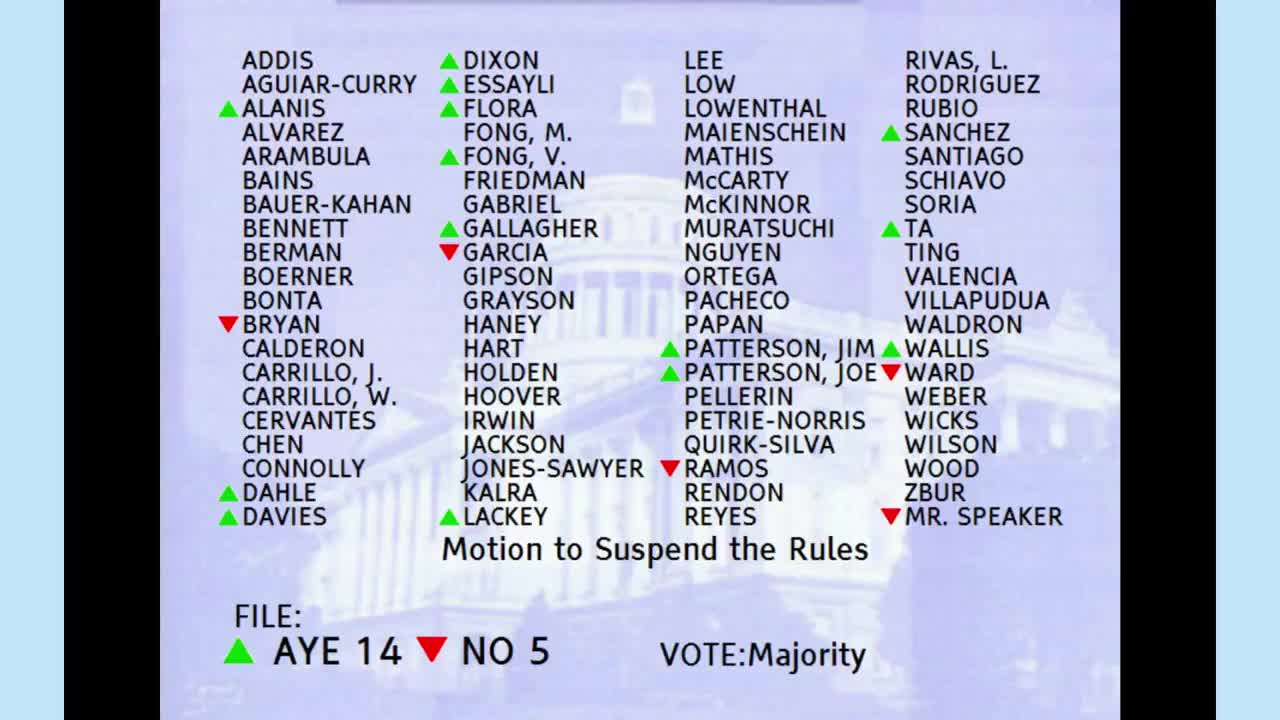 46SEC
Assembly Floor
 2MIN
Senate Floor
 2MIN
Senate Standing Committee on Appropriations
 15MIN
Senate Standing Committee on Education
 30MIN
Senate Standing Committee on Environmental Quality
 1MIN
Assembly Floor
 21MIN
Assembly Standing Committee on Education
 25MIN
Assembly Standing Committee on Environmental Safety and Toxic Materials
Bill Author