AB 2501: Water quality control plans: donations and grants.
- Session Year: 2023-2024
- House: Assembly
- Latest Version Date: 2024-09-28
Current Status:
Passed
(2024-09-28: Chaptered by Secretary of State - Chapter 833, Statutes of 2024.)
Introduced
In Committee
First Chamber
In Committee
Second Chamber
Enacted
Under existing law, the State Water Resources Control Board and the 9 California regional water quality control boards regulate water quality. Existing law requires each regional board to formulate and adopt water quality control plans for all areas within the region, as provided. Existing law establishes in the continuously appropriated State Water Quality Control Fund the continuously appropriated State Water Pollution Cleanup and Abatement Account, which is administered by the state board.
Existing law authorizes the State Water Resources Control Board on behalf of itself or a regional board, to accept donations of moneys from a permittee for the purpose of updating a water quality control plan.
This bill would authorize the state board, on behalf of itself or a regional board, to accept moneys from donations, grants, or contributions, or through contractual agreements, from public agencies for the purpose of planning, permitting, or providing technical support for projects of public benefit, as defined, within the state boards or regional boards jurisdiction. The bill would require all funds received to be deposited, and separately accounted for, in the State Water Pollution Cleanup and Abatement Account, for expenditure in accordance with the terms of the donation, grant, contribution, or contractual agreement. The bill would require the state board to provide notice, as specified, before accepting those moneys. Because the funds deposited would be a new source of funds in the continuously appropriated State Water Pollution Cleanup and Abatement Account within the continuously appropriated State Water Quality Control Fund, the bill would make an appropriation.
Under existing law, the State Water Resources Control Board and the 9 California regional water quality control boards regulate water quality. Existing law requires each regional board to formulate and adopt water quality control plans for all areas within the region, as provided. Existing law establishes in the continuously appropriated State Water Quality Control Fund the continuously appropriated State Water Pollution Cleanup and Abatement Account, which is administered by the state board.
Existing law authorizes the State Water Resources Control Board on behalf of itself or a regional board, to accept donations of moneys from a permittee for the purpose of updating a water quality control plan.
This bill would authorize the state board, on behalf of itself or a regional board, to accept moneys from donations, grants, or contributions, or through contractual agreements, from public agencies, foundations, or other not-for-profit entities agencies for the purpose of planning, permitting, or providing technical support for projects of public benefit, as defined, within the state boards or regional boards jurisdiction. The bill would require all funds received to be deposited, and separately accounted for, in the State Water Pollution Cleanup and Abatement Account, for expenditure in accordance with the terms of the donation, grant, contribution, or contractual agreement. The bill would require the state board to provide notice, as specified, before accepting those moneys. Because the funds deposited would be a new source of funds in the continuously appropriated State Water Pollution Cleanup and Abatement Account within the continuously appropriated State Water Quality Control Fund, the bill would make an appropriation.
Under existing law, the State Water Resources Control Board and the 9 California regional water quality control boards regulate water quality. Existing law requires each regional board to formulate and adopt water quality control plans for all areas within the region, as provided. Existing law establishes in the continuously appropriated State Water Quality Control Fund the continuously appropriated State Water Pollution Cleanup and Abatement Account, which is administered by the state board.
Existing law authorizes the State Water Resources Control Board on behalf of itself or a regional board, to accept donations of moneys from a permittee for the purpose of updating a water quality control plan.
This bill would authorize the state board, on behalf of itself or a regional board, to accept moneys from donations, grants, or contributions, or through contractual agreements, from public agencies, foundations, or other not-for-profit entities for the purpose of planning, permitting, or providing technical support for projects of public benefit, as defined, within the state boards or regional boards jurisdiction. The bill would require all funds received to be deposited, and separately accounted for, in the State Water Pollution Cleanup and Abatement Account, for expenditure in accordance with the terms of the donation, grant, contribution, or contractual agreement. The bill would require the state board to provide notice, as specified, before accepting those moneys. Because the funds deposited would be a new source of funds in the continuously appropriated State Water Pollution Cleanup and Abatement Account within the continuously appropriated State Water Quality Control Fund, the bill would make an appropriation.
(a)The state board may, on behalf of itself or a regional board, accept donations of moneys from a permittee for the purpose of updating a water quality control plan as consistent with the designated use of the funds.
(b)The state board may, on behalf of itself or a regional board, accept moneys from donations, grants, or contributions, or through contractual agreements, from public agencies for the purpose of planning, permitting, or providing technical support for projects of public benefit within the state boards or regional boards jurisdiction.
(c)All funds received pursuant to this section shall be deposited, and separately accounted for, in the State Water Pollution Cleanup and Abatement Account, for expenditure in accordance with the terms of the donation, grant, contribution, or contractual agreement.
(d)For the purposes of this section, projects of public benefit include, but are not limited to, projects directly related to climate change adaptation, ecosystem protection and restoration, water recycling, stormwater capture, water conservation, emergency preparedness, flood management, ambient water quality monitoring, research, and environmental justice.
(e)Before accepting any moneys pursuant to this section, the state board shall provide notice of its intent to accept those moneys and provide a description of the associated public benefit of those moneys in accordance with the requirements governing the notice of a meeting, as set forth in subdivision (b) of Section 11125 of the Government Code.
(a)The state board may, on behalf of itself or a regional board, accept donations of moneys from a permittee for the purpose of updating a water quality control plan as consistent with the designated use of the funds.
(b)The state board may, on behalf of itself or a regional board, accept moneys from donations, grants, or contributions, or through contractual agreements, from public agencies, foundations, or other not-for-profit entities agencies for the purpose of planning, permitting, or providing technical support for projects of public benefit within the state boards or regional boards jurisdiction.
(c)All funds received pursuant to this section shall be deposited, and separately accounted for, in the State Water Pollution Cleanup and Abatement Account, for expenditure in accordance with the terms of the donation, grant, contribution, or contractual agreement.
(d)For the purposes of this section, projects of public benefit include, but are not limited to, projects directly related to climate change adaptation, ecosystem protection and restoration, water recycling, stormwater capture, water conservation, emergency preparedness, flood management, ambient water quality monitoring, research, and environmental justice.
(e)Before accepting any moneys pursuant to this section, the state board shall provide notice of its intent to accept those moneys and provide a description of the associated public benefit of those moneys in accordance with the requirements governing the notice of a meeting, as set forth in subdivision (b) of Section 11125 of the Government Code.
(a)The state board may, on behalf of itself or a regional board, accept donations of moneys from a permittee for the purpose of updating a water quality control plan as consistent with the designated use of the funds.
(b)The state board may, on behalf of itself or a regional board, accept moneys from donations, grants, or contributions, or through contractual agreements, from public agencies, foundations, or other not-for-profit entities for the purpose of planning, permitting, or providing technical support for projects of public benefit within the state boards or regional boards jurisdiction.
(c)All funds received pursuant to this section shall be deposited, and separately accounted for, in the State Water Pollution Cleanup and Abatement Account, for expenditure in accordance with the terms of the donation, grant, contribution, or contractual agreement.
(d)For the purposes of this section, projects of public benefit include, but are not limited to, projects directly related to climate change adaptation, ecosystem protection and restoration, water recycling, stormwater capture, water conservation, emergency preparedness, flood management, ambient water quality monitoring, research, and environmental justice.
(e)Before accepting any moneys pursuant to this section, the state board shall provide notice of its intent to accept those moneys in accordance with the requirements governing the notice of a meeting, as set forth in subdivision (b) of Section 11125 of the Government Code.
|
Date
|
Status
|
|---|---|
| Sep 28, 2024 | Chaptered by Secretary of State - Chapter 833, Statutes of 2024. |
| Sep 28, 2024 | Approved by the Governor. |
| Sep 9, 2024 | Enrolled and presented to the Governor at 3:30 p.m. |
| Aug 28, 2024 | In Assembly. Ordered to Engrossing and Enrolling. |
| Aug 28, 2024 | Read third time. Passed. Ordered to the Assembly. (Ayes 39. Noes 0.). |
| Aug 23, 2024 | Ordered to special consent calendar. |
| Aug 19, 2024 | Read second time. Ordered to third reading. |
| Aug 15, 2024 | From committee: Do pass. (Ayes 7. Noes 0.) (August 15). |
| Jul 1, 2024 | In committee: Referred to suspense file. |
| Jun 19, 2024 | From committee: Do pass and re-refer to Com. on APPR with recommendation: To Consent Calendar. (Ayes 7. Noes 0.) (June 19). Re-referred to Com. on APPR. |
| Jun 5, 2024 | Referred to Com. on E.Q. |
| May 24, 2024 | In Senate. Read first time. To Com. on RLS. for assignment. |
| May 23, 2024 | Read third time. Passed. Ordered to the Senate. (Ayes 72. Noes 0. Page 5602.) |
| May 20, 2024 | Read second time. Ordered to third reading. |
| May 16, 2024 | Read second time and amended. Ordered returned to second reading. |
| May 16, 2024 | From committee: Amend, and do pass as amended. (Ayes 11. Noes 0.) (May 16). |
| May 16, 2024 | Assembly Rule 63 suspended. |
| Apr 10, 2024 | In committee: Set, first hearing. Referred to APPR. suspense file. |
| Mar 19, 2024 | From committee: Do pass and re-refer to Com. on APPR. (Ayes 7. Noes 0.) (March 19). Re-referred to Com. on APPR. |
| Mar 12, 2024 | Re-referred to Com. on E.S. & T.M. |
| Mar 11, 2024 | From committee chair, with author's amendments: Amend, and re-refer to Com. on E.S. & T.M. Read second time and amended. |
| Feb 26, 2024 | Referred to Com. on E.S. & T.M. |
| Feb 14, 2024 | From printer. May be heard in committee March 15. |
| Feb 13, 2024 | Read first time. To print. |
|
Date
|
Description
|
Location
|
Votes
|
|
|---|---|---|---|---|
| Aug 28, 2024 | Special Consent AB2501 Alvarez By Atkins | Senate Floor |
Passed |
|
| Aug 15, 2024 | Do pass | Senate Standing Committee on Appropriations |
Passed |
|
| Jul 1, 2024 | Placed on suspense file | Senate Standing Committee on Appropriations |
Passed |
|
| Jun 19, 2024 | Do pass, but first be re-referred to the Committee on [Appropriations] with the recommendation: To Consent Calendar | Senate Standing Committee on Environmental Quality |
Passed |
|
| May 23, 2024 | AB 2501 Alvarez Assembly Third Reading | Assembly Floor |
Passed |
|
| May 16, 2024 | Do pass as amended. | Assembly Standing Committee on Appropriations |
Passed |
|
| Mar 19, 2024 | Do pass and be re-referred to the Committee on [Appropriations] | Assembly Standing Committee on Environmental Safety and Toxic Materials |
Passed |
This list shows positions taken on this bill by organizations on the date displayed, which is linked to the original source.
Positions by individuals are not included.
|
Organization
|
Position
|
Date
|
|---|---|---|
| Cal Chamber | ** Support | |
| California State Association Of Counties | ** Support | |
| City Of San Diego | ** Support |
SENATE RULES COMMITTEE Office of Senate Floor Analyses (916) 651-1520 Fax: (916) 327-4478 | AB 2501 |
THIRD READING
Bill No: AB 2501
Author: Alvarez (D)
Amended: 5/16/24 in Assembly
Vote: 21
SENATE ENVIRONMENTAL QUALITY COMMITTEE: 7-0, 6/19/24
AYES: Allen, Dahle, Gonzalez, Hurtado, Menjivar, Nguyen, Skinner
SENATE APPROPRIATIONS COMMITTEE: 7-0, 8/15/24
AYES: Caballero, Jones, Ashby, Becker, Bradford, Seyarto, Wahab
ASSEMBLY FLOOR: 72-0, 5/23/24 - See last page for vote
SUBJECT: Water quality control plans: donations and grants
SOURCE: City of San Diego
DIGEST: This bill authorizes the State Water Resources Control Board (State Water Board) to, on behalf of itself or a regional water quality control board (Regional Water Board), accept moneys from public agencies for projects of public benefit, as designated.
ANALYSIS:
Existing law:
- Establishes the Porter-Cologne Water Quality Control Act (Porter-Cologne Act) as the principal law governing water quality regulation in California. (Water Code (WC) § 13000 et seq.)
- Establishes the State Water Board and the Regional Water Boards. (WC § 13100)
- Authorizes the State Water Board to, on behalf of itself or a Regional Water Board, accept donations of moneys from a permittee for the purpose of updating a water quality control plan, as consistent with the designated use of the funds. (WC § 13249)
- Establishes the Abatement Account within the State Water Quality Control Fund, which is administered by the State Water Board. (WC § 13440)
This bill:
- Authorizes the State Water Board to, on behalf of itself or a Regional Water Board, accept moneys from donations, grants, or contributions, or through contractual agreements, from public agencies for the purpose of planning, permitting, or providing technical support for projects of public benefit, as designated in this bill, within the State Water Board's or a Regional Water Board's jurisdiction.
- Designates that, for the purposes of the provisions of this bill, "projects of public benefit" include, but are not limited to, projects directly related to climate change adaptation, ecosystem protection and restoration, water recycling, stormwater capture, water conservation, emergency preparedness, flood management, ambient water quality monitoring, research, and environmental justice.
- Requires the State Water Board, before accepting any moneys pursuant to the provisions of this bill, to provide notice of its intent to accept those moneys and to provide a description of the associated public benefit of those moneys in a public notice.
Background
- State and Regional Water Boards. The Porter-Cologne Act is the principal state law governing water quality regulation in California. The Porter-Cologne Act establishes the State Water Board and nine semiautonomous Regional Water Boards, known collectively as the Water Boards; grants the Water Boards the authority to implement and enforce water quality laws, regulations, and policies; and, requires them to implement the Porter-Cologne Act and the federal Clean Water Act in California. The State Water Board is responsible for developing statewide water quality plans, and for providing program guidance and oversight, allocating funds, and reviewing the Regional Water Boards' decisions. The Regional Water Boards are responsible for developing regional water quality plans (basin plans), implementing the statewide water quality plans and the basin plans, and individual permitting, inspection, and enforcement actions within each of the nine hydrologic regions.
- Funding challenges. The author of this bill argues that, statewide, the number of projects proposed to address climate change adaptation and ecosystem restoration is growing rapidly, noting that this is especially the case in the coastal regions where rising tides present challenges. The State Water Board and Regional Water Boards participate in the planning and permitting processes associated with many of these projects to ensure the protection of water quality.
The City of San Diego, the sponsor of this bill, comments that while they have had many successful experiences working with the San Diego Regional Water Quality Control Board (SD Regional Water Board), there have been times when the lack of available resources has substantially slowed or hampered project progress. For example, according to the City of San Diego, it took a year to acquire SD Regional Water Board authorization on the Habitat Mitigation & Monitoring Plan (HMMP) for the Otay Reed Wetland Mitigation project. The City of San Diego relayed that SD Regional Water Board staff cited staffing shortages and large workloads relating to statutory deadlines as the cause for the long response times and difficulty prioritizing the Otay Reed HMMP review. The City of San Diego says that this twelve month-long review period delayed the project's advertisement, likely leading to higher construction costs due to price escalations. In addition, due to the delay, the City's consultant contract expired, causing additional expenses when the City had to transfer the project to a new consultant team. The City of San Diego argues that the ability of the State, and thus the SD Regional Water Board, to accept funding to bolster resources will lead to faster response times for permitting needs and increased familiarity and knowledge of essential public infrastructure projects.
Local agencies have relayed that they have contemplated funding coordination to better assist State and Regional Water Board staff on high-priority work projects. For example, the City of San Diego notes that, in the past, it funded dedicated SD Regional Water Board staff time to expedite project review, and that it would consider doing so again for similar purposes. However, existing statute does not explicitly authorize the State Water Board or Regional Water Boards to accept funding from entities other than state agencies.
- Funding from permittees. To start to address potential funding shortages, current law, pursuant to SB 1133 (Portantino, Chapter 355, Statutes of 2018), authorizes the State Water Board to, on behalf of itself or a Regional Water Board, accept donations of moneys from a permittee for the purpose of updating a basin plan, as consistent with the designated use of the funds. These funds cannot be used for other actions, such as for individual project reviews. For any Water Board work other than basin plan updates, statute does not explicitly authorize the Water Boards to accept funds from any other entity, unless it is a state agency. Because the Water Boards are almost exclusively funded by discharger fees, this is a limitation on the Water Boards' ability to augment their resources to complete needed work.
- This bill. This bill builds upon the authorization conferred by SB 1133 by authorizing the State Water Board to, on behalf of itself or a Regional Water Board, accept moneys from donations, grants, or contributions, or through contractual agreements, from public agencies for the purpose of planning, permitting, or providing technical support for projects of public benefit. It then designates that, for the purposes of the provisions of the bill, "projects of public benefit" include, but are not limited to, projects directly related to climate change adaptation, ecosystem protection and restoration, water recycling, stormwater capture, water conservation, emergency preparedness, flood management, ambient water quality monitoring, research, and environmental justice. According to the author, entities that would likely be interested in entering into a funding arrangement authorized by AB 2501 include restoration agencies, park districts, cities, ports, and flood control and water supply special districts.
Comments
According to the author, "As California moves to meet the climate crisis, the number of projects proposed to address climate change adaptation and ecosystem restoration is growing rapidly and substantially. However, successful and efficient implementation of these projects depends on the ability of regulatory agencies to review projects and process the required approvals.
“The State Water Board and Regional Water Boards administer federal Clean Water Act programs and adopt, review, and oversee water quality permit implementation. For climate change adaptation and ecosystem restoration projects, they must participate in the planning and permitting processes associated with these projects to ensure the protection of water quality and ecosystems. However, state law currently does not authorize the Water Boards to accept funds from public agencies to facilitate project reviews. AB 2501 establishes the State Water Board's authority to accept funds from public agencies such as cities, municipalities, and local governments, on behalf of the Regional Water Boards. These funds would be used to complete project reviews for urgently-needed climate change adaptation and ecosystem restoration projects."
Related/Prior Legislation
AB 2318 (Papan, 2024) requires the State Water Board to, no later than January 1 of each year, post on its internet website a report describing the receipts and expenditures of the Abatement Account, as provided. This bill is pending hearing in the Assembly ESTM Committee.
AB 2362 (Mullin, 2022) would have authorized the State Water Board to, on behalf of itself or a Regional Water Board, accept moneys from donations, grants, or contributions, or through contractual agreements, given for the purpose of planning, permitting, or providing technical support for projects of public benefit, as specified. This bill died on the Senate inactive file.
SB 1133 (Portantino, Chapter 355, Statutes of 2018) authorizes the State Water Board to, on behalf of itself or a Regional Water Board, accept donations of moneys from a permittee for updating water quality control plans, as consistent with the designated use of the funds.
FISCAL EFFECT: Appropriation: Yes Fiscal Com.: Yes Local: No
According to the Senate Appropriations Committee, to the extent the State Water Board or one or more regional water boards choose to utilize the authority granted by this bill and there is interest from public agencies to contribute funds to further public benefit projects, potential revenue increase and commensurate expenditures for the State Water Board and regional water boards of an unknown amount, potentially in the hundreds of thousands to low millions of dollars (State Water Pollution Cleanup and Abatement Account).
SUPPORT: (Verified 8/15/24)
City of San Diego (source)
California State Association of Counties
OPPOSITION: (Verified 8/15/24)
None received
ASSEMBLY FLOOR: 72-0, 5/23/24
AYES: Addis, Aguiar-Curry, Alanis, Alvarez, Arambula, Bains, Bauer-Kahan, Bennett, Berman, Boerner, Bonta, Bryan, Calderon, Juan Carrillo, Wendy Carrillo, Connolly, Davies, Dixon, Flora, Mike Fong, Vince Fong, Friedman, Gabriel, Gallagher, Garcia, Gipson, Grayson, Haney, Hart, Hoover, Irwin, Jackson, Jones-Sawyer, Kalra, Lackey, Lee, Low, Lowenthal, Maienschein, McCarty, McKinnor, Muratsuchi, Stephanie Nguyen, Ortega, Pacheco, Papan, Jim Patterson, Joe Patterson, Pellerin, Petrie-Norris, Quirk-Silva, Ramos, Rendon, Reyes, Rodriguez, Sanchez, Santiago, Schiavo, Soria, Ta, Ting, Valencia, Villapudua, Waldron, Wallis, Ward, Weber, Wicks, Wilson, Wood, Zbur, Robert Rivas
NO VOTE RECORDED: Cervantes, Chen, Megan Dahle, Essayli, Holden, Mathis, Luz Rivas, Blanca Rubio
Prepared by: Gabrielle Meindl / E.Q. / (916) 651-4108
8/18/24 9:19:15
**** END ****
SENATE COMMITTEE ON
Senator Anna Caballero, Chair
2023 - 2024 Regular Session
AB 2501 (Alvarez) - Water quality control plans: donations and grants
Version: | Policy Vote: |
Urgency: | Mandate: |
Hearing Date: | Consultant: |
Bill Summary:
This bill would authorize the State Water Resources Control Board (State Water Board) to accept moneys from public agencies for advancing public benefit projects.
Fiscal Impact:
- To the extent the State Water Board or one or more regional water boards choose to utilize the authority granted by this bill and there is interest from public agencies to contribute funds to further public benefit projects, potential revenue increase and commensurate expenditures for the State Water Board and regional water boards of an unknown amount, potentially in the hundreds of thousands to low millions of dollars (State Water Pollution Cleanup and Abatement Account).
Background:
State and Regional Water Boards. The Porter-Cologne Act is the principal state law governing water quality regulation in California. The Porter-Cologne Act establishes the State Water Board and nine semiautonomous Regional Water Boards, known collectively as the Water Boards; grants the Water Boards the authority to implement and enforce water quality laws, regulations, and policies; and, requires them to implement the Porter-Cologne Act and the federal Clean Water Act in California. The State Water Board is responsible for developing statewide water quality plans, and for providing program guidance and oversight, allocating funds, and reviewing the Regional Water Boards' decisions. The Regional Water Boards are responsible for developing regional water quality plans (basin plans), implementing the statewide water quality plans and the basin plans, and individual permitting, inspection, and enforcement actions within each of the nine hydrologic regions.
Funding challenges. The author of AB 2501 argues that, statewide, the number of projects proposed to address climate change adaptation and ecosystem restoration is growing rapidly, noting that this is especially the case in the coastal regions where rising tides present challenges. The State Water Board and Regional Water Boards participate in the planning and permitting processes associated with many of these projects to ensure the protection of water quality.
The City of San Diego, the sponsor of the bill, comments that while they have had many successful experiences working with the San Diego Regional Water Quality Control Board (SD Regional Water Board), there have been times when the lack of available resources has substantially slowed or hampered project progress. For example, according to the City of San Diego, it took a year to acquire SD Regional Water Board authorization on the Habitat Mitigation & Monitoring Plan (HMMP) for the Otay Reed Wetland Mitigation project. The City of San Diego relayed that SD Regional Water Board staff cited staffing shortages and large workloads relating to statutory deadlines as the cause for the long response times and difficulty prioritizing the Otay Reed HMMP review. The City of San Diego says that this twelve month-long review period delayed the project's advertisement, likely leading to higher construction costs due to price escalations. In addition, due to the delay, the City's consultant contract expired, causing additional expenses when the City had to transfer the project to a new consultant team. The City of San Diego argues that the ability of the State, and thus the SD Regional Water Board, to accept funding to bolster resources will lead to faster response times for permitting needs and increased familiarity and knowledge of essential public infrastructure projects.
Local agencies have relayed that they have contemplated funding coordination to better assist State and Regional Water Board staff on high-priority work projects. For example, the City of San Diego notes that, in the past, it funded dedicated SD Regional Water Board staff time to expedite project review, and that it would consider doing so again for similar purposes. However, existing statute does not explicitly authorize the State Water Board or Regional Water Boards to accept funding from entities other than state agencies.
Funding from permittees. To start to address potential funding shortages, current law, pursuant to SB 1133 (Portantino), Chapter 355, Statutes of 2018, authorizes the State Water Board to, on behalf of itself or a Regional Water Board, accept donations of moneys from a permittee for the purpose of updating a basin plan, as consistent with the designated use of the funds. These funds cannot be used for other actions, such as for individual project reviews. For any Water Board work other than basin plan updates, statute does not explicitly authorize the Water Boards to accept funds from any other entity, unless it is a state agency. Because the Water Boards are almost exclusively funded by discharger fees, this is a limitation on the Water Boards' ability to augment their resources to complete needed work.
Proposed Law:
This bill would:
- Authorize the State Water Board to, on behalf of itself or a Regional Water Board, accept moneys from donations, grants, or contributions, or through contractual agreements, from public agencies for the purpose of planning, permitting, or providing technical support for projects of public benefit, as designated in this bill, within the State Water Board's or a Regional Water Board's jurisdiction.
- Designate that, for the purposes of the provisions of this bill, "projects of public benefit" include, but are not limited to, projects directly related to climate change adaptation, ecosystem protection and restoration, water recycling, stormwater capture, water conservation, emergency preparedness, flood management, ambient water quality monitoring, research, and environmental justice.
- Require the State Water Board, before accepting any moneys pursuant to the provisions of this bill, to provide notice of its intent to accept those moneys and to provide a description of the associated public benefit of those moneys in a public notice.
This bill would build upon the authorization conferred by SB 1133 by authorizing the State Water Board to, on behalf of itself or a Regional Water Board, accept moneys from donations, grants, or contributions, or through contractual agreements, from public agencies for the purpose of planning, permitting, or providing technical support for projects of public benefit. It would then designate that, for the purposes of the provisions of the bill, "projects of public benefit" include, but are not limited to, projects directly related to climate change adaptation, ecosystem protection and restoration, water recycling, stormwater capture, water conservation, emergency preparedness, flood management, ambient water quality monitoring, research, and environmental justice. According to the author, entities that would likely be interested in entering into a funding arrangement authorized by AB 2501 include restoration agencies, park districts, cities, ports, and flood control and water supply special districts.
Related Legislation:
AB 2318 (Papan). Requires the State Water Board to, no later than January 1 of each year, post on its internet website a report describing the receipts and expenditures of the Abatement Account, as provided.
AB 2362 (Mullin, 2022). Would have authorized the State Water Board to, on behalf of itself or a Regional Water Board, accept moneys from donations, grants, or contributions, or through contractual agreements, given for the purpose of planning, permitting, or providing technical support for projects of public benefit, as specified. This bill died on the Senate inactive file.
SB 1133 (Portantino, Chapter 355, Statutes of 2018). Authorizes the State Water Board to, on behalf of itself or a Regional Water Board, accept donations of moneys from a permittee for updating water quality control plans, as consistent with the designated use of the funds.
-- END --
SENATE COMMITTEE ON ENVIRONMENTAL QUALITY
Senator Gonzalez, Chair
2023 - 2024 Regular
Bill No. | AB 2501 | Hearing Date: | 6/19/24 |
Author: | Alvarez | ||
Version: | 5/16/2024 | ||
Urgency: | No | Fiscal: | Yes |
Consultant: | Gabrielle Meindl | ||
SUBJECT: Water quality control plans: donations and grants
DIGEST: Authorizes the State Water Resources Control Board (State Water Board) to, on behalf of itself or a regional water quality control board (Regional Water Board), accept moneys from public agencies for projects of public benefit, as designated.
ANALYSIS:
Existing law:
- Establishes the Porter-Cologne Water Quality Control Act (Porter-Cologne Act) as the principal law governing water quality regulation in California. (Water Code (WC) § 13000 et seq.)
- Establishes the State Water Board and the Regional Water Boards. (WC § 13100)
- Authorizes the State Water Board to, on behalf of itself or a Regional Water Board, accept donations of moneys from a permittee for the purpose of updating a water quality control plan, as consistent with the designated use of the funds. (WC § 13249)
- Establishes the Abatement Account within the State Water Quality Control Fund, which is administered by the State Water Board. (WC § 13440)
This bill:
- Authorizes the State Water Board to, on behalf of itself or a Regional Water Board, accept moneys from donations, grants, or contributions, or through contractual agreements, from public agencies for the purpose of planning, permitting, or providing technical support for projects of public benefit, as designated in this bill, within the State Water Board's or a Regional Water Board's jurisdiction.
- Designates that, for the purposes of the provisions of this bill, "projects of public benefit" include, but are not limited to, projects directly related to climate change adaptation, ecosystem protection and restoration, water recycling, stormwater capture, water conservation, emergency preparedness, flood management, ambient water quality monitoring, research, and environmental justice.
- Requires the State Water Board, before accepting any moneys pursuant to the provisions of this bill, to provide notice of its intent to accept those moneys and to provide a description of the associated public benefit of those moneys in a public notice.
Background
- State and Regional Water Boards. The Porter-Cologne Act is the principal state law governing water quality regulation in California. The Porter-Cologne Act establishes the State Water Board and nine semiautonomous Regional Water Boards, known collectively as the Water Boards; grants the Water Boards the authority to implement and enforce water quality laws, regulations, and policies; and, requires them to implement the Porter-Cologne Act and the federal Clean Water Act in California. The State Water Board is responsible for developing statewide water quality plans, and for providing program guidance and oversight, allocating funds, and reviewing the Regional Water Boards' decisions. The Regional Water Boards are responsible for developing regional water quality plans (basin plans), implementing the statewide water quality plans and the basin plans, and individual permitting, inspection, and enforcement actions within each of the nine hydrologic regions.
- Funding challenges. The author of AB 2501 argues that, statewide, the number of projects proposed to address climate change adaptation and ecosystem restoration is growing rapidly, noting that this is especially the case in the coastal regions where rising tides present challenges. The State Water Board and Regional Water Boards participate in the planning and permitting processes associated with many of these projects to ensure the protection of water quality.
The City of San Diego, the sponsor of the bill, comments that while they have had many successful experiences working with the San Diego Regional Water Quality Control Board (SD Regional Water Board), there have been times when the lack of available resources has substantially slowed or hampered project progress. For example, according to the City of San Diego, it took a year to acquire SD Regional Water Board authorization on the Habitat Mitigation & Monitoring Plan (HMMP) for the Otay Reed Wetland Mitigation project. The City of San Diego relayed that SD Regional Water Board staff cited staffing shortages and large workloads relating to statutory deadlines as the cause for the long response times and difficulty prioritizing the Otay Reed HMMP review. The City of San Diego says that this twelve month-long review period delayed the project's advertisement, likely leading to higher construction costs due to price escalations. In addition, due to the delay, the City's consultant contract expired, causing additional expenses when the City had to transfer the project to a new consultant team. The City of San Diego argues that the ability of the State, and thus the SD Regional Water Board, to accept funding to bolster resources will lead to faster response times for permitting needs and increased familiarity and knowledge of essential public infrastructure projects.
Local agencies have relayed that they have contemplated funding coordination to better assist State and Regional Water Board staff on high-priority work projects. For example, the City of San Diego notes that, in the past, it funded dedicated SD Regional Water Board staff time to expedite project review, and that it would consider doing so again for similar purposes. However, existing statute does not explicitly authorize the State Water Board or Regional Water Boards to accept funding from entities other than state agencies.
- Funding from permittees. To start to address potential funding shortages, current law, pursuant to SB 1133 (Portantino), Chapter 355, Statutes of 2018, authorizes the State Water Board to, on behalf of itself or a Regional Water Board, accept donations of moneys from a permittee for the purpose of updating a basin plan, as consistent with the designated use of the funds. These funds cannot be used for other actions, such as for individual project reviews. For any Water Board work other than basin plan updates, statute does not explicitly authorize the Water Boards to accept funds from any other entity, unless it is a state agency. Because the Water Boards are almost exclusively funded by discharger fees, this is a limitation on the Water Boards' ability to augment their resources to complete needed work.
- This bill. This bill builds upon the authorization conferred by SB 1133 by authorizing the State Water Board to, on behalf of itself or a Regional Water Board, accept moneys from donations, grants, or contributions, or through contractual agreements, from public agencies for the purpose of planning, permitting, or providing technical support for projects of public benefit. It then designates that, for the purposes of the provisions of the bill, "projects of public benefit" include, but are not limited to, projects directly related to climate change adaptation, ecosystem protection and restoration, water recycling, stormwater capture, water conservation, emergency preparedness, flood management, ambient water quality monitoring, research, and environmental justice. According to the author, entities that would likely be interested in entering into a funding arrangement authorized by AB 2501 include restoration agencies, park districts, cities, ports, and flood control and water supply special districts.
Comments
- Purpose of Bill. According to the author, "As California moves to meet the climate crisis, the number of projects proposed to address climate change adaptation and ecosystem restoration is growing rapidly and substantially. However, successful and efficient implementation of these projects depends on the ability of regulatory agencies to review projects and process the required approvals.
“The State Water Board and Regional Water Boards administer federal Clean Water Act programs and adopt, review, and oversee water quality permit implementation. For climate change adaptation and ecosystem restoration projects, they must participate in the planning and permitting processes associated with these projects to ensure the protection of water quality and ecosystems. However, state law currently does not authorize the Water Boards to accept funds from public agencies to facilitate project reviews. AB 2501 establishes the State Water Board's authority to accept funds from public agencies such as cities, municipalities, and local governments, on behalf of the Regional Water Boards. These funds would be used to complete project reviews for urgently-needed climate change adaptation and ecosystem restoration projects."
Related/Prior Legislation
AB 2318 (Papan). Requires the State Water Board to, no later than January 1 of each year, post on its internet website a report describing the receipts and expenditures of the Abatement Account, as provided. This bill is pending hearing in the Assembly ESTM Committee.
AB 2362 (Mullin, 2022). Would have authorized the State Water Board to, on behalf of itself or a Regional Water Board, accept moneys from donations, grants, or contributions, or through contractual agreements, given for the purpose of planning, permitting, or providing technical support for projects of public benefit, as specified. This bill died on the Senate inactive file.
SB 1133 (Portantino, Chapter 355, Statutes of 2018). Authorizes the State Water Board to, on behalf of itself or a Regional Water Board, accept donations of moneys from a permittee for updating water quality control plans, as consistent with the designated use of the funds.
SOURCE:
City of San Diego
SUPPORT:
California State Association of Counties
City of San Diego
OPPOSITION:
None received
Positions reflect letters received by noon one week prior to the hearing.
-- END --
ASSEMBLY THIRD READING
ATR Bill Id:AB 2501
Author:(Alvarez)
As Amended Ver:May 16, 2024
Majority vote
SUMMARY
Authorizes the State Water Resources Control Board (State Water Board) to, on behalf of itself or a regional water quality control board (Regional Water Board), accept moneys from public agencies for projects of public benefit, as designated.
Major Provisions
- Authorizes the State Water Board to, on behalf of itself or a Regional Water Board, accept moneys from donations, grants, or contributions, or through contractual agreements, from public agencies for the purpose of planning, permitting, or providing technical support for projects of public benefit, as designated in this bill, within the State Water Board's or a Regional Water Board's jurisdiction.
- Designates that, for the purposes of the provisions of this bill, "projects of public benefit" include, but are not limited to, projects directly related to climate change adaptation, ecosystem protection and restoration, water recycling, stormwater capture, water conservation, emergency preparedness, flood management, ambient water quality monitoring, research, and environmental justice.
- Requires the State Water Board, before accepting any moneys pursuant to the provisions of this bill, to provide notice of its intent to accept those moneys and to provide a description of the associated public benefit of those moneys in a public notice.
COMMENTS
State and Regional Water Boards: The Porter-Cologne Act is the principal state law governing water quality regulation in California. The Porter-Cologne Act establishes the State Water Board and nine semiautonomous Regional Water Boards (based on hydrogeologic barriers), known collectively as the Water Boards; grants the Water Boards the authority to implement and enforce water quality laws, regulations, and policies; and, requires them to implement the Porter-Cologne Act and the federal Clean Water Act in California. The State Water Board is responsible for developing statewide water quality plans, and for providing program guidance and oversight, allocating funds, and reviewing the Regional Water Boards' decisions. The Regional Water Boards are responsible for developing regional water quality plans (basin plans), implementing the statewide water quality plans and the basin plans, and individual permitting, inspection, and enforcement actions within each of the nine hydrologic regions.
Funding challenges: The author of AB 2501 argues that, statewide, the number of projects proposed to address climate change adaptation and ecosystem restoration is growing rapidly, noting that this is especially the case in the coastal regions where rising tides present challenges. The State Water Board and Regional Water Boards participate in the planning and permitting processes associated with many of these projects to ensure the protection of water quality.
The City of San Diego, the sponsor of the bill, comments that while they have had many successful experiences working with the San Diego Regional Water Quality Control Board (SD Regional Water Board), there have been times when the lack of available resources has substantially slowed or hampered project progress. For example, according to the City of San Diego, it took a year to acquire SD Regional Water Board authorization on the Habitat Mitigation & Monitoring Plan (HMMP) for the Otay Reed Wetland Mitigation project. The City of San Diego relayed that SD Regional Water Board staff cited staffing shortages and large workloads relating to statutory deadlines as the cause for the long response times and difficulty prioritizing the Otay Reed HMMP review. The City of San Diego says that this twelve month-long review period delayed the project's advertisement, likely leading to higher construction costs due to price escalations. In addition, due to the delay, the City's consultant contract expired, causing additional expenses when the City had to transfer the project to a new consultant team. The City of San Diego argues that the ability for the State, and thus the SD Regional Water Board, to accept funding to bolster resources will lead to faster response times for permitting needs and increased familiarity and knowledge of essential public infrastructure projects.
Local agencies have relayed that they have contemplated funding coordination to better assist State and Regional Water Board staff on high priority work projects. For example, the City of San Diego notes that, in the past, it funded dedicated SD Regional Water Board staff time to expedite project review, and that it would consider doing so again for similar purposes. However, existing statue does not explicitly authorize the State Water Board or Regional Water Boards to accept funding from entities other than state agencies.
Funding from permittees: To start to address potential funding shortages, current law, pursuant to SB 1133 (Portantino), Chapter 355, Statutes of 2018, authorizes the State Water Board to, on behalf of itself or a Regional Water Board, accept donations of moneys from a permittee for the purpose of updating a basin plan, as consistent with the designated use of the funds. These funds cannot be used for other actions, such as for individual project reviews. For any Water Board work other than basin plan updates, statute does not explicitly authorize the Water Boards to accept funds from any other entity, unless it is a state agency. Because the Water Boards are almost exclusively funded by discharger fees, this is a limitation on the Water Boards' ability to augment their resources to complete needed work.
This bill: This bill builds upon the authorization conferred by SB 1133 by authorizing the State Water Board to, on behalf of itself or a Regional Water Board, accept moneys from donations, grants, or contributions, or through contractual agreements, from public agencies for the purpose of planning, permitting, or providing technical support for projects of public benefit. It then designates that, for the purposes of the provisions of the bill, "projects of public benefit" include, but are not limited to, projects directly related to climate change adaptation, ecosystem protection and restoration, water recycling, stormwater capture, water conservation, emergency preparedness, flood management, ambient water quality monitoring, research, and environmental justice. According to the author, entities that would likely be interested in entering into a funding arrangement authorized by AB 2501 include restoration agencies, park districts, cities, ports, and flood control and water supply special districts.
According to the Author
"As California moves to meet the climate crisis, the number of projects proposed to address climate change adaptation and ecosystem restoration is growing rapidly and substantially. However, successful and efficient implementation of these projects depends on the ability of regulatory agencies to review projects and process the required approvals.
The State Water Board and Regional Water Boards administer federal Clean Water Act programs and adopt, review, and oversee water quality permit implementation. For climate change adaptation and ecosystem restoration projects, they must participate in the planning and permitting processes associated with these projects to ensure the protection of water quality and ecosystems. However, state law currently does not authorize the Water Boards to accept funds from public agencies to facilitate project reviews. AB 2501 establishes the State Water Board's authority to accept funds from public agencies such as cities, municipalities, and local governments, on behalf of the Regional Water Boards. These funds would be used to complete project reviews for urgently-needed climate change adaptation and ecosystem restoration projects."
Arguments in Support
The California Chamber of Commerce argues, "…the business community writ large have seen a growing number of urgently needed projects related to climate change adaptation and ecosystem restoration, especially in our coastal regions. At the same time, we have seen such projects face significant permitting delays, which translates to escalating project construction costs. It is imperative that the Water Boards have the resources to effectively participate in the planning and permitting processes for these projects to ensure the protection of water quality and ecosystems… AB 2501 would pave the way for local agencies, cities, municipalities, and local governments to provide crucial support to complete project reviews in a timely manner. This important bill would align the authority of the Water Boards with that of other state agencies, ensuring a cohesive and efficient approach to addressing climate challenges and ecosystem preservation."
Arguments in Opposition
None on file.
FISCAL COMMENTS
According to the Assembly Appropriations Committee, enactment of this bill could result in a potential revenue increase for the State Water Board and Regional Water Boards of an unknown amount, potentially in the hundreds of thousands to low millions of dollars, should the State Water Board or one or more Regional Water Board choose to utilize the authority granted by this bill and there is interest from public agencies to further public benefit projects.
VOTES
ASM ENVIRONMENTAL SAFETY AND TOXIC MATERIALS: 7-0-0
YES: Garcia, Hoover, Connolly, McKinnor, Papan, Reyes, Ta
ASM APPROPRIATIONS: 11-0-4
YES: Wicks, Arambula, Bryan, Calderon, Wendy Carrillo, Mike Fong, Grayson, Haney, Hart, Pellerin, Villapudua
ABS, ABST OR NV: Sanchez, Dixon, Jim Patterson, Ta
UPDATED
VERSION: May 16, 2024
CONSULTANT: Shannon McKinney / E.S. & T.M. / (916) 319-2965 FN: 0003350
Date of Hearing: April 10, 2024
ASSEMBLY COMMITTEE ON APPROPRIATIONS
Buffy Wicks, Chair
ABPCA Bill Id:AB 2501
Author:(Alvarez) – As Amended Ver:March 11, 2024
Policy Committee: | Environmental Safety and Toxic Materials | Vote: | 7 - 0 |
|
| ||
|
|
Urgency: No State Mandated Local Program: No Reimbursable: No
SUMMARY:
This bill authorizes the State Water Resources Control Board (State Water Board) to accept moneys from specified entities for advancing public benefit projects.
Specifically, this bill, among other things:
- Authorizes the State Water Board to, on behalf of itself or a Regional Water Quality Control Board (regional water board), accept moneys from donations, grants, or contributions, or through contractual agreements, from public agencies, foundations, or other nonprofit entities for the purpose of planning, permitting, or providing technical support for public benefit projects, as defined, within the State Water Board’s or regional water board’s jurisdiction.
- Requires all funds received pursuant to this bill be deposited, and separately accounted for, in the State Water Pollution Cleanup and Abatement Account for expenditure in accordance with the terms of the donation, grant, contribution, or contractual agreement.
- Requires the State Water Board, before accepting any moneys pursuant to this bill, to provide notice of its intent to accept those moneys and provide a description of the associated public benefit of those moneys in accordance with specified Government Code requirements.
FISCAL EFFECT:
Potential revenue increase for the State Water Board and regional water boards of an unknown amount, potentially in the hundreds of thousands to low millions of dollars (State Water Pollution Cleanup and Abatement Account), should the State Water Board or one or more regional water boards choose to utilize the authority granted by this bill and there is interest from public agencies, foundations, or nonprofits to contribute funds to further public benefit projects.
COMMENTS:
1) Purpose. According to the author:
As California moves to meet the climate crisis, the number of projects proposed to address climate change adaptation and ecosystem restoration is growing rapidly and substantially. However, successful and efficient implementation of these projects depends on the ability of regulatory agencies to review projects and process the required approvals…AB 2501 establishes the State Water Board’s authority to accept funds from public agencies such as cities, municipalities, and local governments, on behalf of the Regional Water Boards. These funds would be used to complete project reviews for urgently-needed climate change adaptation and ecosystem restoration projects.
2) Background.
City of San Diego. The City of San Diego, the sponsor of this bill, contends that while the city has had many successful experiences working with the San Diego Regional Water Quality Control Board, there have been instances where insufficient resources at the regional water board have substantially slowed or hampered project progress. For example, according to the City of San Diego, it took a year to acquire regional water board authorization for the habitat mitigation and monitoring plan (HMMP) for the Otay Reed Wetland Mitigation project. The city notes that regional water board staff cited staffing shortages and large workloads relating to statutory deadlines as the reason for the long response times and difficulty prioritizing the Otay Reed HMMP review. The city contends this yearlong review period delayed the project’s advertisement, likely leading to higher construction costs due to price escalations. In addition, the city contends the delay resulted in the city’s consultant contract expiring, creating additional expenses when the city had to transfer the project to a new consultant.
The City of San Diego notes it has previously funded dedicated regional water board staff time to expedite project reviews. For example, the city paid the regional water board $1.4 million from 2018 to 2023 to cover the processing and oversight of 401 water quality certifications and waste discharge requirement (WDR) applications for city projects. The city notes that previous agreements between the city and the regional water board resulted in faster processing times for many WDR permits, resulting in approvals within two weeks for permits that typically take between two and three months. However, after determining that state statue does not explicitly authorize the State Water Board or regional water boards to accept funding from entities other than state agencies for individual project reviews, the state and regional boards halted these types of funding agreements.
Precedent. Current law authorizes the State Water Board to, on behalf of itself or a regional water board, accept donations of moneys from a permittee for the purpose of updating a basin plan. The San Diego regional water board utilized this authority when it developed an agreement with the South Orange County Wastewater Authority to fund a limited-term position for three years to work on a basin plan amendment. Similarly, current law authorizes various state entities, including the California Department of Fish and Wildlife (CDFW), the San Francisco Bay Conservation and Development Commission, and the California Coastal Commission, to accept funds from specified sources. CDFW notes it has many contracts with a variety of entities that provide funds to support staff to work on their permits and entitlements. Examples include the California Department of Transportation, Tejon Ranch, Pacific Gas and Electric Company, Southern California Edison, and others.
Equity Considerations. As discussed in the Assembly Environmental Safety and Toxic Materials (ESTM) Committee analysis of this bill, it is important to consider whether the funding agreements authorized by this bill could potentially lead to the prioritization of projects benefitting communities with the ability to donate funds over projects in disadvantaged communities that may not have the same ability to contribute additional resources. While the public notice requirement in the bill is intended to increase transparency and accountability with respect to contributions, the author may wish to consider additional guardrails to ensure that money designated by a public agency, private foundation, or nonprofit for a specific project or purpose does not shift funding from other projects or enable a project to “jump the line.” The ESTM Committee analysis notes that existing funding agreements between the water boards and other state entities appear to not have resulted in preferential treatment in the permitting process or significant delays for other entities.
Analysis Prepared by: Nikita Koraddi / APPR. / (916) 319-2081
Date of Hearing: March 19, 2024
ASSEMBLY COMMITTEE ON ENVIRONMENTAL SAFETY AND TOXIC MATERIALS
Eduardo Garcia, Chair
ABPCA Bill Id:AB 2501 (
Author:Alvarez) – As Amended Ver:March 11, 2024
SUBJECT: Water quality control plans: donations and grants
SUMMARY: Authorizes the State Water Resources Control Board (State Water Board) to, on behalf of itself or a regional water quality control board (Regional Water Board), accept moneys from public agencies, foundations, or other not-for-profit entities for projects of public benefit, as designated. Specifically, this bill:
- Authorizes the State Water Board to, on behalf of itself or a Regional Water Board, accept moneys from donations, grants, or contributions, or through contractual agreements, from public agencies, foundations, or other not-for-profit entities for the purpose of planning, permitting, or providing technical support for projects of public benefit, as designated in this bill, within the State Water Board’s or a Regional Water Board’s jurisdiction.
- Designates that, for the purposes of the provisions of this bill, "projects of public benefit" include, but are not limited to, projects directly related to climate change adaptation, ecosystem protection and restoration, water recycling, stormwater capture, water conservation, emergency preparedness, flood management, ambient water quality monitoring, research, and environmental justice.
- Requires that all funds received pursuant to this bill be deposited, and separately accounted for, in the State Water Pollution Cleanup and Abatement Account (Abatement Account), for expenditure in accordance with the terms of the donation, grant, contribution, or contractual agreement.
- Requires the State Water Board, before accepting any moneys pursuant to the provisions of this bill, to provide notice of its intent to accept those moneys and to provide a description of the associated public benefit of those moneys in accordance with existing Government Code requirements for notice of a meeting for state bodies.
EXISTING LAW:
- Establishes the Federal Water Pollution Control Act (Clean Water Act, or CWA) as the basic structure for regulating discharges of pollutants into the waters of the United States and for regulating quality standards for surface waters. (33 United States Code §1251 et seq.)
- Establishes the Porter-Cologne Water Quality Control Act (Porter-Cologne Act) as the principal law governing water quality regulation in California. (Water Code (WC) § 13000 et seq.)
- Makes legislative findings that the people of the state have a primary interest in the conservation, control, and utilization of the water resources of the state, and that the quality of all the waters of the state shall be protected for use and enjoyment by the people of the state. Makes legislative findings that activities and factors that may affect the quality of the waters of the state shall be regulated to attain the highest water quality that is reasonable, considering all demands being made and to be made on those waters and the total values involved, beneficial and detrimental, economic and social, tangible and intangible. (WC § 13000)
- Establishes the State Water Board and the Regional Water Boards. (WC § 13100)
- Requires the State Water Board to develop and adopt state policy for water quality control. (WC § 13140)
- Designates the State Water Board as the state water pollution control agency for all purposes stated in the federal CWA. (WC § 13160)
- Requires the State Water Board to allocate to the Regional Water Boards funds appropriated to the State Water Board that may be necessary for the administrative expenses of the Regional Water Boards. (WC § 13168)
- Authorizes the State Water Board to, on behalf of itself or a Regional Water Board, accept donations of moneys from a permittee for the purpose of updating a water quality control plan, as consistent with the designated use of the funds. (WC § 13249)
- Establishes the Abatement Account within the State Water Quality Control Fund, which is administered by the State Water Board. (WC § 13440)
- Provides that all moneys from the following sources, among others as specified, are to be paid into the Abatement Account: all moneys appropriated by the Legislature for the account; all moneys contributed to the account by any person and accepted by the State Water Board; and, except as otherwise provided, one-half of all moneys collected by criminal penalty and all moneys collected civilly under the Porter-Cologne Act. (WC § 13441)
- Authorizes the State Water Board to approve grants from the Abatement Account to an eligible entity to assist in cleaning up a waste, abating the effects of a waste on waters of the state, or addressing an urgent drinking water need. Provides, as specified, that eligible entities include: a public agency, a tribal government, a not-for-profit organization serving a disadvantaged community, or a community water system that serves a disadvantaged community. (WC § 13442)
- Authorizes the State Water Board, upon application by a Regional Water Board that is attempting to remedy a significant unforeseen water pollution problem or is overseeing and tracking the implementation of a supplemental environmental project, and for which the Regional Water Board does not have adequate resources budgeted, to order moneys to be paid from the account to the Regional Water Board to assist it in responding to the problem. (WC § 13443)
- Requires a state body to provide notice of a meeting to any person who requests that notice in writing and requires that notice be given and also made available on the internet at least 10 days in advance of the meeting, as specified. (Government Code (GC) §11125(a))
- Requires that the meeting notice of a state body include a specific agenda for the meeting that contains a brief description of the items of business to be transacted or discussed in either open or closed session. (GC §11125(b))
FISCAL EFFECT: Unknown.
COMMENTS:
Need for the bill: According to the author,
"As California moves to meet the climate crisis, the number of projects proposed to address climate change adaptation and ecosystem restoration is growing rapidly and substantially. However, successful and efficient implementation of these projects depends on the ability of regulatory agencies to review projects and process the required approvals.
The State Water Board and Regional Water Boards administer federal Clean Water Act programs and adopt, review, and oversee water quality permit implementation. For climate change adaptation and ecosystem restoration projects, they must participate in the planning and permitting processes associated with these projects to ensure the protection of water quality and ecosystems. However, state law currently does not authorize the Water Boards to accept funds from public agencies to facilitate project reviews. AB 2501 establishes the State Water Board’s authority to accept funds from public agencies such as cities, municipalities, and local governments, on behalf of the Regional Water Boards. These funds would be used to complete project reviews for urgently-needed climate change adaptation and ecosystem restoration projects."
Federal regulation of water quality: The federal Clean Water Act (CWA) is the primary federal statute regulating the protection of the nation’s water. The CWA aims to prevent, reduce, and eliminate pollution in the nation's water in order to "restore and maintain the chemical, physical, and biological integrity of the nation's waters." The CWA addresses pollution and quality of surface waters; regulates both point and nonpoint sources of pollution; and, establishes the beneficial uses of waters and water quality criteria to protect those uses. At the federal level, the United States Environmental Protection Agency implements the CWA by establishing pollution control programs, including setting wastewater standards for industrial facilities and developing national water quality criteria recommendations for pollutants in surface waters. In California, the State Water Board and the nine Regional Water Boards implement many of the federal CWA’s provisions.
State regulation of water quality: The Porter-Cologne Act is the principal state law governing water quality regulation in California. The Porter-Cologne Act establishes a comprehensive program to protect water quality and the beneficial uses of the state’s water, and implements many provisions of the federal CWA. The Porter-Cologne Act establishes as the policy of the state the following: that the quality of all the waters of the state shall be protected, that all activities and factors affecting the quality of water shall be regulated to attain the highest water quality within reason, and that the state must be prepared to exercise its full power and jurisdiction to protect the quality of water in the state from degradation.
State and Regional Water Boards: The Porter-Cologne Act establishes the State Water Board and nine semiautonomous Regional Water Boards (based on hydrogeologic barriers); grants them the authority to implement and enforce water quality laws, regulations, and policies; and, requires them to implement the Porter-Cologne Act and the federal CWA in California. The State Water Board is responsible for developing statewide water quality plans, and for providing program guidance and oversight, allocating funds, and reviewing the Regional Water Boards’ decisions. The Regional Water Boards are responsible for developing regional water quality plans (basin plans), implementing the statewide water quality plans and the basin plans, and individual permitting, inspection, and enforcement actions within each of the nine hydrologic regions.
Funding challenges: The author of AB 2501 argues that, statewide, the number of projects proposed to address climate change adaptation and ecosystem restoration is growing rapidly, noting that this is especially the case in the coastal regions, as these areas face additional challenges due to rising tides. The State Water Board and Regional Water Boards participate in the planning and permitting processes associated with many of these projects to ensure the protection of water quality.
The City of San Diego, the sponsor of the bill, comments that while they have had many successful experiences working with the San Diego Regional Water Quality Control Board (RWQCB), there have been times when the lack of available resources has substantially slowed or hampered project progress. For example, according to the City of San Diego, it took a year to acquire RWQCB authorization on the Habitat Mitigation & Monitoring Plan (HMMP) for the Otay Reed Wetland Mitigation project. The City of San Diego relayed that RWQCB staff cited staffing shortages and large workloads relating to statutory deadlines as the cause for the long response times and difficulty prioritizing the Otay Reed HMMP review. The City of San Diego says that this twelve month-long review period delayed the project’s advertisement, likely leading to higher construction costs due to price escalations. In addition, due to the delay, the City’s consultant contract expired, causing additional expenses when the City had to transfer the project to a new consultant team. The City of San Diego argues that the ability for the State, and thus the RWQCB, to accept funding to bolster resources will lead to faster response times for permitting needs and increased familiarity and knowledge of essential public infrastructure projects.
Local agencies have relayed that they have contemplated funding coordination to better assist State and Regional Water Board staff on high priority work projects. For example, the City of San Diego notes that, in the past, it funded dedicated Regional Water Board staff time to expedite project review, and that it would consider doing so again for similar purposes. However, existing statue does not explicitly authorize the State Water Board or Regional Water Boards to accept funding from entities other than state agencies.
Funding from permittees: To start to address potential funding shortages, current law, pursuant to SB 1133 (Portantino, Chapter 355, Statutes of 2018), authorizes the State Water Board to, on behalf of itself or a Regional Water Board, accept donations of moneys from a permittee for the purpose of updating a basin plan, as consistent with the designated use of the funds. These funds cannot be used for other actions, such as for individual project reviews. For any Water Board work other than basin plan updates, statute does not explicitly authorize the Water Boards to accept funds from any other entity, unless it is a state agency. Because the Water Boards are almost exclusively funded by discharger fees, this is a limitation on the Water Boards’ ability to augment their resources to complete needed work.
This bill: This bill builds upon the authorization conferred by SB 1133 by authorizing the State Water Board to, on behalf of itself or a Regional Water Board, accept moneys from donations, grants, or contributions, or through contractual agreements, from public agencies, foundations, or other not-for-profit entities for the purpose of planning, permitting, or providing technical support for projects of public benefit. It then designates that, for the purposes of the provisions of the bill, "projects of public benefit" include, but are not limited to, projects directly related to climate change adaptation, ecosystem protection and restoration, water recycling, stormwater capture, water conservation, emergency preparedness, flood management, ambient water quality monitoring, research, and environmental justice. According to the author, entities that would likely be interested in entering into a funding arrangement authorized by AB 2501 include restoration agencies, park districts, cities, ports, and flood control and water supply special districts.
State Water Pollution Cleanup and Abatement Account (Abatement Account): The Abatement Account was created to provide public agencies with grants for the cleanup or abatement of pollution when there are no viable responsible parties available to undertake the work. The Abatement Account is funded by various moneys, including those appropriated by the Legislature; those collected as part of criminal penalties or civil proceedings brought pursuant to the Porter-Cologne Act; those collected or recovered by the State Water Board or a Regional Water Board pursuant to laws governing underground storage of hazardous substances; and those repaid by loan recipients, including on the principal, interest, and fees of the loans. In some instances, a court judgment or settlement agreement specifies how collected funds are to be spent, such as on a specific cleanup, investigation, or supplemental environmental project. Those funds may be set aside in the Abatement Account for that identified purpose, consistent with statutes governing uses of the Abatement Account.
Entities that are eligible to apply for funding from the Abatement Account include public agencies, including Regional Water Boards; tribal governments; not-for-profit organizations serving a disadvantaged community; and, community water systems serving a disadvantaged community.
This bill: This bill requires that all moneys received by the State Water Board pursuant to the provisions of this bill be deposited, and separately accounted for, in the Abatement Account, for expenditure in accordance with the terms of the donation, grant, contribution, or contractual agreement.
Equity considerations: Should this bill become law as drafted, care must be taken to establish a transparent and accountable process so that projects benefitting communities with the ability to donate funds are not prioritized over projects for disadvantaged communities with less ability to contribute additional resources. AB 2501 requires the State Water Board, before accepting any moneys from public agencies, foundations, or other not-for-profit entities, pursuant to the provisions of the bill, or moneys from permittees, pursuant to existing statute, to provide notice of its intent to accept those moneys and to provide a description of the associated public benefit of those moneys in accordance with existing statutory requirements for meeting noticing. Therefore, the State Water Board anticipates that, should this bill become law, it would accept these moneys through a public meeting, and that all projects proposed to be funded by donated moneys would be subject to public notice requirements (i.e. the project will be placed in a publicly noticed agenda item, which will be in print for 10 days in advance of the meeting and be subject to public comment). All official State Water Board meeting agendas and meeting minutes remain available on the State Water Board’s website for years.
For long-term accountability and transparency on programs and projects, the State Water Board and Regional Water Boards currently utilize Executive Director (ED) reports. ED reports inform the State Water Board about the performance and progress of programs or projects, raise pertinent issues, and provide an opportunity for meaningful public feedback. The State Water Board anticipates that, should this bill be enacted, projects funded or partially funded by permittees and not-for-profit entities will be included in the ED reports.
While these transparency provisions are helpful, the author may wish to consider, as the bill moves through the legislative process, whether they are substantive enough to ensure equitable consideration of, and work on, projects regardless of whether communities are able to contribute additional funding to the State Water Board or Regional Water Boards.
In addition to transparency and accountability, should this bill become law, care must be taken to ensure that money designated by a donor for specific projects or purposes would not shift funding from other projects. The State Water Board anticipates that funds authorized to be accepted by the provisions of the bill would be in addition to the Water Boards’ existing resources, not shift resources to projects. This is because the donated money would pay for additional Water Board staff, due to the fact that public benefit projects, such as climate change adaptation projects, tend to be long term. Any potential funding agreements will enhance the Water Boards’ capacity, thus improving processing time for all project proponents and contributing to more efficient and engaged coordination. The Water Boards have existing and ongoing agreements with state entities, such as the California Department of Transportation, which appear to not have resulted in preferential treatment in the permitting process or significant delays for other entities. Further, AB 2501 funding agreements will only be authorized for projects of public benefit, and the public benefit must be detailed on the agenda of a State Water Board meeting.
Interaction with other legislation: AB 2318 (Papan) requires, no later than January 1 of each year, the State Water Board to post on its internet website a report describing the receipts and expenditures of the Abatement Account. Should AB 2318 and AB 2501 be signed into law, the provisions in 2318 could provide additional public information on the funds authorized under AB 2501. AB 2318 is currently set for hearing by the Assembly Environmental Safety and Toxic Materials (ESTM) Committee.
Similar statutory authority granted to other state agencies: AB 2501 authorizes the State Water Board to, on behalf of itself or a Regional Water Board, accept moneys from donations, grants, or contributions, or through contractual agreements, from public agencies, foundations, or other not-for-profit entities. The author points to existing statute that authorizes other public entities to receive funding from specified sources, as delineated below, as precedent for the authorities conferred in this bill.
- Department of Fish and Wildlife (Fish & Game Code § 1350(b): "The department, when authorized by the board, may apply for and accept federal grants, and receive gifts, donations, and other financial support from public or private sources to be used for fish and wildlife habitat enhancement, including riparian habitat restoration projects on real property or waters for which the state obtains an interest. Funds received from any of those sources shall be deposited in the Wildlife Restoration Fund or the Fish and Game Preservation Fund."
- San Francisco Bay Conservation and Development Commission (GC § 66633 (a)): "The commission may: (a) Accept grants, contributions, and appropriations from any public agency, private foundation, or individual."
- California Tahoe Regional Planning Agency (GC § 67123): "The agency is authorized to receive gifts, donations, subventions, grants, and other financial aids and funds."
- California Coastal Commission (Public Resources Code § 30334.5): "…the commission may apply for and accept grants, appropriations, and contributions in any form.”"
Arguments in support: The California Chamber of Commerce argues, "…the business community writ large have seen a growing number of urgently needed projects related to climate change adaptation and ecosystem restoration, especially in our coastal regions. At the same time, we have seen such projects face significant permitting delays, which translates to escalating project construction costs. It is imperative that the Water Boards have the resources to effectively participate in the planning and permitting processes for these projects to ensure the protection of water quality and ecosystems… AB 2501 would pave the way for local agencies, cities, municipalities, and local governments to provide crucial support to complete project reviews in a timely manner. This important bill would align the authority of the Water Boards with that of other state agencies, ensuring a cohesive and efficient approach to addressing climate challenges and ecosystem preservation."
Arguments in opposition: None on file.
Related bills:
- AB 2318 (Papan). Requires the State Water Board to, no later than January 1 of each year, post on its internet website a report describing the receipts and expenditures of the Abatement Account, as provided. This bill is pending hearing in the Assembly ESTM Committee.
- AB 2362 (Mullin, 2022). Would have authorized the State Water Board to, on behalf of itself or a Regional Water Board, accept moneys from donations, grants, or contributions, or through contractual agreements, given for the purpose of planning, permitting, or providing technical support for projects of public benefit, as specified. This bill died on the Senate inactive file.
- SB 1133 (Portantino, Chapter 355, Statutes of 2018). Authorizes the State Water Board to, on behalf of itself or a Regional Water Board, accept donations of moneys from a permittee for updating water quality control plans, as consistent with the designated use of the funds.
REGISTERED SUPPORT / OPPOSITION:
Support
City of San Diego (Sponsor)
Cal Chamber
Opposition
None on file.
Analysis Prepared by: Shannon McKinney / E.S. & T.M. /
Discussed in Hearing
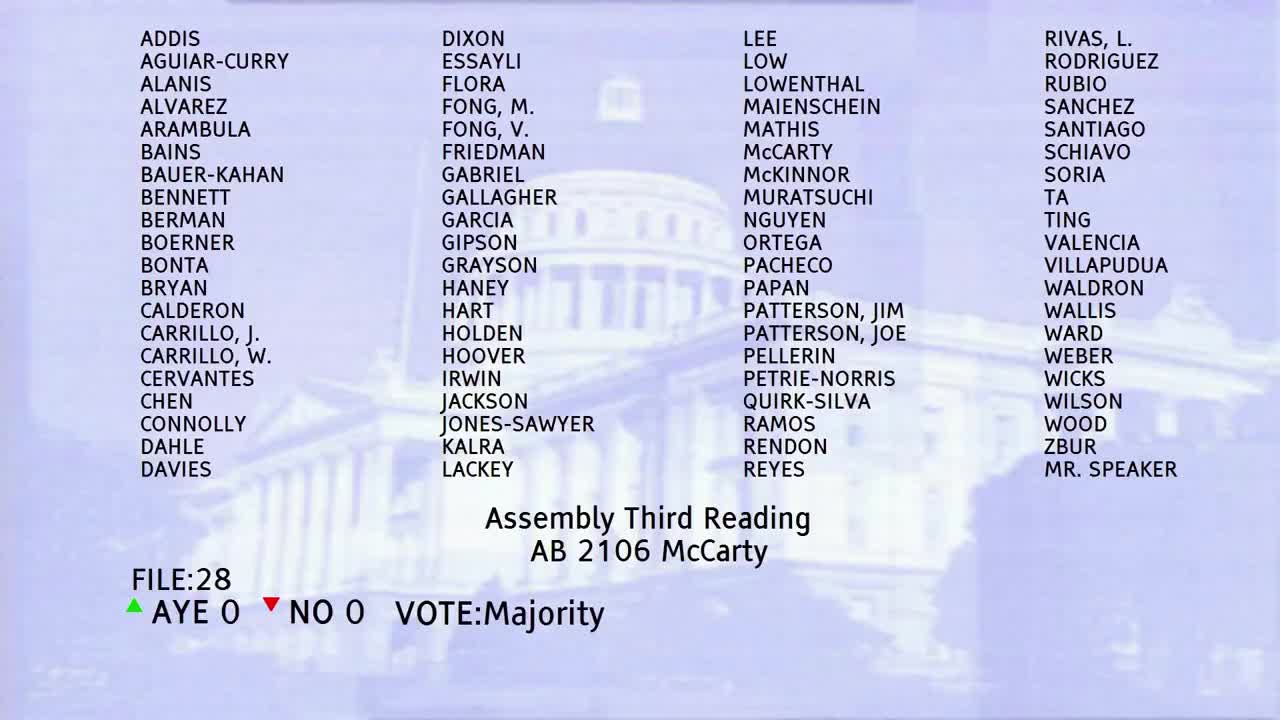 2MIN
Assembly Floor
 8MIN
Assembly Standing Committee on Environmental Safety and Toxic Materials
Bill Author
Bill Co-Author(s):