AB 2514: Solid waste: organic waste: diversion: biomethane: biosolids.
- Session Year: 2023-2024
- House: Assembly
- Latest Version Date: 2024-08-23
Current Status:
Failed
(2024-08-29: Ordered to inactive file at the request of Senator Gonzalez.)
Introduced
In Committee
First Chamber
In Committee
Second Chamber
Enacted
What does this bill do?
The bill defines “pyrolysis” as the thermal breakdown of material at high heat with little or no oxygen and directs the state recycling agency to allow pipeline biomethane (renewable gas made only from organic waste) to count toward a local jurisdiction’s recovered organic waste procurement target. It also temporarily makes the Town of Windsor and the Windsor Water District eligible for a state grant for a biosolids handling project.
The summary is provided by generative AI which can make mistakes. For original language, please view the details in the table below.
(1)The California Integrated Waste Management Act of 1989 generally regulates solid waste disposal, management, and recycling. The act requires each city, county, and regional agency to develop a source reduction and recycling element of an integrated waste management plan. The act requires that element to include a 50% solid waste diversion requirement, as specified, and provides that up to 10% may be achieved through biomass conversion under certain conditions, with biomass conversion defined as the production of heat, fuels, or electricity by certain means from specified materials. One of the conditions for using biomass conversion to satisfy a portion of the solid waste diversion requirement is that pyrolysis not be included in the source reduction and recycling element. Pyrolysis is not defined for that purpose or for other purposes in the act.
This bill would define pyrolysis as the thermal decomposition of organic material at elevated temperatures in the absence or near absence of oxygen.
(2)Existing law requires the Department of Resources Recycling and Recovery, in consultation with the State Air Resources Board, to adopt regulations, as specified, to achieve the reduction in the organic waste disposed of in landfills. The departments regulations provide for, among other things, the calculation by the department of recovered organic waste product procurement targets for each local jurisdiction and a list of eligible recovered organic waste products for purposes of the procurement targets.
This bill would require the department, no later than January 1, 2026, to amend those regulations to include, as a recovered organic waste product attributable to a local jurisdictions procurement target, pipeline biomethane converted exclusively from organic waste, as specified.
(3)Existing law requires the department, upon appropriation by the Legislature, to administer a grant program to provide financial assistance to promote in-state development of infrastructure, food waste prevention, or other projects to reduce organic waste, sort and aggregate or process organic and other recyclable materials into new, value-added products, or divert items from disposal through enhanced reuse opportunities, as provided.
This bill would, until January 1, 2030, make the Town of Windsor and the Windsor Water District eligible for that grant program for purposes of a biosolids handling project.
This bill would make legislative findings and declarations as to the necessity of a special statute for the Town of Windsor and the Windsor Water District.
This bill would incorporate additional changes to Section 42652.5 of the Public Resources Code proposed by AB 2346 and AB 2902 to be operative only if this bill and any or all of the other bills are enacted and this bill is enacted last.
(1)The California Integrated Waste Management Act of 1989 generally regulates solid waste disposal, management, and recycling. The act requires each city, county, and regional agency to develop a source reduction and recycling element of an integrated waste management plan. The act requires that element to include a 50% solid waste diversion requirement, as specified, and provides that up to 10% may be achieved through biomass conversion under certain conditions, with biomass conversion defined as the production of heat, fuels, or electricity by certain means from specified materials. One of the conditions for using biomass conversion to satisfy a portion of the solid waste diversion requirement is that pyrolysis not be included in the source reduction and recycling element. Pyrolysis is not defined for that purpose or for other purposes in the act.
This bill would define pyrolysis as the thermal decomposition of organic material at elevated temperatures in the absence or near absence of oxygen.
(2)Existing law requires the Department of Resources Recycling and Recovery, in consultation with the State Air Resources Board, to adopt regulations, as specified, to achieve the reduction in the organic waste disposed of in landfills. The departments regulations provide for, among other things, the calculation by the department of recovered organic waste product procurement targets for each local jurisdiction and a list of eligible recovered organic waste products for purposes of the procurement targets.
This bill would require the department, no later than January 1, 2026, to amend those regulations to include, as a recovered organic waste product attributable to a local jurisdictions procurement target, pipeline biomethane converted exclusively from organic waste, as specified.
(3)Existing law requires the department, in consultation with the state board, to analyze the progress that the waste sector, state government, and local governments have made in achieving the reduction targets for the amounts of organic waste disposed of in landfills. Existing law authorizes the department to provide incentives to facilitate progress toward the reduction targets if the department determines that sufficient progress has not been made.This bill would require the department, when providing incentives to facilitate progress toward the reduction targets, to consider the life-cycle impacts and benefits of different projects.(3)Existing law requires the department, upon appropriation by the Legislature, to administer a grant program to provide financial assistance to promote in-state development of infrastructure, food waste prevention, or other projects to reduce organic waste, sort and aggregate or process organic and other recyclable materials into new, value-added products, or divert items from disposal through enhanced reuse opportunities, as provided.
This bill would, until January 1, 2030, make the Town of Windsor and the Windsor Water District eligible for that grant program for purposes of a biosolids handling project.
This bill would make legislative findings and declarations as to the necessity of a special statute for the Town of Windsor and the Windsor Water District.
(1)The California Integrated Waste Management Act of 1989 generally regulates solid waste disposal, management, and recycling. The act requires each city, county, and regional agency to develop a source reduction and recycling element of an integrated waste management plan. The act requires that element to include a 50% solid waste diversion requirement, as specified, and provides that up to 10% may be achieved through biomass conversion under certain conditions, with biomass conversion defined as the production of heat, fuels, or electricity by certain means from specified materials. One of the conditions for using biomass conversion to satisfy a portion of the solid waste diversion requirement is that pyrolysis not be included in the source reduction and recycling element. Pyrolysis is not defined for that purpose or for other purposes in the act.
This bill would define pyrolysis as the thermal decomposition of organic material at elevated temperatures in the absence or near absence of oxygen.
(2)Existing law requires the Department of Resources Recycling and Recovery, in consultation with the State Air Resources Board, to adopt regulations, as specified, to achieve the reduction in the organic waste disposed of in landfills. The departments regulations provide for, among other things, the calculation by the department of recovered organic waste product procurement targets for each local jurisdiction and a list of eligible recovered organic waste products for purposes of the procurement targets.
This bill would require the department, no later than January 1, 2026, to amend those regulations to include, as a recovered organic waste product attributable to a local jurisdictions procurement target, hydrogen and pipeline biomethane converted exclusively from organic waste that is separated from other waste, as specified.
(3)Existing law requires the department, in consultation with the state board, to analyze the progress that the waste sector, state government, and local governments have made in achieving the reduction targets for the amounts of organic waste disposed of in landfills. Existing law authorizes the department to provide incentives to facilitate progress toward the reduction targets if the department determines that sufficient progress has not been made.
This bill would require the department, when providing incentives to facilitate progress toward the reduction targets, to consider the life-cycle effects of different projects and then prioritize incentives for landfill diversion projects with the greatest life-cycle benefits. impacts and benefits of different projects.
(1)The California Integrated Waste Management Act of 1989 generally regulates solid waste disposal, management, and recycling. The act requires each city, county, and regional agency to develop a source reduction and recycling element of an integrated waste management plan. The act requires that element to include a 50% solid waste diversion requirement, as specified, and provides that up to 10% may be achieved through biomass conversion under certain conditions, with biomass conversion defined as the production of heat, fuels, or electricity by certain means from specified materials. One of the conditions for using biomass conversion to satisfy a portion of the solid waste diversion requirement is that pyrolysis not be included in the source reduction and recycling element. Pyrolysis is not defined for that purpose or for other purposes in the act.
This bill would define pyrolysis as the thermal decomposition of organic material at elevated temperatures in the absence or near absence of oxygen.
(2)Existing law requires the Department of Resources Recycling and Recovery, in consultation with the State Air Resources Board, to adopt regulations, as specified, to achieve the reduction in the organic waste disposed of in landfills. The departments regulations provide for, among other things, the calculation by the department of recovered organic waste product procurement targets for each local jurisdiction and a list of eligible recovered organic waste products for purposes of the procurement targets.
This bill would require the department, no later than January 1, 2026, to amend those regulations to include, as a recovered organic waste product attributable to a local jurisdictions procurement target, hydrogen and pipeline biomethane converted exclusively from source separated diverted organic waste, organic waste that is separated from other waste, as specified.
(3)Existing law requires the department, in consultation with the state board, to analyze the progress that the waste sector, state government, and local governments have made in achieving the reduction targets for the amounts of organic waste disposed of in landfills. Existing law authorizes the department to provide incentives to facilitate progress toward the reduction targets if the department determines that sufficient progress has not been made.
This bill would require the department, when providing incentives to facilitate progress toward the reduction targets, to consider the life-cycle effects of different projects and then prioritize incentives for landfill diversion projects with the greatest life-cycle benefits.
(1)The California Integrated Waste Management Act of 1989 generally regulates solid waste disposal, management, and recycling. The act requires each city, county, and regional agency to develop a source reduction and recycling element of an integrated waste management plan. The act requires that element to include a 50% solid waste diversion requirement, as specified, and provides that up to 10% may be achieved through biomass conversion under certain conditions, with biomass conversion defined as the production of heat, fuels, or electricity by certain means from specified materials. One of the conditions for using biomass conversion to satisfy a portion of the solid waste diversion requirement is that pyrolysis not be included in the source reduction and recycling element. Pyrolysis is not defined for that purpose or for other purposes in the act.
This bill would define pyrolysis, for purposes of the act and for the Warren-Alquist State Energy Resources Conservation and Development Act, pyrolysis as the thermal decomposition of organic material at elevated temperatures in the absence of gases such as air or or near absence of oxygen.
(2)Existing law requires the Department of Resources Recycling and Recovery, in consultation with the state board, State Air Resources Board, to adopt regulations, as specified, to achieve the reduction in the organic waste disposed of in landfills. The departments regulations provide for, among other things, the calculation by the department of recovered organic waste product procurement targets for each local jurisdiction and a list of eligible recovered organic waste products for purposes of the procurement targets.
This bill would require the department, no later than January 1, 2026, to amend those regulations to include, as a recovered organic waste product attributable to a local jurisdictions procurement target, hydrogen and pipeline biomethane converted exclusively from source separated diverted organic waste, as specified.
(3)Existing law requires the department, in consultation with the state board, to analyze the progress that the waste sector, state government, and local governments have made in achieving the reduction targets for the amounts of organic waste disposed of in landfills. Existing law authorizes the department to provide incentives to facilitate progress towards toward the reduction targets if the department determines that sufficient progress has not been made.
This bill would require the department, when providing incentives to facilitate progress towards toward the reduction targets, to consider the life-cycle carbon intensity effects of different projects and then prioritize incentives for landfill diversion projects with the lowest life-cycle carbon intensity. greatest life-cycle benefits.
(1)The California Integrated Waste Management Act of 1989 generally regulates solid waste disposal, management, and recycling. The act requires each city, county, and regional agency to develop a source reduction and recycling element of an integrated waste management plan. The act requires that element to include a 50% solid waste diversion requirement, as specified, and provides that up to 10% may be achieved through biomass conversion under certain conditions, with biomass conversion defined as the production of heat, fuels, or electricity by certain means from specified materials. One of the conditions for using biomass conversion to satisfy a portion of the solid waste diversion requirement is that pyrolysis not be included in the source reduction and recycling element. Pyrolysis is not defined for that purpose or for other purposes in the act.
This bill would define pyrolysis, for purposes of the act and for the Warren-Alquist State Energy Resources Conservation and Development Act, as the thermal decomposition of organic material at elevated temperatures in the absence of gases such as air or oxygen.
(3)(2)Existing law requires the Department of Resources Recycling and Recovery, in consultation with the state board, to adopt regulations, as specified, to achieve the reduction in the organic waste disposed in landfills. The departments regulations provide for, among other things, the calculation by the department of recovered organic waste product procurement targets for each local jurisdiction and a list of eligible recovered organic waste products for purposes of the procurement targets.
This bill would require the department, no later than January 1, 2026, to amend those regulations to include, as a recovered organic waste product attributable to a local jurisdictions procurement target, hydrogen and pipeline biomethane converted from diverted organic waste, as specified.
(4)(3)Existing law requires the department, in consultation with the state board, to analyze the progress that the waste sector, state government, and local governments have made in achieving the reduction targets for the amounts of organic waste disposed in landfills. Existing law authorizes the department to provide incentives to facilitate progress towards the reduction targets if the department determines that sufficient progress has not been made.
This bill would require the department, when providing incentives to facilitate progress towards the reduction targets, to consider the life-cycle carbon intensity of different projects and then prioritize incentives for landfill diversion projects with the lowest life-cycle carbon intensity.
This bill would require the department, by January 1, 2026, in coordination with the state board, to report to the Legislature on the amount of methane emissions leaked from different recovered organic waste product procurement target compliance pathways, potential measures to reduce the amount of methane leaked from those compliance pathways, and recommendations to reduce methane leakage, costs, and funding needs, as specified.(1)Existing law requires the State Air Resources Board to approve and begin implementing a comprehensive strategy to reduce emissions of short-lived climate pollutants in the state and to achieve a reduction in specified emissions, including methane, as provided. Existing law requires the methane reduction goals to include specified reduction targets for the amounts of organic waste disposed in landfills.
This bill would exempt counties with fewer than 70,000 residents from the reduction targets for the amounts of organic waste disposed in landfills.
(2)The California Integrated Waste Management Act of 1989 generally regulates solid waste disposal, management, and recycling. The act requires each city, county, and regional agency to develop a source reduction and recycling element of an integrated waste management plan. The act requires that element to include a 50% solid waste diversion requirement, as specified, and provides that up to 10% may be achieved through biomass conversion under certain conditions, with biomass conversion defined as the production of heat, fuels, or electricity by certain means from specified materials. One of the conditions for using biomass conversion to satisfy a portion of the solid waste diversion requirement is that pyrolysis not be included in the source reduction and recycling element. Pyrolysis is not defined for that purpose or for other purposes in the act.
This bill would define pyrolysis, for purposes of the act and for the Warren-Alquist State Energy Resources Conservation and Development Act, as the thermal decomposition of organic material at elevated temperatures in the absence of gases such as air or oxygen.
(3)Existing law requires the Department of Resources Recycling and Recovery, in consultation with the state board, to adopt regulations, as specified, to achieve the reduction in the organic waste disposed in landfills. The departments regulations provide for, among other things, the calculation by the department of recovered organic waste product procurement targets for each local jurisdiction and a list of eligible recovered organic waste products for purposes of the procurement targets.
This bill would require the department, no later than January 1, 2026, to amend those regulations to include, as a recovered organic waste product attributable to a local jurisdictions procurement target, hydrogen and pipeline biomethane converted from diverted organic waste, as specified.
(4)Existing law requires the department, in consultation with the state board, to analyze the progress that the waste sector, state government, and local governments have made in achieving the reduction targets for the amounts of organic waste disposed in landfills. Existing law authorizes the department to provide incentives to facilitate progress towards the reduction targets if the department determines that sufficient progress has not been made.
This bill would require the department, when providing incentives to facilitate progress towards the reduction targets, to consider the life-cycle carbon intensity of different projects and then prioritize incentives for landfill diversion projects with the lowest life-cycle carbon intensity.
This bill would require the department, by January 1, 2026, in coordination with the state board, to report to the Legislature on the amount of methane emissions leaked from different recovered organic waste product procurement target compliance pathways, potential measures to reduce the amount of methane leaked from those compliance pathways, and recommendations to reduce methane leakage, costs, and funding needs, as specified.
(a)The Legislature finds and declares all of the following:
(1)Climate scientists agree that reducing methane and other short-lived climate pollutants is the most urgent climate solution because it benefits the climate right away while fossil fuel reductions take decades or centuries to begin to benefit the climate.
(2)Methane is a powerful climate super pollutant that causes 84 times more damage to the climate than carbon dioxide over a 20-year time period.
(3)Methane and black carbon are also harmful air pollutants that damage public health, agricultural productivity, and more.
(4)Reducing methane emissions provides significant and immediate benefits to the climate and to public health.
(5)Existing state law requires a 40-percent reduction in methane emissions by 2030 and diversion of 75 percent of organic landfill waste because landfills emit a significant percentage of Californias methane emissions.
(6)Diverted organic waste can be converted to beneficial products, including renewable energy, compost, and mulch, which benefit the climate and air quality, while providing jobs and economic development.
(7)According to the Legislative Analysts Office and the State Air Resources Board, investments in organic waste diversion projects are among the most cost-effective of all climate investments, reducing carbon emissions at a small fraction of the cost of most climate programs.
(8)According to the Little Hoover Commission, the Department of Resources Recycling and Recovery must take several steps to accelerate organic waste diversion to meet the methane reduction and landfill diversion requirements of state law.
(b)It is the intent of the Legislature to accelerate the diversion and beneficial reuse of organic landfill waste to meet the requirements of Section 39730.6 of the Health and Safety Code.
(c)It is the intent of the Legislature to support the adoption of additional policies and incentives that maximize the climate, public health, environmental, economic, and community benefits of organic waste diversion and reuse.
SEC. 2.Section 40178 is added to the Public Resources Code, to read:40178.Pyrolysis means the thermal decomposition of material at elevated temperatures in the absence or near absence of oxygen.
SEC. 3.Section 42652.5 of the Public Resources Code is amended to read:42652.5.(a)The department, in consultation with the State Air Resources Board, shall adopt regulations to achieve the organic waste reduction goals for 2020 and 2025 established in Section 39730.6 of the Health and Safety Code. The regulations shall comply with all of the following:
(1)May require local jurisdictions to impose requirements on generators or other relevant entities within their jurisdiction and may authorize local jurisdictions to impose penalties on generators for noncompliance.
(2)Shall include requirements intended to meet the goal that not less than 20 percent of edible food that is currently disposed of is recovered for human consumption by 2025.
(3)Shall not establish a numeric organic waste disposal limit for individual landfills.
(4)May include different levels of requirements for local jurisdictions and phased timelines based upon their progress in meeting the organic waste reduction goals for 2020 and 2025 established in Section 39730.6 of the Health and Safety Code. The department shall base its determination of progress on relevant factors, including, but not limited to, reviews conducted pursuant to Section 41825, the amount of organic waste disposed of compared to the 2014 level, per capita disposal rates, the review required by Section 42653, and other relevant information provided by a local jurisdiction.
(5)(A)May include penalties to be imposed by the department for noncompliance. If penalties are included, they shall not exceed the amount authorized pursuant to Section 41850.
(B)Notwithstanding any other law, administrative civil penalties for a local jurisdiction that fails to procure a quantity of recovered organic waste products that meets or exceeds its recovered organic waste product procurement target established by the department pursuant to Section 18993.1 of Title 14 of the California Code of Regulations shall be imposed pursuant to the following schedule:
(i)On or after January 1, 2023, each jurisdiction shall procure a quantity of recovered organic waste products that meets or exceeds 30 percent of its recovered organic waste product procurement target.
(ii)On or after January 1, 2024, each jurisdiction shall procure a quantity of recovered organic waste products that meets or exceeds 65 percent of its recovered organic waste product procurement target.
(iii)On or after January 1, 2025, each jurisdiction shall procure a quantity of recovered organic waste products that meets or exceeds 100 percent of its recovered organic waste product procurement target.
(6)Shall take effect on or after January 1, 2022, except the imposition of penalties pursuant to paragraph (1) shall not take effect until two years after the effective date of the regulations.
(7)Jurisdictions in possession of a rural exemption pursuant to subdivision (c) of Section 18984.12 of Title 14 of the California Code of Regulations, as that section read on January 1, 2022, are exempt from the procurement requirement of this subdivision until December 31, 2026. Beginning January 1, 2027, the department may, in its discretion, provide rural counties and jurisdictions located within rural counties that are exempt from organic waste collection requirements an extended recovered organic waste product procurement target schedule similar to the schedule set forth in this subdivision, which shall be exempt from the Administrative Procedure Act (Chapter 3.5 (commencing with Section 11340) of Part 1 of Division 3 of Title 2 of the Government Code).
(8)The department may, in its discretion, create an adjusted recovered organic waste product procurement target schedule, not to exceed the requirements of the schedule set forth in this subdivision, which shall be exempt from the Administrative Procedure Act (Chapter 3.5 (commencing with Section 11340) of Part 1 of Division 3 of Title 2 of the Government Code).
(9)No later than January 1, 2026, the department shall amend subdivision (f) of Section 18993.1 of Title 14 of the California Code of Regulations to include in the recovered organic waste products that a jurisdiction may procure to comply with Article 12 (commencing with Section 18993.1) of Chapter 12 of Division 7 of Title 14 of the California Code of Regulations pipeline biomethane converted exclusively from organic waste, as defined and described in Article 10 (commencing with Section 650) of Chapter 3 of Part 1 of Division 1 of the Public Utilities Code.
(b)A local jurisdiction may charge and collect fees to recover the local jurisdictions costs incurred in complying with the regulations adopted pursuant to this section.
(c)A local jurisdiction facing continuing violations of the regulations adopted pursuant to subdivision (a) that commence during the 2022 calendar year may submit to the department a notification of intent to comply, as described in this section. Upon approval by the department, and implementation by the local jurisdiction, of a notification of intent to comply that meets the requirements of subdivision (e), a local jurisdiction may be eligible for both of the following:
(1)Administrative civil penalty relief for the 2022 calendar year pursuant to subdivision (d).
(2)A corrective action plan pursuant to Section 18996.2 of Title 14 of the California Code of Regulations.
(d)(1)For violations of the regulations that are disclosed in a notification of intent to comply that is approved by the department as meeting the requirements of subdivision (e), the department shall waive administrative civil penalties under paragraph (5) of subdivision (a) during the 2022 calendar year if, and administrative civil penalties shall not accrue under paragraph (5) of subdivision (a) during the 2022 calendar year if, the local jurisdiction implements the proposed actions according to the schedule proposed pursuant to paragraph (4) of subdivision (e).
(2)For violations that commence during the 2022 calendar year and continue into the 2023 calendar year, administrative civil penalties may begin accruing as of January 1, 2023. Those administrative civil penalties accruing on and after January 1, 2023, shall be waived upon complete compliance with the terms of a corrective action plan pursuant to Section 18996.2 of Title 14 of the California Code of Regulations.
(3)If a local jurisdiction fails to adhere to the proposed actions and schedule described in a notification of intent to comply pursuant to paragraph (4) of subdivision (e), the department may revoke its approval of the notification of intent to comply and impose administrative civil penalties for violations occurring during the 2022 calendar year retroactive to the date of violation.
(4)Notwithstanding any proposed actions and schedule provided by a local jurisdiction in an approved notification of intent to comply pursuant to paragraph (4) of subdivision (e), the department may instead address through a corrective action plan any violations disclosed in that notification that may take more than 180 days to correct. Under those circumstances, the proposed actions and schedule provided pursuant to an approved notification of intent to comply pursuant to paragraph (4) of subdivision (e) shall control until a corrective action plan is finalized.
(e)The department shall approve a notification of intent to comply if the department determines the notification meets the requirements of this subdivision. A notification of intent to comply shall be in writing, adopted by formal resolution by the governing body of the local jurisdiction, and filed with the department no later than March 1, 2022. The notification of intent to comply shall include, at a minimum, all of the following:
(1)A description, with specificity, of the continuing violations.
(2)A detailed explanation of the reasons, supported by documentation, why the local jurisdiction is unable to comply.
(3)A description of the impacts of the COVID-19 pandemic on compliance.
(4)A description of the proposed actions the local jurisdiction will take to remedy the violations within the timelines established in Section 18996.2 of Title 14 of the California Code of Regulations with a proposed schedule for doing so. The proposed actions shall be tailored to remedy the violations in a timely manner.
(f)The department shall respond in writing to a local jurisdiction within 45 business days of receiving a notification of intent to comply with an approval, disapproval, request for additional information, or timeline for a decision on approval or disapproval. If the department disapproves the notification of intent to comply due to the notification not meeting the requirements of subdivision (e), the department shall include in the response a justification for the disapproval.
(g)Notwithstanding Section 18996.2 of Title 14 of the California Code of Regulations, the department may establish any maximum compliance deadline in a corrective action plan that it determines to be necessary and appropriate under the circumstances for the correction of a violation of the regulations adopted pursuant to subdivision (a).
(h)(1)The department may adopt regulations it determines to be necessary to implement and enforce the changes made to this section by Chapter 508 of the Statutes of 2021 as emergency regulations.
(2)Emergency regulations adopted pursuant to paragraph (1) shall be adopted in accordance with Chapter 3.5 (commencing with Section 11340) of Part 1 of Division 3 of Title 2 of the Government Code, and for purposes of that chapter, including Section 11349.6 of the Government Code, the adoption of these regulations is an emergency and shall be considered by the Office of Administrative Law as necessary for the immediate preservation of the public peace, health, safety, and general welfare. Notwithstanding Chapter 3.5 (commencing with Section 11340) of Part 1 of Division 3 of Title 2 of the Government Code, emergency regulations adopted by the department pursuant to paragraph (1) shall be filed with, but not be repealed by, the Office of Administrative Law and shall remain in effect until January 1, 2024.
SEC. 3.1.Section 42652.5 of the Public Resources Code is amended to read:42652.5.(a)The department, in consultation with the State Air Resources Board, shall adopt regulations to achieve the organic waste reduction goals for 2020 and 2025 established in Section 39730.6 of the Health and Safety Code. The regulations shall comply with all of the following:
(1)May require local jurisdictions to impose requirements on generators or other relevant entities within their jurisdiction and may authorize local jurisdictions to impose penalties on generators for noncompliance.
(2)Shall include requirements intended to meet the goal that not less than 20 percent of edible food that is currently disposed of is recovered for human consumption by 2025.
(3)Shall not establish a numeric organic waste disposal limit for individual landfills.
(4)May include different levels of requirements for local jurisdictions and phased timelines based upon their progress in meeting the organic waste reduction goals for 2020 and 2025 established in Section 39730.6 of the Health and Safety Code. The department shall base its determination of progress on relevant factors, including, but not limited to, reviews conducted pursuant to Section 41825, the amount of organic waste disposed of compared to the 2014 level, per capita disposal rates, the review required by Section 42653, and other relevant information provided by a local jurisdiction.
(5)(A)May include penalties to be imposed by the department for noncompliance. If penalties are included, they shall not exceed the amount authorized pursuant to Section 41850.
(B)Notwithstanding any other law, administrative civil penalties for a local jurisdiction that fails to procure a quantity of recovered organic waste products that meets or exceeds its recovered organic waste product procurement target established by the department pursuant to Section 18993.1 of Title 14 of the California Code of Regulations shall be imposed pursuant to the following schedule:
(i)On or after January 1, 2023, each jurisdiction shall procure a quantity of recovered organic waste products that meets or exceeds 30 percent of its recovered organic waste product procurement target.
(ii)On or after January 1, 2024, each jurisdiction shall procure a quantity of recovered organic waste products that meets or exceeds 65 percent of its recovered organic waste product procurement target.
(iii)On or after January 1, 2025, each jurisdiction shall procure a quantity of recovered organic waste products that meets or exceeds 100 percent of its recovered organic waste product procurement target.
(6)Shall take effect on or after January 1, 2022, except the imposition of penalties pursuant to paragraph (1) shall not take effect until two years after the effective date of the regulations.
(7)Jurisdictions in possession of a rural exemption pursuant to subdivision (c) of Section 18984.12 of Title 14 of the California Code of Regulations, as that section read on January 1, 2022, are exempt from the procurement requirement of this subdivision until December 31, 2026. Beginning January 1, 2027, the department may, in its discretion, provide rural counties and jurisdictions located within rural counties that are exempt from organic waste collection requirements an extended recovered organic waste product procurement target schedule similar to the schedule set forth in this subdivision, which shall be exempt from the Administrative Procedure Act (Chapter 3.5 (commencing with Section 11340) of Part 1 of Division 3 of Title 2 of the Government Code).
(8)The department may, in its discretion, create an adjusted recovered organic waste product procurement target schedule, not to exceed the requirements of the schedule set forth in this subdivision, which shall be exempt from the Administrative Procedure Act (Chapter 3.5 (commencing with Section 11340) of Part 1 of Division 3 of Title 2 of the Government Code).
(9)No later than January 1, 2026, the department shall amend subdivision (f) of Section 18993.1 of Title 14 of the California Code of Regulations to include in the recovered organic waste products that a jurisdiction may procure to comply with Article 12 (commencing with Section 18993.1) of Chapter 12 of Division 7 of Title 14 of the California Code of Regulations pipeline biomethane converted exclusively from organic waste, as defined and described in Article 10 (commencing with Section 650) of Chapter 3 of Part 1 of Division 1 of the Public Utilities Code.
(b)A local jurisdiction may charge and collect fees to recover the local jurisdictions costs incurred in complying with the regulations adopted pursuant to this section.
(c)A local jurisdiction facing continuing violations of the regulations adopted pursuant to subdivision (a) that commence during the 2022 calendar year may submit to the department a notification of intent to comply, as described in this section. Upon approval by the department, and implementation by the local jurisdiction, of a notification of intent to comply that meets the requirements of subdivision (e), a local jurisdiction may be eligible for both of the following:
(1)Administrative civil penalty relief for the 2022 calendar year pursuant to subdivision (d).
(2)A corrective action plan pursuant to Section 18996.2 of Title 14 of the California Code of Regulations.
(d)(1)For violations of the regulations that are disclosed in a notification of intent to comply that is approved by the department as meeting the requirements of subdivision (e), the department shall waive administrative civil penalties under paragraph (5) of subdivision (a) during the 2022 calendar year if, and administrative civil penalties shall not accrue under paragraph (5) of subdivision (a) during the 2022 calendar year if, the local jurisdiction implements the proposed actions according to the schedule proposed pursuant to paragraph (4) of subdivision (e).
(2)For violations that commence during the 2022 calendar year and continue into the 2023 calendar year, administrative civil penalties may begin accruing as of January 1, 2023. Those administrative civil penalties accruing on and after January 1, 2023, shall be waived upon complete compliance with the terms of a corrective action plan pursuant to Section 18996.2 of Title 14 of the California Code of Regulations.
(3)If a local jurisdiction fails to adhere to the proposed actions and schedule described in a notification of intent to comply pursuant to paragraph (4) of subdivision (e), the department may revoke its approval of the notification of intent to comply and impose administrative civil penalties for violations occurring during the 2022 calendar year retroactive to the date of violation.
(4)Notwithstanding any proposed actions and schedule provided by a local jurisdiction in an approved notification of intent to comply pursuant to paragraph (4) of subdivision (e), the department may instead address through a corrective action plan any violations disclosed in that notification that may take more than 180 days to correct. Under those circumstances, the proposed actions and schedule provided pursuant to an approved notification of intent to comply pursuant to paragraph (4) of subdivision (e) shall control until a corrective action plan is finalized.
(e)The department shall approve a notification of intent to comply if the department determines the notification meets the requirements of this subdivision. A notification of intent to comply shall be in writing, adopted by formal resolution by the governing body of the local jurisdiction, and filed with the department no later than March 1, 2022. The notification of intent to comply shall include, at a minimum, all of the following:
(1)A description, with specificity, of the continuing violations.
(2)A detailed explanation of the reasons, supported by documentation, why the local jurisdiction is unable to comply.
(3)A description of the impacts of the COVID-19 pandemic on compliance.
(4)A description of the proposed actions the local jurisdiction will take to remedy the violations within the timelines established in Section 18996.2 of Title 14 of the California Code of Regulations with a proposed schedule for doing so. The proposed actions shall be tailored to remedy the violations in a timely manner.
(f)The department shall respond in writing to a local jurisdiction within 45 business days of receiving a notification of intent to comply with an approval, disapproval, request for additional information, or timeline for a decision on approval or disapproval. If the department disapproves the notification of intent to comply due to the notification not meeting the requirements of subdivision (e), the department shall include in the response a justification for the disapproval.
(g)Notwithstanding Section 18996.2 of Title 14 of the California Code of Regulations, the department may establish any maximum compliance deadline in a corrective action plan that it determines to be necessary and appropriate under the circumstances for the correction of a violation of the regulations adopted pursuant to subdivision (a).
(h)A local jurisdiction may be credited for the procurement of recovered organic waste products without executing a direct service provider agreement with end users of recovered organic waste products if all of the following conditions are met:
(1)The use of the recovered organic waste product by any entity is a result of the jurisdictions adoption or enforcement of ordinances, regulations, resolutions, or policies.
(2)The jurisdiction complied with all other recordkeeping and reporting requirements related to procurement targets, including verification, as determined by the department, that an entity is procuring on behalf of the jurisdiction.
(3)The recovered organic waste product is not applied to the recovered organic waste product procurement target of another jurisdiction.
(i)(1)A local jurisdiction may count compost produced and procured from the following compost operations, as described in Section 17852 of Title 14 of the California Code of Regulations, as it read on January 1, 2024, towards its recovered organic waste procurement target:
(A)Vermicomposting operations.
(B)Operations composting green material, agricultural material, food material, and vegetative food material, if the total amount of feedstock and compost onsite at any one time does not exceed 100 cubic yards and 750 square feet.
(C)Mushroom compost. Mushroom compost means the composted growing substrate that remains after a crop has been harvested to completion.
(2)Paragraph (1) applies if a local jurisdiction adopts an ordinance or other enforceable mechanism requiring compost and vermicompost procured by the jurisdiction to comply with this subdivision and to be used in a manner that meets the definition of land application in subparagraph (A) of paragraph (24.5) of subdivision (a) of Section 17852 of Title 14 of the California Code of Regulations and that meets the pathogen, metals, and physical contamination limits that apply to existing composting facilities.
(j)A local jurisdiction may count up to 10 percent of its recovered organic waste product procurement target with both of the following recovered organic waste products:
(1)Mulch produced from tree trimming operations conducted by the jurisdiction or a service provider operating under contract to the jurisdiction when applied to landscape areas owned or managed by the jurisdiction or given away to residents, if the local jurisdiction does both of the following:
(A)The local jurisdiction provides documentation of the amount of mulch used and distributed, and where it was applied.
(B)The local jurisdiction adopts an ordinance or other enforceable mechanism requiring that mulch be used in a manner that meets the definition of land application in subparagraph (A) of paragraph (24.5) of subdivision (a) of Section 17852 of Title 14 of the California Code of Regulations and that meets the pathogen, metals, and physical contamination limits that apply to existing composting facilities.
(2)Edible food recovered in compliance with Section 18991.1 of Title 14 of the California Code of Regulations generated from a commercial food generator located within the jurisdiction. The conversion factor to be used to convert tonnage in the annual recovered organic waste product procurement target for each jurisdiction to equivalent amounts of recovered organic waste product shall be one ton of edible food for each ton of organic waste in a recovered organic waste product procurement target.
(3)Nothing in this paragraph shall be construed to limit the proportion of recovered organic waste products described in subdivision (f) of Section 18993.1 of Title 14 of the California Code of Regulations, as it read on January 1, 2024, that a jurisdiction can count toward its recovered organic waste procurement target.
(k)To count recovered organic waste products listed in subdivisions (i) and (j) toward its recovered organic waste product procurement target, a local jurisdiction shall comply with applicable regulations.
(l)(1)Subject to paragraph (2), and until December 31, 2035, the following direct expenditures by a local jurisdiction may count towards its recovered organic waste product procurement target:
(A)Investments for community composting operations serving the jurisdiction, including, but not limited to, an investment made to establish or expand a compostable materials handling operation or community composting operation.
(B)Equipment that is used only to apply compost or mulch, including, and limited to, compost spreaders, drag harrows, chippers, stump grinders, and blowers, if the jurisdiction uses the equipment to spread compost or mulch in compliance with procurement requirements during the same year that the purchase expense is applied toward its recovered organic waste product procurement target.
(C)Development of compost or mulch distribution sites to make free compost and mulch accessible and available to residents.
(2)(A)The department may determine, in regulations, the appropriate conversion factors for the direct expenditures in paragraph (1). The expenditures may count for up to 10 percent of a jurisdictions total procurement target.
(B)Prior to the departments adoption of regulations to implement this section, the conversion factor shall be twenty-one dollars and thirty-eight cents ($21.38) for each ton of organic waste in a product procurement target.
(m)(1)One or more local jurisdictions within the same county may determine a local per capita procurement target using information from a local waste characterization study for a period not to exceed five years after the completion of the study. A waste characterization study shall be performed by the local jurisdiction or jurisdictions, which shall apply the results of a study to the total amount of landfill disposal attributed to the local jurisdiction or jurisdictions by the departments Recycling and Disposal Reporting System.
(2)A waste characterization study may be used if it meets all of the following criteria:
(A)It was performed within the prior five years. This subparagraph does not require a jurisdiction to conduct a local waste characterization study within a specified five-year cycle or to wait for a recalculation of the annual recovered organic waste product procurement target pursuant to subdivision (b) of Section 18993.1 of Title 14 of the California Code of Regulations.
(B)It includes all categories of organic waste used in the departments most recent waste characterization study that was available at the time the waste characterization local study was performed.
(C)It includes a statistically significant sampling of solid waste disposed by the local jurisdiction or jurisdictions for which the local per capita procurement target will be determined.
(D)The geographic boundaries within which the study is conducted shall match the geographic boundaries of the jurisdiction or jurisdictions the local per capita procurement target will be applied to.
(E)It uses the most recent formula for the per capita procurement target developed by the department.
(F)The results of the study are submitted to the department in a form and manner determined by the department.
(3)The department may establish in regulations criteria for approving the methodology of a local waste characterization study.
(n)Commencing January 1, 2027, a local jurisdiction may procure a quantity of recovered organic waste products that meets or exceeds a five-year recovered organic waste product procurement target if the following conditions are met:
(1)On or before January 1, 2027, and on or before January 1 every five years thereafter, the jurisdictions five-year recovered organic waste procurement requirement target is calculated by multiplying the annual procurement target by five. The department may grant a jurisdiction approval to begin the five-year period on any January 1 after January 1, 2027.
(2)On or before January 1, 2027, the jurisdiction has notified the department that it intends to comply using a five-year target.
(o)In adopting and revising regulations to implement this section, the department may consider both of the following:
(1)The development and adoption of a conversion factor for one ton of organic waste and one ton of compost applied locally to count towards a local jurisdictions organic waste procurement target.
(2)Other pathways to prioritize local use of compost.
(h)(p)(1)The department may adopt regulations it determines to be necessary to implement and enforce the changes made to this section by Chapter 508 of the Statutes of 2021 as emergency regulations.
(2)Emergency regulations adopted pursuant to paragraph (1) shall be adopted in accordance with Chapter 3.5 (commencing with Section 11340) of Part 1 of Division 3 of Title 2 of the Government Code, and for purposes of that chapter, including Section 11349.6 of the Government Code, the adoption of these regulations is an emergency and shall be considered by the Office of Administrative Law as necessary for the immediate preservation of the public peace, health, safety, and general welfare. Notwithstanding Chapter 3.5 (commencing with Section 11340) of Part 1 of Division 3 of Title 2 of the Government Code, emergency regulations adopted by the department pursuant to paragraph (1) shall be filed with, but not be repealed by, the Office of Administrative Law and shall remain in effect until January 1, 2024.
SEC. 3.2.Section 42652.5 of the Public Resources Code is amended to read:42652.5.(a)The department, in consultation with the State Air Resources Board, shall adopt regulations to achieve the organic waste reduction goals for 2020 and 2025 established in Section 39730.6 of the Health and Safety Code. The regulations shall comply with all of the following:
(1)May require local jurisdictions to impose requirements on generators or other relevant entities within their jurisdiction and may authorize local jurisdictions to impose penalties on generators for noncompliance.
(2)(A)Shall include requirements intended to meet the goal that not less than 20 percent of edible food that is currently disposed of is recovered for human consumption by 2025.
(B)The department shall evaluate ways to maximize the local benefits of edible food recovery programs, and explore circumstances in which recovered food may be more suitable for use in local animal feed operations.
(3)Shall not establish a numeric organic waste disposal limit for individual landfills.
(4)Shall evaluate ways to incentivize carbon farming that advances healthy soils.
(4)(5)May include different levels of requirements for local jurisdictions and phased timelines based upon their progress in meeting the organic waste reduction goals for 2020 and 2025 established in Section 39730.6 of the Health and Safety Code. The department shall base its determination of progress on relevant factors, including, but not limited to, reviews conducted pursuant to Section 41825, the amount of organic waste disposed of compared to the 2014 level, per capita disposal rates, the review required by Section 42653, and other relevant information provided by a local jurisdiction.
(5)(6)(A)May include penalties to be imposed by the department for noncompliance. If penalties are included, they shall not exceed the amount authorized pursuant to Section 41850.
(B)Notwithstanding any other law, administrative civil penalties for a local jurisdiction that fails to procure a quantity of recovered organic waste products that meets or exceeds its recovered organic waste product procurement target established by the department pursuant to Section 18993.1 of Title 14 of the California Code of Regulations shall be imposed pursuant to the following schedule:
(i)On or after January 1, 2023, each jurisdiction shall procure a quantity of recovered organic waste products that meets or exceeds 30 percent of its recovered organic waste product procurement target.
(ii)On or after January 1, 2024, each jurisdiction shall procure a quantity of recovered organic waste products that meets or exceeds 65 percent of its recovered organic waste product procurement target.
(iii)On or after January 1, 2025, each jurisdiction shall procure a quantity of recovered organic waste products that meets or exceeds 100 percent of its recovered organic waste product procurement target.
(6)(7)Shall take effect on or after January 1, 2022, except the imposition of penalties pursuant to paragraph (1) shall not take effect until two years after the effective date of the regulations.
(8)For purposes of determining a jurisdictions recovered organic waste procurement target pursuant to Section 18993.1 of Title 14 of the California Code of Regulations, the jurisdictions population shall not include the number of residents included in low population or elevation waivers granted by the department pursuant to Section 18984.12 of Title 14 of the California Code of Regulations.
(7)Jurisdictions(9)Recognizing the continued economic and logistical challenges of organic waste recycling and procurement in rural jurisdictions, a jurisdiction in possession of a rural exemption pursuant to subdivision (c) of Section 18984.12 of Title 14 of the California Code of Regulations, as that section read on January 1, 2022, are exempt from the procurement requirement of this subdivision until December 31, 2026. Beginning January 1, 2027, the department may, in its discretion, provide rural counties and jurisdictions located within rural counties that are exempt from organic waste collection requirements an extended recovered organic waste product procurement target schedule similar to the schedule set forth in this subdivision, which shall be exempt from the Administrative Procedure Act (Chapter 3.5 (commencing with Section 11340) of Part 1 of Division 3 of Title 2 of the Government Code). 2024, shall remain exempt from complying with the organic waste collection services requirements specified in Article 3 (commencing with Section 18984) of, and the procurement requirements specified in Article 12 (commencing with Section 18993.1) of, Chapter 12 of Division 7 of Title 14 of the California Code of Regulations until January 1, 2037. The department shall adopt regulations to establish a process to renew the exemptions after that date for periods of up to five years.
(10)Specify that bear bins are not required to comply with the lid color requirements established by Chapter 12 (commencing with Section 18981.1) of Division 7 of Title 14 of the California Code of Regulations.
(8)(11)The department may, in its discretion, create an adjusted recovered organic waste product procurement target schedule, not to exceed the requirements of the schedule set forth in this subdivision, which shall be exempt from the Administrative Procedure Act (Chapter 3.5 (commencing with Section 11340) of Part 1 of Division 3 of Title 2 of the Government Code).
(12)No later than January 1, 2026, the department shall amend subdivision (f) of Section 18993.1 of Title 14 of the California Code of Regulations to include in the recovered organic waste products that a jurisdiction may procure to comply with Article 12 (commencing with Section 18993.1) of Chapter 12 of Division 7 of Title 14 of the California Code of Regulations pipeline biomethane converted exclusively from organic waste, as defined and described in Article 10 (commencing with Section 650) of Chapter 3 of Part 1 of Division 1 of the Public Utilities Code.
(b)A local jurisdiction may charge and collect fees to recover the local jurisdictions costs incurred in complying with the regulations adopted pursuant to this section.
(c)A local jurisdiction facing continuing violations of the regulations adopted pursuant to subdivision (a) that commence during the 2022 calendar year may submit to the department a notification of intent to comply, as described in this section. Upon approval by the department, and implementation by the local jurisdiction, of a notification of intent to comply that meets the requirements of subdivision (e), a local jurisdiction may be eligible for both of the following:
(1)Administrative civil penalty relief for the 2022 calendar year pursuant to subdivision (d).
(2)A corrective action plan pursuant to Section 18996.2 of Title 14 of the California Code of Regulations.
(d)(1)For violations of the regulations that are disclosed in a notification of intent to comply that is approved by the department as meeting the requirements of subdivision (e), the department shall waive administrative civil penalties under paragraph (5) (6) of subdivision (a) during the 2022 calendar year if, and administrative civil penalties shall not accrue under paragraph (5) (6) of subdivision (a) during the 2022 calendar year if, the local jurisdiction implements the proposed actions according to the schedule proposed pursuant to paragraph (4) of subdivision (e).
(2)For violations that commence during the 2022 calendar year and continue into the 2023 calendar year, administrative civil penalties may begin accruing as of January 1, 2023. Those administrative civil penalties accruing on and after January 1, 2023, shall be waived upon complete compliance with the terms of a corrective action plan pursuant to Section 18996.2 of Title 14 of the California Code of Regulations.
(3)If a local jurisdiction fails to adhere to the proposed actions and schedule described in a notification of intent to comply pursuant to paragraph (4) of subdivision (e), the department may revoke its approval of the notification of intent to comply and impose administrative civil penalties for violations occurring during the 2022 calendar year retroactive to the date of violation.
(4)Notwithstanding any proposed actions and schedule provided by a local jurisdiction in an approved notification of intent to comply pursuant to paragraph (4) of subdivision (e), the department may instead address through a corrective action plan any violations disclosed in that notification that may take more than 180 days to correct. Under those circumstances, the proposed actions and schedule provided pursuant to an approved notification of intent to comply pursuant to paragraph (4) of subdivision (e) shall control until a corrective action plan is finalized.
(e)The department shall approve a notification of intent to comply if the department determines the notification meets the requirements of this subdivision. A notification of intent to comply shall be in writing, adopted by formal resolution by the governing body of the local jurisdiction, and filed with the department no later than March 1, 2022. The notification of intent to comply shall include, at a minimum, all of the following:
(1)A description, with specificity, of the continuing violations.
(2)A detailed explanation of the reasons, supported by documentation, why the local jurisdiction is unable to comply.
(3)A description of the impacts of the COVID-19 pandemic on compliance.
(4)A description of the proposed actions the local jurisdiction will take to remedy the violations within the timelines established in Section 18996.2 of Title 14 of the California Code of Regulations with a proposed schedule for doing so. The proposed actions shall be tailored to remedy the violations in a timely manner.
(f)The department shall respond in writing to a local jurisdiction within 45 business days of receiving a notification of intent to comply with an approval, disapproval, request for additional information, or timeline for a decision on approval or disapproval. If the department disapproves the notification of intent to comply due to the notification not meeting the requirements of subdivision (e), the department shall include in the response a justification for the disapproval.
(g)Notwithstanding Section 18996.2 of Title 14 of the California Code of Regulations, the department may establish any maximum compliance deadline in a corrective action plan that it determines to be necessary and appropriate under the circumstances for the correction of a violation of the regulations adopted pursuant to subdivision (a).
(h)(1)The department may adopt regulations it determines to be necessary to implement and enforce the changes made to this section by Chapter 508 of the Statutes of 2021 as emergency regulations.
(2)Emergency regulations adopted pursuant to paragraph (1) shall be adopted in accordance with Chapter 3.5 (commencing with Section 11340) of Part 1 of Division 3 of Title 2 of the Government Code, and for purposes of that chapter, including Section 11349.6 of the Government Code, the adoption of these regulations is an emergency and shall be considered by the Office of Administrative Law as necessary for the immediate preservation of the public peace, health, safety, and general welfare. Notwithstanding Chapter 3.5 (commencing with Section 11340) of Part 1 of Division 3 of Title 2 of the Government Code, emergency regulations adopted by the department pursuant to paragraph (1) shall be filed with, but not be repealed by, the Office of Administrative Law and shall remain in effect until January 1, 2024.
(i)In order to reduce emissions from solid waste facilities that may be a potential source of methane emissions, the department, in conjunction with the California Pollution Control Financing Authority and the California Infrastructure and Economic Development Bank, may provide information to the owners and operators of those facilities about financing that may be available to fund facility improvements to increase the capture, or reduce the escape, of methane emissions.
(j)Consistent with the decisions in Scott v. Bd. of Equalization (1996) 50 Cal.App.4th 1597 and Schettler v. County of Santa Clara (1977) 74 Cal.App.3d 990, the free provision, or granting of incentive payments for use, of compost or mulch by a jurisdiction constitutes a public purpose resulting in the public benefits of reducing greenhouse gas emissions, increasing soil productivity and water retention, and facilitating diversion of organic waste and so shall not be construed to be gifts of public funds in violation of Section 6 of Article XVI of the California Constitution. This subdivision does not constitute a change in, but is declaratory of, existing law.
SEC. 3.3.Section 42652.5 of the Public Resources Code is amended to read:42652.5.(a)The department, in consultation with the State Air Resources Board, shall adopt regulations to achieve the organic waste reduction goals for 2020 and 2025 established in Section 39730.6 of the Health and Safety Code. The regulations shall comply with all of the following:
(1)May require local jurisdictions to impose requirements on generators or other relevant entities within their jurisdiction and may authorize local jurisdictions to impose penalties on generators for noncompliance.
(2)(A)Shall include requirements intended to meet the goal that not less than 20 percent of edible food that is currently disposed of is recovered for human consumption by 2025.
(B)The department shall evaluate ways to maximize the local benefits of edible food recovery programs, and explore circumstances in which recovered food may be more suitable for use in local animal feed operations.
(3)Shall not establish a numeric organic waste disposal limit for individual landfills.
(4)Shall evaluate ways to incentivize carbon farming that advances healthy soils.
(4)(5)May include different levels of requirements for local jurisdictions and phased timelines based upon their progress in meeting the organic waste reduction goals for 2020 and 2025 established in Section 39730.6 of the Health and Safety Code. The department shall base its determination of progress on relevant factors, including, but not limited to, reviews conducted pursuant to Section 41825, the amount of organic waste disposed of compared to the 2014 level, per capita disposal rates, the review required by Section 42653, and other relevant information provided by a local jurisdiction.
(5)(6)(A)May include penalties to be imposed by the department for noncompliance. If penalties are included, they shall not exceed the amount authorized pursuant to Section 41850.
(B)Notwithstanding any other law, administrative civil penalties for a local jurisdiction that fails to procure a quantity of recovered organic waste products that meets or exceeds its recovered organic waste product procurement target established by the department pursuant to Section 18993.1 of Title 14 of the California Code of Regulations shall be imposed pursuant to the following schedule:
(i)On or after January 1, 2023, each jurisdiction shall procure a quantity of recovered organic waste products that meets or exceeds 30 percent of its recovered organic waste product procurement target.
(ii)On or after January 1, 2024, each jurisdiction shall procure a quantity of recovered organic waste products that meets or exceeds 65 percent of its recovered organic waste product procurement target.
(iii)On or after January 1, 2025, each jurisdiction shall procure a quantity of recovered organic waste products that meets or exceeds 100 percent of its recovered organic waste product procurement target.
(6)(7)Shall take effect on or after January 1, 2022, except the imposition of penalties pursuant to paragraph (1) shall not take effect until two years after the effective date of the regulations.
(8)For purposes of determining a jurisdictions recovered organic waste procurement target pursuant to Section 18993.1 of Title 14 of the California Code of Regulations, the jurisdictions population shall not include the number of residents included in low population or elevation waivers granted by the department pursuant to Section 18984.12 of Title 14 of the California Code of Regulations.
(7)Jurisdictions(9)Recognizing the continued economic and logistical challenges of organic waste recycling and procurement in rural jurisdictions, a jurisdiction in possession of a rural exemption pursuant to subdivision (c) of Section 18984.12 of Title 14 of the California Code of Regulations, as that section read on January 1, 2022, are exempt from the procurement requirement of this subdivision until December 31, 2026. Beginning January 1, 2027, the department may, in its discretion, provide rural counties and jurisdictions located within rural counties that are exempt from organic waste collection requirements an extended recovered organic waste product procurement target schedule similar to the schedule set forth in this subdivision, which shall be exempt from the Administrative Procedure Act (Chapter 3.5 (commencing with Section 11340) of Part 1 of Division 3 of Title 2 of the Government Code). 2024, shall remain exempt from complying with the organic waste collection services requirements specified in Article 3 (commencing with Section 18984) of, and the procurement requirements specified in Article 12 (commencing with Section 18993.1) of, Chapter 12 of Division 7 of Title 14 of the California Code of Regulations until January 1, 2037. The department shall adopt regulations to establish a process to renew the exemptions after that date for periods of up to five years.
(10)Specify that bear bins are not required to comply with the lid color requirements established by Chapter 12 (commencing with Section 18981.1) of Division 7 of Title 14 of the California Code of Regulations.
(8)(11)The department may, in its discretion, create an adjusted recovered organic waste product procurement target schedule, not to exceed the requirements of the schedule set forth in this subdivision, which shall be exempt from the Administrative Procedure Act (Chapter 3.5 (commencing with Section 11340) of Part 1 of Division 3 of Title 2 of the Government Code).
(12)No later than January 1, 2026, the department shall amend subdivision (f) of Section 18993.1 of Title 14 of the California Code of Regulations to include in the recovered organic waste products that a jurisdiction may procure to comply with Article 12 (commencing with Section 18993.1) of Chapter 12 of Division 7 of Title 14 of the California Code of Regulations pipeline biomethane converted exclusively from organic waste, as defined and described in Article 10 (commencing with Section 650) of Chapter 3 of Part 1 of Division 1 of the Public Utilities Code.
(b)A local jurisdiction may charge and collect fees to recover the local jurisdictions costs incurred in complying with the regulations adopted pursuant to this section.
(c)A local jurisdiction facing continuing violations of the regulations adopted pursuant to subdivision (a) that commence during the 2022 calendar year may submit to the department a notification of intent to comply, as described in this section. Upon approval by the department, and implementation by the local jurisdiction, of a notification of intent to comply that meets the requirements of subdivision (e), a local jurisdiction may be eligible for both of the following:
(1)Administrative civil penalty relief for the 2022 calendar year pursuant to subdivision (d).
(2)A corrective action plan pursuant to Section 18996.2 of Title 14 of the California Code of Regulations.
(d)(1)For violations of the regulations that are disclosed in a notification of intent to comply that is approved by the department as meeting the requirements of subdivision (e), the department shall waive administrative civil penalties under paragraph (5) (6) of subdivision (a) during the 2022 calendar year if, and administrative civil penalties shall not accrue under paragraph (5) (6) of subdivision (a) during the 2022 calendar year if, the local jurisdiction implements the proposed actions according to the schedule proposed pursuant to paragraph (4) of subdivision (e).
(2)For violations that commence during the 2022 calendar year and continue into the 2023 calendar year, administrative civil penalties may begin accruing as of January 1, 2023. Those administrative civil penalties accruing on and after January 1, 2023, shall be waived upon complete compliance with the terms of a corrective action plan pursuant to Section 18996.2 of Title 14 of the California Code of Regulations.
(3)If a local jurisdiction fails to adhere to the proposed actions and schedule described in a notification of intent to comply pursuant to paragraph (4) of subdivision (e), the department may revoke its approval of the notification of intent to comply and impose administrative civil penalties for violations occurring during the 2022 calendar year retroactive to the date of violation.
(4)Notwithstanding any proposed actions and schedule provided by a local jurisdiction in an approved notification of intent to comply pursuant to paragraph (4) of subdivision (e), the department may instead address through a corrective action plan any violations disclosed in that notification that may take more than 180 days to correct. Under those circumstances, the proposed actions and schedule provided pursuant to an approved notification of intent to comply pursuant to paragraph (4) of subdivision (e) shall control until a corrective action plan is finalized.
(e)The department shall approve a notification of intent to comply if the department determines the notification meets the requirements of this subdivision. A notification of intent to comply shall be in writing, adopted by formal resolution by the governing body of the local jurisdiction, and filed with the department no later than March 1, 2022. The notification of intent to comply shall include, at a minimum, all of the following:
(1)A description, with specificity, of the continuing violations.
(2)A detailed explanation of the reasons, supported by documentation, why the local jurisdiction is unable to comply.
(3)A description of the impacts of the COVID-19 pandemic on compliance.
(4)A description of the proposed actions the local jurisdiction will take to remedy the violations within the timelines established in Section 18996.2 of Title 14 of the California Code of Regulations with a proposed schedule for doing so. The proposed actions shall be tailored to remedy the violations in a timely manner.
(f)The department shall respond in writing to a local jurisdiction within 45 business days of receiving a notification of intent to comply with an approval, disapproval, request for additional information, or timeline for a decision on approval or disapproval. If the department disapproves the notification of intent to comply due to the notification not meeting the requirements of subdivision (e), the department shall include in the response a justification for the disapproval.
(g)Notwithstanding Section 18996.2 of Title 14 of the California Code of Regulations, the department may establish any maximum compliance deadline in a corrective action plan that it determines to be necessary and appropriate under the circumstances for the correction of a violation of the regulations adopted pursuant to subdivision (a).
(h)A local jurisdiction may be credited for the procurement of recovered organic waste products without executing a direct service provider agreement with end users of recovered organic waste products if all of the following conditions are met:
(1)The use of the recovered organic waste product by any entity is a result of the jurisdictions adoption or enforcement of ordinances, regulations, resolutions, or policies.
(2)The jurisdiction complied with all other recordkeeping and reporting requirements related to procurement targets, including verification, as determined by the department, that an entity is procuring on behalf of the jurisdiction.
(3)The recovered organic waste product is not applied to the recovered organic waste product procurement target of another jurisdiction.
(i)(1)A local jurisdiction may count compost produced and procured from the following compost operations, as described in Section 17852 of Title 14 of the California Code of Regulations, as it read on January 1, 2024, towards its recovered organic waste procurement target:
(A)Vermicomposting operations.
(B)Operations composting green material, agricultural material, food material, and vegetative food material, if the total amount of feedstock and compost onsite at any one time does not exceed 100 cubic yards and 750 square feet.
(C)Mushroom compost. Mushroom compost means the composted growing substrate that remains after a crop has been harvested to completion.
(2)Paragraph (1) applies if a local jurisdiction adopts an ordinance or other enforceable mechanism requiring compost and vermicompost procured by the jurisdiction to comply with this subdivision and to be used in a manner that meets the definition of land application in subparagraph (A) of paragraph (24.5) of subdivision (a) of Section 17852 of Title 14 of the California Code of Regulations and that meets the pathogen, metals, and physical contamination limits that apply to existing composting facilities.
(j)A local jurisdiction may count up to 10 percent of its recovered organic waste product procurement target with both of the following recovered organic waste products:
(1)Mulch produced from tree trimming operations conducted by the jurisdiction or a service provider operating under contract to the jurisdiction when applied to landscape areas owned or managed by the jurisdiction or given away to residents, if the local jurisdiction does both of the following:
(A)The local jurisdiction provides documentation of the amount of mulch used and distributed, and where it was applied.
(B)The local jurisdiction adopts an ordinance or other enforceable mechanism requiring that mulch be used in a manner that meets the definition of land application in subparagraph (A) of paragraph (24.5) of subdivision (a) of Section 17852 of Title 14 of the California Code of Regulations and that meets the pathogen, metals, and physical contamination limits that apply to existing composting facilities.
(2)Edible food recovered in compliance with Section 18991.1 of Title 14 of the California Code of Regulations generated from a commercial food generator located within the jurisdiction. The conversion factor to be used to convert tonnage in the annual recovered organic waste product procurement target for each jurisdiction to equivalent amounts of recovered organic waste product shall be one ton of edible food for each ton of organic waste in a recovered organic waste product procurement target.
(3)Nothing in this paragraph shall be construed to limit the proportion of recovered organic waste products described in subdivision (f) of Section 18993.1 of Title 14 of the California Code of Regulations, as it read on January 1, 2024, that a jurisdiction can count toward its recovered organic waste procurement target.
(k)To count recovered organic waste products listed in subdivisions (i) and (j) toward its recovered organic waste product procurement target, a local jurisdiction shall comply with applicable regulations.
(l)(1)Subject to paragraph (2), and until December 31, 2035, the following direct expenditures by a local jurisdiction may count towards its recovered organic waste product procurement target:
(A)Investments for community composting operations serving the jurisdiction, including, but not limited to, an investment made to establish or expand a compostable materials handling operation or community composting operation.
(B)Equipment that is used only to apply compost or mulch, including, and limited to, compost spreaders, drag harrows, chippers, stump grinders, and blowers, if the jurisdiction uses the equipment to spread compost or mulch in compliance with procurement requirements during the same year that the purchase expense is applied toward its recovered organic waste product procurement target.
(C)Development of compost or mulch distribution sites to make free compost and mulch accessible and available to residents.
(2)(A)The department may determine, in regulations, the appropriate conversion factors for the direct expenditures in paragraph (1). The expenditures may count for up to 10 percent of a jurisdictions total procurement target.
(B)Prior to the departments adoption of regulations to implement this section, the conversion factor shall be twenty-one dollars and thirty-eight cents ($21.38) for each ton of organic waste in a product procurement target.
(m)(1)One or more local jurisdictions within the same county may determine a local per capita procurement target using information from a local waste characterization study for a period not to exceed five years after the completion of the study. A waste characterization study shall be performed by the local jurisdiction or jurisdictions, which shall apply the results of a study to the total amount of landfill disposal attributed to the local jurisdiction or jurisdictions by the departments Recycling and Disposal Reporting System.
(2)A waste characterization study may be used if it meets all of the following criteria:
(A)It was performed within the prior five years. This subparagraph does not require a jurisdiction to conduct a local waste characterization study within a specified five-year cycle or to wait for a recalculation of the annual recovered organic waste product procurement target pursuant to subdivision (b) of Section 18993.1 of Title 14 of the California Code of Regulations.
(B)It includes all categories of organic waste used in the departments most recent waste characterization study that was available at the time the waste characterization local study was performed.
(C)It includes a statistically significant sampling of solid waste disposed by the local jurisdiction or jurisdictions for which the local per capita procurement target will be determined.
(D)The geographic boundaries within which the study is conducted shall match the geographic boundaries of the jurisdiction or jurisdictions the local per capita procurement target will be applied to.
(E)It uses the most recent formula for the per capita procurement target developed by the department.
(F)The results of the study are submitted to the department in a form and manner determined by the department.
(3)The department may establish in regulations criteria for approving the methodology of a local waste characterization study.
(n)Commencing January 1, 2027, a local jurisdiction may procure a quantity of recovered organic waste products that meets or exceeds a five-year recovered organic waste product procurement target if the following conditions are met:
(1)On or before January 1, 2027, and on or before January 1 every five years thereafter, the jurisdictions five-year recovered organic waste procurement requirement target is calculated by multiplying the annual procurement target by five. The department may grant a jurisdiction approval to begin the five-year period on any January 1 after January 1, 2027.
(2)On or before January 1, 2027, the jurisdiction has notified the department that it intends to comply using a five-year target.
(o)In adopting and revising regulations to implement this section, the department may consider both of the following:
(1)The development and adoption of a conversion factor for one ton of organic waste and one ton of compost applied locally to count towards a local jurisdictions organic waste procurement target.
(2)Other pathways to prioritize local use of compost.
(h)(p)(1)The department may adopt regulations it determines to be necessary to implement and enforce the changes made to this section by Chapter 508 of the Statutes of 2021 as emergency regulations.
(2)Emergency regulations adopted pursuant to paragraph (1) shall be adopted in accordance with Chapter 3.5 (commencing with Section 11340) of Part 1 of Division 3 of Title 2 of the Government Code, and for purposes of that chapter, including Section 11349.6 of the Government Code, the adoption of these regulations is an emergency and shall be considered by the Office of Administrative Law as necessary for the immediate preservation of the public peace, health, safety, and general welfare. Notwithstanding Chapter 3.5 (commencing with Section 11340) of Part 1 of Division 3 of Title 2 of the Government Code, emergency regulations adopted by the department pursuant to paragraph (1) shall be filed with, but not be repealed by, the Office of Administrative Law and shall remain in effect until January 1, 2024.
(q)In order to reduce emissions from solid waste facilities that may be a potential source of methane emissions, the department, in conjunction with the California Pollution Control Financing Authority and the California Infrastructure and Economic Development Bank, may provide information to the owners and operators of those facilities about financing that may be available to fund facility improvements to increase the capture, or reduce the escape, of methane emissions.
(r)Consistent with the decisions in Scott v. Bd. of Equalization (1996) 50 Cal.App.4th 1597 and Schettler v. County of Santa Clara (1977) 74 Cal.App.3d 990, the free provision, or granting of incentive payments for use, of compost or mulch by a jurisdiction constitutes a public purpose resulting in the public benefits of reducing greenhouse gas emissions, increasing soil productivity and water retention, and facilitating diversion of organic waste and so shall not be construed to be gifts of public funds in violation of Section 6 of Article XVI of the California Constitution. This subdivision does not constitute a change in, but is declaratory of, existing law.
SEC. 4.Section 42999.2 is added to the Public Resources Code, to read:42999.2.(a)The Town of Windsor and the Windsor Water District are eligible for a grant pursuant to Section 42999 for a biosolids handling project.
(b)This section shall remain in effect only until January 1, 2030, and as of that date is repealed.
SEC. 5.The Legislature finds and declares that a special statute is necessary and that a general statute cannot be made applicable within the meaning of Section 16 of Article IV of the California Constitution because the Town of Windsor has made unique investments in biosolids and municipal solid waste management and, for that reason, it is important to ensure that the town and the Windsor Water District are eligible to apply for a CalRecycle Greenhouse Gas Reduction Revolving Loan Fund grant.
SEC. 6.(a)Section 3.1 of this bill incorporates amendments to Section 42652.5 of the Public Resources Code proposed by both this bill and Assembly Bill 2346. That section of this bill shall only become operative if (1) both bills are enacted and become effective on or before January 1, 2025, (2) each bill amends Section 42652.5 of the Public Resources Code, (3) Assembly Bill 2902 is not enacted or as enacted does not amend that section, and (4) this bill is enacted after Assembly Bill 2346, in which case Sections 3, 3.2, and 3.3 of this bill shall not become operative.
(b)Section 3.2 of this bill incorporates amendments to Section 42652.5 of the Public Resources Code proposed by both this bill and Assembly Bill 2902. That section of this bill shall only become operative if (1) both bills are enacted and become effective on or before January 1, 2025, (2) each bill amends Section 42652.5 of the Public Resources Code, (3) Assembly Bill 2346 is not enacted or as enacted does not amend that section, and (4) this bill is enacted after Assembly Bill 2902 in which case Sections 3, 3.1, and 3.3 of this bill shall not become operative.
(c)Section 3.3 of this bill incorporates amendments to Section 42652.5 of the Public Resources Code proposed by this bill, Assembly Bill 2346, and Assembly Bill 2902. That section of this bill shall only become operative if (1) all three bills are enacted and become effective on or before January 1, 2025, (2) all three bills amend Section 42652.5 of the Public Resources Code, and (3) this bill is enacted after Assembly Bill 2346 and Assembly Bill 2902, in which case Sections 3, 3.1, and 3.2 of this bill shall not become operative.
(a)The Legislature finds and declares all of the following:
(1)Climate scientists agree that reducing methane and other short-lived climate pollutants is the most urgent climate solution because it benefits the climate right away while fossil fuel reductions take decades or centuries to begin to benefit the climate.
(2)Methane is a powerful climate super pollutant that causes 84 times more damage to the climate than carbon dioxide over a 20-year time period.
(3)Methane and black carbon are also harmful air pollutants that damage public health, agricultural productivity, and more.
(4)Reducing methane emissions provides significant and immediate benefits to the climate and to public health.
(5)Existing state law requires a 40-percent reduction in methane emissions by 2030 and diversion of 75 percent of organic landfill waste because landfills emit a significant percentage of Californias methane emissions.
(6)Diverted organic waste can be converted to beneficial products, including renewable energy, compost, and mulch, which benefit the climate and air quality, while providing jobs and economic development.
(7)According to the Legislative Analysts Office and the State Air Resources Board, investments in organic waste diversion projects are among the most cost-effective of all climate investments, reducing carbon emissions at a small fraction of the cost of most climate programs.
(8)According to the Little Hoover Commission, the Department of Resources Recycling and Recovery must take several steps to accelerate organic waste diversion to meet the methane reduction and landfill diversion requirements of state law.
(b)It is the intent of the Legislature to accelerate the diversion and beneficial reuse of organic landfill waste to meet the requirements of Section 39730.6 of the Health and Safety Code.
(c)It is the intent of the Legislature to support the adoption of additional policies and incentives that maximize the climate, public health, environmental, economic, and community benefits of organic waste diversion and reuse.
SEC. 2.Section 40178 is added to the Public Resources Code, to read:40178.Pyrolysis means the thermal decomposition of material at elevated temperatures in the absence or near absence of oxygen.
SEC. 3.Section 42652.5 of the Public Resources Code is amended to read:42652.5.(a)The department, in consultation with the State Air Resources Board, shall adopt regulations to achieve the organic waste reduction goals for 2020 and 2025 established in Section 39730.6 of the Health and Safety Code. The regulations shall comply with all of the following:
(1)May require local jurisdictions to impose requirements on generators or other relevant entities within their jurisdiction and may authorize local jurisdictions to impose penalties on generators for noncompliance.
(2)Shall include requirements intended to meet the goal that not less than 20 percent of edible food that is currently disposed of is recovered for human consumption by 2025.
(3)Shall not establish a numeric organic waste disposal limit for individual landfills.
(4)May include different levels of requirements for local jurisdictions and phased timelines based upon their progress in meeting the organic waste reduction goals for 2020 and 2025 established in Section 39730.6 of the Health and Safety Code. The department shall base its determination of progress on relevant factors, including, but not limited to, reviews conducted pursuant to Section 41825, the amount of organic waste disposed of compared to the 2014 level, per capita disposal rates, the review required by Section 42653, and other relevant information provided by a local jurisdiction.
(5)(A)May include penalties to be imposed by the department for noncompliance. If penalties are included, they shall not exceed the amount authorized pursuant to Section 41850.
(B)Notwithstanding any other law, administrative civil penalties for a local jurisdiction that fails to procure a quantity of recovered organic waste products that meets or exceeds its recovered organic waste product procurement target established by the department pursuant to Section 18993.1 of Title 14 of the California Code of Regulations shall be imposed pursuant to the following schedule:
(i)On or after January 1, 2023, each jurisdiction shall procure a quantity of recovered organic waste products that meets or exceeds 30 percent of its recovered organic waste product procurement target.
(ii)On or after January 1, 2024, each jurisdiction shall procure a quantity of recovered organic waste products that meets or exceeds 65 percent of its recovered organic waste product procurement target.
(iii)On or after January 1, 2025, each jurisdiction shall procure a quantity of recovered organic waste products that meets or exceeds 100 percent of its recovered organic waste product procurement target.
(6)Shall take effect on or after January 1, 2022, except the imposition of penalties pursuant to paragraph (1) shall not take effect until two years after the effective date of the regulations.
(7)Jurisdictions in possession of a rural exemption pursuant to subdivision (c) of Section 18984.12 of Title 14 of the California Code of Regulations, as that section read on January 1, 2022, are exempt from the procurement requirement of this subdivision until December 31, 2026. Beginning January 1, 2027, the department may, in its discretion, provide rural counties and jurisdictions located within rural counties that are exempt from organic waste collection requirements an extended recovered organic waste product procurement target schedule similar to the schedule set forth in this subdivision, which shall be exempt from the Administrative Procedure Act (Chapter 3.5 (commencing with Section 11340) of Part 1 of Division 3 of Title 2 of the Government Code).
(8)The department may, in its discretion, create an adjusted recovered organic waste product procurement target schedule, not to exceed the requirements of the schedule set forth in this subdivision, which shall be exempt from the Administrative Procedure Act (Chapter 3.5 (commencing with Section 11340) of Part 1 of Division 3 of Title 2 of the Government Code).
(9)No later than January 1, 2026, the department shall amend subdivision (f) of Section 18993.1 of Title 14 of the California Code of Regulations to include in the recovered organic waste products that a jurisdiction may procure to comply with Article 12 (commencing with Section 18993.1) of Chapter 12 of Division 7 of Title 14 of the California Code of Regulations pipeline biomethane converted exclusively from organic waste, as defined and described in Article 10 (commencing with Section 650) of Chapter 3 of Part 1 of Division 1 of the Public Utilities Code.
(b)A local jurisdiction may charge and collect fees to recover the local jurisdictions costs incurred in complying with the regulations adopted pursuant to this section.
(c)A local jurisdiction facing continuing violations of the regulations adopted pursuant to subdivision (a) that commence during the 2022 calendar year may submit to the department a notification of intent to comply, as described in this section. Upon approval by the department, and implementation by the local jurisdiction, of a notification of intent to comply that meets the requirements of subdivision (e), a local jurisdiction may be eligible for both of the following:
(1)Administrative civil penalty relief for the 2022 calendar year pursuant to subdivision (d).
(2)A corrective action plan pursuant to Section 18996.2 of Title 14 of the California Code of Regulations.
(d)(1)For violations of the regulations that are disclosed in a notification of intent to comply that is approved by the department as meeting the requirements of subdivision (e), the department shall waive administrative civil penalties under paragraph (5) of subdivision (a) during the 2022 calendar year if, and administrative civil penalties shall not accrue under paragraph (5) of subdivision (a) during the 2022 calendar year if, the local jurisdiction implements the proposed actions according to the schedule proposed pursuant to paragraph (4) of subdivision (e).
(2)For violations that commence during the 2022 calendar year and continue into the 2023 calendar year, administrative civil penalties may begin accruing as of January 1, 2023. Those administrative civil penalties accruing on and after January 1, 2023, shall be waived upon complete compliance with the terms of a corrective action plan pursuant to Section 18996.2 of Title 14 of the California Code of Regulations.
(3)If a local jurisdiction fails to adhere to the proposed actions and schedule described in a notification of intent to comply pursuant to paragraph (4) of subdivision (e), the department may revoke its approval of the notification of intent to comply and impose administrative civil penalties for violations occurring during the 2022 calendar year retroactive to the date of violation.
(4)Notwithstanding any proposed actions and schedule provided by a local jurisdiction in an approved notification of intent to comply pursuant to paragraph (4) of subdivision (e), the department may instead address through a corrective action plan any violations disclosed in that notification that may take more than 180 days to correct. Under those circumstances, the proposed actions and schedule provided pursuant to an approved notification of intent to comply pursuant to paragraph (4) of subdivision (e) shall control until a corrective action plan is finalized.
(e)The department shall approve a notification of intent to comply if the department determines the notification meets the requirements of this subdivision. A notification of intent to comply shall be in writing, adopted by formal resolution by the governing body of the local jurisdiction, and filed with the department no later than March 1, 2022. The notification of intent to comply shall include, at a minimum, all of the following:
(1)A description, with specificity, of the continuing violations.
(2)A detailed explanation of the reasons, supported by documentation, why the local jurisdiction is unable to comply.
(3)A description of the impacts of the COVID-19 pandemic on compliance.
(4)A description of the proposed actions the local jurisdiction will take to remedy the violations within the timelines established in Section 18996.2 of Title 14 of the California Code of Regulations with a proposed schedule for doing so. The proposed actions shall be tailored to remedy the violations in a timely manner.
(f)The department shall respond in writing to a local jurisdiction within 45 business days of receiving a notification of intent to comply with an approval, disapproval, request for additional information, or timeline for a decision on approval or disapproval. If the department disapproves the notification of intent to comply due to the notification not meeting the requirements of subdivision (e), the department shall include in the response a justification for the disapproval.
(g)Notwithstanding Section 18996.2 of Title 14 of the California Code of Regulations, the department may establish any maximum compliance deadline in a corrective action plan that it determines to be necessary and appropriate under the circumstances for the correction of a violation of the regulations adopted pursuant to subdivision (a).
(h)(1)The department may adopt regulations it determines to be necessary to implement and enforce the changes made to this section by Chapter 508 of the Statutes of 2021 as emergency regulations.
(2)Emergency regulations adopted pursuant to paragraph (1) shall be adopted in accordance with Chapter 3.5 (commencing with Section 11340) of Part 1 of Division 3 of Title 2 of the Government Code, and for purposes of that chapter, including Section 11349.6 of the Government Code, the adoption of these regulations is an emergency and shall be considered by the Office of Administrative Law as necessary for the immediate preservation of the public peace, health, safety, and general welfare. Notwithstanding Chapter 3.5 (commencing with Section 11340) of Part 1 of Division 3 of Title 2 of the Government Code, emergency regulations adopted by the department pursuant to paragraph (1) shall be filed with, but not be repealed by, the Office of Administrative Law and shall remain in effect until January 1, 2024.
SEC. 4.Section 42653 of the Public Resources Code is amended to read:42653.(a)No later than July 1, 2020, the department, in consultation with the State Air Resources Board, shall analyze the progress that the waste sector, state government, and local governments have made in achieving the organic waste reduction goals for 2020 and 2025 established in Section 39730.6 of the Health and Safety Code. The analysis shall include all of the following:(1)The status of new organics recycling infrastructure development, including the commitment of state funding and appropriate rate increases for solid waste and recycling services to support infrastructure expansion.(2)The progress in reducing regulatory barriers to the siting of organics recycling facilities and the timing and effectiveness of policies that will facilitate the permitting of organics recycling infrastructure.(3)The status of markets for the products generated by organics recycling facilities, including cost-effective electrical interconnection and common carrier pipeline injection of digester biomethane and the status of markets for compost, biomethane, and other products from the recycling of organic waste.(b)If the department determines that significant progress has not been made on the items analyzed pursuant to subdivision (a), the department may include incentives or additional requirements in the regulations described in Section 42652.5 to facilitate progress toward achieving the organic waste reduction goals for 2020 and 2025 established in Section 39730.6 of the Health and Safety Code. When providing incentives, the department shall, in coordination with the State Air Resources Board, consider the life-cycle impacts and benefits of different projects. The department may, upon consultation with stakeholders, recommend to the Legislature revisions to those organic waste reduction goals.SEC. 4.Section 42999.2 is added to the Public Resources Code, to read:42999.2.(a)The Town of Windsor and the Windsor Water District are eligible for a grant pursuant to Section 42999 for a biosolids handling project.
(b)This section shall remain in effect only until January 1, 2030, and as of that date is repealed.
SEC. 5.The Legislature finds and declares that a special statute is necessary and that a general statute cannot be made applicable within the meaning of Section 16 of Article IV of the California Constitution because the Town of Windsor has made unique investments in biosolids and municipal solid waste management and, for that reason, it is important to ensure that the town and the Windsor Water District are eligible to apply for a CalRecycle Greenhouse Gas Reduction Revolving Loan Fund grant.
(a)The Legislature finds and declares all of the following:
(1)Climate scientists agree that reducing methane and other short-lived climate pollutants is the most urgent climate solution because it benefits the climate right away while fossil fuel reductions take decades or centuries to begin to benefit the climate.
(2)Methane is a powerful climate super pollutant that causes 84 times more damage to the climate than carbon dioxide over a 20-year time period.
(3)Methane and black carbon are also harmful air pollutants that damage public health, agricultural productivity, and more.
(4)Reducing methane emissions provides significant and immediate benefits to the climate and to public health.
(5)Existing state law requires a 40-percent reduction in methane emissions by 2030 and diversion of 75 percent of organic landfill waste because landfills emit a significant percentage of Californias methane emissions.
(6)Diverted organic waste can be converted to beneficial products, including renewable energy, compost, and mulch, which benefit the climate and air quality, while providing jobs and economic development.
(7)According to the Legislative Analysts Office and the State Air Resources Board, investments in organic waste diversion projects are among the most cost-effective of all climate investments, reducing carbon emissions at a small fraction of the cost of most climate programs.
(8)According to the Little Hoover Commission, the Department of Resources Recycling and Recovery must take several steps to accelerate organic waste diversion to meet the methane reduction and landfill diversion requirements of state law.
(b)It is the intent of the Legislature to accelerate the diversion and beneficial reuse of organic landfill waste to meet the requirements of Section 39730.6 of the Health and Safety Code.
(c)It is the intent of the Legislature to support the adoption of additional policies and incentives that maximize the climate, public health, environmental, economic, and community benefits of organic waste diversion and reuse.
SEC. 2.Section 40178 is added to the Public Resources Code, to read:40178.Pyrolysis means the thermal decomposition of material at elevated temperatures in the absence or near absence of oxygen.
SEC. 3.Section 42652.5 of the Public Resources Code is amended to read:42652.5.(a)The department, in consultation with the State Air Resources Board, shall adopt regulations to achieve the organic waste reduction goals for 2020 and 2025 established in Section 39730.6 of the Health and Safety Code. The regulations shall comply with all of the following:
(1)May require local jurisdictions to impose requirements on generators or other relevant entities within their jurisdiction and may authorize local jurisdictions to impose penalties on generators for noncompliance.
(2)Shall include requirements intended to meet the goal that not less than 20 percent of edible food that is currently disposed of is recovered for human consumption by 2025.
(3)Shall not establish a numeric organic waste disposal limit for individual landfills.
(4)May include different levels of requirements for local jurisdictions and phased timelines based upon their progress in meeting the organic waste reduction goals for 2020 and 2025 established in Section 39730.6 of the Health and Safety Code. The department shall base its determination of progress on relevant factors, including, but not limited to, reviews conducted pursuant to Section 41825, the amount of organic waste disposed of compared to the 2014 level, per capita disposal rates, the review required by Section 42653, and other relevant information provided by a local jurisdiction.
(5)(A)May include penalties to be imposed by the department for noncompliance. If penalties are included, they shall not exceed the amount authorized pursuant to Section 41850.
(B)Notwithstanding any other law, administrative civil penalties for a local jurisdiction that fails to procure a quantity of recovered organic waste products that meets or exceeds its recovered organic waste product procurement target established by the department pursuant to Section 18993.1 of Title 14 of the California Code of Regulations shall be imposed pursuant to the following schedule:
(i)On or after January 1, 2023, each jurisdiction shall procure a quantity of recovered organic waste products that meets or exceeds 30 percent of its recovered organic waste product procurement target.
(ii)On or after January 1, 2024, each jurisdiction shall procure a quantity of recovered organic waste products that meets or exceeds 65 percent of its recovered organic waste product procurement target.
(iii)On or after January 1, 2025, each jurisdiction shall procure a quantity of recovered organic waste products that meets or exceeds 100 percent of its recovered organic waste product procurement target.
(6)Shall take effect on or after January 1, 2022, except the imposition of penalties pursuant to paragraph (1) shall not take effect until two years after the effective date of the regulations.
(7)Jurisdictions in possession of a rural exemption pursuant to subdivision (c) of Section 18984.12 of Title 14 of the California Code of Regulations, as that section read on January 1, 2022, are exempt from the procurement requirement of this subdivision until December 31, 2026. Beginning January 1, 2027, the department may, in its discretion, provide rural counties and jurisdictions located within rural counties that are exempt from organic waste collection requirements an extended recovered organic waste product procurement target schedule similar to the schedule set forth in this subdivision, which shall be exempt from the Administrative Procedure Act (Chapter 3.5 (commencing with Section 11340) of Part 1 of Division 3 of Title 2 of the Government Code).
(8)The department may, in its discretion, create an adjusted recovered organic waste product procurement target schedule, not to exceed the requirements of the schedule set forth in this subdivision, which shall be exempt from the Administrative Procedure Act (Chapter 3.5 (commencing with Section 11340) of Part 1 of Division 3 of Title 2 of the Government Code).
(9)No later than January 1, 2026, the department shall amend subdivision (f) of Section 18993.1 of Title 14 of the California Code of Regulations to include in the recovered organic waste products that a jurisdiction may procure to comply with Article 12 (commencing with Section 18993.1) of Chapter 12 of Division 7 of Title 14 of the California Code of Regulations both hydrogen converted exclusively from organic waste that is separated from other waste at the source, a centralized processing facility, an advanced pretreatment facility, or a high diversion organic waste processing facility and pipeline biomethane converted exclusively from organic waste that is separated from other waste at the source, a centralized processing facility, an advanced pretreatment facility, or a high diversion organic waste processing facility, waste, as defined and described in Article 10 (commencing with Section 650) of Chapter 3 of Part 1 of Division 1 of the Public Utilities Code.
(b)A local jurisdiction may charge and collect fees to recover the local jurisdictions costs incurred in complying with the regulations adopted pursuant to this section.
(c)A local jurisdiction facing continuing violations of the regulations adopted pursuant to subdivision (a) that commence during the 2022 calendar year may submit to the department a notification of intent to comply, as described in this section. Upon approval by the department, and implementation by the local jurisdiction, of a notification of intent to comply that meets the requirements of subdivision (e), a local jurisdiction may be eligible for both of the following:
(1)Administrative civil penalty relief for the 2022 calendar year pursuant to subdivision (d).
(2)A corrective action plan pursuant to Section 18996.2 of Title 14 of the California Code of Regulations.
(d)(1)For violations of the regulations that are disclosed in a notification of intent to comply that is approved by the department as meeting the requirements of subdivision (e), the department shall waive administrative civil penalties under paragraph (5) of subdivision (a) during the 2022 calendar year if, and administrative civil penalties shall not accrue under paragraph (5) of subdivision (a) during the 2022 calendar year if, the local jurisdiction implements the proposed actions according to the schedule proposed pursuant to paragraph (4) of subdivision (e).
(2)For violations that commence during the 2022 calendar year and continue into the 2023 calendar year, administrative civil penalties may begin accruing as of January 1, 2023. Those administrative civil penalties accruing on and after January 1, 2023, shall be waived upon complete compliance with the terms of a corrective action plan pursuant to Section 18996.2 of Title 14 of the California Code of Regulations.
(3)If a local jurisdiction fails to adhere to the proposed actions and schedule described in a notification of intent to comply pursuant to paragraph (4) of subdivision (e), the department may revoke its approval of the notification of intent to comply and impose administrative civil penalties for violations occurring during the 2022 calendar year retroactive to the date of violation.
(4)Notwithstanding any proposed actions and schedule provided by a local jurisdiction in an approved notification of intent to comply pursuant to paragraph (4) of subdivision (e), the department may instead address through a corrective action plan any violations disclosed in that notification that may take more than 180 days to correct. Under those circumstances, the proposed actions and schedule provided pursuant to an approved notification of intent to comply pursuant to paragraph (4) of subdivision (e) shall control until a corrective action plan is finalized.
(e)The department shall approve a notification of intent to comply if the department determines the notification meets the requirements of this subdivision. A notification of intent to comply shall be in writing, adopted by formal resolution by the governing body of the local jurisdiction, and filed with the department no later than March 1, 2022. The notification of intent to comply shall include, at a minimum, all of the following:
(1)A description, with specificity, of the continuing violations.
(2)A detailed explanation of the reasons, supported by documentation, why the local jurisdiction is unable to comply.
(3)A description of the impacts of the COVID-19 pandemic on compliance.
(4)A description of the proposed actions the local jurisdiction will take to remedy the violations within the timelines established in Section 18996.2 of Title 14 of the California Code of Regulations with a proposed schedule for doing so. The proposed actions shall be tailored to remedy the violations in a timely manner.
(f)The department shall respond in writing to a local jurisdiction within 45 business days of receiving a notification of intent to comply with an approval, disapproval, request for additional information, or timeline for a decision on approval or disapproval. If the department disapproves the notification of intent to comply due to the notification not meeting the requirements of subdivision (e), the department shall include in the response a justification for the disapproval.
(g)Notwithstanding Section 18996.2 of Title 14 of the California Code of Regulations, the department may establish any maximum compliance deadline in a corrective action plan that it determines to be necessary and appropriate under the circumstances for the correction of a violation of the regulations adopted pursuant to subdivision (a).
(h)(1)The department may adopt regulations it determines to be necessary to implement and enforce the changes made to this section by Chapter 508 of the Statutes of 2021 as emergency regulations.
(2)Emergency regulations adopted pursuant to paragraph (1) shall be adopted in accordance with Chapter 3.5 (commencing with Section 11340) of Part 1 of Division 3 of Title 2 of the Government Code, and for purposes of that chapter, including Section 11349.6 of the Government Code, the adoption of these regulations is an emergency and shall be considered by the Office of Administrative Law as necessary for the immediate preservation of the public peace, health, safety, and general welfare. Notwithstanding Chapter 3.5 (commencing with Section 11340) of Part 1 of Division 3 of Title 2 of the Government Code, emergency regulations adopted by the department pursuant to paragraph (1) shall be filed with, but not be repealed by, the Office of Administrative Law and shall remain in effect until January 1, 2024.
SEC. 4.Section 42653 of the Public Resources Code is amended to read:42653.(a)No later than July 1, 2020, the department, in consultation with the State Air Resources Board, shall analyze the progress that the waste sector, state government, and local governments have made in achieving the organic waste reduction goals for 2020 and 2025 established in Section 39730.6 of the Health and Safety Code. The analysis shall include all of the following:
(1)The status of new organics recycling infrastructure development, including the commitment of state funding and appropriate rate increases for solid waste and recycling services to support infrastructure expansion.
(2)The progress in reducing regulatory barriers to the siting of organics recycling facilities and the timing and effectiveness of policies that will facilitate the permitting of organics recycling infrastructure.
(3)The status of markets for the products generated by organics recycling facilities, including cost-effective electrical interconnection and common carrier pipeline injection of digester biomethane and the status of markets for compost, biomethane, and other products from the recycling of organic waste.
(b)If the department determines that significant progress has not been made on the items analyzed pursuant to subdivision (a), the department may include incentives or additional requirements in the regulations described in Section 42652.5 to facilitate progress toward achieving the organic waste reduction goals for 2020 and 2025 established in Section 39730.6 of the Health and Safety Code. When providing incentives, the department shall, in coordination with the State Air Resources Board, consider the life-cycle effects impacts and benefits of different projects and then prioritize incentives for landfill diversion projects with the greatest life-cycle benefits. projects. The department may, upon consultation with stakeholders, recommend to the Legislature revisions to those organic waste reduction goals.
(a)The Legislature finds and declares all of the following:
(1)Climate scientists agree that reducing methane and other short-lived climate pollutants is the most urgent climate solution because it benefits the climate right away while fossil fuel reductions take decades or centuries to begin to benefit the climate.
(2)Methane is a powerful climate super pollutant that causes 84 times more damage to the climate than carbon dioxide over a 20-year time period.
(3)Methane and black carbon are also harmful air pollutants that damage public health, agricultural productivity, and more.
(4)Reducing methane emissions provides significant and immediate benefits to the climate and to public health.
(5)Existing state law requires a 40-percent reduction in methane emissions by 2030 and diversion of 75 percent of organic landfill waste because landfills emit a significant percentage of Californias methane emissions.
(6)Diverted organic waste can be converted to beneficial products, including renewable energy, compost, and mulch, which benefit the climate and air quality, while providing jobs and economic development.
(7)According to the Legislative Analysts Office and the State Air Resources Board, investments in organic waste diversion projects are among the most cost-effective of all climate investments, reducing carbon emissions at a small fraction of the cost of most climate programs.
(8)According to the Little Hoover Commission, the Department of Resources Recycling and Recovery must take several steps to accelerate organic waste diversion to meet the methane reduction and landfill diversion requirements of state law.
(b)It is the intent of the Legislature to accelerate the diversion and beneficial reuse of organic landfill waste to meet the requirements of Section 39730.6 of the Health and Safety Code.
(c)It is the intent of the Legislature to support the adoption of additional policies and incentives that maximize the climate, public health, environmental, economic, and community benefits of organic waste diversion and reuse.
SEC. 2.Section 40178 is added to the Public Resources Code, to read:40178.Pyrolysis means the thermal decomposition of material at elevated temperatures in the absence or near absence of oxygen.
SEC. 3.Section 42652.5 of the Public Resources Code is amended to read:42652.5.(a)The department, in consultation with the State Air Resources Board, shall adopt regulations to achieve the organic waste reduction goals for 2020 and 2025 established in Section 39730.6 of the Health and Safety Code. The regulations shall comply with all of the following:
(1)May require local jurisdictions to impose requirements on generators or other relevant entities within their jurisdiction and may authorize local jurisdictions to impose penalties on generators for noncompliance.
(2)Shall include requirements intended to meet the goal that not less than 20 percent of edible food that is currently disposed of is recovered for human consumption by 2025.
(3)Shall not establish a numeric organic waste disposal limit for individual landfills.
(4)May include different levels of requirements for local jurisdictions and phased timelines based upon their progress in meeting the organic waste reduction goals for 2020 and 2025 established in Section 39730.6 of the Health and Safety Code. The department shall base its determination of progress on relevant factors, including, but not limited to, reviews conducted pursuant to Section 41825, the amount of organic waste disposed of compared to the 2014 level, per capita disposal rates, the review required by Section 42653, and other relevant information provided by a local jurisdiction.
(5)(A)May include penalties to be imposed by the department for noncompliance. If penalties are included, they shall not exceed the amount authorized pursuant to Section 41850.
(B)Notwithstanding any other law, administrative civil penalties for a local jurisdiction that fails to procure a quantity of recovered organic waste products that meets or exceeds its recovered organic waste product procurement target established by the department pursuant to Section 18993.1 of Title 14 of the California Code of Regulations shall be imposed pursuant to the following schedule:
(i)On or after January 1, 2023, each jurisdiction shall procure a quantity of recovered organic waste products that meets or exceeds 30 percent of its recovered organic waste product procurement target.
(ii)On or after January 1, 2024, each jurisdiction shall procure a quantity of recovered organic waste products that meets or exceeds 65 percent of its recovered organic waste product procurement target.
(iii)On or after January 1, 2025, each jurisdiction shall procure a quantity of recovered organic waste products that meets or exceeds 100 percent of its recovered organic waste product procurement target.
(6)Shall take effect on or after January 1, 2022, except the imposition of penalties pursuant to paragraph (1) shall not take effect until two years after the effective date of the regulations.
(7)Jurisdictions in possession of a rural exemption pursuant to subdivision (c) of Section 18984.12 of Title 14 of the California Code of Regulations, as that section read on January 1, 2022, are exempt from the procurement requirement of this subdivision until December 31, 2026. Beginning January 1, 2027, the department may, in its discretion, provide rural counties and jurisdictions located within rural counties that are exempt from organic waste collection requirements an extended recovered organic waste product procurement target schedule similar to the schedule set forth in this subdivision, which shall be exempt from the Administrative Procedure Act (Chapter 3.5 (commencing with Section 11340) of Part 1 of Division 3 of Title 2 of the Government Code).
(8)The department may, in its discretion, create an adjusted recovered organic waste product procurement target schedule, not to exceed the requirements of the schedule set forth in this subdivision, which shall be exempt from the Administrative Procedure Act (Chapter 3.5 (commencing with Section 11340) of Part 1 of Division 3 of Title 2 of the Government Code).
(9)No later than January 1, 2026, the department shall amend subdivision (f) of Section 18993.1 of Title 14 of the California Code of Regulations to include in the recovered organic waste products that a jurisdiction may procure to comply with Article 12 (commencing with Section 18993.1) of Chapter 12 of Division 7 of Title 14 of the California Code of Regulations both hydrogen converted from diverted organic waste and pipeline biomethane converted exclusively from source separated diverted organic waste, exclusively from organic waste that is separated from other waste at the source, a centralized processing facility, an advanced pretreatment facility, or a high diversion organic waste processing facility and pipeline biomethane converted exclusively from organic waste that is separated from other waste at the source, a centralized processing facility, an advanced pretreatment facility, or a high diversion organic waste processing facility, as defined and described in Article 10 (commencing with Section 650) of Chapter 3 of Part 1 of Division 1 of the Public Utilities Code.
(b)A local jurisdiction may charge and collect fees to recover the local jurisdictions costs incurred in complying with the regulations adopted pursuant to this section.
(c)A local jurisdiction facing continuing violations of the regulations adopted pursuant to subdivision (a) that commence during the 2022 calendar year may submit to the department a notification of intent to comply, as described in this section. Upon approval by the department, and implementation by the local jurisdiction, of a notification of intent to comply that meets the requirements of subdivision (e), a local jurisdiction may be eligible for both of the following:
(1)Administrative civil penalty relief for the 2022 calendar year pursuant to subdivision (d).
(2)A corrective action plan pursuant to Section 18996.2 of Title 14 of the California Code of Regulations.
(d)(1)For violations of the regulations that are disclosed in a notification of intent to comply that is approved by the department as meeting the requirements of subdivision (e), the department shall waive administrative civil penalties under paragraph (5) of subdivision (a) during the 2022 calendar year if, and administrative civil penalties shall not accrue under paragraph (5) of subdivision (a) during the 2022 calendar year if, the local jurisdiction implements the proposed actions according to the schedule proposed pursuant to paragraph (4) of subdivision (e).
(2)For violations that commence during the 2022 calendar year and continue into the 2023 calendar year, administrative civil penalties may begin accruing as of January 1, 2023. Those administrative civil penalties accruing on and after January 1, 2023, shall be waived upon complete compliance with the terms of a corrective action plan pursuant to Section 18996.2 of Title 14 of the California Code of Regulations.
(3)If a local jurisdiction fails to adhere to the proposed actions and schedule described in a notification of intent to comply pursuant to paragraph (4) of subdivision (e), the department may revoke its approval of the notification of intent to comply and impose administrative civil penalties for violations occurring during the 2022 calendar year retroactive to the date of violation.
(4)Notwithstanding any proposed actions and schedule provided by a local jurisdiction in an approved notification of intent to comply pursuant to paragraph (4) of subdivision (e), the department may instead address through a corrective action plan any violations disclosed in that notification that may take more than 180 days to correct. Under those circumstances, the proposed actions and schedule provided pursuant to an approved notification of intent to comply pursuant to paragraph (4) of subdivision (e) shall control until a corrective action plan is finalized.
(e)The department shall approve a notification of intent to comply if the department determines the notification meets the requirements of this subdivision. A notification of intent to comply shall be in writing, adopted by formal resolution by the governing body of the local jurisdiction, and filed with the department no later than March 1, 2022. The notification of intent to comply shall include, at a minimum, all of the following:
(1)A description, with specificity, of the continuing violations.
(2)A detailed explanation of the reasons, supported by documentation, why the local jurisdiction is unable to comply.
(3)A description of the impacts of the COVID-19 pandemic on compliance.
(4)A description of the proposed actions the local jurisdiction will take to remedy the violations within the timelines established in Section 18996.2 of Title 14 of the California Code of Regulations with a proposed schedule for doing so. The proposed actions shall be tailored to remedy the violations in a timely manner.
(f)The department shall respond in writing to a local jurisdiction within 45 business days of receiving a notification of intent to comply with an approval, disapproval, request for additional information, or timeline for a decision on approval or disapproval. If the department disapproves the notification of intent to comply due to the notification not meeting the requirements of subdivision (e), the department shall include in the response a justification for the disapproval.
(g)Notwithstanding Section 18996.2 of Title 14 of the California Code of Regulations, the department may establish any maximum compliance deadline in a corrective action plan that it determines to be necessary and appropriate under the circumstances for the correction of a violation of the regulations adopted pursuant to subdivision (a).
(h)(1)The department may adopt regulations it determines to be necessary to implement and enforce the changes made to this section by Chapter 508 of the Statutes of 2021 as emergency regulations.
(2)Emergency regulations adopted pursuant to paragraph (1) shall be adopted in accordance with Chapter 3.5 (commencing with Section 11340) of Part 1 of Division 3 of Title 2 of the Government Code, and for purposes of that chapter, including Section 11349.6 of the Government Code, the adoption of these regulations is an emergency and shall be considered by the Office of Administrative Law as necessary for the immediate preservation of the public peace, health, safety, and general welfare. Notwithstanding Chapter 3.5 (commencing with Section 11340) of Part 1 of Division 3 of Title 2 of the Government Code, emergency regulations adopted by the department pursuant to paragraph (1) shall be filed with, but not be repealed by, the Office of Administrative Law and shall remain in effect until January 1, 2024.
SEC. 4.Section 42653 of the Public Resources Code is amended to read:42653.(a)No later than July 1, 2020, the department, in consultation with the State Air Resources Board, shall analyze the progress that the waste sector, state government, and local governments have made in achieving the organic waste reduction goals for 2020 and 2025 established in Section 39730.6 of the Health and Safety Code. The analysis shall include all of the following:
(1)The status of new organics recycling infrastructure development, including the commitment of state funding and appropriate rate increases for solid waste and recycling services to support infrastructure expansion.
(2)The progress in reducing regulatory barriers to the siting of organics recycling facilities and the timing and effectiveness of policies that will facilitate the permitting of organics recycling infrastructure.
(3)The status of markets for the products generated by organics recycling facilities, including cost-effective electrical interconnection and common carrier pipeline injection of digester biomethane and the status of markets for compost, biomethane, and other products from the recycling of organic waste.
(b)If the department determines that significant progress has not been made on the items analyzed pursuant to subdivision (a), the department may include incentives or additional requirements in the regulations described in Section 42652.5 to facilitate progress toward achieving the organic waste reduction goals for 2020 and 2025 established in Section 39730.6 of the Health and Safety Code. When providing incentives, the department shall, in coordination with the State Air Resources Board, consider the life-cycle effects of different projects and then prioritize incentives for landfill diversion projects with the greatest life-cycle benefits. The department may, upon consultation with stakeholders, recommend to the Legislature revisions to those organic waste reduction goals.
(a)The Legislature finds and declares all of the following:
(1)Climate scientists agree that reducing methane and other short-lived climate pollutants is the most urgent climate solution because it benefits the climate right away while fossil fuel reductions take decades or centuries to begin to benefit the climate.
(2)Methane is a powerful climate super pollutant that causes 84 times more damage to the climate than carbon dioxide over a 20-year time period.
(3)Methane and black carbon are also harmful air pollutants that damage public health, agricultural productivity, and more.
(4)Reducing methane emissions provides significant and immediate benefits to the climate and to public health.
(5)Existing state law requires a 40-percent reduction in methane emissions by 2030 and diversion of 75 percent of organic landfill waste because landfills emit a significant percentage of Californias methane emissions.
(6)Diverted organic waste can be converted to beneficial products, including renewable energy, compost, and mulch, which benefit the climate and air quality, while providing jobs and economic development.
(7)According to the Legislative Analysts Office and the State Air Resources Board, investments in organic waste diversion projects are among the most cost-effective of all climate investments, reducing carbon emissions at a small fraction of the cost of most climate programs.
(8)According to the Little Hoover Commission, the Department of Resources Recycling and Recovery must take several steps to accelerate organic waste diversion to meet the methane reduction and landfill diversion requirements of state law.
(b)It is the intent of the Legislature to accelerate the diversion and beneficial reuse of organic landfill waste to meet the requirements of Section 39730.6 of the Health and Safety Code.
(c)It is the intent of the Legislature to support the adoption of additional policies and incentives that maximize the climate, public health, environmental, economic, and community benefits of organic waste diversion and reuse.
SEC. 2.Section 25135 of the Public Resources Code is amended to read:25135.Conversion means the processes by which residue is converted to a more usable energy form, including, but not limited to, combustion, anaerobic digestion, and pyrolysis as defined in Section 40178, and is used for heating, process heat applications, and electric power generation.SEC. 3.SEC. 2.Section 40178 is added to the Public Resources Code, to read:40178.Pyrolysis means the thermal decomposition of organic material at elevated temperatures in the absence of gases such as air or or near absence of oxygen.
SEC. 4.SEC. 3.Section 42652.5 of the Public Resources Code is amended to read:42652.5.(a)The department, in consultation with the State Air Resources Board, shall adopt regulations to achieve the organic waste reduction goals for 2020 and 2025 established in Section 39730.6 of the Health and Safety Code. The regulations shall comply with all of the following:
(1)May require local jurisdictions to impose requirements on generators or other relevant entities within their jurisdiction and may authorize local jurisdictions to impose penalties on generators for noncompliance.
(2)Shall include requirements intended to meet the goal that not less than 20 percent of edible food that is currently disposed of is recovered for human consumption by 2025.
(3)Shall not establish a numeric organic waste disposal limit for individual landfills.
(4)May include different levels of requirements for local jurisdictions and phased timelines based upon their progress in meeting the organic waste reduction goals for 2020 and 2025 established in Section 39730.6 of the Health and Safety Code. The department shall base its determination of progress on relevant factors, including, but not limited to, reviews conducted pursuant to Section 41825, the amount of organic waste disposed of compared to the 2014 level, per capita disposal rates, the review required by Section 42653, and other relevant information provided by a local jurisdiction.
(5)(A)May include penalties to be imposed by the department for noncompliance. If penalties are included, they shall not exceed the amount authorized pursuant to Section 41850.
(B)Notwithstanding any other law, administrative civil penalties for a local jurisdiction that fails to procure a quantity of recovered organic waste products that meets or exceeds its recovered organic waste product procurement target established by the department pursuant to Section 18993.1 of Title 14 of the California Code of Regulations shall be imposed pursuant to the following schedule:
(i)On or after January 1, 2023, each jurisdiction shall procure a quantity of recovered organic waste products that meets or exceeds 30 percent of its recovered organic waste product procurement target.
(ii)On or after January 1, 2024, each jurisdiction shall procure a quantity of recovered organic waste products that meets or exceeds 65 percent of its recovered organic waste product procurement target.
(iii)On or after January 1, 2025, each jurisdiction shall procure a quantity of recovered organic waste products that meets or exceeds 100 percent of its recovered organic waste product procurement target.
(6)Shall take effect on or after January 1, 2022, except the imposition of penalties pursuant to paragraph (1) shall not take effect until two years after the effective date of the regulations.
(7)Jurisdictions in possession of a rural exemption pursuant to subdivision (c) of Section 18984.12 of Title 14 of the California Code of Regulations, as that section read on January 1, 2022, are exempt from the procurement requirement of this subdivision until December 31, 2026. Beginning January 1, 2027, the department may, in its discretion, provide rural counties and jurisdictions located within rural counties that are exempt from organic waste collection requirements an extended recovered organic waste product procurement target schedule similar to the schedule set forth in this subdivision, which shall be exempt from the Administrative Procedure Act (Chapter 3.5 (commencing with Section 11340) of Part 1 of Division 3 of Title 2 of the Government Code).
(8)The department may, in its discretion, create an adjusted recovered organic waste product procurement target schedule, not to exceed the requirements of the schedule set forth in this subdivision, which shall be exempt from the Administrative Procedure Act (Chapter 3.5 (commencing with Section 11340) of Part 1 of Division 3 of Title 2 of the Government Code).
(9)No later than January 1, 2026, the department shall amend subdivision (f) of Section 18993.1 of Title 14 of the California Code of Regulations to include in the recovered organic waste products that a jurisdiction may procure to comply with Article 12 (commencing with Section 18993.1) of Chapter 12 of Division 7 of Title 14 of the California Code of Regulations both hydrogen converted from diverted organic waste and pipeline biomethane converted exclusively from source separated diverted organic waste, as defined and described in Article 10 (commencing with Section 650) of Chapter 3 of Part 1 of Division 1 of the Public Utilities Code.
(b)A local jurisdiction may charge and collect fees to recover the local jurisdictions costs incurred in complying with the regulations adopted pursuant to this section.
(c)A local jurisdiction facing continuing violations of the regulations adopted pursuant to subdivision (a) that commence during the 2022 calendar year may submit to the department a notification of intent to comply, as described in this section. Upon approval by the department, and implementation by the local jurisdiction, of a notification of intent to comply that meets the requirements of subdivision (e), a local jurisdiction may be eligible for both of the following:
(1)Administrative civil penalty relief for the 2022 calendar year pursuant to subdivision (d).
(2)A corrective action plan pursuant to Section 18996.2 of Title 14 of the California Code of Regulations.
(d)(1)For violations of the regulations that are disclosed in a notification of intent to comply that is approved by the department as meeting the requirements of subdivision (e), the department shall waive administrative civil penalties under paragraph (5) of subdivision (a) during the 2022 calendar year if, and administrative civil penalties shall not accrue under paragraph (5) of subdivision (a) during the 2022 calendar year if, the local jurisdiction implements the proposed actions according to the schedule proposed pursuant to paragraph (4) of subdivision (e).
(2)For violations that commence during the 2022 calendar year and continue into the 2023 calendar year, administrative civil penalties may begin accruing as of January 1, 2023. Those administrative civil penalties accruing on and after January 1, 2023, shall be waived upon complete compliance with the terms of a corrective action plan pursuant to Section 18996.2 of Title 14 of the California Code of Regulations.
(3)If a local jurisdiction fails to adhere to the proposed actions and schedule described in a notification of intent to comply pursuant to paragraph (4) of subdivision (e), the department may revoke its approval of the notification of intent to comply and impose administrative civil penalties for violations occurring during the 2022 calendar year retroactive to the date of violation.
(4)Notwithstanding any proposed actions and schedule provided by a local jurisdiction in an approved notification of intent to comply pursuant to paragraph (4) of subdivision (e), the department may instead address through a corrective action plan any violations disclosed in that notification that may take more than 180 days to correct. Under those circumstances, the proposed actions and schedule provided pursuant to an approved notification of intent to comply pursuant to paragraph (4) of subdivision (e) shall control until a corrective action plan is finalized.
(e)The department shall approve a notification of intent to comply if the department determines the notification meets the requirements of this subdivision. A notification of intent to comply shall be in writing, adopted by formal resolution by the governing body of the local jurisdiction, and filed with the department no later than March 1, 2022. The notification of intent to comply shall include, at a minimum, all of the following:
(1)A description, with specificity, of the continuing violations.
(2)A detailed explanation of the reasons, supported by documentation, why the local jurisdiction is unable to comply.
(3)A description of the impacts of the COVID-19 pandemic on compliance.
(4)A description of the proposed actions the local jurisdiction will take to remedy the violations within the timelines established in Section 18996.2 of Title 14 of the California Code of Regulations with a proposed schedule for doing so. The proposed actions shall be tailored to remedy the violations in a timely manner.
(f)The department shall respond in writing to a local jurisdiction within 45 business days of receiving a notification of intent to comply with an approval, disapproval, request for additional information, or timeline for a decision on approval or disapproval. If the department disapproves the notification of intent to comply due to the notification not meeting the requirements of subdivision (e), the department shall include in the response a justification for the disapproval.
(g)Notwithstanding Section 18996.2 of Title 14 of the California Code of Regulations, the department may establish any maximum compliance deadline in a corrective action plan that it determines to be necessary and appropriate under the circumstances for the correction of a violation of the regulations adopted pursuant to subdivision (a).
(h)(1)The department may adopt regulations it determines to be necessary to implement and enforce the changes made to this section by Chapter 508 of the Statutes of 2021 as emergency regulations.
(2)Emergency regulations adopted pursuant to paragraph (1) shall be adopted in accordance with Chapter 3.5 (commencing with Section 11340) of Part 1 of Division 3 of Title 2 of the Government Code, and for purposes of that chapter, including Section 11349.6 of the Government Code, the adoption of these regulations is an emergency and shall be considered by the Office of Administrative Law as necessary for the immediate preservation of the public peace, health, safety, and general welfare. Notwithstanding Chapter 3.5 (commencing with Section 11340) of Part 1 of Division 3 of Title 2 of the Government Code, emergency regulations adopted by the department pursuant to paragraph (1) shall be filed with, but not be repealed by, the Office of Administrative Law and shall remain in effect until January 1, 2024.
SEC. 5.SEC. 4.Section 42653 of the Public Resources Code is amended to read:42653.(a)No later than July 1, 2020, the department, in consultation with the State Air Resources Board, shall analyze the progress that the waste sector, state government, and local governments have made in achieving the organic waste reduction goals for 2020 and 2025 established in Section 39730.6 of the Health and Safety Code. The analysis shall include all of the following:
(1)The status of new organics recycling infrastructure development, including the commitment of state funding and appropriate rate increases for solid waste and recycling services to support infrastructure expansion.
(2)The progress in reducing regulatory barriers to the siting of organics recycling facilities and the timing and effectiveness of policies that will facilitate the permitting of organics recycling infrastructure.
(3)The status of markets for the products generated by organics recycling facilities, including cost-effective electrical interconnection and common carrier pipeline injection of digester biomethane and the status of markets for compost, biomethane, and other products from the recycling of organic waste.
(b)If the department determines that significant progress has not been made on the items analyzed pursuant to subdivision (a), the department may include incentives or additional requirements in the regulations described in Section 42652.5 to facilitate progress towards toward achieving the organic waste reduction goals for 2020 and 2025 established in Section 39730.6 of the Health and Safety Code. When providing incentives, the department shall, in coordination with the State Air Resources Board, consider the life-cycle carbon intensity effects of different projects and then prioritize incentives for landfill diversion projects with the lowest life-cycle carbon intensity. greatest life-cycle benefits. The department may, upon consultation with stakeholders, recommend to the Legislature revisions to those organic waste reduction goals.
(a)The Legislature finds and declares all of the following:
(1)Climate scientists agree that reducing methane and other short-lived climate pollutants is the most urgent climate solution because it benefits the climate right away while fossil fuel reductions take decades or centuries to begin to benefit the climate.
(2)Methane is a powerful climate super pollutant that causes 84 times more damage to the climate than carbon dioxide over a 20-year time period.
(3)Methane and black carbon are also harmful air pollutants that damage public health, agricultural productivity, and more.
(4)Reducing methane emissions provides significant and immediate benefits to the climate and to public health.
(5)Existing state law requires a 40-percent reduction in methane emissions by 2030 and diversion of 75 percent of organic landfill waste because landfills emit a significant percentage of Californias methane emissions.
(6)Diverted organic waste can be converted to beneficial products, including renewable energy, compost, and mulch, which benefit the climate and air quality, while providing jobs and economic development.
(7)According to the Legislative Analysts Office and the State Air Resources Board, investments in organic waste diversion projects are among the most cost-effective of all climate investments, reducing carbon emissions at a small fraction of the cost of most climate programs.
(8)According to the Little Hoover Commission, the Department of Resources Recycling and Recovery must take several steps to accelerate organic waste diversion to meet the methane reduction and landfill diversion requirements of state law.
(b)It is the intent of the Legislature to accelerate the diversion and beneficial reuse of organic landfill waste to meet the requirements of Section 39730.6 of the Health and Safety Code.
(c)It is the intent of the Legislature to support the adoption of additional policies and incentives that maximize the climate, public health, environmental, economic, and community benefits of organic waste diversion and reuse.
SEC. 2.Section 25135 of the Public Resources Code is amended to read:25135.Conversion means the processes by which residue is converted to a more usable energy form, including, but not limited to, combustion, anaerobic digestion, and pyrolysis as defined in Section 40178, and is used for heating, process heat applications, and electric power generation.
SEC. 3.Section 40178 is added to the Public Resources Code, to read:40178.Pyrolysis means the thermal decomposition of organic material at elevated temperatures in the absence of gases such as air or oxygen.
SEC. 4.Section 42652.5 of the Public Resources Code is amended to read:42652.5.(a)The department, in consultation with the State Air Resources Board, shall adopt regulations to achieve the organic waste reduction goals for 2020 and 2025 established in Section 39730.6 of the Health and Safety Code. The regulations shall comply with all of the following:
(1)May require local jurisdictions to impose requirements on generators or other relevant entities within their jurisdiction and may authorize local jurisdictions to impose penalties on generators for noncompliance.
(2)Shall include requirements intended to meet the goal that not less than 20 percent of edible food that is currently disposed of is recovered for human consumption by 2025.
(3)Shall not establish a numeric organic waste disposal limit for individual landfills.
(4)May include different levels of requirements for local jurisdictions and phased timelines based upon their progress in meeting the organic waste reduction goals for 2020 and 2025 established in Section 39730.6 of the Health and Safety Code. The department shall base its determination of progress on relevant factors, including, but not limited to, reviews conducted pursuant to Section 41825, the amount of organic waste disposed compared to the 2014 level, per capita disposal rates, the review required by Section 42653, and other relevant information provided by a local jurisdiction.
(5)(A)May include penalties to be imposed by the department for noncompliance. If penalties are included, they shall not exceed the amount authorized pursuant to Section 41850.
(B)Notwithstanding any other law, administrative civil penalties for a local jurisdiction that fails to procure a quantity of recovered organic waste products that meets or exceeds its recovered organic waste product procurement target established by the department pursuant to Section 18993.1 of Title 14 of the California Code of Regulations shall be imposed pursuant to the following schedule:
(i)On or after January 1, 2023, each jurisdiction shall procure a quantity of recovered organic waste products that meets or exceeds 30 percent of its recovered organic waste product procurement target.
(ii)On or after January 1, 2024, each jurisdiction shall procure a quantity of recovered organic waste products that meets or exceeds 65 percent of its recovered organic waste product procurement target.
(iii)On or after January 1, 2025, each jurisdiction shall procure a quantity of recovered organic waste products that meets or exceeds 100 percent of its recovered organic waste product procurement target.
(6)Shall take effect on or after January 1, 2022, except the imposition of penalties pursuant to paragraph (1) shall not take effect until two years after the effective date of the regulations.
(7)Jurisdictions in possession of a rural exemption pursuant to subdivision (c) of Section 18984.12 of Title 14 of the California Code of Regulations, as that section read on January 1, 2022, are exempt from the procurement requirement of this subdivision until December 31, 2026. Beginning January 1, 2027, the department may, in its discretion, provide rural counties and jurisdictions located within rural counties that are exempt from organic waste collection requirements an extended recovered organic waste product procurement target schedule similar to the schedule set forth in this subdivision, which shall be exempt from the Administrative Procedure Act (Chapter 3.5 (commencing with Section 11340) of Part 1 of Division 3 of Title 2 of the Government Code).
(8)The department may, in its discretion, create an adjusted recovered organic waste product procurement target schedule, not to exceed the requirements of the schedule set forth in this subdivision, which shall be exempt from the Administrative Procedure Act (Chapter 3.5 (commencing with Section 11340) of Part 1 of Division 3 of Title 2 of the Government Code).
(9)No later than January 1, 2026, the department shall amend subdivision (f) of Section 18993.1 of Title 14 of the California Code of Regulations to include in the recovered organic waste products that a jurisdiction may procure to comply with Article 12 (commencing with Section 18993.1) of Chapter 12 of Division 7 of Title 14 of the California Code of Regulations both hydrogen converted from diverted organic waste and pipeline biomethane converted from diverted organic waste, as defined and described in Article 10 (commencing with Section 650) of Chapter 3 of Part 1 of Division 1 of the Public Utilities Code.
(b)A local jurisdiction may charge and collect fees to recover the local jurisdictions costs incurred in complying with the regulations adopted pursuant to this section.
(c)A local jurisdiction facing continuing violations of the regulations adopted pursuant to subdivision (a) that commence during the 2022 calendar year may submit to the department a notification of intent to comply, as described in this section. Upon approval by the department, and implementation by the local jurisdiction, of a notification of intent to comply that meets the requirements of subdivision (e), a local jurisdiction may be eligible for both of the following:
(1)Administrative civil penalty relief for the 2022 calendar year pursuant to subdivision (d).
(2)A corrective action plan pursuant to Section 18996.2 of Title 14 of the California Code of Regulations.
(d)(1)For violations of the regulations that are disclosed in a notification of intent to comply that is approved by the department as meeting the requirements of subdivision (e), the department shall waive administrative civil penalties under paragraph (5) of subdivision (a) during the 2022 calendar year if, and administrative civil penalties shall not accrue under paragraph (5) of subdivision (a) during the 2022 calendar year if, the local jurisdiction implements the proposed actions according to the schedule proposed pursuant to paragraph (4) of subdivision (e).
(2)For violations that commence during the 2022 calendar year and continue into the 2023 calendar year, administrative civil penalties may begin accruing as of January 1, 2023. Those administrative civil penalties accruing on and after January 1, 2023, shall be waived upon complete compliance with the terms of a corrective action plan pursuant to Section 18996.2 of Title 14 of the California Code of Regulations.
(3)If a local jurisdiction fails to adhere to the proposed actions and schedule described in a notification of intent to comply pursuant to paragraph (4) of subdivision (e), the department may revoke its approval of the notification of intent to comply and impose administrative civil penalties for violations occurring during the 2022 calendar year retroactive to the date of violation.
(4)Notwithstanding any proposed actions and schedule provided by a local jurisdiction in an approved notification of intent to comply pursuant to paragraph (4) of subdivision (e), the department may instead address through a corrective action plan any violations disclosed in that notification that may take more than 180 days to correct. Under those circumstances, the proposed actions and schedule provided pursuant to an approved notification of intent to comply pursuant to paragraph (4) of subdivision (e) shall control until a corrective action plan is finalized.
(e)The department shall approve a notification of intent to comply if the department determines the notification meets the requirements of this subdivision. A notification of intent to comply shall be in writing, adopted by formal resolution by the governing body of the local jurisdiction, and filed with the department no later than March 1, 2022. The notification of intent to comply shall include, at a minimum, all of the following:
(1)A description, with specificity, of the continuing violations.
(2)A detailed explanation of the reasons, supported by documentation, why the local jurisdiction is unable to comply.
(3)A description of the impacts of the COVID-19 pandemic on compliance.
(4)A description of the proposed actions the local jurisdiction will take to remedy the violations within the timelines established in Section 18996.2 of Title 14 of the California Code of Regulations with a proposed schedule for doing so. The proposed actions shall be tailored to remedy the violations in a timely manner.
(f)The department shall respond in writing to a local jurisdiction within 45 business days of receiving a notification of intent to comply with an approval, disapproval, request for additional information, or timeline for a decision on approval or disapproval. If the department disapproves the notification of intent to comply due to the notification not meeting the requirements of subdivision (e), the department shall include in the response a justification for the disapproval.
(g)Notwithstanding Section 18996.2 of Title 14 of the California Code of Regulations, the department may establish any maximum compliance deadline in a corrective action plan that it determines to be necessary and appropriate under the circumstances for the correction of a violation of the regulations adopted pursuant to subdivision (a).
(h)(1)The department may adopt regulations it determines to be necessary to implement and enforce the changes made to this section by Chapter 508 of the Statutes of 2021 as emergency regulations.
(2)Emergency regulations adopted pursuant to paragraph (1) shall be adopted in accordance with Chapter 3.5 (commencing with Section 11340) of Part 1 of Division 3 of Title 2 of the Government Code, and for purposes of that chapter, including Section 11349.6 of the Government Code, the adoption of these regulations is an emergency and shall be considered by the Office of Administrative Law as necessary for the immediate preservation of the public peace, health, safety, and general welfare. Notwithstanding Chapter 3.5 (commencing with Section 11340) of Part 1 of Division 3 of Title 2 of the Government Code, emergency regulations adopted by the department pursuant to paragraph (1) shall be filed with, but not be repealed by, the Office of Administrative Law and shall remain in effect until January 1, 2024.
SEC. 5.Section 42653 of the Public Resources Code is amended to read:42653.(a)No later than July 1, 2020, the department, in consultation with the State Air Resources Board, shall analyze the progress that the waste sector, state government, and local governments have made in achieving the organic waste reduction goals for 2020 and 2025 established in Section 39730.6 of the Health and Safety Code. The analysis shall include all of the following:
(1)The status of new organics recycling infrastructure development, including the commitment of state funding and appropriate rate increases for solid waste and recycling services to support infrastructure expansion.
(2)The progress in reducing regulatory barriers to the siting of organics recycling facilities and the timing and effectiveness of policies that will facilitate the permitting of organics recycling infrastructure.
(3)The status of markets for the products generated by organics recycling facilities, including cost-effective electrical interconnection and common carrier pipeline injection of digester biomethane and the status of markets for compost, biomethane, and other products from the recycling of organic waste.
(b)If the department determines that significant progress has not been made on the items analyzed pursuant to subdivision (a), the department may include incentives or additional requirements in the regulations described in Section 42652.5 to facilitate progress towards achieving the organic waste reduction goals for 2020 and 2025 established in Section 39730.6 of the Health and Safety Code. When providing incentives, the department shall, in coordination with the State Air Resources Board, consider the life-cycle carbon intensity of different projects and then prioritize incentives for landfill diversion projects with the lowest life-cycle carbon intensity. The department may, upon consultation with stakeholders, recommend to the Legislature revisions to those organic waste reduction goals.
SEC. 6.Section 42653.5 is added to the Public Resources Code, to read:42653.5.(a)By January 1, 2026, the department, in coordination with the State Air Resources Board, shall report to the Legislature the following:(1)The amount of methane emissions leaked from different recovered organic waste product procurement target compliance pathways, as described in subdivision (f) of Section 18993.1 of Title 14 of the California Code of Regulations, based on actual methane monitoring.(2)Potential measures to reduce the amount of methane leaked from those compliance pathways.(3)Recommendations to reduce methane leakage, costs, and funding needs.(b)(1)A report to be submitted pursuant to subdivision (a) shall be submitted in compliance with Section 9795 of the Government Code.(2)Pursuant to Section 10231.5 of the Government Code, this section is repealed on December 31, 2029.(a)Consistent Except as provided in subdivision (c), consistent with Section 39730.5, methane emissions reduction goals shall include the following targets to reduce the landfill disposal of organics:
(1)A 50-percent reduction in the level of the statewide disposal of organic waste from the 2014 level by 2020.
(2)A 75-percent reduction in the level of the statewide disposal of organic waste from the 2014 level by 2025.
(b)Except as provided in this section and Section 42652.5 of the Public Resources Code, the state board shall not adopt, prior to January 1, 2025, requirements to control methane emissions associated with the disposal of organic waste in landfills other than through landfill methane emissions control regulations.
(c)Counties with fewer than 70,000 residents are exempt from the targets to reduce the landfill disposal of organics specified in subdivision (a).
SEC. 2.Section 25135 of the Public Resources Code is amended to read:25135.Conversion means the processes by which residue is converted to a more usable energy form, including, but not limited to, combustion, anaerobic digestion, and pyrolysis, pyrolysis as defined in Section 40178, and is used for heating, process heat applications, and electric power generation.
SEC. 3.Section 40178 is added to the Public Resources Code, to read:40178.Pyrolysis means the thermal decomposition of organic material at elevated temperatures in the absence of gases such as air or oxygen.
SEC. 4.Section 42652.5 of the Public Resources Code is amended to read:42652.5.(a)The department, in consultation with the State Air Resources Board, shall adopt regulations to achieve the organic waste reduction goals for 2020 and 2025 established in Section 39730.6 of the Health and Safety Code. The regulations shall comply with all of the following:
(1)May require local jurisdictions to impose requirements on generators or other relevant entities within their jurisdiction and may authorize local jurisdictions to impose penalties on generators for noncompliance.
(2)Shall include requirements intended to meet the goal that not less than 20 percent of edible food that is currently disposed of is recovered for human consumption by 2025.
(3)Shall not establish a numeric organic waste disposal limit for individual landfills.
(4)May include different levels of requirements for local jurisdictions and phased timelines based upon their progress in meeting the organic waste reduction goals for 2020 and 2025 established in Section 39730.6 of the Health and Safety Code. The department shall base its determination of progress on relevant factors, including, but not limited to, reviews conducted pursuant to Section 41825, the amount of organic waste disposed compared to the 2014 level, per capita disposal rates, the review required by Section 42653, and other relevant information provided by a local jurisdiction.
(5)(A)May include penalties to be imposed by the department for noncompliance. If penalties are included, they shall not exceed the amount authorized pursuant to Section 41850.
(B)Notwithstanding any other law, administrative civil penalties for a local jurisdiction that fails to procure a quantity of recovered organic waste products that meets or exceeds its recovered organic waste product procurement target established by the department pursuant to Section 18993.1 of Title 14 of the California Code of Regulations shall be imposed pursuant to the following schedule:
(i)On or after January 1, 2023, each jurisdiction shall procure a quantity of recovered organic waste products that meets or exceeds 30 percent of its recovered organic waste product procurement target.
(ii)On or after January 1, 2024, each jurisdiction shall procure a quantity of recovered organic waste products that meets or exceeds 65 percent of its recovered organic waste product procurement target.
(iii)On or after January 1, 2025, each jurisdiction shall procure a quantity of recovered organic waste products that meets or exceeds 100 percent of its recovered organic waste product procurement target.
(6)Shall take effect on or after January 1, 2022, except the imposition of penalties pursuant to paragraph (1) shall not take effect until two years after the effective date of the regulations.
(7)Jurisdictions in possession of a rural exemption pursuant to subdivision (c) of Section 18984.12 of Title 14 of the California Code of Regulations, as that section read on January 1, 2022, are exempt from the procurement requirement of this subdivision until December 31, 2026. Beginning January 1, 2027, the department may, in its discretion, provide rural counties and jurisdictions located within rural counties that are exempt from organic waste collection requirements an extended recovered organic waste product procurement target schedule similar to the schedule set forth in this subdivision, which shall be exempt from the Administrative Procedure Act (Chapter 3.5 (commencing with Section 11340) of Part 1 of Division 3 of Title 2 of the Government Code).
(8)The department may, in its discretion, create an adjusted recovered organic waste product procurement target schedule, not to exceed the requirements of the schedule set forth in this subdivision, which shall be exempt from the Administrative Procedure Act (Chapter 3.5 (commencing with Section 11340) of Part 1 of Division 3 of Title 2 of the Government Code).
(9)No later than January 1, 2026, the department shall amend subdivision (f) of Section 18993.1 of Title 14 of the California Code of Regulations to include in the recovered organic waste products that a jurisdiction may procure to comply with Article 12 (commencing with Section 18993.1) of Chapter 12 of Division 7 of Title 14 of the California Code of Regulations both hydrogen converted from diverted organic waste and pipeline biomethane converted from diverted organic waste, as defined and described in Article 10 (commencing with Section 650) of Chapter 3 of Part 1 of Division 1 of the Public Utilities Code.
(b)A local jurisdiction may charge and collect fees to recover the local jurisdictions costs incurred in complying with the regulations adopted pursuant to this section.
(c)A local jurisdiction facing continuing violations of the regulations adopted pursuant to subdivision (a) that commence during the 2022 calendar year may submit to the department a notification of intent to comply, as described in this section. Upon approval by the department, and implementation by the local jurisdiction, of a notification of intent to comply that meets the requirements of subdivision (e), a local jurisdiction may be eligible for both of the following:
(1)Administrative civil penalty relief for the 2022 calendar year pursuant to subdivision (d).
(2)A corrective action plan pursuant to Section 18996.2 of Title 14 of the California Code of Regulations.
(d)(1)For violations of the regulations that are disclosed in a notification of intent to comply that is approved by the department as meeting the requirements of subdivision (e), the department shall waive administrative civil penalties under paragraph (5) of subdivision (a) during the 2022 calendar year if, and administrative civil penalties shall not accrue under paragraph (5) of subdivision (a) during the 2022 calendar year if, the local jurisdiction implements the proposed actions according to the schedule proposed pursuant to paragraph (4) of subdivision (e).
(2)For violations that commence during the 2022 calendar year and continue into the 2023 calendar year, administrative civil penalties may begin accruing as of January 1, 2023. Those administrative civil penalties accruing on and after January 1, 2023, shall be waived upon complete compliance with the terms of a corrective action plan pursuant to Section 18996.2 of Title 14 of the California Code of Regulations.
(3)If a local jurisdiction fails to adhere to the proposed actions and schedule described in a notification of intent to comply pursuant to paragraph (4) of subdivision (e), the department may revoke its approval of the notification of intent to comply and impose administrative civil penalties for violations occurring during the 2022 calendar year retroactive to the date of violation.
(4)Notwithstanding any proposed actions and schedule provided by a local jurisdiction in an approved notification of intent to comply pursuant to paragraph (4) of subdivision (e), the department may instead address through a corrective action plan any violations disclosed in that notification that may take more than 180 days to correct. Under those circumstances, the proposed actions and schedule provided pursuant to an approved notification of intent to comply pursuant to paragraph (4) of subdivision (e) shall control until a corrective action plan is finalized.
(e)The department shall approve a notification of intent to comply if the department determines the notification meets the requirements of this subdivision. A notification of intent to comply shall be in writing, adopted by formal resolution by the governing body of the local jurisdiction, and filed with the department no later than March 1, 2022. The notification of intent to comply shall include, at a minimum, all of the following:
(1)A description, with specificity, of the continuing violations.
(2)A detailed explanation of the reasons, supported by documentation, why the local jurisdiction is unable to comply.
(3)A description of the impacts of the COVID-19 pandemic on compliance.
(4)A description of the proposed actions the local jurisdiction will take to remedy the violations within the timelines established in Section 18996.2 of Title 14 of the California Code of Regulations with a proposed schedule for doing so. The proposed actions shall be tailored to remedy the violations in a timely manner.
(f)The department shall respond in writing to a local jurisdiction within 45 business days of receiving a notification of intent to comply with an approval, disapproval, request for additional information, or timeline for a decision on approval or disapproval. If the department disapproves the notification of intent to comply due to the notification not meeting the requirements of subdivision (e), the department shall include in the response a justification for the disapproval.
(g)Notwithstanding Section 18996.2 of Title 14 of the California Code of Regulations, the department may establish any maximum compliance deadline in a corrective action plan that it determines to be necessary and appropriate under the circumstances for the correction of a violation of the regulations adopted pursuant to subdivision (a).
(h)(1)The department may adopt regulations it determines to be necessary to implement and enforce the changes made to this section by Chapter 508 of the Statutes of 2021 as emergency regulations.
(2)Emergency regulations adopted pursuant to paragraph (1) shall be adopted in accordance with Chapter 3.5 (commencing with Section 11340) of Part 1 of Division 3 of Title 2 of the Government Code, and for purposes of that chapter, including Section 11349.6 of the Government Code, the adoption of these regulations is an emergency and shall be considered by the Office of Administrative Law as necessary for the immediate preservation of the public peace, health, safety, and general welfare. Notwithstanding Chapter 3.5 (commencing with Section 11340) of Part 1 of Division 3 of Title 2 of the Government Code, emergency regulations adopted by the department pursuant to paragraph (1) shall be filed with, but not be repealed by, the Office of Administrative Law and shall remain in effect until January 1, 2024.
SEC. 5.Section 42653 of the Public Resources Code is amended to read:42653.(a)No later than July 1, 2020, the department, in consultation with the State Air Resources Board, shall analyze the progress that the waste sector, state government, and local governments have made in achieving the organic waste reduction goals for 2020 and 2025 established in Section 39730.6 of the Health and Safety Code. The analysis shall include all of the following:
(1)The status of new organics recycling infrastructure development, including the commitment of state funding and appropriate rate increases for solid waste and recycling services to support infrastructure expansion.
(2)The progress in reducing regulatory barriers to the siting of organics recycling facilities and the timing and effectiveness of policies that will facilitate the permitting of organics recycling infrastructure.
(3)The status of markets for the products generated by organics recycling facilities, including cost-effective electrical interconnection and common carrier pipeline injection of digester biomethane and the status of markets for compost, biomethane, and other products from the recycling of organic waste.
(b)If the department determines that significant progress has not been made on the items analyzed pursuant to subdivision (a), the department may include incentives or additional requirements in the regulations described in Section 42652.5 to facilitate progress towards achieving the organic waste reduction goals for 2020 and 2025 established in Section 39730.6 of the Health and Safety Code. When providing incentives, the department shall, in coordination with the State Air Resources Board, consider the life-cycle carbon intensity of different projects and then prioritize incentives for landfill diversion projects with the lowest life-cycle carbon intensity. The department may, upon consultation with stakeholders, recommend to the Legislature revisions to those organic waste reduction goals.
SEC. 6.Section 42653.5 is added to the Public Resources Code, to read:42653.5.(a)By January 1, 2026, the department, in coordination with the State Air Resources Board, shall report to the Legislature the following:
(1)The amount of methane emissions leaked from different recovered organic waste product procurement target compliance pathways, as described in subdivision (f) of Section 18993.1 of Title 14 of the California Code of Regulations, based on actual methane monitoring.
(2)Potential measures to reduce the amount of methane leaked from those compliance pathways.
(3)Recommendations to reduce methane leakage, costs, and funding needs.
(b)(1)A report to be submitted pursuant to subdivision (a) shall be submitted in compliance with Section 9795 of the Government Code.
(2)Pursuant to Section 10231.5 of the Government Code, this section is repealed on December 31, 2029.
|
Date
|
Status
|
|---|---|
| Aug 29, 2024 | Ordered to inactive file at the request of Senator Gonzalez. |
| Aug 26, 2024 | Read second time. Ordered to third reading. |
| Aug 23, 2024 | Read third time and amended. Ordered to second reading. |
| Aug 20, 2024 | Read second time and amended. Ordered to third reading. |
| Aug 19, 2024 | From committee: Amend, and do pass as amended. (Ayes 7. Noes 0.) (August 15). |
| Aug 5, 2024 | In committee: Referred to APPR suspense file. |
| Jul 3, 2024 | Read second time and amended. Re-referred to Com. on APPR. |
| Jul 3, 2024 | From committee: Amend, and do pass as amended and re-refer to Com. on APPR. (Ayes 7. Noes 0.) (July 3). |
| Jun 19, 2024 | In committee: Set, first hearing. Hearing canceled at the request of author. |
| May 29, 2024 | Referred to Com. on E.Q. |
| May 22, 2024 | In Senate. Read first time. To Com. on RLS. for assignment. |
| May 21, 2024 | Read third time. Passed. Ordered to the Senate. (Ayes 60. Noes 0. Page 5424.) |
| May 20, 2024 | Read second time. Ordered to third reading. |
| May 16, 2024 | Read second time and amended. Ordered returned to second reading. |
| May 16, 2024 | From committee: Amend, and do pass as amended. (Ayes 11. Noes 0.) (May 16). |
| May 16, 2024 | Assembly Rule 63 suspended. |
| May 8, 2024 | In committee: Set, first hearing. Referred to APPR. suspense file. |
| Apr 11, 2024 | Re-referred to Com. on APPR. |
| Apr 10, 2024 | Read second time and amended. |
| Apr 9, 2024 | From committee: Amend, and do pass as amended and re-refer to Com. on APPR. (Ayes 9. Noes 0.) (April 8). |
| Apr 2, 2024 | Re-referred to Com. on NAT. RES. |
| Apr 1, 2024 | From committee chair, with author's amendments: Amend, and re-refer to Com. on NAT. RES. Read second time and amended. |
| Mar 4, 2024 | Referred to Com. on NAT. RES. |
| Feb 14, 2024 | From printer. May be heard in committee March 15. |
| Feb 13, 2024 | Read first time. To print. |
|
Date
|
Description
|
Location
|
Votes
|
|
|---|---|---|---|---|
| Aug 15, 2024 | Do pass as amended | Senate Standing Committee on Appropriations |
Passed |
|
| Aug 5, 2024 | Placed on suspense file | Senate Standing Committee on Appropriations |
Passed |
|
| Jul 3, 2024 | Do pass as amended, but first amend, and re-refer to the Committee on [Appropriations] | Senate Standing Committee on Environmental Quality |
Passed |
|
| May 21, 2024 | AB 2514 Aguiar-Curry Assembly Third Reading | Assembly Floor |
Passed |
|
| May 16, 2024 | Do pass as amended. | Assembly Standing Committee on Appropriations |
Passed |
|
| Apr 8, 2024 | Do pass as amended and be re-referred to the Committee on [Appropriations] | Assembly Standing Committee on Natural Resources |
Passed |
This list shows positions taken on this bill by organizations on the date displayed, which is linked to the original source.
Positions by individuals are not included.
|
Organization
|
Position
|
Date
|
|---|---|---|
| 350 Sacramento | ** Against | |
| Anaergia Services LLC | ** Support | |
| Beyond Plastics | ** Against | |
| Bioenergy Association of California | ** Support | |
| California Association Of Sanitation Agencies | ** Support | |
| California Association of Sanitation Districts | ** Support | |
| California Communities Against Toxics | ** Against | |
| California Compost Coalition | ** Support | Apr 8, 2024 |
| California Environmental Voters | ** Against | |
| California Hydrogen Business Council | ** Support | |
| California Hydrogen Coalition | ** Support | |
| California Waste Haulers Council | * Support | Apr 8, 2024 |
| Californians Against Waste | ** Against | |
| Center For Biological Diversity Inc | * Against | Apr 8, 2024 |
| Central Valley Air Quality Coalition | ** Against | |
| Clean Earth 4 Kids | ** Against | |
| Clean Water Action | ** Against | |
| cleanearth4kids.org | ** Against | |
| Climate Action California | * Against | Apr 8, 2024 |
| County Of Los Angeles | * Support | Jul 3, 2024 |
| County of Los Angeles Board of Supervisors | ** Support | |
| East Yard Communities for Environmental Justice | ** Against | |
| Edgar Associates Inc | * Support | Jul 3, 2024 |
| Electrochaea Corporation | ** Support | |
| Environmental Working Group | ** Against | |
| Garbage Haulers and Organic Composters of California | ** Support | Apr 8, 2024 |
| Global Alliance for Incinerator Alternatives | ** Against | |
| Green Hydrogen Coalition | ** Support | |
| H Cycle LLC | ** Neutral | Jul 3, 2024 |
| HCycle | ** Support | |
| Los Angeles Area Chamber Of Commerce | ** Support | |
| Los Angeles County Sanitation Districts | ** Support | |
| Marin Sanitary Service | ** Support | |
| Monterey One Water | ** Support | |
| Natural Resources Defense Council | ** Against | |
| Northeast-western Energy Systems | ** Support | |
| Plastic Pollution Coalition | ** Against | |
| Positions reflect letters received by noon one week prior to the hearing. | ** Against | |
| Raven SR | ** Support | |
| Republic Services Inc. | ** Support | |
| Resource Recovery Coalition Of California | ** Support | |
| Santa Cruz Climate Action Network | ** Against | |
| Seahold | ** Support | |
| Sevana Bioenergy | ** Support | |
| Sierra Club | ** Against | |
| Sierra Club California | ** Against | |
| Solid Waste Association North America Legislative Task Force | * Support | Jul 3, 2024 |
| Southern California Gas Company | ** Support | |
| Stellar J | ** Support | |
| The Last Plastic Straw | ** Against | |
| TSS Consultants | ** Support | |
| USA Water and Power | ** Support |
SENATE RULES COMMITTEE Office of Senate Floor Analyses (916) 651-1520 Fax: (916) 327-4478 | AB 2514 |
THIRD READING
Bill No: AB 2514
Author: Aguiar-Curry (D), et al.
Amended: 8/23/24 in Senate
Vote: 21
SENATE ENVIRONMENTAL QUALITY COMMITTEE: 7-0, 7/3/24
AYES: Allen, Dahle, Gonzalez, Hurtado, Menjivar, Nguyen, Skinner
SENATE APPROPRIATIONS COMMITTEE: 7-0, 8/15/24
AYES: Caballero, Jones, Ashby, Becker, Bradford, Seyarto, Wahab
ASSEMBLY FLOOR: 60-0, 5/21/24 - See last page for vote
SUBJECT: Solid waste: organic waste: diversion: biomethane: biosolids
SOURCE: Author
DIGEST:
This bill defines pyrolysis, requires the Department of Resources Recycling and Recovery (CalRecycle) to include pipeline biomethane converted from organic waste as eligible for procurement credit by local jurisdictions, and makes biosolids handing projects by the Town of Windsor and the Windsor Water District eligible for an existing CalRecycle grant program to promote organic waste diversion among other actions.
Senate Floor Amendments of 8/23/24 are chaptering amendments to conform AB 2514 with AB 2902 (Wood) and AB 2346 (Lee), both of which also make changes to SB 1383 procurement requirements.
ANALYSIS:
Existing law:
- Establishes the Integrated Waste Management Act (IWMA), which generally governs the management of solid waste and recycling in the state, and is implemented by CalRecycle. (Public Resources Code (PRC) 40000 et seq.)
- Requires the California Air Resources Board (CARB) to develop a comprehensive strategy to reduce the emissions of short-lived climate pollutants (SLCP) to achieve a 40% reduction in methane emissions, a 40% reduction in hydrofluorocarbon gases, and a 50% reduction in anthropogenic black carbon below 2013 levels by 2030. (Health and Safety Code (HSC) 39730-39730.5)
- Requires the state to reduce the disposal of organic waste by 40% from the 2014 level by 2020 and 75% by 2025 to help achieve the state’s methane reduction goal. (HSC 39730.6)
- Requires CalRecycle, in consultation with CARB, to adopt regulations to achieve the state’s organic waste reduction requirements. Specifies that the regulations, in part, require local jurisdictions to procure specified quantities of recovered organic waste products. (PRC 42652.5)
- Specifies that the organic waste product procurement target may be met by procuring:
- Compost from a compost facility or in-vessel digestion facility;
- Renewable gas used for transportation, electricity, or hearing applications;
- Electricity from biomass conversion; and,
- Mulch, as specified. (California Code of Regulations (CCR 18993.1)
- Defines “biomethane” for purposes of biomethane procurement requirements established by the CPUC, as methane produced from an organic waste feedstock that meets the standards adopted by the CEC for injection into a common carrier pipeline and that:
- Is produced from the anaerobic decomposition of organic material, including codigestion; or,
- Is produced from the noncombusion thermal conversion of specified organic materials, when separated from other waste. (PUC 650)
- Defines “Transformation” to mean incineration, pyrolysis, distillation, or biological conversion other than composting. “Transformation” does not include composting, gasification, Engineered Municipal Solid Waste (EMSW) conversion, or biomass conversion. (PRC 40201)
- Defines “Conversion” as the processes by which residue is converted to a more usable energy form, including, but not limited to, combustion, anaerobic digestion, and pyrolysis, and is used for heating, process heat applications, and electric power generation. (PRC 25135)
This bill:
- Defines "pyrolysis" as the thermal decomposition of material at elevated temperatures in the absence or near absence of oxygen.
- Requires CalRecycle, no later than January 1, 2026, to amend its regulations to include in the recovered organic waste products that a jurisdiction may procure to comply with the state's organic waste procurement requirements pipeline biomethane converted exclusively from organic waste that is separated from other waste at the source, a centralized processing facility, an advanced pretreatment facility, or a high diversion organic waste processing facility.
- Makes biosolids handling projects from the Town of Windsor and the Windsor Water District eligible for CalRecycle grant program that promotes in-state development of infrastructure, food waste prevention, or other projects to reduce organic waste, sort and aggregate or process organic and other recyclable materials into new, value-added products, or divert items from disposal through enhanced reuse opportunities. Biosolids handling projects from the Town of Windsor or the Windsor Water District are eligible for these grants until January 1, 2030.
Background
- Organic Waste and Short-Lived Climate Pollutants. Organic material accounts for more than a third of California’s waste stream: the nearly 6 million tons of food waste that Californians dispose of alone accounts for approximately 18% of landfilled material, and yard waste accounts for another seven percent of the total waste stream. CalRecycle reports that 2.5 billion meals worth of potentially donatable food is landfilled in a year. Organic waste is not only a high volume problem in landfills— it also has an oversized impact on climate. According to CalRecycle, methane emissions from decomposing organic waste in landfills account for approximately 20% of the State’s total methane emissions. Methane is a climate “super pollutant” that is 84 times more potent than carbon dioxide over a 20-year timescale.
- Organic waste and methane emission reduction goals (SB 1383 Regulations). In 2016, California passed SB 1383 (Lara, Chapter 395, Statutes of 2016) to reduce emissions of short-lived climate pollutants (SLCPs) and specifically to reduce methane emissions by 40% relative to 2014 levels by 2030. SB 1383 targets SLCP emissions from organic material decomposing in landfills
When food and other organic material are discarded in a landfill, bacteria break down the material aerobically (without oxygen), a process that releases methane and other climate pollutants. While modern landfills have systems in place to capture this methane, significant amounts of SLCPs continue to escape from landfills into the atmosphere. According to CalRecycle, landfills are the third largest source of methane in California, and organic waste in landfills emits 20% of the state's methane. Approximately 8.5 million tons of carbon dioxide equivalent were released by landfills in 2020.
Compost facilities, in contrast to landfills, have significantly fewer emissions from organic waste, as composting primarily breaks material down aerobically (with oxygen), which does not produce methane
To reduce emissions from landfills, SB 1383 set a target of reducing the landfill disposal of organic waste 50% by 2020 and 75% by 2025 relative to the 2014 disposal level. Under SB 1383, the organic waste diverted from landfills must go to organics recovery facilities to make products like compost, fertilizer, fuel, or energy. In addition to these goals, at least 20% of the edible food in the organic waste stream must be recovered to feed people by 2025.
Broadly, SB 1383, as developed in regulations by CalRecycle in consultation with CARB, operates by requiring every jurisdiction to provide organic waste collection services to all residents and businesses and by creating a destination for that stream of organics by setting annual recovered organic waste procurement targets for jurisdictions. The procurement targets are based on the average amount of organic waste generated by Californians annually multiplied by the population of a jurisdiction. Jurisdictions must meet their procurement target by procuring, giving away, or creating direct service contracts with entities to use the compost, mulch, biomass electricity, or renewable gas that is generated from the collected organic waste.
- Progress towards SB 1383 goals. The ambitious waste diversion goals established in SB 1383 have necessitated significant changes to California’s organic waste management infrastructure. Though California has made significant progress towards achieving the goals laid out in SB 1383, there is still some way to go; according to a report by the Little Hoover Commission in 2023, the state failed to reach its 2020 targets and is not on track to reach its 2025 goals. However, since its January 2022 implementation, 75% of California communities (464 out of 616 jurisdictions) report that they have residential organic waste collection in place. According to CalRecycle, California now has 206 organic waste processing facilities and is building 20 more. CalRecycle reports having invested over $220 million in grants and loans for SB 1383 infrastructure.
- Pyrolysis. Pyrolysis is generally defined as the chemical decomposition of organic materials (i.e., containing carbon) by heat in the absence of oxygen. In practice, the complete absence of oxygen is nearly impossible, and the systems are operated with some unavoidable oxygen. Pyrolysis is usually conducted at temperatures above 500 degrees Celsius. Due to the lack of oxygen, the material does not combust but is thermally decomposed into combustible gases and bio-char. The gases can be converted into bio-oil. Pyrolysis is widely used in the chemical industry to produce chemicals, such as ethylene from oil and coke from coal, and in the conversion of natural gas and methane into hydrogen. Pyrolysis is one of the technologies that has gained attention in recent years as a form of “advanced recycling” (previously known as conversion technologies), which is a term widely used by the plastic and oil industries to describe technologies that convert plastic back into chemicals, fuel, or oil. These technologies have significant environmental impacts, particularly on the surrounding communities, including toxic air emissions, GHG emissions, and hazardous waste generation. According to a recent study by the National Renewable Energy Lab, pyrolysis and gasification require large amounts of energy and generate GHG emissions and pollutants.
In California, these technologies do not count as recycling for purposes of achieving the state’s solid waste recycling targets. However, when used to convert organic waste, they may count as organics recycling if they meet certain standards. Known as the Article 2 process, in reference to the article in regulations that creates the standard, a technology may qualify as organic waste diversion for purposes of meeting the state’s SLCP targets if the permanent life-cycle GHG emissions reductions are equal to or greater than the emissions reductions from composting organic waste.
- Biomethane from organics. Organic material can be converted into biomethane using many different technologies. Typically, biomethane is produced from organic materials in an anaerobic process that uses microbes and a warm temperature to break down the organic material over time. This process releases biomethane and leftover solids and liquids (digestate) that can be used as fertilizer. Biomethane can be produced anaerobically from organic materials at temperatures between 30-55oC.
Comments
- Purpose of the bill. According to the author, “Climate scientists agree that reducing methane and other Short-Lived Climate Pollutants (SLCPs) is the most urgent step to address climate change. SLCP reductions benefit the climate immediately and reducing methane emissions also provides immediate benefits to public health because methane leads to smog formation and air pollution. SB 1383 (Lara, 2016) required communities to divert organic waste from landfills because organic waste contributes almost 90% of California’s methane emissions, but the state has fallen behind in meeting these goals and organic waste diversion projects have faced many obstacles in the permitting process. AB 2514 aims to accelerate progress in meeting the state’s methane reduction requirements by providing more certainty to organic waste diversion projects. Further, this bill optimizes the use of California’s financial resources by prioritizing incentive funding for projects that are most effective at helping the state meet its climate goals. This prioritization is technology-neutral to make sure that California invests in projects that most efficiently and effectively reduce emissions.”
- Pyrolysis in the code. Pyrolysis is currently undefined in statute, despite appearing in the definitions of transformation and conversion and being an allowable use for tire management at permitted facilities. The absence of such a definition may create uncertainty on what does and does not constitute pyrolysis. The policy implications for determining if a technology is pyrolysis or not are significant: for example, pyrolysis is regulated differently from a similar technology, gasification, and pyrolysis do not qualify for landfill diversion credit while gasification does.
- Exclusively organic? This bill specifies that in order to be eligible for procurement credits pipeline biomethane must be sourced exclusively from organic waste. This is intended to address concerns that unprocessed organic waste may be contaminated with other materials, like plastic. However, it is unclear what constitutes exclusively organic, given that all streams of organic material, whether collected curbside or elsewhere, is contaminated with non-organic material at collection and has some contamination even after leaving a processing facility.
- Procurement pie: compost v. energy. Locals seeking to comply with SB 1383 can get their required procurement credits through several pathways, including converting organic waste to compost, mulch, biomass electricity, or renewable gas that is generated from the diverted organic waste.
This bill significantly expands the potential to use procurement credits for energy by including biomethane injected directly into pipelines. Under current law, biomethane can count towards SB 1383 procurement credits, but only if the biomethane is used on-site. By expanding to include pipeline biomethane as eligible uses for procurement credit, this bill creates a potentially significant use that could eat up a large number of procurement credits. Because the procurement requirements are set based on a per-capita basis (and are thus relatively static), more procurement credits going towards biomethane means less procurement credit going to compost or other allowable uses. While all methods of organic waste diversion have different merits, composting and mulching are important because they return nutrients and carbon to the soil, instead of the inherently more consumptive use of these resources to generate energy. Notably, biomethane produced anaerobically at low temperatures, produces digestate that can be used as a nutrient-rich soil amendment.
- Biosolid Handling in the Town of Windsor. Biosolids are the nutrient-rich by-product of wastewater treatment, generated by treatment of domestic sewage at nearly 250 facilities located throughout California. At the treatment plants, sewage goes through physical, chemical and biological processes which clean the wastewater and remove the solids. Biosolids can then either be landfilled or used in various applications. According to CalRecycle:
- Approximately 56 percent of the biosolids generated in California are land applied.
- Approximately 19 percent of the biosolids generated in California are used as alternative daily cover (ADC) at some landfills.
- Approximately 13 percent of the biosolids generated in California are disposed of at landfills.
- Approximately 3 percent of the biosolids produced in California are Surface disposal methods.
- Approximately 2.5 percent of the biosolids generated in California are incinerated.
- Approximately 2% of biosolids go to alternative use (alternative fuel, deep well injection, etc.)
Windsor is an incorporated town in Sonoma County, California, with a population of 26,344 as of the 2020 census. According to information provided by representatives of the town of Windsor, Windsor is planning a project that would not only convert biosolids into carbon sequestering biochar, but would also reduce greenhouse gas emissions from Windsor’s current biosolids process by at least 90% and eliminate PFAS from the biosolids.
The language in the bill and this project description does not specify which technology or product would be generated from a biosolids handling project. “Handling” biosolids could thus include technologies like combustion, pyrolysis, or gasification. The product generated by these technologies would likely be biomethane or hydrogen, in addition to biochar. ‘Handling’ may even include landfilling the biosolids, although ultimately CalRecycle will decide which projects actually receive grant funding.
Related/Prior Legislation
AB 2346 (Lee, 2024) would authorize jurisdictions to receive procurement credit for investments made in projects that increase organic waste recycling capacity, authorizes locals to do their own waste characterization studies for calculating SB 1383 goals, and allows more sources of compost to be used to reach SB 1383 procurement credit goals. This bill has passed through Senate Appropriations Committee and is awaiting hearing on the floor.
SB 1046 (Laird, 2024) would require CalRecycle to prepare a program environmental impact report that streamlines the California Environmental Quality Act process for small and medium-sized compost facilities. This bill is awaiting hearing on the Senate floor.
FISCAL EFFECT: Appropriation: No Fiscal Com.: Yes Local: No
According to the Senate Appropriatoins Committee, ongoing costs, likely in the low hundreds of thousands of dollars annually (Greenhouse Gas Reduction Fund), for CalRecycle to perform rule-making activities, update technical assistance tools and resources, and provide ongoing assistance to local jurisdictions.
SUPPORT: (Verified 8/26/24)
Anaergia Services, LLC (UNREG)
Bioenergy Association of California
California Association of Sanitation Districts
California Hydrogen Business Council
California Hydrogen Coalition
County of Los Angeles Board of Supervisors
Electrochaea Corporation
Green Hydrogen Coalition
Hcycle
Los Angeles Area Chamber of Commerce
Los Angeles County Sanitation Districts
Marin Sanitary Service
Monterey One Water
Northeast-western Energy Systems
Raven SR
Republic Services INC.
Resource Recovery Coalition of California
Seahold
Sevana Bioenergy
Southern California Gas Company
Stellar J
Tss Consultants
USA Water and Power
OPPOSITION: (Verified 8/26/24)
Beyond Plastics
California Communities Against Toxics
Californians Against Waste
Central Valley Air Quality Coalition
Clean Earth 4 Kids
Clean Water Action
Cleanearth4kids.org
East Yard Communities for Environmental Justice
Environmental Working Group
Global Alliance for Incinerator Alternatives (GAIA)
Natural Resources Defense Council (NRDC)
Natural Resources Defense Council.
Plastic Pollution Coalition
Sierra Club
Sierra Club California
The Last Plastic Straw
ASSEMBLY FLOOR: 60-0, 5/21/24
AYES: Addis, Aguiar-Curry, Alanis, Arambula, Bains, Bennett, Berman, Boerner, Bonta, Bryan, Calderon, Juan Carrillo, Wendy Carrillo, Chen, Davies, Dixon, Essayli, Flora, Mike Fong, Vince Fong, Gallagher, Garcia, Gipson, Grayson, Haney, Hoover, Irwin, Jackson, Jones-Sawyer, Lackey, Low, Lowenthal, McCarty, McKinnor, Stephanie Nguyen, Ortega, Pacheco, Papan, Jim Patterson, Joe Patterson, Pellerin, Petrie-Norris, Quirk-Silva, Ramos, Rodriguez, Blanca Rubio, Sanchez, Santiago, Schiavo, Soria, Ta, Valencia, Villapudua, Waldron, Wallis, Weber, Wicks, Wilson, Wood, Robert Rivas
NO VOTE RECORDED: Alvarez, Bauer-Kahan, Cervantes, Connolly, Megan Dahle, Friedman, Gabriel, Hart, Holden, Kalra, Lee, Maienschein, Mathis, Muratsuchi, Rendon, Reyes, Luz Rivas, Ting, Ward, Zbur
Prepared by: Brynn Cook / E.Q. / (916) 651-4108
8/26/24 17:01:16
**** END ****
SENATE RULES COMMITTEE Office of Senate Floor Analyses (916) 651-1520 Fax: (916) 327-4478 | AB 2514 |
THIRD READING
Bill No: AB 2514
Author: Aguiar-Curry (D), et al.
Amended: 8/20/24 in Senate
Vote: 21
SENATE ENVIRONMENTAL QUALITY COMMITTEE: 7-0, 7/3/24
AYES: Allen, Dahle, Gonzalez, Hurtado, Menjivar, Nguyen, Skinner
SENATE APPROPRIATIONS COMMITTEE: 7-0, 8/15/24
AYES: Caballero, Jones, Ashby, Becker, Bradford, Seyarto, Wahab
ASSEMBLY FLOOR: 60-0, 5/21/24 - See last page for vote
SUBJECT: Solid waste: organic waste: diversion: hydrogen: biomethane
SOURCE: Author
DIGEST:
This bill defines pyrolysis, requires the Department of Resources Recycling and Recovery (CalRecycle) to include pipeline biomethane converted from organic waste as eligible for procurement credit by local jurisdictions, and makes biosolids handing projects by the Town of Windsor and the Windsor Water District eligible for an existing CalRecycle grant program to promote organic waste diversion among other actions.
ANALYSIS:
Existing law:
- Establishes the Integrated Waste Management Act (IWMA), which generally governs the management of solid waste and recycling in the state, and is implemented by CalRecycle. (Public Resources Code (PRC) §40000 et seq.)
- Requires the California Air Resources Board (CARB) to develop a comprehensive strategy to reduce the emissions of short-lived climate pollutants (SLCP) to achieve a 40% reduction in methane emissions, a 40% reduction in hydrofluorocarbon gases, and a 50% reduction in anthropogenic black carbon below 2013 levels by 2030. (Health and Safety Code (HSC) §39730-39730.5)
- Requires the state to reduce the disposal of organic waste by 40% from the 2014 level by 2020 and 75% by 2025 to help achieve the state’s methane reduction goal. (HSC §39730.6)
- Requires CalRecycle, in consultation with CARB, to adopt regulations to achieve the state’s organic waste reduction requirements. Specifies that the regulations, in part, require local jurisdictions to procure specified quantities of recovered organic waste products. (PRC§ 42652.5)
- Specifies that the organic waste product procurement target may be met by procuring:
- Compost from a compost facility or in-vessel digestion facility;
- Renewable gas used for transportation, electricity, or hearing applications;
- Electricity from biomass conversion; and,
- Mulch, as specified. (California Code of Regulations (CCR) §18993.1)
- Defines “biomethane” for purposes of biomethane procurement requirements established by the CPUC, as methane produced from an organic waste feedstock that meets the standards adopted by the CEC for injection into a common carrier pipeline and that:
- Is produced from the anaerobic decomposition of organic material, including codigestion; or,
- Is produced from the noncombusion thermal conversion of specified organic materials, when separated from other waste. (PUC §650)
- Defines “Transformation” to mean incineration, pyrolysis, distillation, or biological conversion other than composting. “Transformation” does not include composting, gasification, Engineered Municipal Solid Waste (EMSW) conversion, or biomass conversion. (PRC §40201)
- Defines “Conversion” as the processes by which residue is converted to a more usable energy form, including, but not limited to, combustion, anaerobic digestion, and pyrolysis, and is used for heating, process heat applications, and electric power generation. (PRC §25135)
This bill:
- Defines "pyrolysis" as the thermal decomposition of material at elevated temperatures in the absence or near absence of oxygen.
- Requires CalRecycle, no later than January 1, 2026, to amend its regulations to include in the recovered organic waste products that a jurisdiction may procure to comply with the state's organic waste procurement requirements pipeline biomethane converted exclusively from organic waste that is separated from other waste at the source, a centralized processing facility, an advanced pretreatment facility, or a high diversion organic waste processing facility.
- Makes biosolids handling projects from the Town of Windsor and the Windsor Water District eligible for CalRecycle grant program that promotes in-state development of infrastructure, food waste prevention, or other projects to reduce organic waste, sort and aggregate or process organic and other recyclable materials into new, value-added products, or divert items from disposal through enhanced reuse opportunities. Biosolids handling projects from the Town of Windsor or the Windsor Water District are eligible for these grants until January 1, 2030.
Background
- Organic Waste and Short-Lived Climate Pollutants. Organic material accounts for more than a third of California’s waste stream: the nearly 6 million tons of food waste that Californians dispose of alone accounts for approximately 18% of landfilled material, and yard waste accounts for another seven percent of the total waste stream. CalRecycle reports that 2.5 billion meals worth of potentially donatable food is landfilled in a year. Organic waste is not only a high volume problem in landfills— it also has an oversized impact on climate. According to CalRecycle, methane emissions from decomposing organic waste in landfills account for approximately 20% of the State’s total methane emissions. Methane is a climate “super pollutant” that is 84 times more potent than carbon dioxide over a 20-year timescale.
- Organic waste and methane emission reduction goals (SB 1383 Regulations). In 2016, California passed SB 1383 (Lara, Chapter 395, Statutes of 2016) to reduce emissions of short-lived climate pollutants (SLCPs) and specifically to reduce methane emissions by 40% relative to 2014 levels by 2030. SB 1383 targets SLCP emissions from organic material decomposing in landfills
When food and other organic material are discarded in a landfill, bacteria break down the material aerobically (without oxygen), a process that releases methane and other climate pollutants. While modern landfills have systems in place to capture this methane, significant amounts of SLCPs continue to escape from landfills into the atmosphere. According to CalRecycle, landfills are the third largest source of methane in California, and organic waste in landfills emits 20% of the state's methane. Approximately 8.5 million tons of carbon dioxide equivalent were released by landfills in 2020. Compost facilities, in contrast to landfills, have significantly fewer emissions from organic waste, as composting primarily breaks material down aerobically (with oxygen), which does not produce methane
To reduce emissions from landfills, SB 1383 set a target of reducing the landfill disposal of organic waste 50% by 2020 and 75% by 2025 relative to the 2014 disposal level. Under SB 1383, the organic waste diverted from landfills must go to organics recovery facilities to make products like compost, fertilizer, fuel, or energy. In addition to these goals, at least 20% of the edible food in the organic waste stream must be recovered to feed people by 2025.
Broadly, SB 1383, as developed in regulations by CalRecycle in consultation with CARB, operates by requiring every jurisdiction to provide organic waste collection services to all residents and businesses and by creating a destination for that stream of organics by setting annual recovered organic waste procurement targets for jurisdictions. The procurement targets are based on the average amount of organic waste generated by Californians annually multiplied by the population of a jurisdiction. Jurisdictions must meet their procurement target by procuring, giving away, or creating direct service contracts with entities to use the compost, mulch, biomass electricity, or renewable gas that is generated from the collected organic waste.
- Progress towards SB 1383 goals. The ambitious waste diversion goals established in SB 1383 have necessitated significant changes to California’s organic waste management infrastructure. Though California has made significant progress towards achieving the goals laid out in SB 1383, there is still some way to go; according to a report by the Little Hoover Commission in 2023, the state failed to reach its 2020 targets and is not on track to reach its 2025 goals. However, since its January 2022 implementation, 75% of California communities (464 out of 616 jurisdictions) report that they have residential organic waste collection in place. According to CalRecycle, California now has 206 organic waste processing facilities and is building 20 more. CalRecycle reports having invested over $220 million in grants and loans for SB 1383 infrastructure.
- Pyrolysis. Pyrolysis is generally defined as the chemical decomposition of organic materials (i.e., containing carbon) by heat in the absence of oxygen. In practice, the complete absence of oxygen is nearly impossible, and the systems are operated with some unavoidable oxygen. Pyrolysis is usually conducted at temperatures above 500 degrees Celsius. Due to the lack of oxygen, the material does not combust but is thermally decomposed into combustible gases and bio-char. The gases can be converted into bio-oil. Pyrolysis is widely used in the chemical industry to produce chemicals, such as ethylene from oil and coke from coal, and in the conversion of natural gas and methane into hydrogen. Pyrolysis is one of the technologies that has gained attention in recent years as a form of “advanced recycling” (previously known as conversion technologies), which is a term widely used by the plastic and oil industries to describe technologies that convert plastic back into chemicals, fuel, or oil. These technologies have significant environmental impacts, particularly on the surrounding communities, including toxic air emissions, GHG emissions, and hazardous waste generation. According to a recent study by the National Renewable Energy Lab, pyrolysis and gasification require large amounts of energy and generate GHG emissions and pollutants.
In California, these technologies do not count as recycling for purposes of achieving the state’s solid waste recycling targets. However, when used to convert organic waste, they may count as organics recycling if they meet certain standards. Known as the Article 2 process, in reference to the article in regulations that creates the standard, a technology may qualify as organic waste diversion for purposes of meeting the state’s SLCP targets if the permanent life-cycle GHG emissions reductions are equal to or greater than the emissions reductions from composting organic waste.
- Biomethane from organics. Organic material can be converted into biomethane using many different technologies. Typically, biomethane is produced from organic materials in an anaerobic process that uses microbes and a warm temperature to break down the organic material over time. This process release biomethane and leftover solids and liquids (digestate) that can be used as fertilizer. Biomethane can be produced anaerobically from organic materials at temperatures between 30-55oC.
Comments
- Purpose of Bill. According to the author, “Climate scientists agree that reducing methane and other Short-Lived Climate Pollutants (SLCPs) is the most urgent step to address climate change. SLCP reductions benefit the climate immediately and reducing methane emissions also provides immediate benefits to public health because methane leads to smog formation and air pollution. SB 1383 (Lara, 2016) required communities to divert organic waste from landfills because organic waste contributes almost 90% of California’s methane emissions, but the state has fallen behind in meeting these goals and organic waste diversion projects have faced many obstacles in the permitting process. AB 2514 aims to accelerate progress in meeting the state’s methane reduction requirements by providing more certainty to organic waste diversion projects. Further, this bill optimizes the use of California’s financial resources by prioritizing incentive funding for projects that are most effective at helping the state meet its climate goals. This prioritization is technology-neutral to make sure that California invests in projects that most efficiently and effectively reduce emissions.”
- Pyrolysis in the code. Pyrolysis is currently undefined in statute, despite appearing in the definitions of transformation and conversion and being an allowable use for tire management at permitted facilities. The absence of such a definition may create uncertainty on what does and does not constitute pyrolysis. The policy implications for determining if a technology is pyrolysis or not are significant: for example, pyrolysis is regulated differently from a similar technology, gasification, and pyrolysis do not qualify for landfill diversion credit while gasification does.
- Exclusively organic? This bill specifies that in order to be eligible for procurement credits pipeline biomethane must be sourced exclusively from organic waste. This is intended to address concerns that unprocessed organic waste may be contaminated with other materials, like plastic. However, it is unclear what constitutes exclusively organic, given that all streams of organic material, whether collected curbside or elsewhere, is contaminated with non-organic material at collection and has some contamination even after leaving a processing facility.
- Procurement pie: compost v. energy. Locals seeking to comply with SB 1383 can get their required procurement credits through several pathways, including converting organic waste to compost, mulch, biomass electricity, or renewable gas that is generated from the diverted organic waste.
This bill significantly expands the potential to use procurement credits for energy by including biomethane injected directly into pipelines. Under current law, biomethane can count towards SB 1383 procurement credits, but only if the biomethane is used on-site. By expanding to include pipeline biomethane as eligible uses for procurement credit, this bill creates a potentially significant use that could eat up a large number of procurement credits. Because the procurement requirements are set based on a per-capita basis (and are thus relatively static), more procurement credits going towards biomethane means less procurement credit going to compost or other allowable uses. While all methods of organic waste diversion have different merits, composting and mulching are important because they return nutrients and carbon to the soil, instead of the inherently more consumptive use of these resources to generate energy. Notably, biomethane produced anaerobically at low temperatures, produces digestate that can be used as a nutrient-rich soil amendment.
- Biosolid Handling in the Town of Windsor. Biosolids are the nutrient-rich by-product of wastewater treatment, generated by treatment of domestic sewage at nearly 250 facilities located throughout California. At the treatment plants, sewage goes through physical, chemical and biological processes which clean the wastewater and remove the solids. Biosolids can then either be landfilled or used in various applications. According to CalRecycle:
- approximately 56 percent of the biosolids generated in California are land applied.
- Approximately 19 percent of the biosolids generated in California are used as alternative daily cover (ADC) at some landfills.
- Approximately 13 percent of the biosolids generated in California are disposed of at landfills.
- Approximately 3 percent of the biosolids produced in California are Surface disposal methods.
- Approximately 2.5 percent of the biosolids generated in California are incinerated.
- Approximately 2% of biosolids go to alternative use (alternative fuel, deep well injection, etc.)
Windsor is an incorporated town in Sonoma County, California, with a population of 26,344 as of the 2020 census. According to information provided by representatives of the town of Windsor, Windsor is planning a project that would not only convert biosolids into carbon sequestering biochar, but would also reduce greenhouse gas emissions from Windsor’s current biosolids process by at least 90% and eliminate PFAS from the biosolids.
The language in the bill and this project description does not specify which technology or product would be generated from a biosolids handling project. “Handling” biosolids could thus include technologies like combustion, pyrolysis, or gasification. The product generated by these technologies would likely be biomethane or hydrogen, in addition to biochar. ‘Handling’ may even include landfilling the biosolids, although ultimately CalRecycle will decide which projects actually receive grant funding.
Related/Prior Legislation
AB 2346 (Lee, 2024) authorizes jurisdictions to receive procurement credit for investments made in projects that increase organic waste recycling capacity, authorizes locals to do their own waste characterization studies for calculating SB 1383 goals, and allows more sources of compost to be used to reach SB 1383 procurement credit goals. This bill has passed through Senate Appropriations Committee and is awaiting hearing on the floor.
SB 1046 (Laird, 2024) requires CalRecycle to prepare a program environmental impact report that streamlines the California Environmental Quality Act process for small and medium-sized compost facilities. This bill is awaiting hearing on the Senate floor.
FISCAL EFFECT: Appropriation: No Fiscal Com.: Yes Local: No
According to the Senate Appropriations Committee, there are ongoing costs, likely in the low hundreds of thousands of dollars annually (Greenhouse Gas Reduction Fund), for CalRecycle to perform rule-making activities, update technical assistance tools and resources, and provide ongoing assistance to local jurisdictions.
SUPPORT: (Verified 8/15/24)
Anaergia Services, LLC
Bioenergy Association of California
California Association of Sanitation Districts
California Hydrogen Business Council
California Hydrogen Coalition
County of Los Angeles Board of Supervisors
Electrochaea Corporation
Green Hydrogen Coalition
Hcycle
Los Angeles Area Chamber of Commerce
Los Angeles County Sanitation Districts
Marin Sanitary Service
Monterey One Water
Northeast-western Energy Systems
Raven SR
Republic Services INC.
Resource Recovery Coalition of California
Seahold
Sevana Bioenergy
Southern California Gas Company
Stellar J
Tss Consultants
USA Water and Power
OPPOSITION: (Verified 8/15/24)
Beyond Plastics
California Communities Against Toxics
Californians Against Waste
Central Valley Air Quality Coalition
Clean Earth 4 Kids
Clean Water Action
Cleanearth4kids.org
East Yard Communities for Environmental Justice
Environmental Working Group
Global Alliance for Incinerator Alternatives
Natural Resources Defense Council
Plastic Pollution Coalition
Sierra Club
Sierra Club California
The Last Plastic Straw
ASSEMBLY FLOOR: 60-0, 5/21/24
AYES: Addis, Aguiar-Curry, Alanis, Arambula, Bains, Bennett, Berman, Boerner, Bonta, Bryan, Calderon, Juan Carrillo, Wendy Carrillo, Chen, Davies, Dixon, Essayli, Flora, Mike Fong, Vince Fong, Gallagher, Garcia, Gipson, Grayson, Haney, Hoover, Irwin, Jackson, Jones-Sawyer, Lackey, Low, Lowenthal, McCarty, McKinnor, Stephanie Nguyen, Ortega, Pacheco, Papan, Jim Patterson, Joe Patterson, Pellerin, Petrie-Norris, Quirk-Silva, Ramos, Rodriguez, Blanca Rubio, Sanchez, Santiago, Schiavo, Soria, Ta, Valencia, Villapudua, Waldron, Wallis, Weber, Wicks, Wilson, Wood, Robert Rivas
NO VOTE RECORDED: Alvarez, Bauer-Kahan, Cervantes, Connolly, Megan Dahle, Friedman, Gabriel, Hart, Holden, Kalra, Lee, Maienschein, Mathis, Muratsuchi, Rendon, Reyes, Luz Rivas, Ting, Ward, Zbur
Prepared by: Brynn Cook / E.Q. / (916) 651-4108
8/20/24 17:04:48
**** END ****
SENATE COMMITTEE ON
Senator Anna Caballero, Chair
2023 - 2024 Regular Session
AB 2514 (Aguiar-Curry) - Solid waste: organic waste: diversion: hydrogen: biomethane
Version: | Policy Vote: |
Urgency: | Mandate: |
Hearing Date: | Consultant: |
Bill Summary:
This bill would require the Department of Resources Recycling and Recovery (CalRecycle) to include, as a recovered organic waste product attributable to a local jurisdiction’s target, pipeline biomethane converted from organic waste and consider life-cycle impacts and benefits of different projects when providing incentives.
*********** ANALYSIS ADDENDUM – SUSPENSE FILE ***********
The following information is revised to reflect amendments
adopted by the committee on August 15, 2024
Fiscal Impact:
- Ongoing costs, likely in the low hundreds of thousands of dollars annually (Greenhouse Gas Reduction Fund), for CalRecycle to perform rule-making activities, update technical assistance tools and resources, and provide ongoing assistance to local jurisdictions.
Author Amendments:
The author amendments would strike the requirement that CalRecycle, when providing incentives to facilitate progress toward the reduction targets, to consider the life-cycle impacts and benefits of different projects.
Committee Amendments:
The committee amendment would clarify eligibility for a CalRecycle grant program that provides financial assistance to promote in-state development of infrastructure, food waste prevention, or other projects to reduce organic waste, sort and aggregate or process organic and other recyclable materials into new, value-added products, or divert items from disposal through enhanced reuse opportunities, as provided.
-- END --
SENATE COMMITTEE ON
Senator Anna Caballero, Chair
2023 - 2024 Regular Session
AB 2514 (Aguiar-Curry) - Solid waste: organic waste: diversion: hydrogen: biomethane
Version: | Policy Vote: |
Urgency: | Mandate: |
Hearing Date: | Consultant: |
Bill Summary:
This bill would require the Department of Resources Recycling and Recovery (CalRecycle) to include, as a recovered organic waste product attributable to a local jurisdiction’s target, pipeline biomethane converted from organic waste and consider life-cycle impacts and benefits of different projects when providing incentives.
Fiscal Impact:
- CalRecycle estimates ongoing costs of about $310,000 annually (Greenhouse Gas Reduction Fund) and two positions to perform rule-making activities, collaborate with the California Air Resources Board (ARB) on developing conversion factors for biomethane, update technical assistance tools and resources, and provide ongoing assistance to local jurisdictions.
- ARB estimates ongoing costs of about $695,000 annually (Cost of Implementation Account) to consider life-cycle impacts and benefits of different projects.
Background:
In 2016, California passed SB 1383 (Lara, Chapter 395, Statutes of 2016) to reduce emissions of short-lived climate pollutants (SLCP’s), and specifically to reduce methane emissions by 40% relative to 2014 levels by 2030. SB 1383 targets SLCP emissions from organic material decomposing in landfills
When food and other organic material are discarded in a landfill, bacteria break down the material aerobically (without oxygen), a process that releases methane and other climate pollutants. While modern landfills have systems in place to capture this methane, significant amounts of SLCPs continue to escape from landfills into the atmosphere. According to CalRecycle, landfills are the third largest source of methane in California, and organic waste in landfills emits 20% of the state's methane. Approximately 8.5 million tons of carbon dioxide equivalent were released by landfills in 2020. Compost facilities, in contrast to landfills, have significantly fewer emissions from organic waste, as composting primarily breaks material down aerobically (with oxygen), which does not produce methane
To reduce emissions from landfills, SB 1383 set a target of reducing the landfill disposal of organic waste 50% by 2020 and 75% by 2025 relative to the 2014 disposal level. Under SB 1383, the organic waste diverted from landfills must go to organics recovery facilities to make products like compost, fertilizer, fuel, or energy. In addition to these goals, at least 20% of the edible food in the organic waste stream must be recovered to feed people by 2025.
CalRecycle reports that meeting the goals of SB 1383 would be equivalent to removing 3 million cars worth of climate pollution. CalRecycle was given the authority to adopt regulations that would achieve these organic waste reduction requirements. After significant public engagement and workshopping over the course of several years, in 2020, CalRecycle adopted its regulations for Short-lived Climate Pollutants (SB 1383 Regulations).
The ambitious waste diversion goals established in SB 1383 have necessitated significant changes to California’s organic waste management infrastructure. Though California has made significant progress towards achieving the goals laid out in SB 1383, there is still some way to go; according to a report by the Little Hoover Commission in 2023, the state failed to reach its 2020 targets and is not on track to reach its 2025 goals. However, since its January 2022 implementation, 75% of California communities (464 out of 616 jurisdictions) report that they have residential organic waste collection in place. According to CalRecycle, California now has 206 organic waste processing facilities and is building 20 more. CalRecycle reports having invested over $220 million in grants and loans for SB 1383 infrastructure.
Broadly, SB 1383 operates by requiring every jurisdiction to provide organic waste collection services to all residents and businesses and by creating a destination for that stream of recovered organics by setting annual recovered organic waste procurement targets for jurisdictions.
Organic waste can be recycled into several useful products, including composting the material, which generates compost that can be used in gardening and agriculture as a soil amendment. Anaerobic digestion is also widely used to recycle organic wastes. This technology uses bacteria to break down the material in the absence of oxygen and produces biogas, which can be used as fuel, and digestate, which can also be used as a soil amendment. Some organic material, like tree trimmings and pruning, can be chipped up into mulch.
To make sure that there are adequate markets for the state’s increasing quantities of products made from diverted organic waste under SB 1383, CalRecycle has established organic material procurement requirements for local jurisdictions as part of the SB 1383 regulations. The procurement targets are based on the average amount of organic waste generated by Californians annually multiplied by the population of a jurisdiction. Jurisdictions can meet the target by procuring, giving away, or arranging for the use of the material through contracts with direct service providers. Eligible materials include compost, mulch, biomass electricity, or renewable gas, as specified.
Proposed Law:
This bill would:
- Define "pyrolysis" as the thermal decomposition of material at elevated temperatures in the absence or near absence of oxygen.
- Require CalRecycle, no later than January 1, 2026, to amend its regulations to include in the recovered organic waste products that a jurisdiction may procure to comply with the state's organic waste procurement requirements pipeline biomethane converted exclusively from organic waste, a centralized processing facility, an advanced pretreatment facility, or a high diversion organic waste processing facility.
- When providing incentives to facilitate progress toward achieving the state's organic waste reduction goals, require CalRecycle, in coordination with CARB, to consider the life-cycle impacts and benefits of different projects.
Related Legislation:
A number of bills relating to organic waste management have been introduced this year, including:
AB 2346 (Lee) would authorize local jurisdictions to be credited for the procurement of recovered organic waste products through contracts with direct service providers, and authorizes jurisdictions to receive procurement credit for investments made in projects that increase organic waste recycling capacity.
SB 1046 (Laird) would require CalRecycle to prepare a program environmental impact report that streamlines the California Environmental Quality Act process for small and medium-sized compost facilities.
SB 1175 (Ochoa Bogh) would require CalRecycle to consider alternatives to census tracts when establishing the boundaries for a low-population or elevation waiver from the state’s organic waste reduction requirements.
SB 972 would direct CalRecycle to develop procedures for local jurisdictions to request technical assistance from the department on SB 1383 implementation. Requires the department to submit two reports to the Legislature on SB 1383 implementation.
-- END --
SENATE COMMITTEE ON ENVIRONMENTAL QUALITY
Senator Allen, Chair
2023 - 2024 Regular
Bill No: AB 2514
Author: | Aguiar-Curry | ||
Version: | 5/16/2024 | Hearing Date: | 7/3/2024 |
Urgency: | No | Fiscal: | Yes |
Consultant: | Brynn Cook | ||
SUBJECT: Solid waste: organic waste: diversion: hydrogen: biomethane
DIGEST: This bill defines pyrolysis, requires the Department of Resources Recycling and Recovery (CalRecycle) to include hydrogen and pipeline biomethane converted from organic waste as eligible for procurement credit by local jurisdictions, and, in coordination with the California Air Resources Board (CARB), requires that projects with the greatest life-cycle benefits receive incentive funding prioritization.
ANALYSIS:
Existing law:
- Establishes the Integrated Waste Management Act (IWMA), which generally governs the management of solid waste and recycling in the state, and is implemented by CalRecycle. (Public Resources Code (PRC) 40000 et seq.)
- Establishes the Warren-Alquist State Energy Resources Conservation and Development Act (Warren-Alquist Act), which generally governs energy policy and planning in the state, and is implemented by the California Energy Commission (CEC). (PRC 25000 et seq.)
- Requires the California Air Resources Board (CARB) to develop a comprehensive strategy to reduce the emissions of short-lived climate pollutants (SLCP) to achieve a 40% reduction in methane emissions, a 40% reduction in hydrofluorocarbon gases, and a 50% reduction in anthropogenic black carbon below 2013 levels by 2030. (Health and Safety Code (HSC) 39730-39730.5)
- Requires the state to reduce the disposal of organic waste by 40% from the 2014 level by 2020 and 75% by 2025 to help achieve the state’s methane reduction goal. (HSC 39730.6)
- Requires CalRecycle, in consultation with CARB, to adopt regulations to achieve the state’s organic waste reduction requirements. Specifies that the regulations, in part, require local jurisdictions to procure specified quantities of recovered organic waste products. (PRC 42652.5)
- Specifies that the organic waste product procurement target may be met by procuring:
- Compost from a compost facility or in-vessel digestion facility;
- Renewable gas used for transportation, electricity, or hearing applications;
- Electricity from biomass conversion; and,
- Mulch, as specified. (California Code of Regulations (CCR 18993.1)
- Establishes the Low-Carbon Fuel Standard (LCFS) regulations to encourage the innovation, use, and production of cleaner, low-carbon fuels in California in order to reduce greenhouse gas (GHG) emissions. (CCR 95480 - 95503)
- Defines “conversion,” for purposes of the Warren-Alquist Act, to mean the processes by which residue is converted to a more usable energy form, including, but not limited to, combustion, anaerobic digestion, and pyrolysis, and is used for heating, process heat applications, and electric power generation. (PRC 25135)
- Establishes the Hydrogen Program, which requires the CEC to provide financial incentives to eligible in-state hydrogen projects for the demonstration or scale-up of the production, processing, delivery, storage, or end use of hydrogen, as specified. (PRC 25664.1)
- Defines “green electrolytic hydrogen” as hydrogen gas produced through electrolysis and does not include hydrogen gas manufactured using steam reforming or any other conversion technology that produces hydrogen from a fossil fuel feedstock. Requires the California Public Utilities Commission (CPUC) to consider green electrolytic hydrogen as an eligible form of energy storage and consider its potential in their decarbonization strategies. (Public Utilities Code (PUC) 400.2 – 400.3.)
- Defines “clean hydrogen” as hydrogen produced from eligible renewable energy resources, as specified. (Government Code 12100.161)
- Defines “biomethane” for purposes of biomethane procurement requirements established by the CPUC, as methane produced from an organic waste feedstock that meets the standards adopted by the CEC for injection into a common carrier pipeline and that:
- Is produced from the anaerobic decomposition of organic material, including codigestion; or,
- Is produced from the noncombusion thermal conversion of specified organic materials, when separated from other waste. (PUC 650)
- Defines “Transformation” to mean incineration, pyrolysis, distillation, or biological conversion other than composting. “Transformation” does not include composting, gasification, Engineered Municipal Solid Waste (EMSW) conversion, or biomass conversion. (PRC 40201)
- Defines “Conversion” as the processes by which residue is converted to a more usable energy form, including, but not limited to, combustion, anaerobic digestion, and pyrolysis, and is used for heating, process heat applications, and electric power generation. (PRC 25135)
- Requires detailed operations plan for permitting of major waste tire facility that may include pyrolysis of tires. (PRC 42821)
This bill:
- Defines "pyrolysis" as the thermal decomposition of material at elevated temperatures in the absence or near absence of oxygen.
- Requires CalRecycle, no later than January 1, 2026, to amend its regulations to include in the recovered organic waste products that a jurisdiction may procure to comply with the state's organic waste procurement requirements both hydrogen converted from diverted organic waste and pipeline biomethane converted exclusively from organic waste that is separated from other waste at the source, a centralized processing facility, an advanced pretreatment facility, or a high diversion organic waste processing facility.
- When providing incentives to facilitate progress toward achieving the state's organic waste reduction goals, requires CalRecycle, in coordination with CARB, to consider the life-cycle effects of different projects and then prioritize incentives for landfill diversion projects with the greatest life-cycle benefits.
Background
- Organic Waste and Short-Lived Climate Pollutants. Organic material accounts for more than a third of California’s waste stream: the nearly 6 million tons of food waste that Californians dispose of alone accounts for approximately 18% of landfilled material, and yard waste accounts for another seven percent of the total waste stream. CalRecycle reports that 2.5 billion meals worth of potentially donatable food is landfilled in a year. Organic waste is not only a high volume problem in landfills— it also has an oversized impact on climate. According to CalRecycle, methane emissions from decomposing organic waste in landfills account for approximately 20% of the State’s total methane emissions. Methane is a climate “super pollutant” that is 84 times more potent than carbon dioxide over a 20-year timescale.
- Organic waste and methane emission reduction goals (SB 1383 Regulations). In 2016, California passed SB 1383 (Lara, Chapter 395, Statutes of 2016) to reduce emissions of short-lived climate pollutants (SLCPs) and specifically to reduce methane emissions by 40% relative to 2014 levels by 2030. SB 1383 targets SLCP emissions from organic material decomposing in landfills
When food and other organic material are discarded in a landfill, bacteria break down the material aerobically (without oxygen), a process that releases methane and other climate pollutants. While modern landfills have systems in place to capture this methane, significant amounts of SLCPs continue to escape from landfills into the atmosphere. According to CalRecycle, landfills are the third largest source of methane in California, and organic waste in landfills emits 20% of the state's methane. Approximately 8.5 million tons of carbon dioxide equivalent were released by landfills in 2020.
Compost facilities, in contrast to landfills, have significantly fewer emissions from organic waste, as composting primarily breaks material down aerobically (with oxygen), which does not produce methane
To reduce emissions from landfills, SB 1383 set a target of reducing the landfill disposal of organic waste 50% by 2020 and 75% by 2025 relative to the 2014 disposal level. Under SB 1383, the organic waste diverted from landfills must go to organics recovery facilities to make products like compost, fertilizer, fuel, or energy. In addition to these goals, at least 20% of the edible food in the organic waste stream must be recovered to feed people by 2025.
Broadly, SB 1383, as developed in regulations by CalRecycle in consultation with CARB, operates by requiring every jurisdiction to provide organic waste collection services to all residents and businesses and by creating a destination for that stream of organics by setting annual recovered organic waste procurement targets for jurisdictions. The procurement targets are based on the average amount of organic waste generated by Californians annually multiplied by the population of a jurisdiction. Jurisdictions must meet their procurement target by procuring, giving away, or creating direct service contracts with entities to use the compost, mulch, biomass electricity, or renewable gas that is generated from the collected organic waste.
- Progress towards SB 1383 goals. The ambitious waste diversion goals established in SB 1383 have necessitated significant changes to California’s organic waste management infrastructure. Though California has made significant progress towards achieving the goals laid out in SB 1383, there is still some way to go; according to a report by the Little Hoover Commission in 2023, the state failed to reach its 2020 targets and is not on track to reach its 2025 goals. However, since its January 2022 implementation, 75% of California communities (464 out of 616 jurisdictions) report that they have residential organic waste collection in place. According to CalRecycle, California now has 206 organic waste processing facilities and is building 20 more. CalRecycle reports having invested over $220 million in grants and loans for SB 1383 infrastructure.
- Pyrolysis. Pyrolysis is generally defined as the chemical decomposition of organic materials (i.e., containing carbon) by heat in the absence of oxygen. In practice, the complete absence of oxygen is nearly impossible, and the systems are operated with some unavoidable oxygen. Pyrolysis is usually conducted at temperatures above 500 degrees Celsius. Due to the lack of oxygen, the material does not combust but is thermally decomposed into combustible gases and bio-char. The gases can be converted into bio-oil. Pyrolysis is widely used in the chemical industry to produce chemicals, such as ethylene from oil and coke from coal, and in the conversion of natural gas and methane into hydrogen. Pyrolysis is one of the technologies that has gained attention in recent years as a form of “advanced recycling” (previously known as conversion technologies), which is a term widely used by the plastic and oil industries to describe technologies that convert plastic back into chemicals, fuel, or oil. These technologies have significant environmental impacts, particularly on the surrounding communities, including toxic air emissions, GHG emissions, and hazardous waste generation. According to a recent study by the National Renewable Energy Lab, pyrolysis and gasification require large amounts of energy and generate GHG emissions and pollutants.
In California, these technologies do not count as recycling for purposes of achieving the state’s solid waste recycling targets. However, when used to convert organic waste, they may count as organics recycling if they meet certain standards. Known as the Article 2 process, in reference to the article in regulations that creates the standard, a technology may qualify as organic waste diversion for purposes of meeting the state’s SLCP targets if the permanent life-cycle GHG emissions reductions are equal to or greater than the emissions reductions from composting organic waste.
Federally, the United States Environmental Protection Agency (US EPA) categorizes pyrolysis as small waste combustion units and institutional waste incinerators under the Clean Air Act, as the facilities consist of “two chamber incinerators with a starved air primary chamber followed by an afterburner to complete combustion.” The US EPA considered removing the technology from Clean Air Act rules in 2020 in response to pressure from the plastics, oil, and waste industries.
- Hydrogen and biomethane from organics. Organic material can be converted into biomethane or hydrogen using many different technologies: these technologies can overlap, but typically do not. Typically, biomethane is produced from organic materials in an anaerobic process that uses microbes and a warm temperature to break down the organic material over time. This process release biomethane and leftover solids and liquids (digestate) that can be used as fertilizer. Biomethane can be produced anaerobically from organic materials at temperatures between 30-55oC.
Hydrogen may be produced from organic material through many pathways, but typically requires higher temperatures than the biomethane production process described above. Hydrogen can be generated through gasification (where biomass is heated without combustion), pyrolysis (where biomass is heated without oxygen), or SMR (the process used to generate hydrogen from fossil natural gas today, but used on biogas). These processes typically occur at very high temperatures. According to one study on the optimal temperature to generate hydrogen from a variety of biomass samples, hydrogen was produced between 500-975oC, with higher yields of hydrogen resulting at higher temperatures. Another study reported the average gasification temperature to produce hydrogen from organic material was 850oC.
- Incentive money for SB 1383. CalRecycle’s Local Assistance Grant Program provides funding to local jurisdictions to meet the state’s organic waste reduction goals. Funded by the Greenhouse Gas Reduction Fund (GGRF), eligible costs include capacity planning, collection, edible food recovery, education and outreach, enforcement and inspection, program evaluation, procurement requirements, and record keeping.
Comments
- Purpose of Bill. According to the author, “Climate scientists agree that reducing methane and other Short-Lived Climate Pollutants (SLCPs) is the most urgent step to address climate change. SLCP reductions benefit the climate immediately and reducing methane emissions also provides immediate benefits to public health because methane leads to smog formation and air pollution. SB 1383 (Lara, 2016) required communities to divert organic waste from landfills because organic waste contributes almost 90% of California’s methane emissions, but the state has fallen behind on meeting these goals and organic waste diversion projects have faced many obstacles in the permitting process. AB 2514 aims to accelerate progress in meeting the state’s methane reduction requirements by providing more certainty to organic waste diversion projects. Further, this bill optimizes the use of California’s financial resources by prioritizing incentive funding for projects that are most effective at helping the state meet its climate goals. This prioritization is technology-neutral to make sure that California invests in projects that most efficiently and effectively reduce emissions.”
- Pyrolysis in the code. Pyrolysis is currently undefined in statute, despite appearing in the definitions of transformation and conversion and being an allowable use for tire management at permitted facilities. The absence of such a definition may create uncertainty on what does and does not constitute pyrolysis. The policy implications for determining if a technology is pyrolysis or not are significant: for example, pyrolysis is regulated differently from a similar technology, gasification, and pyrolysis do not qualify for landfill diversion credit while gasification does.
- Exclusively organic? AB 2514 specifies that in order to be eligible for procurement credits, hydrogen and pipeline biomethane must be sourced exclusively from organic waste that is separated from other waste at either the source, a centralized processing facility, an advanced pretreatment facility, or a high diversion organic waste processing facility. This is intended to address concerns that unprocessed organic waste may be contaminated with other materials, like plastic.
AB 2514 attempts to address the issue of contamination in diverted organic waste streams by requiring material used to produce hydrogen and biomethane be exclusively organic material and processed at a certain kind of facility. However, two of the types of processing facilities identified as acceptable paths to procurement-level organic waste feedstock for hydrogen and injection biomethane (the centralized processing facility nor advanced pretreatment facility) do not seem to be defined. Including these undefined terms raises more questions than answers, such as: what kinds of facilities are included in these terms, and what facilities, if any, are excluded? On what basis are facilities included or excluded? What is the contamination rate of materials being processed at these facilities? Even for the facility that is defined in code, the contamination rate can be as high as 10%. It is worth considering whether an organic waste stream that is 10% contamination, which could mean up tot 10% plastic, is in fact “exclusively organic”.
The author and committee may wish to remove the reference to specific processing facilities for organic waste, and instead specify that biomethane facilities must simply use “exclusively organic” material.
- Hydrogen and biomethane: temperature and contamination interplay. As discussed in the background section, hydrogen and biomethane can be produced using some of the same technologies, but typically biomethane is produced at lower temperatures (up to 55 oC) , while hydrogen may be produced most efficiently at much higher temperatures (greater than 700 oC).
These differences in temperature may have significantly different implications for the emissions of these facilities if the organic waste stream is polluted with other materials. One significant concern with having a high or unknown contamination rate for organic material being converted to energy is that plastic is not inert at high temperatures. For example, PET and polystyrene plastics can pyrolyze at 350-500C—a high temperature that is still significantly lower than the average temperature used to generate hydrogen from organic material. When plastic is pyrolyzed or gasified, it can release toxic or criteria air pollutants and potentially be converted to energy, both of which are problematic for different reasons.
First, high temperature processes using contaminated diverted organic waste streams may result in a wide variety of pollutants that pose a challenge to identify and scrub. Both hydrogen and biomethane produced from organic material can generate air pollutants, including particulate matter (PM), nitrogen containing pollutants, and volatile organic compounds (VOCs). At least a handful of studies find that anaerobic biomethane production and hydrogen produced through pyrolysis and gasification can generate air pollutants including benzenes, toluene and m,p,o-xylenes. While generating both biomethane and hydrogen can result in air pollutants and while pollutants can be formed from even pure organic material, high temperature processes with high levels of contamination are more likely to have a variety of pollutants that are challenging to predict, and therefore mitigate. According to the California Energy Commission’s website, scrubbing the producer gas used in pyrolysis process at high temperature is currently under research and the technology has yet to be demonstrated on a large scale. In addition, pyrolysis and gasifier streams may contain organic compounds of concern that are difficult to remove.
Another potential concern of using high-temperature conversion of organic material that can consume plastic contaminants is that it may reduce pressure to create a clean, plastic-free stream of diverted organic material. Clean streams of organic material are essential for creating useful compost and mulch products. If an energy product, like Hydrogen, is produced through a process that is at a high enough temperature to consume plastic or other contaminants, it could remove the pressure to clean up the diverted organics stream. Creating a route for contaminated diverted organic material feedstock could reduce pressure to create clean streams of organic material that are important for compost and mulch production at a time when California is urgently creating the organic diversion infrastructure needed to meet SB 1383 goals.
To address concerns around the potential variety of pollutants that might result from high-temperature production of hydrogen and to address concerns that this hydrogen production may create a pathway to transform plastic in the form of contaminants in the diverted organic material stream, the author and committee may wish to remove the addition of hydrogen as an eligible recycled organic material product for procurement under SB 1383.
- Procurement pie: compost v. energy. Locals seeking to comply with SB 1383 can get their required procurement credits through several pathways, including converting organic waste to compost, mulch, biomass electricity, or renewable gas that is generated from the diverted organic waste.
AB 2514 significantly expands the potential to use procurement credits for energy by including hydrogen and biomethane injected directly into pipelines. Under current law, biomethane can count towards SB 1383 procurement credits, but only if the biomethane is used on-site. By expanding to include both hydrogen and pipeline biomethane as eligible uses for procurement credit, AB 2514 creates a potentially significant use that could eat up a large number of procurement credits. Because the procurement requirements are set based on a per-capita basis (and are thus relatively static), more procurement credits going towards hydrogen or biomethane means less procurement credit going to compost or other allowable uses. While all methods of organic waste diversion have different merits, composting and mulching are important because they return nutrients and carbon to the soil, instead of the inherently more consumptive use of these resources to generate energy. This consumption may be partially mitigated in the case of biomethane produced anaerobically at low temperatures, which produces digestate that can be used as a nutrient-rich soil amendment.
- Circle of life. AB 2514 tasks CalRecycle and CARB with considering the life-cycle effects of different projects and then prioritizing incentives for projects with the greatest life-cycle benefits. While the term ‘life-cycle effects’ leaves some interpretation up to the discretion of the agencies, it seems likely to refer to the relative carbon reductions or climate change benefits associated with a given project. SB 1383 sets organic waste diversion requirements explicitly to achieve SLCP emission reductions, including a 40% reduction in methane emissions by 2030, with the intent of reducing methane contributions that drive climate change. Given the goals of SB 1383, considering the relative benefits of addressing climate change for SB 1383 incentive grants is sensible. However, it may be more challenging to fully analyze the climate change impacts of some diversion pathways, such as edible food recovery or compost, compared to other more straightforward (from a carbon-tracking perspective) projects, like generating biomethane from diverted organic waste. In addition, there are many co-benefits of carbon-reducing projects, like the social benefits of edible food recovery, that may not be demonstrated in a life cycle analysis: these factors should be considered alongside the potential carbon reduction benefits of a project.
To ensure that carbon intensity is not the only criterion that is considered in allocating this SB 1383 incentive funding, the author and committee may wish to remove the requirement that CalRecycle prioritize projects with the greatest life-cycle benefits and instead simply direct CalRecycle and CARB to consider those benefits.
- Committee amendments. Staff recommends the committee adopt the bolded amendments contained in comments in 3, 4 and 5 above.
Related/Prior Legislation
A number of bills relating to organic waste management have been introduced this year. As the bills move through the process, the authors should work together with CalRecycle, stakeholders, and the relevant policy committees to ensure that the bills are complementary and not duplicative or conflicting. The bills include:
AB 2346 (Lee) authorizes local jurisdictions to be credited for the procurement of recovered organic waste products through contracts with direct service providers, and authorizes jurisdictions to receive procurement credit for investments made in projects that increase organic waste recycling capacity. This bill has passed through the Assembly and is pending hearing in the Senate Environmental Quality Committee.
SB 1046 (Laird) requires CalRecycle to prepare a program environmental impact report that streamlines the California Environmental Quality Act process for small and medium-sized compost facilities. This bill passed out of the Senate and is pending hearing on the Assembly floor.
SB 1175 (Ochoa Bogh) requires CalRecycle to consider alternatives to census tracts when establishing the boundaries for a low-population or elevation waiver from the state’s organic waste reduction requirements. This bill passed out of Senate and is pending hearing in the Assembly Appropriations Committee.
SB 972 directs CalRecycle to develop procedures for local jurisdictions to request technical assistance from the department on SB 1383 implementation. Requires the department to submit two reports to the Legislature on SB 1383 implementation. This bill passed out of Senate and is pending hearing in the Assembly Appropriations Committee.
SOURCE:
Author
SUPPORT:
Anaergia Services, LLC (UNREG)
Bioenergy Association of California
California Association of Sanitation Districts
California Hydrogen Business Council
California Hydrogen Coalition
County of Los Angeles Board of Supervisors
Electrochaea Corporation
Green Hydrogen Coalition
Hcycle
Los Angeles Area Chamber of Commerce
Los Angeles County Sanitation Districts
Monterey One Water
Northeast-western Energy Systems
Raven SR
Republic Services INC.
Resource Recovery Coalition of California
Seahold
Sevana Bioenergy
Southern California Gas Company
Stellar J
Tss Consultants
USA Water and Power
OPPOSITION:
Beyond Plastics
California Communities Against Toxics
Californians Against Waste
Central Valley Air Quality Coalition
Clean Earth 4 Kids
Clean Water Action
Cleanearth4kids.org
East Yard Communities for Environmental Justice
Environmental Working Group
Global Alliance for Incinerator Alternatives (GAIA)
Natural Resources Defense Council (NRDC)
Natural Resources Defense Council.
Plastic Pollution Coalition
Sierra Club California
The Last Plastic Straw
Positions reflect letters received by noon one week prior to the hearing.
-- END –
ASSEMBLY THIRD READING
ATR Bill Id:AB 2514
Author:(Aguiar-Curry)
As Amended Ver:May 16, 2024
Majority vote
SUMMARY
This bill requires the Department of Resources Recycling and Recovery (CalRecycle) to include hydrogen and pipeline biomethane converted from organic waste as eligible for procurement credit by local jurisdictions, and, in coordination with the Air Resources Board (ARB), prioritize incentives for landfill diversion projects with the greatest life-cycle benefits.
Major Provisions
- Defines "pyrolysis" as the thermal decomposition of material at elevated temperatures in the absence or near absence of oxygen.
- Requires CalRecycle, no later than January 1, 2026, to amend its regulations to include in the recovered organic waste products that a jurisdiction may procure to comply with the state's organic waste procurement requirements both hydrogen converted from diverted organic waste and pipeline biomethane converted exclusively from organic waste that is separated from other waste at the source, a centralized processing facility, an advanced pretreatment facility, or a high diversion organic waste processing facility.
- When providing incentives to facilitate progress toward achieving the state's organic waste reduction goals, requires CalRecycle, in coordination with ARB, to consider the life-cycle effects of different projects and then prioritize incentives for landfill diversion projects with the greatest life-cycle benefits.
COMMENTS
Organic material accounts for more than a third of California's disposed waste stream. As this material decomposes in the state's landfills, it generates significant quantities of methane. Methane is a powerful short-lived climate pollutant (SLCP) that is 84 times more potent than carbon dioxide over a 20-year timescale. According to CalRecycle, landfills emit approximately 20% of the state's total methane emissions.
SB 1383 (Lara), Chapter 395, Statutes of 2016, requires ARB to approve and implement a comprehensive SLCP strategy to achieve, by 2030, the following reductions from 2013 levels: a 40% reduction in methane, a 40% reduction in hydrofluorocarbon gases, and a 50% reduction in anthropogenic black carbon. In order to accomplish these goals, the law specifies that the methane emission reduction goals include the following targets to reduce the landfill disposal of organic waste, including food: 50% from the 2014 level by 2020 and 75% from the 2014 level by 2025. The law also requires that by 2025, 20% of edible food that would otherwise be sent to landfills be redirected to feed people.
To achieve the aforementioned targets, California's waste management infrastructure will need to process and recycle much higher quantities of organic materials, involving significant investments in additional processing infrastructure. To ensure there are adequate markets for the state's increasing quantities of products made from organic waste, like mulch, compost, and digestate, CalRecycle established procurement requirements for local jurisdictions. The procurement targets are based on the average amount of organic waste generated by Californians annually, multiplied by the population of a jurisdiction. Jurisdictions may meet the target by procuring, giving away, or arranging for the use of the material through contracts with direct service providers. Eligible materials include compost, mulch, biomass electricity, or renewable gas, as specified.
According to the Author
AB 2514 aims to accelerate progress in meeting the state's methane reduction requirements by providing more certainty to organic waste diversion projects. Further, this bill optimizes the use of California's financial resources by prioritizing incentive funding for projects that are most effective at helping the state meet its climate goals. This prioritization is technology-neutral to make sure that California invests in projects that most efficiently and effectively reduce emissions.
Arguments in Support
The Bioenergy Association of California and a coalition of other organizations contend various state entities have found that converting diverted organic waste to energy and compost is one of the most cost-effective climate investments to reduce methane emissions and provide other benefits. The coalition further argues that SB 1383 requires state agencies to adopt policies and incentives to increase production of renewable gas to help reduce SLCPs, and this bill accomplishes this goal by directing CalRecycle to add two additional procurement products – hydrogen and biomethane – generated from diverted organic waste that local governments may procure to comply with SB 1383.
Arguments in Opposition
Writing in opposition, Californians Against Waste (CAW) objects, among other things, to the bill's inclusion of hydrogen as a procurement pathway, especially if it is not limited to non-disposal technologies and source-separated SB 1383 feedstocks. CAW states:
The state's suite of organic waste policies is intended to prevent all disposal of material, not just in landfills, and hydrogen can be generated at disposal facilities that accept feedstocks beyond those allowed under biomass conversion. Without a clear limit on the type of facility that generates the hydrogen, AB 2514 could incentivize the development of additional disposal facilities.
FISCAL COMMENTS
1) CalRecycle estimates ongoing annual costs of approximately $310,000 for two new positions (special fund) to implement this bill. Tasks include rulemaking-related activities, collaboration with ARB on developing conversion factors for hydrogen and biomethane, updating technical assistance tools and resources, and providing ongoing assistance to local jurisdictions.
2) ARB estimates ongoing annual costs of approximately $692,000 for three new positions (Cost of Implementation Account) to implement this bill. Tasks include establishing a standard process and technical method to evaluate the life-cycle effects of landfill diversion projects; developing tools, resources, and documentation to support the life-cycle effects and benefits evaluation for each project applicant and providing provide an opportunity for public review; and coordinating with CalRecycle to provide, as needed, technical assistance in reviewing project applications to validate life-cycle evaluations.
VOTES
ASM NATURAL RESOURCES: 9-0-2
YES: Bryan, Flora, Connolly, Hoover, Kalra, Joe Patterson, Pellerin, Wicks, Wood
ABS, ABST OR NV: Friedman, Muratsuchi
ASM APPROPRIATIONS: 11-0-4
YES: Wicks, Arambula, Bryan, Calderon, Wendy Carrillo, Mike Fong, Grayson, Haney, Hart, Pellerin, Villapudua
ABS, ABST OR NV: Sanchez, Dixon, Jim Patterson, Ta
UPDATED
VERSION: May 16, 2024
CONSULTANT: Elizabeth MacMillan / NAT. RES. / (916) 319-2092 FN: 0003387
Date of Hearing: May 8, 2024
ASSEMBLY COMMITTEE ON APPROPRIATIONS
Buffy Wicks, Chair
ABPCA Bill Id:AB 2514
Author:(Aguiar-Curry) – As Amended Ver:April 10, 2024
Policy Committee: | Natural Resources | Vote: | 9 - 0 |
|
| ||
|
|
Urgency: No State Mandated Local Program: No Reimbursable: No
SUMMARY:
This bill requires the Department of Resources Recycling and Recovery (CalRecycle) to include hydrogen and pipeline biomethane converted from organic waste as eligible for procurement credit by local jurisdictions, and, in coordination with the Air Resources Board (ARB), prioritize incentives for landfill diversion projects with the greatest life-cycle benefits.
Specifically, this bill:
- Defines “pyrolysis” as the thermal decomposition of material at elevated temperatures in the absence or near absence of oxygen.
- Requires CalRecycle, no later than January 1, 2026, to amend its regulations to include in the recovered organic waste products that a jurisdiction may procure to comply with the state’s organic waste procurement requirements both hydrogen converted from diverted organic waste and pipeline biomethane converted exclusively from source-separated diverted organic waste, as specified.
- When providing incentives to facilitate progress toward achieving the state’s organic waste reduction goals, requires CalRecycle, in coordination with ARB, to consider the life-cycle effects of different projects and then prioritize incentives for landfill diversion projects with the greatest life-cycle benefits.
FISCAL EFFECT:
1) CalRecycle estimates ongoing annual costs of approximately $310,000 for two new positions (special fund) to implement this bill. Tasks include rulemaking-related activities, collaboration with ARB on developing conversion factors for hydrogen and biomethane, updating technical assistance tools and resources, and providing ongoing assistance to local jurisdictions.
2) ARB estimates ongoing annual costs of approximately $692,000 for three new positions (Cost of Implementation Account) to implement this bill. Tasks include establishing a standard process and technical method to evaluate the life-cycle effects of landfill diversion projects; developing tools, resources, and documentation to support the life-cycle effects and benefits evaluation for each project applicant and providing provide an opportunity for public review; and coordinating with CalRecycle to provide, as needed, technical assistance in reviewing project applications to validate life-cycle evaluations.
COMMENTS:
1) Purpose. According to the author:
AB 2514 aims to accelerate progress in meeting the state’s methane reduction requirements by providing more certainty to organic waste diversion projects. Further, this bill optimizes the use of California’s financial resources by prioritizing incentive funding for projects that are most effective at helping the state meet its climate goals. This prioritization is technology-neutral to make sure that California invests in projects that most efficiently and effectively reduce emissions.
2) Background. Organic material accounts for more than a third of California’s disposed waste stream. As this material decomposes in the state’s landfills, it generates significant quantities of methane. Methane is a powerful short-lived climate pollutant (SLCP) that is 84 times more potent than carbon dioxide over a 20-year timescale. According to CalRecycle, landfills emit approximately 20% of the state’s total methane emissions.
SB 1383 (Lara), Chapter 395, Statutes of 2016, requires ARB to approve and implement a comprehensive SLCP strategy to achieve, by 2030, the following reductions from 2013 levels: a 40% reduction in methane, a 40% reduction in hydrofluorocarbon gases, and a 50% reduction in anthropogenic black carbon. In order to accomplish these goals, the law specifies that the methane emission reduction goals include the following targets to reduce the landfill disposal of organic waste, including food: 50% from the 2014 level by 2020 and 75% from the 2014 level by 2025. The law also requires that by 2025, 20% of edible food that would otherwise be sent to landfills be redirected to feed people.
To achieve the aforementioned targets, California’s waste management infrastructure will need to process and recycle much higher quantities of organic materials, involving significant investments in additional processing infrastructure. To ensure there are adequate markets for the state’s increasing quantities of products made from organic waste, like mulch, compost, and digestate, CalRecycle established procurement requirements for local jurisdictions. The procurement targets are based on the average amount of organic waste generated by Californians annually, multiplied by the population of a jurisdiction. Jurisdictions may meet the target by procuring, giving away, or arranging for the use of the material through contracts with direct service providers. Eligible materials include compost, mulch, biomass electricity, or renewable gas, as specified.
The Bioenergy Association of California and a coalition of other organizations contend various state entities have found that converting diverted organic waste to energy and compost is one of the most cost-effective climate investments to reduce methane emissions and provide other benefits. The coalition further argues that SB 1383 requires state agencies to adopt policies and incentives to increase production of renewable gas to help reduce SLCPs, and this bill accomplishes this goal by directing CalRecycle to add two additional procurement products – hydrogen and biomethane – generated from diverted organic waste that local governments may procure to comply with SB 1383.
Writing in opposition, Californians Against Waste (CAW) objects, among other things, to the bill’s inclusion of hydrogen as a procurement pathway, especially if it is not limited to non-disposal technologies and source-separated SB 1383 feedstocks. CAW contends:
The state’s suite of organic waste policies is intended to prevent all disposal of material, not just in landfills, and hydrogen can be generated at disposal facilities that accept feedstocks beyond those allowed under biomass conversion. Without a clear limit on the type of facility that generates the hydrogen, AB 2514 could incentivize the development of additional disposal facilities.
Analysis Prepared by: Nikita Koraddi / APPR. / (916) 319-2081
Date of Hearing: April 8, 2024
ASSEMBLY COMMITTEE ON NATURAL RESOURCES
Isaac G. Bryan, Chair
ABPCA Bill Id:AB 2514 (
Author:Aguiar-Curry) – As Amended Ver:April 1, 2024
SUBJECT: Solid waste: organic waste
SUMMARY: Defines pyrolysis as the thermal decomposition of organic material at elevated temperatures in the absence of oxygen and revises the definition of “combustion” to incorporate this definition of pyrolysis. Requires the Department of Resources Recycling and Recover (CalRecycle) to include hydrogen and pipeline biomethane converted from organic waste as eligible for procurement credit by local jurisdictions and requires CalRecycle to consider “life-cycle carbon intensity” when providing incentives to facilitate progress toward the organic waste reduction targets.
EXISTING LAW:
- Establishes the Integrated Waste Management Act (IWMA), which generally governs the management of solid waste and recycling in the state, and is implemented by CalRecycle. (Public Resources Code (PRC) 40000 et seq.)
- Establishes the Warren-Alquist State Energy Resources Conservation and Development Act (Warren-Alquist Act), which generally governs energy policy and planning in the state, and is implemented by the California Energy Commission (CEC). (PRC 25000 et seq.)
- Requires the Air Resources Board (ARB) to develop a comprehensive strategy to reduce the emissions of short-lived climate pollutants (SLCP) to achieve a 40% reduction in methane emissions, 40% reduction in hydrofluorocarbon gases, and 50% reduction in anthropogenic black carbon below 2013 levels by 2030. (Health and Safety Code (HSC) 39730-39730.5)
- Requires the state to reduce the disposal of organic waste by 40% from the 2014 level by 2020 and 75% by 2025 to help achieve the state’s methane reduction goal. (HSC 39730.6)
- Requires CalRecycle, in consultation with ARB, to adopt regulations to achieve the state’s organic waste reduction requirements. Specifies that the regulations, in part, require local jurisdictions to procure specified quantities of recovered organic waste products. (PRC) 42652.5)
- Specifies that the organic waste product procurement target may be met by procuring:
- Compost from a compost facility or in-vessel digestion facility;
- Renewable gas used for transportation, electricity, or hearing applications;
- Electricity from biomass conversion; and,
- Mulch, as specified. (California Code of Regulations (CCR) 18993.1)
- Establishes the Low-Carbon Fuel Standard (LCFS) regulations to encourage the innovation, use, and production of cleaner, low-carbon fuels in California in order to reduce greenhouse gas (GHG) emissions. (CCR 95480 - 95503)
- Defines “conversion,” for purposes of the Warren-Alquist Act, to mean the processes by which residue is converted to a more usable energy form, including, but not limited to, combustion, anaerobic digestion, and pyrolysis, and is used for heating, process heat applications, and electric power generation. (PRC 25135)
- Establishes the Hydrogen Program, which requires the CEC to provide financial incentives to eligible in-state hydrogen projects for the demonstration or scale-up of the production, processing, delivery, storage, or end use of hydrogen, as specified. (PRC 25664.1)
- Defines “green electrolytic hydrogen” as hydrogen gas produced through electrolysis and does not include hydrogen gas manufactured using steam reforming or any other conversion technology that produces hydrogen from a fossil fuel feedstock. Requires the California Public Utilities Commission (CPUC) to consider green electrolytic hydrogen as an eligible form of energy storage and consider its potential in their decarbonization strategies. (Public Utilities Code (PUC) 400.2 – 400.3.)
- Defines “clean hydrogen” as hydrogen produced from eligible renewable energy resources, as specified. (Government Code 12100.161)
- Defines “biomethane” for purposes of biomethane procurement requirements established by the CPUC, as methane produced from an organic waste feedstock that meets the standards adopted by the CEC for injection into a common carrier pipeline and that:
- Is produced from the anaerobic decomposition of organic material, including codigestion; or,
- Is produced from the noncombusion thermal conversion of specified organic materials, when separated from other waste. (PUC 650)
THIS BILL:
- Defines “pyrolysis” in the IWMA to mean the thermal decomposition of organic material at elevated temperatures in the absence of gases such as air or oxygen.
- Revises the definition of “conversion” in PRC 25135 to include pyrolysis, as defined by this bill.
- Requires CalRecycle, no later than January 1, 2026, to revise the state’s organic materials procurement regulations to include procurement of “hydrogen converted from diverted organic waste and pipeline biomethane converted from diverted organic waste,” as specified.
- When awarding incentives for projects to reduce SLCPs, requires CalRecycle, in coordination with ARB, to consider the life-cycle carbon intensity of different projects and prioritize incentives for landfill diversion projects with the lowest life-cycle carbon intensity.
- States legislative findings relating to SLCPs and declares the intent of the Legislature to accelerate diversion and beneficial reuse of organic waste, meet the state’s organic waste disposal reduction targets, and adopt policies and incentives to maximize climate, public health, environmental, economic, and community benefits of organic waste diversion and reuse.
FISCAL EFFECT: Unknown
COMMENTS:
- Organic waste recycling. An estimated 35 million tons of waste are disposed of in California's landfills annually. More than half of the materials landfilled are organics. CalRecycle’s 2021 waste characterization study, found that 34% of disposed waste is organic waste. According to University of California Los Angeles Center for Health Policy Research, more than a third of Californians (39%) can’t afford enough food. In spite of widespread food insecurity, 11.2 billion pounds of food is disposed of annually in the state.
SB 1383 (Lara), Chapter 395, Statutes of 2016, requires ARB to approve and implement a comprehensive SLCP strategy to achieve, from 2013 levels, a 40% reduction in methane, a 40% reduction in hydrofluorocarbon gases, and a 50% reduction in anthropogenic black carbon, by 2030. In order to accomplish these goals, the law specifies that the methane emission reduction goals include targets to reduce the landfill disposal of organic waste, including food, 50% by 2020 and 75% by 2025 from the 2014 level. SB 1383 also requires that by 2025, 20% of edible food that would otherwise be sent to landfills is redirected to feed people. Specifically, the law requires: jurisdictions to establish food recovery programs and strengthen existing food recovery networks; food donors to arrange to recover the maximum amount of edible food; and, food recovery organizations and services that participate in SB 1383 to maintain specified records.
To achieve this, California’s waste management infrastructure is going to have to process and recycle much higher quantities of organic materials, involving significant investments in additional processing infrastructure. Organic waste is primarily recycled by composting the material, which generates compost that can be used in gardening and agriculture as a soil amendment and engineering purposes for things like slope stabilization. Anaerobic digestion is also widely used to recycle organic wastes. This technology uses bacteria to break down the material in the absence of oxygen and produces biogas, which can be used as fuel, and digestate, which can also be used as a soil amendment. Tree trimmings and prunings can also be mulched.
In order to ensure that there are adequate markets for the state’s increasing quantities of products made from organic waste, like mulch, compost, and digestate, CalRecycle established procurement requirements for local jurisdictions. The procurement targets are based on the average amount of organic waste generated by Californians annually multiplied by the population of a jurisdiction. Jurisdictions can meet the target by procuring, giving away, or arranging for the use of the material through contracts with direct service providers. Eligible materials include compost, mulch, biomass electricity, or renewable gas, as specified.
- Pyrolysis. Pyrolysis is generally defined as the chemical decomposition of organic materials (i.e., containing carbon) by heat in the absence of oxygen. In practice, the complete absence of oxygen is nearly impossible, and the systems are operated with some unavoidable oxygen. Pyrolysis is usually conducted temperatures above 500 degrees Celsius. Due to the lack of oxygen, the material does not combust, but is thermally decomposed into combustible gases and bio-char. The gases can be converted into bio-oil. Pyrolysis is widely used in the chemical industry to produce chemicals, such as ethylene from oil and coke from coal, and in the conversion of natural gas and methane into hydrogen.
Prolysis is one of the technologies that has gained attention in recent years as a form of “advanced recycling” (previously known as conversion technologies), which is a term widely used by the plastic and oil industries to describe technologies that convert plastic back into chemicals, fuel, or oil. These technologies have significant environmental impacts, particularly on the surrounding communities, including toxic air emissions, GHG emissions, and hazardous waste generation. According to a recent study by the National Renewable Energy Lab, pyrolysis and gasification require large amounts of energy and generate GHG emissions and pollutants.
In California, these technologies do not count as recycling for purposes of achieving the state’s solid waste recycling targets. However, when used to convert organic waste, they may count as organics recycling if they meet certain standards. Known as the Article 2 process, in reference to the article in regulations that creates the standard, a technology may qualify as organic waste diversion for purposes of meeting the state’s SLCP targets if the permanent life-cycle GHG emissions reductions are equal to or greater than the emissions reductions from composting organic waste (CCR 18983.2).
- Low Carbon Fuel Standard. ARB identified the LCFS as one of the early action measures to reduce California’s GHG emissions. The LCFS has been used by the ARB since 2013 to reduce the carbon intensity of California’s transportation fuel options and provide an increasing range of low-carbon and renewable alternatives to reduce petroleum dependency and achieve air quality benefits. The LCFS standards are expressed in terms of the "carbon intensity" of gasoline and diesel fuels and their respective substitutes. The program is based on the principle that each fuel has life cycle GHG emissions. This life cycle assessment examines the GHG emissions associated with the production, transportation, and use of a given fuel. The life cycle assessment includes direct emissions associated with producing, transporting, and using the fuels, as well as significant indirect effects on GHG emissions, such as changes in land use for some biofuels. The carbon intensity scores assessed for each fuel are compared to a declining carbon intensity benchmark for each year. Low carbon fuels below the benchmark generate credits, while fuels above the benchmark generate deficits. Transportation fuels providers must demonstrate that the mix of fuels they supply for use in California meets the LCFS carbon intensity standards.
- Federal regulatory action. Federally, the United States Environmental Protection Agency (USEPA) categorizes pyrolysis as small waste combustion units and institutional waste incinerators under the Clean Air Act, as the facilities consist of “two chamber incinerators with a starved air primary chamber followed by an afterburner to complete combustion.” The USEPA considered removing the technology from Clean Air Act rules in 2020 in response to pressure from the plastics, oil, and waste industries. According to a Plastics Industry Association comment, regulating pyrolysis and gasification under the Clean Air Act would discourage the use of the technologies, which they argue are necessary to meet the country’s recycling needs. The USPEA reversed course in 2023 after receiving public comments (and a change in Administration). In response to the proposal, Earthjustice submitted a public comment noting that Clean Air Act rules should apply to all combustion associated with waste processing, including the various forms of pyrolysis and gasification.
- This bill. This bill defines pyrolysis as the thermal decomposition of organic material at elevated temperatures in the absence of oxygen and revises the definition of “combustion” to incorporate this definition of pyrolysis. This bill also requires CalRecycle to include hydrogen and pipeline biomethane converted from organic waste as eligible for procurement credit by local jurisdictions and requires CalRecycle to consider “life-cycle carbon intensity” when providing incentives to facilitate progress toward the organic waste reduction targets.
This bill’s stated intent is to “accelerate the diversion and beneficial reuse or organic waste” and to “support the adoption of policies and incentives that maximize the climate, public health, environmental, economic, and community benefits of organic waste diversion and reuse.” In practice, the bill establishes a definition of pyrolysis that implies that it is only used to convert organic waste, expands markets for hydrogen and pipeline biomethane, and increases the funding priority for fuel-generating technologies within the IWMA.
The author and sponsors of this bill indicate that establishing a definition will give clarity to regulatory agencies regarding pyrolysis technologies; however, it also restricts their ability to interpret the term as technologies advance or change, or tailor the definition for use in specific programs. For example, the legislature codifed a definition for the term “gasification” in 2009 in a bill sponsored by the gasification industry. Instead of providing clarity, this definition has arguably hindered the deployment of gasification in California, as the definition is not considered technically accurate. The definition of pyrolysis used in this bill is consistent with the definition generally used by industry; however, the definition is not technologically accurate, as pyrolysis does involve some amount of oxygen. Additionally, “organic” as used in this definition refers to organic matter that contains carbon, including plastic and other solid waste. However, in the IWMA, “organic waste” and “organic material” refer to compostable materials, like yard waste, tree trimmings, and food waste and the recycled materials produced from them, like compost and mulch. As this definition is being added to the IWMA, it creates confusion and make the definition difficult to interpret legally.
Requiring CalRecycle to include hydrogen and pipeline biomethane in the list of organic waste products that local jurisdictions may purchase to meet their organic waste procurement targets potentially increases the markets for these materials. The bill specifies that the hydrogen or pipeline biomethane must be “converted from diverted organic waste,” but does not limit the feedstock to solely source separated organic waste. This may allow the procurement of those materials even if the source material includes solid waste or recyclables or if the technology is classified as disposal under the IWMA.
Finally, as drafted, this bill has the potential to redirect SLCP funding administered by CalRecycle away from composting and other traditional organics recycling to fuels generation technologies like pyrolysis, as life-cycle carbon intensity is used as to compare the carbon intensity of alternative fuels with conventional fuels for purposes of the LCFS. Additionally, considering only the carbon intensity does not provide an accurate indication of a project’s overall environmental benefits and impacts. Finally, focusing solely on life-cycle carbon intensity or environmental impacts for funding may defund many smaller, community-scale projects that offer significant benefits to communities and individual jurisdictions, especially smaller and more rural jurisdictions that don’t generate sufficient organic waste to support a large-scale project. Smaller scale projects that provide benefits to the environment and reduce methane emissions, but also have significant community benefits, may be unable to compete for funds, such as community compost operations and projects that connect recovered food with food banks and shelters.
- Author’s statement:
Climate scientists agree that reducing methane and other [SLCPs] is the most urgent step to address climate change. SLCP reductions benefit the climate immediately, and reducing methane emissions also provides immediate benefits to public health because methane leads to smog formation and air pollution. SB 1383 required communities to divert organic waste from landfills because organic waste contributes almost 90% of California’s methane emissions, but the state has fallen behind on meeting these goals and organic waste diversion projects have faced many obstacles in the permitting process. AB 2514 aims to accelerate progress in meeting the state’s methane reduction requirements by providing more certainty to organic waste diversion projects. Further, this bill optimizes the use of California’s financial resources by prioritizing incentive funding for projects that are most effective at helping the state meet its climate goals. This prioritization is technology-neutral to make sure that California invests in projects that most efficiently and effectively reduce emissions.
- Suggested amendments. The committee may wish to make the following amendments to this bill:
- Remove the revised definition of “conversion” from the bill. According to the author’s office, the inclusion of this definition within the Warren-Alquist Act was unintentional. Given the strong potential for unintended consequences, the definition should be removed from the bill.
- Strike the word “organic” from the definition of pyrolysis and clarify that the conversion of the material occurs in the absence or near absence of oxygen, as pyrolysis generally does have some oxygen present in the process. While the term organic material is scientifically accurate, it is not appropriate for use in this definition as part of the IWMA.
- Clarify that the regulations adopted by CalRecycle to allow hydrogen and pipeline biomethane to be credited as organic materials procurement specify that hydrogen and biomethane be converted from exclusively source-separated organic materials diverted from landfill and produced by technologies that are not considered disposal for purposes of the IWMA.
- Remove reference to life-cycle carbon intensity and instead require CalRecycle to consider the life-cycle effects of projects and prioritize funding for those with the greatest life cycle benefits. Life-cycle carbon intensity is used in the LCFS to compare the emissions that occur from the use of an alternative fuel per megajoule of conventional fuel it displaces. While this analysis works for comparing fuels, it is not appropriate for comparing recycling technologies like composting and mulching with energy production technologies like pyrolysis and gasification.
- Related legislation. A number of bills relating to organic waste management have been introduced this year. As the bills move through the process, the authors should work together and with CalRecycle, stakeholders, and the relevant policy committees to ensure that the bills are complimentary and not duplicative or conflicting. The bills include:
AB 2311 (Bennett) adds edible food recovery activities to the activities eligible for funding from the Department of Resources Recycling and Recovery’s (CalRecycle) grant program that provides financial assistance to promote the development of organic waste infrastructure and waste reduction programs (infrastructure grant program). This bill has been referred to the Assembly Appropriations Committee.
AB 2346 (Lee) authorizes local jurisdictions to be credited for the procurement of recovered organic waste products through contracts with direct service providers, and authorizes jurisdictions to receive procurement credit for investments made in projects that increase organic waste recycling capacity. This bill has been referred to the Assembly Natural Resources Committee.
AB 2577 (Irwin) requires the regulations adopted by CalRecycle to meet the state’s edible food recovery goal to include product labeling requirements that reduce food waste. This bill has been referred to the Assembly Appropriations Committee.
AB 2658 (Bains) exempts food processing establishments that do not “divert organic waste to landfills” from the state’s organic waste diversion targets. This bill has been referred to the Assembly Natural Resources Committee.
AB 2902 (Wood) indefinitely extends the exemption for small rural counties with a population below 70,000 from the state’s organic waste reduction requirements, as specified. This bill provides additional compliance flexibility for small counties that produce less than 200,000 tons of solid waste annually. This bill also provides a process by which jurisdictions located at higher altitudes may receive an exemption from CalRecycle where food waste collection bins pose a threat to public health or animal safety due to bears. This bill has been referred to the Assembly Natural Resources Committee.
SB 972 (Min) requires CalRecycle, ARB, and the California Environmental Protection Agency to hold at least two joint meetings each calendar year to coordinate the implementation of policies that affect organic waste reduction targets. This bill has been referred to the Senate Environmental Quality Committee.
SB 1045 (Blakespear) requires the Office of Planning and Research, in consultation with CalRecycle, to develop a model zoning ordinance that facilitates the siting of compost facilities and requires local jurisdictions, when amending a zoning ordinance to also amend an appropriate zoning ordinance based on the model ordinance. This bill also requires district or regional water boards to act on permits for compost facilities within 30 days. This bill has been referred to the Senate Local Government Committee.
SB 1046 (Laird) requires CalRecycle to prepare a program environmental impact report that streamlines the California Environmental Quality Act process for small and medium sized compost facilities. This bill has been referred to the Senate Appropriations Committee.
SB 1175 (Ochoa Bogh) requires CalRecycle to consider alternatives to census tracts when establishing the boundaries for a low-population or elevation waiver from the state’s organic waste reduction requirements and extends the length of the waivers to 10 years. This bill has been referred to the Senate Appropriations Committee.
SB 1232 (Grove) exempts a portion of a county from the state’s organic waste collection requirements if the county proposed a fee for the collection and it was rejected by property owners. This bill has been referred to the Senate Local Government Committee.
REGISTERED SUPPORT / OPPOSITION:
Support
Anaergia Services, LLC
Bioenergy Association of California
California Association of Sanitation Agencies
California Hydrogen Business Council
California Hydrogen Coalition
Electrochaea Corporation
Green Hydrogen Coalition
H Cycle LLC
Northeast-Western Energy Systems
Raven SR
Resource Recovery Coalition of California
SeaHold
Sempra Energy Utilities
TSS Consultants
USA Water and Power
Opposition
350 Sacramento
California Environmental Voters
Californians Against Waste (unless amended)
CleanEarth4Kids.org
Clean Water Action
Climate Action California
Natural Resources Defense Council
Santa Cruz Climate Action Network
Analysis Prepared by: Elizabeth MacMillan / NAT. RES. /
Discussed in Hearing
 18MIN
Senate Standing Committee on Environmental Quality
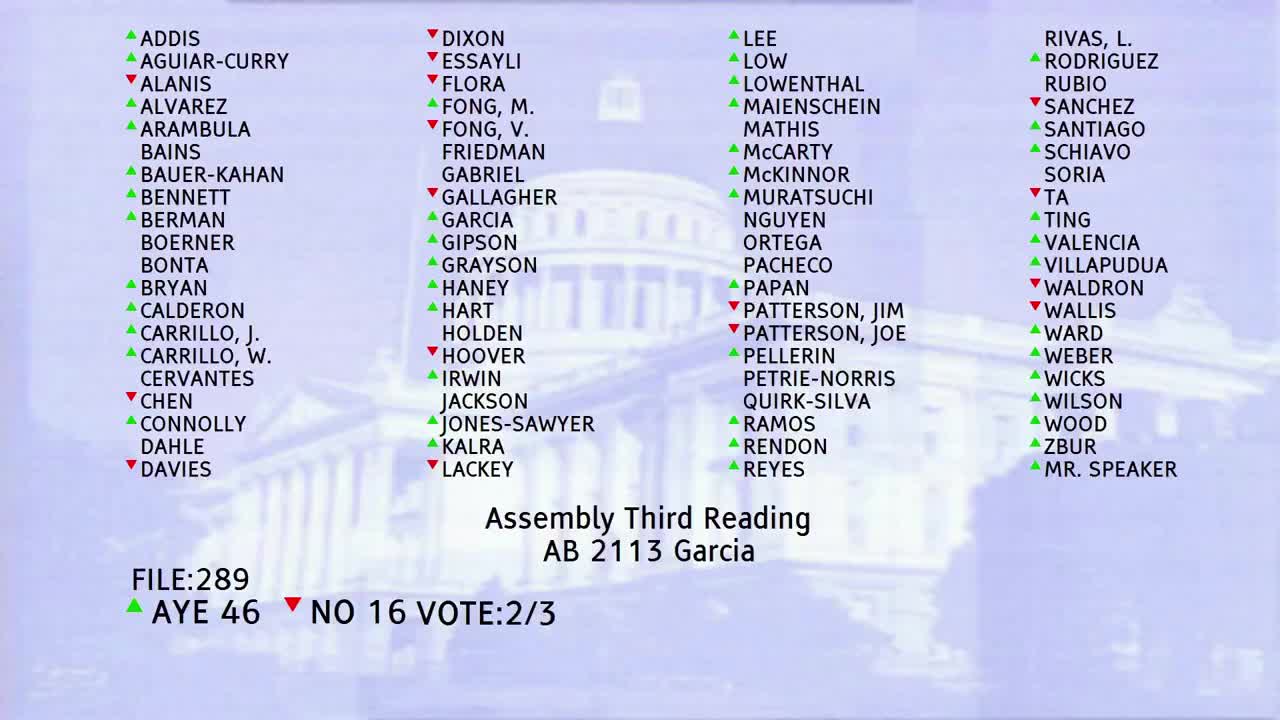 2MIN
Assembly Floor
 29MIN
Assembly Standing Committee on Natural Resources
Bill Author

Bill Co-Author(s):
