AB 256: Vehicles: registration.
- Session Year: 2023-2024
- House: Assembly
- Latest Version Date: 2023-10-04
Current Status:
Passed
(2023-10-04: Chaptered by Secretary of State - Chapter 297, Statutes of 2023.)
Introduced
In Committee
First Chamber
In Committee
Second Chamber
Enacted
What does this bill do?
From July 1, 2024, until January 1, 2030, the bill prevents police and parking enforcers from issuing a ticket solely because a vehicle’s registration has expired or its month/year sticker is missing until the second month after the registration’s expiration month. Enforcement can still occur earlier if the vehicle is stopped for another violation, and officers or parking authorities must check DMV records before issuing a citation for missing or expired tabs.
The summary is provided by generative AI which can make mistakes. For original language, please view the details in the table below.
Existing law requires current month and year tabs, indicating the month and year of expiration of a vehicles registration, to be attached to the rear license plate assigned to the vehicle for the last preceding registration year in which the licensed plates were issued. Under existing law, a vehicle that fails to display current month and year tabs or display expired tabs is in violation of law. Existing law prohibits a person from driving, moving, or leaving standing upon a highway, or in an offstreet public parking facility, any motor vehicle, trailer, semitrailer, pole or pipe dolly, or logging dolly, unless it is registered and the appropriate fees have been paid, except as specified.
This bill would, commencing July 1, 2024, until January 1, 2030, prohibit a violation of these provisions from being the sole basis for any enforcement action before the 2nd month after the month of expiration of the vehicles registration. Notwithstanding this provision, the bill would authorize enforcement action before the 2nd month following the month of expiration if a vehicle is stopped for any other violation of the Vehicle Code.
(1)Existing
Existing law requires current month and year tabs, indicating the month and year of expiration of a vehicles registration, to be attached to the rear license plate assigned to the vehicle for the last preceding registration year in which the licensed plates were issued. Under existing law, a vehicle that fails to display current month and year tabs or display expired tabs is in violation of law. Existing law prohibits a person from driving, moving, or leaving standing upon a highway, or in an offstreet public parking facility, any motor vehicle, trailer, semitrailer, pole or pipe dolly, or logging dolly, unless it is registered and the appropriate fees have been paid, except as specified.
This bill would, commencing July 1, 2024, until January 1, 2030, prohibit a violation of these provisions from being the basis for any enforcement action before the 2nd month after the month of expiration of the vehicles registration.
(2)Existing law requires the addition of a penalty on any application for renewal of registration made later than midnight of the date of expiration or on or after the date the penalty becomes due and requires the penalty to be computed pursuant to a specified formula and collected with the fee.This bill would, commencing on July 1, 2024, until January 1, 2030, prohibit the addition of a penalty for vehicles with a vehicle market value range between $0 and $4,999 if an application for renewal of registration, or an application for renewal of special license plates, is made within 30 days after midnight of the expiration date of the registration or the special plates. (3)Existing law generally requires the registered owner of a vehicle who does not intend to renew the vehicle registration to file a certification of nonoperation. Existing law authorizes the filing of a certificate of nonoperation after the expiration of the registration of a vehicle, but not later than 90 days after the expiration of the registration of a vehicle if the vehicle has not been operated, moved, or left standing upon any highway subsequent to the expiration of the vehicles registration. Existing law requires a penalty to be collected on any certification filed later than midnight of the date of expiration of registration. This bill would, commencing July 1, 2024, until January 1, 2030, prohibit the addition of a penalty for vehicles with a vehicle market value range between $0 and $4,999 if the certification is filed within 30 days after midnight of the expiration date of the registration.(1)Existing law requires current month and year tabs, indicating the month and year of expiration of a vehicles registration, to be attached to the rear license plate assigned to the vehicle for the last preceding registration year in which the licensed plates were issued. Under existing law, a vehicle that fails to display current month and year tabs or display expired tabs is in violation of law. Existing law prohibits a person from driving, moving, or leaving standing upon a highway, or in an offstreet public parking facility, any motor vehicle, trailer, semitrailer, pole or pipe dolly, or logging dolly, unless it is registered and the appropriate fees have been paid, except as specified.
This bill would, commencing July 1, 2024, until January 1, 2030, prohibit a violation of these provisions from being the basis for any enforcement action before the 2nd month after the month of expiration of the vehicles registration.
(2)Existing law requires the addition of a penalty on any application for renewal of registration made later than midnight of the date of expiration or on or after the date the penalty becomes due and requires the penalty to be computed pursuant to a specified formula and collected with the fee.
This bill would, commencing on July 1, 2024, until January 1, 2030, prohibit the addition of a penalty for vehicles with a vehicle market value range between $0 and $4,999 if an application for renewal of registration, or an application for renewal of special license plates, is made within 30 days after midnight of the expiration date of the registration or the special plates.
(3)Existing law generally requires the registered owner of a vehicle who does not intend to renew the vehicle registration to file a certification of nonoperation. Existing law authorizes the filing of a certificate of nonoperation after the expiration of the registration of a vehicle, but not later than 90 days after the expiration of the registration of a vehicle if the vehicle has not been operated, moved, or left standing upon any highway subsequent to the expiration of the vehicles registration. Existing law requires a penalty to be collected on any certification filed later than midnight of the date of expiration of registration.
This bill would, commencing July 1, 2024, until January 1, 2030, prohibit the addition of a penalty for vehicles with a vehicle market value range between $0 and $4,999 if the certification is filed within 30 days after midnight of the expiration date of the registration.
(1)Existing law requires current month and year tabs, indicating the month and year of expiration of a vehicles registration, to be attached to the rear license plate assigned to the vehicle for the last preceding registration year in which the licensed plates were issued. Under existing law, a vehicle that fails to display current month and year tabs or display expired tabs is in violation of law. Existing law prohibits a person from driving, moving, or leaving standing upon a highway, or in an offstreet public parking facility, any motor vehicle, trailer, semitrailer, pole or pipe dolly, or logging dolly, unless it is registered and the appropriate fees have been paid, except as specified.
This bill would, commencing July 1, 2024, until January 1, 2030, prohibit a violation of these provisions from being the basis for any enforcement action before the 2nd month after the month of expiration of the vehicles registration.
(2)Existing law requires the addition of a penalty on any application for renewal of registration made later than midnight of the date of expiration or on or after the date the penalty becomes due and requires the penalty to be computed pursuant to a specified formula and collected with the fee.
This bill would, commencing on July 1, 2024, until January 1, 2030, prohibit the addition of a penalty if an application for renewal of registration, or an application for renewal of special license plates, is made within 30 days after midnight of the expiration date of the registration or the special plates.
(3)Existing law generally requires the registered owner of a vehicle who does not intend to renew the vehicle registration to file a certification of nonoperation. Existing law authorizes the filing of a certificate of nonoperation after the expiration of the registration of a vehicle, but not later than 90 days after the expiration of the registration of a vehicle if the vehicle has not been operated, moved, or left standing upon any highway subsequent to the expiration of the vehicles registration. Existing law requires a penalty to be collected on any certification filed later than midnight of the date of expiration of registration.
This bill would, commencing July 1, 2024, until January 1, 2030, prohibit the addition of a penalty if the certification is filed within 30 days after midnight of the expiration date of the registration.
(a)(1)A person shall not drive, move, or leave standing upon a highway, or in an offstreet public parking facility, any motor vehicle, trailer, semitrailer, pole or pipe dolly, or logging dolly, unless it is registered and the appropriate fees have been paid under this code or registered under the permanent trailer identification program, except that an off-highway motor vehicle which displays an identification plate or device issued by the department pursuant to Section 38010 may be driven, moved, or left standing in an offstreet public parking facility without being registered or paying registration fees.
(2)For purposes of this subdivision, offstreet public parking facility means either of the following:
(A)Any publicly owned parking facility.
(B)Any privately owned parking facility for which no fee for the privilege to park is charged and which is held open for the common public use of retail customers.
(3)This subdivision does not apply to any motor vehicle stored in a privately owned offstreet parking facility by, or with the express permission of, the owner of the privately owned offstreet parking facility.
(4)(A)(i)A violation of this subdivision shall not be the sole basis for any enforcement action before the second month after the month of expiration of the vehicles registration.
(ii)Notwithstanding clause (i), if a vehicle is stopped for any other violation of this code, enforcement action for a violation of this subdivision may be taken before the second month following the month of expiration.
(B)This paragraph shall be operative from July 1, 2024, to January 1, 2030, inclusive.
(b)A person shall not drive, move, or leave standing upon a highway any motor vehicle, as defined in Chapter 2 (commencing with Section 39010) of Part 1 of Division 26 of the Health and Safety Code, that has been registered in violation of Part 5 (commencing with Section 43000) of Division 26 of the Health and Safety Code.
(c)Subdivisions (a) and (b) do not apply to off-highway motor vehicles operated pursuant to Sections 38025 and 38026.5.
(d)This section does not apply, following payment of fees due for registration, during the time that registration and transfer is being withheld by the department pending the investigation of any use tax due under the Revenue and Taxation Code.
(e)Subdivision (a) does not apply to a vehicle that is towed by a tow truck on the order of a sheriff, marshal, or other official acting pursuant to a court order or on the order of a peace officer acting pursuant to this code.
(f)Subdivision (a) applies to a vehicle that is towed from a highway or offstreet parking facility under the direction of a highway service organization when that organization is providing emergency roadside assistance to that vehicle. However, the operator of a tow truck providing that assistance to that vehicle is not responsible for the violation of subdivision (a) with respect to that vehicle. The owner of an unregistered vehicle that is disabled and located on private property, shall obtain a permit from the department pursuant to Section 4003 prior to having the vehicle towed on the highway.
(g)(1)Pursuant to Section 4022 and to subparagraph (B) of paragraph (3) of subdivision (o) of Section 22651, a vehicle obtained by a licensed repossessor as a release of collateral is exempt from registration pursuant to this section for purposes of the repossessor removing the vehicle to their storage facility or the facility of the legal owner. A law enforcement agency, impounding authority, tow yard, storage facility, or any other person in possession of the collateral shall release the vehicle without requiring current registration and pursuant to subdivision (f) of Section 14602.6.
(2)The legal owner of collateral shall, by operation of law and without requiring further action, indemnify and hold harmless a law enforcement agency, city, county, city and county, the state, a tow yard, storage facility, or an impounding yard from a claim arising out of the release of the collateral to a licensee, and from any damage to the collateral after its release, including reasonable attorneys fees and costs associated with defending a claim, if the collateral was released in compliance with this subdivision.
(h)For purposes of this section, possession of a California drivers license by the registered owner of a vehicle shall give rise to a rebuttable presumption that the owner is a resident of California.
SEC. 2.Section 5204 of the Vehicle Code is amended to read:5204.(a)(1)Except as provided by subdivisions (b) and (c), a tab shall indicate the year of expiration and a tab shall indicate the month of expiration. Current month and year tabs shall be attached to the rear license plate assigned to the vehicle for the last preceding registration year in which license plates were issued, and, when so attached, the license plate with the tabs shall, for the purposes of this code, be deemed to be the license plate, except that truck tractors, and commercial motor vehicles having a declared gross vehicle weight of 10,001 pounds or more, shall display the current month and year tabs upon the front license plate assigned to the truck tractor or commercial motor vehicle. Vehicles that fail to display current month and year tabs or display expired tabs are in violation of this section.
(2)(A)(i)A violation of paragraph (1) shall not be the sole basis for any enforcement action before the second month after the month of expiration of the vehicles registration.
(ii)Notwithstanding clause (i), if a vehicle is stopped for any other violation of this code, enforcement action for a violation of paragraph (1) may be taken before the second month following the month of expiration.
(B)This paragraph shall be operative from July 1, 2024, to January 1, 2030, inclusive.
(b)The requirement of subdivision (a) that the tabs indicate the year and the month of expiration does not apply to fleet vehicles subject to Article 9.5 (commencing with Section 5301) or vehicles defined in Section 468.
(c)Subdivision (a) does not apply when proper application for registration has been made pursuant to Section 4602 and the new indicia of current registration have not been received from the department.
(d)This section is enforceable against any motor vehicle that is driven, moved, or left standing upon a highway, or in an offstreet public parking facility, in the same manner as provided in subdivision (a) of Section 4000.
(e)Prior to issuing a citation for a violation of this section, a law enforcement officer shall verify, using available department records, that no current registration exists for that vehicle. A citation shall not be issued for failure to comply with this section against any vehicle that has a current registration on file with the department.
SEC. 3.Section 40225 of the Vehicle Code is amended to read:40225.(a)An equipment violation entered on the notice of parking violation attached to the vehicle under Section 40203 shall be processed in accordance with this article. All of the violations entered on the notice of parking violation shall be noticed in the notice of delinquent parking violation delivered pursuant to Section 40206, together with the amount of civil penalty.
(b)(1)Whether or not a vehicle is in violation of any regulation governing the standing or parking of a vehicle but is in violation of subdivision (a) of Section 5204, a person authorized to enforce parking laws and regulations shall verify, using available Department of Motor Vehicle records, that no current registration exists for that vehicle. A citation shall not be issued for failure to comply with subdivision (a) of Section 5204 against any vehicle that has a current registration on file with the department. If the person authorized to enforce parking laws and regulations does not have immediate access to those records, a citation shall not be issued for failure to comply with subdivision (a) of Section 5204. A person authorized to enforce parking laws and regulations shall issue a written notice of parking violation for a vehicle that does not have a tab or a verified current registration, setting forth the alleged violation. The violation shall be processed pursuant to this section.
(2)Commencing on July 1, 2024, a violation of paragraph (1) shall not be the basis for any enforcement action before the second month after the month of expiration of the vehicles registration. This paragraph shall become inoperative on January 1, 2030.
(c)The civil penalty for each equipment violation, including failure to properly display a license plate, is the amount established for the violation in the Uniform Bail and Penalty Schedule, as adopted by the Judicial Council, except that upon proof of the correction to the processing agency, the penalty shall be reduced to ten dollars ($10). The reduction provided for in this subdivision involving failure to properly display license plates shall only apply if, at the time of the violation, valid license plates were issued for that vehicle in accordance with this code. The civil penalty for each violation of Section 5204 is the amount established for the violation in the Uniform Bail and Penalty Schedule, as adopted by the Judicial Council, except that upon proof of the correction to the processing agency, the penalty shall be reduced to ten dollars ($10).
(d)Fifty percent of any penalty collected pursuant to this section for registration or equipment violations by a processing agency shall be paid to the county for remittance to the State Treasurer and the remaining 50 percent shall be retained by the issuing agency and processing agency subject to the terms of the contract described in Section 40200.5.
(e)Subdivisions (a) and (b) do not preclude the recording of a violation of subdivision (a) or (b) of Section 4000 on a notice of parking violation or the adjudication of that violation under the civil process set forth in this article.
(a)(1)A person shall not drive, move, or leave standing upon a highway, or in an offstreet public parking facility, any motor vehicle, trailer, semitrailer, pole or pipe dolly, or logging dolly, unless it is registered and the appropriate fees have been paid under this code or registered under the permanent trailer identification program, except that an off-highway motor vehicle which displays an identification plate or device issued by the department pursuant to Section 38010 may be driven, moved, or left standing in an offstreet public parking facility without being registered or paying registration fees.
(2)For purposes of this subdivision, offstreet public parking facility means either of the following:
(A)Any publicly owned parking facility.
(B)Any privately owned parking facility for which no fee for the privilege to park is charged and which is held open for the common public use of retail customers.
(3)This subdivision does not apply to any motor vehicle stored in a privately owned offstreet parking facility by, or with the express permission of, the owner of the privately owned offstreet parking facility.
(4)Commencing on July 1, 2024, a (A)(i)A violation of this subdivision shall not be the sole basis for any enforcement action before the second month after the month of expiration of the vehicles registration. This paragraph shall become inoperative on January 1, 2030.
(ii)Notwithstanding clause (i), if a vehicle is stopped for any other violation of this code, enforcement action for a violation of this subdivision may be taken before the second month following the month of expiration.
(B)This paragraph shall be operative from July 1, 2024, to January 1, 2030, inclusive.
(b)No A person shall not drive, move, or leave standing upon a highway any motor vehicle, as defined in Chapter 2 (commencing with Section 39010) of Part 1 of Division 26 of the Health and Safety Code, that has been registered in violation of Part 5 (commencing with Section 43000) of Division 26 of the Health and Safety Code.
(c)Subdivisions (a) and (b) do not apply to off-highway motor vehicles operated pursuant to Sections 38025 and 38026.5.
(d)This section does not apply, following payment of fees due for registration, during the time that registration and transfer is being withheld by the department pending the investigation of any use tax due under the Revenue and Taxation Code.
(e)Subdivision (a) does not apply to a vehicle that is towed by a tow truck on the order of a sheriff, marshal, or other official acting pursuant to a court order or on the order of a peace officer acting pursuant to this code.
(f)Subdivision (a) applies to a vehicle that is towed from a highway or offstreet parking facility under the direction of a highway service organization when that organization is providing emergency roadside assistance to that vehicle. However, the operator of a tow truck providing that assistance to that vehicle is not responsible for the violation of subdivision (a) with respect to that vehicle. The owner of an unregistered vehicle that is disabled and located on private property, shall obtain a permit from the department pursuant to Section 4003 prior to having the vehicle towed on the highway.
(g)(1)Pursuant to Section 4022 and to subparagraph (B) of paragraph (3) of subdivision (o) of Section 22651, a vehicle obtained by a licensed repossessor as a release of collateral is exempt from registration pursuant to this section for purposes of the repossessor removing the vehicle to their storage facility or the facility of the legal owner. A law enforcement agency, impounding authority, tow yard, storage facility, or any other person in possession of the collateral shall release the vehicle without requiring current registration and pursuant to subdivision (f) of Section 14602.6.
(2)The legal owner of collateral shall, by operation of law and without requiring further action, indemnify and hold harmless a law enforcement agency, city, county, city and county, the state, a tow yard, storage facility, or an impounding yard from a claim arising out of the release of the collateral to a licensee, and from any damage to the collateral after its release, including reasonable attorneys fees and costs associated with defending a claim, if the collateral was released in compliance with this subdivision.
(h)For purposes of this section, possession of a California drivers license by the registered owner of a vehicle shall give rise to a rebuttable presumption that the owner is a resident of California.
SEC. 2.Section 5204 of the Vehicle Code is amended to read:5204.(a)(1)Except as provided by subdivisions (b) and (c), a tab shall indicate the year of expiration and a tab shall indicate the month of expiration. Current month and year tabs shall be attached to the rear license plate assigned to the vehicle for the last preceding registration year in which license plates were issued, and, when so attached, the license plate with the tabs shall, for the purposes of this code, be deemed to be the license plate, except that truck tractors, and commercial motor vehicles having a declared gross vehicle weight of 10,001 pounds or more, shall display the current month and year tabs upon the front license plate assigned to the truck tractor or commercial motor vehicle. Vehicles that fail to display current month and year tabs or display expired tabs are in violation of this section.
(2)Commencing on July 1, 2024, a (A)(i)A violation of paragraph (1) shall not be the sole basis for any enforcement action before the second month after the month of expiration of the vehicles registration. This paragraph shall become inoperative on January 1, 2030.
(ii)Notwithstanding clause (i), if a vehicle is stopped for any other violation of this code, enforcement action for a violation of paragraph (1) may be taken before the second month following the month of expiration.
(B)This paragraph shall be operative from July 1, 2024, to January 1, 2030, inclusive.
(b)The requirement of subdivision (a) that the tabs indicate the year and the month of expiration does not apply to fleet vehicles subject to Article 9.5 (commencing with Section 5301) or vehicles defined in Section 468.
(c)Subdivision (a) does not apply when proper application for registration has been made pursuant to Section 4602 and the new indicia of current registration have not been received from the department.
(d)This section is enforceable against any motor vehicle that is driven, moved, or left standing upon a highway, or in an offstreet public parking facility, in the same manner as provided in subdivision (a) of Section 4000.
(e)Prior to issuing a citation for a violation of this section, a law enforcement officer shall verify, using available department records, that no current registration exists for that vehicle. A citation shall not be issued for failure to comply with this section against any vehicle that has a current registration on file with the department.
SEC. 3.Section 40225 of the Vehicle Code is amended to read:40225.(a)An equipment violation entered on the notice of parking violation attached to the vehicle under Section 40203 shall be processed in accordance with this article. All of the violations entered on the notice of parking violation shall be noticed in the notice of delinquent parking violation delivered pursuant to Section 40206, together with the amount of civil penalty.
(b)(1)Whether or not a vehicle is in violation of any regulation governing the standing or parking of a vehicle but is in violation of subdivision (a) of Section 5204, a person authorized to enforce parking laws and regulations shall verify, using available Department of Motor Vehicle records, that no current registration exists for that vehicle. A citation shall not be issued for failure to comply with subdivision (a) of Section 5204 against any vehicle that has a current registration on file with the department. If the person authorized to enforce parking laws and regulations does not have immediate access to those records, a citation shall not be issued for failure to comply with subdivision (a) of Section 5204. A person authorized to enforce parking laws and regulations shall issue a written notice of parking violation for a vehicle that does not have a tab or a verified current registration, setting forth the alleged violation. The violation shall be processed pursuant to this section.
(2)Commencing on July 1, 2024, a violation of paragraph (1) shall not be the basis for any enforcement action before the second month after the month of expiration of the vehicles registration. This paragraph shall become inoperative on January 1, 2030.
(c)The civil penalty for each equipment violation, including failure to properly display a license plate, is the amount established for the violation in the Uniform Bail and Penalty Schedule, as adopted by the Judicial Council, except that upon proof of the correction to the processing agency, the penalty shall be reduced to ten dollars ($10). The reduction provided for in this subdivision involving failure to properly display license plates shall only apply if, at the time of the violation, valid license plates were issued for that vehicle in accordance with this code. The civil penalty for each violation of Section 5204 is the amount established for the violation in the Uniform Bail and Penalty Schedule, as adopted by the Judicial Council, except that upon proof of the correction to the processing agency, the penalty shall be reduced to ten dollars ($10).
(d)Fifty percent of any penalty collected pursuant to this section for registration or equipment violations by a processing agency shall be paid to the county for remittance to the State Treasurer and the remaining 50 percent shall be retained by the issuing agency and processing agency subject to the terms of the contract described in Section 40200.5.
(e)Subdivisions (a) and (b) do not preclude the recording of a violation of subdivision (a) or (b) of Section 4000 on a notice of parking violation or the adjudication of that violation under the civil process set forth in this article.
(a)(1)A person shall not drive, move, or leave standing upon a highway, or in an offstreet public parking facility, any motor vehicle, trailer, semitrailer, pole or pipe dolly, or logging dolly, unless it is registered and the appropriate fees have been paid under this code or registered under the permanent trailer identification program, except that an off-highway motor vehicle which displays an identification plate or device issued by the department pursuant to Section 38010 may be driven, moved, or left standing in an offstreet public parking facility without being registered or paying registration fees.
(2)For purposes of this subdivision, offstreet public parking facility means either of the following:
(A)Any publicly owned parking facility.
(B)Any privately owned parking facility for which no fee for the privilege to park is charged and which is held open for the common public use of retail customers.
(3)This subdivision does not apply to any motor vehicle stored in a privately owned offstreet parking facility by, or with the express permission of, the owner of the privately owned offstreet parking facility.
(4)Commencing on July 1, 2024, a violation of this subdivision shall not be the basis for any enforcement action before the second month after the month of expiration of the vehicles registration. This paragraph shall become inoperative on January 1, 2030.
(b)No person shall drive, move, or leave standing upon a highway any motor vehicle, as defined in Chapter 2 (commencing with Section 39010) of Part 1 of Division 26 of the Health and Safety Code, that has been registered in violation of Part 5 (commencing with Section 43000) of Division 26 of the Health and Safety Code.
(c)Subdivisions (a) and (b) do not apply to off-highway motor vehicles operated pursuant to Sections 38025 and 38026.5.
(d)This section does not apply, following payment of fees due for registration, during the time that registration and transfer is being withheld by the department pending the investigation of any use tax due under the Revenue and Taxation Code.
(e)Subdivision (a) does not apply to a vehicle that is towed by a tow truck on the order of a sheriff, marshal, or other official acting pursuant to a court order or on the order of a peace officer acting pursuant to this code.
(f)Subdivision (a) applies to a vehicle that is towed from a highway or offstreet parking facility under the direction of a highway service organization when that organization is providing emergency roadside assistance to that vehicle. However, the operator of a tow truck providing that assistance to that vehicle is not responsible for the violation of subdivision (a) with respect to that vehicle. The owner of an unregistered vehicle that is disabled and located on private property, shall obtain a permit from the department pursuant to Section 4003 prior to having the vehicle towed on the highway.
(g)(1)Pursuant to Section 4022 and to subparagraph (B) of paragraph (3) of subdivision (o) of Section 22651, a vehicle obtained by a licensed repossessor as a release of collateral is exempt from registration pursuant to this section for purposes of the repossessor removing the vehicle to their storage facility or the facility of the legal owner. A law enforcement agency, impounding authority, tow yard, storage facility, or any other person in possession of the collateral shall release the vehicle without requiring current registration and pursuant to subdivision (f) of Section 14602.6.
(2)The legal owner of collateral shall, by operation of law and without requiring further action, indemnify and hold harmless a law enforcement agency, city, county, city and county, the state, a tow yard, storage facility, or an impounding yard from a claim arising out of the release of the collateral to a licensee, and from any damage to the collateral after its release, including reasonable attorneys fees and costs associated with defending a claim, if the collateral was released in compliance with this subdivision.
(h)For purposes of this section, possession of a California drivers license by the registered owner of a vehicle shall give rise to a rebuttable presumption that the owner is a resident of California.
SEC. 2.Section 4604.5 of the Vehicle Code is amended to read:4604.5.(a)(1)If the vehicle has not been operated, moved, or left standing upon any highway subsequent to the expiration of the vehicles registration, the certification specified in Section 4604 or 4604.2 may be filed after the expiration of the registration of a vehicle, but not later than 90 days after the expiration date, subject to the payment of the filing fee specified in Section 4604 and the penalty specified in paragraph (2).(2)A penalty shall be collected on any certification specified in Section 4604 or 4604.2 filed later than midnight of the date of expiration of registration. The penalty shall be computed as provided in Sections 9406 and 9559 and after the registration and weight fees have been combined with the license fee specified in Section 10751 of the Revenue and Taxation Code, as follows:(A)For a delinquency period of 10 days or less, the penalty is 10 percent of the fee.(B)For a delinquency period of more than 10 days, to and including 30 days, the penalty is 20 percent of the fee.(C)For a delinquency period of more than 30 days, to and including 90 days, the penalty is 60 percent of the fee.(3)This subdivision applies to the renewal of registration for vehicles with expiration dates on or before December 31, 2002.(b)The certification specified in Sections 4604 and 4604.2 may be filed no more than 90 days after the expiration of the registration of a vehicle if the vehicle has not been operated, moved, or left standing upon any highway subsequent to the expiration of the vehicles registration. A penalty shall be collected on any certification specified in Section 4604 or 4604.2 filed later than midnight of the date of expiration of registration. After 90 days, the vehicle must be registered pursuant to Section 4601. A certification filed pursuant to this subdivision is subject to the payment of the filing fee specified in Section 4604 and the payment of the penalties specified in paragraphs (1), (2), and (3) of this subdivision.(1)The penalty for late payment of the registration fee provided in Section 9250 is as follows:(A)For a delinquency period of 10 days or less, the penalty is ten dollars ($10).(B)For a delinquency period of more than 10 days, to and including 30 days, the penalty is fifteen dollars ($15).(C)For a delinquency period of more than 30 days, to and including 90 days, the penalty is thirty dollars ($30).(2)The penalty on the weight fee and the vehicle license fee shall be computed after the weight fee as provided in Section 9400 or 9400.1 plus the vehicle license fee specified in Section 10751 of the Revenue and Taxation Code have been added together as follows:(A)For a delinquency period of 10 days or less, the penalty is 10 percent of the fee.(B)For a delinquency period exceeding 10 days, to and including 30 days, the penalty is 20 percent of the fee.(C)For a delinquency period of more than 30 days, to and including 90 days, the penalty is 60 percent of the fee.(3)Weight fees not reported and not paid within 20 days, as required by Section 9406, shall be assessed a penalty on the difference in the weight fee, as follows:(A)For a delinquency period of 10 days or less, the penalty is 10 percent of the fee.(B)For a delinquency period exceeding 10 days, to and including 30 days, the penalty is 20 percent of the fee.(C)For a delinquency period of more than 30 days, to and including 90 days, the penalty is 60 percent of the fee.(c)Notwithstanding subdivision (b), commencing on July 1, 2024, a penalty shall not be added for a vehicle covered by paragraph (1) of subdivision (a) of Section 11052 of the Revenue and Taxation Code if the certification specified in Section 4604 or 4604.2 is filed within 30 days after midnight of the expiration date of the registration. This subdivision shall become inoperative on January 1, 2030.(d)This section shall apply to registration renewals that expire on or after January 1, 2003.SEC. 3.SEC. 2.Section 5204 of the Vehicle Code, as amended by Section 1 of Chapter 306 of Statutes of 2022, is amended to read:5204.(a)(1)Except as provided by subdivisions (b) and (c), a tab shall indicate the year of expiration and a tab shall indicate the month of expiration. Current month and year tabs shall be attached to the rear license plate assigned to the vehicle for the last preceding registration year in which license plates were issued, and, when so attached, the license plate with the tabs shall, for the purposes of this code, be deemed to be the license plate, except that truck tractors, and commercial motor vehicles having a declared gross vehicle weight of 10,001 pounds or more, shall display the current month and year tabs upon the front license plate assigned to the truck tractor or commercial motor vehicle. Vehicles that fail to display current month and year tabs or display expired tabs are in violation of this section.
(2)Commencing on July 1, 2024, a violation of paragraph (1) shall not be the basis for any enforcement action before the second month after the month of expiration of the vehicles registration. This paragraph shall become inoperative on January 1, 2030.
(b)The requirement of subdivision (a) that the tabs indicate the year and the month of expiration does not apply to fleet vehicles subject to Article 9.5 (commencing with Section 5301) or vehicles defined in Section 468.
(c)Subdivision (a) does not apply when proper application for registration has been made pursuant to Section 4602 and the new indicia of current registration have not been received from the department.
(d)This section is enforceable against any motor vehicle that is driven, moved, or left standing upon a highway, or in an offstreet public parking facility, in the same manner as provided in subdivision (a) of Section 4000.
(e)Prior to issuing a citation for a violation of this section, a law enforcement officer shall verify, using available department records, that no current registration exists for that vehicle. A citation shall not be issued for failure to comply with this section against any vehicle that has a current registration on file with the department.
SEC. 4.Section 9554 of the Vehicle Code is amended to read:9554.(a)(1)A penalty shall be added on any application for renewal of registration made later than midnight of the date of expiration or on or after the date penalties become due. Penalties shall be computed as provided in Section 9559 and shall be collected with the fee.(2)Notwithstanding paragraph (1), commencing on July 1, 2024, a penalty shall not be added for a vehicle covered by paragraph (1) of subdivision (a) of Section 11052 of the Revenue and Taxation Code if an application for renewal of registration, or an application for renewal of special license plates, is made within 30 days after midnight of the expiration date of the registration or special plates. This paragraph shall become inoperative on January 1, 2030.(b)The penalty assessment for the delinquent payment of the registration fee specified in Section 9250 shall be as follows:(1)Ten dollars ($10) for a delinquency period of 10 days or less.(2)Fifteen dollars ($15) for a delinquency period of more than 10 days, to and including 30 days.(3)Thirty dollars ($30) for a delinquency period of more than 30 days, to and including one year.(4)Fifty dollars ($50) for a delinquency period of more than one year, to and including two years.(5)One hundred dollars ($100) for a delinquency period of more than two years.(c)The penalty assessment for the delinquent payment of the weight fee specified in Section 9400 or 9400.1 and the vehicle license fee as specified in Section 10751 of the Revenue and Taxation Code shall be as follows:(1)Ten percent of the vehicle license fee, or the combined amount of the vehicle license fee and the weight fee if the vehicle is subject to both fees, for a delinquency period of 10 days or less.(2)Twenty percent of the vehicle license fee, or the combined amount of the vehicle license fee and the weight fee if the vehicle is subject to both fees, for a delinquency period of more than 10 days, to and including 30 days.(3)Sixty percent of the vehicle license fee, or the combined amount of the vehicle license fee and the weight fee if the vehicle is subject to both fees, for a delinquency period of more than 30 days, to and including one year.(4)Eighty percent of the vehicle license fee, or the combined amount of the vehicle license fee and the weight fee if the vehicle is subject to both fees, for a delinquency period of more than one year, to and including two years.(5)One hundred sixty percent of the vehicle license fee, or the combined amount of the vehicle license fee and the weight fee if the vehicle is subject to both fees, for a delinquency period of more than two years.(d)On or after January 1, 2003, a penalty assessment for weight fees not reported and not paid within 20 days as required by Section 9406 shall be applied to the difference in the weight fee as follows:(1)Ten percent of the fee for a delinquency period of 10 days or less.(2)Twenty percent of the fee for a delinquency period more than 10 days, to and including 30 days.(3)Sixty percent of the fee for a delinquency period more than 30 days, to and including one year.(4)Eighty percent of the fee for a delinquency period more than one year, to and including two years.(5)One hundred sixty percent for a delinquency period more than two years.(e)A single penalty assessment for the delinquent payment of the fees specified in Sections 9250.8 and 9250.13 shall be as follows:(1)Ten dollars ($10) for a delinquency period of 10 days or less.(2)Fifteen dollars ($15) for a delinquency period of more than 10 days, to and including 30 days.(3)Thirty dollars ($30) for a delinquency period of more than 30 days, to and including one year.(4)Fifty dollars ($50) for a delinquency period of more than one year, to and including two years.(5)One hundred dollars ($100) for a delinquency period of more than two years.(6)This subdivision applies to the renewal of registration for vehicles with expiration dates on or after December 1, 2008.SEC. 5.SEC. 3.Section 40225 of the Vehicle Code, as amended by Section 2 of Chapter 306 of Statutes of 2022, is amended to read:40225.(a)An equipment violation entered on the notice of parking violation attached to the vehicle under Section 40203 shall be processed in accordance with this article. All of the violations entered on the notice of parking violation shall be noticed in the notice of delinquent parking violation delivered pursuant to Section 40206, together with the amount of civil penalty.
(b)(1)Whether or not a vehicle is in violation of any regulation governing the standing or parking of a vehicle but is in violation of subdivision (a) of Section 5204, a person authorized to enforce parking laws and regulations shall verify, using available Department of Motor Vehicle records, that no current registration exists for that vehicle. A citation shall not be issued for failure to comply with subdivision (a) of Section 5204 against any vehicle that has a current registration on file with the department. If the person authorized to enforce parking laws and regulations does not have immediate access to those records, a citation shall not be issued for failure to comply with subdivision (a) of Section 5204. A person authorized to enforce parking laws and regulations shall issue a written notice of parking violation for a vehicle that does not have a tab or a verified current registration, setting forth the alleged violation. The violation shall be processed pursuant to this section.
(2)Commencing on July 1, 2024, a violation of paragraph (1) shall not be the basis for any enforcement action before the second month after the month of expiration of the vehicles registration. This paragraph shall become inoperative on January 1, 2030.
(c)The civil penalty for each equipment violation, including failure to properly display a license plate, is the amount established for the violation in the Uniform Bail and Penalty Schedule, as adopted by the Judicial Council, except that upon proof of the correction to the processing agency, the penalty shall be reduced to ten dollars ($10). The reduction provided for in this subdivision involving failure to properly display license plates shall only apply if, at the time of the violation, valid license plates were issued for that vehicle in accordance with this code. The civil penalty for each violation of Section 5204 is the amount established for the violation in the Uniform Bail and Penalty Schedule, as adopted by the Judicial Council, except that upon proof of the correction to the processing agency, the penalty shall be reduced to ten dollars ($10).
(d)Fifty percent of any penalty collected pursuant to this section for registration or equipment violations by a processing agency shall be paid to the county for remittance to the State Treasurer and the remaining 50 percent shall be retained by the issuing agency and processing agency subject to the terms of the contract described in Section 40200.5.
(e)Subdivisions (a) and (b) do not preclude the recording of a violation of subdivision (a) or (b) of Section 4000 on a notice of parking violation or the adjudication of that violation under the civil process set forth in this article.
(a)(1)A person shall not drive, move, or leave standing upon a highway, or in an offstreet public parking facility, any motor vehicle, trailer, semitrailer, pole or pipe dolly, or logging dolly, unless it is registered and the appropriate fees have been paid under this code or registered under the permanent trailer identification program, except that an off-highway motor vehicle which displays an identification plate or device issued by the department pursuant to Section 38010 may be driven, moved, or left standing in an offstreet public parking facility without being registered or paying registration fees.
(2)For purposes of this subdivision, offstreet public parking facility means either of the following:
(A)Any publicly owned parking facility.
(B)Any privately owned parking facility for which no fee for the privilege to park is charged and which is held open for the common public use of retail customers.
(3)This subdivision does not apply to any motor vehicle stored in a privately owned offstreet parking facility by, or with the express permission of, the owner of the privately owned offstreet parking facility.
(4)Commencing on July 1, 2024, a violation of this subdivision shall not be the basis for any enforcement action before the second month after the month of expiration of the vehicles registration. This paragraph shall become inoperative on January 1, 2030.
(b)No person shall drive, move, or leave standing upon a highway any motor vehicle, as defined in Chapter 2 (commencing with Section 39010) of Part 1 of Division 26 of the Health and Safety Code, that has been registered in violation of Part 5 (commencing with Section 43000) of Division 26 of the Health and Safety Code.
(c)Subdivisions (a) and (b) do not apply to off-highway motor vehicles operated pursuant to Sections 38025 and 38026.5.
(d)This section does not apply, following payment of fees due for registration, during the time that registration and transfer is being withheld by the department pending the investigation of any use tax due under the Revenue and Taxation Code.
(e)Subdivision (a) does not apply to a vehicle that is towed by a tow truck on the order of a sheriff, marshal, or other official acting pursuant to a court order or on the order of a peace officer acting pursuant to this code.
(f)Subdivision (a) applies to a vehicle that is towed from a highway or offstreet parking facility under the direction of a highway service organization when that organization is providing emergency roadside assistance to that vehicle. However, the operator of a tow truck providing that assistance to that vehicle is not responsible for the violation of subdivision (a) with respect to that vehicle. The owner of an unregistered vehicle that is disabled and located on private property, shall obtain a permit from the department pursuant to Section 4003 prior to having the vehicle towed on the highway.
(g)(1)Pursuant to Section 4022 and to subparagraph (B) of paragraph (3) of subdivision (o) of Section 22651, a vehicle obtained by a licensed repossessor as a release of collateral is exempt from registration pursuant to this section for purposes of the repossessor removing the vehicle to their storage facility or the facility of the legal owner. A law enforcement agency, impounding authority, tow yard, storage facility, or any other person in possession of the collateral shall release the vehicle without requiring current registration and pursuant to subdivision (f) of Section 14602.6.
(2)The legal owner of collateral shall, by operation of law and without requiring further action, indemnify and hold harmless a law enforcement agency, city, county, city and county, the state, a tow yard, storage facility, or an impounding yard from a claim arising out of the release of the collateral to a licensee, and from any damage to the collateral after its release, including reasonable attorneys fees and costs associated with defending a claim, if the collateral was released in compliance with this subdivision.
(h)For purposes of this section, possession of a California drivers license by the registered owner of a vehicle shall give rise to a rebuttable presumption that the owner is a resident of California.
SEC. 2.Section 4604.5 of the Vehicle Code is amended to read:4604.5.(a)(1)If the vehicle has not been operated, moved, or left standing upon any highway subsequent to the expiration of the vehicles registration, the certification specified in Section 4604 or 4604.2 may be filed after the expiration of the registration of a vehicle, but not later than 90 days after the expiration date, subject to the payment of the filing fee specified in Section 4604 and the penalty specified in paragraph (2).
(2)A penalty shall be collected on any certification specified in Section 4604 or 4604.2 filed later than midnight of the date of expiration of registration. The penalty shall be computed as provided in Sections 9406 and 9559 and after the registration and weight fees have been combined with the license fee specified in Section 10751 of the Revenue and Taxation Code, as follows:
(A)For a delinquency period of 10 days or less, the penalty is 10 percent of the fee.
(B)For a delinquency period of more than 10 days, to and including 30 days, the penalty is 20 percent of the fee.
(C)For a delinquency period of more than 30 days, to and including 90 days, the penalty is 60 percent of the fee.
(3)This subdivision applies to the renewal of registration for vehicles with expiration dates on or before December 31, 2002.
(b)The certification specified in Sections 4604 and 4604.2 may be filed no more than 90 days after the expiration of the registration of a vehicle if the vehicle has not been operated, moved, or left standing upon any highway subsequent to the expiration of the vehicles registration. A penalty shall be collected on any certification specified in Section 4604 or 4604.2 filed later than midnight of the date of expiration of registration. After 90 days, the vehicle must be registered pursuant to Section 4601. A certification filed pursuant to this subdivision is subject to the payment of the filing fee specified in Section 4604 and the payment of the penalties specified in paragraphs (1), (2), and (3) of this subdivision.
(1)The penalty for late payment of the registration fee provided in Section 9250 is as follows:
(A)For a delinquency period of 10 days or less, the penalty is ten dollars ($10).
(B)For a delinquency period of more than 10 days, to and including 30 days, the penalty is fifteen dollars ($15).
(C)For a delinquency period of more than 30 days, to and including 90 days, the penalty is thirty dollars ($30).
(2)The penalty on the weight fee and the vehicle license fee shall be computed after the weight fee as provided in Section 9400 or 9400.1 plus the vehicle license fee specified in Section 10751 of the Revenue and Taxation Code have been added together as follows:
(A)For a delinquency period of 10 days or less, the penalty is 10 percent of the fee.
(B)For a delinquency period exceeding 10 days, to and including 30 days, the penalty is 20 percent of the fee.
(C)For a delinquency period of more than 30 days, to and including 90 days, the penalty is 60 percent of the fee.
(3)Weight fees not reported and not paid within 20 days, as required by Section 9406, shall be assessed a penalty on the difference in the weight fee, as follows:
(A)For a delinquency period of 10 days or less, the penalty is 10 percent of the fee.
(B)For a delinquency period exceeding 10 days, to and including 30 days, the penalty is 20 percent of the fee.
(C)For a delinquency period of more than 30 days, to and including 90 days, the penalty is 60 percent of the fee.
(c)Notwithstanding subdivision (b), commencing on July 1, 2024, a penalty shall not be added for a vehicle covered by paragraph (1) of subdivision (a) of Section 11052 of the Revenue and Taxation Code if the certification specified in Section 4604 or 4604.2 is filed within 30 days after midnight of the expiration date of the registration. This subdivision shall become inoperative on January 1, 2030.
(d)This section shall apply to registration renewals that expire on or after January 1, 2003.
SEC. 3.Section 5204 of the Vehicle Code, as amended by Section 1 of Chapter 306 of Statutes of 2022, is amended to read:5204.(a)(1)Except as provided by subdivisions (b) and (c), a tab shall indicate the year of expiration and a tab shall indicate the month of expiration. Current month and year tabs shall be attached to the rear license plate assigned to the vehicle for the last preceding registration year in which license plates were issued, and, when so attached, the license plate with the tabs shall, for the purposes of this code, be deemed to be the license plate, except that truck tractors, and commercial motor vehicles having a declared gross vehicle weight of 10,001 pounds or more, shall display the current month and year tabs upon the front license plate assigned to the truck tractor or commercial motor vehicle. Vehicles that fail to display current month and year tabs or display expired tabs are in violation of this section.
(2)Commencing on July 1, 2024, a violation of paragraph (1) shall not be the basis for any enforcement action before the second month after the month of expiration of the vehicles registration. This paragraph shall become inoperative on January 1, 2030.
(b)The requirement of subdivision (a) that the tabs indicate the year and the month of expiration does not apply to fleet vehicles subject to Article 9.5 (commencing with Section 5301) or vehicles defined in Section 468.
(c)Subdivision (a) does not apply when proper application for registration has been made pursuant to Section 4602 and the new indicia of current registration have not been received from the department.
(d)This section is enforceable against any motor vehicle that is driven, moved, or left standing upon a highway, or in an offstreet public parking facility, in the same manner as provided in subdivision (a) of Section 4000.
(e)Prior to issuing a citation for a violation of this section, a law enforcement officer shall verify, using available department records, that no current registration exists for that vehicle. A citation shall not be issued for failure to comply with this section against any vehicle that has a current registration on file with the department.
SEC. 4.Section 9554 of the Vehicle Code is amended to read:9554.(a)(1)A penalty shall be added on any application for renewal of registration made later than midnight of the date of expiration or on or after the date penalties become due. Penalties shall be computed as provided in Section 9559 and shall be collected with the fee.
(2)Notwithstanding paragraph (1), commencing on July 1, 2024, a penalty shall not be added for a vehicle covered by paragraph (1) of subdivision (a) of Section 11052 of the Revenue and Taxation Code if an application for renewal of registration, or an application for renewal of special license plates, is made within 30 days after midnight of the expiration date of the registration or special plates. This paragraph shall become inoperative on January 1, 2030.
(b)The penalty assessment for the delinquent payment of the registration fee specified in Section 9250 shall be as follows:
(1)Ten dollars ($10) for a delinquency period of 10 days or less.
(2)Fifteen dollars ($15) for a delinquency period of more than 10 days, to and including 30 days.
(3)Thirty dollars ($30) for a delinquency period of more than 30 days, to and including one year.
(4)Fifty dollars ($50) for a delinquency period of more than one year, to and including two years.
(5)One hundred dollars ($100) for a delinquency period of more than two years.
(c)The penalty assessment for the delinquent payment of the weight fee specified in Section 9400 or 9400.1 and the vehicle license fee as specified in Section 10751 of the Revenue and Taxation Code shall be as follows:
(1)Ten percent of the vehicle license fee, or the combined amount of the vehicle license fee and the weight fee if the vehicle is subject to both fees, for a delinquency period of 10 days or less.
(2)Twenty percent of the vehicle license fee, or the combined amount of the vehicle license fee and the weight fee if the vehicle is subject to both fees, for a delinquency period of more than 10 days, to and including 30 days.
(3)Sixty percent of the vehicle license fee, or the combined amount of the vehicle license fee and the weight fee if the vehicle is subject to both fees, for a delinquency period of more than 30 days, to and including one year.
(4)Eighty percent of the vehicle license fee, or the combined amount of the vehicle license fee and the weight fee if the vehicle is subject to both fees, for a delinquency period of more than one year, to and including two years.
(5)One hundred sixty percent of the vehicle license fee, or the combined amount of the vehicle license fee and the weight fee if the vehicle is subject to both fees, for a delinquency period of more than two years.
(d)On or after January 1, 2003, a penalty assessment for weight fees not reported and not paid within 20 days as required by Section 9406 shall be applied to the difference in the weight fee as follows:
(1)Ten percent of the fee for a delinquency period of 10 days or less.
(2)Twenty percent of the fee for a delinquency period more than 10 days, to and including 30 days.
(3)Sixty percent of the fee for a delinquency period more than 30 days, to and including one year.
(4)Eighty percent of the fee for a delinquency period more than one year, to and including two years.
(5)One hundred sixty percent for a delinquency period more than two years.
(e)A single penalty assessment for the delinquent payment of the fees specified in Sections 9250.8 and 9250.13 shall be as follows:
(1)Ten dollars ($10) for a delinquency period of 10 days or less.
(2)Fifteen dollars ($15) for a delinquency period of more than 10 days, to and including 30 days.
(3)Thirty dollars ($30) for a delinquency period of more than 30 days, to and including one year.
(4)Fifty dollars ($50) for a delinquency period of more than one year, to and including two years.
(5)One hundred dollars ($100) for a delinquency period of more than two years.
(6)This subdivision applies to the renewal of registration for vehicles with expiration dates on or after December 1, 2008.
SEC. 5.Section 40225 of the Vehicle Code, as amended by Section 2 of Chapter 306 of Statutes of 2022, is amended to read:40225.(a)An equipment violation entered on the notice of parking violation attached to the vehicle under Section 40203 shall be processed in accordance with this article. All of the violations entered on the notice of parking violation shall be noticed in the notice of delinquent parking violation delivered pursuant to Section 40206, together with the amount of civil penalty.
(b)(1)Whether or not a vehicle is in violation of any regulation governing the standing or parking of a vehicle but is in violation of subdivision (a) of Section 5204, a person authorized to enforce parking laws and regulations shall verify, using available Department of Motor Vehicle records, that no current registration exists for that vehicle. A citation shall not be issued for failure to comply with subdivision (a) of Section 5204 against any vehicle that has a current registration on file with the department. If the person authorized to enforce parking laws and regulations does not have immediate access to those records, a citation shall not be issued for failure to comply with subdivision (a) of Section 5204. A person authorized to enforce parking laws and regulations shall issue a written notice of parking violation for a vehicle that does not have a tab or a verified current registration, setting forth the alleged violation. The violation shall be processed pursuant to this section.
(2)Commencing on July 1, 2024, a violation of paragraph (1) shall not be the basis for any enforcement action before the second month after the month of expiration of the vehicles registration. This paragraph shall become inoperative on January 1, 2030.
(c)The civil penalty for each equipment violation, including failure to properly display a license plate, is the amount established for the violation in the Uniform Bail and Penalty Schedule, as adopted by the Judicial Council, except that upon proof of the correction to the processing agency, the penalty shall be reduced to ten dollars ($10). The reduction provided for in this subdivision involving failure to properly display license plates shall only apply if, at the time of the violation, valid license plates were issued for that vehicle in accordance with this code. The civil penalty for each violation of Section 5204 is the amount established for the violation in the Uniform Bail and Penalty Schedule, as adopted by the Judicial Council, except that upon proof of the correction to the processing agency, the penalty shall be reduced to ten dollars ($10).
(d)Fifty percent of any penalty collected pursuant to this section for registration or equipment violations by a processing agency shall be paid to the county for remittance to the State Treasurer and the remaining 50 percent shall be retained by the issuing agency and processing agency subject to the terms of the contract described in Section 40200.5.
(e)Subdivisions (a) and (b) do not preclude the recording of a violation of subdivision (a) or (b) of Section 4000 on a notice of parking violation or the adjudication of that violation under the civil process set forth in this article.
(a)(1)A person shall not drive, move, or leave standing upon a highway, or in an offstreet public parking facility, any motor vehicle, trailer, semitrailer, pole or pipe dolly, or logging dolly, unless it is registered and the appropriate fees have been paid under this code or registered under the permanent trailer identification program, except that an off-highway motor vehicle which displays an identification plate or device issued by the department pursuant to Section 38010 may be driven, moved, or left standing in an offstreet public parking facility without being registered or paying registration fees.
(2)For purposes of this subdivision, offstreet public parking facility means either of the following:
(A)Any publicly owned parking facility.
(B)Any privately owned parking facility for which no fee for the privilege to park is charged and which is held open for the common public use of retail customers.
(3)This subdivision does not apply to any motor vehicle stored in a privately owned offstreet parking facility by, or with the express permission of, the owner of the privately owned offstreet parking facility.
(4)Beginning July 1, 2011, the enforcement of paragraph (1) shall commence on the first day of the second month following Commencing on July 1, 2024, a violation of this subdivision shall not be the basis for any enforcement action before the second month after the month of expiration of the vehicles registration. This paragraph shall become inoperative on January 1, 2012. 2030.
(b)No person shall drive, move, or leave standing upon a highway any motor vehicle, as defined in Chapter 2 (commencing with Section 39010) of Part 1 of Division 26 of the Health and Safety Code, that has been registered in violation of Part 5 (commencing with Section 43000) of Division 26 of the Health and Safety Code.
(c)Subdivisions (a) and (b) do not apply to off-highway motor vehicles operated pursuant to Sections 38025 and 38026.5.
(d)This section does not apply, following payment of fees due for registration, during the time that registration and transfer is being withheld by the department pending the investigation of any use tax due under the Revenue and Taxation Code.
(e)Subdivision (a) does not apply to a vehicle that is towed by a tow truck on the order of a sheriff, marshal, or other official acting pursuant to a court order or on the order of a peace officer acting pursuant to this code.
(f)Subdivision (a) applies to a vehicle that is towed from a highway or offstreet parking facility under the direction of a highway service organization when that organization is providing emergency roadside assistance to that vehicle. However, the operator of a tow truck providing that assistance to that vehicle is not responsible for the violation of subdivision (a) with respect to that vehicle. The owner of an unregistered vehicle that is disabled and located on private property, shall obtain a permit from the department pursuant to Section 4003 prior to having the vehicle towed on the highway.
(g)(1)Pursuant to Section 4022 and to subparagraph (B) of paragraph (3) of subdivision (o) of Section 22651, a vehicle obtained by a licensed repossessor as a release of collateral is exempt from registration pursuant to this section for purposes of the repossessor removing the vehicle to his or her their storage facility or the facility of the legal owner. A law enforcement agency, impounding authority, tow yard, storage facility, or any other person in possession of the collateral shall release the vehicle without requiring current registration and pursuant to subdivision (f) of Section 14602.6.
(2)The legal owner of collateral shall, by operation of law and without requiring further action, indemnify and hold harmless a law enforcement agency, city, county, city and county, the state, a tow yard, storage facility, or an impounding yard from a claim arising out of the release of the collateral to a licensee, and from any damage to the collateral after its release, including reasonable attorneys fees and costs associated with defending a claim, if the collateral was released in compliance with this subdivision.
(h)For purposes of this section, possession of a California drivers license by the registered owner of a vehicle shall give rise to a rebuttable presumption that the owner is a resident of California.
SEC. 2.Section 4604.5 of the Vehicle Code is amended to read:4604.5.(a)(1)If the vehicle has not been operated, moved, or left standing upon any highway subsequent to the expiration of the vehicles registration, the certification specified in Section 4604 or 4604.2 may be filed after the expiration of the registration of a vehicle, but not later than 90 days after the expiration date, subject to the payment of the filing fee specified in Section 4604 and the penalty specified in paragraph (2).
(2)A penalty shall be collected on any certification specified in Section 4604 or 4604.2 filed later than midnight of the date of expiration of registration. The penalty shall be computed as provided in Sections 9406 and 9559 and after the registration and weight fees have been combined with the license fee specified in Section 10751 of the Revenue and Taxation Code, as follows:
(A)For a delinquency period of 10 days or less, the penalty is 10 percent of the fee.
(B)For a delinquency period of more than 10 days, to and including 30 days, the penalty is 20 percent of the fee.
(C)For a delinquency period of more than 30 days, to and including 90 days, the penalty is 60 percent of the fee.
(3)This subdivision applies to the renewal of registration for vehicles with expiration dates on or before December 31, 2002.
(b)The certification specified in Sections 4604 and 4604.2 may be filed no more than 90 days after the expiration of the registration of a vehicle if the vehicle has not been operated, moved, or left standing upon any highway subsequent to the expiration of the vehicles registration. A penalty shall be collected on any certification specified in Section 4604 or 4604.2 filed later than midnight of the date of expiration of registration. After 90 days, the vehicle must be registered pursuant to Section 4601. A certification filed pursuant to this subdivision is subject to the payment of the filing fee specified in Section 4604 and the payment of the penalties specified in paragraphs (1), (2), and (3) of this subdivision.
(1)The penalty for late payment of the registration fee provided in Section 9250 is as follows:
(A)For a delinquency period of 10 days or less, the penalty is ten dollars ($10).
(B)For a delinquency period of more than 10 days, to and including 30 days, the penalty is fifteen dollars ($15).
(C)For a delinquency period of more than 30 days, to and including 90 days, the penalty is thirty dollars ($30).
(2)The penalty on the weight fee and the vehicle license fee shall be computed after the weight fee as provided in Section 9400 or 9400.1 plus the vehicle license fee specified in Section 10751 of the Revenue and Taxation Code have been added together as follows:
(A)For a delinquency period of 10 days or less, the penalty is 10 percent of the fee.
(B)For a delinquency period exceeding 10 days, to and including 30 days, the penalty is 20 percent of the fee.
(C)For a delinquency period of more than 30 days, to and including 90 days, the penalty is 60 percent of the fee.
(3)Weight fees not reported and not paid within 20 days, as required by Section 9406, shall be assessed a penalty on the difference in the weight fee, as follows:
(A)For a delinquency period of 10 days or less, the penalty is 10 percent of the fee.
(B)For a delinquency period exceeding 10 days, to and including 30 days, the penalty is 20 percent of the fee.
(C)For a delinquency period of more than 30 days, to and including 90 days, the penalty is 60 percent of the fee.
(c)Notwithstanding subdivision (b), commencing on July 1, 2024, a penalty shall not be added if the certification specified in Section 4604 or 4604.2 is filed within 30 days after midnight of the expiration date of the registration. This subdivision shall become inoperative on January 1, 2030.
(c)(d)This section shall apply to registration renewals that expire on or after January 1, 2003.
SEC. 3.Section 5204 of the Vehicle Code, as amended by Section 1 of Chapter 306 of Statutes of 2022, is amended to read:5204.(a)(1)Except as provided by subdivisions (b) and (c), a tab shall indicate the year of expiration and a tab shall indicate the month of expiration. Current month and year tabs shall be attached to the rear license plate assigned to the vehicle for the last preceding registration year in which license plates were issued, and, when so attached, the license plate with the tabs shall, for the purposes of this code, be deemed to be the license plate, except that truck tractors, and commercial motor vehicles having a declared gross vehicle weight of 10,001 pounds or more, shall display the current month and year tabs upon the front license plate assigned to the truck tractor or commercial motor vehicle. Vehicles that fail to display current month and year tabs or display expired tabs are in violation of this section.
(2)Commencing on July 1, 2024, a violation of paragraph (1) shall not be the basis for any enforcement action before the second month after the month of expiration of the vehicles registration. This paragraph shall become inoperative on January 1, 2030.
(b)The requirement of subdivision (a) that the tabs indicate the year and the month of expiration does not apply to fleet vehicles subject to Article 9.5 (commencing with Section 5301) or vehicles defined in Section 468.
(c)Subdivision (a) does not apply when proper application for registration has been made pursuant to Section 4602 and the new indicia of current registration have not been received from the department.
(d)This section is enforceable against any motor vehicle that is driven, moved, or left standing upon a highway, or in an offstreet public parking facility, in the same manner as provided in subdivision (a) of Section 4000.
(e)Prior to issuing a citation for a violation of this section, a law enforcement officer shall verify, using available department records, that no current registration exists for that vehicle. A citation shall not be issued for failure to comply with this section against any vehicle that has a current registration on file with the department.
SEC. 4.Section 9554 of the Vehicle Code is amended to read:9554.(a)(1)A penalty shall be added on any application for renewal of registration made later than midnight of the date of expiration or on or after the date penalties become due. Penalties shall be computed as provided in Section 9559 and shall be collected with the fee.
(2)Notwithstanding paragraph (1), commencing on July 1, 2011, 2024, a penalty shall not be added if an application for renewal of registration, or an application for renewal of special license plates, is made within 30 days after midnight of the expiration date of the registration or special plates. This paragraph shall become inoperative on January 1, 2012. 2030.
(b)The penalty assessment for the delinquent payment of the registration fee specified in Section 9250 shall be as follows:
(1)Ten dollars ($10) for a delinquency period of 10 days or less.
(2)Fifteen dollars ($15) for a delinquency period of more than 10 days, to and including 30 days.
(3)Thirty dollars ($30) for a delinquency period of more than 30 days, to and including one year.
(4)Fifty dollars ($50) for a delinquency period of more than one year, to and including two years.
(5)One hundred dollars ($100) for a delinquency period of more than two years.
(c)The penalty assessment for the delinquent payment of the weight fee specified in Section 9400 or 9400.1 and the vehicle license fee as specified in Section 10751 of the Revenue and Taxation Code shall be as follows:
(1)Ten percent of the vehicle license fee, or the combined amount of the vehicle license fee and the weight fee if the vehicle is subject to both fees, for a delinquency period of 10 days or less.
(2)Twenty percent of the vehicle license fee, or the combined amount of the vehicle license fee and the weight fee if the vehicle is subject to both fees, for a delinquency period of more than 10 days, to and including 30 days.
(3)Sixty percent of the vehicle license fee, or the combined amount of the vehicle license fee and the weight fee if the vehicle is subject to both fees, for a delinquency period of more than 30 days, to and including one year.
(4)Eighty percent of the vehicle license fee, or the combined amount of the vehicle license fee and the weight fee if the vehicle is subject to both fees, for a delinquency period of more than one year, to and including two years.
(5)One hundred sixty percent of the vehicle license fee, or the combined amount of the vehicle license fee and the weight fee if the vehicle is subject to both fees, for a delinquency period of more than two years.
(d)On or after January 1, 2003, a penalty assessment for weight fees not reported and not paid within 20 days as required by Section 9406 shall be applied to the difference in the weight fee as follows:
(1)Ten percent of the fee for a delinquency period of 10 days or less.
(2)Twenty percent of the fee for a delinquency period more than 10 days, to and including 30 days.
(3)Sixty percent of the fee for a delinquency period more than 30 days, to and including one year.
(4)Eighty percent of the fee for a delinquency period more than one year, to and including two years.
(5)One hundred sixty percent for a delinquency period more than two years.
(e)A single penalty assessment for the delinquent payment of the fees specified in Sections 9250.8 and 9250.13 shall be as follows:
(1)Ten dollars ($10) for a delinquency period of 10 days or less.
(2)Fifteen dollars ($15) for a delinquency period of more than 10 days, to and including 30 days.
(3)Thirty dollars ($30) for a delinquency period of more than 30 days, to and including one year.
(4)Fifty dollars ($50) for a delinquency period of more than one year, to and including two years.
(5)One hundred dollars ($100) for a delinquency period of more than two years.
(6)This subdivision applies to the renewal of registration for vehicles with expiration dates on or after December 1, 2008.
SEC. 5.Section 40225 of the Vehicle Code, as amended by Section 2 of Chapter 306 of Statutes of 2022, is amended to read:40225.(a)An equipment violation entered on the notice of parking violation attached to the vehicle under Section 40203 shall be processed in accordance with this article. All of the violations entered on the notice of parking violation shall be noticed in the notice of delinquent parking violation delivered pursuant to Section 40206, together with the amount of civil penalty.
(b)(1)Whether or not a vehicle is in violation of any regulation governing the standing or parking of a vehicle but is in violation of subdivision (a) of Section 5204, a person authorized to enforce parking laws and regulations shall verify, using available Department of Motor Vehicle records, that no current registration exists for that vehicle. A citation shall not be issued for failure to comply with subdivision (a) of Section 5204 against any vehicle that has a current registration on file with the department. If the person authorized to enforce parking laws and regulations does not have immediate access to those records, a citation shall not be issued for failure to comply with subdivision (a) of Section 5204. A person authorized to enforce parking laws and regulations shall issue a written notice of parking violation for a vehicle that does not have a tab or a verified current registration, setting forth the alleged violation. The violation shall be processed pursuant to this section.
(2)Commencing on July 1, 2024, a violation of paragraph (1) shall not be the basis for any enforcement action before the second month after the month of expiration of the vehicles registration. This paragraph shall become inoperative on January 1, 2030.
(c)The civil penalty for each equipment violation, including failure to properly display a license plate, is the amount established for the violation in the Uniform Bail and Penalty Schedule, as adopted by the Judicial Council, except that upon proof of the correction to the processing agency, the penalty shall be reduced to ten dollars ($10). The reduction provided for in this subdivision involving failure to properly display license plates shall only apply if, at the time of the violation, valid license plates were issued for that vehicle in accordance with this code. The civil penalty for each violation of Section 5204 is the amount established for the violation in the Uniform Bail and Penalty Schedule, as adopted by the Judicial Council, except that upon proof of the correction to the processing agency, the penalty shall be reduced to ten dollars ($10).
(d)Fifty percent of any penalty collected pursuant to this section for registration or equipment violations by a processing agency shall be paid to the county for remittance to the State Treasurer and the remaining 50 percent shall be retained by the issuing agency and processing agency subject to the terms of the contract described in Section 40200.5.
(e)Subdivisions (a) and (b) do not preclude the recording of a violation of subdivision (a) or (b) of Section 4000 on a notice of parking violation or the adjudication of that violation under the civil process set forth in this article.
|
Date
|
Status
|
|---|---|
| Oct 4, 2023 | Chaptered by Secretary of State - Chapter 297, Statutes of 2023. |
| Oct 4, 2023 | Approved by the Governor. |
| Sep 20, 2023 | Enrolled and presented to the Governor at 4 p.m. |
| Sep 13, 2023 | Senate amendments concurred in. To Engrossing and Enrolling. (Ayes 80. Noes 0. Page 3348.). |
| Sep 12, 2023 | In Assembly. Concurrence in Senate amendments pending. |
| Sep 12, 2023 | Read third time. Passed. Ordered to the Assembly. (Ayes 38. Noes 0. Page 2618.). |
| Aug 21, 2023 | Read second time. Ordered to third reading. |
| Aug 17, 2023 | Read third time and amended. Ordered to second reading. |
| Jun 27, 2023 | Read second time. Ordered to Consent Calendar. |
| Jun 27, 2023 | Ordered to third reading. |
| Jun 27, 2023 | From Consent Calendar. |
| Jun 26, 2023 | From committee: Be ordered to second reading file pursuant to Senate Rule 28.8 and ordered to Consent Calendar. |
| Jun 13, 2023 | From committee: Do pass and re-refer to Com. on APPR with recommendation: To Consent Calendar. (Ayes 5. Noes 0.) (June 13). Re-referred to Com. on APPR. |
| May 31, 2023 | Referred to Com. on PUB S. |
| May 18, 2023 | In Senate. Read first time. To Com. on RLS. for assignment. |
| May 18, 2023 | Read third time. Passed. Ordered to the Senate. (Ayes 74. Noes 0. Page 1593.) |
| May 11, 2023 | Read second time. Ordered to Consent Calendar. |
| May 10, 2023 | From committee: Do pass. To Consent Calendar. (Ayes 14. Noes 0.) (May 10). |
| Apr 25, 2023 | From committee: Do pass and re-refer to Com. on APPR. (Ayes 15. Noes 0.) (April 24). Re-referred to Com. on APPR. |
| Apr 18, 2023 | Re-referred to Com. on TRANS. |
| Apr 17, 2023 | From committee chair, with author's amendments: Amend, and re-refer to Com. on TRANS. Read second time and amended. |
| Mar 15, 2023 | Re-referred to Com. on TRANS. |
| Mar 14, 2023 | From committee chair, with author's amendments: Amend, and re-refer to Com. on TRANS. Read second time and amended. |
| Feb 2, 2023 | Referred to Com. on TRANS. |
| Jan 20, 2023 | From printer. May be heard in committee February 19. |
| Jan 19, 2023 | Read first time. To print. |
|
Date
|
Description
|
Location
|
Votes
|
|
|---|---|---|---|---|
| Sep 13, 2023 | AB 256 Dixon Concurrence in Senate Amendments | Assembly Floor |
Passed |
|
| Sep 12, 2023 | Assembly 3rd Reading AB256 Dixon By Rubio | Senate Floor |
Passed |
|
| Jun 13, 2023 | Do pass, but first be re-referred to the Committee on [Appropriations] with the recommendation: To Consent Calendar | Senate Standing Committee on Public Safety |
Passed |
|
| May 18, 2023 | AB 256 Dixon Consent Calendar Second Day Regular Session | Assembly Floor |
Passed |
|
| May 10, 2023 | Do pass. To Consent Calendar. | Assembly Standing Committee on Appropriations |
Passed |
|
| Apr 24, 2023 | Do pass and be re-referred to the Committee on [Appropriations] | Assembly Standing Committee on Transportation |
Passed |
This list shows positions taken on this bill by organizations on the date displayed, which is linked to the original source.
Positions by individuals are not included.
|
Organization
|
Position
|
Date
|
|---|---|---|
| California Association Of Highway Patrolmen | ** Against |
CONCURRENCE IN SENATE AMENDMENTS
CSA1 Bill Id:AB 256
Author:(Dixon)
As Amended Ver:August 17, 2023
Majority vote
SUMMARY
Prohibits law enforcement from taking any enforcement action, including towing a vehicle, for expired vehicle registration before the second month after the month of expiration of the vehicle’s registration, including lacking a registration tab, beginning July 1, 2024 until January 1, 2030, unless the vehicle was stopped for any other violation of the vehicle code.
Senate Amendments
Authorize law enforcement to take an enforcement action for having an expired vehicle registration before the second month of expiration only if the driver is stopped for any other violation of the vehicle code.
COMMENTS
This bill eliminates the ability for law enforcement to take any enforcement action against a person for their registration being expired for only a month. This is in line with California Highway Patrol (CHP) policy to not stop and ticket someone the first month their registration is expired. This bill does not apply to fleet vehicles.
Stops for low-level offenses such a vehicle registration being expired have been criticized for being pretextual stops, or stops used as an investigative tool for something completely unrelated to the actual reason for the stop.
Most of the criticism of pretext stops has centered around their disparate impact on communities of color. In 2020, the Stanford Open Policing Project published an analysis of almost 100 million police traffic stops conducted between 2011 and 2017 by 21 state patrol agencies (including the California Highway Patrol) and 29 municipal police departments nationwide. One of the study’s central findings was that "police stopped and searched black and Hispanic drivers on the basis of less evidence used in stopping white drivers, who are searched less but are more likely to be found with illegal items." Moreover, these stops based on routine traffic violations often turn violent. A 2021 New York Times investigation found that in the preceding 5 years, police officers killed at least more than 400 unarmed drivers and passengers who were not under pursuit for a violent crime and about 60 officers died at the hands of motorists who had been pulled over.
In 2015, the Legislature passed AB 953 (Weber), Chapter 466, Statutes of 2015, also known as the Racial and Identity Profiling Act (RIPA) of 2015, which expressly prohibited racial and identity profiling by law enforcement and requires law enforcement agencies to report vehicle stop data to the Department of Justices. A 2022 analysis conducted by the Public Policy Institute of California of RIPA stop data collected in 2019 California found the following:
[Our] research finds that Black Californians are more than twice as likely to be searched as white Californians, but searches of Black Californians are somewhat less likely to yield contraband or evidence. […] Black Californians are markedly overrepresented in traffic stops […] and white drivers are somewhat underrepresented. […]
The likelihood of being searched during a traffic stop varies across race and ethnicity as well as across agency type. Black drivers stopped by local police and sheriff departments are searched in 20% of traffic stops, while the search rates for Latino and white drivers are 13% and 6%, respectively. […]While roughly one in ten white drivers stopped by local law enforcement in the late evening are searched for contraband or evidence, about one in four Black drivers and one in five Latino drivers are searched. […] The higher search rates of Latino and Black drivers in traffic stops made by local law enforcement are not associated with higher rates of discovery of contraband or evidence.
In January, 2023, the RIPA Board released its sixth annual report on stop data collected in the 2021 calendar year, which showed that the most commonly reported reason for a stop (86.8%) across all racial/ethnic groups was a traffic violation, and that individuals perceived as Black or Hispanic comprised nearly 58% of the stops reported (against a total population share of 42%), while just under 31% of the stops involved individuals perceived as white (against a total population share of 35%). Additionally, the report found that officers used force against people perceived as Black at 2.2 times the rate of individuals perceived as white.
In December 2022, the Committee on the Revision of the Penal Code (CRPC) released its annual report, issuing a series of 10 recommendations spanning various topics in criminal law. Their fourth recommendation urged the Legislature to "prohibit police officers from stopping people for technical, non-safety-related traffic offenses, including at a minimum offenses related to vehicle or equipment registration, position or number of license plates, lighting equipment, window tints or obstructions, and bicycle equipment and operation. "This bill implements the one aspect of the recommendations of both the CRPC and the RIPA board described above.
According to the Author
"The average cost of registering a vehicle in California is $289, which is a 66% increase over the last six years. Vehicle registration fees and taxes increase yearly to reflect current inflation. With inflation at a 40-year high and the cost of living only increasing, it is vital that we provide Californians adequate time to deal with the sticker shock. Transportation is essential for many Californians and living in fear of losing their vehicle because of their inability to pay their vehicle registration is burdensome. AB 256 will delay enforcement for driving with an expired vehicle registration or 30 days after the registration becomes delinquent."
Arguments in Support
According to Western Center on Law and Poverty, "The impact of excessive debt, license suspensions, towing, and DMV registration holds has had a devastating financial impact on low-income communities. These collective policies have stripped billions of dollars in resources from our poorest families leading to the loss of their vehicle, their ability to get to work, and their ability to meet their basic needs like grocery shopping, taking children to school, or going to medical appointments. It has also left a trail of debt for those unable to pay the fines and fees, with approximately $8 billion owed to courts for unpaid traffic tickets.
While providing a modest grace period, we believe that AB 256 is a positive first step in assisting families meet their vehicle registration costs. It is our hope that AB 256 paves the way for further reforms in the fines and fees space.
Arguments in Opposition
None on file
FISCAL COMMENTS
According to the Senate Appropriations Committee, pursuant to Senate Rule 28.8, negligible state costs.
VOTES:
ASM TRANSPORTATION: 15-0-0
YES: Friedman, Vince Fong, Berman, Juan Carrillo, Davies, Gipson, Hart, Jackson, Kalra, Lowenthal, Stephanie Nguyen, Sanchez, Wallis, Ward, Wicks
ASM APPROPRIATIONS: 14-0-2
YES: Holden, Megan Dahle, Calderon, Wendy Carrillo, Dixon, Mike Fong, Addis, Lowenthal, Papan, Pellerin, Robert Rivas, Sanchez, Weber, Wilson
ABS, ABST OR NV: Bryan, Mathis
ASSEMBLY FLOOR: 74-0-6
YES: Addis, Aguiar-Curry, Alanis, Alvarez, Arambula, Bains, Bauer-Kahan, Bennett, Berman, Boerner, Bonta, Bryan, Calderon, Juan Carrillo, Wendy Carrillo, Chen, Connolly, Megan Dahle, Davies, Dixon, Essayli, Flora, Mike Fong, Gabriel, Gallagher, Garcia, Gipson, Grayson, Haney, Hart, Holden, Hoover, Irwin, Jackson, Jones-Sawyer, Kalra, Lackey, Lee, Low, Lowenthal, Maienschein, Mathis, McCarty, McKinnor, Muratsuchi, Stephanie Nguyen, Ortega, Pacheco, Papan, Jim Patterson, Joe Patterson, Pellerin, Petrie-Norris, Quirk-Silva, Ramos, Reyes, Luz Rivas, Robert Rivas, Rodriguez, Blanca Rubio, Sanchez, Santiago, Schiavo, Soria, Ta, Ting, Valencia, Wallis, Ward, Weber, Wicks, Wood, Zbur, Rendon
ABS, ABST OR NV: Cervantes, Vince Fong, Friedman, Villapudua, Waldron, Wilson
UPDATED
VERSION: August 17, 2023
CONSULTANT: David Sforza / TRANS. / (916) 319-2093 FN: 0002388
SENATE RULES COMMITTEE Office of Senate Floor Analyses (916) 651-1520 Fax: (916) 327-4478 | AB 256 |
THIRD READING
Bill No: AB 256
Author: Dixon (R)
Amended: 8/17/23 in Senate
Vote: 21
SENATE PUBLIC SAFETY COMMITTEE: 5-0, 6/13/23
AYES: Wahab, Ochoa Bogh, Bradford, Skinner, Wiener
SENATE APPROPRIATIONS COMMITTEE: Senate Rule 28.8
ASSEMBLY FLOOR: 74-0, 5/18/23 (Consent) - See last page for vote
SUBJECT: Vehicles: registration
SOURCE: Author
DIGEST:
This bill prohibits, commencing January 1, 2024 until January 1, 2030, a violation of specified vehicle registration requirements from being the basis for any enforcement action before the second month after the month of expiration of the vehicle’s registration.
Senate Floor Amendments of 8/17/23, notwithstanding the bill’s provisions, clarify when enforcement actions may be taken.
ANALYSIS:
Existing law:
- Makes it unlawful to willfully fail or refuse to comply with a lawful order, signal or direction of a uniformed peace officer or to refuse to submit to a lawful inspection pursuant to the Vehicle Code. (Vehicle Code §2800(a).)
- Provides that a peace officer, or regularly employed and salaried employee who is engaged in directing traffic or enforcing parking laws and regulations of a city, county, or jurisdiction of a state agency in which a vehicle is located may remove a vehicle located within the territorial limits in which the officer or employ may act, under specified circumstances. (Vehicle Code § 22651(a) – (w).)
- Provides that unless otherwise specified, violations of the Vehicle Code, including registration-related violations, constitute an infraction. (Vehicle Code §40000.1)
- Provides that a person shall not drive, move, or leave standing upon a highway, or in an off street public parking facility, any motor vehicle unless it is registered with the DMV and the appropriate fees have been paid, with specified exceptions. (Vehicle Code §4000 (a) – (h).)
- Provides that registration tabs, indicating the month and year of expiration, shall be attached to the rear license plate assigned to the vehicle for the last preceding registration year in which the plates were issued. (Vehicle Code §5204(a).)
- Provides that truck tractors and commercial motor vehicles having a gross weight of 10,001 pounds or more shall display their registration tabs on the front license plate assigned to that vehicle. (Vehicle Code §5204(a).)
- Specifies that vehicles that fail to display current or expired tabs are in violation of Vehicle Code §5204. (Vehicle Code §5204(a).)
- Exempts fleet vehicles and specified trailers from the registration tab display requirement in Vehicle Code §5204(a). (Vehicle Code §5204(b).)
- Specifies that the registration tab display requirement does not apply when proper application for renewal of registration has been made to the DMV and the indicia of current registration has not yet been received by the owner of the vehicle. (Vehicle Code §5204(c).)
- Provides that Vehicle Code §5204 is enforceable against any motor vehicle that is driven, moved, or left standing upon a highway, or in an offstreet public parking facility. (Vehicle Code §5204(d).)
- Provides that prior to issuing a citation for a violation of VC § 5204, a law enforcement officer shall verify, using available DMV records, that no current registration exists for that vehicle, and that a citation shall not be issued for failure to comply with § 5204 against any vehicle that has a current registration on file. (Vehicle Code §5204(e).)
- Provides that whether or not a vehicle is in violation of any regulation governing the standing or parking of a vehicle but is in violation of VC §5204(a), a person authorized to enforce parking laws and regulations shall verify, using available Department of Motor Vehicle records, that no current registration exists for that vehicle. A citation shall not be issued for failure to comply with VC §5204(a) against any vehicle that has a current registration on file with the department. (Vehicle Code §40225(b).)
- Provides that if the person authorized to enforce parking law and regulations does not have immediate access to DMV records, a citation shall not be issued for failure to comply with §5204, and a person authorized to enforce parking laws and regulations shall issue a written notice of parking violation for a vehicle that does not have a tab or a verified current registration, setting forth the alleged violation. (Vehicle Code §40225(b).)
This bill:
- Provides that, commencing January 1, 2024 and lasting until January 1, 2030, a violation of the above registration requirements shall not be the basis for any traffic enforcement action for expired vehicle registration before the second month after the month of expiration of the vehicle’s registration.
- Provides that, notwithstanding the provision above, the bill authorizes enforcement action before the 2nd month following the month of expiration if a vehicle is stopped for any other violation of the Vehicle Code.
Comments
According to the author, “AB 256 will create a 30-day grace period to pay annual vehicle registrations before late fees and penalties start accruing. Currently the average cost of registering a vehicle in California is $289, which is a 66% increase over the last six years. Vehicle registration fees and taxes increase yearly to reflect current inflation. With inflation at a 40-year high and the cost of living only increasing, it is vital that we provide Californians adequate time to deal with the sticker shock. Transportation is essential for many Californians and living in fear of losing their vehicle because of their inability to pay their vehicle registration is burdensome. AB 256 will allow motorists to pay vehicle registrations without late penalties up to 30 days after the initial due date. Additionally, the bill will delay enforcement for driving with an expired vehicle registration or 30 days after the registration becomes delinquent.”
This bill, commencing January 1, 2024, prohibits law enforcement from taking any enforcement action, including towing a vehicle, for expired vehicle registration before the second month after the month of expiration of the vehicle’s registration. This prohibition sunsets on January 1, 2030. Thus, under this bill, if a vehicle’s registration expires in July, any traffic enforcement against that vehicle would be prohibited until September. Although this provides vehicle owners with a reasonable grace period in which to renew their registration, it could lead to instances where unattended vehicles with expired registration remain on public roadways or in parking facilities for longer than desired when they would otherwise be removed due to a legitimate public safety purpose.
FISCAL EFFECT: Appropriation: No Fiscal Com.: Yes Local: No
SUPPORT: (Verified 8/18/23)
Western Center on Law and Poverty
OPPOSITION: (Verified 8/18/23)
None known
ASSEMBLY FLOOR: 74-0, 5/18/23
AYES: Addis, Aguiar-Curry, Alanis, Alvarez, Arambula, Bains, Bauer-Kahan, Bennett, Berman, Boerner, Bonta, Bryan, Calderon, Juan Carrillo, Wendy Carrillo, Chen, Connolly, Megan Dahle, Davies, Dixon, Essayli, Flora, Mike Fong, Gabriel, Gallagher, Garcia, Gipson, Grayson, Haney, Hart, Holden, Hoover, Irwin, Jackson, Jones-Sawyer, Kalra, Lackey, Lee, Low, Lowenthal, Maienschein, Mathis, McCarty, McKinnor, Muratsuchi, Stephanie Nguyen, Ortega, Pacheco, Papan, Jim Patterson, Joe Patterson, Pellerin, Petrie-Norris, Quirk-Silva, Ramos, Reyes, Luz Rivas, Robert Rivas, Rodriguez, Blanca Rubio, Sanchez, Santiago, Schiavo, Soria, Ta, Ting, Valencia, Wallis, Ward, Weber, Wicks, Wood, Zbur, Rendon
NO VOTE RECORDED: Cervantes, Vince Fong, Friedman, Villapudua, Waldron, Wilson
Prepared by: Alex Barnett / PUB. S. /
8/23/23 14:52:03
**** END ****
SENATE COMMITTEE ON PUBLIC SAFETY
Senator Aisha Wahab, Chair
2023 - 2024 Regular
Bill No: AB 256 Hearing Date: June 13, 2023
Author: | Dixon | ||
Version: | April 17, 2023 | ||
Urgency: | No | Fiscal: | Yes |
Consultant: | AB | ||
Subject: Vehicles: registration
HISTORY
Source: Author
Prior Legislation: SB 1359 (Hueso, Ch. 306, Stats. of 2022)
SB 1389 (Bradford, 2022), died on Senate Inactive File
Support: Unknown
Opposition: California Association of Highway Patrolmen
Assembly Floor Vote: 74 - 0
PURPOSE
The purpose of this bill is to prohibit, commencing January 1, 2024 until January 1, 2030, a violation of specified vehicle registration requirements from being the basis for any enforcement action before the second month after the month of expiration of the vehicle’s registration.
Existing law makes it unlawful to willfully fail or refuse to comply with a lawful order, signal or direction of a uniformed peace officer or to refuse to submit to a lawful inspection pursuant to the Vehicle Code. (Vehicle Code §2800(a).)
Existing law provides that a peace officer, or regularly employed and salaried employee who is engaged in directing traffic or enforcing parking laws and regulations of a city, county, or jurisdiction of a state agency in which a vehicle is located may remove a vehicle located within the territorial limits in which the officer or employ may act, under specified circumstances. (Vehicle Code § 22651(a) – (w).)
Existing law provides that unless otherwise specified, violations of the Vehicle Code, including registration-related violations, constitute an infraction. (Vehicle Code §40000.1)
Existing law provides that a person shall not drive, move, or leave standing upon a highway, or in an off street public parking facility, any motor vehicle unless it is registered with the DMV and the appropriate fees have been paid, with specified exceptions. (Vehicle Code §4000 (a) – (h).)
Existing law provides that registration tabs, indicating the month and year of expiration, shall be attached to the rear license plate assigned to the vehicle for the last preceding registration year in which the plates were issued. (Vehicle Code §5204(a).)
Existing law provides that truck tractors and commercial motor vehicles having a gross weight of 10,001 pounds or more shall display their registration tabs on the front license plate assigned to that vehicle. (Vehicle Code §5204(a).)
Existing law specifies that vehicles that fail to display current or expired tabs are in violation of Vehicle Code §5204. (Vehicle Code §5204(a).)
Existing law exempts fleet vehicles and specified trailers from the registration tab display requirement in Vehicle Code §5204(a). (Vehicle Code §5204(b).)
Existing law specifies that the registration tab display requirement does not apply when proper application for renewal of registration has been made to the DMV and the indicia of current registration has not yet been received by the owner of the vehicle. (Vehicle Code §5204(c).)
Existing law provides that Vehicle Code §5204 is enforceable against any motor vehicle that is driven, moved, or left standing upon a highway, or in an offstreet public parking facility. (Vehicle Code §5204(d).)
Existing law provides that prior to issuing a citation for a violation of VC § 5204, a law enforcement officer shall verify, using available DMV records, that no current registration exists for that vehicle, and that a citation shall not be issued for failure to comply with § 5204 against any vehicle that has a current registration on file. (Vehicle Code §5204(e).)
Existing law provides that whether or not a vehicle is in violation of any regulation governing the standing or parking of a vehicle but is in violation of VC §5204(a), a person authorized to enforce parking laws and regulations shall verify, using available Department of Motor Vehicle records, that no current registration exists for that vehicle. A citation shall not be issued for failure to comply with VC §5204(a) against any vehicle that has a current registration on file with the department. (Vehicle Code §40225(b).)
Existing law provides that if the person authorized to enforce parking law and regulations does not have immediate access to DMV records, a citation shall not be issued for failure to comply with §5204, and a person authorized to enforce parking laws and regulations shall issue a written notice of parking violation for a vehicle that does not have a tab or a verified current registration, setting forth the alleged violation. (Vehicle Code §40225(b).)
This bill provides that, commencing January 1, 2024 and lasting until January 1, 2030, a violation of the above registration requirements shall not be the basis for any traffic enforcement action for expired vehicle registration before the second month after the month of expiration of the vehicle’s registration.
COMMENTS
- Need for This Bill
According to the Author:
AB 256 will create a 30-day grace period to pay annual vehicle registrations before late fees and penalties start accruing. Currently the average cost of registering a vehicle in California is $289, which is a 66% increase over the last six years. Vehicle registration fees and taxes increase yearly to reflect current inflation. With inflation at a 40-year high and the cost of living only increasing, it is vital that we provide Californians adequate time to deal with the sticker shock. Transportation is essential for many Californians and living in fear of losing their vehicle because of their inability to pay their vehicle registration is burdensome. AB 256 will allow motorists to pay vehicle registrations without late penalties up to 30 days after the initial due date. Additionally, the bill will delay enforcement for driving with an expired vehicle registration or 30 days after the registration becomes delinquent.
- Pretext Stops
The Fourth Amendment of the United States Constitution provides in part that “the right of the people to be secure in their persons, houses, papers and effects, against unreasonable searches and seizures, shall not be violated.” The United States Supreme Court has held that temporary detention of individuals during the stop of an automobile by the police, even if only for a brief period and for a limited purpose, constitutes a ‘seizure’ of persons within the meaning of this provision.[1] In Whren v. United States, decided in 1996, the Court further held that “the temporary detention of a motorist upon probable cause to believe that he has violated the traffic laws does not violate the Fourth Amendment’s prohibition against unreasonable seizures, even if a reasonable officer would not have stopped the motorist absent some additional law enforcement objective.”[2] The Court’s decision in Whren has given rise to what have been dubbed “pretext stops,” a practice in which a law enforcement officer uses a minor traffic violation, such as expired registration, as a pretext to stop a vehicle in order to investigate other possible crimes. Given the litany of possible traffic violations, especially in California, the use of pretext stops as an investigative tool has become widespread since the decision in Whren.
As use of pretext stops has increased, so too has criticism of the practice. Many argue that pretext stops are a driver of racial bias in law enforcement, while others claim that they subvert the spirit, if not the letter, of the Fourth Amendment by giving officers carte blanche to stop a vehicle. Critics also point to the difficulty in contesting a pretext stop in court. That is, if an officer stops a driver based on an observed traffic violation – of which there are dozens – the driver bears the burden of producing evidence to refute the officer’s testimony, that, for instance, the license plate was obscured or a taillight was not properly illuminated on a specific date and time. All of these issues, critics argue, lead to disparate outcomes, primarily based on race, and undermine police legitimacy in the eyes of the communities they serve.[3]
In 2015, the Legislature passed AB 953 (Weber, Ch. 466, Stats. of 2015), also known as the Racial and Identity Profiling Act (RIPA) of 2015, which expressly prohibited racial and identity profiling by law enforcement and requires law enforcement agencies to report vehicle stop data to the DOJ. In January, 2023, the RIPA Board released its sixth annual stop data report of data collected in the 2021 calendar year, which showed that the most commonly reported reason for a stop (86.8%) across all racial/ethnic groups was a traffic violation, and that individuals perceived as Black or Hispanic comprised nearly 58% of the stops reported (against a total population share of 42%), while just under 31% of the stops involved individuals perceived as white (against a total population share of 35%).[4]
In addition to publishing compiled stop data, the RIPA board suggests best practices and provides recommendations to law enforcement agencies and policymakers. In its most recent report, RIPA recommended that the Legislature and local law enforcement examine approaches to “identifying and taking action to limit enforcement of traffic laws and minor offenses that pose a low public safety risk and show significant disparities in the rate of enforcement.”[5]
- Impact of Traffic-Related Fines and Fees on Low-Income Communities
As issue of growing concern over the past several years has been the disproportionate impact of traffic enforcement and traffic-related fines and fees on low-income communities due to factors like limited access to other forms of transit, living in areas with greater law enforcement presence, or being unable to afford necessary maintenance. A recent court decision from the Fifth Circuit of the California Court of Appeals summarizes the issue incisively:
As legislative and other policy makers are becoming increasingly aware, the growing use of … fees and similar forms of criminal justice debt creates a significant barrier for individuals seeking to rebuild their lives after a criminal conviction. Criminal justice debt and associated collection practices can damage credit, interfere with a defendant's commitments, such as child support obligations, restrict employment opportunities and otherwise impede reentry and rehabilitation. “What at first glance appears to be easy money for the state can carry significant hidden costs—both human and financial—for individuals, for the government, and for the community at large. … Debt-related mandatory court appearances and probation and parole conditions leave debtors vulnerable for violations that result in a new form of debtor's prison. … Aggressive collection tactics can disrupt employment, make it difficult to meet other obligations such as child support, and lead to financial insecurity—all of which can lead to recidivism.” These additional, potentially devastating consequences suffered only by indigent persons in effect transform a funding mechanism for the courts into additional punishment for a criminal conviction for those unable to pay.[6]
Criminal fines and penalties have climbed steadily in recent decades, and government entities tasked with collecting these fines have realized diminishing returns from collection efforts. Government resources can be wasted in futile collection attempts, especially when they attempt to collect from individuals who simply cannot pay. That is, indigent traffic violators generally cannot produce a substantial flow of money to pay for ever-increasing fines. In March of 2017, when the Legislative Analyst’s Office (LAO) analyzed the Governor’s criminal fines and fees proposal for the 2017-2018 budget, it noted, “Based on available data in Judicial Council reports, the total amount of criminal fines and fees collected has declined annually since 2013-14. … [T]otal collections decreased by nearly $200 million—from $1.8 billion in 2013-14 to $1.6 billion in 2015-16. The $1.6 billion consists of about $905 million (56 percent) in debt that was not delinquent and $720 million (44 percent) in delinquent debt.”[7]
This bill seeks to ease the financial burden on individuals with expired vehicle registration by granting a 30-day grace period from the month of the expiration wherein no punitive or enforcement action can be taken for the expired registration.
- Existing Registration-Related Requirements and Effect of This Bill
In addition to requiring all vehicles to be registered with the DMV, existing law requires most vehicles to clearly display proof of current registration by affixing a registration sticker, or “tab,” to the rear license plate.[8] In addition to other various markings, these tabs include the last preceding year that the vehicle was lawfully registered. For instance, for registration fees paid in early 2022 for that registration year, a motorist will receive a tab with the year “2022” clearly displayed on it. Failure to display registration tabs on a vehicle is punishable as an infraction, but is also considered a “correctable” violation, or “fix-it ticket.”[9] This means that if a cited motorist shows proof of correction and pays a minor dismissal fee, the court will dismiss the charge. In addition to authorizing the issuance of a citation, existing law also authorizes peace officers and other traffic enforcement employees to remove (or have towed) a vehicle located within that official’s jurisdiction under certain circumstances, including when a vehicle is found or operated on a highway, public land or an offstreet parking facility with a registration expiration date in excess of 6 months before the date it is found or operated.[10]
Existing law authorizes peace officers to enforce traffic and vehicle-related violations, and requires motorists to submit to lawful orders and inspections in furtherance of this enforcement.[11] Under existing case law, a peace officer may initiate a vehicle stop if the officer reasonably believes that a traffic-related violation has occurred.[12] Prior to January 1, 2023, an officer could issue a citation against any vehicle that failed to display current registration tabs pursuant to existing requirement (essentially an observed violation). However, in 2022, the Legislature passed SB 1359 (Hueso, Ch. 306, Stats. of 2022), which required law enforcement to verify, using current DMV records, that an individual’s registration is in fact expired and unpaid prior to issuing a citation for failure to display registration tabs. This essentially codified what was already common practice, as officers will regularly check a motorist’s license plate against DMV records using the computer in their police vehicle to confirm the validity of any perceived violations prior to issuing a citation.
This bill, commencing January 1, 2024, prohibits law enforcement from taking any enforcement action, including towing a vehicle, for expired vehicle registration before the second month after the month of expiration of the vehicle’s registration. This prohibition sunsets on January 1, 2030. Thus, under this bill, if a vehicle’s registration expires in July, any traffic enforcement against that vehicle would be prohibited until September. Although this provides vehicle owners with a reasonable grace period in which to renew their registration, it could lead to instances where unattended vehicles with expired registration remain on public roadways or in parking facilities for longer than desired when they would otherwise be removed due to a legitimate public safety purpose.
- Related Legislation
AB 925 (Ta) requires a peace officer or traffic enforcement employee to verify with the DMV that no current vehicle registration exists before towing a vehicle for having expired registration longer than six months and prohibits the vehicle from being towed if the officer or employee does not have immediate access to those records. AB 925 is set for hearing in this committee on the same day as this bill.
SB 50 (Bradford) prohibits peace officers from initiating a traffic stop for specified low-level infractions, including expired registration, unless a separate, independent basis for a stop exists, and authorizes local authorities to enforce traffic violations through the use of non-sworn government employees. SB 50 is currently awaiting referral in the Assembly.
- Argument in Opposition
In opposition to the bill, the California Association of Highway Patrolmen writes:
AB 256 […] would grant relief to those who are late registering their cars. Under current law, a vehicle that fails to display current month and year tabs or display expired tabs is in violation of law. AB 256 would, commencing July 1, 2024, until January 1, 2030, prohibit a violation of these provisions from being the basis for any enforcement action before the 2nd month after the month of expiration of the vehicle’s registration.
The Motor Vehicle Account (MVA) is basically the sole source of funding for the CHP. They get zero revenue from any tickets they write, so the MVA is critically short of funding most of the time. We see this bill as a very serious drain of millions of dollars on that account, so for these reasons, the CAHP must respectfully oppose AB 256.
-- END –
See Delaware v. Prouse, 440 U.S. 648, 653 (1979); United States v. Martinez Fuerte, 428 U.S. 543, 556 (1976); United States v. Brignoni Ponce, 422 U.S. 873, 878 (1975) ↑
Whren v. United States, 517 U.S. 806, 809-819 (1996). ↑
See, for instance, Pierson, Emma et. al. “A large-scale analysis of racial disparities in police stops across the United States.” The Stanford Open Policing Project. July 2020. https://5harad.com/papers/100M-stops.pdf ↑
“Racial and Identity Profiling Advisory Board Annual Report 2023.” 2023 RIPA Board Annual Report - Racial and Identity Profiling Advisory Board - California Department of Justice ↑
People v. Duenas (2019) 30 Cal.App.5th 1157, 1168. ↑
See 2017-2018 Budget: Governor’s Criminal Fines and Fees Proposal, pp. 7-8, http://www.lao.ca.gov/reports/2017/3600/Criminal-Fine-Fee-030317.pdf ↑
Vehicle Code §§ 4000, 5204. ↑
Vehicle Code §40000.1, §§40610-40618; https://www.courts.ca.gov/9529.htm ↑
Vehicle Code §22651(o)(1)(A) ↑
Vehicle Code §2800 et. seq., and §40000.1 et. seq. ↑
Terry v. Ohio 392 U.S. 1 (1968); Brendlin v. California 551 U.S. 249 (2007) ↑
Date of Hearing: May 10, 2023
ASSEMBLY COMMITTEE ON APPROPRIATIONS
Chris Holden, Chair
ABPCA Bill Id:AB 256
Author:(Dixon) – As Amended Ver:April 17, 2023
Policy Committee: | Transportation | Vote: | 15 - 0 |
|
| ||
|
|
Urgency: No State Mandated Local Program: No Reimbursable: No
SUMMARY:
This bill, effective July 1, 2024, prohibits law enforcement from taking any enforcement action, including towing a vehicle, for expired vehicle registration and for a vehicle lacking a registration tab before the second month after the month of expiration of the vehicle’s registration. The bill repeals these provisions as of January 1, 2030.
FISCAL EFFECT:
No state implementation costs.
Potential reduction in revenue to the Motor Vehicle Account (MVA) associated with registrations that would have been paid in response to an enforcement action under current law that go unpaid as an indirect result of this bill.
COMMENTS:
Background. Current law prohibits a person from operating on public roadways a vehicle unless the vehicle is registered with the Department of Motor Vehicles (DMV) and the appropriate fees paid. The law also requires, generally, that a vehicle on public roadways display proof of registration and current fee payment.
Law enforcement can stop a vehicle that is not registered or for which fee payments are not current. There is concern such stops are pretexts for other motivations and that the stops are too often motivated by unreasonable bias, such as racism or other bigotries. The California Highway Patrol (CHP) has adopted a policy not to stop or ticket a person for expired vehicle registration within the first month the registration becomes overdue.
The rationale for this bill, as explained by the author, is more strictly economic:
The average cost of registering a vehicle in California is $289, which is a 66% increase over the last six years. Vehicle registration fees and taxes increase yearly to reflect current inflation. With inflation at a 40-year high and the cost of living only increasing, it is vital that we provide Californians adequate time to deal with the sticker shock. Transportation is essential for many Californians and living in fear of losing their vehicle because of their inability to pay their vehicle registration is burdensome.
The state deposits vehicle registration revenue in the MVA, which funds the operations of the DMV and the CHP. In recent years, the MVA has regularly experienced structural deficits.
This link to the MVA leads the California Association of Highway Patrolmen (CAHP) to write in opposition this bill, noting the MVA “is basically the sole source of funding for the CHP” and that CHP gets “zero revenue from any tickets.” For this reason, the association explains it sees this bill as “a very serious drain of millions of dollars” on the MVA.
Analysis Prepared by: Jay Dickenson / APPR. / (916) 319-2081
Date of Hearing: April 24, 2024
ASSEMBLY COMMITTEE ON TRANSPORTATION
Laura Friedman, Chair
ABPCA Bill Id:AB 256 (
Author:Dixon) – As Amended Ver:April 17, 2023
SUBJECT: Vehicles: registration
SUMMARY: Prohibits law enforcement from taking any enforcement action, including towing a vehicle, for expired vehicle registration before the second month after the month of expiration of the vehicle’s registration, including lacking a registration tab, beginning July 1, 2024 until January 1, 2030.
EXISTING LAW:
- Provides that a person shall not drive, move, or leave standing upon a highway, or in an off-street public parking facility, any motor vehicle unless it is registered with the DMV and the appropriate fees have been paid, with exceptions. (Vehicle Code section (VEH) 4000)
- Establishes various requirements regarding the display of license plates and registration tabs and stickers. (VEH 5200-5206)
FISCAL EFFECT: Unknown
COMMENTS:
This bill eliminates the ability for law enforcement to take any enforcement action against a person for their registration being expired for only a month. This is in line with California Highway Patrol (CHP) policy to not stop and ticket someone the first month their registration is expired. This bill does not apply to fleet vehicles.
According to the author, “The average cost of registering a vehicle in California is $289, which is a 66% increase over the last six years. Vehicle registration fees and taxes increase yearly to reflect current inflation. With inflation at a 40-year high and the cost of living only increasing, it is vital that we provide Californians adequate time to deal with the sticker shock. Transportation is essential for many Californians and living in fear of losing their vehicle because of their inability to pay their vehicle registration is burdensome. AB 256 will delay enforcement for driving with an expired vehicle registration or 30 days after the registration becomes delinquent.”
Stops for low-level offenses such a vehicle registration being expired have been criticized for being pretextual stops, or stops used as an investigative tool for something completely unrelated to the actual reason for the stop.
Criticism of pretext stops has increased in recent years. Many argue that pretext stops are a driver of racial bias in law enforcement (discussed further below), while others claim that they subvert the spirit, if not the letter, of the Fourth Amendment by giving officers carte blanche to stop a vehicle. Critics also point to the difficulty in contesting a pretext stop in court. That is, if an officer stops a driver based on an observed traffic violation – of which there are dozens – the driver bears the burden of producing evidence to refute the officer’s testimony, that, for instance, the license plate was obscured or a taillight was not properly illuminated on a specific date and time. All of these issues, critics argue, lead to disparate outcomes, primarily based on race, and undermine police legitimacy in the eyes of the communities they serve.
Most of the criticism of pretext stops has centered around their disparate impact on communities of color. In 2020, the Stanford Open Policing Project published an analysis of almost 100 million police traffic stops conducted between 2011 and 2017 by 21 state patrol agencies (including the California Highway Patrol) and 29 municipal police departments nationwide. One of the study’s central findings was that “police stopped and searched black and Hispanic drivers on the basis of less evidence used in stopping white drivers, who are searched less but are more likely to be found with illegal items.” Moreover, these stops based on routine traffic violations often turn violent. A 2021 New York Times investigation found that in the preceding 5 years, police officers killed at least more than 400 unarmed drivers and passengers who were not under pursuit for a violent crime and about 60 officers died at the hands of motorists who had been pulled over.
In 2015, the Legislature passed AB 953 (Weber), Chapter 466, Statutes of 2015, also known as the Racial and Identity Profiling Act (RIPA) of 2015, which expressly prohibited racial and identity profiling by law enforcement and requires law enforcement agencies to report vehicle stop data to the Department of Justices. A 2022 analysis conducted by the Public Policy Institute of California of RIPA stop data collected in 2019 California found the following:
[Our] research finds that Black Californians are more than twice as likely to be searched as white Californians, but searches of Black Californians are somewhat less likely to yield contraband or evidence. […] Black Californians are markedly overrepresented in traffic stops […] and white drivers are somewhat underrepresented. […]
The likelihood of being searched during a traffic stop varies across race and ethnicity as well as across agency type. Black drivers stopped by local police and sheriff departments are searched in 20% of traffic stops, while the search rates for Latino and white drivers are 13% and 6%, respectively. […]While roughly one in ten white drivers stopped by local law enforcement in the late evening are searched for contraband or evidence, about one in four Black drivers and one in five Latino drivers are searched. […] The higher search rates of Latino and Black drivers in traffic stops made by local law enforcement are not associated with higher rates of discovery of contraband or evidence.
In January, 2023, the RIPA Board released its sixth annual report on stop data collected in the 2021 calendar year, which showed that the most commonly reported reason for a stop (86.8%) across all racial/ethnic groups was a traffic violation, and that individuals perceived as Black or Hispanic comprised nearly 58% of the stops reported (against a total population share of 42%), while just under 31% of the stops involved individuals perceived as white (against a total population share of 35%). Additionally, the report found that officers used force against people perceived as Black at 2.2 times the rate of individuals perceived as white.
In addition to publishing compiled stop data, the RIPA board suggests best practices and provides recommendations to law enforcement agencies and policymakers. Regarding pretextual stops, the RIPA board, in its most recent report, recommended that the Legislature and local law enforcement should examine approaches to:
- Eliminate all pretextual stops and subsequent searches and ensure that a stop or search is based on reasonable suspicion or probable cause.
- Identify and take action to limit enforcement of traffic laws and minor offenses that pose a low public safety risk and show significant disparities in the rate of enforcement.
- Limit armed responses to traffic enforcement by allowing for stops only if there is a concern for public safety, and consider amending the Vehicle Code to more broadly move traffic enforcement out of law enforcement’s purview (i.e. to a civilian traffic unit).
In December 2022, the Committee on the Revision of the Penal Code (CRPC) released its annual report, issuing a series of 10 recommendations spanning various topics in criminal law. Their fourth recommendation urged the Legislature to “prohibit police officers from stopping people for technical, non-safety-related traffic offenses, including at a minimum offenses related to vehicle or equipment registration, position or number of license plates, lighting equipment, window tints or obstructions, and bicycle equipment and operation. “This bill implements the one aspect of the recommendations of both the CRPC and the RIPA board described above.
The California Highway Patrolmen, writing in opposition, argue “Under current law, a vehicle that fails to display current month and year tabs or display expired tabs is in violation of law. AB 256 would, commencing July 1, 2024, until January 1, 2030, prohibit a violation of these provisions from being the basis for any enforcement action before the 2nd month after the month of expiration of the vehicle’s registration.
The Motor Vehicle Account (MVA) is basically the sole source of funding for the CHP. They get zero revenue from any tickets they write, so the MVA is critically short of funding most of the time. We see this bill as a very serious drain of millions of dollars on that account.”
Committee comments: DMV makes over $500 million in late fees on vehicle registration a year, and registration fees go up by 60% if the fee is late by more than a month. CHP policy is not to stop individuals the first month registration is due for late registration. It is unlikely that not being able to stop someone and issue a ticket for a late registration the first month will ultimately drain the MVA, because CHP current policy is not to stop these individuals.
Related Legislation:
AB 925 (Ta of 2023) requires a peace officer or employee to verify with the DMV that no current vehicle registration exists before towing a vehicle for having expired registration longer than six months and prohibits the vehicle from being towed if the officer or employee does not have immediate access to those records. That bill passed out of this committee and is pending before Assembly Appropriations Committee.
SB 50 (Bradford of 2023) prohibits peace officers from initiating a traffic stop for specified low-level infractions, including expired registration, unless a separate, independent basis for a stop exists, and to authorize local authorities to enforce traffic violations through the use of non-sworn government employees.
REGISTERED SUPPORT / OPPOSITION:
Support
None on file
Opposition
California Association of Highway Patrolmen
Analysis Prepared by: David Sforza / TRANS. / (916) 319-2093
Discussed in Hearing
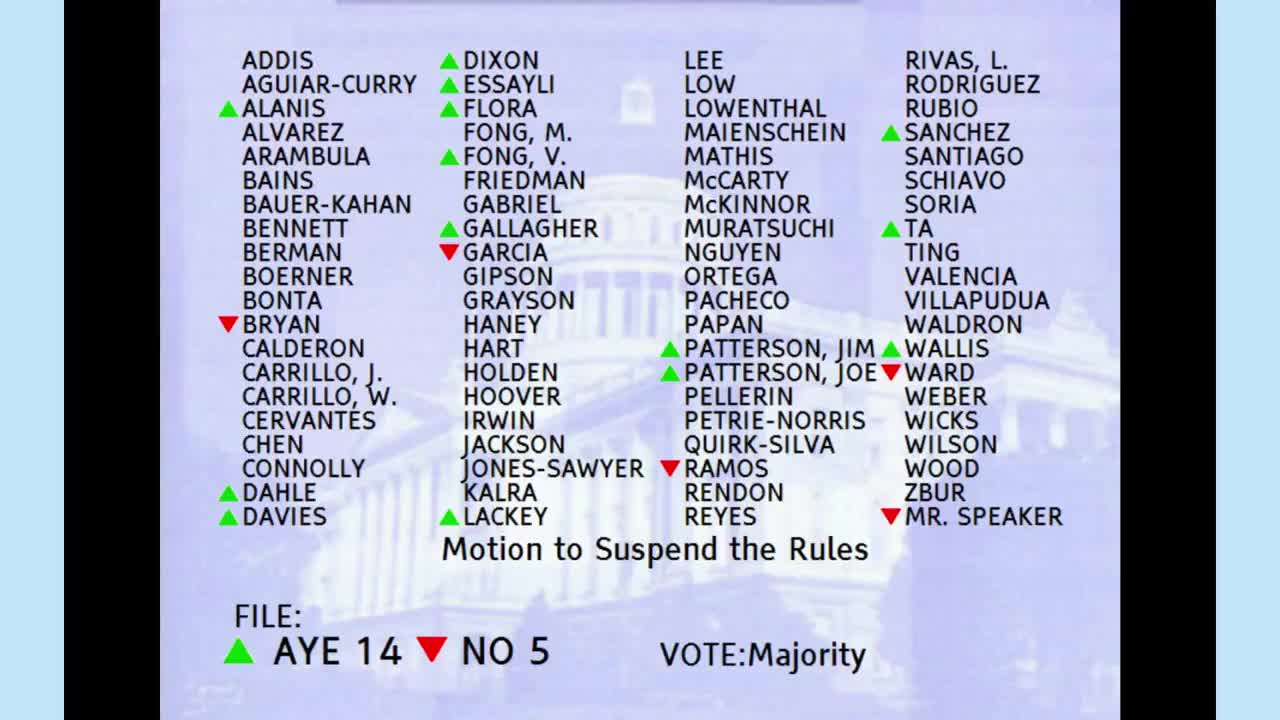 50SEC
Assembly Floor
 1MIN
Senate Floor
 3MIN
Assembly Standing Committee on Transportation
Bill Author

Bill Co-Author(s):