AB 2565: School facilities: interior locks.
- Session Year: 2023-2024
- House: Assembly
- Latest Version Date: 2024-09-24
Current Status:
Passed
(2024-09-24: Chaptered by Secretary of State - Chapter 531, Statutes of 2024.)
Introduced
In Committee
First Chamber
In Committee
Second Chamber
Enacted
What does this bill do?
The bill requires K–12 school districts, county offices of education, and charter schools to install interior locks on doors of rooms that hold five or more people when they upgrade a school building. It exempts doors already locked from outside, doors that already lock from inside, student restrooms, small maintenance jobs under $20,000, and certain modernization projects submitted before Jan. 1, 2025. It also makes installation of these interior locks an eligible expense under the state's Gun Violence Prevention and School Safety Fund.
The summary is provided by generative AI which can make mistakes. For original language, please view the details in the table below.
Existing law requires all new construction projects submitted to the Division of the State Architect pursuant to the Leroy F. Greene School Facilities Act of 1998 to include locks that allow doors to classrooms and rooms with an occupancy of 5 or more persons to be locked from the inside, except as specified.
Existing law requires the governing board of a school district, if the governing board of the school district elects to seek state funding pursuant to the act for a school modernization project for a school facility constructed before January 1, 2012, to include, as part of the modernization project, locks that allow doors to classrooms and any room with an occupancy of 5 or more persons to be locked from the inside of the room, except as provided.
Existing law requires the governing board of any school district to furnish, repair, insure against fire, and in its discretion rent, the school property of its school district.
This bill would, contingent upon an appropriation, require a charter school, school district, or county office of education serving pupils in kindergarten or any of grades 1 to 12, inclusive, that undertakes an addition, alteration, reconstruction, rehabilitation, or retrofit of a school building, to install interior locks on each door of any room with an occupancy of 5 or more persons in that school building, except as provided. By placing a new requirement on local educational agencies, the bill would constitute a state-mandated local program.
Existing law, the Gun Violence Prevention and School Safety Act, commencing July 1, 2024, imposes an excise tax in the amount of 11% of the gross receipts from the retail sale in this state of a firearm, firearm precursor part, and ammunition, as specified. The act requires that the revenues collected be deposited in the Gun Violence Prevention and School Safety Fund in the State Treasury, and requires the moneys received in the fund to be used to fund various gun violence prevention, education, research, response, and investigation programs, as specified, including, among others, up to $50,000,000 to the State Department of Education, upon appropriation by the Legislature, to enhance school safety by addressing risk factors for gun violence affecting pupils in kindergarten and grades 1 to 12, inclusive, through the funding of related measures, including, without limitation, physical security improvements, among other measures.
This bill would specifically include the installation of interior locks, as required by this bill described above, as an authorized physical security improvement for purposes of the act. The bill also would make a nonsubstantive change.
The California Constitution requires the state to reimburse local agencies and school districts for certain costs mandated by the state. Statutory provisions establish procedures for making that reimbursement.
This bill would provide that, if the Commission on State Mandates determines that the bill contains costs mandated by the state, reimbursement for those costs shall be made pursuant to the statutory provisions noted above.
Existing law requires all new construction projects submitted to the Division of the State Architect pursuant to the Leroy F. Greene School Facilities Act of 1998 to include locks that allow doors to classrooms and rooms with an occupancy of 5 or more persons to be locked from the inside, except as specified.
Existing law requires the governing board of a school district, if the governing board of the school district elects to seek state funding pursuant to the act for a school modernization project for a school facility constructed before January 1, 2012, to include, as part of the modernization project, locks that allow doors to classrooms and any room with an occupancy of 5 or more persons to be locked from the inside of the room, except as provided.
Existing law requires the governing board of any school district to furnish, repair, insure against fire, and in its discretion rent, the school property of its school district.
This bill would would, contingent upon an appropriation, require a charter school, school district, or county office of education serving pupils in kindergarten or any of grades 1 to 12, inclusive, that undertakes an addition, alteration, reconstruction, rehabilitation, or retrofit of a school building, to install interior locks on each door of any room with an occupancy of 5 or more persons in that school building, except as provided. By placing a new requirement on local educational agencies, the bill would constitute a state-mandated local program.
Existing law, the Gun Violence Prevention and School Safety Act, commencing July 1, 2024, imposes an excise tax in the amount of 11% of the gross receipts from the retail sale in this state of a firearm, firearm precursor part, and ammunition, as specified. The act requires that the revenues collected be deposited in the Gun Violence Prevention and School Safety Fund in the State Treasury, and requires the moneys received in the fund to be used to fund various gun violence prevention, education, research, response, and investigation programs, as specified, including, among others, up to $50,000,000 to the State Department of Education, upon appropriation by the Legislature, to enhance school safety by addressing risk factors for gun violence affecting pupils in kindergarten and grades 1 to 12, inclusive, through the funding of related measures, including, without limitation, physical security improvements, among other measures.
This bill would specifically include the installation of interior locks, as required by this bill described above, as an authorized physical security improvement for purposes of the act. The bill also would make a nonsubstantive change.
The California Constitution requires the state to reimburse local agencies and school districts for certain costs mandated by the state. Statutory provisions establish procedures for making that reimbursement.
This bill would provide that, if the Commission on State Mandates determines that the bill contains costs mandated by the state, reimbursement for those costs shall be made pursuant to the statutory provisions noted above.
Existing law requires all new construction projects submitted to the Division of the State Architect pursuant to the Leroy F. Greene School Facilities Act of 1998 to include locks that allow doors to classrooms and rooms with an occupancy of 5 or more persons to be locked from the inside, except as specified.
Existing law requires the governing board of a school district, if the governing board of the school district elects to seek state funding pursuant to the act for a school modernization project for a school facility constructed before January 1, 2012, to include, as part of the modernization project, locks that allow doors to classrooms and any room with an occupancy of 5 or more persons to be locked from the inside of the room, except as provided.
Existing law requires the governing board of any school district to furnish, repair, insure against fire, and in its discretion rent, the school property of its school district.
This bill would require a charter school, school district, or county office of education serving pupils in kindergarten or any of grades 1 to 12, inclusive, that undertakes an addition, alteration, reconstruction, rehabilitation, or retrofit of a school building, to install interior locks on each door of any room with an occupancy of 5 or more persons in that school building, except as provided. By placing a new requirement on local educational agencies, the bill would constitute a state-mandated local program.
Existing law, the Gun Violence Prevention and School Safety Act, commencing July 1, 2024, imposes an excise tax in the amount of 11% of the gross receipts from the retail sale in this state of a firearm, firearm precursor part, and ammunition, as specified. The act requires that the revenues collected be deposited in the Gun Violence Prevention and School Safety Fund in the State Treasury, and requires the moneys received in the fund to be used to fund various gun violence prevention, education, research, response, and investigation programs, as specified, including, among others, up to $50,000,000 to the State Department of Education, upon appropriation by the Legislature, to enhance school safety by addressing risk factors for gun violence affecting pupils in kindergarten and grades 1 to 12, inclusive, through the funding of related measures, including, without limitation, physical security improvements, among other measures.
This bill would specifically include the installation of interior locks, as required by this bill described above, as an authorized physical security improvement for purposes of the act. The bill also would make a nonsubstantive change.
The California Constitution requires the state to reimburse local agencies and school districts for certain costs mandated by the state. Statutory provisions establish procedures for making that reimbursement.
This bill would provide that, if the Commission on State Mandates determines that the bill contains costs mandated by the state, reimbursement for those costs shall be made pursuant to the statutory provisions noted above.
Existing law requires all new construction projects submitted to the Division of the State Architect pursuant to the Leroy F. Greene School Facilities Act of 1998 to include locks that allow doors to classrooms and rooms with an occupancy of 5 or more persons to be locked from the inside, except as specified.
Existing law requires the governing board of a school district, if the governing board of the school district elects to seek state funding pursuant to the act for a school modernization project for a school facility constructed before January 1, 2012, to include, as part of the modernization project, locks that allow doors to classrooms and any room with an occupancy of 5 or more persons to be locked from the inside of the room, except as provided.
Existing law requires the governing board of any school district to furnish, repair, insure against fire, and in its discretion rent, the school property of its school district.
This bill would require a charter school, school district, or county office of education serving pupils in kindergarten or any of grades 1 to 12, inclusive, that undertakes a project to build a new school facility or building, or to renovate, repair, modernize, or otherwise alter an existing school facility or building for any purpose, including, but not limited to, for purposes of usability or accessibility, an addition, alteration, reconstruction, rehabilitation, or retrofit of a school building, to install interior locks on each door in that school facility or of any room with an occupancy of 5 or more persons in that school building, except as provided. By placing a new requirement on local educational agencies, the bill would constitute a state-mandated local program.
The California Constitution requires the state to reimburse local agencies and school districts for certain costs mandated by the state. Statutory provisions establish procedures for making that reimbursement.
This bill would provide that, if the Commission on State Mandates determines that the bill contains costs mandated by the state, reimbursement for those costs shall be made pursuant to the statutory provisions noted above.
Existing law requires all new construction projects submitted to the Division of the State Architect pursuant to the Leroy F. Greene School Facilities Act of 1998 to include locks that allow doors to classrooms and rooms with an occupancy of 5 or more persons to be locked from the inside, except as specified.
Existing law requires the governing board of a school district, if the governing board of the school district elects to seek state funding pursuant to the act for a school modernization project for a school facility constructed before January 1, 2012, to include, as part of the modernization project, locks that allow doors to classrooms and any room with an occupancy of 5 or more persons to be locked from the inside of the room, except as provided.
Existing law requires the governing board of any school district to furnish, repair, insure against fire, and in its discretion rent, the school property of its school district.
This bill would require a charter school, school district, or county office of education serving pupils in kindergarten or any of grades 1 to 12, inclusive, that undertakes a project to build a new school facility or building, or to renovate, repair, modernize, or otherwise alter an existing school facility or building for any purpose, including, but not limited to, for purposes of usability or accessibility, to install interior locks on each door in that school facility or building, except as provided. By placing a new requirement on local educational agencies, the bill would constitute a state-mandated local program.
The California Constitution requires the state to reimburse local agencies and school districts for certain costs mandated by the state. Statutory provisions establish procedures for making that reimbursement.
This bill would provide that, if the Commission on State Mandates determines that the bill contains costs mandated by the state, reimbursement for those costs shall be made pursuant to the statutory provisions noted above.
(a)The Legislature finds and declares all of the following:
(1)Gun violence was the leading cause of death for children in the United States in 2020 and 2021.
(2)In 2023, there were 346 school shooting incidents across the country, meaning the United States averaged nearly one incident every day and saw its highest total on record since at least 1966.
(3)In 2023, California tied for the most incidents among states with 25 school shootings.
(4)In 2015, the Sandy Hook Advisory Commission found that a locked classroom door had never been breached in an active shooter situation.
(5)The commission strongly encouraged the installation of interior locks on classroom doors as a practical and effective safety measure.
(6)One in four schools still do not have interior locks on their classroom doors and instead have only locks that must be locked from the outside.
(7)A teacher being able to lock their door from the inside of a classroom, rather than having to step back outside in the middle of an active shooter situation, could make all the difference between life and death.
(b)Therefore, it is the intent of the Legislature to enact legislation that ensures as many doors as possible on school grounds have interior locks to enhance pupil and staff safety.
SEC. 2.Section 17586 is added to the Education Code, to read:17586.(a)A school district, county office of education, or charter school serving pupils in kindergarten or any of grades 1 to 12, inclusive, that undertakes an addition, alteration, reconstruction, rehabilitation, or retrofit of a school building, shall install interior locks on each door of any room with an occupancy of five or more persons in that school building.
(b)The requirement in subdivision (a) does not apply to any of the following:
(1)Doors that are locked from the outside at all times, doors with locks that lock from the inside, and pupil restrooms.
(2)The maintenance of a school facility for individual projects or tasks under twenty thousand dollars ($20,000).
(3)Projects applying for funding pursuant to Chapter 12.5 (commencing with Section 17070.10) of Part 10 of Division 1 for a school modernization project, before January 1, 2025, and that were initially submitted to the Division of the State Architect for approval before January 1, 2025.
(c)The locks required by subdivision (a) shall conform to the specifications and requirements set forth in Title 24 of the California Code of Regulations.
(d)For purposes of this section, addition, alteration, reconstruction, rehabilitation, retrofit, school building, and maintenance have the same meaning as specified in Section 4-314 of Part 1 of Title 24 of the California Code of Regulations.
(e)The implementation of this section is contingent upon an appropriation for its purposes in the annual Budget Act or another statute.
SEC. 3.Section 36005 of the Revenue and Taxation Code is amended to read:36005.(a)There is hereby established in the State Treasury the Gun Violence Prevention and School Safety Fund to receive moneys pursuant to Section 36041.
(b)All moneys in the Gun Violence Prevention and School Safety Fund, including interest or dividends earned by the fund, shall be distributed annually in accordance with the allocation formula provided in subdivision (c), provided that the dollar amounts specified in that subdivision shall be annually adjusted to account for changes in the California Consumer Price Index.
(c)Moneys in the Gun Violence Prevention and School Safety Fund shall be annually allocated in the following order:
(1)The first seventy-five million dollars ($75,000,000) available in the fund, or as much of that amount as is available, shall be continuously appropriated annually to the Board of State and Community Corrections, or other successor agency designated by law as the administering agency for the California Violence Intervention and Prevention (CalVIP) Grant Program, to fund CalVIP Grants and administration and evaluations of CalVIP-supported programs, in accordance with Title 10.2 (commencing with Section 14130) of Part 4 of the Penal Code.
(2)The next fifty million dollars ($50,000,000) available in the fund, or as much of that amount as is available, if any, shall, upon appropriation by the Legislature, be annually allocated to the State Department of Education to enhance school safety by addressing risk factors for gun violence affecting pupils in kindergarten and grades 1 to 12, inclusive, through the funding of related measures, including, without limitation, the measures described in subparagraphs (A) to (D), inclusive. The department may use these funds to support both activities conducted directly by the department and those conducted through contracts with, or grants to, other entities.
(A)Physical security improvements, including, but not limited to, the installation of interior locks for purposes of Section 17586 of the Education Code.
(B)Physical safety assessments.
(C)School-based or school-linked mental health and behavioral services, including training for teachers and employees.
(D)Before school and after school programs for at-risk pupils, including programs offered by entities eligible to receive funding under the Bipartisan Safer Communities Act Stronger Connections Grant Program.
(3)The next fifteen million dollars ($15,000,000) available in the fund, or as much of that amount as is available, if any, shall, upon appropriation by the Legislature, be annually allocated to the Judicial Council to support a court-based firearm relinquishment grant program to be administered in coordination with the Department of Justice to ensure the prompt, consistent, and safe removal of firearms by the Department of Justice and local law enforcement agencies from individuals who become prohibited from owning or possessing firearms and ammunition pursuant to a criminal conviction or other criminal or civil court order, including, but not limited to, criminal protective orders, domestic violence restraining orders, gun violence restraining orders, civil harassment restraining orders, and workplace violence restraining orders. The grant program shall be designed to reduce the number of people who are entered into or remain in the Armed Prohibited Persons System, including by supporting partnerships with courts and local law enforcement agencies.
(4)The next fifteen million dollars ($15,000,000) available in the fund, or as much of that amount as is available, if any, shall, upon appropriation by the Legislature, be annually allocated to the Department of Justice to fund a victims of gun violence grant program. The purpose of this program is to support evidence-based activities to equitably improve investigations and clearance rates in firearm homicide and firearm assault investigations in communities disproportionately impacted by firearm homicides and firearm assaults, and thereby help reduce gun violence in communities across California. Grants from this program shall be made on a competitive basis to state, local, or tribal law enforcement agencies and prosecuting offices for activities that have the specific objective of increasing clearance rates for firearm homicides and nonfatal shootings, which may include, without limitation, hiring and training detectives dedicated to investigating these offenses, hiring and training personnel or other partners to coordinate with victims and witnesses or to collect, process, and test relevant evidence, improving data analysis, forensics, and technological capacities, and promoting recurring and trauma-informed engagement with victims, witnesses, and other impacted community members in a manner that builds trust, safety, and collaboration.
(5)The next two million five hundred thousand dollars ($2,500,000) available in the fund per year, or as much of that amount as is available, if any, shall, upon appropriation by the Legislature, be annually allocated to the Department of Justice to support activities to inform firearm and ammunition purchasers and firearm owners about gun safety laws and responsibilities, such as safe firearm storage, and to promote implementation and coordination of gun violence prevention efforts through activities such as technical assistance, training, capacity building, and local gun violence data and problem analysis support for local governments, law enforcement agencies, community-based service providers, and other stakeholders. The department may use these funds to support activities conducted directly by the department or conducted through contracts with, or grants to, other entities.
(6)The next two million five hundred thousand dollars ($2,500,000) available in the fund, or as much of that amount as is available, if any, shall, upon appropriation by the Legislature, be annually allocated to the Office of Emergency Services to provide counseling and trauma-informed support services to direct and secondary victims of mass shootings and other gun homicides and to individuals who have experienced chronic exposure to community gun violence. The office may use these funds to support activities directly conducted by the office, or conducted through contracts with, or grants to, other entities, and to help reduce gun violence in communities across California.
(7)The next one million dollars ($1,000,000) available in the fund, or as much of that amount as is available, if any, shall, upon appropriation by the Legislature, be allocated to the University of California, Davis, California Firearm Violence Research Center, if those funds are accepted by the Regents of the University of California, for a one-time grant for gun violence research and initiatives to educate health care providers and other stakeholders about clinical tools and other interventions for preventing firearm suicide and injury. This allocation may, if sufficient funds are not available, be made over the course of more than one budget year; however, the total amount allocated pursuant to this paragraph across all years shall not exceed one million dollars ($1,000,000).
(d)Any remaining moneys available in the fund each year after the allocations described in subdivision (c) shall, upon appropriation by the Legislature, be allocated to fund and support activities and programs focused on preventing gun violence, supporting victims of gun violence, and otherwise remediating the harmful effects of gun violence.
(e)Except as otherwise provided in this section or in any other law, a department or agency may reserve up to 5 percent of the funds appropriated to that department or agency under subdivision (c) for the costs of administering and promoting the effectiveness of programs supported by this act, including, without limitation, costs to employ personnel, develop and review grant solicitations, publicize grant opportunities, engage with and provide technical assistance to prospective grant applicants and grantees, and conduct or support data collection or research evaluations.
SEC. 4.If the Commission on State Mandates determines that this act contains costs mandated by the state, reimbursement to local agencies and school districts for those costs shall be made pursuant to Part 7 (commencing with Section 17500) of Division 4 of Title 2 of the Government Code.
(a)The Legislature finds and declares all of the following:
(1)Gun violence was the leading cause of death for children in the United States in 2020 and 2021.
(2)In 2023, there were 346 school shooting incidents across the country, meaning the United States averaged nearly one incident every day and saw its highest total on record since at least 1966.
(3)In 2023, California tied for the most incidents among states with 25 school shootings.
(4)In 2015, the Sandy Hook Advisory Commission found that a locked classroom door had never been breached in an active shooter situation.
(5)The commission strongly encouraged the installation of interior locks on classroom doors as a practical and effective safety measure.
(6)One in four schools still do not have interior locks on their classroom doors and instead have only locks that must be locked from the outside.
(7)A teacher being able to lock their door from the inside of a classroom, rather than having to step back outside in the middle of an active shooter situation, could make all the difference between life and death.
(b)Therefore, it is the intent of the Legislature to enact legislation that ensures as many doors as possible on school grounds have interior locks to enhance pupil and staff safety.
SECTION 1.SEC. 2.Section 17586 is added to the Education Code, to read:17586.(a)A school district, county office of education, or charter school serving pupils in kindergarten or any of grades 1 to 12, inclusive, that undertakes an addition, alteration, reconstruction, rehabilitation, or retrofit of a school building, shall install interior locks on each door of any room with an occupancy of five or more persons in that school building.
(b)The requirement in subdivision (a) does not apply to any of the following:
(1)Doors that are locked from the outside at all times, doors with locks that lock from the inside, and pupil restrooms.
(2)The maintenance of a school facility for individual projects or tasks under twenty thousand dollars ($20,000).
(3)Projects applying for funding pursuant to Chapter 12.5 (commencing with Section 17070.10) of Part 10 of Division 1 for a school modernization project, before January 1, 2025, and that were initially submitted to the Division of the State Architect for approval before January 1, 2025.
(c)The locks required by subdivision (a) shall conform to the specifications and requirements set forth in Title 24 of the California Code of Regulations.
(d)For purposes of this section, addition, alteration, reconstruction, rehabilitation, retrofit, school building, and maintenance have the same meaning as specified in Section 4-314 of Part 1 of Title 24 of the California Code of Regulations.
(e)The implementation of this section is contingent upon an appropriation for its purposes in the annual Budget Act or another statute.
SEC. 2.SEC. 3.Section 36005 of the Revenue and Taxation Code is amended to read:36005.(a)There is hereby established in the State Treasury the Gun Violence Prevention and School Safety Fund to receive moneys pursuant to Section 36041.
(b)All moneys in the Gun Violence Prevention and School Safety Fund, including interest or dividends earned by the fund, shall be distributed annually in accordance with the allocation formula provided in subdivision (c), provided that the dollar amounts specified in that subdivision shall be annually adjusted to account for changes in the California Consumer Price Index.
(c)Moneys in the Gun Violence Prevention and School Safety Fund shall be annually allocated in the following order:
(1)The first seventy-five million dollars ($75,000,000) available in the fund, or as much of that amount as is available, shall be continuously appropriated annually to the Board of State and Community Corrections, or other successor agency designated by law as the administering agency for the California Violence Intervention and Prevention (CalVIP) Grant Program, to fund CalVIP Grants and administration and evaluations of CalVIP-supported programs, in accordance with Title 10.2 (commencing with Section 14130) of Part 4 of the Penal Code.
(2)The next fifty million dollars ($50,000,000) available in the fund, or as much of that amount as is available, if any, shall, upon appropriation by the Legislature, be annually allocated to the State Department of Education to enhance school safety by addressing risk factors for gun violence affecting pupils in kindergarten and grades 1 to 12, inclusive, through the funding of related measures, including, without limitation, the measures described in subparagraphs (A) to (D), inclusive. The department may utilize use these funds to support both activities conducted directly by the department and those conducted through contracts with, or grants to, other entities.
(A)Physical security improvements, including, but not limited to, the installation of interior locks for purposes of Section 17586 of the Education Code.
(B)Physical safety assessments.
(C)School-based or school-linked mental health and behavioral services, including training for teachers and employees.
(D)Before school and after school programs for at-risk pupils, including programs offered by entities eligible to receive funding under the Bipartisan Safer Communities Act Stronger Connections Grant Program.
(3)The next fifteen million dollars ($15,000,000) available in the fund, or as much of that amount as is available, if any, shall, upon appropriation by the Legislature, be annually allocated to the Judicial Council to support a court-based firearm relinquishment grant program to be administered in coordination with the Department of Justice to ensure the prompt, consistent, and safe removal of firearms by the Department of Justice and local law enforcement agencies from individuals who become prohibited from owning or possessing firearms and ammunition pursuant to a criminal conviction or other criminal or civil court order, including, but not limited to, criminal protective orders, domestic violence restraining orders, gun violence restraining orders, civil harassment restraining orders, and workplace violence restraining orders. The grant program shall be designed to reduce the number of people who are entered into or remain in the Armed Prohibited Persons System, including by supporting partnerships with courts and local law enforcement agencies.
(4)The next fifteen million dollars ($15,000,000) available in the fund, or as much of that amount as is available, if any, shall, upon appropriation by the Legislature, be annually allocated to the Department of Justice to fund a victims of gun violence grant program. The purpose of this program is to support evidence-based activities to equitably improve investigations and clearance rates in firearm homicide and firearm assault investigations in communities disproportionately impacted by firearm homicides and firearm assaults, and thereby help reduce gun violence in communities across California. Grants from this program shall be made on a competitive basis to state, local, or tribal law enforcement agencies and prosecuting offices for activities that have the specific objective of increasing clearance rates for firearm homicides and nonfatal shootings, which may include, without limitation, hiring and training detectives dedicated to investigating these offenses, hiring and training personnel or other partners to coordinate with victims and witnesses or to collect, process, and test relevant evidence, improving data analysis, forensics, and technological capacities, and promoting recurring and trauma-informed engagement with victims, witnesses, and other impacted community members in a manner that builds trust, safety, and collaboration.
(5)The next two million five hundred thousand dollars ($2,500,000) available in the fund per year, or as much of that amount as is available, if any, shall, upon appropriation by the Legislature, be annually allocated to the Department of Justice to support activities to inform firearm and ammunition purchasers and firearm owners about gun safety laws and responsibilities, such as safe firearm storage, and to promote implementation and coordination of gun violence prevention efforts through activities such as technical assistance, training, capacity building, and local gun violence data and problem analysis support for local governments, law enforcement agencies, community-based service providers, and other stakeholders. The department may utilize use these funds to support activities conducted directly by the department or conducted through contracts with, or grants to, other entities.
(6)The next two million five hundred thousand dollars ($2,500,000) available in the fund, or as much of that amount as is available, if any, shall, upon appropriation by the Legislature, be annually allocated to the Office of Emergency Services to provide counseling and trauma-informed support services to direct and secondary victims of mass shootings and other gun homicides and to individuals who have experienced chronic exposure to community gun violence. The office may utilize use these funds to support activities directly conducted by the office, or conducted through contracts with, or grants to, other entities, and to help reduce gun violence in communities across California.
(7)The next one million dollars ($1,000,000) available in the fund, or as much of that amount as is available, if any, shall, upon appropriation by the Legislature, be allocated to the University of California, Davis, California Firearm Violence Research Center, if those funds are accepted by the Regents of the University of California, for a one-time grant for gun violence research and initiatives to educate health care providers and other stakeholders about clinical tools and other interventions for preventing firearm suicide and injury. This allocation may, if sufficient funds are not available, be made over the course of more than one budget year; however, the total amount allocated pursuant to this paragraph across all years shall not exceed one million dollars ($1,000,000).
(d)Any remaining moneys available in the fund each year after the allocations described in subdivision (c) shall, upon appropriation by the Legislature, be allocated to fund and support activities and programs focused on preventing gun violence, supporting victims of gun violence, and otherwise remediating the harmful effects of gun violence.
(e)Except as otherwise provided herein in this section or in any other provision of law, a department or agency may reserve up to 5 percent of the funds appropriated to that department or agency under subdivision (c) for the costs of administering and promoting the effectiveness of programs supported by this act, including, without limitation, costs to employ personnel, develop and review grant solicitations, publicize grant opportunities, engage with and provide technical assistance to prospective grant applicants and grantees, and conduct or support data collection or research evaluations.
SEC. 3.SEC. 4.If the Commission on State Mandates determines that this act contains costs mandated by the state, reimbursement to local agencies and school districts for those costs shall be made pursuant to Part 7 (commencing with Section 17500) of Division 4 of Title 2 of the Government Code.
(a)A school district, county office of education, or charter school serving pupils in kindergarten or any of grades 1 to 12, inclusive, that undertakes an addition, alteration, reconstruction, rehabilitation, or retrofit of a school building, shall install interior locks on each door of any room with an occupancy of five or more persons in that school building.
(b)The requirement in subdivision (a) does not apply to any of the following:
(1)Doors that are locked from the outside at all times, doors with locks that lock from the inside, and pupil restrooms.
(2)The maintenance of a school facility for individual projects or tasks under twenty thousand dollars ($20,000).
(3)Projects applying for funding pursuant to Chapter 12.5 (commencing with Section 17070.10) of Part 10 of Division 1 for a school modernization project, before January 1, 2025, and that were initially submitted to the Division of the State Architect for approval before January 1, 2025.
(c)The locks required by subdivision (a) shall conform to the specifications and requirements set forth in Title 24 of the California Code of Regulations.
(d)For purposes of this section, addition, alteration, reconstruction, rehabilitation, retrofit, school building, and maintenance have the same meaning as specified in Section 4-314 of Part 1 of Title 24 of the California Code of Regulations.
SEC. 2.Section 36005 of the Revenue and Taxation Code is amended to read:36005.(a)There is hereby established in the State Treasury the Gun Violence Prevention and School Safety Fund to receive moneys pursuant to Section 36041.
(b)All moneys in the Gun Violence Prevention and School Safety Fund, including interest or dividends earned by the fund, shall be distributed annually in accordance with the allocation formula provided in subdivision (c), provided that the dollar amounts specified in that subdivision shall be annually adjusted to account for changes in the California Consumer Price Index.
(c)Moneys in the Gun Violence Prevention and School Safety Fund shall be annually allocated in the following order:
(1)The first seventy-five million dollars ($75,000,000) available in the fund, or as much of that amount as is available, shall be continuously appropriated annually to the Board of State and Community Corrections, or other successor agency designated by law as the administering agency for the California Violence Intervention and Prevention (CalVIP) Grant Program, to fund CalVIP Grants and administration and evaluations of CalVIP-supported programs, in accordance with Title 10.2 (commencing with Section 14130) of Part 4 of the Penal Code.
(2)The next fifty million dollars ($50,000,000) available in the fund, or as much of that amount as is available, if any, shall, upon appropriation by the Legislature, be annually allocated to the State Department of Education to enhance school safety by addressing risk factors for gun violence affecting pupils in kindergarten through grade 12, and grades 1 to 12, inclusive, through the funding of related measures, including, without limitation, the measures described in subparagraphs (A) to (D), inclusive. The department may utilize these funds to support both activities conducted directly by the department and those conducted through contracts with, or grants to, other entities.
(A)Physical security improvements. improvements, including, but not limited to, the installation of interior locks for purposes of Section 17586 of the Education Code.
(B)Physical safety assessments.
(C)School-based or school-linked mental health and behavioral services, including training for teachers and employees.
(D)Before school and after school programs for at-risk pupils, including programs offered by entities eligible to receive funding under the Bipartisan Safer Communities Act Stronger Connections Grant Program.
(3)The next fifteen million dollars ($15,000,000) available in the fund, or as much of that amount as is available, if any, shall, upon appropriation by the Legislature, be annually allocated to the Judicial Council to support a court-based firearm relinquishment grant program to be administered in coordination with the Department of Justice to ensure the prompt, consistent, and safe removal of firearms by the Department of Justice and local law enforcement agencies from individuals who become prohibited from owning or possessing firearms and ammunition pursuant to a criminal conviction or other criminal or civil court order, including, but not limited to, criminal protective orders, domestic violence restraining orders, gun violence restraining orders, civil harassment restraining orders, and workplace violence restraining orders. The grant program shall be designed to reduce the number of people who are entered into or remain in the Armed Prohibited Persons System, including by supporting partnerships with courts and local law enforcement agencies.
(4)The next fifteen million dollars ($15,000,000) available in the fund, or as much of that amount as is available, if any, shall, upon appropriation by the Legislature, be annually allocated to the Department of Justice to fund a victims of gun violence grant program. The purpose of this program is to support evidence-based activities to equitably improve investigations and clearance rates in firearm homicide and firearm assault investigations in communities disproportionately impacted by firearm homicides and firearm assaults, and thereby help reduce gun violence in communities across California. Grants from this program shall be made on a competitive basis to state, local, or tribal law enforcement agencies and prosecuting offices for activities that have the specific objective of increasing clearance rates for firearm homicides and nonfatal shootings, which may include, without limitation, hiring and training detectives dedicated to investigating these offenses, hiring and training personnel or other partners to coordinate with victims and witnesses or to collect, process, and test relevant evidence, improving data analysis, forensics, and technological capacities, and promoting recurring and trauma-informed engagement with victims, witnesses, and other impacted community members in a manner that builds trust, safety, and collaboration.
(5)The next two million five hundred thousand dollars ($2,500,000) available in the fund per year, or as much of that amount as is available, if any, shall, upon appropriation by the Legislature, be annually allocated to the Department of Justice to support activities to inform firearm and ammunition purchasers and firearm owners about gun safety laws and responsibilities, such as safe firearm storage, and to promote implementation and coordination of gun violence prevention efforts through activities such as technical assistance, training, capacity building, and local gun violence data and problem analysis support for local governments, law enforcement agencies, community-based service providers, and other stakeholders. The department may utilize these funds to support activities conducted directly by the department or conducted through contracts with, or grants to, other entities.
(6)The next two million five hundred thousand dollars ($2,500,000) available in the fund, or as much of that amount as is available, if any, shall, upon appropriation by the Legislature, be annually allocated to the Office of Emergency Services to provide counseling and trauma-informed support services to direct and secondary victims of mass shootings and other gun homicides and to individuals who have experienced chronic exposure to community gun violence. The office may utilize these funds to support activities directly conducted by the office, or conducted through contracts with, or grants to, other entities, and to help reduce gun violence in communities across California.
(7)The next one million dollars ($1,000,000) available in the fund, or as much of that amount as is available, if any, shall, upon appropriation by the Legislature, be allocated to the University of California, Davis, California Firearm Violence Research Center, if those funds are accepted by the Regents of the University of California, for a one-time grant for gun violence research and initiatives to educate health care providers and other stakeholders about clinical tools and other interventions for preventing firearm suicide and injury. This allocation may, if sufficient funds are not available, be made over the course of more than one budget year; however, the total amount allocated pursuant to this paragraph across all years shall not exceed one million dollars ($1,000,000).
(d)Any remaining moneys available in the fund each year after the allocations described in subdivision (c) shall, upon appropriation by the Legislature, be allocated to fund and support activities and programs focused on preventing gun violence, supporting victims of gun violence, and otherwise remediating the harmful effects of gun violence.
(e)Except as otherwise provided herein or in any other provision of law, a department or agency may reserve up to 5 percent of the funds appropriated to that department or agency under subdivision (c) for the costs of administering and promoting the effectiveness of programs supported by this act, including, without limitation, costs to employ personnel, develop and review grant solicitations, publicize grant opportunities, engage with and provide technical assistance to prospective grant applicants and grantees, and conduct or support data collection or research evaluations.
SEC. 2.SEC. 3.If the Commission on State Mandates determines that this act contains costs mandated by the state, reimbursement to local agencies and school districts for those costs shall be made pursuant to Part 7 (commencing with Section 17500) of Division 4 of Title 2 of the Government Code.
(a)A school district, county office of education, or charter school serving pupils in kindergarten or any of grades 1 to 12, inclusive, that undertakes an addition, alteration, reconstruction, rehabilitation, or retrofit of a school building, shall install interior locks on each door of any room with an occupancy of five or more persons in that school building.
(b)The requirement in subdivision (a) does not apply to any of the following:
(1)Doors that are locked from the outside at all times, doors with locks that lock from the inside, and pupil restrooms.
(2)The maintenance of a school facility for individual projects or tasks under twenty thousand dollars ($20,000).
(3)Projects applying for funding pursuant to Chapter 12.5 (commencing with Section 17070.10) of Part 10 of Division 1 for a school modernization project, before January 1, 2025, and that were initially submitted to the Division of the State Architect for approval before January 1, 2025.
(c)The locks required by subdivision (a) shall conform to the specifications and requirements set forth in Title 24 of the California Code of Regulations.
(d)For purposes of this section, addition, alteration, reconstruction, rehabilitation, retrofit, school building, and maintenance have the same meaning as specified in Section 4-314 of Part 1 of Title 24 of the California Code of Regulations.
SEC. 2.If the Commission on State Mandates determines that this act contains costs mandated by the state, reimbursement to local agencies and school districts for those costs shall be made pursuant to Part 7 (commencing with Section 17500) of Division 4 of Title 2 of the Government Code.
(a)A local educational agency serving pupils in kindergarten or any of grades 1 to 12, inclusive, that undertakes a project to build a new school facility or building, or to renovate, repair, modernize, or otherwise alter an existing school facility or building for any purpose, including, but not limited to, for purposes of usability or accessibility, shall install interior locks on each door in that school facility or building.
(b)The requirement in subdivision (a) does not apply to doors that are locked from the outside at all times, doors with locks that lock from the inside, and pupil restrooms.
(c)As used in this section, local educational agency means a charter school, school district, or county office of education.
SEC. 2.If the Commission on State Mandates determines that this act contains costs mandated by the state, reimbursement to local agencies and school districts for those costs shall be made pursuant to Part 7 (commencing with Section 17500) of Division 4 of Title 2 of the Government Code.
|
Date
|
Status
|
|---|---|
| Sep 24, 2024 | Chaptered by Secretary of State - Chapter 531, Statutes of 2024. |
| Sep 24, 2024 | Approved by the Governor. |
| Sep 11, 2024 | Enrolled and presented to the Governor at 4 p.m. |
| Aug 29, 2024 | Senate amendments concurred in. To Engrossing and Enrolling. (Ayes 75. Noes 0.). |
| Aug 28, 2024 | In Assembly. Concurrence in Senate amendments pending. May be considered on or after August 30 pursuant to Assembly Rule 77. |
| Aug 28, 2024 | Assembly Rule 77 suspended. |
| Aug 27, 2024 | Read third time. Passed. Ordered to the Assembly. (Ayes 40. Noes 0.). |
| Aug 19, 2024 | Read second time. Ordered to third reading. |
| Aug 15, 2024 | Read second time and amended. Ordered returned to second reading. |
| Aug 15, 2024 | From committee: Amend, and do pass as amended. (Ayes 6. Noes 0.) (August 15). |
| Jul 1, 2024 | In committee: Referred to suspense file. |
| Jun 19, 2024 | From committee: Do pass and re-refer to Com. on APPR. (Ayes 7. Noes 0.) (June 19). Re-referred to Com. on APPR. |
| Jun 5, 2024 | Referred to Com. on ED. |
| May 24, 2024 | In Senate. Read first time. To Com. on RLS. for assignment. |
| May 23, 2024 | Read third time. Passed. Ordered to the Senate. (Ayes 73. Noes 0. Page 5604.) |
| May 20, 2024 | Read second time. Ordered to third reading. |
| May 16, 2024 | Read second time and amended. Ordered returned to second reading. |
| May 16, 2024 | From committee: Amend, and do pass as amended. (Ayes 11. Noes 0.) (May 16). |
| May 16, 2024 | Assembly Rule 63 suspended. |
| Apr 10, 2024 | In committee: Set, first hearing. Referred to APPR. suspense file. |
| Apr 2, 2024 | Re-referred to Com. on APPR. |
| Apr 1, 2024 | Read second time and amended. |
| Mar 21, 2024 | From committee: Amend, and do pass as amended and re-refer to Com. on APPR. (Ayes 6. Noes 0.) (March 20). |
| Mar 4, 2024 | Referred to Com. on ED. |
| Feb 15, 2024 | From printer. May be heard in committee March 16. |
| Feb 14, 2024 | Read first time. To print. |
|
Date
|
Description
|
Location
|
Votes
|
|
|---|---|---|---|---|
| Aug 29, 2024 | AB 2565 McCarty Concurrence in Senate Amendments | Assembly Floor |
Passed |
|
| Aug 27, 2024 | Assembly 3rd Reading AB2565 McCarty By Newman | Senate Floor |
Passed |
|
| Aug 15, 2024 | Do pass as amended | Senate Standing Committee on Appropriations |
Passed |
|
| Jul 1, 2024 | Placed on suspense file | Senate Standing Committee on Appropriations |
Passed |
|
| Jun 19, 2024 | Do pass, but first be re-referred to the Committee on [Appropriations] | Senate Standing Committee on Education |
Passed |
|
| May 23, 2024 | AB 2565 McCarty Assembly Third Reading | Assembly Floor |
Passed |
|
| May 16, 2024 | Do pass as amended. | Assembly Standing Committee on Appropriations |
Passed |
|
| Mar 20, 2024 | Do pass as amended and be re-referred to the Committee on [Appropriations] | Assembly Standing Committee on Education |
Passed |
This list shows positions taken on this bill by organizations on the date displayed, which is linked to the original source.
Positions by individuals are not included.
|
Organization
|
Position
|
Date
|
|---|---|---|
| California Federation Of Teachers | ** Support | |
| California Teachers Association | ** Support | |
| Perk Advocacy | ** Support | |
| Small School Districts Association | ** Against |
CONCURRENCE IN SENATE AMENDMENTS
CSA1 Bill Id:AB 2565
Author:(McCarty)
As Amended Ver:August 15, 2024
Majority vote
SUMMARY
Requires a school district, county office of education, or charter school making an addition, alteration, reconstruction, rehabilitation, or retrofit of a school building, to install interior locks on each door of any room with an occupancy of five or more persons in that school building, contingent upon an appropriation.
Senate Amendments
- Add various findings and declarations regarding the need for interior locks in school classrooms.
- Require interior locks, as specified, contingent upon an appropriation.
COMMENTS
Key provisions of the bill. This bill expands the existing requirements for locks that allow school doors to be locked from the inside by requiring interior locks to be added when an existing school district or county office of education (COE) school facility is altered for any purpose, thus beginning to close the gap of classroom doors that do not currently have interior locks due to not being required by new construction (as required by AB 211 (Mendoza), Chapter 430, Statutes of 2010), or those as a part of a modernization project (as required by AB 3205 (O'Donnell), Chapter 401, Statutes of 2018). Further, this bill requires charter schools applying funding for specified modernization or retrofit projects to add interior locks when the charter school undertakes a project to build a new school facility or building, or to renovate, repair, modernize, or otherwise alter an existing school facility or building for any purpose to install interior locks on each door in that school facility or building.
Lockdowns. In situations where an active shooter is on campus, schools will employ lockdowns to keep students in and perpetrators out. Teachers in schools without locks on doors that can be locked from the inside must go outside to lock their doors, leaving them and their students vulnerable to threats or attacks.
Door locks and other security hardware. According to the 2018 Division of State Architect (DSA) and Department of General Services (DGS) resource, A Guide and Checklist for Emergency Preparedness and Classroom Security, all locking/security hardware is required to be tested and listed to adopted national standards. Building codes, fire codes, and life safety regulations require users to have the ability to readily unlatch the door from inside the classroom with one motion without the use of a key, tool, or special knowledge or effort to facilitate immediate egress from the classroom or area. In addition, California building code accessibility regulations require doors to have the following features:
- A smooth surface on the bottom 10 inches of the push side of the door;
- Door operating hardware located between 34 and 44 inches above the floor;
- Door hardware that operates without requiring tight grasping, tight pinching, or twisting of the wrist; and
- A maximum of five pounds of force to operate door hardware.
Many schools already have locks that lock from the inside. All new schools already have locks that lock from the inside. AB 211 (Mendoza), Chapter 430, Statutes of 2010, requires, as a condition for state facilities bond funds, all new construction projects submitted to the DSA on and after July 1, 2011, to include locks that allow a door to be locked from the inside of a classroom or any room that accommodates five or more people. California Building Standards Codes under Title 24 regulations authorize the use of locks that are connected to the latching mechanism of the door so that the lock is automatically disengaged without the use of a key or requirement of special knowledge or effort (e.g., a thumbturn lock (slide bolt) above a door lever that unlocks when the lever is turned in one motion).
The majority of California school buildings are more than 25 years old. AB 3205 (O'Donnell), Chapter 401, Statutes of 2018, requires a local governing board seeking state school bond funds for modernization of school facilities built prior to 2012 to include, in those projects, locks that allow classroom doors to be locked from the inside. Doors that are locked at all times, doors that already have locks that lock from the inside, and pupil restrooms are exempted from the requirement. According to the National Center on Education Statistics from the 2019-20 school year, about 1 in 4 public schools in the United States lack classroom doors that can be locked from the inside. The state does not collect this information from California schools.
In an interview on Good Morning America days after the Marjory Stoneman Douglas shooting, a student said, "We have had meetings and teachers talking about what to do in these type of situations, actually, pretty recently and had initiatives to lock all the doors, and, I think, honestly, that worked and easily saved a couple hundred if not a thousand lives because all those doors were locked." One of the key recommendations of a commission established to review school security following the Sandy Hook Elementary School shooting was to require all new or renovated school buildings to have classroom doors that lock from the inside. Sandy Hook Elementary school's classroom doors had to be locked from the outside. Fourteen children were killed in one classroom and a teacher and six students were killed inside another classroom.
According to the Author
"It is unacceptable that so many students and school employees feel that simply coming to school may endanger their lives, and the statistics show their fears are not unwarranted. Schools should be a safe place, meant for learning and enrichment, not violence and devastation. Installing interior locks is a proven safety measure that will help save lives. Schools installing them as they undergo other construction projects is an efficient and productive plan."
Arguments in Support
The California Teachers Association (CTA) writes, "CTA believes all school safety plans should include the procedure to lock doors from the inside by any employee who may be responsible for the safety of students. Interior locks will increase safety for staff and students. Interior locks also allow for disaster preparedness and additional safety measures in situations of school shootings."
Arguments in Opposition
The Small School Districts Association writes, "We appreciate the author's intent of enhancing student safety and making schools more secure. However, retrofitting existing buildings, even during construction projects, with new lock systems can be technically complex and disruptive, particularly when the original plans did not call for them. While locks may provide a sense of security, they could also pose significant safety risks in the event of a fire or other emergencies where rapid evacuation is necessary. Locked doors could hinder the quick and efficient movement of students and staff to safety. For example, in a situation where a room is locked from the inside, there is a risk that students or staff could be trapped with a dangerous individual, complicating rescue efforts by law enforcement or emergency responders. Further, this bill creates a one-size fits-all approach that may not be suitable for many school districts around the state. While adding interior door locks to a project for larger school districts may be an increased, but absorbable cost, budgets for projects for small school districts are often already tight and may not be able to easily absorb the costs of adding interior locks. While AB 2565 aims to increase school safety, the financial, practical, and psychological costs, combined with potential safety risks, suggest that alternative measures should be explored."
FISCAL COMMENTS
According to the Senate Appropriations Committee:
While the bill would be contingent upon an appropriation, it could result in one-time Proposition 98 General Fund cost pressures, potentially in the tens of millions of dollars, for LEAs to install interior locks. A precise estimate would depend on the number of schools that do not have interior locks and of those, how many would then undertake a project that would trigger the bill's requirements. The cost to add an interior lock is typically in the low thousands of dollars per door, depending on the extent of modification needed.
VOTES:
ASM EDUCATION: 6-0-1
YES: Muratsuchi, Addis, Bonta, Flora, Hoover, McCarty
ABS, ABST OR NV: Alvarez
ASM APPROPRIATIONS: 11-0-4
YES: Wicks, Arambula, Bryan, Calderon, Wendy Carrillo, Mike Fong, Grayson, Haney, Hart, Pellerin, Villapudua
ABS, ABST OR NV: Sanchez, Dixon, Jim Patterson, Ta
ASSEMBLY FLOOR: 73-0-7
YES: Addis, Aguiar-Curry, Alanis, Alvarez, Arambula, Bains, Bauer-Kahan, Bennett, Berman, Boerner, Bonta, Bryan, Calderon, Juan Carrillo, Wendy Carrillo, Chen, Connolly, Davies, Dixon, Flora, Mike Fong, Vince Fong, Friedman, Gabriel, Gallagher, Garcia, Gipson, Grayson, Haney, Hart, Hoover, Irwin, Jackson, Jones-Sawyer, Kalra, Lackey, Lee, Low, Lowenthal, Maienschein, McCarty, McKinnor, Muratsuchi, Stephanie Nguyen, Ortega, Pacheco, Papan, Jim Patterson, Joe Patterson, Pellerin, Petrie-Norris, Quirk-Silva, Ramos, Rendon, Reyes, Rodriguez, Sanchez, Santiago, Schiavo, Soria, Ta, Ting, Valencia, Villapudua, Waldron, Wallis, Ward, Weber, Wicks, Wilson, Wood, Zbur, Robert Rivas
ABS, ABST OR NV: Cervantes, Megan Dahle, Essayli, Holden, Mathis, Luz Rivas, Blanca Rubio
SENATE FLOOR: 40-0-0
YES: Allen, Alvarado-Gil, Archuleta, Ashby, Atkins, Becker, Blakespear, Bradford, Caballero, Cortese, Dahle, Dodd, Durazo, Eggman, Glazer, Gonzalez, Grove, Hurtado, Jones, Laird, Limón, McGuire, Menjivar, Min, Newman, Nguyen, Niello, Ochoa Bogh, Padilla, Portantino, Roth, Rubio, Seyarto, Skinner, Smallwood-Cuevas, Stern, Umberg, Wahab, Wiener, Wilk
UPDATED
VERSION: August 15, 2024
CONSULTANT: Marguerite Ries / ED. / (916) 319-2087 FN: 0004866
SENATE RULES COMMITTEE Office of Senate Floor Analyses (916) 651-1520 Fax: (916) 327-4478 | AB 2565 |
THIRD READING
Bill No: AB 2565
Author: McCarty (D)
Amended: 8/15/24 in Senate
Vote: 21
SENATE EDUCATION COMMITTEE: 7-0, 6/19/24
AYES: Newman, Ochoa Bogh, Cortese, Glazer, Gonzalez, Smallwood-Cuevas, Wilk
SENATE APPROPRIATIONS COMMITTEE: 6-0, 8/15/24
AYES: Caballero, Jones, Ashby, Becker, Seyarto, Wahab
NO VOTE RECORDED: Bradford
ASSEMBLY FLOOR: 73-0, 5/23/24 - See last page for vote
SUBJECT: School facilities: interior locks
SOURCE: Author
DIGEST:
This bill, contingent upon an appropriation, requires local educational agencies (LEAs) making an addition, alteration, reconstruction, rehabilitation, or retrofit of a school building, to install interior locks on each door of any room with an occupancy of five or more persons in that school building.
ANALYSIS:
Existing law:
- Requires, on and after July 1, 2011, all new construction projects submitted to the Division of State Architect (DSA) to include locks that allow doors to classrooms and any room with an occupancy of five or more persons to be locked from the inside. Requires the locks to conform to the specifications and requirements set forth in Title 24 regulations. Exempts doors that are locked from the outside at all times and pupil restrooms from the requirement. (Education Code (EC) 17075.50)
- Requires, if a governing board of a school district applies for state funding for a school modernization project for a school facility constructed before January 1, 2012, the governing board of the school district to include, as part of the modernization project, locks that allow doors to classrooms, and any room with an occupancy of five or more persons, to be locked from the inside of the room, except projects that only propose to renovate, repair, or modernize the exterior of a school building, the school grounds, or the playing fields of a school. (EC 17583)
- Requires, under the Leroy F. Greene School Facilities Act of 1998, the State Allocation Board (SAB) to allocate to applicant school districts prescribed per-unhoused-pupil state funding for school facilities. Establishes the School Facility Program (SFP) under which the state provides general obligation bond or other funding for various school construction projects including new construction, modernization, hardship funding, supplemental funding for site development and acquisition, and programs to specifically address the construction needs of charter schools, and career technical education facilities. (EC 17070.10)
This bill:
- Requires, contingent upon an appropriation, LEAs making an addition, alteration, reconstruction, rehabilitation, or retrofit of a school building, to install interior locks on each door of any room with an occupancy of five or more persons in that school building.
- Establishes exceptions to the interior lock requirement, including:
- For doors that are locked from the outside at all times, doors with locks that lock from the inside, and students restrooms;
- For individual school maintenance projects or tasks with a cost under $20,000;
- School modernization projects that applied for state facilities funding prior to January 1, 2025.
- Includes the installation of interior locks, as specified, as an authorized physical security improvement for purposes of the Gun Violence Prevention and School Safety Fund.
Comments
- Need for the bill. According to the author, “It is unacceptable that so many students and school employees feel that simply coming to school may endanger their lives, and the statistics show their fears are not unwarranted. Schools should be a safe place, meant for learning and enrichment, not violence and devastation. Installing interior locks is a proven safety measure that will help save lives. Schools installing them as they undergo other construction projects is an efficient and productive plan.”
- Classroom door locking requirements in California schools. Many existing schools already have locks that can be operated from the inside, and all new schools are equipped with such locks. AB 211 (Mendoza, Chapter 430, Statutes of 2010), mandates that all new construction projects submitted to the DSA after July 1, 2011, must include locks that allow doors to be locked from the inside for any room accommodating five or more people. Under California Building Standards Codes, Title 24 regulations permit the use of locks integrated with the door's latching mechanism, ensuring that the lock disengages automatically without requiring a key or special effort, such as a thumbturn lock that unlocks with a single motion of the door lever.
Given that the majority of California school buildings are over 25 years old, AB 3205 (O’Donnell, Chapter 401, Statutes of 2018), requires local governing boards seeking state school bond funds for modernizing facilities built before 2012 to include locks that allow classroom doors to be locked from the inside. Exceptions to this requirement include doors that are permanently locked, doors already equipped with internal locks, and pupil restrooms. According to data from the National Center for Education Statistics for the 2019-20 school year, about 25 percent of public schools in the United States lack classroom doors that can be locked from the inside. However, California does not collect specific data on this from its schools.
- School safety concerns. Since the tragic event on April 20, 1999, at Columbine High School in Colorado, where two students killed 12 classmates and a teacher and injured 23 others before committing suicide, school safety has become a pressing issue nationwide. Subsequent shootings, such as the December 14, 2012 massacre at Sandy Hook Elementary School in Newtown, Connecticut, which claimed the lives of 26 students and educators, and the February 14, 2018 shooting at Marjory Stoneman Douglas High School in Parkland, Florida, with 17 fatalities, have further highlighted this concern.
These incidents have sparked ongoing discussions about school safety across the country. Students from Marjory Stoneman Douglas High School have led marches in Washington, D.C., and other states, advocating for stricter gun control policies. Proposed measures to enhance school safety include hiring police officers, installing metal detectors, arming teachers, and making various infrastructure improvements.
According to the K-12 School Shooting Database, maintained by independent researcher David Riedman, and data from U.S. News & World Report, the United States saw 346 school shooting incidents in 2023. These incidents include any instance of a gun being fired on school property, bullets striking school property, guns being brandished without being fired, and situations with no victims. Of these incidents, 191 people were wounded, and 57 were killed. California and Ohio each had the highest number of incidents, with 25 each, and California experienced 18 casualty victims.
FISCAL EFFECT: Appropriation: No Fiscal Com.: Yes Local: Yes
According to the Senate Appropriations Committee, while the bill would be contingent upon an appropriation, it could result in one-time Proposition 98 General Fund cost pressures, potentially in the tens of millions of dollars, for LEAs to install interior locks. A precise estimate would depend on the number of schools that do not have interior locks and of those, how many would then undertake a project that would trigger the bill’s requirements. The cost to add an interior lock is typically in the low thousands of dollars per door, depending on the extent of modification needed.
SUPPORT: (Verified 8/16/24)
California Federation of Teachers
California Teachers Association
PERK Advocacy
OPPOSITION: (Verified 8/16/24)
Small School Districts Association
ASSEMBLY FLOOR: 73-0, 5/23/24
AYES: Addis, Aguiar-Curry, Alanis, Alvarez, Arambula, Bains, Bauer-Kahan, Bennett, Berman, Boerner, Bonta, Bryan, Calderon, Juan Carrillo, Wendy Carrillo, Chen, Connolly, Davies, Dixon, Flora, Mike Fong, Vince Fong, Friedman, Gabriel, Gallagher, Garcia, Gipson, Grayson, Haney, Hart, Hoover, Irwin, Jackson, Jones-Sawyer, Kalra, Lackey, Lee, Low, Lowenthal, Maienschein, McCarty, McKinnor, Muratsuchi, Stephanie Nguyen, Ortega, Pacheco, Papan, Jim Patterson, Joe Patterson, Pellerin, Petrie-Norris, Quirk-Silva, Ramos, Rendon, Reyes, Rodriguez, Sanchez, Santiago, Schiavo, Soria, Ta, Ting, Valencia, Villapudua, Waldron, Wallis, Ward, Weber, Wicks, Wilson, Wood, Zbur, Robert Rivas
NO VOTE RECORDED: Cervantes, Megan Dahle, Essayli, Holden, Mathis, Luz Rivas, Blanca Rubio
Prepared by: Ian Johnson / ED. / (916) 651-4105
8/19/24 10:55:46
**** END ****
SENATE COMMITTEE ON APPROPRIATIONS
Senator Anna Caballero, Chair
2023 - 2024 Regular Session
AB 2565 (McCarty) - School facilities: interior locks
Version: May 16, 2024 | Policy Vote: ED. 7 - 0 |
Urgency: No | Mandate: Yes |
Hearing Date: August 15, 2024 | Consultant: Lenin Del Castillo |
Bill Summary:
This bill requires local educational agencies (LEAs) making an addition, alteration, reconstruction, rehabilitation, or retrofit of a school building, to install interior locks on each door of any room with an occupancy of five or more persons in that school building.
*********** ANALYSIS ADDENDUM – SUSPENSE FILE ***********
The following information is revised to reflect amendments
adopted by the committee on August 15, 2024
Fiscal Impact:
While the bill would be contingent upon an appropriation, it could result in one-time Proposition 98 General Fund cost pressures, potentially in the tens of millions of dollars, for LEAs to install interior locks. A precise estimate would depend on the number of schools that do not have interior locks and of those, how many would then undertake a project that would trigger the bill’s requirements. The cost to add an interior lock is typically in the low thousands of dollars per door, depending on the extent of modification needed.
Author Amendments:
Add various findings and declarations regarding the need for interior locks in school classrooms.
Committee Amendments: Make the bill contingent upon an appropriation.
-- END --
SENATE COMMITTEE ON APPROPRIATIONS
Senator Anna Caballero, Chair
2023 - 2024 Regular Session
AB 2565 (McCarty) - School facilities: interior locks
Version: May 16, 2024 | Policy Vote: ED. 7 - 0 |
Urgency: No | Mandate: Yes |
Hearing Date: July 1, 2024 | Consultant: Lenin Del Castillo |
Bill Summary:
This bill requires local educational agencies (LEAs) making an addition, alteration, reconstruction, rehabilitation, or retrofit of a school building, to install interior locks on each door of any room with an occupancy of five or more persons in that school building.
Fiscal Impact:
This bill could result in significant one-time Proposition 98 General Fund costs, potentially in the tens of millions of dollars, for LEAs to install interior locks. A precise estimate would depend on the number of schools that do not have interior locks and of those, how many would then undertake a project that would trigger the bill’s requirements. The cost to add an interior lock is typically in the low thousands of dollars per door, depending on the extent of modification needed. To the extent that the Commission on State Mandates determines the bill’s requirements to be a reimbursable state mandate, the state would need to reimburse these costs or provide additional funding through the K-12 Mandate Block Grant.
Background:
Existing law requires, on and after July 1, 2011, all new construction projects submitted to the Division of State Architect (DSA) to include locks that allow doors to classrooms and any room with an occupancy of five or more persons to be locked from the inside. Requires the locks to conform to the specifications and requirements set forth in Title 24 regulations. Exempts doors that are locked from the outside at all times and pupil restrooms from the requirement.
Existing law requires, if a governing board of a school district applies for state funding for a school modernization project for a school facility constructed before January 1, 2012, the governing board of the school district to include, as part of the modernization project, locks that allow doors to classrooms, and any room with an occupancy of five or more persons, to be locked from the inside of the room, except projects that only propose to renovate, repair, or modernize the exterior of a school building, the school grounds, or the playing fields of a school.
Proposed Law:
This bill requires LEAs making an addition, alteration, reconstruction, rehabilitation, or retrofit of a school building, to install interior locks on each door of any room with an occupancy of five or more persons in that school building. The bill establishes exceptions this requirement, including:
- For doors that are locked from the outside at all times, doors with locks that lock from the inside, and students restrooms;
- For individual school maintenance projects or tasks with a cost under $20,000;
- School modernization projects that applied for state facilities funding prior to January 1, 2025.
This bill includes the installation of interior locks, as specified, as an authorized physical security improvement for purposes of the Gun Violence Prevention and School Safety Fund.
Staff Comments:
AB 211 (Mendoza, Chapter 430, Statutes of 2010) requires all new construction projects submitted to the DSA after July 1, 2011, to include locks that allow doors to be locked from the inside for any room accommodating five or more people. Under California Building Standards Codes, Title 24 regulations permit the use of locks integrated with the door's latching mechanism, ensuring that the lock disengages automatically without requiring a key or special effort, such as a thumbturn lock that unlocks with a single motion of the door lever. Additionally, AB 3205 (O’Donnell, Chapter 401, Statutes of 2018) requires local governing boards seeking state school bond funds for modernizing facilities built before 2012 to include locks that allow classroom doors to be locked from the inside. While the state does not collect specific data on how many schools in California have interior locks, according to data from the National Center for Education Statistics for the 2019-20 school year, about 25 percent of public schools in the United States lack classroom doors that can be locked from the inside.
-- END --
SENATE COMMITTEE ON EDUCATION
Senator Josh Newman, Chair
2023 - 2024 Regular
Bill No: Hearing Date: June 19, 2024
Author: | McCarty | ||
Version: |
| ||
Urgency: | Fiscal: | ||
Consultant: | |||
Subject:
SUMMARY
This bill requires local educational agencies (LEAs) making an addition, alteration, reconstruction, rehabilitation, or retrofit of a school building, to install interior locks on each door of any room with an occupancy of five or more persons in that school building.
BACKGROUND
Existing law:
- Requires, on and after July 1, 2011, all new construction projects submitted to the Division of State Architect (DSA) to include locks that allow doors to classrooms and any room with an occupancy of five or more persons to be locked from the inside. Requires the locks to conform to the specifications and requirements set forth in Title 24 regulations. Exempts doors that are locked from the outside at all times and pupil restrooms from the requirement. (Education Code (EC) 17075.50)
- Requires, if a governing board of a school district applies for state funding for a school modernization project for a school facility constructed before January 1, 2012, the governing board of the school district to include, as part of the modernization project, locks that allow doors to classrooms, and any room with an occupancy of five or more persons, to be locked from the inside of the room, except projects that only propose to renovate, repair, or modernize the exterior of a school building, the school grounds, or the playing fields of a school. (EC 17583)
- Requires, under the Leroy F. Greene School Facilities Act of 1998, the State Allocation Board (SAB) to allocate to applicant school districts prescribed per-unhoused-pupil state funding for school facilities. Establishes the School Facility Program (SFP) under which the state provides general obligation bond or other funding for various school construction projects including new construction, modernization, hardship funding, supplemental funding for site development and acquisition, and programs to specifically address the construction needs of charter schools, and career technical education facilities. (EC 17070.10)
ANALYSIS
This bill:
- Requires LEAs making an addition, alteration, reconstruction, rehabilitation, or retrofit of a school building, to install interior locks on each door of any room with an occupancy of five or more persons in that school building.
- Establishes exceptions to the interior lock requirement, including:
- For doors that are locked from the outside at all times, doors with locks that lock from the inside, and students restrooms;
- For individual school maintenance projects or tasks with a cost under $20,000;
- School modernization projects that applied for state facilities funding prior to January 1, 2025.
- Includes the installation of interior locks, as specified, as an authorized physical security improvement for purposes of the Gun Violence Prevention and School Safety Fund.
STAFF COMMENTS
- Need for the bill. According to the author, “It is unacceptable that so many students and school employees feel that simply coming to school may endanger their lives, and the statistics show their fears are not unwarranted. Schools should be a safe place, meant for learning and enrichment, not violence and devastation. Installing interior locks is a proven safety measure that will help save lives. Schools installing them as they undergo other construction projects is an efficient and productive plan.”
- Classroom door locking requirements in California schools. Many existing schools already have locks that can be operated from the inside, and all new schools are equipped with such locks. AB 211 (Mendoza, Chapter 430, Statutes of 2010), mandates that all new construction projects submitted to the DSA after July 1, 2011, must include locks that allow doors to be locked from the inside for any room accommodating five or more people. Under California Building Standards Codes, Title 24 regulations permit the use of locks integrated with the door's latching mechanism, ensuring that the lock disengages automatically without requiring a key or special effort, such as a thumbturn lock that unlocks with a single motion of the door lever.
Given that the majority of California school buildings are over 25 years old, AB 3205 (O’Donnell, Chapter 401, Statutes of 2018), requires local governing boards seeking state school bond funds for modernizing facilities built before 2012 to include locks that allow classroom doors to be locked from the inside. Exceptions to this requirement include doors that are permanently locked, doors already equipped with internal locks, and pupil restrooms. According to data from the National Center for Education Statistics for the 2019-20 school year, about 25 percent of public schools in the United States lack classroom doors that can be locked from the inside. However, California does not collect specific data on this from its schools.
- School safety concerns. Since the tragic event on April 20, 1999, at Columbine High School in Colorado, where two students killed 12 classmates and a teacher and injured 23 others before committing suicide, school safety has become a pressing issue nationwide. Subsequent shootings, such as the December 14, 2012 massacre at Sandy Hook Elementary School in Newtown, Connecticut, which claimed the lives of 26 students and educators, and the February 14, 2018 shooting at Marjory Stoneman Douglas High School in Parkland, Florida, with 17 fatalities, have further highlighted this concern.
These incidents have sparked ongoing discussions about school safety across the country. Students from Marjory Stoneman Douglas High School have led marches in Washington, D.C., and other states, advocating for stricter gun control policies. Proposed measures to enhance school safety include hiring police officers, installing metal detectors, arming teachers, and making various infrastructure improvements.
According to the K-12 School Shooting Database, maintained by independent researcher David Riedman, and data from U.S. News & World Report, the United States saw 346 school shooting incidents in 2023. These incidents include any instance of a gun being fired on school property, bullets striking school property, guns being brandished without being fired, and situations with no victims. Of these incidents, 191 people were wounded, and 57 were killed. California and Ohio each had the highest number of incidents, with 25 each, and California experienced 18 casualty victims.
- Fiscal impact. According to the Assembly Appropriations Committee, this bill would create ongoing Proposition 98 General Fund cost pressures for several years to school districts, county offices of education, and charter schools to install interior locks, potentially in the tens of millions to low hundreds of millions of dollars. Costs would be higher in initial years and eventually taper off once all schools install interior locks. Adding interior locks to a room door typically costs in the low thousands of dollars per door, depending on the extent of modification needed. Annual cost pressures would depend on the number of schools undertaking an addition, alteration, reconstruction, rehabilitation, or retrofit of a school building in a given year, and the number of doors that already have interior locks.
Staff notes that the General Fund faces a structural deficit in the tens of billions of dollars over the next several fiscal years.
SUPPORT
California Federation of Teachers
PERK Advocacy
OPPOSITION
Small School Districts Association
-- END --
ASSEMBLY THIRD READING
ATR Bill Id:AB 2565
Author:(McCarty)
As Amended Ver:May 16, 2024
Majority vote
SUMMARY
Requires each school district, county office of education (COE), and charter school that makes an addition, alteration, reconstruction, rehabilitation, or retrofit of a school building, to install interior locks on each door of any room with an occupancy of five or more persons in that school building.
Major Provisions
- Establishes certain exceptions to the interior lock requirement, including:
- For doors that are locked from the outside at all times, doors with locks that lock from the inside, and students restrooms;
- For individual school maintenance projects or tasks with a cost under $20,000;
- School modernization projects that applied for state facilities funding prior to January 1, 2025.
- Includes the installation of interior locks, as specified, as an authorized physical security improvement for purposes of edibility for the Gun Violence Prevention and School Safety Fund.
COMMENTS
School safety. Since April 20, 1999, when two high school students killed 12 students and one teacher and wounded 23 others before committing suicide at Columbine High School in Colorado, school safety has been a major concern in schools across the country. Since then, more shootings have taken place at schoolsites, including Sandy Hook Elementary School in Newtown Connecticut in December 2012 where 26 students and educators were killed, and recently, the February 14, 2018 shooting at Marjory Stoneman Douglas High School in Parkland, Florida with 17 casualties. Conversations regarding school safety are taking place throughout the nation. Marjory Stoneman Douglas students have spurred student marches in Washington, D.C., and in many states demanding stricter gun control policies. Other proposed strategies for school safety include hiring police officers, installing metal detectors, arming teachers, and other infrastructure improvements.
According to K-12 School Shooting Database, a catalog of school shooting incidents maintained by independent researcher David Riedman, and the U.S. News & World Report, in 2023 the United States experienced 346 total incidents (defined to include all of the following: incidents in which a gun is fired on school property, incidents in which a bullet hits school property [whether or not school is in session], incidents in which a gun is brandished but not fired, and incidents in which there are no victims are also included). Of those incidents, there were 191 victims wounded, and 57 killed. California and Ohio tied for the most incidents among states last year (25 each), and California experienced 18 causality victims.
Polls indicate fear of school shootings. According to a 2018 Public Policy Institute of California (PPIC) Statewide Survey, 73% of adults and 82% of public school parents say they are "very" or "somewhat concerned" about school shootings. Similarly, a 2022 Pew Research Center survey of parents and teenagers found 69% of teenagers aged 13-17 "extremely worried," "very worried," or "somewhat worried" about a shooting in their schools. According to a 2023 PPIC Statewide Survey, nearly two in three Californians are concerned about the threat of a mass shooting in the area they live in, including about a quarter who are very concerned.
Lockdowns. In situations where an active shooter is on campus, schools will employ lockdowns to keep students in and perpetrators out. Teachers in schools without locks on doors that can be locked from the inside must go outside to lock their doors, leaving them and their students vulnerable to threats or attacks.
Door locks and other security hardware. According to the 2018 Division of the State Architect and Department of General Services resource, A Guide and Checklist for Emergency Preparedness and Classroom Security, all locking/security hardware is required to be tested and listed to adopted national standards. Building codes, fire codes, and life safety regulations require users to have the ability to readily unlatch the door from inside the classroom with one motion without the use of a key, tool, or special knowledge or effort to facilitate immediate egress from the classroom or area. In addition, California building code accessibility regulations require doors to have the following features:
- A smooth surface on the bottom 10 inches of the push side of the door;
- Door operating hardware located between 34 and 44 inches above the floor;
- Door hardware that operates without requiring tight grasping, tight pinching, or twisting of the wrist; and
- A maximum of five pounds of force to operate door hardware.
Many schools already have locks that lock from the inside. All new schools already have locks that lock from the inside. AB 211 (Mendoza), Chapter 430, Statutes of 2010, requires, as a condition for state facilities bond funds, all new construction projects submitted to the DSA on and after July 1, 2011, to include locks that allow a door to be locked from the inside of a classroom or any room that accommodates five or more people. California Building Standards Codes under Title 24 regulations authorize the use of locks that are connected to the latching mechanism of the door so that the lock is automatically disengaged without the use of a key or requirement of special knowledge or effort (e.g., a thumbturn lock (slide bolt) above a door lever that unlocks when the lever is turned in one motion).
The majority of California school buildings are more than 25 years old. AB 3205 (O'Donnell), Chapter 401, Statutes of 2018, requires a local governing board seeking state school bond funds for modernization of school facilities built prior to 2012 to include, in those projects, locks that allow classroom doors to be locked from the inside. Doors that are locked at all times, doors that already have locks that lock from the inside, and pupil restrooms are exempted from the requirement. According to the National Center on Education Statistics from the 2019-20 school year, about one in four public schools in the United States lack classroom doors that can be locked from the inside. The state does not collect this information from California schools.
In an interview on Good Morning America days after the Marjory Stoneman Douglas shooting, a student said, "We have had meetings and teachers talking about what to do in these type of situations, actually, pretty recently and had initiatives to lock all the doors, and, I think, honestly, that worked and easily saved a couple hundred if not a thousand lives because all those doors were locked." One of the key recommendations of a commission established to review school security following the Sandy Hook Elementary School shooting was to require all new or renovated school buildings to have classroom doors that lock from the inside. Sandy Hook Elementary school's classroom doors had to be locked from the outside. Fourteen children were killed in one classroom and a teacher and six students were killed inside another classroom.
According to the Author
"It is unacceptable that so many students and school employees feel that simply coming to school may endanger their lives, and the statistics show their fears are not unwarranted. Schools should be a safe place, meant for learning and enrichment, not violence and devastation. Installing interior locks is a proven safety measure that will help save lives. Schools installing them as they undergo other construction projects is an efficient and productive plan."
Arguments in Support
The California Federation of Teachers writes, "CFT has championed the addition of interior door locks for years, following the massacre at Columbine High School and the countless other school shootings that unfortunately have plagued our public education system. Educators have served as emotional wellness coaches for students worried about threats to their school, investigators to step in and try to prevent harm before it happens, and even as human shields for students and lost their lives in tragic school shootings. Having interior door locks is a basic and necessary tool for the lives and self-defense of everyone in our public education classrooms."
Arguments in Opposition
None on file.
FISCAL COMMENTS
According to the Assembly Appropriations Committee:
- Ongoing Proposition 98 General Fund cost pressures or special fund cost pressures for several years to school districts, county offices of education, and charter schools to install interior locks, potentially in the tens of millions to low hundreds of millions of dollars. Costs would be higher in initial years and eventually taper off once all schools install interior locks. Adding interior locks to a room door typically costs in the low thousands of dollars per door, depending on the extent of modification needed. Annual cost pressures would depend on the number of schools undertaking an addition, alteration, reconstruction, rehabilitation, or retrofit of a school building in a given year, and the number of doors that already have interior locks.
- The state has over 10,000 schools. If 10% of schools undertake projects in a given year that would trigger the requirements of this bill, and those schools do not already have interior locks on any doors, costs would be $90 million in that year. If 25% of schools undertake projects in a given year that would trigger the requirements of this bill, and those schools do not already have interior locks on any doors, costs would be $225 million in that year.
VOTES
ASM EDUCATION: 6-0-1
YES: Muratsuchi, Addis, Bonta, Flora, Hoover, McCarty
ABS, ABST OR NV: Alvarez
ASM APPROPRIATIONS: 11-0-4
YES: Wicks, Arambula, Bryan, Calderon, Wendy Carrillo, Mike Fong, Grayson, Haney, Hart, Pellerin, Villapudua
ABS, ABST OR NV: Sanchez, Dixon, Jim Patterson, Ta
UPDATED
VERSION: May 16, 2024
CONSULTANT: Marguerite Ries / ED. / (916) 319-2087 FN: 0003305
Date of Hearing: April 10, 2024
ASSEMBLY COMMITTEE ON APPROPRIATIONS
Buffy Wicks, Chair
ABPCA Bill Id:AB 2565
Author:(McCarty) – As Amended Ver:April 1, 2024
Policy Committee: | Education | Vote: | 6 - 0 |
|
| ||
|
|
Urgency: No State Mandated Local Program: Yes Reimbursable: Yes
SUMMARY:
This bill requires each school district, county office of education, and charter school that makes an addition, alteration, reconstruction, rehabilitation, or retrofit of a school building, to install interior locks on each door of any room with an occupancy of five or more persons in that school building.
The bill makes certain exceptions to this requirement. Specifically:
- For doors that are locked from the outside at all times, doors with locks that lock from the inside, and students restrooms.
- For individual school maintenance projects or tasks that cost under $20,000.
- School modernization projects that applied for state approval before January 1, 2025.
FISCAL EFFECT:
Ongoing Proposition 98 General Fund cost pressures for several years to school districts, county offices of education, and charter schools to install interior locks, potentially in the tens of millions to low hundreds of millions of dollars. Costs would be higher in initial years and eventually taper off once all schools install interior locks. Adding interior locks to a room door typically costs in the low thousands of dollars per door, depending on the extent of modification needed. Annual cost pressures would depend on the number of schools undertaking an addition, alteration, reconstruction, rehabilitation, or retrofit of a school building in a given year, and the number of doors that already have interior locks.
The state has over 10,000 schools. If 10% of schools undertake projects in a given year that would trigger the requirements of this bill, and those schools do not already have interior locks on any doors, costs would be $90 million in that year. If 25% of schools undertake projects in a given year that would trigger the requirements of this bill, and those schools do not already have interior locks on any doors, costs would be $225 million in that year. (Both estimates assume an average of 30 rooms in a school that would require interior locks and costs of $3,000 per interior lock per room.) The state does not collect information about how many California schools currently have interior locks, however, the National Center on Education Statistics indicates about one in four schools in the United States do not have interior locks on doors.
If the Commission on State Mandates determines the bill’s requirements to be a reimbursable state mandate, the state would need to reimburse these costs to schools or provide funding through the K-12 Mandate Block Grant.
According to the Legislative Analyst’s Office, the General Fund faces a structural deficit in the tens of billions of dollars over the next several fiscal years.
COMMENTS:
- Purpose. According to the author, “Installing interior locks is a proven safety measure that will help save lives. Schools installing them as they undergo other construction projects is an efficient and productive plan.”
- Background. Some schools already have interior locks on doors, either due to local decisions or requirements of current law. Specifically, current law requires, with certain exceptions, all new school construction projects to include interior locks for rooms with an occupancy of five or more persons. In addition, current law requires, with certain exceptions, schools applying for state school bond funds for renovation, repair, or modernization of school facilities built prior to 2012 to include interior locks on doors for rooms with an occupancy of five or more persons.
This bill expands interior lock requirements in current law to require a school that makes an addition, alteration, reconstruction, rehabilitation, or retrofit of a school building to install interior locks on each door of any room with an occupancy of five or more persons in that school building, with certain exceptions.
Analysis Prepared by: Natasha Collins / APPR. / (916) 319-2081
Date of Hearing: March 20, 2024
ASSEMBLY COMMITTEE ON EDUCATION
Al Muratsuchi, Chair
ABPCA Bill Id:AB 2565 (
Author:McCarty) – As Introduced Ver:February 14, 2024
SUBJECT: School facilities: interior locks
SUMMARY: Requires a school district, county office of education (COE), and charter school that undertakes a project to build a new school facility or building, or to renovate, repair, modernize, or otherwise alter an existing school facility or building for any purpose to install interior locks on each door in that school facility or building. Specifically, this bill:
- Requires a local educational agency (LEA) serving pupils in kindergarten or any of grades 1 to 12, inclusive, that undertakes a project to build a new school facility or building, or to renovate, repair, modernize, or otherwise alter an existing school facility or building for any purpose, including, but not limited to, for purposes of usability or accessibility, to install interior locks on each door in that school facility or building.
- States the requirement in (1), above, does not apply to doors that are locked from the outside at all times, doors with locks that lock from the inside, and pupil restrooms.
- Defines “LEA” to mean a charter school, school district, or COE.
EXISTING LAW:
- Requires, on and after July 1, 2011, all new construction projects submitted to the Division of State Architect (DSA) to include locks that allow doors to classrooms and any room with an occupancy of five or more persons to be locked from the inside. Requires the locks to conform to the specifications and requirements set forth in Title 24 regulations. Exempts doors that are locked from the outside at all times and pupil restrooms from the requirement. (Education Code (EC) 17075.50)
- Requires, if a governing board of a school district applies for state funding for a school modernization project for a school facility constructed before January 1, 2012, the governing board of the school district to include, as part of the modernization project, locks that allow doors to classrooms, and any room with an occupancy of five or more persons, to be locked from the inside of the room, except projects that only propose to renovate, repair, or modernize the exterior of a school building, the school grounds, or the playing fields of a school. (EC 17583)
- Defines the following terms:
- “Addition” to mean an increase in permanently constructed floor area or volume of enclosed space placed immediately adjacent to or above and sharing use with an existing certified building. The addition may be of the same occupancy or a different occupancy and may be either structurally attached or structurally detached from the existing building. An existing building with an existing expansion joint, indicating that it was a previously added on to at one time in the past, is considered one single building.
- “Alteration” to mean any construction or renovation to an existing certified building other than reconstruction, rehabilitation, or addition.
- “Maintenance” to mean and include ordinary upkeep or repair work such as replacements in kind, repainting, replastering, and reroofing. Requires reroofing to be limited to one additional application and is required to include an examination of the structural elements of the roof, walls, ceilings, and all other elements that may have suffered deterioration from moisture resulting from roof leaks. States that maintenance does not include work, other than repainting, on structural framing, or include the placement of large mechanical, electrical, or plumbing units or systems.
- “Reconstruction” to mean the repair of damage to an existing certified school building.
- “Rehabilitation” to mean the evaluation and resulting retrofit of an existing nonconforming building or a school building conforming to earlier code requirements o bring the building, or a portion thereof, into conformance with the safety standards of the currently effective regulations.
- “Retrofit” to mean the construction of any new element or system, or the alteration of any existing element or system required for the rehabilitation of the building.
- “School building” to mean including all structure and utility systems or facilities necessary to complete the complete functioning of the structures, used or designed to be used for instructional purposes, or intended to be entered by pupils or teachers for school purposes, or structures operated as school units, the failure of which would endanger pupils or teachers on school grounds or in school buildings. Includes examples of buildings that are not considered school buildings, including: greenhouses, barns not used for classroom instruction, and lighting poles less than 35 feet above the grade. (California Code of Regulations, Title 24 (24 CCR), Section 4-314)
- Specifies the duties of a governing board of a school district and gives authority to the governing board to enter into contracts, establish funds, and make payments for the purpose of maintaining property.
- Requires, under the Leroy F. Greene School Facilities Act of 1998, the State Allocation Board (SAB) to allocate to applicant school districts prescribed per-unhoused-pupil state funding for school facilities. Establishes the School Facility Program (SFP) under which the state provides general obligation bond or other funding for various school construction projects including new construction, modernization, hardship funding, supplemental funding for site development and acquisition, and programs to specifically address the construction needs of charter schools, and career technical education facilities. (EC 17070.10)
- Requires the Department of General Services (DGS) to pass upon and approve or reject all plans for the construction or, if the estimated cost exceeds $100,000, the alteration of any school building. (EC 17295 and 81133)
- Generally requires the governing board of each school and community college district, before adopting construction or alteration plans, to submit the plans to DGS for approval and pay all associated fees. (EC 17295 and 81133)
- Requires construction projects over $200,399 (valuation threshold) to provide “an accessible path of travel” from the building entrance to the project location. (California Code of Regulations, Title 24 (24 CCR) § 11B-202.4)
- Requires, when the adjusted construction cost, as defined, is less than or equal to the current valuation threshold, as defined, the cost of compliance with Section 11B-202.4 of 24 CCR to be limited to 20% of the adjusted construction cost of alterations, structural repairs or additions. When the cost of full compliance with Section 11B-202.4 would exceed 20%, compliance shall be provided to the greatest extent possible without exceeding 20%. (24 CCR § 11B-202.4)
- Requires, if an area containing a primary function has been altered without providing an accessible path of travel to that area, and subsequent alterations of that area, or a different area on the same path of travel, are undertaken within three years of the original alteration, the total cost of alterations to the primary function areas on that path of travel during the preceding three year period shall be considered in determining whether the cost of making that path of travel accessible is disproportionate. (Code of Federal Regulations, Title 28 (28 CFR) § 35.151)
- States that an area that has been altered without providing an accessible path of travel to that area, and subsequent alterations of that area or a different area on the same path of travel are undertaken within three years of the original alteration, the total cost of alterations for the preceding three-year period shall be considered in determining whether the cost threshold has been met. (24 CCR § 11B-202.4)
FISCAL EFFECT: Unknown
COMMENTS:
Need for the bill. According to the author, “It is unacceptable that so many students and school employees feel that simply coming to school may endanger their lives, and the statistics show their fears are not unwarranted. Schools should be a safe place, meant for learning and enrichment, not violence and devastation. Installing interior locks is a proven safety measure that will help save lives. Schools installing them as they undergo other construction projects is an efficient and productive plan.”
Key provisions of the bill. This bill requires a school district, COE, and charter school that undertakes a project to build a new school facility or building, or to renovate, repair, modernize, or otherwise alter an existing school facility or building for any purpose to install interior locks on each door in that school facility or building. Therefore, this bill expands the existing requirements for locks that allow school doors to be locked from the inside by requiring interior locks to be added when an existing school district or COE school facility is altered for any purpose, thus beginning to close the gap of classroom doors that do not currently have interior locks due to not being required by new construction (as required by AB 211 (Mendoza), Chapter 430, Statutes of 2010), or those as a part of a modernization project (as required by AB 3205 (O'Donnell), Chapter 401, Statutes of 2018). Further, this bill requires charter schools to add interior locks when the charter school undertakes a project to build a new school facility or building, or to renovate, repair, modernize, or otherwise alter an existing school facility or building for any purpose to install interior locks on each door in that school facility or building.
School safety. Since April 20, 1999, when two high school students killed 12 students and one teacher and wounded 23 others before committing suicide at Columbine High School in Colorado, school safety has been a major concern in schools across the country. Since then, more shootings have taken place at schoolsites, including Sandy Hook Elementary School in Newtown Connecticut in December 2012 where 26 students and educators were killed, and recently, the February 14, 2018 shooting at Marjory Stoneman Douglas High School in Parkland, Florida with 17 casualties.
Conversations regarding school safety are taking place throughout the nation. Marjory Stoneman Douglas students have spurred student marches in Washington, D.C., and in many states demanding stricter gun control policies. Other proposed strategies for school safety include hiring police officers, installing metal detectors, arming teachers, and other infrastructure improvements.
According to K-12 School Shooting Database, a catalog of school shooting incidents maintained by independent researcher David Riedman, and the U.S. News & World Report, in 2023 the United States experienced 346 total incidents (defined to include all of the following: incidents in which a gun is fired on school property, incidents in which a bullet hits school property [whether or not school is in session], incidents in which a gun is brandished but not fired, and incidents in which there are no victims are also included). Of those incidents, there were 191 victims wounded, and 57 killed. California and Ohio tied for the most incidents among states last year (25 each), and California experienced 18 causality victims.
Polls indicate fear of school shootings. According to a 2018 Public Policy Institute of California (PPIC) Statewide Survey, 73% of adults and 82% of public school parents say they are “very” or “somewhat concerned” about school shootings. Similarly, a 2022 Pew Research Center survey of parents and teenagers found 69% of teenagers aged 13-17 “extremely worried,” “very worried,” or “somewhat worried” about a shooting in their schools. According to a 2023 PPIC Statewide Survey, nearly two in three Californians are concerned about the threat of a mass shooting in the area they live in, including about a quarter who are very concerned.
Lockdowns. In situations where an active shooter is on campus, schools will employ lockdowns to keep students in and perpetrators out. Teachers in schools without locks on doors that can be locked from the inside must go outside to lock their doors, leaving them and their students vulnerable to threats or attacks.
Door locks and other security hardware. According to the 2018 DSA and DGS resource, A Guide and Checklist for Emergency Preparedness and Classroom Security, all locking/security hardware is required to be tested and listed to adopted national standards. Building codes, fire codes, and life safety regulations require users to have the ability to readily unlatch the door from inside the classroom with one motion without the use of a key, tool, or special knowledge or effort to facilitate immediate egress from the classroom or area. In addition, California building code accessibility regulations require doors to have the following features:
- A smooth surface on the bottom 10 inches of the push side of the door;
- Door operating hardware located between 34 and 44 inches above the floor;
- Door hardware that operates without requiring tight grasping, tight pinching, or twisting of the wrist; and
- A maximum of 5 pounds of force to operate door hardware.
Many schools already have locks that lock from the inside. All new schools already have locks that lock from the inside. AB 211 (Mendoza), Chapter 430, Statutes of 2010, requires, as a condition for state facilities bond funds, all new construction projects submitted to the DSA on and after July 1, 2011, to include locks that allow a door to be locked from the inside of a classroom or any room that accommodates five or more people. California Building Standards Codes under Title 24 regulations authorize the use of locks that are connected to the latching mechanism of the door so that the lock is automatically disengaged without the use of a key or requirement of special knowledge or effort (e.g., a thumbturn lock (slide bolt) above a door lever that unlocks when the lever is turned in one motion).
The majority of California school buildings are more than 25 years old. AB 3205 (O'Donnell), Chapter 401, Statutes of 2018, requires a local governing board seeking state school bond funds for modernization of school facilities built prior to 2012 to include, in those projects, locks that allow classroom doors to be locked from the inside. Doors that are locked at all times, doors that already have locks that lock from the inside, and pupil restrooms are exempted from the requirement. According to the National Center on Education Statistics from the 2019-20 school year, about 1 in 4 public schools in the United States lack classroom doors that can be locked from the inside. The state does not collect this information from California schools.
In an interview on Good Morning America days after the Marjory Stoneman Douglas shooting, a student said, “We have had meetings and teachers talking about what to do in these type of situations, actually, pretty recently and had initiatives to lock all the doors, and, I think, honestly, that worked and easily saved a couple hundred if not a thousand lives because all those doors were locked.”
One of the key recommendations of a commission established to review school security following the Sandy Hook Elementary School shooting was to require all new or renovated school buildings to have classroom doors that lock from the inside. Sandy Hook Elementary school’s classroom doors had to be locked from the outside. Fourteen children were killed in one classroom and a teacher and six students were killed inside another classroom.
Adding a requirement to add interior door locks will likely generate significant cost to schools, and may require additional review. The Committee may wish to consider that the requirements of this bill will generate significant costs to the school district, COE, or charter school, and may generate additional review by the DSA:
- Although the costs of the various types of interior locks may vary, schools will need to contemplate the cost of the lock, potentially replacing the door, installation fees, and other upgrades that may be required as a component of the addition of the interior lock. There is no funding specific to this requirement included in this bill.
- Specified alteration, reconstruction or small new construction projects on existing K-12 schoolsites, may be exempt from DSA plan review and approval and, construction observation. However, for specified projects, if the final project cost exceeds the specified cost thresholds, the project may no longer be exempt and will require submittal to DSA for approval and construction oversight. (DSA Interpretation of Regulations (IR) A-22)
- When specified characteristics of new construction projects in existing school buildings exceed specified spending thresholds (in many cases 50% of its replacement value), a rehabilitation of the existing building is required. The additional cost of interior locks to a reconstruction, alteration, or addition of an existing school building may extend a project to over 50% of its replacement value. (DSA IR EB-4)
- The cost of adding interior locks to a school building may extend a project beyond the “valuation threshold” ($200,399 for the year 2024) and require an “accessible path of travel” be provided. Similar federal requirements are in place to provide an accessible path of travel in order to meet the requirements of the Americans with Disabilities Act. When construction projects costs are less than or equal to the “valuation threshold,” the cost of the required improvements is limited to 20% of the construction cost; however, when construction costs are more than the valuation threshold, the cost of the required improvements may exceed 20%.
Recommended Committee Amendments. Staff recommends the bill be amended to refine which projects would initiate the requirement to add interior locks to school buildings.
- Align terms related to making changes to a school building with existing requirements in 24 CCR, including: addition, alteration, maintenance, reconstruction, rehabilitation, retrofit, and school building (see EXISTING LAW section, above).
- Specify that the interior locks requirement not apply to the maintenance of a school facility for individual projects or tasks under $20,000.
- Require the interior locks to conform to the specifications and requirements set forth in 24 CCR.
- Require, for projects seeking a state modernization through the SFP, and that were submitted to the DSA for approval on or after January 1, 2025, the interior lock requirements to apply on or after January 1, 2025 in order to acknowledge projects that are already underway and being filed with DSA for review or OPSC for funding so those projects will not have to start over with their plans in order to meet the requirements of this bill.
Related legislation. AB 3205 (O'Donnell), Chapter 401, Statutes of 2018, requires the governing board of a school district seeking state school facilities bond funds for projects that propose to renovate, repair, or modernize the interior of a school building to include, as part of the project, locks that allow doors to classrooms and any room with an occupancy of five or more persons to be locked from the inside of the room. Requires the locks to conform to the specifications and requirements set forth in Title 24 of the California Code of Regulations. Exempts doors that are locked from the outside at all times, doors that already lock from the inside, and pupil restrooms.
AB 677 (Dodd), of the 2015-16 Session, would have required, if a bond were passed by voters on or after January 1, 2016, all modernization projects submitted to the DSA to include locks that allow doors to classrooms and any room with an occupancy of five or more persons to be locked from the inside. The bill would have also required all higher education institutions to include locks that lock from the inside on all new construction projects. This bill was held in the Assembly Appropriations Committee.
SB 316 (Block), of the 2013-14 Session, would have required, on or after January 1, 2016, all modernization projects submitted to the DSA to include locks that allow doors to classrooms and any room with an occupancy of five or more persons to be locked from the inside. The bill also directed the SAB to adjust modernization grants to reflect the associated cost of installing locks. The bill was held in the Assembly Appropriations Committee.
AB 85 (Mendoza), of the 2011-2012 Session, would have required all K-12 modernization projects that include rehabilitation in a classroom or a room with an occupancy of five or more and all community college district new construction projects to install locks that can be locked from the inside. The bill was held on the Assembly Appropriations Committee’s suspense file.
AB 211 (Mendoza), Chapter 430, Statutes of 2010, requires, as a condition for state facilities bond funds, all new construction projects submitted to the DSA on and after July 1, 2011, to include locks that allow a door to be locked from the inside of a classroom or any room that accommodates five or more people.
REGISTERED SUPPORT / OPPOSITION:
Support
None on file
Opposition
None on file
Analysis Prepared by: Marguerite Ries / ED. / (916) 319-2087
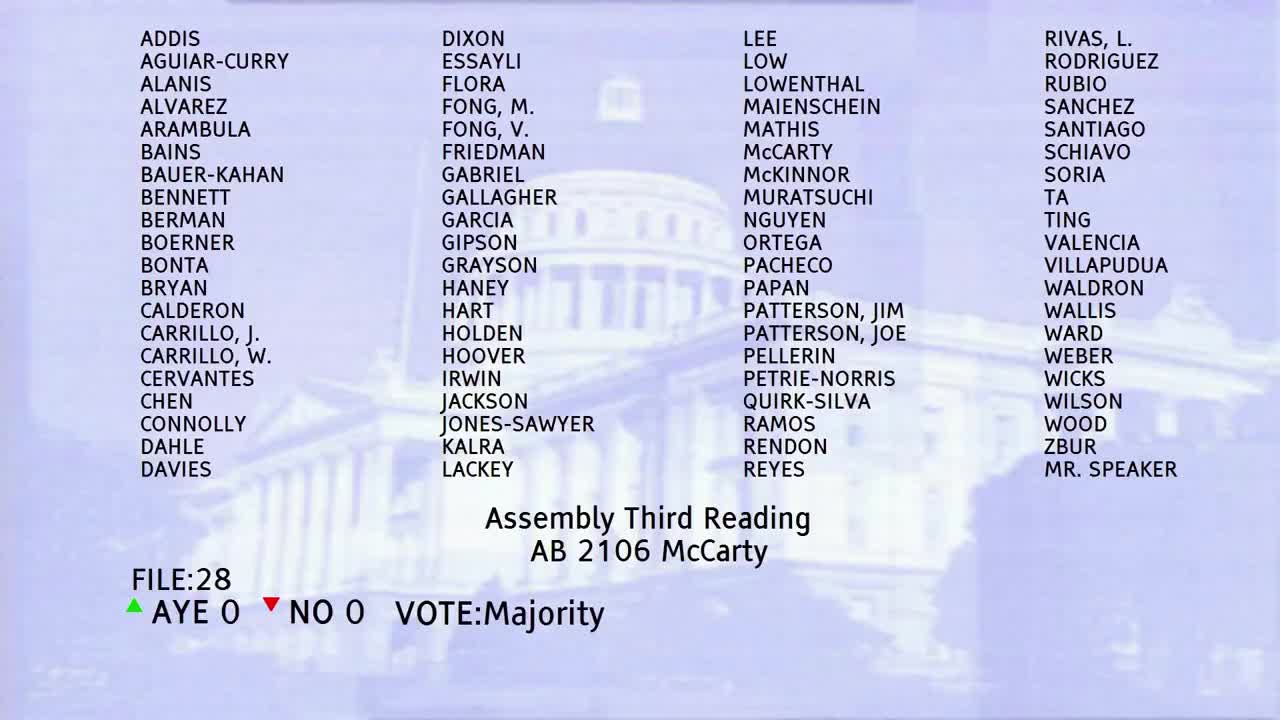
Bill Author

Bill Co-Author(s):