AB 2599: Water: public beaches: discontinuation of residential water service.
- Session Year: 2023-2024
- House: Assembly
- Latest Version Date: 2024-09-22
Current Status:
Passed
(2024-09-22: Chaptered by Secretary of State - Chapter 411, Statutes of 2024.)
Introduced
In Committee
First Chamber
In Committee
Second Chamber
Enacted
Existing law requires the State Department of Public Health, by regulation, to establish, maintain, and amend as necessary minimum standards for the sanitation of public beaches, as provided. Existing law requires the regulations to do certain things, including requiring the testing of the waters adjacent to all public beaches for microbiological contaminants, as provided. Existing law authorizes a local health officer to meet the testing requirements by utilizing test results from other parties conducting microbiological contamination testing of the waters under their jurisdiction.
This bill would provide that the local health officer may only rely on data from test results from other parties if that data meets the same quality requirements that apply to local agencies pursuant to specified regulations and standards. The bill would also require that test results used by the local health officer be made available to the public.
Existing law requires a health officer having jurisdiction over an area in which a public beach is created to do certain things, including, in the event of a known untreated sewage release, immediately test the waters adjacent to the public beach and take certain actions and, in the event of an untreated sewage release that is known to have reached recreational waters adjacent to a public beach, immediately close those waters until it has been determined by the local health officer that the waters are in compliance with specified standards.
This bill would authorize the health officer to meet the requirements described above by using test results from other parties that have conducted microbiological contamination testing of the waters under the health officers jurisdiction, as provided. The bill would provide that the local health officer may only rely on data from test results from other parties if that data meets the same quality requirements that apply to local agencies pursuant to specified regulations and standards. The bill would also require that test results used by the local health officer be made available to the public.
Existing law, the Water Shutoff Protection Act, authorizes the Attorney General, at the request of the State Water Resources Control Board or upon the Attorney Generals own motion, to bring an action in state court to, among other things, restore to any person in interest any money or property, real or personal, that may have been acquired by any method, act, or practice prohibited by the act.
This bill would instead authorize the Attorney General, at the request of the board or upon the Attorney Generals own motion, to bring an action in state court to restore to any person in interest any money or real property acquired by any method, act, or practice prohibited by the act. The bill would also state that these provisions do not provide public water systems with authorities not otherwise provided by law.
Existing law requires the State Department of Public Health, by regulation, to establish, maintain, and amend as necessary minimum standards for the sanitation of public beaches, as provided. Existing law requires the regulations to do certain things, including requiring the testing of the waters adjacent to all public beaches for microbiological contaminants, as provided. Existing law authorizes a local health officer to meet the testing requirements by utilizing test results from other parties conducting microbiological contamination testing of the waters under their jurisdiction.
This bill would provide that the local health officer may only rely on data from test results from other parties if that data meets the same quality requirements that apply to local agencies pursuant to specified regulations and standards. The bill would also require that test results from other parties used by the local health officer be made available to the public.
Existing law requires a health officer having jurisdiction over an area in which a public beach is created to do certain things, including, in the event of a known untreated sewage release, immediately test the waters adjacent to the public beach and take certain actions and, in the event an untreated sewage release that is known to have reached recreational waters adjacent to a public beach, immediately close those waters until it has been determined by the local health officer that the waters are in compliance with specified standards.
This bill would authorize the health officer to meet the requirements described above by using test results from other parties that have conducted microbiological contamination testing of the waters under the health officers jurisdiction, as provided. The bill would provide that the local health officer may only rely on data from test results from other parties if that data meets the same quality requirements that apply to local agencies pursuant to specified regulations and standards. The bill would also require that test results from other parties used by the local health officer be made available to the public.
Existing law, the Water Shutoff Protection Act, authorizes the Attorney General, at the request of the State Water Resources Control Board or upon the Attorney Generals own motion, to bring an action in state court to, among other things, restore to any person in interest any money or property, real or personal, that may have been acquired by any method, act, or practice prohibited by the act.
This bill would instead authorize the Attorney General, at the request of the board or upon the Attorney Generals own motion, to bring an action in state court to restore to any person in interest any money or real property acquired by any method, act, or practice prohibited by the act. The bill would also state that these provisions do not provide public water systems with authorities not otherwise provided by law.
Existing law requires the State Department of Public Health Health, by regulation, to establish, maintain, and amend as necessary minimum standards for the sanitation of public beaches, as provided. Existing law requires the health officer, as defined, having jurisdiction over an area in which a public beach is created to do certain things, including, in the event of a known untreated sewage release, immediately test the waters adjacent to the public beach and, in the event an untreated sewage release that is known to have reached recreational waters adjacent to a public beach, immediately close those waters until it has been determined by the local health officer that the waters are in compliance with the standards. Existing law requires the regulations to do certain things, including requiring the testing of the waters adjacent to all public beaches for microbiological contaminants, as provided. Existing law authorizes a local health officer to meet the testing requirements by utilizing test results from other parties conducting microbiological contamination testing of the waters under their jurisdiction.
This bill would provide that the local health officer may only rely on data from test results from other parties if that data meets the same quality requirements that apply to local agencies pursuant to specified regulations and standards. The bill would also require that test results from other parties used by the local health officer be made available to the public.
Existing law requires a health officer having jurisdiction over an area in which a public beach is created to do certain things, including, in the event of a known untreated sewage release, immediately test the waters adjacent to the public beach and take certain actions and, in the event an untreated sewage release that is known to have reached recreational waters adjacent to a public beach, immediately close those waters until it has been determined by the local health officer that the waters are in compliance with specified standards.
This bill would authorize the health officer to meet the requirements described above by using test results from other parties that have conducted microbiological contamination testing of the waters under the health officers jurisdiction, as provided. The bill would provide that the local health officer may only rely on data from test results from other parties if that data meets the same quality requirements that apply to local agencies pursuant to specified regulations and standards. The bill would also require that test results from other parties used by the local health officer be made available to the public.
Existing law, the Water Shutoff Protection Act, authorizes the Attorney General, at the request of the State Water Resources Control Board or upon the Attorney Generals own motion, to bring an action in state court to, among other things, restore to any person in interest any money or property, real or personal, that may have been acquired by any method, act, or practice prohibited by the act.
This bill would instead authorize the Attorney General, at the request of the board or upon the Attorney Generals own motion, to bring an action in state court to restore to any person in interest any money or real property acquired by any method, act, or practice prohibited by the act. The bill would also state that these provisions do not provide public water systems with authorities not otherwise provided by law.
Existing law requires the State Department of Public Health to establish, maintain, and amend as necessary minimum standards for the sanitation of public beaches, as provided. Existing law requires the health officer, as defined, having jurisdiction over an area in which a public beach is created to do certain things, including, in the event of a known untreated sewage release, immediately test the waters adjacent to the public beach and, in the event an untreated sewage release that is known to have reached recreational waters adjacent to a public beach, immediately close those waters until it has been determined by the local health officer that the waters are in compliance with the standards.
This bill would authorize the health officer to meet the requirements described above by using test results from other parties that have conducted microbiological contamination testing of the waters under the health officers jurisdiction, as provided.
(a)The department shall, by regulation and in consultation with the board, local health officers, and the public, establish, maintain, and amend as necessary, minimum standards for the sanitation of public beaches, including, but not limited to, the removal of refuse, as it determines are reasonably necessary for the protection of the public health and safety.
(b)Prior to final adoption or amendment by the department, the regulations and standards required by this section shall undergo an external comprehensive review process similar to the process set forth in Section 57004.
(c)The regulations shall, at a minimum, do all of the following:
(1)Require the testing of the waters adjacent to all public beaches for microbiological contaminants, including, but not limited to, total coliform, fecal coliform, and enterococci bacteria. The department may require the testing of waters adjacent to all public beaches for microbiological indicators other than those set forth in this paragraph, or a subset of those set forth in this paragraph, if the department affirmatively establishes, based on the best available scientific studies and the weight of the evidence, that the alternative indicators are as protective of the public health.
(2)Establish protective minimum standards for total coliform, fecal coliform, and enterococci bacteria, or for other microbiological indicators that the department determines are appropriate for testing pursuant to paragraph (1).
(3)Require that the waters adjacent to public beaches are tested for total coliform, fecal coliform, and enterococci bacteria, or for other microbiological indicators that the department determines are appropriate for testing pursuant to paragraph (1). Except as set forth in subdivision (e), testing shall be conducted on at least a weekly basis from April 1 to October 31, inclusive, of each year beginning in 2012, if both of the following apply:
(A)The beach is visited by more than 50,000 people annually.
(B)The beach is located on an area adjacent to a storm drain that flows in the summer.
(d)Notwithstanding subdivision (a), if a local health officer demonstrates or has demonstrated through side-by-side testing over a beach season that the use of United States Environmental Protection Agency method 1609 or 1611, or any equivalent or improved rapid detection method published by the United States Environmental Protection Agency for use in beach water quality assessment or approved as an alternative test procedure pursuant to Part 136 of Title 40 of the Code of Federal Regulations, to determine the level of enterococci bacteria as a single indicator provides a reliable indication of overall microbiological contamination conditions at one or more beach locations within that health officers jurisdiction, the department may authorize the use of that testing method at those beach locations instead of other testing methods. In making that determination, the department shall take into account whether an alternative indicator or subset of indicators, with the associated test method, can provide results more quickly, thereby reducing the period of time the public is at risk while waiting for contamination to be confirmed.
(e)The monitoring frequency and locations established pursuant to this section and related regulations may be reduced or altered only after the testing required pursuant to paragraph (3) of subdivision (c) reveals levels of microbiological contaminants that do not exceed, for a period of two years, the minimum protective standards established pursuant to this section.
(f)The local health officer is responsible for testing the waters adjacent to, and coordinating the testing of, all public beaches within their jurisdiction.
(g)(1)The local health officer may meet the testing requirements of this section by utilizing test results from other parties conducting microbiological contamination testing of the waters under their jurisdiction.
(2)Test results used by the local health officer shall be made available to the public.
(3)A local health officer may only rely on data from test results from other parties if that data meets the same quality requirements that apply to local agencies pursuant to regulations and standards established pursuant to this section and Section 115881.
(h)This section does not require a wastewater treatment agency or other party conducting microbiological contamination testing of the waters under the local health officers jurisdiction, who provides those test results to a local health officer pursuant to this section, to use United States Environmental Protection Agency method 1609 or 1611, or any equivalent or improved rapid detection method published by the United States Environmental Protection Agency for use in beach water quality assessment or approved as an alternative test procedure pursuant to Part 136 of Title 40 of the Code of Federal Regulations, for total maximum daily load implementation, waste discharge requirements, or other monitoring programs required to be implemented pursuant to Division 7 (commencing with Section 13000) of the Water Code.
(i)Any city or county may adopt standards for the sanitation of public beaches within its jurisdiction that are stricter than the standards adopted by the department pursuant to this section.
SEC. 2.Section 115885 of the Health and Safety Code is amended to read:115885.(a)(1)A health officer having jurisdiction over an area in which a public beach is created shall do all of the following:
(A)Inspect the public beach to determine whether the public beach is in compliance with the standards established pursuant to Section 115880. If the health officer finds a violation of the standards, the health officer may restrict the use of, or close, the public beach or portion of the public beach in which the violation occurs until the public beach is in compliance with the standards.
(B)Investigate a complaint of a violation of a standard established by the department pursuant to Section 115880. If the health officer finds a violation of the standards prescribed by the department, the health officer may restrict the use of, or close, the public beach or portion of the public beach until the public beach is in compliance with the standard. If the person who made the complaint is not satisfied with the action taken by the health officer, the person may report the violation to the department. The department shall investigate the reported violation, and, if it finds that the violation exists, it may restrict the use of or close the public beach or portion of the public beach until the public beach is in compliance with the violated standard.
(C)If a beach is posted, closed, or otherwise restricted in accordance with Section 115915, inform the agency responsible for the operation and maintenance of the public beach within 24 hours of the posting, closure, or restriction.
(D)Establish a telephone hotline to inform the public of all beaches currently closed, posted, or otherwise restricted. The hotline shall be updated as needed in order to convey changes in public health risks.
(E)Report a violation of the standards established pursuant to Section 115880 to the district attorney, or if the violation occurred in a city and, pursuant to Section 41803.5 of the Government Code, the city attorney is authorized to prosecute misdemeanors, to the city attorney.
(F)In the event of a known untreated sewage release, immediately test the waters adjacent to the public beach and to take action pursuant to regulations established under Sections 115880 and 115881.
(G)Notwithstanding any other law, in the event of an untreated sewage release that is known to have reached recreational waters adjacent to a public beach, immediately close those waters until it has been determined by the local health officer that the waters are in compliance with the standards established pursuant to Section 115880.
(2)(A)The health officer may meet the requirements of subparagraphs (F) and (G) of paragraph (1) by using test results from other parties that have conducted microbiological contamination testing of the waters under the health officers jurisdiction. The sharing of data between these parties pursuant to this paragraph shall be voluntary. The development of data-sharing protocols shall be at the discretion of these parties.
(B)Test results used by the local health officer shall be made available to the public.
(C)A local health officer may only rely on data from test results from other parties if that data meets the same quality requirements that apply to local agencies pursuant to regulations and standards established pursuant to Sections 115880 and 115881.
(b)If the department is aware of an untreated sewage release that has reached recreational waters adjacent to a public beach, and that the local health officer has not taken action to close the beach, it may take action to close those waters until the waters are in compliance.
(c)Any duty imposed upon a local public officer or agency pursuant to this section shall be mandatory only during a fiscal year in which the Legislature has appropriated sufficient funds, as determined by the State Public Health Officer, in the annual Budget Act or otherwise for local agencies to cover the costs to those agencies associated with the performance of these duties. The State Public Health Officer shall annually, within 15 days after enactment of the Budget Act, file a written statement with the Secretary of the Senate and with the Chief Clerk of the Assembly memorializing whether sufficient funds have been appropriated.
SEC. 3.Section 116920 of the Health and Safety Code is amended to read:116920.(a)The Attorney General, at the request of the board or upon the Attorney Generals own motion, may bring an action in state court to do either of the following:
(1)Restrain by temporary or permanent injunction the use of any method, act, or practice declared in this chapter to be unlawful.
(2)Restore to any person in interest any money or real property acquired by any method, act, or practice declared by this chapter to be unlawful.
(b)For a covered water system regulated by the Public Utilities Commission, the commission may bring an action in state court to restrain by temporary or permanent injunction the use by a covered water system regulated by the commission of any method, act, or practice declared in this chapter to be unlawful.
(c)Nothing in this section provides public water systems with authorities not otherwise provided to those systems by law.
(a)The department shall, by regulation and in consultation with the board, local health officers, and the public, establish, maintain, and amend as necessary, minimum standards for the sanitation of public beaches, including, but not limited to, the removal of refuse, as it determines are reasonably necessary for the protection of the public health and safety.
(b)Prior to final adoption or amendment by the department, the regulations and standards required by this section shall undergo an external comprehensive review process similar to the process set forth in Section 57004.
(c)The regulations shall, at a minimum, do all of the following:
(1)Require the testing of the waters adjacent to all public beaches for microbiological contaminants, including, but not limited to, total coliform, fecal coliform, and enterococci bacteria. The department may require the testing of waters adjacent to all public beaches for microbiological indicators other than those set forth in this paragraph, or a subset of those set forth in this paragraph, if the department affirmatively establishes, based on the best available scientific studies and the weight of the evidence, that the alternative indicators are as protective of the public health.
(2)Establish protective minimum standards for total coliform, fecal coliform, and enterococci bacteria, or for other microbiological indicators that the department determines are appropriate for testing pursuant to paragraph (1).
(3)Require that the waters adjacent to public beaches are tested for total coliform, fecal coliform, and enterococci bacteria, or for other microbiological indicators that the department determines are appropriate for testing pursuant to paragraph (1). Except as set forth in subdivision (e), testing shall be conducted on at least a weekly basis from April 1 to October 31, inclusive, of each year beginning in 2012, if both of the following apply:
(A)The beach is visited by more than 50,000 people annually.
(B)The beach is located on an area adjacent to a storm drain that flows in the summer.
(d)Notwithstanding subdivision (a), if a local health officer demonstrates or has demonstrated through side-by-side testing over a beach season that the use of United States Environmental Protection Agency method 1609 or 1611, or any equivalent or improved rapid detection method published by the United States Environmental Protection Agency for use in beach water quality assessment or approved as an alternative test procedure pursuant to Part 136 of Title 40 of the Code of Federal Regulations, to determine the level of enterococci bacteria as a single indicator provides a reliable indication of overall microbiological contamination conditions at one or more beach locations within that health officers jurisdiction, the department may authorize the use of that testing method at those beach locations instead of other testing methods. In making that determination, the department shall take into account whether an alternative indicator or subset of indicators, with the associated test method, can provide results more quickly, thereby reducing the period of time the public is at risk while waiting for contamination to be confirmed.
(e)The monitoring frequency and locations established pursuant to this section and related regulations may be reduced or altered only after the testing required pursuant to paragraph (3) of subdivision (c) reveals levels of microbiological contaminants that do not exceed, for a period of two years, the minimum protective standards established pursuant to this section.
(f)The local health officer is responsible for testing the waters adjacent to, and coordinating the testing of, all public beaches within their jurisdiction.
(g)(1)The local health officer may meet the testing requirements of this section by utilizing test results from other parties conducting microbiological contamination testing of the waters under their jurisdiction.
(2)Test results from other parties used by the local health officer shall be made available to the public.
(3)A local health officer may only rely on data from test results from other parties if that data meets the same quality requirements that apply to local agencies pursuant to regulations and standards established pursuant to this section and Section 115881.
(h)This section does not require a wastewater treatment agency or other party conducting microbiological contamination testing of the waters under the local health officers jurisdiction, who provides those test results to a local health officer pursuant to this section, to use United States Environmental Protection Agency method 1609 or 1611, or any equivalent or improved rapid detection method published by the United States Environmental Protection Agency for use in beach water quality assessment or approved as an alternative test procedure pursuant to Part 136 of Title 40 of the Code of Federal Regulations, for total maximum daily load implementation, waste discharge requirements, or other monitoring programs required to be implemented pursuant to Division 7 (commencing with Section 13000) of the Water Code.
(i)Any city or county may adopt standards for the sanitation of public beaches within its jurisdiction that are stricter than the standards adopted by the department pursuant to this section.
SEC. 2.Section 115885 of the Health and Safety Code is amended to read:115885.(a)(1)A health officer having jurisdiction over an area in which a public beach is created shall do all of the following:
(A)Inspect the public beach to determine whether the public beach is in compliance with the standards established pursuant to Section 115880. If the health officer finds a violation of the standards, the health officer may restrict the use of, or close, the public beach or portion of the public beach in which the violation occurs until the public beach is in compliance with the standards.
(B)Investigate a complaint of a violation of a standard established by the department pursuant to Section 115880. If the health officer finds a violation of the standards prescribed by the department, the health officer may restrict the use of, or close, the public beach or portion of the public beach until the public beach is in compliance with the standard. If the person who made the complaint is not satisfied with the action taken by the health officer, the person may report the violation to the department. The department shall investigate the reported violation, and, if it finds that the violation exists, it may restrict the use of or close the public beach or portion of the public beach until the public beach is in compliance with the violated standard.
(C)If a beach is posted, closed, or otherwise restricted in accordance with Section 115915, inform the agency responsible for the operation and maintenance of the public beach within 24 hours of the posting, closure, or restriction.
(D)Establish a telephone hotline to inform the public of all beaches currently closed, posted, or otherwise restricted. The hotline shall be updated as needed in order to convey changes in public health risks.
(E)Report a violation of the standards established pursuant to Section 115880 to the district attorney, or if the violation occurred in a city and, pursuant to Section 41803.5 of the Government Code, the city attorney is authorized to prosecute misdemeanors, to the city attorney.
(F)In the event of a known untreated sewage release, immediately test the waters adjacent to the public beach and to take action pursuant to regulations established under Sections 115880 and 115881.
(G)Notwithstanding any other law, in the event of an untreated sewage release that is known to have reached recreational waters adjacent to a public beach, immediately close those waters until it has been determined by the local health officer that the waters are in compliance with the standards established pursuant to Section 115880.
(2)(A)The health officer may meet the requirements of subparagraphs (F) and (G) of paragraph (1) by using test results from other parties that have conducted microbiological contamination testing of the waters under the health officers jurisdiction. The sharing of data between these parties pursuant to this paragraph shall be voluntary. The development of data-sharing protocols shall be at the discretion of these parties.
(B)Test results from other parties used by the local health officer shall be made available to the public.
(C)A local health officer may only rely on data from test results from other parties if that data meets the same quality requirements that apply to local agencies pursuant to regulations and standards established pursuant to Sections 115880 and 115881.
(b)If the department is aware of an untreated sewage release that has reached recreational waters adjacent to a public beach, and that the local health officer has not taken action to close the beach, it may take action to close those waters until the waters are in compliance.
(c)Any duty imposed upon a local public officer or agency pursuant to this section shall be mandatory only during a fiscal year in which the Legislature has appropriated sufficient funds, as determined by the State Public Health Officer, in the annual Budget Act or otherwise for local agencies to cover the costs to those agencies associated with the performance of these duties. The State Public Health Officer shall annually, within 15 days after enactment of the Budget Act, file a written statement with the Secretary of the Senate and with the Chief Clerk of the Assembly memorializing whether sufficient funds have been appropriated.
SEC. 3.Section 116920 of the Health and Safety Code is amended to read:116920.(a)The Attorney General, at the request of the board or upon the Attorney Generals own motion, may bring an action in state court to do either of the following:
(1)Restrain by temporary or permanent injunction the use of any method, act, or practice declared in this chapter to be unlawful.
(2)Restore to any person in interest any money or real property acquired by any method, act, or practice declared by this chapter to be unlawful.
(b)For a covered water system regulated by the Public Utilities Commission, the commission may bring an action in state court to restrain by temporary or permanent injunction the use by a covered water system regulated by the commission of any method, act, or practice declared in this chapter to be unlawful.
(c)Nothing in this section provides public water systems with authorities not otherwise provided to those systems by law.
(a)The department shall, by regulation and in consultation with the board, local health officers, and the public, establish, maintain, and amend as necessary, minimum standards for the sanitation of public beaches, including, but not limited to, the removal of refuse, as it determines are reasonably necessary for the protection of the public health and safety.
(b)Prior to final adoption or amendment by the department, the regulations and standards required by this section shall undergo an external comprehensive review process similar to the process set forth in Section 57004.
(c)The regulations shall, at a minimum, do all of the following:
(1)Require the testing of the waters adjacent to all public beaches for microbiological contaminants, including, but not limited to, total coliform, fecal coliform, and enterococci bacteria. The department may require the testing of waters adjacent to all public beaches for microbiological indicators other than those set forth in this paragraph, or a subset of those set forth in this paragraph, if the department affirmatively establishes, based on the best available scientific studies and the weight of the evidence, that the alternative indicators are as protective of the public health.
(2)Establish protective minimum standards for total coliform, fecal coliform, and enterococci bacteria, or for other microbiological indicators that the department determines are appropriate for testing pursuant to paragraph (1).
(3)Require that the waters adjacent to public beaches are tested for total coliform, fecal coliform, and enterococci bacteria, or for other microbiological indicators that the department determines are appropriate for testing pursuant to paragraph (1). Except as set forth in subdivision (e), testing shall be conducted on at least a weekly basis from April 1 to October 31, inclusive, of each year beginning in 2012, if both of the following apply:
(A)The beach is visited by more than 50,000 people annually.
(B)The beach is located on an area adjacent to a storm drain that flows in the summer.
(d)Notwithstanding subdivision (a), if a local health officer demonstrates or has demonstrated through side-by-side testing over a beach season that the use of United States Environmental Protection Agency method 1609 or 1611, or any equivalent or improved rapid detection method published by the United States Environmental Protection Agency for use in beach water quality assessment or approved as an alternative test procedure pursuant to Part 136 of Title 40 of the Code of Federal Regulations, to determine the level of enterococci bacteria as a single indicator provides a reliable indication of overall microbiological contamination conditions at one or more beach locations within that health officers jurisdiction, the department may authorize the use of that testing method at those beach locations instead of other testing methods. In making that determination, the department shall take into account whether an alternative indicator or subset of indicators, with the associated test method, can provide results more quickly, thereby reducing the period of time the public is at risk while waiting for contamination to be confirmed.
(e)The monitoring frequency and locations established pursuant to this section and related regulations may be reduced or altered only after the testing required pursuant to paragraph (3) of subdivision (c) reveals levels of microbiological contaminants that do not exceed, for a period of two years, the minimum protective standards established pursuant to this section.
(f)The local health officer is responsible for testing the waters adjacent to, and coordinating the testing of, all public beaches within his or her their jurisdiction.
(g)(1)The local health officer may meet the testing requirements of this section by utilizing test results from other parties conducting microbiological contamination testing of the waters under his or her their jurisdiction.
(2)Test results from other parties used by the local health officer shall be made available to the public.
(3)A local health officer may only rely on data from test results from other parties if that data meets the same quality requirements that apply to local agencies pursuant to regulations and standards established pursuant to this section and Section 115881.
(h)This section does not require a wastewater treatment agency or other party conducting microbiological contamination testing of the waters under his or her the local health officers jurisdiction, who provides those test results to a local health officer pursuant to this section, to use United States Environmental Protection Agency method 1609 or 1611, or any equivalent or improved rapid detection method published by the United States Environmental Protection Agency for use in beach water quality assessment or approved as an alternative test procedure pursuant to Part 136 of Title 40 of the Code of Federal Regulations, for total maximum daily load implementation, waste discharge requirements, or other monitoring programs required to be implemented pursuant to Division 7 (commencing with Section 13000) of the Water Code.
(i)Any city or county may adopt standards for the sanitation of public beaches within its jurisdiction that are stricter than the standards adopted by the department pursuant to this section.
SECTION 1.SEC. 2.Section 115885 of the Health and Safety Code is amended to read:115885.(a)(1)A health officer having jurisdiction over an area in which a public beach is created shall do all of the following:
(A)Inspect the public beach to determine whether the public beach is in compliance with the standards established pursuant to Section 115880. If the health officer finds a violation of the standards, the health officer may restrict the use of, or close, the public beach or portion of the public beach in which the violation occurs until the public beach is in compliance with the standards.
(B)Investigate a complaint of a violation of a standard established by the department pursuant to Section 115880. If the health officer finds a violation of the standards prescribed by the department, the health officer may restrict the use of, or close, the public beach or portion of the public beach until the public beach is in compliance with the standard. If the person who made the complaint is not satisfied with the action taken by the health officer, the person may report the violation to the department. The department shall investigate the reported violation, and, if it finds that the violation exists, it may restrict the use of or close the public beach or portion of the public beach until the public beach is in compliance with the violated standard.
(C)If a beach is posted, closed, or otherwise restricted in accordance with Section 115915, inform the agency responsible for the operation and maintenance of the public beach within 24 hours of the posting, closure, or restriction.
(D)Establish a telephone hotline to inform the public of all beaches currently closed, posted, or otherwise restricted. The hotline shall be updated as needed in order to convey changes in public health risks.
(E)Report a violation of the standards established pursuant to Section 115880 to the district attorney, or if the violation occurred in a city and, pursuant to Section 41803.5 of the Government Code, the city attorney is authorized to prosecute misdemeanors, to the city attorney.
(F)In the event of a known untreated sewage release, immediately test the waters adjacent to the public beach and to take action pursuant to regulations established under Sections 115880 and 115881.
(G)Notwithstanding any other law, in the event of an untreated sewage release that is known to have reached recreational waters adjacent to a public beach, immediately close those waters until it has been determined by the local health officer that the waters are in compliance with the standards established pursuant to Section 115880.
(2)(A)The health officer may meet the requirements of subparagraphs (F) and (G) of paragraph (1) by using test results from other parties that have conducted microbiological contamination testing of the waters under the health officers jurisdiction. The sharing of data by between these parties pursuant to this paragraph shall be voluntary. The development of data-sharing protocols shall be at the discretion of these parties.
(B)Test results from other parties used by the local health officer shall be made available to the public.
(C)A local health officer may only rely on data from test results from other parties if that data meets the same quality requirements that apply to local agencies pursuant to regulations and standards established pursuant to Sections 115880 and 115881.
(b)If the department is aware of an untreated sewage release that has reached recreational waters adjacent to a public beach, and that the local health officer has not taken action to close the beach, it may take action to close those waters until the waters are in compliance.
(c)Any duty imposed upon a local public officer or agency pursuant to this section shall be mandatory only during a fiscal year in which the Legislature has appropriated sufficient funds, as determined by the State Public Health Officer, in the annual Budget Act or otherwise for local agencies to cover the costs to those agencies associated with the performance of these duties. The State Public Health Officer shall annually, within 15 days after enactment of the Budget Act, file a written statement with the Secretary of the Senate and with the Chief Clerk of the Assembly memorializing whether sufficient funds have been appropriated.
SEC. 2.SEC. 3.Section 116920 of the Health and Safety Code is amended to read:116920.(a)The Attorney General, at the request of the board or upon the Attorney Generals own motion, may bring an action in state court to do either of the following:
(1)Restrain by temporary or permanent injunction the use of any method, act, or practice declared in this chapter to be unlawful.
(2)Restore to any person in interest any money or real property acquired by any method, act, or practice declared by this chapter to be unlawful.
(b)For a covered water system regulated by the Public Utilities Commission, the commission may bring an action in state court to restrain by temporary or permanent injunction the use by a covered water system regulated by the commission of any method, act, or practice declared in this chapter to be unlawful.
(c)Nothing in this section provides public water systems with authorities not otherwise provided to those systems by law.
(a)(1)A health officer having jurisdiction over an area in which a public beach is created shall do all of the following:
(A)Inspect the public beach to determine whether the public beach is in compliance with the standards established pursuant to Section 115880. If the health officer finds a violation of the standards, the health officer may restrict the use of, or close, the public beach or portion of the public beach in which the violation occurs until the public beach is in compliance with the standards.
(B)Investigate a complaint of a violation of a standard established by the department pursuant to Section 115880. If the health officer finds a violation of the standards prescribed by the department, the health officer may restrict the use of, or close, the public beach or portion of the public beach until the public beach is in compliance with the standard. If the person who made the complaint is not satisfied with the action taken by the health officer, the person may report the violation to the department. The department shall investigate the reported violation, and, if it finds that the violation exists, it may restrict the use of or close the public beach or portion of the public beach until the public beach is in compliance with the violated standard.
(C)If a beach is posted, closed, or otherwise restricted in accordance with Section 115915, inform the agency responsible for the operation and maintenance of the public beach within 24 hours of the posting, closure, or restriction.
(D)Establish a telephone hotline to inform the public of all beaches currently closed, posted, or otherwise restricted. The hotline shall be updated as needed in order to convey changes in public health risks.
(E)Report a violation of the standards established pursuant to Section 115880 to the district attorney, or if the violation occurred in a city and, pursuant to Section 41803.5 of the Government Code, the city attorney is authorized to prosecute misdemeanors, to the city attorney.
(F)In the event of a known untreated sewage release, immediately test the waters adjacent to the public beach and to take action pursuant to regulations established under Sections 115880 and 115881.
(G)Notwithstanding any other law, in the event of an untreated sewage release that is known to have reached recreational waters adjacent to a public beach, immediately close those waters until it has been determined by the local health officer that the waters are in compliance with the standards established pursuant to Section 115880.
(2)The health officer may meet the requirements of subparagraphs (F) and (G) of paragraph (1) by using test results from other parties that have conducted microbiological contamination testing of the waters under the health officers jurisdiction. The sharing of data by these parties pursuant to this paragraph shall be voluntary. The development of data-sharing protocols shall be at the discretion of these parties.
(b)If the department is aware of an untreated sewage release that has reached recreational waters adjacent to a public beach, and that the local health officer has not taken action to close the beach, it may take action to close those waters until the waters are in compliance.
(c)Any duty imposed upon a local public officer or agency pursuant to this section shall be mandatory only during a fiscal year in which the Legislature has appropriated sufficient funds, as determined by the State Public Health Officer, in the annual Budget Act or otherwise for local agencies to cover the costs to those agencies associated with the performance of these duties. The State Public Health Officer shall annually, within 15 days after enactment of the Budget Act, file a written statement with the Secretary of the Senate and with the Chief Clerk of the Assembly memorializing whether sufficient funds have been appropriated.
SEC. 2.Section 116920 of the Health and Safety Code is amended to read:116920.(a)The Attorney General, at the request of the board or upon the Attorney Generals own motion, may bring an action in state court to do either of the following:
(1)Restrain by temporary or permanent injunction the use of any method, act, or practice declared in this chapter to be unlawful.
(2)Restore to any person in interest any money or property, real or personal, that may have been real property acquired by any method, act, or practice declared by this chapter to be unlawful.
(b)For a covered water system regulated by the Public Utilities Commission, the commission may bring an action in state court to restrain by temporary or permanent injunction the use by a covered water system regulated by the commission of any method, act, or practice declared in this chapter to be unlawful.
(c)Nothing in this section provides public water systems with authorities not otherwise provided to those systems by law.
(a)The (1)A health officer having jurisdiction over the an area in which a public beach is created shall: shall do all of the following:
(1)(A)Inspect the public beach to determine whether the public beach is in compliance with the standards established pursuant to Section 115880 are being complied with. 115880. If the health officer finds any a violation of the standards, he or she the health officer may restrict the use of, or close, the public beach or portion thereof of the public beach in which the violation occurs until the standard is complied with. public beach is in compliance with the standards.
(2)(B)Investigate any a complaint of a violation of any a standard established by the department pursuant to Section 115880. If the health officer finds any a violation of the standards prescribed by the department, he or she the health officer may restrict the use of, or close, the public beach or portion thereof of the public beach until the standard is complied with. public beach is in compliance with the standard. If the person who made the complaint is not satisfied with the action taken by the health officer, he or she the person may report the violation to the department. The department shall investigate the reported violation, and, if it finds that the violation exists, it may restrict the use of or close the public beach or portion thereof of the public beach until the standard violated is complied with. public beach is in compliance with the violated standard.
(3)Whenever(C)If a beach is posted, closed, or otherwise restricted in accordance with Section 115915, inform the agency responsible for the operation and maintenance of the public beach within 24 hours of the posting, closure, or restriction.
(4)(D)Establish a telephone hotline to inform the public of all beaches currently closed, posted, or otherwise restricted. The hotline shall be updated as needed in order to convey changes in public health risks.
(5)(E)Report any a violation of the standards established pursuant to Section 115880 to the district attorney, or if the violation occurred in a city and, pursuant to Section 41803.5 of the Government Code, the city attorney is authorized to prosecute misdemeanors, to the city attorney.
(6)(F)In the event of a known untreated sewage release, immediately test the waters adjacent to the public beach and to take action pursuant to regulations established under Sections 115880 and 115881.
(7)(G)Notwithstanding any other provision of law, in the event of an untreated sewage release that is known to have reached recreational waters adjacent to a public beach, immediately close those waters until it has been determined by the local health officer that the waters are in compliance with the standards established pursuant to Section 115880.
(2)The health officer may meet the requirements of subparagraphs (F) and (G) of paragraph (1) by using test results from other parties that have conducted microbiological contamination testing of the waters under the health officers jurisdiction. The sharing of data by these parties pursuant to this paragraph shall be voluntary. The development of data-sharing protocols shall be at the discretion of these parties.
(b)If the department is aware of an untreated sewage release that has reached recreational waters adjacent to a public beach, and that the local health officer has not taken action to close the beach, it may take action to close those waters until the waters are in compliance.
(c)Any duty imposed upon a local public officer or agency pursuant to this section shall be mandatory only during a fiscal year in which the Legislature has appropriated sufficient funds, as determined by the State Public Health Officer, in the annual Budget Act or otherwise for local agencies to cover the costs to those agencies associated with the performance of these duties. The State Public Health Officer shall annually, within 15 days after enactment of the Budget Act, file a written statement with the Secretary of the Senate and with the Chief Clerk of the Assembly memorializing whether sufficient funds have been appropriated.
|
Date
|
Status
|
|---|---|
| Sep 22, 2024 | Chaptered by Secretary of State - Chapter 411, Statutes of 2024. |
| Sep 22, 2024 | Approved by the Governor. |
| Sep 3, 2024 | Enrolled and presented to the Governor at 3:30 p.m. |
| Aug 26, 2024 | Senate amendments concurred in. To Engrossing and Enrolling. (Ayes 77. Noes 0. Page 6498.). |
| Aug 20, 2024 | In Assembly. Concurrence in Senate amendments pending. May be considered on or after August 22 pursuant to Assembly Rule 77. |
| Aug 19, 2024 | Read third time. Passed. Ordered to the Assembly. (Ayes 40. Noes 0. Page 5207.). |
| Aug 8, 2024 | Read second time. Ordered to third reading. |
| Aug 7, 2024 | Read third time and amended. Ordered to second reading. |
| Aug 5, 2024 | Ordered to third reading. |
| Aug 5, 2024 | From Consent Calendar. |
| Jul 2, 2024 | Read second time. Ordered to Consent Calendar. |
| Jul 1, 2024 | From committee: Be ordered to second reading file pursuant to Senate Rule 28.8 and ordered to Consent Calendar. |
| Jun 20, 2024 | From committee: Do pass and re-refer to Com. on APPR with recommendation: To Consent Calendar. (Ayes 11. Noes 0.) (June 19). Re-referred to Com. on APPR. |
| Jun 5, 2024 | From committee: Do pass and re-refer to Com. on HEALTH with recommendation: To Consent Calendar. (Ayes 7. Noes 0.) (June 5). Re-referred to Com. on HEALTH. |
| May 21, 2024 | From committee chair, with author's amendments: Amend, and re-refer to committee. Read second time, amended, and re-referred to Com. on E.Q. |
| May 1, 2024 | Referred to Coms. on E.Q. and HEALTH. |
| Apr 18, 2024 | In Senate. Read first time. To Com. on RLS. for assignment. |
| Apr 18, 2024 | Read third time. Passed. Ordered to the Senate. (Ayes 72. Noes 0.) |
| Apr 11, 2024 | Read second time. Ordered to Consent Calendar. |
| Apr 10, 2024 | From committee: Do pass. To Consent Calendar. (Ayes 14. Noes 0.) (April 10). |
| Mar 19, 2024 | From committee: Do pass and re-refer to Com. on APPR. with recommendation: To Consent Calendar. (Ayes 7. Noes 0.) (March 19). Re-referred to Com. on APPR. |
| Mar 7, 2024 | Re-referred to Com. on E.S. & T.M. |
| Mar 6, 2024 | From committee chair, with author's amendments: Amend, and re-refer to Com. on E.S. & T.M. Read second time and amended. |
| Mar 4, 2024 | Referred to Com. on E.S. & T.M. |
| Feb 15, 2024 | From printer. May be heard in committee March 16. |
| Feb 14, 2024 | Read first time. To print. |
|
Date
|
Description
|
Location
|
Votes
|
|
|---|---|---|---|---|
| Aug 26, 2024 | AB 2599 Environmental Safety and Concurrence in Senate Amendments By GARCIA | Assembly Floor |
Passed |
|
| Aug 19, 2024 | Assembly 3rd Reading AB2599 E.S. & T.M. (Garcia) By Allen | Senate Floor |
Passed |
|
| Jun 19, 2024 | Do pass, but first be re-referred to the Committee on [Appropriations] with the recommendation: To Consent Calendar | Senate Standing Committee on Health |
Passed |
|
| Jun 5, 2024 | Do pass, but first be re-referred to the Committee on [Health] with the recommendation: To Consent Calendar | Senate Standing Committee on Environmental Quality |
Passed |
|
| Apr 18, 2024 | AB 2599 Environmental Safety and Toxic Materials Consent Calendar Second Day Regular Session | Assembly Floor |
Passed |
|
| Apr 10, 2024 | Do pass. To Consent Calendar. | Assembly Standing Committee on Appropriations |
Passed |
|
| Mar 19, 2024 | Do pass and be re-referred to the Committee on [Appropriations] with recommendation: To Consent Calendar | Assembly Standing Committee on Environmental Safety and Toxic Materials |
Passed |
This list shows positions taken on this bill by organizations on the date displayed, which is linked to the original source.
Positions by individuals are not included.
|
Organization
|
Position
|
Date
|
|---|---|---|
| Association Of California Water Agencies | ** Support | |
| California Academy of Preventive Medicine | ** Support | |
| California Association Of Professional Scientists | ** Support | |
| Junior Philanthropist Foundation | ** Support | |
| Los Angeles County Sanitation Districts | ** Support |
CONCURRENCE IN SENATE AMENDMENTS
CSA1 Bill Id:AB 2599
Author:(Committee on Environmental Safety and Toxic Materials)
As Amended Ver:August 7, 2024
Majority vote
SUMMARY
Authorizes a local health officer, in the event of a known untreated sewage release, to use test results from other parties conducting microbiological contamination testing, to satisfy the testing requirements for beach water quality. Specifies that test results shall be available to the public and shall meet the same requirements that apply to local agencies under state law and regulation. Makes a technical change to the Water Shutoff Protection Act (Act).
Senate Amendments
- Specify that test results used by a local health officer to satisfy requirements for a known untreated sewage release or when determining the quality of water at public beaches, shall be available to the public.
- Specify that a local health officer may only use data to satisfy the requirements of a known untreated sewage release or the quality of water at a public beach, if that data meets the same requirements that apply to local agencies pursuant to regulations and state law.
COMMENTS
California's beach water quality: According to the State Water Resources Control Board (State Water Board), California has some of the most popular beaches in the country. More than 150 million day visits are generated annually by tourists and residents who use beaches annually to recreate. Beach water quality monitoring and strong pollution prevention measures are critical for protecting beach goers from waterborne diseases.
The State Water Board notes that California has the most extensive and comprehensive monitoring and regulatory program for beaches in the nation. The vast majority of the time, California beaches are open and available for the recreation their visitors enjoy. Unfortunately, there are times when it is not advisable to go in to coastal waters due to bacterial contamination. Local health agencies are responsible for issuing advisories (postings) and closures when the results of testing indicate that one or more bacterial levels exceed water quality standards.
California's beach water quality efforts: California's statewide beach program includes several components aimed at ocean water quality. Assembly Bill (AB) 411 (Wayne, Chapter 765, Statutes of 1997) enacted the California Clean Beaches Program, which is the state's coastal beach monitoring, reporting, posting, and closing program. AB 411 requires CDPH (the program has since been transferred to the State Water Board) to promulgate regulations that require the monitoring of water adjacent to public beaches (those with storm drains that discharge during dry weather and are visited by more than 50,000 people per year) at least weekly during the dry season (historically April through October), for microbiological contaminations, including total coliform, fecal coliform, and enterococci bacteria. AB 411 also requires the regulations to establish protocols for determining the location of monitoring sites and monitoring frequency based on risks to public health, and for public notification of health hazards, including posting, closing, and reopening of public beaches. This program is implemented by the local health officer or environmental health agency of a coastal county or city, and is limited by statute to ocean beaches.
State Water Board authority over sewer systems: To provide a consistent, statewide regulatory approach to address sanitary sewer spills, the State Water Board adopted a General Order for Waste Discharge Requirements for Sanitary Sewer Systems (General Order). The General Order requires public agencies that own or operate sanitary sewer systems to develop and implement sewer system management plans and report all sanitary sewer spills to the State Water Board's online California Integrated Water Quality System Sanitary Sewer System Database. Among the requirements of the General Order are requirements to monitor, track, and analyze spills for ongoing system-specific performance.
This bill: AB 2599 authorizes a local health officer to use testing data taken by a local sewer system for the same purpose and using the same testing protocols. This sharing of testing data by agencies, including the local health officers, currently exists for non-sewage spills (HSC § 115880 (g)) and this bill mirrors that existing authority. This bill specifies that test results shall be available to the public and shall meet the same requirements that apply to local agencies under state law and regulation.
Water Shutoff Protection Act (Act): SB 998 (Dodd, Chapter 891, Statutes of 2018) requires all public water systems (with more than 200 connections) to have a written policy on the discontinuation of residential water service and to provide that policy in multiple languages. SB 998 prohibits a public water system from shutting off water for those customers that can demonstrate that losing water service will be life threatening; the customer is unable to pay during the water system's normal billing cycle; and if the customer is willing to enter into a payment schedule for all delinquent charges.
In 2023, SB 3 (Dodd, Chapter 855, Statutes of 2023) was introduced to amend the Act and make it apply to community water systems with less than 200 connections. SB 3 contained a restitution provision that authorized the Attorney General (A.G.), at the request of the State Water Board, or upon the A.G.'s own motion to restore any person in interest any money or property, real or personal that may have been acquired by any method, act, or practice declared by the Act to be unlawful. However, it was discovered that water systems do not have the authority to acquire personal property from their customers. Therefore, discussions took place to amend this provision of SB 3. Unfortunately, by the time an agreement on language was reached, the time to amend the bill had run out.
This bill: AB 2599 contains the agreed upon technical changes to SB 3.
According to the Author
"Existing laws and regulations require both local public health officers and publicly owned sanitary sewer systems to sample and test affected beach waters after a sanitary sewer spill. Beaches closed due to a spill need to meet water quality standards through monitoring conducted by a local public health officer before they can be reopened. However, the current interpretation of these requirements does not allow local public health officials to use test results from other sources (including other public agencies) to reopen beaches. Assembly Bill (AB) 2599 would allow a local health officer to use testing data taken by a local sewer system for the same purpose and using the same testing protocols. It’s also important to note that the authority to share testing data by agencies, including the local health officers, currently exists for non-sewage spills (HSC Section 115880 (g)) and AB 2599 mirrors that existing authority."
Arguments in Support
According to the Los Angeles County Sanitation Districts, "In the event of a sanitary sewer overflow, existing laws and regulatory requirements have resulted in both local public health officers and publicly owned sanitary sewer systems collecting samples and testing bacteriological indicators in the water at potentially affected beaches. When a sewer overflow occurs, beaches are closed to prevent potential health hazards by minimizing the risk of waterborne illnesses. The reopening of beaches requires testing to demonstrate that water quality complies with water quality standards, which is usually determined through monitoring conducted by local public health officers. Through a statewide permit for Sanitary Sewer Systems and individual permits issued by some Regional Water Quality Control Boards, publicly owned sanitary sewer systems are also required to conduct monitoring for the same bacteriological indicators in potentially affected receiving waters, leading to some duplication of effort. AB 2599 will clarify the Health and Safety Code by allowing, on a voluntary basis, local public health officers to use the water quality monitoring data generated by other public agencies when making beach reopening decisions, as long as the data meets the public health officers’ testing protocols and data quality requirements. Thus, this bill will encourage collaboration among local agencies and make more effective use of limited public resources."
According to the Association of California Water Agencies (ACWA), "This bill would incorporate agreed-upon, technical amendments to SB 3 (Dodd, 2023), which was enacted last year. ACWA supports AB 2599 and respectfully asks for your 'AYE' vote when the Assembly Environmental Safety and Toxic Materials Committee hears the bill."
Arguments in Opposition
None on file.
FISCAL COMMENTS
According to the Assembly Appropriations Committee, enactment of this bill could have minor and absorbable costs to the State Water Board and the Department of Justice.
VOTES:
ASM ENVIRONMENTAL SAFETY AND TOXIC MATERIALS: 7-0-0
YES: Garcia, Hoover, Connolly, McKinnor, Papan, Reyes, Ta
ASM APPROPRIATIONS: 14-0-1
YES: Wicks, Sanchez, Arambula, Bryan, Calderon, Dixon, Mike Fong, Grayson, Haney, Hart, Jim Patterson, Pellerin, Ta, Villapudua
ABS, ABST OR NV: Wendy Carrillo
ASSEMBLY FLOOR: 72-0-8
YES: Addis, Aguiar-Curry, Alanis, Alvarez, Bains, Bauer-Kahan, Bennett, Berman, Calderon, Juan Carrillo, Wendy Carrillo, Chen, Connolly, Davies, Dixon, Flora, Mike Fong, Vince Fong, Friedman, Gabriel, Gallagher, Garcia, Gipson, Grayson, Haney, Hart, Holden, Hoover, Irwin, Jackson, Jones-Sawyer, Kalra, Lackey, Lee, Low, Lowenthal, Maienschein, McCarty, McKinnor, Muratsuchi, Stephanie Nguyen, Ortega, Pacheco, Papan, Jim Patterson, Joe Patterson, Pellerin, Petrie-Norris, Quirk-Silva, Ramos, Rendon, Reyes, Luz Rivas, Rodriguez, Blanca Rubio, Sanchez, Santiago, Schiavo, Soria, Ta, Ting, Valencia, Villapudua, Waldron, Wallis, Ward, Weber, Wicks, Wilson, Wood, Zbur, Robert Rivas
ABS, ABST OR NV: Arambula, Boerner, Bonta, Bryan, Cervantes, Megan Dahle, Essayli, Mathis
SENATE FLOOR: 40-0-0
YES: Allen, Alvarado-Gil, Archuleta, Ashby, Atkins, Becker, Blakespear, Bradford, Caballero, Cortese, Dahle, Dodd, Durazo, Eggman, Glazer, Gonzalez, Grove, Hurtado, Jones, Laird, Limón, McGuire, Menjivar, Min, Newman, Nguyen, Niello, Ochoa Bogh, Padilla, Portantino, Roth, Rubio, Seyarto, Skinner, Smallwood-Cuevas, Stern, Umberg, Wahab, Wiener, Wilk
UPDATED
VERSION: August 7, 2024
CONSULTANT: Josh Tooker / E.S. & T.M. / (916) 319-3965 FN: 0003865
SENATE RULES COMMITTEE Office of Senate Floor Analyses (916) 651-1520 Fax: (916) 327-4478 | AB 2599 |
THIRD READING
Bill No: AB 2599
Author: Committee on Environmental Safety and Toxic Materials
Amended: 8/7/24 in Senate
Vote: 21
SENATE ENVIRONMENTAL QUALITY COMMITTEE: 7-0, 6/5/24
AYES: Gonzalez, Dahle, Hurtado, Laird, Menjivar, Nguyen, Skinner
SENATE HEALTH COMMITTEE: 11-0, 6/19/24
AYES: Roth, Nguyen, Glazer, Gonzalez, Grove, Hurtado, Limón, Menjivar, Rubio, Smallwood-Cuevas, Wiener
SENATE APPROPRIATIONS COMMITTEE: Senate Rule 28.8
ASSEMBLY FLOOR: 72-0, 4/18/24 (Consent) - See last page for vote
SUBJECT: Water: public beaches: discontinuation of residential water service
SOURCE: Author
DIGEST:
This bill authorizes a local health officer, in the event of a known untreated sewage release, to use test results from other parties conducting microbiological contamination testing, to satisfy the testing requirements for beach water quality. Makes a technical change to the Water Shutoff Protection Act.
Senate Floor Amendments of 8/7/24 require all test results used by a local health officer to be made available to the public.
ANALYSIS:
Existing law:
- Provides, under the Porter-Cologne Water Quality Control Act, that the State Water Resources Control Board (State Water Board) and the Regional Water Quality Control Boards are the principal state agencies with regulatory authority over water quality. (Water Code (WC) § 13000 et seq.)
- Requires the California Department of Public Health (CDPH) to, by regulation and in consultation with the State Water Board, local health officers, and the public, establish, maintain, and amend as necessary, minimum standards for the sanitation of public beaches as it determines are reasonably necessary for the protection of the public health and safety (this jurisdiction was later transferred to the State Water Board, see Health and Safety Code (HSC) § 115881). (HSC § 115880 (a))
- Provides, commencing January 1, 2012, that the State Water Board is responsible for all of the beach program requirements, including directing the required monitoring of beaches; establishing and reviewing monitoring protocols, site locations, and monitoring frequencies (in consultation with CDPH and local health officers); and, identifying options for funding beach monitoring. (HSC § 115881)
- Authorizes a local health officer to meet the beach program testing requirements established by the State Water Board by utilizing test results from other parties conducting microbiological contamination testing of the waters under his or her jurisdiction. (HSC § 115880 (g))
- Requires a health officer that has jurisdiction over the area in which a public beach is located, in the event of a known untreated sewage release, to immediately test the waters adjacent to the public beach and to take action under the beach water quality program pursuant to regulations established under HSC Sections 115880 and 115881. (HSC 115885 (a)(6))
- Requires a covered water system that serves 200 or more service connections or a covered water system that serves fewer than 200 water systems, to have a written policy on discontinuation of residential service for nonpayment available in English, the languages listed in Section 1632 of the Civil Code, and any other language spoken by at least 10 percent of the people residing in its service area. (HSC § 116906)
This bill:
- Authorizes a local health officer to use testing data taken by a local sewer system to evaluate water quality and when evaluating whether to reopen a public beach after a sewage spill. Specifies that the sharing of data between parties shall be voluntary.
- Specifies that all test results used by the local health officer shall be made available to the public.
- Stipulates that a local health officer may only rely on data from test results from other parties for both sewer and non-sewer spills if the data meets the same quality requirements pursuant to regulations and standards already in existing law.
- Contains technical and clarifying provisions to existing law:
- Specifies that the Attorney General, at the request of the State Water Board or upon the Attorney General’s own motion, may only restore real property that may have been acquired by any method, act, or practice declared unlawful by the Water Shutoff Protection Act.
- Clarifies that, under the Water Shutoff Protection Act, public water systems are not provided any authorities not otherwise provided to those systems by law.
Background
- California's beach water quality. According to the State Water Board, California has some of the most popular beaches in the country. More than 150 million day visits are generated annually by tourists and residents who use beaches annually to recreate. Beach water quality monitoring and strong pollution prevention measures are critical for protecting beachgoers from waterborne diseases. Local health agencies are responsible for issuing advisories (postings) and closures when the results of testing indicate that one or more bacterial levels exceed water quality standards.
California's statewide beach program includes several components aimed at ocean water quality. Assembly Bill (AB) 411 (Wayne, Chapter 765, Statutes of 1997), enacted the California Clean Beaches Program which is the state's coastal beach monitoring, reporting, posting, and closing program. AB 411 requires CDPH (the program has since been transferred to the State Water Board) to promulgate regulations that require the monitoring of water adjacent to public beaches (those with storm drains that discharge during dry weather and are visited by more than 50,000 people per year) at least weekly during the dry season (historically April through October), for microbiological contaminations. AB 411 also requires the regulations to establish protocols for determining the location of monitoring sites and monitoring frequency based on risks to public health, and for public notification of health hazards, including posting, closing, and reopening of public beaches. This program is implemented by the local health officer or environmental health agency of a coastal county or city, and is limited by statute to ocean beaches.
- State Water Board authority over sewer systems. To provide a consistent, statewide regulatory approach to address sanitary sewer spills, the State Water Board adopted a General Order for Waste Discharge Requirements for Sanitary Sewer Systems. The Sanitary Sewer Systems General Order requires public agencies that own or operate sanitary sewer systems to develop and implement sewer system management plans and report all sanitary sewer spills to the State Water Board’s online California Integrated Water Quality System (CIWQS) Sanitary Sewer System Database. Among the requirements of the General Order are requirements to monitor, track, and analyze spills for ongoing system-specific performance.
- Requirements on local health officers. Existing law requires health officers, in the event of a known untreated sewage release, to immediately test the waters adjacent to a public beach and take action to protect public health and safety, including closing the beach (HSC § 115880 et seq.). AB 2599 authorizes a local health officer to use testing data taken by other parties, including a local sewer system, to meet these testing requirements rather than testing themselves. This sharing of testing data by agencies, including the local health officers, currently exists for non-sewage spills (HSC § 115880 (g)) and this bill mirrors that existing authority but would now apply it to sewage spills. This bill also stipulates that a local health officer may only rely on data from test results from other parties if the data meets the same quality requirements that apply to local agencies pursuant to regulations and standards already in existing law. This bill also specifies that all test results used by the local health officer shall be made available to the public.
- Water Shutoff Protection Act. SB 998 (Dodd, Chapter 891, Statutes of 2018) requires all public water systems (with more than 200 connections) to have a written policy on the discontinuation of residential water service and to provide that policy in multiple languages. SB 998 prohibits a public water system from shutting off water for those customers that can demonstrate that losing water service will be life-threatening; the customer is unable to pay during the water system's normal billing cycle; and if the customer is willing to enter into a payment schedule for all delinquent charges.
In 2023, SB 3 (Dodd, Chapter 855, Statutes of 2023) was introduced to amend the Water Shutoff Protection Act and make it apply to community water systems with less than 200 connections. SB 3 contained a restitution provision that authorized the Attorney General (A.G.), at the request of the State Water Board, or upon the A.G.'s own motion, to restore any person in interest any money or property, real or personal that may have been acquired by any method, act, or practice declared by the Act to be unlawful. However, it was discovered that water systems do not have the authority to acquire personal property from their customers. Therefore, discussions between stakeholders and the A.G.’s office took place to amend this provision of SB 3. Unfortunately, by the time an agreement on language was reached the time to amend the bill had run out. AB 2599 would clarify that nothing in the Water Shutoff Protection Act provides public water systems with authorities not otherwise provided to those systems by law.
Comments
- Purpose of Bill. According to the author, “Existing laws and regulations require both local public health officers and publicly owned sanitary sewer systems to sample and test affected beach waters after a sanitary sewer spill. Beaches closed due to a spill need to meet water quality standards through monitoring conducted by a local public health officer before they can be reopened. However, the current interpretation of these requirements does not allow local public health officials to use test results from other sources (including other public agencies) to reopen beaches. Assembly Bill (AB) 2599 would allow a local health officer to use testing data taken by a local sewer system for the same purpose and using the same testing protocols. It’s also important to note that the authority to share testing data by agencies, including the local health officers, currently exists for non-sewage spills (HSC § 115880 (g)) and AB 2599 mirrors that existing authority.”
Related/Prior Legislation
SB 3 (Dodd, Chapter 855, Statutes of 2023). Requires, on and after August 1, 2024, covered water systems that supply water to 200 service connections or less to have a written policy on the discontinuation of residential water service. Requires that policy to be provided in writing in multiple languages. Prohibits covered water systems from shutting off water service for certain customers that meet specified criteria and prohibits the shutoff of water service until the water bill has been delinquent for 60 days. Enacts a cap on reconnection fees a covered water system can charge for restoring water service.
SB 998 (Dodd, Chapter 891, Statutes of 2018). Requires all public water systems (with more than 200 connections) to have a written policy on discontinuation of residential water service and to provide that policy in multiple languages. Prohibits a public water system from shutting off water service for certain customers that meet specified criteria and prohibits the shutoff of water service until the bill has been delinquent for 60 days. Caps the reconnection fees a public water system can charge for restoring water service.
SB 482 (Kehoe, Chapter 592, Statutes of 2011). Transfers primary jurisdiction for the beach water quality monitoring program from CDPH to the State Water Board.
AB 411 (Wayne, Chapter 765, Statutes of 1997). Enacted the California Clean Beaches Program which requires CDPH (the program has since been transferred to the State Water Board) to promulgate regulations that require the monitoring of water adjacent to public beaches at least weekly during the dry season, for microbiological contaminations, including total coliform, fecal coliform, and enterococci bacteria.
FISCAL EFFECT: Appropriation: No Fiscal Com.: Yes Local: No
SUPPORT: (Verified 8/7/24)
Association of California Water Agencies
California Academy of Preventive Medicine
California Association of Professional Scientists
Junior Philanthropists Foundation
Los Angeles County Sanitation Districts
OPPOSITION: (Verified 8/7/24)
None received
ARGUMENTS IN SUPPORT: According to the Los Angeles County Sanitation Districts, “In the event of a sanitary sewer overflow, existing laws and regulatory requirements have resulted in both local public health officers and publicly owned sanitary sewer systems collecting samples and testing bacteriological indicators in the water at potentially affected beaches. When a sewer overflow occurs, beaches are closed to prevent potential health hazards by minimizing the risk of waterborne illnesses. The reopening of beaches requires testing to demonstrate that water quality complies with water quality standards, which is usually determined through monitoring conducted by local public health officers. Through a statewide permit for Sanitary Sewer Systems and individual permits issued by some Regional Water Quality Control Boards, publicly owned sanitary sewer systems are also required to conduct monitoring for the same bacteriological indicators in potentially affected receiving waters, leading to some duplication of effort. AB 2599 will clarify the Health and Safety Code by allowing, on a voluntary basis, local public health officers to use the water quality monitoring data generated by other public agencies when making beach reopening decisions, as long as the data meets the public health officers’ testing protocols and data quality requirements. Thus, this bill will encourage collaboration among local agencies and make more effective use of limited public resources.”
ASSEMBLY FLOOR: 72-0, 4/18/24
AYES: Addis, Aguiar-Curry, Alanis, Alvarez, Bains, Bauer-Kahan, Bennett, Berman, Calderon, Juan Carrillo, Wendy Carrillo, Chen, Connolly, Davies, Dixon, Flora, Mike Fong, Vince Fong, Friedman, Gabriel, Gallagher, Garcia, Gipson, Grayson, Haney, Hart, Holden, Hoover, Irwin, Jackson, Jones-Sawyer, Kalra, Lackey, Lee, Low, Lowenthal, Maienschein, McCarty, McKinnor, Muratsuchi, Stephanie Nguyen, Ortega, Pacheco, Papan, Jim Patterson, Joe Patterson, Pellerin, Petrie-Norris, Quirk-Silva, Ramos, Rendon, Reyes, Luz Rivas, Rodriguez, Blanca Rubio, Sanchez, Santiago, Schiavo, Soria, Ta, Ting, Valencia, Villapudua, Waldron, Wallis, Ward, Weber, Wicks, Wilson, Wood, Zbur, Robert Rivas
NO VOTE RECORDED: Arambula, Boerner, Bonta, Bryan, Cervantes, Megan Dahle, Essayli, Mathis
Prepared by: Holly Rudel / E.Q. / (916) 651-4108
8/12/24 9:27:36
**** END ****
SENATE RULES COMMITTEE Office of Senate Floor Analyses (916) 651-1520 Fax: (916) 327-4478 | AB 2599 |
THIRD READING
Bill No: AB 2599
Author: Committee on Environmental Safety and Toxic Materials
Amended: 5/21/24 in Senate
Vote: 21
SENATE ENVIRONMENTAL QUALITY COMMITTEE: 7-0, 6/5/24
AYES: Gonzalez, Dahle, Hurtado, Laird, Menjivar, Nguyen, Skinner
SENATE HEALTH COMMITTEE: 11-0, 6/19/24
AYES: Roth, Nguyen, Glazer, Gonzalez, Grove, Hurtado, Limón, Menjivar, Rubio, Smallwood-Cuevas, Wiener
SENATE APPROPRIATIONS COMMITTEE: Senate Rule 28.8
ASSEMBLY FLOOR: 72-0, 4/18/24 (Consent) - See last page for vote
SUBJECT: Water: public beaches: discontinuation of residential water service
SOURCE: Author
DIGEST:
Authorizes a local health officer, in the event of a known untreated sewage release, to use test results from other parties conducting microbiological contamination testing, to satisfy the testing requirements for beach water quality. Makes a technical change to the Water Shutoff Protection Act.
ANALYSIS:
Existing law:
- Provides, under the Porter-Cologne Water Quality Control Act, that the State Water Resources Control Board (State Water Board) and the Regional Water Quality Control Boards are the principal state agencies with regulatory authority over water quality. (Water Code (WC) § 13000 et seq.)
- Requires the California Department of Public Health (CDPH) to, by regulation and in consultation with the State Water Board, local health officers, and the public, establish, maintain, and amend as necessary, minimum standards for the sanitation of public beaches as it determines are reasonably necessary for the protection of the public health and safety (this jurisdiction was later transferred to the State Water Board, see Health and Safety Code (HSC) § 115881). (HSC § 115880 (a))
- Provides, commencing January 1, 2012, that the State Water Board is responsible for all of the beach program requirements, including directing the required monitoring of beaches; establishing and reviewing monitoring protocols, site locations, and monitoring frequencies (in consultation with CDPH and local health officers); and, identifying options for funding beach monitoring. (HSC § 115881)
- Authorizes a local health officer to meet the beach program testing requirements established by the State Water Board by utilizing test results from other parties conducting microbiological contamination testing of the waters under his or her jurisdiction. (HSC § 115880 (g))
- Requires a health officer that has jurisdiction over the area in which a public beach is located, in the event of a known untreated sewage release, to immediately test the waters adjacent to the public beach and to take action under the beach water quality program pursuant to regulations established under HSC Sections 115880 and 115881. (HSC 115885 (a)(6))
- Requires a covered water system that serves 200 or more service connections or a covered water system that serves fewer than 200 water systems, to have a written policy on discontinuation of residential service for nonpayment available in English, the languages listed in Section 1632 of the Civil Code, and any other language spoken by at least 10 percent of the people residing in its service area. (HSC § 116906)
This bill:
- Authorizes a local health officer to use testing data taken by a local sewer system to evaluate water quality and when evaluating whether to reopen a public beach after a sewage spill. Specifies that the sharing of data between parties shall be voluntary.
- Specifies that all test results used by the local health officer shall be made available to the public.
- Stipulates that a local health officer may only rely on data from test results from other parties for both sewer and non-sewer spills if the data meets the same quality requirements pursuant to regulations and standards already in existing law.
- Contains technical and clarifying provisions to existing law:
- Specifies that the Attorney General, at the request of the State Water Board or upon the Attorney General’s own motion, may only restore real property that may have been acquired by any method, act, or practice declared unlawful by the Water Shutoff Protection Act.
- Clarifies that, under the Water Shutoff Protection Act, public water systems are not provided any authorities not otherwise provided to those systems by law.
Background
- California's beach water quality. According to the State Water Board, California has some of the most popular beaches in the country. More than 150 million day visits are generated annually by tourists and residents who use beaches annually to recreate. Beach water quality monitoring and strong pollution prevention measures are critical for protecting beachgoers from waterborne diseases. Local health agencies are responsible for issuing advisories (postings) and closures when the results of testing indicate that one or more bacterial levels exceed water quality standards.
California's statewide beach program includes several components aimed at ocean water quality. Assembly Bill (AB) 411 (Wayne, Chapter 765, Statutes of 1997), enacted the California Clean Beaches Program which is the state's coastal beach monitoring, reporting, posting, and closing program. AB 411 requires CDPH (the program has since been transferred to the State Water Board) to promulgate regulations that require the monitoring of water adjacent to public beaches (those with storm drains that discharge during dry weather and are visited by more than 50,000 people per year) at least weekly during the dry season (historically April through October), for microbiological contaminations. AB 411 also requires the regulations to establish protocols for determining the location of monitoring sites and monitoring frequency based on risks to public health, and for public notification of health hazards, including posting, closing, and reopening of public beaches. This program is implemented by the local health officer or environmental health agency of a coastal county or city, and is limited by statute to ocean beaches.
- State Water Board authority over sewer systems. To provide a consistent, statewide regulatory approach to address sanitary sewer spills, the State Water Board adopted a General Order for Waste Discharge Requirements for Sanitary Sewer Systems. The Sanitary Sewer Systems General Order requires public agencies that own or operate sanitary sewer systems to develop and implement sewer system management plans and report all sanitary sewer spills to the State Water Board’s online California Integrated Water Quality System (CIWQS) Sanitary Sewer System Database. Among the requirements of the General Order are requirements to monitor, track, and analyze spills for ongoing system-specific performance.
- Requirements on local health officers. Existing law requires health officers, in the event of a known untreated sewage release, to immediately test the waters adjacent to a public beach and take action to protect public health and safety, including closing the beach (HSC § 115880 et seq.). AB 2599 authorizes a local health officer to use testing data taken by other parties, including a local sewer system, to meet these testing requirements rather than testing themselves. This sharing of testing data by agencies, including the local health officers, currently exists for non-sewage spills (HSC § 115880 (g)) and this bill mirrors that existing authority but would now apply it to sewage spills. This bill also stipulates that a local health officer may only rely on data from test results from other parties if the data meets the same quality requirements that apply to local agencies pursuant to regulations and standards already in existing law. This bill also specifies that all test results used by the local health officer shall be made available to the public.
- Water Shutoff Protection Act. SB 998 (Dodd, Chapter 891, Statutes of 2018) requires all public water systems (with more than 200 connections) to have a written policy on the discontinuation of residential water service and to provide that policy in multiple languages. SB 998 prohibits a public water system from shutting off water for those customers that can demonstrate that losing water service will be life-threatening; the customer is unable to pay during the water system's normal billing cycle; and if the customer is willing to enter into a payment schedule for all delinquent charges.
In 2023, SB 3 (Dodd, Chapter 855, Statutes of 2023) was introduced to amend the Water Shutoff Protection Act and make it apply to community water systems with less than 200 connections. SB 3 contained a restitution provision that authorized the Attorney General (A.G.), at the request of the State Water Board, or upon the A.G.'s own motion, to restore any person in interest any money or property, real or personal that may have been acquired by any method, act, or practice declared by the Act to be unlawful. However, it was discovered that water systems do not have the authority to acquire personal property from their customers. Therefore, discussions between stakeholders and the A.G.’s office took place to amend this provision of SB 3. Unfortunately, by the time an agreement on language was reached the time to amend the bill had run out. AB 2599 would clarify that nothing in the Water Shutoff Protection Act provides public water systems with authorities not otherwise provided to those systems by law.
Comments
- Purpose of Bill. According to the author, “Existing laws and regulations require both local public health officers and publicly owned sanitary sewer systems to sample and test affected beach waters after a sanitary sewer spill. Beaches closed due to a spill need to meet water quality standards through monitoring conducted by a local public health officer before they can be reopened. However, the current interpretation of these requirements does not allow local public health officials to use test results from other sources (including other public agencies) to reopen beaches. Assembly Bill (AB) 2599 would allow a local health officer to use testing data taken by a local sewer system for the same purpose and using the same testing protocols. It’s also important to note that the authority to share testing data by agencies, including the local health officers, currently exists for non-sewage spills (HSC § 115880 (g)) and AB 2599 mirrors that existing authority.”
Related/Prior Legislation
SB 3 (Dodd, Chapter 855, Statutes of 2023). Requires, on and after August 1, 2024, covered water systems that supply water to 200 service connections or less to have a written policy on the discontinuation of residential water service. Requires that policy to be provided in writing in multiple languages. Prohibits covered water systems from shutting off water service for certain customers that meet specified criteria and prohibits the shutoff of water service until the water bill has been delinquent for 60 days. Enacts a cap on reconnection fees a covered water system can charge for restoring water service.
SB 998 (Dodd, Chapter 891, Statutes of 2018). Requires all public water systems (with more than 200 connections) to have a written policy on discontinuation of residential water service and to provide that policy in multiple languages. Prohibits a public water system from shutting off water service for certain customers that meet specified criteria and prohibits the shutoff of water service until the bill has been delinquent for 60 days. Caps the reconnection fees a public water system can charge for restoring water service.
SB 482 (Kehoe, Chapter 592, Statutes of 2011). Transfers primary jurisdiction for the beach water quality monitoring program from CDPH to the State Water Board.
AB 411 (Wayne, Chapter 765, Statutes of 1997). Enacted the California Clean Beaches Program which requires CDPH (the program has since been transferred to the State Water Board) to promulgate regulations that require the monitoring of water adjacent to public beaches at least weekly during the dry season, for microbiological contaminations, including total coliform, fecal coliform, and enterococci bacteria.
FISCAL EFFECT: Appropriation: No Fiscal Com.: Yes Local: No
SUPPORT: (Verified 8/7/24)
Association of California Water Agencies (ACWA)
California Academy of Preventive Medicine
California Association of Professional Scientists
Junior Philanthropists Foundation
Los Angeles County Sanitation Districts
OPPOSITION: (Verified 8/7/24)
None received
ARGUMENTS IN SUPPORT: According to the Los Angeles County Sanitation Districts, “In the event of a sanitary sewer overflow, existing laws and regulatory requirements have resulted in both local public health officers and publicly owned sanitary sewer systems collecting samples and testing bacteriological indicators in the water at potentially affected beaches. When a sewer overflow occurs, beaches are closed to prevent potential health hazards by minimizing the risk of waterborne illnesses. The reopening of beaches requires testing to demonstrate that water quality complies with water quality standards, which is usually determined through monitoring conducted by local public health officers. Through a statewide permit for Sanitary Sewer Systems and individual permits issued by some Regional Water Quality Control Boards, publicly owned sanitary sewer systems are also required to conduct monitoring for the same bacteriological indicators in potentially affected receiving waters, leading to some duplication of effort. AB 2599 will clarify the Health and Safety Code by allowing, on a voluntary basis, local public health officers to use the water quality monitoring data generated by other public agencies when making beach reopening decisions, as long as the data meets the public health officers’ testing protocols and data quality requirements. Thus, this bill will encourage collaboration among local agencies and make more effective use of limited public resources.”
ASSEMBLY FLOOR: 72-0, 4/18/24
AYES: Addis, Aguiar-Curry, Alanis, Alvarez, Bains, Bauer-Kahan, Bennett, Berman, Calderon, Juan Carrillo, Wendy Carrillo, Chen, Connolly, Davies, Dixon, Flora, Mike Fong, Vince Fong, Friedman, Gabriel, Gallagher, Garcia, Gipson, Grayson, Haney, Hart, Holden, Hoover, Irwin, Jackson, Jones-Sawyer, Kalra, Lackey, Lee, Low, Lowenthal, Maienschein, McCarty, McKinnor, Muratsuchi, Stephanie Nguyen, Ortega, Pacheco, Papan, Jim Patterson, Joe Patterson, Pellerin, Petrie-Norris, Quirk-Silva, Ramos, Rendon, Reyes, Luz Rivas, Rodriguez, Blanca Rubio, Sanchez, Santiago, Schiavo, Soria, Ta, Ting, Valencia, Villapudua, Waldron, Wallis, Ward, Weber, Wicks, Wilson, Wood, Zbur, Robert Rivas
NO VOTE RECORDED: Arambula, Boerner, Bonta, Bryan, Cervantes, Megan Dahle, Essayli, Mathis
Prepared by: Holly Rudel / E.Q. / (916) 651-4108
8/7/24 17:56:47
**** END ****
SENATE RULES COMMITTEE Office of Senate Floor Analyses (916) 651-1520 Fax: (916) 327-4478 | AB 2599 |
CONSENT
Bill No: AB 2599
Author: Committee on Environmental Safety and Toxic Materials
Amended: 5/21/24 in Senate
Vote: 21
SENATE ENVIRONMENTAL QUALITY COMMITTEE: 7-0, 6/5/24
AYES: Gonzalez, Dahle, Hurtado, Laird, Menjivar, Nguyen, Skinner
SENATE HEALTH COMMITTEE: 11-0, 6/19/24
AYES: Roth, Nguyen, Glazer, Gonzalez, Grove, Hurtado, Limón, Menjivar, Rubio, Smallwood-Cuevas, Wiener
SENATE APPROPRIATIONS COMMITTEE: Senate Rule 28.8
ASSEMBLY FLOOR: 72-0, 4/18/24 (Consent) - See last page for vote
SUBJECT: Water: public beaches: discontinuation of residential water service
SOURCE: Author
DIGEST:
This bill authorizes a local health officer, in the event of a known untreated sewage release, to use test results from other parties conducting microbiological contamination testing, to satisfy the testing requirements for beach water quality. Makes a technical change to the Water Shutoff Protection Act.
ANALYSIS:
Existing law:
- Provides, under the Porter-Cologne Water Quality Control Act, that the State Water Resources Control Board (State Water Board) and the Regional Water Quality Control Boards are the principal state agencies with regulatory authority over water quality. (Water Code (WC) § 13000 et seq.)
- Requires the California Department of Public Health (CDPH) to, by regulation and in consultation with the State Water Board, local health officers, and the public, establish, maintain, and amend as necessary, minimum standards for the sanitation of public beaches as it determines are reasonably necessary for the protection of the public health and safety (this jurisdiction was later transferred to the State Water Board, see Health and Safety Code (HSC) § 115881). (HSC § 115880 (a))
- Provides, commencing January 1, 2012, that the State Water Board is responsible for all of the beach program requirements, including directing the required monitoring of beaches; establishing and reviewing monitoring protocols, site locations, and monitoring frequencies (in consultation with CDPH and local health officers); and, identifying options for funding beach monitoring. (HSC § 115881)
- Authorizes a local health officer to meet the beach program testing requirements established by the State Water Board by utilizing test results from other parties conducting microbiological contamination testing of the waters under his or her jurisdiction. (HSC § 115880 (g))
- Requires a health officer that has jurisdiction over the area in which a public beach is located, in the event of a known untreated sewage release, to immediately test the waters adjacent to the public beach and to take action under the beach water quality program pursuant to regulations established under HSC Sections 115880 and 115881. (HSC 115885 (a)(6))
- Requires a covered water system that serves 200 or more service connections or a covered water system that serves fewer than 200 water systems, to have a written policy on discontinuation of residential service for nonpayment available in English, the languages listed in Section 1632 of the Civil Code, and any other language spoken by at least 10 percent of the people residing in its service area. (HSC § 116906)
This bill:
- Authorizes a local health officer to use testing data taken by a local sewer system to evaluate water quality and when evaluating whether to reopen a public beach after a sewage spill. Specifies that the sharing of data between parties shall be voluntary.
- Specifies that test results from other parties used by the local health officer shall be made available to the public.
- Stipulates that a local health officer may only rely on data from test results from other parties for both sewer and non-sewer spills if the data meets the same quality requirements pursuant to regulations and standards already in existing law.
- Contains technical and clarifying provisions to existing law:
- Specifies that the Attorney General, at the request of the State Water Board or upon the Attorney General’s own motion, may only restore real property that may have been acquired by any method, act, or practice declared unlawful by the Water Shutoff Protection Act.
- Clarifies that, under the Water Shutoff Protection Act, public water systems are not provided any authorities not otherwise provided to those systems by law.
Background
- California's beach water quality. According to the State Water Board, California has some of the most popular beaches in the country. More than 150 million day visits are generated annually by tourists and residents who use beaches annually to recreate. Beach water quality monitoring and strong pollution prevention measures are critical for protecting beachgoers from waterborne diseases. Local health agencies are responsible for issuing advisories (postings) and closures when the results of testing indicate that one or more bacterial levels exceed water quality standards.
California's statewide beach program includes several components aimed at ocean water quality. AB 411 (Wayne, Chapter 765, Statutes of 1997), enacted the California Clean Beaches Program which is the state's coastal beach monitoring, reporting, posting, and closing program. AB 411 requires CDPH (the program has since been transferred to the State Water Board) to promulgate regulations that require the monitoring of water adjacent to public beaches (those with storm drains that discharge during dry weather and are visited by more than 50,000 people per year) at least weekly during the dry season (historically April through October), for microbiological contaminations. AB 411 also requires the regulations to establish protocols for determining the location of monitoring sites and monitoring frequency based on risks to public health, and for public notification of health hazards, including posting, closing, and reopening of public beaches. This program is implemented by the local health officer or environmental health agency of a coastal county or city, and is limited by statute to ocean beaches.
- State Water Board authority over sewer systems. To provide a consistent, statewide regulatory approach to address sanitary sewer spills, the State Water Board adopted a General Order for Waste Discharge Requirements for Sanitary Sewer Systems. The Sanitary Sewer Systems General Order requires public agencies that own or operate sanitary sewer systems to develop and implement sewer system management plans and report all sanitary sewer spills to the State Water Board’s online California Integrated Water Quality System (CIWQS) Sanitary Sewer System Database. Among the requirements of the General Order are requirements to monitor, track, and analyze spills for ongoing system-specific performance.
- Requirements on local health officers. Existing law requires health officers, in the event of a known untreated sewage release, to immediately test the waters adjacent to a public beach and take action to protect public health and safety, including closing the beach (HSC § 115880 et seq.). This bill authorizes a local health officer to use testing data taken by other parties, including a local sewer system, to meet these testing requirements rather than testing themselves. This sharing of testing data by agencies, including the local health officers, currently exists for non-sewage spills (HSC § 115880 (g)) and this bill mirrors that existing authority but would now apply it to sewage spills. This bill also stipulates that a local health officer may only rely on data from test results from other parties if the data meets the same quality requirements that apply to local agencies pursuant to regulations and standards already in existing law.
- Water Shutoff Protection Act. SB 998 (Dodd, Chapter 891, Statutes of 2018) requires all public water systems (with more than 200 connections) to have a written policy on the discontinuation of residential water service and to provide that policy in multiple languages. SB 998 prohibits a public water system from shutting off water for those customers that can demonstrate that losing water service will be life-threatening; the customer is unable to pay during the water system's normal billing cycle; and if the customer is willing to enter into a payment schedule for all delinquent charges.
In 2023, SB 3 (Dodd, Chapter 855, Statutes of 2023) was introduced to amend the Water Shutoff Protection Act and make it apply to community water systems with less than 200 connections. SB 3 contained a restitution provision that authorized the Attorney General (A.G.), at the request of the State Water Board, or upon the A.G.'s own motion, to restore any person in interest any money or property, real or personal that may have been acquired by any method, act, or practice declared by the Act to be unlawful. However, it was discovered that water systems do not have the authority to acquire personal property from their customers. Therefore, discussions between stakeholders and the A.G.’s office took place to amend this provision of SB 3. Unfortunately, by the time an agreement on language was reached the time to amend the bill had run out. AB 2599 would clarify that nothing in the Water Shutoff Protection Act provides public water systems with authorities not otherwise provided to those systems by law.
Comments
Purpose of Bill. According to the author, “Existing laws and regulations require both local public health officers and publicly owned sanitary sewer systems to sample and test affected beach waters after a sanitary sewer spill. Beaches closed due to a spill need to meet water quality standards through monitoring conducted by a local public health officer before they can be reopened. However, the current interpretation of these requirements does not allow local public health officials to use test results from other sources (including other public agencies) to reopen beaches. Assembly Bill (AB) 2599 would allow a local health officer to use testing data taken by a local sewer system for the same purpose and using the same testing protocols. It’s also important to note that the authority to share testing data by agencies, including the local health officers, currently exists for non-sewage spills (HSC § 115880 (g)) and AB 2599 mirrors that existing authority.”
Related/Prior Legislation
SB 3 (Dodd, Chapter 855, Statutes of 2023) (1) required, on and after August 1, 2024, covered water systems that supply water to 200 service connections or less to have a written policy on the discontinuation of residential water service; (2) required that policy to be provided in writing in multiple languages; (3) prohibited covered water systems from shutting off water service for certain customers that meet specified criteria and prohibits the shutoff of water service until the water bill has been delinquent for 60 days; and (4) enacted a cap on reconnection fees a covered water system can charge for restoring water service.
SB 998 (Dodd, Chapter 891, Statutes of 2018) (1) required all public water systems (with more than 200 connections) to have a written policy on discontinuation of residential water service and to provide that policy in multiple languages; (2) prohibited a public water system from shutting off water service for certain customers that meet specified criteria and prohibits the shutoff of water service until the bill has been delinquent for 60 days; and capped the reconnection fees a public water system can charge for restoring water service.
SB 482 (Kehoe, Chapter 592, Statutes of 2011) transfered primary jurisdiction for the beach water quality monitoring program from CDPH to the State Water Board.
AB 411 (Wayne, Chapter 765, Statutes of 1997) enacted the California Clean Beaches Program which requires CDPH (the program has since been transferred to the State Water Board) to promulgate regulations that require the monitoring of water adjacent to public beaches at least weekly during the dry season, for microbiological contaminations, including total coliform, fecal coliform, and enterococci bacteria.
FISCAL EFFECT: Appropriation: No Fiscal Com.: Yes Local: No
SUPPORT: (Verified 7/1/24)
Association of California Water Agencies
California Academy of Preventive Medicine
California Association of Professional Scientists
Junior Philanthropists Foundation
Los Angeles County Sanitation Districts
OPPOSITION: (Verified 7/1/24)
None received
ARGUMENTS IN SUPPORT: According to the Los Angeles County Sanitation Districts, “In the event of a sanitary sewer overflow, existing laws and regulatory requirements have resulted in both local public health officers and publicly owned sanitary sewer systems collecting samples and testing bacteriological indicators in the water at potentially affected beaches. When a sewer overflow occurs, beaches are closed to prevent potential health hazards by minimizing the risk of waterborne illnesses. The reopening of beaches requires testing to demonstrate that water quality complies with water quality standards, which is usually determined through monitoring conducted by local public health officers. Through a statewide permit for Sanitary Sewer Systems and individual permits issued by some Regional Water Quality Control Boards, publicly owned sanitary sewer systems are also required to conduct monitoring for the same bacteriological indicators in potentially affected receiving waters, leading to some duplication of effort. AB 2599 will clarify the Health and Safety Code by allowing, on a voluntary basis, local public health officers to use the water quality monitoring data generated by other public agencies when making beach reopening decisions, as long as the data meets the public health officers’ testing protocols and data quality requirements. Thus, this bill will encourage collaboration among local agencies and make more effective use of limited public resources.”
ASSEMBLY FLOOR: 72-0, 4/18/24
AYES: Addis, Aguiar-Curry, Alanis, Alvarez, Bains, Bauer-Kahan, Bennett, Berman, Calderon, Juan Carrillo, Wendy Carrillo, Chen, Connolly, Davies, Dixon, Flora, Mike Fong, Vince Fong, Friedman, Gabriel, Gallagher, Garcia, Gipson, Grayson, Haney, Hart, Holden, Hoover, Irwin, Jackson, Jones-Sawyer, Kalra, Lackey, Lee, Low, Lowenthal, Maienschein, McCarty, McKinnor, Muratsuchi, Stephanie Nguyen, Ortega, Pacheco, Papan, Jim Patterson, Joe Patterson, Pellerin, Petrie-Norris, Quirk-Silva, Ramos, Rendon, Reyes, Luz Rivas, Rodriguez, Blanca Rubio, Sanchez, Santiago, Schiavo, Soria, Ta, Ting, Valencia, Villapudua, Waldron, Wallis, Ward, Weber, Wicks, Wilson, Wood, Zbur, Robert Rivas
NO VOTE RECORDED: Arambula, Boerner, Bonta, Bryan, Cervantes, Megan Dahle, Essayli, Mathis
Prepared by: Holly Rudel / E.Q. / (916) 651-4108
7/2/24 15:16:45
**** END ****
SENATE COMMITTEE ON HEALTH
Senator Richard Roth, Chair
BILL NO: AB 2599
AUTHOR: | Committee on Environmental Safety and Toxic Materials | ||
VERSION: | May 21, 2024 | ||
HEARING DATE: | June 19, 2024 | ||
CONSULTANT: | Margarita Niemann | ||
SUBJECT: Water: public beaches: discontinuation of residential water service
SUMMARY:
Authorizes a local health officer to satisfy the testing requirements for beach water quality, in the event of a known untreated sewage release, by using test results from other parties that have conducted microbiological contamination testing of the waters. Makes a technical change to the Water Shutoff Protection Act.
Existing state law:
- Establishes the State Water Resources Control Board (Board) and regional water quality control boards under the California Natural Resources Agency. [WAT §13100]
- Requires the California Department of Public Health (CDPH) to establish, maintain, and amend as necessary the minimum standards for the sanitation of public beaches by regulation and in consultation with the Board, local health officers (LHOs), and the public. [HSC §115880(a)]
- Requires LHOs to regularly test the waters adjacent to all public beaches within their jurisdiction. [HSC §115880(f)]
- Authorizes LHOs to satisfy the requirements established by the Board by using the test results from other parties conducting microbiological contamination testing of the waters under their jurisdiction. [HSC §115880(g)]
- Requires LHOs to immediately close and test the waters adjacent to the public beach in the event of a known untreated sewage release to determine whether the waters are in compliance with the standards established in 2) above. [HSC §115885(a)(6)]
Existing federal law: Establishes the federal Clean Water Act to regulate discharges of pollutants into U.S. waters and to regulate quality standards for surface waters. [33 USC §1251 et seq.]
This bill:
- Authorizes LHOs to satisfy the testing requirements following a known untreated sewage release by using test results from other parties that have conducted microbiological contamination testing of the waters under their jurisdiction.
- Makes a technical change to the Water Shutoff Protection Act.
FISCAL EFFECT:
According to the Assembly Appropriations Committee, minor and absorbable costs to the Board and Department of Justice (DOJ).
PRIOR VOTES:
Senate Environmental Quality Committee: | 7 - 0 |
Assembly Floor: | 72 - 0 |
Assembly Appropriations Committee: | 14 - 0 |
Assembly Environmental Safety and Toxic Materials Committee: | 7 - 0 |
COMMENTS:
- Author’s statement. According to the author, existing laws and regulations require both LHOs and publicly owned sanitary sewer systems to sample and test affected beach waters after a sanitary sewer spill. Beaches closed due to a spill need to meet water quality standards through monitoring conducted by a local public health officer before they can be reopened. However, the current interpretation of these requirements does not allow local public health officials to use test results from other sources (including other public agencies) to reopen beaches. This bill would allow a LHO to use testing data taken by a local sewer system for the same purpose and using the same testing protocols. It’s also important to note that the authority to share testing data by agencies, including the LHOs, currently exists for non-sewage spills (HSC § 115880 (g)) and AB 2599 mirrors that existing authority.
- California’s beach water quality. The Board states that California has some of the most popular beaches in the U.S., with over 150 million day visits from tourists and residents every year. California has the most extensive and comprehensive monitoring and regulatory program for beaches in the nation. The California counties conduct the public health beach monitoring and regulatory programs within their jurisdictions, monitoring 515 miles of beaches and collecting 28,000 samples every year. The Board analyzes for three indicators: enterococcus, total coliform, and fecal coliform bacteria. They place advisory postings at the beaches that exceed the water quality standards based on the sampling results; and immediately close beaches prior to the sample results whenever there is an expected sewage release that reaches recreational waters. The Board only reopens beaches when two consecutive daily sample results show that all indicators are below the water quality standards. In 2022, the Board adopted the Statewide General Waste Discharge Requirements for Sanitary Sewer Systems, Water Quality Order No. 2022-0103-DWQ (Sanitary Sewer Systems General Order). The Sanitary Sewer Systems General Order requires public agencies that own or operate sanitary sewer systems to develop and implement sewer system management plans and report all sanitary sewer spills to the Board’s online California Integrated Water Quality System Sanitary Sewer System Database.
- Sewage release. According to the Board, sewage is untreated or partially treated domestic, municipal, commercial, and/or industrial waste conveyed in a sanitary sewer system. Sewage contains high levels of suspended solids, non-digested organic waste, pathogenic bacteria, viruses, toxic pollutants, nutrients, oxygen-demanding organic compounds, oils, grease, pharmaceuticals, and other harmful pollutants. An untreated sewage release, or a spill, is a discharge of sewage from any portion of a sanitary sewer system due to a sanitary sewer system overflow, operational failure, and/or infrastructure failure that impacts the quality of waters. The Joint Group of Experts on the Scientific Aspects of Marine Environmental Protection writes that contamination of the coastal marine environment by sewage release can lead to significant numbers of infectious diseases linked to bathing and swimming in marine waters and to the consumption of seafood. LHOs immediately close and test waters adjacent to a public beach following a spill to determine whether the waters comply with the standards established by the Board. Currently, the law only authorizes LHOs to use test results from other parties (such as local sewer systems) who are conducting the same microbiological contamination testing of the waters under their jurisdiction when it is not related to spills.
- Double referral. This bill was heard in the Senate Environmental Quality Committee on June 5, 2024 and passed with a 7 - 0 vote.
- Prior legislation. SB 482 (Kehoe, Chapter 592, Statutes of 2011) requires CDPH to draft regulations related to testing of water adjacent to public beaches. Requires the Board to be responsible for monitoring protocols, site locations, monitoring frequency, and prescribed testing.
AB 538 (Wayne, Chapter 488, Statues of 1999) requires the Board, in conjunction with the California Department of Health Care Services (DHCS) and a panel of experts established by the Board, to develop source investigation protocols for use in conducting source investigations of storm drains that exceed specified bacteriological standards.
AB 411 (Shelley and Wayne, Chapter 765, Statutes of 1997) created a special beach program that requires specific sampling and reporting requirements for the local beach water quality county agencies. Allocates over $1 million a year to counties based on program size and expense.
- Support. The Association of California Water Agencies (ACWA) writes that this bill would allow a local health officer to use testing data taken by a local sewer system for the same purpose and using the same testing protocols. The Los Angeles County Sanitation District writes that through a statewide permit for Sanitary Sewer Systems and individual permits issued by some Regional Water Quality Control Boards, publicly owned sanitary sewer systems are also required to conduct monitoring for the same bacteriological indicators in potentially impacted waters, leading to the duplication of efforts by both local sewer systems and local health officers. This bill will clarify the HSC by allowing LHOs to use the water quality monitoring data generated by other public agencies, on a volunteer basis, thus encouraging collaboration among local agencies as well as make more effective use of limited public resources.
SUPPORT AND OPPOSITION:
Support: Association of California Water Agencies
California Academy of Preventive Medicine
California Association of Professional Scientists
Los Angeles County Sanitation Districts
Oppose: None received.
-- END --
SENATE COMMITTEE ON ENVIRONMENTAL QUALITY
Senator Allen, Chair
2023 - 2024 Regular
Bill No. | AB 2599 | Hearing Date: | 6/5/2024 |
Author: | Committee on Environmental Safety and Toxic Materials | ||
Version: | 5/21/2024 | ||
Urgency: | No | Fiscal: | Yes |
Consultant: | Holly Rudel | ||
SUBJECT: Water: public beaches: discontinuation of residential water service
DIGEST: Authorizes a local health officer, in the event of a known untreated sewage release, to use test results from other parties conducting microbiological contamination testing, to satisfy the testing requirements for beach water quality. Makes a technical change to the Water Shutoff Protection Act.
ANALYSIS:
Existing law:
- Provides, under the Porter-Cologne Water Quality Control Act, that the State Water Resources Control Board (State Water Board) and the Regional Water Quality Control Boards are the principal state agencies with regulatory authority over water quality. (Water Code (WC) § 13000 et seq.)
- Requires the California Department of Public Health (CDPH) to, by regulation and in consultation with the State Water Board, local health officers, and the public, establish, maintain, and amend as necessary, minimum standards for the sanitation of public beaches as it determines are reasonably necessary for the protection of the public health and safety (this jurisdiction was later transferred to the State Water Board, see Health and Safety Code (HSC) § 115881). (HSC § 115880 (a))
- Provides, commencing January 1, 2012, that the State Water Board is responsible for all of the beach program requirements, including directing the required monitoring of beaches; establishing and reviewing monitoring protocols, site locations, and monitoring frequencies (in consultation with CDPH and local health officers); and, identifying options for funding beach monitoring. (HSC § 115881)
- Authorizes a local health officer to meet the beach program testing requirements established by the State Water Board by utilizing test results from other parties conducting microbiological contamination testing of the waters under his or her jurisdiction. (HSC § 115880 (g))
- Requires a health officer that has jurisdiction over the area in which a public beach is located, in the event of a known untreated sewage release, to immediately test the waters adjacent to the public beach and to take action under the beach water quality program pursuant to regulations established under HSC Sections 115880 and 115881. (HSC 115885 (a)(6))
- Requires a covered water system that serves 200 or more service connections or a covered water system that serves fewer than 200 water systems, to have a written policy on discontinuation of residential service for nonpayment available in English, the languages listed in Section 1632 of the Civil Code, and any other language spoken by at least 10 percent of the people residing in its service area. (HSC § 116906)
This bill:
- Authorizes a local health officer to use testing data taken by a local sewer system to evaluate water quality and when evaluating whether to reopen a public beach after a sewage spill. Specifies that the sharing of data between parties shall be voluntary.
- Specifies that test results from other parties used by the local health officer shall be made available to the public.
- Stipulates that a local health officer may only rely on data from test results from other parties for both sewer and non-sewer spills if the data meets the same quality requirements pursuant to regulations and standards already in existing law.
- Contains technical and clarifying provisions to existing law:
- Specifies that the Attorney General, at the request of the State Water Board or upon the Attorney General’s own motion, may only restore real property that may have been acquired by any method, act, or practice declared unlawful by the Water Shutoff Protection Act.
- Clarifies that, under the Water Shutoff Protection Act, public water systems are not provided any authorities not otherwise provided to those systems by law.
Background
- California's beach water quality. According to the State Water Board, California has some of the most popular beaches in the country. More than 150 million day visits are generated annually by tourists and residents who use beaches annually to recreate. Beach water quality monitoring and strong pollution prevention measures are critical for protecting beachgoers from waterborne diseases. Local health agencies are responsible for issuing advisories (postings) and closures when the results of testing indicate that one or more bacterial levels exceed water quality standards.
California's statewide beach program includes several components aimed at ocean water quality. Assembly Bill (AB) 411 (Wayne, Chapter 765, Statutes of 1997), enacted the California Clean Beaches Program which is the state's coastal beach monitoring, reporting, posting, and closing program. AB 411 requires CDPH (the program has since been transferred to the State Water Board) to promulgate regulations that require the monitoring of water adjacent to public beaches (those with storm drains that discharge during dry weather and are visited by more than 50,000 people per year) at least weekly during the dry season (historically April through October), for microbiological contaminations. AB 411 also requires the regulations to establish protocols for determining the location of monitoring sites and monitoring frequency based on risks to public health, and for public notification of health hazards, including posting, closing, and reopening of public beaches. This program is implemented by the local health officer or environmental health agency of a coastal county or city, and is limited by statute to ocean beaches.
- State Water Board authority over sewer systems. To provide a consistent, statewide regulatory approach to address sanitary sewer spills, the State Water Board adopted a General Order for Waste Discharge Requirements for Sanitary Sewer Systems. The Sanitary Sewer Systems General Order requires public agencies that own or operate sanitary sewer systems to develop and implement sewer system management plans and report all sanitary sewer spills to the State Water Board’s online California Integrated Water Quality System (CIWQS) Sanitary Sewer System Database. Among the requirements of the General Order are requirements to monitor, track, and analyze spills for ongoing system-specific performance.
- Requirements on local health officers. Existing law requires health officers, in the event of a known untreated sewage release, to immediately test the waters adjacent to a public beach and take action to protect public health and safety, including closing the beach (HSC § 115880 et seq.). AB 2599 authorizes a local health officer to use testing data taken by other parties, including a local sewer system, to meet these testing requirements rather than testing themselves. This sharing of testing data by agencies, including the local health officers, currently exists for non-sewage spills (HSC § 115880 (g)) and this bill mirrors that existing authority but would now apply it to sewage spills. This bill also stipulates that a local health officer may only rely on data from test results from other parties if the data meets the same quality requirements that apply to local agencies pursuant to regulations and standards already in existing law.
- Water Shutoff Protection Act. SB 998 (Dodd, Chapter 891, Statutes of 2018) requires all public water systems (with more than 200 connections) to have a written policy on the discontinuation of residential water service and to provide that policy in multiple languages. SB 998 prohibits a public water system from shutting off water for those customers that can demonstrate that losing water service will be life-threatening; the customer is unable to pay during the water system's normal billing cycle; and if the customer is willing to enter into a payment schedule for all delinquent charges.
In 2023, SB 3 (Dodd, Chapter 855, Statutes of 2023) was introduced to amend the Water Shutoff Protection Act and make it apply to community water systems with less than 200 connections. SB 3 contained a restitution provision that authorized the Attorney General (A.G.), at the request of the State Water Board, or upon the A.G.'s own motion, to restore any person in interest any money or property, real or personal that may have been acquired by any method, act, or practice declared by the Act to be unlawful. However, it was discovered that water systems do not have the authority to acquire personal property from their customers. Therefore, discussions between stakeholders and the A.G.’s office took place to amend this provision of SB 3. Unfortunately, by the time an agreement on language was reached the time to amend the bill had run out. AB 2599 would clarify that nothing in the Water Shutoff Protection Act provides public water systems with authorities not otherwise provided to those systems by law.
Comments
- Purpose of Bill. According to the author, “Existing laws and regulations require both local public health officers and publicly owned sanitary sewer systems to sample and test affected beach waters after a sanitary sewer spill. Beaches closed due to a spill need to meet water quality standards through monitoring conducted by a local public health officer before they can be reopened. However, the current interpretation of these requirements does not allow local public health officials to use test results from other sources (including other public agencies) to reopen beaches. Assembly Bill (AB) 2599 would allow a local health officer to use testing data taken by a local sewer system for the same purpose and using the same testing protocols. It’s also important to note that the authority to share testing data by agencies, including the local health officers, currently exists for non-sewage spills (HSC § 115880 (g)) and AB 2599 mirrors that existing authority.”
Related/Prior Legislation
SB 3 (Dodd, Chapter 855, Statutes of 2023). Requires, on and after August 1, 2024, covered water systems that supply water to 200 service connections or less to have a written policy on the discontinuation of residential water service. Requires that policy to be provided in writing in multiple languages. Prohibits covered water systems from shutting off water service for certain customers that meet specified criteria and prohibits the shutoff of water service until the water bill has been delinquent for 60 days. Enacts a cap on reconnection fees a covered water system can charge for restoring water service.
SB 998 (Dodd, Chapter 891, Statutes of 2018). Requires all public water systems (with more than 200 connections) to have a written policy on discontinuation of residential water service and to provide that policy in multiple languages. Prohibits a public water system from shutting off water service for certain customers that meet specified criteria and prohibits the shutoff of water service until the bill has been delinquent for 60 days. Caps the reconnection fees a public water system can charge for restoring water service.
SB 482 (Kehoe, Chapter 592, Statutes of 2011). Transfers primary jurisdiction for the beach water quality monitoring program from CDPH to the State Water Board.
AB 411 (Wayne, Chapter 765, Statutes of 1997). Enacted the California Clean Beaches Program which requires CDPH (the program has since been transferred to the State Water Board) to promulgate regulations that require the monitoring of water adjacent to public beaches at least weekly during the dry season, for microbiological contaminations, including total coliform, fecal coliform, and enterococci bacteria.
DOUBLE REFERRAL:
If this measure is approved by the Senate Environmental Quality Committee, the do pass motion must include the action to re-refer the bill to the Senate Health Committee.
SOURCE:
Author
SUPPORT:
Association of California Water Agencies (ACWA)
California Academy of Preventive Medicine
California Association of Professional Scientists
Junior Philanthropists Foundation
Los Angeles County Sanitation Districts
OPPOSITION:
None received
ARGUMENTS IN SUPPORT:
According to the Los Angeles County Sanitation Districts, “In the event of a sanitary sewer overflow, existing laws and regulatory requirements have resulted in both local public health officers and publicly owned sanitary sewer systems collecting samples and testing bacteriological indicators in the water at potentially affected beaches. When a sewer overflow occurs, beaches are closed to prevent potential health hazards by minimizing the risk of waterborne illnesses. The reopening of beaches requires testing to demonstrate that water quality complies with water quality standards, which is usually determined through monitoring conducted by local public health officers. Through a statewide permit for Sanitary Sewer Systems and individual permits issued by some Regional Water Quality Control Boards, publicly owned sanitary sewer systems are also required to conduct monitoring for the same bacteriological indicators in potentially affected receiving waters, leading to some duplication of effort. AB 2599 will clarify the Health and Safety Code by allowing, on a voluntary basis, local public health officers to use the water quality monitoring data generated by other public agencies when making beach reopening decisions, as long as the data meets the public health officers’ testing protocols and data quality requirements. Thus, this bill will encourage collaboration among local agencies and make more effective use of limited public resources.”
Positions reflect letters received by noon one week prior to the hearing.
-- END --
Date of Hearing: April 10, 2024
ASSEMBLY COMMITTEE ON APPROPRIATIONS
Buffy Wicks, Chair
ABPCA Bill Id:AB 2599
Author:(Committee on Environmental Safety and Toxic Materials) – As Amended Ver:March 6, 2024
Policy Committee: | Environmental Safety and Toxic Materials | Vote: | 7 - 0 |
|
| ||
|
|
Urgency: No State Mandated Local Program: No Reimbursable: No
SUMMARY:
This bill authorizes a local health officer, in the event of a known untreated sewage release, to use test results from other parties conducting microbiological contamination testing, to satisfy the testing requirements for beach water quality. This bill also makes a technical change to the Water Shutoff Protection Act (Act).
FISCAL EFFECT:
Minor and absorbable costs to the State Water Resources Control Board (State Water Board) and Department of Justice (DOJ).
COMMENTS:
1) Purpose. According to the Committee on Environmental Safety and Toxic Materials (ESTM):
Existing laws and regulations require both local public health officers and publicly owned sanitary sewer systems to sample and test affected beach waters after a sanitary sewer spill. Beaches closed due to a spill need to meet water quality standards through monitoring conducted by a local public health officer before they can be reopened. However, the current interpretation of these requirements does not allow local public health officials to use test results from other sources (including other public agencies) to reopen beaches. Assembly Bill (AB) 2599 would allow a local health officer to use testing data taken by a local sewer system for the same purpose and using the same testing protocols.
2) Background.
California's Beach Water Quality Efforts. Existing state law establishes the California Clean Beaches Program, which directs the California Department of Public Health to promulgate regulations that require monitoring of water adjacent to public ocean beaches for microbiological contamination. This state law also requires the regulations to establish protocols for determining the location of monitoring sites and monitoring frequency based on risks to public health, and for public notification of health hazards, including posting, closing, and reopening of public beaches. The program is now overseen by the State Water Board and is implemented by the local health officer or environmental health agency of a coastal county or city.
To provide a consistent, statewide regulatory approach to addressing sanitary sewer spills, the State Water Board has adopted a General Order for Waste Discharge Requirements for Sanitary Sewer Systems (General Order). The General Order requires public agencies that own or operate sanitary sewer systems to develop and implement sewer system management plans and report all sanitary sewer spills to the State Water Board. The General Order includes requirements to monitor, track, and analyze spills for ongoing system-specific performance. This bill authorizes a local health officer to meet public beach testing requirements in the event of an untreated sewage release by using test results from other parties that have conducted microbiological contamination testing of the waters under the health officer’s jurisdiction. The ESTM Committee notes that existing law allows local agencies, including local health officers, to share testing data in the event of a non-sewage spill (Health and Safety Code section 115880 (g)), and this bill mirrors that existing authority.
Water Shutoff Protection Act (Act). Existing law requires every public water system with more than 200 connections to have a written policy on the discontinuation of residential water service and to provide that policy in multiple languages. State law prohibits a public water system from shutting off water for any customer who (a) can demonstrate that losing water service will be life threatening, (b) is unable to pay during the water system's normal billing cycle, and (c) is willing to enter into a payment schedule for all delinquent charges.
In 2023, legislation amended the Act to apply it to community water systems with fewer than 200 connections. The legislation also authorized the Attorney General, at the request of the State Water Board, or upon the Attorney General’s own motion, to restore to any person in interest any money or property, real or personal, that may have been acquired by any method, act, or practice declared by the Act to be unlawful. However, water systems do not have the authority to acquire personal property from their customers. This bill explicitly asserts that the Act does not does not provide public water systems with authorities not otherwise provided to those systems by law. The ESTM Committee describe this change as technical and meant to clarify that public water systems do not have the authority to acquire personal property from their customers.
Analysis Prepared by: Nikita Koraddi / APPR. / (916) 319-2081
Date of Hearing: March 19, 2024
ASSEMBLY COMMITTEE ON ENVIRONMENTAL SAFETY AND TOXIC MATERIALS
Eduardo Garcia, Chair
ABPCA Bill Id:AB 2599 (
Author:Committee on Environmental Safety and Toxic Materials) – As Amended Ver:March 6, 2024
SUBJECT: Water: public beaches: discontinuation of residential water service
SUMMARY: Authorizes a local health officer, in the event of a known untreated sewage release, to use test results from other parties conducting microbiological contamination testing, to satisfy the testing requirements for beach water quality. Makes a technical change to the Water Shutoff Protection Act (Act).
EXISTING LAW:
- Establishes the federal Clean Water Act to regulate discharges of pollutants into the waters of the United States and to regulate quality standards for surface waters. (33 United States Code § 1251 et seq.)
- Provides, under the Porter-Cologne Water Quality Control Act, that the State Water Resources Control Board (State Water Board) and the Regional Water Quality Control Boards are the principal state agencies with regulatory authority over water quality. (Water Code (WC) § 13000 et seq.)
- Requires the California Department of Public Health (CDPH) to, by regulation and in consultation with the State Water Board, local health officers, and the public, establish, maintain, and amend as necessary, minimum standards for the sanitation of public beaches as it determines are reasonably necessary for the protection of the public health and safety (this jurisdiction was later transferred to the State Water Board, see Health and Safety Code (HSC) § 115881). (HSC § 115880 (a))
- Provides, commencing January 1, 2012, that the State Water Board is responsible for all of the beach program requirements, including directing the required monitoring of beaches; establishing and reviewing monitoring protocols, site locations, and monitoring frequencies (in consultation with CDPH and local health officers); and, identifying options for funding beach monitoring. (HSC § 115881)
- Authorizes a local health officer to meet the beach program testing requirements established by the State Water Board by utilizing test results from other parties conducting microbiological contamination testing of the waters under his or her jurisdiction. (HSC § 115880 (g)).
- Requires a health officer, that has jurisdiction over the area in which a public beach is located, in the event of a known untreated sewage release, to immediately test the waters adjacent to the public beach and to take action under the beach water quality program pursuant to regulations established under HSC Sections 115880 and 115881. (HSC 115885 (a)(6)).
- Requires a covered water system that serves 200 or more service connections or a covered water system that serves fewer than 200 water systems, to have a written policy on discontinuation of residential service for nonpayment available in English, the languages listed in Section 1632 of the Civil Code, and any other language spoken by at least 10 percent of the people residing in its service area. (HSC § 116906)
FISCAL EFFECT: Unknown.
COMMENTS:
Need for the bill: According to the author, "Existing laws and regulations require both local public health officers and publicly owned sanitary sewer systems to sample and test affected beach waters after a sanitary sewer spill. Beaches closed due to a spill need to meet water quality standards through monitoring conducted by a local public health officer before they can be reopened. However, the current interpretation of these requirements does not allow local public health officials to use test results from other sources (including other public agencies) to reopen beaches. Assembly Bill (AB) 2599 would allow a local health officer to use testing data taken by a local sewer system for the same purpose and using the same testing protocols. It’s also important to note that the authority to share testing data by agencies, including the local health officers, currently exists for non-sewage spills (HSC § 115880 (g)) and AB 2599 mirrors that existing authority."
California's beach water quality: According to the State Water Board, California has some of the most popular beaches in the country. More than 150 million day visits are generated annually by tourists and residents who use beaches annually to recreate. Beach water quality monitoring and strong pollution prevention measures are critical for protecting beach goers from waterborne diseases.
The State Water Board notes that California has the most extensive and comprehensive monitoring and regulatory program for beaches in the nation. The vast majority of the time, California beaches are open and available for the recreation their visitors enjoy. Unfortunately, there are times when it is not advisable to go in the coastal waters due to bacterial contamination. Local health agencies are responsible for issuing advisories (postings) and closures when the results of testing indicate that one or more bacterial levels exceed water quality standards.
California's beach water quality efforts: California's statewide beach program includes several components aimed at ocean water quality. Assembly Bill (AB) 411 (Wayne, Chapter 765, Statutes of 1997), enacted the California Clean Beaches Program which is the state's coastal beach monitoring, reporting, posting, and closing program. AB 411 requires CDPH (the program has since been transferred to the State Water Board) to promulgate regulations that require the monitoring of water adjacent to public beaches (those with storm drains that discharge during dry weather and are visited by more than 50,000 people per year) at least weekly during the dry season (historically April through October), for microbiological contaminations, including total coliform, fecal coliform, and enterococci bacteria. AB 411 also requires the regulations to establish protocols for determining the location of monitoring sites and monitoring frequency based on risks to public health, and for public notification of health hazards, including posting, closing, and reopening of public beaches. This program is implemented by the local health officer or environmental health agency of a coastal county or city, and is limited by statute to ocean beaches.
State Water Board authority over sewer systems: To provide a consistent, statewide regulatory approach to address sanitary sewer spills, the State Water Board adopted a General Order for Waste Discharge Requirements for Sanitary Sewer Systems, (General Order). The Sanitary Sewer Systems General Order requires public agencies that own or operate sanitary sewer systems to develop and implement sewer system management plans and report all sanitary sewer spills to the State Water Board’s online California Integrated Water Quality System (CIWQS) Sanitary Sewer System Database. Among the requirements of the General Order are requirements to monitor, track, and analyze spills for ongoing system-specific performance.
This bill: AB 2599 authorizes a local health officer to use testing data taken by a local sewer system for the same purpose and using the same testing protocols. This sharing of testing data by agencies, including the local health officers, currently exists for non-sewage spills (HSC § 115880 (g)) and this bill mirrors that existing authority.
Water Shutoff Protection Act (Act): SB 998 (Dodd, Chapter 891, Statutes of 2018) requires all public water systems (with more than 200 connections) to have a written policy on the discontinuation of residential water service and to provide that policy in multiple languages (also known as the Act). SB 998 prohibits a public water system from shutting off water for those customers that can demonstrate that losing water service will be life threatening; the customer is unable to pay during the water system's normal billing cycle; and if the customer is willing to enter into a payment schedule for all delinquent charges.
In 2023, SB 3 (Dodd, Chapter 855, Statutes of 2023) was introduced to amend the Act and make it apply to community water systems with less than 200 connections. SB 3 contained a restitution provision that authorized the Attorney General (A.G.), at the request of the State Water Board, or upon the A.G.'s own motion to restore any person in interest any money or property, real or personal that may have been acquired by any method, act, or practice declared by the Act to be unlawful. However, it was discovered that water systems do not have the authority to acquire personal property from their customers. Therefore, discussions took place to amend this provision of SB 3. Unfortunately, by the time an agreement on language was reached the time to amend the bill had run out.
This bill: AB 2599 contains the agreed upon technical changes to SB 3.
Arguments in Support:
According to the Los Angeles County Sanitation Districts, "In the event of a sanitary sewer overflow, existing laws and regulatory requirements have resulted in both local public health officers and publicly owned sanitary sewer systems collecting samples and testing bacteriological indicators in the water at potentially affected beaches. When a sewer overflow occurs, beaches are closed to prevent potential health hazards by minimizing the risk of waterborne illnesses. The reopening of beaches requires testing to demonstrate that water quality complies with water quality standards, which is usually determined through monitoring conducted by local public health officers. Through a statewide permit for Sanitary Sewer Systems and individual permits issued by some Regional Water Quality Control Boards, publicly owned sanitary sewer systems are also required to conduct monitoring for the same bacteriological indicators in potentially affected receiving waters, leading to some duplication of effort. AB 2599 will clarify the Health and Safety Code by allowing, on a voluntary basis, local public health officers to use the water quality monitoring data generated by other public agencies when making beach reopening decisions, as long as the data meets the public health officers’ testing protocols and data quality requirements. Thus, this bill will encourage collaboration among local agencies and make more effective use of limited public resources."
According to the Association of California Water Agencies (ACWA), " This bill would incorporate agreed-upon, technical amendments to SB 3 (Dodd, 2023), which was enacted last year. ACWA supports AB 2599 and respectfully asks for your "AYE" vote when the Assembly Environmental Safety and Toxic Materials Committee hears the bill."
Arguments in Opposition:
None on file.
Related Legislation:
1) SB 3 (Dodd, Chapter 855, Statutes of 2023). Requires, on and after August 1, 2024, covered water systems that supply water to 200 service connections or less to have a written policy on the discontinuation of residential water service. Requires that policy to be provided in writing in multiple languages. Prohibits covered water systems from shutting off water service for certain customers that meet specified criteria and prohibits the shutoff of water service until the water bill has been delinquent for 60 days. Enacts a cap on reconnection fees a covered water system can charge for restoring water service.
2) SB 998 (Dodd, Chapter 891, Statutes of 2018). Requires all public water systems (with more than 200 connections) to have a written policy on discontinuation of residential water service and to provide that policy in multiple languages. Prohibits a public water system from shutting off water service for certain customers that meet specified criteria and prohibits the shutoff of water service until the bill has been delinquent for 60 days. Caps the reconnection fees a public water system can charge for restoring water service.
3) SB 482 (Kehoe, Chapter 592, Statutes of 2011). Transfers primary jurisdiction for the beach water quality monitoring program from CDPH to the State Water Board.
4) AB 411 (Wayne, Chapter 765, Statutes of 1997). Enacted the California Clean Beaches Program which requires CDPH (the program has since been transferred to the State Water Board) to promulgate regulations that require the monitoring of water adjacent to public beaches at least weekly during the dry season, for microbiological contaminations, including total coliform, fecal coliform, and enterococci bacteria
REGISTERED SUPPORT / OPPOSITION:
Support
Association of California Water Agencies (ACWA)
Los Angeles County Sanitation Districts
Opposition
None on file.
Analysis Prepared by: Josh Tooker / E.S. & T.M. /
Discussed in Hearing
View Older Hearings
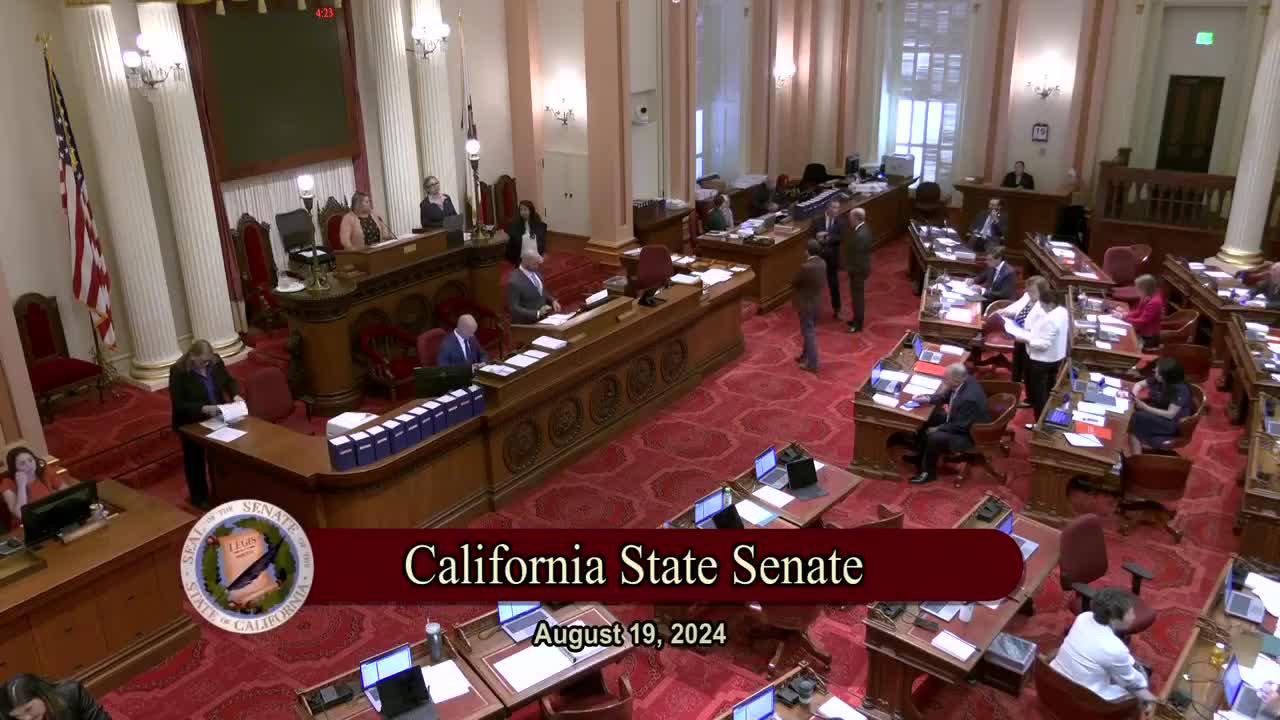
Bill Author
Bill Co-Author(s):