AB 262: Children’s camps: safety and regulation.
- Session Year: 2023-2024
- House: Assembly
- Latest Version Date: 2024-09-22
Current Status:
Passed
(2024-09-22: Chaptered by Secretary of State - Chapter 341, Statutes of 2024.)
Introduced
In Committee
First Chamber
In Committee
Second Chamber
Enacted
What does this bill do?
The bill directs the State Department of Social Services to prepare a report on how to regulate and oversee children’s camps, affecting camp operators, parents, and state and local agencies. The report, developed with input from public health, education, parks, the fire marshal, local health and parks departments, and parent advocates, must recommend a definition of children’s camps, which agency or agencies should adopt and enforce rules (including possible licensing), minimum health and safety standards, and cost estimates with a cost‑benefit analysis.
The summary is provided by generative AI which can make mistakes. For original language, please view the details in the table below.
Existing law, the California Community Care Facilities Act, generally provides for the licensing and regulation of community care facilities, including child daycare facilities, by the State Department of Social Services. Existing law also requires the State Public Health Officer to establish rules and regulations establishing minimum standards for organized camps, defined as a site with a program and facilities established for the primary purposes of providing an outdoor group living experience with social, spiritual, educational, or recreational objectives, for 5 days or more during one or more seasons of the year, except as specified.
This bill, subject to an appropriation by the Legislature for this purpose, would require the State Department of Social Services to prepare a report, in consultation with a wide variety of stakeholders, regarding approaches for childrens camp health and safety regulation and oversight. The bill would require the stakeholder group to be composed of representatives of designated state entities, including, but not limited to, the State Department of Public Health and the State Department of Education, and other stakeholders, such as parent advocate groups and local parks and health departments. The bill would require the department, following consultation with the stakeholder group, and within 24 months after funds are appropriated, to submit its recommendations in a report to the Legislature, as specified. The bill would require the recommendations to address a definition for a childrens camp, the government agency or agencies necessary to establish and enforce rules and regulations relating to childrens camps, and minimum health and safety requirements, as specified. The bill would require the report to include costs estimates for implementation of the recommendations included in the report.
Existing law, the California Community Care Facilities Act, generally provides for the licensing and regulation of community care facilities, including child daycare facilities, by the State Department of Social Services. Existing law also requires the State Public Health Officer to establish rules and regulations establishing minimum standards for organized camps, defined as a site with a program and facilities established for the primary purposes of providing an outdoor group living experience with social, spiritual, educational, or recreational objectives, for 5 days or more during one or more seasons of the year, except as specified.
This bill bill, subject to an appropriation by the Legislature for this purpose, would require the State Department of Social Services to convene and consult with a stakeholder group on childrens camp safety. prepare a report, in consultation with a wide variety of stakeholders, regarding approaches for childrens camp health and safety regulation and oversight. The bill would require the stakeholder group to be composed of representatives of designated state entities, including, but not limited to, the State Department of Public Health and the State Department of Education, and other stakeholders, such as parent advocate groups, childrens advocates and safety groups, groups and local parks and health departments. The bill would require the department, following consultation with the stakeholder group, and within 24 months after funds are appropriated, to submit its recommendations in a report to the Legislature, as specified. The bill would require the recommendations to address, among other things, address a definition for a childrens camp, child supervision requirements, requirements for camp licensure and regulation, and the government agency or agencies necessary to establish and enforce rules and regulations relating to childrens camps, and minimum health and safety requirements, as specified. The bill would require the report to include costs estimates for implementation of the recommendations included in the report. The bill also would require the department to draft preliminary regulations based on the recommendations provided to the Legislature, as specified.
Existing law, the California Community Care Facilities Act, generally provides for the licensing and regulation of community care facilities, including child daycare facilities, by the State Department of Social Services. Existing law also requires the State Public Health Officer to establish rules and regulations establishing minimum standards for organized camps, defined as a site with a program and facilities established for the primary purposes of providing an outdoor group living experience with social, spiritual, educational, or recreational objectives, for 5 days or more during one or more seasons of the year, except as specified.
This bill would require the State Department of Social Services to convene and consult with a stakeholder group on childrens camp safety. The bill would require the stakeholder group to be composed of representatives of designated state entities, including, but not limited to, the State Department of Public Health and the State Department of Education, and other stakeholders, such as parent advocate groups, childrens advocates and safety groups, and local parks and health departments. The bill would require the department, by June 1, 2025, to issue its recommendations, as informed by the stakeholder group, following consultation with the stakeholder group, and within 24 months after funds are appropriated, to submit its recommendations in a report to the Legislature. Legislature, as specified. The bill would require the recommendations to address, among other things, a definition for a childrens camp, child supervision requirements, requirements for camp licensure and regulation, and the government agency or agencies necessary to establish and enforce rules and regulations relating to childrens camps, as specified. The bill would require the report to include costs estimates for implementation of the recommendations included in the report. The bill also would require the department to draft preliminary regulations based on the recommendations provided to the Legislature, as specified.
Existing law, the California Community Care Facilities Act, generally provides for the licensing and regulation of community care facilities, including child daycare facilities, by the State Department of Social Services. Existing law also requires the State Public Health Officer to establish rules and regulations establishing minimum standards for organized camps, defined as a site with a program and facilities established for the primary purposes of providing an outdoor group living experience with social, spiritual, educational, or recreational objectives, for 5 days or more during one or more seasons of the year, except as specified.
This bill would require the State Department of Social Services to establish and lead a stakeholder workgroup to inform department regulations for childrens camps. The bill would define a childrens camp for these purposes as a program that offers daytime or overnight experiences administered by adults, that provides social, cultural, educational, recreational, or artistic programming to more than 5 children between 3 and 17 years of age for 5 days or longer, with specified exceptions. convene and consult with a stakeholder group on childrens camp safety. The bill would require the stakeholder group to be composed of representatives of designated state entities, including, but not limited to, the State Department of Public Health and the State Department of Education. The bill would require the department to consult with other stakeholders, as needed, Education, and other stakeholders, such as parent advocate groups, childrens advocates and safety groups, and local parks and health departments. The bill would require the workgroup to consider regulatory goals, including establishing child supervision requirements, facility safety standards, and requirements for camp licensure and regulation, as prescribed. The bill would require the workgroup, under the direction of the department, to establish a workplan for achieving and implementing the regulatory goals identified in the bill, including relevant benchmarks and timelines. The bill would require the department to submit the workplan to the Legislature by an unspecified date. department, by June 1, 2025, to issue its recommendations, as informed by the stakeholder group, in a report to the Legislature. The bill would require the recommendations to address, among other things, a definition for a childrens camp, child supervision requirements, requirements for camp licensure and regulation, and the government agency or agencies necessary to establish and enforce rules and regulations relating to childrens camps, as specified. The bill would require the report to include costs estimates for implementation of the recommendations included in the report.
Existing law, the California Community Care Facilities Act, generally provides for the licensing and regulation of community care facilities, including child daycare facilities, by the State Department of Social Services. Existing law also requires the State Public Health Officer to establish rules and regulations establishing minimum standards for organized camps, defined as a site with a program and facilities established for the primary purposes of providing an outdoor group living experience with social, spiritual, educational, or recreational objectives, for 5 days or more during one or more seasons of the year, except as specified.
This bill would require the State Department of Social Services to establish and lead a stakeholder workgroup to gather information and provide recommendations to the Legislature regarding development of subsequent legislation inform department regulations for childrens camps. The bill would define a childrens camp for these purposes as a program that offers daytime or overnight experiences administered by adults, that provides social, cultural, educational, recreational, or artistic programming to more than 5 children between 3 and 17 years of age for 5 days or longer, with specified exceptions. The bill would require the stakeholder group to be composed of representatives of designated state entities, including, but not limited to, the State Department of Public Health and the State Department of Education. The bill would authorize require the department to consult with other stakeholders, as needed, such as parent advocate groups, childrens advocates and safety groups, and local parks and health departments. The bill would require the workgroup to consider regulatory goals, including establishing child supervision requirements, facility safety standards, and requirements for camp licensure and regulation, as prescribed. The bill would require the workgroup, under the direction of the department, to establish a workplan for achieving and implementing the regulatory goals identified in the bill, including relevant benchmarks and timelines. The bill would require the department to submit the workplan to the Legislature by an unspecified date.
Existing law, the California Community Care Facilities Act, generally provides for the licensing and regulation of community care facilities, including child daycare facilities, by the State Department of Social Services. Existing law also requires the State Public Health Officer to establish rules and regulations establishing minimum standards for organized camps, defined as a site with a program and facilities established for the primary purposes of providing an outdoor group living experience with social, spiritual, educational, or recreational objectives, for 5 days or more during one or more seasons of the year, except as specified.
This bill would require the State Department of Social Services to establish and lead a stakeholder workgroup to gather information and provide recommendations to the Legislature regarding development of subsequent legislation for childrens camps. The bill would define a childrens camp for these purposes as a program that offers daytime or overnight experiences administered by adults, that provides social, cultural, educational, recreational, or artistic programming to more than 5 children between 3 and 17 years of age for 5 days or longer, with specified exceptions. The bill would require the stakeholder group to be composed of representatives of designated state entities, including, but not limited to, the State Department of Public Health and the State Department of Education. The bill would authorize the department to consult with other stakeholders, as needed, such as parent advocate groups, childrens advocates and safety groups, and local parks and health departments. The bill would require the workgroup to consider regulatory goals, including establishing child supervision requirements, facility safety standards, and requirements for camp licensure and regulation, as prescribed. The bill would require the workgroup, under the direction of the department, to establish a workplan for achieving and implementing the regulatory goals identified in the bill, including relevant benchmarks and timelines. The bill would require the department to submit the workplan to the Legislature by an unspecified date.
(a)(1)Subject to an appropriation by the Legislature for this purpose, the State Department of Social Services shall prepare a report, informed by consultation with a wide variety of stakeholders, regarding approaches for childrens camp health and safety regulation and oversight, as described in Section 1796.91.
(2)In preparing the report, the State Department of Social Services shall consult with a range of stakeholders, including, but not limited to, the following:
(A)The State Department of Public Health.
(B)The State Department of Education.
(C)The Department of Industrial Relations.
(D)The Department of Parks and Recreation.
(E)The Office of the State Fire Marshal.
(F)Local city, county, and special district parks departments, in consultation with the Department of Parks and Recreation.
(G)Local health departments, and local environmental health departments, in consultation with the State Department of Public Health.
(H)Parent advocates.
(b)The State Department of Social Services may contract for consultation services and the preparation of the report described in this section.
(c)Notwithstanding any other law, for purposes of this division, all contracts shall be exempt from the personal services contracting requirements of Article 4 (commencing with section 19130) of Chapter 5 of Part 2 of Division 5 of Title 2 of the Government Code, the Public Contract Code, and the State Contracting Manual, and shall not be subject to the approval of the Department of Technology or the Department of General Services.
1796.91.(a)No later than 24 months after the date funds have been appropriated to the department for this purpose, the State Department of Social Services shall submit the report created under Section 1796.90 to the Legislature. At a minimum, the report shall include recommendations for all of the following:
(1)The definition of a childrens camp.
(2)The government agency or agencies necessary to adopt and enforce regulations or written directives until regulations are adopted, including for approaches that may include a licensing program, relating to childrens camps.
(3)Minimum health and safety requirements to protect children attending childrens camps pursuant to this sections requirements.
(b)The report shall include cost estimates and a cost and benefits analysis for implementation of each of the approaches detailed in subdivision (a).
(c)A report submitted pursuant to this section shall be submitted in compliance with Section 9795 of the Government Code.
The State Department of Social Services shall convene and consult with a stakeholder group on childrens camp safety. The stakeholder group shall include members from all of the following:
(a) The State Department of Public Health.
(b) The State Department of Education.
(c)The Department of Industrial Relations.
(d)The Department of Parks and Recreation Recreation.
(e)Parent advocate groups.
(f)Childrens advocates and safety groups.
(g)For-profit and nonprofit recreational camps.
(h)Local city and county parks departments and special district parks departments.
(i)Local health departments and local environmental health departments.
(j)Emergency service professionals.
(k)Academic researchers.
(l)Firearm instructors.
1796.91.(a)By June 1, 2025, the State Department of Social Services shall issue its recommendations, as informed by the stakeholder group, in a report to the Legislature. Following consultation with the stakeholder group pursuant to Section 1796.90, and within 24 months after funds are appropriated by the Legislature to the State Department of Social Services for this purpose, the department shall submit its recommendations in a report to the Legislature. At a minimum, the report shall include recommendations for all of the following:
(1)The definition of a childrens camp.
(2)Child supervision requirements, including, but not limited to, child-to-counselor ratios and background checks, as appropriate, for administrators, employees, and volunteers.
(3)Physical facility standards, including, but not limited to, facility maintenance requirements and minimization of hazards.
(4)Graduated requirements for camp licensure, regulation, or both, according to the following criteria:
(A)The length of time children are under camp supervision and away from the parent or caregiver.
(B)The inherent risks of the activities offered at the camp.
(5)Appropriate qualifications for camp administrators, employees, and volunteers, taking into consideration factors, including, but not limited to, both of the following:
(A)Specialized training for activities that carry an inherent or heightened risk, including, but not limited to, the following:
(i)Gun ranges.
(ii)Horseback riding.
(iii)Swimming.
(B)Emergency training, including, but not limited to, CPR and treatment for allergic reactions.
(6)Providing parents and caregivers with accessible and transparent camp information, including, but not limited to, camp safety history and written camp safety and emergency plans.
(7)The government agency or agencies necessary to establish and enforce rules and regulations relating to childrens camps, pursuant to the stakeholder groups recommendations.
(b)The report shall include cost estimates for implementation of the recommendations included in subdivision (a).
(c)The department shall draft preliminary regulations relating to childrens camps, based on the recommendations provided in the departments report to the Legislature pursuant to subdivision (b). It is the intent of the Legislature that the department shall revise the regulations drafted pursuant to this subdivision to conform with future legislation relating to childrens camps, as enacted by the Legislature, and adopt those regulations in accordance with the rulemaking provisions of the Administrative Procedure Act (Chapter 3.5 (commencing with Section 11340) of Part 1 of Division 3 of Title 2 of the Government Code).
(c)(d)(1)A report submitted pursuant to this section shall be submitted in compliance with Section 9795 of the Government Code.
(2)The requirement to submit a report pursuant to this section is inoperative on June 1, 2029, pursuant to Section 10231.5 of the Government Code.
The State Department of Social Services shall convene and consult with a stakeholder group on childrens camp safety. The stakeholder group shall include members from all of the following:
(a)The State Department of Public Health.
(b)The State Department of Education.
(c)The Department of Industrial Relations.
(d)The Department of Parks and Recreation
(e)Parent advocate groups.
(f)Childrens advocates and safety groups.
(g)For-profit and nonprofit recreational camps.
(h)Local city and county parks departments and special district parks departments.
(i)Local health departments and local environmental health departments.
(j)Emergency service professionals.
(k)Academic researchers.
1796.91.(a)By June 1, 2025, the State Department of Social Services shall issue its recommendations, as informed by the stakeholder group, in a report to the Legislature. At a minimum, the report shall include recommendations for all of the following:
(1)The definition of a childrens camp.
(2)Child supervision requirements, including, but not limited to, child-to-counselor ratios and background checks, as appropriate, for administrators, employees, and volunteers.
(3)Physical facility standards, including, but not limited to, facility maintenance requirements and minimization of hazards.
(4)Graduated requirements for camp licensure, regulation, or both, according to the following criteria:
(A)The length of time children are under camp supervision and away from the parent or caregiver.
(B)The inherent risks of the activities offered at the camp.
(5)Appropriate qualifications for camp administrators, employees, and volunteers, taking into consideration factors, including, but not limited to, both of the following:
(A)Specialized training for activities that carry an inherent or heightened risk, including, but not limited to, the following:
(i)Gun ranges.
(ii)Horseback riding.
(iii)Swimming.
(B)Emergency training, including, but not limited to, CPR and treatment for allergic reactions.
(6)Providing parents and caregivers with accessible and transparent camp information, including, but not limited to, camp safety history and written camp safety and emergency plans.
(7)The government agency or agencies necessary to establish and enforce rules and regulations relating to childrens camps, pursuant to the stakeholder groups recommendations.
(b)The report shall include cost estimates for implementation of the recommendations included in subdivision (a).
(c)(1)A report submitted pursuant to this section shall be submitted in compliance with Section 9795 of the Government Code.
(2)The requirement to submit a report pursuant to this section is inoperative on June 1, 2029, pursuant to Section 10231.5 of the Government Code.
SECTION 1.Division 2.1 (commencing with Section 1796.90) is added to the Health and Safety Code, to read:2.1.CHILDRENS CAMPS1796.90.The following definitions apply for purposes of this chapter:(a)Childrens camp or camp means a program that offers daytime or overnight experiences administered by adults, that provides social, cultural, educational, recreational, or artistic programming to more than five children between 3 and 17 years of age for five days or longer. A childrens camp does not include any of the following:(1)A youth sports league or team.(2)A program owned or operated by a local educational agency.(3)A drop-in program that does not require registration or sign-in by the attendee, parent, or caregiver.(4)A program that requires a parent to be present.(5)A child daycare facility or family daycare home licensed under Chapter 3.4 (commencing with Section 1596.70), Chapter 3.5 (commencing with Section 1596.90), or Chapter 3.6 (commencing with Section 1597.30) of Division 2.(6)A program that is held for three or fewer hours per day.(b)Department means the State Department of Social Services.1796.91.(a)The department shall establish and lead a stakeholder workgroup to inform department regulations for childrens camps. The stakeholder group shall include representatives from the following state entities:(1)The State Department of Public Health.(2)The State Department of Education.(3)The Office of the State Fire Marshal.(4)The Department of Industrial Relations.(5)The Department of Parks and Recreation.(b)The department shall also consult with other stakeholders, as needed, for purposes of this article, including, but not limited to, the following:(1)Parent advocate groups.(2)Childrens advocates and safety groups.(3)For-profit recreational camps.(4)Nonprofit recreational camps.(5)Local parks departments.(6)Local health departments and local environmental health departments.(7)Emergency service professionals.(8)Academic researchers.1796.92.In gathering information and developing regulations, the workgroup established pursuant to Section 1796.91 shall consider, at a minimum, the following regulatory goals:(a)Establishing child supervision requirements, including, but not limited to, child-to-counselor ratios and background checks, as appropriate, for administrators, employees, and volunteers.(b)Establishing physical facility standards, including, but not limited to, facility maintenance requirements and minimization of hazards.(c)Establishing graduated requirements for camp licensure, regulation, or both, according to the following criteria:(1)The length of time children are under camp supervision and away from the parent or caregiver.(2)The inherent danger of the activities offered at the camp.(d)Establishing appropriate qualifications for camp administrators, employees, and volunteers, taking into consideration factors, including, but not limited to, both of the following:(1)Specialized training for activities that carry an inherent or heightened risk of danger, including, but not limited to, the following:(A)Gun ranges.(B)Horseback riding.(C)Swimming.(2)Emergency training, including, but not limited to, CPR and treatment for allergic reactions.(e)Providing parents and caregivers with accessible and transparent camp information, including, but not limited to, camp safety history and written camp safety and emergency plans.1796.93.(a)The workgroup, under the direction of the department, shall establish a workplan for achieving and implementing the regulatory goals identified in Section 1796.92, including relevant benchmarks and timelines.(b)(1)The department shall submit the workplan to the Legislature by _____.(2)A workplan submitted pursuant to this subdivision shall be submitted in accordance with Section 9795 of the Government Code.The following definitions apply for purposes of this chapter:
(a)Childrens camp or camp means a program that offers daytime or overnight experiences administered by adults, that provides social, cultural, educational, recreational, or artistic programming to more than five children between 3 and 17 years of age for five days or longer. A childrens camp does not include any of the following following:
(1)A youth sports league or team.
(2)A program owned or operated by a local educational agency.
(3)A drop-in program that does not require registration or sign-in by the attendee, parent, or caregiver.
(4)A program that requires a parent to be present.
(5)A child day care daycare facility or family day care daycare home licensed under Chapter 3.4 (commencing with Section 1596.70), Chapter 3.5 (commencing with Section 1596.90), or Chapter 3.6 (commencing with Section 1597.30) of Division 2.
(6)A program that is held for three or fewer hours per day.
(b)Department means the State Department of Social Services.
1796.91.(a)The department shall establish and lead a stakeholder workgroup to gather information and provide recommendations to the Legislature regarding development of subsequent legislation inform department regulations for childrens camps. The stakeholder group shall include representatives from the following state entities:
(1)The State Department of Public Health.
(2)The State Department of Education.
(3)The Office of the State Fire Marshal.
(4)The Department of Industrial Relations.
(5)The Department of Parks and Recreation.
(b)The department may shall also consult with other stakeholders, as needed, for purposes of this article, including, but not limited to, the following:
(1)Parent advocate groups.
(2)Childrens advocates and safety groups.
(3)Forprofit For-profit recreational camps.
(4)Nonprofit recreational camps.
(5)Local parks departments.
(6)Local health departments and local environmental health departments.
(7)Emergency service professionals.
(8)Academic researchers.
1796.92.In gathering information and developing recommendations, regulations, the workgroup established pursuant to Section 1796.91 shall consider, at a minimum, the following regulatory goals:
(a)Establishing child supervision requirements, including, but not limited to, child-to-counselor ratios and background checks, as appropriate, for administrators, employees, and volunteers.
(b)Establishing physical facility standards, including, but not limited to, facility maintenance requirements and minimization of hazards.
(c)Establishing graduated requirements for camp licensure, regulation, or both, according to the following criteria:
(1)The length of time children are under camp supervision and away from the parent or caregiver.
(2)The inherent danger of the activities offered at the camp.
(d)Establishing appropriate qualifications for camp administrators, employees, and volunteers, taking into consideration factors factors, including, but not limited to, both of the following:
(1)Specialized training for activities that carry an inherent or heightened risk of danger, including, but not limited to, the following:
(A)Gun ranges.
(B)Horseback riding.
(C)Swimming.
(2)Emergency training, including, but not limited to, CPR and treatment for allergic reactions.
(e)Providing parents and caregivers with accessible and transparent camp information, including, but not limited to, camp safety history and written camp safety and emergency plans.
1796.93.(a)The workgroup, under the direction of the department, shall establish a workplan for achieving and implementing the regulatory goals identified in Section 1796.92, including relevant benchmarks and timelines.
(b)(1)The department shall submit the workplan to the Legislature by _____.
(2)A workplan submitted pursuant to this subdivision shall be submitted in accordance with Section 9795 of the Government Code.
The following definitions apply for purposes of this chapter:
(a)Childrens camp or camp means a program that offers daytime or overnight experiences administered by adults, that provides social, cultural, educational, recreational, or artistic programming to more than five children between 3 and 17 years of age for five days or longer. A childrens camp does not include any of the following
(1)A youth sports league or team.
(2)A program owned or operated by a local educational agency.
(3)A drop-in program that does not require registration or sign-in by the attendee, parent, or caregiver.
(4)A program that requires a parent to be present.
(5)A child day care facility or family day care home licensed under Chapter 3.4 (commencing with Section 1596.70), Chapter 3.5 (commencing with Section 1596.90), or Chapter 3.6 (commencing with Section 1597.30) of Division 2.
(b)Department means the State Department of Social Services.
1796.91.(a)The department shall establish and lead a stakeholder workgroup to gather information and provide recommendations to the Legislature regarding development of subsequent legislation for childrens camps. The stakeholder group shall include representatives from the following state entities:
(1)The State Department of Public Health.
(2)The State Department of Education.
(3)The Office of the State Fire Marshal.
(4)The Department of Industrial Relations.
(5)The Department of Parks and Recreation.
(b)The department may also consult with other stakeholders, as needed, for purposes of this article, including, but not limited to, the following:
(1)Parent advocate groups.
(2)Childrens advocates and safety groups.
(3)Forprofit recreational camps.
(4)Nonprofit recreational camps.
(5)Local parks departments.
(6)Local health departments.
(7)Emergency service professionals.
(8)Academic researchers.
1796.92.In gathering information and developing recommendations, the workgroup established pursuant to Section 1796.91 shall consider, at a minimum, the following regulatory goals:
(a)Establishing child supervision requirements, including, but not limited to, child-to-counselor ratios and background checks, as appropriate, for administrators, employees, and volunteers.
(b)Establishing physical facility standards, including, but not limited to, facility maintenance requirements and minimization of hazards.
(c)Establishing graduated requirements for camp licensure, regulation, or both, according to the following criteria:
(1)The length of time children are under camp supervision and away from the parent or caregiver.
(2)The inherent danger of the activities offered at the camp.
(d)Establishing appropriate qualifications for camp administrators, employees, and volunteers, taking into consideration factors including, but not limited to, both of the following:
(1)Specialized training for activities that carry an inherent or heightened risk of danger, including, but not limited to, the following:
(A)Gun ranges.
(B)Horseback riding.
(C)Swimming.
(2)Emergency training, including, but not limited to, CPR and treatment for allergic reactions.
(e)Providing parents and caregivers with accessible and transparent camp information, including, but not limited to, camp safety history and written camp safety and emergency plans.
1796.93.(a)The workgroup, under the direction of the department, shall establish a workplan for achieving and implementing the regulatory goals identified in Section 1796.92, including relevant benchmarks and timelines.
(b)(1)The department shall submit the workplan to the Legislature by _____.
(2)A workplan submitted pursuant to this subdivision shall be submitted in accordance with Section 9795 of the Government Code.
|
Date
|
Status
|
|---|---|
| Sep 22, 2024 | Chaptered by Secretary of State - Chapter 341, Statutes of 2024. |
| Sep 22, 2024 | Approved by the Governor. |
| Sep 5, 2024 | Enrolled and presented to the Governor at 4 p.m. |
| Aug 27, 2024 | Senate amendments concurred in. To Engrossing and Enrolling. (Ayes 76. Noes 0.). |
| Aug 27, 2024 | Assembly Rule 77 suspended. |
| Aug 26, 2024 | In Assembly. Concurrence in Senate amendments pending. May be considered on or after August 28 pursuant to Assembly Rule 77. |
| Aug 26, 2024 | Read third time. Passed. Ordered to the Assembly. (Ayes 32. Noes 6.). |
| Aug 12, 2024 | Read second time. Ordered to third reading. |
| Aug 8, 2024 | Ordered to third reading. |
| Aug 8, 2024 | Action rescinded whereby the bill was read third time, passed, and to Assembly. |
| Aug 8, 2024 | Read third time and amended. Ordered to second reading. |
| Jun 17, 2024 | In Senate. Held at Desk. |
| Jun 17, 2024 | Ordered to the Senate. |
| Jun 17, 2024 | From inactive file. |
| Sep 11, 2023 | Ordered to inactive file at the request of Assembly Member Holden. |
| Sep 7, 2023 | Assembly Rule 77 suspended. (Page 3011.) |
| Sep 6, 2023 | In Assembly. Concurrence in Senate amendments pending. May be considered on or after September 8 pursuant to Assembly Rule 77. |
| Sep 6, 2023 | Read third time. Passed. Ordered to the Assembly. (Ayes 33. Noes 5. Page 2403.). |
| Sep 5, 2023 | Read second time. Ordered to third reading. |
| Sep 1, 2023 | From committee: Amend, and do pass as amended. (Ayes 5. Noes 2.) (September 1). |
| Sep 1, 2023 | Read second time and amended. Ordered returned to second reading. |
| Aug 14, 2023 | In committee: Referred to APPR suspense file. |
| Jul 5, 2023 | From committee: Do pass and re-refer to Com. on APPR. (Ayes 5. Noes 0.) (July 3). Re-referred to Com. on APPR. |
| Jun 14, 2023 | In committee: Set, first hearing. Hearing canceled at the request of author. |
| Jun 7, 2023 | Referred to Com. on HUMAN S. |
| May 26, 2023 | In Senate. Read first time. To Com. on RLS. for assignment. |
| May 25, 2023 | Read third time. Passed. Ordered to the Senate. (Ayes 76. Noes 0. Page 1749.) |
| May 18, 2023 | Read second time. Ordered to third reading. |
| May 18, 2023 | Joint Rule 62(a), file notice suspended. (Page 1580.) |
| May 18, 2023 | From committee: Do pass. (Ayes 15. Noes 0.) (May 18). |
| May 17, 2023 | In committee: Set, first hearing. Referred to APPR. suspense file. |
| Apr 26, 2023 | From committee: Do pass and re-refer to Com. on APPR. (Ayes 8. Noes 0.) (April 25). Re-referred to Com. on APPR. |
| Apr 19, 2023 | Re-referred to Com. on HUM. S. |
| Apr 18, 2023 | In committee: Hearing postponed by committee. |
| Apr 18, 2023 | From committee chair, with author's amendments: Amend, and re-refer to Com. on HUM. S. Read second time and amended. |
| Mar 28, 2023 | In committee: Hearing postponed by committee. |
| Mar 16, 2023 | Re-referred to Com. on HUM. S. |
| Mar 15, 2023 | From committee chair, with author's amendments: Amend, and re-refer to Com. on HUM. S. Read second time and amended. |
| Feb 2, 2023 | Referred to Com. on HUM. S. |
| Jan 20, 2023 | From printer. May be heard in committee February 19. |
| Jan 19, 2023 | Read first time. To print. |
|
Date
|
Description
|
Location
|
Votes
|
|
|---|---|---|---|---|
| Aug 27, 2024 | AB 262 Holden Concurrence in Senate Amendments | Assembly Floor |
Passed |
|
| Aug 26, 2024 | Assembly 3rd Reading AB262 Holden By Hurtado | Senate Floor |
Passed |
|
| Sep 6, 2023 | Assembly 3rd Reading AB262 Holden By Alvarado-Gil | Senate Floor |
Passed |
|
| Sep 1, 2023 | Do pass as amended | Senate Standing Committee on Appropriations |
Passed |
|
| Aug 14, 2023 | Placed on suspense file | Senate Standing Committee on Appropriations |
Passed |
|
| Jul 3, 2023 | Do pass, but first be re-referred to the Committee on [Appropriations] | Senate Standing Committee on Human Services |
Passed |
|
| May 25, 2023 | AB 262 Holden Assembly Third Reading | Assembly Floor |
Passed |
|
| May 18, 2023 | Do pass. | Assembly Standing Committee on Appropriations |
Passed |
|
| Apr 25, 2023 | Do pass and be re-referred to the Committee on [Appropriations] | Assembly Standing Committee on Human Services |
Passed |
This list shows positions taken on this bill by organizations on the date displayed, which is linked to the original source.
Positions by individuals are not included.
|
Organization
|
Position
|
Date
|
|---|---|---|
| Alliance Redwoods Conference Grounds | ** Against | |
| AstroCamp | ** Against | |
| Bar 717 Ranch, INC | ** Against | |
| Boy Scouts of America | ** Against | |
| Boy Scouts of America Golden Empire Council | ** Against | |
| Boys & Girls Clubs of San Francisco | ** Against | |
| Cali Camp | ** Against | |
| California Association of Environmental Health Administrators | ** Support | |
| California Association Of Recreation & Park Districts | ** Against | |
| California Coalition For Youth | ** Against | |
| California Collaboration For Youth | * Against | Jul 3, 2023 |
| California State Alliance Of YmcaS | ** Support | |
| California State Association Of Counties | ** Support | |
| Camp Kinneret | ** Against | |
| Camp Ocean Pines, INC | ** Against | |
| Camp Stevens | ** Against | |
| Camp Sugar Pine | ** Against | |
| Campus by the Sea, INC. | ** Against | |
| Carmel Valley Tennis Camp | ** Against | |
| Catalina Island Camps | ** Against | |
| Catalina Sea Camp | ** Against | |
| Cazadero Baptist Camp | ** Against | |
| city of paramount | ** Support | |
| County Health Executives Association Of California | ** Support | |
| County of Santa Clara | ** Support | |
| Deer Crossing Wilderness Camp | ** Against | |
| Emerald Cove Camp | ** Against | |
| Friends of Camp Natoma INC | ** Against | |
| Friends of Camp Natoma, Inc. | ** Against | |
| Girl Scouts of Northern California | ** Against | |
| Gold Arrow Camp | ** Against | |
| Golden Empire Council, Boy Scouts of America | ** Against | |
| Golden Gate Area Council, Boy Scouts of America | ** Against | |
| Greater Los Angeles Area Council, Boy Scouts of America | ** Against | |
| Guided Discoveries | ** Against | |
| Hartland Christian Camp | ** Against | |
| Health Officers Association Of California | ** Support | |
| Jameson Ranch Camp, LLC | ** Against | |
| Jefunira Camp | ** Against | |
| Jewish Community Camps and Retreats Center | ** Against | |
| Kennolyn Camps | ** Against | |
| League Of California Cities | ** Support | |
| Leoni Meadows Camp | ** Against | |
| Long Beach Area Council | ** Against | |
| Long Beach Area Council, Boy Scouts of America | ** Against | |
| Los Padres Council, Boy Scouts of America & the Outdoor School | ** Against | |
| Meow Meow Foundation | * Support | Jul 3, 2023 |
| Mission Springs Camps & Conference Center | ** Against | |
| Mount Hermon Christian Camps and Conference Center | ** Against | |
| Mountain Camp | ** Against | |
| Oasis Ministry Ventures INC | ** Against | |
| Oasis Ministry Ventures, Inc. | ** Against | |
| Outpost Summer Camps | ** Against | |
| Pali Adventures | ** Against | |
| Pali Camp | ** Against | |
| Peninsula Activities, INC. | ** Against | |
| R.M. Pyles Boys Camp | ** Against | |
| Redwood Empire Council Inc., Boy Scouts of America | ** Against | |
| Redwood Empire Council, Boy Scouts of America | ** Against | |
| Regular Baptist Conference of Southern California | ** Against | |
| Regular Baptist Conference of Southern California dba Victory Ranch | ** Against | |
| River Way Ranch Camp | ** Against | |
| Rural County Representatives of California | ** Support | |
| San Diego - Imperial Council, Boy Scouts of America | ** Against | |
| San Diego Imperial Council Boy Scouts | ** Against | |
| San Diego Imperial Council, Bsa | ** Against | |
| San Diego-imperial Council, Bsa | ** Against | |
| Shaffer's High Sierra Camp | ** Against | |
| Southern Sierra Bsa | ** Against | |
| Southern Sierra, Boy Scouts of America | ** Against | |
| Summerkids Camp | ** Against | |
| Tennis Camp INC Dba Carmel Valley Tennis Camp | ** Against | |
| Tocaloma Summer Day Camp | ** Against | |
| Tom Sawyer Camp | ** Against | |
| Urban Counties of California | ** Support | |
| VALLEY INDUSTRY AND COMMERCE ASSOCIATION | ** Against | |
| Valley Trail Summer Camps | * Against | Jul 3, 2023 |
| Valley Trails Summer Camp | ** Against | |
| Ventura County Council, Boy Scouts of America | ** Against | |
| Western Association of Independent Camps | ** Against | |
| Western Camps, INC. | ** Against | |
| Western Los Angeles County Council Boy Scouts of America, INC. | ** Against | |
| Western Los Angeles County Council, Boy Scouts of America | ** Against | |
| YMCA of Orange County | ** Against | |
| Yosemite Sierra Summer Camp | ** Against |
SENATE RULES COMMITTEE Office of Senate Floor Analyses (916) 651-1520 Fax: (916) 327-4478 | AB 262 |
THIRD READING
Bill No: AB 262
Author: Holden (D)
Amended: 9/1/23 in Senate
Vote: 21
SENATE HUMAN SERVICES COMMITTEE: 5-0, 7/3/23
AYES: Alvarado-Gil, Ochoa Bogh, Hurtado, Menjivar, Wahab
SENATE APPROPRIATIONS COMMITTEE: 5-2, 9/1/23
AYES: Portantino, Ashby, Bradford, Wahab, Wiener
NOES: Jones, Seyarto
ASSEMBLY FLOOR: 76-0, 5/25/23 - See last page for vote
SUBJECT: Children’s camps: safety and regulation
SOURCE: Author
DIGEST:
This bill requires the Department of Social Services (CDSS) to convene and consult with a stakeholder group on children’s camp safety. This bill requires CDSS, 24 months after funds have been appropriated for this purpose, to submit a report to the Legislature with recommendations for the regulation or licensing of children’s camp safety, and draft preliminary regulations based on the recommendations provided in the report. This bill specifies topics the report shall include recommendations for, including the definition of a children’s camp and cost estimates for implementation.
ANALYSIS:
Existing law:
- Defines “organized camp” as a site with program and facilities established for the primary purpose of providing an outdoor group living experience with social, spiritual, educational, or recreational objectives for five days or more during one or more seasons of the year. Further specifies that an organized camp does not include a motel, tourist camp, trailer park, resort, hunting camp, auto court, labor camp, penal or correctional camp, child care institution or home-finding agency, nor any charitable or recreational organization that complies with the rules and regulations for recreational trailer parks. (HSC 18897)
- Defines “camper” as any person in an organized camp on a fee or non-fee basis who is a participant in the regular program and training of an organized camp, and who may take on duties relating to such program and training. (HSC 18897.1)
- Requires the Director of the California Department of Public Health (CDPH) to adopt rules and regulations establishing minimum standards for organized camps and regulating the operation of organized camps that the director determines are necessary to protect the health and safety of campers. Further requires organized camps to comply with the building standards of the jurisdiction in which the camp is located, to the extent that those standards are not contrary to, or inconsistent with, the building standards adopted by the Director of CDPH. (HSC 18897.2(a))
- Requires the Director of CDPH to adopt and enforce building standards relating to organized camps, as provided. (HSC 18897.2(a-b))
- Requires the State Fire Marshal to adopt fire safety regulations for organized camps, as provided. (HSC 18897.3)
- Requires local health officers to enforce, within their jurisdiction, the building standards published in the State Building Standards Code relating to organized camps and other rules and regulations adopted by the Director of CDPH, as provided. (HSC 18897.4)
- Prohibits organized camps from being subject to regulation by any state agency other than CDPH, the California regional water quality control boards, the State Water Resources Control Board, and the State Fire Marshal; provided, that this section shall not affect the authority of the Department of Industrial Relations to regulate the wages or hours of employees of organized camps and this section shall not be construed to limit the application of building standards published in the State Building Standards Code to structures in organized camps. (HSC 18897.6)
- Prohibits an organized camp from operating in California unless each site or location in which the camp operates satisfies the minimum standards for organized camps prescribed in building standards published in the State Buildings Code relating to organized camps, and in other rules and regulations adopted by the Director of CDPH and the State Fire Marshal, as provided. (HSC 18897.7)
- Establishes the Child Day Care Facilities Act (CDCFA) with CDSS as the licensing entity for child care centers and family childcare homes, to ensure that working families have access to healthy and safe childcare providers and that childcare programs contribute positively to a child’s emotional, cognitive, and educational development, and are able to respond to, and provide for, the unique characteristics and needs of children. Further, creates a separate licensing category for child daycare centers and family daycare homes within CDSS’s existing licensing structure through the CDCFA. (HSC 1596.70 et seq.)
This bill requires CDSS to convene and consult with a stakeholder group, including members from specified organizations and affiliations, on children’s camp safety and to issue a report to the Legislature by June 1, 2025, including recommendations and cost estimates, as specified.
Comments
According to the author, “This coming summer, children from all over California will attend thousands of camps. Of these camps, only overnight camps are required to follow state regulations and virtually none are inspected to ensure the safety of children attending. Day camps attended by children, which constitute the vast majority of camps in California, are not required to follow any regulations or laws regarding child safety. This large hole in regulation has contributed to the harm children at camp have endured. Our state’s camp safety regulations must change so parents can rest assured their child will return home safely.”
Children’s Camps
According to the American Camp Association (ACA), children’s camps, often referred to informally as summer camps, provide creative, recreational, educational, social, or spiritual experiences for children. Children’s camps are often held in the summer, when most children are not attending school. These camps can provide benefits to campers such as socialization, exercise, skill building, and spending time outdoors. According to the U.S. Administration for Children and Families (ACF) Office of Child Care, families’ childcare needs for school-age children are often based on the school’s daily schedule and school year calendar. Families may also need full-day childcare during school closures such as holidays, school vacation breaks, and summer breaks. Vacation and summer camp programs serve school-age children in a variety of settings, such as childcare centers and family childcare homes, youth programs such as Boys and Girls Clubs and YMCAs, recreation centers, community organizations, and faith-based programs.
Existing law defines “organized camp” but does not include a definition for a “children’s camp” or “day camp”. This bill requires CDSS, in collaboration with a workgroup, to issue a report to the Legislature with specific recommendations, including a recommendation on the definition of a children’s camp.
Camp Oversight
Existing law establishes a limited regulatory framework for organized camps, which are defined as “a site with a program and facilities established for the primary purposes of providing an outdoor group living experience with social, spiritual, educational, or recreational objectives, for five days or more during one or more seasons of the year.” These organized camps must comply with minimum standards put in place through rules and regulations adopted by CDPH, as determined necessary by CDPH to protect the health and safety of campers. Additionally, existing law requires organized camps to comply with building standards adopted by CDPH, as well as the building standards of the jurisdiction in which the camp is located, to the extent that those standards are not contrary to, or inconsistent with, the building standards adopted by the director of CDPH. Organized camps must also comply with minimum fire safety regulations adopted by the State Fire Marshall specifically for such sites.
Additionally, this existing, although limited, regulatory framework only applies to sites that are established to provide an outdoor group living experience, meaning those sites that ostensibly house campers overnight. As such, existing laws and regulations do not apply to the majority of day camps, which provide children and youth with activities and programming during periods of the year when school is not in session. These camps typically do not have a fixed site, but rather operate at parks, zoos, beaches, churches, schools, Boys and Girls Clubs, or YMCA facilities, and are therefore not subject to the laws that currently regulate “organized camps.”
These day camps typically provide parents with an alternative form of childcare when school is out of session. Their operation fills in a weekday childcare need faced by families during the summer months, in addition to providing children and youth with organized recreation and learning opportunities. However, these camps are not child day care facilities, and thus are not covered by the licensing requirements a day care or childcare center must comply with under the CDCFA.
Los Angeles County addressed this lack of oversight through the Elena Matyas Children’s Camp Safety Ordinance, which requires minimum staffing qualifications, counselor-to-camper ratios, staff background checks and criminal history screening, written operating procedures and plans to address medical and other emergencies, written operating procedures and plans related to transportation, safe and sanitary camp site conditions and proper maintenance of equipment and facilities, site evaluation and routine inspections, registration and permit fees, and public notice on a County website of all registered and permitted camps.[1] The Ordinance went into effect on January 1, 2023, and enforcement started on March 1, 2023.
Related/Prior Legislation
AB 1737 (Holden, 2022) would have required the Secretary of the California Health and Human Services Agency and the Director of CDSS to lead the development and implementation of a master plan for children’s camp safety, and work with a workgroup to solicit input from specified state agencies and stakeholders. The bill was held in the Senate Appropriations Committee.
SB 217 (Portantino, 2020) would have required organized or recreational camps to obtain a license from their local health agency, as well as would have required the camp to meet various requirements such as staffing and supervision requirements; background checks; safety; and requirements for swimming; among other changes. The Assembly Health Committee hearing for the bill was canceled at the request of the author.
AB 1964 (Maienschein, 2018) would have required CDPH to issue regulations related to day camps and would have required local enforcement agencies to issue permits for and regulate day camps. The bill was held in the Assembly Appropriations Committee.
SB 476 (Mendoza, 2015) would have redefined organized camps and separated them into two types: resident camps and day camps; and would have required organized day camps to follow existing public health and safety codes and regulations. The bill was held in the Assembly Appropriations Committee.
SB 443 (Walters, 2014) would have defined organized camps and organized day camps and would have established requirements regarding their operation. The bill was held in the Assembly Appropriations Committee.
SB 1087 (Walters, Chapter 652, Statues of 2012) exempted organized camps from licensure required for day care centers.
FISCAL EFFECT: Appropriation: No Fiscal Com.: Yes Local: No
According to the Senate Appropriations Committee, “Unknown one-time General Fund costs, likely low millions, for the CDSS for staffing resources.”
SUPPORT: (Verified 9/1/23)
California Association of Environmental Health Administrators
California State Alliance of YMCAs
California State Association of Counties
City of Paramount
County Health Executives Association of California
County of Santa Clara
Health Officers Association of California
League of California Cities
Rural County Representatives of California
Urban Counties of California
OPPOSITION: (Verified 9/1/23)
Alliance Redwoods Conference Grounds
Bar 717 Ranch, inc.
Boy Scouts of America
Boy Scouts of America Golden Empire Council
Boys & Girls Clubs of San Francisco
California Coalition for Youth
Camp Kinneret
Camp Ocean Pines, Inc.
Camp Stevens
Camp Sugar Pine
Campus by the Sea, Inc.
Catalina Island Camps
Cazadero Baptist Camp
Deer Crossing Wilderness Camp
Emerald Cove Camp
Friends of Camp Natoma, Inc.
Girl Scouts of Northern California
Gold Arrow Camp
Golden Gate Area Council - Boy Scouts of America
Greater Los Angeles Area Council, Boy Scouts of America
Jameson Ranch Camp, LLC.
Jewish Community Camps and Retreats Center
Kennolyn Camps
Leoni Meadows Camp
Long Beach Area Council, Boy Scouts of America
Los Padres Council, Boy Scouts of America & the Outdoor School
Mission Springs Camps & Conference Center
Oasis Ministry Ventures, Inc.
Outpost Summer Camps
Pali Camp
Peninsula Activities, Inc.
R.M. Pyles Boys Camp
Redwood Empire Council Inc., Boy Scouts of America
Regular Baptist Conference of Southern California dba Victory Ranch
San Diego - Imperial Council, Boy Scouts of America
Southern Sierra, Boy Scouts of America
Summerkids Camp
Tennis Camp, Inc. dba Carmel Valley Tennis Camp
Tocaloma Summer Day Camp
Tom Sawyer Camps
Valley Industry and Commerce Association
Ventura County Council, Boy Scouts of America
Western Association of Independent Camps
Western Camps, Inc.
Western Los Angeles County Council, Boy Scouts of America
YMCA of Orange County
Yosemite Sierra Summer Camp
ARGUMENTS IN SUPPORT: According to a joint letter from the California State Association of Counties, Urban Counties of California, Rural County Representatives of California, County Health Executives Association of California, and Health Officers Association of California, children’s camps should be regulated by an agency with the training and expertise in child supervision and safety, and not local health departments, which exist to protect communities from public health threats.
ARGUMENTS IN OPPOSITION: According to over 20 summer day camps, the camping profession has made many attempts to include day camps in current regulations to increase safety for children served by camps. The summer day camps all indicated concern regarding the size of the workgroup created by this bill, and that the workgroup will be overseen by CDSS, rather than CDPH, which has been regulating and working with camp professionals for over 40 years.
The Valley Industry and Commerce Association voiced similar concerns and preference for the workgroup to be housed at CDPH, citing that day camps are regulated and inspected by the county Department of Public Health in Los Angeles County.
ASSEMBLY FLOOR: 76-0, 5/25/23
AYES: Addis, Alanis, Alvarez, Arambula, Bains, Bauer-Kahan, Bennett, Berman, Boerner, Bonta, Bryan, Calderon, Juan Carrillo, Wendy Carrillo, Cervantes, Chen, Connolly, Megan Dahle, Davies, Dixon, Essayli, Flora, Mike Fong, Vince Fong, Friedman, Gabriel, Gallagher, Garcia, Gipson, Grayson, Haney, Hart, Holden, Hoover, Irwin, Jackson, Jones-Sawyer, Kalra, Lee, Low, Maienschein, McCarty, McKinnor, Muratsuchi, Stephanie Nguyen, Ortega, Pacheco, Papan, Jim Patterson, Joe Patterson, Pellerin, Petrie-Norris, Quirk-Silva, Ramos, Reyes, Luz Rivas, Robert Rivas, Rodriguez, Blanca Rubio, Sanchez, Santiago, Schiavo, Soria, Ta, Ting, Valencia, Villapudua, Waldron, Wallis, Ward, Weber, Wicks, Wilson, Wood, Zbur, Rendon
NO VOTE RECORDED: Aguiar-Curry, Lackey, Lowenthal, Mathis
Prepared by: Diana Dominguez / HUMAN S. / (916) 651-1524
9/5/24 15:39:22
http://publichealth.lacounty.gov/eh/docs/business/elena-mataya-children-camp-safety-ordinance.pdf ↑
CONCURRENCE IN SENATE AMENDMENTS
CSA1 Bill Id:AB 262
Author:(Holden)
As Amended Ver:August 8, 2024
Majority vote
SUMMARY
Requires, subject to an appropriation, the California State Department of Social Services (CDSS) to prepare a report, informed by consultation with a wide variety of stakeholders, regarding approaches for children's camp health and safety regulation and oversight, to be submitted to the Legislature.
Senate Amendments
- Revise the composition of the stakeholder group by adding the Office of the State Fire Marshal, and striking the inclusion of children's advocates and safety groups, for-profit and nonprofit recreational camps, emergency service professionals, and academic researchers.
- Permit CDSS to contract for consultation services and the preparation of the report and exempt all contracts from the personal services contracting requirements and specify they are not subject to the approval of the Department of Technology or the Department of General Services.
- Narrow the content of the report by no longer requiring the recommendations on the following topics to be included: child supervision requirements; physical facility standards; graduated requirements for camp licensure; appropriate qualifications for camp administrators, employees, and volunteers, and providing parents and caregivers with accessible and transparent camp information.
- Revise the content of the report to include recommendations on the government agency or agencies necessary to adopt and enforce regulations or written directives until regulations are adopted; minimum health and safety requirements to protect children attending children's camps; and, a cost and benefits analysis instead of cost estimates.
- Remove the inoperative date of June 1, 2020, for the requirement to submit the report.
COMMENTS
CDSS' Expertise in Regulating Childcare in California. Childcare comes in many forms, including unlicensed care provided by family, friends and neighbors; early childhood education programs; licensed family daycare homes; and licensed childcare centers. The licensure, maintenance, and operation of child daycare centers and family daycare homes in the state are governed by the Child Day Care Facilities Act (CDCFA). Existing law establishes minimum general health and safety requirements, staff-to-child ratios, and provider training and education requirements for licensed childcare. CDSS is charged with ensuring licensed childcare facilities meet health and safety standards through monitoring facilities, providing technical assistance, and establishing partnerships with providers, parents, and the childcare community. These requirements also set parameters around the age, educational, and background requirements of those working or volunteering within licensed childcare settings. For example, childcare staff must be at least 18 years of age and are fingerprinted so that a criminal history check can be conducted.
Community Care Licensing Division (CCLD) is responsible for licensing and monitoring the state's childcare centers and licensed school-age childcare facilities. In addition to approving new centers and facilities before they may open, CCLD is responsible for conducting unannounced site visits of all licensed child daycare facilities and homes. CCLD conducts random inspections of 30% of all childcare facilities annually, with each facility receiving a visit at least once every three years. Existing law provides for a number of exceptions that may trigger more frequent inspections, including reported violations of existing licensing requirements as specified through statute or regulation.
Childcare Providers Exempt from Licensing. There are four main groups of childcare providers that are exempt from CDCFA licensing requirements. These include: 1) individuals who care for the children of a relative, or who care for the children of one family in addition to their own, as well as certain parent cooperatives, in which families rotate care on an unpaid basis; 2) public, as well as private non-profit programs, that offer recreational services, including community center programs and park and recreation programs; 3) businesses that offer limited childcare to their clients and customers, that are time limited and require the parent or guardian to remain on the premises, as provided; and, 4) programs that are overseen by other state agencies, such as organized camps which are licensed by the California Department of Public Health (CDPH) and heritage schools, which are overseen by the California Department of Education.
Thus, for many of these unlicensed forms of care, another entity is responsible for overseeing and licensing the facility or program, while for others, like a family childcare home providing care for the child of only one family in addition to the operator's own children or for a parent cooperative arrangement when no payment is involved, the licensing requirements would be prohibitive to enabling parents and families to arrange their own less formal childcare arrangements.
Camp Oversight of Organized/Overnight Camps. Existing law establishes a limited regulatory framework for "organized camps", which are defined as "a site with a program and facilities established for the primary purposes of providing an outdoor group living experience with social, spiritual, educational, or recreational objectives, for five days or more during one or more seasons of the year" meaning these sites ostensibly house campers overnight and do not apply to day camps. These "organized camps" must comply with minimum standards put in place through rules and regulations adopted by CDPH, as determined necessary by CDPH to protect the health and safety of campers. Additionally, existing law requires "organized camps" to comply with building standards adopted by CDPH, as well as the building standards of the jurisdiction in which the camp is located, to the extent that those standards are not contrary to, or inconsistent with, the building standards adopted by the Director of CDPH. Organized camps must also comply with minimum fire safety regulations adopted by the State Fire Marshall specifically for such sites.
Organized camps must annually submit verification that the organized camp is accredited by the American Camp Association (ACA) or a written description of operating procedures, as specified. The ACA accreditation program is an independent national peer-review program of camp operations and has certified over 2,400 camps in 2022. According to ACA's 2023 Impact Report, there are over 15,000 camps nationwide, employing 1.2 million staff and impacting 26 million campers and their families. The ACA indicates it collaborates with experts from the American Academy of Pediatrics, the American Red Cross, and other youth-serving agencies to assure that current practices at camps reflect the most up-to-date, research-based standards in camp operation from staff qualifications and training to emergency management. Camps and the ACA form a partnership that promotes growth and fun in an environment committed to safety. ACA accreditation typically goes beyond basic licensing requirements such as considerations of staff-to-camper ratios that are appropriate for different age groups; goals for camp activities that are developmentally based; emergency transportation available at all times; and, first-aid facilities and trained staff available when campers are present.
These above requirements do not apply to the majority of day camps, which provide children and youth with activities and programming during periods of the year when school is not in session. These camps typically do not have a fixed site, but rather operate at parks, beaches, churches, or schools, and are therefore not subject to the laws that currently regulate "organized camps."
These day camps are an important piece to childcare as they typically provide parents with an alternative form of childcare when school is out of session. Their operation fills in a weekday childcare need faced by families during the summer months. However, these camps are not childcare facilities, and thus are not covered by the licensing requirements that a daycare or childcare center must comply with.
According to the Author
"This coming summer, children from all over California will attend thousands of camps. Of these camps, only overnight camps are required to follow state regulations and virtually none are inspected to ensure the safety of children attending. Day camps attended by children, which constitute the vast majority of camps in California, are not required to follow any regulations or laws regarding child safety. This large hole in regulation has contributed to the harm children at camp have endured. Our state's camp safety regulations must change so parents can rest assured their child will return home safely."
Arguments in Support
According to a joint letter from the California State Association of Counties, Urban Counties of California, Rural County Representatives of California, County Health Executives Association of California, and Health Officers Association of California, children's camps should be regulated by an agency with the training and expertise in child supervision and safety, and not local health departments, which exist to protect communities from public health threats.
Arguments in Opposition
According to over 20 summer day camps, the camping profession has made many attempts to include day camps in current regulations to increase safety for children served by camps. The summer day camps all indicated concern regarding the size of the workgroup created by the bill, and that the workgroup will be overseen by CDSS, rather than CDPH, which has been regulating and working with camp professionals for over 40 years.
The Valley Industry and Commerce Association voiced similar concerns and preference for the workgroup to be housed at CDPH, citing that day camps are regulated and inspected by the county Department of Public Health in Los Angeles County.
FISCAL COMMENTS
According to the Senate Appropriations Committee on September 1, 2023, unknown one-time General Fund costs, likely low millions, for CDSS for staffing resources.
VOTES:
ASM HUMAN SERVICES: 8-0-0
YES: Jackson, Sanchez, Alanis, Arambula, Bonta, Bryan, Calderon, Garcia
ASM APPROPRIATIONS: 15-0-1
YES: Holden, Megan Dahle, Bryan, Calderon, Wendy Carrillo, Dixon, Mike Fong, Hart, Lowenthal, Mathis, Papan, Pellerin, Sanchez, Weber, Ortega
ABS, ABST OR NV: Robert Rivas
ASSEMBLY FLOOR: 76-0-4
YES: Addis, Alanis, Alvarez, Arambula, Bains, Bauer-Kahan, Bennett, Berman, Boerner, Bonta, Bryan, Calderon, Juan Carrillo, Wendy Carrillo, Cervantes, Chen, Connolly, Megan Dahle, Davies, Dixon, Essayli, Flora, Mike Fong, Vince Fong, Friedman, Gabriel, Gallagher, Garcia, Gipson, Grayson, Haney, Hart, Holden, Hoover, Irwin, Jackson, Jones-Sawyer, Kalra, Lee, Low, Maienschein, McCarty, McKinnor, Muratsuchi, Stephanie Nguyen, Ortega, Pacheco, Papan, Jim Patterson, Joe Patterson, Pellerin, Petrie-Norris, Quirk-Silva, Ramos, Reyes, Luz Rivas, Robert Rivas, Rodriguez, Blanca Rubio, Sanchez, Santiago, Schiavo, Soria, Ta, Ting, Valencia, Villapudua, Waldron, Wallis, Ward, Weber, Wicks, Wilson, Wood, Zbur, Rendon
ABS, ABST OR NV: Aguiar-Curry, Lackey, Lowenthal, Mathis
SENATE FLOOR: 33-5-2
YES: Allen, Alvarado-Gil, Archuleta, Ashby, Atkins, Becker, Blakespear, Bradford, Caballero, Cortese, Dodd, Durazo, Eggman, Glazer, Gonzalez, Hurtado, Laird, Limón, McGuire, Menjivar, Min, Newman, Ochoa Bogh, Padilla, Portantino, Roth, Rubio, Skinner, Smallwood-Cuevas, Stern, Umberg, Wahab, Wiener
NO: Dahle, Grove, Jones, Seyarto, Wilk
ABS, ABST OR NV: Nguyen, Niello
UPDATED
VERSION: August 8, 2024
CONSULTANT: Bri-Ann Hernández / HUM. S. / (916) 319-2089 FN: 0004735
CONCURRENCE IN SENATE AMENDMENTS
CSA1 Bill Id:AB 262
Author:(Holden)
As Amended Ver:August 8, 2024
Majority vote
SUMMARY
Requires, subject to an appropriation, the California State Department of Social Services (CDSS) to prepare a report, informed by consultation with a wide variety of stakeholders, regarding approaches for children's camp health and safety regulation and oversight, to be submitted to the Legislature.
Senate Amendments
- Revise the composition of the stakeholder group by adding the Office of the State Fire Marshal, and striking the inclusion of children's advocates and safety groups, for-profit and nonprofit recreational camps, emergency service professionals, and academic researchers.
- Permit CDSS to contract for consultation services and the preparation of the report and exempt all contracts from the personal services contracting requirements and specify they are not subject to the approval of the Department of Technology or the Department of General Services.
- Narrow the content of the report by no longer requiring the recommendations on the following topics to be included: child supervision requirements; physical facility standards; graduated requirements for camp licensure; appropriate qualifications for camp administrators, employees, and volunteers, and providing parents and caregivers with accessible and transparent camp information.
- Revise the content of the report to include recommendations on the government agency or agencies necessary to adopt and enforce regulations or written directives until regulations are adopted; minimum health and safety requirements to protect children attending children's camps; and, a cost and benefits analysis instead of cost estimates.
- Remove the inoperative date of June 1, 2020, for the requirement to submit the report.
COMMENTS
CDSS' Expertise in Regulating Childcare in California. Childcare comes in many forms, including unlicensed care provided by family, friends and neighbors; early childhood education programs; licensed family daycare homes; and licensed childcare centers. The licensure, maintenance, and operation of child daycare centers and family daycare homes in the state are governed by the Child Day Care Facilities Act (CDCFA). Existing law establishes minimum general health and safety requirements, staff-to-child ratios, and provider training and education requirements for licensed childcare. CDSS is charged with ensuring licensed childcare facilities meet health and safety standards through monitoring facilities, providing technical assistance, and establishing partnerships with providers, parents, and the childcare community. These requirements also set parameters around the age, educational, and background requirements of those working or volunteering within licensed childcare settings. For example, childcare staff must be at least 18 years of age and are fingerprinted so that a criminal history check can be conducted.
Community Care Licensing Division (CCLD) is responsible for licensing and monitoring the state's childcare centers and licensed school-age childcare facilities. In addition to approving new centers and facilities before they may open, CCLD is responsible for conducting unannounced site visits of all licensed child daycare facilities and homes. CCLD conducts random inspections of 30% of all childcare facilities annually, with each facility receiving a visit at least once every three years. Existing law provides for a number of exceptions that may trigger more frequent inspections, including reported violations of existing licensing requirements as specified through statute or regulation.
Childcare Providers Exempt from Licensing. There are four main groups of childcare providers that are exempt from CDCFA licensing requirements. These include: 1) individuals who care for the children of a relative, or who care for the children of one family in addition to their own, as well as certain parent cooperatives, in which families rotate care on an unpaid basis; 2) public, as well as private non-profit programs, that offer recreational services, including community center programs and park and recreation programs; 3) businesses that offer limited childcare to their clients and customers, that are time limited and require the parent or guardian to remain on the premises, as provided; and, 4) programs that are overseen by other state agencies, such as organized camps which are licensed by the California Department of Public Health (CDPH) and heritage schools, which are overseen by the California Department of Education.
Thus, for many of these unlicensed forms of care, another entity is responsible for overseeing and licensing the facility or program, while for others, like a family childcare home providing care for the child of only one family in addition to the operator's own children or for a parent cooperative arrangement when no payment is involved, the licensing requirements would be prohibitive to enabling parents and families to arrange their own less formal childcare arrangements.
Camp Oversight of Organized/Overnight Camps. Existing law establishes a limited regulatory framework for "organized camps", which are defined as "a site with a program and facilities established for the primary purposes of providing an outdoor group living experience with social, spiritual, educational, or recreational objectives, for five days or more during one or more seasons of the year" meaning these sites ostensibly house campers overnight and do not apply to day camps. These "organized camps" must comply with minimum standards put in place through rules and regulations adopted by CDPH, as determined necessary by CDPH to protect the health and safety of campers. Additionally, existing law requires "organized camps" to comply with building standards adopted by CDPH, as well as the building standards of the jurisdiction in which the camp is located, to the extent that those standards are not contrary to, or inconsistent with, the building standards adopted by the Director of CDPH. Organized camps must also comply with minimum fire safety regulations adopted by the State Fire Marshall specifically for such sites.
Organized camps must annually submit verification that the organized camp is accredited by the American Camp Association (ACA) or a written description of operating procedures, as specified. The ACA accreditation program is an independent national peer-review program of camp operations and has certified over 2,400 camps in 2022. According to ACA's 2023 Impact Report, there are over 15,000 camps nationwide, employing 1.2 million staff and impacting 26 million campers and their families. The ACA indicates it collaborates with experts from the American Academy of Pediatrics, the American Red Cross, and other youth-serving agencies to assure that current practices at camps reflect the most up-to-date, research-based standards in camp operation from staff qualifications and training to emergency management. Camps and the ACA form a partnership that promotes growth and fun in an environment committed to safety. ACA accreditation typically goes beyond basic licensing requirements such as considerations of staff-to-camper ratios that are appropriate for different age groups; goals for camp activities that are developmentally based; emergency transportation available at all times; and, first-aid facilities and trained staff available when campers are present.
These above requirements do not apply to the majority of day camps, which provide children and youth with activities and programming during periods of the year when school is not in session. These camps typically do not have a fixed site, but rather operate at parks, beaches, churches, or schools, and are therefore not subject to the laws that currently regulate "organized camps."
These day camps are an important piece to childcare as they typically provide parents with an alternative form of childcare when school is out of session. Their operation fills in a weekday childcare need faced by families during the summer months. However, these camps are not childcare facilities, and thus are not covered by the licensing requirements that a daycare or childcare center must comply with.
According to the Author
"This coming summer, children from all over California will attend thousands of camps. Of these camps, only overnight camps are required to follow state regulations and virtually none are inspected to ensure the safety of children attending. Day camps attended by children, which constitute the vast majority of camps in California, are not required to follow any regulations or laws regarding child safety. This large hole in regulation has contributed to the harm children at camp have endured. Our state's camp safety regulations must change so parents can rest assured their child will return home safely."
Arguments in Support
According to a joint letter from the California State Association of Counties, Urban Counties of California, Rural County Representatives of California, County Health Executives Association of California, and Health Officers Association of California, children's camps should be regulated by an agency with the training and expertise in child supervision and safety, and not local health departments, which exist to protect communities from public health threats.
Arguments in Opposition
According to over 20 summer day camps, the camping profession has made many attempts to include day camps in current regulations to increase safety for children served by camps. The summer day camps all indicated concern regarding the size of the workgroup created by the bill, and that the workgroup will be overseen by CDSS, rather than CDPH, which has been regulating and working with camp professionals for over 40 years.
The Valley Industry and Commerce Association voiced similar concerns and preference for the workgroup to be housed at CDPH, citing that day camps are regulated and inspected by the county Department of Public Health in Los Angeles County.
FISCAL COMMENTS
According to the Senate Appropriations Committee on September 1, 2023, unknown one-time General Fund costs, likely low millions, for CDSS for staffing resources.
VOTES:
ASM HUMAN SERVICES: 8-0-0
YES: Jackson, Sanchez, Alanis, Arambula, Bonta, Bryan, Calderon, Garcia
ASM APPROPRIATIONS: 15-0-1
YES: Holden, Megan Dahle, Bryan, Calderon, Wendy Carrillo, Dixon, Mike Fong, Hart, Lowenthal, Mathis, Papan, Pellerin, Sanchez, Weber, Ortega
ABS, ABST OR NV: Robert Rivas
ASSEMBLY FLOOR: 76-0-4
YES: Addis, Alanis, Alvarez, Arambula, Bains, Bauer-Kahan, Bennett, Berman, Boerner, Bonta, Bryan, Calderon, Juan Carrillo, Wendy Carrillo, Cervantes, Chen, Connolly, Megan Dahle, Davies, Dixon, Essayli, Flora, Mike Fong, Vince Fong, Friedman, Gabriel, Gallagher, Garcia, Gipson, Grayson, Haney, Hart, Holden, Hoover, Irwin, Jackson, Jones-Sawyer, Kalra, Lee, Low, Maienschein, McCarty, McKinnor, Muratsuchi, Stephanie Nguyen, Ortega, Pacheco, Papan, Jim Patterson, Joe Patterson, Pellerin, Petrie-Norris, Quirk-Silva, Ramos, Reyes, Luz Rivas, Robert Rivas, Rodriguez, Blanca Rubio, Sanchez, Santiago, Schiavo, Soria, Ta, Ting, Valencia, Villapudua, Waldron, Wallis, Ward, Weber, Wicks, Wilson, Wood, Zbur, Rendon
ABS, ABST OR NV: Aguiar-Curry, Lackey, Lowenthal, Mathis
SENATE FLOOR: 33-6-1
YES: Allen, Alvarado-Gil, Archuleta, Ashby, Atkins, Becker, Blakespear, Bradford, Caballero, Cortese, Dodd, Durazo, Eggman, Glazer, Gonzalez, Hurtado, Laird, Limón, McGuire, Menjivar, Min, Newman, Ochoa Bogh, Padilla, Portantino, Roth, Rubio, Skinner, Smallwood-Cuevas, Stern, Umberg, Wahab, Wiener
NO: Dahle, Grove, Jones, Niello, Seyarto, Wilk
ABS, ABST OR NV: Nguyen
SENATE FLOOR: 33-5-2
YES: Allen, Alvarado-Gil, Archuleta, Ashby, Atkins, Becker, Blakespear, Bradford, Caballero, Cortese, Dodd, Durazo, Eggman, Glazer, Gonzalez, Hurtado, Laird, Limón, McGuire, Menjivar, Min, Newman, Ochoa Bogh, Padilla, Portantino, Roth, Rubio, Skinner, Smallwood-Cuevas, Stern, Umberg, Wahab, Wiener
NO: Dahle, Grove, Jones, Seyarto, Wilk
ABS, ABST OR NV: Nguyen, Niello
UPDATED
VERSION: August 8, 2024
CONSULTANT: Bri-Ann Hernández / HUM. S. / (916) 319-2089 FN: 0004735
SENATE RULES COMMITTEE Office of Senate Floor Analyses (916) 651-1520 Fax: (916) 327-4478 | AB 262 |
THIRD READING
Bill No: AB 262
Author: Holden (D)
Amended: 8/8/24 in Senate
Vote: 21
SENATE HUMAN SERVICES COMMITTEE: 5-0, 7/3/23
AYES: Alvarado-Gil, Ochoa Bogh, Hurtado, Menjivar, Wahab
SENATE APPROPRIATIONS COMMITTEE: 5-2, 9/1/23
AYES: Portantino, Ashby, Bradford, Wahab, Wiener
NOES: Jones, Seyarto
ASSEMBLY FLOOR: 76-0, 5/25/23 - See last page for vote
SUBJECT: Children’s camps: safety and regulation
SOURCE: Author
DIGEST:
This bill requires the Department of Social Services (CDSS), subject to an appropriation by the Legislature, to prepare a report, informed by consultation with a wide variety of stakeholders, on approaches for children’s camp health and safety regulation and oversight.
Senate Floor Amendments of 8/8/24 strike the previous contents of this bill and propose a narrower group of stakeholders for consultation with the State Department of Social Services (CDSS).
ANALYSIS:
Existing law:
- Defines “organized camp” as a site with program and facilities established for the primary purpose of providing an outdoor group living experience with social, spiritual, educational, or recreational objectives for five days or more during one or more seasons of the year. Further specifies that an organized camp does not include a motel, tourist camp, trailer park, resort, hunting camp, auto court, labor camp, penal or correctional camp, child care institution or home-finding agency, nor any charitable or recreational organization that complies with the rules and regulations for recreational trailer parks. (Health and Safety Code [HSC] §18897)
- Defines “camper” as any person in an organized camp on a fee or non-fee basis who is a participant in the regular program and training of an organized camp, and who may take on duties relating to such program and training. (HSC §18897.1)
- Requires the Director of the California Department of Public Health (CDPH) to adopt rules and regulations establishing minimum standards for organized camps and regulating the operation of organized camps that the director determines are necessary to protect the health and safety of campers. Further requires organized camps to comply with the building standards of the jurisdiction in which the camp is located, to the extent that those standards are not contrary to, or inconsistent with, the building standards adopted by the Director of CDPH. (HSC §18897.2(a))
- Requires the Director of CDPH to adopt and enforce building standards relating to organized camps, as provided. (HSC§ 18897.2(a-b))
- Requires the State Fire Marshal to adopt fire safety regulations for organized camps, as provided. (HSC§ 18897.3)
- Requires local health officers to enforce, within their jurisdiction, the building standards published in the State Building Standards Code relating to organized camps and other rules and regulations adopted by the Director of CDPH, as provided. (HSC§ 18897.4)
- Prohibits organized camps from being subject to regulation by any state agency other than CDPH, the California regional water quality control boards, the State Water Resources Control Board, and the State Fire Marshal; provided, that this section shall not affect the authority of the Department of Industrial Relations to regulate the wages or hours of employees of organized camps and this section shall not be construed to limit the application of building standards published in the State Building Standards Code to structures in organized camps. (HSC §18897.6)
- Prohibits an organized camp from operating in California unless each site or location in which the camp operates satisfies the minimum standards for organized camps prescribed in building standards published in the State Buildings Code relating to organized camps, and in other rules and regulations adopted by the Director of CDPH and the State Fire Marshal, as provided. (HSC §18897.7)
- Establishes the Child Day Care Facilities Act with CDSS as the licensing entity for child care centers and family childcare homes, to ensure that working families have access to healthy and safe childcare providers and that childcare programs contribute positively to a child’s emotional, cognitive, and educational development, and are able to respond to, and provide for, the unique characteristics and needs of children. Further, creates a separate licensing category for child daycare centers and family daycare homes within CDSS’s existing licensing structure through the Child Day Care Facilities Act. (HSC§ 1596.70 et seq.)
This bill:
- Requires, subject to an appropriation by the Legislature for this purpose, the CDSS to prepare a report, informed by consultation with a wide variety of stakeholders, regarding approaches for children’s camp health and safety regulation and oversight, as described.
- Requires, in preparing the report, the CDSS to consult with a range of stakeholders, including, but not limited to, the following:
- State Department of Public Health.
- State Department of Education.
- Department of Industrial Relations.
- Department of Parks and Recreation.
- Office of the State Fire Marshal.
- Local, city, county, and special district parks departments, in consultation with the Department of Parks and Recreation.
- Local health departments, and local environmental health departments, in consultation with the State Department of Public Health.
- Parent advocates.
- Allows CDSS to contract for consultation services and the preparation of the report. Notwithstanding any other law, exempts all contracts from personal services contracting requirements, as specified.
- Requires CDSS, no later than 24 months after the date funds have been appropriated to CDSS for this purpose, to submit the report to the Legislature. At a minimum, requires the report to include recommendations for all of the following:
- The definition of a children’s camp.
- The government agency or agencies necessary to adopt and enforce regulations or written directives until regulations are adopted, including for approaches that may include a licensing program, relating to children’s camps.
- Minimum health and safety requirements to protect children attending children’s camps pursuant to this section’s requirements.
- Requires the report to include cost estimates and a cost and benefits analysis for implementation of each of the approaches listed in (4).
- Requires the report submitted pursuant to this section to be submitted in compliance with Government Code Section 9795.
Background
- According to the author, “This coming summer, children from all over California will attend thousands of camps. Of these camps, only overnight camps are required to follow state regulations and virtually none are inspected to ensure the safety of children attending. Day camps attended by children, which constitute the vast majority of camps in California, are not required to follow any regulations or laws regarding child safety. This large hole in regulation has contributed to the harm children at camp have endured. Our state’s camp safety regulations must change so parents can rest assured their child will return home safely.”
- Children’s Camps. According to the American Camp Association, children’s camps, often referred to informally as summer camps, provide creative, recreational, educational, social, or spiritual experiences for children. Children’s camps are often held in the summer, when most children are not attending school. These camps can provide benefits to campers such as socialization, exercise, skill building, and spending time outdoors.
According to the U.S. Administration for Children and Families Office of Child Care, families’ child care needs for school-age children are often based on the school’s daily schedule and school year calendar. Families may also need full-day child care during school closures such as holidays, school vacation breaks, and summer breaks. Vacation and summer camp programs serve school-age children in a variety of settings, such as child care centers and family child care homes, youth programs such as Boys and Girls Clubs and YMCAs, recreation centers, community organizations, and faith-based programs.
Existing law defines “organized camp” but does not include a definition for a “children’s camp” or “day camp”. This bill would require CDSS to submit a report to the Legislature with specific recommendations, including a recommendation on the definition of a children’s camp.
- Camp Oversight. Existing law establishes a limited regulatory framework for organized camps, which are defined as “a site with a program and facilities established for the primary purposes of providing an outdoor group living experience with social, spiritual, educational, or recreational objectives, for five days or more during one or more seasons of the year.” These organized camps must comply with minimum standards put in place through rules and regulations adopted by CDPH, as determined necessary by CDPH to protect the health and safety of campers. Additionally, existing law requires organized camps to comply with building standards adopted by CDPH, as well as the building standards of the jurisdiction in which the camp is located, to the extent that those standards are not contrary to, or inconsistent with, the building standards adopted by the director of CDPH. Organized camps must also comply with minimum fire safety regulations adopted by the State Fire Marshal specifically for such sites.
This existing, although limited, regulatory framework only applies to sites that are established to provide an outdoor group living experience, meaning those sites that ostensibly house campers overnight. As such, existing laws and regulations do not apply to the majority of day camps, which provide children and youth with activities and programming during periods of the year when school is not in session. These camps typically do not have a fixed site, but rather operate at parks, zoos, beaches, churches, schools, Boys and Girls Clubs, or YMCA facilities, and are therefore not subject to the laws that currently regulate “organized camps.”
These day camps typically provide parents with an alternative form of child care when school is out of session. Their operation fills in a weekday child care need faced by families during the summer months, in addition to providing children and youth with organized recreation and learning opportunities. However, these camps are not child day care facilities, and thus are not covered by the licensing requirements a day care or childcare center must comply with under the Child Day Care Facilities Act.
- Child Day Care Facilities Act. The licensure, maintenance, and operation of child day care facilities are governed by the Child Day Care Facilities Act. This Act and corresponding regulations establish, among other things, general health and safety requirements, staff-to-child ratios, and provider training requirements for licensed child care. CDSS’s Child Care Licensing Program within the Community Care Licensing Division is charged with ensuring licensed child care facilities meet health and safety standards through orientations, technical assistance, pre-licensing inspections, unannounced facility inspections, complaint investigations, and partnerships with providers and the child care community.
- Elena Matyas Children’s Camp Safety Ordinance in Los Angeles Count. Los Angeles County addressed the lack of children’s camp oversight through the Elena Matyas Children’s Camp Safety Ordinance, which requires minimum staffing qualifications, counselor-to-camper ratios, staff background checks and criminal history screening, written operating procedures and plans to address medical and other emergencies, written operating procedures and plans related to transportation, safe and sanitary camp site conditions and proper maintenance of equipment and facilities, site evaluation and routine inspections, registration and permit fees, and public notice on a County website of all registered and permitted camps.[1] The Ordinance went into effect on January 1, 2023, and enforcement started on March 1, 2023.
This bill would require CDSS to consult with a range of stakeholders, including CDPH, the Office of the State Fire Marshal, and local parks departments, among others, to prepare a report on approaches for children’s camp health and safety regulation and oversight.
Comments
Children’s camps provide unique activities and experiences for children, thus differentiating camp environments, facilities, staff, and procedures from those of child care programs. The Child Day Care Facilities Act was enacted to ensure that families have access to healthy and safe child care environments. Developing recommendations for similar protections may help to ensure the health and safety of children attending children’s camps, day camps, or summer camps.
Related/Prior Legislation
AB 1737 (Holden, 2022) would have required the Secretary of the California Health and Human Services Agency and the Director of CDSS to lead the development and implementation of a master plan for children’s camp safety, and work with a workgroup to solicit input from specified state agencies and stakeholders. The bill was held in the Senate Appropriations Committee.
SB 217 (Portantino, 2020) would have required organized or recreational camps to obtain a license from their local health agency, as well as required the camp to meet various requirements such as staffing and supervision requirements; background checks; safety; and requirements for swimming; among other changes. The Assembly Health Committee hearing for the bill was canceled at the request of the author.
AB 1964 (Maienschein, 2018) would have required CDPH to issue regulations related to day camps and requires local enforcement agencies to issue permits for and regulate day camps. The bill was held in the Assembly Appropriations Committee.
SB 476 (Mendoza, 2015) would have redefined organized camps and separated them into two types: resident camps and day camps; and required organized day camps to follow existing public health and safety codes and regulations. The bill was held in the Assembly Appropriations Committee.
SB 443 (Walters, 2014) would have defined organized camps and organized day camps and would have established requirements regarding their operation. The bill was held in the Assembly Appropriations Committee.
SB 1087 (Walters, Chapter 652, Statues of 2012) exempts organized camps from licensure required for day care centers.
FISCAL EFFECT: Appropriation: No Fiscal Com.: Yes Local: No
SUPPORT: (Verified 8/13/24)
California Association of Environmental Health Administrators
California State Alliance of Ymcas
California State Association of Counties
City of Paramount
County Health Executives Association of California
County of Santa Clara
Health Officers Association of California
League of California Cities
Rural County Representatives of California
Urban Counties of California
OPPOSITION: (Verified 8/13/24)
Alliance Redwoods Conference Grounds
Bar 717 Ranch, INC
Boy Scouts of America
Boy Scouts of America Golden Empire Council
Boys & Girls Clubs of San Francisco
California Coalition for Youth
Camp Kinneret
Camp Ocean Pines, INC
Camp Stevens
Camp Sugar Pine
Campus by The Sea, INC.
Catalina Island Camps
Cazadero Baptist Camp
Deer Crossing Wilderness Camp
Emerald Cove Camp
Friends of Camp Natoma INC
Girl Scouts of Northern California
Gold Arrow Camp
Golden Empire Council - Boy Scouts of America
Golden Empire Council, Boy Scouts of America
Golden Gate Area Council - Boy Scouts of America
Greater Los Angeles Area Council, Boy Scouts of America
Jameson Ranch Camp, LLC
Jewish Community Camps and Retreats Center
Kennolyn Camps
Leoni Meadows Camp
Long Beach Area Council
Long Beach Area Council, Boy Scouts of America
Los Padres Council, Boy Scouts of America & the Outdoor School
Mission Springs Camps & Conference Center
Oasis Ministry Ventures INC
Outpost Summer Camps
Pali Camp
Peninsula Activities, INC.
R.m. Pyles Boys Camp
Redwood Empire Council INC. Boy Scouts of America
Regular Baptist Conference of Southern California (dba Victory Ranch)
San Diego - Imperial Council, Boy Scouts of America
San Diego Imperial Council Boy Scouts
San Diego Imperial Council, Bsa
San Diego-imperial Council, Boy Scouts of America
San Diego-imperial Council, Bsa
Southern Sierra Bsa
Summerkids Camp
Tennis Camp INC Dba Carmel Valley Tennis Camp
Tocaloma Summer Day Camp
Tom Sawyer Camps
Valley Industry and Commerce Association
Ventura County Council, Boy Scouts of America
Western Association of Independent Camps
Western Camps, INC.
Western Los Angeles County Council - Boy Scouts of America
Western Los Angeles County Council Boy Scouts of America, INC.
YMCA of Orange County
Yosemite Sierra Summer Camp
ARGUMENTS IN SUPPORT: According to a joint letter from the California State Association of Counties, Urban Counties of California, Rural County Representatives of California, County Health Executives Association of California, and Health Officers Association of California, children’s camps should be regulated by an agency with the training and expertise in child supervision and safety, and not local health departments, which exist to protect communities from public health threats.
ARGUMENTS IN OPPOSITION: According to over 20 summer day camps, the camping profession has made many attempts to include day camps in current regulations to increase safety for children served by camps. The summer day camps all indicated concern regarding the size of the workgroup created by the bill, and that the workgroup will be overseen by CDSS, rather than CDPH, which has been regulating and working with camp professionals for over 40 years.
The Valley Industry and Commerce Association voiced similar concerns and preference for the workgroup to be housed at CDPH, citing that day camps are regulated and inspected by the county Department of Public Health in Los Angeles County.
ASSEMBLY FLOOR: 76-0, 5/25/23
AYES: Addis, Alanis, Alvarez, Arambula, Bains, Bauer-Kahan, Bennett, Berman, Boerner, Bonta, Bryan, Calderon, Juan Carrillo, Wendy Carrillo, Cervantes, Chen, Connolly, Megan Dahle, Davies, Dixon, Essayli, Flora, Mike Fong, Vince Fong, Friedman, Gabriel, Gallagher, Garcia, Gipson, Grayson, Haney, Hart, Holden, Hoover, Irwin, Jackson, Jones-Sawyer, Kalra, Lee, Low, Maienschein, McCarty, McKinnor, Muratsuchi, Stephanie Nguyen, Ortega, Pacheco, Papan, Jim Patterson, Joe Patterson, Pellerin, Petrie-Norris, Quirk-Silva, Ramos, Reyes, Luz Rivas, Robert Rivas, Rodriguez, Blanca Rubio, Sanchez, Santiago, Schiavo, Soria, Ta, Ting, Valencia, Villapudua, Waldron, Wallis, Ward, Weber, Wicks, Wilson, Wood, Zbur, Rendon
NO VOTE RECORDED: Aguiar-Curry, Lackey, Lowenthal, Mathis
Prepared by: Diana Dominguez / HUMAN S. / (916) 651-1524
8/14/24 15:49:22
**** END ****
http://publichealth.lacounty.gov/eh/docs/business/elena-mataya-children-camp-safety-ordinance.pdf ↑
SENATE RULES COMMITTEE Office of Senate Floor Analyses (916) 651-1520 Fax: (916) 327-4478 | AB 262 |
THIRD READING
Bill No: AB 262
Author: Holden (D)
Amended: 8/8/24 in Senate
Vote: 21
SENATE HUMAN SERVICES COMMITTEE: 5-0, 7/3/23
AYES: Alvarado-Gil, Ochoa Bogh, Hurtado, Menjivar, Wahab
SENATE APPROPRIATIONS COMMITTEE: 5-2, 9/1/23
AYES: Portantino, Ashby, Bradford, Wahab, Wiener
NOES: Jones, Seyarto
ASSEMBLY FLOOR: 76-0, 5/25/23 - See last page for vote
SUBJECT: Children’s camps: safety and regulation
SOURCE: Author
DIGEST:
This bill requires the Department of Social Services (CDSS), subject to an appropriation by the Legislature, to prepare a report, informed by consultation with a wide variety of stakeholders, on approaches for children’s camp health and safety regulation and oversight.
ANALYSIS:
Existing law:
- Defines “organized camp” as a site with program and facilities established for the primary purpose of providing an outdoor group living experience with social, spiritual, educational, or recreational objectives for five days or more during one or more seasons of the year. Further specifies that an organized camp does not include a motel, tourist camp, trailer park, resort, hunting camp, auto court, labor camp, penal or correctional camp, child care institution or home-finding agency, nor any charitable or recreational organization that complies with the rules and regulations for recreational trailer parks. (Health and Safety Code [HSC] §18897)
- Defines “camper” as any person in an organized camp on a fee or non-fee basis who is a participant in the regular program and training of an organized camp, and who may take on duties relating to such program and training. (HSC §18897.1)
- Requires the Director of the California Department of Public Health (CDPH) to adopt rules and regulations establishing minimum standards for organized camps and regulating the operation of organized camps that the director determines are necessary to protect the health and safety of campers. Further requires organized camps to comply with the building standards of the jurisdiction in which the camp is located, to the extent that those standards are not contrary to, or inconsistent with, the building standards adopted by the Director of CDPH. (HSC §18897.2(a))
- Requires the Director of CDPH to adopt and enforce building standards relating to organized camps, as provided. (HSC§ 18897.2(a-b))
- Requires the State Fire Marshal to adopt fire safety regulations for organized camps, as provided. (HSC§ 18897.3)
- Requires local health officers to enforce, within their jurisdiction, the building standards published in the State Building Standards Code relating to organized camps and other rules and regulations adopted by the Director of CDPH, as provided. (HSC§ 18897.4)
- Prohibits organized camps from being subject to regulation by any state agency other than CDPH, the California regional water quality control boards, the State Water Resources Control Board, and the State Fire Marshal; provided, that this section shall not affect the authority of the Department of Industrial Relations to regulate the wages or hours of employees of organized camps and this section shall not be construed to limit the application of building standards published in the State Building Standards Code to structures in organized camps. (HSC §18897.6)
- Prohibits an organized camp from operating in California unless each site or location in which the camp operates satisfies the minimum standards for organized camps prescribed in building standards published in the State Buildings Code relating to organized camps, and in other rules and regulations adopted by the Director of CDPH and the State Fire Marshal, as provided. (HSC §18897.7)
- Establishes the Child Day Care Facilities Act with CDSS as the licensing entity for child care centers and family childcare homes, to ensure that working families have access to healthy and safe childcare providers and that childcare programs contribute positively to a child’s emotional, cognitive, and educational development, and are able to respond to, and provide for, the unique characteristics and needs of children. Further, creates a separate licensing category for child daycare centers and family daycare homes within CDSS’s existing licensing structure through the Child Day Care Facilities Act. (HSC§ 1596.70 et seq.)
This bill:
- Requires, subject to an appropriation by the Legislature for this purpose, the CDSS to prepare a report, informed by consultation with a wide variety of stakeholders, regarding approaches for children’s camp health and safety regulation and oversight, as described.
- Requires, in preparing the report, the CDSS to consult with a range of stakeholders, including, but not limited to, the following:
- State Department of Public Health.
- State Department of Education.
- Department of Industrial Relations.
- Department of Parks and Recreation.
- Office of the State Fire Marshal.
- Local, city, county, and special district parks departments, in consultation with the Department of Parks and Recreation.
- Local health departments, and local environmental health departments, in consultation with the State Department of Public Health.
- Parent advocates.
- Allows CDSS to contract for consultation services and the preparation of the report. Notwithstanding any other law, exempts all contracts from personal services contracting requirements, as specified.
- Requires CDSS, no later than 24 months after the date funds have been appropriated to CDSS for this purpose, to submit the report to the Legislature. At a minimum, requires the report to include recommendations for all of the following:
- The definition of a children’s camp.
- The government agency or agencies necessary to adopt and enforce regulations or written directives until regulations are adopted, including for approaches that may include a licensing program, relating to children’s camps.
- Minimum health and safety requirements to protect children attending children’s camps pursuant to this section’s requirements.
- Requires the report to include cost estimates and a cost and benefits analysis for implementation of each of the approaches listed in (4).
- Requires the report submitted pursuant to this section to be submitted in compliance with Government Code Section 9795.
Background
- According to the author, “This coming summer, children from all over California will attend thousands of camps. Of these camps, only overnight camps are required to follow state regulations and virtually none are inspected to ensure the safety of children attending. Day camps attended by children, which constitute the vast majority of camps in California, are not required to follow any regulations or laws regarding child safety. This large hole in regulation has contributed to the harm children at camp have endured. Our state’s camp safety regulations must change so parents can rest assured their child will return home safely.”
- Children’s Camps. According to the American Camp Association, children’s camps, often referred to informally as summer camps, provide creative, recreational, educational, social, or spiritual experiences for children. Children’s camps are often held in the summer, when most children are not attending school. These camps can provide benefits to campers such as socialization, exercise, skill building, and spending time outdoors.
According to the U.S. Administration for Children and Families Office of Child Care, families’ child care needs for school-age children are often based on the school’s daily schedule and school year calendar. Families may also need full-day child care during school closures such as holidays, school vacation breaks, and summer breaks. Vacation and summer camp programs serve school-age children in a variety of settings, such as child care centers and family child care homes, youth programs such as Boys and Girls Clubs and YMCAs, recreation centers, community organizations, and faith-based programs.
Existing law defines “organized camp” but does not include a definition for a “children’s camp” or “day camp”. This bill would require CDSS to submit a report to the Legislature with specific recommendations, including a recommendation on the definition of a children’s camp.
- Camp Oversight. Existing law establishes a limited regulatory framework for organized camps, which are defined as “a site with a program and facilities established for the primary purposes of providing an outdoor group living experience with social, spiritual, educational, or recreational objectives, for five days or more during one or more seasons of the year.” These organized camps must comply with minimum standards put in place through rules and regulations adopted by CDPH, as determined necessary by CDPH to protect the health and safety of campers. Additionally, existing law requires organized camps to comply with building standards adopted by CDPH, as well as the building standards of the jurisdiction in which the camp is located, to the extent that those standards are not contrary to, or inconsistent with, the building standards adopted by the director of CDPH. Organized camps must also comply with minimum fire safety regulations adopted by the State Fire Marshal specifically for such sites.
This existing, although limited, regulatory framework only applies to sites that are established to provide an outdoor group living experience, meaning those sites that ostensibly house campers overnight. As such, existing laws and regulations do not apply to the majority of day camps, which provide children and youth with activities and programming during periods of the year when school is not in session. These camps typically do not have a fixed site, but rather operate at parks, zoos, beaches, churches, schools, Boys and Girls Clubs, or YMCA facilities, and are therefore not subject to the laws that currently regulate “organized camps.”
These day camps typically provide parents with an alternative form of child care when school is out of session. Their operation fills in a weekday child care need faced by families during the summer months, in addition to providing children and youth with organized recreation and learning opportunities. However, these camps are not child day care facilities, and thus are not covered by the licensing requirements a day care or childcare center must comply with under the Child Day Care Facilities Act.
- Child Day Care Facilities Act. The licensure, maintenance, and operation of child day care facilities are governed by the Child Day Care Facilities Act. This Act and corresponding regulations establish, among other things, general health and safety requirements, staff-to-child ratios, and provider training requirements for licensed child care. CDSS’s Child Care Licensing Program within the Community Care Licensing Division is charged with ensuring licensed child care facilities meet health and safety standards through orientations, technical assistance, pre-licensing inspections, unannounced facility inspections, complaint investigations, and partnerships with providers and the child care community.
- Elena Matyas Children’s Camp Safety Ordinance in Los Angeles Count. Los Angeles County addressed the lack of children’s camp oversight through the Elena Matyas Children’s Camp Safety Ordinance, which requires minimum staffing qualifications, counselor-to-camper ratios, staff background checks and criminal history screening, written operating procedures and plans to address medical and other emergencies, written operating procedures and plans related to transportation, safe and sanitary camp site conditions and proper maintenance of equipment and facilities, site evaluation and routine inspections, registration and permit fees, and public notice on a County website of all registered and permitted camps.[1] The Ordinance went into effect on January 1, 2023, and enforcement started on March 1, 2023.
This bill would require CDSS to consult with a range of stakeholders, including CDPH, the Office of the State Fire Marshal, and local parks departments, among others, to prepare a report on approaches for children’s camp health and safety regulation and oversight.
Comments
Children’s camps provide unique activities and experiences for children, thus differentiating camp environments, facilities, staff, and procedures from those of child care programs. The Child Day Care Facilities Act was enacted to ensure that families have access to healthy and safe child care environments. Developing recommendations for similar protections may help to ensure the health and safety of children attending children’s camps, day camps, or summer camps.
Related/Prior Legislation
AB 1737 (Holden, 2022) would have required the Secretary of the California Health and Human Services Agency and the Director of CDSS to lead the development and implementation of a master plan for children’s camp safety, and work with a workgroup to solicit input from specified state agencies and stakeholders. The bill was held in the Senate Appropriations Committee.
SB 217 (Portantino, 2020) would have required organized or recreational camps to obtain a license from their local health agency, as well as required the camp to meet various requirements such as staffing and supervision requirements; background checks; safety; and requirements for swimming; among other changes. The Assembly Health Committee hearing for the bill was canceled at the request of the author.
AB 1964 (Maienschein, 2018) would have required CDPH to issue regulations related to day camps and requires local enforcement agencies to issue permits for and regulate day camps. The bill was held in the Assembly Appropriations Committee.
SB 476 (Mendoza, 2015) would have redefined organized camps and separated them into two types: resident camps and day camps; and required organized day camps to follow existing public health and safety codes and regulations. The bill was held in the Assembly Appropriations Committee.
SB 443 (Walters, 2014) would have defined organized camps and organized day camps and would have established requirements regarding their operation. The bill was held in the Assembly Appropriations Committee.
SB 1087 (Walters, Chapter 652, Statues of 2012) exempts organized camps from licensure required for day care centers.
FISCAL EFFECT: Appropriation: No Fiscal Com.: Yes Local: No
SUPPORT: (Verified 8/13/24)
California Association of Environmental Health Administrators
California State Alliance of Ymcas
California State Association of Counties
City of Paramount
County Health Executives Association of California
County of Santa Clara
Health Officers Association of California
League of California Cities
Rural County Representatives of California
Urban Counties of California
OPPOSITION: (Verified 8/13/24)
Alliance Redwoods Conference Grounds
Bar 717 Ranch, INC
Boy Scouts of America
Boy Scouts of America Golden Empire Council
Boys & Girls Clubs of San Francisco
California Coalition for Youth
Camp Kinneret
Camp Ocean Pines, INC
Camp Stevens
Camp Sugar Pine
Campus by The Sea, INC.
Catalina Island Camps
Cazadero Baptist Camp
Deer Crossing Wilderness Camp
Emerald Cove Camp
Friends of Camp Natoma INC
Girl Scouts of Northern California
Gold Arrow Camp
Golden Empire Council - Boy Scouts of America
Golden Empire Council, Boy Scouts of America
Golden Gate Area Council - Boy Scouts of America
Greater Los Angeles Area Council, Boy Scouts of America
Jameson Ranch Camp, LLC
Jewish Community Camps and Retreats Center
Kennolyn Camps
Leoni Meadows Camp
Long Beach Area Council
Long Beach Area Council, Boy Scouts of America
Los Padres Council, Boy Scouts of America & the Outdoor School
Mission Springs Camps & Conference Center
Oasis Ministry Ventures INC
Outpost Summer Camps
Pali Camp
Peninsula Activities, INC.
R.m. Pyles Boys Camp
Redwood Empire Council INC. Boy Scouts of America
Regular Baptist Conference of Southern California (dba Victory Ranch)
San Diego - Imperial Council, Boy Scouts of America
San Diego Imperial Council Boy Scouts
San Diego Imperial Council, Bsa
San Diego-imperial Council, Boy Scouts of America
San Diego-imperial Council, Bsa
Southern Sierra Bsa
Summerkids Camp
Tennis Camp INC Dba Carmel Valley Tennis Camp
Tocaloma Summer Day Camp
Tom Sawyer Camps
Valley Industry and Commerce Association
Ventura County Council, Boy Scouts of America
Western Association of Independent Camps
Western Camps, INC.
Western Los Angeles County Council - Boy Scouts of America
Western Los Angeles County Council Boy Scouts of America, INC.
YMCA of Orange County
Yosemite Sierra Summer Camp
ARGUMENTS IN SUPPORT: According to a joint letter from the California State Association of Counties, Urban Counties of California, Rural County Representatives of California, County Health Executives Association of California, and Health Officers Association of California, children’s camps should be regulated by an agency with the training and expertise in child supervision and safety, and not local health departments, which exist to protect communities from public health threats.
ARGUMENTS IN OPPOSITION: According to over 20 summer day camps, the camping profession has made many attempts to include day camps in current regulations to increase safety for children served by camps. The summer day camps all indicated concern regarding the size of the workgroup created by the bill, and that the workgroup will be overseen by CDSS, rather than CDPH, which has been regulating and working with camp professionals for over 40 years.
The Valley Industry and Commerce Association voiced similar concerns and preference for the workgroup to be housed at CDPH, citing that day camps are regulated and inspected by the county Department of Public Health in Los Angeles County.
ASSEMBLY FLOOR: 76-0, 5/25/23
AYES: Addis, Alanis, Alvarez, Arambula, Bains, Bauer-Kahan, Bennett, Berman, Boerner, Bonta, Bryan, Calderon, Juan Carrillo, Wendy Carrillo, Cervantes, Chen, Connolly, Megan Dahle, Davies, Dixon, Essayli, Flora, Mike Fong, Vince Fong, Friedman, Gabriel, Gallagher, Garcia, Gipson, Grayson, Haney, Hart, Holden, Hoover, Irwin, Jackson, Jones-Sawyer, Kalra, Lee, Low, Maienschein, McCarty, McKinnor, Muratsuchi, Stephanie Nguyen, Ortega, Pacheco, Papan, Jim Patterson, Joe Patterson, Pellerin, Petrie-Norris, Quirk-Silva, Ramos, Reyes, Luz Rivas, Robert Rivas, Rodriguez, Blanca Rubio, Sanchez, Santiago, Schiavo, Soria, Ta, Ting, Valencia, Villapudua, Waldron, Wallis, Ward, Weber, Wicks, Wilson, Wood, Zbur, Rendon
NO VOTE RECORDED: Aguiar-Curry, Lackey, Lowenthal, Mathis
Prepared by: Diana Dominguez / HUMAN S. / (916) 651-1524
8/13/24 16:22:40
**** END ****
http://publichealth.lacounty.gov/eh/docs/business/elena-mataya-children-camp-safety-ordinance.pdf ↑
CONCURRENCE IN SENATE AMENDMENTS
CSA1 Bill Id:AB 262
Author:(Holden)
As Amended Ver:September 1, 2023
Majority vote
SUMMARY
Requires the California State Department of Social Services (CDSS) to convene a stakeholder group to make recommendations for the regulation or licensing of children's camp safety.
Senate Amendments
- Adds firearm instructors as a member of the stakeholder group.
- Revises the timeline for the report to the Legislature to be within 24 months after funds are appropriated to CDSS and after the stakeholder group is consulted.
- Requires CDSS to draft preliminary regulations relating to children's camps, based on the recommendations provided in CDSS' report to the Legislature.
COMMENTS
CDSS' expertise in regulating childcare in California. Childcare comes in many forms, including unlicensed care provided by family, friends and neighbors; early childhood education programs; licensed family daycare homes; and licensed child care centers. The licensure, maintenance, and operation of child day care centers and family daycare homes in the state are governed by Child Day Care Facilities Act (CDCFA). Existing law establishes minimum general health and safety requirements, staff-to-child ratios, and provider training and education requirements for licensed childcare. CDSS is charged with ensuring licensed childcare facilities meet health and safety standards through monitoring facilities, providing technical assistance, and establishing partnerships with providers, parents, and the child care community. These requirements also set parameters around the age, educational, and background requirements of those working or volunteering within licensed child care settings. For example, childcare staff must be at least 18 years of age and are fingerprinted so that a criminal history check can be conducted.
Community Care Licensing Division (CCLD) is responsible for licensing and monitoring the state's childcare centers and licensed school-age childcare facilities. In addition to approving new centers and facilities before they may open, CCLD is responsible for conducting unannounced site visits of all licensed child daycare facilities and homes. CCLD conducts random inspections of 30% of all childcare facilities annually, with each facility receiving a visit at least once every three years. Existing law provides for a number of exceptions that may trigger more frequent inspections, including reported violations of existing licensing requirements as specified through statute or regulation.
Childcare providers exempt from licensing. There are four main groups of childcare providers that are exempt from CDFCA licensing requirements. These include: 1) individuals who care for the children of a relative, or who care for the children of one family in addition to their own, as well as certain parent cooperatives, in which families rotate care on an unpaid basis; 2) public, as well as private non-profit programs, that offer recreational services, including community center programs and park and recreation programs; 3) businesses that offer limited child care to their clients and customers, that are time limited and require the parent or guardian to remain on the premises, as provided; and, 4) programs that are overseen by other state agencies, such as organized camps which are licensed by CDPH and heritage schools, which are overseen by CDE.
Thus, for many of these unlicensed forms of care, another entity is responsible for overseeing and licensing the facility or program, while for others, like a family childcare home providing care for the child of only one family in addition to the operator's own children or for a parent cooperative arrangement when no payment is involved, the licensing requirements would be prohibitive to enabling parents and families to arrange their own less formal childcare arrangements.
Camp oversight of organized/overnight camps. Existing law establishes a limited regulatory framework for "organized camps", which are defined as "a site with a program and facilities established for the primary purposes of providing an outdoor group living experience with social, spiritual, educational, or recreational objectives, for five days or more during one or more seasons of the year" meaning these sites ostensibly house campers overnight and do not apply to day camps. These "organized camps" must comply with minimum standards put in place through rules and regulations adopted by CDPH, as determined necessary by CDPH to protect the health and safety of campers. Additionally, existing law requires "organized camps" to comply with building standards adopted by CDPH, as well as the building standards of the jurisdiction in which the camp is located, to the extent that those standards are not contrary to, or inconsistent with, the building standards adopted by the Director of CDPH. Organized camps must also comply with minimum fire safety regulations adopted by the State Fire Marshall specifically for such sites.
Organized camps must annually submit verification that the organized camp is accredited by the American Camp Association (ACA) or a written description of operating procedures, as specified. The ACA accreditation program is an independent national peer-review program of camp operations and has certified over 2,400 camps in 2022. According to ACA's 2022 Impact Report, there are over 15,000 camps nationwide, employing 1.2 million staff and impacting 26 million campers and their families. ACA indicates it collaborates with experts from the American Academy of Pediatrics, the American Red Cross, and other youth-serving agencies to assure that current practices at camps reflect the most up-to-date, research-based standards in camp operation from staff qualifications and training to emergency management. Camps and ACA form a partnership that promotes growth and fun in an environment committed to safety. ACA accreditation typically goes beyond basic licensing requirements such as considerations of staff-to-camper ratios that are appropriate for different age groups; goals for camp activities that are developmentally based; emergency transportation available at all times; and, first-aid facilities and trained staff available when campers are present.
These above requirements do not apply to the majority of day camps, which provide children and youth with activities and programming during periods of the year when school is not in session. These camps typically do not have a fixed site, but rather operate at parks, beaches, churches, or schools, and are therefore not subject to the laws that currently regulate "organized camps."
These day camps are an important piece to childcare as they typically provide parents with an alternative form of child care when school is out of session. Their operation fills in a week day childcare need faced by families during the summer months. However, these camps are not child childcare facilities, and thus are not covered by the licensing requirements a daycare or child care center must comply with.
Equity Implications: Day camps serve as an important piece in childcare for children during school breaks with working parent(s). These camps typically provide all-day supervision for children who cannot attend an overnight or organized camp and provide important enrichment activities while satisfying a childcare need. Regulation of spaces typically stem from a need to protect consumers. In this case, the consumer is a child. Protecting children's lives and safety is crucial and should be a priority. Childcare most deeply impacts women and their ability to work. Thus, ensuring a safe environment is important to help allow women to continue in the workplace.
According to the Author
"This coming summer, children from all over California will attend thousands of camps. Of these camps, only overnight camps are required to follow state regulations and virtually none are inspected to ensure the safety of children attending. Day camps attended by children, which constitute the vast majority of camps in California, are not required to follow any regulations or laws regarding child safety. This large hole in regulation has contributed to the harm children at camp have endured. Our state's camp safety regulations must change so parents can rest assured their child will return home safely."
Arguments in Support
City of Paramount writes, "The amended AB 262 is a step in the right direction as it would further legislative efforts to address camp safety, while ensuring an inclusive stakeholder process that elevates the voices of local governments. We are hopeful that through the stakeholder group process, new requirements would not adversely affect our ability to continue to provide summer day camp opportunities, without significantly increasing the cost of the camp, making it unaffordable for our residents."
Arguments in Opposition
Deer Crossing Wilderness Camp writes, "This bill gives the creation of this workgroup to the Department of Social Services. Having DSS oversee this committee is a mistake, as this department that has no expertise, policies, experience, or regulations related to camps. The Department of Public Health, on the other hand, has been regulating and working side by side with camp professionals in California for more than 40 years. If there has to be a workgroup, it should be headed by the Department of Public Health."
FISCAL COMMENTS
According to the Senate Appropriations Committee, unknown one-time General Fund costs, likely low millions, for the CDSS for staffing resources.
VOTES:
ASM HUMAN SERVICES: 8-0-0
YES: Jackson, Sanchez, Alanis, Arambula, Bonta, Bryan, Calderon, Garcia
ASM APPROPRIATIONS: 15-0-1
YES: Holden, Megan Dahle, Bryan, Calderon, Wendy Carrillo, Dixon, Mike Fong, Hart, Lowenthal, Mathis, Papan, Pellerin, Sanchez, Weber, Ortega
ABS, ABST OR NV: Robert Rivas
ASSEMBLY FLOOR: 76-0-4
YES: Addis, Alanis, Alvarez, Arambula, Bains, Bauer-Kahan, Bennett, Berman, Boerner, Bonta, Bryan, Calderon, Juan Carrillo, Wendy Carrillo, Cervantes, Chen, Connolly, Megan Dahle, Davies, Dixon, Essayli, Flora, Mike Fong, Vince Fong, Friedman, Gabriel, Gallagher, Garcia, Gipson, Grayson, Haney, Hart, Holden, Hoover, Irwin, Jackson, Jones‑Sawyer, Kalra, Lee, Low, Maienschein, McCarty, McKinnor, Muratsuchi, Stephanie Nguyen, Ortega, Pacheco, Papan, Jim Patterson, Joe Patterson, Pellerin, Petrie-Norris, Quirk‑Silva, Ramos, Reyes, Luz Rivas, Robert Rivas, Rodriguez, Blanca Rubio, Sanchez, Santiago, Schiavo, Soria, Ta, Ting, Valencia, Villapudua, Waldron, Wallis, Ward, Weber, Wicks, Wilson, Wood, Zbur, Rendon
ABS, ABST OR NV: Aguiar-Curry, Lackey, Lowenthal, Mathis
SENATE FLOOR: 33-5-2
YES: Allen, Alvarado-Gil, Archuleta, Ashby, Atkins, Becker, Blakespear, Bradford, Caballero, Cortese, Dodd, Durazo, Eggman, Glazer, Gonzalez, Hurtado, Laird, Limón, McGuire, Menjivar, Min, Newman, Ochoa Bogh, Padilla, Portantino, Roth, Rubio, Skinner, Smallwood-Cuevas, Stern, Umberg, Wahab, Wiener
NO: Dahle, Grove, Jones, Seyarto, Wilk
ABS, ABST OR NV: Nguyen, Niello
UPDATED
VERSION: September 1, 2023
CONSULTANT: Alexandria Smith / HUM. S. / (916) 319-2089 FN: 0001867
SENATE RULES COMMITTEE Office of Senate Floor Analyses (916) 651-1520 Fax: (916) 327-4478 | AB 262 |
THIRD READING
Bill No: AB 262
Author: Holden (D)
Amended: 9/1/23 in Senate
Vote: 21
SENATE HUMAN SERVICES COMMITTEE: 5-0, 7/3/23
AYES: Alvarado-Gil, Ochoa Bogh, Hurtado, Menjivar, Wahab
SENATE APPROPRIATIONS COMMITTEE: 5-2, 9/1/23
AYES: Portantino, Ashby, Bradford, Wahab, Wiener
NOES: Jones, Seyarto
ASSEMBLY FLOOR: 76-0, 5/25/23 - See last page for vote
SUBJECT: Children’s camps: safety and regulation
SOURCE: Author
DIGEST:
This bill requires the Department of Social Services (CDSS) to convene and consult with a stakeholder group on children’s camp safety. This bill requires CDSS, 24 months after funds have been appropriated for this purpose, to submit a report to the Legislature with recommendations for the regulation or licensing of children’s camp safety, and draft preliminary regulations based on the recommendations provided in the report. This bill specifies topics the report shall include recommendations for, including the definition of a children’s camp and cost estimates for implementation.
ANALYSIS:
Existing law:
- Defines “organized camp” as a site with program and facilities established for the primary purpose of providing an outdoor group living experience with social, spiritual, educational, or recreational objectives for five days or more during one or more seasons of the year. Further specifies that an organized camp does not include a motel, tourist camp, trailer park, resort, hunting camp, auto court, labor camp, penal or correctional camp, child care institution or home-finding agency, nor any charitable or recreational organization that complies with the rules and regulations for recreational trailer parks. (HSC 18897)
- Defines “camper” as any person in an organized camp on a fee or non-fee basis who is a participant in the regular program and training of an organized camp, and who may take on duties relating to such program and training. (HSC 18897.1)
- Requires the Director of the California Department of Public Health (CDPH) to adopt rules and regulations establishing minimum standards for organized camps and regulating the operation of organized camps that the director determines are necessary to protect the health and safety of campers. Further requires organized camps to comply with the building standards of the jurisdiction in which the camp is located, to the extent that those standards are not contrary to, or inconsistent with, the building standards adopted by the Director of CDPH. (HSC 18897.2(a))
- Requires the Director of CDPH to adopt and enforce building standards relating to organized camps, as provided. (HSC 18897.2(a-b))
- Requires the State Fire Marshal to adopt fire safety regulations for organized camps, as provided. (HSC 18897.3)
- Requires local health officers to enforce, within their jurisdiction, the building standards published in the State Building Standards Code relating to organized camps and other rules and regulations adopted by the Director of CDPH, as provided. (HSC 18897.4)
- Prohibits organized camps from being subject to regulation by any state agency other than CDPH, the California regional water quality control boards, the State Water Resources Control Board, and the State Fire Marshal; provided, that this section shall not affect the authority of the Department of Industrial Relations to regulate the wages or hours of employees of organized camps and this section shall not be construed to limit the application of building standards published in the State Building Standards Code to structures in organized camps. (HSC 18897.6)
- Prohibits an organized camp from operating in California unless each site or location in which the camp operates satisfies the minimum standards for organized camps prescribed in building standards published in the State Buildings Code relating to organized camps, and in other rules and regulations adopted by the Director of CDPH and the State Fire Marshal, as provided. (HSC 18897.7)
- Establishes the Child Day Care Facilities Act (CDCFA) with CDSS as the licensing entity for child care centers and family childcare homes, to ensure that working families have access to healthy and safe childcare providers and that childcare programs contribute positively to a child’s emotional, cognitive, and educational development, and are able to respond to, and provide for, the unique characteristics and needs of children. Further, creates a separate licensing category for child daycare centers and family daycare homes within CDSS’s existing licensing structure through the CDCFA. (HSC 1596.70 et seq.)
This bill requires CDSS to convene and consult with a stakeholder group, including members from specified organizations and affiliations, on children’s camp safety and to issue a report to the Legislature by June 1, 2025, including recommendations and cost estimates, as specified.
Comments
According to the author, “This coming summer, children from all over California will attend thousands of camps. Of these camps, only overnight camps are required to follow state regulations and virtually none are inspected to ensure the safety of children attending. Day camps attended by children, which constitute the vast majority of camps in California, are not required to follow any regulations or laws regarding child safety. This large hole in regulation has contributed to the harm children at camp have endured. Our state’s camp safety regulations must change so parents can rest assured their child will return home safely.”
Children’s Camps
According to the American Camp Association (ACA), children’s camps, often referred to informally as summer camps, provide creative, recreational, educational, social, or spiritual experiences for children. Children’s camps are often held in the summer, when most children are not attending school. These camps can provide benefits to campers such as socialization, exercise, skill building, and spending time outdoors. According to the U.S. Administration for Children and Families (ACF) Office of Child Care, families’ childcare needs for school-age children are often based on the school’s daily schedule and school year calendar. Families may also need full-day childcare during school closures such as holidays, school vacation breaks, and summer breaks. Vacation and summer camp programs serve school-age children in a variety of settings, such as childcare centers and family childcare homes, youth programs such as Boys and Girls Clubs and YMCAs, recreation centers, community organizations, and faith-based programs.
Existing law defines “organized camp” but does not include a definition for a “children’s camp” or “day camp”. This bill requires CDSS, in collaboration with a workgroup, to issue a report to the Legislature with specific recommendations, including a recommendation on the definition of a children’s camp.
Camp Oversight
Existing law establishes a limited regulatory framework for organized camps, which are defined as “a site with a program and facilities established for the primary purposes of providing an outdoor group living experience with social, spiritual, educational, or recreational objectives, for five days or more during one or more seasons of the year.” These organized camps must comply with minimum standards put in place through rules and regulations adopted by CDPH, as determined necessary by CDPH to protect the health and safety of campers. Additionally, existing law requires organized camps to comply with building standards adopted by CDPH, as well as the building standards of the jurisdiction in which the camp is located, to the extent that those standards are not contrary to, or inconsistent with, the building standards adopted by the director of CDPH. Organized camps must also comply with minimum fire safety regulations adopted by the State Fire Marshall specifically for such sites.
Additionally, this existing, although limited, regulatory framework only applies to sites that are established to provide an outdoor group living experience, meaning those sites that ostensibly house campers overnight. As such, existing laws and regulations do not apply to the majority of day camps, which provide children and youth with activities and programming during periods of the year when school is not in session. These camps typically do not have a fixed site, but rather operate at parks, zoos, beaches, churches, schools, Boys and Girls Clubs, or YMCA facilities, and are therefore not subject to the laws that currently regulate “organized camps.”
These day camps typically provide parents with an alternative form of childcare when school is out of session. Their operation fills in a weekday childcare need faced by families during the summer months, in addition to providing children and youth with organized recreation and learning opportunities. However, these camps are not child day care facilities, and thus are not covered by the licensing requirements a day care or childcare center must comply with under the CDCFA.
Los Angeles County addressed this lack of oversight through the Elena Matyas Children’s Camp Safety Ordinance, which requires minimum staffing qualifications, counselor-to-camper ratios, staff background checks and criminal history screening, written operating procedures and plans to address medical and other emergencies, written operating procedures and plans related to transportation, safe and sanitary camp site conditions and proper maintenance of equipment and facilities, site evaluation and routine inspections, registration and permit fees, and public notice on a County website of all registered and permitted camps.[1] The Ordinance went into effect on January 1, 2023, and enforcement started on March 1, 2023.
Related/Prior Legislation
AB 1737 (Holden, 2022) would have required the Secretary of the California Health and Human Services Agency and the Director of CDSS to lead the development and implementation of a master plan for children’s camp safety, and work with a workgroup to solicit input from specified state agencies and stakeholders. The bill was held in the Senate Appropriations Committee.
SB 217 (Portantino, 2020) would have required organized or recreational camps to obtain a license from their local health agency, as well as would have required the camp to meet various requirements such as staffing and supervision requirements; background checks; safety; and requirements for swimming; among other changes. The Assembly Health Committee hearing for the bill was canceled at the request of the author.
AB 1964 (Maienschein, 2018) would have required CDPH to issue regulations related to day camps and would have required local enforcement agencies to issue permits for and regulate day camps. The bill was held in the Assembly Appropriations Committee.
SB 476 (Mendoza, 2015) would have redefined organized camps and separated them into two types: resident camps and day camps; and would have required organized day camps to follow existing public health and safety codes and regulations. The bill was held in the Assembly Appropriations Committee.
SB 443 (Walters, 2014) would have defined organized camps and organized day camps and would have established requirements regarding their operation. The bill was held in the Assembly Appropriations Committee.
SB 1087 (Walters, Chapter 652, Statues of 2012) exempted organized camps from licensure required for day care centers.
FISCAL EFFECT: Appropriation: No Fiscal Com.: Yes Local: No
According to the Senate Appropriations Committee, “Unknown one-time General Fund costs, likely low millions, for the CDSS for staffing resources.”
SUPPORT: (Verified 9/1/23)
California Association of Environmental Health Administrators
California State Alliance of YMCAs
California State Association of Counties
City of Paramount
County Health Executives Association of California
County of Santa Clara
Health Officers Association of California
League of California Cities
Rural County Representatives of California
Urban Counties of California
OPPOSITION: (Verified 9/1/23)
Alliance Redwoods Conference Grounds
Bar 717 Ranch, inc.
Boy Scouts of America
Boy Scouts of America Golden Empire Council
Boys & Girls Clubs of San Francisco
California Coalition for Youth
Camp Kinneret
Camp Ocean Pines, Inc.
Camp Stevens
Camp Sugar Pine
Campus by the Sea, Inc.
Catalina Island Camps
Cazadero Baptist Camp
Deer Crossing Wilderness Camp
Emerald Cove Camp
Friends of Camp Natoma, Inc.
Girl Scouts of Northern California
Gold Arrow Camp
Golden Gate Area Council - Boy Scouts of America
Greater Los Angeles Area Council, Boy Scouts of America
Jameson Ranch Camp, LLC.
Jewish Community Camps and Retreats Center
Kennolyn Camps
Leoni Meadows Camp
Long Beach Area Council, Boy Scouts of America
Los Padres Council, Boy Scouts of America & the Outdoor School
Mission Springs Camps & Conference Center
Oasis Ministry Ventures, Inc.
Outpost Summer Camps
Pali Camp
Peninsula Activities, Inc.
R.M. Pyles Boys Camp
Redwood Empire Council Inc., Boy Scouts of America
Regular Baptist Conference of Southern California dba Victory Ranch
San Diego - Imperial Council, Boy Scouts of America
Southern Sierra, Boy Scouts of America
Summerkids Camp
Tennis Camp, Inc. dba Carmel Valley Tennis Camp
Tocaloma Summer Day Camp
Tom Sawyer Camps
Valley Industry and Commerce Association
Ventura County Council, Boy Scouts of America
Western Association of Independent Camps
Western Camps, Inc.
Western Los Angeles County Council, Boy Scouts of America
YMCA of Orange County
Yosemite Sierra Summer Camp
ARGUMENTS IN SUPPORT: According to a joint letter from the California State Association of Counties, Urban Counties of California, Rural County Representatives of California, County Health Executives Association of California, and Health Officers Association of California, children’s camps should be regulated by an agency with the training and expertise in child supervision and safety, and not local health departments, which exist to protect communities from public health threats.
ARGUMENTS IN OPPOSITION: According to over 20 summer day camps, the camping profession has made many attempts to include day camps in current regulations to increase safety for children served by camps. The summer day camps all indicated concern regarding the size of the workgroup created by this bill, and that the workgroup will be overseen by CDSS, rather than CDPH, which has been regulating and working with camp professionals for over 40 years.
The Valley Industry and Commerce Association voiced similar concerns and preference for the workgroup to be housed at CDPH, citing that day camps are regulated and inspected by the county Department of Public Health in Los Angeles County.
ASSEMBLY FLOOR: 76-0, 5/25/23
AYES: Addis, Alanis, Alvarez, Arambula, Bains, Bauer-Kahan, Bennett, Berman, Boerner, Bonta, Bryan, Calderon, Juan Carrillo, Wendy Carrillo, Cervantes, Chen, Connolly, Megan Dahle, Davies, Dixon, Essayli, Flora, Mike Fong, Vince Fong, Friedman, Gabriel, Gallagher, Garcia, Gipson, Grayson, Haney, Hart, Holden, Hoover, Irwin, Jackson, Jones-Sawyer, Kalra, Lee, Low, Maienschein, McCarty, McKinnor, Muratsuchi, Stephanie Nguyen, Ortega, Pacheco, Papan, Jim Patterson, Joe Patterson, Pellerin, Petrie-Norris, Quirk-Silva, Ramos, Reyes, Luz Rivas, Robert Rivas, Rodriguez, Blanca Rubio, Sanchez, Santiago, Schiavo, Soria, Ta, Ting, Valencia, Villapudua, Waldron, Wallis, Ward, Weber, Wicks, Wilson, Wood, Zbur, Rendon
NO VOTE RECORDED: Aguiar-Curry, Lackey, Lowenthal, Mathis
Prepared by: Diana Dominguez / HUMAN S. / (916) 651-1524
9/5/23 9:20:15
http://publichealth.lacounty.gov/eh/docs/business/elena-mataya-children-camp-safety-ordinance.pdf ↑
SENATE COMMITTEE ON APPROPRIATIONS
Senator Anthony Portantino, Chair
2023 - 2024 Regular Session
AB 262 (Holden) - Children’s camps: safety and regulation
Version: April 18, 2023 | Policy Vote: HUMAN S. 5 - 0 |
Urgency: No | Mandate: No |
Hearing Date: September 1, 2023 | Consultant: Agnes Lee |
Bill Summary:
AB 262 would require the California Department of Social Services (CDSS) to convene and consult with a stakeholder group on children’s camp safety and to submit a report to the Legislature with recommendations, as specified.
*********** ANALYSIS ADDENDUM – SUSPENSE FILE ***********
The following information is revised to reflect amendments
adopted by the committee on September 1, 2023
Fiscal Impact:
Unknown one-time General Fund costs, likely low millions, for the CDSS for staffing resources.
Author Amendments:
Author amendments add membership to the stakeholder group; require CDSS to draft preliminary regulations; and revise the timeline for the report to the Legislature to be within 24 months after funds are appropriated.
-- END --
SENATE COMMITTEE ON
Senator Anthony Portantino, Chair
2023 - 2024 Regular Session
AB 262 (Holden) - Children’s camps: safety and regulation
Version: | Policy Vote: |
Urgency: | Mandate: |
Hearing Date: August 14, 2023 | Consultant: |
Bill Summary:
AB 262 would require the California Department of Social Services (CDSS) to convene and consult with a stakeholder group on children’s camp safety and to submit a report to the Legislature with recommendations, as specified.
Fiscal Impact:
CDSS estimates General Fund costs of $1,677,000 in 2023-24 and $659,000 in 2024-25 for staffing resources.
Background:
Current law defines an organized camp as a site with program and facilities established for the primary purposes of providing an outdoor group living experience with social, spiritual, educational, or recreational objectives, for five or more days during one or more seasons of the year. The definition excludes a motel, tourist camp, trailer park, resort, hunting camp, auto court, labor camp, penal or correctional camp, childcare institution, or home finding agency. Existing law requires the director of the California Department of Public Health (CDPH) to adopt rules and regulations establishing minimum standards for organized camps and regulating the operation of organized camps that the director determines are necessary to protect the health and safety of campers. Organized camps must comply with the building standards of the jurisdiction in which the camp is located, to the extent that those standards are not contrary to, or inconsistent with, the building standards adopted by the director of CDPH.
The laws governing “organized camps” do not apply to the majority of day camps for children, which provide children and youth with activities and programming during periods of the year when school is not in session. Also, these day camps for children are not considered childcare facilities, and thus are not covered by the state’s child care licensing laws and regulations.
Proposed Law:
AB 262 would require CDSS to convene and consult with a stakeholder group on children’s camp safety and to submit a report to the Legislature, by June 1, 2025, with recommendations and cost estimates for implementation of the following:
- The definition of a children’s camp.
- Child supervision requirements, including, but not limited to, child-to-counselor ratios and background checks, as appropriate, for administrators, employees, and volunteers.
- Physical facility standards, including, but not limited to, facility maintenance requirements and minimization of hazards.
- Graduated requirements for camp licensure, regulation, or both, as specified.
- Appropriate qualifications for camp administrators, employees, and volunteers, taking into consideration factors, as specified.
- Providing parents and caregivers with accessible and transparent camp information, as specified.
- The government agency or agencies necessary to establish and enforce rules and regulations relating to children’s camps, pursuant to the stakeholder group’s recommendations.
Related Legislation:
AB 1737 (Holden, 2022) would have required CDSS to provide a report to the Legislature that included recommendations for developing and issuing requirements for the regulatory oversight of children’s camps. This bill was placed on the inactive file in the Assembly.
-- END --
SENATE COMMITTEE ON HUMAN SERVICES
Senator Alvarado-Gil, Chair
2023 - 2024 Regular
Bill No: | AB 262 | ||
Author: | Holden | ||
Version: | April 18, 2023 | Hearing Date: | July 3, 2023 |
Urgency: | No | Fiscal: | Yes |
Consultant: | Diana Dominguez | ||
Subject: Children’s camps: safety and regulation
SUMMARY
This bill requires the Department of Social Services (CDSS) to convene and consult with a stakeholder group on children’s camp safety and submit a report to the Legislature with recommendations and cost estimates for the regulation or licensing of children’s camp safety.
ABSTRACT
Existing law:
- Defines “organized camp” as a site with program and facilities established for the primary purpose of providing an outdoor group living experience with social, spiritual, educational, or recreational objectives for five days or more during one or more seasons of the year. Further specifies that an organized camp does not include a motel, tourist camp, trailer park, resort, hunting camp, auto court, labor camp, penal or correctional camp, child care institution or home-finding agency, nor any charitable or recreational organization that complies with the rules and regulations for recreational trailer parks. (HSC 18897)
- Defines “camper” as any person in an organized camp on a fee or non-fee basis who is a participant in the regular program and training of an organized camp, and who may take on duties relating to such program and training. (HSC 18897.1)
- Requires the Director of the California Department of Public Health (CDPH) to adopt rules and regulations establishing minimum standards for organized camps and regulating the operation of organized camps that the director determines are necessary to protect the health and safety of campers. Further requires organized camps to comply with the building standards of the jurisdiction in which the camp is located, to the extent that those standards are not contrary to, or inconsistent with, the building standards adopted by the Director of CDPH. (HSC 18897.2(a))
- Requires the Director of CDPH to adopt and enforce building standards relating to organized camps, as provided. (HSC 18897.2(a-b))
- Requires the State Fire Marshal to adopt fire safety regulations for organized camps, as provided. (HSC 18897.3)
- Requires local health officers to enforce, within their jurisdiction, the building standards published in the State Building Standards Code relating to organized camps and other rules and regulations adopted by the Director of CDPH, as provided. (HSC 18897.4)
- Prohibits organized camps from being subject to regulation by any state agency other than CDPH, the California regional water quality control boards, the State Water Resources Control Board, and the State Fire Marshal; provided, that this section shall not affect the authority of the Department of Industrial Relations to regulate the wages or hours of employees of organized camps and this section shall not be construed to limit the application of building standards published in the State Building Standards Code to structures in organized camps. (HSC 18897.6)
- Prohibits an organized camp from operating in California unless each site or location in which the camp operates satisfies the minimum standards for organized camps prescribed in building standards published in the State Buildings Code relating to organized camps, and in other rules and regulations adopted by the Director of CDPH and the State Fire Marshal, as provided. (HSC 18897.7)
- Establishes the Child Day Care Facilities Act (CDCFA) with CDSS as the licensing entity for child care centers and family childcare homes, to ensure that working families have access to healthy and safe childcare providers and that childcare programs contribute positively to a child’s emotional, cognitive, and educational development, and are able to respond to, and provide for, the unique characteristics and needs of children. Further, creates a separate licensing category for child daycare centers and family daycare homes within CDSS’s existing licensing structure through the CDCFA. (HSC 1596.70 et seq.)
This bill:
- Requires CDSS to convene and consult with a stakeholder group on children’s camp safety, and requires the stakeholder group to include members from all of the following:
- California Department of Public Health,
- Department of Education,
- Department of Industrial Relations,
- Department of Parks and Recreation,
- Parent advocate groups,
- Children’s advocates and safety groups,
- For-profit and non-profit recreational camps,
- Local city, county, and special district parks departments,
- Local health departments and local environmental health departments,
- Emergency service professionals, and
- Academic researchers.
- California Department of Public Health,
- Requires CDSS to issue a report to the Legislature with recommendations, as informed by the stakeholder group, by June 1, 2025, including recommendations on and cost estimates to implement all of the following:
- The definition of a children’s camp.
- Child supervision requirements, including, but not limited to, child-to-counselor ratios and background checks, as appropriate, for administrators, employees, and volunteers.
- Physical facility standards, including, but not limited to, facility maintenance requirements and minimization of hazards.
- Graduated requirements for camp licensure, regulation, or both, according to the following criteria:
- The length of time children are under camp supervision and away from the parent or caregiver.
- The inherent risks of the activities offered at the camp.
- The length of time children are under camp supervision and away from the parent or caregiver.
- Appropriate qualifications for camp administrators, employees, and volunteers, including, but not limited to:
- Specialized training for activities that carry an inherent or heightened risk, including, but not limited to, gun ranges, horseback riding, and swimming.
- Emergency training, including, but not limited to, CPR and treatment for allergic reactions.
- Specialized training for activities that carry an inherent or heightened risk, including, but not limited to, gun ranges, horseback riding, and swimming.
- Providing parents and caregivers with accessible and transparent camp information, including, but not limited to, camp safety history and written camp safety and emergency plans.
- The government agency or agencies necessary to establish and enforce rules and regulations relating to children’s camps, pursuant to the stakeholder group’s recommendations.
- The definition of a children’s camp.
FISCAL IMPACT
According to the Assembly Appropriations Committee, estimated one-time General Fund costs of an unknown amount, likely in the mid-hundreds of thousands of dollars to CDSS to convene the working group and develop the report by June 1, 2025. Costs of an unknown amount, but likely minor, to CDPH, CDE, DIR and State Parks to participate in the stakeholder group.
BACKGROUND AND DISCUSSION
Purpose of the bill:
According to the author, “This coming summer, children from all over California will attend thousands of camps. Of these camps, only overnight camps are required to follow state regulations and virtually none are inspected to ensure the safety of children attending. Day camps attended by children, which constitute the vast majority of camps in California, are not required to follow any regulations or laws regarding child safety. This large hole in regulation has contributed to the harm children at camp have endured. Our state’s camp safety regulations must change so parents can rest assured their child will return home safely.”
Children’s Camps
According to the American Camp Association (ACA), children’s camps, often referred to informally as summer camps, provide creative, recreational, educational, social, or spiritual experiences for children.[1] Children’s camps are often held in the summer, when most children are not attending school. These camps can provide benefits to campers such as socialization, exercise, skill building, and spending time outdoors. According to the U.S. Administration for Children and Families (ACF) Office of Child Care, families’ childcare needs for school-age children are often based on the school’s daily schedule and school year calendar. Families may also need full-day childcare during school closures such as holidays, school vacation breaks, and summer breaks. Vacation and summer camp programs serve school-age children in a variety of settings, such as childcare centers and family childcare homes, youth programs such as Boys and Girls Clubs and YMCAs, recreation centers, community organizations, and faith-based programs.
Existing law defines “organized camp” but does not include a definition for a “children’s camp” or “day camp”. This bill would require CDSS, in collaboration with a workgroup, to issue a report to the Legislature with specific recommendations, including a recommendation on the definition of a children’s camp.
Camp Oversight
Existing law establishes a limited regulatory framework for organized camps, which are defined as “a site with a program and facilities established for the primary purposes of providing an outdoor group living experience with social, spiritual, educational, or recreational objectives, for five days or more during one or more seasons of the year.” These organized camps must comply with minimum standards put in place through rules and regulations adopted by CDPH, as determined necessary by CDPH to protect the health and safety of campers. Additionally, existing law requires organized camps to comply with building standards adopted by CDPH, as well as the building standards of the jurisdiction in which the camp is located, to the extent that those standards are not contrary to, or inconsistent with, the building standards adopted by the director of CDPH. Organized camps must also comply with minimum fire safety regulations adopted by the State Fire Marshall specifically for such sites.
Additionally, this existing, although limited, regulatory framework only applies to sites that are established to provide an outdoor group living experience, meaning those sites that ostensibly house campers overnight. As such, existing laws and regulations do not apply to the majority of day camps, which provide children and youth with activities and programming during periods of the year when school is not in session. These camps typically do not have a fixed site, but rather operate at parks, zoos, beaches, churches, schools, Boys and Girls Clubs, or YMCA facilities, and are therefore not subject to the laws that currently regulate “organized camps.”
These day camps typically provide parents with an alternative form of childcare when school is out of session. Their operation fills in a weekday childcare need faced by families during the summer months, in addition to providing children and youth with organized recreation and learning opportunities. However, these camps are not child day care facilities, and thus are not covered by the licensing requirements a day care or childcare center must comply with under the CDCFA.
Los Angeles (LA) County addressed this lack of oversight through the Elena Matyas Children’s Camp Safety Ordinance[2], which requires minimum staffing qualifications, counselor-to-camper ratios, staff background checks and criminal history screening, written operating procedures and plans to address medical and other emergencies, written operating procedures and plans related to transportation, safe and sanitary camp site conditions and proper maintenance of equipment and facilities, site evaluation and routine inspections, registration and permit fees, and public notice on a County website of all registered and permitted camps.[3] The Ordinance went into effect on January 1, 2023, and enforcement started on March 1, 2023.
This bill seeks to correct the lack of regulation and oversight of children’s day camps by establishing a workgroup and requiring CDSS to submit a report to the Legislature with recommendations and cost estimates on specified topics in consultation with the workgroup.
SUPPORT/OPPOSITION
Arguments in support
According to a joint letter from the California State Association of Counties (CSAC), Urban Counties of California (UCC), Rural County Representatives of California (RCRC), County Health Executives Association of California (CHEAC), and Health Officers Association of California (HOAC), children’s camps should be regulated by an agency with the training and expertise in child supervision and safety, and not local health departments, which exist to protect communities from public health threats.
Arguments in opposition
According to over 20 summer day camps, the camping profession has made many attempts to include day camps in current regulations to increase safety for children served by camps. The summer day camps all indicated concern regarding the size of the workgroup created by the bill, and that the workgroup will be overseen by CDSS, rather than CDPH, which has been regulating and working with camp professionals for over 40 years.
The Valley Industry and Commerce Association (VICA) voiced similar concerns and preference for the workgroup to be housed at CDPH, citing that day camps are regulated and inspected by the county Department of Public Health in Los Angeles County.
Related legislation:
AB 1737 (Holden, 2022) would have required the Secretary of the California Health and Human Services Agency, in coordination with the Director of CDSS, to lead the development and implementation of a master plan for children’s camp safety. AB 1737 would have required the Secretary and Director to work with specified state agencies through a workgroup to solicit input from specified stakeholders to develop the master plan. AB 1737 was held in the Senate Appropriations Committee.
SB 217 (Portantino, 2020) would have required organized or recreational camps to obtain a license from their local health agency, as well as required the camp to meet various requirements such as: staffing and supervision requirements; criminal history background check; camp safety; establishment of emergency action plan; requirements for swimming and aquatic activities; archery; horseback riding; and, firearm activities, among other changes. The Assembly Health Committee hearing for SB 217 was canceled at the request of the author.
AB 1964 (Mainschein, 2018) would have required the California Department of Public Health (CDPH) to issue regulations related to day camps and requires local enforcement agencies to issue permits for and regulate day camps. AB 1964 was held in the Assembly Appropriations Committee.
SB 476 (Mendoza, 2015) would have redefined organized camps and separated them into two types: resident camps and day camp. It would have required organized day camps to follow existing public health and safety codes and regulations. SB 476 was held in the Assembly Appropriations Committee.
SB 443 (Walters, 2014) would have defined organized camps and organized day camps and would have established requirements regarding their operation. SB 443 was held in the Assembly Appropriations Committee.
SB 1087 (Walters, Chapter 652, Statues of 2012) exempts organized camps from licensure required for day care centers.
COMMENTS
Children’s camps provide unique activities and experiences for children, thus differentiating camp environments, facilities, staff, and procedures from those of childcare programs. The Child Day Care Facilities Act (CDCFA) was enacted to ensure that families have access to health and safe child care environments. Developing and implementing similar protections may help to ensure the health and safety of children attending children’s camps, day camps, or summer camps.
PRIOR VOTES
| |
Assembly Floor: | 76 - 0 |
Assembly Appropriations Committee: | 15 - 0 |
Assembly Human Services Committee: | 8 - 0 |
POSITIONS
Support:
California State Association of Counties
County Health Executives Association of California
County of Santa Clara
Health Officers Association of California
Rural County Representatives of California
Urban Counties of California
Oppose:
Boy Scouts of America
Camp Kinneret
Camp Ocean Pines, INC
Deer Crossing Wilderness Camp
Emerald Cove Camp
Girl Scouts of Northern California
Gold Arrow Camp
Jameson Ranch Camp, LLC
Kennolyn Camps
Mission Springs Camps & Conference Center
Oasis Ministry Ventures INC
Outpost Summer Camps
Peninsula Activities, INC.
R.m. Pyles Boys Camp
Tennis Camp INC Dba Carmel Valley Tennis Camp
Tocaloma Summer Day Camp
Tom Sawyer Camps
Valley Industry and Commerce Association
Western Association of Independent Camps
Western Camps, INC.
YMCA of Orange County
Yosemite Sierra Summer Camp
-- END --
ASSEMBLY THIRD READING
ATR Bill Id:AB 262
Author:(Holden)
As Amended Ver:April 18, 2023
Majority vote
SUMMARY
Requires the California State Department of Social Services (CDSS) to convene a stakeholder group to make recommendations for the regulation or licensing of children's camp safety.
Major Provisions
- Requires CDSS to convene and consult with a stakeholder group on children's camp safety.
- Requires the stakeholder group to include members from all of the following The State Department of Public Health (CDPH); The State Department of Education (CDE); The Department of Industrial Relation; The Department of Parks and Recreation; Parent advocate groups; Children's advocates and safety groups; For-profit and nonprofit recreational camps; Local city and county parks departments and special district parks departments; Local health departments and local environmental health departments; Emergency service professionals; and, Academic researchers.
- Requires CDSS, by June 1, 2025, to issue its recommendations, as informed by the stakeholder group, in a report to the Legislature.
- Requires, at a minimum, the report to include recommendations and cost of recommendations for all of the following:
- The definition of a children's camp;
- Child supervision requirements, including, but not limited to, child-to-counselor ratios and background checks, as appropriate, for administrators, employees, and volunteers; and,
- Physical facility standards, including, but not limited to, facility maintenance requirements and minimization of hazards.
- Graduated requirements for camp licensure, regulation, or both, according to the following criteria:
- The length of time children are under camp supervision and away from the parent or caregiver; and/or,
- The inherent risks of the activities offered at the camp.
- Appropriate qualifications for camp administrators, employees, and volunteers, taking into consideration factors, including, but not limited to, both of the following:
- Specialized training for activities that carry an inherent or heightened risk, including, but not limited to, the following: Gun ranges; Horseback riding; and, Swimming.
- Emergency training, including, but not limited to, CPR and treatment for allergic reactions.
- Providing parents and caregivers with accessible and transparent camp information, including, but not limited to, camp safety history and written camp safety and emergency plans.
- The government agency or agencies necessary to establish and enforce rules and regulations relating to children's camps, pursuant to the stakeholder group's recommendations.
COMMENTS
CDSS' expertise in regulating childcare in California. Childcare comes in many forms, including unlicensed care provided by family, friends and neighbors; early childhood education programs; licensed family daycare homes; and licensed child care centers. The licensure, maintenance, and operation of child day care centers and family daycare homes in the state are governed by Child Day Care Facilities Act (CDCFA). Existing law establishes minimum general health and safety requirements, staff-to-child ratios, and provider training and education requirements for licensed childcare. CDSS is charged with ensuring licensed childcare facilities meet health and safety standards through monitoring facilities, providing technical assistance, and establishing partnerships with providers, parents, and the child care community. These requirements also set parameters around the age, educational, and background requirements of those working or volunteering within licensed child care settings. For example, childcare staff must be at least 18 years of age and are fingerprinted so that a criminal history check can be conducted.
Community Care Licensing Division (CCLD) is responsible for licensing and monitoring the state's childcare centers and licensed school-age childcare facilities. In addition to approving new centers and facilities before they may open, CCLD is responsible for conducting unannounced site visits of all licensed child daycare facilities and homes. CCLD conducts random inspections of 30% of all childcare facilities annually, with each facility receiving a visit at least once every three years. Existing law provides for a number of exceptions that may trigger more frequent inspections, including reported violations of existing licensing requirements as specified through statute or regulation.
Childcare providers exempt from licensing. There are four main groups of childcare providers that are exempt from CDFCA licensing requirements. These include: 1) individuals who care for the children of a relative, or who care for the children of one family in addition to their own, as well as certain parent cooperatives, in which families rotate care on an unpaid basis; 2) public, as well as private non-profit programs, that offer recreational services, including community center programs and park and recreation programs; 3) businesses that offer limited child care to their clients and customers, that are time limited and require the parent or guardian to remain on the premises, as provided; and, 4) programs that are overseen by other state agencies, such as organized camps which are licensed by CDPH and heritage schools, which are overseen by CDE.
Thus, for many of these unlicensed forms of care, another entity is responsible for overseeing and licensing the facility or program, while for others, like a family childcare home providing care for the child of only one family in addition to the operator's own children or for a parent cooperative arrangement when no payment is involved, the licensing requirements would be prohibitive to enabling parents and families to arrange their own less formal childcare arrangements.
Camp oversight of organized/overnight camps. Existing law establishes a limited regulatory framework for "organized camps", which are defined as "a site with a program and facilities established for the primary purposes of providing an outdoor group living experience with social, spiritual, educational, or recreational objectives, for five days or more during one or more seasons of the year" meaning these sites ostensibly house campers overnight and do not apply to day camps. These "organized camps" must comply with minimum standards put in place through rules and regulations adopted by CDPH, as determined necessary by CDPH to protect the health and safety of campers. Additionally, existing law requires "organized camps" to comply with building standards adopted by CDPH, as well as the building standards of the jurisdiction in which the camp is located, to the extent that those standards are not contrary to, or inconsistent with, the building standards adopted by the Director of CDPH. Organized camps must also comply with minimum fire safety regulations adopted by the State Fire Marshall specifically for such sites.
Organized camps must annually submit verification that the organized camp is accredited by the American Camp Association (ACA) or a written description of operating procedures, as specified. The ACA accreditation program is an independent national peer-review program of camp operations and has certified over 2,400 camps in 2022. According to ACA's 2022 Impact Report, there are over 15,000 camps nationwide, employing 1.2 million staff and impacting 26 million campers and their families. ACA indicates it collaborates with experts from the American Academy of Pediatrics, the American Red Cross, and other youth-serving agencies to assure that current practices at camps reflect the most up-to-date, research-based standards in camp operation from staff qualifications and training to emergency management. Camps and ACA form a partnership that promotes growth and fun in an environment committed to safety. ACA accreditation typically goes beyond basic licensing requirements such as considerations of staff-to-camper ratios that are appropriate for different age groups; goals for camp activities that are developmentally based; emergency transportation available at all times; and, first-aid facilities and trained staff available when campers are present.
These above requirements do not apply to the majority of day camps, which provide children and youth with activities and programming during periods of the year when school is not in session. These camps typically do not have a fixed site, but rather operate at parks, beaches, churches, or schools, and are therefore not subject to the laws that currently regulate "organized camps."
These day camps are an important piece to childcare as they typically provide parents with an alternative form of child care when school is out of session. Their operation fills in a week day childcare need faced by families during the summer months. However, these camps are not child childcare facilities, and thus are not covered by the licensing requirements a daycare or child care center must comply with.
Equity Implications: Day camps serve as an important piece in childcare for children during school breaks with working parent(s). These camps typically provide all-day supervision for children who cannot attend an overnight or organized camp and provide important enrichment activities while satisfying a childcare need. Regulation of spaces typically stem from a need to protect consumers. In this case, the consumer is a child. Protecting children's lives and safety is crucial and should be a priority. Childcare most deeply impacts women and their ability to work. Thus, ensuring a safe environment is important to help allow women to continue in the workplace.
According to the Author
"This coming summer, children from all over California will attend thousands of camps. Of these camps, only overnight camps are required to follow state regulations and virtually none are inspected to ensure the safety of children attending. Day camps attended by children, which constitute the vast majority of camps in California, are not required to follow any regulations or laws regarding child safety. This large hole in regulation has contributed to the harm children at camp have endured. Our state's camp safety regulations must change so parents can rest assured their child will return home safely."
Arguments in Support
California State Association of Counties, Urban Counties of California, Rural County Representatives of California, and the County Health Executives Association of California write, "AB 262 sets out a process, led by CDSS, to engage with other relevant state agencies, such as the California Department of Public Health and the California Department of Education, as well as stakeholders such as children's camps representatives, parent advocate groups, and local public health and environmental health departments, to gather information and develop a plan to establish child supervision requirements, physical facility standards, and camp licensure and regulatory requirements, among others. This process will identify the appropriate agencies and/or entities, with applicable expertise, to ensure children's safety and supervision when attending these day camps.
CDSS is well suited to lead this process given their expertise in regulating facilities that provide care to children, including childcare facilities and children's residential care facilities.
Our organizations believe ensuring children's safety while attending day camps is paramount and that it is vital for an entity with appropriate expertise oversees their operation. AB 262 is the first step towards achieving that goal."
According to the California State Alliance of YMCAs, "We believe the approach outlined in AB 262 as amended on April 18 strikes an appropriate balance between moving with urgency and intentionality to ensure our camps are safe, while also considering the voices from the field and what laws and regulations providers are already abiding by.
There is no higher priority in the provision of youth camp experiences than camper safety. We salute the mission and goal of AB 262, and are pleased we are now able to officially support."
California Association of Environmental Health Administrators write, "These local Environmental Health departments across the state have traditionally provided oversight for the health and safety of the public participating in such organized camps. At times, the roles of the state and local oversight agencies regarding children's physical safety have become blurred. Several previous Legislative attempts to rectify this misalignment of roles have not succeeded.
CAEHA believes that AB 262 is a sound approach to resolving the question of appropriate regulatory oversight for children's camps."
Arguments in Opposition
None on file
FISCAL COMMENTS
According to the Assembly Appropriations Committee on May 17, 2023:
- Estimated one-time General Fund costs of an unknown amount, likely in the mid-hundreds of thousands of dollars to CDSS to convene the working group and develop the report by June 1, 2025.
- Costs of an unknown amount, but likely minor, to DPH, CDE, DIR and State Parks to participate in the stakeholder group.
VOTES
ASM HUMAN SERVICES: 8-0-0
YES: Jackson, Sanchez, Alanis, Arambula, Bonta, Bryan, Calderon, Garcia
ASM APPROPRIATIONS: 15-0-1
YES: Holden, Megan Dahle, Bryan, Calderon, Wendy Carrillo, Dixon, Mike Fong, Hart, Lowenthal, Mathis, Papan, Pellerin, Sanchez, Weber, Ortega
ABS, ABST OR NV: Robert Rivas
UPDATED
VERSION: April 18, 2023
CONSULTANT: Alexandria Smith / HUM. S. / (916) 319-2089 FN: 0000532
Date of Hearing: April 25, 2023
ASSEMBLY COMMITTEE ON HUMAN SERVICES
Corey A. Jackson, Chair
ABPCA Bill Id:AB 262 (
Author:Holden) – As Amended Ver:April 18, 2023
SUBJECT: Children’s camps: safety and regulation
SUMMARY: Requires the California state Department of Social Services (CDSS) to convene a stakeholder group to make specified recommendations for the regulation or licensing of children’s camp safety. Specifically, this bill:
- Requires CDSS to convene and consult with a stakeholder group on children’s camp safety.
- Requires the stakeholder group to include members from all of the following:
- The State Department of Public Health (CDPH);
- The State Department of Education (CDE);
- The Department of Industrial Relation;
- The Department of Parks and Recreation;
- Parent advocate groups;
- Children’s advocates and safety groups;
- For-profit and nonprofit recreational camps;
- Local city and county parks departments and special district parks departments;
- Local health departments and local environmental health departments;
- Emergency service professionals; and,
- Academic researchers.
- Requires CDSS, by June 1, 2025, to issue its recommendations, as informed by the stakeholder group, in a report to the Legislature.
- Requires, at a minimum, the report to include recommendations and cost of recommendations for all of the following:
- The definition of a children’s camp;
- Child supervision requirements, including, but not limited to, child-to-counselor ratios and background checks, as appropriate, for administrators, employees, and volunteers; and,
- Physical facility standards, including, but not limited to, facility maintenance requirements and minimization of hazards.
- Graduated requirements for camp licensure, regulation, or both, according to the following criteria:
- The length of time children are under camp supervision and away from the parent or caregiver; and/or,
- The inherent risks of the activities offered at the camp.
- Appropriate qualifications for camp administrators, employees, and volunteers, taking into consideration factors, including, but not limited to, both of the following:
- Specialized training for activities that carry an inherent or heightened risk, including, but not limited to, the following: Gun ranges; Horseback riding; and, Swimming.
- Emergency training, including, but not limited to, CPR and treatment for allergic reactions.
- Providing parents and caregivers with accessible and transparent camp information, including, but not limited to, camp safety history and written camp safety and emergency plans.
- The government agency or agencies necessary to establish and enforce rules and regulations relating to children’s camps, pursuant to the stakeholder group’s recommendations.
EXISTING LAW:
- Defines “organized camp” as meaning a site with program and facilities established for the primary purposes of providing an outdoor group living experience with social, spiritual, educational, or recreational objectives, for five days or more during one or more seasons of the year. Further specifies that an organized camp does not include a motel, tourist camp, trailer park, resort, hunting camp, auto court, labor camp, penal or correctional camp, does not include a child care institution or home-finding agency, nor does it include any charitable or recreational organization that complies with the rules and regulations for recreational trailer parks. (Health and Safety Code Section [HSC] 18897)
- Defines “camper” as meaning any person in an organized camp on a fee or nonfee basis who is a participant in the regular program and training of an organized camp, and who may take on duties relating to such program and training. (HSC 18897.1)
- Requires the Director of CDPH to adopt rules and regulations establishing minimum standards for organized camps and regulating the operation of organized camps that the director determines are necessary to protect the health and safety of campers. Further requires organized camps to comply with the building standards of the jurisdiction in which the camp is located, to the extent that those standards are not contrary to, or inconsistent with, the building standards adopted by the Director of CDPH. (HSC 18897.2(a))
- Requires the Director of CDPH to adopt and enforce building standards relating to organized camps, as provided. (HSC 18897.2(a)-(b))
- Requires the State Fire Marshall to adopt minimum fire safety regulations for organized camps, as provided. (HSC 18897.3)
- Requires local health officers to enforce, within their jurisdiction, the building standards published in the State Building Standards Code relating to organized camps and other rules and regulations adopted by the Director of CDPH, as provided. (HSC 18897.4)
- Prohibits organized camps from being subject to regulation by any state agency other than CDPH, the California regional water quality control boards, the State Water Resources Control Board, and the State Fire Marshal; provided, that this section shall not affect the authority of the Department of Industrial Relations to regulate the wages or hours of employees of organized camps and this section shall not be construed to limit the application of building standards published in the State Building Standards Code to structures in organized camps. (HSC 18897.6)
- Prohibits an organized camp from operating in California unless each site or location in which the camp operates satisfies the minimum standards for organized camps prescribed in building standards published in the State Buildings Code relating to organized camps, and in other rules and regulations adopted by the Director of CDPH and the State Fire marshal, as provided. (HSC 18897.7)
- Establishes the “Child Care and Development Services Act” for the purpose of providing a comprehensive, coordinated, and cost-effective system of child care and development services, as specified, for children from infancy to 13 years of age, and their parents, through full- and part-time programs. (Education Code Section [EDC] 8200 et seq.)
- States legislative intent that all families have access to child care and development services, as specified, regardless of ethnic status, cultural background, or special needs, and the intent that subsidized child care and development services be provided to eligible families, to the extent funding is available. (EDC 8202)
- Makes a series of legislative findings regarding child day care facilities’ contribution to a child’s emotional, cognitive and educational development; the intent of this state to provide a comprehensive, quality system for licensing child day care facilities to ensure a quality day care environment; and that the system of licensure requires a special understanding of the unique characteristics and needs of the children served by child day care facilities. (HSC 1596.72(a)-(c))
- Establishes the “Child Day Care Facilities Act” (CDCFA), with CDSS as the licensing entity for child care centers and family child care homes, to ensure that working families have access to healthy and safe child care providers and that child care programs contribute positively to a child’s emotional, cognitive, and educational development, and are able to respond to, and provide for, the unique characteristics and needs of children. Further creates a separate licensing category for child daycare centers and family daycare homes within CDSS’s existing licensing structure through the CDCFA. (HSC 1596.70 et seq.)
- States that the purposes of CDCFA are to streamline the administration of child care licensing and thereby increase the efficiency and effectiveness of this system; encourage the development of licensing staff with knowledge and understanding of children and child care needs; provide providers of child care with technical assistance about licensing requirements; enhance consumer awareness of licensing requirements and the benefits of licensed child care; recognize that affordable, quality licensed child care is critical to the well-being of parents and children in this state; and, promote the development and expansion of regulated child care. (HSC 1596.73)
- Defines “child day care facility,” for the purpose of CDCFA, as meaning a facility that provides nonmedical care to children under 18 years of age in need of personal services, supervision, or assistance essential for sustaining the activities of daily living or for the protection of the individual on less than a 24-hour basis. Child day care facilities include day care centers, employer-sponsored child care centers, and family day care homes. (HSC 1596.750)
- Defines “daycare center,” for the purpose of CDCFA, to mean a child daycare facility other than a family daycare home, that includes infant centers, preschools, extended daycare facilities, school-age child care centers, and child care centers. (HSC 1596.76)
- Exempts the following from meeting the requirements of the CDCFA: health facilities; community care facilities; a family child care home providing care for the children of only one family in addition to the operator’s own children; a cooperative arrangement between parents when no payment is involved; any arrangement for the receiving and care of children by a relative; any public recreation program, extended daycare programs operated by public or private schools; any school parent program or adult education child care program that satisfies certain requirements; any child daycare program that offers temporary child care services to parents who are on the same premises as the site of the program and meets other site requirements, as provided; and, any crisis nursery. (HSC 1596.792)
- Defines a “public recreation program” as meaning a program operated by the state, city, county, special district, school district, community college district, chartered city, or chartered city and county, that meets either of the following criteria:
- The program is operated only during hours other than normal school hours for kindergarten and grades 1 to 12, inclusive, in the public school district where the program is located, or operated only during periods when students in kindergarten and grades 1 to 12, inclusive, are normally not in session in the public school district where the program is located, for either: under 20 hours per week; or, for a total of 14 weeks or less during a 12 month period, regardless of whether the weeks are consecutive. In determining “normal school hours,” requires CDSS to consider the normal school hours or periods when students are normally not in session for students attending a year-round school, when appropriate.
- The program is provided to children who are over the age of four years and nine months with sessions that run 12 hours per week or less and are 12 weeks or less in duration. Further provides programs to permit children to be enrolled in consecutive sessions throughout the year, however, prevents programs from enrolling children in a combination of sessions that total more than 12 hours per week for each child. (HSC 1596.792(g))
- Requires an individual to obtain either a criminal record clearance or a criminal record exemption from CDSS before the individual’s initial presence in a child day care facility, as provided. (HSC 1596.871)
FISCAL EFFECT: Unknown, this bill has not been analyzed by a fiscal committee.
COMMENTS:
Background: CDSS’ expertise in regulating childcare in California. Childcare comes in many forms, including unlicensed care provided by family, friends and neighbors; early childhood education programs; licensed family daycare homes; and licensed child care centers. The licensure, maintenance, and operation of child day care centers and family daycare homes in the state are governed by CDCFA as discussed above. Existing law establishes minimum general health and safety requirements, staff-to-child ratios, and provider training and education requirements for licensed childcare. CDSS is charged with ensuring licensed childcare facilities meet health and safety standards through monitoring facilities, providing technical assistance, and establishing partnerships with providers, parents, and the child care community. These requirements also set parameters around the age, educational, and background requirements of those working or volunteering within licensed child care settings. For example, childcare staff must be at least 18 years of age and are fingerprinted so that a criminal history check can be conducted.
Community Care Licensing Division (CCLD) is responsible for licensing and monitoring the state’s childcare centers and licensed school-age childcare facilities. In addition to approving new centers and facilities before they may open, CCLD is responsible for conducting unannounced site visits of all licensed child daycare facilities and homes. CCLD conducts random inspections of 30% of all childcare facilities annually, with each facility receiving a visit at least once every three years. Existing law provides for a number of exceptions that may trigger more frequent inspections, including reported violations of existing licensing requirements as specified through statute or regulation.
Childcare providers exempt from licensing. There are four main groups of childcare providers that are exempt from CDFCA licensing requirements. These include: 1) individuals who care for the children of a relative, or who care for the children of one family in addition to their own, as well as certain parent cooperatives, in which families rotate care on an unpaid basis; 2) public, as well as private non-profit programs, that offer recreational services, including community center programs and park and recreation programs; 3) businesses that offer limited child care to their clients and customers, that are time limited and require the parent or guardian to remain on the premises, as provided; and, 4) programs that are overseen by other state agencies, such as organized camps which are licensed by CDPH and heritage schools, which are overseen by CDE.
Thus, for many of these unlicensed forms of care, another entity is responsible for overseeing and licensing the facility or program, while for others, like a family childcare home providing care for the child of only one family in addition to the operator’s own children or for a parent cooperative arrangement when no payment is involved, the licensing requirements would be prohibitive to enabling parents and families to arrange their own less formal childcare arrangements.
Camp oversight of organized/overnight camps. Existing law establishes a limited regulatory framework for “organized camps”, which are defined as “a site with a program and facilities established for the primary purposes of providing an outdoor group living experience with social, spiritual, educational, or recreational objectives, for five days or more during one or more seasons of the year” meaning these sites ostensibly house campers overnight and do not apply to day camps. These “organized camps” must comply with minimum standards put in place through rules and regulations adopted by CDPH, as determined necessary by CDPH to protect the health and safety of campers. Additionally, existing law requires “organized camps” to comply with building standards adopted by CDPH, as well as the building standards of the jurisdiction in which the camp is located, to the extent that those standards are not contrary to, or inconsistent with, the building standards adopted by the Director of CDPH. Organized camps must also comply with minimum fire safety regulations adopted by the State Fire Marshall specifically for such sites.
Organized camps must annually submit verification that the organized camp is accredited by the American Camp Association (ACA) or a written description of operating procedures, as specified. The ACA accreditation program is an independent national peer-review program of camp operations and has certified over 2,400 camps in 2022. According to ACA’s 2022 Impact Report, there are over 15,000 camps nationwide, employing 1.2 million staff and impacting 26 million campers and their families. ACA indicates it collaborates with experts from the American Academy of Pediatrics, the American Red Cross, and other youth-serving agencies to assure that current practices at camps reflect the most up-to-date, research-based standards in camp operation from staff qualifications and training to emergency management. Camps and ACA form a partnership that promotes growth and fun in an environment committed to safety. ACA accreditation typically goes beyond basic licensing requirements such as considerations of staff-to-camper ratios that are appropriate for different age groups; goals for camp activities that are developmentally based; emergency transportation available at all times; and, first-aid facilities and trained staff available when campers are present.
These above requirements do not apply to the majority of day camps, which provide children and youth with activities and programming during periods of the year when school is not in session. These camps typically do not have a fixed site, but rather operate at parks, beaches, churches, schools, Boys and Girls Clubs, or YMCA facilities, and are therefore not subject to the laws that currently regulate “organized camps.”
These day camps are an important piece to childcare as they typically provide parents with an alternative form of child care when school is out of session. Their operation fills in a week day childcare need faced by families during the summer months. However, these camps are not child childcare facilities, and thus are not covered by the licensing requirements a daycare or child care center must comply with.
Author’s Statement: According to the Author, “This coming summer, children from all over California will attend thousands of camps. Of these camps, only overnight camps are required to follow state regulations and virtually none are inspected to ensure the safety of children attending. Day camps attended by children, which constitute the vast majority of camps in California, are not required to follow any regulations or laws regarding child safety. This large hole in regulation has contributed to the harm children at camp have endured. Our state’s camp safety regulations must change so parents can rest assured their child will return home safely.”
Need for this bill: This bill seeks to establish a stakeholder group to inform CDSS to make recommendation for a regulatory framework for day camps in California. This bill only requires the group meets and makes recommendations and does not require a permanent licensing or regulatory framework, yet.
For the past nine years, a variation of this bill establishing some type of regulatory framework for day camps has been introduced. This effort is a result of adverse events occurring at day camps which do not have oversight. Recent attempts include placing oversight with CDPH, mirroring organized camps’ regulatory requirements, directing the California Health and Human Services Agency to decide the best way to regulate these day camps. None of these bill versions have been signed into law. Consequently, continuing down a path with an unregulated childcare-like industry free of oversight.
Equity Implications: Day camps serve as an important piece in childcare for children during school breaks with working parent(s). These camps typically provide all-day supervision for children who cannot attend an overnight or organized camp and provide important enrichment activities while satisfying a childcare need. Regulation of spaces typically stem from a need to protect consumers. In this case, the consumer is a child. Protecting children’s lives and safety is crucial and should be a priority. Childcare most deeply impacts women and their ability to work. Thus, ensuring a safe environment is important to help allow women to continue in the workplace.
RELATED AND PRIOR LEGISLATION:
AB 1737 (Holden) of 2022, would have required the Secretary of the California Health and Human Services Agency, in coordination with the Director of CDSS, to lead the development and implementation of a master plan for children's camp safety. AB 1737 was placed on the inactive file in the Assembly and not taken up for a final vote.
SB 217 (Portantino) of 2020, would have required organized or recreational camps to obtain a license from their local health agency, as well as required the camp to meet various requirements such as: staffing and supervision requirements; criminal history background check; camp safety; establishment of emergency action plan; requirements for swimming and aquatic activities; archery; horseback riding; and, firearm activities, among other changes. The Assembly Health Committee hearing for SB 217 was canceled at the request of the author.
AB 1964 (Mainschein) of 2018, would have required CDPH to issue regulations related to day camps and requires local enforcement agencies to issue permits for and regulate day camps. AB 1964 was held on the Assembly Appropriations Committee suspense file.
SB 476 (Mendoza) of 2015, would have redefined organized camps and separated them into two types: resident camps and day camp. It would have required organized day camps to follow existing public health and safety codes and regulations. SB 476 was held on the Assembly Appropriations Committee suspense file.
SB 443 (Walters) of 2014, would have defined organized camps and organized day camps and would have established requirements regarding their operation. SB 443 was held on the Assembly Appropriations Committee suspense file.
SB 1087 (Walters), Chapter 652, Statues of 2012, exempts organized camps from licensure required for day care centers.
REGISTERED SUPPORT / OPPOSITION:
Support
April 18, 2023, version of the bill:
California Association of Environmental Health Administrators (CAEHA)
California State Alliance of YMCAs
March 15, 2023, version of the bill:
California State Association of Counties (CSAC)
County Health Executives Association of California (CHEAC)
Health Officers Association of California
Rural County Representatives of California (RCRC)
Urban Counties of California (UCC)
Opposition
March 15, 2023, version of the bill:
Alliance Redwoods Conference Grounds
AstroCamp
Bar 717 Ranch, INC
Boy Scouts of America
Boys & Girls Clubs of San Francisco
Cali Camp
California Association of Recreation & Park Districts
California Coalition for Youth
Camp Kinneret
Camp Stevens
Camp Sugar Pine
Campus by the Sea, INC.
Carmel Valley Tennis Camp
Catalina Island Camps
Catalina Sea Camp
Cazadero Baptist Camp
Friends of Camp Natoma INC
Gold Arrow Camp
Golden Empire Council, Boy Scouts of America
Golden Gate Area Council, Boy Scouts of America
Greater Los Angeles Area Council, Boy Scouts of America
Guided Discoveries
Hartland Christian Camp
Jameson Ranch Camp, LLC
Jefunira Camp
Jewish Community Camps and Retreats Center (camp Mountain Chai)
Kennolyn Camps
Leoni Meadows Camp
Long Beach Area Council
Long Beach Area Council, Boy Scouts of America
Los Padres Council, Boy Scouts of America & the Outdoor School
Mountain Camp
Mount Hermon Christian Camps and Conference Center
Outpost Summer Camps
Pali Adventures
Pali Camp
Peninsula Activities, INC.
R.M. Pyles Boys Camp
Redwood Empire Council, Boy Scouts of America
Regular Baptist Conference of Southern California (dba Victory Ranch)
River Way Ranch Camp
San Diego - Imperial Council, Boy Scouts of America
Shaffer's High Sierra Camp
Southern Sierra, Boy Scouts of America
Summerkids Camp
Tocaloma Summer Day Camp
Tom Sawyer Camps
Valley Industry and Commerce Association (VICA)
Valley Trails Summer Camp
Ventura County Council, Boy Scouts of America
Western Association of Independent Camps
Western Los Angeles County Council, Boy Scouts of America
YMCA of Orange County
Yosemite Sierra Summer Camp
22 private citizens
Analysis Prepared by: Alexandria Smith / HUM. S. / (916) 319-2089
Date of Hearing: May 17, 2023
ASSEMBLY COMMITTEE ON APPROPRIATIONS
Chris Holden, Chair
ABPCA Bill Id:AB 262
Author:(Holden) – As Amended Ver:April 18, 2023
Policy Committee: | Human Services | Vote: | 8 - 0 |
|
| ||
|
|
Urgency: No State Mandated Local Program: No Reimbursable: No
SUMMARY:
This bill requires the California Department of Social Services (CDSS) to convene a stakeholder group to make recommendations for a future regulatory framework for children’s camp safety.
Specifically, this bill:
- Requires CDSS to convene and consult with a stakeholder group on children’s camp safety and to provide recommendations, as informed by the stakeholder group, in a report to the Legislature by June 1, 2025.
- Requires the stakeholder group to include members from specified state departments, including the Department of Public Health (DPH), the Department of Education (CDE), the Department of Industrial Relations (DIR), the Department of Parks and Recreation (State Parks) as well as parent and children’s advocate and safety groups, for-profit and nonprofit recreational camps, local health and parks departments, emergency service professionals, and academic researchers.
- Requires, at a minimum, the report to include recommendations for all of the following:
- The definition of a children’s camp.
- Child supervision requirements, including, but not limited to, child-to-counselor ratios and background checks, as appropriate, for administrators, employees, and volunteers.
- Physical facility standards, including, but not limited to, facility maintenance requirements and minimization of hazards.
- Graduated requirements for camp licensure, regulation, or both, according to the length of time children are under camp supervision and away from the parent or caregiver, and the inherent risks of the activities offered at the camp.
- Appropriate qualifications for camp administrators, employees, and volunteers, taking into consideration specialized training for activities that carry an inherent or heightened risk, such as gun ranges, horseback riding, and swimming, and emergency training, including, but not limited to, CPR and treatment for allergic reactions.
- Providing parents and caregivers with accessible and transparent camp information, including camp safety history and written camp safety and emergency plans.
- The government agency or agencies necessary to establish and enforce rules and regulations relating to children’s camps, pursuant to the stakeholder group’s recommendations.
- Requires the report to include cost estimates for implementation of the recommendations.
FISCAL EFFECT:
- Estimated one-time General Fund costs of an unknown amount, likely in the mid-hundreds of thousands of dollars to CDSS to convene the working group and develop the report by June 1, 2025.
- Costs of an unknown amount, but likely minor, to DPH, CDE, DIR and State Parks to participate in the stakeholder group.
COMMENTS:
- Purpose. According to the author:
This coming summer, children from all over California will attend thousands of camps. Of these camps, only overnight camps are required to follow state regulations and virtually none are inspected to ensure the safety of children attending. Day camps attended by children, which constitute the vast majority of camps in California, are not required to follow any regulations or laws regarding child safety. This large hole in regulation has contributed to the harm children at camp have endured. Our state’s camp safety regulations must change so parents can rest assured their child will return home safely.
- Background. Existing law establishes a limited regulatory framework for “organized camps”, which are defined as “a site with a program and facilities established for the primary purposes of providing an outdoor group living experience with social, spiritual, educational, or recreational objectives, for five days or more during one or more seasons of the year.” These sites house campers overnight and their regulations do not apply to day camps. Organized camps must comply with minimum standards put in place through rules and regulations adopted by DPH, as determined necessary by DPH to protect the health and safety of campers. Organized camps must also comply with building standards and minimum fire safety regulations adopted by the State Fire Marshall specifically for such sites, and annually submit verification the organized camp is accredited by the American Camp Association (ACA) or a written description of operating procedures, as specified.
These above requirements do not apply to the majority of day camps, which provide children and youth with activities and programming during periods of the year when school is not in session. These camps typically do not have a fixed site, but rather operate at parks, beaches, churches, schools, Boys and Girls Clubs, or YMCA facilities, and are therefore not subject to the laws that currently regulate organized camps. In a practical sense, day camps provide parents with an alternative form of child care during the summer months. However, these camps are not childcare facilities, and thus are not covered by the licensing requirements with which a daycare or child care center must comply.
For several years, a variety of bills establishing some type of regulatory framework for day camps have been introduced. This effort is a result of adverse events, including child deaths, occurring at day camps which do not have oversight. In recognition of the importance of child safety in all environments, this bill convenes a group of relevant experts and advocates to determine and recommend an appropriate and effective approach to ensuring the safety of children at day camps.
- Prior Legislation. AB 1737 (Holden), of the 2021-22 Legislative Session, would have required the Secretary of the California Health and Human Services Agency, in coordination with the Director of CDSS, to lead the development and implementation of a master plan for children's camp safety. AB 1737 was placed on the inactive file pending concurrence on the Assembly Floor.
SB 217 (Portantino), of the 2019-2020 Legislative Session, would have required organized or recreational camps to obtain a license from their local health agency, as well as required camps to meet various staffing and safety requirements. SB 217 was referred to, but never heard in, the Assembly Health Committee.
Analysis Prepared by: Jennifer Swenson / APPR. / (916) 319-2081
Discussed in Hearing
 43SEC
Assembly Floor
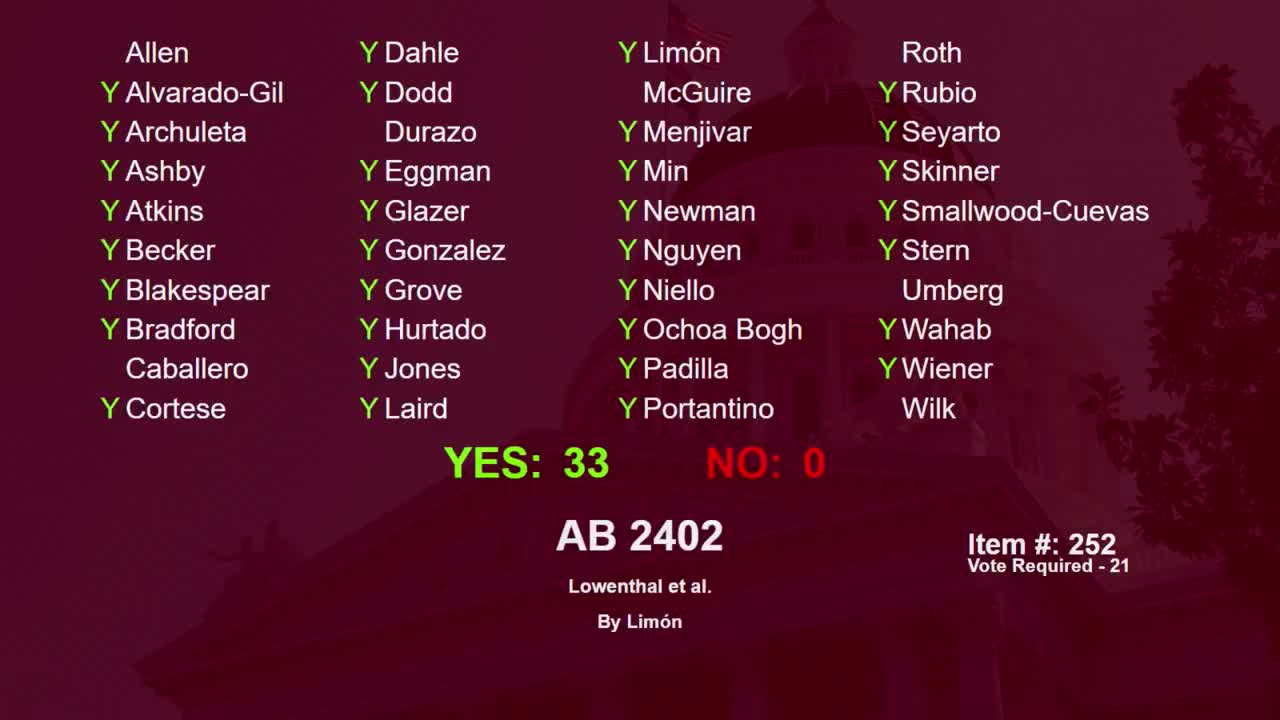 2MIN
Senate Floor
 3MIN
Senate Floor
 2MIN
Senate Standing Committee on Appropriations
 19MIN
Senate Standing Committee on Human Services
 1MIN
Assembly Floor
 16MIN
Assembly Standing Committee on Human Services
Bill Author

Bill Co-Author(s):