AB 2629: Firearms: prohibited persons.
- Session Year: 2023-2024
- House: Assembly
- Latest Version Date: 2024-09-24
Current Status:
Passed
(2024-09-24: Chaptered by Secretary of State - Chapter 527, Statutes of 2024.)
Introduced
In Committee
First Chamber
In Committee
Second Chamber
Enacted
What does this bill do?
This bill expands California’s ban on buying, owning, or possessing guns for people who have been the subject of specified mental‑health court findings to also cover people found mentally incompetent to stand trial in postrelease community supervision or parole revocation hearings. It also adds ammunition to the list of items covered, requires courts and treatment facilities to notify the Department of Justice and in many cases to have the person relinquish firearms or other deadly weapons, and retains a court hearing process to restore rights if the person is found safe to use firearms.
The summary is provided by generative AI which can make mistakes. For original language, please view the details in the table below.
Existing law prohibits certain persons who have been the subject of specified mental health determinations, including having been placed under conservatorship by a court, having been found mentally incompetent to stand trial, having been found not guilty of specified crimes due to reason of insanity, having been adjudicated by a court to be a danger to others as a result of a mental disorder or mental illness, or having been adjudicated to be a mentally disordered sex offender, from possessing or receiving a firearm, as specified.
Existing law removes this prohibition from a person who was found mentally incompetent to stand trial but is subsequently restored to competence, as specified.
This bill would, commencing on September 1, 2025, specify that this prohibition also applies to persons found mentally incompetent to stand trial in a postrelease community supervision or parole revocation hearing.
This bill would incorporate additional changes to Section 8103 of the Welfare and Institutions Code proposed by SB 1002 and SB 1025 to be operative only if this bill and either one or both of those bills are enacted and this bill is enacted last.
Existing law prohibits certain persons who have been the subject of specified mental health determinations, including having been placed under conservatorship by a court, having been found mentally incompetent to stand trial, having been found not guilty of specified crimes due to reason of insanity, having been adjudicated by a court to be a danger to others as a result of a mental disorder or mental illness, or having been adjudicated to be a mentally disordered sex offender, from possessing or receiving a firearm, as specified.
Existing law removes this prohibition from a person who was found mentally incompetent to stand trial but is subsequently restored to competence, as specified.
This bill would, commencing on September 1, 2025, specify that this prohibition also applies to persons found mentally incompetent to stand trial in a misdemeanor proceeding or in postrelease community supervision or parole revocation hearing.
The bill would also, commencing on September 1, 2025, allow a person who has had a misdemeanor charge dismissed due to their mental incompetence to subsequently petition the court for a restoration of competence and would authorize the court, upon receiving such a petition, to appoint a psychologist or psychiatrist to evaluate the person. The bill would require the court, if the psychologist or psychiatrist finds that the person has regained competence, to notify the Department of Justice to remove the prohibition on the person from possessing or receiving a firearm.Existing law prohibits certain persons who have been the subject of specified mental health determinations, including having been placed under conservatorship by a court, having been found mentally incompetent to stand trial, having been found not guilty of specified crimes due to reason of insanity, having been adjudicated by a court to be a danger to others as a result of a mental disorder or mental illness, or having been adjudicated to be a mentally disordered sex offender, from possessing or receiving a firearm, as specified.
Existing law removes this prohibition from a person who was found mentally incompetent to stand trial but is subsequently restored to competence, as specified.
This bill would would, commencing on September 1, 2025, specify that this prohibition also applies to persons found mentally incompetent to stand trial in a misdemeanor proceeding or in postrelease community supervision or parole revocation hearing.
The bill would also also, commencing on September 1, 2025, allow a person who has had a misdemeanor charge dismissed due to their mental incompetence to subsequently petition the court for a restoration of competence and would authorize the court, upon receiving such a petition, to appoint a psychologist or psychiatrist to evaluate the person. The bill would require the court, if the psychologist or psychiatrist finds that the person has regained competence, to notify the Department of Justice to remove the prohibition on the person from possessing or receiving a firearm.
Existing law prohibits certain persons who have been the subject of specified mental health determinations, including having been placed under conservatorship by a court, having been found mentally incompetent to stand trial, having been found not guilty of specified crimes due to reason of insanity, having been adjudicated by a court to be a danger to others as a result of a mental disorder or mental illness, or having been adjudicated to be a mentally disordered sex offender, from possessing or receiving a firearm, as specified.
Existing law removes this prohibition from a person who was found mentally incompetent to stand trial but is subsequently restored to competence, as specified.
This bill would specify that this prohibition also applies to persons found mentally incompetent to stand trial in a misdemeanor proceeding or in postrelease community supervision or parole revocation hearing.
The bill would also allow a person who has had a misdemeanor charge dismissed due to their mental incompetence to subsequently petition the court for a restoration of competence and would authorize the court, upon receiving such a petition, to appoint a psychologist or psychiatrist to evaluate the person. The bill would require the court, if the psychologist or psychiatrist finds that the person has regained competence, to notify the Department of Justice to remove the prohibition on the person from possessing or receiving a firearm.
This bill would make a technical, nonsubstantive change to these provisions.Existing law prohibits certain persons who have been the subject of specified mental health determinations, including having been placed under conservatorship by a court, having been found mentally incompetent to stand trial, having been found not guilty of specified crimes due to reason of insanity, having been adjudicated by a court to be a danger to others as a result of a mental disorder or mental illness, or having been adjudicated to be a mentally disordered sex offender, from possessing or receiving a firearm, as specified.
This bill would make a technical, nonsubstantive change to these provisions.
(a)(1)A person who after October 1, 1955, has been adjudicated by a court of any state to be a danger to others as a result of a mental disorder or mental illness, or who has been adjudicated to be a mentally disordered sex offender, shall not purchase or receive, or attempt to purchase or receive, or have possession, custody, or control of a firearm or any other deadly weapon unless there has been issued to the person a certificate by the court of adjudication upon release from treatment or at a later date stating that the person may possess a firearm or any other deadly weapon without endangering others, and the person has not, subsequent to the issuance of the certificate, again been adjudicated by a court to be a danger to others as a result of a mental disorder or mental illness.
(2)The court shall notify the Department of Justice of the court order finding the individual to be a person described in paragraph (1) as soon as possible, but not later than one court day after issuing the order. The court shall also notify the Department of Justice of any certificate issued as described in paragraph (1) as soon as possible, but not later than one court day after issuing the certificate.
(b)(1)A person who has been found, pursuant to Section 1026 of the Penal Code or the law of any other state or the United States, not guilty by reason of insanity of murder, mayhem, a violation of Section 207, 209, or 209.5 of the Penal Code in which the victim suffers intentionally inflicted great bodily injury, carjacking or robbery in which the victim suffers great bodily injury, a violation of Section 451 or 452 of the Penal Code involving a trailer coach, as defined in Section 635 of the Vehicle Code, or any dwelling house, a violation of paragraph (1) or (2) of subdivision (a) of Section 262 or paragraph (2) or (3) of subdivision (a) of Section 261 of the Penal Code, a violation of Section 459 of the Penal Code in the first degree, assault with intent to commit murder, a violation of Section 220 of the Penal Code in which the victim suffers great bodily injury, a violation of Section 18715, 18725, 18740, 18745, 18750, or 18755 of the Penal Code, or of a felony involving death, great bodily injury, or an act which poses a serious threat of bodily harm to another person, or a violation of the law of any other state or the United States that includes all the elements of any of the above felonies as defined under California law, shall not purchase or receive, or attempt to purchase or receive, or have possession, custody, or control of any firearm or any other deadly weapon.
(2)The court shall notify the Department of Justice of the court order finding the person to be a person described in paragraph (1) as soon as possible, but not later than one court day after issuing the order.
(c)(1)A person who has been found, pursuant to Section 1026 of the Penal Code or the law of any other state or the United States, not guilty by reason of insanity of any crime other than those described in subdivision (b) shall not purchase or receive, or attempt to purchase or receive, or have possession, custody, or control of any firearm or any other deadly weapon unless the court of commitment has found the person to have recovered sanity, pursuant to Section 1026.2 of the Penal Code or the law of any other state or the United States.
(2)The court shall notify the Department of Justice of the court order finding the person to be a person described in paragraph (1) as soon as possible, but not later than one court day after issuing the order. The court shall also notify the Department of Justice when it finds that the person has recovered their sanity as soon as possible, but not later than one court day after making the finding.
(d)(1)A person found by a court to be mentally incompetent to stand trial, pursuant to Section 1370 or 1370.1 of the Penal Code or the law of any other state or the United States, shall not purchase or receive, or attempt to purchase or receive, or have possession, custody, or control of any firearm or any other deadly weapon, unless there has been a finding with respect to the person of restoration to competence to stand trial by the committing court, pursuant to Section 1372 of the Penal Code or the law of any other state or the United States.
(2)The court shall notify the Department of Justice of the court order finding the person to be mentally incompetent as described in paragraph (1) as soon as possible, but not later than one court day after issuing the order. The court shall also notify the Department of Justice when it finds that the person has recovered competence as soon as possible, but not later than one court day after making the finding.
(e)(1)A person who has been placed under conservatorship by a court, pursuant to Section 5350 or the law of any other state or the United States, because the person is gravely disabled as a result of a mental disorder or impairment by chronic alcoholism, shall not purchase or receive, or attempt to purchase or receive, or have possession, custody, or control of any firearm or any other deadly weapon while under the conservatorship if, at the time the conservatorship was ordered or thereafter, the court that imposed the conservatorship found that possession of a firearm or any other deadly weapon by the person would present a danger to the safety of the person or to others. Upon placing a person under conservatorship, and prohibiting firearm or any other deadly weapon possession by the person, the court shall notify the person of this prohibition.
(2)The court shall notify the Department of Justice of the court order placing the person under conservatorship and prohibiting firearm or any other deadly weapon possession by the person as described in paragraph (1) as soon as possible, but not later than one court day after placing the person under conservatorship. The notice shall include the date the conservatorship was imposed and the date the conservatorship is to be terminated. If the conservatorship is subsequently terminated before the date listed in the notice to the Department of Justice or the court subsequently finds that possession of a firearm or any other deadly weapon by the person would no longer present a danger to the safety of the person or others, the court shall notify the Department of Justice as soon as possible, but not later than one court day after terminating the conservatorship.
(3)All information provided to the Department of Justice pursuant to paragraph (2) shall be kept confidential, separate, and apart from all other records maintained by the Department of Justice, and shall be used only to determine eligibility to purchase or possess firearms or other deadly weapons. A person who knowingly furnishes that information for any other purpose is guilty of a misdemeanor. All the information concerning any person shall be destroyed upon receipt by the Department of Justice of notice of the termination of conservatorship as to that person pursuant to paragraph (2).
(f)(1)(A)A person who has been (i) taken into custody as provided in Section 5150 because that person is a danger to themselves or to others, (ii) assessed within the meaning of Section 5151, and (iii) admitted to a designated facility within the meaning of Sections 5151 and 5152 because that person is a danger to themselves or others, shall not own, possess, control, receive, or purchase, or attempt to own, possess, control, receive, or purchase, any firearm for a period of five years after the person is released from the facility.
(B)A person who has been taken into custody, assessed, and admitted as specified in subparagraph (A), and who was previously taken into custody, assessed, and admitted as specified in subparagraph (A) one or more times within a period of one year preceding the most recent admittance, shall not own, possess, control, receive, or purchase, or attempt to own, possess, control, receive, or purchase, any firearm for the remainder of their life.
(C)A person described in this paragraph, however, may own, possess, control, receive, or purchase, or attempt to own, possess, control, receive, or purchase any firearm if the superior court has, pursuant to paragraph (5), found that the people of the State of California have not met their burden pursuant to paragraph (6).
(2)(A)(i)For each person subject to this subdivision, the facility shall, within 24 hours of the time of admission, submit a report to the Department of Justice, on a form prescribed by the Department of Justice, containing information that includes, but is not limited to, the identity of the person and the legal grounds upon which the person was admitted to the facility.
(ii)Any report submitted pursuant to this paragraph shall be confidential, except for purposes of the court proceedings described in this subdivision and for determining the eligibility of the person to own, possess, control, receive, or purchase a firearm.
(B)Facilities shall submit reports pursuant to this paragraph exclusively by electronic means, in a manner prescribed by the Department of Justice.
(3)Prior to, or concurrent with, the discharge, the facility shall inform a person subject to this subdivision that they are prohibited from owning, possessing, controlling, receiving, or purchasing any firearm for a period of five years or, if the person was previously taken into custody, assessed, and admitted to custody for a 72-hour hold because they were a danger to themselves or to others during the previous one-year period, for life. Simultaneously, the facility shall inform the person that they may request a hearing from a court, as provided in this subdivision, for an order permitting the person to own, possess, control, receive, or purchase a firearm. The facility shall provide the person with a copy of the most recent Patient Notification of Firearm Prohibition and Right to Hearing Form prescribed by the Department of Justice. The Department of Justice shall update this form in accordance with the requirements of this section and distribute the updated form to facilities by January 1, 2020. The form shall include information regarding how the person was referred to the facility. The form shall include an authorization for the release of the persons mental health records, upon request, to the appropriate court, solely for use in the hearing conducted pursuant to paragraph (5). A request for the records may be made by mail to the custodian of records at the facility, and shall not require personal service. The facility shall not submit the form on behalf of the person subject to this subdivision.
(4)The Department of Justice shall provide the form upon request to any person described in paragraph (1). The Department of Justice shall also provide the form to the superior court in each county. A person described in paragraph (1) may make a single request for a hearing at any time during the five-year period or period of the lifetime prohibition. The request for hearing shall be made on the form prescribed by the department or in a document that includes equivalent language.
(5)A person who is subject to paragraph (1) who has requested a hearing from the superior court of the county of their residence for an order that they may own, possess, control, receive, or purchase firearms shall be given a hearing. The clerk of the court shall set a hearing date and notify the person, the Department of Justice, and the district attorney. The people of the State of California shall be the plaintiff in the proceeding and shall be represented by the district attorney. Upon motion of the district attorney, or on its own motion, the superior court may transfer the hearing to the county in which the person resided at the time of their detention, the county in which the person was detained, or the county in which the person was evaluated or treated. Within seven days after the request for a hearing, the Department of Justice shall file copies of the reports described in this section with the superior court. The reports shall be disclosed upon request to the person and to the district attorney. The court shall set the hearing within 60 days of receipt of the request for a hearing. Upon showing good cause, the district attorney shall be entitled to a continuance not to exceed 30 days after the district attorney was notified of the hearing date by the clerk of the court. If additional continuances are granted, the total length of time for continuances shall not exceed 60 days. The district attorney may notify the county behavioral health director of the hearing who shall provide information about the detention of the person that may be relevant to the court and shall file that information with the superior court. That information shall be disclosed to the person and to the district attorney. The court, upon motion of the person subject to paragraph (1) establishing that confidential information is likely to be discussed during the hearing that would cause harm to the person, shall conduct the hearing in camera with only the relevant parties present, unless the court finds that the public interest would be better served by conducting the hearing in public. Notwithstanding any other law, declarations, police reports, including criminal history information, and any other material and relevant evidence that is not excluded under Section 352 of the Evidence Code shall be admissible at the hearing under this section.
(6)The people shall bear the burden of showing by a preponderance of the evidence that the person would not be likely to use firearms in a safe and lawful manner.
(7)If the court finds at the hearing set forth in paragraph (5) that the people have not met their burden as set forth in paragraph (6), the court shall order that the person shall not be subject to the five-year prohibition or lifetime prohibition, as appropriate, in this section on the ownership, control, receipt, possession, or purchase of firearms, and that person shall comply with the procedure described in Chapter 2 (commencing with Section 33850) of Division 11 of Title 4 of Part 6 of the Penal Code for the return of any firearms. A copy of the order shall be submitted to the Department of Justice. Upon receipt of the order, the Department of Justice shall delete any reference to the prohibition against firearms from the persons state mental health firearms prohibition system information.
(8)If the district attorney declines or fails to go forward in the hearing, the court shall order that the person shall not be subject to the five-year prohibition or lifetime prohibition required by this subdivision on the ownership, control, receipt, possession, or purchase of firearms. A copy of the order shall be submitted to the Department of Justice. Upon receipt of the order, the Department of Justice shall, within 15 days, delete any reference to the prohibition against firearms from the persons state mental health firearms prohibition system information, and that person shall comply with the procedure described in Chapter 2 (commencing with Section 33850) of Division 11 of Title 4 of Part 6 of the Penal Code for the return of any firearms.
(9)This subdivision does not prohibit the use of reports filed pursuant to this section to determine the eligibility of persons to own, possess, control, receive, or purchase a firearm if the person is the subject of a criminal investigation, a part of which involves the ownership, possession, control, receipt, or purchase of a firearm.
(10)If the court finds that the people have met their burden to show by a preponderance of the evidence that the person would not be likely to use firearms in a safe and lawful manner and the person is subject to a lifetime firearm prohibition because the person had been admitted as specified in subparagraph (A) of paragraph (1) more than once within the previous one-year period, the court shall inform the person of their right to file a subsequent petition no sooner than five years from the date of the hearing.
(11)A person subject to a lifetime firearm prohibition is entitled to bring subsequent petitions pursuant to this subdivision. A person shall not be entitled to file a subsequent petition, and shall not be entitled to a subsequent hearing, until five years have passed since the determination on the persons last petition. A hearing on subsequent petitions shall be conducted as described in this subdivision, with the exception that the burden of proof shall be on the petitioner to establish by a preponderance of the evidence that the petitioner can use a firearm in a safe and lawful manner. Subsequent petitions shall be filed in the same court of jurisdiction as the initial petition regarding the lifetime firearm prohibition.
(g)(1)(A)A person who has been certified for intensive treatment under Section 5250, 5260, or 5270.15 shall not own, possess, control, receive, or purchase, or attempt to own, possess, control, receive, or purchase, any firearm for a period of five years.
(B)Any person who meets the criteria contained in subdivision (e) or (f) who is released from intensive treatment shall nevertheless, if applicable, remain subject to the prohibition contained in subdivision (e) or (f).
(2)(A)For each person certified for intensive treatment under paragraph (1), the facility shall, within 24 hours of the certification, submit a report to the Department of Justice, on a form prescribed by the department, containing information regarding the person, including, but not limited to, the legal identity of the person and the legal grounds upon which the person was certified. A report submitted pursuant to this paragraph shall only be used for the purposes specified in paragraph (2) of subdivision (f).
(B)Facilities shall submit reports pursuant to this paragraph exclusively by electronic means, in a manner prescribed by the Department of Justice.
(3)Prior to, or concurrent with, the discharge of each person certified for intensive treatment under paragraph (1), the facility shall inform the person of that information specified in paragraph (3) of subdivision (f).
(4)A person who is subject to paragraph (1) may petition the superior court of the county of their residence for an order that they may own, possess, control, receive, or purchase firearms. At the time the petition is filed, the clerk of the court shall set a hearing date within 60 days of receipt of the petition and notify the person, the Department of Justice, and the district attorney. The people of the State of California shall be the respondent in the proceeding and shall be represented by the district attorney. Upon motion of the district attorney, or on its own motion, the superior court may transfer the petition to the county in which the person resided at the time of their detention, the county in which the person was detained, or the county in which the person was evaluated or treated. Within seven days after receiving notice of the petition, the Department of Justice shall file copies of the reports described in this section with the superior court. The reports shall be disclosed upon request to the person and to the district attorney. The district attorney shall be entitled to a continuance of the hearing to a date of not less than 30 days after the district attorney was notified of the hearing date by the clerk of the court. If additional continuances are granted, the total length of time for continuances shall not exceed 60 days. The district attorney may notify the county behavioral health director of the petition, and the county behavioral health director shall provide information about the detention of the person that may be relevant to the court and shall file that information with the superior court. That information shall be disclosed to the person and to the district attorney. The court, upon motion of the person subject to paragraph (1) establishing that confidential information is likely to be discussed during the hearing that would cause harm to the person, shall conduct the hearing in camera with only the relevant parties present, unless the court finds that the public interest would be better served by conducting the hearing in public. Notwithstanding any other law, any declaration, police reports, including criminal history information, and any other material and relevant evidence that is not excluded under Section 352 of the Evidence Code, shall be admissible at the hearing under this section. If the court finds by a preponderance of the evidence that the person would be likely to use firearms in a safe and lawful manner, the court may order that the person may own, control, receive, possess, or purchase firearms, and that person shall comply with the procedure described in Chapter 2 (commencing with Section 33850) of Division 11 of Title 4 of Part 6 of the Penal Code for the return of any firearms. A copy of the order shall be submitted to the Department of Justice. Upon receipt of the order, the Department of Justice shall delete any reference to the prohibition against firearms from the persons state mental health firearms prohibition system information.
(h)(1)For all persons identified in subdivisions (f) and (g), facilities shall report to the Department of Justice as specified in those subdivisions, except facilities shall not report persons under subdivision (g) if the same persons previously have been reported under subdivision (f).
(2)Additionally, all facilities shall report to the Department of Justice upon the discharge of persons from whom reports have been submitted pursuant to subdivision (f) or (g). However, a report shall not be filed for persons who are discharged within 31 days after the date of admission.
(i)(1)A person, who has been found by a court, on or after July 1, 2024, to be prohibited from owning or controlling a firearm because they are a danger to themselves or others and has been granted pretrial mental health diversion pursuant to subdivision (m) of Section 1001.36 of the Penal Code, shall not own, possess, control, receive, or purchase, or attempt to own, possess, control, receive, or purchase, any firearm until the person successfully completes diversion or their firearm rights are restored pursuant to paragraph (4) of subdivision (g).
(2)The court shall notify the Department of Justice of the court order finding the person to be an individual described in paragraph (1) as soon as possible, but not later than one court day after issuing the order. The court shall also notify the Department of Justice that the person has successfully completed diversion as soon as possible, but not later than one court day after completion.
(j)Every person who owns or possesses or has custody or control of, or purchases or receives, or attempts to purchase or receive, any firearm or any other deadly weapon in violation of this section shall be punished by imprisonment pursuant to subdivision (h) of Section 1170 of the Penal Code or in a county jail for not more than one year.
(k)Deadly weapon, as used in this section, has the meaning prescribed by Section 8100.
(l)Any notice or report required to be submitted to the Department of Justice pursuant to this section shall be submitted in an electronic format, in a manner prescribed by the Department of Justice.
(m)This section shall remain in effect only until September 1, 2025, and as of that date is repealed.
SEC. 1.1.Section 8103 of the Welfare and Institutions Code is amended to read:8103.(a)(1)A person who after October 1, 1955, has been adjudicated by a court of any state to be a danger to others as a result of a mental disorder or mental illness, or who has been adjudicated to be a mentally disordered sex offender, shall not purchase or receive, or attempt to purchase or receive, or have possession, custody, or control of a firearm, other deadly weapon, or ammunition unless there has been issued to the person a certificate by the court of adjudication upon release from treatment or at a later date stating that the person may possess a firearm, other deadly weapon, or ammunition without endangering others, and the person has not, subsequent to the issuance of the certificate, again been adjudicated by a court to be a danger to others as a result of a mental disorder or mental illness.
(2)The court shall notify the Department of Justice of the court order finding the individual to be a person described in paragraph (1) as soon as possible, but not later than one court day after issuing the order. The court shall also notify the Department of Justice of a certificate issued as described in paragraph (1) as soon as possible, but not later than one court day after issuing the certificate.
(3)A person described in paragraph (1) shall, in accordance with applicable state law and local procedure, relinquish to law enforcement a firearm, other deadly weapon, or ammunition in their custody or control within 14 days of a court order finding the person to be a person described in paragraph (1) and submit a receipt to the court to show proof of relinquishment.
(b)(1)A person who has been found, pursuant to Section 1026 of the Penal Code or the law of any other state or the United States, not guilty by reason of insanity of murder, mayhem, a violation of Section 207, 209, or 209.5 of the Penal Code in which the victim suffers intentionally inflicted great bodily injury, carjacking or robbery in which the victim suffers great bodily injury, a violation of Section 451 or 452 of the Penal Code involving a trailer coach, as defined in Section 635 of the Vehicle Code, or a dwelling house, a violation of paragraph (1) or (2) of subdivision (a) of former Section 262 of the Penal Code or paragraph (2) or (3) of subdivision (a) of Section 261 of the Penal Code, a violation of Section 459 of the Penal Code in the first degree, assault with intent to commit murder, a violation of Section 220 of the Penal Code in which the victim suffers great bodily injury, a violation of Section 18715, 18725, 18740, 18745, 18750, or 18755 of the Penal Code, or of a felony involving death, great bodily injury, or an act which poses a serious threat of bodily harm to another person, or a violation of the law of any other state or the United States that includes all the elements of any of the above felonies as defined under California law, shall not purchase or receive, or attempt to purchase or receive, or have possession, custody, or control of a firearm, other deadly weapon, or ammunition.
(2)The court shall notify the Department of Justice of the court order finding the person to be a person described in paragraph (1) as soon as possible, but not later than one court day after issuing the order.
(3)A person described in paragraph (1) shall, in accordance with applicable state law and local procedure, relinquish to law enforcement a firearm, other deadly weapon, or ammunition in their custody or control within 14 days of the court order finding the person to be a person described in paragraph (1) and submit a receipt to the court to show proof of relinquishment.
(c)(1)A person who has been found, pursuant to Section 1026 of the Penal Code or the law of any other state or the United States, not guilty by reason of insanity of a crime other than those described in subdivision (b) shall not purchase or receive, or attempt to purchase or receive, or have possession, custody, or control of a firearm, other deadly weapon, or ammunition unless the court of commitment has found the person to have recovered sanity, pursuant to Section 1026.2 of the Penal Code or the law of any other state or the United States.
(2)The court shall notify the Department of Justice of the court order finding the person to be a person described in paragraph (1) as soon as possible, but not later than one court day after issuing the order. The court shall also notify the Department of Justice when it finds that the person has recovered their sanity as soon as possible, but not later than one court day after making the finding.
(3)A person described in paragraph (1) shall, in accordance with applicable state law and local procedure, relinquish to law enforcement a firearm, other deadly weapon, or ammunition in their custody or control within 14 days of the court order finding the person to be a person described in paragraph (1) and submit a receipt to the court to show proof of relinquishment.
(d)(1)A person found by a court to be mentally incompetent to stand trial, pursuant to Section 1370 or 1370.1 of the Penal Code or the law of any other state or the United States, shall not purchase or receive, or attempt to purchase or receive, or have possession, custody, or control of a firearm, other deadly weapon, or ammunition, unless there has been a finding with respect to the person of restoration to competence to stand trial by the committing court, pursuant to Section 1372 of the Penal Code or the law of any other state or the United States.
(2)The court shall notify the Department of Justice of the court order finding the person to be mentally incompetent as described in paragraph (1) as soon as possible, but not later than one court day after issuing the order. The court shall also notify the Department of Justice when it finds that the person has recovered competence as soon as possible, but not later than one court day after making the finding.
(e)(1)A person who has been placed under conservatorship by a court, pursuant to Section 5350 or the law of any other state or the United States, because the person is gravely disabled as a result of a mental disorder or impairment by chronic alcoholism, shall not purchase or receive, or attempt to purchase or receive, or have possession, custody, or control of a firearm, other deadly weapon, or ammunition while under the conservatorship if, at the time the conservatorship was ordered or thereafter, the court that imposed the conservatorship found that possession of a firearm, other deadly weapon, or ammunition by the person would present a danger to the safety of the person or to others. Upon placing a person under conservatorship, and prohibiting firearm, other deadly weapon, or ammunition possession by the person, the court shall notify the person of this prohibition.
(2)The court shall notify the Department of Justice of the court order placing the person under conservatorship and prohibiting firearm, other deadly weapon, or ammunition possession by the person as described in paragraph (1) as soon as possible, but not later than one court day after placing the person under conservatorship. The notice shall include the date the conservatorship was imposed and the date the conservatorship is to be terminated. If the conservatorship is subsequently terminated before the date listed in the notice to the Department of Justice or the court subsequently finds that possession of a firearm, other deadly weapon, or ammunition by the person would no longer present a danger to the safety of the person or others, the court shall notify the Department of Justice as soon as possible, but not later than one court day after terminating the conservatorship.
(3)All information provided to the Department of Justice pursuant to paragraph (2) shall be kept confidential, separate, and apart from all other records maintained by the Department of Justice, and shall be used only to determine eligibility to purchase or possess a firearm, other deadly weapon, or ammunition. A person who knowingly furnishes that information for any other purpose is guilty of a misdemeanor. All the information concerning a person shall be destroyed upon receipt by the Department of Justice of notice of the termination of conservatorship as to that person pursuant to paragraph (2).
(f)(1)(A)A person who has been (i) taken into custody as provided in Section 5150 because that person is a danger to themselves or to others, (ii) assessed within the meaning of Section 5151, and (iii) admitted to a designated facility within the meaning of Sections 5151 and 5152 because that person is a danger to themselves or others, shall not own, possess, control, receive, or purchase, or attempt to own, possess, control, receive, or purchase, a firearm, other deadly weapon, or ammunition for a period of five years after the person is released from the facility.
(B)A person who has been taken into custody, assessed, and admitted as specified in subparagraph (A), and who was previously taken into custody, assessed, and admitted as specified in subparagraph (A) one or more times within a period of one year preceding the most recent admittance, shall not own, possess, control, receive, or purchase, or attempt to own, possess, control, receive, or purchase, a firearm for the remainder of their life.
(C)A person described in this paragraph, however, may own, possess, control, receive, or purchase, or attempt to own, possess, control, receive, or purchase a firearm, other deadly weapon, or ammunition if the superior court has, pursuant to paragraph (5), found that the people of the State of California have not met their burden pursuant to paragraph (6).
(2)(A)(i)For each person subject to this subdivision, the facility shall, within 24 hours of the time of admission, submit a report to the Department of Justice, on a form prescribed by the Department of Justice, containing information that includes, but is not limited to, the identity of the person and the legal grounds upon which the person was admitted to the facility.
(ii)A report submitted pursuant to this paragraph shall be confidential, except for purposes of the court proceedings described in this subdivision and for determining the eligibility of the person to own, possess, control, receive, or purchase a firearm, other deadly weapon, or ammunition
(B)Facilities shall submit reports pursuant to this paragraph exclusively by electronic means, in a manner prescribed by the Department of Justice.
(3)Prior to, or concurrent with, the discharge, the facility shall inform a person subject to this subdivision that they are prohibited from owning, possessing, controlling, receiving, or purchasing a firearm, other deadly weapon, or ammunition for a period of five years or, if the person was previously taken into custody, assessed, and admitted to custody for a 72-hour hold because they were a danger to themselves or to others during the previous one-year period, for life. The facility shall inform the person that they are required to relinquish a firearm, other deadly weapon, or ammunition that the person owns, possesses, or controls within 72 hours of discharge from the facility and how to relinquish a firearm, other deadly weapon, or ammunition according to state law and local procedures. Simultaneously, the facility shall inform the person that they may request a hearing from a court, as provided in this subdivision, for an order permitting the person to own, possess, control, receive, or purchase a firearm, other deadly weapon, or ammunition. The facility shall also provide the person with a copy of the most recent Patient Notification of Firearm Prohibition and Right to Hearing Form prescribed by the Department of Justice and a copy of the completed form to the Department of Justice in a manner prescribed by the Department of Justice. The Department of Justice shall update this form in accordance with the requirements of this section and distribute the updated form to facilities by January 1, 2020. The form shall include information regarding how the person was referred to the facility. The form shall include an authorization for the release of the persons mental health records, upon request, to the appropriate court, solely for use in the hearing conducted pursuant to paragraph (5). A request for the records may be made by mail to the custodian of records at the facility, and shall not require personal service. The facility shall not submit the form on behalf of the person subject to this subdivision.
(4)The Department of Justice shall provide the form upon request to a person described in paragraph (1). The Department of Justice shall also provide the form to the superior court in each county. The Department of Justice shall also provide a copy of the form upon the request of a law enforcement agency solely for investigative purposes. A person described in paragraph (1) may make a single request for a hearing at any time during the five-year period or period of the lifetime prohibition. The request for hearing shall be made on the form prescribed by the department or in a document that includes equivalent language.
(5)A person who is subject to paragraph (1) who has requested a hearing from the superior court of the county of their residence for an order that they may own, possess, control, receive, or purchase a firearm, other deadly weapon, or ammunition shall be given a hearing. The clerk of the court shall set a hearing date and notify the person, the Department of Justice, and the district attorney. The people of the State of California shall be the plaintiff in the proceeding and shall be represented by the district attorney. Upon motion of the district attorney, or on its own motion, the superior court may transfer the hearing to the county in which the person resided at the time of their detention, the county in which the person was detained, or the county in which the person was evaluated or treated. Within seven days after the request for a hearing, the Department of Justice shall file copies of the reports described in this section with the superior court. The reports shall be disclosed upon request to the person and to the district attorney. The court shall set the hearing within 60 days of receipt of the request for a hearing. Upon showing good cause, the district attorney shall be entitled to a continuance not to exceed 30 days after the district attorney was notified of the hearing date by the clerk of the court. If additional continuances are granted, the total length of time for continuances shall not exceed 60 days. The district attorney may notify the county behavioral health director of the hearing who shall provide information about the detention of the person that may be relevant to the court and shall file that information with the superior court. That information shall be disclosed to the person and to the district attorney. The court, upon motion of the person subject to paragraph (1) establishing that confidential information is likely to be discussed during the hearing that would cause harm to the person, shall conduct the hearing in camera with only the relevant parties present, unless the court finds that the public interest would be better served by conducting the hearing in public. Notwithstanding any other law, declarations, police reports, including criminal history information, and any other material and relevant evidence that is not excluded under Section 352 of the Evidence Code shall be admissible at the hearing under this section.
(6)The people shall bear the burden of showing by a preponderance of the evidence that the person would not be likely to use a firearm, other deadly weapon, or ammunition in a safe and lawful manner.
(7)If the court finds at the hearing set forth in paragraph (5) that the people have not met their burden as set forth in paragraph (6), the court shall order that the person shall not be subject to the five-year prohibition or lifetime prohibition, as appropriate, in this section on the ownership, control, receipt, possession, or purchase of a firearm, and that person shall comply with the procedure described in Chapter 2 (commencing with Section 33850) of Division 11 of Title 4 of Part 6 of the Penal Code for the return of a firearm. A copy of the order shall be submitted to the Department of Justice. Upon receipt of the order, the Department of Justice shall delete any reference to the prohibition against firearms from the persons state mental health firearms prohibition system information.
(8)If the district attorney declines or fails to go forward in the hearing, the court shall order that the person shall not be subject to the five-year prohibition or lifetime prohibition required by this subdivision on the ownership, control, receipt, possession, or purchase of firearms. A copy of the order shall be submitted to the Department of Justice. Upon receipt of the order, the Department of Justice shall, within 15 days, delete any reference to the prohibition against firearms from the persons state mental health firearms prohibition system information, and that person shall comply with the procedure described in Chapter 2 (commencing with Section 33850) of Division 11 of Title 4 of Part 6 of the Penal Code for the return of a firearm.
(9)This subdivision does not prohibit the use of reports filed pursuant to this section to determine the eligibility of persons to own, possess, control, receive, or purchase a firearm, other deadly weapon, or ammunition if the person is the subject of a criminal investigation, a part of which involves the ownership, possession, control, receipt, or purchase of a firearm, other deadly weapon, or ammunition.
(10)If the court finds that the people have met their burden to show by a preponderance of the evidence that the person would not be likely to use a firearm, other deadly weapon, or ammunition in a safe and lawful manner and the person is subject to a lifetime firearm prohibition because the person had been admitted as specified in subparagraph (A) of paragraph (1) more than once within the previous one-year period, the court shall inform the person of their right to file a subsequent petition no sooner than five years from the date of the hearing.
(11)A person subject to a lifetime firearm prohibition is entitled to bring subsequent petitions pursuant to this subdivision. A person shall not be entitled to file a subsequent petition, and shall not be entitled to a subsequent hearing, until five years have passed since the determination on the persons last petition. A hearing on subsequent petitions shall be conducted as described in this subdivision, with the exception that the burden of proof shall be on the petitioner to establish by a preponderance of the evidence that the petitioner can use a firearm in a safe and lawful manner. Subsequent petitions shall be filed in the same court of jurisdiction as the initial petition regarding the lifetime firearm prohibition.
(12)(A)A person who is subject to paragraph (1), within 72 hours of discharge from a facility, shall relinquish a firearm, other deadly weapon, or ammunition that they own, possess, or control in a safe manner by any of the following methods:
(i)Surrender to the control of a law enforcement agency.
(ii)Sell or transfer to a licensed firearms dealer, as specified in Article 1 (commencing with Section 26700) and Article 2 (commencing with Section 26800) of Chapter 2 of Division 6 of Title 4 of Part 6 of the Penal Code.
(iii)Transfer or cause to be transferred to a licensed firearms dealer for storage during the duration of the prohibition pursuant to Section 29830 of the Penal Code.
(iv)Sell or transfer to a nonprohibited third party with whom the prohibited person does not live using a licensed firearms dealer pursuant to Section 28050 of the Penal Code.
(B)The law enforcement agency or licensed firearms dealer taking possession of a firearm, other deadly weapon, or ammunition from a person relinquishing a firearm, other deadly weapon, or ammunition pursuant to this paragraph shall issue a receipt to the person at the time of relinquishment.
(C)The Patient Notification of Firearm Prohibition and Right to Hearing Form described in paragraph (3) shall include information about how a person will relinquish their firearm, other deadly weapon, or ammunition pursuant to subparagraph (A).
(g)(1)(A)A person who has been certified for intensive treatment under Section 5250, 5260, or 5270.15 shall not own, possess, control, receive, or purchase, or attempt to own, possess, control, receive, or purchase, a firearm, other deadly weapon, or ammunition for a period of five years.
(B)A person who meets the criteria contained in subdivision (e) or (f) who is released from intensive treatment shall nevertheless, if applicable, remain subject to the prohibition contained in subdivision (e) or (f).
(2)(A)For each person certified for intensive treatment under paragraph (1), the facility shall, within 24 hours of the certification, submit a report to the Department of Justice, on a form prescribed by the department, containing information regarding the person, including, but not limited to, the legal identity of the person and the legal grounds upon which the person was certified. A report submitted pursuant to this paragraph shall only be used for the purposes specified in paragraph (2) of subdivision (f).
(B)Facilities shall submit reports pursuant to this paragraph exclusively by electronic means, in a manner prescribed by the Department of Justice.
(3)Prior to, or concurrent with, the discharge of each person certified for intensive treatment under paragraph (1), the facility shall inform the person of that information specified in paragraph (3) of subdivision (f).
(4)A person who is subject to paragraph (1) may petition the superior court of the county of their residence for an order that they may own, possess, control, receive, or purchase a firearm, other deadly weapon, or ammunition. At the time the petition is filed, the clerk of the court shall set a hearing date within 60 days of receipt of the petition and notify the person, the Department of Justice, and the district attorney. The people of the State of California shall be the respondent in the proceeding and shall be represented by the district attorney. Upon motion of the district attorney, or on its own motion, the superior court may transfer the petition to the county in which the person resided at the time of their detention, the county in which the person was detained, or the county in which the person was evaluated or treated. Within seven days after receiving notice of the petition, the Department of Justice shall file copies of the reports described in this section with the superior court. The reports shall be disclosed upon request to the person and to the district attorney. The district attorney shall be entitled to a continuance of the hearing to a date of not less than 30 days after the district attorney was notified of the hearing date by the clerk of the court. If additional continuances are granted, the total length of time for continuances shall not exceed 60 days. The district attorney may notify the county behavioral health director of the petition, and the county behavioral health director shall provide information about the detention of the person that may be relevant to the court and shall file that information with the superior court. That information shall be disclosed to the person and to the district attorney. The court, upon motion of the person subject to paragraph (1) establishing that confidential information is likely to be discussed during the hearing that would cause harm to the person, shall conduct the hearing in camera with only the relevant parties present, unless the court finds that the public interest would be better served by conducting the hearing in public. Notwithstanding any other law, a declaration, police report, including criminal history information, and any other material and relevant evidence that is not excluded under Section 352 of the Evidence Code, shall be admissible at the hearing under this section. If the court finds by a preponderance of the evidence that the person would be likely to use a firearm, other deadly weapon, or ammunition in a safe and lawful manner, the court may order that the person may own, control, receive, possess, or purchase a firearm, other deadly weapon, or ammunition, and that person shall comply with the procedure described in Chapter 2 (commencing with Section 33850) of Division 11 of Title 4 of Part 6 of the Penal Code for the return of a firearm, other deadly weapon, or ammunition. A copy of the order shall be submitted to the Department of Justice. Upon receipt of the order, the Department of Justice shall delete any reference to the prohibition from the persons state mental health firearms prohibition system information.
(h)(1)For all persons identified in subdivisions (f) and (g), a facility shall report to the Department of Justice, as specified in those subdivisions, except a facility shall not report a person under subdivision (g) if the same person was previously reported under subdivision (f).
(2)Additionally, a facility shall report to the Department of Justice upon the discharge of persons from whom reports have been submitted pursuant to subdivision (f) or (g). However, a report shall not be filed for persons who are discharged within 31 days after the date of admission.
(i)(1)A person, who has been found by a court, on or after July 1, 2024, to be prohibited from owning or controlling a firearm, other deadly weapon, or ammunition because they are a danger to themselves or others and has been granted pretrial mental health diversion pursuant to subdivision (m) of Section 1001.36 of the Penal Code, shall not own, possess, control, receive, or purchase, or attempt to own, possess, control, receive, or purchase, a firearm, other deadly weapon, or ammunition until the person successfully completes diversion or their rights are restored pursuant to paragraph (4) of subdivision (g).
(2)The court shall notify the Department of Justice of the court order finding the person to be an individual described in paragraph (1) as soon as possible, but not later than one court day after issuing the order. The court shall also notify the Department of Justice that the person has successfully completed diversion as soon as possible, but not later than one court day after completion.
(j)Every person who owns or possesses or has custody or control of, or purchases or receives, or attempts to purchase or receive, a firearm, other deadly weapon, or ammunition in violation of this section shall be punished by imprisonment pursuant to subdivision (h) of Section 1170 of the Penal Code or in a county jail for not more than one year.
(k)Deadly weapon, as used in this section, has the meaning prescribed by Section 8100.
(l)A notice or report required to be submitted to the Department of Justice pursuant to this section shall be submitted in an electronic format, in a manner prescribed by the Department of Justice.
(m)This section shall remain in effect only until September 1, 2025, and as of that date is repealed.
SEC. 1.3.Section 8103 of the Welfare and Institutions Code is amended to read:8103.(a)(1)A person who after October 1, 1955, has been adjudicated by a court of any state to be a danger to others as a result of a mental disorder or mental illness, or who has been adjudicated to be a mentally disordered sex offender, shall not purchase or receive, or attempt to purchase or receive, or have possession, custody, or control of a firearm or any other deadly weapon unless there has been issued to the person a certificate by the court of adjudication upon release from treatment or at a later date stating that the person may possess a firearm or any other deadly weapon without endangering others, and the person has not, subsequent to the issuance of the certificate, again been adjudicated by a court to be a danger to others as a result of a mental disorder or mental illness.
(2)The court shall notify the Department of Justice of the court order finding the individual to be a person described in paragraph (1) as soon as possible, but not later than one court day after issuing the order. The court shall also notify the Department of Justice of any certificate issued as described in paragraph (1) as soon as possible, but not later than one court day after issuing the certificate.
(b)(1)A person who has been found, pursuant to Section 1026 of the Penal Code or the law of any other state or the United States, not guilty by reason of insanity of murder, mayhem, a violation of Section 207, 209, or 209.5 of the Penal Code in which the victim suffers intentionally inflicted great bodily injury, carjacking or robbery in which the victim suffers great bodily injury, a violation of Section 451 or 452 of the Penal Code involving a trailer coach, as defined in Section 635 of the Vehicle Code, or any dwelling house, a violation of paragraph (1) or (2) of subdivision (a) of Section 262 or paragraph (2) or (3) of subdivision (a) of Section 261 of the Penal Code, a violation of Section 459 of the Penal Code in the first degree, assault with intent to commit murder, a violation of Section 220 of the Penal Code in which the victim suffers great bodily injury, a violation of Section 18715, 18725, 18740, 18745, 18750, or 18755 of the Penal Code, or of a felony involving death, great bodily injury, or an act which poses a serious threat of bodily harm to another person, or a violation of the law of any other state or the United States that includes all the elements of any of the above felonies as defined under California law, shall not purchase or receive, or attempt to purchase or receive, or have possession, custody, or control of any firearm or any other deadly weapon.
(2)The court shall notify the Department of Justice of the court order finding the person to be a person described in paragraph (1) as soon as possible, but not later than one court day after issuing the order.
(c)(1)A person who has been found, pursuant to Section 1026 of the Penal Code or the law of any other state or the United States, not guilty by reason of insanity of any crime other than those described in subdivision (b) shall not purchase or receive, or attempt to purchase or receive, or have possession, custody, or control of any firearm or any other deadly weapon unless the court of commitment has found the person to have recovered sanity, pursuant to Section 1026.2 of the Penal Code or the law of any other state or the United States.
(2)The court shall notify the Department of Justice of the court order finding the person to be a person described in paragraph (1) as soon as possible, but not later than one court day after issuing the order. The court shall also notify the Department of Justice when it finds that the person has recovered their sanity as soon as possible, but not later than one court day after making the finding.
(d)(1)A person found by a court to be mentally incompetent to stand trial, pursuant to Section 1370 or 1370.1 of the Penal Code or the law of any other state or the United States, shall not purchase or receive, or attempt to purchase or receive, or have possession, custody, or control of any firearm or any other deadly weapon, unless there has been a finding with respect to the person of restoration to competence to stand trial by the committing court, pursuant to Section 1372 of the Penal Code or the law of any other state or the United States.
(2)The court shall notify the Department of Justice of the court order finding the person to be mentally incompetent as described in paragraph (1) as soon as possible, but not later than one court day after issuing the order. The court shall also notify the Department of Justice when it finds that the person has recovered competence as soon as possible, but not later than one court day after making the finding.
(e)(1)A person who has been placed under conservatorship by a court, pursuant to Section 5350 or the law of any other state or the United States, because the person is gravely disabled as a result of a mental disorder or impairment by chronic alcoholism, shall not purchase or receive, or attempt to purchase or receive, or have possession, custody, or control of any firearm or any other deadly weapon while under the conservatorship if, at the time the conservatorship was ordered or thereafter, the court that imposed the conservatorship found that possession of a firearm or any other deadly weapon by the person would present a danger to the safety of the person or to others. Upon placing a person under conservatorship, and prohibiting firearm or any other deadly weapon possession by the person, the court shall notify the person of this prohibition.
(2)The court shall notify the Department of Justice of the court order placing the person under conservatorship and prohibiting firearm or any other deadly weapon possession by the person as described in paragraph (1) as soon as possible, but not later than one court day after placing the person under conservatorship. The notice shall include the date the conservatorship was imposed and the date the conservatorship is to be terminated. If the conservatorship is subsequently terminated before the date listed in the notice to the Department of Justice or the court subsequently finds that possession of a firearm or any other deadly weapon by the person would no longer present a danger to the safety of the person or others, the court shall notify the Department of Justice as soon as possible, but not later than one court day after terminating the conservatorship.
(3)All information provided to the Department of Justice pursuant to paragraph (2) shall be kept confidential, separate, and apart from all other records maintained by the Department of Justice, and shall be used only to determine eligibility to purchase or possess firearms or other deadly weapons. A person who knowingly furnishes that information for any other purpose is guilty of a misdemeanor. All the information concerning any person shall be destroyed upon receipt by the Department of Justice of notice of the termination of conservatorship as to that person pursuant to paragraph (2).
(f)(1)(A)A person who has been (i) taken into custody as provided in Section 5150 because that person is a danger to themselves or to others, (ii) assessed within the meaning of Section 5151, and (iii) admitted to a designated facility within the meaning of Sections 5151 and 5152 because that person is a danger to themselves or others, shall not own, possess, control, receive, or purchase, or attempt to own, possess, control, receive, or purchase, any firearm for a period of five years after the person is released from the facility.
(B)A person who has been taken into custody, assessed, and admitted as specified in subparagraph (A), and who was previously taken into custody, assessed, and admitted as specified in subparagraph (A) one or more times within a period of one year preceding the most recent admittance, shall not own, possess, control, receive, or purchase, or attempt to own, possess, control, receive, or purchase, any firearm for the remainder of their life.
(C)A person described in this paragraph, however, may own, possess, control, receive, or purchase, or attempt to own, possess, control, receive, or purchase any firearm if the superior court has, pursuant to paragraph (5), found that the people of the State of California have not met their burden pursuant to paragraph (6).
(2)(A)(i)For each person subject to this subdivision, the facility shall, within 24 hours of the time of admission, submit a report to the Department of Justice, on a form prescribed by the Department of Justice, containing information that includes, but is not limited to, the identity of the person and the legal grounds upon which the person was admitted to the facility.
(ii)Any report submitted pursuant to this paragraph shall be confidential, except for purposes of the court proceedings described in this subdivision and for determining the eligibility of the person to own, possess, control, receive, or purchase a firearm.
(B)Facilities shall submit reports pursuant to this paragraph exclusively by electronic means, in a manner prescribed by the Department of Justice.
(3)Prior to, or concurrent with, the discharge, the facility shall inform a person subject to this subdivision that they are prohibited from owning, possessing, controlling, receiving, or purchasing any firearm for a period of five years or, if the person was previously taken into custody, assessed, and admitted to custody for a 72-hour hold because they were a danger to themselves or to others during the previous one-year period, for life. Simultaneously, the facility shall inform the person that they may request a hearing from a court, as provided in this subdivision, for an order permitting the person to own, possess, control, receive, or purchase a firearm. The facility shall provide the person with a copy of the most recent Patient Notification of Firearm Prohibition and Right to Hearing Form prescribed by the Department of Justice. The Department of Justice shall update this form in accordance with the requirements of this section and distribute the updated form to facilities by January 1, 2020. The form shall include information regarding how the person was referred to the facility. The form shall include an authorization for the release of the persons mental health records, upon request, to the appropriate court, solely for use in the hearing conducted pursuant to paragraph (5). A request for the records may be made by mail to the custodian of records at the facility, and shall not require personal service. The facility shall not submit the form on behalf of the person subject to this subdivision.
(4)The Department of Justice shall provide the form upon request to any person described in paragraph (1). The Department of Justice shall also provide the form to the superior court in each county. A person described in paragraph (1) may make a single request for a hearing at any time during the five-year period or period of the lifetime prohibition. The request for hearing shall be made on the form prescribed by the department or in a document that includes equivalent language.
(5)A person who is subject to paragraph (1) who has requested a hearing from the superior court of the county of their residence for an order that they may own, possess, control, receive, or purchase firearms shall be given a hearing. The clerk of the court shall set a hearing date and notify the person, the Department of Justice, and the district attorney. The people of the State of California shall be the plaintiff in the proceeding and shall be represented by the district attorney. Upon motion of the district attorney, or on its own motion, the superior court may transfer the hearing to the county in which the person resided at the time of their detention, the county in which the person was detained, or the county in which the person was evaluated or treated. Within seven days after the request for a hearing, the Department of Justice shall file copies of the reports described in this section with the superior court. The reports shall be disclosed upon request to the person and to the district attorney. The court shall set the hearing within 60 days of receipt of the request for a hearing. Upon showing good cause, the district attorney shall be entitled to a continuance not to exceed 30 days after the district attorney was notified of the hearing date by the clerk of the court. If additional continuances are granted, the total length of time for continuances shall not exceed 60 days. The district attorney may notify the county behavioral health director of the hearing who shall provide information about the detention of the person that may be relevant to the court and shall file that information with the superior court. That information shall be disclosed to the person and to the district attorney. The court, upon motion of the person subject to paragraph (1) establishing that confidential information is likely to be discussed during the hearing that would cause harm to the person, shall conduct the hearing in camera with only the relevant parties present, unless the court finds that the public interest would be better served by conducting the hearing in public. Notwithstanding any other law, declarations, police reports, including criminal history information, and any other material and relevant evidence that is not excluded under Section 352 of the Evidence Code shall be admissible at the hearing under this section.
(6)The people shall bear the burden of showing by a preponderance of the evidence that the person would not be likely to use firearms in a safe and lawful manner.
(7)If the court finds at the hearing set forth in paragraph (5) that the people have not met their burden as set forth in paragraph (6), the court shall order that the person shall not be subject to the five-year prohibition or lifetime prohibition, as appropriate, in this section on the ownership, control, receipt, possession, or purchase of firearms, and that person shall comply with the procedure described in Chapter 2 (commencing with Section 33850) of Division 11 of Title 4 of Part 6 of the Penal Code for the return of any firearms. A copy of the order shall be submitted to the Department of Justice. Upon receipt of the order, the Department of Justice shall delete any reference to the prohibition against firearms from the persons state mental health firearms prohibition system information.
(8)If the district attorney declines or fails to go forward in the hearing, the court shall order that the person shall not be subject to the five-year prohibition or lifetime prohibition required by this subdivision on the ownership, control, receipt, possession, or purchase of firearms. A copy of the order shall be submitted to the Department of Justice. Upon receipt of the order, the Department of Justice shall, within 15 days, delete any reference to the prohibition against firearms from the persons state mental health firearms prohibition system information, and that person shall comply with the procedure described in Chapter 2 (commencing with Section 33850) of Division 11 of Title 4 of Part 6 of the Penal Code for the return of any firearms.
(9)This subdivision does not prohibit the use of reports filed pursuant to this section to determine the eligibility of persons to own, possess, control, receive, or purchase a firearm if the person is the subject of a criminal investigation, a part of which involves the ownership, possession, control, receipt, or purchase of a firearm.
(10)If the court finds that the people have met their burden to show by a preponderance of the evidence that the person would not be likely to use firearms in a safe and lawful manner and the person is subject to a lifetime firearm prohibition because the person had been admitted as specified in subparagraph (A) of paragraph (1) more than once within the previous one-year period, the court shall inform the person of their right to file a subsequent petition no sooner than five years from the date of the hearing.
(11)A person subject to a lifetime firearm prohibition is entitled to bring subsequent petitions pursuant to this subdivision. A person shall not be entitled to file a subsequent petition, and shall not be entitled to a subsequent hearing, until five years have passed since the determination on the persons last petition. A hearing on subsequent petitions shall be conducted as described in this subdivision, with the exception that the burden of proof shall be on the petitioner to establish by a preponderance of the evidence that the petitioner can use a firearm in a safe and lawful manner. Subsequent petitions shall be filed in the same court of jurisdiction as the initial petition regarding the lifetime firearm prohibition.
(g)(1)(A)A person who has been certified for intensive treatment under Section 5250, 5260, or 5270.15 shall not own, possess, control, receive, or purchase, or attempt to own, possess, control, receive, or purchase, any firearm for a period of five years.
(B)Any person who meets the criteria contained in subdivision (e) or (f) who is released from intensive treatment shall nevertheless, if applicable, remain subject to the prohibition contained in subdivision (e) or (f).
(2)(A)For each person certified for intensive treatment under paragraph (1), the facility shall, within 24 hours of the certification, submit a report to the Department of Justice, on a form prescribed by the department, containing information regarding the person, including, but not limited to, the legal identity of the person and the legal grounds upon which the person was certified. A report submitted pursuant to this paragraph shall only be used for the purposes specified in paragraph (2) of subdivision (f).
(B)Facilities shall submit reports pursuant to this paragraph exclusively by electronic means, in a manner prescribed by the Department of Justice.
(3)Prior to, or concurrent with, the discharge of each person certified for intensive treatment under paragraph (1), the facility shall inform the person of that information specified in paragraph (3) of subdivision (f).
(4)A person who is subject to paragraph (1) may petition the superior court of the county of their residence for an order that they may own, possess, control, receive, or purchase firearms. At the time the petition is filed, the clerk of the court shall set a hearing date within 60 days of receipt of the petition and notify the person, the Department of Justice, and the district attorney. The people of the State of California shall be the respondent in the proceeding and shall be represented by the district attorney. Upon motion of the district attorney, or on its own motion, the superior court may transfer the petition to the county in which the person resided at the time of their detention, the county in which the person was detained, or the county in which the person was evaluated or treated. Within seven days after receiving notice of the petition, the Department of Justice shall file copies of the reports described in this section with the superior court. The reports shall be disclosed upon request to the person and to the district attorney. The district attorney shall be entitled to a continuance of the hearing to a date of not less than 30 days after the district attorney was notified of the hearing date by the clerk of the court. If additional continuances are granted, the total length of time for continuances shall not exceed 60 days. The district attorney may notify the county behavioral health director of the petition, and the county behavioral health director shall provide information about the detention of the person that may be relevant to the court and shall file that information with the superior court. That information shall be disclosed to the person and to the district attorney. The court, upon motion of the person subject to paragraph (1) establishing that confidential information is likely to be discussed during the hearing that would cause harm to the person, shall conduct the hearing in camera with only the relevant parties present, unless the court finds that the public interest would be better served by conducting the hearing in public. Notwithstanding any other law, any declaration, police reports, including criminal history information, and any other material and relevant evidence that is not excluded under Section 352 of the Evidence Code, shall be admissible at the hearing under this section. If the court finds by a preponderance of the evidence that the person would be likely to use firearms in a safe and lawful manner, the court may order that the person may own, control, receive, possess, or purchase firearms, and that person shall comply with the procedure described in Chapter 2 (commencing with Section 33850) of Division 11 of Title 4 of Part 6 of the Penal Code for the return of any firearms. A copy of the order shall be submitted to the Department of Justice. Upon receipt of the order, the Department of Justice shall delete any reference to the prohibition against firearms from the persons state mental health firearms prohibition system information.
(h)(1)For all persons identified in subdivisions (f) and (g), facilities shall report to the Department of Justice as specified in those subdivisions, except facilities shall not report persons under subdivision (g) if the same persons previously have been reported under subdivision (f).
(2)Additionally, all facilities shall report to the Department of Justice upon the discharge of persons from whom reports have been submitted pursuant to subdivision (f) or (g). However, a report shall not be filed for persons who are discharged within 31 days after the date of admission.
(i)(1)A person, who has been found by a court, on or after July 1, 2024, to be prohibited from owning or controlling a firearm because they are a danger to themselves or others and has been granted pretrial mental health diversion pursuant to subdivision (m) of Section 1001.36 or subdivision (p) of Section 1001.80 of the Penal Code, shall not own, possess, control, receive, or purchase, or attempt to own, possess, control, receive, or purchase, any firearm until the person successfully completes diversion or their firearm rights are restored pursuant to paragraph (4) of subdivision (g).
(2)The court shall notify the Department of Justice of the court order finding the person to be an individual described in paragraph (1) as soon as possible, but not later than one court day after issuing the order. The court shall also notify the Department of Justice that the person has successfully completed diversion as soon as possible, but not later than one court day after completion.
(j)Every person who owns or possesses or has custody or control of, or purchases or receives, or attempts to purchase or receive, any firearm or any other deadly weapon in violation of this section shall be punished by imprisonment pursuant to subdivision (h) of Section 1170 of the Penal Code or in a county jail for not more than one year.
(k)Deadly weapon, as used in this section, has the meaning prescribed by Section 8100.
(l)Any notice or report required to be submitted to the Department of Justice pursuant to this section shall be submitted in an electronic format, in a manner prescribed by the Department of Justice.
(m)This section shall remain in effect only until September 1, 2025, and as of that date is repealed.
SEC. 1.5.Section 8103 of the Welfare and Institutions Code is amended to read:8103.(a)(1)A person who after October 1, 1955, has been adjudicated by a court of any state to be a danger to others as a result of a mental disorder or mental illness, or who has been adjudicated to be a mentally disordered sex offender, shall not purchase or receive, or attempt to purchase or receive, or have possession, custody, or control of a firearm, other deadly weapon, or ammunition unless there has been issued to the person a certificate by the court of adjudication upon release from treatment or at a later date stating that the person may possess a firearm, other deadly weapon, or ammunition without endangering others, and the person has not, subsequent to the issuance of the certificate, again been adjudicated by a court to be a danger to others as a result of a mental disorder or mental illness.
(2)The court shall notify the Department of Justice of the court order finding the individual to be a person described in paragraph (1) as soon as possible, but not later than one court day after issuing the order. The court shall also notify the Department of Justice of a certificate issued as described in paragraph (1) as soon as possible, but not later than one court day after issuing the certificate.
(3)A person described in paragraph (1) shall, in accordance with applicable state law and local procedure, relinquish to law enforcement a firearm, other deadly weapon, or ammunition in their custody or control within 14 days of a court order finding the person to be a person described in paragraph (1) and submit a receipt to the court to show proof of relinquishment.
(b)(1)A person who has been found, pursuant to Section 1026 of the Penal Code or the law of any other state or the United States, not guilty by reason of insanity of murder, mayhem, a violation of Section 207, 209, or 209.5 of the Penal Code in which the victim suffers intentionally inflicted great bodily injury, carjacking or robbery in which the victim suffers great bodily injury, a violation of Section 451 or 452 of the Penal Code involving a trailer coach, as defined in Section 635 of the Vehicle Code, or a dwelling house, a violation of paragraph (1) or (2) of subdivision (a) of former Section 262 of the Penal Code or paragraph (2) or (3) of subdivision (a) of Section 261 of the Penal Code, a violation of Section 459 of the Penal Code in the first degree, assault with intent to commit murder, a violation of Section 220 of the Penal Code in which the victim suffers great bodily injury, a violation of Section 18715, 18725, 18740, 18745, 18750, or 18755 of the Penal Code, or of a felony involving death, great bodily injury, or an act which poses a serious threat of bodily harm to another person, or a violation of the law of any other state or the United States that includes all the elements of any of the above felonies as defined under California law, shall not purchase or receive, or attempt to purchase or receive, or have possession, custody, or control of a firearm, other deadly weapon, or ammunition.
(2)The court shall notify the Department of Justice of the court order finding the person to be a person described in paragraph (1) as soon as possible, but not later than one court day after issuing the order.
(3)A person described in paragraph (1) shall, in accordance with applicable state law and local procedure, relinquish to law enforcement a firearm, other deadly weapon, or ammunition in their custody or control within 14 days of the court order finding the person to be a person described in paragraph (1) and submit a receipt to the court to show proof of relinquishment.
(c)(1)A person who has been found, pursuant to Section 1026 of the Penal Code or the law of any other state or the United States, not guilty by reason of insanity of a crime other than those described in subdivision (b) shall not purchase or receive, or attempt to purchase or receive, or have possession, custody, or control of a firearm, other deadly weapon, or ammunition unless the court of commitment has found the person to have recovered sanity, pursuant to Section 1026.2 of the Penal Code or the law of any other state or the United States.
(2)The court shall notify the Department of Justice of the court order finding the person to be a person described in paragraph (1) as soon as possible, but not later than one court day after issuing the order. The court shall also notify the Department of Justice when it finds that the person has recovered their sanity as soon as possible, but not later than one court day after making the finding.
(3)A person described in paragraph (1) shall, in accordance with applicable state law and local procedure, relinquish to law enforcement a firearm, other deadly weapon, or ammunition in their custody or control within 14 days of the court order finding the person to be a person described in paragraph (1) and submit a receipt to the court to show proof of relinquishment.
(d)(1)A person found by a court to be mentally incompetent to stand trial, pursuant to Section 1370 or 1370.1 of the Penal Code or the law of any other state or the United States, shall not purchase or receive, or attempt to purchase or receive, or have possession, custody, or control of a firearm, other deadly weapon, or ammunition, unless there has been a finding with respect to the person of restoration to competence to stand trial by the committing court, pursuant to Section 1372 of the Penal Code or the law of any other state or the United States.
(2)The court shall notify the Department of Justice of the court order finding the person to be mentally incompetent as described in paragraph (1) as soon as possible, but not later than one court day after issuing the order. The court shall also notify the Department of Justice when it finds that the person has recovered competence as soon as possible, but not later than one court day after making the finding.
(e)(1)A person who has been placed under conservatorship by a court, pursuant to Section 5350 or the law of any other state or the United States, because the person is gravely disabled as a result of a mental disorder or impairment by chronic alcoholism, shall not purchase or receive, or attempt to purchase or receive, or have possession, custody, or control of a firearm, other deadly weapon, or ammunition while under the conservatorship if, at the time the conservatorship was ordered or thereafter, the court that imposed the conservatorship found that possession of a firearm, other deadly weapon, or ammunition by the person would present a danger to the safety of the person or to others. Upon placing a person under conservatorship, and prohibiting firearm, other deadly weapon, or ammunition possession by the person, the court shall notify the person of this prohibition.
(2)The court shall notify the Department of Justice of the court order placing the person under conservatorship and prohibiting firearm, other deadly weapon, or ammunition possession by the person as described in paragraph (1) as soon as possible, but not later than one court day after placing the person under conservatorship. The notice shall include the date the conservatorship was imposed and the date the conservatorship is to be terminated. If the conservatorship is subsequently terminated before the date listed in the notice to the Department of Justice or the court subsequently finds that possession of a firearm, other deadly weapon, or ammunition by the person would no longer present a danger to the safety of the person or others, the court shall notify the Department of Justice as soon as possible, but not later than one court day after terminating the conservatorship.
(3)All information provided to the Department of Justice pursuant to paragraph (2) shall be kept confidential, separate, and apart from all other records maintained by the Department of Justice, and shall be used only to determine eligibility to purchase or possess a firearm, other deadly weapon, or ammunition. A person who knowingly furnishes that information for any other purpose is guilty of a misdemeanor. All the information concerning a person shall be destroyed upon receipt by the Department of Justice of notice of the termination of conservatorship as to that person pursuant to paragraph (2).
(f)(1)(A)A person who has been (i) taken into custody as provided in Section 5150 because that person is a danger to themselves or to others, (ii) assessed within the meaning of Section 5151, and (iii) admitted to a designated facility within the meaning of Sections 5151 and 5152 because that person is a danger to themselves or others, shall not own, possess, control, receive, or purchase, or attempt to own, possess, control, receive, or purchase, a firearm, other deadly weapon, or ammunition for a period of five years after the person is released from the facility.
(B)A person who has been taken into custody, assessed, and admitted as specified in subparagraph (A), and who was previously taken into custody, assessed, and admitted as specified in subparagraph (A) one or more times within a period of one year preceding the most recent admittance, shall not own, possess, control, receive, or purchase, or attempt to own, possess, control, receive, or purchase, a firearm for the remainder of their life.
(C)A person described in this paragraph, however, may own, possess, control, receive, or purchase, or attempt to own, possess, control, receive, or purchase a firearm, other deadly weapon, or ammunition if the superior court has, pursuant to paragraph (5), found that the people of the State of California have not met their burden pursuant to paragraph (6).
(2)(A)(i)For each person subject to this subdivision, the facility shall, within 24 hours of the time of admission, submit a report to the Department of Justice, on a form prescribed by the Department of Justice, containing information that includes, but is not limited to, the identity of the person and the legal grounds upon which the person was admitted to the facility.
(ii)A report submitted pursuant to this paragraph shall be confidential, except for purposes of the court proceedings described in this subdivision and for determining the eligibility of the person to own, possess, control, receive, or purchase a firearm, other deadly weapon, or ammunition.
(B)Facilities shall submit reports pursuant to this paragraph exclusively by electronic means, in a manner prescribed by the Department of Justice.
(3)Prior to, or concurrent with, the discharge, the facility shall inform a person subject to this subdivision that they are prohibited from owning, possessing, controlling, receiving, or purchasing a firearm, other deadly weapon, or ammunition for a period of five years or, if the person was previously taken into custody, assessed, and admitted to custody for a 72-hour hold because they were a danger to themselves or to others during the previous one-year period, for life. The facility shall inform the person that they are required to relinquish a firearm, other deadly weapon, or ammunition that the person owns, possesses, or controls within 72 hours of discharge from the facility and how to relinquish a firearm, other deadly weapon, or ammunition according to state law and local procedures. Simultaneously, the facility shall inform the person that they may request a hearing from a court, as provided in this subdivision, for an order permitting the person to own, possess, control, receive, or purchase a firearm, other deadly weapon, or ammunition. The facility shall also provide the person with a copy of the most recent Patient Notification of Firearm Prohibition and Right to Hearing Form prescribed by the Department of Justice and a copy of the completed form to the Department of Justice in a manner prescribed by the Department of Justice. The Department of Justice shall update this form in accordance with the requirements of this section and distribute the updated form to facilities by January 1, 2020. The form shall include information regarding how the person was referred to the facility. The form shall include an authorization for the release of the persons mental health records, upon request, to the appropriate court, solely for use in the hearing conducted pursuant to paragraph (5). A request for the records may be made by mail to the custodian of records at the facility, and shall not require personal service. The facility shall not submit the form on behalf of the person subject to this subdivision.
(4)The Department of Justice shall provide the form upon request to a person described in paragraph (1). The Department of Justice shall also provide the form to the superior court in each county. The Department of Justice shall also provide a copy of the form upon the request of a law enforcement agency solely for investigative purposes. A person described in paragraph (1) may make a single request for a hearing at any time during the five-year period or period of the lifetime prohibition. The request for hearing shall be made on the form prescribed by the department or in a document that includes equivalent language.
(5)A person who is subject to paragraph (1) who has requested a hearing from the superior court of the county of their residence for an order that they may own, possess, control, receive, or purchase a firearm, other deadly weapon, or ammunition shall be given a hearing. The clerk of the court shall set a hearing date and notify the person, the Department of Justice, and the district attorney. The people of the State of California shall be the plaintiff in the proceeding and shall be represented by the district attorney. Upon motion of the district attorney, or on its own motion, the superior court may transfer the hearing to the county in which the person resided at the time of their detention, the county in which the person was detained, or the county in which the person was evaluated or treated. Within seven days after the request for a hearing, the Department of Justice shall file copies of the reports described in this section with the superior court. The reports shall be disclosed upon request to the person and to the district attorney. The court shall set the hearing within 60 days of receipt of the request for a hearing. Upon showing good cause, the district attorney shall be entitled to a continuance not to exceed 30 days after the district attorney was notified of the hearing date by the clerk of the court. If additional continuances are granted, the total length of time for continuances shall not exceed 60 days. The district attorney may notify the county behavioral health director of the hearing who shall provide information about the detention of the person that may be relevant to the court and shall file that information with the superior court. That information shall be disclosed to the person and to the district attorney. The court, upon motion of the person subject to paragraph (1) establishing that confidential information is likely to be discussed during the hearing that would cause harm to the person, shall conduct the hearing in camera with only the relevant parties present, unless the court finds that the public interest would be better served by conducting the hearing in public. Notwithstanding any other law, declarations, police reports, including criminal history information, and any other material and relevant evidence that is not excluded under Section 352 of the Evidence Code shall be admissible at the hearing under this section.
(6)The people shall bear the burden of showing by a preponderance of the evidence that the person would not be likely to use a firearm, other deadly weapon, or ammunition in a safe and lawful manner.
(7)If the court finds at the hearing set forth in paragraph (5) that the people have not met their burden as set forth in paragraph (6), the court shall order that the person shall not be subject to the five-year prohibition or lifetime prohibition, as appropriate, in this section on the ownership, control, receipt, possession, or purchase of a firearm, and that person shall comply with the procedure described in Chapter 2 (commencing with Section 33850) of Division 11 of Title 4 of Part 6 of the Penal Code for the return of a firearm. A copy of the order shall be submitted to the Department of Justice. Upon receipt of the order, the Department of Justice shall delete any reference to the prohibition against firearms from the persons state mental health firearms prohibition system information.
(8)If the district attorney declines or fails to go forward in the hearing, the court shall order that the person shall not be subject to the five-year prohibition or lifetime prohibition required by this subdivision on the ownership, control, receipt, possession, or purchase of firearms. A copy of the order shall be submitted to the Department of Justice. Upon receipt of the order, the Department of Justice shall, within 15 days, delete any reference to the prohibition against firearms from the persons state mental health firearms prohibition system information, and that person shall comply with the procedure described in Chapter 2 (commencing with Section 33850) of Division 11 of Title 4 of Part 6 of the Penal Code for the return of a firearm.
(9)This subdivision does not prohibit the use of reports filed pursuant to this section to determine the eligibility of persons to own, possess, control, receive, or purchase a firearm, other deadly weapon, or ammunition if the person is the subject of a criminal investigation, a part of which involves the ownership, possession, control, receipt, or purchase of a firearm, other deadly weapon, or ammunition.
(10)If the court finds that the people have met their burden to show by a preponderance of the evidence that the person would not be likely to use a firearm, other deadly weapon, or ammunition in a safe and lawful manner and the person is subject to a lifetime firearm prohibition because the person had been admitted as specified in subparagraph (A) of paragraph (1) more than once within the previous one-year period, the court shall inform the person of their right to file a subsequent petition no sooner than five years from the date of the hearing.
(11)A person subject to a lifetime firearm prohibition is entitled to bring subsequent petitions pursuant to this subdivision. A person shall not be entitled to file a subsequent petition, and shall not be entitled to a subsequent hearing, until five years have passed since the determination on the persons last petition. A hearing on subsequent petitions shall be conducted as described in this subdivision, with the exception that the burden of proof shall be on the petitioner to establish by a preponderance of the evidence that the petitioner can use a firearm in a safe and lawful manner. Subsequent petitions shall be filed in the same court of jurisdiction as the initial petition regarding the lifetime firearm prohibition.
(12)(A)A person who is subject to paragraph (1), within 72 hours of discharge from a facility, shall relinquish a firearm, other deadly weapon, or ammunition that they own, possess, or control in a safe manner by any of the following methods:
(i)Surrender to the control of a law enforcement agency.
(ii)Sell or transfer to a licensed firearms dealer, as specified in Article 1 (commencing with Section 26700) and Article 2 (commencing with Section 26800) of Chapter 2 of Division 6 of Title 4 of Part 6 of the Penal Code.
(iii)Transfer or cause to be transferred to a licensed firearms dealer for storage during the duration of the prohibition pursuant to Section 29830 of the Penal Code.
(iv)Sell or transfer to a nonprohibited third party with whom the prohibited person does not live using a licensed firearms dealer pursuant to Section 28050 of the Penal Code.
(B)The law enforcement agency or licensed firearms dealer taking possession of a firearm, other deadly weapon, or ammunition from a person relinquishing a firearm, other deadly weapon, or ammunition pursuant to this paragraph shall issue a receipt to the person at the time of relinquishment.
(C)The Patient Notification of Firearm Prohibition and Right to Hearing Form described in paragraph (3) shall include information about how a person will relinquish their firearm, other deadly weapon, or ammunition pursuant to subparagraph (A).
(g)(1)(A)A person who has been certified for intensive treatment under Section 5250, 5260, or 5270.15 shall not own, possess, control, receive, or purchase, or attempt to own, possess, control, receive, or purchase, a firearm, other deadly weapon, or ammunition for a period of five years.
(B)A person who meets the criteria contained in subdivision (e) or (f) who is released from intensive treatment shall nevertheless, if applicable, remain subject to the prohibition contained in subdivision (e) or (f).
(2)(A)For each person certified for intensive treatment under paragraph (1), the facility shall, within 24 hours of the certification, submit a report to the Department of Justice, on a form prescribed by the department, containing information regarding the person, including, but not limited to, the legal identity of the person and the legal grounds upon which the person was certified. A report submitted pursuant to this paragraph shall only be used for the purposes specified in paragraph (2) of subdivision (f).
(B)Facilities shall submit reports pursuant to this paragraph exclusively by electronic means, in a manner prescribed by the Department of Justice.
(3)Prior to, or concurrent with, the discharge of each person certified for intensive treatment under paragraph (1), the facility shall inform the person of that information specified in paragraph (3) of subdivision (f).
(4)A person who is subject to paragraph (1) may petition the superior court of the county of their residence for an order that they may own, possess, control, receive, or purchase a firearm, other deadly weapon, or ammunition. At the time the petition is filed, the clerk of the court shall set a hearing date within 60 days of receipt of the petition and notify the person, the Department of Justice, and the district attorney. The people of the State of California shall be the respondent in the proceeding and shall be represented by the district attorney. Upon motion of the district attorney, or on its own motion, the superior court may transfer the petition to the county in which the person resided at the time of their detention, the county in which the person was detained, or the county in which the person was evaluated or treated. Within seven days after receiving notice of the petition, the Department of Justice shall file copies of the reports described in this section with the superior court. The reports shall be disclosed upon request to the person and to the district attorney. The district attorney shall be entitled to a continuance of the hearing to a date of not less than 30 days after the district attorney was notified of the hearing date by the clerk of the court. If additional continuances are granted, the total length of time for continuances shall not exceed 60 days. The district attorney may notify the county behavioral health director of the petition, and the county behavioral health director shall provide information about the detention of the person that may be relevant to the court and shall file that information with the superior court. That information shall be disclosed to the person and to the district attorney. The court, upon motion of the person subject to paragraph (1) establishing that confidential information is likely to be discussed during the hearing that would cause harm to the person, shall conduct the hearing in camera with only the relevant parties present, unless the court finds that the public interest would be better served by conducting the hearing in public. Notwithstanding any other law, a declaration, police report, including criminal history information, and any other material and relevant evidence that is not excluded under Section 352 of the Evidence Code, shall be admissible at the hearing under this section. If the court finds by a preponderance of the evidence that the person would be likely to use a firearm, other deadly weapon, or ammunition in a safe and lawful manner, the court may order that the person may own, control, receive, possess, or purchase a firearm, other deadly weapon, or ammunition, and that person shall comply with the procedure described in Chapter 2 (commencing with Section 33850) of Division 11 of Title 4 of Part 6 of the Penal Code for the return of a firearm, other deadly weapon, or ammunition. A copy of the order shall be submitted to the Department of Justice. Upon receipt of the order, the Department of Justice shall delete any reference to the prohibition from the persons state mental health firearms prohibition system information.
(h)(1)For all persons identified in subdivisions (f) and (g), a facility shall report to the Department of Justice as specified in those subdivisions, except a facility shall not report a person under subdivision (g) if the same person was previously reported under subdivision (f).
(2)Additionally, a facility shall report to the Department of Justice upon the discharge of persons from whom reports have been submitted pursuant to subdivision (f) or (g). However, a report shall not be filed for persons who are discharged within 31 days after the date of admission.
(i)(1)A person, who has been found by a court, on or after July 1, 2024, to be prohibited from owning or controlling a firearm, other deadly weapon, or ammunition because they are a danger to themselves or others and has been granted pretrial mental health diversion pursuant to subdivision (m) of Section 1001.36 or subdivision (p) of Section 1001.80 of the Penal Code, shall not own, possess, control, receive, or purchase, or attempt to own, possess, control, receive, or purchase, a firearm, other deadly weapon, or ammunition until the person successfully completes diversion or their rights are restored pursuant to paragraph (4) of subdivision (g).
(2)The court shall notify the Department of Justice of the court order finding the person to be an individual described in paragraph (1) as soon as possible, but not later than one court day after issuing the order. The court shall also notify the Department of Justice that the person has successfully completed diversion as soon as possible, but not later than one court day after completion.
(j)Every person who owns or possesses or has custody or control of, or purchases or receives, or attempts to purchase or receive, a firearm, other deadly weapon, or ammunition in violation of this section shall be punished by imprisonment pursuant to subdivision (h) of Section 1170 of the Penal Code or in a county jail for not more than one year.
(k)Deadly weapon, as used in this section, has the meaning prescribed by Section 8100.
(l)A notice or report required to be submitted to the Department of Justice pursuant to this section shall be submitted in an electronic format, in a manner prescribed by the Department of Justice.
(m)This section shall remain in effect only until September 1, 2025, and as of that date is repealed.
SEC. 2.Section 8103 is added to the Welfare and Institutions Code, to read:8103.(a)(1)A person who after October 1, 1955, has been adjudicated by a court of any state to be a danger to others as a result of a mental disorder or mental illness, or who has been adjudicated to be a mentally disordered sex offender, shall not purchase or receive, or attempt to purchase or receive, or have possession, custody, or control of a firearm or any other deadly weapon unless there has been issued to the person a certificate by the court of adjudication upon release from treatment or at a later date stating that the person may possess a firearm or any other deadly weapon without endangering others, and the person has not, subsequent to the issuance of the certificate, again been adjudicated by a court to be a danger to others as a result of a mental disorder or mental illness.
(2)The court shall notify the Department of Justice of the court order finding the individual to be a person described in paragraph (1) as soon as possible, but not later than one court day after issuing the order. The court shall also notify the department of any certificate issued as described in paragraph (1) as soon as possible, but not later than one court day after issuing the certificate.
(b)(1)A person who has been found, pursuant to Section 1026 of the Penal Code or the law of any other state or the United States, not guilty by reason of insanity of murder, mayhem, a violation of Section 207, 209, or 209.5 of the Penal Code in which the victim suffers intentionally inflicted great bodily injury, carjacking or robbery in which the victim suffers great bodily injury, a violation of Section 451 or 452 of the Penal Code involving a trailer coach, as defined in Section 635 of the Vehicle Code, or any dwelling house, a violation of paragraph (1) or (2) of subdivision (a) of Section 262 or paragraph (2) or (3) of subdivision (a) of Section 261 of the Penal Code, a violation of Section 459 of the Penal Code in the first degree, assault with intent to commit murder, a violation of Section 220 of the Penal Code in which the victim suffers great bodily injury, a violation of Section 18715, 18725, 18740, 18745, 18750, or 18755 of the Penal Code, or of a felony involving death, great bodily injury, or an act which poses a serious threat of bodily harm to another person, or a violation of the law of any other state or the United States that includes all the elements of any of the above felonies as defined under California law, shall not purchase or receive, or attempt to purchase or receive, or have possession, custody, or control of any firearm or any other deadly weapon.
(2)The court shall notify the Department of Justice of the court order finding the person to be a person described in paragraph (1) as soon as possible, but not later than one court day after issuing the order.
(c)(1)A person who has been found, pursuant to Section 1026 of the Penal Code or the law of any other state or the United States, not guilty by reason of insanity of any crime other than those described in subdivision (b) shall not purchase or receive, or attempt to purchase or receive, or have possession, custody, or control of any firearm or any other deadly weapon unless the court of commitment has found the person to have recovered sanity, pursuant to Section 1026.2 of the Penal Code or the law of any other state or the United States.
(2)The court shall notify the Department of Justice of the court order finding the person to be a person described in paragraph (1) as soon as possible, but not later than one court day after issuing the order. The court shall also notify the Department of Justice when it finds that the person has recovered their sanity as soon as possible, but not later than one court day after making the finding.
(d)(1)A person found by a court to be mentally incompetent to stand trial, pursuant to Section 1370, 1370.02, or 1370.1 of the Penal Code or the law of any other state or the United States, shall not purchase or receive, or attempt to purchase or receive, or have possession, custody, or control of any firearm or any other deadly weapon, unless there has been a finding with respect to the person of restoration to competence to stand trial by the committing court, pursuant to Section 1372 of the Penal Code or the law of any other state or the United States.
(2)The court shall notify the Department of Justice of any court order finding a person to be mentally incompetent to stand trial as soon as possible, but not later than one court day after issuing the order. The court shall also notify the Department of Justice when it finds that the person has recovered competence as soon as possible, but not later than one court day after making the finding.
(e)(1)A person who has been placed under conservatorship by a court, pursuant to Section 5350 or the law of any other state or the United States, because the person is gravely disabled as a result of a mental disorder or impairment by chronic alcoholism, shall not purchase or receive, or attempt to purchase or receive, or have possession, custody, or control of any firearm or any other deadly weapon while under the conservatorship if, at the time the conservatorship was ordered or thereafter, the court that imposed the conservatorship found that possession of a firearm or any other deadly weapon by the person would present a danger to the safety of the person or to others. Upon placing a person under conservatorship, and prohibiting firearm or any other deadly weapon possession by the person, the court shall notify the person of this prohibition.
(2)The court shall notify the Department of Justice of the court order placing the person under conservatorship and prohibiting firearm or any other deadly weapon possession by the person as described in paragraph (1) as soon as possible, but not later than one court day after placing the person under conservatorship. The notice shall include the date the conservatorship was imposed and the date the conservatorship is to be terminated. If the conservatorship is subsequently terminated before the date listed in the notice to the Department of Justice or the court subsequently finds that possession of a firearm or any other deadly weapon by the person would no longer present a danger to the safety of the person or others, the court shall notify the Department of Justice as soon as possible, but not later than one court day after terminating the conservatorship.
(3)All information provided to the Department of Justice pursuant to paragraph (2) shall be kept confidential, separate, and apart from all other records maintained by the Department of Justice, and shall be used only to determine eligibility to purchase or possess firearms or other deadly weapons. A person who knowingly furnishes that information for any other purpose is guilty of a misdemeanor. All the information concerning any person shall be destroyed upon receipt by the Department of Justice of notice of the termination of conservatorship as to that person pursuant to paragraph (2).
(f)(1)(A)A person who has been (i) taken into custody as provided in Section 5150 because that person is a danger to themselves or to others, (ii) assessed within the meaning of Section 5151, and (iii) admitted to a designated facility within the meaning of Sections 5151 and 5152 because that person is a danger to themselves or others, shall not own, possess, control, receive, or purchase, or attempt to own, possess, control, receive, or purchase, any firearm for a period of five years after the person is released from the facility.
(B)A person who has been taken into custody, assessed, and admitted as specified in subparagraph (A), and who was previously taken into custody, assessed, and admitted as specified in subparagraph (A) one or more times within a period of one year preceding the most recent admittance, shall not own, possess, control, receive, or purchase, or attempt to own, possess, control, receive, or purchase, any firearm for the remainder of their life.
(C)A person described in this paragraph, however, may own, possess, control, receive, or purchase, or attempt to own, possess, control, receive, or purchase any firearm if the superior court has, pursuant to paragraph (5), found that the people of the State of California have not met their burden pursuant to paragraph (6).
(2)(A)(i)For each person subject to this subdivision, the facility shall, within 24 hours of the time of admission, submit a report to the Department of Justice, on a form prescribed by the Department of Justice, containing information that includes, but is not limited to, the identity of the person and the legal grounds upon which the person was admitted to the facility.
(ii)Any report submitted pursuant to this paragraph shall be confidential, except for purposes of the court proceedings described in this subdivision and for determining the eligibility of the person to own, possess, control, receive, or purchase a firearm.
(B)Facilities shall submit reports pursuant to this paragraph exclusively by electronic means, in a manner prescribed by the Department of Justice.
(3)Prior to, or concurrent with, the discharge, the facility shall inform a person subject to this subdivision that they are prohibited from owning, possessing, controlling, receiving, or purchasing any firearm for a period of five years or, if the person was previously taken into custody, assessed, and admitted to custody for a 72-hour hold because they were a danger to themselves or to others during the previous one-year period, for life. Simultaneously, the facility shall inform the person that they may request a hearing from a court, as provided in this subdivision, for an order permitting the person to own, possess, control, receive, or purchase a firearm. The facility shall provide the person with a copy of the most recent Patient Notification of Firearm Prohibition and Right to Hearing Form prescribed by the Department of Justice. The Department of Justice shall update this form in accordance with the requirements of this section and distribute the updated form to facilities by January 1, 2020. The form shall include information regarding how the person was referred to the facility. The form shall include an authorization for the release of the persons mental health records, upon request, to the appropriate court, solely for use in the hearing conducted pursuant to paragraph (5). A request for the records may be made by mail to the custodian of records at the facility, and shall not require personal service. The facility shall not submit the form on behalf of the person subject to this subdivision.
(4)The Department of Justice shall provide the form upon request to any person described in paragraph (1). The Department of Justice shall also provide the form to the superior court in each county. A person described in paragraph (1) may make a single request for a hearing at any time during the five-year period or period of the lifetime prohibition. The request for hearing shall be made on the form prescribed by the department or in a document that includes equivalent language.
(5)A person who is subject to paragraph (1) who has requested a hearing from the superior court of the county of their residence for an order that they may own, possess, control, receive, or purchase firearms shall be given a hearing. The clerk of the court shall set a hearing date and notify the person, the Department of Justice, and the district attorney. The people of the State of California shall be the plaintiff in the proceeding and shall be represented by the district attorney. Upon motion of the district attorney, or on its own motion, the superior court may transfer the hearing to the county in which the person resided at the time of their detention, the county in which the person was detained, or the county in which the person was evaluated or treated. Within seven days after the request for a hearing, the Department of Justice shall file copies of the reports described in this section with the superior court. The reports shall be disclosed upon request to the person and to the district attorney. The court shall set the hearing within 60 days of receipt of the request for a hearing. Upon showing good cause, the district attorney shall be entitled to a continuance not to exceed 30 days after the district attorney was notified of the hearing date by the clerk of the court. If additional continuances are granted, the total length of time for continuances shall not exceed 60 days. The district attorney may notify the county behavioral health director of the hearing who shall provide information about the detention of the person that may be relevant to the court and shall file that information with the superior court. That information shall be disclosed to the person and to the district attorney. The court, upon motion of the person subject to paragraph (1) establishing that confidential information is likely to be discussed during the hearing that would cause harm to the person, shall conduct the hearing in camera with only the relevant parties present, unless the court finds that the public interest would be better served by conducting the hearing in public. Notwithstanding any other law, declarations, police reports, including criminal history information, and any other material and relevant evidence that is not excluded under Section 352 of the Evidence Code shall be admissible at the hearing under this section.
(6)The people shall bear the burden of showing by a preponderance of the evidence that the person would not be likely to use firearms in a safe and lawful manner.
(7)If the court finds at the hearing set forth in paragraph (5) that the people have not met their burden as set forth in paragraph (6), the court shall order that the person shall not be subject to the five-year prohibition or lifetime prohibition, as appropriate, in this section on the ownership, control, receipt, possession, or purchase of firearms, and that person shall comply with the procedure described in Chapter 2 (commencing with Section 33850) of Division 11 of Title 4 of Part 6 of the Penal Code for the return of any firearms. A copy of the order shall be submitted to the Department of Justice. Upon receipt of the order, the Department of Justice shall delete any reference to the prohibition against firearms from the persons state mental health firearms prohibition system information.
(8)If the district attorney declines or fails to go forward in the hearing, the court shall order that the person shall not be subject to the five-year prohibition or lifetime prohibition required by this subdivision on the ownership, control, receipt, possession, or purchase of firearms. A copy of the order shall be submitted to the Department of Justice. Upon receipt of the order, the Department of Justice shall, within 15 days, delete any reference to the prohibition against firearms from the persons state mental health firearms prohibition system information, and that person shall comply with the procedure described in Chapter 2 (commencing with Section 33850) of Division 11 of Title 4 of Part 6 of the Penal Code for the return of any firearms.
(9)This subdivision does not prohibit the use of reports filed pursuant to this section to determine the eligibility of persons to own, possess, control, receive, or purchase a firearm if the person is the subject of a criminal investigation, a part of which involves the ownership, possession, control, receipt, or purchase of a firearm.
(10)If the court finds that the people have met their burden to show by a preponderance of the evidence that the person would not be likely to use firearms in a safe and lawful manner and the person is subject to a lifetime firearm prohibition because the person had been admitted as specified in subparagraph (A) of paragraph (1) more than once within the previous one-year period, the court shall inform the person of their right to file a subsequent petition no sooner than five years from the date of the hearing.
(11)A person subject to a lifetime firearm prohibition is entitled to bring subsequent petitions pursuant to this subdivision. A person shall not be entitled to file a subsequent petition, and shall not be entitled to a subsequent hearing, until five years have passed since the determination on the persons last petition. A hearing on subsequent petitions shall be conducted as described in this subdivision, with the exception that the burden of proof shall be on the petitioner to establish by a preponderance of the evidence that the petitioner can use a firearm in a safe and lawful manner. Subsequent petitions shall be filed in the same court of jurisdiction as the initial petition regarding the lifetime firearm prohibition.
(g)(1)(A)A person who has been certified for intensive treatment under Section 5250, 5260, or 5270.15 shall not own, possess, control, receive, or purchase, or attempt to own, possess, control, receive, or purchase, any firearm for a period of five years.
(B)Any person who meets the criteria contained in subdivision (e) or (f) who is released from intensive treatment shall nevertheless, if applicable, remain subject to the prohibition contained in subdivision (e) or (f).
(2)(A)For each person certified for intensive treatment under paragraph (1), the facility shall, within 24 hours of the certification, submit a report to the Department of Justice, on a form prescribed by the department, containing information regarding the person, including, but not limited to, the legal identity of the person and the legal grounds upon which the person was certified. A report submitted pursuant to this paragraph shall only be used for the purposes specified in paragraph (2) of subdivision (f).
(B)Facilities shall submit reports pursuant to this paragraph exclusively by electronic means, in a manner prescribed by the Department of Justice.
(3)Prior to, or concurrent with, the discharge of each person certified for intensive treatment under paragraph (1), the facility shall inform the person of that information specified in paragraph (3) of subdivision (f).
(4)A person who is subject to paragraph (1) may petition the superior court of the county of their residence for an order that they may own, possess, control, receive, or purchase firearms. At the time the petition is filed, the clerk of the court shall set a hearing date within 60 days of receipt of the petition and notify the person, the Department of Justice, and the district attorney. The people of the State of California shall be the respondent in the proceeding and shall be represented by the district attorney. Upon motion of the district attorney, or on its own motion, the superior court may transfer the petition to the county in which the person resided at the time of their detention, the county in which the person was detained, or the county in which the person was evaluated or treated. Within seven days after receiving notice of the petition, the Department of Justice shall file copies of the reports described in this section with the superior court. The reports shall be disclosed upon request to the person and to the district attorney. The district attorney shall be entitled to a continuance of the hearing to a date of not less than 30 days after the district attorney was notified of the hearing date by the clerk of the court. If additional continuances are granted, the total length of time for continuances shall not exceed 60 days. The district attorney may notify the county behavioral health director of the petition, and the county behavioral health director shall provide information about the detention of the person that may be relevant to the court and shall file that information with the superior court. That information shall be disclosed to the person and to the district attorney. The court, upon motion of the person subject to paragraph (1) establishing that confidential information is likely to be discussed during the hearing that would cause harm to the person, shall conduct the hearing in camera with only the relevant parties present, unless the court finds that the public interest would be better served by conducting the hearing in public. Notwithstanding any other law, any declaration, police reports, including criminal history information, and any other material and relevant evidence that is not excluded under Section 352 of the Evidence Code, shall be admissible at the hearing under this section. If the court finds by a preponderance of the evidence that the person would be likely to use firearms in a safe and lawful manner, the court may order that the person may own, control, receive, possess, or purchase firearms, and that person shall comply with the procedure described in Chapter 2 (commencing with Section 33850) of Division 11 of Title 4 of Part 6 of the Penal Code for the return of any firearms. A copy of the order shall be submitted to the Department of Justice. Upon receipt of the order, the Department of Justice shall delete any reference to the prohibition against firearms from the persons state mental health firearms prohibition system information.
(h)(1)For all persons identified in subdivisions (f) and (g), facilities shall report to the Department of Justice as specified in those subdivisions, except facilities shall not report persons under subdivision (g) if the same persons previously have been reported under subdivision (f).
(2)Additionally, all facilities shall report to the Department of Justice upon the discharge of persons from whom reports have been submitted pursuant to subdivision (f) or (g). However, a report shall not be filed for persons who are discharged within 31 days after the date of admission.
(i)(1)A person, who has been found by a court, on or after July 1, 2024, to be prohibited from owning or controlling a firearm because they are a danger to themselves or others and has been granted pretrial mental health diversion pursuant to subdivision (m) of Section 1001.36 of the Penal Code, shall not own, possess, control, receive, or purchase, or attempt to own, possess, control, receive, or purchase, any firearm until the person successfully completes diversion or their firearm rights are restored pursuant to paragraph (4) of subdivision (g).
(2)The court shall notify the Department of Justice of the court order finding the person to be an individual described in paragraph (1) as soon as possible, but not later than one court day after issuing the order. The court shall also notify the Department of Justice that the person has successfully completed diversion as soon as possible, but not later than one court day after completion.
(j)Every person who owns or possesses or has custody or control of, or purchases or receives, or attempts to purchase or receive, any firearm or any other deadly weapon in violation of this section shall be punished by imprisonment pursuant to subdivision (h) of Section 1170 of the Penal Code or in a county jail for not more than one year.
(k)Deadly weapon, as used in this section, has the meaning prescribed by Section 8100.
(l)Any notice or report required to be submitted to the Department of Justice pursuant to this section shall be submitted in an electronic format, in a manner prescribed by the Department of Justice.
(m)This section shall become operative on September 1, 2025.
SEC. 2.1.Section 8103 is added to the Welfare and Institutions Code, to read:8103.(a)(1)A person who after October 1, 1955, has been adjudicated by a court of any state to be a danger to others as a result of a mental disorder or mental illness, or who has been adjudicated to be a mentally disordered sex offender, shall not purchase or receive, or attempt to purchase or receive, or have possession, custody, or control of a firearm, other deadly weapon, or ammunition unless there has been issued to the person a certificate by the court of adjudication upon release from treatment or at a later date stating that the person may possess a firearm, other deadly weapon, or ammunition without endangering others, and the person has not, subsequent to the issuance of the certificate, again been adjudicated by a court to be a danger to others as a result of a mental disorder or mental illness.
(2)The court shall notify the Department of Justice of the court order finding the individual to be a person described in paragraph (1) as soon as possible, but not later than one court day after issuing the order. The court shall also notify the department of any certificate issued as described in paragraph (1) as soon as possible, but not later than one court day after issuing the certificate.
(3)A person described in paragraph (1) shall, in accordance with applicable state law and local procedure, relinquish to law enforcement a firearm, other deadly weapon, or ammunition in their custody or control within 14 days of a court order finding the person to be a person described in paragraph (1) and submit a receipt to the court to show proof of relinquishment.
(b)(1)A person who has been found, pursuant to Section 1026 of the Penal Code or the law of any other state or the United States, not guilty by reason of insanity of murder, mayhem, a violation of Section 207, 209, or 209.5 of the Penal Code in which the victim suffers intentionally inflicted great bodily injury, carjacking or robbery in which the victim suffers great bodily injury, a violation of Section 451 or 452 of the Penal Code involving a trailer coach, as defined in Section 635 of the Vehicle Code, or any dwelling house, a violation of paragraph (1) or (2) of subdivision (a) of former Section 262 of the Penal Code or paragraph (2) or (3) of subdivision (a) of Section 261 of the Penal Code, a violation of Section 459 of the Penal Code in the first degree, assault with intent to commit murder, a violation of Section 220 of the Penal Code in which the victim suffers great bodily injury, a violation of Section 18715, 18725, 18740, 18745, 18750, or 18755 of the Penal Code, or of a felony involving death, great bodily injury, or an act which poses a serious threat of bodily harm to another person, or a violation of the law of any other state or the United States that includes all the elements of any of the above felonies as defined under California law, shall not purchase or receive, or attempt to purchase or receive, or have possession, custody, or control of any firearm, other deadly weapon, or ammunition.
(2)The court shall notify the Department of Justice of the court order finding the person to be a person described in paragraph (1) as soon as possible, but not later than one court day after issuing the order.
(3)A person described in paragraph (1) shall, in accordance with applicable state law and local procedure, relinquish to law enforcement a firearm, other deadly weapon, or ammunition in their custody or control within 14 days of the court order finding the person to be a person described in paragraph (1) and submit a receipt to the court to show proof of relinquishment.
(c)(1)A person who has been found, pursuant to Section 1026 of the Penal Code or the law of any other state or the United States, not guilty by reason of insanity of any crime other than those described in subdivision (b) shall not purchase or receive, or attempt to purchase or receive, or have possession, custody, or control of any firearm, other deadly weapon, or ammunition unless the court of commitment has found the person to have recovered sanity, pursuant to Section 1026.2 of the Penal Code or the law of any other state or the United States.
(2)The court shall notify the Department of Justice of the court order finding the person to be a person described in paragraph (1) as soon as possible, but not later than one court day after issuing the order. The court shall also notify the Department of Justice when it finds that the person has recovered their sanity as soon as possible, but not later than one court day after making the finding.
(3)A person described in paragraph (1) shall, in accordance with applicable state law and local procedure, relinquish to law enforcement a firearm, other deadly weapon, or ammunition in their custody or control within 14 days of the court order finding the person to be a person described in paragraph (1) and submit a receipt to the court to show proof of relinquishment.
(d)(1)A person found by a court to be mentally incompetent to stand trial, pursuant to Section 1370, 1370.02, or 1370.1 of the Penal Code or the law of any other state or the United States, shall not purchase or receive, or attempt to purchase or receive, or have possession, custody, or control of any firearm, other deadly weapon, or ammunition unless there has been a finding with respect to the person of restoration to competence to stand trial by the committing court, pursuant to Section 1372 of the Penal Code or the law of any other state or the United States.
(2)The court shall notify the Department of Justice of any court order finding a person to be mentally incompetent to stand trial as soon as possible, but not later than one court day after issuing the order. The court shall also notify the Department of Justice when it finds that the person has recovered competence as soon as possible, but not later than one court day after making the finding.
(e)(1)A person who has been placed under conservatorship by a court, pursuant to Section 5350 or the law of any other state or the United States, because the person is gravely disabled as a result of a mental disorder or impairment by chronic alcoholism, shall not purchase or receive, or attempt to purchase or receive, or have possession, custody, or control of any firearm, other deadly weapon, or ammunition while under the conservatorship if, at the time the conservatorship was ordered or thereafter, the court that imposed the conservatorship found that possession of a firearm, other deadly weapon, or ammunition by the person would present a danger to the safety of the person or to others. Upon placing a person under conservatorship, and prohibiting firearm, other deadly weapon, or ammunition possession by the person, the court shall notify the person of this prohibition.
(2)The court shall notify the Department of Justice of the court order placing the person under conservatorship and prohibiting firearm, other deadly weapon, or ammunition possession by the person as described in paragraph (1) as soon as possible, but not later than one court day after placing the person under conservatorship. The notice shall include the date the conservatorship was imposed and the date the conservatorship is to be terminated. If the conservatorship is subsequently terminated before the date listed in the notice to the Department of Justice or the court subsequently finds that possession of a firearm, other deadly weapon, or ammunition by the person would no longer present a danger to the safety of the person or others, the court shall notify the Department of Justice as soon as possible, but not later than one court day after terminating the conservatorship.
(3)All information provided to the Department of Justice pursuant to paragraph (2) shall be kept confidential, separate, and apart from all other records maintained by the Department of Justice, and shall be used only to determine eligibility to purchase or possess firearms, other deadly weapons, or ammunition. A person who knowingly furnishes that information for any other purpose is guilty of a misdemeanor. All the information concerning any person shall be destroyed upon receipt by the Department of Justice of notice of the termination of conservatorship as to that person pursuant to paragraph (2).
(f)(1)(A)A person who has been (i) taken into custody as provided in Section 5150 because that person is a danger to themselves or to others, (ii) assessed within the meaning of Section 5151, and (iii) admitted to a designated facility within the meaning of Sections 5151 and 5152 because that person is a danger to themselves or others, shall not own, possess, control, receive, or purchase, or attempt to own, possess, control, receive, or purchase, any firearm, other deadly weapon, or ammunition for a period of five years after the person is released from the facility.
(B)A person who has been taken into custody, assessed, and admitted as specified in subparagraph (A), and who was previously taken into custody, assessed, and admitted as specified in subparagraph (A) one or more times within a period of one year preceding the most recent admittance, shall not own, possess, control, receive, or purchase, or attempt to own, possess, control, receive, or purchase, any firearm for the remainder of their life.
(C)A person described in this paragraph, however, may own, possess, control, receive, or purchase, or attempt to own, possess, control, receive, or purchase any firearm, other deadly weapon, or ammunition if the superior court has, pursuant to paragraph (5), found that the people of the State of California have not met their burden pursuant to paragraph (6).
(2)(A)(i)For each person subject to this subdivision, the facility shall, within 24 hours of the time of admission, submit a report to the Department of Justice, on a form prescribed by the Department of Justice, containing information that includes, but is not limited to, the identity of the person and the legal grounds upon which the person was admitted to the facility.
(ii)Any report submitted pursuant to this paragraph shall be confidential, except for purposes of the court proceedings described in this subdivision and for determining the eligibility of the person to own, possess, control, receive, or purchase a firearm, other deadly weapon, or ammunition.
(B)Facilities shall submit reports pursuant to this paragraph exclusively by electronic means, in a manner prescribed by the Department of Justice.
(3)Prior to, or concurrent with, the discharge, the facility shall inform a person subject to this subdivision that they are prohibited from owning, possessing, controlling, receiving, or purchasing any firearm, other deadly weapon, or ammunition for a period of five years or, if the person was previously taken into custody, assessed, and admitted to custody for a 72-hour hold because they were a danger to themselves or to others during the previous one-year period, for life. The facility shall inform the person that they are required to relinquish a firearm, other deadly weapon, or ammunition that the person owns, possesses, or controls within 72 hours of discharge from the facility and how to relinquish a firearm, other deadly weapon, or ammunition according to state law and local procedures. Simultaneously, the facility shall inform the person that they may request a hearing from a court, as provided in this subdivision, for an order permitting the person to own, possess, control, receive, or purchase a firearm, other deadly weapon, or ammunition. The facility shall also provide the person with a copy of the most recent Patient Notification of Firearm Prohibition and Right to Hearing Form prescribed by the Department of Justice and a copy of the completed form to the Department of Justice in a manner prescribed by the Department of Justice. The Department of Justice shall update this form in accordance with the requirements of this section and distribute the updated form to facilities by January 1, 2020. The form shall include information regarding how the person was referred to the facility. The form shall include an authorization for the release of the persons mental health records, upon request, to the appropriate court, solely for use in the hearing conducted pursuant to paragraph (5). A request for the records may be made by mail to the custodian of records at the facility, and shall not require personal service. The facility shall not submit the form on behalf of the person subject to this subdivision.
(4)The Department of Justice shall provide the form upon request to any person described in paragraph (1). The Department of Justice shall also provide the form to the superior court in each county. The Department of Justice shall also provide a copy of the form upon the request of a law enforcement agency solely for investigative purposes. A person described in paragraph (1) may make a single request for a hearing at any time during the five-year period or period of the lifetime prohibition. The request for hearing shall be made on the form prescribed by the department or in a document that includes equivalent language.
(5)A person who is subject to paragraph (1) who has requested a hearing from the superior court of the county of their residence for an order that they may own, possess, control, receive, or purchase a firearm, other deadly weapon, or ammunition shall be given a hearing. The clerk of the court shall set a hearing date and notify the person, the Department of Justice, and the district attorney. The people of the State of California shall be the plaintiff in the proceeding and shall be represented by the district attorney. Upon motion of the district attorney, or on its own motion, the superior court may transfer the hearing to the county in which the person resided at the time of their detention, the county in which the person was detained, or the county in which the person was evaluated or treated. Within seven days after the request for a hearing, the Department of Justice shall file copies of the reports described in this section with the superior court. The reports shall be disclosed upon request to the person and to the district attorney. The court shall set the hearing within 60 days of receipt of the request for a hearing. Upon showing good cause, the district attorney shall be entitled to a continuance not to exceed 30 days after the district attorney was notified of the hearing date by the clerk of the court. If additional continuances are granted, the total length of time for continuances shall not exceed 60 days. The district attorney may notify the county behavioral health director of the hearing who shall provide information about the detention of the person that may be relevant to the court and shall file that information with the superior court. That information shall be disclosed to the person and to the district attorney. The court, upon motion of the person subject to paragraph (1) establishing that confidential information is likely to be discussed during the hearing that would cause harm to the person, shall conduct the hearing in camera with only the relevant parties present, unless the court finds that the public interest would be better served by conducting the hearing in public. Notwithstanding any other law, declarations, police reports, including criminal history information, and any other material and relevant evidence that is not excluded under Section 352 of the Evidence Code shall be admissible at the hearing under this section.
(6)The people shall bear the burden of showing by a preponderance of the evidence that the person would not be likely to use a firearm, other deadly weapon, or ammunition in a safe and lawful manner.
(7)If the court finds at the hearing set forth in paragraph (5) that the people have not met their burden as set forth in paragraph (6), the court shall order that the person shall not be subject to the five-year prohibition or lifetime prohibition, as appropriate, in this section on the ownership, control, receipt, possession, or purchase of firearms, and that person shall comply with the procedure described in Chapter 2 (commencing with Section 33850) of Division 11 of Title 4 of Part 6 of the Penal Code for the return of any firearms. A copy of the order shall be submitted to the Department of Justice. Upon receipt of the order, the Department of Justice shall delete any reference to the prohibition against firearms from the persons state mental health firearms prohibition system information.
(8)If the district attorney declines or fails to go forward in the hearing, the court shall order that the person shall not be subject to the five-year prohibition or lifetime prohibition required by this subdivision on the ownership, control, receipt, possession, or purchase of firearms. A copy of the order shall be submitted to the Department of Justice. Upon receipt of the order, the Department of Justice shall, within 15 days, delete any reference to the prohibition against firearms from the persons state mental health firearms prohibition system information, and that person shall comply with the procedure described in Chapter 2 (commencing with Section 33850) of Division 11 of Title 4 of Part 6 of the Penal Code for the return of any firearms.
(9)This subdivision does not prohibit the use of reports filed pursuant to this section to determine the eligibility of persons to own, possess, control, receive, or purchase a firearm, other deadly weapon, or ammunition if the person is the subject of a criminal investigation, a part of which involves the ownership, possession, control, receipt, or purchase of a firearm, other deadly weapon, or ammunition.
(10)If the court finds that the people have met their burden to show by a preponderance of the evidence that the person would not be likely to use a firearm, other deadly weapon, or ammunition in a safe and lawful manner and the person is subject to a lifetime firearm prohibition because the person had been admitted as specified in subparagraph (A) of paragraph (1) more than once within the previous one-year period, the court shall inform the person of their right to file a subsequent petition no sooner than five years from the date of the hearing.
(11)A person subject to a lifetime firearm prohibition is entitled to bring subsequent petitions pursuant to this subdivision. A person shall not be entitled to file a subsequent petition, and shall not be entitled to a subsequent hearing, until five years have passed since the determination on the persons last petition. A hearing on subsequent petitions shall be conducted as described in this subdivision, with the exception that the burden of proof shall be on the petitioner to establish by a preponderance of the evidence that the petitioner can use a firearm in a safe and lawful manner. Subsequent petitions shall be filed in the same court of jurisdiction as the initial petition regarding the lifetime firearm prohibition.
(12)(A)A person who is subject to paragraph (1), within 72 hours of discharge from a facility, shall relinquish a firearm, other deadly weapon, or ammunition that they own, possess, or control in a safe manner by any of the following methods:
(i)Surrender to the control of a law enforcement agency.
(ii)Sell or transfer to a licensed firearms dealer, as specified in Article 1 (commencing with Section 26700) and Article 2 (commencing with Section 26800) of Chapter 2 of Division 6 of Title 4 of Part 6 of the Penal Code.
(iii)Transfer or cause to be transferred to a licensed firearms dealer for storage during the duration of the prohibition pursuant to Section 29830 of the Penal Code.
(iv)Sell or transfer to a nonprohibited third party with whom the prohibited person does not live using a licensed firearms dealer pursuant to Section 28050 of the Penal Code.
(B)The law enforcement agency or licensed firearms dealer taking possession of a firearm, other deadly weapon, or ammunition from a person relinquishing a firearm, other deadly weapon, or ammunition pursuant to this paragraph shall issue a receipt to the person at the time of relinquishment.
(C)The Patient Notification of Firearm Prohibition and Right to Hearing Form described in paragraph (3) shall include information about how a person will relinquish their firearm, other deadly weapon, or ammunition pursuant to subparagraph (A).
(g)(1)(A)A person who has been certified for intensive treatment under Section 5250, 5260, or 5270.15 shall not own, possess, control, receive, or purchase, or attempt to own, possess, control, receive, or purchase, any firearm, other deadly weapon, or ammunition for a period of five years.
(B)Any person who meets the criteria contained in subdivision (e) or (f) who is released from intensive treatment shall nevertheless, if applicable, remain subject to the prohibition contained in subdivision (e) or (f).
(2)(A)For each person certified for intensive treatment under paragraph (1), the facility shall, within 24 hours of the certification, submit a report to the Department of Justice, on a form prescribed by the department, containing information regarding the person, including, but not limited to, the legal identity of the person and the legal grounds upon which the person was certified. A report submitted pursuant to this paragraph shall only be used for the purposes specified in paragraph (2) of subdivision (f).
(B)Facilities shall submit reports pursuant to this paragraph exclusively by electronic means, in a manner prescribed by the Department of Justice.
(3)Prior to, or concurrent with, the discharge of each person certified for intensive treatment under paragraph (1), the facility shall inform the person of that information specified in paragraph (3) of subdivision (f).
(4)A person who is subject to paragraph (1) may petition the superior court of the county of their residence for an order that they may own, possess, control, receive, or purchase a firearm, other deadly weapon, or ammunition. At the time the petition is filed, the clerk of the court shall set a hearing date within 60 days of receipt of the petition and notify the person, the Department of Justice, and the district attorney. The people of the State of California shall be the respondent in the proceeding and shall be represented by the district attorney. Upon motion of the district attorney, or on its own motion, the superior court may transfer the petition to the county in which the person resided at the time of their detention, the county in which the person was detained, or the county in which the person was evaluated or treated. Within seven days after receiving notice of the petition, the Department of Justice shall file copies of the reports described in this section with the superior court. The reports shall be disclosed upon request to the person and to the district attorney. The district attorney shall be entitled to a continuance of the hearing to a date of not less than 30 days after the district attorney was notified of the hearing date by the clerk of the court. If additional continuances are granted, the total length of time for continuances shall not exceed 60 days. The district attorney may notify the county behavioral health director of the petition, and the county behavioral health director shall provide information about the detention of the person that may be relevant to the court and shall file that information with the superior court. That information shall be disclosed to the person and to the district attorney. The court, upon motion of the person subject to paragraph (1) establishing that confidential information is likely to be discussed during the hearing that would cause harm to the person, shall conduct the hearing in camera with only the relevant parties present, unless the court finds that the public interest would be better served by conducting the hearing in public. Notwithstanding any other law, any declaration, police reports, including criminal history information, and any other material and relevant evidence that is not excluded under Section 352 of the Evidence Code, shall be admissible at the hearing under this section. If the court finds by a preponderance of the evidence that the person would be likely to use a firearm, other deadly weapon, or ammunition in a safe and lawful manner, the court may order that the person may own, control, receive, possess, or purchase a firearm, other deadly weapon, or ammunition, and that person shall comply with the procedure described in Chapter 2 (commencing with Section 33850) of Division 11 of Title 4 of Part 6 of the Penal Code for the return of any firearm, other deadly weapon, or ammunition. A copy of the order shall be submitted to the Department of Justice. Upon receipt of the order, the Department of Justice shall delete any reference to the prohibition from the persons state mental health firearms prohibition system information.
(h)(1)For all persons identified in subdivisions (f) and (g), facilities shall report to the Department of Justice as specified in those subdivisions, except facilities shall not report persons under subdivision (g) if the same persons previously have been reported under subdivision (f).
(2)Additionally, all facilities shall report to the Department of Justice upon the discharge of persons from whom reports have been submitted pursuant to subdivision (f) or (g). However, a report shall not be filed for persons who are discharged within 31 days after the date of admission.
(i)(1)A person, who has been found by a court, on or after July 1, 2024, to be prohibited from owning or controlling a firearm, other deadly weapon, or ammunition because they are a danger to themselves or others and has been granted pretrial mental health diversion pursuant to subdivision (m) of Section 1001.36 of the Penal Code, shall not own, possess, control, receive, or purchase, or attempt to own, possess, control, receive, or purchase, any firearm, other deadly weapon, or ammunition until the person successfully completes diversion or their firearm rights are restored pursuant to paragraph (4) of subdivision (g).
(2)The court shall notify the Department of Justice of the court order finding the person to be an individual described in paragraph (1) as soon as possible, but not later than one court day after issuing the order. The court shall also notify the Department of Justice that the person has successfully completed diversion as soon as possible, but not later than one court day after completion.
(j)Every person who owns or possesses or has custody or control of, or purchases or receives, or attempts to purchase or receive, any firearm, other deadly weapon, or ammunition in violation of this section shall be punished by imprisonment pursuant to subdivision (h) of Section 1170 of the Penal Code or in a county jail for not more than one year.
(k)Deadly weapon, as used in this section, has the meaning prescribed by Section 8100.
(l)A notice or report required to be submitted to the Department of Justice pursuant to this section shall be submitted in an electronic format, in a manner prescribed by the Department of Justice.
(m)This section shall become operative on September 1, 2025.
SEC. 2.3.Section 8103 is added to the Welfare and Institutions Code, to read:8103.(a)(1)A person who after October 1, 1955, has been adjudicated by a court of any state to be a danger to others as a result of a mental disorder or mental illness, or who has been adjudicated to be a mentally disordered sex offender, shall not purchase or receive, or attempt to purchase or receive, or have possession, custody, or control of a firearm or any other deadly weapon unless there has been issued to the person a certificate by the court of adjudication upon release from treatment or at a later date stating that the person may possess a firearm or any other deadly weapon without endangering others, and the person has not, subsequent to the issuance of the certificate, again been adjudicated by a court to be a danger to others as a result of a mental disorder or mental illness.
(2)The court shall notify the Department of Justice of the court order finding the individual to be a person described in paragraph (1) as soon as possible, but not later than one court day after issuing the order. The court shall also notify the department of any certificate issued as described in paragraph (1) as soon as possible, but not later than one court day after issuing the certificate.
(b)(1)A person who has been found, pursuant to Section 1026 of the Penal Code or the law of any other state or the United States, not guilty by reason of insanity of murder, mayhem, a violation of Section 207, 209, or 209.5 of the Penal Code in which the victim suffers intentionally inflicted great bodily injury, carjacking or robbery in which the victim suffers great bodily injury, a violation of Section 451 or 452 of the Penal Code involving a trailer coach, as defined in Section 635 of the Vehicle Code, or any dwelling house, a violation of paragraph (1) or (2) of subdivision (a) of Section 262 or paragraph (2) or (3) of subdivision (a) of Section 261 of the Penal Code, a violation of Section 459 of the Penal Code in the first degree, assault with intent to commit murder, a violation of Section 220 of the Penal Code in which the victim suffers great bodily injury, a violation of Section 18715, 18725, 18740, 18745, 18750, or 18755 of the Penal Code, or of a felony involving death, great bodily injury, or an act which poses a serious threat of bodily harm to another person, or a violation of the law of any other state or the United States that includes all the elements of any of the above felonies as defined under California law, shall not purchase or receive, or attempt to purchase or receive, or have possession, custody, or control of any firearm or any other deadly weapon.
(2)The court shall notify the Department of Justice of the court order finding the person to be a person described in paragraph (1) as soon as possible, but not later than one court day after issuing the order.
(c)(1)A person who has been found, pursuant to Section 1026 of the Penal Code or the law of any other state or the United States, not guilty by reason of insanity of any crime other than those described in subdivision (b) shall not purchase or receive, or attempt to purchase or receive, or have possession, custody, or control of any firearm or any other deadly weapon unless the court of commitment has found the person to have recovered sanity, pursuant to Section 1026.2 of the Penal Code or the law of any other state or the United States.
(2)The court shall notify the Department of Justice of the court order finding the person to be a person described in paragraph (1) as soon as possible, but not later than one court day after issuing the order. The court shall also notify the Department of Justice when it finds that the person has recovered their sanity as soon as possible, but not later than one court day after making the finding.
(d)(1)A person found by a court to be mentally incompetent to stand trial, pursuant to Section 1370, 1370.02, or 1370.1 of the Penal Code or the law of any other state or the United States, shall not purchase or receive, or attempt to purchase or receive, or have possession, custody, or control of any firearm or any other deadly weapon, unless there has been a finding with respect to the person of restoration to competence to stand trial by the committing court, pursuant to Section 1372 of the Penal Code or the law of any other state or the United States.
(2)The court shall notify the Department of Justice of any court order finding a person to be mentally incompetent to stand trial as soon as possible, but not later than one court day after issuing the order. The court shall also notify the Department of Justice when it finds that the person has recovered competence as soon as possible, but not later than one court day after making the finding.
(e)(1)A person who has been placed under conservatorship by a court, pursuant to Section 5350 or the law of any other state or the United States, because the person is gravely disabled as a result of a mental disorder or impairment by chronic alcoholism, shall not purchase or receive, or attempt to purchase or receive, or have possession, custody, or control of any firearm or any other deadly weapon while under the conservatorship if, at the time the conservatorship was ordered or thereafter, the court that imposed the conservatorship found that possession of a firearm or any other deadly weapon by the person would present a danger to the safety of the person or to others. Upon placing a person under conservatorship, and prohibiting firearm or any other deadly weapon possession by the person, the court shall notify the person of this prohibition.
(2)The court shall notify the Department of Justice of the court order placing the person under conservatorship and prohibiting firearm or any other deadly weapon possession by the person as described in paragraph (1) as soon as possible, but not later than one court day after placing the person under conservatorship. The notice shall include the date the conservatorship was imposed and the date the conservatorship is to be terminated. If the conservatorship is subsequently terminated before the date listed in the notice to the Department of Justice or the court subsequently finds that possession of a firearm or any other deadly weapon by the person would no longer present a danger to the safety of the person or others, the court shall notify the Department of Justice as soon as possible, but not later than one court day after terminating the conservatorship.
(3)All information provided to the Department of Justice pursuant to paragraph (2) shall be kept confidential, separate, and apart from all other records maintained by the Department of Justice, and shall be used only to determine eligibility to purchase or possess firearms or other deadly weapons. A person who knowingly furnishes that information for any other purpose is guilty of a misdemeanor. All the information concerning any person shall be destroyed upon receipt by the Department of Justice of notice of the termination of conservatorship as to that person pursuant to paragraph (2).
(f)(1)(A)A person who has been (i) taken into custody as provided in Section 5150 because that person is a danger to themselves or to others, (ii) assessed within the meaning of Section 5151, and (iii) admitted to a designated facility within the meaning of Sections 5151 and 5152 because that person is a danger to themselves or others, shall not own, possess, control, receive, or purchase, or attempt to own, possess, control, receive, or purchase, any firearm for a period of five years after the person is released from the facility.
(B)A person who has been taken into custody, assessed, and admitted as specified in subparagraph (A), and who was previously taken into custody, assessed, and admitted as specified in subparagraph (A) one or more times within a period of one year preceding the most recent admittance, shall not own, possess, control, receive, or purchase, or attempt to own, possess, control, receive, or purchase, any firearm for the remainder of their life.
(C)A person described in this paragraph, however, may own, possess, control, receive, or purchase, or attempt to own, possess, control, receive, or purchase any firearm if the superior court has, pursuant to paragraph (5), found that the people of the State of California have not met their burden pursuant to paragraph (6).
(2)(A)(i)For each person subject to this subdivision, the facility shall, within 24 hours of the time of admission, submit a report to the Department of Justice, on a form prescribed by the Department of Justice, containing information that includes, but is not limited to, the identity of the person and the legal grounds upon which the person was admitted to the facility.
(ii)Any report submitted pursuant to this paragraph shall be confidential, except for purposes of the court proceedings described in this subdivision and for determining the eligibility of the person to own, possess, control, receive, or purchase a firearm.
(B)Facilities shall submit reports pursuant to this paragraph exclusively by electronic means, in a manner prescribed by the Department of Justice.
(3)Prior to, or concurrent with, the discharge, the facility shall inform a person subject to this subdivision that they are prohibited from owning, possessing, controlling, receiving, or purchasing any firearm for a period of five years or, if the person was previously taken into custody, assessed, and admitted to custody for a 72-hour hold because they were a danger to themselves or to others during the previous one-year period, for life. Simultaneously, the facility shall inform the person that they may request a hearing from a court, as provided in this subdivision, for an order permitting the person to own, possess, control, receive, or purchase a firearm. The facility shall provide the person with a copy of the most recent Patient Notification of Firearm Prohibition and Right to Hearing Form prescribed by the Department of Justice. The Department of Justice shall update this form in accordance with the requirements of this section and distribute the updated form to facilities by January 1, 2020. The form shall include information regarding how the person was referred to the facility. The form shall include an authorization for the release of the persons mental health records, upon request, to the appropriate court, solely for use in the hearing conducted pursuant to paragraph (5). A request for the records may be made by mail to the custodian of records at the facility, and shall not require personal service. The facility shall not submit the form on behalf of the person subject to this subdivision.
(4)The Department of Justice shall provide the form upon request to any person described in paragraph (1). The Department of Justice shall also provide the form to the superior court in each county. A person described in paragraph (1) may make a single request for a hearing at any time during the five-year period or period of the lifetime prohibition. The request for hearing shall be made on the form prescribed by the department or in a document that includes equivalent language.
(5)A person who is subject to paragraph (1) who has requested a hearing from the superior court of the county of their residence for an order that they may own, possess, control, receive, or purchase firearms shall be given a hearing. The clerk of the court shall set a hearing date and notify the person, the Department of Justice, and the district attorney. The people of the State of California shall be the plaintiff in the proceeding and shall be represented by the district attorney. Upon motion of the district attorney, or on its own motion, the superior court may transfer the hearing to the county in which the person resided at the time of their detention, the county in which the person was detained, or the county in which the person was evaluated or treated. Within seven days after the request for a hearing, the Department of Justice shall file copies of the reports described in this section with the superior court. The reports shall be disclosed upon request to the person and to the district attorney. The court shall set the hearing within 60 days of receipt of the request for a hearing. Upon showing good cause, the district attorney shall be entitled to a continuance not to exceed 30 days after the district attorney was notified of the hearing date by the clerk of the court. If additional continuances are granted, the total length of time for continuances shall not exceed 60 days. The district attorney may notify the county behavioral health director of the hearing who shall provide information about the detention of the person that may be relevant to the court and shall file that information with the superior court. That information shall be disclosed to the person and to the district attorney. The court, upon motion of the person subject to paragraph (1) establishing that confidential information is likely to be discussed during the hearing that would cause harm to the person, shall conduct the hearing in camera with only the relevant parties present, unless the court finds that the public interest would be better served by conducting the hearing in public. Notwithstanding any other law, declarations, police reports, including criminal history information, and any other material and relevant evidence that is not excluded under Section 352 of the Evidence Code shall be admissible at the hearing under this section.
(6)The people shall bear the burden of showing by a preponderance of the evidence that the person would not be likely to use firearms in a safe and lawful manner.
(7)If the court finds at the hearing set forth in paragraph (5) that the people have not met their burden as set forth in paragraph (6), the court shall order that the person shall not be subject to the five-year prohibition or lifetime prohibition, as appropriate, in this section on the ownership, control, receipt, possession, or purchase of firearms, and that person shall comply with the procedure described in Chapter 2 (commencing with Section 33850) of Division 11 of Title 4 of Part 6 of the Penal Code for the return of any firearms. A copy of the order shall be submitted to the Department of Justice. Upon receipt of the order, the Department of Justice shall delete any reference to the prohibition against firearms from the persons state mental health firearms prohibition system information.
(8)If the district attorney declines or fails to go forward in the hearing, the court shall order that the person shall not be subject to the five-year prohibition or lifetime prohibition required by this subdivision on the ownership, control, receipt, possession, or purchase of firearms. A copy of the order shall be submitted to the Department of Justice. Upon receipt of the order, the Department of Justice shall, within 15 days, delete any reference to the prohibition against firearms from the persons state mental health firearms prohibition system information, and that person shall comply with the procedure described in Chapter 2 (commencing with Section 33850) of Division 11 of Title 4 of Part 6 of the Penal Code for the return of any firearms.
(9)This subdivision does not prohibit the use of reports filed pursuant to this section to determine the eligibility of persons to own, possess, control, receive, or purchase a firearm if the person is the subject of a criminal investigation, a part of which involves the ownership, possession, control, receipt, or purchase of a firearm.
(10)If the court finds that the people have met their burden to show by a preponderance of the evidence that the person would not be likely to use firearms in a safe and lawful manner and the person is subject to a lifetime firearm prohibition because the person had been admitted as specified in subparagraph (A) of paragraph (1) more than once within the previous one-year period, the court shall inform the person of their right to file a subsequent petition no sooner than five years from the date of the hearing.
(11)A person subject to a lifetime firearm prohibition is entitled to bring subsequent petitions pursuant to this subdivision. A person shall not be entitled to file a subsequent petition, and shall not be entitled to a subsequent hearing, until five years have passed since the determination on the persons last petition. A hearing on subsequent petitions shall be conducted as described in this subdivision, with the exception that the burden of proof shall be on the petitioner to establish by a preponderance of the evidence that the petitioner can use a firearm in a safe and lawful manner. Subsequent petitions shall be filed in the same court of jurisdiction as the initial petition regarding the lifetime firearm prohibition.
(g)(1)(A)A person who has been certified for intensive treatment under Section 5250, 5260, or 5270.15 shall not own, possess, control, receive, or purchase, or attempt to own, possess, control, receive, or purchase, any firearm for a period of five years.
(B)Any person who meets the criteria contained in subdivision (e) or (f) who is released from intensive treatment shall nevertheless, if applicable, remain subject to the prohibition contained in subdivision (e) or (f).
(2)(A)For each person certified for intensive treatment under paragraph (1), the facility shall, within 24 hours of the certification, submit a report to the Department of Justice, on a form prescribed by the department, containing information regarding the person, including, but not limited to, the legal identity of the person and the legal grounds upon which the person was certified. A report submitted pursuant to this paragraph shall only be used for the purposes specified in paragraph (2) of subdivision (f).
(B)Facilities shall submit reports pursuant to this paragraph exclusively by electronic means, in a manner prescribed by the Department of Justice.
(3)Prior to, or concurrent with, the discharge of each person certified for intensive treatment under paragraph (1), the facility shall inform the person of that information specified in paragraph (3) of subdivision (f).
(4)A person who is subject to paragraph (1) may petition the superior court of the county of their residence for an order that they may own, possess, control, receive, or purchase firearms. At the time the petition is filed, the clerk of the court shall set a hearing date within 60 days of receipt of the petition and notify the person, the Department of Justice, and the district attorney. The people of the State of California shall be the respondent in the proceeding and shall be represented by the district attorney. Upon motion of the district attorney, or on its own motion, the superior court may transfer the petition to the county in which the person resided at the time of their detention, the county in which the person was detained, or the county in which the person was evaluated or treated. Within seven days after receiving notice of the petition, the Department of Justice shall file copies of the reports described in this section with the superior court. The reports shall be disclosed upon request to the person and to the district attorney. The district attorney shall be entitled to a continuance of the hearing to a date of not less than 30 days after the district attorney was notified of the hearing date by the clerk of the court. If additional continuances are granted, the total length of time for continuances shall not exceed 60 days. The district attorney may notify the county behavioral health director of the petition, and the county behavioral health director shall provide information about the detention of the person that may be relevant to the court and shall file that information with the superior court. That information shall be disclosed to the person and to the district attorney. The court, upon motion of the person subject to paragraph (1) establishing that confidential information is likely to be discussed during the hearing that would cause harm to the person, shall conduct the hearing in camera with only the relevant parties present, unless the court finds that the public interest would be better served by conducting the hearing in public. Notwithstanding any other law, any declaration, police reports, including criminal history information, and any other material and relevant evidence that is not excluded under Section 352 of the Evidence Code, shall be admissible at the hearing under this section. If the court finds by a preponderance of the evidence that the person would be likely to use firearms in a safe and lawful manner, the court may order that the person may own, control, receive, possess, or purchase firearms, and that person shall comply with the procedure described in Chapter 2 (commencing with Section 33850) of Division 11 of Title 4 of Part 6 of the Penal Code for the return of any firearms. A copy of the order shall be submitted to the Department of Justice. Upon receipt of the order, the Department of Justice shall delete any reference to the prohibition against firearms from the persons state mental health firearms prohibition system information.
(h)(1)For all persons identified in subdivisions (f) and (g), facilities shall report to the Department of Justice as specified in those subdivisions, except facilities shall not report persons under subdivision (g) if the same persons previously have been reported under subdivision (f).
(2)Additionally, all facilities shall report to the Department of Justice upon the discharge of persons from whom reports have been submitted pursuant to subdivision (f) or (g). However, a report shall not be filed for persons who are discharged within 31 days after the date of admission.
(i)(1)A person, who has been found by a court, on or after July 1, 2024, to be prohibited from owning or controlling a firearm because they are a danger to themselves or others and has been granted pretrial mental health diversion pursuant to subdivision (m) of Section 1001.36 or subdivision (p) of Section 1001.80 of the Penal Code, shall not own, possess, control, receive, or purchase, or attempt to own, possess, control, receive, or purchase, any firearm until the person successfully completes diversion or their firearm rights are restored pursuant to paragraph (4) of subdivision (g).
(2)The court shall notify the Department of Justice of the court order finding the person to be an individual described in paragraph (1) as soon as possible, but not later than one court day after issuing the order. The court shall also notify the Department of Justice that the person has successfully completed diversion as soon as possible, but not later than one court day after completion.
(j)Every person who owns or possesses or has custody or control of, or purchases or receives, or attempts to purchase or receive, any firearm or any other deadly weapon in violation of this section shall be punished by imprisonment pursuant to subdivision (h) of Section 1170 of the Penal Code or in a county jail for not more than one year.
(k)Deadly weapon, as used in this section, has the meaning prescribed by Section 8100.
(l)A notice or report required to be submitted to the Department of Justice pursuant to this section shall be submitted in an electronic format, in a manner prescribed by the Department of Justice.
(m)This section shall become operative on September 1, 2025.
SEC. 2.5.Section 8103 is added to the Welfare and Institutions Code, to read:8103.(a)(1)A person who after October 1, 1955, has been adjudicated by a court of any state to be a danger to others as a result of a mental disorder or mental illness, or who has been adjudicated to be a mentally disordered sex offender, shall not purchase or receive, or attempt to purchase or receive, or have possession, custody, or control of a firearm, other deadly weapon, or ammunition unless there has been issued to the person a certificate by the court of adjudication upon release from treatment or at a later date stating that the person may possess a firearm, other deadly weapon, or ammunition without endangering others, and the person has not, subsequent to the issuance of the certificate, again been adjudicated by a court to be a danger to others as a result of a mental disorder or mental illness.
(2)The court shall notify the Department of Justice of the court order finding the individual to be a person described in paragraph (1) as soon as possible, but not later than one court day after issuing the order. The court shall also notify the department of any certificate issued as described in paragraph (1) as soon as possible, but not later than one court day after issuing the certificate.
(3)A person described in paragraph (1) shall, in accordance with applicable state law and local procedure, relinquish to law enforcement a firearm, other deadly weapon, or ammunition in their custody or control within 14 days of a court order finding the person to be a person described in paragraph (1) and submit a receipt to the court to show proof of relinquishment.
(b)(1)A person who has been found, pursuant to Section 1026 of the Penal Code or the law of any other state or the United States, not guilty by reason of insanity of murder, mayhem, a violation of Section 207, 209, or 209.5 of the Penal Code in which the victim suffers intentionally inflicted great bodily injury, carjacking or robbery in which the victim suffers great bodily injury, a violation of Section 451 or 452 of the Penal Code involving a trailer coach, as defined in Section 635 of the Vehicle Code, or a dwelling house, a violation of paragraph (1) or (2) of subdivision (a) of former Section 262 of the Penal Code or paragraph (2) or (3) of subdivision (a) of Section 261 of the Penal Code, a violation of Section 459 of the Penal Code in the first degree, assault with intent to commit murder, a violation of Section 220 of the Penal Code in which the victim suffers great bodily injury, a violation of Section 18715, 18725, 18740, 18745, 18750, or 18755 of the Penal Code, or of a felony involving death, great bodily injury, or an act which poses a serious threat of bodily harm to another person, or a violation of the law of any other state or the United States that includes all the elements of any of the above felonies as defined under California law, shall not purchase or receive, or attempt to purchase or receive, or have possession, custody, or control of a firearm, other deadly weapon, or ammunition.
(2)The court shall notify the Department of Justice of the court order finding the person to be a person described in paragraph (1) as soon as possible, but not later than one court day after issuing the order.
(3)A person described in paragraph (1) shall, in accordance with applicable state law and local procedure, relinquish to law enforcement a firearm, other deadly weapon, or ammunition in their custody or control within 14 days of the court order finding the person to be a person described in paragraph (1) and submit a receipt to the court to show proof of relinquishment.
(c)(1)A person who has been found, pursuant to Section 1026 of the Penal Code or the law of any other state or the United States, not guilty by reason of insanity of a crime other than those described in subdivision (b) shall not purchase or receive, or attempt to purchase or receive, or have possession, custody, or control of a firearm, other deadly weapon, or ammunition unless the court of commitment has found the person to have recovered sanity, pursuant to Section 1026.2 of the Penal Code or the law of any other state or the United States.
(2)The court shall notify the Department of Justice of the court order finding the person to be a person described in paragraph (1) as soon as possible, but not later than one court day after issuing the order. The court shall also notify the Department of Justice when it finds that the person has recovered their sanity as soon as possible, but not later than one court day after making the finding.
(3)A person described in paragraph (1) shall, in accordance with applicable state law and local procedure, relinquish to law enforcement a firearm, other deadly weapon, or ammunition in their custody or control within 14 days of the court order finding the person to be a person described in paragraph (1) and submit a receipt to the court to show proof of relinquishment.
(d)(1)A person found by a court to be mentally incompetent to stand trial, pursuant to Section 1370, 1370.02, or 1370.1 of the Penal Code or the law of any other state or the United States, shall not purchase or receive, or attempt to purchase or receive, or have possession, custody, or control of any firearm, other deadly weapon, or ammunition, unless there has been a finding with respect to the person of restoration to competence to stand trial by the committing court, pursuant to Section 1372 of the Penal Code or the law of any other state or the United States.
(2)The court shall notify the Department of Justice of any court order finding a person to be mentally incompetent to stand trial as soon as possible, but not later than one court day after issuing the order. The court shall also notify the Department of Justice when it finds that the person has recovered competence as soon as possible, but not later than one court day after making the finding.
(e)(1)A person who has been placed under conservatorship by a court, pursuant to Section 5350 or the law of any other state or the United States, because the person is gravely disabled as a result of a mental disorder or impairment by chronic alcoholism, shall not purchase or receive, or attempt to purchase or receive, or have possession, custody, or control of any firearm, other deadly weapon, or ammunition while under the conservatorship if, at the time the conservatorship was ordered or thereafter, the court that imposed the conservatorship found that possession of a firearm, other deadly weapon, or ammunition by the person would present a danger to the safety of the person or to others. Upon placing a person under conservatorship, and prohibiting firearm, other deadly weapon, or ammunition possession by the person, the court shall notify the person of this prohibition.
(2)The court shall notify the Department of Justice of the court order placing the person under conservatorship and prohibiting firearm, other deadly weapon, or ammunition possession by the person as described in paragraph (1) as soon as possible, but not later than one court day after placing the person under conservatorship. The notice shall include the date the conservatorship was imposed and the date the conservatorship is to be terminated. If the conservatorship is subsequently terminated before the date listed in the notice to the Department of Justice or the court subsequently finds that possession of a firearm, other deadly weapon, or ammunition by the person would no longer present a danger to the safety of the person or others, the court shall notify the Department of Justice as soon as possible, but not later than one court day after terminating the conservatorship.
(3)All information provided to the Department of Justice pursuant to paragraph (2) shall be kept confidential, separate, and apart from all other records maintained by the Department of Justice, and shall be used only to determine eligibility to purchase or possess firearms, other deadly weapons, or ammunition. A person who knowingly furnishes that information for any other purpose is guilty of a misdemeanor. All the information concerning any person shall be destroyed upon receipt by the Department of Justice of notice of the termination of conservatorship as to that person pursuant to paragraph (2).
(f)(1)(A)A person who has been (i) taken into custody as provided in Section 5150 because that person is a danger to themselves or to others, (ii) assessed within the meaning of Section 5151, and (iii) admitted to a designated facility within the meaning of Sections 5151 and 5152 because that person is a danger to themselves or others, shall not own, possess, control, receive, or purchase, or attempt to own, possess, control, receive, or purchase, any firearm, other deadly weapon, or ammunition for a period of five years after the person is released from the facility.
(B)A person who has been taken into custody, assessed, and admitted as specified in subparagraph (A), and who was previously taken into custody, assessed, and admitted as specified in subparagraph (A) one or more times within a period of one year preceding the most recent admittance, shall not own, possess, control, receive, or purchase, or attempt to own, possess, control, receive, or purchase, any firearm for the remainder of their life.
(C)A person described in this paragraph, however, may own, possess, control, receive, or purchase, or attempt to own, possess, control, receive, or purchase any firearm, other deadly weapon, or ammunition if the superior court has, pursuant to paragraph (5), found that the people of the State of California have not met their burden pursuant to paragraph (6).
(2)(A)(i)For each person subject to this subdivision, the facility shall, within 24 hours of the time of admission, submit a report to the Department of Justice, on a form prescribed by the Department of Justice, containing information that includes, but is not limited to, the identity of the person and the legal grounds upon which the person was admitted to the facility.
(ii)Any report submitted pursuant to this paragraph shall be confidential, except for purposes of the court proceedings described in this subdivision and for determining the eligibility of the person to own, possess, control, receive, or purchase a firearm, other deadly weapon, or ammunition.
(B)Facilities shall submit reports pursuant to this paragraph exclusively by electronic means, in a manner prescribed by the Department of Justice.
(3)Prior to, or concurrent with, the discharge, the facility shall inform a person subject to this subdivision that they are prohibited from owning, possessing, controlling, receiving, or purchasing any firearm, other deadly weapon, or ammunition for a period of five years or, if the person was previously taken into custody, assessed, and admitted to custody for a 72-hour hold because they were a danger to themselves or to others during the previous one-year period, for life. The facility shall inform the person that they are required to relinquish a firearm, other deadly weapon, or ammunition that the person owns, possesses, or controls within 72 hours of discharge from the facility and how to relinquish a firearm, other deadly weapon, or ammunition according to state law and local procedures. Simultaneously, the facility shall inform the person that they may request a hearing from a court, as provided in this subdivision, for an order permitting the person to own, possess, control, receive, or purchase a firearm, other deadly weapon, or ammunition. The facility shall also provide the person with a copy of the most recent Patient Notification of Firearm Prohibition and Right to Hearing Form prescribed by the Department of Justice and a copy of the completed form to the Department of Justice in a manner prescribed by the Department of Justice. The Department of Justice shall update this form in accordance with the requirements of this section and distribute the updated form to facilities by January 1, 2020. The form shall include information regarding how the person was referred to the facility. The form shall include an authorization for the release of the persons mental health records, upon request, to the appropriate court, solely for use in the hearing conducted pursuant to paragraph (5). A request for the records may be made by mail to the custodian of records at the facility, and shall not require personal service. The facility shall not submit the form on behalf of the person subject to this subdivision.
(4)The Department of Justice shall provide the form upon request to any person described in paragraph (1). The Department of Justice shall also provide the form to the superior court in each county. The Department of Justice shall also provide a copy of the form upon the request of a law enforcement agency solely for investigative purposes. A person described in paragraph (1) may make a single request for a hearing at any time during the five-year period or period of the lifetime prohibition. The request for hearing shall be made on the form prescribed by the department or in a document that includes equivalent language.
(5)A person who is subject to paragraph (1) who has requested a hearing from the superior court of the county of their residence for an order that they may own, possess, control, receive, or purchase a firearm, other deadly weapon, or ammunition shall be given a hearing. The clerk of the court shall set a hearing date and notify the person, the Department of Justice, and the district attorney. The people of the State of California shall be the plaintiff in the proceeding and shall be represented by the district attorney. Upon motion of the district attorney, or on its own motion, the superior court may transfer the hearing to the county in which the person resided at the time of their detention, the county in which the person was detained, or the county in which the person was evaluated or treated. Within seven days after the request for a hearing, the Department of Justice shall file copies of the reports described in this section with the superior court. The reports shall be disclosed upon request to the person and to the district attorney. The court shall set the hearing within 60 days of receipt of the request for a hearing. Upon showing good cause, the district attorney shall be entitled to a continuance not to exceed 30 days after the district attorney was notified of the hearing date by the clerk of the court. If additional continuances are granted, the total length of time for continuances shall not exceed 60 days. The district attorney may notify the county behavioral health director of the hearing who shall provide information about the detention of the person that may be relevant to the court and shall file that information with the superior court. That information shall be disclosed to the person and to the district attorney. The court, upon motion of the person subject to paragraph (1) establishing that confidential information is likely to be discussed during the hearing that would cause harm to the person, shall conduct the hearing in camera with only the relevant parties present, unless the court finds that the public interest would be better served by conducting the hearing in public. Notwithstanding any other law, declarations, police reports, including criminal history information, and any other material and relevant evidence that is not excluded under Section 352 of the Evidence Code shall be admissible at the hearing under this section.
(6)The people shall bear the burden of showing by a preponderance of the evidence that the person would not be likely to use a firearm, other deadly weapon, or ammunition in a safe and lawful manner.
(7)If the court finds at the hearing set forth in paragraph (5) that the people have not met their burden as set forth in paragraph (6), the court shall order that the person shall not be subject to the five-year prohibition or lifetime prohibition, as appropriate, in this section on the ownership, control, receipt, possession, or purchase of firearms, and that person shall comply with the procedure described in Chapter 2 (commencing with Section 33850) of Division 11 of Title 4 of Part 6 of the Penal Code for the return of any firearms. A copy of the order shall be submitted to the Department of Justice. Upon receipt of the order, the Department of Justice shall delete any reference to the prohibition against firearms from the persons state mental health firearms prohibition system information.
(8)If the district attorney declines or fails to go forward in the hearing, the court shall order that the person shall not be subject to the five-year prohibition or lifetime prohibition required by this subdivision on the ownership, control, receipt, possession, or purchase of firearms. A copy of the order shall be submitted to the Department of Justice. Upon receipt of the order, the Department of Justice shall, within 15 days, delete any reference to the prohibition against firearms from the persons state mental health firearms prohibition system information, and that person shall comply with the procedure described in Chapter 2 (commencing with Section 33850) of Division 11 of Title 4 of Part 6 of the Penal Code for the return of any firearms.
(9)This subdivision does not prohibit the use of reports filed pursuant to this section to determine the eligibility of persons to own, possess, control, receive, or purchase a firearm, other deadly weapon, or ammunition if the person is the subject of a criminal investigation, a part of which involves the ownership, possession, control, receipt, or purchase of a firearm, other deadly weapon, or ammunition.
(10)If the court finds that the people have met their burden to show by a preponderance of the evidence that the person would not be likely to use a firearm, other deadly weapon, or ammunition in a safe and lawful manner and the person is subject to a lifetime firearm prohibition because the person had been admitted as specified in subparagraph (A) of paragraph (1) more than once within the previous one-year period, the court shall inform the person of their right to file a subsequent petition no sooner than five years from the date of the hearing.
(11)A person subject to a lifetime firearm prohibition is entitled to bring subsequent petitions pursuant to this subdivision. A person shall not be entitled to file a subsequent petition, and shall not be entitled to a subsequent hearing, until five years have passed since the determination on the persons last petition. A hearing on subsequent petitions shall be conducted as described in this subdivision, with the exception that the burden of proof shall be on the petitioner to establish by a preponderance of the evidence that the petitioner can use a firearm, deadly weapon, or ammunition in a safe and lawful manner. Subsequent petitions shall be filed in the same court of jurisdiction as the initial petition regarding the lifetime firearm prohibition.
(12)(A)A person who is subject to paragraph (1), within 72 hours of discharge from a facility, shall relinquish a firearm, other deadly weapon, or ammunition that they own, possess, or control in a safe manner by any of the following methods:
(i)Surrender to the control of a law enforcement agency.
(ii)Sell or transfer to a licensed firearms dealer, as specified in Article 1 (commencing with Section 26700) and Article 2 (commencing with Section 26800) of Chapter 2 of Division 6 of Title 4 of Part 6 of the Penal Code.
(iii)Transfer or cause to be transferred to a licensed firearms dealer for storage during the duration of the prohibition pursuant to Section 29830 of the Penal Code.
(iv)Sell or transfer to a nonprohibited third party with whom the prohibited person does not live using a licensed firearms dealer pursuant to Section 28050 of the Penal Code.
(B)The law enforcement agency or licensed firearms dealer taking possession of a firearm, other deadly weapon, or ammunition from a person relinquishing a firearm, other deadly weapon, or ammunition pursuant to this paragraph shall issue a receipt to the person at the time of relinquishment.
(C)The Patient Notification of Firearm Prohibition and Right to Hearing Form described in paragraph (3) shall include information about how a person will relinquish their firearm, other deadly weapon, or ammunition pursuant to subparagraph (A).
(g)(1)(A)A person who has been certified for intensive treatment under Section 5250, 5260, or 5270.15 shall not own, possess, control, receive, or purchase, or attempt to own, possess, control, receive, or purchase, any firearm, other deadly weapon, or ammunition for a period of five years.
(B)Any person who meets the criteria contained in subdivision (e) or (f) who is released from intensive treatment shall nevertheless, if applicable, remain subject to the prohibition contained in subdivision (e) or (f).
(2)(A)For each person certified for intensive treatment under paragraph (1), the facility shall, within 24 hours of the certification, submit a report to the Department of Justice, on a form prescribed by the department, containing information regarding the person, including, but not limited to, the legal identity of the person and the legal grounds upon which the person was certified. A report submitted pursuant to this paragraph shall only be used for the purposes specified in paragraph (2) of subdivision (f).
(B)Facilities shall submit reports pursuant to this paragraph exclusively by electronic means, in a manner prescribed by the Department of Justice.
(3)Prior to, or concurrent with, the discharge of each person certified for intensive treatment under paragraph (1), the facility shall inform the person of that information specified in paragraph (3) of subdivision (f).
(4)A person who is subject to paragraph (1) may petition the superior court of the county of their residence for an order that they may own, possess, control, receive, or purchase a firearm, other deadly weapon, or ammunition. At the time the petition is filed, the clerk of the court shall set a hearing date within 60 days of receipt of the petition and notify the person, the Department of Justice, and the district attorney. The people of the State of California shall be the respondent in the proceeding and shall be represented by the district attorney. Upon motion of the district attorney, or on its own motion, the superior court may transfer the petition to the county in which the person resided at the time of their detention, the county in which the person was detained, or the county in which the person was evaluated or treated. Within seven days after receiving notice of the petition, the Department of Justice shall file copies of the reports described in this section with the superior court. The reports shall be disclosed upon request to the person and to the district attorney. The district attorney shall be entitled to a continuance of the hearing to a date of not less than 30 days after the district attorney was notified of the hearing date by the clerk of the court. If additional continuances are granted, the total length of time for continuances shall not exceed 60 days. The district attorney may notify the county behavioral health director of the petition, and the county behavioral health director shall provide information about the detention of the person that may be relevant to the court and shall file that information with the superior court. That information shall be disclosed to the person and to the district attorney. The court, upon motion of the person subject to paragraph (1) establishing that confidential information is likely to be discussed during the hearing that would cause harm to the person, shall conduct the hearing in camera with only the relevant parties present, unless the court finds that the public interest would be better served by conducting the hearing in public. Notwithstanding any other law, any declaration, police reports, including criminal history information, and any other material and relevant evidence that is not excluded under Section 352 of the Evidence Code, shall be admissible at the hearing under this section. If the court finds by a preponderance of the evidence that the person would be likely to use a firearm, other deadly weapon, or ammunition in a safe and lawful manner, the court may order that the person may own, control, receive, possess, or purchase a firearm, other deadly weapon, or ammunition, and that person shall comply with the procedure described in Chapter 2 (commencing with Section 33850) of Division 11 of Title 4 of Part 6 of the Penal Code for the return of any firearm, other deadly weapon, or ammunition. A copy of the order shall be submitted to the Department of Justice. Upon receipt of the order, the Department of Justice shall delete any reference to the prohibition from the persons state mental health firearms prohibition system information.
(h)(1)For all persons identified in subdivisions (f) and (g), facilities shall report to the Department of Justice as specified in those subdivisions, except facilities shall not report persons under subdivision (g) if the same persons previously have been reported under subdivision (f).
(2)Additionally, all facilities shall report to the Department of Justice upon the discharge of persons from whom reports have been submitted pursuant to subdivision (f) or (g). However, a report shall not be filed for persons who are discharged within 31 days after the date of admission.
(i)(1)A person, who has been found by a court, on or after July 1, 2024, to be prohibited from owning or controlling a firearm, other deadly weapon, or ammunition because they are a danger to themselves or others and has been granted pretrial mental health diversion pursuant to subdivision (m) of Section 1001.36 or subdivision (p) of Section 1001.80 of the Penal Code, shall not own, possess, control, receive, or purchase, or attempt to own, possess, control, receive, or purchase, any firearm, other deadly weapon, or ammunition until the person successfully completes diversion or their rights are restored pursuant to paragraph (4) of subdivision (g).
(2)The court shall notify the Department of Justice of the court order finding the person to be an individual described in paragraph (1) as soon as possible, but not later than one court day after issuing the order. The court shall also notify the Department of Justice that the person has successfully completed diversion as soon as possible, but not later than one court day after completion.
(j)Every person who owns or possesses or has custody or control of, or purchases or receives, or attempts to purchase or receive, a firearm, other deadly weapon, or ammunition in violation of this section shall be punished by imprisonment pursuant to subdivision (h) of Section 1170 of the Penal Code or in a county jail for not more than one year.
(k)Deadly weapon, as used in this section, has the meaning prescribed by Section 8100.
(l)A notice or report required to be submitted to the Department of Justice pursuant to this section shall be submitted in an electronic format, in a manner prescribed by the Department of Justice.
(m)This section shall become operative on September 1, 2025.
SEC. 3.(a)Sections 1.1 and 2.1 of this bill incorporate amendments to Section 8103 of the Welfare and Institutions Code proposed by both this bill and SB 1002. Those sections of this bill shall only become operative if (1) both bills are enacted and become effective on or before January 1, 2025, (2) each bill amends Section 8103 of the Welfare and Institutions Code, (3) SB 1025 is not enacted or as enacted does not amend that section, and (4) this bill is enacted after SB 1002, in which case Sections 1, 2, 1.3, 2.3, 1.5, and 2.5 of this bill shall not become operative.
(b)Sections 1.3 and 2.3 of this bill incorporate amendments to Section 8103 of the Welfare and Institutions Code proposed by both this bill and SB 1025. Those sections of this bill shall only become operative if (1) both bills are enacted and become effective on or before January 1, 2025, (2) each bill amends Section 8103 of the Welfare and Institutions Code, (3) SB 1002 is not enacted or as enacted does not amend that section, and (4) this bill is enacted after SB 1025 in which case Sections 1, 2, 1.1, 2.1, 1.5, and 2.5 of this bill shall not become operative.
(c)Sections 1.5 and 2.5 of this bill incorporate amendments to Section 8103 of the Welfare and Institutions Code proposed by this bill, SB 1002, and SB 1025. That section of this bill shall only become operative if (1) all three bills are enacted and become effective on or before January 1, 2025, (2) all three bills amend Section 8103 of the Welfare and Institutions Code, and (3) this bill is enacted after SB 1002 and SB 1025, in which case Sections 1, 2, 1.1, 2.1, 1.3, and 2.3 of this bill shall not become operative.
(a)(1)A person who after October 1, 1955, has been adjudicated by a court of any state to be a danger to others as a result of a mental disorder or mental illness, or who has been adjudicated to be a mentally disordered sex offender, shall not purchase or receive, or attempt to purchase or receive, or have possession, custody, or control of a firearm or any other deadly weapon unless there has been issued to the person a certificate by the court of adjudication upon release from treatment or at a later date stating that the person may possess a firearm or any other deadly weapon without endangering others, and the person has not, subsequent to the issuance of the certificate, again been adjudicated by a court to be a danger to others as a result of a mental disorder or mental illness.
(2)The court shall notify the Department of Justice of the court order finding the individual to be a person described in paragraph (1) as soon as possible, but not later than one court day after issuing the order. The court shall also notify the Department of Justice of any certificate issued as described in paragraph (1) as soon as possible, but not later than one court day after issuing the certificate.
(b)(1)A person who has been found, pursuant to Section 1026 of the Penal Code or the law of any other state or the United States, not guilty by reason of insanity of murder, mayhem, a violation of Section 207, 209, or 209.5 of the Penal Code in which the victim suffers intentionally inflicted great bodily injury, carjacking or robbery in which the victim suffers great bodily injury, a violation of Section 451 or 452 of the Penal Code involving a trailer coach, as defined in Section 635 of the Vehicle Code, or any dwelling house, a violation of paragraph (1) or (2) of subdivision (a) of Section 262 or paragraph (2) or (3) of subdivision (a) of Section 261 of the Penal Code, a violation of Section 459 of the Penal Code in the first degree, assault with intent to commit murder, a violation of Section 220 of the Penal Code in which the victim suffers great bodily injury, a violation of Section 18715, 18725, 18740, 18745, 18750, or 18755 of the Penal Code, or of a felony involving death, great bodily injury, or an act which poses a serious threat of bodily harm to another person, or a violation of the law of any other state or the United States that includes all the elements of any of the above felonies as defined under California law, shall not purchase or receive, or attempt to purchase or receive, or have possession, custody, or control of any firearm or any other deadly weapon.
(2)The court shall notify the Department of Justice of the court order finding the person to be a person described in paragraph (1) as soon as possible, but not later than one court day after issuing the order.
(c)(1)A person who has been found, pursuant to Section 1026 of the Penal Code or the law of any other state or the United States, not guilty by reason of insanity of any crime other than those described in subdivision (b) shall not purchase or receive, or attempt to purchase or receive, or have possession, custody, or control of any firearm or any other deadly weapon unless the court of commitment has found the person to have recovered sanity, pursuant to Section 1026.2 of the Penal Code or the law of any other state or the United States.
(2)The court shall notify the Department of Justice of the court order finding the person to be a person described in paragraph (1) as soon as possible, but not later than one court day after issuing the order. The court shall also notify the Department of Justice when it finds that the person has recovered their sanity as soon as possible, but not later than one court day after making the finding.
(d)(1)A person found by a court to be mentally incompetent to stand trial, pursuant to Section 1370 or 1370.1 of the Penal Code or the law of any other state or the United States, shall not purchase or receive, or attempt to purchase or receive, or have possession, custody, or control of any firearm or any other deadly weapon, unless there has been a finding with respect to the person of restoration to competence to stand trial by the committing court, pursuant to Section 1372 of the Penal Code or the law of any other state or the United States.
(2)The court shall notify the Department of Justice of the court order finding the person to be mentally incompetent as described in paragraph (1) as soon as possible, but not later than one court day after issuing the order. The court shall also notify the Department of Justice when it finds that the person has recovered competence as soon as possible, but not later than one court day after making the finding.
(e)(1)A person who has been placed under conservatorship by a court, pursuant to Section 5350 or the law of any other state or the United States, because the person is gravely disabled as a result of a mental disorder or impairment by chronic alcoholism, shall not purchase or receive, or attempt to purchase or receive, or have possession, custody, or control of any firearm or any other deadly weapon while under the conservatorship if, at the time the conservatorship was ordered or thereafter, the court that imposed the conservatorship found that possession of a firearm or any other deadly weapon by the person would present a danger to the safety of the person or to others. Upon placing a person under conservatorship, and prohibiting firearm or any other deadly weapon possession by the person, the court shall notify the person of this prohibition.
(2)The court shall notify the Department of Justice of the court order placing the person under conservatorship and prohibiting firearm or any other deadly weapon possession by the person as described in paragraph (1) as soon as possible, but not later than one court day after placing the person under conservatorship. The notice shall include the date the conservatorship was imposed and the date the conservatorship is to be terminated. If the conservatorship is subsequently terminated before the date listed in the notice to the Department of Justice or the court subsequently finds that possession of a firearm or any other deadly weapon by the person would no longer present a danger to the safety of the person or others, the court shall notify the Department of Justice as soon as possible, but not later than one court day after terminating the conservatorship.
(3)All information provided to the Department of Justice pursuant to paragraph (2) shall be kept confidential, separate, and apart from all other records maintained by the Department of Justice, and shall be used only to determine eligibility to purchase or possess firearms or other deadly weapons. A person who knowingly furnishes that information for any other purpose is guilty of a misdemeanor. All the information concerning any person shall be destroyed upon receipt by the Department of Justice of notice of the termination of conservatorship as to that person pursuant to paragraph (2).
(f)(1)(A)A person who has been (i) taken into custody as provided in Section 5150 because that person is a danger to themselves or to others, (ii) assessed within the meaning of Section 5151, and (iii) admitted to a designated facility within the meaning of Sections 5151 and 5152 because that person is a danger to themselves or others, shall not own, possess, control, receive, or purchase, or attempt to own, possess, control, receive, or purchase, any firearm for a period of five years after the person is released from the facility.
(B)A person who has been taken into custody, assessed, and admitted as specified in subparagraph (A), and who was previously taken into custody, assessed, and admitted as specified in subparagraph (A) one or more times within a period of one year preceding the most recent admittance, shall not own, possess, control, receive, or purchase, or attempt to own, possess, control, receive, or purchase, any firearm for the remainder of their life.
(C)A person described in this paragraph, however, may own, possess, control, receive, or purchase, or attempt to own, possess, control, receive, or purchase any firearm if the superior court has, pursuant to paragraph (5), found that the people of the State of California have not met their burden pursuant to paragraph (6).
(2)(A)(i)For each person subject to this subdivision, the facility shall, within 24 hours of the time of admission, submit a report to the Department of Justice, on a form prescribed by the Department of Justice, containing information that includes, but is not limited to, the identity of the person and the legal grounds upon which the person was admitted to the facility.
(ii)Any report submitted pursuant to this paragraph shall be confidential, except for purposes of the court proceedings described in this subdivision and for determining the eligibility of the person to own, possess, control, receive, or purchase a firearm.
(B)Facilities shall submit reports pursuant to this paragraph exclusively by electronic means, in a manner prescribed by the Department of Justice.
(3)Prior to, or concurrent with, the discharge, the facility shall inform a person subject to this subdivision that they are prohibited from owning, possessing, controlling, receiving, or purchasing any firearm for a period of five years or, if the person was previously taken into custody, assessed, and admitted to custody for a 72-hour hold because they were a danger to themselves or to others during the previous one-year period, for life. Simultaneously, the facility shall inform the person that they may request a hearing from a court, as provided in this subdivision, for an order permitting the person to own, possess, control, receive, or purchase a firearm. The facility shall provide the person with a copy of the most recent Patient Notification of Firearm Prohibition and Right to Hearing Form prescribed by the Department of Justice. The Department of Justice shall update this form in accordance with the requirements of this section and distribute the updated form to facilities by January 1, 2020. The form shall include information regarding how the person was referred to the facility. The form shall include an authorization for the release of the persons mental health records, upon request, to the appropriate court, solely for use in the hearing conducted pursuant to paragraph (5). A request for the records may be made by mail to the custodian of records at the facility, and shall not require personal service. The facility shall not submit the form on behalf of the person subject to this subdivision.
(4)The Department of Justice shall provide the form upon request to any person described in paragraph (1). The Department of Justice shall also provide the form to the superior court in each county. A person described in paragraph (1) may make a single request for a hearing at any time during the five-year period or period of the lifetime prohibition. The request for hearing shall be made on the form prescribed by the department or in a document that includes equivalent language.
(5)A person who is subject to paragraph (1) who has requested a hearing from the superior court of the county of their residence for an order that they may own, possess, control, receive, or purchase firearms shall be given a hearing. The clerk of the court shall set a hearing date and notify the person, the Department of Justice, and the district attorney. The people of the State of California shall be the plaintiff in the proceeding and shall be represented by the district attorney. Upon motion of the district attorney, or on its own motion, the superior court may transfer the hearing to the county in which the person resided at the time of their detention, the county in which the person was detained, or the county in which the person was evaluated or treated. Within seven days after the request for a hearing, the Department of Justice shall file copies of the reports described in this section with the superior court. The reports shall be disclosed upon request to the person and to the district attorney. The court shall set the hearing within 60 days of receipt of the request for a hearing. Upon showing good cause, the district attorney shall be entitled to a continuance not to exceed 30 days after the district attorney was notified of the hearing date by the clerk of the court. If additional continuances are granted, the total length of time for continuances shall not exceed 60 days. The district attorney may notify the county behavioral health director of the hearing who shall provide information about the detention of the person that may be relevant to the court and shall file that information with the superior court. That information shall be disclosed to the person and to the district attorney. The court, upon motion of the person subject to paragraph (1) establishing that confidential information is likely to be discussed during the hearing that would cause harm to the person, shall conduct the hearing in camera with only the relevant parties present, unless the court finds that the public interest would be better served by conducting the hearing in public. Notwithstanding any other law, declarations, police reports, including criminal history information, and any other material and relevant evidence that is not excluded under Section 352 of the Evidence Code shall be admissible at the hearing under this section.
(6)The people shall bear the burden of showing by a preponderance of the evidence that the person would not be likely to use firearms in a safe and lawful manner.
(7)If the court finds at the hearing set forth in paragraph (5) that the people have not met their burden as set forth in paragraph (6), the court shall order that the person shall not be subject to the five-year prohibition or lifetime prohibition, as appropriate, in this section on the ownership, control, receipt, possession, or purchase of firearms, and that person shall comply with the procedure described in Chapter 2 (commencing with Section 33850) of Division 11 of Title 4 of Part 6 of the Penal Code for the return of any firearms. A copy of the order shall be submitted to the Department of Justice. Upon receipt of the order, the Department of Justice shall delete any reference to the prohibition against firearms from the persons state mental health firearms prohibition system information.
(8)If the district attorney declines or fails to go forward in the hearing, the court shall order that the person shall not be subject to the five-year prohibition or lifetime prohibition required by this subdivision on the ownership, control, receipt, possession, or purchase of firearms. A copy of the order shall be submitted to the Department of Justice. Upon receipt of the order, the Department of Justice shall, within 15 days, delete any reference to the prohibition against firearms from the persons state mental health firearms prohibition system information, and that person shall comply with the procedure described in Chapter 2 (commencing with Section 33850) of Division 11 of Title 4 of Part 6 of the Penal Code for the return of any firearms.
(9)This subdivision does not prohibit the use of reports filed pursuant to this section to determine the eligibility of persons to own, possess, control, receive, or purchase a firearm if the person is the subject of a criminal investigation, a part of which involves the ownership, possession, control, receipt, or purchase of a firearm.
(10)If the court finds that the people have met their burden to show by a preponderance of the evidence that the person would not be likely to use firearms in a safe and lawful manner and the person is subject to a lifetime firearm prohibition because the person had been admitted as specified in subparagraph (A) of paragraph (1) more than once within the previous one-year period, the court shall inform the person of their right to file a subsequent petition no sooner than five years from the date of the hearing.
(11)A person subject to a lifetime firearm prohibition is entitled to bring subsequent petitions pursuant to this subdivision. A person shall not be entitled to file a subsequent petition, and shall not be entitled to a subsequent hearing, until five years have passed since the determination on the persons last petition. A hearing on subsequent petitions shall be conducted as described in this subdivision, with the exception that the burden of proof shall be on the petitioner to establish by a preponderance of the evidence that the petitioner can use a firearm in a safe and lawful manner. Subsequent petitions shall be filed in the same court of jurisdiction as the initial petition regarding the lifetime firearm prohibition.
(g)(1)(A)A person who has been certified for intensive treatment under Section 5250, 5260, or 5270.15 shall not own, possess, control, receive, or purchase, or attempt to own, possess, control, receive, or purchase, any firearm for a period of five years.
(B)Any person who meets the criteria contained in subdivision (e) or (f) who is released from intensive treatment shall nevertheless, if applicable, remain subject to the prohibition contained in subdivision (e) or (f).
(2)(A)For each person certified for intensive treatment under paragraph (1), the facility shall, within 24 hours of the certification, submit a report to the Department of Justice, on a form prescribed by the department, containing information regarding the person, including, but not limited to, the legal identity of the person and the legal grounds upon which the person was certified. A report submitted pursuant to this paragraph shall only be used for the purposes specified in paragraph (2) of subdivision (f).
(B)Facilities shall submit reports pursuant to this paragraph exclusively by electronic means, in a manner prescribed by the Department of Justice.
(3)Prior to, or concurrent with, the discharge of each person certified for intensive treatment under paragraph (1), the facility shall inform the person of that information specified in paragraph (3) of subdivision (f).
(4)A person who is subject to paragraph (1) may petition the superior court of the county of their residence for an order that they may own, possess, control, receive, or purchase firearms. At the time the petition is filed, the clerk of the court shall set a hearing date within 60 days of receipt of the petition and notify the person, the Department of Justice, and the district attorney. The people of the State of California shall be the respondent in the proceeding and shall be represented by the district attorney. Upon motion of the district attorney, or on its own motion, the superior court may transfer the petition to the county in which the person resided at the time of their detention, the county in which the person was detained, or the county in which the person was evaluated or treated. Within seven days after receiving notice of the petition, the Department of Justice shall file copies of the reports described in this section with the superior court. The reports shall be disclosed upon request to the person and to the district attorney. The district attorney shall be entitled to a continuance of the hearing to a date of not less than 30 days after the district attorney was notified of the hearing date by the clerk of the court. If additional continuances are granted, the total length of time for continuances shall not exceed 60 days. The district attorney may notify the county behavioral health director of the petition, and the county behavioral health director shall provide information about the detention of the person that may be relevant to the court and shall file that information with the superior court. That information shall be disclosed to the person and to the district attorney. The court, upon motion of the person subject to paragraph (1) establishing that confidential information is likely to be discussed during the hearing that would cause harm to the person, shall conduct the hearing in camera with only the relevant parties present, unless the court finds that the public interest would be better served by conducting the hearing in public. Notwithstanding any other law, any declaration, police reports, including criminal history information, and any other material and relevant evidence that is not excluded under Section 352 of the Evidence Code, shall be admissible at the hearing under this section. If the court finds by a preponderance of the evidence that the person would be likely to use firearms in a safe and lawful manner, the court may order that the person may own, control, receive, possess, or purchase firearms, and that person shall comply with the procedure described in Chapter 2 (commencing with Section 33850) of Division 11 of Title 4 of Part 6 of the Penal Code for the return of any firearms. A copy of the order shall be submitted to the Department of Justice. Upon receipt of the order, the Department of Justice shall delete any reference to the prohibition against firearms from the persons state mental health firearms prohibition system information.
(h)(1)For all persons identified in subdivisions (f) and (g), facilities shall report to the Department of Justice as specified in those subdivisions, except facilities shall not report persons under subdivision (g) if the same persons previously have been reported under subdivision (f).
(2)Additionally, all facilities shall report to the Department of Justice upon the discharge of persons from whom reports have been submitted pursuant to subdivision (f) or (g). However, a report shall not be filed for persons who are discharged within 31 days after the date of admission.
(i)(1)A person, who has been found by a court, on or after July 1, 2024, to be prohibited from owning or controlling a firearm because they are a danger to themselves or others and has been granted pretrial mental health diversion pursuant to subdivision (m) of Section 1001.36 of the Penal Code, shall not own, possess, control, receive, or purchase, or attempt to own, possess, control, receive, or purchase, any firearm until the person successfully completes diversion or their firearm rights are restored pursuant to paragraph (4) of subdivision (g).
(2)The court shall notify the Department of Justice of the court order finding the person to be an individual described in paragraph (1) as soon as possible, but not later than one court day after issuing the order. The court shall also notify the Department of Justice that the person has successfully completed diversion as soon as possible, but not later than one court day after completion.
(j)Every person who owns or possesses or has custody or control of, or purchases or receives, or attempts to purchase or receive, any firearm or any other deadly weapon in violation of this section shall be punished by imprisonment pursuant to subdivision (h) of Section 1170 of the Penal Code or in a county jail for not more than one year.
(k)Deadly weapon, as used in this section, has the meaning prescribed by Section 8100.
(l)Any notice or report required to be submitted to the Department of Justice pursuant to this section shall be submitted in an electronic format, in a manner prescribed by the Department of Justice.
(m)This section shall remain in effect only until September 1, 2025, and as of that date is repealed.
SEC. 1.1.Section 8103 of the Welfare and Institutions Code is amended to read:8103.(a)(1)A person who after October 1, 1955, has been adjudicated by a court of any state to be a danger to others as a result of a mental disorder or mental illness, or who has been adjudicated to be a mentally disordered sex offender, shall not purchase or receive, or attempt to purchase or receive, or have possession, custody, or control of a firearm or any firearm, other deadly weapon weapon, or ammunition unless there has been issued to the person a certificate by the court of adjudication upon release from treatment or at a later date stating that the person may possess a firearm or any firearm, other deadly weapon weapon, or ammunition without endangering others, and the person has not, subsequent to the issuance of the certificate, again been adjudicated by a court to be a danger to others as a result of a mental disorder or mental illness.
(2)The court shall notify the Department of Justice of the court order finding the individual to be a person described in paragraph (1) as soon as possible, but not later than one court day after issuing the order. The court shall also notify the Department of Justice of any a certificate issued as described in paragraph (1) as soon as possible, but not later than one court day after issuing the certificate.
(3)A person described in paragraph (1) shall, in accordance with applicable state law and local procedure, relinquish to law enforcement a firearm, other deadly weapon, or ammunition in their custody or control within 14 days of a court order finding the person to be a person described in paragraph (1) and submit a receipt to the court to show proof of relinquishment.
(b)(1)A person who has been found, pursuant to Section 1026 of the Penal Code or the law of any other state or the United States, not guilty by reason of insanity of murder, mayhem, a violation of Section 207, 209, or 209.5 of the Penal Code in which the victim suffers intentionally inflicted great bodily injury, carjacking or robbery in which the victim suffers great bodily injury, a violation of Section 451 or 452 of the Penal Code involving a trailer coach, as defined in Section 635 of the Vehicle Code, or any a dwelling house, a violation of paragraph (1) or (2) of subdivision (a) of former Section 262 of the Penal Code or paragraph (2) or (3) of subdivision (a) of Section 261 of the Penal Code, a violation of Section 459 of the Penal Code in the first degree, assault with intent to commit murder, a violation of Section 220 of the Penal Code in which the victim suffers great bodily injury, a violation of Section 18715, 18725, 18740, 18745, 18750, or 18755 of the Penal Code, or of a felony involving death, great bodily injury, or an act which poses a serious threat of bodily harm to another person, or a violation of the law of any other state or the United States that includes all the elements of any of the above felonies as defined under California law, shall not purchase or receive, or attempt to purchase or receive, or have possession, custody, or control of any firearm or any a firearm, other deadly weapon. weapon, or ammunition.
(2)The court shall notify the Department of Justice of the court order finding the person to be a person described in paragraph (1) as soon as possible, but not later than one court day after issuing the order.
(3)A person described in paragraph (1) shall, in accordance with applicable state law and local procedure, relinquish to law enforcement a firearm, other deadly weapon, or ammunition in their custody or control within 14 days of the court order finding the person to be a person described in paragraph (1) and submit a receipt to the court to show proof of relinquishment.
(c)(1)A person who has been found, pursuant to Section 1026 of the Penal Code or the law of any other state or the United States, not guilty by reason of insanity of any a crime other than those described in subdivision (b) shall not purchase or receive, or attempt to purchase or receive, or have possession, custody, or control of any firearm or any a firearm, other deadly weapon weapon, or ammunition unless the court of commitment has found the person to have recovered sanity, pursuant to Section 1026.2 of the Penal Code or the law of any other state or the United States.
(2)The court shall notify the Department of Justice of the court order finding the person to be a person described in paragraph (1) as soon as possible, but not later than one court day after issuing the order. The court shall also notify the Department of Justice when it finds that the person has recovered their sanity as soon as possible, but not later than one court day after making the finding.
(3)A person described in paragraph (1) shall, in accordance with applicable state law and local procedure, relinquish to law enforcement a firearm, other deadly weapon, or ammunition in their custody or control within 14 days of the court order finding the person to be a person described in paragraph (1) and submit a receipt to the court to show proof of relinquishment.
(d)(1)A person found by a court to be mentally incompetent to stand trial, pursuant to Section 1370 or 1370.1 of the Penal Code or the law of any other state or the United States, shall not purchase or receive, or attempt to purchase or receive, or have possession, custody, or control of any firearm or any a firearm, other deadly weapon, or ammunition, unless there has been a finding with respect to the person of restoration to competence to stand trial by the committing court, pursuant to Section 1372 of the Penal Code or the law of any other state or the United States.
(2)The court shall notify the Department of Justice of the court order finding the person to be mentally incompetent as described in paragraph (1) as soon as possible, but not later than one court day after issuing the order. The court shall also notify the Department of Justice when it finds that the person has recovered competence as soon as possible, but not later than one court day after making the finding.
(e)(1)A person who has been placed under conservatorship by a court, pursuant to Section 5350 or the law of any other state or the United States, because the person is gravely disabled as a result of a mental disorder or impairment by chronic alcoholism, shall not purchase or receive, or attempt to purchase or receive, or have possession, custody, or control of any firearm or any a firearm, other deadly weapon weapon, or ammunition while under the conservatorship if, at the time the conservatorship was ordered or thereafter, the court that imposed the conservatorship found that possession of a firearm or any firearm, other deadly weapon weapon, or ammunition by the person would present a danger to the safety of the person or to others. Upon placing a person under conservatorship, and prohibiting firearm or any firearm, other deadly weapon weapon, or ammunition possession by the person, the court shall notify the person of this prohibition.
(2)The court shall notify the Department of Justice of the court order placing the person under conservatorship and prohibiting firearm or any other deadly weapon firearm, other deadly weapon, or ammunition possession by the person as described in paragraph (1) as soon as possible, but not later than one court day after placing the person under conservatorship. The notice shall include the date the conservatorship was imposed and the date the conservatorship is to be terminated. If the conservatorship is subsequently terminated before the date listed in the notice to the Department of Justice or the court subsequently finds that possession of a firearm or any other deadly weapon firearm, other deadly weapon, or ammunition by the person would no longer present a danger to the safety of the person or others, the court shall notify the Department of Justice as soon as possible, but not later than one court day after terminating the conservatorship.
(3)All information provided to the Department of Justice pursuant to paragraph (2) shall be kept confidential, separate, and apart from all other records maintained by the Department of Justice, and shall be used only to determine eligibility to purchase or possess firearms or other deadly weapons. a firearm, other deadly weapon, or ammunition. A person who knowingly furnishes that information for any other purpose is guilty of a misdemeanor. All the information concerning any a person shall be destroyed upon receipt by the Department of Justice of notice of the termination of conservatorship as to that person pursuant to paragraph (2).
(f)(1)(A)A person who has been (i) taken into custody as provided in Section 5150 because that person is a danger to themselves or to others, (ii) assessed within the meaning of Section 5151, and (iii) admitted to a designated facility within the meaning of Sections 5151 and 5152 because that person is a danger to themselves or others, shall not own, possess, control, receive, or purchase, or attempt to own, possess, control, receive, or purchase, any firearm a firearm, other deadly weapon, or ammunition for a period of five years after the person is released from the facility.
(B)A person who has been taken into custody, assessed, and admitted as specified in subparagraph (A), and who was previously taken into custody, assessed, and admitted as specified in subparagraph (A) one or more times within a period of one year preceding the most recent admittance, shall not own, possess, control, receive, or purchase, or attempt to own, possess, control, receive, or purchase, any a firearm for the remainder of their life.
(C)A person described in this paragraph, however, may own, possess, control, receive, or purchase, or attempt to own, possess, control, receive, or purchase any firearm a firearm, other deadly weapon, or ammunition if the superior court has, pursuant to paragraph (5), found that the people of the State of California have not met their burden pursuant to paragraph (6).
(2)(A)(i)For each person subject to this subdivision, the facility shall, within 24 hours of the time of admission, submit a report to the Department of Justice, on a form prescribed by the Department of Justice, containing information that includes, but is not limited to, the identity of the person and the legal grounds upon which the person was admitted to the facility.
(ii)Any A report submitted pursuant to this paragraph shall be confidential, except for purposes of the court proceedings described in this subdivision and for determining the eligibility of the person to own, possess, control, receive, or purchase a firearm. firearm, other deadly weapon, or ammunition
(B)Facilities shall submit reports pursuant to this paragraph exclusively by electronic means, in a manner prescribed by the Department of Justice.
(3)Prior to, or concurrent with, the discharge, the facility shall inform a person subject to this subdivision that they are prohibited from owning, possessing, controlling, receiving, or purchasing any firearm a firearm, other deadly weapon, or ammunition for a period of five years or, if the person was previously taken into custody, assessed, and admitted to custody for a 72-hour hold because they were a danger to themselves or to others during the previous one-year period, for life. The facility shall inform the person that they are required to relinquish a firearm, other deadly weapon, or ammunition that the person owns, possesses, or controls within 72 hours of discharge from the facility and how to relinquish a firearm, other deadly weapon, or ammunition according to state law and local procedures. Simultaneously, the facility shall inform the person that they may request a hearing from a court, as provided in this subdivision, for an order permitting the person to own, possess, control, receive, or purchase a firearm. firearm, other deadly weapon, or ammunition. The facility shall also provide the person with a copy of the most recent Patient Notification of Firearm Prohibition and Right to Hearing Form prescribed by the Department of Justice. Justice and a copy of the completed form to the Department of Justice in a manner prescribed by the Department of Justice. The Department of Justice shall update this form in accordance with the requirements of this section and distribute the updated form to facilities by January 1, 2020. The form shall include information regarding how the person was referred to the facility. The form shall include an authorization for the release of the persons mental health records, upon request, to the appropriate court, solely for use in the hearing conducted pursuant to paragraph (5). A request for the records may be made by mail to the custodian of records at the facility, and shall not require personal service. The facility shall not submit the form on behalf of the person subject to this subdivision.
(4)The Department of Justice shall provide the form upon request to any a person described in paragraph (1). The Department of Justice shall also provide the form to the superior court in each county. The Department of Justice shall also provide a copy of the form upon the request of a law enforcement agency solely for investigative purposes. A person described in paragraph (1) may make a single request for a hearing at any time during the five-year period or period of the lifetime prohibition. The request for hearing shall be made on the form prescribed by the department or in a document that includes equivalent language.
(5)A person who is subject to paragraph (1) who has requested a hearing from the superior court of the county of their residence for an order that they may own, possess, control, receive, or purchase firearms a firearm, other deadly weapon, or ammunition shall be given a hearing. The clerk of the court shall set a hearing date and notify the person, the Department of Justice, and the district attorney. The people of the State of California shall be the plaintiff in the proceeding and shall be represented by the district attorney. Upon motion of the district attorney, or on its own motion, the superior court may transfer the hearing to the county in which the person resided at the time of their detention, the county in which the person was detained, or the county in which the person was evaluated or treated. Within seven days after the request for a hearing, the Department of Justice shall file copies of the reports described in this section with the superior court. The reports shall be disclosed upon request to the person and to the district attorney. The court shall set the hearing within 60 days of receipt of the request for a hearing. Upon showing good cause, the district attorney shall be entitled to a continuance not to exceed 30 days after the district attorney was notified of the hearing date by the clerk of the court. If additional continuances are granted, the total length of time for continuances shall not exceed 60 days. The district attorney may notify the county behavioral health director of the hearing who shall provide information about the detention of the person that may be relevant to the court and shall file that information with the superior court. That information shall be disclosed to the person and to the district attorney. The court, upon motion of the person subject to paragraph (1) establishing that confidential information is likely to be discussed during the hearing that would cause harm to the person, shall conduct the hearing in camera with only the relevant parties present, unless the court finds that the public interest would be better served by conducting the hearing in public. Notwithstanding any other law, declarations, police reports, including criminal history information, and any other material and relevant evidence that is not excluded under Section 352 of the Evidence Code shall be admissible at the hearing under this section.
(6)The people shall bear the burden of showing by a preponderance of the evidence that the person would not be likely to use firearms a firearm, other deadly weapon, or ammunition in a safe and lawful manner.
(7)If the court finds at the hearing set forth in paragraph (5) that the people have not met their burden as set forth in paragraph (6), the court shall order that the person shall not be subject to the five-year prohibition or lifetime prohibition, as appropriate, in this section on the ownership, control, receipt, possession, or purchase of firearms, a firearm, and that person shall comply with the procedure described in Chapter 2 (commencing with Section 33850) of Division 11 of Title 4 of Part 6 of the Penal Code for the return of any firearms. a firearm. A copy of the order shall be submitted to the Department of Justice. Upon receipt of the order, the Department of Justice shall delete any reference to the prohibition against firearms from the persons state mental health firearms prohibition system information.
(8)If the district attorney declines or fails to go forward in the hearing, the court shall order that the person shall not be subject to the five-year prohibition or lifetime prohibition required by this subdivision on the ownership, control, receipt, possession, or purchase of firearms. A copy of the order shall be submitted to the Department of Justice. Upon receipt of the order, the Department of Justice shall, within 15 days, delete any reference to the prohibition against firearms from the persons state mental health firearms prohibition system information, and that person shall comply with the procedure described in Chapter 2 (commencing with Section 33850) of Division 11 of Title 4 of Part 6 of the Penal Code for the return of any firearms. a firearm.
(9)This subdivision does not prohibit the use of reports filed pursuant to this section to determine the eligibility of persons to own, possess, control, receive, or purchase a firearm firearm, other deadly weapon, or ammunition if the person is the subject of a criminal investigation, a part of which involves the ownership, possession, control, receipt, or purchase of a firearm. firearm, other deadly weapon, or ammunition.
(10)If the court finds that the people have met their burden to show by a preponderance of the evidence that the person would not be likely to use firearms a firearm, other deadly weapon, or ammunition in a safe and lawful manner and the person is subject to a lifetime firearm prohibition because the person had been admitted as specified in subparagraph (A) of paragraph (1) more than once within the previous one-year period, the court shall inform the person of their right to file a subsequent petition no sooner than five years from the date of the hearing.
(11)A person subject to a lifetime firearm prohibition is entitled to bring subsequent petitions pursuant to this subdivision. A person shall not be entitled to file a subsequent petition, and shall not be entitled to a subsequent hearing, until five years have passed since the determination on the persons last petition. A hearing on subsequent petitions shall be conducted as described in this subdivision, with the exception that the burden of proof shall be on the petitioner to establish by a preponderance of the evidence that the petitioner can use a firearm in a safe and lawful manner. Subsequent petitions shall be filed in the same court of jurisdiction as the initial petition regarding the lifetime firearm prohibition.
(12)(A)A person who is subject to paragraph (1), within 72 hours of discharge from a facility, shall relinquish a firearm, other deadly weapon, or ammunition that they own, possess, or control in a safe manner by any of the following methods:
(i)Surrender to the control of a law enforcement agency.
(ii)Sell or transfer to a licensed firearms dealer, as specified in Article 1 (commencing with Section 26700) and Article 2 (commencing with Section 26800) of Chapter 2 of Division 6 of Title 4 of Part 6 of the Penal Code.
(iii)Transfer or cause to be transferred to a licensed firearms dealer for storage during the duration of the prohibition pursuant to Section 29830 of the Penal Code.
(iv)Sell or transfer to a nonprohibited third party with whom the prohibited person does not live using a licensed firearms dealer pursuant to Section 28050 of the Penal Code.
(B)The law enforcement agency or licensed firearms dealer taking possession of a firearm, other deadly weapon, or ammunition from a person relinquishing a firearm, other deadly weapon, or ammunition pursuant to this paragraph shall issue a receipt to the person at the time of relinquishment.
(C)The Patient Notification of Firearm Prohibition and Right to Hearing Form described in paragraph (3) shall include information about how a person will relinquish their firearm, other deadly weapon, or ammunition pursuant to subparagraph (A).
(g)(1)(A)A person who has been certified for intensive treatment under Section 5250, 5260, or 5270.15 shall not own, possess, control, receive, or purchase, or attempt to own, possess, control, receive, or purchase, any firearm a firearm, other deadly weapon, or ammunition for a period of five years.
(B)Any A person who meets the criteria contained in subdivision (e) or (f) who is released from intensive treatment shall nevertheless, if applicable, remain subject to the prohibition contained in subdivision (e) or (f).
(2)(A)For each person certified for intensive treatment under paragraph (1), the facility shall, within 24 hours of the certification, submit a report to the Department of Justice, on a form prescribed by the department, containing information regarding the person, including, but not limited to, the legal identity of the person and the legal grounds upon which the person was certified. A report submitted pursuant to this paragraph shall only be used for the purposes specified in paragraph (2) of subdivision (f).
(B)Facilities shall submit reports pursuant to this paragraph exclusively by electronic means, in a manner prescribed by the Department of Justice.
(3)Prior to, or concurrent with, the discharge of each person certified for intensive treatment under paragraph (1), the facility shall inform the person of that information specified in paragraph (3) of subdivision (f).
(4)A person who is subject to paragraph (1) may petition the superior court of the county of their residence for an order that they may own, possess, control, receive, or purchase firearms. a firearm, other deadly weapon, or ammunition. At the time the petition is filed, the clerk of the court shall set a hearing date within 60 days of receipt of the petition and notify the person, the Department of Justice, and the district attorney. The people of the State of California shall be the respondent in the proceeding and shall be represented by the district attorney. Upon motion of the district attorney, or on its own motion, the superior court may transfer the petition to the county in which the person resided at the time of their detention, the county in which the person was detained, or the county in which the person was evaluated or treated. Within seven days after receiving notice of the petition, the Department of Justice shall file copies of the reports described in this section with the superior court. The reports shall be disclosed upon request to the person and to the district attorney. The district attorney shall be entitled to a continuance of the hearing to a date of not less than 30 days after the district attorney was notified of the hearing date by the clerk of the court. If additional continuances are granted, the total length of time for continuances shall not exceed 60 days. The district attorney may notify the county behavioral health director of the petition, and the county behavioral health director shall provide information about the detention of the person that may be relevant to the court and shall file that information with the superior court. That information shall be disclosed to the person and to the district attorney. The court, upon motion of the person subject to paragraph (1) establishing that confidential information is likely to be discussed during the hearing that would cause harm to the person, shall conduct the hearing in camera with only the relevant parties present, unless the court finds that the public interest would be better served by conducting the hearing in public. Notwithstanding any other law, any a declaration, police reports, report, including criminal history information, and any other material and relevant evidence that is not excluded under Section 352 of the Evidence Code, shall be admissible at the hearing under this section. If the court finds by a preponderance of the evidence that the person would be likely to use firearms a firearm, other deadly weapon, or ammunition in a safe and lawful manner, the court may order that the person may own, control, receive, possess, or purchase firearms, a firearm, other deadly weapon, or ammunition, and that person shall comply with the procedure described in Chapter 2 (commencing with Section 33850) of Division 11 of Title 4 of Part 6 of the Penal Code for the return of any firearms. a firearm, other deadly weapon, or ammunition. A copy of the order shall be submitted to the Department of Justice. Upon receipt of the order, the Department of Justice shall delete any reference to the prohibition against firearms from the persons state mental health firearms prohibition system information.
(h)(1)For all persons identified in subdivisions (f) and (g), facilities a facility shall report to the Department of Justice Justice, as specified in those subdivisions, except facilities a facility shall not report persons a person under subdivision (g) if the same persons person was previously have been reported under subdivision (f).
(2)Additionally, all facilities a facility shall report to the Department of Justice upon the discharge of persons from whom reports have been submitted pursuant to subdivision (f) or (g). However, a report shall not be filed for persons who are discharged within 31 days after the date of admission.
(i)(1)A person, who has been found by a court, on or after July 1, 2024, to be prohibited from owning or controlling a firearm firearm, other deadly weapon, or ammunition because they are a danger to themselves or others and has been granted pretrial mental health diversion pursuant to subdivision (m) of Section 1001.36 of the Penal Code, shall not own, possess, control, receive, or purchase, or attempt to own, possess, control, receive, or purchase, any firearm a firearm, other deadly weapon, or ammunition until the person successfully completes diversion or their firearm rights are restored pursuant to paragraph (4) of subdivision (g).
(2)The court shall notify the Department of Justice of the court order finding the person to be an individual described in paragraph (1) as soon as possible, but not later than one court day after issuing the order. The court shall also notify the Department of Justice that the person has successfully completed diversion as soon as possible, but not later than one court day after completion.
(j)Every person who owns or possesses or has custody or control of, or purchases or receives, or attempts to purchase or receive, any firearm or any other deadly weapon a firearm, other deadly weapon, or ammunition in violation of this section shall be punished by imprisonment pursuant to subdivision (h) of Section 1170 of the Penal Code or in a county jail for not more than one year.
(k)Deadly weapon, as used in this section, has the meaning prescribed by Section 8100.
(l)Any A notice or report required to be submitted to the Department of Justice pursuant to this section shall be submitted in an electronic format, in a manner prescribed by the Department of Justice.
(m)This section shall remain in effect only until September 1, 2025, and as of that date is repealed.
SEC. 1.3.Section 8103 of the Welfare and Institutions Code is amended to read:8103.(a)(1)A person who after October 1, 1955, has been adjudicated by a court of any state to be a danger to others as a result of a mental disorder or mental illness, or who has been adjudicated to be a mentally disordered sex offender, shall not purchase or receive, or attempt to purchase or receive, or have possession, custody, or control of a firearm or any other deadly weapon unless there has been issued to the person a certificate by the court of adjudication upon release from treatment or at a later date stating that the person may possess a firearm or any other deadly weapon without endangering others, and the person has not, subsequent to the issuance of the certificate, again been adjudicated by a court to be a danger to others as a result of a mental disorder or mental illness.
(2)The court shall notify the Department of Justice of the court order finding the individual to be a person described in paragraph (1) as soon as possible, but not later than one court day after issuing the order. The court shall also notify the Department of Justice of any certificate issued as described in paragraph (1) as soon as possible, but not later than one court day after issuing the certificate.
(b)(1)A person who has been found, pursuant to Section 1026 of the Penal Code or the law of any other state or the United States, not guilty by reason of insanity of murder, mayhem, a violation of Section 207, 209, or 209.5 of the Penal Code in which the victim suffers intentionally inflicted great bodily injury, carjacking or robbery in which the victim suffers great bodily injury, a violation of Section 451 or 452 of the Penal Code involving a trailer coach, as defined in Section 635 of the Vehicle Code, or any dwelling house, a violation of paragraph (1) or (2) of subdivision (a) of Section 262 or paragraph (2) or (3) of subdivision (a) of Section 261 of the Penal Code, a violation of Section 459 of the Penal Code in the first degree, assault with intent to commit murder, a violation of Section 220 of the Penal Code in which the victim suffers great bodily injury, a violation of Section 18715, 18725, 18740, 18745, 18750, or 18755 of the Penal Code, or of a felony involving death, great bodily injury, or an act which poses a serious threat of bodily harm to another person, or a violation of the law of any other state or the United States that includes all the elements of any of the above felonies as defined under California law, shall not purchase or receive, or attempt to purchase or receive, or have possession, custody, or control of any firearm or any other deadly weapon.
(2)The court shall notify the Department of Justice of the court order finding the person to be a person described in paragraph (1) as soon as possible, but not later than one court day after issuing the order.
(c)(1)A person who has been found, pursuant to Section 1026 of the Penal Code or the law of any other state or the United States, not guilty by reason of insanity of any crime other than those described in subdivision (b) shall not purchase or receive, or attempt to purchase or receive, or have possession, custody, or control of any firearm or any other deadly weapon unless the court of commitment has found the person to have recovered sanity, pursuant to Section 1026.2 of the Penal Code or the law of any other state or the United States.
(2)The court shall notify the Department of Justice of the court order finding the person to be a person described in paragraph (1) as soon as possible, but not later than one court day after issuing the order. The court shall also notify the Department of Justice when it finds that the person has recovered their sanity as soon as possible, but not later than one court day after making the finding.
(d)(1)A person found by a court to be mentally incompetent to stand trial, pursuant to Section 1370 or 1370.1 of the Penal Code or the law of any other state or the United States, shall not purchase or receive, or attempt to purchase or receive, or have possession, custody, or control of any firearm or any other deadly weapon, unless there has been a finding with respect to the person of restoration to competence to stand trial by the committing court, pursuant to Section 1372 of the Penal Code or the law of any other state or the United States.
(2)The court shall notify the Department of Justice of the court order finding the person to be mentally incompetent as described in paragraph (1) as soon as possible, but not later than one court day after issuing the order. The court shall also notify the Department of Justice when it finds that the person has recovered competence as soon as possible, but not later than one court day after making the finding.
(e)(1)A person who has been placed under conservatorship by a court, pursuant to Section 5350 or the law of any other state or the United States, because the person is gravely disabled as a result of a mental disorder or impairment by chronic alcoholism, shall not purchase or receive, or attempt to purchase or receive, or have possession, custody, or control of any firearm or any other deadly weapon while under the conservatorship if, at the time the conservatorship was ordered or thereafter, the court that imposed the conservatorship found that possession of a firearm or any other deadly weapon by the person would present a danger to the safety of the person or to others. Upon placing a person under conservatorship, and prohibiting firearm or any other deadly weapon possession by the person, the court shall notify the person of this prohibition.
(2)The court shall notify the Department of Justice of the court order placing the person under conservatorship and prohibiting firearm or any other deadly weapon possession by the person as described in paragraph (1) as soon as possible, but not later than one court day after placing the person under conservatorship. The notice shall include the date the conservatorship was imposed and the date the conservatorship is to be terminated. If the conservatorship is subsequently terminated before the date listed in the notice to the Department of Justice or the court subsequently finds that possession of a firearm or any other deadly weapon by the person would no longer present a danger to the safety of the person or others, the court shall notify the Department of Justice as soon as possible, but not later than one court day after terminating the conservatorship.
(3)All information provided to the Department of Justice pursuant to paragraph (2) shall be kept confidential, separate, and apart from all other records maintained by the Department of Justice, and shall be used only to determine eligibility to purchase or possess firearms or other deadly weapons. A person who knowingly furnishes that information for any other purpose is guilty of a misdemeanor. All the information concerning any person shall be destroyed upon receipt by the Department of Justice of notice of the termination of conservatorship as to that person pursuant to paragraph (2).
(f)(1)(A)A person who has been (i) taken into custody as provided in Section 5150 because that person is a danger to themselves or to others, (ii) assessed within the meaning of Section 5151, and (iii) admitted to a designated facility within the meaning of Sections 5151 and 5152 because that person is a danger to themselves or others, shall not own, possess, control, receive, or purchase, or attempt to own, possess, control, receive, or purchase, any firearm for a period of five years after the person is released from the facility.
(B)A person who has been taken into custody, assessed, and admitted as specified in subparagraph (A), and who was previously taken into custody, assessed, and admitted as specified in subparagraph (A) one or more times within a period of one year preceding the most recent admittance, shall not own, possess, control, receive, or purchase, or attempt to own, possess, control, receive, or purchase, any firearm for the remainder of their life.
(C)A person described in this paragraph, however, may own, possess, control, receive, or purchase, or attempt to own, possess, control, receive, or purchase any firearm if the superior court has, pursuant to paragraph (5), found that the people of the State of California have not met their burden pursuant to paragraph (6).
(2)(A)(i)For each person subject to this subdivision, the facility shall, within 24 hours of the time of admission, submit a report to the Department of Justice, on a form prescribed by the Department of Justice, containing information that includes, but is not limited to, the identity of the person and the legal grounds upon which the person was admitted to the facility.
(ii)Any report submitted pursuant to this paragraph shall be confidential, except for purposes of the court proceedings described in this subdivision and for determining the eligibility of the person to own, possess, control, receive, or purchase a firearm.
(B)Facilities shall submit reports pursuant to this paragraph exclusively by electronic means, in a manner prescribed by the Department of Justice.
(3)Prior to, or concurrent with, the discharge, the facility shall inform a person subject to this subdivision that they are prohibited from owning, possessing, controlling, receiving, or purchasing any firearm for a period of five years or, if the person was previously taken into custody, assessed, and admitted to custody for a 72-hour hold because they were a danger to themselves or to others during the previous one-year period, for life. Simultaneously, the facility shall inform the person that they may request a hearing from a court, as provided in this subdivision, for an order permitting the person to own, possess, control, receive, or purchase a firearm. The facility shall provide the person with a copy of the most recent Patient Notification of Firearm Prohibition and Right to Hearing Form prescribed by the Department of Justice. The Department of Justice shall update this form in accordance with the requirements of this section and distribute the updated form to facilities by January 1, 2020. The form shall include information regarding how the person was referred to the facility. The form shall include an authorization for the release of the persons mental health records, upon request, to the appropriate court, solely for use in the hearing conducted pursuant to paragraph (5). A request for the records may be made by mail to the custodian of records at the facility, and shall not require personal service. The facility shall not submit the form on behalf of the person subject to this subdivision.
(4)The Department of Justice shall provide the form upon request to any person described in paragraph (1). The Department of Justice shall also provide the form to the superior court in each county. A person described in paragraph (1) may make a single request for a hearing at any time during the five-year period or period of the lifetime prohibition. The request for hearing shall be made on the form prescribed by the department or in a document that includes equivalent language.
(5)A person who is subject to paragraph (1) who has requested a hearing from the superior court of the county of their residence for an order that they may own, possess, control, receive, or purchase firearms shall be given a hearing. The clerk of the court shall set a hearing date and notify the person, the Department of Justice, and the district attorney. The people of the State of California shall be the plaintiff in the proceeding and shall be represented by the district attorney. Upon motion of the district attorney, or on its own motion, the superior court may transfer the hearing to the county in which the person resided at the time of their detention, the county in which the person was detained, or the county in which the person was evaluated or treated. Within seven days after the request for a hearing, the Department of Justice shall file copies of the reports described in this section with the superior court. The reports shall be disclosed upon request to the person and to the district attorney. The court shall set the hearing within 60 days of receipt of the request for a hearing. Upon showing good cause, the district attorney shall be entitled to a continuance not to exceed 30 days after the district attorney was notified of the hearing date by the clerk of the court. If additional continuances are granted, the total length of time for continuances shall not exceed 60 days. The district attorney may notify the county behavioral health director of the hearing who shall provide information about the detention of the person that may be relevant to the court and shall file that information with the superior court. That information shall be disclosed to the person and to the district attorney. The court, upon motion of the person subject to paragraph (1) establishing that confidential information is likely to be discussed during the hearing that would cause harm to the person, shall conduct the hearing in camera with only the relevant parties present, unless the court finds that the public interest would be better served by conducting the hearing in public. Notwithstanding any other law, declarations, police reports, including criminal history information, and any other material and relevant evidence that is not excluded under Section 352 of the Evidence Code shall be admissible at the hearing under this section.
(6)The people shall bear the burden of showing by a preponderance of the evidence that the person would not be likely to use firearms in a safe and lawful manner.
(7)If the court finds at the hearing set forth in paragraph (5) that the people have not met their burden as set forth in paragraph (6), the court shall order that the person shall not be subject to the five-year prohibition or lifetime prohibition, as appropriate, in this section on the ownership, control, receipt, possession, or purchase of firearms, and that person shall comply with the procedure described in Chapter 2 (commencing with Section 33850) of Division 11 of Title 4 of Part 6 of the Penal Code for the return of any firearms. A copy of the order shall be submitted to the Department of Justice. Upon receipt of the order, the Department of Justice shall delete any reference to the prohibition against firearms from the persons state mental health firearms prohibition system information.
(8)If the district attorney declines or fails to go forward in the hearing, the court shall order that the person shall not be subject to the five-year prohibition or lifetime prohibition required by this subdivision on the ownership, control, receipt, possession, or purchase of firearms. A copy of the order shall be submitted to the Department of Justice. Upon receipt of the order, the Department of Justice shall, within 15 days, delete any reference to the prohibition against firearms from the persons state mental health firearms prohibition system information, and that person shall comply with the procedure described in Chapter 2 (commencing with Section 33850) of Division 11 of Title 4 of Part 6 of the Penal Code for the return of any firearms.
(9)This subdivision does not prohibit the use of reports filed pursuant to this section to determine the eligibility of persons to own, possess, control, receive, or purchase a firearm if the person is the subject of a criminal investigation, a part of which involves the ownership, possession, control, receipt, or purchase of a firearm.
(10)If the court finds that the people have met their burden to show by a preponderance of the evidence that the person would not be likely to use firearms in a safe and lawful manner and the person is subject to a lifetime firearm prohibition because the person had been admitted as specified in subparagraph (A) of paragraph (1) more than once within the previous one-year period, the court shall inform the person of their right to file a subsequent petition no sooner than five years from the date of the hearing.
(11)A person subject to a lifetime firearm prohibition is entitled to bring subsequent petitions pursuant to this subdivision. A person shall not be entitled to file a subsequent petition, and shall not be entitled to a subsequent hearing, until five years have passed since the determination on the persons last petition. A hearing on subsequent petitions shall be conducted as described in this subdivision, with the exception that the burden of proof shall be on the petitioner to establish by a preponderance of the evidence that the petitioner can use a firearm in a safe and lawful manner. Subsequent petitions shall be filed in the same court of jurisdiction as the initial petition regarding the lifetime firearm prohibition.
(g)(1)(A)A person who has been certified for intensive treatment under Section 5250, 5260, or 5270.15 shall not own, possess, control, receive, or purchase, or attempt to own, possess, control, receive, or purchase, any firearm for a period of five years.
(B)Any person who meets the criteria contained in subdivision (e) or (f) who is released from intensive treatment shall nevertheless, if applicable, remain subject to the prohibition contained in subdivision (e) or (f).
(2)(A)For each person certified for intensive treatment under paragraph (1), the facility shall, within 24 hours of the certification, submit a report to the Department of Justice, on a form prescribed by the department, containing information regarding the person, including, but not limited to, the legal identity of the person and the legal grounds upon which the person was certified. A report submitted pursuant to this paragraph shall only be used for the purposes specified in paragraph (2) of subdivision (f).
(B)Facilities shall submit reports pursuant to this paragraph exclusively by electronic means, in a manner prescribed by the Department of Justice.
(3)Prior to, or concurrent with, the discharge of each person certified for intensive treatment under paragraph (1), the facility shall inform the person of that information specified in paragraph (3) of subdivision (f).
(4)A person who is subject to paragraph (1) may petition the superior court of the county of their residence for an order that they may own, possess, control, receive, or purchase firearms. At the time the petition is filed, the clerk of the court shall set a hearing date within 60 days of receipt of the petition and notify the person, the Department of Justice, and the district attorney. The people of the State of California shall be the respondent in the proceeding and shall be represented by the district attorney. Upon motion of the district attorney, or on its own motion, the superior court may transfer the petition to the county in which the person resided at the time of their detention, the county in which the person was detained, or the county in which the person was evaluated or treated. Within seven days after receiving notice of the petition, the Department of Justice shall file copies of the reports described in this section with the superior court. The reports shall be disclosed upon request to the person and to the district attorney. The district attorney shall be entitled to a continuance of the hearing to a date of not less than 30 days after the district attorney was notified of the hearing date by the clerk of the court. If additional continuances are granted, the total length of time for continuances shall not exceed 60 days. The district attorney may notify the county behavioral health director of the petition, and the county behavioral health director shall provide information about the detention of the person that may be relevant to the court and shall file that information with the superior court. That information shall be disclosed to the person and to the district attorney. The court, upon motion of the person subject to paragraph (1) establishing that confidential information is likely to be discussed during the hearing that would cause harm to the person, shall conduct the hearing in camera with only the relevant parties present, unless the court finds that the public interest would be better served by conducting the hearing in public. Notwithstanding any other law, any declaration, police reports, including criminal history information, and any other material and relevant evidence that is not excluded under Section 352 of the Evidence Code, shall be admissible at the hearing under this section. If the court finds by a preponderance of the evidence that the person would be likely to use firearms in a safe and lawful manner, the court may order that the person may own, control, receive, possess, or purchase firearms, and that person shall comply with the procedure described in Chapter 2 (commencing with Section 33850) of Division 11 of Title 4 of Part 6 of the Penal Code for the return of any firearms. A copy of the order shall be submitted to the Department of Justice. Upon receipt of the order, the Department of Justice shall delete any reference to the prohibition against firearms from the persons state mental health firearms prohibition system information.
(h)(1)For all persons identified in subdivisions (f) and (g), facilities shall report to the Department of Justice as specified in those subdivisions, except facilities shall not report persons under subdivision (g) if the same persons previously have been reported under subdivision (f).
(2)Additionally, all facilities shall report to the Department of Justice upon the discharge of persons from whom reports have been submitted pursuant to subdivision (f) or (g). However, a report shall not be filed for persons who are discharged within 31 days after the date of admission.
(i)(1)A person, who has been found by a court, on or after July 1, 2024, to be prohibited from owning or controlling a firearm because they are a danger to themselves or others and has been granted pretrial mental health diversion pursuant to subdivision (m) of Section 1001.36 of or subdivision (p) of Section 1001.80 of the Penal Code, shall not own, possess, control, receive, or purchase, or attempt to own, possess, control, receive, or purchase, any firearm until the person successfully completes diversion or their firearm rights are restored pursuant to paragraph (4) of subdivision (g).
(2)The court shall notify the Department of Justice of the court order finding the person to be an individual described in paragraph (1) as soon as possible, but not later than one court day after issuing the order. The court shall also notify the Department of Justice that the person has successfully completed diversion as soon as possible, but not later than one court day after completion.
(j)Every person who owns or possesses or has custody or control of, or purchases or receives, or attempts to purchase or receive, any firearm or any other deadly weapon in violation of this section shall be punished by imprisonment pursuant to subdivision (h) of Section 1170 of the Penal Code or in a county jail for not more than one year.
(k)Deadly weapon, as used in this section, has the meaning prescribed by Section 8100.
(l)Any notice or report required to be submitted to the Department of Justice pursuant to this section shall be submitted in an electronic format, in a manner prescribed by the Department of Justice.
(m)This section shall remain in effect only until September 1, 2025, and as of that date is repealed.
SEC. 1.5.Section 8103 of the Welfare and Institutions Code is amended to read:8103.(a)(1)A person who after October 1, 1955, has been adjudicated by a court of any state to be a danger to others as a result of a mental disorder or mental illness, or who has been adjudicated to be a mentally disordered sex offender, shall not purchase or receive, or attempt to purchase or receive, or have possession, custody, or control of a firearm or any firearm, other deadly weapon weapon, or ammunition unless there has been issued to the person a certificate by the court of adjudication upon release from treatment or at a later date stating that the person may possess a firearm or any firearm, other deadly weapon weapon, or ammunition without endangering others, and the person has not, subsequent to the issuance of the certificate, again been adjudicated by a court to be a danger to others as a result of a mental disorder or mental illness.
(2)The court shall notify the Department of Justice of the court order finding the individual to be a person described in paragraph (1) as soon as possible, but not later than one court day after issuing the order. The court shall also notify the Department of Justice of any a certificate issued as described in paragraph (1) as soon as possible, but not later than one court day after issuing the certificate.
(3)A person described in paragraph (1) shall, in accordance with applicable state law and local procedure, relinquish to law enforcement a firearm, other deadly weapon, or ammunition in their custody or control within 14 days of a court order finding the person to be a person described in paragraph (1) and submit a receipt to the court to show proof of relinquishment.
(b)(1)A person who has been found, pursuant to Section 1026 of the Penal Code or the law of any other state or the United States, not guilty by reason of insanity of murder, mayhem, a violation of Section 207, 209, or 209.5 of the Penal Code in which the victim suffers intentionally inflicted great bodily injury, carjacking or robbery in which the victim suffers great bodily injury, a violation of Section 451 or 452 of the Penal Code involving a trailer coach, as defined in Section 635 of the Vehicle Code, or any a dwelling house, a violation of paragraph (1) or (2) of subdivision (a) of former Section 262 of the Penal Code or paragraph (2) or (3) of subdivision (a) of Section 261 of the Penal Code, a violation of Section 459 of the Penal Code in the first degree, assault with intent to commit murder, a violation of Section 220 of the Penal Code in which the victim suffers great bodily injury, a violation of Section 18715, 18725, 18740, 18745, 18750, or 18755 of the Penal Code, or of a felony involving death, great bodily injury, or an act which poses a serious threat of bodily harm to another person, or a violation of the law of any other state or the United States that includes all the elements of any of the above felonies as defined under California law, shall not purchase or receive, or attempt to purchase or receive, or have possession, custody, or control of any firearm or any a firearm, other deadly weapon. weapon, or ammunition.
(2)The court shall notify the Department of Justice of the court order finding the person to be a person described in paragraph (1) as soon as possible, but not later than one court day after issuing the order.
(3)A person described in paragraph (1) shall, in accordance with applicable state law and local procedure, relinquish to law enforcement a firearm, other deadly weapon, or ammunition in their custody or control within 14 days of the court order finding the person to be a person described in paragraph (1) and submit a receipt to the court to show proof of relinquishment.
(c)(1)A person who has been found, pursuant to Section 1026 of the Penal Code or the law of any other state or the United States, not guilty by reason of insanity of any a crime other than those described in subdivision (b) shall not purchase or receive, or attempt to purchase or receive, or have possession, custody, or control of any firearm or any a firearm, other deadly weapon weapon, or ammunition unless the court of commitment has found the person to have recovered sanity, pursuant to Section 1026.2 of the Penal Code or the law of any other state or the United States.
(2)The court shall notify the Department of Justice of the court order finding the person to be a person described in paragraph (1) as soon as possible, but not later than one court day after issuing the order. The court shall also notify the Department of Justice when it finds that the person has recovered their sanity as soon as possible, but not later than one court day after making the finding.
(3)A person described in paragraph (1) shall, in accordance with applicable state law and local procedure, relinquish to law enforcement a firearm, other deadly weapon, or ammunition in their custody or control within 14 days of the court order finding the person to be a person described in paragraph (1) and submit a receipt to the court to show proof of relinquishment.
(d)(1)A person found by a court to be mentally incompetent to stand trial, pursuant to Section 1370 or 1370.1 of the Penal Code or the law of any other state or the United States, shall not purchase or receive, or attempt to purchase or receive, or have possession, custody, or control of any firearm or any a firearm, other deadly weapon, or ammunition, unless there has been a finding with respect to the person of restoration to competence to stand trial by the committing court, pursuant to Section 1372 of the Penal Code or the law of any other state or the United States.
(2)The court shall notify the Department of Justice of the court order finding the person to be mentally incompetent as described in paragraph (1) as soon as possible, but not later than one court day after issuing the order. The court shall also notify the Department of Justice when it finds that the person has recovered competence as soon as possible, but not later than one court day after making the finding.
(e)(1)A person who has been placed under conservatorship by a court, pursuant to Section 5350 or the law of any other state or the United States, because the person is gravely disabled as a result of a mental disorder or impairment by chronic alcoholism, shall not purchase or receive, or attempt to purchase or receive, or have possession, custody, or control of any firearm or any a firearm, other deadly weapon weapon, or ammunition while under the conservatorship if, at the time the conservatorship was ordered or thereafter, the court that imposed the conservatorship found that possession of a firearm or any firearm, other deadly weapon weapon, or ammunition by the person would present a danger to the safety of the person or to others. Upon placing a person under conservatorship, and prohibiting firearm or any firearm, other deadly weapon weapon, or ammunition possession by the person, the court shall notify the person of this prohibition.
(2)The court shall notify the Department of Justice of the court order placing the person under conservatorship and prohibiting firearm or any other deadly weapon firearm, other deadly weapon, or ammunition possession by the person as described in paragraph (1) as soon as possible, but not later than one court day after placing the person under conservatorship. The notice shall include the date the conservatorship was imposed and the date the conservatorship is to be terminated. If the conservatorship is subsequently terminated before the date listed in the notice to the Department of Justice or the court subsequently finds that possession of a firearm or any other deadly weapon firearm, other deadly weapon, or ammunition by the person would no longer present a danger to the safety of the person or others, the court shall notify the Department of Justice as soon as possible, but not later than one court day after terminating the conservatorship.
(3)All information provided to the Department of Justice pursuant to paragraph (2) shall be kept confidential, separate, and apart from all other records maintained by the Department of Justice, and shall be used only to determine eligibility to purchase or possess firearms or other deadly weapons. a firearm, other deadly weapon, or ammunition. A person who knowingly furnishes that information for any other purpose is guilty of a misdemeanor. All the information concerning any a person shall be destroyed upon receipt by the Department of Justice of notice of the termination of conservatorship as to that person pursuant to paragraph (2).
(f)(1)(A)A person who has been (i) taken into custody as provided in Section 5150 because that person is a danger to themselves or to others, (ii) assessed within the meaning of Section 5151, and (iii) admitted to a designated facility within the meaning of Sections 5151 and 5152 because that person is a danger to themselves or others, shall not own, possess, control, receive, or purchase, or attempt to own, possess, control, receive, or purchase, any firearm a firearm, other deadly weapon, or ammunition for a period of five years after the person is released from the facility.
(B)A person who has been taken into custody, assessed, and admitted as specified in subparagraph (A), and who was previously taken into custody, assessed, and admitted as specified in subparagraph (A) one or more times within a period of one year preceding the most recent admittance, shall not own, possess, control, receive, or purchase, or attempt to own, possess, control, receive, or purchase, any a firearm for the remainder of their life.
(C)A person described in this paragraph, however, may own, possess, control, receive, or purchase, or attempt to own, possess, control, receive, or purchase any firearm a firearm, other deadly weapon, or ammunition if the superior court has, pursuant to paragraph (5), found that the people of the State of California have not met their burden pursuant to paragraph (6).
(2)(A)(i)For each person subject to this subdivision, the facility shall, within 24 hours of the time of admission, submit a report to the Department of Justice, on a form prescribed by the Department of Justice, containing information that includes, but is not limited to, the identity of the person and the legal grounds upon which the person was admitted to the facility.
(ii)Any A report submitted pursuant to this paragraph shall be confidential, except for purposes of the court proceedings described in this subdivision and for determining the eligibility of the person to own, possess, control, receive, or purchase a firearm. firearm, other deadly weapon, or ammunition.
(B)Facilities shall submit reports pursuant to this paragraph exclusively by electronic means, in a manner prescribed by the Department of Justice.
(3)Prior to, or concurrent with, the discharge, the facility shall inform a person subject to this subdivision that they are prohibited from owning, possessing, controlling, receiving, or purchasing any firearm a firearm, other deadly weapon, or ammunition for a period of five years or, if the person was previously taken into custody, assessed, and admitted to custody for a 72-hour hold because they were a danger to themselves or to others during the previous one-year period, for life. The facility shall inform the person that they are required to relinquish a firearm, other deadly weapon, or ammunition that the person owns, possesses, or controls within 72 hours of discharge from the facility and how to relinquish a firearm, other deadly weapon, or ammunition according to state law and local procedures. Simultaneously, the facility shall inform the person that they may request a hearing from a court, as provided in this subdivision, for an order permitting the person to own, possess, control, receive, or purchase a firearm. firearm, other deadly weapon, or ammunition. The facility shall also provide the person with a copy of the most recent Patient Notification of Firearm Prohibition and Right to Hearing Form prescribed by the Department of Justice. Justice and a copy of the completed form to the Department of Justice in a manner prescribed by the Department of Justice. The Department of Justice shall update this form in accordance with the requirements of this section and distribute the updated form to facilities by January 1, 2020. The form shall include information regarding how the person was referred to the facility. The form shall include an authorization for the release of the persons mental health records, upon request, to the appropriate court, solely for use in the hearing conducted pursuant to paragraph (5). A request for the records may be made by mail to the custodian of records at the facility, and shall not require personal service. The facility shall not submit the form on behalf of the person subject to this subdivision.
(4)The Department of Justice shall provide the form upon request to any a person described in paragraph (1). The Department of Justice shall also provide the form to the superior court in each county. The Department of Justice shall also provide a copy of the form upon the request of a law enforcement agency solely for investigative purposes. A person described in paragraph (1) may make a single request for a hearing at any time during the five-year period or period of the lifetime prohibition. The request for hearing shall be made on the form prescribed by the department or in a document that includes equivalent language.
(5)A person who is subject to paragraph (1) who has requested a hearing from the superior court of the county of their residence for an order that they may own, possess, control, receive, or purchase firearms a firearm, other deadly weapon, or ammunition shall be given a hearing. The clerk of the court shall set a hearing date and notify the person, the Department of Justice, and the district attorney. The people of the State of California shall be the plaintiff in the proceeding and shall be represented by the district attorney. Upon motion of the district attorney, or on its own motion, the superior court may transfer the hearing to the county in which the person resided at the time of their detention, the county in which the person was detained, or the county in which the person was evaluated or treated. Within seven days after the request for a hearing, the Department of Justice shall file copies of the reports described in this section with the superior court. The reports shall be disclosed upon request to the person and to the district attorney. The court shall set the hearing within 60 days of receipt of the request for a hearing. Upon showing good cause, the district attorney shall be entitled to a continuance not to exceed 30 days after the district attorney was notified of the hearing date by the clerk of the court. If additional continuances are granted, the total length of time for continuances shall not exceed 60 days. The district attorney may notify the county behavioral health director of the hearing who shall provide information about the detention of the person that may be relevant to the court and shall file that information with the superior court. That information shall be disclosed to the person and to the district attorney. The court, upon motion of the person subject to paragraph (1) establishing that confidential information is likely to be discussed during the hearing that would cause harm to the person, shall conduct the hearing in camera with only the relevant parties present, unless the court finds that the public interest would be better served by conducting the hearing in public. Notwithstanding any other law, declarations, police reports, including criminal history information, and any other material and relevant evidence that is not excluded under Section 352 of the Evidence Code shall be admissible at the hearing under this section.
(6)The people shall bear the burden of showing by a preponderance of the evidence that the person would not be likely to use firearms a firearm, other deadly weapon, or ammunition in a safe and lawful manner.
(7)If the court finds at the hearing set forth in paragraph (5) that the people have not met their burden as set forth in paragraph (6), the court shall order that the person shall not be subject to the five-year prohibition or lifetime prohibition, as appropriate, in this section on the ownership, control, receipt, possession, or purchase of firearms, a firearm, and that person shall comply with the procedure described in Chapter 2 (commencing with Section 33850) of Division 11 of Title 4 of Part 6 of the Penal Code for the return of any firearms. a firearm. A copy of the order shall be submitted to the Department of Justice. Upon receipt of the order, the Department of Justice shall delete any reference to the prohibition against firearms from the persons state mental health firearms prohibition system information.
(8)If the district attorney declines or fails to go forward in the hearing, the court shall order that the person shall not be subject to the five-year prohibition or lifetime prohibition required by this subdivision on the ownership, control, receipt, possession, or purchase of firearms. A copy of the order shall be submitted to the Department of Justice. Upon receipt of the order, the Department of Justice shall, within 15 days, delete any reference to the prohibition against firearms from the persons state mental health firearms prohibition system information, and that person shall comply with the procedure described in Chapter 2 (commencing with Section 33850) of Division 11 of Title 4 of Part 6 of the Penal Code for the return of any firearms. a firearm.
(9)This subdivision does not prohibit the use of reports filed pursuant to this section to determine the eligibility of persons to own, possess, control, receive, or purchase a firearm firearm, other deadly weapon, or ammunition if the person is the subject of a criminal investigation, a part of which involves the ownership, possession, control, receipt, or purchase of a firearm. firearm, other deadly weapon, or ammunition.
(10)If the court finds that the people have met their burden to show by a preponderance of the evidence that the person would not be likely to use firearms a firearm, other deadly weapon, or ammunition in a safe and lawful manner and the person is subject to a lifetime firearm prohibition because the person had been admitted as specified in subparagraph (A) of paragraph (1) more than once within the previous one-year period, the court shall inform the person of their right to file a subsequent petition no sooner than five years from the date of the hearing.
(11)A person subject to a lifetime firearm prohibition is entitled to bring subsequent petitions pursuant to this subdivision. A person shall not be entitled to file a subsequent petition, and shall not be entitled to a subsequent hearing, until five years have passed since the determination on the persons last petition. A hearing on subsequent petitions shall be conducted as described in this subdivision, with the exception that the burden of proof shall be on the petitioner to establish by a preponderance of the evidence that the petitioner can use a firearm in a safe and lawful manner. Subsequent petitions shall be filed in the same court of jurisdiction as the initial petition regarding the lifetime firearm prohibition.
(12)(A)A person who is subject to paragraph (1), within 72 hours of discharge from a facility, shall relinquish a firearm, other deadly weapon, or ammunition that they own, possess, or control in a safe manner by any of the following methods:
(i)Surrender to the control of a law enforcement agency.
(ii)Sell or transfer to a licensed firearms dealer, as specified in Article 1 (commencing with Section 26700) and Article 2 (commencing with Section 26800) of Chapter 2 of Division 6 of Title 4 of Part 6 of the Penal Code.
(iii)Transfer or cause to be transferred to a licensed firearms dealer for storage during the duration of the prohibition pursuant to Section 29830 of the Penal Code.
(iv)Sell or transfer to a nonprohibited third party with whom the prohibited person does not live using a licensed firearms dealer pursuant to Section 28050 of the Penal Code.
(B)The law enforcement agency or licensed firearms dealer taking possession of a firearm, other deadly weapon, or ammunition from a person relinquishing a firearm, other deadly weapon, or ammunition pursuant to this paragraph shall issue a receipt to the person at the time of relinquishment.
(C)The Patient Notification of Firearm Prohibition and Right to Hearing Form described in paragraph (3) shall include information about how a person will relinquish their firearm, other deadly weapon, or ammunition pursuant to subparagraph (A).
(g)(1)(A)A person who has been certified for intensive treatment under Section 5250, 5260, or 5270.15 shall not own, possess, control, receive, or purchase, or attempt to own, possess, control, receive, or purchase, any firearm a firearm, other deadly weapon, or ammunition for a period of five years.
(B)Any A person who meets the criteria contained in subdivision (e) or (f) who is released from intensive treatment shall nevertheless, if applicable, remain subject to the prohibition contained in subdivision (e) or (f).
(2)(A)For each person certified for intensive treatment under paragraph (1), the facility shall, within 24 hours of the certification, submit a report to the Department of Justice, on a form prescribed by the department, containing information regarding the person, including, but not limited to, the legal identity of the person and the legal grounds upon which the person was certified. A report submitted pursuant to this paragraph shall only be used for the purposes specified in paragraph (2) of subdivision (f).
(B)Facilities shall submit reports pursuant to this paragraph exclusively by electronic means, in a manner prescribed by the Department of Justice.
(3)Prior to, or concurrent with, the discharge of each person certified for intensive treatment under paragraph (1), the facility shall inform the person of that information specified in paragraph (3) of subdivision (f).
(4)A person who is subject to paragraph (1) may petition the superior court of the county of their residence for an order that they may own, possess, control, receive, or purchase firearms. a firearm, other deadly weapon, or ammunition. At the time the petition is filed, the clerk of the court shall set a hearing date within 60 days of receipt of the petition and notify the person, the Department of Justice, and the district attorney. The people of the State of California shall be the respondent in the proceeding and shall be represented by the district attorney. Upon motion of the district attorney, or on its own motion, the superior court may transfer the petition to the county in which the person resided at the time of their detention, the county in which the person was detained, or the county in which the person was evaluated or treated. Within seven days after receiving notice of the petition, the Department of Justice shall file copies of the reports described in this section with the superior court. The reports shall be disclosed upon request to the person and to the district attorney. The district attorney shall be entitled to a continuance of the hearing to a date of not less than 30 days after the district attorney was notified of the hearing date by the clerk of the court. If additional continuances are granted, the total length of time for continuances shall not exceed 60 days. The district attorney may notify the county behavioral health director of the petition, and the county behavioral health director shall provide information about the detention of the person that may be relevant to the court and shall file that information with the superior court. That information shall be disclosed to the person and to the district attorney. The court, upon motion of the person subject to paragraph (1) establishing that confidential information is likely to be discussed during the hearing that would cause harm to the person, shall conduct the hearing in camera with only the relevant parties present, unless the court finds that the public interest would be better served by conducting the hearing in public. Notwithstanding any other law, any a declaration, police reports, report, including criminal history information, and any other material and relevant evidence that is not excluded under Section 352 of the Evidence Code, shall be admissible at the hearing under this section. If the court finds by a preponderance of the evidence that the person would be likely to use firearms a firearm, other deadly weapon, or ammunition in a safe and lawful manner, the court may order that the person may own, control, receive, possess, or purchase firearms, a firearm, other deadly weapon, or ammunition, and that person shall comply with the procedure described in Chapter 2 (commencing with Section 33850) of Division 11 of Title 4 of Part 6 of the Penal Code for the return of any firearms. a firearm, other deadly weapon, or ammunition. A copy of the order shall be submitted to the Department of Justice. Upon receipt of the order, the Department of Justice shall delete any reference to the prohibition against firearms from the persons state mental health firearms prohibition system information.
(h)(1)For all persons identified in subdivisions (f) and (g), facilities a facility shall report to the Department of Justice as specified in those subdivisions, except facilities a facility shall not report persons a person under subdivision (g) if the same persons previously have been person was previously reported under subdivision (f).
(2)Additionally, all facilities a facility shall report to the Department of Justice upon the discharge of persons from whom reports have been submitted pursuant to subdivision (f) or (g). However, a report shall not be filed for persons who are discharged within 31 days after the date of admission.
(i)(1)A person, who has been found by a court, on or after July 1, 2024, to be prohibited from owning or controlling a firearm firearm, other deadly weapon, or ammunition because they are a danger to themselves or others and has been granted pretrial mental health diversion pursuant to subdivision (m) of Section 1001.36 of or subdivision (p) of Section 1001.80 of the Penal Code, shall not own, possess, control, receive, or purchase, or attempt to own, possess, control, receive, or purchase, any firearm a firearm, other deadly weapon, or ammunition until the person successfully completes diversion or their firearm rights are restored pursuant to paragraph (4) of subdivision (g).
(2)The court shall notify the Department of Justice of the court order finding the person to be an individual described in paragraph (1) as soon as possible, but not later than one court day after issuing the order. The court shall also notify the Department of Justice that the person has successfully completed diversion as soon as possible, but not later than one court day after completion.
(j)Every person who owns or possesses or has custody or control of, or purchases or receives, or attempts to purchase or receive, any firearm or any other deadly weapon a firearm, other deadly weapon, or ammunition in violation of this section shall be punished by imprisonment pursuant to subdivision (h) of Section 1170 of the Penal Code or in a county jail for not more than one year.
(k)Deadly weapon, as used in this section, has the meaning prescribed by Section 8100.
(l)Any A notice or report required to be submitted to the Department of Justice pursuant to this section shall be submitted in an electronic format, in a manner prescribed by the Department of Justice.
(m)This section shall remain in effect only until September 1, 2025, and as of that date is repealed.
SEC. 2.Section 8103 is added to the Welfare and Institutions Code, to read:8103.(a)(1)A person who after October 1, 1955, has been adjudicated by a court of any state to be a danger to others as a result of a mental disorder or mental illness, or who has been adjudicated to be a mentally disordered sex offender, shall not purchase or receive, or attempt to purchase or receive, or have possession, custody, or control of a firearm or any other deadly weapon unless there has been issued to the person a certificate by the court of adjudication upon release from treatment or at a later date stating that the person may possess a firearm or any other deadly weapon without endangering others, and the person has not, subsequent to the issuance of the certificate, again been adjudicated by a court to be a danger to others as a result of a mental disorder or mental illness.
(2)The court shall notify the Department of Justice of the court order finding the individual to be a person described in paragraph (1) as soon as possible, but not later than one court day after issuing the order. The court shall also notify the department of any certificate issued as described in paragraph (1) as soon as possible, but not later than one court day after issuing the certificate.
(b)(1)A person who has been found, pursuant to Section 1026 of the Penal Code or the law of any other state or the United States, not guilty by reason of insanity of murder, mayhem, a violation of Section 207, 209, or 209.5 of the Penal Code in which the victim suffers intentionally inflicted great bodily injury, carjacking or robbery in which the victim suffers great bodily injury, a violation of Section 451 or 452 of the Penal Code involving a trailer coach, as defined in Section 635 of the Vehicle Code, or any dwelling house, a violation of paragraph (1) or (2) of subdivision (a) of Section 262 or paragraph (2) or (3) of subdivision (a) of Section 261 of the Penal Code, a violation of Section 459 of the Penal Code in the first degree, assault with intent to commit murder, a violation of Section 220 of the Penal Code in which the victim suffers great bodily injury, a violation of Section 18715, 18725, 18740, 18745, 18750, or 18755 of the Penal Code, or of a felony involving death, great bodily injury, or an act which poses a serious threat of bodily harm to another person, or a violation of the law of any other state or the United States that includes all the elements of any of the above felonies as defined under California law, shall not purchase or receive, or attempt to purchase or receive, or have possession, custody, or control of any firearm or any other deadly weapon.
(2)The court shall notify the Department of Justice of the court order finding the person to be a person described in paragraph (1) as soon as possible, but not later than one court day after issuing the order.
(c)(1)A person who has been found, pursuant to Section 1026 of the Penal Code or the law of any other state or the United States, not guilty by reason of insanity of any crime other than those described in subdivision (b) shall not purchase or receive, or attempt to purchase or receive, or have possession, custody, or control of any firearm or any other deadly weapon unless the court of commitment has found the person to have recovered sanity, pursuant to Section 1026.2 of the Penal Code or the law of any other state or the United States.
(2)The court shall notify the Department of Justice of the court order finding the person to be a person described in paragraph (1) as soon as possible, but not later than one court day after issuing the order. The court shall also notify the Department of Justice when it finds that the person has recovered their sanity as soon as possible, but not later than one court day after making the finding.
(d)(1)A person found by a court to be mentally incompetent to stand trial, pursuant to Section 1370, 1370.02, or 1370.1 of the Penal Code or the law of any other state or the United States, shall not purchase or receive, or attempt to purchase or receive, or have possession, custody, or control of any firearm or any other deadly weapon, unless there has been a finding with respect to the person of restoration to competence to stand trial by the committing court, pursuant to Section 1372 of the Penal Code or the law of any other state or the United States.
(2)The court shall notify the Department of Justice of the any court order finding the a person to be mentally incompetent as described in paragraph (1) to stand trial as soon as possible, but not later than one court day after issuing the order. The court shall also notify the Department of Justice when it finds that the person has recovered competence as soon as possible, but not later than one court day after making the finding.
(e)(1)A person who has been placed under conservatorship by a court, pursuant to Section 5350 or the law of any other state or the United States, because the person is gravely disabled as a result of a mental disorder or impairment by chronic alcoholism, shall not purchase or receive, or attempt to purchase or receive, or have possession, custody, or control of any firearm or any other deadly weapon while under the conservatorship if, at the time the conservatorship was ordered or thereafter, the court that imposed the conservatorship found that possession of a firearm or any other deadly weapon by the person would present a danger to the safety of the person or to others. Upon placing a person under conservatorship, and prohibiting firearm or any other deadly weapon possession by the person, the court shall notify the person of this prohibition.
(2)The court shall notify the Department of Justice of the court order placing the person under conservatorship and prohibiting firearm or any other deadly weapon possession by the person as described in paragraph (1) as soon as possible, but not later than one court day after placing the person under conservatorship. The notice shall include the date the conservatorship was imposed and the date the conservatorship is to be terminated. If the conservatorship is subsequently terminated before the date listed in the notice to the Department of Justice or the court subsequently finds that possession of a firearm or any other deadly weapon by the person would no longer present a danger to the safety of the person or others, the court shall notify the Department of Justice as soon as possible, but not later than one court day after terminating the conservatorship.
(3)All information provided to the Department of Justice pursuant to paragraph (2) shall be kept confidential, separate, and apart from all other records maintained by the Department of Justice, and shall be used only to determine eligibility to purchase or possess firearms or other deadly weapons. A person who knowingly furnishes that information for any other purpose is guilty of a misdemeanor. All the information concerning any person shall be destroyed upon receipt by the Department of Justice of notice of the termination of conservatorship as to that person pursuant to paragraph (2).
(f)(1)(A)A person who has been (i) taken into custody as provided in Section 5150 because that person is a danger to themselves or to others, (ii) assessed within the meaning of Section 5151, and (iii) admitted to a designated facility within the meaning of Sections 5151 and 5152 because that person is a danger to themselves or others, shall not own, possess, control, receive, or purchase, or attempt to own, possess, control, receive, or purchase, any firearm for a period of five years after the person is released from the facility.
(B)A person who has been taken into custody, assessed, and admitted as specified in subparagraph (A), and who was previously taken into custody, assessed, and admitted as specified in subparagraph (A) one or more times within a period of one year preceding the most recent admittance, shall not own, possess, control, receive, or purchase, or attempt to own, possess, control, receive, or purchase, any firearm for the remainder of their life.
(C)A person described in this paragraph, however, may own, possess, control, receive, or purchase, or attempt to own, possess, control, receive, or purchase any firearm if the superior court has, pursuant to paragraph (5), found that the people of the State of California have not met their burden pursuant to paragraph (6).
(2)(A)(i)For each person subject to this subdivision, the facility shall, within 24 hours of the time of admission, submit a report to the Department of Justice, on a form prescribed by the Department of Justice, containing information that includes, but is not limited to, the identity of the person and the legal grounds upon which the person was admitted to the facility.
(ii)Any report submitted pursuant to this paragraph shall be confidential, except for purposes of the court proceedings described in this subdivision and for determining the eligibility of the person to own, possess, control, receive, or purchase a firearm.
(B)Facilities shall submit reports pursuant to this paragraph exclusively by electronic means, in a manner prescribed by the Department of Justice.
(3)Prior to, or concurrent with, the discharge, the facility shall inform a person subject to this subdivision that they are prohibited from owning, possessing, controlling, receiving, or purchasing any firearm for a period of five years or, if the person was previously taken into custody, assessed, and admitted to custody for a 72-hour hold because they were a danger to themselves or to others during the previous one-year period, for life. Simultaneously, the facility shall inform the person that they may request a hearing from a court, as provided in this subdivision, for an order permitting the person to own, possess, control, receive, or purchase a firearm. The facility shall provide the person with a copy of the most recent Patient Notification of Firearm Prohibition and Right to Hearing Form prescribed by the Department of Justice. The Department of Justice shall update this form in accordance with the requirements of this section and distribute the updated form to facilities by January 1, 2020. The form shall include information regarding how the person was referred to the facility. The form shall include an authorization for the release of the persons mental health records, upon request, to the appropriate court, solely for use in the hearing conducted pursuant to paragraph (5). A request for the records may be made by mail to the custodian of records at the facility, and shall not require personal service. The facility shall not submit the form on behalf of the person subject to this subdivision.
(4)The Department of Justice shall provide the form upon request to any person described in paragraph (1). The Department of Justice shall also provide the form to the superior court in each county. A person described in paragraph (1) may make a single request for a hearing at any time during the five-year period or period of the lifetime prohibition. The request for hearing shall be made on the form prescribed by the department or in a document that includes equivalent language.
(5)A person who is subject to paragraph (1) who has requested a hearing from the superior court of the county of their residence for an order that they may own, possess, control, receive, or purchase firearms shall be given a hearing. The clerk of the court shall set a hearing date and notify the person, the Department of Justice, and the district attorney. The people of the State of California shall be the plaintiff in the proceeding and shall be represented by the district attorney. Upon motion of the district attorney, or on its own motion, the superior court may transfer the hearing to the county in which the person resided at the time of their detention, the county in which the person was detained, or the county in which the person was evaluated or treated. Within seven days after the request for a hearing, the Department of Justice shall file copies of the reports described in this section with the superior court. The reports shall be disclosed upon request to the person and to the district attorney. The court shall set the hearing within 60 days of receipt of the request for a hearing. Upon showing good cause, the district attorney shall be entitled to a continuance not to exceed 30 days after the district attorney was notified of the hearing date by the clerk of the court. If additional continuances are granted, the total length of time for continuances shall not exceed 60 days. The district attorney may notify the county behavioral health director of the hearing who shall provide information about the detention of the person that may be relevant to the court and shall file that information with the superior court. That information shall be disclosed to the person and to the district attorney. The court, upon motion of the person subject to paragraph (1) establishing that confidential information is likely to be discussed during the hearing that would cause harm to the person, shall conduct the hearing in camera with only the relevant parties present, unless the court finds that the public interest would be better served by conducting the hearing in public. Notwithstanding any other law, declarations, police reports, including criminal history information, and any other material and relevant evidence that is not excluded under Section 352 of the Evidence Code shall be admissible at the hearing under this section.
(6)The people shall bear the burden of showing by a preponderance of the evidence that the person would not be likely to use firearms in a safe and lawful manner.
(7)If the court finds at the hearing set forth in paragraph (5) that the people have not met their burden as set forth in paragraph (6), the court shall order that the person shall not be subject to the five-year prohibition or lifetime prohibition, as appropriate, in this section on the ownership, control, receipt, possession, or purchase of firearms, and that person shall comply with the procedure described in Chapter 2 (commencing with Section 33850) of Division 11 of Title 4 of Part 6 of the Penal Code for the return of any firearms. A copy of the order shall be submitted to the Department of Justice. Upon receipt of the order, the Department of Justice shall delete any reference to the prohibition against firearms from the persons state mental health firearms prohibition system information.
(8)If the district attorney declines or fails to go forward in the hearing, the court shall order that the person shall not be subject to the five-year prohibition or lifetime prohibition required by this subdivision on the ownership, control, receipt, possession, or purchase of firearms. A copy of the order shall be submitted to the Department of Justice. Upon receipt of the order, the Department of Justice shall, within 15 days, delete any reference to the prohibition against firearms from the persons state mental health firearms prohibition system information, and that person shall comply with the procedure described in Chapter 2 (commencing with Section 33850) of Division 11 of Title 4 of Part 6 of the Penal Code for the return of any firearms.
(9)This subdivision does not prohibit the use of reports filed pursuant to this section to determine the eligibility of persons to own, possess, control, receive, or purchase a firearm if the person is the subject of a criminal investigation, a part of which involves the ownership, possession, control, receipt, or purchase of a firearm.
(10)If the court finds that the people have met their burden to show by a preponderance of the evidence that the person would not be likely to use firearms in a safe and lawful manner and the person is subject to a lifetime firearm prohibition because the person had been admitted as specified in subparagraph (A) of paragraph (1) more than once within the previous one-year period, the court shall inform the person of their right to file a subsequent petition no sooner than five years from the date of the hearing.
(11)A person subject to a lifetime firearm prohibition is entitled to bring subsequent petitions pursuant to this subdivision. A person shall not be entitled to file a subsequent petition, and shall not be entitled to a subsequent hearing, until five years have passed since the determination on the persons last petition. A hearing on subsequent petitions shall be conducted as described in this subdivision, with the exception that the burden of proof shall be on the petitioner to establish by a preponderance of the evidence that the petitioner can use a firearm in a safe and lawful manner. Subsequent petitions shall be filed in the same court of jurisdiction as the initial petition regarding the lifetime firearm prohibition.
(g)(1)(A)A person who has been certified for intensive treatment under Section 5250, 5260, or 5270.15 shall not own, possess, control, receive, or purchase, or attempt to own, possess, control, receive, or purchase, any firearm for a period of five years.
(B)Any person who meets the criteria contained in subdivision (e) or (f) who is released from intensive treatment shall nevertheless, if applicable, remain subject to the prohibition contained in subdivision (e) or (f).
(2)(A)For each person certified for intensive treatment under paragraph (1), the facility shall, within 24 hours of the certification, submit a report to the Department of Justice, on a form prescribed by the department, containing information regarding the person, including, but not limited to, the legal identity of the person and the legal grounds upon which the person was certified. A report submitted pursuant to this paragraph shall only be used for the purposes specified in paragraph (2) of subdivision (f).
(B)Facilities shall submit reports pursuant to this paragraph exclusively by electronic means, in a manner prescribed by the Department of Justice.
(3)Prior to, or concurrent with, the discharge of each person certified for intensive treatment under paragraph (1), the facility shall inform the person of that information specified in paragraph (3) of subdivision (f).
(4)A person who is subject to paragraph (1) may petition the superior court of the county of their residence for an order that they may own, possess, control, receive, or purchase firearms. At the time the petition is filed, the clerk of the court shall set a hearing date within 60 days of receipt of the petition and notify the person, the Department of Justice, and the district attorney. The people of the State of California shall be the respondent in the proceeding and shall be represented by the district attorney. Upon motion of the district attorney, or on its own motion, the superior court may transfer the petition to the county in which the person resided at the time of their detention, the county in which the person was detained, or the county in which the person was evaluated or treated. Within seven days after receiving notice of the petition, the Department of Justice shall file copies of the reports described in this section with the superior court. The reports shall be disclosed upon request to the person and to the district attorney. The district attorney shall be entitled to a continuance of the hearing to a date of not less than 30 days after the district attorney was notified of the hearing date by the clerk of the court. If additional continuances are granted, the total length of time for continuances shall not exceed 60 days. The district attorney may notify the county behavioral health director of the petition, and the county behavioral health director shall provide information about the detention of the person that may be relevant to the court and shall file that information with the superior court. That information shall be disclosed to the person and to the district attorney. The court, upon motion of the person subject to paragraph (1) establishing that confidential information is likely to be discussed during the hearing that would cause harm to the person, shall conduct the hearing in camera with only the relevant parties present, unless the court finds that the public interest would be better served by conducting the hearing in public. Notwithstanding any other law, any declaration, police reports, including criminal history information, and any other material and relevant evidence that is not excluded under Section 352 of the Evidence Code, shall be admissible at the hearing under this section. If the court finds by a preponderance of the evidence that the person would be likely to use firearms in a safe and lawful manner, the court may order that the person may own, control, receive, possess, or purchase firearms, and that person shall comply with the procedure described in Chapter 2 (commencing with Section 33850) of Division 11 of Title 4 of Part 6 of the Penal Code for the return of any firearms. A copy of the order shall be submitted to the Department of Justice. Upon receipt of the order, the Department of Justice shall delete any reference to the prohibition against firearms from the persons state mental health firearms prohibition system information.
(h)(1)For all persons identified in subdivisions (f) and (g), facilities shall report to the Department of Justice as specified in those subdivisions, except facilities shall not report persons under subdivision (g) if the same persons previously have been reported under subdivision (f).
(2)Additionally, all facilities shall report to the Department of Justice upon the discharge of persons from whom reports have been submitted pursuant to subdivision (f) or (g). However, a report shall not be filed for persons who are discharged within 31 days after the date of admission.
(i)(1)A person, who has been found by a court, on or after July 1, 2024, to be prohibited from owning or controlling a firearm because they are a danger to themselves or others and has been granted pretrial mental health diversion pursuant to subdivision (m) of Section 1001.36 of the Penal Code, shall not own, possess, control, receive, or purchase, or attempt to own, possess, control, receive, or purchase, any firearm until the person successfully completes diversion or their firearm rights are restored pursuant to paragraph (4) of subdivision (g).
(2)The court shall notify the Department of Justice of the court order finding the person to be an individual described in paragraph (1) as soon as possible, but not later than one court day after issuing the order. The court shall also notify the Department of Justice that the person has successfully completed diversion as soon as possible, but not later than one court day after completion.
(j)Every person who owns or possesses or has custody or control of, or purchases or receives, or attempts to purchase or receive, any firearm or any other deadly weapon in violation of this section shall be punished by imprisonment pursuant to subdivision (h) of Section 1170 of the Penal Code or in a county jail for not more than one year.
(k)Deadly weapon, as used in this section, has the meaning prescribed by Section 8100.
(l)Any notice or report required to be submitted to the Department of Justice pursuant to this section shall be submitted in an electronic format, in a manner prescribed by the Department of Justice.
(m)This section shall become operative on September 1, 2025.
SEC. 2.1.Section 8103 is added to the Welfare and Institutions Code, to read:8103.(a)(1)A person who after October 1, 1955, has been adjudicated by a court of any state to be a danger to others as a result of a mental disorder or mental illness, or who has been adjudicated to be a mentally disordered sex offender, shall not purchase or receive, or attempt to purchase or receive, or have possession, custody, or control of a firearm, other deadly weapon, or ammunition unless there has been issued to the person a certificate by the court of adjudication upon release from treatment or at a later date stating that the person may possess a firearm, other deadly weapon, or ammunition without endangering others, and the person has not, subsequent to the issuance of the certificate, again been adjudicated by a court to be a danger to others as a result of a mental disorder or mental illness.
(2)The court shall notify the Department of Justice of the court order finding the individual to be a person described in paragraph (1) as soon as possible, but not later than one court day after issuing the order. The court shall also notify the department of any certificate issued as described in paragraph (1) as soon as possible, but not later than one court day after issuing the certificate.
(3)A person described in paragraph (1) shall, in accordance with applicable state law and local procedure, relinquish to law enforcement a firearm, other deadly weapon, or ammunition in their custody or control within 14 days of a court order finding the person to be a person described in paragraph (1) and submit a receipt to the court to show proof of relinquishment.
(b)(1)A person who has been found, pursuant to Section 1026 of the Penal Code or the law of any other state or the United States, not guilty by reason of insanity of murder, mayhem, a violation of Section 207, 209, or 209.5 of the Penal Code in which the victim suffers intentionally inflicted great bodily injury, carjacking or robbery in which the victim suffers great bodily injury, a violation of Section 451 or 452 of the Penal Code involving a trailer coach, as defined in Section 635 of the Vehicle Code, or any dwelling house, a violation of paragraph (1) or (2) of subdivision (a) of former Section 262 of the Penal Code or paragraph (2) or (3) of subdivision (a) of Section 261 of the Penal Code, a violation of Section 459 of the Penal Code in the first degree, assault with intent to commit murder, a violation of Section 220 of the Penal Code in which the victim suffers great bodily injury, a violation of Section 18715, 18725, 18740, 18745, 18750, or 18755 of the Penal Code, or of a felony involving death, great bodily injury, or an act which poses a serious threat of bodily harm to another person, or a violation of the law of any other state or the United States that includes all the elements of any of the above felonies as defined under California law, shall not purchase or receive, or attempt to purchase or receive, or have possession, custody, or control of any firearm, other deadly weapon, or ammunition.
(2)The court shall notify the Department of Justice of the court order finding the person to be a person described in paragraph (1) as soon as possible, but not later than one court day after issuing the order.
(3)A person described in paragraph (1) shall, in accordance with applicable state law and local procedure, relinquish to law enforcement a firearm, other deadly weapon, or ammunition in their custody or control within 14 days of the court order finding the person to be a person described in paragraph (1) and submit a receipt to the court to show proof of relinquishment.
(c)(1)A person who has been found, pursuant to Section 1026 of the Penal Code or the law of any other state or the United States, not guilty by reason of insanity of any crime other than those described in subdivision (b) shall not purchase or receive, or attempt to purchase or receive, or have possession, custody, or control of any firearm, other deadly weapon, or ammunition unless the court of commitment has found the person to have recovered sanity, pursuant to Section 1026.2 of the Penal Code or the law of any other state or the United States.
(2)The court shall notify the Department of Justice of the court order finding the person to be a person described in paragraph (1) as soon as possible, but not later than one court day after issuing the order. The court shall also notify the Department of Justice when it finds that the person has recovered their sanity as soon as possible, but not later than one court day after making the finding.
(3)A person described in paragraph (1) shall, in accordance with applicable state law and local procedure, relinquish to law enforcement a firearm, other deadly weapon, or ammunition in their custody or control within 14 days of the court order finding the person to be a person described in paragraph (1) and submit a receipt to the court to show proof of relinquishment.
(d)(1)A person found by a court to be mentally incompetent to stand trial, pursuant to Section 1370, 1370.02, or 1370.1 of the Penal Code or the law of any other state or the United States, shall not purchase or receive, or attempt to purchase or receive, or have possession, custody, or control of any firearm, other deadly weapon, or ammunition unless there has been a finding with respect to the person of restoration to competence to stand trial by the committing court, pursuant to Section 1372 of the Penal Code or the law of any other state or the United States.
(2)The court shall notify the Department of Justice of any court order finding a person to be mentally incompetent to stand trial as soon as possible, but not later than one court day after issuing the order. The court shall also notify the Department of Justice when it finds that the person has recovered competence as soon as possible, but not later than one court day after making the finding.
(e)(1)A person who has been placed under conservatorship by a court, pursuant to Section 5350 or the law of any other state or the United States, because the person is gravely disabled as a result of a mental disorder or impairment by chronic alcoholism, shall not purchase or receive, or attempt to purchase or receive, or have possession, custody, or control of any firearm, other deadly weapon, or ammunition while under the conservatorship if, at the time the conservatorship was ordered or thereafter, the court that imposed the conservatorship found that possession of a firearm, other deadly weapon, or ammunition by the person would present a danger to the safety of the person or to others. Upon placing a person under conservatorship, and prohibiting firearm, other deadly weapon, or ammunition possession by the person, the court shall notify the person of this prohibition.
(2)The court shall notify the Department of Justice of the court order placing the person under conservatorship and prohibiting firearm, other deadly weapon, or ammunition possession by the person as described in paragraph (1) as soon as possible, but not later than one court day after placing the person under conservatorship. The notice shall include the date the conservatorship was imposed and the date the conservatorship is to be terminated. If the conservatorship is subsequently terminated before the date listed in the notice to the Department of Justice or the court subsequently finds that possession of a firearm, other deadly weapon, or ammunition by the person would no longer present a danger to the safety of the person or others, the court shall notify the Department of Justice as soon as possible, but not later than one court day after terminating the conservatorship.
(3)All information provided to the Department of Justice pursuant to paragraph (2) shall be kept confidential, separate, and apart from all other records maintained by the Department of Justice, and shall be used only to determine eligibility to purchase or possess firearms, other deadly weapons, or ammunition. A person who knowingly furnishes that information for any other purpose is guilty of a misdemeanor. All the information concerning any person shall be destroyed upon receipt by the Department of Justice of notice of the termination of conservatorship as to that person pursuant to paragraph (2).
(f)(1)(A)A person who has been (i) taken into custody as provided in Section 5150 because that person is a danger to themselves or to others, (ii) assessed within the meaning of Section 5151, and (iii) admitted to a designated facility within the meaning of Sections 5151 and 5152 because that person is a danger to themselves or others, shall not own, possess, control, receive, or purchase, or attempt to own, possess, control, receive, or purchase, any firearm, other deadly weapon, or ammunition for a period of five years after the person is released from the facility.
(B)A person who has been taken into custody, assessed, and admitted as specified in subparagraph (A), and who was previously taken into custody, assessed, and admitted as specified in subparagraph (A) one or more times within a period of one year preceding the most recent admittance, shall not own, possess, control, receive, or purchase, or attempt to own, possess, control, receive, or purchase, any firearm for the remainder of their life.
(C)A person described in this paragraph, however, may own, possess, control, receive, or purchase, or attempt to own, possess, control, receive, or purchase any firearm, other deadly weapon, or ammunition if the superior court has, pursuant to paragraph (5), found that the people of the State of California have not met their burden pursuant to paragraph (6).
(2)(A)(i)For each person subject to this subdivision, the facility shall, within 24 hours of the time of admission, submit a report to the Department of Justice, on a form prescribed by the Department of Justice, containing information that includes, but is not limited to, the identity of the person and the legal grounds upon which the person was admitted to the facility.
(ii)Any report submitted pursuant to this paragraph shall be confidential, except for purposes of the court proceedings described in this subdivision and for determining the eligibility of the person to own, possess, control, receive, or purchase a firearm, other deadly weapon, or ammunition.
(B)Facilities shall submit reports pursuant to this paragraph exclusively by electronic means, in a manner prescribed by the Department of Justice.
(3)Prior to, or concurrent with, the discharge, the facility shall inform a person subject to this subdivision that they are prohibited from owning, possessing, controlling, receiving, or purchasing any firearm, other deadly weapon, or ammunition for a period of five years or, if the person was previously taken into custody, assessed, and admitted to custody for a 72-hour hold because they were a danger to themselves or to others during the previous one-year period, for life. The facility shall inform the person that they are required to relinquish a firearm, other deadly weapon, or ammunition that the person owns, possesses, or controls within 72 hours of discharge from the facility and how to relinquish a firearm, other deadly weapon, or ammunition according to state law and local procedures. Simultaneously, the facility shall inform the person that they may request a hearing from a court, as provided in this subdivision, for an order permitting the person to own, possess, control, receive, or purchase a firearm, other deadly weapon, or ammunition. The facility shall also provide the person with a copy of the most recent Patient Notification of Firearm Prohibition and Right to Hearing Form prescribed by the Department of Justice and a copy of the completed form to the Department of Justice in a manner prescribed by the Department of Justice. The Department of Justice shall update this form in accordance with the requirements of this section and distribute the updated form to facilities by January 1, 2020. The form shall include information regarding how the person was referred to the facility. The form shall include an authorization for the release of the persons mental health records, upon request, to the appropriate court, solely for use in the hearing conducted pursuant to paragraph (5). A request for the records may be made by mail to the custodian of records at the facility, and shall not require personal service. The facility shall not submit the form on behalf of the person subject to this subdivision.
(4)The Department of Justice shall provide the form upon request to any person described in paragraph (1). The Department of Justice shall also provide the form to the superior court in each county. The Department of Justice shall also provide a copy of the form upon the request of a law enforcement agency solely for investigative purposes. A person described in paragraph (1) may make a single request for a hearing at any time during the five-year period or period of the lifetime prohibition. The request for hearing shall be made on the form prescribed by the department or in a document that includes equivalent language.
(5)A person who is subject to paragraph (1) who has requested a hearing from the superior court of the county of their residence for an order that they may own, possess, control, receive, or purchase a firearm, other deadly weapon, or ammunition shall be given a hearing. The clerk of the court shall set a hearing date and notify the person, the Department of Justice, and the district attorney. The people of the State of California shall be the plaintiff in the proceeding and shall be represented by the district attorney. Upon motion of the district attorney, or on its own motion, the superior court may transfer the hearing to the county in which the person resided at the time of their detention, the county in which the person was detained, or the county in which the person was evaluated or treated. Within seven days after the request for a hearing, the Department of Justice shall file copies of the reports described in this section with the superior court. The reports shall be disclosed upon request to the person and to the district attorney. The court shall set the hearing within 60 days of receipt of the request for a hearing. Upon showing good cause, the district attorney shall be entitled to a continuance not to exceed 30 days after the district attorney was notified of the hearing date by the clerk of the court. If additional continuances are granted, the total length of time for continuances shall not exceed 60 days. The district attorney may notify the county behavioral health director of the hearing who shall provide information about the detention of the person that may be relevant to the court and shall file that information with the superior court. That information shall be disclosed to the person and to the district attorney. The court, upon motion of the person subject to paragraph (1) establishing that confidential information is likely to be discussed during the hearing that would cause harm to the person, shall conduct the hearing in camera with only the relevant parties present, unless the court finds that the public interest would be better served by conducting the hearing in public. Notwithstanding any other law, declarations, police reports, including criminal history information, and any other material and relevant evidence that is not excluded under Section 352 of the Evidence Code shall be admissible at the hearing under this section.
(6)The people shall bear the burden of showing by a preponderance of the evidence that the person would not be likely to use a firearm, other deadly weapon, or ammunition in a safe and lawful manner.
(7)If the court finds at the hearing set forth in paragraph (5) that the people have not met their burden as set forth in paragraph (6), the court shall order that the person shall not be subject to the five-year prohibition or lifetime prohibition, as appropriate, in this section on the ownership, control, receipt, possession, or purchase of firearms, and that person shall comply with the procedure described in Chapter 2 (commencing with Section 33850) of Division 11 of Title 4 of Part 6 of the Penal Code for the return of any firearms. A copy of the order shall be submitted to the Department of Justice. Upon receipt of the order, the Department of Justice shall delete any reference to the prohibition against firearms from the persons state mental health firearms prohibition system information.
(8)If the district attorney declines or fails to go forward in the hearing, the court shall order that the person shall not be subject to the five-year prohibition or lifetime prohibition required by this subdivision on the ownership, control, receipt, possession, or purchase of firearms. A copy of the order shall be submitted to the Department of Justice. Upon receipt of the order, the Department of Justice shall, within 15 days, delete any reference to the prohibition against firearms from the persons state mental health firearms prohibition system information, and that person shall comply with the procedure described in Chapter 2 (commencing with Section 33850) of Division 11 of Title 4 of Part 6 of the Penal Code for the return of any firearms.
(9)This subdivision does not prohibit the use of reports filed pursuant to this section to determine the eligibility of persons to own, possess, control, receive, or purchase a firearm, other deadly weapon, or ammunition if the person is the subject of a criminal investigation, a part of which involves the ownership, possession, control, receipt, or purchase of a firearm, other deadly weapon, or ammunition.
(10)If the court finds that the people have met their burden to show by a preponderance of the evidence that the person would not be likely to use a firearm, other deadly weapon, or ammunition in a safe and lawful manner and the person is subject to a lifetime firearm prohibition because the person had been admitted as specified in subparagraph (A) of paragraph (1) more than once within the previous one-year period, the court shall inform the person of their right to file a subsequent petition no sooner than five years from the date of the hearing.
(11)A person subject to a lifetime firearm prohibition is entitled to bring subsequent petitions pursuant to this subdivision. A person shall not be entitled to file a subsequent petition, and shall not be entitled to a subsequent hearing, until five years have passed since the determination on the persons last petition. A hearing on subsequent petitions shall be conducted as described in this subdivision, with the exception that the burden of proof shall be on the petitioner to establish by a preponderance of the evidence that the petitioner can use a firearm in a safe and lawful manner. Subsequent petitions shall be filed in the same court of jurisdiction as the initial petition regarding the lifetime firearm prohibition.
(12)(A)A person who is subject to paragraph (1), within 72 hours of discharge from a facility, shall relinquish a firearm, other deadly weapon, or ammunition that they own, possess, or control in a safe manner by any of the following methods:
(i)Surrender to the control of a law enforcement agency.
(ii)Sell or transfer to a licensed firearms dealer, as specified in Article 1 (commencing with Section 26700) and Article 2 (commencing with Section 26800) of Chapter 2 of Division 6 of Title 4 of Part 6 of the Penal Code.
(iii)Transfer or cause to be transferred to a licensed firearms dealer for storage during the duration of the prohibition pursuant to Section 29830 of the Penal Code.
(iv)Sell or transfer to a nonprohibited third party with whom the prohibited person does not live using a licensed firearms dealer pursuant to Section 28050 of the Penal Code.
(B)The law enforcement agency or licensed firearms dealer taking possession of a firearm, other deadly weapon, or ammunition from a person relinquishing a firearm, other deadly weapon, or ammunition pursuant to this paragraph shall issue a receipt to the person at the time of relinquishment.
(C)The Patient Notification of Firearm Prohibition and Right to Hearing Form described in paragraph (3) shall include information about how a person will relinquish their firearm, other deadly weapon, or ammunition pursuant to subparagraph (A).
(g)(1)(A)A person who has been certified for intensive treatment under Section 5250, 5260, or 5270.15 shall not own, possess, control, receive, or purchase, or attempt to own, possess, control, receive, or purchase, any firearm, other deadly weapon, or ammunition for a period of five years.
(B)Any person who meets the criteria contained in subdivision (e) or (f) who is released from intensive treatment shall nevertheless, if applicable, remain subject to the prohibition contained in subdivision (e) or (f).
(2)(A)For each person certified for intensive treatment under paragraph (1), the facility shall, within 24 hours of the certification, submit a report to the Department of Justice, on a form prescribed by the department, containing information regarding the person, including, but not limited to, the legal identity of the person and the legal grounds upon which the person was certified. A report submitted pursuant to this paragraph shall only be used for the purposes specified in paragraph (2) of subdivision (f).
(B)Facilities shall submit reports pursuant to this paragraph exclusively by electronic means, in a manner prescribed by the Department of Justice.
(3)Prior to, or concurrent with, the discharge of each person certified for intensive treatment under paragraph (1), the facility shall inform the person of that information specified in paragraph (3) of subdivision (f).
(4)A person who is subject to paragraph (1) may petition the superior court of the county of their residence for an order that they may own, possess, control, receive, or purchase a firearm, other deadly weapon, or ammunition. At the time the petition is filed, the clerk of the court shall set a hearing date within 60 days of receipt of the petition and notify the person, the Department of Justice, and the district attorney. The people of the State of California shall be the respondent in the proceeding and shall be represented by the district attorney. Upon motion of the district attorney, or on its own motion, the superior court may transfer the petition to the county in which the person resided at the time of their detention, the county in which the person was detained, or the county in which the person was evaluated or treated. Within seven days after receiving notice of the petition, the Department of Justice shall file copies of the reports described in this section with the superior court. The reports shall be disclosed upon request to the person and to the district attorney. The district attorney shall be entitled to a continuance of the hearing to a date of not less than 30 days after the district attorney was notified of the hearing date by the clerk of the court. If additional continuances are granted, the total length of time for continuances shall not exceed 60 days. The district attorney may notify the county behavioral health director of the petition, and the county behavioral health director shall provide information about the detention of the person that may be relevant to the court and shall file that information with the superior court. That information shall be disclosed to the person and to the district attorney. The court, upon motion of the person subject to paragraph (1) establishing that confidential information is likely to be discussed during the hearing that would cause harm to the person, shall conduct the hearing in camera with only the relevant parties present, unless the court finds that the public interest would be better served by conducting the hearing in public. Notwithstanding any other law, any declaration, police reports, including criminal history information, and any other material and relevant evidence that is not excluded under Section 352 of the Evidence Code, shall be admissible at the hearing under this section. If the court finds by a preponderance of the evidence that the person would be likely to use a firearm, other deadly weapon, or ammunition in a safe and lawful manner, the court may order that the person may own, control, receive, possess, or purchase a firearm, other deadly weapon, or ammunition, and that person shall comply with the procedure described in Chapter 2 (commencing with Section 33850) of Division 11 of Title 4 of Part 6 of the Penal Code for the return of any firearm, other deadly weapon, or ammunition. A copy of the order shall be submitted to the Department of Justice. Upon receipt of the order, the Department of Justice shall delete any reference to the prohibition from the persons state mental health firearms prohibition system information.
(h)(1)For all persons identified in subdivisions (f) and (g), facilities shall report to the Department of Justice as specified in those subdivisions, except facilities shall not report persons under subdivision (g) if the same persons previously have been reported under subdivision (f).
(2)Additionally, all facilities shall report to the Department of Justice upon the discharge of persons from whom reports have been submitted pursuant to subdivision (f) or (g). However, a report shall not be filed for persons who are discharged within 31 days after the date of admission.
(i)(1)A person, who has been found by a court, on or after July 1, 2024, to be prohibited from owning or controlling a firearm, other deadly weapon, or ammunition because they are a danger to themselves or others and has been granted pretrial mental health diversion pursuant to subdivision (m) of Section 1001.36 of the Penal Code, shall not own, possess, control, receive, or purchase, or attempt to own, possess, control, receive, or purchase, any firearm, other deadly weapon, or ammunition until the person successfully completes diversion or their firearm rights are restored pursuant to paragraph (4) of subdivision (g).
(2)The court shall notify the Department of Justice of the court order finding the person to be an individual described in paragraph (1) as soon as possible, but not later than one court day after issuing the order. The court shall also notify the Department of Justice that the person has successfully completed diversion as soon as possible, but not later than one court day after completion.
(j)Every person who owns or possesses or has custody or control of, or purchases or receives, or attempts to purchase or receive, any firearm, other deadly weapon, or ammunition in violation of this section shall be punished by imprisonment pursuant to subdivision (h) of Section 1170 of the Penal Code or in a county jail for not more than one year.
(k)Deadly weapon, as used in this section, has the meaning prescribed by Section 8100.
(l)A notice or report required to be submitted to the Department of Justice pursuant to this section shall be submitted in an electronic format, in a manner prescribed by the Department of Justice.
(m)This section shall become operative on September 1, 2025.
SEC. 2.3.Section 8103 is added to the Welfare and Institutions Code, to read:8103.(a)(1)A person who after October 1, 1955, has been adjudicated by a court of any state to be a danger to others as a result of a mental disorder or mental illness, or who has been adjudicated to be a mentally disordered sex offender, shall not purchase or receive, or attempt to purchase or receive, or have possession, custody, or control of a firearm or any other deadly weapon unless there has been issued to the person a certificate by the court of adjudication upon release from treatment or at a later date stating that the person may possess a firearm or any other deadly weapon without endangering others, and the person has not, subsequent to the issuance of the certificate, again been adjudicated by a court to be a danger to others as a result of a mental disorder or mental illness.
(2)The court shall notify the Department of Justice of the court order finding the individual to be a person described in paragraph (1) as soon as possible, but not later than one court day after issuing the order. The court shall also notify the department of any certificate issued as described in paragraph (1) as soon as possible, but not later than one court day after issuing the certificate.
(b)(1)A person who has been found, pursuant to Section 1026 of the Penal Code or the law of any other state or the United States, not guilty by reason of insanity of murder, mayhem, a violation of Section 207, 209, or 209.5 of the Penal Code in which the victim suffers intentionally inflicted great bodily injury, carjacking or robbery in which the victim suffers great bodily injury, a violation of Section 451 or 452 of the Penal Code involving a trailer coach, as defined in Section 635 of the Vehicle Code, or any dwelling house, a violation of paragraph (1) or (2) of subdivision (a) of Section 262 or paragraph (2) or (3) of subdivision (a) of Section 261 of the Penal Code, a violation of Section 459 of the Penal Code in the first degree, assault with intent to commit murder, a violation of Section 220 of the Penal Code in which the victim suffers great bodily injury, a violation of Section 18715, 18725, 18740, 18745, 18750, or 18755 of the Penal Code, or of a felony involving death, great bodily injury, or an act which poses a serious threat of bodily harm to another person, or a violation of the law of any other state or the United States that includes all the elements of any of the above felonies as defined under California law, shall not purchase or receive, or attempt to purchase or receive, or have possession, custody, or control of any firearm or any other deadly weapon.
(2)The court shall notify the Department of Justice of the court order finding the person to be a person described in paragraph (1) as soon as possible, but not later than one court day after issuing the order.
(c)(1)A person who has been found, pursuant to Section 1026 of the Penal Code or the law of any other state or the United States, not guilty by reason of insanity of any crime other than those described in subdivision (b) shall not purchase or receive, or attempt to purchase or receive, or have possession, custody, or control of any firearm or any other deadly weapon unless the court of commitment has found the person to have recovered sanity, pursuant to Section 1026.2 of the Penal Code or the law of any other state or the United States.
(2)The court shall notify the Department of Justice of the court order finding the person to be a person described in paragraph (1) as soon as possible, but not later than one court day after issuing the order. The court shall also notify the Department of Justice when it finds that the person has recovered their sanity as soon as possible, but not later than one court day after making the finding.
(d)(1)A person found by a court to be mentally incompetent to stand trial, pursuant to Section 1370, 1370.02, or 1370.1 of the Penal Code or the law of any other state or the United States, shall not purchase or receive, or attempt to purchase or receive, or have possession, custody, or control of any firearm or any other deadly weapon, unless there has been a finding with respect to the person of restoration to competence to stand trial by the committing court, pursuant to Section 1372 of the Penal Code or the law of any other state or the United States.
(2)The court shall notify the Department of Justice of any court order finding a person to be mentally incompetent to stand trial as soon as possible, but not later than one court day after issuing the order. The court shall also notify the Department of Justice when it finds that the person has recovered competence as soon as possible, but not later than one court day after making the finding.
(e)(1)A person who has been placed under conservatorship by a court, pursuant to Section 5350 or the law of any other state or the United States, because the person is gravely disabled as a result of a mental disorder or impairment by chronic alcoholism, shall not purchase or receive, or attempt to purchase or receive, or have possession, custody, or control of any firearm or any other deadly weapon while under the conservatorship if, at the time the conservatorship was ordered or thereafter, the court that imposed the conservatorship found that possession of a firearm or any other deadly weapon by the person would present a danger to the safety of the person or to others. Upon placing a person under conservatorship, and prohibiting firearm or any other deadly weapon possession by the person, the court shall notify the person of this prohibition.
(2)The court shall notify the Department of Justice of the court order placing the person under conservatorship and prohibiting firearm or any other deadly weapon possession by the person as described in paragraph (1) as soon as possible, but not later than one court day after placing the person under conservatorship. The notice shall include the date the conservatorship was imposed and the date the conservatorship is to be terminated. If the conservatorship is subsequently terminated before the date listed in the notice to the Department of Justice or the court subsequently finds that possession of a firearm or any other deadly weapon by the person would no longer present a danger to the safety of the person or others, the court shall notify the Department of Justice as soon as possible, but not later than one court day after terminating the conservatorship.
(3)All information provided to the Department of Justice pursuant to paragraph (2) shall be kept confidential, separate, and apart from all other records maintained by the Department of Justice, and shall be used only to determine eligibility to purchase or possess firearms or other deadly weapons. A person who knowingly furnishes that information for any other purpose is guilty of a misdemeanor. All the information concerning any person shall be destroyed upon receipt by the Department of Justice of notice of the termination of conservatorship as to that person pursuant to paragraph (2).
(f)(1)(A)A person who has been (i) taken into custody as provided in Section 5150 because that person is a danger to themselves or to others, (ii) assessed within the meaning of Section 5151, and (iii) admitted to a designated facility within the meaning of Sections 5151 and 5152 because that person is a danger to themselves or others, shall not own, possess, control, receive, or purchase, or attempt to own, possess, control, receive, or purchase, any firearm for a period of five years after the person is released from the facility.
(B)A person who has been taken into custody, assessed, and admitted as specified in subparagraph (A), and who was previously taken into custody, assessed, and admitted as specified in subparagraph (A) one or more times within a period of one year preceding the most recent admittance, shall not own, possess, control, receive, or purchase, or attempt to own, possess, control, receive, or purchase, any firearm for the remainder of their life.
(C)A person described in this paragraph, however, may own, possess, control, receive, or purchase, or attempt to own, possess, control, receive, or purchase any firearm if the superior court has, pursuant to paragraph (5), found that the people of the State of California have not met their burden pursuant to paragraph (6).
(2)(A)(i)For each person subject to this subdivision, the facility shall, within 24 hours of the time of admission, submit a report to the Department of Justice, on a form prescribed by the Department of Justice, containing information that includes, but is not limited to, the identity of the person and the legal grounds upon which the person was admitted to the facility.
(ii)Any report submitted pursuant to this paragraph shall be confidential, except for purposes of the court proceedings described in this subdivision and for determining the eligibility of the person to own, possess, control, receive, or purchase a firearm.
(B)Facilities shall submit reports pursuant to this paragraph exclusively by electronic means, in a manner prescribed by the Department of Justice.
(3)Prior to, or concurrent with, the discharge, the facility shall inform a person subject to this subdivision that they are prohibited from owning, possessing, controlling, receiving, or purchasing any firearm for a period of five years or, if the person was previously taken into custody, assessed, and admitted to custody for a 72-hour hold because they were a danger to themselves or to others during the previous one-year period, for life. Simultaneously, the facility shall inform the person that they may request a hearing from a court, as provided in this subdivision, for an order permitting the person to own, possess, control, receive, or purchase a firearm. The facility shall provide the person with a copy of the most recent Patient Notification of Firearm Prohibition and Right to Hearing Form prescribed by the Department of Justice. The Department of Justice shall update this form in accordance with the requirements of this section and distribute the updated form to facilities by January 1, 2020. The form shall include information regarding how the person was referred to the facility. The form shall include an authorization for the release of the persons mental health records, upon request, to the appropriate court, solely for use in the hearing conducted pursuant to paragraph (5). A request for the records may be made by mail to the custodian of records at the facility, and shall not require personal service. The facility shall not submit the form on behalf of the person subject to this subdivision.
(4)The Department of Justice shall provide the form upon request to any person described in paragraph (1). The Department of Justice shall also provide the form to the superior court in each county. A person described in paragraph (1) may make a single request for a hearing at any time during the five-year period or period of the lifetime prohibition. The request for hearing shall be made on the form prescribed by the department or in a document that includes equivalent language.
(5)A person who is subject to paragraph (1) who has requested a hearing from the superior court of the county of their residence for an order that they may own, possess, control, receive, or purchase firearms shall be given a hearing. The clerk of the court shall set a hearing date and notify the person, the Department of Justice, and the district attorney. The people of the State of California shall be the plaintiff in the proceeding and shall be represented by the district attorney. Upon motion of the district attorney, or on its own motion, the superior court may transfer the hearing to the county in which the person resided at the time of their detention, the county in which the person was detained, or the county in which the person was evaluated or treated. Within seven days after the request for a hearing, the Department of Justice shall file copies of the reports described in this section with the superior court. The reports shall be disclosed upon request to the person and to the district attorney. The court shall set the hearing within 60 days of receipt of the request for a hearing. Upon showing good cause, the district attorney shall be entitled to a continuance not to exceed 30 days after the district attorney was notified of the hearing date by the clerk of the court. If additional continuances are granted, the total length of time for continuances shall not exceed 60 days. The district attorney may notify the county behavioral health director of the hearing who shall provide information about the detention of the person that may be relevant to the court and shall file that information with the superior court. That information shall be disclosed to the person and to the district attorney. The court, upon motion of the person subject to paragraph (1) establishing that confidential information is likely to be discussed during the hearing that would cause harm to the person, shall conduct the hearing in camera with only the relevant parties present, unless the court finds that the public interest would be better served by conducting the hearing in public. Notwithstanding any other law, declarations, police reports, including criminal history information, and any other material and relevant evidence that is not excluded under Section 352 of the Evidence Code shall be admissible at the hearing under this section.
(6)The people shall bear the burden of showing by a preponderance of the evidence that the person would not be likely to use firearms in a safe and lawful manner.
(7)If the court finds at the hearing set forth in paragraph (5) that the people have not met their burden as set forth in paragraph (6), the court shall order that the person shall not be subject to the five-year prohibition or lifetime prohibition, as appropriate, in this section on the ownership, control, receipt, possession, or purchase of firearms, and that person shall comply with the procedure described in Chapter 2 (commencing with Section 33850) of Division 11 of Title 4 of Part 6 of the Penal Code for the return of any firearms. A copy of the order shall be submitted to the Department of Justice. Upon receipt of the order, the Department of Justice shall delete any reference to the prohibition against firearms from the persons state mental health firearms prohibition system information.
(8)If the district attorney declines or fails to go forward in the hearing, the court shall order that the person shall not be subject to the five-year prohibition or lifetime prohibition required by this subdivision on the ownership, control, receipt, possession, or purchase of firearms. A copy of the order shall be submitted to the Department of Justice. Upon receipt of the order, the Department of Justice shall, within 15 days, delete any reference to the prohibition against firearms from the persons state mental health firearms prohibition system information, and that person shall comply with the procedure described in Chapter 2 (commencing with Section 33850) of Division 11 of Title 4 of Part 6 of the Penal Code for the return of any firearms.
(9)This subdivision does not prohibit the use of reports filed pursuant to this section to determine the eligibility of persons to own, possess, control, receive, or purchase a firearm if the person is the subject of a criminal investigation, a part of which involves the ownership, possession, control, receipt, or purchase of a firearm.
(10)If the court finds that the people have met their burden to show by a preponderance of the evidence that the person would not be likely to use firearms in a safe and lawful manner and the person is subject to a lifetime firearm prohibition because the person had been admitted as specified in subparagraph (A) of paragraph (1) more than once within the previous one-year period, the court shall inform the person of their right to file a subsequent petition no sooner than five years from the date of the hearing.
(11)A person subject to a lifetime firearm prohibition is entitled to bring subsequent petitions pursuant to this subdivision. A person shall not be entitled to file a subsequent petition, and shall not be entitled to a subsequent hearing, until five years have passed since the determination on the persons last petition. A hearing on subsequent petitions shall be conducted as described in this subdivision, with the exception that the burden of proof shall be on the petitioner to establish by a preponderance of the evidence that the petitioner can use a firearm in a safe and lawful manner. Subsequent petitions shall be filed in the same court of jurisdiction as the initial petition regarding the lifetime firearm prohibition.
(g)(1)(A)A person who has been certified for intensive treatment under Section 5250, 5260, or 5270.15 shall not own, possess, control, receive, or purchase, or attempt to own, possess, control, receive, or purchase, any firearm for a period of five years.
(B)Any person who meets the criteria contained in subdivision (e) or (f) who is released from intensive treatment shall nevertheless, if applicable, remain subject to the prohibition contained in subdivision (e) or (f).
(2)(A)For each person certified for intensive treatment under paragraph (1), the facility shall, within 24 hours of the certification, submit a report to the Department of Justice, on a form prescribed by the department, containing information regarding the person, including, but not limited to, the legal identity of the person and the legal grounds upon which the person was certified. A report submitted pursuant to this paragraph shall only be used for the purposes specified in paragraph (2) of subdivision (f).
(B)Facilities shall submit reports pursuant to this paragraph exclusively by electronic means, in a manner prescribed by the Department of Justice.
(3)Prior to, or concurrent with, the discharge of each person certified for intensive treatment under paragraph (1), the facility shall inform the person of that information specified in paragraph (3) of subdivision (f).
(4)A person who is subject to paragraph (1) may petition the superior court of the county of their residence for an order that they may own, possess, control, receive, or purchase firearms. At the time the petition is filed, the clerk of the court shall set a hearing date within 60 days of receipt of the petition and notify the person, the Department of Justice, and the district attorney. The people of the State of California shall be the respondent in the proceeding and shall be represented by the district attorney. Upon motion of the district attorney, or on its own motion, the superior court may transfer the petition to the county in which the person resided at the time of their detention, the county in which the person was detained, or the county in which the person was evaluated or treated. Within seven days after receiving notice of the petition, the Department of Justice shall file copies of the reports described in this section with the superior court. The reports shall be disclosed upon request to the person and to the district attorney. The district attorney shall be entitled to a continuance of the hearing to a date of not less than 30 days after the district attorney was notified of the hearing date by the clerk of the court. If additional continuances are granted, the total length of time for continuances shall not exceed 60 days. The district attorney may notify the county behavioral health director of the petition, and the county behavioral health director shall provide information about the detention of the person that may be relevant to the court and shall file that information with the superior court. That information shall be disclosed to the person and to the district attorney. The court, upon motion of the person subject to paragraph (1) establishing that confidential information is likely to be discussed during the hearing that would cause harm to the person, shall conduct the hearing in camera with only the relevant parties present, unless the court finds that the public interest would be better served by conducting the hearing in public. Notwithstanding any other law, any declaration, police reports, including criminal history information, and any other material and relevant evidence that is not excluded under Section 352 of the Evidence Code, shall be admissible at the hearing under this section. If the court finds by a preponderance of the evidence that the person would be likely to use firearms in a safe and lawful manner, the court may order that the person may own, control, receive, possess, or purchase firearms, and that person shall comply with the procedure described in Chapter 2 (commencing with Section 33850) of Division 11 of Title 4 of Part 6 of the Penal Code for the return of any firearms. A copy of the order shall be submitted to the Department of Justice. Upon receipt of the order, the Department of Justice shall delete any reference to the prohibition against firearms from the persons state mental health firearms prohibition system information.
(h)(1)For all persons identified in subdivisions (f) and (g), facilities shall report to the Department of Justice as specified in those subdivisions, except facilities shall not report persons under subdivision (g) if the same persons previously have been reported under subdivision (f).
(2)Additionally, all facilities shall report to the Department of Justice upon the discharge of persons from whom reports have been submitted pursuant to subdivision (f) or (g). However, a report shall not be filed for persons who are discharged within 31 days after the date of admission.
(i)(1)A person, who has been found by a court, on or after July 1, 2024, to be prohibited from owning or controlling a firearm because they are a danger to themselves or others and has been granted pretrial mental health diversion pursuant to subdivision (m) of Section 1001.36 or subdivision (p) of Section 1001.80 of the Penal Code, shall not own, possess, control, receive, or purchase, or attempt to own, possess, control, receive, or purchase, any firearm until the person successfully completes diversion or their firearm rights are restored pursuant to paragraph (4) of subdivision (g).
(2)The court shall notify the Department of Justice of the court order finding the person to be an individual described in paragraph (1) as soon as possible, but not later than one court day after issuing the order. The court shall also notify the Department of Justice that the person has successfully completed diversion as soon as possible, but not later than one court day after completion.
(j)Every person who owns or possesses or has custody or control of, or purchases or receives, or attempts to purchase or receive, any firearm or any other deadly weapon in violation of this section shall be punished by imprisonment pursuant to subdivision (h) of Section 1170 of the Penal Code or in a county jail for not more than one year.
(k)Deadly weapon, as used in this section, has the meaning prescribed by Section 8100.
(l)A notice or report required to be submitted to the Department of Justice pursuant to this section shall be submitted in an electronic format, in a manner prescribed by the Department of Justice.
(m)This section shall become operative on September 1, 2025.
SEC. 2.5.Section 8103 is added to the Welfare and Institutions Code, to read:8103.(a)(1)A person who after October 1, 1955, has been adjudicated by a court of any state to be a danger to others as a result of a mental disorder or mental illness, or who has been adjudicated to be a mentally disordered sex offender, shall not purchase or receive, or attempt to purchase or receive, or have possession, custody, or control of a firearm, other deadly weapon, or ammunition unless there has been issued to the person a certificate by the court of adjudication upon release from treatment or at a later date stating that the person may possess a firearm, other deadly weapon, or ammunition without endangering others, and the person has not, subsequent to the issuance of the certificate, again been adjudicated by a court to be a danger to others as a result of a mental disorder or mental illness.
(2)The court shall notify the Department of Justice of the court order finding the individual to be a person described in paragraph (1) as soon as possible, but not later than one court day after issuing the order. The court shall also notify the department of any certificate issued as described in paragraph (1) as soon as possible, but not later than one court day after issuing the certificate.
(3)A person described in paragraph (1) shall, in accordance with applicable state law and local procedure, relinquish to law enforcement a firearm, other deadly weapon, or ammunition in their custody or control within 14 days of a court order finding the person to be a person described in paragraph (1) and submit a receipt to the court to show proof of relinquishment.
(b)(1)A person who has been found, pursuant to Section 1026 of the Penal Code or the law of any other state or the United States, not guilty by reason of insanity of murder, mayhem, a violation of Section 207, 209, or 209.5 of the Penal Code in which the victim suffers intentionally inflicted great bodily injury, carjacking or robbery in which the victim suffers great bodily injury, a violation of Section 451 or 452 of the Penal Code involving a trailer coach, as defined in Section 635 of the Vehicle Code, or a dwelling house, a violation of paragraph (1) or (2) of subdivision (a) of former Section 262 of the Penal Code or paragraph (2) or (3) of subdivision (a) of Section 261 of the Penal Code, a violation of Section 459 of the Penal Code in the first degree, assault with intent to commit murder, a violation of Section 220 of the Penal Code in which the victim suffers great bodily injury, a violation of Section 18715, 18725, 18740, 18745, 18750, or 18755 of the Penal Code, or of a felony involving death, great bodily injury, or an act which poses a serious threat of bodily harm to another person, or a violation of the law of any other state or the United States that includes all the elements of any of the above felonies as defined under California law, shall not purchase or receive, or attempt to purchase or receive, or have possession, custody, or control of a firearm, other deadly weapon, or ammunition.
(2)The court shall notify the Department of Justice of the court order finding the person to be a person described in paragraph (1) as soon as possible, but not later than one court day after issuing the order.
(3)A person described in paragraph (1) shall, in accordance with applicable state law and local procedure, relinquish to law enforcement a firearm, other deadly weapon, or ammunition in their custody or control within 14 days of the court order finding the person to be a person described in paragraph (1) and submit a receipt to the court to show proof of relinquishment.
(c)(1)A person who has been found, pursuant to Section 1026 of the Penal Code or the law of any other state or the United States, not guilty by reason of insanity of a crime other than those described in subdivision (b) shall not purchase or receive, or attempt to purchase or receive, or have possession, custody, or control of a firearm, other deadly weapon, or ammunition unless the court of commitment has found the person to have recovered sanity, pursuant to Section 1026.2 of the Penal Code or the law of any other state or the United States.
(2)The court shall notify the Department of Justice of the court order finding the person to be a person described in paragraph (1) as soon as possible, but not later than one court day after issuing the order. The court shall also notify the Department of Justice when it finds that the person has recovered their sanity as soon as possible, but not later than one court day after making the finding.
(3)A person described in paragraph (1) shall, in accordance with applicable state law and local procedure, relinquish to law enforcement a firearm, other deadly weapon, or ammunition in their custody or control within 14 days of the court order finding the person to be a person described in paragraph (1) and submit a receipt to the court to show proof of relinquishment.
(d)(1)A person found by a court to be mentally incompetent to stand trial, pursuant to Section 1370, 1370.02, or 1370.1 of the Penal Code or the law of any other state or the United States, shall not purchase or receive, or attempt to purchase or receive, or have possession, custody, or control of any firearm, other deadly weapon, or ammunition, unless there has been a finding with respect to the person of restoration to competence to stand trial by the committing court, pursuant to Section 1372 of the Penal Code or the law of any other state or the United States.
(2)The court shall notify the Department of Justice of any court order finding a person to be mentally incompetent to stand trial as soon as possible, but not later than one court day after issuing the order. The court shall also notify the Department of Justice when it finds that the person has recovered competence as soon as possible, but not later than one court day after making the finding.
(e)(1)A person who has been placed under conservatorship by a court, pursuant to Section 5350 or the law of any other state or the United States, because the person is gravely disabled as a result of a mental disorder or impairment by chronic alcoholism, shall not purchase or receive, or attempt to purchase or receive, or have possession, custody, or control of any firearm, other deadly weapon, or ammunition while under the conservatorship if, at the time the conservatorship was ordered or thereafter, the court that imposed the conservatorship found that possession of a firearm, other deadly weapon, or ammunition by the person would present a danger to the safety of the person or to others. Upon placing a person under conservatorship, and prohibiting firearm, other deadly weapon, or ammunition possession by the person, the court shall notify the person of this prohibition.
(2)The court shall notify the Department of Justice of the court order placing the person under conservatorship and prohibiting firearm, other deadly weapon, or ammunition possession by the person as described in paragraph (1) as soon as possible, but not later than one court day after placing the person under conservatorship. The notice shall include the date the conservatorship was imposed and the date the conservatorship is to be terminated. If the conservatorship is subsequently terminated before the date listed in the notice to the Department of Justice or the court subsequently finds that possession of a firearm, other deadly weapon, or ammunition by the person would no longer present a danger to the safety of the person or others, the court shall notify the Department of Justice as soon as possible, but not later than one court day after terminating the conservatorship.
(3)All information provided to the Department of Justice pursuant to paragraph (2) shall be kept confidential, separate, and apart from all other records maintained by the Department of Justice, and shall be used only to determine eligibility to purchase or possess firearms, other deadly weapons, or ammunition. A person who knowingly furnishes that information for any other purpose is guilty of a misdemeanor. All the information concerning any person shall be destroyed upon receipt by the Department of Justice of notice of the termination of conservatorship as to that person pursuant to paragraph (2).
(f)(1)(A)A person who has been (i) taken into custody as provided in Section 5150 because that person is a danger to themselves or to others, (ii) assessed within the meaning of Section 5151, and (iii) admitted to a designated facility within the meaning of Sections 5151 and 5152 because that person is a danger to themselves or others, shall not own, possess, control, receive, or purchase, or attempt to own, possess, control, receive, or purchase, any firearm, other deadly weapon, or ammunition for a period of five years after the person is released from the facility.
(B)A person who has been taken into custody, assessed, and admitted as specified in subparagraph (A), and who was previously taken into custody, assessed, and admitted as specified in subparagraph (A) one or more times within a period of one year preceding the most recent admittance, shall not own, possess, control, receive, or purchase, or attempt to own, possess, control, receive, or purchase, any firearm for the remainder of their life.
(C)A person described in this paragraph, however, may own, possess, control, receive, or purchase, or attempt to own, possess, control, receive, or purchase any firearm, other deadly weapon, or ammunition if the superior court has, pursuant to paragraph (5), found that the people of the State of California have not met their burden pursuant to paragraph (6).
(2)(A)(i)For each person subject to this subdivision, the facility shall, within 24 hours of the time of admission, submit a report to the Department of Justice, on a form prescribed by the Department of Justice, containing information that includes, but is not limited to, the identity of the person and the legal grounds upon which the person was admitted to the facility.
(ii)Any report submitted pursuant to this paragraph shall be confidential, except for purposes of the court proceedings described in this subdivision and for determining the eligibility of the person to own, possess, control, receive, or purchase a firearm, other deadly weapon, or ammunition.
(B)Facilities shall submit reports pursuant to this paragraph exclusively by electronic means, in a manner prescribed by the Department of Justice.
(3)Prior to, or concurrent with, the discharge, the facility shall inform a person subject to this subdivision that they are prohibited from owning, possessing, controlling, receiving, or purchasing any firearm, other deadly weapon, or ammunition for a period of five years or, if the person was previously taken into custody, assessed, and admitted to custody for a 72-hour hold because they were a danger to themselves or to others during the previous one-year period, for life. The facility shall inform the person that they are required to relinquish a firearm, other deadly weapon, or ammunition that the person owns, possesses, or controls within 72 hours of discharge from the facility and how to relinquish a firearm, other deadly weapon, or ammunition according to state law and local procedures. Simultaneously, the facility shall inform the person that they may request a hearing from a court, as provided in this subdivision, for an order permitting the person to own, possess, control, receive, or purchase a firearm, other deadly weapon, or ammunition. The facility shall also provide the person with a copy of the most recent Patient Notification of Firearm Prohibition and Right to Hearing Form prescribed by the Department of Justice and a copy of the completed form to the Department of Justice in a manner prescribed by the Department of Justice. The Department of Justice shall update this form in accordance with the requirements of this section and distribute the updated form to facilities by January 1, 2020. The form shall include information regarding how the person was referred to the facility. The form shall include an authorization for the release of the persons mental health records, upon request, to the appropriate court, solely for use in the hearing conducted pursuant to paragraph (5). A request for the records may be made by mail to the custodian of records at the facility, and shall not require personal service. The facility shall not submit the form on behalf of the person subject to this subdivision.
(4)The Department of Justice shall provide the form upon request to any person described in paragraph (1). The Department of Justice shall also provide the form to the superior court in each county. The Department of Justice shall also provide a copy of the form upon the request of a law enforcement agency solely for investigative purposes. A person described in paragraph (1) may make a single request for a hearing at any time during the five-year period or period of the lifetime prohibition. The request for hearing shall be made on the form prescribed by the department or in a document that includes equivalent language.
(5)A person who is subject to paragraph (1) who has requested a hearing from the superior court of the county of their residence for an order that they may own, possess, control, receive, or purchase a firearm, other deadly weapon, or ammunition shall be given a hearing. The clerk of the court shall set a hearing date and notify the person, the Department of Justice, and the district attorney. The people of the State of California shall be the plaintiff in the proceeding and shall be represented by the district attorney. Upon motion of the district attorney, or on its own motion, the superior court may transfer the hearing to the county in which the person resided at the time of their detention, the county in which the person was detained, or the county in which the person was evaluated or treated. Within seven days after the request for a hearing, the Department of Justice shall file copies of the reports described in this section with the superior court. The reports shall be disclosed upon request to the person and to the district attorney. The court shall set the hearing within 60 days of receipt of the request for a hearing. Upon showing good cause, the district attorney shall be entitled to a continuance not to exceed 30 days after the district attorney was notified of the hearing date by the clerk of the court. If additional continuances are granted, the total length of time for continuances shall not exceed 60 days. The district attorney may notify the county behavioral health director of the hearing who shall provide information about the detention of the person that may be relevant to the court and shall file that information with the superior court. That information shall be disclosed to the person and to the district attorney. The court, upon motion of the person subject to paragraph (1) establishing that confidential information is likely to be discussed during the hearing that would cause harm to the person, shall conduct the hearing in camera with only the relevant parties present, unless the court finds that the public interest would be better served by conducting the hearing in public. Notwithstanding any other law, declarations, police reports, including criminal history information, and any other material and relevant evidence that is not excluded under Section 352 of the Evidence Code shall be admissible at the hearing under this section.
(6)The people shall bear the burden of showing by a preponderance of the evidence that the person would not be likely to use a firearm, other deadly weapon, or ammunition in a safe and lawful manner.
(7)If the court finds at the hearing set forth in paragraph (5) that the people have not met their burden as set forth in paragraph (6), the court shall order that the person shall not be subject to the five-year prohibition or lifetime prohibition, as appropriate, in this section on the ownership, control, receipt, possession, or purchase of firearms, and that person shall comply with the procedure described in Chapter 2 (commencing with Section 33850) of Division 11 of Title 4 of Part 6 of the Penal Code for the return of any firearms. A copy of the order shall be submitted to the Department of Justice. Upon receipt of the order, the Department of Justice shall delete any reference to the prohibition against firearms from the persons state mental health firearms prohibition system information.
(8)If the district attorney declines or fails to go forward in the hearing, the court shall order that the person shall not be subject to the five-year prohibition or lifetime prohibition required by this subdivision on the ownership, control, receipt, possession, or purchase of firearms. A copy of the order shall be submitted to the Department of Justice. Upon receipt of the order, the Department of Justice shall, within 15 days, delete any reference to the prohibition against firearms from the persons state mental health firearms prohibition system information, and that person shall comply with the procedure described in Chapter 2 (commencing with Section 33850) of Division 11 of Title 4 of Part 6 of the Penal Code for the return of any firearms.
(9)This subdivision does not prohibit the use of reports filed pursuant to this section to determine the eligibility of persons to own, possess, control, receive, or purchase a firearm, other deadly weapon, or ammunition if the person is the subject of a criminal investigation, a part of which involves the ownership, possession, control, receipt, or purchase of a firearm, other deadly weapon, or ammunition.
(10)If the court finds that the people have met their burden to show by a preponderance of the evidence that the person would not be likely to use a firearm, other deadly weapon, or ammunition in a safe and lawful manner and the person is subject to a lifetime firearm prohibition because the person had been admitted as specified in subparagraph (A) of paragraph (1) more than once within the previous one-year period, the court shall inform the person of their right to file a subsequent petition no sooner than five years from the date of the hearing.
(11)A person subject to a lifetime firearm prohibition is entitled to bring subsequent petitions pursuant to this subdivision. A person shall not be entitled to file a subsequent petition, and shall not be entitled to a subsequent hearing, until five years have passed since the determination on the persons last petition. A hearing on subsequent petitions shall be conducted as described in this subdivision, with the exception that the burden of proof shall be on the petitioner to establish by a preponderance of the evidence that the petitioner can use a firearm, deadly weapon, or ammunition in a safe and lawful manner. Subsequent petitions shall be filed in the same court of jurisdiction as the initial petition regarding the lifetime firearm prohibition.
(12)(A)A person who is subject to paragraph (1), within 72 hours of discharge from a facility, shall relinquish a firearm, other deadly weapon, or ammunition that they own, possess, or control in a safe manner by any of the following methods:
(i)Surrender to the control of a law enforcement agency.
(ii)Sell or transfer to a licensed firearms dealer, as specified in Article 1 (commencing with Section 26700) and Article 2 (commencing with Section 26800) of Chapter 2 of Division 6 of Title 4 of Part 6 of the Penal Code.
(iii)Transfer or cause to be transferred to a licensed firearms dealer for storage during the duration of the prohibition pursuant to Section 29830 of the Penal Code.
(iv)Sell or transfer to a nonprohibited third party with whom the prohibited person does not live using a licensed firearms dealer pursuant to Section 28050 of the Penal Code.
(B)The law enforcement agency or licensed firearms dealer taking possession of a firearm, other deadly weapon, or ammunition from a person relinquishing a firearm, other deadly weapon, or ammunition pursuant to this paragraph shall issue a receipt to the person at the time of relinquishment.
(C)The Patient Notification of Firearm Prohibition and Right to Hearing Form described in paragraph (3) shall include information about how a person will relinquish their firearm, other deadly weapon, or ammunition pursuant to subparagraph (A).
(g)(1)(A)A person who has been certified for intensive treatment under Section 5250, 5260, or 5270.15 shall not own, possess, control, receive, or purchase, or attempt to own, possess, control, receive, or purchase, any firearm, other deadly weapon, or ammunition for a period of five years.
(B)Any person who meets the criteria contained in subdivision (e) or (f) who is released from intensive treatment shall nevertheless, if applicable, remain subject to the prohibition contained in subdivision (e) or (f).
(2)(A)For each person certified for intensive treatment under paragraph (1), the facility shall, within 24 hours of the certification, submit a report to the Department of Justice, on a form prescribed by the department, containing information regarding the person, including, but not limited to, the legal identity of the person and the legal grounds upon which the person was certified. A report submitted pursuant to this paragraph shall only be used for the purposes specified in paragraph (2) of subdivision (f).
(B)Facilities shall submit reports pursuant to this paragraph exclusively by electronic means, in a manner prescribed by the Department of Justice.
(3)Prior to, or concurrent with, the discharge of each person certified for intensive treatment under paragraph (1), the facility shall inform the person of that information specified in paragraph (3) of subdivision (f).
(4)A person who is subject to paragraph (1) may petition the superior court of the county of their residence for an order that they may own, possess, control, receive, or purchase a firearm, other deadly weapon, or ammunition. At the time the petition is filed, the clerk of the court shall set a hearing date within 60 days of receipt of the petition and notify the person, the Department of Justice, and the district attorney. The people of the State of California shall be the respondent in the proceeding and shall be represented by the district attorney. Upon motion of the district attorney, or on its own motion, the superior court may transfer the petition to the county in which the person resided at the time of their detention, the county in which the person was detained, or the county in which the person was evaluated or treated. Within seven days after receiving notice of the petition, the Department of Justice shall file copies of the reports described in this section with the superior court. The reports shall be disclosed upon request to the person and to the district attorney. The district attorney shall be entitled to a continuance of the hearing to a date of not less than 30 days after the district attorney was notified of the hearing date by the clerk of the court. If additional continuances are granted, the total length of time for continuances shall not exceed 60 days. The district attorney may notify the county behavioral health director of the petition, and the county behavioral health director shall provide information about the detention of the person that may be relevant to the court and shall file that information with the superior court. That information shall be disclosed to the person and to the district attorney. The court, upon motion of the person subject to paragraph (1) establishing that confidential information is likely to be discussed during the hearing that would cause harm to the person, shall conduct the hearing in camera with only the relevant parties present, unless the court finds that the public interest would be better served by conducting the hearing in public. Notwithstanding any other law, any declaration, police reports, including criminal history information, and any other material and relevant evidence that is not excluded under Section 352 of the Evidence Code, shall be admissible at the hearing under this section. If the court finds by a preponderance of the evidence that the person would be likely to use a firearm, other deadly weapon, or ammunition in a safe and lawful manner, the court may order that the person may own, control, receive, possess, or purchase a firearm, other deadly weapon, or ammunition, and that person shall comply with the procedure described in Chapter 2 (commencing with Section 33850) of Division 11 of Title 4 of Part 6 of the Penal Code for the return of any firearm, other deadly weapon, or ammunition. A copy of the order shall be submitted to the Department of Justice. Upon receipt of the order, the Department of Justice shall delete any reference to the prohibition from the persons state mental health firearms prohibition system information.
(h)(1)For all persons identified in subdivisions (f) and (g), facilities shall report to the Department of Justice as specified in those subdivisions, except facilities shall not report persons under subdivision (g) if the same persons previously have been reported under subdivision (f).
(2)Additionally, all facilities shall report to the Department of Justice upon the discharge of persons from whom reports have been submitted pursuant to subdivision (f) or (g). However, a report shall not be filed for persons who are discharged within 31 days after the date of admission.
(i)(1)A person, who has been found by a court, on or after July 1, 2024, to be prohibited from owning or controlling a firearm, other deadly weapon, or ammunition because they are a danger to themselves or others and has been granted pretrial mental health diversion pursuant to subdivision (m) of Section 1001.36 or subdivision (p) of Section 1001.80 of the Penal Code, shall not own, possess, control, receive, or purchase, or attempt to own, possess, control, receive, or purchase, any firearm, other deadly weapon, or ammunition until the person successfully completes diversion or their rights are restored pursuant to paragraph (4) of subdivision (g).
(2)The court shall notify the Department of Justice of the court order finding the person to be an individual described in paragraph (1) as soon as possible, but not later than one court day after issuing the order. The court shall also notify the Department of Justice that the person has successfully completed diversion as soon as possible, but not later than one court day after completion.
(j)Every person who owns or possesses or has custody or control of, or purchases or receives, or attempts to purchase or receive, a firearm, other deadly weapon, or ammunition in violation of this section shall be punished by imprisonment pursuant to subdivision (h) of Section 1170 of the Penal Code or in a county jail for not more than one year.
(k)Deadly weapon, as used in this section, has the meaning prescribed by Section 8100.
(l)A notice or report required to be submitted to the Department of Justice pursuant to this section shall be submitted in an electronic format, in a manner prescribed by the Department of Justice.
(m)This section shall become operative on September 1, 2025.
SEC. 3.(a)Sections 1.1 and 2.1 of this bill incorporate amendments to Section 8103 of the Welfare and Institutions Code proposed by both this bill and SB 1002. Those sections of this bill shall only become operative if (1) both bills are enacted and become effective on or before January 1, 2025, (2) each bill amends Section 8103 of the Welfare and Institutions Code, (3) SB 1025 is not enacted or as enacted does not amend that section, and (4) this bill is enacted after SB 1002, in which case Sections 1, 2, 1.3, 2.3, 1.5, and 2.5 of this bill shall not become operative.
(b)Sections 1.3 and 2.3 of this bill incorporate amendments to Section 8103 of the Welfare and Institutions Code proposed by both this bill and SB 1025. Those sections of this bill shall only become operative if (1) both bills are enacted and become effective on or before January 1, 2025, (2) each bill amends Section 8103 of the Welfare and Institutions Code, (3) SB 1002 is not enacted or as enacted does not amend that section, and (4) this bill is enacted after SB 1025 in which case Sections 1, 2, 1.1, 2.1, 1.5, and 2.5 of this bill shall not become operative.
(c)Sections 1.5 and 2.5 of this bill incorporate amendments to Section 8103 of the Welfare and Institutions Code proposed by this bill, SB 1002, and SB 1025. That section of this bill shall only become operative if (1) all three bills are enacted and become effective on or before January 1, 2025, (2) all three bills amend Section 8103 of the Welfare and Institutions Code, and (3) this bill is enacted after SB 1002 and SB 1025, in which case Sections 1, 2, 1.1, 2.1, 1.3, and 2.3 of this bill shall not become operative.
(a)(1)A person who after October 1, 1955, has been adjudicated by a court of any state to be a danger to others as a result of a mental disorder or mental illness, or who has been adjudicated to be a mentally disordered sex offender, shall not purchase or receive, or attempt to purchase or receive, or have possession, custody, or control of a firearm or any other deadly weapon unless there has been issued to the person a certificate by the court of adjudication upon release from treatment or at a later date stating that the person may possess a firearm or any other deadly weapon without endangering others, and the person has not, subsequent to the issuance of the certificate, again been adjudicated by a court to be a danger to others as a result of a mental disorder or mental illness.
(2)The court shall notify the Department of Justice of the court order finding the individual to be a person described in paragraph (1) as soon as possible, but not later than one court day after issuing the order. The court shall also notify the Department of Justice of any certificate issued as described in paragraph (1) as soon as possible, but not later than one court day after issuing the certificate.
(b)(1)A person who has been found, pursuant to Section 1026 of the Penal Code or the law of any other state or the United States, not guilty by reason of insanity of murder, mayhem, a violation of Section 207, 209, or 209.5 of the Penal Code in which the victim suffers intentionally inflicted great bodily injury, carjacking or robbery in which the victim suffers great bodily injury, a violation of Section 451 or 452 of the Penal Code involving a trailer coach, as defined in Section 635 of the Vehicle Code, or any dwelling house, a violation of paragraph (1) or (2) of subdivision (a) of Section 262 or paragraph (2) or (3) of subdivision (a) of Section 261 of the Penal Code, a violation of Section 459 of the Penal Code in the first degree, assault with intent to commit murder, a violation of Section 220 of the Penal Code in which the victim suffers great bodily injury, a violation of Section 18715, 18725, 18740, 18745, 18750, or 18755 of the Penal Code, or of a felony involving death, great bodily injury, or an act which poses a serious threat of bodily harm to another person, or a violation of the law of any other state or the United States that includes all the elements of any of the above felonies as defined under California law, shall not purchase or receive, or attempt to purchase or receive, or have possession, custody, or control of any firearm or any other deadly weapon.
(2)The court shall notify the Department of Justice of the court order finding the person to be a person described in paragraph (1) as soon as possible, but not later than one court day after issuing the order.
(c)(1)A person who has been found, pursuant to Section 1026 of the Penal Code or the law of any other state or the United States, not guilty by reason of insanity of any crime other than those described in subdivision (b) shall not purchase or receive, or attempt to purchase or receive, or have possession, custody, or control of any firearm or any other deadly weapon unless the court of commitment has found the person to have recovered sanity, pursuant to Section 1026.2 of the Penal Code or the law of any other state or the United States.
(2)The court shall notify the Department of Justice of the court order finding the person to be a person described in paragraph (1) as soon as possible, but not later than one court day after issuing the order. The court shall also notify the Department of Justice when it finds that the person has recovered their sanity as soon as possible, but not later than one court day after making the finding.
(d)(1)A person found by a court to be mentally incompetent to stand trial, pursuant to Section 1370 or 1370.1 of the Penal Code or the law of any other state or the United States, shall not purchase or receive, or attempt to purchase or receive, or have possession, custody, or control of any firearm or any other deadly weapon, unless there has been a finding with respect to the person of restoration to competence to stand trial by the committing court, pursuant to Section 1372 of the Penal Code or the law of any other state or the United States.
(2)The court shall notify the Department of Justice of the court order finding the person to be mentally incompetent as described in paragraph (1) as soon as possible, but not later than one court day after issuing the order. The court shall also notify the Department of Justice when it finds that the person has recovered competence as soon as possible, but not later than one court day after making the finding.
(e)(1)A person who has been placed under conservatorship by a court, pursuant to Section 5350 or the law of any other state or the United States, because the person is gravely disabled as a result of a mental disorder or impairment by chronic alcoholism, shall not purchase or receive, or attempt to purchase or receive, or have possession, custody, or control of any firearm or any other deadly weapon while under the conservatorship if, at the time the conservatorship was ordered or thereafter, the court that imposed the conservatorship found that possession of a firearm or any other deadly weapon by the person would present a danger to the safety of the person or to others. Upon placing a person under conservatorship, and prohibiting firearm or any other deadly weapon possession by the person, the court shall notify the person of this prohibition.
(2)The court shall notify the Department of Justice of the court order placing the person under conservatorship and prohibiting firearm or any other deadly weapon possession by the person as described in paragraph (1) as soon as possible, but not later than one court day after placing the person under conservatorship. The notice shall include the date the conservatorship was imposed and the date the conservatorship is to be terminated. If the conservatorship is subsequently terminated before the date listed in the notice to the Department of Justice or the court subsequently finds that possession of a firearm or any other deadly weapon by the person would no longer present a danger to the safety of the person or others, the court shall notify the Department of Justice as soon as possible, but not later than one court day after terminating the conservatorship.
(3)All information provided to the Department of Justice pursuant to paragraph (2) shall be kept confidential, separate, and apart from all other records maintained by the Department of Justice, and shall be used only to determine eligibility to purchase or possess firearms or other deadly weapons. A person who knowingly furnishes that information for any other purpose is guilty of a misdemeanor. All the information concerning any person shall be destroyed upon receipt by the Department of Justice of notice of the termination of conservatorship as to that person pursuant to paragraph (2).
(f)(1)(A)A person who has been (i) taken into custody as provided in Section 5150 because that person is a danger to themselves or to others, (ii) assessed within the meaning of Section 5151, and (iii) admitted to a designated facility within the meaning of Sections 5151 and 5152 because that person is a danger to themselves or others, shall not own, possess, control, receive, or purchase, or attempt to own, possess, control, receive, or purchase, any firearm for a period of five years after the person is released from the facility.
(B)A person who has been taken into custody, assessed, and admitted as specified in subparagraph (A), and who was previously taken into custody, assessed, and admitted as specified in subparagraph (A) one or more times within a period of one year preceding the most recent admittance, shall not own, possess, control, receive, or purchase, or attempt to own, possess, control, receive, or purchase, any firearm for the remainder of their life.
(C)A person described in this paragraph, however, may own, possess, control, receive, or purchase, or attempt to own, possess, control, receive, or purchase any firearm if the superior court has, pursuant to paragraph (5), found that the people of the State of California have not met their burden pursuant to paragraph (6).
(2)(A)(i)For each person subject to this subdivision, the facility shall, within 24 hours of the time of admission, submit a report to the Department of Justice, on a form prescribed by the Department of Justice, containing information that includes, but is not limited to, the identity of the person and the legal grounds upon which the person was admitted to the facility.
(ii)Any report submitted pursuant to this paragraph shall be confidential, except for purposes of the court proceedings described in this subdivision and for determining the eligibility of the person to own, possess, control, receive, or purchase a firearm.
(B)Facilities shall submit reports pursuant to this paragraph exclusively by electronic means, in a manner prescribed by the Department of Justice.
(3)Prior to, or concurrent with, the discharge, the facility shall inform a person subject to this subdivision that they are prohibited from owning, possessing, controlling, receiving, or purchasing any firearm for a period of five years or, if the person was previously taken into custody, assessed, and admitted to custody for a 72-hour hold because they were a danger to themselves or to others during the previous one-year period, for life. Simultaneously, the facility shall inform the person that they may request a hearing from a court, as provided in this subdivision, for an order permitting the person to own, possess, control, receive, or purchase a firearm. The facility shall provide the person with a copy of the most recent Patient Notification of Firearm Prohibition and Right to Hearing Form prescribed by the Department of Justice. The Department of Justice shall update this form in accordance with the requirements of this section and distribute the updated form to facilities by January 1, 2020. The form shall include information regarding how the person was referred to the facility. The form shall include an authorization for the release of the persons mental health records, upon request, to the appropriate court, solely for use in the hearing conducted pursuant to paragraph (5). A request for the records may be made by mail to the custodian of records at the facility, and shall not require personal service. The facility shall not submit the form on behalf of the person subject to this subdivision.
(4)The Department of Justice shall provide the form upon request to any person described in paragraph (1). The Department of Justice shall also provide the form to the superior court in each county. A person described in paragraph (1) may make a single request for a hearing at any time during the five-year period or period of the lifetime prohibition. The request for hearing shall be made on the form prescribed by the department or in a document that includes equivalent language.
(5)A person who is subject to paragraph (1) who has requested a hearing from the superior court of the county of their residence for an order that they may own, possess, control, receive, or purchase firearms shall be given a hearing. The clerk of the court shall set a hearing date and notify the person, the Department of Justice, and the district attorney. The people of the State of California shall be the plaintiff in the proceeding and shall be represented by the district attorney. Upon motion of the district attorney, or on its own motion, the superior court may transfer the hearing to the county in which the person resided at the time of their detention, the county in which the person was detained, or the county in which the person was evaluated or treated. Within seven days after the request for a hearing, the Department of Justice shall file copies of the reports described in this section with the superior court. The reports shall be disclosed upon request to the person and to the district attorney. The court shall set the hearing within 60 days of receipt of the request for a hearing. Upon showing good cause, the district attorney shall be entitled to a continuance not to exceed 30 days after the district attorney was notified of the hearing date by the clerk of the court. If additional continuances are granted, the total length of time for continuances shall not exceed 60 days. The district attorney may notify the county behavioral health director of the hearing who shall provide information about the detention of the person that may be relevant to the court and shall file that information with the superior court. That information shall be disclosed to the person and to the district attorney. The court, upon motion of the person subject to paragraph (1) establishing that confidential information is likely to be discussed during the hearing that would cause harm to the person, shall conduct the hearing in camera with only the relevant parties present, unless the court finds that the public interest would be better served by conducting the hearing in public. Notwithstanding any other law, declarations, police reports, including criminal history information, and any other material and relevant evidence that is not excluded under Section 352 of the Evidence Code shall be admissible at the hearing under this section.
(6)The people shall bear the burden of showing by a preponderance of the evidence that the person would not be likely to use firearms in a safe and lawful manner.
(7)If the court finds at the hearing set forth in paragraph (5) that the people have not met their burden as set forth in paragraph (6), the court shall order that the person shall not be subject to the five-year prohibition or lifetime prohibition, as appropriate, in this section on the ownership, control, receipt, possession, or purchase of firearms, and that person shall comply with the procedure described in Chapter 2 (commencing with Section 33850) of Division 11 of Title 4 of Part 6 of the Penal Code for the return of any firearms. A copy of the order shall be submitted to the Department of Justice. Upon receipt of the order, the Department of Justice shall delete any reference to the prohibition against firearms from the persons state mental health firearms prohibition system information.
(8)If the district attorney declines or fails to go forward in the hearing, the court shall order that the person shall not be subject to the five-year prohibition or lifetime prohibition required by this subdivision on the ownership, control, receipt, possession, or purchase of firearms. A copy of the order shall be submitted to the Department of Justice. Upon receipt of the order, the Department of Justice shall, within 15 days, delete any reference to the prohibition against firearms from the persons state mental health firearms prohibition system information, and that person shall comply with the procedure described in Chapter 2 (commencing with Section 33850) of Division 11 of Title 4 of Part 6 of the Penal Code for the return of any firearms.
(9)This subdivision does not prohibit the use of reports filed pursuant to this section to determine the eligibility of persons to own, possess, control, receive, or purchase a firearm if the person is the subject of a criminal investigation, a part of which involves the ownership, possession, control, receipt, or purchase of a firearm.
(10)If the court finds that the people have met their burden to show by a preponderance of the evidence that the person would not be likely to use firearms in a safe and lawful manner and the person is subject to a lifetime firearm prohibition because the person had been admitted as specified in subparagraph (A) of paragraph (1) more than once within the previous one-year period, the court shall inform the person of their right to file a subsequent petition no sooner than five years from the date of the hearing.
(11)A person subject to a lifetime firearm prohibition is entitled to bring subsequent petitions pursuant to this subdivision. A person shall not be entitled to file a subsequent petition, and shall not be entitled to a subsequent hearing, until five years have passed since the determination on the persons last petition. A hearing on subsequent petitions shall be conducted as described in this subdivision, with the exception that the burden of proof shall be on the petitioner to establish by a preponderance of the evidence that the petitioner can use a firearm in a safe and lawful manner. Subsequent petitions shall be filed in the same court of jurisdiction as the initial petition regarding the lifetime firearm prohibition.
(g)(1)(A)A person who has been certified for intensive treatment under Section 5250, 5260, or 5270.15 shall not own, possess, control, receive, or purchase, or attempt to own, possess, control, receive, or purchase, any firearm for a period of five years.
(B)Any person who meets the criteria contained in subdivision (e) or (f) who is released from intensive treatment shall nevertheless, if applicable, remain subject to the prohibition contained in subdivision (e) or (f).
(2)(A)For each person certified for intensive treatment under paragraph (1), the facility shall, within 24 hours of the certification, submit a report to the Department of Justice, on a form prescribed by the department, containing information regarding the person, including, but not limited to, the legal identity of the person and the legal grounds upon which the person was certified. A report submitted pursuant to this paragraph shall only be used for the purposes specified in paragraph (2) of subdivision (f).
(B)Facilities shall submit reports pursuant to this paragraph exclusively by electronic means, in a manner prescribed by the Department of Justice.
(3)Prior to, or concurrent with, the discharge of each person certified for intensive treatment under paragraph (1), the facility shall inform the person of that information specified in paragraph (3) of subdivision (f).
(4)A person who is subject to paragraph (1) may petition the superior court of the county of their residence for an order that they may own, possess, control, receive, or purchase firearms. At the time the petition is filed, the clerk of the court shall set a hearing date within 60 days of receipt of the petition and notify the person, the Department of Justice, and the district attorney. The people of the State of California shall be the respondent in the proceeding and shall be represented by the district attorney. Upon motion of the district attorney, or on its own motion, the superior court may transfer the petition to the county in which the person resided at the time of their detention, the county in which the person was detained, or the county in which the person was evaluated or treated. Within seven days after receiving notice of the petition, the Department of Justice shall file copies of the reports described in this section with the superior court. The reports shall be disclosed upon request to the person and to the district attorney. The district attorney shall be entitled to a continuance of the hearing to a date of not less than 30 days after the district attorney was notified of the hearing date by the clerk of the court. If additional continuances are granted, the total length of time for continuances shall not exceed 60 days. The district attorney may notify the county behavioral health director of the petition, and the county behavioral health director shall provide information about the detention of the person that may be relevant to the court and shall file that information with the superior court. That information shall be disclosed to the person and to the district attorney. The court, upon motion of the person subject to paragraph (1) establishing that confidential information is likely to be discussed during the hearing that would cause harm to the person, shall conduct the hearing in camera with only the relevant parties present, unless the court finds that the public interest would be better served by conducting the hearing in public. Notwithstanding any other law, any declaration, police reports, including criminal history information, and any other material and relevant evidence that is not excluded under Section 352 of the Evidence Code, shall be admissible at the hearing under this section. If the court finds by a preponderance of the evidence that the person would be likely to use firearms in a safe and lawful manner, the court may order that the person may own, control, receive, possess, or purchase firearms, and that person shall comply with the procedure described in Chapter 2 (commencing with Section 33850) of Division 11 of Title 4 of Part 6 of the Penal Code for the return of any firearms. A copy of the order shall be submitted to the Department of Justice. Upon receipt of the order, the Department of Justice shall delete any reference to the prohibition against firearms from the persons state mental health firearms prohibition system information.
(h)(1)For all persons identified in subdivisions (f) and (g), facilities shall report to the Department of Justice as specified in those subdivisions, except facilities shall not report persons under subdivision (g) if the same persons previously have been reported under subdivision (f).
(2)Additionally, all facilities shall report to the Department of Justice upon the discharge of persons from whom reports have been submitted pursuant to subdivision (f) or (g). However, a report shall not be filed for persons who are discharged within 31 days after the date of admission.
(i)(1)A person, who has been found by a court, on or after July 1, 2024, to be prohibited from owning or controlling a firearm because they are a danger to themselves or others and has been granted pretrial mental health diversion pursuant to subdivision (m) of Section 1001.36 of the Penal Code, shall not own, possess, control, receive, or purchase, or attempt to own, possess, control, receive, or purchase, any firearm until the person successfully completes diversion or their firearm rights are restored pursuant to paragraph (4) of subdivision (g).
(2)The court shall notify the Department of Justice of the court order finding the person to be an individual described in paragraph (1) as soon as possible, but not later than one court day after issuing the order. The court shall also notify the Department of Justice that the person has successfully completed diversion as soon as possible, but not later than one court day after completion.
(j)Every person who owns or possesses or has custody or control of, or purchases or receives, or attempts to purchase or receive, any firearm or any other deadly weapon in violation of this section shall be punished by imprisonment pursuant to subdivision (h) of Section 1170 of the Penal Code or in a county jail for not more than one year.
(k)Deadly weapon, as used in this section, has the meaning prescribed by Section 8100.
(l)Any notice or report required to be submitted to the Department of Justice pursuant to this section shall be submitted in an electronic format, in a manner prescribed by the Department of Justice.
(m)This section shall remain in effect only until September 1, 2025, and as of that date is repealed.
SEC. 4.SEC. 2.Section 8103 is added to the Welfare and Institutions Code, to read:8103.(a)(1)A person who after October 1, 1955, has been adjudicated by a court of any state to be a danger to others as a result of a mental disorder or mental illness, or who has been adjudicated to be a mentally disordered sex offender, shall not purchase or receive, or attempt to purchase or receive, or have possession, custody, or control of a firearm or any other deadly weapon unless there has been issued to the person a certificate by the court of adjudication upon release from treatment or at a later date stating that the person may possess a firearm or any other deadly weapon without endangering others, and the person has not, subsequent to the issuance of the certificate, again been adjudicated by a court to be a danger to others as a result of a mental disorder or mental illness.
(2)The court shall notify the Department of Justice of the court order finding the individual to be a person described in paragraph (1) as soon as possible, but not later than one court day after issuing the order. The court shall also notify the department of any certificate issued as described in paragraph (1) as soon as possible, but not later than one court day after issuing the certificate.
(b)(1)A person who has been found, pursuant to Section 1026 of the Penal Code or the law of any other state or the United States, not guilty by reason of insanity of murder, mayhem, a violation of Section 207, 209, or 209.5 of the Penal Code in which the victim suffers intentionally inflicted great bodily injury, carjacking or robbery in which the victim suffers great bodily injury, a violation of Section 451 or 452 of the Penal Code involving a trailer coach, as defined in Section 635 of the Vehicle Code, or any dwelling house, a violation of paragraph (1) or (2) of subdivision (a) of Section 262 or paragraph (2) or (3) of subdivision (a) of Section 261 of the Penal Code, a violation of Section 459 of the Penal Code in the first degree, assault with intent to commit murder, a violation of Section 220 of the Penal Code in which the victim suffers great bodily injury, a violation of Section 18715, 18725, 18740, 18745, 18750, or 18755 of the Penal Code, or of a felony involving death, great bodily injury, or an act which poses a serious threat of bodily harm to another person, or a violation of the law of any other state or the United States that includes all the elements of any of the above felonies as defined under California law, shall not purchase or receive, or attempt to purchase or receive, or have possession, custody, or control of any firearm or any other deadly weapon.
(2)The court shall notify the Department of Justice of the court order finding the person to be a person described in paragraph (1) as soon as possible, but not later than one court day after issuing the order.
(c)(1)A person who has been found, pursuant to Section 1026 of the Penal Code or the law of any other state or the United States, not guilty by reason of insanity of any crime other than those described in subdivision (b) shall not purchase or receive, or attempt to purchase or receive, or have possession, custody, or control of any firearm or any other deadly weapon unless the court of commitment has found the person to have recovered sanity, pursuant to Section 1026.2 of the Penal Code or the law of any other state or the United States.
(2)The court shall notify the Department of Justice of the court order finding the person to be a person described in paragraph (1) as soon as possible, but not later than one court day after issuing the order. The court shall also notify the Department of Justice when it finds that the person has recovered their sanity as soon as possible, but not later than one court day after making the finding.
(d)(1)A person found by a court to be mentally incompetent to stand trial, pursuant to Section 1370, 1370.01, 1370.02, or 1370.1 of the Penal Code or the law of any other state or the United States, shall not purchase or receive, or attempt to purchase or receive, or have possession, custody, or control of any firearm or any other deadly weapon, unless there has been a finding with respect to the person of restoration to competence to stand trial by the committing court, pursuant to Section 1370.01 or 1372 of the Penal Code or the law of any other state or the United States.
(2)The court shall notify the Department of Justice of the court order finding the person to be mentally incompetent as described in paragraph (1) as soon as possible, but not later than one court day after issuing the order. The court shall also notify the Department of Justice when it finds that the person has recovered competence as soon as possible, but not later than one court day after making the finding.
(e)(1)A person who has been placed under conservatorship by a court, pursuant to Section 5350 or the law of any other state or the United States, because the person is gravely disabled as a result of a mental disorder or impairment by chronic alcoholism, shall not purchase or receive, or attempt to purchase or receive, or have possession, custody, or control of any firearm or any other deadly weapon while under the conservatorship if, at the time the conservatorship was ordered or thereafter, the court that imposed the conservatorship found that possession of a firearm or any other deadly weapon by the person would present a danger to the safety of the person or to others. Upon placing a person under conservatorship, and prohibiting firearm or any other deadly weapon possession by the person, the court shall notify the person of this prohibition.
(2)The court shall notify the Department of Justice of the court order placing the person under conservatorship and prohibiting firearm or any other deadly weapon possession by the person as described in paragraph (1) as soon as possible, but not later than one court day after placing the person under conservatorship. The notice shall include the date the conservatorship was imposed and the date the conservatorship is to be terminated. If the conservatorship is subsequently terminated before the date listed in the notice to the Department of Justice or the court subsequently finds that possession of a firearm or any other deadly weapon by the person would no longer present a danger to the safety of the person or others, the court shall notify the Department of Justice as soon as possible, but not later than one court day after terminating the conservatorship.
(3)All information provided to the Department of Justice pursuant to paragraph (2) shall be kept confidential, separate, and apart from all other records maintained by the Department of Justice, and shall be used only to determine eligibility to purchase or possess firearms or other deadly weapons. A person who knowingly furnishes that information for any other purpose is guilty of a misdemeanor. All the information concerning any person shall be destroyed upon receipt by the Department of Justice of notice of the termination of conservatorship as to that person pursuant to paragraph (2).
(f)(1)(A)A person who has been (i) taken into custody as provided in Section 5150 because that person is a danger to themselves or to others, (ii) assessed within the meaning of Section 5151, and (iii) admitted to a designated facility within the meaning of Sections 5151 and 5152 because that person is a danger to themselves or others, shall not own, possess, control, receive, or purchase, or attempt to own, possess, control, receive, or purchase, any firearm for a period of five years after the person is released from the facility.
(B)A person who has been taken into custody, assessed, and admitted as specified in subparagraph (A), and who was previously taken into custody, assessed, and admitted as specified in subparagraph (A) one or more times within a period of one year preceding the most recent admittance, shall not own, possess, control, receive, or purchase, or attempt to own, possess, control, receive, or purchase, any firearm for the remainder of their life.
(C)A person described in this paragraph, however, may own, possess, control, receive, or purchase, or attempt to own, possess, control, receive, or purchase any firearm if the superior court has, pursuant to paragraph (5), found that the people of the State of California have not met their burden pursuant to paragraph (6).
(2)(A)(i)For each person subject to this subdivision, the facility shall, within 24 hours of the time of admission, submit a report to the Department of Justice, on a form prescribed by the Department of Justice, containing information that includes, but is not limited to, the identity of the person and the legal grounds upon which the person was admitted to the facility.
(ii)Any report submitted pursuant to this paragraph shall be confidential, except for purposes of the court proceedings described in this subdivision and for determining the eligibility of the person to own, possess, control, receive, or purchase a firearm.
(B)Facilities shall submit reports pursuant to this paragraph exclusively by electronic means, in a manner prescribed by the Department of Justice.
(3)Prior to, or concurrent with, the discharge, the facility shall inform a person subject to this subdivision that they are prohibited from owning, possessing, controlling, receiving, or purchasing any firearm for a period of five years or, if the person was previously taken into custody, assessed, and admitted to custody for a 72-hour hold because they were a danger to themselves or to others during the previous one-year period, for life. Simultaneously, the facility shall inform the person that they may request a hearing from a court, as provided in this subdivision, for an order permitting the person to own, possess, control, receive, or purchase a firearm. The facility shall provide the person with a copy of the most recent Patient Notification of Firearm Prohibition and Right to Hearing Form prescribed by the Department of Justice. The Department of Justice shall update this form in accordance with the requirements of this section and distribute the updated form to facilities by January 1, 2020. The form shall include information regarding how the person was referred to the facility. The form shall include an authorization for the release of the persons mental health records, upon request, to the appropriate court, solely for use in the hearing conducted pursuant to paragraph (5). A request for the records may be made by mail to the custodian of records at the facility, and shall not require personal service. The facility shall not submit the form on behalf of the person subject to this subdivision.
(4)The Department of Justice shall provide the form upon request to any person described in paragraph (1). The Department of Justice shall also provide the form to the superior court in each county. A person described in paragraph (1) may make a single request for a hearing at any time during the five-year period or period of the lifetime prohibition. The request for hearing shall be made on the form prescribed by the department or in a document that includes equivalent language.
(5)A person who is subject to paragraph (1) who has requested a hearing from the superior court of the county of their residence for an order that they may own, possess, control, receive, or purchase firearms shall be given a hearing. The clerk of the court shall set a hearing date and notify the person, the Department of Justice, and the district attorney. The people of the State of California shall be the plaintiff in the proceeding and shall be represented by the district attorney. Upon motion of the district attorney, or on its own motion, the superior court may transfer the hearing to the county in which the person resided at the time of their detention, the county in which the person was detained, or the county in which the person was evaluated or treated. Within seven days after the request for a hearing, the Department of Justice shall file copies of the reports described in this section with the superior court. The reports shall be disclosed upon request to the person and to the district attorney. The court shall set the hearing within 60 days of receipt of the request for a hearing. Upon showing good cause, the district attorney shall be entitled to a continuance not to exceed 30 days after the district attorney was notified of the hearing date by the clerk of the court. If additional continuances are granted, the total length of time for continuances shall not exceed 60 days. The district attorney may notify the county behavioral health director of the hearing who shall provide information about the detention of the person that may be relevant to the court and shall file that information with the superior court. That information shall be disclosed to the person and to the district attorney. The court, upon motion of the person subject to paragraph (1) establishing that confidential information is likely to be discussed during the hearing that would cause harm to the person, shall conduct the hearing in camera with only the relevant parties present, unless the court finds that the public interest would be better served by conducting the hearing in public. Notwithstanding any other law, declarations, police reports, including criminal history information, and any other material and relevant evidence that is not excluded under Section 352 of the Evidence Code shall be admissible at the hearing under this section.
(6)The people shall bear the burden of showing by a preponderance of the evidence that the person would not be likely to use firearms in a safe and lawful manner.
(7)If the court finds at the hearing set forth in paragraph (5) that the people have not met their burden as set forth in paragraph (6), the court shall order that the person shall not be subject to the five-year prohibition or lifetime prohibition, as appropriate, in this section on the ownership, control, receipt, possession, or purchase of firearms, and that person shall comply with the procedure described in Chapter 2 (commencing with Section 33850) of Division 11 of Title 4 of Part 6 of the Penal Code for the return of any firearms. A copy of the order shall be submitted to the Department of Justice. Upon receipt of the order, the Department of Justice shall delete any reference to the prohibition against firearms from the persons state mental health firearms prohibition system information.
(8)If the district attorney declines or fails to go forward in the hearing, the court shall order that the person shall not be subject to the five-year prohibition or lifetime prohibition required by this subdivision on the ownership, control, receipt, possession, or purchase of firearms. A copy of the order shall be submitted to the Department of Justice. Upon receipt of the order, the Department of Justice shall, within 15 days, delete any reference to the prohibition against firearms from the persons state mental health firearms prohibition system information, and that person shall comply with the procedure described in Chapter 2 (commencing with Section 33850) of Division 11 of Title 4 of Part 6 of the Penal Code for the return of any firearms.
(9)This subdivision does not prohibit the use of reports filed pursuant to this section to determine the eligibility of persons to own, possess, control, receive, or purchase a firearm if the person is the subject of a criminal investigation, a part of which involves the ownership, possession, control, receipt, or purchase of a firearm.
(10)If the court finds that the people have met their burden to show by a preponderance of the evidence that the person would not be likely to use firearms in a safe and lawful manner and the person is subject to a lifetime firearm prohibition because the person had been admitted as specified in subparagraph (A) of paragraph (1) more than once within the previous one-year period, the court shall inform the person of their right to file a subsequent petition no sooner than five years from the date of the hearing.
(11)A person subject to a lifetime firearm prohibition is entitled to bring subsequent petitions pursuant to this subdivision. A person shall not be entitled to file a subsequent petition, and shall not be entitled to a subsequent hearing, until five years have passed since the determination on the persons last petition. A hearing on subsequent petitions shall be conducted as described in this subdivision, with the exception that the burden of proof shall be on the petitioner to establish by a preponderance of the evidence that the petitioner can use a firearm in a safe and lawful manner. Subsequent petitions shall be filed in the same court of jurisdiction as the initial petition regarding the lifetime firearm prohibition.
(g)(1)(A)A person who has been certified for intensive treatment under Section 5250, 5260, or 5270.15 shall not own, possess, control, receive, or purchase, or attempt to own, possess, control, receive, or purchase, any firearm for a period of five years.
(B)Any person who meets the criteria contained in subdivision (e) or (f) who is released from intensive treatment shall nevertheless, if applicable, remain subject to the prohibition contained in subdivision (e) or (f).
(2)(A)For each person certified for intensive treatment under paragraph (1), the facility shall, within 24 hours of the certification, submit a report to the Department of Justice, on a form prescribed by the department, containing information regarding the person, including, but not limited to, the legal identity of the person and the legal grounds upon which the person was certified. A report submitted pursuant to this paragraph shall only be used for the purposes specified in paragraph (2) of subdivision (f).
(B)Facilities shall submit reports pursuant to this paragraph exclusively by electronic means, in a manner prescribed by the Department of Justice.
(3)Prior to, or concurrent with, the discharge of each person certified for intensive treatment under paragraph (1), the facility shall inform the person of that information specified in paragraph (3) of subdivision (f).
(4)A person who is subject to paragraph (1) may petition the superior court of the county of their residence for an order that they may own, possess, control, receive, or purchase firearms. At the time the petition is filed, the clerk of the court shall set a hearing date within 60 days of receipt of the petition and notify the person, the Department of Justice, and the district attorney. The people of the State of California shall be the respondent in the proceeding and shall be represented by the district attorney. Upon motion of the district attorney, or on its own motion, the superior court may transfer the petition to the county in which the person resided at the time of their detention, the county in which the person was detained, or the county in which the person was evaluated or treated. Within seven days after receiving notice of the petition, the Department of Justice shall file copies of the reports described in this section with the superior court. The reports shall be disclosed upon request to the person and to the district attorney. The district attorney shall be entitled to a continuance of the hearing to a date of not less than 30 days after the district attorney was notified of the hearing date by the clerk of the court. If additional continuances are granted, the total length of time for continuances shall not exceed 60 days. The district attorney may notify the county behavioral health director of the petition, and the county behavioral health director shall provide information about the detention of the person that may be relevant to the court and shall file that information with the superior court. That information shall be disclosed to the person and to the district attorney. The court, upon motion of the person subject to paragraph (1) establishing that confidential information is likely to be discussed during the hearing that would cause harm to the person, shall conduct the hearing in camera with only the relevant parties present, unless the court finds that the public interest would be better served by conducting the hearing in public. Notwithstanding any other law, any declaration, police reports, including criminal history information, and any other material and relevant evidence that is not excluded under Section 352 of the Evidence Code, shall be admissible at the hearing under this section. If the court finds by a preponderance of the evidence that the person would be likely to use firearms in a safe and lawful manner, the court may order that the person may own, control, receive, possess, or purchase firearms, and that person shall comply with the procedure described in Chapter 2 (commencing with Section 33850) of Division 11 of Title 4 of Part 6 of the Penal Code for the return of any firearms. A copy of the order shall be submitted to the Department of Justice. Upon receipt of the order, the Department of Justice shall delete any reference to the prohibition against firearms from the persons state mental health firearms prohibition system information.
(h)(1)For all persons identified in subdivisions (f) and (g), facilities shall report to the Department of Justice as specified in those subdivisions, except facilities shall not report persons under subdivision (g) if the same persons previously have been reported under subdivision (f).
(2)Additionally, all facilities shall report to the Department of Justice upon the discharge of persons from whom reports have been submitted pursuant to subdivision (f) or (g). However, a report shall not be filed for persons who are discharged within 31 days after the date of admission.
(i)(1)A person, who has been found by a court, on or after July 1, 2024, to be prohibited from owning or controlling a firearm because they are a danger to themselves or others and has been granted pretrial mental health diversion pursuant to subdivision (m) of Section 1001.36 of the Penal Code, shall not own, possess, control, receive, or purchase, or attempt to own, possess, control, receive, or purchase, any firearm until the person successfully completes diversion or their firearm rights are restored pursuant to paragraph (4) of subdivision (g).
(2)The court shall notify the Department of Justice of the court order finding the person to be an individual described in paragraph (1) as soon as possible, but not later than one court day after issuing the order. The court shall also notify the Department of Justice that the person has successfully completed diversion as soon as possible, but not later than one court day after completion.
(j)Every person who owns or possesses or has custody or control of, or purchases or receives, or attempts to purchase or receive, any firearm or any other deadly weapon in violation of this section shall be punished by imprisonment pursuant to subdivision (h) of Section 1170 of the Penal Code or in a county jail for not more than one year.
(k)Deadly weapon, as used in this section, has the meaning prescribed by Section 8100.
(l)Any notice or report required to be submitted to the Department of Justice pursuant to this section shall be submitted in an electronic format, in a manner prescribed by the Department of Justice.
(m)This section shall become operative on September 1, 2025.
(a)If the defendant is found mentally competent, the criminal process shall resume, and the trial on the offense charged or hearing on the alleged violation shall proceed.
(b)If the defendant is found mentally incompetent, the trial, judgment, or hearing on the alleged violation shall be suspended and the court may do either of the following:
(1)(A)Conduct a hearing, pursuant to Chapter 2.8A (commencing with Section 1001.35) of Title 6, and, if the court deems the defendant eligible, grant diversion pursuant to Section 1001.36 for a period not to exceed one year from the date the individual is accepted into diversion or the maximum term of imprisonment provided by law for the most serious offense charged in the misdemeanor complaint, whichever is shorter.
(B)If the court opts to conduct a hearing pursuant to this paragraph, the hearing shall be held no later than 30 days after the finding of incompetence. If the hearing is delayed beyond 30 days, the court shall order the defendant to be released on their own recognizance pending the hearing.
(C)If the defendant performs satisfactorily on diversion pursuant to this section, at the end of the period of diversion, the court shall dismiss the criminal charges that were the subject of the criminal proceedings at the time of the initial diversion.
(D)If the court finds the defendant ineligible for diversion based on the circumstances set forth in subdivision (b), (c), (d), or (g) of Section 1001.36, the court may, after notice to the defendant, defense counsel, and the prosecution, hold a hearing to determine whether to do any of the following:
(i)Order modification of the treatment plan in accordance with a recommendation from the treatment provider.
(ii)Refer the defendant to assisted outpatient treatment pursuant to Section 5346 of the Welfare and Institutions Code. A referral to assisted outpatient treatment may only occur in a county where services are available pursuant to Section 5348 of the Welfare and Institutions Code, and the agency agrees to accept responsibility for treatment of the defendant. A hearing to determine eligibility for assisted outpatient treatment shall be held within 45 days after the date of the referral. If the hearing is delayed beyond 45 days, the court shall order the defendant, if confined in county jail, to be released on their own recognizance pending that hearing. If the defendant is accepted into assisted outpatient treatment, the charges shall be dismissed pursuant to Section 1385.
(iii)Refer the defendant to the county conservatorship investigator in the county of commitment for possible conservatorship proceedings for the defendant pursuant to Chapter 3 (commencing with Section 5350) of Part 1 of Division 5 of the Welfare and Institutions Code. A defendant shall only be referred to the conservatorship investigator if, based on the opinion of a qualified mental health expert, the defendant appears to be gravely disabled, as defined in subparagraph (A) of paragraph (1) of subdivision (h) of Section 5008 of the Welfare and Institution Code. Any hearings required in the conservatorship proceedings shall be held in the superior court in the county of commitment. The court shall transmit a copy of the order directing initiation of conservatorship proceedings to the county mental health director or the directors designee and shall notify the county mental health director or their designee of the outcome of the proceedings. Before establishing a conservatorship, the public guardian shall investigate all available alternatives to conservatorship pursuant to Section 5354 of the Welfare and Institutions Code. If a petition is not filed within 60 days of the referral, the court shall order the defendant, if confined in county jail, to be released on their own recognizance pending conservatorship proceedings. If the outcome of the conservatorship proceedings results in the establishment of conservatorship, the charges shall be dismissed pursuant to Section 1385.
(iv)Refer the defendant to the CARE program pursuant to Section 5978 of the Welfare and Institutions Code. A hearing to determine eligibility for CARE shall be held within 14 court days after the date on which the petition for the referral is filed. If the hearing is delayed beyond 14 court days, the court shall order the defendant, if confined in county jail, to be released on their own recognizance pending that hearing. If the defendant is accepted into CARE, the charges shall be dismissed pursuant to Section 1385.
(2)Dismiss the charges pursuant to Section 1385. If the criminal action is dismissed, the court shall transmit a copy of the order of dismissal to the county behavioral health director or the directors designee.
(c)If the defendant is found mentally incompetent and is on a grant of probation for a misdemeanor offense, the court shall dismiss the pending revocation matter and may return the defendant to supervision. If the revocation matter is dismissed pursuant to this subdivision, the court may modify the terms and conditions of supervision to include appropriate mental health treatment.
(d)It is the intent of the Legislature that a defendant subject to the terms of this section receive mental health treatment in a treatment facility and not a jail. A term of four days will be deemed to have been served for every two days spent in actual custody against the maximum term of diversion. A defendant not in actual custody shall otherwise receive day for day credit against the term of diversion from the date the defendant is accepted into diversion. Actual custody has the same meaning as in Section 4019.
(e)This section shall apply only as provided in subdivision (b) of Section 1367.
(f)This section shall remain in effect only until September 1, 2025, and as of that date is repealed.
SEC. 2.Section 1370.01 is added to the Penal Code, to read:1370.01.(a)If the defendant is found mentally competent, the criminal process shall resume, and the trial on the offense charged or hearing on the alleged violation shall proceed.
(b)If the defendant is found mentally incompetent, the trial, judgment, or hearing on the alleged violation shall be suspended and the court may do either of the following:
(1)(A)Conduct a hearing, pursuant to Chapter 2.8A (commencing with Section 1001.35) of Title 6, and, if the court deems the defendant eligible, grant diversion pursuant to Section 1001.36 for a period not to exceed one year from the date the individual is accepted into diversion or the maximum term of imprisonment provided by law for the most serious offense charged in the misdemeanor complaint, whichever is shorter.
(B)If the court opts to conduct a hearing pursuant to this paragraph, the hearing shall be held no later than 30 days after the finding of incompetence. If the hearing is delayed beyond 30 days, the court shall order the defendant to be released on their own recognizance pending the hearing.
(C)If the defendant performs satisfactorily on diversion pursuant to this section, at the end of the period of diversion, the court shall dismiss the criminal charges that were the subject of the criminal proceedings at the time of the initial diversion.
(D)If the court finds the defendant ineligible for diversion based on the circumstances set forth in subdivision (b), (c), (d), or (g) of Section 1001.36, the court may, after notice to the defendant, defense counsel, and the prosecution, hold a hearing to determine whether to do any of the following:
(i)Order modification of the treatment plan in accordance with a recommendation from the treatment provider.
(ii)Refer the defendant to assisted outpatient treatment pursuant to Section 5346 of the Welfare and Institutions Code. A referral to assisted outpatient treatment may only occur in a county where services are available pursuant to Section 5348 of the Welfare and Institutions Code, and the agency agrees to accept responsibility for treatment of the defendant. A hearing to determine eligibility for assisted outpatient treatment shall be held within 45 days after the date of the referral. If the hearing is delayed beyond 45 days, the court shall order the defendant, if confined in county jail, to be released on their own recognizance pending that hearing. If the defendant is accepted into assisted outpatient treatment, the charges shall be dismissed pursuant to Section 1385.
(iii)Refer the defendant to the county conservatorship investigator in the county of commitment for possible conservatorship proceedings for the defendant pursuant to Chapter 3 (commencing with Section 5350) of Part 1 of Division 5 of the Welfare and Institutions Code. A defendant shall only be referred to the conservatorship investigator if, based on the opinion of a qualified mental health expert, the defendant appears to be gravely disabled, as defined in subparagraph (A) of paragraph (1) of subdivision (h) of Section 5008 of the Welfare and Institution Code. Any hearings required in the conservatorship proceedings shall be held in the superior court in the county of commitment. The court shall transmit a copy of the order directing initiation of conservatorship proceedings to the county mental health director or the directors designee and shall notify the county mental health director or their designee of the outcome of the proceedings. Before establishing a conservatorship, the public guardian shall investigate all available alternatives to conservatorship pursuant to Section 5354 of the Welfare and Institutions Code. If a petition is not filed within 60 days of the referral, the court shall order the defendant, if confined in county jail, to be released on their own recognizance pending conservatorship proceedings. If the outcome of the conservatorship proceedings results in the establishment of conservatorship, the charges shall be dismissed pursuant to Section 1385.
(iv)Refer the defendant to the CARE program pursuant to Section 5978 of the Welfare and Institutions Code. A hearing to determine eligibility for CARE shall be held within 14 court days after the date on which the petition for the referral is filed. If the hearing is delayed beyond 14 court days, the court shall order the defendant, if confined in county jail, to be released on their own recognizance pending that hearing. If the defendant is accepted into CARE, the charges shall be dismissed pursuant to Section 1385.
(2)Dismiss the charges pursuant to Section 1385. If the criminal action is dismissed, the court shall transmit a copy of the order of dismissal to the county behavioral health director or the directors designee.
(c)If the defendant is found mentally incompetent and is on a grant of probation for a misdemeanor offense, the court shall dismiss the pending revocation matter and may return the defendant to supervision. If the revocation matter is dismissed pursuant to this subdivision, the court may modify the terms and conditions of supervision to include appropriate mental health treatment.
(d)(1)A defendant whose charges have been dismissed pursuant to paragraph (2) of subdivision (b) may at any subsequent time petition the court for a finding of restoration of competence.
(2)If the petitioner provides the court with substantial evidence that their psychiatric symptoms have changed to such a degree as to create a doubt in the mind of the judge as to their current mental incompetence, the court may appoint a psychiatrist or a licensed psychologist to opine as to whether the petitioner has regained competence.
(3)If, in the opinion of the psychiatrist or licensed psychologist appointed pursuant to paragraph (2), the petitioner has regained competence, the court shall find that the petitioner has been restored to competence and shall notify the Department of Justice.
(e)It is the intent of the Legislature that a defendant subject to the terms of this section receive mental health treatment in a treatment facility and not a jail. A term of four days will be deemed to have been served for every two days spent in actual custody against the maximum term of diversion. A defendant not in actual custody shall otherwise receive day for day credit against the term of diversion from the date the defendant is accepted into diversion. Actual custody has the same meaning as in Section 4019.
(f)This section shall apply only as provided in subdivision (b) of Section 1367.
(g)This section shall become operative on September 1, 2025.
SEC. 3.Section 8103 of the Welfare and Institutions Code is amended to read:8103.(a)(1)A person who after October 1, 1955, has been adjudicated by a court of any state to be a danger to others as a result of a mental disorder or mental illness, or who has been adjudicated to be a mentally disordered sex offender, shall not purchase or receive, or attempt to purchase or receive, or have possession, custody, or control of a firearm or any other deadly weapon unless there has been issued to the person a certificate by the court of adjudication upon release from treatment or at a later date stating that the person may possess a firearm or any other deadly weapon without endangering others, and the person has not, subsequent to the issuance of the certificate, again been adjudicated by a court to be a danger to others as a result of a mental disorder or mental illness.
(2)The court shall notify the Department of Justice of the court order finding the individual to be a person described in paragraph (1) as soon as possible, but not later than one court day after issuing the order. The court shall also notify the Department of Justice of any certificate issued as described in paragraph (1) as soon as possible, but not later than one court day after issuing the certificate.
(b)(1)A person who has been found, pursuant to Section 1026 of the Penal Code or the law of any other state or the United States, not guilty by reason of insanity of murder, mayhem, a violation of Section 207, 209, or 209.5 of the Penal Code in which the victim suffers intentionally inflicted great bodily injury, carjacking or robbery in which the victim suffers great bodily injury, a violation of Section 451 or 452 of the Penal Code involving a trailer coach, as defined in Section 635 of the Vehicle Code, or any dwelling house, a violation of paragraph (1) or (2) of subdivision (a) of Section 262 or paragraph (2) or (3) of subdivision (a) of Section 261 of the Penal Code, a violation of Section 459 of the Penal Code in the first degree, assault with intent to commit murder, a violation of Section 220 of the Penal Code in which the victim suffers great bodily injury, a violation of Section 18715, 18725, 18740, 18745, 18750, or 18755 of the Penal Code, or of a felony involving death, great bodily injury, or an act which poses a serious threat of bodily harm to another person, or a violation of the law of any other state or the United States that includes all the elements of any of the above felonies as defined under California law, shall not purchase or receive, or attempt to purchase or receive, or have possession, custody, or control of any firearm or any other deadly weapon.
(2)The court shall notify the Department of Justice of the court order finding the person to be a person described in paragraph (1) as soon as possible, but not later than one court day after issuing the order.
(c)(1)A person who has been found, pursuant to Section 1026 of the Penal Code or the law of any other state or the United States, not guilty by reason of insanity of any crime other than those described in subdivision (b) shall not purchase or receive, or attempt to purchase or receive, or have possession, custody, or control of any firearm or any other deadly weapon unless the court of commitment has found the person to have recovered sanity, pursuant to Section 1026.2 of the Penal Code or the law of any other state or the United States.
(2)The court shall notify the Department of Justice of the court order finding the person to be a person described in paragraph (1) as soon as possible, but not later than one court day after issuing the order. The court shall also notify the Department of Justice when it finds that the person has recovered their sanity as soon as possible, but not later than one court day after making the finding.
(d)(1)A person found by a court to be mentally incompetent to stand trial, pursuant to Section 1370 or 1370.1 of the Penal Code or the law of any other state or the United States, shall not purchase or receive, or attempt to purchase or receive, or have possession, custody, or control of any firearm or any other deadly weapon, unless there has been a finding with respect to the person of restoration to competence to stand trial by the committing court, pursuant to Section 1372 of the Penal Code or the law of any other state or the United States.
(2)The court shall notify the Department of Justice of the court order finding the person to be mentally incompetent as described in paragraph (1) as soon as possible, but not later than one court day after issuing the order. The court shall also notify the Department of Justice when it finds that the person has recovered competence as soon as possible, but not later than one court day after making the finding.
(e)(1)A person who has been placed under conservatorship by a court, pursuant to Section 5350 or the law of any other state or the United States, because the person is gravely disabled as a result of a mental disorder or impairment by chronic alcoholism, shall not purchase or receive, or attempt to purchase or receive, or have possession, custody, or control of any firearm or any other deadly weapon while under the conservatorship if, at the time the conservatorship was ordered or thereafter, the court that imposed the conservatorship found that possession of a firearm or any other deadly weapon by the person would present a danger to the safety of the person or to others. Upon placing a person under conservatorship, and prohibiting firearm or any other deadly weapon possession by the person, the court shall notify the person of this prohibition.
(2)The court shall notify the Department of Justice of the court order placing the person under conservatorship and prohibiting firearm or any other deadly weapon possession by the person as described in paragraph (1) as soon as possible, but not later than one court day after placing the person under conservatorship. The notice shall include the date the conservatorship was imposed and the date the conservatorship is to be terminated. If the conservatorship is subsequently terminated before the date listed in the notice to the Department of Justice or the court subsequently finds that possession of a firearm or any other deadly weapon by the person would no longer present a danger to the safety of the person or others, the court shall notify the Department of Justice as soon as possible, but not later than one court day after terminating the conservatorship.
(3)All information provided to the Department of Justice pursuant to paragraph (2) shall be kept confidential, separate, and apart from all other records maintained by the Department of Justice, and shall be used only to determine eligibility to purchase or possess firearms or other deadly weapons. A person who knowingly furnishes that information for any other purpose is guilty of a misdemeanor. All the information concerning any person shall be destroyed upon receipt by the Department of Justice of notice of the termination of conservatorship as to that person pursuant to paragraph (2).
(f)(1)(A)A person who has been (i) taken into custody as provided in Section 5150 because that person is a danger to themselves or to others, (ii) assessed within the meaning of Section 5151, and (iii) admitted to a designated facility within the meaning of Sections 5151 and 5152 because that person is a danger to themselves or others, shall not own, possess, control, receive, or purchase, or attempt to own, possess, control, receive, or purchase, any firearm for a period of five years after the person is released from the facility.
(B)A person who has been taken into custody, assessed, and admitted as specified in subparagraph (A), and who was previously taken into custody, assessed, and admitted as specified in subparagraph (A) one or more times within a period of one year preceding the most recent admittance, shall not own, possess, control, receive, or purchase, or attempt to own, possess, control, receive, or purchase, any firearm for the remainder of their life.
(C)A person described in this paragraph, however, may own, possess, control, receive, or purchase, or attempt to own, possess, control, receive, or purchase any firearm if the superior court has, pursuant to paragraph (5), found that the people of the State of California have not met their burden pursuant to paragraph (6).
(2)(A)(i)For each person subject to this subdivision, the facility shall, within 24 hours of the time of admission, submit a report to the Department of Justice, on a form prescribed by the Department of Justice, containing information that includes, but is not limited to, the identity of the person and the legal grounds upon which the person was admitted to the facility.
(ii)Any report submitted pursuant to this paragraph shall be confidential, except for purposes of the court proceedings described in this subdivision and for determining the eligibility of the person to own, possess, control, receive, or purchase a firearm.
(B)Facilities shall submit reports pursuant to this paragraph exclusively by electronic means, in a manner prescribed by the Department of Justice.
(3)Prior to, or concurrent with, the discharge, the facility shall inform a person subject to this subdivision that they are prohibited from owning, possessing, controlling, receiving, or purchasing any firearm for a period of five years or, if the person was previously taken into custody, assessed, and admitted to custody for a 72-hour hold because they were a danger to themselves or to others during the previous one-year period, for life. Simultaneously, the facility shall inform the person that they may request a hearing from a court, as provided in this subdivision, for an order permitting the person to own, possess, control, receive, or purchase a firearm. The facility shall provide the person with a copy of the most recent Patient Notification of Firearm Prohibition and Right to Hearing Form prescribed by the Department of Justice. The Department of Justice shall update this form in accordance with the requirements of this section and distribute the updated form to facilities by January 1, 2020. The form shall include information regarding how the person was referred to the facility. The form shall include an authorization for the release of the persons mental health records, upon request, to the appropriate court, solely for use in the hearing conducted pursuant to paragraph (5). A request for the records may be made by mail to the custodian of records at the facility, and shall not require personal service. The facility shall not submit the form on behalf of the person subject to this subdivision.
(4)The Department of Justice shall provide the form upon request to any person described in paragraph (1). The Department of Justice shall also provide the form to the superior court in each county. A person described in paragraph (1) may make a single request for a hearing at any time during the five-year period or period of the lifetime prohibition. The request for hearing shall be made on the form prescribed by the department or in a document that includes equivalent language.
(5)A person who is subject to paragraph (1) who has requested a hearing from the superior court of the county of their residence for an order that they may own, possess, control, receive, or purchase firearms shall be given a hearing. The clerk of the court shall set a hearing date and notify the person, the Department of Justice, and the district attorney. The people of the State of California shall be the plaintiff in the proceeding and shall be represented by the district attorney. Upon motion of the district attorney, or on its own motion, the superior court may transfer the hearing to the county in which the person resided at the time of their detention, the county in which the person was detained, or the county in which the person was evaluated or treated. Within seven days after the request for a hearing, the Department of Justice shall file copies of the reports described in this section with the superior court. The reports shall be disclosed upon request to the person and to the district attorney. The court shall set the hearing within 60 days of receipt of the request for a hearing. Upon showing good cause, the district attorney shall be entitled to a continuance not to exceed 30 days after the district attorney was notified of the hearing date by the clerk of the court. If additional continuances are granted, the total length of time for continuances shall not exceed 60 days. The district attorney may notify the county behavioral health director of the hearing who shall provide information about the detention of the person that may be relevant to the court and shall file that information with the superior court. That information shall be disclosed to the person and to the district attorney. The court, upon motion of the person subject to paragraph (1) establishing that confidential information is likely to be discussed during the hearing that would cause harm to the person, shall conduct the hearing in camera with only the relevant parties present, unless the court finds that the public interest would be better served by conducting the hearing in public. Notwithstanding any other law, declarations, police reports, including criminal history information, and any other material and relevant evidence that is not excluded under Section 352 of the Evidence Code shall be admissible at the hearing under this section.
(6)The people shall bear the burden of showing by a preponderance of the evidence that the person would not be likely to use firearms in a safe and lawful manner.
(7)If the court finds at the hearing set forth in paragraph (5) that the people have not met their burden as set forth in paragraph (6), the court shall order that the person shall not be subject to the five-year prohibition or lifetime prohibition, as appropriate, in this section on the ownership, control, receipt, possession, or purchase of firearms, and that person shall comply with the procedure described in Chapter 2 (commencing with Section 33850) of Division 11 of Title 4 of Part 6 of the Penal Code for the return of any firearms. A copy of the order shall be submitted to the Department of Justice. Upon receipt of the order, the Department of Justice shall delete any reference to the prohibition against firearms from the persons state mental health firearms prohibition system information.
(8)If the district attorney declines or fails to go forward in the hearing, the court shall order that the person shall not be subject to the five-year prohibition or lifetime prohibition required by this subdivision on the ownership, control, receipt, possession, or purchase of firearms. A copy of the order shall be submitted to the Department of Justice. Upon receipt of the order, the Department of Justice shall, within 15 days, delete any reference to the prohibition against firearms from the persons state mental health firearms prohibition system information, and that person shall comply with the procedure described in Chapter 2 (commencing with Section 33850) of Division 11 of Title 4 of Part 6 of the Penal Code for the return of any firearms.
(9)This subdivision does not prohibit the use of reports filed pursuant to this section to determine the eligibility of persons to own, possess, control, receive, or purchase a firearm if the person is the subject of a criminal investigation, a part of which involves the ownership, possession, control, receipt, or purchase of a firearm.
(10)If the court finds that the people have met their burden to show by a preponderance of the evidence that the person would not be likely to use firearms in a safe and lawful manner and the person is subject to a lifetime firearm prohibition because the person had been admitted as specified in subparagraph (A) of paragraph (1) more than once within the previous one-year period, the court shall inform the person of their right to file a subsequent petition no sooner than five years from the date of the hearing.
(11)A person subject to a lifetime firearm prohibition is entitled to bring subsequent petitions pursuant to this subdivision. A person shall not be entitled to file a subsequent petition, and shall not be entitled to a subsequent hearing, until five years have passed since the determination on the persons last petition. A hearing on subsequent petitions shall be conducted as described in this subdivision, with the exception that the burden of proof shall be on the petitioner to establish by a preponderance of the evidence that the petitioner can use a firearm in a safe and lawful manner. Subsequent petitions shall be filed in the same court of jurisdiction as the initial petition regarding the lifetime firearm prohibition.
(g)(1)(A)A person who has been certified for intensive treatment under Section 5250, 5260, or 5270.15 shall not own, possess, control, receive, or purchase, or attempt to own, possess, control, receive, or purchase, any firearm for a period of five years.
(B)Any person who meets the criteria contained in subdivision (e) or (f) who is released from intensive treatment shall nevertheless, if applicable, remain subject to the prohibition contained in subdivision (e) or (f).
(2)(A)For each person certified for intensive treatment under paragraph (1), the facility shall, within 24 hours of the certification, submit a report to the Department of Justice, on a form prescribed by the department, containing information regarding the person, including, but not limited to, the legal identity of the person and the legal grounds upon which the person was certified. A report submitted pursuant to this paragraph shall only be used for the purposes specified in paragraph (2) of subdivision (f).
(B)Facilities shall submit reports pursuant to this paragraph exclusively by electronic means, in a manner prescribed by the Department of Justice.
(3)Prior to, or concurrent with, the discharge of each person certified for intensive treatment under paragraph (1), the facility shall inform the person of that information specified in paragraph (3) of subdivision (f).
(4)A person who is subject to paragraph (1) may petition the superior court of the county of their residence for an order that they may own, possess, control, receive, or purchase firearms. At the time the petition is filed, the clerk of the court shall set a hearing date within 60 days of receipt of the petition and notify the person, the Department of Justice, and the district attorney. The people of the State of California shall be the respondent in the proceeding and shall be represented by the district attorney. Upon motion of the district attorney, or on its own motion, the superior court may transfer the petition to the county in which the person resided at the time of their detention, the county in which the person was detained, or the county in which the person was evaluated or treated. Within seven days after receiving notice of the petition, the Department of Justice shall file copies of the reports described in this section with the superior court. The reports shall be disclosed upon request to the person and to the district attorney. The district attorney shall be entitled to a continuance of the hearing to a date of not less than 30 days after the district attorney was notified of the hearing date by the clerk of the court. If additional continuances are granted, the total length of time for continuances shall not exceed 60 days. The district attorney may notify the county behavioral health director of the petition, and the county behavioral health director shall provide information about the detention of the person that may be relevant to the court and shall file that information with the superior court. That information shall be disclosed to the person and to the district attorney. The court, upon motion of the person subject to paragraph (1) establishing that confidential information is likely to be discussed during the hearing that would cause harm to the person, shall conduct the hearing in camera with only the relevant parties present, unless the court finds that the public interest would be better served by conducting the hearing in public. Notwithstanding any other law, any declaration, police reports, including criminal history information, and any other material and relevant evidence that is not excluded under Section 352 of the Evidence Code, shall be admissible at the hearing under this section. If the court finds by a preponderance of the evidence that the person would be likely to use firearms in a safe and lawful manner, the court may order that the person may own, control, receive, possess, or purchase firearms, and that person shall comply with the procedure described in Chapter 2 (commencing with Section 33850) of Division 11 of Title 4 of Part 6 of the Penal Code for the return of any firearms. A copy of the order shall be submitted to the Department of Justice. Upon receipt of the order, the Department of Justice shall delete any reference to the prohibition against firearms from the persons state mental health firearms prohibition system information.
(h)(1)For all persons identified in subdivisions (f) and (g), facilities shall report to the Department of Justice as specified in those subdivisions, except facilities shall not report persons under subdivision (g) if the same persons previously have been reported under subdivision (f).
(2)Additionally, all facilities shall report to the Department of Justice upon the discharge of persons from whom reports have been submitted pursuant to subdivision (f) or (g). However, a report shall not be filed for persons who are discharged within 31 days after the date of admission.
(i)(1)A person, who has been found by a court, on or after July 1, 2024, to be prohibited from owning or controlling a firearm because they are a danger to themselves or others and has been granted pretrial mental health diversion pursuant to subdivision (m) of Section 1001.36 of the Penal Code, shall not own, possess, control, receive, or purchase, or attempt to own, possess, control, receive, or purchase, any firearm until the person successfully completes diversion or their firearm rights are restored pursuant to paragraph (4) of subdivision (g).
(2)The court shall notify the Department of Justice of the court order finding the person to be an individual described in paragraph (1) as soon as possible, but not later than one court day after issuing the order. The court shall also notify the Department of Justice that the person has successfully completed diversion as soon as possible, but not later than one court day after completion.
(j)Every person who owns or possesses or has custody or control of, or purchases or receives, or attempts to purchase or receive, any firearm or any other deadly weapon in violation of this section shall be punished by imprisonment pursuant to subdivision (h) of Section 1170 of the Penal Code or in a county jail for not more than one year.
(k)Deadly weapon, as used in this section, has the meaning prescribed by Section 8100.
(l)Any notice or report required to be submitted to the Department of Justice pursuant to this section shall be submitted in an electronic format, in a manner prescribed by the Department of Justice.
(m)This section shall remain in effect only until September 1, 2025, and as of that date is repealed.
SEC. 4.Section 8103 is added to the Welfare and Institutions Code, to read:8103.(a)(1)A person who after October 1, 1955, has been adjudicated by a court of any state to be a danger to others as a result of a mental disorder or mental illness, or who has been adjudicated to be a mentally disordered sex offender, shall not purchase or receive, or attempt to purchase or receive, or have possession, custody, or control of a firearm or any other deadly weapon unless there has been issued to the person a certificate by the court of adjudication upon release from treatment or at a later date stating that the person may possess a firearm or any other deadly weapon without endangering others, and the person has not, subsequent to the issuance of the certificate, again been adjudicated by a court to be a danger to others as a result of a mental disorder or mental illness.
(2)The court shall notify the Department of Justice of the court order finding the individual to be a person described in paragraph (1) as soon as possible, but not later than one court day after issuing the order. The court shall also notify the department of any certificate issued as described in paragraph (1) as soon as possible, but not later than one court day after issuing the certificate.
(b)(1)A person who has been found, pursuant to Section 1026 of the Penal Code or the law of any other state or the United States, not guilty by reason of insanity of murder, mayhem, a violation of Section 207, 209, or 209.5 of the Penal Code in which the victim suffers intentionally inflicted great bodily injury, carjacking or robbery in which the victim suffers great bodily injury, a violation of Section 451 or 452 of the Penal Code involving a trailer coach, as defined in Section 635 of the Vehicle Code, or any dwelling house, a violation of paragraph (1) or (2) of subdivision (a) of Section 262 or paragraph (2) or (3) of subdivision (a) of Section 261 of the Penal Code, a violation of Section 459 of the Penal Code in the first degree, assault with intent to commit murder, a violation of Section 220 of the Penal Code in which the victim suffers great bodily injury, a violation of Section 18715, 18725, 18740, 18745, 18750, or 18755 of the Penal Code, or of a felony involving death, great bodily injury, or an act which poses a serious threat of bodily harm to another person, or a violation of the law of any other state or the United States that includes all the elements of any of the above felonies as defined under California law, shall not purchase or receive, or attempt to purchase or receive, or have possession, custody, or control of any firearm or any other deadly weapon.
(2)The court shall notify the Department of Justice of the court order finding the person to be a person described in paragraph (1) as soon as possible, but not later than one court day after issuing the order.
(c)(1)A person who has been found, pursuant to Section 1026 of the Penal Code or the law of any other state or the United States, not guilty by reason of insanity of any crime other than those described in subdivision (b) shall not purchase or receive, or attempt to purchase or receive, or have possession, custody, or control of any firearm or any other deadly weapon unless the court of commitment has found the person to have recovered sanity, pursuant to Section 1026.2 of the Penal Code or the law of any other state or the United States.
(2)The court shall notify the Department of Justice of the court order finding the person to be a person described in paragraph (1) as soon as possible, but not later than one court day after issuing the order. The court shall also notify the Department of Justice when it finds that the person has recovered their sanity as soon as possible, but not later than one court day after making the finding.
(d)(1)A person found by a court to be mentally incompetent to stand trial, pursuant to Section 1370, 1370.01, 1370.02, or 1370.1 of the Penal Code or the law of any other state or the United States, shall not purchase or receive, or attempt to purchase or receive, or have possession, custody, or control of any firearm or any other deadly weapon, unless there has been a finding with respect to the person of restoration to competence to stand trial by the committing court, pursuant to Section 1370.01 or 1372 of the Penal Code or the law of any other state or the United States.
(2)The court shall notify the Department of Justice of the court order finding the person to be mentally incompetent as described in paragraph (1) as soon as possible, but not later than one court day after issuing the order. The court shall also notify the Department of Justice when it finds that the person has recovered competence as soon as possible, but not later than one court day after making the finding.
(e)(1)A person who has been placed under conservatorship by a court, pursuant to Section 5350 or the law of any other state or the United States, because the person is gravely disabled as a result of a mental disorder or impairment by chronic alcoholism, shall not purchase or receive, or attempt to purchase or receive, or have possession, custody, or control of any firearm or any other deadly weapon while under the conservatorship if, at the time the conservatorship was ordered or thereafter, the court that imposed the conservatorship found that possession of a firearm or any other deadly weapon by the person would present a danger to the safety of the person or to others. Upon placing a person under conservatorship, and prohibiting firearm or any other deadly weapon possession by the person, the court shall notify the person of this prohibition.
(2)The court shall notify the Department of Justice of the court order placing the person under conservatorship and prohibiting firearm or any other deadly weapon possession by the person as described in paragraph (1) as soon as possible, but not later than one court day after placing the person under conservatorship. The notice shall include the date the conservatorship was imposed and the date the conservatorship is to be terminated. If the conservatorship is subsequently terminated before the date listed in the notice to the Department of Justice or the court subsequently finds that possession of a firearm or any other deadly weapon by the person would no longer present a danger to the safety of the person or others, the court shall notify the Department of Justice as soon as possible, but not later than one court day after terminating the conservatorship.
(3)All information provided to the Department of Justice pursuant to paragraph (2) shall be kept confidential, separate, and apart from all other records maintained by the Department of Justice, and shall be used only to determine eligibility to purchase or possess firearms or other deadly weapons. A person who knowingly furnishes that information for any other purpose is guilty of a misdemeanor. All the information concerning any person shall be destroyed upon receipt by the Department of Justice of notice of the termination of conservatorship as to that person pursuant to paragraph (2).
(f)(1)(A)A person who has been (i) taken into custody as provided in Section 5150 because that person is a danger to themselves or to others, (ii) assessed within the meaning of Section 5151, and (iii) admitted to a designated facility within the meaning of Sections 5151 and 5152 because that person is a danger to themselves or others, shall not own, possess, control, receive, or purchase, or attempt to own, possess, control, receive, or purchase, any firearm for a period of five years after the person is released from the facility.
(B)A person who has been taken into custody, assessed, and admitted as specified in subparagraph (A), and who was previously taken into custody, assessed, and admitted as specified in subparagraph (A) one or more times within a period of one year preceding the most recent admittance, shall not own, possess, control, receive, or purchase, or attempt to own, possess, control, receive, or purchase, any firearm for the remainder of their life.
(C)A person described in this paragraph, however, may own, possess, control, receive, or purchase, or attempt to own, possess, control, receive, or purchase any firearm if the superior court has, pursuant to paragraph (5), found that the people of the State of California have not met their burden pursuant to paragraph (6).
(2)(A)(i)For each person subject to this subdivision, the facility shall, within 24 hours of the time of admission, submit a report to the Department of Justice, on a form prescribed by the Department of Justice, containing information that includes, but is not limited to, the identity of the person and the legal grounds upon which the person was admitted to the facility.
(ii)Any report submitted pursuant to this paragraph shall be confidential, except for purposes of the court proceedings described in this subdivision and for determining the eligibility of the person to own, possess, control, receive, or purchase a firearm.
(B)Facilities shall submit reports pursuant to this paragraph exclusively by electronic means, in a manner prescribed by the Department of Justice.
(3)Prior to, or concurrent with, the discharge, the facility shall inform a person subject to this subdivision that they are prohibited from owning, possessing, controlling, receiving, or purchasing any firearm for a period of five years or, if the person was previously taken into custody, assessed, and admitted to custody for a 72-hour hold because they were a danger to themselves or to others during the previous one-year period, for life. Simultaneously, the facility shall inform the person that they may request a hearing from a court, as provided in this subdivision, for an order permitting the person to own, possess, control, receive, or purchase a firearm. The facility shall provide the person with a copy of the most recent Patient Notification of Firearm Prohibition and Right to Hearing Form prescribed by the Department of Justice. The Department of Justice shall update this form in accordance with the requirements of this section and distribute the updated form to facilities by January 1, 2020. The form shall include information regarding how the person was referred to the facility. The form shall include an authorization for the release of the persons mental health records, upon request, to the appropriate court, solely for use in the hearing conducted pursuant to paragraph (5). A request for the records may be made by mail to the custodian of records at the facility, and shall not require personal service. The facility shall not submit the form on behalf of the person subject to this subdivision.
(4)The Department of Justice shall provide the form upon request to any person described in paragraph (1). The Department of Justice shall also provide the form to the superior court in each county. A person described in paragraph (1) may make a single request for a hearing at any time during the five-year period or period of the lifetime prohibition. The request for hearing shall be made on the form prescribed by the department or in a document that includes equivalent language.
(5)A person who is subject to paragraph (1) who has requested a hearing from the superior court of the county of their residence for an order that they may own, possess, control, receive, or purchase firearms shall be given a hearing. The clerk of the court shall set a hearing date and notify the person, the Department of Justice, and the district attorney. The people of the State of California shall be the plaintiff in the proceeding and shall be represented by the district attorney. Upon motion of the district attorney, or on its own motion, the superior court may transfer the hearing to the county in which the person resided at the time of their detention, the county in which the person was detained, or the county in which the person was evaluated or treated. Within seven days after the request for a hearing, the Department of Justice shall file copies of the reports described in this section with the superior court. The reports shall be disclosed upon request to the person and to the district attorney. The court shall set the hearing within 60 days of receipt of the request for a hearing. Upon showing good cause, the district attorney shall be entitled to a continuance not to exceed 30 days after the district attorney was notified of the hearing date by the clerk of the court. If additional continuances are granted, the total length of time for continuances shall not exceed 60 days. The district attorney may notify the county behavioral health director of the hearing who shall provide information about the detention of the person that may be relevant to the court and shall file that information with the superior court. That information shall be disclosed to the person and to the district attorney. The court, upon motion of the person subject to paragraph (1) establishing that confidential information is likely to be discussed during the hearing that would cause harm to the person, shall conduct the hearing in camera with only the relevant parties present, unless the court finds that the public interest would be better served by conducting the hearing in public. Notwithstanding any other law, declarations, police reports, including criminal history information, and any other material and relevant evidence that is not excluded under Section 352 of the Evidence Code shall be admissible at the hearing under this section.
(6)The people shall bear the burden of showing by a preponderance of the evidence that the person would not be likely to use firearms in a safe and lawful manner.
(7)If the court finds at the hearing set forth in paragraph (5) that the people have not met their burden as set forth in paragraph (6), the court shall order that the person shall not be subject to the five-year prohibition or lifetime prohibition, as appropriate, in this section on the ownership, control, receipt, possession, or purchase of firearms, and that person shall comply with the procedure described in Chapter 2 (commencing with Section 33850) of Division 11 of Title 4 of Part 6 of the Penal Code for the return of any firearms. A copy of the order shall be submitted to the Department of Justice. Upon receipt of the order, the Department of Justice shall delete any reference to the prohibition against firearms from the persons state mental health firearms prohibition system information.
(8)If the district attorney declines or fails to go forward in the hearing, the court shall order that the person shall not be subject to the five-year prohibition or lifetime prohibition required by this subdivision on the ownership, control, receipt, possession, or purchase of firearms. A copy of the order shall be submitted to the Department of Justice. Upon receipt of the order, the Department of Justice shall, within 15 days, delete any reference to the prohibition against firearms from the persons state mental health firearms prohibition system information, and that person shall comply with the procedure described in Chapter 2 (commencing with Section 33850) of Division 11 of Title 4 of Part 6 of the Penal Code for the return of any firearms.
(9)This subdivision does not prohibit the use of reports filed pursuant to this section to determine the eligibility of persons to own, possess, control, receive, or purchase a firearm if the person is the subject of a criminal investigation, a part of which involves the ownership, possession, control, receipt, or purchase of a firearm.
(10)If the court finds that the people have met their burden to show by a preponderance of the evidence that the person would not be likely to use firearms in a safe and lawful manner and the person is subject to a lifetime firearm prohibition because the person had been admitted as specified in subparagraph (A) of paragraph (1) more than once within the previous one-year period, the court shall inform the person of their right to file a subsequent petition no sooner than five years from the date of the hearing.
(11)A person subject to a lifetime firearm prohibition is entitled to bring subsequent petitions pursuant to this subdivision. A person shall not be entitled to file a subsequent petition, and shall not be entitled to a subsequent hearing, until five years have passed since the determination on the persons last petition. A hearing on subsequent petitions shall be conducted as described in this subdivision, with the exception that the burden of proof shall be on the petitioner to establish by a preponderance of the evidence that the petitioner can use a firearm in a safe and lawful manner. Subsequent petitions shall be filed in the same court of jurisdiction as the initial petition regarding the lifetime firearm prohibition.
(g)(1)(A)A person who has been certified for intensive treatment under Section 5250, 5260, or 5270.15 shall not own, possess, control, receive, or purchase, or attempt to own, possess, control, receive, or purchase, any firearm for a period of five years.
(B)Any person who meets the criteria contained in subdivision (e) or (f) who is released from intensive treatment shall nevertheless, if applicable, remain subject to the prohibition contained in subdivision (e) or (f).
(2)(A)For each person certified for intensive treatment under paragraph (1), the facility shall, within 24 hours of the certification, submit a report to the Department of Justice, on a form prescribed by the department, containing information regarding the person, including, but not limited to, the legal identity of the person and the legal grounds upon which the person was certified. A report submitted pursuant to this paragraph shall only be used for the purposes specified in paragraph (2) of subdivision (f).
(B)Facilities shall submit reports pursuant to this paragraph exclusively by electronic means, in a manner prescribed by the Department of Justice.
(3)Prior to, or concurrent with, the discharge of each person certified for intensive treatment under paragraph (1), the facility shall inform the person of that information specified in paragraph (3) of subdivision (f).
(4)A person who is subject to paragraph (1) may petition the superior court of the county of their residence for an order that they may own, possess, control, receive, or purchase firearms. At the time the petition is filed, the clerk of the court shall set a hearing date within 60 days of receipt of the petition and notify the person, the Department of Justice, and the district attorney. The people of the State of California shall be the respondent in the proceeding and shall be represented by the district attorney. Upon motion of the district attorney, or on its own motion, the superior court may transfer the petition to the county in which the person resided at the time of their detention, the county in which the person was detained, or the county in which the person was evaluated or treated. Within seven days after receiving notice of the petition, the Department of Justice shall file copies of the reports described in this section with the superior court. The reports shall be disclosed upon request to the person and to the district attorney. The district attorney shall be entitled to a continuance of the hearing to a date of not less than 30 days after the district attorney was notified of the hearing date by the clerk of the court. If additional continuances are granted, the total length of time for continuances shall not exceed 60 days. The district attorney may notify the county behavioral health director of the petition, and the county behavioral health director shall provide information about the detention of the person that may be relevant to the court and shall file that information with the superior court. That information shall be disclosed to the person and to the district attorney. The court, upon motion of the person subject to paragraph (1) establishing that confidential information is likely to be discussed during the hearing that would cause harm to the person, shall conduct the hearing in camera with only the relevant parties present, unless the court finds that the public interest would be better served by conducting the hearing in public. Notwithstanding any other law, any declaration, police reports, including criminal history information, and any other material and relevant evidence that is not excluded under Section 352 of the Evidence Code, shall be admissible at the hearing under this section. If the court finds by a preponderance of the evidence that the person would be likely to use firearms in a safe and lawful manner, the court may order that the person may own, control, receive, possess, or purchase firearms, and that person shall comply with the procedure described in Chapter 2 (commencing with Section 33850) of Division 11 of Title 4 of Part 6 of the Penal Code for the return of any firearms. A copy of the order shall be submitted to the Department of Justice. Upon receipt of the order, the Department of Justice shall delete any reference to the prohibition against firearms from the persons state mental health firearms prohibition system information.
(h)(1)For all persons identified in subdivisions (f) and (g), facilities shall report to the Department of Justice as specified in those subdivisions, except facilities shall not report persons under subdivision (g) if the same persons previously have been reported under subdivision (f).
(2)Additionally, all facilities shall report to the Department of Justice upon the discharge of persons from whom reports have been submitted pursuant to subdivision (f) or (g). However, a report shall not be filed for persons who are discharged within 31 days after the date of admission.
(i)(1)A person, who has been found by a court, on or after July 1, 2024, to be prohibited from owning or controlling a firearm because they are a danger to themselves or others and has been granted pretrial mental health diversion pursuant to subdivision (m) of Section 1001.36 of the Penal Code, shall not own, possess, control, receive, or purchase, or attempt to own, possess, control, receive, or purchase, any firearm until the person successfully completes diversion or their firearm rights are restored pursuant to paragraph (4) of subdivision (g).
(2)The court shall notify the Department of Justice of the court order finding the person to be an individual described in paragraph (1) as soon as possible, but not later than one court day after issuing the order. The court shall also notify the Department of Justice that the person has successfully completed diversion as soon as possible, but not later than one court day after completion.
(j)Every person who owns or possesses or has custody or control of, or purchases or receives, or attempts to purchase or receive, any firearm or any other deadly weapon in violation of this section shall be punished by imprisonment pursuant to subdivision (h) of Section 1170 of the Penal Code or in a county jail for not more than one year.
(k)Deadly weapon, as used in this section, has the meaning prescribed by Section 8100.
(l)Any notice or report required to be submitted to the Department of Justice pursuant to this section shall be submitted in an electronic format, in a manner prescribed by the Department of Justice.
(m)This section shall become operative on September 1, 2025.
SECTION 1.Section 1370.01 of the Penal Code is amended to read:1370.01.(a)If the defendant is found mentally competent, the criminal process shall resume, and the trial on the offense charged or hearing on the alleged violation shall proceed.(b)If the defendant is found mentally incompetent, the trial, judgment, or hearing on the alleged violation shall be suspended and the court may do either of the following:(1)(A)Conduct a hearing, pursuant to Chapter 2.8A (commencing with Section 1001.35) of Title 6, and, if the court deems the defendant eligible, grant diversion pursuant to Section 1001.36 for a period not to exceed one year from the date the individual is accepted into diversion or the maximum term of imprisonment provided by law for the most serious offense charged in the misdemeanor complaint, whichever is shorter.(B)If the court opts to conduct a hearing pursuant to this paragraph, the hearing shall be held no later than 30 days after the finding of incompetence. If the hearing is delayed beyond 30 days, the court shall order the defendant to be released on their own recognizance pending the hearing.(C)If the defendant performs satisfactorily on diversion pursuant to this section, at the end of the period of diversion, the court shall dismiss the criminal charges that were the subject of the criminal proceedings at the time of the initial diversion.(D)If the court finds the defendant ineligible for diversion based on the circumstances set forth in subdivision (b), (c), (d), or (g) of Section 1001.36, the court may, after notice to the defendant, defense counsel, and the prosecution, hold a hearing to determine whether to do any of the following:(i)Order modification of the treatment plan in accordance with a recommendation from the treatment provider.(ii)Refer the defendant to assisted outpatient treatment pursuant to Section 5346 of the Welfare and Institutions Code. A referral to assisted outpatient treatment may only occur in a county where services are available pursuant to Section 5348 of the Welfare and Institutions Code, and the agency agrees to accept responsibility for treatment of the defendant. A hearing to determine eligibility for assisted outpatient treatment shall be held within 45 days after the date of the referral. If the hearing is delayed beyond 45 days, the court shall order the defendant, if confined in county jail, to be released on their own recognizance pending that hearing. If the defendant is accepted into assisted outpatient treatment, the charges shall be dismissed pursuant to Section 1385.(iii)Refer the defendant to the county conservatorship investigator in the county of commitment for possible conservatorship proceedings for the defendant pursuant to Chapter 3 (commencing with Section 5350) of Part 1 of Division 5 of the Welfare and Institutions Code. A defendant shall only be referred to the conservatorship investigator if, based on the opinion of a qualified mental health expert, the defendant appears to be gravely disabled, as defined in subparagraph (A) of paragraph (1) of subdivision (h) of Section 5008 of the Welfare and Institution Code. Any hearings required in the conservatorship proceedings shall be held in the superior court in the county of commitment. The court shall transmit a copy of the order directing initiation of conservatorship proceedings to the county mental health director or the directors designee and shall notify the county mental health director or their designee of the outcome of the proceedings. Before establishing a conservatorship, the public guardian shall investigate all available alternatives to conservatorship pursuant to Section 5354 of the Welfare and Institutions Code. If a petition is not filed within 60 days of the referral, the court shall order the defendant, if confined in county jail, to be released on their own recognizance pending conservatorship proceedings. If the outcome of the conservatorship proceedings results in the establishment of conservatorship, the charges shall be dismissed pursuant to Section 1385.(iv)Refer the defendant to the CARE program pursuant to Section 5978 of the Welfare and Institutions Code. A hearing to determine eligibility for CARE shall be held within 14 court days after the date on which the petition for the referral is filed. If the hearing is delayed beyond 14 court days, the court shall order the defendant, if confined in county jail, to be released on their own recognizance pending that hearing. If the defendant is accepted into CARE, the charges shall be dismissed pursuant to Section 1385.(2)Dismiss the charges pursuant to Section 1385. If the criminal action is dismissed, the court shall transmit a copy of the order of dismissal to the county behavioral health director or the directors designee.(c)If the defendant is found mentally incompetent and is on a grant of probation for a misdemeanor offense, the court shall dismiss the pending revocation matter and may return the defendant to supervision. If the revocation matter is dismissed pursuant to this subdivision, the court may modify the terms and conditions of supervision to include appropriate mental health treatment.(d)(1)A defendant whose charges have been dismissed pursuant to paragraph (2) of subdivision (b) may at any subsequent time petition the court for a finding of restoration of competence.(2)If the petitioner provides the court with substantial evidence that their psychiatric symptoms have changed to such a degree as to create a doubt in the mind of the judge as to their current mental incompetence, the court may appoint a psychiatrist or a licensed psychologist to opine as to whether the petitioner has regained competence.(3)If, in the opinion of the psychiatrist or licensed psychologist appointed pursuant to paragraph (2), the petitioner has regained competence, the court shall find that the petitioner has been restored to competence and shall notify the Department of Justice.(e)It is the intent of the Legislature that a defendant subject to the terms of this section receive mental health treatment in a treatment facility and not a jail. A term of four days will be deemed to have been served for every two days spent in actual custody against the maximum term of diversion. A defendant not in actual custody shall otherwise receive day for day credit against the term of diversion from the date the defendant is accepted into diversion. Actual custody has the same meaning as in Section 4019.(f)This section shall apply only as provided in subdivision (b) of Section 1367.SEC. 2.Section 8103 of the Welfare and Institutions Code is amended to read:8103.(a)(1)A person who after October 1, 1955, has been adjudicated by a court of any state to be a danger to others as a result of a mental disorder or mental illness, or who has been adjudicated to be a mentally disordered sex offender, shall not purchase or receive, or attempt to purchase or receive, or have possession, custody, or control of a firearm or any other deadly weapon unless there has been issued to the person a certificate by the court of adjudication upon release from treatment or at a later date stating that the person may possess a firearm or any other deadly weapon without endangering others, and the person has not, subsequent to the issuance of the certificate, again been adjudicated by a court to be a danger to others as a result of a mental disorder or mental illness.(2)The court shall notify the Department of Justice of the court order finding the individual to be a person described in paragraph (1) as soon as possible, but not later than one court day after issuing the order. The court shall also notify the department of any certificate issued as described in paragraph (1) as soon as possible, but not later than one court day after issuing the certificate.(b)(1)A person who has been found, pursuant to Section 1026 of the Penal Code or the law of any other state or the United States, not guilty by reason of insanity of murder, mayhem, a violation of Section 207, 209, or 209.5 of the Penal Code in which the victim suffers intentionally inflicted great bodily injury, carjacking or robbery in which the victim suffers great bodily injury, a violation of Section 451 or 452 of the Penal Code involving a trailer coach, as defined in Section 635 of the Vehicle Code, or any dwelling house, a violation of paragraph (1) or (2) of subdivision (a) of Section 262 or paragraph (2) or (3) of subdivision (a) of Section 261 of the Penal Code, a violation of Section 459 of the Penal Code in the first degree, assault with intent to commit murder, a violation of Section 220 of the Penal Code in which the victim suffers great bodily injury, a violation of Section 18715, 18725, 18740, 18745, 18750, or 18755 of the Penal Code, or of a felony involving death, great bodily injury, or an act which poses a serious threat of bodily harm to another person, or a violation of the law of any other state or the United States that includes all the elements of any of the above felonies as defined under California law, shall not purchase or receive, or attempt to purchase or receive, or have possession, custody, or control of any firearm or any other deadly weapon.(2)The court shall notify the Department of Justice of the court order finding the person to be a person described in paragraph (1) as soon as possible, but not later than one court day after issuing the order.(c)(1)A person who has been found, pursuant to Section 1026 of the Penal Code or the law of any other state or the United States, not guilty by reason of insanity of any crime other than those described in subdivision (b) shall not purchase or receive, or attempt to purchase or receive, or have possession, custody, or control of any firearm or any other deadly weapon unless the court of commitment has found the person to have recovered sanity, pursuant to Section 1026.2 of the Penal Code or the law of any other state or the United States.(2)The court shall notify the Department of Justice of the court order finding the person to be a person described in paragraph (1) as soon as possible, but not later than one court day after issuing the order. The court shall also notify the Department of Justice when it finds that the person has recovered their sanity as soon as possible, but not later than one court day after making the finding.(d)(1)A person found by a court to be mentally incompetent to stand trial, pursuant to Section 1370, 1370.01, 1370.02, or 1370.1 of the Penal Code or the law of any other state or the United States, shall not purchase or receive, or attempt to purchase or receive, or have possession, custody, or control of any firearm or any other deadly weapon, unless there has been a finding with respect to the person of restoration to competence to stand trial by the committing court, pursuant to Section 1370.01 or 1372 of the Penal Code or the law of any other state or the United States.(2)The court shall notify the Department of Justice of the court order finding the person to be mentally incompetent as described in paragraph (1) as soon as possible, but not later than one court day after issuing the order. The court shall also notify the Department of Justice when it finds that the person has recovered competence as soon as possible, but not later than one court day after making the finding.(e)(1)A person who has been placed under conservatorship by a court, pursuant to Section 5350 or the law of any other state or the United States, because the person is gravely disabled as a result of a mental disorder or impairment by chronic alcoholism, shall not purchase or receive, or attempt to purchase or receive, or have possession, custody, or control of any firearm or any other deadly weapon while under the conservatorship if, at the time the conservatorship was ordered or thereafter, the court that imposed the conservatorship found that possession of a firearm or any other deadly weapon by the person would present a danger to the safety of the person or to others. Upon placing a person under conservatorship, and prohibiting firearm or any other deadly weapon possession by the person, the court shall notify the person of this prohibition.(2)The court shall notify the Department of Justice of the court order placing the person under conservatorship and prohibiting firearm or any other deadly weapon possession by the person as described in paragraph (1) as soon as possible, but not later than one court day after placing the person under conservatorship. The notice shall include the date the conservatorship was imposed and the date the conservatorship is to be terminated. If the conservatorship is subsequently terminated before the date listed in the notice to the Department of Justice or the court subsequently finds that possession of a firearm or any other deadly weapon by the person would no longer present a danger to the safety of the person or others, the court shall notify the Department of Justice as soon as possible, but not later than one court day after terminating the conservatorship.(3)All information provided to the Department of Justice pursuant to paragraph (2) shall be kept confidential, separate, and apart from all other records maintained by the Department of Justice, and shall be used only to determine eligibility to purchase or possess firearms or other deadly weapons. A person who knowingly furnishes that information for any other purpose is guilty of a misdemeanor. All the information concerning any person shall be destroyed upon receipt by the Department of Justice of notice of the termination of conservatorship as to that person pursuant to paragraph (2).(f)(1)(A)A person who has been (i) taken into custody as provided in Section 5150 because that person is a danger to themselves or to others, (ii) assessed within the meaning of Section 5151, and (iii) admitted to a designated facility within the meaning of Sections 5151 and 5152 because that person is a danger to themselves or others, shall not own, possess, control, receive, or purchase, or attempt to own, possess, control, receive, or purchase, any firearm for a period of five years after the person is released from the facility.(B)A person who has been taken into custody, assessed, and admitted as specified in subparagraph (A), and who was previously taken into custody, assessed, and admitted as specified in subparagraph (A) one or more times within a period of one year preceding the most recent admittance, shall not own, possess, control, receive, or purchase, or attempt to own, possess, control, receive, or purchase, any firearm for the remainder of their life.(C)A person described in this paragraph, however, may own, possess, control, receive, or purchase, or attempt to own, possess, control, receive, or purchase any firearm if the superior court has, pursuant to paragraph (5), found that the people of the State of California have not met their burden pursuant to paragraph (6).(2)(A)(i)For each person subject to this subdivision, the facility shall, within 24 hours of the time of admission, submit a report to the Department of Justice, on a form prescribed by the Department of Justice, containing information that includes, but is not limited to, the identity of the person and the legal grounds upon which the person was admitted to the facility.(ii)Any report submitted pursuant to this paragraph shall be confidential, except for purposes of the court proceedings described in this subdivision and for determining the eligibility of the person to own, possess, control, receive, or purchase a firearm.(B)Facilities shall submit reports pursuant to this paragraph exclusively by electronic means, in a manner prescribed by the Department of Justice.(3)Prior to, or concurrent with, the discharge, the facility shall inform a person subject to this subdivision that they are prohibited from owning, possessing, controlling, receiving, or purchasing any firearm for a period of five years or, if the person was previously taken into custody, assessed, and admitted to custody for a 72-hour hold because they were a danger to themselves or to others during the previous one-year period, for life. Simultaneously, the facility shall inform the person that they may request a hearing from a court, as provided in this subdivision, for an order permitting the person to own, possess, control, receive, or purchase a firearm. The facility shall provide the person with a copy of the most recent Patient Notification of Firearm Prohibition and Right to Hearing Form prescribed by the Department of Justice. The Department of Justice shall update this form in accordance with the requirements of this section and distribute the updated form to facilities by January 1, 2020. The form shall include information regarding how the person was referred to the facility. The form shall include an authorization for the release of the persons mental health records, upon request, to the appropriate court, solely for use in the hearing conducted pursuant to paragraph (5). A request for the records may be made by mail to the custodian of records at the facility, and shall not require personal service. The facility shall not submit the form on behalf of the person subject to this subdivision.(4)The Department of Justice shall provide the form upon request to any person described in paragraph (1). The Department of Justice shall also provide the form to the superior court in each county. A person described in paragraph (1) may make a single request for a hearing at any time during the five-year period or period of the lifetime prohibition. The request for hearing shall be made on the form prescribed by the department or in a document that includes equivalent language.(5)A person who is subject to paragraph (1) who has requested a hearing from the superior court of the county of their residence for an order that they may own, possess, control, receive, or purchase firearms shall be given a hearing. The clerk of the court shall set a hearing date and notify the person, the Department of Justice, and the district attorney. The people of the State of California shall be the plaintiff in the proceeding and shall be represented by the district attorney. Upon motion of the district attorney, or on its own motion, the superior court may transfer the hearing to the county in which the person resided at the time of their detention, the county in which the person was detained, or the county in which the person was evaluated or treated. Within seven days after the request for a hearing, the Department of Justice shall file copies of the reports described in this section with the superior court. The reports shall be disclosed upon request to the person and to the district attorney. The court shall set the hearing within 60 days of receipt of the request for a hearing. Upon showing good cause, the district attorney shall be entitled to a continuance not to exceed 30 days after the district attorney was notified of the hearing date by the clerk of the court. If additional continuances are granted, the total length of time for continuances shall not exceed 60 days. The district attorney may notify the county behavioral health director of the hearing who shall provide information about the detention of the person that may be relevant to the court and shall file that information with the superior court. That information shall be disclosed to the person and to the district attorney. The court, upon motion of the person subject to paragraph (1) establishing that confidential information is likely to be discussed during the hearing that would cause harm to the person, shall conduct the hearing in camera with only the relevant parties present, unless the court finds that the public interest would be better served by conducting the hearing in public. Notwithstanding any other law, declarations, police reports, including criminal history information, and any other material and relevant evidence that is not excluded under Section 352 of the Evidence Code shall be admissible at the hearing under this section.(6)The people shall bear the burden of showing by a preponderance of the evidence that the person would not be likely to use firearms in a safe and lawful manner.(7)If the court finds at the hearing set forth in paragraph (5) that the people have not met their burden as set forth in paragraph (6), the court shall order that the person shall not be subject to the five-year prohibition or lifetime prohibition, as appropriate, in this section on the ownership, control, receipt, possession, or purchase of firearms, and that person shall comply with the procedure described in Chapter 2 (commencing with Section 33850) of Division 11 of Title 4 of Part 6 of the Penal Code for the return of any firearms. A copy of the order shall be submitted to the Department of Justice. Upon receipt of the order, the Department of Justice shall delete any reference to the prohibition against firearms from the persons state mental health firearms prohibition system information.(8)If the district attorney declines or fails to go forward in the hearing, the court shall order that the person shall not be subject to the five-year prohibition or lifetime prohibition required by this subdivision on the ownership, control, receipt, possession, or purchase of firearms. A copy of the order shall be submitted to the Department of Justice. Upon receipt of the order, the Department of Justice shall, within 15 days, delete any reference to the prohibition against firearms from the persons state mental health firearms prohibition system information, and that person shall comply with the procedure described in Chapter 2 (commencing with Section 33850) of Division 11 of Title 4 of Part 6 of the Penal Code for the return of any firearms.(9)This subdivision does not prohibit the use of reports filed pursuant to this section to determine the eligibility of persons to own, possess, control, receive, or purchase a firearm if the person is the subject of a criminal investigation, a part of which involves the ownership, possession, control, receipt, or purchase of a firearm.(10)If the court finds that the people have met their burden to show by a preponderance of the evidence that the person would not be likely to use firearms in a safe and lawful manner and the person is subject to a lifetime firearm prohibition because the person had been admitted as specified in subparagraph (A) of paragraph (1) more than once within the previous one-year period, the court shall inform the person of their right to file a subsequent petition no sooner than five years from the date of the hearing.(11)A person subject to a lifetime firearm prohibition is entitled to bring subsequent petitions pursuant to this subdivision. A person shall not be entitled to file a subsequent petition, and shall not be entitled to a subsequent hearing, until five years have passed since the determination on the persons last petition. A hearing on subsequent petitions shall be conducted as described in this subdivision, with the exception that the burden of proof shall be on the petitioner to establish by a preponderance of the evidence that the petitioner can use a firearm in a safe and lawful manner. Subsequent petitions shall be filed in the same court of jurisdiction as the initial petition regarding the lifetime firearm prohibition.(g)(1)(A)A person who has been certified for intensive treatment under Section 5250, 5260, or 5270.15 shall not own, possess, control, receive, or purchase, or attempt to own, possess, control, receive, or purchase, any firearm for a period of five years.(B)Any person who meets the criteria contained in subdivision (e) or (f) who is released from intensive treatment shall nevertheless, if applicable, remain subject to the prohibition contained in subdivision (e) or (f).(2)(A)For each person certified for intensive treatment under paragraph (1), the facility shall, within 24 hours of the certification, submit a report to the Department of Justice, on a form prescribed by the department, containing information regarding the person, including, but not limited to, the legal identity of the person and the legal grounds upon which the person was certified. A report submitted pursuant to this paragraph shall only be used for the purposes specified in paragraph (2) of subdivision (f).(B)Facilities shall submit reports pursuant to this paragraph exclusively by electronic means, in a manner prescribed by the Department of Justice.(3)Prior to, or concurrent with, the discharge of each person certified for intensive treatment under paragraph (1), the facility shall inform the person of that information specified in paragraph (3) of subdivision (f).(4)A person who is subject to paragraph (1) may petition the superior court of the county of their residence for an order that they may own, possess, control, receive, or purchase firearms. At the time the petition is filed, the clerk of the court shall set a hearing date within 60 days of receipt of the petition and notify the person, the Department of Justice, and the district attorney. The people of the State of California shall be the respondent in the proceeding and shall be represented by the district attorney. Upon motion of the district attorney, or on its own motion, the superior court may transfer the petition to the county in which the person resided at the time of their detention, the county in which the person was detained, or the county in which the person was evaluated or treated. Within seven days after receiving notice of the petition, the Department of Justice shall file copies of the reports described in this section with the superior court. The reports shall be disclosed upon request to the person and to the district attorney. The district attorney shall be entitled to a continuance of the hearing to a date of not less than 30 days after the district attorney was notified of the hearing date by the clerk of the court. If additional continuances are granted, the total length of time for continuances shall not exceed 60 days. The district attorney may notify the county behavioral health director of the petition, and the county behavioral health director shall provide information about the detention of the person that may be relevant to the court and shall file that information with the superior court. That information shall be disclosed to the person and to the district attorney. The court, upon motion of the person subject to paragraph (1) establishing that confidential information is likely to be discussed during the hearing that would cause harm to the person, shall conduct the hearing in camera with only the relevant parties present, unless the court finds that the public interest would be better served by conducting the hearing in public. Notwithstanding any other law, any declaration, police reports, including criminal history information, and any other material and relevant evidence that is not excluded under Section 352 of the Evidence Code, shall be admissible at the hearing under this section. If the court finds by a preponderance of the evidence that the person would be likely to use firearms in a safe and lawful manner, the court may order that the person may own, control, receive, possess, or purchase firearms, and that person shall comply with the procedure described in Chapter 2 (commencing with Section 33850) of Division 11 of Title 4 of Part 6 of the Penal Code for the return of any firearms. A copy of the order shall be submitted to the Department of Justice. Upon receipt of the order, the Department of Justice shall delete any reference to the prohibition against firearms from the persons state mental health firearms prohibition system information.(h)(1)For all persons identified in subdivisions (f) and (g), facilities shall report to the Department of Justice as specified in those subdivisions, except facilities shall not report persons under subdivision (g) if the same persons previously have been reported under subdivision (f).(2)Additionally, all facilities shall report to the Department of Justice upon the discharge of persons from whom reports have been submitted pursuant to subdivision (f) or (g). However, a report shall not be filed for persons who are discharged within 31 days after the date of admission.(i)(1)A person, who has been found by a court, on or after July 1, 2024, to be prohibited from owning or controlling a firearm because they are a danger to themselves or others and has been granted pretrial mental health diversion pursuant to subdivision (m) of Section 1001.36 of the Penal Code, shall not own, possess, control, receive, or purchase, or attempt to own, possess, control, receive, or purchase, any firearm until the person successfully completes diversion or their firearm rights are restored pursuant to paragraph (4) of subdivision (g).(2)The court shall notify the Department of Justice of the court order finding the person to be an individual described in paragraph (1) as soon as possible, but not later than one court day after issuing the order. The court shall also notify the Department of Justice that the person has successfully completed diversion as soon as possible, but not later than one court day after completion.(j)Every person who owns or possesses or has custody or control of, or purchases or receives, or attempts to purchase or receive, any firearm or any other deadly weapon in violation of this section shall be punished by imprisonment pursuant to subdivision (h) of Section 1170 of the Penal Code or in a county jail for not more than one year.(k)Deadly weapon, as used in this section, has the meaning prescribed by Section 8100.(l)Any notice or report required to be submitted to the Department of Justice pursuant to this section shall be submitted in an electronic format, in a manner prescribed by the Department of Justice.(a)If the defendant is found mentally competent, the criminal process shall resume, and the trial on the offense charged or hearing on the alleged violation shall proceed.
(b)If the defendant is found mentally incompetent, the trial, judgment, or hearing on the alleged violation shall be suspended and the court may do either of the following:
(1)(A)Conduct a hearing, pursuant to Chapter 2.8A (commencing with Section 1001.35) of Title 6, and, if the court deems the defendant eligible, grant diversion pursuant to Section 1001.36 for a period not to exceed one year from the date the individual is accepted into diversion or the maximum term of imprisonment provided by law for the most serious offense charged in the misdemeanor complaint, whichever is shorter.
(B)If the court opts to conduct a hearing pursuant to this paragraph, the hearing shall be held no later than 30 days after the finding of incompetence. If the hearing is delayed beyond 30 days, the court shall order the defendant to be released on their own recognizance pending the hearing.
(C)If the defendant performs satisfactorily on diversion pursuant to this section, at the end of the period of diversion, the court shall dismiss the criminal charges that were the subject of the criminal proceedings at the time of the initial diversion.
(D)If the court finds the defendant ineligible for diversion based on the circumstances set forth in subdivision (b), (c), (d), or (g) of Section 1001.36, the court may, after notice to the defendant, defense counsel, and the prosecution, hold a hearing to determine whether to do any of the following:
(i)Order modification of the treatment plan in accordance with a recommendation from the treatment provider.
(ii)Refer the defendant to assisted outpatient treatment pursuant to Section 5346 of the Welfare and Institutions Code. A referral to assisted outpatient treatment may only occur in a county where services are available pursuant to Section 5348 of the Welfare and Institutions Code, and the agency agrees to accept responsibility for treatment of the defendant. A hearing to determine eligibility for assisted outpatient treatment shall be held within 45 days after the date of the referral. If the hearing is delayed beyond 45 days, the court shall order the defendant, if confined in county jail, to be released on their own recognizance pending that hearing. If the defendant is accepted into assisted outpatient treatment, the charges shall be dismissed pursuant to Section 1385.
(iii)Refer the defendant to the county conservatorship investigator in the county of commitment for possible conservatorship proceedings for the defendant pursuant to Chapter 3 (commencing with Section 5350) of Part 1 of Division 5 of the Welfare and Institutions Code. A defendant shall only be referred to the conservatorship investigator if, based on the opinion of a qualified mental health expert, the defendant appears to be gravely disabled, as defined in subparagraph (A) of paragraph (1) of subdivision (h) of Section 5008 of the Welfare and Institution Code. Any hearings required in the conservatorship proceedings shall be held in the superior court in the county of commitment. The court shall transmit a copy of the order directing initiation of conservatorship proceedings to the county mental health director or the directors designee and shall notify the county mental health director or their designee of the outcome of the proceedings. Before establishing a conservatorship, the public guardian shall investigate all available alternatives to conservatorship pursuant to Section 5354 of the Welfare and Institutions Code. If a petition is not filed within 60 days of the referral, the court shall order the defendant, if confined in county jail, to be released on their own recognizance pending conservatorship proceedings. If the outcome of the conservatorship proceedings results in the establishment of conservatorship, the charges shall be dismissed pursuant to Section 1385.
(iv)Refer the defendant to the CARE program pursuant to Section 5978 of the Welfare and Institutions Code. A hearing to determine eligibility for CARE shall be held within 14 court days after the date on which the petition for the referral is filed. If the hearing is delayed beyond 14 court days, the court shall order the defendant, if confined in county jail, to be released on their own recognizance pending that hearing. If the defendant is accepted into CARE, the charges shall be dismissed pursuant to Section 1385.
(2)Dismiss the charges pursuant to Section 1385. If the criminal action is dismissed, the court shall transmit a copy of the order of dismissal to the county behavioral health director or the directors designee.
(c)If the defendant is found mentally incompetent and is on a grant of probation for a misdemeanor offense, the court shall dismiss the pending revocation matter and may return the defendant to supervision. If the revocation matter is dismissed pursuant to this subdivision, the court may modify the terms and conditions of supervision to include appropriate mental health treatment.
(d)(1)A defendant whose charges have been dismissed pursuant to paragraph (2) of subdivision (b) may at any subsequent time petition the court for a finding of restoration of competence.
(2)If the petitioner provides the court with substantial evidence that their psychiatric symptoms have changed to such a degree as to create a doubt in the mind of the judge as to their current mental incompetence, the court may appoint a psychiatrist or a licensed psychologist to opine as to whether the petitioner has regained competence.
(3)If, in the opinion of the psychiatrist or licensed psychologist appointed pursuant to paragraph (2), the petitioner has regained competence, the court shall find that the petitioner has been restored to competence and shall notify the Department of Justice.
(d)(e)It is the intent of the Legislature that a defendant subject to the terms of this section receive mental health treatment in a treatment facility and not a jail. A term of four days will be deemed to have been served for every two days spent in actual custody against the maximum term of diversion. A defendant not in actual custody shall otherwise receive day for day credit against the term of diversion from the date the defendant is accepted into diversion. Actual custody has the same meaning as in Section 4019.
(e)(f)This section shall apply only as provided in subdivision (b) of Section 1367.
SECTION 1.SEC. 2.Section 8103 of the Welfare and Institutions Code is amended to read:8103.(a)(1)A person who after October 1, 1955, has been adjudicated by a court of any state to be a danger to others as a result of a mental disorder or mental illness, or who has been adjudicated to be a mentally disordered sex offender, shall not purchase or receive, or attempt to purchase or receive, or have possession, custody, or control of a firearm or any other deadly weapon unless there has been issued to the person a certificate by the court of adjudication upon release from treatment or at a later date stating that the person may possess a firearm or any other deadly weapon without endangering others, and the person has not, subsequent to the issuance of the certificate, again been adjudicated by a court to be a danger to others as a result of a mental disorder or mental illness.
(2)The court shall notify the Department of Justice of the court order finding the individual to be a person described in paragraph (1) as soon as possible, but not later than one court day after issuing the order. The court shall also notify the department of any certificate issued as described in paragraph (1) as soon as possible, but not later than one court day after issuing the certificate.
(b)(1)A person who has been found, pursuant to Section 1026 of the Penal Code or the law of any other state or the United States, not guilty by reason of insanity of murder, mayhem, a violation of Section 207, 209, or 209.5 of the Penal Code in which the victim suffers intentionally inflicted great bodily injury, carjacking or robbery in which the victim suffers great bodily injury, a violation of Section 451 or 452 of the Penal Code involving a trailer coach, as defined in Section 635 of the Vehicle Code, or any dwelling house, a violation of paragraph (1) or (2) of subdivision (a) of Section 262 or paragraph (2) or (3) of subdivision (a) of Section 261 of the Penal Code, a violation of Section 459 of the Penal Code in the first degree, assault with intent to commit murder, a violation of Section 220 of the Penal Code in which the victim suffers great bodily injury, a violation of Section 18715, 18725, 18740, 18745, 18750, or 18755 of the Penal Code, or of a felony involving death, great bodily injury, or an act which poses a serious threat of bodily harm to another person, or a violation of the law of any other state or the United States that includes all the elements of any of the above felonies as defined under California law, shall not purchase or receive, or attempt to purchase or receive, or have possession, custody, or control of any firearm or any other deadly weapon.
(2)The court shall notify the Department of Justice of the court order finding the person to be a person described in paragraph (1) as soon as possible, but not later than one court day after issuing the order.
(c)(1)A person who has been found, pursuant to Section 1026 of the Penal Code or the law of any other state or the United States, not guilty by reason of insanity of any crime other than those described in subdivision (b) shall not purchase or receive, or attempt to purchase or receive, or have possession, custody, or control of any firearm or any other deadly weapon unless the court of commitment has found the person to have recovered sanity, pursuant to Section 1026.2 of the Penal Code or the law of any other state or the United States.
(2)The court shall notify the Department of Justice of the court order finding the person to be a person described in paragraph (1) as soon as possible, but not later than one court day after issuing the order. The court shall also notify the Department of Justice when it finds that the person has recovered their sanity as soon as possible, but not later than one court day after making the finding.
(d)(1)A person found by a court to be mentally incompetent to stand trial, pursuant to Section 1370 1370, 1370.01, 1370.02, or 1370.1 of the Penal Code or the law of any other state or the United States, shall not purchase or receive, or attempt to purchase or receive, or have possession, custody, or control of any firearm or any other deadly weapon, unless there has been a finding with respect to the person of restoration to competence to stand trial by the committing court, pursuant to Section 1370.01 or 1372 of the Penal Code or the law of any other state or the United States.
(2)The court shall notify the Department of Justice of the court order finding the person to be mentally incompetent as described in paragraph (1) as soon as possible, but not later than one court day after issuing the order. The court shall also notify the Department of Justice when it finds that the person has recovered competence as soon as possible, but not later than one court day after making the finding.
(e)(1)A person who has been placed under conservatorship by a court, pursuant to Section 5350 or the law of any other state or the United States, because the person is gravely disabled as a result of a mental disorder or impairment by chronic alcoholism, shall not purchase or receive, or attempt to purchase or receive, or have possession, custody, or control of any firearm or any other deadly weapon while under the conservatorship if, at the time the conservatorship was ordered or thereafter, the court that imposed the conservatorship found that possession of a firearm or any other deadly weapon by the person would present a danger to the safety of the person or to others. Upon placing a person under conservatorship, and prohibiting firearm or any other deadly weapon possession by the person, the court shall notify the person of this prohibition.
(2)The court shall notify the Department of Justice of the court order placing the person under conservatorship and prohibiting firearm or any other deadly weapon possession by the person as described in paragraph (1) as soon as possible, but not later than one court day after placing the person under conservatorship. The notice shall include the date the conservatorship was imposed and the date the conservatorship is to be terminated. If the conservatorship is subsequently terminated before the date listed in the notice to the Department of Justice or the court subsequently finds that possession of a firearm or any other deadly weapon by the person would no longer present a danger to the safety of the person or others, the court shall notify the Department of Justice as soon as possible, but not later than one court day after terminating the conservatorship.
(3)All information provided to the Department of Justice pursuant to paragraph (2) shall be kept confidential, separate, and apart from all other records maintained by the Department of Justice, and shall be used only to determine eligibility to purchase or possess firearms or other deadly weapons. A person who knowingly furnishes that information for any other purpose is guilty of a misdemeanor. All the information concerning any person shall be destroyed upon receipt by the Department of Justice of notice of the termination of conservatorship as to that person pursuant to paragraph (2).
(f)(1)(A)A person who has been (i) taken into custody as provided in Section 5150 because that person is a danger to themselves or to others, (ii) assessed within the meaning of Section 5151, and (iii) admitted to a designated facility within the meaning of Sections 5151 and 5152 because that person is a danger to themselves or others, shall not own, possess, control, receive, or purchase, or attempt to own, possess, control, receive, or purchase, any firearm for a period of five years after the person is released from the facility.
(B)A person who has been taken into custody, assessed, and admitted as specified in subparagraph (A), and who was previously taken into custody, assessed, and admitted as specified in subparagraph (A) one or more times within a period of one year preceding the most recent admittance, shall not own, possess, control, receive, or purchase, or attempt to own, possess, control, receive, or purchase, any firearm for the remainder of their life.
(C)A person described in this paragraph, however, may own, possess, control, receive, or purchase, or attempt to own, possess, control, receive, or purchase any firearm if the superior court has, pursuant to paragraph (5), found that the people of the State of California have not met their burden pursuant to paragraph (6).
(2)(A)(i)For each person subject to this subdivision, the facility shall, within 24 hours of the time of admission, submit a report to the Department of Justice, on a form prescribed by the Department of Justice, containing information that includes, but is not limited to, the identity of the person and the legal grounds upon which the person was admitted to the facility.
(ii)Any report submitted pursuant to this paragraph shall be confidential, except for purposes of the court proceedings described in this subdivision and for determining the eligibility of the person to own, possess, control, receive, or purchase a firearm.
(B)Facilities shall submit reports pursuant to this paragraph exclusively by electronic means, in a manner prescribed by the Department of Justice.
(3)Prior to, or concurrent with, the discharge, the facility shall inform a person subject to this subdivision that they are prohibited from owning, possessing, controlling, receiving, or purchasing any firearm for a period of five years or, if the person was previously taken into custody, assessed, and admitted to custody for a 72-hour hold because they were a danger to themselves or to others during the previous one-year period, for life. Simultaneously, the facility shall inform the person that they may request a hearing from a court, as provided in this subdivision, for an order permitting the person to own, possess, control, receive, or purchase a firearm. The facility shall provide the person with a copy of the most recent Patient Notification of Firearm Prohibition and Right to Hearing Form prescribed by the Department of Justice. The Department of Justice shall update this form in accordance with the requirements of this section and distribute the updated form to facilities by January 1, 2020. The form shall include information regarding how the person was referred to the facility. The form shall include an authorization for the release of the persons mental health records, upon request, to the appropriate court, solely for use in the hearing conducted pursuant to paragraph (5). A request for the records may be made by mail to the custodian of records at the facility, and shall not require personal service. The facility shall not submit the form on behalf of the person subject to this subdivision.
(4)The Department of Justice shall provide the form upon request to any person described in paragraph (1). The Department of Justice shall also provide the form to the superior court in each county. A person described in paragraph (1) may make a single request for a hearing at any time during the five-year period or period of the lifetime prohibition. The request for hearing shall be made on the form prescribed by the department or in a document that includes equivalent language.
(5)A person who is subject to paragraph (1) who has requested a hearing from the superior court of the county of their residence for an order that they may own, possess, control, receive, or purchase firearms shall be given a hearing. The clerk of the court shall set a hearing date and notify the person, the Department of Justice, and the district attorney. The people of the State of California shall be the plaintiff in the proceeding and shall be represented by the district attorney. Upon motion of the district attorney, or on its own motion, the superior court may transfer the hearing to the county in which the person resided at the time of their detention, the county in which the person was detained, or the county in which the person was evaluated or treated. Within seven days after the request for a hearing, the Department of Justice shall file copies of the reports described in this section with the superior court. The reports shall be disclosed upon request to the person and to the district attorney. The court shall set the hearing within 60 days of receipt of the request for a hearing. Upon showing good cause, the district attorney shall be entitled to a continuance not to exceed 30 days after the district attorney was notified of the hearing date by the clerk of the court. If additional continuances are granted, the total length of time for continuances shall not exceed 60 days. The district attorney may notify the county behavioral health director of the hearing who shall provide information about the detention of the person that may be relevant to the court and shall file that information with the superior court. That information shall be disclosed to the person and to the district attorney. The court, upon motion of the person subject to paragraph (1) establishing that confidential information is likely to be discussed during the hearing that would cause harm to the person, shall conduct the hearing in camera with only the relevant parties present, unless the court finds that the public interest would be better served by conducting the hearing in public. Notwithstanding any other law, declarations, police reports, including criminal history information, and any other material and relevant evidence that is not excluded under Section 352 of the Evidence Code shall be admissible at the hearing under this section.
(6)The people shall bear the burden of showing by a preponderance of the evidence that the person would not be likely to use firearms in a safe and lawful manner.
(7)If the court finds at the hearing set forth in paragraph (5) that the people have not met their burden as set forth in paragraph (6), the court shall order that the person shall not be subject to the five-year prohibition or lifetime prohibition, as appropriate, in this section on the ownership, control, receipt, possession, or purchase of firearms, and that person shall comply with the procedure described in Chapter 2 (commencing with Section 33850) of Division 11 of Title 4 of Part 6 of the Penal Code for the return of any firearms. A copy of the order shall be submitted to the Department of Justice. Upon receipt of the order, the Department of Justice shall delete any reference to the prohibition against firearms from the persons state mental health firearms prohibition system information.
(8)If the district attorney declines or fails to go forward in the hearing, the court shall order that the person shall not be subject to the five-year prohibition or lifetime prohibition required by this subdivision on the ownership, control, receipt, possession, or purchase of firearms. A copy of the order shall be submitted to the Department of Justice. Upon receipt of the order, the Department of Justice shall, within 15 days, delete any reference to the prohibition against firearms from the persons state mental health firearms prohibition system information, and that person shall comply with the procedure described in Chapter 2 (commencing with Section 33850) of Division 11 of Title 4 of Part 6 of the Penal Code for the return of any firearms.
(9)This subdivision does not prohibit the use of reports filed pursuant to this section to determine the eligibility of persons to own, possess, control, receive, or purchase a firearm if the person is the subject of a criminal investigation, a part of which involves the ownership, possession, control, receipt, or purchase of a firearm.
(10)If the court finds that the people have met their burden to show by a preponderance of the evidence that the person would not be likely to use firearms in a safe and lawful manner and the person is subject to a lifetime firearm prohibition because the person had been admitted as specified in subparagraph (A) of paragraph (1) more than once within the previous one-year period, the court shall inform the person of their right to file a subsequent petition no sooner than five years from the date of the hearing.
(11)A person subject to a lifetime firearm prohibition is entitled to bring subsequent petitions pursuant to this subdivision. A person shall not be entitled to file a subsequent petition, and shall not be entitled to a subsequent hearing, until five years have passed since the determination on the persons last petition. A hearing on subsequent petitions shall be conducted as described in this subdivision, with the exception that the burden of proof shall be on the petitioner to establish by a preponderance of the evidence that the petitioner can use a firearm in a safe and lawful manner. Subsequent petitions shall be filed in the same court of jurisdiction as the initial petition regarding the lifetime firearm prohibition.
(g)(1)(A)A person who has been certified for intensive treatment under Section 5250, 5260, or 5270.15 shall not own, possess, control, receive, or purchase, or attempt to own, possess, control, receive, or purchase, any firearm for a period of five years.
(B)Any person who meets the criteria contained in subdivision (e) or (f) who is released from intensive treatment shall nevertheless, if applicable, remain subject to the prohibition contained in subdivision (e) or (f).
(2)(A)For each person certified for intensive treatment under paragraph (1), the facility shall, within 24 hours of the certification, submit a report to the Department of Justice, on a form prescribed by the department, containing information regarding the person, including, but not limited to, the legal identity of the person and the legal grounds upon which the person was certified. A report submitted pursuant to this paragraph shall only be used for the purposes specified in paragraph (2) of subdivision (f).
(B)Facilities shall submit reports pursuant to this paragraph exclusively by electronic means, in a manner prescribed by the Department of Justice.
(3)Prior to, or concurrent with, the discharge of each person certified for intensive treatment under paragraph (1), the facility shall inform the person of that information specified in paragraph (3) of subdivision (f).
(4)A person who is subject to paragraph (1) may petition the superior court of the county of their residence for an order that they may own, possess, control, receive, or purchase firearms. At the time the petition is filed, the clerk of the court shall set a hearing date within 60 days of receipt of the petition and notify the person, the Department of Justice, and the district attorney. The people of the State of California shall be the respondent in the proceeding and shall be represented by the district attorney. Upon motion of the district attorney, or on its own motion, the superior court may transfer the petition to the county in which the person resided at the time of their detention, the county in which the person was detained, or the county in which the person was evaluated or treated. Within seven days after receiving notice of the petition, the Department of Justice shall file copies of the reports described in this section with the superior court. The reports shall be disclosed upon request to the person and to the district attorney. The district attorney shall be entitled to a continuance of the hearing to a date of not less than 30 days after the district attorney was notified of the hearing date by the clerk of the court. If additional continuances are granted, the total length of time for continuances shall not exceed 60 days. The district attorney may notify the county behavioral health director of the petition, and the county behavioral health director shall provide information about the detention of the person that may be relevant to the court and shall file that information with the superior court. That information shall be disclosed to the person and to the district attorney. The court, upon motion of the person subject to paragraph (1) establishing that confidential information is likely to be discussed during the hearing that would cause harm to the person, shall conduct the hearing in camera with only the relevant parties present, unless the court finds that the public interest would be better served by conducting the hearing in public. Notwithstanding any other law, any declaration, police reports, including criminal history information, and any other material and relevant evidence that is not excluded under Section 352 of the Evidence Code, shall be admissible at the hearing under this section. If the court finds by a preponderance of the evidence that the person would be likely to use firearms in a safe and lawful manner, the court may order that the person may own, control, receive, possess, or purchase firearms, and that person shall comply with the procedure described in Chapter 2 (commencing with Section 33850) of Division 11 of Title 4 of Part 6 of the Penal Code for the return of any firearms. A copy of the order shall be submitted to the Department of Justice. Upon receipt of the order, the Department of Justice shall delete any reference to the prohibition against firearms from the persons state mental health firearms prohibition system information.
(h)(1)For all persons identified in subdivisions (f) and (g), facilities shall report to the Department of Justice as specified in those subdivisions, except facilities shall not report persons under subdivision (g) if the same persons previously have been reported under subdivision (f).
(2)Additionally, all facilities shall report to the Department of Justice upon the discharge of persons from whom reports have been submitted pursuant to subdivision (f) or (g). However, a report shall not be filed for persons who are discharged within 31 days after the date of admission.
(i)(1)A person, who has been found by a court, on or after July 1, 2024, to be prohibited from owning or controlling a firearm because they are a danger to themselves or others and has been granted pretrial mental health diversion pursuant to subdivision (m) of Section 1001.36 of the Penal Code, shall not own, possess, control, receive, or purchase, or attempt to own, possess, control, receive, or purchase, any firearm until the person successfully completes diversion or their firearm rights are restored pursuant to paragraph (4) of subdivision (g).
(2)The court shall notify the Department of Justice of the court order finding the person to be an individual described in paragraph (1) as soon as possible, but not later than one court day after issuing the order. The court shall also notify the Department of Justice that the person has successfully completed diversion as soon as possible, but not later than one court day after completion.
(j)Every person who owns or possesses or has custody or control of, or purchases or receives, or attempts to purchase or receive, any firearm or any other deadly weapon in violation of this section shall be punished by imprisonment pursuant to subdivision (h) of Section 1170 of the Penal Code or in a county jail for not more than one year.
(k)Deadly weapon, as used in this section, has the meaning prescribed by Section 8100.
(l)Any notice or report required to be submitted to the Department of Justice pursuant to this section shall be submitted in an electronic format, in a manner prescribed by the Department of Justice.
(a)(1)A person who after October 1, 1955, has been adjudicated by a court of any state to be a danger to others as a result of a mental disorder or mental illness, or who has been adjudicated to be a mentally disordered sex offender, shall not purchase or receive, or attempt to purchase or receive, or have possession, custody, or control of a firearm or any other deadly weapon unless there has been issued to the person a certificate by the court of adjudication upon release from treatment or at a later date stating that the person may possess a firearm or any other deadly weapon without endangering others, and the person has not, subsequent to the issuance of the certificate, again been adjudicated by a court to be a danger to others as a result of a mental disorder or mental illness.
(2)The court shall notify the Department of Justice of the court order finding the individual to be a person described in paragraph (1) as soon as possible, but not later than one court day after issuing the order. The court shall also notify the Department of Justice department of any certificate issued as described in paragraph (1) as soon as possible, but not later than one court day after issuing the certificate.
(b)(1)A person who has been found, pursuant to Section 1026 of the Penal Code or the law of any other state or the United States, not guilty by reason of insanity of murder, mayhem, a violation of Section 207, 209, or 209.5 of the Penal Code in which the victim suffers intentionally inflicted great bodily injury, carjacking or robbery in which the victim suffers great bodily injury, a violation of Section 451 or 452 of the Penal Code involving a trailer coach, as defined in Section 635 of the Vehicle Code, or any dwelling house, a violation of paragraph (1) or (2) of subdivision (a) of Section 262 or paragraph (2) or (3) of subdivision (a) of Section 261 of the Penal Code, a violation of Section 459 of the Penal Code in the first degree, assault with intent to commit murder, a violation of Section 220 of the Penal Code in which the victim suffers great bodily injury, a violation of Section 18715, 18725, 18740, 18745, 18750, or 18755 of the Penal Code, or of a felony involving death, great bodily injury, or an act which poses a serious threat of bodily harm to another person, or a violation of the law of any other state or the United States that includes all the elements of any of the above felonies as defined under California law, shall not purchase or receive, or attempt to purchase or receive, or have possession, custody, or control of any firearm or any other deadly weapon.
(2)The court shall notify the Department of Justice of the court order finding the person to be a person described in paragraph (1) as soon as possible, but not later than one court day after issuing the order.
(c)(1)A person who has been found, pursuant to Section 1026 of the Penal Code or the law of any other state or the United States, not guilty by reason of insanity of any crime other than those described in subdivision (b) shall not purchase or receive, or attempt to purchase or receive, or have possession, custody, or control of any firearm or any other deadly weapon unless the court of commitment has found the person to have recovered sanity, pursuant to Section 1026.2 of the Penal Code or the law of any other state or the United States.
(2)The court shall notify the Department of Justice of the court order finding the person to be a person described in paragraph (1) as soon as possible, but not later than one court day after issuing the order. The court shall also notify the Department of Justice when it finds that the person has recovered their sanity as soon as possible, but not later than one court day after making the finding.
(d)(1)A person found by a court to be mentally incompetent to stand trial, pursuant to Section 1370 or 1370.1 of the Penal Code or the law of any other state or the United States, shall not purchase or receive, or attempt to purchase or receive, or have possession, custody, or control of any firearm or any other deadly weapon, unless there has been a finding with respect to the person of restoration to competence to stand trial by the committing court, pursuant to Section 1372 of the Penal Code or the law of any other state or the United States.
(2)The court shall notify the Department of Justice of the court order finding the person to be mentally incompetent as described in paragraph (1) as soon as possible, but not later than one court day after issuing the order. The court shall also notify the Department of Justice when it finds that the person has recovered competence as soon as possible, but not later than one court day after making the finding.
(e)(1)A person who has been placed under conservatorship by a court, pursuant to Section 5350 or the law of any other state or the United States, because the person is gravely disabled as a result of a mental disorder or impairment by chronic alcoholism, shall not purchase or receive, or attempt to purchase or receive, or have possession, custody, or control of any firearm or any other deadly weapon while under the conservatorship if, at the time the conservatorship was ordered or thereafter, the court that imposed the conservatorship found that possession of a firearm or any other deadly weapon by the person would present a danger to the safety of the person or to others. Upon placing a person under conservatorship, and prohibiting firearm or any other deadly weapon possession by the person, the court shall notify the person of this prohibition.
(2)The court shall notify the Department of Justice of the court order placing the person under conservatorship and prohibiting firearm or any other deadly weapon possession by the person as described in paragraph (1) as soon as possible, but not later than one court day after placing the person under conservatorship. The notice shall include the date the conservatorship was imposed and the date the conservatorship is to be terminated. If the conservatorship is subsequently terminated before the date listed in the notice to the Department of Justice or the court subsequently finds that possession of a firearm or any other deadly weapon by the person would no longer present a danger to the safety of the person or others, the court shall notify the Department of Justice as soon as possible, but not later than one court day after terminating the conservatorship.
(3)All information provided to the Department of Justice pursuant to paragraph (2) shall be kept confidential, separate, and apart from all other records maintained by the Department of Justice, and shall be used only to determine eligibility to purchase or possess firearms or other deadly weapons. A person who knowingly furnishes that information for any other purpose is guilty of a misdemeanor. All the information concerning any person shall be destroyed upon receipt by the Department of Justice of notice of the termination of conservatorship as to that person pursuant to paragraph (2).
(f)(1)(A)A person who has been (i) taken into custody as provided in Section 5150 because that person is a danger to themselves or to others, (ii) assessed within the meaning of Section 5151, and (iii) admitted to a designated facility within the meaning of Sections 5151 and 5152 because that person is a danger to themselves or others, shall not own, possess, control, receive, or purchase, or attempt to own, possess, control, receive, or purchase, any firearm for a period of five years after the person is released from the facility.
(B)A person who has been taken into custody, assessed, and admitted as specified in subparagraph (A), and who was previously taken into custody, assessed, and admitted as specified in subparagraph (A) one or more times within a period of one year preceding the most recent admittance, shall not own, possess, control, receive, or purchase, or attempt to own, possess, control, receive, or purchase, any firearm for the remainder of their life.
(C)A person described in this paragraph, however, may own, possess, control, receive, or purchase, or attempt to own, possess, control, receive, or purchase any firearm if the superior court has, pursuant to paragraph (5), found that the people of the State of California have not met their burden pursuant to paragraph (6).
(2)(A)(i)For each person subject to this subdivision, the facility shall, within 24 hours of the time of admission, submit a report to the Department of Justice, on a form prescribed by the Department of Justice, containing information that includes, but is not limited to, the identity of the person and the legal grounds upon which the person was admitted to the facility.
(ii)Any report submitted pursuant to this paragraph shall be confidential, except for purposes of the court proceedings described in this subdivision and for determining the eligibility of the person to own, possess, control, receive, or purchase a firearm.
(B)Facilities shall submit reports pursuant to this paragraph exclusively by electronic means, in a manner prescribed by the Department of Justice.
(3)Prior to, or concurrent with, the discharge, the facility shall inform a person subject to this subdivision that they are prohibited from owning, possessing, controlling, receiving, or purchasing any firearm for a period of five years or, if the person was previously taken into custody, assessed, and admitted to custody for a 72-hour hold because they were a danger to themselves or to others during the previous one-year period, for life. Simultaneously, the facility shall inform the person that they may request a hearing from a court, as provided in this subdivision, for an order permitting the person to own, possess, control, receive, or purchase a firearm. The facility shall provide the person with a copy of the most recent Patient Notification of Firearm Prohibition and Right to Hearing Form prescribed by the Department of Justice. The Department of Justice shall update this form in accordance with the requirements of this section and distribute the updated form to facilities by January 1, 2020. The form shall include information regarding how the person was referred to the facility. The form shall include an authorization for the release of the persons mental health records, upon request, to the appropriate court, solely for use in the hearing conducted pursuant to paragraph (5). A request for the records may be made by mail to the custodian of records at the facility, and shall not require personal service. The facility shall not submit the form on behalf of the person subject to this subdivision.
(4)The Department of Justice shall provide the form upon request to any person described in paragraph (1). The Department of Justice shall also provide the form to the superior court in each county. A person described in paragraph (1) may make a single request for a hearing at any time during the five-year period or period of the lifetime prohibition. The request for hearing shall be made on the form prescribed by the department or in a document that includes equivalent language.
(5)A person who is subject to paragraph (1) who has requested a hearing from the superior court of the county of their residence for an order that they may own, possess, control, receive, or purchase firearms shall be given a hearing. The clerk of the court shall set a hearing date and notify the person, the Department of Justice, and the district attorney. The people of the State of California shall be the plaintiff in the proceeding and shall be represented by the district attorney. Upon motion of the district attorney, or on its own motion, the superior court may transfer the hearing to the county in which the person resided at the time of their detention, the county in which the person was detained, or the county in which the person was evaluated or treated. Within seven days after the request for a hearing, the Department of Justice shall file copies of the reports described in this section with the superior court. The reports shall be disclosed upon request to the person and to the district attorney. The court shall set the hearing within 60 days of receipt of the request for a hearing. Upon showing good cause, the district attorney shall be entitled to a continuance not to exceed 30 days after the district attorney was notified of the hearing date by the clerk of the court. If additional continuances are granted, the total length of time for continuances shall not exceed 60 days. The district attorney may notify the county behavioral health director of the hearing who shall provide information about the detention of the person that may be relevant to the court and shall file that information with the superior court. That information shall be disclosed to the person and to the district attorney. The court, upon motion of the person subject to paragraph (1) establishing that confidential information is likely to be discussed during the hearing that would cause harm to the person, shall conduct the hearing in camera with only the relevant parties present, unless the court finds that the public interest would be better served by conducting the hearing in public. Notwithstanding any other law, declarations, police reports, including criminal history information, and any other material and relevant evidence that is not excluded under Section 352 of the Evidence Code shall be admissible at the hearing under this section.
(6)The people shall bear the burden of showing by a preponderance of the evidence that the person would not be likely to use firearms in a safe and lawful manner.
(7)If the court finds at the hearing set forth in paragraph (5) that the people have not met their burden as set forth in paragraph (6), the court shall order that the person shall not be subject to the five-year prohibition or lifetime prohibition, as appropriate, in this section on the ownership, control, receipt, possession, or purchase of firearms, and that person shall comply with the procedure described in Chapter 2 (commencing with Section 33850) of Division 11 of Title 4 of Part 6 of the Penal Code for the return of any firearms. A copy of the order shall be submitted to the Department of Justice. Upon receipt of the order, the Department of Justice shall delete any reference to the prohibition against firearms from the persons state mental health firearms prohibition system information.
(8)If the district attorney declines or fails to go forward in the hearing, the court shall order that the person shall not be subject to the five-year prohibition or lifetime prohibition required by this subdivision on the ownership, control, receipt, possession, or purchase of firearms. A copy of the order shall be submitted to the Department of Justice. Upon receipt of the order, the Department of Justice shall, within 15 days, delete any reference to the prohibition against firearms from the persons state mental health firearms prohibition system information, and that person shall comply with the procedure described in Chapter 2 (commencing with Section 33850) of Division 11 of Title 4 of Part 6 of the Penal Code for the return of any firearms.
(9)This subdivision does not prohibit the use of reports filed pursuant to this section to determine the eligibility of persons to own, possess, control, receive, or purchase a firearm if the person is the subject of a criminal investigation, a part of which involves the ownership, possession, control, receipt, or purchase of a firearm.
(10)If the court finds that the people have met their burden to show by a preponderance of the evidence that the person would not be likely to use firearms in a safe and lawful manner and the person is subject to a lifetime firearm prohibition because the person had been admitted as specified in subparagraph (A) of paragraph (1) more than once within the previous one-year period, the court shall inform the person of their right to file a subsequent petition no sooner than five years from the date of the hearing.
(11)A person subject to a lifetime firearm prohibition is entitled to bring subsequent petitions pursuant to this subdivision. A person shall not be entitled to file a subsequent petition, and shall not be entitled to a subsequent hearing, until five years have passed since the determination on the persons last petition. A hearing on subsequent petitions shall be conducted as described in this subdivision, with the exception that the burden of proof shall be on the petitioner to establish by a preponderance of the evidence that the petitioner can use a firearm in a safe and lawful manner. Subsequent petitions shall be filed in the same court of jurisdiction as the initial petition regarding the lifetime firearm prohibition.
(g)(1)(A)A person who has been certified for intensive treatment under Section 5250, 5260, or 5270.15 shall not own, possess, control, receive, or purchase, or attempt to own, possess, control, receive, or purchase, any firearm for a period of five years.
(B)Any person who meets the criteria contained in subdivision (e) or (f) who is released from intensive treatment shall nevertheless, if applicable, remain subject to the prohibition contained in subdivision (e) or (f).
(2)(A)For each person certified for intensive treatment under paragraph (1), the facility shall, within 24 hours of the certification, submit a report to the Department of Justice, on a form prescribed by the department, containing information regarding the person, including, but not limited to, the legal identity of the person and the legal grounds upon which the person was certified. A report submitted pursuant to this paragraph shall only be used for the purposes specified in paragraph (2) of subdivision (f).
(B)Facilities shall submit reports pursuant to this paragraph exclusively by electronic means, in a manner prescribed by the Department of Justice.
(3)Prior to, or concurrent with, the discharge of each person certified for intensive treatment under paragraph (1), the facility shall inform the person of that information specified in paragraph (3) of subdivision (f).
(4)A person who is subject to paragraph (1) may petition the superior court of the county of their residence for an order that they may own, possess, control, receive, or purchase firearms. At the time the petition is filed, the clerk of the court shall set a hearing date within 60 days of receipt of the petition and notify the person, the Department of Justice, and the district attorney. The people of the State of California shall be the respondent in the proceeding and shall be represented by the district attorney. Upon motion of the district attorney, or on its own motion, the superior court may transfer the petition to the county in which the person resided at the time of their detention, the county in which the person was detained, or the county in which the person was evaluated or treated. Within seven days after receiving notice of the petition, the Department of Justice shall file copies of the reports described in this section with the superior court. The reports shall be disclosed upon request to the person and to the district attorney. The district attorney shall be entitled to a continuance of the hearing to a date of not less than 30 days after the district attorney was notified of the hearing date by the clerk of the court. If additional continuances are granted, the total length of time for continuances shall not exceed 60 days. The district attorney may notify the county behavioral health director of the petition, and the county behavioral health director shall provide information about the detention of the person that may be relevant to the court and shall file that information with the superior court. That information shall be disclosed to the person and to the district attorney. The court, upon motion of the person subject to paragraph (1) establishing that confidential information is likely to be discussed during the hearing that would cause harm to the person, shall conduct the hearing in camera with only the relevant parties present, unless the court finds that the public interest would be better served by conducting the hearing in public. Notwithstanding any other law, any declaration, police reports, including criminal history information, and any other material and relevant evidence that is not excluded under Section 352 of the Evidence Code, shall be admissible at the hearing under this section. If the court finds by a preponderance of the evidence that the person would be likely to use firearms in a safe and lawful manner, the court may order that the person may own, control, receive, possess, or purchase firearms, and that person shall comply with the procedure described in Chapter 2 (commencing with Section 33850) of Division 11 of Title 4 of Part 6 of the Penal Code for the return of any firearms. A copy of the order shall be submitted to the Department of Justice. Upon receipt of the order, the Department of Justice shall delete any reference to the prohibition against firearms from the persons state mental health firearms prohibition system information.
(h)(1)For all persons identified in subdivisions (f) and (g), facilities shall report to the Department of Justice as specified in those subdivisions, except facilities shall not report persons under subdivision (g) if the same persons previously have been reported under subdivision (f).
(2)Additionally, all facilities shall report to the Department of Justice upon the discharge of persons from whom reports have been submitted pursuant to subdivision (f) or (g). However, a report shall not be filed for persons who are discharged within 31 days after the date of admission.
(i)(1)A person, who has been found by a court, on or after July 1, 2024, to be prohibited from owning or controlling a firearm because they are a danger to themselves or others and has been granted pretrial mental health diversion pursuant to subdivision (m) of Section 1001.36 of the Penal Code, shall not own, possess, control, receive, or purchase, or attempt to own, possess, control, receive, or purchase, any firearm until the person successfully completes diversion or their firearm rights are restored pursuant to paragraph (4) of subdivision (g).
(2)The court shall notify the Department of Justice of the court order finding the person to be an individual described in paragraph (1) as soon as possible, but not later than one court day after issuing the order. The court shall also notify the Department of Justice that the person has successfully completed diversion as soon as possible, but not later than one court day after completion.
(j)Every person who owns or possesses or has custody or control of, or purchases or receives, or attempts to purchase or receive, any firearm or any other deadly weapon in violation of this section shall be punished by imprisonment pursuant to subdivision (h) of Section 1170 of the Penal Code or in a county jail for not more than one year.
(k)Deadly weapon, as used in this section, has the meaning prescribed by Section 8100.
(l)Any notice or report required to be submitted to the Department of Justice pursuant to this section shall be submitted in an electronic format, in a manner prescribed by the Department of Justice.
|
Date
|
Status
|
|---|---|
| Sep 24, 2024 | Chaptered by Secretary of State - Chapter 527, Statutes of 2024. |
| Sep 24, 2024 | Approved by the Governor. |
| Sep 13, 2024 | Enrolled and presented to the Governor at 4 p.m. |
| Aug 31, 2024 | Senate amendments concurred in. To Engrossing and Enrolling. (Ayes 68. Noes 0.). |
| Aug 31, 2024 | In Assembly. Concurrence in Senate amendments pending. |
| Aug 31, 2024 | Read third time. Passed. Ordered to the Assembly. (Ayes 39. Noes 1.). |
| Aug 28, 2024 | Read second time. Ordered to third reading. |
| Aug 27, 2024 | Read third time and amended. Ordered to second reading. |
| Aug 27, 2024 | Joint Rule 61 suspended. |
| Aug 19, 2024 | Read second time. Ordered to third reading. |
| Aug 15, 2024 | Read second time and amended. Ordered returned to second reading. |
| Aug 15, 2024 | From committee: Amend, and do pass as amended. (Ayes 7. Noes 0.) (August 15). |
| Aug 5, 2024 | In committee: Referred to APPR suspense file. |
| Jun 25, 2024 | From committee: Do pass and re-refer to Com. on APPR. (Ayes 5. Noes 0.) (June 25). Re-referred to Com. on APPR. |
| Jun 5, 2024 | Referred to Com. on PUB S. |
| May 24, 2024 | In Senate. Read first time. To Com. on RLS. for assignment. |
| May 23, 2024 | Read third time. Passed. Ordered to the Senate. (Ayes 72. Noes 0. Page 5604.) |
| May 20, 2024 | Read second time. Ordered to third reading. |
| May 16, 2024 | Read second time and amended. Ordered returned to second reading. |
| May 16, 2024 | From committee: Amend, and do pass as amended. (Ayes 11. Noes 0.) (May 16). |
| May 16, 2024 | Assembly Rule 63 suspended. |
| May 8, 2024 | In committee: Set, first hearing. Referred to APPR. suspense file. |
| Apr 24, 2024 | From committee: Do pass and re-refer to Com. on APPR. (Ayes 8. Noes 0.) (April 23). Re-referred to Com. on APPR. |
| Apr 1, 2024 | Re-referred to Com. on PUB. S. |
| Mar 21, 2024 | Referred to Com. on PUB. S. |
| Mar 21, 2024 | From committee chair, with author's amendments: Amend, and re-refer to Com. on PUB. S. Read second time and amended. |
| Feb 15, 2024 | From printer. May be heard in committee March 16. |
| Feb 14, 2024 | Read first time. To print. |
|
Date
|
Description
|
Location
|
Votes
|
|
|---|---|---|---|---|
| Aug 31, 2024 | AB 2629 Haney Concurrence in Senate Amendments | Assembly Floor |
Passed |
|
| Aug 31, 2024 | AB 2629 Haney Concurrence in Senate Amendments Move The Previous Question By AGUIAR-CURRY | Assembly Floor |
Passed |
|
| Aug 31, 2024 | Assembly 3rd Reading AB2629 Haney By Portantino | Senate Floor |
Passed |
|
| Aug 15, 2024 | Do pass as amended | Senate Standing Committee on Appropriations |
Passed |
|
| Aug 5, 2024 | Placed on suspense file | Senate Standing Committee on Appropriations |
Passed |
|
| Jun 25, 2024 | Do pass, but first be re-referred to the Committee on [Appropriations] | Senate Standing Committee on Public Safety |
Passed |
|
| May 23, 2024 | AB 2629 Haney Assembly Third Reading | Assembly Floor |
Passed |
|
| May 16, 2024 | Do pass as amended. | Assembly Standing Committee on Appropriations |
Passed |
|
| Apr 23, 2024 | Do pass and be re-referred to the Committee on [Appropriations] | Assembly Standing Committee on Public Safety |
Passed |
This list shows positions taken on this bill by organizations on the date displayed, which is linked to the original source.
Positions by individuals are not included.
|
Organization
|
Position
|
Date
|
|---|---|---|
| Aclu California Action | ** Against | |
| California Department of Justice | ** Support | |
| City of Alameda | ** Support | |
| City of Santa Monica | ** Support | |
| Los Angeles City Attorney | ** Support | |
| Los Angeles County District Attorney'S Office | * Support | Jun 26, 2024 |
| San Francisco Public Defender's Office | * Against Unless Amend | Apr 23, 2024 |
CONCURRENCE IN SENATE AMENDMENTS
CSA1 Bill Id:AB 2629
Author:(Haney)
As Amended Ver:August 27, 2024
Majority vote
SUMMARY
Specifies, commencing September 1, 2025, that any person who is determined to be incompetent to stand trial ("IST") on a misdemeanor offense, or in a post-release community supervision ("PRCS") proceeding, or in a parole revocation hearing, may not possess or own a firearm, as specified.
Senate Amendments
- Delete the prohibition against possessing or owning a firearm by a person found to be IST in a misdemeanor proceeding.
- Double join this bill with SB 1002 (Blakespear) and SB 1025 (Eggman) to avoid chaptering issues.
COMMENTS
As passed by the Assembly, this bill:
- Prohibited any person who is found IST and is granted mental health diversion on a misdemeanor from possessing or owning a firearm.
- Authorized a person who has had their misdemeanor offense dismissed due to their mental incompetence to subsequently petition the court for a restoration of competence.
- Allowed a court, upon receiving a petition for a determination of restoration of competence, to appoint a psychologist or psychiatrist to evaluate the person and requires a court, if the psychologist or psychologist finds that the person has regained competence, to notify the Department of Justice (DOJ) to remove the prohibition on the person from possessing or receiving a firearm.
According to the Author
"AB 2629 will close a loophole in existing law that allows people who are deemed criminally insane to purchase and buy guns. Compared to other high-income countries, the United States has stood out as the only country with a persistent problem with gun violence. Since 2014, California has had more than 12,000 deaths caused by guns – with thousands of Californians to dying due to this loophole not being closed. Preventing tragedies before they happen by prohibiting gun ownership for individuals who are mentally incompetent is a common sense solution that will improve public safety.
"When an individual is deemed by the court to be mentally incompetent during a felony criminal proceeding or due to a developmental disability, the person becomes prohibited from purchasing or possessing firearms until their rights are restored by the courts. (Welfare & Institutions Code Section 8103(d)(1).) This firearm prohibition also applies to individuals found mentally incompetent to stand trial during misdemeanor proceedings in federal court or the courts of any other state. (Welfare & Institutions Code Section 8103(d)(1).)
"Although the standard for determining mental incompetency is the same for both felony and misdemeanor proceedings, such a finding only results in a firearm prohibition in felony cases, or in misdemeanor proceedings held in federal or other states' courts. When a person is found incompetent to stand trial in a misdemeanor proceeding in California, however, and the person is not ordered into a diversion program, existing law inexplicably does not trigger the same firearm safeguards. Instead, in many of these cases the court must simply dismiss the matter and the person is released without treatment or supervision, but retaining their ability to purchase and possess firearms.
"This bill will clarify that firearm prohibitions apply in any case where a person is found mentally incompetent to stand trial – regardless of whether the underlying charge is a felony or misdemeanor – and not placed into a diversion program. As the relevant factor is the person's mental health status and not the underlying crime, it makes sense to apply the firearms prohibitions consistently in all mental incompetency cases."
Arguments in Support
According to the California Department of Justice: "The vast majority of people with mental health conditions are not violent. However, some individuals' mental conditions do cause more significant impairments and higher risk of violence, suicidality, or unsafe use of weapons. Accordingly, state and federal gun safety laws generally disqualify individuals from accessing firearms if a civil or criminal court has found they have a severe condition or disability that makes them a danger to self or others or that renders them unable to contract or manage their own affairs. This generally includes circumstances where a court finds that an individual has a severe condition or disability such that they require an appointed conservator or guardian or are mentally incompetent to stand trial in a criminal proceeding.
"Under existing California law, when an individual is deemed by the court to be mentally incompetent during a felony criminal proceeding or due to a developmental disability, the person becomes prohibited from purchasing or possessing firearms unless they successfully petition a court to remove this prohibition. This firearm prohibition also applies to individuals found mentally incompetent to stand trial during misdemeanor proceedings that occurred in federal court or the courts of any other state. Inexplicably, however, a mental incompetency determination in a misdemeanor case from a court of this state does not result in a firearm prohibition under California law. Unfortunately, this has resulted in dangerous situations where defendants have remained in possession of firearms after they were found mentally incompetent to stand trial for offenses involving violence or misuse of those weapons.
"It is important to emphasize that incompetent-to-stand-trial determinations are distinct from determinations about whether an individual qualifies for pre-trial diversion from prosecution. An individual may qualify for diversion if the court finds that a mental illness was a significant factor in their commission of an offense. Recently enacted changes in the law have also given courts discretion to issue orders prohibiting firearm possession by persons granted pre-trial diversion. By comparison, to find that a person is mentally incompetent to stand trial, the court must find that, as a result of a mental health disorder or developmental disability, the person is unable to understand the nature of the criminal proceedings or to assist counsel in the conduct of a defense in a rational matter.
"This finding occurs in cases involving especially severe disabilities or impairments that would typically indicate the individual cannot be expected to safely possess firearms or comply with gun safety laws and responsibilities. AB 2629 will close this loophole in California law to clarify that firearm prohibitions apply in any case where a person is found mentally incompetent to stand trial – regardless of whether the underlying charge is a felony or misdemeanor. Notably, there are provisions allowing affected persons to petition for the return of their firearms rights on an individualized basis. The standard and procedure for determining incompetency to stand trial is the same for both felony and misdemeanor proceedings. As the firearm prohibition for incompetency cases is based on the individual's mental condition and capacities – not the underlying crime – the law should be consistent between felony and misdemeanor incompetency determinations. Making certain that guns do not fall into the wrong hands is a goal we all share. AB 2629 furthers those efforts by bringing consistency in our firearms safety laws."
Arguments in Opposition
According to the ACLU California Action: "This bill would prohibit any person deemed incompetent to stand trial in a misdemeanor proceeding or in a post release community supervision or parole revocation hearing from purchasing, receiving, attempting to purchase or receive, or have possession, custody, or control of a firearm or any other deadly weapon unless there has been a finding of restoration to competence. While we appreciate the goal of preventing gun and other violence, we are concerned that this bill will expose vulnerable people with serious mental illness to future criminal penalties for potential violations of the prohibition created by the bill. Under current law, people charged with felonies and deemed incompetent to stand trial are subject to the firearm and deadly weapon prohibitions described above. (Welfare and Institutions Code, Section8103, subdivision (d)(1).)
"While we still have concerns with the possibility of this vulnerable population facing future criminal liability for violations of the existing prohibitions, our concerns are partially mitigated by the fact that the relevant process for restoration to competence is one that occurs during the lifecycle of the case when the person is still represented by an attorney, the charges are in place, and there are resources already allocated for evaluation. In contrast, the people who would be subject to the prohibitions under AB 2629 would include people charged with misdemeanors whose charges have been dismissed and who are not otherwise under the court's jurisdiction as well as others who have not been restored to competence before the termination of their case and would not otherwise be re-evaluated for competence.
"While the bill provides a process for a person to seek a finding of restoration, it is unlikely an indigent person will have a meaningful opportunity to avail themselves of such a process given the resources and legal expertise required to navigate the court system for a voluntary process such as this. Given the breadth of our misdemeanor laws and the consequences of violating a firearms or deadly weapons prohibition, we fear this bill will expose already vulnerable people originally charged with misdemeanor offenses to further engagement with the criminal legal system and subject them to potentially severe future penalties."
FISCAL COMMENTS
According to the Senate Appropriations Committee:
- Costs (General Fund) to the Department of Justice (DOJ), possibly in the low hundreds of thousands of dollars annually, to add this bill’s firearm prohibition to the Armed and Prohibited Persons System (APPS). Costs will likely decrease after APPS is updated but DOJ may incur ongoing workload costs to identify people subject to this prohibition and enforce it.
- Costs (Trial Court Trust Fund, General Fund) of an unknown amount to adjudicate violations of the firearms prohibition added by this bill. A defendant charged with a misdemeanor or felony is entitled to no-cost legal representation and a jury trial. Actual court costs will depend on the number of violations, prosecutorial discretion, and the amount of court time needed to adjudicate each case. Additional workload pressures will also arise from individuals who petition to have their firearms rights restored, as authorized by this bill. While the courts are not funded on a workload basis, an increase in workload could result in delayed court services and would put pressure on the General Fund to fund additional staff and resources and to increase the amount appropriated to backfill for trial court operations. The Budget Act of 2024, for the fiscal year beginning July 1, 2024, includes a $97 million reduction to the trial courts, a commensurate reduction of up to 7.95 percent to the budget for the state-level judiciary, and a reduction of the trial court state-level emergency reserve in the Trial Court Trust Fund from $10 million to $5 million. The Budget Act also includes a $37.3 million General Fund backfill for the Trial Court Trust Fund to address the continued decline in civil fee and criminal fine and penalty revenues expected in fiscal year 2024‒25.
VOTES:
ASM PUBLIC SAFETY: 8-0-0
YES: McCarty, Alanis, Lackey, Stephanie Nguyen, Reyes, Ting, Wilson, Zbur
ASM APPROPRIATIONS: 11-0-4
YES: Wicks, Arambula, Bryan, Calderon, Wendy Carrillo, Mike Fong, Grayson, Haney, Hart, Pellerin, Villapudua
ABS, ABST OR NV: Sanchez, Dixon, Jim Patterson, Ta
ASSEMBLY FLOOR: 72-0-8
YES: Addis, Aguiar-Curry, Alanis, Alvarez, Arambula, Bains, Bauer-Kahan, Bennett, Berman, Boerner, Bonta, Bryan, Calderon, Juan Carrillo, Wendy Carrillo, Chen, Connolly, Davies, Dixon, Flora, Mike Fong, Friedman, Gabriel, Gallagher, Garcia, Gipson, Grayson, Haney, Hart, Hoover, Irwin, Jackson, Jones-Sawyer, Kalra, Lackey, Lee, Low, Lowenthal, Maienschein, McCarty, McKinnor, Muratsuchi, Stephanie Nguyen, Ortega, Pacheco, Papan, Jim Patterson, Joe Patterson, Pellerin, Petrie-Norris, Quirk-Silva, Ramos, Rendon, Reyes, Rodriguez, Sanchez, Santiago, Schiavo, Soria, Ta, Ting, Valencia, Villapudua, Waldron, Wallis, Ward, Weber, Wicks, Wilson, Wood, Zbur, Robert Rivas
ABS, ABST OR NV: Cervantes, Megan Dahle, Essayli, Vince Fong, Holden, Mathis, Luz Rivas, Blanca Rubio
UPDATED
VERSION: August 27, 2024
CONSULTANT: Gergory Pagan/ Kimberly Horiuchi / PUB. S. / (916) 319-3744 FN: 0005068
SENATE RULES COMMITTEE Office of Senate Floor Analyses (916) 651-1520 Fax: (916) 327-4478 | AB 2629 |
THIRD READING
Bill No: AB 2629
Author: Haney (D)
Amended: 8/27/24 in Senate
Vote: 21
SENATE PUBLIC SAFETY COMMITTEE: 5-0, 6/25/24
AYES: Wahab, Seyarto, Bradford, Skinner, Wiener
SENATE APPROPRIATIONS COMMITTEE: 7-0, 8/15/24
AYES: Caballero, Jones, Ashby, Becker, Bradford, Seyarto, Wahab
ASSEMBLY FLOOR: 72-0, 5/23/24 - See last page for vote
SUBJECT: Firearms: prohibited persons
SOURCE: California Department of Justice
DIGEST:
This bill, commencing September 1, 2025, prohibits persons found mentally incompetent to stand trial in a postrelease community supervision or parole revocation hearing from possessing or receiving a firearm, as specified.
Senate Floor Amendments of 8/23/24 resolve chaptering conflicts between this bill and both SB 1002 (Blakespear) and SB 1025 (Eggman).
ANALYSIS:
Existing law:
- Provides that person who has been adjudicated a “mental defective” or committed to a mental institution is prohibited from shipping, transporting, receiving or possessing any firearm or ammunition, a violation of which is punishable by a fine of $250,000 and/or imprisonment of up to ten years. (18 U.S.C. §§ 922(g)(4), 924(a)(2).)
- Authorizes diversion programs for specified offenses, including diversion specifically for offenders who suffer from mental disorders. (Pen. Code, §§ 1000 et seq. for drug abuse; Pen. Code, §§ 1001.12 et seq. for child abuse; Pen. Code, §§ 1001.70 et seq. for contributing to the delinquency of another; Pen. Code, §§ 1001.60 et seq. for writing bad checks, and for specific types of offenders; Pen. Code, §§ 1001.80 et seq. for veterans; Pen. Code, §§ 1001.83 for caregivers; Pen. Code, §§ 1001.35 et seq. for persons with mental disorders).
- Authorizes a court to, after considering the positions of the defense and prosecution, grant pretrial mental health diversion to defendant charged with a misdemeanor or a felony if the defendant meets specified eligibility and suitability requirements. (Pen. Code, § 1001.36, subds. (a)-(c).)
- States that a person cannot be tried or adjudged to punishment or have his or her probation, mandatory supervision, postrelease community supervision, or parole revoked while that person is mentally incompetent. (Pen. Code § 1367, subd. (a).)
- Requires, when counsel has declared a doubt as to the defendant’s competence, the court to hold a hearing determine whether the defendant is incompetent to stand trial (IST). (Pen. Code § 1368, subd. (b).)
- Provides that if the defendant is found mentally competent during a postrealease community supervision or parole revocation hearing, the revocation proceedings shall resume, and the formal hearing on the revocation shall occur within a reasonable time after the resumption of proceedings, but in no event may the defendant be detained in custody for over 180 days from the date of arrest. (Pen. Code § 1370.02, subd. (a).)
- Provides that if the defendant has been found mentally incompetent in the above proceedings, the court shall dismiss the pending revocation matter and return the defendant to supervision. If the revocation matter is dismissed, the court may also modify the terms and conditions of supervision to include mental health treatment, refer the matter to any local mental health, reentry, or collaborative court, or refer the matter to the public guardian of the county of commitment to initiate conservatorship proceedings. (Pen. Code § 1370.02, subd. (b).)
- Provides that a person found by a court to be mentally incompetent to stand trial on a felony or has a developmental disability, as specified, shall not purchase or receive, or attempt to purchase or receive, or have possession, custody, or control of any firearm or any other deadly weapon, unless there has been a finding with respect to the person of restoration to competence by the committing court. (Welf. & Inst. Code §8103, subd. (d).)
This bill provides, commencing September 1, 2025, that a person found by a court to be mentally incompetent to stand trial during a post-release community supervision proceeding or parole revocation hearing, shall not purchase or receive, or attempt to purchase or receive, or have possession, custody, or control of any firearm or any other deadly weapon, unless there has been a finding with respect to the person of restoration to competence to stand trial by the committing court.
Comments
According to the author, “AB 2629 will close a loophole in existing law that allows people who are deemed criminally insane to purchase and buy guns. Compared to other high-income countries, the United States has stood out as the only country with a persistent problem with gun violence. Since 2014, California has had more than 12,000 deaths caused by guns. Preventing tragedies before they happen by prohibiting gun ownership for individuals who are mentally incompetent is a common sense solution that will improve public safety.”
Existing California law prohibits certain persons from owning or possessing firearms, ammunition, other deadly weapons and related devices, including, among other categories, persons subject to a domestic violence restraining order or gun violence restraining order, persons convicted of a felony and certain misdemeanors, and other categories of persons found to be a danger to themselves or others, including specified individuals found to be suffering from mental illness. California Welfare and Institutions Code § 8103 contains several mental illness-related firearms prohibitions for individuals that fall within different categories, most of which are lifetime bans on the ownership, possession or purchase of firearms.
Individuals subject to this lifetime ban include persons found by a court of any state to be a danger to others as a result of mental illness, persons adjudicated to be mentally disordered sex offenders, persons found not guilty by reason of insanity, persons found mentally incompetent to stand trial, and any person who is placed under a 5150 hold two or more times within one year. Non-lifetime prohibitions include persons receiving in-patient treatment at a mental health facility for a mental disorder and is a danger to self or others (until discharge), any person placed under a conservatorship because they are gravely disabled from a mental disorder or chronic alcoholism and are a danger to self or others (for the period of the conservatorship), any person who communicates a serious threat of physical violence to a psychotherapist against a reasonably identifiable victim (5 years), any person taken into custody and admitted to a mental health facility under a 5150 hold (5 years).
Central to this bill is the lifetime ban on the purchase or possession of firearms or other deadly weapons for individuals who are found IST, which may be lifted if there is a subsequent finding by the committing court that the person has been restored to competence. Existing law requires the court to notify the DOJ of a finding of either competence or incompetence no later than one court day after issuing the order. Critically, this lifetime ban only applies to individuals who are charged with a felony, alleged to have violated the terms of felony probation or mandatory supervision, or are incompetent as a result of a mental health disorder, developmental disability, or both a mental health disorder and developmental disability. This bill, commencing September 1, 2025, extends the firearm and deadly weapon prohibition for IST individuals to also apply to individuals who are found IST a post-release community supervision or parole revocation hearing.
FISCAL EFFECT: Appropriation: No Fiscal Com.: Yes Local: No
According to the Senate Appropriations Committee:
- Costs (General Fund) to the Department of Justice (DOJ), possibly in the low hundreds of thousands of dollars annually, to add this bill’s firearm prohibition to the Armed and Prohibited Persons System (APPS). Costs will likely decrease after APPS is updated but DOJ may incur ongoing workload costs to identify people subject to this prohibition and enforce it.
- Costs (Trial Court Trust Fund, General Fund) of an unknown amount to adjudicate violations of the firearms prohibition added by this bill. A defendant charged with a misdemeanor or felony is entitled to no-cost legal representation and a jury trial. Actual court costs will depend on the number of violations, prosecutorial discretion, and the amount of court time needed to adjudicate each case. Additional workload pressures will also arise from individuals who petition to have their firearms rights restored, as authorized by this bill. While the courts are not funded on a workload basis, an increase in workload could result in delayed court services and would put pressure on the General Fund to fund additional staff and resources and to increase the amount appropriated to backfill for trial court operations. The Budget Act of 2024, for the fiscal year beginning July 1, 2024, includes a $97 million reduction to the trial courts, a commensurate reduction of up to 7.95 percent to the budget for the state-level judiciary, and a reduction of the trial court state-level emergency reserve in the Trial Court Trust Fund from $10 million to $5 million. The Budget Act also includes a $37.3 million General Fund backfill for the Trial Court Trust Fund to address the continued decline in civil fee and criminal fine and penalty revenues expected in fiscal year 2024‒25.
SUPPORT: (Verified 8/23/24)
California Department of Justice (Source)
City of Alameda
City of Santa Monica
Los Angeles City Attorney
OPPOSITION: (Verified 8/23/24)
ACLU California Action
ASSEMBLY FLOOR: 72-0, 5/23/24
AYES: Addis, Aguiar-Curry, Alanis, Alvarez, Arambula, Bains, Bauer-Kahan, Bennett, Berman, Boerner, Bonta, Bryan, Calderon, Juan Carrillo, Wendy Carrillo, Chen, Connolly, Davies, Dixon, Flora, Mike Fong, Friedman, Gabriel, Gallagher, Garcia, Gipson, Grayson, Haney, Hart, Hoover, Irwin, Jackson, Jones-Sawyer, Kalra, Lackey, Lee, Low, Lowenthal, Maienschein, McCarty, McKinnor, Muratsuchi, Stephanie Nguyen, Ortega, Pacheco, Papan, Jim Patterson, Joe Patterson, Pellerin, Petrie-Norris, Quirk-Silva, Ramos, Rendon, Reyes, Rodriguez, Sanchez, Santiago, Schiavo, Soria, Ta, Ting, Valencia, Villapudua, Waldron, Wallis, Ward, Weber, Wicks, Wilson, Wood, Zbur, Robert Rivas
NO VOTE RECORDED: Cervantes, Megan Dahle, Essayli, Vince Fong, Holden, Mathis, Luz Rivas, Blanca Rubio
Prepared by: Alex Barnett / PUB. S. /
8/28/24 23:31:48
**** END ****
SENATE RULES COMMITTEE Office of Senate Floor Analyses (916) 651-1520 Fax: (916) 327-4478 | AB 2629 |
THIRD READING
Bill No: AB 2629
Author: Haney (D)
Amended: 8/15/24 in Senate
Vote: 21
SENATE PUBLIC SAFETY COMMITTEE: 5-0, 6/25/24
AYES: Wahab, Seyarto, Bradford, Skinner, Wiener
SENATE APPROPRIATIONS COMMITTEE: 7-0, 8/15/24
AYES: Caballero, Jones, Ashby, Becker, Bradford, Seyarto, Wahab
ASSEMBLY FLOOR: 72-0, 5/23/24 - See last page for vote
SUBJECT: Firearms: prohibited persons
SOURCE: California Department of Justice
DIGEST:
This bill, commencing September 1, 2025, prohibits persons found mentally incompetent to stand trial in a postrelease community supervision or parole revocation hearing from possessing or receiving a firearm, as specified.
ANALYSIS:
Existing law:
- Provides that person who has been adjudicated a “mental defective” or committed to a mental institution is prohibited from shipping, transporting, receiving or possessing any firearm or ammunition, a violation of which is punishable by a fine of $250,000 and/or imprisonment of up to ten years. (18 U.S.C. §§ 922(g)(4), 924(a)(2).)
- Authorizes diversion programs for specified offenses, including diversion specifically for offenders who suffer from mental disorders. (Pen. Code, §§ 1000 et seq. for drug abuse; Pen. Code, §§ 1001.12 et seq. for child abuse; Pen. Code, §§ 1001.70 et seq. for contributing to the delinquency of another; Pen. Code, §§ 1001.60 et seq. for writing bad checks, and for specific types of offenders; Pen. Code, §§ 1001.80 et seq. for veterans; Pen. Code, §§ 1001.83 for caregivers; Pen. Code, §§ 1001.35 et seq. for persons with mental disorders).
- Authorizes a court to, after considering the positions of the defense and prosecution, grant pretrial mental health diversion to defendant charged with a misdemeanor or a felony if the defendant meets specified eligibility and suitability requirements. (Pen. Code, § 1001.36, subds. (a)-(c).)
- States that a person cannot be tried or adjudged to punishment or have his or her probation, mandatory supervision, postrelease community supervision, or parole revoked while that person is mentally incompetent. (Pen. Code § 1367, subd. (a).)
- Requires, when counsel has declared a doubt as to the defendant’s competence, the court to hold a hearing determine whether the defendant is incompetent to stand trial (IST). (Pen. Code § 1368, subd. (b).)
- Provides that if the defendant is found mentally competent during a postrealease community supervision or parole revocation hearing, the revocation proceedings shall resume, and the formal hearing on the revocation shall occur within a reasonable time after the resumption of proceedings, but in no event may the defendant be detained in custody for over 180 days from the date of arrest. (Pen. Code § 1370.02, subd. (a).)
- Provides that if the defendant has been found mentally incompetent in the above proceedings, the court shall dismiss the pending revocation matter and return the defendant to supervision. If the revocation matter is dismissed, the court may also modify the terms and conditions of supervision to include mental health treatment, refer the matter to any local mental health, reentry, or collaborative court, or refer the matter to the public guardian of the county of commitment to initiate conservatorship proceedings. (Pen. Code § 1370.02, subd. (b).)
- Provides that a person found by a court to be mentally incompetent to stand trial on a felony or has a developmental disability, as specified, shall not purchase or receive, or attempt to purchase or receive, or have possession, custody, or control of any firearm or any other deadly weapon, unless there has been a finding with respect to the person of restoration to competence by the committing court. (Welf. & Inst. Code §8103, subd. (d).)
This bill provides, commencing September 1, 2025, that a person found by a court to be mentally incompetent to stand trial during a post-release community supervision proceeding or parole revocation hearing, shall not purchase or receive, or attempt to purchase or receive, or have possession, custody, or control of any firearm or any other deadly weapon, unless there has been a finding with respect to the person of restoration to competence to stand trial by the committing court.
Comments
According to the author, “AB 2629 will close a loophole in existing law that allows people who are deemed criminally insane to purchase and buy guns. Compared to other high-income countries, the United States has stood out as the only country with a persistent problem with gun violence. Since 2014, California has had more than 12,000 deaths caused by guns. Preventing tragedies before they happen by prohibiting gun ownership for individuals who are mentally incompetent is a common sense solution that will improve public safety.”
Existing California law prohibits certain persons from owning or possessing firearms, ammunition, other deadly weapons and related devices, including, among other categories, persons subject to a domestic violence restraining order or gun violence restraining order, persons convicted of a felony and certain misdemeanors, and other categories of persons found to be a danger to themselves or others, including specified individuals found to be suffering from mental illness. California Welfare and Institutions Code § 8103 contains several mental illness-related firearms prohibitions for individuals that fall within different categories, most of which are lifetime bans on the ownership, possession or purchase of firearms.
Individuals subject to this lifetime ban include persons found by a court of any state to be a danger to others as a result of mental illness, persons adjudicated to be mentally disordered sex offenders, persons found not guilty by reason of insanity, persons found mentally incompetent to stand trial, and any person who is placed under a 5150 hold two or more times within one year. Non-lifetime prohibitions include persons receiving in-patient treatment at a mental health facility for a mental disorder and is a danger to self or others (until discharge), any person placed under a conservatorship because they are gravely disabled from a mental disorder or chronic alcoholism and are a danger to self or others (for the period of the conservatorship), any person who communicates a serious threat of physical violence to a psychotherapist against a reasonably identifiable victim (5 years), any person taken into custody and admitted to a mental health facility under a 5150 hold (5 years).
Central to this bill is the lifetime ban on the purchase or possession of firearms or other deadly weapons for individuals who are found IST, which may be lifted if there is a subsequent finding by the committing court that the person has been restored to competence. Existing law requires the court to notify the DOJ of a finding of either competence or incompetence no later than one court day after issuing the order. Critically, this lifetime ban only applies to individuals who are charged with a felony, alleged to have violated the terms of felony probation or mandatory supervision, or are incompetent as a result of a mental health disorder, developmental disability, or both a mental health disorder and developmental disability. This bill, commencing September 1, 2025, extends the firearm and deadly weapon prohibition for IST individuals to also apply to individuals who are found IST a post-release community supervision or parole revocation hearing.
FISCAL EFFECT: Appropriation: No Fiscal Com.: Yes Local: No
According to the Senate Appropriations Committee:
- Costs (General Fund) to the Department of Justice (DOJ), possibly in the low hundreds of thousands of dollars annually, to add this bill’s firearm prohibition to the Armed and Prohibited Persons System (APPS). Costs will likely decrease after APPS is updated but DOJ may incur ongoing workload costs to identify people subject to this prohibition and enforce it.
- Costs (Trial Court Trust Fund, General Fund) of an unknown amount to adjudicate violations of the firearms prohibition added by this bill. A defendant charged with a misdemeanor or felony is entitled to no-cost legal representation and a jury trial. Actual court costs will depend on the number of violations, prosecutorial discretion, and the amount of court time needed to adjudicate each case. Additional workload pressures will also arise from individuals who petition to have their firearms rights restored, as authorized by this bill. While the courts are not funded on a workload basis, an increase in workload could result in delayed court services and would put pressure on the General Fund to fund additional staff and resources and to increase the amount appropriated to backfill for trial court operations. The Budget Act of 2024, for the fiscal year beginning July 1, 2024, includes a $97 million reduction to the trial courts, a commensurate reduction of up to 7.95 percent to the budget for the state-level judiciary, and a reduction of the trial court state-level emergency reserve in the Trial Court Trust Fund from $10 million to $5 million. The Budget Act also includes a $37.3 million General Fund backfill for the Trial Court Trust Fund to address the continued decline in civil fee and criminal fine and penalty revenues expected in fiscal year 2024‒25.
SUPPORT: (Verified 8/14/24)
California Department of Justice (Source)
City of Alameda
City of Santa Monica
Los Angeles City Attorney
OPPOSITION: (Verified 8/14/24)
ACLU California Action
ASSEMBLY FLOOR: 72-0, 5/23/24
AYES: Addis, Aguiar-Curry, Alanis, Alvarez, Arambula, Bains, Bauer-Kahan, Bennett, Berman, Boerner, Bonta, Bryan, Calderon, Juan Carrillo, Wendy Carrillo, Chen, Connolly, Davies, Dixon, Flora, Mike Fong, Friedman, Gabriel, Gallagher, Garcia, Gipson, Grayson, Haney, Hart, Hoover, Irwin, Jackson, Jones-Sawyer, Kalra, Lackey, Lee, Low, Lowenthal, Maienschein, McCarty, McKinnor, Muratsuchi, Stephanie Nguyen, Ortega, Pacheco, Papan, Jim Patterson, Joe Patterson, Pellerin, Petrie-Norris, Quirk-Silva, Ramos, Rendon, Reyes, Rodriguez, Sanchez, Santiago, Schiavo, Soria, Ta, Ting, Valencia, Villapudua, Waldron, Wallis, Ward, Weber, Wicks, Wilson, Wood, Zbur, Robert Rivas
NO VOTE RECORDED: Cervantes, Megan Dahle, Essayli, Vince Fong, Holden, Mathis, Luz Rivas, Blanca Rubio
Prepared by: Alex Barnett / PUB. S. /
8/19/24 10:55:47
**** END ****
SENATE COMMITTEE ON
Senator Anna Caballero, Chair
2023 - 2024 Regular Session
AB 2629 (Haney) - Firearms: prohibited persons
Version: | Policy Vote: |
Urgency: | Mandate: |
Hearing Date: | Consultant: |
Bill Summary:
AB 2629 would specify that firearm prohibitions apply to persons found mentally incompetent to stand trial in a postrelease community supervision or parole revocation hearing.
*********** ANALYSIS ADDENDUM – SUSPENSE FILE ***********
The following information is revised to reflect amendments
adopted by the committee on August 15, 2024
Fiscal Impact:
- Costs (General Fund) to the Department of Justice (DOJ), possibly in the low hundreds of thousands of dollars annually, to add this bill’s firearm prohibition to the Armed and Prohibited Persons System (APPS). Costs will likely decrease after APPS is updated but DOJ may incur ongoing workload costs to identify people subject to this prohibition and enforce it.
- Costs (Trial Court Trust Fund, General Fund) of an unknown amount to adjudicate violations of the firearms prohibition added by this bill. A defendant charged with a misdemeanor or felony is entitled to no-cost legal representation and a jury trial. Actual court costs will depend on the number of violations, prosecutorial discretion, and the amount of court time needed to adjudicate each case. Additional workload pressures will also arise from individuals who petition to have their firearms rights restored, as authorized by this bill. While the courts are not funded on a workload basis, an increase in workload could result in delayed court services and would put pressure on the General Fund to fund additional staff and resources and to increase the amount appropriated to backfill for trial court operations. The Budget Act of 2024, for the fiscal year beginning July 1, 2024, includes a $97 million reduction to the trial courts, a commensurate reduction of up to 7.95 percent to the budget for the state-level judiciary, and a reduction of the trial court state-level emergency reserve in the Trial Court Trust Fund from $10 million to $5 million. The Budget Act also includes a $37.3 million General Fund backfill for the Trial Court Trust Fund to address the continued decline in civil fee and criminal fine and penalty revenues expected in fiscal year 2024‒25.
Committee Amendments:
Delete provisions of the bill that would extend firearm prohibitions to persons found mentally incompetent to stand trial in a misdemeanor proceeding.
-- END --
SENATE COMMITTEE ON
Senator Anna Caballero, Chair
2023 - 2024 Regular Session
AB 2629 (Haney) - Firearms: prohibited persons
Version: | Policy Vote: |
Urgency: | Mandate: |
Hearing Date: | Consultant: |
Bill Summary:
AB 2629 prohibits any person who is determined to be incompetent to stand trial (IST) on a misdemeanor offense, or in a post-release community supervision (PRCS) proceeding, or in a parole revocation hearing, from possessing a firearm.
Fiscal Impact:
- Costs (General Fund) to the Department of Justice (DOJ), possibly in the low hundreds of thousands of dollars annually, to add this bill’s firearm prohibition to the Armed and Prohibited Persons System (APPS). Costs will likely decrease after APPS is updated but DOJ may incur ongoing workload costs to identify people subject to this prohibition and enforce it.
- Costs (Trial Court Trust Fund, General Fund) of an unknown amount to adjudicate violations of the firearms prohibition added by this bill. A defendant charged with a misdemeanor or felony is entitled to no-cost legal representation and a jury trial. Actual court costs will depend on the number of violations, prosecutorial discretion, and the amount of court time needed to adjudicate each case. Additional workload pressures will also arise from individuals who petition to have their firearms rights restored, as authorized by this bill. While the courts are not funded on a workload basis, an increase in workload could result in delayed court services and would put pressure on the General Fund to fund additional staff and resources and to increase the amount appropriated to backfill for trial court operations. The Budget Act of 2024, for the fiscal year beginning July 1, 2024, includes a $97 million reduction to the trial courts, a commensurate reduction of up to 7.95 percent to the budget for the state-level judiciary, and a reduction of the trial court state-level emergency reserve in the Trial Court Trust Fund from $10 million to $5 million. The Budget Act also includes a $37.3 million General Fund backfill for the Trial Court Trust Fund to address the continued decline in civil fee and criminal fine and penalty revenues expected in fiscal year 2024‒25.
Background:
Under state and federal law, all individuals who face criminal charges must be mentally competent to help in their defense. A defendant is mentally incompetent to stand trial “if, as a result of mental disorder or developmental disability, the defendant is unable to understand the nature of the criminal proceedings or to assist counsel in the conduct of a defense in a rational manner.
Defendants who are declared IST are only charged with an offense, and have not been found guilty of the offense. A person can be declared IST without any finding that they have a propensity for violence or harm –it is simply that they cannot understand the nature of criminal proceedings. Accordingly, this bill would restrict the rights of people who may not be a risk to public safety and who have not been convicted of a crime, and in most cases, are unlikely to comprehend the nature of any proceeding to relinquish their firearms.
Proposed Law:
This bill specifies that a person charged with a misdemeanor and determined IST is prohibited from possessing a firearm. This bill authorizes the restoration of firearm rights if a defendant restores competency. This bill also allows a court, upon receiving a petition for a determination of restoration of competence, to appoint a psychologist or psychiatrist to evaluate the person and requires a court, if the psychologist or psychologist finds that the person has regained competence, to notify the Department of Justice (DOJ) to remove the prohibition on the person from possessing or receiving a firearm.
-- END --
SENATE COMMITTEE ON PUBLIC SAFETY
Senator Aisha Wahab, Chair
2023 - 2024 Regular
Bill No: AB 2629 Hearing Date: June 25, 2024
Author: | Haney | ||
Version: | May 16, 2024 | ||
Urgency: | No | Fiscal: | Yes |
Consultant: | AB | ||
Subject: Firearms: prohibited persons
HISTORY
Source: Department of Justice
Prior Legislation: AB 455 (Quirk-Silva, Ch. 236, Stats. of 2023)
SB 317 (Stern, Ch. 599, Stats. of 2021)
AB 1968 (Low, Ch. 861, Stats. of 2018)
SB 755 (Wolk, 2013), vetoed by the Governor
Support: Unknown
Opposition: ACLU California Action (unless amended)
Assembly Floor Vote: 72 - 0
PURPOSE
The purpose of this bill is to, commencing September 1, 2025, prohibit any person who is determined to be incompetent to stand trial (IST) on a misdemeanor offense, in a post-release community supervision (PRCS) proceeding, or in a parole revocation hearing from possessing or owning a firearm, as specified.
Existing federal law provides that person who has been adjudicated a “mental defective” or committed to a mental institution is prohibited from shipping, transporting, receiving or possessing any firearm or ammunition, a violation of which is punishable by a fine of $250,000 and/or imprisonment of up to ten years. (18 U.S.C. §§ 922(g)(4), 924(a)(2).)
Existing law authorizes diversion programs for specified offenses, including diversion specifically for offenders who suffer from mental disorders. (Pen. Code, §§ 1000 et seq. for drug abuse; Pen. Code, §§ 1001.12 et seq. for child abuse; Pen. Code, §§ 1001.70 et seq. for contributing to the delinquency of another; Pen. Code, §§ 1001.60 et seq. for writing bad checks, and for specific types of offenders; Pen. Code, §§ 1001.80 et seq. for veterans; Pen. Code, §§ 1001.83 for caregivers; Pen. Code, §§ 1001.35 et seq. for persons with mental disorders).
Existing law authorizes a court to, after considering the positions of the defense and prosecution, grant pretrial mental health diversion to defendant charged with a misdemeanor or a felony if the defendant meets specified eligibility and suitability requirements. (Pen. Code, § 1001.36, subds. (a)-(c).)
Existing law excludes defendants from mental health diversion eligibility if they are charged with murder, voluntary manslaughter, a sex-registerable offense except for indecent exposure, or offenses involving weapons of mass destruction. (Pen. Code, § 1001.36, subd. (d.)
Existing law provides that if any of several specified circumstances exist, the court shall, after notice to the defendant, defense counsel, and the prosecution, hold a hearing to determine whether the criminal proceedings should be reinstated, whether the treatment should be modified, or whether the defendant should be conserved and referred to the conservatorship investigator of the county of commitment to initiate conservatorship proceedings for the defendant. (Pen. Code, § 1001.36, subd. (g.)
Existing law provides that if the defendant has performed satisfactorily in diversion, at the end of the period of diversion, the court shall dismiss the defendant’s criminal charges that were the subject of the criminal proceedings at the time of the initial diversion, as specified. (Pen. Code, § 1001.36, subd. (h.)
Existing law states that a person cannot be tried or adjudged to punishment or have his or her probation, mandatory supervision, postrelease community supervision, or parole revoked while that person is mentally incompetent. (Pen. Code § 1367, subd. (a).)
Existing law requires, when counsel has declared a doubt as to the defendant’s competence, the court to hold a hearing determine whether the defendant is incompetent to stand trial (IST). (Pen. Code § 1368, subd. (b).)
Existing law provides that, except as provided, when an order for a hearing into the present mental competence of the defendant has been issued, all proceedings in the criminal prosecution shall be suspended until the question of whether the defendant is IST is determined. (Pen. Code § 1368, subd. (c).)
Existing law provides that if the defendant is found mentally competent to stand trial for a felony, the criminal process shall resume. If the defendant has been found mentally incompetent, the trial, the hearing on the alleged violation, or the judgment shall be suspended until the person becomes mentally competent. (Pen. Code § 1370, subd. (a).)
Existing law states that upon a filing of a certificate of restoration to competence, the court shall order the defendant to be returned to court in accordance with Penal Code section 1372. (Pen. Code § 1370, subd. (a)(1)(C).)
Existing law provides that if the defendant is found mentally competent to stand trial for a misdemeanor, the criminal process shall resume. If the defendant has been found mentally incompetent, the trial, the hearing on the alleged violation, or the judgment shall be suspended and the court may either conduct a hearing to determine whether the defendant is eligible for mental health diversion or dismiss the charge. (Pen. Code § 1370.01, subds. (a), (b).)
Existing law provides that if the defendant is found mentally incompetent and is on a grant of probation for a misdemeanor offense, the court shall dismiss the pending revocation matter and may return the defendant to supervision. If the revocation matter is dismissed pursuant to this subdivision, the court may modify the terms and conditions of supervision to include appropriate mental health treatment. (Pen. Code § 1370.01, subd. (c).)
Existing law provides that if the defendant is found mentally competent during a postrealease community supervision or parole revocation hearing, the revocation proceedings shall resume, and the formal hearing on the revocation shall occur within a reasonable time after the resumption of proceedings, but in no event may the defendant be detained in custody for over 180 days from the date of arrest. (Pen. Code § 1370.02, subd. (a).)
Existing law provides that if the defendant has been found mentally incompetent in the above proceedings, the court shall dismiss the pending revocation matter and return the defendant to supervision. If the revocation matter is dismissed, the court may also modify the terms and conditions of supervision to include mental health treatment, refer the matter to any local mental health, reentry, or collaborative court, or refer the matter to the public guardian of the county of commitment to initiate conservatorship proceedings. (Pen. Code § 1370.02, subd. (b).)
Existing law provides that a person found not guilty by reason of insanity shall not purchase or receive, or attempt to purchase or receive, or have possession, custody, or control of any firearm or any other deadly weapon. (Welf. & Inst. Code §8103, subd. (b), (c).)
Existing law provides that a person found by a court to be mentally incompetent to stand trial on a felony or has a developmental disability, as specified, shall not purchase or receive, or attempt to purchase or receive, or have possession, custody, or control of any firearm or any other deadly weapon, unless there has been a finding with respect to the person of restoration to competence by the committing court. (Welf. & Inst. Code §8103, subd. (d).)
Existing law provides that a person who has been taken into custody under Welfare and Institutions Code Section 5150 because that person is a danger to themselves or others, and has been assessed and admitted to a designated facility, as specified, because that person is a danger to themselves or others, shall not own, possess, control, receive, or purchase, or attempt to own, possess, control, receive, or purchase, any firearm for a period of five years after the person is released by the facility. For a person taken into custody, assessed and admitted and who was previously taken into custody, assessed and admitted one or more times within one year preceding the most recent admittance, the ban on the purchase, possession, receipt and ownership of a firearm shall last the remainder of their life. (Welf. & Inst. Code §8103, subd. (f)(1).)
This bill provides that an IST misdemeanor defendant whose charges have been dismissed by the court as specified may at any subsequent time petition the court for a finding of restoration of competence.
This bill specifies that if the petitioner provides the court with substantial evidence that their psychiatric symptoms have changed to such a degree as to create a doubt in the mind of the judge as to their current mental incompetence, the court may appoint a psychiatrist or a licensed psychologist to opine as to whether the petitioner has regained competence.
This bill provides that if, in the opinion of the psychiatrist or licensed psychologist the petitioner has regained competence, the court shall find that the petitioner has been restored to competence and shall notify the Department of Justice.
This bill provides a person found by a court to be mentally incompetent to stand trial for a misdemeanor, or during a post-release community supervision proceeding or parole revocation hearing, shall not purchase or receive, or attempt to purchase or receive, or have possession, custody, or control of any firearm or any other deadly weapon, unless there has been a finding with respect to the person of restoration to competence to stand trial by the committing court.
COMMENTS
- Need for This Bill
According to the Author:
AB 2629 will close a loophole in existing law that allows people who are deemed criminally insane to purchase and buy guns. Compared to other high-income countries, the United States has stood out as the only country with a persistent problem with gun violence. Since 2014, California has had more than 12,000 deaths caused by guns. Preventing tragedies before they happen by prohibiting gun ownership for individuals who are mentally incompetent is a common sense solution that will improve public safety.
- Firearms and Mental Illness
For decades, government regulation of firearms has been bound up with public discourse surrounding mental health and mental illness, a trend that has only become more prevalent with the tragic rise in mass shootings. However, while mental health issues are certainly a component, they alone cannot predict or cause gun violence. Some research indicates that despite popular misconceptions reflected in the media and in policy, mental illness is a weak risk factor for gun violence, and that framing psychiatric disease as the driving culprit behind such violence has more to do with political expediency than fidelity to the data, which shows that people with mental illnesses are often more likely to be the victims of gun violence.[1]
Other research suggests that suicide risk and homicide risk are in fact elevated among people with certain mental illnesses (e.g. schizophrenia, depression, borderline personality disorder, and others) and co-occurring substance abuse disorders, though these individuals still account for a minority of homicides and acts of mass violence in the United States. This research also suggests that people with mental health conditions appear to be at an increased risk for being victims of interpersonal violence.[2] Regardless of any inconsistencies in the research regarding how strong mental illness is as a risk factor for gun violence, most experts agree that policymakers should at least be aware of the connection between these issues in the development of firearm regulations.
- Mental Competency in Criminal Proceedings
The Due Process Clause of the United States Constitution prohibits the criminal prosecution of a defendant who is not mentally competent to stand trial. Existing law provides that if a person has been charged with a crime and is not able to understand the nature of the criminal proceedings and/or is not able to assist counsel in his or her defense, the court may determine that the offender is incompetent to stand trial (IST). When the court issues an order for a hearing into the present mental competence of the defendant, all proceedings in the criminal prosecution are suspended until the question of present mental competence has been determined.[3] (Pen. Code, §1368, subd. (c).)
In order to determine mental competence, the court must appoint a psychiatrist or licensed psychologist to examine the defendant. If defense counsel opposes a finding on incompetence, the court must appoint two experts: one chosen by the defense, one by the prosecution. The examining expert(s) must evaluate the defendant’s alleged mental disorder and the defendant’s ability to understand the proceedings and assist counsel, as well as address whether antipsychotic medication is medically appropriate.[4] Under existing law, both parties have a right to a jury trial to decide competency, and the burden of proof is on the party seeking a finding of incompetence.[5] .) In order to be competent to stand trial, “a defendant must have sufficient present ability to consult with his or her lawyer with a reasonable degree of rational understanding and a rational as well as factual understanding of the proceedings against him or her.”[6]
If a defendant is found competent, the criminal process resume, and the trial, hearing or other proceeding moves forward. However, if the defendant is found IST, existing law sets forth different requirements depending on whether the underlying crime is a felony trial, a misdemeanor trial, or a post-release community supervision or parole revocation hearing, or if the defendant has a developmental disability as specified.[7] If a defendant is found IST in a felony case, the criminal proceedings are suspended and the court shall order the defendant to be referred to DSH, or to any other available public or private treatment facility, including a community-based residential treatment system, as specified. The court may also refer the defendant to mental health diversion if they are found to be an appropriate candidate. In misdemeanor cases, the court may grant mental health diversion (upon a hearing to determine eligibility) or dismiss the charges in the interest of justice.
- Mental Illness-Related Firearm Restrictions in California and Effect of This Bill
Existing California law prohibits certain persons from owning or possessing firearms, ammunition, other deadly weapons and related devices, including, among other categories, persons subject to a domestic violence restraining order or gun violence restraining order,
persons convicted of a felony and certain misdemeanors, and other categories of persons found to be a danger to themselves or others, including specified individuals found to be suffering from mental illness.[8] California Welfare and Institutions Code § 8103 contains several mental illness-related firearms prohibitions for individuals that fall within different categories, most of which are lifetime bans on the ownership, possession or purchase of firearms. Individuals subject to this lifetime ban include persons found by a court of any state to be a danger to others as a result of mental illness, persons adjudicated to be mentally disordered sex offenders, persons found not guilty by reason of insanity, persons found mentally incompetent to stand trial, and any person who is placed under a 5150 hold two or more times within one year. Non-lifetime prohibitions include persons receiving in-patient treatment at a mental health facility for a mental disorder and is a danger to self or others (until discharge)[9], any person placed under a conservatorship because they are gravely disabled from a mental disorder or chronic alcoholism and are a danger to self or others (for the period of the conservatorship), any person who communicates a serious threat of physical violence to a psychotherapist against a reasonably identifiable victim (5 years), any person taken into custody and admitted to a mental health facility under a 5150 hold (5 years).[10]
Central to this bill is the lifetime ban on the purchase or possession of firearms or other deadly weapons for individuals who are found IST, which may be lifted if there is a subsequent finding by the committing court that the person has been restored to competence. Existing law requires the court to notify the DOJ of a finding of either competence or incompetence no later than one court day after issuing the order. Critically, this lifetime ban only applies to individuals who are charged with a felony, alleged to have violated the terms of felony probation or mandatory supervision, or are incompetent as a result of a mental health disorder, developmental disability, or both a mental health disorder and developmental disability.
This bill, commencing September 1, 2025, extends the firearm and deadly weapon prohibition for IST individuals to also apply to individuals who are found IST on a misdemeanor charge or during a post-release community supervision or parole revocation hearing. Additionally, for individuals found IST on a misdemeanor charge or charges that have been dismissed by the court in the interest of justice, this bill creates a process by which they may petition the court for a finding of restoration of competence, which also goes into effect September 1, 2025. Under this process, if the petitioner provides the court with substantial evidence that their psychiatric symptoms have sufficiently improved[11], the court may appoint a psychiatrist or a licensed psychologist to opine as to whether the petitioner has regained competence. If that expert determines that the petitioner has regained competence, the court shall find that the petitioner has been restored to competence and notify the DOJ, which must remove the prohibition against possessing or purchasing a firearm or deadly weapon.
- Argument in Support
According to the bill’s sponsor, the Department of Justice:
The vast majority of people with mental health conditions are not violent. However, some individuals’ mental conditions do cause more significant impairments and higher risk of violence, suicidality, or unsafe use of weapons. Accordingly, state and federal gun safety laws generally disqualify individuals from accessing firearms if a civil or criminal court has found they have a severe condition or disability that makes them a danger to self or others or that renders them unable to contract or manage their own affairs. This generally includes circumstances where a court finds that an individual has a severe condition or disability such that they require an appointed conservator or guardian or are mentally incompetent to stand trial in a criminal proceeding.
Under existing California law, when an individual is deemed by the court to be mentally incompetent during a felony criminal proceeding or due to a developmental disability, the person becomes prohibited from purchasing or possessing firearms unless they successfully petition a court to remove this prohibition. This firearm prohibition also applies to individuals found mentally incompetent to stand trial during misdemeanor proceedings that occurred in federal court or the courts of any other state. Inexplicably, however, a mental incompetency determination in a misdemeanor case from a court of this state does not result in a firearm prohibition under California law. Unfortunately, this has resulted in dangerous situations where defendants have remained in possession of firearms after they were found mentally incompetent to stand trial for offenses involving violence or misuse of those weapons.
It is important to emphasize that incompetent-to-stand-trial determinations are distinct from determinations about whether an individual qualifies for pre-trial diversion from prosecution. An individual may qualify for diversion if the court finds that a mental illness was a significant factor in their commission of an offense. Recently enacted changes in the law have also given courts discretion to issue orders prohibiting firearm possession by persons granted pre-trial diversion. By comparison, to find that a person is mentally incompetent to stand trial, the court must find that, as a result of a mental health disorder or developmental disability, the person is unable to understand the nature of the criminal proceedings or to assist counsel in the conduct of a defense in a rational matter. This finding occurs in cases involving especially severe disabilities or impairments that would typically indicate the individual cannot be expected to safely possess firearms or comply with gun safety laws and responsibilities.
AB 2629 will close this loophole in California law to clarify that firearm prohibitions apply in any case where a person is found mentally incompetent to stand trial – regardless of whether the underlying charge is a felony or misdemeanor. Notably, there are provisions allowing affected persons to petition for the return of their firearms rights on an individualized basis. The standard and procedure for determining incompetency to stand trial is the same for both felony and misdemeanor proceedings. As the firearm prohibition for incompetency cases is based on the individual’s mental condition and capacities – not the underlying crime – the law should be consistent between felony and misdemeanor incompetency determinations.
- Argument in Opposition
According to ACLU California Action, which has an oppose unless amended position:
This bill would prohibit any person deemed incompetent to stand trial in a misdemeanor proceeding or in a post release community supervision or parole revocation hearing from purchasing, receiving, attempting to purchase or receive, or have possession, custody, or control of a firearm or any other deadly weapon unless there has been a finding of restoration to competence. While we appreciate the goal of preventing gun and other violence, we are concerned that this bill will expose vulnerable people with serious mental illness to future criminal penalties for potential violations of the prohibition created by the bill.
Under current law, people charged with felonies and deemed incompetent to stand trial are subject to the firearm and deadly weapon prohibitions described above. (Welfare and Institutions Code, §8103, subd. (d)(1).) While we still have concerns with the possibility of this vulnerable population facing future criminal liability for violations of the existing prohibitions, our concerns are partially mitigated by the fact that the relevant process for restoration to competence is one that occurs during the lifecycle of the case when the person is still represented by an attorney, the charges are in place, and there are resources already allocated for evaluation.
In contrast, the people who would be subject to the prohibitions under AB 2629 would include people charged with misdemeanors whose charges have been dismissed and who are not otherwise under the court’s jurisdiction as well as others who have not been restored to competence before the termination of their case and would not otherwise be re-evaluated for competence. While the bill provides a process for a person to seek a finding of restoration, it is unlikely an indigent person will have a meaningful opportunity to avail themselves of such a process given the resources and legal expertise required to navigate the court system for a voluntary process such as this.
-- END –
Rozel, John and Edward Mulvey. “The Link Between Mental Illness and Firearm Violence: Implications for Social Policy and Clinical Practice.” Annu Rev Clin Psychol. 2017 May 8; 13: 445–469. The Link Between Mental Illness and Firearm Violence: Implications for Social Policy and Clinical Practice - PMC (nih.gov); “Mental Health, Gun Violence, and Why American Connects Them.” NPR. 21 June 2022. Mental Health, Gun Violence, And Why America Connects Them : 1A : NPR ↑
Ramchand, Rajeev and Lynsay Ayer. “Is Mental Illness a Risk Factor for Gun Violence?” RAND Corporation. 15 April 2021. Is Mental Illness a Risk Factor for Gun Violence? | RAND ↑
Pen. Code §§ 1367, 1368, subd. (c). ↑
Pen. Code §1369, subd. (a). ↑
Ibid; People v. Skeirik (1991) 229 Cal.App.3d 444, 459-460 ↑
People v. Oglesby (2008) 158 Cal.App.4th 818, 827, citing People v. Ramos (2004) 34 Cal.4th 494, 507 ↑
Pen. Code §§1367, 1370, 1370.01, 1370.02, 1370.1. ↑
Family Code §6389; Penal Code §§18100, 29800, 29805; Welfare and Institutions Code §8103. Federal law also prohibits persons from possessing firearms who have been “adjudicated as a mental defective or who has been committed to a mental institution.” See 18 USC §922(g)(4). ↑
This prohibition is located in Welfare and Institutions Code § 8100 ↑
See Welfare and Institutions Code § 8103(a)-(g). ↑
The bill states that the psychiatric symptoms need to have changed to such a degree as to create a doubt in the mind of the judge as to the defendant’s current mental incompetence. ↑
ASSEMBLY THIRD READING
ATR Bill Id:AB 2629
Author:(Haney)
As Amended Ver:May 16, 2024
Majority vote
SUMMARY
Specifies, commencing September 1, 2025, that any person who is determined to be incompetent to stand trial ("IST") on a misdemeanor offense, or in a post-release community supervision ("PRCS") proceeding, or in a parole revocation hearing, may not possess or own a firearm, as specified.
Major Provisions
- Prohibits any person who is found IST and is granted mental health diversion on a misdemeanor from possessing or owning a firearm.
- Authorizes a person who has had their misdemeanor offense dismissed due to their mental incompetence to subsequently petition the court for a restoration of competence.
- Allows a court, upon receiving a petition for a determination of restoration of competence, to appoint a psychologist or psychiatrist to evaluate the person and requires a court, if the psychologist or psychologist finds that the person has regained competence, to notify the Department of Justice (DOJ) to remove the prohibition on the person from possessing or receiving a firearm.
COMMENTS
EXISTING LAW:
- Authorizes diversion programs for specified crimes (Penal Code, Section 1000 et seq. for drug abuse; Penal Code, Section 1001.12 et seq. for child abuse; Penal Code, Section 1001.70 et seq. for contributing to the delinquency of another; Penal Code, Section 1001.60 et seq. for writing bad checks, and for specific types of offenders; Penal. Code, Section 1001.80 et seq. for veterans; Penal Code, Section 1001.83 for caregivers; Penal Code, Section 1001.35 et seq. for persons with mental disorders).
- States that the purpose of mental health diversion is to promote the following:
- Increased diversion of individuals with mental disorders to mitigate the individuals' entry and reentry into the criminal justice system while protecting public safety;
- Allowing local discretion and flexibility for counties in the development and implementation of diversion for individuals with mental disorders across a continuum of care settings; and,
- Providing diversion that meets the unique mental health treatment and support needs of individuals with mental disorders. (Penal Code, Section 1001.35.)
- Authorizes a court to, after considering the positions of the defense and prosecution, grant pretrial mental health diversion to defendant charged with a misdemeanor or a felony if the defendant meets all of the following requirements:
- The court is satisfied that the defendant suffers from a mental disorder as identified in the most recent edition of the Diagnostic and Statistical Manual of Mental Disorders, including, but not limited to, bipolar disorder, schizophrenia, schizoaffective disorder, or post-traumatic stress disorder, but excluding antisocial personality disorder, borderline personality disorder, and pedophilia, and the defense produces evidence of the defendant's mental disorder which must include a recent diagnosis by a qualified mental health expert;
- The court is satisfied that the defendant's mental disorder was a significant factor in the commission of the charged offense, as provided;
- In the opinion of a qualified mental health expert, the defendant's symptoms of the mental disorder motivating the criminal behavior would respond to mental health treatment;
- The defendant consents to diversion and waives their right to a speedy trial, unless a defendant has been found to be an appropriate candidate for diversion in lieu of commitment due to the their mental incompetence and cannot consent to diversion or give a knowing and intelligent waiver of their right to a speedy trial;
- The defendant agrees to comply with treatment as a condition of diversion; and,
- The court is satisfied that the defendant will not pose an unreasonable risk of danger to public safety, as defined, if treated in the community. In making this determination, the court may consider the opinions of the district attorney, the defense, or a qualified mental health expert, and may consider the defendant's violence and criminal history, the current charged offense, and any other factors that the court deems appropriate. (Penal Code, Section 1001.36, subdivisions. (a)-(b).)
- Excludes defendants from mental health diversion eligibility if they are charged with murder, voluntary manslaughter, a sex-registerable offense except for indecent exposure, or offenses involving weapons of mass destruction. (Penal Code, Section 1001.36, subdivision (b)(2).)
According to the Author
"AB 2629 will close a loophole in existing law that allows people who are deemed criminally insane to purchase and buy guns. Compared to other high-income countries, the United States has stood out as the only country with a persistent problem with gun violence. Since 2014, California has had more than 12,000 deaths caused by guns – with thousands of Californians to dying due to this loophole not being closed. Preventing tragedies before they happen by prohibiting gun ownership for individuals who are mentally incompetent is a common sense solution that will improve public safety.
"When an individual is deemed by the court to be mentally incompetent during a felony criminal proceeding or due to a developmental disability, the person becomes prohibited from purchasing or possessing firearms until their rights are restored by the courts. (Welfare & Institutions Code Section 8103(d)(1).) This firearm prohibition also applies to individuals found mentally incompetent to stand trial during misdemeanor proceedings in federal court or the courts of any other state. (Welfare & Institutions Code Section 8103(d)(1).)
"Although the standard for determining mental incompetency is the same for both felony and misdemeanor proceedings, such a finding only results in a firearm prohibition in felony cases, or in misdemeanor proceedings held in federal or other states' courts. When a person is found incompetent to stand trial in a misdemeanor proceeding in California, however, and the person is not ordered into a diversion program, existing law inexplicably does not trigger the same firearm safeguards. Instead, in many of these cases the court must simply dismiss the matter and the person is released without treatment or supervision, but retaining their ability to purchase and possess firearms.
"This bill will clarify that firearm prohibitions apply in any case where a person is found mentally incompetent to stand trial – regardless of whether the underlying charge is a felony or misdemeanor – and not placed into a diversion program. As the relevant factor is the person's mental health status and not the underlying crime, it makes sense to apply the firearms prohibitions consistently in all mental incompetency cases."
Arguments in Support
According to the California Department of Justice: "The vast majority of people with mental health conditions are not violent. However, some individuals' mental conditions do cause more significant impairments and higher risk of violence, suicidality, or unsafe use of weapons. Accordingly, state and federal gun safety laws generally disqualify individuals from accessing firearms if a civil or criminal court has found they have a severe condition or disability that makes them a danger to self or others or that renders them unable to contract or manage their own affairs. This generally includes circumstances where a court finds that an individual has a severe condition or disability such that they require an appointed conservator or guardian or are mentally incompetent to stand trial in a criminal proceeding.
"Under existing California law, when an individual is deemed by the court to be mentally incompetent during a felony criminal proceeding or due to a developmental disability, the person becomes prohibited from purchasing or possessing firearms unless they successfully petition a court to remove this prohibition. This firearm prohibition also applies to individuals found mentally incompetent to stand trial during misdemeanor proceedings that occurred in federal court or the courts of any other state. Inexplicably, however, a mental incompetency determination in a misdemeanor case from a court of this state does not result in a firearm prohibition under California law. Unfortunately, this has resulted in dangerous situations where defendants have remained in possession of firearms after they were found mentally incompetent to stand trial for offenses involving violence or misuse of those weapons.
"It is important to emphasize that incompetent-to-stand-trial determinations are distinct from determinations about whether an individual qualifies for pre-trial diversion from prosecution. An individual may qualify for diversion if the court finds that a mental illness was a significant factor in their commission of an offense. Recently enacted changes in the law have also given courts discretion to issue orders prohibiting firearm possession by persons granted pre-trial diversion. By comparison, to find that a person is mentally incompetent to stand trial, the court must find that, as a result of a mental health disorder or developmental disability, the person is unable to understand the nature of the criminal proceedings or to assist counsel in the conduct of a defense in a rational matter.
"This finding occurs in cases involving especially severe disabilities or impairments that would typically indicate the individual cannot be expected to safely possess firearms or comply with gun safety laws and responsibilities. AB 2629 will close this loophole in California law to clarify that firearm prohibitions apply in any case where a person is found mentally incompetent to stand trial – regardless of whether the underlying charge is a felony or misdemeanor. Notably, there are provisions allowing affected persons to petition for the return of their firearms rights on an individualized basis. The standard and procedure for determining incompetency to stand trial is the same for both felony and misdemeanor proceedings. As the firearm prohibition for incompetency cases is based on the individual's mental condition and capacities – not the underlying crime – the law should be consistent between felony and misdemeanor incompetency determinations. Making certain that guns do not fall into the wrong hands is a goal we all share. AB 2629 furthers those efforts by bringing consistency in our firearms safety laws."
Arguments in Opposition
According to the ACLU California Action: "This bill would prohibit any person deemed incompetent to stand trial in a misdemeanor proceeding or in a post release community supervision or parole revocation hearing from purchasing, receiving, attempting to purchase or receive, or have possession, custody, or control of a firearm or any other deadly weapon unless there has been a finding of restoration to competence. While we appreciate the goal of preventing gun and other violence, we are concerned that this bill will expose vulnerable people with serious mental illness to future criminal penalties for potential violations of the prohibition created by the bill. Under current law, people charged with felonies and deemed incompetent to stand trial are subject to the firearm and deadly weapon prohibitions described above. (Welfare and Institutions Code, Section8103, subdivision (d)(1).)
"While we still have concerns with the possibility of this vulnerable population facing future criminal liability for violations of the existing prohibitions, our concerns are partially mitigated by the fact that the relevant process for restoration to competence is one that occurs during the lifecycle of the case when the person is still represented by an attorney, the charges are in place, and there are resources already allocated for evaluation. In contrast, the people who would be subject to the prohibitions under AB 2629 would include people charged with misdemeanors whose charges have been dismissed and who are not otherwise under the court's jurisdiction as well as others who have not been restored to competence before the termination of their case and would not otherwise be re-evaluated for competence.
"While the bill provides a process for a person to seek a finding of restoration, it is unlikely an indigent person will have a meaningful opportunity to avail themselves of such a process given the resources and legal expertise required to navigate the court system for a voluntary process such as this. Given the breadth of our misdemeanor laws and the consequences of violating a firearms or deadly weapons prohibition, we fear this bill will expose already vulnerable people originally charged with misdemeanor offenses to further engagement with the criminal legal system and subject them to potentially severe future penalties."
FISCAL COMMENTS
According to the Assembly Appropriations Committee:
- Costs (General Fund) to the Department of Justice (DOJ) to add this bill's firearm prohibition to the Armed and Prohibited Persons System (APPS). DOJ estimates workload costs of $70,000 in the first year of implementation and $186,000 in the second year of implementation. These costs include staffing to modify IT applications, conduct development and testing, and for post-implementation efforts, as well as staffing for the Bureau of Firearms to participate in IT efforts and update mental health prohibition procedures and trainings. DOJ reports the Dealers’ Record of Sale Fund is unable to support these costs and the department would need a General Fund appropriation to complete these duties. DOJ also reports it may need additional funding for deputy attorney general consultation costs.
- Costs (Trial Court Trust Fund, General Fund) of an unknown amount to adjudicate violations of the firearms prohibition added by this bill. A defendant charged with a misdemeanor or felony is entitled to no-cost legal representation and a jury trial. Actual court costs will depend on the number of violations, prosecutorial discretion, and the amount of court time needed to adjudicate each case. Although courts are not funded on the basis of workload, increased pressure on the Trial Court Trust Fund may create a need for increased funding for courts from the General Fund. The Governor’s 2024-25 budget proposes $83.1 million ongoing from the General Fund to backfill declining revenue to the Trial Court Trust Fund.
VOTES
ASM PUBLIC SAFETY: 8-0-0
YES: McCarty, Alanis, Lackey, Stephanie Nguyen, Reyes, Ting, Wilson, Zbur
ASM APPROPRIATIONS: 11-0-4
YES: Wicks, Arambula, Bryan, Calderon, Wendy Carrillo, Mike Fong, Grayson, Haney, Hart, Pellerin, Villapudua
ABS, ABST OR NV: Sanchez, Dixon, Jim Patterson, Ta
UPDATED
VERSION: May 16, 2024
CONSULTANT: Kimberly Horiuchi / PUB. S. / (916) 319-3744 FN: 0003190
Date of Hearing: May 8, 2024
ASSEMBLY COMMITTEE ON APPROPRIATIONS
Buffy Wicks, Chair
ABPCA Bill Id:AB 2629
Author:(Haney) – As Amended Ver:March 21, 2024
Policy Committee: | Public Safety | Vote: | 8 - 0 |
|
| ||
|
|
Urgency: No State Mandated Local Program: No Reimbursable: No
SUMMARY:
This bill prohibits a person from possessing or owning a firearm if they are determined to be incompetent to stand trial (IST) for a misdemeanor offense, a postrelease community supervision proceeding, or a parole revocation hearing.
FISCAL EFFECT:
- Costs (General Fund) to the Department of Justice (DOJ), possibly in the low hundreds of thousands of dollars annually, to add this bill’s firearm prohibition to the Armed and Prohibited Persons System (APPS). Costs will likely decrease after APPS is updated but DOJ may incur ongoing workload costs to identify people subject to this prohibition and enforce it.
- Costs (Trial Court Trust Fund, General Fund) of an unknown amount to adjudicate violations of the firearms prohibition added by this bill. A defendant charged with a misdemeanor or felony is entitled to no-cost legal representation and a jury trial. Actual court costs will depend on the number of violations, prosecutorial discretion, and the amount of court time needed to adjudicate each case. Although courts are not funded on the basis of workload, increased pressure on the Trial Court Trust Fund may create a need for increased funding for courts from the General Fund. The Governor’s 2024-25 budget proposes $83.1 million ongoing from the General Fund to backfill declining revenue to the Trial Court Trust Fund.
According to the Legislative Analyst’s Office, the General Fund faces a structural deficit in the tens of billions of dollars over the next several fiscal years.
COMMENTS:
- Purpose. According to the author:
This bill will clarify that firearm prohibitions apply in any case where a person is found mentally incompetent to stand trial – regardless of whether the underlying charge is a felony or misdemeanor – and not placed into a diversion program. As the relevant factor is the person’s mental health status and not the underlying crime, it makes sense to apply the firearms prohibitions consistently in all mental incompetency cases.
- Background. Under existing law, when a person is charged with a misdemeanor and has been deemed IST, the court may grant the defendant mental health diversion or dismiss the charges against the defendant. If the court determines the defendant is not eligible for diversion, the court may order modification of the treatment plan in accordance with a recommendation from the treatment provider, refer the defendant to assisted outpatient treatment if such treatment is available, refer the defendant for possible conservatorship proceedings if the defendant appears to be gravely disabled, or refer the defendant to CARE Court.
This bill specifies that a person deemed IST for a misdemeanor offense is prohibited from possessing a firearm. The bill also authorizes the restoration of firearm rights if such a defendant restores competency. A person deemed IST for a felony offense is already prohibited from possessing a firearm.
- Support and Opposition. In support of this bill, DOJ (the sponsor of the bill) writes:
Inexplicably…a mental incompetency determination in a misdemeanor case from a court of this state does not result in a firearm prohibition under California law. Unfortunately, this has resulted in dangerous situations where defendants have remained in possession of firearms after they were found mentally incompetent to stand trial for offenses involving violence or misuse of those weapons….AB 2629 will close this loophole in California law to clarify that firearm prohibitions apply in any case where a person is found mentally incompetent to stand trial – regardless of whether the underlying charge is a felony or misdemeanor.
In opposition, ACLU California Action writes:
[T]he people who would be subject to the prohibitions under AB 2629 would include people charged with misdemeanors whose charges have been dismissed and who are not otherwise under the court’s jurisdiction as well as others who have not been restored to competence before the termination of their case and would not otherwise be re-evaluated for competence. While the bill provides a process for a person to seek a finding of restoration, it is unlikely an indigent person will have a meaningful opportunity to avail themselves of such a process given the resources and legal expertise required to navigate the court system for a voluntary process such as this.
Analysis Prepared by: Annika Carlson / APPR. / (916) 319-2081
Date of Hearing:
Counsel: Kimberly Horiuchi
ASSEMBLY COMMITTEE ON PUBLIC SAFETY
Kevin McCarty, Chair
ABPCA Bill Id:AB 2629
Author:(Haney) – As Amended Ver:March 21, 2024
SUMMARY:
Prohibits any person who is determined to be incompetent to stand trial (“IST”) on a misdemeanor offense, or in a post-release community supervision (“PRCS”) proceeding, or in a parole revocation hearing, from possessing or owning a firearm. Specifically, this bill:
- Prohibits any person who is found IST and is granted mental health diversion on a misdemeanor from possessing or owning a firearm.
- Authorizes a person who has had their misdemeanor offense dismissed due to their mental incompetence to subsequently petition the court for a restoration of competence.
- Allows a court, upon receiving a petition for a determination of restoration of competence, to appoint a psychologist or psychiatrist to evaluate the person and requires a court, if the psychologist or psychologist finds that the person has regained competence, to notify the Department of Justice (DOJ) to remove the prohibition on the person from possessing or receiving a firearm.
EXISTING FEDERAL LAW:
Provides that it is unlawful for any person to sell or otherwise dispose of any firearm or ammunition to any person knowing or having reasonable cause to believe that such person “has been adjudicated as a mental defective or has been committed to any mental institution.” (18 U.S.C.S. § 922, subd. (d).)
EXISTING LAW:
- Authorizes diversion programs for specified crimes (Pen. Code, §§ 1000 et seq. for drug abuse; Pen. Code, §§ 1001.12 et seq. for child abuse; Pen. Code, §§ 1001.70 et seq. for contributing to the delinquency of another; Pen. Code, §§ 1001.60 et seq. for writing bad checks, and for specific types of offenders; Pen. Code, §§ 1001.80 et seq. for veterans; Pen. Code, §§ 1001.83 for caregivers; Pen. Code, §§ 1001.35 et seq. for persons with mental disorders).
- States that the purpose of mental health diversion is to promote the following:
- Increased diversion of individuals with mental disorders to mitigate the individuals’ entry and reentry into the criminal justice system while protecting public safety;
- Allowing local discretion and flexibility for counties in the development and implementation of diversion for individuals with mental disorders across a continuum of care settings; and,
- Providing diversion that meets the unique mental health treatment and support needs of individuals with mental disorders. (Pen. Code, § 1001.35.)
- Authorizes a court to, after considering the positions of the defense and prosecution, grant pretrial mental health diversion to defendant charged with a misdemeanor or a felony if the defendant meets all of the following requirements:
- The court is satisfied that the defendant suffers from a mental disorder as identified in the most recent edition of the Diagnostic and Statistical Manual of Mental Disorders, including, but not limited to, bipolar disorder, schizophrenia, schizoaffective disorder, or post-traumatic stress disorder, but excluding antisocial personality disorder, borderline personality disorder, and pedophilia, and the defense produces evidence of the defendant’s mental disorder which must include a recent diagnosis by a qualified mental health expert;
- The court is satisfied that the defendant’s mental disorder was a significant factor in the commission of the charged offense, as provided;
- In the opinion of a qualified mental health expert, the defendant’s symptoms of the mental disorder motivating the criminal behavior would respond to mental health treatment;
- The defendant consents to diversion and waives their right to a speedy trial, unless a defendant has been found to be an appropriate candidate for diversion in lieu of commitment due to the their mental incompetence and cannot consent to diversion or give a knowing and intelligent waiver of their right to a speedy trial;
- The defendant agrees to comply with treatment as a condition of diversion; and,
- The court is satisfied that the defendant will not pose an unreasonable risk of danger to public safety, as defined, if treated in the community. In making this determination, the court may consider the opinions of the district attorney, the defense, or a qualified mental health expert, and may consider the defendant’s violence and criminal history, the current charged offense, and any other factors that the court deems appropriate. (Pen. Code, § 1001.36, subds. (a)-(b).)
- Excludes defendants from mental health diversion eligibility if they are charged with murder, voluntary manslaughter, a sex-registerable offense except for indecent exposure, or offenses involving weapons of mass destruction. (Pen. Code, § 1001.36, subd. (b)(2).)
- Defines “pretrial diversion” as the postponement of prosecution to allow a defendant to undergo mental health treatment subject to the following conditions:
- The court is satisfied that the recommended inpatient or outpatient program of mental health treatment will meet the specialized mental health treatment needs of the defendant;
- The defendant may be referred to a program of mental health treatment utilizing existing inpatient or outpatient mental health resources. Before approving a proposed treatment program, the court shall consider the request of the defense, the request of the prosecution, the needs of the defendant, and the interests of the community. The treatment may be procured using private or public funds, and a referral may be made to a county mental health agency, existing collaborative courts, or assisted outpatient treatment only if that entity has agreed to accept responsibility for the treatment of the defendant, and mental health services are provided only to the extent that resources are available and the defendant is eligible for those services;
- The provider of the mental health treatment program in which the defendant has been placed shall provide regular reports to the court, the defense, and the prosecutor on the defendant’s progress in treatment;
- The period during which criminal proceedings against the defendant may be diverted shall be no longer than two years;
- Upon request, the court shall conduct a hearing to determine whether restitution is owed to any victim as a result of the diverted offense and, if owed, order its payment during the period of diversion. However, a defendant’s inability to pay restitution due to indigence or mental disorder shall not be grounds for denial of diversion or a finding that the defendant has failed to comply with the terms of diversion. (Pen. Code, § 1001.36, subd. (c).)
- States that if any of the following circumstances exists, the court shall, after proper notice, hold a hearing to determine whether the criminal proceedings should be reinstated, whether the treatment should be modified, or whether the defendant should be conserved and referred to the conservatorship investigator of the county of commitment to initiate conservatorship proceedings for the defendant:
- The defendant is charged with an additional misdemeanor allegedly committed during the pretrial diversion and that reflects the defendant’s propensity for violence;
- The defendant is charged with an additional felony allegedly committed during the pretrial diversion;
- The defendant is engaged in criminal conduct rendering him or her unsuitable for diversion; or,
- A qualified mental health expert opines that:
- The defendant is performing unsatisfactorily in the assigned program; or
ii. The defendant is gravely disabled, as defined. (Pen. Code, § 1001.36, subd. (d).)
- Requires the court to dismiss the criminal charges if the defendant has performed satisfactorily in diversion. A court may conclude that the defendant has performed satisfactorily if the defendant has substantially complied with the requirements of diversion, has avoided significant new violations of law unrelated to the defendant’s mental health condition, and has a plan in place for long-term mental health care. (Pen. Code, § 1001.36, subd. (e).)
- States that no person who has been found not guilty by reason of insanity of any crime other than those specified, shall purchase or receive, or attempt to purchase or receive, or shall have in their possession, custody, or control any firearm or any other deadly weapon unless the court of commitment has found the person to have recovered sanity, as specified. (Welf. and Inst. Code, 8103, subd (c)(1).)
- Specifies that no person found by a court to be IST, shall purchase or receive, or attempt to purchase or receive, or shall have in their possession, custody, or control, any firearm or any other deadly weapon, unless there has been a finding with respect to the person of restoration to competence to stand trial by the committing court. (Welf. and Inst. Code, 8103, subd (d)(1).)
- States no person who has been placed under conservatorship by a court, as specified, because the person is gravely disabled as a result of a mental disorder or impairment by chronic alcoholism, shall purchase or receive, or attempt to purchase or receive, or shall have in their possession, custody, or control, any firearm or any other deadly weapon while under the conservatorship if, at the time the conservatorship was ordered or thereafter, the court that imposed the conservatorship found that possession of a firearm or any other deadly weapon by the person would present a danger to the safety of the person or to others. (Welf. and Inst. Code, 8103, subd (e)(1).)
- Specifies that a person who has been taken into custody on a 72 hour hold because that person is a danger to themselves or others, assessed as specified, and admitted to a designated facility because that person is a danger themselves or others, shall not own or possess any firearm for a period of five years after the person is released from the facility. (Welf. and Inst. Code, 8103, subd (f)(1).)
- States that a person taken into custody on a 72 hour hold may possess a firearm if the superior court has found that the people of the State of California have not met their burden of showing by a preponderance of the evidence that the person would not be likely to use firearms in a safe and lawful manner. (Welf. and Inst. Code, 8103, subd (f).)
- Provides that a person subject to a 72 hour hold may make a single request for a hearing at any time during the five-year period. (Welf. and Inst. Code, 8103, subd (f)(4).)
- Specifies that within seven days after the request for a hearing, the DOJ shall file copies of the reports described in this section with the superior court. (Welf. and Inst. Code, 8103, subd (f)(5).)
FISCAL EFFECT:
Unknown
COMMENTS:
- Authors’ Statement: According to the author: “AB 2629 will close a loophole in existing law that allows people who are deemed criminally insane to purchase and buy guns. Compared to other high-income countries, the United States has stood out as the only country with a persistent problem with gun violence. Since 2014, California has had more than 12,000 deaths caused by guns – with thousands of Californians to dying due to this loophole not being closed. Preventing tragedies before they happen by prohibiting gun ownership for individuals who are mentally incompetent is a common sense solution that will improve public safety.
When an individual is deemed by the court to be mentally incompetent during a felony criminal proceeding or due to a developmental disability, the person becomes prohibited from purchasing or possessing firearms until their rights are restored by the courts. (Welf. & Inst. Code § 8103(d)(1).) This firearm prohibition also applies to individuals found mentally incompetent to stand trial during misdemeanor proceedings in federal court or the courts of any other state. (Welf. & Inst. Code § 8103(d)(1).)
Although the standard for determining mental incompetency is the same for both felony and misdemeanor proceedings, such a finding only results in a firearm prohibition in felony cases, or in misdemeanor proceedings held in federal or other states’ courts. When a person is found incompetent to stand trial in a misdemeanor proceeding in California, however, and the person is not ordered into a diversion program, existing law inexplicably does not trigger the same firearm safeguards. Instead, in many of these cases the court must simply dismiss the matter and the person is released without treatment or supervision, but retaining their ability to purchase and possess firearms.
This bill will clarify that firearm prohibitions apply in any case where a person is found mentally incompetent to stand trial – regardless of whether the underlying charge is a felony or misdemeanor – and not placed into a diversion program. As the relevant factor is the person’s mental health status and not the underlying crime, it makes sense to apply the firearms prohibitions consistently in all mental incompetency cases.”
- Misdemeanor IST: Under state and federal law, all individuals who face criminal charges must be mentally competent to help in their defense. A defendant is mentally incompetent to stand trial “if, as a result of mental disorder or developmental disability, the defendant is unable to understand the nature of the criminal proceedings or to assist counsel in the conduct of a defense in a rational manner. (Pen. Code, § 1367.) Due process requires the court to initiate a determination of competency on its own motion when substantial evidence exists that the defendant is incompetent. (People v. Pennington (1967) 66 Cal.2d 508, 518.)
When substantial evidence of incompetence exists, the trial court cannot proceed with the case against the defendant without first holding a competency hearing. (Id. at 521.) The court must appoint a psychiatrist or licensed psychologist to examine the defendant. If defense counsel opposes a finding on incompetence, the court must appoint two experts: one chosen by the defense, one by the prosecution. (Pen. Code, § 11369, subd. (a).) The examining expert(s) must evaluate the defendant’s alleged mental disorder and the defendant’s ability to understand the proceedings and assist counsel, as well as address whether antipsychotic medication is medically appropriate. (Pen. Code, § 1369, subd. (a).)
Both parties have a right to a jury trial to decide competency. (Pen. Code, § 1369.) A formal trial is not required when jury trial has been waived. (People v. Harris (1993) 14 Cal.App.4th 984.) If the court finds a defendant mentally incompetent to stand trial, the person is committed to Department of State Hospitals (DSH) or other (inpatient or outpatient) treatment facility for treatment to regain competency in order to be brought back to court to face the charges against them. (Pen. Code, § 1370, subd. (a).) A treatment facility includes a county jail, if the county board of supervisors, the county mental health director, and the county sheriff, concur and make specified findings. A court can also find that the defendant is eligible for mental health diversion and may grant diversion on that basis. (Pen. Code, §§ 1370 and 1370.01.)
On a felony offense or offenses, the person may be committed to the treatment facility for two years or the period equal to the maximum term of imprisonment for the most serious underlying offense with which they are charged, whichever is shorter. (Pen. Code, § 1370, subd. (c)(1).) If the treatment facility determines that there is no substantial likelihood that the defendant will regain mental competence in the foreseeable future or if the patient has not regained competency after this period, the defendant is returned to the committing court. (Pen. Code, § 1370, subds. (b) & (c).)
If the defendant has not regained competence after the maximum period of commitment or the treating agency finds that there is no reason to believe the offender will regain competence, the court may release the person or initiate conservatorship proceedings. (In re Davis (1973) 8 Cal.3d 798.) If the defendant is facing an indictment or an information on a felony charge involving death, great bodily injury or serious threat to another and the statutory three years has past, the court may initiate a Murphy conservatorship.
Since 2022, the state no longer refers defendant charged with misdemeanors to DSH given the backlog of assignments to DSH. (See SB 317 (Stern), Chapter 599, Statutes of 2021.) When a defendant is charged with a misdemeanor but is IST, a court may grant the defendant mental health diversion (if the defendant qualifies) or dismiss the charges, which are options available under existing law.
If the court determines that the defendant is not eligible for diversion, the court may (1) order modification of the treatment plan in accordance with a recommendation from the treatment provider; (2) refer the defendant to assisted outpatient treatment (Laura’s Law) if such treatment is available in the county and the agency agrees to accept responsibility for treatment of the defendant; (3) refer for possible conservatorship proceedings if based on the opinion of a qualified mental health expert, the defendant appears to be gravely disabled; or (4) refer the defendant to Care Court, pursuant to Welfare and Institutions Code section 5978.
This bill amends Penal Code section 1370.01 to specify that a person who is granted misdemeanor IST is prohibited from possessing a firearm but authorizes the restoration of firearm rights if a defendant restores competency.
- Arguments in Support: According to the California Department of Justice: “The vast majority of people with mental health conditions are not violent. However, some individuals’ mental conditions do cause more significant impairments and higher risk of violence, suicidality, or unsafe use of weapons. Accordingly, state and federal gun safety laws generally disqualify individuals from accessing firearms if a civil or criminal court has found they have a severe condition or disability that makes them a danger to self or others or that renders them unable to contract or manage their own affairs. This generally includes circumstances where a court finds that an individual has a severe condition or disability such that they require an appointed conservator or guardian or are mentally incompetent to stand trial in a criminal proceeding.
Under existing California law, when an individual is deemed by the court to be mentally incompetent during a felony criminal proceeding or due to a developmental disability, the person becomes prohibited from purchasing or possessing firearms unless they successfully petition a court to remove this prohibition. This firearm prohibition also applies to individuals found mentally incompetent to stand trial during misdemeanor proceedings that occurred in federal court or the courts of any other state. Inexplicably, however, a mental incompetency determination in a misdemeanor case from a court of this state does not result in a firearm prohibition under California law. Unfortunately, this has resulted in dangerous situations where defendants have remained in possession of firearms after they were found mentally incompetent to stand trial for offenses involving violence or misuse of those weapons.
It is important to emphasize that incompetent-to-stand-trial determinations are distinct from determinations about whether an individual qualifies for pre-trial diversion from prosecution. An individual may qualify for diversion if the court finds that a mental illness was a significant factor in their commission of an offense. Recently enacted changes in the law have also given courts discretion to issue orders prohibiting firearm possession by persons granted pre-trial diversion. By comparison, to find that a person is mentally incompetent to stand trial, the court must find that, as a result of a mental health disorder or developmental disability, the person is unable to understand the nature of the criminal proceedings or to assist counsel in the conduct of a defense in a rational matter.
This finding occurs in cases involving especially severe disabilities or impairments that would typically indicate the individual cannot be expected to safely possess firearms or comply with gun safety laws and responsibilities. AB 2629 will close this loophole in California law to clarify that firearm prohibitions apply in any case where a person is found mentally incompetent to stand trial – regardless of whether the underlying charge is a felony or misdemeanor. Notably, there are provisions allowing affected persons to petition for the return of their firearms rights on an individualized basis. The standard and procedure for determining incompetency to stand trial is the same for both felony and misdemeanor proceedings. As the firearm prohibition for incompetency cases is based on the individual’s mental condition and capacities – not the underlying crime – the law should be consistent between felony and misdemeanor incompetency determinations. Making certain that guns do not fall into the wrong hands is a goal we all share. AB 2629 furthers those efforts by bringing consistency in our firearms safety laws.”
- Arguments in Opposition: According to the ACLU California Action: “This bill would prohibit any person deemed incompetent to stand trial in a misdemeanor proceeding or in a post release community supervision or parole revocation hearing from purchasing, receiving, attempting to purchase or receive, or have possession, custody, or control of a firearm or any other deadly weapon unless there has been a finding of restoration to competence. While we appreciate the goal of preventing gun and other violence, we are concerned that this bill will expose vulnerable people with serious mental illness to future criminal penalties for potential violations of the prohibition created by the bill. Under current law, people charged with felonies and deemed incompetent to stand trial are subject to the firearm and deadly weapon prohibitions described above. (Welfare and Institutions Code, §8103, subd. (d)(1).)
While we still have concerns with the possibility of this vulnerable population facing future criminal liability for violations of the existing prohibitions, our concerns are partially mitigated by the fact that the relevant process for restoration to competence is one that occurs during the lifecycle of the case when the person is still represented by an attorney, the charges are in place, and there are resources already allocated for evaluation. In contrast, the people who would be subject to the prohibitions under AB 2629 would include people charged with misdemeanors whose charges have been dismissed and who are not otherwise under the court’s jurisdiction as well as others who have not been restored to competence before the termination of their case and would not otherwise be re-evaluated for competence.
While the bill provides a process for a person to seek a finding of restoration, it is unlikely an indigent person will have a meaningful opportunity to avail themselves of such a process given the resources and legal expertise required to navigate the court system for a voluntary process such as this. Given the breadth of our misdemeanor laws and the consequences of violating a firearms or deadly weapons prohibition, we fear this bill will expose already vulnerable people originally charged with misdemeanor offenses to further engagement with the criminal legal system and subject them to potentially severe future penalties.”
- Related Legislation:
- AB 2518 (Davies) Prohibits any person adjudicated a ward of the court, as specified, for the crimes of murder, attempted murder, or voluntary manslaughter from owning, possessing, or having custody of a firearm. AB 2518 is pending hearing in this committee today.
- AB 2739 (Maienschein) Requires a firearm, as specified, that is used in the commission of a crime, to be surrendered to law enforcement even where the defendant is granted diversion, if the crime would require the firearm to be surrendered if the defendant had been convicted of the crime. AB 2739 is pending on the Assembly floor.
- AB 2759 (Petrie-Norris) Revises the exemption in existing law pertaining to the issuance of a protective order or restraining order and the relinquishment of a firearm to clarify and expand the court’s obligations in making determinations as to sown peace officers carrying a firearm either on or off duty. AB 2759 is pending on the Assembly floor.
- AB 2518 (Davies) Prohibits any person adjudicated a ward of the court, as specified, for the crimes of murder, attempted murder, or voluntary manslaughter from owning, possessing, or having custody of a firearm. AB 2518 is pending hearing in this committee today.
- Prior Legislation:
- AB 178 (Ting), Chapter 45, Statutes of 2022, allocates $40 million to the Judicial Council to support a court-based firearm relinquishment program to ensure the consistent and safe removal of firearms from individuals who become prohibited from owning or possessing firearms and ammunition pursuant to court order.
- AB 1594 (Ting), Chapter 98, Statutes of 2022, authorizes DOJ, local governments and survivors of gun violence to file a civil action in a California court for damages against a gun manufacturer, importer or dealer that violates firearm industry standards of conduct, as specified.
- SB 129 (Skinner), Chapter 69, Statutes of 2021, allocates funds to DOJ to disburse to local sheriffs’ departments for APPS enforcement operations, and outlined reporting requirements for participating sheriffs’ departments.
- SB 94 (Committee on Public Safety), Chapter 25, Statutes of 2019, requires DOJ to send an annual report to the Legislature detailing information related to APPS including the number of individuals in the database, firearms removed, number of staff enforcing APPS, and information regarding collaborative task forces with local law enforcement agencies.
- AB 809 (Feuer), Chapter 745, Statutes of 2011, requires the DOJ to collect and retain firearm transaction information for all types of firearms, including long guns.
- AB 178 (Ting), Chapter 45, Statutes of 2022, allocates $40 million to the Judicial Council to support a court-based firearm relinquishment program to ensure the consistent and safe removal of firearms from individuals who become prohibited from owning or possessing firearms and ammunition pursuant to court order.
SUPPORT
California Department of Justice (Sponsor)
OPPOSITION
ACLU California Action
Analysis Prepared by:
Kimberly Horiuchi / PUB. S. / (916) 319-3744
Discussed in Hearing
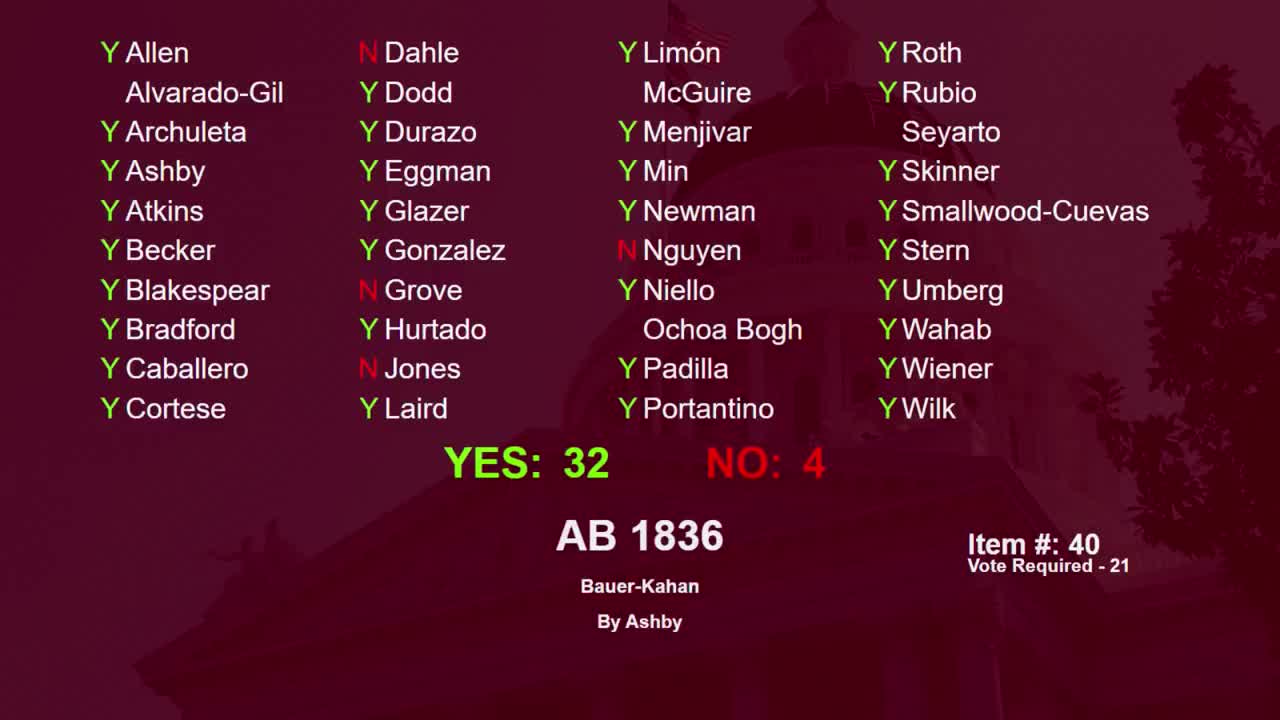 2MIN
Senate Floor
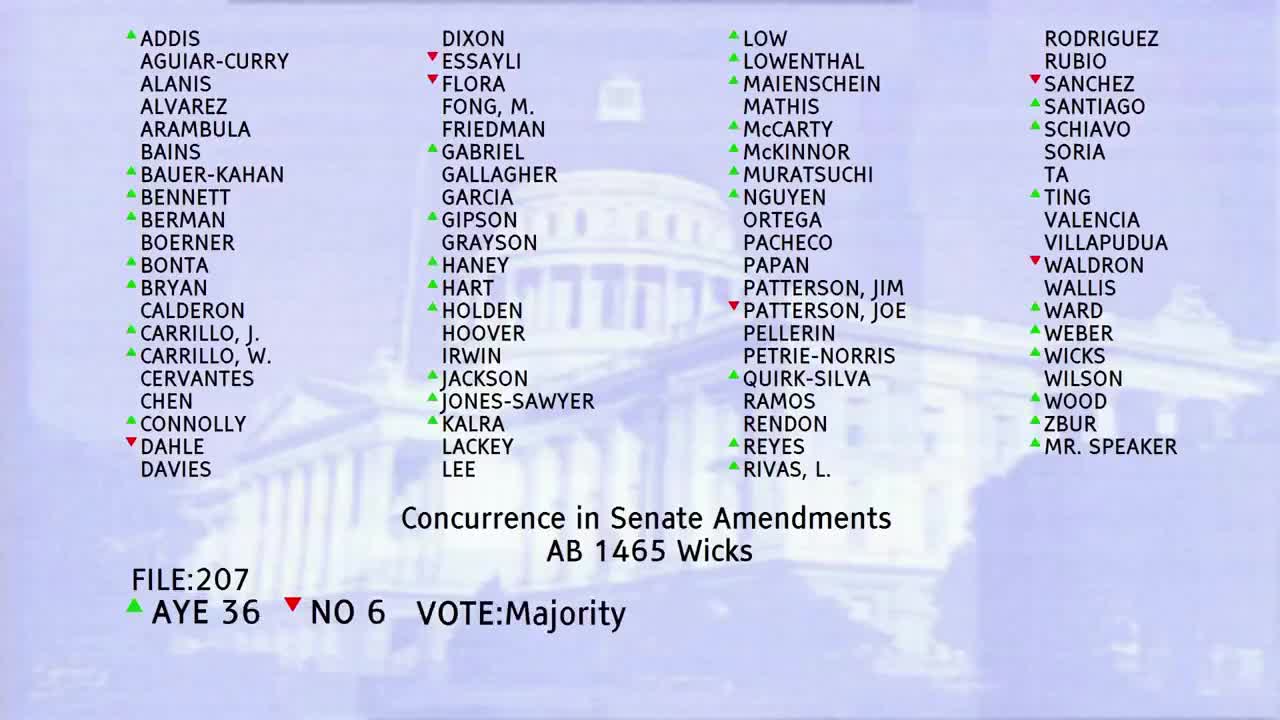 1MIN
Assembly Floor
 58SEC
Senate Standing Committee on Appropriations
 5MIN
Senate Standing Committee on Public Safety
 1MIN
Assembly Floor
 7MIN
Assembly Standing Committee on Public Safety
Bill Author

Bill Co-Author(s):