AB 2648: Environmentally preferable purchasing: single-use plastic bottles.
- Session Year: 2023-2024
- House: Assembly
- Latest Version Date: 2024-05-16
Current Status:
Failed
(2024-05-24: Ordered to inactive file at the request of Assembly Member Bennett.)
Introduced
In Committee
First Chamber
In Committee
Second Chamber
Enacted
Existing law generally governs the state procurement of materials, supplies, equipment, and services. Existing law also provides various procedures and requirements pertaining to the purchase of recycled items by the state, including minimum content requirements for recycled plastic products. Existing law requires the Department of General Services, in consultation with specified parties, to provide state agencies with information and assistance regarding environmentally preferable purchasing, including, but not limited to, the promotion of environmentally preferable purchasing and the development and implementation of a strategy to increase environmentally preferable purchasing.
This bill would, with certain exceptions, prohibit state agencies from entering into, modifying, amending, or renewing a contract, on or after January 1, 2025, to purchase single-use plastic bottles, as defined, for internal use or resale and would require state agencies to take appropriate steps to replace the use of single-use plastic bottles at food service facilities with nonplastic, recyclable, and reusable alternatives, as specified. The bill would require the Department of General Services to ensure that any new, modified, or renewed agreements, contracts, or procurement undertaken by a food service facility as part of a contract or agreement with the Department of General Services comply with the bill, as specified. The bill would require state agencies to submit a report, on or before January 1, 2026, to the Joint Legislative Budget Committee, confirming its compliance with these requirements. The bill would define a state agency for these purposes to include various agencies, including the California State University, and would request that the University of California comply with its provisions. agencies.
The bill would create an exception to the above-described prohibition that would become operative only if Assembly Bill 2527 of the 202324 Regular Session is enacted and takes effect on or before January 1, 2025.
Existing law generally governs the state procurement of materials, supplies, equipment, and services. Existing law also provides various procedures and requirements pertaining to the purchase of recycled items by the state, including minimum content requirements for recycled plastic products. Existing law requires the Department of General Services, in consultation with specified parties, to provide state agencies with information and assistance regarding environmentally preferable purchasing, including, but not limited to, the promotion of environmentally preferable purchasing and the development and implementation of a strategy to increase environmentally preferable purchasing.
This bill would, with certain exceptions, prohibit state agencies from entering into, modifying, amending, or renewing a contract, on or after January 1, 2025, to purchase single-use plastic bottles, as defined, for internal use or resale and would require state agencies to take appropriate steps to replace the use of single-use plastic bottles at food service facilities with nonplastic, recyclable recyclable, and reusable alternatives, as specified. The bill would require the Department of General Services to ensure that any new, modified, or renewed agreements, contracts, or procurement undertaken by a food service facility as part of a contract or agreement with the Department of General Services comply with the bill, as specified. The bill would require state agencies to submit a report, on or before January 1, 2026, to the Joint Legislative Budget Committee, confirming its compliance with these requirements. The bill would define a state agency for these purposes to include various agencies, including the California State University, and would request that the University of California comply with its provisions.
Existing law generally governs the state procurement of materials, supplies, equipment, and services. Existing law also provides various procedures and requirements pertaining to the purchase of recycled items by the state, including minimum content requirements for recycled plastic products. Existing law requires the Department of General Services, in consultation with specified parties, to provide state agencies with information and assistance regarding environmentally preferable purchasing, including, but not limited to, the promotion of environmentally preferable purchasing and the development and implementation of a strategy to increase environmentally preferable purchasing.
This bill would, with certain exceptions, prohibit state agencies from entering into into, modifying, amending, or renewing a contract, on or after January 1, 2025, to purchase single-use plastic bottles, as defined, for internal use or resale. resale and would require state agencies to take appropriate steps to replace the use of single-use plastic bottles at food service facilities with nonplastic, recyclable alternatives, as specified. The bill would require the Department of General Services to ensure that any new, modified, or renewed agreements, contracts, or procurement undertaken by a food service facility as part of a contract or agreement with the Department of General Services comply with the bill, as specified. The bill would require state agencies to submit a report, on or before January 1, 2026, to the Joint Legislative Budget Committee, confirming its compliance with these requirements. The bill would define a state agency for these purposes to include various agencies, including the California State University, and would request that the University of California comply with its provisions.
Existing law generally governs the state procurement of materials, supplies, equipment, and services. Existing law also provides various procedures and requirements pertaining to the purchase of recycled items by the state, including minimum content requirements for recycled plastic products. Existing law requires the Department of General Services, in consultation with specified parties, to provide state agencies with information and assistance regarding environmentally preferable purchasing, including, but not limited to, the promotion of environmentally preferable purchasing and the development and implementation of a strategy to increase environmentally preferable purchasing.
This bill would, with certain exceptions, prohibit state agencies from entering into or renewing a contract, on or after January 1, 2025, to purchase single-use plastic bottles, as defined, for internal use or resale. The bill would require state agencies to submit a report, on or before January 1, 2026, to the Joint Legislative Budget Committee, confirming its compliance with these requirements. The bill would define a state agency for these purposes to include various agencies, including the California State University, and would request that the University of California comply with its provisions.
The Legislature finds and declares all of the following:
(a)California is in the midst of a plastic pollution crisis. Every year, about 11,000,000 metric tons of plastic waste enter the ocean from coastal nations. New scientific research estimates that under the current trajectory, plastic pollution will double by 2030.
(b)Plastic bottles are among the top 10 most commonly found plastic items on beaches. Every hour, Americans use 3,000,000 plastic water bottles, about 70 percent of which are not recycled. Californians use more than 12,000,000,000 plastic beverage bottles annually, and while consumers place approximately 70 percent in recycle bins, it is unknown how many of those bottles are recycled into another product.
(c)The production of plastic bottles relies on fossil fuels. The production, consumption, and end-of-life management of single-use plastic bottles, typically used for only a few minutes before being discarded, have significant environmental impacts, including substantial greenhouse gas emissions, litter, marine pollution, environmental contamination, increased cancer risk to production employees, harm to wildlife, the depletion of precious natural resources, decrease of biodiversity, and the generation of hard-to-manage waste.
(d)Microplastics and nanoplastics are released from plastic bottles. Microplastics have been found within human lungs, livers, spleens, and kidneys, in the placentas of newborn babies, and in breast milk.
(e)Prioritizing reduction and reuse of packaging can provide significant economic, environmental, and social benefits and is consistent with the Integrated Waste management hierarchy that places Reduce and Reuse above Recycling and disposal.
(f)The availability of innovative services, systems, and businesses that deliver products in unpackaged or reusable formats is increasingly creating new opportunities for local business entrepreneurship and economic development. Recycling and reusing create between nine and 30 times more jobs than disposing of waste in landfills and incinerators.
(g)Public access to water refill stations supports personal efforts to avoid disposable plastic bottles by using reusable bottles and helps people save money.
SEC. 2.Section 12405 is added to the Public Contract Code, immediately following Section 12404, to read:12405.(a)(1)Except as provided in paragraph (4), a state agency shall not enter into, modify, amend, or renew a contract to purchase single-use plastic bottles for internal use or resale.
(2)The Legislature encourages every state agency to install and maintain at least one, or maintain at least one existing, water bottle refill station located to ensure maximum access by all visitors and to allow visitors to bring their own reusable beverage bottle for use at water bottle refill stations.
(3)A state agency shall take appropriate steps to replace the use of single-use plastic bottles at food service facilities with nonplastic, recyclable, and reusable alternatives, including, but not limited to, aluminum cans, glass bottles, water fountains, or water bottle refill stations for reusable or refillable beverage containers.
(4)(A)A state agency may enter into or renew a contract to purchase single-use plastic bottles only when reasonably necessary to protect the general health, safety, and welfare in preparing for or responding to a declaration of emergency.
(B)The Department of Corrections and Rehabilitation may enter into or renew a contract to purchase single-use plastic bottles for either of the following reasons:
(i)To provide single-use plastic bottles for sale in a canteen pursuant to Section 5005 of the Penal Code.
(ii)To provide bottled water as required by Sections 3408 and 4023.8 of the Penal Code.
(5)(A)The Department of General Services shall ensure that any new, modified, or renewed agreements, contracts, or procurement undertaken by a food service facility as part of a contract or agreement with the Department of General Services complies with the requirements of this section.
(B)The Department of General Services shall take appropriate steps, including, but not limited to, revising relevant state contracting and procurement rules and procedures, in order to fulfill the requirements of subparagraph (A).
(b)On or before January 1, 2026, a state agency shall submit a report to the Joint Legislative Budget Committee confirming its compliance with this section.
(c)This section applies only to contracts entered into, modified, amended, or renewed on or after January 1, 2025.
(d)This section does not limit the duties of a state agency under a collective bargaining agreement entered into or renewed before January 1, 2025.
(e)For purposes of this section, the following definitions apply:
(1)Food service facility means an operation or business that is located in a state-owned facility, operating on or acting as a concessionaire on state property, or under contract to provide food service to a state agency and that stores, serves, vends, or offers for sale bottled beverages. Food service facility may include, but is not limited to, a cafeteria, commissary, restaurant, deli, store, shop, market, or mobile food unit.
(2)Plastic has the same meaning as in subdivision (t) of Section 42041 of the Public Resources Code.
(3)Reusable has the same meaning as in subdivision (af) of Section 42041 of the Public Resources Code.
(4)Single-use plastic bottle means a beverage in a sealed plastic bottle or plastic-coated carton with a capacity of less than 24 fluid ounces. ounces, but does not include milk contained in cartons.
(5)State agency has the same meaning as set forth in subdivision (m) of Section 12200, and shall does not include the California State University.
(6)Water bottle refill station means a bottle filler that dispenses potable drinking water downward that complies with Section 116875 of the Health and Safety Code, applicable standards under the federal Americans with Disabilities Act of 1990 (P.L. 101-336; 42 U.S.C. 12101 et seq.), and accessibility requirements applicable to drinking fountains under the California Building Standards Code.
(f)The University of California is hereby requested to comply with this section.SEC. 3.Section 12405 is added to the Public Contract Code, immediately following Section 12404, to read:12405.(a)(1)Except as provided in paragraph (4), a state agency shall not enter into, modify, amend, or renew a contract to purchase single-use plastic bottles for internal use or resale.
(2)The Legislature encourages every state agency to install and maintain at least one, or maintain at least one existing, water bottle refill station located to ensure maximum access by all visitors and to allow visitors to bring their own reusable beverage bottle for use at water bottle refill stations.
(3)A state agency shall take appropriate steps to replace the use of single-use plastic bottles at food service facilities with nonplastic, recyclable, and reusable alternatives, including, but not limited to, aluminum cans, glass bottles, water fountains, or water bottle refill stations for reusable or refillable beverage containers.
(4)(A)A state agency may enter into or renew a contract to purchase single-use plastic bottles only when reasonably necessary to protect the general health, safety, and welfare in preparing for or responding to a declaration of emergency.
(B)The Department of Corrections and Rehabilitation may enter into or renew a contract to purchase single-use plastic bottles to provide single-use plastic bottles for sale in a canteen pursuant to Section 5005 of the Penal Code.
(5)(A)The Department of General Services shall ensure that any new, modified, or renewed agreements, contracts, or procurement undertaken by a food service facility as part of a contract or agreement with the Department of General Services complies with the requirements of this section.
(B)The Department of General Services shall take appropriate steps, including, but not limited to, revising relevant state contracting and procurement rules and procedures, in order to fulfill the requirements of subparagraph (A).
(b)On or before January 1, 2026, a state agency shall submit a report to the Joint Legislative Budget Committee confirming its compliance with this section.
(c)This section applies only to contracts entered into, modified, amended, or renewed on or after January 1, 2025.
(d)This section does not limit the duties of a state agency under a collective bargaining agreement entered into or renewed before January 1, 2025.
(e)For purposes of this section, the following definitions apply:
(1)Food service facility means an operation or business that is located in a state-owned facility, operating on or acting as a concessionaire on state property, or under contract to provide food service to a state agency and that stores, serves, vends, or offers for sale bottled beverages. Food service facility may include, but is not limited to, a cafeteria, commissary, restaurant, deli, store, shop, market, or mobile food unit.
(2)Plastic has the same meaning as in subdivision (t) of Section 42041 of the Public Resources Code.
(3)Reusable has the same meaning as in subdivision (af) of Section 42041 of the Public Resources Code.
(4)Single-use plastic bottle means a beverage in a sealed plastic bottle or plastic-coated carton with a capacity of less than 24 fluid ounces, but does not include milk contained in cartons.
(5)State agency has the same meaning as set forth in subdivision (m) of Section 12200, and does not include the California State University.
(6)Water bottle refill station means a bottle filler that dispenses potable drinking water downward that complies with Section 116875 of the Health and Safety Code, applicable standards under the federal Americans with Disabilities Act of 1990 (P.L. 101-336; 42 U.S.C. 12101 et seq.), and accessibility requirements applicable to drinking fountains under the California Building Standards Code.
SEC. 4.Section 2 of this bill shall become operative only if (1) Assembly Bill 2527 of the 202324 Regular Session and this bill are enacted and become effective on or before January 1, 2025, and (2) AB 2527 amends Sections 3408 and 4023.8 of the Penal Code, in which case Section 3 of this bill shall not become operative.
The Legislature finds and declares all of the following:
(a)California is in the midst of a plastic pollution crisis. Every year, about 11,000,000 metric tons of plastic waste enter the ocean from coastal nations. New scientific research estimates that under the current trajectory, plastic production pollution will double by 2030.
(b)Plastic bottles are among the top 10 most commonly found plastic items on beaches. Every hour, Americans use 3,000,000 plastic water bottles. bottles, about 70 percent of which are not recycled. Californians used use more than 12,000,000,000 plastic beverage bottles in 2017, about 70 percent of which were not recycled. annually, and while consumers place approximately 70 percent in recycle bins, it is unknown how many of those bottles are recycled into another product.
(c)The production of plastic bottles relies on fossil fuels. The production, consumption, and end-of-life management of single-use plastic bottles, typically used for only a few minutes before being discarded, have significant environmental impacts, including substantial greenhouse gas emissions, litter, marine pollution, environmental contamination, increased cancer risk to production employees, harm to wildlife, the depletion of precious natural resources, decrease of biodiversity, and the generation of hard-to-manage waste.
(d)Microplastics and nanoplastics are released from plastic bottles. Microplastics have been found within human lungs, livers, spleens, and kidneys, in the placentas of newborn babies, and in breast milk.
(e)Prioritizing reduction and reuse of packaging can provide significant economic, environmental, and social benefits and is consistent with the Integrated Waste management hierarchy that places Reduce and Reuse above Recycling and disposal.
(f)The availability of innovative services, systems, and businesses that deliver products in unpackaged or reusable formats is increasingly creating new opportunities for local business entrepreneurship and economic development. Recycling and reusing create between nine and 30 times more jobs than disposing of waste in landfills and incinerators.
(g)Public access to water refill stations supports personal efforts to avoid disposable plastic bottles by using reusable bottles and helps people save money.
SEC. 2.Section 12405 is added to the Public Contract Code, immediately following Section 12404, to read:12405.(a)(1)Except as provided in paragraph (4), a state agency shall not enter into, modify, amend, or renew a contract to purchase single-use plastic bottles for internal use or resale.
(2)The Legislature encourages every state agency to install and maintain at least one, or maintain at least one existing, water bottle refill station located to ensure maximum access by all visitors and to allow visitors to bring their own reusable beverage bottle for use at water bottle refill stations.
(3)A state agency shall take appropriate steps to replace the use of single-use plastic bottles at food service facilities with nonplastic, recyclable recyclable, and reusable alternatives, including, but not limited to, aluminum cans, glass bottles, water fountains, or water bottle refill stations for reusable or refillable water beverage containers.
(4)A state agency may enter into or renew a contract to purchase single-use plastic bottles only when reasonably necessary to protect the general health, safety, and welfare in preparing for or responding to a declaration of emergency.
(5)(A)The Department of General Services shall ensure that any new, modified, or renewed agreements, contracts, or procurement undertaken by a food service facility as part of a contract or agreement with the Department of General Services complies with the requirements of this section.
(B)The Department of General Services shall take appropriate steps, including, but not limited to, revising relevant state contracting and procurement rules and procedures, in order to fulfill the requirements of subparagraph (A).
(b)On or before January 1, 2026, a state agency shall submit a report to the Joint Legislative Budget Committee confirming its compliance with this section.
(c)This section applies only to contracts entered into, modified, amended, or renewed on or after January 1, 2025.
(d)This section does not limit the duties of a state agency under a collective bargaining agreement entered into or renewed before January 1, 2025.
(e)For purposes of this section, the following definitions apply:
(1)Food service facility means an operation or business that is located in a state-owned facility, operating on or acting as a concessionaire on state property, or under contract to provide food service to a state agency and that stores, serves, vends, or offers for sale bottled liquids. beverages. Food service facility may include, but is not limited to, a cafeteria, commissary, restaurant, deli, store, shop, market, or mobile food unit.
(2)Plastic has the same meaning as in subdivision (t) of Section 42041 of the Public Resources Code.
(3)Reusable has the same meaning as in subdivision (af) of Section 42041 of the Public Resources Code.
(4)Single-use plastic bottle means a beverage in a sealed plastic bottle or plastic-coated carton with a capacity of 21 fluid ounces or less. less than 24 fluid ounces.
(5)State agency has the same meaning as set forth in subdivision (m) of Section 12200, and shall include the California State University.
(6)Water bottle refill station means a bottle filler that dispenses potable drinking water downward that complies with Section 116875 of the Health and Safety Code, applicable standards under the federal Americans with Disabilities Act of 1990 (P.L. 101-336; 42 U.S.C. 12101 et seq.), and accessibility requirements applicable to drinking fountains under the California Building Standards Code.
(f)The University of California is hereby requested to comply with this section.
The Legislature finds and declares all of the following:
(a)California is in the midst of a plastic pollution crisis. Every year, about 11,000,000 metric tons of plastic waste enter the ocean from coastal nations. New scientific research estimates that under the current trajectory, plastic production will double by 2030.
(b)Plastic bottles are among the top 10 mostly most commonly found plastic items on beaches. Every hour, Americans use 3,000,000 plastic water bottles. Californians used more than 12,000,000,000 plastic beverage bottles in 2017, about 70 percent of which were not recycled.
(c)The production of plastic bottles relies on fossil fuels. The production, consumption, and end-of-life management of single-use plastic bottles, typically used for only a few minutes before being discarded, have significant environmental impacts, including substantial greenhouse gas emissions, litter, marine pollution, environmental contamination, increased cancer risk to production employees, harm to wildlife, the depletion of precious natural resources, decrease of biodiversity, and the generation of hard-to-manage waste.
(d)Micro Microplastics and nanoplastics are released from plastic bottles. Microplastics have been found within human lungs, livers, spleens, and kidneys, in the placentas of newborn babies, and in breast milk.
(e)Prioritizing reduction and reuse of packaging can provide significant economic, environmental, and social benefits and is consistent with the Integrated Waste management hierarchy that places Reduce and Reuse above Recycling and disposal.
(f)The availability of innovative services, systems, and businesses that deliver products in unpackaged or reusable formats is increasingly creating new opportunities for local business entrepreneurship and economic development. Recycling and reusing create between nine and 30 times more jobs than disposing of waste in landfills and incinerators.
(g)Public access to water refill stations supports personal efforts to avoid disposable plastic bottles by using reusable bottles and helps people save money.
SEC. 2.Section 12405 is added to the Public Contract Code, immediately following Section 12404, to read:12405.(a)(1)Except as provided in paragraph (4), a state agency shall not enter into into, modify, amend, or renew a contract to purchase single-use plastic bottles for internal use or resale.
(2)The Legislature encourages every state agency to install and maintain at least one, or maintain at least one existing, water bottle refill station located to ensure maximum access by all visitors and to allow visitors to bring their own reusable beverage bottle for use at water bottle refill stations.
(3)A state agency shall take appropriate steps to replace the use of single-use plastic bottles at food service facilities with nonplastic, recyclable alternatives, including, but not limited to, aluminum cans, glass bottles, water fountains, or water bottle refill stations for reusable or refillable water containers.
(4)A state agency may enter into or renew a contract to purchase single-use plastic bottles only when reasonably necessary to protect the general health, safety, and welfare in preparing for or responding to a declaration of emergency.
(5)(A)The Department of General Services shall ensure that any new, modified, or renewed agreements, contracts, or procurement undertaken by a food service facility as part of a contract or agreement with the Department of General Services complies with the requirements of this section.
(B)The Department of General Services shall take appropriate steps, including, but not limited to, revising relevant state contracting and procurement rules and procedures, in order to fulfill the requirements of subparagraph (A).
(b)On or before January 1, 2026, a state agency shall submit a report to the Joint Legislative Budget Committee confirming its compliance with this section.
(c)This section applies only to contracts entered into into, modified, amended, or renewed on or after January 1, 2025.
(d)This section does not limit the duties of a state agency under a collective bargaining agreement entered into or renewed before January 1, 2025.
(e)For purposes of this section, the following definitions apply:
(1)Food service facility means an operation or business that is located in a state-owned facility, operating on or acting as a concessionaire on state property, or under contract to provide food service to a state agency and that stores, serves, vends, or offers for sale bottled liquids. Food service facility may include, but is not limited to, a cafeteria, commissary, restaurant, deli, store, shop, market, or mobile food unit.
(1)(2)Plastic has the same meaning as in subdivision (t) of Section 42041 of the Public Resources Code.
(2)(3)Reusable has the same meaning as in subdivision (af) of Section 42041 of the Public Resources Code.
(3)(4)Single-use plastic bottle means a beverage in a sealed plastic bottle or plastic-coated carton with a capacity of 21 fluid ounces or less.
(4)(5)State agency has the same meaning as set forth in subdivision (m) of Section 12200, and shall include the California State University.
(5)(6)Water bottle refill station means a bottle filler that dispenses potable drinking water downward that complies with Section 116875 of the Health and Safety Code, applicable standards under the federal Americans with Disabilities Act of 1990 (P.L. 101-336; 42 U.S.C. 12101, 12101 et seq.), and accessibility requirements applicable to drinking fountains under the California Building Standards Code.
(f)The University of California is hereby requested to comply with this section.
The Legislature finds and declares all of the following:
(a)California is in the midst of a plastic pollution crisis. Every year, about 11,000,000 metric tons of plastic waste enter the ocean from coastal nations. New scientific research estimates that under the current trajectory, plastic production will double by 2030.
(b)Plastic bottles are among the top 10 mostly commonly found plastic items on beaches. Every hour, Americans use 3,000,000 plastic water bottles. Californians used more than 12,000,000,000 plastic beverage bottles in 2017, about 70 percent of which were not recycled.
(c)The production of plastic bottles relies on fossil fuels. The production, consumption, and end-of-life management of single-use plastic bottles, typically used for only a few minutes before being discarded, have significant environmental impacts, including substantial greenhouse gas emissions, litter, marine pollution, environmental contamination, increased cancer risk to production employees, harm to wildlife, the depletion of precious natural resources, decrease of biodiversity, and the generation of hard-to-manage waste.
(d)Micro and nanoplastics are released from plastic bottles. Microplastics have been found within human lungs, livers, spleens, and kidneys, in the placentas of newborn babies, and in breast milk.
(e)Prioritizing reduction and reuse of packaging can provide significant economic, environmental, and social benefits and is consistent with the Integrated Waste management hierarchy that places Reduce and Reuse above Recycling and disposal.
(f)The availability of innovative services, systems, and businesses that deliver products in unpackaged or reusable formats is increasingly creating new opportunities for local business entrepreneurship and economic development. Recycling and reusing create between nine and 30 times more jobs than disposing of waste in landfills and incinerators.
(g)Public access to water refill stations supports personal efforts to avoid disposable plastic bottles by using reusable bottles and helps people save money.
SEC. 2.Section 12405 is added to the Public Contract Code, immediately following Section 12404, to read:12405.(a)(1)Except as provided in paragraph (4), a state agency shall not enter into or renew a contract to purchase single-use plastic bottles for internal use or resale.
(2)The Legislature encourages every state agency to install and maintain at least one, or maintain at least one existing, water bottle refill station located to ensure maximum access by all visitors and to allow visitors to bring their own reusable beverage bottle for use at water bottle refill stations.
(3)A state agency shall take appropriate steps to replace the use of single-use plastic bottles with nonplastic, recyclable alternatives, including, but not limited to, aluminum cans, glass bottles, water fountains, or water bottle refill stations for reusable or refillable water containers.
(4)A state agency may enter into or renew a contract to purchase single-use plastic bottles only when reasonably necessary to protect the general health, safety, and welfare in preparing for or responding to a declaration of emergency.
(b)On or before January 1, 2026, a state agency shall submit a report to the Joint Legislative Budget Committee confirming its compliance with this section.
(c)This section applies only to contracts entered into or renewed on or after January 1, 2025.
(d)This section does not limit the duties of a state agency under a collective bargaining agreement entered into or renewed before January 1, 2025.
(e)For purposes of this section, the following definitions apply:
(1)Plastic has the same meaning as in subdivision (t) of Section 42041 of the Public Resources Code.
(2)Reusable has the same meaning as in subdivision (af) of Section 42041 of the Public Resources Code.
(3)Single-use plastic bottle means a beverage in a sealed plastic bottle or plastic-coated carton with a capacity of 21 fluid ounces or less.
(4)State agency has the same meaning as set forth in subdivision (m) of Section 12200, and shall include the California State University.
(5)Water bottle refill station means a bottle filler that dispenses potable drinking water downward that complies with Section 116875 of the Health and Safety Code, applicable standards under the federal Americans with Disabilities Act of 1990 (P.L. 101-336; 42 U.S.C. 12101, et seq.), and accessibility requirements applicable to drinking fountains under the California Building Standards Code.
(f)The University of California is hereby requested to comply with this section.
|
Date
|
Status
|
|---|---|
| May 24, 2024 | Ordered to inactive file at the request of Assembly Member Bennett. |
| May 20, 2024 | Read second time. Ordered to third reading. |
| May 16, 2024 | Assembly Rule 63 suspended. |
| May 16, 2024 | From committee: Amend, and do pass as amended. (Ayes 8. Noes 4.) (May 16). |
| May 16, 2024 | Read second time and amended. Ordered returned to second reading. |
| Apr 17, 2024 | In committee: Set, first hearing. Referred to APPR. suspense file. |
| Apr 1, 2024 | Re-referred to Com. on APPR. |
| Mar 21, 2024 | Read second time and amended. |
| Mar 20, 2024 | From committee: Amend, and do pass as amended and re-refer to Com. on APPR. (Ayes 8. Noes 3.) (March 19). |
| Mar 14, 2024 | Re-referred to Com. on NAT. RES. |
| Mar 13, 2024 | From committee chair, with author's amendments: Amend, and re-refer to Com. on NAT. RES. Read second time and amended. |
| Mar 4, 2024 | Referred to Com. on NAT. RES. |
| Feb 15, 2024 | From printer. May be heard in committee March 16. |
| Feb 14, 2024 | Read first time. To print. |
|
Date
|
Description
|
Location
|
Votes
|
|
|---|---|---|---|---|
| May 16, 2024 | Do pass as amended. | Assembly Standing Committee on Appropriations |
Passed |
|
| Mar 19, 2024 | Do pass as amended and be re-referred to the Committee on [Appropriations] | Assembly Standing Committee on Natural Resources |
Passed |
This list shows positions taken on this bill by organizations on the date displayed, which is linked to the original source.
Positions by individuals are not included.
|
Organization
|
Position
|
Date
|
|---|---|---|
| American Chemistry Council | * Against | Mar 19, 2024 |
| Association of Plastics and Recyclers | * Against | Mar 19, 2024 |
| CALPIRG Students | * Support | Mar 19, 2024 |
| Center For Biological Diversity, Inc. | * Support | Mar 19, 2024 |
| Climate Reality Project | * Support | Mar 19, 2024 |
| Environment California | * Support | Mar 19, 2024 |
| FracTracker Alliance | * Support | Mar 19, 2024 |
| Monterey Bay Aquarium | * Support | Mar 19, 2024 |
| Niagara Bottling | * Against | Mar 19, 2024 |
| Plastic Recycling Corporation Of California | * Against | Mar 19, 2024 |
| Rethink Waste | * Support | Mar 19, 2024 |
ASSEMBLY THIRD READING
ATR Bill Id:AB 2648
Author:(Bennett)
As Amended Ver:May 16, 2024
Majority vote
SUMMARY
Prohibits state agencies from purchasing single-use plastic bottles, as specified.
Major Provisions
- Prohibits a state agency from entering into, modifying, amending, or renewing a contract to purchase single-use plastic bottles for internal use or resale. Specifies that the bill applies only to contracts entered into, modified, amended, or renewed on or after January 1, 2025.
- Encourages each state agency to install and maintain at least one, or maintain at least one existing, water bottle refill station located to ensure maximum access by all visitors and to allow visitors to bring their own reusable beverage bottle for use at refill stations.
- Requires a state agency to take appropriate steps to replace the use of single-use plastic bottles at food service facilities with nonplastic, recyclable, and reusable alternatives.
- Authorizes a state agency to enter into or renew a contract to purchase single-use plastic bottles only when reasonably necessary to protect the general health, safety, and welfare in preparing for or responding to a declaration of emergency.
- Authorizes the Department of Corrections to enter into or renew a contract to purchase single-use plastic bottles for sale in a canteen or to provide bottled water, pursuant to specified statutes.
- Requires the Department of General Services (DGS) to ensure that any new, modified, or renewed agreements, contracts, or procurement undertaken by a food service facility as part of a contract or agreement with DGS complies with this bill.
- Requires a state agency, on or before January 1, 2026, to submit a report to the Joint Legislative Budget Committee confirming its compliance with the bill’s requirements.
- Specifies that this bill does not limit the duties of a state agency under a collective bargaining agreement entered into or renewed before January 1, 2025.
- Restates the provisions of the bill in the Public Contract Code.
COMMENTS
Plastic pollution. Plastics pose a threat to the environment from origin to end-of-life. Plastic production is responsible for three and a half percent of all greenhouse gas emissions—more than the entire aviation sector. In 2021, global plastics production was estimated at 390.7 million metric tons, a 4% increase from the previous year. The United Nations Environment Programme reports that only 9% of all plastic ever made has been recycled, 12% has been incinerated, and the remaining 79% has accumulated in landfills and the environment.
Once plastics enter the environment, they remain there for hundreds to thousands of years. Plastics do not break down into their constituent parts, but instead break down into smaller and smaller particles, or microplastics. Because they are so small, microplastics can travel in the air and water, and can be easily absorbed by living things and accumulate up the food chain. Microplastics have been found in the most pristine natural environments on earth, including in the deep ocean, Antarctic sea ice, and in the sand of remote deserts.
Micoplastics are found in household dust and drinking water (bottled and tap), causing people to inhale and consume them. In January of this year, the National Institutes of Health tested three popular brands of bottled water. On average, the researchers found that "a liter of bottled water included about 240,000 tiny pieces of plastic." The water did not just contain plastic from the bottle; they found seven common forms of plastic. A March 2024 study published in Science of the Total Environment identified microplastics in all human tissues sampled, with the polyvinyl chloride being the dominant polymer. The highest abundance of microplastics were found in human lung tissue, followed by the small intestine, large intestine, and tonsils. A February 2024 study published in Toxicological Sciences analyzed samples of 62 human placentas and found microplastics present in every sample. Shockingly little information exists about the potential health impacts of microplastics exposure. Laboratory studies have found that microplastics increase the risk of cancer and disrupt hormone pathways in lab rats.
Plastic pollution and the impacts of microplastics on human health fall disproportionately on marginalized communities. Both due to plastics and to the environmental impacts of plastic production. Nearly all plastic is produced from fossil fuels and generates greenhouse gas emissions and toxic chemicals that impact air and water quality. About 14% of oil is used in petrochemical manufacturing, a precursor to producing plastic. By 2050, plastic production is predicted to account for 50% of oil and fracked gas demand growth. According to Feeding the Plastics Industrial Complex: Taking Public Subsidies, Breaking Pollution Limits, a report released on March, 14, 2024, by the Environmental Integrity Project, "more than 66% of people within three miles of factories that manufacture the main ingredients in plastic products are people of color living in communities that are over-exposed to air pollution while schools and other public services are chronically underfunded." The report notes that these facilities receive billions in subsidies while repeatedly violating environmental laws and regulations. For example, Indorama, the world's largest producer of polyethylene terephthalate (PET) resins used in beverage containers and other single-use packaging, cited a facility in Louisiana that cracks natural gas or oil into ethylene. The facility received both a $1.5 million grant from the state and an exemption from local taxes – a subsidy estimated to be worth at least $73 million over 10 years. In return, Indorama violated its permitted air pollution control limits. In one example, over five months in 2019, the facility released more than 90 times the permitted level of volatile organic compounds. Instead of coming into compliance after multiple violations, the state revised the facility's pollution control permit to allow higher levels of emissions.
While recycling plastic into new products is one way to reduce plastic pollution, as it keeps the recycled plastic out of the environment and reduces our dependence on virgin resin, recycling is currently only feasible for some of the more common, and least toxic, forms of plastic. The most effective way to tackle the plastic pollution crisis is to use less of it.
Bottle Bill. The Bottle Bill was established in 1986 to be a self-funded program that encourages consumers to recycle beverage containers and to prevent littering. The program accomplishes this goal by requiring consumers to pay a deposit for each eligible container purchased. Then the program guarantees consumers repayment of that deposit, the CRV, for each eligible container returned to a certified recycler. Statute includes two main goals for the program: 1) reducing litter; and, 2) achieving a recycling rate of 80% for eligible containers. Containers recycled through the Bottle Bill’s certified recycling centers also provides a consistent, clean, uncontaminated stream of recycled materials with minimal processing.
Bottle bans. In 2018, the California State University system enacted a policy that banned plastic straws and single-use plastic bags in 2019, expanded polystyrene food service items in 2021, and single-use plastic water bottles by 2023. Subsequently, the University of California enacted a policy in 2020 that eliminated the use of plastic bags by 2021, single-use food service items by 2022, and single-use plastic bottles by 2023.
In Massachusetts, Executive Order 619 of 2023 prohibits state executive departments from purchasing single-use plastic bottles. The order applies to single-use plastic bottles 21 ounces or less containing beverages including, but not limited to, water, juice, milk, and soft drinks. The order authorizes state departments to limit the purchase or use of single-use plastic bottles only under the following circumstances: 1) No alternative is available or practicable; 2) Necessary to protect health, safety, and welfare; 3) Compliance would conflict with contract requirements or labor agreements solicited before the effective date of the order; and, 4) To prepare for an emergency.
This bill. This bill is intended to reduce the unnecessary use of plastic beverage containers in state facilities and replace them with the nonplastic recyclable and reusable containers. It also requires the installation of water bottle filling stations to ensure that the use of reusable containers is convenient for state employees and visitors to state facilities. This bill includes an exemption for plastic bottles that are necessary for emergency response, public health and safety, and natural disasters.
According to the Author
It is time that state government models the change we encourage of everyone else. The impact of plastics is pervasive and well-documented, and makes this transition necessary. The State of California has massive purchasing power and resources to show that this change is feasible in all but the most unique situations, for California's residents and visitors alike.
Arguments in Support
A coalition of supporters state:
Almost 98% of single-use plastic is made from fossil fuels. In addition to the well-known harmful effects of oil extraction, the process of turning that oil into plastic involves the use of many toxic chemicals and heavy machinery plants. Additionally, single-use plastic is difficult to recycle for many reasons and is, therefore, largely downcycled. The downcycling process makes it difficult to incorporate recycled materials into new single-use plastic products, further supporting the dependence on fossil fuels to create single-use plastic. Single-use plastic production is expected to triple worldwide by 2050, accounting for 20% of total oil production, according to a 2016 report by the World Economic Forum.
Arguments in Opposition
A coalition of opponents state:
AB 2648 (Bennett) moves in the wrong direction by prohibiting the state from the purchase and sale of the most environmentally sustainable major container on the market for all beverages including juice, milk, water, carbonated waters, teas, carbonated soft drinks, juice, and coffee products and many more. PET plastic bottles are 100% recyclable. California has a strong functioning bottle bill program returning 76% of the plastic PET bottles sold in the state in 2023. This is similar to aluminum, which is one alternative, and better than the 69% of glass, another alternative. With the passage of SB 54 (Allen) in 2022, the recycling system and the amount of bottles returned is sure to improve as the demand for recycled content substantially increases.
FISCAL COMMENTS
According to the Assembly Appropriations Committee:
1) DGS Costs.
- DGS anticipates ongoing costs of an unknown but significant amount, likely in the millions of dollars annually, for state agencies to procure beverages in recyclable nonplastic packaging (mix of General Fund and special funds such as the Motor Vehicle Account (MVA)). For example, DGS notes the per-unit cost in its contract to supply bottled water in emergencies is 66.25 cents per 0.5 liter plastic bottle or $1.24 per 0.5 liter aluminum container; switching from plastic to aluminum would result in an 87% cost increase.
- DGS anticipates annual costs of approximately $100,000 for two years for half a position to develop policy and training materials, monitor compliance, and implement the provisions of this bill.
- DGS estimates cost pressures of approximately $23.8 million (one-time) and $1.5 million (ongoing annual) for the installation and maintenance of water bottle filling stations in DGS-managed buildings. This does not include costs for associated Americans with Disabilities Act (ADA) upgrades if the installation location of a filling station warrants path of travel changes to accommodate those with disabilities. The magnitude of these ADA-related costs are unknown but are potentially significant. DGS notes its cost estimates are only for state-owned buildings managed by DGS, not for state-owned buildings under the jurisdiction of other state agencies.
2) Department of Rehabilitation (DOR) Costs. DOR estimates one-time costs in the range of $464,000 and $843,000 to modify all 602 of its existing Business Enterprise Program (BEP) vending machines – which currently are able to sell beverages only in single-use plastic battles – to sell alternatives (Vending Stand Fund (VSF.)) DOR notes the solvency of the VSF is unknown to the extent that BEP vendors may lose profit due to the provisions of this bill.
3) Department of State Hospitals (DSH) Costs. Costs of an unknown amount, potentially in the hundreds of thousands of dollars, for the (General Fund or special fund) to identify alternatives to single-use plastic bottles that still meet patient needs. DSH notes its average annual cost of purchasing single-use plastic bottles is approximately $620,000.
4) California Department of Parks and Recreation (State Parks) Costs. Costs of an unknown amount, potentially in the hundreds of thousands of dollars, to State Parks to the extent that cost increases from the transition to nonplastic alternatives or reduced sales from fewer options sold at concession stands located in state parks result in less revenue for State Parks (State Parks and Recreation Fund). In fiscal year 2014-15, concession sales at state parks exceeded $140 million and resulted in over $20 million in compensation to the department.
5) Other state agency costs. Costs of an unknown but potentially significant amount, ranging from minor and absorbable for some state agencies to the hundreds of thousands or low to tens of millions of dollars for others, to implement this bill.
VOTES
ASM NATURAL RESOURCES: 8-3-0
YES: Bryan, Bauer-Kahan, Friedman, Kalra, Muratsuchi, Pellerin, Wicks, Wood
NO: Flora, Hoover, Mathis
ASM APPROPRIATIONS: 8-4-3
YES: Wicks, Arambula, Bryan, Wendy Carrillo, Mike Fong, Haney, Hart, Pellerin
NO: Sanchez, Dixon, Jim Patterson, Ta
ABS, ABST OR NV: Calderon, Grayson, Villapudua
UPDATED
VERSION: May 16, 2024
CONSULTANT: Elizabeth MacMillan / NAT. RES. / (916) 319-2092 FN: 0003363
Date of Hearing: April 17, 2024
ASSEMBLY COMMITTEE ON APPROPRIATIONS
Buffy Wicks, Chair
ABPCA Bill Id:AB 2648
Author:(Bennett) – As Amended Ver:March 21, 2024
Policy Committee: | Natural Resources | Vote: | 8 - 3 |
|
| ||
|
|
Urgency: No State Mandated Local Program: No Reimbursable: No
SUMMARY:
This bill prohibits state agencies from purchasing single-use plastic bottles, as specified.
Specifically, this bill, among other things:
- Prohibits a state agency from entering into, modifying, amending, or renewing a contract to purchase single-use plastic bottles for internal use or resale. Specifies that the bill applies only to contracts entered into, modified, amended, or renewed on or after January 1, 2025.
- Encourages each state agency to install and maintain at least one, or maintain at least one existing, water bottle refill station located to ensure maximum access by all visitors and to allow visitors to bring their own reusable beverage bottle for use at refill stations.
- Requires a state agency to take appropriate steps to replace the use of single-use plastic bottles at food service facilities with nonplastic, recyclable, and reusable alternatives.
- Authorizes a state agency to enter into or renew a contract to purchase single-use plastic bottles only when reasonably necessary to protect the general health, safety, and welfare in preparing for or responding to a declaration of emergency.
- Requires the Department of General Services (DGS) to ensure that any new, modified, or renewed agreements, contracts, or procurement undertaken by a food service facility as part of a contract or agreement with DGS complies with this bill.
- Requires a state agency, on or before January 1, 2026, to submit a report to the Joint Legislative Budget Committee confirming its compliance with the bill’s requirements.
- Specifies that this bill does not limit the duties of a state agency under a collective bargaining agreement entered into or renewed before January 1, 2025.
- Requests that the University of California comply with the bill’s requirements.
FISCAL EFFECT:
1) DGS Costs.
- DGS anticipates ongoing costs of an unknown but significant amount, likely in the millions of dollars annually, for state agencies to procure beverages in recyclable nonplastic packaging (mix of General Fund and special funds such as the Motor Vehicle Account (MVA)). For example, DGS notes the per-unit cost in its contract to supply bottled water in emergencies is 66.25 cents per 0.5 liter plastic bottle or $1.24 per 0.5 liter aluminum container; switching from plastic to aluminum would result in an 87% cost increase.
- DGS anticipates annual costs of approximately $100,000 for two years for half a position to develop policy and training materials, monitor compliance, and implement the provisions of this bill.
- DGS estimates cost pressures of approximately $23.8 million (one-time) and $1.5 million (ongoing annual) for the installation and maintenance of water bottle filling stations in DGS-managed buildings. This does not include costs for associated Americans with Disabilities Act (ADA) upgrades if the installation location of a filling station warrants path of travel changes to accommodate those with disabilities. The magnitude of these ADA-related costs are unknown but are potentially significant. DGS notes its cost estimates are only for state-owned buildings managed by DGS, not for state-owned buildings under the jurisdiction of other state agencies.
2) Department of Rehabilitation (DOR) Costs. DOR estimates one-time costs in the range of $464,000 and $843,000 to modify all 602 of its existing Business Enterprise Program (BEP) vending machines – which currently are able to sell beverages only in single-use plastic battles – to sell alternatives (Vending Stand Fund (VSF.)) DOR notes the solvency of the VSF is unknown to the extent that BEP vendors may lose profit due to the provisions of this bill. See background for more details.
3) Department of State Hospitals (DSH) Costs. Costs of an unknown amount, potentially in the hundreds of thousands of dollars, for the (General Fund or special fund) to identify alternatives to single-use plastic bottles that still meet patient needs. DSH notes its average annual cost of purchasing single-use plastic bottles is approximately $620,000. See background for more details.
4) California Department of Corrections and Rehabilitation (CDCR) Costs. In 2023, CDCR spent nearly $865,000 to provide single-use bottled beverages to canteens at CDCR facilities and camps and expects to spend approximately $1 million in the current year for the same purpose. CDCR contends the cost of alternatives to plastic bottled beverages (such as aluminum) are approximately three times greater than plastic bottled beverages. However, any costs incurred by CDCR to provide nonplastic alternatives will likely be offset by prices paid by incarcerated people for those products, which CDCR marks up to cover canteen operations (Inmate Welfare Fund.)
5) California Department of Parks and Recreation (State Parks) Costs. Costs of an unknown amount, potentially in the hundreds of thousands of dollars, to State Parks to the extent that cost increases from the transition to nonplastic alternatives or reduced sales from fewer options sold at concession stands located in state parks result in less revenue for State Parks (State Parks and Recreation Fund). In fiscal year 2014-15, concession sales at state parks exceeded $140 million and resulted in over $20 million in compensation to the department.
6) Higher Education Costs. The University of California (UC) and California State University (CSU) systems do not expect significant new costs as a result of this bill given their ongoing implementation of their respective single-use plastics phase-out policies (see below). However, this bill mandates what both university systems are currently doing on a voluntary basis. Therefore, to the extent there are cost increases associated with transitioning away from single-use beverage bottles at campuses that are not yet in compliance with the UC or CSU policies, these costs would likely be borne by the General Fund. Such costs will likely be in the low to tens of millions of dollars.
7) Costs of an unknown but potentially significant amount, ranging from minor and absorbable for some state agencies to the hundreds of thousands or low to tens of millions of dollars for others, to implement this bill.
According to the Legislative Analyst’s Office (LAO): (a) the General Fund faces a structural deficit in the tens of billions of dollars over the next several fiscal years, and (b) the MVA is expected to fully exhaust its reserves and become insolvent in fiscal year 2025‑26. The LAO further warns that the MVA, absent corrective action, such as revenue increases or spending reductions, will experience a negative fund balance of $1.4 billion in fiscal year 2028‑29.
COMMENTS:
1) Purpose. According to the author:
It is time that state government models the change we encourage of everyone else. The impact of plastics is pervasive and well-documented, and makes this transition necessary. The State of California has massive purchasing power and resources to show that this change is feasible in all but the most unique situations, for California’s residents and visitors alike.
2) Background.
a) Plastic Pollution. In California, roughly 12 billion plastic bottles are sold every year. Plastic pollution is a significant and growing threat to the environment, terrestrial wildlife, marine life, human health, local governments, ratepayers, and environmental justice communities. Plastic, across its entire lifecycle, is also a major contributor to greenhouse gas emissions and climate change. For a more detailed overview of the plastic pollution crisis, please see the Assembly Natural Resources Committee analysis of this bill.
b) Bottle Bans. DGS’s State Implementation Manual (SAM) provides that bottled drinking water may be purchased by a state agency if it has determined that the building water supply is not fit for human consumption or the cost of connecting a drinking fountain to the building water supply renders it impractical. Otherwise, the SAM states, “No other purchases of bottled drinking water will be made.” It is not clear to what extent DGS is monitoring compliance with this policy.
In 2018, the CSU system enacted a policy that banned from CSU campuses plastic straws and single-use plastic bags in 2019, banned expanded polystyrene food service items in 2021, and banned single-use plastic water bottles by 2023. Based on a limited survey, CSU reports that at least 10 of its 23 campuses are in full compliance with its plastics policy.
Similarly, the UC system has a policy that calls for the elimination of the use of plastic bags by 2021 and single-use food service items and plastic bottles by 2024. According to UC, its campuses have made significant progress in eliminating single-use plastic bottles. Most UC campuses have shifted to aluminum water bottles and cans, while several locations have instead prioritized the installation of bottle refill stations and are encouraging students to carry reusable bottles. UC notes its timelines for full phase-out likely extend beyond the 2024 deadline due to product and supply chain limitations.
In 2022, the Interior Department policy declared the department will phase out sales of plastic water bottles and other single-use products at national parks and on other public lands in the next decade. In Massachusetts, Executive Order 619 of 2023 prohibits, with specified exemptions, state executive departments from purchasing single-use plastic bottles containing beverages.
c) Other Implementation Considerations. This bill covers all beverages in plastic containers with a capacity of less than 24 fluid ounces, including plastic-coated cartons. While transitioning to nonplastic, recyclable, and reusable alternatives might be relatively straightforward for some state entities, others may encounter implementation challenges.
DOR administers the BEP, which creates business opportunities for Californians who are legally blind to operate vending facilities on federal and state property as independent business owners. DOR has agreements with DGS and CDCR to allow BEP vendors to operate vending facilities on state property. To comply with this bill, DOR would need to modify all 602 of its existing BEP vending machines selling beverages in single-use plastic bottles to sell alternatives, as slots holding single-use plastic bottle beverages cannot distribute products made by other materials such as aluminum or glass.
DSH notes that access to beverages in single-use plastic bottles is important for the health, safety, and wellbeing of DSH patients who receive 24/7 treatment and care in a psychiatric inpatient setting. DSH contends the purchase of alternative containers other than plastic is not a reliable option for the department, because common alternative container materials, including glass bottles and aluminum cans, are not permitted within DSH’s secure treatment areas for safety reasons. To implement this bill, DSH would need to identify an alternative means of purchasing these items in a compliant manner that still meets patient care needs, which would likely increase costs.
Specific food packaging in correctional facilities is chosen, in part, to minimize the risk of prisoners breaking, sharpening, or melting and forming the packaging material into a weapon.
This bill may also create health and safety risks for emergency response personnel, such as California Department of Forestry and Fire Protection (CAL FIRE) employees – particularly when they are battling large fires in remote areas of the state for an extended period of time. CAL FIRE notes there are extensive Occupational Safety and Health Administration requirements for the hydration of CAL FIRE employees, and the department reports having issues carrying sufficient water for firefighters as is. While the bill includes an exemption for declarations of emergency, state emergency response personnel are often called to respond to disasters and other situations before the state or federal government officially declares a state of emergency in the area. On the other hand, the Department of Transportation notes it does not purchase single-use bottled water for its employees working on road and highway building, operation, and maintenance; instead, Caltrans makes large, refillable beverage dispensers available on worksites.
d) Support and Opposition. Writing in support of the bill, a large coalition of organizations and businesses points to the significance of the state’s purchasing power and contends that “single-use plastic bottles are an easy first step to phase out from state procurement practices.”
Writing in opposition, a coalition of associations representing food and beverage manufacturers and business entities contends that numerous studies have compared the main beverage container types, and plastic polyethylene terephthalate (PET) bottles have the lowest environmental footprint. The American Beverage Association notes that while the bill encourages the use of water bottle refill stations at each state agency, “that is not practical or achievable for all types of beverages.”
3) Related Legislation. AB 2527 (Bauer-Kahan) of this legislative session, among other things, requires a prison or detention facility to provide a pregnant incarcerated person with meals that meet specified Department of Public Health guidelines and clean bottled water each day. AB 2527 is pending in this committee.
Analysis Prepared by: Nikita Koraddi / APPR. / (916) 319-2081
Date of Hearing: March 19, 2024
ASSEMBLY COMMITTEE ON NATURAL RESOURCES
Isaac G. Bryan, Chair
ABPCA Bill Id:AB 2648 (
Author:Bennett) – As Amended Ver:March 13, 2024
SUBJECT: Environmentally preferable purchasing: single-use plastic bottles
SUMMARY: Prohibits state agencies from purchasing single-use plastic bottles, as specified.
EXISTING LAW:
- Establishes the California Beverage Container Recycling and Litter Reduction Act (Bottle Bill), which requires beverage containers, as defined, to have a California redemption value (CRV) of 5 cents for containers that hold fewer than 24 ounces and 10 cents for containers that hold 24 ounces or more. Requires beverage distributors to pay a redemption payment to CalRecycle for every beverage container sold in the state. Provides that these funds are continuously appropriated to CalRecycle for, among other things, the payment of refund values and processing payments. (Public Resources Code (PRC) 14500 et seq.)
- Establishes the Sustainable Packaging for the State of California Act of 2018, which requires food service facilities, as defined, located in a state-owned facility or operating on state property from dispensing prepared food using food service packaging unless the food service packaging has been determined by the Department of Resources Recycling and Recovery (CalRecycle) as reusable, recyclable, or compostable. (PRC 42370-42370.7)
- Establishes the Plastic Pollution Prevention and Packaging Producer Responsibility Act, which imposes minimum recycled content requirements and source reduction requirements for single-use packaging and food service ware, as defined. Requires compliance with the requirements to take place through an expanded producer responsibility program. Excludes beverage containers subject to the Bottle Bill from the definition of single-use packaging and food service ware. (PRC 42040 et seq.)
- Requires state agencies and large state facilities to provide adequate receptacles, signage, education, and staffing for collecting and recycling recyclable materials. (PRC 42924.5)
THIS BILL:
- Prohibits a state agency from entering into, modifying, amending, or renewing a contract to purchase single-use plastic bottles for internal use or resale.
- Encourages each state agency to install and maintain at least one, or maintain at least one existing, water bottle refill station located to ensure maximum access by all visitors and to allow visitors to bring their own reusable beverage bottle for use at all water bottle refill stations.
- Requires a state agency to take appropriate steps to replace the use of single-use plastic bottles at food service facilities with nonplastic, recyclable alternatives, including, but not limited to, aluminum cans, glass bottles, water fountains, or water bottle refill stations for reusable or refillable water containers.
- Authorizes a state agency to enter into or renew a contract to purchase single-use plastic bottles only when reasonably necessary to protect the general health, safety, and welfare in preparing for or responding to a declaration of emergency.
- Requires DGS to ensure that any new, modified, or renewed agreements, contracts, or procurement undertaken by a food service facility as part of a contract or agreement with DGS complies with this bill.
- Requires DGS to take appropriate steps, including, but not limited to, revising relevant state contracting and procurement rules and procedures in order to fulfill the requirements of this bill.
- Defines “food service facility” to mean an operation of business that is located in a state-owned facility, operating on or acting as a concessionaire on state property, or under contract to provide food service to a state agency and that stores, serves, vends, or offers for sale bottled liquids. Specifies that food service facility may include, but is not limited to, a cafeteria, commissary, restaurant, deli, store, shop, market, or mobile food unit.
- Requires, on or before January 1, 2026, a state agency to submit a report to the Joint Legislative Budget Committee confirming its compliance with the bill’s requirements.
- Specifies that the bill only applies to contracts entered into, modified, amended, or renewed on or after January 1, 2025.
- Specifies that this bill does not limit the duties of a state agency under a collective bargaining agreement entered into or renewed before January 1, 2025.
- Defines terms used in the bill, including “single-use plastic bottle” to mean a beverage in a sealed plastic bottle or plastic-coated carton with a capacity of 21 fluid ounces or less.
- Requests that the University of California comply with the bill’s requirements.
- States legislative findings and declarations relating to plastic pollution and the use of single-use plastic bottles.
FISCAL EFFECT: Unknown
COMMENTS:
- Plastic pollution. Plastics pose a threat to the environment from origin to end-of-life. Plastic production is responsible for three and a half percent of all greenhouse gas emissions—more than the entire aviation sector. In 2021, global plastics production was estimated at 390.7 million metric tons, a 4% increase from the previous year. The United Nations Environment Programme reports that only 9%of all plastic ever made has been recycled, 12% has been incinerated, and the remaining 79% has accumulated in landfills and the environment.
Once plastics enter the environment, they remain there for hundreds to thousands of years. Plastics do not break down into their constituent parts, but instead break down into smaller and smaller particles, or microplastics. Because they are so small, microplastics can travel in the air and water, and can be easily absorbed by living things and accumulate up the food chain. Microplastics have been found in the most pristine natural environments on earth, including in the deep ocean, Antarctic sea ice, and in the sand of remote deserts.
Micoplastics are found in household dust and drinking water (bottled and tap), causing people to inhale and consume them. In January of this year, the National Institutes of Health tested three popular brands of bottled water. On average, the researchers found that “a liter of bottled water included about 240,000 tiny pieces of plastic.” The water did not just contain plastic from the bottle; they found seven common forms of plastic. A March 2024 study published in Science of the Total Environment identified microplastics in all human tissues sampled, with the polyvinyl chloride being the dominant polymer. The highest abundance of microplastics were found in human lung tissue, followed by the small intestine, large intestine, and tonsils. A February 2024 study published in Toxicological Sciences analyzed samples of 62 human placentas and found microplastics present in every sample. Shockingly little information exists about the potential health impacts of microplastics exposure. Laboratory studies have found that microplastics increase the risk of cancer and disrupt hormone pathways in lab rats.
Plastic pollution and the impacts of microplastics on human health fall disproportionately on marginalized communities. Both due to plastics and to the environmental impacts of plastic production. Nearly all plastic is produced from fossil fuels and generates greenhouse gas emissions and toxic chemicals that impact air and water quality. About 14% of oil is used in petrochemical manufacturing, a precursor to producing plastic. By 2050, plastic production is predicted to account for 50% of oil and fracked gas demand growth. According to Feeding the Plastics Industrial Complex: Taking Public Subsidies, Breaking Pollution Limits, a report released on March, 14, 2024, by the Environmental Integrity Project, “more than 66% of people within three miles of factories that manufacture the main ingredients in plastic products are people of color living in communities that are over-exposed to air pollution while schools and other public services are chronically underfunded.” The report notes that these facilities receive billions in subsidies while repeatedly violating environmental laws and regulations. For example, Indorama, the world’s largest producer of polyethylene terephthalate (PET) resins used in beverage containers and other single-use packaging, cited a facility in Louisiana that cracks natural gas or oil into ethylene. The facility received both a $1.5 million grant from the state and an exemption from local taxes – a subsidy estimated to be worth at least $73 million over 10 years. In return, Indorama violated its permitted air pollution control limits. In one example, over five months in 2019, the facility released more than 90 times the permitted level of volatile organic compounds. Instead of coming into compliance after multiple violations, the state revised the facility’s pollution control permit to allow higher levels of emissions.
While recycling plastic into new products is one way to reduce plastic pollution, as it keeps the recycled plastic out of the environment and reduces our dependence on virgin resin, recycling is currently only feasible for some of the more common, and least toxic, forms of plastic. The most effective way to tackle the plastic pollution crisis is to use less of it.
- Bottle Bill. The Bottle Bill was established in 1986 to be a self-funded program that encourages consumers to recycle beverage containers and to prevent littering. The program accomplishes this goal by requiring consumers to pay a deposit for each eligible container purchased. Then the program guarantees consumers repayment of that deposit, the CRV, for each eligible container returned to a certified recycler. Statute includes two main goals for the program: (1) reducing litter; and, (2) achieving a recycling rate of 80% for eligible containers. Containers recycled through the Bottle Bill’s certified recycling centers also provides a consistent, clean, uncontaminated stream of recycled materials with minimal processing.
- Bottle bans. In 2018, the California State University system enacted a policy that banned plastic straws and single-use plastic bags in 2019, expanded polystyrene food service items in 2021, and single-use plastic water bottles by 2023. Subsequently, the University of California enacted a policy in 2020 that eliminated the use of plastic bags by 2021, single-use food service items by 2022, and single-use plastic bottles by 2023.
In Massachusetts, Executive Order 619 of 2023 prohibits state executive departments from purchasing single-use plastic bottles. The order applies to single-use plastic bottles 21 ounces or less containing beverages including, but not limited to, water, juice, milk, and soft drinks. The order authorizes state departments to limit the purchase or use of single-use plastic bottles only under the following circumstances: 1) No alternative is available or practicable; 2) Necessary to protect health, safety, and welfare; 3) Compliance would conflict with contract requirements or labor agreements solicited before the effective date of the order; and, 4) To prepare for an emergency. - This bill. This bill is intended to reduce the unnecessary use of plastic beverage containers in state facilities and replace them with the nonplastic recyclable and reusable containers. It also requires the installation of water bottle filling stations to ensure that the use of reusable containers is convenient for state employees and visitors to state facilities. This bill includes an exemption for plastic bottles that are necessary for emergency response, public health and safety, and natural disasters.
- Author’s statement:
It is time that state government models the change we encourage of everyone else. The impact of plastics is pervasive and well-documented, and makes this transition necessary. The State of California has massive purchasing power and resources to show that this change is feasible in all but the most unique situations, for California’s residents and visitors alike.
- Suggested amendments:
- Correct drafting errors in the legislative findings.
- Require state agencies to include reusable bottles as possible alternatives to disposable single-use plastic bottles.
- Replace “water” with “beverage” on page 3, line 28 of the bill.
- Change the size of containers subject to the bill from 21 fluid ounces to less than 24 fluid ounces to be consistent with the state’s Bottle Bill.
- Replace “liquid” with “beverage” on page 4, line 16.
REGISTERED SUPPORT / OPPOSITION:
Support
350 Ventura County Climate Hub
Active San Gabriel Valley
Atrium 916
Ban SUP
Blue Ocean Warriors
Breast Cancer Prevention Partners
California Environmental Voters
California Public Interest Research Group
Citizens’ Climate Lobby
CleanEarth4Kids.org
Climate Action California
Climate Reality Project, Los Angeles Chapter
Climate Reality Project, Orange County
Climate Reality Project, San Fernando Valley
Environmental Defense Center
Fossil Free California
Marine Conservation Institute
Monterey Bay Aquarium
Napa Climate Now
National Stewardship Action Council
Ocean Conservancy
Oceana
Plastic Pollution Coalition
RethinkWaste
San Joaquin Valley Democratic Club
Save Our Shores
Save the Albatross Foundation
Save the Bay
Sierra Club California
Surfrider Foundation
Sustainable Mill Valley
Sustainable Rossmoor
The 5 Gyres Institute
The Last Beach Cleanup
The Last Plastic Straw
Upstream
WeTap
Zero Waste Sonoma
Opposition
National Association for PET Container Resources
Plastics Industry Association
Analysis Prepared by: Elizabeth MacMillan / NAT. RES. /
Discussed in Hearing
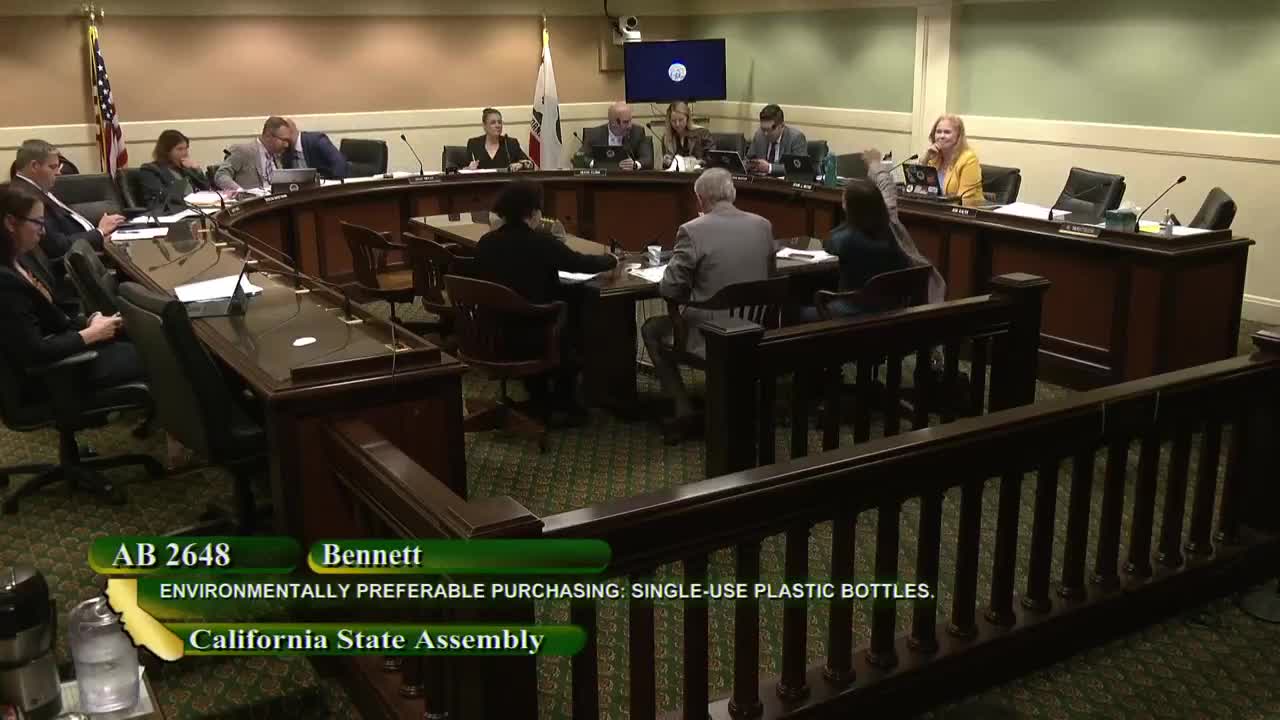 33MIN
Assembly Standing Committee on Natural Resources
Bill Author



