AB 2660: Office of Emergency Services: federal grant funding.
- Session Year: 2023-2024
- House: Assembly
- Latest Version Date: 2024-06-18
Current Status:
Failed
(2024-08-15: In committee: Held under submission.)
Introduced
In Committee
First Chamber
In Committee
Second Chamber
Enacted
Existing law, the California Emergency Services Act, establishes the Office of Emergency Services (OES) within the office of the Governor, and sets forth its powers and duties relating to addressing natural, technological, or manmade disasters and emergencies, including responsibility for activities necessary to prevent, respond to, recover from, and mitigate the effects of emergencies and disasters to people and property.
This bill would require the OES, to the extent permitted by federal law, to provide to local operational areas and urban areas the maximum local share of federal grant funding administered by the office from specified federal grant programs relating to emergency management and homeland security. the Emergency Management Performance Grant Program. The bill would also require the OES, to the extent permitted by federal law, to provide specified legislative committees with copies of agreements entered into with local governments to spend the state share of federal grant funding administered by the office from specified federal grant programs, including the State Homeland Security Grant Program. The bill would authorize the office to retain up to 3% of the above-described federal grant funding for administrative purposes.
Existing law, the California Emergency Services Act, establishes the Office of Emergency Services (OES) within the office of the Governor, and sets forth its powers and duties relating to addressing natural, technological, or manmade disasters and emergencies, including responsibility for activities necessary to prevent, respond to, recover from, and mitigate the effects of emergencies and disasters to people and property.
This bill would require the OES, to the extent permitted by federal law, to provide to local operational areas and urban areas the maximum local share of federal grant funding administered by the office from specified federal grant programs relating to emergency management and homeland security. The bill would authorize the office to retain up to 3% of the above-described federal grant funding for administrative purposes.
Existing law, the California Emergency Services Act, establishes the Office of Emergency Services (OES) within the office of the Governor, and sets forth its powers and duties relating to addressing natural, technological, or manmade disasters and emergencies, including responsibility for activities necessary to prevent, respond to, recover from, and mitigate the effects of emergencies and disasters to people and property.
This bill would require the OES, to the extent permitted by federal law, to provide to local operational areas and urban areas the maximum local share of federal grant funding administered by the office from specified federal grant programs relating to emergency management and homeland security.
(a)The office, to the extent permitted by federal law, shall provide to local operational areas and urban areas the maximum local share of federal grant funding administered by the office from the following sources: Emergency Management Performance Grant Program.
(1)The Emergency Management Performance Grant Program.(b)The office, to the extent permitted by federal law, shall provide the Senate Committee on Governmental Organization and the Assembly Committee on Emergency Management with copies of agreements entered into with local governments to spend the state share of federal grant funding administered by the office from the following sources:
(2)(1)The State Homeland Security Grant Program.
(3)(2)The Urban Areas Security Initiative Program.
(b)(c)The office may retain up to 3 percent of the federal grant funding described in subdivision subdivisions (a) and (b) for administrative purposes.
(a)The office, to the extent permitted by federal law, shall provide to local operational areas and urban areas the maximum local share of federal grant funding administered by the office from the following sources:
(a)(1)The Emergency Management Performance Grant Program.
(b)(2)The State Homeland Security Grant Program.
(c)(3)The Urban Areas Security Initiative Program.
(b)The office may retain up to 3 percent of the federal grant funding described in subdivision (a) for administrative purposes.
The office, to the extent permitted by federal law, shall provide to local operational areas and urban areas the maximum local share of federal grant funding administered by the office from the following sources:
(a)The Emergency Management Performance Grant Program.
(b)The State Homeland Security Grant Program.
(c)The Urban Areas Security Initiative Program.
|
Date
|
Status
|
|---|---|
| Aug 15, 2024 | In committee: Held under submission. |
| Aug 5, 2024 | In committee: Referred to APPR suspense file. |
| Jun 25, 2024 | From committee: Do pass and re-refer to Com. on APPR. (Ayes 14. Noes 0.) (June 25). Re-referred to Com. on APPR. |
| Jun 18, 2024 | From committee chair, with author's amendments: Amend, and re-refer to committee. Read second time, amended, and re-referred to Com. on G.O. |
| Jun 5, 2024 | Referred to Com. on G.O. |
| May 23, 2024 | In Senate. Read first time. To Com. on RLS. for assignment. |
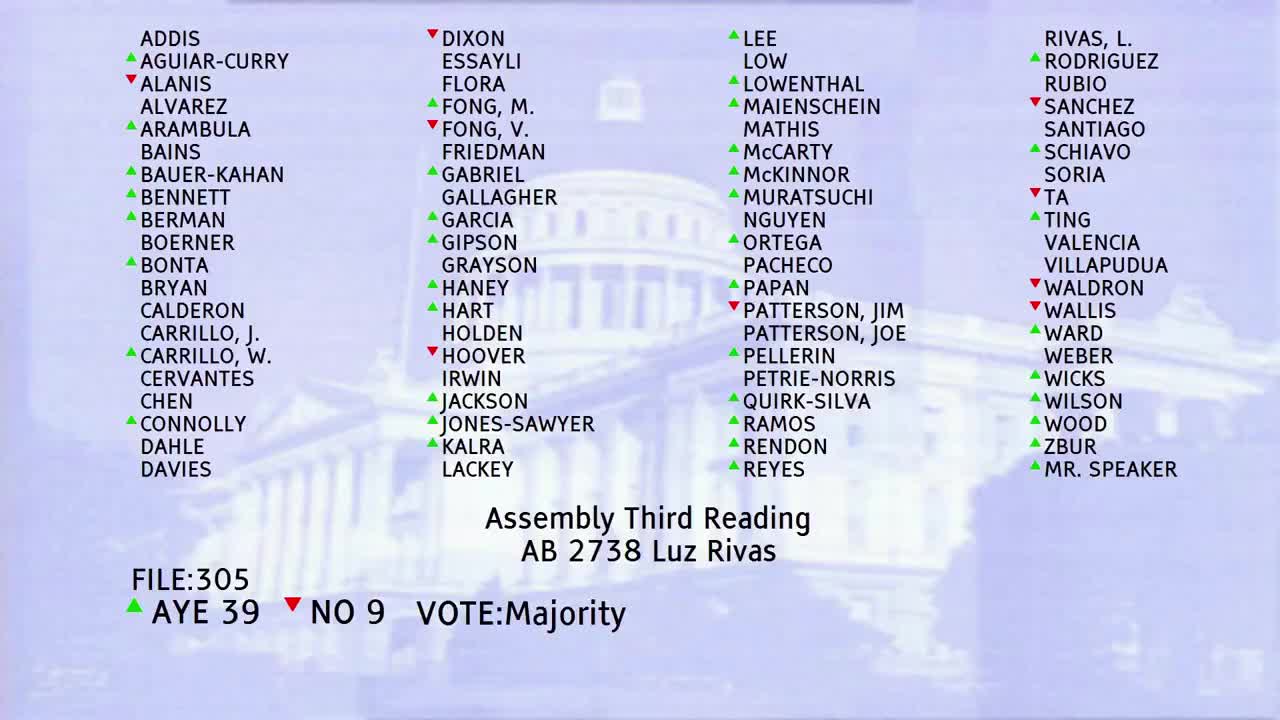
| May 22, 2024 | Read third time. Passed. Ordered to the Senate. (Ayes 70. Noes 0. Page 5550.) |
| May 21, 2024 | Read second time. Ordered to third reading. |
| May 20, 2024 | From committee: Amend, and do pass as amended. (Ayes 11. Noes 0.) (May 16). |
| May 20, 2024 | Read second time and amended. Ordered returned to second reading. |
| May 16, 2024 | Joint Rule 62(a), file notice suspended. (Page 5215.) |
| May 15, 2024 | In committee: Set, first hearing. Referred to APPR. suspense file. |
| Apr 23, 2024 | From committee: Do pass and re-refer to Com. on APPR. with recommendation: To Consent Calendar. (Ayes 8. Noes 0.) (April 22). Re-referred to Com. on APPR. |
| Mar 4, 2024 | Referred to Com. on E.M. |
| Feb 15, 2024 | From printer. May be heard in committee March 16. |
| Feb 14, 2024 | Read first time. To print. |
|
Date
|
Description
|
Location
|
Votes
|
|
|---|---|---|---|---|
| Aug 5, 2024 | Placed on suspense file | Senate Standing Committee on Appropriations |
Passed |
|
| Jun 25, 2024 | Do pass, but first be re-referred to the Committee on [Appropriations] | Senate Standing Committee on Governmental Organization |
Passed |
|
| May 22, 2024 | AB 2660 Emergency Management Assembly Third Reading By RODRIGUEZ | Assembly Floor |
Passed |
|
| May 16, 2024 | Do pass as amended. | Assembly Standing Committee on Appropriations |
Passed |
|
| Apr 22, 2024 | Do pass and be re-referred to the Committee on [Appropriations] with recommendation: To Consent Calendar | Assembly Standing Committee on Emergency Management |
Passed |
This list shows positions taken on this bill by organizations on the date displayed, which is linked to the original source.
Positions by individuals are not included.
|
Organization
|
Position
|
Date
|
|---|---|---|
| California State Association Of Counties | ** Support |
SENATE COMMITTEE ON
Senator Anna Caballero, Chair
2023 - 2024 Regular Session
AB 2660 (Committee on Emergency Management) - Office of Emergency Services: federal grant funding
Version: | Policy Vote: |
Urgency: | Mandate: |
Hearing Date: | Consultant: |
Bill Summary:
AB 2660 requires Office of Emergency Services (OES) to provide local operational and urban areas the maximum local share of federal grand funding administered by OES from the Emergency Management Performance Grant Program (EMPG); requires OES to provide specified legislative policy committees with copies of agreements entered into local governments, as specified; and authorizes OES to retain up to three percent of federal grant funding for administrative purposes, as specified.
Fiscal Impact:
OES reports total General Fund costs of approximately $16 million to backfill the redirection of federal grant funds. Specifically:
- $11.7 million in EMPG funds from OES to local EMPG subrecipients, which reflects a $12.1 million, or 97 percent, reduction in the current EMPG allocation to OES.
- $4.3 million in EMPG, State Homeland Security Grant Program (SHSP), and Urban Areas Security Initiative Program (UASI) funds from OES by reducing the amount of federal grant funding OES may retain. Currently, OES is authorized to retain up to five percent of funds to support its management and administration costs.
Background:
The EMPG provides state, local, tribal, and territorial emergency management agencies with the resources required for implementation of the National Preparedness System and works toward the National Preparedness Goal of a secure and resilient nation. The EMPG’s allowable costs support efforts to build and sustain core capabilities across the prevention, protection, mitigation, response, and recovery mission areas. The Notice of Funding Opportunity for fiscal year (FY) 2024 was released on April 16, 2024.
Key changes to the FY 2024 EMPG include a requirement that when applying for funding, grant recipients and sub-recipients must include exercise objectives centered on practicing and validating their plans and procedures for sending emergency alerts to the public through the Federal Emergency Management Agency (FEMA) Integrated Public Alert and Warning System (IPAWS). Recipients are expected to work toward developing continuity plans for the assured performance of government essential functions and services as well as associated supporting activities. These plans should be consistent with the Continuity Guidance Circular and associated Continuity Assessment Tool.
The EMPG carries a one to one match requirement from the awardee for every federal dollar received. In FY 2023, California was awarded $27.3 million, of which the author’s office states that 44 percent is retained at the state level. Further, the author’s office notes that the EMPG Program does not have a provision for the proportion of federal awards the state must award to local jurisdictions vs. retain at the state agency level. The discretion is left to OES as the grant-administering agency.
Proposed Law:
- Requires OES, to the extent permitted by federal law, to provide to local operational areas and urban areas the maximum local share of federal grant funding administered by the office from the EMPG.
- Requires OES, to the extent permitted by federal law, to provide the Senate Committee on Governmental Organization and the Assembly Committee on Emergency Management with copies of agreements entered into with local governments to spend the state share of federal grant funding administered by the office from the SHSP and the UASI.
- Authorizes OES to retain up to 3 percent of federal grant funding from the EMPG, SHSP, or UASI.
-- END --
SENATE COMMITTEE ON GOVERNMENTAL ORGANIZATION
Senator Bill Dodd
Chair
2023 - 2024 Regular
Bill No: 2660 Hearing Date: 6/25/2024
Author: | |||
Version: | 6/18/2024 Amended | ||
Urgency: | No | Fiscal: | Yes |
Consultant: | Brian Duke | ||
SUBJECT: Office of Emergency Services: federal grant funding
DIGEST: This bill requires the Office of Emergency Services (OES) to provide to local operational areas and urban areas the maximum local share of federal grant funding administered by OES from the Emergency Management Performance Grant Program, as specified; requires OES to provide specified legislative committees with copies of agreements entered into with local governments to spend the state share of federal grant funding administered by OES, as specified; and, authorizes OES to retain up to three percent of that grant funding for administrative purposes, as specified.
ANALYSIS:
Existing law:
- The California Emergency Services Act (ESA) establishes OES, within the office of the Governor, and sets forth its powers and duties relating to addressing natural, technological, or manmade disasters and emergencies, including responsibility for activities necessary to prevent, respond to, recover from, and mitigate the effects of emergencies and disasters to people and property, as specified.
- The California Disaster Assistance Act (CDAA) authorizes OES to administer a disaster assistance program that provides financial assistance for the costs incurred by local governments as a result of a disaster.
This bill:
- Requires OES, to the extent permitted by federal law, to provide to local operational areas and urban areas the maximum local share of federal grant funding administered by OES from the Emergency Management Performance Grant Program.
- Requires OES, to the extent permitted by federal law, to provide the Senate Committee on Governmental Organization and the Assembly Committee on Emergency Management with copies of agreements entered into with local governments to spend the state share of federal grant funding administered by OES from the following sources:
- The State Homeland Security Grant Program.
- The Urban Areas Security Initiative Program.
- Authorizes OES to retain up to three percent of the federal grant funding described above for administrative purposes.
Background
Author Statement. According to the author’s office, “a saying in emergency management is that ‘all emergencies are local.’ Local emergency management offices, however, frequently lack the staffing and resources required to adequately prepare for and address disasters with the speed and thoroughness increasing rates of disasters now require. This bill directs more funding to local agencies to increase their capacity and agility to respond to issues on the ground as they happen. Emergency response must be able to respond to both natural disasters and security threats such as cyberattacks and acts of terrorism. Local emergency managers know their communities intimately and possess the knowledge to respond and prepare with the cultural competence that comes from being a part of the community they serve.”
Emergency Management Performance Grant. The Emergency Management Performance Grant Program (EMPG) provides state, local, tribal, and territorial emergency management agencies with the resources required for implementation of the National Preparedness System and works toward the National Preparedness Goal of a secure and resilient nation. The EMPG’s allowable costs support efforts to build and sustain core capabilities across the prevention, protection, mitigation, response, and recovery mission areas. The Notice of Funding Opportunity for fiscal year (FY) 2024 was released on April 16, 2024.
Key changes to the FY 2024 EMPG Program include a requirement that when applying for funding, grant recipients and sub-recipients must include exercise objectives centered on practicing and validating their plans and procedures for sending emergency alerts to the public through the Federal Emergency Management Agency (FEMA) Integrated Public Alert and Warning System (IPAWS). Recipients are expected to work toward developing continuity plans for the assured performance of government essential functions and services as well as associated supporting activities. These plans should be consistent with the Continuity Guidance Circular and associated Continuity Assessment Tool.
The EMPG Program carries a one to one match requirement from the awardee for every federal dollar received. In FY 2023, California was awarded $27.3 million, of which the author’s office states that 44 percent is retained at the state level. Further, the author’s office notes that the EMPG Program does not have a provision for the proportion of federal awards the state must award to local jurisdictions vs. retain at the state agency level. The discretion is left to OES as the grant-administering agency.
Realignment of Federal Dollars. This bill requires OES, to the extent permitted by federal law, to provide to local operational areas and urban areas the maximum local share of federal grant funding administered by OES from the EMPG. The EMPG Program requires a 50 percent cost share and $27.3 million was awarded to California for FY 2023. Currently, OES is passing $15.2 million directly to locals and retaining $12.1 million at the state level. By realigning funding from the EMPG, OES will face a possible operating budget reduction that will recall augmentation from the General Fund.
The author’s office states that with additional funding, local agencies will have the ability to purchase equipment, hire staff, perform public education campaigns, and run training exercises for a whole host of safety and resilience issues.
Additionally, this bill requires OES, to the extent permitted by federal law, to provide this Committee and the Assembly Committee on Emergency Management with copies of agreements entered into with local governments to spend the state share of federal grant funding administered by OES from the SHSGP and the UASI.
Finally, this bill authorizes OES to retain up to three percent of the federal grant funding from EMPG, SHSGP, and UASI for administrative purposes.
Prior/Related Legislation
AB 973 (Rodriguez, 2021) would have required OES, by January 15th of 2022, and every year thereafter, to submit a written report to the Assembly Committee on Emergency Management, the Assembly Committee on Budget, the Senate Committee on Governmental Organization, and the Senate Committee on Budget and Fiscal Review that details the priority investments and expenditures of CDAA funds. (Held on the Assembly Appropriations Committee Suspense File)
AB 1123 (Rodriguez, 2021) would have required the Governor to provide timely notification of emergency declarations and would have required the State Auditor’s Office to conduct performance audits on the expenditures of disaster funds, as specified. (Died on the Assembly Inactive File)
AB 1569 (Committee on Emergency Management, 2021) would have required OES to submit an annual report to the Legislature detailing the priority investments and expenditures of the federal Hazard Mitigation Grant Program, as specified. (Held on the Assembly Appropriations Committee Suspense File)
AB 291 (Chu, 2019) would have established a new state fund to support staffing, planning, and other mitigation projects to help local governments become better prepared for disasters. (Never heard in the Senate Governmental Organization Committee)
FISCAL EFFECT: Appropriation: Fiscal Com.: Local:
SUPPORT:
California Emergency Response Resiliency Venues and Fairgrounds Association
California State Association of Counties
County of Sacramento
OPPOSITION:
None received
ARGUMENTS IN SUPPORT: In support of the bill, the California Association of Counties (CSAC) writes that, “[c]ounties typically serve as the lead agency of an operational area during a disaster. As such, CSAC supports legislative proposals that maximize California counties’ ability to effectively prepare for and respond to natural and man-made disasters and public health emergencies. This includes supporting full funding for on-going emergency preparedness and all hazard planning at the state and local level.”
Further, “AB 2660 bolsters the capabilities of counties to respond to emergencies. The proposed measure maximizes the local share of grant programs that aim at sustaining core capabilities focused on prevention, protection, mitigation, response and recovery mission areas, including the evolving threats and risks associated with climate change.”
ASSEMBLY THIRD READING
ATR Bill Id:AB 2660
Author:(Committee on Emergency Management)
As Amended Ver:May 20, 2024
Majority vote
SUMMARY
Requires the California Office of Emergency Services (Cal OES) to provide to local emergency management agencies, cities and counties the maximum permitted local share of federal grant funding administered by Cal OES for three Federal Emergency Management Agency (FEMA) programs, minus administrative costs.
Major Provisions
Directs Cal OES to award local emergency management jurisdictions the entirety of California's funding allocation, to the extent permitted by federal law, for the following three programs:
- The Emergency Management Performance Grant (EMPG) Program;
- The State Homeland Security Grant (SHSG) Program; and
- The Urban Areas Security Initiative (UASI) Program.
Cal OES would be permitted to retain up to 3% of these funds for administrative costs.
COMMENTS
Enhancing Equity by Empowering Locals: The grant programs affected by this bill are part of a comprehensive set of measures authorized by Congress and implemented by DHS/FEMA to assist state, local, tribal and territorial emergency management agencies to implement the National Preparedness System and the National Preparedness Goal of a secure and resilient nation. In the FY 2022 documentation, Equity is named as the first of three programmatic priorities (the other two are Climate Resilience and Readiness) in the effort to address the increasing range and complexity of disasters, support the diversity of communities we serve, and complement the nation's growing expectations of the emergency management community.
Underserved communities suffer disproportionately from disasters. Disasters compound the challenges faced by these communities and increase their risk to future disasters. According to FEMA, "Equity in emergency management requires proactively prioritizing actions that reinforce cultural competency, accessibility, and inclusion, as well as reflect the historical context of specific groups of people. To that end, states and territories are strongly encouraged to explore how EMPG Program-funded activities can address the needs of underserved, at-risk communities to help ensure consistent and systematic, fair, just and impartial treatment of all individuals before, during and after a disaster."
Local emergency jurisdictions are largely staffed by residents of the community, including the first responders and infrastructure agencies who see the challenges faced by their area on a daily basis. Compared to workers at the state level, local emergency managers are more likely to be familiar with the geography of an incident area, the community resources that are available to respond to crises, and the populations that will be affected. Increasingly, local emergency managers are familiar with the languages spoken by those they protect and their common concerns or vulnerabilities. Therefore, local agencies are more likely to be able to identify capacity gaps that could be filled with the additional equipment, capital and technical upgrades, trainings and exercises, staffing, security improvements etc. for which the grants identified in this bill provide. Additionally, the equity focus of these grants may be more efficiently served by supporting or hiring local managers who are already familiar with their underserved populations, and are more likely to have relationships with community leaders trusted by these populations who can help identify and address inequitable need-gaps with cultural competence.
General Fund Savings: The EMPG Program requires a 50% cost share and $27.3 million was awarded to California for fiscal year 2023. Currently, Cal OES is passing $15.2 million directly to locals and retaining $12.1 million at the state level. Realigning those retained funds to local jurisdictions would therefore amount to a $12 million savings to the General Funds in avoided match costs. By realigning up to $48 million across all three grant programs, Cal OES will face an operating budget reduction of up to $60 million when the General Fund match dollars are included.
With additional funding, local agencies will have the ability to purchase equipment, hire staff, perform public education campaigns, and run training exercises for a whole host of safety and resilience issues, from earthquake response to defending against extremist violence.
Background: This bill concerns the distribution of three emergency management grants from FEMA:
- The Emergency Management Performance Grant (EMPG) Program – this all-hazard grant addresses vulnerabilities within a framework that prioritizes equity, climate resilience, and readiness. It is awarded to implement preparedness goals and close capability gaps through actions such as providing trainings to community partners, purchasing equipment, hiring additional staff, installing back-up power systems, prepositioning logistics and distribution infrastructure, developing or refining disaster plans, and implementing programs that increase the resilience of underserved communities.
- EMPG carries a 1:1 match requirement from the awardee for every federal dollar received. In fiscal year 2023, California was awarded $27.3 million, of which 44% is retained at the state level.
- The EMPG Program does not have a provision for the proportion of federal awards the state must award to local jurisdictions vs retain at the state agency level. The discretion is left to Cal OES as the grant-administering agency.
- The State Homeland Security Grant (SHSG) Program – this grant assists efforts to build, sustain, and deliver capabilities to prepare for, protect against, and respond to acts of terrorism. Priority areas include protection of soft targets/crowded places, intelligence sharing, domestic violent extremism, cybersecurity, and election security. This money is targeted at planning, training/ exercises, and awareness campaigns, as well as funding needed equipment and capital projects.
- States are required by FEMA to pass 80% of awarded funds through to local jurisdictions. SHSG has no match requirement. In fiscal year 2023, California was awarded $57 million, of which 20% is retained at the state level.
- Urban Areas Security Initiative (UASI) Program – this grant is very similar to the SHSG program with a particular emphasis on providing resources to high-threat, high-density urban areas.
- States are required by FEMA to pass 80% of awarded funds through to local jurisdictions. UASI has no match requirement. In fiscal year 2023, California was awarded $132.1 million, of which 18.5% is retained at the state level.
In total, the state retains $48 million of these three grants which, minus administration costs and federal requirements, this bill would realign to local jurisdictions.
The two homeland security-focused grants already have federal rules for minimum portions that must be allocated to locals. However, the state is permitted to spend some of this money on behalf of local jurisdictions when an agreement is in the place between them. However, despite the existence of state-organized 'local capacity supporting' projects, local jurisdictions have not been given access to or agreements on the governing of this spending on their behalf. Realigning more of the grants through to local jurisdictions would advance the local control of funds that has heretofore not been appropriately facilitated.
According to the Author
A saying in emergency management is that 'all emergencies are local'. Local emergency management offices, however, frequently lack the staffing and resources required to adequately prepare for and address disasters with the speed and thoroughness increasing rates of disasters now require. This bill directs more funding to local agencies to increase their capacity and agility to respond to issues on the ground as they happen. Emergency response must be able to respond to both natural disasters and security threats such as cyberattacks and acts of terrorism. Local emergency managers know their communities intimately and possess the knowledge to respond and prepare with the cultural competence that comes from being a part of the community they serve.
Arguments in Support
The California State Association of Counties writes "Counties typically serve as the lead agency of an operational area during a disaster. AB 2660 bolsters the capability of counties to respond to emergencies… [by maximizing] the local share of grant programs that aim at sustaining core capabilities focused on prevention, protection, mitigation, response and recovery mission areas, including the evolving threats and risks associated with climate change."
Arguments in Opposition
None on file.
FISCAL COMMENTS
According to the Assembly Committee on Appropriations, this bill would incur "General Fund (GF) cost pressures of an unknown amount to OES resulting from passing through the maximum local share of federal grant funds. To the extent OES would otherwise utilize more than 3% of the specified federal grant funding to cover administrative costs, this additional pass through would result in GF cost pressures to backfill the redirected amount. However, these costs may be offset by an additional federal match of non-administrative program expenditures."
VOTES
ASM EMERGENCY MANAGEMENT: 8-0-0
YES: Rodriguez, Arambula, Bennett, Boerner, Calderon, Wendy Carrillo, Davies, Waldron
ASM APPROPRIATIONS: 11-0-4
YES: Wicks, Arambula, Bryan, Calderon, Wendy Carrillo, Mike Fong, Grayson, Haney, Hart, Pellerin, Villapudua
ABS, ABST OR NV: Sanchez, Dixon, Jim Patterson, Ta
UPDATED
VERSION: May 20, 2024
CONSULTANT: Sarina Patel / E.M. / (916) 319-3802 FN: 0003336
Date of Hearing: May 15, 2024
ASSEMBLY COMMITTEE ON APPROPRIATIONS
Buffy Wicks, Chair
ABPCA Bill Id:AB 2660
Author:(Committee on Emergency Management) – As Introduced Ver:February 14, 2024
Policy Committee: | Emergency Management | Vote: | 8 - 0 |
|
| ||
|
|
Urgency: No State Mandated Local Program: No Reimbursable: No
SUMMARY:
This bill requires the Office of Emergency Services (OES), to the extent permitted by federal law, to provide local operational areas and urban areas the maximum local share of federal grant funding administered by OES from specified federal grant programs.
Covered programs include the: (a) Emergency Management Performance Grant Program, (b) State Homeland Security Grant Program, (c) Urban Areas Security Initiative Program.
FISCAL EFFECT:
General Fund (GF) cost pressures of an unknown, but potentially significant amount, in excess of $150,000, to OES resulting from passing through the maximum local share of federal grant funds. Generally, a state agency will utilize approximately 5% of total program funds for administrative purposes. To the extent OES would otherwise utilize some of the specified federal grant funding to cover administrative costs, this additional pass through would result in GF cost pressures to backfill the redirected amount. However, these costs may be offset by an additional federal match of non-administrative program expenditures.
According to the Legislative Analyst’s Office, the GF faces a structural deficit in the tens of billions of dollars over the next several fiscal years.
COMMENTS:
- Purpose. According to the author:
A saying in emergency management is that ‘all emergencies are local.’ Local emergency management offices, however, frequently lack the staffing and resources required to adequately prepare for and address disasters with the speed and thoroughness increasing rates of disasters now require. This bill directs more funding to local agencies to increase their capacity and agility to respond to issues on the ground as they happen.
This bill is supported by the California State Association of Counties.
- Federal Grant Programs. This bill modifies the distribution of three emergency management grants from the Federal Emergency Management Agency (FEMA):
- The Emergency Management Performance Grant Program – this all-hazards grant assists state, local, tribal, and territorial governments in developing their emergency management capabilities and preparedness activities.
- The State Homeland Security Grant Program – this risk-based grant assists state, local, tribal, and territorial efforts in preventing, protecting against, mitigating, responding to, and recovering from acts of terrorism and other threats.
- Urban Areas Security Initiative Program – this grant is similar to the State Homeland Security Grant Program, but prioritizes providing resources to high-threat, high-density urban areas.
According to the Assembly Emergency Management Committee’s analysis of this bill:
In total, the state retains $48 million of these three grants which, minus administration costs and federal requirements, this bill would realign to local jurisdictions.
The two homeland security-focused grants already have federal rules for minimum portions that must be allocated to locals. However, the state is permitted to spend some of this money on behalf of local jurisdictions when an agreement is in the place between them. However, despite the existence of state-organized ‘local capacity supporting’ projects, local jurisdictions have not been given access to or agreements on the governing of this spending on their behalf. Realigning more of the grants through to local jurisdictions would advance the local control of funds that has heretofore not been appropriately facilitated.
Analysis Prepared by: Irene Ho / APPR. / (916) 319-2081
Date of Hearing: April 22, 2024
ASSEMBLY COMMITTEE ON EMERGENCY MANAGEMENT
Freddie Rodriguez, Chair
ABPCA Bill Id:AB 2660 (
Author:Committee on Emergency Management) – As Introduced Ver:February 14, 2024
SUBJECT: Office of Emergency Services: increasing local share of federal grant funding
SUMMARY: Requires the California Office of Emergency Services (Cal OES) to provide to local emergency management agencies, cities and counties the maximum permitted local share of federal grant funding administered by Cal OES for three Federal Emergency Management Agency (FEMA) programs. Specifically, this bill:
1) Directs Cal OES to award local emergency management jurisdictions the entirety of California’s funding allocation, minus required administration costs and federally-imposed limits, for the following three programs:
a. The Emergency Management Performance Grant (EMPG) Program;
b. The State Homeland Security Grant (SHSG) Program; and
c. The Urban Areas Security Initiative (UASI) Program.
2) Increases the total budget of local Operational Areas (OA) by up to $48 million, elevating their capacity to prepare for and respond to critical threats and damaging disasters.
3) Achieves a cost savings for the State of up to $12 million in General Funds by realigning the grant-matching responsibility for the EMPG Program to local OAs instead of Cal OES.
EXISTING LAW:
- Establishes the California Office of Emergency Services (Cal OES) within the office of the Governor and makes Cal OES responsible for the state’s emergency and disaster response services for natural, technological, or manmade disasters and emergencies, including responsibility for activities necessary to prevent, respond to, recover from, and mitigate the effects of emergencies and disasters to people and property. (Gov. Code § 8550)
- Authorizes the Governor to make, amend, and rescind orders and regulations necessary to carry out the provisions of the California Emergency Services Act, requires the orders and regulations to have the force and effect of law, and requires orders and regulations, or amendments or rescissions to orders and regulations, issued during a state of war emergency or state of emergency to be in writing and to take effect immediately upon their issuance. (Gov. Code § 8567)
- The Federal Robert T. Stafford Disaster Relief and Emergency Assistance Act (Public Law 100-707) authorizes the Federal Emergency Management Agency (FEMA) to provide emergency assistance to states and local entities impacted by disasters. In any emergency, the President may, among other things, authorize public assistance programs aimed at providing essential emergency assistance, repairing and restoring damaged public facilities and removing debris.
- The EMPG Program is authorized by Section 662 of the Post-Katrina Emergency Management Reform Act of 2006 (PKEMRA), as amended, (Pub. L. No. 109-295) (6 U.S.C. § 762); the Robert T. Stafford Disaster Relief and Emergency Assistance Act, as amended (Pub. L. No. 93-288) (42 U.S.C. §§ 5121 et seq.); the Earthquake Hazards Reduction Act of 1977, as amended (Pub. L. No. 95-124) (42 U.S.C. §§ 7701 et seq.); and the National Flood Insurance Act of 1968, as amended (Pub. L. No. 90448) (42 U.S.C. §§ 4001 et seq.).
- The Homeland Security Grant Programs, including the State Homeland Security Program (SHSP) and the Urban Area Security Initiative (UASI), are authorized by Section 2002 of the Homeland Security Act of 2002 (Pub. L. No. 107-296, as amended) (6 U.S.C. § 603).
- Provides FEMA with the statutory authority to deliver numerous disaster and non-disaster financial assistance programs in support of FEMA’s mission, largely through grant agreements and cooperative agreements (grants).
- The California Disaster Assistance Act (CDAA) authorizes the Office of Emergency Services (Cal OES) to administer a disaster assistance program that provides financial assistance for the costs incurred by local governments as a result of a disaster. (Gov. Code § 8680)
FISCAL EFFECT: This bill has not been analyzed by a fiscal committee.
COMMENTS:
Purpose of the bill: According to the author, “A saying in emergency management is that ‘all emergencies are local’. Local emergency management offices, however, frequently lack the staffing and resources required to adequately prepare for and address disasters with the speed and thoroughness increasing rates of disasters now require. This bill directs more funding to local agencies to increase their capacity and agility to respond to issues on the ground as they happen. Emergency response must be able to respond to both natural disasters and security threats such as cyberattacks and acts of terrorism. Local emergency managers know their communities intimately and possess the knowledge to respond and prepare with the cultural competence that comes from being a part of the community they serve.”
Equity Assessment: Underserved communities suffer disproportionately from disasters. Disasters compound the challenges faced by these communities and increase their risk to future disasters. According to FEMA, “Equity in emergency management requires proactively prioritizing actions that reinforce cultural competency, accessibility, and inclusion, as well as reflect the historical context of specific groups of people. To that end, states and territories are strongly encouraged to explore how EMPG Program-funded activities can address the needs of underserved, at-risk communities to help ensure consistent and systematic, fair, just and impartial treatment of all individuals before, during and after a disaster.”
The grant programs affected by this bill are part of a comprehensive set of measures authorized by Congress and implemented by DHS/FEMA to assist state, local, tribal and territorial emergency management agencies to implement the National Preparedness System and the National Preparedness Goal of a secure and resilient nation. In the FY 2022 documentation, Equity is named as the first of three programmatic priorities (the other two are Climate Resilience and Readiness) in the effort to address the increasing range and complexity of disasters, support the diversity of communities we serve, and complement the nation’s growing expectations of the emergency management community.
Local emergency jurisdictions are largely staffed by residents of the community, including the first responders and infrastructure agencies who see the challenges faced by their area on a daily basis. Compared to workers at the state level, local emergency managers are more likely to be familiar with the geography of an incident area, the community resources that are available to respond to crises, and the populations that will be affected. Increasingly, local emergency managers are familiar with the languages spoken by those they protect and their common concerns or vulnerabilities. Therefore, local agencies are more likely to be able to identify capacity gaps that could be filled with the additional equipment, capital and technical upgrades, trainings and exercises, staffing, security improvements etc. for which the grants identified in this bill provide. Additionally, the equity focus of these grants may be more efficiently served by supporting or hiring local managers who are already familiar with their underserved populations, and are more likely to have relationships with community leaders trusted by these populations who can help identify and address inequitable need-gaps with cultural competence.
General Fund Savings: The EMPG Program requires a 50% cost share and $27.3 million was awarded to California for fiscal year 2023. Currently, Cal OES is passing $15.2 million directly to locals and retaining $12.1 million at the state level. Realigning those retained funds to local jurisdictions would therefore amount to a $12 million savings to the General Funds in avoided match costs. By realigning up to $48 million across all three grant programs, Cal OES will face an operating budget reduction of up to $60 million when the General Fund match dollars are included.
With additional funding, local agencies will have the ability to purchase equipment, hire staff, perform public education campaigns, and run training exercises for a whole host of safety and resilience issues, from earthquake response to defending against extremist violence.
Background: This bill concerns the distribution of three emergency management grants from FEMA:
- The Emergency Management Performance Grant (EMPG) Program – this all-hazard grant addresses vulnerabilities within a framework that prioritizes equity, climate resilience, and readiness. It is awarded to implement preparedness goals and close capability gaps through actions such as providing trainings to community partners, purchasing equipment, hiring additional staff, installing back-up power systems, prepositioning logistics and distribution infrastructure, developing or refining disaster plans, and implementing programs that increase the resilience of underserved communities.
- EMPG carries a 1:1 match requirement from the awardee for every federal dollar received. In fiscal year 2023, California was awarded $27.3 million, of which 44% is retained at the state level.
- The EMPG Program does not have a provision for the proportion of federal awards the state must award to local jurisdictions vs retain at the state agency level. The discretion is left to Cal OES as the grant-administering agency.
- The State Homeland Security Grant (SHSG) Program – this grant assists efforts to build, sustain, and deliver capabilities to prepare for, protect against, and respond to acts of terrorism. Priority areas include protection of soft targets/crowded places, intelligence sharing, domestic violent extremism, cybersecurity, and election security. This money is targeted at planning, training/ exercises, and awareness campaigns, as well as funding needed equipment and capital projects.
- States are required by FEMA to pass 80% of awarded funds through to local jurisdictions. SHSG has no match requirement. In fiscal year 2023, California was awarded $57 million, of which 20% is retained at the state level.
- Urban Areas Security Initiative (UASI) Program – this grant is very similar to the SHSG program with a particular emphasis on providing resources to high-threat, high-density urban areas.
- States are required by FEMA to pass 80% of awarded funds through to local jurisdictions. UASI has no match requirement. In fiscal year 2023, California was awarded $132.1 million, of which 18.5% is retained at the state level.
In total, the state retains $48 million of these three grants which, minus administration costs and federal requirements, this bill would realign to local jurisdictions.
The two homeland security-focused grants already have federal rules for minimum portions that must be allocated to locals. However, the state is permitted to spend some of this money on behalf of local jurisdictions when an agreement is in the place between them. However, despite the existence of state-organized ‘local capacity supporting’ projects, local jurisdictions have not been given access to or agreements on the governing of this spending on their behalf. Realigning more of the grants through to local jurisdictions would advance the local control of funds that has heretofore not been appropriately facilitated.
Arguments in Support: The California State Association of Counties writes “Counties typically serve as the lead agency of an operational area during a disaster. AB 2660 bolsters the capability of counties to respond to emergencies… [by maximizing] the local share of grant programs that aim at sustaining core capabilities focused on prevention, protection, mitigation, response and recovery mission areas, including the evolving threats and risks associated with climate change.”
Arguments in Opposition:
None on file.
Related Legislation: AB 2594 (Committee on Emergency Management) of this Session: This bill would direct Cal OES to conduct a biennial gap analysis of the state’s mutual aid systems in the event of two simultaneous disasters occurring in California (in Assembly Appropriations)
AB 1786 (Rodriguez) of this Session: This bill would create the Individual and Local Assistance funds to provide aid to communities and individuals in California who are otherwise excluded from existing FEMA aid programs ( set to be heard in the Assembly Human Services Committee on April 23, 2024)
Prior Legislation: AB 903 (Houston) Chapter 400, Statutes of 2007: This bill made private nonprofit organizations which are eligible for disaster assistance under federal law to also be eligible for state assistance for distribution of supplies, and other disaster or emergency assistance activities resulting in extraordinary cost, subject to some requirements around nondiscrimination.
AB 291 (Chu) from the 2019-2020 Session: This bill would have established a Local Emergency Preparedness and Hazard Mitigation Fund to help local governments meet emergency management, preparedness, readiness, and resilience goals. (Died in Senate Governmental Organization Committee.)
AB 973 (Rodriguez) from the 2021-2022 Session: This bill would have required Cal OES to submit an annual written report to legislative committees that details the priority investments and expenditures of funds made available through the California Disaster Assistance Act. (Held in Assembly Appropriations Committee).
AB 1123 (Rodriguez) from the 2021-2022 Session: This bill would have required the Governor to notify the Legislature of any expenditure of state or federal emergency response funds, such as those authorized by the California Disaster Assistance Act, and the California State Auditor’s Office to conduct annual audits of said funds. (Ordered to inactive file at the request of the author, where it died.)
AB 1569 (Committee on Emergency Management) from the 2021-2022 Session: This bill would have required Cal OES to submit a report on the priority investments and expenditures of the federal Hazard Mitigation Grant Program administered by the office. (Held in Assembly Appropriations.)
REGISTERED SUPPORT / OPPOSITION:
Support
California State Association of Counties (CSAC)
Opposition
None on file.
Analysis Prepared by: Sarina Patel / E.M. / (916) 319-3802
Discussed in Hearing
 1MIN
Senate Standing Committee on Appropriations
 1MIN
Senate Standing Committee on Governmental Organization
 2MIN
Assembly Floor
Bill Author
Bill Co-Author(s):