AB 2661: Electricity: Westlands Water District.
- Session Year: 2023-2024
- House: Assembly
- Latest Version Date: 2024-09-25
Current Status:
Passed
(2024-09-25: Chaptered by Secretary of State - Chapter 573, Statutes of 2024.)
Introduced
In Committee
First Chamber
In Committee
Second Chamber
Enacted
What does this bill do?
This bill lets the Westlands Water District build, own, and operate solar panels, energy storage (batteries), and electric transmission lines inside its boundaries to generate and move electricity. The district must use the power for its water operations (like pumping and treatment), may sell surplus electricity to utilities or other sellers (but not at retail to individual customers), may lease facilities, must report income from those facilities, and must adopt a community benefits plan with job training, local hiring, and community investments.
The summary is provided by generative AI which can make mistakes. For original language, please view the details in the table below.
The California Water District Law provides for the establishment of water districts and authorizes a district to construct, maintain, and operate plants for the generation of hydroelectric energy and transmission lines for the conveyance of the hydroelectric energy. Existing law merged the former West Plains Water Storage District into the Westlands Water District, and provides for the operation of the Westlands Water District.
This bill would authorize the Westlands Water District to provide, generate, and deliver solar photovoltaic electricity and to construct, operate, and maintain works, facilities, improvements, and property necessary or convenient for generating and delivering that electricity. The bill would require the district to use the electricity for the districts own purposes, and the bill would authorize the district to sell surplus electricity to a public or private entity engaged in the distribution or sale of electricity. The bill would also authorize the district to construct, operate, and maintain energy storage systems and electric transmission lines, and to construct, operate, and maintain works, facilities, improvements, and property necessary or convenient for the operation of the energy storage systems and electric transmission lines, within the boundaries of the district, as specified. The bill would require the district to report the amount of income, and the purposes for expenditure of that income, from electricity facilities constructed pursuant to these provisions in a specified report. The bill would require the district to establish a community benefits agreement plan for a specified electrical infrastructure development plan and related transmission and other electrical projects, as provided.
This bill would make legislative findings and declarations as to the necessity of a special statute for the Westlands Water District.
The California Water District Law provides for the establishment of water districts and authorizes a district to construct, maintain, and operate plants for the generation of hydroelectric energy and transmission lines for the conveyance of the hydroelectric energy. Existing law merged the former West Plains Water Storage District into the Westlands Water District, and provides for the operation of the Westlands Water District.
This bill would authorize the Westlands Water District to provide, generate, and deliver solar photovoltaic or hydroelectric electricity and to construct, operate, and maintain works, facilities, improvements, and property necessary or convenient for generating and delivering that electricity. The bill would require the district to use the electricity for the districts own purposes, and the bill would authorize the district to sell surplus electricity to a public or private entity engaged in the distribution or sale of electricity. The bill would also authorize the district to construct, operate, and maintain energy storage systems and electric transmission lines, and to construct, operate, and maintain works, facilities, improvements, and property necessary or convenient for the operation of the energy storage system and electric transmission lines, within the boundaries of the district, as specified. The bill would require the district to report the amount of income, and the purposes for expenditure of that income, from these electricity facilities in a specified report. The bill would require the district to establish a community benefits agreement plan for a specified electrical infrastructure development plan and related transmission and other electrical projects, as provided.
This bill would make legislative findings and declarations as to the necessity of a special statute for the Westlands Water District.
The California Water District Law provides for the establishment of water districts and authorizes a district to construct, maintain, and operate plants for the generation of hydroelectric energy and transmission lines for the conveyance of the hydroelectric energy. Existing law merged the former West Plains Water Storage District into the Westlands Water District, and provides for the operation of the Westlands Water District.
This bill would authorize the Westlands Water District to provide, generate, and deliver solar photovoltaic or hydroelectric electricity and to construct, operate, and maintain works, facilities, improvements, and property necessary or convenient for generating and delivering that electricity. The bill would require the district to use the electricity for the districts own purposes, and the bill would authorize the district to sell surplus electricity to a public or private entity engaged in the distribution or sale of electricity. The bill would also authorize the district to construct, operate, and maintain energy storage systems and electric transmission lines, and to construct, operate, and maintain works, facilities, improvements, and property necessary or convenient for the operation of the energy storage system and electric transmission lines, within the boundaries of the district, as specified. The bill would require the district to report the amount of income, and the purposes for expenditure of that income, from these electricity facilities in a specified report.
This bill would make legislative findings and declarations as to the necessity of a special statute for the Westlands Water District.
(1)Existing law vests the Public Utilities Commission (PUC) with regulatory authority over public utilities. Existing law requires the PUC to adopt a process for each load-serving entity, as defined, to file an integrated resource plan and a schedule for periodic updates to the plan to ensure that it meets, among other things, the states targets for reducing emissions of greenhouse gases and the requirement to procure at least 60% of its electricity from eligible renewable energy resources by December 31, 2030. Under existing law, after the load-serving entities have updated the integrated resource plans pursuant to the schedule adopted by the PUC, the PUC adopted an aggregated resource portfolio known as the preferred system plan.
Existing law establishes an Independent System Operator (ISO) as a nonprofit public benefit corporation, and requires the ISO to ensure the efficient use and reliable operation of the electrical transmission grid consistent with the achievement of planning and operating reserve criteria, as specified. Existing law requires the PUC, in consultation with the State Energy Resources Conservation and Development Commission, to provide, not later than March 31, 2024, transmission-focused guidance to the ISO about resource portfolios of expected future renewable energy resources and zero-carbon resources. Existing law requires the guidance to include the allocation of those resources by region based on technical feasibility and commercial interest in each region.
This bill would require the PUC to evaluate perform a sensitivity analysis evaluating the potential for 10,000 to 30,000 megawatts of solar electrical generation located in the Central Valley beyond the amount of solar electrical generation described in the most recently adopted preferred system plan as of January 1, 2025. If the PUC determines that solar electrical generation to be cost effective, the bill would require the PUC to provide, no later than the March 31 immediately following that determination, transmission-focused guidance to the ISO that includes the solar electrical generation in the resource portfolios of expected future renewable energy resources and zero-carbon resources. The bill would require the PUC to transmit the sensitivity analysis to the ISO for evaluation as part of the next transmission planning process.
(2)The California Water District Law provides for the establishment of water districts and authorizes a district to construct, maintain, and operate plants for the generation of hydroelectric energy and transmission lines for the conveyance of the hydroelectric energy. Existing law merged the former West Plains Water Storage District into the Westlands Water District, and provides for the operation of the Westlands Water District.
This bill would authorize a water district the Westlands Water District to provide, generate, and deliver zero-emission solar photovoltaic or hydroelectric electricity and to construct, operate, and maintain works, facilities, improvements, and property necessary or convenient for generating and delivering that electricity. The bill would require a the district to use the electricity for the districts own purposes, and the bill would authorize a the district to sell surplus electricity to a public or private entity engaged in the distribution or sale of electricity. The bill would also authorize a the district to construct, operate, and maintain energy storage systems and electric transmission lines, and to construct, operate, and maintain works, facilities, improvements, and property necessary or convenient for the operation of the energy storage system and electric transmission lines, within the boundaries of the district, as specified.
This bill would make legislative findings and declarations as to the necessity of a special statute for the Westlands Water District.
(1)Existing law vests the Public Utilities Commission (PUC) with regulatory authority over public utilities. Existing law requires the PUC to adopt a process for each load-serving entity, as defined, to file an integrated resource plan and a schedule for periodic updates to the plan to ensure that it meets, among other things, the states targets for reducing emissions of greenhouse gases and the requirement to procure at least 60% of its electricity from eligible renewable energy resources by December 31, 2030. Under existing law, after the load-serving entities have updated the integrated resource plans pursuant to the schedule adopted by the PUC, the PUC adopted an aggregated resource portfolio known as the preferred system plan.
Existing law establishes an Independent System Operator (ISO) as a nonprofit public benefit corporation, and requires the ISO to ensure the efficient use and reliable operation of the electrical transmission grid consistent with the achievement of planning and operating reserve criteria, as specified. Existing law requires the PUC, in consultation with the State Energy Resources Conservation and Development Commission, to provide, not later than March 31, 2024, transmission-focused guidance to the ISO about resource portfolios of expected future renewable energy resources and zero-carbon resources. Existing law requires the guidance to include the allocation of those resources by region based on technical feasibility and commercial interest in each region.
This bill would require the PUC to evaluate the potential for 10,000 to 30,000 megawatts of solar electrical generation located in the Central Valley beyond the amount of solar electrical generation described in the most recently adopted preferred system plan as of January 1, 2025. If the PUC determines that solar electrical generation to be cost effective, the bill would require the PUC to provide, no later than the March 31 immediately following that determination, transmission-focused guidance to the ISO that includes the solar electrical generation in the resource portfolios of expected future renewable energy resources and zero-carbon resources.
(2)The California Water District Law provides for the establishment of water districts and authorizes a district to construct, maintain, and operate plants for the generation of hydroelectric energy and transmission lines for the conveyance of the hydroelectric energy.
This bill would authorize a water district to provide, generate, and deliver zero-emission electricity and to construct, operate, and maintain works, facilities, improvements, and property necessary or convenient for generating and delivering that electricity. The bill would require a district to use the electricity for the districts own purposes, and the bill would authorize a district to sell surplus electricity to a public or private entity engaged in the distribution or sale of electricity. The bill would also authorize a district to construct, operate, and maintain energy storage systems and electric transmission lines, and to construct, operate, and maintain works, facilities, improvements, and property necessary or convenient for the operation of the energy storage system and electric transmission lines, within the boundaries of the district, as specified.
Under existing law, various programs provide funds for water projects and facilities, including water storage. Existing law requires the Department of Water Resources to operate the State Water Resources Development System, known as the State Water Project, to supply water to persons and entities in the state. This bill would state the intent of the Legislature to enact subsequent legislation to increase statewide water storage capacity.Under existing law, various programs provide funds for water projects and facilities, including water storage. Existing law requires the Department of Water Resources to operate the State Water Resources Development System, known as the State Water Project, to supply water to persons and entities in the state.
This bill would state the intent of the Legislature to enact subsequent legislation to increase statewide water storage capacity.
(a)For purposes of this section, for its own purposes means the Westlands Water District performing only functions within its capacity as a water district, including, but not limited to, any of the following:
(1)Pumping operations.
(2)Water treatment operations.
(3)Barrier intrusion operations.
(4)Desalination operations.
(b)(1)The Westlands Water District may provide, generate, and deliver solar photovoltaic electricity, and may construct, operate, and maintain any and all works, facilities, improvements, and property, or portions thereof, necessary or convenient for generating and delivering that electricity.
(2)An electric powerplant or transmission line constructed pursuant to this subdivision may be leased for operation.
(3)The electricity generated pursuant to this subdivision shall be used by the Westlands Water District for its own purposes. The district may sell surplus electricity to a public or private entity that is engaged in the distribution or sale of electricity.
(c)The Westlands Water District may construct, operate, and maintain an energy storage system, as defined in Section 2835 of the Public Utilities Code, and all works, facilities, improvements, and property, or portions thereof, necessary or convenient for the operation of an energy storage system, within the boundaries of the district, regardless of whether the energy storage system is interconnected to or directly charged by an electric powerplant constructed pursuant to subdivision (b). An energy storage system constructed pursuant to this subdivision may be leased for operation. The district may operate an energy storage system in a manner intended, as determined by the district, to increase the economic value of the energy storage system and the district is not required to use the discharging energy for its own purposes. The district may purchase discharging energy through a market administered by the Independent System Operator. The district may sell discharging energy and any attributes of the energy storage system through a market administered by the Independent System Operator.
(d)The Westlands Water District may construct, operate, and maintain electrical transmission lines and all works, facilities, improvements, and property, or portions thereof, necessary or convenient for the conveyance of electricity within the boundaries of the district, regardless of whether the transmission lines are used for the purpose of conveying electricity from an electric powerplant constructed pursuant to subdivision (b). Transmission lines constructed pursuant to this subdivision may be leased for operation. The district may sell the rights to use transmission lines constructed pursuant to this subdivision to any public or private entity that is engaged in the distribution or sale of electricity. Transmission facilities developed pursuant to this section shall be controlled by a California balancing authority, as defined in Section 399.12 of the Public Utilities Code, regardless of ownership by the Westlands Water District or a subsequent owner.
(e)This section does not authorize the Westlands Water District to provide, sell, or deliver electricity at retail.
(f)The Westlands Water District shall not acquire property employed in the generation or delivery of electricity for public or private utility purposes, except by mutual agreement between the district and the owner of that property.
(g)The Westlands Water District shall report the amount of income, and the purposes for expenditure of that income, from electricity facilities constructed pursuant to this section in the report required by Section 53892 of the Government Code.
37861.(a)The Westlands Water District shall establish a community benefits agreement plan for the Valley Clean Infrastructure Plan and related transmission and other electrical projects constructed pursuant to Section 37860.
(b)The community benefits agreement plan shall be designed to ensure that local communities have meaningful opportunities to participate and access benefits associated with projects that are part of the Valley Clean Infrastructure Plan.
(c)The community benefits agreement plan shall outline the specific benefits to be provided to local communities, which may include, but are not limited to, all of the following:
(1)Job creation and training programs for local residents.
(2)Use of local businesses and vendors.
(3)Financial contributions to community development projects and programs.
(d)For purposes of this section, local communities means counties, cities, and other local governmental agencies located within, or adjacent to, the Westlands Water Districts jurisdictional boundaries.
SEC. 2.The Legislature finds and declares that a special statute is necessary and that a general statute cannot be made applicable within the meaning of Section 16 of Article IV of the California Constitution because of the unique need of the Westlands Water District to support the development of solar electrical generation for the electrical grid and to facilitate the development of transmission capacity to help California reach its clean energy and climate goals.
(a)For purposes of this section, for its own purposes means the Westlands Water District performing only functions within its capacity as a water district, including, but not limited to, any of the following:
(1)Pumping operations.
(2)Water treatment operations.
(3)Barrier intrusion operations.
(4)Desalination operations.
(b)(1)The Westlands Water District may provide, generate, and deliver solar photovoltaic or hydroelectric electricity, and may construct, operate, and maintain any and all works, facilities, improvements, and property, or portions thereof, necessary or convenient for generating and delivering that electricity.
(2)An electric powerplant or transmission line constructed pursuant to this subdivision may be leased for operation.
(3)The electricity generated pursuant to this subdivision shall be used by the Westlands Water District for its own purposes. The district may sell surplus electricity to a public or private entity that is engaged in the distribution or sale of electricity.
(c)The Westlands Water District may construct, operate, and maintain an energy storage system, as defined in Section 2835 of the Public Utilities Code, and all works, facilities, improvements, and property, or portions thereof, necessary or convenient for the operation of an energy storage system, within the boundaries of the district, regardless of whether the energy storage system is interconnected to or directly charged by an electric powerplant constructed pursuant to subdivision (b). An energy storage system constructed pursuant to this subdivision may be leased for operation. The district may operate an energy storage system in a manner intended, as determined by the district, to increase the economic value of the energy storage system and the district is not required to use the discharging energy for its own purposes. The district may purchase discharging energy through a market administered by the Independent System Operator. The district may sell discharging energy and any attributes of the energy storage system through a market administered by the Independent System Operator.
(d)The Westlands Water District may construct, operate, and maintain electrical transmission lines and all works, facilities, improvements, and property, or portions thereof, necessary or convenient for the conveyance of electricity within the boundaries of the district, regardless of whether the transmission lines are used for the purpose of conveying electricity from an electric powerplant constructed pursuant to subdivision (b). Transmission lines constructed pursuant to this subdivision may be leased for operation. The district may sell the rights to use transmission lines constructed pursuant to this subdivision to any public or private entity that is engaged in the distribution or sale of electricity. Transmission facilities developed pursuant to this section shall be controlled by a California balancing authority, as defined in Section 399.12 of the Public Utilities Code, regardless of ownership by the Westlands Water District or a subsequent owner.
(e)This section does not authorize the Westlands Water District to provide, sell, or deliver electricity at retail.
(f)The Westlands Water District shall not acquire property employed in the generation or delivery of electricity for public or private utility purposes, except by mutual agreement between the district and the owner of that property.
(g)The Westlands Water District shall report the amount of income, and the purposes for expenditure of that income, from electricity facilities constructed pursuant to this section in the report required by Section 53892 of the Government Code.
37861.(a)The Westlands Water District shall establish a community benefits agreement plan for the Valley Clean Infrastructure Plan and related transmission and other electrical projects constructed pursuant to Section 37860.
(b)The community benefits agreement plan shall be designed to ensure that local communities have meaningful opportunities to participate and access benefits associated with projects that are part of the Valley Clean Infrastructure Plan.
(c)The community benefits agreement plan shall outline the specific benefits to be provided to local communities, which may include, but are not limited to, all of the following:
(1)Job creation and training programs for local residents.
(2)Use of local businesses and vendors.
(3)Financial contributions to community development projects and programs.
(d)For purposes of this section, local communities means counties, cities, and other local governmental agencies located within, or adjacent to, the Westlands Water Districts jurisdictional boundaries.
SEC. 2.The Legislature finds and declares that a special statute is necessary and that a general statute cannot be made applicable within the meaning of Section 16 of Article IV of the California Constitution because of the unique need of the Westlands Water District to support the development of solar electrical generation for the electrical grid and to facilitate the development of transmission capacity to help California reach its clean energy and climate goals.
(a)For purposes of this section, for its own purposes means the Westlands Water District performing only functions within its capacity as a water district, including, but not be limited to, any of the following:
(1)Pumping operations.
(2)Water treatment operations.
(3)Barrier intrusion operations.
(4)Desalination operations.
(b)(1)The Westlands Water District may provide, generate, and deliver solar photovoltaic or hydroelectric electricity, and may construct, operate, and maintain any and all works, facilities, improvements, and property, or portions thereof, necessary or convenient for generating and delivering that electricity.
(2)An electric powerplant or transmission line constructed pursuant to this subdivision may be leased for operation.
(3)The electricity generated pursuant to this subdivision shall be used by the Westlands Water District for its own purposes. The district may sell surplus electricity to a public or private entity that is engaged in the distribution or sale of electricity.
(c)The Westlands Water District may construct, operate, and maintain an energy storage system, as defined in Section 2835 of the Public Utilities Code, and all works, facilities, improvements, and property, or portions thereof, necessary or convenient for the operation of an energy storage system, within the boundaries of the district, regardless of whether the energy storage system is interconnected to or directly charged by an electric powerplant constructed pursuant to subdivision (b). An energy storage system constructed pursuant to this subdivision may be leased for operation. The district may operate an energy storage system in a manner intended, as determined by the district, to increase the economic value of the energy storage system and the district is not required to use the discharging energy for its own purposes. The district may purchase discharging energy through a market administered by the Independent System Operator. The district may sell discharging energy and any attributes of the energy storage system through a market administered by the Independent System Operator.
(d)The Westlands Water District may construct, operate, and maintain electrical transmission lines and all works, facilities, improvements, and property, or portions thereof, necessary or convenient for the conveyance of electricity within the boundaries of the district, regardless of whether the transmission lines are used for the purpose of conveying electricity from an electric powerplant constructed pursuant to subdivision (b). Transmission lines constructed pursuant to this subdivision may be leased for operation. The district may sell the rights to use transmission lines constructed pursuant to this subdivision to any public or private entity that is engaged in the distribution or sale of electricity. Transmission facilities developed pursuant to this section shall be controlled by a California balancing authority, as defined in Section 399.12 of the Public Utilities Code, regardless of ownership by the Westlands Water District or a subsequent owner.
(e)This section does not authorize the Westlands Water District to provide, sell, or deliver electricity at retail.
(f)The Westlands Water District shall not acquire property employed in the generation or delivery of electricity for public or private utility purposes, except by mutual agreement between the district and the owner of that property.
(g)The Westlands Water District shall report the amount of income, and the purposes for expenditure of that income, from electricity facilities constructed pursuant to this section in the report required by Section 53892 of the Government Code.
SEC. 3.SEC. 2.The Legislature finds and declares that a special statute is necessary and that a general statute cannot be made applicable within the meaning of Section 16 of Article IV of the California Constitution because of the unique need of the Westlands Water District to support the development of solar electrical generation for the electrical grid and to facilitate the development of transmission capacity to help California reach its clean energy and climate goals.
(a)This section shall be known, and may be cited, as the Accelerating Renewable Energy Delivery Act.
(b)The Legislature finds and declares all of the following:
(1)The commission, the Energy Commission, and the State Air Resources Board have jointly estimated that the states installed electric generation may need a threefold increase in capacity to meet state carbon-free electricity policy targets.
(2)Record-setting renewable energy generation build rates are needed to meet the goals of the California Renewables Portfolio Standard Program and the Senate Bill 100 (Chapter 312 of the Statutes of 2018) target of supplying 100 percent of retail sales of electricity from renewable energy resources and zero-carbon resources. However, these build rates are not achievable without additional electrical transmission lines and facilities connecting new resources to consumers in the states load centers.
(3)In recent years, California has seen problems in delivering renewable energy resources and zero-carbon resources to customers, including problems caused by constraints on the transmission system. First, there are generation pockets where the total potential output from renewable energy generation exceeds the capacity of the transmission system to export that energy. Second, there are load pockets where there is insufficient transmission capacity to import the renewable energy resources and zero-carbon resources that are available. Both types of constraints should be promptly fixed so that all available renewable energy resources and zero-carbon resources can be delivered to customers.
(4)Reducing the use of nonpreferred resources in disadvantaged communities has been a priority for those communities, and they would benefit from increased access to electricity from new renewable energy resources and zero-carbon resources delivered to serve in-city loads.
(5)New transmission facilities have many steps that must be accomplished before they are online and delivering electricity. Major new transmission lines can take more than a decade from initial planning to operation.
(6)New transmission facilities should be planned proactively to support delivery to load centers from expected locations for future renewable energy resource and zero-carbon resource development, where those locations are identified in the integrated resource planning process pursuant to Sections 454.52 and 9621 or as part of longer range planning processes pursuant to Section 454.53.
(7)The Central Valley may have the potential to host substantially increased amounts of solar energy generation and energy storage beyond current planning assumptions if there were sufficient transmission capacity to deliver the energy to load centers. The commission, Energy Commission, and Independent System Operator should consider potential increased development of solar energy generation and energy storage in the Central Valley and of the transmission capacity needed to deliver that energy to load centers.
(8)New transmission facilities should be designed to minimize the risk of transmission-triggered wildfires.
(9)New transmission facilities should be designed to facilitate renewable energy transmission across California to better manage the variability of electrical supply.
(10)The Independent System Operator has issued a 20-Year Transmission Outlook that identifies substantial additional transmission projects needed to integrate renewable energy resources and storage for retail suppliers within the Independent System Operator balancing authority. Given the scale of this challenge, there is an urgent need to prioritize and accelerate the substantial effort needed to build transmission projects with long development times.
(c)Recognizing that the Independent System Operators Federal Energy Regulatory Commission-approved tariff requires the Independent System Operator to plan and approve new transmission facilities needed to achieve the states goals, it is the intent of the Legislature that the Independent System Operator shall take notice of the state policies expressed in this section.
(d)(1)In support of the states policy to supply increasing amounts of electricity from renewable energy resources and zero-carbon resources pursuant to Article 16 (commencing with Section 399.11) and Section 454.53, beginning as soon as possible and not later than March 31, 2024, the commission, in consultation with the Energy Commission, shall provide transmission-focused guidance to the Independent System Operator about resource portfolios of expected future renewable energy resources and zero-carbon resources. The guidance shall include the allocation of those resources by region based on technical feasibility and commercial interest in each region to allow the Independent System Operator to identify and approve transmission facilities needed to interconnect resources and reliably serve the needs of load centers.
(2)(A)For purposes of the next integrated resource plan cycle after January 1, 2025, the commission shall evaluate perform a sensitivity analysis evaluating the potential for 10,000 to 30,000 megawatts of solar electrical generation located in the Central Valley, and facilitated by the authority granted to water districts pursuant to Section 35574 of the Water Code, Valley beyond the amount of solar electrical generation described in the most recently adopted preferred system plan as of January 1, 2025.
(B)If the commission determines that the solar electrical generation described in subparagraph (A) would be cost effective, the commission, no later than the March 31 immediately following that determination, shall provide transmission-focused guidance to the Independent System Operator that includes the solar electrical generation described in subparagraph (A) in the resource portfolios of expected future renewable energy resources and zero-carbon resources. The commission shall coordinate the guidance with any master plan of a water district that would facilitate construction of transmission lines and facilities under the authority of the water district.(B)The commission shall transmit the results of the sensitivity analysis performed pursuant to subparagraph (A) to the Independent System Operator for evaluation as part of the next transmission planning process.
(e)In providing the guidance described in subdivision (d), the commission and the Energy Commission shall provide projections each year, including from the integrated energy policy report prepared pursuant to Section 25302 of the Public Resources Code and the load-serving entities integrated resource plans prepared pursuant to Section 454.52, to support planning and approvals by the Independent System Operator in its annual transmission planning process, including by doing all of the following:
(1)Providing projections of resource portfolios and electricity demand by region for at least 15 years into the future to ensure adequate lead time for the Independent System Operator to analyze and approve transmission development, and for the permitting and construction of the approved facilities, to meet the projections.
(2)Providing load growth projections, including projected growth from building and transportation electrification, that are consistent with achieving the economywide greenhouse gas emissions reductions required pursuant to Division 25.5 (commencing with Section 38500) of the Health and Safety Code.
(3)Providing projections of new renewable energy resources and zero-carbon resources consistent with the build rates necessary to achieve the targets established in Article 16 (commencing with Section 399.11) and Section 454.53.
(4)(A)Providing resource projections that, combined with transmission capacity expansions, are expected to substantially reduce, no later than 2035, the need to rely on nonpreferred resources in local capacity areas.
(B)The resource projections in subparagraph (A) shall include consideration of cost-effective and feasible alternatives to transmission capacity expansions, including the use of energy storage resources, renewable energy resources, or zero-carbon resources that are located within the local capacity areas.
(5)Providing projections for offshore wind generation as identified by the SB 100 Joint Agency Report of the commission, the Energy Commission, and the State Air Resources Board, and informed by the strategic plan developed pursuant to Section 25991 of the Public Resources Code, to allow the Independent System Operator to identify and approve transmission facilities needed from offshore wind resource areas that would be sufficient to make offshore wind resources fully deliverable to load centers.
(6)Providing projections for increases in imports of electricity into the state that reflect the expected development of renewable energy resources and zero-carbon resources in other parts of the Western Interconnection for the purpose of delivering clean energy to California balancing authorities.
(f)On or before January 15, 2023, the commission shall request the Independent System Operator to do both of the following:
(1)Identify, based as much as possible on studies completed before January 1, 2023, by the Independent System Operator and projections provided before January 1, 2023, by the commission and the Energy Commission, the highest priority transmission facilities that are needed to allow for increased transmission capacity into local capacity areas to deliver renewable energy resources or zero-carbon resources that are expected to be developed by 2035 into those areas.
(2)Consider whether to approve transmission projects identified pursuant to paragraph (1) as part of its 202223 transmission planning process.
(g)It is the policy of the state that new transmission facilities be built on a timely basis and in anticipation of new electrical generation that will be built to meet the states renewable energy resource and zero-carbon resource targets, with interim targets for transmission capacity additions that demonstrate adequate progress toward meeting these long-term transmission needs. The commission shall request that the Independent System Operator implement this policy by approving transmission projects needed based on a longer planning period supported by the guidance provided pursuant to subdivisions (d) and (e). The projects should be approved in time to be online when needed, considering permitting and construction lead times.
(h)It is the policy of the state that planning for new transmission facilities considers the following goals:
(1)Minimizing the risk of wildfire.
(2)Increasing systemwide reliability and cost efficiency, including through the sharing of diverse electrical generation resources within California and with other parts of the Western Interconnection.
(3)Eliminating transmission constraints that prevent electrical generation resources from delivering to the wider grid and that prevent importing energy into load pockets.
(i)For purposes of this section, the following definitions apply:
(1)Local capacity area means a transmission constrained load pocket, as identified by the Independent System Operator, where local generation capacity is needed for reliability due to insufficient transmission capacity into the load pocket to meet electricity demand with electricity from outside of the load pocket.
(2)Nonpreferred resources means electrical generation resources that are not renewable energy resources or zero-carbon resources pursuant to Section 454.53.
SEC. 2.Section 35574 is added to the Water Code, to read:35574.SEC. 2.Chapter 4 (commencing with Section 37860) is added to Part 8.1 of Division 13 of the Water Code, to read:4.Additional Powers of the District37860.(a)For purposes of this section, the following definitions apply:
(1)For for its own purposes means a district the Westlands Water District performing only functions within its capacity as a water district, including, but not be limited to, any of the following:
(A)(1)Pumping operations.
(B)(2)Water treatment operations.
(C)(3)Barrier intrusion operations.
(D)(4)Desalination operations.
(2)Zero-emission electricity includes electricity generated by a hydroelectric generation facility, regardless of the capacity of the generation facility, or electricity from a renewable electrical generation facility, as that term is defined in Section 25741 of the Public Resources Code.(b)(1)A district The Westlands Water District may provide, generate, and deliver zero-emission solar photovoltaic or hydroelectric electricity, and may construct, operate, and maintain any and all works, facilities, improvements, and property, or portions thereof, necessary or convenient for generating and delivering that electricity.
(2)An electric powerplant or transmission line constructed pursuant to this subdivision may be leased for operation.
(3)The electricity generated pursuant to this subdivision shall be used by a district the Westlands Water District for its own purposes. A The district may sell surplus electricity to a public or private entity that is engaged in the distribution or sale of electricity.
(c)A district The Westlands Water District may construct, operate, and maintain an energy storage system, as defined in Section 2835 of the Public Utilities Code, and all works, facilities, improvements, and property, or portions thereof, necessary or convenient for the operation of an energy storage system, within the boundaries of the district, regardless of whether the energy storage system is interconnected to or directly charged by an electric powerplant constructed pursuant to subdivision (a). (b). An energy storage system constructed pursuant to this subdivision may be leased for operation. A The district may operate an energy storage system in a manner intended, as determined by the district, to increase the economic value of the energy storage system and the district is not required to use the discharging energy for its own purposes. A The district may purchase discharging energy through a market administered by the Independent System Operator or from a public or private entity that is engaged in the distribution or sale of electricity. A Operator. The district may sell discharging energy and any attributes of the energy storage system through a market administered by the Independent System Operator or to any public or private entity that is engaged in the distribution or sale of electricity. Operator.
(d)A district The Westlands Water District may construct, operate, and maintain electrical transmission lines and all works, facilities, improvements, and property, or portions thereof, necessary or convenient for the conveyance of electricity within the boundaries of the district, regardless of whether the transmission lines are used for the purpose of conveying electricity from an electric powerplant constructed pursuant to subdivision (a). (b). Transmission lines constructed pursuant to this subdivision may be leased for operation. A The district may sell the rights to use transmission lines constructed pursuant to this subdivision to any public or private entity that is engaged in the distribution or sale of electricity. Transmission facilities developed pursuant to this section shall be controlled by a California balancing authority, as defined in Section 399.12 of the Public Utilities Code, regardless of ownership by the Westlands Water District or a subsequent owner.
(e)This section does not authorize a district the Westlands Water District to provide, sell, or deliver electricity at retail.
(f)A district The Westlands Water District shall not acquire property employed in the generation or delivery of electricity for public or private utility purposes, except by mutual agreement between the district and the owner of that property.
SEC. 3.The Legislature finds and declares that a special statute is necessary and that a general statute cannot be made applicable within the meaning of Section 16 of Article IV of the California Constitution because of the unique need of the Westlands Water District to support the development of solar electrical generation for the electrical grid and to facilitate the development of transmission capacity to help California reach its clean energy and climate goals.
(a)This section shall be known, and may be cited, as the Accelerating Renewable Energy Delivery Act.
(b)The Legislature finds and declares all of the following:
(1)The commission, the Energy Commission, and the State Air Resources Board have jointly estimated that the states installed electric generation may need a threefold increase in capacity to meet state carbon-free electricity policy targets.
(2)Record-setting renewable energy generation build rates are needed to meet the goals of the California Renewables Portfolio Standard Program and the Senate Bill 100 (Chapter 312 of the Statutes of 2018) target of supplying 100 percent of retail sales of electricity from renewable energy resources and zero-carbon resources. However, these build rates are not achievable without additional electrical transmission lines and facilities connecting new resources to consumers in the states load centers.
(3)In recent years, California has seen problems in delivering renewable energy resources and zero-carbon resources to customers, including problems caused by constraints on the transmission system. First, there are generation pockets where the total potential output from renewable energy generation exceeds the capacity of the transmission system to export that energy. Second, there are load pockets where there is insufficient transmission capacity to import the renewable energy resources and zero-carbon resources that are available. Both types of constraints should be promptly fixed so that all available renewable energy resources and zero-carbon resources can be delivered to customers.
(4)Reducing the use of nonpreferred resources in disadvantaged communities has been a priority for those communities, and they would benefit from increased access to electricity from new renewable energy resources and zero-carbon resources delivered to serve in-city loads.
(5)New transmission facilities have many steps that must be accomplished before they are online and delivering electricity. Major new transmission lines can take more than a decade from initial planning to operation.
(6)New transmission facilities should be planned proactively to support delivery to load centers from expected locations for future renewable energy resource and zero-carbon resource development, where those locations are identified in the integrated resource planning process pursuant to Sections 454.52 and 9621 or as part of longer range planning processes pursuant to Section 454.53.
(7)The Central Valley may have the potential to host substantially increased amounts of solar energy generation and energy storage beyond current planning assumptions if there were sufficient transmission capacity to deliver the energy to load centers. The commission, Energy Commission, and Independent System Operator should consider potential increased development of solar energy generation and energy storage in the Central Valley and of the transmission capacity needed to deliver that energy to load centers.
(7)(8)New transmission facilities should be designed to minimize the risk of transmission-triggered wildfires.
(8)(9)New transmission facilities should be designed to facilitate renewable energy transmission across California to better manage the variability of electrical supply.
(9)(10)The Independent System Operator has issued a 20-Year Transmission Outlook that identifies substantial additional transmission projects needed to integrate renewable energy resources and storage for retail suppliers within the Independent System Operator balancing authority. Given the scale of this challenge, there is an urgent need to prioritize and accelerate the substantial effort needed to build transmission projects with long development times.
(c)Recognizing that the Independent System Operators Federal Energy Regulatory Commission-approved tariff requires the Independent System Operator to plan and approve new transmission facilities needed to achieve the states goals, it is the intent of the Legislature that the Independent System Operator shall take notice of the state policies expressed in this section.
(d)(1)In support of the states policy to supply increasing amounts of electricity from renewable energy resources and zero-carbon resources pursuant to Article 16 (commencing with Section 399.11) and Section 454.53, beginning as soon as possible and not later than March 31, 2024, the commission, in consultation with the Energy Commission, shall provide transmission-focused guidance to the Independent System Operator about resource portfolios of expected future renewable energy resources and zero-carbon resources. The guidance shall include the allocation of those resources by region based on technical feasibility and commercial interest in each region to allow the Independent System Operator to identify and approve transmission facilities needed to interconnect resources and reliably serve the needs of load centers.
(2)(A)For purposes of the next integrated resource plan cycle after January 1, 2025, the commission shall evaluate the potential for 10,000 to 30,000 megawatts of solar electrical generation located in the Central Valley, and facilitated by the authority granted to water districts pursuant to Section 35574 of the Water Code, beyond the amount of solar electrical generation described in the most recently adopted preferred system plan as of January 1, 2025.
(B)If the commission determines that the solar electrical generation described in subparagraph (A) would be cost effective, the commission, no later than the March 31 immediately following that determination, shall provide transmission-focused guidance to the Independent System Operator that includes the solar electrical generation described in subparagraph (A) in the resource portfolios of expected future renewable energy resources and zero-carbon resources. The commission shall coordinate the guidance with any master plan of a water district that would facilitate construction of transmission lines and facilities under the authority of the water district.
(e)In providing the guidance described in subdivision (d), the commission and the Energy Commission shall provide projections each year, including from the integrated energy policy report prepared pursuant to Section 25302 of the Public Resources Code and the load-serving entities integrated resource plans prepared pursuant to Section 454.52, to support planning and approvals by the Independent System Operator in its annual transmission planning process, including by doing all of the following:
(1)Providing projections of resource portfolios and electricity demand by region for at least 15 years into the future to ensure adequate lead time for the Independent System Operator to analyze and approve transmission development, and for the permitting and construction of the approved facilities, to meet the projections.
(2)Providing load growth projections, including projected growth from building and transportation electrification, that are consistent with achieving the economywide greenhouse gas emissions reductions required pursuant to Division 25.5 (commencing with Section 38500) of the Health and Safety Code.
(3)Providing projections of new renewable energy resources and zero-carbon resources consistent with the build rates necessary to achieve the targets established in Article 16 (commencing with Section 399.11) and Section 454.53.
(4)(A)Providing resource projections that, combined with transmission capacity expansions, are expected to substantially reduce, no later than 2035, the need to rely on nonpreferred resources in local capacity areas.
(B)The resource projections in subparagraph (A) shall include consideration of cost-effective and feasible alternatives to transmission capacity expansions, including the use of energy storage resources, renewable energy resources, or zero-carbon resources that are located within the local capacity areas.
(5)Providing projections for offshore wind generation as identified by the SB 100 Joint Agency Report of the commission, the Energy Commission, and the State Air Resources Board, and informed by the strategic plan developed pursuant to Section 25991 of the Public Resources Code, to allow the Independent System Operator to identify and approve transmission facilities needed from offshore wind resource areas that would be sufficient to make offshore wind resources fully deliverable to load centers.
(6)Providing projections for increases in imports of electricity into the state that reflect the expected development of renewable energy resources and zero-carbon resources in other parts of the Western Interconnection for the purpose of delivering clean energy to California balancing authorities.
(f)On or before January 15, 2023, the commission shall request the Independent System Operator to do both of the following:
(1)Identify, based as much as possible on studies completed before January 1, 2023, by the Independent System Operator and projections provided before January 1, 2023, by the commission and the Energy Commission, the highest priority transmission facilities that are needed to allow for increased transmission capacity into local capacity areas to deliver renewable energy resources or zero-carbon resources that are expected to be developed by 2035 into those areas.
(2)Consider whether to approve transmission projects identified pursuant to paragraph (1) as part of its 202223 transmission planning process.
(g)It is the policy of the state that new transmission facilities be built on a timely basis and in anticipation of new electrical generation that will be built to meet the states renewable energy resource and zero-carbon resource targets, with interim targets for transmission capacity additions that demonstrate adequate progress toward meeting these long-term transmission needs. The commission shall request that the Independent System Operator implement this policy by approving transmission projects needed based on a longer planning period supported by the guidance provided pursuant to subdivisions (d) and (e). The projects should be approved in time to be online when needed, considering permitting and construction lead times.
(h)It is the policy of the state that planning for new transmission facilities considers the following goals:
(1)Minimizing the risk of wildfire.
(2)Increasing systemwide reliability and cost efficiency, including through the sharing of diverse electrical generation resources within California and with other parts of the Western Interconnection.
(3)Eliminating transmission constraints that prevent electrical generation resources from delivering to the wider grid and that prevent importing energy into load pockets.
(i)For purposes of this section, the following definitions apply:
(1)Local capacity area means a transmission constrained load pocket, as identified by the Independent System Operator, where local generation capacity is needed for reliability due to insufficient transmission capacity into the load pocket to meet electricity demand with electricity from outside of the load pocket.
(2)Nonpreferred resources means electrical generation resources that are not renewable energy resources or zero-carbon resources pursuant to Section 454.53.
SEC. 2.Section 35574 is added to the Water Code, to read:35574.(a)For purposes of this section, the following definitions apply:
(1)For its own purposes means a district performing only functions within its capacity as a water district, including, but not be limited to, any of the following:
(A)Pumping operations.
(B)Water treatment operations.
(C)Barrier intrusion operations.
(D)Desalination operations.
(2)Zero-emission electricity includes electricity generated by a hydroelectric generation facility, regardless of the capacity of the generation facility, or electricity from a renewable electrical generation facility, as that term is defined in Section 25741 of the Public Resources Code.
(b)(1)A district may provide, generate, and deliver zero-emission electricity, and may construct, operate, and maintain any and all works, facilities, improvements, and property, or portions thereof, necessary or convenient for generating and delivering that electricity.
(2)An electric powerplant or transmission line constructed pursuant to this subdivision may be leased for operation.
(3)The electricity generated pursuant to this subdivision shall be used by a district for its own purposes. A district may sell surplus electricity to a public or private entity that is engaged in the distribution or sale of electricity.
(c)A district may construct, operate, and maintain an energy storage system, and all works, facilities, improvements, and property, or portions thereof, necessary or convenient for the operation of an energy storage system, within the boundaries of the district, regardless of whether the energy storage system is interconnected to or directly charged by an electric powerplant constructed pursuant to subdivision (a). An energy storage system constructed pursuant to this subdivision may be leased for operation. A district may operate an energy storage system in a manner intended, as determined by the district, to increase the economic value of the energy storage system and the district is not required to use the discharging energy for its own purposes. A district may purchase discharging energy through a market administered by the Independent System Operator or from a public or private entity that is engaged in the distribution or sale of electricity. A district may sell discharging energy and any attributes of the energy storage system through a market administered by the Independent System Operator or to any public or private entity that is engaged in the distribution or sale of electricity.
(d)A district may construct, operate, and maintain electrical transmission lines and all works, facilities, improvements, and property, or portions thereof, necessary or convenient for the conveyance of electricity within the boundaries of the district, regardless of whether the transmission lines are used for the purpose of conveying electricity from an electric powerplant constructed pursuant to subdivision (a). Transmission lines constructed pursuant to this subdivision may be leased for operation. A district may sell the rights to use transmission lines constructed pursuant to this subdivision to any public or private entity that is engaged in the distribution or sale of electricity.
(e)This section does not authorize a district to provide, sell, or deliver electricity at retail.
(f)A district shall not acquire property employed in the generation or delivery of electricity for public or private utility purposes, except by mutual agreement between the district and the owner of that property.
SECTION 1.It is the intent of the Legislature to enact subsequent legislation to increase statewide water storage capacity.It is the intent of the Legislature to enact subsequent legislation to increase statewide water storage capacity.
|
Date
|
Status
|
|---|---|
| Sep 25, 2024 | Chaptered by Secretary of State - Chapter 573, Statutes of 2024. |
| Sep 25, 2024 | Approved by the Governor. |
| Sep 13, 2024 | Enrolled and presented to the Governor at 4 p.m. |
| Aug 31, 2024 | Senate amendments concurred in. To Engrossing and Enrolling. (Ayes 76. Noes 0.). |
| Aug 31, 2024 | In Assembly. Concurrence in Senate amendments pending. |
| Aug 30, 2024 | Read third time. Passed. Ordered to the Assembly. (Ayes 38. Noes 0.). |
| Aug 26, 2024 | Read second time. Ordered to third reading. |
| Aug 23, 2024 | Read third time and amended. Ordered to second reading. |
| Jul 3, 2024 | Read second time. Ordered to third reading. |
| Jul 2, 2024 | From committee: Do pass. (Ayes 18. Noes 0.) (July 2). |
| Jun 11, 2024 | From committee: Do pass and re-refer to Com. on E., U. & C. (Ayes 7. Noes 0.) (June 11). Re-referred to Com. on E., U. & C. |
| Jun 5, 2024 | Referred to Coms. on L. GOV. and E., U. & C. |
| May 24, 2024 | In Senate. Read first time. To Com. on RLS. for assignment. |
| May 23, 2024 | Read third time. Passed. Ordered to the Senate. (Ayes 73. Noes 0. Page 5606.) |
| May 20, 2024 | Read second time. Ordered to third reading. |
| May 16, 2024 | Read second time and amended. Ordered returned to second reading. |
| May 16, 2024 | From committee: Amend, and do pass as amended. (Ayes 11. Noes 0.) (May 16). |
| May 16, 2024 | Assembly Rule 63 suspended. |
| May 8, 2024 | In committee: Set, first hearing. Referred to APPR. suspense file. |
| Apr 25, 2024 | Re-referred to Com. on APPR. |
| Apr 24, 2024 | Read second time and amended. |
| Apr 23, 2024 | From committee: Amend, and do pass as amended and re-refer to Com. on APPR. (Ayes 11. Noes 0.) (April 22). |
| Apr 18, 2024 | From committee: Do pass and re-refer to Com. on NAT. RES. (Ayes 16. Noes 0.) (April 17). Re-referred to Com. on NAT. RES. |
| Apr 15, 2024 | Assembly Rule 56 suspended. (Page 4775.) |
| Apr 15, 2024 | (Pending re-refer to Com. on NAT. RES.) |
| Apr 1, 2024 | Re-referred to Com. on U. & E. |
| Mar 28, 2024 | In committee: Set, first hearing. Hearing canceled at the request of author. |
| Mar 21, 2024 | Referred to Coms. on U. & E. and NAT. RES. |
| Mar 21, 2024 | From committee chair, with author's amendments: Amend, and re-refer to Com. on U. & E. Read second time and amended. |
| Feb 15, 2024 | From printer. May be heard in committee March 16. |
| Feb 14, 2024 | Read first time. To print. |
|
Date
|
Description
|
Location
|
Votes
|
|
|---|---|---|---|---|
| Aug 31, 2024 | AB 2661 Soria Concurrence in Senate Amendments | Assembly Floor |
Passed |
|
| Aug 30, 2024 | Assembly 3rd Reading AB2661 Soria By Hurtado | Senate Floor |
Passed |
|
| Jul 2, 2024 | Do pass | Senate Standing Committee on Energy, Utilities and Communications |
Passed |
|
| Jun 11, 2024 | Do pass, but first be re-referred to the Committee on [Energy, Utilities and Communications] | Senate Standing Committee on Local Government |
Passed |
|
| May 23, 2024 | AB 2661 Soria Assembly Third Reading | Assembly Floor |
Passed |
|
| May 16, 2024 | Do pass as amended. | Assembly Standing Committee on Appropriations |
Passed |
|
| Apr 22, 2024 | Do pass as amended and be re-referred to the Committee on [Appropriations] | Assembly Standing Committee on Natural Resources |
Passed |
|
| Apr 17, 2024 | Do pass and be re-referred to the Committee on [Natural Resources] | Assembly Standing Committee on Utilities and Energy |
Passed |
This list shows positions taken on this bill by organizations on the date displayed, which is linked to the original source.
Positions by individuals are not included.
|
Organization
|
Position
|
Date
|
|---|---|---|
| Agricultural Council Of California | ** Support | |
| Agricultural Energy Consumers Association | ** Support | |
| Almond Alliance | ** Support | |
| American Pistachio Growers | * Support | Jul 2, 2024 |
| Association Of California Water Agencies | ** Support | |
| Bizfed Central Valley | ** Support | |
| CA Cotton Ginners & Growers Association | ** Support | |
| California Association of Local Agency Formation Commissions | ** Support | |
| California Avocado Commission | ** Support | |
| California Avocados | ** Support | |
| California Citrus Mutual | ** Support | |
| California Cotton Ginners & Growers Association | ** Support | |
| California Manufacturers And Technology Association | ** Support | |
| California Special Districts Association | ** Support | |
| California State Association Of Electrical Workers | ** Support | |
| California Walnut Commission | ** Support | |
| California Walnuts | ** Support | |
| California Wind Energy Association | * Against Unless Amend | Apr 17, 2024 |
| Carter, Wetch & Associates | ** Support | |
| Central Valley Business Federation | ** Support | |
| Cities of: Avenal, Coalinga, Hanford, and San Joaquin | ** Support | |
| city of avenal | ** Support | |
| City Of Coalinga | ** Support | |
| City of Hanford | ** Support | |
| City Of San Joaquin | ** Support | |
| Clean Power Campaign | * Support | Jul 2, 2024 |
| Coalinga City Of | ** Support | |
| Coalition of California Utility Employees | ** Support | |
| Dairy Institute Of California | ** Support | |
| E J Gallo Winery | * Support | Jul 2, 2024 |
| Golden State Clean Energy LLC | ** Support | |
| Harris Farms Inc | ** Support | |
| IBEW 1245 | * Support | Jul 2, 2024 |
| International Union Of Painters And Allied Trades | * Support | Apr 22, 2024 |
| Kings River Conservation District | ** Support | |
| Kings River Water Association | ** Support | |
| Latino Equity Advocacy and Policy Institute | * Support | Jul 2, 2024 |
| Regenerate California Innovation | ** Support | |
| Regenerate California Innovation, INC | ** Support | |
| San Luis Delta-Mendota Water Authority | ** Support | |
| Santa Clara Valley Water District | ** Support | |
| Santa Clarita Valley Water Agency | * Support | Apr 22, 2024 |
| Self Help Enterprises | ** Support | |
| Western Agricultural Processors Association | ** Support | |
| Western Growers Association | ** Support | |
| Westlands Water District | ** Support |
CONCURRENCE IN SENATE AMENDMENTS
CSA1 Bill Id:AB 2661
Author:(Soria)
As Amended Ver:August 23, 2024
Majority vote
SUMMARY
Allows the Westlands Water District (Westlands) to generate solar photovoltaic electricity and construct necessary facilities, including transmission lines and energy storage.
Senate Amendments
- Deletes the explicit inclusion of the generation of hydroelectric electricity.
- Requires Westlands to establish a community benefits agreement (CBA) plan for the Valley Clean Infrastructure Plan and related transmission and other electrical projects.
- Requires the CBA to be designed to ensure that local communities have meaningful opportunities to participate and access benefits associated with projects that are part of the Valley Clean Infrastructure Plan.
- Requires the CBA plan outline the specific local benefits, not limited to local job creation and use of local businesses.
COMMENTS
Challenges for California's Energy Future. While California has ambitious climate and energy goals, the state may not be on track to meet its GHG reduction goals by the end of the decade unless it can triple its efforts to reduce carbon emissions statewide. As such, the push to decarbonize economies will likely accelerate, and the installed capacity of renewable energy is expected to grow by 2045 to support this energy transition. However, the pace of new clean energy development required to meet these goals outpaces the rate at which transmission projects are planned, permitted, sited, and built.
Westlands Water District. Westlands is the largest agricultural water district in the United States, made up of more than 1,000 square miles of farmland in western Fresno and Kings Counties. Westlands has federal contracts to provide water to 700 farms that produce $1 billion worth of agricultural crops. The Westlands Board of Directors are comprised of nine members each of whom is a district landowner or designated or legal representative of a landowner. Board elections are held every two years, and Directors are elected to four-year terms of office. Each landowner in the District is allowed one vote for each dollar's worth of land to which he/she holds title.
Fallowed Farmland. Water is delivered to Westlands from the Central Valley Project (CVP) which pumps water from Northern California. Before Westlands began receiving CVP water, farmers on the west side of the San Joaquin Valley relied on groundwater pumping. This dependence led to severe overdrafts, widespread land subsidence and other environmental damage. Westlands' water supply has decreased since a drought that began in 1986. Drought conditions as well as environmental regulations have led the U.S. Bureau of Reclamation, who operates the CVP, to reduce the amount of water it delivers to Westlands. Currently, Westlands expects to receive only about 50% of its contractual water supply in an average water year.
According to Westlands, "over the last ten years inadequate and unpredictable water supplies have forced in any given year more than 100,000-200,000 acres – approximately 36% of Westlands' farmland – out of production. Further, available annual water supplies are declining under the implementation of the Sustainable Groundwater Management Act, resulting in more land being retired from irrigated agriculture."
This Bill. Current law authorizes the creation of water districts to provide for water storage, transmission and distribution systems within the district. This bill would authorize Westlands to generate electricity, build transmission and energy storage, and enter the wholesale power business. Specifically, the bill authorizes Westlands to generate solar PV electricity and specifies that electricity must be for its own use, but then provides discharged energy from energy storage and any surplus electricity generated from solar PV can be sold to other utilities. Westlands wants this authority to start planning a transition for some land within its boundaries away from farming crops to farming solar.
As farmland goes out of production, local communities, may suffer from loss of jobs, poor air quality, and other environmental harms. Converting farmland to land with solar PV facilities and leased transmission has the potential to ameliorate some of these undesirable effects by creating an opportunity for revenue generation for the owners of the land.
According to the Author
According to the author, "To combat the impacts of climate change, California has set ambitious goals to increase the use of clean energy. California's Public Utilities Commission estimates that the state will need over 40,000 megawatts of new renewable energy to meet these goals. The Central Valley is in a unique position to help meet this need through the construction of new solar generation facilities and the transmission lines needed to deliver it to the grid. Unfortunately, Major high voltage transmission can take nearly a decade from approval to operation. AB 2661 aims to accelerate solar power development in the Central Valley by leveraging the resources of Westlands Water District to build the transmission necessary to tap into tens of thousands of megawatts of renewable energy and help meet our state's clean energy goals."
Arguments in Support
This bill is supported by a coalition of supporters including Water Agencies, Labor Organizations, Cities, Agricultural Associations, among others who write that California has established an ambitious vision for its energy future: serving 100 percent of the state's retail sales and state loads with renewable and zero-carbon energy by 2045. More recent legislation set new interim goals of 90% by 2035 and 95% by 2040. However, the grid infrastructure has not kept pace with the state's rapid clean energy transition. They note that the proposed authority with this measure would accelerate the development of new solar generation and the needed transmission capacity while creating much needed jobs in the Central Valley.
Arguments in Opposition
None on file.
FISCAL COMMENTS
Appropriation: No Fiscal Com.: No Local: No
VOTES:
ASM UTILITIES AND ENERGY: 16-0-0
YES: Petrie-Norris, Jim Patterson, Bauer-Kahan, Calderon, Chen, Connolly, Friedman, Holden, Joe Patterson, Reyes, Santiago, Schiavo, Ting, Wallis, Wood, Zbur
ASM NATURAL RESOURCES: 11-0-0
YES: Bryan, Flora, Bauer-Kahan, Friedman, Hoover, Kalra, Joe Patterson, Muratsuchi, Pellerin, Wicks, Wood
ASM APPROPRIATIONS: 11-0-4
YES: Wicks, Arambula, Bryan, Calderon, Wendy Carrillo, Mike Fong, Grayson, Haney, Hart, Pellerin, Villapudua
ABS, ABST OR NV: Sanchez, Dixon, Jim Patterson, Ta
ASSEMBLY FLOOR: 73-0-7
YES: Addis, Aguiar-Curry, Alanis, Alvarez, Arambula, Bains, Bauer-Kahan, Bennett, Berman, Boerner, Bonta, Bryan, Calderon, Juan Carrillo, Wendy Carrillo, Chen, Connolly, Davies, Dixon, Flora, Mike Fong, Vince Fong, Friedman, Gabriel, Gallagher, Garcia, Gipson, Grayson, Haney, Hart, Hoover, Irwin, Jackson, Jones-Sawyer, Kalra, Lackey, Lee, Low, Lowenthal, Maienschein, McCarty, McKinnor, Muratsuchi, Stephanie Nguyen, Ortega, Pacheco, Papan, Jim Patterson, Joe Patterson, Pellerin, Petrie-Norris, Quirk-Silva, Ramos, Rendon, Reyes, Rodriguez, Sanchez, Santiago, Schiavo, Soria, Ta, Ting, Valencia, Villapudua, Waldron, Wallis, Ward, Weber, Wicks, Wilson, Wood, Zbur, Robert Rivas
ABS, ABST OR NV: Cervantes, Megan Dahle, Essayli, Holden, Mathis, Luz Rivas, Blanca Rubio
UPDATED
VERSION: August 23, 2024
CONSULTANT: Lina V. Malova / U. & E. / (916) 319-2083 FN: 0005028
SENATE RULES COMMITTEE Office of Senate Floor Analyses (916) 651-1520 Fax: (916) 327-4478 | AB 2661 |
THIRD READING
Bill No: AB 2661
Author: Soria (D)
Amended: 8/23/24 in Senate
Vote: 21
SENATE LOCAL GOVERNMENT COMMITTEE: 7-0, 6/11/24
AYES: Durazo, Seyarto, Dahle, Glazer, Skinner, Wahab, Wiener
SENATE ENERGY, U. & C. COMMITTEE: 18-0, 7/2/24
AYES: Bradford, Dahle, Ashby, Becker, Caballero, Dodd, Durazo, Eggman, Gonzalez, Grove, Limón, Min, Newman, Rubio, Seyarto, Skinner, Stern, Wilk
ASSEMBLY FLOOR: 73-0, 5/23/24 - See last page for vote
SUBJECT: Electricity: Westlands Water District
SOURCE: California State Association of Electrical Workers
Coalition of California Utility Employees
Westlands Water District
DIGEST:
This bill allows the Westlands Water District (Westlands) to generate solar photovoltaic electricity and construct necessary facilities, including transmission lines and energy storage.
Senate Floor Amendments of 8/23/24 require Westlands to establish a community benefits agreement plan and remove the ability of Westlands to generate hydroelectric electricity.
ANALYSIS:
Existing law:
- Allows nine kinds of special districts to generate or provide electricity:
- California water districts.
- County water districts.
- Municipal water districts.
- Community services districts.
- Public utility districts.
- Irrigation districts.
- Resort improvement districts
- Municipal utility districts.
- Water conservation districts.
- Limits the electricity generation ability of these districts as follows:
- California water districts can generate hydroelectric electricity.
- County water districts and municipal water districts can generate power using any fuel source. However, they are limited to generating power for their own purposes as a water agency and can’t sell retail electricity, but they can sell surplus electricity to other utilities that distribute or sell electricity.
This bill:
- Allows Westlands to provide, generate, and deliver solar photovoltaic (PV) electricity, and to construct and operate any facilities related to generating and delivering that electricity. These facilities can include energy storage systems and transmission lines. If Westlands builds a powerplant, energy storage system, or transmission lines, the district can lease it for operation. Transmission lines must be controlled by a California balancing authority, regardless of ownership by Westlands or a subsequent owner.
- Requires the electricity generated under this bill’s authority must be used by Westlands for its own purposes, except energy discharged from an energy storage system does not have to be used for its own purposes.
- Allows Westlands to:
- Sell surplus electricity to an entity that distributes or sells electricity.
- Purchase and sell discharging energy through a market administered by the Independent System Operator.
- Sell the rights to use transmission lines to an entity that distributes or sells electricity.
- Prohibits Westlands from:
- Selling electricity at retail.
- Using eminent domain to acquire property for the generation or delivery of electricity.
- Requires Westlands to establish a community benefits agreement plan for the Valley Clean Infrastructure Plan and related transmission and other electrical projects constructed pursuant to the bill, as follows:
- The community benefits agreement plan must be designed to ensure that local communities have meaningful opportunities to participate and access benefits associated with projects that are part of the Valley Clean Infrastructure Plan.
- The community benefits agreement plan must outline the specific benefits to be provided to local communities within or adjacent to the district, which may include, but are not limited to, all of the following:
- Job creation and training programs for local residents.
- Use of local businesses and vendors.
- Financial contributions to community development projects and programs.
- Requires Westlands to report the amount of income, and the purposes for expenditure of that income, from electricity facilities constructed under this bill in its annual financial report required under existing law.
- Defines its terms.
- Includes findings and declarations to support its purposes.
Background
- Sustainable Groundwater Management Act. In response to a multi-year drought, the Legislature enacted the Sustainable Groundwater Management Act (SGMA) in 2014. Composed of three bills—AB 1739 (Dickinson), SB 1168 (Pavley) and SB 1319 (Pavley)—SGMA comprehensively reformed California’s groundwater laws. Among other provisions, SGMA directs the Department of Water Resources (DWR) to categorize the state’s groundwater basins into high, medium, low, and very low priorities, based on factors such as the population overlying the basin, the number of wells in the basin, and overlying irrigated acreage. DWR must also identify basins subject to critical overdraft. A basin is in critical overdraft when continuing the present water management practices would probably result in significant adverse overdraft-related environmental, social, or economic impacts.
California has 515 groundwater basins and subbasins that provide about 40 percent of the state’s water supply. Of these 515 basins, DWR has designated 94 basins as high- or medium-priority basins. Under SGMA, basins designated as high or medium priority must be managed by a groundwater sustainability agency (GSA). That agency must develop a groundwater sustainability plan (GSP) to ensure that by 2040, the basin is in a sustainable condition—there can be no “undesirable results” from use of the basin. If a basin does not have a GSA, or the agency fails to adopt or implement a GSP (or approved alternative) that will achieve sustainability, the State Water Resources Control Board may designate the basin as “probationary” and can develop a plan to achieve sustainability for the basin.
- Land fallowing. Bringing basins to sustainability under SGMA is expected to result in widespread fallowing of land—taking agricultural land out of production—as groundwater pumping is reduced. According to a 2023 report by the Public Policy Institute of California, Managing Water and Farmland Transitions in the San Joaquin Valley:
“…Reducing pumping by the valley’s largest water user—agriculture—will be unavoidable. In the most extreme scenario, close to 900,000 of the valley’s 4.5 million acres of irrigated cropland could go fallow to meet the needed reductions in water use. With nearly 20 percent of the San Joaquin Valley’s irrigated agricultural footprint at risk, it is crucial to consider how to transition these lands to alternative productive uses that consume much less water. In more than seven years of conversations with diverse valley stakeholders—including water and land managers, farmers, researchers, and representatives of local agencies, communities, and environmental organizations, among others—one recurring theme has emerged: haphazard, unplanned fallowing is widely viewed as a pathway to undesirable outcomes for the valley’s economy, environment, and community well-being. Concerns include widespread land degradation due to noxious weed infestations and topsoil loss, setbacks to the valley’s progress on air quality, missed opportunities to create habitat connectivity, and heightened risks of economic disruption in this heavily agricultural region.”
- Westlands Water District. Westlands is the largest agricultural water district in the United States, made up of more than 1,000 square miles of farmland in western Fresno and Kings Counties. Westlands has federal contracts to provide water to 700 farms that average 875 acres in size and produce $1 billion worth of agricultural crops. Westlands’ water supply has decreased since a drought that began in 1986, and the Bureau of Reclamation has significantly reduced the amount of water it delivers to Westlands. Currently, Westlands expects to receive only about 50% of its contractual water supply in an average water year.
According to Westlands, “over the last ten years inadequate and unpredictable water supplies have forced in any given year more than 100,000-200,000 acres – approximately 36 percent of Westlands’ farmland – out of production. Further, available annual water supplies are declining under the implementation of the Sustainable Groundwater Management Act, resulting in more land being retired from irrigated agriculture.” Westlands, the Coalition of California Utility Employees, and the State Association of Electrical Workers want the Legislature to give Westlands the authority to generate solar photovoltaic power and construct transmission lines to deliver it where it’s needed.
Comments
- Purpose of the bill. According to the author, “To combat the impacts of climate change, California has set ambitious goals to increase the use of clean energy. California’s Public Utilities Commission estimates that the state will need over 40,000 megawatts of new renewable energy to meet these goals. The Central Valley is in a unique position to help meet this need through the construction of new solar generation facilities and the transmission lines needed to deliver it to the grid. Unfortunately, Major high voltage transmission can take nearly a decade from approval to operation. AB 2661 aims to accelerate solar power development in the Central Valley by leveraging the resources of Westlands Water District to build the transmission necessary to tap into tens of thousands of megawatts of renewable energy and help meet our state’s clean energy goals.”
- Additional approval needed. The Legislature has the authority to create, dissolve, or otherwise modify the boundaries and services of local governments. Beginning in 1963, the Legislature delegated the ongoing responsibility to control the boundaries of cities, county service areas, and most special districts to local agency formation commissions (LAFCOs) in each county. Special districts need to go to their county’s LAFCO for approval to use their “latent powers”—powers their principal act allows them to exercise but they do not yet exercise. The district must apply to LAFCO and provide a plan for services that includes a description of the services to be provided, the cost of providing the services and the cost to customers within the district, an identification of existing service providers, and a financing plan, among other items. LAFCOs look at various factors when considering whether to allow a district to activate a latent power, including: the capacity of the district to provide the new service, the financial effect on the district and the residents in the area of providing the new service, impacts on other local agencies providing similar services in the area, and others. This bill grants Westlands Water District a new set of powers: the authority to generate PV electricity and construct other related infrastructure. Because it doesn’t currently use this power, Westlands will need to ask LAFCO before it can start doing so.
FISCAL EFFECT: Appropriation: No Fiscal Com.: No Local: No
SUPPORT: (Verified 8/26/24)
California State Association of Electrical Workers (co-source)
Coalition of California Utility Employees (co-source)
Westlands Water District (co-source)
Agricultural Council of California
Agricultural Energy Consumers Association
Almond Alliance
Association of California Water Agencies
Bizfed Central Valley
California Avocado Commission
California Avocados
California Citrus Mutual
California Cotton Ginners & Growers Association
California Manufacturers and Technology Association
California Special Districts Association
California Walnut Commission
City of Avenal
City of Coalinga
City of Hanford
City of San Joaquin
Dairy Institute of California
Golden State Clean Energy LLC
Harris Farms INC
Kings River Conservation District
Kings River Water Association
Regenerate California Innovation, INC
San Luis Delta-mendota Water Authority
Santa Clara Valley Water District
Self Help Enterprises
Western Agricultural Processors Association
Western Growers Association
OPPOSITION: (Verified 8/26/24)
None received
ASSEMBLY FLOOR: 73-0, 5/23/24
AYES: Addis, Aguiar-Curry, Alanis, Alvarez, Arambula, Bains, Bauer-Kahan, Bennett, Berman, Boerner, Bonta, Bryan, Calderon, Juan Carrillo, Wendy Carrillo, Chen, Connolly, Davies, Dixon, Flora, Mike Fong, Vince Fong, Friedman, Gabriel, Gallagher, Garcia, Gipson, Grayson, Haney, Hart, Hoover, Irwin, Jackson, Jones-Sawyer, Kalra, Lackey, Lee, Low, Lowenthal, Maienschein, McCarty, McKinnor, Muratsuchi, Stephanie Nguyen, Ortega, Pacheco, Papan, Jim Patterson, Joe Patterson, Pellerin, Petrie-Norris, Quirk-Silva, Ramos, Rendon, Reyes, Rodriguez, Sanchez, Santiago, Schiavo, Soria, Ta, Ting, Valencia, Villapudua, Waldron, Wallis, Ward, Weber, Wicks, Wilson, Wood, Zbur, Robert Rivas
NO VOTE RECORDED: Cervantes, Megan Dahle, Essayli, Holden, Mathis, Luz Rivas, Blanca Rubio
Prepared by: Anton Favorini-Csorba / L. GOV. / (916) 651-4119
8/26/24 17:01:22
**** END ****
SENATE RULES COMMITTEE Office of Senate Floor Analyses (916) 651-1520 Fax: (916) 327-4478 | AB 2661 |
THIRD READING
Bill No: AB 2661
Author: Soria (D)
Amended: 5/16/24 in Assembly
Vote: 21
SENATE LOCAL GOVERNMENT COMMITTEE: 7-0, 6/11/24
AYES: Durazo, Seyarto, Dahle, Glazer, Skinner, Wahab, Wiener
SENATE ENERGY, U. & C. COMMITTEE: 18-0, 7/2/24
AYES: Bradford, Dahle, Ashby, Becker, Caballero, Dodd, Durazo, Eggman, Gonzalez, Grove, Limón, Min, Newman, Rubio, Seyarto, Skinner, Stern, Wilk
ASSEMBLY FLOOR: 73-0, 5/23/24 - See last page for vote
SUBJECT: Electricity: Westlands Water District
SOURCE: California State Association of Electrical Workers
Coalition of California Utility Employees
Westlands Water District
DIGEST:
This bill allows the Westlands Water District (Westlands) to generate solar photovoltaic electricity and construct necessary facilities, including transmission lines and energy storage.
ANALYSIS:
Existing law:
- Allows nine kinds of special districts to generate or provide electricity:
- California water districts.
- County water districts.
- Municipal water districts.
- Community services districts.
- Public utility districts.
- Irrigation districts.
- Resort improvement districts
- Municipal utility districts.
- Water conservation districts.
- Limits the electricity generation ability of these districts as follows:
- California water districts can generate hydroelectric electricity.
- County water districts and municipal water districts can generate power using any fuel source. However, they are limited to generating power for their own purposes as a water agency and can’t sell retail electricity, but they can sell surplus electricity to other utilities that distribute or sell electricity.
This bill:
- Allows Westlands to provide, generate, and deliver solar photovoltaic (PV) electricity, and to construct and operate any facilities related to generating and delivering that electricity. These facilities can include energy storage systems and transmission lines. If Westlands builds a powerplant, energy storage system, or transmission lines, the district can lease it for operation. Transmission lines must be controlled by a California balancing authority, regardless of ownership by Westlands or a subsequent owner.
- Requires the electricity generated under this bill’s authority must be used by Westlands for its own purposes, except energy discharged from an energy storage system does not have to be used for its own purposes.
- Allows Westlands to:
- Sell surplus electricity to an entity that distributes or sells electricity.
- Purchase and sell discharging energy through a market administered by the Independent System Operator.
- Sell the rights to use transmission lines to an entity that distributes or sells electricity.
- Prohibits Westlands from:
- Selling electricity at retail.
- Using eminent domain to acquire property for the generation or delivery of electricity.
- Requires Westlands to report the amount of income, and the purposes for expenditure of that income, from electricity facilities constructed under this bill in its annual financial report required under existing law.
- Defines its terms.
- Includes findings and declarations to support its purposes.
Background
- Sustainable Groundwater Management Act. In response to a multi-year drought, the Legislature enacted the Sustainable Groundwater Management Act (SGMA) in 2014. Composed of three bills—AB 1739 (Dickinson), SB 1168 (Pavley) and SB 1319 (Pavley)—SGMA comprehensively reformed California’s groundwater laws. Among other provisions, SGMA directs the Department of Water Resources (DWR) to categorize the state’s groundwater basins into high, medium, low, and very low priorities, based on factors such as the population overlying the basin, the number of wells in the basin, and overlying irrigated acreage. DWR must also identify basins subject to critical overdraft. A basin is in critical overdraft when continuing the present water management practices would probably result in significant adverse overdraft-related environmental, social, or economic impacts.
California has 515 groundwater basins and subbasins that provide about 40 percent of the state’s water supply. Of these 515 basins, DWR has designated 94 basins as high- or medium-priority basins. Under SGMA, basins designated as high or medium priority must be managed by a groundwater sustainability agency (GSA). That agency must develop a groundwater sustainability plan (GSP) to ensure that by 2040, the basin is in a sustainable condition—there can be no “undesirable results” from use of the basin. If a basin does not have a GSA, or the agency fails to adopt or implement a GSP (or approved alternative) that will achieve sustainability, the State Water Resources Control Board may designate the basin as “probationary” and can develop a plan to achieve sustainability for the basin.
- Land fallowing. Bringing basins to sustainability under SGMA is expected to result in widespread fallowing of land—taking agricultural land out of production—as groundwater pumping is reduced. According to a 2023 report by the Public Policy Institute of California, Managing Water and Farmland Transitions in the San Joaquin Valley:
“…Reducing pumping by the valley’s largest water user—agriculture—will be unavoidable. In the most extreme scenario, close to 900,000 of the valley’s 4.5 million acres of irrigated cropland could go fallow to meet the needed reductions in water use. With nearly 20 percent of the San Joaquin Valley’s irrigated agricultural footprint at risk, it is crucial to consider how to transition these lands to alternative productive uses that consume much less water. In more than seven years of conversations with diverse valley stakeholders—including water and land managers, farmers, researchers, and representatives of local agencies, communities, and environmental organizations, among others—one recurring theme has emerged: haphazard, unplanned fallowing is widely viewed as a pathway to undesirable outcomes for the valley’s economy, environment, and community well-being. Concerns include widespread land degradation due to noxious weed infestations and topsoil loss, setbacks to the valley’s progress on air quality, missed opportunities to create habitat connectivity, and heightened risks of economic disruption in this heavily agricultural region.”
- Westlands Water District. Westlands is the largest agricultural water district in the United States, made up of more than 1,000 square miles of farmland in western Fresno and Kings Counties. Westlands has federal contracts to provide water to 700 farms that average 875 acres in size and produce $1 billion worth of agricultural crops. Westlands’ water supply has decreased since a drought that began in 1986, and the Bureau of Reclamation has significantly reduced the amount of water it delivers to Westlands. Currently, Westlands expects to receive only about 50% of its contractual water supply in an average water year.
According to Westlands, “over the last ten years inadequate and unpredictable water supplies have forced in any given year more than 100,000-200,000 acres – approximately 36 percent of Westlands’ farmland – out of production. Further, available annual water supplies are declining under the implementation of the Sustainable Groundwater Management Act, resulting in more land being retired from irrigated agriculture.” Westlands, the Coalition of California Utility Employees, and the State Association of Electrical Workers want the Legislature to give Westlands the authority to generate solar photovoltaic power and construct transmission lines to deliver it where it’s needed.
Comments
- Purpose of the bill. According to the author, “To combat the impacts of climate change, California has set ambitious goals to increase the use of clean energy. California’s Public Utilities Commission estimates that the state will need over 40,000 megawatts of new renewable energy to meet these goals. The Central Valley is in a unique position to help meet this need through the construction of new solar generation facilities and the transmission lines needed to deliver it to the grid. Unfortunately, Major high voltage transmission can take nearly a decade from approval to operation. AB 2661 aims to accelerate solar power development in the Central Valley by leveraging the resources of Westlands Water District to build the transmission necessary to tap into tens of thousands of megawatts of renewable energy and help meet our state’s clean energy goals.”
- Additional approval needed. The Legislature has the authority to create, dissolve, or otherwise modify the boundaries and services of local governments. Beginning in 1963, the Legislature delegated the ongoing responsibility to control the boundaries of cities, county service areas, and most special districts to local agency formation commissions (LAFCOs) in each county. Special districts need to go to their county’s LAFCO for approval to use their “latent powers”—powers their principal act allows them to exercise but they do not yet exercise. The district must apply to LAFCO and provide a plan for services that includes a description of the services to be provided, the cost of providing the services and the cost to customers within the district, an identification of existing service providers, and a financing plan, among other items. LAFCOs look at various factors when considering whether to allow a district to activate a latent power, including: the capacity of the district to provide the new service, the financial effect on the district and the residents in the area of providing the new service, impacts on other local agencies providing similar services in the area, and others. This bill grants Westlands Water District a new set of powers: the authority to generate PV electricity and construct other related infrastructure. Because it doesn’t currently use this power, Westlands will need to ask LAFCO before it can start doing so.
FISCAL EFFECT: Appropriation: No Fiscal Com.: No Local: No
SUPPORT: (Verified 7/23/24)
California State Association of Electrical Workers (co-source)
Coalition of California Utility Employees (co-source)
Westlands Water District (co-source)
Agricultural Council of California
Agricultural Energy Consumers Association
Almond Alliance
Association of California Water Agencies
Bizfed Central Valley
California Avocado Commission
California Avocados
California Citrus Mutual
California Cotton Ginners & Growers Association
California Manufacturers and Technology Association
California Special Districts Association
California Walnut Commission
City of Avenal
City of Coalinga
City of Hanford
City of San Joaquin
Dairy Institute of California
Golden State Clean Energy LLC
Harris Farms INC
Kings River Conservation District
Kings River Water Association
Regenerate California Innovation, INC
San Luis Delta-mendota Water Authority
Santa Clara Valley Water District
Self Help Enterprises
Western Agricultural Processors Association
Western Growers Association
OPPOSITION: (Verified 7/23/24)
None received
ASSEMBLY FLOOR: 73-0, 5/23/24
AYES: Addis, Aguiar-Curry, Alanis, Alvarez, Arambula, Bains, Bauer-Kahan, Bennett, Berman, Boerner, Bonta, Bryan, Calderon, Juan Carrillo, Wendy Carrillo, Chen, Connolly, Davies, Dixon, Flora, Mike Fong, Vince Fong, Friedman, Gabriel, Gallagher, Garcia, Gipson, Grayson, Haney, Hart, Hoover, Irwin, Jackson, Jones-Sawyer, Kalra, Lackey, Lee, Low, Lowenthal, Maienschein, McCarty, McKinnor, Muratsuchi, Stephanie Nguyen, Ortega, Pacheco, Papan, Jim Patterson, Joe Patterson, Pellerin, Petrie-Norris, Quirk-Silva, Ramos, Rendon, Reyes, Rodriguez, Sanchez, Santiago, Schiavo, Soria, Ta, Ting, Valencia, Villapudua, Waldron, Wallis, Ward, Weber, Wicks, Wilson, Wood, Zbur, Robert Rivas
NO VOTE RECORDED: Cervantes, Megan Dahle, Essayli, Holden, Mathis, Luz Rivas, Blanca Rubio
Prepared by: Anton Favorini-Csorba / L. GOV. / (916) 651-4119
7/31/24 15:30:52
**** END ****
SENATE COMMITTEE ON ENERGY, UTILITIES AND COMMUNICATIONS
Senator Steven Bradford, Chair
2023 - 2024 Regular
Bill No: AB 2661 Hearing Date: 7/2/2024
Author: | Soria | ||
Version: | 5/16/2024 Amended | ||
Urgency: | No | Fiscal: | No |
Consultant: | Nidia Bautista | ||
SUBJECT: Electricity: Westlands Water District
DIGEST: This bill authorizes the Westlands Water District (Westlands) to own electric generation, storage, and transmission facilities within the district and sell the output to public or investor-owned utilities (IOUs) for sale to retail customers.
ANALYSIS:
Existing law:
- Establishes and vests the California Public Utilities Commission (CPUC) with regulatory authority over public utilities, including electric IOUs and transmission owners providing intrastate transmission services. (Article XII of the California Constitution)
- Authorizes the CPUC to supervise and regulate every public utility, including electrical corporations, and to do all things that are necessary and convenient in the exercise of that power and jurisdiction. (Public Utilities Code §201 et seq. and §701)
- Requires retail sellers and publicly owned utilities (POUs) to increase purchases of renewable energy such that at least 60 percent of retail sales are procured from eligible renewable energy resources by December 31, 2030. This is known as the Renewables Portfolio Standard (RPS). (Public Utilities Code §399.11 et seq.)
- Establishes it is the policy of the state that eligible renewable energy resources and zero-carbon resources supply 100 percent of all retail sales of electricity to California end-use customers by December 31, 2045. (Public Utilities Code §454.53)
- Provides, as part of the California Water District Law, for the establishment of water districts and authorizes a district to construct, maintain, and operate plants for the generation of hydroelectric energy and transmission lines for the conveyance of the hydroelectric energy. (Water Code §35770)
- Merged the former West Plains Water Storage District into the Westlands, and provides for the operation of the Westlands. (Water Code §37820)
This bill:
- Authorizes the Westlands to provide, generate, and deliver solar photovoltaic (PV) or hydroelectric electricity and to construct, operate, and maintain works, facilities, improvements, and property necessary or convenient for generating and delivering that electricity.
- Requires the Westlands to use the electricity for the Westland’s own purposes and authorizes Westlands to sell surplus electricity to a public or private entity engaged in the distribution or sale of electricity.
- Authorizes the Westlands to construct, operate, and maintain energy storage systems and electric transmission lines, and to construct, operate, and maintain works, facilities, improvements, and property necessary or convenient for the operation of the energy storage system and electric transmission lines, within the boundaries of the district, as specified.
- Requires the Westlands to report the amount of income, and the purposes for expenditure of that income, from these electricity facilities in a specified report.
- Makes legislative findings and declarations as to the necessity of a special statute for Westlands.
Background
Westlands Water District. The Westlands is the largest agricultural water district in the United States, by irrigable acres, consisting of more than 1,000 square miles of land in Fresno and Kings Counties which provides water primarily to farms and rural communities on the west side of Fresno and Kings for more than seven decades. The Westlands has federal contracts to provide water to 700 family-owned farms that average 875 acres in size and produce $1 billion worth of agricultural crops. The Westlands Board of Directors are comprised of nine members each of whom is a district landowner or designated or legal representative of a landowner. Board elections are held every two years, and Directors are elected to four-year terms of office. Each landowner in the District is allowed one vote for each dollar’s worth of land to which he/she holds title.
Agriculture lands becoming fallowed. Water is delivered to Westlands from the Central Valley Project (CVP) which pumps water from Northern California. Before Westlands began receiving CVP water, farmers on the west side of the San Joaquin Valley relied on groundwater pumping. This dependence led to severe overdrafts, widespread land subsidence and other environmental damage. Westlands’ water supply has decreased since a drought that began in 1986. Drought conditions as well as environmental regulations have led the U.S. Bureau of Reclamation, who operates the CVP, to reduce the amount of water it delivers to Westlands. Currently, Westlands expects to receive only about 50 percent of its contractual water supply in an average water year.
According to Westlands, “over the last ten years inadequate and unpredictable water supplies have forced in any given year more than 100,000-200,000 acres – approximately 36 percent of Westlands’ farmland – out of production. Further, available annual water supplies are declining under the implementation of the Sustainable Groundwater Management Act, resulting in more land being retired from irrigated agriculture.”
Special districts who can generate electricity. State law allows nine kinds of special districts to generate or provide electricity:
- California water districts;
- County water districts;
- Municipal water districts;
- Community services districts;
- Public utility districts;
- Irrigation districts;
- Resort improvement districts;
- Municipal utility districts; and
- Water conservation districts.
California water districts are limited to hydroelectric generation that comes from using the hydraulic force of the water to generate electricity. County water districts and municipal water districts can generate power using any fuel source. However, they are limited to generating power for their own purposes as a water agency and can’t sell retail electricity, but they can sell surplus electricity to other utilities that distribute or sell electricity.
Integrated Resource Planning (IRP) framework. The CPUC developed the IRP process pursuant to SB 350 (De León, Chapter 547, Statutes of 2015). IRP provides the umbrella process by which the CPUC oversees long-term procurement for its regulated load-serving entities (E.g., electrical corporations, community choice aggregators, and electric service providers), which serve approximately 75 percent of the state. This process ensures that California’s electric sector meets its greenhouse gas (GHGs) reduction goals while maintaining reliability at the lowest possible costs. The IRP runs on a two-year cycle, and forecasts system need 10 years into the future. In February 2024, the CPUC adopted a decision in its integrated resource planning that meets a statewide 25 million metric ton (MMT) GHG target for the electric sector by 2035 (CPUC Decision 24-02-047 of Rulemaking 20-05-003). The decision represents the most aggressive end of the range identified by California Air Resources Board (CARB), and has identified 56,000 megawatts of clean new resources are needed by 2035. The CPUC also recommended to the California Independent System Operator that the resource portfolio achieving the 25 MMT GHG goal be the foundation for planning transmission investments – utilized as both the reliability base case and the policy-driven base case for study in its 2024-2025 Transmission Planning Process. This GHG target will further expand on the need for additional energy resources, especially renewable energy, to help the state meet its climate and clean energy goals.
Comments
Need for this bill. The author notes: “To combat the impacts of climate change, California has set ambitious goals to increase the use of clean energy. California’s Public Utilities Commission estimates that the state will need over 40,000 megawatts of new renewable energy to meet these goals. The Central Valley is in a unique position to help meet this need through the construction of new solar generation facilities and the transmission lines needed to deliver it to the grid. Unfortunately, Major high voltage transmission can take nearly a decade from approval to operation. AB 2661 aims to accelerate solar power and transmission development in the Central Valley, tapping into tens of thousands of megawatts of renewable energy, to help meet our state’s clean energy goals.”
Authorizes Westlands and energy. This bill would authorize Westlands to generate electricity, build transmission and energy storage, and enter the wholesale power business. Specifically, the bill authorizes Westlands to generate solar PV electricity and specifies that electricity must be for its own use, but then provides discharged energy from energy storage and any surplus electricity generated from solar PV can be sold to other utilities. Westlands wants this authority to start planning a transition for some land within its boundaries away from farming crops to farming solar. As farmland goes out of production, it can have various negative effects on local communities, including a loss of jobs, poor air quality, and other environmental harms. Converting farmland to land with solar PV facilities and leased transmission has the potential to ameliorate some of these negative effects by creating an opportunity for revenue generation for the owners of the land. AB 2661 potentially makes deploying additional solar PV facilities easier by allowing Westlands to construct them, along with the transmission lines needed to deliver energy.
Dual referral: This bill passed out of the Senate Committee on Local Government by a vote of 7-0 on June 11, 2024.
Prior/Related Legislation
SB 1755 (Soto, Chapter 848, Statutes of 2002) authorized municipal water districts and county water districts to own and operate electric power plants whether hydroelectric or otherwise; states power generated from these plants may be used for the district's own purposes; and authorizes surplus power may be sold to any public or private entity that sells electricity.
FISCAL EFFECT: Appropriation: No Fiscal Com.: No Local: No
SUPPORT:
California State Association of Electrical Workers, Co-sponsor
Coalition of California Utility Employees, Co-Sponsor
Agricultural Council of California
Agricultural Energy Consumers Association
Almond Alliance
California Avocado Commission
California Association of Local Agency Formation Commissions
California Citrus Mutual
California Cotton Ginners & Growers Association
California Manufacturers & Technology Association
California Walnut Commission
Central Valley Business Federation
Cities of: Avenal, Coalinga, Hanford, and San Joaquin
Dairy Institute of California
Golden State Clean Energy, LLC
Harris Farms, Inc.
Kings River Conservation District
Kings River Water Association
Regenerate California Innovation, Inc.
Santa Clara Valley Water District
Self-Help Enterprises
Western Agricultural Processors Association
Western Growers Association
Westlands Water District
OPPOSITION:
None received
ARGUMENTS IN SUPPORT: Westlands Water District states:
AB 2661 is critical for the planning and development of up to 30,000 megawatts of renewable energy in the San Joaquin Valley by aiding in the deployment of transmission lines and by allowing state water districts to own and operate energy storage, generation, and transmission facilities. This would empower districts like Westlands to use this clean electricity for our water operational needs, thus reducing the cost of water to end customers. AB 2661 would also grant state water districts the authority to sell any excess electricity to other public or private entities that deal in electricity distribution or sales. Importantly, AB 2661 does not allow a water district to serve end-use retail customers other than the district’s own uses. We urge the passage of AB 2661 because it offers farmers a viable solution for repurposing SGMA-impacted and non-irrigable lands while helping the state meet its clean energy goals, sustaining jobs, and bringing new investment to the San Joaquin Valley. AB 2661 will tap into the significant potential of the San Joaquin Valley for solar, energy storage, and transmission while giving a second life to lands that are no longer irrigated due to inadequate water supply.
-- END --
SENATE COMMITTEE ON LOCAL GOVERNMENT
Senator María Elena Durazo, Chair
2023 - 2024 Regular
Bill No: | AB 2661 | Hearing Date: | 6/11/24 |
Author: | Soria | Fiscal: | No |
Version: | 5/16/24 | Consultant: | Favorini-Csorba |
Electricity: Westlands Water District
Allows the Westlands Water District to generate solar photovoltaic electricity and construct necessary facilities, including transmission lines and energy storage.
Background
State law allows nine kinds of special districts to generate or provide electricity:
- California water districts;
- County water districts;
- Municipal water districts;
- Community services districts;
- Public utility districts;
- Irrigation districts;
- Resort improvement districts
- Municipal utility districts; and
- Water conservation districts.
California water districts are limited to hydroelectric generation that comes from using the hydraulic force of the water to generate electricity. County water districts and municipal water districts can generate power using any fuel source. However, they are limited to generating power for their own purposes as a water agency and can’t sell retail electricity, but they can sell surplus electricity to other utilities that distribute or sell electricity.
Sustainable Groundwater Management Act. In response to a multi-year drought, the Legislature enacted the Sustainable Groundwater Management Act (SGMA) in 2014. Composed of three bills—AB 1739 (Dickinson), SB 1168 (Pavley) and SB 1319 (Pavley)—SGMA comprehensively reformed California’s groundwater laws. Among other provisions, SGMA directs the Department of Water Resources (DWR) to categorize the state’s groundwater basins into high, medium, low, and very low priorities, based on factors such as the population overlying the basin, the number of wells in the basin, and overlying irrigated acreage. DWR must also identify basins subject to critical overdraft. A basin is in critical overdraft when continuing the present water management practices would probably result in significant adverse overdraft-related environmental, social, or economic impacts.
California has 515 groundwater basins and subbasins that provide about 40 percent of the state’s water supply. Of these 515 basins, DWR has designated 94 basins as high- or medium-priority basins. Under SGMA, basins designated as high or medium priority must be managed by a groundwater sustainability agency (GSA). That agency must develop a groundwater sustainability plan (GSP) to ensure that by 2040, the basin is in a sustainable condition—there can be no “undesirable results” from use of the basin. If a basin does not have a GSA, or the agency fails to adopt or implement a GSP (or approved alternative) that will achieve sustainability, the State Water Resources Control Board may designate the basin as “probationary” and can develop a plan to achieve sustainability for the basin.
Land fallowing. Bringing basins to sustainability under SGMA is expected to result in widespread fallowing of land—taking agricultural land out of production—as groundwater pumping is reduced. According to a 2023 report by the Public Policy Institute of California, Managing Water and Farmland Transitions in the San Joaquin Valley:
“…Reducing pumping by the valley’s largest water user—agriculture—will be unavoidable. In the most extreme scenario, close to 900,000 of the valley’s 4.5 million acres of irrigated cropland could go fallow to meet the needed reductions in water use. With nearly 20 percent of the San Joaquin Valley’s irrigated agricultural footprint at risk, it is crucial to consider how to transition these lands to alternative productive uses that consume much less water. In more than seven years of conversations with diverse valley stakeholders—including water and land managers, farmers, researchers, and representatives of local agencies, communities, and environmental organizations, among others—one recurring theme has emerged: haphazard, unplanned fallowing is widely viewed as a pathway to undesirable outcomes for the valley’s economy, environment, and community well-being. Concerns include widespread land degradation due to noxious weed infestations and topsoil loss, setbacks to the valley’s progress on air quality, missed opportunities to create habitat connectivity, and heightened risks of economic disruption in this heavily agricultural region.”
Westlands Water District. Westlands Water District (Westlands) is the largest agricultural water district in the United States, made up of more than 1,000 square miles of farmland in western Fresno and Kings Counties. Westlands has federal contracts to provide water to 700 farms that average 875 acres in size and produce $1 billion worth of agricultural crops. Westlands’ water supply has decreased since a drought that began in 1986, and the Bureau of Reclamation has significantly reduced the amount of water it delivers to Westlands. Currently, Westlands expects to receive only about 50% of its contractual water supply in an average water year.
According to Westlands, “over the last ten years inadequate and unpredictable water supplies have forced in any given year more than 100,000-200,000 acres – approximately 36 percent of Westlands’ farmland – out of production. Further, available annual water supplies are declining under the implementation of the Sustainable Groundwater Management Act, resulting in more land being retired from irrigated agriculture.”
Westlands and the Coalition of Utility Employees want the Legislature to give Westlands the authority to generate solar photovoltaic power and construct transmission lines to deliver it where it’s needed.
Proposed Law
Assembly Bill 2661 allows Westlands to provide, generate, and deliver solar photovoltaic (PV) electricity, and to construct and operate any facilities related to generating and delivering that electricity. These facilities can include energy storage systems and transmission lines. If Westlands builds a powerplant, energy storage system, or transmission lines, the district can lease it for operation. Transmission lines must be controlled by a California balancing authority, regardless of ownership by Westlands or a subsequent owner.
The electricity generated under the bill’s authority must be used by Westlands for its own purposes, except energy discharged from an energy storage system does not have to be used for its own purposes. Additionally, Westlands can:
- Sell surplus electricity to an entity that distributes or sells electricity;
- Purchase and sell discharging energy through a market administered by the Independent System Operator; and
- Sell the rights to use transmission lines to an entity that distributes or sells electricity.
AB 2661 prohibits Westlands from:
- Selling electricity at retail; and
- Using eminent domain to acquire property for the generation or delivery of electricity.
AB 2661 requires Westlands to report the amount of income, and the purposes for expenditure of that income, from electricity facilities constructed under the bill in its annual financial report required under existing law.
AB 2661 defines its terms and includes findings and declarations to support its purposes.
Comments
1. Purpose of the bill. According to the author, “To combat the impacts of climate change, California has set ambitious goals to increase the use of clean energy. California’s Public Utilities Commission estimates that the state will need over 40,000 megawatts of new renewable energy to meet these goals. The Central Valley is in a unique position to help meet this need through the construction of new solar generation facilities and the transmission lines needed to deliver it to the grid. Unfortunately, Major high voltage transmission can take nearly a decade from approval to operation. AB 2661 aims to accelerate solar power development in the Central Valley by leveraging the resources of Westlands Water District to build the transmission necessary to tap into tens of thousands of megawatts of renewable energy and help meet our state’s clean energy goals.”
2. Goose and gander. AB 2661 allows Westlands to enter the wholesale power business. It lets Westlands generate solar PV electricity and specifies that electricity must be for its own use, but then provides discharged energy from energy storage and any surplus electricity generated from solar PV can be sold to other utilities. Westlands wants this authority to start planning a transition for some land within its boundaries away from farming food and fiber to farming solar. However, water districts across the state are finding out that as local GMPs or state plans in probationary basins become effective, they will have less water to sell to farmers, resulting in land fallowing. As farmland goes out of production, it can have various negative effects on local communities, including a loss of jobs, poor air quality, and other environmental harms. Converting farmland to solar PV facilities has the potential to ameliorate some of these negative effects by creating an opportunity for employment in a different field for farmworkers as farmland acreage dwindles and providing environmental benefits from keeping the land used and maintained, rather than becoming dustbowls. AB 2661 potentially makes deploying additional solar PV facilities easier by allowing Westlands to construct them, along with the transmission lines needed to deliver that energy. Other California water districts that are facing similar water supply challenges may want this authority in the future to attempt to facilitate solar PV projects within their jurisdictions as well.
3. Don’t forget about me. The Legislature has the authority to create, dissolve, or otherwise modify the boundaries and services of local governments. Beginning in 1963, the Legislature delegated the ongoing responsibility to control the boundaries of cities, county service areas, and most special districts to local agency formation commissions (LAFCOs) in each county. Special districts need to go to their county’s LAFCO for approval to use their “latent powers”—powers their principal act allows them to exercise but they do not yet exercise. The district must apply to LAFCO and provide a plan for services that includes a description of the services to be provided, the cost of providing the services and the cost to customers within the district, an identification of existing service providers, and a financing plan, among other items. LAFCOs look at various factors when considering whether to allow a district to activate a latent power, including: the capacity of the district to provide the new service, the financial effect on the district and the residents in the area of providing the new service, impacts on other local agencies providing similar services in the area, and others. AB 2661 grants Westlands Water District a new set of powers: the authority to generate PV electricity and construct other related infrastructure. Because it doesn’t currently use this power, Westlands will need to ask LAFCO before it can start doing so. However, to avoid any ambiguity over whether LAFCO must get involved, the Committee may wish to consider amending AB 2661 to clarify Westlands must apply and receive approval from the applicable LAFCO prior to exercising any powers under the bill.
4. Special legislation. The California Constitution prohibits special legislation when a general law can apply (Article IV, §16). AB 2661 contains findings and declarations explaining the need for legislation that applies to the unique need of the Westlands Water District to support the development of solar electrical generation for the electrical grid and to facilitate the development of transmission capacity to help California reach its clean energy and climate goals.
5. Coming and going. The Senate Rules Committee has ordered a double referral of AB 2661: first to the Committee on Local Government to hear issues relating to local powers and duties, and second to the Committee on Energy, Utilities, and Communications.
Assembly Actions
Assembly Utilities and Energy Committee: 16-0
Assembly Natural Resources Committee: 11-0
Assembly Appropriations Committee: 11-0
Assembly Floor: 73-0
Support and Opposition
(6/7/24)
Support: California State Association of Electrical Workers (co-sponsor)
Coalition of California Utility Employees (co-sponsor)
Westlands Water District (co-sponsor)
Agricultural Council of California
Agricultural Energy Consumers Association
Almond Alliance
Association of California Water Agencies (ACWA)
Bizfed Central Valley
CA Cotton Ginners & Growers Association
California Avocado Commission
California Citrus Mutual
California Cotton Ginners & Growers Association
California Manufacturers and Technology Association
California Special Districts Association
California Walnut Commission
City of Avenal
City of Coalinga
City of Hanford
City of San Joaquin
Dairy Institute of California
Golden State Clean Energy LLC
Harris Farms INC
Kings River Conservation District
Kings River Water Association
Regenerate California Innovation, INC
Self Help Enterprises
Western Agricultural Processors Association
Western Growers Association
Opposition: None submitted.
-- END --
ASSEMBLY THIRD READING
ATR Bill Id:AB 2661
Author:(Soria)
As Amended Ver:May 16, 2024
Majority vote
SUMMARY
Authorizes the Westlands Water District to own electric generation, storage and transmission facilities within the district and sell the output to public or investor-owned utilities for sale to retail customers. For clarification, this bill does not authorize Westlands Water District to sell the electricity directly to retail customers.
Major Provisions
- Authorizes the Westlands Water District to generate solar photovoltaic or hydroelectric electricity and to construct property necessary for generating and delivering that electricity.
- Requires the district to use the electricity for the district's own purposes, and permits the district to sell surplus electricity to a public or private entity engaged in the distribution or sale of electricity.
- Authorizes the district to construct and operate energy storage systems and electric transmission lines within the boundaries of the district.
- Requires the district to report the amount of income, and the purposes for expenditure of that income, from these electricity facilities in a specified report.
COMMENTS
Westlands Water District. Westlands has provided water primarily to farms and rural communities on the west side of Fresno and Kings Counties for more than seven decades. The Westlands Board of Directors are comprised of nine members each of whom is a District landowner or designated or legal representative of a landowner. Westlands Water District derives water from the Central Valley Project, a federal network of waterways, dams, pumping stations and hydropower plants that deliver water to Southern California. Drought conditions as well as environmental regulations have led the Bureau of Reclamation to reduce the amount of water it delivers to Westlands.
Transmission Delays. SB 100 (De León), Chapter 312, Statutes of 2018 requires 100% of the state's retail electricity needs be supplied with renewable and zero-carbon resources by 2045. Meeting this goal will require an unprecedented build out of new clean energy generation accompanied by similarly unprecedented new transmission capacity. However, the pace of new clean energy development required to meet California's clean energy goals far outpaces the rate at which transmission projects are planned, permitted, sited, and built. Long timelines and delays continue to challenge current and future transmission build out rates.
Expanded Authority. Existing law authorizes the creation of water districts to provide for water storage, transmission, and distribution systems within the district. It also authorizes such a district to generate, transmit, and distribute electricity; but that authority is limited to electricity generated by a hydroelectric powerplant using water or water supplies furnished to the district or used by the district. This bill expands this authority, in the case of the Westlands Water District only, by allowing the district to provide, generate, and deliver solar photovoltaic or hydroelectric electricity, and construct and operate energy storage systems and transmission lines. In addition, the bill authorizes Westlands to sell surplus electricity to a public or private entity that is engaged in the distribution or sale of electricity, but it explicitly prohibits Westlands from providing, selling, or delivering electricity at retail.
According to the Author
According to the author, "To combat the impacts of climate change, California has set ambitious goals to increase the use of clean energy. California's Public Utilities Commission estimates that the state will need over 40,000 megawatts of new renewable energy to meet these goals. The Central Valley is in a unique position to help meet this need through the construction of new solar generation facilities and the transmission lines needed to deliver it to the grid. Unfortunately, major high voltage transmission can take nearly a decade from approval to operation. AB 2661 aims to accelerate and prioritize solar and transmission development in the Central Valley, tapping into tens of thousands of megawatts of renewable energy, to help meet our state’s clean energy goals."
Arguments in Support
This bill is supported by a large coalition of agricultural and industrial organizations with operations in the Central Valley, electric utility labor organizations and others who argue that, "AB 2661 is an effort that utilizes the immense potential of the San Joaquin Valley for solar, energy storage, and transmission development and to build it potentially faster and with less environmental impact compared to other areas of the state."
Arguments in Opposition
The version of this bill before it was amended in Assembly Appropriations Committee was opposed by the California Wind Energy Association. They expressed concern that directing the CPUC to evaluate a substantial amount of solar energy from the Central Valley may "crowd out" wind energy from the CPUCs system wide plan. However, this provision was removed from the bill in Assembly Appropriations. It is not clear whether the wind association remains opposed to this bill.
FISCAL COMMENTS
According to the Assembly Appropriations Committee, the state does not anticipate incurring any costs if this bill becomes law.
VOTES
ASM UTILITIES AND ENERGY: 16-0-0
YES: Petrie-Norris, Jim Patterson, Bauer-Kahan, Calderon, Chen, Connolly, Friedman, Holden, Joe Patterson, Reyes, Santiago, Schiavo, Ting, Wallis, Wood, Zbur
ASM NATURAL RESOURCES: 11-0-0
YES: Bryan, Flora, Bauer-Kahan, Friedman, Hoover, Kalra, Joe Patterson, Muratsuchi, Pellerin, Wicks, Wood
ASM APPROPRIATIONS: 11-0-4
YES: Wicks, Arambula, Bryan, Calderon, Wendy Carrillo, Mike Fong, Grayson, Haney, Hart, Pellerin, Villapudua
ABS, ABST OR NV: Sanchez, Dixon, Jim Patterson, Ta
UPDATED
VERSION: May 16, 2024
CONSULTANT: Lina V. Malova / U. & E. / (916) 319-2083 FN: 0003327
Date of Hearing: May 8, 2024
ASSEMBLY COMMITTEE ON APPROPRIATIONS
Buffy Wicks, Chair
ABPCA Bill Id:AB 2661
Author:(Soria) – As Amended Ver:April 24, 2024
Policy Committee: | Utilities and Energy | Vote: | 16 - 0 |
Natural Resources | 11 - 0 | ||
|
|
Urgency: No State Mandated Local Program: No Reimbursable: No
SUMMARY:
This bill has two distinct, but related components. First, this bill requires the California Public Utilities Commission (CPUC), for purposes of the next integrated resources plan cycle after January 1, 2025, to perform a sensitivity analysis evaluating the potential for 10,000 to 30,000 megawatts of solar electrical generation located in the Central Valley beyond the amount of solar generation in the most recent integrated resource plan (IRP) preferred system plan (PSP), and transmit the analysis to the California Independent System Operator (CAISO) for evaluation as part of its next transmission planning process (TPP). Second, the bill authorizes the Westlands Water District to own electric generation, storage and transmission facilities within district and sell the output to public or investor-owned utilities for sale to retail customers.
FISCAL EFFECT:
The CPUC will need to perform the sensitivity analysis required by this bill, and the value of the resources needed to do so will likely exceed $150,000.
The CPUC anticipates needing one additional staff member in the classification of Public Utilities Regulatory Analyst III, at an annual cost of $179,000, as well as related software and hardware costs of $30,000 for each of four years and travel costs of $10,000 for each of three years (Public Utilities Commission Utilities Reimbursement Account).
It is not clear why the CPUC concludes it will need a permanent staff position to implement the bill when the bill calls for only a one-time analysis, though the CPUC contends it will need permanent staffing to implement the bill because “the IRP process spans over several years and may eclipse the time frame that a limited-term position would cover.”
COMMENTS:
- Purpose. The author intends this bill to enable the development of significant solar resources in the Central Valley. According to the author:
To combat the impacts of climate change, California has set ambitious goals to increase the use of clean energy. California’s Public Utilities Commission estimates that the state will need over 40,000 megawatts of new renewable energy to meet these goals. The Central Valley is in a unique position to help - meet this need through the construction of new solar generation facilities and the transmission lines needed to deliver it to the grid. Unfortunately, major high voltage transmission can take nearly a decade from approval to operation. AB 2661 aims to accelerate and prioritize solar and transmission development in the Central Valley, tapping into tens of thousands of megawatts of renewable energy, to help meet our state’s clean energy goals.
- Background.
Electric Resource Planning. State law requires every electric utility, or utility-like entity—both privately owned and municipally owned—to adopt and update every two years what are known as “integrated resource plans,” or IRPs, that demonstrate how the utility will procure energy resources to ensure California has a safe, reliable and cost-effective electrical supply while meeting its environmental and related goals. Statute requires the privately owned utilities, such as Pacific Gas and Electric and San Diego Gas and Electric, to each submit their IRP to the CPUC for review and approval. (In contrast, statute requires the governing body of a large municipally owned utility (also known as a POU) to adopt an IRP and submit it to the California Energy Commission (CEC) for CEC review, but CEC has no authority to approve or reject the IRP).
To begin the IRP process for the privately owned electric utilities, the CPUC develops a system-wide plan that chooses the lowest cost energy resources consistent with the state’s clean energy policies but otherwise without regard to technology. The electric utilities use this plan as the starting point to develop their own plans, which may select for resources that differ from those included in the CPUC’s system-wide plan, so long as they do not increase costs and comply with the state’s clean energy goals.
This bill directs the CPUC, as part of its next IRP cycle, to conduct a sensitivity analysis evaluating the potential for 10,000 to 30,000 megawatts of solar electrical generation located in the Central Valley beyond the amount included in the CPUC’s most recent system wide plan and to transmit the analysis to CAISO. According to the CPUC, a sensitivity analysis, on its own, does not trigger transmission investment; however, CPUC describes the effect of such analyses as elucidating relevant issues, which may ultimately influence the direction of CAISO’s future transmission plans and areas CAISO identifies for transmission investment.
Water District Hydroelectric Power. Existing law authorizes creation of water districts to provide for water storage, transmission and distribution systems within the district. It also authorizes such a district to generate, transmit and distribute electricity, but that authority is limited to electricity generated by a hydroelectric powerplant using water or water supplies furnished to the district or used by the district. This bill expands this authority, in the case of the Westlands Water District only, by allowing the district to provide, generate and deliver solar photovoltaic or hydroelectric electricity, and construct and operate energy storage systems and transmission lines. In addition, the bill authorizes Westlands to sell surplus electricity to a public or private entity that is engaged in the distribution or sale of electricity, but it explicitly prohibits Westlands from providing, selling or delivering electricity at retail.
- Support and Opposition. This bill is supported by many large agricultural and industrial organizations with operations in the Central Valley, electric utility labor organizations and others.
The only registered opposition to this bill is the California Wind Energy Association, which expressed concern that directing the CPUC, as part of the next IRP, to evaluate a substantial increase in the amount solar energy from the Central Valley may “crowd out” wind energy from the CPUCs system wide plan. Subsequent to the association’s opposition letter, the bill was amended to revise the requirement of the CPUC, so that the bill requires the CPUC to perform a sensitivity analysis evaluating the potential for additional solar electricity production from the Central Valley, as discussed above. It is not clear whether the wind association remains opposed to this bill.
Analysis Prepared by: Jay Dickenson / APPR. / (916) 319-2081
Date of Hearing: April 22, 2024
ASSEMBLY COMMITTEE ON NATURAL RESOURCES
Isaac G. Bryan, Chair
ABPCA Bill Id:AB 2661 (
Author:Soria) – As Amended Ver:March 21, 2024
SUBJECT: Electricity: transmission facility planning: water districts
SUMMARY: Requires the Public Utilities Commission (PUC) to analyze the potential for 10,000 to 30,000 megawatts of additional solar electrical generation in the Central Valley, as specified. Authorizes the Westlands Water District to own, operate, and lease solar photovoltaic generation facilities, energy storage systems, and transmission lines.
EXISTING LAW:
- The Renewables Portfolio Standard (RPS) requires utilities and other retail sellers of electricity to procure 60% of their retail electricity sales from eligible renewable energy resources by 2030 and thereafter, including interim targets of 33% by 2020, 44% by 2024, and 52% by 2027. (Public Utilities Code (PUC) 399.11 et seq.)
- SB 100 establishes a policy that eligible renewable energy resources and zero-carbon electric generating facilities will supply all electricity procured to serve California customers by December 31, 2045, and directs the PUC, California Energy Commission (CEC), and Air Resources Board (ARB) to incorporate this policy into all relevant planning and programs. (PUC 454.53)
- Requires the PUC to adopt a process for each Load Serving Entity (LSE) serving end-use customers in the state, to file an integrated resource plan (IRP) and schedule periodic updates to the plan to ensure that it meets, among other things, the state’s targets for reducing emissions of greenhouse gases and the requirement to procure at least 60% of its electricity from eligible renewable energy resources by 2030. (PUC 454.52)
- Requires that the IRP of each LSE contribute to a diverse and balanced portfolio of resources needed to ensure a reliable electricity supply that provides optimal integration of renewable energy resources in a cost-effective manner, meets the emissions reduction targets for greenhouse gas emissions established by ARB for the electricity sector, and prevents cost shifting among LSEs. (PUC 454.54)
- Establishes water districts and authorizes a district to construct, maintain, and operate plants for the generation of hydroelectric energy and transmission lines for the conveyance of the hydroelectric energy. (Water Code 31149.1)
THIS BILL, as proposed to be amended:
- Requires the PUC, for purposes of the next IRP plan cycle after January 1, 2025, to perform a sensitivity analysis evaluating the potential for 10,000 to 30,000 megawatts of solar electrical generation located in the Central Valley beyond the amount of solar generation in the most recent IRP preferred system plan.
- Requires the PUC to transmit this analysis to the ISO for evaluation as part of the next transmission planning process.
- Authorizes Westlands to provide, generate, and deliver solar photovoltaic or hydroelectric electricity (including selling surplus electricity at wholesale), to construct, operate, and maintain works, facilities, improvements, and property necessary or convenient for generating and delivering that electricity (e.g., transmission lines), and construct operate and maintain an energy storage system, as defined.
- Makes related findings.
FISCAL EFFECT: Unknown
COMMENTS:
- Background. The Central Valley includes parts of 19 counties, which together are home to more than 35,000 farms and nearly 6 million harvested acres. The Central Valley includes 8 of the top 10 agricultural counties in the state: Fresno, Kern, Tulare, Stanislaus, Merced, San Joaquin, Kings, and Madera. According to the United States Geological Survey (USGS), the Central Valley of California is recognized as a vital and diverse agricultural region by producing over 250 food crops valued at more than $17 billion annually. The USGS also estimates that the Valley produces 25% of the Nation's food, including 40% of the Nation's fruits, nuts, and other table foods. These farming activities demand vast amounts of water. It is estimated that Central Valley occupies 75% of California’s irrigated land. Much of the water supply used for this irrigation comes from local groundwater resources. In recent years, climate change events such as extreme heat events, sustained droughts, and major flooding are threatening the growing agricultural economy.
In January 2022, the California Independent System Operator (CAISO), in collaboration with the PUC and CEC, created a 20-Year Transmission Outlook to examine longer-term grid requirements. This study envisions over 25 GW of solar development and 14 GW of battery development in the lower Central Valley.
As of 2019, there are over 3GW of solar projects in the Central Valley, and roughly half of this capacity was installed in the last five years. Solar development is expected to increase as the state strives to meet its 2045 renewable energy goals. Given that transmission capacity in the Central Valley is a limiting factor, solar project development has concentrated in areas where transmission already exists. Existing transmission is primarily located on the western side of the Valley and new solar projects will likely continue to cluster there in the absence of new approaches to planning and significant transmission investments in other parts of the Valley.
Current law authorizes a water district to construct, maintain, and operate plants for the generation of hydropower energy and transmission lines for the transmission of the hydropower. Westlands Water District is the largest agricultural water district in the United States and provides water primarily to farms and rural communities on the west side of Fresno and Kings counties. Before Westlands began receiving Central Valley Project water, farmers on the west side of the San Joaquin Valley relied on groundwater pumping. This dependence led to severe overdrafts, widespread land subsidence and other environmental damage. Drought conditions as well as environmental regulations have led the Bureau of Reclamation to reduce the amount of water it delivers to Westlands.
- Author’s statement:
To combat the impacts of climate change, California has set ambitious goals to increase the use of clean energy – aiming to achieve 60% eligible renewable energy by 2030 and 100% zero carbon energy by 2045. To meet these goals, new renewable generation facilities and thousands of miles of new transmission lines are needed. The California Independent System Operator has already identified an opportunity to develop 30,000 megawatts of solar in the San Joaquin Valley.
At the same time, changes in water supply due to the Sustainable Groundwater Management Act are projected to potentially lead to 500,000 and 900,000 acres of farmland being fallowed in the San Joaquin Valley alone. This fallowed farmland can be the key to expanding our solar generation and improving the state’s transmission lines.
Westlands Water District is in a unique position to identify suitable fallowed farmland in their service territory for conversion to solar generation and use this land to contribute to the state’s renewable portfolio while making up for lost water supply revenues needed to continue serving their remaining water customers. Unfortunately, there is not enough transmission currently planned for the Central Valley to capitalize on this opportunity. AB 2661 will require the PUC to evaluate this potential new solar generation and gives Westlands Water District the authority to build, own, and operate transmission lines to connect this new generation to the grid.
- Double referral. This bill was approved by Utilities and Energy Committee on April 17 by a vote of 16-0. Included in the Utilities and Energy Committee’s action was a commitment to adopt proposed amendments in this committee, limiting the scope of the bill to the Westlands Water District and making other technical and clarifying changes.
REGISTERED SUPPORT / OPPOSITION:
Support
Agricultural Council of California
Agricultural Energy Consumers Association
California Avocados
California Citrus Mutual
California Cotton Ginners and Growers Association
California Manufacturers and Technology Association
California Walnuts
City of Avenal
City of Coalinga
Coalition of California Utility Employees
Golden State Clean Energy
Harris Farms
Regenerate California Innovation
Self-Help Enterprises
State Association of Electrical Workers
Western Agricultural Processors Association
Western Growers Association
Westlands Water District
Opposition
California Wind Energy Association (unless amended)
Analysis Prepared by: Lawrence Lingbloom / NAT. RES. /
Date of Hearing: April 17, 2024
ASSEMBLY COMMITTEE ON UTILITIES AND ENERGY
Cottie Petrie-Norris, Chair
ABPCA Bill Id:AB 2661 (
Author:Soria) – As Amended Ver:March 21, 2024
SUBJECT: Electricity: transmission facility planning: water districts
SUMMARY: Requires the California Public Utilities Commission (CPUC) to evaluate the potential for 10,000 to 30,000 MW of solar generation in the Central Valley beyond the amount of solar electrical generation described in the most recently adopted preferred system plan. If that solar generation is determined to be cost-effective, the CPUC is required to provide transmission-focused guidance to California Independent System Operator (CAISO) for transmission upgrades needed to accommodate this new solar capacity. Additionally, this bill would provide California water districts the authority to own electric generation, storage and transmission facilities within their district and sell the output to public or investor-owned utilities for sale to retail customers.
Specifically, this bill:
- Requires the CPUC to evaluate the potential for 10,000 to 30,000 MW of solar generation in the Central Valley beyond the amount of solar electrical generation described in the most recently adopted preferred system plan as of January 1, 2025. If that solar generation is determined to be cost-effective, the CPUC is required to provide transmission-focused guidance no later than March 31, 2025 to the CAISO that includes the new generation of expected future resource portfolio so that the CAISO evaluates the transmission needs that accommodates the new capacity into the CAISO system.
- Authorizes a water district to generate, and deliver hydro-electric energy and to construct, operate, and maintain works, facilities, improvements, and property necessary or convenient for generating and delivering that electricity.
- Requires a water district to use the hydro-electric energy for the district’s own purposes, and also authorizes a district to sell surplus energy to a public or private entity engaged in the distribution or sale of electricity.
- Authorizes a water district to construct, operate, and maintain energy storage systems and transmission lines within the boundaries of the water district as specified.
- Does not authorize a water district to sell, or deliver electricity at retail.
EXISTING LAW:
- Authorizes the CPUC to supervise and regulate every public utility, including electrical corporations, and to do all things that are necessary and convenient in the exercise of that power and jurisdiction. (Public Utilities Code §201 et seq., and § 701)
- Requires retail sellers and publicly owned utilities to increase purchases of renewable energy such that at least 60% of retail sales are procured from eligible renewable energy resources by December 31, 2030. This is known as the Renewables Portfolio Standard (RPS). (Public Utilities Code § 399.11 et seq.)
- Establishes it is the policy of the state that eligible renewable energy resources and zero-carbon resources supply 100% of all retail sales of electricity to California end-use customers and 100% of electricity procured to serve all state agencies by December 31, 2045. (Public Utilities Code § 454.53)
- Requires the CPUC to adopt a process for each Load Serving Entity (LSE) serving end-use customers in the state, to file an IRP and schedule periodic updates to the plan to ensure that it meets, among other things, the state’s targets for reducing emissions of greenhouse gases and the requirement to procure at least 60% of its electricity from eligible renewable energy resources by December 31, 2030. (Public Utilities Code § 454.52)
- Requires that the IRP of each LSE contribute to a diverse and balanced portfolio of resources needed to ensure a reliable electricity supply that provides optimal integration of renewable energy resources in a cost-effective manner, meets the emissions reduction targets for greenhouse gas emissions established by the California Air Resources Board (CARB) for the electricity sector, and prevents cost shifting among LSEs. (Public Utilities Code § 454.54)
- Establishes the California Independent System Operator (CAISO) as a nonprofit public benefit corporation and requires the CAISO to ensure efficient use and reliable operation of the electrical transmission grid consistent with achieving planning and operating reserve criteria. (Public Utilities Code § 345.5)
- Requires the California Energy Commission (CEC) to adopt a strategic plan for the state’s electric transmission grid, which recommends actions required to implement investments needed to ensure reliability, relieve congestion, and meet future growth in load and generation. (Public Resources Code § 25324)
- Establishes that the Federal Energy Regulatory Commission (FERC)[1]has exclusive jurisdiction over the transmission of electric energy in interstate commerce. Also establishes the process and procedures for establishing transmission of electric energy in interstate commerce by public utilities, i.e., the rates, terms, and conditions of interstate electric transmission by public utilities. (Federal Power Act §§§ 201, 205, 206 (16 USC 824, 824d, 824(e))
- Establishes water districts and authorizes a district to construct, maintain, and operate plants for the generation of hydroelectric energy and transmission lines for the conveyance of the hydroelectric energy (Water Code § 31149.1)
FISCAL EFFECT: Unknown. This bill is keyed fiscal and will be referred to the Committee on Appropriations for its review.
BACKGROUND:
California’s Climate & Energy Goals. SB 100 (De León, Chapter 312, Statutes of 2018) established the state policy that renewable and zero-carbon resources supply 100% of retail sales and electricity procured to serve all state agencies by 2045.[2] This policy was recently updated under SB 1020 (Laird, Chapter 361, Statutes of 2022) by accelerating the requirement on state agencies to 100% by 2035, and establishing interim targets to meet the sector-wide 100% goal. The updated 2022 Scoping Plan[3] released by the California Air Resources Board (CARB) in December 2022 calls for targets of 38 million metric tons of carbon dioxide equivalent (MMTCO2e) in 2030 and 30 MMTCO2e in 2035 in the electricity sector.[4] These sector-wide targets establish the planning goal that informs all subsequent electricity procurement and transmission planning.
Integrated Resource Planning (IRP) framework. The CPUC developed the integrated resource planning (IRP) process pursuant to SB 350 (De León, Chapter 547, Statutes of 2015). IRP provides the umbrella process by which the CPUC oversees long-term procurement for its regulated load-serving entities (E.g., electrical corporations, community choice aggregators, and electric service providers), which serve approximately 75% of the state.[5] This process ensures that California’s electric sector meets its Greenhouse Gas (GHGs) reduction goals while maintaining reliability at the lowest possible costs. During the beginning of the IRP process, the CPUC first develops an estimate for what those LSEs should be procuring (the Reference System Plan), allows these LSEs to file their individual procurement plans, then approves those plans based on their consistency with collective system needs (the Preferred System Plan). The Preferred System Plan that is produced by the IRP process is the basis for a number of additional planning processes, including the SB 100 report, Transmission Planning Process (TPP) by the CAISO and subsequent LSEs’ IRP plans. Existing law, within the IRP framework, also allows the CPUC to order the resource procurement, outside of individual LSEs’ IRPs, in order to meet decarbonization goals.
The IRP runs on a two-year cycle, and forecasts system need 10 years into the future. In February 2024, the CPUC adopted a decision in its integrated resource planning that meets a statewide 25 million metric ton (MMT) greenhouse gas (GHG) target for the electric sector by 2035.[6] The decision represents the most aggressive end of the range identified by California Air Resources Board (CARB), and has identified 56,000 megawatts of clean new resources are needed by 2035. The CPUC also recommended to the California Independent System Operator (CAISO) that the resource portfolio achieving the 25 MMT GHG goal be the foundation for planning transmission investments – utilized as both the reliability base case and the policy-driven base case for study in its 2024-2025 Transmission Planning Process (TPP).
CAISO 20-year Transmission Outlook. In January 2022, CAISO in collaboration with the CPUC and the CEC created a 20-Year Transmission Outlook to examine longer-term grid requirements and options for meeting the State’s clean energy and climate goals reliably and cost-effectively.[7] CAISO identified 37 gigawatts (GW) of battery energy storage, 4 GW of long-duration storage, over 53 GW of utility scale solar, over 2 GW of geothermal, and over 24 GW of wind generation – the latter split between out-of-state and instate resources.[8] The bulk of the in-state resources consist of offshore wind. Given the lead times needed for these facilities primarily due to right-of-way acquisition and environmental permitting requirements, the CAISO has found that the “longer-term blueprint is essential to chart the transmission planning horizon beyond the conventional 10-year timeframe,”[9] as used in the annual transmission plans. The resulting plan estimated over $30 billion in cost would be needed to meet our 2045 clean energy goals.[10] CAISO has since indicated an update to its 2022 Outlook is forthcoming.
Transmission Planning Process (TPP) – Each year, the CAISO conducts its TPP to identify potential system limitations as well as transmission projects in need of upgrades or new infrastructure in need of construction to improve reliability and efficiency.[11] The TPP fulfills the CAISO’s core responsibility to identify and develop solutions to meet the future needs of the electricity grid. The TPP relies on the CPUC’s integrated resource plan (IRP) process to identify the optimal mix of system-wide resources capable of meeting greenhouse gas planning targets for the electric sector.[12] CAISO receives the IRP results as inputs into its TPP. In addition, the CAISO also receives the California Energy Commission’s (CEC’s) demand forecast of electricity and natural gas sales, consumption, and peak and hourly electricity demand.
The development of the TPP entails an annual public stakeholder process that is conducted pursuant to the CAISO’s FERC-approved tariff. It includes a three-phase process that leads to annual CAISO Board of Governors’ approval of a transmission plan and associated transmission projects. There are three main categories of CAISO approved transmission projects:
- Reliability projects to meet federal standards;
- Policy projects to meet state policy goals
- Economic projects that reduce congestion, production costs, transmission losses, capacity requirements or other electric supply costs.
Following the CAISO Board’s approval of a TPP, new projects that are identified as necessary go through a competitive solicitation process. Transmission developers—which may be public or investor-owned utilities or private, for-profit entities—apply for the project solicitation and those applications are evaluated on a number of qualifying criteria, including cost.
CAISO’s 2022-2023 Transmission Plan. The CAISO’s transmission plan released in May 2023, calls for more than 40 GW of new resources identified by the CPUC in the next decade. Resources identified in the plan include:
- Over 17 GW of solar generation distributed across the state in solar development regions that include the Westlands area in the Central Valley, the Kramer area in San Bernardino County;
- Over 3.5 GW of in-state wind generation in existing wind development regions, including Tehachapi in Southern California;
- Over 1 GW of geothermal development, primarily in California’s Imperial Valley and in southern Nevada;
- The import of over 4.5 GW of out-of-state wind generation from Idaho, Wyoming and New Mexico.
This plan determined 45 transmission projects with a total cost of $7.3 billion, ranging in individual cost from $4 million to $2.3 billion. These needed projects were weighed against a large variety of alternatives and found to be needed to meet reliability, policy, and economic requirements.
CAISO’s Draft 2023-2024 Transmission Plan. The CAISO’s draft transmission plan released on April 1, 2024 adds more than 85 GW of new resources by 2035 to reflect GHG reduction goals and load growth from increased electrification occurring in other sectors of the economy, notably in transportation and building industry.[13] Resources identified in the plan include:
- Over 38 GW of solar generation distributed across the state in solar development
regions that include the Westlands area in the Central Valley, the Kramer area in San Bernardino County, Riverside County;
- Over 3 GW of in-state wind generation in existing wind development regions, including
Tehachapi in Southern California;
- Over 21 GW of geothermal development, primarily in the Imperial Valley and in southern Nevada;
- The import of over 5.6 GW of out-of-state wind generation from Idaho, Wyoming and
New Mexico;
- Over 4.7 GW of offshore wind with 3.1 GW in the Central Coast (Morro Bay call area)
and 1.6 GW in the North Coast area (Humboldt call area).
The CAISO has found the need for 26 transmission projects, for a total infrastructure investment of an estimated $6.1 billion. The vast majority of transmission costs stem from preparing Humboldt for offshore wind development. As such, 3 projects in Humboldt will cost close to $ 4.1 billion.
The Central Valley. The Central Valley includes parts of 19 counties, which together are home to more than 35,000 farms and nearly 6 million harvested acres. These counties also include 8 of the top 10 agricultural counties in the state: Fresno, Kern, Tulare, Stanislaus, Merced, San Joaquin, Kings, and Madera. According to the United States Geological Survey (USGS), the Central Valley of California is recognized as a vital and diverse agricultural region by producing over 250 food crops valued at more than $17 billion annually.[14] The USGS also estimates that the Valley produces 1/4 of the Nation's food, including 40% of the Nation's fruits, nuts, and other table foods.[15] These farming activities demand vast amounts of water. It is estimated that Central Valley occupies 75% of California’s irrigated land.[16] Furthermore, much of the water supply used for this irrigation comes from local groundwater resources, and the region accounts for as much as 20% of the entire nation’s groundwater demand.[17] In recent years, climate change events such as extreme heat events, sustained droughts and major flooding are threatening the growing agricultural economy.
Central Valley Solar Resources and Transmission. As eluded earlier in the background, in January 2022, CAISO in collaboration with the CPUC and the CEC created a 20-Year Transmission Outlook to examine longer-term grid requirements. In Figure 1[18], the 20-Year Transmission Outlook study envisions over 25 GW of solar development and 14 GW of battery development in the lower Central Valley.
Figure 1: Resource Scenario for Solar and Battery Development in Central Valley
Resource Area | Solar Capacity (2045) | Battery Capacity(2045) |
Los Banos | 3,391 | 1,846 |
Westlands | 14,065 | 7,899 |
Kern | 6,395 | 3,603 |
Greater Carrizo | 1630 | 1,050 |
Total | 25,481 | 14,398 |
As of 2019, there are over 3GW of solar projects in the region, and roughly half of this capacity was installed in the last five years.[19] Solar development is expected to increase as the state strives to meet its 2045 renewable energy goals, and on the extent of electrification in the rest of the economy. However, a couple of factors including access to transmission lines, interconnection costs, cost of land among other factors will influence where projects are located. Given that transmission capacity in Central Valley is a limiting factor, solar project development has concentrated in areas where transmission already exists. Existing transmission is primarily located on the western side of the valley and new solar projects and will likely continue to cluster there in the absence of new approaches to planning and significant transmission investments in other parts of the Valley.[20]
California Water Districts. They can be created by a petition to the principal county by holders of title to a majority of land that is capable of using water beneficially for irrigation, domestic, industrial, or municipal purposes.[21] A five-member board of directors acts as the governing body for California Water Districts. Each director must be a landowner within the district or a legal representative for a district landholder. After a water district has been established for four years, the board, by resolution, may increase the number of directors to 7, 9 or 11 and may initially appoint individuals to fill these positions.[22] Current law authorizes a water district to construct, maintain, and operate plants for the generation of hydropower energy and transmission lines for the transmission of the hydropower.
Westland’s Water District. Is largest agricultural water district in the United States, [23] by irrigable acres and provides water primarily to farms and rural communities on the west side of Fresno and Kings for more than seven decades.[24] The Westlands Board of Directors are comprised of nine members each of whom is a District landowner or designated or legal representative of a landowner. Board elections are held every two years, and Directors are elected to four-year terms of office. Each landowner in the District is allowed one vote for each dollar’s worth of land to which he/she holds title. Before Westlands began receiving Central Valley Project (CVP)[25] water, farmers on the west side of the San Joaquin Valley relied on groundwater pumping. This dependence led to severe overdrafts, widespread land subsidence and other environmental damage. Drought conditions as well as environmental regulations have led the Bureau of Reclamation to reduce the amount of water it delivers to Westlands.
COMMENTS:
- Author’s Statement. According to the author, “To combat the impacts of climate change, California has set ambitious goals to increase the use of clean energy. California’s Public Utilities Commission estimates that the state will need over 40,000 megawatts of new renewable energy to meet these goals. The Central Valley is in a unique position to help meet this need through the construction of new solar generation facilities and the transmission lines needed to deliver it to the grid. Unfortunately, major high voltage transmission can take nearly a decade from approval to operation. AB 2661 aims to accelerate and prioritize solar and transmission development in the Central Valley, tapping into tens of thousands of megawatts of renewable energy, to help meet our state’s clean energy goals.”
- Pressing Challenges in California. While California has ambitious climate and energy goals, the state may not be on track to meet its GHG reduction goals by the end of the decade unless it can triple its efforts to reduce carbon emissions statewide.[26] The push to decarbonize economies will likely accelerate, and the installed capacity of renewable energy is expected to grow by 2045 to support this energy transition. However, the pace of new clean energy development required to meet California's clean energy goals far outpaces the rate at which transmission projects are planned, permitted, sited, and built.
- Purpose of the Bill. This bill seeks to bring more solar generation from the Central Valley into the electric grid, and also create additional authority for California Water Districts to construct and own transmission necessary for energy projects.
Specifically: The bill requires the CPUC to evaluate the potential for 10,000 to 30,000 MW of solar generation in the Central Valley beyond the amount of solar electrical generation described in the most recently adopted preferred system plan as of January 1, 2025. If that solar generation is determined to be cost-effective, the CPUC is required to provide transmission-focused guidance no later than March 31, 2025 to the CAISO that includes the new generation of expected future resource portfolio so that the CAISO evaluates the transmission needs that accommodates the new capacity into the CAISO system.
However, concerns arise on various fronts:
- Picking Winners in the IRP Process. The IRP provides the umbrella process by which the CPUC directs long-term procurement for its regulated load-serving entities. During the IRP process, the CPUC strives to be technologically-neutral by looking at a broad mix of technologies to ensure California meets its clean energy and climate goals while maintaining reliability in a cost-effective manner. This bill requires the Legislature to direct the CPUC to carve out a specific resource—in this case only solar—for further evaluation leading to procurement that may undermine IRP determinations. This provision of the bill may not be a befitting precedent as the Legislature could be used as a venue for determining IRP outcomes when there is already an existing process.
- Implementation delays. The IRP is a multi-year process. The first half of the IRP cycle begins with the CPUC developing an estimate for what its regulated load-serving entities LSEs (e.g., electrical corporations, community choice aggregators, and electric service providers) should be procuring (the Reference System Plan), to meet GHG, reliability, and cost objectives. For the second half of the IRP cycle, the CPUC allows the LSEs to file their individual procurement plans, then approves those plans based on their consistency with collective system needs (the Preferred System Plan). This plan is the basis for a number of important additional planning processes such as the subsequent LSEs’ IRP plans and Transmission Planning Process (TPP) by the CAISO.
On February 2024, the CPUC adopted a decision in its integrated resource planning that meets a statewide 25 million metric ton (MMT) greenhouse gas (GHG) target for the electric sector, and identifies 56 GW of clean new resources by 2035. The CPUC recommended that CAISO apply this target as the foundation for its 2024-2025 Transmission Planning Process (TPP). Adding new legislative requirements to consider a very specific resource, with specific amounts and location, may delay not only the IRP process that is critical for cost-effectively maintaining the state's electric grid, but also the TPP that serves as the formal road map for transmission infrastructure projects in CAISO’s territory.
- What is Currently Happening? According to the CPUC, the current IRP identifies over 6 GW of new solar by 2035 and over 11.5 GW by 2039 which are mapped to numerous locations in the Central Valley. Furthermore, the CAISO is currently conducting its second 20-year transmission outlook to assess the potential high-level transmission needs of a resource portfolio for 2045. That portfolio developed in collaboration with CEC and CPUC includes nearly 29 GW of solar mapped to the Central Valley for CAISO to assess its potential transmission needs.
- Beyond IRP Modelling. Evaluating an additional 30 GW of solar generation may be in essence doubling the amount of total solar in the current TPP. Such a substantial amount of a specific resource in a specific location, beyond what IRP has modelled to be seemingly feasible, may in turn require CAISO to identify significantly larger upgrades or plan for the buildup of new transmission. This could lead to additional transmission costs that will likely be absorbed by ratepayers.
However, the CPUC’s IRP work is not exclusive to one scenario. Rather, they often study both a base scenario and a number of policy-driven sensitivity scenarios which are used for informational purposes.[27] For instance, in 2021, the CPUC provided a sensitivity portfolio for offshore wind to better inform the transmission process for 2021-2022. Given the unprecedented scale of the solar capacity required to be evaluated in the IRP by this bill, a level that would likely spike the outcome of the IRP model, it may be prudent to treat the designated solar as a sensitivity similar to what the CPUC has done for offshore wind. As such, the committee recommends clarifying that as part of the IRP cycle after January 1, 2025, the CPUC shall perform a sensitivity analysis that evaluates the potential for 10,000 to 30,000 megawatts of solar electrical generation located in the Central Valley.
- Definitions. This bill defines zero-emission electricity” as electricity generated by a hydroelectric generation facility, regardless of the capacity of the generation facility, or electricity from a renewable electrical generation facility, as that term is defined in Section 25741 of the Public Resources Code. However, Section 25741 of the Public Resources Code limits the definition of eligible hydroelectric generation to 30 megawatts or less. It’s unclear why the definition of zero-emission electricity seeks to formally define a new category of hydroelectric energy. As such, the committee recommends striking the zero-carbon definition as provided in this bill, and instead limit the resource procurement authority for Westlands Water Authority to solar and hydro.
- Narrow the Bill. The author and supporters of this bill have primarily focused on the uniqueness of the Central Valley to support the development of solar electrical generation to the electrical grid and to facilitate the development of transmission capacity to help California reach its clean energy and climate goals. Yet the bill is written broadly, to capture all water districts throughout the state. Given the scant information the committee has received regarding the universe of water districts that may or may not utilize this new authority and for what purpose, it may be prudent to limit eligibility in the bill; at least until more information could be brought forward to justify additional inclusion. As such, for purposes of this bill, the committee recommends narrowing the definition of water district to mean Westlands Water District.
- Clarify. The new authority given to water districts in this bill to own transmission facilities is not clearly articulated in relation to operational control of those transmission assets. Most transmission facilities in the state are under the operational control of the CAISO, and are subject to cost-of-service rate case filings at FERC and the CAISO’s Transmission Access Charge. It is unclear if such a relationship is contemplated for these asset, even though the bill is seeking a TPP justification for the circuits. To clarify, the committee recommends that the new transmission facilities shall be subject to the control of a California balancing authority.
- Double referral. This bill is double-referred; upon passage in this Committee, this bill will be referred to the Assembly Committee on Natural Resources.
REGISTERED SUPPORT / OPPOSITION:
Support
Agricultural Council of California
Agricultural Energy Consumers Association
Almond Alliance
Avenal; City of
CA Cotton Ginners & Growers Association
California Avocado Commission
California Citrus Mutual
California State Association of Electrical Workers
California Walnut Commission
Carter, Wetch & Associates
Coaliation of California Utility Employees
Coalinga; City of
Coalition of California Utility Employees
Golden State Clean Energy LLC
Harris Farms INC
Regenerate California Innovation, INC
Self Help Enterprises
Self-help Enterprises
Western Agricultural Processors Association
Western Growers Association
Westlands Water District
Opposition
California Wind Energy Association
Analysis Prepared by: Lina V. Malova / U. & E. / (916) 319-2083
Is the United States federal agency that regulates the transmission and wholesale sale of electricity and natural gas in interstate commerce and regulates the transportation of oil by pipeline in interstate commerce. ↑
Public Utilities Code § 454.53 ↑
In its previous draft plan, CARB set the electric sector targets at 38 million metric tons of carbon dioxide equivalent (MMTCO2e) in 2030 and 30 MMTCO2e in 2045. ↑
Pg.75, CARB, “DRAFT 2022 Scoping Plan Update,” May 10, 2022 ↑
Public Utilities Code § 454.51-454.53 ↑
Proposed Decision 24-02-047 issued 2/15/2024 in IRP Proceeding, Rulemaking 20-05-003 ↑
CAISO 20-Year Transmission Outlook, January 31, 2022; http://www.caiso.com/InitiativeDocuments/Draft20-YearTransmissionOutlook.pdf ↑
Pg. 2, California ISO, “20-Year Transmission Outlook”. ↑
Pg. 1, Ibid ↑
Pg. 3, Ibid ↑
There are other transmission planning efforts, including local capacity requirements, special studies, interregional transmission project, and others that are not mentioned here for sake of clarity. ↑
Via the Reference System Plan (RSP) and Preferred System Plan (PSP). The CPUC creates the Reference System Plan (RSP) to meet the electric sector target informed by the California Air Resources Board Climate Change Scoping Plan. The CPUC uses this RSP to establish filing requirements for the load-serving entities. The second year considers the procurement each load-serving entity proposes to meet these GHG targets. As each load-serving entity has its own local constraints to consider, each files its own plan. The CPUC reviews, modifies, and aggregates these individual load-serving entities’ plans into a preferred system plan (PSP). Based on the approved PSP, the CPUC considers authorizing load-serving entities to procure resources within the next 1-3 years to meet GHG planning targets. ↑
Pg.2, CAISO, “2023-2024 Draft TPP”. April 2024 ↑
USGS, “California’s Central Valley – Valley Facts”; https://ca.water.usgs.gov/projects/central-valley/about-central-valley.html ↑
Ibid ↑
USGS, “The Central Valley: San Joaquin Basin” https://ca.water.usgs.gov/projects/central-valley/san-joaquin-basin.html ↑
Ibid ↑
CAISO 20-Year Transmission Outlook, January 31, 2022; http://www.caiso.com/InitiativeDocuments/Draft20-YearTransmissionOutlook.pdf ↑
PPIC Report, “Solar Energy and Groundwater in the San Joaquin Valley.” October 2022 ↑
Ibid ↑
YOLO COUNTRY, “Water Districts”; https://www.yolocounty.org/government/board-of-supervisors/advisory-bodies/special-district-directory/water-districts ↑
Water Code §34700, et seq ↑
Westlands Water District, “Maps” https://wwd.ca.gov/about-westlands/maps/ ↑
Westlands Water District, “Westlands Westlands Water District” https://wwd.ca.gov/about-westlands/ ↑
Originating in 1933, the CVP was built in order to provide irrigation and municipal water to the Central Valley regions. Operated by the U.S. Bureau of Reclamation, the project s tores water in Northern California reservoirs and transports it to the Central Valley through a series of pumping facilities and canals. The CVP also produces hydroelectric power at some of its facilities, provides flood control and is a recreation destination in some areas. There are eight divisions of the project and ten corresponding units, many of which operate in conjunction, while others are independent of the rest of the network. ↑
Cal Matters, “California isn’t on track to meet its climate change mandates — and a new analysis says it’s not even close.” March 14, 2024 ↑
CAISO, “Transmission Capability Estimates for use in the CPUC’s Resource Planning Process,” July 28, 2023 ↑
Discussed in Hearing
 1MIN
Assembly Floor
 3MIN
Senate Floor
 12MIN
Senate Standing Committee on Energy, Utilities and Communications
 8MIN
Senate Standing Committee on Local Government
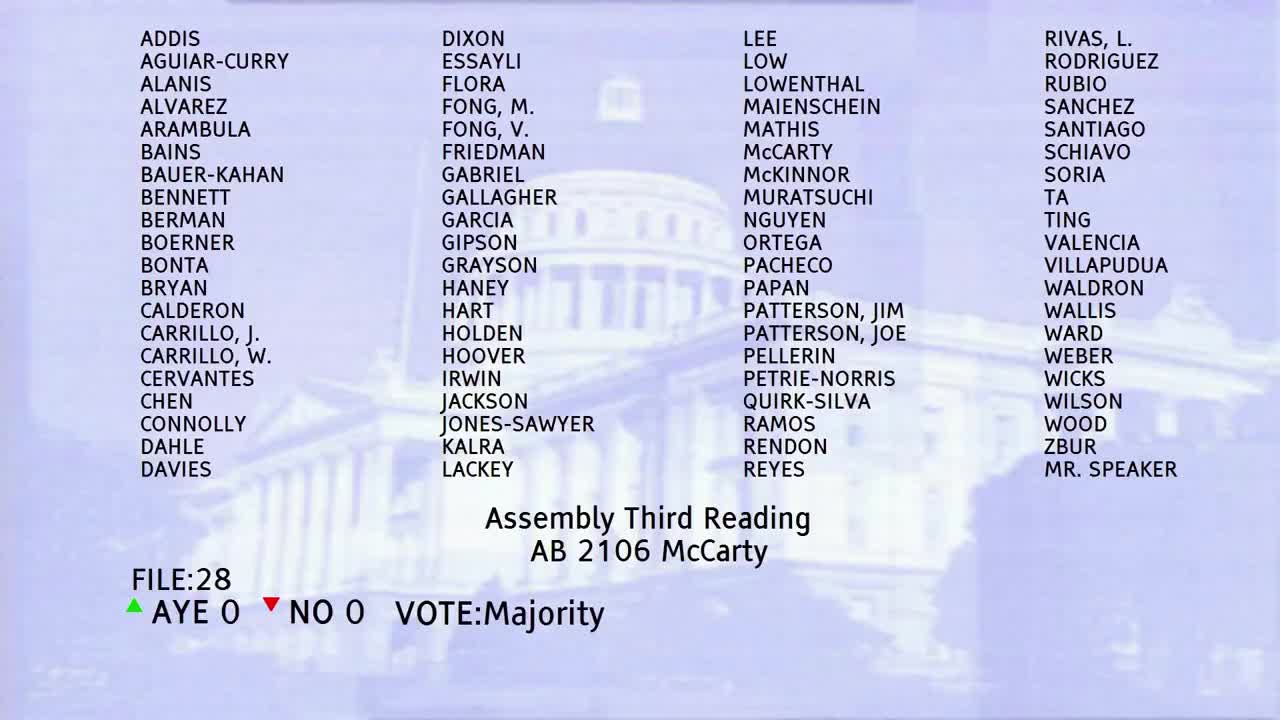 2MIN
Assembly Floor
 10MIN
Assembly Standing Committee on Natural Resources
 31SEC
Assembly Standing Committee on Natural Resources
 18MIN
Assembly Standing Committee on Utilities and Energy
Bill Author
Bill Co-Author(s):