AB 2689: Personal income taxes: California Alzheimer’s Disease and Related Dementia Research Voluntary Tax Contribution Fund.
- Session Year: 2023-2024
- House: Assembly
- Latest Version Date: 2024-07-15
Current Status:
Passed
(2024-07-15: Chaptered by Secretary of State - Chapter 112, Statutes of 2024.)
Introduced
In Committee
First Chamber
In Committee
Second Chamber
Enacted
What does this bill do?
This bill extends until January 1, 2032 the option for California taxpayers to add a voluntary contribution on their state income tax return to the California Alzheimer’s Disease and Related Dementia Research Fund, which supports grants run by the State Department of Public Health. Each year the Franchise Tax Board must check whether donations will reach a $250,000 minimum; if they are projected to fall below that amount, the donation option ends.
The summary is provided by generative AI which can make mistakes. For original language, please view the details in the table below.
Existing law allows taxpayers, until January 1, 2025, to designate on their personal income tax return that a specified amount in excess of their personal income tax liability be contributed to the California Alzheimers Disease and Related Dementia Research Voluntary Tax Contribution Fund, which is a continuously appropriated fund, to be allocated to, among others, the State Department of Public Health to support eligible programs awarded grants under selection criteria established by the State Department of Public Health Alzheimers Disease Program.
This bill would extend the operation of these provisions to January 1, 2032, unless the minimum contribution amount of $250,000 is not met, as specified. By extending the operation of a continuously appropriated fund, the bill would make an appropriation.
Existing law allows taxpayers, until January 1, 2025, to designate on their personal income tax return that a specified amount in excess of their personal income tax liability be contributed to the California Alzheimers Disease and Related Dementia Research Voluntary Tax Contribution Fund, which is a continuously appropriated fund, to be allocated to, among others, the State Department of Public Health to support eligible programs awarded grants under selection criteria established by the State Department of Public Health Alzheimers Disease Program.
This bill would extend the operation of these provisions to January 1, 2030, 2032, unless the minimum contribution amount of $250,000 is not met, as specified. By extending the operation of a continuously appropriated fund, the bill would make an appropriation.
Existing law allows taxpayers, until January 1, 2025, to designate on their personal income tax return that a specified amount in excess of their personal income tax liability be contributed to the California Alzheimers Disease and Related Dementia Research Voluntary Tax Contribution Fund, which is a continuously appropriated fund, to be allocated to, among others, the State Department of Public Health to support eligible programs awarded grants under selection criteria established by the State Department of Public Health Alzheimers Disease Program.
This bill would extend the operation of these provisions to January 1, 2030, unless the minimum contribution amount of $250,000 is not met, as specified. By extending the operation of a continuously appropriated fund, the bill would make an appropriation.
(a)Except as otherwise provided in subdivision (b), this article shall remain in effect only for taxable years beginning before January 1, 2032, and as of December 1 of that year is repealed.
(b)(1)By September 1, 2019, and by September 1 of each subsequent calendar year that the California Alzheimers Disease and Related Dementia Research Voluntary Tax Contribution Fund appears on a tax return, the Franchise Tax Board shall determine whether the amount of contributions estimated to be received during the calendar year will equal or exceed the minimum contributions amount for the calendar year pursuant to paragraph (3). The Franchise Tax Board shall estimate the amount of contributions to be received by using the actual amounts received and an estimate of the contributions that will be received by the end of that calendar year. If the Franchise Tax Board determines that the fund is projected to fall below the minimum contribution amount, the Franchise Tax Board shall provide written notification to the State Department of Public Health.
(2)If the Franchise Tax Board determines that the amount of contributions estimated to be received during a calendar year will not at least equal the minimum contribution amount for the calendar year, this article shall be inoperative with respect to taxable years beginning on or after January 1 of that calendar year and shall be repealed on December 1 of that year.
(3)For purposes of this section, the minimum contribution amount for a calendar year means two hundred fifty thousand dollars ($250,000).
(a)Except as otherwise provided in subdivision (b), this article shall remain in effect only for taxable years beginning before January 1, 2030, 2032, and as of December 1 of that year is repealed.
(b)(1)By September 1, 2019, and by September 1 of each subsequent calendar year that the California Alzheimers Disease and Related Dementia Research Voluntary Tax Contribution Fund appears on a tax return, the Franchise Tax Board shall determine whether the amount of contributions estimated to be received during the calendar year will equal or exceed the minimum contributions amount for the calendar year pursuant to paragraph (3). The Franchise Tax Board shall estimate the amount of contributions to be received by using the actual amounts received and an estimate of the contributions that will be received by the end of that calendar year. If the Franchise Tax Board determines that the fund is projected to fall below the minimum contribution amount, the Franchise Tax Board shall provide written notification to the State Department of Public Health.
(2)If the Franchise Tax Board determines that the amount of contributions estimated to be received during a calendar year will not at least equal the minimum contribution amount for the calendar year, this article shall be inoperative with respect to taxable years beginning on or after January 1 of that calendar year and shall be repealed on December 1 of that year.
(3)For purposes of this section, the minimum contribution amount for a calendar year means two hundred fifty thousand dollars ($250,000).
(a)Except as otherwise provided in subdivision (b), this article shall remain in effect only for taxable years beginning before January 1, 2025, 2030, and as of December 1 of that year is repealed.
(b)(1)By September 1, 2019, and by September 1 of each subsequent calendar year that the California Alzheimers Disease and Related Dementia Research Voluntary Tax Contribution Fund appears on a tax return, the Franchise Tax Board shall determine whether the amount of contributions estimated to be received during the calendar year will equal or exceed the minimum contributions amount for the calendar year pursuant to paragraph (3). The Franchise Tax Board shall estimate the amount of contributions to be received by using the actual amounts received and an estimate of the contributions that will be received by the end of that calendar year. If the Franchise Tax Board determines that the fund is projected to fall below the minimum contribution amount, the Franchise Tax Board shall provide written notification to the State Department of Public Health.
(2)If the Franchise Tax Board determines that the amount of contributions estimated to be received during a calendar year will not at least equal the minimum contribution amount for the calendar year, this article shall be inoperative with respect to taxable years beginning on or after January 1 of that calendar year and shall be repealed on December 1 of that year.
(3)For purposes of this section, the minimum contribution amount for a calendar year means two hundred fifty thousand dollars ($250,000).
|
Date
|
Status
|
|---|---|
| Jul 15, 2024 | Chaptered by Secretary of State - Chapter 112, Statutes of 2024. |
| Jul 15, 2024 | Approved by the Governor. |
| Jul 3, 2024 | Enrolled and presented to the Governor at 3 p.m. |
| Jun 27, 2024 | In Assembly. Ordered to Engrossing and Enrolling. |
| Jun 27, 2024 | Read third time. Passed. Ordered to the Assembly. (Ayes 40. Noes 0.). |
| Jun 25, 2024 | Read second time. Ordered to Consent Calendar. |
| Jun 24, 2024 | From committee: Be ordered to second reading file pursuant to Senate Rule 28.8 and ordered to Consent Calendar. |
| Jun 12, 2024 | From committee: Do pass and re-refer to Com. on APPR with recommendation: To Consent Calendar. (Ayes 6. Noes 0.) (June 12). Re-referred to Com. on APPR. |
| May 1, 2024 | Referred to Com. on REV. & TAX. |
| Apr 18, 2024 | In Senate. Read first time. To Com. on RLS. for assignment. |
| Apr 18, 2024 | Read third time. Passed. Ordered to the Senate. (Ayes 72. Noes 0.) |
| Apr 11, 2024 | Read second time. Ordered to Consent Calendar. |
| Apr 10, 2024 | From committee: Do pass. To Consent Calendar. (Ayes 14. Noes 0.) (April 10). |
| Apr 2, 2024 | From committee: Do pass and re-refer to Com. on APPR. (Ayes 7. Noes 0.) (April 1). Re-referred to Com. on APPR. |
| Mar 19, 2024 | Re-referred to Com. on REV. & TAX. |
| Mar 18, 2024 | From committee chair, with author's amendments: Amend, and re-refer to Com. on REV. & TAX. Read second time and amended. |
| Mar 4, 2024 | Referred to Com. on REV. & TAX. |
| Feb 15, 2024 | From printer. May be heard in committee March 16. |
| Feb 14, 2024 | Read first time. To print. |
|
Date
|
Description
|
Location
|
Votes
|
|
|---|---|---|---|---|
| Jun 27, 2024 | Consent Calendar 2nd AB2689 Bains et al. | Senate Floor |
Passed |
|
| Jun 12, 2024 | Do pass, but first be re-referred to the Committee on [Appropriations] with the recommendation: To Consent Calendar | Senate Standing Committee on Revenue and Taxation |
Passed |
|
| Apr 18, 2024 | AB 2689 Bains Consent Calendar Second Day Regular Session | Assembly Floor |
Passed |
|
| Apr 10, 2024 | Do pass. To Consent Calendar. | Assembly Standing Committee on Appropriations |
Passed |
|
| Apr 1, 2024 | Do pass and be re-referred to the Committee on [Appropriations] | Assembly Standing Committee on Revenue and Taxation |
Passed |
This list shows positions taken on this bill by organizations on the date displayed, which is linked to the original source.
Positions by individuals are not included.
|
Organization
|
Position
|
Date
|
|---|---|---|
| Alzheimer's Association | * Support | Apr 1, 2024 |
| California Assisted Living Association | * Support | Apr 1, 2024 |
| California Life Sciences | * Support | Apr 1, 2024 |
SENATE RULES COMMITTEE Office of Senate Floor Analyses (916) 651-1520 Fax: (916) 327-4478 | AB 2689 |
CONSENT
Bill No: AB 2689
Author: Bains (D), et al.
Amended: 3/18/24 in Assembly
Vote: 21
SENATE REVENUE AND TAXATION COMMITTEE: 6-0, 6/12/24
AYES: Glazer, Dahle, Bradford, Dodd, Padilla, Skinner
NO VOTE RECORDED: Ashby
SENATE APPROPRIATIONS COMMITTEE: Senate Rule 28.8
ASSEMBLY FLOOR: 72-0, 4/18/24 (Consent) - See last page for vote
SUBJECT: Personal income taxes: California Alzheimer’s Disease and Related Dementia Research Voluntary Tax Contribution Fund
SOURCE: Alzheimer’s Association
DIGEST:
This bill extends the sunset date for the California Alzheimer’s Disease and Related Dementia Research Voluntary Tax Contribution Fund from January 1, 2025 to January 1, 2032.
ANALYSIS:
Existing law:
- Allows taxpayers to contribute money from their own resources in excess of the amount they owe in taxes to Voluntary Contribution Funds (VCF) by checking a box on their state Personal Income Tax (PIT) return.
- Establishes 18 VCFs on the PIT Return.
- Generally requires the Franchise Tax Board (FTB) to remove a VCF due to a sunset provision or if the VCF fails to meet the statutory minimum contribution amount.
- Generally requires FTB to annually determine whether estimated contributions to each VCF will exceed $250,000 to remain on the PIT form.
- Provides that after a taxpayer contributes to a VCF, the FTB deposits all contributions, minus its administration costs, into a fund named for the VCF.
- Requires that VCFs meet certain best practices:
- Include “voluntary tax contribution” in the fund name;
- Requires the administering agency’s internet website to report specific data related to the usage of the amounts received from a VCF;
- Be repealed following January 1 of the seventh calendar year following the first appearance of the contribution on the tax return and be repealed as of December 1 of that year.
- Authorizes the California Alzheimer’s Disease and Related Dementia Research Voluntary Tax Contribution Fund
- Directs funds from this VCF to be continuously appropriated and allocated to the FTB, the Controller, and the State Department of Public Health (DPH) for reimbursement of all administrative costs incurred in connection with their duties in administering this VCF.
- Subsequently, directs remaining funds from this VCF to be allocated to DPH to support grants awarded by their Alzheimer’s Disease Program.
This bill extends the sunset date for the California Alzheimer’s Disease and Related Dementia Research Voluntary Tax Contribution Fund from January 1, 2025, to January 1, 2032, if the fund meets the minimum contribution amount of $250,000 annually.
Background
Alzheimer’s in California. Alzheimer’s disease is a type of dementia that causes problems with memory, thinking, and behavior. Symptoms usually develop slowly and worsen over time, becoming severe enough to interfere with daily tasks. With 600,000 Californians living with the disease and another 2 million providing care to a loved one with Alzheimer's, our state is in the early stages of a major public health crisis. Alzheimer’s disease accounts for 60 to 80% of dementia cases. Currently, there is no cure for Alzheimer’s, but treatments for symptoms are available, and research continues.
The California Alzheimer’s Disease and Related Dementia Research Voluntary Tax Contribution Fund. This VCF first appeared on the state PIT returns in 1984. Between 2014 and 2023, the Fund received $5,248,017, an average of $524,802 per year being contributed. Since 2020, however, the Fund has received an average annual contribution of $608,737. Contributions will provide grants to California scientists who study Alzheimer's disease and related disorders. This research includes basic science, diagnosis, treatment, prevention, behavioral problems, and caregiving. This Fund will expire on January 1, 2025, absent legislative action to extend the Fund's appearance on the PIT return.
FISCAL EFFECT: Appropriation: Yes Fiscal Com.: Yes Local: No
SUPPORT: (Verified 6/21/24)
Alzheimer's Association (source)
Alzheimer's Association State Policy Office
California Assisted Living Association
California Collaborative for Long-term Services and Supports
California Life Sciences
Elderly Care Everywhere
OPPOSITION: (Verified 6/21/24)
None received
ARGUMENTS IN SUPPORT: According to the author, “As a practicing physician, I am keenly aware of the devastating power Alzheimer’s disease and other related dementias have on the lives of those who are impacted and on those who care for them. I also know research shows diagnoses vary greatly within communities of color. Research is needed to better understand how we will narrow the divide in diagnosis and treatment moving forward. This voluntary tax contribution expands what can be done in the fields of research to better understand and ultimately end this disease.”
ASSEMBLY FLOOR: 72-0, 4/18/24
AYES: Addis, Aguiar-Curry, Alanis, Alvarez, Bains, Bauer-Kahan, Bennett, Berman, Calderon, Juan Carrillo, Wendy Carrillo, Chen, Connolly, Davies, Dixon, Flora, Mike Fong, Vince Fong, Friedman, Gabriel, Gallagher, Garcia, Gipson, Grayson, Haney, Hart, Holden, Hoover, Irwin, Jackson, Jones-Sawyer, Kalra, Lackey, Lee, Low, Lowenthal, Maienschein, McCarty, McKinnor, Muratsuchi, Stephanie Nguyen, Ortega, Pacheco, Papan, Jim Patterson, Joe Patterson, Pellerin, Petrie-Norris, Quirk-Silva, Ramos, Rendon, Reyes, Luz Rivas, Rodriguez, Blanca Rubio, Sanchez, Santiago, Schiavo, Soria, Ta, Ting, Valencia, Villapudua, Waldron, Wallis, Ward, Weber, Wicks, Wilson, Wood, Zbur, Robert Rivas
NO VOTE RECORDED: Arambula, Boerner, Bonta, Bryan, Cervantes, Megan Dahle, Essayli, Mathis
Prepared by: Haley Summers / REV. & TAX. / (916) 651-4117
6/25/24 13:11:37
**** END ****
SENATE COMMITTEE ON REVENUE AND TAXATION
Senator Steven Glazer, Chair
2023 - 2024 Regular
Bill No: | AB 2689 | Hearing Date: | 6/12/24 |
Author: | Bains | Tax Levy: | No |
Version: | 3/18/24 | Fiscal: | Yes |
Consultant: | Summers | ||
Personal income taxes: California Alzheimer’s Disease and Related Dementia Research Voluntary Tax Contribution Fund
Extends the sunset date for the California Alzheimer’s Disease and Related Dementia Research Voluntary Tax Contribution Fund from January 1, 2025 to January 1, 2032.
Background
Voluntary Tax Contribution Funds. California allows taxpayers to contribute money towards voluntary contribution funds (VCFs), commonly called “check-offs,” on their Personal Income Tax (PIT) return. Taxpayers may contribute money to one or more of these VCFs from the excess of the amount they owe in taxes and can claim a deduction for the year the contribution is made. Their contribution to a VCF is only made if their tax payments and credits exceed the taxes they owe to the state. Taxpayers can voluntarily contribute to one or several of the 18 organizations on their PIT return. These organizations include nonprofits that work on disease, natural resource conservation, and more.
The Legislature adds each VCF individually to PIT return forms through legislation. With a few exceptions, VCFs remain on the return until the Franchise Tax Board (FTB) removes the VCF due to a sunset provision or the VCF fails to meet the statutory minimum contribution amount. By September 1 of each calendar year, the FTB must determine whether estimated contributions to specified funds will be less than the minimum contribution amount required for that calendar year. If FTB estimates a fund will fail to meet the minimum contribution amount for a calendar year, the fund is repealed on January 1 of the following calendar year. However, some funds do not have a repeal date. In general, the minimum contribution amount is $250,000, beginning in the fund’s second year, with some adjusted for inflation. The VCFs listed below currently do not have a minimum contribution requirement:
- California Firefighters’ Memorial Foundation Fund;
- California Peace Officer Memorial Foundation Fund;
- California Senior Citizen Advocacy Voluntary Tax Contribution Fund; and
- California Seniors Special Fund.
Contributions to voluntary funds in 2023 were as follows:
School Supplies for Homeless Children Voluntary Tax Contribution Fund | $619,450 |
Emergency Food for Families Voluntary Tax Contribution Fund | $579,131 |
State Parks Protection Fund/Parks Pass Purchase | $565,097 |
Alzheimer's Disease and Related Dementia Voluntary Tax Contribution Fund | $540,392 |
Rare and Endangered Species Preservation Voluntary Tax Contribution Program | $441,935 |
California Cancer Research Voluntary Tax Contribution Fund | $427,091 |
California Breast Cancer Research Voluntary Tax Contribution Fund | $413,725 |
Rape Kit Backlog Voluntary Tax Contribution Fund | $412,935 |
Mental Health Crisis Prevention Voluntary Tax Contribution Fund | $356,972 |
Prevention of Animal Homelessness and Cruelty Voluntary Tax Contribution Fund | $303,304 |
Native California Wildlife Rehabilitation Voluntary Tax Contribution Fund | $318,078 |
Protect Our Coast and Oceans Voluntary Tax Contribution Fund | $313,778 |
California Sea Otter Voluntary Tax Contribution Fund | $301,979 |
Keep Arts in Schools Voluntary Tax Contribution Fund | $277,673 |
Suicide Prevention Voluntary Tax Contribution Fund | $262,403 |
California Firefighters' Memorial Voluntary Tax Contribution Fund | $182,187 |
California Seniors Special Fund | $132,332 |
California Peace Officer Memorial Foundation Voluntary Tax Contribution Fund | $114,797 |
California Senior Citizen Advocacy Voluntary Tax Contribution Fund | $111,492 |
Total | $6,674,751 |
After a taxpayer contributes to a VCF, the FTB deposits all contributions, minus its administration costs, into a fund named for the VCF. State agencies administer most VCF funds to fund the purpose outlined in the legislation that placed the VCF on the PIT form. For other VCFs, the State Controller’s office allocates taxpayer contributions directly to the private organization without going through an administrative agency. For example, the State Controller’s office directly passes taxpayer contributions to the California Fire Foundation.
Senate Bill 1476. In December 2015, the Senate Committee on Governance and Finance held an oversight hearing on VCFs. The Committee identified best practices and reforms needed to ensure the state allocates taxpayer contributions toward charitable purposes transparently and timely. In 2016, the Legislature enacted SB 1476 (Committee on Governance and Finance), which used those best practices to establish general provisions for all VCFs enacted on or extended after January 2, 2017. Specifically, the bill required of VCFs:
- The words “voluntary tax contribution” must be included in the fund's name;
- The administering agency’s internet website shall report specific data related to the usage of the amounts received via voluntary contribution;
- A voluntary contribution fund must receive a minimum contribution of $250,000 for the second calendar year after it first appears on the tax return and each year after that to remain on the tax return; and
- A voluntary tax contribution would remain in effect only until January 1 of the seventh calendar year following the first appearance of the contribution on the tax return and be repealed as of December 1 of that year.
Alzheimer’s in California. Alzheimer’s disease is a type of dementia that causes problems with memory, thinking, and behavior. Symptoms usually develop slowly and worsen over time, becoming severe enough to interfere with daily tasks. With 600,000 Californians living with the disease and another 2 million providing care to a loved one with Alzheimer's, our state is in the early stages of a major public health crisis. Alzheimer’s disease accounts for 60 to 80% of dementia cases. Currently, there is no cure for Alzheimer’s, but treatments for symptoms are available, and research continues.
The California Alzheimer’s Disease and Related Dementia Research Voluntary Tax Contribution Fund. A voluntary contribution fund for the California Alzheimer’s Disease and Related Dementia Research Voluntary Tax Contribution Fund first appeared on the state PIT returns in 1984. Between 2014 and 2023, the fund received $5,248,017, an average of $524,802 per year being contributed. Since 2020, however, the fund has received an average annual contribution of $608,737. Contributions will provide grants to California scientists who study Alzheimer's disease and related disorders. This research includes basic science, diagnosis, treatment, prevention, behavioral problems, and caregiving. This fund will expire on January 1, 2025, absent legislative action to extend the fund's appearance on the PIT return.
Assembly Bill 2400. The Legislature has extended this VCF several times, most recently in 2018 (AB 2400, Kalra). AB 2400 also set the minimum contribution threshold for the fund to remain on PIT returns to $250,000 and deleted the provision that required annual inflation adjustments to the minimum contribution threshold. It also required contributions to be continuously appropriated to the FTB, the State Controller, and the State Department of Public Health (CDPH) to reimburse them for all administrative costs. Contributions are then allocated to the CDPH to administer eligible programs—in the form of grants—under the selection criteria established by CDPH’s Alzheimer’s Disease Program. AB 2400 also requires CDPH to post on its internet website the process and the administrative costs of awarding the contributions and an itemization of how funds were awarded.
With the VCF set to sunset on January 1, 2025, the author wants to extend the VCF until January 1, 2032.
Proposed Law
Assembly Bill 2689 extends the sunset date for the California Alzheimer’s Disease and Related Dementia Research Voluntary Tax Contribution Fund from January 1, 2025, to January 1, 2032, if the fund meets the minimum contribution amount of $250,000 annually.
State Revenue Impact
FTB estimates AB 2689 will result in a revenue loss of $11,000 in 2026-27.
Comments
- Purpose of the bill. According to the author, “As a practicing physician, I am keenly aware of the devastating power Alzheimer’s disease and other related dementias have on the lives of those who are impacted and on those who care for them. I also know research shows diagnoses vary greatly within communities of color. Research is needed to better understand how we will narrow the divide in diagnosis and treatment moving forward. This voluntary tax contribution expands what can be done in the fields of research to better understand and ultimately end this disease.”
- Many worthy causes. Today, the PIT return contains 18 VCFs. Even though the Legislature has added many VCFs on the return, the total contribution to this fund has remained fairly consistent. The California Alzheimer’s Disease and Related Dementia Research Voluntary Tax Contribution Fund has consistently met its minimum contribution requirement, unlike several other funds.
- SB 1476 requirements. This fund meets the best practices outlined in SB 1476 (2015 Governance and Finance), codified at Section 18873.
- Vital research. Scientific opportunities exist to find the answers to Alzheimer’s by continuing vital research support. Extending this voluntary tax check-off allows Californians and their families a mechanism to maintain a significant investment in healthcare that all Californians deserve.
- Related Legislation. In addition to this bill, the following bills have been introduced this year:
- SB 1172 (Grove) extends the sunset dates for the California Breast Cancer Voluntary Contribution Fund and California Cancer Research Voluntary Contribution Fund from January 1, 2025 to January 1, 2032.
- AB 2197 (Addis) extends the repeal date of the Protect Our Coast and Oceans Voluntary Tax Contribution Fund to January 1, 2032.
- AB 1983 (Mainschein) reestablishes the Prevention of Animal Homelessness and Cruelty Voluntary Tax Contribution Fund, operative until January 1 of the seventh taxable year following the first year the fund appears on the tax return, and is repealed as of December 1 of that year.
- AB 1828 (Waldron) extends the repeal date for the Rare and Endangered Species Preservation Voluntary Tax Contribution Program from January 1, 2025, to January 1, 2032; Extends the sunset date for the Native California Wildlife Rehabilitation Voluntary Tax Contribution Fund to January 1, 2031, and makes changes to the administration of covered grants, as defined.
Assembly Actions
Assembly Revenue & Taxation Committee: 7-0
Assembly Appropriations Committee: 14-0
Assembly Floor: 72-0
Support and Opposition
(6/7/24)
Support: Alzheimer's Association (Sponsor)
California Assisted Living Association
California Collaborative for Long-term Services and Supports
California Life Sciences
Elderly Care Everywhere
Opposition: None submitted.
-- END --
Date of Hearing: April 10, 2024
ASSEMBLY COMMITTEE ON APPROPRIATIONS
Buffy Wicks, Chair
ABPCA Bill Id:AB 2689
Author:(Bains) – As Amended Ver:March 18, 2024
Policy Committee: | Revenue and Taxation | Vote: | 7 - 0 |
|
| ||
|
|
Urgency: No State Mandated Local Program: No Reimbursable: No
SUMMARY:
This bill extends, by seven years, the sunset date of the California Alzheimer’s Disease and Related Dementia Research Voluntary Tax Contribution Fund (Fund) on the personal income tax (PIT) return.
FISCAL EFFECT:
- Annual General Fund (GF) revenue loss of approximately $11,000 beginning fiscal year 2026-27. The Franchise Tax Board (FTB) generally assumes $11,000 in GF revenue loss for every $540,000 in voluntary tax contribution fund (VCF) contributions, as a taxpayer may deduct such charitable contributions in the next taxable year. In the prior three years, the Fund generated more than $540,000 annually.
- No significant costs to FTB or the California Department of Public Health to continue administering the Fund.
COMMENTS:
- Purpose. According to the author:
As a practicing physician, I am keenly aware of the devastating power Alzheimer’s disease and other related dementias have on the lives of those who are impacted and on those who care for them. I also know research shows diagnoses vary greatly within communities of color. Research is needed to better understand how we will narrow the divide in diagnosis and treatment moving forward. This voluntary tax contribution expands what can be done in the fields of research to better understand and ultimately end this disease.
This bill is sponsored by the Alzheimer’s Association and supported by the California Assisted Living Association and California Life Sciences.
- Background.
VCFs. Existing law allows a taxpayer to donate an amount in excess of their PIT liability to one or more VCFs listed on the PIT return. There were 18 VCFs listed on the 2023 return. Generally, a VCF remains on the PIT return until a statutory sunset date, but if FTB determines the VCF fails to meet a $250,000 minimum contribution amount, the VCF is statutorily repealed and FTB removes the VCF from the return.
The Fund. Proceeds raised from the Fund, after reimbursing state administrative costs, are allocated to CDPH to support eligible programs awarded grants through CDPH’s existing Alzheimer’s Disease Program, which supports postsecondary higher educational institutions with diagnostic and treatment centers. The Fund has raised $540,392 in 2023, $597,955 in 2022, and $657,736 in 2021, and is set to sunset after the 2024 return. This bill extends the Fund’s sunset date another seven years.
- Related Legislation. AB 1828 (Waldron) extends, by seven years, the sunset date of two VCFs on the PIT return established to support wildlife. AB 1828 is pending referral by the Senate Rules Committee.
AB 1983 (Maienschein) recreates the previously repealed Prevention of Animal Homelessness and Cruelty VCF on the PIT return. AB 1983 is pending referral by the Senate Rules Committee.
AB 2197 (Addis) extends, by seven years, the sunset date of the Protect Our Coast and Oceans VCF on the PIT. AB 2197 is pending referral by the Senate Rules Committee.
AB 3051 (Muratsuchi) creates the California Climate Literary Education VCF to fund environmental education programs. AB 3051 is pending hearing in the Assembly Revenue and Taxation Committee.
Analysis Prepared by: Irene Ho / APPR. / (916) 319-2081
Date of Hearing: April 1, 2024
ASSEMBLY COMMITTEE ON REVENUE AND TAXATION
Jacqui Irwin, Chair
ABPCA Bill Id:
AB 2689 (
Author:Bains) – As Amended Ver:March 18, 2024
Majority vote. Fiscal committee.
SUBJECT: Personal income taxes: California Alzheimer's Disease and Related Dementia Research Voluntary Tax Contribution Fund
SUMMARY: Extends the sunset date for the statutory provisions authorizing the California Alzheimer's Disease and Related Dementia Research Voluntary Tax Contribution Fund (Fund) until December 1, 2032, unless the Fund fails to meet its minimum contribution amount of $250,000, as specified. Specifically, this bill extends the sunset date for the Fund's statutory provisions from December 1, 2025, to December 1, 2032.
EXISTING LAW:
- Allows taxpayers to contribute to one or more of 18 voluntary contribution funds (VCFs) on the 2023 personal income tax (PIT) return. (Revenue and Taxation Code (R&TC) Section 18730 et seq.)
- Requires each VCF to meet an annual minimum contribution amount to remain in effect, except for the California Firefighters' Memorial Voluntary Tax Contribution Fund, the California Peace Officer Memorial Foundation Voluntary Tax Contribution Fund, the California Senior Citizen Advocacy Voluntary Tax Contribution Fund, and the California Seniors Special Fund. (R&TC Sections 18801 et seq., 18805 et seq., 18730 et seq., and 18771 et seq.)
- Provides a specific sunset date for each VCF, except for the California Seniors Special Fund and the State Parks Protection Fund. (R&TC Sections 18771 et seq. and 18900.1 et seq.)
- Allows an individual to designate on their PIT return that a specified amount in excess of their tax liability be contributed to the Fund. (R&TC Section 18763.)
- Requires these contributions to be continuously appropriated and allocated to the:
- Franchise Tax Board (FTB), the State Controller, and the State Department of Public Health (CDPH) for reimbursement of all administrative costs; and,
- CDPH to support eligible programs awarded grants under the selection criteria established by the CDPH's Alzheimer's Disease Program and for direct program-related expenses. (R&TC Section 18765.)
- Franchise Tax Board (FTB), the State Controller, and the State Department of Public Health (CDPH) for reimbursement of all administrative costs; and,
- Prohibits grant moneys from being used for any purpose outside California. (R&TC Section 18765.)
- Repeals the Fund's statutory provisions on December 1, 2025. (R&TC Section 18766.)
FISCAL EFFECT: The FTB estimates that this bill would reduce General Fund revenues by $11,000 beginning in fiscal year 2026-27.
COMMENTS:
- The author has provided the following statement in support of this bill:
As a practicing physician, I am keenly aware of the devastating power Alzheimer's disease and other related dementias have on the lives of those who are impacted and on those who care for them. I also know research shows diagnoses vary greatly within communities of color. Research is needed to better understand how we will narrow the divide in diagnosis and treatment moving forward. This voluntary tax contribution expands what can be done in the fields of research to better understand and ultimately end this disease.
- This bill is sponsored by the Alzheimer's Association, which notes:
Since 1997, the California Franchise Tax Board (FTB) has included the option for voluntary contributions by taxpayers to contribute to the research fund. For the previous six years, the fund has raised more than a half million dollars annually to provide research dollars to California scientists to help bring an end to the disease. Funds collected by the FTB are administered by the California Department of Public Health who awards grants through a competitive process. In 2024, the CDPH Alzheimer's Disease Program awarded approximately $20 million to seven recipients for research projects to run from 2024 through 2028.
AB 2689 will continue to allow the California Department of Public Health to grant research funds to California researchers investigating a variety of aspects of the disease. Recent grant awardees include UCLA, UCSF, USC, for their work on reducing disparities in diagnoses in California's diverse population.
- This bill is supported by the California Assisted Living Association, which notes:
The number of older adults with Alzheimer's disease and related dementias continues to increase with no known cure, and, according to the Alzheimer's Association, "[a]s of 2018, Alzheimer's and dementia is the third leading cause of death in California." This voluntary tax contribution has been available since 1997 and provides funds to scientists and researchers working to find a cure to this disease. Extending this voluntary contribution presents Californians with the option of helping to fund this important research that has or will touch most Californians in some way over the course of their lives.
- Committee Staff Comments:
- General background: As the Legislature has previously noted in findings and declarations, Alzheimer's disease and related dementias (ADRDs) are devastating health conditions that cause a loss of intellectual performance so severe that they interfere with an individual's daily functioning and eventually result in death. These conditions also cause serious financial, social, and emotional hardships on both those impacted and on their caregivers.
It is hard to overstate the impact of ADRDs on the citizens of California. In January 2021, the CDPH released a report that noted the following sobering statistics:
- In 2019, approximately 660,000 Californians over 65 years of age lived with Alzheimer's disease, which accounted for approximately 11% of the nation's disease prevalence;
- Between 2019 and 2040, a doubling in the number of Californians living with ADRDs is expected. This increase will affect all regions of the state across various demographic groups;
- Among California's baby boomers who live to be 65 years of age and older, estimates suggest that one in six people will develop Alzheimer's disease and one in five people will develop dementia; and,
- As of 2018, Alzheimer's disease was the third leading cause of death in California.
In addition, the author's office notes the following:
Older age does not cause Alzheimer's, but it is the most important known risk factor for the disease. The number of people with Alzheimer's disease doubles about every 5 years beyond age 65. About one-third of all people age 85 and older may have Alzheimer's disease.
Black participants in Alzheimer's disease research studies were 35% less likely to be diagnosed with Alzheimer's and related dementias than white participants, despite national statistics that indicate that Black Americans are overall about twice as likely to develop dementias than whites.
In recognition of these facts, the Legislature established the Fund as a VCF on the PIT return. Thus, an individual taxpayer may designate on their return that a contribution in excess of tax liability, if any, be made to the Fund. All money transferred to the Fund is first allocated to the FTB, the State Controller, and the CDPH to cover their administrative costs. The remainder is then allocated to the CDPH to support eligible programs awarded grants under the selection criteria established by the CDPH's Alzheimer's Disease Program and for direct program-related expenses.
- What would this bill do? This bill would, very simply, extend the Fund's operation through taxable years beginning before January 1, 2032. The Fund has been very successful over the past several years, with the FTB reporting valid contributions of $657,736 in 2021, $597,955 in 2022, and $540,392 in 2023.
- So many causes, so little space: There are countless worthy causes that would benefit from the inclusion of a VCF on the state's income tax returns. At the same time, space on the returns is limited. Thus, it could be argued that the current system for adding VCFs to the form is subjective and essentially rewards organizations that can convince the Legislature to include their cause on the form.
- Leveling the field: In an effort to promote a fair playing field, the Legislature enacted a series of requirements for new and extended VCFs. Specifically, R&TC Section 18873 was added by SB 1476 (Committee on Governance and Finance), Chapter 597, Statutes of 2016, to bring a degree of uniformity and improvement to the disparate VCF statutes. Among other things, Section 18873 provides the following parameters:
- The words "voluntary tax contribution" must be included as part of the name of the fund;
- The website of the fund's administering agency shall report the process for awarding money, the amount of money spent on administration, and an itemization of how program funds were awarded, as specified;
- The minimum contribution amount that must be received for the fund to continue appearing on the tax return is $250,000, without subsequent inflation adjustments; and,
- The statutory provisions establishing a VCF shall remain in effect only until January 1 of the seventh calendar year following the VCF's first appearance on the return.
The Fund, in turn, complies with each of these parameters.
- Prior legislation:
- AB 2400 (Kalra), Chapter 299, Statutes of 2018, extended by five years the sunset date for the Fund.
- AB 394 (Yamada), Chapter 671, Statutes of 2013, extended the Fund's operation to taxable years beginning before January 1, 2020.
- AB 292 (Yamada), Chapter 232, Statutes of 2009, extended the operation of the Fund provisions to January 1, 2015.
- AB 1799 (Mullin), Chapter 370, Statutes of 2004, extended the Fund's statutory provisions to January 1, 2010.
- Prior legislation:
REGISTERED SUPPORT / OPPOSITION:
Support
Alzheimer's Association (Sponsor)
California Assisted Living Association
Opposition
None on file
Analysis Prepared by: M. David Ruff / REV. & TAX. / (916) 319-2098
Discussed in Hearing
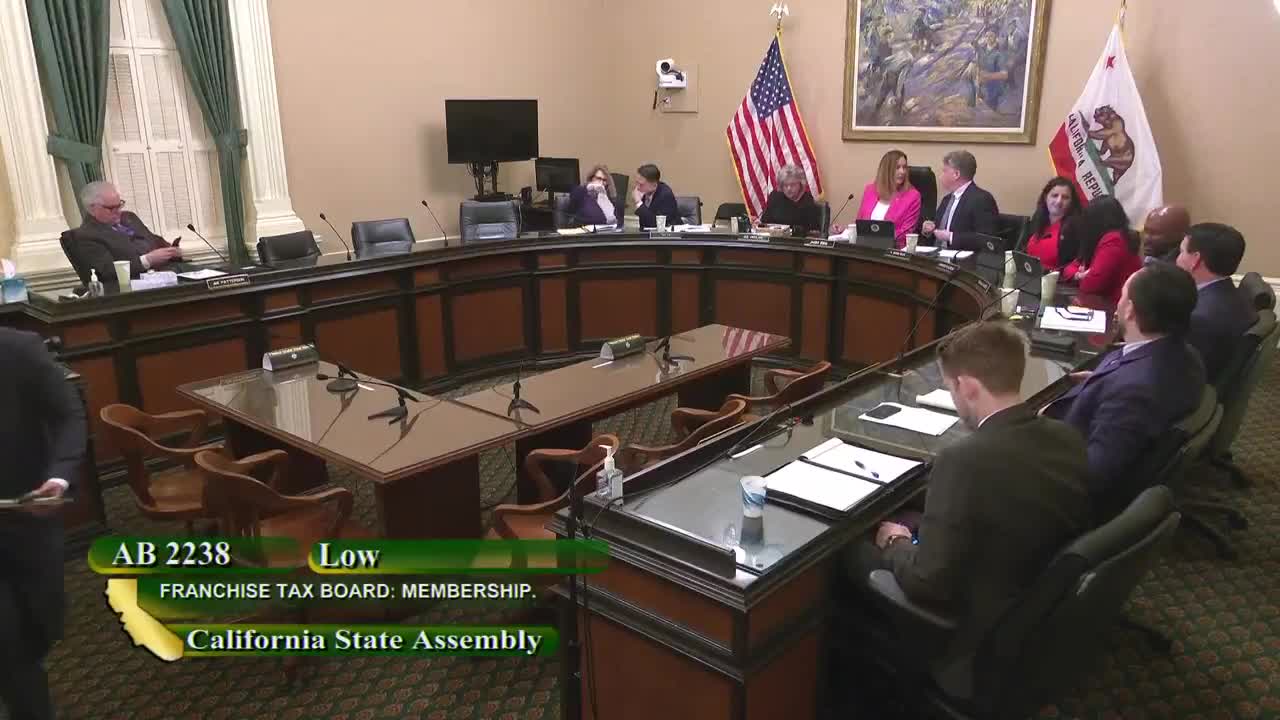 6MIN
Assembly Standing Committee on Revenue and Taxation
Bill Author

Bill Co-Author(s):
