AB 2722: California Endangered Species Act: wolverines.
- Session Year: 2023-2024
- House: Assembly
- Latest Version Date: 2024-02-14
Current Status:
Failed
(2024-05-16: In committee: Held under submission.)
Introduced
In Committee
First Chamber
In Committee
Second Chamber
Enacted
What does this bill do?
This bill requires the California Department of Fish and Wildlife, when it prepares a status assessment for wolverines, to evaluate whether a reintroduction or supplementation program — meaning bringing in wolverines or adding animals to boost numbers — could restore a viable wolverine population in the state.
The summary is provided by generative AI which can make mistakes. For original language, please view the details in the table below.
The California Endangered Species Act (CESA) requires the Fish and Game Commission to establish a list of endangered species and a list of threatened species, which currently includes wolverines, and to add or remove species from either list if it finds, upon the receipt of sufficient scientific information, as specified, that the action is warranted. The act prohibits the taking of an endangered or threatened species, except in certain situations, including, if specified conditions are met, through the issuance of a permit commonly known as an incidental take permit.
Existing law enumerates fully protected mammals, including wolverines, and prohibits the take or possession of these mammals except under limited circumstances. Existing law, until December 31, 2033, authorizes the Department of Fish and Wildlife to issue a permit under CESA that would authorize the take of a fully protected species resulting from impacts attributable to the implementation of specified projects if certain conditions are satisfied, including, among others, the conditions required for the issuance of an incidental take permit. Existing law requires the department to develop a plan on or before July 1, 2024, to assess the population status of each fully protected species.
This bill would require the department, in any status assessment for wolverines prepared pursuant to the plan described above, to assess the feasibility of a population reintroduction or supplementation program with the goal of restoring a viable population of wolverines to the state.
(a)Notwithstanding Sections 3511, 4700, 5050, and 5515, and subject to the requirements set forth in subdivisions (c) to (g), inclusive, the department may authorize under this chapter by permit the take of species listed in subdivision (b) of Section 3511, subdivision (b) of Section 4700, subdivision (b) of Section 5050, and subdivision (b) of Section 5515 resulting from impacts attributable to the implementation of the projects identified in subdivision (b) if all of the following conditions are satisfied:
(1)The requirements of subdivisions (b) and (c) of Section 2081 are satisfied as to the species for which take is authorized.
(2)The department ensures that all further measures necessary to satisfy the conservation standard of subdivision (d) of Section 2805 and take is avoided to the maximum extent possible as to the species for which take is authorized are incorporated into each project.
(3)The take authorization permit provides for the development and implementation, in cooperation with the department, and federal and state agencies, as applicable, of a monitoring program and an adaptive management plan, approved by the department, that satisfy the conservation standard of subdivision (d) of Section 2805 for monitoring the effectiveness of, and amending, as necessary, the measures to minimize and fully mitigate the impacts of the authorized take.
(4)The applicant pays a permit application fee consistent with Section 2081.2.
(b)Projects or categories of projects eligible for a take authorization permit pursuant to this section are limited to all of the following:
(1)A maintenance, repair, or improvement project to the State Water Project, including existing infrastructure, undertaken by the Department of Water Resources.
(2)A maintenance, repair, or improvement project to critical regional or local water agency infrastructure.
(3)A transportation project, including any associated habitat connectivity and wildlife crossing project, undertaken by a state, regional, or local agency, that does not increase highway or street capacity for automobile or truck travel.
(4)A wind project and any appurtenant infrastructure improvement, and any associated electric transmission project carrying electric power from a facility that is located in the state to a point of junction with any California-based balancing authority.
(5)A solar photovoltaic project and any appurtenant infrastructure improvement, and any associated electric transmission project carrying electric power from a facility that is located in the state to a point of junction with any California-based balancing authority.
(c)A permit issued pursuant to subdivision (a) shall cover any incidental take of a species for which take is authorized that may occur in the course of implementing mitigation or conservation actions required in the permit.
(d)The permit conditions are subject to amendment when required by the monitoring program and adaptive management plan adopted pursuant to paragraph (3) of subdivision (a).
(e)(1)This section does not apply to the design or construction of through-delta water conveyances in the Sacramento-San Joaquin Delta.
(2)This section does not apply to the design or construction of ocean desalination projects.
(f)This section shall not be construed to exempt the projects or categories of projects identified in paragraphs (1) to (5), inclusive, of subdivision (b) from any other law.
(g)(1)The department shall not issue new take authorization permits pursuant to this section on or after December 31, 2033.
(2)Take authorization permits issued pursuant to this section before December 31, 2033, shall continue to remain in effect.
(h)The department shall develop a plan on or before July 1, 2024, to assess the population status of each fully protected species. The plan shall include recommendations to the Legislature for resources necessary to determine the scientific status of each fully protected species. In any status assessment for wolverines prepared pursuant to this subdivision, the department shall assess the feasibility of a population reintroduction or supplementation program with the goal of restoring a viable population of wolverines to the state.
(i)On or before July 1, 2025, and annually thereafter, the department shall prepare and submit a report to the relevant policy and budget committees of the Legislature regarding the implementation of this section. The report shall include, at a minimum, all of the following information:
(1)For each individual permit issued to take a fully protected species pursuant to this section, all of the following information:
(A)The type and location of the project for which the permit was issued, including the county in which the project is located.
(B)The fully protected species at risk due to the project and any take of the fully protected species due to the project in the preceding calendar year.
(C)Actions taken to avoid, minimize, and fully mitigate the take of, and to conserve, the fully protected species.
(D)A description of the monitoring program, including observation frequency, and any adaptive management-driven modifications to the monitoring program in the preceding calendar year.
(2)The cost to the department of the implementation of this section in the preceding calendar year broken down by task.
|
Date
|
Status
|
|---|---|
| May 16, 2024 | In committee: Held under submission. |
| Apr 17, 2024 | In committee: Set, first hearing. Referred to APPR. suspense file. |
| Apr 9, 2024 | From committee: Do pass and re-refer to Com. on APPR. (Ayes 11. Noes 3.) (April 9). Re-referred to Com. on APPR. |
| Mar 4, 2024 | Referred to Com. on W., P., & W. |
| Feb 15, 2024 | From printer. May be heard in committee March 16. |
| Feb 14, 2024 | Read first time. To print. |
|
Date
|
Description
|
Location
|
Votes
|
|
|---|---|---|---|---|
| Apr 9, 2024 | Do pass and be re-referred to the Committee on [Appropriations] | Assembly Standing Committee on Water, Parks, and Wildlife |
Passed |
This list shows positions taken on this bill by organizations on the date displayed, which is linked to the original source.
Positions by individuals are not included.
|
Organization
|
Position
|
Date
|
|---|---|---|
| Active San Gabriel Valley | ** Support | |
| amah mutsun tribal band | ** Support | |
| Animal Legal Defense Fund | * Support | Apr 9, 2024 |
| Arroyos & Foothills Conservancy | ** Support | |
| Brentwood Alliance of Canyons & Hillsides | ** Support | |
| California Association Of Professional Scientists | ** Support | |
| California Coastkeeper Alliance | ** Support | |
| California Indian Environmental Alliance | ** Support | |
| California Native Plant Society | ** Support | |
| California Trout | ** Support | |
| California Wilderness Coalition | ** Support | |
| Canyon Back Alliance | ** Support | |
| Center For Biological Diversity | ** Support | |
| Center For Biological Diversity Inc | * Support | Apr 9, 2024 |
| Clean Water Action | ** Support | |
| cleanearth4kids.org | ** Support | |
| Climate Action California | ** Support | |
| Climate Reality Project, Los Angeles Chapter | ** Support | |
| Climate Reality Project, San Fernando Valley | ** Support | |
| Community Alliance With Family Farmers | ** Support | |
| Defenders Of Wildlife | * Support | Apr 9, 2024 |
| Defenders Of Wildlife | ** Support | |
| Endangered Habitats League | ** Support | |
| Environmental Action Committee of West Marin | ** Support | |
| Environmental Protection Information Center | ** Support | |
| Felidae Conservation Fund | ** Support | |
| Freshwater Life | ** Support | |
| Friends of Harbors, Beaches and Parks | ** Support | |
| Friends Of Plumas Wilderness | ** Support | |
| Friends of the Inyo | ** Support | |
| Friends of the River | ** Support | |
| Hills for Everyone | ** Support | |
| Humane Society Of The United States | ** Support | |
| Humane Society United States | * Support | Apr 9, 2024 |
| Klamath Siskiyou Connectivity Project | ** Support | |
| Mount Shasta Bioregional Ecology Center | ** Support | |
| Mountain Lion Foundation | ** Support | |
| National Wildlife Federation | ** Support | |
| Natural Heritage Institute | ** Support | |
| North County Watch | ** Support | |
| Northcoast Environmental Center | ** Support | |
| Occidental Arts and Ecology Center | ** Support | |
| Ohlone Humane Society Wildlife Rehab Center | ** Support | |
| Ojai Raptor Center | ** Support | |
| Pacific Forest Trust | ** Support | |
| Paula Lane Action Network | ** Support | |
| Planning And Conservation League | ** Support | |
| Poison Free Malibu | ** Support | |
| Preserve Wild Santee | ** Support | |
| Project Coyote | ** Support | |
| Raptors Are The Solution | ** Support | |
| Resource Renewal Institute | ** Support | |
| San Bernardino Valley Audubon Society | ** Support | |
| San Diego Humane Society And Spca | ** Support | |
| San Luis Obispo Beaver Brigade | ** Support | |
| Santa Barbara Audobon Society | ** Support | |
| Santa Monica Mountains Fund | ** Support | |
| Santa Susana Mountain Park Association | ** Support | |
| Save Joshua Tree Wildlife | ** Support | |
| Scott River Watershed Council | ** Support | |
| Sierra Forest Legacy | ** Support | |
| Sierra Wildlife Rescue | ** Support | |
| SoCal 350 Climate Action | ** Support | |
| Social Compassion In Legislation | ** Support | |
| Social Compassion In Legislation | * Support | Apr 9, 2024 |
| Swift Water Design | ** Support | |
| The Beaver Institute | ** Support | |
| The Big Wild | ** Support | |
| The Climate Center | ** Support | |
| The Nature Conservancy | ** Support | |
| The Nature of Wildworks | ** Support | |
| The Rewilding Institute | ** Support | |
| The Wildlands Conservancy | ** Support | |
| Theodore Roosevelt Conservation Partnership | ** Support | |
| Tolowa Dee-ni' Nation | ** Support | |
| Trout Unlimited | ** Support | |
| Tuolumne River Trust | ** Support | |
| Urban Wildlife Research Project | ** Support | |
| Wild Earth Guardians | ** Support | |
| Wildlands Network | ** Support | |
| Women United for Animal Welfare | ** Support |
Date of Hearing: April 17, 2024
ASSEMBLY COMMITTEE ON APPROPRIATIONS
Buffy Wicks, Chair
ABPCA Bill Id:AB 2722
Author:(Friedman) – As Introduced Ver:February 14, 2024
Policy Committee: | Water, Parks and Wildlife | Vote: | 11 - 3 |
|
| ||
|
|
Urgency: No State Mandated Local Program: No Reimbursable: No
SUMMARY:
This bill requires the California Department of Fish and Wildlife (CDFW), in any status assessment for wolverines prepared pursuant to existing law, to assess the feasibility of a population reintroduction or supplementation program with the goal of restoring a viable population of wolverines to the state.
FISCAL EFFECT:
CDFW estimates a one-time cost of approximately $235,000 to hire one limited-term senior environmental scientist specialist to prepare the required wolverine reintroduction or supplementation feasibility study as part of a future status assessment for wolverines (General Fund). According to the Legislative Analyst’s Office, the General Fund faces a structural deficit in the tens of billions of dollars over the next several fiscal years.
COMMENTS:
1) Purpose. According to the author:
Wolverines are apex predators that once played a significant ecological role in high-elevation ecosystems in California. Unlike many species that are imperiled due to habitat loss, wolverine habitat is largely intact and protected in national parks and wilderness areas, areas where there is no likelihood of conflict with other users. Restoring the wolverine to these areas can help enhance ecosystem resiliency in the face of climate change.
2) Background. The wolverine is the largest terrestrial member of the weasel family. Wolverines are widely distributed in Canada and Alaska with smaller populations in the Rocky and Cascade mountains. There have been only two wolverines detected in California since 1922 – a male wolverine was detected near Truckee in 2008 and another was confirmed in the Eastern Sierra Mountains in June 2023. According to a coalition of organizations writing in support of this bill, wolverines were largely extirpated from the state by the 1920s as a result of widespread poisoning and fur trapping.
In California, wolverines are classified as fully protected and listed as a threatened species under the California Endangered Species Act (CESA); federally, they are classified as threatened under the Endangered Species Act (ESA). Of the 34 species currently designated as fully protected, eight are listed as threatened and 19 are listed as endangered under CESA. The scientific status of most of the state’s fully protected species is not known. CDFW conducts five-year reviews of CESA-listed species. SB 147 (Ashby), Chapter 59, Statutes of 2023, requires CDFW to develop a plan to assess the population status of each fully protected species by July 1, 2024. SB 147 requires the plan to include recommendations to the Legislature for resources necessary to determine the scientific status of each fully protected species. CDFW notes it is in the process of developing this plan.
Recovery Plans. CESA allows for and ESA requires recovery plans for the conservation and survival of listed species. Approximately 60% of CESA-listed species are also listed under ESA and may already have a federal recovery plan. For the CESA-listed species for which a federal recovery plan exists, CDFW has the authority to adopt, or adopt with revisions, the federal recovery plan. CDFW is currently drafting recovery planning guidelines, which will provide a framework for recovery planning for CESA-listed species. The first benefactor of a CESA recovery plan is likely the red abalone. CDFW has not identified a timeline for the development of a recovery plan for wolverines.
Reintroductions. According to the Assembly Water, Parks, and Wildlife Committee analysis of this bill, although there have been several species recovery efforts, there have been few reintroductions in the state, in part because reintroductions can be risky, costly, and questionably effective. This bill requires CDFW to assess the feasibility of a wolverine reintroduction or supplementation program during the process of performing the fully protected species status assessment. Supporters of this bill contend:
Absent active translocation of female wolverines, California will likely never again have a viable population of the species in our state. Reintroducing wolverines to California is likely to provide significant ecological benefits with little or no downsides. A restored population of wolverines in the state is highly unlikely to result in any human/wildlife conflict as their high-elevation habitat remains largely intact, protected within national parks and wilderness areas where conflicting uses are already prohibited. We are not aware of any insurmountable biological or logistical obstacles to reintroduction.
Analysis Prepared by: Nikita Koraddi / APPR. / (916) 319-2081
Date of Hearing: April 9, 2024
ASSEMBLY COMMITTEE ON WATER, PARKS, AND WILDLIFE
Diane Papan, Chair
ABPCA Bill Id:AB 2722 (
Author:Friedman) – As Introduced Ver:February 14, 2024
SUBJECT: California Endangered Species Act: wolverines
SUMMARY: Requires the Department of Fish and Wildlife (DFW) to assess the feasibility of a population reintroduction or supplementation program to restore wolverines to the state when conducting a status assessment on wolverines.
EXISTING LAW:
- Establishes that DFW has jurisdiction over the conservation, protection, and management of fish, wildlife, native plants, and habitat necessary for biologically sustainable populations of those species [Fish and Game Code (FGC) § 1802].
- Establishes the wolverine (Gulo luscus) as a fully protected mammal [FGC § 4700 (b)].
- Designates certain species as fully protected, and prohibits the take of these species, with exceptions for necessary scientific research and, for fully protected bird species, the protection of livestock (FGC §§ 3511, 4700, 5050, 5515).
- Provides under the California Endangered Species Act (CESA) the listing and protection of species determined through biological scientific analysis to be endangered or threatened with extinction (FGC §§ 2070 et seq.).
- Authorizes DFW to review endangered and threatened species to determine if the conditions that led to the original listing are still present. Requires the review to review the identification of habitat that may be essential to the continued existence of the species and DFW’s recommendations for management activities and other recommendations for recovery of the species (FGC § 2077).
- Defines “recovery” to mean to improve, and improvement in, the status of a species to the point at which listing is no longer appropriate under the criteria set out in that chapter and any regulations adopted thereunder, and, if DFW has approved a recovery plan, satisfaction of the conditions of that plan (FGC § 2064.5).
- Authorizes DFW to develop and implement nonregulatory recovery plans for the conservation and survival of species listed as endangered or threatened and sets how the recovery plans should be developed and implemented (FGC § 2079.1).
FISCAL EFFECT: Unknown. This bill is keyed fiscal.
COMMENTS:
- Purpose of this bill. This bill allows DFW to authorize by permit the take of fully protected species resulting from impacts attributable to the implementation of specified project types if all required conditions are met. According to the author, “Wolverines are apex predators that once played a significant ecological role in high-elevation ecosystems in California. Unlike many species that are imperiled due to habitat loss, wolverine habitat is largely intact and protected in national parks and wilderness areas, areas where there is no likelihood of conflict with other users. Restoring the wolverine to these areas can help enhance ecosystem resiliency in the face of climate change.”
- Background. The North American wolverine (Gulo gulo luscus) is a large, solitary mustelid that inhabits remote wilderness areas at very low population densities. Wolverine habitat is characterized by persistent spring snowpacks in subalpine forests and talus fields near treeline. Wolverines are opportunistic feeders but rely mainly on ungulate (i.e., elk, deer, sheep) and rodent prey, or carrion in winter. Historically, wolverines occurred throughout the high elevations of California’s Sierra Nevada. Research has found that wolverines in the Sierra Nevada were genetically distinct from all other North American wolverines and were likely isolated from other populations in North America for >2,000 years.[1]
There have only been two wolverines detected in California since 1922, a male wolverine detected near Truckee in 2008 and another confirmed in the Easter Sierra Nevada Mountains in June 2023. The wolverine is a fully protected species, listed as threatened in California under CESA, and was listed as threatened in January of 2024 under the federal Endangered Species Act (ESA).
Fully protected species. In the 1960s, California began its efforts to identify and protect animals that were rare or at risk of extinction within the state. These efforts resulted in lists of fully protected species— animals that may not be taken or possessed, except in limited circumstances such as for scientific research or, in the case of fully protected birds, for the relocation of birds to protect livestock. Currently, there are 11 fully protected birds (FGC § 3511), five fully protected reptiles and amphibians, nine fully protected fish (FGC § 5515), and nine fully protected mammals (FGC § 4700), including the wolverine.
Since the creation of the fully protected species lists, Congress and the Legislature enacted ESA and CESA, respectively. CESA- or ESA-listed species differ from fully protected species in a couple of key ways. First, the endangered species lists are intended to be maintained according to the best available scientific information, whereas the fully protected species lists were codified by the Legislature and had not been updated until recently. The scientific status of most of the fully protected species are not known. DFW conducts five-year reviews of CESA-listed species, with reviews completed recently for nine species, including two fully protected species (Owens pupfish and California bighorn sheep).
Of the 34 species currently designated as fully protected, eight are listed as threatened and 19 are listed as endangered under CESA. Until recently, the American peregrine falcon, brown pelican, and thicktail chub were given fully protected status until they were delisted from CESA by the Fish and Game Commission based on scientific findings that the protections afforded by listing were no longer necessary. Both the American peregrine falcon and brown pelican had recovered and the thicktail chub was extirpated (locally extinct). SB 147 (Ashby) Chapter 59, Statues of 2023, requires DFW to develop a plan to assess the population status of each fully protected species by July 1, 2024.
Recovery plans. CESA allows for and ESA requires recovery plans for the conservation and survival of listed species. The California Condor Recovery Program is perhaps the most famous recovery effort and is led by the U.S. Fish and Wildlife Service. Approximately 60% of CESA-listed species are also listed under ESA and may already have a federal recovery plan. For the CESA-listed species for which a federal recovery plan exists, DFW has the authority to adopt, or adopt with revisions, the federal recovery plan. Any federal recovery plan proposed for adoption, or any newly drafted recovery plan, will go through public review and comment, including a public meeting in the recovery plan area, before being approved. DFW is currently drafting recovery planning guidelines, which will provide a framework for recovery planning for CESA-listed species.
Each plan will be based on the best available scientific information and will, at a minimum, include:
- Site-specific management actions necessary for the recovery of the species;
- Objective, measurable criteria that, when achieved, would result in the potential delisting of the species; and
- Estimates of the time required and the cost to carry out those measures and to achieve intermediate steps toward recovery.
The first benefactor of the CESA recovery plan is likely the red abalone. In response to the rapid decline of the red abalone, the California Fish and Game Commission directed DFW to transition from developing a fishery management plan for red abalone to a species recovery plan. The goal of the Red Abalone Recovery Plan is to develop a robust, adaptive, climate ready strategy to support the recovery of the red abalone population to sustainable levels.
Reintroductions. Although there have been several species recovery efforts, few reintroductions occur in the state. Gray wolves began their natural return to California in 2011 and were not intentionally reintroduced. Species reintroduction is risky and their effectiveness debated. With the passage of Public Law 116–260 in December 2020, the U.S. Fish and Wildlife Service studied the feasibility and cost of reestablishing sea otters on the Pacific Coast of the contiguous United States. This assessment relied upon the International Union for the Conservation of Nature guidelines for evaluating conservation reintroductions. These guidelines provide clear objectives for a reintroduction; an assessment of whether the reintroduction will result in a net conservation benefit to the species and its ecosystem; an evaluation of feasibility from a biological, socioeconomic, and legal perspective; and an evaluation of the risks to ecological, social, and economic interests associated with the reintroduction. The study concludes there would be multiple substantial benefits to sea otter reintroduction to their historical range in norther California and Oregon. The reintroduction is deemed feasible, but not without challenges, and is expected to cost $26–43 million dollars over a 10 year period to perform habitat evaluation, acquisition and release of sea otters, and habitat and population monitoring. A bill to authorize wolverine reintroduction is currently before the Colorado state legislature.
This bill requires DFW to assess the feasibility of a wolverine reintroduction or supplementation program during the process of performing the fully protected species status assessment. DFW’s Alpine Mesocarnivore study was motivated in part by the need to evaluate the potential for wolverine occupancy elsewhere in the Sierra Nevada to inform potential reintroduction efforts.[2]
- Arguments in support. A collection of environmental organizations write in support, lamenting the role of the poisoning and fur trapping that lead to the species extirpation. They also write that male wolverines are known to travel long distances (as was witnessed last year), but females do not, so any hope of having a viable population in the state will depend on reintroduction. They state that this bill “is an essential first step in recovering this iconic, irreplaceable, and ecologically important species to our state.”
- Related legislation. SB 147 (Ashby) Chapter 59, Statues of 2023, among other things, requires DFW to develop a plan to assess the population status of each fully protected species by July 1, 2024.
SB 473 (Hertzberg), Chapter 329, Statutes of 2018, among other things, requires the Fish and Game Commission to add or remove species from the endangered species list based solely upon scientific information, authorizes DFW to review listed species every five years and requires the review with specific appropriation, defined “recover,” and authorized DFW to develop and implement a nonregulatory recovery plan for the conservation and survival of any listed species.
REGISTERED SUPPORT / OPPOSITION:
Support
Center for Biological Diversity (Sponsor)
Amah Mutsun Tribal Band
Arroyos & Foothills Conservancy
Brentwood Alliance of Canyons & Hillsides
California Association of Professional Scientists
California Native Plant Society
Canyon Back Alliance
Cleanearth4kids.org
Defenders of Wildlife
Endangered Habitats League
Environmental Protection Information Center
Felidae Conservation Fund
Friends of Harbors, Beaches and Parks
Friends of Plumas Wilderness
Friends of The Inyo
Hills for Everyone
Humane Society of The United States
Klamath Siskiyou Connectivity Project
Mount Shasta Bioregional Ecology Center
Mountain Lion Foundation
North County Watch
Northcoast Environmental Center
Ojai Raptor Center
Pacific Forest Trust
Paula Lane Action Network
Poison Free Malibu
Preserve Wild Santee
Raptors are The Solution
Resource Renewal Institute
San Bernardino Valley Audubon Society
Santa Barbara Audubon Society
Santa Monica Mountains Fund
Santa Susana Mountain Park Association
Save Joshua Tree Wildlife
Sierra Forest Legacy
So Cal 350 Climate Action
Social Compassion in Legislation
The Big Wild
The Nature of Wildworks
The Wildlands Conservancy
Tolowa Dee-ni' Nation
Urban Wildlife Research Project
Wild Earth Guardians
Wildlands Network
Women United for Animal Welfare
Opposition
None on file
Analysis Prepared by: Stephanie Mitchell / W., P., & W. / (916) 319-2096
Date of Hearing: April 9, 2024
ASSEMBLY COMMITTEE ON WATER, PARKS, AND WILDLIFE
Diane Papan, Chair
ABPCA Bill Id:AB 2722 (
Author:Friedman) – As Introduced Ver:February 14, 2024
SUBJECT: California Endangered Species Act: wolverines
SUMMARY: Requires the Department of Fish and Wildlife (DFW) to assess the feasibility of a population reintroduction or supplementation program to restore wolverines to the state when conducting a status assessment on wolverines.
EXISTING LAW:
- Establishes that DFW has jurisdiction over the conservation, protection, and management of fish, wildlife, native plants, and habitat necessary for biologically sustainable populations of those species [Fish and Game Code (FGC) § 1802].
- Establishes the wolverine (Gulo luscus) as a fully protected mammal [FGC § 4700 (b)].
- Designates certain species as fully protected, and prohibits the take of these species, with exceptions for necessary scientific research and, for fully protected bird species, the protection of livestock (FGC §§ 3511, 4700, 5050, 5515).
- Provides under the California Endangered Species Act (CESA) the listing and protection of species determined through biological scientific analysis to be endangered or threatened with extinction (FGC §§ 2070 et seq.).
- Authorizes DFW to review endangered and threatened species to determine if the conditions that led to the original listing are still present. Requires the review to review the identification of habitat that may be essential to the continued existence of the species and DFW’s recommendations for management activities and other recommendations for recovery of the species (FGC § 2077).
- Defines “recovery” to mean to improve, and improvement in, the status of a species to the point at which listing is no longer appropriate under the criteria set out in that chapter and any regulations adopted thereunder, and, if DFW has approved a recovery plan, satisfaction of the conditions of that plan (FGC § 2064.5).
- Authorizes DFW to develop and implement nonregulatory recovery plans for the conservation and survival of species listed as endangered or threatened and sets how the recovery plans should be developed and implemented (FGC § 2079.1).
FISCAL EFFECT: Unknown. This bill is keyed fiscal.
COMMENTS:
- Purpose of this bill. This bill allows DFW to authorize by permit the take of fully protected species resulting from impacts attributable to the implementation of specified project types if all required conditions are met. According to the author, “Wolverines are apex predators that once played a significant ecological role in high-elevation ecosystems in California. Unlike many species that are imperiled due to habitat loss, wolverine habitat is largely intact and protected in national parks and wilderness areas, areas where there is no likelihood of conflict with other users. Restoring the wolverine to these areas can help enhance ecosystem resiliency in the face of climate change.”
- Background. The North American wolverine (Gulo gulo luscus) is a large, solitary mustelid that inhabits remote wilderness areas at very low population densities. Wolverine habitat is characterized by persistent spring snowpacks in subalpine forests and talus fields near treeline. Wolverines are opportunistic feeders but rely mainly on ungulate (i.e., elk, deer, sheep) and rodent prey, or carrion in winter. Historically, wolverines occurred throughout the high elevations of California’s Sierra Nevada. Research has found that wolverines in the Sierra Nevada were genetically distinct from all other North American wolverines and were likely isolated from other populations in North America for >2,000 years.[1]
There have only been two wolverines detected in California since 1922, a male wolverine detected near Truckee in 2008 and another confirmed in the Easter Sierra Nevada Mountains in June 2023. The wolverine is a fully protected species, listed as threatened in California under CESA, and was listed as threatened in January of 2024 under the federal Endangered Species Act (ESA).
Fully protected species. In the 1960s, California began its efforts to identify and protect animals that were rare or at risk of extinction within the state. These efforts resulted in lists of fully protected species— animals that may not be taken or possessed, except in limited circumstances such as for scientific research or, in the case of fully protected birds, for the relocation of birds to protect livestock. Currently, there are 11 fully protected birds (FGC § 3511), five fully protected reptiles and amphibians, nine fully protected fish (FGC § 5515), and nine fully protected mammals (FGC § 4700), including the wolverine.
Since the creation of the fully protected species lists, Congress and the Legislature enacted ESA and CESA, respectively. CESA- or ESA-listed species differ from fully protected species in a couple of key ways. First, the endangered species lists are intended to be maintained according to the best available scientific information, whereas the fully protected species lists were codified by the Legislature and had not been updated until recently. The scientific status of most of the fully protected species are not known. DFW conducts five-year reviews of CESA-listed species, with reviews completed recently for nine species, including two fully protected species (Owens pupfish and California bighorn sheep).
Of the 34 species currently designated as fully protected, eight are listed as threatened and 19 are listed as endangered under CESA. Until recently, the American peregrine falcon, brown pelican, and thicktail chub were given fully protected status until they were delisted from CESA by the Fish and Game Commission based on scientific findings that the protections afforded by listing were no longer necessary. Both the American peregrine falcon and brown pelican had recovered and the thicktail chub was extirpated (locally extinct). SB 147 (Ashby) Chapter 59, Statues of 2023, requires DFW to develop a plan to assess the population status of each fully protected species by July 1, 2024.
Recovery plans. CESA allows for and ESA requires recovery plans for the conservation and survival of listed species. The California Condor Recovery Program is perhaps the most famous recovery effort and is led by the U.S. Fish and Wildlife Service. Approximately 60% of CESA-listed species are also listed under ESA and may already have a federal recovery plan. For the CESA-listed species for which a federal recovery plan exists, DFW has the authority to adopt, or adopt with revisions, the federal recovery plan. Any federal recovery plan proposed for adoption, or any newly drafted recovery plan, will go through public review and comment, including a public meeting in the recovery plan area, before being approved. DFW is currently drafting recovery planning guidelines, which will provide a framework for recovery planning for CESA-listed species.
Each plan will be based on the best available scientific information and will, at a minimum, include:
- Site-specific management actions necessary for the recovery of the species;
- Objective, measurable criteria that, when achieved, would result in the potential delisting of the species; and
- Estimates of the time required and the cost to carry out those measures and to achieve intermediate steps toward recovery.
The first benefactor of the CESA recovery plan is likely the red abalone. In response to the rapid decline of the red abalone, the California Fish and Game Commission directed DFW to transition from developing a fishery management plan for red abalone to a species recovery plan. The goal of the Red Abalone Recovery Plan is to develop a robust, adaptive, climate ready strategy to support the recovery of the red abalone population to sustainable levels.
Reintroductions. Although there have been several species recovery efforts, few reintroductions occur in the state. Gray wolves began their natural return to California in 2011 and were not intentionally reintroduced. Species reintroduction is risky and their effectiveness debated. With the passage of Public Law 116–260 in December 2020, the U.S. Fish and Wildlife Service studied the feasibility and cost of reestablishing sea otters on the Pacific Coast of the contiguous United States. This assessment relied upon the International Union for the Conservation of Nature guidelines for evaluating conservation reintroductions. These guidelines provide clear objectives for a reintroduction; an assessment of whether the reintroduction will result in a net conservation benefit to the species and its ecosystem; an evaluation of feasibility from a biological, socioeconomic, and legal perspective; and an evaluation of the risks to ecological, social, and economic interests associated with the reintroduction. The study concludes there would be multiple substantial benefits to sea otter reintroduction to their historical range in norther California and Oregon. The reintroduction is deemed feasible, but not without challenges, and is expected to cost $26–43 million dollars over a 10 year period to perform habitat evaluation, acquisition and release of sea otters, and habitat and population monitoring. A bill to authorize wolverine reintroduction is currently before the Colorado state legislature.
This bill requires DFW to assess the feasibility of a wolverine reintroduction or supplementation program during the process of performing the fully protected species status assessment. DFW’s Alpine Mesocarnivore study was motivated in part by the need to evaluate the potential for wolverine occupancy elsewhere in the Sierra Nevada to inform potential reintroduction efforts.[2]
- Arguments in support. A collection of environmental organizations write in support, lamenting the role of the poisoning and fur trapping that lead to the species extirpation. They also write that male wolverines are known to travel long distances (as was witnessed last year), but females do not, so any hope of having a viable population in the state will depend on reintroduction. They state that this bill “is an essential first step in recovering this iconic, irreplaceable, and ecologically important species to our state.”
- Related legislation. SB 147 (Ashby) Chapter 59, Statues of 2023, among other things, requires DFW to develop a plan to assess the population status of each fully protected species by July 1, 2024.
SB 473 (Hertzberg), Chapter 329, Statutes of 2018, among other things, requires the Fish and Game Commission to add or remove species from the endangered species list based solely upon scientific information, authorizes DFW to review listed species every five years and requires the review with specific appropriation, defined “recover,” and authorized DFW to develop and implement a nonregulatory recovery plan for the conservation and survival of any listed species.
REGISTERED SUPPORT / OPPOSITION:
Support
350 Humboldt
350 Sacramento
Active San Gabriel Valley
California Coastkeeper Alliance
California Indian Environmental Alliance
California Trout
California Wilderness Coalition
Center for Biological Diversity
Clean Water Action
Cleanearth4kids.org
Climate Action California
Climate Reality Project, Los Angeles Chapter
Climate Reality Project, San Fernando Valley
Community Alliance With Family Farmers
Defenders of Wildlife
Environmental Action Committee of West Marin
Environmental Protection Information Center
Freshwater Life
Friends of The River
Mount Shasta Bioregional Ecology Center
National Wildlife Federation
Natural Heritage Institute
Occidental Arts and Ecology Center
Ohlone Humane Society Wildlife Rehab Center
Pacific Forest Trust
Planning and Conservation League
Project Coyote
San Diego Humane Society and SPCA
San Luis Obispo Beaver Brigade
Scott River Watershed Council
Sierra Wildlife Rescue
Swift Water Design
The Beaver Institute
The Climate Center
The Nature Conservancy
The Rewilding Institute
Theodore Roosevelt Conservation Partnership
Trout Unlimited
Tuolumne River Trust
Wildlands Network
Opposition
None on file
Analysis Prepared by: Stephanie Mitchell / W., P., & W. / (916) 319-2096
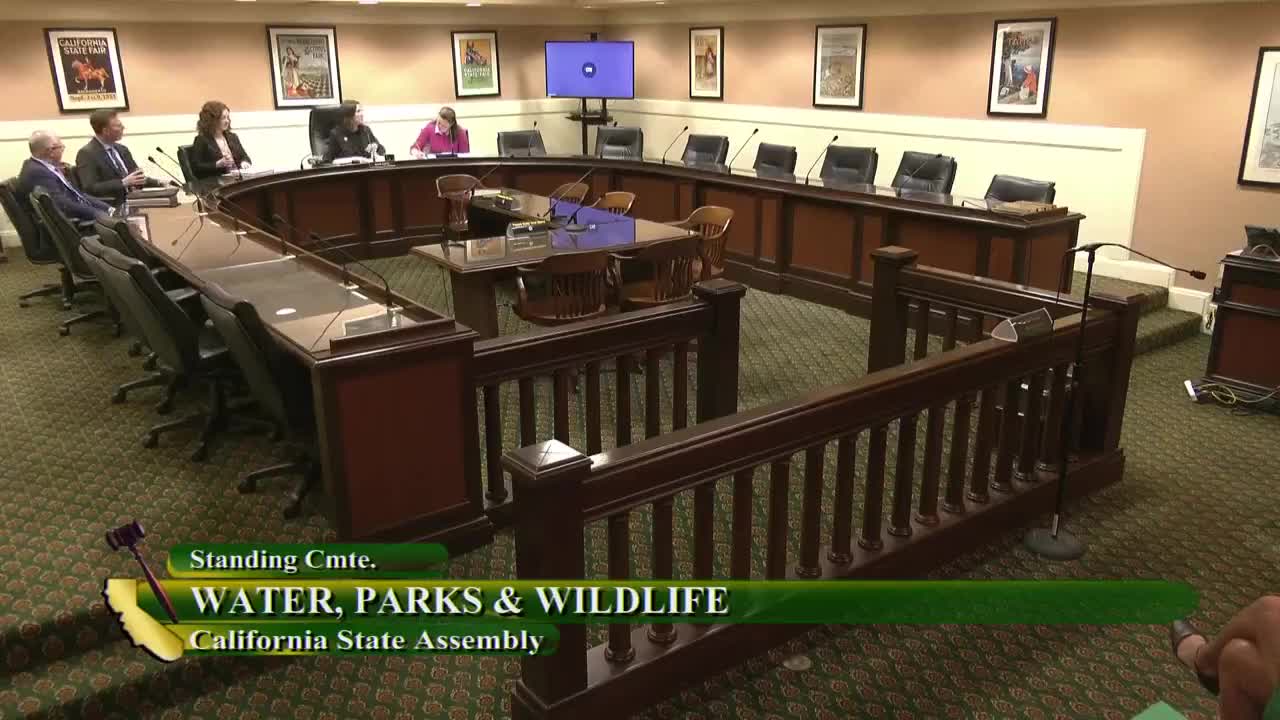
Discussed in Hearing
 7MIN
Assembly Standing Committee on Water, Parks, and Wildlife
Bill Author

Bill Co-Author(s):