AB 2808: Primary ticket sellers.
- Session Year: 2023-2024
- House: Assembly
- Latest Version Date: 2024-04-30
Current Status:
Failed
(2024-05-16: Joint Rule 62(a), file notice suspended. (Page 5215.))
Introduced
In Committee
First Chamber
In Committee
Second Chamber
Enacted
Existing law regulates ticket sellers, defined as a person who, for compensation, commission, or otherwise, sells admission tickets to entertainment events. In this regard, existing law prohibits specified ticket selling practices and imposes certain recordkeeping and disclosure requirements on ticket sellers.
This bill would require a ticketing enterprise provider, as defined, to include an application programming interface (API) that enables any participating ticketing provider, as defined, to integrate with the ticket manifest to list and sell primary tickets or secondary tickets, as those terms are defined, that are instantly verified by the ticketing enterprise system. The bill would make it unlawful for a ticketing enterprise provider or an entertainment facility to provide services associated with a system access API, as defined, on an exclusive or discriminatory basis, as specified. The bill would make it unlawful to limit the transfer or resale of a ticket or penalize, discriminate against, or deny access to an event to a person who has resold a ticket or purchases a secondary ticket. This bill would make a violation of the bills provisions subject to a $2,500 civil penalty for each ticket not sold or offered for sale in violation of the bills provisions.This bill would prohibit a contract between a primary ticket seller and a venue operator from providing for the primary ticket seller to be the exclusive and sole primary ticket seller. The bill would also prohibit such a contract from having a term longer than 3 years. The bill would require a venue operator, when entering into an agreement with an artist or artist representative, to allow the artist or artist representative to determine the terms and conditions relating to tickets to their events, as specified. The bill would apply its provisions to contracts entered into, amended, or renewed on or after January 1, 2025. The bill would provide an exception for significant national or international sporting events, as specified. The bill would impose a civil penalty of up to $2,500 for each violation of its provisions.
Existing law regulates ticket sellers, defined as a person who, for compensation, commission, or otherwise, sells admission tickets to entertainment events. In this regard, existing law prohibits specified ticket selling practices and imposes certain recordkeeping and disclosure requirements on ticket sellers.
This bill would require a ticketing enterprise provider, as defined, to include an application programming interface (API) that enables any participating ticketing provider, as defined, to integrate with the ticket manifest to list and sell primary tickets or secondary tickets, as those terms are defined, that are instantly verified by the ticketing enterprise system. The bill would make it unlawful for a ticketing enterprise provider or an entertainment facility to provide services associated with a system access API, as defined, on an exclusive or discriminatory basis, as specified. The bill would make it unlawful to limit the transfer or resale of a ticket or penalize, discriminate against, or deny access to an event to a person who has resold a ticket or purchases a secondary ticket. This bill would make a violation of the bills provisions subject to a $2,500 civil penalty for each ticket not sold or offered for sale in violation of the bills provisions.
Existing law requires a publisher to obtain the written consent of a subscriber who has been assigned a telephone number for a facsimile machine before including the number in any commercial directory, as specified. Existing law makes a violation of this provision an infraction punishable by a fine of $500.This bill would increase that fine to $525. The bill would also make a nonsubstantive change to those provisions.Existing law requires a publisher to obtain the written consent of a subscriber who has been assigned a telephone number for a facsimile machine before including the number in any commercial directory, as specified. Existing law makes a violation of this provision an infraction punishable by a fine of $500.
This bill would increase that fine to $525. The bill would also make a nonsubstantive change to those provisions.
The Legislature finds and declares all of the following:
(a)There are many social and emotional upsides for individuals who are able to experience live entertainment and sporting events, including positive impacts to well-being and happiness.
(b)Live events often serve as a focal point for communities to come together by creating a shared sense of identity, belonging, and social cohesion among attendees with similar interests.
(c)Fans of popular artists and sports teams can have very diverse backgrounds. By fostering a sense of inclusivity and breaking down societal barriers, people of various ages, ethnicities, and backgrounds can share in the enjoyment of these events.
(d)Emotional engagement with musical performances and sports can reduce stress and promote mental well-being. The exciting and positive experiences at sporting events or concerts can trigger the release of endorphins, which are often associated with increased happiness and a positive emotional state.
(e)Studies have shown that listening to music lowers the hormone cortisol, which causes feelings of stress and anxiety, and listening to music can lead to decreases in heart rate, blood pressure, and respiratory rate.
(f)Attending live events often leads to cherished memories, which can have a positive impact on an individuals emotional well-being and provide a source of nostalgia in the future.
(g)People are very passionate about their fandom and the events that they want to attend, and devote significant time and resources to see their favorite performers or sports teams.
(h)Although it can be argued that it is a luxury to have access to these types of events, there is no question that live entertainment can have a huge, positive impact on people and the communities they live in.
(i)Access to live entertainment has value for inspiring the next generations of artists, athletes, and performers in the state. It encourages creativity and self-expression not only for the performers and athletes, but also for the audience and fans.
(j)Witnessing talented individuals in person can ignite artistic aspirations and may influence the audience to explore their own musical or athletic abilities. This inspiration empowers individuals and can become a catalyst for personal growth, exploring potential, and fostering a sense of empowerment.
(k)For youth, exposure to live entertainment could lead to participation in extracurricular activities, which promotes greater levels of academic achievement, self-esteem, and resiliency.
(l)Given the positive impact of live entertainment events on Californians and their communities, it is in the interest of the Legislature to establish policies that foster and support a vibrant and eclectic live entertainment industry and ensure that Californians continue to have access to a wide range of affordable live entertainment events.
SEC. 2.Chapter 21.1 (commencing with Section 22512) is added to Division 8 of the Business and Professions Code, to read:21.1.Primary Ticket Sellers22512.For purposes of this chapter, the following definitions apply:
(a)Artist means an actor rendering services on the stage, musical artist, musical organization, or other performing artist rendering professional services in theatrical and other live entertainment enterprises.
(b)Artist representative means a person or corporation who is authorized to represent an artist and engages in the occupation of procuring, offering, promising, or attempting to procure employment or engagements for an artist or artists.
(c)Consumer means a natural person who purchases a ticket to an entertainment event with the purpose of attending that event.
(d)Entertainment event means a scheduled performance at a specific date, time, and location, including, but not limited to, a theatrical or operatic performance, concert, or sporting event, including, but not limited to, football, basketball, baseball, boxing, tennis, hockey, or any other sport.
(e)(1)Entertainment venue means a publicly or privately owned place that holds live entertainment events, including, but not limited to, an arena, auditorium, concert hall, live performance venue, racetrack, stadium, theater, or other place where entertainment events are presented for a price of admission.
(2)(A)Entertainment venue does not include an amusement park, fairground, museum, or other venue where the primary purpose is to provide interactive entertainment that allows the consumer to engage with different exhibits and activities.
(B)A theater or venue operated by a nonprofit entity organized under Section 501(c)(3) of the Internal Revenue Code does not constitute an entertainment venue for purposes of this chapter.
(f)Primary ticket seller has the same meaning as that term is defined in Section 22503 but does not include the secondary sale of tickets. Ticket seller includes a primary contractor, as defined in Section 22503.5, an agent of a ticket seller, and an online ticket selling marketplace where consumers are able to sell and purchase tickets for an entertainment event.
(g)Venue operator means any person who owns, operates, manages, or controls an entertainment venue with a seating capacity of____people or more.
22512.1.(a)A contract between a primary ticket seller and a venue operator shall not do either of the following:
(1)Provide for the primary ticket seller to be the exclusive and sole primary ticket seller.
(2)Have a term longer than three years.
(b)A venue operator, when entering into an agreement with an artist or artist representative, shall allow the artist or artist representative to determine the terms and conditions related to the sale, pricing, distribution, and transfer of tickets to the artists events.
(c)This section applies only to contracts entered into, amended, or renewed on or after January 1, 2025.
22512.2.This chapter does not apply to a significant national or international sporting event where many anticipated attendees of these events will be traveling from outside of the state and outside of the country specifically to attend an event that may require stricter regulations on the sale of tickets for purposes of controlling the sale of tickets in order to ensure maximum availability for consumers and for maintaining the safety and security of both the attendees and the athletes, including, but not limited to, the World Cup, the Super Bowl, the Olympic and Paralympic Games, the annual Rose Bowl game, the Stanley Cup, and the World Series
22512.3.A person who violates this chapter shall be liable for a civil penalty not to exceed two thousand five hundred dollars ($2,500) for each violation, which may be assessed and recovered in an action brought in the name of the people of the State of California by the Attorney General, a district attorney, a county counsel, a city attorney, or a city prosecutor. In addition, the court shall award a prevailing public prosecutor reasonable costs and attorneys fees. For purposes of this section, each ticket sold or offered for sale in violation of this section shall constitute a separate violation. The remedies provided by this section are in addition to the remedies or penalties available under all other laws of this state.
SECTION 1.Chapter 21.1 (commencing with Section 22512) is added to Division 8 of the Business and Professions Code, to read:21.1.Ticketing Enterprise Provider22512.For purposes of this chapter: (a)Entertainment facility means a publicly or privately owned place of entertainment including, but not limited to, an arena, auditorium, concert hall, live performance venue, racetrack, stadium, theater, or other place where live entertainment events are presented for a price of admission.(b)Participating ticketing provider means a primary ticketing provider or a secondary ticketing provider that meets all of the following requirements:(1)Has a toll-free telephone number or email address dedicated for consumer complaints.(2)Has a standard refund policy that guarantees the purchaser a full refund under any of the following circumstances:(A)The event is canceled.(B)The ticket does not allow the purchaser to enter the ticketed event unless the ticket is canceled due to an act or omission by the purchaser.(C)The ticket fails to conform to its description or the purchaser failed to receive the ticket.(D)The purchaser failed to receive the ticket.(3)Pays the system access fee.(c)Primary ticket means the initial sale of a ticket to an event held at an entertainment facility.(d)Primary ticketing provider means a business that operates an internet website, software application for a mobile device, or any other digital platform to sell or facilitate the sale of primary tickets to events held at an entertainment facility.(e)Secondary ticket means the sale of a ticket to an event held at an entertainment facility that is subsequent to the sale of the primary ticket.(f)Secondary ticketing provider means a business, including a primary ticketing provider, that operates an internet website, software application for a mobile device, or any other digital platform to facilitate the sale of secondary tickets to events held at an entertainment facility.(g)System access API means an application programming interface that enables a participating ticket provider to integrate with the ticket manifest in order to list and sell primary tickets and list and sell secondary tickets that are instantly verified by the ticketing enterprise system.(h)System access fee means the fee paid by the participating ticketing provider to the primary ticketing provider for the system access API.(i)Ticketing enterprise provider means a business, which may include a primary ticketing provider or a secondary ticketing provider, that operates a ticketing enterprise system.(j)Ticketing enterprise system means a product or product suite used by an entertainment facility to manage box office operations for ticket sales and ticket distribution, including the ticket manifest.(k)Ticket manifest means a detailed accounting of all tickets that have been generated for the event. 22512.1.A ticketing enterprise provider shall include an application programming interface that enables any participating ticketing provider to integrate with the ticket manifest in order to list and sell primary tickets and list and sell secondary tickets that are instantly verified by the ticketing enterprise system.22512.2.(a)The ticketing enterprise provider shall establish a uniform set of terms applicable to all participating ticketing providers to govern participation, maintenance, and support issues associated with the system access API.(b)It shall be unlawful for a ticketing enterprise provider or an entertainment facility to provide or offer to provide services associated with the system access API on an exclusive or discriminatory basis, including, but not limited to, the following:(1)Providing an exclusive or tiered schedule for selling primary tickets or secondary tickets.(2)Providing service enhancements to a participating ticketing provider on more favorable terms than any other participating ticketing provider.(3)Throttling or degrading access.22512.3.The cost of the system access fee shall be reasonable and proportionate to the ticketing enterprise providers cost of validating the ticket and maintaining the administration of the system access API. The ticketing enterprise provider shall not adjust the cost of the system access fee to discriminate against or discourage participation by any participating ticketing provider.22512.4.It shall be unlawful for a ticketing enterprise provider or entertainment facility to do either of the following:(a)Limit the transfer or resale of a ticket.(b)Penalize, discriminate against, or deny access to an event to a person who has resold a ticket or who purchases a secondary ticket.22512.5.A person who violates this section shall be liable for a civil penalty not to exceed two thousand five hundred dollars ($2,500) for each violation, which may be assessed and recovered in an action brought in the name of the people of the State of California by the Attorney General, a district attorney, a city attorney, or a city prosecutor. For purposes of this section, each ticket not sold or offered for sale in violation of this section shall constitute a separate violation. The remedies provided by this section are in addition to the remedies or penalties available under all other laws of this state.For purposes of this chapter:
(a)Entertainment facility means a publicly or privately owned place of entertainment including, but not limited to, an arena, auditorium, concert hall, live performance venue, racetrack, stadium, theater, or other place where live entertainment events are presented for a price of admission.
(b)Participating ticketing provider means a primary ticketing provider or a secondary ticketing provider that meets all of the following requirements:
(1)Has a toll-free telephone number or email address dedicated for consumer complaints.
(2)Has a standard refund policy that guarantees the purchaser a full refund under any of the following circumstances:
(A)The event is canceled.
(B)The ticket does not allow the purchaser to enter the ticketed event unless the ticket is canceled due to an act or omission by the purchaser.
(C)The ticket fails to conform to its description or the purchaser failed to receive the ticket.
(D)The purchaser failed to receive the ticket.
(3)Pays the system access fee.
(c)Primary ticket means the initial sale of a ticket to an event held at an entertainment facility.
(d)Primary ticketing provider means a business that operates an internet website, software application for a mobile device, or any other digital platform to sell or facilitate the sale of primary tickets to events held at an entertainment facility.
(e)Secondary ticket means the sale of a ticket to an event held at an entertainment facility that is subsequent to the sale of the primary ticket.
(f)Secondary ticketing provider means a business, including a primary ticketing provider, that operates an internet website, software application for a mobile device, or any other digital platform to facilitate the sale of secondary tickets to events held at an entertainment facility.
(g)System access API means an application programming interface that enables a participating ticket provider to integrate with the ticket manifest in order to list and sell primary tickets and list and sell secondary tickets that are instantly verified by the ticketing enterprise system.
(h)System access fee means the fee paid by the participating ticketing provider to the primary ticketing provider for the system access API.
(i)Ticketing enterprise provider means a business, which may include a primary ticketing provider or a secondary ticketing provider, that operates a ticketing enterprise system.
(j)Ticketing enterprise system means a product or product suite used by an entertainment facility to manage box office operations for ticket sales and ticket distribution, including the ticket manifest.
(k)Ticket manifest means a detailed accounting of all tickets that have been generated for the event.
22512.1.A ticketing enterprise provider shall include an application programming interface that enables any participating ticketing provider to integrate with the ticket manifest in order to list and sell primary tickets and list and sell secondary tickets that are instantly verified by the ticketing enterprise system.
22512.2.(a)The ticketing enterprise provider shall establish a uniform set of terms applicable to all participating ticketing providers to govern participation, maintenance, and support issues associated with the system access API.
(b)It shall be unlawful for a ticketing enterprise provider or an entertainment facility to provide or offer to provide services associated with the system access API on an exclusive or discriminatory basis, including, but not limited to, the following:
(1)Providing an exclusive or tiered schedule for selling primary tickets or secondary tickets.
(2)Providing service enhancements to a participating ticketing provider on more favorable terms than any other participating ticketing provider.
(3)Throttling or degrading access.
22512.3.The cost of the system access fee shall be reasonable and proportionate to the ticketing enterprise providers cost of validating the ticket and maintaining the administration of the system access API. The ticketing enterprise provider shall not adjust the cost of the system access fee to discriminate against or discourage participation by any participating ticketing provider.
22512.4.It shall be unlawful for a ticketing enterprise provider or entertainment facility to do either of the following:
(a)Limit the transfer or resale of a ticket.
(b)Penalize, discriminate against, or deny access to an event to a person who has resold a ticket or who purchases a secondary ticket.
22512.5.A person who violates this section shall be liable for a civil penalty not to exceed two thousand five hundred dollars ($2,500) for each violation, which may be assessed and recovered in an action brought in the name of the people of the State of California by the Attorney General, a district attorney, a city attorney, or a city prosecutor. For purposes of this section, each ticket not sold or offered for sale in violation of this section shall constitute a separate violation. The remedies provided by this section are in addition to the remedies or penalties available under all other laws of this state.
SECTION 1.Section 22600 of the Business and Professions Code is amended to read:22600.(a)Every publisher shall, prior to including a telephone number for a facsimile machine in any commercial directory of telephone numbers, obtain the written consent of the subscriber who has been assigned the number unless the telephone number for the facsimile machine is obtained from a telephone corporations alphabetical or classified directory of telephone numbers.(b)As used in this section:(1)Commercial directory does not include an alphabetical directory of telephone numbers or a classified directory published by a telephone corporation.(2)Telephone number for a facsimile machine means any number designated in a directory as being for a facsimile machine or any number included in a directory represented to be a directory of telephone numbers for facsimile machines.(c)Every publisher shall notify, in writing, all of the subscribers of the facsimile telephone numbers printed in the publishers directory of the requirements of this chapter on or before April 1, 1991. Unless the subscriber thereafter notifies the publisher otherwise, telephone numbers for facsimile machines published prior to July 1, 1991, without the written consent of the subscriber, may continue to be published by that publisher. Upon notification by the subscriber that they desire to be excluded from the directory, all subsequent volumes of the directory shall exclude the subscribers facsimile telephone number.(d)Every violation of subdivision (a) is an infraction punishable by a fine of five hundred twenty-five dollars ($525).(a)Every publisher shall, prior to including a telephone number for a facsimile machine in any commercial directory of telephone numbers, obtain the written consent of the subscriber who has been assigned the number unless the telephone number for the facsimile machine is obtained from a telephone corporations alphabetical or classified directory of telephone numbers.
(b)As used in this section:
(1)Commercial directory does not include an alphabetical directory of telephone numbers or a classified directory published by a telephone corporation.
(2)Telephone number for a facsimile machine means any number designated in a directory as being for a facsimile machine or any number included in a directory represented to be a directory of telephone numbers for facsimile machines.
(c)Every publisher shall notify, in writing, all of the subscribers of the facsimile telephone numbers printed in the publishers directory of the requirements of this chapter on or before April 1, 1991. Unless the subscriber thereafter notifies the publisher otherwise, telephone numbers for facsimile machines published prior to July 1, 1991, without the written consent of the subscriber, may continue to be published by that publisher. Upon notification by the subscriber that he or she desires they desire to be excluded from the directory, all subsequent volumes of the directory shall exclude the subscribers facsimile telephone number.
(d)Every violation of subdivision (a) is an infraction punishable by a fine of five hundred twenty-five dollars ($500). ($525).
|
Date
|
Status
|
|---|---|
| May 16, 2024 | In committee: Held under submission. |
| May 16, 2024 | Joint Rule 62(a), file notice suspended. (Page 5215.) |
| May 15, 2024 | In committee: Set, first hearing. Referred to APPR. suspense file. |
| May 1, 2024 | Re-referred to Com. on APPR. |
| Apr 30, 2024 | Read second time and amended. |
| Apr 29, 2024 | From committee: Amend, and do pass as amended and re-refer to Com. on APPR. (Ayes 7. Noes 3.) (April 23). |
| Apr 16, 2024 | From committee: Do pass and re-refer to Com. on P. & C.P. (Ayes 5. Noes 1.) (April 16). Re-referred to Com. on P. & C.P. |
| Apr 1, 2024 | Re-referred to Com. on A., E., S., & T. |
| Mar 21, 2024 | From committee chair, with author's amendments: Amend, and re-refer to Com. on A., E., S., & T. Read second time and amended. |
| Mar 21, 2024 | Referred to Coms. on A., E., S., & T. and P. & C.P. |
| Feb 16, 2024 | From printer. May be heard in committee March 17. |
| Feb 15, 2024 | Read first time. To print. |
|
Date
|
Description
|
Location
|
Votes
|
|
|---|---|---|---|---|
| Apr 23, 2024 | Do pass as amended and be re-referred to the Committee on [Appropriations] | Assembly Standing Committee on Privacy and Consumer Protection |
Passed |
|
| Apr 16, 2024 | Do pass and be re-referred to the Committee on [Privacy and Consumer Protection] | Assembly Standing Committee on Arts, Entertainment, Sports, and Tourism |
Passed |
This list shows positions taken on this bill by organizations on the date displayed, which is linked to the original source.
Positions by individuals are not included.
|
Organization
|
Position
|
Date
|
|---|---|---|
| American Association of Independent Music | ** Against | |
| Artist Rights Alliance | ** Against | |
| Arts Council for Long Beach | * Support | Apr 16, 2024 |
| Axs | ** Against | |
| Black Music Action Coalition | ** Against | |
| Broadway San Diego | ** Against | |
| Brownstein Hyatt Farber Schreck LLP | * Against Unless Amend | Apr 16, 2024 |
| California Arts Advocates | * Indeterminate | Apr 23, 2024 |
| California Black Chamber of Commerce | ** Support | |
| California Chamber Of Commerce | ** Against | |
| California Hispanic Chambers Of Commerce | ** Support | |
| California League of United Latin American Citizens | ** Support | |
| California Lulac State Organization | ** Support | |
| California Urban Partnership | ** Support | |
| Central Valley Yemen Society | ** Support | |
| Central Valley Yemeni Association | * Support | Apr 16, 2024 |
| Chamber Of Progress | ** Support | |
| Coalition For Ticket Fairness | * Support | Apr 23, 2024 |
| Consumer Federation Of California | * Support | Apr 23, 2024 |
| Event Tickets Center INC. | ** Support | |
| Fan Alliance | ** Against | |
| Freight and Salvage | * Against Unless Amend | Apr 16, 2024 |
| Future of Music Coalition | ** Against | |
| Golden State Warriors | ** Against | |
| Golden State Warriors / The Chase Center | ** Against | |
| Hispanic 100 | ** Support | |
| Hollywood Pantages Theater / Broadway in Hollywood | ** Against | |
| Latin Business Association | ** Support | |
| LENUSA | ** Support | |
| Live Nation Entertainment, Inc. | ** Against | |
| Los Angeles Clippers | * Against | Apr 16, 2024 |
| Los Angeles Philharmonic | * Against | Apr 16, 2024 |
| Los Angeles Philharmonic | * Against | Apr 23, 2024 |
| Los Angeles Philharmonic Association | ** Against | |
| Los Angeles Rams | ** Against | |
| Multicultural Business Alliance | ** Support | |
| Music Artists Coalition | ** Against | |
| Music Box San Diego | * Against Unless Amend | Apr 16, 2024 |
| Music Managers Forum - US | ** Against | |
| Music Managers Forum US | ** Against | |
| Music Workers Alliance | ** Against | |
| National Action Network Sacramento Chapter | ** Support | |
| National Independent Talent Organization | ** Against | |
| National Independent Venue Association Of California | * Against Unless Amend | Apr 23, 2024 |
| Recording Academy | ** Against | |
| Recording Industry Association Of America | ** Against | |
| SAG-AFTRA | ** Against | |
| San Francisco 49ers | ** Against | |
| San Francisco Venue Coalition | * Against Unless Amend | Apr 16, 2024 |
| San Jose Sharks | ** Against | |
| SeatGeek | * Support | Apr 23, 2024 |
| Si Se Puede Fresno, Tulare, Kings & Kern | ** Support | |
| Songwriters of North America | ** Against | |
| Sports Fans Coalition | ** Support | |
| StubHub | * Support | Apr 23, 2024 |
| TickPick | * Support | Apr 23, 2024 |
| Union of Musicians and Allied Workers | ** Against | |
| United Musicians and Allied Workers | ** Against | |
| Women Veterans Alliance | ** Support | |
| Youth Leadership Institute | * Support | Apr 23, 2024 |
Date of Hearing: May 15, 2024
ASSEMBLY COMMITTEE ON APPROPRIATIONS
Buffy Wicks, Chair
ABPCA Bill Id:AB 2808
Author:(Wicks) – As Amended Ver:April 30, 2024
Policy Committee: | Arts, Entertainment, Sports, and Tourism | Vote: | 5 - 1 |
Privacy and Consumer Protection | 7 - 3 | ||
|
|
Urgency: No State Mandated Local Program: No Reimbursable: No
SUMMARY:
This bill prohibits certain entertainment venue operators from entering into an exclusive contract with a primary ticket seller, among other requirements. The bill imposes a civil penalty of up to $2,500 for each violation of its provisions.
Specifically, this bill:
- Prohibits an operator of an entertainment venue with an unspecified seated capacity from entering into an exclusive contract with a primary ticket seller.
- Limits the term of a contract between the operator of an entertainment venue with unspecified seated capacity and a primary ticket seller to no longer than three years.
- Requires an operator of an entertainment venue with unspecified seated capacity entering into an agreement with an artist or artist’s representative to allow the artist or their representative to determine the terms and conditions related to the sale, pricing, distribution, and transfer of tickets to their events
- Exempts from its provisions significant national and international sporting events that may require more strict regulations on the sale of tickets for purposes of controlling the sale of the tickets in order to ensure maximum availability for consumers and for maintaining the safety and security of both attendees and athletes.
FISCAL EFFECT:
- Costs (Trial Court Trust Fund, General Fund) of an unknown amount to the courts to adjudicate enforcement actions filed by public prosecutors. The actual costs will depend on the number of actions filed and the amount of court time needed to resolve each case. It generally costs approximately $1,000 to operate a courtroom for one hour. Although courts are not funded on the basis of workload, increased pressure on the Trial Court Trust Fund may create a need for increased funding for courts from the General Fund. The Governor’s 2024-25 budget proposes $83.1 million ongoing from the General Fund to backfill declining revenue to the Trial Court Trust Fund.
- Cost pressures (General Fund) to the Department of Justice (DOJ) of an unknown but potentially significant amount if the Attorney General brings enforcement actions as authorized by this bill. Actual costs will depend on the number of violations, the number of actions filed, and whether DOJ prevails and recovers attorney’s fees. If DOJ chooses not to pursue litigation authorized by this bill, DOJ will likely not incur any costs.
According to the Legislative Analyst’s Office, the General Fund faces a structural deficit in the tens of billions of dollars over the next several fiscal years.
COMMENTS:
- Purpose. According to the author:
AB 2808 is a first of its kind bill; it attacks the root cause of high event ticket prices and lack of access, by requiring competition at the first point of sale for tickets. Right now, exclusive to this industry, one entity effectively controls 80% of ticket sales in this country and 78% of the top-grossing arenas in addition to managing the artists. Adjusted for inflation, ticket prices have increased 140% since the Ticketmaster/Live Nation merger in 2010. This bill will increase competition by prohibiting live entertainment facilities from entering into exclusive contracts with one ticket provider. This change will give consumers a choice in ticket sellers, just like they have a choice in hotels, airlines, online retail and every other industry.
- Background. Recent events related to online ticket sales have drawn criticism by consumers and led to a recent hearing in Congress to probe online ticket retail practices and competition within the ticket market. Specifically, the congressional hearing focused on how competition can be stifled when a primary ticket seller enters into an exclusive contract with an entertainment venue to sell tickets to events at the venue.
Among other provisions, this bill prohibits certain entertainment venue operators from entering into an exclusive contract with a primary ticket seller.
Current law contains various penalties, constituting misdemeanors and fines, to ticket retailers who violate ticket retail law. This bill imposes a civil penalty of up to $2,500 for each violation of its provisions.
- Related Legislation. AB 2203 (McCarty) requires a ticket seller to provide an immediate proof of purchase to a consumer and requires a venue operator to honor a proof of purchase for a ticket for entrance to an entertainment venue, if a consumer does not have access to the ticket at the time of the event. This bill is pending in this committee.
Analysis Prepared by: Natasha Collins / APPR. / (916) 319-2081
Date of Hearing: April 23, 2024
ASSEMBLY COMMITTEE ON PRIVACY AND CONSUMER PROTECTION
Rebecca Bauer-Kahan, Chair
ABPCA Bill Id:AB 2808 (
Author:Wicks) – As Amended Ver:March 21, 2024
AS PROPOSED TO BE AMENDED
SUBJECT: Ticketing enterprise providers
SYNOPSIS
The lack of healthy competition in the primary ticketing market has been a persistent concern for consumer advocates and policymakers. Over the last two decades (at least), Live Nation Entertainment, which acquired Ticketmaster in 2010, has grown to control between 60 to 80 percent of the ticketing and live event venues market. This purpose of this bill is to disrupt the primary market by opening access for businesses that want to have the opportunity to compete with Live Nation/Ticketmaster to capture a share of the market. By shortening the length of contracts between venue operators and primary ticket sellers and limiting exclusivity contracts in larger venues, the author intends to create space in the primary ticket market for other ticketing companies to compete.
This bill has been substantially amended to address the commitments made by the author in the Arts, Entertainment, Sports, and Tourism Committee and to strengthen consumer protections in the bill as required by this Committee. The amended bill, on a going-forward basis, prohibits exclusive contracts between large venue operators and a primary ticket selling platform; restricts exclusive contracts to a maximum of three years; and, requires that artists and their representatives maintain control of the distribution and sale of their tickets. In addition, the amendments exempt significant national and international sporting events along with non-profit entertainment venues.
Unfortunately, given the short time-period between the previous Committee hearing and this Committee hearing and the complexity of the issues the author is addressing, there was not time to fully resolve certain details. The suggested Committee amendments are intended to create a framework for addressing a number of the challenges for consumers, but will require further refining if the bill moves forward.
This bill is sponsored by the Consumer Federation of California and the version currently in print enjoyed the support of approximately 20 organizations, including the Chamber of Progress, Stub Hub, the California Black Chamber of Commerce, the California Hispanic Chamber of Commerce, and the Coalition for Ticketing Fairness (a national association of ticket brokers).
The opposition for the bill in print includes approximately 25 organizations, including SAG-AFTRA, the Music Artists Coalition, the Union of Musicians and Allied Workers, the Recording Academy, and Live Nation/Ticketmaster.
It is unknown how the Committee amendments will impact the support and opposition.
This bill passed the Arts, Entertainment, Sports, and Tourism Committee on a 5-1-1 vote.
SUMMARY: Prohibits certain entertainment venue operators, as defined, from entering into an exclusive contract with a primary ticket seller. Specifically, this bill:
- Defines the following terms for this chapter:
- “Artist” means actors rendering services on the legitimate stage, musical artists, musical organizations, and other performing artists rendering professional services in theatrical and other live entertainment enterprises.
- “Artist representative” means a person or corporation who is authorized to represent an artist and engages in the occupation of procuring, offering, promising, or attempting to procure employment or engagements for an artist or artists.
- “Consumer” means a natural person or persons who purchase tickets to an entertainment event with the express purpose of attending that event.
- “Entertainment venue” means a publicly or privately owned place of live entertainment including, but not limited to, an arena, auditorium, concert hall, live performance venue, racetrack, stadium, theater, or other place where live entertainment events are presented for a price of admission. The term does not apply to an amusement park, fair ground, museum, or other venue where the primary purpose is to provide interactive entertainment that allows the consumer to engage with different exhibits and activities. A theater or venue operated by a nonprofit entity organized under Section 501(c)(3) of the Internal Revenue Code does not constitute an entertainment venue for the purposes of this chapter.
- “Entertainment event” means forms of entertainment including, but not limited to, theatrical or operatic performances, concerts, and professional athletic competitions including football, basketball, baseball, boxing, tennis, hockey, and any other professional sport. The term does not apply to entertainment for which the primary purpose is not a performance or sporting event on a specific date at a specific time.
- “Operator” means any person who owns, operates, manages, or controls an entertainment facility.
- “Primary ticket seller” means a primary contractor as defined in Section 22503.5, ticket seller, or agent of the primary contractor or ticket seller that engages in the initial sale of tickets for a live entertainment event.
- On or after January 1, 2025, prohibits an operator of an entertainment venue with a seated capacity of ______ people or more from entering into an exclusive contract with a primary ticket seller.
- Limits the term of contracts between the operator of a venue with a seated capacity of _____ people or more and a primary ticket seller to no longer than three years.
- Requires an operator entering into an agreement with an artist or artists’ representative to allow the artist or their representative to determine the terms and conditions related to the sale, pricing, distribution, and transfer of tickets to their events.
- Exempts significant national and international sporting events that may require more strict regulations on the sale of tickets for purposes of controlling the sale of the tickets in order to ensure maximum availability for consumers and for maintaining the safety and security of both attendees and athletes.
EXISTING LAW:
- Defines a “ticket seller” as any person who for compensation, commission, or otherwise sells admission tickets to sporting, musical, theatre, or any other entertainment event. (Bus. & Prof. Code § 22503.)
- Clarifies that the following are not ticket sellers for purposes of existing law:
- An officially appointed agent of an air carrier, ocean carrier, or motor coach carrier who purchases or sells tickets in conjunction with a tour package.
- Any person who sells six tickets or less to any one single event, provided the tickets are sold off the event premises, including, but not limited to, designated parking areas and points of entry to the event.
- The person or organization responsible for the event for which tickets are being sold, or a seller of tickets operating under a written contract with this person or organization.
- Any nonprofit charitable tax-exempt organization selling tickets to an event sponsored by the organization. (Bus. & Prof. Code §§ 22503.5, 22503.6, 22504, 22511.)
- Requires that ticket sellers:
- Maintain records of ticket sales, deposits, and refunds. (Bus. & Prof. Code § 22501.)
- Prior to sale, disclose to the purchaser by means of description or a map the location of the seat or seats represented by the ticket or tickets. (Bus. & Prof. Code § 22502.)
- Make any partial or full deposit refundable if received on a future event for which tickets are not available, except for a service charge of not more than 10 percent, until such time as tickets for the event are actually available. (Bus. & Prof. Code § 22506.)
- Provide a refund within 30 days for the ticket price of an event that is canceled. (Bus. & Prof. Code § 22507(a).)
- Provide a refund, upon request, within 30 days, for the ticket price of an event which is postponed, rescheduled, or replaced with another event at the same date and time. (Bus. & Prof. Code § 22507(b).)
- Provide that a local jurisdiction may require a bond of not more $50,000 to cover required refunds. (Bus. & Prof. Code § 22507(d).)
- Disclose that a service charge is imposed by the ticket seller and is added to the actual ticket price by the seller in any advertisement or promotion for any event by the ticket seller. (Bus. & Prof. Code § 22508.)
- Prohibits a ticket seller from contracting to sell or accepting payment for tickets unless the ticket seller:
- Has lawful possession of the ticket;
- Has a contractual right to obtain the ticket; or
- Informs the purchaser, in a specified manner, that it does not have possession of the ticket, has no contract to obtain the offered ticket, and may not be able to supply the ticket at the contracted price. (Bus. & Prof. Code § 22502.1.)
- Authorizes a ticket seller to accept a deposit from a prospective purchaser as part of an agreement that the ticket seller will make best efforts to obtain a ticket at a specified price or price range and within a specified time, provided that the ticket seller informs the purchaser, in a specified manner, of the terms of the deposit agreement and makes required disclosures. (Bus. & Prof. Code § 22502.1.)
- Prohibits a ticket seller from representing that it can deliver or cause to be delivered a ticket at a specific price or within a specific price range and fail to deliver the ticket a) within a reasonable time and b) below or within the price and range of prices stated. (Bus. & Prof. Code § 22502.2.)
- Provides a private right of action to ticket purchasers for violations of 5) and 6). (Bus. & Prof. Code § 22502.3.)
- Declares it unlawful for a person to intentionally use or sell software or services to circumvent a security measure, access control system, or other control or measure (including limits on the number of tickets a person can purchase) that is used to ensure an equitable ticket buying process for event attendees. (Bus. & Prof. Code § 22502.5)
- Deems a violation of the chapter of the Business and Professions Code containing the provisions above to be a misdemeanor. (Bus. & Prof. Code § 22505.)
- Requires a ticket seller to have a permanent business address from which tickets may only be sold and that the address be included in any advertisement or solicitation. Makes a violation of this requirement a misdemeanor punishable by imprisonment or a fine not exceeding $2,500 or by both, and provides for civil penalties of up to $2,500 for violations. (Bus. & Prof. Code § 22500.)
FISCAL EFFECT: As currently in print, this bill is keyed fiscal.
COMMENTS:
1) Background. Gone are the days of camping out overnight in line at a box office hoping to get tickets to a Fleetwood Mac, Pink Floyd, or Luther Vandross concert or to one of your favorite team’s games. In that pre-internet era, if overnight camping was not an option, a person could try calling the box office over and over hoping to break through the busy signal to get an actual person who can sell tickets over the phone, in the hopes that the tickets have not sold out already. If those efforts failed, a fan could listen to their favorite radio station for hours at a time hoping to score free tickets through a call-in giveaway contest. Finally, if nothing else worked and the day of the concert or game arrived, they could take the chance of going to the venue in the hopes of finding a scalper standing in the parking lot, or near the entrance to the venue, holding up a couple of tickets for sale at a premium cash price. Of course, this last-ditch effort meant that fans ran the risk of being ripped off by a scalper selling fake tickets. But diehard fans often considered it a chance worth taking.
Buying tickets online. While some things remain unchanged for the music and sports fan, technology and the internet have profoundly changed the experience of ticket buying. The live entertainment ticket ecosystem is now simultaneously much more complicated and much more convenient. Largely gone are the days of box offices and paper tickets. Now, in theory, when tickets go on sale for a concert or a game, fans go to the online ticket platform that is selling those tickets (often Ticketmaster) to purchase them and then have them delivered electronically. However, the reality is more complicated, depending how the consumer enters the online market place.
Today, the ticket market is broken down into on-sale primary vendors, comprised of venues and online primary ticket platforms, and the secondary (or resale) market, made up of ticket brokers and resale marketplace platforms, such as StubHub, SeatGeek, and Vivid Seats. Adding to the confusion, there is significant crossover between the two markets. For example, Ticketmaster operates a resale platform and SeatGeek operates as both a primary and secondary platform. When multiple secondary platforms and the on-sale primary vendor are all competing for ticket buyers, it can be very difficult for consumers to know where to buy tickets or even whether or not they are getting an actual ticket.
The primary market. The primary market is one in which event organizers control the ticket price, the sharing of the revenue between the artist, venue operator, and ticket company, and which platform will sell the tickets. The prices set in the primary market heavily affect the volume and value of tickets in the secondary market. In general, it is most common to find underpriced tickets—tickets that sell on the primary market with a face value that is below their market value—so that event organizers can maximize the attendance of their target audience in order to increase customer loyalty, and merchandise sales.[1] To complicate ticket selling in the primary market, some artists have been known to hold back a certain number of tickets to sell on the resale market in order to take advantage of the higher prices while still maintaining fan loyalty by offering the initial tickets at a low price.[2]
The secondary market. The secondary market is where tickets purchased on the primary market are resold. Ticket prices are usually significantly higher when purchased from someone in the secondary market. A study conducted by the National Independent Talent Organizations (NITO) analyzed data from 65 different shows around the country in 2023 where artists represented by NITO members performed. According to their findings, on average, ticket buyers were charged twice as much when buying tickets in the secondary market.[3] Secondary market platforms not only serve as a way for professional ticket brokers (i.e. businesses that purchase event tickets solely for the purpose of reselling them for a profit) to sell tickets, they also play an important role by allowing consumers who can no longer use their tickets a relatively simple way of recouping their money and perhaps making a profit by reselling them to someone else.
The platforms, for a fee, provide the infrastructure and technology that make up the marketplace for brokers and individuals to resell their tickets. Professional ticket brokers either enter into agreements with sports teams and promoters to have access to tickets for resale or they compete with consumers in the primary marketplace to purchase tickets that they intend to resell at a profit on the platforms. These secondary market platforms, such as StubHub, Vivid Seats, TickPicks, SeatGeek, and the secondary platforms run by Ticketmaster and their main competitor AXS, generally speaking, are similar to eBay (the former parent company for StubHub) or Etsy, meaning that individual entities, who are generally not associated with the platform, are the ones selling the merchandise – tickets, in this case.
2) Purpose of this bill. The focus of this bill, according to the author, is on the problems in the primary market, specifically. The lack of healthy competition in that market is a concern for consumer advocates and policymakers. Over the last two decades (at least), Live Nation Entertainment, which acquired Ticketmaster in 2010, has grown to control between 60 to 80 percent of the ticketing and live event venues market.[4] The merged entity was responsible for the infamous Taylor Swift Ticketmaster platform meltdown in 2022 when tickets for her Eras tour went on sale:
It’s no secret that Taylor Swift fans were outraged in November 2022 when millions flocked to Ticketmaster.com to grab tickets to see the heartbreak queen for the first time since 2018 and the website crashed. The long wait lines and frozen screens sparked an uproar with fans, blaming Ticketmaster for ruining their chances to see the pop star.
“As the leading player, we have an obligation to do better,” said Joe Berchtold, Live Nation Entertainment president and chief financial officer, at the hearing Tuesday.
This is not the first time consumers have called for the breakup of Ticketmaster and Live Nation. It’s also not the first time the Department of Justice has been reportedly looking into alleged misconduct by the company.
When the Live Nation and Ticketmaster merger was approved in 2010, it was under the condition of a consent decree. Among other things, the purpose of that agreement was to forbid Live Nation from retaliating against a venue for using a ticketer other than Ticketmaster. After an investigation, in 2019 the DOJ made its most significant enforcement action of an antitrust decree in 20 years when it alleged Live Nation Entertainment violated that decree. The company settled with the government.[5]
The company’s outsized power has created concerns among some in the industry that Live Nation will retaliate if an artist or venue goes with a ticketing company other than their Ticketmaster operation. In many cases, exclusivity agreements require Ticketmaster to be used:
“In a world where the promoter and the venue are not affiliated with each other, we can trust that the promoter will look to get the best deal from the venue; however, in this case the promoter and the venue are part of the same corporate entity so the line items are essentially Live Nation negotiating to pay itself,” [one musician from the band Lawrence] said.
The band told CNBC if they want to play a certain size venue in a particular city, they are sometimes left no choice other than to use Live Nation because of the lack of competition in some regions. Then if they would like to use another ticketer other than Ticketmaster, they say that is not an option.
“Ticketmaster has created these exclusive contracts, once you sign that contract, a band is not allowed to come in and say, ‘we want to sell our tickets with X, Y, Z platform,’” said Jordan Cohen, one of the band’s eight members.
They even have a song with the lyric, “Live Nation is a monopoly.” “Due to Live Nation’s control across the industry, we have practically no leverage in negotiating,” Lawrence said.
While the company does have some competition, experts say no other firm currently stands a chance.[6]
These concerns are not just expressed by musicians and consumer advocates. The Justice Department is reported to have opened an investigation into Live Nation, focused on whether the company has “abused its power over the multibillion-dollar live music industry”:
Members of the antitrust division’s staff at the Justice Department have in recent months contacted music venues and players in the ticket market, asking about Live Nation’s practices and the wider dynamics of the industry, said the people, who spoke on the condition of anonymity because the investigation is sensitive. The inquiry appears to be broad, looking at whether the company maintains a monopoly over the industry, one of the people said.[7]
The U.S. Senate Judiciary Committee felt the issue pressing enough to hold an oversight hearing to delve into the issue, “Location Change: That’s the Ticket: Promoting Competition and Protecting Consumers in Live Entertainment.”[8] Senator Klobuchar explained the need for the hearing: “For too long, consumers have faced high fees, long waits, and website failures, and Ticketmaster’s dominant market position means the company faces inadequate pressure to innovate and improve.”[9]
The practices above leave consumers in the lurch. They are forced to pay exorbitant service fees and other charges, exacerbated by the fact that the original ticket seller faces little competition. Then, if they are not among the lucky ones who can buy quickly, they are price-gouged on the secondary market.
The purpose of this bill is to disrupt the primary market by opening access for businesses that want to have the opportunity to compete with Live Nation/Ticketmaster to capture a share of the market. By shortening the length of contracts between venue operators and primary ticket sellers and limiting exclusivity contracts in larger venues, the author intends to create space in the primary ticket market for other ticketing companies to compete.
3) Author’s statement. According to the author:
AB 2808 is a first of its kind bill; it attacks the root cause of high event ticket prices and lack of access, by requiring competition at the first point of sale for tickets. Right now, exclusive to this industry, one entity effectively controls 80% of ticket sales in this country and 78% of the top-grossing arenas in addition to managing the artists. Adjusted for inflation, ticket prices have increased 140% since the Ticketmaster/Live Nation merger in 2010. This bill will increase competition by prohibiting live entertainment facilities from entering into exclusive contracts with one ticket provider. This change will give consumers a choice in ticket sellers, just like they have a choice in hotels, airlines, online retail and every other industry.
4) Providing opportunities for smaller, innovative companies. Despite Ticketmaster’s dominance in the market, there are other companies that are finding success as primary ticket sellers. Of note, smaller, innovative ticket sellers have been carving out unique niches within the primary ticket marketplace over the last decade by using more advanced technology that allows them to meet the changing needs of artists, venues, and consumers and by creating hybrid platforms that offer more than a traditional online box office this is designed only for selling concert tickets.
For example, ticket company DICE offers a platform that allows music fans to connect their Spotify or Apple Music accounts, which allows DICE to make recommendations to consumers about upcoming shows that they might want to attend based on their musical tastes and what they are currently streaming. In addition, the platform allows consumers to follow their favorite artists allowing them to get information on upcoming tours and live shows. According to their website, “Since 2014, DICE has been reshaping the ticketing industry for fans, artists and venues – breaking down barriers that get in the way of a good time, and creating a fairer and more inclusive industry in the process.”[10]
Another example is ticket company TIXR. A California-based company, TIXR, was founded by technologists who have used their expertise to build a platform for selling live event tickets. Their goal was to be nimble enough to sell a large volume of tickets quickly, recognize bot activity and recover tickets purchased by bots for resale, and to maintain a site that is easy for ticket buyers to navigate. According to their website, one of the unique features they offer is allowing concert promoters to build packages that allow them to sell merchandise, create hospitality packages for their fan-base, offer the ability to pre-order food and beverages during shows, and provide live-stream access.
Among the things that both of these companies have in common is that they have found ways to disrupt the secondary market by being able to recognize and stop bot activity on their platforms, thus allowing them to ensure that the tickets for sale on their platforms are going to actual consumers, rather than to individuals and businesses intending to sell them at an inflated price on the resale platforms. Another way they have disrupted the secondary market is by creating waiting lists for consumers who were unable to get tickets at the initial sale. TIXR’s waitlist requires a consumer to enter their credit card information and then if additional tickets are offered for sale they are offered the tickets, at the original face value in the order they appear on the list. According to both companies, offering a waitlist helps stop people from turning to a secondary market.[11]
The success of companies like these that have found ways of offering services and experiences that Ticketmaster and other large platforms cannot demonstrates that the market is working to erode Ticketmaster’s dominance. However, opening up opportunities for companies to compete for primary sales contracts by reducing the allowable length of the contracts, arguably could assist in creating a more competitive ticket marketplace.
5) Proposed Committee amendments. The Committee worked closely with the author’s office to recast the bill in a way that addresses some of the largest concerns raised by stakeholders. In addition, this Committee believes that these proposed amendments fulfill the commitments the author made to the chair of the previous policy Committee.
Unfortunately, given the short time-period between the previous Committee hearing and this Committee hearing and the complexity of the issues the author is addressing, there was not time to fully develop the detailed policy changes that this Committee prefers when amending a bill under its jurisdiction. The suggested Committee amendments are intended to create a framework for addressing a number of the challenges for consumers discussed previously in this analysis, but will require further refining if the bill moves forward.
The Committee recommends the following amendments:
Amendment #1. Remove the current definitions in the bill, with the exception of “Entertainment venue” and replace them with the following definitions:
(a) “Artist” means actors rendering services on the legitimate stage, musical artists, musical organizations, and other performing artists rendering professional services in theatrical and other live entertainment enterprises.
(b) “Artist representative” means a person or corporation who is authorized to represent an artist and engages in the occupation of procuring, offering, promising, or attempting to procure employment or engagements for an artist or artists.
(c) “Consumer” means a natural person or persons who purchase tickets to an entertainment event with the express purpose of attending that event.
(d) “Entertainment venue” means a publicly or privately owned place of live entertainment including, but not limited to, an arena, auditorium, concert hall, live performance venue, racetrack, stadium, theater, or other place where live entertainment events are presented for a price of admission. The term does not apply to an amusement park, fair ground, museum, or other venue where the primary purpose is to provide interactive entertainment that allows the consumer to engage with different exhibits and activities. A theater or venue operated by a nonprofit entity organized under Section 501(c)(3) of the Internal Revenue Code does not constitute an entertainment venue for the purposes of this chapter.
(e) “Entertainment event” means forms of entertainment including, but not limited to, theatrical or operatic performances, concerts, and professional athletic competitions including football, basketball, baseball, boxing, tennis, hockey, and any other professional sport. The term does not apply to entertainment that’s primary purpose is not a performance or sporting event on a specific date at a specific time.
(f) “Operator” means any person who owns, operates, manages, or controls an entertainment facility.
(g) “Primary ticket seller” means a primary contractor as defined in Section 22503.5, ticket seller, or agent of the primary contractor or ticket seller that engages in the initial sale of tickets for a live entertainment event.
Of note, the definition of “entertainment venue” has been amended to clarify that non-profit venues are exempt from the provisions in this bill.
In addition, the proposed amendments to the substantive sections of the bill required a number of new definitions to provide clarity. Among them is a definition of consumer that is intended to clarify who this bill is ultimately intended to benefit. A consumer in the live entertainment ticket market is simply someone who wants to purchase tickets to attend live entertainment events. It is not someone who purchases tickets as an investment with plans to resell them to make a profit off of consumers while adding no additional value or service.
Amendment #2: Remove the remaining contents of the bill, with the exception of the penalty, and replace it with the following:
22512.1. (a) (1) A contract entered into, amended, or renewed on or after January 1, 2025, between a primary ticket seller and an operator of an entertainment venue with a seated capacity of _____ people or more shall not provide for the primary ticket seller to be the exclusive and sole primary ticket seller.
- The term of the contract shall be no longer than three years.
(b) An operator when entering into an agreement with an artist or artist representative shall allow the artist or artist representative to determine the terms and conditions related to the sale, pricing, distribution, and transfer of tickets to their events.
This suggested amendment provides the core of the bill. It is intended to accomplish three things. First and foremost, it prohibits exclusive contracts between venue operators of large venues and primary ticket sellers. (The exact capacity of what size of venue will fall under this prohibition will be determined by the author when the bill is amended in the next Committee.) Limits the length of the contract to no more than three years. Finally, it enshrines in statute that artists and their representatives shall have the right to determine the terms and conditions related to the sale of tickets to their events.
Based on this Committee’s reading of the Arts, Entertainment, Sports, and Tourism Committee analysis, this amendment should fulfill the author’s commitment to the chair to continue to allow sports teams to enter into contracts that allow them to control the sale of their tickets. Nothing in this bill will prohibit contracts between ticket sellers and venue operators.
Amendment #3: Adds the following exemption:
22512.2. This chapter shall not apply to significant national or international sporting events, such as the World Cup, the Super Bowl, the Olympic and Paralympic Games, the annual Rose Bowl game, the Stanley Cup, and the World Series where many anticipated attendees of these events will be traveling from outside of the state and outside of the country specifically to attend an event that may require more strict regulations on the sale of tickets for purposes of controlling the sale of tickets in order to ensure maximum availability for consumers and for maintaining the safety and security of both the attendees and the athletes.
According to the Arts, Entertainment, Sports, and Tourism Committee analysis, one of their concerns was that significant sporting events may require special considerations when it comes to controlling the sale of tickets. This amendment exempts those events from the requirements of this bill.
Amendment #4: Updates the penalty language as follows:
22512.3. A person who violates this section shall be liable for a civil penalty not to exceed two thousand five hundred dollars ($2,500) for each violation, which may be assessed and recovered in an action brought in the name of the people of the State of California by the Attorney General, a district attorney, a city attorney, county counsel, or a city prosecutor. In addition, the court shall award a prevailing public prosecutor reasonable costs and attorney’s fees. For purposes of this section, each ticket not sold or offered for sale in violation of this section shall constitute a separate violation. The remedies provided by this section are in addition to the remedies or penalties available under all other laws of this state.
This added language is intended to reimburse public attorneys, with limited resources, for the costs associated with bringing civil suits against those who violate the provisions in this bill.
Amendment #5: Adds the following uncodified findings and declarations:
The Legislature finds and declares:
There are many social and emotional upsides for individuals who are able to experience live entertainment and sporting events, including positive impacts to well-being and happiness.
Live events often serve as a focal point for communities to come together, by creating a shared sense of identity, belonging, and social cohesion among attendees with similar interests.
Fans of popular artists and sports teams can have very diverse backgrounds. By fostering a sense of inclusivity and breaking down societal barriers, people of various ages, ethnicities, and backgrounds can share in the enjoyment of these events.
Emotional engagement with musical performances and sports can reduce stress and promote mental well-being. The exciting and positive experiences at sporting events or concerts can trigger the release of endorphins, which are often associated with increased happiness and a positive emotional state.
Studies have shown that listening to music lowers the hormone cortisol, which causes feelings of stress and anxiety, and can lead to decreases in heart rate, blood pressure and respiratory rate.
Attending live events often leads to cherished memories, which can have a positive impact on an individual’s emotional well-being and provide a source of nostalgia in the future.
People are very passionate about their fandom and the events that they want to attend, and devote significant time and resources to see their favorite performers or sports teams.
Although it can be argued that it is a luxury to have access to these types of events, there is no question that live entertainment can have a huge, positive impact on people and the communities they live in.
Access to live entertainment has value for inspiring the next generations of artists, athletes, and performers in the state. It encourages creativity and self-expression not only for the performers and athletes, but for the audience and fans as well.
Witnessing talented individuals in person can ignite artistic aspirations and may influence the audience to explore their own musical or athletic abilities. This inspiration empowers individuals and can become a catalyst for personal growth, exploring potential, and fosters a sense of empowerment.
For youth, exposure to live entertainment could lead to participation in extracurricular activities, which promotes greater levels of academic achievement, self-esteem, and resiliency.
Given the positive impact of live entertainment events on Californians and their communities, it is in the interest of the Legislature to establish policies that foster and support a vibrant and eclectic live entertainment industry and ensure that Californians continue to have access to a wide range of affordable live entertainment events.
The purpose of the new findings and declarations is to signal that it is the intent of the Legislature to focus policies related to live entertainment ticketing on protecting the ability of Californians to attend entertainment events and to recognize the importance of these events for individuals and communities.
Taken as a whole, the Committee believes that these amendments strengthen the bill by allowing for the disruption of the primary market when it comes to larger venues, while protecting smaller independent for profit and non-profit venues that rely on exclusive contracts with ticket sellers to provide necessary revenue and technical infrastructure for their venues. In addition, the amendments provide artists with much needed control over their work product by allowing them to control how tickets are sold and distributed. Finally, the amendments clarify in statute the consumers that this Committee aims to protect under its consumer protection jurisdiction.
5) Related legislation. AB 2203 (McCarty, 2024) requires a ticket seller to provide an immediate proof of purchase to a consumer and requires a venue operator to honor a proof of purchase for a ticket for entrance to an entertainment venue, if a consumer does not have access to the ticket at the time of the event. That bill is being heard by the Committee at the same time as this bill.
AB 8 (Friedman, 2023) would have required a ticket seller to disclose to a purchaser the total price of the ticket and the portion of that price that represents any fees or surcharges. The seller must also provide a link to an internet web page that includes certain refund requirements, as specified. AB 8 was held under submission on the Senate Appropriations Committee suspense file.
AB 1556 (Friedman, Chap. 180, Stats. 2021) required, for cancelled events, that a refund be made within 30 calendar days of the cancellation. It further required a ticket price at any event which is postponed, rescheduled, or replaced with another event at the same date and time be fully refunded to the purchaser by the ticket seller upon request within 30 calendar days of the refund request.
AB 1032 (Quirk, Chap. 105, Stats. 2019) bolstered anti-bot provisions enacted by AB 329, described below, by clarifying that “a control or measure used to ensure an equitable ticket buying process” includes limits on the number of tickets that a person can purchase.
AB 329 (Pan, Chap. 325, Stats. 2013) made it a misdemeanor to intentionally use or sell software to circumvent a security measure, access control system, or other control or measure on a ticket seller’s internet website that is used to ensure an equitable ticket buying process.
SB 478 (Dodd, Chap. 400, Stats. 2023) makes it an unlawful business practice pursuant to the Consumer Legal Remedies Act to advertise, display, or offer a price for a good or service that does not include all mandatory fees or charges other than taxes imposed by a government.
SB 785 (Caballero, 2023) would update laws regulating ticket sales by establishing new categories of ticket sellers, establishing requirements for different categories of ticket sellers, and increasing penalties for violations of rules governing ticket seller operations. That bill is currently pending in this Committee.
SB 829 (Wilk, 2023) prohibits the operator of an entertainment facility and a primary ticket seller from entering into a contract that provides for the primary ticket seller to be the exclusive ticket seller for the operator of the entertainment facility. That bill is currently pending in the Arts, Entertainment, Sports, and Tourism Committee.
ARGUMENTS IN SUPPORT:
A coalition of organizations, writing in support for the bill currently in print, state:
Today there is virtually no competition in primary ticket sales because all the control lies in the hands of a single company - Live Nation/Ticketmaster (LNE/TM). Every step of the live event marketplace – from artist management to promotion to venues to ticketing – is heavily influenced by LNE/TM. This monopoly has fostered an anti-competitive environment that leaves fans frustrated by increased prices, less access to events, and less control of tickets they rightfully purchased.
ARGUMENTS IN OPPOSITION:
A coalition of artist organizations, writing in strong opposition to the bill currently in print, argue:
The undersigned organizations represent music creators, the venues where artists play, the labels for whom they record, and labor organizations – those who create, invest in, and deliver live entertainment events to our fans. No one cares more about music fans and creating a great live experience for fans than our members. Our members are the ones who work every day to make concerts great. We are on the frontlines. And, at the risk of being immodest, we are the foundation of the live entertainment business in California. We are dedicated to protecting and advocating for artist rights without compromise.
AB 2808 was drafted and introduced without any consultation or engagement with artists, venues, or the broader music community. Its primary effect would be to undermine artist control of ticketing for their shows; drive up prices for their fans by outlawing the most successful consumer affordability tools; and ensure that ticket scalpers, resellers, and illegal bots are able to claim and sell the majority of seats at unchecked, sky-high prices. It would be a huge step backward for artists and their fans, a paradoxical result to the stated consumer protection intention of the bill.
REGISTERED SUPPORT / OPPOSITION:
Support
Consumer Federation of California (sponsor)
California Black Chamber of Commerce
California Hispanic Chambers of Commerce
California League of United Latin American Citizens
California LULAC State Organization
California Urban Partnership
Central Valley Yemen Society
Chamber of Progress
Coalition for Ticket Fairness
Event Tickets Center INC.
Hispanic 100
Latin Business Association
LENUSA
Multicultural Business Alliance
National Action Network - Sacramento Chapter
Si Se Puede Fresno, Tulare, Kings & Kern
Sports Fans Coalition
StubHub, INC.
Women Veterans Alliance
Opposition
American Association of Independent Music
Artist Rights Alliance
Black Music Action Coalition
Broadway San Diego
Fan Alliance
Future of Music Coalition
Golden State Warriors
Live Nation Entertainment, INC.
Los Angeles Philharmonic Association
Los Angeles Rams
Music Artists Coalition (MAC)
Music Managers Forum - US
Music Workers Alliance
National Independent Talent Organization
Recording Academy
Recording Industry Association of America
SAG-AFTRA
San Francisco 49ers
San Jose Sharks
Songwriters of North America
Union of Musicians and Allied Workers
United Musicians and Allied Workers
Oppose Unless Amended
AXS
California Arts Advocates
National Independent Venue Association of California
Analysis Prepared by: Julie Salley / P. & C.P. / (916) 319-2200
The Event Ticketing Industry is Broken and in Need of Disruption, Aventus Network (May 19, 2017). ↑
Tyler Jenke, “Ed Sheeran’s manager has admitted to selling tickets to resale services,” The Music Network (Jun 3, 2018) available at https://themusicnetwork.com/ed-sheeran-manager-sold-tickets-resale/. ↑
NITO Ticket Resale Study. National Independent Talent Organization (Jul 2023) ↑
Daniel De Vise, “Congress, Ticketmaster and Taylor Swift: How we got here”, The Hill, February 8, 2023, available at https://thehill.com/business/3847966-congress-v-ticketmaster-how-we-got-here/. ↑
Emily Lorsch, Why Live Nation and Ticketmaster dominate the live entertainment industry (Jan 25, 2023) CNBC, https://www.cnbc.com/2023/01/25/the-live-nation-and-ticketmaster-monopoly-of-live-entertainment.html. ↑
Ibid. ↑
David McCabe & Ben Sisario, Justice Dept. Is Said to Investigate Ticketmaster’s Parent Company (Jan 24, 2023) The New York Times, https://www.nytimes.com/2022/11/18/technology/live-nation-ticketmaster-investigation-taylor-swift.html. ↑
Video of the hearing available at: https://www.judiciary.senate.gov/committee-activity/hearings/thats-the-ticket-promoting-competition-and-protecting-consumers-in-live-entertainment. ↑
News Releases, Klobuchar, Lee Announce Date of Senate Judiciary Committee Hearing on Problems in America’s Ticketing Markets (Jan. 17, 2023) Senator Amy Klobuchar website, https://www.klobuchar.senate.gov/public/index.cfm/2023/1/klobuchar-lee-announce-date-of-senate-judiciary-committee-hearing-on-problems-in-america-s-ticketing-markets. ↑
Date of Hearing: April 16, 2024
ASSEMBLY COMMITTEE ON ARTS, ENTERTAINMENT, SPORTS, AND TOURISM
Mike Gipson, Chair
ABPCA Bill Id:AB 2808 (
Author:Wicks) – As Amended Ver:March 21, 2024
SUBJECT: Ticketing enterprise providers
SUMMARY: This bill would require ticketing enterprise providers to administer a system application programming interface (API) that would enable participating ticketing providers to access ticket manifests to list and sell verified tickets on the primary and secondary market.
Specifically, this bill:
- Defines “ticketing enterprise provider” as a business, which may include a primary ticketing provider or a secondary ticketing provider, that operates a ticketing enterprise system.
- Defines a “participating ticketing provider” as a primary ticketing provider or a secondary ticketing provider that meets all of the following requirements:
- Has a toll-free telephone number or email address dedicated for consumer complaints.
- Has a standard refund policy that guarantees the purchaser a full refund under any of the following circumstances:
- The event is canceled.
- The ticket does not allow the purchaser to enter the ticketed event unless the ticket is canceled due to an act or omission by the purchaser.
- The ticket fails to conform to its description or the purchaser failed to receive the ticket.
- The purchaser failed to receive the ticket.
- Pays the system access fee.
- Defines “ticketing enterprise system” as a product or product suite used by an entertainment facility to manage box office operations for ticket sales and ticket distribution, including the ticket manifest.
- Defines “ticket manifest” as a detailed accounting of all tickets that have been generated for the event.
- Defines “system access API” as an application programming interface that enables a participating ticket provider, after paying a system access fee, to integrate with the ticket manifest in order to list and sell primary tickets and list and sell secondary tickets that are instantly verified by the ticketing enterprise system.
- Requires a ticketing enterprise provider to include an API that enables any participating ticketing provider to integrate with the ticket manifest in order to list and sell primary tickets and list and sell secondary tickets that are instantly verified by the ticketing enterprise system.
- Requires a ticketing enterprise provider to establish a uniform set of terms applicable to all participating ticketing providers to govern participation, maintenance, and support issues associated with the system access API.
- Prohibits a ticketing enterprise provider or an entertainment facility from providing or offer to provide services associated with the system access API on an exclusive or discriminatory basis, which includes the following:
- Providing an exclusive or tiered schedule for selling primary tickets or secondary tickets.
- Providing service enhancements to a participating ticketing provider on more favorable terms than any other participating ticketing provider.
- Throttling or degrading access.
- Prohibits a ticketing enterprise provider or entertainment facility from doing either of the following:
- Limit the transfer or resale of a ticket.
- Penalize, discriminate against, or deny access to an event to a person who has resold a ticket or who purchases a secondary ticket.
- States that a person who violates this section shall be liable for a civil penalty not to exceed two thousand five hundred dollars ($2,500) for each violation, which may be assessed and recovered in an action brought in the name of the people of the State of California by the Attorney General, a district attorney, a city attorney, or a city prosecutor. For purposes of this section, each ticket not sold or offered for sale in violation of this section shall constitute a separate violation. The remedies provided by this section are in addition to the remedies or penalties available under all other laws of this state.
EXISTING LAW:
- Defines a ticket seller as any person who for compensation, commission, or otherwise sells admission tickets to sporting, musical, theatre, or any other entertainment event. (Business and Professions Code (BPC) Division 8, Chapter 21. Ticket Sellers, Section 22503). Clarifies that the following are not ticket sellers subject to the various sections BPC Chapter 21:
- Any primary contractor or seller of tickets for the primary contractor operating under a written contract with the primary contractor. “Primary contractor” means the person or organization responsible for the event for which tickets are being sold. (BPC 22503.5)
- An officially appointed agent of an air carrier, ocean carrier or motor coach carrier who purchases or sells tickets in conjunction with a tour package accomplished through the primary event promoter or their agent by written agreement. (BPC 22503.6)
- Any person who sells six tickets or less to any one single event, provided the tickets are sold off the premises where the event is to take place, including, but not limited to, designated parking areas and points of entry to the event. (BPC 22504)
- Any nonprofit charitable tax-exempt organization selling tickets to an event sponsored by the organization. (BPC 22511)
- Imposes various requirements on ticket sellers. A violation of any of these provisions constitutes a misdemeanor and may subject the ticket seller to civil liability. These requirements include that tickets sellers:
- Have a permanent business address from which tickets may only be sold and that the address be included in any advertisement or solicitation, a violation of which constitutes a misdemeanor punishable by imprisonment or a fine not exceeding $2,500 or by both. Provides that a person who engages, has engaged, or proposes to engage in a violation of this specific requirement is liable for a civil penalty not to exceed $2,500 for each violation. (BPC 22500 (a)(b)&(c))
- Maintain records of ticket sales, deposits, and refunds. (BPC 22501)
- Prior to sale, disclose to the purchaser by means of description or a map the location of the seat or seats represented by the ticket or tickets. (BPC 22502)
- Make any partial or full deposit received on a future event for which tickets are not available refundable, except for a service charge of not more than 10 percent until tickets for the event are actually available. (BPC 22506)
- Provide a full refund if an event is canceled to the purchaser within 30 days of the cancellation. If an event is postponed, rescheduled, or replaced with another event at the same date and time, a refund must be provided within 30 days upon the request of the purchaser. (BPC 22507 (a)&(b))
- Disclose that a service charge is imposed by the ticket seller and is added to the actual ticket price by the seller in any advertisement or promotion for any event by the ticket seller. (BPC 22508)
- Prohibits a ticket seller from contracting to sell or accepting payment for tickets unless the ticket seller meets one of more of the following requirements:
- The ticket seller has the ticket in their possession. (BPC 22502.1 (a))
- The ticket seller has a written contract to obtain the offered ticket at a certain price from a person in possession of the ticket or from a person who has a contractual right to obtain the ticket from the primary contractor. (BPC 22502.1 (b))
- The ticket seller informs the purchaser orally at the time of the contract or receipt of consideration, whichever is earlier, and in writing within two business days, that the seller does not have possession of the tickets, has no contract to obtain the offered ticket at a certain price from a person in possession of the ticket or from a person who has a contractual right to obtain the ticket from the primary contractor, and may not be able to supply the ticket at the contracted price or range of prices. (BPC 22502.1 (c))
- Prohibits a ticket seller from representing that they can deliver or cause to be delivered a ticket at a specific price or within a specific price range and fail to deliver within a reasonable time at or below or within the price and range of prices stated. (BPC 22502.2)
- Specifies that a ticket seller who violated this prohibition and violates 3) or 4) above is civilly liable to the ticket purchaser for two times the contracted price of the ticket, in addition to any sum expended in trying to attend the event, and reasonable attorney’s fees and court costs. (BPC 22502.3.)
FISCAL EFFECT: Unknown. This measure has been keyed fiscal by the Legislative Counsel.
COMMENTS:
- Author’s statement. According to the author, “AB 2808 is a ‘first of its kind’ bill; it attacks the ‘root cause’ of high event ticket prices and lack of access, by requiring competition at the first point of sale for tickets. Right now, exclusive to this industry, one entity effectively controls 80% of ticket sales in this country and 78% of the top-grossing arenas in addition to managing the artists. Adjusted for inflation, ticket prices have increased 140% since the Ticketmaster/Live Nation merger in 2010. This bill would require that ticket access be provided to multiple platforms, similar to how hotels operate."
- Background. In 2010, the Justice Department approved a merger between Ticketmaster and Live Nation Entertainment. Live Nation is a massive events promoter and venue operator, and Ticketmaster is widely recognized as a gigantic entity in ticket sales. Combined they control an estimate of 60 to 80 percent of the ticketing and live event venues market. The conditions of this merger included provision stipulating that Ticketmaster divesting one of its ticket divisions and license its software to a competitor, and being subject for 10 years to tough anti-retaliation provisions to prevent abuse of its power over concert tours, artist management, ticketing, and theaters. While originally the Justice Department determined that the merger was anticompetitive, these terms alleviated its concerns. However, many consumer advocates, politicians, and independent concert promoters were not in favor of the merger. In July 2010, 50 members of the House of Representatives sent a letter urging the Justice Department to oppose the deal.
Ticketmaster and Live Nation argued that by combining they would be able to reduce inefficiencies in the marketing and presentation of live events, which would help to revive the ailing music industry and ultimately benefit consumers. The lack of healthy competition in the primary market is a concern for consumer advocates, who claim that the near-monopoly power has created concerns among many that Live Nation will retaliate if venues go with a ticketing company other than their Ticketmaster operation, and in many cases exclusivity agreements, that can last 3-7 years, require Ticketmaster to be used.
On Tuesday, January 24, 2023, the U.S. Senate Judiciary Committee had a hearing on this issue, focusing specifically on Live Nation and Ticketmaster’s 2010 merger. U.S. Senators questioned Live Nation and raised potential solutions to the problems above, including non-exclusivity of contracts between venues and ticketing agents, in addition to placing price caps on tickets and working more closely with the Federal Trade Commission to stop speculative ticket sales.
Of note, in January 2017, Ireland’s Competition and Consumer Protection Commission (CCPC) launched an investigation into Ticketmaster Ireland. The CCPC concluded that, “Ticketmaster Ireland may have abused a dominant position in the market by entering into long term exclusive contracts with contractual partners and that these contracts may have restricted competition in the market.” In November 2020, Ticketmaster Ireland entered into an agreement with CCPC to remove exclusivity clauses from contracts with venues over the supply of ticketing services.
- Live event ticketing. Tickets purchased online are typically found on either primary ticket seller websites or on the secondary market. Primary ticket sellers, including Ticketmaster and AXS, work with event organizers to control ticket prices, and share revenue between the artists and the venue operators. The prices set in the primary market heavily affect the volume and value of tickets in the secondary market. Although the cost of tickets can fluctuate through dynamic pricing, tickets generally sell on the primary market with a face value that is below their market value. The number of tickets available is of necessity limited to the capacity of the venue, and of course are subject to sell outs.
The secondary market is where tickets purchased on the primary market are resold. Ticket prices are usually significantly higher when purchased from someone in the secondary market, especially for high demand or sold out concerts and sports games, as was seen last year for tickets to see Taylor Swift, Beyoncé, or the Sacramento Kings’ playoff games. Secondary market platforms not only serve as a way for consumers who are unable to use their tickets to have a relatively simple way of recouping their money, and potentially making a profit, by reselling them to someone else, they also are utilized by professional ticket brokers. These brokers operate as a business that purchases event tickets solely for the purpose of reselling them to maximize profit.
The platforms, for a fee, simply provide the infrastructure and technology that make up the marketplace for brokers and individuals to resell their tickets. Professional ticket brokers either enter into agreements with sports teams and promoters to have access to tickets for resale, or they compete with consumers in the primary marketplace, to purchase tickets that they intend to resell at a profit on the platforms. These secondary market platforms include StubHub, Vivid Seats, TickPicks, and SeatGeek, as well as resale platforms run by Ticketmaster and AXS.
According to a 2018 report by the United States Government Accountability Office (GAO), ticket brokers are dominating the resale marketplaces. They have a competitive advantage over individual consumers because they have the technology and resources to purchase large numbers of tickets as soon as they go on sale. Some consumer advocates, state officials, and event organizers believe that brokers unfairly use this advantage to obtain tickets from the primary market, which restricts ordinary consumers from buying tickets at face value. As a result, consumers may pay higher prices than they would if tickets were available on the primary market. In addition, some event organizers and primary ticket sellers have expressed frustration that the profits from the higher resale price are pocketed by brokers who had no role in creating or producing the event.
It is possible that brokers and others reselling tickets could list a ticket on multiple resale platforms at the same time, and choose to complete the transaction with the highest bidder. For digital ticket sales, where a paper ticket is not being mailed or delivered to the purchaser, it is unclear at what stage in the process the reseller can cancel the sale or choose to keep the ticket and offer a refund to the purchaser.
- What is an API? An application programming interface, or API, is a software interface that allows two of more computer programs or components to interface. One of the purpose of the APIs is to make the internal details of how a system works hidden, exposing only what is useful to the programmer, and to maintain consistency. Without ensuring proper security practices, bad actors can get access to information they should not have, or even gain privileges to make changes to servers.
Primary and secondary market ticket sellers use an API to verify barcodes when tickets are transferred or resold on their platforms. When a ticket is resold, the API allows the secondary ticket platform to verify and then cancel the original barcode, and a new barcode is then issued to the buyer of the resold ticket.
- Arguments in support. According to a coalition of supporters including the Consumer Federation of California, the California Black Chamber of Commerce, the California Hispanic Chamber of Commerce, and others, “AB 2808 will increase competition in live event ticketing, making live events more affordable and accessible to attend. It helps fix a broken system where one ticketing monopoly uses its market dominance to benefit themselves at the expense of consumers.
“Today there is virtually no competition in primary ticket sales because all the control lies in the hands of a single company - Live Nation/Ticketmaster (LNE/TM). Every step of the live event marketplace – from artist management to promotion to venues to ticketing – is heavily influenced by LNE/TM. This monopoly has fostered an anti-competitive environment that leaves fans frustrated by increased prices, less access to events, and less control of tickets they rightfully purchased.
“With AB 2808, California has an opportunity to lead the nation in transforming live event ticketing to give fans – not monopolies – more power in the ticketing marketplace. Instead of being forced to shop with one company, AB 2808 creates an open, integrated marketplace where consumers can shop around for the best price and the best experience.”
- Arguments in opposition. According to the National Independent Venue Association of California, with an opposed unless amended position on the bill, “Independent music venues are struggling across California, in large part due to the overwhelming amount of fraud in the secondary ticket seller marketplace. As venues, we are the first responders and also the provider of the benefit of the bargain of the ticket—we sell the tickets, we man the box office, we handle the rope lines, we book and promote the show, and we provide all the logistics necessary for the artists on our stages to put on the show. We are involved in every aspect, including having to speak to guests who unfortunately bought a fake ticket or were sold the same ticket a different individual used to enter the venue.
“While it aims to increase competition, the logistical obstacles of running multiple platforms will fall directly on the shoulders of indie venues that have small full time staffs. If more than one platform is being utilized day of show, it will result in a more confusing and frustrating experience for the fans, the artist and the venue staff. AB 2808 offers a confusing scheme that puts all of the burden on the venue to manage and will ultimately impact fan and consumer experience.”
- Double-referral. Should the bill pass out of this committee, it will be re-referred to the Assembly Committee on Privacy and Consumer Protection.
- Amendments and policy considerations. The committee has requested amendments from the author that would remove system access API provisions from the bill, and exempt live professional and collegiate sporting events. The committee feels that opposition has valid concerns with allowing open access to the API at the scale proposed by the bill. Providing broad access to inventories and customers’ personal information, administered and maintained by venues and primary ticket sellers, creates safety and security risks for venues, teams, performers, and attendees of live events. Additional concerns include risk to the ability to confirm the validity of tickets, and creating more situations where fraudulent tickets find their way on to the market.
The committee’s concerns about the impacts to professional and collegiate sports include safety and security for major international sporting events that will be occurring in the state. This includes the 2026 World Cup, the 2027 Super Bowl, and the 2028 Olympic and Paralympic Games. With many anticipated attendees of these events traveling from out of the state, especially from outside of the country, the committee feels that some of the more strict regulations on ticketing, put in place by parent organizations outside of state control, are of necessity. These safety and security measures are not simply for the benefit of the organizers and participants of these events, but have implications on California’s tourism industry by giving peace of mind to consumers.
- Prior and related legislation:
- AB 2203 (McCarty), of 2024, would make it unlawful to sell the same ticket to an entertainment event to more than one person. (Status: The bill is currently in the Assembly Committee on Privacy and Consumer Protection.)
- AB 8 (Friedman), of 2023, would prohibit a ticket seller from advertising, displaying, or offering a ticket for sale without including all fees that must be paid in order to purchase the ticket, other than taxes imposed by a government on the transaction, and would prohibit the price of a ticket from increasing during the purchase process at any point after the ticket has been selected by the purchaser. (Status: The bill is currently in the Senate Committee on Appropriations.)
- SB 785 (Caballero), of 2023, would update laws regulating ticket sellers by establishing definitions for original sellers and ticket resellers; makes changes to the requirements of listing, marketing, and selling a ticket; and increasing penalties for violations of rules governing ticket seller operations. (Status: The bill is currently in the Assembly Committee on Privacy and Consumer Protection.)
- SB 829 (Wilk, 2023) prohibits the operator of an entertainment facility and a primary ticket seller from entering into a contract that provides for the primary ticket seller to be the exclusive ticket seller for the operator of the entertainment facility. (Status: The bill is currently in the Assembly Committee on Arts, Entertainment, Sports, and Tourism)
- AB 1556 (Friedman), Chapter 180, Statutes of 2021, requires, for cancelled events, that a refund be made within 30 calendar days of the cancellation. Requires a ticket price at any event which is postponed, rescheduled, or replaced with another event at the same date and time be fully refunded to the purchaser by the ticket seller upon request within 30 calendar days of the refund request.
- SB 1001 (Hertzberg), Chapter 892, Statutes of 2018, prohibits a person from using of a bot to communicate or interact with another person in California online with intent to mislead the other person about its artificial identity for the purpose of knowingly deceiving the person about the content of the communication in order to incentivize a purchase or sale of goods or services in a commercial transaction or to influence a vote in an election.
- AB 329 (Pan), Chapter 325, Statutes of 2013, made it a misdemeanor to intentionally use or sell software to circumvent a security measure, access control system, or other control or measure on a ticket seller’s Internet Web site that is used to ensure an equitable ticket buying process.
REGISTERED SUPPORT / OPPOSITION:
Support
California Black Chamber of Commerce
California Hispanic Chambers of Commerce
California League of United Latin American Citizens (LULAC)
California Urban Partnership
Central Valley Yemen Society
Chamber of Progress
Coalition for Ticket Fairness
Consumer Federation of California
Hispanic 100
Latin Business Association
LENUSA
National Action Network Sacramento
Si Se Puede Fresno, Tulare, Kings & Kern
Sports Fans Coalition
Stubhub, INC.
Women Veterans Alliance
Opposition
American Association of Independent Music
Artist Rights Alliance
AXS (Oppose unless amended)
Black Music Action Coalition
California Arts Advocates (Oppose unless amended)
California Chamber of Commerce
Future of Music Coalition
Golden State Warriors / The Chase Center
Hollywood Pantages Theater / Broadway in Hollywood
Live Nation Entertainment, INC.
Los Angeles Rams
Music Artists Coalition (MAC)
Music Managers Forum US
Music Workers Alliance
National Independent Talent Organization
National Independent Venue Association of California (Oppose unless amended)
Recording Academy
Recording Industry Association of America
SAG-AFTRA
San Francisco 49ers
San Jose Sharks
Songwriters of North America Union of Musicians and Allied Workers
Analysis Prepared by: Brian V. Anderson, Jr. / A.,E.,S., & T. / (916) 319-3450
Discussed in Hearing
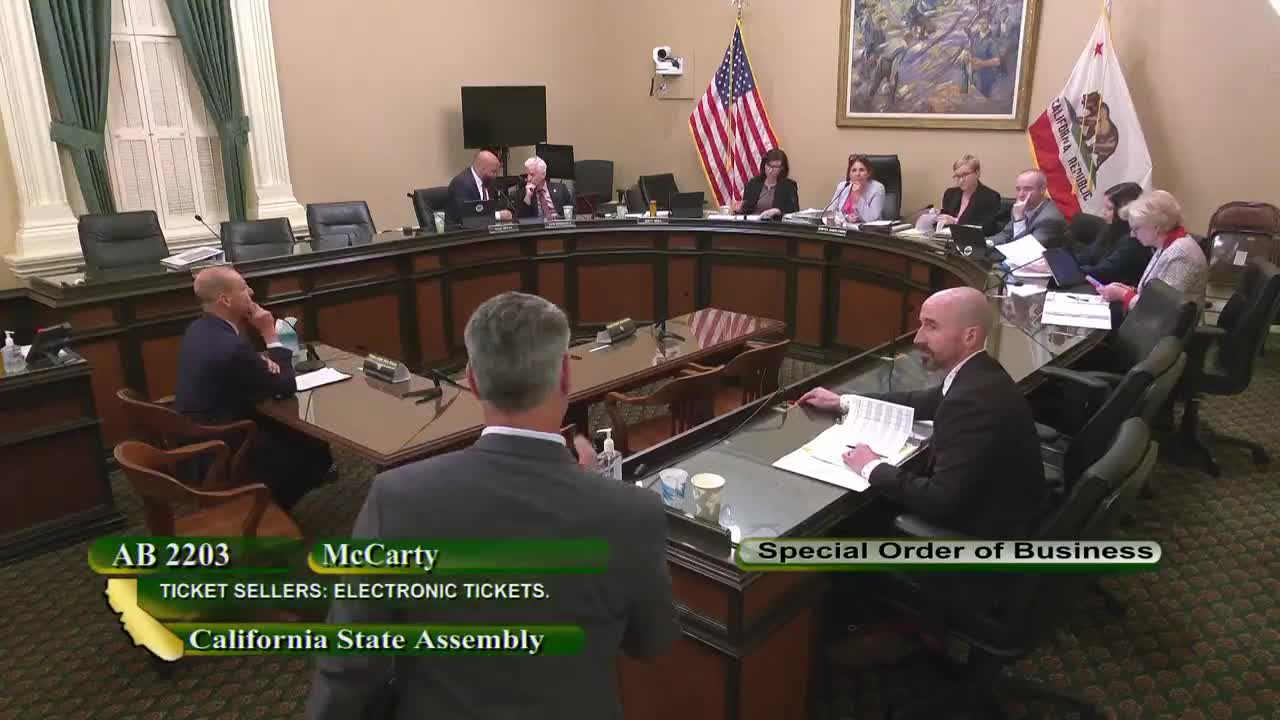 10MIN
Assembly Standing Committee on Privacy and Consumer Protection
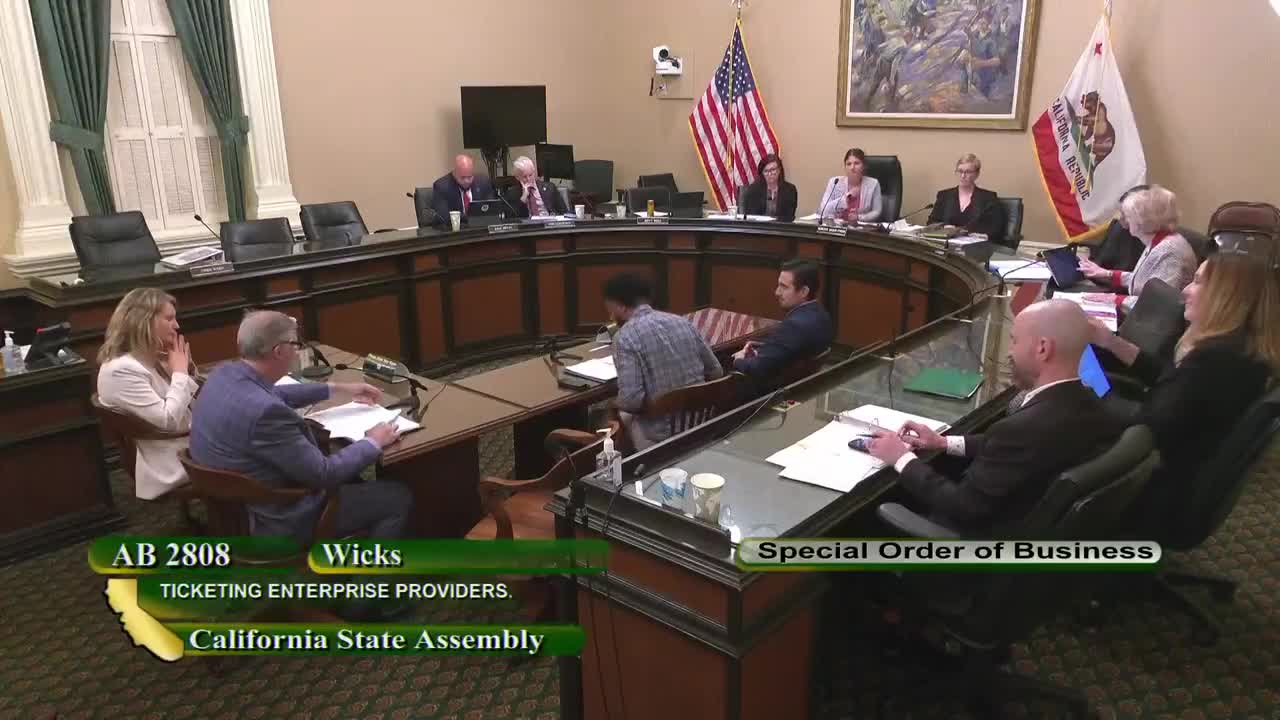 24MIN
Assembly Standing Committee on Privacy and Consumer Protection
 43SEC
Assembly Standing Committee on Privacy and Consumer Protection
 39MIN
Assembly Standing Committee on Arts, Entertainment, Sports, and Tourism
Bill Author

Bill Co-Author(s):