AB 2822: Domestic violence.
- Session Year: 2023-2024
- House: Assembly
- Latest Version Date: 2024-09-24
Current Status:
Passed
(2024-09-24: Chaptered by Secretary of State - Chapter 536, Statutes of 2024.)
Introduced
In Committee
First Chamber
In Committee
Second Chamber
Enacted
What does this bill do?
This bill requires California law enforcement agencies to add a space on domestic violence incident report forms to record whether officers removed a firearm or other deadly weapon from the scene. It updates existing reporting about weapons and other details on domestic violence calls and applies to officers who respond to those calls.
The summary is provided by generative AI which can make mistakes. For original language, please view the details in the table below.
Existing law requires every law enforcement agency to develop, adopt, and implement written policies and standards for officers responses to domestic violence calls. Existing law requires each law enforcement agency to develop an incident report form that includes, among other things, a notation of whether the officer or officers who responded to the domestic violence call found it necessary, for the protection of the peace officer or other persons present, to inquire of the victim, the alleged abuser, or both, whether a firearm or other deadly weapon was present at the location, and, if there is an inquiry, whether that inquiry disclosed the presence of a firearm or other deadly weapon.
This bill would additionally require a law enforcement agency to include in the incident report form a space for officers to document whether a firearm or deadly weapon was removed from the location of the domestic violence call. By increasing the reporting duties on local law enforcement agencies, this bill would create a state-mandated local program.
The California Constitution requires the state to reimburse local agencies and school districts for certain costs mandated by the state. Statutory provisions establish procedures for making that reimbursement.
This bill would provide that, if the Commission on State Mandates determines that the bill contains costs mandated by the state, reimbursement for those costs shall be made pursuant to the statutory provisions noted above.
Existing law requires every law enforcement agency to develop, adopt, and implement written policies and standards for officers responses to domestic violence calls. Existing law requires each law enforcement agency to develop an incident report form the includes, among other things, a notation of whether the officer or officers who responded to the domestic violence call found it necessary, for the protection of the peace officer or other persons present, to inquire of the victim, the alleged abuser, or both, whether a firearm or other deadly weapon was present at the location, and, if there is an inquiry, whether that inquiry disclosed the presence of a firearm or other deadly weapon.
This bill would additionally require a law enforcement agency to include in the incident report form a space for officers to document whether a firearm or deadly weapon was removed from the location of the domestic violence call. By increasing the reporting duties on local law enforcement agencies, this bill would create a state-mandated local program.
The California Constitution requires the state to reimburse local agencies and school districts for certain costs mandated by the state. Statutory provisions establish procedures for making that reimbursement.
This bill would provide that, if the Commission on State Mandates determines that the bill contains costs mandated by the state, reimbursement for those costs shall be made pursuant to the statutory provisions noted above.
Existing law authorizes a peace officer to search a lawfully detained person whom the officer has reasonable cause to believe possesses a weapon.This bill would make technical, nonsubstantive changes to that provision.Existing law authorizes a peace officer to search a lawfully detained person whom the officer has reasonable cause to believe possesses a weapon.
This bill would make technical, nonsubstantive changes to that provision.
(a)Each law enforcement agency shall develop a system, by January 1, 1986, for recording all domestic violence-related calls for assistance that are made to the department, including whether weapons are involved and whether the incident involved strangulation or suffocation. All domestic violence-related calls for assistance shall be supported with a written incident report, as described in subdivision (c), identifying the domestic violence incident. Monthly, the total number of domestic violence calls received and the numbers of those cases involving weapons or strangulation or suffocation shall be compiled by each law enforcement agency and submitted to the Attorney General.
(b)The Attorney General shall report annually to the Governor, the Legislature, and the public the total number of domestic violence-related calls that are received by California law enforcement agencies, the number of cases involving weapons, the number of cases involving strangulation or suffocation, and a breakdown of calls received by agency, city, and county.
(c)Each law enforcement agency shall develop an incident report form that includes a domestic violence identification code by January 1, 1986. In all incidents of domestic violence, a report shall be written and shall be identified on the face of the report as a domestic violence incident. The report shall include at least all of the following:
(1)A notation of whether the officer or officers who responded to the domestic violence call observed signs that the alleged abuser was under the influence of alcohol or a controlled substance.
(2)A notation of whether the officer or officers who responded to the domestic violence call determined if a law enforcement agency had previously responded to a domestic violence call at the same address involving the same alleged abuser or victim.
(3)A notation of whether the officer or officers who responded to the domestic violence call found it necessary, for the protection of the peace officer or other persons present, to inquire of the victim, the alleged abuser, or both, whether a firearm or other deadly weapon was present at the location, and, if there is an inquiry, whether that inquiry disclosed the presence of a firearm or other deadly weapon. A firearm or other deadly weapon discovered by an officer at the scene of a domestic violence incident shall be subject to confiscation pursuant to Division 4 (commencing with Section 18250) of Title 2 of Part 6.
(4)A notation of whether there were indications that the incident involved strangulation or suffocation. This includes whether a witness or victim reported an incident of strangulation or suffocation, whether a victim reported symptoms of strangulation or suffocation, or whether the officer observed signs of strangulation or suffocation.
(5)A notation of whether the officer or officers who responded to the domestic violence call removed a firearm or other deadly weapon from the location of the domestic violence call.
SEC. 2.If the Commission on State Mandates determines that this act contains costs mandated by the state, reimbursement to local agencies and school districts for those costs shall be made pursuant to Part 7 (commencing with Section 17500) of Division 4 of Title 2 of the Government Code.
(a)Each law enforcement agency shall develop a system, by January 1, 1986, for recording all domestic violence-related calls for assistance made to the department, including whether weapons are involved, or involved and whether the incident involved strangulation or suffocation. All domestic violence-related calls for assistance shall be supported with a written incident report, as described in subdivision (c), identifying the domestic violence incident. Monthly, the total number of domestic violence calls received and the numbers of those cases involving weapons or strangulation or suffocation shall be compiled by each law enforcement agency and submitted to the Attorney General.
(b)The Attorney General shall report annually to the Governor, the Legislature, and the public the total number of domestic violence-related calls received by California law enforcement agencies, the number of cases involving weapons, the number of cases involving strangulation or suffocation, and a breakdown of calls received by agency, city, and county.
(c)Each law enforcement agency shall develop an incident report form that includes a domestic violence identification code by January 1, 1986. In all incidents of domestic violence, a report shall be written and shall be identified on the face of the report as a domestic violence incident. The report shall include at least all of the following:
(1)A notation of whether the officer or officers who responded to the domestic violence call observed any signs that the alleged abuser was under the influence of alcohol or a controlled substance.
(2)A notation of whether the officer or officers who responded to the domestic violence call determined if any a law enforcement agency had previously responded to a domestic violence call at the same address involving the same alleged abuser or victim.
(3)A notation of whether the officer or officers who responded to the domestic violence call found it necessary, for the protection of the peace officer or other persons present, to inquire of the victim, the alleged abuser, or both, whether a firearm or other deadly weapon was present at the location, and, if there is an inquiry, whether that inquiry disclosed the presence of a firearm or other deadly weapon. Any A firearm or other deadly weapon discovered by an officer at the scene of a domestic violence incident shall be subject to confiscation pursuant to Division 4 (commencing with Section 18250) of Title 2 of Part 6.
(4)A notation of whether there were indications that the incident involved strangulation or suffocation. This includes whether any a witness or victim reported any an incident of strangulation or suffocation, whether any a victim reported symptoms of strangulation or suffocation, or whether the officer observed any signs of strangulation or suffocation.
(5)A notation of whether the officer or officers who responded to the domestic violence call removed a firearm or other deadly weapon from the location of the domestic violence call.
SEC. 2.If the Commission on State Mandates determines that this act contains costs mandated by the state, reimbursement to local agencies and school districts for those costs shall be made pursuant to Part 7 (commencing with Section 17500) of Division 4 of Title 2 of the Government Code.
SECTION 1.Section 833 of the Penal Code is amended to read:833.A peace officer may search for dangerous weapons any person that the officer has legal cause to arrest, upon reasonable cause to believe that the person possesses a dangerous weapon. If the officer finds a dangerous weapon, they may take and keep it until the completion of the questioning, and shall then either return it or arrest the person. The arrest may be for the illegal possession of the weapon.A peace officer may search for dangerous weapons any person whom he that the officer has legal cause to arrest, whenever he has upon reasonable cause to believe that the person possesses a dangerous weapon. If the officer finds a dangerous weapon, he they may take and keep it until the completion of the questioning, when he and shall then either return it or arrest the person. The arrest may be for the illegal possession of the weapon.
|
Date
|
Status
|
|---|---|
| Sep 24, 2024 | Chaptered by Secretary of State - Chapter 536, Statutes of 2024. |
| Sep 24, 2024 | Approved by the Governor. |
| Aug 28, 2024 | Enrolled and presented to the Governor at 4 p.m. |
| Aug 22, 2024 | Senate amendments concurred in. To Engrossing and Enrolling. (Ayes 62. Noes 0. Page 6424.). |
| Aug 20, 2024 | In Assembly. Concurrence in Senate amendments pending. May be considered on or after August 22 pursuant to Assembly Rule 77. |
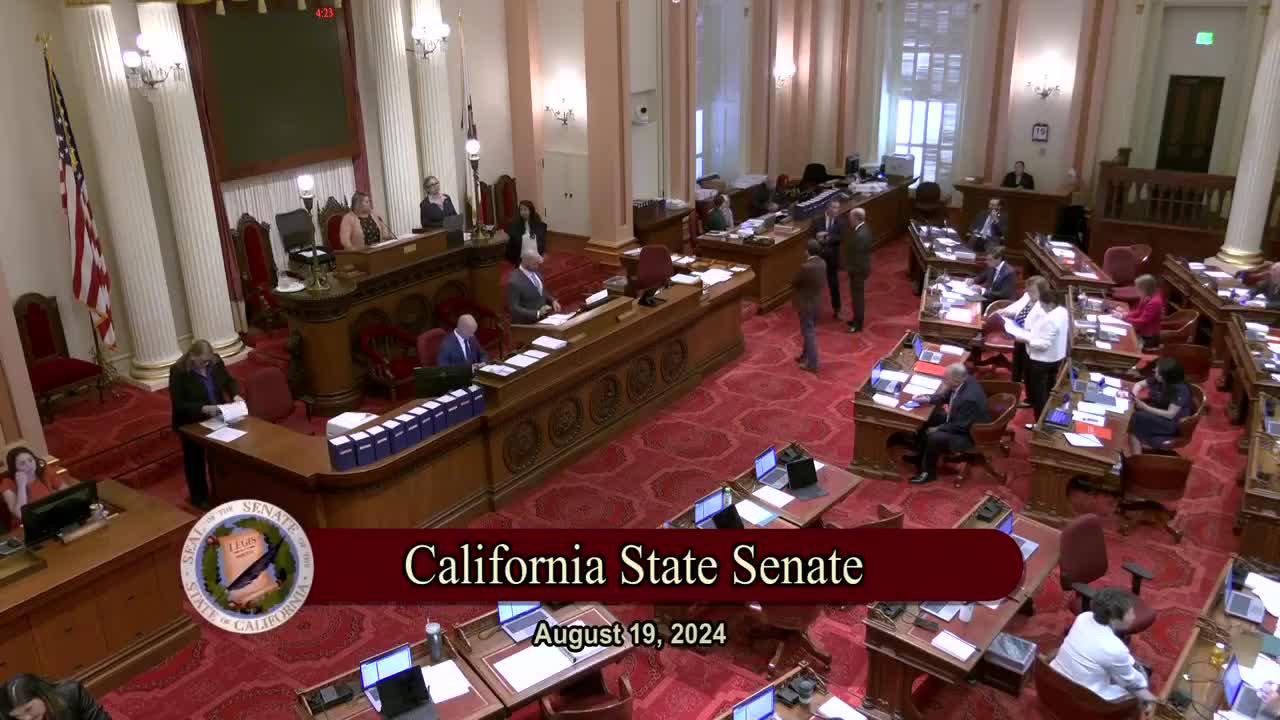
| Aug 19, 2024 | Read third time. Passed. Ordered to the Assembly. (Ayes 40. Noes 0. Page 5202.). |
| Jun 18, 2024 | Read second time. Ordered to third reading. |
| Jun 17, 2024 | Read third time and amended. Ordered to second reading. |
| Jun 13, 2024 | Ordered to third reading. |
| Jun 13, 2024 | From Consent Calendar. |
| Jun 11, 2024 | Read second time. Ordered to Consent Calendar. |
| Jun 10, 2024 | From committee: Be ordered to second reading file pursuant to Senate Rule 28.8 and ordered to Consent Calendar. |
| May 28, 2024 | From committee: Do pass and re-refer to Com. on APPR with recommendation: To Consent Calendar. (Ayes 4. Noes 0.) (May 28). Re-referred to Com. on APPR. |
| May 8, 2024 | Referred to Com. on PUB S. |
| Apr 25, 2024 | In Senate. Read first time. To Com. on RLS. for assignment. |
| Apr 25, 2024 | Read third time. Passed. Ordered to the Senate. (Ayes 75. Noes 0. Page 4999.) |
| Apr 18, 2024 | Read second time. Ordered to Consent Calendar. |
| Apr 17, 2024 | From committee: Do pass. To Consent Calendar. (Ayes 15. Noes 0.) (April 17). |
| Apr 3, 2024 | From committee: Do pass and re-refer to Com. on APPR. with recommendation: To Consent Calendar. (Ayes 8. Noes 0.) (April 2). Re-referred to Com. on APPR. |
| Mar 12, 2024 | Re-referred to Com. on PUB. S. |
| Mar 11, 2024 | Referred to Com. on PUB. S. |
| Mar 11, 2024 | From committee chair, with author's amendments: Amend, and re-refer to Com. on PUB. S. Read second time and amended. |
| Feb 16, 2024 | From printer. May be heard in committee March 17. |
| Feb 15, 2024 | Read first time. To print. |
|
Date
|
Description
|
Location
|
Votes
|
|
|---|---|---|---|---|
| Aug 22, 2024 | AB 2822 Gabriel Concurrence in Senate Amendments | Assembly Floor |
Passed |
|
| Aug 19, 2024 | Assembly 3rd Reading AB2822 Gabriel et al. By Rubio | Senate Floor |
Passed |
|
| May 28, 2024 | Do pass, but first be re-referred to the Committee on [Appropriations] with the recommendation: To Consent Calendar | Senate Standing Committee on Public Safety |
Passed |
|
| Apr 25, 2024 | AB 2822 Gabriel Consent Calendar Second Day Regular Session | Assembly Floor |
Passed |
|
| Apr 17, 2024 | Do pass. To Consent Calendar. | Assembly Standing Committee on Appropriations |
Passed |
|
| Apr 2, 2024 | Do pass and be re-referred to the Committee on [Appropriations] with recommendation: To Consent Calendar | Assembly Standing Committee on Public Safety |
Passed |
This list shows positions taken on this bill by organizations on the date displayed, which is linked to the original source.
Positions by individuals are not included.
|
Organization
|
Position
|
Date
|
|---|---|---|
| Alliance for Community Empowerment | ** Support | |
| Brady California | ** Support | |
| Brady Campaign | ** Support | |
| California Partnership To End Domestic Violence | ** Support | |
| Giffords | ** Support | |
| She is Hope LA | ** Support |
CONCURRENCE IN SENATE AMENDMENTS
CSA1 Bill Id:AB 2822
Author:(Gabriel)
As Amended Ver:June 17, 2024
Majority vote
SUMMARY
Requires a law enforcement officer to make a notation in a domestic violence incident report if they remove a firearm or other deadly weapon.
Senate Amendments
Make technical amendments.
COMMENTS
As Passed by the Assembly, this bill requires a law enforcement officer to make a notation in a domestic violence incident report if they remove a firearm or other deadly weapon.
According to the Author,
"AB 2822 is a common-sense measure to address the all-too-often deadly intersection of domestic violence and gun violence by requiring law enforcement to note if they have removed a gun from the scene, as required by existing law. More than a million acts of domestic violence occur in the United States every year, and the presence of a firearm vastly increases the chance that violence will escalate to homicide. This bill will help ensure that we are keeping guns out of the hands of abusive partners and reducing incidents of gun violence and intimate partner violence."
Arguments in Support,
"According to The California Partnership to End Domestic Violence, "Since 1986, California has required law enforcement agencies to collect data pertaining to domestic violence calls, including whether weapons are involved. Every month, the data from this collection process is reported to the Attorney General. The Attorney General then produces an annual report to the Governor, Legislature, and public on domestic-violence related calls received by California's law enforcement agencies.
"Unfortunately, existing law does not require law enforcement officers to note whether they have removed the firearm or other deadly weapon from the location of the domestic violence call. As a result, no state agency can track what happens to firearms if they are found at the scene. There is concern that some may not be collected right away, despite statutory requirements.
"According to the most recent data made available by the California Department of Justice in November, there has been an increase in domestic violence calls involving firearms since before the pandemic. However, advocates and law enforcement lack available data to discern whether or not firearms have indeed been removed in cases where they are involved.
"AB 2822 would address this problem by requiring law enforcement to record when they have removed a firearm or deadly weapon from the scene of a domestic violence call. This change will improve data tracking and accountability around existing firearm relinquishment efforts, and ensure this critical data is up to date."
Arguments in Opposition:
None submitted.
FISCAL COMMENTS
According to the Senate Appropriations Committee, pursuant to Senate Rule 28.8 negligible state costs.
VOTES:
ASM PUBLIC SAFETY: 8-0-0
YES: McCarty, Alanis, Lackey, Stephanie Nguyen, Reyes, Ting, Wilson, Zbur
ASM APPROPRIATIONS: 15-0-0
YES: Wicks, Sanchez, Arambula, Bryan, Calderon, Wendy Carrillo, Dixon, Mike Fong, Grayson, Haney, Hart, Jim Patterson, Pellerin, Ta, Villapudua
ASSEMBLY FLOOR: 75-0-5
YES: Addis, Aguiar-Curry, Alanis, Alvarez, Arambula, Bains, Bauer-Kahan, Bennett, Berman, Bonta, Bryan, Calderon, Juan Carrillo, Wendy Carrillo, Cervantes, Chen, Connolly, Davies, Dixon, Essayli, Flora, Mike Fong, Vince Fong, Friedman, Gabriel, Garcia, Gipson, Grayson, Haney, Holden, Hoover, Irwin, Jackson, Jones-Sawyer, Kalra, Lackey, Lee, Low, Lowenthal, Maienschein, McCarty, McKinnor, Muratsuchi, Stephanie Nguyen, Ortega, Pacheco, Papan, Jim Patterson, Joe Patterson, Pellerin, Petrie-Norris, Quirk-Silva, Ramos, Rendon, Reyes, Luz Rivas, Rodriguez, Blanca Rubio, Sanchez, Santiago, Schiavo, Soria, Ta, Ting, Valencia, Villapudua, Waldron, Wallis, Ward, Weber, Wicks, Wilson, Wood, Zbur, Robert Rivas
ABS, ABST OR NV: Boerner, Megan Dahle, Gallagher, Hart, Mathis
SENATE FLOOR: 40-0-0
YES: Allen, Alvarado-Gil, Archuleta, Ashby, Atkins, Becker, Blakespear, Bradford, Caballero, Cortese, Dahle, Dodd, Durazo, Eggman, Glazer, Gonzalez, Grove, Hurtado, Jones, Laird, Limón, McGuire, Menjivar, Min, Newman, Nguyen, Niello, Ochoa Bogh, Padilla, Portantino, Roth, Rubio, Seyarto, Skinner, Smallwood-Cuevas, Stern, Umberg, Wahab, Wiener, Wilk
UPDATED
VERSION: June 17, 2024
CONSULTANT: Elizabeth Potter / PUB. S. / (916) 319-3744 FN: 0004204
SENATE RULES COMMITTEE Office of Senate Floor Analyses (916) 651-1520 Fax: (916) 327-4478 | AB 2822 |
THIRD READING
Bill No: AB 2822
Author: Gabriel (D), et al.
Amended: 6/17/24 in Senate
Vote: 21
SENATE PUBLIC SAFETY COMMITTEE: 4-0, 5/28/24
AYES: Wahab, Seyarto, Skinner, Wiener
NO VOTE RECORDED: Bradford
SENATE APPROPRIATIONS COMMITTEE: Senate Rule 28.8
ASSEMBLY FLOOR: 75-0, 4/25/24 (Consent) - See last page for vote
SUBJECT: Domestic violence
SOURCE: Author
DIGEST:
This bill adds a requirement that a law enforcement officer make a notation in a domestic violence incident report if the officer removes a firearm or other deadly weapon from the location of the domestic violence location.
Senate Floor Amendments of 6/17/24 add a co-author and make technical changes.
ANALYSIS:
Existing law:
- Provides that any person who willfully inflicts corporal injury resulting in a traumatic condition upon a victim, as described, is guilty of a felony punishable by imprisonment in state prison for two, three, or four years, or in county jail for not more than one year, or by a fine of up to $6,000, or by both fine and imprisonment. (Pen. Code, § 273.5, subd. (a).)
- Defines a “victim” as one or more of the following:
- The offender’s spouse or former spouse;
- The offender’s cohabitant or former cohabitant;
- The offender’s fiancé or fiancée, or someone with the offender has or previously had, an engagement or dating relationship; and,
- The mother or father of the offender’s child. (Pen. Code, § 273.5, subd. (b).)
- Provides that battery against a spouse, a person with whom the defendant is cohabitating with, a person who is the defendant’s child, former spouse, fiancé, or fiancée, or a person with whom the defendant currently has, or previously had, a dating or engagement relationship, is punishable by a fine not exceeding $2,000, or by imprisonment in county jail for a period of not more than one year, or by both fine and imprisonment. (Pen. Code, § 243, subd. (e)(1).)
- Requires a law enforcement officer at the scene of a domestic violence incident involving a threat to human life or physical assault to take temporary custody of any firearm or other deadly weapon in plain sight or discovered pursuant to a consensual or other lawful search as necessary for the protection of the peace officer or other persons present. (Pen. Code, § 18250.)
- Requires each law enforcement agency to develop a system for recording domestic violence-related calls for assistance made to the department, including whether weapons were involved, or whether the incident involved strangulation or suffocation. Requires all domestic violence-related calls to be supported with a written incident report. Requires each local law enforcement agency to report and submit the total number of domestic violence calls received and the number of cases of involving weapons, strangulation, or suffocation to the Attorney General on a monthly basis. (Pen. Code, § 13730, subd. (a).)
- Requires the Attorney General to report annually to the Governor, the Legislature, and the public the total number of domestic violence-related calls received by law enforcement agencies, the number of cases involving weapons, the number of cases involving strangulation or suffocation, and a breakdown of calls received by agency, city, and county. (Pen. Code, § 13730, subd. (b).)
- Requires each local law enforcement agency to develop an incident report that includes a domestic violence identification code. Requires a written report for all domestic violence incidents and requires the report to include at least all of the following:
- Whether the officer or officers who responded to the call observed any signs that the alleged abuser was under the influence of alcohol or a controlled substance;
- Whether the officer or officers who responded to the call determined if any law enforcement agency has previously responded to a call at the same address involving the same alleged abuser and victim;
- Whether the officer of officers who responded to the call found it necessary, for the protection of the peace officer or other persons present, to inquire of the victim, the alleged abuser, or both, whether a firearm or other deadly weapon was present at the location, and, if there is an inquiry, whether that inquire disclosed the presence of the firearm or other deadly weapon; and,
- Whether there were indications that the incident involved strangulation or suffocation. (Pen. Code, § 13730, subd. (c)(1)-(4).)
This bill adds a requirement that a law enforcement officer make a notation in a domestic violence incident report if the officer removes a firearm or other deadly weapon from the location of the domestic violence location.
Background
Under current law, a law enforcement officer who responds to the scene of a domestic violence incident that involves a threat to human life or physical assault is required to take temporary custody of any firearm or other deadly weapon in plain sight. (Pen. Code, § 18250.) Firearms and other deadly weapons discovered as the result of a consensual or otherwise lawful search must also be taken into temporary custody. (Ibid.) Current law additionally requires a responding law enforcement officer to complete a written report for all domestic violence incidents, and specifies that the report must include all of the following:
- Whether the officer or officers who responded to the call observed any signs that the alleged abuser was under the influence of alcohol or a controlled substance;
- Whether the officer or officers who responded to the call determined if any law enforcement agency has previously responded to a call at the same address involving the same alleged abuser and victim;
- Whether the officer of officers who responded to the call found it necessary, for the protection of the peace officer or other persons present, to inquire of the victim, the alleged abuser, or both, whether a firearm or other deadly weapon was present at the location, and, if there is an inquiry, whether that inquire disclosed the presence of the firearm or other deadly weapon; and,
- Whether there were indications that the incident involved strangulation or suffocation. (Pen. Code, § 13730, subd. (c).)
This bill adds a requirement that the report include whether a law enforcement officer removed a firearm or other deadly weapon from the location of the domestic violence location.
FISCAL EFFECT: Appropriation: No Fiscal Com.: Yes Local: Yes
SUPPORT: (Verified 6/17/24)
Alliance for Community Empowerment
Brady California
Brady Campaign
She Is Hope LA
OPPOSITION: (Verified 6/17/24)
None received
ASSEMBLY FLOOR: 75-0, 4/25/24
AYES: Addis, Aguiar-Curry, Alanis, Alvarez, Arambula, Bains, Bauer-Kahan, Bennett, Berman, Bonta, Bryan, Calderon, Juan Carrillo, Wendy Carrillo, Cervantes, Chen, Connolly, Davies, Dixon, Essayli, Flora, Mike Fong, Vince Fong, Friedman, Gabriel, Garcia, Gipson, Grayson, Haney, Holden, Hoover, Irwin, Jackson, Jones-Sawyer, Kalra, Lackey, Lee, Low, Lowenthal, Maienschein, McCarty, McKinnor, Muratsuchi, Stephanie Nguyen, Ortega, Pacheco, Papan, Jim Patterson, Joe Patterson, Pellerin, Petrie-Norris, Quirk-Silva, Ramos, Rendon, Reyes, Luz Rivas, Rodriguez, Blanca Rubio, Sanchez, Santiago, Schiavo, Soria, Ta, Ting, Valencia, Villapudua, Waldron, Wallis, Ward, Weber, Wicks, Wilson, Wood, Zbur, Robert Rivas
NO VOTE RECORDED: Boerner, Megan Dahle, Gallagher, Hart, Mathis
Prepared by: Stephanie Jordan / PUB. S. /
6/18/24 15:49:23
**** END ****
SENATE RULES COMMITTEE Office of Senate Floor Analyses (916) 651-1520 Fax: (916) 327-4478 | AB 2822 |
THIRD READING
Bill No: AB 2822
Author: Gabriel (D)
Amended: 3/11/24 in Assembly
Vote: 21
SENATE PUBLIC SAFETY COMMITTEE: 4-0, 5/28/24
AYES: Wahab, Seyarto, Skinner, Wiener
NO VOTE RECORDED: Bradford
SENATE APPROPRIATIONS COMMITTEE: Senate Rule 28.8
ASSEMBLY FLOOR: 75-0, 4/25/24 (Consent) - See last page for vote
SUBJECT: Domestic violence
SOURCE: Author
DIGEST:
This bill adds a requirement that a law enforcement officer make a notation in a domestic violence incident report if the officer removes a firearm or other deadly weapon from the location of the domestic violence location.
ANALYSIS:
Existing law:
- Provides that any person who willfully inflicts corporal injury resulting in a traumatic condition upon a victim, as described, is guilty of a felony punishable by imprisonment in state prison for two, three, or four years, or in county jail for not more than one year, or by a fine of up to $6,000, or by both fine and imprisonment. (Pen. Code, § 273.5, subd. (a).)
- Defines a “victim” as one or more of the following:
- The offender’s spouse or former spouse;
- The offender’s cohabitant or former cohabitant;
- The offender’s fiancé or fiancée, or someone with the offender has or previously had, an engagement or dating relationship; and,
- The mother or father of the offender’s child. (Pen. Code, § 273.5, subd. (b).)
- Provides that battery against a spouse, a person with whom the defendant is cohabitating with, a person who is the defendant’s child, former spouse, fiancé, or fiancée, or a person with whom the defendant currently has, or previously had, a dating or engagement relationship, is punishable by a fine not exceeding $2,000, or by imprisonment in county jail for a period of not more than one year, or by both fine and imprisonment. (Pen. Code, § 243, subd. (e)(1).)
- Requires a law enforcement officer at the scene of a domestic violence incident involving a threat to human life or physical assault to take temporary custody of any firearm or other deadly weapon in plain sight or discovered pursuant to a consensual or other lawful search as necessary for the protection of the peace officer or other persons present. (Pen. Code, § 18250.)
- Requires each law enforcement agency to develop a system for recording domestic violence-related calls for assistance made to the department, including whether weapons were involved, or whether the incident involved strangulation or suffocation. Requires all domestic violence-related calls to be supported with a written incident report. Requires each local law enforcement agency to report and submit the total number of domestic violence calls received and the number of cases of involving weapons, strangulation, or suffocation to the Attorney General on a monthly basis. (Pen. Code, § 13730, subd. (a).)
- Requires the Attorney General to report annually to the Governor, the Legislature, and the public the total number of domestic violence-related calls received by law enforcement agencies, the number of cases involving weapons, the number of cases involving strangulation or suffocation, and a breakdown of calls received by agency, city, and county. (Pen. Code, § 13730, subd. (b).)
- Requires each local law enforcement agency to develop an incident report that includes a domestic violence identification code. Requires a written report for all domestic violence incidents and requires the report to include at least all of the following:
- Whether the officer or officers who responded to the call observed any signs that the alleged abuser was under the influence of alcohol or a controlled substance;
- Whether the officer or officers who responded to the call determined if any law enforcement agency has previously responded to a call at the same address involving the same alleged abuser and victim;
- Whether the officer of officers who responded to the call found it necessary, for the protection of the peace officer or other persons present, to inquire of the victim, the alleged abuser, or both, whether a firearm or other deadly weapon was present at the location, and, if there is an inquiry, whether that inquire disclosed the presence of the firearm or other deadly weapon; and,
- Whether there were indications that the incident involved strangulation or suffocation. (Pen. Code, § 13730, subd. (c)(1)-(4).)
This bill adds a requirement that a law enforcement officer make a notation in a domestic violence incident report if the officer removes a firearm or other deadly weapon from the location of the domestic violence location.
Background
Under current law, a law enforcement officer who responds to the scene of a domestic violence incident that involves a threat to human life or physical assault is required to take temporary custody of any firearm or other deadly weapon in plain sight. (Pen. Code, § 18250.) Firearms and other deadly weapons discovered as the result of a consensual or otherwise lawful search must also be taken into temporary custody. (Ibid.) Current law additionally requires a responding law enforcement officer to complete a written report for all domestic violence incidents, and specifies that the report must include all of the following:
- Whether the officer or officers who responded to the call observed any signs that the alleged abuser was under the influence of alcohol or a controlled substance;
- Whether the officer or officers who responded to the call determined if any law enforcement agency has previously responded to a call at the same address involving the same alleged abuser and victim;
- Whether the officer of officers who responded to the call found it necessary, for the protection of the peace officer or other persons present, to inquire of the victim, the alleged abuser, or both, whether a firearm or other deadly weapon was present at the location, and, if there is an inquiry, whether that inquire disclosed the presence of the firearm or other deadly weapon; and,
- Whether there were indications that the incident involved strangulation or suffocation. (Pen. Code, § 13730, subd. (c).)
This bill adds a requirement that the report include whether a law enforcement officer removed a firearm or other deadly weapon from the location of the domestic violence location.
FISCAL EFFECT: Appropriation: No Fiscal Com.: Yes Local: Yes
SUPPORT: (Verified 6/10/24)
Alliance for Community Empowerment
Brady California
Brady Campaign
She Is Hope LA
OPPOSITION: (Verified 6/10/24)
None received
ASSEMBLY FLOOR: 75-0, 4/25/24
AYES: Addis, Aguiar-Curry, Alanis, Alvarez, Arambula, Bains, Bauer-Kahan, Bennett, Berman, Bonta, Bryan, Calderon, Juan Carrillo, Wendy Carrillo, Cervantes, Chen, Connolly, Davies, Dixon, Essayli, Flora, Mike Fong, Vince Fong, Friedman, Gabriel, Garcia, Gipson, Grayson, Haney, Holden, Hoover, Irwin, Jackson, Jones-Sawyer, Kalra, Lackey, Lee, Low, Lowenthal, Maienschein, McCarty, McKinnor, Muratsuchi, Stephanie Nguyen, Ortega, Pacheco, Papan, Jim Patterson, Joe Patterson, Pellerin, Petrie-Norris, Quirk-Silva, Ramos, Rendon, Reyes, Luz Rivas, Rodriguez, Blanca Rubio, Sanchez, Santiago, Schiavo, Soria, Ta, Ting, Valencia, Villapudua, Waldron, Wallis, Ward, Weber, Wicks, Wilson, Wood, Zbur, Robert Rivas
NO VOTE RECORDED: Boerner, Megan Dahle, Gallagher, Hart, Mathis
Prepared by: Stephanie Jordan / PUB. S. /
6/14/24 9:45:55
**** END ****
SENATE RULES COMMITTEE Office of Senate Floor Analyses (916) 651-1520 Fax: (916) 327-4478 | AB 2822 |
CONSENT
Bill No: AB 2822
Author: Gabriel (D)
Amended: 3/11/24 in Assembly
Vote: 21
SENATE PUBLIC SAFETY COMMITTEE: 4-0, 5/28/24
AYES: Wahab, Seyarto, Skinner, Wiener
NO VOTE RECORDED: Bradford
SENATE APPROPRIATIONS COMMITTEE: Senate Rule 28.8
ASSEMBLY FLOOR: 75-0, 4/25/24 (Consent) - See last page for vote
SUBJECT: Domestic violence
SOURCE: Author
DIGEST:
This bill adds a requirement that a law enforcement officer make a notation in a domestic violence incident report if the officer removes a firearm or other deadly weapon from the location of the domestic violence location.
ANALYSIS:
Existing law:
- Provides that any person who willfully inflicts corporal injury resulting in a traumatic condition upon a victim, as described, is guilty of a felony punishable by imprisonment in state prison for two, three, or four years, or in county jail for not more than one year, or by a fine of up to $6,000, or by both fine and imprisonment. (Pen. Code, § 273.5, subd. (a).)
- Defines a “victim” as one or more of the following:
- The offender’s spouse or former spouse;
- The offender’s cohabitant or former cohabitant;
- The offender’s fiancé or fiancée, or someone with the offender has or previously had, an engagement or dating relationship; and,
- The mother or father of the offender’s child. (Pen. Code, § 273.5, subd. (b).)
- Provides that battery against a spouse, a person with whom the defendant is cohabitating with, a person who is the defendant’s child, former spouse, fiancé, or fiancée, or a person with whom the defendant currently has, or previously had, a dating or engagement relationship, is punishable by a fine not exceeding $2,000, or by imprisonment in county jail for a period of not more than one year, or by both fine and imprisonment. (Pen. Code, § 243, subd. (e)(1).)
- Requires a law enforcement officer at the scene of a domestic violence incident involving a threat to human life or physical assault to take temporary custody of any firearm or other deadly weapon in plain sight or discovered pursuant to a consensual or other lawful search as necessary for the protection of the peace officer or other persons present. (Pen. Code, § 18250.)
- Requires each law enforcement agency to develop a system for recording domestic violence-related calls for assistance made to the department, including whether weapons were involved, or whether the incident involved strangulation or suffocation. Requires all domestic violence-related calls to be supported with a written incident report. Requires each local law enforcement agency to report and submit the total number of domestic violence calls received and the number of cases of involving weapons, strangulation, or suffocation to the Attorney General on a monthly basis. (Pen. Code, § 13730, subd. (a).)
- Requires the Attorney General to report annually to the Governor, the Legislature, and the public the total number of domestic violence-related calls received by law enforcement agencies, the number of cases involving weapons, the number of cases involving strangulation or suffocation, and a breakdown of calls received by agency, city, and county. (Pen. Code, § 13730, subd. (b).)
- Requires each local law enforcement agency to develop an incident report that includes a domestic violence identification code. Requires a written report for all domestic violence incidents and requires the report to include at least all of the following:
- Whether the officer or officers who responded to the call observed any signs that the alleged abuser was under the influence of alcohol or a controlled substance;
- Whether the officer or officers who responded to the call determined if any law enforcement agency has previously responded to a call at the same address involving the same alleged abuser and victim;
- Whether the officer of officers who responded to the call found it necessary, for the protection of the peace officer or other persons present, to inquire of the victim, the alleged abuser, or both, whether a firearm or other deadly weapon was present at the location, and, if there is an inquiry, whether that inquire disclosed the presence of the firearm or other deadly weapon; and,
- Whether there were indications that the incident involved strangulation or suffocation. (Pen. Code, § 13730, subd. (c)(1)-(4).)
This bill adds a requirement that a law enforcement officer make a notation in a domestic violence incident report if the officer removes a firearm or other deadly weapon from the location of the domestic violence location.
Background
Under current law, a law enforcement officer who responds to the scene of a domestic violence incident that involves a threat to human life or physical assault is required to take temporary custody of any firearm or other deadly weapon in plain sight. (Pen. Code, § 18250.) Firearms and other deadly weapons discovered as the result of a consensual or otherwise lawful search must also be taken into temporary custody. (Ibid.) Current law additionally requires a responding law enforcement officer to complete a written report for all domestic violence incidents, and specifies that the report must include all of the following:
- Whether the officer or officers who responded to the call observed any signs that the alleged abuser was under the influence of alcohol or a controlled substance;
- Whether the officer or officers who responded to the call determined if any law enforcement agency has previously responded to a call at the same address involving the same alleged abuser and victim;
- Whether the officer of officers who responded to the call found it necessary, for the protection of the peace officer or other persons present, to inquire of the victim, the alleged abuser, or both, whether a firearm or other deadly weapon was present at the location, and, if there is an inquiry, whether that inquire disclosed the presence of the firearm or other deadly weapon; and,
- Whether there were indications that the incident involved strangulation or suffocation. (Pen. Code, § 13730, subd. (c).)
This bill adds a requirement that the report include whether a law enforcement officer removed a firearm or other deadly weapon from the location of the domestic violence location.
FISCAL EFFECT: Appropriation: No Fiscal Com.: Yes Local: Yes
SUPPORT: (Verified 6/10/24)
Alliance for Community Empowerment
Brady California
Brady Campaign
She Is Hope LA
OPPOSITION: (Verified 6/10/24)
None received
ASSEMBLY FLOOR: 75-0, 4/25/24
AYES: Addis, Aguiar-Curry, Alanis, Alvarez, Arambula, Bains, Bauer-Kahan, Bennett, Berman, Bonta, Bryan, Calderon, Juan Carrillo, Wendy Carrillo, Cervantes, Chen, Connolly, Davies, Dixon, Essayli, Flora, Mike Fong, Vince Fong, Friedman, Gabriel, Garcia, Gipson, Grayson, Haney, Holden, Hoover, Irwin, Jackson, Jones-Sawyer, Kalra, Lackey, Lee, Low, Lowenthal, Maienschein, McCarty, McKinnor, Muratsuchi, Stephanie Nguyen, Ortega, Pacheco, Papan, Jim Patterson, Joe Patterson, Pellerin, Petrie-Norris, Quirk-Silva, Ramos, Rendon, Reyes, Luz Rivas, Rodriguez, Blanca Rubio, Sanchez, Santiago, Schiavo, Soria, Ta, Ting, Valencia, Villapudua, Waldron, Wallis, Ward, Weber, Wicks, Wilson, Wood, Zbur, Robert Rivas
NO VOTE RECORDED: Boerner, Megan Dahle, Gallagher, Hart, Mathis
Prepared by: Stephanie Jordan / PUB. S. /
6/11/24 14:54:24
**** END ****
SENATE COMMITTEE ON PUBLIC SAFETY
Senator Aisha Wahab, Chair
2023 - 2024 Regular
Bill No: AB 2822 Hearing Date: May 28, 2024
Author: | Gabriel | ||
Version: | March 11, 2024 | ||
Urgency: | No | Fiscal: | Yes |
Consultant: | SJ | ||
Subject: Domestic violence
HISTORY
Source: Author
Prior Legislation: SB 40 (Roth), Ch. 331, Stats. 2017
AB 469 (Cohn), Ch. 483, Stats. 2001
Support: Alliance for Community Empowerment; Brady California; Brady Campaign; She is Hope LA
Opposition: None known
Assembly Floor Vote: 75 - 0
PURPOSE
The purpose of this bill is to add a requirement that a law enforcement officer make a notation in a domestic violence incident report if the officer removes a firearm or other deadly weapon from the location of the domestic violence location.
Existing law provides that any person who willfully inflicts corporal injury resulting in a traumatic condition upon a victim, as described, is guilty of a felony punishable by imprisonment in state prison for two, three, or four years, or in county jail for not more than one year, or by a fine of up to $6,000, or by both fine and imprisonment. (Pen. Code, § 273.5, subd. (a).)
Existing law defines a “victim” as one or more of the following:
- The offender’s spouse or former spouse;
- The offender’s cohabitant or former cohabitant;
- The offender’s fiancé or fiancée, or someone with the offender has or previously had, an engagement or dating relationship; and,
- The mother or father of the offender’s child. (Pen. Code, § 273.5, subd. (b).)
Existing law provides that battery against a spouse, a person with whom the defendant is cohabitating with, a person who is the defendant’s child, former spouse, fiancé, or fiancée, or a
person with whom the defendant currently has, or previously had, a dating or engagement relationship, is punishable by a fine not exceeding $2,000, or by imprisonment in county jail for a period of not more than one year, or by both fine and imprisonment. (Pen. Code, § 243, subd. (e)(1).)
Existing law requires a law enforcement officer at the scene of a domestic violence incident involving a threat to human life or physical assault to take temporary custody of any firearm or other deadly weapon in plain sight or discovered pursuant to a consensual or other lawful search as necessary for the protection of the peace officer or other persons present. (Pen. Code, § 18250.)
Existing law requires each law enforcement agency to develop a system for recording domestic violence-related calls for assistance made to the department, including whether weapons were involved, or whether the incident involved strangulation or suffocation. Requires all domestic violence-related calls to be supported with a written incident report. Requires each local law enforcement agency to report and submit the total number of domestic violence calls received and the number of cases of involving weapons, strangulation, or suffocation to the Attorney General on a monthly basis. (Pen. Code, § 13730, subd. (a).)
Existing law requires the Attorney General to report annually to the Governor, the Legislature, and the public the total number of domestic violence-related calls received by law enforcement agencies, the number of cases involving weapons, the number of cases involving strangulation or suffocation, and a breakdown of calls received by agency, city, and county. (Pen. Code, § 13730, subd. (b).)
Existing law requires each local law enforcement agency to develop an incident report that includes a domestic violence identification code. Requires a written report for all domestic violence incidents and requires the report to include at least all of the following:
- Whether the officer or officers who responded to the call observed any signs that the alleged abuser was under the influence of alcohol or a controlled substance;
- Whether the officer or officers who responded to the call determined if any law enforcement agency has previously responded to a call at the same address involving the same alleged abuser and victim;
- Whether the officer of officers who responded to the call found it necessary, for the protection of the peace officer or other persons present, to inquire of the victim, the alleged abuser, or both, whether a firearm or other deadly weapon was present at the location, and, if there is an inquiry, whether that inquire disclosed the presence of the firearm or other deadly weapon; and,
- Whether there were indications that the incident involved strangulation or suffocation. (Pen. Code, § 13730, subd. (c)(1)-(4).)
This bill adds a requirement that a law enforcement officer make a notation in a domestic violence incident report if the officer removes a firearm or other deadly weapon from the location of the domestic violence location.
COMMENTS
- Need For This Bill
According to the author:
AB 2822 is a common-sense measure to address the all-too-often deadly intersection of domestic violence and gun violence by requiring law enforcement to note if they have removed a gun from the scene, as required by existing law. More than a million acts of domestic violence occur in the United States every year, and the presence of a firearm vastly increases the chance that violence will escalate to homicide. This bill will help ensure that we are keeping guns out of the hands of abusive partners and reducing incidents of gun violence and intimate partner violence.
- Domestic Violence Incident Reports
Under current law, a law enforcement officer who responds to the scene of a domestic violence incident that involves a threat to human life or physical assault is required to take temporary custody of any firearm or other deadly weapon in plain sight. (Pen. Code, § 18250.) Firearms and other deadly weapons discovered as the result of a consensual or otherwise lawful search must also be taken into temporary custody. (Ibid.) Current law additionally requires a responding law enforcement officer to complete a written report for all domestic violence incidents, and specifies that the report must include all of the following:
- Whether the officer or officers who responded to the call observed any signs that the alleged abuser was under the influence of alcohol or a controlled substance;
- Whether the officer or officers who responded to the call determined if any law enforcement agency has previously responded to a call at the same address involving the same alleged abuser and victim;
- Whether the officer of officers who responded to the call found it necessary, for the protection of the peace officer or other persons present, to inquire of the victim, the alleged abuser, or both, whether a firearm or other deadly weapon was present at the location, and, if there is an inquiry, whether that inquire disclosed the presence of the firearm or other deadly weapon; and,
- Whether there were indications that the incident involved strangulation or suffocation. (Pen. Code, § 13730, subd. (c).)
This bill adds a requirement that the report include whether a law enforcement officer removed a firearm or other deadly weapon from the location of the domestic violence location.
-- END --
Date of Hearing: April 17, 2024
ASSEMBLY COMMITTEE ON APPROPRIATIONS
Buffy Wicks, Chair
ABPCA Bill Id:AB 2822
Author:(Gabriel) – As Amended Ver:March 11, 2024
Policy Committee: | Public Safety | Vote: | 8 - 0 |
|
| ||
|
|
Urgency: No State Mandated Local Program: Yes Reimbursable: Yes
SUMMARY:
This bill requires a law enforcement agency to note in the incident report completed for a domestic violence incident to which the agency responds whether an officer responding to the domestic violence call removed a firearm or other deadly weapon from the location of the call.
FISCAL EFFECT:
Likely minor workload costs to law enforcement agencies to add the required information to their domestic violence incident reports.
COMMENTS:
- Purpose. According to the author:
AB 2822 is a common-sense measure to address the all-too-often deadly intersection of domestic violence and gun violence by requiring law enforcement to note if they have removed a gun from the scene, as required by existing law. More than a million acts of domestic violence occur in the United States every year, and the presence of a firearm vastly increases the chance that violence will escalate to homicide. This bill will help ensure that we are keeping guns out of the hands of abusive partners and reducing incidents of gun violence and intimate partner violence
- Background. Current law requires a law enforcement agency to develop an incident report form that is used to collect information about each domestic violence call to which the agency responds. For each domestic violence call, the incident report must include information about whether the officer who responded to the call observed any signs that the alleged abuser was under the influence of alcohol or a controlled substance, whether the officer determined if any law enforcement agency has previously responded to a call at the same address involving the same parties, and whether the officer’s inquiries indicated the presence of a firearm or other deadly weapon at the location. A firearm or other deadly weapon discovered by an officer at the scene of a domestic violence incident is subject to confiscation under existing law.
This bill additionally requires an agency to include in its report for a domestic violence incident whether a responding officer removed a firearm or other deadly weapon from the location. Because law enforcement agencies already complete reports about every domestic violence incident, including this additional data on existing reports is unlikely to result in significant workload costs.
Analysis Prepared by: Annika Carlson / APPR. / (916) 319-2081
Date of Hearing: April 2, 2024
Consultant: Elizabeth Potter
ASSEMBLY COMMITTEE ON
Kevin McCarty, Chair
ABPCA Bill Id:
Author:() – As Ver:
SUMMARY: Requires a law enforcement officer to make a notation in a domestic violence incident report if they remove a firearm or other deadly weapon.
EXISTING LAW:
- States that any person who willfully inflicts corporal injury resulting in a traumatic condition upon a victim is guilty of a felony punishable by imprisonment in state prison for two, three, or four years, or in county jail for not more than one year, or by a fine of up to $6,000, or by both fine and imprisonment. (Pen. Code, § 273.5, subd. (a)).
- Defines a “victim” as one or more of the following:
- The offender’s spouse or former spouse;
- The offender’s cohabitant or former cohabitant;
- The offender’s fiancé or fiancée, or someone with the offender has or previously had, an engagement or dating relationship; and,
- The mother or father of the offender’s child. (Pen. Code, § 273.5, subd. (b)).
- The offender’s spouse or former spouse;
- States that battery against a spouse, a person with whom the defendant is cohabitating with, a person who is the defendant’s child, former spouse, fiancé, or fiancée, or a person with whom the defendant currently has, or previously had, a dating or engagement relationship, is punishable by a fine not exceeding $2,000, or by imprisonment in county jail for a period of not more than one year, or by both fine and imprisonment. (Pen. Code, § 243, subd. (e)(1)).
- Requires a law enforcement officer at the scene of a domestic violence incident involving a threat to human life or physical assault to take temporary custody of any firearm or deadly weapon in plain sight or discovered pursuant to a consensual or other lawful search as necessary for the protection of the peace officer or other persons present. (Pen. Code, § 18250)
- Requires law enforcement agencies to develop a system for recording domestic-violence-related calls made to the department, including whether weapons, strangulation, or suffocation were part of the incident. All domestic violence-related calls shall be supported with a written incident report. (Pen. Code, § 13730, subd. (a).)
- Requires local law enforcement agencies to report and submit on a monthly basis the number of domestic violence calls received and the number of cases of involving weapons, strangulation, or suffocation to the Attorney General. (Pen. Code, § 13730, subd. (a).)
- States that the Attorney General will report annually to the Governor, the Legislature, and the public the total number of domestic-violence-related calls received by law enforcement, the number of cases involving weapons, the number of cases involving strangulation or suffocation, and a breakdown of calls received by agency, city, and county. (Pen. Code, § 13730, subd. (b).)
- Requires law enforcement agencies to develop an incident report that includes a domestic violence identification code. The report shall be written and identified as a domestic violence incident and should include all of the following notations:
- Whether the officer or officers who responded to the call observed any signs that the alleged abuser was under the influence of alcohol or a controlled substance;
- Whether the officer or officers who responded to the call determined if any law enforcement agency has previously responded to a call at the same address involving the same alleged abuser and victim;
- Whether the officer of officers who responded to the call found it necessary, for the protection of the peace officer or other persons present, to inquire of the victim, the alleged abuser, or both, whether a firearm or deadly weapon was present at the location, and, if there is an inquiry, whether that inquire disclosed the presence of the firearm or other deadly weapon; and,
- Whether there were indications that the incident involved strangulation or suffocation. (Pen. Code, § 13730, subd. (c)(1)-(4).)
- Whether the officer or officers who responded to the call observed any signs that the alleged abuser was under the influence of alcohol or a controlled substance;
- Requires DOJ to do all of the following to comply with criminal statistics:
- Collect all data necessary for the work of the department from all persons and agencies;
- Prepare and distribute to all those persons and agencies cards, forms, or electronic means used in reporting data, and in addition include items of information needed by federal bureaus or departments;
- Recommend the form and content of records that must be kept by those persons and agencies;
- Instruct those persons and agencies in the installation, maintenance, and use of those records;
- Process, tabulate, analyze, and interpret the data collected;
- Supply federal bureaus or departments engaged in the collection of national criminal statistic data at their request;
- Make available to the public, through the department’s OpenJustice Web portal, information relating to criminal statistics, to be updated at least once a year. The Attorney General may approve reports on special aspects of criminal statistics;
- Periodically review the requirements of units of government using criminal justice statistics, and to make recommendations for changes; and,
- Evaluate, on an annual basis, the progress of California’s transition from summary crime reporting to incident based reporting. (Pen. Code, § 13010.)
- Collect all data necessary for the work of the department from all persons and agencies;
- Provides that any person who is convicted, on or after January 1, 2019 of a misdemeanor violation of domestic abuse and who subsequently, owns, purchases, receives, or has in possession or under custody or control, any firearm is guilty of a public offense, punishable by imprisonment in a county jail or in a state prison not exceeding one year, by a fine not exceeding $1,000, or by both imprisonment and fine. (Pen. Code, § 29805, subd. (b).
FISCAL EFFECT: Unknown
COMMENTS:
- Author's Statement: According to the author, "AB 2822 is a common-sense measure to address the all-too-often deadly intersection of domestic violence and gun violence by requiring law enforcement to note if they have removed a gun from the scene, as required by existing law. More than a million acts of domestic violence occur in the United States every year, and the presence of a firearm vastly increases the chance that violence will escalate to homicide. This bill will help ensure that we are keeping guns out of the hands of abusive partners and reducing incidents of gun violence and intimate partner violence.”
- Domestic Violence Guidelines - California Commission on Peace Officer Standards and Training (POST): In 2022 POST revised their guidelines for law enforcement officers when dealing with domestic violence incidents. The original publication on this topic was produced and provided to law enforcement in 1988.
The guidelines cover both what law enforcement officers are required to do by statute and best practices on how to approach these highly volatile situations. They cover, among other things, law enforcement arrests, weapons, children, and victim resources.
In their guidelines for deadly weapons, which includes firearms, they outline the following protocols:
WEAPONS
GUIDELINE 11 Weapons
1. Officers at the scene of a domestic violence incident involving a threat to human life or a physical assault shall take temporary custody of any firearm or other deadly weapon in plain sight or discovered pursuant to a consensual or other lawful search, as necessary for the protection of the officers or persons present (PC Section 18250).
2. Upon taking custody of a firearm or other deadly weapon, the officer shall give the owner or person who possessed the firearm a receipt. The receipt shall describe the firearm or other deadly weapon and list any identification or serial number on the firearm. The receipt shall indicate where the firearm or other deadly weapon can be recovered, the time limit for recovery as required by this section, and the date after which the owner or possessor can recover the firearm or other deadly weapon (PC Section 18255).
3. If the weapon is not kept as evidence or contraband, and it can be lawfully possessed by the person in possession, officers shall keep the weapon for no less than 48 hours, nor more than five business days, after the seizure unless a civil action is to be filed (PC Section 18265).
4. If officers believe the return of the weapon or other deadly weapons taken pursuant to these provisions would likely result in endangering the victim or the person reporting the assault or threat, the officers or their agency may initiate a petition in Superior Court to determine if a firearm or other deadly weapon should be returned.
5. Officers should document the necessity, for the protection of the peace officer and/or other persons present, to inquire of the victim, the alleged abuser, or both, whether a firearm or other deadly weapon was present at the location, and, if there is an inquiry, whether that inquiry disclosed the presence of a firearm or other deadly weapon. Any firearm or other deadly weapon discovered by an officer at the scene of a domestic violence incident shall be subject to confiscation [PC Section 13730 (c) (3)].
A person who owns, possesses, purchases, or receives a firearm knowing he or she is prohibited from doing so by the provision of a temporary restraining, protective, or gun violence restraining order as defined in PC Section 136.2, FC Section 6218, or Code of Civil Procedure Sections 527.6, 527.8 or 527.85 shall be punished under PC Section 29825(a). (https://post.ca.gov/Portals/0/post_docs/publications/Domestic_Violence.pdf>) [on p. 14 as of Mar. 28, 2024]
- Data Collection, DOJ, and the OpenJustice Portal: The California Department of Justice collects data on domestic-violence related calls for assistance directly from local law enforcement agencies. (See <State of California Department of Justice - OpenJustice>.) [as of Mar. 25, 2024]. Domestic violence calls that involved the use, or threat to use, of a firearm, knife or cutting instrument or other dangerous weapon are reported according to the type of weapon used regardless of the outcome or injury. There is also a separate category for the use of a personal weapon such as hands, fists, or feet if it is considered an aggravated assault under Uniform Crime Reporting (UCR) guidelines. An aggravated assault is an unlawful attack by one person upon another for the purpose of inflicting severe or aggravated bodily injury, such as broken bones, internal injuries, or cuts requiring stitches. Additionally, law enforcement must report if a domestic violence incident involved strangulation.
The total number of domestic violence related calls, which includes firearms, weapons, or strangulation and suffocation throughout the state has averaged 160,000 or more over the last five years. The portal also reports that there was an average of 2,200 domestic violence calls that involved firearms over the last three years. ( <State of California Department of Justice - OpenJustice See 2013-2022 chart) [as of Mar. 25. 2024] It must be noted that while the DOJ strives for 100 percent accuracy, this is not always possible. Because different law enforcement agencies vary in their interpretation of “domestic violence”, the data collected can have wide disparities.
This bill would require an officer or officers to make a notation in a domestic violence incidence report whether a firearm or other deadly weapon was removed. This data would presumably be included in future data on the OpenJustice website. - Argument in Support: According to The California Partnership to End Domestic Violence, “Since 1986, California has required law enforcement agencies to collect data pertaining to domestic violence calls, including whether weapons are involved. Every month, the data from this collection process is reported to the Attorney General. The Attorney General then produces an annual report to the Governor,Legislature, and public on domestic-violence related calls received by California’s law enforcement agencies.
“Unfortunately, existing law does not require law enforcement officers to note whether they have removed the firearm or other deadly weapon from the location of the domestic violence call. As a result, no state agency can track what happens to firearms if they are found at the scene. There is concern that some may not be collected right away, despite statutory requirements.
“According to the most recent data made available by the California Department of Justice in November, there has been an increase in domestic violence calls involving firearms since before the pandemic. However, advocates and law enforcement lack available data to discern whether or not firearms have indeed been removed in cases where they are involved.
“AB 2822 would address this problem by requiring law enforcement to record when they have removed a firearm or deadly weapon from the scene of a domestic violence call. This change will improve data tracking and accountability around existing firearm relinquishment efforts, and ensure this critical data is up to date.” - Related Legislation: AB 2759 (Petrie Norris), would revise the exemption in existing law pertaining to the issuance of a domestic violence protective order (“DVPO”) and the relinquishment of a firearm to clarify the court’s obligations in making determinations as to sworn peace officers carrying a particular firearm both on or off duty. AB 2759 is pending hearing in this committee today.
- Prior Legislation:
- AB 1977 (Lackey), of the 2021-2022 Legislative Session, would have required local law enforcement agencies to specify whether a child was present during a domestic violence incident. AB 1977 was held on the Assembly Appropriations Suspense calendar, and subsequently returned to the desk without further action.
- SB 40 (Roth), Chapter 331, Statutes of 2017, requires the domestic violence policies of local law enforcement agencies to include a statement informing the victim that strangulation may cause internal injuries and the victim should seek medical attention. SB 40 also requires law enforcement agencies to report if strangulation or suffocation were involved in domestic violence-related calls.
- AB 469 (Cohn), Chapter 483, Statutes of 2001, requires an officer or officers who respond to a domestic violence incident who finds it necessary for the safety of the peace officer or other persons present to inquire of the victim, the abuser, or both, as to whether a firearm or other deadly weapon is present at the location, and to make a notation on the incident report.
- AB 1977 (Lackey), of the 2021-2022 Legislative Session, would have required local law enforcement agencies to specify whether a child was present during a domestic violence incident. AB 1977 was held on the Assembly Appropriations Suspense calendar, and subsequently returned to the desk without further action.
REGISTERED SUPPORT / OPPOSITION:
Support
Brady California
Brady Campaign
California Partnership to End Domestic Violence
Giffords
March for Our Lives Action Fund
Opposition
None
Analysis Prepared by:
Discussed in Hearing
View Older Hearings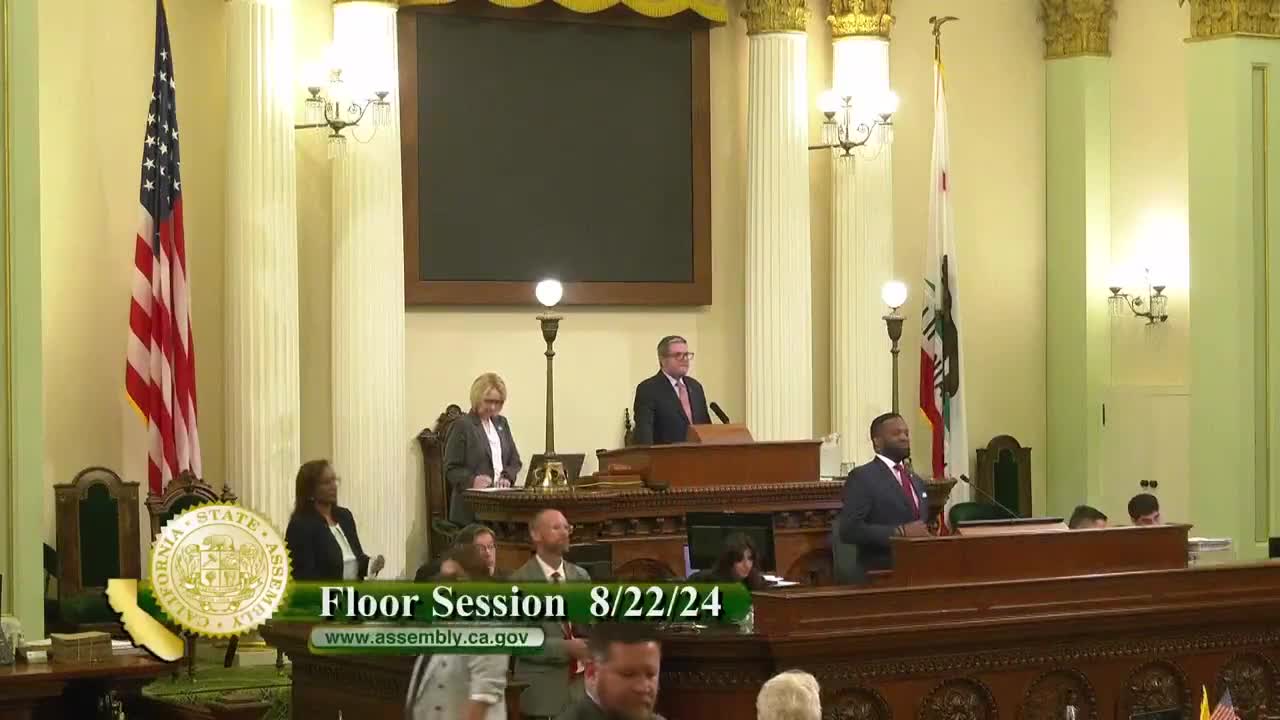
Bill Author

Bill Co-Author(s):
