AB 2905: Telecommunications: automatic dialing-announcing devices: artificial voices.
- Session Year: 2023-2024
- House: Assembly
- Latest Version Date: 2024-09-20
Current Status:
Passed
(2024-09-20: Chaptered by Secretary of State - Chapter 316, Statutes of 2024.)
Introduced
In Committee
First Chamber
In Committee
Second Chamber
Enacted
Existing law authorizes the Public Utilities Commission to control and regulate the connection of an automatic dialing-announcing device, as defined, to a telephone line. Existing law imposes various requirements on the use of an automatic dialing-announcing device, including that whenever telephone calls are placed through the use of an automatic dialing-announcing device, the device may be operated only after an unrecorded, natural voice announcement has been made to the person called by the person calling. Existing law requires the announcement to state the nature of the call and provide specified information about the business or organization being represented, if any, and inquire as to whether the person called consents to hear the prerecorded message.
This bill would require the announcement to also inform the person called if the prerecorded message uses an artificial voice, as defined.
Under existing law, a violation of any order, decision, rule, direction, demand, or requirement of the commission is a crime.
Because a violation of a commission action implementing this bills requirements would be a crime, the bill would impose a state-mandated local program.
The California Constitution requires the state to reimburse local agencies and school districts for certain costs mandated by the state. Statutory provisions establish procedures for making that reimbursement.
This bill would provide that no reimbursement is required by this act for a specified reason.
Existing law authorizes the Public Utilities Commission to control and regulate the connection of an automatic dialing-announcing device device, as defined, to a telephone line. Existing law imposes various requirements on the use of an automatic dialing-announcing device, as defined, including that whenever telephone calls are placed through the use of an automatic dialing-announcing device, the device may be operated only after an unrecorded, natural voice announcement has been made to the person called by the person calling. Existing law requires the announcement to state the nature of the call and provide specified information about the business or organization being represented, if any, and inquire as to whether the person called consents to hear the prerecorded message.
This bill would require the announcement to also inform the person called if the prerecorded message uses an artificial voice, which the bill would state includes, but is not limited to, a voice simulated or generated using artificial intelligence. as defined.
Under existing law, a violation of any order, decision, rule, direction, demand, or requirement of the commission is a crime.
Because a violation of a commission action implementing this bills requirements would be a crime, the bill would impose a state-mandated local program.
The California Constitution requires the state to reimburse local agencies and school districts for certain costs mandated by the state. Statutory provisions establish procedures for making that reimbursement.
This bill would provide that no reimbursement is required by this act for a specified reason.
Existing law authorizes the Public Utilities Commission to control and regulate the connection of an automatic dialing-announcing device to a telephone line. Existing law defines automatic dialing-announcing device as any automatic equipment that incorporates a storage capability of telephone numbers to be called, or a random or sequential number generator capable of producing numbers to be called, and the capability, working alone or in conjunction with other equipment, to disseminate a prerecorded message to the telephone number called. Existing law imposes various requirements on the use of an automatic dialing-announcing device. device, as defined, including that whenever telephone calls are placed through the use of an automatic dialing-announcing device, the device may be operated only after an unrecorded, natural voice announcement has been made to the person called by the person calling. Existing law requires the announcement to state the nature of the call and provide specified information about the business or organization being represented, if any, and inquire as to whether the person called consents to hear the prerecorded message.
This bill would require the announcement to also inform the person called if the prerecorded message uses an artificial voice, which the bill would state includes, but is not limited to, a voice simulated or generated using artificial intelligence.
This bill would expand that definition of automatic dialing-announcing device to include calls made using an artificial voice, as specified.Under existing law, a violation of any order, decision, rule, direction, demand, or requirement of the commission is a crime.
Because a violation of a commission action implementing this bills requirements would be a crime, the bill would impose a state-mandated local program.
The California Constitution requires the state to reimburse local agencies and school districts for certain costs mandated by the state. Statutory provisions establish procedures for making that reimbursement.
This bill would provide that no reimbursement is required by this act for a specified reason.
Existing law authorizes the Public Utilities Commission to control and regulate the connection of an automatic dialing-announcing device to a telephone line. Existing law defines automatic dialing-announcing device as any automatic equipment that incorporates a storage capability of telephone numbers to be called, or a random or sequential number generator capable of producing numbers to be called, and the capability, working alone or in conjunction with other equipment, to disseminate a prerecorded message to the telephone number called. Existing law imposes various requirements on the use of an automatic dialing-announcing device.
This bill would expand that definition of automatic dialing-announcing device to include calls made using an artificial voice, as specified.
Under existing law, a violation of any order, decision, rule, direction, demand, or requirement of the commission is a crime.
Because a violation of a commission action implementing this bills requirements would be a crime, the bill would impose a state-mandated local program.
The California Constitution requires the state to reimburse local agencies and school districts for certain costs mandated by the state. Statutory provisions establish procedures for making that reimbursement.
This bill would provide that no reimbursement is required by this act for a specified reason.
Existing law vests the Public Utilities Commission with regulatory authority over public utilities, including electrical corporations. Existing law requires the commission to adopt inspection, maintenance, repair, and replacement standards for the distribution systems of electrical corporations in order to provide high-quality, safe, and reliable service. Existing law requires the commission to require each electrical corporation to report annually on its compliance with those standards. Existing law requires the electrical corporations report to be made available to the public, except as provided.This bill would make nonsubstantive changes to the public reporting provision.Existing law vests the Public Utilities Commission with regulatory authority over public utilities, including electrical corporations. Existing law requires the commission to adopt inspection, maintenance, repair, and replacement standards for the distribution systems of electrical corporations in order to provide high-quality, safe, and reliable service. Existing law requires the commission to require each electrical corporation to report annually on its compliance with those standards. Existing law requires the electrical corporations report to be made available to the public, except as provided.
This bill would make nonsubstantive changes to the public reporting provision.
(a)Whenever telephone calls are placed through the use of an automatic dialing-announcing device, the device may be operated only after an unrecorded, natural voice announcement has been made to the person called by the person calling. The announcement shall do all of the following:
(1)State the nature of the call and the name, address, and telephone number of the business or organization being represented, if any.
(2)Inquire as to whether the person called consents to hear the prerecorded message of the person calling.
(3)Inform the person called if the prerecorded message uses an artificial voice.
(b)The person calling, as described in subdivision (a), shall disconnect the automatic dialing-announcing device from the telephone line upon the termination of the call by either the person calling or the person called.
(c)For purposes of this section, both of the following definitions apply:
(1)Artificial intelligence means an engineered or machine-based system that varies in its level of autonomy and that can, for explicit or implicit objectives, infer from the input it receives how to generate outputs that can influence physical or virtual environments.
(2)Artificial voice means a voice that is generated or significantly altered using artificial intelligence.
SEC. 2.No reimbursement is required by this act pursuant to Section 6 of Article XIIIB of the California Constitution because the only costs that may be incurred by a local agency or school district will be incurred because this act creates a new crime or infraction, eliminates a crime or infraction, or changes the penalty for a crime or infraction, within the meaning of Section 17556 of the Government Code, or changes the definition of a crime within the meaning of Section 6 of Article XIIIB of the California Constitution.
(a)Whenever telephone calls are placed through the use of an automatic dialing-announcing device, the device may be operated only after an unrecorded, natural voice announcement has been made to the person called by the person calling. The announcement shall do all of the following:
(1)State the nature of the call and the name, address, and telephone number of the business or organization being represented, if any.
(2)Inquire as to whether the person called consents to hear the prerecorded message of the person calling.
(3)Inform the person called if the prerecorded message uses an artificial voice.
(b)The person calling, as described in subdivision (a), shall disconnect the automatic dialing-announcing device from the telephone line upon the termination of the call by either the person calling or the person called.
(c)For purposes of this section, both of the following definitions apply:
(1)Artificial intelligence means an engineered or machine-based system that varies in its level of autonomy and that can, for explicit or implicit objectives, infer from the input it receives how to generate outputs that can influence physical or virtual environments.
(c)For purposes of this section, artificial voice includes, but is not limited to,
(2)Artificial voice means a voice simulated or that is generated or significantly altered using artificial intelligence.
SEC. 2.No reimbursement is required by this act pursuant to Section 6 of Article XIIIB of the California Constitution because the only costs that may be incurred by a local agency or school district will be incurred because this act creates a new crime or infraction, eliminates a crime or infraction, or changes the penalty for a crime or infraction, within the meaning of Section 17556 of the Government Code, or changes the definition of a crime within the meaning of Section 6 of Article XIIIB of the California Constitution.
(a)Whenever telephone calls are placed through the use of an automatic dialing-announcing device, the device may be operated only after an unrecorded, natural voice announcement has been made to the person called by the person calling. The announcement shall do all of the following:
(1)State the nature of the call and the name, address, and telephone number of the business or organization being represented, if any.
(2)Inquire as to whether the person called consents to hear the prerecorded message of the person calling.
(3)Inform the person called if the prerecorded message uses an artificial voice.
(b)The calling person person calling, as described in subdivision (a) subdivision (a), shall disconnect the automatic dialing-announcing device from the telephone line upon the termination of the call by either the person calling or the person called.
(c)For purposes of this section, artificial voice includes, but is not limited to, a voice simulated or generated using artificial intelligence.
SECTION 1.Section 2871 of the Public Utilities Code is amended to read:2871.(a)As used in this article, automatic dialing-announcing device means any automatic equipment that incorporates a storage capability of telephone numbers to be called or a random or sequential number generator capable of producing numbers to be called and the capability, working alone or in conjunction with other equipment, to disseminate a prerecorded message, or to make a call using an artificial voice, to the telephone number called.(b)For purposes of this section, artificial voice includes a voice simulated or generated using artificial intelligence.SEC. 2.No reimbursement is required by this act pursuant to Section 6 of Article XIIIB of the California Constitution because the only costs that may be incurred by a local agency or school district will be incurred because this act creates a new crime or infraction, eliminates a crime or infraction, or changes the penalty for a crime or infraction, within the meaning of Section 17556 of the Government Code, or changes the definition of a crime within the meaning of Section 6 of Article XIIIB of the California Constitution.
(a)As used in this article, automatic dialing-announcing device means any automatic equipment which that incorporates a storage capability of telephone numbers to be called or a random or sequential number generator capable of producing numbers to be called and the capability, working alone or in conjunction with other equipment, to disseminate a prerecorded message message, or to make a call using an artificial voice, to the telephone number called.
(b)For purposes of this section, artificial voice includes a voice simulated or generated using artificial intelligence.
SEC. 2.No reimbursement is required by this act pursuant to Section 6 of Article XIIIB of the California Constitution because the only costs that may be incurred by a local agency or school district will be incurred because this act creates a new crime or infraction, eliminates a crime or infraction, or changes the penalty for a crime or infraction, within the meaning of Section 17556 of the Government Code, or changes the definition of a crime within the meaning of Section 6 of Article XIIIB of the California Constitution.
SECTION 1.Section 590 of the Public Utilities Code is amended to read:590.The commission shall require each electrical corporation to report annually on its compliance with the standards or rules adopted by the commission pursuant to Section 364. The electrical corporations report shall be made available to the public, except that the commission may, consistent with any other law, withhold from the public information generated or obtained pursuant to this section that it deems would pose a security threat to the public if disclosed.The commission shall require each electrical corporation to report annually on its compliance with the standards or rules adopted by the commission pursuant to Section 364. That The electrical corporations report shall be made available to the public, except that the commission may, consistent with any other provisions of law, withhold from the public information generated or obtained pursuant to this section that it deems would pose a security threat to the public if disclosed.
|
Date
|
Status
|
|---|---|
| Sep 20, 2024 | Chaptered by Secretary of State - Chapter 316, Statutes of 2024. |
| Sep 20, 2024 | Approved by the Governor. |
| Aug 27, 2024 | Enrolled and presented to the Governor at 12 p.m. |
| Aug 20, 2024 | In Assembly. Ordered to Engrossing and Enrolling. |
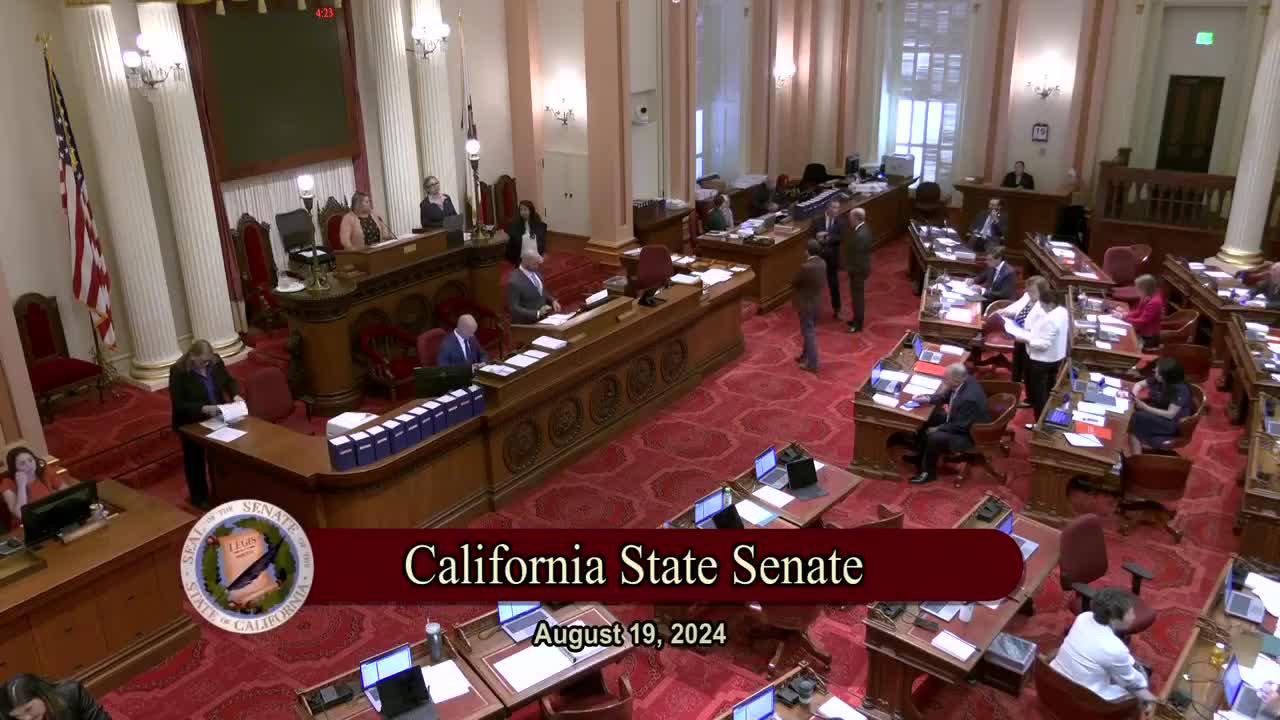
| Aug 19, 2024 | Read third time. Passed. Ordered to the Assembly. (Ayes 40. Noes 0. Page 5204.). |
| Jul 2, 2024 | Read second time. Ordered to third reading. |
| Jul 1, 2024 | From committee: Be ordered to second reading pursuant to Senate Rule 28.8. |
| Jun 18, 2024 | From committee: Do pass and re-refer to Com. on APPR. (Ayes 18. Noes 0.) (June 18). Re-referred to Com. on APPR. |
| May 29, 2024 | Referred to Com. on E., U. & C. |
| May 22, 2024 | In Senate. Read first time. To Com. on RLS. for assignment. |
| May 21, 2024 | Read third time. Passed. Ordered to the Senate. (Ayes 71. Noes 0. Page 5446.) |
| May 16, 2024 | Read second time. Ordered to Consent Calendar. |
| May 15, 2024 | From committee: Do pass. To Consent Calendar. (Ayes 15. Noes 0.) (May 15). |
| Apr 29, 2024 | Re-referred to Com. on APPR. |
| Apr 25, 2024 | Read second time and amended. |
| Apr 24, 2024 | From committee: Amend, and do pass as amended and re-refer to Com. on APPR. with recommendation: To Consent Calendar. (Ayes 11. Noes 0.) (April 23). |
| Apr 16, 2024 | Re-referred to Com. on P. & C.P. |
| Apr 15, 2024 | Read second time and amended. |
| Apr 11, 2024 | From committee: Amend, and do pass as amended and re-refer to Com. on P. & C.P. with recommendation: To Consent Calendar. (Ayes 11. Noes 0.) (April 10). |
| Apr 1, 2024 | Re-referred to Com. on C. & C. |
| Mar 21, 2024 | Referred to Coms. on C. & C. and P. & C.P. |
| Mar 21, 2024 | From committee chair, with author's amendments: Amend, and re-refer to Com. on C. & C. Read second time and amended. |
| Feb 16, 2024 | From printer. May be heard in committee March 17. |
| Feb 15, 2024 | Read first time. To print. |
|
Date
|
Description
|
Location
|
Votes
|
|
|---|---|---|---|---|
| Aug 19, 2024 | Assembly 3rd Reading AB2905 Low et al. By Dodd | Senate Floor |
Passed |
|
| Jun 18, 2024 | Do pass, but first be re-referred to the Committee on [Appropriations] | Senate Standing Committee on Energy, Utilities and Communications |
Passed |
|
| May 21, 2024 | AB 2905 Low Consent Calendar Second Day Regular Session | Assembly Floor |
Passed |
|
| May 15, 2024 | Do pass. To Consent Calendar. | Assembly Standing Committee on Appropriations |
Passed |
|
| Apr 23, 2024 | Do pass as amended, and be re-referred to the Committee on [Appropriations] with recommendation: To Consent Calendar | Assembly Standing Committee on Privacy and Consumer Protection |
Passed |
|
| Apr 10, 2024 | Do pass as amended, and be re-referred to the Committee on [Privacy and Consumer Protection] with recommendation: To Consent Calendar | Assembly Standing Committee on Communications and Conveyance |
Passed |
This list shows positions taken on this bill by organizations on the date displayed, which is linked to the original source.
Positions by individuals are not included.
SENATE RULES COMMITTEE Office of Senate Floor Analyses (916) 651-1520 Fax: (916) 327-4478 | AB 2905 |
THIRD READING
Bill No: AB 2905
Author: Low (D) and Jim Patterson (R)
Amended: 4/25/24 in Assembly
Vote: 21
SENATE ENERGY, U. & C. COMMITTEE: 18-0, 6/18/24
AYES: Bradford, Dahle, Ashby, Becker, Caballero, Dodd, Durazo, Eggman, Gonzalez, Grove, Limón, Min, Newman, Rubio, Seyarto, Skinner, Stern, Wilk
ASSEMBLY FLOOR: 71-0, 5/21/24 (Consent) - See last page for vote
SENATE APPROPRIATIONS COMMITTEE: Senate Rule 28.8
SUBJECT: Telecommunications: automatic dialing-announcing devices: artificial voices
SOURCE: Author
DIGEST:
This bill requires autodialing devices to notify consumers if a pre-recorded message uses an artificial voice.
ANALYSIS:
Existing law:
- Defines an “automatic dialing-announcing device” as any automatic equipment which stores or creates a random sequence of telephone numbers to be called and has the ability to disseminate a prerecorded message to those telephone numbers. (Public Utilities Code §2871)
- Authorizes the California Public Utilities Commission (CPUC) to regulate the use of automatic dialing-announcing devices and establishes certain requirements for the operation of these devices, including restricting the operation of automatic dialing-announcing devices to the hours of 9pm and 9am California time. Establishes various exemptions to the limitations on the use of automatic dialing-announcing devices for certain legitimate business, government, and utility purposes. Existing law specifies that these legitimate purposes include the use of these devices for emergency alerts and school notifications about attendance or health and safety issues. (Public Utilities Code §2872)
- Specifies that operators of automatic dialing-announcing devices must use an unrecorded, natural voice announcement to do the following before playing any pre-recorded message:
- State the nature of the call, the name, address, and telephone number of the business represented, if any.
- Obtain consent to play the pre-recorded message from the individual receiving the call.
This bill:
- Requires the operator of an automatic dialing-announcing device to inform the person receiving the call if a pre-recorded message uses an artificial voice.
- Defines “artificial intelligence” as an engineered or machine-based system that varies in its level of autonomy and that can, for explicit or implicit objectives, infer from the input it receives how to generate outputs that can influence physical or virtual environments.
- Defines “Artificial voice” means a voice that is generated or significantly altered using artificial intelligence (AI).
Background
- The CPUC regulates the use of autodialers at the state level. Automatic dialing-announcing devices, also known as autodialers, are electronic or software-based devices that automatically dial phone numbers to initiate calls that generally deliver a pre-recorded message. Existing law authorizes the CPUC to regulate the use of autodialers within California; however, the Federal Communications Commission (FCC) retains broad authority over the use of these systems on a national basis.
- Robocalls using AI have given rise to new scam calls. Recent developments in AI have enabled some autodialer operators to disseminate prerecorded message created using artificially-created voices that appear to sound like real voices. AI software is capable of creating cloned voices from recordings of real individuals. This technology has led to an increase in phone-based scams using artificial voices. Recent scams have used the voices of celebrities, government officials, and the family members of call recipients to spread misinformation and extort money. The ability to imitate the voices of call recipients’ family members has enabled more elaborate phone scams, including fake kidnap ransom demands.
- Bill adopts restrictions on artificial voice robocalls consistent with recent FCC rules. In response to concerns about the use of artificial voices in robocalls, the FCC adopted a ruling on February 8, 2024, restricting the use of artificial voices in robocalls. The FCC noted that these restrictions were needed to ensure that autodialers using AI-generated voices comply with the Telephone Consumer Protection Act (TCPA). California’s Attorney General joined 25 other state Attorney Generals in supporting the FCC’s ruling. The FCC ruling states the following regarding the use of artificial voices in robocalls under the ruling:
In this Declaratory Ruling, we confirm that the TCPA’s restrictions on the use of “artificial or prerecorded voice” encompass current AI technologies that generate human voices. As a result, calls that use such technologies fall under the TCPA and the Commission’s implementing rules, and therefore require the prior express consent of the called party to initiate such calls absent an emergency purpose or exemption.
This bill requires autodialers to notify a consumer about the use of an AI-generated voice and obtain consent from a consumer before disseminating a pre-recorded message using an artificial voice. These requirements are consistent with the FCC’s ruling. While this bill may not prevent criminals seeking to use artificial voices in phone scams from attempting to extort customers, this bill may provide another tool at the state level to help distinguish between compliant and non-compliant autodialers.
Related/Prior Legislation
AB 2906 (Patterson, Chapter 36, Statutes of 2022) exempted school health and safety notifications from restrictions on the use of autodialers.
AB 956 (Diep, Chapter 232, Statutes of 2019) exempted 911 emergency telephone
testing from restrictions on the use of autodialers.
FISCAL EFFECT: Appropriation: No Fiscal Com.: Yes Local: Yes
SUPPORT: (Verified 7/1/24)
None received
OPPOSITION: (Verified 7/1/24)
None received
ARGUMENTS IN SUPPORT: According to the author:
In our tech-driven world, protecting our communities from AI scam calls is paramount. These deceptive practices, targeting vulnerable Californians, are unacceptable. That's why I'm introducing legislation to ban AI in scams. This bill underscores our commitment to protecting consumer rights, privacy, and security in the digital age.
ASSEMBLY FLOOR: 71-0, 5/21/24
AYES: Addis, Aguiar-Curry, Alanis, Alvarez, Arambula, Bains, Bauer-Kahan, Bennett, Berman, Boerner, Bonta, Bryan, Juan Carrillo, Wendy Carrillo, Chen, Connolly, Davies, Dixon, Essayli, Flora, Mike Fong, Vince Fong, Gallagher, Garcia, Gipson, Grayson, Haney, Hart, Hoover, Irwin, Jackson, Jones-Sawyer, Kalra, Lackey, Lee, Low, Lowenthal, Maienschein, McCarty, McKinnor, Muratsuchi, Stephanie Nguyen, Ortega, Pacheco, Jim Patterson, Joe Patterson, Pellerin, Petrie-Norris, Quirk-Silva, Ramos, Rendon, Reyes, Rodriguez, Blanca Rubio, Sanchez, Santiago, Schiavo, Soria, Ta, Ting, Valencia, Villapudua, Waldron, Wallis, Ward, Weber, Wicks, Wilson, Wood, Zbur, Robert Rivas
NO VOTE RECORDED: Calderon, Cervantes, Megan Dahle, Friedman, Gabriel, Holden, Mathis, Papan, Luz Rivas
Prepared by: Sarah Smith / E., U. & C. / (916) 651-4107
7/2/24 9:32:04
**** END ****
SENATE COMMITTEE ON ENERGY, UTILITIES AND COMMUNICATIONS
Senator Steven Bradford, Chair
2023 - 2024 Regular
Bill No: Hearing Date: 6/18/2024
Author: | |||
Version: | Amended | ||
Urgency: | Fiscal: | ||
Consultant: | |||
SUBJECT:
DIGEST: This bill requires autodialing devices to notify consumers if a pre-recorded message uses an artificial voice.
ANALYSIS:
Existing law:
- Defines an “automatic dialing-announcing device” as any automatic equipment which stores or creates a random sequence of telephone numbers to be called and has the ability to disseminate a prerecorded message to those telephone numbers. (Public Utilities Code §2871)
- Authorizes the California Public Utilities Commission (CPUC) to regulate the use of automatic dialing-announcing devices and establishes certain requirements for the operation of these devices, including restricting the operation of automatic dialing-announcing devices to the hours of 9pm and 9am California time. Existing law also establishes various exemptions to the limitations on the use of automatic dialing-announcing devices for certain legitimate business, government, and utility purposes. Existing law specifies that these legitimate purposes include the use of these devices for emergency alerts and school notifications about attendance or health and safety issues. (Public Utilities Code §2872)
- Existing law specifies that operators of automatic dialing-announcing devices must use an unrecorded, natural voice announcement to do the following before playing any pre-recorded message:
- State the nature of the call, the name, address, and telephone number of the business represented, if any.
- Obtain consent to play the pre-recorded message from the individual receiving the call.
This bill:
- Requires the operator of an automatic dialing-announcing device to inform the person receiving the call if a pre-recorded message uses an artificial voice.
- Defines “artificial intelligence” as an engineered or machine-based system that varies in its level of autonomy and that can, for explicit or implicit objectives, infer from the input it receives how to generate outputs that can influence physical or virtual environments.
- “Artificial voice” means a voice that is generated or significantly altered using artificial intelligence (AI).
Background
The CPUC regulates the use of autodialers at the state level. Automatic dialing-announcing devices, also known as autodialers, are electronic or software-based devices that automatically dial phone numbers to initiate calls that generally deliver a pre-recorded message. Existing law authorizes the CPUC to regulate the use of autodialers within California; however, the Federal Communications Commission (FCC) retains broad authority over the use of these systems on a national basis.
Robocalls using AI have given rise to new scam calls. Recent developments in AI have enabled some autodialer operators to disseminate prerecorded message created using artificially-created voices that appear to sound like real voices. AI software is capable of creating cloned voices from recordings of real individuals. This technology has led to an increase in phone-based scams using artificial voices. Recent scams have used the voices of celebrities, government officials, and the family members of call recipients to spread misinformation and extort money. The ability to imitate the voices of call recipients’ family members has enabled more elaborate phone scams, including fake kidnap ransom demands.
Bill adopts restrictions on artificial voice robocalls consistent with recent FCC rules. In response to concerns about the use of artificial voices in robocalls, the FCC adopted a ruling on February 8, 2024, restricting the use of artificial voices in robocalls. The FCC noted that these restrictions were needed to ensure that autodialers using AI-generated voices comply with the Telephone Consumer Protection Act (TCPA). California’s Attorney General joined 25 other state Attorney Generals in supporting the FCC’s ruling. The FCC ruling states the following regarding the use of artificial voices in robocalls under the ruling:
In this Declaratory Ruling, we confirm that the TCPA’s restrictions on the use of “artificial or prerecorded voice” encompass current AI technologies that generate human voices. As a result, calls that use such technologies fall under the TCPA and the Commission’s implementing rules, and therefore require the prior express consent of the called party to initiate such calls absent an emergency purpose or exemption.
This bill requires autodialers to notify a consumer about the use of an AI-generated voice and obtain consent from a consumer before disseminating a pre-recorded message using an artificial voice. These requirements are consistent with the FCC’s ruling. While this bill may not prevent criminals seeking to use artificial voices in phone scams from attempting to extort customers, this bill may provide another tool at the state level to help distinguish between compliant and non-compliant autodialers.
Prior/Related Legislation
AB 2906 (Patterson, Chapter 36, Statutes of 2022) exempted school health and safety notifications from restrictions on the use of autodialers.
AB 956 (Diep, Chapter 232, Statutes of 2019) exempted 911 emergency telephone
testing from restrictions on the use of autodialers.
FISCAL EFFECT: Appropriation: Fiscal Com.: Local:
SUPPORT:
None received
OPPOSITION:
None received
ARGUMENTS IN SUPPORT: According to the author:
In our tech-driven world, protecting our communities from AI scam calls is paramount. These deceptive practices, targeting vulnerable Californians, are unacceptable. That's why I'm introducing legislation to ban AI in scams. This bill underscores our commitment to protecting consumer rights, privacy, and security in the digital age.
-- END --
Date of Hearing: May 15, 2024
ASSEMBLY COMMITTEE ON APPROPRIATIONS
Buffy Wicks, Chair
ABPCA Bill Id:AB 2905
Author:(Low) – As Amended Ver:April 25, 2024
Policy Committee: | Communications and Conveyance | Vote: | 11 - 0 |
Privacy and Consumer Protection | 11 - 0 | ||
|
|
Urgency: No State Mandated Local Program: Yes Reimbursable: No
SUMMARY:
This bill requires that when a person receives a call (a receiver) from a person using an automatic dialing device (a caller) to deliver a pre-recorded message, the caller inform the receiver that the message uses an artificial voice. This is to allow the receiver to consent to hearing the pre-recorded message.
To this end, the bill defines “artificial voice” and “artificial intelligence,” as follows:
- “Artificial voice” means a voice that is generated or significantly altered using artificial intelligence.
- “Artificial intelligence” means an engineered or machine-based system that varies in its level of autonomy and that can, for explicit or implicit objectives, infer from the input it receives how to generate outputs that can influence physical or virtual environments.
FISCAL EFFECT:
No state costs.
COMMENTS:
Existing law defines an “automatic dialing-announcing device” to mean any automatic equipment that incorporates a storage capability of telephone numbers to be called or a random or sequential number generator capable of producing numbers to be called and the capability, working alone or in conjunction with other equipment, to disseminate a prerecorded message to the telephone number called. The law prohibits a person from operating an automatic dialing-announcing device except in accordance with existing procedures that generally prohibit the use of the devices during the hours between 9 p.m. and 9 a.m. The author is concerned unscrupulous actors will use “AI scams” in combination with an automatic dialing device. According to the author:
In our tech-driven world, protecting our communities from AI scam calls is paramount. These deceptive practices, targeting vulnerable Californians, are unacceptable. That's why I'm introducing legislation to ban AI in scams. This bill underscores our commitment to protecting consumer rights, privacy, and security in the digital age.
Analysis Prepared by: Jay Dickenson / APPR. / (916) 319-2081
Date of Hearing: April 23, 2024
ASSEMBLY COMMITTEE ON PRIVACY AND CONSUMER PROTECTION
Rebecca Bauer-Kahan, Chair
ABPCA Bill Id:AB 2905 (
Author:Low) – As Amended Ver:March 21, 2024
AS PROPOSED TO BE AMENDED
SYNOPSIS
The existence of affordable, user-friendly generative artificial intelligence (AI) tools has ushered in a new era in scamming. For the first time, robocalls – telephone calls made using automatic dialing-announcing devices – contain voices that are recognizable to the target of the scam, either because they belong to a trusted family member, or because they are based on the voice of a well-known celebrity. Upon receiving such a call, the target of a scam can be convinced or threatened into sending the scammer money or personal information; alternatively, the scammer may desire to alter the target’s behavior. Such was the case in a recent robocalling incident in New Hampshire: prior to the 2024 Democratic primary election, a call was made to thousands of residents urging them not to cast their votes. The call was lent credibility by fact that President Biden himself appeared to have recorded the message.
In California, automatic dialing-announcing devices are regulated by the Public Utilities Commission (CPUC). Existing law requires that when an automated call is made, the prerecorded message of the call must be preceded by a natural voice announcement. This bill would require that this natural voice announcement additionally include whether the prerecorded message was produced, in whole or in part, by artificial intelligence.
This bill is author-sponsored and has no support or opposition.
SUBJECT: Telecommunications: automatic dialing-announcing devices: artificial voices
SUMMARY: Requires that automatic telephone calls containing artificial intelligence (AI)-generated voices disclose their use of AI. Specifically, this bill:
- Requires that a natural voice announcement be used to disclose whether an automatic dialing-announcing device’s prerecorded message uses an artificial voice.
- Defines “artificial voice” to include, but not be limited to, a voice simulated or generated using artificial intelligence.
EXISTING LAW:
- Categorizes private corporations that own, operate, control, or manage systems for the transmission of telephone messages as public utilities. (California Constitution XII § 3.)
- Defines an “automatic dialing-announcing device” to mean any automatic equipment that incorporates a storage capability of telephone numbers to be called or a random or sequential number generator capable of producing numbers to be called and the capability, working alone or in conjunction with other equipment, to disseminate a prerecorded message to the telephone number called. (Pub. Util. Code § 2871.)
- Places connections between automatic dialing devices and telephone lines under the jurisdiction of the CPUC. (Pub. Util. Code § 2872.)
- Establishes that a person shall not operate an automatic dialing-announcing device except in accordance with existing procedures that generally prohibit the use of the devices during the hours between 9 p.m. and 9 a.m. (Pub. Util. Code § 2872.)
- Allows use of automatic dialing-announcing devices to place calls over telephone lines only pursuant to a prior agreement between the persons involved, whereby the recipient consents to such calls. (Pub. Util. Code § 2873.)
- Requires that whenever telephone calls are placed through the use of an automatic dialing-announcing device, the device may be operated only after an unrecorded, natural voice announcement has been made to the person called by the person calling. (Pub. Util. Code § 2874.)
FISCAL EFFECT: As currently in print, this bill is keyed fiscal.
COMMENTS:
- A brief history of robocalls. Automatic dialing-announcing devices were first developed in the mid-20th century to automate the laborious task of dialing telephone numbers. Frequently used by call centers and telemarketing organizations, these devices could quickly dial phone numbers from a pre-set list. Autodialers became more sophisticated with the rise of digital technology and integrated computer systems in the late 20th century: they evolved from simple mechanical devices into software-based systems capable of managing thousands of calls simultaneously. As these devices became more accessible, they increasingly became a tool for widespread robocalling, wherein prerecorded messages could be delivered to a vast audience without human operators.[1] Robocalls have been employed in various sectors for debt collection, political campaigns, and consumer sales, as well as for intrusive spam calls and scams. In California, various organizations use autodialing devices to legally disseminate pre-recorded messages to telephone numbers located within a defined target area.
Aside from legal uses of robocalling, Californians are frequently subjected to robocall-related scams. These scams often aim to trick vulnerable communities into handing over personal information or money under fraudulent pretenses. Robocall-related scams have grown more devious through the development of caller identification spoofing technologies, which allow scammers to disguise their phone numbers in order to appear legitimate. The Federal Communications Commission (FCC) estimated that fraudulent phone calls and texts have led to more than $1.13 billion in losses across the country.[2] The number of phone scam victims in the U.S. nearly tripled between 2017 and 2022, according to a Truecaller/Harris poll.[3] In response to the negative impact of these technologies, state and local governments have stepped in to regulate the use of automatic dialing-announcing devices. In February, the FCC issued a unanimous ruling clarifying that it was illegal to use voice cloning technologies in common robocall scams.[4]
- The California Public Utilities Commission. CPUC oversees a variety of utility services within the state. According to CPUC, “California’s economy depends on the infrastructure the [CPUC] and utilities provide. For almost 100 years, the CPUC has worked to protect consumers and ensure the provision of safe, reliable utility service and infrastructure at reasonable rates, with a commitment to environmental enhancement and a healthy California economy.” Established in 1911, the CPUC originated from the Railroad Commission of California; today, the CPUC regulates services and utilities such as telecommunications, electric, water, natural gas, and transportation within California. CPUC’s jurisdiction includes the regulation and mitigation of robocalls. Existing law within the Public Utilities Code governs the use of automatic dialing-announcing devices.
- Artificial intelligence. Artificial intelligence (AI) is creating exciting opportunities to grow California’s economy and improve the lives of its residents – but just as the development of software-based automatic dialing devices ushered in the era of robocalling, the development of artificial intelligence has sparked a revolution in scamming and the dissemination of misinformation.
What is AI? AI refers to the use of artificial systems to mimic human cognitive abilities. AI uses algorithms – sets of rules – to transform inputs into outputs. Inputs and outputs can be anything a computer can process: numbers, text, audio, video, or movement. This is because AI is not fundamentally different from other computer functions. Its novelty lies in its application: unlike normal computer functions, AI is able to accomplish tasks that are normally performed by humans.
Voice cloning. The rise of cheap, user-friendly AI has enabled bad actors to adapt novel technologies for nefarious purposes. “Voice cloning” allows Hollywood to use actors’ voices in commercials and animated movies long after an actor has retired, but it is also allowing scammers to emulate recognizable voices in robocalls to consumers. These voices are often used in imposter scams to spread misinformation, endorse products, or steal money and personal information. Scammers may attempt to fool an unsuspecting grandparent by feverishly explaining that their grandchild (who appears to be on the other end of the telephone line) is in trouble and requires immediate financial assistance. Alternatively, a voice seeming to belong to a trusted celebrity may solicit donations to a fake charity. When the target of the scam pays up, the money is instead directed into the pockets of the scammer.
The AI tools that enable scammers to generate fake voices are most often trained on publicly available data. The more data a target has online, the easier it is to develop a passable imitation of them or their loved ones. This is especially true of wealthy and famous individuals, whose public appearances, including speeches, are often widely available on the internet. A complicated scam utilizing both deepfake video and false audio was recently performed in Hong Kong: a multinational company lost $25.6 million after an employee was fooled by deepfake technology when a digitally recreated version of the company’s chief financial officer ordered money transfers in a video conference call. Everyone present on the video call, except the employee, was a fake representation of real people. The scammers applied deepfake technology to turn publicly available video and other footage into convincing versions of the meeting’s participants.[5]
Political propaganda and disinformation. AI technology is being used around the world to spread disinformation and propaganda. 2024 is a major election year in democracies around the globe: at least 64 countries will hold elections, representing close to 49% of the world’s population. It is also likely to be the first of many election years in which AI plays a pivotal role, as the technology becomes more widely available and easier to use. This has already been observed in Slovakia, where AI-generated audio influenced an election in 2023:
Days before a pivotal election in Slovakia to determine who would lead the country, a damning audio recording spread online in which one of the top candidates seemingly boasted about how he’d rigged the election. And if that wasn’t bad enough, his voice could be heard on another recording talking about raising the cost of beer. The recordings immediately went viral on social media, and the candidate, who is pro-NATO and aligned with Western interests, was defeated in September by an opponent who supported closer ties to Moscow and Russian President Vladimir Putin.[6]
Similar technologies have now been deployed in the United States in advance of the 2024 presidential election. In late January, between 5,000 and 20,000 New Hampshire residents received AI-generated phone calls impersonating President Biden that told them not to vote in the state’s primary.[7] The call told voters: “It’s important that you save your vote for the November election.” Concern about this call has led at least 14 states to introduce legislation targeting AI-powered disinformation. It is still unclear how many people might not have voted based on these calls.
- What this bill would do. This bill’s scope is quite narrow. Existing law provides that whenever telephone calls are placed through the use of an automatic dialing-announcing device, the device may be operated only after an unrecorded, natural voice announcement has been made. This natural voice announcement must state the nature of the call, the contact information of the caller, and obtain affirmative consent from the person being called.
If the content of the call – in other words, the prerecorded message that follows the natural voice announcement – was generated using AI, then this bill would require the natural voice announcement to disclose that fact.
- Author’s statement. According to the author:
In our tech-driven world, protecting our communities from AI scam calls is paramount. These deceptive practices, targeting vulnerable Californians, are unacceptable. That's why I'm introducing legislation to ban AI in scams. This bill underscores our commitment to protecting consumer rights, privacy, and security in the digital age.
- Analysis. As written, this bill would specifically affect robocalls made by lawful entities using automatic dialing-announcement devices. Had the law that this bill prescribes been established in New Hampshire prior to the 2024 Democratic primary election, it would not have prevented the infamous Biden robocall from being made, as those scammers – who appear to have been based in Texas – exhibited minimal regard for existing voter suppression laws.[8] This bill also does not address one of the main concerns related to artificial intelligence scamming: the ability for a scammer to actively engage with a participant, and convince them in real time to behave according to the scammer’s wishes. By definition, automated dialing-announcing devices disseminate prerecorded messages.
- Committee amendments. Two committee amendments have been introduced for this bill in collaboration with the author. The first inserts a definition for “artificial intelligence” into the bill’s text. The second inserts a definition for “artificial voice.”
(c) “Artificial intelligence” means an engineered or machine-based system that varies in its level of autonomy and that can, for explicit or implicit objectives, infer from the input it receives how to generate outputs that can influence physical or virtual environments.
(c) For purposes of this section, “artificial voice” includes, but is not limited to, a voice simulated or generated using artificial intelligence.
(d) “Artificial voice” means a voice that is generated or significantly altered using artificial intelligence.
- Related legislation. AB 2839 (Pellerin, 2024) would prohibit election-related communications containing digitally-altered or -created audio in the period around an election, including by telephone. This bill is pending in the Assembly Judiciary Committee.
AB 3050 (Low, 2024) would establish liability for damages resulting from the creation of a nonconsensual deepfake of a person’s voice. This bill is pending in this Committee.
SB 942 (Becker, 2024) would require the provider of a generative AI system to embed an imperceptible disclosure into generated content, including audio. This bill is pending in the Senate Governmental Organization Committee.
SB 970 (Ashby, 2024) would expand penalties related to the nonconsensual use of an individual’s digital likeness to include audio impersonations created through the use of artificial intelligence. This bill is pending in the Senate Public Safety Committee.
REGISTERED SUPPORT / OPPOSITION:
Support
None on file.
Opposition
None on file.
Analysis Prepared by: Slater Sharp / P. & C.P. / (916) 319-2200
Tara Bernard, “Yes, It’s Bad. Robocalls, and Their Scams, Are Surging.” New York Times, May 6, 2018, https://www.nytimes.com/2018/05/06/your-money/robocalls-rise-illegal.html. ↑
Chase DiFeliciantonio, “FCC cracks down on AI-generated scam calls that simulate human voices,” San Francisco Chronicle, Feb. 8, 2024, https://www.sfchronicle.com/bayarea/article/fcc-cracks-ai-generated-scam-calls-simulate-human-18656122.php. ↑
Truecaller, “Truecaller Insights 2022 U.S. Spam & Scam Report,” May 24, 2022, https://www.truecaller.com/blog/insights/truecaller-insights-2022-us-spam-scam-report. ↑
Federal Communications Commission, “Implications of Artificial Intelligence Technologies on Protecting Consumers from Unwanted Robocalls and Robotexts,” Feb. 2, 2024, https://www.fcc.gov/document/fcc-makes-ai-generated-voices-robocalls-illegal. ↑
Harvey Kong, "‘Everyone looked real’: multinational firm’s Hong Kong office loses HK$200 million after scammers stage deepfake video meeting," South China Morning Post, Feb. 4th, 2024, www.scmp.com/news/hong-kong/law-and-crime/article/3250851/everyone-looked-real-multinational-firms-hong-kong-office-loses-hk200-million-after-scammers-stage. ↑
Curt Devine, Donie O'Sullivan, Sean Lyngass, "A fake recording of a candidate saying he’d rigged the election went viral. Experts say it’s only the beginning," CNN, Feb. 1, 2024, www.cnn.com/2024/02/01/politics/election-deepfake-threats-invs/index.html. ↑
Cat Zakrzewski and Pranshu Verma, "New Hampshire opens criminal probe into AI calls impersonating Biden," Washington Post, Feb. 6, 2024, www.washingtonpost.com/technology/2024/02/06/nh-robocalls-ai-biden/. ↑
Maggie Astor, “Texas Company Was Behind Voter Robocalls That Impersonated Biden, N.H. Says,” New York Times, Feb. 6, 2024, https://www.nytimes.com/2024/02/06/us/politics/biden-robocall-new-hampshire.html. ↑
Date of Hearing: April 10, 2024
ASSEMBLY COMMITTEE ON COMMUNICATIONS AND CONVEYANCE
Tasha Boerner, Chair
ABPCA Bill Id:AB 2905 (
Author:Low) – As Amended Ver:March 21, 2024
SUBJECT: Telecommunications: automatic dialing-announcing devices: artificial voices
SUMMARY: Expands the definition of an “automatic dialing-announcing device” to include automatic equipment used to make calls using an artificial voice.
Specifically, this bill:
- Defines artificial voice to include a voice simulated or generated using artificial intelligence.
EXISTING LAW:
- Defines an “automatic dialing-announcing device” to mean any automatic equipment that incorporates a storage capability of telephone numbers to be called or a random or sequential number generator capable of producing numbers to be called and the capability, working alone or in conjunction with other equipment, to disseminate a prerecorded message to message to the telephone number called. (Public Utilities Code § 2871)
- Establishes that a person shall not operate an automatic dialing-announcing device except in accordance with existing procedures that generally prohibit the use of the devices during the hours between 9 p.m. and 9 a.m. (Public Utilities Code § 2872)
- Automatic dialing-announcing devices may be used to place calls over telephone lines only pursuant to a prior agreement between the persons involved, whereby the person called has agreed that he or she consents to receive such calls from the person calling. (Public Utilities Code § 2873)
- Requires that whenever telephone calls are placed through the use of an automatic dialing-announcing device, the device may be operated only after an unrecorded, natural voice announcement has been made to the person called by the person calling. (Public Utilities Code § 2874)
FISCAL EFFECT: Unknown. This bill has been keyed fiscal by the Legislative Counsel.
COMMENTS:
- Author’s Statement. According to the author "In our tech-driven world, protecting our communities from AI scam calls is paramount. These deceptive practices, targeting vulnerable Californians, are unacceptable. That's why I'm introducing legislation to ban AI in scams. This bill underscores our commitment to protecting consumer rights, privacy, and security in the digital age.”
- The use of automatic dialing-announcing devices. Existing law governs the use of automatic dialing-announcing devices, including the hours during which the devices may be operated. In California, various organizations use autodialing devices to legally disseminate pre-recorded messages to telephone numbers located within a defined target area in an efficient manner. Colloquially, these sorts of calls are referred to as robocalls. For example, telemarketers use such devices to make robocalls for the purposes of selling goods and services by phone. Generally, automatic dialing-announcing devices are permitted to be used between the hours of 9p.m. and 9a.m. California time.
Aside from legal use of robocalls, Californians are increasingly being contacted via phone under fraudulent pretenses, sometimes tricking vulnerable communities into handing over personal financial information or money. The FCC estimated that fraudulent phone calls and texts led to more than $1.13 billion in losses across the country. The number of phone scam victims in the U.S. nearly tripled between 2017 and 2022, according to a Truecaller/Harris poll.
- Artificial intelligence is making spam calls more risky. As the rise of artificial intelligence software has proliferated, nefarious actors have also began to utilize the technology for their fraudulent ends. For example, scammers are using artificial intelligence to generate new voices to be used in their spam calls. Also known as voice cloning, these technologies emulate recognizable voices for robocalls to consumers and are often used in imposter scams that spread misinformation, endorse products, or steal money and personal information. Scammers may try to fool an unsuspecting grandparent that a grandchild is in trouble and needs immediate financial assistance or solicit donations to a fake charity endorsed by what sounds like a trusted celebrity.
In February of this year the Federal Communications Commission (FCC) issued a unanimous ruling that declared that calls made with AI-generated voices are “artificial” under the federal Telephone Consumer Protection Act (TCPA). The ruling, which took effect immediately, clarified that voice cloning technology used in common robocalls scams targeting consumers are illegal. The decision empowered State Attorneys General across the country new tools to go after bad actors behind these nefarious robocalls. Consistent with the action at the federal level, this bill attempts to clarify something similar in state law. However, the current drafting of this bill may be too broad of an approach. For example, because the existing statutes are fundamentally about the legal use of robocalling devices, expanding the definition to include artificial voices may unnecessarily implicate legal robocalls that use artificial voices. For example, some business may have a legitimate purpose for using this technology.
- Committee amendments. To avoid a potentially broad application of this bill, the committee recommends revising this bill to instead amend Public Utilities Code 2874 to require a disclosure that the robocall is being made using an artificial voice.
REGISTERED SUPPORT / OPPOSITION:
Support
None on file.
Opposition
None on file.
Analysis Prepared by: Emilio Perez / C. & C. / (916) 319-2637


Bill Co-Author(s):