AB 2959: Prisons: food.
- Session Year: 2023-2024
- House: Assembly
- Latest Version Date: 2024-08-15
Current Status:
Failed
(2024-08-28: Ordered to inactive file at the request of Senator Becker.)
Introduced
In Committee
First Chamber
In Committee
Second Chamber
Enacted
What does this bill do?
This bill requires the Department of Corrections and Rehabilitation, which runs California state prisons, to make sure food and snack items sold in prison vending machines cost no more than 35% above the average retail price in the community where each prison is located.
The summary is provided by generative AI which can make mistakes. For original language, please view the details in the table below.
Existing law establishes the Department of Corrections and Rehabilitation and sets forth its powers and duties regarding the administration of correctional facilities and the care and custody of inmates.
This bill would require the department to require all food items sold in the facility vending machines to be priced at the same average market retail price as in the community in which the facility is located. The bill would also require those facilities to take into consideration research that exists on junk foods and snacks as a cause of obesity in children and families when providing food in the state prison, and to encourage the provision of affordable, fresh, and nutritious food items in prison vending machines and the sourcing of food items from local farmers and producers.This bill would, commencing January 1, 2028, require the department, in coordination with the Department of Rehabilitation, to ensure food items sold in prison vending machines do not exceed a 35% markup above the average market retail price in the community in which the facility is located.
Existing law establishes the Department of Corrections and Rehabilitation and sets forth its powers and duties regarding the administration of correctional facilities and the care and custody of inmates.
This bill would require the department to require all food items sold in the facility vending machines to be priced at the same average market retail price as in the community in which the facility is located. The bill would also require those facilities to take into consideration research that exists on junk foods and snacks as a cause of obesity in children and families when providing food in the state prison, and to encourage the provision of affordable, fresh, and nutritious food items in prison vending machines and the sourcing of food items from local farmers and producers.
(a)The Department of Corrections and Rehabilitation, in coordination with the Department of Rehabilitation, shall ensure that food items sold in prison vending machines do not exceed a 35-percent markup above the average market retail price in the community in which the prison is located.
(b)This section shall become operative on January 1, 2028.
SECTION 1.Section 5018 is added to the Penal Code, to read:5018.The Department of Corrections and Rehabilitation shall do all of the following:(a)Require all food items sold in prison vending machines to be priced at the same average market retail price as in the community in which the prison is located.(b)Take into consideration the research that exists on junk foods and snacks as a cause of obesity in children and families when providing food in the state prison.(c)Encourage the provision of affordable, fresh, and nutritious food items in prison vending machines and the sourcing of food items from local farmers and producers.The Department of Corrections and Rehabilitation shall do all of the following:
(a)Require all food items sold in prison vending machines to be priced at the same average market retail price as in the community in which the prison is located.
(b)Take into consideration the research that exists on junk foods and snacks as a cause of obesity in children and families when providing food in the state prison.
(c)Encourage the provision of affordable, fresh, and nutritious food items in prison vending machines and the sourcing of food items from local farmers and producers.
|
Date
|
Status
|
|---|---|
| Aug 28, 2024 | Ordered to inactive file at the request of Senator Becker. |
| Aug 19, 2024 | Read second time. Ordered to third reading. |
| Aug 15, 2024 | From committee: Amend, and do pass as amended. (Ayes 5. Noes 2.) (August 15). |
| Aug 15, 2024 | Read second time and amended. Ordered returned to second reading. |
| Aug 5, 2024 | In committee: Referred to APPR suspense file. |
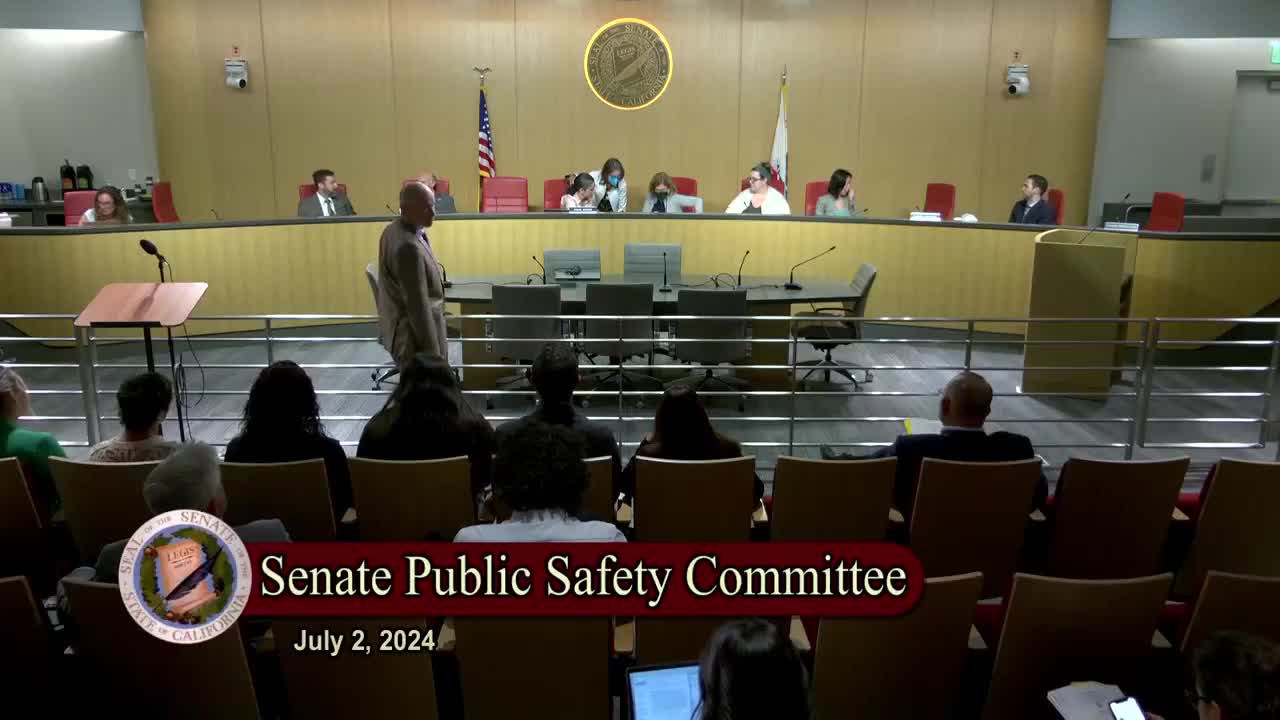
| Jul 2, 2024 | From committee: Do pass and re-refer to Com. on APPR. (Ayes 4. Noes 1.) (July 2). Re-referred to Com. on APPR. |
| Jun 5, 2024 | Referred to Com. on PUB S. |
| May 23, 2024 | In Senate. Read first time. To Com. on RLS. for assignment. |
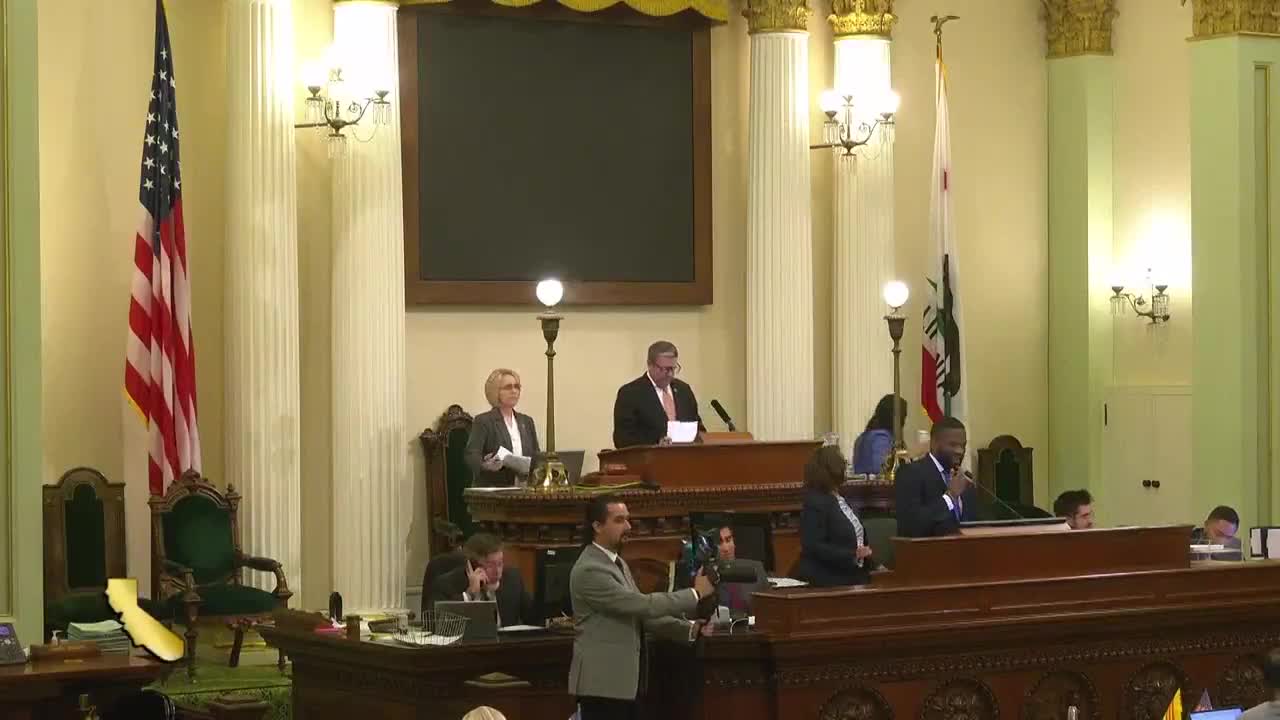
| May 22, 2024 | Read third time. Passed. Ordered to the Senate. (Ayes 60. Noes 4. Page 5520.) |
| May 20, 2024 | Read second time. Ordered to third reading. |
| May 16, 2024 | From committee: Do pass. (Ayes 11. Noes 2.) (May 16). |
| May 8, 2024 | In committee: Set, first hearing. Referred to APPR. suspense file. |
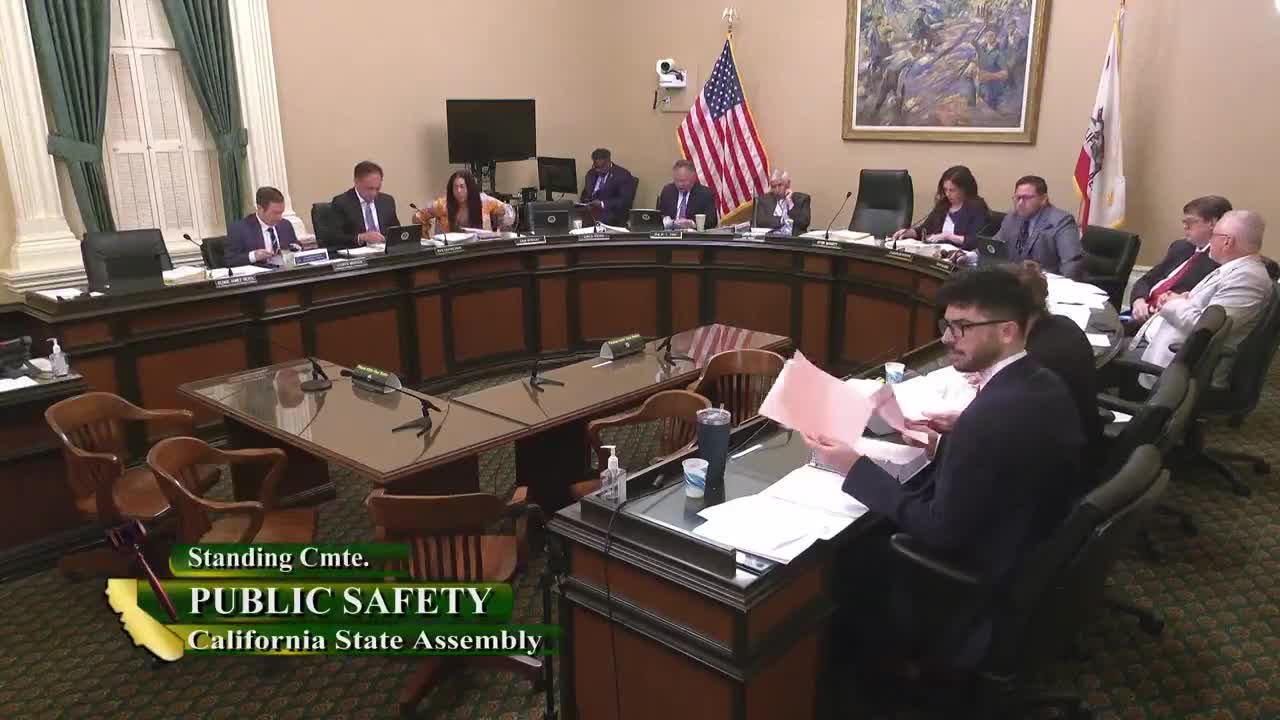
| Apr 17, 2024 | From committee: Do pass and re-refer to Com. on APPR. (Ayes 7. Noes 0.) (April 16). Re-referred to Com. on APPR. |
| Mar 11, 2024 | Referred to Com. on PUB. S. |
| Feb 17, 2024 | From printer. May be heard in committee March 18. |
| Feb 16, 2024 | Read first time. To print. |
|
Date
|
Description
|
Location
|
Votes
|
|
|---|---|---|---|---|
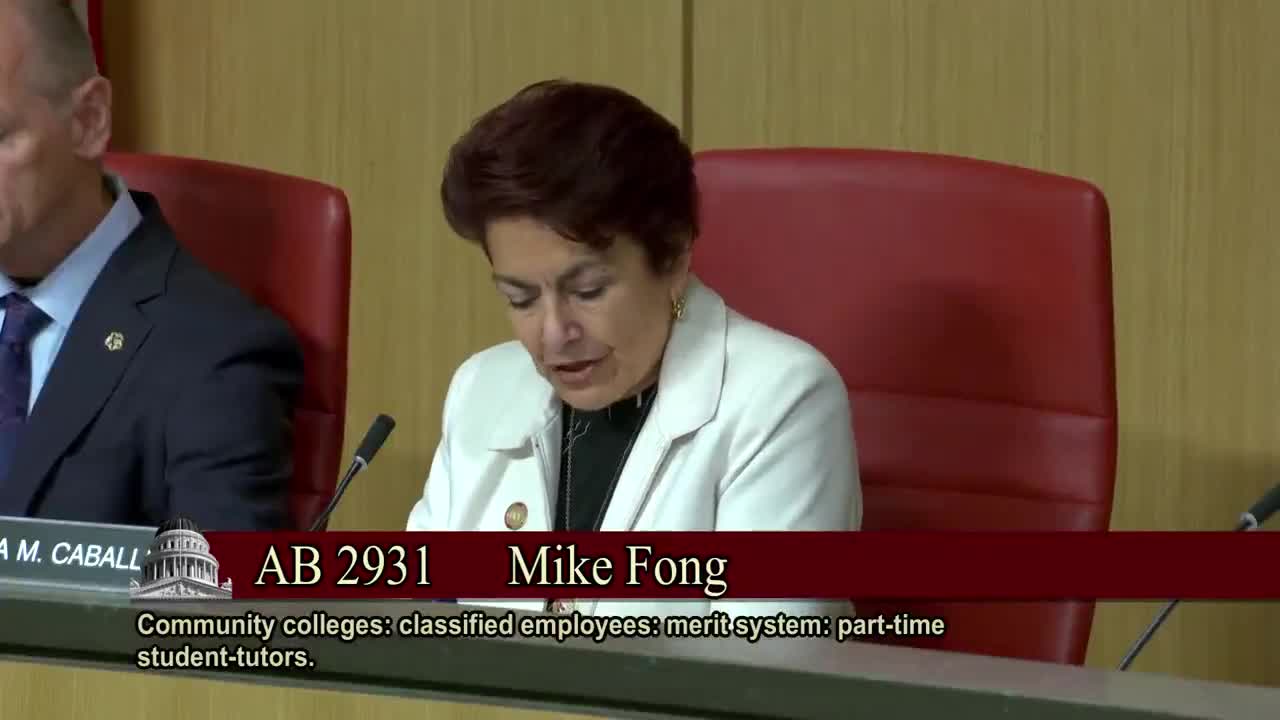
| Aug 15, 2024 | Do pass as amended | Senate Standing Committee on Appropriations |
Passed |
|
| Aug 5, 2024 | Placed on suspense file | Senate Standing Committee on Appropriations |
Passed |
|
| Jul 2, 2024 | Do pass, but first be re-referred to the Committee on [Appropriations] | Senate Standing Committee on Public Safety |
Passed |
|
| May 22, 2024 | AB 2959 Ortega Assembly Third Reading | Assembly Floor |
Passed |
|
| May 16, 2024 | Do pass. | Assembly Standing Committee on Appropriations |
Passed |
|
| Apr 16, 2024 | Do pass and be re-referred to the Committee on [Appropriations] | Assembly Standing Committee on Public Safety |
Passed |
This list shows positions taken on this bill by organizations on the date displayed, which is linked to the original source.
Positions by individuals are not included.
|
Organization
|
Position
|
Date
|
|---|---|---|
| A New Way of Life Reentry Project | ** Support | |
| Aclu California Action | ** Support | |
| All of Us or None | * Support | Apr 16, 2024 |
| Alliance for Boys and Men of Color | ** Support | |
| California Alliance for Youth and Community Justice | ** Support | |
| California Automatic Vendors Council | ** Against | |
| California Council Of The Blind | ** Against | |
| California Hospital Association | ** Support | |
| California Public Defenders Association | ** Support | |
| Californians for Safety and Justice | * Support | Apr 16, 2024 |
| Californians United for a Responsible Budget | ** Support | |
| Capital Advocacy | * Against | Apr 16, 2024 |
| Center on Juvenile and Criminal Justice | ** Support | |
| Change Parallel Project | * Support | Apr 16, 2024 |
| Coalition for Family Unity | ** Support | |
| Communities United for Restorative Youth Justice | ** Support | |
| Ella Baker Center For Human Rights | ** Support | |
| Empowering Women | * Support | Apr 16, 2024 |
| Empowering Women Impacted by Incarceration | * Support | Apr 16, 2024 |
| Essie Justice Group | ** Support | |
| Felony Murder Elimination Project | ** Support | |
| Freedom 4 Youth | ** Support | |
| Freedom Angels | * Support | Apr 16, 2024 |
| Initiate Justice Action | ** Support | |
| LA Defensa | ** Support | |
| Lawyers' Committee for Civil Rights of the San Francisco Bay Area | ** Support | |
| Legal Services for Prisoners with Children | * Support | Apr 16, 2024 |
| Power in Unity Fellowship | * Support | Apr 16, 2024 |
| Randolph Sheppard Program | * Against | Apr 16, 2024 |
| Restoring Hope California | * Support | Apr 16, 2024 |
| Rubicon Programs | ** Support | |
| San Francisco Financial Justice Project | ** Support | |
| San Francisco Public Defender's Office | * Support | Apr 16, 2024 |
| The Change Parallel Project | ** Support | |
| Uncommon Law | * Support | Apr 16, 2024 |
| Underground Scholars Initiative | * Support | Apr 16, 2024 |
| Young Women's Freedom Center | ** Support | |
| Youth Will | ** Support |
SENATE RULES COMMITTEE Office of Senate Floor Analyses (916) 651-1520 Fax: (916) 327-4478 | AB 2959 |
THIRD READING
Bill No: AB 2959
Author: Ortega (D)
Amended: 8/15/24 in Senate
Vote: 21
SENATE PUBLIC SAFETY COMMITTEE: 4-1, 7/2/24
AYES: Wahab, Bradford, Skinner, Wiener
NOES: Seyarto
SENATE APPROPRIATIONS COMMITTEE: 5-2, 8/15/24
AYES: Caballero, Ashby, Becker, Bradford, Wahab
NOES: Jones, Seyarto
ASSEMBLY FLOOR: 60-4, 5/22/24 - See last page for vote
SUBJECT: Prisons: food
SOURCE: Coalition for Family Unity
DIGEST:
This bill requires, beginning January 1, 2028, the California Department of Corrections and Rehabilitation (CDCR) in coordination with the Department of Rehabilitation (DOR), to ensure that food items sold in prison vending machines do not exceed a 35% markup above the average market retail price in the community in which the facility is located.
ANALYSIS:
Existing law:
- Requires CDCR to maintain a canteen at an active prison or institution under its jurisdiction for the sale to incarcerated persons of toilet articles, candy, notions, and other sundries. Requires CDCR to provide the necessary facilities, equipment, personnel, and merchandise for the canteen. Requires the secretary to specify what commodities will be sold in the canteen. Prohibits the sale prices of the articles offered for sale from exceeding a 35-percent markup above the amount paid to the vendors. (Pen. Code, § 5005, subd. (a).)
- Requires CDCR to undertake to insure against damage or loss of canteen and handicraft materials, supplies, and equipment owned by the Inmate Welfare Fund (IWF). (Pen. Code, § 5005, subd. (b).)
- Requires the Department of Finance (DOF) to conduct a biennial audit of canteen operations at any prison or institution and requires the audit to be available to incarcerated persons, as specified. (Pen. Code, § 5005, subd. (c).)
- Requires all net proceeds from the operation of canteens to be deposited in the IWF. Provides that the moneys in the fund constitute a trust held by the Secretary of CDCR for the benefit and welfare of all persons incarcerated at CDCR instructions. (Pen. Code, § 5006, subd. (b).)
- Requires the money in the IWF be used solely for the benefit and welfare of inmates of prisons and institutions under the jurisdiction of CDCR, including the following:
- The establishment, maintenance, employment of personnel for, and purchase of items for sale to inmates at canteens maintained at the state institutions;
- The establishment, maintenance, employment of personnel, and necessary expenses in connection with the operation of the hobby shops at institutions under the jurisdiction of the CDCR;
- Educational programs, hobby and recreational programs, which may include physical education activities and hobby craft classes, inmate family visiting services, leisure-time activities, and assistance with obtaining photo identification from the Department of Motor Vehicles; and,
- Funding for innovative programming by not-for-profit organizations offering programs that have demonstrated success and focus on offender responsibility and restorative justice principles. All funding used for this purpose shall go directly to the not-for-profit organizations and shall not be used for department staff or administration of the programming.
(Pen. Code, § 5006, subd. (a)(1)(A)-(D).)
- Requires CDCR to provide each incarcerated person with sufficient plain and wholesome food of such variety as may be most conducive to good health and requires plant-based meals to be available. Defines “plant-based meals” to mean entire meals that contain no animal products or byproducts, including meat, poultry, fish, dairy, or eggs. (Pen. Code, § 2084.)
This bill requires, beginning January 1, 2028, CDCR in coordination with DOR, to ensure that food items sold in prison vending machines do not exceed a 35% markup above the average market retail price in the community in which the facility is located.
Background
CDCR contracts with third party vendors for a variety of goods and services, including vending machines and the products sold in the machines. (https://www.cdcr.ca.gov/obs/services-goods-types/) Food items in visiting room vending machines are often the only food items visitors and the incarcerated individuals who they are visiting have access to because visitors are generally prohibited from bringing food into a CDCR facility. While CDCR does not control the prices charged by third party vendors or the items selected to put in the machines, it can prioritize contracting with third party vendors that have reasonable for food items.
This bill requires CDCR in coordination with DOR to ensure that food items sold in prison vending machines do not exceed a 35% markup above the average market retail price in the community in which the facility is located. The limit on the allowable markup on food items offered in prison vending machines is consistent with the allowable markup on items sold in prison canteens enacted via SB 474 (Becker), Chapter 609, Statutes of 2023.
FISCAL EFFECT: Appropriation: No Fiscal Com.: Yes Local: No
According to the Senate Appropriations Committee, there are unknown, potentially significant state costs (General Fund) to the California Department of Corrections and Rehabilitation (CDCR) and the Department of Rehabilitation (DOR).
SUPPORT: (Verified 8/15/24)
Coalition for Family Unity (source)
A New Way of Life Reentry Project
ACLU California Action
California Public Defenders Association
Californians United for A Responsible Budget
Center on Juvenile and Criminal Justice
Communities United for Restorative Youth Justice
Ella Baker Center for Human Rights
Essie Justice Group
Initiate Justice Action
La Defensa
San Francisco Financial Justice Project
The Change Parallel Project
Youth Will
3 individuals
OPPOSITION: (Verified 8/15/24)
California Automatic Vendor’s Council
ASSEMBLY FLOOR: 60-4, 5/22/24
AYES: Addis, Aguiar-Curry, Alanis, Alvarez, Arambula, Bains, Bauer-Kahan, Bennett, Berman, Boerner, Bonta, Bryan, Juan Carrillo, Wendy Carrillo, Connolly, Mike Fong, Gabriel, Garcia, Gipson, Grayson, Haney, Hart, Irwin, Jackson, Jones-Sawyer, Kalra, Lee, Low, Lowenthal, Maienschein, McCarty, McKinnor, Muratsuchi, Stephanie Nguyen, Ortega, Pacheco, Papan, Pellerin, Petrie-Norris, Quirk-Silva, Ramos, Rendon, Reyes, Rodriguez, Blanca Rubio, Santiago, Schiavo, Soria, Ting, Valencia, Villapudua, Waldron, Wallis, Ward, Weber, Wicks, Wilson, Wood, Zbur, Robert Rivas
NOES: Davies, Dixon, Vince Fong, Sanchez
NO VOTE RECORDED: Calderon, Cervantes, Chen, Megan Dahle, Essayli, Flora, Friedman, Gallagher, Holden, Hoover, Lackey, Mathis, Jim Patterson, Joe Patterson, Luz Rivas, Ta
Prepared by: Stephanie Jordan / PUB. S. /
8/19/24 10:55:56
**** END ****
SENATE COMMITTEE ON
Senator Anna Caballero, Chair
2023 - 2024 Regular Session
AB 2959 (Ortega) - Prisons and jails: food
Version: | Policy Vote: |
Urgency: | Mandate: |
Hearing Date: | Consultant: |
Bill Summary:
AB 2959 ensures that food items sold in prison vending machines do not exceed a 35-percent markup above the average market retail price in the community in which the prison is located.
*********** ANALYSIS ADDENDUM – SUSPENSE FILE ***********
The following information is revised to reflect amendments
adopted by the committee on August 15, 2024
Fiscal Impact:
Unknown, potentially significant state costs (General Fund) to the California Department of Corrections and Rehabilitation (CDCR) and the Department of Rehabilitation (DOR).
Author Amendments:
- Strike the provision in the bill that requires CDCR to take into consideration the research that exists on junk foods and snacks as a cause of obesity in children and families when providing food in the state prison.
- Strike the provision in the bill that requires CDCR to encourage the provision of affordable, fresh, and nutritious food items in prison vending machines and the sourcing of food items from local farmers and producers.
Committee Amendments:
Delete the provision in the bill that requires CDCR to require all food items sold in prison vending machines to be priced at the same average market retail price as in the community in which the prison is located and instead requires CDCR, in coordination with the DOR, to ensure that food items sold in prison vending machines do not exceed a 35-percent markup above the average market retail price in the community in which the prison is located. The committee amendments also provide that the bill shall become effective January 1, 2028.
-- END --
SENATE COMMITTEE ON APPROPRIATIONS
Senator Anna Caballero, Chair
2023 - 2024 Regular Session
AB 2959 (Ortega) - Prisons and jails: food
Version: February 16, 2024 | Policy Vote: PUB. S. 4 - 1 |
Urgency: No | Mandate: No |
Hearing Date: August 5, 2024 | Consultant: Liah Burnley |
Bill Summary:
AB 2595 requires all food items sold in prison vending machines to be priced at the same average market retail price as in the community in which the prison is located.
Fiscal Impact:
Significant ongoing state costs (General Fund). CDCR indicates that it does not hold the contracts for vending machine services. However, to the extent CDCR is required to review and report whether food items meet the standards in the bill, the department anticipates the need for a staff position at each institution to assess all vending machines, compare prices, attempt to coordinate/meet the requirements with vendors and the Department of Rehabilitation (DOR). CDCR reports that the department would also need two positions at headquarters to manage the program. In total, CDCR anticipate costs of about $4.3 million annually for 31 analysts at each institution and two managers at headquarters. (See staff comments)
Background:
CDCR contracts with third party vendors for a variety of goods and services, including vending machines and the products being sold in the machines. These food items, particularly in visitor’s room, are often the only food items visiting family and friends have access to when visiting a person in a CDCR facility. In many cases, where people visit loved ones incarcerated at CDCR, they must wait hours for the inmate to be brought to the visitor’s room. Visitors are generally prohibited from bringing food in from the outside. Also, families often buy items for incarcerated people to enjoy while visiting.
However, CDCR’s website points out that it does not install or stock the vending machines – they contract for that service. Accordingly, CDCR may not have authority to tell the vending machine company what to charge for items; however, CDCR may demand market rate on items when negotiating agreements for vending machine services.
Proposed Law:
This bill would require CDCR to do all of the following:
- Require all food items sold in prison vending machines to be priced at the same average market retail price as in the community in which the prison is located;
- Take into consideration the research that exists on junk foods and snacks as a cause of obesity in children and families when providing food in the state prison; and,
- Encourage the provision of affordable, fresh, and nutritious food items in prison vending machines and the sourcing of food items from local farmers and producers.
Staff Comments:
Under existing law, the DOR’s Business Enterprise Program facilitates licensed vending by blind vendors, which is a California-specific part of a broader federal policy framework dating back to the New Deal era. As such, it is unclear to what extent CDCR can comply with the requirements of this bill.
-- END --
SENATE COMMITTEE ON PUBLIC SAFETY
Senator Aisha Wahab, Chair
2023 - 2024 Regular
Bill No: AB 2959 Hearing Date: July 2, 2024
Author: | Ortega | ||
Version: | February 16, 2024 | ||
Urgency: | No | Fiscal: | Yes |
Consultant: | SJ | ||
Subject: Prisons and jails: food
HISTORY
Source: Coalition for Family Unity
Prior Legislation: SB 474 (Becker), Ch. 609, Stats. 2023
AB 1782 (Jones-Sawyer), vetoed in 2022
SB 555 (Mitchell), vetoed in 2020
SB 1138 (Skinner), Ch. 512, Stats. 2018
Support: A New Way of Life Reentry Project; ACLU California Action; California Public Defenders Association; Californians United for A Responsible Budget; Center on Juvenile and Criminal Justice; Communities United for Restorative Youth Justice; Ella Baker Center for Human Rights; Essie Justice Group; Initiate Justice Action; La Defensa; San Francisco Financial Justice Project; The Change Parallel Project; 3 individuals
Opposition: None known
Assembly Floor Vote: 60 - 4
PURPOSE
The purpose of this bill is to require all food items sold in prison vending machines to be priced at the same average market retail price as in the community in which the prison is located and encourage the provision of affordable, fresh, locally-sourced, and nutritious food items in prison vending machines.
Existing law requires California Department of Corrections and Rehabilitation (CDCR) to maintain a canteen at an active prison or institution under its jurisdiction for the sale to incarcerated persons of toilet articles, candy, notions, and other sundries. Requires CDCR to provide the necessary facilities, equipment, personnel, and merchandise for the canteen. Requires the secretary to specify what commodities will be sold in the canteen. Prohibits the sale prices of the articles offered for sale from exceeding a 35-percent markup above the amount paid to the vendors. (Pen. Code, § 5005, subd. (a).)
Existing law requires CDCR to undertake to insure against damage or loss of canteen and handicraft materials, supplies, and equipment owned by the Inmate Welfare Fund (IWF). (Pen. Code, § 5005, subd. (b).)
Existing law requires the Department of Finance (DOF) to conduct a biennial audit of canteen operations at any prison or institution and requires the audit to be available to incarcerated persons, as specified. (Pen. Code, § 5005, subd. (c).)
Existing law requires all net proceeds from the operation of canteens to be deposited in the IWF. Provides that the moneys in the fund constitute a trust held by the Secretary of CDCR for the benefit and welfare of all persons incarcerated at CDCR instructions. (Pen. Code, § 5006, subd. (b).)
Existing law requires the money in the IWF be used solely for the benefit and welfare of inmates of prisons and institutions under the jurisdiction of CDCR, including the following:
- The establishment, maintenance, employment of personnel for, and purchase of items for sale to inmates at canteens maintained at the state institutions;
- The establishment, maintenance, employment of personnel, and necessary expenses in connection with the operation of the hobby shops at institutions under the jurisdiction of the CDCR;
- Educational programs, hobby and recreational programs, which may include physical education activities and hobby craft classes, inmate family visiting services, leisure-time activities, and assistance with obtaining photo identification from the Department of Motor Vehicles; and,
- Funding for innovative programming by not-for-profit organizations offering programs that have demonstrated success and focus on offender responsibility and restorative justice principles. All funding used for this purpose shall go directly to the not-for-profit organizations and shall not be used for department staff or administration of the programming.
(Pen. Code, § 5006, subd. (a)(1)(A)-(D).)
Existing law requires CDCR to provide each incarcerated person with sufficient plain and wholesome food of such variety as may be most conducive to good health and requires plant-based meals to be available. Defines “plant-based meals” to mean entire meals that contain no animal products or byproducts, including meat, poultry, fish, dairy, or eggs. (Pen. Code, § 2084.)
This bill requires CDCR to do all of the following:
- Require all food items sold in prison vending machines to be priced at the same average market retail price as in the community in which the prison is located.
- Take into consideration the research that exists on junk foods and snacks as a cause of obesity in children and families when providing food in the state prison.
- Encourage the provision of affordable, fresh, and nutritious food items in prison vending machines and the sourcing of food items from local farmers and producers.
COMMENTS
- Need For This Bill
According to the author:
AB 2959 is crucial to reducing the financial burden on families visiting their loved ones in CDCR facilities. The lack of regulation on food prices in these facilities results in significant markups, causing families to pay significantly more than local store prices. Despite CDCR increasing the allowed amount of money visitors can bring, vendors have also raised their prices, exacerbating the financial strain. AB 2959 will mandate that food prices in prison vending machines align with average market retail prices in the community where the prison is located.
- Prison Canteens
Existing law requires CDCR to maintain a canteen at any prison or institution under its jurisdiction for the sale of toilet articles, candy, notions, and other sundries to incarcerated people. (Pen. Code, § 5005, subd. (a).) CDCR is also required to provide the necessary facilities, equipment, personnel, and merchandise for the canteen. (Ibid.) Regulations require each CDCR facility to establish a canteen enabling incarcerated prisons to make purchases of approved merchandise. (Cal. Code Regs., tit. 15, §§ 3090-3095.)
Beginning January 1, 2024, the sale prices of the articles offered for sale in a canteen are not to exceed a 35-percent markup above the amount paid to vendors. (Pen. Code, § 5005, subd. (a).) On January 1, 2028, the prices of the items in the canteen will revert to being set by the Secretary of CDCR at amounts that will render each canteen self-supporting—the protocol in place prior to the passage of SB 474 (Becker), Chapter 609, Statutes of 2023. Pursuant to regulations, facility staff are required to “consult with representatives of the inmate population when determining items to be stocked in the canteen for resale.” (Cal. Code Regs., tit. § 3090, subd. (a).)
The DOF is required to conduct biennial audits of canteen operations. (Pen. Code, § 5005, subd. (c).) In its most recent audit for Fiscal Year 2020-2021, the DOF reports that the net canteen sales across all CDCR institutions was $89,465,128. (DOF, Office of State Audits and Evaluations, Report No. 22-5225-029, p. 12.) The cost of the goods sold totaled $54,938,660. The gross margin from canteen sales totaled $34,526,468, and canteen expenses totaled $25,180,743. (Id. at p. 33.) As such, the total income from canteen sales across all CDCR institutions was $9,345,725. (Ibid.)
- Visiting Room Vending Machines
CDCR contracts with third party vendors for a variety of goods and services, including vending machines and the products sold in the machines. (https://www.cdcr.ca.gov/obs/services-goods-types/) Food items in visiting room vending machines are often the only food items visitors and the incarcerated individuals who they are visiting have access to because visitors are generally prohibited from bringing food into a CDCR facility. While CDCR does not control the prices charged by third party vendors or the items selected to put in the machines, it can prioritize contracting with third party vendors that have reasonable pricing and healthier food options.
This bill requires CDCR to require all food items sold in prison vending machines be priced at the same average market retail price as in the community in which the prison is located, take into consideration the research that exists on junk foods and snacks as a cause of obesity in children and families when providing food in the state prison, and encourage the provision of affordable, fresh, locally-sourced, and nutritious food items in prison vending machines.
- Argument in Support
Californians United for A Responsible Budget writes:
The bill would reduce markups on items sold in CDCR prison visiting room vending machines providing critical immediate relief for incarcerated people and their families. These savings will help to establish more financial stability for families impacted by incarceration, and ultimately strengthen community health, public safety, and re-entry outcomes.
…
The current practice of vending machine pricing contradicts these findings and creates an unfair burden on families who are visiting their incarcerated loved ones.
Since 2007, the California Department of Corrections and Rehabilitation (CDCR), deemed it necessary to increase the amount of money families are allowed to bring to visit to compensate for increased vending prices. In 2019, CDCR was still concerned with the increase in vending prices and were seeking to prevent price gouging. Families were allowed to bring more money to visits, once again, to compensate for the increased vending machine prices. Nevertheless, during and since COVID, families have been placed under an unfair burden of further increased prices. The mark ups tend to be 4-6 times the retail price.
Visits are an integral part of maintaining family contact and are a rehabilitative mechanism that is recognized to reduce recidivism. Part of visiting is eating a meal together. … Sharing a meal with a family and/or friend deepens those bonds, and they can shape healthy eating habits. …
There are many challenges and costs to maintaining relationships and family ties while a loved one is incarcerated. … The exorbitant pricing for food in vending machines does not align with the mission of rehabilitation since it discourages the use of this proven component to reduce recidivism.
This bill would be another step for California’s legislature in combating poverty, racial inequity, and mass incarceration, following on the heels of recent, bold reforms in our state to repeal administrative fees in the criminal system (AB 1869), eliminate fees for prison phone calls (SB 1008), and reduce markups on canteen prices (SB 474). Investing in financial stability for justice-involved families is a critical and evidence-based strategy for improving reentry outcomes and is an investment in public safety for all Californians.
-- END --
ASSEMBLY THIRD READING
ATR Bill Id:AB 2959
Author:(Ortega)
As Introduced Ver:February 16, 2024
Majority vote
SUMMARY
Requires the California Department of Corrections and Rehabilitation (CDCR) to price all vending machine food items in any CDCR prison the same market retail price as in the community in which the prison is located.
Major Provisions
- Requires CDCR to take into consideration the research that exists on junk foods and snacks as a cause of obesity in children and families when providing food in the state prison.
- Mandates CDCR encourage the provision of affordable, fresh, and nutritious food items in prison vending machines and the sourcing of food items from local farmers and producers.
COMMENTS
- Prison Canteens and Vending Machines: Existing law permits, but does not require, CDCR to maintain a canteen at any prison or institution under its jurisdiction for the sale of toilet articles, candy, notions, and other sundries to incarcerated people. (Penal Code Section (PEN) 5005.) CDCR is statutorily authorized, but not required, to provide the necessary facilities, equipment, personnel, and merchandise for the canteen. (Ibid.) Title 15 regulations require each CDCR facility to establish a canteen enabling incarcerated prisons to make purchases of approved merchandise. (California Code of Regulations (CCR)., Title 15 Section 3090 – 3095.) Despite the permissive statutory language, canteens are currently operated in all correctional institutions.[1]
Under current law, the sale prices of the articles offered for sale in a canteen are fixed by the Secretary of CDCR at the amounts that will, as far as possible, “render each canteen self-supporting." (PEN 5005.) Pursuant to regulations, facility staff are required to “consult with representatives of the inmate population when determining items to be stocked in the canteen for resale." (CCR 3090, subd. (a).) Prison vending machines are accessible by visitors. Visiting family and friends may make purchases for incarcerated person or for themselves.
However, the Penal Code vests CDCR with broad discretion to set the price of items sold in the canteen. (See In re Hamilton (1996) 41 Cal.App.4th 926, 934-935.) In In re Hamilton, the court of appeal held that the imposition by CDCR of a 10% surcharge on items bought or sold by incarcerated persons is within CDCR's discretion, including purchases at the prison canteen. (In re Hamilton, supra, 41 Cal.App.4th at pp. 934-935.) The court observed, "The Legislature has vested [CDCR] with considerable discretionary power by which to attain the goal of a self-supporting program. The subject surcharge clearly falls within the ambit of this power." (Id. at p. 933.) The court concluded that the surcharge was necessary to "defray costs.” (Id. at pp. 934-935.) The court elaborated that PEN 5005 requires only that the canteens "as far as possible" "attempt" to be self-supporting. Thus, prison canteens may price items to generate net proceeds, so long as those proceeds are used in the manner required by law. (Ibid.)
The DOF is required to conduct biennial audits of canteen operations. (Pen. Code, § 5005.) In its most recent audit for Fiscal Year 2021, the DOF reports that the net canteen sales across all CDCR institutions was $89,465,128. The cost of the goods sold totaled $54,938,660. The gross margin from canteen sales totaled $34,526,468 and canteen expenses totaled $25,180,743. As such, the total income from canteen sales across all CDCR institutions was $9,345,725. (DOF, Office of State Audits and Evaluations, Report No. 22-5225-029, supra at p.33.) $9.3 million in proceeds is likely more than adequate to render the canteens “self-supporting” and “defray costs.” Of note, the income from canteen sales is raised directly from incarcerated persons. The combined pay for all incarcerated persons across all of CDCR’s institutions for the fiscal year relating to canteen operations was $67,705—a mere fraction of a percent of the total income from canteen sales. (DOF, Office of State Audits and Evaluations, Report No. 22-5225-029, supra at p.33.) Though canteen prices continue to rise, the State has not raised pay for incarcerated persons,[2] including the pay of those that work the canteens.
The size of the prison commissary industry is difficult to estimate, but likely exceeds $1.6 billion in annual revenue. (Stephen Raher, The Company Store and the Literally Captive Market: Consumer Law in Prisons and Jails, 17 Hastings Race & Poverty L.J. 3 (2020).) “It is difficult to see prison-retail prices as anything other than premium rates charged for inexpensive, run-of-the mill goods or services.” (Id. at p. 25.) Commentators have opined that the prison-retail industry is an exploitative “business model based on using the coercive power of the state to extract revenue from poor people in the form of exorbitant prices for phone calls or junk food.” (Ibid.)
- CDCR Contracting for Goods and Services: CDCR contracts with third party vendors for a variety of goods and services, including vending machines and the products being sold in the machines. These food items, particularly in visitor's room, are often the only food items visiting family and friends have access to when visiting a person in a CDCR facility. In many cases, where people visit loved ones incarcerated at CDCR, they must wait hours for the inmate to be brought to the visitor's room. Visitors are generally prohibited from bringing food in from the outside. Also, families often buy items for incarcerated people to enjoy while visiting.
Certainly, demanding market rate for these items does not seem unreasonable. However, CDCR's website points out that it does not install or stock the vending machines – they contract for that service.[3] Accordingly, CDCR may not have authority to tell the vending machine company what to charge for items; however, CDCR may demand market rate on items when negotiating agreements for vending machine services.
The availability of reasonable, low cost food items may encourage more visitors. It is settled policy that family and community visits are crucial to an incarcerated person’s success both while in custody and after coming home.
Using multiple measures of visitation (any visit, total number of visits, visits per month, timing of visits, and number of individual visitors) and recidivism (new offense conviction and technical violation revocation), the study found that visitation significantly decreased the risk of recidivism, a result that was robust across all of the Cox regression models that were estimated. The results also showed that visits from siblings, in-laws, fathers, and clergy were the most beneficial in reducing the risk of recidivism, whereas visits from ex-spouses significantly increased the risk. The findings suggest that revising prison visitation policies to make them more "visitor friendly" could yield public safety benefits by helping offenders establish a continuum of social support from prison to the community. It is anticipated, however, that revising existing policies would not likely increase visitation to a significant extent among unvisited inmates, who comprised nearly 40 percent of the sample. Accordingly, it is suggested that correctional systems consider allocating greater resources to increase visitation among inmates with little or no social support. (Minnesota Department of Corrections (2011) "The Effects of Prison Visitation on Offender Recidivism," p. iii.)[4]
While CDCR cannot control what third party vendors charge or what those vendors put in the machines, it can prioritize its efforts to contract with third party vendors that have reasonable pricing and healthy food options. Additionally, inmate councils across the state have complained to CDCR and the Legislature that inmates actually struggle just to meet daily caloric intake due to lack of inmate resources to purchase food and not enough food from CDCR.
According to the Author
"AB 2959 is crucial to reducing the financial burden on families visiting their loved ones in CDCR facilities. The lack of regulation on food prices in these facilities results in significant markups, causing families to pay significantly more than local store prices. Despite CDCR increasing the allowed amount of money visitors can bring, vendors have also raised their prices, exacerbating the financial strain. AB 2959 will mandate that food prices in prison vending machines align with average market retail prices in the community where the prison is located. Additionally, the bill encourages a diversification of food options and the inclusion of healthier choices, improving quality and dignity for visiting families."
"Visitors to prison facilities are often present for hours at a time. They are not allowed to bring their own alimentation inside, and exiting and re-entering is often disallowed or impracticable. So if they require nourishment, they will have to obtain it on site. Additionally, for those visiting loved ones, the experience of communal meals may be an especially precious way of bonding. (You are who you eat with.) Being effectively a captive buyer, the visitor is in a weak bargaining position vis-a-vis the seller; the seller, moreover, has a monopoly and so needn’t compete with other sellers as in a marketplace. (The minimum actors for any market mechanism whatsoever to operate is at least two buyers and at least two sellers for competition. See John R. Commons, "Institutional Economics" 21 Amer. Econ. Rev. 648 (1931).)
"The sellers get a local monopoly pursuant to a contract within the framework of a cooperation between the Department of Rehabilitation and the CA Department of Corrections and Rehabilitation. DOR's Business Enterprise Program facilitates licensed vending by blind vendors, which is a California-specific part of a broader federal policy framework dating back to the New Deal era. This preference structure, designed to enhance the economic opportunities of blind persons, is worthy, but it comes at a cost: the guaranteed profit for the vendor is paid for by higher-than-market prices for the consumers and, due to inadequate state oversight, lower quality goods. This is a consequence of the structure of the program. The remedy this bill proposes is price controls coupled with quality standards."
Arguments in Support
According to the California Alliance for Youth & Community Justice: In 2023, through SB 474, the state legislature found and declared: It is essential that incarcerated Californians and their loved ones are protected from price gouging and excessive cost pressures related to incarceration that negatively impact their financial stability. Research shows that economic stability is critical to preventing recidivism and supporting positive reentry outcomes.
In 2020, a report by Impact Justice found that 60 percent of formerly incarcerated people surveyed said that they could not afford canteen purchases while incarcerated, while 75 percent of those surveyed reported that their access to adequate food was restricted by their personal or family finances. A research study from the Ella Baker Center for Human Rights has shown that nearly two in three families with an incarcerated family member are unable to meet their families’ basic needs due to the costs of incarceration, and that nearly one-half of families are unable to afford conviction-related costs.
The financial burdens associated with incarceration tend to fall most heavily on women of color from low-income communities. The current practice of vending machine pricing contradicts these findings and creates an unfair burden on families who are visiting their incarcerated loved ones. Since 2007, the California Department of Corrections and Rehabilitation (CDCR), deemed it necessary to increase the amount of money families are allowed to bring to visit to compensate for increased vending prices.
In 2019, CDCR was still concerned with the increase in vending prices and were seeking to prevent price gouging. Families were allowed to bring more money to visits, once again, to compensate for the increased vending machine prices. Nevertheless, during and since COVID, families have been placed under an unfair burden of further increased prices. The mark ups tend to be 4-6 times what the retail price. Visits are an integral part of maintaining family contact and are a rehabilitative mechanism that is recognized to reduce recidivism. Part of visiting is eating a meal together. Research has demonstrated the importance of eating a meal together.
Sharing a meal with a family and/or friend deepens those bonds and they can shape healthy eating habits. They also have prosocial benefits for the incarcerated individual. The prosocial aspect of visiting is undermined by the price gouging that occurs with the vending machines at prison visiting rooms.
The prices limit the number of times a family or friend will visit their incarcerated loved ones. There are many challenges and costs to maintaining relationships and family ties while a loved one is incarcerated. From phone calls to canteen to a source of income has left the household.
Visits are often an expense families have to save up with cost for gas, cost for a hotel, cost for flights for some. The exorbitant pricing for food in vending machines does not align with the mission of rehabilitation since it discourages the use of this proven component to reduce recidivism. …
This bill would be another step for California's legislature in combating poverty, racial inequity, and mass incarceration, following on the heels of recent, bold reforms in our state to repeal administrative fees in the criminal system (AB 1869), eliminate fees for prison phone calls (SB 1008), and reduce markups on canteen prices (SB 474). Investing in financial stability for justice-involved families is a critical and evidence-based strategy for improving reentry outcomes, and is an investment in public safety for all Californians."
Arguments in Opposition
According to the California Council of the Blind: "AB2959 would require the CDCR to require all food items sold in the facility vending machines to be priced at the same average market retail price as in the community in which the facility is located. Many state prisons are operated by blind vendors working under the state's Business Enterprise Program.
The problem with this provision is that many prisons are surrounded by big box stores and other chain stores that can dramatically undercut any price point that can be met by a blind vendor. If the proponents of this bill desire to solve the problem of overpricing without harming the ability of blind vendors to make a living wage, a more realistic solution would be to determine an average price point based upon the amount for items charged by convenience stores and gas stations in the community.
The bill would also require those facilities to take into consideration research that exists on junk foods and snacks as a cause of obesity in children and families when providing food in the state prison, and to encourage the provision of affordable, fresh, and nutritious food items in prison vending machines and the sourcing of food items from local farmers and producers. Blind vendors are more than willing to bring in healthy food choices and work with the department in this endeavor. However, it is often the department itself who discourages vendors from taking those steps that will allow such choices to be provided. If this provision is to be adopted, blind vendors would need assurances from the department that it would be implemented in a manner that would help all concerned, both those buying products and blind vendors.
FISCAL COMMENTS
According to the Assembly Appropriations Committee, "Revenue loss (Vending Stand Fund (VSF)) of an unknown but potentially significant amount to the Department of Rehabilitation (DOR). CDCR does not maintain contracts for vending machines in state prisons. DOR administers the Business Enterprises Program (BEP), which creates business opportunities for Californians who are legally blind to operate vending machines as self-employed small business owners on federal and state property, including CDCR prisons. DOR reports that currently, 17 vendors operate 867 vending machines in 19 CDCR prisons. The BEP is funded by the VSF, which is supported by BEP vendor profits, federal grants, and state match funds. DOR reports the VSF fund balance is currently $3 million. To the extent that BEP vendors lose profit margins due to this bill's market retail price requirements, DOR expects unknown cost pressures to the VSF."
VOTES
ASM PUBLIC SAFETY: 7-0-1
YES: McCarty, Alanis, Stephanie Nguyen, Reyes, Ting, Wilson, Zbur
ABS, ABST OR NV: Lackey
ASM APPROPRIATIONS: 11-2-2
YES: Wicks, Arambula, Bryan, Calderon, Wendy Carrillo, Mike Fong, Grayson, Haney, Hart, Pellerin, Villapudua
NO: Sanchez, Dixon
ABS, ABST OR NV: Jim Patterson, Ta
UPDATED
VERSION: February 16, 2024
CONSULTANT: Kimberly Horiuchi / PUB. S. / (916) 319-3744 FN: 0003075
(DOF, Office of State Audits and Evaluations, Report No. 22-5225-029 (Jan. 2023) at p. 9 <https://esd.dof.ca.gov/reports/reportPdf/98602576-41DE-ED11-A820-00224843A957/Department%20of%20Corrections%20and%20Rehabilitation%20Financial%20Combined%20Inmate%20Welfare%20Fund%20for%20the%20Fiscal%20Year%20Ended%20June%2030,%202021> [June 8, 2023].) ↑
Generally, the average pay for incarcerated people is $0.08 to $0.37 an hour before fees and deductions (Cal. Code Regs., tit. 15, § 3041.2.) Recent measures to increase prison pay have failed passage by the Legislature. (See, e.g., SB 1371 (Bradford), of the 2021-2022 Legislative Session [would have required CDCR to adopt a 5-year implementation plan to increase inmate wages; SB 1371 was vetoed]; ACA 3 (Kamlager), of the 2021-2022 Legislative Session [would have removed language in the state Constitution that allows involuntary servitude as punishment to a crime; ACA 3 was ordered to the Senate Inactive File].) ↑
Located at https://www.cdcr.ca.gov/obs/services-goods-types/ [last visited April 10, 2024.] ↑
Located at https://nicic.gov/resources/nic-library/all-library-items/effects-prison-visitation-offender-recidivism [last visited April 10, 2024]. ↑
Date of Hearing: May 8, 2024
ASSEMBLY COMMITTEE ON APPROPRIATIONS
Buffy Wicks, Chair
ABPCA Bill Id:AB 2959
Author:(Ortega) – As Introduced Ver:February 16, 2024
Policy Committee: | Public Safety | Vote: | 7 - 0 |
|
| ||
|
|
Urgency: No State Mandated Local Program: No Reimbursable: No
SUMMARY:
This bill requires the California Department of Corrections and Rehabilitation (CDCR) to price food in a prison vending machine at the same average market retail price as in the community in which the prison is located.
FISCAL EFFECT:
Revenue loss (Vending Stand Fund (VSF)) of an unknown but potentially significant amount to the Department of Rehabilitation (DOR). CDCR does not maintain contracts for vending machines in state prisons. DOR administers the Business Enterprises Program (BEP), which creates business opportunities for Californians who are legally blind to operate vending machines as self-employed small business owners on federal and state property, including CDCR prisons. DOR reports that currently, 17 vendors operate 867 vending machines in 19 CDCR prisons. The BEP is funded by the VSF, which is supported by BEP vendor profits, federal grants, and state match funds. DOR reports the VSF fund balance is currently $3 million. To the extent that BEP vendors lose profit margins due to this bill’s market retail price requirements, DOR expects unknown cost pressures to the VSF.
COMMENTS:
- Purpose. According to the author:
AB 2959 is crucial to reducing the financial burden on families visiting their loved ones in CDCR facilities. The lack of regulation on food prices in these facilities results in significant markups, causing families to pay significantly more than local store prices. Despite CDCR increasing the allowed amount of money visitors can bring, vendors have also raised their prices, exacerbating the financial strain. AB 2959 will mandate that food prices in prison vending machines align with average market retail prices in the community where the prison is located. Additionally, the bill encourages a diversification of food options and the inclusion of healthier choices, improving quality and dignity for visiting families.
- Background. CDCR contracts with third party vendors that operate vending machines and provide the products sold in the machines. A person who comes to prison for visitation generally cannot bring their own food or drinks into the facility, so vending machines are the primary source of food for visitors. Visitors often purchase food from vending machines to provide to the incarcerated person they are visiting.
This bill requires food items sold in a prison vending machine to be priced at the same average market retail price as the community in which the prison is located. The bill also requires CDCR to take into consideration research about foods that cause obesity, and encourage provision of affordable, fresh, and nutritious food items in prison vending machines. Since CDCR contracts with vendors who provide food for prison vending machines, the department will likely need to negotiate new vendor contracts to comply with this bill, resulting in the costs to the department described above.
- Prior Legislation. SB 474 (Becker), Chapter 609, Statutes of 2023, prohibits, until 2028, CDCR from selling a canteen item for more than 35% above the amount CDCR paid a vendor for the item.
Analysis Prepared by: Annika Carlson / APPR. / (916) 319-2081
Date of Hearing:
Counsel: Kimberly Horiuchi
ASSEMBLY COMMITTEE ON PUBLIC SAFETY
Kevin McCarty, Chair
ABPCA Bill Id:AB 2959
Author:(Ortega) – As Introduced Ver:February 16, 2024
SUMMARY:
Requires the California Department of Corrections and Rehabilitation (CDCR) to price all vending machine food items in any CDCR prison the same market retail price as in the community in which the prison is located. Specifically, this bill:
- Requires CDCR to take into consideration the research that exists on junk foods and snacks as a cause of obesity in children and families when providing food in the state prison.
- Mandates CDCR encourage the provision of affordable, fresh, and nutritious food items in prison vending machines and the sourcing of food items from local farmers and producers.
EXISTING LAW:
- Permits CDCR to maintain a canteen at any prison or institution under its jurisdiction to sell incarcerated person toilet articles, candy, notions, and other sundries. (Pen. Code, § 5005.)
- Permits CDCR to provide the necessary facilities, equipment, personnel, and merchandise for the canteen. (Pen. Code, § 5005.)
- Permits CDCR to undertake to insure against damage or loss of canteen and handicraft materials, supplies and equipment owned by the Inmate Welfare Fund (IWF). (Pen. Code, § 5005.)
- Provides that the sale prices of the articles offered for sale in the canteen shall be fixed by CDCR at the amounts that will, as far as possible, render each canteen self-supporting. (Pen. Code, § 5005.)
- Requires all net proceeds from the operation of canteens to be deposited in the IWF. The moneys in the fund shall constitute a trust held by the Secretary of CDCR for the benefit and welfare of all persons incarcerated at CDCR instructions. (Pen. Code, § 5006, subd. (b).)
- Requires the Department of Finance (DOF) to conduct a biennial audit of canteen operations at any prison or institution and requires the audit to be available to incarcerated persons, as specified. (Pen. Code, § 5005.)
- States all moneys now held for the benefit of inmates currently housed in CDCR facilities including those known as the Inmate Canteen Fund of the California Institution for Men; the IWF of the California Institution for Women; the Trust Contingent Fund of the California State Prison at Folsom; the S.P.L. Commissary, Canteen Account, Hobby Association, Camp Account, Library Fund, News Agency of the San Quentin Rehabilitation Center, the Prisoners’ Fund; and the Prisoners’ Employment Fund, shall be deposited in the Inmate Welfare Fund of the CDCR, in the State Treasury, which is hereby created. (Pen. Code, § 5006, subd. (a)(1).)
- Requires the money in the IWF be used solely for the benefit and welfare of inmates of prisons and institutions under the jurisdiction of CDCR, including the following:
- The establishment, maintenance, employment of personnel for, and purchase of items for sale to inmates at canteens maintained at the state institutions;
- The establishment, maintenance, employment of personnel, and necessary expenses in connection with the operation of the hobby shops at institutions under the jurisdiction of the CDCR;
- Educational programs, hobby and recreational programs, which may include physical education activities and hobby craft classes, inmate family visiting services, leisure-time activities, and assistance with obtaining photo identification from the Department of Motor Vehicles; and,
- Funding for innovative programming by not-for-profit organizations offering programs that have demonstrated success and focus on offender responsibility and restorative justice principles. All funding used for this purpose shall go directly to the not-for-profit organizations and shall not be used for department staff or administration of the programming. (Pen. Code, § 5006, subd. (a)(1)(A-D).)
- The establishment, maintenance, employment of personnel for, and purchase of items for sale to inmates at canteens maintained at the state institutions;
- States money in the IWF shall not be expended to pay charges for any or all of the following purposes:
- Overtime for staff coverage of special events;
- Television repair; or,
- Original complement of television sets and replacement of television equipment.
- Overtime for staff coverage of special events;
- CDCR shall pay the above charges out of any money appropriated for these purposes. (Pen. Code, § 5006.1.)
FISCAL EFFECT:
Unknown
COMMENTS:
- Author's Statement: According to the author, “AB 2959 is crucial to reducing the financial burden on families visiting their loved ones in CDCR facilities. The lack of regulation on food prices in these facilities results in significant markups, causing families to pay significantly more than local store prices. Despite CDCR increasing the allowed amount of money visitors can bring, vendors have also raised their prices, exacerbating the financial strain. AB 2959 will mandate that food prices in prison vending machines align with average market retail prices in the community where the prison is located. Additionally, the bill encourages a diversification of food options and the inclusion of healthier choices, improving quality and dignity for visiting families.”
“Visitors to prison facilities are often present for hours at a time. They are not allowed to bring their own alimentation inside, and exiting and re-entering is often disallowed or impracticable. So if they require nourishment, they will have to obtain it on site. Additionally, for those visiting loved ones, the experience of communal meals may be an especially precious way of bonding. (You are who you eat with.) Being effectively a captive buyer, the visitor is in a weak bargaining position vis-a-vis the seller; the seller, moreover, has a monopoly and so needn’t compete with other sellers as in a marketplace. (The minimum actors for any market mechanism whatsoever to operate is at least two buyers and at least two sellers for competition. See John R. Commons, “Institutional Economics” 21 Amer. Econ. Rev. 648 (1931).)
“The sellers get a local monopoly pursuant to a contract within the framework of a cooperation between the Department of Rehabilitation and the CA Department of Corrections and Rehabilitation. DOR’s Business Enterprise Program facilitates licensed vending by blind vendors, which is a California-specific part of a broader federal policy framework dating back to the New Deal era. This preference structure, designed to enhance the economic opportunities of blind persons, is worthy, but it comes at a cost: the guaranteed profit for the vendor is paid for by higher-than-market prices for the consumers and, due to inadequate state oversight, lower quality goods. This is a consequence of the structure of the program. The remedy this bill proposes is price controls coupled with quality standards. - Prison Canteens and Vending Machines: Existing law permits, but does not require, CDCR to maintain a canteen at any prison or institution under its jurisdiction for the sale of toilet articles, candy, notions, and other sundries to incarcerated people. (Pen. Code, § 5005.) CDCR is statutorily authorized, but not required, to provide the necessary facilities, equipment, personnel, and merchandise for the canteen. (Ibid.) Title 15 regulations require each CDCR facility to establish a canteen enabling incarcerated prisons to make purchases of approved merchandise. (Cal. Code Regs., tit. 15 §§ 3090 – 3095.) Despite the permissive statutory language, canteens are currently operated in all correctional institutions.[1]
Under current law, the sale prices of the articles offered for sale in a canteen are fixed by the Secretary of CDCR at the amounts that will, as far as possible, “render each canteen self-supporting.” (Pen. Code, § 5005.) Pursuant to regulations, facility staff are required to “consult with representatives of the inmate population when determining items to be stocked in the canteen for resale.” (Cal. Code Regs., tit. § 3090, subd. (a).) Prison vending machines are accessible by visitors. Visiting family and friends may make purchases for incarcerated person or for themselves.
However, the Penal Code vests CDCR with broad discretion to set the price of items sold in the canteen. (See In re Hamilton (1996) 41 Cal.App.4th 926, 934-935.) In In re Hamilton, the court of appeal held that the imposition by CDCR of a 10% surcharge on items bought or sold by incarcerated persons is within CDCR’s discretion, including purchases at the prison canteen. (In re Hamilton, supra, 41 Cal.App.4th at pp. 934-935.) The court observed, “The Legislature has vested [CDCR] with considerable discretionary power by which to attain the goal of a self-supporting program. The subject surcharge clearly falls within the ambit of this power.” (Id. at p. 933.) The court concluded that the surcharge was necessary to “defray costs.” (Id. at pp. 934-935.) The court elaborated that Penal Code section 5005 requires only that the canteens “as far as possible” “attempt” to be self-supporting. Thus, prison canteens may price items to generate net proceeds, so long as those proceeds are used in the manner required by law. (Ibid.)
The DOF is required to conduct biennial audits of canteen operations. (Pen. Code, § 5005.) In its most recent audit for Fiscal Year 2021, the DOF reports that the net canteen sales across all CDCR institutions was $89,465,128. The cost of the goods sold totaled $54,938,660. The gross margin from canteen sales totaled $34,526,468 and canteen expenses totaled $25,180,743. As such, the total income from canteen sales across all CDCR institutions was $9,345,725. (DOF, Office of State Audits and Evaluations, Report No. 22-5225-029, supra at p.33.) $9.3 million in proceeds is likely more than adequate to render the canteens “self-supporting” and “defray costs.” Of note, the income from canteen sales is raised directly from incarcerated persons. The combined pay for all incarcerated persons across all of CDCR’s institutions for the fiscal year relating to canteen operations was $67,705—a mere fraction of a percent of the total income from canteen sales. (DOF, Office of State Audits and Evaluations, Report No. 22-5225-029, supra at p.33.) Though canteen prices continue to rise, the State has not raised pay for incarcerated persons,[2] including the pay of those that work the canteens.
The size of the prison commissary industry is difficult to estimate, but likely exceeds $1.6 billion in annual revenue. (Stephen Raher, The Company Store and the Literally Captive Market: Consumer Law in Prisons and Jails, 17 Hastings Race & Poverty L.J. 3 (2020).) “It is difficult to see prison-retail prices as anything other than premium rates charged for inexpensive, run-of-the mill goods or services.” (Id. at p. 25.) Commentators have opined that the prison-retail industry is an exploitative “business model based on using the coercive power of the state to extract revenue from poor people in the form of exorbitant prices for phone calls or junk food.” (Ibid.)
- CDCR Contracting for Goods and Services: CDCR contracts with third party vendors for a variety of goods and services, including vending machines and the products being sold in the machines. These food items, particularly in visitor’s room, are often the only food items visiting family and friends have access to when visiting a person in a CDCR facility. In many cases, where people visit loved ones incarcerated at CDCR, they must wait hours for the inmate to be brought to the visitor’s room. Visitors are generally prohibited from bringing food in from the outside. Also, families often buy items for incarcerated people to enjoy while visiting.
Certainly, demanding market rate for these items does not seem unreasonable. However, CDCR’s website points out that it does not install or stock the vending machines – they contract for that service.[3] Accordingly, CDCR may not have authority to tell the vending machine company what to charge for items; however, CDCR may demand market rate on items when negotiating agreements for vending machine services.
The availability of reasonable, low cost food items may encourage more visitors. It is settled policy that family and community visits are crucial to an incarcerated person’s success both while in custody and after coming home.
Using multiple measures of visitation (any visit, total number of visits, visits per month, timing of visits, and number of individual visitors) and recidivism (new offense conviction and technical violation revocation), the study found that visitation significantly decreased the risk of recidivism, a result that was robust across all of the Cox regression models that were estimated. The results also showed that visits from siblings, in-laws, fathers, and clergy were the most beneficial in reducing the risk of recidivism, whereas visits from ex-spouses significantly increased the risk. The findings suggest that revising prison visitation policies to make them more “visitor friendly” could yield public safety benefits by helping offenders establish a continuum of social support from prison to the community. It is anticipated, however, that revising existing policies would not likely increase visitation to a significant extent among unvisited inmates, who comprised nearly 40 percent of the sample. Accordingly, it is suggested that correctional systems consider allocating greater resources to increase visitation among inmates with little or no social support. (Minnesota Department of Corrections (2011) “The Effects of Prison Visitation on Offender Recidivism,” p. iii.)[4]
While CDCR cannot control what third party vendors charge or what those vendors put in the machines, it can prioritize its efforts to contract with third party vendors that have reasonable pricing and healthy food options. Additionally, inmate councils across the state have complained to CDCR and the Legislature that inmates actually struggle just to meet daily caloric intake due to lack of inmate resources to purchase food and not enough food from CDCR.
- Arguments in Support: According to the California Alliance for Youth & Community Justice: In 2023, through SB 474, the state legislature found and declared: It is essential that incarcerated Californians and their loved ones are protected from price gouging and excessive cost pressures related to incarceration that negatively impact their financial stability. Research shows that economic stability is critical to preventing recidivism and supporting positive reentry outcomes.
In 2020, a report by Impact Justice found that 60 percent of formerly incarcerated people surveyed said that they could not afford canteen purchases while incarcerated, while 75 percent of those surveyed reported that their access to adequate food was restricted by their personal or family finances. A research study from the Ella Baker Center for Human Rights has shown that nearly two in three families with an incarcerated family member are unable to meet their families’ basic needs due to the costs of incarceration, and that nearly one-half of families are unable to afford conviction-related costs.
The financial burdens associated with incarceration tend to fall most heavily on women of color from low-income communities. The current practice of vending machine pricing contradicts these findings and creates an unfair burden on families who are visiting their incarcerated loved ones. Since 2007, the California Department of Corrections and Rehabilitation (CDCR), deemed it necessary to increase the amount of money families are allowed to bring to visit to compensate for increased vending prices.
In 2019, CDCR was still concerned with the increase in vending prices and were seeking to prevent price gouging. Families were allowed to bring more money to visits, once again, to compensate for the increased vending machine prices. Nevertheless, during and since COVID, families have been placed under an unfair burden of further increased prices. The mark ups tend to be 4-6 times what the retail price. Visits are an integral part of maintaining family contact and are a rehabilitative mechanism that is recognized to reduce recidivism. Part of visiting is eating a meal together. Research has demonstrated the importance of eating a meal together.
Sharing a meal with a family and/or friend deepens those bonds and they can shape healthy eating habits. They also have prosocial benefits for the incarcerated individual. The prosocial aspect of visiting is undermined by the price gouging that occurs with the vending machines at prison visiting rooms.
The prices limit the number of times a family or friend will visit their incarcerated loved ones. There are many challenges and costs to maintaining relationships and family ties while a loved one is incarcerated. From phone calls to canteen to a source of income has left the household.
Visits are often an expense families have to save up with cost for gas, cost for a hotel, cost for flights for some. The exorbitant pricing for food in vending machines does not align with the mission of rehabilitation since it discourages the use of this proven component to reduce recidivism. …
This bill would be another step for California’s legislature in combating poverty, racial inequity, and mass incarceration, following on the heels of recent, bold reforms in our state to repeal administrative fees in the criminal system (AB 1869), eliminate fees for prison phone calls (SB 1008), and reduce markups on canteen prices (SB 474). Investing in financial stability for justice-involved families is a critical and evidence-based strategy for improving reentry outcomes, and is an investment in public safety for all Californians.”
- Arguments in Opposition: According to the California Council of the Blind: “AB2959 would require the CDCR to require all food items sold in the facility vending machines to be priced at the same average market retail price as in the community in which the facility is located. Many state prisons are operated by blind vendors working under the state’s Business Enterprise Program.
The problem with this provision is that many prisons are surrounded by big box stores and other chain stores that can dramatically undercut any price point that can be met by a blind vendor. If the proponents of this bill desire to solve the problem of overpricing without harming the ability of blind vendors to make a living wage, a more realistic solution would be to determine an average price point based upon the amount for items charged by convenience stores and gas stations in the community.
The bill would also require those facilities to take into consideration research that exists on junk foods and snacks as a cause of obesity in children and families when providing food in the state prison, and to encourage the provision of affordable, fresh, and nutritious food items in prison vending machines and the sourcing of food items from local farmers and producers. Blind vendors are more than willing to bring in healthy food choices and work with the department in this endeavor. However, it is often the department itself who discourages vendors from taking those steps that will allow such choices to be provided. If this provision is to be adopted, blind vendors would need assurances from the department that it would be implemented in a manner that would help all concerned, both those buying products and blind vendors.
- Prior Legislation:
- AB 1782 (Jones-Sawyer), of the 2021-2022 Legislative Session, would have renamed the IWF the Incarcerated Peoples’ Welfare fund and would have required money in the fund to be expended solely for the benefit, education, and welfare of incarcerated people. AB 1782 was vetoed.
- SB 555 (Mitchell), of the 2019-2020 Legislative Session, would have required, in part, that IWF funds be expended solely for the benefit, education, and welfare of the individuals incarcerated in the jail. SB 555 was vetoed.
REGISTERED SUPPORT / OPPOSITION:
Support
A New Way of Life Reentry Project
ACLU California Action
Alliance for Boys and Men of Color
California Alliance for Youth and Community Justice
California Hospital Association
California Public Defenders Association
Californians United for A Responsible Budget
Center on Juvenile and Criminal Justice
Communities United for Restorative Youth Justice (CURYJ)
Empowering Women Impacted by Incarceration
Felony Murder Elimination Project
Freedom 4 Youth
Initiate Justice
Initiate Justice Action
LA Defensa
Lawyers' Committee for Civil Rights of The San Francisco Bay Area
Legal Services for Prisoners With Children
Rubicon Programs
San Francisco Financial Justice Project
Young Women's Freedom Center
Oppose
California Council of The Blind
Capitol Advocacy, LLC
Analysis Prepared by:
Kimberly Horiuchi / PUB. S. / (916) 319-3744
(DOF, Office of State Audits and Evaluations, Report No. 22-5225-029 (Jan. 2023) at p. 9 <https://esd.dof.ca.gov/reports/reportPdf/98602576-41DE-ED11-A820-00224843A957/Department%20of%20Corrections%20and%20Rehabilitation%20Financial%20Combined%20Inmate%20Welfare%20Fund%20for%20the%20Fiscal%20Year%20Ended%20June%2030,%202021> [June 8, 2023].) ↑
Generally, the average pay for incarcerated people is $0.08 to $0.37 an hour before fees and deductions (Cal. Code Regs., tit. 15, § 3041.2.) Recent measures to increase prison pay have failed passage by the Legislature. (See, e.g., SB 1371 (Bradford), of the 2021-2022 Legislative Session [would have required CDCR to adopt a 5-year implementation plan to increase inmate wages; SB 1371 was vetoed]; ACA 3 (Kamlager), of the 2021-2022 Legislative Session [would have removed language in the state Constitution that allows involuntary servitude as punishment to a crime; ACA 3 was ordered to the Senate Inactive File].) ↑
Located at https://www.cdcr.ca.gov/obs/services-goods-types/ [last visited April 10, 2024.] ↑
Located at https://nicic.gov/resources/nic-library/all-library-items/effects-prison-visitation-offender-recidivism [last visited April 10, 2024]. ↑
Discussed in Hearing
 36SEC
Senate Standing Committee on Appropriations
 8MIN
Senate Standing Committee on Public Safety
 1MIN
Assembly Floor
 17MIN
Assembly Standing Committee on Public Safety
Bill Author

Bill Co-Author(s):