AB 2981: Finance lenders: exemption from licensure.
- Session Year: 2023-2024
- House: Assembly
- Latest Version Date: 2024-04-08
Current Status:
Failed
(2024-05-16: In committee: Held under submission.)
Introduced
In Committee
First Chamber
In Committee
Second Chamber
Enacted
Existing law, the California Financing Law, prohibits a person from engaging in the business of a finance lender or broker without obtaining a license from the Commissioner of Financial Protection and Innovation.
This bill would, notwithstanding those provisions, authorize a person to engage in the business of a finance lender or broker without obtaining a license if the person, in the preceding year, has not made a consumer loan and has made fewer than 4 commercial loans, or if the principal amount of every loan made by the person in the preceding calendar year has each exceeded the highest conforming loan limit value in any county for mortgages that finance single-family, one-unit properties, as calculated under the permanent formula established under the federal Housing and Economic Recovery Act of 2008.This bill would deem a lender to be a licensed finance lender or broker without obtaining a license if the lender does not make or broker residential mortgage loans or consumer loans, makes 5 or fewer commercial loans annually, and the principal amount of all loans made by the lender in the preceding and current calendar year have each exceeded $350,000.
Existing law, the California Financing Law, prohibits a person from engaging in the business of a finance lender or broker without obtaining a license from the Commissioner of Financial Protection and Innovation.
This bill would, notwithstanding those provisions, authorize a person to engage in the business of a finance lender or broker without obtaining a license if the person, in the preceding year, has not made a consumer loan and has made fewer than 4 commercial loans, or if the principal amount of every loan made by the person in the preceding calendar year has each exceeded the highest conforming loan limit value in any county for mortgages that finance single-family, one-unit properties, as calculated under the permanent formula established under the federal Housing and Economic Recovery Act of 2008.
(a)No person shall engage in the business of a finance lender or broker without obtaining a license from the commissioner.
(b)Every licensee engaging in the business of making or brokering residential mortgage loans shall require that every mortgage loan originator employed or compensated by that licensee obtains and maintains a mortgage loan originator license from the commissioner under this division or Division 20 (commencing with Section 50000), or has first obtained a license endorsement from the Commissioner of Real Estate pursuant to Article 2.1 (commencing with Section 10166.01) of Chapter 3 of Part 1 of Division 4 of the Business and Professions Code.
(c)A finance lender or broker shall not employ a mortgage loan originator whose license or license endorsement has lapsed.
(d)A finance lender or broker may not make or broker a residential mortgage loan unless that loan is offered by, negotiated by, or applied for through a licensed mortgage loan originator.
(e)Every licensee engaged in the business of making or brokering residential mortgage loans and every mortgage loan originator licensed under this division shall register with and maintain a valid unique identifier issued by the Nationwide Mortgage Licensing System and Registry.
(f)An individual shall not engage in the business of a mortgage loan originator with respect to any dwelling located in this state without first obtaining and maintaining annually a license in accordance with the requirements of this division and any rules promulgated by the commissioner under this chapter.
(g)A registered mortgage loan originator, as defined in subdivision (c) of Section 22013, is exempt from licensure under this section when they are employed by:
(1)A depository institution.
(2)A subsidiary of a depository institution that is owned and controlled by a depository institution and regulated by a federal banking agency.
(3)An institution regulated by the Farm Credit Administration.
(h)Notwithstanding any provision of law, a person is exempt from licensure under this section if the person meets either of the following conditions:(1)In the preceding calendar year, the person has not made a consumer loan and has made fewer than four commercial loans.(2)The principal amount of every loan made by the person in the preceding calendar year has each exceeded the highest conforming loan limit value in any county for mortgages that finance single-family, one-unit properties, as calculated under the permanent formula established under the federal Housing and Economic Recovery Act of 2008 (Public Law 110-289).(h)A lender that does not make or broker residential mortgage loans or consumer loans shall be deemed a licensee under this article when the lender makes five or fewer commercial loans annually and the principal amount of all loans made by the lender in the preceding and current calendar year have each exceeded three hundred fifty thousand dollars ($350,000).
(a)No person shall engage in the business of a finance lender or broker without obtaining a license from the commissioner.
(b)Every licensee engaging in the business of making or brokering residential mortgage loans shall require that every mortgage loan originator employed or compensated by that licensee obtains and maintains a mortgage loan originator license from the commissioner under this division or Division 20 (commencing with Section 50000), or has first obtained a license endorsement from the Commissioner of Real Estate pursuant to Article 2.1 (commencing with Section 10166.01) of Chapter 3 of Part 1 of Division 4 of the Business and Professions Code.
(c)A finance lender or broker shall not employ a mortgage loan originator whose license or license endorsement has lapsed.
(d)A finance lender or broker may not make or broker a residential mortgage loan unless that loan is offered by, negotiated by, or applied for through a licensed mortgage loan originator.
(e)Every licensee engaged in the business of making or brokering residential mortgage loans and every mortgage loan originator licensed under this division shall register with and maintain a valid unique identifier issued by the Nationwide Mortgage Licensing System and Registry.
(f)An individual shall not engage in the business of a mortgage loan originator with respect to any dwelling located in this state without first obtaining and maintaining annually a license in accordance with the requirements of this division and any rules promulgated by the commissioner under this chapter.
(g)A registered mortgage loan originator, as defined in subdivision (c) of Section 22013, is exempt from licensure under this section when he or she is they are employed by:
(1)A depository institution.
(2)A subsidiary of a depository institution that is owned and controlled by a depository institution and regulated by a federal banking agency.
(3)An institution regulated by the Farm Credit Administration.
(h)Notwithstanding any provision of law, a person is exempt from licensure under this section if the person meets either of the following conditions:
(1)In the preceding calendar year, the person has not made a consumer loan and has made fewer than four commercial loans.
(2)The principal amount of every loan made by the person in the preceding calendar year has each exceeded the highest conforming loan limit value in any county for mortgages that finance single-family, one-unit properties, as calculated under the permanent formula established under the federal Housing and Economic Recovery Act of 2008 (Public Law 110-289).
|
Date
|
Status
|
|---|---|
| May 16, 2024 | In committee: Held under submission. |
| May 1, 2024 | In committee: Set, first hearing. Referred to APPR. suspense file. |
| Apr 16, 2024 | From committee: Do pass and re-refer to Com. on APPR. (Ayes 9. Noes 0.) (April 15). Re-referred to Com. on APPR. |
| Apr 9, 2024 | Re-referred to Com. on B. & F. |
| Apr 8, 2024 | From committee chair, with author's amendments: Amend, and re-refer to Com. on B. & F. Read second time and amended. |
| Mar 11, 2024 | Referred to Com. on B. & F. |
| Feb 17, 2024 | From printer. May be heard in committee March 18. |
| Feb 16, 2024 | Read first time. To print. |
|
Date
|
Description
|
Location
|
Votes
|
|
|---|---|---|---|---|
| Apr 15, 2024 | Do pass and be re-referred to the Committee on [Appropriations] | Assembly Standing Committee on Banking and Finance |
Passed |
This list shows positions taken on this bill by organizations on the date displayed, which is linked to the original source.
Positions by individuals are not included.
|
Organization
|
Position
|
Date
|
|---|---|---|
| Ares Management LLC | * Support | Apr 15, 2024 |
| Consumer Federation Of California | * Indeterminate | Apr 15, 2024 |
Date of Hearing: May 1, 2024
ASSEMBLY COMMITTEE ON APPROPRIATIONS
Buffy Wicks, Chair
ABPCA Bill Id:AB 2981
Author:(Chen) – As Amended Ver:April 8, 2024
Policy Committee: | Banking and Finance | Vote: | 9 - 0 |
|
| ||
|
|
Urgency: No State Mandated Local Program: No Reimbursable: No
SUMMARY:
This bill deems as licensed a lender that does not make or broker residential mortgage or consumer loans, if the lender makes five or fewer commercial loans annually and the principal amount of each loan made in the preceding and current calendar year exceeds $350,000.
FISCAL EFFECT:
Costs of an unknown, but potentially significant, amount to the Department of Financial Protection and Innovation (DFPI), as it is unclear how being “deemed a licensee” would work in practice (Financial Protection and Innovation Fund). For example, if a complaint is filed against a lender deemed to be a licensee, DFPI would not have the lender’s information on file to begin an investigation. If the lender is identified and found to be in violation of state law, does DFPI have the authority to “un-deem” a licensee, similar to how a license could be suspended or revoked? Also, it is unclear whether a deemed licensee would be exempt from paying license fees. Although the scope of licensees impacted by this bill is likely small, DFPI is likely to incur outsized administrative and legal costs to implement this bill.
COMMENTS:
- Purpose. According to the author, this bill “will address the delays and backlogs in processing licensing and background check applications at [DFPI] for occasional commercial lenders.” This bill is sponsored by Ares Management LLC, which is a California-headquartered U.S Securities and Exchange Commission-registered investment advisor.
- De Minimis Exemption. Existing law exempts from DFPI licensure a person who makes one commercial loan in a 12-month period or five commercial loans in a 12-month period, as long as those five loans are “incidental” to the business of the entity making the loans. This “de minimis” exemption, which had been revised multiple times since its inception in 1997, exists to minimize unnecessary over-regulation of transactions structured as loans by entities that are not otherwise lenders. This bill takes an intentionally different approach and deems a lender to be licensed if the lender makes five or fewer commercial loans annually and the principal amount of each loan exceeds $350,000. Unlike the existing de minimis exemption for a lender making five incidental loans, this bill’s exception applies to a lender whose sole purpose is to offer a limited number of high-value commercial loans. Such a lender “deemed” a licensee would bypass the traditional license application process, but such lenders are not explicitly exempt from following requirements imposed on other traditional licensees, although it is unclear how such requirements would be enforced.
Analysis Prepared by: Irene Ho / APPR. / (916) 319-2081
Date of Hearing: April 15, 2024
ASSEMBLY COMMITTEE ON BANKING AND FINANCE
Timothy Grayson, Chair
ABPCA Bill Id:AB 2981 (
Author:Chen) – As Amended Ver:April 8, 2024
SUBJECT: Finance lenders: exemption from licensure
SUMMARY: This bill specifies that a commercial finance lender that does not make or broker residential mortgage loans or consumer loans shall be deemed a licensee under the California Financing Law if that finance lender makes five or fewer commercial loans annually and the principal amount of each loan exceeds $350,000.
EXISTING LAW:
- Establishes the California Financing Law (CFL), which regulates specified finance lenders and brokers making certain types of commercial loans. (Fin. Code, div. 9, §§ 22000 et seq.)
- Defines “commercial financing” as an accounts receivable purchase transaction, including factoring, asset-based lending transaction, commercial loan, commercial open-end credit plan, or lease financing transaction intended by the recipient for use primarily for other than personal, family, or household purposes. (Financial Code Sec. 22800 (d))
- Defines “commercial loan” as a loan of a principal amount of five thousand dollars ($5,000) or more, or any loan under an open-end credit program, whether secured by either real or personal property, or both, or unsecured, the proceeds of which are intended by the borrower for use primarily for other than personal, family, or household purposes. (Financial Code Sec. 22502)
- Exempts from CFL licensure the following types of commercial lenders:
- Any person who makes no more than one loan in a 12-month period if that loan is a commercial loan. (Financial Code Section 22050.5)
- Any person who makes five or fewer loans in a 12-month period, these loans are commercial loans as defined in Section 22502, and the loans are incidental to the business of the person relying upon the exemption. (Financial Code Section 2250)
FISCAL EFFECT: Unknown. This bill is keyed Fiscal by Legislative Counsel.
COMMENTS:
- Purpose.
According to the author:
AB 2981 will address the delays and backlogs in processing licensing and background check applications at the Department of Financial Protection and Innovation (DFPI) for occasional commercial lenders.
- Background: Existing CFL exemptions for commercial lenders
Generally, California law has allowed for some type of “de minimis” exemption that would allow for limited commercial lending without the need for the lender to become licensed under the CFL. This exemption was first created in 1997 and allowed for one commercial loan in a 12-month period without triggering a licensing requirement. AB 1091 (Skinner), Chapter 243, Statutes of 2013, replaced this exemption with a five-loan de minimum exemption so long as those loans were “incidental” to the business of the entity making the loans. The intent of this change was to minimize unnecessary over-regulation of businesses by exempting certain commercial financing transactions structured as loans by entities that are not otherwise lenders.
However, AB 1091’s change to the de minimis exemption led to unintended consequences for entities that help facilitate loans eligible for federal New Market Tax Credits (NMTC). NMTC transactions are carried out through a subsidiary which is created specifically to raise tax credit equity and to make a loan to a qualifying borrower. Therefore, NMTC lenders are typically created for the express purpose of making one loan in a low-income community, which means these entities were not able to use the new exemption because these loans were not “incidental.”
In response, AB 777 (Lara), Chapter 478, Statutes of 2016, addressed the above issue by re-adding the one-loan de minimis exemption but leaving unchanged the newer five-loan de minimis exemption. SB 777 also included a January 1, 2022 sunset date for the added exemption, which was then removed by SB 577 (Limón), Chapter 577, Statutes of 2021.
- What does AB 2981 do? And why is it needed?
AB 2981 deems an entity as being licensed under the CFL if it makes fewer than five loans makes five or fewer commercial loans a year and if the principal amounts of each loan exceeds $350,000. Thus, unlike the existing licensure exemption for companies whose limited commercial loan activity is “incidental,” AB 2981 would apply to entities whose sole purpose is to offer a limited number of high-value commercial loans.
This bill does not provide for an explicit exemption from the CFL and its requirements. Rather, AB 2981 would possibly allow these companies to bypass the application process altogether and be deemed licensee by virtue of being a very specific type of lender specializing in a small number of large commercial transactions.
According to the author’s office, the CFL’s licensure process is impractical for certain types of institutional commercial lenders. As an illustrative example, a special-purpose vehicle (SPV) is a legal entity that allows multiple investors to pool capital and finance a specific investment, and these entities can also be formed to make just a small number of large, complex loans to sophisticated borrowers. Because an SPV does not necessarily have employees, prior activity, or a unified management or organizational structure, the author’s office argues this type of entity does not align well with the CFL application process. These practical and administrative challenges have led to significant delays and confusion for companies hoping to make a small number of large loans in California.
Importantly, the mere fact that an entity is organized as an SPV or some other legal entity does not mean it cannot nor should not obtain a CFL license. A brief review of DFPI enforcement actions reveals that SPVs do obtain CFL licenses and do violate the law.[1] Because large commercial lenders can compartmentalize and organize their financial activities in different ways and for different purposes, it is hard to know just what type of entity is at odds with the licensure process, as the bill’s supporters argue, and which type is not.
At the same time, AB 2981 recognizes that complex commercial transactions in the hundreds of thousands of dollars typically involve sophisticated actors with and the resources to evaluate the agreements they are entering into. AB 2981 presents an important question: What is the purpose of the CFL, and whom does it protect? This bill proposes a partial answer to that question: There is a group of sophisticated commercial borrowers who do not benefit from the protections granted by the CFL’s application process, and the juice is simply not worth the squeeze to get them licensed.
If AB 2981 moves forward, there are remaining issues the author will need to resolve. The bill’s approach to deem an entity a licensee rather than fully exempt the entity from the CFL solves some problems (such as ensuring the CFL’s protections apply) but perhaps causes other problems. These problems are largely mechanical: How does DFPI enforce the CFL if DFPI does not have the kinds of information a license application provides? And, does this entity pay the CFL licensee fees and file the annual report? As the bill moves forward, the author will need to work with the regulator to fine tune this concept.
- Support.
AB 2981 is sponsored by Ares Management LLC, who writes:
Ares is a California headquartered U.S. Securities and Exchange Commission registered investment advisor. Credit funds managed by Ares are focused on delivering comprehensive financing solutions primarily to middle market companies in the United States. Middle market companies often face challenges in accessing traditional bank loans due to stringent requirements and institutional credit lenders like Ares make financing more accessible to these businesses. Overall, institutional credit lenders like Ares provide middle market companies with much-needed financing options that are tailored to their specific needs and circumstances, helping them to grow and thrive in the competitive business landscape. Ares credit funds have a meaningful number of portfolio companies headquartered in California.
Under current law, any individual or company that engages in the business of making commercial loans or acting as a broker in connection with loans made by a finance lender is required to obtain a finance lender license through the National Mortgage Licensing System. The license application requires detailed sensitive personal information about finance company owners, including fingerprints and personal financial disclosures. In many cases for institutional commercial lenders like Ares, these application requirements are inapplicable or impossible to meet, and this causes delays and confusion at the DFPI and in many instances prevents or delays institutional credit lenders like Ares from making loans to midsized
California companies.
REGISTERED SUPPORT / OPPOSITION:
Support
Ares Management LLC (sponsor)
Opposition
None on file.
Analysis Prepared by: Luke Reidenbach / B. & F. / (916) 319-3081
See, for example: https://dfpi.ca.gov/enf-e/encina-equipment-finance-spv-llc/, https://dfpi.ca.gov/enf-s/sic-jv-spv-funding-i-llc/, https://dfpi.ca.gov/enf-m/mcc-jv-spv-funding-i-llc/ ↑
Discussed in Hearing
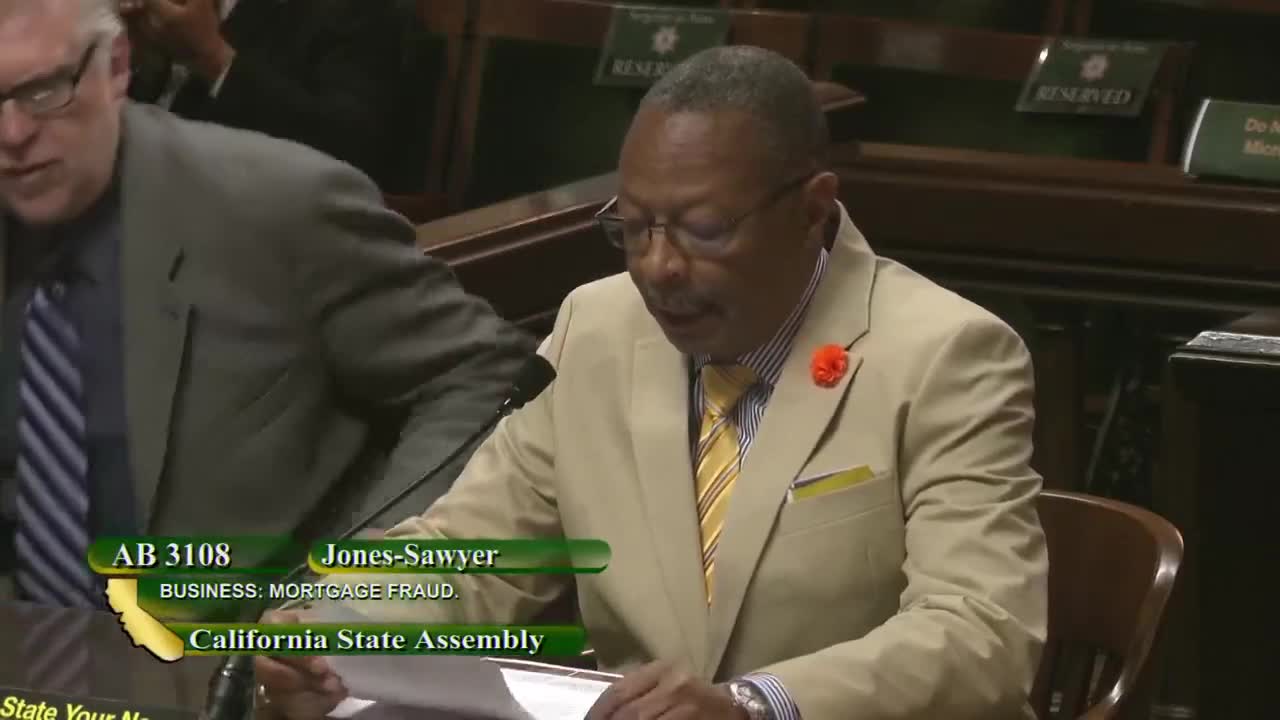 6MIN
Assembly Standing Committee on Banking and Finance
Bill Author

Bill Co-Author(s):