AB 3073: Wastewater testing: illicit substances.
- Session Year: 2023-2024
- House: Assembly
- Latest Version Date: 2024-03-21
Current Status:
Failed
(2024-05-16: In committee: Held under submission.)
Introduced
In Committee
First Chamber
In Committee
Second Chamber
Enacted
What does this bill do?
This bill creates a temporary pilot program run by the State Department of Public Health to test wastewater for high‑risk drugs and related treatment medicines, affecting participating local health agencies, wastewater treatment facilities, and qualified labs. The department will set protocols that protect privacy and consider environmental justice, recruit voluntary local partners, arrange sample collection and lab testing, and analyze results to guide public‑health actions. Target substances may include fentanyl, methamphetamine, cocaine, xylazine, methadone, buprenorphine, and naloxone, and the program may use grants or donations and must report findings to the Legislature.
The summary is provided by generative AI which can make mistakes. For original language, please view the details in the table below.
Existing law establishes the State Department of Public Health to implement various programs throughout the state relating to public health. The department administers the CDPH Wastewater Surveillance Network Dashboard that provides an overview of wastewater surveillance of SARS-CoV-2 in California. The dashboard includes wastewater samples collected and analyzed by the department, wastewater utilities, and academic, laboratory, and other partners across the state.
This bill would require the department, in consultation with participating wastewater treatment facilities, local public health agencies, and other subject matter experts, to create a pilot program to test for high-risk substances and related treatment medications in wastewater. Under the bill, the goal of the program would be to determine how wastewater data can be used by state and local public health programs to address substance abuse in California. The bill would require the department to develop a list of target substances to be analyzed during the program that may include cocaine, fentanyl, methamphetamine, xylazine, methadone, buprenorphine, and naloxone. The bill would require the department, on or before July 1, 2025, to solicit voluntary participation from local public health agencies and wastewater treatment facilities, as specified. The bill would require the department to work with the participating agencies and facilities to collect samples and to arrange for those samples to be tested by qualified laboratories. The bill would require the department, in consultation with public health agencies and subject matter experts, to analyze test results to determine possible public health interventions.
This bill would authorize the department to utilize external funding sources to complete the pilot program. The bill would create the Wastewater Testing for Illicit Substances Pilot Program Fund for the purpose of receiving moneys from grants or voluntary donations. The bill would require the department, on or before December 31, 2027, to report its findings and recommendations to the Legislature, as specified.
This bill would repeal these provisions on January 1, 2028.
Existing law requires the State Water Resources Control Board to classify types of wastewater treatment plants, as defined, for the purpose of determining the levels of competence necessary to operate them. Existing law requires a person who operates a nonexempt wastewater treatment plant to possess a valid, unexpired wastewater certificate of the appropriate grade. This bill would require the state board to create a program to test for illicit substances, including, but not limited to, cocaine, fentanyl, methamphetamine, and morphine, in wastewater, as provided. The bill would require local sanitation agencies to collect wastewater sample for testing by the state board. By imposing additional duties on local agencies, this bill would impose a state-mandated local program. The bill would require the state board to transmit the results of its wastewater testing to the State Department of Public Health for the department to post on its internet website.The California Constitution requires the state to reimburse local agencies and school districts for certain costs mandated by the state. Statutory provisions establish procedures for making that reimbursement.This bill would provide that, if the Commission on State Mandates determines that the bill contains costs mandated by the state, reimbursement for those costs shall be made pursuant to the statutory provisions noted above.Existing law requires the State Water Resources Control Board to classify types of wastewater treatment plants, as defined, for the purpose of determining the levels of competence necessary to operate them. Existing law requires a person who operates a nonexempt wastewater treatment plant to possess a valid, unexpired wastewater certificate of the appropriate grade.
This bill would require the state board to create a program to test for illicit substances, including, but not limited to, cocaine, fentanyl, methamphetamine, and morphine, in wastewater, as provided. The bill would require local sanitation agencies to collect wastewater sample for testing by the state board. By imposing additional duties on local agencies, this bill would impose a state-mandated local program. The bill would require the state board to transmit the results of its wastewater testing to the State Department of Public Health for the department to post on its internet website.
The California Constitution requires the state to reimburse local agencies and school districts for certain costs mandated by the state. Statutory provisions establish procedures for making that reimbursement.
This bill would provide that, if the Commission on State Mandates determines that the bill contains costs mandated by the state, reimbursement for those costs shall be made pursuant to the statutory provisions noted above.
For purposes of this chapter, the following terms have the following definitions:
(a)Department means the State Department of Public Health.
(b)Qualified laboratory means a public or private laboratory with significant experience testing for high-risk substances in wastewater in accordance with national standards and industry best practices.
25249.31.(a)The department, in consultation with participating wastewater treatment facilities, local public health agencies, and other subject matter experts, shall create a pilot program to test for high-risk substances and related treatment medications in wastewater.
(b)The goal of the pilot program is to determine how wastewater data can be used by state and local public health programs to address substance abuse in California.
25249.32.The department shall develop all of the following:
(a)Protocols for implementing wastewater surveillance for high-risk substances, analyzing the data, and using results to inform decisionmaking of state and local public health officials.
(b)Objectives to ensure that data is collected and presented in a way that is ethical, protective of privacy considerations, considers environmental justice implications, and that achieve the goal of the pilot program.
(c)A list of target substances to be analyzed during the pilot program. Target analytes may include high-risk substances and their metabolites or other markers, including, but not limited to, cocaine, fentanyl, methamphetamine, xylazine, methadone, buprenorphine, and naloxone.
25249.33.(a)On or before July 1, 2025, the department shall solicit voluntary participation from local public health agencies and wastewater treatment facilities.
(b)To be eligible to participate, a local public health agency and wastewater treatment facility having jurisdiction over some or all of the same population shall both voluntarily agree to participate in the pilot program.
(c)The department shall aim to include in the program local public health agencies and wastewater treatment facilities that, in the aggregate, are representative of California demographics, include representation from large urban and small rural populations, and that are geographically diverse.
25249.34.(a)(1)The department shall work with the participating local public health agencies and wastewater treatment facilities to collect samples. The department shall arrange for those samples to be tested by qualified laboratories.
(2)The department, after ensuring that sufficient capacity exists for testing in the pilot program by qualified laboratories, shall identify reliable methods for laboratory testing.
(3)The department, in consultation with the participating local public health agencies and wastewater facilities, shall determine the frequency and timing of sampling under the pilot program, and may test different configurations to determine a program design that will provide timely information useful for public health agencies.
(b)Participating laboratories shall transmit the results of wastewater testing to the participating local public health agencies, and the department. Each jurisdiction, including county health agencies, shall receive its own results.
(c)The department, in consultation with participating local public health agencies and other subject matter experts, shall analyze test results to determine possible public health interventions.
25249.35.(a)The department may consult with or contract with other existing wastewater epidemiology projects or public health programs being conducted or previously completed by nonprofits, nongovernmental organizations, academic institutions, and other governmental entities to develop the program.
(b)The department shall provide laboratory services for purposes of this program, either through state-operated laboratories or through contract laboratories, free of charge to participating wastewater facilities. Laboratory services include the provision of sample kits and the shipping and laboratory analysis of samples.
25249.36.(a)In addition to the departments existing funds, the department may utilize external funding sources to complete the pilot program. The department may solicit private donations or grants and may accept moneys donated by other wastewater epidemiology or opioid response programs.
(b)The Wastewater Testing for Illicit Substances Pilot Program Fund is hereby created for the purpose of receiving moneys from grants or voluntary donations to the fund from any person, educational institution, governmental entity, corporation or other business entity, or organization. All moneys in the fund are available, upon appropriation, to the department for the purposes of implementing this chapter.
25249.37.(a)The department, on or before December 31, 2027, shall submit a report to the Legislature stating the departments findings and recommendations. If the department recommends that a permanent wastewater testing program or extension or expansion of the pilot be implemented, the department shall include in the report program parameters, anticipated benefits, and implementation costs for state and local agencies.
(b)The report to be submitted pursuant to subdivision (a) shall be submitted in compliance with Section 9795 of the Government Code.
25249.38.This chapter shall remain in effect only until January 1, 2028, and as of that date is repealed.
SECTION 1.Section 13192 is added to the Water Code, to read:13192.(a)(1)The state board shall create a program to test for illicit substances in wastewater.(2)The State Department of Public Health shall advise the state board on what illicit substances to test for, including, but not limited to, cocaine, fentanyl, methamphetamine, and morphine.(b)The state board, in consultation with other jurisdictions operating wastewater drug testing programs in the United States and abroad, shall develop uniform standards for testing.(c)Local sanitation agencies shall collect wastewater samples for testing by the state board.(d)Testing may include testing for the substances, their metabolites, or other markers.(e)Testing shall occur twice a week, with one test on a weekday and one on a weekend, or more frequently, as determined by the state board in consultation with the State Department of Public Health.(f)The state board shall transmit the results of its wastewater testing to the State Department of Public Health which shall post the results on its internet website.SEC. 2.If the Commission on State Mandates determines that this act contains costs mandated by the state, reimbursement to local agencies and school districts for those costs shall be made pursuant to Part 7 (commencing with Section 17500) of Division 4 of Title 2 of the Government Code.(a)(1)The state board shall create a program to test for illicit substances in wastewater.
(2)The State Department of Public Health shall advise the state board on what illicit substances to test for, including, but not limited to, cocaine, fentanyl, methamphetamine, and morphine.
(b)The state board, in consultation with other jurisdictions operating wastewater drug testing programs in the United States and abroad, shall develop uniform standards for testing.
(c)Local sanitation agencies shall collect wastewater samples for testing by the state board.
(d)Testing may include testing for the substances, their metabolites, or other markers.
(e)Testing shall occur twice a week, with one test on a weekday and one on a weekend, or more frequently, as determined by the state board in consultation with the State Department of Public Health.
(f)The state board shall transmit the results of its wastewater testing to the State Department of Public Health which shall post the results on its internet website.
SEC. 2.If the Commission on State Mandates determines that this act contains costs mandated by the state, reimbursement to local agencies and school districts for those costs shall be made pursuant to Part 7 (commencing with Section 17500) of Division 4 of Title 2 of the Government Code.
|
Date
|
Status
|
|---|---|
| May 16, 2024 | In committee: Held under submission. |
| Apr 24, 2024 | In committee: Set, first hearing. Referred to APPR. suspense file. |
| Apr 10, 2024 | From committee: Do pass and re-refer to Com. on APPR. (Ayes 6. Noes 0.) (April 9). Re-referred to Com. on APPR. |
| Apr 1, 2024 | Re-referred to Com. on E.S. & T.M. |
| Mar 21, 2024 | From committee chair, with author's amendments: Amend, and re-refer to Com. on E.S. & T.M. Read second time and amended. |
| Mar 11, 2024 | Referred to Com. on E.S. & T.M. |
| Feb 17, 2024 | From printer. May be heard in committee March 18. |
| Feb 16, 2024 | Read first time. To print. |
|
Date
|
Description
|
Location
|
Votes
|
|
|---|---|---|---|---|
| Apr 9, 2024 | Do pass and be re-referred to the Committee on [Appropriations] | Assembly Standing Committee on Environmental Safety and Toxic Materials |
Passed |
This list shows positions taken on this bill by organizations on the date displayed, which is linked to the original source.
Positions by individuals are not included.
|
Organization
|
Position
|
Date
|
|---|---|---|
| California Assocation of Sanitation Agencies | * Support | Apr 9, 2024 |
| California State Association Of Counties | * Support | Apr 9, 2024 |
| County Health Executives Association | * Support | Apr 9, 2024 |
| County of Marin | * Support | Apr 9, 2024 |
| San Francisco Public Utilities Commission | * Support | Apr 9, 2024 |
| Stanford University | * Support | Apr 9, 2024 |
Date of Hearing: April 24, 2024
ASSEMBLY COMMITTEE ON APPROPRIATIONS
Buffy Wicks, Chair
ABPCA Bill Id:AB 3073
Author:(Haney) – As Amended Ver:March 21, 2024
Policy Committee: | Environmental Safety and Toxic Materials | Vote: | 6 - 0 |
|
| ||
|
|
Urgency: No State Mandated Local Program: No Reimbursable: No
SUMMARY:
This bill requires the California Department of Public Health (CDPH), in consultation with specified entities, to create a pilot program to test for high-risk substances and related treatment medications in wastewater, to determine how wastewater data can be used by state and local public health programs to address substance abuse in California.
Specifically, this bill, among other things:
1) Requires CDPH to develop all of the following: protocols for implementing wastewater surveillance for high-risk substances, analyzing the data, and using results to inform decisionmaking of state and local public health officials; objectives to ensure that data is collected and presented in a way that is ethical, protective of privacy considerations, considers environmental justice implications, and that achieve the goal of the pilot program; and a list of target substances to be analyzed during the pilot program, as specified.
2) Requires CDPH, on or before July 1, 2025, to solicit voluntary participation from local public health agencies and wastewater treatment facilities, as specified.
3) Requires CDPH to work with the participating local public health agencies and wastewater treatment facilities to collect samples, and requires CDPH to arrange for those samples to be tested by qualified laboratories, as specified.
4) Requires CDPH, in consultation with participating local public health agencies and other subject matter experts, to analyze test results to determine possible public health interventions.
5) Authorizes CDPH to consult or contract with other existing wastewater epidemiology projects or public health programs being conducted or previously completed by specified entities to develop the pilot program.
6) Requires CDPH to provide laboratory services for purposes of the pilot program, either through state-operated laboratories or through contract laboratories, free of charge to participating wastewater facilities.
7) Authorizes CDPH to use, in addition to its existing funds, external funding sources to complete the pilot program, and authorizes CDPH to solicit private donations or grants and to accept moneys donated by other wastewater epidemiology or opioid response programs.
8) Creates the Wastewater Testing for Illicit Substances Pilot Program Fund (Fund) for the purpose of receiving moneys from grants or voluntary donations from specified entities. Provides that all moneys in the Fund are available to CDPH, upon appropriation, to implement this bill.
9) Requires CDPH, on or before December 31, 2027, to submit a report to the Legislature with CDPH's findings and recommendations. Requires CDPH, if it recommends that a permanent wastewater testing program or extension or expansion of the pilot program be implemented, to include in the report program parameters, anticipated benefits, and implementation costs for state and local agencies.
10) Sunsets on January 1, 2028.
FISCAL EFFECT:
1) CDPH estimates laboratory costs of approximately $3 million in the first year and annual costs in the range of $1 million and $1.7 million (General Fund) in subsequent years until the program sunsets on January 1, 2028. Laboratory costs will cover equipment and six new positions to collect wastewater samples, conduct sample and data analyses, and post data online. Specific tasks include, among other things, developing the analytical and measurement methods for wastewater sample screening for illicit substances, performing chemical sample analyses, managing equipment and materials, conducting data review, and collaborating with local and state agencies.
2) CDPH notes its information technology costs are unknown but likely in the low hundreds of thousands of dollars (General Fund.)
According to the Legislative Analyst’s Office, the General Fund faces a structural deficit in the tens of billions of dollars over the next several fiscal years.
COMMENTS:
1) Purpose. According to the author:
Successfully used in Europe for over a decade, wastewater based drug testing allows local governments to pinpoint down to a neighborhood level dangerous spikes in the use of illicit drugs. Wastewater testing allows local public health departments to accurately allocate resources to tackle the rise of illegal drugs, allowing communities to feel safer and to save lives. The surge in illicit drug use has intensified California’s struggle with the overdose epidemic...Wastewater drug testing empowers us to be proactive and respond effectively and immediately when we see spikes in certain areas or of particular drugs.
2) Background. According to CDPH, wastewater surveillance, or wastewater-based epidemiology, is a public health tool that can track the presence and amount of pathogens in wastewater samples. These data can provide important information about the spread of diseases within a community or potentially as an early warning, even when people are not tested for a disease.
As an example, CDPH and the State Water Resources Control Board have been coordinating with several wastewater utilities, local health departments, universities, and laboratories in California on wastewater surveillance for SARS-CoV-2, the virus that causes COVID-19. Data collected from this network of participants, called the California Wastewater Surveillance Network, are submitted to the U.S. Centers for Disease Control and Prevention’s National Wastewater Surveillance System. According to the California Association of Sanitation Agencies (CASA), CDPH’s program now encompasses 26 million residents in 41 counties through voluntary sampling by public wastewater agencies.
According to the County Health Executives Association of California (CHEAC), a pilot program funded by the National Institute on Drug Abuse (NIDA) has several sites in California that are testing sewage samples for opioids and other drugs to inform overdose prevention efforts. The California Association of Counties notes this pilot program is set to expire in August of this year. CHEAC contends, “With California experiencing an overdose epidemic with 7,385 deaths in 2022, AB 3073 provides a potential tool to better target public health interventions in our communities to address this catastrophe.”
Analysis Prepared by: Nikita Koraddi / APPR. / (916) 319-2081
Date of Hearing: April 9, 2024
ASSEMBLY COMMITTEE ON ENVIRONMENTAL SAFETY AND TOXIC MATERIALS
Eduardo Garcia, Chair
ABPCA Bill Id:AB 3073 (
Author:Haney) – As Amended Ver:March 21, 2024
SUBJECT: Wastewater testing: illicit substances
SUMMARY: Requires the California Department of Public Health (CDPH), in consultation with participating wastewater treatment facilities, local public health agencies, and other subject matter experts, to create a pilot program (pilot program) to test for high-risk substances and related treatment medications in wastewater. Specifically, this bill:
1) Defines "Department" as the California Department of Public Health (CDPH).
2) Requires CDPH, in consultation with participating wastewater treatment facilities, local public health agencies, and other subject matter experts, to create a pilot program to test for high-risk substances and related treatment medications in wastewater. Provides that the goal of the pilot program is to determine how wastewater data can be used by state and local public health programs to address substance abuse in California.
3) Requires CDPH to develop all of the following: protocols for implementing wastewater surveillance for high-risk substances, analyzing the data, and using results to inform decision-making of state and local public health officials; objectives to ensure that data is collected and presented in a way that is ethical, protective of privacy considerations, considers environmental justice implications, and that achieve the goal of the pilot program; and, a list of target substances to be analyzed during the pilot program.
4) Requires, on or before July 1, 2025, CDPH to solicit voluntary participation from local public health agencies and wastewater treatment facilities.
5) Requires CDPH to aim to include in the pilot program local public health agencies and wastewater treatment facilities that, in the aggregate, are representative of California demographics, include representation from large urban and small rural populations, and that are geographically diverse.
6) Requires CDPH to work with the participating local public health agencies and wastewater treatment facilities to collect samples; requires CDPH to arrange for those samples to be tested by qualified laboratories.
7) Requires CDPH, after ensuring that sufficient capacity exists for testing in the pilot program by qualified laboratories, to identify reliable methods for laboratory testing.
8) Requires CDPH, in consultation with the participating local public health agencies and wastewater facilities, to determine the frequency and timing of sampling under the pilot program.
9) Requires laboratories that are participating in the pilot program to transmit the results of wastewater testing to the participating local public health agencies, and to CDPH.
10) Requires CDPH, in consultation with participating local public health agencies and other subject matter experts, to analyze test results to determine possible public health interventions.
11) Authorizes CDPH to consult or contract with other existing wastewater epidemiology projects or public health programs being conducted or previously completed by nonprofits, nongovernmental organizations, academic institutions, and other governmental entities to develop the pilot program.
12) Requires CDPH to provide laboratory services for purposes of the pilot program, either through state-operated laboratories or through contract laboratories, free of charge to participating wastewater facilities.
13) Authorizes CDPH to use, in addition to their existing funds, external funding sources to complete the pilot program; authorizes CDPH to solicit private donations or grants and to accept moneys donated by other wastewater epidemiology or opioid response programs.
14) Creates the Wastewater Testing for Illicit Substances Pilot Program Fund (Fund) for the purpose of receiving moneys from grants or voluntary donations from any person, educational institution, governmental entity, corporation, or other business entity or organization. Provides that all moneys in the Fund are available to CDPH, upon appropriation by the Legislature to implement the pilot program.
15) Requires CDPH, on or before December 31, 2027, to submit a report to the Legislature stating CDPH's findings and recommendations. Requires CDPH, if it recommends that a permanent wastewater testing program or extension or expansion of the pilot program be implemented, to include in the report program parameters, anticipated benefits, and implementation costs for state and local agencies.
EXISTING LAW:
1) Declares, under the Porter-Cologne Water Quality Control Act (Porter-Cologne Act), that the health, safety, and welfare of people require there to be a statewide program for water quality control and that the statewide program for water quality control can be most effectively administered regionally, within a framework of statewide coordination and policy. (Water Code (WC) § 13000)
2) Defines "wastewater treatment plant" as any of the following:
(a) Any facility owned by a state, local, or federal agency and used in the treatment or reclamation of sewage or industrial wastes;
(b) Any privately owned facility used in the treatment or reclamation of sewage or industrial wastes, and regulated by the Public Utilities Commission; or,
- Any privately owned facility used primarily in the treatment or reclamation of sewage for which the State Water Resources Control Board (State Water Board) or a Regional Water Quality Control Board (Regional Water Board) has issued waste discharge requirements. (WC 13625 § (d)(1))
3) Requires the CDPH to maintain a laboratory and branch laboratories as necessary to perform the microbiological, physical, and chemical analyses required to meet the responsibilities of CDPH. (Health and Safety Code (HSC) § 100250).
4) Establishes the intent of the Legislature to establish an Environmental Health Surveillance System to establish ongoing surveillance of the environmental exposures and diseases affecting Californians. (HSC § 104324)
FISCAL EFFECT: Unknown.
COMMENTS:
Need for the bill: According to the author: "Successfully used in Europe for over a decade, wastewater based drug testing allows local governments to pinpoint down to a neighborhood level dangerous spikes in the use of illicit drugs. Wastewater testing allows local public health departments to accurately allocate resources to tackle the rise of illegal drugs, allowing communities to feel safer and to save lives.
The surge in illicit drug use has intensified California’s struggle with the overdose epidemic. Driven by the proliferation of fentanyl and Tranq, overdose-related deaths in San Francisco peaked to more than 750 people in 2023, taking nearly three times as many lives as COVID-19 at its peak in 2021. Nationally, an estimated 109,680 drug overdose deaths were recorded in 2022 alone according to the CDC 300 Americans each day.
Wastewater drug testing empowers us to be proactive and respond effectively and immediately when we see spikes in certain areas or of particular drugs. The state cannot simply wait for people to die before we act. Wastewater drug testing can give us critical information to respond quicker to stop these drugs and intervene smarter and deploy resources with more precision."
State Water Board authority over sewer systems: To provide a consistent, statewide regulatory approach to address sanitary sewer spills, the State Water Board adopted a General Order for Waste Discharge Requirements for Sanitary Sewer Systems (General Order). The General Order requires public agencies that own or operate sanitary sewer systems to develop and implement sewer system management plans and report all sanitary sewer spills to the State Water Board’s online California Integrated Water Quality System (CIWQS) Sanitary Sewer System Database. Among the requirements of the General Order are requirements to monitor, track, and analyze spills for ongoing system-specific performance.
According to its 2022 General Order, the State Water Board regulates over 1,100 publicly owned sanitary sewer systems. California also has a large unknown number of unregulated privately owned sanitary sewer systems. Under authority granted pursuant to the Clean Water Act and the Porter-Cologne Act, the State Water Board's General Order regulates sewer service providers, which can include state agencies, federal agencies, municipalities, special districts, private companies, or other non-governmental entities that own and/or operate a sewer system. The General Order regulates multiple aspects of sewer systems, including the discharge of sewage and monitoring and reporting requirements.
The California Department of Public Health (CDPH): CDPH works to protect the public's health in the Golden State and helps shape positive health outcomes for individuals, families, and communities. CDPH's fundamental responsibilities are comprehensive in scope and include infectious disease control and prevention, food safety, environmental health, laboratory services, patient safety, emergency preparedness, chronic disease prevention and health promotion, family health, health equity, and vital records and statistics. CDPH's key activities and services include protecting people in California from the threat of preventable infectious diseases like Zika virus, HIV/AIDS, tuberculosis and viral hepatitis, and providing reliable and accurate public health laboratory services and information about health threats.
Wastewater surveillance for SARS-CoV-2 virus: CDPH and the State Water Board together are coordinating with several wastewater utilities, local health departments, universities and laboratories in California on wastewater surveillance for SARS-CoV-2, the virus causing COVID-19. Data collected from this network of participants, called the California Surveillance of Wastewater Systems (Cal-SuWers) Network, are submitted to the U.S. Centers for Disease Control and Prevention (CDC) National Wastewater Surveillance System (NWSS). Along with local partners, CDPH is monitoring and quantifying levels of SARS-CoV-2 at the headworks or "influent" of 13 wastewater treatment plants.
Wastewater surveillance, or wastewater-based epidemiology, is a public health tool that can track the presence and amount of pathogens (e.g., viruses, such as SARS-CoV2, bacteria, etc.) in wastewater samples. These data can provide important information about the spread of diseases within a community or potentially as an early warning, even when people are not tested for a disease. This can be an especially important tool for diseases that are not reportable to public health, that are not routinely tested for, or if people rely on at-home testing, which often does not get reported to public health. Wastewater surveillance ca provide insight about the spread of pathogens within a community, as infected persons can shed pathogens in their waste, with or without symptoms. Sewage or waste from an entire community is conveyed to a wastewater treatment plant through a network of underground pipes and connections, also known as a sewershed or service area. Samples of raw wastewater are collected at the headworks of a treatment plant before the wastewater is treated. These samples are then shipped to a laboratory, where they are analyzed to quantify the amount of viral genomic material present. The results and data are shared with epidemiologists at public health departments, who interpret trends in the data to inform public health actions.
Wastewater monitoring for SARS-CoV-2 is carried out by several groups, including CDPH. Other groups also monitor wastewater, with some contributing data to the California Wastewater Surveillance Network (CA WWS Network), managed by CDPH. These data are used for state and local public health, and submitted to the (CDC)(NWSS).
Wastewater surveillance data limitations: Wastewater surveillance for viral detection is still a developing field. Lessons learned from SARS-CoV2 wastewater surveillance include:
- It is not possible to reliably and accurately predict the total number of infected individuals in a community based on sewage surveillance alone.
- Wastewater surveillance will not represent homes on septic-based systems.
- Community-level wastewater surveillance at a wastewater treatment plant will not represent communities or facilities served by decentralized systems, such as prisons, universities, or hospitals that treat their own sewage.
- Low levels of infection in a community may not be captured by sewage surveillance if the quantity of SARS-CoV-2 falls below the limit of detection for laboratory analysis.
- Wastewater is a complex environmental sample and inherent variability in measured concentrations are expected due to environmental variability, day-to-day differences in sewershed and population dynamics, and laboratory variability. As such, trends are more reliable than individual data points; concentration of any individual data point may reflect variability and should be interpreted with caution.
Wastewater surveillance could help guide responses to the opioid epidemic: According to the 2023 article, "Wastewater-based monitoring could help guide responses to the USA opioid epidemic," published in the journal Nature Water (Ahmed, et. al):
"The successful use of wastewater-based data during the COVID-19 pandemic has led to the creation of the National Wastewater Surveillance System in the USA for pathogen monitoring. Now a complementary system is needed for help tackling the opioid epidemic.
In 2021, the Centers for Disease Control and Prevention (CDC) reported annual deaths from drug-involved overdoses in the United States exceeded 100,000 people, with opioids primarily responsible for 75% of overdoses. With opioid overdose deaths having accelerated during the COVID-19 pandemic, better data are urgently needed to illuminate the dynamic shifts in drug use that are occurring. Wastewater-based epidemiology has played a significant role in helping officials monitor and respond to the COVID-19 pandemic. This innovative approach to public health surveillance can also be harnessed for more timely monitoring of the opioid epidemic.
Around the world, wastewater-based epidemiology has become a valuable public health tool to identify the emergence and progression of COVID-19 outbreaks. The CDC has partnered with the US Department of Health and Human Services and other agencies to establish a National Wastewater Surveillance System (NWSS). The current system, which covers 46 states, five cities and two territories (more than 133 million people), is oriented to addressing the COVID-19 pandemic, with an eye towards future monitoring of foodborne illnesses and antimicrobial resistance.
We believe that the United States should develop a similar system to monitor the use of opioids and other drugs. Specifically, there is a need for support from federal agencies to boost the analytic capabilities of testing labs across the county for wastewater monitoring, conduct inter-laboratory validation studies to ensure nationwide robustness, coordinate with state and tribal health agencies to facilitate widespread sampling that is conducted in an ethical manner, and develop standardized reporting procedures and clear messaging around the results. The CDC would be the most appropriate agency to lead this effort, given their leadership with NWSS. A 2023 National Academies report on wastewater-based infectious disease surveillance stated that: [w]hen evaluating potential targets for future wastewater surveillance, CDC should consider three criteria: (1) public health significance of the threat, (2) analytical feasibility for wastewater surveillance, and (3) usefulness of community-level wastewater surveillance data to inform public health action. While this was written with infectious disease as the focus, we believe this sentiment and these three criteria perfectly match with using wastewater for opioid monitoring.
Wastewater is essentially a pooled urine and faeces sample of a community that includes biomarkers of both biological and chemical exposures. A national wastewater surveillance system to monitor opioids and other emerging illicit drugs such as benzodiazepines could help public health and safety officials anticipate new drug outbreaks and respond more quickly to protect the health of US citizens.
Although US government and health officials have data on opioid prescribing practices, hospital admissions, drugs seizures, surveys, and arrests, the release of these data usually lags well behind trends in opioid use because it takes time to collect, structure, analyse, and report the data. Further, people often do not know which opioids or other drugs they are consuming, and so cannot accurately report such on the self-reported surveys that the federal government relies on to understand drug use trends, the populations affected, and the need for treatment services. Wastewater data, by contrast, provide more granular, drug specific, near-real-time information on patterns of opioid and other drug use.
Wastewater-based epidemiology has been used for over a decade in Australia and Europe, and to a lesser extent North America and Asia, to monitor population trends in licit and illicit drug use. Wastewater evidence of a five-fold increase in methamphetamine use in Australia from 2009 to 2015 led the Australian Government to establish a National Wastewater Drug Monitoring Program. Subsequent monitoring of fentanyl observed a higher baseline use in rural areas, and a nearly 150% increase in consumption between 2016 and 2018.
Communities could opt into the opioid expansion of the NWSS. The number of municipalities included in NWSS has greatly expanded during the pandemic, though some remain hesitant to participate in SARS-CoV-2 surveillance due to fears of stigmatization. Finding communities to participate in opioid monitoring may prove more difficult, but communities can be given the choice to opt into an opioid expansion of the NWSS. While some may opt out, due to concerns around privacy or stigmatization, others that continue to seek out better data on drug use to inform their response could benefit."
This bill: AB 3073 requires CDPH to develop and implement a pilot project to test wastewater for illicit drugs. This pilot program could be used to inform other states and the CDC on the potential parameters of a national wastewater surveillance program for illicit drugs. It is important to note that participation in this pilot project by wastewater agencies is voluntary.
Arguments in Support: According to the California Association of Sanitation Agencies, "Wastewater Surveillance (WS) is a public health tool that has been utilized for decades to track diseases such as polio, particularly in developing countries. During the early days of the COVID-19 pandemic in the spring of 2020, WS was elevated to the forefront of the pandemic response as a potential resource to monitor the spread of disease and help support and inform public health interventions. Wastewater agencies responded quickly by collecting and providing treatment plant influent samples to various exploratory programs and academic efforts. The Centers for Disease Control and Prevention (CDC) launched the National Wastewater Surveillance System (NWSS) in September 2020 to build the nation’s capacity to track the presence of SARS-CoV-2 in wastewater across the country through multiple support mechanisms.
In December 2020, CDPH started a pilot program with a few wastewater utilities and local public health agencies to test the implementation of WS and the integration of this new data source into the existing suite of public health metrics. The pilot grew into the California Wastewater Surveillance Network, which now encompasses approximately 26 million residents in 41 counties through voluntary sampling by public wastewater agencies.
AB 3073 would build upon the success of existing WS efforts to evaluate whether testing wastewater for illicit substances such as opioids and the drugs used to treat opioid overdoses can provide helpful data for public health interventions and responses."
Arguments in Opposition:
None on file.
REGISTERED SUPPORT / OPPOSITION:
Support
California Association of Sanitation Agencies
California State Association of Counties
County Health Executives Association of California (CHEAC)
San Francisco Public Utilities Commission
Opposition
None on file.
Analysis Prepared by: Josh Tooker / E.S. & T.M. /
Discussed in Hearing
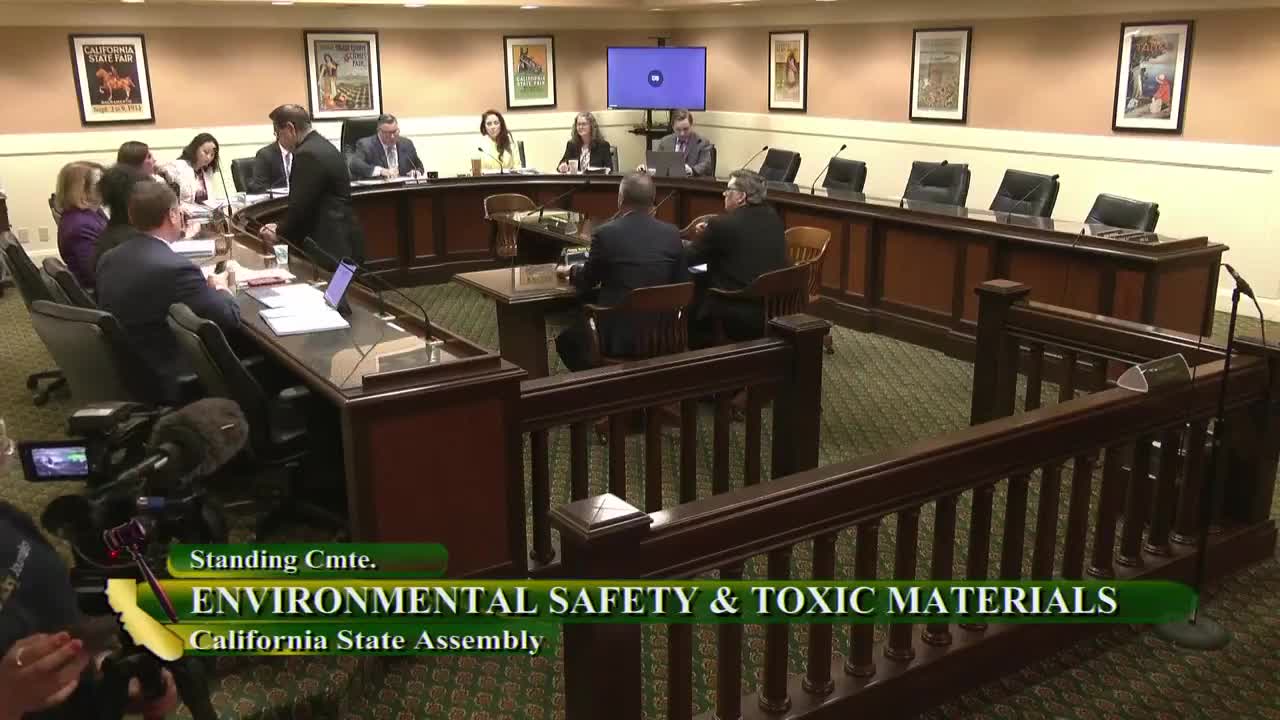 8MIN
Assembly Standing Committee on Environmental Safety and Toxic Materials
Bill Author

Bill Co-Author(s):