AB 3100: Assumption of mortgage loans: dissolution of marriage.
- Session Year: 2023-2024
- House: Assembly
- Latest Version Date: 2024-09-22
Current Status:
Passed
(2024-09-22: Chaptered by Secretary of State - Chapter 431, Statutes of 2024.)
Introduced
In Committee
First Chamber
In Committee
Second Chamber
Enacted
Existing law defines and regulates mortgages, including recording notices of default and applications for loan modification. The California Consumer Financial Protection Law requires the Department of Financial Protection and Innovation to regulate the offering and provision of consumer financial products or services under California consumer financial laws and to exercise nonexclusive oversight and enforcement authority under California consumer financial laws.
This bill would require a conventional home mortgage loan originated on or after January 1, 2027, and secured by owner-occupied residential real property containing 4 or fewer dwelling units with multiple borrowers to include provisions to allow for any of the existing borrowers to purchase the property interest of another borrower on the loan by assuming the sellers portion of the mortgage under specified circumstances if the assuming borrower qualifies for the underlying loan, as determined by the lender.
Existing law defines and regulates mortgages, including recording notices of default and applications for loan modification. The California Consumer Financial Protection Law requires the Department of Financial Protection and Innovation to regulate the offering and provision of consumer financial products or services under California consumer financial laws and to exercise nonexclusive oversight and enforcement authority under California consumer financial laws.
This bill would require a conventional home mortgage loan originated on or after January 1, 2027, and secured by owner-occupied residential real property containing 4 or fewer dwelling units with multiple borrowers to include provisions to allow for any of the existing borrowers to purchase the property interest of another borrower on the loan by assuming the sellers portion of the mortgage under specified circumstances if the assuming borrower qualifies for the underlying loan, as determined by the lender.
Existing law defines and regulates mortgages, including recording notices of default and applications for loan modification. The California Consumer Financial Protection Law requires the Department of Financial Protection and Innovation to regulate the offering and provision of consumer financial products or services under California consumer financial laws and to exercise nonexclusive oversight and enforcement authority under California consumer financial laws.
This bill would, beginning January 1, 2025, would require a conventional home mortgage loan on originated on or after January 1, 2027, and secured by owner-occupied residential real property containing less than 5 4 or fewer dwelling units with multiple borrowers to include provisions to allow for any of the existing borrowers to purchase the property interest of another borrower on the loan by assuming the sellers portion of the mortgage under specified circumstances if the assuming borrower qualifies for the underlying loan, as determined by the lender. The bill would require an explanation of the loan assumption process to be included in the loan documents provided to the borrowers.
Existing law defines and regulates mortgages, including recording notices of default and applications for loan modification.
This bill would, beginning January 1, 2025, require a conventional home mortgage loan on residential real property containing less than 5 dwelling units with multiple borrowers to include provisions to allow for any of the existing borrowers to purchase the property interest of another borrower on the loan by assuming the sellers portion of the mortgage under specified circumstances if the assuming borrower qualifies for the underlying loan. loan, as determined by the lender. The bill would require an explanation of the loan assumption process to be included in the loan documents provided to the borrowers.
Existing law defines and regulates mortgages, including recording notices of default and applications for loan modification.
This bill would, beginning January 1, 2025, require a conventional home mortgage loan on residential real property with multiple borrowers to include provisions to allow for any of the existing borrowers to purchase the property interest of another borrower on the loan by assuming the sellers portion of the mortgage if the assuming borrower qualifies for the underlying loan. The bill would require an explanation of the loan assumption process to be included in the loan documents provided to the borrowers.
The California Financing Law prohibits a person from engaging in the business of a finance lender or broker without obtaining a license from the Commissioner of Financial Protection and Innovation and requires a licensee engaging in the business of making or brokering residential mortgage loans to require that a mortgage loan originator employed or compensated by that licensee obtains and maintains a mortgage loan originator license from the commissioner.This bill would express the intent of the Legislature to enact legislation that would relate to requiring additional transparency and notification on how to assume a mortgage loan.The California Financing Law prohibits a person from engaging in the business of a finance lender or broker without obtaining a license from the Commissioner of Financial Protection and Innovation and requires a licensee engaging in the business of making or brokering residential mortgage loans to require that a mortgage loan originator employed or compensated by that licensee obtains and maintains a mortgage loan originator license from the commissioner.
This bill would express the intent of the Legislature to enact legislation that would relate to requiring additional transparency and notification on how to assume a mortgage loan.
(a)A conventional home mortgage loan originated on or after January 1, 2027, and secured by owner-occupied residential real property containing four or fewer dwelling units with multiple borrowers shall include provisions to allow for any of the existing borrowers to purchase the property interest of another borrower on the loan by assuming the sellers portion of the mortgage in connection with a decree of dissolution of marriage, a legal separation agreement, or an incidental property settlement if the assuming borrower qualifies for the underlying loan, as determined by the lender.
(b)For purposes of this section:
(1)Conventional home mortgage loan means a mortgage loan that is not insured or guaranteed by the federal government.
(2)Owner-occupied means that the property is the principal residence of the borrowers and is security for a loan made for personal, family, or household purposes.
(a)A conventional home mortgage loan originated on or after January 1, 2027, and secured by owner-occupied residential real property containing four or fewer dwelling units with multiple borrowers shall include provisions to allow for any of the existing borrowers to purchase the property interest of another borrower on the loan by assuming the sellers portion of the mortgage in connection with a decree of dissolution of marriage, a legal separation agreement, or an incidental property settlement if the assuming borrower qualifies for the underlying loan, as determined by the lender.
(b)For purposes of this section:
(1)Conventional home mortgage loan means a mortgage loan that is not insured or guaranteed by the federal government.
(2)Owner-occupied means that the property is the principal residence of the borrowers and is security for a loan made for personal, family, or household purposes.
(a)On or after January 1, 2025, a A conventional home mortgage loan on originated on or after January 1, 2027, and secured by owner-occupied residential real property containing less than five four or fewer dwelling units with multiple borrowers shall include provisions to allow for any of the existing borrowers to purchase the property interest of another borrower on the loan by assuming the sellers portion of the mortgage in connection with a decree of dissolution of marriage, a legal separation agreement, or an incidental property settlement if the assuming borrower qualifies for the underlying loan, as determined by the lender.
(b)An explanation of the loan assumption process shall be included in the loan documents provided to the borrowers.(c)(b)For purposes of this section, a conventional home mortgage loan means a mortgage loan that is not insured or guaranteed by the federal government. section:
(1)Conventional home mortgage loan means a mortgage loan that is not insured or guaranteed by the federal government.
(2)Owner-occupied means that the property is the principal residence of the borrowers and is security for a loan made for personal, family, or household purposes.
(a)On or after January 1, 2025, a conventional home mortgage loan on residential real property containing less than five dwelling units with multiple borrowers shall include provisions to allow for any of the existing borrowers to purchase the property interest of another borrower on the loan by assuming the sellers portion of the mortgage in connection with a decree of dissolution of marriage, a legal separation agreement, or an incidental property settlement if the assuming borrower qualifies for the underlying loan. An loan, as determined by the lender.
(b)An explanation of the loan assumption process shall be included in the loan documents provided to the borrowers.
(b)(c)For purposes of this section, a conventional home mortgage loan means a mortgage loan that is not insured or guaranteed by the federal government.
(a)On or after January 1, 2025, a conventional home mortgage loan on residential real property with multiple borrowers shall include provisions to allow for any of the existing borrowers to purchase the property interest of another borrower on the loan by assuming the sellers portion of the mortgage if the assuming borrower qualifies for the underlying loan. An explanation of the loan assumption process shall be included in the loan documents provided to the borrowers.
(b)For purposes of this section, a conventional home mortgage loan means a mortgage loan that is not insured or guaranteed by the federal government.
SECTION 1.It is the intent of the Legislature to enact legislation that would relate to requiring additional transparency and notification on how to assume a mortgage loan.It is the intent of the Legislature to enact legislation that would relate to requiring additional transparency and notification on how to assume a mortgage loan.
|
Date
|
Status
|
|---|---|
| Sep 22, 2024 | Chaptered by Secretary of State - Chapter 431, Statutes of 2024. |
| Sep 22, 2024 | Approved by the Governor. |
| Sep 5, 2024 | Enrolled and presented to the Governor at 4 p.m. |
| Aug 27, 2024 | Senate amendments concurred in. To Engrossing and Enrolling. (Ayes 77. Noes 0.). |
| Aug 27, 2024 | Assembly Rule 77 suspended. |
| Aug 26, 2024 | In Assembly. Concurrence in Senate amendments pending. May be considered on or after August 28 pursuant to Assembly Rule 77. |
| Aug 26, 2024 | Read third time. Passed. Ordered to the Assembly. (Ayes 39. Noes 0.). |
| Aug 7, 2024 | Read second time. Ordered to third reading. |
| Aug 6, 2024 | From committee: Do pass. (Ayes 7. Noes 0.) (August 5). |
| Jun 26, 2024 | From committee: Do pass and re-refer to Com. on APPR with recommendation: To Consent Calendar. (Ayes 11. Noes 0.) (June 25). Re-referred to Com. on APPR. |
| Jun 20, 2024 | From committee: Do pass and re-refer to Com. on JUD. (Ayes 6. Noes 0.) (June 19). Re-referred to Com. on JUD. |
| Jun 6, 2024 | From committee chair, with author's amendments: Amend, and re-refer to committee. Read second time, amended, and re-referred to Com. on B. & F.I. |
| May 1, 2024 | Referred to Coms. on B. & F.I. and JUD. |
| Apr 22, 2024 | In Senate. Read first time. To Com. on RLS. for assignment. |
| Apr 22, 2024 | Read third time. Passed. Ordered to the Senate. (Ayes 68. Noes 0. Page 4919.) |
| Apr 17, 2024 | Read second time. Ordered to Consent Calendar. |
| Apr 16, 2024 | From committee: Do pass. To Consent Calendar. (Ayes 12. Noes 0.) (April 16). |
| Apr 15, 2024 | Re-referred to Com. on JUD. |
| Apr 11, 2024 | From committee chair, with author's amendments: Amend, and re-refer to Com. on JUD. Read second time and amended. |
| Apr 1, 2024 | Re-referred to Com. on JUD. |
| Mar 21, 2024 | Referred to Com. on JUD. |
| Mar 21, 2024 | From committee chair, with author's amendments: Amend, and re-refer to Com. on JUD. Read second time and amended. |
| Feb 17, 2024 | From printer. May be heard in committee March 18. |
| Feb 16, 2024 | Read first time. To print. |
|
Date
|
Description
|
Location
|
Votes
|
|
|---|---|---|---|---|
| Aug 27, 2024 | AB 3100 Low Concurrence in Senate Amendments | Assembly Floor |
Passed |
|
| Aug 26, 2024 | Assembly 3rd Reading AB3100 Low By Grove | Senate Floor |
Passed |
|
| Aug 5, 2024 | Do pass | Senate Standing Committee on Appropriations |
Passed |
|
| Jun 25, 2024 | Do pass, but first be re-referred to the Committee on [Appropriations] with the recommendation: To Consent Calendar | Senate Standing Committee on Judiciary |
Passed |
|
| Jun 19, 2024 | Do pass, but first be re-referred to the Committee on [Judiciary] | Senate Standing Committee on Banking and Financial Institutions |
Passed |
|
| Apr 22, 2024 | AB 3100 Low Consent Calendar Second Day | Assembly Floor |
Passed |
|
| Apr 16, 2024 | Do pass. To Consent Calendar. | Assembly Standing Committee on Judiciary |
Passed |
This list shows positions taken on this bill by organizations on the date displayed, which is linked to the original source.
Positions by individuals are not included.
|
Organization
|
Position
|
Date
|
|---|---|---|
| California Association Of Realtors | ** Support |
CONCURRENCE IN SENATE AMENDMENTS
CSA1 Bill Id:AB 3100
Author:(Low)
As Amended Ver:June 6, 2024
Majority vote
SUMMARY
Requires conventional home mortgage loans on certain residential real properties with multiple borrowers to include provisions to allow for assumption of a co-borrower's portion of the mortgage in connection with a divorce by another co-borrower. Specifically, this bill:
- Establishes that on any conventional home mortgage loan on owner-occupied residential real property that originated on or after January 1, 2027, and which contains four or fewer dwellings with multiple borrowers, must include provisions to allow for any of the existing borrowers to purchase the property interest of another borrower on the loan by assuming the seller's portion.
- Provides that 1) applies only if the borrower wanting to assume the other portion of the loan qualifies for the underlying loan, as determined by the lender.
- Defines "conventional home mortgage loan" as a mortgage loan that is not insured or guaranteed by the federal government.
- Defines "owner-occupied" as the property that is the principal residence of the borrowers and is security for a loan made for personal, family, or household purposes.
Senate Amendments
Clarify the type of transactions that fall within the provisions of the bill.
COMMENTS
An estimated 39 percent of marriages may end in divorce. Considering that nearly 65 percent of Americans own homes, it is likely that a couple facing divorce will have to figure out how to deal with a mortgage once they are no longer together. Generally, couples in this situation pursue one of two options – sell the home and divide the proceeds or one of them buys the other out, either in cash or by refinancing the mortgage to become the sole borrower. With the recent rise of home mortgage interest rates, the refinancing option might mean that, even if they independently qualify, the new sole borrower's monthly mortgage would be significantly higher than before the refinance. This bill codifies another option, consistent with existing federal guidelines: one co-borrower may assume the other's portion of the loan, along with its existing terms and rates. The measure clarifies that the assumption in the case of a marital dissolution would be available to a co-borrower under specified circumstances, and only if the assuming borrower qualifies for the underlying loan, as determined by the lender. This measure would also require the lender to provide an explanation of the loan assumption process in the loan documents provided to borrowers.
What is a conventional home mortgage loan? A conventional mortgage loan is a type of home loan that is not insured or guaranteed by the government. Instead, it is originated and funded by private lenders such as banks, credit unions, or mortgage companies. Conventional loans typically follow guidelines set by Fannie Mae and Freddie Mac, which are two major government-sponsored enterprises (GSEs). However, they can also be offered by private lenders outside of these guidelines. Conventional loans often require higher down payments and have stricter qualification criteria compared to government-backed loans. Borrowers with good credit and stable income may prefer conventional loans because they often offer competitive interest rates and terms.
Conventional home mortgage loans must generally conform to the guidelines set by GSEs. Government-sponsored enterprises (GSEs) like Fannie Mae or Freddie Mac are entities established by the government to provide liquidity and stability to the mortgage market by purchasing and securitizing mortgages. Fannie Mae and Freddie Mac do not originate loans directly but provide liquidity to the mortgage market by purchasing mortgages from lenders and bundling them into mortgage-backed securities, which are sold to investors. GSEs also establish standards and guidelines for the loans they purchase, which lenders must adhere to in order to sell their loans to Fannie Mae or Freddie Mac. The primary goal of GSEs in the mortgage market is to promote stability, affordability, and access to mortgage credit for borrowers. They help facilitate the availability of funds for lenders to originate mortgages, which in turn supports homeownership and the housing market.
GSE guidelines on assumption of loans. Most conventional mortgages — the ones offered by private lenders — are not assumable. They contain what's called a due-on-sale or due-on-transfer clause, which mandates the mortgage be paid in full whenever the original borrower sells the residence. But in certain special circumstances, conventional loans can be assumable. GSEs like Fannie Mae and Freddie Mac establish guidelines for loan assumptions, which are agreements where a new borrower takes over an existing mortgage from the original borrower. These guidelines typically outline the conditions under which loan assumptions are allowed and the process involved. Assumption of a mortgage occurs when a new borrower takes over an existing mortgage from the original borrower, without the need to obtain a new mortgage loan. In an assumption, the original borrower transfers the mortgage obligation to the assuming borrower, who becomes responsible for making future mortgage payments. The assuming borrower typically undergoes a qualification process to ensure they meet the lender's criteria for assuming the mortgage. This may involve a credit check, verification of income and assets, and approval from the lender. Unlike a transfer of ownership, where the property changes hands, the property ownership remains unchanged in an assumption. Only the mortgage liability is transferred to the assuming borrower.
The federal Garn-St. Germain Depository Institutions Act of 1982, introduced several provisions related to the assumption of mortgages. These guidelines aimed to facilitate the transfer of existing mortgage obligations from the original borrower to a new borrower. One of the significant changes introduced by the Gran St. Germain Act was the imposition of restrictions on due-on-sale clauses in mortgage contracts. The Act restricted the enforcement of due-on-sale clauses under certain circumstances. Specifically, it prohibited lenders from exercising their due-on-sale rights in cases where the property transfer occurred through inheritance, divorce, or other family-related transactions.
This bill codifies under state law that a conventional home mortgage may be assumed by a co-borrower, in connection with dissolution of a marriage, so long as the co-borrower who is assuming the loan qualifies pursuant to the bank. The bill appears to comply with the federal Garn-St. Germain Act because it clarifies that a lender may evaluate the creditworthiness of the assuming co-borrower before making a decision to allow assumption of the loan. The bill further establishes that a lender must provide an explanation of the loan assumption process on loan documents provided to the borrower.
According to the Author
AB 3100 addresses the problem of rising interest rates causing high monthly payments for homeowners, especially during life transitions like divorce. The bill mandates changes to home mortgage loans, allowing existing borrowers to assume other borrowers' property interest if they qualify, avoiding refinancing and higher interest rates. This simplifies the loan assumption process and promotes homeownership stability. AB 3100 ensures practical solutions that empower Californians to navigate housing transitions without unnecessary financial burdens, ensuring a secure and equitable housing market.
Arguments in Support
The California Association of Realtors explains its support of the measure:
AB 3100 will codify federal guidelines that allow conventional home mortgage loans on certain residential real properties with multiple borrowers to include provisions to allow for assumption of a co-borrower's portion of the mortgage in connection with a divorce by another co-borrower.
According to the National Association of REALTORS®, 61 percent of first-time homebuyers are married couples. However, with the national divorce rate hovering around 40 percent, the guaranteed ability to assume a current mortgage loan (upon qualification) will allow divorcing homeowners the option to lock a lower interest rate than a rate that they might otherwise qualify for in current conditions. This ability will help ensure more homeowners are able to keep their home after a dissolution of marriage and will additionally add to the economic stability for both parties.
Arguments in Opposition
No opposition on file.
FISCAL COMMENTS
According to the Senate Appropriations analysis:
- The Department of Real Estate reports costs of approximately $87,000 in the first year and $83,000 in the second year for workload associated with updating publications and forms, conducting industry and consumer outreach, and training staff (Real Estate Fund).
- The Department of Financial Protection and Innovation anticipate any costs associated with the bill to be minor and absorbable.
VOTES:
ASM JUDICIARY: 12-0-0
YES: Kalra, Dixon, Bauer-Kahan, Bryan, Connolly, Haney, Maienschein, McKinnor, Pacheco, Reyes, Sanchez, Waldron
ASSEMBLY FLOOR: 68-0-12
YES: Addis, Aguiar-Curry, Alanis, Alvarez, Arambula, Bains, Bauer-Kahan, Bennett, Berman, Bonta, Calderon, Wendy Carrillo, Chen, Connolly, Davies, Dixon, Essayli, Flora, Mike Fong, Vince Fong, Friedman, Gallagher, Garcia, Gipson, Grayson, Haney, Hoover, Irwin, Jackson, Jones-Sawyer, Kalra, Lee, Low, Maienschein, McCarty, McKinnor, Muratsuchi, Stephanie Nguyen, Ortega, Pacheco, Papan, Jim Patterson, Joe Patterson, Pellerin, Petrie-Norris, Quirk-Silva, Ramos, Rendon, Luz Rivas, Rodriguez, Blanca Rubio, Sanchez, Santiago, Schiavo, Soria, Ta, Ting, Valencia, Villapudua, Waldron, Wallis, Ward, Weber, Wicks, Wilson, Wood, Zbur, Robert Rivas
ABS, ABST OR NV: Boerner, Bryan, Juan Carrillo, Cervantes, Megan Dahle, Gabriel, Hart, Holden, Lackey, Lowenthal, Mathis, Reyes
SENATE FLOOR: 40-0-0
YES: Allen, Alvarado-Gil, Archuleta, Ashby, Atkins, Becker, Blakespear, Bradford, Caballero, Cortese, Dahle, Dodd, Durazo, Eggman, Glazer, Gonzalez, Grove, Hurtado, Jones, Laird, Limón, McGuire, Menjivar, Min, Newman, Nguyen, Niello, Ochoa Bogh, Padilla, Portantino, Roth, Rubio, Seyarto, Skinner, Smallwood-Cuevas, Stern, Umberg, Wahab, Wiener, Wilk
UPDATED
VERSION: June 6, 2024
CONSULTANT: Shiran Zohar / JUD. / (916) 319-2334 FN: 0004291
SENATE RULES COMMITTEE Office of Senate Floor Analyses (916) 651-1520 Fax: (916) 327-4478 | AB 3100 |
THIRD READING
Bill No: AB 3100
Author: Low (D)
Amended: 6/6/24 in Senate
Vote: 21
SENATE BANKING & F.I. COMMITTEE: 6-0, 6/19/24
AYES: Limón, Niello, Caballero, Min, Nguyen, Portantino
NO VOTE RECORDED: Bradford
SENATE JUDICIARY COMMITTEE: 11-0, 6/25/24
AYES: Umberg, Wilk, Allen, Ashby, Caballero, Durazo, Laird, Niello, Roth, Stern, Wahab
SENATE APPROPRIATIONS COMMITTEE: 7-0, 8/5/24
AYES: Caballero, Jones, Ashby, Becker, Bradford, Seyarto, Wahab
ASSEMBLY FLOOR: 68-0, 4/22/24 (Consent) - See last page for vote
SUBJECT: Assumption of mortgage loans: dissolution of marriage
SOURCE: Author
DIGEST:
This bill requires that a conventional home mortgage loan, as specified, shall include provisions allowing for the assumption of a mortgage in connection with a divorce.
ANALYSIS:
Existing federal law:
Pursuant to the Garn-St. Germain Act,
- Defines “due-on-sale clause” to mean a contract provision which authorizes a lender, at its option, to declare due and payable sums secured by the lender’s security instrument if all or any part of the property, or an interest therein, securing a real property loan is sold or transferred with the lender’s prior written consent. (12 USC Sec. 1701j-3(a)(1))
- Provides that a lender may enter into or enforce a contract containing a due-on-sale clause with respect to a real property loan, preempting any state laws to the contrary. (12 USC Sec. 1701j-3(b)(1))
- Notwithstanding #2, provides that a lender may not exercise its option pursuant to a due-on-sale clause upon specified transfers or disposition, including a transfer resulting from a decree of a dissolution of marriage, legal separation agreement, or from an incidental property settlement agreement, by which the spouse of the borrower becomes an owner of the property. (12 USC Sec. 1701j-3(d))
Existing state law:
Requires that a clause that provides for the acceleration of an amount owed under a deed of trust or mortgage if specified events occur, including succession of the property, shall be set forth in its entirety in the deed of trust or mortgage and the promissory note or other document evidencing the secured obligation, if that clause is to be deemed valid. (Civil Code Section 2924.5)
This bill:
Defines “conventional home mortgage loan” to mean a mortgage loan that is not insured or guaranteed by the federal government.
- Requires a conventional home mortgage loan originated on or after January 1, 2027, and secured by owner-occupied residential real property containing four or fewer dwelling units with multiple borrowers shall include provisions to allow for any of the existing borrowers to purchase the property interest of another borrower on the loan by assuming the seller’s portion of the mortgage in connection with a decree of dissolution of marriage, a legal separation agreement, or an incidental property settlement if the assuming borrower qualifies for the underlying loan, as determined by the lender.
Background
The process of divorce often compels a married couple to determine how to divide their property and debts, which may include their house and an accompanying mortgage. There are a variety of ways to resolve the division of a house and mortgage. One method is for the spouse who stays in the house to purchase the other spouse’s interest in the property and to assume sole liability for the mortgage. The availability of this option is contingent on the terms of the mortgage loan and the remaining borrower being able to qualify for the loan on their own, without the financial support of the other spouse. Some mortgage loan contracts allow the mortgage to be assumed for any reason, while others may provide for assumption only in specified cases, such as a divorce or death of a borrower. Some mortgage contracts may not expressly provide an assumption clause, but the holder and servicer may allow for assumptions under certain conditions.[1]
Existing federal law, enacted by the Garn St. Germain Act in 1982, provides that a mortgage holder is prohibited from accelerating a loan (i.e., making the entire outstanding balance immediately payable) when a property is transferred under certain conditions, including a transfer pursuant to divorce. The law does not, however, provide any legal requirement that the mortgage holder allow the transferee to assume the mortgage. In a divorce context, this means that the transfer of a house to one spouse will not require the related mortgage to be immediately paid off, but the spouse who does not retain ownership of the house may not be able to have their name removed from the mortgage, even when the remaining spouse can qualify for the mortgage on their own. Without an ability to have the other spouse’s name removed from the mortgage, the remaining spouse may be forced to refinance the mortgage or to sell the house if they cannot qualify for a refinance.
A mortgage assumption is an attractive option when the interest rate on the existing loan is less than the prevailing interest rate in the current market. In recent years, mortgage rates have increased significantly, increasing from under 3% in June 2021 to 7% in June 2024.[2] For a $500,000 mortgage, this increase in rates moves the monthly payment on a 30-year mortgage from $2,100 up to $3,300, a significant increase that could force a divorcing couple to liquidate the property, pay off the mortgage, and for each spouse to seek new housing options, rather than allowing one person to stay in the house.
While an assumption may be beneficial for a borrower in the current interest rate environment, the mortgage holder may prefer that the loan be paid off, either through a refinance or sale of the underlying property. A person holding a mortgage with an interest rate significantly below prevailing market rates incurs an opportunity cost of their investment. Rather than having money tied up in a loan that pays 3% interest, the lender or investor could re-invest that money in a mortgage paying 7%. Due to this financial incentive, policymakers may need to intervene if they hold the interests of the borrower above those of the mortgage holder, as the mortgage holder may prefer to prohibit assumptions. This bill proposes such an intervention.
What types of loans do not already allow for assumption? Mortgages that are insured or guaranteed by the federal government – FHA, VA, or USDA mortgages – include assumability provisions with relatively few restrictions. Borrowers of these mortgages are able to transfer or sell their homes and allow a new borrower to assume the loan, as long as the borrower qualifies under the requirements of the respective insurer or guarantor. These loans are assumable under a variety of conditions, not just divorce or death. Because these loans already provide for assumption, they are not covered under the scope of this bill.
Mortgage loans that are not insured or guaranteed by the federal government are referred to as conventional mortgages, which make up about 75% of the mortgages originated nationwide in recent months.[3] The originators of conventional mortgages have discretion in whether and under what conditions they allow the mortgage to be assumed. This bill expressly applies to conventional mortgages.
Within the population of conventional mortgages, there are conforming and non-conforming loans. Conforming loans align with criteria set by Fannie Mae and Freddie Mac, two government-sponsored enterprises (GSEs) charged with providing liquidity to mortgage financing markets. After origination, conforming loans may be sold to a GSE or held as a portfolio loan on the balance sheet of a lender. In many cases, a lender who holds a conforming loan on its balance sheet will follow GSE guidelines in the servicing of the loan. In relation to assumptions, GSE guidelines provide that, regardless of the type of due-on-sale clause in a mortgage contract, the GSE allows a mortgage to be assumed if required by state law or under specified circumstances.[4]
Conventional, non-conforming mortgages are not government insured or guaranteed and are originated outside of GSE guidelines. These mortgages exist outside of the government-backed mortgage financing system. Some of these mortgages are too large to fit under the upper limit of GSE guidelines, which for most of California is capped currently at $766,550 for a mortgage on a single-family home.[5] Other conventional, non-conforming loans, like subprime mortgages, are made to credit-challenged borrowers who cannot qualify for a conforming loan. Unlike conforming mortgages, conventional, non-conforming mortgages do not necessarily follow a common set of guidelines for origination or servicing.
Banking and Financial Institutions Committee staff was unable to identify any data to estimate the portion of conventional mortgages that allow for assumption in the mortgage loan contract. Even if not expressly provided in the contract, some mortgage servicers may voluntarily allow for assumption in cases of divorce. But it is likely that a considerable portion of divorcing couples have not been granted the option to assume an existing mortgage, which makes this bill potentially meaningful.
What this bill does (and does not do) This bill requires conventional mortgages, originated on or after January 1, 2027, to contain provisions that allow for assumption in the case of marital separation or divorce, if both spouses are listed as co-borrowers on the loan. Such an assumption is conditioned on the borrower qualifying for the underlying loan, as determined by the lender – a reasonable condition that aligns with GSE guidelines and is fair to the holder of the mortgage who would not want to lend money to an unqualified borrower. The delayed operative date provides sufficient time for the GSEs to update their uniform documents in furtherance of industry compliance with this law and for private lenders making non-conforming conventional loans to revise their own documents.
This bill does not provide an enforcement mechanism to ensure consumers benefit from this policy. It is likely that many financial institutions, especially when making and servicing conforming loans, will comply with this law. This is especially true for conforming loans that are originated and serviced to conform to GSE guidelines. In those cases where a financial institution does not comply with this law, however, legislators may consider whether a consumer should have a right to seek legal remedy. Such a provision can be crafted to balance the interests of the mortgage holder by ensuring that the mortgage holder retains full discretion in determining whether the assuming borrower qualifies for the mortgage.
National Banks and Preemption. Banks chartered by the federal government – national banks – receive statutory authority to engage in specified activities. Relevant to this bill, a national bank is authorized to make, arrange, purchase, or sell loans secured by real estate (12 U.S.C. Sect. 371). Many national banks originate and service mortgages, some of which are government-backed and others that are not. For non-government backed loans, these banks may set their own policies related to assumption. If a national bank did not want to comply with this bill, they may argue that California law is preempted.
The National Bank Act provides the following preemption standards in relation to a state consumer financial law, stating that a state law is preempted (1) if the application of the state law would have a discriminatory effect on national banks, relative to a state-chartered bank, or (2) if the state law prevents or significantly interferes with the exercise by the national bank of its powers.. A court’s analysis would need to follow a recent Supreme Court decision in Cantero v. Bank of America, N.A., decided on May 30, 2024.[6] In that decision, the Court held that the analysis required to determine if a state law significantly interferes with the power of a national bank requires “a practical assessment of the nature and degree of the interference caused by state law.” Arguments likely can be made for both sides: that this bill significantly interferes with the powers of a national bank and that it does not. Federal preemption related to national banks is an ever-present challenge and constraint for state policymakers who decide on issues of consumer financial law.
Comments
Purpose of the bill. According to the author, “AB 3100 addresses the problem of rising interest rates causing high monthly payments for homeowners, especially during life transitions like divorce. The bill mandates changes to home mortgage loans, allowing existing borrowers to assume other borrowers' property interest if they qualify, avoiding refinancing and higher interest rates. This simplifies the loan assumption process and promotes homeownership stability. AB 3100 ensures practical solutions that empower Californians to navigate housing transitions without unnecessary financial burdens, ensuring a secure and equitable housing market.”
FISCAL EFFECT: Appropriation: No Fiscal Com.: Yes Local: No
According to the Senate Appropriations Committee:
- The Department of Real Estate reports costs of approximately $87,000 in the first year and $83,000 in the second year for workload associated with updating publications and forms, conducting industry and consumer outreach, and training staff (Real Estate Fund).
- The Department of Financial Protection and Innovation anticipate any costs associated with the bill to be minor and absorbable.
SUPPORT: (Verified 8/6/24)
California Association of Realtors
OPPOSITION: (Verified 8/6/24)
None received
ARGUMENTS IN SUPPORT:
The California Association of Realtors writes in support:
According to the National Association of REALTORS®, 61 percent of first-time homebuyers are married couples. However, with the national divorce rate hovering around 40 percent, the guaranteed ability to assume a current mortgage loan (upon qualification) will allow divorcing homeowners the option to lock a lower interest rate than a rate that they might otherwise qualify for in current conditions. This ability will help ensure more homeowners are able to keep their home after a dissolution of marriage and will additionally add to the economic stability for both parties.
ARGUMENTS IN OPPOSITION: None received
ASSEMBLY FLOOR: 68-0, 4/22/24
AYES: Addis, Aguiar-Curry, Alanis, Alvarez, Arambula, Bains, Bauer-Kahan, Bennett, Berman, Bonta, Calderon, Wendy Carrillo, Chen, Connolly, Davies, Dixon, Essayli, Flora, Mike Fong, Vince Fong, Friedman, Gallagher, Garcia, Gipson, Grayson, Haney, Hoover, Irwin, Jackson, Jones-Sawyer, Kalra, Lee, Low, Maienschein, McCarty, McKinnor, Muratsuchi, Stephanie Nguyen, Ortega, Pacheco, Papan, Jim Patterson, Joe Patterson, Pellerin, Petrie-Norris, Quirk-Silva, Ramos, Rendon, Luz Rivas, Rodriguez, Blanca Rubio, Sanchez, Santiago, Schiavo, Soria, Ta, Ting, Valencia, Villapudua, Waldron, Wallis, Ward, Weber, Wicks, Wilson, Wood, Zbur, Robert Rivas
NO VOTE RECORDED: Boerner, Bryan, Juan Carrillo, Cervantes, Megan Dahle, Gabriel, Hart, Holden, Lackey, Lowenthal, Mathis, Reyes
Prepared by: Michael Burdick / B. & F.I. /
8/7/24 13:38:53
**** END ****
The processing of a request for a mortgage assumption is conducted by the mortgage servicer. The mortgage servicer is responsible for a variety of interactions with a mortgage borrower, including collecting monthly payments from borrowers, notifying borrowers of missed payments, and working with borrowers during pre-foreclosure and certain foreclosure-related procedures, such as evaluating a borrower for a loan modification. In some cases, a mortgage servicer is also the holder of the mortgage, but more often, the servicer is working on behalf of investors who hold an interest in the mortgage. In those latter cases, a servicer typically follows servicing guidelines that provide for how the servicer should deal with a variety of situations that arise over the life of a mortgage, including issues related to assumption. ↑
See First Lien Origination Composition chart on page 8 of the Housing Finance Chartbook published by the Urban Institute, found here: https://www.urban.org/sites/default/files/2024-05/Housing-Finance-At-A-Glance-Monthly-Chartbook-May-2024.pdf. ↑
Higher-priced counties, such as those in the Bay Area and Los Angeles, have a conforming loan limit of $1,149,825. ↑
https://www.supremecourt.gov/opinions/23pdf/22-529_1b7d.pdf ↑
SENATE COMMITTEE ON
Senator Anna Caballero, Chair
2023 - 2024 Regular Session
AB 3100 (Low) - Assumption of mortgage loans: dissolution of marriage
Version: | Policy Vote: |
Urgency: | Mandate: |
Hearing Date: | Consultant: |
Bill Summary:
AB 3100 requires a conventional home mortgage loan originated after January 1, 2027 to include provisions allowing for the assumption of a mortgage in connection with a divorce, as specified.
Fiscal Impact:
- The Department of Real Estate reports costs of approximately $87,000 in the first year and $83,000 in the second year for workload associated with updating publications and forms, conducting industry and consumer outreach, and training staff (Real Estate Fund).
- The Department of Financial Protection and Innovation anticipate any costs associated with the bill to be minor and absorbable.
Background:
Mortgage loans that are not insured or guaranteed by the federal government are referred to as conventional mortgages, which make up about 75% of the mortgages originated nationwide in recent months. The originators of conventional mortgages have discretion in whether and under what conditions they allow the mortgage to be assumed.
Proposed Law:
- Requires a conventional home mortgage loan originated after January 1, 2027 secured by owner-occupied residential real property containing four or fewer dwelling units with multiple borrowers to include provisions allowing for any of the existing borrowers to allow for any of the existing borrowers to assume the seller’s portion of the mortgage, in connection with a decree of dissolution or marriage or legal separation agreement if the assuming borrower qualifies for the underlying loan.
- Defines “conventional home mortgage loan” as a mortgage loan that is not insured or guaranteed by the federal government.
- Defines “owner-occupied” to mean that the property is the principal residence of the borrowers and is security for a loan made for personal, family, or household purposes.
-- END --
Senator Thomas Umberg, Chair
2023-2024 Regular Session
Bill No: AB 3100 (Author:Low)
Version: June 6, 2024
Hearing Date: June 25, 2024
Fiscal: Yes
Urgency: No
Consultant: ID
SUBJECT
Assumption of mortgage loans: dissolution of marriage
DIGEST
This bill requires conventional mortgage loans secured by occupant-owned residential property of four or fewer units to include, for all loans originated after January 1, 2027, provisions to allow a borrower to assume the loan pursuant to a dissolution or separation.
EXECUTIVE SUMMARY
Most home mortgage loans include “due at sale” clauses that allow the lender to immediately request payment of the loan upon the sale or transfer of the property. However, when a couple divorce or separate, it may be ideal for the borrower wishing to keep the home to “assume” the mortgage loan from their former spouse. This is because the loan may have favorable terms, including a favorable interest rate. The benefit of assuming a loan has increased in recent years, as interest rates and inflation have gone up. Thus, homeowners who have owned their home for a while and thus enjoy a lower interest rate on their mortgage would save money by assuming the mortgage, rather than having to obtain a new mortgage at current, historically high interest rates. Federal law places some limits on “due at sale” provisions, and requires federally-related mortgage loans to allow for assumption of the loan in the case of dissolution, legal separation, or incidental property settlement. This bill proposes to require that all conventional mortgage loans include provisions allowing for the purchase of the property by an existing borrower by assuming the mortgage loan, when the assumption is related to a marriage dissolution, legal separation, or an incidental property settlement, for all loans originated after January 1, 2027. AB 3100 is author-sponsored, is supported by the California Association of Realtors. The Committee has received no timely opposition. AB passed out of the Senate Banking and Financial Institutions Committee by a vote of 6 to 1.
PROPOSED CHANGES TO THE LAW
Existing federal law:
- Provides that with respect to a real property loan secured by a lien on residential real property containing less than five dwellings, a lender my not exercise its option pursuant to a due-on-sale clause upon a transfer resulting from a decree of a dissolution of marriage, legal separation agreement, or from an incidental property settlement agreement, by which the spouse of the borrower becomes an owner of the property. (12 U.S.C. § 1701j-3 (d)(7).)
Existing state law:
- Requires a mortgage servicer to allow a successor in interest to either:
- apply to assume the deceased borrower’s loan, for which the mortgage servicer may evaluate the creditworthiness of the successor in interest, subject to applicable investor requirements and guidelines; or
- if a successor in interest of an assumable loan also seeks a foreclosure prevention alternative, allow the successor in interest to simultaneously apply to assume the loan and for the foreclosure prevention alternative, for which the mortgage servicer may evaluate the creditworthiness of the successor in interest, subject to applicable investor requirements and guidelines. (Civil Code § 2920.7 (d).)
This bill:
- Requires that a conventional home mortgage loan on owner-occupied residential real property containing less than five dwellings with multiple borrowers, include provisions to allow for any of the existing borrowers to purchase the property interest of another borrower on the loan by assuming the seller’s portion of the mortgage, in connection with a decree of dissolution of marriage, a legal separation agreement, or an incidental property settlement, if the assuming borrower qualifies for the underlying loan, as determined by the lender.
- Provides that these requirements apply to conventional home mortgage loans originated on or after January 1, 2027.
- Defines, for the purposes of (1), above the following:
- “conventional home mortgage loan” as a mortgage loan that is not insured or guaranteed by the federal government.
- “owner-occupied” as a property that is the principal residence of the borrowers and is security for a loan made for personal, family, or household purposes.
COMMENTS
- Author’s statement
According to the author:
AB 3100 addresses the problem of rising interest rates causing high monthly payments for homeowners, especially during life transitions like divorce. The bill mandates changes to home mortgage loans, allowing existing borrowers to assume other borrowers' property interest if they qualify, avoiding refinancing and higher interest rates. This simplifies the loan assumption process and promotes homeownership stability. AB 3100 ensures practical solutions that empower Californians to navigate housing transitions without unnecessary financial burdens, ensuring a secure and equitable housing market.
- Marriage and mortgage assumptions
When two people get married in California, they often share and equally own their property and assets as community property during the marriage. This can include the ownership of their home. However, when married couples get divorced, dividing and disposing of community property may be a complicated process. For a home, they may need to sell it in order for both individuals to end the marriage with their appropriate shares of the community property. Another option sometimes is that one person assumes the mortgage of the remaining share of the home from the other. When a person assumes the mortgage, they keep the interest rate and loan terms of the existing mortgage, and the person providing the assumption is removed from the deed to the home. This can be particularly appealing in today’s housing market, as interest rates and inflation have made current mortgages more expensive and home prices higher.[1]
- Mortgages and the federal law around assuming mortgages
There are a variety of loans that prospective homeowners can obtain to finance their home. Most mortgages are what are called conventional mortgage loans, which are private loans not guaranteed by federal agencies like the Federal Housing Administration or the Department of Veterans Affairs. Government-backed loans typically protect the lender against defaults by the borrower, so that lenders offer mortgages to a larger group of borrowers than lenders of loans not guaranteed by the government otherwise might. Conventional loans, on the other hand, are more difficult to obtain because the lender must protect themselves more from default by the borrower. While conventional loans are not backed by the government, most are guaranteed by Fannie Mae and Freddie Mac, two Government-sponsored Enterprises (GSE’s) that then set guidelines for the conventional loans that the guarantee must follow.[2] Fannie Mae and Freddie Mac historically were private companies that operated under government regulation as GSE’s; however, after the 2008 financial crisis, both came under the control of the government.[3]
Most conventional loans contain a due-on-sale or due-on-transfer clause, which requires the borrower to pay the mortgage in full whenever the borrower sells or transfers the residence. However, in 1982, Congress passed the Garn-St Germain Depository Institutions Act of 1982 (Pub. L. 97-320) (the Act). The Act prohibits lenders from requiring a loan be paid in full upon sale or transfer in certain circumstances, and provides for the assumption of mortgage loans in certain circumstances as well. Specifically, the Act prevents a lender from calling a loan due or requiring immediate repayment when a surviving joint tenant takes title to the home, or when the title is transferred by inheritance. (12 U.S.C. § 1701j-3(d).) The Act also encourages lenders in the exercise of their option to require payment under a due-on-sale clause to permit assumption at the existing contract rate or one that is below the average between the contract and market rates. (12 U.S.C. § 1701j-3(b)(3).) The Act also provides for specific instances in which a lender of a mortgage loan on residential real property of less than five dwelling units may not exercise its option to require payment under a due-on-sale clause. One of the instances is when there has been a transfer of the property resulting from a decree of dissolution of marriage, a legal separation agreement, or from an incidental property settlement agreement through which the borrower becomes an owner of the property. (12 U.S.C. § 1701j-3(d)(7).) In addition to these provisions of the Garn-St. Germain Act, Fannie Mae and Freddie Mac maintain guidelines for the assumption of loans, if the loan allows for assumptions, in certain circumstances and with review by the GSE in most instances.
- AB 3100 proposes to allow individuals who get divorced to be able to assume their ex-spouse’s portion of the mortgage
AB 3100 proposes to ensure that borrowers in California with a conventional loan have the option of requesting an assumption of a mortgage loan pursuant to a divorce, legal separation, or an incidental property settlement. It specifies that a conventional mortgage loan originated after January 1, 2027 secured by property with four or fewer units must include in the loan agreement provisions allowing for existing borrowers to assume the seller’s portion of the mortgage in connection with a degree of dissolution of marriage, legal separation agreement, or an incidental property settlement, if the borrower otherwise qualifies for the underlying loan. This requirement is ultimately a requirement on the loan agreement, providing that the lender must provide borrowers the option to assume the loan through the contract. However, AB 3100 does not require the lender to approve or grant any particular assumption request, as it provides the lender the authority to determine whether the borrower qualifies for the underlying loan. Moreover, AB 3100 does not apply to every conventional loan, but rather to those secured by residential property occupied by the owner.
AB 3100’s language is substantially similar to that of the Garn-St. Germain Depository Institutions Act of 1982. Because its provisions allowing for assumptions connected to a dissolution or separation are substantially the same as those in the Garn-St. Germain Depository Institutions Act, the two laws do not conflict. This is relevant because federal law supersedes and supplants state law via the Supremacy Clause of the United States Constitution (U.S. Const., Art. VI, § 2), when the two conflict. While the two laws do not conflict, it is nonetheless possible for the federal law to preempt AB 3100’s provisions under field preemption. However, the Garn-St. Germain Act addresses state laws in multiple provisions relating to due-at-sale clauses, which may suggest that Congress did not intend to occupy the entire field of due-at-sale clauses, if the law specifically outlawed certain state laws. Moreover, it should be noted that the Garn-St. Germain Depository Institutions Act of 1982 applies to all federally-related mortgage loans, which includes both loans guaranteed by the federal government and loans regulated by a GSE. Because AB 3100 pertains to conventional loans, most of which are already covered by the Garn-St. Germain Act, it will impact those conventional loans that are not backed by a GSE.
SUPPORT
California Association of Realtors
OPPOSITION
None received
RELATED LEGISLATION
Pending Legislation: None known.
Prior Legislation:
SB 1150 (Leno, Ch. 838, Stats. 2016) prohibited a mortgage servicer, upon notification that a borrower has died, from recording a notice of default, and required a mortgage servicer to allow a successor in interest to assume the deceased borrower’s loan or apply for foreclosure prevention alternatives on an assumable loan.
PRIOR VOTES:
Senate Banking and Financial Institutions Committee (Ayes 6, Noes 1)
Assembly Floor (Ayes 68, Noes 0)
Assembly Judiciary Committee (Ayes 12, Noes 0)
**************
Anoush Garakani, “Assumptions on the rise: are you ready for mortgage assumptions?” JD Supra (Dec. 19, 2022), available at https://www.jdsupra.com/legalnews/assumptions-on-the-rise-are-you-ready-6432882/. ↑
See, Consumer Financial Protection Bureau, “Conventional Loans,” (accessed Jun. 16, 2024), https://www.consumerfinance.gov/owning-a-home/conventional-loans/; Kate Wood, “What is a Conventional Loan?” Nerdwallet (Dec. 20, 2023), https://www.nerdwallet.com/article/mortgages/conventional-mortgage. ↑
Consumer Financial Protection Bureau, “What are Fannie Mae and Freddie Mac?” (Feb. 2, 2024), https://www.consumerfinance.gov/ask-cfpb/what-are-fannie-mae-and-freddie-mac-en-1959/. ↑
SENATE COMMITTEE ON
BANKING AND FINANCIAL INSTITUTIONS
Senator Monique Limón, Chair
2023 - 2024 Regular
Bill No: AB 3100 Hearing Date: June 19, 2024
Author: | Low | ||
Version: | April 11, 2024 Amended | ||
Urgency: | No | Fiscal: | No |
Consultant: | Michael Burdick | ||
Subject: Mortgage loans
SUMMARY
This bill requires that a conventional home mortgage loan, as specified, shall include provisions allowing for the assumption of a mortgage in connection with a divorce.
EXISTING FEDERAL LAW
Pursuant to the Garn-St. Germain Act,
- Defines “due-on-sale clause” to mean a contract provision which authorizes a lender, at its option, to declare due and payable sums secured by the lender’s security instrument if all or any part of the property, or an interest therein, securing a real property loan is sold or transferred with the lender’s prior written consent. (12 USC Sec. 1701j-3(a)(1))
- Provides that a lender may enter into or enforce a contract containing a due-on-sale clause with respect to a real property loan, preempting any state laws to the contrary. (12 USC Sec. 1701j-3(b)(1))
- Notwithstanding #2, provides that a lender may not exercise its option pursuant to a due-on-sale clause upon specified transfers or disposition, including a transfer resulting from a decree of a dissolution of marriage, legal separation agreement, or from an incidental property settlement agreement, by which the spouse of the borrower becomes an owner of the property. (12 USC Sec. 1701j-3(d))
EXISTING STATE LAW
Requires that a clause that provides for the acceleration of an amount owed under a deed of trust or mortgage if specified events occur, including succession of the property, shall be set forth in its entirety in the deed of trust or mortgage and the promissory note or other document evidencing the secured obligation, if that clause is to be deemed valid. (Civil Code Section 2924.5)
THIS BILL
Defines “conventional home mortgage loan” to mean a mortgage loan that is not insured or guaranteed by the federal government.
- Requires a conventional home mortgage loan originated on or after January 1, 2027, and secured by owner-occupied residential real property containing four or fewer dwelling units with multiple borrowers shall include provisions to allow for any of the existing borrowers to purchase the property interest of another borrower on the loan by assuming the seller’s portion of the mortgage in connection with a decree of dissolution of marriage, a legal separation agreement, or an incidental property settlement if the assuming borrower qualifies for the underlying loan, as determined by the lender.
COMMENTS
- PURPOSE
According to the author, AB 3100 addresses the problem of rising interest rates causing high monthly payments for homeowners, especially during life transitions like divorce. The bill mandates changes to home mortgage loans, allowing existing borrowers to assume other borrowers' property interest if they qualify, avoiding refinancing and higher interest rates. This simplifies the loan assumption process and promotes homeownership stability. AB 3100 ensures practical solutions that empower Californians to navigate housing transitions without unnecessary financial burdens, ensuring a secure and equitable housing market.
- BACKGROUND
The process of divorce often compels a married couple to determine how to divide their property and debts, which may include their house and an accompanying mortgage. There are a variety of ways to resolve the division of a house and mortgage. One method is for the spouse who stays in the house to purchase the other spouse’s interest in the property and to assume sole liability for the mortgage. The availability of this option is contingent on the terms of the mortgage loan and the remaining borrower being able to qualify for the loan on their own, without the financial support of the other spouse. Some mortgage loan contracts allow the mortgage to be assumed for any reason, while others may provide for assumption only in specified cases, such as a divorce or death of a borrower. Some mortgage contracts may not expressly provide an assumption clause, but the holder and servicer may allow for assumptions under certain conditions.[1]
Existing federal law, enacted by the Garn St. Germain Act in 1982, provides that a mortgage holder is prohibited from accelerating a loan (i.e., making the entire outstanding balance immediately payable) when a property is transferred under certain conditions, including a transfer pursuant to divorce. The law does not, however, provide any legal requirement that the mortgage holder allow the transferee to assume the mortgage. In a divorce context, this means that the transfer of a house to one spouse will not require the related mortgage to be immediately paid off, but the spouse who does not retain ownership of the house may not be able to have their name removed from the mortgage, even when the remaining spouse can qualify for the mortgage on their own. Without an ability to have the other spouse’s name removed from the mortgage, the remaining spouse may be forced to refinance the mortgage or to sell the house if they cannot qualify for a refinance.
A mortgage assumption is an attractive option when the interest rate on the existing loan is less than the prevailing interest rate in the current market. In recent years, mortgage rates have increased significantly, increasing from under 3% in June 2021 to 7% in June 2024.[2] For a $500,000 mortgage, this increase in rates moves the monthly payment on a 30-year mortgage from $2,100 up to $3,300, a significant increase that could force a divorcing couple to liquidate the property, pay off the mortgage, and for each spouse to seek new housing options, rather than allowing one person to stay in the house.
While an assumption may be beneficial for a borrower in the current interest rate environment, the mortgage holder may prefer that the loan be paid off, either through a refinance or sale of the underlying property. A person holding a mortgage with an interest rate significantly below prevailing market rates incurs an opportunity cost of their investment. Rather than having money tied up in a loan that pays 3% interest, the lender or investor could re-invest that money in a mortgage paying 7%. Due to this financial incentive, policymakers may need to intervene if they hold the interests of the borrower above those of the mortgage holder, as the mortgage holder may prefer to prohibit assumptions. This bill proposes such an intervention.
- WHAT TYPES OF LOANS DO NOT ALREADY ALLOW FOR ASSUMPTION
Mortgages that are insured or guaranteed by the federal government – FHA, VA, or USDA mortgages – include assumability provisions with relatively few restrictions. Borrowers of these mortgages are able to transfer or sell their homes and allow a new borrower to assume the loan, as long as the borrower qualifies under the requirements of the respective insurer or guarantor. These loans are assumable under a variety of conditions, not just divorce or death. Because these loans already provide for assumption, they are not covered under the scope of this bill.
Mortgage loans that are not insured or guaranteed by the federal government are referred to as conventional mortgages, which make up about 75% of the mortgages originated nationwide in recent months.[3] The originators of conventional mortgages have discretion in whether and under what conditions they allow the mortgage to be assumed. This bill expressly applies to conventional mortgages.
Within the population of conventional mortgages, there are conforming and non-conforming loans. Conforming loans align with criteria set by Fannie Mae and Freddie Mac, two government-sponsored enterprises (GSEs) charged with providing liquidity to mortgage financing markets. After origination, conforming loans may be sold to a GSE or held as a portfolio loan on the balance sheet of a lender. In many cases, a lender who holds a conforming loan on its balance sheet will follow GSE guidelines in the servicing of the loan. In relation to assumptions, GSE guidelines provide that, regardless of the type of due-on-sale clause in a mortgage contract, the GSE allows a mortgage to be assumed if required by state law or under specified circumstances.[4]
Conventional, non-conforming mortgages are not government insured or guaranteed and are originated outside of GSE guidelines. These mortgages exist outside of the government-backed mortgage financing system. Some of these mortgages are too large to fit under the upper limit of GSE guidelines, which for most of California is capped currently at $766,550 for a mortgage on a single-family home.[5] Other conventional, non-conforming loans, like subprime mortgages, are made to credit-challenged borrowers who cannot qualify for a conforming loan. Unlike conforming mortgages, conventional, non-conforming mortgages do not necessarily follow a common set of guidelines for origination or servicing.
Committee staff is unaware of any data to estimate the portion of conventional mortgages that allow for assumption in the mortgage loan contract. Even if not expressly provided in the contract, some mortgage servicers may voluntarily allow for assumption in cases of divorce. But it is likely that a considerable portion of divorcing couples have not been granted the option to assume an existing mortgage, which makes this bill potentially meaningful.
- WHAT THIS BILL DOES (AND DOES NOT DO)
This bill requires conventional mortgages, originated on or after January 1, 2027, to contain provisions that allow for assumption in the case of marital separation or divorce, if both spouses are listed as co-borrowers on the loan. Such an assumption is conditioned on the borrower qualifying for the underlying loan, as determined by the lender – a reasonable condition that aligns with GSE guidelines and is fair to the holder of the mortgage who would not want to lend money to an unqualified borrower. The delayed operative date provides sufficient time for the GSEs to update their uniform documents in furtherance of industry compliance with this law and for private lenders making non-conforming conventional loans to revise their own documents.
This bill does not provide an enforcement mechanism to ensure consumers benefit from this policy. It is likely that many financial institutions, especially when making and servicing conforming loans, will comply with this law. This is especially true for conforming loans that are originated and serviced to conform to GSE guidelines. In those cases where a financial institution does not comply with this law, however, the Committee should consider whether a consumer should have a right to seek legal remedy. The author may consider working with the Judiciary Committee to craft a narrow enforcement provision to provide some assurance that consumers can seek an assumption, as intended by this bill. Such a provision can be crafted to balance the interests of the mortgage holder by ensuring that the mortgage holder retains full discretion in determining whether the assuming borrower qualifies for the mortgage.
- NATIONAL BANKS AND PREEMPTION
Banks chartered by the federal government – national banks – receive statutory authority to engage in specified activities. Relevant to this bill, a national bank is authorized to make, arrange, purchase, or sell loans secured by real estate (12 U.S.C. Sect. 371). Many national banks originate and service mortgages, some of which are government-backed and others that are not. For non-government backed loans, these banks may set their own policies related to assumption. If a national bank did not want to comply with this bill, they may argue that California law is preempted.
The National Bank Act provides the following preemption standards in relation to a state consumer financial law, stating that a state law is preempted (a) if the application of the state law would have a discriminatory effect on national banks, relative to a state-chartered bank, or (b) if the state law prevents or significantly interferes with the exercise by the national bank of its powers.. A court’s analysis would need to follow a recent Supreme Court decision in Cantero v. Bank of America, N.A., decided on May 30, 2024.[6] In that decision, the Court held that the analysis required to determine if a state law significantly interferes with the power of a national bank requires “a practical assessment of the nature and degree of the interference caused by state law.” Arguments likely can be made for both sides: that this bill significantly interferes with the powers of a national bank and that it does not. Committee staff raises the risk of preemption solely for the purpose of awareness for the author and Committee and not as a criticism of the bill. Federal preemption related to national banks is an ever-present challenge and constraint for state policymakers who decide on issues of consumer financial law.
- ARGUMENTS IN SUPPORT
The California Association of Realtors writes in support:
According to the National Association of REALTORS®, 61 percent of first-time homebuyers are married couples. However, with the national divorce rate hovering around 40 percent, the guaranteed ability to assume a current mortgage loan (upon qualification) will allow divorcing homeowners the option to lock a lower interest rate than a rate that they might otherwise qualify for in current conditions. This ability will help ensure more homeowners are able to keep their home after a dissolution of marriage and will additionally add to the economic stability for both parties.
- DOUBLE-REFERRAL
This bill is double referred to the Committee on Public Safety.
LIST OF REGISTERED SUPPORT/OPPOSITION
Support
California Association of Realtors
Opposition
-- END --
The processing of a request for a mortgage assumption is conducted by the mortgage servicer. The mortgage servicer is responsible for a variety of interactions with a mortgage borrower, including collecting monthly payments from borrowers, notifying borrowers of missed payments, and working with borrowers during pre-foreclosure and certain foreclosure-related procedures, such as evaluating a borrower for a loan modification. In some cases, a mortgage servicer is also the holder of the mortgage, but more often, the servicer is working on behalf of investors who hold an interest in the mortgage. In those latter cases, a servicer typically follows servicing guidelines that provide for how the servicer should deal with a variety of situations that arise over the life of a mortgage, including issues related to assumption. ↑
See First Lien Origination Composition chart on page 8 of the Housing Finance Chartbook published by the Urban Institute, found here: https://www.urban.org/sites/default/files/2024-05/Housing-Finance-At-A-Glance-Monthly-Chartbook-May-2024.pdf. ↑
Higher-priced counties, such as those in the Bay Area and Los Angeles, have a conforming loan limit of $1,149,825. ↑
https://www.supremecourt.gov/opinions/23pdf/22-529_1b7d.pdf ↑
Date of Hearing: April 16, 2024
ASSEMBLY COMMITTEE ON JUDICIARY
Ash Kalra, Chair
ABPCA Bill Id:AB 3100
Author:(Low) – As Amended Ver:April 11, 2024
PROPOSED CONSENT
SUBJECT: Mortgage loans
KEY ISSUE: SHOULD state law codify a co-borrower’s right to assume another co-borrower’s portion of a joint mortgage in connection with a divorce, if the lender determines the assuming borrower is qualified?
SYNOPSIS
An estimated 39 percent of marriages may end in divorce. Considering that nearly 65 percent of Americans own homes, it is likely that a couple facing divorce will have to figure out how to deal with a mortgage once they are no longer together. Generally, couples in this situation pursue one of two options – sell the home and divide the proceeds or one of them buys the other out, either in cash or by refinancing the mortgage to become the sole borrower. With the recent rise of home mortgage interest rates, the refinancing option might mean that, even if they independently qualify, the new sole borrower’s monthly mortgage would be significantly higher than before the refinance. This bill codifies another option, consistent with existing federal guidelines: one co-borrower may assume the other’s portion of the loan, along with its existing terms and rates. The measure clarifies that the assumption in the case of a marital dissolution would be available to a co-borrower under specified circumstances, and only if the assuming borrower qualifies for the underlying loan, as determined by the lender. This measure would also require the lender to provide an explanation of the loan assumption process in the loan documents provided to borrowers at the initiation of the loan. This measure is author-sponsored and has no support or opposition on file.
SUMMARY: Requires conventional home mortgage loans on certain residential real properties with multiple borrowers to include provisions to allow for assumption of a co-borrower’s portion of the mortgage in connection with a divorce by another co-borrower. Specifically, this bill:
- Establishes that on any conventional home mortgage loan on residential real property containing less than five dwellings with multiple borrowers must include provisions to allow for any of the existing borrowers to purchase the property interest of another borrower on the loan by assuming the seller’s portion.
- Provides that 1) applies only if the borrower wanting to assume the other portion of the loan qualifies for the underlying loan, as determined by the lender.
- Requires an explanation of the loan assumption process to be included in the loan documents provided to the borrowers.
- Defines “conventional home mortgage loan” as a mortgage loan that is not insured or guaranteed by the federal government.
EXISTING LAW:
- Provides that with respect to a real property loan secured by a lien on residential real property containing less than five dwellings, a lender my not exercise its option pursuant to a due-on-sale clause upon a transfer resulting from a decree of a dissolution of marriage, legal separation agreement, or from an incidental property settlement agreement, by which the spouse of the borrower becomes an owner of the property. (12 U.S.C. Section 1701j-3 (d)(7).)
- Requires a mortgage servicer to allow a successor in interest to either:
- Apply to assume the deceased borrower’s loan. The mortgage servicer may evaluate the creditworthiness of the successor in interest, subject to applicable investor requirements and guidelines; or
- If a successor in interest of an assumable loan also seeks a foreclosure prevention alternative, the servicer must allow the successor in interest to simultaneously apply to assume the loan and for the foreclosure prevention alternative. The mortgage servicer may evaluate the creditworthiness of the successor in interest, subject to applicable investor requirements and guidelines. (Civil Code 2920.7 (d).)
FISCAL EFFECT: As currently in print this bill is keyed non-fiscal.
COMMENTS: An estimated 39 percent of marriages may end in divorce. Considering that nearly 65 percent of Americans own homes, it is likely that a couple facing divorce will have to figure out how to deal with a mortgage once they are no longer together. Generally, couples in this situation pursue one of two options – sell the home and divide the proceeds or one of them buys the other out, either in cash or by refinancing the mortgage to become the sole borrower. With the recent rise of home mortgage interest rates, the refinancing option might mean that, even if they independently qualify, the new sole borrower’s monthly mortgage would be significantly higher than before the refinance. This bill codifies another option, consistent with existing federal guidelines: one co-borrower may assume the other’s portion of the loan, along with its existing terms and rates. The measure clarifies that the assumption in the case of a marital dissolution would be available to a co-borrower under specified circumstances, and only if the assuming borrower qualifies for the underlying loan, as determined by the lender. This measure would also require the lender to provide an explanation of the loan assumption process in the loan documents provided to borrowers. According to the author:
AB 3100 addresses the problem of rising interest rates causing high monthly payments for homeowners, especially during life transitions like divorce. The bill mandates changes to home mortgage loans, allowing existing borrowers to assume other borrowers’ property interest if they qualify, avoiding refinancing and higher interest rates. This simplifies the loan assumption process and promotes homeownership stability. AB 3100 ensures practical solutions that empower Californians to navigate housing transitions without unnecessary financial burdens, ensuring a secure and equitable housing market.
What is a conventional home mortgage loan? A conventional mortgage loan is a type of home loan that is not insured or guaranteed by the government. Instead, it is originated and funded by private lenders such as banks, credit unions, or mortgage companies. Conventional loans typically follow guidelines set by Fannie Mae and Freddie Mac, which are two major government-sponsored enterprises (GSEs). However, they can also be offered by private lenders outside of these guidelines. Conventional loans often require higher down payments and have stricter qualification criteria compared to government-backed loans. Borrowers with good credit and stable income may prefer conventional loans because they often offer competitive interest rates and terms.
Conventional home mortgage loans must generally conform to the guidelines set by GSEs. Government-sponsored enterprises (GSEs) like Fannie Mae or Freddie Mac are entities established by the government to provide liquidity and stability to the mortgage market by purchasing and securitizing mortgages. Fannie Mae and Freddie Mac do not originate loans directly but provide liquidity to the mortgage market by purchasing mortgages from lenders and bundling them into mortgage-backed securities, which are sold to investors. GSEs also establish standards and guidelines for the loans they purchase, which lenders must adhere to in order to sell their loans to Fannie Mae or Freddie Mac. The primary goal of GSEs in the mortgage market is to promote stability, affordability, and access to mortgage credit for borrowers. They help facilitate the availability of funds for lenders to originate mortgages, which in turn supports homeownership and the housing market.
GSE guidelines on assumption of loans. Most conventional mortgages — the ones offered by private lenders — are not assumable. They contain what’s called a due-on-sale or due-on-transfer clause, which mandates the mortgage be paid in full whenever the original borrower sells the residence. But in certain special circumstances, conventional loans can be assumable. GSEs like Fannie Mae and Freddie Mac establish guidelines for loan assumptions, which are agreements where a new borrower takes over an existing mortgage from the original borrower. These guidelines typically outline the conditions under which loan assumptions are allowed and the process involved. Assumption of a mortgage occurs when a new borrower takes over an existing mortgage from the original borrower, without the need to obtain a new mortgage loan. In an assumption, the original borrower transfers the mortgage obligation to the assuming borrower, who becomes responsible for making future mortgage payments. The assuming borrower typically undergoes a qualification process to ensure they meet the lender’s criteria for assuming the mortgage. This may involve a credit check, verification of income and assets, and approval from the lender. Unlike a transfer of ownership, where the property changes hands, the property ownership remains unchanged in an assumption. Only the mortgage liability is transferred to the assuming borrower.
The federal Garn-St. Germain Depository Institutions Act of 1982, introduced several provisions related to the assumption of mortgages. These guidelines aimed to facilitate the transfer of existing mortgage obligations from the original borrower to a new borrower. One of the significant changes introduced by the Gran St. Germain Act was the imposition of restrictions on due-on-sale clauses in mortgage contracts. The Act restricted the enforcement of due-on-sale clauses under certain circumstances. Specifically, it prohibited lenders from exercising their due-on-sale rights in cases where the property transfer occurred through inheritance, divorce, or other family-related transactions.
This bill codifies under state law that a conventional home mortgage may be assumed by a co-borrower, in connection with dissolution of a marriage, so long as the co-borrower who is assuming the loan qualifies pursuant to the bank. The bill appears to comply with the federal Garn-St. Germain Act because it clarifies that a lender may evaluate the creditworthiness of the assuming co-borrower before making a decision to allow assumption of the loan. The bill further establishes that a lender must provide an explanation of the loan assumption process on loan documents provided to the borrower.
REGISTERED SUPPORT / OPPOSITION:
Support
None on file
Opposition
None on file
Analysis Prepared by: Shiran Zohar / JUD. / (916) 319-2334
Discussed in Hearing
 1MIN
Assembly Floor
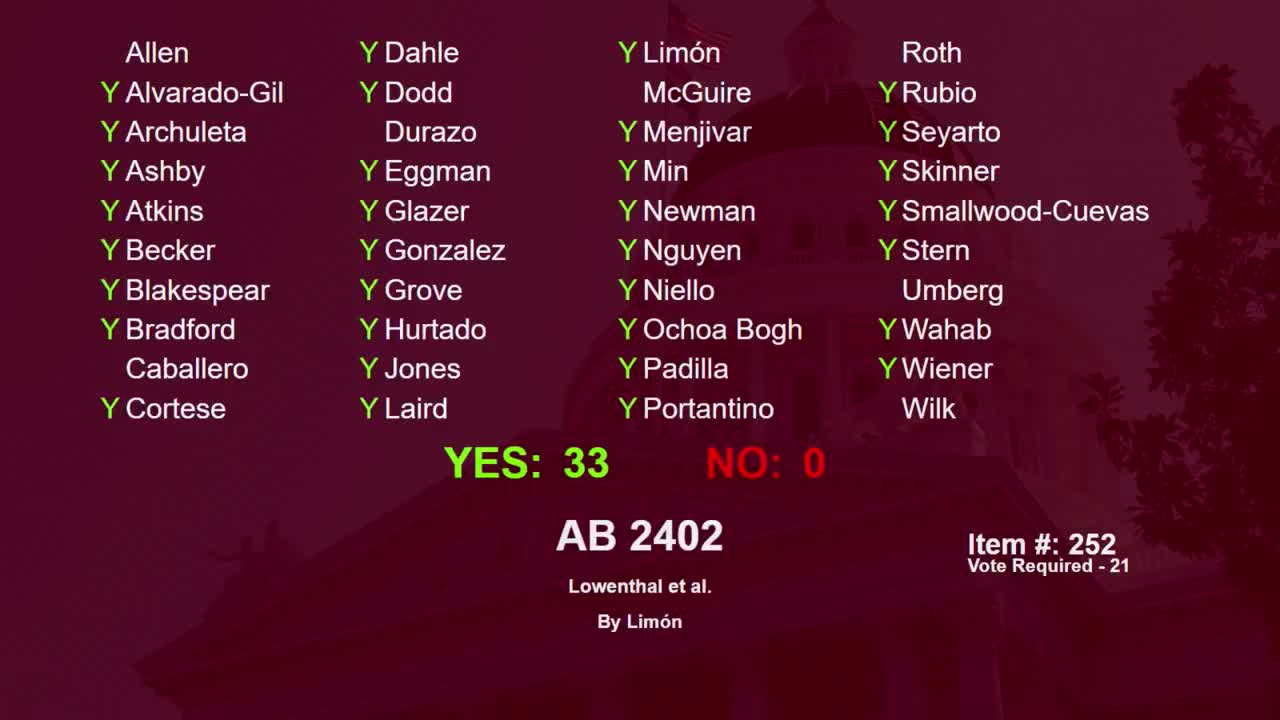 1MIN
Senate Floor
 1MIN
Senate Standing Committee on Appropriations
 1MIN
Senate Standing Committee on Banking and Financial Institutions
Bill Author

Bill Co-Author(s):