AB 312: State Partnership for Affordable Housing Registries in California Grant Program.
- Session Year: 2023-2024
- House: Assembly
- Latest Version Date: 2023-03-30
Current Status:
Failed
(2024-02-01: From committee: Filed with the Chief Clerk pursuant to Joint Rule 56.)
Introduced
In Committee
First Chamber
In Committee
Second Chamber
Enacted
What does this bill do?
This bill creates a state grant program to help eligible local governments (cities, counties, and regional housing agencies with populations of 60,000 or more) build and join a state-run online platform and a single standardized housing preapplication so people can find, apply for, and track affordable housing listings. The platform must be open-source, multilingual, accessible to people with disabilities, let property managers post and update listings and let applicants submit and monitor applications, and personal information collected would be kept confidential and not released in public records.
The summary is provided by generative AI which can make mistakes. For original language, please view the details in the table below.
Existing law creates the Department of Housing and Community Development and requires the department to administer various programs relating to housing.
This bill would establish, subject to appropriation by the Legislature, the State Partnership for Affordable Housing Registries in California Grant Program to provide technical assistance to eligible entities, as defined, for the purpose of creating a state-managed online platform of affordable housing listings, information, and applications. The bill would require the department to administer the program and to adopt guidelines for this purpose. The bill would require the department to develop a housing preapplication to standardize applications for affordable housing and to solicit participation of eligible entities no later than January 1, 2026, and to launch the platform no later than July 1, 2027. The bill would require the department to provide technical assistance to participating entities and to ensure equitable access to database users, as specified. The bill would authorize the department to coordinate with the Office of Data and Innovation to carry out the requirements of the program and to contract with vendors pursuant to existing provisions of state contract law, as specified. The bill would establish minimum requirements for the platform and would require a vendor selected to create and maintain the platform to demonstrate specified capabilities and implement those requirements. The bill would exempt from disclosure as a public record any personally identifiable information collected by the platform or shared between eligible entities and the department in administering the program.
Existing constitutional provisions require that a statute that limits the right of access to the meetings of public bodies or the writings of public officials and agencies be adopted with findings demonstrating the interest protected by the limitation and the need for protecting that interest.
This bill would make legislative findings to that effect.
(a)There is hereby established the State Partnership for Affordable Housing Registries in California Grant Program to be administered by the Department of Housing and Community Development upon appropriation by the Legislature.
(b)The program shall provide technical assistance to eligible entities for the purpose of creating a state-managed online platform of affordable housing listings, information, and applications.
(c)The department shall adopt guidelines to administer this chapter. The guidelines shall be adopted pursuant to the requirements of Chapter 3.5 (commencing with Section 11340) of Part 1 of Title 2 of the Government Code.
50481.For purposes of this chapter, the following terms have the following meanings:
(a)Affordable housing means any units developed pursuant to a either of the following:
(1)A locally adopted inclusionary housing program, or program.
(2)A multifamily deed-restricted rental housing accommodation, that was constructed with financing from one or more of the following sources:
(1)(A)State or federal low-income housing tax credits awarded pursuant to Sections 12206, 17058, 23610.5, or 50199.14 of the Revenue and Taxation Code, or Section 42 of the Internal Revenue Code.
(2)(B)Project-based housing choice vouchers.
(3)(C)Funding awarded by the department.
(4)(D)Financing for a multifamily development from the California Housing Finance Agency.
(5)(E)Local government funding.
(b)Department means the Department of Housing and Community Development.
(c)Eligible entity means a city, county, city and county, regional housing finance agency, or council of government that has a population of not less than 60,000, according to data from the 2020 census.
(d)Platform means the state-managed online database of affordable housing listings, information, and applications created pursuant to this chapter.
(e)Program means the State Partnership for Affordable Housing Registries in California Grant Program established pursuant to this chapter.
50482.The department shall do all of the following:
(a)No later than January 1, 2026, establish a housing preapplication. The housing preapplication shall be developed pursuant to Chapter 3.5 (commencing with Section 11340) of Part 1 of Title 2 of the Government Code and shall eliminate redundancies among affordable housing applications by standardizing the necessary information typically required of all affordable housing applicants to match households to an appropriate housing unit, including income, family size, and accessibility needs. An affordable housing applicant shall not be assessed any fee to complete and submit a housing preapplication.
(b)No later than January 1, 2026, solicit participation among eligible entities through a notice of funding availability. Eligible entities shall agree through a memorandum of understanding to share with the department and its strategic partners and agents all data required to develop the platform.
(c)No later than July 1, 2027, launch the platform. The platform shall utilize open-source code and plain language and shall be accessible in multiple languages, including, but not limited to, English and the languages specified in Section 1632 of the Civil Code.
(d)Provide technical assistance to eligible entities that participate in the program. The department shall provide program support to participating eligible entities via telephone, electronically, mobile text message, or in person.
(e)To ensure equitable access for all database users, develop materials that can be used by local governments, community partners including housing navigators, and other stakeholders to reach non-English-speaking and hard-to-reach households, with considerations for racial equity and traditionally underserved populations. These materials shall be developed for the initial launch of the publicly accessible version of the platform.
50483.(a)The department may contract, pursuant to the requirements of Chapter 3 (commencing with Section 12100) of Part 2 of Division 2 of the Public Contract Code, with one or more vendors provided the vendor commits to the creation of an open-source code platform. A vendor selected to create and maintain the platform shall meet the requirements described in Section 50484.
(b)The department may, and is encouraged to, coordinate with the Office of Data and Innovation where appropriate to carry out the requirements of this chapter.
50484.(a)To be eligible for selection to create and maintain the platform, a vendor shall demonstrate sufficient capacity and experience to administer a program of this scope and scale, including all of the following capabilities:
(1)The technological capacity to develop and implement a central technology-driven application portal and system that serves managers of affordable housing units and prospective tenants, has mobile and multilanguage capabilities, and allows an applicant to track the status of their application. The application system shall have the capacity to handle the volume of expected use without disruption.
(2)User testing with a diverse range of potential tenant applicants and managers of affordable housing to ensure that the database is designed for ease of use and that all user-facing content is easy to comprehend.
(3)The capacity to develop and implement an application portal and system that is fully accessible to people with disabilities, including:
(A)The capacity to develop a system that conforms to Level A and AA of version 2.2 of the Web Content Accessibility Guidelines developed by the World Wide Web Consortium (W3C), or any standard that provides for greater accessibility.
(B)The capacity to ensure that any Portable Document Format (PDF) files in the system meet International Organization for Standardization (ISO) PDF/Universal Accessibility standards.
(C)Iterative user testing with a diverse range of people with disabilities, a diverse range of assistive technologies, and a diverse range of operating systems and browser combinations.
(D)The capacity to ensure that all online and hard-copy hard copy training materials, user guides, and audio-visual audiovisual instructional resources are accessible to people with disabilities, including including, but not limited to to, people who need auxiliary aids and services in order to receive effective communication.
(b)A vendor selected to create and maintain the platform shall develop and implement the application portal and system and conduct user testing as described in subdivision (a).
50485.The platform shall be capable of operating and contain all data necessary to perform all of the following functions:
(a)The ability to search, identify, and explore property listings on a virtual map.
(b)The ability for prospective affordable housing applicants to do all of the following:
(1)Identify affordable housing listings for which they qualify, as indicated by their responses to a completed housing preapplication.
(2)Readily view affordable housing listing characteristics, including income and special needs restrictions.
(3)Submit electronic applications online.
(4)Store information online for reuse in applying for other available listings.
(5)Request automatic notification by email of new affordable housing vacancy listings.
(6)Receive notification and a confirmation number for their application.
(7)Obtain an updated status of their place on eligibility lists.
(c)The ability for affordable housing property managers and administrators to do all of the following:
(1)Access the database through a user account.
(2)Create and update current listings of affordable units.
(3)Allow for tracking of automatic updates to listings data.
(4)Allow for manual updates to listings data.
(5)View, prioritize, match, and respond to individual applications submitted by a household.
(6)Manage non-English text translations.
(7)Post information to promote the users experience, such as training guides or videos.
50486.The platform shall meet all of the following minimum requirements:
(a)Compliance with all state and federal fair housing laws and regulations.
(b)Compliance with all state protections related to the use of personally identifiable information, including providing any necessary disclosures and assuring the secure storage of any personally identifiable information generated, as part of the application process.
(c)Once the platform begins accepting applications it shall be available 24 hours a day, seven days a week, with 99 percent planned uptime rating and all of the following capacities:
(1)Support for at least 2,000,000 application records.
(2)Support for at least 50,000 concurrent full-access users, allowing users to create, read, update, and delete transactions based upon their user role.
(3)Support for, at a minimum, applications and affordable housing units to be viewed in multiple languages.
(4)Support for hosting on the platform website user guides, audio-visual audiovisual instructional resources, and step-by-step overviews of the application process that are fully accessible to people with disabilities.
50487.Any personally identifiable information collected by the platform or shared between eligible entities and the department in administering this chapter is confidential and exempt from disclosure under the California Public Records Act (Division 10 (commencing with Section 7920.000) of Title 1 of the Government Code), and may be used or disclosed only for purposes of administering the program.
50488.This chapter shall become operative upon appropriation by the Legislature of sufficient funds, including funds from private donations if available, to the department for the purposes of this chapter.
SEC. 2.The Legislature finds and declares that Section 1 of this act, which adds Chapter 2.6 (commencing with Section 50480) of Part 2 of Division 31 of the Health and Safety Code, imposes a limitation on the publics right of access to the meetings of public bodies or the writings of public officials and agencies within the meaning of Section 3 of Article I of the California Constitution. Pursuant to that constitutional provision, the Legislature makes the following findings to demonstrate the interest protected by this limitation and the need for protecting that interest:
In order to protect the privacy of households seeking access to affordable housing, it is in the states interest to limit public access to information.
(a)There is hereby established the State Partnership for Affordable Housing Registries in California Grant Program to be administered by the Department of Housing and Community Development upon appropriation by the Legislature.
(b)The program shall provide technical assistance to eligible entities for the purpose of creating a state-managed online platform of affordable housing listings, information, and applications.
(c)The department shall adopt guidelines to administer this chapter. The guidelines shall be adopted pursuant to the requirements of Chapter 3.5 (commencing with Section 11340) of Part 1 of Title 2 of the Government Code.
50481.For purposes of this chapter, the following terms have the following meanings:
(a)Affordable housing means any units developed pursuant to a locally adopted inclusionary housing program, or multifamily deed-restricted rental housing accommodation, that was constructed with financing from one or more of the following sources:
(1)State or federal low-income housing tax credits awarded pursuant to Sections 12206, 17058, 23610.5, or 50199.14 of the Revenue and Taxation Code, or Section 42 of the Internal Revenue Code.
(2)Project-based housing choice vouchers.
(3)Funding awarded by the department.
(4)Financing for a multifamily development from the California Housing Finance Agency.
(5)Local government funding.
(b)Department means the Department of Housing and Community Development.
(c)Eligible entity means a city, county, city and county, regional housing finance agency, or council of government that has a population of not less than 60,000, according to data from the 2020 census.
(d)Platform means the state-managed online database of affordable housing listings, information, and applications created pursuant to this chapter.
(e)Program means the State Partnership for Affordable Housing Registries in California Grant Program established pursuant to this chapter.
50482.The department shall do all of the following:
(a)No later than January 1, 2026, establish a housing preapplication. The housing preapplication shall be developed pursuant to Chapter 3.5 (commencing with Section 11340) of Part 1 of Title 2 of the Government Code and shall eliminate redundancies among affordable housing applications by standardizing the necessary information typically required of all affordable housing applicants to match households to an appropriate housing unit, including income, family size, and accessibility needs. An affordable housing applicant shall not be assessed any fee to complete and submit a housing preapplication.
(b)No later than January 1, 2026, solicit participation among eligible entities through a notice of funding availability. Eligible entities shall agree through a memorandum of understanding to share with the department and its strategic partners and agents all data required to develop the platform.
(c)No later than July 1, 2027, launch the platform. The platform shall utilize open-source code and plain language and shall be accessible in multiple languages, including, but not limited to, English and the languages specified in Section 1632 of the Civil Code.
(d)Provide technical assistance to eligible entities that participate in the program. The department shall provide program support to participating eligible entities via telephone, electronically, mobile text message, or in person.
(e)To ensure equitable access for all database users, develop materials that can be used by local governments, community partners including housing navigators, and other stakeholders to reach non-English-speaking and hard-to-reach households, with considerations for racial equity and traditionally underserved populations. These materials shall be developed for the initial launch of the publicly accessible version of the platform.
50483.(a)The department may contract, pursuant to the requirements of Chapter 3 (commencing with Section 12100) of Part 2 of Division 2 of the Public Contract Code, with one or more vendors provided the vendor commits to the creation of an open-source code platform. A vendor selected to create and maintain the platform shall meet the requirements described in Section 50484.
(b)The department may, and is encouraged to, coordinate with the Office of Data and Innovation where appropriate to carry out the requirements of this chapter.
50484.(a)To be eligible for selection to create and maintain the platform, a vendor shall demonstrate sufficient capacity and experience to administer a program of this scope and scale, including all of the following capabilities:
(1)The technological capacity to develop and implement a central technology-driven application portal and system that serves managers of affordable housing units and prospective tenants, has mobile and multilanguage capabilities, and allows an applicant to track the status of their application. The application system shall have the capacity to handle the volume of expected use without disruption.
(2)User testing with a diverse range of potential tenant applicants and managers of affordable housing to ensure that the database is designed for ease of use and that all user-facing content is easy to comprehend.
(3)The capacity to develop and implement an application portal and system that is fully accessible to people with disabilities, including:
(A)The capacity to develop a system that conforms to Level A and AA of version 2.2 of the Web Content Accessibility Guidelines developed by the World Wide Web Consortium (W3C), or any standard that provides for greater accessibility.
(B)The capacity to ensure that any Portable Document Format (PDF) files in the system meet International Organization for Standardization (ISO) PDF/Universal Accessibility standards.
(C)Iterative user testing with a diverse range of people with disabilities, a diverse range of assistive technologies, and a diverse range of operating systems and browser combinations.
(D)The capacity to ensure that all online and hard-copy training materials, user guides, and audio-visual instructional resources are accessible to people with disabilities, including but not limited to people who need auxiliary aids and services in order to receive effective communication.
(b)A vendor selected to create and maintain the platform shall develop and implement the application portal and system and conduct user testing as described in subdivision (a).
50485.The platform shall be capable of operating and contain all data necessary to perform all of the following functions:
(a)The ability to search, identify, and explore property listings on a virtual map.
(b)The ability for prospective affordable housing applicants to do all of the following:
(1)Identify affordable housing listings for which they qualify, as indicated by their responses to a completed housing preapplication.
(2)Readily view affordable housing listing characteristics, including income and special needs restrictions.
(3)Submit electronic applications online.
(4)Store information online for reuse in applying for other available listings.
(5)Request automatic notification by email of new affordable housing vacancy listings.
(6)Receive notification and a confirmation number for their application.
(7)Obtain an updated status of their place on eligibility lists.
(c)The ability for affordable housing property managers and administrators to do all of the following:
(1)Access the database through a user account.
(2)Create and update current listings of affordable units.
(3)Allow for tracking of automatic updates to listings data.
(4)Allow for manual updates to listings data.
(5)View, prioritize, match, and respond to individual applications submitted by a household.
(6)Manage non-English text translations.
(7)Post information to promote the users experience, such as training guides or videos.
50486.The platform shall meet all of the following minimum requirements:
(a)Compliance with all state and federal fair housing laws and regulations.
(b)Compliance with all state protections related to the use of personally identifiable information, including providing any necessary disclosures and assuring the secure storage of any personally identifiable information generated, as part of the application process.
(c)Once the platform begins accepting applications it shall be available 24 hours a day, seven days a week, with 99 percent planned uptime rating and all of the following capacities:
(1)Support for at least 2,000,000 application records.
(2)Support for at least 50,000 concurrent full-access users, allowing users to create, read, update, and delete transactions based upon their user role.
(3)Support for, at a minimum, applications and affordable housing units to be viewed in multiple languages.
(4)Support for hosting on the platform website user guides, audio-visual instructional resources, and step-by-step overviews of the application process that are fully accessible to people with disabilities.
50487.Any personally identifiable information collected by the platform or shared between eligible entities and the department in administering this chapter is confidential and exempt from disclosure under the California Public Records Act (Division 10 (commencing with Section 7920.000) of Title 1 of the Government Code), and may be used or disclosed only for purposes of administering the program.
50488.This chapter shall become operative upon appropriation by the Legislature of sufficient funds, including funds from private donations if available, to the department for the purposes of this chapter.
SEC. 2.The Legislature finds and declares that Section 1 of this act, which adds Chapter 2.6 (commencing with Section 50480) of Part 2 of Division 31 of the Health and Safety Code, imposes a limitation on the publics right of access to the meetings of public bodies or the writings of public officials and agencies within the meaning of Section 3 of Article I of the California Constitution. Pursuant to that constitutional provision, the Legislature makes the following findings to demonstrate the interest protected by this limitation and the need for protecting that interest:
In order to protect the privacy of households seeking access to affordable housing, it is in the states interest to limit public access to information.
|
Date
|
Status
|
|---|---|
| Feb 1, 2024 | From committee: Filed with the Chief Clerk pursuant to Joint Rule 56. |
| Jan 31, 2024 | Died pursuant to Art. IV, Sec. 10(c) of the Constitution. |
| May 18, 2023 | In committee: Held under submission. |
| May 3, 2023 | In committee: Set, first hearing. Referred to APPR. suspense file. |
| Apr 18, 2023 | From committee: Do pass and re-refer to Com. on APPR. with recommendation: To Consent Calendar. (Ayes 11. Noes 0.) (April 18). Re-referred to Com. on APPR. |
| Apr 12, 2023 | From committee: Do pass and re-refer to Com. on JUD. (Ayes 8. Noes 0.) (April 12). Re-referred to Com. on JUD. |
| Apr 3, 2023 | Re-referred to Com. on H. & C.D. |
| Mar 30, 2023 | From committee chair, with author's amendments: Amend, and re-refer to Com. on H. & C.D. Read second time and amended. |
| Feb 9, 2023 | Referred to Coms. on H. & C.D. and JUD. |
| Jan 27, 2023 | From printer. May be heard in committee February 26. |
| Jan 26, 2023 | Read first time. To print. |
|
Date
|
Description
|
Location
|
Votes
|
|
|---|---|---|---|---|
| Apr 18, 2023 | Do pass and be re-referred to the Committee on [Appropriations] with recommendation: To Consent Calendar | Assembly Standing Committee on Judiciary |
Passed |
|
| Apr 12, 2023 | Do pass and be re-referred to the Committee on [Judiciary] | Assembly Standing Committee on Housing and Community Development |
Passed |
This list shows positions taken on this bill by organizations on the date displayed, which is linked to the original source.
Positions by individuals are not included.
|
Organization
|
Position
|
Date
|
|---|---|---|
| All Home | ** Support | |
| Association Of Regional Center Agencies | ** Support | |
| California Housing Partnership | ** Support | |
| Corporation For Supportive Housing | ** Support | |
| East Bay Housing Organizations | ** Support | |
| Family Assistance Program | * Support | Apr 12, 2023 |
| Housing California | ** Support | |
| Inland Regional Center | ** Support | |
| LeadingAge California | ** Support | |
| Lift To Rise | ** Support | |
| National Association Of Social Workers, California Chapter | ** Support | |
| Orange County United Way | ** Support | |
| Residents United Network of Housing California | ** Support | |
| San Francisco Bay Area Planning and Urban Research Association | ** Support | |
| TechEquity Collaborative | ** Support | |
| The Kelsey | ** Support | |
| The People Concern | ** Support |
Date of Hearing: May 3, 2023
ASSEMBLY COMMITTEE ON APPROPRIATIONS
Chris Holden, Chair
ABPCA Bill Id:AB 312
Author:(Reyes) – As Amended Ver:March 30, 2023
Policy Committee: | Housing and Community Development | Vote: | 8 - 0 |
Judiciary | 11 - 0 | ||
|
|
Urgency: No State Mandated Local Program: No Reimbursable: No
SUMMARY:
This bill requires the Department of Housing and Community Development (HCD) to establish a grant program for the purpose of creating a statewide online database of affordable housing listings, information, and tenant applications.
Specifically, this bill:
- Establishes, upon appropriation by the Legislature, the State Partnership for Affordable Housing Registries in California Grant Program (program) to be administered HCD.
- Requires the program to provide technical assistance to eligible entities, defined as a city, county, city and county, regional housing finance agency, or council of government with a population of not less than 60,000, to create a state-managed online platform of affordable housing listings, information, and applications.
- Requires HCD to establish a housing pre-application and solicit participation among eligible entities through a notice of funding availability by January 1, 2026, and to launch the platform by July 1, 2027. Requires the platform to utilize open-source code and plain language and be accessible in multiple languages, as specified.
- Requires HCD to provide technical assistance to eligible entities and to develop materials for local governments, community partners, including housing navigators and other stakeholders to use to reach non-English-speaking and hard-to-reach households, with considerations for racial equity and traditionally underserved populations.
- Authorizes HCD to contract with one or more vendors provided the vendor commits to the creation of an open-source code platform, and the vendor meets other specified requirements.
- Requires a vendor, in order to be eligible for selection to create and maintain the platform, to demonstrate sufficient capacity and experience to administer a program of this scope and scale, including specified capabilities.
- Requires the platform to be capable of operating and contain all data necessary to perform specified functions, including the ability to search, identify, and explore property listings on a virtual map, the capacity to be available 24 hours a day, seven days a week, and able to support at least two million application records, among other requirements.
- Provides any personally identifiable information collected by the platform that is shared between eligible entities and HCD is confidential and exempt from disclosure under the California Public Records Act.
FISCAL EFFECT:
HCD estimates total General Fund (GF) costs of $33.7 million to establish and administer the Program. These costs include $14.4 million in one-time contract costs for system design and development, $10.3 million in ongoing annual costs for 50 staff positions, and $9 million in ongoing annual contract costs for vendor support and cloud subscription, as follows:
- Information Technology (IT) Division costs: HCD estimates one-time consulting costs of $14.4 million for system design, development, integration (DDI) and yearly cloud subscriptions of $3 million. The database will also require yearly vendor support costs of $6 million for the system operations including a continuously operating help desk to support up to 50,000 concurrent users of the database. HCD anticipates needing 22 ongoing staff positions to manage and maintain the database.
- Housing Policy Division costs: HCD anticipates needing 28 ongoing staff positions for a new outreach and data team. This team would work with the IT Division to develop database and system requirements and to analyze data and integration with relevant HCD databases. This team would also develop guidelines and outreach efforts to tenants, landlords and other stakeholders including regional and local governments, create technical assistance materials and webinars for landlords and tenants prior to launch, and coordinate customer service and technical assistance to landlords and tenants, likely including working with a vendor to manage a call center.
(The author is also pursuing this proposal in the budget process.)
COMMENTS:
- Purpose. The author of this bill seeks to improve access to affordable housing by creating a statewide affordable housing data base to make it easier for low-income households to find and apply for affordable housing across the state. According to the author:
[This bill] will ensure California renters have access to a regional centralized platform to search for and apply to deed-restricted affordable housing. Searching for affordable housing is already a daunting task, and there should be support for our renters to find housing efficiently and effectively. Renters currently face the challenge of finding affordable housing options that meet their specific needs, particularly renters such as seniors, veterans, and people with disabilities. [This bill] is a step in the right direction and will help California renters today while preparing for the future.
- Background. The California Housing Partnership Corporation estimates there are 504,872 units of multifamily rental housing in the state that include deed restrictions on affordability requiring the housing to be offered only to low-income households at an affordable rent, defined as no more than 30% of household income.
There is no state-wide centralized platform for low-income Californians to learn about or apply to vacancies in deed-restricted affordable rental housing. As a result, low-income households seeking rental housing generally must search across a number of rental housing listing services that may include a mix of non-subsidized housing and deed-restricted affordable housing. In addition, many deed-restricted affordable units are available only to certain sub-populations of low-income renters, such as seniors, veterans or households considered very-low income. Prospective tenants lack an easy way to identify which deed-restricted affordable units have vacancies for which they might be eligible.
The City and County of San Francisco created DAHLIA (Database of Affordable Housing Listings, Information and Applications), a centralized web-based housing portal for finding and applying to government-subsidized affordable rental and ownership housing vacancies within San Franciso’s jurisdiction. Prior to building the portal, each building with deed-restricted affordable housing in San Francisco required a different paper application. According to Exygy, the developer of DAHLIA, “97% of applications [are] completed online in about 15 minutes, replacing an in-person, paper-based process that often required 10+ pages and took hours to complete.” The DAHLIA platform was built using open source code and supports a number of different user languages including Spanish and Chinese. It also allows prospective tenants to receive email notifications when new vacancies for affordable units become available.
This bill requires HCD to create a similar statewide database.
- Prior Legislation. AB 1961 (Gabriel), of the 2021-22 Legislative Session, was similar to this bill and would have required HCD to coordinate with state and local partners to create an online database with affordable housing listings, information, and tenant applications. AB 1961 was held on the Senate Appropriations Committee’s suspense file.
AB 724 (Wicks), of the 2019-20 Legislative Session, would have created a rental registry for properties that met certain criteria. AB 724 was held on this committee’s suspense file.
Analysis Prepared by: Jennifer Swenson / APPR. / (916) 319-2081
Date of Hearing: April 18, 2023
ASSEMBLY COMMITTEE ON JUDICIARY
Brian Maienschein, Chair
ABPCA Bill Id:AB 312
Author:(Reyes and Ward) – As Amended Ver:March 30, 2023
proposed consent
SUBJECT: State Partnership for Affordable Housing Registries in California Grant Program
KEY ISSUE: SHOULD PERSONALLY IDENTIFIABLE INFORMATION about landlords and tenants, COLLECTED BY THE proposed STATE PARTNERSHIP FOR AFFORDABLE HOUSING REGISTRIES IN CALIFORNIA GRANT PROGRAM AND SHARED BETWEEN ELIGIBLE ENTITIES, BE EXEMPT FROM DISCLOSURE UNDER THE CALIFORNIA PUBLIC RECORDS ACT?
SYNOPSIS
It is no secret that California faces a severe housing crisis, with countless potential causes and solutions. According to the joint oversight hearing provided by the Assembly Committees on Housing and Community Development and Health and Human Services earlier this year, over 173,000 individuals in California experience homelessness on any given night, and this number is likely an undercount. In order to build sufficient new housing to provide shelter to each unhoused individual, California would need to build approximately 180,000 new units per year. Current development levels, however, see less than 100,000 total units built each year. To summarize this issue briefly – California cannot build its way out of the homelessness crisis. Instead, a combination of policy strategies appear necessary to provide for all unhoused Californians.
One such additional policy proposal rests on highlighting the availability of currently existing low-income housing options. Currently there is no centralized mechanism, hosted by a state agency or private platform that aggregates all affordable housing units throughout California. This bill proposes creating a centralized platform housed under the California Department of Housing and Community Development that will both assist the state in identifying the true number of affordable housing units available, and facilitate tenants in accessing those units. As an element of the new platform, the bill proposes to exempt personally identifiable information submitted to the program from disclosure requirements under the California Public Records Act. While some of the information considered by this bill, including social security numbers, is already expressly exempted from disclosure under existing provisions of the CPRA, there is arguably no harm and a very strong interest in protecting the remaining personally identifiable data from disclosure under the CPRA.
This bill is sponsored by Housing California and Residents United Network. There is no opposition on file. This bill was previously heard by the Assembly Committee on Housing and Community Development and passed out on a vote of 8-0.
SUMMARY: Establishes the State Partnership for Affordable Housing Registries in California Grant Program and exempts specified information from the California Public Records Act. Specifically, this bill:
- Establishes the State Partnership for Affordable Housing Registries in California Grant Program (Program) to be administered by the Department of Housing and Community Development (HCD) upon appropriation by the Legislature.
- Requires the program to provide technical assistance to eligible entities for the purpose of creating a state-managed online platform of affordable housing listings, information, and applications.
- Defines the following for the purpose of this bill:
- “Affordable housing” means any units pursuant to specified programs or existing state or federal laws.
- “Department” means the Department of Housing and Community Development.
- “Eligible entity” means a city, county, city and county, regional housing finance agency, or council of government that has a population of not less than 60,000, according to data from the 2020 census.
- “Platform” means the state-managed online database of affordable housing listings, information, and applications created pursuant to this bill.
- “Program” means the State Partnership for Affordable Housing Registries in California Grant Program established pursuant to this bill.
- Requires the Department to do all of the following:
- No later than January 1, 2026, to establish a housing preapplication.
- No later than January 1, 2026, to solicit participation among eligible entities through a notice of funding availability.
- No later than July 1, 2027, to launch the platform.
- Provide technical assistance to eligible entities that participate in the program via telephone, electronically, mobile text message, or in person.
- Ensure equitable access for all database users, develop materials that can be used by local governments, community partners including housing navigators, and other stakeholders to reach non-English-speaking and hard-to-reach households, with considerations for racial equity and traditionally underserved populations.
- Authorizes the Department to contract with one or more vendors provided the vendor commits to the creation of an open-source code platform, and that the vendor meets other specified requirements.
- Authorizes the Department to coordinate with the Office of Data and Innovation where appropriate to carry out the requirements of this bill.
- Requires a vendor, in order to be eligible for selection to create and maintain the platform, to demonstrate sufficient capacity and experience to administer a program of this scope and scale, including specified capabilities.
- Requires the platform to be capable of operating and contain all data necessary to perform specified functions.
- Requires the platform to meet the following minimum requirements:
- Compliance with all state and federal fair housing laws and regulations.
- Compliance with all state protections related to the use of personally identifiable information, including providing any necessary disclosures and assuring the secure storage of any personally identifiable information generated, as part of the application process.
- Availability of the platform 24 hours a day, seven days a week, with 99 percent planned uptime rating and specified capacities, once the platform begins accepting applications.
- Makes any personally identifiable information collected by the platform or shared between eligible entities and the Department in administering this bill confidential and exempt from disclosure under the California Public Records Act, and clarifies that the information may be used or disclosed only for purposes of administering the program.
- Makes findings related to the exemption of the information from disclosure under the California Public Records Act.
EXISTING LAW:
- Provides that the people have the right of access to information concerning the conduct of the people’s business and, therefore, the writings of public officials and agencies shall be open to public scrutiny. Specifies that any law or rule that limits the public right of access shall be adopted with findings demonstrating the interest protected by the limitation. (California Constitution, art. I, Section 3.)
- Provides that, in enacting the California Public Records Act (CPRA), the Legislature, mindful of the right of individuals to privacy, finds and declares that access to information concerning the conduct of the people’s business is a fundamental and necessary right of every person in this state. (Government Code Section 7921.000. All further statutory references are to this code, unless otherwise indicated.)
- Requires agencies to redact social security numbers from records before disclosing the record to the public. (Section 7922.200.)
- Provides that public records are open to inspection at all times during the office hours of a state or local agency and every person has a right to inspect any public record, exempted as otherwise provided; and that any reasonably segregable portion of a record shall be available for inspection by any person requesting the record after deletion of the portions that are exempted by law. (Section 7922.525.)
- Allows an agency to withhold from public disclosure, “Personnel, medical, or similar files, the disclosure of which would constitute an unwarranted invasion of personal privacy.” (Section 7927.700.)
- Holds in case law, that certain information supplied by individual applicants to a licensing agency may under certain circumstances entail a substantial privacy interest. For example, the records may contain intimate information concerning an applicant's own or his family's medical or psychological history. In such special cases, the confidential information may be deleted. (CBS, Inc. v. Block (1986) 42 Cal.3d 646, 655.)
- Requires a public agency to justify withholding any record by demonstrating that the record in question is exempt under express provisions of this division, or that on the facts of the particular case the public interest served by not disclosing the record clearly outweighs the public interest served by disclosure of the record. (Section 7922.000.)
FISCAL EFFECT: As currently in print this bill is keyed fiscal.
COMMENTS: It is no secret that California faces a severe housing crisis, with countless potential causes and solutions. According to the joint oversight hearing provided by the Assembly Committees on Housing and Community Development and Health and Human Services earlier this year, over 173,000 individuals in California experience homelessness on any given night, and this number is likely an undercount. (Joint Oversight Hearing: Housing and Community Development and Health and Human Services, February 15, 2023 at p. 1 available at https://ahum.assembly.ca.gov/sites/ahum.assembly.ca.gov/files/Background%20Paper%20-%20Joint%20Overshight%20Hearing%202.15.23.pdf.) The causes for homelessness are sufficiently varied that no one policy solution can ameliorate the epidemic. While some individuals experiencing homelessness become unhoused because of mental health issues, many others end up unhoused because of a lack of parity between the cost of living and stagnant wages.
According to the Statewide Housing Plan issued by the California Interagency Council on Homelessness, the state would need an additional 2.5 million housing units, including 1.2 million for lower-income households in order to fully address the state’s unmet housing needs. (Id. at p. 2.) Broken down to reflect an annual minimum, California needs to build approximately 180,000 new units per year to meet this goal. Current development levels, however, see less than 100,000 total units built each year. (Ibid.) To summarize this issue– California cannot rely solely on building its way out of the homelessness crisis. Instead, a combination of policy strategies appear necessary to provide housing for all unhoused Californians.
One such additional policy proposal rests on highlighting the availability of currently existing low-income housing options. Currently there is no centralized mechanism, hosted by either a state agency or private platform, that aggregates all affordable housing units throughout California. The lack of a centralized system leads renters to have to search across multiple platforms, and often take time and waste resources applying to units that they may be unable to rent, whether due to a financial situation or restrictions on the unit itself. This bill proposes creating a centralized platform housed under the California Department of Housing and Community Development (HCD) that will both assist the state in identifying the true number of affordable housing units available, and facilitate tenants in accessing those units.
According to the author:
AB 312 will ensure California renters have access to a regional centralized platform to search for and apply to deed-restricted affordable housing. Searching for affordable housing is already a daunting task, and there should be support for our renters to find housing efficiently and effectively. Renters currently face the challenge of finding affordable housing options that meet their specific needs, particularly renters such as seniors, veterans, and people with disabilities. Due to the absence of a centralized system, renters often apply for multiple listing options they do not qualify for or have already applied for on another posting site - leading to a delay in the renter’s path to housing. The housing crisis we find ourselves in is dire, and while we find ways to create more affordable housing, the state needs to prepare methods to make current affordable housing options more accessible to all Californians. AB 312 is a step in the right direction and will help California renters today while preparing for the future. Creating clear pathways to affordable housing is essential. Housing alone will not solve the state’s crisis; we need equitable and efficient systems to be put in place.
The main purpose of this bill is to establish the State Partnership for Affordable Housing Registries in California (Program), housed within the HCD. As a main feature, the Program would provide a platform for landlords and homeowners to post available affordable housing, and for prospective tenants to submit housing applications. Both of these elements would require the submission of personal identifiable information to HCD. The majority of this policy proposal falls largely within the jurisdiction of the Assembly Committee on Housing and Community Development. However, acknowledging the sensitivity of the personally identifiable information required to both post available housing and apply for the vacancies, the bill also proposes to exempt this personal identifiable information from disclosure requirements under the California Public Records Act (CPRA). The application of CPRA to this bill and the propriety of this exemption is within the jurisdiction of this Committee, and is therefore explored in this analysis.
The California Public Records Act and its existing exemptions for certain sensitive personal information. The California Public Records Act (CPRA) was enacted in 1968 (Chapter 1473, Statutes of 1968) and is currently codified as Sections 7920.000 through 7931.000 of the Government Code. Similar to the federal Freedom of Information Act, the CPRA requires that the documents and "writings" of a public agency be open and available for public inspection, unless they are exempt from disclosure. (Sections 7921.000-7927.700.) The CPRA is premised on the principle that "access to information concerning the conduct of the people’s business is a fundamental and necessary right of every person in this state," but in enacting the new law the Legislature was “mindful of the right of individuals to privacy,” The CPRA defines a “public record” to mean “any writing containing information relating to the conduct of the public’s business prepared, owned, used, or retained by any state or local agency regardless of physical form or characteristics.” (Section 7920.530.)
The CPRA’s privacy protections have been held to extend to an individual’s own or his family’s medical or psychological history. (CBS, Inc. v. Block (1986) 42 Cal.3d 646, 655.) Additionally, the CPRA itself grants agencies the discretion to withhold from public access any record which it can justify withholding by demonstrating that the public interest served by not disclosing the information clearly outweighs the public interest in the disclosure. (Section 7922.000.)
This bill proposes to exempt “personally identifiable information collected by the platform or shared between eligible entities” from the disclosure requirements of the CPRA. While the term “personally identifying information” is not defined in the bill, he information considered by this provision would likely include individual applicants’ information (including such sensitive information as name, address, date of birth, and social security number), as well as personal information from potential landlords. While some of this information, including social security numbers, is already expressly exempted from disclosure under existing provisions of the CPRA (see Section 7922.200), there is arguably a very strong interest in protecting the remaining personally identifiable data from disclosure under the CPRA.
Particularly considering the intent of the platform is to promote applications for affordable housing, those who may benefit the most from this platform are also likely to be overly burdened and dissuaded from its use if their personal information were available through a CPRA request. Therefore, while some of this information is likely already exempted from disclosure, making the exemption explicitly cover all personally identifying information would arguably give HCD the latitude to identify any remaining personal information, the disclosure of which would be detrimental to the very population this new platform is intended to assist.
As the bill moves forward the author may wish to further define “personally identifying information” for purposes of the bill.
ARGUMENTS IN SUPPORT: This bill is supported by a coalition of housing access advocates, including the California Housing Partnership, the Corporation for Supportive Housing, the National Association of Social Workers, California Chapter, and various local organizations. In support of the bill, the California Housing Partnership writes:
In 2021, the Partnership and Housing California published California’s Roadmap Home 2030 to demonstrate how, over the next ten years, the state can end homelessness, create affordable homes for those struggling the most, ensure that Californians can stay in their homes, and advance racial equity and economic inclusion — creating a California where everyone can thrive. Consistent with Roadmap policy E10, this bill helps create efficiency and accountability by helping low-income tenants find affordable housing faster.
Research by the Partnership shows that California has over 450,000 deed-restricted multifamily affordable housing rental units.1 While there may be a variety of deed-restricted affordable housing units across the state, low-income households are required to search for these units across various posting sites. These sites often do not tailor the search results accurately for renters and may even display both non-subsidized housing and affordable housing options.
AB 312 creates the SPAHRC Grant Program (Program) which would allow the Department of Housing and Community Development (Department) to partner closely with selected local jurisdictions to develop a user-friendly web platform and application portal for deed-restricted and inclusionary housing units. AB 312 includes provisions to ensure accessibility and requires the platform to be developed in open-source code, allowing the Department to scale up its platform to serve additional jurisdictions. Additionally, this bill includes flexibility for the Department of Housing and Community Development to coordinate with the California Office of Data and Innovation to design the platform and implement the Program.
AB 312, the SPAHRC Grant Program, provides the necessary incentives to ‘spark’ coordination between state and local governments and creates a digital tool for Californians to find and apply to affordable housing. For these reasons, the California Housing Partnership strongly supports AB 312.
REGISTERED SUPPORT / OPPOSITION:
Support
Housing California (co-sponsor)
Residents United Network of Housing California (co-sponsor)
All Home
Association of Regional Center Agencies
California Housing Partnership
Corporation for Supportive Housing
East Bay Housing Organizations
Inland Regional Center
LeadingAge California
Lift to Rise
National Association of Social Workers, California Chapter
Orange County United Way
San Francisco Bay Area Planning and Urban Research Association (SPUR)
TechEquity Collaborative
The Kelsey
The People Concern
Opposition
None on file
Analysis Prepared by: Manuela Boucher-de la Cadena / JUD. / (916) 319-2334
Date of Hearing: April 12, 2023
ASSEMBLY COMMITTEE ON HOUSING AND COMMUNITY DEVELOPMENT
Buffy Wicks, Chair
ABPCA Bill Id:AB 312 (
Author:Reyes) – As Amended Ver:March 30, 2023
SUBJECT: State Partnership for Affordable Housing Registries in California Grant Program
SUMMARY: Establishes the State Partnership for Affordable Housing Registries in California Grant Program (the program) at the Department of Housing and Community Development (HCD). Specifically, this bill:
- Requires the program to provide technical assistance to eligible entities to create a state-managed online platform of housing listings, information, and applications.
- Requires HCD to adopt guidelines for the program pursuant to the Administrative Procedures Act.
- Includes the following definitions:
- “Affordable housing” means any units developed pursuant to either of the following:
- A locally adopted inclusionary housing program; or
- A multifamily deed-restricted rental housing accommodation that was constructed with financing from one or more of the following sources:
- State or federal low-income housing tax credits;
- Project-based housing choice vouchers;
- Funding awarded by HCD or the California Housing Finance Agency (CalHFA); and
- Local government funding.
- “Eligible entity” means a city, county, city and county, regional housing finance agency, or council of government that has a population of not less than 60,000, according to data from the 2020 census;
- “Platform” means the state-managed online database of affordable housing listings, information, and applications created pursuant to this Act;
- “Program” means the State Partnership for Affordable Housing Registries in California Grant Program established pursuant to this bill.
- Requires HCD to do all of the following:
- Establish a housing pre-application, no later than January 1, 2026, that eliminates redundancies among affordable housing applications, as specified. Provides that an affordable housing applicant shall not be assessed any fee to complete and submit a housing pre-application;
- Solicit participation among eligible entities through a notice of funding availability no later than January 1, 2026. Requires eligible entities to agree through a memorandum of understanding to share all data required to develop the platform with HCD and its strategic partners and agents;
- Launch the platform no later than July 1, 2027. Require the platform to utilize open-source code and plain language and be accessible in multiple languages, as specified;
- Provide technical assistance to eligible entities that participate in the program via telephone, electronically, mobile text message, or in person; and
- Develop materials that can be used by local governments, community partners including housing navigators, and other stakeholders to reach non-English-speaking and hard-to-reach households, with considerations for racial equity and traditionally underserved populations.
Allows HCD to contract with one or more vendors to create and maintain an open-source code platform.
- Requires a vendor to demonstrate sufficient capacity and experience to administer the program, as specified.
- Requires the platform to be capable of operating and contain all data necessary to perform all of the following functions:
- The ability to search, identify, and explore property listings on a virtual map;
- The ability for prospective affordable housing applicants to do all of the following:
- Identify affordable housing listings for which they qualify, as indicated by their responses to a completed housing pre-application;
- Readily view affordable housing listing characteristics, including income and special needs restrictions; and
- Submit electronic applications online.
- Store information online for reuse in applying for other available listings;
- Request automatic notification by email of new affordable housing vacancy listings;
- Receive notification and a confirmation number for their application;
- Obtain an updated status of their place on eligibility lists;
- Allow affordable housing property managers and administrators to do all of the following:
- Access the database through a user account;
- Create and update current listings of affordable units;
- Allow for tracking of automatic updates to listings data;
- Allow for manual updates to listings data;
- View, prioritize, match, and respond to individual applications submitted by a household;
- Manage non-English text translations; and
- Post information to promote the user’s experience, such as training guides or videos.
- Requires the platform to meet all of the following minimum requirements:
- Compliance with all state and federal fair housing laws and regulations.
- Compliance with all state protections related to the use of personally identifiable information, including providing any necessary disclosures and assuring the secure storage of any personally identifiable information generated, as part of the application process.
- Once the platform begins accepting applications it must be available 24 hours a day, seven days a week, with 99 percent planned uptime rating and all of the following capacities:
- Support for at least 2,000,000 application records;
- Support for at least 50,000 concurrent full-access users, allowing users to create, read, update, and delete transactions based upon their user role;
- Support for, at a minimum, applications and affordable housing units to be viewed in multiple languages; and
- Support for hosting on the platform website user guides, audiovisual instructional resources, and step-by-step overviews of the application process that are fully accessible to people with disabilities.
- Provides that any personally identifiable information collected by the platform that is shared between eligible entities and HCD is confidential and exempt from the Public Records Act.
- Provides that this Act shall become operative upon an appropriation by the Legislature.
- Includes findings and declarations that in order to protect the privacy of households seeking access to affordable housing, it is in the state’s interest to limit public access to information.
EXISTING LAW:
- Specifies that when a landlord or their agent receives a request to rent a residential property from an applicant, the landlord or agent may charge that applicant an application screening fee to cover the costs of obtaining information about the applicant which may include personal reference checks and consumer credit reports. (Civil Code Section 1950.6(a))
- Provides that rental application screening fees cannot be greater than the actual out-of-pocket costs of gathering information concerning the applicant. Specifies that in no case can the amount of the application screening fee be greater than thirty dollars ($30) per applicant, which may be adjusted annually commensurate with an increase in the Consumer Price Index, beginning on January 1, 1998. (Civil Code Section 1950.6(b))
FISCAL EFFECT: Unknown.
COMMENTS:
Author’s statement: According to the author, “AB 312 will ensure California renters have access to a regional centralized platform to search for and apply to deed-restricted affordable housing. Searching for affordable housing is already a daunting task, and there should be support for our renters to find housing efficiently and effectively. Renters currently face the challenge of finding affordable housing options that meet their specific needs, particularly renters such as seniors, veterans, and people with disabilities. Due to the absence of a centralized system, renters often apply for multiple listing options they do not qualify for or have already applied for on another posting site - leading to a delay in the renter’s path to housing. The housing crisis we find ourselves in is dire, and while we find ways to create more affordable housing, the state needs to prepare methods to make current affordable housing options more accessible to all Californians. AB 312 is a step in the right direction and will help California renters today while preparing for the future. Creating clear pathways to affordable housing is essential. Housing alone will not solve the state’s crisis; we need equitable and efficient systems to be put in place.”
Background on Affordable Housing: According to the California Housing Partnership Corporation, there are an estimated 1.638 million units of multifamily affordable rental housing in the state. Out of these, 504,872 units include deed restrictions on affordability which require the housing to be offered only to low-income households at an affordable rent, defined as a rent which is no more than 30 percent of household income. Deed-restricted affordable units generally receive one or more forms of government subsidy, including through CalHFA, HCD, the U.S. Department of Agriculture (USDA), the federal Department of Housing and Urban Development (HUD), or state or federal low-income housing tax credits (LIHTCs).
Currently there is no centralized platform for low-income Californians to learn about or apply to vacancies in deed-restricted affordable rental housing. As a result, low-income households seeking rental housing accommodations are generally forced to search across a number of rental housing listing services that may include a mix of non-subsidized housing and deed-restricted affordable housing. To complicate matters further, many deed-restricted affordable units are only available to certain sub-populations of low-income renters. For example, units can be specified for use only by seniors, veterans, or households considered very low income. However, prospective tenants lack an easy way to identify which deed-restricted affordable units have vacancies for which they meet eligibility criteria.
Recognizing this challenge, the city and county of San Francisco created DAHLIA (Database of Affordable Housing Listings, Information, and Applications), a centralized web-based housing portal for finding and applying to government-subsidized affordable rental and ownership housing vacancies in the jurisdiction. Prior to building the portal, each building with deed-restricted affordable housing in San Francisco required a different paper application. According to Exygy, the developer of DAHLIA, “97 percent of applications [are] completed online in ~15 minutes replacing an in-person, paper-based process that often required 10+ pages and took hours to complete.” The DAHLIA platform was built using open source code and supports a number of different user languages including Spanish and Chinese. It also allows prospective tenants to receive email notifications when new vacancies for affordable units become available.
Statewide Affordable Housing Database: This bill proposes to establish an online database for prospective tenants to locate and apply to affordable housing accommodations across the state. HCD would create a pre-application that tenants could complete to help match them to units they qualify for based on income or special status such as age or military service. The bill would require HCD to work with a variety of local and regional government entities to identify and upload information about affordable housing units into the platform. Local governments would not be required to participate. The platform would include affordable housing units subsidized using Project Based Housing Choice Vouchers and constructed using Low Income Housing Tax Credits and state and local funding. In terms of technical requirements, the database would need to allow prospective tenants to apply to vacant units and enable affordable housing managers to post new listings and view and respond to tenant applications. Additionally, the database would be required to support multiple languages and allow users to store information online for reuse across multiple applications.
Arguments in support: According to one of the sponsors, Housing California, this bill allows “HCD to partner with select local entities to develop a user-friendly web platform including deed-restricted and inclusionary housing units and an application portal that matches a perspective housing applicant through a department approve housing pre-application.”
Arguments in opposition: None on file.
Related legislation:
AB 1961 (Gabriel) (2022) would have required HCD to coordinate with state and local partners to create an online database with affordable housing listings, information, and tenant applications. This bill died in the Senate Committee on Appropriations.
Double Referred: This bill was also referred to the Assembly Committee on Judiciary, where it will be heard should it pass out of this committee.
REGISTERED SUPPORT / OPPOSITION:
Support
Housing California (Co-Sponsor)
Residents’ United Network (Co-Sponsor)
All Home
Association of Regional Center Agencies
California Housing Partnership
Corporation for Supportive Housing
East Bay Housing Organization
East Bay Housing Organizations
Inland Regional Center
LeadingAge California
Lift to Rise
National Association of Social Workers, California Chapter
Orange County United Way
San Francisco Bay Area Planning and Urban Research Association (SPUR)
TechEquity Collaborative
The Kelsey
The People Concern
Opposition
None on file.
Analysis Prepared by: Lisa Engel / H. & C.D. / (916) 319-2085
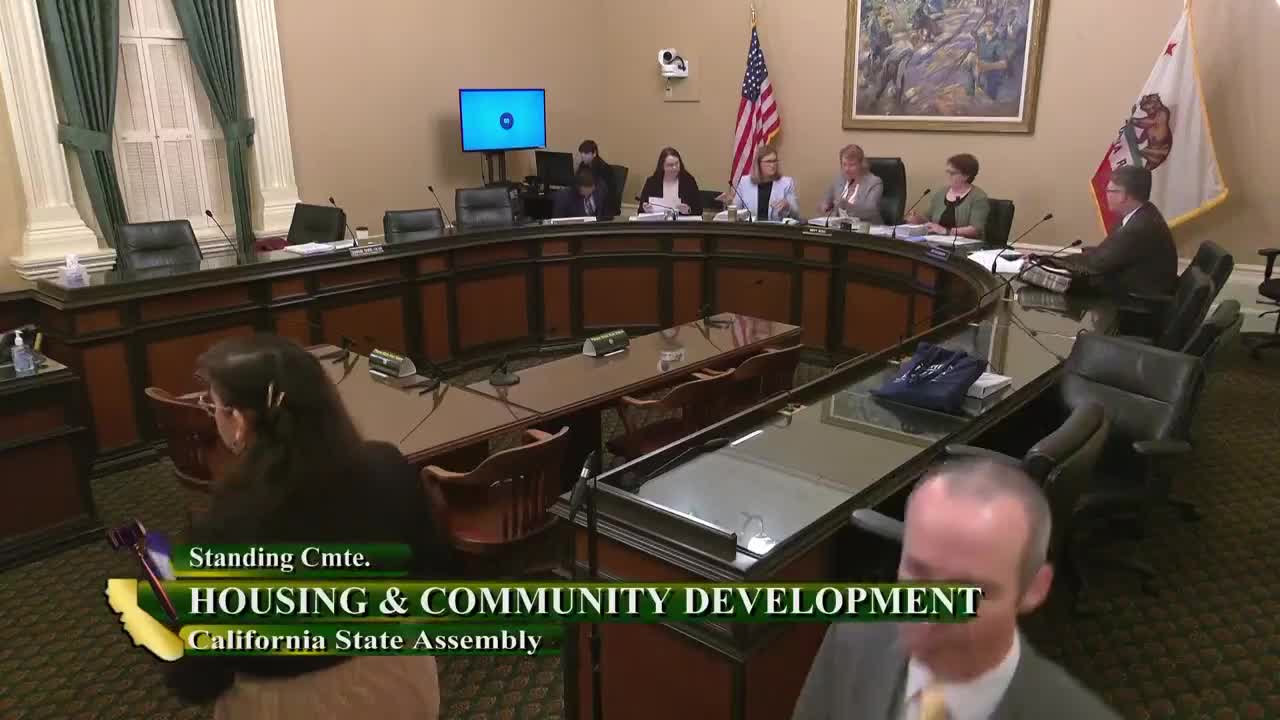
Discussed in Hearing
 10MIN
Assembly Standing Committee on Housing and Community Development


Bill Co-Author(s):