AB 3129: Health care system consolidation.
- Session Year: 2023-2024
- House: Assembly
- Latest Version Date: 2024-09-05
Current Status:
Failed
(2024-09-28: Vetoed by Governor.)
Introduced
In Committee
First Chamber
In Committee
Second Chamber
Enacted
Existing law requires a nonprofit corporation that operates or controls a health facility or other facility that provides similar health care to provide written notice to, and to obtain the written consent of, the Attorney General prior to entering into any agreement or transaction to sell, transfer, lease, exchange, option, convey, or otherwise dispose of the asset, or to transfer control, responsibility, or governance of the asset or operation, to a for-profit corporation or entity, to a mutual benefit corporation or entity, or to a nonprofit corporation, as specified.
This bill would require a private equity group or a hedge fund, as defined, to provide written notice to, and obtain the written consent of, the Attorney General before a transaction between the private equity group or hedge fund and a health care facility, provider, or provider group, as those terms are defined, and any of those entities that directly or indirectly control, are controlled by, are under common control of, or are otherwise affiliated with a payor, except as specified. The bill would require the notice to be submitted at the same time that any other state or federal agency is notified pursuant to state or federal law, and otherwise at least 90 days before the transaction. The bill would authorize the Attorney General to extend that 90-day period under certain circumstances. The bill would additionally require a private equity group or hedge fund to provide advance written notice to the Attorney General before a transaction between a private equity group or hedge fund and a nonphysician provider or a provider, with specified gross annual revenue.
The bill would authorize the Attorney General to give the private equity group or hedge fund a written waiver or the notice and consent requirements if specified conditions apply, including, but not limited to, that the party makes a written waiver request, the health care facilitys, provider groups, or providers operating costs have exceeded its operating revenue in the relevant market for 3 or more years and the party cannot meet its debts, and the transaction will ensure continued health care access in the relevant markets. The bill would require the Attorney General to grant or deny the waiver within 45 days, as prescribed.
The bill would authorize the Attorney General to consent to, give conditional consent to, or not consent to a transaction between a private equity group or hedge fund and a health care facility, provider group, or provider if the transaction may have a substantial likelihood of anticompetitive effects or may create a significant effect on the access or availability of health care services to the affected community, applying a public interest standard, as defined. The bill would authorize the private equity group or hedge fund to elect to participate in an evidentiary hearing before an administrative law judge assigned to the Office of Administrative Hearings, and would set forth the requirements for that hearing. The bill would require the administrative law judge to issue a statement of decision after the close of the hearing, and would require the Attorney General to issue a final determination accepting or rejecting the statement of decision, as specified. The bill would authorize the private equity group or hedge fund to seek subsequent judicial review, as specified, of the Attorney Generals final determination if the Attorney General does not consent or gives conditional consent to a transaction.
The bill would prohibit a private equity group or hedge fund involved in any manner with a physician, psychiatric, or dental practice doing business in this state from interfering with the professional judgment of physicians, psychiatrists, or dentists in making health care decisions, among other things. The bill would authorize the Attorney General to adopt regulations and contract with state agencies, experts, or consultants to implement its requirements, as specified.
Existing law requires a health care entity to provide the Office of Health Care Affordability with written notice of agreements and transactions that would sell, transfer, lease, exchange, option, encumber, convey, or otherwise dispose of a material amount of assets, or that would transfer control, responsibility, or governance of a material amount of the assets or operations to one or more entities, except as specified.
This bill would exempt transactions involving private equity groups or hedge funds that are subject to Attorney General review pursuant to the bill from this notice requirement.
Existing law requires a nonprofit corporation that operates or controls a health facility or other facility that provides similar health care to provide written notice to, and to obtain the written consent of, the Attorney General prior to entering into any agreement or transaction to sell, transfer, lease, exchange, option, convey, or otherwise dispose of the asset, or to transfer control, responsibility, or governance of the asset or operation, to a for-profit corporation or entity, to a mutual benefit corporation or entity, or to a nonprofit corporation, as specified.
This bill would require a private equity group or a hedge fund, as defined, to provide written notice to, and obtain the written consent of, the Attorney General before a transaction between the private equity group or hedge fund and a health care facility, provider, or provider group, as those terms are defined, and any of those entities that directly or indirectly control, are controlled by, are under common control of, or are otherwise affiliated with a payor, except as specified. The bill would require the notice to be submitted at the same time that any other state or federal agency is notified pursuant to state or federal law, and otherwise at least 90 days before the transaction. The bill would authorize the Attorney General to extend that 90-day period under certain circumstances. The bill would additionally require a private equity group or hedge fund to provide advance written notice to the Attorney General before a transaction between a private equity group or hedge fund and a nonphysician provider or a provider, with specified gross annual revenue.
The bill would authorize the Attorney General to give the private equity group or hedge fund a written waiver or the notice and consent requirements if specified conditions apply, including, but not limited to, that the party makes a written waiver request, the health care facilitys, provider groups, or providers operating costs have exceeded its operating revenue in the relevant market for 3 or more years and the party cannot meet its debts, and the transaction will ensure continued health care access in the relevant markets. The bill would require the Attorney General to grant or deny the waiver within 45 days, as prescribed.
The bill would authorize the Attorney General to consent to, give conditional consent to, or not consent to a transaction between a private equity group or hedge fund and a health care facility, provider group, or provider if the transaction may have a substantial likelihood of anticompetitive effects or may create a significant effect on the access or availability of health care services to the affected community, applying a public interest standard, as defined. The bill would authorize the private equity group or hedge fund to elect to participate in an evidentiary hearing before an administrative law judge assigned to the Office of Administrative Hearings, and would set forth the requirements for that hearing. The bill would require the administrative law judge to issue a statement of decision after the close of the hearing, and would require the Attorney General to issue a final determination accepting or rejecting the statement of decision, as specified. The bill would authorize the private equity group or hedge fund to seek subsequent judicial review, as specified, of the Attorney Generals final determination if the Attorney General does not consent or gives conditional consent to a transaction.
The bill would prohibit a private equity group or hedge fund involved in any manner with a physician, psychiatric, or dental practice doing business in this state from interfering with the professional judgment of physicians, psychiatrists, or dentists in making health care decisions, among other things. The bill would authorize the Attorney General to adopt regulations and contract with state agencies, experts, or consultants to implement its requirements, as specified.
Existing law requires a health care entity to provide the Office of Health Care Affordability with written notice of agreements and transactions that would sell, transfer, lease, exchange, option, encumber, convey, or otherwise dispose of a material amount of assets, or that would transfer control, responsibility, or governance of a material amount of the assets or operations to one or more entities, except as specified.
This bill would exempt transactions involving private equity groups or hedge funds that are subject to Attorney General review pursuant to the bill from this notice requirement.
Existing law requires a nonprofit corporation that operates or controls a health facility or other facility that provides similar health care to provide written notice to, and to obtain the written consent of, the Attorney General prior to entering into any agreement or transaction to sell, transfer, lease, exchange, option, convey, or otherwise dispose of the asset, or to transfer control, responsibility, or governance of the asset or operation, to a for-profit corporation or entity, to a mutual benefit corporation or entity, or to a nonprofit corporation, as specified.
This bill would require a private equity group or a hedge fund, as defined, to provide written notice to, and obtain the written consent of, the Attorney General before a transaction between the private equity group or hedge fund and a health care facility, provider, or provider group, as those terms are defined, and any of those entities that directly or indirectly control, are controlled by, are under common control of, or are otherwise affiliated with a payor, except as specified. The bill would require the notice to be submitted at the same time that any other state or federal agency is notified pursuant to state or federal law, and otherwise at least 90 days before the transaction. The bill would authorize the Attorney General to extend that 90-day period under certain circumstances. The bill would additionally require a private equity group or hedge fund to provide advance written notice to the Attorney General before a transaction between a private equity group or hedge fund and a nonphysician provider or a provider, with specified gross annual revenue.
The bill would authorize the Attorney General to give the private equity group or hedge fund a written waiver or the notice and consent requirements if specified conditions apply, including, but not limited to, that the party makes a written waiver request, the health care facilitys, provider groups, or providers operating costs have exceeded its operating revenue in the relevant market for 3 or more years and the party cannot meet its debts, and the transaction will ensure continued health care access in the relevant markets. The bill would require the Attorney General to grant or deny the waiver within 45 days, as prescribed.
The bill would authorize the Attorney General to consent to, give conditional consent to, or not consent to a transaction between a private equity group or hedge fund and a health care facility, provider group, or provider if the transaction may have a substantial likelihood of anticompetitive effects or may create a significant effect on the access or availability of health care services to the affected community, applying a public interest standard, as defined. The bill would authorize the private equity group or hedge fund to elect to participate in an evidentiary hearing before an administrative law judge assigned to the Office of Administrative Hearings, and would set forth the requirements for that hearing. The bill would require the administrative law judge to issue a statement of decision after the close of the hearing, and would require the Attorney General to issue a final determination accepting or rejecting the statement of decision, as specified. The bill would authorize the private equity group or hedge fund to seek subsequent judicial review, as specified, of the Attorney Generals final determination if the Attorney General does not consent or gives conditional consent to a transaction.
The bill would prohibit a private equity group or hedge fund involved in any manner with a physician, psychiatric, or dental practice doing business in this state from interfering with the professional judgment of physicians, psychiatrists, or dentists in making health care decisions, among other things. The bill would authorize the Attorney General to adopt regulations and contract with state agencies, experts, or consultants to implement its requirements, as specified.
Existing law requires a health care entity to provide the Office of Health Care Affordability with written notice of agreements and transactions that would sell, transfer, lease, exchange, option, encumber, convey, or otherwise dispose of a material amount of assets, or that would transfer control, responsibility, or governance of a material amount of the assets or operations to one or more entities, except as specified.
This bill would exempt transactions involving private equity groups or hedge funds that are subject to Attorney General review pursuant to the bill from this notice requirement.
Existing law requires a nonprofit corporation that operates or controls a health facility or other facility that provides similar health care to provide written notice to, and to obtain the written consent of, the Attorney General prior to entering into any agreement or transaction to sell, transfer, lease, exchange, option, convey, or otherwise dispose of the asset, or to transfer control, responsibility, or governance of the asset or operation, to a for-profit corporation or entity, to a mutual benefit corporation or entity, or to a nonprofit corporation, as specified.
This bill would require a private equity group or a hedge fund, as defined, to provide written notice to, and obtain the written consent of, the Attorney General before a transaction between the private equity group or hedge fund and a health care facility, provider, or provider group, as those terms are defined, and any of those entities under common control or that directly or indirectly control, are controlled by, are under common control of, or are otherwise affiliated with a payor, except as specified. The bill would require the notice to be submitted at the same time that any other state or federal agency is notified pursuant to state or federal law, and otherwise at least 90 days before the transaction. The bill would authorize the Attorney General to extend that 90-day period under certain circumstances. The bill would additionally require a private equity group or hedge fund to provide advance written notice to the Attorney General before a transaction between a private equity group or hedge fund and a nonphysician provider or a provider, with specified gross annual revenue.
The bill would authorize the Attorney General to give the private equity group or hedge fund a written waiver or the notice and consent requirements if specified conditions apply, including, but not limited to, that the party makes a written waiver request, the health care facilitys, provider groups, or providers operating costs have exceeded its operating revenue in the relevant market for 3 or more years and the party cannot meet its debts, and the transaction will ensure continued health care access in the relevant markets. The bill would require the Attorney General to grant or deny the waiver within 45 days, as prescribed.
The bill would authorize the Attorney General to consent to, give conditional consent to, or not consent to a transaction between a private equity group or hedge fund and a health care facility, provider group, or provider if the transaction may have a substantial likelihood of anticompetitive effects or may create a significant effect on the access or availability of health care services to the affected community, applying a public interest standard, as defined. The bill would authorize the private equity group or hedge fund to elect to participate in an evidentiary hearing before an administrative law judge assigned to the Office of Administrative Hearings, and would set forth the requirements for that hearing. The bill would require the administrative law judge to issue a statement of decision after the close of the hearing, and would require the Attorney General to issue a final determination accepting or rejecting the statement of decision, as specified. The bill would authorize the private equity group or hedge fund to seek subsequent judicial review, as specified, of the Attorney Generals final determination if the Attorney General does not consent or gives conditional consent to a transaction.
The bill would prohibit a private equity group or hedge fund involved in any manner with a physician, psychiatric, or dental practice doing business in this state from interfering with the professional judgment of physicians, psychiatrists, or dentists in making health care decisions, among other things. The bill would authorize the Attorney General to adopt regulations and contract with state agencies, experts, or consultants to implement its requirements, as specified.
Existing law requires a health care entity to provide the Office of Health Care Affordability with written notice of agreements and transactions that would sell, transfer, lease, exchange, option, encumber, convey, or otherwise dispose of a material amount of assets, or that would transfer control, responsibility, or governance of a material amount of the assets or operations to one or more entities, except as specified.
This bill would exempt transactions involving private equity groups or hedge funds that are subject to Attorney General review pursuant to the bill from this notice requirement.
Existing law requires a nonprofit corporation that operates or controls a health facility or other facility that provides similar health care to provide written notice to, and to obtain the written consent of, the Attorney General prior to entering into any agreement or transaction to sell, transfer, lease, exchange, option, convey, or otherwise dispose of the asset, or to transfer control, responsibility, or governance of the asset or operation, to a for-profit corporation or entity, to a mutual benefit corporation or entity, or to a nonprofit corporation, as specified.
This bill would require a private equity group or a hedge fund, as defined, to provide written notice to, and obtain the written consent of, the Attorney General before a transaction between the private equity group or hedge fund and a health care facility, provider, or provider group, as those terms are defined, and any of those entities under common control or affiliated with a payor, except as specified. The bill would require the notice to be submitted at the same time that any other state or federal agency is notified pursuant to state or federal law, and otherwise at least 90 days before the transaction. The bill would authorize the Attorney General to extend that 90-day period under certain circumstances. The bill would additionally require a private equity group or hedge fund to provide advance written notice to the Attorney General before a transaction between a private equity group or hedge fund and a nonphysician provider or a provider, with specified gross annual revenue.
The bill would authorize the Attorney General to give the private equity group or hedge fund a written waiver or the notice and consent requirements if specified conditions apply, including, but not limited to, that the party makes a written waiver request, the health care facilitys, provider groups, or providers operating costs have exceeded its operating revenue in the relevant market for 3 or more years and the party cannot meet its debts, and the transaction will ensure continued health care access in the relevant markets. The bill would require the Attorney General to grant or deny the waiver within 45 days, as prescribed.
The bill would authorize the Attorney General to consent to, give conditional consent to, or not consent to a transaction between a private equity group or hedge fund and a health care facility, provider group, or provider if the transaction may have a substantial likelihood of anticompetitive effects or may create a significant effect on the access or availability of health care services to the affected community, applying a public interest standard, as defined. The bill would authorize the private equity group or hedge fund to elect to participate in an evidentiary hearing, hearing before an administrative law judge assigned to the Office of Administrative Hearings, and would set forth the requirements for that hearing. The bill would authorize any party to the transaction to apply to the Attorney General to reconsider the decision and to modify, amend, or revoke the prior decision, and to seek subsequent judicial review of the Attorney Generals final determination on that reconsideration application if the Attorney General does not consent or gives conditional consent. The bill would require the administrative law judge to issue a statement of decision after the close of the hearing, and would require the Attorney General to issue a final determination accepting or rejecting the statement of decision, as specified. The bill would authorize the private equity group or hedge fund to seek subsequent judicial review, as specified, of the Attorney Generals final determination if the Attorney General does not consent or gives conditional consent to a transaction.
The bill would prohibit a private equity group or hedge fund involved in any manner with a physician, psychiatric, or dental practice doing business in this state from interfering with the professional judgment of physicians, psychiatrists, or dentists in making health care decisions, among other things. The bill would also prohibit a physician, psychiatric, or dental practice from entering into an agreement or arrangement with a private equity group, hedge fund, or entity controlled directly or indirectly in part or in whole by a private equity group or hedge fund for the furnishing of business or management services in exchange for a fee, as specified. The bill would authorize the Attorney General to adopt regulations to implement its requirements, as specified.
Existing law requires a health care entity to provide the Office of Health Care Affordability with written notice of agreements and transactions that would sell, transfer, lease, exchange, option, encumber, convey, or otherwise dispose of a material amount of assets, or that would transfer control, responsibility, or governance of a material amount of the assets or operations to one or more entities, except as specified.
This bill would exempt transactions involving private equity groups or hedge funds that are subject to Attorney General review pursuant to the bill from this notice requirement.
Existing law requires a nonprofit corporation that operates or controls a health facility or other facility that provides similar health care to provide written notice to, and to obtain the written consent of, the Attorney General prior to entering into any agreement or transaction to sell, transfer, lease, exchange, option, convey, or otherwise dispose of the asset, or to transfer control, responsibility, or governance of the asset or operation, to a for-profit corporation or entity, to a mutual benefit corporation or entity, or to a nonprofit corporation, as specified.
This bill would require a private equity group or a hedge fund, as defined, to provide written notice to, and obtain the written consent of, the Attorney General prior to a change of control or an acquisition before a transaction between the private equity group or hedge fund and a health care facility facility, provider, or provider group, as those terms are defined, except as specified. The bill would require the notice to be submitted at the same time that any other state or federal agency is notified pursuant to state or federal law, and otherwise at least 90 days before the change in control or acquisition. transaction. The bill would authorize the Attorney General to extend that 90-day period under certain circumstances. The bill would additionally require a private equity group or hedge fund to provide advance written notice to the Attorney General prior to a change of control or acquisition before a transaction between a private equity group or hedge fund and a nonphysician provider, provider or a provider with provider, with specified gross annual revenue.
The bill would authorize the Attorney General to give the private equity group or hedge fund a written waiver or the notice and consent requirements if specified conditions apply, including, but not limited to, that the party makes a written waiver request, the partys health care facilitys, provider groups, or providers operating costs have exceeded its operating revenue in the relevant market for 3 or more years and the party cannot meet its debts, and the acquisition or change of control transaction will ensure continued health care access in the relevant markets. The bill would require the Attorney General to grant or deny the waiver within 60 45 days, as prescribed.
The bill would authorize the Attorney General to consent to, give conditional consent to, or not consent to a change of control or an acquisition transaction between a private equity group or hedge fund and a health care facility, provider group, or both, provider if the change of control or acquisition transaction may have a substantial likelihood of anticompetitive effects or may create a significant effect on the access or availability of health care services to the affected community, applying a public interest standard, as defined. The bill would authorize the private equity group or hedge fund to elect to participate in an evidentiary hearing, and would set forth the requirements for that hearing. The bill would authorize any party to the acquisition or change of control transaction to apply to the Attorney General to reconsider the decision and to modify, amend, or revoke the prior decision, and to seek subsequent judicial review of the Attorney Generals final determination on that reconsideration application if the Attorney General does not consent or gives conditional consent.
The bill would prohibit a private equity group or hedge fund involved in any manner with a physician or psychiatric physician, psychiatric, or dental practice doing business in this state, from controlling or directing that practice, as specified. state from interfering with the professional judgment of physicians, psychiatrists, or dentists in making health care decisions, among other things. The bill would also prohibit a physician or psychiatric physician, psychiatric, or dental practice from entering into an agreement or arrangement with an a private equity group, hedge fund, or entity controlled directly or indirectly in part or in whole directly or indirectly by a private equity group or hedge fund in which that private equity group or hedge fund manages any of the affairs of the physician or psychiatric practice for the furnishing of business or management services in exchange for a fee. fee, as specified. The bill would authorize the Attorney General to adopt regulations to implement its requirements, as specified.
Existing law requires a health care entity to provide the Office of Health Care Affordability with written notice of agreements and transactions that would sell, transfer, lease, exchange, option, encumber, convey, or otherwise dispose of a material amount of assets, or that would transfer control, responsibility, or governance of a material amount of the assets or operations to one or more entities, except as specified.
This bill would exempt transactions involving private equity groups or hedge funds that are subject to Attorney General review pursuant to the bill from this notice requirement.
Existing law requires a nonprofit corporation that operates or controls a health facility or other facility that provides similar health care to provide written notice to, and to obtain the written consent of, the Attorney General prior to entering into any agreement or transaction to sell, transfer, lease, exchange, option, convey, or otherwise dispose of the asset, or to transfer control, responsibility, or governance of the asset or operation, to a for-profit corporation or entity, to a mutual benefit corporation or entity, or to a nonprofit corporation, as specified.
This bill would require a private equity group or a hedge fund, as defined, to provide written notice to, and obtain the written consent of, the Attorney General prior to a change of control or an acquisition between the private equity group or hedge fund and a health care facility or provider group, as those terms are defined, except as specified. The bill would require the notice to be submitted at the same time that any other state or federal agency is notified pursuant to state or federal law, and otherwise at least 90 days before the change in control or acquisition. The bill would authorize the Attorney General to extend that 90-day period under certain circumstances. The bill would additionally require a private equity group or hedge fund to provide advance written notice to the Attorney General prior to a change of control or acquisition between a private equity group or hedge fund and a nonphysician provider, or a provider with specified annual revenue.
The bill would authorize the Attorney General to give the private equity group or hedge fund a written waiver or the notice and consent requirements if specified conditions apply, including, but not limited to, that the party makes a written waiver request, the partys operating costs have exceeded its operating revenue in the relevant market for 3 or more years and the party cannot meet its debts, and the acquisition or change of control will ensure continued health care access in the relevant markets. The bill would require the Attorney General to grant or deny the waiver within 60 days, as prescribed.
The bill would authorize the Attorney General to grant, deny, or impose conditions consent to, give conditional consent to, or not consent to a change of control or an acquisition between a private equity group or hedge fund and a health care facility, provider group, or both, if the change of control or acquisition may have a substantial likelihood of anticompetitive effects or may create a significant effect on the access or availability of health care services to the affected community, applying a public interest standard, as defined. The bill would authorize any party to the acquisition or change of control to apply to the Attorney General to reconsider the decision and to modify, amend, or revoke the prior decision, and to seek subsequent judicial review of the Attorney Generals final determination on that reconsideration application if the Attorney General denies does not consent or gives conditional consent.
The bill would prohibit a private equity group or hedge fund involved in any manner with a physician or psychiatric practice doing business in this state, from controlling or directing that practice, as specified. The bill would also prohibit a physician or psychiatric practice from entering into an agreement or arrangement with an entity controlled in part or in whole directly or indirectly by a private equity group or hedge fund in which that private equity group or hedge fund manages any of the affairs of the physician or psychiatric practice in exchange for a fee. The bill would authorize the Attorney General to adopt regulations to implement its requirements, as specified.
Existing law requires a nonprofit corporation that operates or controls a health facility or other facility that provides similar health care to provide written notice to, and to obtain the written consent of, the Attorney General prior to entering into any agreement or transaction to sell, transfer, lease, exchange, option, convey, or otherwise dispose of the asset, or to transfer control, responsibility, or governance of the asset or operation, to a for-profit corporation or entity, to a mutual benefit corporation or entity, or to a nonprofit corporation, as specified.
This bill would require a private equity group or a hedge fund, as defined, to provide written notice to, and obtain the written consent of, the Attorney General prior to a change of control or an acquisition between the private equity group or hedge fund and a health care facility or provider group, as those terms are defined, except as specified. The bill would require the notice to be submitted at the same time that any other state or federal agency is notified pursuant to state or federal law, and otherwise at least 90 days before the change in control or acquisition. The bill would authorize the Attorney General to extend that 90-day period under certain circumstances. The bill would additionally require a private equity group or hedge fund to provide advance written notice to the Attorney General prior to a change of control or acquisition between a private equity group or hedge fund and a nonphysician provider, or a provider with specified annual revenue.
The bill would authorize the Attorney General to give the private equity group or hedge fund a written waiver or the notice and consent requirements if specified conditions apply, including, but not limited to, that the party makes a written waiver request, the partys operating costs have exceeded its operating revenue in the relevant market for 3 or more years and the party cannot meet its debts, and the acquisition or change of control will ensure continued health care access in the relevant markets. The bill would require the Attorney General to grant or deny the waiver within 60 days, as prescribed.
The bill would authorize the Attorney General to grant, deny, or impose conditions to a change of control or an acquisition between a private equity group or hedge fund and a health care facility, provider group, or both, if the change of control or acquisition may have a substantial likelihood of anticompetitive effects or may create a significant effect on the access or availability of health care services to the affected community, applying a public interest standard, as defined. The bill would authorize any party to the acquisition or change of control to apply to the Attorney General to reconsider the decision and to modify, amend, or revoke the prior decision, and to seek subsequent judicial review of the Attorney Generals final determination on that reconsideration application if the Attorney General denies consent or gives conditional consent.
The bill would prohibit a private equity group or hedge fund involved in any manner with a physician or psychiatric practice doing business in this state, from controlling or directing that practice, as specified. The bill would also prohibit a physician or psychiatric practice from entering into an agreement or arrangement with an entity controlled in part or in whole directly or indirectly by a private equity group or hedge fund in which that private equity group or hedge fund manages any of the affairs of the physician or psychiatric practice in exchange for a fee. The bill would authorize the Attorney General to adopt regulations to implement its requirements, as specified.
Existing law requires a nonprofit corporation that operates or controls a health facility or other facility that provides similar health care to provide written notice to, and to obtain the written consent of, the Attorney General prior to entering into any agreement or transaction to sell, transfer, lease, exchange, option, convey, or otherwise dispose of the asset, or to transfer control, responsibility, or governance of the asset or operation, to a for-profit corporation or entity, to a mutual benefit corporation or entity, or to a nonprofit corporation, as specified.
This bill would require a private equity group or a hedge fund, as defined, to provide written notice to, and obtain the written consent of, the Attorney General prior to a change of control or an acquisition between the private equity group or hedge fund and a health care facility or provider group, as those terms are defined, except as specified. The bill would require the notice to be submitted at the same time that any other state or federal agency is notified pursuant to state or federal law, and otherwise at least 90 days before the change in control or acquisition. The bill would authorize the Attorney General to extend that 90-day period under certain circumstances. The bill would additionally require a private equity group or hedge fund to provide advance written notice to the Attorney General prior to a change of control or acquisition between a private equity group or hedge fund and a nonphysician provider, or a provider with specified annual revenue.
The bill would authorize the Attorney General to give the private equity group or hedge fund a written waiver or the notice and consent requirements if specified conditions apply, including, but not limited to, that the party makes a written waiver request, the partys operating costs have exceeded its operating revenue in the relevant market for 3 or more years and the party cannot meet its debts, and the acquisition or change of control will ensure continued health care access in the relevant markets. The bill would require the Attorney General to grant or deny the waiver within 60 days, as prescribed.
The bill would authorize the Attorney General to grant, deny, or impose conditions to a change of control or an acquisition between a private equity group or hedge fund and a health care facility, provider group, or both, if the change of control or acquisition may have a substantial likelihood of anticompetitive effects or may create a significant effect on the access or availability of health care services to the affected community, applying a public interest standard, as defined. The bill would authorize any party to the acquisition or change of control to apply to the Attorney General to reconsider the decision and to modify, amend, or revoke the prior decision, and to seek subsequent judicial review of the Attorney Generals final determination on that reconsideration application if the Attorney General denies consent or gives conditional consent.
The bill would prohibit a private equity group or hedge fund involved in any manner with a physician or psychiatric practice doing business in this state, from controlling or directing that practice, as specified. The bill would also prohibit a physician or psychiatric practice from entering into an agreement or arrangement with an entity controlled in part or in whole directly or indirectly by a private equity group or hedge fund in which that private equity group or hedge fund manages any of the affairs of the physician or psychiatric practice in exchange for a fee. The bill would authorize the Attorney General to adopt regulations to implement its requirements, as specified.
(a)For purposes of this division, the following definitions shall apply:
(1)Change of control means an arrangement in which a private equity group or hedge fund establishes a change in governance or sharing of control over health care services provided by a health care facility, provider group, or provider doing business in this state, or in which a private equity group or hedge fund otherwise assumes direct or indirect control over the operations of a health care facility, provider group, or provider in whole or in part doing business in this state, as consistent with subdivision (a) of Section 5914 of, and subdivision (a) of Section 5920 of, the Corporations Code. For purposes of this division, an arrangement shall include any agreement, association, partnership, joint venture, transfer, or other arrangement that results in a change of governance or control. A change of control does not exist if a health facility only extends an offer of employment to, or hires, a provider. A transfer includes, but is not limited to, an arrangement, written or oral, that alters voting control of, responsibility for, or control of the governing body of the health care facility, provider group, or provider.
(2)(A)Health care facility means a place, or building where services are provided by nondental, licensed health professionals, including, but not limited to, all of the following:
(i)A health facility, as described in Chapter 2 (commencing with Section 1250) of Division 2, that is not a hospital.
(ii)A clinic, as described in Chapter 1 (commencing with Section 1200) of Division 2.
(iii)An outpatient setting, as described in Chapter 1.3 (commencing with Section 1248) of Division 2.
(iv)An ambulatory surgical center or accredited outpatient setting.
(v)A clinical laboratory, as described in Chapter 3 (commencing with Section 1200) of Division 2 of the Business and Professions Code.
(vi)An imaging facility that employs or contracts with persons that are described in the Radiation Control Law (Chapter 8 (commencing with Section 114960) of Part 9 of Division 104), the Radiologic Technologists Act (Article 5 (commencing with Section 106955) of Chapter 4 of Part 1 of Division 104), or Article 6 (commencing with Section 107150) of Chapter 4 of Part 1 of Division 104.
(B)The licensing, tax, or ownership status of a health care facility is immaterial to the definition of health care facility.
(3)(A)Hedge fund means a pool of funds managed by investors for the purpose of earning a return on those funds, regardless of the strategies used to manage the funds. Hedge funds include, but are not limited to, a pool of funds managed or controlled by private limited partnerships.
(B)Hedge fund does not include:
(i)Natural persons or other entities that contribute, or promise to contribute, funds to the hedge fund, but otherwise do not participate in the management of the hedge fund or the funds assets, or in any change in control of the hedge fund or the funds assets.
(ii)Entities that solely provide or manage debt financing secured in whole or in part by the assets of a health care facility, including, but not limited to, banks and credit unions, commercial real estate lenders, bond underwriters, and trustees.
(4)Hospital means a general acute care hospital, acute psychiatric hospital, or special hospital, as those terms are defined in subdivision (a), (b), or (f) of Section 1250, respectively.
(5)Licensed health professional includes all of the following:
(A)Physicians and surgeons.
(B)Dentists.
(C)Optometrists.
(D)Pharmacists.
(E)Nonphysician mental health professionals, including, but not limited to, psychologists, licensed clinical social workers, and marriage, family, and child counselors.
(F)Physician assistants or advanced practice registered nurses, including, but not limited to, nurse practitioners, certified nurse-midwives, nurse anesthetists, and clinical nurse specialists.
(6)Payor means a private or public entity that is any of the following:
(A)A health insurer licensed to provide health insurance, as defined in Section 106 of the Insurance Code.
(B)A health care service plan or a specialized mental health care service plan, as defined in the Knox-Keene Health Care Service Plan Act of 1975 (Chapter 2.2 (commencing with Section 1340) of Division 2) or a Medi-Cal managed care plan contracted with the State Department of Health Care Services to provide full-scope benefits to a Medi-Cal enrollee pursuant to Chapter 7 (commencing with Section 14000), Chapter 8 (commencing with Section 14200), or Chapter 8.75 (commencing with Section 14591) of, Part 3 of Division 9 of the Welfare and Institutions Code.
(C)A publicly funded health care program, including, but not limited to, Medi-Cal and Medicare.
(D)A third-party administrator.
(E)Any other public or private entity, other than an individual, that arranges, pays for, or reimburses for any part of the cost for the provision of health care.
(F)An organization or business entity that purchases health care services, including, but not limited to, trust funds, trade associations, and private and public employers that provide health care benefits to their employees, members, and dependents.
(7)Nonphysician provider means a group of two or more health professionals that are licensed as defined under Division 2 (commencing with Section 500) of the Business and Professions Code, except for a provider or a provider group.
(8)(A)Private equity group means an investor or group of investors who primarily engage in the raising or returning of capital and who invests, develops, or disposes of specified assets.
(B)Private equity group does not include natural persons or other entities that contribute or promise to contribute funds to the private equity group, but otherwise do not participate in the management of the private equity group or the groups assets, or in any change in control of the private equity group or the groups assets.
(9)Provider means a group of two to nine licensed health professionals acting within their scope of practice, including a lawfully organized group of two to nine physicians that provides, delivers, or furnishes health care services, except for a provider group.
(10)Provider group means a group of 10 or more licensed health professionals acting within the scope of their practice, or a group of two to nine licensed health professionals acting within the scope of their practice that generated gross annual revenue of twenty-five million dollars ($25,000,000) or more. A provider group may include any combination of licensed health professionals, but does not include a medical group practice, a professional medical corporation, or a medical partnership that provides, delivers, or furnishes health care services and is composed of nine or fewer physicians that generated gross annual revenue of less than twenty-five million dollars ($25,000,000). A provider group also does not include any combination of licensed health professionals if the primary purpose of the group is to deliver dermatology services.
(11)(A)Transaction means the direct or indirect acquisition in any manner, including, but not limited to, lease, transfer, exchange, option, receipt of a conveyance, creation of a joint venture, or any other manner of purchase, by a private equity group or hedge fund of a material amount of the assets or operations, or a change of control, of a health care facility, provider group, or provider doing business in this state.
(B)A transaction involves a material amount of the assets or operations if either the transaction affects more than 15 percent of the market value or ownership shares of the health care facility, provider group, or provider. A transaction that vests rights significant enough to constitute a change in control, including, but not limited to, supermajority rights, veto rights, exclusivity provisions, and similar provisions, involves a material amount of the assets or operations even if less than 15 percent of the market value or ownership shares of the health care facility, provider group, or provider is affected.
(b)These definitions do not apply to either of the following:
(1)Transactions entered into prior to January 1, 2025, including subsequent renewals, as long as those transactions do not involve a material change in the corporate relationship between the private equity group or hedge fund and a health care facility, provider group, or provider on or after January 1, 2025.
(2)The pledge of assets solely to secure a debt obligation, including, but not limited to, security agreements, deeds of trust, indentures, financing statements, and liens.
1190.10.(a)Except as provided in subdivision (h), a private equity group or hedge fund shall provide written notice to, and obtain the written consent of, the Attorney General before a transaction between the private equity group or hedge fund and any of the following:
(1)A health care facility, except for hospitals.
(2)A provider group.
(3)A provider, if the private equity group or hedge fund has been involved, directly or indirectly, in a transaction involving a health care facility, provider group, provider, or related health care services within the past seven years.
(4)Any health care facility, provider group, or provider as described in paragraph (3), that directly or indirectly controls, is controlled by, is under common control of, or is otherwise affiliated with a payor, if the private equity group or hedge fund has been involved, directly or indirectly, in a transaction involving a health care facility, provider group, or provider.
(5)A health district may refer a transfer by the district, as defined in Section 32121, of a health care facility, provider group, or provider to a private equity group or hedge fund to the Attorney General.
(b)The notice shall be submitted at the same time that any other state or federal agency is notified pursuant to state or federal law, and otherwise shall be provided at least 90 days before the transaction, and shall contain information sufficient to evaluate the nature of the transaction and information sufficient for the Attorney General to determine that the criteria set forth in subdivisions (a) and (b) of Section 1190.20 have been met or that a waiver may be granted pursuant to subdivision (h).
(c)The Attorney General may extend this 90-day period for one additional 45-day period, in addition to any time for which the period is stayed, if any of the following conditions apply:
(1)The extension is necessary to obtain additional information.
(2)The proposed transaction is substantially modified after the original notice was provided to the Attorney General.
(3)The proposed transaction involves a multifacility or multiprovider health system serving multiple communities, rather than a single facility or entity.
(d)The Attorney General may extend any time period set forth in subdivision (b) or (c) by 14 days if the Attorney General decides to hold a public meeting under subdivision (b) of Section 1190.30.
(e)Upon the expiration of the time periods set forth in subdivision (b), (c), or (d), as applicable, and without the issuance of a written determination from the Attorney General, the private equity group or hedge fund may close the transaction. If the parties to the transaction elect to proceed under subdivision (c) of Section 1190.30, the transaction shall not be closed until the issuance of a written determination from the Attorney General and until any litigation is resolved.
(f)A private equity group or hedge fund shall provide advance written notice to the Attorney General before a transaction between a private equity group or hedge fund and a nonphysician provider or between a private equity group or hedge fund and a provider, if the nonphysician provider has gross annual revenue of more than four million dollars ($4,000,000) or the provider has gross annual revenue between four million dollars ($4,000,000) and twenty-five million dollars ($25,000,000) and is not required to provide written notice under subdivision (a). Transactions between a private equity group or hedge fund and a nonphysician provider, or transactions between a private equity group or hedge fund and a provider, that are required to be notified under this subdivision shall not be subject to consent by the Attorney General.
(g)The Attorney General may stay any time period in this section, upon notice to the parties to the transaction, pending any review by a state or federal agency that has also been notified as required by federal or state law.
(h)(1)Written notice to, and the consent of, the Attorney General shall not be required under subdivision (a), if the Attorney General has given the private equity group or hedge fund a written waiver of this section as to the proposed transaction. The Attorney General may grant a waiver if all of the following conditions apply:
(A)The party makes a waiver request by submitting, in writing, a description of the proposed transaction, a copy of all documents that effectuate any part of the proposed acquisition or change of control, an explanation of why the waiver should be granted, and any other information the Attorney General determines is required to evaluate the waiver request.
(B)The health care facilitys, provider groups, or providers operating costs have exceeded its operating revenue in the relevant market for three or more years and the party cannot meet its debts as they come due.
(C)The health care facility, provider group, or provider is at grave risk of immediate business failure and can demonstrate a substantial likelihood that it will have to file for bankruptcy under Chapter 11 of the Bankruptcy Act (11 U.S.C. Sec. 1101 et seq.) absent the waiver.
(D)The health care facility, provider group, or provider provides substantial evidence that it is at risk of liquidation under Chapter 7 of the Bankruptcy Act (11 U.S.C. Sec. 701 et seq.).
(E)The transaction will ensure continued health care access in the relevant markets.
(F)The health care facility, provider group, or provider has made commercially reasonable best efforts in good faith to elicit reasonable alternative offers that would keep its assets in the relevant markets and that would pose a less severe danger to competition and access to care than the proposed transaction.
(2)Any consideration of a partys finances under this subdivision may include consideration of the finances of any affiliates that are under common control or are under the control of the party.
(3)The Attorney General shall grant or deny the waiver request within 45 days after all information needed to evaluate the waiver request has been submitted to the Attorney General. In determining whether to grant a waiver, the Attorney General shall consider whether any of the decisional factors set forth in Section 1190.20 are applicable to the proposed transaction. A waiver may be denied if any of these decisional factors require full Attorney General review of the proposed transaction. The Attorney General may condition the grant of a waiver in a manner that eliminates the need for full Attorney General review.
(4)Written notice to, and the consent of, the Attorney General shall not be required under subdivision (a) for a transaction or agreement involving a health care service plan, including a specialized health care service plan, that is subject to review by the Director of the Department of Managed Health Care for cost impact or market consolidation under the Knox-Keene Health Care Service Plan Act of 1975 (Chapter 2.2 (commencing with Section 1340) of Division 2).
(5)Written notice to, and the consent of, the Attorney General shall not be required under subdivision (a) for transactions involving health insurers that are subject to review by the Insurance Commissioner for cost impact or market consolidation under Article 16 (commencing with Section 1080) of Chapter 1 of Part 2 of Division 1 of the Insurance Code.
(6)Written notice to, and the consent of, the Attorney General shall not be required under subdivision (a) for transactions in which a county is purchasing, acquiring, or taking control, responsibility, or governance of a health care facility, provider group, or provider from a private equity group or hedge fund to ensure continued access to health care services in that county.
(7)Written notice to, and the consent of, the Attorney General shall not be required under subdivision (a) for a transfer by a health district, as defined in Section 32121, of a health care facility, provider group, or provider to a private equity group or hedge fund.
(A)A health district shall request and consider an advisory opinion by the Attorney General concerning a transfer by the district, as defined in Section 32121, of a health care facility or provider group to a private equity group, or hedge fund, at least 135 days before the district board approves the transfer agreement or otherwise submits a resolution proposing the transfer to the voters of the district.
(B)A private equity group or hedge fund shall submit information sufficient to evaluate the nature of the acquisition or change of control and information sufficient for the Attorney General to determine if the transaction may have a substantial likelihood of anticompetitive effects and what mitigation measures could be adopted to avoid this result.
(C)The authority of the Attorney General to maintain competitive markets and prosecute state and federal antitrust and unfair competition violations shall not be narrowed, abrogated, or otherwise altered by this subdivision.
(8)Written notice to, and the consent of, the Attorney General shall not be required under subdivision (a) or (b) for transactions entered into before January 1, 2025, including subsequent renewals, as long as those transactions do not involve a material change in the corporate relationship between the private equity group or hedge fund and a health care facility, provider group, or provider on or after January 1, 2025.
(9)Written notice to, and the consent of, the Attorney General under subdivision (a) shall only be required for transactions or agreements with the University of California in which a private equity group or hedge fund is purchasing, acquiring, or taking control, responsibility, or governance of a health care facility, provider group, or provider.
1190.20.(a)The Attorney General may consent to, give conditional consent to, or not consent to a transaction between a private equity group or hedge fund and a health care facility, provider group, or provider, pursuant to subdivision (a) of Section 1190.10, depending on the Attorney Generals determination of whether the transaction may have a substantial likelihood of anticompetitive effects, including a substantial risk of lessening competition or of tending to create a monopoly, or may create a significant effect on the access or availability of health care services to the affected community.
(b)The Attorney General, in making a determination whether to consent to, give conditional consent to, or not consent to a transaction pursuant to this section, shall apply the public interest standard. The term public interest is defined as being in the interests of the public in protecting competitive and accessible health care markets for prices, quality, choice, accessibility, and availability of all health care services for local communities, regions, or the state as a whole. Protecting competitive and accessible health care markets includes considering the substantial risk of lessening competition in horizontal, vertical, or related markets, the substantial risk of anticompetitive effects from increased leverage or the ability to tie, the substantial risk of foreclosing competitors in the same or related markets, the substantial risk of decreased access or services in local markets, any other negative effects from the transaction, any benefits from the transaction that are specific to the transaction, any views from local communities on the transaction, and any other factors the Attorney General determines to be a public benefit. Negative effects may involve the substantial risk of increases in prices or costs, decreases in quality, or the lessening of access to or availability of services. Benefits from the transaction may include price or cost decreases directly passed to patients, improvements in access or availability of services in the community, or capital improvements that will benefit local community care if that financing cannot be reasonably obtained elsewhere. The Attorney General may, in the public interest, take account of any other negative or positive effects of the transaction. Transactions shall not be presumed to be efficient for the purpose of assessing compliance with the public interest standard.
1190.30.(a)The Attorney General shall make a written determination, including the factual and legal basis for that determination, whether to consent to, give conditional consent to, or not consent to a transaction pursuant to Section 1190.20.
(b)Prior to issuing a written determination pursuant to subdivision (a), the Attorney General may hold a public meeting, which may be held in any of the counties in which the transaction will take place, or in the case of a declaration of an emergency in any of those counties or in the state, online, to hear comments from interested parties. Prior to holding a public meeting, the Attorney General shall provide notice of the time and place of any meetings by electronic publication, or publication in newspapers of general circulation, to consumers that may be affected by the transaction. If a substantive change or modification to the transaction is submitted to the Attorney General after a public meeting, the Attorney General may conduct an additional public meeting to hear from interested parties with respect to the change or modification. To the extent that a public meeting has already occurred under Sections 5916 and 5922 of the Corporations Code, the Attorney General may waive a subsequent meeting requirement under this section.
(c)(1)Within 14 days after service of the written determination described in subdivision (a), the private equity group or hedge fund may elect to proceed to an evidentiary hearing before an administrative law judge assigned to the Office of Administrative Hearings on the issue of whether the transaction, as proposed, may have a substantial likelihood of anticompetitive effects, including a substantial risk of lessening competition or of tending to create a monopoly, or may create a significant effect on the access or availability of health care services to the affected community, as described in subdivisions (a) and (b) of Section 1190.20, and any other issue identified by the Attorney General in the written determination. The Office of Administrative Hearings shall prioritize the scheduling of a hearing held pursuant to this subdivision.
(2)The administrative hearing shall be conducted according to the following procedures:
(A)The Attorney General shall present evidence to support the written determination issued pursuant to subdivision (a).
(B)The private equity group or hedge fund shall present evidence in support of the request for review and the issues identified therein.
(C)All testimony received during the hearing shall be sworn.
(D)Any relevant evidence shall be admitted by the administrative law judge in accordance with the rules of evidence applicable to administrative proceedings.
(E)The administrative law judge shall have the authority to compel the attendance of witnesses and the production of documents.
(F)The administrative law judge shall have full discretion to determine the facts of the case.
(3)The Attorney General shall have the burden of proof to establish whether the transaction has a substantial likelihood of anticompetitive effects, including a substantial risk of lessening competition or of tending to create a monopoly, or may create a significant effect on the access or availability of health care services to the affected community, and all other factors forming the basis for the Attorney Generals written decision.
(4)(A)At the conclusion of the administrative hearing, the administrative law judge shall establish such posthearing briefing requirements as the administrative law judge deems appropriate.
(B)Within 60 days after receipt of posthearing briefs, if any, or at the close of the hearing, whichever is later, the administrative law judge shall issue a statement of decision, which shall include findings of fact and conclusions of law regarding the issues presented during the hearing.
(5)Within 45 days after service of the statement of decision, the Attorney General shall issue a final determination accepting or rejecting the statement of decision, in whole or in part, and consenting to, giving conditional consent to, or refusing to consent to the transaction. The Attorney General shall, relying solely on the administrative record, set forth the specific facts and conclusions of law which support the final determination.
(6)(A)If the Attorney General does not consent or gives conditional consent to a transaction in the Attorney Generals final determination issued pursuant to paragraph (5), the private equity group or hedge fund may, within 30 calendar days after service of the final determination, seek judicial review of the final determination by filing a petition for a writ of administrative mandamus with the superior court pursuant to Section 1094.5 of the Code of Civil Procedure.
(B)In an action filed pursuant to subparagraph (A), the administrative record shall consist of all of the following:
(i)The Attorney Generals written determination issued pursuant to subdivision (a).
(ii)The record of proceedings before the administrative law judge.
(iii)The statement of decision, including findings of fact and conclusions of law, issued by the administrative law judge following the proceedings.
(iv)The Attorney Generals final determination issued pursuant to paragraph (5).
(C)The superior court shall consider the following issues in its consideration of the petition:
(i)Whether the Attorney General proceeded without, or in excess of, jurisdiction.
(ii)Whether there was a fair trial.
(iii)Whether there was any prejudicial abuse of discretion. Abuse of discretion is established if the Attorney General has not proceeded in the manner required by law, the Attorney Generals final determination is not supported by the findings, or the findings are not supported by the evidence.
(D)Notwithstanding any other provision of Section 1094.5 of the Code of Civil Procedure, the superior court may exercise its independent judgment on the evidence, and abuse of discretion is established if the court determines that the findings are not supported by the weight of the evidence pursuant to subdivision (c) of Section 1094.5 of the Code of Civil Procedure.
(E)Barring extraordinary circumstances or the consent of the parties, the superior court shall issue its response to the petition not later than 180 days after the filing of the petition.
1190.40.(a)A private equity group or hedge fund involved in any manner with a physician, psychiatric, or dental practice doing business in this state, including as an investor in that physician, psychiatric, or dental practice or as an investor or owner of the assets of that practice, shall not do either of the following with respect to that practice:
(1)Interfere with the professional judgment of physicians, psychiatrists, or dentists in making health care decisions, including any of the following:
(A)Determining what diagnostic tests are appropriate for a particular condition.
(B)Determining the need for referrals to, or consultation with, another physician, psychiatrist, dentist, or licensed health professional.
(C)Being responsible for the ultimate overall care of the patient, including treatment options available to the patient.
(D)Determining how many patients a physician, psychiatrist, or dentist shall see in a given period of time or how many hours a physician, psychiatrist, or dentist shall work.
(2)Exercise control over, or be delegated the power to do, any of the following:
(A)Owning or otherwise determining the content of patient medical records.
(B)Selecting, hiring, or firing physicians, psychiatrists, dentists, allied health staff, and medical assistants based, in whole or in part, on clinical competency or proficiency.
(C)Setting the parameters under which a physician, psychiatrist, dentist, or physician, psychiatric, or dental practice shall enter into contractual relationships with third-party payers.
(D)Setting the parameters under which a physician, psychiatrist, or dentist shall enter into contractual relationships with other physicians, psychiatrists, or dentists for the delivery of care.
(E)Making decisions regarding coding and billing procedures for patient care services.
(F)Approving the selection of medical equipment and medical supplies for the physician, psychiatric, or dental practice.
(b)The corporate form of that physician, psychiatric, or dental practice as a sole proprietorship, a partnership, foundation, or a corporate entity of any kind shall not affect the applicability of this section.
(c)A private equity group or hedge fund, or an entity controlled directly, in whole or in part, by a private equity group or hedge fund, shall not enter into an agreement or arrangement with a physician, psychiatric, or dental practice doing business in this state if the agreement or arrangement would enable the person or entity to interfere with the professional judgment of physicians, psychiatrists, or dentists in making health care decisions, as set forth in paragraph (1) of subdivision (a) or exercise control over or be delegated the powers set forth in paragraph (2) of subdivision (a).
(d)Any contract involving the management of a physician, psychiatric, or dental practice doing business in this state by, or the sale of real estate or other assets owned by a physician, psychiatric, or dental practice doing business in this state to, a private equity group or hedge fund, or any entity controlled directly or indirectly, in whole or in part, by a private equity group or hedge fund, shall not explicitly or implicitly include any clause barring any provider in that practice from competing with that practice in the event of a termination or resignation of that provider from that practice, or from disparaging, opining, or commenting on that practice in any manner as to any issues involving quality of care, utilization of care, ethical or professional challenges in the practice of medicine or dentistry, or revenue-increasing strategies employed by the private equity group or hedge fund. Any such explicit or implicit contractual clauses are void, unenforceable, and against public policy. This subdivision shall not impact the validity of an otherwise enforceable sale of business noncompete agreement, but a contract described in this subdivision shall not operate as an employee noncompete agreement.
(e)The Attorney General shall be entitled to injunctive relief, and other equitable remedies, a court deems appropriate for enforcement of this section and shall be entitled to recover attorneys fees and costs incurred in remedying any violation of this section.
1190.45.In furtherance of this division, the Attorney General may do all of the following:
(a)Contract with, consult, and receive advice from any state agency on terms and conditions that the Attorney General deems appropriate.
(b)Contract with experts or consultants to assist in reviewing a proposed acquisition or change in control. Contract costs shall not exceed an amount that is reasonable and necessary to conduct the review and complete the report. Any contract entered into under this section shall be on a noncompetitive bid basis and shall be exempt from Chapter 2 (commencing with Section 10290) of Part 2 of Division 2 of the Public Contract Code.
(c)Contract with experts or consultants to assist in effectively monitoring ongoing compliance with the terms and conditions of any acquisition or change of control subject to Section 1190.10. Contract costs shall not exceed an amount that is reasonable and necessary to conduct the review and complete evaluation. Any contract entered into under this section shall be on a noncompetitive bid basis and shall be exempt from Chapter 2 (commencing with Section 10290) of Part 2 of Division 2 of the Public Contract Code.
(d)The Attorney General may enforce conditions imposed on the Attorney Generals consent to a transaction pursuant to Section 1190.10 to the fullest extent provided by law. In addition to any legal remedies the Attorney General may have, the Attorney General shall be entitled to specific performance, injunctive relief, and other equitable remedies a court deems appropriate for breach of any of the conditions.
1190.50.The Attorney General may adopt regulations to implement this division, including, but not limited to, regulations to extend time periods or to provide a process for requesting a waiver, pursuant to Section 1190.10.
1190.60.(a)This division is intended to address health care practices by private equity groups, and hedge funds that can lead to higher prices for services, lower quality at a given price for services, less cost-efficient services, restricted access to, or the closure of services, and less choice for services, which ultimately leads to higher prices and more inconvenience for consumers, and higher total cost of care for services.
(b)This division does not narrow, abrogate, or otherwise lower the bar on the corporate practice of medicine or dentistry as set forth in the Business and Professions Code or the Corporations Code, or any other applicable state or federal law.
(c)This division shall be construed, as a matter of state law, to be enforceable up to, but no further than, the maximum possible extent consistent with federal law and constitutional requirements, even if that construction is not readily apparent, as these constructions are authorized only to the extent necessary to save the statute from judicial invalidation.
(d)The provisions of this division are severable. If any provision of this division or its application is held invalid, that invalidity shall not affect other provisions or applications that can be given effect without the invalid provision or application.
SEC. 2.Section 127507 of the Health and Safety Code is amended to read:127507.(a)The office shall monitor cost trends, including conducting research and studies on the health care market, including, but not limited to, the impact of consolidation, market power, venture capital activity, profit margins, and other market failures on competition, prices, access, quality, and equity. In a manner supportive of the efforts of the Attorney General, the Department of Managed Health Care, and the Department of Insurance, as appropriate, the office shall promote competitive health care markets by examining mergers, acquisitions, corporate affiliations, or other transactions that entail a material change to ownership, operations, or governance structure involving health care service plans, health insurers, hospitals or hospital systems, physician organizations, providers, pharmacy benefit managers, and other health care entities. The office shall prospectively analyze those transactions likely to have significant effects, seek input from the parties and the public, and report on the anticipated impacts to the health care market. The role of the office is to collect and report information that is informative to the public.
(b)This article does not apply to an exempted provider unless that provider is being acquired by, or affiliating with, an entity that is not an exempted provider. If an entity that is not an exempted provider is acquiring or affiliating with an exempted provider, the entity that is not an exempted provider shall meet the requirements of this article.
(c)(1)A health care entity shall provide the office with written notice of agreements or transactions that will occur on or after April 1, 2024, that do either of the following:
(A)Sell, transfer, lease, exchange, option, encumber, convey, or otherwise dispose of a material amount of its assets to one or more entities.
(B)Transfer control, responsibility, or governance of a material amount of the assets or operations of the health care entity to one or more entities.
(2)Written notice pursuant to paragraph (1) shall be provided to the office at least 90 days prior to entering into the agreement or transaction. If the conditions in paragraph (1) of subdivision (a) of Section 127507.2 apply, the office shall make the notice of material change publicly available, including all information and materials submitted to the office for review with regard to the material change.
(3)The office shall adopt regulations for proposed material changes that warrant a notification, establish appropriate fees, and consider appropriate thresholds, including, but not limited to, annual gross and net revenues and market share in a given service or region.
(d)The requirement to provide notice of a material change pursuant to subdivision (c) does not apply to any of the following:
(1)Agreements or transactions involving health care service plans that are subject to review by the Director of the Department of Managed Health Care for cost impact or market consolidation under the Knox-Keene Health Care Service Plan Act of 1975 (Chapter 2.2 (commencing with Section 1340) of Division 2).
(2)Agreements or transactions involving health insurers that are subject to review by the Insurance Commissioner under Article 16 (commencing with Section 1080) of Chapter 1 of Part 2 of Division 1 of the Insurance Code.
(3)Agreements or transactions where a county is purchasing, acquiring, or taking control, responsibility, or governance of an entity to ensure continued access in that county.
(4)Agreements or transactions involving nonprofit corporations that are subject to review by the Attorney General under Article 2 (commencing with Section 5914) of Chapter 9 of Part 2, Division 2 of Title 1 of the Corporations Code.
(5)Transactions involving private equity groups or hedge funds that are subject to review by the Attorney General under Division 1.7 (commencing with Section 1190).
(e)Agreements or transactions exempted under subdivision (d) from the requirement to provide a notice of material change may be referred to the office for a cost and market impact review by the reviewing authority.
(f)This article does not limit the Attorney Generals review of the conversion or restructuring of charitable trusts held by a nonprofit health facility or by an affiliated nonprofit health system or the Attorney Generals review of any health care agreement or transaction under any state or federal law.
(g)This article does not narrow, abrogate, or otherwise alter the corporate practice of medicine doctrine, which expressly prohibits the practice of medicine or control of medicine, medical corporations, medical partnerships, or physician practices by entities or individuals other than licensed physicians and surgeons.
(a)For purposes of this division, the following definitions shall apply:
(1)Change of control means an arrangement in which a private equity group or hedge fund establishes a change in governance or sharing of control over health care services provided by a health care facility, provider group, or provider doing business in this state, or in which a private equity group or hedge fund otherwise assumes direct or indirect control over the operations of a health care facility, provider group, or provider in whole or in part doing business in this state, as consistent with subdivision (a) of Section 5914 of, and subdivision (a) of Section 5920 of, the Corporations Code. For purposes of this division, an arrangement shall include any agreement, association, partnership, joint venture, transfer, or other arrangement that results in a change of governance or control. A change of control does not exist if a health facility only extends an offer of employment to, or hires, a provider. A transfer includes, but is not limited to, an arrangement, written or oral, that alters voting control of, responsibility for, or control of the governing body of the health care facility, provider group, or provider.
(2)(A)Health care facility means a place, or building where services are provided by nondental, licensed health professionals, including, but not limited to, all of the following:
(i)A health facility, as described in Chapter 2 (commencing with Section 1250) of Division 2, that is not a hospital.
(ii)A clinic, as described in Chapter 1 (commencing with Section 1200) of Division 2.
(iii)An outpatient setting, as described in Chapter 1.3 (commencing with Section 1248) of Division 2.
(iv)An ambulatory surgical center or accredited outpatient setting.
(v)A clinical laboratory, as described in Chapter 3 (commencing with Section 1200) of Division 2 of the Business and Professions Code.
(vi)An imaging facility that employs or contracts with persons that are described in the Radiation Control Law (Chapter 8 (commencing with Section 114960) of Part 9 of Division 104), the Radiologic Technologists Act (Article 5 (commencing with Section 106955) of Chapter 4 of Part 1 of Division 104), or Article 6 (commencing with Section 107150) of Chapter 4 of Part 1 of Division 104.
(B)The licensing, tax, or ownership status of a health care facility is immaterial to the definition of health care facility.
(3)(A)Hedge fund means a pool of funds managed by investors for the purpose of earning a return on those funds, regardless of the strategies used to manage the funds. Hedge funds include, but are not limited to, a pool of funds managed or controlled by private limited partnerships.
(B)Hedge fund does not include:
(i)Natural persons or other entities that contribute, or promise to contribute, funds to the hedge fund, but otherwise do not participate in the management of the hedge fund or the funds assets, or in any change in control of the hedge fund or the funds assets.
(ii)Entities that solely provide or manage debt financing secured in whole or in part by the assets of a health care facility, including, but not limited to, banks and credit unions, commercial real estate lenders, bond underwriters, and trustees.
(4)Hospital means a general acute care hospital, acute psychiatric hospital, or special hospital, as those terms are defined in subdivision (a), (b), or (f) of Section 1250, respectively.
(5)Licensed health professional includes all of the following:
(A)Physicians and surgeons.
(B)Dentists.
(C)Optometrists.
(D)Pharmacists.
(E)Nonphysician mental health professionals, including, but not limited to, psychologists, licensed clinical social workers, and marriage, family, and child counselors.
(F)Physician assistants or advanced practice registered nurses, including, but not limited to, nurse practitioners, certified nurse-midwives, nurse anesthetists, and clinical nurse specialists.
(6)Payor means a private or public entity that is any of the following:
(A)A health insurer licensed to provide health insurance, as defined in Section 106 of the Insurance Code.
(B)A health care service plan or a specialized mental health care service plan, as defined in the Knox-Keene Health Care Service Plan Act of 1975 (Chapter 2.2 (commencing with Section 1340) of Division 2) or a Medi-Cal managed care plan contracted with the State Department of Health Care Services to provide full-scope benefits to a Medi-Cal enrollee pursuant to Chapter 7 (commencing with Section 14000), Chapter 8 (commencing with Section 14200), or Chapter 8.75 (commencing with Section 14591) of, Part 3 of Division 9 of the Welfare and Institutions Code.
(C)A publicly funded health care program, including, but not limited to, Medi-Cal and Medicare.
(D)A third-party administrator.
(E)Any other public or private entity, other than an individual, that arranges, pays for, or reimburses for any part of the cost for the provision of health care.
(F)An organization or business entity that purchases health care services, including, but not limited to, trust funds, trade associations, and private and public employers that provide health care benefits to their employees, members, and dependents.
(7)Nonphysician provider means a group of two or more health professionals that are licensed as defined under Division 2 (commencing with Section 500) of the Business and Professions Code, except for a provider or a provider group.
(8)(A)Private equity group means an investor or group of investors who primarily engage in the raising or returning of capital and who invests, develops, or disposes of specified assets.
(B)Private equity group does not include natural persons or other entities that contribute or promise to contribute funds to the private equity group, but otherwise do not participate in the management of the private equity group or the groups assets, or in any change in control of the private equity group or the groups assets.
(9)Provider means a group of two to nine licensed health professionals acting within their scope of practice, including a lawfully organized group of two to nine physicians that provides, delivers, or furnishes health care services, except for a provider group.
(10)Provider group means a group of 10 or more licensed health professionals acting within the scope of their practice, or a group of two to nine licensed health professionals acting within the scope of their practice that generated gross annual revenue of twenty-five million dollars ($25,000,000) or more. A provider group may include any combination of licensed health professionals, but does not include a medical group practice, a professional medical corporation, or a medical partnership that provides, delivers, or furnishes health care services and is composed of nine or fewer physicians that generated gross annual revenue of less than twenty-five million dollars ($25,000,000). A provider group also does not include any combination of licensed health professionals if the primary purpose of the group is to deliver dermatology services.
(11)(A)Transaction means the direct or indirect acquisition in any manner, including, but not limited to, lease, transfer, exchange, option, receipt of a conveyance, creation of a joint venture, or any other manner of purchase, by a private equity group or hedge fund of a material amount of the assets or operations, or a change of control, of a health care facility, provider group, or provider doing business in this state.
(B)A transaction involves a material amount of the assets or operations if either the transaction affects more than 15 percent of the market value or ownership shares of the health care facility, provider group, or provider. A transaction that vests rights significant enough to constitute a change in control, including, but not limited to, supermajority rights, veto rights, exclusivity provisions, and similar provisions, involves a material amount of the assets or operations even if less than 15 percent of the market value or ownership shares of the health care facility, provider group, or provider is affected.
(b)These definitions do not apply to either of the following:
(1)Transactions entered into prior to January 1, 2025, including subsequent renewals, as long as those transactions do not involve a material change in the corporate relationship between the private equity group or hedge fund and a health care facility, provider group, or provider on or after January 1, 2025.
(2)The pledge of assets solely to secure a debt obligation, including, but not limited to, security agreements, deeds of trust, indentures, financing statements, and liens.
1190.10.(a)Except as provided in subdivision (h), a private equity group or hedge fund shall provide written notice to, and obtain the written consent of, the Attorney General before a transaction between the private equity group or hedge fund and any of the following:
(1)A health care facility, except for hospitals.
(2)A provider group.
(3)A provider, if the private equity group or hedge fund has been involved, directly or indirectly, in a transaction involving a health care facility, provider group, provider, or related health care services within the past seven years.
(4)Any health care facility, provider group, or provider as described in paragraph (3), that directly or indirectly controls, is controlled by, is under common control of, or is otherwise affiliated with a payor, if the private equity group or hedge fund has been involved, directly or indirectly, in a transaction involving a health care facility, provider group, or provider.
(5)A health district may refer a transfer by the district, as defined in Section 32121, of a health care facility, provider group, or provider to a private equity group or hedge fund to the Attorney General.
(b)The notice shall be submitted at the same time that any other state or federal agency is notified pursuant to state or federal law, and otherwise shall be provided at least 90 days before the transaction, and shall contain information sufficient to evaluate the nature of the transaction and information sufficient for the Attorney General to determine that the criteria set forth in subdivisions (a) and (b) of Section 1190.20 have been met or that a waiver may be granted pursuant to subdivision (h).
(c)The Attorney General may extend this 90-day period for one additional 45-day period, in addition to any time for which the period is stayed, if any of the following conditions apply:
(1)The extension is necessary to obtain additional information.
(2)The proposed transaction is substantially modified after the original notice was provided to the Attorney General.
(3)The proposed transaction involves a multifacility or multiprovider health system serving multiple communities, rather than a single facility or entity.
(d)The Attorney General may extend any time period set forth in subdivision (b) or (c) by 14 days if the Attorney General decides to hold a public meeting under subdivision (b) of Section 1190.30.
(e)Upon the expiration of the time periods set forth in subdivision (b), (c), or (d), as applicable, and without the issuance of a written determination from the Attorney General, the private equity group or hedge fund may close the transaction. If the parties to the transaction elect to proceed under subdivision (c) of Section 1190.30, the transaction shall not be closed until the issuance of a written determination from the Attorney General and until any litigation is resolved.
(f)A private equity group or hedge fund shall provide advance written notice to the Attorney General before a transaction between a private equity group or hedge fund and a nonphysician provider or between a private equity group or hedge fund and a provider, if the nonphysician provider has gross annual revenue of more than four million dollars ($4,000,000) or the provider has gross annual revenue between four million dollars ($4,000,000) and twenty-five million dollars ($25,000,000) and is not required to provide written notice under subdivision (a). Transactions between a private equity group or hedge fund and a nonphysician provider, or transactions between a private equity group or hedge fund and a provider, that are required to be notified under this subdivision shall not be subject to consent by the Attorney General.
(g)The Attorney General may stay any time period in this section, upon notice to the parties to the transaction, pending any review by a state or federal agency that has also been notified as required by federal or state law.
(h)(1)Written notice to, and the consent of, the Attorney General shall not be required under subdivision (a), if the Attorney General has given the private equity group or hedge fund a written waiver of this section as to the proposed transaction. The Attorney General may grant a waiver if all of the following conditions apply:
(A)The party makes a waiver request by submitting, in writing, a description of the proposed transaction, a copy of all documents that effectuate any part of the proposed acquisition or change of control, an explanation of why the waiver should be granted, and any other information the Attorney General determines is required to evaluate the waiver request.
(B)The health care facilitys, provider groups, or providers operating costs have exceeded its operating revenue in the relevant market for three or more years and the party cannot meet its debts as they come due.
(C)The health care facility, provider group, or provider is at grave risk of immediate business failure and can demonstrate a substantial likelihood that it will have to file for bankruptcy under Chapter 11 of the Bankruptcy Act (11 U.S.C. Sec. 1101 et seq.) absent the waiver.
(D)The health care facility, provider group, or provider provides substantial evidence that it is at risk of liquidation under Chapter 7 of the Bankruptcy Act (11 U.S.C. Sec. 701 et seq.).
(E)The transaction will ensure continued health care access in the relevant markets.
(F)The health care facility, provider group, or provider has made commercially reasonable best efforts in good faith to elicit reasonable alternative offers that would keep its assets in the relevant markets and that would pose a less severe danger to competition and access to care than the proposed transaction.
(2)Any consideration of a partys finances under this subdivision may include consideration of the finances of any affiliates that are under common control or are under the control of the party.
(3)The Attorney General shall grant or deny the waiver request within 45 days after all information needed to evaluate the waiver request has been submitted to the Attorney General. In determining whether to grant a waiver, the Attorney General shall consider whether any of the decisional factors set forth in Section 1190.20 are applicable to the proposed transaction. A waiver may be denied if any of these decisional factors require full Attorney General review of the proposed transaction. The Attorney General may condition the grant of a waiver in a manner that eliminates the need for full Attorney General review.
(4)Written notice to, and the consent of, the Attorney General shall not be required under subdivision (a) for a transaction or agreement involving a health care service plan, including a specialized health care service plan, that is subject to review by the Director of the Department of Managed Health Care for cost impact or market consolidation under the Knox-Keene Health Care Service Plan Act of 1975 (Chapter 2.2 (commencing with Section 1340) of Division 2).
(5)Written notice to, and the consent of, the Attorney General shall not be required under subdivision (a) for transactions involving health insurers that are subject to review by the Insurance Commissioner for cost impact or market consolidation under Article 16 (commencing with Section 1080) of Chapter 1 of Part 2 of Division 1 of the Insurance Code.
(6)Written notice to, and the consent of, the Attorney General shall not be required under subdivision (a) for transactions in which a county is purchasing, acquiring, or taking control, responsibility, or governance of a health care facility, provider group, or provider from a private equity group or hedge fund to ensure continued access to health care services in that county.
(7)Written notice to, and the consent of, the Attorney General shall not be required under subdivision (a) for a transfer by a health district, as defined in Section 32121, of a health care facility, provider group, or provider to a private equity group or hedge fund.
(A)A health district shall request and consider an advisory opinion by the Attorney General concerning a transfer by the district, as defined in Section 32121, of a health care facility or provider group to a private equity group, or hedge fund, at least 135 days before the district board approves the transfer agreement or otherwise submits a resolution proposing the transfer to the voters of the district.
(B)A private equity group or hedge fund shall submit information sufficient to evaluate the nature of the acquisition or change of control and information sufficient for the Attorney General to determine if the transaction may have a substantial likelihood of anticompetitive effects and what mitigation measures could be adopted to avoid this result.
(C)The authority of the Attorney General to maintain competitive markets and prosecute state and federal antitrust and unfair competition violations shall not be narrowed, abrogated, or otherwise altered by this subdivision.
(8)Written notice to, and the consent of, the Attorney General shall not be required under subdivision (a) or (b) for transactions entered into before January 1, 2025, including subsequent renewals, as long as those transactions do not involve a material change in the corporate relationship between the private equity group or hedge fund and a health care facility, provider group, or provider on or after January 1, 2025.
(9)Written notice to, and the consent of, the Attorney General under subdivision (a) shall only be required for transactions or agreements with the University of California in which a private equity group or hedge fund is purchasing, acquiring, or taking control, responsibility, or governance of a health care facility, provider group, or provider.
1190.20.(a)The Attorney General may consent to, give conditional consent to, or not consent to a transaction between a private equity group or hedge fund and a health care facility, provider group, or provider, pursuant to subdivision (a) of Section 1190.10, depending on the Attorney Generals determination of whether the transaction may have a substantial likelihood of anticompetitive effects, including a substantial risk of lessening competition or of tending to create a monopoly, or may create a significant effect on the access or availability of health care services to the affected community.
(b)The Attorney General, in making a determination whether to consent to, give conditional consent to, or not consent to a transaction pursuant to this section, shall apply the public interest standard. The term public interest is defined as being in the interests of the public in protecting competitive and accessible health care markets for prices, quality, choice, accessibility, and availability of all health care services for local communities, regions, or the state as a whole. Protecting competitive and accessible health care markets includes considering the substantial risk of lessening competition in horizontal, vertical, or related markets, the substantial risk of anticompetitive effects from increased leverage or the ability to tie, the substantial risk of foreclosing competitors in the same or related markets, the substantial risk of decreased access or services in local markets, any other negative effects from the transaction, any benefits from the transaction that are specific to the transaction, any views from local communities on the transaction, and any other factors the Attorney General determines to be a public benefit. Negative effects may involve the substantial risk of increases in prices or costs, decreases in quality, or the lessening of access to or availability of services. Benefits from the transaction may include price or cost decreases directly passed to patients, improvements in access or availability of services in the community, or capital improvements that will benefit local community care if that financing cannot be reasonably obtained elsewhere. The Attorney General may, in the public interest, take account of any other negative or positive effects of the transaction. Transactions shall not be presumed to be efficient for the purpose of assessing compliance with the public interest standard.
1190.30.(a)The Attorney General shall make a written determination, including the factual and legal basis for that determination, whether to consent to, give conditional consent to, or not consent to a transaction pursuant to Section 1190.20.
(b)Prior to issuing a written determination pursuant to subdivision (a), the Attorney General may hold a public meeting, which may be held in any of the counties in which the transaction will take place, or in the case of a declaration of an emergency in any of those counties or in the state, online, to hear comments from interested parties. Prior to holding a public meeting, the Attorney General shall provide notice of the time and place of any meetings by electronic publication, or publication in newspapers of general circulation, to consumers that may be affected by the transaction. If a substantive change or modification to the transaction is submitted to the Attorney General after a public meeting, the Attorney General may conduct an additional public meeting to hear from interested parties with respect to the change or modification. To the extent that a public meeting has already occurred under Sections 5916 and 5922 of the Corporations Code, the Attorney General may waive a subsequent meeting requirement under this section.
(c)(1)Within 14 days after service of the written determination described in subdivision (a), the private equity group or hedge fund may elect to proceed to an evidentiary hearing before an administrative law judge assigned to the Office of Administrative Hearings on the issue of whether the transaction, as proposed, may have a substantial likelihood of anticompetitive effects, including a substantial risk of lessening competition or of tending to create a monopoly, or may create a significant effect on the access or availability of health care services to the affected community, as described in subdivisions (a) and (b) of Section 1190.20, and any other issue identified by the Attorney General in the written determination. The Office of Administrative Hearings shall prioritize the scheduling of a hearing held pursuant to this subdivision.
(2)The administrative hearing shall be conducted according to the following procedures:
(A)The Attorney General shall present evidence to support the written determination issued pursuant to subdivision (a).
(B)The private equity group or hedge fund shall present evidence in support of the request for review and the issues identified therein.
(C)All testimony received during the hearing shall be sworn.
(D)Any relevant evidence shall be admitted by the administrative law judge in accordance with the rules of evidence applicable to administrative proceedings.
(E)The administrative law judge shall have the authority to compel the attendance of witnesses and the production of documents.
(F)The administrative law judge shall have full discretion to determine the facts of the case.
(3)The Attorney General shall have the burden of proof to establish whether the transaction has a substantial likelihood of anticompetitive effects, including a substantial risk of lessening competition or of tending to create a monopoly, or may create a significant effect on the access or availability of health care services to the affected community, and all other factors forming the basis for the Attorney Generals written decision.
(4)(A)At the conclusion of the administrative hearing, the administrative law judge shall establish such posthearing briefing requirements as the administrative law judge deems appropriate.
(B)Within 60 days after receipt of posthearing briefs, if any, or at the close of the hearing, whichever is later, the administrative law judge shall issue a statement of decision, which shall include findings of fact and conclusions of law regarding the issues presented during the hearing.
(5)Within 45 days after service of the statement of decision, the Attorney General shall issue a final determination accepting or rejecting the statement of decision, in whole or in part, and consenting to, giving conditional consent to, or refusing to consent to the transaction. The Attorney General shall, relying solely on the administrative record, set forth the specific facts and conclusions of law which support the final determination.
(6)(A)If the Attorney General does not consent or gives conditional consent to a transaction in the Attorney Generals final determination issued pursuant to paragraph (5), the private equity group or hedge fund may, within 30 calendar days after service of the final determination, seek judicial review of the final determination by filing a petition for a writ of administrative mandamus with the superior court pursuant to Section 1094.5 of the Code of Civil Procedure.
(B)In an action filed pursuant to subparagraph (A), the administrative record shall consist of all of the following:
(i)The Attorney Generals written determination issued pursuant to subdivision (a).
(ii)The record of proceedings before the administrative law judge.
(iii)The statement of decision, including findings of fact and conclusions of law, issued by the administrative law judge following the proceedings.
(iv)The Attorney Generals final determination issued pursuant to paragraph (5).
(C)The superior court shall consider the following issues in its consideration of the petition:
(i)Whether the Attorney General proceeded without, or in excess of, jurisdiction.
(ii)Whether there was a fair trial.
(iii)Whether there was any prejudicial abuse of discretion. Abuse of discretion is established if the Attorney General has not proceeded in the manner required by law, the Attorney Generals final determination is not supported by the findings, or the findings are not supported by the evidence.
(D)Notwithstanding any other provision of Section 1094.5 of the Code of Civil Procedure, the superior court may exercise its independent judgment on the evidence, and abuse of discretion is established if the court determines that the findings are not supported by the weight of the evidence pursuant to subdivision (c) of Section 1094.5 of the Code of Civil Procedure.
(E)Barring extraordinary circumstances or the consent of the parties, the superior court shall issue its response to the petition not later than 180 days after the filing of the petition.
1190.40.(a)A private equity group or hedge fund involved in any manner with a physician, psychiatric, or dental practice doing business in this state, including as an investor in that physician, psychiatric, or dental practice or as an investor or owner of the assets of that practice, shall not do either of the following with respect to that practice:
(1)Interfere with the professional judgment of physicians, psychiatrists, or dentists in making health care decisions, including any of the following:
(A)Determining what diagnostic tests are appropriate for a particular condition.
(B)Determining the need for referrals to, or consultation with, another physician, psychiatrist, dentist, or licensed health professional.
(C)Being responsible for the ultimate overall care of the patient, including treatment options available to the patient.
(D)Determining how many patients a physician, psychiatrist, or dentist shall see in a given period of time or how many hours a physician, psychiatrist, or dentist shall work.
(2)Exercise control over, or be delegated the power to do, any of the following:
(A)Owning or otherwise determining the content of patient medical records.
(B)Selecting, hiring, or firing physicians, psychiatrists, dentists, allied health staff, and medical assistants based, in whole or in part, on clinical competency or proficiency.
(C)Setting the parameters under which a physician, psychiatrist, dentist, or physician, psychiatric, or dental practice shall enter into contractual relationships with third-party payers.
(D)Setting the parameters under which a physician, psychiatrist, or dentist shall enter into contractual relationships with other physicians, psychiatrists, or dentists for the delivery of care.
(E)Making decisions regarding coding and billing procedures for patient care services.
(F)Approving the selection of medical equipment and medical supplies for the physician, psychiatric, or dental practice.
(b)The corporate form of that physician, psychiatric, or dental practice as a sole proprietorship, a partnership, foundation, or a corporate entity of any kind shall not affect the applicability of this section.
(c)A private equity group or hedge fund, or an entity controlled directly, in whole or in part, by a private equity group or hedge fund, shall not enter into an agreement or arrangement with a physician, psychiatric, or dental practice doing business in this state if the agreement or arrangement would enable the person or entity to interfere with the professional judgment of physicians, psychiatrists, or dentists in making health care decisions, as set forth in paragraph (1) of subdivision (a) or exercise control over or be delegated the powers set forth in paragraph (2) of subdivision (a).
(d)Any contract involving the management of a physician, psychiatric, or dental practice doing business in this state by, or the sale of real estate or other assets owned by a physician, psychiatric, or dental practice doing business in this state to, a private equity group or hedge fund, or any entity controlled directly or indirectly, in whole or in part, by a private equity group or hedge fund, shall not explicitly or implicitly include any clause barring any provider in that practice from competing with that practice in the event of a termination or resignation of that provider from that practice, or from disparaging, opining, or commenting on that practice in any manner as to any issues involving quality of care, utilization of care, ethical or professional challenges in the practice of medicine or dentistry, or revenue-increasing strategies employed by the private equity group or hedge fund. Any such explicit or implicit contractual clauses are void, unenforceable, and against public policy. This subdivision shall not impact the validity of an otherwise enforceable sale of business noncompete agreement, but a contract described in this subdivision shall not operate as an employee noncompete agreement.
(e)The Attorney General shall be entitled to injunctive relief, and other equitable remedies, a court deems appropriate for enforcement of this section and shall be entitled to recover attorneys fees and costs incurred in remedying any violation of this section.
1190.45.In furtherance of this division, the Attorney General may do all of the following:
(a)Contract with, consult, and receive advice from any state agency on terms and conditions that the Attorney General deems appropriate.
(b)Contract with experts or consultants to assist in reviewing a proposed acquisition or change in control. Contract costs shall not exceed an amount that is reasonable and necessary to conduct the review and complete the report. Any contract entered into under this section shall be on a noncompetitive bid basis and shall be exempt from Chapter 2 (commencing with Section 10290) of Part 2 of Division 2 of the Public Contract Code.
(c)Contract with experts or consultants to assist in effectively monitoring ongoing compliance with the terms and conditions of any acquisition or change of control subject to Section 1190.10. Contract costs shall not exceed an amount that is reasonable and necessary to conduct the review and complete evaluation. Any contract entered into under this section shall be on a noncompetitive bid basis and shall be exempt from Chapter 2 (commencing with Section 10290) of Part 2 of Division 2 of the Public Contract Code.
(d)The Attorney General may enforce conditions imposed on the Attorney Generals consent to a transaction pursuant to Section 1190.10 to the fullest extent provided by law. In addition to any legal remedies the Attorney General may have, the Attorney General shall be entitled to specific performance, injunctive relief, and other equitable remedies a court deems appropriate for breach of any of the conditions.
1190.50.The Attorney General may adopt regulations to implement this division, including, but not limited to, regulations to extend time periods or to provide a process for requesting a waiver, pursuant to Section 1190.10.
1190.60.(a)This division is intended to address health care practices by private equity groups, and hedge funds that can lead to higher prices for services, lower quality at a given price for services, less cost-efficient services, restricted access to, or the closure of services, and less choice for services, which ultimately leads to higher prices and more inconvenience for consumers, and higher total cost of care for services.
(b)This division does not narrow, abrogate, or otherwise lower the bar on the corporate practice of medicine or dentistry as set forth in the Business and Professions Code or the Corporations Code, or any other applicable state or federal law.
(c)This division shall be construed, as a matter of state law, to be enforceable up to, but no further than, the maximum possible extent consistent with federal law and constitutional requirements, even if that construction is not readily apparent, as these constructions are authorized only to the extent necessary to save the statute from judicial invalidation.
(d)The provisions of this division are severable. If any provision of this division or its application is held invalid, that invalidity shall not affect other provisions or applications that can be given effect without the invalid provision or application.
SEC. 2.Section 127507 of the Health and Safety Code is amended to read:127507.(a)The office shall monitor cost trends, including conducting research and studies on the health care market, including, but not limited to, the impact of consolidation, market power, venture capital activity, profit margins, and other market failures on competition, prices, access, quality, and equity. In a manner supportive of the efforts of the Attorney General, the Department of Managed Health Care, and the Department of Insurance, as appropriate, the office shall promote competitive health care markets by examining mergers, acquisitions, corporate affiliations, or other transactions that entail a material change to ownership, operations, or governance structure involving health care service plans, health insurers, hospitals or hospital systems, physician organizations, providers, pharmacy benefit managers, and other health care entities. The office shall prospectively analyze those transactions likely to have significant effects, seek input from the parties and the public, and report on the anticipated impacts to the health care market. The role of the office is to collect and report information that is informative to the public.
(b)This article does not apply to an exempted provider unless that provider is being acquired by, or affiliating with, an entity that is not an exempted provider. If an entity that is not an exempted provider is acquiring or affiliating with an exempted provider, the entity that is not an exempted provider shall meet the requirements of this article.
(c)(1)A health care entity shall provide the office with written notice of agreements or transactions that will occur on or after April 1, 2024, that do either of the following:
(A)Sell, transfer, lease, exchange, option, encumber, convey, or otherwise dispose of a material amount of its assets to one or more entities.
(B)Transfer control, responsibility, or governance of a material amount of the assets or operations of the health care entity to one or more entities.
(2)Written notice pursuant to paragraph (1) shall be provided to the office at least 90 days prior to entering into the agreement or transaction. If the conditions in paragraph (1) of subdivision (a) of Section 127507.2 apply, the office shall make the notice of material change publicly available, including all information and materials submitted to the office for review with regard to the material change.
(3)The office shall adopt regulations for proposed material changes that warrant a notification, establish appropriate fees, and consider appropriate thresholds, including, but not limited to, annual gross and net revenues and market share in a given service or region.
(d)The requirement to provide notice of a material change pursuant to subdivision (c) does not apply to any of the following:
(1)Agreements or transactions involving health care service plans that are subject to review by the Director of the Department of Managed Health Care for cost impact or market consolidation under the Knox-Keene Health Care Service Plan Act of 1975 (Chapter 2.2 (commencing with Section 1340) of Division 2).
(2)Agreements or transactions involving health insurers that are subject to review by the Insurance Commissioner under Article 16 (commencing with Section 1080) of Chapter 1 of Part 2 of Division 1 of the Insurance Code.
(3)Agreements or transactions where a county is purchasing, acquiring, or taking control, responsibility, or governance of an entity to ensure continued access in that county.
(4)Agreements or transactions involving nonprofit corporations that are subject to review by the Attorney General under Article 2 (commencing with Section 5914) of Chapter 9 of Part 2, Division 2 of Title 1 of the Corporations Code.
(5)Transactions involving private equity groups or hedge funds that are subject to review by the Attorney General under Division 1.7 (commencing with Section 1190).
(e)Agreements or transactions exempted under subdivision (d) from the requirement to provide a notice of material change may be referred to the office for a cost and market impact review by the reviewing authority.
(f)This article does not limit the Attorney Generals review of the conversion or restructuring of charitable trusts held by a nonprofit health facility or by an affiliated nonprofit health system or the Attorney Generals review of any health care agreement or transaction under any state or federal law.
(g)This article does not narrow, abrogate, or otherwise alter the corporate practice of medicine doctrine, which expressly prohibits the practice of medicine or control of medicine, medical corporations, medical partnerships, or physician practices by entities or individuals other than licensed physicians and surgeons.
(a)For purposes of this division, the following definitions shall apply:
(1)Change of control means an arrangement in which a private equity group or hedge fund establishes a change in governance or sharing of control over health care services provided by a health care facility, provider group, or provider doing business in this state, or in which a private equity group or hedge fund otherwise assumes direct or indirect control over the operations of a health care facility, provider group, or provider in whole or in part doing business in this state, as consistent with subdivision (a) of Section 5914 of, and subdivision (a) of Section 5920 of, the Corporations Code. For purposes of this division, an arrangement shall include any agreement, association, partnership, joint venture, transfer, or other arrangement that results in a change of governance or control. A change of control does not exist if a health facility only extends an offer of employment to, or hires, a provider. A transfer includes, but is not limited to, an arrangement, written or oral, that alters voting control of, responsibility for, or control of the governing body of the health care facility, provider group, or provider.
(2)(A)Health care facility means a place, or building where services are provided by nondental, licensed health professionals, including, but not limited to, all of the following:
(i)A health facility, as described in Chapter 2 (commencing with Section 1250) of Division 2, that is not a hospital.
(ii)A clinic, as described in Chapter 1 (commencing with Section 1200) of Division 2.
(iii)An outpatient setting, as described in Chapter 1.3 (commencing with Section 1248) of Division 2.
(iv)An ambulatory surgical center or accredited outpatient setting.
(v)A clinical laboratory, as described in Chapter 3 (commencing with Section 1200) of Division 2 of the Business and Professions Code.
(vi)An imaging facility that employs or contracts with persons that are described in the Radiation Control Law (Chapter 8 (commencing with Section 114960) of Part 9 of Division 104), the Radiologic Technologists Act (Article 5 (commencing with Section 106955) of Chapter 4 of Part 1 of Division 104), or Article 6 (commencing with Section 107150) of Chapter 4 of Part 1 of Division 104.
(B)The licensing, tax, or ownership status of a health care facility is immaterial to the definition of health care facility.
(3)(A)Hedge fund means a pool of funds managed by investors for the purpose of earning a return on those funds, regardless of the strategies used to manage the funds. Hedge funds include, but are not limited to, a pool of funds managed or controlled by private limited partnerships.
(B)Hedge fund does not include:
(i)Natural persons or other entities that contribute, or promise to contribute, funds to the hedge fund, but otherwise do not participate in the management of the hedge fund or the funds assets, or in any change in control of the hedge fund or the funds assets.
(ii)Entities that solely provide or manage debt financing secured in whole or in part by the assets of a health care facility, including, but not limited to, banks and credit unions, commercial real estate lenders, bond underwriters, and trustees.
(4)Hospital means a general acute care hospital, acute psychiatric hospital, or special hospital, as those terms are defined in subdivision (a), (b), or (f) of Section 1250, respectively.
(5)Licensed health professional includes all of the following:
(A)Physicians and surgeons.
(B)Dentists.
(C)Optometrists.
(D)Pharmacists.
(E)Nonphysician mental health professionals, including, but not limited to, psychologists, licensed clinical social workers, and marriage, family, and child counselors.
(F)Physician assistants or advanced practice registered nurses, including, but not limited to, nurse practitioners, certified nurse-midwives, nurse anesthetists, and clinical nurse specialists.
(6)Payor means a private or public entity that is any of the following:
(A)A health insurer licensed to provide health insurance, as defined in Section 106 of the Insurance Code.
(B)A health care service plan or a specialized mental health care service plan, as defined in the Knox-Keene Health Care Service Plan Act of 1975 (Chapter 2.2 (commencing with Section 1340) of Division 2) or a Medi-Cal managed care plan contracted with the State Department of Health Care Services to provide full-scope benefits to a Medi-Cal enrollee pursuant to Chapter 7 (commencing with Section 14000), Chapter 8 (commencing with Section 14200), or Chapter 8.75 (commencing with Section 14591) of, Part 3 of Division 9 of the Welfare and Institutions Code.
(C)A publicly funded health care program, including, but not limited to, Medi-Cal and Medicare.
(D)A third-party administrator.
(E)Any other public or private entity, other than an individual, that arranges, pays for, or reimburses for any part of the cost for the provision of health care.
(F)An organization or business entity that purchases health care services, including, but not limited to, trust funds, trade associations, and private and public employers that provide health care benefits to their employees, members, and dependents.
(7)Nonphysician provider means a group of two or more health professionals that are licensed as defined under Division 2 (commencing with Section 500) of the Business and Professions Code, except for a provider or a provider group.
(8)(A)Private equity group means an investor or group of investors who primarily engage in the raising or returning of capital and who invests, develops, or disposes of specified assets.
(B)Private equity group does not include natural persons or other entities that contribute or promise to contribute funds to the private equity group, but otherwise do not participate in the management of the private equity group or the groups assets, or in any change in control of the private equity group or the groups assets.
(9)Provider means a group of two to nine licensed health professionals acting within their scope of practice, including a lawfully organized group of two to nine physicians that provides, delivers, or furnishes health care services, except for a provider group.
(10)Provider group means a group of 10 or more licensed health professionals acting within the scope of their practice, or a group of two to nine licensed health professionals acting within the scope of their practice that generated gross annual revenue of twenty-five million dollars ($25,000,000) or more. A provider group may include any combination of licensed health professionals, but does not include a medical group practice, a professional medical corporation, or a medical partnership that provides, delivers, or furnishes health care services and is composed of nine or fewer physicians that generated gross annual revenue of less than twenty-five million dollars ($25,000,000). A provider group also does not include any combination of licensed health professionals if the primary purpose of the group is to deliver dermatology services.
(11)(A)Transaction means the direct or indirect acquisition in any manner, including, but not limited to, lease, transfer, exchange, option, receipt of a conveyance, creation of a joint venture, or any other manner of purchase, by a private equity group or hedge fund of a material amount of the assets or operations, or a change of control, of a health care facility, provider group, or provider doing business in this state.
(B)A transaction involves a material amount of the assets or operations if either the transaction affects more than 15 percent of the market value or ownership shares of the health care facility, provider group, or provider. A transaction that vests rights significant enough to constitute a change in control, including, but not limited to, supermajority rights, veto rights, exclusivity provisions, and similar provisions, involves a material amount of the assets or operations even if less than 15 percent of the market value or ownership shares of the health care facility, provider group, or provider is affected.
(b)These definitions do not apply to either of the following:
(1)Transactions entered into prior to January 1, 2025, including subsequent renewals, as long as those transactions do not involve a material change in the corporate relationship between the private equity group or hedge fund and a health care facility, provider group, or provider on or after January 1, 2025.
(2)The pledge of assets solely to secure a debt obligation, including, but not limited to, security agreements, deeds of trust, indentures, financing statements, and liens.
1190.10.(a)Except as provided in subdivision (h), a private equity group or hedge fund shall provide written notice to, and obtain the written consent of, the Attorney General before a transaction between the private equity group or hedge fund and any of the following:
(1)A health care facility, except for hospitals.
(2)A provider group.
(3)A provider, if the private equity group or hedge fund has been involved, directly or indirectly, in a transaction involving a health care facility, provider group, provider, or related health care services within the past seven years.
(4)Any health care facility, provider group, or provider as described in paragraph (3), that directly or indirectly controls, is controlled by, is under common control of, or is otherwise affiliated with a payor, if the private equity group or hedge fund has been involved, directly or indirectly, in a transaction involving a health care facility, provider group, or provider.
(5)A health district may refer a transfer by the district, as defined in Section 32121, of a health care facility, provider group, or provider to a private equity group or hedge fund to the Attorney General.
(b)The notice shall be submitted at the same time that any other state or federal agency is notified pursuant to state or federal law, and otherwise shall be provided at least 90 days before the transaction, and shall contain information sufficient to evaluate the nature of the transaction and information sufficient for the Attorney General to determine that the criteria set forth in subdivisions (a) and (b) of Section 1190.20 have been met or that a waiver may be granted pursuant to subdivision (h).
(c)The Attorney General may extend this 90-day period for one additional 45-day period, in addition to any time for which the period is stayed, if any of the following conditions apply:
(1)The extension is necessary to obtain additional information.
(2)The proposed transaction is substantially modified after the original notice was provided to the Attorney General.
(3)The proposed transaction involves a multifacility or multiprovider health system serving multiple communities, rather than a single facility or entity.
(d)The Attorney General may extend any time period set forth in subdivision (b) or (c) by 14 days if the Attorney General decides to hold a public meeting under subdivision (b) of Section 1190.30.
(e)Upon the expiration of the time periods set forth in subdivision (b), (c), or (d), as applicable, and without the issuance of a written determination from the Attorney General, the private equity group or hedge fund may close the transaction. If the parties to the transaction elect to proceed under subdivision (c) of Section 1190.30, the transaction shall not be closed until the issuance of a written determination from the Attorney General and until any litigation is resolved.
(f)A private equity group or hedge fund shall provide advance written notice to the Attorney General before a transaction between a private equity group or hedge fund and a nonphysician provider or between a private equity group or hedge fund and a provider, if the nonphysician provider has gross annual revenue of more than four million dollars ($4,000,000) or the provider has gross annual revenue between four million dollars ($4,000,000) and twenty-five million dollars ($25,000,000) and is not required to provide written notice under subdivision (a). Transactions between a private equity group or hedge fund and a nonphysician provider, or transactions between a private equity group or hedge fund and a provider, that are required to be notified under this subdivision shall not be subject to consent by the Attorney General.
(g)The Attorney General may stay any time period in this section, upon notice to the parties to the transaction, pending any review by a state or federal agency that has also been notified as required by federal or state law.
(h)(1)Written notice to, and the consent of, the Attorney General shall not be required under subdivision (a), if the Attorney General has given the private equity group or hedge fund a written waiver of this section as to the proposed transaction. The Attorney General may grant a waiver if all of the following conditions apply:
(A)The party makes a waiver request by submitting, in writing, a description of the proposed transaction, a copy of all documents that effectuate any part of the proposed acquisition or change of control, an explanation of why the waiver should be granted, and any other information the Attorney General determines is required to evaluate the waiver request.
(B)The health care facilitys, provider groups, or providers operating costs have exceeded its operating revenue in the relevant market for three or more years and the party cannot meet its debts as they come due.
(C)The health care facility, provider group, or provider is at grave risk of immediate business failure and can demonstrate a substantial likelihood that it will have to file for bankruptcy under Chapter 11 of the Bankruptcy Act (11 U.S.C. Sec. 1101 et seq.) absent the waiver.
(D)The health care facility, provider group, or provider provides substantial evidence that it is at risk of liquidation under Chapter 7 of the Bankruptcy Act (11 U.S.C. Sec. 701 et seq.).
(E)The transaction will ensure continued health care access in the relevant markets.
(F)The health care facility, provider group, or provider has made commercially reasonable best efforts in good faith to elicit reasonable alternative offers that would keep its assets in the relevant markets and that would pose a less severe danger to competition and access to care than the proposed transaction.
(2)Any consideration of a partys finances under this subdivision may include consideration of the finances of any affiliates that are under common control or are under the control of the party.
(3)The Attorney General shall grant or deny the waiver request within 45 days after all information needed to evaluate the waiver request has been submitted to the Attorney General. In determining whether to grant a waiver, the Attorney General shall consider whether any of the decisional factors set forth in Section 1190.20 are applicable to the proposed transaction. A waiver may be denied if any of these decisional factors require full Attorney General review of the proposed transaction. The Attorney General may condition the grant of a waiver in a manner that eliminates the need for full Attorney General review.
(4)Written notice to, and the consent of, the Attorney General shall not be required under subdivision (a) for a transaction or agreement between a health care service plan and another payor that is not under common control or affiliated with a health care facility, provider group, or provider pursuant to subdivision (a), subject to review by the Director of the Department of Managed Health Care pursuant to subdivision (b) of Section 1399.65.(4)Written notice to, and the consent of, the Attorney General shall not be required under subdivision (a) for a transaction or agreement involving a health care service plan, including a specialized health care service plan, that is subject to review by the Director of the Department of Managed Health Care for cost impact or market consolidation under the Knox-Keene Health Care Service Plan Act of 1975 (Chapter 2.2 (commencing with Section 1340) of Division 2).
(5)Written notice to, and the consent of, the Attorney General shall not be required under subdivision (a) for transactions involving health insurers that are subject to review by the Insurance Commissioner for cost impact or market consolidation under Article 16 (commencing with Section 1080) of Chapter 1 of Part 2 of Division 1 of the Insurance Code.
(6)Written notice to, and the consent of, the Attorney General shall not be required under subdivision (a) for transactions in which a county is purchasing, acquiring, or taking control, responsibility, or governance of a health care facility, provider group, or provider from a private equity group or hedge fund to ensure continued access to health care services in that county.
(7)Written notice to, and the consent of, the Attorney General shall not be required under subdivision (a) for a transfer by a health district, as defined in Section 32121, of a health care facility, provider group, or provider to a private equity group or hedge fund.
(A)A health district shall request and consider an advisory opinion by the Attorney General concerning a transfer by the district, as defined in Section 32121, of a health care facility or provider group to a private equity group, or hedge fund, at least 135 days before the district board approves the transfer agreement or otherwise submits a resolution proposing the transfer to the voters of the district.
(B)A private equity group or hedge fund shall submit information sufficient to evaluate the nature of the acquisition or change of control and information sufficient for the Attorney General to determine if the transaction may have a substantial likelihood of anticompetitive effects and what mitigation measures could be adopted to avoid this result.
(C)The authority of the Attorney General to maintain competitive markets and prosecute state and federal antitrust and unfair competition violations shall not be narrowed, abrogated, or otherwise altered by this subdivision.
(8)Written notice to, and the consent of, the Attorney General shall not be required under subdivision (a) or (b) for transactions entered into before January 1, 2025, including subsequent renewals, as long as those transactions do not involve a material change in the corporate relationship between the private equity group or hedge fund and a health care facility, provider group, or provider on or after January 1, 2025.
1190.20.(a)The Attorney General may consent to, give conditional consent to, or not consent to a transaction between a private equity group or hedge fund and a health care facility, provider group, or provider, pursuant to subdivision (a) of Section 1190.10, depending on the Attorney Generals determination of whether the transaction may have a substantial likelihood of anticompetitive effects, including a substantial risk of lessening competition or of tending to create a monopoly, or may create a significant effect on the access or availability of health care services to the affected community.
(b)The Attorney General, in making a determination whether to consent to, give conditional consent to, or not consent to a transaction pursuant to this section, shall apply the public interest standard. The term public interest is defined as being in the interests of the public in protecting competitive and accessible health care markets for prices, quality, choice, accessibility, and availability of all health care services for local communities, regions, or the state as a whole. Protecting competitive and accessible health care markets includes considering the substantial risk of lessening competition in horizontal, vertical, or related markets, the substantial risk of anticompetitive effects from increased leverage or the ability to tie, the substantial risk of foreclosing competitors in the same or related markets, the substantial risk of decreased access or services in local markets, any other negative effects from the transaction, any benefits from the transaction that are specific to the transaction, any views from local communities on the transaction, and any other factors the Attorney General determines to be a public benefit. Negative effects may involve the substantial risk of increases in prices or costs, decreases in quality, or the lessening of access to or availability of services. Benefits from the transaction may include price or cost decreases directly passed to patients, improvements in access or availability of services in the community, or capital improvements that will benefit local community care if that financing cannot be reasonably obtained elsewhere. The Attorney General may, in the public interest, take account of any other negative or positive effects of the transaction. Transactions shall not be presumed to be efficient for the purpose of assessing compliance with the public interest standard.
1190.30.(a)The Attorney General shall make a written determination, including the factual and legal basis for that determination, whether to consent to, give conditional consent to, or not consent to a transaction pursuant to Section 1190.20.
(b)Prior to issuing a written determination pursuant to subdivision (a), the Attorney General may hold a public meeting, which may be held in any of the counties in which the transaction will take place, or in the case of a declaration of an emergency in any of those counties or in the state, online, to hear comments from interested parties. Prior to holding a public meeting, the Attorney General shall provide notice of the time and place of any meetings by electronic publication, or publication in newspapers of general circulation, to consumers that may be affected by the transaction. If a substantive change or modification to the transaction is submitted to the Attorney General after a public meeting, the Attorney General may conduct an additional public meeting to hear from interested parties with respect to the change or modification. To the extent that a public meeting has already occurred under Sections 5916 and 5922 of the Corporations Code, the Attorney General may waive a subsequent meeting requirement under this section.
(c)(1)Within 14 days after service of the written determination described in subdivision (a), the private equity group or hedge fund may elect to proceed to an evidentiary hearing before an administrative law judge assigned to the Office of Administrative Hearings on the issue of whether the transaction, as proposed, may have a substantial likelihood of anticompetitive effects, including a substantial risk of lessening competition or of tending to create a monopoly, or may create a significant effect on the access or availability of health care services to the affected community, as described in subdivisions (a) and (b) of Section 1190.20, and any other issue identified by the Attorney General in the written determination. The Office of Administrative Hearings shall prioritize the scheduling of a hearing held pursuant to this subdivision.
(2)The administrative hearing shall be conducted according to the following procedures:
(A)The Attorney General shall present evidence to support the written determination issued pursuant to subdivision (a).
(B)The private equity group or hedge fund shall present evidence in support of the request for review and the issues identified therein.
(C)All testimony received during the hearing shall be sworn.
(D)Any relevant evidence shall be admitted by the administrative law judge in accordance with the rules of evidence applicable to administrative proceedings.
(E)The administrative law judge shall have the authority to compel the attendance of witnesses and the production of documents.
(F)The administrative law judge shall have full discretion to determine the facts of the case.
(3)The Attorney General shall have the burden of proof to establish whether the transaction has a substantial likelihood of anticompetitive effects, including a substantial risk of lessening competition or of tending to create a monopoly, or may create a significant effect on the access or availability of health care services to the affected community, and all other factors forming the basis for the Attorney Generals written decision.
(4)(A)At the conclusion of the administrative hearing, the administrative law judge shall establish such posthearing briefing requirements as the administrative law judge deems appropriate.
(B)Within 60 days after receipt of posthearing briefs, if any, or at the close of the hearing, whichever is later, the administrative law judge shall issue a statement of decision, which shall include findings of fact and conclusions of law regarding the issues presented during the hearing.
(5)Within 45 days after service of the statement of decision, the Attorney General shall issue a final determination accepting or rejecting the statement of decision, in whole or in part, and consenting to, giving conditional consent to, or refusing to consent to the transaction. The Attorney General shall, relying solely on the administrative record, set forth the specific facts and conclusions of law which support the final determination.
(6)(A)If the Attorney General does not consent or gives conditional consent to a transaction in the Attorney Generals final determination issued pursuant to paragraph (5), the private equity group or hedge fund may, within 30 calendar days after service of the final determination, seek judicial review of the final determination by filing a petition for a writ of administrative mandamus with the superior court pursuant to Section 1094.5 of the Code of Civil Procedure.
(B)In an action filed pursuant to subparagraph (A), the administrative record shall consist of all of the following:
(i)The Attorney Generals written determination issued pursuant to subdivision (a).
(ii)The record of proceedings before the administrative law judge.
(iii)The statement of decision, including findings of fact and conclusions of law, issued by the administrative law judge following the proceedings.
(iv)The Attorney Generals final determination issued pursuant to paragraph (5).
(C)The superior court shall consider the following issues in its consideration of the petition:
(i)Whether the Attorney General proceeded without, or in excess of, jurisdiction.
(ii)Whether there was a fair trial.
(iii)Whether there was any prejudicial abuse of discretion. Abuse of discretion is established if the Attorney General has not proceeded in the manner required by law, the Attorney Generals final determination is not supported by the findings, or the findings are not supported by the evidence.
(D)Notwithstanding any other provision of Section 1094.5 of the Code of Civil Procedure, the superior court may exercise its independent judgment on the evidence, and abuse of discretion is established if the court determines that the findings are not supported by the weight of the evidence pursuant to subdivision (c) of Section 1094.5 of the Code of Civil Procedure.
(E)Barring extraordinary circumstances or the consent of the parties, the superior court shall issue its response to the petition not later than 180 days after the filing of the petition.
1190.40.(a)A private equity group or hedge fund involved in any manner with a physician, psychiatric, or dental practice doing business in this state, including as an investor in that physician, psychiatric, or dental practice or as an investor or owner of the assets of that practice, shall not do either of the following with respect to that practice:
(1)Interfere with the professional judgment of physicians, psychiatrists, or dentists in making health care decisions, including any of the following:
(A)Determining what diagnostic tests are appropriate for a particular condition.
(B)Determining the need for referrals to, or consultation with, another physician, psychiatrist, dentist, or licensed health professional.
(C)Being responsible for the ultimate overall care of the patient, including treatment options available to the patient.
(D)Determining how many patients a physician, psychiatrist, or dentist shall see in a given period of time or how many hours a physician, psychiatrist, or dentist shall work.
(2)Exercise control over, or be delegated the power to do, any of the following:
(A)Owning or otherwise determining the content of patient medical records.
(B)Selecting, hiring, or firing physicians, psychiatrists, dentists, allied health staff, and medical assistants based, in whole or in part, on clinical competency or proficiency.
(C)Setting the parameters under which a physician, psychiatrist, dentist, or physician, psychiatric, or dental practice shall enter into contractual relationships with third-party payers.
(D)Setting the parameters under which a physician, psychiatrist, or dentist shall enter into contractual relationships with other physicians, psychiatrists, or dentists for the delivery of care.
(E)Making decisions regarding coding and billing procedures for patient care services.
(F)Approving the selection of medical equipment and medical supplies for the physician, psychiatric, or dental practice.
(b)The corporate form of that physician, psychiatric, or dental practice as a sole proprietorship, a partnership, foundation, or a corporate entity of any kind shall not affect the applicability of this section.
(c)A private equity group or hedge fund, or an entity controlled directly, in whole or in part, by a private equity group or hedge fund, shall not enter into an agreement or arrangement with a physician, psychiatric, or dental practice doing business in this state if the agreement or arrangement would enable the person or entity to interfere with the professional judgment of physicians, psychiatrists, or dentists in making health care decisions, as set forth in paragraph (1) of subdivision (a) or exercise control over or be delegated the powers set forth in paragraph (2) of subdivision (a).
(d)Any contract involving the management of a physician, psychiatric, or dental practice doing business in this state by, or the sale of real estate or other assets owned by a physician, psychiatric, or dental practice doing business in this state to, a private equity group or hedge fund, or any entity controlled directly or indirectly, in whole or in part, by a private equity group or hedge fund, shall not explicitly or implicitly include any clause barring any provider in that practice from competing with that practice in the event of a termination or resignation of that provider from that practice, or from disparaging, opining, or commenting on that practice in any manner as to any issues involving quality of care, utilization of care, ethical or professional challenges in the practice of medicine or dentistry, or revenue-increasing strategies employed by the private equity group or hedge fund. Any such explicit or implicit contractual clauses are void, unenforceable, and against public policy. This subdivision shall not impact the validity of an otherwise enforceable sale of business noncompete agreement, but a contract described in this subdivision shall not operate as an employee noncompete agreement.
(e)The Attorney General shall be entitled to injunctive relief, and other equitable remedies, a court deems appropriate for enforcement of this section and shall be entitled to recover attorneys fees and costs incurred in remedying any violation of this section.
1190.45.In furtherance of this division, the Attorney General may do all of the following:
(a)Contract with, consult, and receive advice from any state agency on terms and conditions that the Attorney General deems appropriate.
(b)Contract with experts or consultants to assist in reviewing a proposed acquisition or change in control. Contract costs shall not exceed an amount that is reasonable and necessary to conduct the review and complete the report. Any contract entered into under this section shall be on a noncompetitive bid basis and shall be exempt from Chapter 2 (commencing with Section 10290) of Part 2 of Division 2 of the Public Contract Code.
(c)Contract with experts or consultants to assist in effectively monitoring ongoing compliance with the terms and conditions of any acquisition or change of control subject to Section 1190.10. Contract costs shall not exceed an amount that is reasonable and necessary to conduct the review and complete evaluation. Any contract entered into under this section shall be on a noncompetitive bid basis and shall be exempt from Chapter 2 (commencing with Section 10290) of Part 2 of Division 2 of the Public Contract Code.
(d)The Attorney General may enforce conditions imposed on the Attorney Generals consent to a transaction pursuant to Section 1190.10 to the fullest extent provided by law. In addition to any legal remedies the Attorney General may have, the Attorney General shall be entitled to specific performance, injunctive relief, and other equitable remedies a court deems appropriate for breach of any of the conditions.
1190.50.The Attorney General may adopt regulations to implement this division, including, but not limited to, regulations to extend time periods or to provide a process for requesting a waiver, pursuant to Section 1190.10.
1190.60.(a)This division is intended to address health care practices by private equity groups, and hedge funds that can lead to higher prices for services, lower quality at a given price for services, less cost-efficient services, restricted access to, or the closure of services, and less choice for services, which ultimately leads to higher prices and more inconvenience for consumers, and higher total cost of care for services.
(b)This division does not narrow, abrogate, or otherwise lower the bar on the corporate practice of medicine or dentistry as set forth in the Business and Professions Code or the Corporations Code, or any other applicable state or federal law.
(c)This division shall be construed, as a matter of state law, to be enforceable up to, but no further than, the maximum possible extent consistent with federal law and constitutional requirements, even if that construction is not readily apparent, as these constructions are authorized only to the extent necessary to save the statute from judicial invalidation.
(d)The provisions of this division are severable. If any provision of this division or its application is held invalid, that invalidity shall not affect other provisions or applications that can be given effect without the invalid provision or application.
SEC. 2.Section 127507 of the Health and Safety Code is amended to read:127507.(a)The office shall monitor cost trends, including conducting research and studies on the health care market, including, but not limited to, the impact of consolidation, market power, venture capital activity, profit margins, and other market failures on competition, prices, access, quality, and equity. In a manner supportive of the efforts of the Attorney General, the Department of Managed Health Care, and the Department of Insurance, as appropriate, the office shall promote competitive health care markets by examining mergers, acquisitions, corporate affiliations, or other transactions that entail a material change to ownership, operations, or governance structure involving health care service plans, health insurers, hospitals or hospital systems, physician organizations, providers, pharmacy benefit managers, and other health care entities. The office shall prospectively analyze those transactions likely to have significant effects, seek input from the parties and the public, and report on the anticipated impacts to the health care market. The role of the office is to collect and report information that is informative to the public.
(b)This article does not apply to an exempted provider unless that provider is being acquired by, or affiliating with, an entity that is not an exempted provider. If an entity that is not an exempted provider is acquiring or affiliating with an exempted provider, the entity that is not an exempted provider shall meet the requirements of this article.
(c)(1)A health care entity shall provide the office with written notice of agreements or transactions that will occur on or after April 1, 2024, that do either of the following:
(A)Sell, transfer, lease, exchange, option, encumber, convey, or otherwise dispose of a material amount of its assets to one or more entities.
(B)Transfer control, responsibility, or governance of a material amount of the assets or operations of the health care entity to one or more entities.
(2)Written notice pursuant to paragraph (1) shall be provided to the office at least 90 days prior to entering into the agreement or transaction. If the conditions in paragraph (1) of subdivision (a) of Section 127507.2 apply, the office shall make the notice of material change publicly available, including all information and materials submitted to the office for review with regard to the material change.
(3)The office shall adopt regulations for proposed material changes that warrant a notification, establish appropriate fees, and consider appropriate thresholds, including, but not limited to, annual gross and net revenues and market share in a given service or region.
(d)The requirement to provide notice of a material change pursuant to subdivision (c) does not apply to any of the following:
(1)Agreements or transactions involving health care service plans that are subject to review by the Director of the Department of Managed Health Care for cost impact or market consolidation under the Knox-Keene Health Care Service Plan Act of 1975 (Chapter 2.2 (commencing with Section 1340) of Division 2).
(2)Agreements or transactions involving health insurers that are subject to review by the Insurance Commissioner under Article 16 (commencing with Section 1080) of Chapter 1 of Part 2 of Division 1 of the Insurance Code.
(3)Agreements or transactions where a county is purchasing, acquiring, or taking control, responsibility, or governance of an entity to ensure continued access in that county.
(4)Agreements or transactions involving nonprofit corporations that are subject to review by the Attorney General under Article 2 (commencing with Section 5914) of Chapter 9 of Part 2, Division 2 of Title 1 of the Corporations Code.
(5)Transactions involving private equity groups or hedge funds that are subject to review by the Attorney General under Division 1.7 (commencing with Section 1190).
(e)Agreements or transactions exempted under subdivision (d) from the requirement to provide a notice of material change may be referred to the office for a cost and market impact review by the reviewing authority.
(f)This article does not limit the Attorney Generals review of the conversion or restructuring of charitable trusts held by a nonprofit health facility or by an affiliated nonprofit health system or the Attorney Generals review of any health care agreement or transaction under any state or federal law.
(g)This article does not narrow, abrogate, or otherwise alter the corporate practice of medicine doctrine, which expressly prohibits the practice of medicine or control of medicine, medical corporations, medical partnerships, or physician practices by entities or individuals other than licensed physicians and surgeons.
(a)For purposes of this division, the following definitions shall apply:
(1)Change of control means an arrangement in which a private equity group or hedge fund establishes a change in governance or sharing of control over health care services provided by a health care facility, provider group, or provider doing business in this state, or in which a private equity group or hedge fund otherwise assumes direct or indirect control over the operations of a health care facility, provider group, or provider in whole or in part doing business in this state, as consistent with subdivision (a) of Section 5914 of, and subdivision (a) of Section 5920 of, the Corporations Code. For purposes of this division, an arrangement shall include any agreement, association, partnership, joint venture, transfer, or other arrangement that results in a change of governance or control. A change of control does not exist if a health facility only extends an offer of employment to, or hires, a provider. A transfer includes, but is not limited to, an arrangement, written or oral, that alters voting control of, responsibility for, or control of the governing body of the health care facility, provider group, or provider.
(2)(A)Health care facility means a place, or building where services are provided by nondental, licensed health professionals, including, but not limited to, all of the following:
(i)A health facility, as described in Chapter 2 (commencing with Section 1250) of Division 2. 2, that is not a hospital.
(ii)A clinic, as described in Chapter 1 (commencing with Section 1200) of Division 2.
(iii)An outpatient setting, as described in Chapter 1.3 (commencing with Section 1248) of Division 2.
(iv)An ambulatory surgical center or accredited outpatient setting.
(v)A clinical laboratory, as described in Chapter 3 (commencing with Section 1200) of Division 2 of the Business and Professions Code.
(vi)An imaging facility that employs or contracts with persons that are described in the Radiation Control Law (Chapter 8 (commencing with Section 114960) of Part 9 of Division 104), the Radiologic Technologists Act (Article 5 (commencing with Section 106955) of Chapter 4 of Part 1 of Division 104), or Article 6 (commencing with Section 107150) of Chapter 4 of Part 1 of Division 104.
(B)The licensing, tax, or ownership status of a health care facility is immaterial to the definition of health care facility.
(3)(A)Hedge fund means a pool of funds managed by investors for the purpose of earning a return on those funds, regardless of the strategies used to manage the funds. Hedge funds include, but are not limited to, a pool of funds managed or controlled by private limited partnerships.
(B)Hedge fund does not include:
(i)Natural persons or other entities that contribute, or promise to contribute, funds to the hedge fund, but otherwise do not participate in the management of the hedge fund or the funds assets, or in any change in control of the hedge fund or the funds assets.
(ii)Entities that solely provide or manage debt financing secured in whole or in part by the assets of a health care facility, including, but not limited to, banks and credit unions, commercial real estate lenders, bond underwriters, and trustees.
(4)Hospital means a general acute care hospital, acute psychiatric hospital, or special hospital, as those terms are defined in subdivision (a), (b), or (f) of Section 1250, respectively.
(5)Licensed health professional includes all of the following:
(A)Physicians and surgeons.
(B)Dentists.
(C)Optometrists.
(D)Pharmacists.
(E)Nonphysician mental health professionals, including, but not limited to, psychologists, licensed clinical social workers, and marriage, family, and child counselors.
(F)Physician assistants or advanced practice registered nurses, including, but not limited to, nurse practitioners, certified nurse-midwives, nurse anesthetists, and clinical nurse specialists.
(6)Payor means a private or public entity that is any of the following:
(A)A health insurer licensed to provide health insurance, as defined in Section 106 of the Insurance Code.
(B)A health care service plan or a specialized mental health care service plan, as defined in the Knox-Keene Health Care Service Plan Act of 1975 (Chapter 2.2 (commencing with Section 1340) of Division 2) or a Medi-Cal managed care plan contracted with the State Department of Health Care Services to provide full-scope benefits to a Medi-Cal enrollee pursuant to Chapter 7 (commencing with Section 14000), Chapter 8 (commencing with Section 14200), or Chapter 8.75 (commencing with Section 14591) of, Part 3 of Division 9 of the Welfare and Institutions Code.
(C)A publicly funded health care program, including, but not limited to, Medi-Cal and Medicare.
(D)A third-party administrator.
(E)Any other public or private entity, other than an individual, that arranges, pays for, or reimburses for any part of the cost for the provision of health care.
(F)An organization or business entity that purchases health care services, including, but not limited to, trust funds, trade associations, and private and public employers that provide health care benefits to their employees, members, and dependents.
(7)Nonphysician provider means a group of two or more health professionals that are licensed as defined under Division 2 (commencing with Section 500) of the Business and Professions Code, except for a provider or a provider group.
(8)(A)Private equity group means an investor or group of investors who primarily engage in the raising or returning of capital and who invests, develops, or disposes of specified assets.
(B)Private equity group does not include natural persons or other entities that contribute or promise to contribute funds to the private equity group, but otherwise do not participate in the management of the private equity group or the groups assets, or in any change in control of the private equity group or the groups assets.
(9)Provider means a group of two to nine licensed health professionals acting within their scope of practice, including a lawfully organized group of two to nine physicians that provides, delivers, or furnishes health care services, except for a provider group.
(10)Provider group means a group of 10 or more licensed health professionals acting within the scope of their practice, or a group of two to nine licensed health professionals acting within the scope of their practice that generated gross annual revenue of twenty-five million dollars ($25,000,000) or more. A provider group may include any combination of licensed health professionals, but does not include a medical group practice, a professional medical corporation, or a medical partnership that provides, delivers, or furnishes health care services and is composed of nine or fewer physicians that generated gross annual revenue of less than twenty-five million dollars ($25,000,000). A provider group also does not include any combination of licensed health professionals if the primary purpose of the group is to deliver dermatology services.
(11)(A)Transaction means the direct or indirect acquisition in any manner, including, but not limited to, lease, transfer, exchange, option, receipt of a conveyance, creation of a joint venture, or any other manner of purchase, by a private equity group or hedge fund of a material amount of the assets or operations, or a change of control, of a health care facility, provider group, or provider doing business in this state.
(B)A transaction involves a material amount of the assets or operations if either the transaction affects more than 15 percent of the market value or ownership shares of the health care facility, provider group, or provider or the transaction involves a hospital. provider. A transaction that vests rights significant enough to constitute a change in control, including, but not limited to, supermajority rights, veto rights, exclusivity provisions, and similar provisions, involves a material amount of the assets or operations even if less than 15 percent of the market value or ownership shares of the health care facility, provider group, or provider is affected.
(b)These definitions do not apply to either of the following:
(1)Transactions entered into prior to January 1, 2025, including subsequent renewals, as long as those transactions do not involve a material change in the corporate relationship between the private equity group or hedge fund and a health care facility, provider group, or provider on or after January 1, 2025.
(2)The pledge of assets solely to secure a debt obligation, including, but not limited to, security agreements, deeds of trust, indentures, financing statements, and liens.
1190.10.(a)Except as provided in subdivision (h), a private equity group or hedge fund shall provide written notice to, and obtain the written consent of, the Attorney General before a transaction between the private equity group or hedge fund and any of the following:
(1)A health care facility. facility, except for hospitals.
(2)A provider group.
(3)A provider, if the private equity group or hedge fund has been involved, directly or indirectly, in a transaction involving a health care facility, provider group, provider, or related health care services within the past seven years.
(4)Any health care facility, provider group, or provider as described in paragraph (3) under common control or (3), that directly or indirectly controls, is controlled by, is under common control of, or is otherwise affiliated with a payor, if the private equity group or hedge fund has been involved, directly or indirectly, in a transaction involving a health care facility, provider group, or provider.
(5)A health district may refer a transfer by the district, as defined in Section 32121, of a health care facility, provider group, or provider to a private equity group or hedge fund to the Attorney General.
(b)The notice shall be submitted at the same time that any other state or federal agency is notified pursuant to state or federal law, and otherwise shall be provided at least 90 days before the transaction, and shall contain information sufficient to evaluate the nature of the transaction and information sufficient for the Attorney General to determine that the criteria set forth in subdivisions (a) and (b) of Section 1190.20 have been met or that a waiver may be granted pursuant to subdivision (h).
(c)The Attorney General may extend this 90-day period for one additional 45-day period, in addition to any time for which the period is stayed, if any of the following conditions apply:
(1)The extension is necessary to obtain additional information.
(2)The proposed transaction is substantially modified after the original notice was provided to the Attorney General.
(3)The proposed transaction involves a multifacility or multiprovider health system serving multiple communities, rather than a single facility or entity.
(d)The Attorney General may extend any time period set forth in subdivision(b) subdivision (b) or (c) by 14 days if the Attorney General decides to hold a public meeting under subdivision (b) of Section 1190.30.
(e)Upon the expiration of the time periods set forth in subdivision (b), (c), or (d), as applicable, and without the issuance of a written determination from the Attorney General, the private equity group or hedge fund may close the transaction. If the parties to the transaction elect to proceed under subdivision (c) of Section 1190.30, the transaction shall not be closed until the issuance of a written determination from the Attorney General and until any litigation is resolved.
(f)A private equity group or hedge fund shall provide advance written notice to the Attorney General before a transaction between a private equity group or hedge fund and a nonphysician provider or between a private equity group or hedge fund and a provider, if the nonphysician provider has gross annual revenue of more than four million dollars ($4,000,000) or the provider has gross annual revenue between four million dollars ($4,000,000) and twenty-five million dollars ($25,000,000) and is not required to provide written notice under subdivision (a). Transactions between a private equity group or hedge fund and a nonphysician provider, or transactions between a private equity group or hedge fund and a provider, that are required to be notified under this subdivision shall not be subject to consent by the Attorney General.
(g)The Attorney General may stay any time period in this section, upon notice to the parties to the transaction, pending any review by a state or federal agency that has also been notified as required by federal or state law.
(h)(1)Written notice to, and the consent of, the Attorney General shall not be required under subdivision (a), if the Attorney General has given the private equity group or hedge fund a written waiver of this section as to the proposed transaction. The Attorney General may grant a waiver if all of the following conditions apply:
(A)The party makes a waiver request by submitting, in writing, a description of the proposed transaction, a copy of all documents that effectuate any part of the proposed acquisition or change of control, an explanation of why the waiver should be granted, and any other information the Attorney General determines is required to evaluate the waiver request.
(B)The health care facilitys, provider groups, or providers operating costs have exceeded its operating revenue in the relevant market for three or more years and the party cannot meet its debts as they come due.
(C)The health care facility, provider group, or provider is at grave risk of immediate business failure and can demonstrate a substantial likelihood that it will have to file for bankruptcy under Chapter 11 of the Bankruptcy Act (11 U.S.C. Sec. 1101 et seq.) absent the waiver.
(D)The health care facility, provider group, or provider provides substantial evidence that it is at risk of liquidation under Chapter 7 of the Bankruptcy Act (11 U.S.C. Sec. 701 et seq.).
(E)The transaction will ensure continued health care access in the relevant markets.
(F)The health care facility, provider group, or provider has made commercially reasonable best efforts in good faith to elicit reasonable alternative offers that would keep its assets in the relevant markets and that would pose a less severe danger to competition and access to care than the proposed transaction.
(2)Any consideration of a partys finances under this subdivision may include consideration of the finances of any affiliates that are under common control or are under the control of the party.
(3)The Attorney General shall grant or deny the waiver request within 45 days after all information needed to evaluate the waiver request has been submitted to the Attorney General. In determining whether to grant a waiver, the Attorney General shall consider whether any of the decisional factors set forth in Section 1190.20 are applicable to the proposed transaction. A waiver may be denied if any of these decisional factors require full Attorney General review of the proposed transaction. The Attorney General may condition the grant of a waiver in a manner that eliminates the need for full Attorney General review.
(4)Written notice to, and the consent of, the Attorney General shall not be required under subdivision (a) for a transaction or agreement between a health care service plan and another payor that is not under common control or affiliated with a health care facility, provider group, or provider pursuant to subdivision (a), subject to review by the Director of the Department of Managed Health Care pursuant to subdivision (b) of Section 1399.65.
(5)Written notice to, and the consent of, the Attorney General shall not be required under subdivision (a) for transactions involving health insurers that are subject to review by the Insurance Commissioner for cost impact or market consolidation under Article 16 (commencing with Section 1080) of Chapter 1 of Part 2 of Division 1 of the Insurance Code.
(6)Written notice to, and the consent of, the Attorney General shall not be required under subdivision (a) for transactions in which a county is purchasing, acquiring, or taking control, responsibility, or governance of a health care facility, provider group, or provider from a private equity group or hedge fund to ensure continued access to health care services in that county.
(7)Written notice to, and the consent of, the Attorney General shall not be required under subdivision (a) for a transfer by a health district, as defined in Section 32121, of a health care facility, provider group, or provider to a private equity group or hedge fund.
(A)A health district shall request and consider an advisory opinion by the Attorney General concerning a transfer by the district, as defined in Section 32121, of a health care facility or provider group to a private equity group, or hedge fund, at least 135 days before the district board approves the transfer agreement or otherwise submits a resolution proposing the transfer to the voters of the district.
(B)A private equity group or hedge fund shall submit information sufficient to evaluate the nature of the acquisition or change of control and information sufficient for the Attorney General to determine if the transaction may have a substantial likelihood of anticompetitive effects and what mitigation measures could be adopted to avoid this result.
(C)The authority of the Attorney General to maintain competitive markets and prosecute state and federal antitrust and unfair competition violations shall not be narrowed, abrogated, or otherwise altered by this subdivision.
(8)Written notice to, and the consent of, the Attorney General shall not be required under subdivision (a) or (b) for transactions entered into before January 1, 2025, including subsequent renewals, as long as those transactions do not involve a material change in the corporate relationship between the private equity group or hedge fund and a health care facility, provider group, or provider on or after January 1, 2025.
1190.20.(a)The Attorney General may consent to, give conditional consent to, or not consent to a transaction between a private equity group or hedge fund and a health care facility, provider group, or provider, pursuant to subdivision (a) of Section 1190.10, depending on the Attorney Generals determination of whether the transaction may have a substantial likelihood of anticompetitive effects, including a substantial risk of lessening competition or of tending to create a monopoly, or may create a significant effect on the access or availability of health care services to the affected community.
(b)The Attorney General, in making a determination whether to consent to, give conditional consent to, or not consent to a transaction pursuant to this section, shall apply the public interest standard. The term public interest is defined as being in the interests of the public in protecting competitive and accessible health care markets for prices, quality, choice, accessibility, and availability of all health care services for local communities, regions, or the state as a whole. Protecting competitive and accessible health care markets includes considering the substantial risk of lessening competition in horizontal, vertical, or related markets, the substantial risk of anticompetitive effects from increased leverage or the ability to tie, the substantial risk of foreclosing competitors in the same or related markets, the substantial risk of decreased access or services in local markets, any other negative effects from the transaction, any benefits from the transaction that are specific to the transaction, any views from local communities on the transaction, and any other factors the Attorney General determines to be a public benefit. Negative effects may involve the substantial risk of increases in prices or costs, decreases in quality, or the lessening of access to or availability of services. Benefits from the transaction may include price or cost decreases directly passed to patients, improvements in access or availability of services in the community, or capital improvements that will benefit local community care if that financing cannot be reasonably obtained elsewhere. The Attorney General may, in the public interest, take account of any other negative or positive effects of the transaction. Transactions shall not be presumed to be efficient for the purpose of assessing compliance with the public interest standard.
1190.30.(a)The Attorney General shall make a written determination, including the factual and legal basis for that determination, whether to consent to, give conditional consent to, or not consent to a transaction pursuant to Section 1190.20.
(b)Prior to issuing a written determination pursuant to subdivision (a), the Attorney General may hold a public meeting, which may be held in any of the counties in which the transaction will take place, or in the case of a declaration of an emergency in any of those counties or in the state, online, to hear comments from interested parties. Prior to holding a public meeting, the Attorney General shall provide notice of the time and place of any meetings by electronic publication, or publication in newspapers of general circulation, to consumers that may be affected by the transaction. If a substantive change or modification to the transaction is submitted to the Attorney General after a public meeting, the Attorney General may conduct an additional public meeting to hear from interested parties with respect to the change or modification. To the extent that a public meeting has already occurred under Sections 5916 and 5922 of the Corporations Code, the Attorney General may waive a subsequent meeting requirement under this section.
(c)(1)Within 14 days after service of the written determination described in subdivision (a), the private equity group or hedge fund may elect to proceed to an evidentiary hearing before an administrative law judge assigned to the Office of Administrative Hearings on the issue of whether the transaction, as proposed, may have a substantial likelihood of anticompetitive effects, including a substantial risk of lessening competition or of tending to create a monopoly, or may create a significant effect on the access or availability of health care services to the affected community, as described in subdivisions (a) and (b) of Section 1190.20, and any other issue identified by the Attorney General in the written determination. The Office of Administrative Hearings shall prioritize the scheduling of a hearing held pursuant to this subdivision.
(2)The administrative hearing shall be conducted according to the following procedures:
(A)The Attorney General shall present evidence to support the written determination issued pursuant to subdivision (a).
(B)The private equity group or hedge fund shall present evidence in support of the request for review and the issues identified therein.
(C)All testimony received during the hearing shall be sworn.
(D)Any relevant evidence shall be admitted by the administrative law judge in accordance with the rules of evidence applicable to administrative proceedings.
(E)The administrative law judge shall have the authority to compel the attendance of witnesses and the production of documents.
(F)The administrative law judge shall have full discretion to determine the facts of the case.
(3)The Attorney General shall have the burden of proof to establish whether the transaction has a substantial likelihood of anticompetitive effects, including a substantial risk of lessening competition or of tending to create a monopoly, or may create a significant effect on the access or availability of health care services to the affected community, and all other factors forming the basis for the Attorney Generals written decision.
(4)(A)At the conclusion of the administrative hearing, the administrative law judge shall establish such posthearing briefing requirements as the administrative law judge deems appropriate.
(B)Within 60 days after receipt of posthearing briefs, if any, or at the close of the hearing, whichever is later, the administrative law judge shall issue a statement of decision, which shall include findings of fact and conclusions of law regarding the issues presented during the hearing.
(5)Within 45 days after service of the statement of decision, the Attorney General shall issue a final determination accepting or rejecting the statement of decision, in whole or in part, and consenting to, giving conditional consent to, or refusing to consent to the transaction. The Attorney General shall, relying solely on the administrative record, set forth the specific facts and conclusions of law which support the final determination.
(6)(A)If the Attorney General does not consent or gives conditional consent to a transaction in the Attorney Generals final determination issued pursuant to paragraph (5), the private equity group or hedge fund may, within 30 calendar days after service of the final determination, seek judicial review of the final determination by filing a petition for a writ of administrative mandamus with the superior court pursuant to Section 1094.5 of the Code of Civil Procedure.
(B)In an action filed pursuant to subparagraph (A), the administrative record shall consist of all of the following:
(i)The Attorney Generals written determination issued pursuant to subdivision (a).
(ii)The record of proceedings before the administrative law judge.
(iii)The statement of decision, including findings of fact and conclusions of law, issued by the administrative law judge following the proceedings.
(iv)The Attorney Generals final determination issued pursuant to paragraph (5).
(C)The superior court shall consider the following issues in its consideration of the petition:
(i)Whether the Attorney General proceeded without, or in excess of, jurisdiction.
(ii)Whether there was a fair trial.
(iii)Whether there was any prejudicial abuse of discretion. Abuse of discretion is established if the Attorney General has not proceeded in the manner required by law, the Attorney Generals final determination is not supported by the findings, or the findings are not supported by the evidence.
(D)Notwithstanding any other provision of Section 1094.5 of the Code of Civil Procedure, the superior court may exercise its independent judgment on the evidence, and abuse of discretion is established if the court determines that the findings are not supported by the weight of the evidence pursuant to subdivision (c) of Section 1094.5 of the Code of Civil Procedure.
(E)Barring extraordinary circumstances or the consent of the parties, the superior court shall issue its response to the petition not later than 180 days after the filing of the petition.
1190.40.(a)A private equity group or hedge fund involved in any manner with a physician, psychiatric, or dental practice doing business in this state, including as an investor in that physician, psychiatric, or dental practice or as an investor or owner of the assets of that practice, shall not do either of the following with respect to that practice:
(1)Interfere with the professional judgment of physicians, psychiatrists, or dentists in making health care decisions, including any of the following:
(A)Determining what diagnostic tests are appropriate for a particular condition.
(B)Determining the need for referrals to, or consultation with, another physician, psychiatrist, dentist, or licensed health professional.
(C)Being responsible for the ultimate overall care of the patient, including treatment options available to the patient.
(D)Determining how many patients a physician, psychiatrist, or dentist shall see in a given period of time or how many hours a physician, psychiatrist, or dentist shall work.
(2)Exercise control over, or be delegated the power to do, any of the following:
(A)Owning or otherwise determining the content of patient medical records.
(B)Selecting, hiring, or firing physicians, psychiatrists, dentists, allied health staff, and medical assistants based, in whole or in part, on clinical competency or proficiency.
(C)Setting the parameters under which a physician, psychiatrist, dentist, or physician, psychiatric, or dental practice shall enter into contractual relationships with third-party payers.
(D)Setting the parameters under which a physician, psychiatrist, or dentist shall enter into contractual relationships with other physicians, psychiatrists, or dentists for the delivery of care.
(E)Making decisions regarding coding and billing procedures for patient care services.
(F)Approving the selection of medical equipment and medical supplies for the physician, psychiatric, or dental practice.
(b)The corporate form of that physician, psychiatric, or dental practice as a sole proprietorship, a partnership, foundation, or a corporate entity of any kind shall not affect the applicability of this section.
(c)A private equity group or hedge fund, or an entity controlled directly or indirectly, directly, in whole or in part, by a private equity group or hedge fund, shall not enter into a an agreement or arrangement with a physician, psychiatric, or dental practice doing business in this state if the agreement or arrangement would enable the person or entity to interfere with the professional judgment of physicians, psychiatrists, or dentists in making health care decisions, as set forth in paragraph (1) of subdivision (a) or exercise control over or be delegated the powers set forth in paragraph (2) of subdivision (a).
(d)Any contract involving the management of a physician, psychiatric, or dental practice doing business in this state by, or the sale of real estate or other assets owned by a physician, psychiatric, or dental practice doing business in this state to, a private equity group or hedge fund, or any entity controlled directly or indirectly, in whole or in part, by a private equity group or hedge fund, shall not explicitly or implicitly include any clause barring any provider in that practice from competing with that practice in the event of a termination or resignation of that provider from that practice, or from disparaging, opining, or commenting on that practice in any manner as to any issues involving quality of care, utilization of care, ethical or professional challenges in the practice of medicine or dentistry, or revenue-increasing strategies employed by the private equity group or hedge fund. Any such explicit or implicit contractual clauses are void, unenforceable, and against public policy. This subdivision shall not impact the validity of an otherwise enforceable sale of business noncompete agreement, but a contract described in this subdivision shall not operate as an employee noncompete agreement.
(e)The Attorney General shall be entitled to injunctive relief, and other equitable remedies, a court deems appropriate for enforcement of this section and shall be entitled to recover attorneys fees and costs incurred in remedying any violation of this section.
1190.45.In furtherance of this division, the Attorney General may do all of the following:
(a)Contract with, consult, and receive advice from any state agency on terms and conditions that the Attorney General deems appropriate.
(b)Contract with experts or consultants to assist in reviewing a proposed acquisition or change in control. Contract costs shall not exceed an amount that is reasonable and necessary to conduct the review and complete the report. Any contract entered into under this section shall be on a noncompetitive bid basis and shall be exempt from Chapter 2 (commencing with Section 10290) of Part 2 of Division 2 of the Public Contract Code.
(c)Contract with experts or consultants to assist in effectively monitoring ongoing compliance with the terms and conditions of any acquisition or change of control subject to Section 1190.10. Contract costs shall not exceed an amount that is reasonable and necessary to conduct the review and complete evaluation. Any contract entered into under this section shall be on a noncompetitive bid basis and shall be exempt from Chapter 2 (commencing with Section 10290) of Part 2 of Division 2 of the Public Contract Code.
(d)The Attorney General may enforce conditions imposed on the Attorney Generals consent to a transaction pursuant to Section 1190.10 to the fullest extent provided by law. In addition to any legal remedies the Attorney General may have, the Attorney General shall be entitled to specific performance, injunctive relief, and other equitable remedies a court deems appropriate for breach of any of the conditions.
1190.50.The Attorney General may adopt regulations to implement this division, including, but not limited to, regulations to extend time periods or to provide a process for requesting a waiver, pursuant to Section 1190.10.
1190.60.(a)This division is intended to address health care practices by private equity groups, and hedge funds that can lead to higher prices for services, lower quality at a given price for services, less cost-efficient services, restricted access to, or the closure of services, and less choice for services, which ultimately leads to higher prices and more inconvenience for consumers, and higher total cost of care for services.
(b)This division does not narrow, abrogate, or otherwise alter lower the bar on the corporate practice of medicine or dentistry as set forth in the Business and Professions Code or the Corporations Code, or any other applicable state or federal law.
(c)This division shall be construed, as a matter of state law, to be enforceable up to, but no further than, the maximum possible extent consistent with federal law and constitutional requirements, even if that construction is not readily apparent, as these constructions are authorized only to the extent necessary to save the statute from judicial invalidation.
(d)The provisions of this division are severable. If any provision of this division or its application is held invalid, that invalidity shall not affect other provisions or applications that can be given effect without the invalid provision or application.
SEC. 2.Section 127507 of the Health and Safety Code is amended to read:127507.(a)The office shall monitor cost trends, including conducting research and studies on the health care market, including, but not limited to, the impact of consolidation, market power, venture capital activity, profit margins, and other market failures on competition, prices, access, quality, and equity. In a manner supportive of the efforts of the Attorney General, the Department of Managed Health Care, and the Department of Insurance, as appropriate, the office shall promote competitive health care markets by examining mergers, acquisitions, corporate affiliations, or other transactions that entail a material change to ownership, operations, or governance structure involving health care service plans, health insurers, hospitals or hospital systems, physician organizations, providers, pharmacy benefit managers, and other health care entities. The office shall prospectively analyze those transactions likely to have significant effects, seek input from the parties and the public, and report on the anticipated impacts to the health care market. The role of the office is to collect and report information that is informative to the public.
(b)This article does not apply to an exempted provider unless that provider is being acquired by, or affiliating with, an entity that is not an exempted provider. If an entity that is not an exempted provider is acquiring or affiliating with an exempted provider, the entity that is not an exempted provider shall meet the requirements of this article.
(c)(1)A health care entity shall provide the office with written notice of agreements or transactions that will occur on or after April 1, 2024, that do either of the following:
(A)Sell, transfer, lease, exchange, option, encumber, convey, or otherwise dispose of a material amount of its assets to one or more entities.
(B)Transfer control, responsibility, or governance of a material amount of the assets or operations of the health care entity to one or more entities.
(2)Written notice pursuant to paragraph (1) shall be provided to the office at least 90 days prior to entering into the agreement or transaction. If the conditions in paragraph (1) of subdivision (a) of Section 127507.2 apply, the office shall make the notice of material change publicly available, including all information and materials submitted to the office for review with regard to the material change.
(3)The office shall adopt regulations for proposed material changes that warrant a notification, establish appropriate fees, and consider appropriate thresholds, including, but not limited to, annual gross and net revenues and market share in a given service or region.
(d)The requirement to provide notice of a material change pursuant to subdivision (c) does not apply to any of the following:
(1)Agreements or transactions involving health care service plans that are subject to review by the Director of the Department of Managed Health Care for cost impact or market consolidation under the Knox-Keene Health Care Service Plan Act of 1975 (Chapter 2.2 (commencing with Section 1340) of Division 2).
(2)Agreements or transactions involving health insurers that are subject to review by the Insurance Commissioner under Article 14 (commencing with Section 1091) of Chapter 1 of Part 2, 16 (commencing with Section 1080) of Chapter 1 of Part 2 of Division 1 of the Insurance Code.
(3)Agreements or transactions where a county is purchasing, acquiring, or taking control, responsibility, or governance of an entity to ensure continued access in that county.
(4)Agreements or transactions involving nonprofit corporations that are subject to review by the Attorney General under Article 2 (commencing with Section 5914) of Chapter 9 of Part 2, Division 2 of Title 1 of the Corporations Code.
(5)Transactions involving private equity groups or hedge funds that are subject to review by the Attorney General under Division 1.7 (commencing with Section 1190).
(e)Agreements or transactions exempted under subdivision (d) from the requirement to provide a notice of material change may be referred to the office for a cost and market impact review by the reviewing authority.
(f)This article does not limit the Attorney Generals review of the conversion or restructuring of charitable trusts held by a nonprofit health facility or by an affiliated nonprofit health system or the Attorney Generals review of any health care agreement or transaction under any state or federal law.
(g)This article does not narrow, abrogate, or otherwise alter the corporate practice of medicine doctrine, which expressly prohibits the practice of medicine or control of medicine, medical corporations, medical partnerships, or physician practices by entities or individuals other than licensed physicians and surgeons.
(a)For purposes of this division, the following definitions shall apply:
(1)Change of control means an arrangement in which a private equity group or hedge fund establishes a change in governance or sharing of control over health care services provided by a health care facility, provider group, or provider doing business in this state, or in which a private equity group or hedge fund otherwise assumes direct or indirect control over the operations of a health care facility, provider group, or provider in whole or in part doing business in this state, as consistent with subdivision (a) of Section 5914 of, and subdivision (a) of Section 5920 of, the Corporations Code. For purposes of this division, an arrangement shall include any agreement, association, partnership, joint venture, transfer, or other arrangement that results in a change of governance or control. A change of control does not exist if a health facility only extends an offer of employment to, or hires, a provider. A transfer includes, but is not limited to, an arrangement, written or oral, that alters voting control of, responsibility for, or control of the governing body of the health care facility, provider group, or provider.
(2)(A)Health care facility means an institution, a place, or building where services are provided by nondental, licensed health professionals, including, but not limited to, all of the following:
(i)A health facility, as described in Chapter 2 (commencing with Section 1250) of Division 2.
(ii)A clinic, as described in Chapter 1 (commencing with Section 1200) of Division 2.
(iii)An outpatient setting, as described in Chapter 1.3 (commencing with Section 1248) of Division 2.
(iv)An ambulatory surgical center or accredited outpatient setting.
(v)A clinical laboratory, as described in Chapter 3 (commencing with Section 1200) of Division 2 of the Business and Professions Code.
(vi)An imaging facility that employs or contracts with persons that are described in the Radiation Control Law (Chapter 8 (commencing with Section 114960) of Part 9 of Division 104), the Radiologic Technologists Act (Article 5 (commencing with Section 106955) of Chapter 4 of Part 1 of Division 104), or Article 6 (commencing with Section 107150) of Chapter 4 of Part 1 of Division 104.
(B)The licensing, tax, or ownership status of a health care facility is immaterial to the definition of health care facility.
(3)(A)Hedge fund means a pool of funds managed by investors for the purpose of earning a return on those funds, regardless of the strategies used to manage the funds. Hedge funds include, but are not limited to, a pool of funds managed or controlled by private limited partnerships.
(B)Hedge fund does not include natural include:
(i)Natural persons or other entities that contribute, or promise to contribute, funds to the hedge fund, but otherwise do not participate in the management of the hedge fund or the funds assets, or in any change in control of the hedge fund or the funds assets.
(ii)Entities that solely provide or manage debt financing secured in whole or in part by the assets of a health care facility, including, but not limited to, banks and credit unions, commercial real estate lenders, bond underwriters, and trustees.
(4)Hospital means a general acute care hospital, acute psychiatric hospital, or special hospital, as those terms are defined in subdivision (a), (b), or (f) of Section 1250, respectively.
(5)Licensed health professional includes all of the following:
(A)Physicians and surgeons.
(B)Dentists.
(C)Optometrists.
(D)Pharmacists.
(E)Nonphysician mental health professionals, including, but not limited to, psychologists, licensed clinical social workers, and marriage, family, and child counselors.
(F)Physician assistants, registered nurses, assistants or advanced practice registered nurses, including, but not limited to, nurse practitioners, certified nurse-midwives, nurse anesthetists, and clinical nurse specialists.
(6)Payor means a private or public entity that is any of the following:
(A)A health insurer licensed to provide health insurance, as defined in Section 106 of the Insurance Code.
(B)A health care service plan or a specialized mental health care service plan, as defined in the Knox-Keene Health Care Service Plan Act of 1975 (Chapter 2.2 (commencing with Section 1340) of Division 2) or a Medi-Cal managed care plan contracted with the State Department of Health Care Services to provide full-scope benefits to a Medi-Cal enrollee pursuant to Chapter 7 (commencing with Section 14000), Chapter 8 (commencing with Section 14200), or Chapter 8.75 (commencing with Section 14591) of, Part 3 of Division 9 of the Welfare and Institutions Code.
(C)A publicly funded health care program, including, but not limited to, Medi-Cal and Medicare.
(D)A third-party administrator.
(E)Any other public or private entity, other than an individual, that arranges, pays for, or reimburses for any part of the cost for the provision of health care.
(F)An organization or business entity that purchases health care services, including, but not limited to, trust funds, trade associations, and private and public employers that provide health care benefits to their employees, members, and dependents.
(7)Nonphysician provider means a group of two or more health professionals that are licensed as defined under Division 2 (commencing with Section 500) of the Business and Professions Code, except for a provider or a provider group.
(8)(A)Private equity group means an investor or group of investors who primarily engage in the raising or returning of capital and who invests, develops, or disposes of specified assets.
(B)Private equity group does not include natural persons or other entities that contribute or promise to contribute funds to the private equity group, but otherwise do not participate in the management of the private equity group or the groups assets, or in any change in control of the private equity group or the groups assets.
(9)Provider means a group of two to nine licensed health professionals acting within their scope of practice, including a lawfully organized group of two to nine physicians that provides, delivers, or furnishes health care services, except for a provider group.
(10)Provider group means a group of 10 or more licensed health professionals acting within the scope of their practice, or a group of two to nine licensed health professionals acting within the scope of their practice that generated gross annual revenue of twenty-five million dollars ($25,000,000) or more. A provider group may include any combination of licensed health professionals, but does not include a medical group practice, a professional medical corporation, or a medical partnership that provides, delivers, or furnishes health care services and is composed of nine or fewer physicians that generated gross annual revenue of less than twenty-five million dollars ($25,000,000).
(11)(A)Transaction means the direct or indirect acquisition in any manner, including, but not limited to, lease, transfer, exchange, option, receipt of a conveyance, creation of a joint venture, or any other manner of purchase, by a private equity group or hedge fund of a material amount of the assets or operations, or a change of control, of a health care facility, provider group, or provider doing business in this state.
(B)A transaction involves a material amount of the assets or operations if either the transaction affects more than 15 percent of the market value or ownership shares of the health care facility, provider group, or provider or the transaction involves a hospital. A transaction that vests rights significant enough to constitute a change in control, including, but not limited to, supermajority rights, veto rights, exclusivity provisions, and similar provisions, involves a material amount of the assets or operations even if less than 15 percent of the market value or ownership shares of the health care facility, provider group, or provider is affected.
(b)These definitions do not apply to transactions either of the following:
(1)Transactions entered into prior to January 1, 2025, including subsequent renewals, as long as those transactions do not involve a material change in the corporate relationship between the private equity group or hedge fund and a health care facility, provider group, or provider on or after January 1, 2025.
(2)The pledge of assets solely to secure a debt obligation, including, but not limited to, security agreements, deeds of trust, indentures, financing statements, and liens.
1190.10.(a)Except as provided in subdivision (h), a private equity group or hedge fund shall provide written notice to, and obtain the written consent of, the Attorney General before a transaction between the private equity group or hedge fund and any of the following:
(1)A health care facility.
(2)A provider group.
(3)A provider, if the private equity group or hedge fund has been involved, directly or indirectly, in a transaction involving a health care facility, provider group, provider, or related health care services within the past seven years.
(4)Any health care facility, provider group, or provider as described in paragraph (3) under common control or affiliated with a payor, if the private equity group or hedge fund has been involved, directly or indirectly, in a transaction involving a health care facility, provider group, or provider.
(b)The notice shall be submitted at the same time that any other state or federal agency is notified pursuant to state or federal law, and otherwise shall be provided at least 90 days before the transaction, and shall contain information sufficient to evaluate the nature of the transaction and information sufficient for the Attorney General to determine that the criteria set forth in subdivisions (a) and (b) of Section 1190.20 have been met or that a waiver may be granted pursuant to subdivision (h).
(c)The Attorney General may extend this 90-day period for one additional 45-day period, in addition to any time for which the period is stayed, if any of the following conditions apply:
(1)The extension is necessary to obtain additional information.
(2)The proposed transaction is substantially modified after the original notice was provided to the Attorney General.
(3)The proposed transaction involves a multifacility or multiprovider health system serving multiple communities, rather than a single facility or entity.
(d)The Attorney General may extend any time period set forth in subdivision(b) or (c) by 14 days if the Attorney General decides to hold a public meeting under subdivision (b) of Section 1190.30.
(e)Upon the expiration of the time periods set forth in subdivision (b), (c), or (d), as applicable, and without the issuance of a written determination from the Attorney General, the private equity group or hedge fund may close the transaction. If the parties to the transaction elect to proceed under subdivision (c) of Section 1190.30, the transaction shall not be closed until the issuance of a written determination from the Attorney General and until any litigation is resolved.
(f)A private equity group or hedge fund shall provide advance written notice to the Attorney General before a transaction between a private equity group or hedge fund and a nonphysician provider or between a private equity group or hedge fund and a provider, if the nonphysician provider has gross annual revenue of more than four million dollars ($4,000,000) or the provider has gross annual revenue between four million dollars ($4,000,000) and twenty-five million dollars ($25,000,000) and is not required to provide written notice under subdivision (a). Transactions between a private equity group or hedge fund and a nonphysician provider, or transactions between a private equity group or hedge fund and a provider, that are required to be notified under this subdivision shall not be subject to consent by the Attorney General.
(g)The Attorney General may stay any time period in this section, upon notice to the parties to the transaction, pending any review by a state or federal agency that has also been notified as required by federal or state law.
(h)(1)Written notice to, and the consent of, the Attorney General shall not be required under subdivision (a), if the Attorney General has given the private equity group or hedge fund a written waiver of this section as to the proposed transaction. The Attorney General may grant a waiver if all of the following conditions apply:
(A)The party makes a waiver request by submitting, in writing, a description of the proposed transaction, a copy of all documents that effectuate any part of the proposed acquisition or change of control, an explanation of why the waiver should be granted, and any other information the Attorney General determines is required to evaluate the waiver request.
(B)The health care facilitys, provider groups, or providers operating costs have exceeded its operating revenue in the relevant market for three or more years and the party cannot meet its debts as they come due.
(C)The health care facility, provider group, or provider is at grave risk of immediate business failure and can demonstrate a substantial likelihood that it will have to file for bankruptcy under Chapter 11 of the Bankruptcy Act (11 U.S.C. Sec. 1101 et seq.) absent the waiver.
(D)The health care facility, provider group, or provider provides substantial evidence that it is at risk of liquidation under Chapter 7 of the Bankruptcy Act (11 U.S.C. Sec. 701 et seq.).
(E)The transaction will ensure continued health care access in the relevant markets.
(F)The health care facility, provider group, or provider has made commercially reasonable best efforts in good faith to elicit reasonable alternative offers that would keep its assets in the relevant markets and that would pose a less severe danger to competition and access to care than the proposed transaction.
(2)Any consideration of a partys finances under this subdivision may include consideration of the finances of any affiliates that are under common control or are under the control of the party.
(3)The Attorney General shall grant or deny the waiver request within 45 days after all information needed to evaluate the waiver request has been submitted to the Attorney General. In determining whether to grant a waiver, the Attorney General shall consider whether any of the decisional factors set forth in Section 1190.20 are applicable to the proposed transaction. A waiver may be denied if any of these decisional factors require full Attorney General review of the proposed transaction. The Attorney General may condition the grant of a waiver in a manner that eliminates the need for full Attorney General review.
(4)Written notice to, and the consent of, the Attorney General shall not be required under subdivision (a) for a transaction or agreement between a health care service plan and another payor that is not under common control or affiliated with a health care facility, provider group, or provider pursuant to subdivision (a), subject to review by the Director of the Department of Managed Health Care pursuant to subdivision (b) of Section 1399.65.
1190.20.(a)The Attorney General may consent to, give conditional consent to, or not consent to a transaction between a private equity group or hedge fund and a health care facility, provider group, or provider, pursuant to subdivision (a) of Section 1190.10, depending on the Attorney Generals determination of whether the transaction may have a substantial likelihood of anticompetitive effects, including a substantial risk of lessening competition or creating of tending to create a monopoly, or may create a significant effect on the access or availability of health care services to the affected community.
(b)The Attorney General, in making a determination whether to consent to, give conditional consent to, or not consent to a transaction pursuant to this section, shall apply the public interest standard. The term public interest is defined as being in the interests of the public in protecting competitive and accessible health care markets for prices, quality, choice, accessibility, and availability of all health care services for local communities, regions, or the state as a whole. Protecting competitive and accessible health care markets includes considering the substantial risk of lessening competition in horizontal, vertical, or related markets, the substantial risk of anticompetitive effects from increased leverage or the ability to tie, the substantial risk of foreclosing competitors in the same or related markets, the substantial risk of decreased access or services in local markets, any other negative effects from the transaction, any benefits from the transaction that are specific to the transaction, any views from local communities on the transaction, and any other factors the Attorney General determines to be a public benefit. Negative effects may involve the substantial risk of increases in prices or costs, decreases in quality, or the lessening of access to or availability of services. Benefits from the transaction may include price or cost decreases directly passed to patients, improvements in access or availability of services in the community, or capital improvements that will benefit local community care if that financing cannot be reasonably obtained elsewhere. The Attorney General may, in the public interest, take account of any other negative or positive effects of the transaction. Transactions shall not be presumed to be efficient for the purpose of assessing compliance with the public interest standard.
1190.30.(a)The Attorney General shall make the determination a written determination, including the factual and legal basis for that determination, whether to consent to, give conditional consent to, or not consent to a transaction as required by Section 1190.20 in writing that provides the basis for the determination. transaction pursuant to Section 1190.20.
(b)Prior to issuing a written determination pursuant to subdivision (a), the Attorney General may hold a public meeting, which may be held in any of the counties in which the transaction will take place, or, in or in the case of a declaration of an emergency in any of those counties or in the state, online, to hear comments from interested parties. Prior to holding a public meeting, the Attorney General shall provide notice of the time and place of any meetings by electronic publication, or publication in newspapers of general circulation, to consumers that may be affected by the transaction. If a substantive change or modification to the transaction is submitted to the Attorney General after a public meeting, the Attorney General may conduct an additional public meeting to hear from interested parties with respect to the change or modification. To the extent that a public meeting has already occurred under Sections 5916 and 5922 of the Corporations Code, the Attorney General may waive a subsequent meeting requirement under this section.
(c)(1)Before the issuance of a written determination pursuant to subdivision (a), but after any public hearing held pursuant to subdivision (b), the private equity group or hedge fund may elect, within 3 days of the public hearing, but no later than 14 days before the issuance of a written determination, to participate in an evidentiary hearing before a presiding officer. An administrative law judge shall serve as the presiding officer. The presiding officer shall have the duty to conduct fair and impartial hearings, to take all necessary action to avoid delay in the disposition of proceedings, and to maintain order.(A)The presiding officer may conduct all or part of a 72-hour hearing by electronic means 60 days following the election if each participant in the hearing has an opportunity to participate in and to hear the entire proceeding while it is taking place and to observe exhibits.(B)Relevant, material, and reliable evidence shall be admitted. Irrelevant, immaterial, and unreliable evidence shall be excluded. Statements or testimony by a hearing party, if relevant, shall be admitted.(C)A hearing party is entitled to present its case or defense by sworn oral testimony and documentary evidence, to submit rebuttal evidence, and to conduct the cross-examination that, in the discretion of the presiding officer, may be required for a full and true disclosure of the facts.(D)The proponent of a factual proposition shall be required to sustain the burden of proof with respect thereto. As the parties to the transaction are in the best position to determine the nature of documents generated by the parties and that come from their own files, the burden of proof is on the parties to the transaction to introduce evidence to rebut a presumption that the documents are authentic and kept in the regular course of business.(E)Any documents, papers, books, physical exhibits, or other materials or information obtained by the Attorney General under any of its powers may be disclosed by counsel representing the Attorney General when necessary in connection with the hearing and may be offered in evidence by counsel representing the Attorney General in the hearing.(F)The testimony in a hearing shall be reduced to writing and filed in the office of the Attorney General. Upon completion of the evidentiary hearing, the presiding officer shall issue an order closing the hearing record after giving the parties three business days to determine if the record is complete or needs to be supplemented.(2)Within 21 days of the closing of the hearing record, each hearing party may file with the presiding officer proposed findings of fact and conclusions of law and order, together with reasons for and briefs in support of the findings and conclusions. The proposals shall be in writing, shall be served upon all parties, and shall contain adequate references to the record and authorities relied on. Reply findings of fact, conclusions of law, and briefs may be filed by each hearing party within 10 days of service of the initial proposed findings. Within 60 days of the reply findings of fact, conclusions of law, and briefs, the presiding officer shall submit a proposed decision to the Attorney General. If there is a substantive change or modification to proposed transaction after the closing of the hearing record, the parties to the transaction have not exhausted their administrative remedies.(3)Within 45 days of the proposed decision, the Attorney General shall make the determination whether to consent to, give conditional consent to, or not consent to a transaction as required by Section 1190.20.(4)If the Attorney General does not consent or gives conditional consent to a transaction via a written determination issued under this subdivision, any of the parties to the transaction may, within 30 calendar days of a decision pursuant to this subdivision, seek judicial review of the Attorney Generals final determination by a superior court pursuant to the procedures in Section 1094.5 of the Code of Civil Procedure.(5)The administrative record shall consist of the hearing record, any evidence submitted by the parties to the transaction, any comments offered by interested parties at a public meeting held pursuant to subdivision (b), any official reports by experts hired by the Attorney General to review the transaction, any evidence obtained by the Attorney General from the parties to the transaction or third parties, and any other evidence or information relied on by the Attorney General in making the determination required by subdivision (a), including information required to be submitted as part of the notice required by subdivisions (a) and (b) of Section 1190.10. To the extent that any evidence or other information is confidential, the Attorney General may take reasonable measures to ensure the confidentiality of that evidence or other information in the administrative record.(d)Within 10 days of the Attorney Generals notice of the decision to consent to, give conditional consent to, or not consent to the transaction any party to the transaction may make an application to the Attorney General to reconsider the decision and to modify, amend, or revoke the prior decision in whole or in part based upon new or different facts, circumstances, or law. The party making the application shall state by affidavit what order or decisions were made, and what new or different facts, circumstances, or law are claimed to be shown. Pursuant to Section 1008 of the Code of Civil Procedure, the Attorney General shall order or deny reconsideration within 30 days following receipt of the application and affidavit. A decision by the Attorney General on an application filed under this subdivision shall have the same force and effect as the original decision.(e)(1)If the Attorney General does not consent or gives conditional consent to a transaction any of the parties to the transaction may, within 30 calendar days of a decision pursuant to subdivision (a) or subdivision (c), seek judicial review of the Attorney Generals final determination by a writ of mandate to the superior court pursuant to Section 1085 of the Code of Civil Procedure.(2)Barring extraordinary circumstances or the consent of the parties, the superior court shall issue its response to the petition within 180 days of receipt of the petition. After a review of the records, including any administrative record and any material submitted in support of the petition, the court may grant the petition upon finding that the decision was a gross abuse of discretion.(f)The Attorney Generals determination in subdivision (a) or subdivision (d) shall be based on an administrative record that shall be provided to the court and to the parties to the transaction in the event that the parties notify the Attorney General of their intent to appeal the Attorney Generals final determination pursuant to subdivision (e). The administrative record shall consist of any evidence submitted by the parties to the transaction, any comments offered by interested parties at a public meeting held pursuant to subdivision (b), any official reports by any experts hired by the Attorney General to review the transaction, any evidence obtained by the Attorney General from the parties to the transaction or third parties, and any other evidence or information relied on by the Attorney General in making the determination required by subdivision (a) or (d), including information required to be submitted as part of the notice required by subdivisions (a) and (b) of Section 1190.10. To the extent that any evidence or other information is confidential, the Attorney General may take reasonable measures to ensure the confidentiality of that evidence or other information in the administrative record.(c)(1)Within 14 days after service of the written determination described in subdivision (a), the private equity group or hedge fund may elect to proceed to an evidentiary hearing before an administrative law judge assigned to the Office of Administrative Hearings on the issue of whether the transaction, as proposed, may have a substantial likelihood of anticompetitive effects, including a substantial risk of lessening competition or of tending to create a monopoly, or may create a significant effect on the access or availability of health care services to the affected community, as described in subdivisions (a) and (b) of Section 1190.20, and any other issue identified by the Attorney General in the written determination.
(2)The administrative hearing shall be conducted according to the following procedures:
(A)The Attorney General shall present evidence to support the written determination issued pursuant to subdivision (a).
(B)The private equity group or hedge fund shall present evidence in support of the request for review and the issues identified therein.
(C)All testimony received during the hearing shall be sworn.
(D)Any relevant evidence shall be admitted by the administrative law judge in accordance with the rules of evidence applicable to administrative proceedings.
(E)The administrative law judge shall have the authority to compel the attendance of witnesses and the production of documents.
(F)The administrative law judge shall have full discretion to determine the facts of the case.
(3)The Attorney General shall have the burden of proof to establish whether the transaction has a substantial likelihood of anticompetitive effects, including a substantial risk of lessening competition or of tending to create a monopoly, or may create a significant effect on the access or availability of health care services to the affected community, and all other factors forming the basis for the Attorney Generals written decision.
(4)(A)At the conclusion of the administrative hearing, the administrative law judge shall establish such posthearing briefing requirements as the administrative law judge deems appropriate.
(B)Within 60 days after receipt of posthearing briefs, if any, or at the close of the hearing, whichever is later, the administrative law judge shall issue a statement of decision, which shall include findings of fact and conclusions of law regarding the issues presented during the hearing.
(5)Within 45 days after service of the statement of decision, the Attorney General shall issue a final determination accepting or rejecting the statement of decision, in whole or in part, and consenting to, giving conditional consent to, or refusing to consent to the transaction. The Attorney General shall, relying solely on the administrative record, set forth the specific facts and conclusions of law which support the final determination.
(6)(A)If the Attorney General does not consent or gives conditional consent to a transaction in the Attorney Generals final determination issued pursuant to paragraph (5), the private equity group or hedge fund may, within 30 calendar days after service of the final determination, seek judicial review of the final determination by filing a petition for a writ of administrative mandamus with the superior court pursuant to Section 1094.5 of the Code of Civil Procedure.
(B)In an action filed pursuant to subparagraph (A), the administrative record shall consist of all of the following:
(i)The Attorney Generals written determination issued pursuant to subdivision (a).
(ii)The record of proceedings before the administrative law judge.
(iii)The statement of decision, including findings of fact and conclusions of law, issued by the administrative law judge following the proceedings.
(iv)The Attorney Generals final determination issued pursuant to paragraph (5).
(C)The superior court shall consider the following issues in its consideration of the petition:
(i)Whether the Attorney General proceeded without, or in excess of, jurisdiction.
(ii)Whether there was a fair trial.
(iii)Whether there was any prejudicial abuse of discretion. Abuse of discretion is established if the Attorney General has not proceeded in the manner required by law, the Attorney Generals final determination is not supported by the findings, or the findings are not supported by the evidence.
(D)Notwithstanding any other provision of Section 1094.5 of the Code of Civil Procedure, the superior court may exercise its independent judgment on the evidence, and abuse of discretion is established if the court determines that the findings are not supported by the weight of the evidence pursuant to subdivision (c) of Section 1094.5 of the Code of Civil Procedure.
(E)Barring extraordinary circumstances or the consent of the parties, the superior court shall issue its response to the petition not later than 180 days after the filing of the petition.
1190.40.(a)A private equity group or hedge fund involved in any manner with a physician, psychiatric, or dental practice doing business in this state, including as an investor in that physician, psychiatric, or dental practice or as an investor or owner of the assets of that practice, shall not do either of the following with respect to that practice:
(1)Interfere with the professional judgment of physicians, psychiatrists, or dentists in making health care decisions, including any of the following:
(A)Determining what diagnostic tests are appropriate for a particular condition.
(B)Determining the need for referrals to, or consultation with, another physician, psychiatrist, dentist, or licensed health professional.
(C)Being responsible for the ultimate overall care of the patient, including treatment options available to the patient.
(D)Determining how many patients a physician, psychiatrist, or dentist shall see in a given period of time or how many hours a physician, psychiatrist, or dentist shall work.
(2)Exercise control over, or be delegated the power to do, any of the following:
(A)Owning or otherwise determining the content of patient medical records.
(B)Selecting, hiring, or firing physicians, psychiatrists, dentists, allied health staff, and medical assistants based, in whole or in part, on clinical competency or proficiency.
(C)Setting the parameters under which a physician, psychiatrist, dentist, or physician, psychiatric, or dental practice shall enter into contractual relationships with third-party payers.
(D)Setting the parameters under which a physician, psychiatrist, or dentist shall enter into contractual relationships with other physicians, psychiatrists, or dentists for the delivery of care.
(E)Making decisions regarding coding and billing procedures for patient care services.
(F)Approving the selection of medical equipment and medical supplies for the physician, psychiatric, or dental practice.
(b)The corporate form of that physician, psychiatric, or dental practice as a sole proprietorship, a partnership, foundation, or a corporate entity of any kind shall not affect the applicability of this section.
(c)(1)A private equity group or hedge fund, or an entity controlled directly or indirectly, in whole or in part, by a private equity group or hedge fund, shall not enter into a agreement or arrangement with a physician, psychiatric, or dental practice doing business in this state if the agreement or arrangement would enable the person or entity to interfere with the professional judgment of physicians, psychiatrists, or dentists in making health care decisions, as set forth in paragraph (1) of subdivision (a) or exercise control over or be delegated the powers set forth in paragraph (2) of subdivision (a).
(2)A physician, psychiatric, or dental practice doing business in this state shall not enter into any agreement, or arrangement, with a private equity group, hedge fund, or any entity controlled directly or indirectly in part or in whole by a private equity group or hedge fund for the furnishing of business or management services in exchange for a fee that is passed through by that practice directly or indirectly to a payor, purchaser of physician, psychiatric, or dental services, or patient.(d)Any contract involving the management of a physician, psychiatric, or dental practice doing business in this state by, or the sale of real estate or other assets owned by a physician, psychiatric, or dental practice doing business in this state to, a private equity group or hedge fund, or any entity controlled directly or indirectly, in whole or in part, by a private equity group or hedge fund, shall not explicitly or implicitly include any clause barring any provider in that practice from competing with that practice in the event of a termination or resignation of that provider from that practice, or from disparaging, opining, or commenting on that practice in any manner as to any issues involving quality of care, utilization of care, ethical or professional challenges in the practice of medicine or dentistry, or revenue-increasing strategies employed by the private equity group or hedge fund. Any such explicit or implicit contractual clauses are void, unenforceable, and against public policy.
(e)The Attorney General shall be entitled to injunctive relief, and other equitable remedies, a court deems appropriate for enforcement of this section and shall be entitled to recover attorneys fees and costs incurred in remedying any violation of this section.
1190.50.The Attorney General may adopt regulations to implement this division, including, but not limited to, regulations to extend time periods or to provide a process for requesting a waiver, pursuant to Section 1190.10.
1190.60.(a)This division is intended to address health care practices by private equity groups, and hedge funds that can lead to higher prices for services, lower quality at a given price for services, less cost-efficient services, restricted access to, or the closure of services, and less choice for services, which ultimately leads to higher prices and more inconvenience for consumers, and higher total cost of care for services.
(b)This division does not narrow, abrogate, or otherwise alter the bar on the corporate practice of medicine or dentistry as set forth in the Business and Professions Code or the Corporations Code, or any other applicable state or federal law.
(c)This division shall be construed, as a matter of state law, to be enforceable up to, but no further than, the maximum possible extent consistent with federal law and constitutional requirements, even if that construction is not readily apparent, as these constructions are authorized only to the extent necessary to save the statute from judicial invalidation.
(d)The provisions of this division are severable. If any provision of this division or its application is held invalid, that invalidity shall not affect other provisions or applications that can be given effect without the invalid provision or application.
SEC. 2.Section 127507 of the Health and Safety Code is amended to read:127507.(a)The office shall monitor cost trends, including conducting research and studies on the health care market, including, but not limited to, the impact of consolidation, market power, venture capital activity, profit margins, and other market failures on competition, prices, access, quality, and equity. In a manner supportive of the efforts of the Attorney General, the Department of Managed Health Care, and the Department of Insurance, as appropriate, the office shall promote competitive health care markets by examining mergers, acquisitions, corporate affiliations, or other transactions that entail a material change to ownership, operations, or governance structure involving health care service plans, health insurers, hospitals or hospital systems, physician organizations, providers, pharmacy benefit managers, and other health care entities. The office shall prospectively analyze those transactions likely to have significant effects, seek input from the parties and the public, and report on the anticipated impacts to the health care market. The role of the office is to collect and report information that is informative to the public.
(b)This article does not apply to an exempted provider unless that provider is being acquired by, or affiliating with, an entity that is not an exempted provider. If an entity that is not an exempted provider is acquiring or affiliating with an exempted provider, the entity that is not an exempted provider shall meet the requirements of this article.
(c)(1)A health care entity shall provide the office with written notice of agreements or transactions that will occur on or after April 1, 2024, that do either of the following:
(A)Sell, transfer, lease, exchange, option, encumber, convey, or otherwise dispose of a material amount of its assets to one or more entities.
(B)Transfer control, responsibility, or governance of a material amount of the assets or operations of the health care entity to one or more entities.
(2)Written notice pursuant to paragraph (1) shall be provided to the office at least 90 days prior to entering into the agreement or transaction. If the conditions in paragraph (1) of subdivision (a) of Section 127507.2 apply, the office shall make the notice of material change publicly available, including all information and materials submitted to the office for review with regard to the material change.
(3)The office shall adopt regulations for proposed material changes that warrant a notification, establish appropriate fees, and consider appropriate thresholds, including, but not limited to, annual gross and net revenues and market share in a given service or region.
(d)The requirement to provide notice of a material change pursuant to subdivision (c) does not apply to any of the following:
(1)Agreements or transactions involving health care service plans that are subject to review by the Director of the Department of Managed Health Care for cost impact or market consolidation under the Knox-Keene Health Care Service Plan Act of 1975 (Chapter 2.2 (commencing with Section 1340) of Division 2).
(2)Agreements or transactions involving health insurers that are subject to review by the Insurance Commissioner under Article 14 (commencing with Section 1091) of Chapter 1 of Part 2, of Division 1 of the Insurance Code.
(3)Agreements or transactions where a county is purchasing, acquiring, or taking control, responsibility, or governance of an entity to ensure continued access in that county.
(4)Agreements or transactions involving nonprofit corporations that are subject to review by the Attorney General under Article 2 (commencing with Section 5914) of Chapter 9 of Part 2, Division 2 of Title 1 of the Corporations Code.
(5)Transactions involving private equity groups or hedge funds that are subject to review by the Attorney General under Division 1.7 (commencing with Section 1190).
(e)Agreements or transactions exempted under subdivision (d) from the requirement to provide a notice of material change may be referred to the office for a cost and market impact review by the reviewing authority.
(f)This article does not limit the Attorney Generals review of the conversion or restructuring of charitable trusts held by a nonprofit health facility or by an affiliated nonprofit health system or the Attorney Generals review of any health care agreement or transaction under any state or federal law.
(g)This article does not narrow, abrogate, or otherwise alter the corporate practice of medicine doctrine, which expressly prohibits the practice of medicine or control of medicine, medical corporations, medical partnerships, or physician practices by entities or individuals other than licensed physicians and surgeons.
(a)For purposes of this division, the following definitions shall apply:
(1)Acquisition means the direct or indirect purchase in any manner, including, but not limited to, lease, transfer, exchange, option, receipt of a conveyance, creation of a joint venture, or any other manner of purchase, by a private equity group or hedge fund of a material amount of the assets or operations, as used in Sections 5914 and 5920 of the Corporations Code, of a health care facility or provider doing business in this state. A transfer includes, but is not limited to, any arrangement, written or oral, that alters voting control of, responsibility for, or control of the governing body of the health care facility or provider.(2)(1)Change of control means an arrangement in which a private equity group or hedge fund establishes a change in governance or sharing of control over health care services provided by a health care facility facility, provider group, or provider doing business in this state, or in which a private equity group or hedge fund otherwise acquires assumes direct or indirect control over the operations of a health care facility facility, provider group, or provider in whole or in substantial part doing business in this state, as consistent with subdivision (a) of Section 5914 of, and subdivision (a) of Section 5920 of, the Corporations Code. For purposes of this division, an arrangement shall include any agreement, association, partnership, joint venture, transfer, or other arrangement that results in a change of governance or control. A change of control does not exist where if a health facility only extends an offer of employment to, or hires, a provider. A transfer includes, but is not limited to, an arrangement, written or oral, that alters voting control of, responsibility for, or control of the governing body of the health care facility, provider group, or provider.
(3)(2)(A)Health care facility means a facility, nonprofit or for-profit corporation, institution, clinic, place, or building where health-related physician, surgery, or laboratory services are provided, including, but not limited to, a hospital, clinic, long-term health care facility, ambulatory surgery center, treatment center, or laboratory or physician office located outside of a hospital. an institution, place, or building where services are provided by nondental, licensed health professionals, including, but not limited to, all of the following:
(i)A health facility, as described in Chapter 2 (commencing with Section 1250) of Division 2.
(ii)A clinic, as described in Chapter 1 (commencing with Section 1200) of Division 2.
(iii)An outpatient setting, as described in Chapter 1.3 (commencing with Section 1248) of Division 2.
(iv)An ambulatory surgical center or accredited outpatient setting.
(v)A clinical laboratory, as described in Chapter 3 (commencing with Section 1200) of Division 2 of the Business and Professions Code.
(vi)An imaging facility that employs or contracts with persons that are described in the Radiation Control Law (Chapter 8 (commencing with Section 114960) of Part 9 of Division 104), the Radiologic Technologists Act (Article 5 (commencing with Section 106955) of Chapter 4 of Part 1 of Division 104), or Article 6 (commencing with Section 107150) of Chapter 4 of Part 1 of Division 104.
(B)The licensing, tax, or ownership status of a health care facility is immaterial to the definition of health care facility.
(4)(3)(A)Hedge fund means a pool of funds managed by investors for the purpose of earning a return on those funds, regardless of the strategies used to manage the funds. Hedge funds include, but are not limited to, a pool of funds managed or controlled by private limited partnerships.
(B)Hedge fund does not include natural persons or other entities that contribute, or promise to contribute, funds to the hedge fund, but otherwise do not participate in the management of the hedge fund or the funds assets, or in any change in control of the hedge fund or the funds assets.
(5)(4)Hospital means a general acute care hospital, acute psychiatric hospital, or special hospital, as those terms are defined in subdivision (a), (b), or (f) of Section 1250, respectively.
(6)(5)Licensed health professional includes all of the following:
(A)Physicians and surgeons.
(B)Dentists.
(C)Optometrists.
(D)Pharmacists.
(E)Nonphysician mental health professionals, including, but not limited to, psychologists, licensed clinical social workers, and marriage, family, and child counselors.
(F)Physician assistants assistants, registered nurses, or advanced practice registered nurses, including, but not limited to, nurse practitioners, certified nurse-midwives, nurse anesthetists, and clinical nurse specialists.
(7)(6)Payor means a private or public entity that is any of the following:
(A)A health insurer licensed to provide health insurance, as defined in Section 106 of the Insurance Code.
(B)A health care service plan or a specialized mental health care service plan, as defined in the Knox-Keene Health Care Service Plan Act of 1975 (Chapter 2.2 (commencing with Section 1340) of Division 2) or a Medi-Cal managed care plan contracted with the State Department of Health Care Services to provide full-scope benefits to a Medi-Cal enrollee pursuant to Chapter 7 (commencing with Section 14000), Chapter 8 (commencing with Section 14200), or Chapter 8.75 (commencing with Section 14591) of, Part 3 of Division 9 of the Welfare and Institutions Code.
(C)A publicly funded health care program, including, but not limited to, Medi-Cal and Medicare.
(D)A third-party administrator.
(E)Any other public or private entity, other than an individual, that pays for arranges, pays for, or reimburses for any part of the cost for the provision of health care.
(F)An organization or business entity that purchases health care services, including, but not limited to, trust funds, trade associations, and private and public employers that provide health care benefits to their employees, members, and dependents.
(8)(7)Nonphysician provider means a group of two or more health professionals that are licensed as defined under Division 2 (commencing with Section 500) of the Business and Professions Code that do not provide health-related physician, surgery, or laboratory services to consumers. Code, except for a provider or a provider group.
(9)(8)(A)Private equity group means an investor or group of investors who primarily engage in the raising or returning of capital and who invests, develops, or disposes of specified assets.
(B)Private equity group does not include natural persons or other entities that contribute or promise to contribute funds to the private equity group, but otherwise do not participate in the management of the private equity group, group or the groups assets, or in any change in control of the private equity group or the groups assets.
(10)(9)Provider means a group of two to nine licensed health professionals acting within their scope of practice, including a lawfully organized group of two to nine physicians that provides, delivers, or furnishes health care services, except for a provider group.
(11)(10)Provider group means a group of 10 or more licensed health professionals acting within the scope of their practice, or a group of two to nine licensed health professionals acting within the scope of their practice that generated gross annual revenue of ten twenty-five million dollars ($10,000,000) ($25,000,000) or more. A provider group may include any combination of licensed health professionals. professionals, but does not include a medical group practice, a professional medical corporation, or a medical partnership that provides, delivers, or furnishes health care services and is composed of nine or fewer physicians that generated gross annual revenue of less than twenty-five million dollars ($25,000,000).
(11)(A)Transaction means the direct or indirect acquisition in any manner, including, but not limited to, lease, transfer, exchange, option, receipt of a conveyance, creation of a joint venture, or any other manner of purchase, by a private equity group or hedge fund of a material amount of the assets or operations, or a change of control, of a health care facility, provider group, or provider doing business in this state.
(B)A transaction involves a material amount of the assets or operations if either the transaction affects more than 15 percent of the market value or ownership shares of the health care facility, provider group, or provider or the transaction involves a hospital. A transaction that vests rights significant enough to constitute a change in control, including, but not limited to, supermajority rights, veto rights, exclusivity provisions, and similar provisions, involves a material amount of the assets or operations even if less than 15 percent of the market value of the health care facility, provider group, or provider is affected.
(b)These definitions do not apply to acquisitions or changes of control transactions entered into prior to January 1, 2025, including subsequent renewals, as long as those acquisitions or changes of control transactions do not involve a material change in the corporate relationship between the private equity group or hedge fund and a health care facility or provider group, facility, provider group, or provider on or after January 1, 2025.
1190.10.(a)Except as provided in subdivision (f), (h), a private equity group or hedge fund shall provide written notice to, and obtain the written consent of, the Attorney General prior to a change of control or an acquisition before a transaction between the private equity group or hedge fund and a health care facility or provider group. The any of the following:
(1)A health care facility.
(2)A provider group.
(3)A provider, if the private equity group or hedge fund has been involved, directly or indirectly, in a transaction involving a health care facility, provider group, provider, or related health care services within the past seven years.
(b)The notice shall be submitted at the same time that any other state or federal agency is notified pursuant to state or federal law, and otherwise shall be provided at least 90 days before the change in control or acquisition, transaction, and shall contain information sufficient to evaluate the nature of the acquisition or change of control transaction and information sufficient for the Attorney General to determine that the criteria set forth in subdivisions (a) and (b) of Section 1190.20 have been met or that a waiver may be granted pursuant to subdivision (f). (h).
(b)(c)The Attorney General may extend this 90-day period for one additional 45-day period, in addition to any time for which the period is stayed, if any of the following conditions apply:
(1)The extension is necessary to obtain additional information.
(2)The proposed acquisition or change of control transaction is substantially modified after the original notice was provided to the Attorney General.
(3)The proposed acquisition or change of control transaction involves a multifacility or multiprovider health system serving multiple communities, rather than a single facility or entity.
(c)(d)The Attorney General may extend any time period set forth in subdivision (a) or (b) or (c) by 14 days if the Attorney General decides to hold a public meeting under subdivision (b) of Section 1190.30.
(e)Upon the expiration of the time periods set forth in subdivision (b), (c), or (d), as applicable, and without the issuance of a written determination from the Attorney General, the private equity group or hedge fund may close the transaction. If the parties to the transaction elect to proceed under subdivision (c) of Section 1190.30, the transaction shall not be closed until the issuance of a written determination from the Attorney General and until any litigation is resolved.
(d)(f)A private equity group, or hedge fund, group or hedge fund shall provide advance written notice to the Attorney General prior to a change of control or acquisition before a transaction between a private equity group or hedge fund and a nonphysician provider or between a private equity group or hedge fund and a provider, where if the nonphysician provider has gross annual revenue of more than four million dollars ($4,000,000) or the provider has gross annual revenue between four million dollars ($4,000,000) and ten twenty-five million dollars ($10,000,000). ($25,000,000) and is not required to provide written notice under subdivision (a). Transactions between a private equity group or hedge fund and a nonphysician provider, or transactions between a private equity group or hedge fund and a provider, that are required to be notified under this subdivision shall not be subject to consent by the Attorney General.
(e)(g)The Attorney General may stay any time period in this section, upon notice to the parties to the acquisition or change of control, transaction, pending any review by a state or federal agency that has also been notified as required by federal or state law.
(f)(h)(1)Written notice to, and the consent of, the Attorney General shall not be required under subdivision (a), if the Attorney General has given the private equity group or hedge fund a written waiver of this section as to the proposed acquisition or change of control. transaction. The Attorney General may grant a waiver if all of the following conditions apply:
(A)The party makes a waiver request by submitting, in writing, a description of the proposed acquisition or change of control, transaction, a copy of all documents that effectuate any part of the proposed acquisition or change of control, an explanation of why the waiver should be granted, and any other information the Attorney General determines is required to evaluate the waiver request.
(B)The partys health care facilitys, provider groups, or providers operating costs have exceeded its operating revenue in the relevant market for three or more years and the party cannot meet its debts as they come due.
(C)The party health care facility, provider group, or provider is at grave risk of immediate business failure and can demonstrate a substantial likelihood that it will have to file for bankruptcy under Chapter 11 of the Bankruptcy Act (11 U.S.C. Sec. 1101 et seq.) absent the waiver.
(D)The party would likely be substantially unable to reorganize successfully under Chapter 11 of the Bankruptcy Act (11 U.S.C. Sec. 1101 et seq.).(D)The health care facility, provider group, or provider provides substantial evidence that it is at risk of liquidation under Chapter 7 of the Bankruptcy Act (11 U.S.C. Sec. 701 et seq.).
(E)The acquisition or change of control transaction will ensure continued health care access in the relevant markets.
(F)The party health care facility, provider group, or provider has made commercially reasonable best efforts in good faith to elicit reasonable alternative offers that would keep its assets in the relevant markets and that would pose a less severe danger to competition and access to care than the proposed acquisition or change of control. transaction.
(2)Any consideration of a partys finances under this subdivision may include consideration of the finances of any affiliates that are under common control or are under the control of the party.
(3)The Attorney General shall grant or deny the waiver request within 60 45 days after all information needed to evaluate the waiver request has been submitted to the Attorney General. In determining whether to grant a waiver, the Attorney General shall consider whether any of the decisional factors set forth in Section 1190.20 are applicable to the proposed acquisition or change of control. transaction. A waiver may be denied if any of these decisional factors require full Attorney General review of the proposed agreement or transaction. The Attorney General may condition the grant of a waiver in a manner that eliminates the need for full Attorney General review.
1190.20.(a)The Attorney General may consent to, give conditional consent to, or not consent to a change of control or an acquisition transaction between a private equity group or hedge fund and a health care facility, provider group, or both, provider, pursuant to subdivision (a) of Section 1190.10, depending on the Attorney Generals determination of whether the change of control or an acquisition transaction may have a substantial likelihood of anticompetitive effects effects, including a substantial risk of lessening competition or creating a monopoly, or may create a significant effect on the access or availability of health care services to the affected community.
(b)The Attorney General, in making a determination whether to consent to, give conditional consent to, or not consent to a change of control or an acquisition transaction pursuant to this section, shall apply the public interest standard. The term public interest is defined as being in the interests of the public in protecting competitive and accessible health care markets for prices, quality, choice, accessibility, and availability of all health care services for local communities, regions, or the state as a whole. Acquisitions or changes of control Protecting competitive and accessible health care markets includes considering the substantial risk of lessening competition in horizontal, vertical, or related markets, the substantial risk of anticompetitive effects from increased leverage or the ability to tie, the substantial risk of foreclosing competitors in the same or related markets, the substantial risk of decreased access or services in local markets, any other negative effects from the transaction, any benefits from the transaction that are specific to the transaction, any views from local communities on the transaction, and any other factors the Attorney General determines to be a public benefit. Negative effects may involve the substantial risk of increases in prices or costs, decreases in quality, or the lessening of access to or availability of services. Benefits from the transaction may include price or cost decreases directly passed to patients, improvements in access or availability of services in the community, or capital improvements that will benefit local community care if that financing cannot be reasonably obtained elsewhere. The Attorney General may, in the public interest, take account of any other negative or positive effects of the transaction. Transactions shall not be presumed to be efficient for the purpose of assessing compliance with the public interest standard.
1190.30.(a)The Attorney General shall make the determination whether to consent to, give conditional consent to, or not consent to a transaction as required by Section 1190.20 in writing that provides the basis for the determination.
(b)Prior to issuing a written determination pursuant to subdivision (a), the Attorney General may hold a public meeting, which may be held in any of the counties in which the acquisition or change of control transaction will take place, or, in case of a declaration of an emergency in any of those counties or in the state, online, to hear comments from interested parties. Prior to holding a public meeting, the Attorney General shall provide notice of the time and place of any meetings by electronic publication, or publication in newspapers of general circulation, to consumers that may be affected by the acquisition or change of control. transaction. If a substantive change or modification to the acquisition or change of control transaction is submitted to the Attorney General after a public meeting, the Attorney General may conduct an additional public meeting to hear from interested parties with respect to the change or modification. To the extent that a public meeting has already occurred under Sections 5916 and 5922 of the Corporations Code, the Attorney General may waive a subsequent meeting requirement under this section.
(c)(1)Before the issuance of a written determination pursuant to subdivision (a), but after any public hearing held pursuant to subdivision (b), the private equity group or hedge fund may elect, within 3 days of the public hearing, but no later than 14 days before the issuance of a written determination, to participate in an evidentiary hearing before a presiding officer. An administrative law judge shall serve as the presiding officer. The presiding officer shall have the duty to conduct fair and impartial hearings, to take all necessary action to avoid delay in the disposition of proceedings, and to maintain order.
(A)The presiding officer may conduct all or part of a 72-hour hearing by electronic means 60 days following the election if each participant in the hearing has an opportunity to participate in and to hear the entire proceeding while it is taking place and to observe exhibits.
(B)Relevant, material, and reliable evidence shall be admitted. Irrelevant, immaterial, and unreliable evidence shall be excluded. Statements or testimony by a hearing party, if relevant, shall be admitted.
(C)A hearing party is entitled to present its case or defense by sworn oral testimony and documentary evidence, to submit rebuttal evidence, and to conduct the cross-examination that, in the discretion of the presiding officer, may be required for a full and true disclosure of the facts.
(D)The proponent of a factual proposition shall be required to sustain the burden of proof with respect thereto. As the parties to the transaction are in the best position to determine the nature of documents generated by the parties and that come from their own files, the burden of proof is on the parties to the transaction to introduce evidence to rebut a presumption that the documents are authentic and kept in the regular course of business.
(E)Any documents, papers, books, physical exhibits, or other materials or information obtained by the Attorney General under any of its powers may be disclosed by counsel representing the Attorney General when necessary in connection with the hearing and may be offered in evidence by counsel representing the Attorney General in the hearing.
(F)The testimony in a hearing shall be reduced to writing and filed in the office of the Attorney General. Upon completion of the evidentiary hearing, the presiding officer shall issue an order closing the hearing record after giving the parties three business days to determine if the record is complete or needs to be supplemented.
(2)Within 21 days of the closing of the hearing record, each hearing party may file with the presiding officer proposed findings of fact and conclusions of law and order, together with reasons for and briefs in support of the findings and conclusions. The proposals shall be in writing, shall be served upon all parties, and shall contain adequate references to the record and authorities relied on. Reply findings of fact, conclusions of law, and briefs may be filed by each hearing party within 10 days of service of the initial proposed findings. Within 60 days of the reply findings of fact, conclusions of law, and briefs, the presiding officer shall submit a proposed decision to the Attorney General. If there is a substantive change or modification to proposed transaction after the closing of the hearing record, the parties to the transaction have not exhausted their administrative remedies.
(3)Within 45 days of the proposed decision, the Attorney General shall make the determination whether to consent to, give conditional consent to, or not consent to a transaction as required by Section 1190.20.
(4)If the Attorney General does not consent or gives conditional consent to a transaction via a written determination issued under this subdivision, any of the parties to the transaction may, within 30 calendar days of a decision pursuant to this subdivision, seek judicial review of the Attorney Generals final determination by a superior court pursuant to the procedures in Section 1094.5 of the Code of Civil Procedure.
(5)The administrative record shall consist of the hearing record, any evidence submitted by the parties to the transaction, any comments offered by interested parties at a public meeting held pursuant to subdivision (b), any official reports by experts hired by the Attorney General to review the transaction, any evidence obtained by the Attorney General from the parties to the transaction or third parties, and any other evidence or information relied on by the Attorney General in making the determination required by subdivision (a), including information required to be submitted as part of the notice required by subdivisions (a) and (b) of Section 1190.10. To the extent that any evidence or other information is confidential, the Attorney General may take reasonable measures to ensure the confidentiality of that evidence or other information in the administrative record.
(c)(d)Within 10 days of the Attorney Generals notice of the decision to consent to, give conditional consent to, or not consent to the acquisition or change of control, transaction any party to the acquisition or change of control transaction may make an application to the Attorney General to reconsider the decision and to modify, amend, or revoke the prior decision in whole or in part based upon new or different facts, circumstances, or law. The party making the application shall state by affidavit what order or decisions were made, and what new or different facts, circumstances, or law are claimed to be shown. Pursuant to Section 1008 of the Code of Civil Procedure, the Attorney General shall order or deny reconsideration within 30 days following receipt of the application and affidavit. A decision by the Attorney General on an application filed under this subdivision shall have the same force and effect as the original decision.
(d)(e)(1)If the Attorney General does not consent or gives conditional consent to an acquisition or change of control, a transaction any of the parties to the acquisition or change of control transaction may, within 30 calendar days of a decision pursuant to subdivision (a) or subdivision (c), seek judicial review of the Attorney Generals final determination by a writ of mandate to the superior court pursuant to Section 1085 of the Code of Civil Procedure.
(2)Barring extraordinary circumstances or the consent of the parties, the superior court shall issue its response to the petition within 180 days of receipt of the petition. After a review of the records, including any administrative record and any material submitted in support of the petition, the court may grant the petition upon finding that the decision was a gross abuse of discretion.
(e)(f)The Attorney Generals determination in subdivision (a) or subdivision (c) (d) shall be based on an administrative record that shall be provided to the court and to the parties to the acquisition or change of control transaction in the event that the parties notify the Attorney General of their intent to appeal the Attorney Generals final determination pursuant to subdivision (d). (e). The administrative record shall consist of any evidence submitted by the parties to the acquisition or change of control, transaction, any comments offered by interested parties at a public meeting held pursuant to subdivision (b), any official reports by any experts hired by the Attorney General to review the transaction, any evidence obtained by the Attorney General from the parties to the acquisition or change of control transaction or third parties, and any other evidence or information relied on by the Attorney General in making the determination required by subdivision (a) or subdivision (c), (d), including information required to be submitted as part of the notice required by subdivision (a) subdivisions (a) and (b) of Section 1190.10. To the extent that any evidence or other information is confidential, the Attorney General may take reasonable measures to ensure the confidentiality of that evidence or other information in the administrative record.
1190.40.(a)A private equity group or hedge fund involved in any manner with a physician or psychiatric physician, psychiatric, or dental practice doing business in this state, including as an investor in that physician or psychiatric physician, psychiatric, or dental practice or as an investor or owner of the assets of that practice, shall not control or direct that practice, including, but not limited to, influencing or entering into contracts on behalf of that practice or physicians or psychiatrists in that practice with any third party, influencing or setting rates for that practice or physicians or psychiatrists in that practice with any third party, or influencing or setting patient admission, referral, or physician or psychiatrist availability policies. The do either of the following with respect to that practice:
(1)Interfere with the professional judgment of physicians, psychiatrists, or dentists in making health care decisions, including any of the following:
(A)Determining what diagnostic tests are appropriate for a particular condition.
(B)Determining the need for referrals to, or consultation with, another physician, psychiatrist, dentist, or licensed health professional.
(C)Being responsible for the ultimate overall care of the patient, including treatment options available to the patient.
(D)Determining how many patients a physician, psychiatrist, or dentist shall see in a given period of time or how many hours a physician, psychiatrist, or dentist shall work.
(2)Exercise control over, or be delegated the power to do, any of the following:
(A)Owning or otherwise determining the content of patient medical records.
(B)Selecting, hiring, or firing physicians, psychiatrists, dentists, allied health staff, and medical assistants based, in whole or in part, on clinical competency or proficiency.
(C)Setting the parameters under which a physician, psychiatrist, dentist, or physician, psychiatric, or dental practice shall enter into contractual relationships with third-party payers.
(D)Setting the parameters under which a physician, psychiatrist, or dentist shall enter into contractual relationships with other physicians, psychiatrists, or dentists for the delivery of care.
(E)Making decisions regarding coding and billing procedures for patient care services.
(F)Approving the selection of medical equipment and medical supplies for the physician, psychiatric, or dental practice.
(b)The corporate form of that physician or psychiatric physician, psychiatric, or dental practice as a sole proprietorship, a partnership, foundation, or a corporate entity of any kind shall not affect the applicability of this section.
(b)Any physician or psychiatric practice, whether a sole proprietorship, a partnership, a foundation, or corporate entity of any kind, doing(c)(1)A private equity group or hedge fund, or an entity controlled directly or indirectly, in whole or in part, by a private equity group or hedge fund, shall not enter into a agreement or arrangement with a physician, psychiatric, or dental practice doing business in this state if the agreement or arrangement would enable the person or entity to interfere with the professional judgment of physicians, psychiatrists, or dentists in making health care decisions, as set forth in paragraph (1) of subdivision (a) or exercise control or be delegated powers set forth in paragraph (2) of subdivision (a).
(2)A physician, psychiatric, or dental practice doing business in this state shall not enter into any agreement, or arrangement, with a private equity group, hedge fund, or any entity controlled directly or indirectly in part or in whole directly or indirectly by a private equity group or hedge fund in which that private equity group or hedge fund manages any of the affairs of the physician or psychiatric practice for the furnishing of business or management services in exchange for a fee to be charged to that practice or that is passed through by that practice directly or indirectly to any payor a payor, purchaser of physician, psychiatric, or dental services, or patient. This provision does not bar revenue-sharing between any such practice and any private equity group or hedge fund.
(c)(d)Any contract involving the management of a physician or psychiatric physician, psychiatric, or dental practice doing business in this state by, or the sale of real estate or other assets owned by a physician or psychiatric physician, psychiatric, or dental practice doing business in this state to, a private equity group or hedge fund fund, or any entity controlled directly or indirectly, in whole or in part, by a private equity group or hedge fund, shall not explicitly or implicitly include any clause barring any provider in that practice from competing with that practice in the event of a termination or resignation of that provider from that practice, or from disparaging, opining, or commenting on that practice in any manner as to any issues involving quality of care, utilization of care, ethical or professional challenges in the practice of medicine, medicine or dentistry, or revenue-increasing strategies employed by the private equity group or hedge fund. Any such explicit or implicit contractual clauses are void, unenforceable, and against public policy.
(d)(e)The Attorney General shall be entitled to injunctive relief, and other equitable remedies, a court deems appropriate for enforcement of this section and shall be entitled to recover attorneys fees and costs incurred in remedying any violation of this section.
1190.50.The Attorney General may adopt regulations to implement this division, including, but not limited to, regulations to extend time periods or to provide a process for requesting a waiver, pursuant to Section 1190.10.
1190.60.(a)This division is intended to address health care practices by private equity groups, and hedge funds that can lead to higher prices for services, lower quality at a given price for services, less cost-efficient services, restricted access to, or the closure of services, and less choice for services, which ultimately leads to higher prices and more inconvenience for consumers, and higher total cost of care for services.
(b)This division does not narrow, abrogate, or otherwise alter the bar on the corporate practice of medicine or dentistry as set forth in the Business and Professions Code or the Corporations Code, or any other applicable state or federal law.
(b)(c)This division shall be construed, as a matter of state law, to be enforceable up to, but no further than, the maximum possible extent consistent with federal law and constitutional requirements, even if that construction is not readily apparent, as these constructions are authorized only to the extent necessary to save the statute from judicial invalidation.
(c)(d)The provisions of this division are severable. If any provision of this division or its application is held invalid, that invalidity shall not affect other provisions or applications that can be given effect without the invalid provision or application.
SEC. 2.Section 127507 of the Health and Safety Code is amended to read:127507.(a)The office shall monitor cost trends, including conducting research and studies on the health care market, including, but not limited to, the impact of consolidation, market power, venture capital activity, profit margins, and other market failures on competition, prices, access, quality, and equity. In a manner supportive of the efforts of the Attorney General, the Department of Managed Health Care, and the Department of Insurance, as appropriate, the office shall promote competitive health care markets by examining mergers, acquisitions, corporate affiliations, or other transactions that entail a material change to ownership, operations, or governance structure involving health care service plans, health insurers, hospitals or hospital systems, physician organizations, providers, pharmacy benefit managers, and other health care entities. The office shall prospectively analyze those transactions likely to have significant effects, seek input from the parties and the public, and report on the anticipated impacts to the health care market. The role of the office is to collect and report information that is informative to the public.
(b)This article does not apply to an exempted provider unless that provider is being acquired by, or affiliating with, an entity that is not an exempted provider. If an entity that is not an exempted provider is acquiring or affiliating with an exempted provider, the entity that is not an exempted provider shall meet the requirements of this article.
(c)(1)A health care entity shall provide the office with written notice of agreements or transactions that will occur on or after April 1, 2024, that do either of the following:
(A)Sell, transfer, lease, exchange, option, encumber, convey, or otherwise dispose of a material amount of its assets to one or more entities.
(B)Transfer control, responsibility, or governance of a material amount of the assets or operations of the health care entity to one or more entities.
(2)Written notice pursuant to paragraph (1) shall be provided to the office at least 90 days prior to entering into the agreement or transaction. If the conditions in paragraph (1) of subdivision (a) of Section 127507.2 apply, the office shall make the notice of material change publicly available, including all information and materials submitted to the office for review with regard to the material change.
(3)The office shall adopt regulations for proposed material changes that warrant a notification, establish appropriate fees, and consider appropriate thresholds, including, but not limited to, annual gross and net revenues and market share in a given service or region.
(d)The requirement to provide notice of a material change pursuant to subdivision (c) does not apply to any of the following:
(1)Agreements or transactions involving health care service plans that are subject to review by the Director of the Department of Managed Health Care for cost impact or market consolidation under the Knox-Keene Health Care Service Plan Act of 1975 (Chapter 2.2 (commencing with Section 1340) of Division 2).
(2)Agreements or transactions involving health insurers that are subject to review by the Insurance Commissioner under Article 14 (commencing with Section 1091) of Chapter 1 of Part 2, of Division 1 of the Insurance Code.
(3)Agreements or transactions where a county is purchasing, acquiring, or taking control, responsibility, or governance of an entity to ensure continued access in that county.
(4)Agreements or transactions involving nonprofit corporations that are subject to review by the Attorney General under Article 2 (commencing with Section 5914) of Chapter 9 of Part 2, Division 2 of Title 1 of the Corporations Code.
(5)Transactions involving private equity groups or hedge funds that are subject to review by the Attorney General under Division 1.7 (commencing with Section 1190).
(e)Agreements or transactions exempted under subdivision (d) from the requirement to provide a notice of material change may be referred to the office for a cost and market impact review by the reviewing authority.
(f)This article does not limit the Attorney Generals review of the conversion or restructuring of charitable trusts held by a nonprofit health facility or by an affiliated nonprofit health system or the Attorney Generals review of any health care agreement or transaction under any state or federal law.
(g)This article does not narrow, abrogate, or otherwise alter the corporate practice of medicine doctrine, which expressly prohibits the practice of medicine or control of medicine, medical corporations, medical partnerships, or physician practices by entities or individuals other than licensed physicians and surgeons.
(a)For purposes of this division, the following definitions shall apply:
(1)Acquisition means the direct or indirect purchase in any manner, including, but not limited to, lease, transfer, exchange, option, receipt of a conveyance, creation of a joint venture, or any other manner of purchase, by a private equity group or hedge fund of a material amount of the assets or operations, as used in Sections 5914 and 5920 of the Corporations Code, of a health care facility or provider doing business in this state. A transfer includes, but is not limited to, any arrangement, written or oral, that alters voting control of, responsibility for, or control of the governing body of the health care facility or provider.
(2)Change of control means an arrangement in which a private equity group or hedge fund establishes a change in governance or sharing of control over health care services provided by a health care facility or provider doing business in this state, or in which a private equity group or hedge fund otherwise acquires direct or indirect control over the operations of a health care facility or provider in whole or in substantial part doing business in this state, as consistent with subdivision (a) of Section 5914 of, and subdivision (a) of Section 5920 of, the Corporations Code. For purposes of this division, an arrangement shall include any agreement, association, partnership, joint venture, or other arrangement that results in a change of governance or control. A change of control does not exist where a health facility only extends an offer of employment to, or hires, a provider.
(3)Health care facility means a facility, nonprofit or for-profit corporation, institution, clinic, place, or building where health-related physician, surgery, or laboratory services are provided, including, but not limited to, a hospital, clinic, long-term health care facility, ambulatory surgery center, treatment center, or laboratory or physician office located outside of a hospital.
(4)(A)Hedge fund means a pool of funds by investors, including a pool of funds managed or controlled by private limited partnerships, if those investors or the management of that pool or private limited partnership employ investment strategies of any kind to earn a return on that pool of funds. managed by investors for the purpose of earning a return on those funds, regardless of the strategies used to manage the funds. Hedge funds include, but are not limited to, a pool of funds managed or controlled by private limited partnerships.
(B)Hedge fund does not include natural persons or other entities that contribute, or promise to contribute, funds to the hedge fund, but otherwise do not participate in the management of the hedge fund or the funds assets, or in any change in control of the hedge fund or the funds assets.
(5)Hospital means a general acute care hospital, acute psychiatric hospital, or special hospital, as those terms are defined in subdivision (a), (b), or (f) of Section 1250, respectively.
(6)Licensed health professional includes all of the following:
(A)Physicians and surgeons.
(B)Dentists.
(C)Optometrists.
(D)Pharmacists.
(E)Nonphysician mental health professionals, including, but not limited to, psychologists, licensed clinical social workers, and marriage, family, and child counselors.
(F)Physician assistants or advanced practice registered nurses, including, but not limited to, nurse practitioners, certified nurse midwives, nurse-midwives, and clinical nurse specialists.
(7)Payor means a private or public entity that is any of the following:
(A)A health insurer licensed to provide health insurance, as defined in Section 106 of the Insurance Code.
(B)A health care service plan or a specialized mental health care service plan, as defined in the Knox-Keene Health Care Service Plan Act of 1975 (Chapter 2.2 (commencing with Section 1340) of Division 2) or a Medi-Cal managed care plan contracted with the State Department of Health Care Services to provide full scope full-scope benefits to a Medi-Cal enrollee pursuant to Chapter 7 (commencing with Section 14000), Chapter 8 (commencing with Section 14200), or Chapter 8.75 (commencing with Section 14591) of, Part 3 of Division 9 of the Welfare and Institutions Code.
(C)A publicly funded health care program, including, but not limited to, Medi-Cal and Medicare.
(D)A third-party administrator.
(E)Any other public or private entity, other than an individual, that pays for or reimburses for any part of the cost for the provision of health care.
(8)Nonphysician provider means a group of two or more health professionals that are licensed as defined under Division 2 (commencing with Section 500) of the Business and Professions Code that do not provide health-related physician, surgery, or laboratory services to consumers.
(9)(A)Private equity group means an investor or group of investors who engage in the raising or returning of capital and who invests, develops, or disposes of specified assets.
(B)Private equity group does not include natural persons or other entities that contribute or promise to contribute funds to the private equity group, but otherwise do not participate in the management of the private equity group, or in any change in control of the private equity group or the groups assets.
(10)Provider means a group of 2 to 9 two to nine licensed health professionals acting within their scope of practice, except for a provider group.
(11)Provider group means a group of 10 or more licensed health professionals acting within the scope of their practice, or a group of 2 to 9 two to nine licensed health professionals acting within the scope of their practice that generated annual revenue of ten million dollars ($10,000,000) or more. A provider group may include any combination of licensed health professionals.
(b)These definitions do not apply to acquisitions or changes of control entered into prior to January 1, 2025, including subsequent renewals, as long as those acquisitions or changes of control do not involve a material change in the corporate relationship between the private equity group or hedge fund and a health care facility or provider group, on or after January 1, 2025.
1190.10.(a)Except as provided in subdivision (f), a private equity group or hedge fund shall provide written notice to, and obtain the written consent of, the Attorney General prior to a change of control or an acquisition between the private equity group or hedge fund and a health care facility or provider group. The notice shall be submitted at the same time that any other state or federal agency is notified pursuant to state or federal law, and otherwise shall be provided at least 90 days before the change in control or acquisition, and shall contain information sufficient to evaluate the nature of the acquisition or change of control and information sufficient for the Attorney General to determine that the criteria set forth in subdivisions (a) and (b) of Section 1190.20 have been met or that a waiver may be granted pursuant to subdivision (f).
(b)The Attorney General may extend this 90-day period for one additional 45-day period, in addition to any time for which the period is stayed, if any of the following conditions apply:
(1)The extension is necessary to obtain additional information.
(2)The proposed acquisition or change of control is substantially modified after the original notice was provided to the Attorney General.
(3)The proposed acquisition or change of control involves a multifacility or multiprovider health system serving multiple communities, rather than a single facility or entity.
(c)The Attorney General may extend any time period set forth in subdivision (a) or (b) by 14 days if the Attorney General decides to hold a public meeting under subdivision (b) of Section 1190.30.
(d)A private equity group, or hedge fund, shall provide advance written notice to the Attorney General prior to a change of control or acquisition between a private equity group or hedge fund and a nonphysician provider or between a private equity group or hedge fund and a provider, where the nonphysician provider has annual revenue of more than four million dollars ($4,000,000) or the provider has annual revenue between four million dollars ($4,000,000) and ten million dollars ($10,000,000). Transactions between a private equity group or hedge fund and a nonphysician provider, or transactions between a private equity group or hedge fund and a provider, that are required to be notified under this subdivision shall not be subject to consent by the Attorney General.
(e)The Attorney General may stay any time period in this section, upon notice to the parties to the acquisition or change of control, pending any review by a state or federal agency that has also been notified as required by federal or state law.
(f)(1)Written notice to, and the consent of, the Attorney General shall not be required under subdivision (a), if the Attorney General has given the private equity group or hedge fund a written waiver of this section as to the proposed acquisition or change of control. The Attorney General may grant a waiver if all of the following conditions apply:
(A)The party makes a waiver request by submitting, in writing, a description of the proposed acquisition or change of control, a copy of all documents that effectuate any part of the proposed acquisition or change of control, an explanation of why the waiver should be granted, and any other information the Attorney General determines is required to evaluate the waiver request.
(B)The partys operating costs have exceeded its operating revenue in the relevant market for three or more years and the party cannot meet its debts as they come due.
(C)The party is at grave risk of immediate business failure and can demonstrate a substantial likelihood that it will have to file for bankruptcy under Chapter 11 of the Bankruptcy Act (11 U.S.C. Sec. 1101 et seq.) absent the waiver.
(D)The party would likely be substantially unable to reorganize successfully under Chapter 11 of the Bankruptcy Act (11 U.S.C. Sec. 1101 et seq.).
(E)The acquisition or change of control will ensure continued health care access in the relevant markets.
(F)The party has made commercially reasonable best efforts in good faith to elicit reasonable alternative offers that would keep its assets in the relevant markets and that would pose a less severe danger to competition and access to care than the proposed acquisition or change of control.
(2)Any consideration of a partys finances under this subdivision may include consideration of the finances of any affiliates that are under common control or are under the control of the party.
(3)The Attorney General shall grant or deny the waiver request within 60 days after all information needed to evaluate the waiver request has been submitted to the Attorney General. In determining whether to grant a waiver, the Attorney General shall consider whether any of the decisional factors set forth in Section 1190.20 are applicable to the proposed acquisition or change of control. A waiver may be denied if any of these decisional factors require full Attorney General review of the proposed agreement or transaction. The Attorney General may condition the grant of a waiver in a manner that eliminates the need for full Attorney General review.
1190.20.(a)The Attorney General may grant, deny, or impose conditions consent to, give conditional consent to, or not consent to a change of control or an acquisition between a private equity group or hedge fund and a health care facility, provider group, or both, if depending on the Attorney Generals determination of whether the change of control of or an acquisition may have a substantial likelihood of anticompetitive effects or may create a significant effect on the access or availability of health care services to the affected community.
(b)The Attorney General, in making a determination to grant, deny, or impose conditions whether to consent to, give conditional consent to, or not consent to a change of control or an acquisition pursuant to this section, shall apply the public interest standard. The term public interest is defined as being in the interests of the public in protecting competitive and accessible health care markets for prices, quality, choice, accessibility, and availability of all health care services for local communities, regions, or the state as a whole. Acquisitions or changes of control shall not be presumed to be efficient for the purpose of assessing compliance with the public interest standard.
1190.30.(a)The Attorney General shall make the determination required by Section 1190.20 in writing that provides the basis for the determination.
(b)Prior to issuing a written determination pursuant to subdivision (a), the Attorney General may hold a public meeting, which may be held in any of the counties in which the acquisition or change of control will take place, or, in case of a declaration of an emergency in any of those counties or in the state, online, to hear comments from interested parties. Prior to holding a public meeting, the Attorney General shall provide notice of the time and place of any meetings by electronic publication, or publication in newspapers of general circulation, to consumers that may be affected by the acquisition or change of control. If a substantive change or modification to the acquisition or change of control is submitted to the Attorney General after a public meeting, the Attorney General may conduct an additional public meeting to hear from interested parties with respect to the change or modification. To the extent that a public meeting has already occurred under Sections 5916 and 5922 of the Corporations Code, the Attorney General may waive a subsequent meeting requirement under this section.
(c)Within 10 days of the Attorney Generals notice of the decision to consent to, give conditional consent to, or not consent to the acquisition or change of control, any party to the acquisition or change of control may make an application to the Attorney General to reconsider the decision and to modify, amend, or revoke the prior decision in whole or in part based upon new or different facts, circumstances, or law. The party making the application shall state by affidavit what order or decisions were made, and what new or different facts, circumstances, or law are claimed to be shown. Pursuant to Section 1008 of the Code of Civil Procedure, the Attorney General shall order or deny reconsideration within 30 days following receipt of the application and affidavit. A decision by the Attorney General on an application filed under this subdivision shall have the same force and effect as the original decision.
(d)(1)If the Attorney General does not consent or gives conditional consent to an acquisition or change of control, any of the parties to the acquisition or change of control may, within 30 calendar days of a decision pursuant to subdivision (a) or subdivision (c), seek judicial review of the Attorney Generals final determination by a writ of mandate to the superior court pursuant to Section 1085 of the Code of Civil Procedure.
(2)Barring extraordinary circumstances or the consent of the parties, the superior court shall issue its response to the petition within 180 days of receipt of the petition. After a review of the records, including any administrative record and any material submitted in support of the petition, the court may grant the petition upon finding that the decision was a gross abuse of discretion.
(e)The Attorney Generals determination in subdivision (a) or subdivision (c) shall be based on an administrative record that shall be provided to the court and to the parties to the acquisition or change of control in the event that the parties notify the Attorney General of their intent to appeal the Attorney Generals final determination pursuant to subdivision (d). The administrative record shall consist of any evidence submitted by the parties to the acquisition or change of control, any comments offered by interested parties at a public meeting held pursuant to subdivision (b), any official reports by any experts hired by the Attorney General to review the transaction, any evidence obtained by the Attorney General from the parties to the acquisition or change of control or third parties, and any other evidence or information relied on by the Attorney General in making the determination required by subdivision (a) or subdivision (c), including information required to be submitted as part of the notice required by subdivision (a) of Section 1190.10. To the extent that any evidence or other information is confidential, the Attorney General may take reasonable measures to ensure the confidentiality of that evidence or other information in the administrative record.
1190.40.(a)A private equity group or hedge fund involved in any manner with a physician or psychiatric practice doing business in this state, including as an investor in that physician or psychiatric practice or as an investor or owner of the assets of that practice, shall not control or direct that practice, including, but not limited to, influencing or entering into contracts on behalf of that practice or physicians or psychiatrists in that practice with any third party, influencing or setting rates for that practice or physicians or psychiatrists in that practice with any third party, or influencing or setting patient admission, referral, or physician or psychiatrist availability policies. The corporate form of that physician or psychiatric practice as a sole proprietorship, a partnership, foundation, or a corporate entity of any kind shall not affect the applicability of this section.
(b)Any physician or psychiatric practice, whether a sole proprietorship, a partnership, a foundation, or corporate entity of any kind, doing business in this state shall not enter into any agreement, or arrangement, with any entity controlled in part or in whole directly or indirectly by a private equity group or hedge fund in which that private equity group or hedge fund manages any of the affairs of the physician or psychiatric practice in exchange for a fee to be charged to that practice or passed through by that practice directly or indirectly to any payor or patient. This provision does not bar revenue-sharing between any such practice and any private equity group or hedge fund.
(c)Any contract involving the management of a physician or psychiatric practice doing business in this state by, or the sale of real estate or other assets owned by a physician or psychiatric practice doing business in this state to, a private equity group or hedge fund shall not explicitly or implicitly include any clause barring any provider in that practice from competing with that practice in the event of a termination or resignation of that provider from that practice, or from disparaging, opining, or commenting on that practice in any manner as to any issues involving quality of care, utilization of care, ethical or professional challenges in the practice of medicine, or revenue-increasing strategies employed by the private equity group or hedge fund. Any such explicit or implicit contractual clauses are void, unenforceable, and against public policy.
(d)The Attorney General shall be entitled to injunctive relief, and other equitable remedies, a court deems appropriate for enforcement of this section and shall be entitled to recover attorneys fees and costs incurred in remedying any violation of this section.
1190.50.The Attorney General may adopt regulations to implement this division, including, but not limited to, regulations to extend time periods or to provide a process for requesting a waiver, pursuant to Section 1190.10.
1190.60.(a)This division is intended to address health care practices by private equity groups, and hedge funds that can lead to higher prices for services, lower quality at a given price for services, less cost-efficient services, restricted access to, or the closure of services, and less choice for services, which ultimately leads to higher prices and more inconvenience for consumers, and higher total cost of care for services.
(b)This division shall be construed, as a matter of state law, to be enforceable up to, but no further than, the maximum possible extent consistent with federal law and constitutional requirements, even if that construction is not readily apparent, as these constructions are authorized only to the extent necessary to save the statute from judicial invalidation.
(c)The provisions of this division are severable. If any provision of this division or its application is held invalid, that invalidity shall not affect other provisions or applications that can be given effect without the invalid provision or application.
(a)For purposes of this division, the following definitions shall apply:
(1)Acquisition means the direct or indirect purchase in any manner, including, but not limited to, lease, transfer, exchange, option, receipt of a conveyance, creation of a joint venture, or any other manner of purchase, by a private equity group or hedge fund of a material amount of the assets or operations, as used in Sections 5914 and 5920 of the Corporations Code, of a health care facility or provider doing business in this state. A transfer includes, but is not limited to, any arrangement, written or oral, that alters voting control of, responsibility for, or control of the governing body of the health care facility or provider.
(2)Change of control means an arrangement in which a private equity group or hedge fund establishes a change in governance or sharing of control over health care services provided by a health care facility or provider doing business in this state, or in which a private equity group or hedge fund otherwise acquires direct or indirect control over the operations of a health care facility or provider in whole or in substantial part doing business in this state, as consistent with subdivision (a) of Section 5914 of, and subdivision (a) of Section 5920 of, the Corporations Code. For purposes of this division, an arrangement shall include any agreement, association, partnership, joint venture, or other arrangement that results in a change of governance or control. A change of control does not exist where a health facility only extends an offer of employment to, or hires, a provider.
(3)Health care facility means a facility, nonprofit or for-profit corporation, institution, clinic, place, or building where health-related physician, surgery, or laboratory services are provided, including, but not limited to, a hospital, clinic, long-term health care facility, ambulatory surgery center, treatment center, or laboratory or physician office located outside of a hospital.
(4)Health plan means a health care service plan or a specialized health care service plan, as defined in the Knox-Keene Health Care Service Plan Act of 1975 (Chapter 2.2 (commencing with Section 1340) of Division 2).(5)(4)Hedge fund means a pool of funds by investors, including a pool of funds managed or controlled by private limited partnerships, if those investors or the management of that pool or private limited partnership employ investment strategies of any kind to earn a return on that pool of funds.
(6)(5)Hospital means a general acute care hospital, acute psychiatric hospital, or special hospital, as those terms are defined in subdivision (a), (b), or (f) of Section 1250, respectively.
(7)Insurance products means any product provided by the following:(6)Licensed health professional includes all of the following:
(A)Physicians and surgeons.
(B)Dentists.
(C)Optometrists.
(D)Pharmacists.
(E)Nonphysician mental health professionals, including, but not limited to, psychologists, licensed clinical social workers, and marriage, family, and child counselors.
(F)Physician assistants or advanced practice registered nurses, including, but not limited to, nurse practitioners, certified nurse midwives, and clinical nurse specialists.
(7)Payor means a private or public entity that is any of the following:
(A)A health insurer licensed to provide health insurance, as defined in Section 106 of the Insurance Code.
(B)A health care service plan or a specialized mental health care service plan, as defined in the Knox-Keene Health Care Service Plan Act of 1975 (Chapter 2.2 (commencing with Section 1340) of Division 2) or a Medi-Cal managed care plan contracted with the State Department of Health Care Services to provide full scope benefits to a Medi-Cal enrollee pursuant to Chapter 7 (commencing with Section 14000), Chapter 8 (commencing with Section 14200), or Chapter 8.75 (commencing with Section 14591) of, Part 3 of Division 9 of the Welfare and Institutions Code.
(B)(C)A publicly funded health care program, including, but not limited to, Medi-Cal and Medicare.
(C)(D)A third-party administrator.
(D)(E)Any other public or private entity, other than an individual, that pays for or reimburses for any part of the cost for the provision of health care.
(8)Nonphysician provider means a group of two or more individuals health professionals that are licensed as defined under Division 2 (commencing with Section 500) of the Business and Professions Code that does do not provide health-related physician, surgery, or laboratory services to consumers.
(9)Private equity group means an investor or group of investors who engage in the raising or returning of capital and who invests, develops, or disposes of specified assets.
(10)Provider means any group of two to nine individuals, except for a provider group, that provides health-related physician, psychiatric, surgery, or laboratory services to consumers.(11)Provider group means a group of providers of 10 or more providers that provide health-related physician, psychiatric, surgery, or laboratory services to consumers or a group of providers of two to nine individuals that provide health-related physician, psychiatric, surgery, or laboratory services to consumers that generate annual revenue of ten million dollars ($10,000,000) or more. This definition includes licensed health care providers such as dentists, optometrists, and pharmacists who provide health-related surgery or laboratory services within the scope of their practice as licensees under the Business and Professions Code.(10)Provider means a group of 2 to 9 licensed health professionals acting within their scope of practice, except for a provider group.
(11)Provider group means a group of 10 or more licensed health professionals acting within the scope of their practice, or a group of 2 to 9 licensed health professionals acting within the scope of their practice that generated annual revenue of ten million dollars ($10,000,000) or more. A provider group may include any combination of licensed health professionals.
(b)These definitions do not apply to acquisitions or changes of control entered into prior to January 1, 2025, including subsequent renewals, as long as those acquisitions or changes of control do not involve a material change in the corporate relationship between the private equity group or hedge fund and a health care facility or provider group, on or after January 1, 2025.
1190.10.(a)Except as provided in subdivision (f), a private equity group or hedge fund shall provide written notice to, and obtain the written consent of, the Attorney General prior to a change of control or an acquisition between the private equity group or hedge fund and a health care facility or provider group. The notice shall be submitted at the same time that any other state or federal agency is notified pursuant to state or federal law, and otherwise shall be provided at least 90 days before the change in control or acquisition, and shall contain information sufficient to evaluate the nature of the acquisition or change of control and information sufficient for the Attorney General to determine that the criteria set forth in subdivisions (a) and (b) of Section 1190.20 have been met or that a waiver may be granted pursuant to subdivision (f).
(b)The Attorney General may extend this 90-day period for one additional 45-day period, in addition to any time for which the period is stayed, if any of the following conditions apply:
(1)The extension is necessary to obtain additional information.
(2)The proposed acquisition or change of control is substantially modified after the original notice was provided to the Attorney General.
(3)The proposed acquisition or change of control involves a multifacility or multiprovider health system serving multiple communities, rather than a single facility or entity.
(c)The Attorney General may extend any time period set forth in subdivision (a) or (b) by 14 days if the Attorney General decides to hold a public meeting under subdivision (b) of Section 1190.30.
(d)A private equity group, or hedge fund, shall provide advance written notice to the Attorney General prior to a change of control or acquisition between a private equity group or hedge fund and a nonphysician provider or between a private equity group or hedge fund and a provider, where the nonphysician provider has annual revenue of more than four million dollars ($4,000,000) or the provider has annual revenue between four million dollars ($4,000,000) and ten million dollars ($10,000,000). Transactions between a private equity group or hedge fund and a nonphysician provider, or transactions between a private equity group or hedge fund and a provider, that are required to be notified under this subdivision shall not be subject to consent by the Attorney General.
(e)The Attorney General may stay any time period in this section, upon notice to the parties to the acquisition or change of control, pending any review by a state or federal agency that has also been notified as required by federal or state law.
(f)(1)Written notice to, and the consent of, the Attorney General shall not be required under subdivision (a), if the Attorney General has given the private equity group or hedge fund a written waiver of this section as to the proposed acquisition or change of control. The Attorney General may grant a waiver if all of the following conditions apply:
(A)The party makes a waiver request by submitting, in writing, a description of the proposed acquisition or change of control, a copy of all documents that effectuate any part of the proposed acquisition or change of control, an explanation of why the waiver should be granted, and any other information the Attorney General determines is required to evaluate the waiver request.
(B)The partys operating costs have exceeded its operating revenue in the relevant market for three or more years and the party cannot meet its debts as they come due.
(C)The party is at grave risk of immediate business failure and can demonstrate a substantial likelihood that it will have to file for bankruptcy under Chapter 11 of the Bankruptcy Act (11 U.S.C. Sec. 1101 et seq.) absent the waiver.
(D)The party would likely be substantially unable to reorganize successfully under Chapter 11 of the Bankruptcy Act (11 U.S.C. Sec. 1101 et seq.).
(E)The acquisition or change of control will ensure continued health care access in the relevant markets.
(F)The party has made commercially reasonable best efforts in good faith to elicit reasonable alternative offers that would keep its assets in the relevant markets and that would pose a less severe danger to competition and access to care than the proposed acquisition or change of control.
(2)Any consideration of a partys finances under this subdivision may include consideration of the finances of any affiliates that are under common control or are under the control of the party.
(3)The Attorney General shall grant or deny the waiver request within 60 days after all information needed to evaluate the waiver request has been submitted to the Attorney General. In determining whether to grant a waiver, the Attorney General shall consider whether any of the decisional factors set forth in Section 1190.20 are applicable to the proposed acquisition or change of control. A waiver may be denied if any of these decisional factors require full Attorney General review of the proposed agreement or transaction. The Attorney General may condition the grant of a waiver in a manner that eliminates the need for full Attorney General review.
1190.20.(a)The Attorney General may grant, deny, or impose conditions to a change of control or an acquisition between a private equity group or hedge fund and a health care facility, provider group, or both, if the change of control of an acquisition may have a substantial likelihood of anticompetitive effects or may create a significant effect on the access or availability of health care services to the affected community.
(b)The Attorney General, in making a determination to grant, deny, or impose conditions pursuant to this section, shall apply the public interest standard. The term public interest is defined as being in the interests of the public in protecting competitive and accessible health care markets for prices, quality, choice, accessibility, and availability of all health care services for local communities, regions, or the state as a whole. Acquisitions or changes of control shall not be presumed to be efficient for the purpose of assessing compliance with the public interest standard.
1190.30.(a)The Attorney General shall make the determination required by Section 1190.20 in writing that provides the basis for the determination.
(b)Prior to issuing a written determination pursuant to subdivision (a), the Attorney General may hold a public meeting, which may be held in any of the counties in which the acquisition or change of control will take place, or, in case of a declaration of an emergency in any of those counties or in the state, online, to hear comments from interested parties. Prior to holding a public meeting, the Attorney General shall provide notice of the time and place of any meetings by electronic publication, or publication in newspapers of general circulation, to consumers that may be affected by the acquisition or change of control. If a substantive change or modification to the acquisition or change of control is submitted to the Attorney General after a public meeting, the Attorney General may conduct an additional public meeting to hear from interested parties with respect to the change or modification. To the extent that a public meeting has already occurred under Sections 5916 and 5922 of the Corporations Code, the Attorney General may waive a subsequent meeting requirement under this section.
(c)Within 10 days of the Attorney Generals notice of the decision to consent to, give conditional consent to, or not consent to the acquisition or change of control, any party to the acquisition or change of control may make an application to the Attorney General to reconsider the decision and to modify, amend, or revoke the prior decision in whole or in part based upon new or different facts, circumstances, or law. The party making the application shall state by affidavit what order or decisions were made, and what new or different facts, circumstances, or law are claimed to be shown. Pursuant to Section 1008 of the Code of Civil Procedure, the Attorney General shall order or deny reconsideration within 30 days following receipt of the application and affidavit. A decision by the Attorney General on an application filed under this subdivision shall have the same force and effect as the original decision.
(d)(1)If the Attorney General does not consent or gives conditional consent to an acquisition or change of control, any of the parties to the acquisition or change of control may, within 30 calendar days of a decision pursuant to subdivision (a) or subdivision (c), seek judicial review of the Attorney Generals final determination by a writ of mandate to the superior court pursuant to Section 1085 of the Code of Civil Procedure.
(2)Barring extraordinary circumstances or the consent of the parties, the superior court shall issue its response to the petition within 180 days of receipt of the petition. After a review of the records, including any administrative record and any material submitted in support of the petition, the court may grant the petition upon finding that the decision was a gross abuse of discretion.
(e)The Attorney Generals determination in subdivision (a) or subdivision (c) shall be based on an administrative record that shall be provided to the court and to the parties to the acquisition or change of control in the event that the parties notify the Attorney General of their intent to appeal the Attorney Generals final determination pursuant to subdivision (d). The administrative record shall consist of any evidence submitted by the parties to the acquisition or change of control, any comments offered by interested parties at a public meeting held pursuant to subdivision (b), any official reports by any experts hired by the Attorney General to review the transaction, any evidence obtained by the Attorney General from the parties to the acquisition or change of control or third parties, and any other evidence or information relied on by the Attorney General in making the determination required by subdivision (a) or subdivision (c), including information required to be submitted as part of the notice required by subdivision (a) of Section 1190.10. To the extent that any evidence or other information is confidential, the Attorney General may take reasonable measures to ensure the confidentiality of that evidence or other information in the administrative record.
1190.40.(a)A private equity group or hedge fund involved in any manner with a physician or psychiatric practice doing business in this state, including as an investor in that physician or psychiatric practice or as an investor or owner of the assets of that practice, shall not control or direct that practice, including, but not limited to, influencing or entering into contracts on behalf of that practice or physicians or psychiatrists in that practice with any third party, influencing or setting rates for that practice or physicians or psychiatrists in that practice with any third party, or influencing or setting patient admission, referral, or physician or psychiatrist availability policies. The corporate form of that physician or psychiatric practice as a sole proprietorship, a partnership, foundation, or a corporate entity of any kind shall not affect the applicability of this section.
(b)Any physician or psychiatric practice, whether a sole proprietorship, a partnership, a foundation, or corporate entity of any kind, doing business in this state shall not enter into any agreement, or arrangement, with any entity controlled in part or in whole directly or indirectly by a private equity group or hedge fund in which that private equity group or hedge fund manages any of the affairs of the physician or psychiatric practice in exchange for a fee to be charged to that practice or passed through by that practice directly or indirectly to any health plan, insurer product, payor or patient. This provision does not bar revenue-sharing between any such practice and any private equity group or hedge fund.
(c)Any contract involving the management of a physician or psychiatric practice doing business in this state by, or the sale of real estate or other assets owned by a physician or psychiatric practice doing business in this state to, a private equity group or hedge fund shall not explicitly or implicitly include any clause barring any provider in that practice from competing with that practice in the event of a termination or resignation of that provider from that practice, or from disparaging, opining, or commenting on that practice in any manner as to any issues involving quality of care, utilization of care, ethical or professional challenges in the practice of medicine, or revenue-increasing strategies employed by the private equity group or hedge fund. Any such explicit or implicit contractual clauses are void, unenforceable, and against public policy.
(d)The Attorney General shall be entitled to injunctive relief, and other equitable remedies, a court deems appropriate for enforcement of this section and shall be entitled to recover attorneys fees and costs incurred in remedying any violation of this section.
1190.50.The Attorney General may adopt regulations to implement this division, including, but not limited to, regulations to extend time periods or to provide a process for requesting a waiver, pursuant to Section 1190.10.
1190.60.(a)This division is intended to address health care practices by private equity groups, and hedge funds that can lead to higher prices for services, lower quality at a given price for services, less cost-efficient services, restricted access to, or the closure of services, and less choice for services, which ultimately leads to higher prices and more inconvenience for consumers, and higher total cost of care for services.
(b)This division shall be construed, as a matter of state law, to be enforceable up to, but no further than, the maximum possible extent consistent with federal law and constitutional requirements, even if that construction is not readily apparent, as these constructions are authorized only to the extent necessary to save the statute from judicial invalidation.
(c)The provisions of this division are severable. If any provision of this division or its application is held invalid, that invalidity shall not affect other provisions or applications that can be given effect without the invalid provision or application.
(a)For purposes of this division, the following definitions shall apply:
(1)Acquisition means the direct or indirect purchase in any manner, including, but not limited to, lease, transfer, exchange, option, receipt of a conveyance, creation of a joint venture, or any other manner of purchase, by a private equity group or hedge fund of a material amount of the assets or operations, as used in Sections 5914 and 5920 of the Corporations Code, of a health care facility or provider doing business in this state. A transfer includes, but is not limited to, any arrangement, written or oral, that alters voting control of, responsibility for, or control of the governing body of the health care facility or provider.
(2)Change of control means an arrangement in which a private equity group or hedge fund establishes a change in governance or sharing of control over health care services provided by a health care facility or provider doing business in this state, or in which a private equity group or hedge fund otherwise acquires direct or indirect control over the operations of a health care facility or provider in whole or in substantial part doing business in this state, as consistent with subdivision (a) of Section 5914 of, and subdivision (a) of Section 5920 of, the Corporations Code. For purposes of this division, an arrangement shall include any agreement, association, partnership, joint venture, or other arrangement that results in a change of governance or control. A change of control does not exist where a health facility only extends an offer of employment to, or hires, a provider.
(3)Health care facility means a facility, nonprofit or for-profit corporation, institution, clinic, place, or building where health-related physician, surgery, or laboratory services are provided, including, but not limited to, a hospital, clinic, long-term health care facility, ambulatory surgery center, treatment center, or laboratory or physician office located outside of a hospital.
(4)Health plan means a health care service plan or a specialized health care service plan, as defined in the Knox-Keene Health Care Service Plan Act of 1975 (Chapter 2.2 (commencing with Section 1340) of Division 2).
(5)Hedge fund means a pool of funds by investors, including a pool of funds managed or controlled by private limited partnerships, if those investors or the management of that pool or private limited partnership employ investment strategies of any kind to earn a return on that pool of funds.
(6)Hospital means a general acute care hospital, acute psychiatric hospital, or special hospital, as those terms are defined in subdivision (a), (b), or (f) of Section 1250, respectively.
(7)Insurance products means any product provided by the following:
(A)A health insurer licensed to provide health insurance, as defined in Section 106 of the Insurance Code.
(B)A publicly funded health care program, including, but not limited to, Medi-Cal and Medicare.
(C)A third-party administrator.
(D)Any other public or private entity, other than an individual, that pays for or reimburses for any part of the cost for the provision of health care.
(8)Nonphysician provider means a group of two or more individuals that are licensed as defined under Division 2 (commencing with Section 500) of the Business and Professions Code that does not provide health-related physician, surgery, or laboratory services to consumers.
(9)Private equity group means an investor or group of investors who engage in the raising or returning of capital and who invests, develops, or disposes of specified assets.
(10)Provider means any group of two to nine individuals, except for a provider group, that provides health-related physician, psychiatric, surgery, or laboratory services to consumers.
(11)Provider group means a group of providers of 10 or more providers that provide health-related physician, psychiatric, surgery, or laboratory services to consumers or a group of providers of two to nine individuals that provide health-related physician, psychiatric, surgery, or laboratory services to consumers that generate annual revenue of ten million dollars ($10,000,000) or more. This definition includes licensed health care providers such as dentists, optometrists, and pharmacists who provide health-related surgery or laboratory services within the scope of their practice as licensees under the Business and Professions Code.
(b)These definitions do not apply to acquisitions or changes of control entered into prior to January 1, 2025, including subsequent renewals, as long as those acquisitions or changes of control do not involve a material change in the corporate relationship between the private equity group or hedge fund and a health care facility or provider group, on or after January 1, 2025.
1190.10.(a)Except as provided in subdivision (f), a private equity group or hedge fund shall provide written notice to, and obtain the written consent of, the Attorney General prior to a change of control or an acquisition between the private equity group or hedge fund and a health care facility or provider group. The notice shall be submitted at the same time that any other state or federal agency is notified pursuant to state or federal law, and otherwise shall be provided at least 90 days before the change in control or acquisition, and shall contain information sufficient to evaluate the nature of the acquisition or change of control and information sufficient for the Attorney General to determine that the criteria set forth in subdivisions (a) and (b) of Section 1190.20 have been met or that a waiver may be granted pursuant to subdivision (f).
(b)The Attorney General may extend this 90-day period for one additional 45-day period, in addition to any time for which the period is stayed, if any of the following conditions apply:
(1)The extension is necessary to obtain additional information.
(2)The proposed acquisition or change of control is substantially modified after the original notice was provided to the Attorney General.
(3)The proposed acquisition or change of control involves a multifacility or multiprovider health system serving multiple communities, rather than a single facility or entity.
(c)The Attorney General may extend any time period set forth in subdivision (a) or (b) by 14 days if the Attorney General decides to hold a public meeting under subdivision (b) of Section 1190.30.
(d)A private equity group, or hedge fund, shall provide advance written notice to the Attorney General prior to a change of control or acquisition between a private equity group or hedge fund and a nonphysician provider or between a private equity group or hedge fund and a provider, where the nonphysician provider has annual revenue of more than four million dollars ($4,000,000) or the provider has annual revenue between four million dollars ($4,000,000) and ten million dollars ($10,000,000). Transactions between a private equity group or hedge fund and a nonphysician provider, or transactions between a private equity group or hedge fund and a provider, that are required to be notified under this subdivision shall not be subject to consent by the Attorney General.
(e)The Attorney General may stay any time period in this section, upon notice to the parties to the acquisition or change of control, pending any review by a state or federal agency that has also been notified as required by federal or state law.
(f)(1) Written notice to, and the consent of, the Attorney General shall not be required under subdivision (a), if the Attorney General has given the private equity group or hedge fund a written waiver of this section as to the proposed acquisition or change of control. The Attorney General may grant a waiver if all of the following conditions apply:
(A)The party makes a waiver request by submitting, in writing, a description of the proposed acquisition or change of control, a copy of all documents that effectuate any part of the proposed acquisition or change of control, an explanation of why the waiver should be granted, and any other information the Attorney General determines is required to evaluate the waiver request.
(B)The partys operating costs have exceeded its operating revenue in the relevant market for three or more years and the party cannot meet its debts as they come due.
(C)The party is at grave risk of immediate business failure and can demonstrate a substantial likelihood that it will have to file for bankruptcy under Chapter 11 of the Bankruptcy Act (11 U.S.C. Sec. 1101 et seq.) absent the waiver.
(D)The party would likely be substantially unable to reorganize successfully under Chapter 11 of the Bankruptcy Act (11 U.S.C. Sec. 1101 et seq.).
(E)The acquisition or change of control will ensure continued health care access in the relevant markets.
(F)The party has made commercially reasonable best efforts in good faith to elicit reasonable alternative offers that would keep its assets in the relevant markets and that would pose a less severe danger to competition and access to care than the proposed acquisition or change of control.
(2)Any consideration of a partys finances under this subdivision may include consideration of the finances of any affiliates that are under common control or are under the control of the party.
(3)The Attorney General shall grant or deny the waiver request within 60 days after all information needed to evaluate the waiver request has been submitted to the Attorney General. In determining whether to grant a waiver, the Attorney General shall consider whether any of the decisional factors set forth in Section 1190.20 are applicable to the proposed acquisition or change of control. A waiver may be denied if any of these decisional factors require full Attorney General review of the proposed agreement or transaction. The Attorney General may condition the grant of a waiver in a manner that eliminates the need for full Attorney General review.
1190.20.(a)The Attorney General may grant, deny, or impose conditions to a change of control or an acquisition between a private equity group or hedge fund and a health care facility, provider group, or both, if the change of control of an acquisition may have a substantial likelihood of anticompetitive effects or may create a significant effect on the access or availability of health care services to the affected community.
(b)The Attorney General, in making a determination to grant, deny, or impose conditions pursuant to this section, shall apply the public interest standard. The term public interest is defined as being in the interests of the public in protecting competitive and accessible health care markets for prices, quality, choice, accessibility, and availability of all health care services for local communities, regions, or the state as a whole. Acquisitions or changes of control shall not be presumed to be efficient for the purpose of assessing compliance with the public interest standard.
1190.30.(a)The Attorney General shall make the determination required by Section 1190.20 in writing that provides the basis for the determination.
(b)Prior to issuing a written determination pursuant to subdivision (a), the Attorney General may hold a public meeting, which may be held in any of the counties in which the acquisition or change of control will take place, or, in case of a declaration of an emergency in any of those counties or in the state, online, to hear comments from interested parties. Prior to holding a public meeting, the Attorney General shall provide notice of the time and place of any meetings by electronic publication, or publication in newspapers of general circulation, to consumers that may be affected by the acquisition or change of control. If a substantive change or modification to the acquisition or change of control is submitted to the Attorney General after a public meeting, the Attorney General may conduct an additional public meeting to hear from interested parties with respect to the change or modification. To the extent that a public meeting has already occurred under Sections 5916 and 5922 of the Corporations Code, the Attorney General may waive a subsequent meeting requirement under this section.
(c)Within 10 days of the Attorney Generals notice of the decision to consent to, give conditional consent to, or not consent to the acquisition or change of control, any party to the acquisition or change of control may make an application to the Attorney General to reconsider the decision and to modify, amend, or revoke the prior decision in whole or in part based upon new or different facts, circumstances, or law. The party making the application shall state by affidavit what order or decisions were made, and what new or different facts, circumstances, or law are claimed to be shown. Pursuant to Section 1008 of the Code of Civil Procedure, the Attorney General shall order or deny reconsideration within 30 days following receipt of the application and affidavit. A decision by the Attorney General on an application filed under this subdivision shall have the same force and effect as the original decision.
(d)(1) If the Attorney General does not consent or gives conditional consent to an acquisition or change of control, any of the parties to the acquisition or change of control may, within 30 calendar days of a decision pursuant to subdivision (a) or subdivision (c), seek judicial review of the Attorney Generals final determination by a writ of mandate to the superior court pursuant to Section 1085 of the Code of Civil Procedure.
(2)Barring extraordinary circumstances or the consent of the parties, the superior court shall issue its response to the petition within 180 days of receipt of the petition. After a review of the records, including any administrative record and any material submitted in support of the petition, the court may grant the petition upon finding that the decision was a gross abuse of discretion.
(e)The Attorney Generals determination in subdivision (a) or subdivision (c) shall be based on an administrative record that shall be provided to the court and to the parties to the acquisition or change of control in the event that the parties notify the Attorney General of their intent to appeal the Attorney Generals final determination pursuant to subdivision (d). The administrative record shall consist of any evidence submitted by the parties to the acquisition or change of control, any comments offered by interested parties at a public meeting held pursuant to subdivision (b), any official reports by any experts hired by the Attorney General to review the transaction, any evidence obtained by the Attorney General from the parties to the acquisition or change of control or third parties, and any other evidence or information relied on by the Attorney General in making the determination required by subdivision (a) or subdivision (c), including information required to be submitted as part of the notice required by subdivision (a) of Section 1190.10. To the extent that any evidence or other information is confidential, the Attorney General may take reasonable measures to ensure the confidentiality of that evidence or other information in the administrative record.
1190.40.(a)A private equity group or hedge fund involved in any manner with a physician or psychiatric practice doing business in this state, including as an investor in that physician or psychiatric practice or as an investor or owner of the assets of that practice, shall not control or direct that practice, including, but not limited to, influencing or entering into contracts on behalf of that practice or physicians or psychiatrists in that practice with any third party, influencing or setting rates for that practice or physicians or psychiatrists in that practice with any third party, or influencing or setting patient admission, referral, or physician or psychiatrist availability policies. The corporate form of that physician or psychiatric practice as a sole proprietorship, a partnership, foundation, or a corporate entity of any kind shall not affect the applicability of this section.
(b)Any physician or psychiatric practice, whether a sole proprietorship, a partnership, a foundation, or corporate entity of any kind, doing business in this state shall not enter into any agreement, or arrangement, with any entity controlled in part or in whole directly or indirectly by a private equity group or hedge fund in which that private equity group or hedge fund manages any of the affairs of the physician or psychiatric practice in exchange for a fee to be charged to that practice or passed through by that practice directly or indirectly to any health plan, insurer product, or patient. This provision does not bar revenue-sharing between any such practice and any private equity group or hedge fund.
(c)Any contract involving the management of a physician or psychiatric practice doing business in this state by, or the sale of real estate or other assets owned by a physician or psychiatric practice doing business in this state to, a private equity group or hedge fund shall not explicitly or implicitly include any clause barring any provider in that practice from competing with that practice in the event of a termination or resignation of that provider from that practice, or from disparaging, opining, or commenting on that practice in any manner as to any issues involving quality of care, utilization of care, ethical or professional challenges in the practice of medicine, or revenue-increasing strategies employed by the private equity group or hedge fund. Any such explicit or implicit contractual clauses are void, unenforceable, and against public policy.
(d)The Attorney General shall be entitled to injunctive relief, and other equitable remedies, a court deems appropriate for enforcement of this section and shall be entitled to recover attorneys fees and costs incurred in remedying any violation of this section.
1190.50.The Attorney General may adopt regulations to implement this division, including, but not limited to, regulations to extend time periods or to provide a process for requesting a waiver, pursuant to Section 1190.10.
1190.60.(a)This division is intended to address health care practices by private equity groups, and hedge funds that can lead to higher prices for services, lower quality at a given price for services, less cost-efficient services, restricted access to, or the closure of services, and less choice for services, which ultimately leads to higher prices and more inconvenience for consumers, and higher total cost of care for services.
(b)This division shall be construed, as a matter of state law, to be enforceable up to, but no further than, the maximum possible extent consistent with federal law and constitutional requirements, even if that construction is not readily apparent, as these constructions are authorized only to the extent necessary to save the statute from judicial invalidation.
(c)The provisions of this division are severable. If any provision of this division or its application is held invalid, that invalidity shall not affect other provisions or applications that can be given effect without the invalid provision or application.
|
Date
|
Status
|
|---|---|
| Sep 28, 2024 | Vetoed by Governor. |
| Sep 13, 2024 | Enrolled and presented to the Governor at 4 p.m. |
| Aug 31, 2024 | Senate amendments concurred in. To Engrossing and Enrolling. (Ayes 49. Noes 14.). |
| Aug 31, 2024 | In Assembly. Concurrence in Senate amendments pending. |
| Aug 31, 2024 | Read third time. Passed. Ordered to the Assembly. (Ayes 21. Noes 11.). |
| Aug 29, 2024 | Read second time. Ordered to third reading. |
| Aug 28, 2024 | Joint Rule 61 suspended. (Ayes 31. Noes 8.) |
| Aug 28, 2024 | Read third time and amended. Ordered to second reading. |
| Aug 26, 2024 | Read second time. Ordered to third reading. |
| Aug 23, 2024 | Read third time and amended. Ordered to second reading. |
| Aug 19, 2024 | Read second time. Ordered to third reading. |
| Aug 15, 2024 | Read second time and amended. Ordered returned to second reading. |
| Aug 15, 2024 | From committee: Amend, and do pass as amended. (Ayes 4. Noes 2.) (August 15). |
| Aug 5, 2024 | In committee: Referred to APPR suspense file. |
| Jul 3, 2024 | From committee: Do pass and re-refer to Com. on APPR. (Ayes 9. Noes 2.) (July 2). Re-referred to Com. on APPR. |
| Jun 27, 2024 | Read second time and amended. Re-referred to Com. on JUD. |
| Jun 26, 2024 | From committee: Amend, and do pass as amended and re-refer to Com. on JUD. (Ayes 6. Noes 2.) (June 26). |
| Jun 19, 2024 | From committee chair, with author's amendments: Amend, and re-refer to committee. Read second time, amended, and re-referred to Com. on HEALTH. |
| May 29, 2024 | Referred to Coms. on HEALTH and JUD. |
| May 22, 2024 | In Senate. Read first time. To Com. on RLS. for assignment. |
| May 21, 2024 | Read third time. Passed. Ordered to the Senate. (Ayes 50. Noes 16. Page 5365.) |
| May 20, 2024 | Read second time. Ordered to third reading. |
| May 16, 2024 | From committee: Do pass. (Ayes 11. Noes 4.) (May 16). |
| May 8, 2024 | In committee: Set, first hearing. Referred to APPR. suspense file. |
| Apr 25, 2024 | Re-referred to Com. on APPR. |
| Apr 24, 2024 | Read second time and amended. |
| Apr 23, 2024 | From committee: Amend, and do pass as amended and re-refer to Com. on APPR. (Ayes 9. Noes 2.) (April 23). |
| Apr 15, 2024 | Re-referred to Com. on JUD. |
| Apr 15, 2024 | In committee: Hearing postponed by committee. |
| Apr 11, 2024 | Read second time and amended. |
| Apr 10, 2024 | From committee: Amend, and do pass as amended and re-refer to Com. on JUD. (Ayes 12. Noes 4.) (April 9). |
| Mar 11, 2024 | Referred to Coms. on HEALTH and JUD. |
| Feb 17, 2024 | From printer. May be heard in committee March 18. |
| Feb 16, 2024 | Read first time. To print. |
|
Date
|
Description
|
Location
|
Votes
|
|
|---|---|---|---|---|
| Aug 31, 2024 | AB 3129 Wood Concurrence in Senate Amendments By REYES | Assembly Floor |
Passed |
|
| Aug 31, 2024 | Assembly 3rd Reading AB3129 Wood et al. By Hurtado | Senate Floor |
Passed |
|
| Aug 15, 2024 | Do pass as amended | Senate Standing Committee on Appropriations |
Passed |
|
| Aug 5, 2024 | Placed on suspense file | Senate Standing Committee on Appropriations |
Passed |
|
| Jul 2, 2024 | Do pass, but first be re-referred to the Committee on [Appropriations] | Senate Standing Committee on Judiciary |
Passed |
|
| Jun 26, 2024 | Do pass as amended, but first amend, and re-refer to the Committee on [Judiciary] | Senate Standing Committee on Health |
Passed |
|
| May 21, 2024 | AB 3129 Wood Assembly Third Reading | Assembly Floor |
Passed |
|
| May 16, 2024 | Do pass. | Assembly Standing Committee on Appropriations |
Passed |
|
| Apr 23, 2024 | Do pass as amended and be re-referred to the Committee on [Appropriations] | Assembly Standing Committee on Judiciary |
Passed |
|
| Apr 9, 2024 | Do pass as amended and be re-referred to the Committee on [Judiciary] | Assembly Standing Committee on Health |
Passed |
This list shows positions taken on this bill by organizations on the date displayed, which is linked to the original source.
Positions by individuals are not included.
|
Organization
|
Position
|
Date
|
|---|---|---|
| Alliance of Californians for Community Empowerment Action | ** Support | |
| Alliance Of Catholic Health Care | ** Against | |
| American Academy of Emergency Medicine | ** Support | |
| American College of Emergency Physicians - California Chapter | * Support | Jul 2, 2024 |
| American Federation Of State, County And Municipal Employees, Afl-Cio | ** Support | |
| American Investment Council | ** Against | |
| Asian Resources, Inc | ** Support | |
| Association of Dental Support Organizations | ** Against | |
| ATA Action | * Indeterminate | Jun 26, 2024 |
| Attorney General Rob Bonta | ** Support | |
| Balboa Nephrology Medical Group | ** Against | |
| California Academy Of Family Physicians | ** Support | |
| California Association Of Health Facilities | ** Against | |
| California Association of Mental Health Care Organizations | * Against | Jul 2, 2024 |
| California Association Of Public Hospitals Health Systems | ** Against | |
| California Black Health Network | ** Support | |
| California Business Properties Association | ** Against | |
| California Chamber Of Commerce | ** Against | |
| California Dental Association | ** Support | |
| California Hospital Association | ** Against | |
| California Independent Physician Practice Association | ** Against | |
| California Labor Federation | ** Support | |
| California LGBTQ Health and Human Services Network | ** Support | |
| California Medical Association | ** Support | |
| California Nurses Association | ** Support | |
| California Orthopedic Association | * Neutral | Jul 2, 2024 |
| California Pan-Ethnic Health Network | ** Support | |
| California Physicians Alliance | ** Support | |
| California Public Interest Research Group | ** Support | |
| California State Association of Psychiatrists | ** Support | |
| California State Council of Service Employees International Union | ** Support | |
| California State Retirees | ** Support | |
| California Teachers Association | ** Support | |
| California Urgent Care Association | ** Against | |
| Children's Choice Dental Care | ** Against | |
| Coalition for Patient-Centered Care | ** Support | |
| County of Santa Clara | ** Against | |
| Courage California | ** Support | |
| Health Access California | ** Support | |
| Ivy Fertility | ** Against | |
| Leukemia and Lymphoma Society | ** Support | |
| Long Beach Gray Panthers | ** Support | |
| Maternal and Child Health Access | ** Support | |
| Mindpath Health | ** Against | |
| National Union Of Healthcare Workers | ** Support | |
| Newport Healthcare | * Against | Jun 26, 2024 |
| NextGen California | ** Support | |
| Planned Parenthood Affiliates Of California | * Support | Jul 2, 2024 |
| Private Equity Stakeholder Project | ** Support | |
| Private Essential Access Community Hospitals | ** Against | |
| PRN | ** Against | |
| Public Law Center | ** Support | |
| Purchaser Business Group on Health | ** Support | |
| Reproductive Freedom for All CA | ** Support | |
| Santa Clara County Board of Supervisors | * Against Unless Amend | Jul 2, 2024 |
| SCO California | * Support | Apr 9, 2024 |
| Small Business Majority | ** Support | |
| Smile Brands | ** Against | |
| Stone Advocacy | * Indeterminate | Jun 26, 2024 |
| The Leukemia & Lymphoma Society | ** Support | |
| Town Hall Ventures | ** Against | |
| UNAC/UHCP | * Support | Apr 9, 2024 |
| United Hospital Association | ** Against | |
| University of California | ** Against | |
| Western Dental Services, Inc. | ** Against |
GOVERNOR'S VETO
GV Bill Id:AB 3129
Author:(Wood)
As Enrolled Ver:September 5, 2024
2/3 vote
SUMMARY
Requires a private equity group or hedge fund to provide written notice to, and obtain the written consent of, the Attorney General (AG) prior to a transaction with a health care facility, except for hospitals, provider groups except dermatology, or, a provider if the private equity group or hedge fund has been involved in a transaction within the last seven years with a health care facility, provider group or provider. Prohibits a private equity group or hedge fund involved in any manner with a physician, psychiatric, or dental practice doing business in this state, including as an investor, or as an investor or owner of the assets, from interfering with the professional judgment of physicians, psychiatrists, or dentists in making health care decisions; or, exercising control over, or be delegated the power to do other activities, as specified.
Senate Amendments
- Remove hospitals and dermatology medical groups from the bill’s provisions;
- Delete the requirement that an entity controlled indirectly, in whole or in part, by a private equity group or hedge fund, cannot enter into an agreement or arrangement with specified entities if the agreement or arrangement would enable the person or entity to interfere with professional judgment, as specified, or exercise control over or be delegated powers, as specified;
- Authorize the AG to contract with entities, as specified (to support the review process);
- Remove language that would have allowed entities regulated by the Department of Managed Health Care (DMHC) to only be reviewed by DMHC and not the AG; and,
- Add a process for private equity and hedge funds to seek judicial review.
Governor’s Veto Message
This bill would require a private equity group (PEG) or hedge fund to provide written notice to and obtain the written consent of the Attorney General (AG) at least 90 days before a change of control or acquisition between the PEG or hedge fund and a health care facility or provider group, with exemptions.
The Office of Health Care Affordability (OHCA) was established in 2022 to review and evaluate health care consolidation transactions through cost and market impact reviews (CMIR) of mergers, acquisitions, or corporate affiliations involving health plans, hospitals, physician organizations, pharmacy benefit managers, and other health care entities. OHCA analyzes transactions that may significantly impact market competition, meeting state spending targets, or affordability and will compile data about market consolidation. While OHCA itself cannot block a proposed transaction, it can coordinate with other state entities, including referring transactions for further review to the AG. This bill would exempt transactions involving PEGs or hedge funds that would be subject to review by the AG from OHCA's existing review.
I appreciate the author's continued efforts and partnership to increase oversight of California's health care system in an effort to ensure consumers receive affordable and quality health care. However, OHCA was created as the responsible state entity to review proposed health care transactions, and it would be more appropriate for the OHCA to oversee these consolidation issues as it is already doing much of this work.
COMMENTS
According to the January 2020 California Health Care Foundation (CHCF) report entitled "Getting to Affordability: Spending Trends and Waste in California's Health Care System," per capita spending has grown steadily over time for all sources of coverage: employer-sponsored insurance, Medi-Cal, Medicare, and private health insurance. Private health insurance coverage had the highest growth rates at 4% per year. Most of the spending comes from inpatient hospital stays and office-based medical provider services ($60 billion each) followed by prescription drugs ($45.6 billion). A critical factor in the fast growth of prices in California compared with the rest of the country is market concentration. This market concentration, including hospital and physician consolidation, has been proliferating in the state along with price acceleration according to a 2019 CHCF report entitled, "Sky's the Limit: Health Care Prices and Market Consolidation in California." As market concentration rises, so do prices.
A 2020 Journal of American Medicine article, "Private Equity Acquisitions of Physician Medical Groups Across Specialties," notes that private equity (PE) has started to play a role in this consolidation in recent years. These firms typically invest in businesses by taking a majority stake with the goal of increasing the value of the business and potentially selling it at a profit. One study found that PE firms acquired 355 physician practices (1,426 sites and 5,714 physicians) from 2013 to 2016.
The PE model. According to a 2023 study published in the International Journal of Health Economics and Management, "Private equity and its effect on patients: a window into the future," in a typical acquisition by PE, 70% of the overall cost is financed by debt and the remaining 30% equity stake is funded through limited partners (e.g. endowments, pension funds, wealthy individuals), who expect an annual return of 20% or more. The PE firm which manages the business usually funds 2% of the overall equity stake. Usually, the PE firm will exit the investment within three to seven years from the time of acquisition and usually keep 20% profit from the sale of the entity with the rest going to the limited partners. The typical investment model that PE uses in acquiring healthcare entities is the leverage buyout, where the PE firm pledges the targets assets as collateral for the debt to finance the purchase. Notably, it is the acquired entity that bears the responsibility of paying the debt.
Effect of PE in Healthcare. Over the past decade, there has been a sharp rise in PE and hedge fund acquisitions of health care companies nationwide. According to a 2021 Petris Center on Health Care Markets and Consumer Welfare Report (Petris report), "Soaring Private Equity Investment in the Healthcare Sector: Consolidation Accelerated, Competition Undermined, and Patients at Risk," estimated deal values have totaled $750 billion between 2010 and 2019. The Petris report also notes that when a short-term profit-driven business model is applied to the health care system, there is an incentive to raise prices, cut costs, and pay out any revenue to PE investors. This often leads to staffing shortages, failures to pay vendors, and increased costs for patients and employers. Instead of practicing medicine in the best interest of patients, physicians are directed to hit patient quotas and push more profitable procedures. Over time, this directly leads to the closure or scaling back of health care services.
According to the Author
Private equity acquisitions in health care have exploded in the past decade. From 2013 to 2016, PE firms acquired 355 physician practices. In the four years that followed, private equity acquired 578 additional practices and has poured nearly $1 trillion into nearly 8,000 health care transactions during the past decade. More than 90% of private equity consolidations fall below the $101 million threshold that triggers an antitrust review by the Federal Trade Commission and the U.S. Justice Department. The author states that emerging data shows these acquisitions demand attention and increased regulatory oversight to ensure that these transactions are in the public interest. These private equity firms aim to secure high returns on their investments, as much as 20% in just three to five years, by making them more lucrative, which can conflict with the goal of delivering affordable, accessible, high-value health care.
Arguments in Support
AG Rob Bonta is the sponsor of this bill and states that over the past decade, there has been a sharp rise in private equity and hedge fund acquisitions of health care companies nationwide. Estimated deal values have totaled $750 billion between 2010 and 2019. When a short-term profit-driven business model is applied to our health care system, there is an incentive to raise prices, cut costs, and pay out any revenue to private equity investors. This often leads to staffing shortages, failures to pay vendors, and increased costs for patients and employers. Instead of practicing medicine in the best interest of patients, physicians are directed to hit patient quotas and push more profitable procedures. Over time, this directly leads to the closure or scaling back of health care providers. The AG concludes that by establishing review of private equity and hedge fund acquisitions of health care facilities and provider groups and enhancing oversight of the relationship between these corporate entities and health care providers, this bill would protect health care access, availability, choice, cost, and quality for California communities across the state.
Arguments in Opposition
The American Investment Council (AIC) is opposed to this bill and states that if passed, this bill will result in less capital being available to fund health care services and research in California, diminished access to care for patients throughout the state, and additional failures in the health care system. More broadly, AIC believes the enactment of this bill would send the wrong message to private capital investors. California has long been the top destination for private capital investment and innovation. The state ranks first in the country for attracting private capital investment dollars, averaging around $100 billion per year. The California Hospital Association (CHA) is opposed to this bill and states that across California, patients are experiencing delays in emergency care and behavioral health services, as well as other medical procedures. The current hospital capacity crisis can only be alleviated by continued investment in the expansion and retention of services. The state's policy should be to encourage investment in the California health care marketplace rather than making it more difficult. CHA contends that this bill creates barriers to new investment when exactly the opposite is needed.
FISCAL COMMENTS
According to the Senate Appropriations Committee, unknown ongoing General Fund costs for the Department of Justice for state administration, and unknown costs for the Department of General Services related to workload for potential cases filed with its Office of Administrative Hearings.
VOTES
ASM HEALTH: 12-4-0
YES: Bonta, Aguiar-Curry, Arambula, Wendy Carrillo, Haney, Jones-Sawyer, Maienschein, McCarty, Rodriguez, Santiago, Schiavo, Weber
NO: Waldron, Flora, Joe Patterson, Sanchez
ASM JUDICIARY: 9-2-1
YES: Kalra, Bauer-Kahan, Bryan, Connolly, Haney, Maienschein, McKinnor, Pacheco, Reyes
NO: Dixon, Sanchez
ABS, ABST OR NV: Waldron
ASM APPROPRIATIONS: 11-4-0
YES: Wicks, Arambula, Bryan, Calderon, Wendy Carrillo, Mike Fong, Grayson, Haney, Hart, Pellerin, Villapudua
NO: Sanchez, Dixon, Jim Patterson, Ta
ASSEMBLY FLOOR: 50-16-14
YES: Addis, Aguiar-Curry, Alvarez, Arambula, Bauer-Kahan, Bennett, Berman, Bonta, Bryan, Calderon, Juan Carrillo, Connolly, Mike Fong, Garcia, Gipson, Grayson, Haney, Hart, Irwin, Jackson, Jones-Sawyer, Kalra, Lee, Low, Lowenthal, Maienschein, McCarty, McKinnor, Muratsuchi, Ortega, Papan, Pellerin, Quirk-Silva, Ramos, Rendon, Reyes, Luz Rivas, Rodriguez, Santiago, Schiavo, Soria, Ting, Valencia, Ward, Weber, Wicks, Wilson, Wood, Zbur, Robert Rivas
NO: Alanis, Bains, Chen, Davies, Dixon, Essayli, Flora, Vince Fong, Gallagher, Hoover, Lackey, Jim Patterson, Joe Patterson, Sanchez, Ta, Waldron
ABS, ABST OR NV: Boerner, Wendy Carrillo, Cervantes, Megan Dahle, Friedman, Gabriel, Holden, Mathis, Stephanie Nguyen, Pacheco, Petrie-Norris, Blanca Rubio, Villapudua, Wallis
SENATE FLOOR: 21-11-8
YES: Allen, Atkins, Blakespear, Caballero, Cortese, Dodd, Durazo, Gonzalez, Hurtado, Laird, Limón, McGuire, Min, Padilla, Roth, Skinner, Smallwood-Cuevas, Stern, Umberg, Wahab, Wiener
NO: Alvarado-Gil, Ashby, Becker, Dahle, Grove, Jones, Nguyen, Niello, Ochoa Bogh, Seyarto, Wilk
ABS, ABST OR NV: Archuleta, Bradford, Eggman, Glazer, Menjivar, Newman, Portantino, Rubio
ASSEMBLY FLOOR: 49-14-16
YES: Addis, Aguiar-Curry, Alvarez, Bauer-Kahan, Bennett, Berman, Bonta, Bryan, Juan Carrillo, Wendy Carrillo, Cervantes, Connolly, Mike Fong, Friedman, Gabriel, Garcia, Gipson, Grayson, Haney, Hart, Holden, Irwin, Jackson, Jones-Sawyer, Kalra, Lee, Low, Lowenthal, Maienschein, McCarty, Muratsuchi, Pacheco, Papan, Pellerin, Quirk-Silva, Ramos, Reyes, Luz Rivas, Rodriguez, Santiago, Schiavo, Soria, Ting, Ward, Weber, Wicks, Wood, Zbur, Robert Rivas
NO: Alanis, Bains, Megan Dahle, Davies, Dixon, Flora, Gallagher, Hoover, Mathis, Jim Patterson, Joe Patterson, Sanchez, Ta, Waldron
ABS, ABST OR NV: Arambula, Boerner, Calderon, Chen, Essayli, Lackey, McKinnor, Stephanie Nguyen, Ortega, Petrie-Norris, Rendon, Blanca Rubio, Valencia, Villapudua, Wallis, Wilson
UPDATED
VERSION: September 5, 2024
CONSULTANT: Lara Flynn / HEALTH / (916) 319-2097 FN: 0005146
CONCURRENCE IN SENATE AMENDMENTS
CSA1 Bill Id:AB 3129
Author:(Wood)
As Amended Ver:August 28, 2024
Majority vote
SUMMARY
Requires a private equity group or hedge fund to provide written notice to, and obtain the written consent of, the Attorney General (AG) prior to a transaction with a health care facility, except for hospitals, provider groups except dermatology, or, a provider if the private equity group or hedge fund has been involved in a transaction within the last seven years with a health care facility, provider group or provider. Prohibits a private equity group or hedge fund involved in any manner with a physician, psychiatric, or dental practice doing business in this state, including as an investor, or as an investor or owner of the assets, from interfering with the professional judgment of physicians, psychiatrists, or dentists in making health care decisions; or, exercising control over, or be delegated the power to do other activities, as specified
Senate Amendments
- Remove hospitals and dermatology medical groups from the bill’s provisions;
- Delete the requirement that an entity controlled indirectly, in whole or in part, by a private equity group or hedge fund, cannot enter into an agreement or arrangement with specified entities if the agreement or arrangement would enable the person or entity to interfere with professional judgment, as specified, or exercise control over or be delegated powers, as specified;
- Authorize the AG to contract with entities, as specified (to support the review process);
- Remove language that would have allowed entities regulated by the Department of Managed Health Care (DMHC) to only be reviewed by DMHC and not the AG; and,
- Add a process for private equity and hedge funds to seek judicial review.
COMMENTS
According to the January 2020 California Health Care Foundation (CHCF) report entitled "Getting to Affordability: Spending Trends and Waste in California's Health Care System," per capita spending has grown steadily over time for all sources of coverage: employer-sponsored insurance, Medi-Cal, Medicare, and private health insurance. Private health insurance coverage had the highest growth rates at 4% per year. Most of the spending comes from inpatient hospital stays and office-based medical provider services ($60 billion each) followed by prescription drugs ($45.6 billion). A critical factor in the fast growth of prices in California compared with the rest of the country is market concentration. This market concentration, including hospital and physician consolidation, has been proliferating in the state along with price acceleration according to a 2019 CHCF report entitled, "Sky's the Limit: Health Care Prices and Market Consolidation in California." As market concentration rises, so do prices.
A 2020 Journal of American Medicine article, "Private Equity Acquisitions of Physician Medical Groups Across Specialties," notes that private equity (PE) has started to play a role in this consolidation in recent years. These firms typically invest in businesses by taking a majority stake with the goal of increasing the value of the business and potentially selling it at a profit. One study found that PE firms acquired 355 physician practices (1,426 sites and 5,714 physicians) from 2013 to 2016.
The PE model. According to a 2023 study published in the International Journal of Health Economics and Management, "Private equity and its effect on patients: a window into the future," in a typical acquisition by PE, 70% of the overall cost is financed by debt and the remaining 30% equity stake is funded through limited partners (e.g. endowments, pension funds, wealthy individuals), who expect an annual return of 20% or more. The PE firm which manages the business usually funds 2% of the overall equity stake. Usually, the PE firm will exit the investment within three to seven years from the time of acquisition and usually keep 20% profit from the sale of the entity with the rest going to the limited partners. The typical investment model that PE uses in acquiring healthcare entities is the leverage buyout, where the PE firm pledges the targets assets as collateral for the debt to finance the purchase. Notably, it is the acquired entity that bears the responsibility of paying the debt.
Effect of PE in Healthcare. Over the past decade, there has been a sharp rise in PE and hedge fund acquisitions of health care companies nationwide. According to a 2021 Petris Center on Health Care Markets and Consumer Welfare Report (Petris report), "Soaring Private Equity Investment in the Healthcare Sector: Consolidation Accelerated, Competition Undermined, and Patients at Risk," estimated deal values have totaled $750 billion between 2010 and 2019. The Petris report also notes that when a short-term profit-driven business model is applied to the health care system, there is an incentive to raise prices, cut costs, and pay out any revenue to PE investors. This often leads to staffing shortages, failures to pay vendors, and increased costs for patients and employers. Instead of practicing medicine in the best interest of patients, physicians are directed to hit patient quotas and push more profitable procedures. Over time, this directly leads to the closure or scaling back of health care services.
Ban on the Corporate Practice of Medicine. California has one of the strongest prohibitions on the Corporate Practice of Medicine (CPOM), with more active enforcement than most other states with a CPOM doctrine. Corporations may not practice medicine nor facilitate the practice of medicine (e.g. engage with contractor physicians). The California ban on the corporate practice of medicine extends to other licensed clinical professions, including the work of dentists, chiropractors, psychologists, therapists, optometrists, speech therapists, occupational therapists, and others. Corporations may not "indirectly" practice medicine by unduly controlling a physician's work. Over the years, several AG opinions have upheld this CPOM doctrine, which is defined by both case law (developed over the last century) as well as laws on medical licensure. The Medical Practice Act prohibits entities without a valid licensure from practicing, attempting to practice, or advertising medical practice. The term "person" is restricted to natural individuals, denying corporations the right to practice medicine. However, exceptions exist. California law allows certain entities, like professional medical corporations, partnerships, HMOs, and nonprofit organizations, to practice medicine.
According to the Author
Private equity acquisitions in health care have exploded in the past decade. From 2013 to 2016, PE firms acquired 355 physician practices. In the four years that followed, private equity acquired 578 additional practices and has poured nearly $1 trillion into nearly 8,000 health care transactions during the past decade. More than 90% of private equity consolidations fall below the $101 million threshold that triggers an antitrust review by the Federal Trade Commission and the U.S. Justice Department. The author states that emerging data shows these acquisitions demand attention and increased regulatory oversight to ensure that these transactions are in the public interest. These private equity firms aim to secure high returns on their investments, as much as 20% in just three to five years, by making them more lucrative, which can conflict with the goal of delivering affordable, accessible, high-value health care. Studies consistently show that private equity ownership in the health care industry has resulted in higher health care costs, poor quality and less access to care. The author concludes that transparency and scrutiny of these deals is needed because without proper oversight and regulation, these practices will continue and patients and consumers are likely to experience anticompetitive effects.
Arguments in Support
AG Rob Bonta is the sponsor of this bill and states that over the past decade, there has been a sharp rise in private equity and hedge fund acquisitions of health care companies nationwide. Estimated deal values have totaled $750 billion between 2010 and 2019. When a short-term profit-driven business model is applied to our health care system, there is an incentive to raise prices, cut costs, and pay out any revenue to private equity investors. This often leads to staffing shortages, failures to pay vendors, and increased costs for patients and employers. Instead of practicing medicine in the best interest of patients, physicians are directed to hit patient quotas and push more profitable procedures. Over time, this directly leads to the closure or scaling back of health care providers. Private equity transactions are leading to further consolidation in the health care market through a practice called “roll ups” where health care providers purchase smaller providers in a given area or specialty to aggregate market power. Comparing communities where private equity dominate physician specialties to other U.S. markets, price increases are up to three times higher. The AG concludes that by establishing review of private equity and hedge fund acquisitions of health care facilities and provider groups and enhancing oversight of the relationship between these corporate entities and health care providers, this bill would protect health care access, availability, choice, cost, and quality for California communities across the state.
Arguments in Opposition
The American Investment Council (AIC) is opposed to this bill and states that if passed, this bill will result in less capital being available to fund health care services and research in California, diminished access to care for patients throughout the state, and additional failures in the health care system. More broadly, AIC believes the enactment of this bill would send the wrong message to private capital investors. California has long been the top destination for private capital investment and innovation. The state ranks first in the country for attracting private capital investment dollars, averaging around $100 billion per year.
The California Hospital Association (CHA) is opposed to this bill and states that across California, patients are experiencing delays in emergency care and behavioral health services, as well as other medical procedures. The current hospital capacity crisis can only be alleviated by continued investment in the expansion and retention of services. The state's policy should be to encourage investment in the California health care marketplace rather than making it more difficult. CHA contends that this bill creates barriers to new investment when exactly the opposite is needed.
FISCAL COMMENTS
According to the Senate Appropriations Committee, unknown ongoing General Fund costs for the Department of Justice for state administration, and unknown costs for the Department of General Services related to workload for potential cases filed with its Office of Administrative Hearings.
VOTES:
ASM HEALTH: 12-4-0
YES: Bonta, Aguiar-Curry, Arambula, Wendy Carrillo, Haney, Jones-Sawyer, Maienschein, McCarty, Rodriguez, Santiago, Schiavo, Weber
NO: Waldron, Flora, Joe Patterson, Sanchez
ASM JUDICIARY: 9-2-1
YES: Kalra, Bauer-Kahan, Bryan, Connolly, Haney, Maienschein, McKinnor, Pacheco, Reyes
NO: Dixon, Sanchez
ABS, ABST OR NV: Waldron
ASM APPROPRIATIONS: 11-4-0
YES: Wicks, Arambula, Bryan, Calderon, Wendy Carrillo, Mike Fong, Grayson, Haney, Hart, Pellerin, Villapudua
NO: Sanchez, Dixon, Jim Patterson, Ta
ASSEMBLY FLOOR: 50-16-14
YES: Addis, Aguiar-Curry, Alvarez, Arambula, Bauer-Kahan, Bennett, Berman, Bonta, Bryan, Calderon, Juan Carrillo, Connolly, Mike Fong, Garcia, Gipson, Grayson, Haney, Hart, Irwin, Jackson, Jones-Sawyer, Kalra, Lee, Low, Lowenthal, Maienschein, McCarty, McKinnor, Muratsuchi, Ortega, Papan, Pellerin, Quirk-Silva, Ramos, Rendon, Reyes, Luz Rivas, Rodriguez, Santiago, Schiavo, Soria, Ting, Valencia, Ward, Weber, Wicks, Wilson, Wood, Zbur, Robert Rivas
NO: Alanis, Bains, Chen, Davies, Dixon, Essayli, Flora, Vince Fong, Gallagher, Hoover, Lackey, Jim Patterson, Joe Patterson, Sanchez, Ta, Waldron
ABS, ABST OR NV: Boerner, Wendy Carrillo, Cervantes, Megan Dahle, Friedman, Gabriel, Holden, Mathis, Stephanie Nguyen, Pacheco, Petrie-Norris, Blanca Rubio, Villapudua, Wallis
UPDATED
VERSION: August 28, 2024
CONSULTANT: Lara Flynn / HEALTH / (916) 319-2097 FN: 0004684
SENATE RULES COMMITTEE Office of Senate Floor Analyses (916) 651-1520 Fax: (916) 327-4478 | AB 3129 |
THIRD READING
Bill No: AB 3129
Author: Wood (D), et al.
Amended: 8/28/24 in Senate
Vote: 21
SENATE HEALTH COMMITTEE: 6-2, 6/26/24
AYES: Roth, Gonzalez, Hurtado, Menjivar, Smallwood-Cuevas, Wiener
NOES: Nguyen, Grove
NO VOTE RECORDED: Glazer, Limón, Rubio
SENATE JUDICIARY COMMITTEE: 9-2, 7/2/24
AYES: Umberg, Allen, Ashby, Caballero, Durazo, Laird, Roth, Stern, Wahab
NOES: Wilk, Niello
SENATE APPROPRIATIONS COMMITTEE: 4-2, 8/15/24
AYES: Caballero, Ashby, Becker, Wahab
NOES: Jones, Seyarto
NO VOTE RECORDED: Bradford
ASSEMBLY FLOOR: 50-16, 5/21/24 - See last page for vote
SUBJECT: Health care system consolidation
SOURCE: Attorney General Rob Bonta
DIGEST:
This bill requires a private equity group or hedge fund to provide written notice to, and obtain the written consent of, the Attorney General prior to a transaction with a health care facility except hospitals, provider group except dermatology, or, a provider if the private equity group or hedge fund has been involved in a transaction within the last seven years with a health care facility, provider group or provider. This bill prohibits a private equity group or hedge fund involved in any manner with a physician, psychiatric, or dental practice doing business in this state, including as an investor, or as an investor or owner of the assets from interfering with the professional judgment of physicians, psychiatrists, or dentists in making health care decisions; or, exercising control over, or be delegated the power to do other activities, as specified.
Senate Floor Amendments of 8/28/24 require notice to, and consent of, the Attorney General under this bill only to be required for transactions or agreements with the University of California in which a private equity group or hedge fund is purchasing, acquiring, or taking control, responsibility, or governance of a health care facility, provider group, or provider.
ANALYSIS:
Existing law:
- Provides the Attorney General (AG) with the discretion to consent to, give conditional consent to, or not consent to any agreement or transaction involving a nonprofit health facility based on the consideration of specified factors, such as fair market value and public interest that the AG deems relevant. [Corporations Code (CORP) §5917, §5923]
- Establishes the Office of Health Care Affordability (OHCA) in the Department of Health Care Access and Information (HCAI), and requires a health care entity to provide OHCA with written notice of agreements or transactions that will occur on or after April 1, 2024, at least 90 days prior to entering into an agreement to sell or transfer control, as specified. [Health and Safety Code (HSC) §127507]
This bill:
- Requires a private equity group or hedge fund to provide written notice to, and obtain the written consent of, the AG prior to a transaction between it and a health care facility (includes clinics, labs, long-term care, outpatient settings, ambulatory surgical centers, clinical laboratories, imaging facilities and others), provider group, or, a provider (two to nine licensed health professionals, including physicians) if the private equity group or hedge fund has been involved, directly or indirectly, in a transaction involving a health care facility, provider group, provider, or related health care services within the past seven years. Defines a “provider group” as a group of 10 or more licensed health professionals, or, two to nine licensed health professionals with gross annual revenue over $25 million. A provider group may include any combination of licensed health professionals but does not include a professional medical corporation or medical partnership that provides, delivers, or furnishes health care services and is composed of nine or fewer physicians with gross annual revenue of less than $25 million. Excludes a group if the primary purpose is to deliver dermatology. Also includes any health care facility, provider group, or provider that directly or indirectly controls, is controlled by, is under common control of, or is otherwise affiliated with a payor, if the private equity group or hedge fund has been involved, directly or indirectly, in a transaction involving a health care facility, provider group, or provider.
- Defines “Hospital” as a general acute care hospital, acute psychiatric hospital, or special hospital, as those terms are defined in existing law.
- Exempts from the consent requirement in 1) above, a transaction between a private equity group or hedge fund and a nonphysician provider, or, between a private equity group or hedge fund and a provider, if the nonphysician provider has gross annual revenue of more than $4 million or, the provider has gross annual revenue between $4 million and $25 million and is not required to provide written notice. In this provision an advance notice to the AG is required but AG written consent is not. Written notice and consent is not required for a transactions involving health insurers and health plans where the regulator is reviewing cost impact or market consolidation, county purchasers, health districts. Requires hospital districts to request and consider an advisory opinion from the AG. Transactions prior to January 1, 2025 are also exempt.
- Exempts, from the written notice and consent requirements, a private equity group or hedge fund granted a written waiver from the AG. Allows the AG to grant a waiver within 45 days if specified conditions apply, such as:
- The health care facility, provider group, or provider’s operating costs have exceeded its operating revenue in the relevant market for three or more years and the party cannot meet its debts as they come due;
- The health care facility, provider group, or provider is at grave risk of immediate business failure and can demonstrate a substantial likelihood that it will have to file for Chapter 11 bankruptcy under the federal Bankruptcy Act absent the waiver;
- The transaction will ensure continued health care access in the relevant markets; and,
- The health care facility, provider group, or provider has made commercially reasonable best efforts in good faith to elicit reasonable alternative offers that would keep its assets in the relevant markets and that would pose a less severe danger to competition and access to care than the proposed transaction.
- Requires the notice to be submitted at the same time that any other state or federal agency is notified, and otherwise to be provided at least 90 days before the transaction, and to contain information sufficient to evaluate the nature of transaction and information sufficient for the AG to determine that the specified criteria have been met or that a waiver may be granted. Allows the AG to extend this 90-day period for one additional 45-day period, in addition to any time for which the period is stayed, if specified conditions are met. Allows the AG to extend the timeframes by 14 days if the AG decides to hold a public meeting. If the time periods expire and the AG has not issued a written decision, the private equity group or hedge fund may close the transaction.
- Establishes, as factors for the AG’s determination to consent, conditionally consent, or not consent to a transaction, whether the transaction may have a substantial likelihood of anticompetitive effects including:
- A substantial risk of lessening competition;
- Creating a monopoly; or,
- A significant effect of the access or availability of health care services to the affected community.
- Requires the AG to apply the “public interest standard,” which is defined as being in the interests of the public in protecting competitive and accessible health care markets for prices, quality, choice, accessibility, and availability of all health care services for local communities, regions, or the state as a whole. Includes additional parameters, as specified in this bill. Permits the AG, in the public interest, to take account of any other negative or positive effects of the transaction. Prohibits transactions from being presumed to be efficient for the purpose of assessing compliance with the public interest standard.
- Requires the AG to make a written determination, including the factual basis for the determination.
- Permits an opportunity for the private equity group or hedge fund to elect, within three days of the public hearing but no later than 14 days prior to the issuance of a written determination, to request an evidentiary hearing before a presiding officer. Requires 60 days following the request of a 72-hour hearing by electronic means with submission of relevant evidence, and testimony. Upon completion, requires the presiding officer to issue an order closing the hearing record after giving the parties three days to determine if the record is complete or needs to be supplemented. Allows hearing parties to file findings of fact and conclusions of law and order within 21 days of the closing of the record. Requires the presiding officer, within 60 days of the reply findings of fact, conclusions of law, and briefs, to submit a proposed decision to the AG. Requires the AG to make a decision within 45 days of the proposed decision.
- Permits the private equity group or hedge fund to elect to proceed to an evidentiary hearing before an administrative law judge on the issue of whether the proposed transaction meets the criteria established in this bill and any other issue identified by the AG in the written determination. Establishes procedures for the hearing, including that the AG has the burden of proof of the factors that formed the basis of the AG’s written decision. Requires the Office of Administrative Hearings to prioritize the scheduling of these hearings.
- Gives an additional opportunity for the private equity group or hedge fund to seek judicial review of the AG’s final decision within 30 calendar days by a superior court pursuant to specified procedures under section 1094.5 of the Code of Civil Procedure (CCP). Allows a Superior Court to exercise its independent judgement on the evidence, and abuse of discretion.
- Requires the AG’s determination to be based on an administrative record provided to the court and to the parties upon appeal of the AG’s final determination. Requires the administrative record to consist of any evidence submitted, comments from the public meeting, any official reports by experts hired by the AG.
- Prohibits a private equity group or hedge fund involved in any manner with a physician, psychiatric, or dental practice doing business in this state, including as an investor, or as an investor or owner of the assets, from:
- Interfering with the professional judgment of physicians, psychiatrists, or dentists in making health care decisions, including, but not limited to:
- Being responsible for the ultimate overall care of the patient, including treatment options available to the patient; or,
- Determining how many patients a physician, psychiatrist or dentist must see in a given period of time or how many hours a physician, psychiatrist or dentist must work; and,
- Exercising control over, or be delegated the power to do such as setting the parameters under which a physician, psychiatrist, dentist, or physician, psychiatric, or dental practice will enter into contractual relationships with third-party payers, and setting the parameters under which a physician, psychiatrist, or dentist will enter into contractual relationships with other physicians, psychiatrists, or dentists for the delivery of care.
- Interfering with the professional judgment of physicians, psychiatrists, or dentists in making health care decisions, including, but not limited to:
- Prohibits a private equity or hedge fund, or entity controlled directly by one, from entering an agreement or arrangement with a physician, dental, or psychiatric practice from entering into any agreement or arrangement, if the agreement or arrangement would enable the interference with the professional judgement of physicians, psychiatrists, or dentists in making health care decisions.
- Prohibits any contract involving the management of a physician, dental, or psychiatric practice doing business in this state by, or the sale of real estate or other assets owned by a physician, dental, or psychiatric practice doing business in this state to, a private equity group or hedge fund, or any entity controlled directly or indirectly in whole or in part by a private equity group or hedge fund from explicitly or implicitly including any clause barring any provider in that practice from competing with that practice in the event of a termination or resignation of that provider from that practice, or from disparaging, opining, or commenting on that practice in any manner as to any issues involving quality of care, utilization of care, ethical or professional challenges in the practice of medicine or dentistry, or revenue-increasing strategies employed by the private equity group or hedge fund. Voids, any such explicit or implicit contractual clauses making them unenforceable, and against public policy. This shall not impact the validity of an otherwise enforceable sale of business noncompete agreement, but a contract described in this paragraph shall not operate as an employee noncompete agreement.
- Makes the AG entitled to injunctive relieve, and other equitable remedies, including recovery of fees and costs. Permits the AG to adopt regulations. This applies to 13) – 15) above.
- Permits the AG to contract with state agencies, experts or consultants on a noncompetitive basis and enforce provisions to the fullest extent of the law, as specified.
- Exempts transactions involving private equity groups or hedge funds that are subject to review by the AG pursuant to this bill from the OHCA notice requirements to the same extent as notice requirements are exempted for health plans, insurers, and nonprofit corporations, as specified.
Comments
According to the author, private equity investments and acquisitions in health care are growing exponentially and research shows why these transactions need review to ensure they are in the public interest. There is no oversight for these transactions now. They have resulted in accelerated consolidation, which in turn, reduces competition and creates monopolies that use leverage to increase prices, negotiate higher fees that result in premium increases and can restrict access to services such as labor and delivery and reproductive health care. This hits communities hard, and more rural areas are especially vulnerable. This bill does not prohibit these transactions and allows the review to occur within a reasonable timeline and accommodates health care entities that are in financial distress. Given the high amount of debt that is used to finance these transactions, which becomes a burden to the entity, has resulted in bankruptcy as it did with Steward Health Care in Massachusetts where several hospitals are now facing closure. Opponents argue that the OHCA was intended to address this concern, but it does not. OHCA looks at the data, analyzes and sets cost targets but only after these transactions have happened. This bill authorizes the AG to consider the impact to the public before they occur.
[Note: See Senate Health Committee analysis for more information.]
FISCAL EFFECT: Appropriation: No Fiscal Com.: Yes Local: No
According to the Senate Appropriations Committee, unknown ongoing General Fund costs for the Department of Justice for state administration. Unknown costs for the Department of General Services related to workload for potential cases filed with its Office of Administrative Hearings.
SUPPORT: (Verified 8/12/24)
Attorney General Rob Bonta (source)
Alliance of Californians for Community Empowerment Action
American Academy of Emergency Medicine
American Federation of State, County and Municipal Employees, AFL-CIO
Asian Resources, INC
California Academy of Family Physicians
California Black Health Network
California Dental Association
California Labor Federation
California LGBTQ Health and Human Services Network
California Medical Association
California Nurses Association
California Pan-ethnic Health Network
California Physicians Alliance
California State Association of Psychiatrists
California State Council of Service Employees International Union
California State Retirees
California Teachers Association
California Public Interest Research Group
Courage California
Health Access California
Leukemia and Lymphoma Society
Long Beach Gray Panthers
Maternal and Child Health Access
National Union of Healthcare Workers
Nextgen California
Purchaser Business Group on Health
Reproductive Freedom for All CA
Small Business Majority
The Leukemia & Lymphoma Society
4 Individuals
OPPOSITION: (Verified 8/14/24)
Alliance of Catholic Health Care
American Investment Council
Association of Dental Support Organizations
Balboa Nephrology Medical Group
California Association of Public Hospitals & Health Systems
California Association of Health Facilities
California Business Properties Association
California Chamber of Commerce
California Hospital Association
California Urgent Care Association
Children's Choice Dental Care
Ivy Fertility
Mindpath Health
Private Essential Access Community Hospitals
PRN
Smile Brands
Town Hall Ventures
United Hospital Association
ARGUMENTS IN SUPPORT: Attorney General Rob Bonta, who is the sponsor, writes that this bill would safeguard fair competition and root out predatory practices in the health care industry by reviewing health care transactions involving private equity and hedge funds and reinforcing the existing bar on the corporate practice of medicine as it applies to the interference of private equity groups or hedge funds in the medical care of patients. When a short-term profit-driven business model is applied to our health care system, there is an incentive to raise prices, cut costs, and pay out any revenue to private equity investors. This often leads to staffing shortages, failures to pay vendors, and increased costs for patients and employers. Instead of practicing medicine in the best interest of patients, physicians are directed to hit patient quotas and push more profitable procedures. Over time, this directly leads to the closure or scaling back of health care providers. In health care facilities, private equity backed acquisitions have led to a higher rate of serious medical errors in hospitals and increased mortality in nursing homes. Increased deaths among seniors in nursing homes is likely due to a combination of lower staffing levels and cutting corners on meeting standards of care. In addition, appointment times can be curtailed and waiting times increased. Ultimately, this type of impact has been particularly noticeable on California patients that live in areas with limited health care access. Comparing communities where private equity dominate physician specialties to other U.S. markets, price increases are up to three times higher. Additionally, existing law recognizes the conflict of interest between treating patients and the control of medical decision making by corporate entities by favoring the former. Yet, experience with private equity groups has revealed that companies direct physicians to maximize revenue generated per patient at the expense of patient treatment, cost, and quality of care. Private equity groups further use non-compete and non-disparagement agreements to block health care providers from discussing concerns about quality of care and working conditions.
The American Academy of Emergency Medicine writes that anti-corporate practice of medicine laws across the country suffer from lack of enforcement. The AG’s affirmative consent of any transaction from a private equity firm or hedge fund of a healthcare facility is a good potential guardrail. If passed, this bill would serve as a new gold standard for other states to emulate. They also support a provision that prohibits restrictive covenants, also known as non-compete clauses. Some contract holders and hospital administrators control emergency physicians through exploitative contractual provisions. These provisions include restrictive covenants that control where emergency physicians may work upon contract termination, violating their professional rights and effectively preventing them from advocating for their patients. The threat of termination from a hospital medical staff, as well as a restrictive covenant, may prevent physicians from advocating for their patients if the hospital or contract holder opposes such advocacy.
The California Physicians Alliance writes that a recent report by the American Antitrust Institute and the Petris Center at UC Berkeley highlights the incompatibility of the private equity model with a healthcare system that prioritizes patient care. Private equity’s focus on rapid revenue generation and consolidation undermines competition, destabilizes markets, and often escapes regulatory scrutiny. The report calls for urgent oversight to mitigate these negative impacts.
ARGUMENTS IN OPPOSITION: The American Investment Council (AIC) believes the definition of private equity would capture more investors than just private equity funds, but not all for-profit investors. AIC takes issue with recent amendments that “strip” them from the OHCA process. AIC writes this bill would vest in the AG unbridled discretion to reject or condition a for-profit transaction based on a finding of a “substantial likelihood” of anticompetitive effects under a vague “public interest” standard. While this bill outlines some factors that the AG is to consider in making their determination under the “public interest standard,” it expressly provides that the AG may “take account of any other negative or positive effects of the merger.” This language provides the AG with a “catchall” to broadly consider any factor that they, unilaterally, deem important, which poses material uncertainty regarding a reporting entity’s evidentiary burden. Even sophisticated investors would not be able to accurately predict if a potential transaction would meet these criteria, which would be wholly dependent on the views of a particular AG. In effect, the virtually unchecked authority vested in the AG by this bill means there is not a consistent rule of law to guide private investors interested in providing funding and investment to health providers. To the degree an investor must know they will be able to reasonably exit an investment down the road, it would be impossible to predict. Given the broad power the bill provides the AG to approve or deny transactions, it is unclear what practical value the appeal process included in the amended bill would provide. This bill defines “change of control” to include a change in governance, which captures a plethora of minor changes in governance that are immaterial to the operations of the health care entity, such as the appointment or substitution of a single board member, or even the appointment of a board observer. The “change in governance” criterion would pick up many transactions that would fall well short of what is typically considered to be a change of control (i.e., 50% or more ownership interest). AIC writes inherent in the new review and approval powers is the reality that the AG will deny certain private capital investments. Investments will also be foregone due to the uncertainty caused by the approval and review powers. Furthermore, the bill also appears to be intended to drive private capital investments out of physician practices. IVY Fertility writes that since 2021, a Management Services Organization has invested over $12 million to help develop two full-service clinics, increasing capacity and reducing wait times. Additional investments are planned and the partnership has helped improve clinical outcomes and make reproductive care more affordable. The result has been a 15% reduction in out-of-pocket medication costs and an 18% reduction in the cost of some procedures with certain payors. IVY Fertility indicates that reproductive endocrinology is a highly specialized and capital-intensive field and in vitro fertilization centers are expensive to build given the lab equipment and standards imposed by the U.S. Food and Drug Administration and regulatory bodies. IVY Fertility is concerned about the implications this bill will have on reproductive health care. Children’s Choice has expanded to 25 locations, with access to capital from a private equity firm, and plans to open new clinics that are dedicated to providing quality dental care in underserved communities and ensuring that low-income Californians’ dental needs are met. Children’s Choice believes this bill is threatening their ability to raise additional capital from private equity and its enactment will send a strong message that private equity capital investment is no longer welcome in California.
ASSEMBLY FLOOR: 50-16, 5/21/24
AYES: Addis, Aguiar-Curry, Alvarez, Arambula, Bauer-Kahan, Bennett, Berman, Bonta, Bryan, Calderon, Juan Carrillo, Connolly, Mike Fong, Garcia, Gipson, Grayson, Haney, Hart, Irwin, Jackson, Jones-Sawyer, Kalra, Lee, Low, Lowenthal, Maienschein, McCarty, McKinnor, Muratsuchi, Ortega, Papan, Pellerin, Quirk-Silva, Ramos, Rendon, Reyes, Luz Rivas, Rodriguez, Santiago, Schiavo, Soria, Ting, Valencia, Ward, Weber, Wicks, Wilson, Wood, Zbur, Robert Rivas
NOES: Alanis, Bains, Chen, Davies, Dixon, Essayli, Flora, Vince Fong, Gallagher, Hoover, Lackey, Jim Patterson, Joe Patterson, Sanchez, Ta, Waldron
NO VOTE RECORDED: Boerner, Wendy Carrillo, Cervantes, Megan Dahle, Friedman, Gabriel, Holden, Mathis, Stephanie Nguyen, Pacheco, Petrie-Norris, Blanca Rubio, Villapudua, Wallis
Prepared by: Teri Boughton / HEALTH / (916) 651-4111
8/29/24 16:35:32
**** END ****
SENATE RULES COMMITTEE Office of Senate Floor Analyses (916) 651-1520 Fax: (916) 327-4478 | AB 3129 |
THIRD READING
Bill No: AB 3129
Author: Wood (D), et al.
Amended: 8/23/24 in Senate
Vote: 21
SENATE HEALTH COMMITTEE: 6-2, 6/26/24
AYES: Roth, Gonzalez, Hurtado, Menjivar, Smallwood-Cuevas, Wiener
NOES: Nguyen, Grove
NO VOTE RECORDED: Glazer, Limón, Rubio
SENATE JUDICIARY COMMITTEE: 9-2, 7/2/24
AYES: Umberg, Allen, Ashby, Caballero, Durazo, Laird, Roth, Stern, Wahab
NOES: Wilk, Niello
SENATE APPROPRIATIONS COMMITTEE: 4-2, 8/15/24
AYES: Caballero, Ashby, Becker, Wahab
NOES: Jones, Seyarto
NO VOTE RECORDED: Bradford
ASSEMBLY FLOOR: 50-16, 5/21/24 - See last page for vote
SUBJECT: Health care system consolidation
SOURCE: Attorney General Rob Bonta
DIGEST:
This bill requires a private equity group or hedge fund to provide written notice to, and obtain the written consent of, the Attorney General prior to a transaction with a health care facility except hospitals, provider group except dermatology, or, a provider if the private equity group or hedge fund has been involved in a transaction within the last seven years with a health care facility, provider group or provider. This bill prohibits a private equity group or hedge fund involved in any manner with a physician, psychiatric, or dental practice doing business in this state, including as an investor, or as an investor or owner of the assets from interfering with the professional judgment of physicians, psychiatrists, or dentists in making health care decisions; or, exercising control over, or be delegated the power to do other activities, as specified.
Senate Floor Amendments of 8/23/24 indicate that written notice to, and the consent of the Attorney General is not required for a transaction or agreement involving a health plan, including a specialized health plan, that is subject to review by the Director of the Department of Managed Health Care for cost impact or market consolidation, as specified.
ANALYSIS:
Existing law:
- Provides the Attorney General (AG) with the discretion to consent to, give conditional consent to, or not consent to any agreement or transaction involving a nonprofit health facility based on the consideration of specified factors, such as fair market value and public interest that the AG deems relevant. [CORP §5917, §5923]
- Establishes the Office of Health Care Affordability (OHCA) in the Department of Health Care Access and Information (HCAI), and requires a health care entity to provide OHCA with written notice of agreements or transactions that will occur on or after April 1, 2024, at least 90 days prior to entering into an agreement to sell or transfer control, as specified. [HSC §127507]
This bill:
- Requires a private equity group or hedge fund to provide written notice to, and obtain the written consent of, the AG prior to a transaction between it and a health care facility (includes clinics, labs, long-term care, outpatient settings, ambulatory surgical centers, clinical laboratories, imaging facilities and others), provider group, or, a provider (two to nine licensed health professionals, including physicians) if the private equity group or hedge fund has been involved, directly or indirectly, in a transaction involving a health care facility, provider group, provider, or related health care services within the past seven years. Defines a “provider group” as a group of 10 or more licensed health professionals, or, two to nine licensed health professionals with gross annual revenue over $25 million. A provider group may include any combination of licensed health professionals but does not include a professional medical corporation or medical partnership that provides, delivers, or furnishes health care services and is composed of nine or fewer physicians with gross annual revenue of less than $25 million. Excludes a group if the primary purpose is to deliver dermatology. Also includes any health care facility, provider group, or provider that directly or indirectly controls, is controlled by, is under common control of, or is otherwise affiliated with a payor, if the private equity group or hedge fund has been involved, directly or indirectly, in a transaction involving a health care facility, provider group, or provider.
- Defines “Hospital” as a general acute care hospital, acute psychiatric hospital, or special hospital, as those terms are defined in existing law.
- Exempts from the consent requirement in 1) above, a transaction between a private equity group or hedge fund and a nonphysician provider, or, between a private equity group or hedge fund and a provider, if the nonphysician provider has gross annual revenue of more than $4 million or, the provider has gross annual revenue between $4 million and $25 million and is not required to provide written notice. In this provision an advance notice to the AG is required but AG written consent is not. Written notice and consent is not required for a transactions involving health insurers and health plans where the regulator is reviewing cost impact or market consolidation, county purchasers, health districts. Requires hospital districts to request and consider an advisory opinion from the AG. Transactions prior to January 1, 2025 are also exempt.
- Exempts, from the written notice and consent requirements, a private equity group or hedge fund granted a written waiver from the AG. Allows the AG to grant a waiver within 45 days if specified conditions apply, such as:
- The health care facility, provider group, or provider’s operating costs have exceeded its operating revenue in the relevant market for three or more years and the party cannot meet its debts as they come due;
- The health care facility, provider group, or provider is at grave risk of immediate business failure and can demonstrate a substantial likelihood that it will have to file for Chapter 11 bankruptcy under the federal Bankruptcy Act absent the waiver;
- The transaction will ensure continued health care access in the relevant markets; and,
- The health care facility, provider group, or provider has made commercially reasonable best efforts in good faith to elicit reasonable alternative offers that would keep its assets in the relevant markets and that would pose a less severe danger to competition and access to care than the proposed transaction.
- Requires the notice to be submitted at the same time that any other state or federal agency is notified, and otherwise to be provided at least 90 days before the transaction, and to contain information sufficient to evaluate the nature of transaction and information sufficient for the AG to determine that the specified criteria have been met or that a waiver may be granted. Allows the AG to extend this 90-day period for one additional 45-day period, in addition to any time for which the period is stayed, if specified conditions are met. Allows the AG to extend the timeframes by 14 days if the AG decides to hold a public meeting. If the time periods expire and the AG has not issued a written decision, the private equity group or hedge fund may close the transaction.
- Establishes, as factors for the AG’s determination to consent, conditionally consent, or not consent to a transaction, whether the transaction may have a substantial likelihood of anticompetitive effects including:
- A substantial risk of lessening competition;
- Creating a monopoly; or,
- A significant effect of the access or availability of health care services to the affected community.
- Requires the AG to apply the “public interest standard,” which is defined as being in the interests of the public in protecting competitive and accessible health care markets for prices, quality, choice, accessibility, and availability of all health care services for local communities, regions, or the state as a whole. Includes additional parameters, as specified in this bill. Permits the AG, in the public interest, to take account of any other negative or positive effects of the transaction. Prohibits transactions from being presumed to be efficient for the purpose of assessing compliance with the public interest standard.
- Requires the AG to make a written determination, including the factual basis for the determination.
- Permits an opportunity for the private equity group or hedge fund to elect, within three days of the public hearing but no later than 14 days prior to the issuance of a written determination, to request an evidentiary hearing before a presiding officer. Requires 60 days following the request of a 72-hour hearing by electronic means with submission of relevant evidence, and testimony. Upon completion, requires the presiding officer to issue an order closing the hearing record after giving the parties three days to determine if the record is complete or needs to be supplemented. Allows hearing parties to file findings of fact and conclusions of law and order within 21 days of the closing of the record. Requires the presiding officer, within 60 days of the reply findings of fact, conclusions of law, and briefs, to submit a proposed decision to the AG. Requires the AG to make a decision within 45 days of the proposed decision.
- Permits the private equity group or hedge fund to elect to proceed to an evidentiary hearing before an administrative law judge on the issue of whether the proposed transaction meets the criteria established in this bill and any other issue identified by the AG in the written determination. Establishes procedures for the hearing, including that the AG has the burden of proof of the factors that formed the basis of the AG’s written decision. Requires the Office of Administrative Hearings to prioritize the scheduling of these hearings.
- Gives an additional opportunity for the private equity group or hedge fund to seek judicial review of the AG’s final decision within 30 calendar days by a superior court pursuant to specified procedures under section 1094.5 of the Code of Civil Procedure (CCP). Allows a Superior Court to exercise its independent judgement on the evidence, and abuse of discretion.
- Requires the AG’s determination to be based on an administrative record provided to the court and to the parties upon appeal of the AG’s final determination. Requires the administrative record to consist of any evidence submitted, comments from the public meeting, any official reports by experts hired by the AG.
- Prohibits a private equity group or hedge fund involved in any manner with a physician, psychiatric, or dental practice doing business in this state, including as an investor, or as an investor or owner of the assets, from:
- Interfering with the professional judgment of physicians, psychiatrists, or dentists in making health care decisions, including, but not limited to:
- Being responsible for the ultimate overall care of the patient, including treatment options available to the patient; or,
- Determining how many patients a physician, psychiatrist or dentist must see in a given period of time or how many hours a physician, psychiatrist or dentist must work; and,
- Exercising control over, or be delegated the power to do such as setting the parameters under which a physician, psychiatrist, dentist, or physician, psychiatric, or dental practice will enter into contractual relationships with third-party payers, and setting the parameters under which a physician, psychiatrist, or dentist will enter into contractual relationships with other physicians, psychiatrists, or dentists for the delivery of care.
- Interfering with the professional judgment of physicians, psychiatrists, or dentists in making health care decisions, including, but not limited to:
- Prohibits a private equity or hedge fund, or entity controlled directly by one, from entering an agreement or arrangement with a physician, dental, or psychiatric practice from entering into any agreement or arrangement, if the agreement or arrangement would enable the interference with the professional judgement of physicians, psychiatrists, or dentists in making health care decisions.
- Prohibits any contract involving the management of a physician, dental, or psychiatric practice doing business in this state by, or the sale of real estate or other assets owned by a physician, dental, or psychiatric practice doing business in this state to, a private equity group or hedge fund, or any entity controlled directly or indirectly in whole or in part by a private equity group or hedge fund from explicitly or implicitly including any clause barring any provider in that practice from competing with that practice in the event of a termination or resignation of that provider from that practice, or from disparaging, opining, or commenting on that practice in any manner as to any issues involving quality of care, utilization of care, ethical or professional challenges in the practice of medicine or dentistry, or revenue-increasing strategies employed by the private equity group or hedge fund. Voids, any such explicit or implicit contractual clauses making them unenforceable, and against public policy. This shall not impact the validity of an otherwise enforceable sale of business noncompete agreement, but a contract described in this paragraph shall not operate as an employee noncompete agreement.
- Makes the AG entitled to injunctive relieve, and other equitable remedies, including recovery of fees and costs. Permits the AG to adopt regulations. This applies to 13) – 15) above.
- Permits the AG to contract with state agencies, experts or consultants on a noncompetitive basis and enforce provisions to the fullest extent of the law, as specified.
- Exempts transactions involving private equity groups or hedge funds that are subject to review by the AG pursuant to this bill from the OHCA notice requirements to the same extent as notice requirements are exempted for health plans, insurers, and nonprofit corporations, as specified.
Comments
According to the author, private equity investments and acquisitions in health care are growing exponentially and research shows why these transactions need review to ensure they are in the public interest. There is no oversight for these transactions now. They have resulted in accelerated consolidation, which in turn, reduces competition and creates monopolies that use leverage to increase prices, negotiate higher fees that result in premium increases and can restrict access to services such as labor and delivery and reproductive health care. This hits communities hard, and more rural areas are especially vulnerable. This bill does not prohibit these transactions and allows the review to occur within a reasonable timeline and accommodates health care entities that are in financial distress. Given the high amount of debt that is used to finance these transactions, which becomes a burden to the entity, has resulted in bankruptcy as it did with Steward Health Care in Massachusetts where several hospitals are now facing closure. Opponents argue that the OHCA was intended to address this concern, but it does not. OHCA looks at the data, analyzes and sets cost targets but only after these transactions have happened. This bill authorizes the AG to consider the impact to the public before they occur.
[Note: See Senate Health Committee analysis for more information.]
FISCAL EFFECT: Appropriation: No Fiscal Com.: Yes Local: No
According to the Senate Appropriations Committee, unknown ongoing General Fund costs for the Department of Justice for state administration. Unknown costs for the Department of General Services related to workload for potential cases filed with its Office of Administrative Hearings.
SUPPORT: (Verified 8/12/24)
Attorney General Rob Bonta (source)
Alliance of Californians for Community Empowerment Action
American Academy of Emergency Medicine
American Federation of State, County and Municipal Employees, AFL-CIO
Asian Resources, INC
California Academy of Family Physicians
California Black Health Network
California Dental Association
California Labor Federation
California LGBTQ Health and Human Services Network
California Medical Association
California Nurses Association
California Pan-ethnic Health Network
California Physicians Alliance
California State Association of Psychiatrists
California State Council of Service Employees International Union
California State Retirees
California Teachers Association
California Public Interest Research Group
Courage California
Health Access California
Leukemia and Lymphoma Society
Long Beach Gray Panthers
Maternal and Child Health Access
National Union of Healthcare Workers
Nextgen California
Purchaser Business Group on Health
Reproductive Freedom for All CA
Small Business Majority
The Leukemia & Lymphoma Society
4 Individuals
OPPOSITION: (Verified 8/12/24)
Alliance of Catholic Health Care
American Investment Council
Association of Dental Support Organizations
Balboa Nephrology Medical Group
California Association of Public Hospitals & Health Systems
California Association of Health Facilities
California Business Properties Association
California Chamber of Commerce
California Hospital Association
California Urgent Care Association
Children's Choice Dental Care
Ivy Fertility
Mindpath Health
Private Essential Access Community Hospitals
PRN
Smile Brands
Town Hall Ventures
United Hospital Association
University of California
ARGUMENTS IN SUPPORT: Attorney General Rob Bonta, who is the sponsor, writes that this bill would safeguard fair competition and root out predatory practices in the health care industry by reviewing health care transactions involving private equity and hedge funds and reinforcing the existing bar on the corporate practice of medicine as it applies to the interference of private equity groups or hedge funds in the medical care of patients. When a short-term profit-driven business model is applied to our health care system, there is an incentive to raise prices, cut costs, and pay out any revenue to private equity investors. This often leads to staffing shortages, failures to pay vendors, and increased costs for patients and employers. Instead of practicing medicine in the best interest of patients, physicians are directed to hit patient quotas and push more profitable procedures. Over time, this directly leads to the closure or scaling back of health care providers. In health care facilities, private equity backed acquisitions have led to a higher rate of serious medical errors in hospitals and increased mortality in nursing homes. Increased deaths among seniors in nursing homes is likely due to a combination of lower staffing levels and cutting corners on meeting standards of care. In addition, appointment times can be curtailed and waiting times increased. Ultimately, this type of impact has been particularly noticeable on California patients that live in areas with limited health care access. Comparing communities where private equity dominate physician specialties to other U.S. markets, price increases are up to three times higher. Additionally, existing law recognizes the conflict of interest between treating patients and the control of medical decision making by corporate entities by favoring the former. Yet, experience with private equity groups has revealed that companies direct physicians to maximize revenue generated per patient at the expense of patient treatment, cost, and quality of care. Private equity groups further use non-compete and non-disparagement agreements to block health care providers from discussing concerns about quality of care and working conditions.
The American Academy of Emergency Medicine writes that anti-corporate practice of medicine laws across the country suffer from lack of enforcement. The AG’s affirmative consent of any transaction from a private equity firm or hedge fund of a healthcare facility is a good potential guardrail. If passed, this bill would serve as a new gold standard for other states to emulate. They also support a provision that prohibits restrictive covenants, also known as non-compete clauses. Some contract holders and hospital administrators control emergency physicians through exploitative contractual provisions. These provisions include restrictive covenants that control where emergency physicians may work upon contract termination, violating their professional rights and effectively preventing them from advocating for their patients. The threat of termination from a hospital medical staff, as well as a restrictive covenant, may prevent physicians from advocating for their patients if the hospital or contract holder opposes such advocacy.
The California Physicians Alliance writes that a recent report by the American Antitrust Institute and the Petris Center at UC Berkeley highlights the incompatibility of the private equity model with a healthcare system that prioritizes patient care. Private equity’s focus on rapid revenue generation and consolidation undermines competition, destabilizes markets, and often escapes regulatory scrutiny. The report calls for urgent oversight to mitigate these negative impacts.
ARGUMENTS IN OPPOSITION: The American Investment Council (AIC) believes the definition of private equity would capture more investors than just private equity funds, but not all for-profit investors. AIC takes issue with recent amendments that “strip” them from the OHCA process. AIC writes this bill would vest in the AG unbridled discretion to reject or condition a for-profit transaction based on a finding of a “substantial likelihood” of anticompetitive effects under a vague “public interest” standard. While this bill outlines some factors that the AG is to consider in making their determination under the “public interest standard,” it expressly provides that the AG may “take account of any other negative or positive effects of the merger.” This language provides the AG with a “catchall” to broadly consider any factor that they, unilaterally, deem important, which poses material uncertainty regarding a reporting entity’s evidentiary burden. Even sophisticated investors would not be able to accurately predict if a potential transaction would meet these criteria, which would be wholly dependent on the views of a particular AG. In effect, the virtually unchecked authority vested in the AG by this bill means there is not a consistent rule of law to guide private investors interested in providing funding and investment to health providers. To the degree an investor must know they will be able to reasonably exit an investment down the road, it would be impossible to predict. Given the broad power the bill provides the AG to approve or deny transactions, it is unclear what practical value the appeal process included in the amended bill would provide. This bill defines “change of control” to include a change in governance, which captures a plethora of minor changes in governance that are immaterial to the operations of the health care entity, such as the appointment or substitution of a single board member, or even the appointment of a board observer. The “change in governance” criterion would pick up many transactions that would fall well short of what is typically considered to be a change of control (i.e., 50% or more ownership interest). AIC writes inherent in the new review and approval powers is the reality that the AG will deny certain private capital investments. Investments will also be foregone due to the uncertainty caused by the approval and review powers. Furthermore, the bill also appears to be intended to drive private capital investments out of physician practices. IVY Fertility writes that since 2021, a Management Services Organization has invested over $12 million to help develop two full-service clinics, increasing capacity and reducing wait times. Additional investments are planned and the partnership has helped improve clinical outcomes and make reproductive care more affordable. The result has been a 15% reduction in out-of-pocket medication costs and an 18% reduction in the cost of some procedures with certain payors. IVY Fertility indicates that reproductive endocrinology is a highly specialized and capital-intensive field and in vitro fertilization centers are expensive to build given the lab equipment and standards imposed by the U.S. Food and Drug Administration and regulatory bodies. IVY Fertility is concerned about the implications this bill will have on reproductive health care. Children’s Choice has expanded to 25 locations, with access to capital from a private equity firm, and plans to open new clinics that are dedicated to providing quality dental care in underserved communities and ensuring that low-income Californians’ dental needs are met. Children’s Choice believes this bill is threatening their ability to raise additional capital from private equity and its enactment will send a strong message that private equity capital investment is no longer welcome in California.
ASSEMBLY FLOOR: 50-16, 5/21/24
AYES: Addis, Aguiar-Curry, Alvarez, Arambula, Bauer-Kahan, Bennett, Berman, Bonta, Bryan, Calderon, Juan Carrillo, Connolly, Mike Fong, Garcia, Gipson, Grayson, Haney, Hart, Irwin, Jackson, Jones-Sawyer, Kalra, Lee, Low, Lowenthal, Maienschein, McCarty, McKinnor, Muratsuchi, Ortega, Papan, Pellerin, Quirk-Silva, Ramos, Rendon, Reyes, Luz Rivas, Rodriguez, Santiago, Schiavo, Soria, Ting, Valencia, Ward, Weber, Wicks, Wilson, Wood, Zbur, Robert Rivas
NOES: Alanis, Bains, Chen, Davies, Dixon, Essayli, Flora, Vince Fong, Gallagher, Hoover, Lackey, Jim Patterson, Joe Patterson, Sanchez, Ta, Waldron
NO VOTE RECORDED: Boerner, Wendy Carrillo, Cervantes, Megan Dahle, Friedman, Gabriel, Holden, Mathis, Stephanie Nguyen, Pacheco, Petrie-Norris, Blanca Rubio, Villapudua, Wallis
Prepared by: Teri Boughton / HEALTH / (916) 651-4111
8/25/24 13:35:58
**** END ****
SENATE RULES COMMITTEE Office of Senate Floor Analyses (916) 651-1520 Fax: (916) 327-4478 | AB 3129 |
THIRD READING
Bill No: AB 3129
Author: Wood (D), et al.
Amended: 8/15/24 in Senate
Vote: 21
SENATE HEALTH COMMITTEE: 6-2, 6/26/24
AYES: Roth, Gonzalez, Hurtado, Menjivar, Smallwood-Cuevas, Wiener
NOES: Nguyen, Grove
NO VOTE RECORDED: Glazer, Limón, Rubio
SENATE JUDICIARY COMMITTEE: 9-2, 7/2/24
AYES: Umberg, Allen, Ashby, Caballero, Durazo, Laird, Roth, Stern, Wahab
NOES: Wilk, Niello
SENATE APPROPRIATIONS COMMITTEE: 4-2, 8/15/24
AYES: Caballero, Ashby, Becker, Wahab
NOES: Jones, Seyarto
NO VOTE RECORDED: Bradford
ASSEMBLY FLOOR: 50-16, 5/21/24 - See last page for vote
SUBJECT: Health care system consolidation
SOURCE: Attorney General Rob Bonta
DIGEST:
This bill requires a private equity group or hedge fund to provide written notice to, and obtain the written consent of, the Attorney General prior to a transaction with a health care facility except hospitals, provider group except dermatology, or, a provider if the private equity group or hedge fund has been involved in a transaction within the last seven years with a health care facility, provider group or provider. This bill prohibits a private equity group or hedge fund involved in any manner with a physician, psychiatric, or dental practice doing business in this state, including as an investor, or as an investor or owner of the assets from interfering with the professional judgment of physicians, psychiatrists, or dentists in making health care decisions; or, exercising control over, or be delegated the power to do other activities, as specified.
ANALYSIS:
Existing law:
- Provides the Attorney General (AG) with the discretion to consent to, give conditional consent to, or not consent to any agreement or transaction involving a nonprofit health facility based on the consideration of specified factors, such as fair market value and public interest that the AG deems relevant. [CORP §5917, §5923]
- Establishes the Office of Health Care Affordability (OHCA) in the Department of Health Care Access and Information (HCAI), and requires a health care entity to provide OHCA with written notice of agreements or transactions that will occur on or after April 1, 2024, at least 90 days prior to entering into an agreement to sell or transfer control, as specified. [Health and Safety Code (HSC) §127507]
This bill:
- Requires a private equity group or hedge fund to provide written notice to, and obtain the written consent of, the AG prior to a transaction between it and a health care facility (includes clinics, labs, long-term care, outpatient settings, ambulatory surgical centers, clinical laboratories, imaging facilities and others), provider group, or, a provider (two to nine licensed health professionals, including physicians) if the private equity group or hedge fund has been involved, directly or indirectly, in a transaction involving a health care facility, provider group, provider, or related health care services within the past seven years. Defines a “provider group” as a group of 10 or more licensed health professionals, or, two to nine licensed health professionals with gross annual revenue over $25 million. A provider group may include any combination of licensed health professionals but does not include a professional medical corporation or medical partnership that provides, delivers, or furnishes health care services and is composed of nine or fewer physicians with gross annual revenue of less than $25 million. Excludes a group if the primary purpose is to deliver dermatology. Also includes any health care facility, provider group, or provider that directly or indirectly controls, is controlled by, is under common control of, or is otherwise affiliated with a payor, if the private equity group or hedge fund has been involved, directly or indirectly, in a transaction involving a health care facility, provider group, or provider.
- Defines “Hospital” as a general acute care hospital, acute psychiatric hospital, or special hospital, as those terms are defined in existing law.
- Exempts from the consent requirement in 1) above, a transaction between a private equity group or hedge fund and a nonphysician provider, or, between a private equity group or hedge fund and a provider, if the nonphysician provider has gross annual revenue of more than $4 million or, the provider has gross annual revenue between $4 million and $25 million and is not required to provide written notice. In this provision an advance notice to the AG is required but AG written consent is not. Written notice and consent is not required for a transactions involving health insurers and health plans where the regulator is reviewing cost impact or market consolidation, county purchasers, health districts. Requires hospital districts to request and consider an advisory opinion from the AG. Transactions prior to January 1, 2025 are also exempt.
- Exempts, from the written notice and consent requirements, a private equity group or hedge fund granted a written waiver from the AG. Allows the AG to grant a waiver within 45 days if specified conditions apply, such as:
- The health care facility, provider group, or provider’s operating costs have exceeded its operating revenue in the relevant market for three or more years and the party cannot meet its debts as they come due;
- The health care facility, provider group, or provider is at grave risk of immediate business failure and can demonstrate a substantial likelihood that it will have to file for Chapter 11 bankruptcy under the federal Bankruptcy Act absent the waiver;
- The transaction will ensure continued health care access in the relevant markets; and,
- The health care facility, provider group, or provider has made commercially reasonable best efforts in good faith to elicit reasonable alternative offers that would keep its assets in the relevant markets and that would pose a less severe danger to competition and access to care than the proposed transaction.
- Requires the notice to be submitted at the same time that any other state or federal agency is notified, and otherwise to be provided at least 90 days before the transaction, and to contain information sufficient to evaluate the nature of transaction and information sufficient for the AG to determine that the specified criteria have been met or that a waiver may be granted. Allows the AG to extend this 90-day period for one additional 45-day period, in addition to any time for which the period is stayed, if specified conditions are met. Allows the AG to extend the timeframes by 14 days if the AG decides to hold a public meeting. If the time periods expire and the AG has not issued a written decision, the private equity group or hedge fund may close the transaction.
- Establishes, as factors for the AG’s determination to consent, conditionally consent, or not consent to a transaction, whether the transaction may have a substantial likelihood of anticompetitive effects including:
- A substantial risk of lessening competition;
- Creating a monopoly; or,
- A significant effect of the access or availability of health care services to the affected community.
- Requires the AG to apply the “public interest standard,” which is defined as being in the interests of the public in protecting competitive and accessible health care markets for prices, quality, choice, accessibility, and availability of all health care services for local communities, regions, or the state as a whole. Includes additional parameters, as specified in this bill. Permits the AG, in the public interest, to take account of any other negative or positive effects of the transaction. Prohibits transactions from being presumed to be efficient for the purpose of assessing compliance with the public interest standard.
- Requires the AG to make a written determination, including the factual basis for the determination.
- Permits an opportunity for the private equity group or hedge fund to elect, within three days of the public hearing but no later than 14 days prior to the issuance of a written determination, to request an evidentiary hearing before a presiding officer. Requires 60 days following the request of a 72-hour hearing by electronic means with submission of relevant evidence, and testimony. Upon completion, requires the presiding officer to issue an order closing the hearing record after giving the parties three days to determine if the record is complete or needs to be supplemented. Allows hearing parties to file findings of fact and conclusions of law and order within 21 days of the closing of the record. Requires the presiding officer, within 60 days of the reply findings of fact, conclusions of law, and briefs, to submit a proposed decision to the AG. Requires the AG to make a decision within 45 days of the proposed decision.
- Permits the private equity group or hedge fund to elect to proceed to an evidentiary hearing before an administrative law judge on the issue of whether the proposed transaction meets the criteria established in this bill and any other issue identified by the AG in the written determination. Establishes procedures for the hearing, including that the AG has the burden of proof of the factors that formed the basis of the AG’s written decision. Requires the Office of Administrative Hearings to prioritize the scheduling of these hearings.
- Gives an additional opportunity for the private equity group or hedge fund to seek judicial review of the AG’s final decision within 30 calendar days by a superior court pursuant to specified procedures under section 1094.5 of the Code of Civil Procedure (CCP). Allows a Superior Court to exercise its independent judgement on the evidence, and abuse of discretion.
- Requires the AG’s determination to be based on an administrative record provided to the court and to the parties upon appeal of the AG’s final determination. Requires the administrative record to consist of any evidence submitted, comments from the public meeting, any official reports by experts hired by the AG.
- Prohibits a private equity group or hedge fund involved in any manner with a physician, psychiatric, or dental practice doing business in this state, including as an investor, or as an investor or owner of the assets, from:
- Interfering with the professional judgment of physicians, psychiatrists, or dentists in making health care decisions, including, but not limited to:
- Being responsible for the ultimate overall care of the patient, including treatment options available to the patient; or,
- Determining how many patients a physician, psychiatrist or dentist must see in a given period of time or how many hours a physician, psychiatrist or dentist must work; and,
- Exercising control over, or be delegated the power to do such as setting the parameters under which a physician, psychiatrist, dentist, or physician, psychiatric, or dental practice will enter into contractual relationships with third-party payers, and setting the parameters under which a physician, psychiatrist, or dentist will enter into contractual relationships with other physicians, psychiatrists, or dentists for the delivery of care.
- Interfering with the professional judgment of physicians, psychiatrists, or dentists in making health care decisions, including, but not limited to:
- Prohibits a private equity or hedge fund, or entity controlled directly by one, from entering an agreement or arrangement with a physician, dental, or psychiatric practice from entering into any agreement or arrangement, if the agreement or arrangement would enable the interference with the professional judgement of physicians, psychiatrists, or dentists in making health care decisions.
- Prohibits any contract involving the management of a physician, dental, or psychiatric practice doing business in this state by, or the sale of real estate or other assets owned by a physician, dental, or psychiatric practice doing business in this state to, a private equity group or hedge fund, or any entity controlled directly or indirectly in whole or in part by a private equity group or hedge fund from explicitly or implicitly including any clause barring any provider in that practice from competing with that practice in the event of a termination or resignation of that provider from that practice, or from disparaging, opining, or commenting on that practice in any manner as to any issues involving quality of care, utilization of care, ethical or professional challenges in the practice of medicine or dentistry, or revenue-increasing strategies employed by the private equity group or hedge fund. Voids, any such explicit or implicit contractual clauses making them unenforceable, and against public policy. This shall not impact the validity of an otherwise enforceable sale of business noncompete agreement, but a contract described in this paragraph shall not operate as an employee noncompete agreement.
- Makes the AG entitled to injunctive relieve, and other equitable remedies, including recovery of fees and costs. Permits the AG to adopt regulations. This applies to 13) – 15) above.
- Permits the AG to contract with state agencies, experts or consultants on a noncompetitive basis and enforce provisions to the fullest extent of the law, as specified.
- Exempts transactions involving private equity groups or hedge funds that are subject to review by the AG pursuant to this bill from the OHCA notice requirements to the same extent as notice requirements are exempted for health plans, insurers, and nonprofit corporations, as specified.
Comments
According to the author, private equity investments and acquisitions in health care are growing exponentially and research shows why these transactions need review to ensure they are in the public interest. There is no oversight for these transactions now. They have resulted in accelerated consolidation, which in turn, reduces competition and creates monopolies that use leverage to increase prices, negotiate higher fees that result in premium increases and can restrict access to services such as labor and delivery and reproductive health care. This hits communities hard, and more rural areas are especially vulnerable. This bill does not prohibit these transactions and allows the review to occur within a reasonable timeline and accommodates health care entities that are in financial distress. Given the high amount of debt that is used to finance these transactions, which becomes a burden to the entity, has resulted in bankruptcy as it did with Steward Health Care in Massachusetts where several hospitals are now facing closure. Opponents argue that the OHCA was intended to address this concern, but it does not. OHCA looks at the data, analyzes and sets cost targets but only after these transactions have happened. This bill authorizes the AG to consider the impact to the public before they occur.
FISCAL EFFECT: Appropriation: No Fiscal Com.: Yes Local: No
According to the Senate Appropriations Committee, unknown ongoing General Fund costs for the Department of Justice for state administration. Unknown costs for the Department of General Services related to workload for potential cases filed with its Office of Administrative Hearings.
SUPPORT: (Verified 8/12/24)
Attorney General Rob Bonta (source)
Alliance of Californians for Community Empowerment Action
American Academy of Emergency Medicine
American Federation of State, County and Municipal Employees, AFL-CIO
Asian Resources, INC
California Academy of Family Physicians
California Black Health Network
California Dental Association
California Labor Federation
California LGBTQ Health and Human Services Network
California Medical Association
California Nurses Association
California Pan-ethnic Health Network
California Physicians Alliance
California State Association of Psychiatrists
California State Council of Service Employees International Union
California State Retirees
California Teachers Association
California Public Interest Research Group
Courage California
Health Access California
Leukemia and Lymphoma Society
Long Beach Gray Panthers
Maternal and Child Health Access
National Union of Healthcare Workers
Nextgen California
Purchaser Business Group on Health
Reproductive Freedom for All CA
Small Business Majority
The Leukemia & Lymphoma Society
Four individuals
OPPOSITION: (Verified 8/12/24)
Alliance of Catholic Health Care
American Investment Council
Association of Dental Support Organizations
Balboa Nephrology Medical Group
California Association of Public Hospitals & Health Systems
California Association of Health Facilities
California Business Properties Association
California Chamber of Commerce
California Hospital Association
California Urgent Care Association
Children's Choice Dental Care
Ivy Fertility
Mindpath Health
Private Essential Access Community Hospitals
PRN
Smile Brands
Town Hall Ventures
United Hospital Association
University of California
ARGUMENTS IN SUPPORT: The AG, who is the sponsor, writes that this bill would safeguard fair competition and root out predatory practices in the health care industry by reviewing health care transactions involving private equity and hedge funds and reinforcing the existing bar on the corporate practice of medicine as it applies to the interference of private equity groups or hedge funds in the medical care of patients. When a short-term profit-driven business model is applied to our health care system, there is an incentive to raise prices, cut costs, and pay out any revenue to private equity investors. This often leads to staffing shortages, failures to pay vendors, and increased costs for patients and employers. Instead of practicing medicine in the best interest of patients, physicians are directed to hit patient quotas and push more profitable procedures. Over time, this directly leads to the closure or scaling back of health care providers. In health care facilities, private equity backed acquisitions have led to a higher rate of serious medical errors in hospitals and increased mortality in nursing homes. Increased deaths among seniors in nursing homes is likely due to a combination of lower staffing levels and cutting corners on meeting standards of care. In addition, appointment times can be curtailed and waiting times increased. Ultimately, this type of impact has been particularly noticeable on California patients that live in areas with limited health care access. Comparing communities where private equity dominate physician specialties to other U.S. markets, price increases are up to three times higher. Additionally, existing law recognizes the conflict of interest between treating patients and the control of medical decision making by corporate entities by favoring the former. Yet, experience with private equity groups has revealed that companies direct physicians to maximize revenue generated per patient at the expense of patient treatment, cost, and quality of care. Private equity groups further use non-compete and non-disparagement agreements to block health care providers from discussing concerns about quality of care and working conditions. The American Academy of Emergency Medicine writes that anti-corporate practice of medicine laws across the country suffer from lack of enforcement. The AG’s affirmative consent of any transaction from a private equity firm or hedge fund of a healthcare facility is a good potential guardrail. If passed, this bill would serve as a new gold standard for other states to emulate. They also support a provision that prohibits restrictive covenants, also known as non-compete clauses. Some contract holders and hospital administrators control emergency physicians through exploitative contractual provisions. These provisions include restrictive covenants that control where emergency physicians may work upon contract termination, violating their professional rights and effectively preventing them from advocating for their patients. The threat of termination from a hospital medical staff, as well as a restrictive covenant, may prevent physicians from advocating for their patients if the hospital or contract holder opposes such advocacy. The California Physicians Alliance writes that a recent report by the American Antitrust Institute and the Petris Center at UC Berkeley highlights the incompatibility of the private equity model with a healthcare system that prioritizes patient care. Private equity’s focus on rapid revenue generation and consolidation undermines competition, destabilizes markets, and often escapes regulatory scrutiny. The report calls for urgent oversight to mitigate these negative impacts.
ARGUMENTS IN OPPOSITION: The American Investment Council (AIC) believes the definition of private equity would capture more investors than just private equity funds, but not all for-profit investors. AIC takes issue with recent amendments that “strip” them from the OHCA process. AIC writes this bill would vest in the AG unbridled discretion to reject or condition a for-profit transaction based on a finding of a “substantial likelihood” of anticompetitive effects under a vague “public interest” standard. While this bill outlines some factors that the AG is to consider in making their determination under the “public interest standard,” it expressly provides that the AG may “take account of any other negative or positive effects of the merger.” This language provides the AG with a “catchall” to broadly consider any factor that they, unilaterally, deem important, which poses material uncertainty regarding a reporting entity’s evidentiary burden. Even sophisticated investors would not be able to accurately predict if a potential transaction would meet these criteria, which would be wholly dependent on the views of a particular AG. In effect, the virtually unchecked authority vested in the AG by this bill means there is not a consistent rule of law to guide private investors interested in providing funding and investment to health providers. To the degree an investor must know they will be able to reasonably exit an investment down the road, it would be impossible to predict. Given the broad power the bill provides the AG to approve or deny transactions, it is unclear what practical value the appeal process included in the amended bill would provide. This bill defines “change of control” to include a change in governance, which captures a plethora of minor changes in governance that are immaterial to the operations of the health care entity, such as the appointment or substitution of a single board member, or even the appointment of a board observer. The “change in governance” criterion would pick up many transactions that would fall well short of what is typically considered to be a change of control (i.e., 50% or more ownership interest). AIC writes inherent in the new review and approval powers is the reality that the AG will deny certain private capital investments. Investments will also be foregone due to the uncertainty caused by the approval and review powers. Furthermore, the bill also appears to be intended to drive private capital investments out of physician practices. IVY Fertility writes that since 2021, a Management Services Organization has invested over $12 million to help develop two full-service clinics, increasing capacity and reducing wait times. Additional investments are planned and the partnership has helped improve clinical outcomes and make reproductive care more affordable. The result has been a 15% reduction in out-of-pocket medication costs and an 18% reduction in the cost of some procedures with certain payors. IVY Fertility indicates that reproductive endocrinology is a highly specialized and capital-intensive field and in vitro fertilization centers are expensive to build given the lab equipment and standards imposed by the U.S. Food and Drug Administration and regulatory bodies. IVY Fertility is concerned about the implications this bill will have on reproductive health care. Children’s Choice has expanded to 25 locations, with access to capital from a private equity firm, and plans to open new clinics that are dedicated to providing quality dental care in underserved communities and ensuring that low-income Californians’ dental needs are met. Children’s Choice believes this bill is threatening their ability to raise additional capital from private equity and its enactment will send a strong message that private equity capital investment is no longer welcome in California.
Please see Senate Health Committee analysis for more information.
ASSEMBLY FLOOR: 50-16, 5/21/24
AYES: Addis, Aguiar-Curry, Alvarez, Arambula, Bauer-Kahan, Bennett, Berman, Bonta, Bryan, Calderon, Juan Carrillo, Connolly, Mike Fong, Garcia, Gipson, Grayson, Haney, Hart, Irwin, Jackson, Jones-Sawyer, Kalra, Lee, Low, Lowenthal, Maienschein, McCarty, McKinnor, Muratsuchi, Ortega, Papan, Pellerin, Quirk-Silva, Ramos, Rendon, Reyes, Luz Rivas, Rodriguez, Santiago, Schiavo, Soria, Ting, Valencia, Ward, Weber, Wicks, Wilson, Wood, Zbur, Robert Rivas
NOES: Alanis, Bains, Chen, Davies, Dixon, Essayli, Flora, Vince Fong, Gallagher, Hoover, Lackey, Jim Patterson, Joe Patterson, Sanchez, Ta, Waldron
NO VOTE RECORDED: Boerner, Wendy Carrillo, Cervantes, Megan Dahle, Friedman, Gabriel, Holden, Mathis, Stephanie Nguyen, Pacheco, Petrie-Norris, Blanca Rubio, Villapudua, Wallis
Prepared by: Teri Boughton / HEALTH / (916) 651-4111
8/19/24 12:46:42
**** END ****
SENATE COMMITTEE ON APPROPRIATIONS
Senator Anna Caballero, Chair
2023 - 2024 Regular Session
AB 3129 (Wood) - Health care system consolidation
Version: June 27, 2024 | Policy Vote: HEALTH 6 - 2, JUD. 9 - 2 |
Urgency: No | Mandate: No |
Hearing Date: August 15, 2024 | Consultant: Agnes Lee |
Bill Summary:
AB 3129 would require a private equity group or hedge fund to provide written notice to, and obtain the written consent of, the Attorney General (AG) before a transaction between the private equity group or hedge fund and certain health care entities.
*********** ANALYSIS ADDENDUM – SUSPENSE FILE ***********
The following information is revised to reflect amendments
adopted by the committee on August 15, 2024
Fiscal Impact:
- Unknown ongoing General Fund costs for the Department of Justice for state administration.
- Unknown costs for the Department of General Services related to workload for potential cases filed with its Office of Administrative Hearings.
Committee Amendments:
Remove hospitals and dermatology medical groups from the bill’s provisions; delete the requirement that an entity controlled indirectly, in whole or in part, by a private equity group or hedge fund, cannot enter into an agreement or arrangement with specified entities if the agreement or arrangement would enable the person or entity to interfere with professional judgment, as specified, or exercise control over or be delegated powers, as specified; and authorize the AG to contract with entities, as specified.
-- END --
SENATE COMMITTEE ON
Senator Anna Caballero, Chair
2023 - 2024 Regular Session
AB 3129 (Wood) - Health care system consolidation
Version: | Policy Vote: |
Urgency: | Mandate: |
Hearing Date: | Consultant: |
Bill Summary:
AB 3129 would require a private equity group or hedge fund to provide written notice to, and obtain the written consent of, the Attorney General (AG) before a transaction between the private equity group or hedge fund and certain health care entities.
Fiscal Impact:
- Unknown ongoing General Fund costs, likely low millions, for the Department of Justice for state administration.
- The Department of General Services (DGS) estimates annual costs of approximately $215,670 related to workload for potential cases filed with its Office of Administrative Hearings.
Background:
Current law requires any nonprofit corporation that operates or controls a health facility to provide written notice to, and obtain the written consent of, the AG prior to entering into any agreement or transaction to do either of the following:
- Sell, transfer, lease, exchange, option, convey, or otherwise dispose of, its assets to a for-profit corporation or entity, or another nonprofit corporation; or,
- Transfer control, responsibility, or governance of a material amount of the assets or operations of the nonprofit corporation to any for-profit corporation or entity, or another nonprofit corporation.
The AG has the discretion to consent to, give conditional consent to, or not consent to any agreement or transaction involving a nonprofit health facility based on the consideration of any factors that the AG deems relevant, including, but not limited to:
- Whether the agreement or transaction is at fair market value;
- Whether the proposed use of the proceeds from the transaction is consistent with the charitable trust on which the assets are held by the health facility or by the affiliated nonprofit health system;
- Whether the transaction would create significant effects on the availability or accessibility of health care services to the affected community; or,
- Whether the transaction is in the public interest.
Current law establishes the Office of Health Care Affordability (OHCA) in the Department of Health Care Access and Information (HCAI), which is responsible for analyzing the health care market for cost trends and drivers of spending, developing data-informed policies for lowering health care costs for consumers and purchasers, creating a state strategy for controlling the cost of health care and ensuring affordability for consumers and purchasers, and enforcing cost targets. Current law requires a health care entity to provide OHCA with written notice of agreements or transactions that will occur on or after April 1, 2024, at least 90 days prior to entering into an agreement to do either of the following:
- Sell, transfer, lease, exchange, option, encumber, convey, or otherwise dispose of a material amount of its assets to one or more entities; or,
- Transfer control, responsibility, or governance of a material amount of the assets or operations of the health care entity to one or more entities.
Proposed Law:
Specific provisions of the bill would:
- Require a private equity group or hedge fund to provide written notice to, and obtain the written consent of, the AG before a transaction between the private equity group or hedge fund and any of the following, as defined in the bill:
- A health care facility.
- A provider group.
- A provider, if the private equity group or hedge fund has been involved, directly or indirectly, in a transaction involving a health care facility, provider group, provider, or related health care services within the past seven years.
- Any health care facility, provider group, or provider as described above under common control or affiliated with a payor, if the private equity group or hedge fund has been involved, directly or indirectly, in a transaction involving a health care facility, provider group, or provider.
- Provide that the written notice to, and the consent of, the AG is not required if the AG has given the private equity group or hedge fund a written waiver, as specified.
- Provide that the AG may consent to, give conditional consent to, or not consent to a transaction between a private equity group or hedge fund and a health care facility, provider group, or provider, depending on the AG’s determination of whether the transaction may have a substantial likelihood of anticompetitive effects, including a substantial risk of lessening competition or of tending to create a monopoly, or may create a significant effect on the access or availability of health care services to the affected community.
- Require the AG to make a written determination, including the factual and legal basis for that determination, whether to consent to, give conditional consent to, or not consent to a transaction.
- Prohibit a private equity group or hedge fund involved in any manner with a physician, psychiatric, or dental practice doing business in this state from interfering with the professional judgment of physicians, psychiatrists, or dentists in making health care decisions or from exercising control over certain business activities.
- Exempt the transactions involving private equity groups or hedge funds that are subject to review by the AG from the existing statutory requirement to provide notice of a material change to the OHCA.
-- END --
Senator Thomas Umberg, Chair
2023-2024 Regular Session
Bill No: AB 3129 (Author:Wood)
Version: June 27, 2024
Hearing Date: July 2, 2024
Fiscal: Yes
Urgency: No
Consultant: AM
SUBJECT
Health care system consolidation
DIGEST
Requires a private equity group or hedge fund to provide written notice to, and obtain the written consent of, the Attorney General prior to a transaction with: a health care facility; provider group; a provider, if the private equity group or hedge fund has been involved, directly or indirectly, in a transaction involving a health care facility, provider group, provider, or related health care services within the past seven years; or, any health care facility, provider group, or provider as described in the prior clause that is under common control or affiliated with a payor, if the private equity group or hedge fund has been involved, directly or indirectly, in a transaction involving a health care facility, provider group, or provider, as specified.
EXECUTIVE SUMMARY
Under existing law, nonprofit health facilities that are subject to public benefit corporation law are required to obtain written consent from the AG prior to entering into an agreement to sell, transfer, lease, exchange, option, convey, or otherwise dispose of assets, or transfer control or governance of assets. (Corp. Code § 5914 et. seq.) The AG is required to review the agreement to determine, among other things, whether the proposed agreement or transaction is in the public interest. (Corp. Code. § 5917(i).) This bill seeks to enact a similar requirement for private equity groups or hedge funds prior to a transaction with a health care facility, provider group, or a provider, as specified. The bill is sponsored by the Attorney General. The bill is supported by numerous organizations, including, among others, labor organizations, advocates for health care access and affordability, and associations representing physicians and other providers. The bill is opposed by various organizations, including, among others, associations representing hospitals, dental and orthopedic providers, and businesses and private equity investors. The bill passed the Senate Health Committee on a vote of 6 to 2.
PROPOSED CHANGES TO THE LAW
Existing law:
- Requires any non-profit corporation that operates or controls a health facility to provide written notice to, and obtain the written consent of, the Attorney General (AG) prior to entering into any agreement or transaction to do either of the following:
- Sell, transfer, lease, exchange, option, convey, or otherwise dispose of, its assets to a for-profit corporation or entity, or another non-profit corporation; or
- Transfer control, responsibility, or governance of a material amount of the assets or operations of the non-profit corporation to any for-profit corporation or entity, or another non-profit corporation. (Corp. Code § 5914 & § 5920.)
- Requires the AG, within 90 days of the receipt of a written notice of a proposed transaction involving a non-profit health facility, to notify the non-profit corporation in writing of the decision to consent to, give conditional consent to, or not consent to the agreement or transaction. (Ibid.)
- Authorizes the AG to extend the 90-day deadline described above for one additional 45-day period if any of the following conditions are satisfied
- the extension is necessary to obtain specified information;
- the proposed transaction is substantially modified after the first public meeting conducted by the AG; or
- the proposed transaction involves a multi-facility health system serving multiple communities. (Ibid.)
- Requires the AG to conduct one or more public meetings to hear comments from interested parties prior to issuing any written decision regarding a transaction involving a nonprofit health facility. (Corp. Code § 5916 & § 5922.)
- Provides the AG with the discretion to consent to, give conditional consent to, or not consent to any agreement or transaction involving a nonprofit health facility based on the consideration of any factors that the AG deems relevant, including, but not limited to:
- whether the agreement or transaction is at fair market value;
- whether the proposed use of the proceeds from the transaction is consistent with the charitable trust on which the assets are held by the health facility or by the affiliated nonprofit health system;
- whether the transaction would create significant effects on the availability or accessibility of health care services to the affected community; or
- whether the transaction is in the public interest. (Corp. Code § 5917 & § 5923.)
- Prohibits the AG from consenting to a health facility transaction in which the seller restricts the type or level of medical services that may be provided at the health facility that is the subject of the transaction. (Corp. Code § 5917.7.)
- Establishes the Office of Health Care Affordability (OHCA) in the Department of Health Care Access and Information (HCAI), which is responsible for analyzing the health care market for cost trends and drivers of spending, developing data-informed policies for lowering health care costs for consumers and purchasers, creating a state strategy for controlling the cost of health care and ensuring affordability for consumers and purchasers, and enforcing cost targets. (Health & Saf. Code § 127501.)
- Requires OHCA to review and evaluate consolidation, market power, and other market failures through cost and market impact reviews of mergers, acquisitions, or corporate affiliations involving health plans, health insurers, hospitals, physician organizations, pharmacy benefit managers, and other health care entities. (Ibid.)
- Requires OHCA to monitor cost trends, including conducting research and studies on the health care market, including, but not limited to, the impact of consolidation, market power, venture capital activity, profit margins, and other market failures on competition, prices, access, quality, and equity. (Health & Saf. Code § 127507.)
- Requires OHCA to promote competitive health care markets by examining mergers, acquisitions, corporate affiliations, or other transactions that entail a material change to ownership, operations, or governance structure involving health plans, health insurers, hospitals or hospital systems, physician organizations, providers, pharmacy benefit managers, and other health care entities, in a manner supportive of the efforts of the AG, Department of Managed Health Care (DMHC), and California Department of Insurance. Requires OHCA to prospectively analyze those transactions likely to have significant effects, seek input from the parties and the public, and report on the anticipated impacts to the health care market. (Ibid.)
- Requires a health care entity to provide OHCA with written notice of agreements or transactions that will occur on or after April 1, 2024, at least 90 days prior to entering into an agreement to do either of the following:
- Sell, transfer, lease, exchange, option, encumber, convey, or otherwise dispose of a material amount of its assets to one or more entities; or,
- Transfer control, responsibility, or governance of a material amount of the assets or operations of the health care entity to one or more entities. (Ibid.)
- Exempts the following from 11) above:
- agreements or transactions involving health plans that are subject to review by the DMHC director;
- agreements or transactions involving health insurers that are subject to review by the Insurance Commissioner;
- agreements or transactions where a county is purchasing, acquiring, or taking control, responsibility, or governance of an entity to ensure continued access in that county; and
- agreements or transactions involving nonprofit corporations that are subject to review by the AG, as specified. (Ibid.)
- Authorizes exempt agreements to be referred to OHCA for a cost and market impact review by the reviewing authority. (Ibid.)
- Authorizes the court, in any civil action brought by the AG or a district attorney, in addition to granting such prohibitory injunctions and other restraints as it may deem expedient to deter the defendant from, and insure against, his committing a future violation, as specified, to grant such mandatory injunctions as may be reasonably necessary to restore and preserve fair competition in the trade or commerce affected by the violation. (Bus. & Prof. Code § 16754.5.)
This bill:
- Requires a private equity group or hedge fund to provide written notice to, and obtain the written consent of, the AG prior to a transaction between it and any of the following:
- a health care facility, which includes hospitals, clinics, labs, long-term care, outpatient settings, ambulatory surgical centers, clinical laboratories, imaging facilities and others;
- a provider group;
- a provider, if the private equity group or hedge fund has been involved, directly or indirectly, in a transaction involving a health care facility, provider group, provider, or related health care services within the past seven years; or
- any health care facility, provider group, or provider as described in c), above, under common control or affiliated with a payor, if the private equity group or hedge fund has been involved, directly or indirectly, in a transaction involving a health care facility, provider group, or provider.
- Requires a private equity group or hedge fund to provide advance written notice to the AG before a transaction between a private equity group or hedge fund and a nonphysician provider or between a private equity group or hedge fund and a provider, if the nonphysician provider has gross annual revenue of more than $4,000,000 or the provider has gross annual revenue between four million dollars $4,000,000 and $25,000,000 and is not required to provide written notice under 1), above. Transactions between a private equity group or hedge fund and a nonphysician provider, or transactions between a private equity group or hedge fund and a provider, that are required to be notified are not subject to consent by the Attorney General.
- Authorizes the AG to grant a waiver from the notice and consent requirements if all of the following conditions apply:
- The party makes a waiver request by submitting, in writing, a description of the proposed transaction, a copy of all documents that effectuate any part of the proposed acquisition or change of control, an explanation of why the waiver should be granted, and any other information the Attorney General determines is required to evaluate the waiver request.
- The health care facility’s, provider group’s, or provider’s operating costs have exceeded its operating revenue in the relevant market for three or more years and the party cannot meet its debts as they come due.
- The health care facility, provider group, or provider is at grave risk of immediate business failure and can demonstrate a substantial likelihood that it will have to file for bankruptcy under Chapter 11 of the Bankruptcy Act (11 U.S.C. Sec. 1101 et seq.) absent the waiver.
- The health care facility, provider group, or provider provides substantial evidence that it is at risk of liquidation under Chapter 7 of the Bankruptcy Act (11 U.S.C. Sec. 701 et seq.).
- The transaction will ensure continued health care access in the relevant markets.
- The health care facility, provider group, or provider has made commercially reasonable best efforts in good faith to elicit reasonable alternative offers that would keep its assets in the relevant markets and that would pose a less severe danger to competition and access to care than the proposed transaction.
- Provides that written notice to, and the consent of, the Attorney General is not required for a transaction or agreement between a health care service plan and another payor that is not under common control or affiliated with a health care facility, provider group, or provider that is subject to review by the Director of DMHC pursuant to subdivision (b) of Section 1399.65 of the Health and Safety Code.
- Defines various terms, including:
- “Hedge fund” means a pool of funds managed by investors for the purpose of earning a return on those funds, regardless of the strategies used to manage the funds. Hedge funds include, but are not limited to, a pool of funds managed or controlled by private limited partnerships.
- Hedge fund does not include:
- Natural persons or other entities that contribute, or promise to contribute, funds to the hedge fund, but otherwise do not participate in the management of the hedge fund or the fund’s assets, or in any change in control of the hedge fund or the fund’s assets.
- Entities that solely provide or manage debt financing secured in whole or in part by the assets of a health care facility, including, but not limited to, banks and credit unions, commercial real estate lenders, bond underwriters, and trustees.
- Hedge fund does not include:
- “Nonphysician provider” means a group of two or more health professionals that are licensed as defined under Division 2 (commencing with Section 500) of the Business and Professions Code, except for a provider or a provider group.
- “Payor” means a private or public entity that is: a health insurer, a health care service plan or specialized mental health care service plan, Medi-Cal managed care plan, a publicly funded health care program, a third party administrator, any public or private entity, other than an individual, that arranges, pays for, or reimburses for any part of the cost for the provision of health care, or an organization or business entity that purchases health care services.
- “Provider” means a group of two to nine licensed health professionals acting within their scope of practice, including a lawfully organized group of two to nine physicians that provides, delivers, or furnishes health care services, except for a provider group.
- “Provider group” as a group of 10 or more licensed health professionals, or, two to nine licensed health professionals with gross annual revenue over $25 million. A provider group may include any combination of licensed health professionals but does not include a professional medical corporation or medical partnership that provides, delivers, or furnishes health care services and is composed of nine or fewer physicians with gross annual revenue of less than $25 million.
- “Transaction” means the direct or indirect acquisition in any manner, including, but not limited to, lease, transfer, exchange, option, receipt of a conveyance, creation of a joint venture, or any other manner of purchase, by a private equity group or hedge fund of a material amount of the assets or operations, or a change of control, of a health care facility, provider group, or provider doing business in this state.
- A transaction involves a “material amount of the assets or operations” if either the transaction affects more than 15 percent of the market value or ownership shares of the health care facility, provider group, or provider or the transaction involves a hospital. A transaction that vests rights significant enough to constitute a change in control, including, but not limited to, supermajority rights, veto rights, exclusivity provisions, and similar provisions, involves a “material amount of the assets or operations” even if less than 15 percent of the market value or ownership shares of the health care facility, provider group, or provider is affected.
- “Hedge fund” means a pool of funds managed by investors for the purpose of earning a return on those funds, regardless of the strategies used to manage the funds. Hedge funds include, but are not limited to, a pool of funds managed or controlled by private limited partnerships.
- Requires the notice to be submitted at the same time that any other state or federal agency is notified, and otherwise to be provided at least 90 days before the transaction, and to contain information sufficient to evaluate the nature of the transaction and information sufficient for the AG to determine that the specified criteria have been met or that a waiver may be granted.
- Authorizes the AG to extend this 90-day period for one additional 45-day period, in addition to any time for which the period is stayed, if specified conditions are met.
- Authorizes the AG to extend the timeframes by 14 days if the AG decides to hold a public meeting.
- If the time periods expire and the AG has not issued a written decision, the private equity group or hedge fund may close the transaction.
- Authorizes the AG to consent to, give conditional consent to, or not consent to a transaction depending on the Attorney General’s determination of whether the transaction may have a substantial likelihood of anticompetitive effects, including a substantial risk of lessening competition or of tending to create a monopoly, or may create a significant effect on the access or availability of health care services to the affected community.
- Requires the AG to apply the “public interest standard” when making a determination. Public interest is defined as being in the interests of the public in protecting competitive and accessible health care markets for prices, quality, choice, accessibility, and availability of all health care services for local communities, regions, or the state as a whole. Establishes the following additional parameters:
- “protecting competitive and accessible health care markets” includes considering the substantial risk of lessening competition in horizontal, vertical, or related markets, the substantial risk of anticompetitive effects from increased leverage or the ability to tie, the substantial risk of foreclosing competitors in the same or related markets, the substantial risk of decreased access or services in local markets, any other negative effects from the transaction, any benefits from the transaction that are specific to the transaction, any views from local communities on the transaction, and any other factors the AG determines to be a public benefit;
- “negative effects” may involve the substantial risk of increases in prices or costs, decreases in quality, or the lessening of access to or availability of services; and
- “benefits from the transaction” may include price or cost decreases directly passed to patients, improvements in access or availability of services in the community, or capital improvements that will benefit local community care where that financing cannot be reasonably obtained elsewhere.
- Authorizes the AG, in the public interest, to take account of any other negative or positive effects of the transaction. Prohibits transactions from being presumed to be efficient for the purpose of assessing compliance with the public interest standard.
- Requires the AG to make a written determination, including the factual and legal basis for that determination.
- Authorizes the AG, prior to issuing a written determination, to hold a public meeting, which may be held in any of the counties in which the transaction will take place, or, in or in the case of a declaration of an emergency in any of those counties or in the state, online, to hear comments from interested parties.
- Prior to holding a public meeting, the AG is required to provide notice of the time and place of any meetings by electronic publication, or publication in newspapers of general circulation, to consumers that may be affected by the transaction, as provided.
- Authorizes the private equity group or hedge fund, within 14 days after service of the written determination, to elect to proceed to an evidentiary hearing before an administrative law judge (ALJ) assigned to the Office of Administrative Hearings on the issue of whether the transaction, as proposed, may have a substantial likelihood of anticompetitive effects, including a substantial risk of lessening competition or of tending to create a monopoly, or may create a significant effect on the access or availability of health care services to the affected, and any other issue identified by the AG in the written determination.
- Requires the hearing to be conducted according to the following procedures:
- The AG is required to present evidence to support the written determination.
- The private equity group or hedge fund is required to present evidence in support of the request for review and the issues identified therein.
- All testimony received during the hearing is to be sworn.
- Any relevant evidence is to be admitted by the ALJ in accordance with the rules of evidence applicable to administrative proceedings.
- The ALJ has the authority to compel the attendance of witnesses and the production of documents.
- The ALJ has full discretion to determine the facts of the case.
- Requires the AG to have the burden of proof to establish whether the transaction has a substantial likelihood of anticompetitive effects, including a substantial risk of lessening competition or of tending to create a monopoly, or may create a significant effect on the access or availability of health care services to the affected community, and all other factors forming the basis for the AG’s written decision.
- Requires the ALJ, at the conclusion of the administrative hearing, to establish such post-hearing briefing requirements as the administrative law judge deems appropriate.
- Within 60 days after receipt of post-hearing briefs, if any, or at the close of the hearing, whichever is later, the ALJ must issue a statement of decision, which is to include findings of fact and conclusions of law regarding the issues presented during the hearing.
- Within 45 days after service of the statement of decision, the AG must issue a final determination accepting or rejecting the statement of decision, in whole or in part, and consenting to, giving conditional consent to, or refusing to consent to the transaction. The Attorney General is required, relying solely on the administrative record, to set forth the specific facts and conclusions of law which support the final determination.
- If the AG does not consent or gives conditional consent to a transaction in the final determination issued pursuant to 15)b), above, the private equity group or hedge fund may, within 30 calendar days after service of the final determination, seek judicial review of the final determination by filing a petition for a writ of administrative mandamus with the superior court pursuant to Section 1094.5 of the Code of Civil Procedure.
- Specifies that the administrative record consists of all of the following:
- the Attorney General’s written determination;
- the record of proceedings before the ALJ;
- the statement of decision, including findings of fact and conclusions of law, issued by the ALJ following the proceedings; and
- the AG’s final determination;
- Specifies that the administrative record consists of all of the following:
- Requires the superior court to consider the following issues in its consideration of the petition:
- whether the Attorney General proceeded without, or in excess of, jurisdiction;
- whether there was a fair trial;
- whether there was any prejudicial abuse of discretion, which is established if the AG has not proceeded in the manner required by law, the Attorney General’s final determination is not supported by the findings, or the findings are not supported by the evidence.
- Authorizes the superior court to exercise its independent judgment on the evidence, and provides that abuse of discretion is established if the court determines that the findings are not supported by the weight of the evidence.
- Requires the superior court, barring extraordinary circumstances or the consent of the parties, to issue its response to the petition not later than 180 days after the filing of the petition.
- Prohibits a private equity group or hedge fund involved in any manner with a physician, psychiatric, or dental practice doing business in this state, including as an investor in that physician, psychiatric, or dental practice or as an investor or owner of the assets of that practice, from either:
- interfering with the professional judgment of physicians, psychiatrists, or dentists in making health care decisions; or
- exercising control over, or be delegated the power to do, specified thins, including owning or determining the content of patient medical records, approving selection of medical equipment, or selecting, hiring, or firing physicians or other medical providers.
- Prohibits a private equity group or hedge fund, or an entity controlled directly or indirectly in whole or in part by a private equity group or hedge fund, from entering into any agreement, or arrangement, with any physician, psychiatric, or dental practice doing business in this state that would enable the person or entity to interfere with the professional judgement of physicians, psychiatrists, or dentists in making health care decisions or exercise control or be delegated powers.
- Prohibits any contract involving the management of a physician, dental, or psychiatric practice doing business in this state by, or the sale of real estate or other assets owned by a physician, dental, or psychiatric practice doing business in this state to, a private equity group or hedge fund, or any entity controlled directly or indirectly in whole or in part by a private equity group or hedge fund from explicitly or implicitly including any clause barring any provider in that practice from competing with that practice in the event of a termination or resignation of that provider from that practice, or from disparaging, opining, or commenting on that practice in any manner as to any issues involving quality of care, utilization of care, ethical or professional challenges in the practice of medicine or dentistry, or revenue-increasing strategies employed by the private equity group or hedge fund. Voids, any such explicit or implicit contractual clauses making them unenforceable, and against public policy.
- Provides that the AG is entitled to injunctive relieve, and other equitable remedies, including recovery of attorney fees and costs.
- Authorizes the AG to adopt regulations to enforce these provisions.
- Provides that that these provisions do not narrow, abrogate, or otherwise alter the bar on the corporate practice of medicine or dentistry as set forth in any applicable state or federal law.
- Makes this bill enforceable up to, but no further than, the maximum possible extent consistent with federal law and constitutional requirements. Makes the provisions severable if any are held invalid.
- Exempts transactions involving private equity groups or hedge funds that are subject to review by the AG pursuant to this bill from the OHCA notice requirements to the same extent as notice requirements, as specified.
COMMENTS
- Stated need for the bill
The author writes:
Private Equity (PE) investments and acquisitions in health care are growing exponentially and research shows why these transactions need review to ensure they are in the public interest.
Why do we need oversight? Because there is none. These transactions are currently flying under the radar without regulatory review and oversight. A recently published research paper by the California Health Care Foundation found these acquisitions resulted in higher prices, lower patient satisfaction, mixed to worse quality of care and worse financial outcomes.
PE investment in health care in 2021 totaled $83 billion nationally and $20 billion in California. Compare that with the $12 billion and $1 billion, respectively, in 2005. PE’s priority is on short-term profit for the investors. It takes control of an entity, restructures it and resells it at a profit within 3 to 7 years. Restructuring often involves “asset stripping,” such as reductions in staff, replacing staff with lower cost staff, selling assets and limiting services provided.
These acquisitions accelerate consolidation, reducing competition and creating monopolies that allow them to use their leverage to increase prices, negotiate higher fees that result in premium increases and restrict access to certain services, such as labor and delivery and reproductive health care. This can hit all communities hard, and more rural areas are especially vulnerable.
Opponents will tell you that AB 3129 will risk closures of community hospitals or other facilities. What they don’t tell you is their acquisitions often use large amounts of debt – 60 to 80 percent -- to finance the purchases and that debt is added to the books of the facilities. On May 7, just weeks ago, Steward Health Care, the struggling health care provider that relied on backing from private equity investors to quickly acquire dozens of community hospitals, including facilities in Massachusetts, Texas and Florida, announced in early May that it is filing for bankruptcy. Now the hospitals in these communities are at risk of closure.
AB 3129 does not cut off or prohibit funding or investment for under-resourced or struggling hospitals or other health care facilities. If it is a change of control or an acquisition, it will be reviewed by the AG to ensure it’s in the public interest, and the AG will complete the review within a reasonable and predictable timeline defined in the language of the bill.
Opponents will tell you that this bill is unnecessary and that is what the Office of Health Care Affordability (OHCA) is for. It. Is. Not. I was intimately involved in the creation of OHCA. It was created to collect data, analyze cost drivers and develop policies to improve affordability, but they have no role in overseeing or approving these transactions before they happen. AB 3129 final language will make it clear that no duplication of cost and market impact reviews will occur for the entities covered under this bill.
Private equity acquisitions cannot continue under the radar. AB 3129 provides a process to assure these acquisitions do not create an anticompetitive environment.
Attorney General Rob Bonta, the sponsor of the bill, writes:
Over the past decade, there has been a sharp rise in private equity and hedge fund acquisitions of health care companies nationwide. Estimated deal values have totaled $750 billion between 2010 and 2019. Private equity often follows a 3 to 7-year timeline for entering and exiting new markets. When a short-term profit-driven business model is applied to our health care system, there is an incentive to raise prices, cut costs, and pay out any revenue to private equity investors. This often leads to staffing shortages, failures to pay vendors, and increased costs for patients and employers. Instead of practicing medicine in the best interest of patients, physicians are directed to hit patient quotas and push more profitable procedures. Over time, this directly leads to the closure or scaling back of health care providers.
In health care facilities, private equity backed acquisitions have led to a higher rate of serious medical errors in hospitals and increased mortality in nursing homes. Increased deaths among seniors in nursing homes is likely due to a combination of lower staffing levels and cutting corners on meeting standards of care. Also, appointment times can be curtailed and waiting times increased. Ultimately, this type of impact has been particularly noticeable on California patients that live in areas with limited health care access.
Private equity transactions are leading to further consolidation in the health care market through a practice called “roll ups” where health care providers purchase smaller providers in a given area or specialty to aggregate market power. As a result, competition is curtailed. Health care prices rise. Health care worker wages stagnate. Comparing communities where private equity dominate physician specialties to other U.S. markets, price increases are up to 3 times higher.
By establishing review of private equity and hedge fund acquisitions of health care facilities and provider groups and enhancing oversight of the relationship between these corporate entities and health care providers, AB 3129 would protect health care access, availability, choice, cost, and quality for California communities across the state. […] [fn. omitted]
- Background
- Private equity in health care
The Senate Health Committee provides the following background on private equity in health care:
According to a May 2024 California Health Care Foundation report, private equity investment into health care totaled about $83 billion nationally and $20 billion in California in 2021. While the majority of overall private equity dollars has been directed at biotechnology and pharmaceuticals in recent years, private equity acquisitions of health care service providers (such as clinics, hospitals, and nursing homes) make up a significant portion of all private equity health care deals. In California, acquisitions of providers totaled $4.31 billion dollars between 2019 and 2023, and represented roughly a third of all deals. Available data, while limited, show that private equity has gained a small but meaningful ownership foothold among certain kinds of providers. Private equity firms now own approximately 8% of all private hospitals in the U.S. and approximately 6% of private hospitals in California. Key features of private equity in health care involve a three to seven year investment strategy, limited financial risk for the private equity firm at the financial peril of the acquired entity, roll-ups of multiple neighboring clinical entities to command higher prices, and minimal tax and regulatory liability for the firm. Peer reviewed studies found that private equity acquisition led to higher costs for patients or insurers, with some finding no difference. Higher charges, which are often passed along to patients, have been documented in clinics, hospitals, and nursing homes. Twenty-seven studies reviewed found 12 with a harmful impact on quality of care, nine found a mixed impact, and three found a neutral impact. One rigorous study found that private equity acquisitions led to an 11% higher mortality rate during short-term nursing home stays.
- Private equity playbook – seek a high return on investment in a short period of time
In a report by Private Equity Stakeholder Project, one of the sponsors of the bill, entitled Private Equity Descends on Rural Healthcare it notes that private equity firms seek high returns on their investments, generally trying to double or triple the investment in a condensed time period, generally less than 10 years.[1] Typical ways this return on investment is achieved is through cutting operating costs, such as reducing staffing or the provision of less profitable services, such as obstetrics and pediatric care.[2] Another way private equity firms seek to make money is through sale-leaseback transactions where they sell the land a hospital, clinic, or nursing facility is located and require, as part of the sale, that medical facility enter a lease with the seller.[3] This provides a quick way for the private equity firm to turn an asset into cash, but can leave the medical facility with higher monthly payments than before the sale and also fewer assets.[4] Similarly, a private equity firm can take on new debt for the health facility, pay its self with the borrowed money, and then saddle the health facility with the debt and repayment of the loan. This leaves the health facility in a precarious position of carrying additional debt and having to repay the loan, without getting the benefit of the being able to use the borrowed money to invest in its facilities or services.[5]
There have been numerous documented situations that demonstrate the dangers private equity investment can pose in health care. One example is of Steward Health Care, which owns some 30 hospitals across eight states and “relied on backing from private equity investors to quickly acquire dozens of community hospitals.”[6] Steward Health Care has entered bankruptcy. According to a year-and-a-half-long investigation by CBS News, reviewed records demonstrated that money was redirected away from hospital operations, such as selling off real estate, leading to the closure of facilities and “risking a shortage of potentially lifesaving supplies.”[7] Another is Prospect Medical, which received $205 million in private equity funding and expanded from five hospitals in California to 17 across the U.S.[8] ProPublica reported that the investors have extracted $400 million in dividends and fees by saddling these hospitals with debt.[9] Not surprisingly, this has impacted patient care including: elevator breakdowns requiring patients to be wheeled across streets in Los Angeles, inability to fuel ambulances or access other needed supplies due to nonpayment of creditors, issues with bed bugs, and dilapidated facilities.[10] The article further noted that:
All but one of Prospect’s hospitals rank below average in the federal government’s annual quality-of-care assessments, with just one or two stars out of five, placing them in the bottom 17% of all U.S. hospitals. The concerns are dire enough that on 14 occasions since 2010, Prospect facilities have been deemed by government inspectors to pose “immediate jeopardy” to their patients, a situation the U.S. Department of Health and Human Services defines as having caused, or is likely to cause, ‘serious injury, harm, impairment or death.’[11]
The author and sponsor of the bill state that the goal of this bill is to ensure that situations described above do not happen in California. By requiring prior approval and the ability for the AG to provide conditional consent the bill would help ensure that private equity investment in health facilities in this state will not merely strip the health facility of value and assets, leaving consumers of its services in the lurch.
- AG review of transactions for nonprofit corporations that operate or control a health facility
Since 1997, California law has required nonprofit health facilities that are subject to public benefit corporation law to obtain written consent from the AG prior to entering into an agreement to sell, transfer, lease, exchange, option, convey, or otherwise dispose of assets, or transfer control or governance of assets. (Corp. Code § 5914 et. seq.) The AG is required to review the agreement to determine, among other things, whether the proposed agreement or transaction is in the public interest. (Corp. Code. § 5917(i).) Additionally, the AG is required to conduct at least one public meeting in the county where the health facility is located before issuing a written opinion making the determination whether to consent to, give conditional consent to, or not consent to any elimination or reduction of emergency medical services. (Corp. Code. § 5916.)
- OHCA
OHCA was established through the California Health Care Quality and Affordability Act (Act) (SB 184 (Committee on Budget and Fiscal Review, Ch. 47, Stats. 2022)), which was enacted in recognition that health care affordability has reached a crisis point. The Act emphasized that it is in the public interest that all Californians receive health care that is accessible, affordable, equitable, high-quality, and universal. OHCA is responsible for monitoring the impact of market consolidation on cost trends and is required to evaluate and review prospective transactions that could adversely impact competition and affordability in California’s health care market. Health care entities are required to provide OHCA with 90-day advance notice of material changes in ownership or governance such as mergers, acquisitions, and corporate affiliations; however, OHCA does not have authority to stop a transaction or require conditions on a transaction. If a transaction or other material change is likely to have a significant impact on market competition, the state’s ability to meet cost targets, or costs for purchasers and consumers, OHCA will conduct a cost and market impact review. OHCA will make its findings and issue a preliminary report upon completion of that review, and allow all affected parties and the public to respond to the preliminary report. After all of these steps, OHCA will issue a final report. If a transaction is subject to a cost and market review, the transaction may not be implemented until 60 days after OHCA issues its final report. Based on the results, OHCA will then work with other state agencies to address market consolidation as appropriate, including referring matters to the AG. The AG has the authority under existing antitrust statutes to pursue cases they believe violate those statutes.
The author and sponsor of the bill believe that OHCA’s review is not sufficient because it can only issue reports and recommendations with a 60-day stay for the transaction to be finalized. If the AG believes a transaction was anticompetitive under existing law it would need to institute a suit within that 60 day period. They also argue that it is extremely difficult to undo a merger or the harms to consumers after the fact and that is why prior notice and authority to approve is necessary.
- Prior notice and consent of the AG for a transaction between a private equity group or hedge fund with specified health care facilities, provider groups, or providers
This bill seeks to require prior notice and consent of the AG for a transaction between a private equity group or hedge fund with specified health care facilities, provider groups, or providers. A transaction means the direct or indirect acquisition in any manner, including, but not limited to, lease, transfer, exchange, option, receipt of a conveyance, creation of a joint venture, or any other manner of purchase, by a private equity group or hedge fund of a material amount of the assets or operations, or a change of control, of a health care facility, provider group, or provider doing business in this state. A transaction involves a “material amount of the assets or operations” if either the transaction affects more than 15 percent of the market value or ownership shares of the health care facility, provider group, or provider or the transaction involves a hospital. A transaction that vests rights significant enough to constitute a change in control, including, but not limited to, supermajority rights, veto rights, exclusivity provisions, and similar provisions, involves a “material amount of the assets or operations” even if less than 15 percent of the market value or ownership shares of the health care facility, provider group, or provider is affected. The bill would not apply to transactions that occurred prior to January 1, 2025, or to any pledge of assets solely to secure a debt obligation, including, but not limited to, security agreements, deeds of trust, indentures, financing statements, and liens.
The bill would provide the AG with the power to approve, conditionally approve, or deny a proposed transaction depending on the AG’s determination of whether the transaction may have a substantial likelihood of anticompetitive effects, including a substantial risk of lessening competition or creating or tending to create a monopoly, or may create a significant effect on the access or availability of health care services to the affected community. The bill requires the AG in making the determination to apply the public interest standard.
The term “public interest” is defined as being in the interests of the public in protecting competitive and accessible health care markets for prices, quality, choice, accessibility, and availability of all health care services for local communities, regions, or the state as a whole. Protecting competitive and accessible health care markets includes considering the substantial risk of lessening competition in horizontal, vertical, or related markets, the substantial risk of anticompetitive effects from increased leverage or the ability to tie, the substantial risk of foreclosing competitors in the same or related markets, the substantial risk of decreased access or services in local markets, any other negative effects from the transaction, any benefits from the transaction that are specific to the transaction, any views from local communities on the transaction, and any other factors the Attorney General determines to be a public benefit. Negative effects may involve the substantial risk of increases in prices or costs, decreases in quality, or the lessening of access to or availability of services. Benefits from the transaction may include price or cost decreases directly passed to patients, improvements in access or availability of services in the community, or capital improvements that will benefit local community care if that financing cannot be reasonably obtained elsewhere. The Attorney General may, in the public interest, also take account of any other negative or positive effects of the transaction. Transactions are not to be presumed to be efficient for the purpose of assessing compliance with the public interest standard.
The bill requires the AG to make a written determination, including the factual and legal basis for that determination. The AG is authorized to hold a public meeting, which may be held in any of the counties in which the transaction will take place or online, if there is a declaration of an emergency in any of those counties or in the state at the time, to hear comments from interested parties. The bill provides for an administrative hearing process for a private equity group or hedge fund to contest the AG’s determination. The hearing is to be conducted by an ALJ and provides for the introduction of evidence and testimony of witnesses. The AG has the burden of proof to establish whether the transaction has a substantial likelihood of anticompetitive effects and all other factors forming the basis for the Attorney General’s written decision. The AG is required to either accept or reject the statement of decision issued by the ALJ within 45 days of the decision, which will be the AG’s final determination. A private equity group or hedge fund may appeal the decision to a court pursuant to a writ of mandamus. The bill specifies what issues a court can consider on appeal, but authorizes the court to exercise its own independent judgement on the evidence. Abuse of discretion is established if the court determines that the findings are not supported by the weight of the evidence.
- Opposition concerns and issues with the bill
- General opposition concerns and issues
A common concern among the opposition is that this bill will chill or deter investment in this state’s health care market. The California Hospital Association asserts this is already happening for transactions with nonprofit health facilities and entities which require prior approval and consent by the AG under existing law. They note that the existing process requires the investment of thousands of hours and work from financial, legal, and other experts in order to submit a proposed transaction to the AG, and that the process can take up to a year or longer and can result in costs of hundreds or thousands of dollars billed to the hospital by the AG for reviewing the transaction. They argue that a lack of investment will actually lead to less access to services for patients and stifle the ability of the health care market in California to expand.
Additionally, opposition also asserts that this bill is premature and that there has not been enough data reported by OHCA to justify requiring prior approval of private transactions. They believe that after all the time, effort, and resources spent to establish OCHA, the Legislature should let OCHA do its job and use the data it provides to make informed decisions based off of that data. They note that the AG already has authority under existing antitrust laws to investigate and prosecute anticompetitive behavior, as does the federal government. One notable instance of this happening is the 2019 settlement that the AG entered into with Sutter Health for $575 million.[12]
Opposition also argues that this bill grants the AG unfettered authority to approve or deny private transactions as the definition of private equity or hedge fund is extremely broad and encompasses almost all private investments, not just those traditionally thought of as private equity or hedge funds. The American Investment Council argues that the public interest standard in the bill leads to potential due process issues since it includes a “catch all” that the AG can take account of any other negative or positive effects of the transaction. They state there is no way for potential investors to accurately predict if a potential transaction would meet the public interest criteria in the bill. The American Investment Council also notes that the bill broadly defines change of control, so it could include even immaterial operations of a health care entity—the appointment or substitution of a single board member or the appointment of a board observer—since the bill does not specify that change in control would mean a 50 percent or more ownership change. The Chamber of Commerce writes in their opposition letter that “a free market cannot appropriately function if certain segments of that market are subject to AG oversight whenever they want to engage in a transaction” and that “allowing state authorities to unilaterally determine which private transactions are good or bad prior to them taking place runs counter to a free market system.”
- Requests for carve outs
Western Dental seeks a carve out from the bill for all transactions that are already subject to review by the Director of DMHC. A recent amendment to the bill carved out a transaction or agreement between a health care service plan and another payor that is not under common control or affiliated with a health care facility, provider group, or provider. Western Dental has indicated they are still opposed unless amended to extend this exception to all transactions subject to review by the Director of DMHC.
The County of Santa Clara seeks an amendment to exempt a political subdivision of the state that engages in a transaction to directly or indirectly purchase, acquire, or take control, responsibility, or governance of a health care facility, hospital, and provider group from a private equity group or hedge fund.
The California Independent Physician Practice Association writes that various provisions of the bill need to be addressed to ensure the state remains committed to preserving independent medical practices as a competitive counterbalance to higher cost care furnished in the hospital and health system setting. They also have concerns with the potential for double review under this bill and OHCA and seek (1) to carve out prior approval and review by the AG for providers, and (2) carve out from OHCA review of any transactions required to receive prior approval under this bill.
- Concerns with non-compete language in the bill
The California Independent Physician Practice Association and the American Investment Council both express concerns over the language in Section 1190.40 of the bill and that it could be interpreted to abrogate the existing exception available under California law that allows for noncompete agreements entered in connection with the sale of a business. (see Bus. and Prof. Code §§ 16600 & 16601.) They ask that this issue be addressed.
- Statements in support
The California Medical Association writes in support, stating:
CMA strongly supports the provisions in the bill that strengthen the Ban on the Corporate Practice of Medicine (Corporate Bar) which maintains the autonomy and integrity of the patient-physician relationship in medical decision-making by preventing non-physicians and lay entities from influencing medical decisions for profit. To effectively strengthen the Ban on the Corporate Practice of Medicine via enforcement by the Attorney General against P.E., proposed amendments ensure that the bill does not impede practices’ ability to enter business arrangements and contracts that improve their day-to-day operations and help to increase quality and improve patient health outcomes.
Given the dangerous consequences P.E. has on cost, quality and access to care for all Californians, CMA respectfully requests that the bill move forward to ensure appropriate review of P.E. transactions and protect the patient-physician relationship against private equity in the health care delivery system.
A coalition of various organizations, including labor organizations, health advocacy organizations, and small businesses, write in support, stating:
Private equity acquisitions in health care have accelerated drastically in the last decade, totally $1 trillion nationally. In California, according to the California Health Care Foundation, private equity acquisitions of health care providers totaled $4.31 billion dollars between 2019-2023 and represented a third of all health care deals. Fund managers have little knowledge of health care, and use investments in health care organizations like they would another opportunity to maximize profit. They often aggressively seek quick profits, and own health care entities for a much shorter period than other buyers, averaging three to seven years. For example, a tactic used by firms is to flip the asset by selling their newly purchased health care organization to companies like CVS or Amazon, for a much higher price. But to attract those buyers, private equity firms boost profits through cutting costs, raising prices or increasing the number of more profitable procedures, and cutting less profitable services – even if those services are needed in the community. When private equity firms use health care facilities as collateral, they leave them with debt; and high levels of debt can increase their risk of bankruptcy – raising concerns about closures and loss of services.
All these choices are at the expense of the consumers who are going to hospitals and doctors to get the health care they need. Studies have shown that private equity acquisitions have negative impacts on costs, quality and access to care. Comparing communities where private equity dominate physician specialties, a study found that price increases are up to 3 times higher; And research has shown there are dangerous impacts of private equity acquisition on health outcomes in hospitals and skilled nursing homes, including higher death rates in skilled nursing facilities.
For decades the Attorney General has protected health consumers with oversight over nonprofit health care mergers, with the authority to review proposed mergers for their impacts on the health of communities, and approve, deny or approve with conditions these acquisitions. AB 3129 expands this to include private equity and hedge fund acquisitions to protect consumers from potential negative impacts before harm can be done.
- Statements in opposition
The United Hospital Association writes in opposition, stating:
[…] Private equity investment helps provide capital for various purposes, sometimes serving as the only financing option available. For example, private equity investment has been used to purchase hospitals out of bankruptcy and to invest in other hospitals that do not qualify for commercial or bond financing. Without this investment, many of these facilities would be forced to close and residents of the communities they serve would lose access to much needed services.
Private investment has helped bring new or additional services to communities across the state. These investments not only improve access but also can bring more advanced technology to patients, practitioners, and health facilities statewide.
Across California, patients are facing delays in accessing emergency care, mental health services, and other medical procedures. Rather than creating unnecessary obstacles, the state should be encouraging additional investment in California's health care system. AB 3129 creates barriers to new investment at a time when more investment is needed.
Children’s Choice Pediatric Dental Care (Children’s Choice) writes in opposition, stating:
If passed, AB 3129 will result in less capital being available to fund and diminished access to care for patients throughout the state. The underlying premise of the bill is flawed and the bill fails to provide the Office of Health Care Affordability (“OHCA”) with sufficient time to collect and report data informative to the legislature regarding health care expenditures and cost trends in order to develop data-informed policies. […]
We have been able to expand to 25 locations, because we have been able to access capital from a private equity firm. We plan to open new clinics that are dedicated to providing quality dental care in underserved communities and ensuring that low-income Californians’ dental needs are met. However, the prospect of the enactment AB 3129 is threatening our ability to raise additional capital from private equity. The enactment of AB 3129 will send a strong message that private equity capital investment is no longer welcome in California. […]
Rather than enact AB 3129, we urge the legislature to instead allow the Office of Health Care Affordability (OHCA) to collect sufficient data under its new transaction approval regime to analyze the health care market for cost drivers and trends and to develop data-informed policies.
SUPPORT
Attorney General Rob Bonta (sponsor)
ACCE Action
American Academy of Emergency Medicine
American Federation of State, County and Municipal Employees of California
Asian Resources Inc.
California Academy of Family Physicians
California Dental Association
California Labor Federation
California LGBTQ Health and Human Services Network
California Medical Association
California Nurses Association
California Pan-Ethnic Health Network
California Physicians Alliance
California Public Interest Research Group
California State Association of Psychiatrists
California State Council of Service Employees International Union
California Teachers Association
Coalition for Patient-Centered Care
Courage California
Health Access California
Long Beach Gray Panthers
Maternal and Child Health Access
National Union of Healthcare Workers
NextGen America
Private Equity Stakeholder Project
Public Law Center
Purchaser Business Group on Health
Reproductive Freedom for All California
Small Business Majority
The Leukemia and Lymphoma Society
OPPOSITION
American Investment Council
Association of Dental Support Organizations
Balboa Nephrology Medical Group
California Chamber of Commerce
California Hospital Association
California Independent Physician Practice Association
California Orthopedic Association
Children's Choice Dental Care
County of Santa Clara
Ivy Fertility
Smile Brands
United Hospital Association
Western Dental Services, Inc.
RELATED LEGISLATION
Pending Legislation: None known.
Prior Legislation:
AB 2080 (Wood, 2022) would have, among other things, required a medical group, hospital or hospital system, health facility, health plan, health insurer, or pharmacy benefit manager to provide written notice to, and obtain written consent from, the AG before entering into an agreement or transaction involving a material amount of assets. AB 2080 was not heard by the Senate Health Committee at the request of the author.
SB 977 (Monning, 2020) would have, among other things, required a health care system, a private equity group, or hedge fund to provide written notice to, and obtain the written consent of, the AG prior to a change in control, or an acquisition, between the entity and a health care facility or provider, and would have provided for an expedited review process for transactions under $1 million, county facilities, and academic centers, as defined. SB 977 was never taken up for a vote on the Assembly Floor.
AB 595 (Wood, Ch. 292, Stats. 2018) required prior approval by DMHC for a health plan that intends to merge or consolidate with, or enters into an agreement resulting in its purchase, acquisition or control by, any entity and allowed the DMHC to disapprove a transaction if the transaction would substantially lessen competition.
PRIOR VOTES
Senate Health Committee (Ayes 6, Noes 2)
Assembly Floor (Ayes 50, Noes 16)
Assembly Appropriations Committee (Ayes 11, Noes 4)
Assembly Judiciary Committee (Ayes 9, Noes 2)
Assembly Health Committee (Ayes 12, Noes 4)
**************
Eileen O’Grady, et. al., Private Equity Descends on Rural Healthcare, Private Equity Stakeholder Project, (Jan. 2023), available at https://pestakeholder.org/wp-content/uploads/2023/02/PE_Rural_Health_Jan2023.pdf at 4. ↑
Ibid. ↑
Ibid. ↑
Ibid. ↑
Ibid. ↑
Matt Schooley, Christina Hager, Michael Kaplan, Steward Health Care files for Chapter 11 bankruptcy, WBZ News, (May 7, 2024), available at https://www.cbsnews.com/boston/news/steward-health-care-bankruptcy/. ↑
Ibid. ↑
Peter Elkind & Doris Burke, Investors Extracted $400 Million From a Hospital Chain That Sometimes Couldn’t Pay for Medical Supplies or Gas for Ambulances, ProPublica, (Sept. 30, 2020), available at https://www.propublica.org/article/investors-extracted-400-million-from-a-hospital-chain-that-sometimes-couldnt-pay-for-medical-supplies-or-gas-for-ambulances. ↑
Ibid. ↑
Ibid. ↑
Ibid. ↑
Press Release, Attorney General Bonta Announces Final Approval of $575 Million Settlement, (Aug, 27, 2021.), available at https://oag.ca.gov/news/press-releases/attorney-general-bonta-announces-final-approval-575-million-settlement-sutter. ↑
SENATE COMMITTEE ON HEALTH
Senator Richard Roth, Chair
BILL NO: AB 3129
AUTHOR: | Wood | ||
VERSION: | June 19, 2024 | ||
HEARING DATE: | June 26, 2024 | ||
CONSULTANT: | Teri Boughton | ||
SUBJECT: Health care system consolidation.
SUMMARY:
Requires a private equity group or hedge fund to provide written notice to, and obtain the written consent of, the Attorney General prior to a transaction with a health care facility, provider group, or, a provider if the private equity group or hedge fund has been involved in a transaction within the last seven years with a health care facility, provider group or provider. Defines provider as a group of two to nine health professionals, and a provider group as 10 or more licensed health professionals, a group of two to nine licensed health professionals whose practice generates $25 million or more in gross annual revenue, or, but not certain medical entities with nine or fewer physicians that generates gross annual revenue of less than $25 million. Authorizes waivers from the notice and consent requirement for entities that demonstrate specified financial issues. Prohibits a private equity group or hedge fund involved in any manner with a physician, psychiatric, or dental practice doing business in this state, including as an investor or as an investor or owner of the assets, from specified activities with respect to a practice, such as interfering with the professional judgement of physicians, psychiatrists, or dentists in making health care decisions.
Existing law:
- Requires any non-profit corporation that operates or controls a health facility to provide written notice to, and obtain the written consent of, the Attorney General (AG) prior to entering into any agreement or transaction to do either of the following:
- Sell, transfer, lease, exchange, option, convey, or otherwise dispose of, its assets to a for-profit corporation or entity, or another non-profit corporation; or,
- Transfer control, responsibility, or governance of a material amount of the assets or operations of the non-profit corporation to any for-profit corporation or entity, or another non-profit corporation. [CORP §5914, §5920]
- Requires the AG, within 90 days of the receipt of a written notice of a proposed transaction involving a non-profit health facility, to notify the non-profit corporation in writing of the decision to consent to, give conditional consent to, or not consent to the agreement or transaction. [CORP §5915, §5920]
- Permits the AG to extend the 90-day deadline described above for one additional 45-day period if any of the following conditions are satisfied: the extension is necessary to obtain specified information; the proposed transaction is substantially modified after the first public meeting conducted by the AG; or, the proposed transaction involves a multi-facility health system serving multiple communities. [CORP §5915, §5920]
- Requires the AG to conduct one or more public meetings to hear comments from interested parties prior to issuing any written decision regarding a transaction involving a nonprofit health facility. [CORP §5916, §5922]
- Provides the AG with the discretion to consent to, give conditional consent to, or not consent to any agreement or transaction involving a nonprofit health facility based on the consideration of any factors that the AG deems relevant, including, but not limited to:
- Whether the agreement or transaction is at fair market value;
- Whether the proposed use of the proceeds from the transaction is consistent with the charitable trust on which the assets are held by the health facility or by the affiliated nonprofit health system;
- Whether the transaction would create significant effects on the availability or accessibility of health care services to the affected community; or,
- Whether the transaction is in the public interest. [CORP §5917, §5923]
- Prohibits the AG from consenting to a health facility transaction in which the seller restricts the type or level of medical services that may be provided at the health facility that is the subject of the transaction. [CORP §5917.7]
- Establishes the Office of Health Care Affordability (OHCA) in the Department of Health Care Access and Information (HCAI), which is responsible for analyzing the health care market for cost trends and drivers of spending, developing data-informed policies for lowering health care costs for consumers and purchasers, creating a state strategy for controlling the cost of health care and ensuring affordability for consumers and purchasers, and enforcing cost targets. [HSC §127501]
- Requires OHCA to review and evaluate consolidation, market power, and other market failures through cost and market impact reviews of mergers, acquisitions, or corporate affiliations involving health plans, health insurers, hospitals, physician organizations, pharmacy benefit managers, and other health care entities. [HSC §127501]
- Requires OHCA to monitor cost trends, including conducting research and studies on the health care market, including, but not limited to, the impact of consolidation, market power, venture capital activity, profit margins, and other market failures on competition, prices, access, quality, and equity. [HSC §127507]
- Requires OHCA to promote competitive health care markets by examining mergers, acquisitions, corporate affiliations, or other transactions that entail a material change to ownership, operations, or governance structure involving health plans, health insurers, hospitals or hospital systems, physician organizations, providers, pharmacy benefit managers, and other health care entities, in a manner supportive of the efforts of the AG, Department of Managed Health Care (DMHC), and California Department of Insurance. Requires OHCA to prospectively analyze those transactions likely to have significant effects, seek input from the parties and the public, and report on the anticipated impacts to the health care market. [HSC §127507]
- Requires a health care entity to provide OHCA with written notice of agreements or transactions that will occur on or after April 1, 2024, at least 90 days prior to entering into an agreement to do either of the following:
- Sell, transfer, lease, exchange, option, encumber, convey, or otherwise dispose of a material amount of its assets to one or more entities; or,
- Transfer control, responsibility, or governance of a material amount of the assets or operations of the health care entity to one or more entities. [HSC §127507]
- Exempts the following from 11) above:
- Agreements or transactions involving health plans that are subject to review by the DMHC director;
- Agreements or transactions involving health insurers that are subject to review by the Insurance Commissioner;
- Agreements or transactions where a county is purchasing, acquiring, or taking control, responsibility, or governance of an entity to ensure continued access in that county; and,
- Agreements or transactions involving nonprofit corporations that are subject to review by the AG, as specified. [HSC §127507]
- Authorizes exempt agreements to be referred to OHCA for a cost and market impact review by the reviewing authority. [HSC §127507]
- Authorizes the court, in any civil action brought by the AG or a district attorney, in addition to granting such prohibitory injunctions and other restraints as it may deem expedient to deter the defendant from, and insure against, his committing a future violation, as specified, to grant such mandatory injunctions as may be reasonably necessary to restore and preserve fair competition in the trade or commerce affected by the violation. [BPC §16754.5]
This bill:
- Establishes the following definitions:
- “Private equity group” means an investor or group of investors who primarily engage in the raising or returning of capital and who invests, develops, or disposes of specified assets, but it does not include natural persons or other entities that contribute or promise to contribute funds to the private equity group, but otherwise do not participate in the management of the private equity group or the group’s assets, or in any change in control of the private equity group or the group’s assets.
- “Transaction” means the direct or indirect acquisition in any manner, including, but not limited to, lease, transfer, exchange, option, receipt of a conveyance, creation of a joint venture, or any other manner of purchase, by a private equity group or hedge fund of material amount of the assets or persons, or a change of control, of a health care facility, provider group or provider doing business in this state. A transaction involves a “material amount of the assets or operations” if either the transaction affects more than 15% of the market value or ownership shares of the health care facility, provider group, or provider or the transaction involves a hospital. Transactions that vest rights significant enough to constitute a change in control including, but not limited, to supermajority rights, veto rights, exclusivity provisions, and similar provisions involve a “material amount of the assets or operations” even if less than 15% of the market value of the health care facility, provider group, or provider is affected.
- “Change of control” means an arrangement in which a private equity group or hedge fund establishes a change in governance or sharing of control over health care services provided by a health care facility, provider group, or provider doing business in this state, or in which a private equity group or hedge fund otherwise assumes direct or indirect control over the operations of a health care facility, provider group, or provider in whole or in part doing business in this state, as specified. “Arrangement” includes any agreement, association, partnership, joint venture, transfer, or other arrangement that results in a change of governance or control. A change of control does not exist where a health facility only extends an offer of employment to, or hires, a provider. A transfer includes, but is not limited to, any arrangement, written or oral, that alters voting control of, responsibility for, or control of the governing body of the health care facility, provider group, or provider.
- Requires a private equity group or hedge fund to provide written notice to, and obtain the written consent of, the AG prior to a transaction between it and a health care facility (includes hospitals, clinics, labs, long-term care, outpatient settings, ambulatory surgical centers, clinical laboratories, imaging facilities and others), provider group, or, a provider (two to nine licensed health professionals, including physicians) if the private equity group or hedge fund has been involved, directly or indirectly, in a transaction involving a health care facility, provider group, provider, or related health care services within the past seven years. Defines a “provider group” as a group of 10 or more licensed health professionals, or, two to nine licensed health professionals with gross annual revenue over $25 million. A provider group may include any combination of licensed health professionals but does not include a professional medical corporation or medical partnership that provides, delivers, or furnishes health care services and is composed of nine or fewer physicians with gross annual revenue of less than $25 million.
- Excepts from the consent requirement in 2) above, a transaction between a private equity group or hedge fund and a nonphysician provider, or, between a private equity group or hedge fund and a provider, if the nonphysician provider has gross annual revenue of more than $4 million or, the provider has gross annual revenue between $4 million and $25 million and is not required to provide written notice. In this provision an advance notice to the AG is required but AG written consent is not.
- Exempts, from the written notice and consent requirements, a private equity group or hedge fund granted a written waiver from the AG. Allows the AG to grant a waiver within 45 days if the following conditions apply:
- The party makes a waiver request by submitting, in writing, a description of the proposed transaction, a copy of all documents that effectuate any part of the proposed acquisition or change of control, an explanation of why the waiver should be granted, and any other information the AG requires;
- The health care facility, provider group, or provider’s operating costs have exceeded its operating revenue in the relevant market for three or more years and the party cannot meet its debts as they come due;
- The health care facility, provider group, or provider is at grave risk of immediate business failure and can demonstrate a substantial likelihood that it will have to file for Chapter 11 bankruptcy under the federal Bankruptcy Act absent the waiver;
- The health care facility, provider group, or provider provides substantial evidence that it is at risk of liquidation under Chapter 7 of the Bankruptcy Act;
- The transaction will ensure continued health care access in the relevant markets; and,
- The health care facility, provider group, or provider has made commercially reasonable best efforts in good faith to elicit reasonable alternative offers that would keep its assets in the relevant markets and that would pose a less severe danger to competition and access to care than the proposed transaction.
- Requires the notice to be submitted at the same time that any other state or federal agency is notified, and otherwise to be provided at least 90 days before the transaction, and to contain information sufficient to evaluate the nature of transaction and information sufficient for the AG to determine that the specified criteria have been met or that a waiver may be granted. Allows the AG to extend this 90-day period for one additional 45-day period, in addition to any time for which the period is stayed, if specified conditions are met. Allows the AG to extend the timeframes by 14 days if the AG decides to hold a public meeting. If the time periods expire and the AG has not issued a written decision, the private equity group or hedge fund may close the transaction.
- Establishes, as factors for the AG’s determination to consent, conditionally consent, or not consent to a transaction, whether the transaction may have a substantial likelihood of anticompetitive effects including:
- A substantial risk of lessening competition;
- Creating a monopoly; or,
- A significant effect of the access or availability of health care services to the affected community.
- Requires the AG to apply the “public interest standard,” which is defined as being in the interests of the public in protecting competitive and accessible health care markets for prices, quality, choice, accessibility, and availability of all health care services for local communities, regions, or the state as a whole. Establishes the following additional parameters:
- “Protecting competitive and accessible health care markets” includes considering the substantial risk of lessening competition in horizontal, vertical, or related markets, the substantial risk of anticompetitive effects from increased leverage or the ability to tie, the substantial risk of foreclosing competitors in the same or related markets, the substantial risk of decreased access or services in local markets, any other negative effects from the transaction, any benefits from the transaction that are specific to the transaction, any views from local communities on the transaction, and any other factors the AG determines to be a public benefit;
- “Negative effects” may involve the substantial risk of increases in prices or costs, decreases in quality, or the lessening of access to or availability of services; and,
- “Benefits from the transaction” may include price or cost decreases directly passed to patients, improvements in access or availability of services in the community, or capital improvements that will benefit local community care where that financing cannot be reasonably obtained elsewhere.
Permits the AG, in the public interest, to take account of any other negative or positive effects of the transaction. Prohibits transactions from being presumed to be efficient for the purpose of assessing compliance with the public interest standard.
- Requires the AG to make the basis for the determination in writing.
- Permits a public meeting or meetings and requires notice of time and place. Provides an opportunity for the private equity group or hedge fund to elect, within three days of the public hearing but no later than 14 days prior to the issuance of a written determination, to request an evidentiary hearing before a presiding officer. Requires 60 days following the request of a 72-hour hearing by electronic means with submission of relevant evidence, and testimony. Upon completion, requires the presiding officer to issue an order closing the hearing record after giving the parties three days to determine if the record is complete or needs to be supplemented. Allows hearing parties to file findings of fact and conclusions of law and order within 21 days of the closing of the record. Requires the presiding officer, within 60 days of the reply findings of fact, conclusions of law, and briefs, to submit a proposed decision to the AG. Requires the AG to make a decision within 45 days of the proposed decision.
- Provides an opportunity for the private equity group or hedge fund to seek judicial review of the AG’s final decision within 30 calendar days by a superior court pursuant to specified procedures under section 1094.5 of the Code of Civil Procedure (CCP).
- Permits any party to the transaction, within 10 days of the AG’s notice of consent, conditional consent, or no consent, to make an application for reconsideration based on new or different facts, circumstances, or law. Requires the AG to order or deny reconsideration within 30 days based on section 1085 of the CCP, as specified. Barring extraordinary circumstances or the consent of the parties, requires the superior court to issue its response to the petition within 180 days of receipt of the petition. Authorizes the court to grant the petition upon finding that the decision was a gross abuse of discretion, after a review of the records, including any administrative record and any material submitted in support of the petition, the court may grant the petition upon finding that the decision was a gross abuse of discretion.
- Requires the AG’s determination to be based on an administrative record provided to the court and to the parties upon appeal of the AG’s final determination. Requires the administrative record to consist of any evidence submitted, comments from the public meeting, any official reports by experts hired by the AG.
- Prohibits a private equity group or hedge fund involved in any manner with a physician, psychiatric, or dental practice doing business in this state, including as an investor, or as an investor or owner of the assets, from:
- Interfering with the professional judgment of physicians, psychiatrists, or dentists in making health care decisions, including, but not limited to:
- Determining what diagnostic tests are appropriate for a particular condition;
- Determining the need for referrals to, or consultation with, another physician, psychiatrist, dentist, or licensed health professional;
- Being responsible for the ultimate overall care of the patient, including treatment options available to the patient; or,
- Determining how many patients a physician, psychiatrist or dentist must see in a given period of time or how many hours a physician, psychiatrist or dentist must work;
- Exercise control over, or be delegated the power to do any of the following:
- Owning or otherwise determining the content of patient medical records;
- Selecting, hiring, or firing physicians, psychiatrists, dentists, allied health staff and medical assistants based in whole or in part on clinical competency or proficiency;
- Setting the parameters under which a physician, psychiatrist, dentist, or physician, psychiatric, or dental practice will enter into contractual relationships with third-party payers;
- Setting the parameters under which a physician, psychiatrist, or dentist will enter into contractual relationships with other physicians, psychiatrists, or dentists for the delivery of care;
- Making decisions regarding coding and billing procedures for patient care services; or,
- Approving of the selection of medical equipment and medical supplies for the physician, psychiatric, or dental practice.
- Interfering with the professional judgment of physicians, psychiatrists, or dentists in making health care decisions, including, but not limited to:
- Prohibits a private equity group or hedge fund, or an entity controlled directly or indirectly in whole or in part by a private equity group or hedge fund, from entering into any agreement, or arrangement, with any physician, psychiatric, or dental practice doing business in this state that would enable the person or entity to interfere with the professional judgement of physicians, psychiatrists, or dentists in making health care decisions or exercise control or be delegated powers.
- Prohibits any physician, dental, or psychiatric practice from entering into any agreement or arrangement, with a private equity group, hedge fund, or any entity controlled directly or indirectly in part or in whole by a private equity group or hedge fund for the furnishing of any business or management services in exchange for a fee that is passed through by that practice directly or indirectly to any payer, purchaser or physician, psychiatric, or dental services, or patient.
- Prohibits any contract involving the management of a physician, dental, or psychiatric practice doing business in this state by, or the sale of real estate or other assets owned by a physician, dental, or psychiatric practice doing business in this state to, a private equity group or hedge fund, or any entity controlled directly or indirectly in whole or in part by a private equity group or hedge fund from explicitly or implicitly including any clause barring any provider in that practice from competing with that practice in the event of a termination or resignation of that provider from that practice, or from disparaging, opining, or commenting on that practice in any manner as to any issues involving quality of care, utilization of care, ethical or professional challenges in the practice of medicine or dentistry, or revenue-increasing strategies employed by the private equity group or hedge fund. Voids, any such explicit or implicit contractual clauses making them unenforceable, and against public policy.
- Makes the AG entitled to injunctive relieve, and other equitable remedies, including recovery of fees and costs. Permits the AG to adopt regulations. This applies to 13) – 16) above.
- Indicates this bill does not narrow, abrogate, or otherwise alter the bar on the corporate practice of medicine or dentistry as set forth in any applicable state or federal law.
- Makes this bill enforceable up to, but no further than, the maximum possible extent consistent with federal law and constitutional requirements. Makes the provisions severable if any are held invalid.
- Exempts transactions involving private equity groups or hedge funds that are subject to review by the AG pursuant to this bill from the OHCA notice requirements to the same extent as notice requirements are exempted for health plans, insurers, and nonprofit corporations, as specified.
FISCAL EFFECT:
According to the Assembly Appropriations Committee, the Department of Justice (DOJ) estimates costs of $965,000 in fiscal year 2024-25 and $1.7 million in fiscal year 2025-26 and ongoing (Public Rights Law Enforcement Fund). Based on an initial assessment of the number of private equity healthcare transactions per year, DOJ expects the review would require additional staffing of three deputy attorneys general, one research specialist, one senior legal analyst, and three legal secretaries, beginning January 1, 2025, and ongoing.
PRIOR VOTES:
Assembly Floor: | 50-16 |
Assembly Appropriations Committee: | 11-4 |
Assembly Judiciary Committee: | 9-2 |
Assembly Health Committee: | 12 - 4 |
COMMENTS:
- Author’s statement. According to the author, private equity investments and acquisitions in health care are growing exponentially and research shows why these transactions need review to ensure they are in the public interest. There is no oversight for these transactions now. They have resulted in accelerated consolidation, which in turn, reduces competition and creates monopolies that use leverage to increase prices, negotiate higher fees that result in premium increases and can restrict access to services such as labor and delivery and reproductive health care. This hits communities hard, and more rural areas are especially vulnerable. This bill does not prohibit these transactions and allows the review to occur within a reasonable timeline and accommodates health care entities that are in financial distress. Given the high amount of debt that is used to finance these transactions, which becomes a burden to the entity, has resulted in bankruptcy as it did with Steward Health Care in Massachusetts where several hospitals are now facing closure. Opponents argue that the OHCA was intended to address this concern, but it does not. OHCA looks at the data, analyzes and sets cost targets but only after these transactions have happened. This bill authorizes the AG to consider the impact to the public before they occur.
- Private equity in health care. According to a May 2024 California Health Care Foundation report, private equity investment into health care totaled about $83 billion nationally and $20 billion in California in 2021. While the majority of overall private equity dollars has been directed at biotechnology and pharmaceuticals in recent years, private equity acquisitions of health care service providers (such as clinics, hospitals, and nursing homes) make up a significant portion of all private equity health care deals. In California, acquisitions of providers totaled $4.31 billion dollars between 2019 and 2023, and represented roughly a third of all deals. Available data, while limited, show that private equity has gained a small but meaningful ownership foothold among certain kinds of providers. Private equity firms now own approximately 8% of all private hospitals in the U.S. and approximately 6% of private hospitals in California. Key features of private equity in health care involve a three to seven year investment strategy, limited financial risk for the private equity firm at the financial peril of the acquired entity, roll-ups of multiple neighboring clinical entities to command higher prices, and minimal tax and regulatory liability for the firm. Peer reviewed studies found that private equity acquisition led to higher costs for patients or insurers, with some finding no difference. Higher charges, which are often passed along to patients, have been documented in clinics, hospitals, and nursing homes. Twenty-seven studies reviewed found 12 with a harmful impact on quality of care, nine found a mixed impact, and three found a neutral impact. One rigorous study found that private equity acquisitions led to an 11% higher mortality rate during short-term nursing home stays.
- Role of private equity in Medicare. A June 2021 report to Congress [Medicare and the Health Care Delivery System by the Medicare Payment Advisory Commission (MEDPAC)], indicates that there is relatively little research on the effects of private equity in hospitals, nursing homes, physician practices, and Medicare Advantage partly because of the challenges of identifying private equity owned providers, and research findings appear to be mixed. The report concludes that the debate about the merits of private equity involves many issues that lie outside Medicare’s purview, such as federal antitrust policy, whether private equity firms should bear responsibility for the debt of their portfolio companies, and the tax treatment of carried interest. Even within health care, one major concern, that private equity may consolidate providers to create market power and negotiate higher payment rates, may have limited relevance for Medicare because the program largely sets its own payment rates. Nevertheless, Medicare could be affected in other ways, such as the volume and mix of services that are provided, and the program’s payment policies are often an important consideration for private equity firms. Investment activity in specific sectors or markets may indicate areas where payment policies should be reexamined and may highlight areas that could potentially result in lower costs or better quality.
- DOJ. California’s DOJ, headed by the AG, can bring civil and criminal legal actions against individuals and businesses acting in restraint of trade. Anyone injured by an antitrust offense may recover from the wrongdoer an amount that is three times the damages suffered. The Cartwright Act is a California antitrust statute, but it does not give the AG the authority to approve or deny a merger. The following three activities are examples of activities that are illegal under the Cartwright Act:
- Price-fixing. An informal understanding between competitors concerning prices is illegal. The agreement need not set specific prices; any agreement affecting price levels is illegal;
- Tying arrangements. When a seller requires a buyer to purchase a product that the buyer does not want in order to be allowed to buy a product that the buyer does want. Tying is generally illegal if the seller has some degree of control over the market for the product that the buyer wants; and,
- Monopoly. When a business unfairly keeps others from competing with it. Growth through superior ability and efficiency is not illegal. However, a business with significant market power may not, without legitimate business justification, take actions that exclude or handicap its competitors.
- Blocking anticompetitive transactions. Under existing state and federal antitrust laws, the AG can file a lawsuit to block any merger or acquisition when there is a concern that the transaction will substantially lessen competition or tend toward creating a monopoly. However, this requires significant resources and time, which could span multiple elected AGs, without any certainty of success. For example, a past merger between Sutter and Summit hospitals (two hospitals located 2.5 miles apart in the Oakland-Berkley region of the San Francisco Bay Area) was litigated by the California AG, but the AG’s request for an injunction was ultimately blocked by the judge in the case. Ten years later, a retrospective study by the Bureau of Economics of the Federal Trade Commission found Summit’s price increases after the merger were among the largest of any comparable hospital in California. Claims data from three large health insurers were used to compare the post-merger price change for Sutter and Summit to the price change for a set of control group hospitals. The results suggested this transaction may have been anticompetitive. Contracted price increases for Summit following the merger ranged from approximately 29% to 72%, compared to approximately 10% to 21% at Alta Bates (another hospital in Berkley).
- Nonprofit hospital reviews. California’s charitable trust law, unlike the Cartwright Act, requires the AG’s consent for any sale or transfer of a health care facility owned or operated by a nonprofit corporation whose assets are held in public trust. The charitable trusts section of the DOJ is tasked with protecting the public’s interest in the property and assets committed to charitable purposes in California through registration, education and enforcement. The AG must consider whether the transaction may tend to create a monopoly or substantially lessen competition.
- OHCA. OHCA is responsible for monitoring the impact of market consolidation on cost trends and will evaluate and review prospective transactions that could adversely impact competition and affordability in California’s health care market. Health care entities are required to provide OHCA with 90-day advance notice of material changes in ownership or governance such as mergers, acquisitions, and corporate affiliations. OHCA does not have authority to stop a transaction or require conditions on a transaction. OHCA will decide whether to conduct a cost and market impact review or issue a waiver from the review. If the transaction or other material change is likely to have a significant impact on market competition, the state’s ability to meet cost targets, or costs for purchasers and consumers, OHCA will conduct a cost and market impact review. Upon completion of the review, OHCA will make its findings and issue a preliminary report. After allowing affected parties and the public to respond to the preliminary report, OHCA will issue a final report. The transaction that triggered the cost and market review may not be implemented until 60 days after OHCA issues its final report. Based on the results, OHCA will then work with other state agencies to address market consolidation as appropriate.
- Administrative review. Writs of Administrative Mandate are used to request a Superior Court to review a decision made by an administrative agency of the government. This bill includes a writ to be used to appeal the AG’s determination or if a transaction qualifies for the AG’s determination. The court may inquire into whether the agency acted in excess of its jurisdiction, made a serious error of law, or abused its discretion in determining the facts. There are different procedures in the CCP, which can be used. CCP §1094.5 states, in part:
(a) Where the writ is issued for the purpose of inquiring into the validity of any final administrative order or decision made as the result of a proceeding in which by law a hearing is required to be given, evidence is required to be taken, and discretion in the determination of facts is vested, the case shall be heard by the court sitting without a jury. All or part of the record of the proceedings may be filed with the petition, may be filed with respondent’s points and authorities, or may be ordered to be filed by the court;
(b) The inquiry in such a case shall extend to the questions of whether the respondent has proceeded without, or in excess of, jurisdiction; whether there was a fair trial; and whether there was any prejudicial abuse of discretion. Abuse of discretion is established if the respondent has not proceeded in the manner required by law, the order or decision is not supported by the findings, or the findings are not supported by the evidence; and,
(c) Where it is claimed that the findings are not supported by the evidence, in cases in which the court is authorized by law to exercise its independent judgment on the evidence, abuse of discretion is established if the court determines that the findings are not supported by the weight of the evidence. In all other cases, abuse of discretion is established if the court determines that the findings are not supported by substantial evidence in the light of the whole record.
- Double referral. This bill is double referred. Should this bill pass out of this Committee it will be referred to the Senate Committee on Judiciary.
- Prior legislation. AB 2080 (Wood of 2022) would have prohibited the use of six contract requirements, as specified, by a health care provider, health facility, and others that restrict the behavior of a health plan or insurer; permitted the AG and any other state entity charged with reviewing health care market competition to review contracts containing these provisions; and, required a medical group, hospital or hospital system, health facility, as specified, health plan, health insurer, or pharmacy benefit manager to provide written notice to, and obtain written consent from, the AG before entering into an agreement or transaction involving a material amount of assets, as specified. AB 2080 was not heard by the Senate Health Committee at the request of the author.
SB 977 (Monning of 2020) would have required the AG, beginning July 1, 2021, to establish the Health Policy Advisory Board (Board) for the purpose of evaluating and analyzing health care markets in California and providing recommendations to the AG's office. SB 977 would have required a health care system, a private equity group, or hedge fund to provide written notice to, and obtain the written consent of, the AG prior to a change in control, or an acquisition, between the entity and a health care facility or provider. SB 977 would have provided for an expedited review process for transactions under $1 million, county facilities, and academic centers, as defined. SB 977 would have required a health care system, private equity group, or hedge fund to provide advance written notice to the AG prior to a change of control or acquisition between it and a non-physician provider. SB 977 would have made it unlawful for one or more health care systems, either independently or dependently, to use their market power to, among other things, cause anticompetitive effects or authorized the AG to bring a civil action for a violation of this unlawful conduct. SB 977 was never taken up for a vote on the Assembly Floor.
SB 538 (Monning of 2018) would have prohibited contracts between hospitals or any affiliate of a hospital and certain types of third-party administrators, health plans or health insurers from containing provisions that set payment rates or terms for nonparticipating providers, requiring contracts with one or more affiliated providers, requiring payers to attest to the contract terms, requiring arbitration for antitrust claims, requiring same cost-sharing for out-of-network hospitals, or keeping payment rates secret, as specified. Would have made any of these contract provisions void and unenforceable. SB 538 was not heard in the Assembly Health Committee.
AB 595 (Wood, Chapter 292, Statutes of 2018) requires prior approval by DMHC for a health plan that intends to merge or consolidate with, or enters into an agreement resulting in its purchase, acquisition or control by, any entity and allows the DMHC to disapprove a transaction if the transaction would substantially lessen competition.
SB 932 (Hernandez of 2015) would have banned seven specified provisions from contracts between health care providers and payers and required prior approval from DMHC for mergers and other transactions between health plans, risk-based and other organizations. SB 932 was held at the request of the author in the Senate Appropriations Committee.
- Support. The AG, who is the sponsor, writes that this bill would safeguard fair competition and root out predatory practices in the health care industry by reviewing health care transactions involving private equity and hedge funds and reinforcing the existing bar on the corporate practice of medicine as it applies to the interference of private equity groups or hedge funds in the medical care of patients. When a short-term profit-driven business model is applied to our health care system, there is an incentive to raise prices, cut costs, and pay out any revenue to private equity investors. This often leads to staffing shortages, failures to pay vendors, and increased costs for patients and employers. Instead of practicing medicine in the best interest of patients, physicians are directed to hit patient quotas and push more profitable procedures. Over time, this directly leads to the closure or scaling back of health care providers. In health care facilities, private equity backed acquisitions have led to a higher rate of serious medical errors in hospitals and increased mortality in nursing homes. Increased deaths among seniors in nursing homes is likely due to a combination of lower staffing levels and cutting corners on meeting standards of care. In addition, appointment times can be curtailed and waiting times increased. Ultimately, this type of impact has been particularly noticeable on California patients that live in areas with limited health care access. Comparing communities where private equity dominate physician specialties to other U.S. markets, price increases are up to three times higher. Additionally, existing law recognizes the conflict of interest between treating patients and the control of medical decision making by corporate entities by favoring the former. Yet, experience with private equity groups has revealed that companies direct physicians to maximize revenue generated per patient at the expense of patient treatment, cost, and quality of care. Private equity groups further use non-compete and non-disparagement agreements to block health care providers from discussing concerns about quality of care and working conditions. The American Academy of Emergency Medicine writes that anti-corporate practice of medicine laws across the country suffer from lack of enforcement. The AG’s affirmative consent of any transaction from a private equity firm or hedge fund of a healthcare facility is a good potential guardrail. If passed, this bill would serve as a new gold standard for other states to emulate. They also support a provision that prohibits restrictive covenants, also known as non-compete clauses. Some contract holders and hospital administrators control emergency physicians through exploitative contractual provisions. These provisions include restrictive covenants that control where emergency physicians may work upon contract termination, violating their professional rights and effectively preventing them from advocating for their patients. The threat of termination from a hospital medical staff, as well as a restrictive covenant, may prevent physicians from advocating for their patients if the hospital or contract holder opposes such advocacy. The California Physicians Alliance writes that a recent report by the American Antitrust Institute and the Petris Center at UC Berkeley highlights the incompatibility of the private equity model with a healthcare system that prioritizes patient care. Private equity’s focus on rapid revenue generation and consolidation undermines competition, destabilizes markets, and often escapes regulatory scrutiny. The report calls for urgent oversight to mitigate these negative impacts.
- Support if amended. The California Public Employees’ Retirement System writes, reviewing health care mergers and acquisitions involving private equity groups and hedge funds is an important first step in addressing anticompetitive behavior in the marketplace. However, we believe expanding this bill to encompass and regulate all entities seeking to affiliate with or acquire healthcare facilities or provider groups in California, inclusive of horizontal and vertical consolidations will best protect remaining competitive markets.
- Concerns. Newport Healthcare views this bill as adding a layer of expensive and burdensome requirements for facilities like theirs wishing to expand mental health residential services in California. If passed this bill may limit the ability for Newport Healthcare and similar behavioral health providers to raise the capital needed to grow their services.
- Oppose unless amended. Western Dental is a dental service provider organization and is also licensed as a health plan by DMHC. Western Dental writes that this bill makes no accommodation for providers already subject to the thorough and rigorous statutory notice/review/consent process by DMHC, resulting in duplicative and potentially contradictory regulatory regimes. Western Dental has been owned by two successive growth-focused equity capital firms since 2006. Western Dental is requesting an amendment to exempt a transaction that is subject to review by DMHC from the AG process proposed in this bill. The California Independent Physician Practice Association (CIPPA) writes that there are portions of the bill that need to be stricken in their entirety if the State is committed to preserving independent medical practices as a competitive counterbalance to higher cost care furnished in the hospital and health system setting. CIPPA believes that the Legislature should: (i) wait until the OHCA review process has been operational for at least a full year before creating an alternative process for examining certain health care transactions or, at the very least, (ii) adopt the proposed amendment to Section 127507(d) that would exempt from the OCHA review process transactions subject to review by the AG. If the Committee does proceed with this bill’s review process, then we urge the Committee to limit the notice obligation to “health care facilities” and “provider groups”—as contemplated in the version of the bill that passed the Assembly—and not add in a notice obligation for “providers” as contemplated by recent amendments. CIPPA writes, even as amended, this bill does not go far enough and should be modified to ensure that the prohibitions on corporate practice of medicine do not apply only to “a private equity group or hedge fund involved in any manner with a physician, psychiatric, or dental practice doing business in this state,” but to “any unlicensed person or entity including but not limited to, a private equity group or hedge fund.” CIPPA does not believe that it is necessary or appropriate to include a non-compete provision in this bill, given the rules that already exist under California law. The American Telemedicine Association (ATA Action) has significant concern that Section 1190.40 of the legislation will jeopardize this long-established model and disrupt access to care for millions of Californians. Specifically, Section 1190.40(c)(2) would impose a sweeping mandate prohibiting medical, dental and psychiatric practices from contracting with an entity to perform any business or management services for a management fee if that entity takes investment—even indirectly or in part—from private equity, hedge fund, venture capital fund and many other forms of private investment. This broad limitation on doctors’ freedom of contract and ability to partner with investors will have dire consequences for telehealth access in California. Telehealth platforms—often investor backed in order to innovate and grow—operate by collecting a fee in exchange for the practitioner’s use of the platform to reach patients. This bill will therefore broadly prohibit California medical professionals from contracting with telehealth platforms whatsoever. This impact cannot be understated, particularly for burgeoning telehealth services that are treating patients in fields where innovation is desperately needed, such as reproductive health, addiction treatment and behavioral health counseling.
- Opposition. The American Investment Council (AIC) believes the definition of private equity would capture more investors than just private equity funds, but not all for-profit investors. AIC takes issue with recent amendments that “strip” them from the OHCA process. AIC writes this bill would vest in the AG unbridled discretion to reject or condition a for-profit transaction based on a finding of a “substantial likelihood” of anticompetitive effects under a vague “public interest” standard. While this bill outlines some factors that the AG is to consider in making their determination under the “public interest standard,” it expressly provides that the AG may “take account of any other negative or positive effects of the merger.” This language provides the AG with a “catchall” to broadly consider any factor that they, unilaterally, deem important, which poses material uncertainty regarding a reporting entity’s evidentiary burden. Even sophisticated investors would not be able to accurately predict if a potential transaction would meet these criteria, which would be wholly dependent on the views of a particular AG. In effect, the virtually unchecked authority vested in the AG by this bill means there is not a consistent rule of law to guide private investors interested in providing funding and investment to health providers. To the degree an investor must know they will be able to reasonably exit an investment down the road, it would be impossible to predict. Given the broad power the bill provides the AG to approve or deny transactions, it is unclear what practical value the appeal process included in the amended bill would provide. This bill defines “change of control” to include a change in governance, which captures a plethora of minor changes in governance that are immaterial to the operations of the health care entity, such as the appointment or substitution of a single board member, or even the appointment of a board observer. The “change in governance” criterion would pick up many transactions that would fall well short of what is typically considered to be a change of control (i.e., 50% or more ownership interest). AIC writes inherent in the new review and approval powers is the reality that the AG will deny certain private capital investments. Investments will also be foregone due to the uncertainty caused by the approval and review powers. Furthermore, the bill also appears to be intended to drive private capital investments out of physician practices. The California Hospital Association indicates the definition of private equity is too broad and it would deem every investor to be a private equity group including a nonprofit hospital, physician, bank, mutual fund, CalPERS or an individual. The standards for review are unclear and the bureaucratic red tape would stifle needed investment. CHA believes this bill is unnecessary and it endangers existing services. IVY Fertility writes that since 2021, a Management Services Organization has invested over $12 million to help develop two full-service clinics, increasing capacity and reducing wait times. Additional investments are planned and the partnership has helped improve clinical outcomes and make reproductive care more affordable. The result has been a 15% reduction in out-of-pocket medication costs and an 18% reduction in the cost of some procedures with certain payors. IVY Fertility indicates that reproductive endocrinology is a highly specialized and capital-intensive field and in vitro fertilization centers are expensive to build given the lab equipment and standards imposed by the U.S. Food and Drug Administration and regulatory bodies. IVY Fertility is concerned about the implications this bill will have on reproductive health care. Children’s Choice has expanded to 25 locations, with access to capital from a private equity firm, and plans to open new clinics that are dedicated to providing quality dental care in underserved communities and ensuring that low-income Californians’ dental needs are met. Children’s Choice believes this bill is threatening their ability to raise additional capital from private equity and its enactment will send a strong message that private equity capital investment is no longer welcome in California.
- Amendments.
- The chair is requesting an alternative process for a private equity group or hedge fund to appeal the AG’s determination. The amendments would replace HSC §1190.30 in the bill with a process that first allows for appeal to an administrative hearing after the AG’s written determination which will allow a presiding officer to have full discretion to determine the facts of the case after receiving testimony and evidence, and a post hearing briefing, statement of decision, findings of fact and conclusion of law. Within 45 days, the AG is required to issue a final determination accepting or rejecting the statement of decision. If the AG does not consent, or gives conditional consent, the private equity group or hedge fund may seek judicial review within 30 calendar days of the AG’s final determination by filing a Writ of Administrative Mandate with the Superior Court pursuant to CCR §1094.5. The Superior Court shall be authorized to exercise its independent judgement on the evidence; and, abuse of discretion shall be established if the court determines that the findings are not supported by the weight of the evidence pursuant to CCR §1094.5(c).
- The author is requesting the committee adopt an amendment to delete 1190.40 (c)(2) which states:
- The chair is requesting an alternative process for a private equity group or hedge fund to appeal the AG’s determination. The amendments would replace HSC §1190.30 in the bill with a process that first allows for appeal to an administrative hearing after the AG’s written determination which will allow a presiding officer to have full discretion to determine the facts of the case after receiving testimony and evidence, and a post hearing briefing, statement of decision, findings of fact and conclusion of law. Within 45 days, the AG is required to issue a final determination accepting or rejecting the statement of decision. If the AG does not consent, or gives conditional consent, the private equity group or hedge fund may seek judicial review within 30 calendar days of the AG’s final determination by filing a Writ of Administrative Mandate with the Superior Court pursuant to CCR §1094.5. The Superior Court shall be authorized to exercise its independent judgement on the evidence; and, abuse of discretion shall be established if the court determines that the findings are not supported by the weight of the evidence pursuant to CCR §1094.5(c).
(c)(2) A physician, psychiatric, or dental practice doing business in this state shall not enter into any agreement, or arrangement, with a private equity group, hedge fund, or any entity controlled directly or indirectly in part or in whole by a private equity group or hedge fund for the furnishing of business or management services in exchange for a fee that is passed through by that practice directly or indirectly to a payor, purchaser of physician, psychiatric, or dental services, or patient.
SUPPORT AND OPPOSITION:
Support: Attorney General Rob Bonta (sponsor)
Alliance of Californians for Community Empowerment Action
American Academy of Emergency Medicine
American Federation of State, County and Municipal Employees, AFL-CIO
Asian Resources, INC
California Academy of Family Physicians
California Dental Association
California Labor Federation
California LGBTQ Health and Human Services Network
California Medical Association
California Nurses Association
California Pan-ethnic Health Network
California Physicians Alliance
California State Association of Psychiatrists
California State Council of Service Employees International Union
California Teachers Association
California Public Interest Research Group
Courage California
Health Access California
Leukemia and Lymphoma Society
Long Beach Gray Panthers
Maternal and Child Health Access
National Union of Healthcare Workers
Nextgen California
Purchaser Business Group on Health
Reproductive Freedom for All CA
Small Business Majority
The Leukemia & Lymphoma Society
Four individuals
Oppose: Alpha Telemedicine, PC
American Investment Council
American Telemedicine Association Action (unless amended)
Association of Dental Support Organizations
Balboa Nephrology Medical Group
California Chamber of Commerce
California Hospital Association
California Independent Physician Practice Association (unless amended)
California Orthopedic Association (unless amended)
Children's Choice Dental Care
Ivy Fertility
Mindpath Health
United Hospital Association
Western Dental Services, Inc. (unless amended)
-- END --
ASSEMBLY THIRD READING
ATR Bill Id:AB 3129
Author:(Wood)
As Amended Ver:April 24, 2024
Majority vote
SUMMARY
Authorizes the Attorney General (AG) to consent to, give conditional consent to, or not consent to a change of control or an acquisition between a private equity (PE) group or hedge fund and a health care facility or provider group to ensure these transactions are in the public interest. Requires a PE group or a hedge fund to provide written notice to, and obtain the written consent of, the AG at least 90 days prior to a change of control or an acquisition between the PE group or hedge fund and a health care facility or provider group with specified annual revenue. Reinforces the existing bar on the corporate practice of medicine by prohibiting a PE group or hedge fund involved in any manner with a physician or psychiatric practice doing business in this state, from controlling or directing that practice.
Major Provisions
COMMENTS
According to the January 2020 California Health Care Foundation (CHCF) report entitled "Getting to Affordability: Spending Trends and Waste in California's Health Care System," per capita spending has grown steadily over time for all sources of coverage: employer-sponsored insurance, Medi-Cal, Medicare, and private health insurance. Private health insurance coverage had the highest growth rates at 4% per year. Most of the spending comes from inpatient hospital stays and office-based medical provider services ($60 billion each) followed by prescription drugs ($45.6 billion). A critical factor in the fast growth of prices in California compared with the rest of the country is market concentration. This market concentration, including hospital and physician consolidation, has been proliferating in the state along with price acceleration according to a 2019 CHCF report entitled, "Sky's the Limit: Health Care Prices and Market Consolidation in California." As market concentration rises, so do prices.
A 2020 Journal of American Medicine article, "Private Equity Acquisitions of Physician Medical Groups Across Specialties," notes that PE has started to play a role in this consolidation in recent years. These firms typically invest in businesses by taking a majority stake with the goal of increasing the value of the business and potentially selling it at a profit. One study found that PE firms acquired 355 physician practices (1,426 sites and 5,714 physicians) from 2013 to 2016.
The PE model. According to a 2023 study published in the International Journal of Health Economics and Management, "Private equity and its effect on patients: a window into the future," in a typical acquisition by PE, 70% of the overall cost is financed by debt and the remaining 30% equity stake is funded through limited partners (e.g. endowments, pension funds, wealthy individuals), who expect an annual return of 20% or more. The PE firm which manages the business usually funds 2% of the overall equity stake. Usually, the PE firm will exit the investment within three to seven years from the time of acquisition and usually keep 20% profit from the sale of the entity with the rest going to the limited partners. The typical investment model that PE uses in acquiring healthcare entities is the leverage buyout, where the PE firm pledges the targets assets as collateral for the debt to finance the purchase. Notably, it is the acquired entity that bears the responsibility of paying the debt.
Effect of PE in Healthcare. Over the past decade, there has been a sharp rise in PE and hedge fund acquisitions of health care companies nationwide. According to a 2021 Petris Center on Health Care Markets and Consumer Welfare Report (Petris report), "Soaring Private Equity Investment in the Healthcare Sector: Consolidation Accelerated, Competition Undermined, and Patients at Risk," estimated deal values have totaled $750 billion between 2010 and 2019. The Petris report also notes that when a short-term profit-driven business model is applied to the health care system, there is an incentive to raise prices, cut costs, and pay out any revenue to PE investors. This often leads to staffing shortages, failures to pay vendors, and increased costs for patients and employers. Instead of practicing medicine in the best interest of patients, physicians are directed to hit patient quotas and push more profitable procedures. Over time, this directly leads to the closure or scaling back of health care services.
Existing AG oversight of nonprofit transactions. As noted in existing law, above, California law requires the AG's review and consent for any sale or transfer of a health care facility owned or operated by a nonprofit corporation whose assets are held in public trust. This requirement covers health care facilities that are licensed to provide 24-hour care, such as hospitals and skilled nursing facilities. The review process includes public meetings and, when necessary, preparation of expert reports. The AG's decision often requires the continuation of existing levels of charity care, continued operation of emergency rooms and other essential services, and other actions necessary to avoid adverse effects on healthcare in the local community. Specifically, the law provides the AG with the discretion to consent to, give conditional extent to, or not consent to any agreement or transaction involving a nonprofit health facility based on the consideration of any factors that the AG deems relevant, including but not limited to:
- Whether the agreement or transaction is at fair market value;
- Whether the proposed use of the proceeds from the transaction is consistent with the charitable trust on which the assets are held by the health facility or by the affiliated nonprofit health system;
- Whether the transaction would create significant effects on the availability or accessibility of health care services to the affected community; or,
- Whether the transaction is in the public interest.
This bill would expand that authority by extending the AG's authority to review transactions prior to a change of control or an acquisition between a PE group or hedge fund and a health care facility or provider group in order to address concerns about the expansion of PE into the healthcare sector and the effects on costs, quality, equity and access.
Ban on the Corporate Practice of Medicine. California has one of the strongest prohibitions on the Corporate Practice of Medicine (CPOM), with more active enforcement than most other states with a CPOM doctrine. Corporations may not practice medicine nor facilitate the practice of medicine (e.g. engage with contractor physicians). The California ban on the corporate practice of medicine extends to other licensed clinical professions, including the work of dentists, chiropractors, psychologists, therapists, optometrists, speech therapists, occupational therapists, and others. Corporations may not "indirectly" practice medicine by unduly controlling a physician's work. Over the years, several AG opinions have upheld this CPOM doctrine, which is defined by both case law (developed over the last century) as well as laws on medical licensure. The Medical Practice Act prohibits entities without a valid licensure from practicing, attempting to practice, or advertising medical practice. The term “person” is restricted to natural individuals, denying corporations the right to practice medicine. However, exceptions exist. California law allows certain entities, like professional medical corporations, partnerships, HMOs, and nonprofit organizations, to practice medicine.
This bill would prohibit a private equity group or hedge fund involved in any manner with a physician or psychiatric practice doing business in this state, from controlling or directing that practice.
According to the Author
PE acquisitions in health care have exploded in the past decade. From 2013 to 2016, PE firms acquired 355 physician practices. In the four years that followed, PE acquired 578 additional practices and has poured nearly $1 trillion into nearly 8,000 health care transactions during the past decade. More than 90% of PE consolidations fall below the $101 million threshold that triggers an antitrust review by the Federal Trade Commission and the U.S. Justice Department. The author states that emerging data shows these acquisitions demand attention and increased regulatory oversight to ensure that these transactions are in the public interest. These PE firms aim to secure high returns on their investments, as much as 20% in just three to five years, by making them more lucrative, which can conflict with the goal of delivering affordable, accessible, high-value health care. Studies consistently show that PE ownership in the health care industry has resulted in higher health care costs, poor quality and less access to care. The author concludes that transparency and scrutiny of these deals is needed because without proper oversight and regulation, these practices will continue and patients and consumers are likely to experience anticompetitive effects.
Arguments in Support
AG Rob Bonta is the sponsor of this bill and states that over the past decade, there has been a sharp rise in PE and hedge fund acquisitions of health care companies nationwide. Estimated deal values have totaled $750 billion between 2010 and 2019. When a short-term profit-driven business model is applied to our health care system, there is an incentive to raise prices, cut costs, and pay out any revenue to PE investors. This often leads to staffing shortages, failures to pay vendors, and increased costs for patients and employers. Instead of practicing medicine in the best interest of patients, physicians are directed to hit patient quotas and push more profitable procedures. Over time, this directly leads to the closure or scaling back of health care providers. PE transactions are leading to further consolidation in the health care market through a practice called “roll ups” where health care providers purchase smaller providers in a given area or specialty to aggregate market power. Comparing communities where PE dominate physician specialties to other U.S. markets, price increases are up to three times higher. The AG concludes that by establishing review of PE and hedge fund acquisitions of health care facilities and provider groups and enhancing oversight of the relationship between these corporate entities and health care providers, this bill would protect health care access, availability, choice, cost, and quality for California communities across the state.
Arguments in Opposition
The American Investment Council (AIC) is opposed to this bill and states that if passed, this bill will result in less capital being available to fund health care services and research in California, diminished access to care for patients throughout the state, and additional failures in the health care system.
More broadly, AIC believes the enactment of this bill would send the wrong message to private capital investors. California has long been the top destination for private capital investment and innovation. The state ranks first in the country for attracting private capital investment dollars, averaging around $100 billion per year.
The California Hospital Association (CHA) is opposed to this bill and states that across California, patients are experiencing delays in emergency care and behavioral health services, as well as other medical procedures. The current hospital capacity crisis can only be alleviated by continued investment in the expansion and retention of services. The state's policy should be to encourage investment in the California health care marketplace rather than making it more difficult. CHA contends that this bill creates barriers to new investment when exactly the opposite is needed.
FISCAL COMMENTS
According to the Assembly Appropriations Committee, the Department of Justice (DOJ) estimates costs of $965,000 in fiscal year 2024-25 and $1.7 million in fiscal year 2025-26 and ongoing (Public Rights Law Enforcement Fund). Based on an initial assessment of the number of PE healthcare transactions per year, DOJ expects the review would require additional staffing of three deputy attorneys general, one research specialist, one senior legal analyst, and three legal secretaries, beginning January 1, 2025, and ongoing.
VOTES
ASM HEALTH: 12-4-0
YES: Bonta, Aguiar-Curry, Arambula, Wendy Carrillo, Haney, Jones-Sawyer, Maienschein, McCarty, Rodriguez, Santiago, Schiavo, Weber
NO: Waldron, Flora, Joe Patterson, Sanchez
ASM JUDICIARY: 9-2-1
YES: Kalra, Bauer-Kahan, Bryan, Connolly, Haney, Maienschein, McKinnor, Pacheco, Reyes
NO: Dixon, Sanchez
ABS, ABST OR NV: Waldron
ASM APPROPRIATIONS: 11-4-0
YES: Wicks, Arambula, Bryan, Calderon, Wendy Carrillo, Mike Fong, Grayson, Haney, Hart, Pellerin, Villapudua
NO: Sanchez, Dixon, Jim Patterson, Ta
UPDATED
VERSION: April 24, 2024
CONSULTANT: Lara Flynn / HEALTH / (916) 319-2097 FN: 0003226
Date of Hearing: May 8, 2024
ASSEMBLY COMMITTEE ON APPROPRIATIONS
Buffy Wicks, Chair
ABPCA Bill Id:AB 3129
Author:(Wood) – As Amended Ver:April 24, 2024
Policy Committee: | Health | Vote: | 12 - 4 |
Judiciary | 9 - 2 | ||
|
|
Urgency: No State Mandated Local Program: No Reimbursable: No
SUMMARY:
This bill requires a private equity group (PEG) or hedge fund to provide written notice to, and obtain the written consent of, the Attorney General (AG) prior to taking control of or acquiring a health care facility or provider group. The bill authorizes the AG to ensure that the transaction is in the public interest and consent to, give conditional consent to, or not consent to the transaction.
Specifically, this bill:
- Requires, unless the AG has provided a written waiver, a PEG or hedge fund to provide written notice to, and obtain the written consent of, the AG prior to a change of control or an acquisition between the PEG or hedge fund and a health care facility or provider group.
- Requires the notice described in 1), above, be submitted at the same time any other state or federal agency is notified pursuant to state or federal law, and otherwise at least 90 days before the change in control or acquisition.
- Authorizes the AG to extend this 90-day period for one additional 45-day period, in addition to any time for which the period is stayed, if specified conditions apply.
- Requires a PEG or hedge fund, to provide advance written notice to the AG prior to a change of control or acquisition between a PEG or hedge fund and a nonphysician provider or between a PEG or hedge fund and a provider, where the nonphysician provider has annual revenue of more than $4 million or the provider has annual revenue between $4 million and $10 million. Exempts transactions between a PEG or hedge fund and a nonphysician provider, or transactions between a PEG or hedge fund and a provider, that are required to be notified (but not reviewed) from being subject to consent by the AG.
- Authorizes the AG to grant a waiver under specified conditions pertaining to possible business failure.
- Authorizes the AG to consent to, give conditional consent to, or not consent to a change of control or an acquisition between a PEG or hedge fund and a health care facility, provider group, or both, depending on the AG’s determination of whether the change of control of an acquisition would likely have anticompetitive effects or create a significant effect on the access or availability of health care services to the affected community.
- Requires the AG, in determining whether to consent to, give conditional consent to, or not consent to a change of control or an acquisition pursuant to this section, to apply the public interest standard. Defines the term “public interest” as being in the interests of the public in protecting competitive and accessible health care markets for prices, quality, choice, accessibility, and availability of all health care services for local communities, regions, or the state as a whole. Prohibits acquisitions or changes of control from being presumed to be efficient for the purpose of assessing compliance with the public interest standard.
- Requires the AG to make the determination required in 7, above, in writing, and provide the basis for the determination.
- Authorizes, within 10 days of the AG’s notice of the decision pursuant to 6, above, any party to the proposed transaction to make an application to the AG to reconsider the decision and to modify, amend, or revoke the prior decision in whole or in part based upon new or different facts, circumstances, or law.
- Authorizes, if the AG does not consent or gives conditional consent to an acquisition or change of control, any of the parties to the acquisition or change of control, within 30 calendar days of a decision, to seek judicial review of the AG’s final determination by a writ of mandate to the superior court.
- Requires, barring extraordinary circumstances or the consent of the parties, the superior court to issue its response to the petition within 180 days of receipt of the petition.
- Prohibits a PEG or hedge fund involved in any manner with a physician or psychiatric practice doing business in this state from controlling or directing that practice, as defined.
- Prohibits any physician or psychiatric practice, whether a sole proprietorship, a partnership, a foundation, or corporate entity of any kind, doing business in this state from entering into any agreement, or arrangement, with any entity controlled in part or in whole directly or indirectly by a PEG or hedge fund in which that PEG or hedge fund manages any of the affairs of the physician or psychiatric practice in exchange for a fee to be charged to that practice or passed through by that practice directly or indirectly to any health plan, insurer product, or patient.
- Prohibits any contract involving the management of a physician or psychiatric practice doing business in this state by, or the sale of real estate or other assets owned by a physician or psychiatric practice doing business in this state to, a PEG or hedge fund from explicitly or implicitly including any clause barring any provider in that practice from competing with that practice in the event of a termination or resignation of that provider from that practice, or from disparaging, opining, or commenting on that practice in any manner as to any issues involving quality of care, utilization of care, ethical or professional challenges in the practice of medicine, or revenue-increasing strategies employed by the PEG or hedge fund.
- Entitles the AG to injunctive relief and other equitable remedies a court deems appropriate for enforcement of this section and entitles the AG to recover attorney’s fees and costs incurred in remedying any violation of this bill.
- Authorizes the AG to adopt regulations to implement this bill, including, but not limited to, regulations to extend time periods or to provide a process for requesting a waiver.
FISCAL EFFECT:
The Department of Justice (DOJ) estimates costs of $965,000 in fiscal year 2024-25 and $1.7 million in fiscal year 2025-26 and ongoing (Public Rights Law Enforcement Fund). Based on an initial assessment of the number of private equity healthcare transactions per year, DOJ expects the review would require additional staffing of three deputy attorneys general, one research specialist, one senior legal analyst, and three legal secretaries, beginning January 1, 2025, and ongoing.
COMMENTS:
- Purpose. This bill is sponsored by Attorney General Rob Bonta. According to the author:
Private equity (PE) acquisitions in health care have exploded in the past decade. From 2013 to 2016, private equity firms acquired 355 physician practices. In the four years that followed, PE acquired 578 additional practices and has poured nearly $1 trillion into nearly 8,000 health care transactions during the past decade. More than 90 percent of PE consolidations fall below the $101 million threshold that triggers an antitrust review by the Federal Trade Commission and the U.S. Justice Department.
Emerging data shows these acquisitions demand attention and increased regulatory oversight to ensure that these transactions are in the public interest. These PE firms aim to secure high returns on their investments, as much as 20 percent in just three to five years, by making them more lucrative, which can conflict with the goal of delivering affordable, accessible, high-value health care. Studies consistently show that private-equity ownership in the health care industry has resulted in higher health care costs, poor quality and less access to care. Transparency and scrutiny of these deals is needed because without proper oversight and regulation, these practices will continue and patients and consumers are likely to experience anticompetitive effects.
- Background.
PE in Health Care. According to January 2020 report from the California Health Care Foundation (CHCF), per capita spending has grown steadily over time for all sources of health coverage in California. Private health insurance coverage had the highest growth rates, at 4% per year. A critical factor in the fast growth of prices in California compared with the rest of the country is market concentration, including hospital and physician consolidation, which has been proliferating in the state, accompanied by price acceleration, according to another CHCF report. A 2020 article in Journal of American Medicine notes PE had started to play a role in this consolidation. These firms typically invest in businesses by taking a majority stake with the goal of increasing the value of the business and potentially selling it at a profit. PE firms can drive down costs through severe cuts to support staff or swapping out physicians for lower-paid clinicians, and providing unnecessary care and gaming insurance codes. According to a 2023 study published in the International Journal of Health Economics and Management, in health care facilities, PE backed acquisitions have led to a higher rate of serious medical errors in hospitals and increased mortality in nursing homes
AG Oversight of Transactions. California law requires the AG's review and consent for any sale or transfer of a health care facility owned or operated by a nonprofit corporation whose assets are held in public trust. This requirement covers health care facilities that are licensed to provide 24-hour care, such as hospitals and skilled nursing facilities. The review process includes public meetings and, when necessary, preparation of expert reports. The AG's decision often requires the continuation of existing levels of charity care, continued operation of emergency rooms and other essential services, and other actions necessary to avoid adverse effects on healthcare in the local community. Specifically, the law provides the AG with the discretion to consent to, give conditional consent to, or not consent to any agreement or transaction involving a nonprofit health facility based on the consideration of any factors that the AG deems relevant.
- Prior Legislation.
- SB 184 (Committee on Budget and Fiscal Review), Chapter 47, Statutes of 2022, establishes the Office of Health Care Affordability (OHCA) and establishes OHCA’s three primary responsibilities: managing spending targets, monitoring system performance, and assessing market consolidation. SB 184 also requires OHCA to collect, analyze, and publicly report data on total health care expenditures, and enforce spending targets set by a Health Care Affordability Board.
- AB 595 (Wood), Chapter 292, Statutes of 2018, requires a health plan that intends to merge or consolidate with, or enter into an agreement resulting in its purchase, acquisition, or control by, any entity to give notice to, and secure prior approval from, the Department of Managed Health Care director.
- AB 1132 (Wood), of the 2021-22 Legislative Session, would have expanded the AG’s existing authority to approve or deny a change in ownership of a nonprofit health facility to include oversight and approval or denial of for-profit changes in ownership and control. The bill would have prohibited health care providers, insurers, health plans and health care facilities from engaging in certain contracting practices and expanded regulatory oversight over certain health plan transactions, including when a health plan merged or acquired other entities. AB 1132 was subsequently amended to address a different issue area.
- AB 2080 (Wood), of the 2021-22 Legislative Session, would have prohibited a contract between a health plan or health insurer and a health care provider or health facility from including anti-competitive terms, as specified. AB 2080 was referred to, but not heard in, the Senate Health Committee.
- SB 977 (Monning), of the 2019-20 Legislative Session, would have required the AG to establish the Health Policy Advisory Board for the purpose of evaluating and analyzing health care markets in California and providing recommendations to the AG. SB 977 had provisions like those in this bill, and provided for expedited review for transactions under $1 million, county facilities, and academic centers. SB 977 was not taken up for a vote on the Assembly Floor.
Analysis Prepared by: Allegra Kim / APPR. / (916) 319-2081
Date of Hearing: April 23, 2024
ASSEMBLY COMMITTEE ON JUDICIARY
Ash Kalra, Chair
ABPCA Bill Id:AB 3129
Author:(Wood) – As Amended Ver:April 11, 2024
As Proposed to be Amended
SUBJECT: Health care system consolidation
KEY ISSUE: To avoid anti-competitive consolidation or health care providers that often increases costs and decreases quality for consumers, should the Attorney General be authorized to consent to, give conditional consent to, or not consent to a change of control or an acquisition of a health care facility or provider group by a private equity group or hedge fund to ensure that the transaction is in the public interest?
SYNOPSIS
According to a 2020 report, a critical factor in the fast growth of prices in California compared with the rest of the country is market concentration. This market concentration, including hospital and physician consolidation, has been proliferating in the state, along with price acceleration. One of the primary drivers of this trend of consolidation in California is the investment model in which private equity groups (PEGs) and hedge funds acquire health care companies, physician groups, and hospitals; operate them for several years; and then sell the acquired health care entity for a profit. PEGs acquired 355 physician practices (1,426 sites and 5,714 physicians) from 2013 to 2016. This PEG and hedge fund acquisition of providers appears to have played a role in both the market consolidation and price increases during recent years.
Three major federal anti-trust laws--the Sherman Antitrust Act, the Clayton Act, and the Federal Trade Act--are used by both state and federal governments to review the effects on competition, including but not limited to, the effect of proposed mergers and acquisitions on health care entity conduct and pricing. Also, under current law, the AG must review and consent to, give conditional consent to, or not consent to any proposed sale or transfer of a health care facility owned or operated by a nonprofit corporation whose assets are held in public trust to ensure that such sales and transfers are in the public interest. This bill would create a similar review process for proposed acquisitions of health care facilities and physician groups by PEGs and hedge funds.
The author proposes amendments to clarify the definitions of “private equity group” and “hedge fund” and to make the language of the new review process match the language of the public hospital review process that is in existing law. The amendments are incorporated into the SUMMARY, below, and explained in the analysis. The bill, recently approved by the Assembly Committee on Health by a vote of 12-4, is supported by numerous organizations that advocate for health care providers and greater health care coverage. It is opposed by the California Chamber of Commerce, hospitals, the American Investment Council, and Children’s Choice Dental Care.
SUMMARY: To avoid anti-competitive consolidation of health care providers that often increases costs and decreases quality for consumers, authorizes the Attorney General (AG) to consent to, give conditional consent to, or not consent to a change of control, or acquisition, of a health care facility or provider group by a private equity group (PEG) or hedge fund to ensure that the transaction is in the public interest. Specifically, this bill:
- Requires, unless the AG has provided a written waiver pursuant to 7) below, a PEG or hedge fund to provide written notice to, and obtain the written consent of, the AG prior to a change of control or an acquisition between the PEG or hedge fund and a health care facility or provider group.
- Requires that the notice described in 1) be submitted at the same time that any other state or federal agency is notified pursuant to state or federal law, and otherwise to be provided at least 90 days before the change in control or acquisition, and to contain information sufficient to evaluate the nature of the acquisition or change of control and information sufficient for the AG to determine that the criteria set forth in 10) and 11), below, have been met or that a waiver may be granted.
- Authorizes the AG to extend this 90-day period for one additional 45-day period, in addition to any time for which the period is stayed, if any of the following conditions apply:
- The extension is necessary to obtain additional information;
- The proposed acquisition or change of control is substantially modified after the original notice was provided to the AG; or,
- The proposed acquisition or change of control involves a multifacility or multiprovider health system serving multiple communities, rather than a single facility or entity.
- Authorizes the AG to extend any time period set forth in 10) or 11), below, by 14 days if the AG decides to hold a public meeting as specified in 13), below.
- Requires a PEG or hedge fund, to provide advance written notice to the AG prior to a change of control or acquisition between a PEG or hedge fund and a nonphysician provider or between a PEG or hedge fund and a provider, where the nonphysician provider has annual revenue of more than four million dollars ($4,000,000) or the provider has annual revenue between four million dollars ($4,000,000) and 10 million dollars ($10,000,000). Exempts transactions between a PEG or hedge fund and a nonphysician provider, or transactions between a PEG or hedge fund and a provider, that are required to be notified (but not reviewed) from being subject to consent by the AG.
- Authorizes the AG to stay any time period in this bill upon notice to the parties to the acquisition or change of control, pending any review by a state or federal agency that has also been notified as required by federal or state law.
- Prohibits written notice to, and the consent of, the AG from being required pursuant to 1) above, if the AG has given the PEG or hedge fund a written waiver as to the proposed acquisition or change of control. Authorizes the AG to grant a waiver if all of the following conditions apply:
- The party makes a waiver request by submitting, in writing, a description of the proposed acquisition or change of control, a copy of all documents that effectuate any part of the proposed acquisition or change of control, an explanation of why the waiver should be granted, and any other information the AG determines is required to evaluate the waiver request;
- The party’s operating costs have exceeded its operating revenue in the relevant market for three or more years and the party cannot meet its debts as they come due;
- The party is at grave risk of immediate business failure and can demonstrate a substantial likelihood that it will have to file for bankruptcy under Chapter 11 of the federal Bankruptcy Act absent the waiver;
- The party would likely be substantially unable to reorganize successfully under Chapter 11 of the Bankruptcy Act;
- The acquisition or change of control will ensure continued health care access in the relevant markets; and,
- The party has made commercially reasonable best efforts in good faith to elicit reasonable alternative offers that would keep its assets in the relevant markets and that would pose a less severe danger to competition and access to care than the proposed acquisition or change of control.
- Allows any consideration of a party’s finances under this bill to include consideration of the finances of any affiliates that are under common control or are under the control of the party.
- Requires the AG to grant or deny the waiver request within 60 days after all information needed to evaluate the waiver request has been submitted to the AG. Requires the AG, in determining whether to grant a waiver, to consider whether any of the decisional factors set forth 10) and 11), below, are applicable to the proposed acquisition or change of control. Allows a waiver to be denied if any of these decisional factors require full AG review of the proposed agreement or transaction. Authorizes the AG to condition the grant of a waiver in a manner that eliminates the need for full AG review.
- Authorizes the AG to consent to, give conditional consent to, or not consent to a change of control or an acquisition between a PEG or hedge fund and a health care facility, provider group, or both, depending on the AG’s determination of whether the change of control of an acquisition could have a substantial likelihood of anticompetitive effects or create a significant effect on the access or availability of health care services to the affected community.
- Requires the AG, in making a determination whether to consent to, give conditional consent to, or not consent to a change of control or an acquisition pursuant to this section, to apply the public interest standard. Defines the term “public interest” as being in the interests of the public in protecting competitive and accessible health care markets for prices, quality, choice, accessibility, and availability of all health care services for local communities, regions, or the state as a whole. Prohibits acquisitions or changes of control from being presumed to be efficient for the purpose of assessing compliance with the public interest standard.
- Requires the AG to make the determination required in 9) above in writing, and provide the basis for the determination.
- Authorizes the AG, prior to issuing a written determination to hold a public meeting, which may be held in any of the counties in which the acquisition or change of control will take place, or, in case of a declaration of an emergency in any of those counties or in the state, online, to hear comments from interested parties. Requires, prior to holding a public meeting, the AG to provide notice of the time and place of any meetings by electronic publication, or publication in newspapers of general circulation, to consumers that may be affected by the acquisition or change of control.
- Authorizes, within 10 days of the AG’s notice of the decision to consent to, give conditional consent to, or not consent to the acquisition or change of control, any party to the acquisition or change of control to make an application to the AG to reconsider the decision and to modify, amend, or revoke the prior decision in whole or in part based upon new or different facts, circumstances, or law.
- Authorizes, if the AG does not consent or gives conditional consent to an acquisition or change of control, any of the parties to the acquisition or change of control to, within 30 calendar days of a decision, seek judicial review of the AG’s final determination by a writ of mandate to the superior court.
- Requires, barring extraordinary circumstances or the consent of the parties, the superior court to issue its response to the petition within 180 days of receipt of the petition. Authorizes, after a review of the records, including any administrative record and any material submitted in support of the petition, the court to grant the petition upon finding that the decision was a gross abuse of discretion.
- Requires the AG’s determination to be based on an administrative record that must be provided to the court and to the parties to the acquisition or change of control in the event that the parties notify the AG of their intent to appeal the AG’s final determination. Requires the administrative record to consist of any evidence submitted by the parties to the acquisition or change of control, any comments offered by interested parties at a public meeting, any official reports by any experts hired by the AG to review the transaction, any evidence obtained by the AG from the parties to the acquisition or change of control or third parties, and any other evidence or information relied on by the AG in making the determination.
- Prohibits a PEG or hedge fund involved in any manner with a physician or psychiatric practice doing business in this state, including as an investor in that physician or psychiatric practice or as an investor or owner of the assets of that practice, from controlling or directing that practice, including, but not limited to, influencing or entering into contracts on behalf of that practice or physicians or psychiatrists in that practice with any third party, influencing or setting rates for that practice or physicians or psychiatrists in that practice with any third party, or influencing or setting patient admission, referral, or physician or psychiatrist availability policies.
- Prohibits any physician or psychiatric practice, whether a sole proprietorship, a partnership, a foundation, or corporate entity of any kind, doing business in this state from entering into any agreement, or arrangement, with any entity controlled in part or in whole directly or indirectly by a PEG or hedge fund in which that PEG or hedge fund manages any of the affairs of the physician or psychiatric practice in exchange for a fee to be charged to that practice or passed through by that practice directly or indirectly to any health plan, insurer product, or patient. Specifies that this provision does not bar revenue-sharing between any such practice and any PEG or hedge fund.
- Prohibits any contract involving the management of a physician or psychiatric practice doing business in this state by, or the sale of real estate or other assets owned by a physician or psychiatric practice doing business in this state to, a PEG or hedge fund from explicitly or implicitly including any clause barring any provider in that practice from competing with that practice in the event of a termination or resignation of that provider from that practice, or from disparaging, opining, or commenting on that practice in any manner as to any issues involving quality of care, utilization of care, ethical or professional challenges in the practice of medicine, or revenue-increasing strategies employed by the PEG or hedge fund. Makes any such explicit or implicit contractual clauses void, unenforceable, and against public policy.
- Entitles the AG to injunctive relief, and other equitable remedies, a court deems appropriate for enforcement of this section and entitled to recover attorney’s fees and costs incurred in remedying any violation of this bill.
- Authorizes the AG to adopt regulations to implement this bill, including, but not limited to, regulations to extend time periods or to provide a process for requesting a waiver.
- Defines the following, for purposes of this bill:
- “Acquisition” to mean the direct or indirect purchase in any manner, including, but not limited to, lease, transfer, exchange, option, receipt of a conveyance, creation of a joint venture, or any other manner of purchase, by a PEG or hedge fund of a material amount of the assets or operations. Specifies that a transfer includes, but is not limited to, any arrangement, written or oral, that alters voting control of, responsibility for, or control of the governing body of the health care facility or provider.
- “Change of control” to mean an arrangement in which a PEG or hedge fund establishes a change in governance or sharing of control over health care services provided by a health care facility or provider doing business in this state, or in which a PEG or hedge fund otherwise acquires direct or indirect control over the operations of a health care facility or provider in whole or in substantial part doing business in this state. Provides, for purposes of this bill, an “arrangement” includes any agreement, association, partnership, joint venture, or other arrangement that results in a change of governance or control. States that a change of control does not exist where a health facility only extends an offer of employment to, or hires, a provider.
- “Health care facility” to mean a facility, nonprofit or for-profit corporation, institution, clinic, place, or building where health-related physician, surgery, or laboratory services are provided, including, but not limited to, a hospital, clinic, long-term health care facility, ambulatory surgery center, treatment center, or laboratory or physician office located outside of a hospital.
- “Health plan” to mean a health care service plan or a specialized health care service plan, as defined in the Knox-Keene Health Care Service Plan Act of 1975.
- “Hedge fund” to mean a pool of funds managed by investors for the purpose of earning a return on those funds, regardless of the strategies used to manage the funds. Hedge funds include, but are not limited to, a pool of funds managed or controlled by private limited partnerships; but “hedge fund” does not include natural persons or other entities that contribute, or promise to contribute, funds to the hedge fund, but otherwise do not participate in the management of the hedge fund or the fund's assets, or in any change in control of the hedge fund or the fund’s assets.
- “Hospital” to mean a general acute care hospital, acute psychiatric hospital, or special hospital, as those terms are defined.
- “Insurance products” to mean any product provided by the following:
- A health insurer licensed to provide health insurance;
- A publicly funded health care program, including, but not limited to, Medi-Cal and Medicare;
- A third-party; or,
- Any other public or private entity, other than an individual, that pays for or reimburses for any part of the cost for the provision of health care.
- “Nonphysician provider” to mean a group of two or more individuals that are licensed as defined under Division 2 (commencing with Section 500) of the BPC that does not provide health-related physician, surgery, or laboratory services to consumers.
- “Private equity group” to mean an investor or group of investors who engage in the raising or returning of capital and who invests, develops, or disposes of specified assets; but “private equity group” does not include natural persons or other entities that contribute or promise to contribute funds to the private equity group, but otherwise do not participate in the management of the private equity group, or in any change in control of the private equity group or the group’s assets.
- “Provider” to mean any group of two to nine individuals, except for a provider group, that provides health-related physician, psychiatric, surgery, or laboratory services to consumers.
- “Provider group” to mean a group of providers of ten or more providers that provide health-related physician, psychiatric, surgery, or laboratory services to consumers or a group of providers of two to nine individuals that provide health-related physician, psychiatric, surgery, or laboratory services to consumers that generate annual revenue of ten million dollars ($10,000,000) or more. Specifies that this definition includes licensed health care providers such as dentists, optometrists, and pharmacists who provide health-related surgery or laboratory services within the scope of their practice as licensees.
- Provides that these definitions do not apply to acquisitions or changes of control entered into prior to January 1, 2025, including subsequent renewals, as long as those acquisitions or changes of control do not involve a material change in the corporate relationship between the PEG or hedge fund and a health care facility or provider group, on or after January 1, 2025.
- States that this bill is intended to address health care practices by PEGs, and hedge funds that can lead to higher prices for services, lower quality at a given price for services, less cost-efficient services, restricted access to, or the closure of services, and less choice for services, which ultimately leads to higher prices and more inconvenience for consumers, and higher total cost of care for services.
- Requires this bill to be construed, as a matter of state law, to be enforceable up to, but no further than, the maximum possible extent consistent with federal law and constitutional requirements, even if that construction is not readily apparent, as these constructions are authorized only to the extent necessary to save the statute from judicial invalidation.
- Makes the provisions of this bill severable. Prohibits, if any provision of this bill or its application is held invalid, that invalidity from affecting other provisions or applications that can be given effect without the invalid provision or application.
EXISTING LAW:
- Authorizes the California Department of Justice (DOJ) and the AG to bring civil and criminal legal actions against individuals and businesses acting in restraint of trade under the Cartwright Act, which is the state’s antitrust law prohibiting anti-competitive activity, mirroring the federal Sherman Antitrust Act and the Clayton Antitrust Act. (Business & Professions Code Section 16600 et seq.)
- Requires any non-profit corporation that operates or controls a health facility, as defined, to provide written notice to, and obtain the written consent of, the AG prior to entering into any agreement or transaction to do either of the following:
- Sell, transfer, lease, exchange, option, convey, or otherwise dispose of, its assets to a for-profit corporation or entity, or another non-profit corporation.
- Transfer control, responsibility, or governance of a material amount of the assets or operations of the non-profit corporation to any for-profit corporation or entity, or another non-profit corporation. (Corporations Code Sections 5914, 5920.)
- Requires the AG, within 90 days of the receipt of a written notice of a proposed transaction involving a non-profit health facility, to notify the non-profit corporation in writing of the decision to consent to, give conditional consent to, or not consent to the agreement or transaction. (Corporations Code Sections 5915, 5920.)
- Permits the AG to extend the 90-day deadline described above for one additional 45-day period if any of the following conditions are satisfied: the extension is necessary to obtain specified information, the proposed transaction is substantially modified after the first public meeting conducted by the AG, or the proposed transaction involves a multi-facility health system serving multiple communities. (Corporations Code Sections 5915, 5920.)
- Requires the AG to conduct one or more public meetings to hear comments from interested parties prior to issuing any written decision regarding a transaction involving a nonprofit health facility. (Corporations Code Sections 5916, 5922.)
- Provides the AG with the discretion to consent to, give conditional consent to, or not consent to any agreement or transaction involving a nonprofit health facility based on the consideration of any factors that the AG deems relevant, including but not limited to:
- Whether the agreement or transaction is at fair market value;
- Whether the proposed use of the proceeds from the transaction is consistent with the charitable trust on which the assets are held by the health facility or by the affiliated nonprofit health system;
- Whether the transaction would create significant effects on the availability or accessibility of health care services to the affected community; or,
- Whether the transaction is in the public interest. (Corporations Code Sections 5917, 5923.)
- Prohibits the AG from consenting to a health facility transaction in which the seller restricts the type or level of medical services that may be provided at the health facility that is the subject of the transaction. (Corporations Code Section 5917.7.)
- Establishes the Office of Health Care Affordability (OHCA) within the Department of Health Care Access and Information (HCAI). Identifies OHCAs three primary responsibilities: managing spending targets, monitoring system performance, and assessing market consolidation. Requires OHCA to collect, analyze, and publicly report data on total health care expenditures, and enforce spending targets set by a Health Care Affordability Board. Requires health care entities to provide written notice of agreements and transactions that merge and if OHCA finds that the change is likely to have a risk of a significant impact on market competition, the state’s ability to meet cost targets, or costs for purchasers and consumers, requires OHCA to conduct a cost and market impact review. Authorizes OHCA to coordinate with other state agencies to address consolidation as appropriate. (Health and Safety Code Section 127501.)
FISCAL EFFECT: As currently in print this bill is keyed fiscal.
COMMENTS: In order to avoid anti-competitive consolidation of health care providers in California, that results in price hikes and reductions in the quality, access, and availability of health care for Californians, this bill, sponsored by Attorney General Rob Bonta, authorizes the Attorney General (AG) to consent to, give conditional consent to, or not consent to a change of control or an acquisition between a private equity group (PEG) or hedge fund and a health care facility or provider group to ensure these transactions are in the public interest. According to the author:
Private equity (PE) acquisitions in health care have exploded in the past decade. From 2013 to 2016, private equity firms acquired 355 physician practices. In the four years that followed, PE acquired 578 additional practices and has poured nearly $1 trillion into nearly 8,000 health care transactions during the past decade. More than 90 percent of PE consolidations fall below the $101 million threshold that triggers an antitrust review by the Federal Trade Commission and the U.S. Justice Department.
Emerging data shows these acquisitions demand attention and increased regulatory oversight to ensure that these transactions are in the public interest. These PE firms aim to secure high returns on their investments, as much as 20 percent in just three to five years, by making them more lucrative, which can conflict with the goal of delivering affordable, accessible, high-value health care. Studies consistently show that private-equity ownership in the health care industry has resulted in higher health care costs, poor quality and less access to care. Transparency and scrutiny of these deals is needed because without proper oversight and regulation, these practices will continue and patients and consumers are likely to experience anticompetitive effects.
Background: Health care provider consolidation and its effect on health care costs. According to the January 2020 California Health Care Foundation (CHCF) report entitled “Getting to Affordability: Spending Trends and Waste in California’s Health Care System,” a critical factor in the fast growth of prices in California compared with the rest of the country is market concentration. This market concentration, including hospital and physician consolidation, has been proliferating in the state along with price acceleration according to a 2019 CHCF report entitled, “Sky’s the Limit: Health Care Prices and Market Consolidation in California.” As market concentration increases, prices rise.
One of the primary drivers of this trend of consolidation in California is the investment model in which PEGs and hedge funds acquire health care companies, physician groups, and hospitals; operate them for several years; and then sell the acquired health care entity for a profit. PEGs acquired 355 physician practices (1,426 sites and 5,714 physicians) from 2013 to 2016. According to a 2023 study published in the International Journal of Health Economics and Management, “Private equity and its effect on patients: a window into the future,” (the IJHEM study) in a typical acquisition by a PEG, 70% of the overall cost is financed by debt and the remaining 30% equity stake is funded through limited partners (e.g. endowments, pension funds, wealthy individuals), who expect an annual return of 20% or more. The PEG that manages the business usually funds 2% of the overall equity stake. Usually, the PEG will exit the investment within three to seven years from the time of acquisition and usually keep 20% profit from the sale of the entity with the rest going to the limited partners. The typical investment model that a PEG uses in acquiring healthcare entities is the leveraged buyout, where the PEG pledges the targets assets as collateral for the debt to finance the purchase. Notably, it is the acquired health care entity that bears the responsibility for paying off the debt assumed by the PEG during the period when it owns and operates the entity.
According to the 2020 Journal of American Medicine article, discussed above, PEG and hedge fund acquisition of providers has started to play a role in both market consolidation and accompanying price increases during recent years.
Current Regulatory Oversight of Consolidation. Three major federal anti-trust laws--the Sherman Antitrust Act, the Clayton Act, and the Federal Trade Act--are used by both state and federal governments to review the effects on competition, including but not limited to, the effect of proposed mergers and acquisitions on health care entity conduct and pricing. Under the Hart-Scott-Rodino Act, the Federal Trade Commission and the U.S. DOJ review most of the proposed transactions that affect commerce in the United States and are over a certain size, and either agency can take legal action to block deals that it believes would “substantially lessen competition.” California has its own anti-trust law: the Cartwright Act.
Existing AG oversight of public hospital transactions. California law (Corporations Code Sections 5914 – 5930) requires the AG to review and consent to, give conditional consent to, or not consent to any proposed sale or transfer of a health care facility owned or operated by a nonprofit corporation whose assets are held in public trust. This requirement covers health care facilities that are licensed to provide 24-hour care, such as hospitals and skilled nursing facilities. The review process includes public meetings and, when necessary, preparation of expert reports. The AG's decision often leads to the AG placing conditions on the proposed sale or transfer. The conditions may require the acquiring entity to, for example, continue existing levels of charity care; continue operation of emergency rooms and other essential services; and take other actions necessary to avoid adverse effects on healthcare in the local community. Specifically, the law provides the AG with the discretion to consent to, give conditional extent to, or not consent to any agreement or transaction involving a nonprofit health facility based on the consideration of any factors that the AG deems relevant, including but not limited to whether the following apply:
(a) The terms and conditions of the agreement or transaction are fair and reasonable to the nonprofit corporation.
(b) The agreement or transaction will result in inurement to any private person or entity.
(c) Fair market value of the agreement or transaction, meaning the most likely price that the assets being sold would bring in a competitive and open market under all conditions requisite to a fair sale, the buyer and seller, each acting prudently, knowledgeably, and in their own best interest, and a reasonable time being allowed for exposure in the open market.
(d) The market value has been manipulated by the actions of the parties in a manner that causes the value of the assets to decrease.
(e) The proposed use of the proceeds from the agreement or transaction is consistent with the charitable trust on which the assets are held by the health facility or by the affiliated nonprofit health system.
(f) The agreement or transaction involves or constitutes any breach of trust.
(g) The Attorney General has been provided, pursuant to Section 5250, with sufficient information and data by the nonprofit public benefit corporation to evaluate adequately the agreement or transaction or the effects thereof on the public.
(h) The agreement or transaction may create a significant effect on the availability or accessibility of health care services to the affected community.
(i) The proposed agreement or transaction is in the public interest.
(j) The agreement or transaction may create a significant effect on the availability and accessibility of cultural interests provided by the facility in the affected community. (Corporations Code Section 5923.)
The law provides that the AG “shall not consent to a health facility agreement or transaction . . . in which the seller restricts the type or level of medical services that may be provided at the health facility that is the subject of the agreement or transaction.” (Corporations Code Section 5917.5.) The AG is authorized to contract with experts when deciding whether to give consent to a transaction (Corporations Code Section 5924 (a)), or to monitor ongoing compliance with the terms and conditions of any transaction (Id., at (d)), and requires the nonprofit corporation to reimburse the AG for all reasonable and necessary costs to conduct the review or monitor ongoing compliance (Id., at (c)).
Ban on the Corporate Practice of Medicine. California has one of the strongest prohibitions on the Corporate Practice of Medicine (CPOM). Section 2400 of the Business & Professions Code provides:
Corporations and other artificial legal entities shall have no professional rights, privileges, or powers. However, the Division of Licensing may in its discretion, after such investigation and review of such documentary evidence as it may require, and under regulations adopted by it, grant approval of the employment of licensees on a salary basis by licensed charitable institutions, foundations, or clinics, if no charge for professional services rendered patients is made by any such institution, foundation, or clinic.
As a result, corporations may not practice medicine nor facilitate the practice of medicine (e.g. engage with contractor physicians). California’s ban on the corporate practice of medicine extends to other licensed clinical professions, including the work of dentists, chiropractors, psychologists, therapists, optometrists, speech therapists, occupational therapists, and others. Corporations may not “indirectly” practice medicine by unduly controlling a physician’s work. Over the years, several AG opinions have upheld the CPOM doctrine, which is defined by both case law (developed over the last century), as well as existing laws on medical licensure. For example, Opinion Number 00-206, concludes that, “A non-professional corporation, known as a management services organization, may not enter into an agreement with a labor union to select, schedule, secure, and pay for radiology diagnostic services ordered by the union's physician for union members and charge the union a fee for its management services. (See https://oag.ca.gov/system/files/opinions/pdfs/00-206.pdf.) Several exceptions to the CPOM ban exist in current law. California law allows certain entities, such as professional medical corporations, partnerships, HMOs, and nonprofit organizations, to practice medicine. (See Business & Professions Code Sections 2401, 2406, 2406.5 (b).)
This bill would extend the AG’s authority to review health care transactions to situations where a PEG or hedge fund seeks to effect a change of control or acquire a health care facility or provider group. The purpose of the AG’s review is to ensure that these proposed transactions are in the public interest. The process for the AG’s review of these proposed transactions would be similar to the process for the AG’s review of proposals to transfer or affect public non-profit hospital assets and services.
- A PEG or hedge fund would be required to provide written notice to, and obtain the written consent of, the Attorney General prior to a change of control or an acquisition between the PEG or hedge fund and a health care facility or provider group.
- The bill clarifies that this applies, when a nonphysician provider is involved, where the nonphysician provider has annual revenue of more than four million dollars ($4,000,000).
- The bill clarifies that this applies, when a provider is involved, where the provider has annual revenue between four million dollars ($4,000,000) and ten million dollars ($10,000,000).
- The bill clarifies that transactions between a private equity group or hedge fund and a nonphysician provider, or transactions between a private equity group or hedge fund and a provider, that are below these thresholds are not required to be notified under the bill and are not subject to consent by the AG.
- The notice would be submitted at the same time that any other state or federal agency is notified pursuant to state or federal law, and at least 90 days before the proposed change in control or acquisition. It would be required to contain information sufficient for the AG to evaluate the nature of the acquisition or change of control and information sufficient for the AG to determine that the criteria set forth in the bill regarding public interest have been met or that a waiver may be granted. The AG could extend or stay any time period upon notice to the parties to the acquisition or change of control, pending any review by a state or federal agency that has also been notified as required by federal or state law.
- However, written notice to, and the consent of, the AG would not be required if the AG gives the private equity group or hedge fund a written waiver of the notice requirement as to the proposed acquisition or change of control. The AG may grant a waiver within 60 days if all of the conditions specified in the bill apply. Those conditions include the following: (a) the party’s operating costs have exceeded its operating revenue in the relevant market for three or more years and the party cannot meet its debts as they come due; (b) the party is at grave risk of immediate business failure and can demonstrate a substantial likelihood that it will have to file for bankruptcy; or (c) the party has made commercially reasonable best efforts in good faith to elicit reasonable alternative offers that would keep its assets in the relevant markets and that would pose a less severe danger to competition and access to care than the proposed acquisition or change of control.
- The AG would then consent to, give conditional consent to, or not consent to a change of control or acquisition between a PEG or hedge fund and a health care facility, provider group, or both. The AG may give conditional consent to, or not consent to a proposed transaction if the change of control of an acquisition may have a substantial likelihood of anticompetitive effects or may create a significant effect on the access or availability of health care services to the affected community.
- In making a determination to consent to, give conditional consent to, or not consent to a change of control or acquisition, the AG shall apply the public interest standard. The term “public interest” is defined as being in the interests of the public in protecting competitive and accessible health care markets for prices, quality, choice, accessibility, and availability of all health care services for local communities, regions, or the state as a whole.
- Acquisitions or changes of control shall not be presumed to be efficient for the purpose of assessing compliance with the public interest standard. The AG must make the determination in writing that provides the basis for their determination.
- The bill allows the AG, prior to issuing a written determination, to hold a public meeting. The meeting could be held in any of the counties in which the acquisition or change of control will take place, or, in case of a declaration of an emergency in any of those counties or in the state, online, to hear comments from interested parties.
- Prior to holding a public meeting, the Attorney General shall provide notice of the time and place of any meetings by electronic publication, or publication in newspapers of general circulation, to consumers that may be affected by the acquisition or change of control.
- If a substantive change or modification to the acquisition or change of control is submitted to the Attorney General after a public meeting, the Attorney General may conduct an additional public meeting to hear from interested parties with respect to the change or modification.
- To the extent that a public meeting has already occurred the AG may waive a subsequent meeting requirement under this section.
- The bill provides that, within 10 days of the AG’s notice of the decision to consent to, give conditional consent to, or not consent to the acquisition or change of control, any party to the acquisition or change of control may make an application directly to the AG, requesting the AG to reconsider the decision and to modify, amend, or revoke the prior decision in whole or in part based upon new or different facts, circumstances, or law.
- The party making the application shall state by affidavit what order or decisions were made, and what new or different facts, circumstances, or law are claimed to be shown.
- The AG shall order or deny reconsideration within 30 days following receipt of the application and affidavit. A decision by the AG on an application filed under this subdivision shall have the same force and effect as the original decision.
- The bill allows any of the parties to the acquisition or change of control, within 30 calendar days of a decision by the AG to not consent or gives conditional consent to an acquisition or change of control, to seek judicial review of the AG’s final determination by a writ of mandate to the superior court.
- Barring extraordinary circumstances or the consent of the parties, the superior court shall issue its response to the petition within 180 days of receipt of the petition. After a review of the records, including any administrative record and any material submitted in support of the petition, the court may grant the petition upon finding that the decision was a gross abuse of discretion.
- It requires that the AG’s determination is based on an administrative record that shall be provided to the court and to the parties to the acquisition or change of control in the event that the parties notify the AG of their intent to appeal the AG’s final determination.
- The administrative record must consist of any evidence submitted by the parties to the acquisition or change of control, any comments offered by interested parties at a public meeting, any official reports by any experts hired by the AG to review the transaction, any evidence obtained by the AG from the parties to the acquisition or change of control or third parties, and any other evidence or information relied on by the AG in making the determination.
- To the extent that any evidence or other information is confidential, the AG may take reasonable measures to ensure the confidentiality of that evidence or other information in the administrative record.
The bill also makes several clarifications to existing law relating to the corporate practice of medicine. It prohibits a PEG or hedge fund from being involved in any manner with a physician or psychiatric practice doing business in this state, including as an investor in that physician or psychiatric practice or as an investor or owner of the assets of that practice. It also prohibits those entities from controlling or directing that practice, including, but not limited to, influencing or entering into contracts on behalf of that practice or physicians or psychiatrists in that practice with any third party, influencing or setting rates for that practice or physicians or psychiatrists in that practice with any third party, or influencing or setting patient admission, referral, or physician or psychiatrist availability policies.
The bill also correspondingly prohibits any physician or psychiatric practice, whether a sole proprietorship, a partnership, a foundation, or corporate entity of any kind, that is doing business in this state from entering into any agreement, or arrangement, with any entity controlled in part or in whole directly or indirectly by a PEG or hedge fund in which that PEG or hedge fund manages any of the affairs of the physician or psychiatric practice in exchange for a fee to be charged to that practice or passed through by that practice directly or indirectly to any payor or patient. The bill, however, does not bar revenue-sharing between any such practice and a PEG or hedge fund.
The bill prohibits two types of contracts – (1) any contract involving the management of a physician or psychiatric practice doing business in this state by a PEG or hedge fund, or (2) any contract involving the sale of real estate or other assets owned by a physician or psychiatric practice doing business in this state to a PEG or hedge fund-- from explicitly or implicitly including any clause barring any provider in that practice from competing with that practice in the event of a termination or resignation of that provider from that practice, or from disparaging, opining, or commenting on that practice in any manner as to any issues involving quality of care, utilization of care, ethical or professional challenges in the practice of medicine, or revenue-increasing strategies employed by the PEG or hedge fund. The bill provides that any such explicit or implicit contractual clauses are void, unenforceable, and against public policy.
The bill entitles the AG to injunctive relief, and other equitable remedies that a court deems appropriate for enforcement of the bill, as well as any attorney’s fees and costs incurred in remedying any violation of bill’s provision.
The definitions in the bill apply on a prospective basis. The bill provides that, “These definitions do not apply to acquisitions or changes of control entered into prior to January 1, 2025, including subsequent renewals, as long as those acquisitions or changes of control do not involve a material change in the corporate relationship between the private equity group or hedge fund and a health care facility or provider group, on or after January 1, 2025.”
Finally, the bill clarifies several points that may be helpful to courts when interpreting its provisions in the future:
- In order to clarify the legislative purpose for enactment of the bill, the bill states that it is intended to address health care practices by private equity groups, and hedge funds that can lead to higher prices for services, lower quality at a given price for services, less cost-efficient services, restricted access to, or the closure of services, and less choice for services, which ultimately leads to higher prices and more inconvenience for consumers, and higher total cost of care for services.
- In order to clarify how its provisions should be harmonized with federal and constitutional requirements, the bill clarifies that it “shall be construed, as a matter of state law, to be enforceable up to, but no further than, the maximum possible extent consistent with federal law and constitutional requirements, even if that construction is not readily apparent, as these constructions are authorized only to the extent necessary to save the statute from judicial invalidation.”
- The bill includes a severability clause, providing, “If any provision of this division or its application is held invalid, that invalidity shall not affect other provisions or applications that can be given effect without the invalid provision or application.”
Author’s amendments. The bill in print defines two terms that are crucial to the implementation and effectiveness of the bill—“hedge fund” and “private equity group”—in a manner that could have unintended consequences. For example, the bill in print’s definition of “hedge fund” could be interpreted to apply to any funds that are pooled together by any group of investors for any purpose, including perhaps a married couple’s investments in stocks or mutual funds. The California Hospital Association argues that the definition of PEG in the bill similarly is too expansive:
The bill adopts an extraordinarily broad definition of “private equity group” as “an investor or group of investors who engage in the raising or returning of capital and who invests, develops, or disposes of specified assets.” This is really a definition of an “investor,” not a definition of a “private equity group.” This bill would deem every investor to be a private equity group, including a nonprofit hospital, physician, bank, mutual fund, CalPERS, or even a single individual. It is difficult to think of any individual or organization that invests money that would not meet the bill’s definition of a “private equity group.”
In order to address the potential overbreadth of these definitions, the author proposes the following clarifying amendments:
(4) (A) “Hedge fund” means a pool of funds managed by investors, including for the purpose of earning a return on those funds, regardless of the strategies used to manage the funds. Hedge funds include, but are not limited to, including a pool of funds managed or controlled by private limited partnerships, if those investors or the management of that pool or private limited partnership employ investment strategies of any kind to earn a return on that pool of funds.
(B) “Hedge fund” does not include natural persons or other entities that contribute, or promise to contribute, funds to the hedge fund, but otherwise do not participate in the management of the hedge fund or the fund's assets, or in any change in control of the hedge fund or the fund’s assets.
. . .
(9) (A) “Private equity group” means an investor or group of investors who engage in the raising or returning of capital and who invests, develops, or disposes of specified assets.
(B) “Private equity group” does not include natural persons or other entities that contribute or promise to contribute funds to the private equity group, but otherwise do not participate in the management of the private equity group, or in any change in control of the private equity group or the group’s assets.
The AG’s authority to review the types of transactions at issue in this bill -- a change of control or an acquisition between a PEG or hedge fund and a health care facility or provider group—is modeled after Section 5917 of the Corporations Code, the AG’s existing authority to review proposed changes in ownership or services of public nonprofit hospitals. But the bill in print does not have use the same language that is used in Section 5917. Therefore, the author seeks to make the language of two sections consistent, proposing amendments to the proposed Section 1190.20 of the Health and Safety Code in Section 1 of the bill to read as follows:
1190.20. (a) The Attorney General may grant, deny, or impose conditions consent to, give conditional consent to, or not consent to a change of control or an acquisition between a private equity group or hedge fund and a health care facility, provider group, or both, if depending on the Attorney General’s determination of whether the change of control of an acquisition may have a substantial likelihood of anticompetitive effects or may create a significant effect on the access or availability of health care services to the affected community.
(b) The Attorney General, in making a determination whether to grant, deny, or impose conditions consent to, give conditional consent to, or not consent a change of control or an acquisition pursuant to this section, shall apply the public interest standard. The term “public interest” is defined as being in the interests of the public in protecting competitive and accessible health care markets for prices, quality, choice, accessibility, and availability of all health care services for local communities, regions, or the state as a whole. Acquisitions or changes of control shall not be presumed to be efficient for the purpose of assessing compliance with the public interest standard.
Additional amendments requested. The California Orthopaedic Association writes that, “Some of our members believe that partnering with investor groups will bring vitally needed resources to keep the practice viable and that will ultimately benefit patients preserving their access to needed medical services. We also understand the concern that there should be some oversight and approval for larger group mergers with investor firms, when the investor firm is controlling medical care.” The Association suggests the following amendments:
- Tighten up the definition of “acquisition” and clarify “change of control,” because including “direct or indirect control” is unclear and could include instances where the investor provides funds but does not control the practice. We believe that as long as the physicians maintain control of the practice and the medical decision-making, merely acquiring monies from an investor group should not come under AG review. . . .
- Exempt practices of 10 or more physicians. To do that we urge changing the language to 2 to 9 “physicians” instead of “providers.” An orthopaedic group may have any number of ancillary providers – x-ray technicians, physician assistants, physical therapists, etc. – who have no ownership interest in the group. A group of just 2-3 orthopaedic surgeons could be a group of 9 providers. The use of the term physicians rather than providers is more in line with the intent of the bill – to focus the AG on the review and approval of mergers with larger entities.
- Exempt physician groups that are either fewer than ten physicians and have less than $25 M in value. A valuation of $10 M can be quickly achieved in an orthopaedic practice if you include the value of their property and equipment. Again, a higher group value would be more in line with the intent of the bill.
- Finally, the language in Section 1190.40 (a) and (b) appears to prohibit a physician group from working with a Management Services Organization (MSO) that is owned or controlled by a hedge fund. Many physicians work with MSOs without necessarily knowing how they are funded and whether they receive monies from an investor group. Again, the important point is whether the investor group is controlling medical care, not whether they have invested in an MSO. We recommend that this language be deleted.
ARGUMENTS IN SUPPORT: Sponsor AG Rob Bonta writes the following to explain his support for the bill:
AB 3129 would safeguard fair competition and root out predatory practices in the health care industry. First, it authorizes the Attorney General to review health care transactions involving private equity and hedge fund groups. Second, it reinforces the existing bar on the corporate practice of medicine as it applies to the interference of private equity groups or hedge funds in the medical care of patients.
. . . When a short-term profit-driven business model is applied to our health care system, there is an incentive to raise prices, cut costs, and pay out any revenue to private equity investors. This often leads to staffing shortages, failures to pay vendors, and increased costs for patients and employers. Instead of practicing medicine in the best interest of patients, physicians are directed to hit patient quotas and push more profitable procedures. Over time, this directly leads to the closure or scaling back of health care providers.
. . .
By establishing review of private equity and hedge fund acquisitions of health care facilities and provider groups and enhancing oversight of the relationship between these corporate entities and health care providers, AB 3129 would protect health care access, availability, choice, cost, and quality for California communities across the state.
ARGUMENTS IN OPPOSITION: The California Hospital Association argues that the bill would take away the financial flexibility that hospitals and medical providers need:
Across California, patients are experiencing delays in emergency care and behavioral health services, as well as other medical procedures. The current hospital access crisis can only be alleviated by continued investment to expand and retain services. The state’s policy should be to encourage investment in California’s health care marketplace rather than making it more difficult. This bill creates barriers to new resources for patients when exactly the opposite is needed.
The American Investment Council extols the many benefits of hedge fund and venture capital investments in the health care industry in California and summarizes its opposition as follows:
Private Equity has not forced itself into the California health care market. Rather, health care providers and other entities in the health care market have sought out private equity investment. AB 3129, by denying or making more difficult the entry of capital into California’s health care system, may lead to additional failures in California’s health care system with corresponding impacts on patients’ access to health care.
Newport Healthcare writes that it is “concerned” about the bill and how it “may limit the ability of . . . behavioral health providers to raise the capital needed to grow our services. Put simply. AB 3129 and similar legislation creates uncertainty for investors and will likely discourage healthcare investment and innovation within the State of California.”
REGISTERED SUPPORT / OPPOSITION:
Support
Alliance of Californians for Community Empowerment (ACCE) Action
American Academy of Emergency Medicine
Attorney General Rob Bonta
California Nurses Association
California Physicians Alliance
California State Association of Psychiatrists (CSAP)
California State Council of Service Employees International Union (SEIU California)
CALPIRG, California Public Interest Research Group
Courage California
Health Access California
National Union of Healthcare Workers (NUHW)
NextGen California
Purchaser Business Group on Health
Reproductive Freedom for All CA
Small Business Majority
The Leukemia & Lymphoma Society
Opposition
American Investment Council
California Chamber of Commerce
California Hospital Association
California Orthopedic Association (unless amended)
Children's Choice Dental Care
United Hospital Association
Analysis Prepared by: Alison Merrilees / JUD. / (916) 319-2334
Date of Hearing: April 9, 2024
ASSEMBLY COMMITTEE ON HEALTH
Mia Bonta, Chair
ABPCA Bill Id:AB 3129
Author:((Wood) – As Introduced Ver:February 16, 2024
SUBJECT: Health care system consolidation.
SUMMARY: Authorizes the Attorney General (AG) to grant, deny, or impose conditions to a change of control or an acquisition between a private equity (PE) group or hedge fund and a health care facility or provider group to ensure these transactions are in the public interest. Requires a PE group or a hedge fund to provide written notice to, and obtain the written consent of, the AG at least 90 days prior to a change of control or an acquisition between the PE group or hedge fund and a health care facility or provider group with specified annual revenue. Reinforces the existing bar on the corporate practice of medicine by prohibiting a PE group or hedge fund involved in any manner with a physician or psychiatric practice doing business in this state, from controlling or directing that practice. Specifically, this bill:
- Requires, unless the AG has provided a written waiver pursuant to 7) below, a PE group or hedge fund to provide written notice to, and obtain the written consent of, the AG prior to a change of control or an acquisition between the PE group or hedge fund and a health care facility or provider group.
- Requires the notice to be submitted at the same time that any other state or federal agency is notified pursuant to state or federal law, and otherwise to be provided at least 90 days before the change in control or acquisition, and to contain information sufficient to evaluate the nature of the acquisition or change of control and information sufficient for the AG to determine that the criteria set forth in 10) and 11) below have been met or that a waiver may be granted.
- Authorizes the AG to extend this 90-day period for one additional 45-day period, in addition to any time for which the period is stayed, if any of the following conditions apply:
- The extension is necessary to obtain additional information;
- The proposed acquisition or change of control is substantially modified after the original notice was provided to the AG; or,
- The proposed acquisition or change of control involves a multifacility or multiprovider health system serving multiple communities, rather than a single facility or entity.
- Authorizes the AG to extend any time period set forth in 10) or 11) below by 14 days if the AG decides to hold a public meeting as specified in 13) below.
- Requires a PE group, or hedge fund, to provide advance written notice to the AG prior to a change of control or acquisition between a PE group or hedge fund and a nonphysician provider or between a PE group or hedge fund and a provider, where the nonphysician provider has annual revenue of more than four million dollars ($4,000,000) or the provider has annual revenue between four million dollars ($4,000,000) and 10 million dollars ($10,000,000). Exempts transactions between a PE group or hedge fund and a nonphysician provider, or transactions between a PE group or hedge fund and a provider, that are required to be notified (but not reviewed) from being subject to consent by the AG.
- Authorizes the AG to stay any time period in this bill upon notice to the parties to the acquisition or change of control, pending any review by a state or federal agency that has also been notified as required by federal or state law.
- Prohibits written notice to, and the consent of, the AG from being required pursuant to 1) above, if the AG has given the PE group or hedge fund a written waiver as to the proposed acquisition or change of control. Authorizes the AG to grant a waiver if all of the following conditions apply:
- The party makes a waiver request by submitting, in writing, a description of the proposed acquisition or change of control, a copy of all documents that effectuate any part of the proposed acquisition or change of control, an explanation of why the waiver should be granted, and any other information the AG determines is required to evaluate the waiver request;
- The party’s operating costs have exceeded its operating revenue in the relevant market for three or more years and the party cannot meet its debts as they come due;
- The party is at grave risk of immediate business failure and can demonstrate a substantial likelihood that it will have to file for bankruptcy under Chapter 11 of the federal Bankruptcy Act absent the waiver;
- The party would likely be substantially unable to reorganize successfully under Chapter 11 of the Bankruptcy Act;
- The acquisition or change of control will ensure continued health care access in the relevant markets; and,
- The party has made commercially reasonable best efforts in good faith to elicit reasonable alternative offers that would keep its assets in the relevant markets and that would pose a less severe danger to competition and access to care than the proposed acquisition or change of control.
- Allows any consideration of a party’s finances under this bill to include consideration of the finances of any affiliates that are under common control or are under the control of the party.
- Requires the AG to grant or deny the waiver request within 60 days after all information needed to evaluate the waiver request has been submitted to the AG. Requires the AG, in determining whether to grant a waiver, to consider whether any of the decisional factors set forth 10) and 11) below are applicable to the proposed acquisition or change of control. Allows a waiver to be denied if any of these decisional factors require full AG review of the proposed agreement or transaction. Authorizes the AG to condition the grant of a waiver in a manner that eliminates the need for full AG review.
- Authorizes the AG to grant, deny, or impose conditions to a change of control or an acquisition between a PE group or hedge fund and a health care facility, provider group, or both, if the change of control of an acquisition could have a substantial likelihood of anticompetitive effects or create a significant effect on the access or availability of health care services to the affected community.
- Requires the AG, in making a determination to grant, deny, or impose conditions pursuant to this section, to apply the public interest standard. Defines the term “public interest” as being in the interests of the public in protecting competitive and accessible health care markets for prices, quality, choice, accessibility, and availability of all health care services for local communities, regions, or the state as a whole. Prohibits acquisitions or changes of control from being presumed to be efficient for the purpose of assessing compliance with the public interest standard.
- Requires the AG to make the determination required in 9) above in writing, and provide the basis for the determination.
- Authorizes the AG, prior to issuing a written determination to hold a public meeting, which may be held in any of the counties in which the acquisition or change of control will take place, or, in case of a declaration of an emergency in any of those counties or in the state, online, to hear comments from interested parties. Requires, prior to holding a public meeting, the AG to provide notice of the time and place of any meetings by electronic publication, or publication in newspapers of general circulation, to consumers that may be affected by the acquisition or change of control.
- Authorizes, within 10 days of the AG’s notice of the decision to consent to, give conditional consent to, or not consent to the acquisition or change of control, any party to the acquisition or change of control to make an application to the AG to reconsider the decision and to modify, amend, or revoke the prior decision in whole or in part based upon new or different facts, circumstances, or law.
- Authorizes, if the AG does not consent or gives conditional consent to an acquisition or change of control, any of the parties to the acquisition or change of control to, within 30 calendar days of a decision, seek judicial review of the AG’s final determination by a writ of mandate to the superior court.
- Requires, barring extraordinary circumstances or the consent of the parties, the superior court to issue its response to the petition within 180 days of receipt of the petition. Authorizes, after a review of the records, including any administrative record and any material submitted in support of the petition, the court to grant the petition upon finding that the decision was a gross abuse of discretion.
- Requires the AG’s determination to be based on an administrative record that must be provided to the court and to the parties to the acquisition or change of control in the event that the parties notify the AG of their intent to appeal the AG’s final determination. Requires the administrative record to consist of any evidence submitted by the parties to the acquisition or change of control, any comments offered by interested parties at a public meeting, any official reports by any experts hired by the AG to review the transaction, any evidence obtained by the AG from the parties to the acquisition or change of control or third parties, and any other evidence or information relied on by the AG in making the determination.
- Prohibits a PE group or hedge fund involved in any manner with a physician or psychiatric practice doing business in this state, including as an investor in that physician or psychiatric practice or as an investor or owner of the assets of that practice, from controlling or directing that practice, including, but not limited to, influencing or entering into contracts on behalf of that practice or physicians or psychiatrists in that practice with any third party, influencing or setting rates for that practice or physicians or psychiatrists in that practice with any third party, or influencing or setting patient admission, referral, or physician or psychiatrist availability policies.
- Prohibits any physician or psychiatric practice, whether a sole proprietorship, a partnership, a foundation, or corporate entity of any kind, doing business in this state from entering into any agreement, or arrangement, with any entity controlled in part or in whole directly or indirectly by a PE group or hedge fund in which that PE group or hedge fund manages any of the affairs of the physician or psychiatric practice in exchange for a fee to be charged to that practice or passed through by that practice directly or indirectly to any health plan, insurer product, or patient. Specifies that this provision does not bar revenue-sharing between any such practice and any PE group or hedge fund.
- Prohibits any contract involving the management of a physician or psychiatric practice doing business in this state by, or the sale of real estate or other assets owned by a physician or psychiatric practice doing business in this state to, a PE group or hedge fund from explicitly or implicitly including any clause barring any provider in that practice from competing with that practice in the event of a termination or resignation of that provider from that practice, or from disparaging, opining, or commenting on that practice in any manner as to any issues involving quality of care, utilization of care, ethical or professional challenges in the practice of medicine, or revenue-increasing strategies employed by the PE group or hedge fund. Makes any such explicit or implicit contractual clauses void, unenforceable, and against public policy.
- Makes the AG be entitled to injunctive relief, and other equitable remedies, a court deems appropriate for enforcement of this section and entitled to recover attorney’s fees and costs incurred in remedying any violation of this bill.
- Authorizes the AG to adopt regulations to implement this bill, including, but not limited to, regulations to extend time periods or to provide a process for requesting a waiver.
- Defines the following, for purposes of this bill:
- “Acquisition” to mean the direct or indirect purchase in any manner, including, but not limited to, lease, transfer, exchange, option, receipt of a conveyance, creation of a joint venture, or any other manner of purchase, by a PE group or hedge fund of a material amount of the assets or operations. Specifies that a transfer includes, but is not limited to, any arrangement, written or oral, that alters voting control of, responsibility for, or control of the governing body of the health care facility or provider.
- “Change of control” to mean an arrangement in which a PE group or hedge fund establishes a change in governance or sharing of control over health care services provided by a health care facility or provider doing business in this state, or in which a PE group or hedge fund otherwise acquires direct or indirect control over the operations of a health care facility or provider in whole or in substantial part doing business in this state. Provides, for purposes of this bill, an “arrangement” includes any agreement, association, partnership, joint venture, or other arrangement that results in a change of governance or control. States that a change of control does not exist where a health facility only extends an offer of employment to, or hires, a provider.
- “Health care facility” to means a facility, nonprofit or for-profit corporation, institution, clinic, place, or building where health-related physician, surgery, or laboratory services are provided, including, but not limited to, a hospital, clinic, long-term health care facility, ambulatory surgery center, treatment center, or laboratory or physician office located outside of a hospital.
- “Health plan” means a health care service plan or a specialized health care service plan, as defined in the Knox-Keene Health Care Service Plan Act of 1975.
- “Hedge fund” means a pool of funds by investors, including a pool of funds managed or controlled by private limited partnerships, if those investors or the management of that pool or private limited partnership employ investment strategies of any kind to earn a return on that pool of funds.
- “Hospital” means a general acute care hospital, acute psychiatric hospital, or special hospital, as those terms are defined.
- “Insurance products” means any product provided by the following:
- A health insurer licensed to provide health insurance;
- A publicly funded health care program, including, but not limited to, Medi-Cal and Medicare;
- A third-party; or,
- Any other public or private entity, other than an individual, that pays for or reimburses for any part of the cost for the provision of health care.
- “Nonphysician provider” to mean a group of two or more individuals that are licensed as defined under Division 2 (commencing with Section 500) of the BPC that does not provide health-related physician, surgery, or laboratory services to consumers.
- “PE group to mean an investor or group of investors who engage in the raising or returning of capital and who invests, develops, or disposes of specified assets.
- “Provider” to mean any group of two to nine individuals, except for a provider group, that provides health-related physician, psychiatric, surgery, or laboratory services to consumers.
- “Provider group” to mean a group of providers of ten or more providers that provide health-related physician, psychiatric, surgery, or laboratory services to consumers or a group of providers of two to nine individuals that provide health-related physician, psychiatric, surgery, or laboratory services to consumers that generate annual revenue of ten million dollars ($10,000,000) or more. Specifies that this definition includes licensed health care providers such as dentists, optometrists, and pharmacists who provide health-related surgery or laboratory services within the scope of their practice as licensees.
- “Acquisition” to mean the direct or indirect purchase in any manner, including, but not limited to, lease, transfer, exchange, option, receipt of a conveyance, creation of a joint venture, or any other manner of purchase, by a PE group or hedge fund of a material amount of the assets or operations. Specifies that a transfer includes, but is not limited to, any arrangement, written or oral, that alters voting control of, responsibility for, or control of the governing body of the health care facility or provider.
- Provides that these definitions do not apply to acquisitions or changes of control entered into prior to January 1, 2025, including subsequent renewals, as long as those acquisitions or changes of control do not involve a material change in the corporate relationship between the PE group or hedge fund and a health care facility or provider group, on or after January 1, 2025.
- States that this bill is intended to address health care practices by PE groups, and hedge funds that can lead to higher prices for services, lower quality at a given price for services, less cost-efficient services, restricted access to, or the closure of services, and less choice for services, which ultimately leads to higher prices and more inconvenience for consumers, and higher total cost of care for services.
- Requires this bill to be construed, as a matter of state law, to be enforceable up to, but no further than, the maximum possible extent consistent with federal law and constitutional requirements, even if that construction is not readily apparent, as these constructions are authorized only to the extent necessary to save the statute from judicial invalidation.
- Makes the provisions of this bill severable. Prohibits, if any provision of this bill or its application is held invalid, that invalidity from affecting other provisions or applications that can be given effect without the invalid provision or application.
EXISTING LAW:
- Establishes the state Department of Justice (DOJ) and AG to bring civil and criminal legal actions against individuals and businesses acting in restraint of trade under the Cartwright Act, which is the state’s antitrust law prohibiting anti-competitive activity, mirroring the federal Sherman Antitrust Act and the Clayton Antitrust Act. [BPC §16600 et seq.]
- Requires any non-profit corporation that operates or controls a health facility, as defined, to provide written notice to, and obtain the written consent of, the AG prior to entering into any agreement or transaction to do either of the following:
- Sell, transfer, lease, exchange, option, convey, or otherwise dispose of, its assets to a for-profit corporation or entity, or another non-profit corporation; or,
- Transfer control, responsibility, or governance of a material amount of the assets or operations of the non-profit corporation to any for-profit corporation or entity, or another non-profit corporation. [Corporations Code (CORP) §5914, §5920]
- Requires the AG, within 90 days of the receipt of a written notice of a proposed transaction involving a non-profit health facility, to notify the non-profit corporation in writing of the decision to consent to, give conditional consent to, or not consent to the agreement or transaction. [CORP §5915, §5920]
- Permits the AG to extend the 90-day deadline described above for one additional 45-day period if any of the following conditions are satisfied: the extension is necessary to obtain specified information, the proposed transaction is substantially modified after the first public meeting conducted by the AG, or the proposed transaction involves a multi-facility health system serving multiple communities. [CORP §5915, §5920]
- Requires the AG to conduct one or more public meetings to hear comments from interested parties prior to issuing any written decision regarding a transaction involving a nonprofit health facility. [CORP §5916, §5922]
- Provides the AG with the discretion to consent to, give conditional consent to, or not consent to any agreement or transaction involving a nonprofit health facility based on the consideration of any factors that the AG deems relevant, including but not limited to:
- Whether the agreement or transaction is at fair market value;
- Whether the proposed use of the proceeds from the transaction is consistent with the charitable trust on which the assets are held by the health facility or by the affiliated nonprofit health system;
- Whether the transaction would create significant effects on the availability or accessibility of health care services to the affected community; or,
- Whether the transaction is in the public interest. [CORP §5917, §5923]
- Prohibits the AG from consenting to a health facility transaction in which the seller restricts the type or level of medical services that may be provided at the health facility that is the subject of the transaction. [CORP §5917.7]
- Establishes the Office of Health Care Affordability (OHCA) within the Department of Health Care Access and Information (HCAI). Identifies OHCAs three primary responsibilities: managing spending targets, monitoring system performance, and assessing market consolidation. Requires OHCA to collect, analyze, and publicly report data on total health care expenditures, and enforce spending targets set by a Health Care Affordability Board. Requires health care entities to provide written notice of agreements and transactions that merge and if OHCA finds that the change is likely to have a risk of a significant impact on market competition, the state’s ability to meet cost targets, or costs for purchasers and consumers, requires OHCA to conduct a cost and market impact review. Authorizes OHCA to coordinate with other state agencies to address consolidation as appropriate. [Health and Safety Code §127501]
FISCAL EFFECT: Unknown. This bill has not yet been analyzed by a fiscal committee.
COMMENTS:
- PURPOSE OF THIS BILL. According to the author, PE acquisitions in health care have exploded in the past decade. From 2013 to 2016, PE firms acquired 355 physician practices. In the four years that followed, PE acquired 578 additional practices and has poured nearly $1 trillion into nearly 8,000 health care transactions during the past decade. More than 90% of PE consolidations fall below the $101 million threshold that triggers an antitrust review by the Federal Trade Commission and the U.S. Justice Department. The author states that emerging data shows these acquisitions demand attention and increased regulatory oversight to ensure that these transactions are in the public interest. These PE firms aim to secure high returns on their investments, as much as 20% in just three to five years, by making them more lucrative, which can conflict with the goal of delivering affordable, accessible, high-value health care. Studies consistently show that PE ownership in the health care industry has resulted in higher health care costs, poor quality and less access to care. The author concludes that transparency and scrutiny of these deals is needed because without proper oversight and regulation, these practices will continue and patients and consumers are likely to experience anticompetitive effects.
- BACKGROUND. According to the January 2020 California Health Care Foundation (CHCF) report entitled “Getting to Affordability: Spending Trends and Waste in California’s Health Care System,” per capita spending has grown steadily over time for all sources of coverage: employer-sponsored insurance, Medi-Cal, Medicare, and private health insurance. Private health insurance coverage had the highest growth rates at 4% per year. Most of the spending comes from inpatient hospital stays and office-based medical provider services ($60 billion each) followed by prescription drugs ($45.6 billion). A critical factor in the fast growth of prices in California compared with the rest of the country is market concentration. This market concentration, including hospital and physician consolidation, has been proliferating in the state along with price acceleration according to a 2019 CHCF report entitled, “Sky’s the Limit: Health Care Prices and Market Consolidation in California.” As market concentration rises, so do prices.
A 2020 Journal of American Medicine article, “Private Equity Acquisitions of Physician Medical Groups Across Specialties,” notes that PE has started to play a role in this consolidation in recent years. These firms typically invest in businesses by taking a majority stake with the goal of increasing the value of the business and potentially selling it at a profit. One study found that PE firms acquired 355 physician practices (1,426 sites and 5,714 physicians) from 2013 to 2016.
- The PE model. According to a 2023 study published in the International Journal of Health Economics and Management, “Private equity and its effect on patients: a window into the future,” (the IJHEM study) in a typical acquisition by PE, 70% of the overall cost is financed by debt and the remaining 30% equity stake is funded through limited partners (e.g. endowments, pension funds, wealthy individuals), who expect an annual return of 20% or more. The PE firm which manages the business usually funds 2% of the overall equity stake. Usually, the PE firm will exit the investment within three to seven years from the time of acquisition and usually keep 20% profit from the sale of the entity with the rest going to the limited partners. The typical investment model that PE uses in acquiring healthcare entities is the leverage buyout, where the PE firm pledges the targets assets as collateral for the debt to finance the purchase. Notably, it is the acquired entity that bears the responsibility of paying the debt.
- Effect of PE in Healthcare. Over the past decade, there has been a sharp rise in PE and hedge fund acquisitions of health care companies nationwide. According to a 2021 Petris Center on Health Care Markets and Consumer Welfare Report (Petris report), “Soaring Private Equity Investment in the Healthcare Sector: Consolidation Accelerated, Competition Undermined, and Patients at Risk,” estimated deal values have totaled $750 billion between 2010 and 2019. The Petris report also notes that when a short-term profit-driven business model is applied to the health care system, there is an incentive to raise prices, cut costs, and pay out any revenue to PE investors. This often leads to staffing shortages, failures to pay vendors, and increased costs for patients and employers. Instead of practicing medicine in the best interest of patients, physicians are directed to hit patient quotas and push more profitable procedures. Over time, this directly leads to the closure or scaling back of health care services.
- The PE model. According to a 2023 study published in the International Journal of Health Economics and Management, “Private equity and its effect on patients: a window into the future,” (the IJHEM study) in a typical acquisition by PE, 70% of the overall cost is financed by debt and the remaining 30% equity stake is funded through limited partners (e.g. endowments, pension funds, wealthy individuals), who expect an annual return of 20% or more. The PE firm which manages the business usually funds 2% of the overall equity stake. Usually, the PE firm will exit the investment within three to seven years from the time of acquisition and usually keep 20% profit from the sale of the entity with the rest going to the limited partners. The typical investment model that PE uses in acquiring healthcare entities is the leverage buyout, where the PE firm pledges the targets assets as collateral for the debt to finance the purchase. Notably, it is the acquired entity that bears the responsibility of paying the debt.
According to the IJHEM study, in health care facilities, PE backed acquisitions have led to a higher rate of serious medical errors in hospitals and increased mortality in nursing homes. Increased deaths among seniors in nursing homes is likely due to a combination of lower staffing levels and cutting corners on meeting standards of care. Also, appointment times can be curtailed and waiting times increased.
c) Current Regulatory Oversight of Consolidation. Among the key provisions in U.S. antitrust law is one designed to prevent anticompetitive mergers or acquisitions. Three major federal anti-trust laws, the Sherman Antitrust Act, the Clayton Act, and the Federal Trade Act, are used by both state and federal government to review the effects on competition from health care entity conduct and consolidations. Under the Hart-Scott-Rodino Act, the Federal Trade Commission and the DOJ review most of the proposed transactions that affect commerce in the United States and are over a certain size, and either agency can take legal action to block deals that it believes would “substantially lessen competition.” California has its own anti-trust law, the Cartwright Act.
d) OHCA. In 2022, the California Health Care Quality and Affordability Act (SB 184 (Committee on Budget and Fiscal Review), Chapter 47, Statutes of 2022) established the OHCA within HCAI. Recognizing that health care affordability has reached a crisis point as health care costs continue to grow, OHCA’s enabling statute emphasizes that it is in the public interest that all Californians receive health care that is accessible, affordable, equitable, high-quality, and universal. OHCA will collect, analyze, and publicly report data on total health care expenditures, and enforce spending targets set by a new Health Care Affordability Board. To ensure a balanced approach to slow spending growth, OHCA will monitor system performance by measuring quality, equity, adoption of alternative payment models, investment in primary care and behavioral health, and workforce stability. Through cost and market impact reviews, OHCA will analyze transactions that are likely to significantly impact on market competition, the state’s ability to meet targets, or affordability for consumers and purchasers. Based on results of the review, OHCA will then coordinate with other state agencies to address consolidation as appropriate.
e) Existing AG oversight of nonprofit transactions. As noted in existing law, above, California law requires the AG's review and consent for any sale or transfer of a health care facility owned or operated by a nonprofit corporation whose assets are held in public trust. This requirement covers health care facilities that are licensed to provide 24-hour care, such as hospitals and skilled nursing facilities. The review process includes public meetings and, when necessary, preparation of expert reports. The AG's decision often requires the continuation of existing levels of charity care, continued operation of emergency rooms and other essential services, and other actions necessary to avoid adverse effects on healthcare in the local community. Specifically, the law provides the AG with the discretion to consent to, give conditional extent to, or not consent to any agreement or transaction involving a nonprofit health facility based on the consideration of any factors that the AG deems relevant, including but not limited to:
- Whether the agreement or transaction is at fair market value;
- Whether the proposed use of the proceeds from the transaction is consistent with the charitable trust on which the assets are held by the health facility or by the affiliated nonprofit health system;
- Whether the transaction would create significant effects on the availability or accessibility of health care services to the affected community; or,
- Whether the transaction is in the public interest.
The law also prohibits the AG from consenting to a health facility transaction in which the seller restricts the type or level of medical services that may be provided at the health facility that is the subject of the transaction. The AG is authorized to contract with experts when deciding whether to give consent to a transaction, or to monitor ongoing compliance with the terms and conditions of any transaction, and requires the nonprofit corporation to reimburse the AG for all reasonable and necessary costs to conduct the review or monitoring ongoing compliance.
This bill would expand that authority by extending the AG’s authority to review transactions prior to a change of control or an acquisition between a PE group or hedge fund and a health care facility or provider group in order to address concerns about the expansion of PE into the healthcare sector and the effects on costs, quality, equity and access.
f) Ban on the Corporate Practice of Medicine. California has one of the strongest prohibitions on the Corporate Practice of Medicine (CPOM), with more active enforcement than most other states with a CPOM doctrine. Corporations may not practice medicine nor facilitate the practice of medicine (e.g. engage with contractor physicians). The California ban on the corporate practice of medicine extends to other licensed clinical professions, including the work of dentists, chiropractors, psychologists, therapists, optometrists, speech therapists, occupational therapists, and others. Corporations may not “indirectly” practice medicine by unduly controlling a physician’s work. Over the years, several AG opinions have upheld this CPOM doctrine, which is defined by both case law (developed over the last century) as well as laws on medical licensure. The Medical Practice Act prohibits entities without a valid licensure from practicing, attempting to practice, or advertising medical practice. The term “person” is restricted to natural individuals, denying corporations the right to practice medicine. However, exceptions exist. California law allows certain entities, like professional medical corporations, partnerships, HMOs, and nonprofit organizations, to practice medicine.
This bill would prohibit a private equity group or hedge fund involved in any manner with a physician or psychiatric practice doing business in this state, from controlling or directing that practice.
- SUPPORT. AG Rob Bonta is the sponsor of this bill and states that over the past decade, there has been a sharp rise in PE and hedge fund acquisitions of health care companies nationwide. Estimated deal values have totaled $750 billion between 2010 and 2019. When a short-term profit-driven business model is applied to our health care system, there is an incentive to raise prices, cut costs, and pay out any revenue to PE investors. This often leads to staffing shortages, failures to pay vendors, and increased costs for patients and employers. Instead of practicing medicine in the best interest of patients, physicians are directed to hit patient quotas and push more profitable procedures. Over time, this directly leads to the closure or scaling back of health care providers. PE transactions are leading to further consolidation in the health care market through a practice called “roll ups” where health care providers purchase smaller providers in a given area or specialty to aggregate market power. Comparing communities where PE dominate physician specialties to other U.S. markets, price increases are up to three times higher. The AG concludes that by establishing review of PE and hedge fund acquisitions of health care facilities and provider groups and enhancing oversight of the relationship between these corporate entities and health care providers, this bill would protect health care access, availability, choice, cost, and quality for California communities across the state.
Health Access California (HAC) supports this bill and notes that oversight is needed to ensure that consumers are protected in these acquisitions. For over 30 years, California Attorneys General has used their authority to protect consumers from negative impacts of nonprofit hospital mergers. This bill extends this authority, allowing the AG to provide public scrutiny on these PE and hedge fund acquisitions and changes in control of health facilities, and be able to approve, deny or approve with conditions to address key issues. Specifically, this bill will require: a) PE groups and hedge funds to provide written notice to the AG prior to their change in control or acquisition of a provider group or health facility; b), For nonphysician providers with annual revenue of more than $4 million and a provider with revenue between $4 million and $10 million they will only be required to provide notice to the AG; and, c) For all health facilities, and physician groups with annual revenue greater than $10 million, those transactions will be required to seek consent from the AG and undergo a 90-day review process. HAC concludes that this bill allows for a waiver process for financially distressed health facilities and physician groups, and for the AG to consider the impact of the transaction on the public interest, competition and the health of the community when considering the waiver.
Reproductive Freedom for All (RFFA) supports this bill and states that PE acquisitions in healthcare are on the rise and studies show that healthcare services have suffered as a result. Private ownership has resulted in higher health care costs, poor quality, and less access to care. Between 2013 and 2020, 933 physician practices have been acquired by PE firms. Today, over 30% of practices in almost 30% of metropolitan areas are owned by PE. The driving force of these investments is not positive healthcare outcomes, it is profit. RFFA notes that with the increase in PE acquisitions of healthcare facilities, reproductive healthcare is often one of the first to be impacted. Many private facilities decline to offer a full host of reproductive health services, including abortion, or simply close their reproductive healthcare practice for profitability margins. RFFA concludes that this bill will ensure that everyone has access to quality reproductive healthcare regardless of their location in the state of California. - OPPOSITION. The American Investment Council (AIC) is opposed to this bill and states that if passed, this bill will result in less capital being available to fund health care services and research in California, diminished access to care for patients throughout the state, and additional failures in the health care system. AIC contends that the underlying premise of the bill is flawed and the bill fails to provide OHCA with sufficient time to collect and report data informative to the legislature regarding health care expenditures and cost trends in order to develop data-informed policies.
More broadly, AIC believes the enactment of this bill would send the wrong message to private capital investors. California has long been the top destination for private capital investment and innovation. The state ranks first in the country for attracting private capital investment dollars, averaging around $100 billion per year. In 2022 alone, private equity invested $173 billion in California’s economy, many supporting medical technologies, life sciences and access to health care. Private equity is responsible for 1,475,000 direct jobs and another 2.3 million indirect jobs in the state. California is home to over 750 private equity firms that are responsible for some of the state’s most innovative and successful companies. The premise inherent in this bill that one of the state’s most important economic contributors is the “culprit” for the many issues faced by California’s health care system diminishes the importance of these investments and will send a strong message that private capital investment is no longer welcome.
AIC also states, that this bill also proposes to ban investors and investor-owned businesses from entering into any agreement that “manages any of the affairs” of a physician practice in exchange for a fee, which would presumably include management, administrative and business support services agreements. This ban would essentially end the physician practice management model in California and would potentially go far beyond this to prohibit common vendor arrangements between physician practices and investor-owned businesses such as revenue cycle management services agreements and other outsourced non-clinical service arrangements. The practice management model is a well-developed structure that has been implemented in compliance with California’s stringent corporate practice of medicine prohibition for many years.
The California Hospital Association (CHA) is opposed to this bill and states that across California, patients are experiencing delays in emergency care and behavioral health services, as well as other medical procedures. The current hospital capacity crisis can only be alleviated by continued investment in the expansion and retention of services. The state’s policy should be to encourage investment in the California health care marketplace rather than making it more difficult. CHA contends that this bill creates barriers to new investment when exactly the opposite is needed. Some of CHAs’ concerns with this bill are outlined below.
The definition of “PE group” is too broad. The bill adopts an extraordinarily broad definition of “PE group” as “an investor or group of investors who engage in the raising or returning of capital and who invests, develops, or disposes of specified assets.” This is really a definition of an “investor,” not a definition of a “PE group.” This bill would deem every investor to be a PE group, including a nonprofit hospital, physician, bank, mutual fund, CalPERS, or even a single individual. It is difficult to think of any individual or organization that invests money that would not meet the bill’s definition of a “PE group.”
The standards for DOJ review are unclear. Without clear standards, entities will struggle to determine whether DOJ approval is required, slowing much-needed capital investment in health care. The bill’s definition of “change of control” is also unclear, including “indirect” control and “sharing of control” where there are even minor changes in governance. The bill explicitly calls out “altering voting control of” a provider as requiring notice. This bureaucratic red tape would stifle needed investment.
This bill is premature and unnecessary. Existing law requires, as of April 1, 2024, OHCA to analyze the transactions covered by AB 3129. OHCA is the state agency responsible for gathering data about California’s health care marketplace and understanding the health care delivery system, payment system, access, and costs. Existing law prohibits transactions from closing until 60 days after OHCA publishes its final impact analysis — which gives the DOJ time to go to court if it believes the transaction violates any laws. The DOJ has long had the ability to investigate and prosecute anticompetitive behavior, as do federal government authorities.
- PREVIOUS LEGISLATION.
- AB 2080 (Wood) of 2022 would have established the Health Care Consolidation and Contracting Fairness Act of 2022, which prohibited a contract issued, amended, or renewed on or after January 1, 2023, between a health care service plan (health plan) or health insurer and a health care provider or health facility from including anti-competitive terms, such as restricting the health plan or insurer from offering incentives to encourage enrollees or insureds to utilize higher quality, low cost health care providers. AB 2080 was not heard in the Senate Health Committee.
- SB 184 (Committee on Budget and Fiscal Review), Chapter 47, Statutes of 2202, establishes OHCA within HCAI. Identifies OHCAs three primary responsibilities: managing spending targets, monitoring system performance, and assessing market consolidation. Requires OHCA to collect, analyze, and publicly report data on total health care expenditures, and enforce spending targets set by a Health Care Affordability Board.
- AB 1132 (Wood) of 2021 would have expanded the AG’s existing authority to approve or deny a change in ownership of a nonprofit health facility to include oversight and approval or denial of for-profit changes in ownership and control. AB 1132 would have prohibited health care providers, insurers, health plans and health care facilities from engaging in specific contracting practices and expanded regulatory oversight over certain health plan transactions, including when a health plan merged or acquired other entities. AB 1132 was subsequently amended to address a different issue area.
- SB 977 (Monning) of 2020 would have required the AG, beginning July 1, 2021, to establish the Health Policy Advisory Board for the purpose of evaluating and analyzing health care markets in California and providing recommendations to the AG's office. Would have required a health care system, as defined, a PE group, or hedge fund to provide written notice to, and obtain the written consent of, the AG prior to a change in control, or an acquisition, as defined, between the entity and a health care facility or provider. Provides for an expedited review process for transactions under $1 million, county facilities, and academic centers, as defined. Would have required a health care system, PE group, or hedge fund to provide advance written notice to the AG prior to a change of control or acquisition between a health care system, PE group, or hedge fund and a non-physician provider, as defined. Would have made it unlawful for one or more health care systems, either independently or dependently, to use their market power to, among other things, cause anticompetitive effects, as described, and authorizes the AG to bring a civil action for a violation of this unlawful conduct. Would have sunset the AG's authority to review changes of control on January 1, 2026. SB 977 was not taken up for a vote on the Assembly Floor.
- SB 538 (Monning) of 2018 would have established the Health Care Market Fairness Act of 2018, and would have prohibited contracts between hospitals, as defined, and contracting agents, health care service plans, or health insurers from containing certain provisions, including, but not limited to, setting payment rates or other terms for nonparticipating affiliates of the hospital, and requiring the contracting agent, plan, or insurer to keep the contract’s payment rates confidential from any payor, as defined, that is or may become financially responsible for the payment. SB 538 was held at the request of the author in the Assembly Health Committee.
- AB 595 (Wood), Chapter 292, Statutes of 2018, requires a health plan that intends to merge or consolidate with, or enter into an agreement resulting in its purchase, acquisition, or control by, any entity, as defined, including another health care service plan or a licensed health insurer, to give notice to, and secure prior approval from, the Department of Managed Health Care Director.
- SB 932 (Hernandez) of 2016 would have banned seven specified provisions from contracts between health care providers and payers and would have required prior approval from DMHC for mergers and other transactions between health plans, risk-based and other organizations. SB 932 was held at the request of the author in the Senate Appropriations Committee.
- DOUBLE REFERRAL. This bill has been double-referred; upon passage of this committee, it will be referred to the Assembly Judiciary Committee.
- SUGGESTED AMENDMENTS. The Committee is suggesting technical and clarifying amendments to more clearly define the entities, health professionals, provider groups and health care facilities involved in the acquisitions and changes of control by PE or hedge funds covered by this legislation.
REGISTERED SUPPORT / OPPOSITION:
Support
Attorney General Rob Bonta (sponsor)
American Academy of Emergency Medicine
California Physicians Alliance
California State Association of Psychiatrists (CSAP)
California State Council of Service Employees International Union (SEIU California)
Health Access California
NextGen California
Reproductive Freedom for All
Opposition
American Investment Council
California Chamber of Commerce
California Hospital Association
United Hospital Association
Analysis Prepared by: Lara Flynn / HEALTH / (916) 319-2097
Discussed in Hearing
 31MIN
Senate Floor
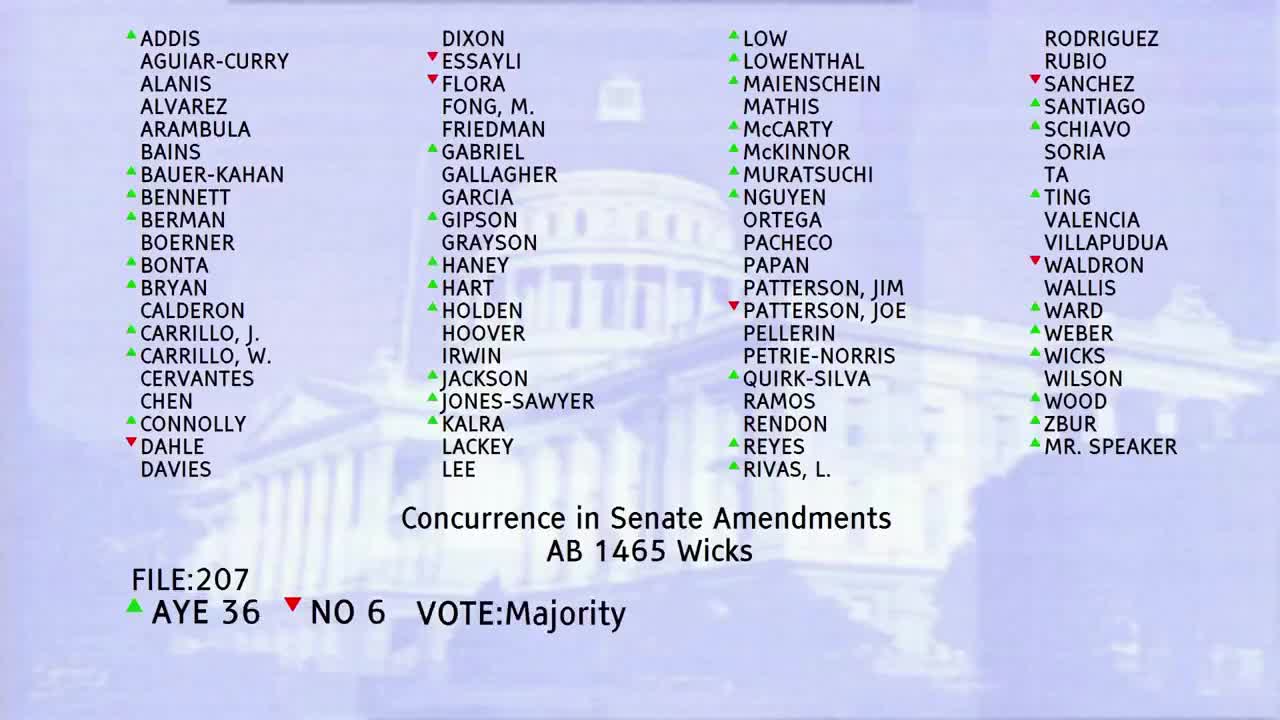 1MIN
Assembly Floor
 2MIN
Senate Standing Committee on Appropriations
 30MIN
Senate Standing Committee on Judiciary
 42MIN
Senate Standing Committee on Health
 5MIN
Assembly Floor
 26MIN
Assembly Standing Committee on Judiciary
 14SEC
Assembly Standing Committee on Judiciary
Bill Author

Bill Co-Author(s):