AB 335: Retail theft.
- Session Year: 2023-2024
- House: Assembly
- Latest Version Date: 2023-03-09
Current Status:
Failed
(2024-02-01: From committee: Filed with the Chief Clerk pursuant to Joint Rule 56.)
Introduced
In Committee
First Chamber
In Committee
Second Chamber
Enacted
Existing law, until January 1, 2026, makes it a misdemeanor to commit organized retail theft. Existing law defines organized retail theft to include, among other acts, acting as an agent of another individual or group of individuals to steal merchandise from one or more merchants premises or online marketplaces as part of an organized plan to commit theft. Under existing law, acts of organized retail theft that are committed on 2 or more separate occasions within a 12-month period and that have an aggregate value that exceeds $950 are punishable as a misdemeanor or a felony.
This bill would require the Milton Marks Little Hoover Commission on California State Government Organization and Economy to submit a report to the Legislature describing the reported retail thefts, as specified. This bill would also require state and local law enforcement to collect and provide data on retail theft to the commission, as specified. This bill would require the commission to issue its report to the Legislature no later than January 1, 2026. By imposing new duties on local entities, the bill would impose a state-mandated local program.
The California Constitution requires the state to reimburse local agencies and school districts for certain costs mandated by the state. Statutory provisions establish procedures for making that reimbursement.
This bill would provide that, if the Commission on State Mandates determines that the bill contains costs mandated by the state, reimbursement for those costs shall be made pursuant to the statutory provisions noted above.
The Safe Neighborhoods and Schools Act, enacted as an initiative statute by Proposition 47, as approved by the electors at the November 4, 2014, statewide general election, made various changes relating to theft and the possession of controlled substances, including by, among other things, generally reducing the penalty for those crimes, including reducing the penalty for possession of concentrated cannabis, establishing a procedure by which individuals convicted of those crimes prior to the passage of the act may petition for resentencing under the act, and creating the crime of shoplifting. The act also requires the Director of Finance to calculate the savings accruing to the state as a result of the implementation of the act and requires the Controller to transfer that sum from the General Fund to the Safe Neighborhoods and Schools Fund, which was created by the act. The act specifies the manner of distribution of those funds and the purposes for which they may be used.This bill would repeal the changes and additions made by Proposition 47, except those related to reducing the penalty for possession of concentrated cannabis. This bill would provide that it would become effective only upon approval of the voters, and would provide for the submission of this measure to the voters for approval at the next statewide general election.The Safe Neighborhoods and Schools Act, enacted as an initiative statute by Proposition 47, as approved by the electors at the November 4, 2014, statewide general election, made various changes relating to theft and the possession of controlled substances, including by, among other things, generally reducing the penalty for those crimes, including reducing the penalty for possession of concentrated cannabis, establishing a procedure by which individuals convicted of those crimes prior to the passage of the act may petition for resentencing under the act, and creating the crime of shoplifting. The act also requires the Director of Finance to calculate the savings accruing to the state as a result of the implementation of the act and requires the Controller to transfer that sum from the General Fund to the Safe Neighborhoods and Schools Fund, which was created by the act. The act specifies the manner of distribution of those funds and the purposes for which they may be used.
This bill would repeal the changes and additions made by Proposition 47, except those related to reducing the penalty for possession of concentrated cannabis. This bill would provide that it would become effective only upon approval of the voters, and would provide for the submission of this measure to the voters for approval at the next statewide general election.
(a)The Milton Marks Little Hoover Commission on California State Government Organization and Economy, established pursuant to Section 8501 of the Government Code, shall submit a report to the Legislature on retail theft, shoplifting, and organized retail theft in California. The report shall include, at a minimum, all of the following:
(1)Information on retail thefts, shoplifting, and organized retail thefts reported to all state and local law enforcement agencies, including, but not limited to, the number of reported retail thefts, shoplifting, and organized retail thefts made to each law enforcement agency, the size of the business, if known, the type of property reported stolen, if known, and monetary value of the property reported stolen, if known.
(2)Information on every state and local law enforcement agencys response to each report of retail theft, shoplifting, and organized retail theft, including, but not limited to, the average amount of time taken by the law enforcement agency to respond to the reported theft, whether the reported theft was investigated by law enforcement, whether an arrest was made in response to each report, whether a citation was made in response to each report, and, if so, which, and whether the investigating law enforcement referred the theft, retail theft, shoplifting, and organized retail theft to the district attorney for prosecution.
(3)Information on whether the district attorney who received reports of retail thefts, shoplifting, and organized retail thefts from law enforcement agencies filed criminal charges in each case, and, if charges were not filed, the extent to which this was due to the district attorneys determination that there was insufficient evidence to prosecute the offense, due to policies relating to the prioritization of filing charges in these types of cases, or due to some other reason for declining to file criminal charges in these cases.
(4)Countywide statistical information, including, but not limited to, the amount of reports of theft, shoplifting, and organized retail theft made to law enforcement in each county and the corresponding response, the amount of arrests made for theft, shoplifting, and organized retail theft in each county, the amount of citations given for theft, shoplifting, and organized retail theft in each county, the number of cases referred to the district attorney for prosecution for theft, shoplifting, and organized retail theft in each county, and the disposition of each case referred to the district attorney for prosecution in each county.
(b)The commission shall include any findings and recommendations relating to laws, policies, and practices regarding retail theft, shoplifting, and organized retail theft in California in the report.
(c)State and local law enforcement agencies shall collect and share the required information with the commission for the purpose of the report.
(d)The commission shall provide the report to the Legislature no later than January 1, 2026. The report shall be submitted in compliance with Section 9795 of the Government Code.
(e)This section shall remain in effect only until January 1, 2027, and as of that date is repealed.
SEC. 2.If the Commission on State Mandates determines that this act contains costs mandated by the state, reimbursement to local agencies and school districts for those costs shall be made pursuant to Part 7 (commencing with Section 17500) of Division 4 of Title 2 of the Government Code.
SECTION 1.Chapter 33 (commencing with Section 7599) of Division 7 of Title 1 of the Government Code is repealed.SEC. 2.Section 11350 of the Health and Safety Code is amended to read:11350.(a) Except as otherwise provided in this division, every person who possesses (1) any controlled substance specified in subdivision (b) or (c), or paragraph (1) of subdivision (f) of Section 11054, specified in paragraph (14), (15), or (20) of subdivision (d) of Section 11054, or specified in subdivision (b) or (c) of Section 11055, or specified in subdivision (h) of Section 11056, or (2) any controlled substance classified in Schedule III, IV, or V which is a narcotic drug, unless upon the written prescription of a physician, dentist, podiatrist, or veterinarian licensed to practice in this state, shall be punished by imprisonment pursuant to subdivision (h) of Section 1170 of the Penal Code.(b)Except as otherwise provided in this division, every person who possesses any controlled substance specified in subdivision (e) of Section 11054 shall be punished by imprisonment in a county jail for not more than one year, or pursuant to subdivision (h) of Section 1170 of the Penal Code.(c)Except as otherwise provided in this division, whenever a person who possesses any of the controlled substances specified in subdivision (a) or (b), the judge may, in addition to any punishment provided for pursuant to subdivision (a), assess against that person a fine not to exceed seventy dollars ($70) with proceeds of this fine to be used in accordance with Section 1463.23 of the Penal Code. The court shall, however, take into consideration the defendants ability to pay, and no defendant shall be denied probation because of their inability to pay the fine permitted under this subdivision.(d)Except in unusual cases in which it would not serve the interest of justice to do so, whenever a court grants probation pursuant to a felony conviction under this section, in addition to any other conditions of probation which may be imposed, the following conditions of probation shall be ordered:(1) For a first offense under this section, a fine of at least one thousand dollars ($1,000) or community service.(2) For a second or subsequent offense under this section, a fine of at least two thousand dollars ($2,000) or community service.(3) If a defendant does not have the ability to pay the minimum fines specified in paragraphs (1) and (2), community service shall be ordered in lieu of the fine.(e)It is not unlawful for a person other than the prescription holder to possess a controlled substance described in subdivision (a) if both of the following apply:(1)The possession of the controlled substance is at the direction or with the express authorization of the prescription holder.(2)The sole intent of the possessor is to deliver the prescription to the prescription holder for its prescribed use or to discard the substance in a lawful manner.(f)This section does not permit the use of a controlled substance by a person other than the prescription holder or permit the distribution or sale of a controlled substance that is otherwise inconsistent with the prescription.SEC. 3.Section 11377 of the Health and Safety Code is amended to read:11377.(a)Except as authorized by law and as otherwise provided in subdivision (b) or Section 11375, or in Article 7 (commencing with Section 4211) of Chapter 9 of Division 2 of the Business and Professions Code, every person who possesses any controlled substance which is (1) classified in Schedule III, IV, or V, and which is not a narcotic drug, (2) specified in subdivision (d) of Section 11054, except paragraphs (13), (14), (15), and (20) of subdivision (d), (3) specified in paragraph (11) of subdivision (c) of Section 11056, (4) specified in paragraph (2) or (3) of subdivision (f) of Section 11054, or (5) specified in subdivision (d), (e), or (f) of Section 11055, unless upon the prescription of a physician, dentist, podiatrist, or veterinarian, licensed to practice in this state, shall be punished by imprisonment in a county jail for a period of not more than one year, or pursuant to subdivision (h) of Section 1170 of the Penal Code.(b)(1)Any person who violates subdivision (a) by unlawfully possessing a controlled substance specified in subdivision (f) of Section 11056, and who has not previously been convicted of a violation involving a controlled substance specified in subdivision (f) of Section 11056, is guilty of a misdemeanor.(2)Any person who violates subdivision (a) by unlawfully possessing a controlled substance specified in subdivision (g) of Section 11056 is guilty of a misdemeanor.(3)Any person who violates subdivision (a) by unlawfully possessing a controlled substance specified in paragraph (7) or (8) of subdivision (d) of Section 11055 is guilty of a misdemeanor.(4)Any person who violates subdivision (a) by unlawfully possessing a controlled substance specified in paragraph (8) of subdivision (f) of Section 11057 is guilty of a misdemeanor.(c)In addition to any fine assessed under subdivision (b), the judge may assess a fine not to exceed seventy dollars ($70) against any person who violates subdivision (a), with the proceeds of this fine to be used in accordance with Section 1463.23 of the Penal Code. The court shall, however, take into consideration the defendants ability to pay, and no defendant shall be denied probation because of their inability to pay the fine permitted under this subdivision.(d)It is not unlawful for a person other than the prescription holder to possess a controlled substance described in subdivision (a) if both of the following apply:(1)The possession of the controlled substance is at the direction or with the express authorization of the prescription holder.(2)The sole intent of the possessor is to deliver the prescription to the prescription holder for its prescribed use or to discard the substance in a lawful manner.(e)This section does not permit the use of a controlled substance by a person other than the prescription holder or permit the distribution or sale of a controlled substance that is otherwise inconsistent with the prescription.SEC. 4.Section 459.5 of the Penal Code is repealed.SEC. 5.Section 473 of the Penal Code is amended to read:473.Forgery is punishable by imprisonment in a county jail for not more than one year, or by imprisonment pursuant to subdivision (h) of Section 1170.SEC. 6.Section 476a of the Penal Code is amended to read:476a.(a)Any person who, for themselves, as the agent or representative of another, or as an officer of a corporation, willfully, with intent to defraud, makes or draws or utters or delivers a check, draft, or order upon a bank or depositary, a person, a firm, or a corporation, for the payment of money, knowing at the time of that making, drawing, uttering, or delivering that the maker or drawer or the corporation has not sufficient funds in, or credit with the bank or depositary, person, firm, or corporation, for the payment of that check, draft, or order and all other checks, drafts, or orders upon funds then outstanding, in full upon its presentation, although no express representation is made with reference thereto, is punishable by imprisonment in a county jail for not more than one year, or pursuant to subdivision (h) of Section 1170.(b)However, if the total amount of all checks, drafts, or orders that the defendant is charged with and convicted of making, drawing, or uttering does not exceed four hundred fifty dollars ($450), the offense is punishable only by imprisonment in the county jail for not more than one year. This subdivision shall not be applicable if the defendant has previously been convicted of a violation of Section 470, 475, or 476, or of this section, or of the crime of petty theft in a case in which defendants offense was a violation also of Section 470, 475, or 476 or of this section or if the defendant has previously been convicted of any offense under the laws of any other state or of the United States which, if committed in this state, would have been punishable as a violation of Section 470, 475 or 476 or of this section or if the defendant has been so convicted of the crime of petty theft in a case in which, if defendants offense had been committed in this state, it would have been a violation also of Section 470, 475, or 476, or of this section.(c)Where the check, draft, or order is protested on the ground of insufficiency of funds or credit, the notice of protest shall be admissible as proof of presentation, nonpayment, and protest and shall be presumptive evidence of knowledge of insufficiency of funds or credit with the bank or depositary, person, firm, or corporation.(d)In any prosecution under this section involving two or more checks, drafts, or orders, it shall constitute prima facie evidence of the identity of the drawer of a check, draft, or order if both of the following occur:(1)When the payee accepts the check, draft, or order from the drawer, the payee obtains from the drawer the following information: name and residence of the drawer, business or mailing address, either a valid drivers license number or Department of Motor Vehicles identification card number, and the drawers home or work phone number or place of employment. That information may be recorded on the check, draft, or order itself or may be retained on file by the payee and referred to on the check, draft, or order by identifying number or other similar means.(2)The person receiving the check, draft, or order witnesses the drawers signature or endorsement, and, as evidence of that, initials the check, draft, or order at the time of receipt.(e)The word credit as used herein shall be construed to mean an arrangement or understanding with the bank or depositary, person, firm, or corporation for the payment of a check, draft, or order.(f)If any of the preceding paragraphs, or parts thereof, shall be found unconstitutional or invalid, the remainder of this section shall not thereby be invalidated, but shall remain in full force and effect.(g)A sheriffs department, police department, or other law enforcement agency may collect a fee from the defendant for investigation, collection, and processing of checks referred to their agency for investigation of alleged violations of this section or Section 476.(h)The amount of the fee shall not exceed twenty-five dollars ($25) for each bad check, in addition to the amount of any bank charges incurred by the victim as a result of the alleged offense. If the sheriffs department, police department, or other law enforcement agency collects a fee for bank charges incurred by the victim pursuant to this section, that fee shall be paid to the victim for any bank fees the victim may have been assessed. In no event shall reimbursement of the bank charge to the victim pursuant to this section exceed ten dollars ($10) per check.SEC. 7.Section 490.2 of the Penal Code is repealed.SEC. 8.Section 496 of the Penal Code is amended to read:496.(a)Every person who buys or receives any property that has been stolen or that has been obtained in any manner constituting theft or extortion, knowing the property to be so stolen or obtained, or who conceals, sells, withholds, or aids in concealing, selling, or withholding any property from the owner, knowing the property to be so stolen or obtained, shall be punished by imprisonment in a county jail for not more than one year, or imprisonment pursuant to subdivision (h) of Section 1170. However, if the district attorney or the grand jury determines that this action would be in the interests of justice, the district attorney or the grand jury, as the case may be, may, if the value of the property does not exceed nine hundred fifty dollars ($950), specify in the accusatory pleading that the offense shall be a misdemeanor, punishable only by imprisonment in a county jail not exceeding one year.A principal in the actual theft of the property may be convicted pursuant to this section. However, no person may be convicted both pursuant to this section and of the theft of the same property.(b)Every swap meet vendor, as defined in Section 21661 of the Business and Professions Code, and every person whose principal business is dealing in, or collecting, merchandise or personal property, and every agent, employee, or representative of that person, who buys or receives any property of a value in excess of nine hundred fifty dollars ($950) that has been stolen or obtained in any manner constituting theft or extortion, under circumstances that should cause the person, agent, employee, or representative to make reasonable inquiry to ascertain that the person from whom the property was bought or received had the legal right to sell or deliver it, without making a reasonable inquiry, shall be punished by imprisonment in a county jail for not more than one year, or imprisonment pursuant to subdivision (h) of Section 1170.Every swap meet vendor, as defined in Section 21661 of the Business and Professions Code, and every person whose principal business is dealing in, or collecting, merchandise or personal property, and every agent, employee, or representative of that person, who buys or receives any property of a value of nine hundred fifty dollars ($950) or less that has been stolen or obtained in any manner constituting theft or extortion, under circumstances that should cause the person, agent, employee, or representative to make reasonable inquiry to ascertain that the person from whom the property was bought or received had the legal right to sell or deliver it, without making a reasonable inquiry, shall be guilty of a misdemeanor.(c)Any person who has been injured by a violation of subdivision (a) or (b) may bring an action for three times the amount of actual damages, if any, sustained by the plaintiff, costs of suit, and reasonable attorneys fees.(d)Notwithstanding Section 664, any attempt to commit any act prohibited by this section, except an offense specified in the accusatory pleading as a misdemeanor, is punishable by imprisonment in a county jail for not more than one year, or by imprisonment pursuant to subdivision (h) of Section 1170.SEC. 9.Section 666 of the Penal Code is amended to read:666.(a)Notwithstanding Section 490, every person who, having been convicted three or more times of petty theft, grand theft, a conviction pursuant to subdivision (d) or (e) of Section 368, auto theft under Section 10851 of the Vehicle Code, burglary, carjacking, robbery, or a felony violation of Section 496 and having served a term therefor in any penal institution or having been imprisoned therein as a condition of probation for that offense, and who is subsequently convicted of petty theft, is punishable by imprisonment in a county jail not exceeding one year, or imprisonment pursuant to subdivision (h) of Section 1170.(b)Notwithstanding Section 490, any person described in paragraph (1) who, having been convicted of petty theft, grand theft, a conviction pursuant to subdivision (d) or (e) of Section 368, auto theft under Section 10851 of the Vehicle Code, burglary, carjacking, robbery, or a felony violation of Section 496, and having served a term of imprisonment therefor in any penal institution or having been imprisoned therein as a condition of probation for that offense, and who is subsequently convicted of petty theft, is punishable by imprisonment in the county jail not exceeding one year, or in the state prison.(1)This subdivision shall apply to any person who is required to register pursuant to the Sex Offender Registration Act, or who has a prior violent or serious felony conviction, as specified in subdivision (c) of Section 667.5 or subdivision (c) of Section 1192.7.(2)This subdivision shall not be construed to preclude prosecution or punishment pursuant to subdivisions (b) to (i), inclusive, of Section 667, or Section 1170.12.SEC. 10.Section 1170.18 of the Penal Code is repealed.SEC. 11.Sections 1 to 10, inclusive, of this act amend the Safe Neighborhoods and Schools Act, enacted as an initiative statute by Proposition 47, as approved by the electors at the November 4, 2014, statewide election, and shall become effective only when submitted to and approved by the voters. The Secretary of State shall submit Sections 1 to 10, inclusive, of this act for approval by the voters at a statewide election in accordance with Section 9040 of the Elections Code.(a) Except as otherwise provided in this division, every person who possesses (1) any controlled substance specified in subdivision (b), (c), (e), (b) or (c), or paragraph (1) of subdivision (f) of Section 11054, specified in paragraph (14), (15), or (20) of subdivision (d) of Section 11054, or specified in subdivision (b) or (c) of Section 11055, or specified in subdivision (h) of Section 11056, or (2) any controlled substance classified in Schedule III, IV, or V which is a narcotic drug, unless upon the written prescription of a physician, dentist, podiatrist, or veterinarian licensed to practice in this state, shall be punished by imprisonment in a county jail for not more than one year, except that such person shall instead be punished pursuant to subdivision (h) of Section 1170 of the Penal Code if that person has one or more prior convictions for an offense specified in clause (iv) of subparagraph (C) of paragraph (2) of subdivision (e) of Section 667 of the Penal Code or for an offense requiring registration pursuant to subdivision (c) of Section 290 of the Penal Code.
(b)Except as otherwise provided in this division, every person who possesses any controlled substance specified in subdivision (e) of Section 11054 shall be punished by imprisonment in a county jail for not more than one year, or pursuant to subdivision (h) of Section 1170 of the Penal Code.
(b)(c)Except as otherwise provided in this division, whenever a person who possesses any of the controlled substances specified in subdivision (a), (a) or (b), the judge may, in addition to any punishment provided for pursuant to subdivision (a), assess against that person a fine not to exceed seventy dollars ($70) with proceeds of this fine to be used in accordance with Section 1463.23 of the Penal Code. The court shall, however, take into consideration the defendants ability to pay, and no defendant shall be denied probation because of his or her their inability to pay the fine permitted under this subdivision.
(c)(d)Except in unusual cases in which it would not serve the interest of justice to do so, whenever a court grants probation pursuant to a felony conviction under this section, in addition to any other conditions of probation which may be imposed, the following conditions of probation shall be ordered:
(1) For a first offense under this section, a fine of at least one thousand dollars ($1,000) or community service.
(2) For a second or subsequent offense under this section, a fine of at least two thousand dollars ($2,000) or community service.
(3) If a defendant does not have the ability to pay the minimum fines specified in paragraphs (1) and (2), community service shall be ordered in lieu of the fine.
(d)(e)It is not unlawful for a person other than the prescription holder to possess a controlled substance described in subdivision (a) if both of the following apply:
(1)The possession of the controlled substance is at the direction or with the express authorization of the prescription holder.
(2)The sole intent of the possessor is to deliver the prescription to the prescription holder for its prescribed use or to discard the substance in a lawful manner.
(e)(f)This section does not permit the use of a controlled substance by a person other than the prescription holder or permit the distribution or sale of a controlled substance that is otherwise inconsistent with the prescription.
SEC. 3.Section 11377 of the Health and Safety Code is amended to read:11377.(a)Except as authorized by law and as otherwise provided in subdivision (b) or Section 11375, or in Article 7 (commencing with Section 4211) of Chapter 9 of Division 2 of the Business and Professions Code, every person who possesses any controlled substance which is (1) classified in Schedule III, IV, or V, and which is not a narcotic drug, (2) specified in subdivision (d) of Section 11054, except paragraphs (13), (14), (15), and (20) of subdivision (d), (3) specified in paragraph (11) of subdivision (c) of Section 11056, (4) specified in paragraph (2) or (3) of subdivision (f) of Section 11054, or (5) specified in subdivision (d), (e), or (f) of Section 11055, unless upon the prescription of a physician, dentist, podiatrist, or veterinarian, licensed to practice in this state, shall be punished by imprisonment in a county jail for a period of not more than one year, except that such person may instead be punished pursuant to subdivision (h) of Section 1170 of the Penal Code if that person has one or more prior convictions for an offense specified in clause (iv) of subparagraph (C) of paragraph (2) of subdivision (e) of Section 667 of the Penal Code or for an offense requiring registration pursuant to subdivision (c) of Section 290 of the or pursuant to subdivision (h) of Section 1170 of the Penal Code.
(b)(1)Any person who violates subdivision (a) by unlawfully possessing a controlled substance specified in subdivision (f) of Section 11056, and who has not previously been convicted of a violation involving a controlled substance specified in subdivision (f) of Section 11056, is guilty of a misdemeanor.
(2)Any person who violates subdivision (a) by unlawfully possessing a controlled substance specified in subdivision (g) of Section 11056 is guilty of a misdemeanor.
(3)Any person who violates subdivision (a) by unlawfully possessing a controlled substance specified in paragraph (7) or (8) of subdivision (d) of Section 11055 is guilty of a misdemeanor.
(4)Any person who violates subdivision (a) by unlawfully possessing a controlled substance specified in paragraph (8) of subdivision (f) of Section 11057 is guilty of a misdemeanor.
(b)The(c)In addition to any fine assessed under subdivision (b), the judge may assess a fine not to exceed seventy dollars ($70) against any person who violates subdivision (a), with the proceeds of this fine to be used in accordance with Section 1463.23 of the Penal Code. The court shall, however, take into consideration the defendants ability to pay, and no defendant shall be denied probation because of his or her their inability to pay the fine permitted under this subdivision.
(c)(d)It is not unlawful for a person other than the prescription holder to possess a controlled substance described in subdivision (a) if both of the following apply:
(1)The possession of the controlled substance is at the direction or with the express authorization of the prescription holder.
(2)The sole intent of the possessor is to deliver the prescription to the prescription holder for its prescribed use or to discard the substance in a lawful manner.
(d)(e)This section does not permit the use of a controlled substance by a person other than the prescription holder or permit the distribution or sale of a controlled substance that is otherwise inconsistent with the prescription.
SEC. 4.Section 459.5 of the Penal Code is repealed.459.5.(a)Notwithstanding Section 459, shoplifting is defined as entering a commercial establishment with intent to commit larceny while that establishment is open during regular business hours, where the value of the property that is taken or intended to be taken does not exceed nine hundred fifty dollars ($950). Any other entry into a commercial establishment with intent to commit larceny is burglary. Shoplifting shall be punished as a misdemeanor, except that a person with one or more prior convictions for an offense specified in clause (iv) of subparagraph (C) of paragraph (2) of subdivision (e) of Section 667 or for an offense requiring registration pursuant to subdivision (c) of Section 290 may be punished pursuant to subdivision (h) of Section 1170.(b)Any act of shoplifting as defined in subdivision (a) shall be charged as shoplifting. No person who is charged with shoplifting may also be charged with burglary or theft of the same property.SEC. 5.Section 473 of the Penal Code is amended to read:473.(a)Forgery is punishable by imprisonment in a county jail for not more than one year, or by imprisonment pursuant to subdivision (h) of Section 1170.
(b)Notwithstanding subdivision (a), any person who is guilty of forgery relating to a check, bond, bank bill, note, cashiers check, travelers check, or money order, where the value of the check, bond, bank bill, note, cashiers check, travelers check, or money order does not exceed nine hundred fifty dollars ($950), shall be punishable by imprisonment in a county jail for not more than one year, except that such person may instead be punished pursuant to subdivision (h) of Section 1170 if that person has one or more prior convictions for an offense specified in clause (iv) of subparagraph (C) of paragraph (2) of subdivision (e) of Section 667 or for an offense requiring registration pursuant to subdivision (c) of Section 290. This subdivision shall not be applicable to any person who is convicted both of forgery and of identity theft, as defined in Section 530.5.SEC. 6.Section 476a of the Penal Code is amended to read:476a.(a)Any person who, for himself or herself, themselves, as the agent or representative of another, or as an officer of a corporation, willfully, with intent to defraud, makes or draws or utters or delivers a check, draft, or order upon a bank or depositary, a person, a firm, or a corporation, for the payment of money, knowing at the time of that making, drawing, uttering, or delivering that the maker or drawer or the corporation has not sufficient funds in, or credit with the bank or depositary, person, firm, or corporation, for the payment of that check, draft, or order and all other checks, drafts, or orders upon funds then outstanding, in full upon its presentation, although no express representation is made with reference thereto, is punishable by imprisonment in a county jail for not more than one year, or pursuant to subdivision (h) of Section 1170.
(b)However, if the total amount of all checks, drafts, or orders that the defendant is charged with and convicted of making, drawing, or uttering does not exceed nine hundred fifty dollars ($950), four hundred fifty dollars ($450), the offense is punishable only by imprisonment in the county jail for not more than one year, except that such person may instead be punished pursuant to subdivision (h) of Section 1170 if that person has one or more prior convictions for an offense specified in clause (iv) of subparagraph (C) of paragraph (2) of subdivision (e) of Section 667 or for an offense requiring registration pursuant to subdivision (c) of Section 290. year. This subdivision shall not be applicable if the defendant has previously been convicted of three or more violations a violation of Section 470, 475, or 476, or of this section, or of the crime of petty theft in a case in which defendants offense was a violation also of Section 470, 475, or 476 or of this section or if the defendant has previously been convicted of any offense under the laws of any other state or of the United States which, if committed in this state, would have been punishable as a violation of Section 470, 475 or 476 or of this section or if he the defendant has been so convicted of the crime of petty theft in a case in which, if defendants offense had been committed in this state, it would have been a violation also of Section 470, 475, or 476, or of this section.
(c)Where the check, draft, or order is protested on the ground of insufficiency of funds or credit, the notice of protest shall be admissible as proof of presentation, nonpayment, and protest and shall be presumptive evidence of knowledge of insufficiency of funds or credit with the bank or depositary, person, firm, or corporation.
(d)In any prosecution under this section involving two or more checks, drafts, or orders, it shall constitute prima facie evidence of the identity of the drawer of a check, draft, or order if both of the following occur:
(1)When the payee accepts the check, draft, or order from the drawer, he or she the payee obtains from the drawer the following information: name and residence of the drawer, business or mailing address, either a valid drivers license number or Department of Motor Vehicles identification card number, and the drawers home or work phone number or place of employment. That information may be recorded on the check, draft, or order itself or may be retained on file by the payee and referred to on the check, draft, or order by identifying number or other similar means.
(2)The person receiving the check, draft, or order witnesses the drawers signature or endorsement, and, as evidence of that, initials the check, draft, or order at the time of receipt.
(e)The word credit as used herein shall be construed to mean an arrangement or understanding with the bank or depositary, person, firm, or corporation for the payment of a check, draft, or order.
(f)If any of the preceding paragraphs, or parts thereof, shall be found unconstitutional or invalid, the remainder of this section shall not thereby be invalidated, but shall remain in full force and effect.
(g)A sheriffs department, police department, or other law enforcement agency may collect a fee from the defendant for investigation, collection, and processing of checks referred to their agency for investigation of alleged violations of this section or Section 476.
(h)The amount of the fee shall not exceed twenty-five dollars ($25) for each bad check, in addition to the amount of any bank charges incurred by the victim as a result of the alleged offense. If the sheriffs department, police department, or other law enforcement agency collects a fee for bank charges incurred by the victim pursuant to this section, that fee shall be paid to the victim for any bank fees the victim may have been assessed. In no event shall reimbursement of the bank charge to the victim pursuant to this section exceed ten dollars ($10) per check.
SEC. 7.Section 490.2 of the Penal Code is repealed.490.2.(a)Notwithstanding Section 487 or any other provision of law defining grand theft, obtaining any property by theft where the value of the money, labor, real or personal property taken does not exceed nine hundred fifty dollars ($950) shall be considered petty theft and shall be punished as a misdemeanor, except that such person may instead be punished pursuant to subdivision (h) of Section 1170 if that person has one or more prior convictions for an offense specified in clause (iv) of subparagraph (C) of paragraph (2) of subdivision (e) of Section 667 or for an offense requiring registration pursuant to subdivision (c) of Section 290.(b)This section shall not be applicable to any theft that may be charged as an infraction pursuant to any other provision of law.(c)This section shall not apply to theft of a firearm.SEC. 8.Section 496 of the Penal Code is amended to read:496.(a)Every person who buys or receives any property that has been stolen or that has been obtained in any manner constituting theft or extortion, knowing the property to be so stolen or obtained, or who conceals, sells, withholds, or aids in concealing, selling, or withholding any property from the owner, knowing the property to be so stolen or obtained, shall be punished by imprisonment in a county jail for not more than one year, or imprisonment pursuant to subdivision (h) of Section 1170. However, if the district attorney or the grand jury determines that this action would be in the interests of justice, the district attorney or the grand jury, as the case may be, may, if the value of the property does not exceed nine hundred fifty dollars ($950), specify in the accusatory pleading that the offense shall be a misdemeanor, punishable only by imprisonment in a county jail not exceeding one year, if such person has no prior convictions for an offense specified in clause (iv) of subparagraph (C) of paragraph (2) of subdivision (e) of Section 667 or for an offense requiring registration pursuant to subdivision (c) of Section 290. year.
A principal in the actual theft of the property may be convicted pursuant to this section. However, no person may be convicted both pursuant to this section and of the theft of the same property.
(b)Every swap meet vendor, as defined in Section 21661 of the Business and Professions Code, and every person whose principal business is dealing in, or collecting, merchandise or personal property, and every agent, employee, or representative of that person, who buys or receives any property of a value in excess of nine hundred fifty dollars ($950) that has been stolen or obtained in any manner constituting theft or extortion, under circumstances that should cause the person, agent, employee, or representative to make reasonable inquiry to ascertain that the person from whom the property was bought or received had the legal right to sell or deliver it, without making a reasonable inquiry, shall be punished by imprisonment in a county jail for not more than one year, or imprisonment pursuant to subdivision (h) of Section 1170.
Every swap meet vendor, as defined in Section 21661 of the Business and Professions Code, and every person whose principal business is dealing in, or collecting, merchandise or personal property, and every agent, employee, or representative of that person, who buys or receives any property of a value of nine hundred fifty dollars ($950) or less that has been stolen or obtained in any manner constituting theft or extortion, under circumstances that should cause the person, agent, employee, or representative to make reasonable inquiry to ascertain that the person from whom the property was bought or received had the legal right to sell or deliver it, without making a reasonable inquiry, shall be guilty of a misdemeanor.
(c)Any person who has been injured by a violation of subdivision (a) or (b) may bring an action for three times the amount of actual damages, if any, sustained by the plaintiff, costs of suit, and reasonable attorneys fees.
(d)Notwithstanding Section 664, any attempt to commit any act prohibited by this section, except an offense specified in the accusatory pleading as a misdemeanor, is punishable by imprisonment in a county jail for not more than one year, or by imprisonment pursuant to subdivision (h) of Section 1170.
SEC. 9.Section 666 of the Penal Code is amended to read:666.(a)Notwithstanding Section 490, every person who, having been convicted three or more times of petty theft, grand theft, a conviction pursuant to subdivision (d) or (e) of Section 368, auto theft under Section 10851 of the Vehicle Code, burglary, carjacking, robbery, or a felony violation of Section 496 and having served a term therefor in any penal institution or having been imprisoned therein as a condition of probation for that offense, and who is subsequently convicted of petty theft, is punishable by imprisonment in a county jail not exceeding one year, or imprisonment pursuant to subdivision (h) of Section 1170.
(a)(b)Notwithstanding Section 490, any person described in subdivision (b) paragraph (1) who, having been convicted of petty theft, grand theft, a conviction pursuant to subdivision (d) or (e) of Section 368, auto theft under Section 10851 of the Vehicle Code, burglary, carjacking, robbery, or a felony violation of Section 496, and having served a term of imprisonment therefor in any penal institution or having been imprisoned therein as a condition of probation for that offense, and who is subsequently convicted of petty theft, is punishable by imprisonment in the county jail not exceeding one year, or in the state prison.
(b)Subdivision (a) shall(1)This subdivision shall apply to any person who is required to register pursuant to the Sex Offender Registration Act, or who has a prior violent or serious felony conviction, as specified in clause (iv) of subparagraph (C) of paragraph (2) of subdivision (e) of Section 667, or has a conviction pursuant to subdivision (d) or (e) of Section 368. subdivision (c) of Section 667.5 or subdivision (c) of Section 1192.7.
(c)(2)This section subdivision shall not be construed to preclude prosecution or punishment pursuant to subdivisions (b) to (i), inclusive, of Section 667, or Section 1170.12.
SEC. 10.Section 1170.18 of the Penal Code is repealed.1170.18.(a)A person who, on November 5, 2014, was serving a sentence for a conviction, whether by trial or plea, of a felony or felonies who would have been guilty of a misdemeanor under the act that added this section (this act) had this act been in effect at the time of the offense may petition for a recall of sentence before the trial court that entered the judgment of conviction in his or her case to request resentencing in accordance with Sections 11350, 11357, or 11377 of the Health and Safety Code, or Section 459.5, 473, 476a, 490.2, 496, or 666 of the Penal Code, as those sections have been amended or added by this act.(b)Upon receiving a petition under subdivision (a), the court shall determine whether the petitioner satisfies the criteria in subdivision (a). If the petitioner satisfies the criteria in subdivision (a), the petitioners felony sentence shall be recalled and the petitioner resentenced to a misdemeanor pursuant to Sections 11350, 11357, or 11377 of the Health and Safety Code, or Section 459.5, 473, 476a, 490.2, 496, or 666 of the Penal Code, as those sections have been amended or added by this act, unless the court, in its discretion, determines that resentencing the petitioner would pose an unreasonable risk of danger to public safety. In exercising its discretion, the court may consider all of the following:(1)The petitioners criminal conviction history, including the type of crimes committed, the extent of injury to victims, the length of prior prison commitments, and the remoteness of the crimes.(2)The petitioners disciplinary record and record of rehabilitation while incarcerated.(3)Any other evidence the court, within its discretion, determines to be relevant in deciding whether a new sentence would result in an unreasonable risk of danger to public safety.(c)As used throughout this code, unreasonable risk of danger to public safety means an unreasonable risk that the petitioner will commit a new violent felony within the meaning of clause (iv) of subparagraph (C) of paragraph (2) of subdivision (e) of Section 667.(d)A person who is resentenced pursuant to subdivision (b) shall be given credit for time served and shall be subject to parole for one year following completion of his or her sentence, unless the court, in its discretion, as part of its resentencing order, releases the person from parole. The person is subject to parole supervision by the Department of Corrections and Rehabilitation pursuant to Section 3000.08 and the jurisdiction of the court in the county in which the parolee is released or resides, or in which an alleged violation of supervision has occurred, for the purpose of hearing petitions to revoke parole and impose a term of custody.(e)Resentencing pursuant to this section shall not result in the imposition of a term longer than the original sentence.(f)A person who has completed his or her sentence for a conviction, whether by trial or plea, of a felony or felonies who would have been guilty of a misdemeanor under this act had this act been in effect at the time of the offense, may file an application before the trial court that entered the judgment of conviction in his or her case to have the felony conviction or convictions designated as misdemeanors.(g)If the application satisfies the criteria in subdivision (f), the court shall designate the felony offense or offenses as a misdemeanor.(h)Unless the applicant requests a hearing, a hearing is not necessary to grant or deny an application filed under subdivision (f).(i)This section does not apply to a person who has one or more prior convictions for an offense specified in clause (iv) of subparagraph (C) of paragraph (2) of subdivision (e) of Section 667 or for an offense requiring registration pursuant to subdivision (c) of Section 290.(j)Except as specified in subdivision (p), a petition or application under this section shall be filed on or before November 4, 2022, or at a later date upon showing of good cause.(k)A felony conviction that is recalled and resentenced under subdivision (b) or designated as a misdemeanor under subdivision (g) shall be considered a misdemeanor for all purposes, except that resentencing shall not permit that person to own, possess, or have in his or her custody or control a firearm or prevent his or her conviction under Chapter 2 (commencing with Section 29800) of Division 9 of Title 4 of Part 6.(l)If the court that originally sentenced the petitioner is not available, the presiding judge shall designate another judge to rule on the petition or application.(m)This section does not diminish or abrogate any rights or remedies otherwise available to the petitioner or applicant.(n)Resentencing pursuant to this section does not diminish or abrogate the finality of judgments in any case that does not come within the purview of this section.(o)A resentencing hearing ordered under this section shall constitute a postconviction release proceeding under paragraph (7) of subdivision (b) of Section 28 of Article I of the California Constitution (Marsys Law).(p)(1)A person who is committed to a state hospital after being found not guilty by reason of insanity pursuant to Section 1026 may petition the court to have his or her maximum term of commitment, as established by Section 1026.5, reduced to the length it would have been had the act that added this section been in effect at the time of the original determination. Both of the following conditions are required for the maximum term of commitment to be reduced.(A)The person would have met all of the criteria for a reduction in sentence pursuant to this section had he or she been found guilty.(B)The person files the petition for a reduction of the maximum term of commitment before January 1, 2021, or on a later date upon a showing of good cause.(2)If a petitioners maximum term of confinement is ordered reduced under this subdivision, the new term of confinement must provide opportunity to meet requirements provided in subdivision (b) of Section 1026.5. If a petitioners new maximum term of confinement ordered under this section does not provide sufficient time to meet requirements provided in subdivision (b) of Section 1026.5, the new maximum term of confinement may be extended, not more than 240 days from the date the petition is granted, in order to meet requirements provided in subdivision (b) of Section 1026.5.SEC. 11.Sections 1 to 10, inclusive, of this act amend the Safe Neighborhoods and Schools Act, enacted as an initiative statute by Proposition 47, as approved by the electors at the November 4, 2014, statewide election, and shall become effective only when submitted to and approved by the voters. The Secretary of State shall submit Sections 1 to 10, inclusive, of this act for approval by the voters at a statewide election in accordance with Section 9040 of the Elections Code.
|
Date
|
Status
|
|---|---|
| Feb 1, 2024 | From committee: Filed with the Chief Clerk pursuant to Joint Rule 56. |
| Jan 31, 2024 | Died pursuant to Art. IV, Sec. 10(c) of the Constitution. |
| May 18, 2023 | In committee: Held under submission. |
| Apr 19, 2023 | In committee: Set, first hearing. Referred to APPR. suspense file. |
| Mar 13, 2023 | Re-referred to Com. on APPR. |
| Mar 9, 2023 | Read second time and amended. |
| Mar 8, 2023 | From committee: Amend, and do pass as amended and re-refer to Com. on APPR. (Ayes 8. Noes 0.) (March 7). |
| Feb 9, 2023 | Referred to Com. on PUB. S. |
| Jan 31, 2023 | From printer. May be heard in committee March 2. |
| Jan 30, 2023 | Read first time. To print. |
|
Date
|
Description
|
Location
|
Votes
|
|
|---|---|---|---|---|
| Mar 7, 2023 | Do pass as amended and be re-referred to the Committee on [Appropriations] | Assembly Standing Committee on Public Safety |
Passed |
This list shows positions taken on this bill by organizations on the date displayed, which is linked to the original source.
Positions by individuals are not included.
|
Organization
|
Position
|
Date
|
|---|---|---|
| Aclu California Action | * Neutral | Mar 7, 2023 |
| Arcadia Police Officers' Association | ** Support | |
| Burbank Police Officers' Association | ** Support | |
| California Police Chiefs Association | * Support | Mar 7, 2023 |
| California Attorneys For Criminal Justice | ** Against | |
| California Coalition of School Safety Professionals | ** Support | |
| California Commission on Peace Officer Standards and Training | * Support | Mar 7, 2023 |
| California District Attorneys Association | ** Support | |
| California for Safety and Justice | * Neutral | Mar 7, 2023 |
| California Public Defenders Association | ** Against | |
| California State Sheriffs' Association | ** Support | |
| Californians for Safety and Justice | * Neutral | Mar 7, 2023 |
| CLAREMONT POLICE OFFICERS ASSOCIATION | ** Support | |
| Communities United for Restorative Youth Justice | ** Against | |
| Corona Police Officers Association | ** Support | |
| Culver City Police Officers' Association | ** Support | |
| Defy Ventures | ** Against | |
| Drug Policy Alliance | ** Against | |
| Ella Baker Center For Human Rights | ** Against | |
| Friends Committee of Legislation of California | * Neutral | Mar 7, 2023 |
| Friends Committee On Legislation Of California | * Neutral | Mar 7, 2023 |
| Fullerton Police Officers' Association | ** Support | |
| Inglewood Police Officers Association | ** Support | |
| Initiate Justice | ** Against | |
| Last Prisoner Project | ** Against | |
| los angeles school police officers association | ** Support | |
| Miracles Counseling Center | ** Against | |
| Modesto Chamber of Commerce | ** Support | |
| Newport Beach Police Association | ** Support | |
| Palos Verdes Police Officers Association | ** Support | |
| PLACER COUNTY DEPUTY SHERIFFS ASSOCIATION | ** Support | |
| Pomona Police Officers' Association | ** Support | |
| PORAC | * Support | Mar 7, 2023 |
| Riverside County Sheriff's Office | ** Support | |
| RIVERSIDE POLICE OFFICERS ASSOCIATION | ** Support | |
| Riverside Sheriffs' Association | ** Support | |
| Rubicon Programs | ** Against | |
| San Diegans Against Crime | * Support | Mar 7, 2023 |
| San Diego District Attorney's Association | * Support | Mar 7, 2023 |
| San Diego District Attorney's Office | * Support | Mar 7, 2023 |
| Santa Ana Police Officers Association | ** Support | |
| Santa Cruz Barrios Unidos INC. | ** Against | |
| Stanislaus County District Attorney | * Support | Mar 7, 2023 |
| Stanislaus County District Attorney's Office | * Support | Mar 7, 2023 |
| Take A Stand Stanislaus | ** Support | |
| Turlock Associated Police Officers | ** Support | |
| Universidad Popular | ** Against | |
| Upland Police Officers Association | ** Support |
Date of Hearing: April 19, 2023
ASSEMBLY COMMITTEE ON APPROPRIATIONS
Chris Holden, Chair
ABPCA Bill Id:AB 335
Author:(Alanis) – As Amended Ver:March 9, 2023
Policy Committee: | Public Safety | Vote: | 8 - 0 |
|
| ||
|
|
Urgency: No State Mandated Local Program: Yes Reimbursable: Yes
SUMMARY:
This bill requires the Little Hoover Commission (Commission) to submit a report to the Legislature by January 1, 2026, on retail theft, shoplifting, and organized retail theft in California. The bill specifies the data and information to be included in the report and requires state and local law enforcement to collect and share the required information with the Commission.
FISCAL EFFECT:
- General Fund costs of approximately $1.35 million over two years to the Commission to conduct the study. The Commission indicates this bill describes a far different kind of study than traditionally conducted by the Commission, making costs difficult to estimate, but notes the extensive data collection and analysis requirements are well beyond the traditional scope of the Commission’s work, staff expertise, and resources. Thus, the Commission anticipates needing to engage outside expertise through a research collaboration with the University of California or another partner. Additionally, as an independent agency, the Commission’s existing ongoing research agenda and advocacy of current policy recommendations will continue to comprise the bulk of staff workload, which means the Commission will need to make at least four additional staff hires to accommodate the work required by this bill.
- Costs of an unknown, but likely substantial amount to local law enforcement to collect and provide data on retail theft to the Commission. These costs are potentially reimbursable by the state, subject to a determination by the Commission on State Mandates.
COMMENTS:
- Purpose. According to the author:
This bill will provide clarity, on the impacts to businesses, including small businesses, and give us as lawmakers an opportunity to fairly and openly address potential deficits in the enactment of Proposition 47.
- Proposition 47. Proposition 47 (2014), the Safe Neighborhoods and Schools Act, re-classified certain drug possession offenses and property offenses less than $950 from felonies or wobblers (alternate misdemeanor-felony) to straight misdemeanors, and created the misdemeanor offense of shoplifting. However, the measure limited these reduced penalties to offenders who do not have designated prior convictions for specified serious or violent felonies (also known as super strikes) and who are not required to register as sex offenders.
Over the past three or four years, retailers have alleged reduced penalties have contributed to a substantial increase in shoplifting at retail locations – some thieves so brazen as to bring in bags to fill. However, research and even the retailers themselves now explain that many of these reports were overblown. According to the San Francisco Chronicle on January 5, 2023:
Data released by the San Francisco Police Department in October 2021 did not support Walgreens’ claim that unchecked theft had forced it to close five stores. On average, the ill-fated stores had recorded two shoplifting incidents a month from 2018 to their shuttering dates in 2021. While inventory amounting to 3.5% of the Walgreens total sales vanished last year, this year’s losses seemed to stabilize, hovering closer to the “mid twos.”
Furthermore, the Public Policy Institute of California found that in 2020, the property crime rate in California reached the lowest level observed since 1960. While it ticked up in 2021 by 2.4%, it remained historically low. Specifically, in 2021, property crime rose in 25 counties, including in San Francisco, which experienced the largest increase at 16.9%, and fell in eight of the state’s 15 largest counties, with Ventura’s 6.3% drop being the largest.
- Little Hoover Commission. The Commission is an independent state oversight agency charged in statute with recommending policy changes that would provide “economy, efficiency and improved service” in state government. The Commission traditionally does this by holding public hearings, conducting staff research, and issuing written reports that outline its findings and recommendations. The Commission has a total staff of seven.
During the 2021-22 Legislative Session, the Commission produced 16 reports, including those recommending California do a better job facilitating equitable regional economic development, increase access to affordable housing, improve its approach to law enforcement training, improve children’s mental health care, and support workers impacted by the COVID-19 pandemic.
- Related Legislation. AB 23 (Muratsuchi) amends Proposition 47 by reducing the threshold amount for petty theft and shoplifting from $950 to $400. AB 23 is pending in the Assembly Public Safety Committee, having been set three times and never heard.
AB 75 (Hoover) reinstates a provision of law repealed by Proposition 47 relating to petty theft with a prior conviction. AB 75 failed passage in the Assembly Public Safety Committee.
AB 329 (Ta) amends Proposition 47 to make petty theft or shoplifting by a person who is not a resident of this state a wobbler. AB 329 failed passage in the Assembly Public Safety Committee.
Analysis Prepared by: Jennifer Swenson / APPR. / (916) 319-2081
Date of Hearing: March 7, 2023
Counsel: Liah Burnley
ASSEMBLY COMMITTEE ON
Reginald Byron Jones-Sawyer, Sr., Chair
ABPCA Bill Id:
Author:() – As Ver:
As Proposed to be Amended In Committee
SUMMARY: Requires the Little Hoover Commission (commission) to submit a report to the Legislature on retail theft, shoplifting, and organized retail theft in California. Specifically, this bill:
- States that the report shall include all of the following:
- Information on retail thefts, shoplifting, and organized retail thefts reported to all state and local law enforcement agencies, including but not limited to:
- The number of reports made to each law enforcement agency;
- The size of the business, if known;
- The type of property reported stolen, if known; and,
- The monetary value of the property reported stolen, if known.
- The number of reports made to each law enforcement agency;
- Information on every state and local law enforcement agencies’ response to each report of retail theft, shoplifting, and organized retail theft, including but not limited to:
- The average amount of time taken by the law enforcement agency to respond to the report;
- Whether the reported theft was investigated by law enforcement;
- Whether an arrest was made in response to each report;
- Whether a citation was made in response to each report, and if so which; and,
- Whether the investigating law enforcement referred the matter to the district attorney for prosecution.
- The average amount of time taken by the law enforcement agency to respond to the report;
- Information on actions of district attorneys who received reports of retail thefts, shoplifting, and organized retail thefts from law enforcement agencies including:
- Whether they filed criminal charges in each case; and
- If charges were not filed, the extent to which this was due to the district attorney’s determination that there was insufficient evidence to prosecute the offense, policies relating to the prioritization of filing charges in these types of cases, or due to some other reason.
- Whether they filed criminal charges in each case; and
- Countywide statistical information on theft, shoplifting, and organized retail theft, including but not limited to:
- The number of reports made to law enforcement in each county;
- The number of arrests made in each county;
- The number of citations given in each county;
- The number of cases referred to the district attorney for prosecution of theft, shoplifting, and organized retail theft in each county; and,
- The disposition of each case referred to the district attorney for prosecution in each county.
- The number of reports made to law enforcement in each county;
- Information on retail thefts, shoplifting, and organized retail thefts reported to all state and local law enforcement agencies, including but not limited to:
- Requires the commission to include any findings and recommendations relating to laws, policies, and practices regarding retail theft, shoplifting, and organized retail theft in California in the report.
- Requires state and local law enforcement agencies to collect and share the required information with the commission for the purpose of the report.
- Requires the commission shall provide the report to the Legislature no later than January 1, 2026.
- Sunsets these provisions on January 1, 2027.
EXISTING LAW:
- Establishes the commission and provides that the commission shall be composed of thirteen members as specified. (Gov. Code, § 8501.)
- Provides that it is the purpose of the commission, to secure assistance for the Governor and the Legislature in promoting economy, efficiency, and improved service in the transaction of the public business in the various departments, agencies, and instrumentalities of the executive branch of the state government, and in making the operation of all state departments, agencies, and instrumentalities, and all expenditures of public funds, more directly responsive to the wishes of the people as expressed by their elected representatives. (Gov. Code, § 8521.)
- Defines “shoplifting” as entering a commercial establishment with intent to commit theft, while that establishment is open during regular business hours, where the value of the property that is taken or intended to be taken does not exceed $950. Shoplifting shall be punished as a misdemeanor, except that shoplifting may be punished as a felony if a person has a prior “super strike,” or a registerable sex conviction, as specified. (Pen. Code § 459.5 subd. (a).)
- Specifies that any other entry into a commercial establishment with intent to commit theft is burglary. Burglary in the first degree is a felony; burglary in the second degree is a wobbler (an alternate felony/misdemeanor). (Pen. Code §§ 459.5 subd. (a) & 461.)
- Defines “Grand theft” as theft that is committed when the money, labor, or real or personal property taken is of a value exceeding $950, except as specified. Grand theft is a wobbler (an alternate felony or misdemeanor). (Pen. Code, §§ 487 & 489, subd. (c).)
- Defines “Petty theft” as obtaining any property by theft where the value of the money, labor, real or personal property taken does not exceed $950. Petty theft is a misdemeanor, punishable by a fine not exceeding $1,000 or by imprisonment in the county jail not exceeding 6 months, or both. Petty theft does not include any theft that may be charged as an infraction. (Pen. Code, §§ 490 & 490.2.)
- Provides that the offense of petty theft with a prior is a wobbler. (Pen. Code, § 666, subd. (a).)
- Defines “organized retail theft” as any person who acts in concert with other persons to steal merchandise from a merchant with the intent to sell, exchange, or return the merchandise for value; to receive, purchase or possess merchandise knowing or believing it to have been stolen; or, as a part of an organized plan to commit theft. Organized retail theft is punishable as a wobbler. (Pen. Code, § 490.4.)
- States that the authority of peace officers extends to any place in the state as to a public offense committed, for which there is probable cause to believe has been committed, as specified. (Pen. Code, § 830, et seq.)
- Authorizes peace officers to make an arrest for the commission of a felony or a misdemeanor. (Pen. Code, §§ 840, 834 et seq.)
- Permits a peace officer to take a person into custody rather than releasing them on their own recognizance if, among other reasons, a person has been cited, arrested, or convicted for misdemeanor or felony theft from a store in the previous six months, or when there is probable cause to believe that the person arrested is guilty of committing organized retail theft. (Pen. Code, § 853.6.)
- Allows a bench warrant to be issued where the person has been cited or arrested for misdemeanor or felony theft from a store and has failed to appear in court in connection with that charge or those charges in the previous six months. (Pen. Code, § 978.5.)
- Authorizes a city or county prosecuting attorney or county probation department to create a diversion or deferred entry of judgment program for persons who commit a theft offense or repeat theft offenses. (Pen. Code, § 1001.81.)
- Requires the Department of the California Highway Patrol (CHP) to coordinate with the Department of Justice (DOJ) to convene a regional property crimes task force to identify geographic areas experiencing increased levels of property crimes, including organized retail theft, and assist local law enforcement with resources, such as personnel and equipment. (Pen. Code, § 13899.)
FISCAL EFFECT:
Unknown
COMMENTS:
- Author’s Statement: According to the author, “California businesses have faced unintended adverse impacts under Proposition 47. There is very little aggregated information available as to the full extent of those impacts. Business owners, including minority businesses owners, expect the laws to work for them in protecting their person, property and way of life. Failure to deliver on those expectations erodes the trust they have for their government and in law enforcement. AB 335 will provide clarity, on the impacts to businesses, including small businesses, and give us as lawmakers an opportunity to fairly and openly address potential deficits in the enactment of Proposition 47.”
- Reforms Made by Proposition 47: In the November 4, 2014 election, California voters approved Proposition 47, with 59.6% of the vote, which became effective the following day. (California Secretary of State (“SOS”), Statement of the Vote at p. 93 <https://elections.cdn.sos.ca.gov/sov/2014-general/pdf/2014-complete-sov.pdf> [as of Feb. 16, 2023].) The purpose of Proposition 47 is to “ensure that spending focused on violent and serious offences and to maximize alternatives for nonserious, nonviolent crime” and to invest the savings into “prevention and support programs for schools, victims services, and mental health and drug treatment.” (SOS, Voter Guide, Proposition 47, Section 2 at p. 70 <https://vig.cdn.sos.ca.gov/2014/general/pdf/text-of-proposed-laws1.pdf> [as of Feb. 16, 2023].)
Proposition 47 amended various provisions of the Government Code, Penal Code and Health and Safety Code to reclassify certain drug possession offenses and property offenses less than $950 from felonies or wobblers to misdemeanors, and created the misdemeanor offense of shoplifting. However, the measure limited these reduced penalties to offenders who do not have designated prior convictions for specified serious or violent felonies (super strikes) and who are not required to register as sex offenders. (Ibid.) - Proposition 47 and Crime Rates: Opponents of Proposition 47 claim that there is an increase in crime attributable to the initiative. However, reports evaluating the effects of the initiative have found that Proposition 47 has had little to no effect on California’s crime rates overall. (KQED, California Prison Reform Didn't Cause Crime Increase, Study Finds <https://www.kpcc.org/2016-02-18/study-cas-prison-reform-didnt-cause-crime-increase>[as of Feb. 16, 2023]; see also, Center on Juvenile and Criminal Justice, Urban Crime Trends Remain Stable Through California’s Policy Reform Era (2010-2016) <http://www.cjcj.org/uploads/cjcj/documents/urban_crime_trends_remain_stable_through_californias_policy_reform_era_2010-2016.pdf> [as of Feb. 16, 2023].) Incarceration and crime rates are all down substantially compared to their levels in 2006 – shortly before state policymakers and the voters began enacting reforms to California’s criminal justice system. (Criminal Justice Reform is Working in California, California Budget & Policy Center <https://calbudgetcenter.org/resources/criminal-justice-reform-is-working-in-california/> [as of Feb. 16, 2023].)
In 2020, the property crime rate in California reached the lowest level observed since 1960. While it ticked up in 2021 by 2.4%, it remained low. Property crime rose in 25 counties in 2021—San Francisco saw the largest increase, by 16.9%. On the other hand, property crime fell in 8 of the 15 largest counties, with Ventura’s 6.3% drop being the largest. (PPIC, Crime Trends in California <https://www.ppic.org/publication/crime-trends-in-california/> [as of March 2, 2023].)
Moreover, a study by the Pew Research Center found that raising the felony theft threshold in other states had no impact on crime; states that increased their thresholds reported roughly the same average decrease in crime as the 20 states that did not change their theft laws; and the amount of a state’s felony theft threshold—whether it is $500, $1,000, $2,000, or more—is not correlated with its property crime and larceny rates. (Pew Research Center, The Effects of Changing Felony Theft Thresholds <https://www.pewtrusts.org/en/research-and-analysis/issue-briefs/2017/04/the-effects-of-changing-felony-theft-thresholds> [as of Feb. 16, 2023].)
Research also suggests that Proposition 47 has had no effect on violent crimes, including homicide, rape, aggravated assault and robbery and findings of increased property offenses such as larceny and motor vehicle theft that blame Proposition 47 as the cause do not withstand more rigorous statistical testing. (Bartos, Bradley J. & Kubrin, Charis E., Can We Downsize Our Prisons and Jails without Compromising Public Safety? (2018) 17 Criminology & Public Policy 3 <https://onlinelibrary.wiley.com/doi/10.1111/1745-9133.12378 > [as of Feb. 16, 2023].)
- Reports of Exaggerated Losses by Retailers: Some complaints of retail theft were overstated. For example, in 2021, Walgreens closed five stores in San Francisco purportedly due to retail theft. However, the San Francisco Police Department’s data on shoplifting did not support this explanation for the closures. Recently, the chief financial officer of Walgreens acknowledged the shoplifting threat had probably been overstated. The company likely spent too much on security measures and mischaracterized the amount of theft at stores. In fact, shrinkage (the inventory that was bought but could not be sold primarily due to shoplifting) actually decreased to around 2.5 to 2.6 percent of sales, compared to 3.5 percent the prior year. (See New York Times, Walgreens Executive Says Shoplifting Threat Was Overstated (Jan. 6, 2023) <https://www.nytimes.com/2023/01/06/business/walgreens-shoplifting.html> [as of March 2, 2023]; see also Los Angeles Times, Retailers Say Thefts Are at Crisis Level. The Numbers Say Otherwise (Dec. 15, 2021) <https://www.latimes.com/business/story/2021-12-15/organized-retail-theft-crime-rate> [as of March 2, 2023]; CNN Business, ‘Maybe We Cried Too Much’ Over Shoplifting, Walgreens Executive Says (Jan. 7, 2023) <https://www.cnn.com/2023/01/06/business/walgreens-shoplifting-retail/index.html> [as of March 2, 2023]; The Atlantic, The Great Shoplifting Freak-Out (Dec. 203, 2021) <https://www.theatlantic.com/health/archive/2021/12/shoplifting-holiday-theft-panic/621108/> [as of March 2, 2023].)
- Recent Legislation Targeting Reports of Increased Theft: The crime of organized retail theft was created by AB 1065 (Jones-Sawyer), Chapter 803, Statutes of 2018. AB 1065 also authorized CHP to establish regional task forces to investigate property theft crimes. AB 1065 contained various provisions expanding jurisdiction to prosecute theft, organized retail theft and receipt of stolen property; authorizing nonrelease of individuals arrested for misdemeanors when certain circumstances are present; specifying that a court may issue a bench warrant for a person who failed to appear if the defendant has been cited or arrested for a theft offense in the previous 6 months; and authorizing the creation of a diversion or deferred entry of judgment program for persons who commit theft and repeat theft offenses. AB 1065 contained a sunset date of January 1, 2021.
Subsequently, AB 331 (Jones-Sawyer), Chapter 113, Statutes of 2021, reenacted the provisions of the original bill that created the crime of organized retain theft. AB 331 contains a sunset date of January 1, 2026. AB 2294 (Jones-Sawyer), Chapter 856, Statutes of 2022, authorized the misdemeanor arrest of a person that has a prior arrest, citation or conviction for theft, as specified, and provisions of AB 1065 that had authorized nonrelease of individuals arrested for misdemeanors when certain circumstances are present; specifying that a court may issue a bench warrant for a person who failed to appear if the defendant has been cited or arrested for a theft offense in the previous 6 months; and authorizing the creation of a diversion or deferred entry of judgment program for persons who commit repeat theft offenses but also expanded to apply to single theft offenses. AB 2294 contains a sunset date of January 1, 2026.
In addition, AB 2356 (Rodriguez), Chapter 22, Statues of 2022, specified that if the value of the money, labor, real property, or personal property taken exceeds $950 over the course of distinct but related acts, whether committed against one or more victims, the value of the money, labor, real property, or personal property taken may properly be aggregated to charge a count of grand theft, if the acts are motivated by one intention, one general impulse, and one plan. According to the Assembly Public Safety Analysis of AB 2356, the intent of the bill was to “codify existing case law, People v. Bailey (1961) 55 Cal.2d 514, 518-519 to “clarify the state of the law to the extent some prosecutors may think Proposition 47 changed the Bailey rule.”
- Need for this Bill: In the post-Proposition 47 debate, law enforcement officers say they no longer can arrest people for thefts and prosecutors claim they cannot prosecute the offenses. And, because arrests are down, they contend that crime in California is increasing, resulting in increases in thefts and property offenses. (Los Angeles Times, Opinion: California’s Prop. 47 Revolution: Why Are Police Refusing To Make Misdemeanor Arrests? <https://www.latimes.com/opinion/opinion-la/la-ol-proposition-47-falsehoods-arrest-20151027-story.html> [as of March 2, 2023].)
Supporters of Proposition 47 respond that crime rates fluctuate for a number of factors, and that rising crime in cities outside California shows that there is not necessarily a causal link between crime and Proposition 47. Further, all the same procedures and remedies that were available before the proposition took effect are still available, except that jail sentences for those specified crimes may be reduced in certain circumstances. (Ibid)
Given that critics of the initiative believe that crime is rising because law enforcement will not make arrests and people will not be prosecuted for their offenses, it is important for the Legislature to understand to what extent law enforcement and prosecutors are failing to respond to reports of thefts. To shed light on this issue, this bill would require the commission to submit a report to the Legislature on retail theft, shoplifting, and organized retail theft in California, including specific metrics about the number of reports of thefts made, and the response made by every state and law enforcement agency and prosecutors to each reported theft.
- Argument in Support: According to the Modesto Chamber of Commerce, “Since the approval of Prop 47, crime has significantly increased, especially theft and shoplifting, which has dramatically impacted our residents and business community. We have heard from our small business community their frustration with shoplifters. Many of these businesses have stopped reporting theft entirely. Due to staffing shortages and difficulty recruiting, law enforcement agencies have struggled to respond to every reported crime, Proposition 47 has just made that worse. Shoplifting is not a victimless crime, nor insignificant. Business owners and residents should be able to count on the law working for them, and law enforcement agencies should be provided the tools they need to ensure victims are provided justice.”
- Argument in Opposition: According to Californians for Safety and Justice, “Prop. 47 did not affect serious or violent felonies, but instead targeted low-level property and drug offenses for reform. Political rhetoric notwithstanding, since its enactment, property crime has decreased in California. Not dissuaded, in 2020, “tough on crime” advocates tried to persuade the public to repeal Prop. 47 via Prop. 20. Again, California voters rejected the attempt to go back to mass incarceration.”
- Related Legislation:
- AB 23 (Muratsuchi), would amend Proposition 47 by reducing the threshold amount for petty theft and shoplifting from $950 to $400. AB 23 has been permanently pulled by the author. .
- AB 75 (Hoover), would reinstate a provision of law that was repealed by Proposition 47 relating to petty theft with a prior. AB 75 failed passage in this Committee.
- AB 329 (Ta), would amend Proposition 47 to make petty theft or shoplifting by a person who is not a resident of this state a wobbler. AB 329 is pending hearing in this Committee.
- SB 316 (Niello), would reinstate a provision of law that was repealed by Proposition 47 relating to petty theft with a prior. SB 316 is pending in Senate Public Safety Committee.
- AB 23 (Muratsuchi), would amend Proposition 47 by reducing the threshold amount for petty theft and shoplifting from $950 to $400. AB 23 has been permanently pulled by the author. .
- Prior Legislation:
- AB 2294 (Jones-Sawyer), Chapter 856, Statutes of 2022, authorized the misdemeanor arrest of a person that has a prior arrest, citation or conviction for theft, as specified.
- AB 2356 (Rodriguez), Chapter 22, Statues of 2022, expanded the definition of “grand theft” where the aggregate amount taken by all participants exceeds $950.
- AB 1065 (Jones-Sawyer), Chapter 803, Statutes of 2018, created the crime of organized retail theft and expanded jurisdiction to prosecute cases of theft or receipt of stolen merchandise.
- Proposition 47 of the November 2014 general election, the Safe Neighborhoods and Schools Act, reduced penalties for certain drug and property crimes.
- AB 2294 (Jones-Sawyer), Chapter 856, Statutes of 2022, authorized the misdemeanor arrest of a person that has a prior arrest, citation or conviction for theft, as specified.
REGISTERED SUPPORT / OPPOSITION:
Support
Arcadia Police Officers' Association
Burbank Police Officers' Association
California Coalition of School Safety Professionals
California District Attorneys Association
California State Sheriffs' Association
Claremont Police Officers Association
Corona Police Officers Association
Culver City Police Officers' Association
Fullerton Police Officers' Association
Inglewood Police Officers Association
Los Angeles School Police Officers Association
Modesto Chamber of Commerce
Newport Beach Police Association
Palos Verdes Police Officers Association
Placer County Deputy Sheriffs' Association
Pomona Police Officers' Association
Riverside County Sheriff's Office
Riverside Police Officers Association
Riverside Sheriffs' Association
Santa Ana Police Officers Association
Take a Stand Stanislaus
Turlock Associated Police Officers
Upland Police Officers Association
7 Private Individuals
Opposition
California Attorneys for Criminal Justice
California Public Defenders Association (CPDA)
Californians for Safety and Justice
Communities United for Restorative Youth Justice (CURYJ)
Defy Ventures
Drug Policy Alliance
Ella Baker Center for Human Rights
Friends Committee on Legislation of California
Initiate Justice
Last Prisoner Project
Miracles Counseling Center
Rubicon Programs
Santa Cruz Barrios Unidos INC.
Universidad Popular
2 Private Individuals
Analysis Prepared by:
Discussed in Hearing
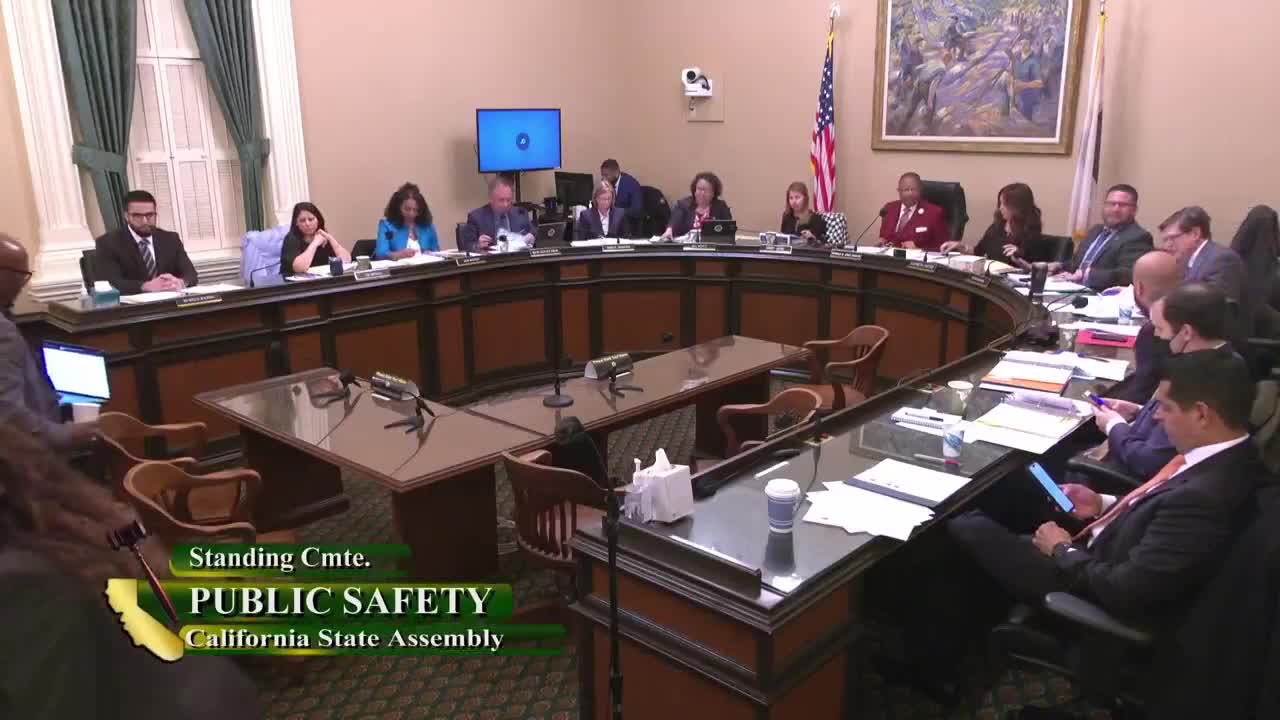 18MIN
Assembly Standing Committee on Public Safety
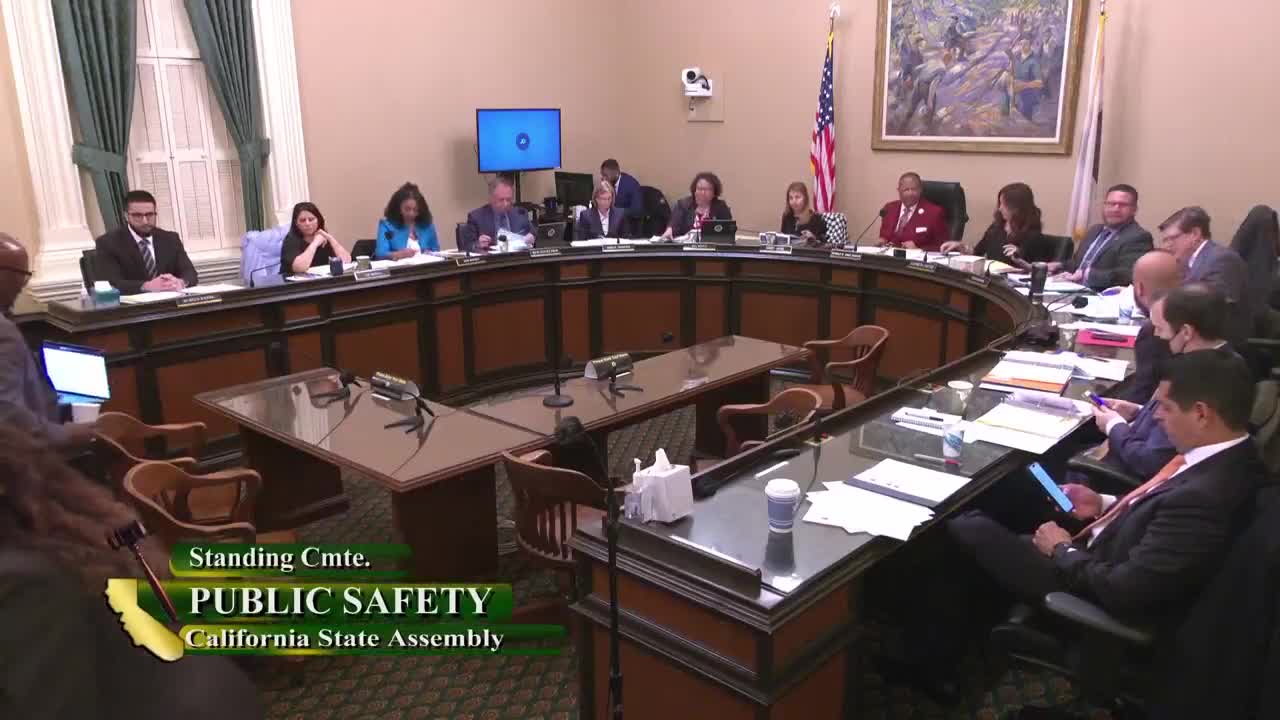 39MIN
Assembly Standing Committee on Public Safety
Bill Author

Bill Co-Author(s):