AB 411: California Recreational Trails and Greenways Act.
- Session Year: 2023-2024
- House: Assembly
- Latest Version Date: 2023-03-16
Current Status:
Failed
(2024-02-01: From committee: Filed with the Chief Clerk pursuant to Joint Rule 56.)
Introduced
In Committee
First Chamber
In Committee
Second Chamber
Enacted
What does this bill do?
The bill creates a new California Recreational Trails and Greenways Program and fund to give competitive grants for creating, expanding, improving, and restoring nonmotorized public trails and greenways, favoring natural‑surface, multiuse trails. It directs specific federal and Proposition 68 dollars into the fund, requires at least 35% of awards to benefit disadvantaged communities, and lets the state parks department offer advance‑payment or match‑assistance loans or grants to reduce barriers. The bill also sets a $10 million annual allocation to the Environmental Enhancement and Mitigation Program Fund and explicitly makes trail projects—like rail‑to‑trail conversions and rail crossing safety—eligible for grants.
The summary is provided by generative AI which can make mistakes. For original language, please view the details in the table below.
Existing law establishes the Active Transportation Program in the Department of Transportation to encourage the increased use of active modes of transportation. Existing law provides that the program is funded by state and federal moneys through appropriations in the annual Budget Act and that certain moneys, excluding specified federal moneys for recreational trails projects appropriated to the Department of Parks and Recreation, are to be appropriated for that purpose.
Existing law requires the Director of Parks and Recreation to cause to be prepared the California Recreational Trails System Plan, a comprehensive plan for the development and operation of a statewide system of recreation trails, as specified.
The California Drought, Water, Parks, Climate, Coastal Protection, and Outdoor Access For All Act of 2018, approved by the voters as Proposition 68 at the June 5, 2018, statewide primary direct election, authorizes the issuance of bonds in the amount of $4,000,000,000 pursuant to the State General Obligation Bond Law to finance a drought, water, parks, climate, coastal protection, and outdoor access for all program. Under the act, if any moneys allocated pursuant to the act are not encumbered or expended by the recipient entity within the time period specified by the administering agency, the unexpended moneys are required to revert to the administering agency for allocation, as specified. Article XVI of the California Constitution requires measures authorizing general obligation bonds to specify the single object or work to be funded by the bonds and further requires a bond act to be approved by a 2/3 vote of each house of the Legislature and a majority of the voters.
This bill would state that the Legislature is required to annually appropriate all of those federal moneys for recreational trails projects to the Department of Parks and Recreation for purposes of its recreational trails program and that not more than $1,700,000 of those federal moneys may be allocated for motorized trail benefits. The bill would authorize the Department of Parks and Recreation to give preference to natural surface, multibenefit trails and trail systems when awarding those appropriated moneys. require the Department of Parks and Recreation to establish the California Recreational Trails and Greenways Program to, beginning in 2024, award competitive grants on a biennial basis for new, expanded, or improved public access opportunities through nonmotorized recreational trail creation, improvement, enhancement, and restoration projects. The bill would create the California Recreational Trails and Greenways Fund in the State Treasury, and would require that specified moneys, including, to the extent consistent with Proposition 68, unexpended Proposition 68 moneys that revert to the administering agency for allocation, upon appropriation by the Legislature, be deposited into the fund and, upon appropriation by the Legislature, be available for allocation by the department for purposes of the program, as specified. In order to reduce the financial burdens associated with frontloaded cost structures and match requirements, the bill would authorize the department to create a loan or grant process for advanced payment and match assistance to reduce barriers to participation in the program.
Proposition 117, an initiative measure approved by the electors at the June 5, 1990, statewide primary direct election, enacted the California Wildlife Protection Act of 1990. The act creates the Habitat Conservation Fund and requires the moneys in the fund to be used for specified purposes generally relating to the acquisition, enhancement, or restoration of wildlife habitat, including $2,000,000 annually for 50% matching grants to local agencies for projects meeting specified purposes and, additionally, for the acquisition of wildlife corridors and urban trails, nature interpretation programs, and other programs that bring urban residents into park and wildlife areas. The act, as initially approved by the electors, required the Controller, until June 30, 2020, to annually transfer $30,000,000 from the General Fund to the Habitat Conservation Fund, less any amount transferred to the Habitat Conservation Fund from specified accounts and funds, and authorizes the Legislature to extend the operative effect of this transfer by statute. Except for the extension of this transfer and other specified exceptions, the act prohibits the Legislature from amending the act except by a 4/5 vote of the membership of both houses of the Legislature. The act requires any amendment of the act to be consistent with, and further the purposes of, the act. Existing law extends the transfer of these funds until June 30, 2030.
This bill would encourage the department, to the extent consistent with Proposition 117, to allocate 50% of the $2,000,000 described above for purposes of increasing access to trails.
Existing law states the intent of the Legislature to annually allocate $7,000,000 to the Environmental Enhancement and Mitigation Program Fund to provide grants to local, state, and federal agencies and nonprofit entities to undertake certain environmental enhancement and mitigation projects, including, but not limited to, urban forestry projects, acquisition or enhancement of resource lands, and projects to mitigate the impact of proposed transportation facilities or to enhance the environment.
This bill would revise that statement of legislative intent to instead allocate $10,000,000 annually for that purpose. The bill would also revise the types of projects eligible for funding by, among other things, expressly including natural surface trail improvements, the conversion of rail corridors to trails, pedestrian and cyclist safety improvements at rail crossings, and roadside recreation.
Existing law establishes the Active Transportation Program in the Department of Transportation to encourage the increased use of active modes of transportation. Existing law provides that the program is funded by state and federal moneys through appropriations in the annual Budget Act and that certain moneys, excluding specified federal moneys for recreational trails projects appropriated to the Department of Parks and Recreation, are to be appropriated for that purpose.
This bill would state that the Legislature is required to annually appropriate all of those federal moneys for recreational trails projects to the Department of Parks and Recreation for purposes of its recreational trails program and that not more than $1,700,000 of those federal moneys may be allocated for motorized trail benefits. The bill would authorize the Department of Parks and Recreation to give preference to natural surface, multibenefit trails and trail systems when awarding those appropriated moneys.
(a)The Legislature finds and declares all of the following:
(1)Since the establishment of Californias Active Transportation Program (Chapter 8 (commencing with Section 2380) of Division 3 of the Streets and Highways Code) pursuant to Chapter 359 of the Statutes of 2013, the state has allocated nearly $2.5 billion to the program. In contrast, during that same period, only $1.7 million in nonstate sources was annually allocated for nonmotorized recreational trails.(2)(a)Due in large part to the COVID-19 pandemic and the fundamental human need to interact with people and nature, the popularity of Californias nonmotorized natural surface recreation trails exploded over the past two years. and has continued beyond the pandemic.
(3)(b)Nonmotorized recreation trails are the venues of choice for diverse outdoor activities, including hiking, equestrian use, adventure, gravel and mountain biking, trail running, and passive nature experience.
(c)According to the Outdoor Foundations 2022 Outdoor Participation Trends Report, all five of the most popular outdoor activities, including hiking, camping, fishing, running, and cycling, are largely trail dependent.
(4)According(d)To reinforce the findings and declarations above, according to the Outdoor Industry Association, trail activities are the most popular form of outdoor engagement in the country, yet California spends less than $2 million $2,000,000 per year on nonmotorized natural surface trail enhancements through a federally funded program.
(5)(e)Several strategy documents produced by Governor Gavin Newsoms administration to combat climate change and promote resilient landscapes, including the document Pathways to 30x30 California: Accelerating Conservation of Californias Nature (April 22, 2022), which emphasizes the need for sustainable and equitable recreation and trail investments, will help to facilitate nonmotorized natural surface trail enhancements.
(6)(f)In an effort to combat wildfire through the joint management of lands, California and the United States Forest Service entered into the Agreement for Shared Stewardship of Californias Forest and Rangelands, which calls for a shared vision around access and diversity, including by increasing accessible trails and facilities, and targeting low-income communities that lack access.
(7)(g)To further promote the multibenefit opportunities inherent in climate and resiliency investments, California should further explore the incorporation of new trails and trail corridors into future risk reduction buffers and shaded fuel break projects.
(8)(h)According to the Outdoor Industry Association, Californias outdoor economy is one of the states primary economic drivers, contributing nearly $100 billion $100,000,000,000 annually in goods and services to the financial health of the state, and trail infrastructure is a critical component to this sectors level of success.
(9)(i)Through the enactment of Proposition 68, as approved at the June 5, 2018, statewide direct primary election, and the Budget Act of 2021, California has seen an infusion of resources for nature-based investments to accelerate the pace and scale of climate resiliency and public access projects.
(10)(j)While the state has recently made a substantial commitment to outdoor programming, this investment is incongruous with the level of investment in trail infrastructure, which are the primary means to connect people and programs to nature, and California needs to establish a sustainable state-specific funding source to keep up with trail demand.
(11)(k)To underscore the demand for funding in this area, during a recent grant cycle to secure awards relating to trails and greenway corridors, there were more than $400 million $400,000,000 in funding requests, but there was only $27 million $27,000,000 available pursuant to Proposition 68, as approved at the June 5, 2018, statewide direct primary election.
(b)It is the intent of the Legislature that the changes made by this bill apply only to appropriations made on or after the effective date of this measure.(l)In 2013, California established the nations first Active Transportation Program, an important achievement, but, in establishing this program, shifted 60 percent of the funds otherwise available on an annual basis for recreation-specific trail improvements.
(m)In order to align scarce state dollars with the need to meet existing and growing public access considerations, lawmakers should reevaluate and, to the extent possible, combine existing grant programs and priorities consistent with Governor Gavin Newsoms Outdoors for All initiative and outdoor activity trends and use patterns.
SEC. 2.Section 164.56 of the Streets and Highways Code is amended to read:164.56.(a)It is the intent of the Legislature to allocate ten million dollars ($10,000,000) annually to the Environmental Enhancement and Mitigation Program Fund, which is hereby created.(b)Local, state, and federal agencies and nonprofit entities may apply for and may receive grants, not to exceed five million dollars ($5,000,000) for any single grant, to undertake environmental enhancement and mitigation projects that are directly or indirectly related to the environmental impact of modifying existing transportation facilities or for the design, construction, or expansion of new transportation facilities.(c)Projects eligible for funding include, but are not limited to, all of the following:(1)Urban forestry projects designed to offset vehicular emissions of carbon dioxide.(2)Acquisition or enhancement of resource lands that may provide multibenefits, including nonmotorized trail corridor access and easements, to mitigate the loss of, or the detriment to, resource lands lying within the right-of-way acquired for proposed transportation improvements.(3)Natural surface trail improvements, conversion of rail corridors to trails, pedestrian and cyclist safety improvements at rail crossings, and roadside recreation.(4)Projects to mitigate the impact of proposed transportation facilities or to enhance the environment, where the ability to effectuate the mitigation or enhancement measures is beyond the scope of the lead agency responsible for assessing the environmental impact of the proposed transportation improvement.(d)Grant proposals shall be submitted to the Resources Agency for evaluation in accordance with procedures and criteria prescribed by the Resources Agency. The Resources Agency shall evaluate proposals submitted to it and prepare a list of proposals recommended for funding. The list may be revised at any time. Before including a proposal on the list, the Resources Agency shall make a finding that the proposal is eligible for funding pursuant to subdivision (f).(e)Within the fiscal limitations of subdivisions (a) and (b), the commission shall annually award grants to fund proposals that are included on the list prepared by the Resources Agency pursuant to subdivision (d).(f)Projects funded pursuant to this section shall be projects that contribute to mitigation of the environmental effects of transportation facilities, as provided for by Section 1 of Article XIX of the California Constitution.SEC. 3.Section 2381.5 is added to the Streets and Highways Code, to read:2381.5.For purposes of the federal moneys received by the state for recreational trails projects described in Section 133(h)(5) of Title 23 of the United States Code, all of the following shall apply:(a)The Legislature shall annually appropriate all of those moneys to the Department of Parks and Recreation for purposes of its recreational trails program.(b)When awarding those moneys, the Department of Parks and Recreation may give preference to natural surface, multibenefit trails and trail systems.(c)Not more than one million seven hundred thousand dollars ($1,700,000) of those moneys may be allocated for motorized trail benefits.SEC. 2.Section 5073.5 is added to the Public Resources Code, to read:5073.5.(a)This section shall be known, and may be cited, as the California Recreational Trails and Greenways Act.
(b)For purposes of this section, the following definitions apply:
(1)Disadvantaged community has the same meaning as defined in Section 80002.
(2)Fund means the California Recreational Trails and Greenways Fund created pursuant to subdivision (c).
(3)Program means the California Recreational Trails and Greenways Program established by the department pursuant to subdivision (c).
(c)(1)The department shall establish the California Recreational Trails and Greenways Program to, beginning in 2024, award competitive grants on a biennial basis for new, expanded, or improved public access opportunities through nonmotorized recreational trail creation, improvement, enhancement, and restoration projects.
(2)The California Recreational Trails and Greenways Fund is hereby created in the State Treasury.
(d)To the extent consistent with state and federal law, the following moneys shall be deposited into the fund and, upon appropriation by the Legislature, shall be available for allocation by the department for purposes of the program:
(1)Upon appropriation by the Legislature, 50 percent of the federal Recreational Trails Program moneys that are received by the state and available for appropriation.
(2)Upon appropriation by the Legislature, 25 percent of the federal Land and Water Conservation Fund Act of 1965 (Public Law 88-578) moneys that are received by the state and available for local assistance grants.
(3)To the extent consistent with Proposition 68, as approved by the voters at the June 5, 2018, statewide primary direct election, any moneys that become available for allocation by the department pursuant to Section 80014 that may be lawfully allocated for purposes of the program.
(e)In awarding competitive grants through the program, the department shall do all of the following:
(1)Endeavor to fund multibenefit, multiuse, natural surface trails.
(2)Promote trails and trail infrastructure that minimize the impacts of human and natural ecosystem interface.
(3)Ensure at least 35 percent of the moneys awarded pursuant to the program benefit disadvantaged communities.
(f)To the extent consistent with Proposition 117, as approved by the voters at the June 5, 1990, statewide primary direct election, the department is encouraged to allocate 50 percent of the moneys it allocates pursuant to paragraph (3) of subdivision (a) of Section 2787 of the Fish and Game Code for purposes of increasing access to trails.
(g)In order to reduce the financial burdens associated with frontloaded cost structures and match requirements, the department may create a loan or grant process for advanced payment and match assistance to reduce barriers to participation in the program.
SEC. 3.The provisions of this act are severable. If any provision of this act or its application is held invalid, that invalidity shall not affect other provisions or applications that can be given effect without the invalid provision or application.
REVISIONS: HeadingLine 2.(a)The Legislature finds and declares all of the following:
(1)Since the establishment of Californias Active Transportation Program (Chapter 8 (commencing with Section 2380) of Division 3 of the Streets and Highways Code) pursuant to Chapter 359 of the Statutes of 2013, the state has allocated nearly $2.5 billion to the program. In contrast, during that same period, only $1.7 million in nonstate sources was annually allocated for nonmotorized recreational trails.
(2)Due in large part to the COVID-19 pandemic and the fundamental human need to interact with people and nature, the popularity of Californias nonmotorized natural surface recreation trails exploded over the past two years.
(3)Nonmotorized recreation trails are the venues of choice for diverse outdoor activities, including hiking, equestrian use, adventure, gravel and mountain biking, trail running, and passive nature experience.
(4)According to the Outdoor Industry Association, trail activities are the most popular form of outdoor engagement in the country, yet California spends less than $2 million per year on nonmotorized natural surface trail enhancements through a federally funded program.
(5)Several strategy documents produced by Governor Gavin Newsoms administration to combat climate change and promote resilient landscapes, including the document Pathways to 30x30 California: Accelerating Conservation of Californias Nature (April 22, 2022), which emphasizes the need for sustainable and equitable recreation and trail investments, will help to facilitate nonmotorized natural surface trail enhancements.
(6)In an effort to combat wildfire through the joint management of lands, California and the United States Forest Service entered into the Agreement for Shared Stewardship of Californias Forest and Rangelands, which calls for a shared vision around access and diversity, including by increasing accessible trails and facilities, and targeting low-income communities that lack access.
(7)To further promote the multibenefit opportunities inherent in climate and resiliency investments, California should further explore the incorporation of new trails and trail corridors into future risk reduction buffers and shaded fuel break projects.
(8)According to the Outdoor Industry Association, Californias outdoor economy is one of the states primary economic drivers, contributing nearly $100 billion annually in goods and services to the financial health of the state, and trail infrastructure is a critical component to this sectors level of success.
(9)Through the enactment of Proposition 68, as approved at the June 5, 2018, statewide direct primary election, and the Budget Act of 2021, California has seen an infusion of resources for nature-based investments to accelerate the pace and scale of climate resiliency and public access projects.
(10)While the state has recently made a substantial commitment to outdoor programming, this investment is incongruous with the level of investment in trail infrastructure, which are the primary means to connect people and programs to nature, and California needs to establish a sustainable state-specific funding source to keep up with trail demand.
(11)To underscore the demand for funding in this area, during a recent grant cycle to secure awards relating to trails and greenway corridors, there were more than $400 million in funding requests, but there was only $27 million available pursuant to Proposition 68, as approved at the June 5, 2018, statewide direct primary election.
(b)It is the intent of the Legislature that the changes made by this bill apply only to appropriations made on or after the effective date of this measure.
SEC. 2.Section 164.56 of the Streets and Highways Code is amended to read:164.56.(a)It is the intent of the Legislature to allocate seven ten million dollars ($7,000,000) ($10,000,000) annually to the Environmental Enhancement and Mitigation Program Fund, which is hereby created.
(b)Local, state, and federal agencies and nonprofit entities may apply for and may receive grants, not to exceed five million dollars ($5,000,000) for any single grant, to undertake environmental enhancement and mitigation projects that are directly or indirectly related to the environmental impact of modifying existing transportation facilities or for the design, construction, or expansion of new transportation facilities.
(c)Projects eligible for funding include, but are not limited to, all of the following:
(1)Urban forestry projects designed to offset vehicular emissions of carbon dioxide.
(2)Acquisition or enhancement of resource lands that may provide multibenefits, including nonmotorized trail corridor access and easements, to mitigate the loss of, or the detriment to, resource lands lying within the right-of-way acquired for proposed transportation improvements.
(3)Natural surface trail improvements, conversion of rail corridors to trails, pedestrian and cyclist safety improvements at rail crossings, and roadside recreation.
(3)(4)Projects to mitigate the impact of proposed transportation facilities or to enhance the environment, where the ability to effectuate the mitigation or enhancement measures is beyond the scope of the lead agency responsible for assessing the environmental impact of the proposed transportation improvement.
(d)Grant proposals shall be submitted to the Resources Agency for evaluation in accordance with procedures and criteria prescribed by the Resources Agency. The Resources Agency shall evaluate proposals submitted to it and prepare a list of proposals recommended for funding. The list may be revised at any time. Prior to Before including a proposal on the list, the Resources Agency shall make a finding that the proposal is eligible for funding pursuant to subdivision (f).
(e)Within the fiscal limitations of subdivisions (a) and (b), the commission shall annually award grants to fund proposals that are included on the list prepared by the Resources Agency pursuant to subdivision (d).
(f)Projects funded pursuant to this section shall be projects that contribute to mitigation of the environmental effects of transportation facilities, as provided for by Section 1 of Article XIX of the California Constitution.
SEC. 3.Section 2381.5 is added to the Streets and Highways Code, to read:2381.5.For purposes of the federal moneys received by the state for recreational trails projects described in Section 133(h)(5) of Title 23 of the United States Code, all of the following shall apply:
(a)The Legislature shall annually appropriate all of those moneys to the Department of Parks and Recreation for purposes of its recreational trails program.
(b)When awarding those moneys, the Department of Parks and Recreation may give preference to natural surface, multibenefit trails and trail systems.
(c)Not more than one million seven hundred thousand dollars ($1,700,000) of those moneys may be allocated for motorized trail benefits.
|
Date
|
Status
|
|---|---|
| Feb 1, 2024 | From committee: Filed with the Chief Clerk pursuant to Joint Rule 56. |
| Jan 31, 2024 | Died pursuant to Art. IV, Sec. 10(c) of the Constitution. |
| May 18, 2023 | In committee: Held under submission. |
| May 10, 2023 | In committee: Set, first hearing. Referred to APPR. suspense file. |
| May 3, 2023 | In committee: Hearing postponed by committee. |
| Apr 19, 2023 | Coauthors revised. |
| Apr 19, 2023 | From committee: Do pass and re-refer to Com. on APPR. (Ayes 14. Noes 0.) (April 18). Re-referred to Com. on APPR. |
| Mar 20, 2023 | Re-referred to Com. on TRANS. |
| Mar 20, 2023 | Re-referred to Com. on W., P., & W. pursuant to Assembly Rule 96. |
| Mar 16, 2023 | From committee chair, with author's amendments: Amend, and re-refer to Com. on TRANS. Read second time and amended. |
| Mar 8, 2023 | In committee: Set, first hearing. Hearing canceled at the request of author. |
| Feb 17, 2023 | Referred to Coms. on TRANS. and W., P., & W. |
| Feb 3, 2023 | From printer. May be heard in committee March 5. |
| Feb 2, 2023 | Read first time. To print. |
|
Date
|
Description
|
Location
|
Votes
|
|
|---|---|---|---|---|
| Apr 18, 2023 | Do pass and be re-referred to the Committee on [Appropriations] | Assembly Standing Committee on Water, Parks, and Wildlife |
Passed |
This list shows positions taken on this bill by organizations on the date displayed, which is linked to the original source.
Positions by individuals are not included.
|
Organization
|
Position
|
Date
|
|---|---|---|
| Access4bikes | ** Support | |
| Bear Yuba Land Trust | ** Support | |
| Bicycle Trails Council of The East Bay | ** Support | |
| California Mountain Biking Coalition | ** Support | |
| California Outdoor Recreation Partnership | ** Support | |
| California Park & Recreation Society | ** Support | |
| California Park and Rec Society | * Support | Apr 18, 2023 |
| concerned off-road bicyclists association | ** Support | |
| County of Nevada | ** Support | |
| County Of Placer | ** Support | |
| Eastern Sierra Land Trust | ** Support | |
| Feather River Land Trust | ** Support | |
| Mammoth Lakes Trails and Public Access Foundation | ** Support | |
| Marin County Bicycle Coalition | ** Support | |
| Outdoor Alliance California | ** Support | |
| Pacific Trail Association | * Support | Apr 18, 2023 |
| People for Bikes | ** Support | |
| Placer Land Trust | ** Support | |
| Santa Cruz Mountains Trail Stewardship | ** Support | |
| sf urban riders | ** Support | |
| Sierra Business Council | ** Support | |
| Sierra Club California | ** Support | |
| Sierra County Land Trust | ** Support | |
| Sierra Foothill Conservancy | ** Support | |
| Sierra Nevada Alliance | ** Support | |
| Tahoe Area Mountain Biking Association | ** Support | |
| Tahoe City Public Utility District | ** Support | |
| The San Diego Mountain Biking Association | ** Support | |
| Truckee Donner Land Trust | ** Support |
Date of Hearing: May 10, 2023
ASSEMBLY COMMITTEE ON APPROPRIATIONS
Chris Holden, Chair
ABPCA Bill Id:AB 411
Author:(Bennett) – As Amended Ver:March 16, 2023
Policy Committee: | Water, Parks and Wildlife | Vote: | 14 - 0 |
|
| ||
|
|
Urgency: No State Mandated Local Program: No Reimbursable: No
SUMMARY:
This bill requires the Department of Parks and Recreation (State Parks) to establish the California Recreational Trails and Greenways Program (Program) to award grants to create, improve, expand, and restore nonmotorized recreational trails.
Specifically, this bill:
- Requires State Parks to establish the Program to award competitive grants on a biennial basis for new, expanded, or improved public access opportunities through nonmotorized recreational trail creation, improvement, enhancement, and restoration projects, as specified.
- Creates the California Recreations Trails and Greenways Fund (Fund), and to the extent consistent with state and federal law, requires the following moneys to be deposited into the Fund and, upon appropriation, made available by State Parks for the Program:
- 50% of federal Recreational Trails Program (RTP) moneys received by the state and available for appropriation.
- 25% of the federal Land and Water Conservation Fund (LWCF) Act of 1965 moneys received by the state and available for appropriation.
- To the extent consistent with Proposition 68, any moneys not encumbered or expended by recipients within a specified time period that become available for allocation by State Parks.
- To the extent consistent with Proposition 117, encourages State Parks to allocate 50% of the moneys it allocates through the Habitat Conservation Fund (HCF) to increase access to trails.
- Authorizes State Parks to create a loan or grant process for advanced payment and match assistance to reduce barriers to participation in the Program.
FISCAL EFFECT:
Costs of an unknown but potentially significant amount, in excess of $150,000, for State Parks to establish and administer the new Program and award grants for nonmotorized recreational trail work (General Fund, special fund, or bond funds). While this bill does not appropriate any new funding for the Program, it proposes to reconfigure and redirect specified percentages of several existing programs.
COMMENTS:
1) Purpose. According to the author:
During the pandemic our parks and trails were highly utilized as an outlet for stress and connection. This difficult time put a spotlight on how integral access to outdoor spaces are to our overall well-being. Despite some modest federal and state investments in the past, we have not funded infrastructure improvements in our trails systems. This bill would establish funding for recreational trail improvements grants so all Californians can receive the benefits of outdoor activities.
2) Background.
Recreational Trails. According to the Assembly Water, Parks, and Wildlife Committee analysis of this bill, state parks contain more than 5,000 miles of trails. Additional thousands of miles of trails are found on other state lands, federal lands, and in regional, county, and city parks. Natural surface trails are used for non-motorized recreation and pedestrian, bike, and equestrian uses. Although natural surface trails are inexpensive and relatively quick to build, they require more frequent upkeep and maintenance compared to other trail surfaces. The California Recreational Trails Act, passed in 1974, requires the director of State Parks to prepare and maintain a comprehensive plan for the development and operation of a statewide system of recreation trails. AB 1789 (Bennett), Chapter 522, Statutes of 2022, requires State Parks to prepare a full update of this plan by January 1, 2024.
The supporters of this bill contend that the state’s recent significant funding for outdoor access programming is incongruous with the level of investment in trails infrastructure, which they note is the most popular form of outdoor engagement in the country. In his January budget for fiscal year (FY) 2023-24, the Governor proposes to cut $35 million that was appropriated in FY 2022-23 for the Recreational Trails and Greenways Program at the California Natural Resources Agency (CNRA). Supporters note this bill establishes a sustainable, dedicated funding source to keep up with trail demand.
Recreational Trails Program. The RTP is administered at the federal level by the Federal Highway Administration (FHWA) and at the state level by State Parks and the Department of Transportation’s Active Transportation Program. As seen in the graphic below from State Parks, $1.7 million is currently available annually for grants for non-motorized recreational trails and trails-related projects. Earlier this year, State Parks announced $4.68 million in grant funding for seven non-motorized trail projects. The RTP requires a minimum 12% match from local sponsors and state funds. FHWA must approve project recommendations before State Parks can execute grant agreements with local agencies. This bill proposes to reserve 50% of the funding available through the RTP for the Program.
Land and Water Conservation Fund. The federal LWCF grants provide funding for the acquisition or development of land to create new outdoor recreation opportunities in the state. Since 1965, over 1,000 state parks have been created or improved with LWCF assistance. In 2022, State Parks recommended 16 local park projects for a total of $45 million in LWCF grants, after evaluating $116 million in requests. For a breakdown of current LCWF allocations, see the graphic below. This bill proposes to reserve 25% of LWCF moneys for the new Program.
Proposition 68. On June 5, 2018, voters passed Proposition 68 (the Drought, Water, Parks, Climate, Coastal Protection, and Outdoor Access For All Act of 2018), a $4 billion bond. According to CNRA’s bond accountability website, there is a balance of approximately $145.4 million in Prop 68 funds. State Parks administers a number of programs utilizing Prop 68 funds. For example, the FY 2020-21 budget allocated $395 million for the statewide park development and community revitalization program and $23.1 million for the regional park program. Prop 68 specifically created and allocated $30 million to the Trails and Greenways Investment Program, administered by CNRA, which has a remaining balance of $32,000. This bill calls for unencumbered Prop 68 dollars in specific categories to be available for the new Program.
Proposition 117. Proposition 117 (the 1990 California Wildlife Protection Act) created the HCF, which provides grants to cities, counties, and districts for wildlife corridors and urban trails, nature interpretation programs, and other programs that bring urban residents into park and wildlife areas. The program requires a 50% match. A 2019 budget trailer bill approved a $30 million annual allocation for HCF until 2030. This bill encourages State Parks to allocate 50% of the moneys it allocates through HCF to increase access to trails.
Analysis Prepared by: Nikita Koraddi / APPR. / (916) 319-2081
Date of Hearing: April 18, 2023
ASSEMBLY COMMITTEE ON WATER, PARKS, AND WILDLIFE
Rebecca Bauer-Kahan, Chair
ABPCA Bill Id:AB 411 (
Author:Bennett) – As Amended Ver:March 16, 2023
SUBJECT: California Recreational Trails and Greenways Act
SUMMARY: Establishes the California Recreational Trails and Greenways Act for increasing access to recreational trails. Specifically, this bill:
- Requires the Department of Parks and Recreation (State Parks) establish the California Recreations Trails and Greenways Program (Program) to award competitive grants on a biennial basis for new, expanded, or improved public access opportunities through non-motorized recreational trail creation, improvement, enhancement, and restoration projects.
- Creates the California Recreations Trails and Greenways Fund (Fund).
- Specifies, to the extent consistent with state and federal law, moneys that shall be deposited in the Fund as follows:
- 50% of federal Recreational Trails Program (RTP) funding, upon appropriation by the Legislature,
- 25% of the federal Land and Water Conservation Fund (LWCF) Act of 1965, upon appropriation by the Legislature, and
- To the extent consistent with Proposition 68, any moneys that become available for allocation by State Parks from a specified section of the proposition.
- To the extent consistent with Proposition 117, State Parks is encouraged to allocate 50% of a specified section of the proposition.
- In awarding the grants, State Parks shall:
- Endeavor to fund multibenefit, multiuse, natural surface trails.
- Promote trails and trail infrastructure that minimize the impacts of human and natural ecosystem interface.
- Ensure at least 35% of the moneys awarded pursuant to the program benefit disadvantaged communities.
- Allows State Parks to create a loan or grant process for advanced payment and match assistance to reduce barriers to participation in the Program.
- Makes legislative findings and declarations regarding the benefit of trails.
EXISTING LAW:
- Establishes State Parks within the California Natural Resources Agency (CNRA), which is under the control of the Director of State Parks (PRC § § 500 et seq.).
- Requires improvements undertaken within state parks to be for public enjoyment and education in a manner consistent with the preservation of natural, scenic, cultural, and ecological values for present and future generations. Authorizes improvements to provide for recreational activities including, among other things, camping, picnicking, sightseeing, nature study, hiking, and horseback riding, so long as those improvements do not involve major modification of lands, forests, or waters (PRC § 5019.53).
- Requires the Director of State Parks to cause to be prepared, and continuously maintained, a comprehensive plan, known as the California Recreational Trails System Plan, for the development and operation of a statewide system of recreation trails. Requires the plan to:
- Assess the present and future demand for trail-oriented recreation uses (PRC § 5070.7).
- Recommend an integrated and interconnecting system of trail routes designed to provide a wide range of recreational opportunities and to assure access and linkage to scenic, natural, historic, and recreational areas of statewide significance (PRC § 5070.7).
- Include pedestrian trails, bikeways, equestrian trails, boating trails, cross-country skiing trails, heritage corridors, and trails and areas suitable for use by persons with physical disabilities, the elderly, and others in need of graduated trails (PRC § 5071).
- Describe policies, standards, and criteria in acquiring, developing, operating, and maintaining land and water trails and areas as part of the system. Specify standards and criteria in providing facilities, as specified, to complement trail routes and areas (PRC § 5071.3).
- Creates the Recreational Trails Fund, which is used to deposit federal funds allocated to the state by the Steve Symms National Recreational Trails Fund Act of 1991. Moneys in the fund are available, upon appropriation by the Legislature, to State Parks for competitive grants to cities, counties, districts, state and federal agencies, and nonprofit organizations with management responsibilities over public lands to acquire and develop recreational trails (PRC § 5072.8).
- Makes $30 million available to CNRA, working in cooperation with State Parks, for competitive grants to provide non-motorized infrastructure development and enhancements that promote new or alternate access to parks, waterways, outdoor recreational pursuits, and forested or other natural environments to encourage health-related active transportation and opportunities for Californians to reconnect with nature (Proposition 68, PRC § 80080).
- Determines the apportionment of funds received from the Land and Water Conservation Act of 1965 (PRC § 5099.12).
- Makes $2 million available to State Parks for 50% matching grants to meet the purposes of Proposition 117 and for the acquisition of urban trails and other programs that bring urban residents into park and wildlife areas, among other things (Fish and Game Code § 2786, § 2787).
FISCAL EFFECT: Unknown. This bill is keyed fiscal.
COMMENTS:
- Purpose of this bill. AB 411 establishes the Program and collects moneys from various funds in a new Fund to be used for the purpose of the Program. According to the author, “During the pandemic our parks and trails were highly utilized as an outlet for stress and connection. This difficult time put a spotlight on how integral access to outdoor spaces are to our overall well-being. Despite some modest federal and state investments in the past, we have not funded infrastructure improvements in our trails systems. This bill would establish funding for recreational trail improvements grants so all Californians can receive the benefits of outdoor activities.”
- Background. According to surveys conducted by the Outdoor Industry Association, trail use is the most popular outdoor activity in the nation. During the COVID-19 pandemic, park and natural surface trail use saw marked increases in visitation. In 2021, 54% of Americans (164.2 million people) ages 6 and over participated in outdoor recreation at least once—the highest number of participants on record. Additionally, 6.8 million Americans, a record number, tried outdoor recreation for the first time in 2021.
State Parks. State Parks’ mission is to provide for the health, inspiration, and education of the people of California by helping to preserve the state's extraordinary biological diversity, protecting its most valued natural and cultural resources, and creating opportunities for high-quality outdoor recreation. With 280 state park units, covering 1.3 million acres, over 340 miles of coastline, 970 miles of lake and river frontage, 15,000 campsites, 3,195 historic buildings, and more than 11,000 known prehistoric and historic archaeological sites, State Parks contains the largest and most diverse recreational, natural, and cultural heritage holdings of any state agency in the nation. More than 68 million people annually visit California’s state park system.
State Parks trails. State Parks contain more than 5,000 miles of trails. Additional thousands of miles of trails are found on other state lands, federal lands, and in regional, county and city parks. These trails range from meandering and narrow footpaths that may provide beach access or entry into a redwood forest to a variety of other types of trails that can accommodate bicyclists, runners, equestrians, hikers, in-line skaters, and wheelchair users.
Natural surface trails are an alternative to paved trails. Natural surface trails are used for non-motorized recreation, such as pedestrian, bike, and equestrian uses. “Pedestrian” can include walking, running, roller blades, wheel chair, etc. Although natural surface trails are inexpensive and relatively quick to build, they do require more frequent upkeep and maintenance compared to other trail surfaces. Some, but not all, natural surface trails are Americans with Disabilities Act compliant. To be considered “multi-use”, a trail must be designated for cyclists, equestrians, and pedestrians according to the State Parks Trails Handbook. The Trails Handbook also recognizes that when all of these groups share the same trail, not all of the design needs and expectations can be met. Multi-use trail design and construction represent a compromise between the different groups and this compromise can often result in less user satisfaction and greater difficulty in the design and construction of a sustainable trail.
California Regional Trails Act. In 1974, the California Recreational Trails Act (CRTA) passed. The CRTA requires the Director of State Parks to prepare and maintain a comprehensive plan for the development and operation of a statewide system of recreation trails, called the California Recreational Trails System Plan (trails plan). The trails plan assesses present and future demand for recreational trail use and recommends a system of trail routes designed to provide a wide range of recreational opportunities. The 2002 plan update identified 12 goals, including to develop adequate and stable funding for planning, acquisition, development and management of trails; prepare regional and statewide inventories of existing, planned, and potential trails; and promote and encourage the incorporation of trails and greenways development and linkages into all local and statewide land use planning. The 2011 update reported on progress on the 12 goals and on specific trails around the state. In particular, it noted a need for more funding for trail maintenance, planning, and increasing access. The report also highlighted conflicts on multi-use trails among different types of trail users. AB 1789 (Bennett), Chapter 522, Statutes of 2022, requires State Parks to prepare a full update of the trails plan by January 1, 2024.
Office of Grants and Local Services (OGALS). Major funding sources for OGALS grants have been statewide park, water, and natural resources bond measures, when available. Among many other smaller programs, OGALS administers annual LWCF funds from the National Park Service, the Habitat Conservation Fund ($2 million/year), and RTP (up to $4 million, depending on Congressional action).
Recreations Trails Program. Approximately $1.7 million is available annually statewide for grants for non-motorized recreational trails and trails-related projects through the federally funded RTP, which is administered by the Federal Highway Administration (see Figure 1). Grants are made to local governments and nonprofit organizations with management responsibilities over public lands to acquire and develop recreational trails. The non-motorized RTP funds recreation trail projects that are for pedestrians, bicyclists, and equestrians. Funded projects may also serve as non-motorized transportation corridors. Routine maintenance is not eligible for funding under the non-motorized RTP. The non-motorized RTP does not give higher priority to either paved, decomposed granite, or natural trails. According to U.S. Code Title 23 Section 206 regarding the recreational trails program, 30% of these funds must be used for motorized trails. In 2022, State Parks recommend $4.68 million in RTP funding for seven local non-motorized trail projects.
Figure 1. RTP funding breakdown for California for Federal fiscal years 2016 through 2020. (source: https://www.parks.ca.gov/?page_id=24324)
The Active Transportation Program (ATP) was created through budget action by SB 99 (Committee on Budget and Fiscal Review, Chapter 359, Statutes of 2013) and AB 101 (Committee on Budget, Chapter 354, Statues of 2013) to encourage increased use of active modes of transportation, such as walking and biking. The ATP consolidated existing federal and state transportation programs into a single program. This consolidation included the reallocation of some funds which previously funded natural surface trails. SB 1 (Beall, Chapter 5, Statutes of 2017) stipulates that $100 million of revenues from the Road Maintenance and Rehabilitation Account be made available annually to the ATP. ATP includes, as projects eligible for funding under the program, recreational trails and trailheads, park projects that facilitate trail linkages or connectivity to non-motorized corridors, and conversion of abandoned railroad corridors to trails.
Since its inception, the ATP has funded over 800 active transportation projects across the state benefiting both urban and rural areas. More than 400 of the funded projects are Safe Routes to Schools projects and programs that encourage a healthy and active lifestyle throughout students' lives. In addition, every funding cycle has seen more than 85% of funds going towards projects that will benefit disadvantaged communities throughout the state.
According to the California Transportation Commission (CTC), the ATP is incredibly oversubscribed and cannot meet all of the State's needs. However, the CTC and California Department of Transportation have generated a list of 15 other funds that may be used for similar purposes.[1]
Land and Water Conservation Fund Act. The federal LWCF grants provide funding for the acquisition or development of land to create new outdoor recreation opportunities for the health and wellness of Californians. Since 1965, over one thousand parks throughout California have been created or improved with LWCF assistance. The Statewide Comprehensive Outdoor Recreation Plan is developed by State Parks OGALS and is the primary tool for prioritizing the LWCF.
Of the annual apportionment of LWCF grants, 40% is used for state agency projects. Of that 40%, 60% is allocated to State Parks, 35% to the Wildlife Conservation Board or the Department of Fish and Wildlife, and 5% to the Department of Water Resources (PRC § 5099.12) (see Figure 2). In 2022, State Parks recommended 16 local park projects for a total of $45 million in LWCF grants, after evaluating $116 million in requests.
Figure 2. LWCF funding breakdown for California for Federal fiscal year 2021. (source: https://www.parks.ca.gov/?page_id=30240)
Proposition 68. In 2018, Proposition 68 (the California Drought, Water, Parks, Climate, Coastal Protection, and Outdoor Access For All Act of 2018) created the Trails and Greenways Program administered by CNRA and contained $30 million for trail investments through the program. Grant applications from 2020 exceeded the amount of available funds with $400 million in requests. According to the CNRA Bond Accountability website, there is a remaining balance of $32,000 for Trails and Greenway Investment and $639,000 in the Investments in Protecting, Enhancing, and Accessing California’s Local and Regional Outdoor Spaces.
Proposition 117. Proposition 117 (the 1990 California Wildlife Protection Act) creates the Habitat Conservation Fund and requires the moneys in the fund to be used for specified purposes generally relating to the acquisition, enhancement, or restoration of wildlife habitat, including $2 million annually for 50% matching grants to local agencies for projects meeting specified purposes and, additionally, for the acquisition of wildlife corridors and urban trails, nature interpretation programs, and other programs that bring urban residents into park and wildlife areas. A 2019 trailer bill continued the $30 million annual allocation into the Habitat Conservation Fund until 2030 (SB 85, Chapter 31, Statutes of 2019).
Equity. This bill requires that at least 35% of the funds be spent on the development of trails that will benefit disadvantaged communities. This bill also allows State Parks to create a process for providing advanced payments, which is intended to increase access to funding as LWCF requires a 50% match.
- Policy considerations. Although outside this committee’s jurisdiction, this bill is altering funding destinations. U.S. Code requires that 30% of the RTP moneys be used for motorized trails, which is accomplished through allocation to the Off-Highway Motor Vehicle Division. State Parks is currently allocated 30% of RTP moneys for non-motorized recreation. This bill calls for 50% of RTP moneys received by the state to be deposited into the Fund. In order to accomplish this, moneys would inevitably need to be reallocated from the ATP. Additionally, it is unclear if state funding from LWCF may be reallocated to achieve the 25% appropriation that would be required by this bill.
- Arguments in support. Numerous organizations write in support of this bill and the need to secure funds for trail investment in response to the elimination of $35 million for trails improvement in the Governor’s January budget proposal. They also claim that millions of dollars of trail improvement is especially needed this year as “historic rainfall has ravaged the state, resulting in catastrophic floods and landslide incidents … [and] … to complicate matters, increased trail use by all users over the last three years are exacerbating trail health issues and increasing annualized costs for trail maintenance.”
- Related legislation. AB 1212 (Hart), of this legislative session, would enact the California Scenic Bikeways and Trails Act, which would require State Parks to establish a scenic bikeway network under specified criteria in selecting and designing scenic bikeway routes.
AB 1789 (Bennett), Chapter 522, Statutes of 2022, requires the California Recreational Trails System Plan to include recommended priorities for funding to improve and expand, among other things, non-motorized natural surface trails.
AB 209 (Limon), Chapter 675, Statutes of 2019, establishes the Outdoor Equity Grants Program at State Parks, which focuses on outdoor access programs for underserved and at-risk youth.
AB 1111 (Friedman) of 2019, would have established the Office of Outdoor Recreation in the Office of the Governor and required the office to undertake certain activities, including supporting the outdoor recreation economy and working toward equitable access to outdoor areas of the state by engaging in specified activities. AB 1111 was held in Senate Appropriations Committee.
AB 955 (Huber), of 2011–12, would have extended the sunset date of the California Recreational Trails Committee from January 1, 2013 to January 1, 2028. AB 955 was vetoed by Governor Brown.
REGISTERED SUPPORT / OPPOSITION:
Support
Access4bikes
Bear Yuba Land Trust
Bicycle Trails Council of The East Bay
California Mountain Biking Coalition
California Outdoors Recreation Partnership
California Park & Recreation Society
Concerned Off-road Bicyclists Association
County of Nevada
County of Placer
Eastern Sierra Land Trust
Feather River Land Trust
Mammoth Lakes Trails and Public Access Foundation
Marin County Bicycle Coalition
Outdoor Alliance California
People for Bikes
Placer Land Trust
Santa Cruz Mountains Trail Stewardship
SF Urban Riders
Sierra Business Council
Sierra Club California
Sierra County Land Trust
Sierra Foothill Conservancy
Sierra Nevada Alliance
Tahoe Area Mountain Biking Association
Tahoe City Public Utility District
The San Diego Mountain Biking Association
Truckee Donner Land Trust
Opposition
None on file
Analysis Prepared by: Stephanie Mitchell / W., P., & W. / (916) 319-2096
Funding Elements that may include active transportation elements. https://catc.ca.gov/-/media/ctc-media/documents/programs/atp/2020/funding-programs-that-fund-active-transportation-a11y.pdf ↑
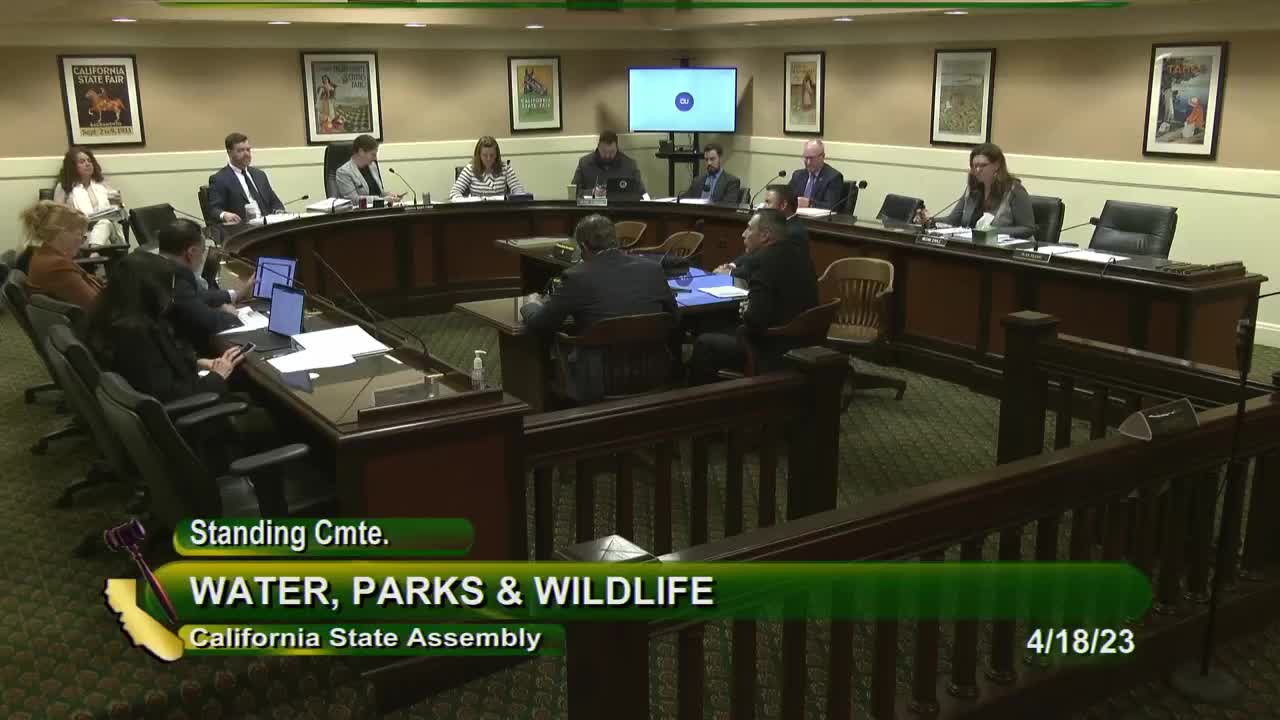
Discussed in Hearing
 4MIN
Assembly Standing Committee on Water, Parks, and Wildlife
Bill Author


