AB 474: State Threat Assessment Center: transnational criminal organizations.
- Session Year: 2023-2024
- House: Assembly
- Latest Version Date: 2023-09-13
Current Status:
Failed
(2024-01-30: Consideration of Governor's veto stricken from file.)
Introduced
In Committee
First Chamber
In Committee
Second Chamber
Enacted
What does this bill do?
This bill directs the State Threat Assessment Center (STAC) — the state’s main information‑sharing center run by the California Highway Patrol, the Office of Emergency Services, and the Department of Justice — to prioritize working with state and local agencies to disrupt criminal networks that traffic opioid drugs. It also requires STAC to support interagency task forces by preparing and sharing intelligence, analyzing tactics and trends of transnational criminal groups, and informing government leaders and public safety officials about opioid trafficking threats.
The summary is provided by generative AI which can make mistakes. For original language, please view the details in the table below.
Existing law, the California Emergency Services Act, creates, within the office of the Governor, the Office of Emergency Services, which is responsible for addressing natural, technological, or human-caused disasters and emergencies, including responsibility for activities necessary to prevent, respond to, recover from, and mitigate the effects of emergencies and disasters to people and property.
This bill would find and declare that the State Threat Assessment Center (STAC) serves as Californias information-sharing clearinghouse of strategic threat analysis and situational awareness reporting for statewide leadership and the public safety community, as specified, and that the STAC is Californias state primary fusion center, as designated by the Governor, and is operated by the Department of the California Highway Patrol, the Office of Emergency Services, and the Department of Justice. The bill would make other findings and declarations related to drug trafficking and transnational criminal organizations.
This bill would require the STAC and the Office of Emergency Services to prioritize, to the greatest extent possible, cooperation with state and local efforts to illuminate, disrupt, degrade, and dismantle criminal networks trafficking opioid drugs that pose a threat to California. The bill would require the STAC to support state and local interagency task forces to combat illegal opioid trafficking in California, as specified, including preparing and disseminating intelligence products for public safety entities.
Existing law, the California Emergency Services Act, creates, within the office of the Governor, the Office of Emergency Services, which is responsible for addressing natural, technological, or human-caused disasters and emergencies, including responsibility for activities necessary to prevent, respond to, recover from, and mitigate the effects of emergencies and disasters to people and property.
This bill would find and declare that the State Threat Assessment Center (STAC) serves as Californias information-sharing clearinghouse of strategic threat analysis and situational awareness reporting for statewide leadership and the public safety community, as specified, and that the STAC is Californias state primary fusion center, as designated by the Governor, and is operated by the Department of the California Highway Patrol, the Office of Emergency Services, and the Department of Justice. The bill would make other findings and declarations related to drug trafficking and transnational criminal organizations.
The bill would require the STAC and the Office of Emergency Services to prioritize, to the greatest extent possible, cooperation with state and local efforts to illuminate, disrupt, degrade, and dismantle criminal networks trafficking opioid drugs that pose a threat to California. The bill would require the STAC to support state and local interagency task forces to combat illegal opioid trafficking in California, as specified, including preparing and disseminating intelligence products for public safety entities.
The Legislature finds and declares all of the following:
(a)The State Threat Assessment Center (STAC) serves as Californias information-sharing clearinghouse of strategic threat analysis and situational awareness reporting for statewide leadership and the public safety community in support of efforts to prevent, prepare for, mitigate, and respond to all crimes and hazards impacting California citizens and critical infrastructure while preserving civil liberties, individual privacy, and constitutional rights.
(b)The STAC is Californias state primary fusion center, as designated by the Governor, and is operated by the Department of the California Highway Patrol, the Office of Emergency Services, and the Department of Justice.
(c)Transnational criminal organizations (TCOs) continue to pose a threat to California, public health, and our economic security.
(d)According to the United States Department of the Treasury, it is estimated that drug-related crime alone generated over $100 billion in proceeds in the United States.
(e)There were 7,175 deaths related to any opioid overdoses in California in 2021, of which 5,961 were related to fentanyl, according to the State Department of Public Health.
(f)Mexico-based TCO criminal activity is not limited to drug trafficking, as they engage in a wide variety of other criminal activity. TCOs also facilitated and profited from smuggling migrants into the United States, and their illicit trade activity led to the seizure of over $2.14 billion in intellectual property violations in federal fiscal year 2021, according to the United States Department of Homeland Security.
SEC. 2.Section 8685.11 is added to the Government Code, to read:8685.11.(a)The State Threat Assessment Center with the Office of Emergency Services shall prioritize, to the greatest extent possible, cooperation with state and local efforts to illuminate, disrupt, degrade, and dismantle criminal networks trafficking opioid drugs that pose a threat to California.
(b)In carrying out this section, the State Threat Assessment Center shall support state and local interagency task forces established to combat illegal opioid trafficking in California. Support provided by the State Threat Assessment Center shall include, but not be limited to, all of the following:
(1)Preparing and disseminating intelligence products for public safety entities.
(2)Analyzing tactics and trends or transnational criminal organizations operating in California.
(3)Sharing information with government decisionmakers and state and local public safety officials regarding the extent to which transnational criminal organizations are trafficking opioids and pose other public safety threats in California.
|
Date
|
Status
|
|---|---|
| Jan 30, 2024 | Consideration of Governor's veto stricken from file. |
| Jan 3, 2024 | Consideration of Governor's veto pending. |
| Oct 8, 2023 | Vetoed by Governor. |
| Sep 18, 2023 | Enrolled and presented to the Governor at 3:30 p.m. |
| Sep 11, 2023 | In Assembly. Ordered to Engrossing and Enrolling. |
| Sep 11, 2023 | Read third time. Passed. Ordered to the Assembly. (Ayes 39. Noes 0. Page 2565.). |
| Sep 5, 2023 | Read second time. Ordered to third reading. |
| Sep 1, 2023 | From committee: Do pass. (Ayes 7. Noes 0.) (September 1). |
| Aug 14, 2023 | In committee: Referred to APPR suspense file. |
| Jul 11, 2023 | From committee: Do pass and re-refer to Com. on APPR. (Ayes 14. Noes 0.) (July 11). Re-referred to Com. on APPR. |
| Jun 28, 2023 | From committee: Do pass and re-refer to Com. on G.O. (Ayes 5. Noes 0.) (June 27). Re-referred to Com. on G.O. |
| Jun 14, 2023 | Referred to Coms. on PUB S. and G.O. |
| May 26, 2023 | In Senate. Read first time. To Com. on RLS. for assignment. |
| May 25, 2023 | Read third time. Passed. Ordered to the Senate. (Ayes 78. Noes 0. Page 1754.) |
| May 18, 2023 | Read second time. Ordered to third reading. |
| May 18, 2023 | From committee: Do pass. (Ayes 15. Noes 0.) (May 18). |
| May 10, 2023 | In committee: Set, first hearing. Referred to APPR. suspense file. |
| May 1, 2023 | From committee: Do pass and re-refer to Com. on APPR. (Ayes 8. Noes 0.) (April 27). Re-referred to Com. on APPR. |
| Apr 4, 2023 | In committee: Hearing postponed by committee. |
| Mar 14, 2023 | From committee: Do pass and re-refer to Com. on PUB. S. with recommendation: To Consent Calendar. (Ayes 7. Noes 0.) (March 13). Re-referred to Com. on PUB. S. |
| Feb 17, 2023 | Referred to Coms. on E.M. and PUB. S. |
| Feb 8, 2023 | From printer. May be heard in committee March 10. |
| Feb 7, 2023 | Read first time. To print. |
|
Date
|
Description
|
Location
|
Votes
|
|
|---|---|---|---|---|
| Sep 11, 2023 | Assembly 3rd Reading AB474 Rodriguez et al. By Umberg | Senate Floor |
Passed |
|
| Sep 1, 2023 | Do pass | Senate Standing Committee on Appropriations |
Passed |
|
| Aug 14, 2023 | Placed on suspense file | Senate Standing Committee on Appropriations |
Passed |
|
| Jul 11, 2023 | Do pass, but first be re-referred to the Committee on [Appropriations] | Senate Standing Committee on Governmental Organization |
Passed |
|
| Jun 27, 2023 | Do pass, but first be re-referred to the Committee on [Governmental Organization] | Senate Standing Committee on Public Safety |
Passed |
|
| May 25, 2023 | AB 474 Rodriguez Assembly Third Reading | Assembly Floor |
Passed |
|
| May 18, 2023 | Do pass. | Assembly Standing Committee on Appropriations |
Passed |
|
| Apr 27, 2023 | Do pass and be re-referred to the Committee on [Appropriations] | Assembly Standing Committee on Public Safety |
Passed |
|
| Mar 13, 2023 | Do pass and be re-referred to the Committee on [Public Safety] with recommendation: To Consent Calendar | Assembly Standing Committee on Emergency Management |
Passed |
This list shows positions taken on this bill by organizations on the date displayed, which is linked to the original source.
Positions by individuals are not included.
|
Organization
|
Position
|
Date
|
|---|---|---|
| Aclu California Action | ** Against | |
| All of Us or None | * Against | Apr 27, 2023 |
| Asian Americans Advancing Justice Asian Law Caucus | ** Against | Apr 27, 2023 |
| Asian Americans Advancing Justice Southern California | ** Against | Apr 27, 2023 |
| Buenosino in Ventura County | ** Against | Apr 27, 2023 |
| California Immigrant Policy Center | * Against | Apr 27, 2023 |
| California State Sheriffs Association | ** Support | |
| City of Alhambra | ** Support | |
| City of Arcata | ** Support | |
| City of Artesia | ** Support | |
| City of Atwater | ** Support | |
| City of Bakersfield | ** Support | |
| City of Big Bear Lake | ** Support | |
| City of Brisbane | ** Support | |
| City Of Burbank | ** Support | |
| city of carlsbad | ** Support | |
| City of Duarte | ** Support | |
| City of Fortuna | ** Support | |
| City of Grand Terrace | ** Support | |
| City of Hesperia | ** Support | |
| City of La Mirada | ** Support | |
| city of laguna niguel | ** Support | |
| City of Maywood | ** Support | |
| City of Montclair | ** Support | |
| City of Morgan Hill | ** Support | |
| City of Norwalk | ** Support | |
| city of paramount | ** Support | |
| City Of Placentia | ** Support | |
| City of Riverbank | ** Support | |
| City of San Pablo | ** Support | |
| City of Sand City | ** Support | |
| City of Santa Clarita | ** Support | |
| City of Simi Valley | ** Support | |
| City of South Pasadena | ** Support | |
| City of Thousand Oaks | ** Support | |
| City of Tulare | ** Support | |
| City of Vista | ** Support | |
| Communities United for Restorative Youth Justice | ** Against | Apr 27, 2023 |
| Immigrant Legal Resource Center | ** Against | |
| Inland Coalition for Immigrant Justice | ** Against | Apr 27, 2023 |
| League Of California Cities | ** Support | |
| Legal Services for Prisoners with Children | * Against | Apr 27, 2023 |
| Los Angeles County Division of the League of California Cities | ** Support | |
| Oakland Privacy | ** Against | |
| Peace Officers Research Association Of California | ** Support | |
| Reevolution | ** Support | |
| San Francisco Public Defenders Office | ** Against | |
| Solano County Board of Supervisors | ** Support | |
| South Bay People Power Inc | ** Against | Apr 27, 2023 |
| Town Of Colma | ** Support |
GOVERNOR'S VETO
GV Bill Id:AB 474
Author:(Rodriguez)
As Enrolled Ver:September 13, 2023
2/3 vote
SUMMARY
Requires the State Threat Assessment Center (STAC) and the California Office of Emergency Services (Cal OES) to prioritize, to the greatest extent possible, cooperation with state and local efforts to disrupt and dismantle criminal networks trafficking opioid drugs that pose a threat to California.
Major Provisions:
- Provides the State Threat Assessment Center (STAC) serves as California's information-sharing clearinghouse of strategic threat analysis and situational awareness reporting for statewide leadership and the public safety community, as specified.
- Provides the STAC is California's state primary fusion center, as designated by the Governor, and is operated by the Department of the California Highway Patrol, the California Office of Emergency Services (Cal OES), and the Department of Justice.
- Requires the STAC and Cal OES to prioritize, to the greatest extent possible, cooperation with state and local efforts to disrupt and dismantle criminal networks trafficking opioid drugs that pose a threat to California.
- Requires the STAC to support state and local interagency task forces to combat illegal opioid trafficking in California, as specified, including preparing and disseminating intelligence products for public safety entities.
Governor’s Veto Message
This bill would require the State Threat Assessment Center (STAC) to prioritize, to the greatest extent possible, cooperation with state and local efforts to illuminate, disrupt, degrade, and dismantle Transnational Criminal Organizations trafficking opioid drugs that pose a threat to California.
Tackling opioid trafficking by Transnational Criminal Organizations is a priority for my Administration, evidenced by our 2023 Master Plan for Tackling the Fentanyl and Opioid Crisis. We have invested over $1 billion to help stop opioid trafficking and enforce the law, combat overdoses, support those with opioid use disorder, and raise awareness about the dangers of opioids.
The STAC currently has the authority to address and prioritize opioid trafficking, and it already does. Furthermore, the threats facing California are constantly evolving, and law enforcement agencies need flexibility to shift priorities to meet this ever-changing threat landscape. This bill would limit this flexibility, with a detrimental impact on public safety and national security.
COMMENTS
Background: The State Threat Assessment Center (STAC) serves as California's information sharing clearinghouse of strategic threat analysis and situational awareness reporting to statewide leadership and the public safety community in support of efforts to prevent, prepare for, mitigate and respond to all crimes and all hazards impacting California citizens and critical infrastructure, while preserving civil liberties, individual privacy, and constitutional rights.
Transnational Criminal Organizations (TCOs) continue to pose a threat to California, public health, and our economic security. According to the United States (U.S.) Treasury Department estimated drug related crime alone generated over $100 billion in proceeds in the United States. These profits also come with a high toll on human life; the opioid drugs these TCOs traffic were responsible for the majority of the over 100,000 U.S. overdose deaths between April 2020 and April 2021, according to the Centers for Disease Control. According to the California Department of Public Health, California suffered 7,175 deaths related to any opioid overdoses in 2021- 5,961 of those were related to fentanyl.
Initially, Cal OES expressed concern about directing STAC personnel to assist with the analytical work necessary to enhance public safety and strengthen national security by assisting in the disruption of Transnational Criminal Organizations. Subsequently, Cal OES raised fiscal concerns due the costs of hiring an additional analyst to perform such work. However, the Governor’s veto message makes it clear the STAC is already engaged in such efforts and raises a new concern based on this bill potentially limiting the nimbleness of the state’s fusion center.
According to the Author
It is critical that we counter the public health threat posed by Transnational Criminal Organizations, which have generated over $100 billion from drug-related crimes alone and continue to threaten the lives of our children. We must use every tool at our disposal to disrupt these networks of criminals and get opioid drugs off of our streets. This bill would require the State Threat Assessment Center (STAC) to prepare and share intelligence products for public safety entities and analyze tactics and trends of Transnational Criminal Organizations operating in California. The STAC would then be required to share this information with government decision-makers and state and local public safety officials to highlight the extent to which TCOs are trafficking opioids and pose other public safety threats in California. Allowing our State to gain insights and information on TCOs and other threats to California is the first step in fighting back and stopping the opioid epidemic.
Arguments in Support
The California State Sheriffs' Association (CSSA) write in support, "Partnerships are a key facet of California's approach to countering illegal drug trafficking. Coordinated investigations, enforcement actions, and prosecutions between state and local law enforcement partners will eliminate barriers and leverage the authorities and resources to identify, investigate, disrupt, and dismantle at every level of operations the ability of cartels and other criminal networks to smuggle drugs, especially illicit fentanyl, into California. For these reasons, CSSA is pleased to support Assembly Bill 474, which will use a multipronged approach to combat the illicit importation and distribution of opioids and opioid precursors in California.
The Peace Officers' Research Association of California (PORAC) write in support, "We are pleased to support AB 474 relating to State Threat Assessment Center: transnational criminal organizations. AB 474 would find and declare that the State Threat Assessment Center (STAC) serves as California's information-sharing clearinghouse of strategic threat analysis and situational awareness reporting for statewide leadership and the public safety community, as specified. Again, PORAC strongly supports the passage of AB 474."
Arguments in Opposition
The ACLU California Action writes in opposition, "The opioid crisis is a matter of public health that the criminal legal system is ill-equipped to solve. As previous "war on drugs" efforts have more than demonstrated, notably the war on crack cocaine, we cannot police ourselves out of drug overdoses and the collateral damage of such efforts lasts for a long period of time and takes a great deal of work to undo. A better solution would center a health-based uniform effort to address the opioid overdose problem."
FISCAL COMMENTS
According to the Senate Appropriations Committee, Cal OES reports costs of $227,000 annually and ongoing to cover salary and benefits for additional STAC staff. The Department of Justice and the California Highway Patrol reported no impact and minor/absorbable costs, respectively.
VOTES
ASM EMERGENCY MANAGEMENT: 7-0-0
YES: Rodriguez, Waldron, Aguiar-Curry, Alvarez, Calderon, Megan Dahle, Schiavo
ASM PUBLIC SAFETY: 8-0-0
YES: Jones-Sawyer, Alanis, Bonta, Bryan, Lackey, Ortega, Santiago, Zbur
ASM APPROPRIATIONS: 15-0-1
YES: Holden, Megan Dahle, Bryan, Calderon, Wendy Carrillo, Dixon, Mike Fong, Hart, Lowenthal, Mathis, Papan, Pellerin, Sanchez, Weber, Ortega
ABS, ABST OR NV: Robert Rivas
ASSEMBLY FLOOR: 78-0-2
YES: Addis, Alanis, Alvarez, Arambula, Bains, Bauer-Kahan, Bennett, Berman, Boerner, Bonta, Bryan, Calderon, Juan Carrillo, Wendy Carrillo, Cervantes, Chen, Connolly, Megan Dahle, Davies, Dixon, Essayli, Flora, Mike Fong, Vince Fong, Friedman, Gabriel, Gallagher, Garcia, Gipson, Grayson, Haney, Hart, Holden, Hoover, Irwin, Jackson, Jones‑Sawyer, Kalra, Lackey, Lee, Low, Lowenthal, Maienschein, McCarty, McKinnor, Muratsuchi, Stephanie Nguyen, Ortega, Pacheco, Papan, Jim Patterson, Joe Patterson, Pellerin, Petrie-Norris, Quirk-Silva, Ramos, Reyes, Luz Rivas, Robert Rivas, Rodriguez, Blanca Rubio, Sanchez, Santiago, Schiavo, Soria, Ta, Ting, Valencia, Villapudua, Waldron, Wallis, Ward, Weber, Wicks, Wilson, Wood, Zbur, Rendon
ABS, ABST OR NV: Aguiar-Curry, Mathis
SENATE FLOOR: 38-1-1
YES: Allen, Alvarado-Gil, Archuleta, Ashby, Atkins, Becker, Blakespear, Bradford, Cortese, Dahle, Dodd, Eggman, Glazer, Gonzalez, Grove, Hurtado, Jones, Laird, Limón, McGuire, Menjivar, Min, Newman, Nguyen, Niello, Ochoa Bogh, Padilla, Portantino, Roth, Rubio, Seyarto, Skinner, Smallwood-Cuevas, Stern, Umberg, Wahab, Wiener, Wilk
NO: Durazo
ABS, ABST OR NV: Caballero
UPDATED
VERSION: September 13, 2023
CONSULTANT: Mike Dayton / E.M. / (916) 319-3802 FN: 0002557
SENATE RULES COMMITTEE Office of Senate Floor Analyses (916) 651-1520 Fax: (916) 327-4478 | AB 474 |
THIRD READING
Bill No: AB 474
Author: Rodriguez (D), et al.
Introduced: 2/7/23
Vote: 21
SENATE PUBLIC SAFETY COMMITTEE: 5-0, 6/27/23
AYES: Wahab, Ochoa Bogh, Bradford, Skinner, Wiener
SENATE GOVERNMENTAL ORG. COMMITTEE: 14-0, 7/11/23
AYES: Dodd, Wilk, Alvarado-Gil, Archuleta, Ashby, Bradford, Glazer, Jones, Ochoa Bogh, Padilla, Portantino, Roth, Rubio, Seyarto
NO VOTE RECORDED: Grove
SENATE APPROPRIATIONS COMMITTEE: 7-0, 9/1/23
AYES: Portantino, Jones, Ashby, Bradford, Seyarto, Wahab, Wiener
ASSEMBLY FLOOR: 78-0, 5/25/23 - See last page for vote
SUBJECT: State Threat Assessment Center: transnational criminal organizations
SOURCE: Author
DIGEST:
This bill requires the State Threat Assessment Center (STAC) and the California Office of Emergency Services (Cal OES) to prioritize, to the greatest extent possible, cooperation with state and local efforts to disrupt and dismantle criminal networks trafficking opioid drugs that pose a threat to California.
ANALYSIS:
Existing federal law:
- Provides that the Department of Homeland Security (DHS), under the federal Homeland Security Act of 2002, has responsibility for integrating law enforcement and intelligence information relating to terrorist threats to the homeland. (P.L. 107-296)
- Establishes the National Counterterrorism Center as the coordinator at the federal level for terrorism information and assessment. (P.L. 108-458)
Existing state law:
- Establishes the California Office of Emergency Services (Cal OES) within the office of the Governor for the purpose of mitigating the effects of natural, manmade, or war-caused emergencies. (Gov. Code, §§ 8550, 8585, subd. (a).)
- Provides that Cal OES shall be considered a law enforcement organization as required for receipt of criminal intelligence information, as specified. ((Gov. Code, § 8585, subd. (c).)
- Requires Cal OES to coordinate the emergency activities of all state agencies in connection with an emergency, and requires every state agency and officer to cooperate with Cal OES in rendering all possible assistance in carrying out its duties, as specified. (Gov. Code, § 8587, subd. (a).)
- Requires Cal OES to establish and lead the California Cybersecurity Integration Center (CCIC), whose primary mission is to reduce the likelihood and severity of cyber incident that could damage California’s economy, its critical infrastructure, or public and private sector computer networks in the state. (Gov. Code, § 8586.5, subd. (a).)
- Provides that the CCIC shall serve as the central organizing hub of state government’s cybersecurity activities and coordinate information sharing with local, state, and federal agencies, tribal governments, utilities and other service providers, academic institutions, and nongovernmental organizations. (Gov. Code, § 8586.5, subd. (a).)
- Provides that the CCIC shall be comprised of representatives from various organizations, including STAC. (Gov. Code, § 8586.5, subd. (a).)
- Requires the California Cybersecurity Integration Center to operate in close coordination with the California State Threat Assessment System and the United States Department of Homeland Security –National Cybersecurity and Communications Integration Center. (Gov. Code, § 8586.5, subd. (b).)
- Provides that the CCIC shall provide warnings of cyberattacks to government agencies and nongovernmental partners, coordinate information sharing among these entities, assess risks to critical infrastructure and information technology networks, prioritize cyber threats and support public and private sector partners in protecting their vulnerable infrastructure and information technology networks, enable cross-sector coordination and sharing of recommended best practices and security measures, and support cybersecurity assessments, audits, and accountability programs that are required by state law to protect the information technology networks of California’s agencies and departments. (Gov. Code, § 8586.5, subd. (b).)
This bill:
- Sets forth several findings and declarations, including:
- STAC serves as California’s information-sharing clearinghouse of strategic threat analysis and situational awareness reporting for statewide leadership and the public safety community in support of efforts to prevent, prepare for, mitigate, and respond to all crimes and hazards impacting California citizens and critical infrastructure while preserving civil liberties, individual privacy, and constitutional rights.
- The STAC is California’s state primary fusion center, as designated by the Governor, and is operated by the Department of the California Highway Patrol, the Office of Emergency Services, and the Department of Justice.
- Transnational criminal organizations (TCOs) continue to pose a threat to California, public health, and our economic security.
- According to the United States Department of the Treasury, it is estimated that drug-related crime alone generated over $100 billion in proceeds in the United States.
- There were 7,175 deaths related to any opioid overdoses in California in 2021, of which 5,961 were related to fentanyl, according to the State Department of Public Health.
- Mexico-based TCO criminal activity is not limited to drug trafficking, as they engage in a wide variety of other criminal activity. TCOs also facilitated and profited from smuggling migrants into the United States, and their illicit trade activity led to the seizure of over $2.14 billion in intellectual property violations in federal fiscal year 2021, according to the United States Department of Homeland Security.
- Provides that the STAC shall prioritize, to the greatest extent possible, cooperation with state and local efforts to illuminate, disrupt, degrade and dismantle criminal networks trafficking opioid drugs that pose a threat to California.
- Provides that in carrying out its provisions, the STAC shall support state and local interagency task forces established to combat illegal opioid trafficking in California.
- Provides that support provided by the STAC shall include, but not be limited to:
- Preparing and disseminating intelligence products for public safety entities.
- Analyzing tactics and trends or transnational criminal organizations operating in California.
- Sharing information with government decision makers and state and local public safety officials regarding the extent to which transnational criminal organizations are trafficking opioids and pose other public safety threats in California.
Comments
According to the author, “It is critical that we counter the public health threat posed by Transnational Criminal Organizations, which have generated over $100 billion from drug-related crimes alone and continue to threaten the lives of our children. We must use every tool at our disposal to disrupt these networks of criminals and get opioid drugs off of our streets. This bill would require the State Threat Assessment Center (STAC) to prepare and share intelligence products for public safety entities and analyze tactics and trends of Transnational Criminal Organizations operating in California. The STAC would then be required to share this information with government decision-makers and state and local public safety officials to highlight the extent to which TCOs are trafficking opioids and pose other public safety threats in California. Allowing our State to gain insights and information on TCOs and other threats to California is the first step in fighting back and stopping the opioid epidemic.”
California is currently in the throes of a persistent and deadly crisis related to the opioid drug known as fentanyl. Though originally developed for pharmaceutical use, fentanyl is now illicitly produced internationally – primarily in China and Mexico – and then smuggled into the United States, where it has wreaked havoc on the population on the population. In California, the number of deaths involving opioids, and fentanyl in particular, has increased significantly over the course of the last decade. Between 2012 and 2018, while opioid-related overdose deaths increased by 42%, overdose deaths related to fentanyl specifically increased by more than 800%—from 82 to 786. In 2021, California experienced 21,016 emergency room visits resulting from an opioid overdose, 7,176 opioid-related overdose deaths, and 5,961 overdose deaths from fentanyl, including 1,600 in Los Angeles County Alone.
California’s STAC, organizationally located within the California Governor’s Office of Emergency Services (Cal OES), “serves as California’s information sharing clearinghouse of strategic threat analysis and situational awareness reporting to statewide leadership and the public safety community in support of efforts to prevent, prepare for, mitigate and respond to all crimes and all hazards impacting California citizens and critical infrastructure, while preserving civil liberties, individual privacy, and constitutional rights.” The STAC is California’s primary “fusion center,” which, in state security parlance, refers to state-owned and operated information-sharing centers intended to facilitate collaboration and information integration between agencies, and maximizing states’ ability to detect, prevent, investigate and respond to criminal terrorist activity.
In 2014, then Attorney General Kamala D. Harris, released a report entitled, Gangs Beyond Borders: California and the Fight Against Transnational Organized Crime, which noted that “more narcotics, weapons and humans are trafficked in and out of California than any other state.” The report, written with assistance from the STAC, described the strategies that are working and made recommendations to combat transnational organized crime. Among the recommendations in this report were that federal, state, and local law enforcement should use California’s State Threat Assessment System as a central hub for sharing information about transnational crime and state and local law enforcement agencies should increase operational coordination in combatting TCOs.
Though boosters argue that fusion centers, like STAC, are vital to national security and effective law enforcement, they have faced some criticism. According to ACLU California Action, which writes in opposition to this bill:
Contrary to the finding and declaration [of the bill], fusion centers like STAC are not operating in ways preserving civil liberties, individual privacy and constitutional rights. Fusion centers act as opaque data brokers for law enforcement and spy on Americans with virtually complete secrecy. They enable the sharing of people’s information with out-of-state authorities, while also exacerbating harmful policing practices. There have also been substantive questions by Congress about the quality of intelligence provided by the fusion centers. In addition to secretly collecting up vast stores of people’s personal information and their history of producing flawed analyses, fusion centers also have targeted minority communities and protesters and perpetuated improper religious, racial, ethnic and political bias.
This bill requires STAC to prioritize, to the greatest extent possible, cooperation with state and local efforts to disrupt and dismantle criminal networks trafficking opioid drugs that pose a threat to California. In achieving this objective, this bill provides that STAC shall support state and local anti-opioid task forces by preparing intelligence products, analyzing TCO tactics and trends, and sharing information with government decision makers and public safety officials regarding he threat posed by TCOs.
FISCAL EFFECT: Appropriation: No Fiscal Com.: Yes Local: No
According to the Senate Appropriations Committee, Cal OES reports costs of $227,000 annually and ongoing to cover salary and benefits for additional STAC staff. The Department of Justice and the California Highway Patrol reported no impact and minor/absorbable costs, respectively.
SUPPORT: (Verified 9/1/23)
California State Sheriffs’ Association
City of Bakersfield
City of Burbank
City of Carlsbad
City of Laguna Niguel
City of Norwalk
City of Santa Clarita
City of Simi Valley
City of Thousand Oaks
Peace Officers Research Association of California
ReEvolution
Solano County Board of Supervisors
OPPOSITION: (Verified 9/1/23)
ACLU California Action
Oakland Privacy
ASSEMBLY FLOOR: 78-0, 5/25/23
AYES: Addis, Alanis, Alvarez, Arambula, Bains, Bauer-Kahan, Bennett, Berman, Boerner, Bonta, Bryan, Calderon, Juan Carrillo, Wendy Carrillo, Cervantes, Chen, Connolly, Megan Dahle, Davies, Dixon, Essayli, Flora, Mike Fong, Vince Fong, Friedman, Gabriel, Gallagher, Garcia, Gipson, Grayson, Haney, Hart, Holden, Hoover, Irwin, Jackson, Jones-Sawyer, Kalra, Lackey, Lee, Low, Lowenthal, Maienschein, McCarty, McKinnor, Muratsuchi, Stephanie Nguyen, Ortega, Pacheco, Papan, Jim Patterson, Joe Patterson, Pellerin, Petrie-Norris, Quirk-Silva, Ramos, Reyes, Luz Rivas, Robert Rivas, Rodriguez, Blanca Rubio, Sanchez, Santiago, Schiavo, Soria, Ta, Ting, Valencia, Villapudua, Waldron, Wallis, Ward, Weber, Wicks, Wilson, Wood, Zbur, Rendon
NO VOTE RECORDED: Aguiar-Curry, Mathis
Prepared by: Alex Barnett / PUB. S. /
9/2/23 14:58:43
**** END ****
SENATE COMMITTEE ON
Senator Anthony Portantino, Chair
2023 - 2024 Regular Session
AB 474 (Rodriguez) - State Threat Assessment Center: transnational criminal organizations
Version: | Policy Vote: |
Urgency: | Mandate: |
Hearing Date: | Consultant: |
Bill Summary:
Requires the State Threat Assessment Center (STAC) and the California Office of Emergency Services (Cal OES) to prioritize, to the greatest extent possible, cooperation with state and local efforts to disrupt and dismantle criminal networks trafficking opioid drugs that pose a threat to California.
Fiscal Impact:
Cal OES reports costs of $227,000 annually and ongoing to cover salary and benefits for additional STAC staff. The Department of Justice (DOJ) and the California Highway Patrol (CHP) reported no impact and minor/absorbable costs, respectively.
Background:
California is currently in the throes of a persistent and deadly crisis related to the opioid drug known as fentanyl. Though originally developed for pharmaceutical use, fentanyl is now illicitly produced internationally – primarily in China and Mexico – and then smuggled into the United States, where it has wreaked havoc on the population on the population. In California, the number of deaths involving opioids, and fentanyl in particular, has increased significantly over the course of the last decade. Between 2012 and 2018, while opioid-related overdose deaths increased by 42%, overdose deaths related to fentanyl specifically increased by more than 800%—from 82 to 786. In 2021, California experienced 21,016 emergency room visits resulting from an opioid overdose, 7,176 opioid-related overdose deaths, and 5,961 overdose deaths from fentanyl, including 1,600 in Los Angeles County Alone.
As referenced above, most of the illicit fentanyl consumed in the United States originates in China, a major pipeline of the building blocks of fentanyl, known as fentanyl precursors. Chemical manufactures in China ship fentanyl precursors to Mexico where drug cartels make fentanyl and arrange for it to be transported across the U.S.-Mexico border. The vast majority of the fentanyl seizures in the U.S. occur at legal ports of entry or interior vehicle checkpoints, and U.S. citizens are primarily the ones trafficking fentanyl. In 2022, law enforcement officials in California seized almost 30,000 pounds of fentanyl, a 594% increase over 2021, and enough of the drug to potentially kill the entire population of North America, twice.
The state’s 2022-23 budget included $7.9 million in 2022-23 and $6.7 million ongoing to fund the Fentanyl Task Force within DOJ to help tackle the fentanyl crisis. The task force includes 25 new DOJ positions to support those efforts. Building on the 2022-23 Budget, the state’s 2023-24 Budget includes additional funding to combat fentanyl abuse. Specifically, the budget allocates $93 million over the next four years, including $79 million for Naloxone distribution projects; $10 million for grants for education, testing, recovery, and support services; $4 million to make test strips more available; and, $3.5 million for overdose medication for all middle and high schools.
The Governor’s Master Plan for Tackling the Fentanyl and Opioid Crisis also includes $30 million to expand California National Guard’s work to prevent drug-trafficking transnational criminal organizations (TCOs) and $15 million over two years to establish and operate the Fentanyl Enforcement Program within the DOJ to combat manufacturing, distribution, and trafficking. The Governor also has allocated $40.8 million for an education and awareness campaign to establish partnerships and create messaging and education tools for parents and educators, and $23 million in substance use disorder workforce grants to develop substance use disorder training for non-behavioral health professionals working with children and youth.
Most recently, in April, the Governor announced the formation of a public safety partnership to disrupt fentanyl trafficking in San Francisco, under which the California Highway Patrol and California National Guard would assist San Francisco law enforcement agencies.
Proposed Law:
- Provides that the STAC shall prioritize, to the greatest extent possible, cooperation with state and local efforts to illuminate, disrupt, degrade and dismantle criminal networks trafficking opioid drugs that pose a threat to California.
- Provides that in carrying out its provisions, the STAC shall support state and local interagency task forces established to combat illegal opioid trafficking in California.
- Provides that support provided by the STAC shall include, but not be limited to:
- Preparing and disseminating intelligence products for public safety entities.
- Analyzing tactics and trends or transnational criminal organizations operating in California.
- Sharing information with government decision makers and state and local public safety officials regarding the extent to which transnational criminal organizations are trafficking opioids and pose other public safety threats in California.
Related Legislation:
- AB 701 (Villapudua, 2023) would have applied the existing weight enhancements that increase the penalty and fine for trafficking controlled substances containing heroin, cocaine base, and cocaine to fentanyl. AB 701 is pending in this Committee.
- AB 367 (Maienschein, 2023), would apply the “great bodily injury” enhancement to any person who sells, furnishes, administers, or gives away a controlled substance when the person to whom the substance was sold, furnished, administered or given suffers a significant or substantial physical injury from using the substance. AB 367 failed passage in the Assembly Public Safety Committee.
- AB 1058 (Jim Patterson, 2023), would increase the penalty for possessing for sale or for trafficking more than 28.35 grams of fentanyl, an analog of fentanyl, or a substance containing fentanyl or an analog of fentanyl. AB 1058 failed passage in the Assembly Public Safety Committee.
- AB 18 (Joe Patterson, 2023), would require the court to advise a person convicted of specified drug offenses that they could be charged with voluntary manslaughter or murder in the future if they manufacture or distribute controlled substances and somebody dies as a result. AB 18 failed passage in the Assembly Public Safety Committee.
- SB 62 (Nguyen, 2023). SB 62 would have imposed an additional term of 3 to 25 years upon a person who is convicted of specified drug offenses with respect to a substance containing fentanyl, if the substance exceeds a specified weight. SB 62 failed passage in the Senate Public Safety Committee.
- SB 237 (Grove, 2023), would have increased the punishment for drug trafficking fentanyl. SB 237 failed passage in the Senate Public Safety Committee.
- SB 44 (Umberg, 2023), is identical to AB 18 (Joe Patterson), referenced above. SB 44 failed passage in the Senate Public Safety Committee.
-- END --
SENATE COMMITTEE ON GOVERNMENTAL ORGANIZATION
Senator Bill Dodd
Chair
2023 - 2024 Regular
Bill No: AB Hearing Date: 7/11/2023
Author: | Rodriguez, et al. | ||
Version: | Introduced | ||
Urgency: | Fiscal: | ||
Consultant: | |||
SUBJECT:
DIGEST: This bill requires the State Threat Assessment Center (STAC) to prioritize, to the greatest extent possible, cooperation with state and local efforts to illuminate, disrupt, degrade, and dismantle criminal networks trafficking in opioid drugs that pose a threat to California, as specified.
ANALYSIS:
Existing law:
- The California Emergency Services Act (ESA) establishes OES, which is responsible for addressing natural, technological, or human-caused disasters and emergencies, including responsibility for activities necessary to prevent, respond to, recover from, and mitigate the effects of emergencies and disasters to people and property.
- Provides that OES shall be considered a law enforcement organization as required for receipt of criminal intelligence information by persons employed within OES whose duties and responsibilities require the authority to access criminal intelligence information.
- Requires OES to establish and lead the California Cybersecurity Integration Center (Cal-CSIC), whose primary mission is to reduce the likelihood and severity of cyber incidents that could damage California’s economy, its critical infrastructure, or public and private sector computer networks in the state.
- Provides that Cal-CSIC shall serve as the central organizing hub of state government’s cybersecurity activities and coordination information sharing with local, state, and federal agencies, tribal governments, utilities and other service providers, academic institutions, and nongovernmental organizations.
This bill:
- Requires the STAC to prioritize, to the greatest extent possible, cooperation with state and local efforts to illuminate, disrupt, degrade, and dismantle criminal networks trafficking opioid drugs that pose a threat to California.
- Requires the STAC, in carrying out the above provision, to support state and local interagency task forces established to combat illegal opioid trafficking in California.
- Requires support provided by the STAC to include, but not be limited to, all of the following:
- Preparing and disseminating intelligence products for public safety entities.
- Analyzing tactics and trends or transnational criminal organizations operating in California.
- Sharing information with government decisionmakers and state and local public safety officials regarding the extent to which transnational criminal organizations are trafficking opioids and pose other public safety threats in California.
- Includes Legislative findings and declarations related to the STAC and transnational criminal organizations, as specified.
Background
Author Statement. According to the author’s office, “it is critical that we counter the public health threat posed by Transnational Criminal Organizations (TCOs), which have generated over $100 billion from drug-related crimes alone and continue to threaten the lives of our children. We must use every tool at our disposal to disrupt these networks of criminals and get opioid drugs off of our streets. This bill would require the STAC to prepare and share intelligence products for public safety entities and analyze tactics and trends of TCOs operating in California. The STAC would then be required to share this information with government decision-makers and state and local public safety officials to highlight the extent to which TCOs are trafficking opioids and pose other public safety threats in California. Allowing our State to gain insights and information on TCOs and other threats to California is the first step in fighting back and stopping the opioid epidemic.”
California’s Fentanyl Crisis. California is currently in the throes of a persistent and deadly crisis related to the opioid drug known as fentanyl. Though originally developed for pharmaceutical use, fentanyl is now illicitly produced internationally – primarily in China and Mexico – and then smuggled into the United States, where it has wreaked havoc on the population on the population. In California, the number of deaths involving opioids, and fentanyl in particular, has increased significantly over the course of the last decade. Between 2012 and 2018, while opioid-related overdose deaths increased by 42%, overdose deaths related to fentanyl specifically increased by more than 800%—from 82 to 786. In 2021, California experienced 21,016 emergency room visits resulting from an opioid overdose, 7,176 opioid-related overdose deaths, and 5,961 overdose deaths from fentanyl, including 1,600 in Los Angeles County Alone.
As referenced above, most of the illicit fentanyl consumed in the United States originates in China, a major pipeline of the building blocks of fentanyl, known as fentanyl precursors. Chemical manufactures in China ship fentanyl precursors to Mexico where drug cartels make fentanyl and arrange for it to be transported across the U.S.-Mexico border. The vast majority of the fentanyl seizures in the U.S. occur at legal ports of entry or interior vehicle checkpoints, and U.S. citizens are primarily the ones trafficking fentanyl. In 2022, law enforcement officials in California seized almost 30,000 pounds of fentanyl, a 594% increase over 2021, and enough of the drug to potentially kill the entire population of North America, twice.
The state’s 2022-23 budget included $7.9 million in 2022-23 and $6.7 million ongoing to fund the Fentanyl Task Force within DOJ to help tackle the fentanyl crisis. The task force includes 25 new DOJ positions to support those efforts. Building on the 2022-23 Budget, the state’s 2023-24 Budget includes additional funding to combat fentanyl abuse. Specifically, the budget allocates $93 million over the next four years, including $79 million for Naloxone distribution projects; $10 million for grants for education, testing, recovery, and support services; $4 million to make test strips more available; and, $3.5 million for overdose medication for all middle and high schools.
The Governor’s Master Plan for Tackling the Fentanyl and Opioid Crisis also includes $30 million to expand California National Guard’s work to prevent drug-trafficking TCOs and $15 million over two years to establish and operate the Fentanyl Enforcement Program within the DOJ to combat manufacturing, distribution, and trafficking. The Governor also has allocated $40.8 million for an education and awareness campaign to establish partnerships and create messaging and education tools for parents and educators, and $23 million in substance use disorder workforce grants to develop substance use disorder training for non-behavioral health professionals working with children and youth.
Most recently, in April, the Governor announced the formation of a public safety partnership to disrupt fentanyl trafficking in San Francisco, under which the California Highway Patrol and California National Guard would assist San Francisco law enforcement agencies. Since May, the CHP has seized more than 8 pounds of fentanyl in the city’s Tenderloin district. Despite this crackdown, however, May was still the city’s deadliest month for fentanyl overdoses on record.
State Threat Assessment Center. California’s STAC serves as California’s information sharing clearinghouse of strategic threat analysis and situational awareness reporting to statewide leadership and the public safety community in support of efforts to prevent, prepare for, mitigate and respond to all crimes and all hazards impacting California citizens and critical infrastructure, while preserving civil liberties, individual privacy, and constitutional rights.
The STAC is California’s primary fusion center, as designated by the Governor of California, and is operated by the California Highway Patrol (CHP), OES, and the California Department of Justice (DOJ). The STAC was opened as a direct result of the events of 9/11 with the goal of helping to fix issues with information sharing across the nation. In 2004, OES adopted a homeland security strategy, which included opening six fusion centers to establish the State Threat Assessment System (STAS).
The STAC serves as the state-level partner to regional and urban fusion centers in Sacramento, San Francisco, Los Angeles, Orange County, and San Diego, which are locally organized and directed. In 2009, the STAC formalized its membership through a Memorandum of Understanding (MOU) creating a partnership between DOJ, OES and CHP; the latter vested with the day-to-day command and management of the STAC. The California National Guard, the California Police Chiefs Association, the California Sheriffs Association, and the California Department of Corrections and Rehabilitation joined the STAC’s Governance Board in 2013.
This bill requires the STAC with OES to prioritize, to the greatest extent possible, cooperation with state and local efforts to illuminate, disrupt, degrade, and dismantle criminal networks trafficking opioid drugs that pose a threat to California. In carrying out those efforts, this bill requires the STAC to support state and local interagency task forces established to combat illegal opioid trafficking in California. The support provided by the STAC required by this bill includes, but is not limited to: preparing and disseminating intelligence products for public safety entities; analyzing tactics and trends or transnational criminal organizations operating in California; and sharing information with government decisionmakers and state and local public safety officials regarding the extent to which transnational criminal organizations are trafficking opioids and pose other public safety threats in California.
Prior/Related Legislation
AB 1673 (Seyarto, 2022) would have created the Anti-Fentanyl Abuse Task Force to evaluate the nature and extent fentanyl abuse in California and to develop policy recommendations for addressing it, as specified. (Held on the Assembly Appropriations Committee Suspense File)
AB 1566 (Committee on Emergency Management, 2021) would have required OES to deliver, by January 15, 2022, and annually thereafter, a written threat assessment and a state’s federal homeland security grant program report, as specified. (Never heard in the Assembly Emergency Management Committee)
FISCAL EFFECT: Appropriation: No Fiscal Com.: Yes Local: No
SUPPORT:
California State Sheriffs’ Association
City of Alhambra
City of Arcata
City of Artesia
City of Atwater
City of Bakersfield
City of Big Bear Lake
City of Brisbane
City of Burbank
City of Duarte
City of Fortuna
City of Grand Terrace
City of Hesperia
City of La Mirada
City of Laguna Niguel
City of Maywood
City of Montclair
City of Morgan Hill
City of Norwalk
City of Riverbank
City of Paramount
City of Placentia
City of San Pablo
City of Sand City
City of Simi Valley
City of South Pasadena
City of Thousand Oaks
City of Tulare
City of Vista
League of California Cities
Los Angeles County Division of the League of California Cities
Peace Officers’ Research Association of California
ReEvolution
Solano County Board of Supervisors
Town of Colma
OPPOSITION:
ACLU California Action
Immigrant Legal Resource Center
Oakland Privacy
San Francisco Public Defender’s Office
ARGUMENTS IN SUPPORT: In support of the bill, the California State Sheriffs’ Association writes that this bill “requires the State Threat Assessment Center with the Office of Emergency Services to prioritize, to the greatest extent possible, cooperation with state and local efforts to illuminate, disrupt, degrade, and dismantle criminal networks trafficking opioid drugs that pose a threat to California.”
Further, the Sheriffs’ Association writes, “[p]artnerships are a key facet of California’s approach to countering illegal drug trafficking. Coordinated investigations, enforcement actions, and prosecutions between state and local law enforcement partners will eliminate barriers and leverage the authorities and resources to identify, investigate, disrupt, and dismantle at every level of operations the ability of cartels and other criminal networks to smuggle drugs, especially illicit fentanyl, into California.”
ARGUMENTS IN OPPOSITION: In opposition to the bill, ACLU California Action writes that, “AB 474 centers problematic fusion centers to address this public health problem. STAC is, as the bill notes, a fusion center in California. Contrary to the finding and declaration, fusion centers like STAC are not operating in ways ‘preserving civil liberties, individual privacy and constitutional rights.’ Fusion centers act as opaque data brokers for law enforcement and spy on Americans with virtually complete secrecy. There have also been substantive questions by Congress about the quality of intelligence provided by the fusion centers. In addition to secretly collecting up vast stores of people’s personal information and their history of producing flawed analyses, fusion centers also have targeted minority communities and protesters and perpetuated improper religious, racial, ethnic and political bias – collecting and compiling information like ‘Suspicious ME [Middle Eastern] Males Buy Several Large Pallets of Water.’”
DUAL REFERRAL: Senate Committee on Public Safety (5-0) & Senate Committee on Governmental Organization
SENATE COMMITTEE ON PUBLIC SAFETY
Senator Aisha Wahab, Chair
2023 - 2024 Regular
Bill No: AB 474 Hearing Date: June 27, 2023
Author: | Rodriguez | ||
Version: | February 7, 2023 | ||
Urgency: | No | Fiscal: | Yes |
Consultant: | AB | ||
Subject: State Threat Assessment Center: transnational criminal organizations
HISTORY
Source: Author
Prior Legislation: AB 1566 (Com. on Emergency Management) never heard 2021
AB 1673 (Seyarto, 2022), held in Assembly Appropriations
Support: California State Sheriffs’ Association; City of Bakersfield; City of Norwalk;
City of Simi Valley; City of Thousand Oaks; Peace Officers Research Association of California; ReEvolution
Opposition: ACLU California Action; Oakland Privacy
Assembly Floor Vote: 78 - 0
PURPOSE
The purpose of this bill is to require the State Threat Assessment Center (STAC) and the California Office of Emergency Services (Cal OES) to prioritize, to the greatest extent possible, cooperation with state and local efforts to disrupt and dismantle criminal networks trafficking opioid drugs that pose a threat to California.
Existing federal law provides that the Department of Homeland Security (DHS), under the federal Homeland Security Act of 2002, has responsibility for integrating law enforcement and intelligence information relating to terrorist threats to the homeland. (P.L. 107-296)
Existing federal law establishes the National Counterterrorism Center as the coordinator at the federal level for terrorism information and assessment. (P.L. 108-458)
Existing state law establishes the California Office of Emergency Services (Cal OES) within the office of the Governor for the purpose of mitigating the effects of natural, manmade, or war-caused emergencies. (Gov. Code, §§ 8550, 8585, subd. (a).)
Existing law provides that Cal OES shall be considered a law enforcement organization as required for receipt of criminal intelligence information, as specified. ((Gov. Code, § 8585, subd. (c).)
Existing law requires Cal OES to coordinate the emergency activities of all state agencies in connection with an emergency, and requires every state agency and officer to cooperate with Cal OES in rendering all possible assistance in carrying out its duties, as specified. (Gov. Code, § 8587, subd. (a).)
Existing law requires Cal OES to establish and lead the California Cybersecurity Integration Center (CCIC), whose primary mission is to reduce the likelihood and severity of cyber incident that could damage California’s economy, its critical infrastructure, or public and private sector computer networks in the state. (Gov. Code, § 8586.5, subd. (a).)
Existing law provides that the CCIC shall serve as the central organizing hub of state government’s cybersecurity activities and coordinate information sharing with local, state, and federal agencies, tribal governments, utilities and other service providers, academic institutions, and nongovernmental organizations. (Gov. Code, § 8586.5, subd. (a).)
Existing law provides that the CCIC shall be comprised of representatives from various organizations, including the State Threat Assessment Center (STAC). (Gov. Code, § 8586.5, subd. (a).)
Existing law requires the California Cybersecurity Integration Center to operate in close coordination with the California State Threat Assessment System and the United States Department of Homeland Security –National Cybersecurity and Communications Integration Center. (Gov. Code, § 8586.5, subd. (b).)
Existing law provides that the CCIC shall provide warnings of cyberattacks to government agencies and nongovernmental partners, coordinate information sharing among these entities, assess risks to critical infrastructure and information technology networks, prioritize cyber threats and support public and private sector partners in protecting their vulnerable infrastructure and information technology networks, enable cross-sector coordination and sharing of recommended best practices and security measures, and support cybersecurity assessments, audits, and accountability programs that are required by state law to protect the information technology networks of California’s agencies and departments. (Gov. Code, § 8586.5, subd. (b).)
This bill sets forth several findings and declarations, including:
- The State Threat Assessment Center (STAC) serves as California’s information-sharing clearinghouse of strategic threat analysis and situational awareness reporting for statewide leadership and the public safety community in support of efforts to prevent, prepare for, mitigate, and respond to all crimes and hazards impacting California citizens and critical infrastructure while preserving civil liberties, individual privacy, and constitutional rights.
- The STAC is California’s state primary fusion center, as designated by the Governor, and is operated by the Department of the California Highway Patrol, the Office of Emergency Services, and the Department of Justice.
- Transnational criminal organizations (TCOs) continue to pose a threat to California, public health, and our economic security.
- According to the United States Department of the Treasury, it is estimated that drug-related crime alone generated over $100 billion in proceeds in the United States.
- There were 7,175 deaths related to any opioid overdoses in California in 2021, of which 5,961 were related to fentanyl, according to the State Department of Public Health.
- Mexico-based TCO criminal activity is not limited to drug trafficking, as they engage in a wide variety of other criminal activity. TCOs also facilitated and profited from smuggling migrants into the United States, and their illicit trade activity led to the seizure of over $2.14 billion in intellectual property violations in federal fiscal year 2021, according to the United States Department of Homeland Security.
This bill provides that the STAC shall prioritize, to the greatest extent possible, cooperation with state and local efforts to illuminate, disrupt, degrade and dismantle criminal networks trafficking opioid drugs that pose a threat to California.
This bill provides that in carrying out its provisions, the STAC shall support state and local interagency task forces established to combat illegal opioid trafficking in California.
This bill provides that support provided by the STAC shall include, but not be limited to:
- Preparing and disseminating intelligence products for public safety entities.
- Analyzing tactics and trends or transnational criminal organizations operating in California.
- Sharing information with government decision makers and state and local public safety officials regarding the extent to which transnational criminal organizations are trafficking opioids and pose other public safety threats in California.
COMMENTS
- Need for This Bill
According to the Author:
It is critical that we counter the public health threat posed by Transnational Criminal Organizations, which have generated over $100 billion from drug-related crimes alone and continue to threaten the lives of our children. We must use every tool at our disposal to disrupt these networks of criminals and get opioid drugs off of our streets. This bill would require the State Threat Assessment Center (STAC) to prepare and share intelligence products for public safety entities and analyze tactics and trends of Transnational Criminal Organizations operating in California. The STAC would then be required to share this information with government decision-makers and state and local public safety officials to highlight the extent to which TCOs are trafficking opioids and pose other public safety threats in California. Allowing our State to gain insights and information on TCOs and other threats to California is the first step in fighting back and stopping the opioid epidemic.
- California’s Fentanyl Crisis
California is currently in the throes of a persistent and deadly crisis related to the opioid drug known as fentanyl. Though originally developed for pharmaceutical use, fentanyl is now illicitly produced internationally – primarily in China and Mexico – and then smuggled into the United States, where it has wreaked havoc on the population on the population. In California, the number of deaths involving opioids, and fentanyl in particular, has increased significantly over the course of the last decade. Between 2012 and 2018, while opioid-related overdose deaths increased by 42%, overdose deaths related to fentanyl specifically increased by more than 800%—from 82 to 786. In 2021, California experienced 21,016 emergency room visits resulting from an opioid overdose, 7,176 opioid-related overdose deaths, and 5,961 overdose deaths from fentanyl, including 1,600 in Los Angeles County Alone.[1]
As referenced above, most of the illicit fentanyl consumed in the United States originates in China, a major pipeline of the building blocks of fentanyl, known as fentanyl precursors. Chemical manufactures in China ship fentanyl precursors to Mexico where drug cartels make fentanyl and arrange for it to be transported across the U.S.-Mexico border.[2] The vast majority of the fentanyl seizures in the U.S. occur at legal ports of entry or interior vehicle checkpoints, and U.S. citizens are primarily the ones trafficking fentanyl.[3] In 2022, law enforcement officials in California seized almost 30,000 pounds of fentanyl, a 594% increase over 2021, and enough of the drug to potentially kill the entire population of North America, twice.[4]
The state’s 2022-23 budget included $7.9 million in 2022-23 and $6.7 million ongoing to fund the Fentanyl Task Force within DOJ to help tackle the fentanyl crisis. The task force includes 25 new DOJ positions to support those efforts. Building on the 2022-23 Budget, the state’s 2023-24 Budget includes additional funding to combat fentanyl abuse. Specifically, the budget allocates $93 million over the next four years, including $79 million for Naloxone distribution projects; $10 million for grants for education, testing, recovery, and support services; $4 million to make test strips more available; and, $3.5 million for overdose medication for all middle and high schools.[5]
The Governor’s Master Plan for Tackling the Fentanyl and Opioid Crisis also includes $30 million to expand California National Guard’s work to prevent drug-trafficking transnational criminal organizations (TCOs) and $15 million over two years to establish and operate the Fentanyl Enforcement Program within the DOJ to combat manufacturing, distribution, and trafficking. The Governor also has allocated $40.8 million for an education and awareness campaign to establish partnerships and create messaging and education tools for parents and educators, and $23 million in substance use disorder workforce grants to develop substance use disorder training for non-behavioral health professionals working with children and youth.[6]
Most recently, in April, the Governor announced the formation of a public safety partnership to disrupt fentanyl trafficking in San Francisco, under which the California Highway Patrol and California National Guard would assist San Francisco law enforcement agencies. Since May, the CHP has seized more than 8 pounds of fentanyl in the city’s Tenderloin district. Despite this crackdown, however, May was still the city’s deadliest month for fentanyl overdoses on record.[7]
- State Threat Assessment Center and Effect of This Bill
California’s State Threat Assessment Center (STAC), organizationally located within the California Governor’s Office of Emergency Services (Cal OES), “serves as California’s information sharing clearinghouse of strategic threat analysis and situational awareness reporting to statewide leadership and the public safety community in support of efforts to prevent, prepare for, mitigate and respond to all crimes and all hazards impacting California citizens and critical infrastructure, while preserving civil liberties, individual privacy, and constitutional rights.”[8] The STAC is California’s primary “fusion center,” which, in state security parlance, refers to state-owned and operated information-sharing centers intended to facilitate collaboration and information integration between agencies, and maximizing states’ ability to detect, prevent, investigate and respond to criminal terrorist activity.[9]
In 2014, then Attorney General Kamala D. Harris, released a report entitled, Gangs Beyond Borders: California and the Fight Against Transnational Organized Crime, which noted that “more narcotics, weapons and humans are trafficked in and out of California than any other state.” The report, written with assistance from the STAC, described the strategies that are working and made recommendations to combat transnational organized crime. Among the recommendations in this report were that federal, state, and local law enforcement should use California’s State Threat Assessment System as a central hub for sharing information about transnational crime and state and local law enforcement agencies should increase operational coordination in combatting TCOs.[10]
Though boosters argue that fusion centers, like STAC, are vital to national security and effective law enforcement, they have faced some criticism. According to ACLU California Action, which writes in opposition to this bill:
Contrary to the finding and declaration [of the bill], fusion centers like STAC are not operating in ways preserving civil liberties, individual privacy and constitutional rights. Fusion centers act as opaque data brokers for law enforcement and spy on Americans with virtually complete secrecy. They enable the sharing of people’s information with out-of-state authorities, while also exacerbating harmful policing practices. There have also been substantive questions by Congress about the quality of intelligence provided by the fusion centers. In addition to secretly collecting up vast stores of people’s personal information and their history of producing flawed analyses, fusion centers also have targeted minority communities and protesters and perpetuated improper religious, racial, ethnic and political bias.
This bill requires STAC to prioritize, to the greatest extent possible, cooperation with state and local efforts to disrupt and dismantle criminal networks trafficking opioid drugs that pose a threat to California. In achieving this objective, the bill provides that STAC shall support state and local anti-opioid task forces by preparing intelligence products, analyzing TCO tactics and trends, and sharing information with government decision makers and public safety officials regarding he threat posed by TCOs.
- Argument in Support
According to the City of Thousand Oaks:
According to the U.S. Drug Enforcement Administration, criminal drug networks are mass-producing fake pills and falsely marketing them as legitimate prescription pills to deceive the public. The U.S. Drug Enforcement Administration asserts that drug traffickers are using fake pills to exploit the opioid crisis and prescription drug misuse. In 2021, 107,622 people died by drug poisoning in the United States.
Early this month, Ventura County Sheriff's Office confiscated drugs from an apparent drug delivery ring. After a three-month investigation which began in March, narcotics deputies learned about the organized activity involving daily drug deliveries in the cities of Thousand Oaks and Ojai. Approximately 2800 fake prescription pills—3.5 pounds of heroin—were seized. The fake oxycodone pills were laced with fentanyl.
AB 474 would require STAC to prepare and share intelligence for public safety entities and analyze tactics and trends of Transnational Criminal Organizations operating in California. STAC would then be required to share this information with state and local public safety officials to highlight the extent to which Transnational Criminal Organizers are trafficking opioids and posing public safety threats in the State. Sharing information with state and local public safety agencies will help create better awareness and response, counteract trafficking of counterfeit pills, and, mostly importantly, prevent lethal overdoses.
- Argument in Opposition
According to ACLU California Action:
AB 474 wastes taxpayer money by recreating the failed War on Drugs rather than centering proven non-law enforcement approaches to curtailing the demand for these drugs. AB 474 further wastes taxpayer money by adding to the remit of problematic fusion centers and asking them to do work that is duplicative of the work done by other agencies already.
Instead of AB 474, California should approach drug crises in restorative and life-affirming public health-oriented ways that do not have dangerous collateral consequences on people and communities of color and of lower incomes. For example, according to the National Center for Drug Abuse Statistics, the average cost to treat a patient for substance abuse disorder in California is just under $57k. If our collective goal is to address the demand for drugs—which is the only way to stifle the market—we must make quality treatment readily available. AB 474 takes the wrong fiscal and policy approach—an enforcement-only approach. Under AB 474 taxpayer money will instead be used to incarcerate individuals at a cost of more than $106,000 per year for every individual incarcerated in state prison for a total prison budget of $14 billion. Locally, jurisdictions spend nearly $7 billion each year for detention and corrections
The opioid crisis is a matter of public health that the criminal legal system is ill-equipped to solve. As previous “War on Drugs” efforts have more than demonstrated, notably the war on crack cocaine, we cannot police ourselves out of drug overdoses and the collateral damage of such efforts lasts for a long period of time and takes a great deal of work to undo. A better solution would center a health-based uniform effort to address the opioid overdose problem. […]
AB 474 has other problems as well. Its operative language mandates STAC to take action against unspecific criminal organizations while providing no basis for assuming these unspecified organizations cause the problems the bill hopes to remedy nor providing any metrics or guidelines to establish what "success" looks like in this endeavor.
Additionally, AB 474 would redirect STAC to focus on work that is already being done by other agencies. Disrupting and dismantling trans-national crime rings distributing drugs is the mission of the Drug Enforcement Agency (DEA) and its 33 affiliates in the High-Intensity Drug Trafficking Areas and 19 Organized Crime Drug Enforcement Task Force Strike Forces. It is unclear why STAC would be redirected to duplicate this work.
Rather than appreciating the domestic causes of opioid addiction and the fentanyl crisis or providing support for proven non-law enforcement approaches to curtailing the demand for these drugs, the bill assumes that "transnational criminal organizations" are the causes for these crises and further entrenches the misguided assumption that we can police and criminalize our way out of our drug problems. We have tried this before with the failed War on Drugs and seen the devastating consequences on people’s lives – how it harms communities most impacted by drug addiction without addressing the public health issue these laws were meant to solve.
-- END –
CDPH, Overdose Prevention Initiative https://www.cdph.ca.gov/Programs/CCDPHP/DCDIC/SACB/Pages/PrescriptionDrugOverdoseProgram.aspx?msclkid=99f1af92b9e411ec97e3e1fe58cde884; CDPH, Overdose Surveillance Dashboard <https://skylab.cdph.ca.gov/ODdash/?tab=Home; “Growing fentanyl crisis is leaving ‘trail of death’ in its wake, federal officials warn.” Los Angeles Times. 21 November 2022. Federal officials warn of 'unprecedented' fentanyl crisis - Los Angeles Times (latimes.com) ↑
“The US sanctioned Chinese companies to fight illicit fentanyl. But the drug’s ingredients keep coming” CNN.com (Mar. 30, 2023) https://www.cnn.com/2023/03/30/americas/fentanyl-us-china-mexico-precursor-intl/index.html ↑
Fentanyl Is Smuggled for U.S. Citizens By U.S. Citizens, Not Asylum Seekers.” The CATO Institute (Sept. 14, 2022) https://www.cato.org/blog/fentanyl-smuggled-us-citizens-us-citizens-not-asylum-seekers ↑
California Seized Enough Fentanyl to Potentially Kill the Entire Population of North America, Twice | California Governor ↑
“Governor’s Budget Summary – 2023-24” at p. 69, https://ebudget.ca.gov/FullBudgetSummary.pdf ↑
“Governor Newsom’s Master Plan for Tackling the Fentanyl and Opioid Crisis.” https://www.gov.ca.gov/wp-content/uploads/2023/03/Fentanyl-Opioids-Glossy-Plan_3.20.23.pdf?emrc=86c07e ↑
May was worst month on record for fentanyl deaths in San Francisco despite crackdown (msn.com) ↑
State Threat Assessment Center | California Governor's Office of Emergency Services ↑
For more info, see the Dept. of Homeland’s Security Fusion Center website: Fusion Centers | Homeland Security (dhs.gov) ↑
https://oag.ca.gov/sites/all/files/agweb/pdfs/toc/report_2014.pdf ↑
ASSEMBLY THIRD READING
ATR Bill Id:AB 474
Author:(Rodriguez)
As Introduced Ver:February 7, 2023
Majority vote
SUMMARY
Requires the State Threat Assessment Center (STAC) and the California Office of Emergency Services (Cal OES) to prioritize, to the greatest extent possible, cooperation with state and local efforts to disrupt and dismantle criminal networks trafficking opioid drugs that pose a threat to California.
Major Provisions
- Provides the State Threat Assessment Center (STAC) serves as California's information-sharing clearinghouse of strategic threat analysis and situational awareness reporting for statewide leadership and the public safety community, as specified.
- Provides the STAC is California's state primary fusion center, as designated by the Governor, and is operated by the Department of the California Highway Patrol, the California Office of Emergency Services (Cal OES), and the Department of Justice.
- Requires the STAC and Cal OES to prioritize, to the greatest extent possible, cooperation with state and local efforts to disrupt and dismantle criminal networks trafficking opioid drugs that pose a threat to California.
- Requires the STAC to support state and local interagency task forces to combat illegal opioid trafficking in California, as specified, including preparing and disseminating intelligence products for public safety entities.
COMMENTS
Equity Impact: According to the author's staff, "this bill seeks, among other things, to address the inequitable and increased vulnerability to overdose and death some groups, including those who are unhoused, pregnant with opioid use disorder, or incarcerated."
Background: The State Threat Assessment Center (STAC) serves as California's information sharing clearinghouse of strategic threat analysis and situational awareness reporting to statewide leadership and the public safety community in support of efforts to prevent, prepare for, mitigate and respond to all crimes and all hazards impacting California citizens and critical infrastructure, while preserving civil liberties, individual privacy, and constitutional rights.
Transnational Criminal Organizations (TCOs) continue to pose a threat to California, public health, and our economic security. According to the U.S. Treasury Department estimated drug related crime alone generated over $100 billion in proceeds in the United States. These profits also come with a high toll on human life; the opioid drugs these TCOs traffic were responsible for the majority of the over 100,000 U.S. overdose deaths between April 2020 and April 2021, according to the Centers for Disease Control. According to the California Department of Public Health, California suffered 7,175 deaths related to any opioid overdoses in 2021- 5,961 of those were related to fentanyl.
Assembly Office of Policy and Research Report: On November 11, 2022, the Assembly Office of Policy and Research released a report on the "The Evolving Opioid and Overdose Crisis in California." The report stated that the recent spike in deaths over the last decade is fueled primarily by illicit fentanyl, a synthetic opioid that is 50 times more potent than heroin. The report also found "he progression of the opioid epidemic has changed over the last two decades and experts identified a new wave, which began during the COVID pandemic and is being fueled by the use of opioids mixed with stimulants - mostly methamphetamine" and "some groups, including those who are unhoused, pregnant with opioid use disorder, or incarcerated, are especially vulnerable to overdose and death."
Previous collaboration with the STAC: In 2014, then Attorney General Kamala D. Harris, released a report entitled, "California and the Fight Against Transnational Organized Crime." The report noted, "more narcotics, weapons and humans are trafficked in and out of California than any other state." The report, written with assistance from the STAC, described the strategies that are working and made recommendations to combat transnational organized crime. Among the recommendations in this report, were federal, state, and local law enforcement should use California's State Threat Assessment System as a central hub for sharing information about transnational crime and state and local law enforcement agencies should increase operational coordination in combatting transnational criminal organizations.
According to the Author
It is critical that we counter the public health threat posed by Transnational Criminal Organizations, which have generated over $100 billion from drug-related crimes alone and continue to threaten the lives of our children. We must use every tool at our disposal to disrupt these networks of criminals and get opioid drugs off of our streets. This bill would require the State Threat Assessment Center (STAC) to prepare and share intelligence products for public safety entities and analyze tactics and trends of Transnational Criminal Organizations operating in California. The STAC would then be required to share this information with government decision-makers and state and local public safety officials to highlight the extent to which TCOs are trafficking opioids and pose other public safety threats in California. Allowing our State to gain insights and information on TCOs and other threats to California is the first step in fighting back and stopping the opioid epidemic.
Arguments in Support
The California State Sheriffs' Association (CSSA) write in support, "Partnerships are a key facet of California's approach to countering illegal drug trafficking. Coordinated investigations, enforcement actions, and prosecutions between state and local law enforcement partners will eliminate barriers and leverage the authorities and resources to identify, investigate, disrupt, and dismantle at every level of operations the ability of cartels and other criminal networks to smuggle drugs, especially illicit fentanyl, into California. For these reasons, CSSA is pleased to support Assembly Bill 474, which will use a multipronged approach to combat the illicit importation and distribution of opioids and opioid precursors in California.
The Peace Officers' Research Association of California (PORAC) write in support, "We are pleased to support AB 474 relating to State Threat Assessment Center: transnational criminal organizations. AB 474 would find and declare that the State Threat Assessment Center (STAC) serves as California's information-sharing clearinghouse of strategic threat analysis and situational awareness reporting for statewide leadership and the public safety community, as specified. Again, PORAC strongly supports the passage of AB 474."
Arguments in Opposition
The ACLU California Action writes in opposition, "The opioid crisis is a matter of public health that the criminal legal system is ill-equipped to solve. As previous "war on drugs" efforts have more than demonstrated, notably the war on crack cocaine, we cannot police ourselves out of drug overdoses and the collateral damage of such efforts lasts for a long period of time and takes a great deal of work to undo. A better solution would center a health-based uniform effort to address the opioid overdose problem.
FISCAL COMMENTS
According to the Assembly Committee on Appropriations, "ongoing General Fund costs of approximately $368,000 to OES for an additional STAC staff position to prioritize, to the greatest extent possible, combatting opioid drug trafficking."
VOTES
ASM EMERGENCY MANAGEMENT: 7-0-0
YES: Rodriguez, Waldron, Aguiar-Curry, Alvarez, Calderon, Megan Dahle, Schiavo
ASM PUBLIC SAFETY: 8-0-0
YES: Jones-Sawyer, Alanis, Bonta, Bryan, Lackey, Ortega, Santiago, Zbur
ASM APPROPRIATIONS: 15-0-1
YES: Holden, Megan Dahle, Bryan, Calderon, Wendy Carrillo, Dixon, Mike Fong, Hart, Lowenthal, Mathis, Papan, Pellerin, Sanchez, Weber, Ortega
ABS, ABST OR NV: Robert Rivas
UPDATED
VERSION: February 7, 2023
CONSULTANT: Mike Dayton / E.M. / (916) 319-3802 FN: 0000591
Date of Hearing: May 10, 2023
ASSEMBLY COMMITTEE ON APPROPRIATIONS
Chris Holden, Chair
ABPCA Bill Id:AB 474
Author:(Rodriguez) – As Introduced Ver:February 7, 2023
Policy Committee: | Emergency Management | Vote: | 7 - 0 |
Public Safety | 8 - 0 | ||
|
|
Urgency: No State Mandated Local Program: No Reimbursable: No
SUMMARY:
This bill requires the State Threat Assessment Center (STAC) and the Office of Emergency Services (OES) to prioritize, to the greatest extent possible, cooperation with state and local efforts to illuminate, disrupt, degrade, and dismantle criminal networks trafficking opioid drugs.
FISCAL EFFECT:
Ongoing General Fund costs of approximately $368,000 to OES for an additional STAC staff position to prioritize, to the greatest extent possible, combatting opioid drug trafficking.
COMMENTS:
- Purpose. According to the author:
As we are facing an opioid crisis, it is critical that we do everything we can to protect our State from threats to our public health. Transnational Criminal Organizations pose such a threat and have generated $100 billion from drug-related crimes alone. We must, to the best of our ability, disrupt these networks of criminals and get opioid drugs off of our streets.
- Support and Opposition. This bill is supported by law enforcement associations and many cities. For example, the California State Sheriffs’ Association argues “Partnerships are a key facet of California’s approach to countering illegal drug trafficking” and will help “dismantle at every level of operations the ability of cartels and other criminal networks to smuggle drugs, especially illicit fentanyl, into California.”
This bill is opposed by ACLU California Action, the San Francisco Public Defender, and other civil liberties groups. ACLU argues “The opioid crisis is a matter of public health that the criminal legal system is ill-equipped to solve” and “we cannot police ourselves out of drug overdoses and the collateral damage of such efforts lasts for a long period of time and takes a great deal of work to undo.”
- Background.
STAC. STAC is California’s information sharing clearinghouse of strategic threat analysis and situational awareness reporting to prevent, prepare for, mitigate, and respond to all crimes and hazards impacting California citizens and critical infrastructure, while preserving civil liberties, individual privacy, and constitutional rights. STAC is operated by OES, the California Highway Patrol, and Department of Justice (DOJ).
Fentanyl Crisis. The number of deaths in California involving opioids, particularly fentanyl, has increased significantly over the last decade. The Budget Act of 2022 included $7.9 million in fiscal year 2022-23 and $6.7 million ongoing to fund the Fentanyl Task Force within DOJ, including 25 new positions to tackle the crisis. Additionally, on March 20, 2023, Governor Newsom released the administration’s Master Plan for Tackling the Fentanyl and Opioid Crisis, building “on the Governor’s $1 billion investment to tackle this crisis – including an expansion of California National Guard-supported operations that last year led to a 594% increase in seized fentanyl.” This bill requires STAC and OES to prioritize, to the greatest extent possible, cooperation with state and local efforts to dismantle criminal networks trafficking opioid drugs.
- Related Legislation. AB 33 (Bains) establishes the Fentanyl Addiction and Overdose Prevention Task Force. AB 33 is pending hearing in this committee.
AB 462 (Ramos) establishes the Overdose Response Team Fund, administered by the Board of State and Community Corrections, for grants to fund county sheriff efforts to prevent and investigate fatal overdoses. AB 462 is pending on this committee’s suspense file.
SB 19 (Seyarto) creates the Anti-Fentanyl Abuse Task Force. SB 19 is pending on the Senate Committee on Appropriations’ suspense file.
Analysis Prepared by: Irene Ho / APPR. / (916) 319-2081
Date of Hearing: April 27, 2023
Counsel: Andrew Ironside
ASSEMBLY COMMITTEE ON
Reginald Byron Jones-Sawyer, Sr., Chair
ABPCA Bill Id:
Author:() – As Ver:
SUMMARY:
Requires the State Threat Assessment Center (STAC) and the California Office of Emergency Services (Cal OES) to prioritize, to the greatest extent possible, cooperation with state and local efforts to disrupt and dismantle criminal networks trafficking opioid drugs that pose a threat to California. Specifically, this bill:
- Requires STAC to support state and local interagency task forces established to combat illegal opioid trafficking in California.
- Requires support provided by STAC to include, but is not limited to, all off the following:
- Preparing and disseminating intelligence products for public safety entities;
- Analyzing tactics and trends or transnational criminal organizations operating in California; and,
- Sharing information with government decision makers and state and local public safety officials regarding the extent to which transnational criminal organizations are trafficking opioids and pose other public safety threats in California.
- Preparing and disseminating intelligence products for public safety entities;
- Contains Legislative findings and declarations.
EXISTING FEDERAL LAW:
- Provides that the Department of Homeland Security (DHS), under the federal Homeland Security Act of 2002, has responsibility for integrating law enforcement and intelligence information relating to terrorist threats to the homeland. (P.L. 107-296)
- Establishes the National Counterterrorism Center as the coordinator at the federal level for terrorism information and assessment. (P.L. 108-458)
EXISTING STATE LAW:
- Establishes the California Office of Emergency Services (Cal OES) within the office of the Governor for the purpose of mitigating the effects of natural, manmade, or war-caused emergencies. (Gov. Code, § 8550)
- Requires Cal OES to coordinate the emergency activities of all state agencies in connection with an emergency, and requires every state agency and officer to cooperate with Cal OES in rendering all possible assistance in carrying out its duties, as specified. (Gov. Code, § 8587, subd. (a).)
- Includes representatives from the STAC on the California Cybersecurity Integration Center. (Gov. Code, § 8586.5, subd. (a).)
- Requires the California Cybersecurity Integration Center to operate in close coordination with the California State Threat Assessment System and the United States Department of Homeland Security –National Cybersecurity and Communications Integration Center. (Gov. Code, § 8586.5, subd. (b).)
FISCAL EFFECT:
Unknown
COMMENTS:
- Author's Statement: According to the author, “As we are facing an opioid crisis, it is critical that we do everything we can to protect our State from threats to our public health. Transnational Criminal Organizations pose such a threat and have generated $100 billion from drug-related crimes alone. We must, to the best of our ability, disrupt these networks of criminals and get opioid drugs off of our streets.”
“Transnational Criminal Organizations refers to a range of criminal activity perpetrated by groups whose origins often lie outside of the United States but whose operations cross international borders. The operations of transnational criminal organizations threaten the safety, health and economic wellbeing of all Californians. AB 474 would require the STAC to prepare and share intelligence products for public safety entities and analyze tactics and trends of Transnational Criminal Organizations operating in California. STAC would then be required to share this information with government decision-makers and state and local public safety officials to highlight the extent to which TCOs are trafficking opioids and pose other public safety threats in California.”
“Fentanyl and other opioids are killing Californians, and related deaths continue to increase. Our children have been severely affected by this crisis and are dying from drugs they likely know little to nothing about. Allowing our State to gain insights and information on TCOs and other threats to California is the first step in fighting back and stopping the opioid epidemic. Additionally, the Governor recently released a ‘Master Plan for Tackling the Fentanyl and Opioid Crisis.’ The Governor’s plan, among other things, establishes a state opioid task force to improve statewide collaboration and planning. The STAC should support this and other task forces aimed at disrupting criminals trafficking fentanyl.” - The State Threat Assessment Center: The State Threat Assessment Center (STAC) serves as California’s information sharing clearinghouse of strategic threat analysis and situational awareness reporting to statewide leadership and the public safety community in support of efforts to prevent, prepare for, mitigate and respond to all crimes and all hazards impacting California citizens and critical infrastructure, while preserving civil liberties, individual privacy, and constitutional rights.
Transnational Criminal Organizations (TCOs) continue to pose a threat to California, public health, and our economic security. Estimated profits from illicit drug sales exceed $100 billion per year in the United States. (Office of the President of the United States, What America’s Users Spend on Illegal Drugs: 2000-2010 (Feb. 2014) <https://obamawhitehouse.archives.gov/sites/default/files/ondcp/policy-and-research/wausid_results_report.pdf> [last visited Mar. 31, 2023].) These profits come with a high toll on human life; the opioids these TCOs traffic are responsible for the majority of the over 100,000 U.S. overdose deaths between April 2020 and April 2021. (Press Release, Drug Overdose Deaths in the U.S. Top 100,000 Annually, CDC (Nov. 17, 2021).) Roughly 70% of those deaths are synthetic opioid-related overdoses. (Fentanyl & Overdose Prevention, CDPH <https://www.cdph.ca.gov/Programs/OPA/Pages/Communications-Toolkits/Fentanyl-Overdose-Prevention.aspx> [last visited Mar. 31, 2023].) - Fentanyl in California: Drug overdoses have increased dramatically in recent years. In California, the number of deaths involving opioids, and fentanyl in particular, has increased significantly over the course of the last decade. Between 2012 and 2018, while opioid-related overdose deaths increased by 42%, overdose deaths related to fentanyl specifically increased by more than 800%—from 82 to 786. (CDPH, Overdose Prevention Initiative <https://www.cdph.ca.gov/Programs/CCDPHP/DCDIC/SACB/Pages/PrescriptionDrugOverdoseProgram.aspx?msclkid=99f1af92b9e411ec97e3e1fe58cde884> [last viewed Mar. 7, 2023].) In 2021, there were 21,016 emergency room visits resulting from an opioid overdose, 7,176 opioid-related overdose deaths, and 5,961 overdose deaths from fentanyl. (CDPH, Overdose Surveillance Dashboard <https://skylab.cdph.ca.gov/ODdash/?tab=Home> [last visited Mar. 7, 2023].).
Most of the illicit fentanyl consumed in the United States originates in China, “a major pipeline of the building blocks of fentanyl, known as fentanyl precursors, according to U.S. officials.” (John et al., The US sanctioned Chinese companies to fight illicit fentanyl. But the drug’s ingredients keep coming, CNN.com (Mar. 30, 2023) < https://www.cnn.com/2023/03/30/americas/fentanyl-us-china-mexico-precursor-intl/index.html> [last visited Mar. 31, 2023].). Chemical manufactures in China ship fentanyl precursors to Mexico where drug cartels make fentanyl and arrange for it to be transported across the U.S./Mexico border. (Ainsley, U.S. and Mexico weighing deal from Mexico to crack down on fentanyl going north while U.S. cracks down on guns going south, NBCNews.com (Mar. 27, 2023) <https://www.nbcnews.com/politics/national-security/fentanyl-gun-smuggling-us-mexico-border-deal-rcna75782> [last visited Mar. 31, 2023].) The vast majority of the fentanyl seizures in the U.S. occur at legal ports of entry or interior vehicle checkpoints, and U.S. citizens are primarily the ones trafficking fentanyl. (Bier, Fentanyl Is Smuggled for U.S. Citizens By U.S. Citizens, Not Asylum Seekers, Cato.org (Sept. 14, 2022) <https://www.cato.org/blog/fentanyl-smuggled-us-citizens-us-citizens-not-asylum-seekers> [last visited Mar. 31, 2023].).
This bill would require STAC to cooperate with state and local task forces to disrupt drug trafficking of illicit opioids in California, focusing in particular on the role of transnational criminal organizations operating in the state. - Attorney General Recommended Using STAC to Combat Transnational Organized Crime: In 2014, then Attorney General Kamala D. Harris, released a report entitled, Gangs Beyond Borders: California and the Fight Against Transnational Organized Crime. (https://oag.ca.gov/sites/all/files/agweb/pdfs/toc/report_2014.pdf [last visited Mar. 31, 2023].) The report noted, “more narcotics, weapons and humans are trafficked in and out of California than any other state.” The report, written with assistance from the STAC, described the strategies that are working and made recommendations to combat transnational organized crime. Among the recommendations in this report, were federal, state, and local law enforcement should use California’s State Threat Assessment System as a central hub for sharing information about transnational crime and state and local law enforcement agencies should increase operational coordination in combatting TCOs. (Id. at 74.)
- Existing Efforts to Combat Fentanyl in California: The state’s 2022-23 budget included $7.9 million in 2022-23 and $6.7 million ongoing to fund the Fentanyl Task Force within DOJ to help tackle the fentanyl crisis. (Governor’s Budget Summary – 2023-24 at p. 117 <https://ebudget.ca.gov/2022-23/pdf/Enacted/BudgetSummary/FullBudgetSummary.pdf> [April 20, 2023].) The task force includes 25 new positions within Department of Justice (DOJ) to support those efforts. (Ibid.)
Building on the 2022-23 Budget, the state’s 2023-24 Budget includes additional funding to combat fentanyl abuse. The budget allocates $93 million over the next four years, including $79 million for Naloxone distribution projects; $10 million for grants for education, testing, recovery, and support services; $4 million to make test strips more available; and, $3.5 million for overdose medication for all middle and high schools. (Governor’s Budget Summary – 2023-24 at p. 69 <https://ebudget.ca.gov/FullBudgetSummary.pdf> [April 20, 2023].)
The Governor’s Master Plan for Tackling the Fentanyl and Opioid Crisis also includes $30 million to expand California National Guard’s work to prevent drug-trafficking transnational criminal organizations and $15 million over two years to establish and operate the Fentanyl Enforcement Program within the DOJ to combat manufacturing, distribution, and trafficking. The Governor also has allocated $40.8 million for an education and awareness campaign to establish partnerships and create messaging and education tools for parents and educators, and $23 million in substance use disorder workforce grants to develop substance use disorder training for non-behavioral health professionals working with children and youth. (Governor Newsom’s Master Plan for Tackling the Fentanyl and Opioid Crisis <https://www.gov.ca.gov/wp-content/uploads/2023/03/Fentanyl-Opioids-Glossy-Plan_3.20.23.pdf?emrc=86c07e> [April 20, 2023].)
Adding to these efforts, the Governor recently announced a public safety partnership charged with combatting fentanyl trafficking in San Francisco. The partnership would include the California Highway Patrol, the California National Guard, San Francisco Police Department, and the San Francisco District Attorney’s Office. According to the press release, “This agreement will lead to the formation of a new collaborative operation between all four agencies focused on dismantling fentanyl trafficking and disrupting the supply of the deadly drug in the city by holding the operators of large-scale drug trafficking operations accountable.” (Governor Newsom Announces Public Safety Partnership to Disrupt Fentanyl Trafficking San Francisco <https://www.gov.ca.gov/2023/04/21/public-safety-partnership-sf/> [last visited Apr. 24, 2023].)
- Argument in Support: According to the Peace Officers’ Research Association of California, “AB 474 would find and declare that the State Threat Assessment Center (STAC) serves as California’s information-sharing clearinghouse of strategic threat analysis and situational awareness reporting for statewide leadership and the public safety community, as specified, and that the STAC is California’s state primary fusion center, as designated by the Governor, and is operated by the Department of the California Highway Patrol, the Office of Emergency Services, and the Department of Justice. The bill would make other findings and declarations related to drug trafficking and transnational criminal organizations.”
- Argument in Opposition: According to the ACLU California Action, “The opioid crisis is a matter of public health that the criminal legal system is ill-equipped to solve. As previous ‘war on drugs’ efforts have more than demonstrated, notably the war on crack cocaine, we cannot police ourselves out of drug overdoses and the collateral damage of such efforts lasts for a long period of time and takes a great deal of work to undo. A better solution would center a health-based uniform effort to address the opioid overdose problem.
“Instead, AB 474 centers problematic fusion centers to address this public health problem. STAC is, as the bill notes, a fusion center in California. Contrary to the finding and declaration, fusion centers like STAC are not operating in ways ‘preserving civil liberties, individual privacy and constitutional rights.’ Fusion centers act as opaque data brokers for law enforcement and spy on Americans with virtually complete secrecy.” There have also been substantive questions by Congress about the quality of intelligence provided by the fusion centers. In addition to secretly collecting up vast stores of people’s personal information and their history of producing flawed analyses, fusion centers also have targeted minority communities and protesters and perpetuated improper religious, racial, ethnic and political bias – collecting and compiling information like ‘Suspicious ME [Middle Eastern] Males Buy Several Large Pallets of Water.’
“Fusion centers continue to be susceptible to abuse and undermine the rights and safety of community members. According to the Brennan Center, ‘fusion centers have amplified FBI and DHS threat warnings that falsely lump pro-choice activists together with abortion foes as potential ‘abortion-related violent extremists,’ even though only anti-abortion militants have a history of engaging in deadly violence. As states criminalize abortion, investigations of those seeking, providing, or even just supporting access to reproductive services will fit within fusion centers’ ‘all crimes’ remit,’ with the potential that fusion centers will contribute to law enforcement actions inconsistent with California protections for reproductive freedom.
“Unfortunately, AB 474 builds on this problematic remit of fusion centers, including the targeting of particular communities. The bill’s legislative finding muddles opioid distribution with immigration and thefts of intellectual property, singles outpeople [sic] from a particular country, and using overheated rhetoric, threatens to further exacerbate improper targeting based on nationality or family ancestry.
“Additionally, AB 474 would redirect STAC to focus on work that is already being done by other agencies. Disrupting and dismantling trans-national crime rings distributing drugs is the mission of the Drug Enforcement Agency (DEA) and its 33 affiliates in the High-Intensity Drug Trafficking Areas and 19 Organized Crime Drug Enforcement Task Force Strike Forces. It is unclear why STAC would be redirected to duplicate this work.
“In sum, we have grave policy concerns about unleashing California’s problematic fusion centers on all things Mexico and Mexicans using a vague mandate and little oversight under the guise of solving the opioid overdose problem.” (citations omitted) - Related Legislation:
- AB 33 (Bains), would establish the Fentanyl Addiction and Overdose Prevention Task Force to evaluate the nature and extent fentanyl abuse in California and to develop policy recommendations for addressing it. AB 33 will be heard in this committee today.
- SB 19 (Seyarto), would create the Anti-Fentanyl Abuse Task Force to evaluate the nature and extent of fentanyl abuse in California and to develop policy recommendations for addressing it. SB 19 is pending hearing in the Senate Appropriations Committee.
- AB 462 (Ramos), would establish the Overdose Response Team Fund within the State Treasury, to be administered by the Board of State and Community Corrections, for grants to fund efforts by county sheriffs’ departments to establish overdose response teams to investigate fatal overdoses. AB 462 is pending hearing in the Assembly Appropriations Committee.
- AB 33 (Bains), would establish the Fentanyl Addiction and Overdose Prevention Task Force to evaluate the nature and extent fentanyl abuse in California and to develop policy recommendations for addressing it. AB 33 will be heard in this committee today.
- Prior Legislation:
- AB 1566 (Committee on Emergency Management), of the 2021-2022 Legislative Session, would have required Cal OES to deliver an annual threat assessment and report on homeland security grant fund expenditures, as specified. AB 1566 failed passage in the Assembly.
- AB 1673 (Seyarto), of the 2021-2022 Legislatives Session, was substantially similar to SB 19 above. AB 1673 was held on suspense in the Assembly Appropriations Committee.
REGISTERED SUPPORT / OPPOSITION:
Support
California State Sheriffs' Association
League of California Cities
Peace Officers Research Association of California (PORAC)
Oppose
ACLU California Action
Oakland Privacy
San Francisco Public Defender
Analysis Prepared by:
Date of Hearing: March 13, 2023
ASSEMBLY COMMITTEE ON EMERGENCY MANAGEMENT
Freddie Rodriguez, Chair
ABPCA Bill Id:AB 474 (
Author:Rodriguez) – As Introduced Ver:February 7, 2023
SUBJECT: State Threat Assessment Center: transnational criminal organizations
SUMMARY: Requires the State Threat Assessment Center (STAC) and the California Office of Emergency Services (Cal OES) to prioritize, to the greatest extent possible, cooperation with state and local efforts to disrupt and dismantle criminal networks trafficking opioid drugs that pose a threat to California. Specifically, this bill:
- Provides the State Threat Assessment Center (STAC) serves as California’s information-sharing clearinghouse of strategic threat analysis and situational awareness reporting for statewide leadership and the public safety community, as specified.
- Provides the STAC is California’s state primary fusion center, as designated by the Governor, and is operated by the Department of the California Highway Patrol, the California Office of Emergency Services(Cal OES), and the Department of Justice.
- Requires the STAC and Cal OES to prioritize, to the greatest extent possible, cooperation with state and local efforts to disrupt and dismantle criminal networks trafficking opioid drugs that pose a threat to California.
- Requires the STAC to support state and local interagency task forces to combat illegal opioid trafficking in California, as specified, including preparing and disseminating intelligence products for public safety entities.
EXISTING LAW:
- Under the California Emergency Services Act, establishes the California Office of Emergency Services (Cal OES) within the office of the Governor for the purpose of mitigating the effects of natural, manmade, or war-caused emergencies. (Government Code 8550)
- Under the federal Homeland Security Act of 2002, the Department of Homeland Security (DHS) has responsibility for integrating law enforcement and intelligence information relating to terrorist threats to the homeland. (P.L. 107-296)
- Under the Intelligence Reform and Terrorist Prevention Act of 2004, establishes the National Counterterrorism Center as the coordinator at the federal level for terrorism information and assessment. (P.L. 108-458)
FISCAL EFFECT: Unknown.
COMMENTS:
Purpose of the bill: According to the author, “As we are facing an opioid crisis, it is critical that we do everything we can to protect our State from threats to our public health. Transnational Criminal Organizations pose such a threat and have generated $100 billion from drug-related crimes alone. We must, to the best of our ability, disrupt these networks of criminals and get opioid drugs off of our streets,”
“Transnational Criminal Organizations refers to a range of criminal activity perpetrated by groups whose origins often lie outside of the United States but whose operations cross international borders. The operations of transnational criminal organizations threaten the safety, health and economic wellbeing of all Californians. AB 474 would require the STAC to prepare and share intelligence products for public safety entities and analyze tactics and trends of Transnational Criminal Organizations operating in California. STAC would then be required to share this information with government decision-makers and state and local public safety officials to highlight the extent to which TCOs are trafficking opioids and pose other public safety threats in California,” added the author.
The author concludes, “Fentanyl and other opioids are killing Californians, and related deaths continue to increase. Our children have been severely affected by this crisis and are dying from drugs they likely know little to nothing about. Allowing our State to gain insights and information on TCOs and other threats to California is the first step in fighting back and stopping the opioid epidemic.”
Equity Impact: According to the author’s staff, “this bill seeks, among other things, to address the inequitable and increased vulnerability to overdose and death some groups, including those who are unhoused, pregnant with opioid use disorder, or incarcerated.”
Background: The State Threat Assessment Center (STAC) serves as California’s information sharing clearinghouse of strategic threat analysis and situational awareness reporting to statewide leadership and the public safety community in support of efforts to prevent, prepare for, mitigate and respond to all crimes and all hazards impacting California citizens and critical infrastructure, while preserving civil liberties, individual privacy, and constitutional rights.
Transnational Criminal Organizations (TCOs) continue to pose a threat to California, public health, and our economic security. According to the U.S. Treasury Department estimated drug related crime alone generated over $100 billion in proceeds in the United States. These profits also come with a high toll on human life; the opioid drugs these TCOs traffic were responsible for the majority of the over 100,000 U.S. overdose deaths between April 2020 and April 2021, according to the Centers for Disease Control.
According to the California Department of Public Health, California suffered 7,175 deaths related to any opioid overdoses in 2021- 5,961 of those were related to fentanyl. Mexico-based TCO criminal activity is not limited to drug trafficking, as they engage in wide variety of other criminal activity.
TCOs also facilitated and profited from smuggling migrants into the United States and their illicit trade activity led to the seizure of over $2.14 billion in Intellectual Property violations in FFY 2021 according to the US Department of Homeland Security. Additionally, the consequences of the opioid crisis have led to multiple states and cities proclaiming a state of emergency.
Assembly Office of Policy and Research Report: On November 11, 2022, the Assembly Office of Policy and Research released a report on the “The Evolving Opioid and Overdose Crisis in California.” The report stated that the recent spike in deaths over the last decade is fueled primarily by illicit fentanyl, a synthetic opioid that is 50 times more potent than heroin.
The report also found “he progression of the opioid epidemic has changed over the last two decades and experts identified a new wave, which began during the COVID pandemic and is being fueled by the use of opioids mixed with stimulants - mostly methamphetamine” and “some groups, including those who are unhoused, pregnant with opioid use disorder, or incarcerated, are especially vulnerable to overdose and death.”
Previous collaboration with the STAC: In 2014, then Attorney General Kamala D. Harris, released a report entitled, “California and the Fight Against Transnational Organized Crime.” The report noted, “more narcotics, weapons and humans are trafficked in and out of California than any other state.” The report, written with assistance from the STAC, described the strategies that are working and made recommendations to combat transnational organized crime. Among the recommendations in this report, were federal, state, and local law enforcement should use California’s State Threat Assessment System as a central hub for sharing information about transnational crime and state and local law enforcement agencies should increase operational coordination in combatting transnational criminal organizations.
Arguments in support: The Peace Officers’ Research Association of California (PORAC) write in support, “We are pleased to support AB 474 relating to State Threat Assessment Center: transnational criminal organizations. AB 474 would find and declare that the State Threat Assessment Center (STAC) serves as California’s information-sharing clearinghouse of strategic threat analysis and situational awareness reporting for statewide leadership and the public safety community, as specified. Again, PORAC strongly supports the passage of AB 474.”
Double referral: This bill is set to be heard by the Committee on Emergency Management on March 13, 2023. Should the bill be approved by this committee, it will be referred to the Assembly Committee on Public Safety.
Related legislation: AB 33 (Bains) of this Session. Would establish the Fentanyl Addiction and Overdose Prevention Task Force, as specified. (Set to be heard by the Assembly Committee on Health on March 21, 2023.)
SB 19 (Seyarto) of this Session. Would, upon appropriation by the Legislature, establish the Anti-Fentanyl Abuse Task Force, as specified. (Set to be heard by the Senate Committee on Public Safety on March 14, 2023.)
Prior legislation: AB 1566 (Committee on Emergency Management) of the 2021-2022 Session. Would have required Cal OES to deliver an annual threat assessment and report on homeland security grant fund expenditures, as specified. (Died in the Assembly.)
REGISTERED SUPPORT / OPPOSITION:
Support
Peace Officers’ Research Association of California (PORAC)
Opposition
None on file.
Analysis Prepared by: Mike Dayton / E.M. / (916) 319-3802
Discussed in Hearing
 3MIN
Senate Floor
 1MIN
Senate Standing Committee on Appropriations
 7MIN
Senate Standing Committee on Governmental Organization
 7MIN
Senate Standing Committee on Public Safety
 1MIN
Assembly Floor
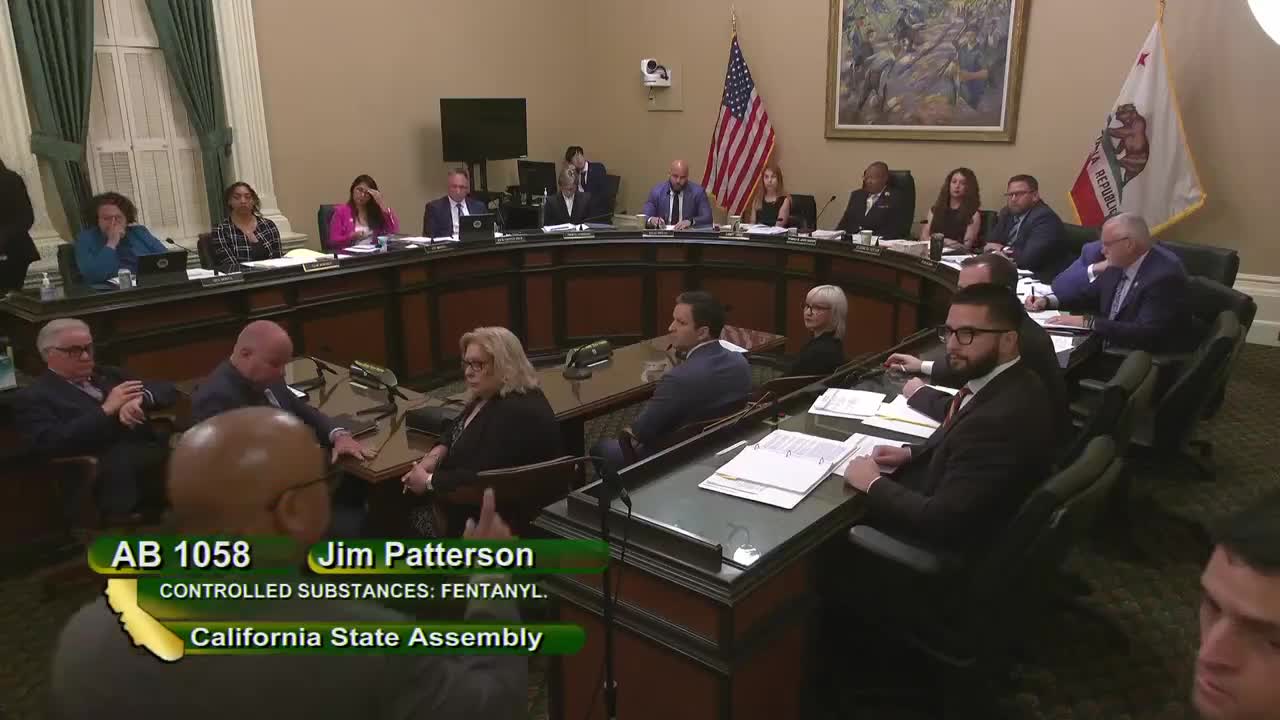 10MIN
Assembly Standing Committee on Public Safety
Bill Author

Bill Co-Author(s):
