AB 512: Mental health and substance use disorders: database of facilities.
- Session Year: 2023-2024
- House: Assembly
- Latest Version Date: 2023-03-20
Current Status:
Failed
(2024-02-01: From committee: Filed with the Chief Clerk pursuant to Joint Rule 56.)
Introduced
In Committee
First Chamber
In Committee
Second Chamber
Enacted
What does this bill do?
The bill requires the California Health and Human Services Agency to create a temporary committee to study building a real-time internet system that shows available beds in inpatient psychiatric hospitals, crisis stabilization units, residential mental health facilities, and residential alcoholism or substance use treatment facilities for use by hospitals, clinics, law enforcement, paramedics, emergency medical technicians (EMTs), and other health providers. The committee must report its findings to the Legislature by July 1, 2025.
The summary is provided by generative AI which can make mistakes. For original language, please view the details in the table below.
Existing law establishes a system of mental health programs, largely administered through the counties, to provide mental health and substance use disorder services in the state. Existing law regulates the facilities that provide these services, including acute psychiatric hospitals, residential substance abuse treatment facilities, and outpatient programs.
This bill would require that, by July 1, 2024, the California Health and Human Services Agency, either on its own or through the Behavioral Health Task Force established by the Governor, to create an ad hoc committee to study how to develop a real-time, internet-based system, usable by hospitals, clinics, law enforcement, paramedics and emergency medical technicians (EMTs), and other health care providers as deemed appropriate, to display information about available beds in inpatient psychiatric facilities, crisis stabilization units, residential community mental health facilities, and residential alcoholism or substance abuse treatment facilities in order to facilitate the identification and designation of available facilities for the transfer to, and temporary treatment of, individuals in mental health or substance use disorder crisis. The ad hoc committee shall submit a report of its findings to the Legislature no later than July 1, 2025.
Existing law establishes a system of mental health programs, largely administered through the counties, to provide mental health and substance use disorder services in the state. Existing law regulates the facilities that provide these services, including acute psychiatric hospitals, residential substance abuse treatment facilities, and outpatient programs.
This bill would require the California Health and Human Services Agency, either on its own or through the Behavioral Health Task Force established by the Governor, to create an ad hoc committee to study how to develop a real-time, internet-based system, usable by hospitals, clinics, law enforcement, paramedics and emergency medical technicians (EMTs), and other health care providers as deemed appropriate, to display information about available beds in inpatient psychiatric facilities, crisis stabilization units, residential community mental health facilities, and residential alcoholism or substance abuse treatment facilities in order to facilitate the identification and designation of available facilities for the transfer to, and temporary treatment of, individuals in mental health or substance use disorder crisis.
The (a)By July 1, 2024, the California Health and Human Services Agency, either on its own or through the Behavioral Health Task Force established by the Governor, shall create an ad hoc committee to study how to develop a real-time, internet-based system, usable by hospitals, clinics, law enforcement, paramedics and emergency medical technicians (EMTs), and other health care providers as deemed appropriate, to display information in real time about available beds in inpatient psychiatric facilities, crisis stabilization units, residential community mental health facilities, and residential alcoholism or substance abuse treatment facilities in order to facilitate the identification and designation of available facilities for the transfer to, and temporary treatment of, individuals in mental health or substance use disorder crisis. The ad hoc committee shall submit a report of its findings to the Legislature no later than July 1, 2025.
(b)A report submitted pursuant to subdivision (a) shall be submitted in compliance with Section 9795 of the Government Code.
(c)Pursuant to Section 10231.5 of the Government Code, this section is repealed on January 1, 2029.
The California Health and Human Services Agency, either on its own or through the Behavioral Health Task Force established by the Governor, shall create an ad hoc committee to study how to develop a real-time, internet-based system, usable by hospitals, clinics, law enforcement, paramedics and emergency medical technicians (EMTs), and other health care providers as deemed appropriate, to display information in real time about available beds in inpatient psychiatric facilities, crisis stabilization units, residential community mental health facilities, and residential alcoholism or substance abuse treatment facilities in order to facilitate the identification and designation of available facilities for the transfer to, and temporary treatment of, individuals in mental health or substance use disorder crisis.
|
Date
|
Status
|
|---|---|
| Feb 1, 2024 | From committee: Filed with the Chief Clerk pursuant to Joint Rule 56. |
| Jan 31, 2024 | Died pursuant to Art. IV, Sec. 10(c) of the Constitution. |
| May 18, 2023 | In committee: Held under submission. |
| Mar 29, 2023 | In committee: Set, first hearing. Referred to APPR. suspense file. |
| Mar 21, 2023 | Re-referred to Com. on APPR. |
| Mar 20, 2023 | Read second time and amended. |
| Mar 16, 2023 | From committee: Amend, and do pass as amended and re-refer to Com. on APPR. with recommendation: To Consent Calendar. (Ayes 13. Noes 0.) (March 14). |
| Feb 17, 2023 | Referred to Com. on HEALTH. |
| Feb 8, 2023 | From printer. May be heard in committee March 10. |
| Feb 7, 2023 | Read first time. To print. |
|
Date
|
Description
|
Location
|
Votes
|
|
|---|---|---|---|---|
| Mar 14, 2023 | Do pass as amended, and be re-referred to the Committee on [Appropriations] with recommendation: To Consent Calendar | Assembly Standing Committee on Health |
Passed |
This list shows positions taken on this bill by organizations on the date displayed, which is linked to the original source.
Positions by individuals are not included.
|
Organization
|
Position
|
Date
|
|---|---|---|
| Angeles emeralds social equity | * Support | Jul 10, 2023 |
| California Cannabis Manufacturers Association | * Support | Jul 10, 2023 |
| California minority alliance | * Support | Jul 10, 2023 |
| California Normal | * Support | Jul 10, 2023 |
| California State Sheriffs Association | ** Support | |
| Cannabis Distribution Association | * Support | Jul 10, 2023 |
| Coachella valley cannabis alliance network | * Support | Jul 10, 2023 |
| Flower Policy Equity United | * Support | Jul 10, 2023 |
| Go Verde Incubator | * Support | Jul 10, 2023 |
| Gorilla RX Wellness | * Support | Jul 10, 2023 |
| Gorilla RX Wellness | * Support | Jul 10, 2023 |
| Jeter | * Support | Jul 10, 2023 |
| Life Developement Group | * Support | Jul 10, 2023 |
| Life Development Group | * Support | Jul 10, 2023 |
| Long Beach Collectives Association | * Support | Jul 10, 2023 |
| Los Angeles Silicon Valley cannabis alliance | * Support | Jul 10, 2023 |
| Montebello Cannabinoid Business Association | * Support | Jul 10, 2023 |
| Nabbis Distribution | * Support | Jul 10, 2023 |
| Origins Council | * Support | Jul 10, 2023 |
| Public Health Institute | * Against | Jul 10, 2023 |
| San Francisco Cannabis Retailers alliance | * Support | Jul 10, 2023 |
| United Cannabis Business Alliance | * Support | Jul 10, 2023 |
| United Cannabis Business Association | * Support | Jul 10, 2023 |
| Weed Maps | * Support | Jul 10, 2023 |
| Youth Forward | * Against | Jul 10, 2023 |
Date of Hearing: March 29, 2023
ASSEMBLY COMMITTEE ON APPROPRIATIONS
Chris Holden, Chair
ABPCA Bill Id:AB 512
Author:(Waldron) – As Amended Ver:March 20, 2023
Policy Committee: | Health | Vote: | 13 - 0 |
|
| ||
|
|
Urgency: No State Mandated Local Program: No Reimbursable: No
SUMMARY:
This bill requires the California Health and Human Services Agency (CHHSA), either on its own or through the Behavioral Health Task Force, to create an ad hoc committee (committee) to study how to develop a real-time, internet-based database to display information about available treatment beds in facilities for the treatment of individuals in mental health or substance use disorder crisis. This bill also requires the committee to submit a report of its findings to the Legislature.
FISCAL EFFECT:
CHHSA reports unknown, significant limited-term costs, likely $1 million (General Fund (GF)) to establish the ad-hoc committee and fund its operational costs.
CHHSA projects additional unknown, significant ongoing cost pressures of $5 million to $10 million (GF) for vendor costs to establish the internet database recommended by the committee, specifically: to compile the report findings and provide oversight of a report contractor (hundreds of thousands of dollars, GF) and for vendor costs to implement a real-time, internet-based bed database ($5 million to $10 million, GF).
COMMENTS:
- Purpose. According to the author:
When a mental health crisis occurs and care is needed immediately, psychiatric beds are essential infrastructure for meeting the needs of individuals with serious mental health conditions. Psychiatric beds serve several purposes, most importantly allowing for a safe and stable environment for persons having an acute mental health crisis, but also for those who are significantly impaired and require ongoing medical monitoring. The problem is that California has a well-documented shortage of vacant psychiatric beds. AB 512 would help clarify where these beds are available in real-time.
- Shortage of Psychiatric Hospital Beds. The California HealthCare Foundation, reported in 2022 that the number of psychiatric beds per 100,000 population decreased 31% from 1998 through 2017 as 35 facilities either closed or eliminated their psychiatric units. These facilities have not been replaced despite the growing prevalence of mental illness. Additionally, there was significant geographic variation in the availability of beds for psychiatric inpatient care. Twenty-five counties had no adult acute psychiatric beds, and 43 counties had no acute psychiatric beds for children.
An independent panel of 15 psychiatrists concluded that 50 public psychiatric beds per 100,000 individuals is the minimum required to meet current needs. In 1995, California fell short of this target by nearly 1,400 beds. In 2016, that gap increased by nearly 4,000 beds, with the state having only 17.05 psychiatric inpatient beds for every 100,000 residents.
- Inpatient Bed Tracking. According to a 2019 report published by the U.S. Department of Health and Human Services, states have begun to collect and post information on bed availability as a tool for providers, patients, and caregivers to identify open beds more efficiently. In the absence of a bed registry, emergency room staff, other providers, or patients must call multiple hospitals or residential settings to locate a treatment bed that is appropriate for the patient’s needs. Authors of an evaluation of inpatient bed tracking systems found significant variation in how state registries were operating, the types of behavioral health providers included, and perceptions of their usefulness. In some states, systems to track the availability of psychiatric hospital beds have been challenged by the reluctance of hospitals to update information frequently enough to be useful, given rapid patient turnover. Emergency department staff noted that the system does not obviate the need for them to call hospitals to confirm that there is still an appropriate open bed and that relationships among hospitals and emergency departments and other crisis system staff may be more efficient than using the bed registries. However, some states reported that the registries were very helpful in locating open beds.
- National Association of State Mental Health Program Directors (NASMHPD) Brief. A 2018 NASMHPD brief reported that sixteen states had bed registries and eight more states were in the process of planning or developing bed registries. In just over half the states with bed registries, participation in the registry was voluntary. According to the brief, many states built their system for under $100,000 and are able to maintain their system for under $100,000 a year. The brief identified costs to facilities to keep records in the registry updated. Facility staff are willing to support that cost if they believe that participating in the registry is to their benefit. Of the states with registries, 11 had registries that were updated several times a day to daily – not in real-time. Very few states reported having registries that were updated 24/7 with real-time information.
- Data Exchange. With AB 133 (Committee on Budget), Chapter 143, Statutes of 2022, the Legislature committed to the establishment of a California Health and Human Services Data Exchange Framework that includes a single data sharing agreement and a common set of policies and procedures that will leverage and advance national standards for information exchange and data content, and will also govern and require the exchange of health information among health care entities and government agencies in California.
AB 1331 (Wood) of 2023 establishes the Data Exchange Framework governing board. The potential sharing of health care information could, as part of the HIE design, incorporate a standalone component that would encompass a repository of available beds in all participating entities. AB 1331 is pending in Assembly Health Committee.
Analysis Prepared by: Allegra Kim / APPR. / (916) 319-2081
Date of Hearing: March 14, 2023
ASSEMBLY COMMITTEE ON HEALTH
Jim Wood, Chair
ABPCA Bill Id:AB 512
Author:(Waldron) – As Introduced Ver:February 7, 2023
SUBJECT: Mental health and substance use disorders: database of facilities.
SUMMARY: Requires the California Health and Human Services Agency, either on its own or through the Behavioral Health Task Force established by the Governor, to create an ad hoc committee (the committee) to study how to develop a real-time, Internet-based database to display information about available treatment beds in specified facilities.
EXISTING LAW:
- Requires the California Department of Public Health (DPH) to license and regulate hospitals, including a general acute care hospital and an acute psychiatric hospital. [Health and Safety Code (HSC) §1250, et seq.]
- Requires the Department of Health Care Services (DHCS) to license and regulate residential alcoholism or drug abuse recovery or treatment facilities. [HSC §11834.02, et seq.]
- Requires DHCS and counties to provide specialty mental health services for Medi-Cal beneficiaries through a county mental health plan, as specified, which may include crisis stabilization services and inpatient psychiatric care. [Welfare and Institutions Code (WIC) §14705 and §14712]
- Requires the Department of Social Services to license community care facilities, including any facility, place, or building that is maintained and operated to provide nonmedical residential care, day treatment, adult day care, or foster family agency services for children, adults, or children and adults, including, but not limited to, the physically handicapped, mentally impaired, incompetent persons, and abused or neglected children, and may include crisis residential services. [HSC §1501, et seq.]
- Establishes psychiatric health facilities (PHFs), licensed by DHCS, which provide 24-hour inpatient care for people with mental health disorders that includes, but is not limited to, the following basic services: psychiatry; clinical psychology; psychiatric nursing; social work; rehabilitation drug administration; and, appropriate food services for those persons whose physical health needs can be met in an affiliated hospital or in outpatient settings. [HSC §1250.2 and WIC §4080]
- Establishes the Lanterman-Petris-Short Act, which authorizes a person to be involuntarily detained for a period of up to 72 hours for assessment, evaluation, and crisis intervention (known as a “5150” hold), when as a result of a mental disorder the person is a danger to self or others, or is “gravely disabled.” Defines “gravely disabled” as a condition in which a person, as a result of a mental disorder, is unable to provide for his or her basic personal needs for food, clothing, or shelter. [WIC §5008 and 5150]
- Requires facilities, for the purposes of detaining a person for up to 72-hour treatment and evaluation, to be designated by a county and approved by DHCS, which may be a licensed psychiatric hospital, a licensed PHF, and a certified crisis stabilization unit. [WIC §5008]
FISCAL EFFECT: Unknown. This bill has not yet been analyzed by a fiscal committee.
COMMENTS:
- PURPOSE OF THIS BILL. According to the author, when a mental health crisis occurs and care is needed immediately, psychiatric beds are essential infrastructure for meeting the needs of individuals with serious mental health conditions. Psychiatric beds serve several purposes, most importantly allowing for a safe and stable environment for persons having an acute mental health crisis, but also for those who are significantly impaired and require ongoing medical monitoring. This bill could help the homeless community, as they are often the ones suffering from mental health crises. Further, mental crises are not specific to any gender, ethnicity, or socio-economic class. By having these vulnerable communities able to go to facilities with open beds, their mental health needs can be better served. The problem, the author concludes, is that California has a well-documented shortage of vacant psychiatric beds. This bill would help clarify where these beds are available in real-time.
- BACKGROUND.
- Treatment beds in California. The California HealthCare Foundation, in a 2022 publication entitled, “Mental Health in California: Waiting for Care” reported that the number of psychiatric beds per 100,000 population decreased 31% from 1998 through 2017 as 35 facilities either closed or eliminated their psychiatric units. These facilities have not been replaced despite the growing prevalence of mental illness. Additionally, there was significant geographic variation in the availability of beds for psychiatric inpatient care. Twenty-five counties had no adult acute psychiatric beds, and 43 counties had no acute psychiatric beds for children.
According to a 2021 RAND report, California requires 50.5 inpatient psychiatric beds per 100,000 adults: 26.0 per 100,000 at the acute level and 24.6 per 100,000 at the subacute level, or 7,945 and 7,518 total beds, respectively. At the community residential level, the estimated need is 22.3 beds per 100,000 adults. RAND estimated that California has a total of 5,975 beds at the acute level (19.5 per 100,000 adults) and 4,724 at the subacute level (15.4 per 100,000 adults), excluding state hospital beds. If state hospital beds are included, these figures increase to 7,679 (25.1 per 100,000 adults) and 9,168 beds (29.9 per 100,000 adults), respectively. RAND also observed large regional variation. For example, excluding state hospitals, acute bed capacity ranged from 9.1 beds per 100,000 adults in the Northern San Joaquin Valley to 27.9 beds per 100,000 adults in the Superior region. For subacute bed capacity, regional estimates ranged from 7.4 to 31.8 beds per 100,000 adults. At the community residential level, RAND estimated that California has 3,872 beds (12.7 per 100,000 adults). California has a shortfall of approximately 1,971 beds at the acute level (6.4 additional beds required per 100,000 adults) and a shortage of 2,796 beds at the subacute level (9.1 additional beds required per 100,000 adults), or 4,767 subacute and acute beds combined, excluding state hospital beds.
- In-Patient Bed Tracking: State Responses to Need for Inpatient Care. According to a 2019 report published by the U. S. Department of Health and Human Service’s, Office of the Assistant Secretary for Planning and Evaluation (ASPE) entitled “In-Patient Bed Tracking: State Responses to Need for Inpatient Care,” states have begun to collect and post information on bed availability (i.e., create bed registries or bed tracking systems) as a tool for providers, patients, and caregivers to identify open beds more efficiently. In the absence of a bed registry, emergency room staff, patients, or other providers must call multiple hospitals or residential settings to determine if there is a slot available that would be appropriate given the patient’s needs. Little was known about state bed registries, their effectiveness, and challenges faced in their execution and utilization. As such, ASPE contracted with RTI International (an independent, nonprofit research institute dedicated to improving the human condition) to study whether states were making information on open beds available to consumers, the impact that inpatient bed tracking had on patient access, and the challenges that remain with inpatient bed tracking systems. To collect this information, RTI conducted an environmental scan including 13 interviews with 18 stakeholders in five states. Through the environmental scan and discussions with stakeholders, the authors found significant variation among states in how the registries were operating, the types of behavioral health providers they included, and perceptions of their usefulness.
In some states, systems to track the availability of psychiatric hospital beds have been challenged by the reluctance of hospitals to update information on open beds frequently enough to be useful given rapid patient turnover. Emergency department (ED) staff noted that the system does not negate the need for them to call hospitals to confirm there is still an open bed that is appropriate for the patient’s needs. EDs reported that building relationships among hospitals and EDs and other crisis system staff may be more efficient than using bed registries. Some states did report that the registries were very helpful in locating open beds as well as in documenting the need for additional psychiatric beds. According to the ASPE report, there have been no formal evaluations of the effect of bed registries on access to care. Future research could help improve understanding of the characteristics and processes that make the bed registries most useful. Some avenues to explore include: how financial, regulatory, contractual, and policy levers can be used to encourage participation in bed registry systems; how many consumers are using the public registries and how to increase their usage; whether technology can substitute for human data entry to track available treatment beds; and, whether registries reduce the time and effort required to locate an appropriate inpatient or residential bed.
- Behavioral Health Continuum Infrastructure Program (BHCIP). DHCS was authorized through legislation in 2021, to establish the BHCIP with $2.2 billion allocated to construct, acquire, and rehabilitate real estate assets or to invest in needed mobile crisis infrastructure to expand the community continuum of behavioral health treatment resources. The program provides grants through six competitive grant rounds. To date, four of the six anticipated rounds of BHCIP funding have been awarded as follows:
- $45 million for mobile crisis infrastructure;
- $16 million for county and tribal planning grants;
- $519 million for “launch ready” projects; and,
- $481 million for projects targeted at children and youth.
- Behavioral Health Continuum Infrastructure Program (BHCIP). DHCS was authorized through legislation in 2021, to establish the BHCIP with $2.2 billion allocated to construct, acquire, and rehabilitate real estate assets or to invest in needed mobile crisis infrastructure to expand the community continuum of behavioral health treatment resources. The program provides grants through six competitive grant rounds. To date, four of the six anticipated rounds of BHCIP funding have been awarded as follows:
Round five, a general-purpose round totaling $480 million, is currently underway. Round six, totaling another $481 million is intended to address remaining needs based on an assessment conducted by DHCS. Because of the current budget deficit projections, the Governor’s 2023-24 budget has proposed delaying the sixth round of grants with half of the delayed funds to be provided in 2024-25 and the remaining amount provided in 2025-26.
At a recent joint hearing of the Assembly Health Committee and the Assembly Budget Subcommittee 1 on February 28, 2023, on the “Status of Mental Health Initiatives in California,” DHCS representatives advised that the BHCIP is anticipated to result in the creation or renovation of 88 out-patient facilities with capacity to serve over 200,000 individuals and 65 residential facilities with an increase in bed capacity of 1,176 treatment beds.
- SUPPORT. The California State Sheriff’s Association (CSSA) in a support position states that law enforcement officers often encounter persons in the community who present a danger to themselves or others because of mental health disorders. Unfortunately, appropriate bed space for such persons is not always readily available and finding that bed space can be difficult. This bill will help address this problem by setting the stage for the development of an internet database that will streamline the identification of health facilities that have beds available for temporary placement and treatment. The CSSA concludes by stating that mental health patients will be more likely to be placed in an appropriate environment, while law enforcement and medical professionals will not have to take unnecessary steps to search for available beds.
- RELATED LEGISLATION. SB 363 (Eggman) requires DPH, by January 1, 2025, to develop a real-time, internet-based database to collect, aggregate, and display information about available beds in designated facilities to identify the availability of inpatient and residential mental health or substance use disorder treatment. SB 363 is set to be heard in the Senate Health Committee on March 22, 2023.
- PREVIOUS LEGISLATION.
- AB 2768 (Waldron) of 2022 was identical to this bill. AB 2768 was held on the Senate Appropriations Committee suspense file.
- SB 929 (Eggman), Chapter 539, Statutes of 2022, expanded DHCS’s responsibility in current law to collect and publish information about involuntary detentions to include additional information, such as clinical outcomes, services provided, demographic data of those receiving care, and an assessment of all contracted beds.
- AB 1154 (Eggman) of 2022, AB 682 (Eggman) of 2019, AB 1136 (Eggman) of 2018, and AB 2743 (Eggman) of 2016 were substantially similar to SB 363. SB 1154 was held on the Assembly Appropriations Committee suspense file. AB 682 was held on the Assembly Appropriations Committee suspense file. AB 1136 was held on the Senate Appropriations Committee suspense file. AB 2743 was held on the Assembly Appropriations Committee suspense file.
- POLICY COMMENTS. AB 1131 (Wood) of 2021 would have established a statewide health information network governing board, an independent public entity not affiliated with an agency or department to provide the data infrastructure needed to meet California’s health care access, equity, affordability, public health, and quality goals. AB 1131 was held in the Assembly Suspense Committee. However, with the passage of AB 133 (Budget Committee), Chapter 143, Statutes of 2022, the Legislature committed to the establishment of a California Health and Human Services Data Exchange Framework that includes a single data sharing agreement and a common set of policies and procedures that will leverage and advance national standards for information exchange and data content, and that will also govern and require the exchange of health information among health care entities and government agencies in California. To further the state’s goal of a Health Information Exchange (HIE) AB 1331 (Wood) of 2023 would establish the Data Exchange Framework governing board and require the board to approve any modifications to that data sharing agreement and its policies and procedures and requires the governing board to consist of five members, appoints as specified. The potential for the sharing of health care information could, as part of the HIE design, incorporate a standalone component that would encompass a repository of available beds in all participating entities (hospital, acute psychiatric hospitals, etc.).
- PROPOSED AMENDMENTS. As currently drafted, this bill does not contain either a convening date or a reporting timeline. The Committee may wish to amend the bill to set some timelines for the convening of the committee and a date for submission of a report to the Legislature. The bill is proposed to be amended as follows:
Section 5760 is added to the Welfare and Institutions Code, to read:
a) By July 1, 2024, the California Health and Human Services Agency, either on its own or through the Behavioral Health Task Force established by the Governor, shall create an ad hoc committee to study how to develop a real-time, internet-based system, usable by hospitals, clinics, law enforcement, paramedics and emergency medical technicians (EMTs), and other health care providers as deemed appropriate, to display information in real time about available beds in inpatient psychiatric facilities, crisis stabilization units, residential community mental health facilities, and residential alcoholism or substance abuse treatment facilities in order to facilitate the identification and designation of available facilities for the transfer to, and temporary treatment of, individuals in mental health or substance use disorder crisis. The ad hoc committee shall submit a report of its findings to the Legislature no later than July 1, 2025.
(b) A report submitted pursuant to subdivision (a) shall be submitted in compliance with Section 9795 of the Government Code.
(c) Pursuant to Section 102351.5 of the Government Code, this section is repealed on January 1, 2029.
REGISTERED SUPPORT / OPPOSITION:
Support
California State Sheriff’s Association
Opposition
None on file.
Analysis Prepared by: Judith Babcock / HEALTH / (916) 319-2097
Discussed in Hearing
 19MIN
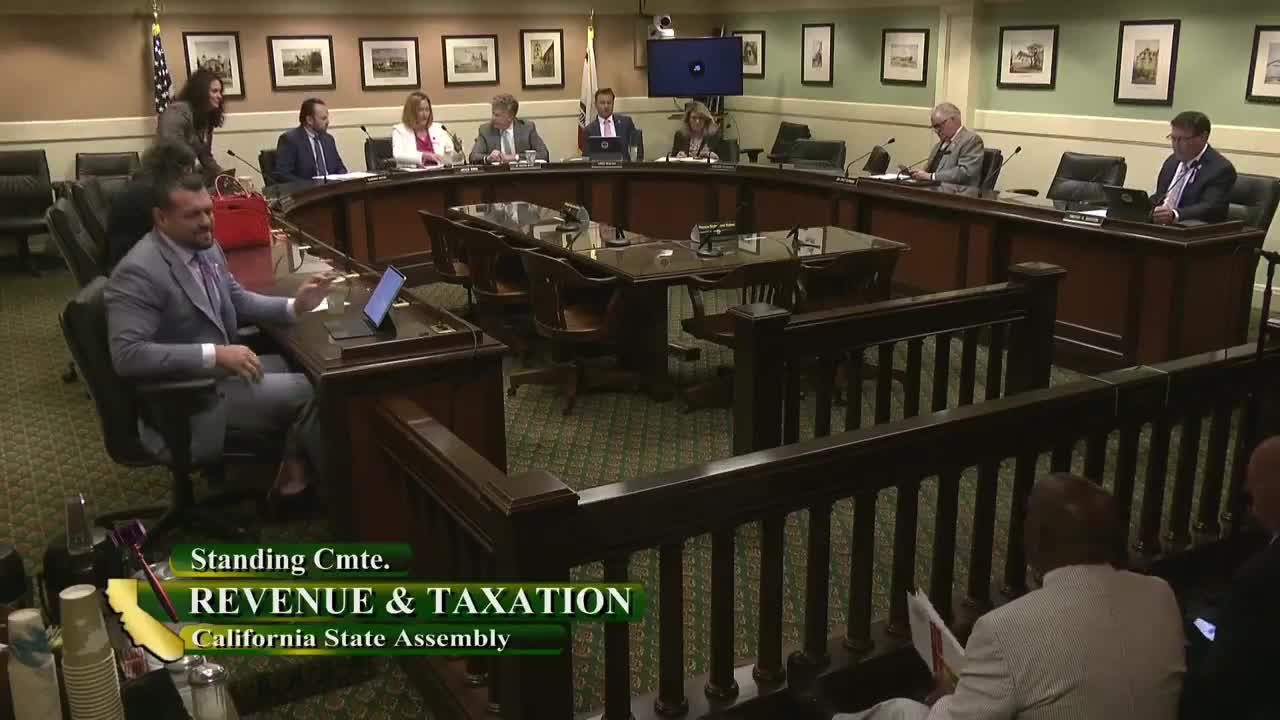
Assembly Standing Committee on Revenue and Taxation
Bill Author

Bill Co-Author(s):