AB 640: Pupil work permits.
- Session Year: 2023-2024
- House: Assembly
- Latest Version Date: 2023-03-28
Current Status:
Failed
(2024-02-01: From committee: Filed with the Chief Clerk pursuant to Joint Rule 56.)
Introduced
In Committee
First Chamber
In Committee
Second Chamber
Enacted
Existing law authorizes specific school administrators to issue a work permit to pupils subject to specific requirements, including requiring certain information to be included on a notification of intent to employ a minor, provided to the administrator by an employer.
This bill would specifically authorize an employer to employ a minor subject to the above-described provisions to work partially or exclusively online. The bill would require the State Department of Education to prepare an informed consent form, signed by the parent or guardian of the minor, identifying the potential dangers to the minor of online work for any minor who will be performing work partially or exclusively online. The bill would require, as part of the above-described notification, the above-described signed informed consent form and information about whether the work will be performed online or at a jobsite. The bill would authorize an employer of a minor that is intending to employ the minor to work exclusively online to provide the current Uniform Resource Locator (URL) for the employers internet website as an address for purposes of the above-described notification.
Existing law authorizes specific school administrators to issue a work permit to pupils subject to specific requirements, including requiring certain information to be included on a notification of intent to employ a minor, provided to the administrator by an employer.
This bill would authorize an employer of a minor that is intending to employ the minor to work exclusively online to provide the current Uniform Resource Locator (URL) for the employers internet website as an address for purposes of the above-described notification.
No A person, firm firm, or corporation shall not employ, suffer, or permit any a minor under the age of 18 years of age subject to the requirements and conditions of this chapter to work in in, or in connection with with, any establishment or occupation except as provided in Section 49151 occupation, including work to be performed partially or exclusively online, without a work permit to employ, issued by the proper educational officers in accordance with law.
SECTION 1.SEC. 2.Section 49163 of the Education Code is amended to read:49163.The notification of intent to employ a minor shall contain:
(a)The name, address, phone number, and social security number of the minor.
(b)(1)The name, address, phone number, and supervisor at the minors place of employment. An employer of a minor that is intending to employ the minor to work exclusively online may provide the current Uniform Resource Locator (URL) for the employers internet website as an address.
(2)An informed consent form signed by the parent or guardian attesting that the parent or guardian understands the potential dangers of online work to the minor.
(c)The kind of work the minor will perform. perform, including, but not limited to, whether the work will be performed online or at a jobsite.
(d)The maximum number of hours per day and per week the student will be expected to work for the employer.
(e)The signatures of the parent or guardian, of the minor, and of the employer.
SEC. 3.Section 49163.1 is added to the Education Code, to read:49163.1.The department, in consultation with the office of the Labor Commissioner in the Department of Industrial Relations, shall prepare the content for the consent form described in subdivision (b) of Section 49163.
The notification of intent to employ a minor shall contain:
(a)The name, address, phone number, and social security number of the minor.
(b)The name, address, phone number, and supervisor at the minors place of employment. An employer of a minor that is intending to employ the minor to work exclusively online may provide the current Uniform Resource Locator (URL) for the employers internet website as an address.
(c)The kind of work the minor will perform.
(d)The maximum number of hours per day and per week the student will be expected to work for the employer.
(e)The signatures of the parent or guardian, of the minor, and of the employer.
|
Date
|
Status
|
|---|---|
| Feb 1, 2024 | From committee: Filed with the Chief Clerk pursuant to Joint Rule 56. |
| Jan 31, 2024 | Died pursuant to Art. IV, Sec. 10(c) of the Constitution. |
| Mar 29, 2023 | Re-referred to Com. on L. & E. |
| Mar 28, 2023 | Read second time and amended. |
| Mar 27, 2023 | From committee: Amend, and do pass as amended and re-refer to Com. on L. & E. (Ayes 7. Noes 0.) (March 22). |
| Feb 23, 2023 | Referred to Coms. on ED. and L. & E. |
| Feb 10, 2023 | From printer. May be heard in committee March 12. |
| Feb 9, 2023 | Read first time. To print. |
|
Date
|
Description
|
Location
|
Votes
|
|
|---|---|---|---|---|
| Mar 22, 2023 | Do pass as amended and be re-referred to the Committee on [Labor and Employment] | Assembly Standing Committee on Education |
Passed |
This list shows positions taken on this bill by organizations on the date displayed, which is linked to the original source.
Positions by individuals are not included.
|
Organization
|
Position
|
Date
|
|---|---|---|
| California Association of Student Councils | ** Support | |
| California High School Democrats | ** Support | |
| Fremont Unified School District | * Support | Mar 22, 2023 |
| GENup | ** Support |
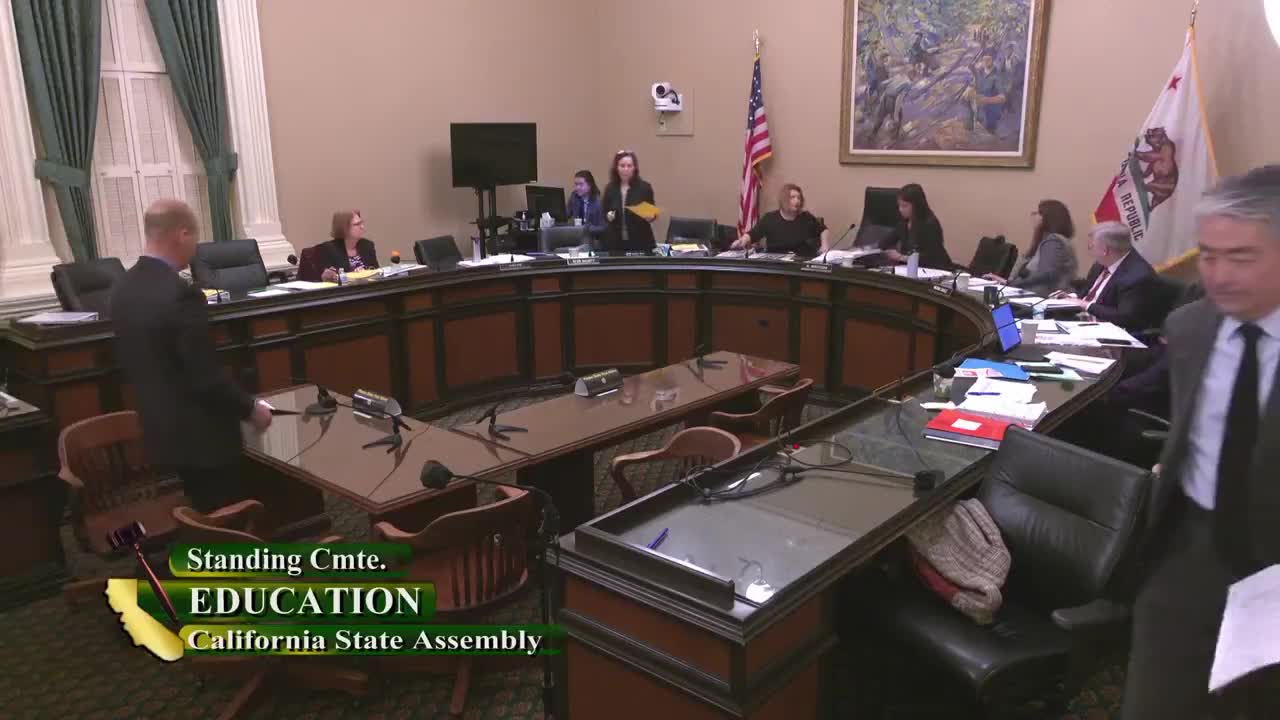
Date of Hearing: March 22, 2023
ASSEMBLY COMMITTEE ON EDUCATION
Al Muratsuchi, Chair
ABPCA Bill Id:AB 640 (
Author:Lee) – As Introduced Ver:February 9, 2023
[Note: This bill is double referred to the Assembly Labor and Employment Committee and will be heard by that Committee as it relates to issues under its jurisdiction.]
SUBJECT: Pupil work permits
SUMMARY: Authorizes an employer intending to employ a minor to work exclusively online to provide the Uniform Resource Locator (URL) for the employer’s website as an address in the notification to a school administrator of the intent to employ the minor. Specifically, this bill:
- Authorizes an employer intending to employ a minor to work exclusively online to provide the URL for the employer’s website as an address in the notification to a school administrator of the intent to employ the minor.
EXISTING LAW:
- Prohibits any person, firm or corporation from employing any minor under the age of 18 years to work in or in connection with any establishment or occupation without a permit to employ, issued by the proper educational officers, and in accordance with law. (EC 49160)
- Requires the notification of the intent to employ a minor to contain:
- The name, address, phone number, and social security number of the minor;
- The name, address, phone number, and supervisor at the minor’s place of employment;
- The kind of work the minor will perform;
- The maximum number of hours per day and per week the student will be expected to work for the employer; and
- The signatures of the parent or guardian, of the minor, and of the employer. (EC 49163)
- Provides that specified school district, charter school, and private school officials may issue a minor a work permit if requested by the minor’s parent, guardian, foster parent, or caregiver. Any principal issuing a work permit must provide a self-certification that he or she understands the requirements in existing law for issuing a work permit and submit a copy of each work permit he or she issues along with a copy of the application for each work permit to the superintendent of the school district in which the school is located. (Education Code (EC) 49110)
- Specifies that a permit to work may be issued to any minor over the age of 12 years and under the age of 18 years to be employed on a school holiday or during the regular vacation of the school. (EC 49111)
- Authorizes the provision of a work permit to a minor who has completed the equivalent of the 7th grade to work outside of school hours for not more than three hours per day on days when school is in session if the minor is 14 or 15 years of age; four hours per day if the minor is 16 or 17 years of age; or for a minor who is 16 years or older, up to eight hours in any day which is immediately prior to a non-school day. (EC 49112)
- Authorizes the attendance supervisor of any school district in which a place of employment is situated, or the probation officer of the county, to at any time enter into the place of employment for the purpose of examining permits to work for minors employed, for the purpose of investigating violations of the Labor Code or the Education Code provisions. (EC 48246)
- Prohibits any employer employing a minor 16 or 17 years of age for more than 8 hours in one day or more than 48 hours in one week. (Labor Code 1391)
- Provides that any person employing either directly or indirectly through third persons, or who employs, or permits any minor to be employed in violation of the law, is guilty of a misdemeanor, and subject to a fine of $1,000 to $5,000 or imprisonment in the county jail for not more than six months, or both. (Labor Code 1303)
- Requires employers who are employing minors directly or indirectly through third persons to maintain files of all work and employment permits and certificates issued, and to make this available at all times to inspection by school attendance and probation officers, the State Board of Education, and officers of the Division of Labor Standards Enforcement. (Labor Code 1299).
FISCAL EFFECT: The Office of Legislative Counsel has keyed this bill as non-fiscal.
COMMENTS:
Need for the bill. According to the author, “The law governing our work permit system for minors was enacted in 1976 and only allows minors to work in a physical location of business. The code has not been updated since enactment, and in an effort to modernize and create more equitable career opportunities, AB 640 will provide students the ability to also work for online businesses, which better reflects our evolving workplace and economy.”
Purpose of current work permit system. According to the CDE, minors employed in the state of California must have a Permit to Employ and Work (commonly referred to as a “work permit”). Work permits are typically issued by the school where the student is enrolled. Work permits indicate the duties and location where the work will be done as well as the number of hours a minor may work. In most cases it is a two-step process, the minor along with the parent/guardian and employer fill out the form and submit to the school local to the minor's address. The school district reviews the B1-1 form and issues the work permit.
The current system has protective laws in place that regulate the times at which the minor may work (not too early and not late at night nor overnight) and the duration of the employment (not too many hours). All of these laws are in place to prevent exploitation of minors and ensure the minor is able to attend school and to graduate.
The minor’s work assignment is subject to monitoring by both school attendance, probation, and labor/safety officials to protect the health and safety of the minor and to ensure the employer is complying with all relevant labor laws. Inspectors visit a given address and match each minor on the property to a work permit that is to be made available for inspection at that physical location. This bill would remove the requirement that a work permit be linked to a physical address, therefore limiting the ability of officials to monitor the minor’s working conditions, content, and hours.
The changing world of work. The author also notes, “The increasing popularity of telework as an alternative to working fully in-person has led to a growing online economy. Many online start-ups and small businesses have transitioned to providing services and selling products online to cut costs associated with renting an office space. The growth of telework holds the potential in providing more opportunities for student employees, due to an evolving workplace that is moving away from a traditional in-person business. Given that telework is an increasing part of our economy and workplaces, there is no reason to exclude minors who can legally work from being a part of this workforce. We must update our statutes to reflect this changing economy.”
The Society for Industrial and Applied Mathematics (SIAM) polled 1,000 16- to 18-year-old students in the United States and the United Kingdom in early 2022 asking about how remote learning during the pandemic has affected their plans for after high school. Those polled were participants in an annual online intensive math competition. Findings of the survey included the following:
- 58%, said they foresee their future careers will involve hybrid work — a combination of remote and in-person;
- 59% of students responding said they are concerned about the mental health impacts of an increasingly remote workforce;
- 40% said they are concerned that working at home could result in working more hours online on job tasks;
- 26% expressed concern that working at home would make it more difficult to benefit from a mentor and to get promoted; and
- 21% said they are concerned that an increase in remote careers — with no requirements for employees to be located near the employer — would make the job market more competitive.
Potential for jeopardizing of the health and safety of a minor working online. The California work permit system and its oversight functions do not currently allow for the possibility of online work where a minor would be working at home in a separate location from that of the employer, due at least partially to the possibility of child worker exploitation.
One of the functions of the current work permit system is to regulate the number of hours that a minor is working to ensure they are not working so many hours as to put their school attendance and performance at risk. The nature of online work being conducted in a private home allows for work to be performed at all hours of the day and night. This could be of concern if the minor is working an excessive number of hours and therefore putting their schooling at risk. Minors are likely to be more reluctant to speak up about wage theft and excessive hours.
Current law regulates the content of the work performed by the minor where equipment and job duties not appropriate for minors are prohibited. Online work may involve inappropriate content. With a lack of oversight, the content the minors are working with cannot be monitored for age- appropriate access and could turn out to be psychologically damaging if the minor is accessing age-inappropriate content.
Arguments in support. The California Association of Student Councils state, “Currently, California statute only authorizes work permits for minors to a physical brick-and-mortar place of business. This law was enacted in 1976 and has not been updated since. Many online businesses lack a physical address to comply with California’s statute for work permits, resulting in fewer opportunities for minors who wish to build their careers. During the start of the COVID-19 pandemic, working from home was a relatively new experience. In today’s economy, it is estimated that roughly 60% of workers have jobs that can be done remotely.
The increasing popularity of telework as an alternative to working fully in-person has led to a growing online economy. The growth of telework may limit opportunities for students who wish to attain a work permit, due to an evolving workspace that is moving away from the traditional physical place of business. Current statute has not been updated to reflect this changing economy. This bill will modernize California statute by expanding work permits to online employers in order to provide students with additional opportunities to gain work experience and further develop their careers.”
Recommended Committee Amendments. Staff recommends that the bill be amended as follows:
- Require that a school issuing a permit for online work to be conducted without a physical location, collect an informed consent form signed by the parent or guardian of the minor, before issuing the work permit.
- Require the CDE, in cooperation with the appropriate labor agencies, to prepare the content for the informed consent form to be completed by the parent or guardian identifying the potential dangers to the minor of online work.
Related legislation. AB 800 of the 2023-24 Session would designate “Workplace Readiness Week” in May and require all public schools to annually observe that week by educating all 11th and 12th grade students about their rights as workers; and require that schools provide students seeking a work permit a document that clearly explains basic labor rights extended to workers.
SB 1428 (McGuire) Chapter 420, Statutes of 2018, prohibits a school from denying a work permit for a minor on the basis of the pupil's grades, grade point average, or school attendance, if the permit would allow the pupil to participate in a government-administered employment and training program that will occur during the regular summer vacation of the school that the pupil attends.
SB 702 (McGuire) Chapter 775, Statutes of 2016, extends a Lake County-specific exemption of child labor law that allows minors to work during the peak agricultural season when school is not in session.
REGISTERED SUPPORT / OPPOSITION:
Support
California Association of Student Councils
California High School Democrats
GENup
Opposition
None on file
Analysis Prepared by: Debbie Look / ED. / (916) 319-2087
Bill Author

Bill Co-Author(s):